US8865409B2 - Assay methods for MDV-1 - Google Patents
Assay methods for MDV-1 Download PDFInfo
- Publication number
- US8865409B2 US8865409B2 US13/391,563 US201013391563A US8865409B2 US 8865409 B2 US8865409 B2 US 8865409B2 US 201013391563 A US201013391563 A US 201013391563A US 8865409 B2 US8865409 B2 US 8865409B2
- Authority
- US
- United States
- Prior art keywords
- mdv
- virulent
- vaccine
- strain
- nucleic acid
- Prior art date
- Legal status (The legal status is an assumption and is not a legal conclusion. Google has not performed a legal analysis and makes no representation as to the accuracy of the status listed.)
- Active
Links
Images




Classifications
-
- C—CHEMISTRY; METALLURGY
- C12—BIOCHEMISTRY; BEER; SPIRITS; WINE; VINEGAR; MICROBIOLOGY; ENZYMOLOGY; MUTATION OR GENETIC ENGINEERING
- C12Q—MEASURING OR TESTING PROCESSES INVOLVING ENZYMES, NUCLEIC ACIDS OR MICROORGANISMS; COMPOSITIONS OR TEST PAPERS THEREFOR; PROCESSES OF PREPARING SUCH COMPOSITIONS; CONDITION-RESPONSIVE CONTROL IN MICROBIOLOGICAL OR ENZYMOLOGICAL PROCESSES
- C12Q1/00—Measuring or testing processes involving enzymes, nucleic acids or microorganisms; Compositions therefor; Processes of preparing such compositions
- C12Q1/70—Measuring or testing processes involving enzymes, nucleic acids or microorganisms; Compositions therefor; Processes of preparing such compositions involving virus or bacteriophage
- C12Q1/701—Specific hybridization probes
- C12Q1/705—Specific hybridization probes for herpetoviridae, e.g. herpes simplex, varicella zoster
-
- A—HUMAN NECESSITIES
- A61—MEDICAL OR VETERINARY SCIENCE; HYGIENE
- A61P—SPECIFIC THERAPEUTIC ACTIVITY OF CHEMICAL COMPOUNDS OR MEDICINAL PREPARATIONS
- A61P31/00—Antiinfectives, i.e. antibiotics, antiseptics, chemotherapeutics
-
- A—HUMAN NECESSITIES
- A61—MEDICAL OR VETERINARY SCIENCE; HYGIENE
- A61P—SPECIFIC THERAPEUTIC ACTIVITY OF CHEMICAL COMPOUNDS OR MEDICINAL PREPARATIONS
- A61P31/00—Antiinfectives, i.e. antibiotics, antiseptics, chemotherapeutics
- A61P31/12—Antivirals
- A61P31/20—Antivirals for DNA viruses
- A61P31/22—Antivirals for DNA viruses for herpes viruses
-
- A—HUMAN NECESSITIES
- A61—MEDICAL OR VETERINARY SCIENCE; HYGIENE
- A61P—SPECIFIC THERAPEUTIC ACTIVITY OF CHEMICAL COMPOUNDS OR MEDICINAL PREPARATIONS
- A61P37/00—Drugs for immunological or allergic disorders
- A61P37/02—Immunomodulators
- A61P37/04—Immunostimulants
-
- C—CHEMISTRY; METALLURGY
- C12—BIOCHEMISTRY; BEER; SPIRITS; WINE; VINEGAR; MICROBIOLOGY; ENZYMOLOGY; MUTATION OR GENETIC ENGINEERING
- C12Q—MEASURING OR TESTING PROCESSES INVOLVING ENZYMES, NUCLEIC ACIDS OR MICROORGANISMS; COMPOSITIONS OR TEST PAPERS THEREFOR; PROCESSES OF PREPARING SUCH COMPOSITIONS; CONDITION-RESPONSIVE CONTROL IN MICROBIOLOGICAL OR ENZYMOLOGICAL PROCESSES
- C12Q2600/00—Oligonucleotides characterized by their use
- C12Q2600/156—Polymorphic or mutational markers
Definitions
- the present invention relates to assay methods and, in particular, to methods for analysing levels of vaccine strains and levels of virulent strains of virus, particularly Marek's Disease Virus serotype-1 (MDV-1), in samples from birds.
- MDV-1 Marek's Disease Virus serotype-1
- Marek's Disease Virus is a herpesvirus, which causes lymphoproliferative disease in chickens. Even after the introduction of vaccines against MDV, the infection still causes considerable losses in the poultry industry. MDV is divided into three serotypes, all of which establish latent infections. Serotype 1 includes oncogenic viruses, serotype 2 non-oncogenic viruses and serotype 3 includes the turkey herpesviruses (HVT) (Bülow et al (1976) Monblatt für Veterinar Kunststoff, 23B, 391-402).
- HVT turkey herpesviruses
- CVI988 (Rispens) strain a naturally-attenuated MDV serotype-1 (MDV-1) was introduced in the mid-1990s (Rispens et al., (1972) Avian Diseases, 16, 108-125; de Boer et al., (1986) Avian Diseases, 30, 276-283) and is to-date the most effective vaccine against MDV. However, even in light of vaccination programmes, MDV outbreaks continue to cause significant losses.
- outbreaks can have several causes including: inhibition by maternal antibodies of vaccine virus replication (King et al., (1981) Avian Diseases, 25, 74-81; de Boer et al., (1986) supra); suppression of the immune response to vaccine by environmental stresses or co-infections with immunosuppressive pathogens; infection with a virulent MDV strain prior to establishment of full vaccinal immunity; infection of vaccinated and fully immunocompetent birds with a hypervirulent MDV strain (Witter et al., (2005) Avian Pathology, 34, 75-90); and, finally, administration of insufficient vaccine dose which fails to induce protective immunity.
- MDV vaccine and challenge (virulent) virus individually, including measuring one or both, in the same individual chicken for both experimental and commercial reasons.
- Experimentally it is very useful to be able to examine the interactions between vaccine and challenge virus, with a view to better understanding the mechanism of vaccinal protection and differences in efficiency between vaccines.
- Commercially it is important to assist in identifying the causes of vaccine failures, such as administration of a sub-optimal vaccine dose (Landman & Verschuren, 2003), interference with vaccine virus replication by maternal antibodies (King et al., 1981; de Boer et al., 1986), and infection with hypervirulent MDV field strains (Witter et al., 2005).
- serotype-specific assays can be used to quantify both vaccine and virulent challenge virus in individual chickens, where challenge virus (always MDV-1) is of a different serotype to vaccine virus (MDV-2 or -3) (Islam et al., 2006b).
- MDV vaccine is a naturally-attenuated serotype-1 strain (CVI988, Rispens) (Rispens et al., 1972; de Boer et al., 1986) and, to date, real-time PCR to distinguish challenge virus from serotype-1 vaccine virus has not been possible, because sequence differences between them are very limited.
- a difference in the number of repeats in the 132-bp repeat region can be used to distinguish CVI988 from virulent strains using conventional PCR (Becker et al., 1992; Silva, 1992).
- the repetitive nature of this region precludes its use in quantitative PCR. Differences in the meq gene and the ICP4 gene are not consistent between CVI988 and virulent strains.
- a qPCR system has also been developed (Baigent, unpublished) to distinguish between BAC (Bacterial Artificial Chromosome) cloned MDV-1 and wild-type MDV-1 by targeting the BAC-specific sequence of the BAC cloned MDV-1 and US2 gene of the wild-type MDV-1, this can be used to distinguish between BAC cloned vaccine strains and wild-type virulent strains but only when such vaccine stains are BAC cloned. Importantly, such a method could not be used commercially, since no commercial MDV-1 vaccines are BAC cloned.
- the pp38 gene shows a consistent single nucleotide difference between the CVI988 vaccine strain and virulent strains of MDV-1, however q-PCR primers are difficult to design which would be able to distinguish such a small difference.
- the present invention provides methods for quantifying vaccine and/or virulent MDV-1 strains of Marek's Disease Virus Serotype-1 in birds based on a single nucleotide polymorphism (SNP) in the pp38 gene. These methods also include methods for the quantification of the relative and/or absolute amounts of vaccine and virulent strains and determination of copy number of each strain.
- SNP single nucleotide polymorphism
- the invention provides a method for the quantification of a vaccine strain of Marek's Disease Virus Serotype-1 (MDV-1) in a sample from a bird, comprising the steps of:
- the invention provides a method for the quantification of a virulent strain of Marek's Disease Virus Serotype-1 (MDV-1) in a sample from a bird, comprising the steps of:
- the invention provides a method for the quantification of a vaccine strain and a virulent strain of Marek's Disease Virus Serotype-1 (MDV-1) in a sample from a bird, comprising the steps of:
- the quantification of the virulent and vaccine strains may be a relative quantification.
- the methods of the invention optionally may include the step of isolating nucleic acid from the biological sample of step (i) and subjecting the isolated nucleic acid to the qPCR of step (iii).
- the biological sample provided from the bird may comprise bird nucleic acid or nucleic acid as isolated from the bird (i.e. may include both bird nucleic acids and nucleic acid from other sources within the bird—e.g. a virus).
- the biological sample provided is derived from the following tissues: blood, spleen, liver, skin, ovaries, bursa, thymus, kidney or feather tips of individual birds (Baigent et al., (2005a) Journal of Virological Methods, 123, 53-64; Baigent et al., (2005b) Journal of General Virology, 86, 2989-2998).
- Use of feather tips provides a means of sampling birds in the field and is the simplest and least invasive procedure.
- a single-nucleotide polymorphism is a DNA sequence variation occurring when a single nucleotide (A, T, C, or G) in the genome (or other shared sequence) differs between members of a species, or between paired chromosomes in an individual, or in this case between vaccine and virulent strains of MDV-1.
- AAGCCTA to AAGCTTA two sequenced DNA fragments from different individuals, AAGCCTA to AAGCTTA, contain a difference in a single nucleotide. In this case we say that there are two alleles, the C polymorphism and the T polymorphism. Almost all common SNPs have only two alleles.
- Real-time polymerase chain reaction also called quantitative real time polymerase chain reaction (Q-PCR/qPCR) or kinetic polymerase chain reaction is a technique based on the polymerase chain reaction (PCR) and is used to both amplify and quantify target genetic material.
- qPCR enables both detection and quantification (as relative amount or absolute number of copies when normalized to DNA input or additional normalizing genes) of a specific sequence in a DNA sample.
- qPCR follows the general procedure of PCR with the extra feature that the accumulating amplified DNA is quantified in real time after every cycle of the qPCR.
- qPCR is a widely used and very useful method of detecting and quantifying a particular nucleic acid sequence in a sample. Methods of qPCR are well known to those skilled in the art and are described in textbooks such as Sambrook and Russell, Molecular Cloning: a Laboratory Manual. Volumes 1, 2 and 3 (2001, 3 rd Edition).
- a method for detecting vaccine and/or virulent strains of MDV-1 in a nucleic acid sample through the means of Real-Time PCR (qPCR) and using an agent such as a nucleic acid probe capable of producing a detectable signal upon binding with the nucleic acid produced during the qPCR.
- a detectable signal may conveniently be provided by labelling the probe with a fluorescing dye such as JUP which has a wavelength detectable in the VIC detection channel of the qPCR instrument.
- duplex assay i.e. an assay with two forms of nucleic acid to be detected
- specificity is usually required at three levels:
- PCR product specificity In the present invention a universal primer pair is used, complimentary to a conserved region of the pp38 gene, and as a result both CVI988 and virulent strains of MDV-1 will be amplified equally and as such there is no specificity at this level.
- Probe specificity In the present invention there is good probe specificity, since both probes bind minimally to the mis-matched PCR product, instead binding specifically to either the vaccine or virulent strains of MDV-1.
- Detector specificity In the present invention there is no cross talking between the detection channels of the known standard reaction and the pp38 reaction and as such detector specificity is achieved.
- the detectable signal produced during the qPCR may be provided by labelling the probe with any agent capable of producing a detectable signal such as a fluorescing agent such as a fluorescent dye, for example MAR, JUP, NEP, SAT, URA, FAM, HEX, TET, VIC, JOE, TAMRA, ethidium bromide, LC Green, SYBR Green I, YO-PRO-1, BEBO and SYTO9; a chromophore, such as a chromophore dye, for example Cy3, Cy5, Pyr(10)PC; or a chromophore dye pair suitable for use in FRET analysis for example the dye pair TOTO 1 and TOTO 3.
- a fluorescing agent such as a fluorescent dye, for example MAR, JUP, NEP, SAT, URA, FAM, HEX, TET, VIC, JOE, TAMRA, ethidium bromide, LC Green, SYBR Green I, YO-PRO
- the quantification of the strain(s) is absolute quantification.
- the qPCRs of step (ii) further comprise a concomitant known standard qPCR (normalisation reaction) utilising a probe labelled with a different detectable signal to allow absolute quantification of the attenuated and/or virulent strains.
- the different detectable signal allows the signal produced to be detected in a separate detection channel of the qPCR instrument.
- this standard qPCR system is the Ovo reaction, which uses the Ovo host gene present in chicken DNA and conveniently may use the detectable signal FAM-BHQ1 (available from suppliers such as Eurogentec).
- FAM-BHQ1 available from suppliers such as Eurogentec
- Ovo is a gene present in chicken DNA and two copies of Ovo gene is equivalent to one cell, so the Ovo standard curve can be used to calculate the Ovo Ct value which is equivalent to 10000 cells.
- a standard curve produced using CVI988 DNA and the CVI988-specific reaction is used to calculate the copy no. (from CVI988-specific Ct value) of CVI988 in the sample, while a standard curve produced using RB-1B DNA and the virulent-specific reaction is used to calculate the copy no. (from virulent-specific Ct value) of virulent MDV in the sample.
- the Ovo standard curve is used to work out Ovo copy no. (from Ovo Ct value) in the sample.
- Ovo copy number i.e. cell number
- Ct cycle-threshold
- This measurement is determined by plotting relative concentrations of DNA present during the exponential phase of the PCR reaction (measured as fluorescence) against cycle number on a logarithmic scale (so an exponentially increasing quantity will give a straight line).
- a threshold for detection of fluorescence above background is determined and the cycle at which the fluorescence from a sample crosses the threshold is the cycle threshold, Ct.
- the Ct value is defined as the cycle number at the threshold level of log based fluorescence (i.e. the lowest fluorescence observed above background levels). This is the observed and measured value in real-time PCR experiments (qPCR).
- the production of a detectable signal in a qPCR with each of the specific probes allows relative determination of the amount of each of the vaccine strain and the MDV-1 virulent strain in the nucleic sample provided from a specific bird.
- the nucleic acid probes have a sequence complimentary to the sequence specific for either the vaccine or virulent strains of MDV-1 and accordingly will only bind to one of the specific strains.
- Ct values can be calculated as described and used in absolute quantification of the specific strain of virus produced in the qPCR reaction and as such a comparison of the amount of each strain is possible.
- the vaccine strain of MDV-1 is an attenuated vaccine and in a further embodiment the vaccine strain is the attenuated vaccine CVI988.
- Virus vaccines are dead, inactivated or attenuated forms of viruses or purified products derived from them and are given to a subject in order to induce an immune response to such a virus without the subject experiencing the usual negative effects or illness caused by the virus in its virulent form. Following such an immune response, immunity is created in the subject against exposure to the pathogen in its virulent form.
- virus vaccines fall into the categories of killed vaccines, attenuated vaccines, toxoid vaccines, subunit vaccines and conjugate vaccines.
- Attenuated vaccines contain live attenuated viruses—these are live viruses that can replicate. They are naturally occurring in a non-virulent form or have been cultivated under conditions that disable their virulent properties, or which use closely-related but less dangerous organisms to produce a broad immune response. They typically provoke more durable immunological responses than other forms of vaccine.
- the probes are complimentary to a sequence of pp38 incorporating the region of up to 30 base pairs around the SNP.
- Vaccine strain-specific probe 5′ CCCACCGTGACAGCC 3′ SEQ ID NO. 1
- Virulent strain-specific probe 5′ CCCACTGTGACAGCC 3′; SEQ ID NO. 2 or a second virulent strain-specific probe: 5′ CTCCCACTGTGACAGCC 3 SEQ ID NO. 3
- a method is provided wherein the qPCR of step (ii) further comprises the use of a ‘total’ nucleic acid probe in step (ii) capable of detecting both vaccine and virulent strains.
- a total probe is useful as a control as the amount of virus detected by the total probe should be equal to the sum of virus detected by both the vaccine-specific and virulent-specific probes in their specific qPCRs.
- the total probe specific for both strains may contain within a longer sequence or comprise solely of the following sequence or a fragment thereof:
- the primers used within the qPCR will amplify a region incorporating the single nucleotide polymorphism and as such can be used in combination with any of the nucleic acid probes described above.
- the forward and reverse primers used in the amplification of the nucleic acid sample may contain within a longer sequence or comprise solely of the following sequences or a fragment thereof:
- polynucleotides of the invention also provide polynucleotides including nucleotide sequences that are substantially equivalent to the polynucleotides recited above.
- Polynucleotides according to the invention can have, e.g., at least about 65%, at least about 70%, at least about 75%, at least about 80%, 81%, 82%, 83%, 84%, more typically at least about 85%, 86%, 87%, 88%, 89%, more typically at least about 90%, 91%, 92%, 93%, 94%, and even more typically at least about 95%, 96%, 97%, 98%, 99% sequence identity to a polynucleotide recited above.
- the polynucleotides of the invention additionally include the complement of any of the polynucleotides recited above.
- the polynucleotide can be DNA (genomic, cDNA, amplified, or synthetic) or RNA. Methods and algorithms for obtaining such polynucleotides are well known to those of skill in the art and can include, for example, methods for determining hybridization conditions that can routinely isolate polynucleotides of the desired sequence identities.
- Oligonucleotides as used in the present invention can be produced by methods routine to those skilled in the art and are discussed in text books such as Ch10 Molecular Cloning: A Laboratory Manual (Sambrook and Russell 2001).
- the specificity of the probes used is due to a consistent single nucleotide polymorphism (SNP) in the pp38 gene between attenuated and virulent strains of MDV-1.
- the probes used to detect this SNP are homolabelled fluorogenic probes comprising two identical reporter dyes that are capable of quenching each other and becoming dequenched once the probe is cleaved.
- such probes are AllGlo miniprobes (AlleLogic Biosciences Corp, Hayward, Calif.).
- AllGlo miniprobes are novel homolabelled fluorogenic probes. Unlike conventional dual-labeled Taqman probes, AllGlo miniprobes are comprised of two identical reporter dyes that are capable of quenching each other and become dequenched once the probe is cleaved. Thus, probe cleavage results in the release of two signal-generating dyes per probe, increasing detection sensitivity compared with Taqman probes.
- AllGlo miniprobes are significantly shorter than conventional dual-labeled probes (e.g. 15-16 nucleotides). The shortened length makes quenching more efficient and results in low fluorescent baselines. The specificity is greater than that of Taqman probes, such that an AllGlo miniprobe can detect a single point mutation. AllGlo miniprobes are preferably used with the fluorescing dyes MAR, JUP, NEP, SAT or URA available from Allelogic Biosciences.
- the virulent MDV-1 strain is selected from RB1B MDV, 584A MDV, 595 MDV, 684A MDV, Md5 MDV, HPRS-B14 MDV, JM102 MDV, 660A MDV, 675A MDV, 549 MDV, 571 MDV, or C12-130 MDV.
- the method of the invention may be used in the diagnosis of infection with virulent MDV-1 in birds whether or not they have been previously vaccinated with, for example, an attenuated vaccine strain.
- the method has the ability to simultaneously monitor the behaviour of the vaccine and the virulent strains, it would be the diagnostic method of choice in situations such as identifying the cause of vaccine failures and in a further aspect the method may be used as a research tool in the development and/or testing of MDV-1 vaccines.
- the method may be particularly useful in common situations in which it is not known if a bird is infected with both vaccine and virulent strains prior to testing for either strain.
- the invention may be provided as a kit of parts comprising:
- the invention may be provided as a kit of parts comprising:
- the invention may be provided as a kit of parts comprising:
- kit of parts may optionally include standard qPCR reagents and/or a known standard qPCR utilising a probe labelled with a different detectable signal.
- the vaccine strain quantified by the kit of parts is the CVI988 vaccine.
- nucleic acid probe(s) of the kit of parts may contain within a longer sequence or comprise solely of the following sequences or a fragment thereof:
- Vaccine strain-specific probe 5′ CCCACCGTGACAGCC 3′; SEQ ID NO. 1 and/or Virulent strain-specific probe: 5′ CCCACTGTGACAGCC 3′ SEQ ID NO. 2
- FIG. 1 shows the binding location of primers bold underline and probes
- FIG. 2 shows the specificity of each of the two miniprobes for (a) CVI988 (vaccine strain) and (b) RB1B (representative virulent strain) by plotting change in fluorescence against cycle number of the qPCR.
- FIG. 3 shows DNA standard curves of Ct value versus copy number of infected Chick Embryo Fibroblast (CEF) cells produced for the following qPCR reactions: (a) CVI988 (vaccine strain) probe with nucleic acid from CVI988 (vaccine strain) infected CEF; (b) RB1B (representative virulent strain) probe with nucleic acid from RB1B (representative virulent strain) infected CEF; (c) dual-specificity probe with nucleic acid from CVI988 (vaccine strain) infected CEF; and (d) dual-specificity probe with nucleic acid from RB1B (representative virulent strain) infected CEF. Copy number values were produced by calibrating the fluorescence results produced with those produced from plasmid DNA of known copy number.
- FIG. 4 shows the specificity of the nucleic acid probes for MDV-serotype-3 vaccine HVT, MDV-serotype-2 vaccine SB-1, 3 different sources of MDV-1 vaccine CVI988 and for MDV-1 virulent strains of varying virulence across a range of 12 different virulent stains of MDV-1.
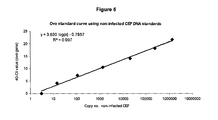
- FIG. 5 shows the standard curve produced for the Ovo qPCR reaction using an Ovo probe labelled with FAM-BHQ1 and calibrated serial dilutions of non-infected Chick Embryo Fibroblast (CEF) DNA.
- FIG. 6 shows the gene map for MDV-1 and the location of the key pp38 and US2 genes within the CVI988 vaccine and RB1B challenge virus.
- FIG. 7 shows the comparison of standard curves of Ct-values versus copy number of infected cells produced in the following qPCR reactions: (a) CVI988 (vaccine strain) probe with nucleic acid from CVI988 (vaccine strain) infected CEF; (b) RB1B (representative virulent strain) probe with nucleic acid from RB1B (representative virulent strain) infected CEF compared to those produced from the equivalent reactions in the BAC/US2 qPCR method.
- FIG. 8 shows the copy number produced for 40 birds using qPCR systems specific for BAC cloned vaccine virus (column 1), virulent/challenge virus (column 2) and total virus (column 3) and comparing the present qPCR invention versus BAC/US2 based qPCR for each.
- Birds are indicated as to whether they fall into the following four groups: 1) non-vaccinated, non-challenged; 2) vaccinated, non-challenged; 3) vaccinated, challenged; and 4) non-vaccinated, challenged.
- FIG. 9 shows correlation of levels of virus measured between the qPCR of the present invention and the BAC/US2 qPCR system for (a) vaccine virus and (b) virulent virus.
- FIG. 10 shows (a) correlation of levels of virus measured between total (dual-specific) qPCR and the additive result of vaccine-specific and virulent-specific for the qPCR of the present invention; (b) correlation of levels of virus measured between the additive result of vaccine-specific and virulent-specific for the qPCR of the present invention and the additive result of the BAC/US2 qPCR system; and (c) correlation between levels of virus measured between total (dual-specific) qPCR of the present invention and the additive result of the BAC/US2 qPCR system.
- the MDV pp38 gene sequence shows two single nucleotide differences between the attenuated vaccine CVI988 and Md5 (a virulent strain) ( FIG. 1 ).
- the polymorphism highlighted in large bold underline (G/A) represents a consistent difference between the MDV-1 vaccine virus and the MDV-1 virulent viruses for all which we have sequence (RB1B MDV, 584A MDV, 595 MDV, 684A MDV, Md5 MDV, HPRS-B14 MDV, JM102 MDV, 660A MDV, 675A MDV, 549 MDV, 571 MDV, C12-130 MDV) and this was the polymorphism which was incorporated into the specific probes.
- Table 1 also shows a second probe (pp38Vir_A_JUP(3)) targeting specifically virulent viruses was designed so that the vaccine-specific, virulent-specific and total pp38 probes all have a similar melting temperature.
- the performance of pp38Vir_A_JUP(3) is very similar to that of pp38Vir_A_JUP(1) (the other virulent strain-specific probe); however, because it covers the second ‘non-consistent’ polymorphic site, it is possible that affinity for some field strains may be reduced (see FIG. 1 and Table 1).
- the probes are labelled with the dye JUP (AlleLogic Biosciences), which is detected in the VIC detection channel of the real-time PCR instrument.
- Chick Embryo Fibroblast (CEF) cells were infected with either CVI988 vaccine strain or RB1B virulent strain of MDV-1. Five days post infection, serial dilutions were prepared from these cells for use in singleplex qPCRs.
- CEF chic embryo fibroblast
- CEF chic embryo fibroblast
- DNA was prepared using phenol-chloroform extraction method.
- Reactions are 25 ul volume and contain: Absolute Blue qPCR mastermix (ABgene), 400 nM of each primer (i.e. Ovo primers+virus specific primers), 200 nM of each probe (i.e. Ovo probe+virus-specific probe), approximately 100 ng DNA sample.
- Reactions are performed on an ABI7500 real-time PCR machine using the cycling parameters: 50° C. for 2 min, 95° C. for 15 min, followed by 40 cycles of 95° C. (15 sec) and 60° C. (1 min).
- Reactions were set up essentially as previously described (Baigent et al., 2005a), each containing ‘ABsolute q-PCR master mix’ (ABgene, Epsom, UK), forward and reverse primer, and one of the probes.
- An ABI 7500FAST® q-PCR system (Applied Biosystems, Foster City, Calif., USA) was used to amplify and detect the reaction products, under the following conditions: 50° C. for 2 min, 95° C. for 15 min, followed by 40 cycles of 95° C. (15 sec) and 60° C. (1 min). Primer and probe combinations for each singleplex qPCR are shown in Table 2.
- probes were initially assessed by using serial 10-fold dilutions of DNA prepared from chick embryo fibroblast (CEF) cells, five days post infection with either CVI988 or RB1B (a virulent strain of MDV-1).
- CEF chick embryo fibroblast
- FIG. 2 demonstrates the change in fluorescence produced by (a) CVI988-specific probe and (b) virulent-specific probe using nucleic acid template from either CVI988 or RBIB (a virulent strain) or no template control.
- the data clearly shows the signal to only be produced at significant levels when the probe specific for the nucleic acid is used in the qPCR and as such specificity of the probes is clearly demonstrated.
- FIG. 3( a ) shows the standard curve produced using CVI988-specific qPCR on CVI988 DNA.
- FIG. 3( b ) shows the standard curve produced using virulent-specific qPCR on RB-1B DNA.
- FIG. 3( c ) shows the standard curve produced using total pp38 qPCR on CVI988 DNA.
- FIG. 3( d ) shows the standard curve produced using total pp38 qPCR on RB-1B DNA.
- pp38Vir_A_JUP virulent-specific
- pp38Vacc_G_JUP CVI988 vaccine-specific
- Thresholds were set at: Ovo reaction (0.2), virulent-specific pp38 reaction (0.6), CVI988-specific pp38 reaction (0.35), total pp38 reaction (0.1).
- the virulent-specific probe detected all virulent strains of MDV1 (but did not detect CVI988), and the vaccine-specific probe detected only CVI988, but from all 3 sources. Neither probe detected the MDV-2 and MDV-3 vaccine strains SB-1 and HVT.
- the data confirm the consistent specificity of pp38Vacc_G_JUP for the MDV-1 vaccine CVI988 strain of varying sources and the specificity of pp38Vir_A_JUP for virulent MDV-1 strains of varying virulence.
- the data also shows specificity of both probes for MDV-1 strains over MDV-2 or MDV-3 strains.
- the Ovo probe was labelled with FAM-BHQ1 so as to be detected in a different channel to the pp38 probe fluorescence.
- the target amplicon of the Ovo qPCR is 71 base pairs and primers and probe sequences used are shown in table 3 below. Primers and probes were produced by Sigma Aldrich and Eurogentec.
- Ovo standard curve can be used to calculate the Ovo Ct value which is equivalent to 10000 cells.
- CVI988 DNA and the CVI988-specific reaction is used to calculate the copy no. (from CVI988-specific Ct value) of CVI988 in the sample, while a standard curve produced using RB-1B DNA and the virulent-specific reaction is used to calculate the copy no. (from virulent-specific Ct value) of virulent MDV in the sample.
- the Ovo standard curve is used to work out Ovo copy no. (from Ovo Ct value) in the sample.
- Ovo copy number i.e. cell number
- the standard curve for the Ovo reaction was prepared using calibrated serial dilutions of non-infected CEF DNA and is shown in FIG. 5 .
- Chicken tissue DNA samples were taken from an experiment in which chickens had been vaccinated with a BAC-cloned CVI988 virus (pCVI988) and challenged with RB-1B.
- Four groups of chicks were (1) non-vaccinated, non-challenged; (2) vaccinated, non-challenged; (3) vaccinated and challenged; (4) non-vaccinated, challenged.
- Spleen samples were collected at various time points post vaccination and challenge.
- the vaccine virus was pCVI988 and the challenge (virulent) virus WT RB-1B which should allow distinction between the two viruses by both the CVI988 pp38/virulent pp38 system and by a second qPCR system which we have developed to distinguish between BAC cloned MDV (using a BAC-specific sequence) and wild-type MDV (by targeting the US2 gene). This latter qPCR system could thus be used to validate the CVI988 pp38/virulent pp38 qPCR system). Total virus was also measured using the pp38-total reaction. A plan for the validation of the qPCR system is shown in Table 4 and indicated on the viral gene maps of FIG. 6 .
- FIGS. 7( a ) and 7 ( b ) show the standard curves used for quantifying vaccine and virulent virus using both qPCR systems.
- FIG. 8 shows level of vaccine, challenge and total MDV measured in 40 birds, from four groups, 1) non-vaccinated, non-challenged; 2) vaccinated, non-challenged; 3) vaccinated, challenged; and 4) non-vaccinated, challenged. Samples having a baseline value (0.6) are negative.
- the first two columns show measurement of vaccine virus by CVI-specific pp38 qPCR (col 1) and BAC-specific qPCR (col 2). In both systems, vaccine virus was detected only in the two vaccinated groups. Agreement between the copy number values obtained with the two systems was good (see also FIG. 9( a )).
Landscapes
- Health & Medical Sciences (AREA)
- Life Sciences & Earth Sciences (AREA)
- Chemical & Material Sciences (AREA)
- Organic Chemistry (AREA)
- Immunology (AREA)
- Engineering & Computer Science (AREA)
- Virology (AREA)
- General Health & Medical Sciences (AREA)
- Wood Science & Technology (AREA)
- Zoology (AREA)
- Proteomics, Peptides & Aminoacids (AREA)
- Molecular Biology (AREA)
- Biotechnology (AREA)
- Bioinformatics & Cheminformatics (AREA)
- Chemical Kinetics & Catalysis (AREA)
- Veterinary Medicine (AREA)
- Public Health (AREA)
- Animal Behavior & Ethology (AREA)
- Pharmacology & Pharmacy (AREA)
- General Chemical & Material Sciences (AREA)
- Medicinal Chemistry (AREA)
- Nuclear Medicine, Radiotherapy & Molecular Imaging (AREA)
- Physics & Mathematics (AREA)
- Biophysics (AREA)
- Microbiology (AREA)
- Analytical Chemistry (AREA)
- Biochemistry (AREA)
- General Engineering & Computer Science (AREA)
- Genetics & Genomics (AREA)
- Communicable Diseases (AREA)
- Oncology (AREA)
- Measuring Or Testing Involving Enzymes Or Micro-Organisms (AREA)
- Medicines Containing Antibodies Or Antigens For Use As Internal Diagnostic Agents (AREA)
- Investigating Or Analysing Biological Materials (AREA)
Applications Claiming Priority (3)
| Application Number | Priority Date | Filing Date | Title |
|---|---|---|---|
| GB0914826.3 | 2009-08-25 | ||
| GBGB0914826.3A GB0914826D0 (en) | 2009-08-25 | 2009-08-25 | Assay methods |
| PCT/GB2010/001602 WO2011023950A1 (en) | 2009-08-25 | 2010-08-25 | Assay methods for mdv-1 |
Related Parent Applications (1)
| Application Number | Title | Priority Date | Filing Date |
|---|---|---|---|
| PCT/GB2010/001602 A-371-Of-International WO2011023950A1 (en) | 2009-08-25 | 2010-08-25 | Assay methods for mdv-1 |
Related Child Applications (2)
| Application Number | Title | Priority Date | Filing Date |
|---|---|---|---|
| US14/467,941 Continuation US9416428B2 (en) | 2009-08-25 | 2014-08-25 | Assay methods for MDV-1 |
| US14/467,856 Division US9416427B2 (en) | 2009-08-25 | 2014-08-25 | Assay methods for MDV-1 |
Publications (2)
| Publication Number | Publication Date |
|---|---|
| US20120208177A1 US20120208177A1 (en) | 2012-08-16 |
| US8865409B2 true US8865409B2 (en) | 2014-10-21 |
Family
ID=41171882
Family Applications (3)
| Application Number | Title | Priority Date | Filing Date |
|---|---|---|---|
| US13/391,563 Active US8865409B2 (en) | 2009-08-25 | 2010-08-25 | Assay methods for MDV-1 |
| US14/467,856 Active US9416427B2 (en) | 2009-08-25 | 2014-08-25 | Assay methods for MDV-1 |
| US14/467,941 Active US9416428B2 (en) | 2009-08-25 | 2014-08-25 | Assay methods for MDV-1 |
Family Applications After (2)
| Application Number | Title | Priority Date | Filing Date |
|---|---|---|---|
| US14/467,856 Active US9416427B2 (en) | 2009-08-25 | 2014-08-25 | Assay methods for MDV-1 |
| US14/467,941 Active US9416428B2 (en) | 2009-08-25 | 2014-08-25 | Assay methods for MDV-1 |
Country Status (17)
| Country | Link |
|---|---|
| US (3) | US8865409B2 (pl) |
| EP (1) | EP2470676B1 (pl) |
| JP (2) | JP6025562B2 (pl) |
| CN (1) | CN102686748B (pl) |
| AU (1) | AU2010288269C1 (pl) |
| BR (1) | BR112012004102B1 (pl) |
| CA (1) | CA2771962C (pl) |
| CY (1) | CY1116130T1 (pl) |
| DK (1) | DK2470676T3 (pl) |
| ES (1) | ES2538189T3 (pl) |
| GB (1) | GB0914826D0 (pl) |
| HR (1) | HRP20150308T1 (pl) |
| MX (1) | MX2012002411A (pl) |
| PL (1) | PL2470676T3 (pl) |
| PT (1) | PT2470676E (pl) |
| SI (1) | SI2470676T1 (pl) |
| WO (1) | WO2011023950A1 (pl) |
Families Citing this family (14)
| Publication number | Priority date | Publication date | Assignee | Title |
|---|---|---|---|---|
| GB0914826D0 (en) | 2009-08-25 | 2009-09-30 | Wyeth Corp | Assay methods |
| WO2013192100A1 (en) * | 2012-06-18 | 2013-12-27 | The United States Of America, As Represented By The Secretary, Department Of Health & Human Services | Methods and compositions for detecting jc virus |
| EP2845904A1 (en) * | 2013-09-06 | 2015-03-11 | Ceva Sante Animale | Recombinant Marek's disease viruses and uses thereof |
| EP2889381A1 (en) * | 2013-12-27 | 2015-07-01 | Universite De Liege | Detection method for species specific identification of nucleic acid of interest |
| CN105886662B (zh) * | 2016-01-26 | 2020-03-24 | 金宇保灵生物药品有限公司 | 快速选育猪瘟兔化弱毒株(c株)st敏感细胞系的方法及专用引物 |
| CN108034767A (zh) * | 2018-01-03 | 2018-05-15 | 山东农业大学 | 鉴别血清i型马立克病毒基因缺失疫苗、传代致弱疫苗与野毒的引物、探针及试剂盒 |
| CN113039780B (zh) | 2018-11-17 | 2023-07-28 | 北京字节跳动网络技术有限公司 | 视频处理中用运动矢量差的Merge |
| CN109355434B (zh) * | 2018-11-26 | 2022-04-15 | 中国农业科学院哈尔滨兽医研究所(中国动物卫生与流行病学中心哈尔滨分中心) | 定量检测鸡马立克氏病毒Meq基因缺失疫苗株和野毒株的荧光定量PCR试剂盒及其应用 |
| CN110699485B (zh) * | 2019-08-16 | 2023-03-28 | 广州千寻生物技术有限公司 | 一种快速检测马立克氏病病毒的rpa引物对、探针、试剂盒及检测方法 |
| CN111733297A (zh) * | 2020-08-10 | 2020-10-02 | 中国兽医药品监察所 | 一种马立克氏病病毒血清3型荧光定量pcr试剂盒及其应用 |
| CN113025734A (zh) * | 2021-03-19 | 2021-06-25 | 广东省农业科学院动物卫生研究所 | 鉴别布鲁氏菌疫苗株a19与野毒株的引物、探针及应用 |
| CN114317827B (zh) * | 2022-01-07 | 2023-03-24 | 河南省农业科学院 | 一种鉴别不同血清型马立克病病毒感染与免疫的多重pcr引物、方法及应用 |
| CN114540312B (zh) * | 2022-03-16 | 2023-03-24 | 河南省农业科学院 | 一种血清1型马立克病病毒pp38单克隆抗体的制备方法及应用 |
| CN116356081A (zh) * | 2023-04-28 | 2023-06-30 | 北京家禽育种有限公司 | 鸡马立克病毒的引物探针组及试剂盒与检测方法和应用 |
Citations (2)
| Publication number | Priority date | Publication date | Assignee | Title |
|---|---|---|---|---|
| EP0775743A2 (en) | 1995-10-27 | 1997-05-28 | Michigan State University | Sustainable chick cell line infected with Marek's disease virus |
| CN101824488A (zh) * | 2010-04-09 | 2010-09-08 | 山东农业大学 | 鸡多重病毒核酸探针斑点杂交检测试剂盒 |
Family Cites Families (2)
| Publication number | Priority date | Publication date | Assignee | Title |
|---|---|---|---|---|
| US5702659A (en) | 1995-11-30 | 1997-12-30 | Corning Incorporated | Honeycomb extrusion die and methods |
| GB0914826D0 (en) | 2009-08-25 | 2009-09-30 | Wyeth Corp | Assay methods |
-
2009
- 2009-08-25 GB GBGB0914826.3A patent/GB0914826D0/en not_active Ceased
-
2010
- 2010-08-25 BR BR112012004102-9A patent/BR112012004102B1/pt active IP Right Grant
- 2010-08-25 CN CN201080043079.6A patent/CN102686748B/zh active Active
- 2010-08-25 EP EP10752901.8A patent/EP2470676B1/en active Active
- 2010-08-25 JP JP2012526114A patent/JP6025562B2/ja active Active
- 2010-08-25 DK DK10752901.8T patent/DK2470676T3/en active
- 2010-08-25 HR HRP20150308TT patent/HRP20150308T1/hr unknown
- 2010-08-25 CA CA2771962A patent/CA2771962C/en active Active
- 2010-08-25 ES ES10752901.8T patent/ES2538189T3/es active Active
- 2010-08-25 MX MX2012002411A patent/MX2012002411A/es active IP Right Grant
- 2010-08-25 WO PCT/GB2010/001602 patent/WO2011023950A1/en not_active Ceased
- 2010-08-25 PT PT10752901T patent/PT2470676E/pt unknown
- 2010-08-25 PL PL10752901T patent/PL2470676T3/pl unknown
- 2010-08-25 AU AU2010288269A patent/AU2010288269C1/en active Active
- 2010-08-25 US US13/391,563 patent/US8865409B2/en active Active
- 2010-08-25 SI SI201030866T patent/SI2470676T1/sl unknown
-
2014
- 2014-08-25 US US14/467,856 patent/US9416427B2/en active Active
- 2014-08-25 US US14/467,941 patent/US9416428B2/en active Active
-
2015
- 2015-03-20 CY CY20151100277T patent/CY1116130T1/el unknown
- 2015-09-28 JP JP2015189321A patent/JP2016052307A/ja active Pending
Patent Citations (2)
| Publication number | Priority date | Publication date | Assignee | Title |
|---|---|---|---|---|
| EP0775743A2 (en) | 1995-10-27 | 1997-05-28 | Michigan State University | Sustainable chick cell line infected with Marek's disease virus |
| CN101824488A (zh) * | 2010-04-09 | 2010-09-08 | 山东农业大学 | 鸡多重病毒核酸探针斑点杂交检测试剂盒 |
Non-Patent Citations (28)
| Title |
|---|
| AllGlo Technology for Real Time PCR (hereinafter "AllGlo"; available at http://www.allelogic.com/product.htm, May 30, 2008). * |
| Baigent et al. (Absolute quantitation of Marek's disease virus genome copy number in chicken feather and lymphocyte samples using real-time PCR, Journal of Virological Methods 123 (2005) 53-64). * |
| Baigent et al. (hereinafter "Baigent 2"; Correlation of Marek's disease herpesvirus vaccine virus genome load in feather tips with protection, using an experimental challenge model, Avian Pathology, 36:6, 467-474, 2007). * |
| Baigent, S. J., et al., "Absolute quantitation of Marek's disease virus genome copy number in chicken feather and lymphocyte samples using real-time PCR," J. Virol. Methods., vol. 123, No. 1, pp. 53-64, 2005 [available online Oct. 22, 2004]. |
| Baigent, S. J., et al., "Replication kinetics of Marek's disease vaccine virus in feathers and lymphoid tissues using PCR and virus isolation," J. Gen. Virol., vol. 86, pp. 2989-2998, 2005. |
| Baigent, S. J., et al., "Vaccinal control of Marek's disease: Current challenges, and future strategies to maximize protection," Vet. Immunol. Immunopathol., vol. 112, pp. 78-86, 2006. |
| Becker, Y., et al., "Polymerase chain reaction for differentiation between pathogenic and non-pathogenic serotype 1 Marek's disease viruses (MDV) and vaccine viruses of MDC-serotypes 2 and 3," J. Virol. Methods, vol. 40, pp. 307-322, 1992. |
| Bülow, V.V., et al., German article from Zentralblatt für Veterinarmedizin, B, vol. 23, pp. 391-402, 1976 [***English summary is found on p. 400]. |
| De Boer, G. F., et al., "Protective Efficacy of Marek's Disease Virus (MDV) CVI-988 CEF65 Clone C against Challenge Infection with Three Very Virulent MDV Strains," Avian Diseases, vol. 30, No. 2, pp. 276-283, Apr.-Jun. 1986. |
| Edwards et al. (Mutation Detection by Real-Time PCR, available at http://www.horizonpress.com/pcr/pdf/rtpcr/rtpcr08.pdf, Jul. 26, 2008). * |
| Endoh, D., et al., Database EMBL [Online], "Marek disease virus type 1 pp38 mRNA, complete cds.," XP002609232, retrieved from EBI Database accession No. S76060, Aug. 4, 1995. |
| Fakhrul Islam, A. F. M., et al., "Relationship between Marek's disease virus load in peripheral blood lymphocytes at various stages of infection and clinical Marek's disease in broiler chickens," Avian Pathology, vol. 35, No. 1, pp. 42-48, 2006. |
| Gimeno, I. M., et al., "The pp38 Gene of Marek's Disease Virus (MDV) is Necessary for Cytolytic Infection of B Cells and Maintenance of the Transformed State but Not for Cytolytic Infection of the Feather Follicle Epithelium and Horizontal Spread of MDV," J. Virol., vol. 79, No. 7, pp. 4545-4549, 2005. |
| Handberg, K. J., et al., "The use of serotype 1- and serotype 3-specific polymerase chain reaction for the detection of Marek's disease virus in chickens," Avian Pathology, vol. 30, No. 3, pp. 243-249, 2001. |
| Islam, A., et al., "Absolute quantitation of Marek's disease virus and Herpesvirus of turkeys in chicken lymphocyte, feather tip and dust samples using real-time PCR," J. Virol. Methods, vol. 132, pp. 127-134, 2006 [available online Nov. 14, 2005]. |
| Islam, A., et al., "Addendum to 'Absolute quantitation of Marek's disease virus and Herpesvirus of turkeys in chicken lymphocyte, feather tip and dust samples using real-time PCR,'" J. Virol. Methods, vol. 141, p. 230, 2007. |
| King, D., et al., "Difference between Influences of Homologous and Heterologous Maternal Antibodies on Response to Serotype-2 and Serotype-3 Marek's Disease Vaccines," Avian Diseases, vol. 25, No. 1, pp. 74-81, Jan.-Mar. 1981. |
| Landman, W. J. M. & S. B. E. Verschuren, "Titration of Marek's Disease Cell-Associated Vaccine Virus (CVI 988) of Reconstituted Vaccine and Vaccine Ampoules from Dutch Hatcheries," Avian Diseases, vol. 47, No. 4, pp. 1458-1465, Oct.-Dec. 2003. |
| Renz et al. (Differentiation between pathogenic serotype 1 isolates of Marek's disease virus and the Rispens CVI988 vaccine in Australia using real-time PCR and high resolution melt curve analysis, Journal of Virological Methods 187 (2013) 144-152. * |
| Renz, K. G., et al., "Absolute quantification using real-time polymerase chain reaction of Marek's disease virus serotype 2 in field dust samples, feather tips and spleens," J. Virol. Methods, vol. 135, pp. 186-191, 2006 [available online May 6, 2006]. |
| Rispens, B. H., et al., "Control of Marek's Disease in the Netherlands. I. Isolation of an Avirulent Marek's Disease Virus (Strain CVI 988) and Its Use in Laboratory Vaccination Trials," Avian Diseases, vol. 16, No. 1, pp. 108-125, Apr. 1972. |
| Shamblin, C.E., et al., "Comparative analysis of Marek's disease virus (MDV) glycoprotein-, lytic antigen pp38- and transformation antigen Meq-encoding genes: association of meq mutations with MDVs of high virulence," Veterinary Microbiology, vol. 102, No. 3-4, pp. 147-167, Sep. 8, 2004. |
| Silva, R. F., "Differentiation of Pathogenic and Non-Pathogenic Serotype 1 Marek's Disease Viruses (MDVs) by the Polymerase Chain Reaction Amplification of the Tandem Direct Repeats within the MDV Genome," Avian Diseases, vol. 36, No. 3, pp. 521-528, Jul.-Sep. 1992. |
| Spatz et al. (Comparative full-length sequence analysis of oncogenic and vaccine (Rispens) strains of Marek's disease virus, Journal of General Virology (2007), 88, 1080-1096). * |
| Spatz, S.J., et al., "Comparative full-length sequence analysis of oncogenic and vaccine (Rispens) strains of Marek's disease virus," Journal of General Virology, vol. 88, No. Part 4, pp. 1080-1096, Apr. 2007. |
| Spatz, S.J., et al., "Sequence determination of variable regions within the genomes of gallid herpesvirus-2 pathotypes," Archives of Virology, vol. 152, No. 9, pp. 1665-1678, Jun. 8, 2007. |
| Witter, R. L., et al., "Classification of Marek's disease viruses according to pathotype: philosophy and methodology," Avian Pathology, vol. 34, No. 2, pp. 75-90, 2005. |
| Zhizhong et al. (Analyzing the H19- and T65-epitopes in 38 kd phosphorylated protein of Marek's disease viruses and comparing chicken immunological reactions to viruses point-mutated in the epitopes, Science in China Ser. C Life Sciences 2004 vol. 47 No. 1 82-91). * |
Also Published As
| Publication number | Publication date |
|---|---|
| CY1116130T1 (el) | 2017-02-08 |
| ES2538189T3 (es) | 2015-06-17 |
| SI2470676T1 (sl) | 2015-03-31 |
| US20120208177A1 (en) | 2012-08-16 |
| JP6025562B2 (ja) | 2016-11-16 |
| AU2010288269C1 (en) | 2015-11-26 |
| US20150024383A1 (en) | 2015-01-22 |
| EP2470676B1 (en) | 2015-01-28 |
| CN102686748B (zh) | 2015-09-09 |
| AU2010288269B2 (en) | 2015-05-21 |
| DK2470676T3 (en) | 2015-02-16 |
| US9416427B2 (en) | 2016-08-16 |
| MX2012002411A (es) | 2012-04-10 |
| BR112012004102B1 (pt) | 2021-03-30 |
| US20150024382A1 (en) | 2015-01-22 |
| JP2016052307A (ja) | 2016-04-14 |
| CN102686748A (zh) | 2012-09-19 |
| HRP20150308T1 (hr) | 2015-04-24 |
| GB0914826D0 (en) | 2009-09-30 |
| PT2470676E (pt) | 2015-03-30 |
| JP2013502916A (ja) | 2013-01-31 |
| WO2011023950A1 (en) | 2011-03-03 |
| PL2470676T3 (pl) | 2015-06-30 |
| CA2771962C (en) | 2015-09-29 |
| EP2470676A1 (en) | 2012-07-04 |
| US9416428B2 (en) | 2016-08-16 |
| BR112012004102A2 (pt) | 2016-03-15 |
| AU2010288269A1 (en) | 2012-03-08 |
| CA2771962A1 (en) | 2011-03-03 |
Similar Documents
| Publication | Publication Date | Title |
|---|---|---|
| US8865409B2 (en) | Assay methods for MDV-1 | |
| Baigent et al. | Real-time PCR for differential quantification of CVI988 vaccine virus and virulent strains of Marek’s disease virus | |
| JP7418717B2 (ja) | 微生物の検出方法 | |
| KR102516022B1 (ko) | 아프리카돼지열병 및 돼지열병 동시감별 실시간유전자 진단법 | |
| CN113249522A (zh) | 一种检测SARS-CoV-2变异毒株核酸的方法及其应用 | |
| CN111961756A (zh) | 用于检测猫泛白细胞减少症病毒的引物和探针及检测试剂盒 | |
| Tadese et al. | Detection and differentiation of re-emerging fowlpox virus (FWPV) strains carrying integrated reticuloendotheliosis virus (FWPV-REV) by real-time PCR | |
| EP3060686B1 (en) | Compositions and methods for detection of influenza viruses | |
| Rojas et al. | Optimization and application of a high-resolution melting protocol in the characterization of avian infectious laryngotracheitis virus | |
| WO2024030345A1 (en) | Compositions, kits, and methods for detection of variant strains of african swine fever virus | |
| KR102529399B1 (ko) | 실시간 중합효소연쇄반응을 이용한 수두바이러스 검출 및 정량 방법 | |
| Deng et al. | Development of a loop-mediated isothermal amplification method for rapid detection of reticuloendotheliosis virus | |
| US20100196881A1 (en) | Reverse restriction fragment length polymorphism assay and uses thereof | |
| Schang et al. | Quantitation of latency established by attenuated strains of Pseudorabies (Aujeszky's disease) virus | |
| Sauerbrei et al. | Genotyping of varicella-zoster virus strains after serial passages in cell culture | |
| RU2857315C1 (ru) | Способ опосредованного определения титра инфекционной активности возбудителя панлейкопении кошек штамма "Шеба" в неинактивированном сырье для культуральных вакцин | |
| Kuo et al. | Identification of pan-orthopoxvirus, monkeypox-specific and smallpox-specific DNAs by real-time PCR assay | |
| US9267178B2 (en) | Detection and differentiation of demodex mites | |
| Zhang et al. | Development and application of a triplex TaqMan RT-PCR assay for simultaneous detection of Feline calicivirus, Feline Herpesvirus 1 and Feline parvovirus | |
| McMenamy et al. | Development and comparison of a Primer-Probe Energy Transfer based assay and a 5′ conjugated Minor Groove Binder assay for sensitive real-time PCR detection of infectious laryngotracheitis virus | |
| CN120967061A (zh) | 引物探针组合、试剂盒及其应用 | |
| CN120967062A (zh) | 引物组、探针和试剂盒及其应用 | |
| CN120829993A (zh) | 同时检测cGPV、MDPV、MDGPV、SBDSV的四重TaqMan实时荧光定量PCR引物组和探针组及其试剂盒 | |
| HK1120834A (en) | Detection of very virulent infectious bursal disease virus |
Legal Events
| Date | Code | Title | Description |
|---|---|---|---|
| AS | Assignment |
Owner name: WYETH LLC, NEW JERSEY Free format text: ASSIGNMENT OF ASSIGNORS INTEREST;ASSIGNORS:BAIGENT, SUSAN;NAIR, VENUGOPAL;REEL/FRAME:028592/0859 Effective date: 20120423 Owner name: WYETH LLC, NEW JERSEY Free format text: ASSIGNMENT OF ASSIGNORS INTEREST;ASSIGNOR:LE GALLUDEC, HERVE;REEL/FRAME:028592/0989 Effective date: 20120502 |
|
| AS | Assignment |
Owner name: PAH W LLC, NEW YORK Free format text: ASSIGNMENT OF ASSIGNORS INTEREST;ASSIGNOR:WYETH LLC;REEL/FRAME:029081/0692 Effective date: 20121001 |
|
| AS | Assignment |
Owner name: ZOETIS W LLC, NEW JERSEY Free format text: CHANGE OF NAME;ASSIGNOR:PAH W LLC;REEL/FRAME:030091/0926 Effective date: 20130201 |
|
| STCF | Information on status: patent grant |
Free format text: PATENTED CASE |
|
| AS | Assignment |
Owner name: ZOETIS SERVICES LLC, NEW JERSEY Free format text: MERGER;ASSIGNOR:ZOETIS W LLC;REEL/FRAME:035651/0884 Effective date: 20150426 |
|
| AS | Assignment |
Owner name: ZOETIS SERVICES LLC, NEW JERSEY Free format text: ADDRESS CHANGE OF ASSIGNEE;ASSIGNOR:ZOETIS SERVICES LLC;REEL/FRAME:042693/0207 Effective date: 20161027 |
|
| MAFP | Maintenance fee payment |
Free format text: PAYMENT OF MAINTENANCE FEE, 4TH YEAR, LARGE ENTITY (ORIGINAL EVENT CODE: M1551) Year of fee payment: 4 |
|
| MAFP | Maintenance fee payment |
Free format text: PAYMENT OF MAINTENANCE FEE, 8TH YEAR, LARGE ENTITY (ORIGINAL EVENT CODE: M1552); ENTITY STATUS OF PATENT OWNER: LARGE ENTITY Year of fee payment: 8 |
|
| MAFP | Maintenance fee payment |
Free format text: PAYMENT OF MAINTENANCE FEE, 12TH YEAR, LARGE ENTITY (ORIGINAL EVENT CODE: M1553); ENTITY STATUS OF PATENT OWNER: LARGE ENTITY Year of fee payment: 12 |