US8739397B2 - Electrode sheet and process for producing electrode sheet - Google Patents
Electrode sheet and process for producing electrode sheet Download PDFInfo
- Publication number
- US8739397B2 US8739397B2 US12/679,747 US67974708A US8739397B2 US 8739397 B2 US8739397 B2 US 8739397B2 US 67974708 A US67974708 A US 67974708A US 8739397 B2 US8739397 B2 US 8739397B2
- Authority
- US
- United States
- Prior art keywords
- electrode sheet
- electrode
- wiring layer
- printed
- making
- Prior art date
- Legal status (The legal status is an assumption and is not a legal conclusion. Google has not performed a legal analysis and makes no representation as to the accuracy of the status listed.)
- Expired - Fee Related, expires
Links
Images




Classifications
-
- A—HUMAN NECESSITIES
- A61—MEDICAL OR VETERINARY SCIENCE; HYGIENE
- A61B—DIAGNOSIS; SURGERY; IDENTIFICATION
- A61B5/00—Measuring for diagnostic purposes; Identification of persons
- A61B5/24—Detecting, measuring or recording bioelectric or biomagnetic signals of the body or parts thereof
- A61B5/25—Bioelectric electrodes therefor
- A61B5/251—Means for maintaining electrode contact with the body
- A61B5/257—Means for maintaining electrode contact with the body using adhesive means, e.g. adhesive pads or tapes
- A61B5/259—Means for maintaining electrode contact with the body using adhesive means, e.g. adhesive pads or tapes using conductive adhesive means, e.g. gels
-
- A—HUMAN NECESSITIES
- A61—MEDICAL OR VETERINARY SCIENCE; HYGIENE
- A61B—DIAGNOSIS; SURGERY; IDENTIFICATION
- A61B5/00—Measuring for diagnostic purposes; Identification of persons
- A61B5/24—Detecting, measuring or recording bioelectric or biomagnetic signals of the body or parts thereof
- A61B5/25—Bioelectric electrodes therefor
- A61B5/279—Bioelectric electrodes therefor specially adapted for particular uses
- A61B5/28—Bioelectric electrodes therefor specially adapted for particular uses for electrocardiography [ECG]
- A61B5/282—Holders for multiple electrodes
-
- A—HUMAN NECESSITIES
- A61—MEDICAL OR VETERINARY SCIENCE; HYGIENE
- A61B—DIAGNOSIS; SURGERY; IDENTIFICATION
- A61B5/00—Measuring for diagnostic purposes; Identification of persons
- A61B5/68—Arrangements of detecting, measuring or recording means, e.g. sensors, in relation to patient
- A61B5/6801—Arrangements of detecting, measuring or recording means, e.g. sensors, in relation to patient specially adapted to be attached to or worn on the body surface
- A61B5/6802—Sensor mounted on worn items
- A61B5/6804—Garments; Clothes
-
- A—HUMAN NECESSITIES
- A61—MEDICAL OR VETERINARY SCIENCE; HYGIENE
- A61B—DIAGNOSIS; SURGERY; IDENTIFICATION
- A61B5/00—Measuring for diagnostic purposes; Identification of persons
- A61B5/68—Arrangements of detecting, measuring or recording means, e.g. sensors, in relation to patient
- A61B5/6801—Arrangements of detecting, measuring or recording means, e.g. sensors, in relation to patient specially adapted to be attached to or worn on the body surface
- A61B5/683—Means for maintaining contact with the body
- A61B5/6832—Means for maintaining contact with the body using adhesives
- A61B5/6833—Adhesive patches
-
- A—HUMAN NECESSITIES
- A61—MEDICAL OR VETERINARY SCIENCE; HYGIENE
- A61B—DIAGNOSIS; SURGERY; IDENTIFICATION
- A61B2562/00—Details of sensors; Constructional details of sensor housings or probes; Accessories for sensors
- A61B2562/12—Manufacturing methods specially adapted for producing sensors for in-vivo measurements
- A61B2562/125—Manufacturing methods specially adapted for producing sensors for in-vivo measurements characterised by the manufacture of electrodes
-
- Y—GENERAL TAGGING OF NEW TECHNOLOGICAL DEVELOPMENTS; GENERAL TAGGING OF CROSS-SECTIONAL TECHNOLOGIES SPANNING OVER SEVERAL SECTIONS OF THE IPC; TECHNICAL SUBJECTS COVERED BY FORMER USPC CROSS-REFERENCE ART COLLECTIONS [XRACs] AND DIGESTS
- Y10—TECHNICAL SUBJECTS COVERED BY FORMER USPC
- Y10T—TECHNICAL SUBJECTS COVERED BY FORMER US CLASSIFICATION
- Y10T29/00—Metal working
- Y10T29/49—Method of mechanical manufacture
- Y10T29/49002—Electrical device making
- Y10T29/49117—Conductor or circuit manufacturing
- Y10T29/49124—On flat or curved insulated base, e.g., printed circuit, etc.
-
- Y—GENERAL TAGGING OF NEW TECHNOLOGICAL DEVELOPMENTS; GENERAL TAGGING OF CROSS-SECTIONAL TECHNOLOGIES SPANNING OVER SEVERAL SECTIONS OF THE IPC; TECHNICAL SUBJECTS COVERED BY FORMER USPC CROSS-REFERENCE ART COLLECTIONS [XRACs] AND DIGESTS
- Y10—TECHNICAL SUBJECTS COVERED BY FORMER USPC
- Y10T—TECHNICAL SUBJECTS COVERED BY FORMER US CLASSIFICATION
- Y10T29/00—Metal working
- Y10T29/49—Method of mechanical manufacture
- Y10T29/49002—Electrical device making
- Y10T29/49117—Conductor or circuit manufacturing
- Y10T29/49124—On flat or curved insulated base, e.g., printed circuit, etc.
- Y10T29/49155—Manufacturing circuit on or in base
-
- Y—GENERAL TAGGING OF NEW TECHNOLOGICAL DEVELOPMENTS; GENERAL TAGGING OF CROSS-SECTIONAL TECHNOLOGIES SPANNING OVER SEVERAL SECTIONS OF THE IPC; TECHNICAL SUBJECTS COVERED BY FORMER USPC CROSS-REFERENCE ART COLLECTIONS [XRACs] AND DIGESTS
- Y10—TECHNICAL SUBJECTS COVERED BY FORMER USPC
- Y10T—TECHNICAL SUBJECTS COVERED BY FORMER US CLASSIFICATION
- Y10T442/00—Fabric [woven, knitted, or nonwoven textile or cloth, etc.]
- Y10T442/20—Coated or impregnated woven, knit, or nonwoven fabric which is not [a] associated with another preformed layer or fiber layer or, [b] with respect to woven and knit, characterized, respectively, by a particular or differential weave or knit, wherein the coating or impregnation is neither a foamed material nor a free metal or alloy layer
- Y10T442/2418—Coating or impregnation increases electrical conductivity or anti-static quality
Definitions
- the present invention relates to an electrode for use to measure an electrocardiographic waveform or the like, and in particular to the improvement of wiring for an electrode and so forth.
- Biological information including an electrocardiogram is occasionally measured in emergencies such as in an ambulance.
- a measuring person attaches an electrode to each of the chest, wrists, and ankles of a person to be measured by suction, and then takes an electrocardiogram using an electrocardiogram measurement device.
- the electrocardiogram measurement according to the prior art requires much time to attach electrodes by suction, and thus may not be suitable for use in emergencies.
- a large number of wiring cords which are connected to a large number of electrodes are occasionally tangled with each other to lower the working efficiency.
- Patent Document 1 discloses a technique in which electrodes are provided to a garment such as a T-shirt.
- Patent Document 2 discloses a technique in which a metal layer is provided on a surface of a fabric by plating or vapor deposition to maintain the conductivity of a wiring layer provided on the fabric to be high.
- Patent Document 1 JP-A-2002-159458
- Patent Document 2 JP-A-1992(Hei4)-108168
- Patent Document 1 While the prior art according to Patent Document 1 above facilitates mounting of the electrodes, however, the conductivity of wiring provided on a fabric is low.
- Patent Document 2 successfully addresses the above issues, providing a metal layer on a surface of a fabric by plating or vapor deposition is not easy and complicates the production process.
- composition of a conductive ink to be printed on a surface of a fabric which has significant projections and depressions, is particularly discussed in neither of the above prior art documents.
- an electrode sheet includes: a material with a flattened surface; a wiring layer provided on the flattened surface of the material and formed of a conductive ink containing carbon nanotubes; and an electrode connected to the wiring layer.
- the conductive ink comprise a binder containing an acrylic resin, a dispersant containing an acrylic acid polymer, and carbon nanotubes.
- the material is formed by knitting one of a blended yarn of polyester fibers and urethane fibers, a yarn of nylon fibers, and a yarn of urethane fibers.
- a lower insulating layer is provided on the flattened surface of the material, and the wiring layer may be formed on the lower insulating layer.
- the lower insulating layer as an underlayer for the wiring layer, it is possible to form the wiring layer on a flatter surface, and to ensure the conductivity.
- an upper insulating layer is formed on the wiring layer.
- the electrode is formed of an adhesive conductive paste.
- the electrode is an electrode that measures an electrocardiographic waveform of a subject with a garment.
- the electrode sheet according to the present invention further comprises: a connector that is connectable to an external device; and a film substrate having a wire connected to the connector, in which the wire of the film substrate is electrically connected and physically secured to the wiring layer.
- an electrode sheet comprises: a flexible material; a wiring layer provided on a flattened surface of the material and formed of a conductive ink containing carbon nanotubes; and an electrode connected to the wiring layer.
- a garment comprises: a material with a flattened surface; and a wiring layer provided on the flattened surface of the material and formed of a conductive ink containing carbon nanotubes.
- the garment according to the present invention further comprises an electrode connected to the wiring layer.
- electrode sheet refers to a sheet having an electrode that measures biological information such as an electrocardiogram, an electromyogram, and an electroencephalogram, and that may include not only sheets having a flat shape but also those having a three-dimensional shape that conforms to the shape of a body and those having a ring shape.
- material refers to a carrier that is provided with an electrode and a wiring layer, and that may include not only woven or knit materials but also thin flexible sheets made of rubber, plastic, or the like.
- FIG. 1 shows the appearance of an electrode sheet according to an embodiment of the present invention.
- FIG. 2 shows a cross-sectional view of various portions of FIG. 1 .
- FIG. 3 shows the electrode sheet in use.
- FIG. 4 shows the structure of a calendering machine.
- FIG. 5 shows a surface of a material before and after a calendering process.
- FIG. 6 shows a portion of the electrode sheet that is joined to a film substrate.
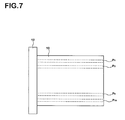
- FIG. 7 shows the film substrate and a connector.
- FIG. 8 shows another embodiment.
- FIG. 9 shows the arrangement of conductive layers that measure electrical resistances.
- FIG. 10 shows a knitting structure of the material.
- FIG. 11 shows the pattern of conductive layers that measure resistance values.
- FIG. 1 shows the appearance of an electrode sheet 1 for electrocardiogram measurement according to an embodiment of the present invention.
- chest electrodes E 3 , E 4 , . . . , E 8 , neutral electrodes T 1 , T 2 , T 9 , and T 10 , and wiring layers L 1 , L 2 , . . . , L 10 are formed on a material 2 .
- the chest electrodes E 3 , E 4 , . . . , E 8 and the neutral electrodes T 1 , T 2 , T 9 , and T 10 for electrocardiogram measurement are formed of an adhesive conductive paste.
- FIG. 2A shows a cross-sectional view taken along the line IIA-IIA of FIG. 1 .
- a lower insulating layer 4 made from an insulating ink is formed on the material 2
- the wiring layer L 1 made from a conductive ink is formed on the lower insulating layer 4 .
- the neutral electrode T 1 is formed on the wiring layer L 1 .
- the other electrode portions are configured in the same manner.
- the material 2 is preferably formed by knitting to provide elasticity.
- the insulating ink forming the lower insulating layer 4 is made from an acrylic material.
- the conductive ink forming the wiring layer L 1 is obtained by mixing carbon nanotubes (5% to 10% by weight), a dispersant, and a binder.
- the conductive paste forming the chest electrodes E 3 , E 4 , . . . , E 8 and the neutral electrodes T 1 , T 2 , T 9 , and T 10 is made from silver/silver chloride (ST-gel, manufactured by Sekisui Plastics Co., Ltd.).
- a conductive ink containing carbon nanotubes is used because it keeps providing conductivity to the wiring layer with the elongated carbon nanotubes tangled with each other even when the material is stretched.
- the carbon nanotubes are preferably long. In consideration of ease of manufacture, the carbon nanotubes are preferably 80 ⁇ m to 150 ⁇ m long. More preferably, the carbon nanotubes are 100 ⁇ m to 120 ⁇ m long. While single-layer carbon nanotubes may be used, multi-layer carbon nanotubes are preferably used in consideration of conductivity. While the single-layer carbon nanotubes generally have a diameter of 0.5 nm to 5 nm, the multi-layer carbon nanotubes generally have a diameter of 10 nm to 100 nm. In the embodiment, multi-layer carbon nanotubes manufactured by an arc discharge method are used.
- the carbon nanotubes are highly cohesive.
- a dispersant is used to disperse the carbon nanotubes as uniformly as possible.
- an acrylic acid polymer for example, a polymer of acrylic acid and amide acrylate
- the dispersant include a nonionic polymer surfactant (for example, a polyester type, a Pluronic type, a tetranic type, an acrylic type, and so forth).
- a binder composed of a flexible material is used to organize the carbon nanotubes in a certain form so that it keeps them in shape to a certain degree even in the case where the material is stretched or shrunk.
- a binder containing an acrylic resin for example, a polymer or a copolymer containing one of methacrylic ester, acrylic ester, and ethyl acrylate as the main component
- the binder include a polyester resin, a urethane resin, or a silicone resin.
- FIG. 2B shows a cross-sectional view taken along the line IIB-IIB of FIG. 1 .
- FIG. 2B is the same as FIG. 2A in that the lower insulating layer 4 made from an insulating ink is formed on the material 2 , and the wiring layer L 1 made from a conductive ink is formed on the lower insulating layer 4 .
- An upper insulating layer 8 made from an insulating ink is formed on the wiring layer L 1 .
- the other wiring layers are structured in the same manner.
- the upper insulating layer 8 covers the wiring layers L 1 , L 2 , . . . , L 10 so that no conductive portions other than the chest electrodes E 3 , E 4 , . . . , E 8 and the neutral electrodes T 1 , T 2 , T 9 , and T 10 contact a human body. This enables accurate measurement of an electrocardiogram.
- FIG. 2C shows a partial cross-sectional view taken along the line IIC-IIC of FIG. 1 .
- the lower insulating layer 4 made from an insulating ink is formed on the material 2 , and the wiring layers L 1 , L 2 , . . . , L 10 made from a conductive ink are selectively formed on the lower insulating layer 4 .
- the film substrate 10 is formed by printed wires P 1 , P 2 , . . . , P 10 on an insulating flexible film 14 .
- P 10 are respectively provided at positions corresponding to the wiring layers L 1 , L 2 , . . . , L 10 .
- the film substrate 10 and the material 2 are secured to each other by an adhesive 18 with each of the wires P 1 , P 2 , . . . , P 10 of the film substrate 10 contacting the corresponding one of the wiring layers L 1 , L 2 , . . . , L 10 .
- the insulating adhesive 18 is provided at portions other than the wires P 1 , P 2 , . . . , P 10 and the wiring layers L 1 , L 2 , . . . , L 10 .
- the film substrate 10 is provided with the connector 12 that is connectable to an external device (such as an electrocardiograph).
- an external device such as an electrocardiograph
- the contact resistance between the skin of a human body and the electrodes can be about several M ⁇ .
- a resistance value, from one end (electrode portion) of the wiring layer to the other end (connector portion), of 1000 K ⁇ or less is sufficient for practical use when the material is stretched by about 30%.
- the resistance value is preferably 100 K ⁇ , more preferably 10 K ⁇ .
- the electrode sheet 1 is used with the chest electrodes E 3 , E 4 , . . . , E 8 and the neutral electrodes T 1 , T 2 , T 9 , and T 10 ticking to a human body.
- Each of the electrodes is formed of an adhesive conductive paste to be suitable for sticking.
- the material 2 may be slackened or stretched to dispose each of the electrodes at a desired position.
- a device-side connector 16 that is connectable to an electrocardiograph is connected to the connector 12 . This allows measurement of an electrocardiogram with the electrocardiograph.
- the use of the electrode sheet eliminates the risk that the wires from the electrodes are tangled with each other, and allows quick preparation for measurement with the electrodes roughly disposed in position previously.
- a blended yarn of polyester and urethane is used as the fibers of the shirt.
- a blended yarn with about one fifth (preferably 18%) of urethane with respect to polyester is used.
- Such a yarn is knit to form the material of the shirt. Urethane which has high elasticity itself is knit to obtain much higher elasticity.
- any natural or synthetic fibers other than those described above may be used as the fibers of the shirt.
- materials obtained by knitting or weaving non-blended polyester, non-blended urethane, non-blended nylon, non-blended cotton, non-blended acryl, or a blended yarn of these may be used.
- materials obtained by knitting or weaving various natural fibers such as cotton and wool may also be used. These fibers may be blended at any proportion to obtain the material.
- a knit material is preferable where the elasticity is important, a woven material or a nonwoven material may also be used.
- the above material is heated at around 200 degrees Celsius (for example, 196 degrees Celsius). This eliminates distortion to stabilize the shape of the material.
- the material is immersed in a hot dye solution to dye the material.
- the process may be omitted.
- the material is heated again at around 170 degrees (for example, 160 degrees) Celsius to adjust the dimensions.
- Smoothing refers to a process in which projections and depressions formed by loops on a surface of the material are flattened using heat or pressure to smooth the surface compared to that before the process.
- smoothing is performed using a calendering process.
- calendering machines as shown in FIGS. 4A and 4B may be used.
- a material with a width of 100 to 220 cm is subjected to a linear pressure of 20 tons to 50 tons using rollers at temperatures of 190 to 200 degrees Celsius.
- the surface of the material changes from a state with significant projections and depressions as shown in FIG. 5A into a relatively flat state as shown in FIG. 5B .
- the lower insulating layer 4 is printed with an insulating ink as an underlayer for each of the wiring layers L 1 , L 2 , . . . , L 10 .
- An acrylic resin for example, a binder EN-ME/EN-MRE manufactured by Matsui Shikiso Chemical Co., Ltd.
- a urethane resin or the like may also be used.
- the lower insulating layer 4 is wider than each of the wiring layers L 1 , L 2 , . . . , L 10 by 1 mm to several mm. This allows each of the wiring layers L 1 , L 2 , . . . , L 10 to be placed on the lower insulating layer 4 even if the wiring layers L 1 , L 2 , . . . , L 10 are printed in a displaced manner.
- the conductive ink for the wiring layers L 1 , L 2 , . . . , L 10 is obtained by compounding carbon nanotubes, a dispersant, and a binder.
- An amphipathic acrylic polymer (a polymer of acrylic acid and amide acrylate, which may be TX-17-100 manufactured by Kyoeisha Chemical Co., Ltd., for example) is used as the dispersant.
- An acrylic soft binder a polymer of acrylic ester, which may be Light Epoch T-23M manufactured by Kyoeisha Chemical Co., Ltd., for example) is used as the binder.
- the compounding ratios of the amphipathic acrylic polymer, the acrylic soft binder, and the carbon nanotubes are respectively 0.5 to 2.0% by weight, 5 to 10% by weight, with the remaining component being water.
- Tables 1 and 2 show variations in conductivity with the carbon nanotubes compounded at various ratios.
- Table 1 corresponds to a case where printing is performed on the front surface of the material.
- Table 2 corresponds to a case where printing is performed on the back surface of the material.
- TX17-1 and TX17-1A are obtained by compounding 0.85% by weight of the amphipathic acrylic polymer (dispersant), 5.8% by weight of the acrylic soft binder, and 5.0% of the carbon nanotubes.
- multi-layer carbon nanotubes with a diameter of 150 nm and a length of 10 to 20 ⁇ m are used as the carbon nanotubes.
- TX17-1B is obtained by compounding 1.6% by weight of the amphipathic acrylic polymer (dispersant), 7.2% by weight of the acrylic soft binder, and 8.3% of the carbon nanotubes.
- TX17-1C is obtained by compounding 1.7% by weight of the amphipathic acrylic polymer (dispersant), 5.6% by weight of the acrylic soft binder, and 8.9% of the carbon nanotubes.
- the conductive ink may include other conductive materials or ink such as silver particles in addition to or in place of the carbon nanotubes.
- the upper insulating layer 8 is printed with an insulating ink on each of the wiring layers L 1 , L 2 , . . . , L 10 .
- the material of the insulating ink used to form the upper insulating layer is the same as the material of the insulating ink used to form the lower insulating layer.
- the upper insulating layer 8 is formed to be wider than each of the wiring layers L 1 , L 2 , . . . , L 10 by 1 mm to several mm so as to reliably cover each of the wiring layers L 1 , L 2 , . . . , L 10 even if printing is performed in a more or less displaced manner.
- the upper insulating layer 8 is not printed on portions at which the chest electrodes E 3 , E 4 , . . . , E 8 and the neutral electrodes T 1 , T 2 , T 9 , and T 10 are to be formed and on a portion to which the film substrate 10 is to be jointed.
- a hot-melt adhesive is printed to join the wiring layers L 1 , L 2 , . . ., L 10 to the film substrate 10 .
- the hot-melt adhesive is printed at portions in the vicinity of the wiring layers L 1 , L 2 , . . . , L 10 and not on the wiring layers L 1 , L 2 , . . . , L 10 .
- a mixture of an acrylic ester copolymer resin, ethylene glycol, water, and so forth (for example, a binder K-2050 manufactured by Meisei Chemical Works, Ltd.) is used as the hot-melt adhesive.
- the upper insulating layer 8 , the wiring layers L, the lower insulating layer 4 , and the hot-melt adhesive are printed using hand printing in the embodiment, they may be printed using automatic printing, rotary printing, inkjet printing, or the like.
- the entire material 2 is heated at about 150 degrees Celsius to promote curing of the upper insulating layer 8 for sufficient insulation.
- a conductive paste is pasted on electrode portions of the wiring layers L 1 , L 2 , . . . , L 10 .
- Silver/silver chloride ST-gel, manufactured by Sekisui Plastics Co., Ltd. may be used as the conductive paste.
- the film substrate 10 with the connector 12 shown in FIG. 7 is placed on portions at which the hot-melt adhesive is printed as shown in FIG. 6 .
- the film substrate 10 is positioned such that the wires P 1 , P 2 , . . . , P 10 respectively oppose and contact the wiring layers L 1 , L 2 , . . . , L 10 .
- the hot-melt adhesive is heated at 80 degrees to 150 degrees to be dissolved for adhesion using a small-sized transfer machine, and then is cooled to be cured. This allows the film substrate 10 to adhere to the material 2 .
- the present invention is implemented as the electrode sheet 1 .
- the chest electrodes E 3 , E 4 , . . . , E 8 , the neutral electrodes T 1 , T 2 , T 9 , and T 10 , and the wiring layers L 1 , L 2 , . . . , L 10 may be provided on the inner side (the side that contacts the skin) of a garment such as a shirt.
- preparation for placement of the electrodes for electrocardiogram measurement can be performed by wearing the shirt.
- the chest electrodes E 3 , E 4 , . . . , E 8 may not be disposed in correct position depending on differences among individual wearers.
- the chest electrodes E 3 , E 4 , . . . , E 8 are elongated vertically as shown in FIG. 8 so as to allow accurate measurement even if the electrodes are displaced.
- the electrodes are formed from an adhesive material.
- an insulating adhesive may be pasted to desired portions other than the electrodes to improve adhesion of the electrode sheet to a human body.
- the material has the shape of a flat sheet in the above embodiment, the material may have the shape of a thin sheet that conforms to the shape of a body or have the shape of a ring (like a belly band).
- the material is a woven or knit cloth.
- the material may be a thin flexible sheet made of rubber, plastic, or the like.
- a material formed by knitting a blended yarn of polyester and urethane was used to measure electrical resistance values.
- the percentages of polyester fibers and urethane fibers were respectively 82% and 18%.
- FIG. 10 shows a knitting structure of the material.
- the material was formed of front yarns and back yarns.
- the front yarns and the back yarns are respectively indicated by the thick lines and the thin lines.
- a lower insulating layer in a pattern as shown in FIG. 9 was printed on the front surface or the back surface of the material, and wiring layers were printed on the lower insulating layer.
- An acrylic resin (a binder EN-ME/EN-MRE manufactured by Matsui Shikiso Chemical Co., Ltd.) was used as the insulating ink forming the lower insulating layer.
- the conductive ink forming the wiring layers was obtained by compounding carbon nanotubes, a dispersant, and a binder.
- the “Left” in the “Location” field indicates a measurement performed at the wiring layer connected to the electrode B in FIG. 9 .
- the “Center” indicates a measurement performed at a wiring layer connected to the electrode E.
- the “Right” indicates a measurement performed at a wiring layer connected to the electrode J.
- the “Vertical” in the “Knitting direction” field refers to a direction in which the knit yarn is continuous. It corresponds to the Y direction in FIG. 10 .
- the measurements were performed in the Y direction in FIG. 9 corresponding to the vertical knitting direction.
- the “Horizontal” in the “Knitting direction” field refers to a direction in which the knit yarn is not continuous. It corresponds to the X direction in FIG. 10 .
- the measurements were performed in the X direction in FIG. 9 corresponding to the horizontal knitting direction.
- Tables 3 to 6 show measurement values for a case where the calendering process was not performed.
- Tables 3 and 5 correspond to a case where the wiring layers were printed on the front surface of the material.
- Tables 4 and 6 correspond to a case where the wiring layers were printed on the back surface of the material.
- the front surface and the back surface of the material respectively mean a sinker surface and a needle surface.
- Tables 5 and 6 show the results of measuring a resistance value over the entire length of the wire for each electrode.
- Tables 7 to 10 show measurement values for a case where a calendering process was performed.
- Tables 7 and 9 correspond to a case where the wiring layers were printed on the front surface of the material.
- Tables 8 and 10 correspond to a case where the wiring layers were printed on the back surface of the material.
- Tables 9 and 10 show the results of measuring a resistance value over the entire length of the wire for each electrode.
- the conductivity was improved by the calendering process. Moreover, the conductivity was higher in the “vertical” “knitting direction” than the “horizontal” knitting direction, and was higher on the back surface than the front surface. Thus, it is preferable to print the wiring layers using the back surface and such that the direction of the wiring layers matches the vertical knitting direction as much as possible. For example, if the wires as shown in FIG. 9 are formed, it is preferable that the X direction in the drawing corresponds to the “vertical” “knitting direction”.
- Table 11 shows the results of measuring variations in resistance value in wiring layers in the case where the material was stretched.
- the conductive ink 1.7% (by weight) of an amphipathic acrylic polymer (TX-17-100 manufactured by Kyoeisha Chemical Co., Ltd.) serving as the dispersant, 5.1% (by weight) of an acrylic soft binder (Light Epoch T-23M manufactured by Kyoeisha Chemical Co., Ltd.) serving as the binder, and 9.5% by weight of multi-layer carbon nanotubes (with a diameter of 150 nm and a length of 10 to 20 ⁇ m) were compounded.
- TX-17-100 manufactured by Kyoeisha Chemical Co., Ltd.
- an acrylic soft binder Light Epoch T-23M manufactured by Kyoeisha Chemical Co., Ltd.
- Wiring layers with a width of 4 mm and a length of 10 cm were formed using the above conductive ink in each of the X direction and the Y direction shown in FIG. 10 . Resistance values were measured for the entire length of the wiring layer formed in the X direction in cases where the wiring layer was not stretched, stretched by 30%, and stretched by 50%. The same measurements were performed on the wiring layer formed in the Y direction. The wiring layers were printed after a calendering process was performed on the front surface of the material.
- the resistance value of the wiring layer in the X direction was unstable and thus could not be measured although the resistance value of the wiring layer in the Y direction remained in the order of K ⁇ .
- Table 12 shows the results of testing the adhesive strength in cases where the material of the film substrate and the component of the hot-melt adhesive were varied. In the tests, an acrylic ester copolymer resin and a nylon resin were used as the component of the hot-melt adhesive, while a polyester film and a polyimide film were used as the material of the film substrate. A thermal transfer machine was used to perform an adhesion process at 150 degrees for 20 seconds.
- the adhesive strength was highest in the case where a polyimide film was used as the film substrate and a nylon resin was used as the hot-melt adhesive.
- a lower insulating layer in a pattern as shown in FIG. 11 was printed on a material formed by knitting a blended yarn of polyester and urethane, and wiring layers with a width of 0.4 cm and a thickness of 0.02 to 0.03 cm were printed on the lower insulating layer.
- the percentages of polyester fibers and urethane fibers were respectively 82% and 18%.
- An acrylic resin (a binder EN-ME/EN-MRE manufactured by Matsui Shikiso Chemical Co., Ltd.) was used as the insulating ink forming the lower insulating layer.
- the conductive ink forming the wiring layers was obtained by compounding carbon nanotubes, a dispersant, and a binder.
- Table 13 shows the results of measuring resistance values between electrodes L, R, F, N, and C1 to C6 and starting points Z of respective wires corresponding to the electrodes in cases where the conductive ink forming the wiring layers were printed once, and twice, three times, four times, and five times at the same position in an overlapping manner.
- the distances to the electrodes from the respective starting points were as follows.
- the symbols representing the electrodes in the table correspond to the symbols in FIG. 11 . It should be noted that the conductivity was drastically enhanced by printing the wiring layers twice.
- Table 14 shows the comparison results of resistance values between cases where wiring layers with a width of 0.4 cm, a thickness of 0.02 to 0.03 cm, and a length of each of 10 cm and 20 cm were printed once, twice, three times, four times, and five times under the same conditions as described above, and between cases where wiring layers with a width of 1.0 cm, a thickness of 0.02 to 0.03 cm, and a length of each of 10 cm and 20 cm were printed once, twice, and three times under the same conditions as described above.
- the resistance values were approximately the same between the case where the wiring layers with a width of 0.4 cm were printed four times and the case where the wiring layers with a width of 1.0 cm were printed twice. Thus, it was found that the number of printing in an overlapping manner can be reduced by increasing the width of the wiring layers.
Landscapes
- Health & Medical Sciences (AREA)
- Life Sciences & Earth Sciences (AREA)
- Medical Informatics (AREA)
- Molecular Biology (AREA)
- Veterinary Medicine (AREA)
- Biophysics (AREA)
- Pathology (AREA)
- Engineering & Computer Science (AREA)
- Biomedical Technology (AREA)
- Heart & Thoracic Surgery (AREA)
- Public Health (AREA)
- Physics & Mathematics (AREA)
- Surgery (AREA)
- Animal Behavior & Ethology (AREA)
- General Health & Medical Sciences (AREA)
- Chemical & Material Sciences (AREA)
- Dispersion Chemistry (AREA)
- Cardiology (AREA)
- Measurement And Recording Of Electrical Phenomena And Electrical Characteristics Of The Living Body (AREA)
- Laminated Bodies (AREA)
- Woven Fabrics (AREA)
- Parts Printed On Printed Circuit Boards (AREA)
Applications Claiming Priority (3)
| Application Number | Priority Date | Filing Date | Title |
|---|---|---|---|
| JP2007-247960 | 2007-09-25 | ||
| JP2007247960 | 2007-09-25 | ||
| PCT/JP2008/067293 WO2009041496A1 (ja) | 2007-09-25 | 2008-09-25 | 電極シート及び電極シートの製造方法 |
Publications (2)
| Publication Number | Publication Date |
|---|---|
| US20100198038A1 US20100198038A1 (en) | 2010-08-05 |
| US8739397B2 true US8739397B2 (en) | 2014-06-03 |
Family
ID=40511379
Family Applications (1)
| Application Number | Title | Priority Date | Filing Date |
|---|---|---|---|
| US12/679,747 Expired - Fee Related US8739397B2 (en) | 2007-09-25 | 2008-09-25 | Electrode sheet and process for producing electrode sheet |
Country Status (6)
| Country | Link |
|---|---|
| US (1) | US8739397B2 (ja) |
| EP (1) | EP2196142A4 (ja) |
| JP (1) | JP5186506B2 (ja) |
| CN (1) | CN101848675B (ja) |
| CA (1) | CA2700493A1 (ja) |
| WO (1) | WO2009041496A1 (ja) |
Cited By (18)
| Publication number | Priority date | Publication date | Assignee | Title |
|---|---|---|---|---|
| US8948839B1 (en) * | 2013-08-06 | 2015-02-03 | L.I.F.E. Corporation S.A. | Compression garments having stretchable and conductive ink |
| US8945328B2 (en) | 2012-09-11 | 2015-02-03 | L.I.F.E. Corporation S.A. | Methods of making garments having stretchable and conductive ink |
| US9282893B2 (en) | 2012-09-11 | 2016-03-15 | L.I.F.E. Corporation S.A. | Wearable communication platform |
| US20160338645A1 (en) * | 2014-01-28 | 2016-11-24 | Nippon Telegraph And Telephone Corporation | Electrode material and device |
| US20170079543A1 (en) * | 2015-09-18 | 2017-03-23 | Neurorex Inc | Imaging compatible electrode-set for measurement of body electrical signals and methods for fabricating the same using ink-jet printing |
| US9795339B2 (en) | 2015-07-08 | 2017-10-24 | Industry-Academic Cooperation Foundation, Chosun University | Sensor for measuring biometric information and item of clothing including the same |
| US9817440B2 (en) | 2012-09-11 | 2017-11-14 | L.I.F.E. Corporation S.A. | Garments having stretchable and conductive ink |
| US10154791B2 (en) | 2016-07-01 | 2018-12-18 | L.I.F.E. Corporation S.A. | Biometric identification by garments having a plurality of sensors |
| US10159440B2 (en) | 2014-03-10 | 2018-12-25 | L.I.F.E. Corporation S.A. | Physiological monitoring garments |
| US10201310B2 (en) | 2012-09-11 | 2019-02-12 | L.I.F.E. Corporation S.A. | Calibration packaging apparatuses for physiological monitoring garments |
| US10462898B2 (en) | 2012-09-11 | 2019-10-29 | L.I.F.E. Corporation S.A. | Physiological monitoring garments |
| US10467744B2 (en) | 2014-01-06 | 2019-11-05 | L.I.F.E. Corporation S.A. | Systems and methods to automatically determine garment fit |
| US10653190B2 (en) | 2012-09-11 | 2020-05-19 | L.I.F.E. Corporation S.A. | Flexible fabric ribbon connectors for garments with sensors and electronics |
| US11246213B2 (en) | 2012-09-11 | 2022-02-08 | L.I.F.E. Corporation S.A. | Physiological monitoring garments |
| US11439543B2 (en) * | 2017-05-30 | 2022-09-13 | Kao Corporation | Wearable article equipped with sensor |
| US11684305B2 (en) | 2018-06-02 | 2023-06-27 | Seyedhesam Sadeghian-Motahar | Electrode array configuration on a flexible substrate for electro-oculogram recording |
| US11839756B2 (en) | 2017-12-04 | 2023-12-12 | Atlantic Therapeutics Group Limited | Conductive circuit |
| US12109406B2 (en) | 2019-05-28 | 2024-10-08 | Caldera Medical, Inc. | Conductive circuit |
Families Citing this family (51)
| Publication number | Priority date | Publication date | Assignee | Title |
|---|---|---|---|---|
| US20090227857A1 (en) * | 2008-03-06 | 2009-09-10 | Chuck Rowe | Biomedical electrode |
| US8548558B2 (en) | 2008-03-06 | 2013-10-01 | Covidien Lp | Electrode capable of attachment to a garment, system, and methods of manufacturing |
| JP5306886B2 (ja) * | 2009-04-14 | 2013-10-02 | 独立行政法人国立高等専門学校機構 | 生体電気信号測定用センサ及びその製造方法 |
| US9055925B2 (en) | 2010-07-27 | 2015-06-16 | Carefusion 303, Inc. | System and method for reducing false alarms associated with vital-signs monitoring |
| US9585620B2 (en) * | 2010-07-27 | 2017-03-07 | Carefusion 303, Inc. | Vital-signs patch having a flexible attachment to electrodes |
| DE102010041650A1 (de) * | 2010-09-29 | 2012-03-29 | Siemens Aktiengesellschaft | Band für die Erfassung von Vitaldaten einer Person |
| US9808196B2 (en) | 2010-11-17 | 2017-11-07 | Smart Solutions Technologies, S.L. | Sensors |
| ES2541629T3 (es) | 2010-11-17 | 2015-07-22 | Smart Solutions Technologies, S.L. | Sensor para adquirir señales fisiológicas |
| EP2654556B1 (en) | 2010-12-22 | 2018-10-10 | CardioInsight Technologies, Inc. | Multi-layered sensor apparatus |
| US10932720B2 (en) | 2011-03-08 | 2021-03-02 | Nanowear Inc. | Smart materials, dry textile sensors, and electronics integration in clothing, bed sheets, and pillow cases for neurological, cardiac and/or pulmonary monitoring |
| US20130211208A1 (en) * | 2011-03-08 | 2013-08-15 | Vijay K. Varadan | Smart materials, dry textile sensors, and electronics integration in clothing, bed sheets, and pillow cases for neurological, cardiac and/or pulmonary monitoring |
| US8818478B2 (en) * | 2011-03-31 | 2014-08-26 | Adidas Ag | Sensor garment |
| PL2696752T3 (pl) * | 2011-04-12 | 2020-07-13 | Smart Solutions Technologies, S.L. | Tkanina do pozyskiwania sygnałów fizjologicznych |
| US9386684B2 (en) | 2012-03-20 | 2016-07-05 | Molex, Llc | Physical contact layer for body-worn leadware using selective deposition |
| WO2016009277A1 (en) * | 2014-07-14 | 2016-01-21 | L.I.F.E. Corporation S.A. | Garments having stretchable and conductive ink |
| KR102123318B1 (ko) * | 2013-12-03 | 2020-06-16 | 코오롱글로텍주식회사 | 플렉서블 섬유 기판의 제조방법 |
| JP6275473B2 (ja) * | 2013-12-20 | 2018-02-07 | 花王株式会社 | 着用物品 |
| WO2015115441A1 (ja) * | 2014-01-28 | 2015-08-06 | 日本電信電話株式会社 | 生体信号検出衣料 |
| CN106413547B (zh) * | 2014-03-10 | 2020-09-15 | 立芙公司 | 生理监控衣服 |
| JP5740038B2 (ja) * | 2014-09-25 | 2015-06-24 | 日本電信電話株式会社 | 生体電極、及び生体信号測定装置 |
| EP3198342B1 (en) | 2014-09-26 | 2019-07-17 | HP Indigo B.V. | Liquid toner containing a low symmetry electrically conducting material for printing conductive traces |
| WO2016093194A1 (ja) | 2014-12-08 | 2016-06-16 | 日本電信電話株式会社 | 生体電極および衣類 |
| CN104473634A (zh) * | 2014-12-20 | 2015-04-01 | 李国振 | 一种一体式心电电极片 |
| JP6406359B2 (ja) * | 2015-01-14 | 2018-10-17 | 東洋紡株式会社 | 導電性布帛 |
| CN107205677B (zh) * | 2015-01-14 | 2020-12-25 | 东洋纺株式会社 | 伸缩性电极片、生物体信息计测用接触面 |
| US11111593B2 (en) | 2015-01-16 | 2021-09-07 | Nanowear Inc. | Large scale manufacturing of hybrid nanostructured textile sensors |
| US10131993B2 (en) | 2015-01-16 | 2018-11-20 | Nanowear, Inc. | Large scale manufacturing of hybrid nanostructured textile sensors |
| JP6235501B2 (ja) * | 2015-01-23 | 2017-11-22 | 日本電信電話株式会社 | 生体信号計測用衣服 |
| JP6039724B2 (ja) * | 2015-03-27 | 2016-12-07 | 日本電信電話株式会社 | 生体電極、及び生体信号測定装置 |
| JP6457355B2 (ja) * | 2015-08-27 | 2019-01-23 | 日本電信電話株式会社 | ウェアラブル電極および生体信号モニタシステム |
| EP3380006B1 (en) * | 2015-11-29 | 2022-04-27 | Ramot at Tel-Aviv University Ltd. | Sensing electrode and method of fabricating the same |
| US9844133B2 (en) * | 2015-12-21 | 2017-12-12 | Panasonic Intellectual Property Management Co., Ltd. | Flexible substrate including stretchable sheet |
| US10231623B2 (en) | 2016-02-04 | 2019-03-19 | Nanowear Inc. | Roll-to-roll printing process for manufacturing a wireless nanosensor |
| KR20180114114A (ko) * | 2016-02-12 | 2018-10-17 | 도요보 가부시키가이샤 | 의복형 전자 기기, 및 의복형 전자 기기의 제조방법 |
| JP6778549B2 (ja) * | 2016-08-25 | 2020-11-04 | セーレン株式会社 | 接続方法および導電性布帛 |
| JP6836362B2 (ja) * | 2016-09-14 | 2021-03-03 | 日本メクトロン株式会社 | 伸縮性配線基板の製造方法及び伸縮性配線基板 |
| US11896393B1 (en) * | 2017-03-01 | 2024-02-13 | CB Innovations, LLC | Wearable diagnostic electrocardiogram garment |
| CN206576310U (zh) * | 2017-03-13 | 2017-10-24 | 博迪加科技(北京)有限公司 | 智能服装的传感器组件及智能服装 |
| US10959634B2 (en) | 2017-05-02 | 2021-03-30 | Nanowear Inc. | Wearable congestive heart failure management system |
| JP7012284B2 (ja) * | 2017-07-26 | 2022-01-28 | セーレン株式会社 | 導電性布帛の製造方法及び導電性布帛 |
| TWI692566B (zh) * | 2017-10-03 | 2020-05-01 | 金寶電子工業股份有限公司 | 轉印紙以及智慧衣物的製作方法 |
| CN107811633A (zh) * | 2017-10-24 | 2018-03-20 | 海南聚能科技创新研究院有限公司 | 一种便携式心电电极片 |
| CN111542264B (zh) * | 2017-12-15 | 2023-06-20 | 阿尔卑斯阿尔派株式会社 | 传感器装置及其制造方法以及车辆用座椅 |
| JP2018089446A (ja) * | 2018-03-08 | 2018-06-14 | 学校法人立命館 | 心電図測定用衣類、及びその製造方法 |
| KR101930952B1 (ko) * | 2018-04-30 | 2019-03-11 | 윤영훈 | 미세 전류 발생 직물 및 이의 제조 방법 |
| US10999925B2 (en) * | 2018-09-19 | 2021-05-04 | Ii-Vi Delaware, Inc. | Stretchable conductor circuit |
| JP7190694B2 (ja) * | 2018-12-06 | 2022-12-16 | 株式会社マルアイ | Rfidの導電性パターンの製造方法 |
| CN113873943B (zh) * | 2019-05-31 | 2024-02-27 | 世联株式会社 | 生物体电极以及附带生物体电极的装配用具 |
| GB2587185B (en) * | 2019-09-09 | 2021-12-08 | Prevayl Innovations Ltd | Surface electromyography apparatus |
| JP7767924B2 (ja) * | 2020-09-29 | 2025-11-12 | 東レ株式会社 | 生体電極 |
| WO2023084971A1 (ja) * | 2021-11-11 | 2023-05-19 | 株式会社村田製作所 | 伸縮デバイス |
Citations (36)
| Publication number | Priority date | Publication date | Assignee | Title |
|---|---|---|---|---|
| US4353372A (en) | 1980-02-11 | 1982-10-12 | Bunker Ramo Corporation | Medical cable set and electrode therefor |
| US4365634A (en) * | 1979-12-06 | 1982-12-28 | C. R. Bard, Inc. | Medical electrode construction |
| JPH0251506U (ja) | 1988-10-05 | 1990-04-11 | ||
| JPH03707U (ja) | 1988-09-20 | 1991-01-08 | ||
| JPH04108168A (ja) | 1990-08-24 | 1992-04-09 | Japan Vilene Co Ltd | 導電繊維シート |
| JPH067324A (ja) | 1992-02-05 | 1994-01-18 | Nederland Appar Fab Nedap:Nv | 生体内の生理物質の濃度測定に適した移植可能な生物医学的センサおよびこれを用いる生理物質の測定方法 |
| JPH077196U (ja) | 1993-06-30 | 1995-01-31 | 神東塗料株式会社 | 導電性布テープ |
| JPH09131328A (ja) | 1995-11-07 | 1997-05-20 | Nippon Koden Corp | 生体用電極 |
| JPH10211179A (ja) | 1997-01-28 | 1998-08-11 | Hewlett Packard Co <Hp> | 電極装置および電極装着方法 |
| US5865740A (en) * | 1990-06-21 | 1999-02-02 | Unilead International, Inc. | Electrodeless EKG sensor sheet |
| JPH11172559A (ja) | 1997-12-02 | 1999-06-29 | Nitto Boseki Co Ltd | ガラス繊維不織布及びプリント配線基板 |
| JP2000328303A (ja) | 1999-05-11 | 2000-11-28 | Ya Man Ltd | 下着電極 |
| US6385473B1 (en) * | 1999-04-15 | 2002-05-07 | Nexan Limited | Physiological sensor device |
| JP2002159458A (ja) | 2000-11-24 | 2002-06-04 | Fukuda Denshi Co Ltd | 生体電気信号誘導センサ、生体電気信号記録システム及び生体電気信号記録方法 |
| WO2002055769A1 (en) | 2000-11-03 | 2002-07-18 | Honeywell International Inc. | Spinning, processing, and applications of carbon nanotube filaments, ribbons, and yarns |
| WO2003072185A2 (en) | 2002-02-28 | 2003-09-04 | Koninklijke Philips Electronics N.V. | Selectively detachable and wearable electrode/sensors |
| US20040054276A1 (en) * | 1998-10-05 | 2004-03-18 | Advanced Imaging Systems, Inc. | EMG electrode apparatus and positioning system |
| US20040138546A1 (en) * | 2001-02-19 | 2004-07-15 | Akseli Reho | Sensor arrangeable on the skin |
| US20050106977A1 (en) * | 2003-09-12 | 2005-05-19 | Invista North America S.A.R.L. | Extended optical range reflective system for monitoring motion of a member |
| JP2005205223A (ja) | 2005-02-21 | 2005-08-04 | Ya Man Ltd | 下着電極の製造方法 |
| WO2005089642A1 (ja) | 2004-03-24 | 2005-09-29 | Dainippon Sumitomo Pharma Co., Ltd. | 電極を有する生体情報計測用衣服、生体情報計測システムおよび生体情報計測装置、および装置制御方法 |
| JP2005285519A (ja) | 2004-03-29 | 2005-10-13 | Shinshu Univ | 導電性粒子粉末及び導電性基材 |
| US20050229328A1 (en) * | 2004-04-06 | 2005-10-20 | Availableip.Com | Nano-particles on fabric or textile |
| US20050239075A1 (en) | 2003-04-03 | 2005-10-27 | Pioneer Corporation | Living body information detecting device, contact member used therefor, and living body information detecting member-use paint |
| WO2005119772A2 (en) | 2004-06-02 | 2005-12-15 | Douglas Joel S | Coatings comprising carbon nanotubes |
| JP2006122415A (ja) | 2004-10-29 | 2006-05-18 | Takiron Co Ltd | 電極材 |
| US20060247509A1 (en) | 2005-04-28 | 2006-11-02 | Tuccillo Mark J | ECG cable for use in MRI |
| US20070078324A1 (en) * | 2005-09-30 | 2007-04-05 | Textronics, Inc. | Physiological Monitoring Wearable Having Three Electrodes |
| CN1970657A (zh) | 2005-09-16 | 2007-05-30 | 三菱麻铁里亚尔株式会社 | 印刷用油墨及使用有该油墨的涂膜的制造方法 |
| WO2007066513A1 (ja) | 2005-12-05 | 2007-06-14 | Pioneer Corporation | 生体情報検出装置、ハンドル部材、ハンドルカバー及びハンドル部材の製造方法 |
| US20070276273A1 (en) * | 2003-09-10 | 2007-11-29 | Watson Jr Richard L | Periumbilical Infant Ecg Sensor and Monitoring System |
| US20070285868A1 (en) * | 2006-06-08 | 2007-12-13 | Suunto Oy | Sensor arrangement |
| US20080014528A1 (en) * | 2006-07-17 | 2008-01-17 | Richard Kevin Bailey | Metal compositions, thermal imaging donors and patterned multilayer compositions derived therefrom |
| WO2008092098A2 (en) | 2007-01-25 | 2008-07-31 | Lifesync Corporation | Radiolucent electrode or sensor assembly |
| US7468332B2 (en) * | 2005-09-02 | 2008-12-23 | Jamshid Avloni | Electroconductive woven and non-woven fabric |
| US20100234715A1 (en) * | 2007-08-03 | 2010-09-16 | Electronics And Telecommunications Research Institute | Garment for measuring physiological signals and method of fabricating the same |
Family Cites Families (2)
| Publication number | Priority date | Publication date | Assignee | Title |
|---|---|---|---|---|
| WO2005012411A1 (en) * | 2003-07-29 | 2005-02-10 | The University Of Akron | Electrically-conducting polymers, a method for preparing electrically-conducting polymers, and a method for controlling electrical conductivity of polymers |
| WO2007097249A1 (ja) * | 2006-02-20 | 2007-08-30 | Daicel Chemical Industries, Ltd. | 多孔性フィルム及び多孔性フィルムを用いた積層体 |
-
2008
- 2008-09-25 US US12/679,747 patent/US8739397B2/en not_active Expired - Fee Related
- 2008-09-25 WO PCT/JP2008/067293 patent/WO2009041496A1/ja not_active Ceased
- 2008-09-25 EP EP20080833687 patent/EP2196142A4/en not_active Withdrawn
- 2008-09-25 JP JP2009534355A patent/JP5186506B2/ja not_active Expired - Fee Related
- 2008-09-25 CN CN2008801084026A patent/CN101848675B/zh not_active Expired - Fee Related
- 2008-09-25 CA CA 2700493 patent/CA2700493A1/en not_active Abandoned
Patent Citations (40)
| Publication number | Priority date | Publication date | Assignee | Title |
|---|---|---|---|---|
| US4365634A (en) * | 1979-12-06 | 1982-12-28 | C. R. Bard, Inc. | Medical electrode construction |
| US4353372A (en) | 1980-02-11 | 1982-10-12 | Bunker Ramo Corporation | Medical cable set and electrode therefor |
| JPH03707U (ja) | 1988-09-20 | 1991-01-08 | ||
| JPH0251506U (ja) | 1988-10-05 | 1990-04-11 | ||
| US5865740A (en) * | 1990-06-21 | 1999-02-02 | Unilead International, Inc. | Electrodeless EKG sensor sheet |
| JPH04108168A (ja) | 1990-08-24 | 1992-04-09 | Japan Vilene Co Ltd | 導電繊維シート |
| JPH067324A (ja) | 1992-02-05 | 1994-01-18 | Nederland Appar Fab Nedap:Nv | 生体内の生理物質の濃度測定に適した移植可能な生物医学的センサおよびこれを用いる生理物質の測定方法 |
| JPH077196U (ja) | 1993-06-30 | 1995-01-31 | 神東塗料株式会社 | 導電性布テープ |
| JPH09131328A (ja) | 1995-11-07 | 1997-05-20 | Nippon Koden Corp | 生体用電極 |
| JPH10211179A (ja) | 1997-01-28 | 1998-08-11 | Hewlett Packard Co <Hp> | 電極装置および電極装着方法 |
| JPH11172559A (ja) | 1997-12-02 | 1999-06-29 | Nitto Boseki Co Ltd | ガラス繊維不織布及びプリント配線基板 |
| US20040054276A1 (en) * | 1998-10-05 | 2004-03-18 | Advanced Imaging Systems, Inc. | EMG electrode apparatus and positioning system |
| US6385473B1 (en) * | 1999-04-15 | 2002-05-07 | Nexan Limited | Physiological sensor device |
| JP2000328303A (ja) | 1999-05-11 | 2000-11-28 | Ya Man Ltd | 下着電極 |
| WO2002055769A1 (en) | 2000-11-03 | 2002-07-18 | Honeywell International Inc. | Spinning, processing, and applications of carbon nanotube filaments, ribbons, and yarns |
| JP2004532937A (ja) | 2000-11-03 | 2004-10-28 | ハネウェル・インターナショナル・インコーポレーテッド | カーボンナノチューブフィラメント、リボン、および糸の紡糸、処理、および利用 |
| JP2002159458A (ja) | 2000-11-24 | 2002-06-04 | Fukuda Denshi Co Ltd | 生体電気信号誘導センサ、生体電気信号記録システム及び生体電気信号記録方法 |
| US20040138546A1 (en) * | 2001-02-19 | 2004-07-15 | Akseli Reho | Sensor arrangeable on the skin |
| CN1708328A (zh) | 2002-02-28 | 2005-12-14 | 皇家飞利浦电子股份有限公司 | 可选择地拆卸和穿戴的电极/传感器 |
| WO2003072185A2 (en) | 2002-02-28 | 2003-09-04 | Koninklijke Philips Electronics N.V. | Selectively detachable and wearable electrode/sensors |
| US20050239075A1 (en) | 2003-04-03 | 2005-10-27 | Pioneer Corporation | Living body information detecting device, contact member used therefor, and living body information detecting member-use paint |
| US20070276273A1 (en) * | 2003-09-10 | 2007-11-29 | Watson Jr Richard L | Periumbilical Infant Ecg Sensor and Monitoring System |
| US20050106977A1 (en) * | 2003-09-12 | 2005-05-19 | Invista North America S.A.R.L. | Extended optical range reflective system for monitoring motion of a member |
| US20070293750A1 (en) * | 2003-09-12 | 2007-12-20 | Textronics, Inc. | Extended optical range system for monitoring motion of a member |
| WO2005089642A1 (ja) | 2004-03-24 | 2005-09-29 | Dainippon Sumitomo Pharma Co., Ltd. | 電極を有する生体情報計測用衣服、生体情報計測システムおよび生体情報計測装置、および装置制御方法 |
| JP2005285519A (ja) | 2004-03-29 | 2005-10-13 | Shinshu Univ | 導電性粒子粉末及び導電性基材 |
| US20050229328A1 (en) * | 2004-04-06 | 2005-10-20 | Availableip.Com | Nano-particles on fabric or textile |
| WO2005119772A2 (en) | 2004-06-02 | 2005-12-15 | Douglas Joel S | Coatings comprising carbon nanotubes |
| US20080044651A1 (en) * | 2004-06-02 | 2008-02-21 | Mysticmd Inc. | Coatings Comprising Carbon Nanotubes |
| JP2006122415A (ja) | 2004-10-29 | 2006-05-18 | Takiron Co Ltd | 電極材 |
| JP2005205223A (ja) | 2005-02-21 | 2005-08-04 | Ya Man Ltd | 下着電極の製造方法 |
| US20060247509A1 (en) | 2005-04-28 | 2006-11-02 | Tuccillo Mark J | ECG cable for use in MRI |
| US7468332B2 (en) * | 2005-09-02 | 2008-12-23 | Jamshid Avloni | Electroconductive woven and non-woven fabric |
| CN1970657A (zh) | 2005-09-16 | 2007-05-30 | 三菱麻铁里亚尔株式会社 | 印刷用油墨及使用有该油墨的涂膜的制造方法 |
| US20070078324A1 (en) * | 2005-09-30 | 2007-04-05 | Textronics, Inc. | Physiological Monitoring Wearable Having Three Electrodes |
| WO2007066513A1 (ja) | 2005-12-05 | 2007-06-14 | Pioneer Corporation | 生体情報検出装置、ハンドル部材、ハンドルカバー及びハンドル部材の製造方法 |
| US20070285868A1 (en) * | 2006-06-08 | 2007-12-13 | Suunto Oy | Sensor arrangement |
| US20080014528A1 (en) * | 2006-07-17 | 2008-01-17 | Richard Kevin Bailey | Metal compositions, thermal imaging donors and patterned multilayer compositions derived therefrom |
| WO2008092098A2 (en) | 2007-01-25 | 2008-07-31 | Lifesync Corporation | Radiolucent electrode or sensor assembly |
| US20100234715A1 (en) * | 2007-08-03 | 2010-09-16 | Electronics And Telecommunications Research Institute | Garment for measuring physiological signals and method of fabricating the same |
Non-Patent Citations (15)
| Title |
|---|
| First Official Action (including translation) for corresponding Chinese Patent Application No. 200880108402.6, issued Apr. 25, 2011, 21 pages. |
| International Preliminary Report on Patentability (including English translation) for International (PCT) Patent Application No. PCT/US2008/067293, issued Mar. 30, 2010. |
| International Search Report prepared by the Japanese Patent Office on Dec. 22, 2008, for International Application No. PCT/JP2008/067293. |
| Kordas et al. "Inkjet Printing of Electrically Conductive Patterns of Carbon Nanotubes" Small 2006, 2, No. 8-9; pp. 1021-1025 (2006). * |
| Notification of Reasons for Refusal (including translation) for Japanese Patent Application No. 2009-534355, mailed Nov. 5, 2012, 4 pages. |
| Official Action for corresponding European Application No. 08833687.0, issued Jul. 30, 2012, 3 pages. |
| Official Action for corresponding European Application No. 08833687.0, issued Jul. 9, 2013, 4 pages. |
| Rejection Decision (including translation) for corresponding Chinese Patent Application No. 200880108402.6, issued Oct. 20, 2011, 20 pages. |
| ScienceDaily "Nanotube Ink: Desktop Printing of Carbon Nanotube Patterns" Aug. 31, 2006; available at http://www.sciencedaily.com/releases/2006/08/060830220023.htm. * |
| Second Notification of Office Action (including translation) for corresponding Chinese Patent Application No. 200880108402.6, issued Jul. 4, 2012, 7 pages. |
| Shim et al. "Smart Electronic Yarns and Wearable Fabrics for Human Biomonitoring made by Carbon Nanotube Coating with Polyelectrolytes" Nano Letters: 8(12), pp. 4151-4157 (2008). * |
| Supplementary European Search Report for corresponding European Application No. 08833687.0, issued Jan. 19, 2012, 6 pages. |
| Suzuki et al. "Carbon Nanotubes on Carbon Fabrics for Flexible Field Emitter Arrays" Applied Physics Letters: 93, 053107 (2008). * |
| Third Notification of Office Action (including translation) for corresponding Chinese Patent Application No. 200880108402.6, issued Nov. 5, 2012, 6 pages. |
| Written Opinion (including English translation) for International (PCT) Patent Application No. PCT/US2008/067293, issued Mar. 25, 2010. |
Cited By (26)
| Publication number | Priority date | Publication date | Assignee | Title |
|---|---|---|---|---|
| US10736213B2 (en) | 2012-09-11 | 2020-08-04 | L.I.F.E. Corporation S.A. | Physiological monitoring garments |
| US11246213B2 (en) | 2012-09-11 | 2022-02-08 | L.I.F.E. Corporation S.A. | Physiological monitoring garments |
| US10201310B2 (en) | 2012-09-11 | 2019-02-12 | L.I.F.E. Corporation S.A. | Calibration packaging apparatuses for physiological monitoring garments |
| US9282893B2 (en) | 2012-09-11 | 2016-03-15 | L.I.F.E. Corporation S.A. | Wearable communication platform |
| US10462898B2 (en) | 2012-09-11 | 2019-10-29 | L.I.F.E. Corporation S.A. | Physiological monitoring garments |
| US10653190B2 (en) | 2012-09-11 | 2020-05-19 | L.I.F.E. Corporation S.A. | Flexible fabric ribbon connectors for garments with sensors and electronics |
| US11013275B2 (en) | 2012-09-11 | 2021-05-25 | L.I.F.E. Corporation S.A. | Flexible fabric ribbon connectors for garments with sensors and electronics |
| US9817440B2 (en) | 2012-09-11 | 2017-11-14 | L.I.F.E. Corporation S.A. | Garments having stretchable and conductive ink |
| US9986771B2 (en) | 2012-09-11 | 2018-06-05 | L.I.F.E. Corporation S.A. | Garments having stretchable and conductive ink |
| US10045439B2 (en) | 2012-09-11 | 2018-08-07 | L.I.F.E. Corporation S.A. | Garments having stretchable and conductive ink |
| US10258092B2 (en) | 2012-09-11 | 2019-04-16 | L.I.F.E. Corporation S.A. | Garments having stretchable and conductive ink |
| US8945328B2 (en) | 2012-09-11 | 2015-02-03 | L.I.F.E. Corporation S.A. | Methods of making garments having stretchable and conductive ink |
| US8948839B1 (en) * | 2013-08-06 | 2015-02-03 | L.I.F.E. Corporation S.A. | Compression garments having stretchable and conductive ink |
| US20150040282A1 (en) * | 2013-08-06 | 2015-02-12 | L.I.F.E. Corporation S.A. | Compression garments having stretchable and conductive ink |
| US10467744B2 (en) | 2014-01-06 | 2019-11-05 | L.I.F.E. Corporation S.A. | Systems and methods to automatically determine garment fit |
| US10699403B2 (en) | 2014-01-06 | 2020-06-30 | L.I.F.E. Corporation S.A. | Systems and methods to automatically determine garment fit |
| US20160338645A1 (en) * | 2014-01-28 | 2016-11-24 | Nippon Telegraph And Telephone Corporation | Electrode material and device |
| US10159440B2 (en) | 2014-03-10 | 2018-12-25 | L.I.F.E. Corporation S.A. | Physiological monitoring garments |
| US9795339B2 (en) | 2015-07-08 | 2017-10-24 | Industry-Academic Cooperation Foundation, Chosun University | Sensor for measuring biometric information and item of clothing including the same |
| US20170079543A1 (en) * | 2015-09-18 | 2017-03-23 | Neurorex Inc | Imaging compatible electrode-set for measurement of body electrical signals and methods for fabricating the same using ink-jet printing |
| US10869620B2 (en) | 2016-07-01 | 2020-12-22 | L.I.F.E. Corporation S.A. | Biometric identification by garments having a plurality of sensors |
| US10154791B2 (en) | 2016-07-01 | 2018-12-18 | L.I.F.E. Corporation S.A. | Biometric identification by garments having a plurality of sensors |
| US11439543B2 (en) * | 2017-05-30 | 2022-09-13 | Kao Corporation | Wearable article equipped with sensor |
| US11839756B2 (en) | 2017-12-04 | 2023-12-12 | Atlantic Therapeutics Group Limited | Conductive circuit |
| US11684305B2 (en) | 2018-06-02 | 2023-06-27 | Seyedhesam Sadeghian-Motahar | Electrode array configuration on a flexible substrate for electro-oculogram recording |
| US12109406B2 (en) | 2019-05-28 | 2024-10-08 | Caldera Medical, Inc. | Conductive circuit |
Also Published As
| Publication number | Publication date |
|---|---|
| JPWO2009041496A1 (ja) | 2011-01-27 |
| CA2700493A1 (en) | 2009-04-02 |
| US20100198038A1 (en) | 2010-08-05 |
| CN101848675B (zh) | 2013-06-05 |
| EP2196142A4 (en) | 2012-02-29 |
| WO2009041496A1 (ja) | 2009-04-02 |
| CN101848675A (zh) | 2010-09-29 |
| JP5186506B2 (ja) | 2013-04-17 |
| EP2196142A1 (en) | 2010-06-16 |
Similar Documents
| Publication | Publication Date | Title |
|---|---|---|
| US8739397B2 (en) | Electrode sheet and process for producing electrode sheet | |
| US11357104B2 (en) | Garment-type electronic device and method for producing same | |
| EP3510922B1 (en) | Biosignal detection garment | |
| JP5883923B2 (ja) | 生理的信号を取得するためのファブリック | |
| JP6301969B2 (ja) | 生体信号検出衣料 | |
| US11672481B2 (en) | Biological information measuring garment | |
| JP7352839B2 (ja) | 衣服型電子機器およびその製造方法 | |
| CN113873943B (zh) | 生物体电极以及附带生物体电极的装配用具 | |
| KR20200044842A (ko) | 생체 접촉형 전극 및 생체 정보 계측용 의복 | |
| JP2020130910A (ja) | 衣類 | |
| HK1143515A (en) | Electrode sheet and process for producing electrode sheet | |
| JP2026057931A (ja) | ウェアラブルデバイス | |
| CN110060796A (zh) | 具有导电图案的织物 |
Legal Events
| Date | Code | Title | Description |
|---|---|---|---|
| AS | Assignment |
Owner name: ASAKURA SENPU CO., LTD., JAPAN Free format text: ASSIGNMENT OF ASSIGNORS INTEREST;ASSIGNORS:NAGATA, SHINYA;IWASAKI, NOBUMICHI;REEL/FRAME:024130/0326 Effective date: 20100310 Owner name: DAINIPPON SUMITOMO PHARMA CO., LTD., JAPAN Free format text: ASSIGNMENT OF ASSIGNORS INTEREST;ASSIGNORS:NAGATA, SHINYA;IWASAKI, NOBUMICHI;REEL/FRAME:024130/0326 Effective date: 20100310 |
|
| AS | Assignment |
Owner name: NIHON KOHDEN CORPORATION, JAPAN Free format text: ASSIGNMENT OF ASSIGNORS INTEREST;ASSIGNOR:DAINIPPON SUMITOMO PHARMA CO., LTD;REEL/FRAME:026850/0891 Effective date: 20110613 |
|
| FEPP | Fee payment procedure |
Free format text: MAINTENANCE FEE REMINDER MAILED (ORIGINAL EVENT CODE: REM.) |
|
| LAPS | Lapse for failure to pay maintenance fees |
Free format text: PATENT EXPIRED FOR FAILURE TO PAY MAINTENANCE FEES (ORIGINAL EVENT CODE: EXP.) |
|
| STCH | Information on status: patent discontinuation |
Free format text: PATENT EXPIRED DUE TO NONPAYMENT OF MAINTENANCE FEES UNDER 37 CFR 1.362 |
|
| FP | Lapsed due to failure to pay maintenance fee |
Effective date: 20180603 |