US5367565A - Mixed mode communication apparatus - Google Patents
Mixed mode communication apparatus Download PDFInfo
- Publication number
- US5367565A US5367565A US08/959,924 US95992492A US5367565A US 5367565 A US5367565 A US 5367565A US 95992492 A US95992492 A US 95992492A US 5367565 A US5367565 A US 5367565A
- Authority
- US
- United States
- Prior art keywords
- data
- quick
- stereotyped
- document body
- dial
- Prior art date
- Legal status (The legal status is an assumption and is not a legal conclusion. Google has not performed a legal analysis and makes no representation as to the accuracy of the status listed.)
- Expired - Fee Related
Links
Images


Classifications
-
- H—ELECTRICITY
- H04—ELECTRIC COMMUNICATION TECHNIQUE
- H04N—PICTORIAL COMMUNICATION, e.g. TELEVISION
- H04N1/00—Scanning, transmission or reproduction of documents or the like, e.g. facsimile transmission; Details thereof
- H04N1/32—Circuits or arrangements for control or supervision between transmitter and receiver or between image input and image output device, e.g. between a still-image camera and its memory or between a still-image camera and a printer device
- H04N1/32101—Display, printing, storage or transmission of additional information, e.g. ID code, date and time or title
- H04N1/32128—Display, printing, storage or transmission of additional information, e.g. ID code, date and time or title attached to the image data, e.g. file header, transmitted message header, information on the same page or in the same computer file as the image
- H04N1/32133—Display, printing, storage or transmission of additional information, e.g. ID code, date and time or title attached to the image data, e.g. file header, transmitted message header, information on the same page or in the same computer file as the image on the same paper sheet, e.g. a facsimile page header
-
- H—ELECTRICITY
- H04—ELECTRIC COMMUNICATION TECHNIQUE
- H04N—PICTORIAL COMMUNICATION, e.g. TELEVISION
- H04N1/00—Scanning, transmission or reproduction of documents or the like, e.g. facsimile transmission; Details thereof
- H04N1/387—Composing, repositioning or otherwise geometrically modifying originals
- H04N1/3872—Repositioning or masking
- H04N1/3873—Repositioning or masking defined only by a limited number of coordinate points or parameters, e.g. corners, centre; for trimming
-
- H—ELECTRICITY
- H04—ELECTRIC COMMUNICATION TECHNIQUE
- H04N—PICTORIAL COMMUNICATION, e.g. TELEVISION
- H04N2201/00—Indexing scheme relating to scanning, transmission or reproduction of documents or the like, and to details thereof
- H04N2201/32—Circuits or arrangements for control or supervision between transmitter and receiver or between image input and image output device, e.g. between a still-image camera and its memory or between a still-image camera and a printer device
- H04N2201/3201—Display, printing, storage or transmission of additional information, e.g. ID code, date and time or title
- H04N2201/3204—Display, printing, storage or transmission of additional information, e.g. ID code, date and time or title of data relating to a user, sender, addressee, machine or electronic recording medium
- H04N2201/3209—Display, printing, storage or transmission of additional information, e.g. ID code, date and time or title of data relating to a user, sender, addressee, machine or electronic recording medium of a telephone number
-
- H—ELECTRICITY
- H04—ELECTRIC COMMUNICATION TECHNIQUE
- H04N—PICTORIAL COMMUNICATION, e.g. TELEVISION
- H04N2201/00—Indexing scheme relating to scanning, transmission or reproduction of documents or the like, and to details thereof
- H04N2201/32—Circuits or arrangements for control or supervision between transmitter and receiver or between image input and image output device, e.g. between a still-image camera and its memory or between a still-image camera and a printer device
- H04N2201/3201—Display, printing, storage or transmission of additional information, e.g. ID code, date and time or title
- H04N2201/3274—Storage or retrieval of prestored additional information
-
- H—ELECTRICITY
- H04—ELECTRIC COMMUNICATION TECHNIQUE
- H04N—PICTORIAL COMMUNICATION, e.g. TELEVISION
- H04N2201/00—Indexing scheme relating to scanning, transmission or reproduction of documents or the like, and to details thereof
- H04N2201/32—Circuits or arrangements for control or supervision between transmitter and receiver or between image input and image output device, e.g. between a still-image camera and its memory or between a still-image camera and a printer device
- H04N2201/3201—Display, printing, storage or transmission of additional information, e.g. ID code, date and time or title
- H04N2201/3278—Transmission
Definitions
- the present invention relates to a mixed mode communication apparatus, and more particularly to a mixed mode communication apparatus which is capable of adding to the body of a document to be transmitted to specific called stations information which is added at high frequency by a simple manner.
- a calling or transmitting station Before transmission of the document, a calling or transmitting station communicates with a called or receiving station for getting the information on the communication functions of the called station. Then, it selects the best communication mode, and starts transmission of document data. Since this communication apparatus has a multiple of functions, much time is taken for selecting the best communication mode. This is disadvantageous.
- the just-mentioned communication apparatus still has the following problems.
- the apparatus a tendency to add the same type of information to documents which are to be transmitted frequently to specific other stations.
- Examples of the same type of information are the addresses and names of addressees and addressers and stereotyped expressions or cliche.
- the prior communication apparatus succeeds in reducing the time needed to select the best communication mode, but takes no measure for improvement of the working efficiency.
- a terminal device in which title data can be added to the document body is disclosed in Published Unexamined Japanese Patent Application No. Sho. 64-24567. Title data, together with document data, is stored in the terminal device. When the device is operated for printing, the title data is read out and printed out as a header or footer.
- a relatively short stereotyped message, or title data can be printed out on plural pages, which form a page set.
- the present invention has been made in view of the above circumstances and has an object to provide a mixed mode communication apparatus which can add to a document body, the stereotyped data specified for a desired called station before the document is transmitted.
- a mixed mode communication apparatus comprising quick dial storing means for storing dial numbers of called stations in association with quick dial numbers, quick block data storing means for storing stereotyped data corresponding to each dial number that is stored in the quick dial storing means, adding means operating such that when a quick dial is received, the adding means reads the stereotyped data associated with the received quick dial from the quick block data storing means, the adding means adding the readout stereotyped data to document body data to be transmitted, block layout confirming means for confirming a layout of the blocks depending on whether or not the stereotyped data laps over document body data when the stereotyped data is added to the document body data, and overlap processing means for performing an editorial processing so as to prevent the stereotyped data from lapping over the document body data when the block layout confirming means confirms that the stereotyped data laps over the document body data.
- quick block data which is previously registered in association with the quick dial, or the called station, is automatically added to the document.
- the term "quick block data" used here has the same construction as that of the block data usually used in the mixed mode document. The reason why the term is used in this specification is that the block data is registered in association with quick dial.
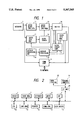
- FIG. 1 is a block diagram showing the principal functions of a mixed mode communication apparatus according to an embodiment of the present invention
- FIG. 2 is a block diagram showing the hardware construction of the communication apparatus
- FIG. 3 is a flow chart showing the transmission operation of the mixed mode communication apparatus.
- FIG. 4 is a chart showing examples of layouts of blocks on one page.
- FIG. 2 is a block diagram showing a hardware construction of a mixed mode communication apparatus according to an embodiment of the present invention.
- image data of an original sheet is read by a reading device 1 and picture image data received through a communication controller 6 from another document processor, are stored into a picture image memory 2.
- Such information as alphanumeric, symbols, and the like, entered by operations on a keyboard 3, is stored as given character codes or character data into the picture image memory 2.
- the picture information stored in the picture image memory 2 is put on a CRT (cathode ray tube) 4, and, with reference to the information thus displayed on this CRT 4, such editorial jobs as deletion, insertion, enlargement, and reduction of picture image are carried out by operations performed on the keyboard 3 or by operating a mouse 5.
- the edited information is processed in the picture image memory 2, and can be stored in a disk device 7 as an external memory device provided as necessary to the apparatus.
- the edited data can also be sent to a receiving station, through the communication controller 6.
- the document data received by the mixed mode communication apparatus is temporarily stored in the picture image memory 2, and, in response to an instruction, is output to a printer 8 or the CRT 4.
- this communication apparatus is capable of printing not merely the document data as received, but also the document data as edited at discretion.
- CPU Central Processing Unit
- a personal computer 21 and a work station 22 may be connected through an I/F unit 20 instead of the keyboard 3, the CRT 4 and the mouse 22.
- FIG. 1 presents a block diagram showing the principal functions of the mixed mode communication apparatus of the instant embodiment, which are for executing an operation to be given later.
- a quick dial memory section 11 stores a dial number and a quick code, or quick dial, that Are entered through preset procedural steps of operations on the keyboard 3.
- the dial number registered therein corresponds to the quick dial.
- a quick block information generating section 12 generates quick block data, which contains character data and image data entered from the keyboard 3 or the reading device 1.
- the quick block information generating section 12 includes the CRT 4 of displaying stereotyped data on the basis for the entered character data and image data, coordinates detecting means for detecting the coordinates representative of a position of the stereotyped data on the CRT 4, and so forth.
- the quick block data generated by the quick block information generating section 12, together with a block number entered from the keyboard 3, is stored into a quick block data memory section 13.
- a register block number as well as the quick dial number is stored in the quick dial memory section 11.
- a block data memory section 14 stores block data, which is generated through an ordinary mixed mode preparation procedure, and does not correspond to the quick dial.
- the block data is based on the data entered from the keyboard 3 or the reading device 1.
- a block search section 15 searches a block number, which is registered in connection with the dial number registered in the quick dial memory section 11, and reads out of the quick block data memory section 13 the quick block data registered therein in association with the searched block number, and loads it into a buffer 16.
- a block layout confirming section 17 confirms a layout of the blocks by checking whether or not the quick block data stored in the buffer 16 laps over the block data, or document body data, stored in the block data memory section 14.
- the block layout confirming section 17 reads the coordinates of the quick block data and the document body data, and performs the block layout confirmation job on the basis of those coordinates data.
- the confirming section produces a proper signal, reads the dial number from the quick dial memory section 11, and sends it out to the communication line, through the communication controller 6.
- the communication controller 6 reads the block data from the buffer 16 and the block data memory section 14, and sends it out to the communication line.
- the block layout confirming section 17 transfers an improper signal to an overlap processing section 18.
- the overlap processing section 18 processes the layout data (coordinates values) of the block data of the buffer 16 and the block data memory section 14 to rearrange the block data so that these data will not overlap.
- the overlap processing section 18 attaches to the data, a flag indicating that the document data is sent in a state that the blocks overlap and the layout data is intact or that the quick block data is written over the block data or the former is written over the latter.
- the overlap processing section 18 Upon completion of the overlap processing, the overlap processing section 18 sends an end signal to the buffer 16 and the block data memory section 14, which in turn produce the stored data toward the communication controller 6.
- FIG. 3 shows a flow chart showing the procedure.
- the system in the apparatus determines at the step S1 whether or not a dial number entered from the keyboard 3 to set up a communication line is quick dial. If it is not quick dial, the system jumps to step S17 where the dial number is sent out to the communication line, a call is generated, and data transmission is started.
- step S1 If the entered dial number is quick dial, the answer to the step S1 is affirmative and then the system advances to the step S2 where it searches the entered quick dial in the quick dial memory section 11.
- the system determines whether or not a block number indicating that the quick block data corresponding to the searched quick dial, and this quick dial as well are stored in the quick dial memory section 11.
- step S3 If it is stored, the answer to the step S3 is affirmative and the system goes to the step S4. At this step S4, the block number is read out as a readout address from the quick block data memory section 13.
- the system confirms a positional relationship (layout) of the quick block data and the block data, or the document body data, stored in the block data memory section 14. On the basis of the confirmed layout, the system checks at the step S6 whether or not both block data overlap each other. If the blocks overlap, the system discriminates in the steps S7 to S9 the contents of setting the overlap processings in the overlap-processing setting section 19 which stores the processings dealing with the case where the blocks overlap.
- step S7 the system determines whether or not the overlap processing is set for deleting the quick block data. If the answer is YES the system executes the job of step S10 where the quick block is removed from the document data to be transmitted.
- step S7 determines whether or not the overlap processing is set for modifying the layout. If the answer to the step S8 is YES, the system goes to the step S11.
- the system determines whether or not the quick block data and the document body data, when rearranged, are located within one page while not overlapping, on the basis of the layout data (coordinates values) of both the blocks.
- the step S12 is executed to modify the layout.
- the layout is modified in a manner that the coordinates values of the quick block data and the block data are adjusted to vertically and horizontally move the blocks within one page so that the blocks, not overlapping, are both located within one page.
- step S11 the system proceeds to the step S13 where the quick block is removed from the document data to be transmitted. If the blocks cannot be properly rearranged, the system may go to the step S9 according to the setting of the overlap processing.
- step S8 determines whether or not the overlap processing is an overwrite processing in which the quick block is attached to the document data irrespective of the data overlapping. If it is the overwrite processing, the answer to the step S9 is YES and the system goes to the step S14. In the job of this step, the quick block data is written over the document body data. If the answer to the step S9 is NO, the step S15 is executed to attach a flag for giving the quick block data an optical transmission property.
- the operation advances to the next step S16 where it is confirmed whether there are the following pages or not and then it is specified whether or not to add quick block in the following pages. If "Yes” in the step S16, the operation returns back to the step S4 where the same edit operation described above is carried out with regard to the following pages. In case of "No" in the step S16, the operation advances to the step S17 to transmit the information.
- FIG. 4 is used for the description.
- a quick block data C with coordinates located as shown in FIG. 4(a) and a data block (document body A) with coordinates located as shown in FIG. 4(b) are composed to have a layout where the blocks do not overlap as shown in FIG. 4(d).
- a document body B with coordinates located as shown in FIG. 4(c) and the quick block data C are composed to have a layout as shown in FIG. 4(e) where the blocks overlap.
- a part of the document body B is written over the quick block data C.
- those blocks are rearranged in accordance with any of preset instructions; an instruction to modify the layout as shown in FIG. 4(d), an instruction to delete the quick block data as shown in FIG. 4(f), an instruction to overwrite the quick block data over the document body as shown in FIG. 4(g), and an instruction to give the document body an optical transmission property as shown in FIG. 4(h).
- the quick block data may be moved to a vacant portion of the document as shown in FIG. 4(i).
- the quick block data is registered in association with the quick dial.
- such overlap processings as layout modification and quick block data deletion are properly selected in accordance with a preset instruction.
- the data blocks are subjected to the selected overlap processing.
- quick block data is added to one page. It is evident that a plural number of quick block data may be added to one page.
- the names of an addressee and addresser may be located above and below a document body, respectively.
- quick block data used common to different receiving stations, for example, the name of an addresser, there is no need for generating and registering the quick block data for each quick dial.
- Such quick block data may be registered as single quick block data with a common block number.
- a select means may be provided by which a user can select use or nonuse of the quick block data before his communication.
- the data to be attached to a document body can be previously registered in association with quick dial. This feature eliminates the troublesome and time-consuming work to prepare a block including the attached data and to attach the prepared block to a document body.
- the layout data can be added for each quick block data.
- the quick block data can be placed at a proper location on one page.
Landscapes
- Engineering & Computer Science (AREA)
- Multimedia (AREA)
- Signal Processing (AREA)
- General Engineering & Computer Science (AREA)
- Computer And Data Communications (AREA)
- Document Processing Apparatus (AREA)
- Facsimiles In General (AREA)
Applications Claiming Priority (2)
| Application Number | Priority Date | Filing Date | Title |
|---|---|---|---|
| JP3-294906 | 1991-10-16 | ||
| JP3294906A JPH05110708A (ja) | 1991-10-16 | 1991-10-16 | ミクスト・モ―ド通信装置 |
Publications (1)
| Publication Number | Publication Date |
|---|---|
| US5367565A true US5367565A (en) | 1994-11-22 |
Family
ID=17813791
Family Applications (1)
| Application Number | Title | Priority Date | Filing Date |
|---|---|---|---|
| US08/959,924 Expired - Fee Related US5367565A (en) | 1991-10-16 | 1992-10-15 | Mixed mode communication apparatus |
Country Status (2)
| Country | Link |
|---|---|
| US (1) | US5367565A (ja) |
| JP (1) | JPH05110708A (ja) |
Cited By (3)
| Publication number | Priority date | Publication date | Assignee | Title |
|---|---|---|---|---|
| US6742046B2 (en) * | 1992-09-21 | 2004-05-25 | Canon Kabushiki Kaisha | Network system and terminal apparatus |
| US20040263907A1 (en) * | 2003-06-26 | 2004-12-30 | Takuya Hiraki | Page processing apparatus and page processing method |
| US20060198555A1 (en) * | 2005-03-04 | 2006-09-07 | Canon Kabushiki Kaisha | Layout control apparatus, layout control method, and layout control program |
Citations (7)
| Publication number | Priority date | Publication date | Assignee | Title |
|---|---|---|---|---|
| JPS58107770A (ja) * | 1981-12-22 | 1983-06-27 | Fujitsu Ltd | フアクシミリ装置 |
| US4641197A (en) * | 1980-10-30 | 1987-02-03 | Canon Kabushiki Kaisha | Image processing method or apparatus |
| JPS6370659A (ja) * | 1986-09-11 | 1988-03-30 | Canon Inc | デ−タ通信装置 |
| JPS6424567A (en) * | 1987-07-20 | 1989-01-26 | Sanyo Electric Co | Mixed mode communication terminal equipment |
| US4811111A (en) * | 1986-07-12 | 1989-03-07 | Ricoh Company, Ltd. | Facsimile machine having a function of transmitting source and destination information |
| JPH0344259A (ja) * | 1989-07-12 | 1991-02-26 | Ricoh Co Ltd | ファクシミリ装置 |
| US5086434A (en) * | 1985-09-30 | 1992-02-04 | Canon Kabushiki Kaisha | Data communication process and apparatus for data transmission in blocks which may include mixed data types |
-
1991
- 1991-10-16 JP JP3294906A patent/JPH05110708A/ja active Pending
-
1992
- 1992-10-15 US US08/959,924 patent/US5367565A/en not_active Expired - Fee Related
Patent Citations (7)
| Publication number | Priority date | Publication date | Assignee | Title |
|---|---|---|---|---|
| US4641197A (en) * | 1980-10-30 | 1987-02-03 | Canon Kabushiki Kaisha | Image processing method or apparatus |
| JPS58107770A (ja) * | 1981-12-22 | 1983-06-27 | Fujitsu Ltd | フアクシミリ装置 |
| US5086434A (en) * | 1985-09-30 | 1992-02-04 | Canon Kabushiki Kaisha | Data communication process and apparatus for data transmission in blocks which may include mixed data types |
| US4811111A (en) * | 1986-07-12 | 1989-03-07 | Ricoh Company, Ltd. | Facsimile machine having a function of transmitting source and destination information |
| JPS6370659A (ja) * | 1986-09-11 | 1988-03-30 | Canon Inc | デ−タ通信装置 |
| JPS6424567A (en) * | 1987-07-20 | 1989-01-26 | Sanyo Electric Co | Mixed mode communication terminal equipment |
| JPH0344259A (ja) * | 1989-07-12 | 1991-02-26 | Ricoh Co Ltd | ファクシミリ装置 |
Cited By (4)
| Publication number | Priority date | Publication date | Assignee | Title |
|---|---|---|---|---|
| US6742046B2 (en) * | 1992-09-21 | 2004-05-25 | Canon Kabushiki Kaisha | Network system and terminal apparatus |
| US20040263907A1 (en) * | 2003-06-26 | 2004-12-30 | Takuya Hiraki | Page processing apparatus and page processing method |
| US20060198555A1 (en) * | 2005-03-04 | 2006-09-07 | Canon Kabushiki Kaisha | Layout control apparatus, layout control method, and layout control program |
| US7900139B2 (en) | 2005-03-04 | 2011-03-01 | Canon Kabushiki Kaisha | Layout control apparatus, layout control method, and layout control program |
Also Published As
| Publication number | Publication date |
|---|---|
| JPH05110708A (ja) | 1993-04-30 |
Similar Documents
| Publication | Publication Date | Title |
|---|---|---|
| US5041918A (en) | Facsimile adapter unit | |
| JPH11143668A (ja) | プリントシステム、プリンタ及び印刷方法 | |
| US5392131A (en) | Facsimile machine having function of retrieving stored domuments waiting for transmission | |
| GB2312131A (en) | Broadcast transmission in a facsimile system | |
| JPS63244965A (ja) | フアクシミリ装置 | |
| US5339169A (en) | Electronic filing system | |
| US5335085A (en) | Facsimile apparatus | |
| US5367565A (en) | Mixed mode communication apparatus | |
| US5537221A (en) | Transmission device for multi-mode communications | |
| JP3253377B2 (ja) | ファクシミリ装置 | |
| JPH04223552A (ja) | ミクストモード文書作成装置 | |
| JP2000194518A (ja) | 印刷処理装置、印刷処理システム、印刷処理方法およびその方法をコンピュ―タに実行させるプログラムを記録したコンピュ―タ読み取り可能な記録媒体 | |
| JPH0358219A (ja) | 文書作成装置および制御装置 | |
| JPH06350790A (ja) | ファクシミリ装置の制御方法 | |
| JPH05250108A (ja) | 印刷データの出力管理装置 | |
| JPH07321982A (ja) | 画像処理装置 | |
| JPH05110745A (ja) | ミクスト・モ―ド文書処理装置 | |
| JPH01316060A (ja) | 文書作成装置 | |
| JPH09131948A (ja) | プリンタ装置 | |
| JPH01106543A (ja) | データ通信装置 | |
| JPH04249469A (ja) | ファクシミリ装置 | |
| JPH11249853A (ja) | 画像形成装置 | |
| JPH05130288A (ja) | ミクスト・モ―ド文書処理方式および装置 | |
| JPH01298868A (ja) | 通信装置 | |
| JPH1013652A (ja) | 通信装置 |
Legal Events
| Date | Code | Title | Description |
|---|---|---|---|
| AS | Assignment |
Owner name: FUJI XEROX CO., LTD., JAPAN Free format text: ASSIGNMENT OF ASSIGNORS INTEREST.;ASSIGNORS:MATSUI, TSUNEHIRO;KOUE, TOSHIAKI;REEL/FRAME:006314/0255 Effective date: 19921104 |
|
| CC | Certificate of correction | ||
| REMI | Maintenance fee reminder mailed | ||
| LAPS | Lapse for failure to pay maintenance fees | ||
| FP | Lapsed due to failure to pay maintenance fee |
Effective date: 19981122 |
|
| STCH | Information on status: patent discontinuation |
Free format text: PATENT EXPIRED DUE TO NONPAYMENT OF MAINTENANCE FEES UNDER 37 CFR 1.362 |