US4530202A - Container filling machine and method - Google Patents
Container filling machine and method Download PDFInfo
- Publication number
- US4530202A US4530202A US06/457,063 US45706383A US4530202A US 4530202 A US4530202 A US 4530202A US 45706383 A US45706383 A US 45706383A US 4530202 A US4530202 A US 4530202A
- Authority
- US
- United States
- Prior art keywords
- container
- filling
- containers
- machine
- station
- Prior art date
- Legal status (The legal status is an assumption and is not a legal conclusion. Google has not performed a legal analysis and makes no representation as to the accuracy of the status listed.)
- Expired - Fee Related
Links
- 238000011049 filling Methods 0.000 title claims abstract description 230
- 238000000034 method Methods 0.000 title claims abstract description 38
- 230000001954 sterilising effect Effects 0.000 claims abstract description 128
- 210000000078 claw Anatomy 0.000 claims description 22
- 230000007246 mechanism Effects 0.000 claims description 18
- 230000005855 radiation Effects 0.000 claims description 17
- 238000011068 loading method Methods 0.000 claims description 15
- 239000007921 spray Substances 0.000 claims description 15
- 239000007788 liquid Substances 0.000 claims description 14
- 238000007789 sealing Methods 0.000 claims description 13
- 238000004659 sterilization and disinfection Methods 0.000 claims description 11
- 230000009471 action Effects 0.000 claims description 7
- 238000011012 sanitization Methods 0.000 claims description 6
- 239000000126 substance Substances 0.000 claims description 5
- 238000003466 welding Methods 0.000 claims description 4
- 238000005520 cutting process Methods 0.000 claims description 2
- 238000005485 electric heating Methods 0.000 claims description 2
- 238000002347 injection Methods 0.000 claims description 2
- 239000007924 injection Substances 0.000 claims description 2
- 238000004806 packaging method and process Methods 0.000 claims description 2
- 238000007363 ring formation reaction Methods 0.000 claims description 2
- 238000011144 upstream manufacturing Methods 0.000 description 21
- 239000008267 milk Substances 0.000 description 11
- 210000004080 milk Anatomy 0.000 description 11
- 235000013336 milk Nutrition 0.000 description 11
- 239000007789 gas Substances 0.000 description 10
- IJGRMHOSHXDMSA-UHFFFAOYSA-N Atomic nitrogen Chemical compound N#N IJGRMHOSHXDMSA-UHFFFAOYSA-N 0.000 description 8
- 238000011109 contamination Methods 0.000 description 8
- 235000013305 food Nutrition 0.000 description 8
- 230000001580 bacterial effect Effects 0.000 description 7
- 238000012544 monitoring process Methods 0.000 description 7
- 238000005192 partition Methods 0.000 description 6
- 230000008569 process Effects 0.000 description 6
- 238000005406 washing Methods 0.000 description 5
- 238000012423 maintenance Methods 0.000 description 4
- 229910052757 nitrogen Inorganic materials 0.000 description 4
- 230000000903 blocking effect Effects 0.000 description 3
- 238000001035 drying Methods 0.000 description 3
- 230000000694 effects Effects 0.000 description 3
- 239000003755 preservative agent Substances 0.000 description 3
- 238000003860 storage Methods 0.000 description 3
- 238000010438 heat treatment Methods 0.000 description 2
- 235000021056 liquid food Nutrition 0.000 description 2
- 238000004519 manufacturing process Methods 0.000 description 2
- 239000002184 metal Substances 0.000 description 2
- 238000005057 refrigeration Methods 0.000 description 2
- 238000000926 separation method Methods 0.000 description 2
- XLYOFNOQVPJJNP-UHFFFAOYSA-N water Substances O XLYOFNOQVPJJNP-UHFFFAOYSA-N 0.000 description 2
- 241000894006 Bacteria Species 0.000 description 1
- 239000002390 adhesive tape Substances 0.000 description 1
- 230000004075 alteration Effects 0.000 description 1
- 238000013459 approach Methods 0.000 description 1
- 230000000712 assembly Effects 0.000 description 1
- 238000000429 assembly Methods 0.000 description 1
- 230000005540 biological transmission Effects 0.000 description 1
- 238000006243 chemical reaction Methods 0.000 description 1
- 238000004140 cleaning Methods 0.000 description 1
- 239000011248 coating agent Substances 0.000 description 1
- 238000000576 coating method Methods 0.000 description 1
- 238000012790 confirmation Methods 0.000 description 1
- 238000010276 construction Methods 0.000 description 1
- 239000000356 contaminant Substances 0.000 description 1
- 238000001816 cooling Methods 0.000 description 1
- 230000003111 delayed effect Effects 0.000 description 1
- 238000007599 discharging Methods 0.000 description 1
- 230000005251 gamma ray Effects 0.000 description 1
- 238000007654 immersion Methods 0.000 description 1
- 238000007689 inspection Methods 0.000 description 1
- 239000000463 material Substances 0.000 description 1
- 238000012986 modification Methods 0.000 description 1
- 230000004048 modification Effects 0.000 description 1
- 238000009928 pasteurization Methods 0.000 description 1
- 238000002360 preparation method Methods 0.000 description 1
- 238000005086 pumping Methods 0.000 description 1
- 230000000717 retained effect Effects 0.000 description 1
- 230000000979 retarding effect Effects 0.000 description 1
- 230000000007 visual effect Effects 0.000 description 1
Images




Classifications
-
- B—PERFORMING OPERATIONS; TRANSPORTING
- B65—CONVEYING; PACKING; STORING; HANDLING THIN OR FILAMENTARY MATERIAL
- B65B—MACHINES, APPARATUS OR DEVICES FOR, OR METHODS OF, PACKAGING ARTICLES OR MATERIALS; UNPACKING
- B65B31/00—Packaging articles or materials under special atmospheric or gaseous conditions; Adding propellants to aerosol containers
- B65B31/04—Evacuating, pressurising or gasifying filled containers or wrappers by means of nozzles through which air or other gas, e.g. an inert gas, is withdrawn or supplied
- B65B31/06—Evacuating, pressurising or gasifying filled containers or wrappers by means of nozzles through which air or other gas, e.g. an inert gas, is withdrawn or supplied the nozzle being arranged for insertion into, and withdrawal from, the mouth of a filled container and operating in conjunction with means for sealing the container mouth
-
- B—PERFORMING OPERATIONS; TRANSPORTING
- B65—CONVEYING; PACKING; STORING; HANDLING THIN OR FILAMENTARY MATERIAL
- B65B—MACHINES, APPARATUS OR DEVICES FOR, OR METHODS OF, PACKAGING ARTICLES OR MATERIALS; UNPACKING
- B65B55/00—Preserving, protecting or purifying packages or package contents in association with packaging
- B65B55/02—Sterilising, e.g. of complete packages
- B65B55/022—Sterilising, e.g. of complete packages of flexible containers having a filling and dispensing spout, e.g. containers of the "bag-in-box"-type
-
- B—PERFORMING OPERATIONS; TRANSPORTING
- B65—CONVEYING; PACKING; STORING; HANDLING THIN OR FILAMENTARY MATERIAL
- B65B—MACHINES, APPARATUS OR DEVICES FOR, OR METHODS OF, PACKAGING ARTICLES OR MATERIALS; UNPACKING
- B65B55/00—Preserving, protecting or purifying packages or package contents in association with packaging
- B65B55/02—Sterilising, e.g. of complete packages
- B65B55/04—Sterilising wrappers or receptacles prior to, or during, packaging
- B65B55/06—Sterilising wrappers or receptacles prior to, or during, packaging by heat
-
- B—PERFORMING OPERATIONS; TRANSPORTING
- B65—CONVEYING; PACKING; STORING; HANDLING THIN OR FILAMENTARY MATERIAL
- B65B—MACHINES, APPARATUS OR DEVICES FOR, OR METHODS OF, PACKAGING ARTICLES OR MATERIALS; UNPACKING
- B65B61/00—Auxiliary devices, not otherwise provided for, for operating on sheets, blanks, webs, binding material, containers or packages
- B65B61/04—Auxiliary devices, not otherwise provided for, for operating on sheets, blanks, webs, binding material, containers or packages for severing webs, or for separating joined packages
- B65B61/06—Auxiliary devices, not otherwise provided for, for operating on sheets, blanks, webs, binding material, containers or packages for severing webs, or for separating joined packages by cutting
-
- B—PERFORMING OPERATIONS; TRANSPORTING
- B67—OPENING, CLOSING OR CLEANING BOTTLES, JARS OR SIMILAR CONTAINERS; LIQUID HANDLING
- B67B—APPLYING CLOSURE MEMBERS TO BOTTLES JARS, OR SIMILAR CONTAINERS; OPENING CLOSED CONTAINERS
- B67B7/00—Hand- or power-operated devices for opening closed containers
- B67B7/02—Hand- or power-operated devices for opening closed containers for removing stoppers
-
- B—PERFORMING OPERATIONS; TRANSPORTING
- B67—OPENING, CLOSING OR CLEANING BOTTLES, JARS OR SIMILAR CONTAINERS; LIQUID HANDLING
- B67C—CLEANING, FILLING WITH LIQUIDS OR SEMILIQUIDS, OR EMPTYING, OF BOTTLES, JARS, CANS, CASKS, BARRELS, OR SIMILAR CONTAINERS, NOT OTHERWISE PROVIDED FOR; FUNNELS
- B67C3/00—Bottling liquids or semiliquids; Filling jars or cans with liquids or semiliquids using bottling or like apparatus; Filling casks or barrels with liquids or semiliquids
- B67C3/001—Cleaning of filling devices
- B67C3/002—Cleaning of filling devices using cups or dummies to be placed under the filling heads
- B67C3/004—Cleaning of filling devices using cups or dummies to be placed under the filling heads permanently attached to the filling machine and movable between a rest and a working position
-
- B—PERFORMING OPERATIONS; TRANSPORTING
- B67—OPENING, CLOSING OR CLEANING BOTTLES, JARS OR SIMILAR CONTAINERS; LIQUID HANDLING
- B67C—CLEANING, FILLING WITH LIQUIDS OR SEMILIQUIDS, OR EMPTYING, OF BOTTLES, JARS, CANS, CASKS, BARRELS, OR SIMILAR CONTAINERS, NOT OTHERWISE PROVIDED FOR; FUNNELS
- B67C7/00—Concurrent cleaning, filling, and closing of bottles; Processes or devices for at least two of these operations
- B67C7/0073—Sterilising, aseptic filling and closing
Definitions
- This invention relates generally to a machine and method for filling a container with a product, and particularly to a machine and method for aseptically filling successive containers with a liquid food or drink product.
- the machine and method may be particularly applicable for filling flexible bag containers with liquid drinks easily susceptible to spoilage, such as milk, and it will be convenient to hereinafter describe the machine and method in relation to that example application. It should be appreciated, however, that the machine and method is not limited to that exemplary application.
- a relatively recently developed pasteurising process identified as ultraheat treatment (UHT) process, however, has been found to destroy bacterial organisms within some food and drink products with minimal damage to product characteristics.
- UHT process is based upon raising the food or drink product to a very high temperature for a short period and then rapidly cooling that product to ambient temperature. Once back at ambient temperature, however, some products are again susceptible to spoilage.
- Milk can be particularly susceptible to bacterial organism contamination and thus spoilage and none of the above outlined means are entirely satisfactory for preventing that spoilage. In consequence, it is necessary for marketers of milk products to market the milk in a container which will maintain the milk within a sterile atomsphere from final production stage until ultimate consumer use so as to minimise bacterial organism contamination. Such successful maintenance means that the milk can be transported and stored for extended periods without the need of critical refrigeration, added preservatives, pasteurisation or other bacterial organisms destroying means.
- a recently developed container for storing and marketing milk, particularly to large users, is a flexible bag composed of sheet material, such as a plastic or plastic/metal laminate, having a closure assembly through which milk can be poured into and from the bag. It has been found that these bag containers can generally maintain the milk in an unspoiled condition provided the containers are sterilized prior to filling and the container is filled with minimum, if any, contamination of either the container or milk. However, machines and methods presently available to fill such bag containers on a commercial scale do not achieve that satisfactorily, so that the useful life of the contained milk is reduced.
- a machine for filling a container through an opening therein including: a machine frame defining a container conveying zone through which a container loaded into the machine moves during a filling operation; a container. sterilizing assembly mounted on the machine frame and defining a sterilizing station in the conveying zone, the container sterilizing assembly operable to aseptically sterilize the container at least in a region incorporating the opening, when positioned at the sterilizing station; and, a container filling assembly at the mounted on the machine frame and defining a container filling station in the conveying zone, the container filling assembly being operable to receive the sterilized container and fill the container through the opening therein with a product whilst maintaining at least the opening region of the container in an aseptic condition.
- a method for filling a container through an opening therein including the steps of: loading the container into a container conveying zone; moving the container through the conveying zone to a sterilizing station; aseptically sterilizing the container at least in the region of the opening when positioned at the sterilizing station; moving the sterilized container along the conveying zone to a filling station; and, filling the container received at the filling station through the opening thereof with a product whilst maintaining at least in the opening region of the container in an aseptic condition.
- the machine frame defines an elongated conveying zone having an inlet through which an empty container is passed for loading into the zone, and an outlet through which a filled container passes to be discharged from the conveying zone.
- the conveying zone preferably, lies generally along one or more horizontal planes during machine operation.
- the machine frame is adapted, during machine operation, to enclose the conveying zone along its entire. longitudinal extent.
- the inlet and outlet to that zone is selectively sealable, that being achieved by the inclusion of suitable inlet and outlet closure members in the machine frame. Because of the extent of this enclosure of the conveying zone during machine operation, contamination of the zone with atmosphere surrounding the machine can be minimised.
- the conveying zone is supplied with a sterilizing gas which pressurizes and maintains the conveying zone at a pressure higher than the surrounding atmosphere. That sterilizing gas is preferably supplied from a zone pressurizing unit.
- the machine of the present invention is preferably adapted to operate continuously so that a plurality of the containers are successively introduced into the machine and move through the conveying zone being filled and then discharged from the machine.
- Those containers are preferably stored adjacent the conveying zone for loading thereinto.
- Those containers may be loaded into the conveying zone in any suitable manner, such as manually.
- Those containers may be separate from each other or, to facilitate loading, severably interconnected in seriatim so that a pack of containers may be simultaneously loaded into the machine and then severed from each other before or after filling.
- the machine of the present invention preferably also includes a container drive assembly operable to move the containers through the conveying zone.
- that drive assembly is operable to step move the containers along the conveying zone.
- container movement steps can be so selected that container movement can be halted between preselected movement steps to allow machine functions to be completed on the containers whilst those containers are in a stop condition.
- the drive assembly is preferably arranged to ensure the general equal spacing between adjacent containers as they move through the conveying zone.
- the container sterilizing assembly is mounted on the machine frame such that the sterilizing station is positioned downstream of the conveying zone inlet. Moreover, preferably, the sterilizing assembly is so arranged that the sterilizing station can be generally isolated from the remainder of the conveying zone.
- the sterilizing assembly is adapted to sterilize containers, or at least a region of those containers, in two stages.
- the sterilizing station preferably has two sub-stations at each of which a respective one of those sterilizing stages occurs, one sub-station being upstream of the other.
- the sterilizing assembly includes a preliminary sterilizing unit positioned within or adjacent the conveying zone, at the upstream sterilizing sub station, and operable to sterilize at least an outer surface of the containers or a holding bag in which one or more of the containers are loaded into the machine.
- a preliminary sterilizing unit positioned within or adjacent the conveying zone, at the upstream sterilizing sub station, and operable to sterilize at least an outer surface of the containers or a holding bag in which one or more of the containers are loaded into the machine.
- the containers stop their movement through the conveying zone when in the upstream sterilizing sub station to allow proper sterilization by the preliminary sterilizing unit.
- the preliminary sterilizing unit may wash cleanse the outer surface of the containers or packs of containers. That wash cleansing may be achieved by spray washing the outer surface with a chemical sanitising liquid and then drying that surface so as to remove traces of that liquid from the outer surface.
- the preliminary sterilizing unit may also be operable to generally immerse the containers in high frequency light rays such as low intensity ultraviolet light rays to assist in sterilization.
- the container sterilizing assembly also includes a main sterilizing unit positioned within or adjacent the conveying zone, at the downstream sterilizing sub-station, and operable to sterilize at least the opening region of the containers.
- a main sterilizing unit positioned within or adjacent the conveying zone, at the downstream sterilizing sub-station, and operable to sterilize at least the opening region of the containers.
- the containers also stop their movement through the conveying zone when in the downstream sterilizing sub-station to allow proper sterilization by the main sterilizing unit.
- the main sterilizing unit may be operable to immerse the opening region of the containers in high frequency light rays, such as high intensity ultraviolet light rays. That sterilizing unit may also immerse the container generally in high frequency light rays, such as low intensity ultraviolet light rays.
- the container filling assembly is mounted on the machine frame such that the filling station is positioned downstream of the sterilizing station.
- the filling assembly is so constructed that the filling station can be generally isolated from the remainder of the conveying zone.
- the filling station is positioned immediately downstream of the downstream sterilizing sub-station so that during machine operation containers move immediately from the sterilizing station to the filling station in preparation for filling.
- the filling assembly includes a container filling unit mounted within or adjacent the conveying zone and operable to fill containers in the filling station with a predetermined portion of product.
- the filling unit preferably has one or more guide elements extending from the sterilizing station, into and through the filling station for supportingly guiding successive containers from the sterilizing station into and through the filling station.
- the filling unit preferably has one or more locating elements provided in the filling station and selectively operable to positively locate and firmly hold the containers, adjacent the opening thereof, in the filling station in a predetermined filling position for filling with the product.
- the locating elements hold the container, movement of that container and of succeeding containers through the conveying zone is stopped to allow container filling. This stoppage also provides the stoppage of successive container(s), within at least the downstream sterilizing sub-station.
- the locating elements are preferably so operable to releasably locate and hold the containers only during container filling.
- the filling unit preferably also has a container filling head mounted within the conveying zone, the head being connectable to a source of product and operable to inject a portion of that product into a container, through the opening thereof, located and held by the locating elements in the filling station.
- the filling head is preferably mounted for movement relative to the held container so that, in machine operation, the head is projected into the container opening for injection of product and then withdrawn frdm the opening to allow the filled container to move from the filling station.
- the machine of the present invention preferably further includes a container discharge assembly mounted on the machine frame and defining a discharge station in the conveying zone.
- the discharge assembly is operable to discharge a filled container, received at the discharge station from the filled station.
- the container discharge assembly is mounted on the machine frame such that the discharge station is positioned downstream of the filling station.
- the discharge assembly may include a severing unit to separate the containers to that they can pass individually through the conveying zone outlet from the machine.
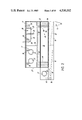
- FIG. 1. is a side elevational view showing the general assembly of a preferred embodiment of the container filling machine of the present invention
- FIG. 1a is a side elevation view illustrating a form of containers filled by the machine of FIG. 1;
- FIG. 2 is a detailed side elevational view illustrating a part of the machine of FIG. 1;
- FIG. 3 is a detailed end elevational view of the machine part of FIG. 2;
- FIG. 4 is a detailed side elevational view illustrating a further part of the machine of FIG. 1;
- FIG. 5 is a detailed plan view of a machine part as seen from V--V of FIG. 4;
- FIG. 6 is a detailed end elevational view of the machine part of FIG. 4;
- FIG. 7 is a detailed perspective view illustrating another part of the machine of FIG. 1;
- FIG. 8 is a detailed cross sectional view of a machine part as seen from VIII--VIII of FIG. 7;
- FIG. 9 is a detailed side elevational view illustrating yet a further part of the machine of FIG. 1; and,
- FIG. 10 is a detailed and elevational view of the machine part of FIG. 9.
- Container 2 for filling container 2, with a product (not shown).
- Container 2 includes plastic bag 3, with closure sleeve 4, sealingly mounted in bag 3, so as to define opening 5, into bag 3.
- Container 2 also has closure cap 6, releasably snap-connectable to sleeve 4, to close opening 5,
- a plurality of bag containers 2 are arranged into pack 7, bags 2, being interconnected in seriatim and fanfolded into a stack and stored in at least one plastic holding bag (not shown).
- Pack 7, may have previously been subjected to a sterilization process such as gamma ray radiation, prior to delivery to machine 2.
- Machine 1 has frame 8, which defines generally horizontally extending conveying zone 9.
- Zone 9 is generally quadrangular and defined by bottom wall 10, top wall 11, and opposed side walls 12, 13 of frame 8.
- Conveying zone 9, has inlet 14, through which packs 7, are loaded into machine 1.
- Inlet 14, is selectively closable by inlet closure door 15, slidably mounted on frame 8.
- Conveying zone 9, also has outlet 16, through which filled containers 2, can pass from machine 1, following movement through conveying zone 9.
- Outlet 16 is selectively closable by outlet closure flap (not shown) hinged to frame 8, and pushed open upon pressure from containers 2, during machine operation.
- Frame 8 is conveniently fabricated so as to include access hatches 17, for inspection and maintenance of machine 1. At least some of hatches 17, may be transparent to enable a operator to watch over filling operations.
- Machine 1 generally includes container sterilizing assembly 18, for aseptically sterilizing containers 2, container filling assmebly 19, for filling containers 2, with product, container discharge assembly 20, for discharging filled containers 2, from machine 1, and drive assembly 21, for moving containers 2, along conveying zone 9, through assemblies 18, 19 and 20.
- Sterilizing assembly 18 is illustrated in detail in FIGS. 2 to 4, and defines upstream sterilizing sub-station 22, and downstream sterilizing sub-station 23, in conveying zone 9.
- Sterilizing assembly 18, can include movable inner partition door 24, for dividing upstream sterilizing sub-station 22, into regions 25, and 26.
- sterilizing assembly 18, may include outer partition wall 27, for at least substantially dividing upstream sterilizing sub-station 22, from downstream sterilizing sub-station 23. In this way, sub-station region 25, in particular and sub-station region 26, to a lesser extent of upstream sterilizing sub-station 22, can be enclosed and isolated.
- Sterilizing assembly 18 includes preliminary sterilizing unit 28, (FIGS. 2 and 3) for sterilizing container pack 7, loaded into conveying zone 9, through inlet 14, and located at upstream sterilizing station 22.
- Preliminary sterilizing unit 28 includes a pair of spaced apart spray nozzles 29, mounted within sub-station region 25, and depending from top wall 11. Nozzles 29, are connectable through pipe 30, to a source of pressurized chemical sanitizing liquid (not shown) to spray wash the outer surface of the holding bag of container pack 7.
- Preliminary sterilizing unit 28 may also include at least one electric heating element 31, mounted in upstream sterilizing sub-station region 25, and selectively operable to dry container pack 7, previously washed with sanitizing liquid sprayed from nozzles 29.
- Preliminary sterilizing unit 28 further includes collection trays 32, positioned adjacent or formed from bottom wall 10, in sub-station regions 25, and 26, for collecting and removing sprayed sanitizing liquid from conveying zone 9.
- Each tray 32 may have a drain pipe (not shown) leading therefrom for collection and disposal or recirculation of the sanitizing liquid.
- Preliminary sterilizing unit 28 also includes at least one low intensity ultraviolet light generator 33, operable to immerse container pack 7, in ultraviolet light rays.
- Each light generator 33 depends from top wall 11, and may be a water cooled lamp.
- a pair of generators 33 may be spaced apart in each of sub-station regions 25, and 26, of upstream sterilizing sub-station 22.
- Sterilizing assembly 18 also includes main sterilizing unit 34, (FIG. 4) located in downstream sterilizing sub-station 23.
- Main sterilizing unit 34 includes high intensity ultraviolet light generator 35, in the form of a water-cooled lamp, positioned in sterilizing sub-station 23, so that containers 2, moving along conveying zone 9, will have that region thereof including closure sleeve 4, and closure cap 6, pass immediately therebeneath for immersion in the ultraviolet light rays.
- Main sterilizing unit 34 also includes at least one low intensity ultraviolet light generator 36, arranged in downstream sterilizing sub-station 23, so as to immerse at least the outer upper surface of bags 3, in ultraviolet light rays. At least two such generators 36, also in the form of water cooled lamps may be spaced about sterilizing sub-station 23, and depend from top wall 11.
- Sterilizing assembly 18 also includes at least one manipulative element 37, mounted on machine frame 8, and adapted to allow manual manipulation of container pack 7, within upstream sterilizing sub-station 22, and to some extent also within downstream sterilizing sub-station 23.
- Each manipulative element 37 may be a surgical glove sealingly mounted on machine frame 8, so as to extend through side wall 12, or 13, into conveying zone 9, and into which a machine operator's arm may extent to allow manipulation of container pack 7.
- At least one pair of manipulative elements 37 can extend into each of upstream and downstream sterilizing sub-stations 22, and 23 (not all shown for reasons of simplicity).
- Sterilizing assembly 18 further includes dump outlet 38, (FIG. 2) opening from downstream sterilizing sub-station 23, and through which the holding bag of container pack 7, can be discarded following dispensing of containers 2, from pack 7.
- Dump outlet 38 includes dump chute 39, sealable from within downstream sterilizing sub-station 23, by removable lid 40, manipulated by conveniently positioned manipulative element 37.
- Container filling assembly 19 is illustrated in detail in FIGS. 4 to 8, and defines container filling station 41, in conveying zone 9, and at which containers 2, are actually filled with a product (not shown).
- Container filling assembly 19, is open to downstream sterilizing sub-station 23, but has a partition 42, dividing to isolate filling station 41, from discharge assembly 20, except for outlet opening 43, through which filled containers 2, move during machine operation.
- Outlet opening 43 is generally rectangular shaped and sized to neatly receive filled bag containers 2, therethrough.
- Container filling assembly 19 includes container filling unit 44, arranged at or adjacent filling station 41.
- Filling unit 44 includes a pair of closely spaced apart guide rails 45, extending from within downstream sterilizing sub-station 23, through filling station 41, and out through outlet opening 43, thereof.
- Guide rails 45 are generally L-shaped and are arranged to face each other so that sleeve 4, of container 2, can extend therebetween and be slidingly supported thereby for sliding movement therealong.
- Guide rails 45 are rigidly mounted on machine frame 8, adjacent bottom wall 10, of conveying zone 9, and pass beneath high intensity light generator 35. That mounting positions rails 45, in a horizontal plane so that closure sleeves 4, guided thereby generally vertically upstanding therefrom with opening 5, facing upwardly.
- Guide rails 45 vary in their relative spacing so that they are more closely spaced apart in filling station 41, than in downstream sterilizing sub-station 23. In this way, closure sleeve 4, of containers 2, can be easily received by and guided between rails 45, to minimise frictional resistance whilst in sterilizing sub-station 23, and is only retained in a close sliding and supporting fit between guide rails 45, at filling station 41, so as to positively locate and hold closure sleeve 4, for container filling.
- Inner surfaces 46, of guide rails 45 may be highly polished or reflective so that ultraviolet light rays particularly from light generator 35, are reflected therefrom and concentrated about closure sleeve 4, and closure cap 6.
- Container filling unit 44 also has support platform 47, extending beneath guide rails 45, from within downstream sterilizing sub-station 23, through filling station 41, to outlet opening 43, thereof.
- Support platform 47 acts to positively support container bags 3, between support platform 47, and guide rails 45, as they move through filling station 41, and particularly during and following filling with product.
- support platform 47 extends parallel and closely spaced beneath guide rails 45, in downstream sterilizing sub-station 23, but diverges downwardly therefrom in filling station 41, to outlet opening 43.
- Support platform 47 may be in the nature of a support plate or support rack.
- Filling unit 44 also has a pair of locating arms 48, and 49, selectively actuable to grip and hold closure sleeves 4, of containers 2, when located in filling station 41.
- Each arm 48, 49 is mounted on a respective guide rail 45, and includes gripping finger 50, mounted on respective guide rail 45, for pivotal movement about axes 51, with finger 50, of arm 48, being located slightly downstream from finger 50, of arm 49.
- Each arm 48, 49 also includes actuating lever 52, pivotably connected to respective gripping finger 50, and actuable by respective linear motor 53, to pivotably move gripping fingers 50, about axes 51, toward and away from each other so as to respectively grip and release a closure sleeve 4, placed therebetween.
- Filling unit 44 also includes filling head 54, (FIGS. 7 and 8) for actually attending to filling of containers 2, when located at filling station 41.
- Filling head 54 includes support plate 55, rigidly mounted on support rod 56, which in turn is mounted on machine frame 8, through bearing 57, for linear movement along and rotary movement about vertical axis 58, relative to machine frame 8.
- Support plate 55 is spaced immediately above guide rails 45, and gripping fingers 50, within filling station 41, so that it will be spaced above closure sleeve 4, of containers 2, positioned between gripping fingers 50, in filling station 41.
- Support rod 56 is pivotal about axis 58, by means of linear motor 59, mounted on machine frame 8, and connected eccentrically to rod 56, through linkage 60.
- Support rod 56 is linearly movable along axis 58, by means of further linear motor 61, also mounted on machine frame 8, and connected to rod 56, through connecting link 62.
- Filling head 54 further includes closure cap removal mechanism 63, mounted on support plate 55, and operable to remove closure cap 6, from container 2, located in filling station 41, for filling of container 2, and subsequently replace that cap 6.
- Removal mechanism 63 includes tubular body 64, rigidly mounted on support plate 55, and projecting downwardly therefrom.
- a series of elongated gripping claws 65 are mounted on tubular body 64, and project downwardly thereof.
- Claws 65 are spaced apart about body 64, in a ring formation and are mounted for radial pivotal movement about individual axes 66.
- Tubular body 64, and claws 65 together define downwardly facing open mouth 67, for receipt of closure caps 6, therein during operation of machine 1.
- a series of resilient bands 68 Mounted on tubular body 64, is a series of resilient bands 68, extending circumferentially about body 64, and also gripping claws 65. Those bands 68, resiliently bias gripping claws 65, radially inwardly so as to extend parallel with body 64.
- Resilient bands 68 may be coil springs.
- Cap removal mechanism 63 further has cap seating plunger 69, operable to engage and move gripping claws radially outwardly against the bias of resilient bands 68, to cause them to release any closure cap 6, gripped therebetween and also to press that released closure cap 6, into engagement with closure sleeve 4.
- Seating plunger 69 has elongated shank portion 70, longitudinally slidable within tubular body 64, and head portion 71, located adjacent gripping claws 65, plunger 69, being movable between an inoperative position (as illustrated in FIG. 8) where head portion 71, is retracted from engagement with gripping claws 65, and an operative position in which head portion 71, engages gripping claws 65, and projects from mouth 67.
- Plunger 69 is resiliently biased into its inoperative position by means of coil spring 72, mounted for reaction between tubular body 64, and shank portion 70, and is movable to its operative position against that bias by action of linear motor 73, mounted on machine frame 8, immediately above where closure sleeve 4, will be gripped by arms 48, 49, in filling station 41.
- Filling head 54 also includes filling nozzle 74, mounted on plate 55, and support rod 56, for movement therewith.
- support rod 56 is provided with passageway 75, extending between nozzle 74, and outlet 76, outlet 76, being connectable to a source of product (not shown) for delivery to nozzle 74.
- Filling nozzle 74 is circumferentially spaced apart from removal mechanism 63, about vertical axis 58, of support rod 56. In this way, during machine operation, support plate 55, can be rotated between positions where cap removal mechanism 63, and filling nozzle 74, are alternatively positioned beneath linear actor 73, and above closure sleeve 4, of container 2, positioned between gripping claws 65, in filling station 41.
- Nozzle 74 has elongated body 77, which extends generally downwardly from support plate 55, to terminal nozzle nose 78.
- Nozzle 74 is generally tubular and thereby defines product passageway 79, connecting with passageway 75.
- Nozzle nose 78 is sized so as to project into opening 5, of closure sleeve 4, with nozzle nose 78, sealing against sleeve 4.
- Valve 80 also has dispensing valve 80, selectively actuable to block and unblock passageway 79, thereby to respectively prevent and permit product dispensing through nozzle nose 78.
- Valve 80 includes valve closure plug 81, adapted to move toward and away from valve seat 82, to respectively block and unblock passageway 79.
- Valve closure plug 81 is mounted on and movable by hollow plunger stem 83, and is resiliently baised into passageway blocking engagement with valve seat 82, by spring 84, acting between body 77, and hollow plunger stem 83. Movement of plunger stem 83, and thus valve closure plug 81, to unblock passageway 79, against bias of spring 84, is achieved with linear motor 73.
- Filling nozzle 74 is also selectively connectable to a source of vacuum and low positive pressure gas (not shown) and is operable to communicate that vacuum and gas through nozzle nose 78, to container 2.
- Connection of filling nozzle 74, to the source of vacuum occurs when filling nozzle nose 78, is sealed against closure sleeve 4, and prior to container filling so as to evacuate any air from container 2. That connection also occurs immediately following withdrawal of filling nozzle nose 78, from closure sleeve 4, after filling so that any drops of product on nozzle nose 78, can be removed and thereby minimise the possibility of those drops falling and contaminating either containers 2, or filling station 41.
- connection of filling nozzle 74, to the source of pressure gas occurs upon completion of container filling and as filling nozzle 74, is about to be lifted away from sleeve 4, to assist in breaking the seal between sleeve 4, and filling nozzle nose 78, and thereby avoid splashing of product from sleeve 4.
- the gas may be nitrogen. That connection occurs through passageway 85, which communicates through relief 86, and port 87, to inner bore 88, hollow plunger stem 83.
- machine 1 provides for selective separate connection of the source of vacuum and the low pressure gas during machine operation, as will become more apparent hereinafter.
- Filling nozzle 74 further includes control valve 89, selectively actuable to control connection of inner bore 88, through nozzle nose 78, and thus into opening 5, of container 2, during machine operation.
- Control valve 89 includes port 90, extending coaxially through valve closure plug 81, and defining seat 91, therein.
- Valve closure needle 92 is slidably mounted in inner bore 88, and adapted to move toward and away from seat 91, to respectively block and unblock port 90.
- Valve closure needle 92 protrudes from plunger stem 83, and is sealed thereto with O-ring 93, so as to confine vacuum and pressure gas in inner bore 88, and prevent escape except through port 90.
- Valve closure needle 92 is resiliently biased out of port blocking engagement with seat 91, by spring 94, acting between plunger stem 83, and closure needle 92. Movement of valve closure needle 92, against bias of spring 94, to block port 90, is achieved with linear motor 73, when plunger stem 83, is moved thereby.
- Filling nozzle 74 also has inlet port 95, and outlet port 96, communicating through relief 97, in body 77. Ports 95, and 96, are connected to a source of steam (not shown) during machine operation to sterilize that region of plunger stem 83, facing relief 97, and which enters product passageway 79, to be contaminated thereby.
- Filling unit 44 also includes nozzle cleansing device 98, mounted on machine frame 8, adjacent filling head 54, for cleansing nozzle nose 78, following each container filling operation.
- Cleansing device 98 is operable to liquid wash filling nozzle nose 78, when support plate 55, is rotated to move nozzle 74, away from closure sleeve 4, and move the removal mechanism 63, into registry therewith.
- Cleansing device 98 includes cleansing cup 99, into which filling nozzle nose 78, can extend and a series of spray jets 100, spaced about cup 99, and selectively connectable to a source of cleansing liquid (not shown), spray jets 100, operable to spray filling nose nozzle 78.
- Discharge assembly 20 is illustrated in detail in FIGS. 9 and 10, and defines discharge station 101, in conveying zone 9.
- Discharge assembly 20 includes sealing device 102, operable to permanently seal closure caps 6, replaced on sleeves 4, following container filling. Sealing device 102, is located in discharge station 101, immediately downstream of filling station 41, and may be a suitable welding device such as an ultrasonic welder, construction of which is well known to those skilled in the relevant art.
- Discharge assembly 20 also includes severing unit 103, operable to separate filled containers 2, as they are moved through discharge station 101, so that they are individually discharged from machine 1, through outlet 16.
- Severing unit 103 includes severing blade 104, mounted adjacent top wall 11, defining conveying zone 9.
- Severing blade 104 has cutting edge 105, extending longitudinally in a configuration.
- Severing blade 104 is mounted on linear motor 106, and through which blade 104, is mounted on machine frame 8. Actuation of linear motor 106, causes upward and downward movement of severing blade 104, in a guillotine action.
- discharge assembly 20 may also include a discharge chute through which separated, filled containers 2, fall out of conveying zone 9, through outlet 16, for subsequent collection.
- Machine 1 also includes pressurizing units 107, (FIGS. 1 and 6) connected to conveying zone 9, for supplying sterilized and pressurized air thereto.
- Pressurizing unit 107 ducts the air through coveying zone 9, via ducts 108, opening into filling station 41, to freely circulate within and between filling station 41, and downstream sterilizing sub-station 23.
- that pressurized air is free to leak into and then from upstream sterilizing sub-station 22, and discharge station 101, to provide at least partial pressurization of that sub-station 22, and station 101.
- Pressurizing unit 107 may be selectively operable to single pass and recirculatively duct the air into conveying zone 9.
- Pressurizing unit 107 may include a pump device 109, operable to draw air from atmosphere surrounding machine 1, and pumping the air through incinerator 110, for sterilization and cooler 111, prior to delivery to ducts 108, and subsequent recirculation.
- pressurizing unit 107 may alternatively be an air cleaning sterilizer operable to draw air from a compressed air source and sterilize the air prior to delivery to ducts 108.
- Machine 1 also includes drive assembly 21, for moving container pack 7, and containers 2, therein along conveying zone 9.
- Drive assembly 21, includes inlet conveyor 112, (FIGS. 2 and 3) comprising idler rollers rotatably mounted within sterilizing sub-station 22, and 23.
- One series of rollers 113 extends along bottom wall 10, of conveying zone 9, in both sub stations 22, and 23 whilst further series of rollers 114, extend along side walls 12, 13 of conveying zone 9, in upstream sterilizing sub-station 22.
- This inlet conveyor 112 is such that container packs 7, loaded into sterilizing sub-station are manually movable along the series of idler rollers 113, 114, therewithin.
- Container packs 7, are loaded into conveying zone 9, so that they bear directly on conveyor roller series 113.
- drive assembly 21 may provide one or more support pallets (not shown) arranged to bear on conveyor roller series 113, and to support the container pack 7, thereon. These pallets may facilitate mechanical loading of container packs 7, into conveying zone 9, and also movement of packs 7, within sterilizing sub-stations 22, and 23.
- one of access hatches 17, may be positioned adjacent downstream sterilizing sub-station 23, to allow removal of those pallets following depletion of the containers 2, of pack 7, on the pallet within the sterilizing sub-station 23.
- Outlet conveyor 115 (FIGS. 9 and 10) extending along conveying zone 9, within discharge station 101, and operable to move filled containers 2, therethrough and discharge them from machine 1.
- Outlet conveyor 115 is a series of driven conveyor rollers 116, extending within discharge station 101, Roller series 116, is driven through suitable motor and drive transmission train 117, such as an air motor, drive shaft, and belt train.
- Each roller in series 116, of outlet conveyor 115. may have outer surface 118, treated to facilitate frictional grip with filled containers 2.
- each roller in series 116 may be provided with an at least partially rubberised outer surface 118. That surface 118, may be provided by a rubberised coating or, as shown, a series of O-rings 119, spaced apart along each of rollers in series 116.
- outlet conveyor 115 may have a slight downward gradient from the container filling assembly 19, to conveying zone outlet 16, to facilitate container movement therethrough.
- a variety of monitoring and control mechanisms may be provided to monitor and control the various functions of machine 1.
- means may be provided to monitor the number of bag containers 2, within machine 1, awaiting to be filled, the presence of closure cap 6, with each of those containers 2, the correct positioning of each container 2, on support platform 47, and within guide rails 45, prior to container filling, the maintenance of a positive pressure within at least filling station 41, the maintenance of a predetermined temperature within one or more stations 22, 23, 41, and 101, the hours of operation of ultraviolet light generators 33, 35, and 36, the sealing of filling nozzle nose 78, within closure sleeve 4, prior to filling, and the spillage of product or other contamination within conveying zone 9.
- Means may be provided to control operation of, inter alia, washing spray jets 100, heating element 31, ultraviolet light generators 33, 35 and 36, filling head 54, movement involving closure cap removal mechanism 63, and filling nozzle 74, outlet conveyor 115, sealing device 102, and severing blade 104.
- Linear motors 53, 59, 61, 73, and 120 may be air operated piston and cylinder motors, the control means control flow of pressurized air to and from those motors.
- the monitoring and control mechanisms may particularly include a nozzle check facility operable to check effectiveness of sleeve sealing before operation of dispensing valve 80, to dispense product is permitted.
- This facility may involve monitoring the effectiveness of the evacuation of container 2, by holding and monitoring the residual vacuum following the period of evacuation and, if the negative pressure decays toward zero, providing an indication to the machine operator that the seal between filling nozzle nose 78, and sleeve 4, is incomplete.
- monitoring and control means are located outside conveying zone 9, at least in filling station 41, to minimise potential contamination of that zone 9.
- suitable aseptic seals may be provided.
- the monitoring and control means may be a combination of electronic and mechanical devices well recognised by those skilled in this art. Wherever practical in this form, those devices preferably automatically function to facilitate automatic operation of the machine.
- control means Prior to any period of operation of machine 1, that machine 1, is caused to automatically undergo a sterilizing procedure to ensure that machine 1, is sterilized for operation.
- the control means is operated so that support plate 55, is rotated and lowered under action of linear motors 59, and 61, until filling nozzle nose 78, is positioned within cleansing cup 99, and dispensing valve 80, is actuated by linear motor 120, mounted on manchine frame 8, to unblock product passageway 79, to allow sterilization of all product delivery lines.
- the control means additionally causes the gas pump device 109, to operate so that sterilized air is ducted into conveying zone 9, at least in downstream sterilizing sub-station 23, and filling station 41.
- That air is filtered to about 25 micron and then passed through incinerator 110, raising the air to a temperature of approzimately 300° C. Prior to direct circulation through ducts 108, and within conveying zone 9. At this air temperature, all living bacteria are destroyed. Metal components of machine 1, contacted by this hot dry air are raised to a temperature in the region of 150° C. When the required sanitizing temperature is reached it will be monitored for a set time and recorded on a chart recorder and at the completion of that heating period, the air will be diverted through cooler 111, to lower its temperature to approximately 45° C.
- This air can then be continued to be ducted through ducts 108, into at least downstream sterilizing sub-station 23, and filling station 41, and used as the low pressure sterile air for maintaining conveying zone 9, at a positive pressure throughout the filling operation.
- gas pump device 109 along with a volume of makeup air replacing air vented through inlet 14, and outlet 16, of conveying zone 9.
- an operator working in a clean environment adjacent machine 1 removes any outer storage or transportation packaging (not shown) from container pack 7, to leave the holding bag closed about bag containers 2.
- This container pack 7, is then loaded into conveying zone 9, through inlet 14, and placed in the upstream sterilizing sub-station region 25.
- the operator then isolates that region 25, by closing inlet closure door 15, and inner partition door 24, and initiates spray washing and drying of the holding bag. That washing and drying is a timed function with the operator being alerted by the control means as to the end of that function.
- the holding bag and containers 2 are then immersed in ultraviolet light rays from light generators 33, in upstream sterilizing sub-station region 25.
- a leading bag container 2, in slit container pack 7, is then removed from pack 7, and clipped to a draw cord (not shown) threaded through conveying zone 9, prior to machine sterilization. That cord passes through conveying zone outlet 16, and is gripped by the operator to draw successive bag containers 2, from pack 7, onto support platform 47, with closure sleeves 4, in sliding engagement with guide rails 45.
- a draw cord (not shown) threaded through conveying zone 9, prior to machine sterilization. That cord passes through conveying zone outlet 16, and is gripped by the operator to draw successive bag containers 2, from pack 7, onto support platform 47, with closure sleeves 4, in sliding engagement with guide rails 45.
- As bag containers 2, are drawn through downstream sterilizing sub-station 23, they are immersed in ultraviolet light rays from light generators 35, and 36, and so sterilized prior to moving to filling station 41.
- downstream gripping arm 48 will be actuated by respectiye linear motor 53, to block closure sleeve passage along guide rails 45.
- upstream gripping arm 49 will be actuated by respective linear motor 53, to cause closure sleeve 4, of that leading bag container 2, to be firmly gripped between fingers 50, of the gripping arms 48, 49.
- cap removal mechanism 63 is initially placed inmediately above closure cap 6, and, with plunger 69, in its inoperative position, filling head support plate 55, lowered under action of linear motor 61, until removal mechanism gripping claws 65, extend over and about to resiliently engage closure cap 6, in mouth 67.
- Filling head support plate 55 is then raised with linear motor 61, with removal mechanism 63, withdrawing closure cap 6, from closure sleeve 4.
- linear motor 73 actuates linear motor 73, to push plunger stem 83 and needle 92 against their respective biasing springs 84 and 94. Because of the relative positions of plunger stem 83, and needle 92, linear motor 73, initially actuates needle 92, blocking port 90 and so ending air withdrawal. Immediatley, thereafter linear motor 73, actuates plunger stem 83, which in turn actuates dispensing valve 80, to unblock passageway 79, and allow a preset quantity of product to be delivered through passageways 75, and 79, to that bag container 2. During this delivery passageway 85, is connected to the source of low pressure nitrogen.
- linear motor 73 Upon completion of bag container filling linear motor 73, is again actuated to release plunger stem 83 and needle 92, causing dispensing valve 80, to initially block passageway 79, then unblock part 90 to deliver low pressure nitrogen to opening 5.
- Support plate 55 is then raised slowly with linear motor 61 to lift filling nozzle nose 78, out of sleeve 4, to avoid product splashing, the low pressure nitrogen assisting separation between nozzle 74, and product.
- filling nozzle nose 78 While filling nozzle nose 78, is above sleeve 4, and for about 200 milliseconds before support plate 55, further moves away, filling nozzle 74, is reconnected to the source of vacuum through passageway 85, to draw any drops of product on filling nozzle nose 78, into inner bore 88, and eventually out thfough passageway 85.
- Support plate 55 is then completely retracted and then rotated under action of linear motor 59, so positioning filling nozzle 74, above cleansing cup 99, and repositioning removal mechanism 63, above closure sleeve 4.
- lowering support plate 55, with linear motor 61 causes filling nozzle nose 74, to enter cleansing cup 99, for washing with a cleansing liquid, and closure cap 6 to re-engage with closure sleeve 6.
- the control means then causes linear motor 73, to move plunger 69, from its inoperative position to its operative position where it moves gripping claws 65, against the resilient bias of resilient bands 68, and so out of contact with closure cap 6, and presses closure cap 6, into firm engagement with closure sleeve 4.
- plunger 69 With plunger 69, maintained in its operative position, filling head support plate 55, is then raised with linear motor 61, to clear removal mechanism 63, from filled bag container 2, and linear motor 73, retracted to allow plunger 69, to return to its inoperative position.
- Locating arms 48, 49 then release closure sleeve 6, so that filled leading bag container 2, can be then manually drawn out of filling station 41, to discharge station 89, where operation of outlet conveyor 115, moves that leading bag container 2, through that station 101, and simultaneously draws a successive bag container 2, into container filling station 41, for filling as above.
- outlet conveyor 115 moves that leading bag container 2, through that station 101, and simultaneously draws a successive bag container 2, into container filling station 41, for filling as above.
- outlet conveyor 115 Until two filled bag containers 2, are pulled through filling station 41, onto outlet conveyor 115, the operator will be required to manually draw containers 2, along conveying zone 9, with the draw cord. Once those two containers 2, are on outlet conveyor 115, then the draw cord can be unhooked and outlet conveyor 115, will operate to continuously draw containers 2, from pack 7, and through conveying zone 9.
- a series of fixed spray heads (not shown) spaced along conveying zone 9, can spray cleanse and sterilize that zone 9, to wash away the residue of that product.
- That wash down programme may be timed for approximately 3 minutes and then machine 1, can be set for a further filling operation.
- machine 1 will have at least two container packs 7, within conveying zone 9, one in each of the upstream and downstream sterilizing sub-stations 22, and 23, one pack 7, having containers 2, being drawn therefrom for filling and the other pack 7, in readiness upon depletion of that one pack 7.
- the leading container 2, of the other container pack 7, in upstream sub-station 22 is connected to the last container 2, of the one container pack 7, in the downstream sub-station 23, by the operator while the one container pack 7, is being filled. That connection can be achieved with adhesive tape applied to either the last container 2, of the one container pack 7, or the leading container 2, of the other container pack 7, during pack manufacture.
- the machine can be provided with visual indication through the access hatches 17, to advise the operator that the one container pack 7, is depleted so that the other container pack 7, should be moved into downstream sub-station 23, and a further container pack 7, loaded into upstream sub station 22.
- the monitoring means may provide an alarm indication should that function not be carried out.
- the present invention provides a machine and method which can operate to fill containers in an aseptic condition.
- that machine it is particularly suitable for filling flexible bag containers with liquid food and drink.
- containers so filled with the machine can maintain the product in a usable condition for a longer period of time when compared with previous filling machines.
- the machine and method of the present invention enables rapid continuous filling of containers with minimal possibility of interruption through incorrect container feeding or filling. As such, container filling can be achieved economically and efficiently thereby minimising ultimate cost of the product to the consumer.
Landscapes
- Engineering & Computer Science (AREA)
- Mechanical Engineering (AREA)
- Chemical & Material Sciences (AREA)
- Dispersion Chemistry (AREA)
- Filling Of Jars Or Cans And Processes For Cleaning And Sealing Jars (AREA)
- Basic Packing Technique (AREA)
Applications Claiming Priority (4)
| Application Number | Priority Date | Filing Date | Title |
|---|---|---|---|
| AUPF2319 | 1982-01-18 | ||
| AUPF231982 | 1982-01-18 | ||
| AUPF2475 | 1982-01-28 | ||
| AUPF247582 | 1982-01-28 |
Publications (1)
| Publication Number | Publication Date |
|---|---|
| US4530202A true US4530202A (en) | 1985-07-23 |
Family
ID=25642521
Family Applications (1)
| Application Number | Title | Priority Date | Filing Date |
|---|---|---|---|
| US06/457,063 Expired - Fee Related US4530202A (en) | 1982-01-18 | 1983-01-10 | Container filling machine and method |
Country Status (5)
| Country | Link |
|---|---|
| US (1) | US4530202A (it) |
| DE (1) | DE3301315C2 (it) |
| FR (1) | FR2519936B1 (it) |
| GB (1) | GB2112735B (it) |
| IT (1) | IT1163032B (it) |
Cited By (43)
| Publication number | Priority date | Publication date | Assignee | Title |
|---|---|---|---|---|
| US4730435A (en) * | 1986-04-07 | 1988-03-15 | Aqua-Chem, Inc. | Sterile docking system for filling IV bags |
| US4815256A (en) * | 1987-07-02 | 1989-03-28 | Bhmw Partnership | Capped container dispenser |
| US4842028A (en) * | 1987-05-13 | 1989-06-27 | Baxter International Inc. | Fluid transfer apparatus |
| US4911212A (en) * | 1987-07-06 | 1990-03-27 | Burton John W | Bottle filling device |
| DE3918504A1 (de) * | 1989-06-07 | 1990-12-13 | Seitz Enzinger Noll Masch | Verschliessmaschine umlaufender bauart |
| US5339874A (en) * | 1992-07-22 | 1994-08-23 | Fountain Fresh International | Beverage dispensing apparatus and process |
| US5537803A (en) * | 1994-02-15 | 1996-07-23 | Tetra Laval Holdings & Finance S.A. | Method and apparatus for finishing and filling packaging containers |
| US5881535A (en) * | 1996-04-09 | 1999-03-16 | Baxter International, Inc. | Apparatus and method for filling and sealing intravenous solution bags |
| US5910138A (en) * | 1996-05-13 | 1999-06-08 | B. Braun Medical, Inc. | Flexible medical container with selectively enlargeable compartments and method for making same |
| US5928213A (en) * | 1996-05-13 | 1999-07-27 | B. Braun Medical, Inc. | Flexible multiple compartment medical container with preferentially rupturable seals |
| US5944709A (en) * | 1996-05-13 | 1999-08-31 | B. Braun Medical, Inc. | Flexible, multiple-compartment drug container and method of making and using same |
| US6065270A (en) * | 1996-12-18 | 2000-05-23 | Schott Glaswerke | Method of producing a filled plastic syringe body for medical purposes |
| DE19904131A1 (de) * | 1999-02-03 | 2000-08-24 | Hassia Verpackung Ag | Füllstation für eine Aseptik-FFS-Verpackungsmaschine |
| EP1047623A4 (en) * | 1995-07-24 | 2000-11-02 | Smithkline Beecham Corp | VIAL LIFTER |
| USRE37471E1 (en) | 1994-03-02 | 2001-12-18 | Robert Bosch Packaging Technology, Inc. | Vial filling apparatus |
| US6463716B1 (en) * | 1998-11-10 | 2002-10-15 | Focke & Co. (Gmbh & Co.) | Packaging machine for cigarettes |
| US6561203B2 (en) * | 2000-02-08 | 2003-05-13 | Ajinomoto Co., Inc. | Container cleaning, draining and drying apparatus |
| WO2003068663A1 (en) * | 2002-02-11 | 2003-08-21 | Lamba Kft. | Procedure and equipment for filling containers with aseptic liquid |
| US20040065056A1 (en) * | 2002-10-02 | 2004-04-08 | Michael Wilford | Patch for flexible container |
| US6735926B1 (en) * | 1998-04-03 | 2004-05-18 | Kent A. Louviere | Method of making a plurality of interconnected vials |
| USRE38747E1 (en) | 1994-03-02 | 2005-06-28 | Robert Bosch Packaging Technology, Inc. | Vial filling apparatus |
| US20050235474A1 (en) * | 2002-07-24 | 2005-10-27 | Erik Forsberg | Apparatus and method for manufacturing and assembling sterile containers |
| US20060225837A1 (en) * | 2003-07-09 | 2006-10-12 | Wolfgang Haase | Method and device for attaching advertising media to bottles |
| US20070029009A1 (en) * | 2005-08-08 | 2007-02-08 | Luis Alves | Container filling device |
| US20070205216A1 (en) * | 2006-03-01 | 2007-09-06 | Smith Mark A | Puncturable cap and piercer |
| US20120031583A1 (en) * | 2010-07-15 | 2012-02-09 | Albert Handtmann Maschinenfabrik Gmbh & Co. Kg | Device and method for cooling food machinery |
| CN102666288A (zh) * | 2009-11-24 | 2012-09-12 | Khs有限责任公司 | 用于包装元件的无菌或者消毒处理的装置 |
| US20140076457A1 (en) * | 2012-09-20 | 2014-03-20 | Pouch Pac Innovations, Llc | Diving nozzle for filling a product into a package and for gas purging and method for the same |
| JP2015077680A (ja) * | 2013-10-18 | 2015-04-23 | ポール ライフ サイエンシズ ベルジウム ビーヴイビーエーPall Life Sciences Belgium Bvba | 製品の充填及び仕上げのための使い捨て製造ライン |
| US9505511B2 (en) | 2012-09-20 | 2016-11-29 | Pouch Pac Innovations, Llc | Diving nozzle for filling a product into a package and for gas purging and method for the same |
| WO2017072591A1 (en) * | 2015-10-28 | 2017-05-04 | Vanrx Pharmasystems Inc. | Aseptic robotic filling system and method |
| US10259607B2 (en) | 2008-03-04 | 2019-04-16 | Vanrx Pharmasystems Inc. | Aseptic robotic filling system and method |
| WO2021022053A1 (en) * | 2019-07-30 | 2021-02-04 | Steribin, LLC | Systems and methods for treating a contaminated container |
| KR20210087660A (ko) * | 2020-01-03 | 2021-07-13 | 정상진 | 매트리스 살균장치 |
| US11203453B2 (en) | 2014-06-23 | 2021-12-21 | Hosokawa Yoko Co., Ltd. | Method of manufacturing spouted pouch aseptically filled with contents |
| US11247888B2 (en) * | 2017-06-28 | 2022-02-15 | Krones Ag | Method for tightness control of a filling-sealing unit for containers, and filling-sealing machine |
| US20220214208A1 (en) * | 2019-05-27 | 2022-07-07 | I.M.A. Industria Macchine Automatiche S.P.A. | Method to weigh containers |
| US20230132939A1 (en) * | 2017-04-03 | 2023-05-04 | Sidel Participations | Installation for treating containers and method for changing format |
| US11679171B2 (en) | 2021-06-08 | 2023-06-20 | Steribin, LLC | Apparatus and method for disinfecting substances as they pass through a pipe |
| CN118651812A (zh) * | 2024-07-15 | 2024-09-17 | 椰泰实业(惠州)有限公司 | 一种基于pet瓶装饮料的无菌冷灌装控制方法及系统 |
| US20250074645A1 (en) * | 2023-08-30 | 2025-03-06 | Hecht Technologie Gmbh | Device for handling containers |
| US20250187895A1 (en) * | 2022-03-02 | 2025-06-12 | Ján SOFRANKO | Device and method for aseptic filling of packages |
| US12404160B2 (en) * | 2022-11-10 | 2025-09-02 | Gea Procomac S.P.A. | Apparatus for treating closures for containers |
Families Citing this family (10)
| Publication number | Priority date | Publication date | Assignee | Title |
|---|---|---|---|---|
| GB8602506D0 (en) * | 1986-02-01 | 1986-03-05 | Corrugated Prod Ltd | Filling apparatus |
| DE3837460A1 (de) * | 1988-11-04 | 1990-05-10 | Sieger Plastic Gmbh | Trennvorrichtung zum abtrennen von endlos gefertigten bag-in-box-beuteln von einer beutelbahn |
| IT1269243B (it) * | 1994-07-27 | 1997-03-26 | Rossi & Catelli Spa | Macchina per confezionare contenitori in ambiente asettico |
| IT1275875B1 (it) * | 1995-03-08 | 1997-10-24 | Goglio Spa Luigi Milano | Sistema per il mantenimento delle condizioni di sterilita' nella zona del bocchello di riempimento di contenitori per impianti di |
| FR2737716B1 (fr) * | 1995-08-09 | 1999-09-10 | Dufrene Alain | Dispositif de remplissage de recipients comportant un bouchon et destines a recevoir des liquides |
| IT1293960B1 (it) * | 1997-06-20 | 1999-03-11 | Mbf Spa | Macchina riempitrice rotativa per il riempimento di contenitori con liquidi |
| DE102011054683B4 (de) * | 2011-10-21 | 2023-11-09 | Krones Aktiengesellschaft | Trocknungsvorrichtung für Behälter und Verfahren zum Reinigen einer solchen Trocknungsvorrichtung |
| HUE028812T2 (en) * | 2013-06-21 | 2017-01-30 | Alegre Alex Guamis | Continuous packaging using ultraviolet-C light to sterilize bottles |
| DE102014003871B3 (de) * | 2014-03-07 | 2014-11-27 | Flex&Fill Solutions Limited | Ausgießer für einen Behälter zur aseptischen Aufnahme eines fließfähigen Produkts sowie Behälter und Verfahren zum aseptischen Befüllen |
| DE102014116151B3 (de) * | 2014-11-06 | 2016-01-28 | Flex&Fill Solutions Limited | Verschlusseinrichtung für einen Behälter zur aseptischen Aufnahme eines fließfähigen Produkts sowie Behälter und Verfahren zum aseptischen Befüllen |
Citations (11)
| Publication number | Priority date | Publication date | Assignee | Title |
|---|---|---|---|---|
| US2546418A (en) * | 1946-08-12 | 1951-03-27 | Continental Can Co | Siruping machine and method for siruping filled containers |
| US3014620A (en) * | 1959-04-20 | 1961-12-26 | Rca Corp | Fluid dispensing device |
| US3159395A (en) * | 1962-02-12 | 1964-12-01 | Continental Oil Co | Holder for glass ball joints |
| GB1086076A (en) * | 1965-04-09 | 1967-10-04 | Tepar Ag | A method of packaging sterile material under aseptic conditions |
| US3390891A (en) * | 1966-02-25 | 1968-07-02 | Karlsruhe Augsburg Iweka | Tube holder for tube filling and closing machines |
| US3783581A (en) * | 1972-04-18 | 1974-01-08 | Dart Ind Inc | Aseptic packaging method and machine |
| CH595248A5 (en) * | 1974-12-10 | 1978-02-15 | Anders Ruben Rausing | Sterilised cartons for long-life liquids |
| US4077182A (en) * | 1975-12-01 | 1978-03-07 | Aci Operations Pty, Ltd. | Liquid fill apparatus |
| US4120134A (en) * | 1977-07-05 | 1978-10-17 | Scholle Corporation | Apparatus for and method of filling flexible containers |
| US4218265A (en) * | 1977-10-05 | 1980-08-19 | Tetra Pak International Ab | Method and an arrangement for the cleaning of a filler pipe in a packing machine |
| US4417607A (en) * | 1981-06-29 | 1983-11-29 | Scholle Corporation | Apparatus and method for aseptically filling flexible containers |
Family Cites Families (6)
| Publication number | Priority date | Publication date | Assignee | Title |
|---|---|---|---|---|
| CH345260A (fr) * | 1957-06-19 | 1960-03-15 | Jovignot Raymond | Procédé de mise en récipients stériles dans des conditions stériles d'un produit préalabement stérilisé et installation pour la mise en oeuvre du procédé |
| DE2509611A1 (de) * | 1975-03-05 | 1976-09-16 | Ganzhorn & Stirn | Vorrichtung zum sterilen verpacken von guetern in behaelter |
| DE2919388A1 (de) * | 1978-05-19 | 1979-11-22 | Scholle Corp | Vorrichtung zum aseptischen verpacken |
| IT1100746B (it) * | 1978-12-18 | 1985-09-28 | Safta Spa | Contenitori flessibili piatti e valvole relative,e procedimento e apparecchiatura per la loro fabbricazione in condizioni assolutamente sterili |
| NZ194774A (en) * | 1979-08-29 | 1983-09-02 | Brown Albert M | Semi-automatic filling of wine cask type containers |
| EP0078260A4 (en) * | 1981-05-07 | 1985-02-18 | Scholle Corp | DEVICE AND METHOD FOR ASEPTICALLY FILLING FLEXIBLE CONTAINERS. |
-
1983
- 1983-01-10 US US06/457,063 patent/US4530202A/en not_active Expired - Fee Related
- 1983-01-17 DE DE3301315A patent/DE3301315C2/de not_active Expired - Lifetime
- 1983-01-17 FR FR8300608A patent/FR2519936B1/fr not_active Expired
- 1983-01-18 IT IT19155/83A patent/IT1163032B/it active
- 1983-01-18 GB GB08301241A patent/GB2112735B/en not_active Expired
Patent Citations (11)
| Publication number | Priority date | Publication date | Assignee | Title |
|---|---|---|---|---|
| US2546418A (en) * | 1946-08-12 | 1951-03-27 | Continental Can Co | Siruping machine and method for siruping filled containers |
| US3014620A (en) * | 1959-04-20 | 1961-12-26 | Rca Corp | Fluid dispensing device |
| US3159395A (en) * | 1962-02-12 | 1964-12-01 | Continental Oil Co | Holder for glass ball joints |
| GB1086076A (en) * | 1965-04-09 | 1967-10-04 | Tepar Ag | A method of packaging sterile material under aseptic conditions |
| US3390891A (en) * | 1966-02-25 | 1968-07-02 | Karlsruhe Augsburg Iweka | Tube holder for tube filling and closing machines |
| US3783581A (en) * | 1972-04-18 | 1974-01-08 | Dart Ind Inc | Aseptic packaging method and machine |
| CH595248A5 (en) * | 1974-12-10 | 1978-02-15 | Anders Ruben Rausing | Sterilised cartons for long-life liquids |
| US4077182A (en) * | 1975-12-01 | 1978-03-07 | Aci Operations Pty, Ltd. | Liquid fill apparatus |
| US4120134A (en) * | 1977-07-05 | 1978-10-17 | Scholle Corporation | Apparatus for and method of filling flexible containers |
| US4218265A (en) * | 1977-10-05 | 1980-08-19 | Tetra Pak International Ab | Method and an arrangement for the cleaning of a filler pipe in a packing machine |
| US4417607A (en) * | 1981-06-29 | 1983-11-29 | Scholle Corporation | Apparatus and method for aseptically filling flexible containers |
Cited By (69)
| Publication number | Priority date | Publication date | Assignee | Title |
|---|---|---|---|---|
| US4730435A (en) * | 1986-04-07 | 1988-03-15 | Aqua-Chem, Inc. | Sterile docking system for filling IV bags |
| US4842028A (en) * | 1987-05-13 | 1989-06-27 | Baxter International Inc. | Fluid transfer apparatus |
| US4815256A (en) * | 1987-07-02 | 1989-03-28 | Bhmw Partnership | Capped container dispenser |
| US4911212A (en) * | 1987-07-06 | 1990-03-27 | Burton John W | Bottle filling device |
| DE3918504A1 (de) * | 1989-06-07 | 1990-12-13 | Seitz Enzinger Noll Masch | Verschliessmaschine umlaufender bauart |
| US5040354A (en) * | 1989-06-07 | 1991-08-20 | Seitz Enzinger Noll | Arrangement for cleaning capping mechanisms of a rotary-type capping machine |
| US5339874A (en) * | 1992-07-22 | 1994-08-23 | Fountain Fresh International | Beverage dispensing apparatus and process |
| US5450882A (en) * | 1992-07-22 | 1995-09-19 | Fountain Fresh International | Beverage dispensing apparatus and process |
| US5537803A (en) * | 1994-02-15 | 1996-07-23 | Tetra Laval Holdings & Finance S.A. | Method and apparatus for finishing and filling packaging containers |
| USRE38747E1 (en) | 1994-03-02 | 2005-06-28 | Robert Bosch Packaging Technology, Inc. | Vial filling apparatus |
| USRE37471E1 (en) | 1994-03-02 | 2001-12-18 | Robert Bosch Packaging Technology, Inc. | Vial filling apparatus |
| EP1047623A4 (en) * | 1995-07-24 | 2000-11-02 | Smithkline Beecham Corp | VIAL LIFTER |
| US5881535A (en) * | 1996-04-09 | 1999-03-16 | Baxter International, Inc. | Apparatus and method for filling and sealing intravenous solution bags |
| US5944709A (en) * | 1996-05-13 | 1999-08-31 | B. Braun Medical, Inc. | Flexible, multiple-compartment drug container and method of making and using same |
| US20040068960A1 (en) * | 1996-05-13 | 2004-04-15 | Smith Steven L. | Flexible multi-compartment container with peelable seals and method for making same |
| US6165161A (en) * | 1996-05-13 | 2000-12-26 | B. Braun Medical, Inc. | Sacrificial port for filling flexible, multiple-compartment drug container |
| US6996951B2 (en) | 1996-05-13 | 2006-02-14 | B. Braun Medical Inc. | Flexible multi-compartment container with peelable seals and method for making same |
| US6198106B1 (en) | 1996-05-13 | 2001-03-06 | B. Braun Medical, Inc. | Transport and sterilization carrier for flexible, multiple compartment drug container |
| US6203535B1 (en) | 1996-05-13 | 2001-03-20 | B. Braun Medical, Inc. | Method of making and using a flexible, multiple-compartment drug container |
| US5928213A (en) * | 1996-05-13 | 1999-07-27 | B. Braun Medical, Inc. | Flexible multiple compartment medical container with preferentially rupturable seals |
| US5910138A (en) * | 1996-05-13 | 1999-06-08 | B. Braun Medical, Inc. | Flexible medical container with selectively enlargeable compartments and method for making same |
| US6468377B1 (en) | 1996-05-13 | 2002-10-22 | B. Braun Medical Inc. | Flexible medical container with selectively enlargeable compartments and method for making same |
| US20030000632A1 (en) * | 1996-05-13 | 2003-01-02 | Sperko William A. | Flexible medical container with selectively enlargeable compartments and method for making same |
| US6846305B2 (en) | 1996-05-13 | 2005-01-25 | B. Braun Medical Inc. | Flexible multi-compartment container with peelable seals and method for making same |
| US6764567B2 (en) | 1996-05-13 | 2004-07-20 | B. Braun Medical | Flexible medical container with selectively enlargeable compartments and method for making same |
| US6065270A (en) * | 1996-12-18 | 2000-05-23 | Schott Glaswerke | Method of producing a filled plastic syringe body for medical purposes |
| US7007445B2 (en) | 1998-04-03 | 2006-03-07 | Louviere Kent A | Method of making a plurality of interconnected vials |
| US6735926B1 (en) * | 1998-04-03 | 2004-05-18 | Kent A. Louviere | Method of making a plurality of interconnected vials |
| US20040222560A1 (en) * | 1998-04-03 | 2004-11-11 | Louviere Kent A. | Method of making a plurality of interconnected vials |
| US6463716B1 (en) * | 1998-11-10 | 2002-10-15 | Focke & Co. (Gmbh & Co.) | Packaging machine for cigarettes |
| DE19904131C2 (de) * | 1999-02-03 | 2001-01-04 | Hassia Verpackung Ag | Füllstation für eine Aseptik-FFS-Verpackungsmaschine |
| DE19904131A1 (de) * | 1999-02-03 | 2000-08-24 | Hassia Verpackung Ag | Füllstation für eine Aseptik-FFS-Verpackungsmaschine |
| US6561203B2 (en) * | 2000-02-08 | 2003-05-13 | Ajinomoto Co., Inc. | Container cleaning, draining and drying apparatus |
| WO2003068663A1 (en) * | 2002-02-11 | 2003-08-21 | Lamba Kft. | Procedure and equipment for filling containers with aseptic liquid |
| US7634847B2 (en) * | 2002-07-24 | 2009-12-22 | Erik Forsberg | Apparatus and method for manufacturing and assembling sterile containers |
| US20050235474A1 (en) * | 2002-07-24 | 2005-10-27 | Erik Forsberg | Apparatus and method for manufacturing and assembling sterile containers |
| US20040065056A1 (en) * | 2002-10-02 | 2004-04-08 | Michael Wilford | Patch for flexible container |
| US20060225837A1 (en) * | 2003-07-09 | 2006-10-12 | Wolfgang Haase | Method and device for attaching advertising media to bottles |
| US20070029009A1 (en) * | 2005-08-08 | 2007-02-08 | Luis Alves | Container filling device |
| US7607555B2 (en) | 2006-03-01 | 2009-10-27 | Ds Smith Plastics Limited | Puncturable cap and piercer |
| US20070205216A1 (en) * | 2006-03-01 | 2007-09-06 | Smith Mark A | Puncturable cap and piercer |
| US10259607B2 (en) | 2008-03-04 | 2019-04-16 | Vanrx Pharmasystems Inc. | Aseptic robotic filling system and method |
| CN102666288A (zh) * | 2009-11-24 | 2012-09-12 | Khs有限责任公司 | 用于包装元件的无菌或者消毒处理的装置 |
| CN102666288B (zh) * | 2009-11-24 | 2015-04-01 | Khs有限责任公司 | 用于包装元件的无菌或者消毒处理的装置 |
| US20120031583A1 (en) * | 2010-07-15 | 2012-02-09 | Albert Handtmann Maschinenfabrik Gmbh & Co. Kg | Device and method for cooling food machinery |
| CN102389156A (zh) * | 2010-07-15 | 2012-03-28 | 艾伯特.汉德特曼机器制造有限责任两合公司 | 用于冷却食品设备的装置和方法 |
| US20140076457A1 (en) * | 2012-09-20 | 2014-03-20 | Pouch Pac Innovations, Llc | Diving nozzle for filling a product into a package and for gas purging and method for the same |
| US9505511B2 (en) | 2012-09-20 | 2016-11-29 | Pouch Pac Innovations, Llc | Diving nozzle for filling a product into a package and for gas purging and method for the same |
| US9242848B2 (en) * | 2012-09-20 | 2016-01-26 | Pouch Pac Innovations, Llc | Diving nozzle for filling a product into a package and for gas purging and method for the same |
| CN104648710A (zh) * | 2013-10-18 | 2015-05-27 | 帕尔生物科学比利时有限公司 | 一种用于处理一个或多个需要封闭物的产品的装置 |
| JP2015077680A (ja) * | 2013-10-18 | 2015-04-23 | ポール ライフ サイエンシズ ベルジウム ビーヴイビーエーPall Life Sciences Belgium Bvba | 製品の充填及び仕上げのための使い捨て製造ライン |
| CN104648710B (zh) * | 2013-10-18 | 2019-10-11 | 帕尔生物科学比利时有限公司 | 一种用于处理一个或多个需要封闭物的产品的装置 |
| US11459138B2 (en) | 2014-06-23 | 2022-10-04 | Hosokawa Yoko Co., Ltd. | Filling system |
| US11203453B2 (en) | 2014-06-23 | 2021-12-21 | Hosokawa Yoko Co., Ltd. | Method of manufacturing spouted pouch aseptically filled with contents |
| WO2017072591A1 (en) * | 2015-10-28 | 2017-05-04 | Vanrx Pharmasystems Inc. | Aseptic robotic filling system and method |
| US20230132939A1 (en) * | 2017-04-03 | 2023-05-04 | Sidel Participations | Installation for treating containers and method for changing format |
| CN114057145B (zh) * | 2017-06-28 | 2023-11-28 | 克朗斯股份公司 | 用于容器的填充-密封单元的密封性控制的方法以及填充-密封机 |
| US11247888B2 (en) * | 2017-06-28 | 2022-02-15 | Krones Ag | Method for tightness control of a filling-sealing unit for containers, and filling-sealing machine |
| CN114057145A (zh) * | 2017-06-28 | 2022-02-18 | 克朗斯股份公司 | 用于容器的填充-密封单元的密封性控制的方法以及填充-密封机 |
| US20220214208A1 (en) * | 2019-05-27 | 2022-07-07 | I.M.A. Industria Macchine Automatiche S.P.A. | Method to weigh containers |
| US12181329B2 (en) * | 2019-05-27 | 2024-12-31 | I.M.A. Industria Macchine Automatiche S.P.A. | Method to weigh containers |
| WO2021022053A1 (en) * | 2019-07-30 | 2021-02-04 | Steribin, LLC | Systems and methods for treating a contaminated container |
| KR20210087660A (ko) * | 2020-01-03 | 2021-07-13 | 정상진 | 매트리스 살균장치 |
| US11679171B2 (en) | 2021-06-08 | 2023-06-20 | Steribin, LLC | Apparatus and method for disinfecting substances as they pass through a pipe |
| US20250187895A1 (en) * | 2022-03-02 | 2025-06-12 | Ján SOFRANKO | Device and method for aseptic filling of packages |
| US12404160B2 (en) * | 2022-11-10 | 2025-09-02 | Gea Procomac S.P.A. | Apparatus for treating closures for containers |
| US20250074645A1 (en) * | 2023-08-30 | 2025-03-06 | Hecht Technologie Gmbh | Device for handling containers |
| US12559278B2 (en) * | 2023-08-30 | 2026-02-24 | Hecht Technologie Gmbh | Device for handling containers |
| CN118651812A (zh) * | 2024-07-15 | 2024-09-17 | 椰泰实业(惠州)有限公司 | 一种基于pet瓶装饮料的无菌冷灌装控制方法及系统 |
Also Published As
| Publication number | Publication date |
|---|---|
| GB2112735A (en) | 1983-07-27 |
| FR2519936A1 (fr) | 1983-07-22 |
| DE3301315C2 (de) | 1996-03-28 |
| GB8301241D0 (en) | 1983-02-16 |
| IT8319155A0 (it) | 1983-01-18 |
| DE3301315A1 (de) | 1983-07-28 |
| GB2112735B (en) | 1986-04-30 |
| FR2519936B1 (fr) | 1987-12-31 |
| IT1163032B (it) | 1987-04-08 |
Similar Documents
| Publication | Publication Date | Title |
|---|---|---|
| US4530202A (en) | Container filling machine and method | |
| US5069017A (en) | Aseptic filling machine for food | |
| US4409775A (en) | Apparatus for the aseptic packing of high acid food | |
| US4999978A (en) | Aseptic filling apparatus | |
| US7533512B2 (en) | Apparatus and process for aseptically packaging food products in presealed pouches | |
| US6475435B1 (en) | Apparatus and method for providing sterilization zones in an aseptic packaging sterilization tunnel | |
| US20040185521A1 (en) | Microorganism sampling method and microorganism sampling device | |
| US20050097863A1 (en) | Apparatus for aseptic packaging | |
| JPS6246409B2 (it) | ||
| CN108516153A (zh) | 一种水果罐头通用真空包装设备 | |
| JPH0397461A (ja) | 廃棄物滅菌方法及び装置 | |
| CN108584838A (zh) | 一种水果罐头真空灌装用旋盖机构 | |
| US3368865A (en) | Apparatus for the sequential sterilization of articles in receptacles | |
| US3376689A (en) | Packaging apparatus and method of utilizing the same | |
| US4963335A (en) | Sterilizing apparatus | |
| JPS58149232A (ja) | 充填装置及びその方法 | |
| WO2022271039A1 (en) | Method and apparatus for processing plastic liner bags | |
| US3050914A (en) | Sterilizing procedures for aseptic canning | |
| US20010000558A1 (en) | Apparatus and method for providing container lidding and sealing in an aseptic processing apparatus | |
| JP2610651B2 (ja) | 無菌充填包装機における容器移送方法とその装置 | |
| JPH1043279A (ja) | 滅菌装置 | |
| GB2097770A (en) | Apparatus and method for aseptic filling of containers | |
| JPH0958631A (ja) | 包装材料の殺菌方法及び殺菌装置 | |
| JPH06179428A (ja) | 内容物充填金属缶の製造装置 | |
| WO2001005658A1 (en) | Apparatus and method for container filling |
Legal Events
| Date | Code | Title | Description |
|---|---|---|---|
| AS | Assignment |
Owner name: ACI AUSTRALIA LIMITED, 200 QUEEN ST., MELBOURNE, V Free format text: ASSIGNMENT OF ASSIGNORS INTEREST.;ASSIGNORS:POWELL, ROGER MCLEAN;MARSHALL, STEVEN;WATERWORTH, PHILIP D.;REEL/FRAME:004083/0012 Effective date: 19821223 |
|
| FEPP | Fee payment procedure |
Free format text: PAYOR NUMBER ASSIGNED (ORIGINAL EVENT CODE: ASPN); ENTITY STATUS OF PATENT OWNER: LARGE ENTITY |
|
| REMI | Maintenance fee reminder mailed | ||
| LAPS | Lapse for failure to pay maintenance fees | ||
| STCH | Information on status: patent discontinuation |
Free format text: PATENT EXPIRED DUE TO NONPAYMENT OF MAINTENANCE FEES UNDER 37 CFR 1.362 |
|
| FP | Lapsed due to failure to pay maintenance fee |
Effective date: 19890723 |