US20230265521A1 - Body fluid extract containing micro rna - Google Patents
Body fluid extract containing micro rna Download PDFInfo
- Publication number
- US20230265521A1 US20230265521A1 US17/641,054 US202017641054A US2023265521A1 US 20230265521 A1 US20230265521 A1 US 20230265521A1 US 202017641054 A US202017641054 A US 202017641054A US 2023265521 A1 US2023265521 A1 US 2023265521A1
- Authority
- US
- United States
- Prior art keywords
- mir
- hsa
- micrornas
- microrna
- urine
- Prior art date
- Legal status (The legal status is an assumption and is not a legal conclusion. Google has not performed a legal analysis and makes no representation as to the accuracy of the status listed.)
- Pending
Links
Images




Classifications
-
- C—CHEMISTRY; METALLURGY
- C12—BIOCHEMISTRY; BEER; SPIRITS; WINE; VINEGAR; MICROBIOLOGY; ENZYMOLOGY; MUTATION OR GENETIC ENGINEERING
- C12Q—MEASURING OR TESTING PROCESSES INVOLVING ENZYMES, NUCLEIC ACIDS OR MICROORGANISMS; COMPOSITIONS OR TEST PAPERS THEREFOR; PROCESSES OF PREPARING SUCH COMPOSITIONS; CONDITION-RESPONSIVE CONTROL IN MICROBIOLOGICAL OR ENZYMOLOGICAL PROCESSES
- C12Q1/00—Measuring or testing processes involving enzymes, nucleic acids or microorganisms; Compositions therefor; Processes of preparing such compositions
- C12Q1/68—Measuring or testing processes involving enzymes, nucleic acids or microorganisms; Compositions therefor; Processes of preparing such compositions involving nucleic acids
- C12Q1/6813—Hybridisation assays
- C12Q1/6827—Hybridisation assays for detection of mutation or polymorphism
-
- C—CHEMISTRY; METALLURGY
- C12—BIOCHEMISTRY; BEER; SPIRITS; WINE; VINEGAR; MICROBIOLOGY; ENZYMOLOGY; MUTATION OR GENETIC ENGINEERING
- C12Q—MEASURING OR TESTING PROCESSES INVOLVING ENZYMES, NUCLEIC ACIDS OR MICROORGANISMS; COMPOSITIONS OR TEST PAPERS THEREFOR; PROCESSES OF PREPARING SUCH COMPOSITIONS; CONDITION-RESPONSIVE CONTROL IN MICROBIOLOGICAL OR ENZYMOLOGICAL PROCESSES
- C12Q1/00—Measuring or testing processes involving enzymes, nucleic acids or microorganisms; Compositions therefor; Processes of preparing such compositions
- C12Q1/68—Measuring or testing processes involving enzymes, nucleic acids or microorganisms; Compositions therefor; Processes of preparing such compositions involving nucleic acids
- C12Q1/6876—Nucleic acid products used in the analysis of nucleic acids, e.g. primers or probes
- C12Q1/6883—Nucleic acid products used in the analysis of nucleic acids, e.g. primers or probes for diseases caused by alterations of genetic material
- C12Q1/6886—Nucleic acid products used in the analysis of nucleic acids, e.g. primers or probes for diseases caused by alterations of genetic material for cancer
-
- C—CHEMISTRY; METALLURGY
- C12—BIOCHEMISTRY; BEER; SPIRITS; WINE; VINEGAR; MICROBIOLOGY; ENZYMOLOGY; MUTATION OR GENETIC ENGINEERING
- C12Q—MEASURING OR TESTING PROCESSES INVOLVING ENZYMES, NUCLEIC ACIDS OR MICROORGANISMS; COMPOSITIONS OR TEST PAPERS THEREFOR; PROCESSES OF PREPARING SUCH COMPOSITIONS; CONDITION-RESPONSIVE CONTROL IN MICROBIOLOGICAL OR ENZYMOLOGICAL PROCESSES
- C12Q1/00—Measuring or testing processes involving enzymes, nucleic acids or microorganisms; Compositions therefor; Processes of preparing such compositions
- C12Q1/68—Measuring or testing processes involving enzymes, nucleic acids or microorganisms; Compositions therefor; Processes of preparing such compositions involving nucleic acids
- C12Q1/6806—Preparing nucleic acids for analysis, e.g. for polymerase chain reaction [PCR] assay
-
- C—CHEMISTRY; METALLURGY
- C12—BIOCHEMISTRY; BEER; SPIRITS; WINE; VINEGAR; MICROBIOLOGY; ENZYMOLOGY; MUTATION OR GENETIC ENGINEERING
- C12Q—MEASURING OR TESTING PROCESSES INVOLVING ENZYMES, NUCLEIC ACIDS OR MICROORGANISMS; COMPOSITIONS OR TEST PAPERS THEREFOR; PROCESSES OF PREPARING SUCH COMPOSITIONS; CONDITION-RESPONSIVE CONTROL IN MICROBIOLOGICAL OR ENZYMOLOGICAL PROCESSES
- C12Q1/00—Measuring or testing processes involving enzymes, nucleic acids or microorganisms; Compositions therefor; Processes of preparing such compositions
- C12Q1/68—Measuring or testing processes involving enzymes, nucleic acids or microorganisms; Compositions therefor; Processes of preparing such compositions involving nucleic acids
- C12Q1/6813—Hybridisation assays
- C12Q1/6834—Enzymatic or biochemical coupling of nucleic acids to a solid phase
- C12Q1/6837—Enzymatic or biochemical coupling of nucleic acids to a solid phase using probe arrays or probe chips
-
- C—CHEMISTRY; METALLURGY
- C12—BIOCHEMISTRY; BEER; SPIRITS; WINE; VINEGAR; MICROBIOLOGY; ENZYMOLOGY; MUTATION OR GENETIC ENGINEERING
- C12N—MICROORGANISMS OR ENZYMES; COMPOSITIONS THEREOF; PROPAGATING, PRESERVING, OR MAINTAINING MICROORGANISMS; MUTATION OR GENETIC ENGINEERING; CULTURE MEDIA
- C12N15/00—Mutation or genetic engineering; DNA or RNA concerning genetic engineering, vectors, e.g. plasmids, or their isolation, preparation or purification; Use of hosts therefor
- C12N15/09—Recombinant DNA-technology
- C12N15/10—Processes for the isolation, preparation or purification of DNA or RNA
-
- C—CHEMISTRY; METALLURGY
- C12—BIOCHEMISTRY; BEER; SPIRITS; WINE; VINEGAR; MICROBIOLOGY; ENZYMOLOGY; MUTATION OR GENETIC ENGINEERING
- C12Q—MEASURING OR TESTING PROCESSES INVOLVING ENZYMES, NUCLEIC ACIDS OR MICROORGANISMS; COMPOSITIONS OR TEST PAPERS THEREFOR; PROCESSES OF PREPARING SUCH COMPOSITIONS; CONDITION-RESPONSIVE CONTROL IN MICROBIOLOGICAL OR ENZYMOLOGICAL PROCESSES
- C12Q2600/00—Oligonucleotides characterized by their use
- C12Q2600/112—Disease subtyping, staging or classification
-
- C—CHEMISTRY; METALLURGY
- C12—BIOCHEMISTRY; BEER; SPIRITS; WINE; VINEGAR; MICROBIOLOGY; ENZYMOLOGY; MUTATION OR GENETIC ENGINEERING
- C12Q—MEASURING OR TESTING PROCESSES INVOLVING ENZYMES, NUCLEIC ACIDS OR MICROORGANISMS; COMPOSITIONS OR TEST PAPERS THEREFOR; PROCESSES OF PREPARING SUCH COMPOSITIONS; CONDITION-RESPONSIVE CONTROL IN MICROBIOLOGICAL OR ENZYMOLOGICAL PROCESSES
- C12Q2600/00—Oligonucleotides characterized by their use
- C12Q2600/156—Polymorphic or mutational markers
-
- C—CHEMISTRY; METALLURGY
- C12—BIOCHEMISTRY; BEER; SPIRITS; WINE; VINEGAR; MICROBIOLOGY; ENZYMOLOGY; MUTATION OR GENETIC ENGINEERING
- C12Q—MEASURING OR TESTING PROCESSES INVOLVING ENZYMES, NUCLEIC ACIDS OR MICROORGANISMS; COMPOSITIONS OR TEST PAPERS THEREFOR; PROCESSES OF PREPARING SUCH COMPOSITIONS; CONDITION-RESPONSIVE CONTROL IN MICROBIOLOGICAL OR ENZYMOLOGICAL PROCESSES
- C12Q2600/00—Oligonucleotides characterized by their use
- C12Q2600/158—Expression markers
-
- C—CHEMISTRY; METALLURGY
- C12—BIOCHEMISTRY; BEER; SPIRITS; WINE; VINEGAR; MICROBIOLOGY; ENZYMOLOGY; MUTATION OR GENETIC ENGINEERING
- C12Q—MEASURING OR TESTING PROCESSES INVOLVING ENZYMES, NUCLEIC ACIDS OR MICROORGANISMS; COMPOSITIONS OR TEST PAPERS THEREFOR; PROCESSES OF PREPARING SUCH COMPOSITIONS; CONDITION-RESPONSIVE CONTROL IN MICROBIOLOGICAL OR ENZYMOLOGICAL PROCESSES
- C12Q2600/00—Oligonucleotides characterized by their use
- C12Q2600/178—Oligonucleotides characterized by their use miRNA, siRNA or ncRNA
Definitions
- the present disclosure relates to body fluid extracts comprising microRNA
- Non-Patent Documents 1 to 4 the inclusion of micro-RNAs (miRNA) in the interior of extracellular vesicles (hereinafter, simply referred to as “EVs”) (Non-Patent Documents 1 to 4), such as exosomes, microvesicles, and apoptotic bodies, has been found in various body fluids, including healthy and sick individuals (Non-Patent Documents 6 to 20). Differences in the EV-inclusion miRNAs between the two groups of humans can be a sign of warning of various diseases [20].
- Non-Patent Document 21 it is believed that the inclusion of miRNAs into EVs is advantageous in that the effect of ribonuclease on RNA degradation can be reduced (Non-Patent Document 21), and it is believed that miRNAs in EVs are more stable than free floating miRNAs.
- Non-Patent Document 4 Ultracentrifugation or differential centrifugation, capture based on immunoaffinity, and size exclusion chromatography.
- Expected alternatives have been reported, such as polymer precipitation methods (Non-Patent Document 22), platforms based on microfluidics (Non-Patent Documents 23 to 26), and filtration methods based on size (Non-Patent Document 27).
- these existing methods of capturing EV-containing miRNA have not been adequate for recovering EV from urines containing EV at very low concentrations ( ⁇ 0.01 vol %) (28).
- ultracentrifugation is the most commonly used method for the capture of EV in urine. Ultracentrifugation has identified between 200 and 300 miRNA types in urine [29-31]. More than 2,000 human miRNAs have been reported. The remaining 90% did not appear to be present or absent in the urine.
- the present disclosure provides a body fluid extract comprising microRNA.
- the present inventors have found that upon contacting nanowires (nanorods) with a solution containing extracellular vesicles (EVs) having a positive charge in solution (particularly at the pH of urine), EVs can be efficiently captured on the nanowires.
- the present inventors have found that by contacting urine with the nanowires, EVs and miRNAs in urine can be effectively captured, and thus a urine extract containing types of miRNAs which cannot be extracted by a conventional method can be obtained.
- the present inventors also succeeded in detecting various types of miRNAs that were not considered to be detected in urine or urine extracts by analyzing urine of patients with various diseases. These miRNAs may be useful as predictive markers of disease conditions and the like.
- the present disclosure is based on such findings.
- An extract of urine comprising one or more microRNAs selected from the group consisting of:
- a method of predicting the likelihood that a subject has lung cancer comprising: detecting in the urine of the subject one or more microRNAs selected from the group consisting of the below, and predicting the likelihood that the subject is cancerous using the expression level of the microRNA as an indicator: hsa-miR-4443, hsa-miR-4515, hsa-miR-4743-5p, hsa-miR-1908-3p, hsa-miR-4314, hsa-miR-296-3p, hsa-miR-6772-5p, hsa-miR-370-3p, hsa-miR-4708-3p, hsa-miR-4499, hsa-miR-6759-5p, hsa-miR-3160-3p, hsa-miR-219a-2-3p, hsa-miR-564, hsa-mi
- the miRNA to be detected is one or more microRNAs selected from the group consisting of: hsa-miR-6788-5p, hsa-miR-6500-3p, hsa-miR-5189-5p, hsa-miR-7151-3p, hsa-miR-891a-5p, hsa-miR-3126-5p, hsa-miR-8083, hsa-miR-4428, hsa-miR-4474-3p, hsa-miR-7850-5p, hsa-miR-4700-5p, hsa-miR-6828-5p, hsa-miR-668-5p, hsa-miR-3934-5p, hsa-miR-4654, hsa-miR-4436a, hsa-miR-173f,
- the miRNA to be detected is one or more microRNAs selected from the group consisting of: hsa-miR-4644, hsa-miR-4754, hsa-miR-477-3p, hsa-miR-4445-3p, hsa-miR-4436b-3p, hsa-miR-4262, hsa-miR-1306-3p, hsa-miR-4514, hsa-miR-4296, hsa-miR-4458, hsa-miR-4520-5p, hsa-miR-766-5p, hsa-miR-548ao-3p, hsa-miR-758-5p, hsa-miR-4451, hsa-miR-4300, hsa-miR-4453, hsa-
- the miRNA to be detected is one or more microRNAs selected from the group consisting of: hsa-miR-4768-3p, hsa-miR-1265, hsa-miR-4321, hsa-miR-4423-5p, hsa-miR-1294, and hsa-miR-4520-3p.
- a method of predicting the likelihood that a subject has lung cancer comprising detecting in the urine of the subject one or more microRNAs selected from the group consisting of the below and predicting the likelihood that the subject has cancer using the expressions level of the microRNAs as an indicator: hsa-miR-147b, hsa-miR-3912-5p, hsa-miR-148a-5p, hsa-miR-6773-5p, hsa-miR-3681-5p, hsa-miR-3976, hsa-miR-3121-5p, hsa-miR-6082, hsa-miR-106b-5p, hsa-miR-758-3p, hsa-miR-4418, hsa-miR-216a-5p, hsa-miR-34a-3p, hsa-miR-516b-5p, hs
- the miRNA to be detected is one or more microRNAs selected from the group consisting of: hsa-miR-147b, hsa-miR-3912-5p, hsa-miR-148a-5p, hsa-miR-6773-5p, hsa-miR-3681-5p, hsa-miR-3976, hsa-miR-3121-5p, hsa-miR-6082, hsa-miR-106b-5p, hsa-miR-758-3p, hsa-miR-4418, hsa-miR-216a-5p, hsa-miR-34a-3p, hsa-miR-516b-5p, hsa-miR-140-5p, hsa-miR-7154-5p, hsa-miR-616-5
- the miRNA to be detected is one or more microRNAs selected from the group consisting of: hsa-miR-147b, hsa-miR-3912-5p, hsa-miR-148a-5p, hsa-miR-6773-5p, hsa-miR-3681-5p, hsa-miR-3976, hsa-miR-3121-5p, hsa-miR-6082, hsa-miR-106b-5p, hsa-miR-758-3p, hsa-miR-4418, hsa-miR-216a-5p, hsa-miR-34a-3p, hsa-miR-516b-5p, hsa-miR-140-5p, hsa-miR-7154-5p, hsa-miR-616-5
- the miRNA to be detected is one or more microRNAs selected from the group consisting of: hsa-miR-147b, hsa-miR-3912-5p, hsa-miR-148a-5p, hsa-miR-6773-5p, hsa-miR-3681-5p, hsa-miR-3976, hsa-miR-3121-5p, hsa-miR-6082, hsa-miR-106b-5p, hsa-miR-758-3p, hsa-miR-4418, hsa-miR-216a-5p, hsa-miR-34a-3p, hsa-miR-516b-5p, hsa-miR-140-5p, hsa-miR-7154-5p, hsa-miR-616-5
- (6D) The method according to any one of (6), (6A), (6B), and (6C) above, wherein the miRNA to be detected are 5 or more microRNAs selected from the group consisting of the below.
- (6E) The method according to any one of (6), (6A), (6B), and (6C) above, wherein the miRNA to be detected are 10 or more microRNAs selected from the group consisting of the below.
- (6G) The method according to any one of (6), (6A), (6B), and (6C) above, wherein the miRNA to be detected are 20 or more microRNAs selected from the group consisting of the below.
- (6K) The method according to any one of the above (6D) to (6G), wherein any or all of the predictive accuracy, sensitivity, and specificity exceeds 80%.
- (6L) The method according to any of (6D) to (6K), wherein the area under the curve (AUC) of the receiver operating property curve (ROC) is greater than 0.5, greater than 0.6, greater than 0.7, greater than 0.8, greater than 0.9, or greater than 0.95.
- AUC area under the curve of the receiver operating property curve
- (6M) The method according to (6L) above, wherein it is predicted whether or not the subject has a likelihood of lung cancer, based on a cut-off value of true positive rate >false positive rate.
- a method of predicting a likelihood that a subject has lung cancer comprising detecting at least one, two, three, four, five, six, seven, eight, nine, ten or more, fifteen or more, or twenty or more, or all microRNAs selected from the group consisting of the below in the subject urine: hsa-let-7a-3p, hsa-let-7g-5p, hsa-miR-100-3p, hsa-miR-101-3p, hsa-miR-105-3p, hsa-miR-10b-3p, hsa-miR-1185-5p, hsa-miR-1197, hsa-miR-1206, hsa-miR-1243, hsa-miR-1245b-3p, hsa-miR-1246, hsa-miR-1252-3p, hsa-miR-1252-5p, hsa-miR-1258
- a method of detecting microRNAs in a body fluid of a subject comprising detecting at least one microRNA or all microRNAs selected from the group consisting of the below, by contacting the body fluid sample obtained from the subject with a detecting agent for the microRNA to be detected.
- the microRNAs of each table may each independently comprise 1 or more, 2 or more, 3 or more, 4 or more, 5 or more, 10 or more, 15 or more, or 20 or more of the microRNAs. That is, the urine extract may comprise a combination of a plurality of microRNAs from a particular table and may comprise a plurality of such combinations.
- the microRNAs of each table may each independently comprise 1 or more, 2 or more, 3 or more, 4 or more, 5 or more, 10 or more, 15 or more, or 20 or more of the microRNAs.
- FIG. 1 relates to electrostatic collection of urinary EV by nanowires and subsequent in-situ extraction of the EV-inclusion miRNA.
- FIG. 1 B shows a schematic diagram of the embedded nanowires after pouring, curing and peeling of PDMS and a schematic inset of the vertical cross-sectional FESEM image of the embedded nanowires (nanowires shown by rods, PDMS shown as the transparent area) and a cut-off plane image at the lower left.
- Yellow (light area on gray scale) indicates nanowires, blue indicates PDMS, and dotted white lines indicate the edge of PDMS.
- the scale bar indicates 1 ⁇ m.
- FIG. 1 C shows a schematic diagram showing a cross-sectional image of nanowire growth from embedded nanowires (nanowire-incorporated PDMS) and a lower left schematic inset and a vertical cross-sectional image of the nanowire embedded PDMS.
- the scale bar indicates 1 ⁇ m.
- FIG. 1 D shows a schematic cross-sectional view of bonding of the nanowire-incorporated PDMS to a PDMS substrate having a microfluidic herringbone structure, a schematic inset at the bottom left, a photograph of a nanowire-embedded microfluidic device with polyetheretherketone (PEEK) tubes for inlet and outlet (the nanowire-incorporated PDMS and the PDMS substrate of the microfluidic herringbone structure are bonded to each other), and a laser micrograph of the microfluidic herringbone structure on the PDMS substrate.
- the scale bar indicates 1 ⁇ m.
- FIG. 1 E shows a schematic view of a nanowire-incorporated device and FESEM image from the top surface of a nanowire-incorporated PDMS after being exposed to the lysis buffer.
- the scale bar indicates 1 ⁇ m.
- FIG. 1 F shows a schematic view of nanowires on a Si substrate and a FESEM image from the top surface of the nanowires on the Si substrate after being exposed to a dissolution buffer.
- FIG. 2 relates to in the situ extraction of miRNA using the nanowire-incorporated microfluidic device.
- FIG. 2 A shows a scatter plot of the normalized intensities of miRNA extracted from the EVS collected by the nanowire-incorporated devices of the present disclosure and by ultracentrifugation.
- FIG. 2 C shows a scatter plot of the normalized intensities of miRNA extracted from the EVs collected by the nanowire-incorporated devices of the present disclosure and by commercially available kits.
- FIG. 3 relates to the collection of EVs onto nanowires.
- FIG. 3 A is a schematic diagram relating to the experimental process and the calculation of the collection efficiency.
- FIG. 3 B shows the size-distribution of free suspended solids of urine in untreated urine.
- FIG. 3 C shows the flow-through fractionation of urine processed by the nanowire-incorporated device of the present disclosure and the size-distribution of the free-suspended solids of urine in ultracentrifuged urine.
- FIG. 3 D shows EVs collected with nanowires and fluorescent (RKH26) labeled.
- PKH26 labeled EVs on nanowires are shown.
- the scale bar indicates 500 ⁇ m.
- FIG. 3 E shows a FESEM image of the nanowires after introduction of PKH26 labeled EVs.
- the white arrows indicate collected EVs.
- the scale bar indicates 200 nm.
- FIG. 3 F shows the results of detecting EVs on nanowires and 96-well plates using antibodies against CD63 or CD81.
- the measured concentration of free suspended solids in urine was 1.4 ⁇ 10 8 ml ⁇ 1.
- N.D. indicates that no fluorescence was observed.
- the dotted line indicates the 3SD signal level above background.
- FIG. 4 shows the results of in situ extractions of cancer-related miRNA using nanowire-incorporated devices.
- FIG. 4 shows the heat maps of miRNA expression arrays for each of the urine samples of non-cancerous donors, lung cancer donors, liver cancer donors, bladder cancer donors, and prostate cancer donors, respectively. Gradients of colors based on signal intensities have been used to intuitively understand the expression of each miRNA and the comparisons between the groups. If the logarithmic signal intensity is 5, it is black; 2 or less is blue; and 8 or more is yellow. Each column of the heat map represents the logarithmic signal intensity of miRNA (specific numerical values are shown in S1).
- FIG. 5 shows down-regulation and over-expression of miRNA extracted from FIG. 4 between non-cancerous donors and donors with various cancers.
- the extracted miRNAs were set to have a log signal intensity of the second smallest of one group greater than the second largest of the other group.
- the symbols “ ⁇ ” and “+” indicate non-cancer donors and cancer donors, respectively.
- the part where the left line is doubled indicates that one of the smallest logarithmic signal intensities was greater than the other's largest logarithmic signal intensity. Otherwise, one logarithmic signal intensity is higher or lower than the other logarithmic signal intensity.
- FIG. 6 shows a schematic view of the fabrication process of the nanowires incorporated in PDMS.
- FIGS. 6 a - g show that nanowires are incorporated into PDMS by lithography and PDMS curing processes.
- Components include a S1-substrate and OFPR8600 photoresist, a Cr-layer, nanowires, and PDMS.
- FIG. 6 a a Si substrate is prepared, and in FIG. 6 a , the photoresist is laminated in FIG. 6 b .
- the Cr layer is further laminated, in FIG. 6 d the photoresist is removed, and in FIG. 6 e the nanowires are grown the Cr layer.
- FIG. 6 f PDMS is poured and cured.
- the cured PDMS layer is peeled from the substrate.
- FIG. 6 h shows a schematic view of the embedded nanowires after pouring, curing, and peeling of PDMS.
- FIG. 6 i shows a schematic view of the process of growing nanowires from the embedded nanowires.
- FIG. 6 j shows a schematic view of the process of bonding the nanowire-embedded PDMS substrate to a microfluidic herringbone-structured PDMS substrate.
- FIG. 7 relates to the incorporation of nanowires into the PDMS.
- FIG. 7 a is a FESEM image from the top surface of the nanowires.
- the scale bar indicates 1 ⁇ m.
- FIG. 7 b shows the distribution of the diameter of nanowires.
- the average diameter of the nanowires was 150 mu.
- FIG. 7 c shows the distribution of the space between the nanowires.
- the space was defined as the shortest distance between the two nanowires and determined from the SEM image of the cut surface.
- the average space between the nanowires was 200 nm.
- FIG. 8 relates to FESEM images of a PDMS substrate without nanowires, a PDMS substrate with embedded nanowires, and a nanowire-incorporated PDMS substrate, respectively, and corresponding EDS-element mappings.
- FIGS. 8 a - c are FESEM images of vertical cut planes of a PDMS substrate without nanowires, a PDMS substrate with embedded nanowires, and a nanowire-embedded PDMS substrate, respectively.
- FIGS. 8 d - f show element mappings corresponding to the FESEM images of the cut surface of FIGS. 8 a - c .
- Si and Zn are represented by blue (dark areas) and green (areas indicated by arrowheads and bright areas), respectively.
- FIG. 8 e it was observed that slightly nanowires (green) are exposed on the surface of PDMS substrate (blue). Further, in FIG. 8 f , it was observed that the thickness of the nanowires is increased.
- FIG. 8 g is a FESEM image from the top surface of PDMS with embedded nanowires.
- FIG. 8 h shows an EDS-element mapping corresponding to the FESEM images from the top surface of FIG. 8 g .
- Si and Zn are represented by blue and green (dotted bright areas on the gray scale), respectively.
- FIG. 9 relates to the mechanical stability of the incorporated nanowires and the non-incorporated nanowires.
- FIGS. 9 a and b are schematic views of nanowires incorporated into PDMS before being exposed into lysis buffer and nanowires on a Si-substrate.
- Components include nanowires.
- Non-incorporated nanowires were fabricated on top of a thermally oxidized chromium layer on the Si substrate.
- FIGS. 9 c and d are FESEM images of the nanowires incorporated into PDMS and the top surface of the nanowires on the Si-substrate, respectively.
- the scale bars indicate 1 ⁇ m.
- FIGS. 9 e and f are FESEM images from the nanowires incorporated into PDMS and the nanowires on the Si-substrate, respectively, when exposed to lysis buffer.
- the scale bars indicate 1 ⁇ m. After exposure to the lysis buffer, the nanowires on the Si-substrate peeled off, whereas the nanowires incorporated into PDMS did not peel off.
- FIG. 10 shows an example of processes for extracting urinary miRNA using nanowire incorporated devices, ultracentrifugation, and commercially available kits.
- FIG. 10 a shows the experimental procedure of microarray analysis of the expression of miRNA.
- FIG. 10 b shows the experimental procedure for the quantitation of small-molecule RNAs using Qubit(trademark) microRNA assay kit (Thermo Fisher Scientific). RNA generation and quantitation of small RNAs were carried out after extracting miRNA by various techniques.
- FIG. 10 c shows the quantification of small molecule RNA using various methods.
- Qubit(trademark) microRNA assay kit Thermo Fisher Scientific
- the concentration of small molecular RNAs is set on the Y-axis. According to these data, the washing step did not affect the RNA collection efficiency.
- the error bars indicate SD for the measurements (N ⁇ 3).
- FIG. 11 shows FESEM images of one nanowire and the EDS-element mapping of STEM image. Zn, O, and Al are shown in green, red, and orange, respectively.
- FIG. 11 a shows a nanowire of ZnO alone.
- the scale bar indicates 500 nm.
- FIG. 11 b shows a ZnO/Al 2 O 3 core-shell nanowire.
- the scale bar indicates 500 nm.
- Al was seen to cover the Zn core.
- FIG. 11 c shows a ZnO/Al 2 O 3 core-shell nanowire.
- the scale bar indicates 100 nm.
- Al was seen to cover the core of Zn, and O was seen to overlap Al and Zn.
- FIG. 12 relates to detection of EV on ZnO nanowires, ZnO/Al 2 O 3 core-shell nanowires, and a surface without nanowires, with anti-CD9 antibody.
- the dotted line indicates the 3SD signal intensity above background.
- the points on the graph show the signal intensities when miRNA were extracted on ZnO nanowires.
- ZnO/Al 2 O 3 core-shell nanowires, and a surface without nanowires for samples with EV concentrations of 10 9 /mL and 10 10 /mL. After introducing EVs, PBS was perfused for these three devices to remove EVs that could not be collected.
- the first device had ZnO nanowires
- the second device had ZnO/Al 2 O 3 core-shell nanowires
- the third device had no nanowires.
- FIG. 13 shows the zeta potential of EV in urine.
- the zeta-potential of the EVs was measured using a dynamic-light-scattering device (Zetasizer Nano-ZS, Malvern Instruments, Ltd.).
- the average zeta potential of the EV was ⁇ 28 mV.
- FIG. 14 shows the size distribution of EV collected by ultracentrifugation.
- FIG. 14 also shows the presence of EV-free miRNA collected on the nanowires.
- the concentration of the collected EV was 1.6 ⁇ 10 9 mL ⁇ 1.
- FIG. 14 b shows the amount of miRNA collected and miRNA released by quantitative reverse transcription-polymerase chain reaction (qRT-PCR).
- qRT-PCR quantitative reverse transcription-polymerase chain reaction
- FIG. 15 shows the size distributions of the free suspended solids of urine.
- the size-distribution and concentration of urinary free suspended solids were determined using a nanoparticle detector (qNano, Meiwafosis Co, Ltd.) equipped with a 100 nm nanopore membrane (NP100, Meiwafosis Co, Ltd).
- FIG. 15 a is data on free suspended solids of untreated urine and the concentration was 1.4 ⁇ 10 12 mL ⁇ 1.
- FIG. 15 b is data on free suspended solids in the flow-through fraction of urine processed by the nanowire-incorporated device, with a concentration of 2.4 ⁇ 10 10 mL ⁇ 1 (capture efficiency of 99%).
- FIG. 15 c is data on free suspended solids in the flow-through fraction of urine processed with a nanowire-incorporated device without herringbone structure, with a concentration of 4.3 ⁇ 10 11 mL ⁇ 1 (capture efficiency of 61%).
- FIG. 16 shows: schematic diagrams and photographs of the present microRNA extracting system (A-C); the numbers of miRNA detected (D); the numbers of miRNA showing significant differences between the urine of a lung cancer patients and the urine of healthy persons (E); a ROC curve based on data obtained by randomly dividing the patients and the healthy persons into 20 groups, deriving a criterion formula from the results of 19 groups obtained randomly, and predicting the remaining group for 20 cycles (F); and a plot of Cancer risk of each subject divided by stage (Cancer risk) derived by the criterion formula on the vertical axis (G).
- A-C the numbers of miRNA detected
- E the numbers of miRNA showing significant differences between the urine of a lung cancer patients and the urine of healthy persons
- E a ROC curve based on data obtained by randomly dividing the patients and the healthy persons into 20 groups, deriving a criterion formula from the results of 19 groups obtained randomly, and predicting the remaining group for 20 cycles
- F a plot of Cancer risk of each subject divided
- FIG. 17 shows: a weighting coefficient for miRNA in which the absolute value of the weighting coefficient is larger than 0.01 in the criterion formula obtained in FIG. 16 (A); a heat map produced from the relation between log 2 (fluorescent intensity) and miRNA shown in FIG. 17 A (B); and accuracy (correct answer rate), sensitivity (sensitivity), and specificity (specificity) of lung cancer prediction using total miRNA, and accuracy (correct answer rate), sensitivity (sensitivity), and specificity (specificity) of lung cancer prediction using miRNA in which the absolute value of the weighting coefficient is larger than 0.05 (C).
- FIG. 18 shows: the results of lung cancer prediction for stage I patients (A and B), lung cancer prediction for stage II patients (C and D), lung cancer prediction for stage III patients (E and F), and lung cancer prediction for stage IV patients (G and H).
- FIG. 19 shows the relation of the number of miRNA detected in the urine of lung cancer tissue and lung cancer patients (A), and the strength of tissue expression in miRNA where the absolute value of the weighting factor exceeds 0.5 (B).
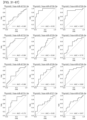
- FIGS. 20 - 1 to 20 - 217 show ROCs curves for predicting lung cancer in humans using a single miRNA.
- FIGS. 21 - 1 to 21 - 78 show ROCs curves for predicting human breast cancer using a single miRNA.
- FIGS. 22 - 1 to 22 - 46 show ROCs curves for predicting kidney cancer in humans using a single miRNA.
- FIGS. 23 - 1 to 23 - 25 show ROC-curves for predicting leukemias in humans using a single miRNA.
- FIGS. 24 - 1 to 24 - 65 show ROC-curves for predicting lymphomas in humans using a single miRNA.
- FIGS. 25 - 1 to 25 - 68 show ROC-curves for predicting pancreatic cancer in humans using a single miRNA.
- FIGS. 26 - 1 to 26 - 18 show ROC-curves for predicting prostatic cancer in humans using a single miRNA.
- FIGS. 27 - 1 to 27 - 49 show ROCs curves for predicting gastric cancer in humans using a single miRNA.
- FIGS. 28 - 1 to 28 - 56 show ROC-curves for predicting urothelial carcinoma in humans using a single miRNA.
- FIGS. 29 - 1 to 29 - 39 show ROCs curves for predicting melanomas in humans using a single miRNA.
- FIGS. 30 - 1 to 30 - 28 show ROCs curves for predicting ovarian cancer in humans using a single miRNA.
- FIGS. 31 - 1 to 31 - 130 show ROCs curves for predicting thyroid cancer in humans using a single miRNA.
- FIGS. 32 - 1 to 32 - 57 show ROC-curves for predicting cervical cancer in humans using a single miRNA.
- FIGS. 33 - 1 to 33 - 44 show ROCs curves for predicting colorectal cancer in humans using a single miRNA.
- FIGS. 34 - 1 to 34 - 84 show ROC-curves for predicting human endometrial cancer using a single miRNA.
- subject means a subject for urinalysis.
- the subject may be an animal.
- the subject may be a reptile, mammal, amphibian. Mammals may be dogs, cats, cows, horses, sheep, pigs, hamsters, mice, squirrels, and primates such as monkeys, gorillas, chimpanzees, bonovo, humans.
- the subject may in particular be a human.
- urine means liquid waste produced by the kidneys.
- Urine can be either drained out through the urethra or accumulated in the bladder. Urine may be extracted or collected and collected from the body using an extractor such as a syringe.
- the urine is not particularly limited, but may be, for example, a reptile, a mammal, an amphibian urine. Mammals may be dogs, cats, cows, horses, sheep, pigs, hamsters, mice, squirrels, and primates such as monkeys, gorillas, chimpanzees, bonovo, humans.
- “Urine” may be urine of a healthy subject, urine of a subject with a particular disease (e.g., cancer selected from cancers such as lung cancer, liver cancer, pancreatic cancer, bladder cancer, and prostate cancer, etc.), or urine of a subject suspected of suffering from a particular disease.
- “Urine” may be used as a stock solution or may be a liquid in which the stock solution is diluted or concentrated.
- “Urine” may be obtained by adding an additive to a urine sample. The additive may be, for example, one obtained by adding a stabilizing agent or a pH adjusting agent.
- “Urine” may be urine in a frozen state.
- microRNA As used herein, “microRNA” (also referred to as “miRNA”) is a type of non-coding RNA (ncRNA) that is believed not to encode a protein.
- MicroRNAs are processed from their precursors into mature bodies.
- microRNA has a length of about 20 to 25 bases.
- Human microRNA is denoted by the name hsa ⁇ In this specification, since the examples all measure human microRNA, the notation hsa has been abbreviated, but the results of human microRNA have been disclosed ⁇
- Precursors are given mir and matures are given miR. The identified sequences are numbered in the order in which they are identified, and for similar sequences, the numbers are followed by a lower case alphabet. If there is a precursor derived from the 5′ and 3′ ends, the microRNAs derived from the 5′ end are labeled 5p, and those derived from the 3′ end are labeled 3p. These symbols and numbers are connected by hyphens.
- the mature microRNA may be double-stranded.
- a miRNA is described as explicitly including a human miRNA, whether or not has been imparted.
- extracellular vesicles are vesicles that are released from cells, including those released from cells during apoptosis, and those released from healthy cells.
- Extracellular vesicles are broadly divided into exosomes (exosome), microvesicles (micro vesicle; MVs), and apoptotic bodies (apoptosis body) according to size and surface-markers.
- Exosomes usually have a diameter of 40 to 120 nm and may express 1 or more or all molecules selected from the group consisting of Alix, Tsg101, CD9, CD63, CD81, and flotillin.
- Microvesicles usually have a diameter of 50 to 1,000 nm and may express 1 or more or all molecules selected from the group consisting of integrins, selectins, and CD40.
- Apoptotic bodies usually have a diameter of 500 to 2,000 nm and may express 1 or more molecules selected from the group consisting of Annexin V and phosphatidylserine.
- Exosomes can include proteins and nucleic acids, such as mRNA, miRNA, ncRNA.
- Microvesicles can include proteins and nucleic acids (e.g., mRNA, miRNA, ncRNA). Apoptotic bodies are thought to contain fragmented nuclei and organelles.
- extract means an extracted product and wherein a particular component is more concentrated than prior to extraction.
- extract of urine means an extract extracted from urine in which a particular component (particularly microRNA) is more concentrated than in urine prior to extraction. Extracts of urine may be aqueous solutions (solutions or suspensions) or may be solids obtained by drying them. In urine extracts, extracts from which components other than the extracellular vesicles and nucleic acids in the urine have been substantially removed may also be referred to as urine purifications.
- the extract of urine may comprise a surfactant (preferably a nonionic surfactant).
- Urinary extracts may include detergents and debris of extracellular vesicles (e.g., exosomes and/or microvesicles).
- the extract of urine may be one or more free or substantially free of 1 or more selected from the group consisting of surfactants and debris (debris) of extracellular vesicles (e.g., exosomes and/or microvesicles).
- the extract of urine may further comprise a stabilizing agent (e.g., a stabilizing agent of a nucleic acid) and/or a pH adjusting agent (e.g., a buffering agent).
- the extract of urine may contain salt.
- the urine extract may comprise one or more urine components selected from the group consisting of urine components, e.g., urea, creatinine, uric acid, ammonia, urobilin, riboflavin, urinary protein, sugar, and urinary hormones (e.g., chorionic gonadotropin) (each independently may be 50% or less, 40% or less, 30% or less, 20% or less, 10% or less, 5% or less, 4% or less, 3% or less, 2% or less, 1 ⁇ 10 ⁇ 1% or less, 1 ⁇ 10 ⁇ 2 % or less, or 1 ⁇ 10 ⁇ 3 % or less of the concentration in urine.
- the pH of the urine extract may be greater than or greater than a value such as 2, 3, 4, or 5.
- a urine extract comprises a microRNA.
- a urine extract may comprise a concentrated microRNA or a group thereof.
- urine extracts may comprise microRNAs extracted by the extraction methods described herein.
- a urine extract may comprise at least one or all of the microRNAs listed in Data S1 (or Table 3 disclosing Data S1).
- urine extracts can be those obtained by contacting urine with nanowires (e.g., nanowires having at least one surface selected from the group consisting of ZnO, SiO 2 , Li 2 O, MgO, Al 2 O 3 , CaO, TiO 2 , Mn 2 O 3 , Fe 2 O 3 , CoO, NiO, CuO, Ga 2 O 3 , SrO, In 2 O 3 , SnO 2 , Sm 2 O 3 , and EuO) having a positively charged surface in a urine pH environment, followed by cleaning as needed, and then extracting with a buffer containing a non-ionic surfactant or the like (the urine extract thus obtained may be referred to as an “extract of urine of the present disclosure).
- Urine may also be adjusted in pH so that the surface charge of the nanowire is positive when contacting the nanowire with urine
- in situ extraction means disrupting EVs captured on nanowires using nanowire-incorporated microfluidic devices to extract small molecule RNAs (e.g., microRNAs) in situ, or extracting small molecule RNAs (e.g., microRNAs) captured on nanowires into solutions from nanowires.
- small molecule RNAs e.g., microRNAs
- microRNAs small molecule RNAs
- microRNA is not contained in an extracellular vesicle and is present in a state where the microRNA is not associated with the extracellular vesicle.
- inclusion when used in the context of a form of presence of microRNA in urine means that the microRNA is incorporated into an extracellular vesicle (either fully or partially inclusive).
- nanowire generally means a rod-like structure having a size (e.g., a diameter of 1 to several hundred nanometers) such as a cross-sectional shape or diameter on the order of nanometers.
- the size of the nanowires is not particularly limited, for example, 1 nm, 5 nm, 10 nm, 20 nm, 20 nm, 30 nm, 50 nm, 60 nm, 70 nm, 90 nm, 100 nm, 105 nm, 110 nm, 120 nm, 130 nm, 145 nm, 150 nm, 160 nm. 170 nm, 180 nm, 185 nm.
- the size of the nanowires is also not particularly limited, for example, 1000 nm, 990 nm, 980 nm, 970 nm, 960 nm, 930 nm. 920 nm. 910 nm, 900 nm, 890 nm, 880 nm. 870 nm, 860 nm, 850 nm, 840 nm, 820 nm, 810 nm, 800 nm, 790 nm, 780 nm, 770 nm, 760 nm, 750 nm, 740 nm, 730 nm, 720 nm, 710 nm.
- nanowires 700 nm, 690 nm, 680 nm. 670 nm, 660 nm, 650 nm, 640 nm, 560 nm, 550 nm, 550 nm It may be 520 nm, 510 nm or 500 nm, or it may be smaller than one lower limit value selected from the above numerical group.
- the size of the nanowire is not particularly limited, and may be any size between the upper limit and the lower limit, for example. In the devices of the present disclosure, the use of nanowires can increase surface area, which can increase the recovery capacity of EVs.
- the length of the nanowire is not particularly limited, and may be any length between two values selected from 500 nm, 600 nm, 700 nm, 800 nm, 900 nm, 1 ⁇ m, 2 ⁇ m, 3 ⁇ m, 4 ⁇ m, 5 ⁇ m, 6 ⁇ m, 7 ⁇ m. 8 ⁇ m, 9 ⁇ m, and 10 ⁇ m, for example.
- the length and diameter of the nanowires can affect the physical strength and surface area of the nanowires. The length and diameter could be adjusted to suit the environment of use.
- the nanowires are, in some embodiments, 1 ⁇ m to 10 ⁇ n long (e.g., 1.5 ⁇ m to 5 ⁇ m long) and are made of metal oxide (e.g., zinc oxide).
- free means substantially free or free of the ingredients when used in combination with the ingredients described immediately prior to this term.
- substantially free does not exclude the inclusion of a level of the component that cannot be removed in the extract.
- the present inventors have found that extracellular vesicles (EVs) (and free miRNAs) in urine are efficiently adsorbed on nanowires without destruction by bringing nanowires with a positively charged surface (for example, a zinc oxide (ZnO) surface) into contact with the urine of a subject at pH 6 to 8.
- a positively charged surface for example, a zinc oxide (ZnO) surface
- ZnO zinc oxide
- the present inventors have also found that EVs and miRNAs adsorbed on nanowires can be effectively collected using a surfactant.
- the present disclosure provides an extract of urine containing any one or more microRNAs listed in data S1 (or Table 3).
- the present disclosure provides an extract of urine containing all microRNAs listed in the data S1 (or Table 3).
- the present disclosure provides an extract of urine containing any one or more microRNAs listed in Table 2.
- the present disclosure provides an extract of urine containing all microRNAs listed in Table 2.
- an extract of urine containing any one or more or all microRNAs listed in the data S1 may contain 500 or more types. 600 or more types, 700 or more types, 800 or more types, 900 or more types, 1000 or more types, or 1100 or more types of microRNAs (particularly microRNAs present in urine). In one embodiment, an extract of urine containing any one or more or all microRNAs listed in the data S1 (or Table 3) may contain 749 or more types, 822 or more types, or 1111 or more types of microRNAs (particularly microRNAs present in urine).
- 500 or more types, 600 or more types. 700 or more types, 800 or more ty pes, 900 or more types, 1000 or more types, or 1100 or more types of microRNAs present in urine may be contained.
- the number of types of microRNAs contained in urine may be the number of types of microRNAs actually contained.
- the number of types of microRNAs contained in urine may be defined by a method or technique for detecting microRNAs.
- the number of types of microRNAs contained in urine may depend on the detection limit of the method for detecting microRNAs.
- they may be prepared from urine using a nanowire-embedded device according to the present disclosure.
- a microRNA may include at least one or all microRNAs selected from the group consisting of microRNAs that have values of 1 or more, 2 or more, 3 or more, 4 or more, 5 or more, 6 or more, 7 or more, 8 or more, 9 or more, 10 or more, 11 or more, 12 or more, 13 or more, 14 or more, 15 or more, and 16 or more in the data S1 (or Table 3) (values log 2-transformed after the background intensity is subtracted).
- a microRNA may include at least one or all microRNAs selected from the group consisting of microRNAs that have values of 1 or more and less than 2, 2 or more and less than 3, 3 or more and less than 4, 4 or more and less than 5, 5 or more and less than 6, 6 or more and less than 7, 7 or more and less than 8, 8 or more and less than 9, 9 or more and less than 10, 10 or more and less than 11, 11 or more and less than 12, 12 or more and less than 13, 13 or more and less than 14, 14 or more and less than 15, and 16 or more in the data S1 (or Table 3) (values log 2-transformed after the background intensity is subtracted).
- these values may be values of non-cancer donors (for example, healthy persons), values of lung cancer patients, values of pancreatic cancer patients, values of liver cancer patients, values of bladder cancer patients, values of prostate cancer patients, values of gastric cancer patients, values of urothelial carcinoma patients, values of melanoma patients, values of ovarian cancer patients, values of thyroid cancer patients, values of cervical cancer patients, values of colorectal cancer patients, and/or values of endometrial cancer patients.
- the values may be, for example, values of gastrointestinal cancer patients, values of hematopoietic cancer patients, and or values of urological cancer patients.
- the values may be values of all the cancer patients.
- the present disclosure provides an extract of urine containing at least one or all microRNAs selected from the group consisting of miR-3117-5p, miR-3118, miR-3121-3p, miR-3121-5p, miR-3126-5p, miR-3128, miR-3133, miR-3134, miR-3136-3p, miR-3136-5p, miR-3139, miR-3142, miR-3143, miR-3145-3p, miR-3163, miR-3166, miR-3167, miR-16-1-3p, miR-424-3p, miR-519c-5p, miR-525-5p, miR-551b-5p, miR-558, miR-921, miR-942-3p, miR-3126-3p, miR-3127-5p, miR-3129-5p, miR-3144-5p, miR-3150a-5p, miR-3152-5p, miR-3155a, miR-3157-3p, miR-3159, miR-3165, miR-3678-3p, mi
- the present disclosure provides an extract of urine containing at least one microRNA or all microRNAs selected from the group consisting of miR-378a-5p, miR-520c-3p, and miR-526b-3p. These microRNAs may be detected in the urine of a lung cancer patient.
- the urine may be the urine of a subject having lung cancer.
- the present disclosure provides an extract of urine containing at least one or all microRNAs selected from the group consisting of let-7i-3p, miR-183-5p, miR-202-5p, miR-409-5p, miR-4661-5p, miR-4800-3p, miR-5587-5p, miR-372-3p, miR-378b, miR-520b, miR-1266-3p, miR-3605-5p, miR-3612, miR-4645-3p, miR-4694-3p, miR-4752, miR-6816-3p, miR-8087, let-7f-2-3p, miR-15a-3p, miR-20a-3p, miR-33b-3p, miR-34c-5p, miR-93-5p, miR-130a-5p, miR-135a-5p, miR-135b-5p, miR-185-5p, miR-203a-3p, miR-302d-5p, miR-337-3p, miR-378c, miR
- the present disclosure provides an extract of urine containing at least one or all microRNAs selected from the group consisting of miR-183-5p, miR-202-5p, and miR-409-5p.
- the present disclosure provides an extract of urine containing at least one or all microRNAs selected from the group consisting of miR-372-3p, miR-520b, miR-15a-3p, miR-34c-5p, miR-135a-5p, miR-185-5p, miR-337-3p, miR-422a, miR-506-3p, miR-520c-3p, miR-1284, miR-1323, and miR-4273.
- These microRNAs may be detected in the urine of a pancreatic cancer patient.
- the urine may be the urine of a subject having pancreatic cancer.
- the present disclosure provides an extract of urine containing at least one or all microRNAs selected from the group consisting of miR-4521, let-7c-3p, let-7i-5p, miR-16-1-3p, miR-26a-1-3p, miR-28-5p, miR-105-5p, miR-195-3p, miR-200b-5p, miR-219a-2-3p, miR-297, miR-300, miR-330-3p, miR-374b-5p, miR-431-5p, miR-454-5p, miR-513c-5p, miR-548ax, miR-593-5p, miR-623, miR-664a-5p, miR-942-3p, miR-1205, miR-1276, miR-1288-3p, miR-1297, miR-3678-3p, miR-4283, miR-4295, miR-4439, miR-4524b-5p, miR-4703-3p, miR-4768-5p, miR-4
- the present disclosure provides an extract of urine containing at least one or all microRNAs selected from the group consisting of miR-16-1-3p, miR-28-5p, miR-297, miR-300, miR-330-3p, miR-454-5p, miR-1297, and miR-4295.
- the present disclosure provides an extract of urine containing miR-520c-3p. These microRNAs may be detected in the urine of a subject having liver cancer. Thus, the urine may be the urine of a subject having liver cancer.
- the present disclosure provides an extract of urine containing at least one or all microRNAs selected from the group consisting of miR-16-1-3p, miR-23b-3p, miR-28-5p, miR-92a-2-5p, miR-142-3p, miR-195-3p, miR-196b-5p, miR-299-3p, miR-492, miR-513b-5p, miR-601, miR-619-5p, miR-1285-3p, miR-3155a, miR-3162-5p, miR-3678-3p, miR-4283, miR-4295, miR-4311, miR-4531, miR-5096, miR-5187-5p, let-7f-2-3p, miR-520c-3p, and miR-4783-5p.
- the present disclosure provides an extract of urine containing at least one or all microRNAs selected from the group consisting of miR-16-1-3p, miR-23b-3p, miR-28-5p, miR-142-3p, miR-195-3p, miR-299-3p, and miR-4295.
- the present disclosure provides an extract of urine containing miR-520c-3p. These microRNAs may be detected in an embodiment having bladder cancer.
- the urine may be the urine of a subject having bladder cancer.
- the present disclosure provides an extract of urine containing at least one or all microRNAs selected from the group consisting of miR-4531, miR-28-5p, miR-103a-2-5p, miR-105-5p, miR-124-3p, miR-151a-5p, miR-151b, miR-200a-5p, miR-300, miR-424-3p, miR-519c-5p, miR-551b-5p, miR-617, miR-873-3p, miR-921, miR-1288-3p, miR-3124-5p, miR-3155a, miR-3917, miR-4283, miR-4727-3p, miR-5096, miR-5187-5p, miR-6074, miR-6874-5p, miR-6892-5p, miR-15a-3p, miR-135b-5p, miR-520c-3p, miR-4783-5p, and miR-7849-3p.
- the present disclosure provides an extract of urine containing at least one or all microRNAs selected from the group consisting of miR-28-5p, miR-105-5p, miR-124-3p, miR-151a-5p, and miR-300.
- the present disclosure provides an extract of urine containing at least one or all microRNAs selected from the group consisting of miR-15a-3p and miR-520c-3p. These microRNAs may be detected in an embodiment having prostate cancer.
- the urine may be the urine of a subject having prostate cancer.
- Another aspect of the present disclosure provides a method for examining the likelihood that a subject has cancer.
- the method for examining the likelihood of cancer can be replaced and interchangeable with a method for diagnosing cancer, a method for acquiring preliminary information for diagnosing cancer, a method for determining whether a subject has cancer cells in the body, a method for detecting cancer cells, a method for predicting the likelihood of cancer, or a method for determining the likelihood that a subject has cancer.
- a doctor or the like can make a definitive diagnosis.
- a method according to the present disclosure including diagnosing cancer and performing cancer therapy (for example, radiotherapy, chemotherapy, immunological therapy, and/or surgery) on a patient diagnosed with cancer.
- cancer therapy for example, radiotherapy, chemotherapy, immunological therapy, and/or surgery
- the likelihood that a subject has cancer can be determined using the expression level of any of the microRNAs listed in the data S1 (or Table 3) in a body fluid sample as an indicator.
- the present disclosure provides an extract of urine containing any one or more microRNAs listed in any of Tables 4-1 to 4-15.
- the present disclosure provides an extract of urine containing all microRNAs listed in any of Tables 4-1 to 4-15.
- the present disclosure provides an extract of urine containing any one or more microRNAs listed in any of Tables 4-1 to 4-15.
- the present disclosure provides an extract of urine containing all microRNAs listed in any of Tables 4-1 to 4-15.
- the microRNAs may be microRNAs increased in a cancer patient.
- a microRNA detected in an extract of urine may indicate that a subject from which the urine is derived has cancer or a likelihood of the subject having cancer.
- the present disclosure provides a method of analyzing urine including obtaining an extract of urine.
- a method of analyzing urine according to the present disclosure may further include extracting a microRNA from an extract of urine. Whether an extract of urine contains a specific microRNA can be determined by a method of analyzing urine according to the present disclosure.
- a method of analyzing urine according to the present disclosure may further include measuring the amount of specific microRNA when an extracted microRNA includes the specific microRNA.
- the specific microRNA may be any one or more microRNAs listed in any of Tables 4-1 to 4-15.
- the specific microRNA may be any one or more microRNAs listed in any of Tables 4-1 to 4-15 and may have a p-value of less than 0.005.
- the specific microRNA may be any one or more microRNAs listed in any of Tables 22-1 to 22-13.
- the specific microRNA may be any one or more microRNAs listed in any of Tables 22-1 to 22-13 having an accuracy of higher than 50%, 55% or higher, 60% or higher, 65% or higher, 70% or higher, 75% or higher. 80% or higher, 85% or higher, 90% or higher, or 95% or higher.
- the specific microRNA may be any one or more microRNAs listed in any of Tables 22-1 and 23-1 to 23-14 preferably having an accuracy of higher than 50%, 55% or higher, 60% or higher, 65% or higher, 70% or higher, 75% or higher, 80% or higher, 85% or higher, 90% or higher, or 95% or higher.
- the specific microRNA may be any one or more microRNAs listed in any of Tables 24-1 to 24-15 possibly having an accuracy of higher than 0.5, 0.55 or higher, 0.6 or higher, 0.65 or higher, 0.7 or higher, 0.75 or higher, 0.8 or higher, 0.85 or higher, or 0.9 or higher.
- the specific microRNA may be any one or more microRNAs listed in any of Tables 25-1 to 25-15 possibly having an accuracy of higher than 0.5, 0.55 or higher, 0.6 or higher, 0.65 or higher, 0.7 or higher, 0.75 or higher, 0.8 or higher, 0.85 or higher, or 0.9 or higher.
- the specific microRNA may include 5 types, 10 types, 15 types, 20 types. 30 types, 40 types, 50 types, 60 types, 70 types, 80 types, 90 types. 100 types, 200 types, 300 types, 400 types, 500 or more types, 600 or more types, 700 or more types, 800 or more types, 900 or more types, 1000 or more types, 1100 or more types, 1200 or more types, 1300 or more types, 1400 or more types.
- the specific microRNA can be detected or quantified by various known methods.
- the specific microRNA can be identified by contacting the microRNA with a nucleic acid containing a sequence that can hybridize to the microRNA.
- a nucleic acid containing a sequence that can hybridize to a microRNA can be solid-phased.
- a nucleic acid containing a sequence that can hybridize to a microRNA may be solid-phased on a microarray.
- a nucleic acid containing a sequence that can hybridize to a microRNA may be a probe for RT-PCR.
- an extract of urine containing any one or more or all microRNAs listed in any of Tables 4-1 to 4-15 may contain 5 types, 10 types, 15 types, 20 types, 30 types, 40 types, 50 types, 60 types, 70 types, 80 types, 90 types, 100 types, 200 types, 300 types.
- microRNAs particularly microRNAs present in urine
- an extract of urine containing any one or more or all microRNAs listed in any of Tables 4-1 to 4-15 may contain microRNAs (particularly microRNAs present in urine) corresponding to a little more than 50%, 60% or more, 70% or more, 80% or more, 90% or more, or 100% of the number of types of microRNAs listed in the respective tables.
- an extract of urine containing any one or more or all microRNAs listed in Table 1 may contain 749 or more types, 822 or more types, or 1111 or more types of microRNAs (particularly microRNAs present in urine).
- the microRNAs may be microRNAs increased in a cancer patient.
- a microRNA detected in an extract of urine may indicate that a subject from which the urine is derived has cancer or a likelihood thereof.
- an extract of urine containing any one or more or all microRNAs listed in any of Tables 4-1 to 4-15 may contain 500 or more types, 600 or more types, 700 or more types, 800 or more types, 900 or more types, 1000 or more types, 1100 or more types, 1200 or more types, 1300 or more types, 1400 or more types, 1500 or more types, 1600 or more types, 1700 or more types, 1800 or more types, 1900 or more ty pes, 2000 or more types, 2100 or more ty pes, 2200 or more types, 2300 or more types, 2400 or more types, or 2500 or more types of microRNAs present in urine.
- the number of types of microRNAs contained in urine may be the number of types of microRNAs actually contained. In some embodiments, the number of types of microRNAs contained in urine may be defined by a method or technique for detecting microRNAs. For example, the number of types of microRNAs contained in urine may depend on the detection limit of the method for detecting microRNAs. In one embodiment of the disclosure of the present invention, preferably, they may be prepared from urine using a nanowire-embedded device according to the present disclosure.
- a microRNA may include at least one or all microRNAs selected from the group consisting of microRNAs having a sensitivity and/or specificity value of more than 50%, more than 55%, more than 60%, more than 65%, more than 70%, more than 75%, more than 80%, more than 85%, more than 90%, or more than 95% in Table 4-1.
- a microRNA may include at least one or all microRNAs selected from the group consisting of microRNAs having a sensitivity and/or specificity value of more than 50% and 55% or less, more than 55% and 60% or less, more than 60% and 65% or less, more than 65% and 70% or less, more than 70% and 75% or less, more than 75% and 80% or less, more than 80% and 85% or less, more than 85% and 90% or less, more than 90% and 95% or less, or more than 95% in Table 4-1.
- the microRNAs may be microRNAs increased in a cancer patient.
- a microRNA detected in an extract of urine may indicate that a subject from which the urine is derived has cancer or a likelihood thereof.
- Whether the specific microRNA has a higher or lower expression level in the case of a specific cancer than in a healthy person can be determined based on whether the specific microRNA has a higher or lower expression level in the case of the specific cancer than in a healthy person in Tables 4-1 to 4-15.
- a microRNA in an extract of urine is in an amount that can be or is sufficient to be detected by a microarray.
- the present disclosure provides an extract of urine containing at least one type, two types, three types, four types, five types, six types, seven types, eight types, nine types, or ten types of or all microRNAs selected from the group consisting of hsa-let-7a-3p, hsa-miR-103a-2-5p, hsa-miR-103a-3p, hsa-miR-105-3p, hsa-miR-106a-3p, hsa-miR-1180-3p, hsa-miR-1185-2-3p, hsa-miR-1193, hsa-miR-127-3p, hsa-miR-1245b-5p, hsa-miR-1247-3p, hsa-miR-125b-2-3p, hsa-miR-1263, hsa-miR-173g-3p, hsa-miR-129-2-3p
- the present disclosure provides an extract of urine containing at least one type, two types, three types, four types, five types, six types, seven types, eight types, nine types, or ten types of or all microRNAs selected from the group consisting of hsa-miR-103a-3p, hsa-miR-1193, hsa-miR-127-3p, hsa-miR-1247-3p, hsa-miR-1263, hsa-miR-173g-3p, hsa-miR-129-2-3p, hsa-miR-1293, hsa-miR-130a-5p, hsa-miR-1469, hsa-miR-15b-3p, hsa-miR-193b-3p, hsa-miR-2861, hsa-miR-298, hsa-miR-30d-5p, hsa-miR-3
- the present disclosure provides an extract of urine containing at least one type, two types, three types, four types, five types, six types, seven types, eight types, nine types, or ten types of or all microRNAs selected from the group consisting of hsa-miR-103a-2-5p, hsa-miR-1193, hsa-miR-3622a-5p, hsa-miR-363-3p, hsa-miR-4521, hsa-miR-4796-5p, hsa-miR-518f-3p, hsa-miR-5580-5p, hsa-miR-3125, hsa-miR-3130-3p, hsa-miR-3678-3p, hsa-miR-4750-5p, hsa-miR-5194, hsa-miR-578, hsa-miR-625-5p, hs
- the present disclosure provides an extract of urine containing at least one type, two types, three types, four types, five types, six types, seven types, eight types, nine types, or ten types of or all microRNAs selected from the group consisting of hsa-miR-103a-2-5p, hsa-miR-106a-3p, hsa-miR-1185-2-3p, hsa-miR-1193, hsa-miR-1273g-3p, hsa-miR-1293, hsa-miR-1301-5p, hsa-miR-152-5p, hsa-miR-184, hsa-miR-200c-5p, hsa-miR-2909, hsa-miR-298, hsa-miR-302b-3p, hsa-miR-3116, hsa-miR-3122, hsa-miR-3
- the extract of urine may be an extract of the urine of a patient having a stage-I cancer.
- the patient having a stage-1 cancer may be a patient having stage-I lung cancer.
- These miRNAs are detected in a larger amount in the urine of a stage-I lung cancer patient than in the urine of a healthy person.
- the stage may be based on TNM classification, for example. In the TNM classification, the stage is judged from three perspectives: T: tumor size, N: the presence or absence of metastasis to lymph nodes, and M: metastasis to other organs. Doctors can classify cancers in accordance with the TNM classification.
- the term “early-stage cancer”, as used herein, refers to a cancer selected from the group consisting of stage-I and -II cancers.
- Another aspect of the present disclosure provides an extract of urine containing at least one type, two types, three types, four types, five types, six types, seven types, eight types, nine types, or ten types of or all microRNAs selected from the microRNAs listed in Table 4-2.
- the present disclosure also provides an extract of urine containing at least one type, two types, three types, four types, five types, six types, seven types, eight types, nine types, or ten types of or all microRNAs selected from the group consisting of hsa-miR-492, hsa-miR-1292-5p, hsa-miR-6789-5p, hsa-miR-1268b, hsa-miR-3648, hsa-miR-678l-5p, hsa-miR-4745-5p, hsa-miR-4651, hsa-miR-12120, hsa-miR-3937, hsa-mi
- the extract of urine may be an extract of the urine of a breast cancer patient. Only one of these microRNAs can be used to predict whether a subject from which the urine is derived is a breast cancer patient, and 5 or more types, 10 or more types, 15 or more types, or 20 or more types of these microRNAs can be used in combination to predict whether a subject from which the urine is derived is a breast cancer patient. Among these microRNAs, a microRNA that may be highly expressed in a breast cancer patient can be preferably used for prediction.
- the present disclosure provides an extract of urine containing at least one type, two types, three types, four types, five types, six types, seven types, eight types, nine types, or ten types of or all microRNAs selected from the group consisting of hsa-miR-29a-3p, hsa-miR-29b-3p, hsa-miR-103a-3p, hsa-miR-107, hsa-miR-192-5p, hsa-miR-196a-5p, hsa-miR-197-3p, hsa-miR-129-5p, hsa-miR-34a-5p, hsa-miR-187-3p, hsa-miR-210-3p, hsa-miR-211-5p, hsa-miR-214-3p, hsa-miR-124-3p, hsa-miR-125b-5p
- microRNAs Only one of these microRNAs can be used to predict whether a subject from which the urine is derived is a breast cancer patient (particularly stage-I or -II), and 5 or more types, 10 or more types, 15 or more types, or 20 or more types of these microRNAs can be used in combination to predict whether a subject from which the urine is derived is a breast cancer patient (particularly stage-I or -II).
- a microRNA that may be highly expressed in a breast cancer patient can be preferably used for prediction.
- the present disclosure provides an extract of urine containing at least one type, two types, three types, four types, five types, six types, seven types, eight types, nine types, or ten types of or all microRNAs selected from the group consisting of hsa-miR-29a-3p, hsa-miR-31-5p, hsa-miR-29b-3p, hsa-miR-124-3p, hsa-miR-184, hsa-miR-106b-5p, hsa-miR-299-3p, hsa-miR-361-5p, hsa-miR-370-3p, hsa-miR-373-3p, hsa-miR-379-5p, hsa-miR-335-5p, hsa-miR-325, hsa-miR-202-3p, hsa-miR-492, hsa-m
- microRNAs Only one of these microRNAs can be used to predict whether a subject from which the urine is derived is a breast cancer patient (particularly stage-I), and 5 or more types, 10 or more types, 15 or more types, or 20 or more types of these microRNAs can be used in combination to predict whether a subject from which the urine is derived is a breast cancer patient (particularly stage-I).
- a microRNA that may be highly expressed in a breast cancer patient (particularly stage-1) can be preferably used for prediction.
- the present disclosure provides an extract of urine containing at least one type, two types, three types, four types, five types, six types, seven types, eight types, nine types, or ten types of or all microRNAs selected from the group consisting of microRNAs that have a percentage of correct answers (accuracy; multiplied by 100 when expressed as a percentage. For example, 0.5 represents 50%) higher than 0.500 among the microRNAs listed in Table 24-2.
- the extract of urine may be an extract of the urine of a breast cancer patient.
- microRNAs Only one of these microRNAs can be used to predict whether a subject from which the urine is derived is a breast cancer patient, and 5 or more types, 10 or more types, 15 or more types, or 20 or more types of these microRNAs can be used in combination to predict whether a subject from which the urine is derived is a breast cancer patient.
- a microRNA that may be highly expressed in a breast cancer patient can be preferably used for prediction.
- the accuracy may be higher than 0.5, 0.55 or higher, 0.6 or higher, 0.65 or higher, 0.7 or higher, 0.75 or higher, 0.8 or higher, 0.85 or higher, or 0.9 or higher.
- the present disclosure also provides an extract of urine containing at least one type, two types, three types, four types, five types, six types, seven types, eight types, nine types, or ten types of or all microRNAs selected from the group consisting of microRNAs having an accuracy of higher than 0.500 among the microRNAs listed in Table 25-2.
- the extract of urine may be an extract of the urine of a breast cancer patient. Only one of these microRNAs can be used to predict whether a subject from which the urine is derived is a breast cancer patient, and 5 or more types, 10 or more types, 15 or more types, or 20 or more types of these microRNAs can be used in combination to predict whether a subject from which the urine is derived is a breast cancer patient.
- a microRNA that may be highly expressed in a breast cancer patient can be preferably used for prediction.
- the accuracy may be higher than 0.5, 0.55 or higher, 0.6 or higher, 0.65 or higher. 0.7 or higher, 0.75 or higher, 0.8 or higher, 0.85 or higher, or 0.9 or higher.
- Another aspect of the present disclosure provides an extract of urine containing at least one type, two types, three types, four types, five types, six types, seven types, eight types, nine types, or ten types of or all microRNAs selected from the microRNAs listed in Table 4-3.
- the present disclosure also provides an extract of urine containing at least one type, two types, three types, four types, five types, six types, seven types, eight types, nine types, or ten types of or all microRNAs selected from the group consisting of hsa-miR-498-5p, hsa-miR-551 b-5p, hsa-miR-10526-3p, hsa-miR-150-3p, hsa-miR-5196-5p, hsa-miR-6809-5p, hsa-miR-6783-5p, hsa-miR-3059-3p, hsa-miR-4433b-3p, hsa-miR-6794-5p, hsa-miR-3124-5p, hsa-miR-1207-5p, hsa-miR-424-3p, hsa-miR-629-5p, hsa-miR-43
- the extract of urine may be an extract of the urine of a kidney cancer patient. Only one of these microRNAs can be used to predict whether a subject from which the urine is derived is a kidney cancer patient, and 5 or more types, 10 or more types, 15 or more types, or 20 or more types of these microRNAs can be used in combination to predict whether a subject from which the urine is derived is a kidney cancer patient. Among these microRNAs, a microRNA that may be highly expressed in a kidney cancer patient can be preferably used for prediction.
- the present disclosure provides an extract of urine containing at least one type, two types, three types, four types, five types, six types, seven types, eight types, nine types, or ten types of or all microRNAs selected from the group consisting of hsa-miR-29a-3p, hsa-miR-30a-5p, hsa-miR-29b-3p, hsa-miR-196a-5p, hsa-miR-197-3p, hsa-miR-198, hsa-miR-199a-5p, hsa-miR-30d-5p, hsa-miR-10a-5p, hsa-miR-187-3p, hsa-miR-199b-5p, hsa-miR-214-3p, hsa-miR-223-3p, hsa-miR-133a-3p, hsa-miR-125a-5
- the extract of urine may be an extract of the urine of a stage-I or -II kidney cancer patient.
- Only one of these microRNAs can be used to predict whether a subject from which the urine is derived is a kidney cancer patient (particularly stage-I or -II), and 5 or more types, 10 or more types, 15 or more types, or 20 or more types of these microRNAs can be used in combination to predict whether a subject from which the urine is derived is a kidney cancer patient (particularly stage-I or -II).
- a microRNA that may be highly expressed in a kidney cancer patient (particularly stage-I or -II) can be preferably used for prediction.
- the present disclosure provides an extract of urine containing at least one type, two types, three types, four types, five types, six types, seven types, eight types, nine types, or ten types of or all microRNAs selected from the group consisting of hsa-miR-17-3p, hsa-miR-29a-3p, hsa-miR-30a-5p, hsa-miR-31-5p, hsa-miR-29b-3p, hsa-miR-196a-5p, hsa-miR-197-3p, hsa-miR-198, hsa-miR-30d-5p, hsa-miR-10a-5p, hsa-miR-187-3p, hsa-miR-199b-5p, hsa-miR-214-3p, hsa-miR-223-3p, hsa-miR-133a-3p,
- the extract of urine may be an extract of the urine of a stage-I kidney cancer patient.
- Only one of these microRNAs can be used to predict whether a subject from which the urine is derived is a kidney cancer patient (particularly stage-I), and 5 or more types, 10 or more types, 15 or more types, or 20 or more types of these microRNAs can be used in combination to predict whether a subject from which the urine is derived is a kidney cancer patient (particularly stage-I).
- a microRNA that may be highly expressed in a kidney cancer patient (particularly stage-I) can be preferably used for prediction.
- the present disclosure provides an extract of urine containing at least one type, two types, three types, four types, five types, six types, seven types, eight types, nine types, or ten types of or all microRNAs selected from the group consisting of microRNAs having an accuracy of higher than 0.500 among the microRNAs listed in Table 24-3.
- the extract of urine may be an extract of the urine of a kidney cancer patient. Only one of these microRNAs can be used to predict whether a subject from which the urine is derived is a kidney cancer patient, and 5 or more types, 10 or more types, 15 or more types, or 20 or more types of these microRNAs can be used in combination to predict whether a subject from which the urine is derived is a kidney cancer patient.
- a microRNA that may be highly expressed in a kidney cancer patient can be preferably used for prediction.
- the accuracy may be higher than 0.5, 0.55 or higher, 0.6 or higher, 0.65 or higher, 0.7 or higher, 0.75 or higher, 0.8 or higher, 0.85 or higher, or 0.9 or higher.
- the present disclosure provides an extract of urine containing at least one type, two types, three types, four types, five types, six types, seven types, eight types, nine types, or ten types of or all microRNAs selected from the group consisting of microRNAs having an accuracy of higher than 0.500 among the microRNAs listed in Table 25-3.
- the extract of urine may be an extract of the urine of a kidney cancer patient. Only one of these microRNAs can be used to predict whether a subject from which the urine is derived is a kidney cancer patient, and 5 or more types, 10 or more types, 15 or more types, or 20 or more types of these microRNAs can be used in combination to predict whether a subject from which the urine is derived is a kidney cancer patient.
- a microRNA that may be highly expressed in a kidney cancer patient can be preferably used for prediction.
- the accuracy may be higher than 0.5, 0.55 or higher, 0.6 or higher, 0.65 or higher. 0 . 7 or higher, 0.75 or higher, 0.8 or higher, 0.85 or higher, or 0.9 or higher.
- the present disclosure provides an extract of urine containing at least one type, two types, three types, four types, five types, six types, seven types, eight types, nine types, or ten types of or all microRNAs selected from the microRNAs listed in Table 4-4.
- the present disclosure also provides an extract of urine containing at least one type, two types, three types, four types, five types, six types, seven types, eight types, nine types, or ten types of or all microRNAs selected from the group consisting of hsa-miR-1292-5p, hsa-miR-542-5p, hsa-miR-551b-5p, hsa-miR-135a-2-3p, hsa-miR-498-5p, hsa-miR-605-3p, hsa-miR-6750-5p, hsa-miR-4321, hsa-miR-4755-3p, hsa-miR-6791-5p,
- the extract of urine may be an extract of the urine of a leukemia patient. Only one of these microRNAs can be used to predict whether a subject from which the urine is derived is a leukemia patient, and 5 or more types, 10 or more types, 15 or more types, or 20 or more types of these microRNAs can be used in combination to predict whether a subject from which the urine is derived is a leukemia patient. Among these microRNAs, a microRNA that may be highly expressed in a leukemia patient can be preferably used for prediction.
- the present disclosure provides an extract of urine containing at least one type, two types, three types, four types, five types, six types, seven types, eight types, nine types, or ten types of or all microRNAs selected from the group consisting of microRNAs having an accuracy of higher than 0.500 among the microRNAs listed in Table 24-4.
- the extract of urine may be an extract of the urine of a leukemia patient. Only one of these microRNAs can be used to predict whether a subject from which the urine is derived is a leukemia patient, and 5 or more types, 10 or more types, 15 or more types, or 20 or more types of these microRNAs can be used in combination to predict whether a subject from which the urine is derived is a leukemia patient.
- a microRNA that may be highly expressed in a leukemia patient can be preferably used for prediction.
- the accuracy may be higher than 0.5, 0.55 or higher, 0.6 or higher, 0.65 or higher, 0.7 or higher, 0.75 or higher, 0.8 or higher, 0.85 or higher, or 0.9 or higher.
- the present disclosure provides an extract of urine containing at least one type, two types, three types, four types, five types, six types, seven types, eight types, nine types, or ten types of or all microRNAs selected from the group consisting of microRNAs having an accuracy of higher than 0.500 among the microRNAs listed in Table 25-4.
- the extract of urine may be an extract of the urine of a leukemia patient. Only one of these microRNAs can be used to predict whether a subject from which the urine is derived is a leukemia patient, and 5 or more types, 10 or more types, 15 or more types, or 20 or more types of these microRNAs can be used in combination to predict whether a subject from which the urine is derived is a leukemia patient.
- a microRNA that may be highly expressed in a leukemia patient can be preferably used for prediction.
- the accuracy may be higher than 0.5, 0.55 or higher, 0.6 or higher, 0.65 or higher, 0.7 or higher, 0.75 or higher, 0.8 or higher, 0.85 or higher, or 0.9 or higher.
- the present disclosure provides an extract of urine containing at least one type, two types, three types, four types, five types, six types, seven types, eight types, nine types, or ten types of or all microRNAs selected from the microRNAs listed in Table 4-5.
- the present disclosure also provides an extract of urine containing at least one type, two types, three types, four types, five types, six types, seven types, eight types, nine types, or ten types of or all microRNAs selected from the group consisting of hsa-miR-605-3p, hsa-miR-498-5p, hsa-miR-551b-5p, hsa-miR-541-3p, hsa-miR-10526-3p, hsa-miR-4321, hsa-miR-150-3p, hsa-miR-3199, hsa-miR-6770-5p, hsa-miR-1914-3p, hsa-m
- the extract of urine may be an extract of the urine of a lymphoma patient.
- Only one of these microRNAs can be used to predict wiiether a subject from which the urine is derived is a lymphoma patient, and 5 or more types, 10 or more types, 15 or more types, or 20 or more types of these microRNAs can be used in combination to predict whether a subject from which the urine is derived is a lymphoma patient.
- a microRNA that may be highly expressed in a lymphoma patient can be preferably used for prediction.
- the present disclosure provides an extract of urine containing at least one type, two types, three types, four types, five types, six types, seven types, eight types, nine types, or ten types of or all microRNAs selected from the group consisting of hsa-miR-29a-3p, hsa-miR-29b-3p, hsa-miR-140-5p, hsa-miR-106b-5p, hsa-miR-299-3p, hsa-miR-20b-5p, hsa-miR-448, hsa-miR-492, hsa-miR-498-5p, hsa-miR-520d-3p, hsa-miR-516b-3p, hsa-miR-516a-3p, hsa-miR-502-5p, hsa-miR-628-3p, hsa-miR-639, hs
- the extract of urine may be an extract of the urine of a stage-I or -II lymphoma patient.
- Only one of these microRNAs can be used to predict whether a subject from which the urine is derived is a lymphoma patient (particularly stage-I or -II), and 5 or more types, 10 or more types, 15 or more types, or 20 or more types of these microRNAs can be used in combination to predict whether a subject from which the urine is derived is a lymphoma patient (particularly stage-I or -II).
- a microRNA that may be highly expressed in a lymphoma patient can be preferably used for prediction.
- the present disclosure provides an extract of urine containing at least one type, two types, three types, four types, five types, six types, seven types, eight types, nine types, or ten types of or all microRNAs selected from the group consisting of microRNAs having an accuracy of higher than 0.500 among the microRNAs listed in Table 24-5.
- the extract of urine may be an extract of the urine of a lymphoma patient. Only one of these microRNAs can be used to predict whether a subject from which the urine is derived is a lymphoma patient, and 5 or more types, 10 or more types, 15 or more types, or 20 or more types of these microRNAs can be used in combination to predict whether a subject from which the urine is derived is a lymphoma patient.
- a microRNA that may be highly expressed in a lymphoma patient can be preferably used for prediction.
- the accuracy may be higher than 0.5, 0.55 or higher, 0.6 or higher, 0.65 or higher, 0.7 or higher, 0.75 or higher, 0.8 or higher, 0.85 or higher, or 0.9 or higher.
- the present disclosure provides an extract of urine containing at least one type, two types, three types, four types, five types, six types, seven types, eight types, nine types, or ten types of or all microRNAs selected from the group consisting of microRNAs having an accuracy of higher than 0.500 among the microRNAs listed in Table 25-5.
- the extract of urine may be an extract of the urine of a lymphoma patient. Only one of these microRNAs can be used to predict whether a subject from which the urine is derived is a lymphoma patient, and 5 or more types, 10 or more types, 15 or more types, or 20 or more types of these microRNAs can be used in combination to predict whether a subject from which the urine is derived is a lymphoma patient.
- a microRNA that may be highly expressed in a lymphoma patient can be preferably used for prediction.
- the accuracy may be higher than 0.5, 0.55 or higher, 0.6 or higher, 0.65 or higher, 0.7 or higher, 0.75 or higher, 0.8 or higher, 0.85 or higher, or 0.9 or higher.
- the present disclosure provides an extract of urine containing at least one type, two types, three types, four types, five types, six types, seven types, eight types, nine types, or ten types of or all microRNAs selected from the microRNAs listed in Table 4-6.
- the present disclosure also provides an extract of urine containing at least one type, two types, three types, four types, five types, six types, seven types, eight types, nine types, or ten types of or all microRNAs selected from the group consisting of hsa-miR-4280, hsa-miR-4458, hsa-miR-6074, hsa-miR-135a-2-3p, hsa-miR-601, hsa-miR-4727-3p, hsa-miR-498-5p, hsa-miR-5007-5p, hsa-miR-1207-5p, hsa-miR-338-5p, hsa-miR-6
- the extract of urine may be an extract of the urine of a pancreatic cancer patient.
- Only one of these microRNAs can be used to predict whether a subject from which the urine is derived is a pancreatic cancer patient, and 5 or more types, 10 or more types, 15 or more types, or 20 or more types of these microRNAs can be used in combination to predict whether a subject from which the urine is derived is a pancreatic cancer patient.
- a microRNA that may be highly expressed in a pancreatic cancer patient can be preferably used for prediction.
- the present disclosure provides an extract of urine containing at least one type, two types, three types, four types, five types, six types, seven types, eight types, nine types, or ten types of or all microRNAs selected from the group consisting of hsa-miR-15a-5p, hsa-miR-16-5p, hsa-miR-17-3p, hsa-miR-19b-3p, hsa-miR-20a-5p, hsa-miR-27a-3p, hsa-miR-28-5p, hsa-miR-29a-3p, hsa-miR-30a-5p, hsa-miR-33a-5p, hsa-miR-99a-5p, hsa-miR-29b-3p, hsa-miR-196a-5p, hsa-miR-197-3p, hsa-miR-198,
- the extract of urine may be an extract of the urine of a stage-I or -II pancreatic cancer patient.
- Only one of these microRNAs can be used to predict whether a subject from which the urine is derived is a pancreatic cancer patient (particularly stage-I or -II), and 5 or more types, 10 or more types, 15 or more types, or 20 or more types of these microRNAs can be used in combination to predict whether a subject from which the urine is derived is a pancreatic cancer patient (particularly stage-I or -II).
- a microRNA that may be highly expressed in a pancreatic cancer patient can be preferably used for prediction.
- the present disclosure also provides an extract of urine containing at least one type, two types, three types, four types, five types, six types, seven types, eight types, nine types, or ten types of or all microRNAs selected from the group consisting of hsa-miR-15a-5p, hsa-miR-19b-3p, hsa-miR-27a-3p, hsa-miR-28-5p, hsa-miR-29a-3p, hsa-miR-30a-5p, hsa-miR-196a-5p, hsa-miR-10a-5p, hsa-miR-34a-5p, hsa-miR-181c-5p, hsa-miR-183-5p, hsa-miR-210-3p, hsa-miR-133a-3p, hsa-miR-154-3p, hsa-miR-184
- the extract of urine may be an extract of the urine of a stage-I pancreatic cancer patient.
- Only one of these microRNAs can be used to predict whether a subject from which the urine is derived is a pancreatic cancer patient (particularly stage-I), and 5 or more types, 10 or more types, 15 or more types, or 20 or more types of these microRNAs can be used in combination to predict whether a subject from which the urine is derived is a pancreatic cancer patient (particularly stage-I).
- a microRNA that may be highly expressed in a pancreatic cancer patient (particularly stage-I) can be preferably used for prediction.
- the present disclosure provides an extract of urine containing at least one type, two types, three types, four types, five types, six types, seven types, eight types, nine types, or ten types of or all microRNAs selected from the group consisting of microRNAs having an accuracy of higher than 0.500 among the microRNAs listed in Table 24-6.
- the extract of urine may be an extract of the urine of a pancreatic cancer patient. Only one of these microRNAs can be used to predict whether a subject from which the urine is derived is a pancreatic cancer patient, and 5 or more types, 10 or more types, 15 or more types, or 20 or more types of these microRNAs can be used in combination to predict whether a subject from which the urine is derived is a pancreatic cancer patient.
- a microRNA that may be highly expressed in a pancreatic cancer patient can be preferably used for prediction.
- the accuracy may be higher than 0.5, 0.55 or higher, 0.6 or higher, 0.65 or higher, 0.7 or higher, 0.75 or higher, 0.8 or higher, 0.85 or higher, or 0.9 or higher.
- the present disclosure provides an extract of urine containing at least one type, two types, three types, four types, five types, six types, seven types, eight types, nine types, or ten types of or all microRNAs selected from the group consisting of microRNAs having an accuracy of higher than 0.500 among the microRNAs listed in Table 25-6.
- the extract of urine may be an extract of the urine of a pancreatic cancer patient. Only one of these microRNAs can be used to predict whether a subject from which the urine is derived is a pancreatic cancer patient, and 5 or more types, 10 or more types, 15 or more types, or 20 or more types of these microRNAs can be used in combination to predict whether a subject from which the urine is derived is a pancreatic cancer patient.
- a microRNA that may be highly expressed in a pancreatic cancer patient can be preferably used for prediction.
- the accuracy may be higher than 0.5, 0.55 or higher, 0.6 or higher, 0.65 or higher, 0.7 or higher, 0.75 or higher, 0.8 or higher, 0.85 or higher, or 0.9 or higher.
- the present disclosure provides an extract of urine containing at least one type, two types, three types, four types, five types, six types, seven types, eight types, nine types, or ten types of or all microRNAs selected from the microRNAs listed in Table 4-7.
- the present disclosure also provides an extract of urine containing at least one type, two types, three types, four types, five types, six types, seven types, eight types, nine types, or ten types of or all microRNAs selected from the group consisting of hsa-miR-629-5p, hsa-miR-7851-3p, hsa-miR-3124-5p, hsa-miR-605-3p, hsa-miR-6788-5p, hsa-miR-551b-5p, hsa-miR-8077, hsa-miR-138-5p, hsa-miR-92a-2-5p, hsa-miR-12122, hs
- the extract of urine may be an extract of the urine of a prostate cancer patient. Only one of these microRNAs can be used to predict whether a subject from which the urine is derived is a prostate cancer patient, and 5 or more types, 10 or more types, 15 or more types, or 20 or more types of these microRNAs can be used in combination to predict whether a subject from which the urine is derived is a prostate cancer patient. Among these microRNAs, a microRNA that may be highly expressed in a prostate cancer patient can be preferably used for prediction.
- the present disclosure provides an extract of urine containing at least one type, two types, three types, four types, five types, six types, seven types, eight types, nine types, or ten types of or all microRNAs selected from the group consisting of hsa-miR-28-5p, hsa-miR-29a-3p, hsa-miR-93-5p, hsa-miR-105-5p, hsa-miR-198, hsa-miR-129-5p, hsa-miR-134-5p, hsa-miR-184, hsa-miR-185-5p, hsa-miR-296-5p, hsa-miR-130b-3p, hsa-miR-302c-5p, hsa-miR-370-3p, hsa-miR-378a-3p, hsa-miR-20b-5p, hsa-
- the extract of urine may be an extract of the urine of a stage-I or -II prostate cancer patient.
- Only one of these microRNAs can be used to predict whether a subject from which the urine is derived is a prostate cancer patient (particularly stage-I or -II), and 5 or more types. 10 or more types, 15 or more types, or 20 or more types of these microRNAs can be used in combination to predict whether a subject from which the urine is derived is a prostate cancer patient (particularly stage-1 or -II).
- a microRNA that may be highly expressed in a prostate cancer patient can be preferably used for prediction.
- the present disclosure provides an extract of urine containing at least one type, two types, three types, four types, five types, six types, seven types, eight types, nine types, or ten types of or all microRNAs selected from the group consisting of hsa-miR-29a-3p, hsa-miR-105-5p, hsa-miR-129-5p, hsa-let-7i-5p, hsa-miR-133a-3p, hsa-miR-142-3p, hsa-miR-106b-5p, hsa-miR-130b-3p, hsa-miR-30e-5p, hsa-miR-365a-3p, hsa-miR-365b-3p, hsa-miR-371a-3p, hsa-miR-378a-3p, hsa-miR-135b-5p, hsa-miR-
- the extract of urine may be an extract of the urine of a stage-I prostate cancer patient.
- Only one of these microRNAs can be used to predict whether a subject from which the urine is derived is a prostate cancer patient (particularly stage-I), and 5 or more types, 10 or more types, 15 or more types, or 20 or more types of these microRNAs can be used in combination to predict whether a subject from which the urine is derived is a prostate cancer patient (particularly stage-I).
- a microRNA that may be highly expressed in a prostate cancer patient (particularly stage-I) can be preferably used for prediction.
- the present disclosure provides an extract of urine containing at least one type, two types, three types, four types, five types, six types, seven types, eight types, nine types, or ten types of or all microRNAs selected from the group consisting of microRNAs having an accuracy of higher than 0.500 among the microRNAs listed in Table 24-7.
- the extract of urine may be an extract of the urine of a prostate cancer patient. Only one of these microRNAs can be used to predict whether a subject from which the urine is derived is a prostate cancer patient, and 5 or more types, 10 or more types, 15 or more types, or 20 or more types of these microRNAs can be used in combination to predict whether a subject from which the urine is derived is a prostate cancer patient.
- a microRNA that may be highly expressed in a prostate cancer patient can be preferably used for prediction.
- the accuracy may be higher than 0.5, 0.55 or higher, 0.6 or higher, 0.65 or higher, 0.7 or higher, 0.75 or higher, 0.8 or higher, 0.85 or higher, or 0.9 or higher.
- the present disclosure provides an extract of urine containing at least one type, two types, three types, four types, five types, six types, seven types, eight types, nine types, or ten types of or all microRNAs selected from the group consisting of microRNAs having an accuracy of higher than 0.500 among the microRNAs listed in Table 25-7.
- the extract of urine may be an extract of the urine of a prostate cancer patient. Only one of these microRNAs can be used to predict whether a subject from which the urine is derived is a prostate cancer patient, and 5 or more types, 10 or more types, 15 or more types, or 20 or more types of these microRNAs can be used in combination to predict whether a subject from which the urine is derived is a prostate cancer patient.
- a microRNA that may be highly expressed in a prostate cancer patient can be preferably used for prediction.
- the accuracy may be higher than 0.5, 0.55 or higher, 0.6 or higher, 0.65 or higher, 0.7 or higher, 0.75 or higher, 0.8 or higher, 0.85 or higher, or 0.9 or higher.
- the present disclosure provides an extract of urine containing at least one type, two types, three types, four types, five types, six types, seven types, eight types, nine types, or ten types of or all microRNAs selected from the microRNAs listed in Table 4-8.
- the present disclosure also provides an extract of urine containing at least one type, two types, three types, four types, five types, six types, seven types, eight types, nine types, or ten types of or all microRNAs selected from the group consisting of hsa-miR-605-3p, hsa-miR-4755-3p, hsa-miR-1292-5p, hsa-miR-202-3p, hsa-miR-492, hsa-miR-10396a-3p, hsa-miR-629-5p, hsa-miR-6809-5p, hsa-miR-6081, hsa-miR-6750-5p, hsa
- the extract of urine may be an extract of the urine of a gastric cancer patient.
- Only one of these microRNAs can be used to predict whether a subject from which the urine is derived is a gastric cancer patient, and 5 or more types, 10 or more types, 15 or more types, or 20 or more types of these microRNAs can be used in combination to predict whether a subject from which the urine is derived is a gastric cancer patient.
- a microRNA that may be highly expressed in a gastric cancer patient can be preferably used for prediction.
- the present disclosure provides an extract of urine containing at least one type, two types, three types, four types, five types, six types, seven types, eight types, nine types, or ten types of or all microRNAs selected from the group consisting of hsa-miR-29a-3p, hsa-miR-29b-3p, hsa-miR-198, hsa-miR-203a-3p, hsa-miR-214-3p, hsa-miR-133a-3p, hsa-miR-134-5p, hsa-miR-184, hsa-miR-185-5p, hsa-miR-299-3p, hsa-miR-296-5p, hsa-miR-130b-3p, hsa-miR-361-5p, hsa-miR-365a-3p, hsa-miR-365b-3p,
- the extract of urine may be an extract of the urine of a stage-I or -II gastric cancer patient.
- Only one of these microRNAs can be used to predict whether a subject from which the urine is derived is a gastric cancer patient (particularly stage-I or -II), and 5 or more types, 10 or more types, 15 or more types, or 20 or more types of these microRNAs can be used in combination to predict whether a subject from which the urine is derived is a gastric cancer patient (particularly stage-I or -II).
- a microRNA that may be highly expressed in a gastric cancer patient can be preferably used for prediction.
- the present disclosure provides an extract of urine containing at least one type, two types, three types, four types, five types, six types, seven types, eight types, nine types, or ten types of or all microRNAs selected from the group consisting of hsa-miR-29a-3p, hsa-miR-182-5p, hsa-miR-299-3p, hsa-miR-130b-3p, hsa-miR-361-5p, hsa-miR-200a-5p, hsa-miR-202-3p, hsa-miR-492, hsa-miR-494-3p, hsa-miR-498-5p, hsa-miR-519c-5p, hsa-miR-523-5p, hsa-miR-518e-5p, hsa-miR-522-5p, hsa-miR-519a-5p
- the extract of urine may be an extract of the urine of a stage-I gastric cancer patient.
- Only one of these microRNAs can be used to predict whether a subject from which the urine is derived is a gastric cancer patient (particularly stage-I), and 5 or more types, 10 or more types, 15 or more types, or 20 or more types of these microRNAs can be used in combination to predict whether a subject from which the urine is derived is a gastric cancer patient (particularly stage-I).
- a microRNA that may be highly expressed in a gastric cancer patient (particularly stage-I) can be preferably used for prediction.
- the present disclosure provides an extract of urine containing at least one type, two types, three types, four types, five types, six types, seven types, eight types, nine types, or ten types of or all microRNAs selected from the group consisting of microRNAs having an accuracy of higher than 0.500 among the microRNAs listed in Table 24-8.
- the extract of urine may be an extract of the urine of a gastric cancer patient. Only one of these microRNAs can be used to predict whether a subject from which the urine is derived is a gastric cancer patient, and 5 or more types, 10 or more types, 15 or more types, or 20 or more types of these microRNAs can be used in combination to predict whether a subject from which the urine is derived is a gastric cancer patient.
- a microRNA that may be highly expressed in a gastric cancer patient can be preferably used for prediction.
- the accuracy may be higher than 0.5, 0.55 or higher, 0.6 or higher, 0.65 or higher, 0.7 or higher, 0.75 or higher, 0.8 or higher, 0.85 or higher, or 0.9 or higher.
- the present disclosure provides an extract of urine containing at least one type, two types, three types, four types, five types, six types, seven types, eight types, nine types, or ten types of or all microRNAs selected from the group consisting of microRNAs having an accuracy of higher than 0.500 among the microRNAs listed in Table 25-8.
- the extract of urine may be an extract of the urine of a gastric cancer patient. Only one of these microRNAs can be used to predict whether a subject from which the urine is derived is a gastric cancer patient, and 5 or more types, 10 or more types, 15 or more types, or 20 or more types of these microRNAs can be used in combination to predict whether a subject from which the urine is derived is a gastric cancer patient.
- a microRNA that may be highly expressed in a gastric cancer patient can be preferably used for prediction.
- the accuracy may be higher than 0.5, 0.55 or higher, 0.6 or higher, 0.65 or higher. 0.7 or higher, 0.75 or higher, 0.8 or higher, 0.85 or higher, or 0.9 or higher.
- the present disclosure provides an extract of urine containing at least one type, two types, three types, four types, five types, six types, seven types, eight types, nine types, or ten types of or all microRNAs selected from the microRNAs listed in Table 4-9.
- the present disclosure also provides an extract of urine containing at least one type, two types, three types, four types, five types, six types, seven types, eight types, nine types, or ten types of or all microRNAs selected from the group consisting of hsa-miR-150-3p, hsa-miR-4447, hsa-miR-629-5p, hsa-miR-498-5p, hsa-miR-937-5p, hsa-miR-6756-5p, hsa-miR-4433b-3p, hsa-miR-4433a-3p, hsa-miR-5196-5p, hsa-miR-6763-3p,
- the extract of urine may be an extract of the urine of an urothelial carcinoma patient.
- Only one of these microRNAs can be used to predict whether a subject from which the urine is derived is an urothelial carcinoma patient, and 5 or more types, 10 or more types, 15 or more types, or 20 or more types of these microRNAs can be used in combination to predict whether a subject from which the urine is derived is an urothelial carcinoma patient.
- a microRNA that may be highly expressed in an urothelial carcinoma patient can be preferably used for prediction.
- the present disclosure provides an extract of urine containing at least one type, two types, three types, four types, five types, six types, seven types, eight types, nine types, or ten types of or all microRNAs selected from the group consisting of miR-15a-5p, miR-17-3p, miR-29a-3p, miR-30a-5p, miR-29b-3p, miR-103a-3p, miR-107, miR-196a-5p, miR-197-3p, miR-198, miR-208a-3p, miR-30d-5p, miR-10a-5p, miR-182-5p, miR-187-3p, miR-199b-5p, miR-214-3p, miR-223-3p, miR-124-3p, miR-125b-5p, miR-133a-3p, miR-140-5p, miR-141-3p, miR-134-5p, miR-149-5p, miR-154-3p, miR-184, miR-188-5p, miR-
- the extract of urine may be an extract of the urine of a stage-I or -II urothelial carcinoma patient. Only one of these microRNAs can be used to predict whether a subject from which the urine is derived is an urothelial carcinoma patient (particularly stage-I or -II), and 5 or more types. 10 or more types, 15 or more types, or 20 or more types of these microRNAs can be used in combination to predict whether a subject from which the urine is derived is an urothelial carcinoma patient (particularly stage-I or -II). Among these microRNAs, a microRNA that may be highly expressed in an urothelial carcinoma patient (particularly stage-I or -II) can be preferably used for prediction.
- the present disclosure provides an extract of urine containing at least one type, two types, three types, four types, five types, six types, seven types, eight types, nine types, or ten types of or all microRNAs selected from the group consisting of hsa-let-7a-5p, hsa-miR-15a-5p, hsa-miR-17-3p, hsa-miR-29a-3p, hsa-miR-30a-5p, hsa-miR-103a-3p, hsa-miR-196a-5p, hsa-miR-198, hsa-miR-10a-5p, hsa-miR-182-5p, hsa-miR-214-3p, hsa-miR-124-3p, hsa-miR-125b-5p, hsa-miR-140-5p, hsa-miR-141-3p, hsa-
- the extract of urine may be an extract of the urine of a stage-I urothelial carcinoma patient.
- Only one of these microRNAs can be used to predict whether a subject from which the urine is derived is an urothelial carcinoma patient (particularly stage-I), and 5 or more types, 10 or more types, 15 or more types, or 20 or more types of these microRNAs can be used in combination to predict whether a subject from which the urine is derived is an urothelial carcinoma patient (particularly stage-I).
- a microRNA that may be highly expressed in an urothelial carcinoma patient (particularly stage-I) can be preferably used for prediction.
- the present disclosure provides an extract of urine containing at least one type, two types, three types, four types, five types, six types, seven types, eight types, nine types, or ten types of or all microRNAs selected from the group consisting of microRNAs having an accuracy of higher than 0.500 among the microRNAs listed in Table 24-9.
- the extract of urine may be an extract of the urine of an urothelial carcinoma patient. Only one of these microRNAs can be used to predict whether a subject from which the urine is derived is an urothelial carcinoma patient, and 5 or more types, 10 or more types, 15 or more types, or 20 or more types of these microRNAs can be used in combination to predict whether a subject from which the urine is derived is an urothelial carcinoma patient.
- a microRNA that may be highly expressed in an urothelial carcinoma patient can be preferably used for prediction.
- the accuracy may be higher than 0.5, 0.55 or higher, 0.6 or higher, 0.65 or higher, 0.7 or higher, 0.75 or higher, 0.8 or higher, 0.85 or higher, or 0.9 or higher.
- the present disclosure provides an extract of urine containing at least one type, two types, three types, four types, five types, six types, seven types, eight types, nine types, or ten types of or all microRNAs selected from the group consisting of microRNAs having an accuracy of higher than 0.500 among the microRNAs listed in Table 25-9.
- the extract of urine may be an extract of the urine of an urothelial carcinoma patient. Only one of these microRNAs can be used to predict whether a subject from which the urine is derived is an urothelial carcinoma patient, and 5 or more types, 10 or more types, 15 or more types, or 20 or more types of these microRNAs can be used in combination to predict whether a subject from which the urine is derived is an urothelial carcinoma patient.
- a microRNA that may be highly expressed in an urothelial carcinoma patient can be preferably used for prediction.
- the accuracy may be higher than 0.5, 0.55 or higher, 0.6 or higher, 0.65 or higher, 0.7 or higher, 0.75 or higher, 0.8 or higher, 0.85 or higher, or 0.9 or higher.
- the present disclosure provides an extract of urine containing at least one type, two types, three types, four types, five types, six types, seven types, eight types, nine types, or ten types of or all microRNAs selected from the microRNAs listed in Table 4-10.
- the present disclosure also provides an extract of urine containing at least one type, two types, three types, four types, five types, six types, seven types, eight types, nine types, or ten types of or all microRNAs selected from the group consisting of hsa-miR-1292-5p, hsa-miR-3978, hsa-miR-8079, hsa-miR-6719-3p, hsa-miR-605-3p, hsa-miR-10522-5p, hsa-miR-6809-5p, hsa-miR-6808-3p, hsa-miR-5584-5p, hsa-miR-181d-3p, h
- the extract of urine may be an extract of the urine of a melanoma patient. Only one of these microRNAs can be used to predict whether a subject from which the urine is derived is a melanoma patient, and 5 or more types, 10 or more types, 15 or more types, or 20 or more types of these microRNAs can be used in combination to predict whether a subject from which the urine is derived is a melanoma patient. Among these microRNAs, a microRNA that may be highly expressed in a melanoma patient can be preferably used for prediction.
- the present disclosure provides an extract of urine containing at least one type, two types, three types, four types, five types, six types, seven types, eight types, nine types, or ten types of or all microRNAs selected from the group consisting of miR-25-3p, miR-197-3p, miR-198, miR-210-3p, miR-224-5p, miR-124-3p, miR-185-5p, miR-296-5p, miR-365a-3p, miR-365b-3p, miR-302c-5p, miR-370-3p, miR-373-5p, miR-380-3p, miR-383-5p, miR-330-3p, miR-328-3p, miR-449a, miR-483-3p, miR-484, miR-485-5p, miR-498-5p, miR-520e-3p, miR-519b-3p, miR-518f-3p, miR-520b-3p, miR-519a-3p, miR-513a-5p,
- the extract of urine may be an extract of the urine of a stage-I or -II melanoma patient. Only one of these microRNAs can be used to predict whether a subject from which the urine is derived is a melanoma patient (particularly stage-I or -II), and 5 or more types, 10 or more types, 15 or more types, or 20 or more types of these microRNAs can be used in combination to predict whether a subject from which the urine is derived is a melanoma patient (particularly stage-I or -II). Among these microRNAs, a microRNA that may be highly expressed in a melanoma patient (particularly stage-I or -II) can be preferably used for prediction.
- the present disclosure provides an extract of urine containing at least one type, two types, three types, four types, five types, six types, seven types, eight types, nine types, or ten types of or all microRNAs selected from the group consisting of hsa-miR-25-3p, hsa-miR-197-3p, hsa-miR-198, hsa-miR-224-5p, hsa-miR-124-3p, hsa-miR-184, hsa-miR-296-5p, hsa-miR-365a-3p, hsa-miR-365b-3p, hsa-miR-302c-5p, hsa-miR-373-5p, hsa-miR-380-3p, hsa-miR-383-5p, hsa-miR-328-3p, hsa-miR-449a, hsa-mi
- the extract of urine may be an extract of the urine of a stage-I melanoma patient.
- Only one of these microRNAs can be used to predict whether a subject from which the urine is derived is a melanoma patient (particularly stage-1), and 5 or more types, 10 or more types, 15 or more types, or 20 or more types of these microRNAs can be used in combination to predict whether a subject from which the urine is derived is a melanoma patient (particularly stage-I).
- a microRNA that may be highly expressed in a melanoma patient (particularly stage-I) can be preferably used for prediction.
- the present disclosure provides an extract of urine containing at least one type, two types, three types, four types, five types, six types, seven types, eight types, nine types, or ten types of or all microRNAs selected from the group consisting of microRNAs having an accuracy of higher than 0.500 among the microRNAs listed in Table 24-10.
- the extract of urine may be an extract of the urine of a melanoma patient.
- microRNAs Only one of these microRNAs can be used to predict whbether a subject from wvhich the urine is derived is a melanoma patient, and 5 or more types, 10 or more types, 15 or more types, or 20 or more types of these microRNAs can be used in combination to predict whether a subject from which the urine is derived is a melanoma patient.
- a microRNA that may be highly expressed in a melanoma patient can be preferably used for prediction. In one embodiment, the accuracy may be higher than 0.5, 0.55 or higher, 0.6 or higher, 0.65 or higher, 0.7 or higher, 0.75 or higher, 0.8 or higher, 0.85 or higher, or 0.9 or higher.
- the present disclosure provides an extract of urine containing at least one type, two types, three types, four types, five types, six types, seven types, eight types, nine types, or ten types of or all microRNAs selected from the group consisting of microRNAs having an accuracy of higher than 0.500 among the microRNAs listed in Table 25-10.
- the extract of urine may be an extract of the urine of a melanoma patient. Only one of these microRNAs can be used to predict whether a subject from which the urine is derived is a melanoma patient, and 5 or more types, 10 or more types, 15 or more types, or 20 or more types of these microRNAs can be used in combination to predict whether a subject from which the urine is derived is a melanoma patient.
- a microRNA that may be highly expressed in a melanoma patient can be preferably used for prediction.
- the accuracy may be higher than 0.5, 0.55 or higher, 0.6 or higher, 0.65 or higher, 0.7 or higher, 0.75 or higher, 0.8 or higher, 0.85 or higher, or 0.9 or higher.
- the present disclosure provides an extract of urine containing at least one type, two types, three types, four types, five types, six types, seven types, eight types, nine types, or ten types of or all microRNAs selected from the microRNAs listed in Table 4-11.
- the present disclosure also provides an extract of urine containing at least one type, two types, three types, four types, five types, six types, seven types, eight types, nine types, or ten types of or all microRNAs selected from the group consisting of hsa-miR-4512, hsa-miR-3978, hsa-miR-1912-3p, hsa-miR-1292-5p, hsa-miR-4691-3p, hsa-miR-8079, hsa-miR-8080, hsa-miR-4280, hsa-miR-539-5p, hsa-miR-150-3p, hsa-miR-106a-3p
- the extract of urine may be an extract of the urine of an ovarian cancer patient. Only one of these microRNAs can be used to predict whether a subject from which the urine is derived is an ovarian cancer patient, and 5 or more types. 10 or more types, 15 or more types, or 20 or more types of these microRNAs can be used in combination to predict whether a subject from which the urine is derived is an ovarian cancer patient. Among these microRNAs, a microRNA that may be highly expressed in an ovarian cancer patient can be preferably used for prediction.
- the present disclosure provides an extract of urine containing at least one type, two types, three types, four types, five types, six types, seven types, eight types, nine types, or ten types of or all microRNAs selected from the group consisting of miR-25-3p, miR-129-5p, miR-221-3p, miR-27b-3p, miR-143-3p, miR-146a-5p, miR-154-5p, miR-106b-5p, miR-130b-3p, miR-371a-3p, miR-375-3p, miR-378a-5p, miR-380-3p, miR-382-5p, miR-330-3p, miR-422a, miR-431-5p, miR-432-5p, miR-519b-3p, miR-525-3p, miR-519a-3p, miR-539-5p, miR-571, miR-580-3p, miR-584-5p, miR-589-3p, miR-591, miR-608, miR-611,
- the extract of urine may be an extract of the urine of a stage-I or -II ovarian cancer patient.
- Only one of these microRNAs can be used to predict whether a subject from which the urine is derived is an ovarian cancer patient (particularly stage-I or -II), and 5 or more types, 10 or more types, 15 or more types, or 20 or more types of these microRNAs can be used in combination to predict whether a subject from which the urine is derived is an ovarian cancer patient (particularly stage-I or -II).
- a microRNA that may be highly expressed in an ovarian cancer patient can be preferably used for prediction.
- the present disclosure provides an extract of urine containing at least one type, two types, three types, four types, five types, six types, seven types, eight types, nine types, or ten types of or all microRNAs selected from the group consisting of hsa-miR-93-5p, hsa-miR-210-3p, hsa-miR-221-3p, hsa-miR-27b-3p, hsa-miR-143-3p, hsa-miR-34b-5p, hsa-miR-130b-3p, hsa-miR-371a-3p, hsa-miR-380-3p, hsa-miR-382-5p, hsa-miR-383-5p, hsa-miR-330-3p, hsa-miR-369-5p, hsa-miR-431-5p, hsa-miR-452-3p,
- the extract of urine may be an extract of the urine of a stage-I ovarian cancer patient.
- Only one of these microRNAs can be used to predict whether a subject from which the urine is derived is an ovarian cancer patient (particularly stage-I), and 5 or more types, 10 or more types, 15 or more types, or 20 or more types of these microRNAs can be used in combination to predict whether a subject from which the urine is derived is an ovarian cancer patient (particularly stage-1).
- a microRNA that may be highly expressed in an ovarian cancer patient (particularly stage-I) can be preferably used for prediction.
- the present disclosure provides an extract of urine containing at least one type, two types, three types, four types, five types, six types, seven types, eight types, nine types, or ten types of or all microRNAs selected from the group consisting of microRNAs having an accuracy of higher than 0.500 among the microRNAs listed in Table 24-11.
- the extract of urine may be an extract of the urine of an ovarian cancer patient. Only one of these microRNAs can be used to predict whether a subject from which the urine is derived is an ovarian cancer patient, and 5 or more types, 10 or more types, 15 or more types, or 20 or more types of these microRNAs can be used in combination to predict whether a subject from which the urine is derived is an ovarian cancer patient.
- a microRNA that may be highly expressed in an ovarian cancer patient can be preferably used for prediction.
- the accuracy may be higher than 0.5, 0.55 or higher, 0.6 or higher, 0.65 or higher, 0.7 or higher, 0.75 or higher. 0.8 or higher, 0.85 or higher, or 0.9 or higher.
- the present disclosure provides an extract of urine containing at least one type, two types, three types, four types, five types, six types, seven types, eight types, nine types, or ten types of or all microRNAs selected from the group consisting of microRNAs having an accuracy of higher than 0.500 among the microRNAs listed in Table 25-11.
- the extract of urine may be an extract of the urine of an ovarian cancer patient. Only one of these microRNAs can be used to predict whether a subject from which the urine is derived is an ovarian cancer patient, and 5 or more types, 10 or more types, 15 or more types, or 20 or more types of these microRNAs can be used in combination to predict whether a subject from which the urine is derived is an ovarian cancer patient.
- a microRNA that may be highly expressed in an ovarian cancer patient can be preferably used for prediction.
- the accuracy may be higher than 0.5, 0.55 or higher, 0.6 or higher, 0.65 or higher, 0.7 or higher, 0.75 or higher, 0.8 or higher, 0.85 or higher, or 0.9 or higher.
- the present disclosure provides an extract of urine containing at least one type, two types, three types, four types, five types, six types, seven types, eight types, nine types, or ten types of or all microRNAs selected from the microRNAs listed in Table 4-12.
- the present disclosure also provides an extract of urine containing at least one type, two types, three types, four types, five types, six types, seven types, eight types, nine types, or ten types of or all microRNAs selected from the group consisting of hsa-miR-1292-5p, hsa-miR-4521, hsa-miR-4512, hsa-miR-8080, hsa-miR-6071, hsa-miR-4691-3p, hsa-miR-127-5p, hsa-miR-3133, hsa-miR-1914-3p, hsa-miR-6838-5p, hsa-miR-4755
- the extract of urine may be an extract of the urine of a thyroid cancer patient. Only one of these microRNAs can be used to predict whether a subject from which the urine is derived is a thyroid cancer patient, and 5 or more types, 10 or more types, 15 or more types, or 20 or more types of these microRNAs can be used in combination to predict whether a subject from which the urine is derived is a thyroid cancer patient. Among these microRNAs, a microRNA that may be highly expressed in a thyroid cancer patient can be preferably used for prediction.
- the present disclosure provides an extract of urine containing at least one type, two types, three types, four types, five types, six types, seven types, eight types, nine types, or ten types of or all microRNAs selected from the group consisting of hsa-miR-17-3p, hsa-miR-25-3p, hsa-miR-197-3p, hsa-miR-198, hsa-miR-139-5p, hsa-miR-124-3p, hsa-miR-185-5p, hsa-miR-296-5p, hsa-miR-365a-3p, hsa-miR-365b-3p, hsa-miR-302c-5p, hsa-miR-370-3p, hsa-miR-373-5p, hsa-miR-383-5p, hsa-miR-330-3p, hsa
- the extract of urine may be an extract of the urine of a stage-I or -II thyroid cancer patient.
- Only one of these microRNAs can be used to predict whether a subject from which the urine is derived is a thyroid cancer patient (particularly stage-I or -II), and 5 or more types, 10 or more types, 15 or more types, or 20 or more types of these microRNAs can be used in combination to predict whether a subject from which the urine is derived is a thyroid cancer patient (particularly stage-I or -II).
- a microRNA that may be highly expressed in a thyroid cancer patient can be preferably used for prediction.
- the present disclosure provides an extract of urine containing at least one type, two types, three types, four types, five types, six types, seven types, eight types, nine types, or ten types of or all microRNAs selected from the group consisting of hsa-miR-17-3p, hsa-miR-25-3p, hsa-miR-197-3p, hsa-miR-198, hsa-miR-139-5p, hsa-miR-124-3p, hsa-miR-185-5p, hsa-miR-296-5p, hsa-miR-365a-3p, hsa-miR-365b-3p, hsa-miR-302c-5p, hsa-miR-370-3p, hsa-miR-373-5p, hsa-miR-383-5p, hsa-miR-330-3p, hsa
- the extract of urine may be an extract of the urine of a stage-I thyroid cancer patient.
- Only one of these microRNAs can be used to predict whether a subject from which the urine is derived is a thyroid cancer patient (particularly stage-I), and 5 or more types, 10 or more types, 15 or more types, or 20 or more types of these microRNAs can be used in combination to predict whether a subject from which the urine is derived is a thyroid cancer patient (particularly stage-I).
- a microRNA that may be highly expressed in a thyroid cancer patient (particularly stage-I) can be preferably used for prediction.
- the present disclosure provides an extract of urine containing at least one type, two types, three types, four types, five types, six types, seven types, eight types, nine types, or ten types of or all microRNAs selected from the group consisting of microRNAs having an accuracy of higher than 0.500 among the microRNAs listed in Table 24-12.
- the extract of urine may be an extract of the urine of a thyroid cancer patient. Only one of these microRNAs can be used to predict whether a subject from which the urine is derived is a thyroid cancer patient, and 5 or more types, 10 or more types, 15 or more types, or 20 or more types of these microRNAs can be used in combination to predict whether a subject from which the urine is derived is a thyroid cancer patient.
- a microRNA that may be highly expressed in a thyroid cancer patient can be preferably used for prediction.
- the accuracy may be higher than 0.5, 0.55 or higher, 0.6 or higher, 0.65 or higher. 0.7 or higher, 0.75 or higher, 0.8 or higher, 0.85 or higher, or 0.9 or higher.
- the present disclosure provides an extract of urine containing at least one type, two types, three types, four types, five types, six types, seven types, eight types, nine types, or ten types of or all microRNAs selected from the group consisting of microRNAs having an accuracy of higher than 0.500 among the microRNAs listed in Table 25-12.
- the extract of urine may be an extract of the urine of a thyroid cancer patient. Only one of these microRNAs can be used to predict whether a subject from which the urine is derived is a thyroid cancer patient, and 5 or more types, 10 or more types, 15 or more types, or 20 or more types of these microRNAs can be used in combination to predict whether a subject from which the urine is derived is a thyroid cancer patient.
- a microRNA that may be highly expressed in a thyroid cancer patient can be preferably used for prediction.
- the accuracy may be higher than 0.5, 0.55 or higher, 0.6 or higher, 0.65 or higher, 0.7 or higher, 0.75 or higher, 0.8 or higher, 0.85 or higher, or 0.9 or higher.
- the present disclosure provides an extract of urine containing at least one type, two types, three types, four types, five types, six types, seven types, eight types, nine types, or ten types of or all microRNAs selected from the microRNAs listed in Table 4-13.
- the present disclosure also provides an extract of urine containing at least one type, two types, three types, four types, five types, six types, seven types, eight types, nine types, or ten types of or all microRNAs selected from the group consisting of miR-3978, miR-6808-3p, miR-8079, miR-4280, miR-6719-3p, miR-6809-5p, miR-8080, miR-5196-5p, miR-4521, miR-6513-5p, miR-598-5p, miR-297, miR-4661-5p, miR-449a, miR-1912-3p, miR-6071, miR-3059-3p, miR-4715-5p, miR-12131, miR-1914-3p, miR-5
- the extract of urine may be an extract of the urine of a cervical cancer patient. Only one of these microRNAs can be used to predict whether a subject from which the urine is derived is a cervical cancer patient, and 5 or more types, 10 or more types, 15 or more types, or 20 or more types of these microRNAs can be used in combination to predict whether a subject from which the urine is derived is a cervical cancer patient. Among these microRNAs, a microRNA that may be highly expressed in a cervical cancer patient can be preferably used for prediction.
- the present disclosure provides an extract of urine containing at least one type, two types, three types, four types, five types, six types, seven types, eight types, nine types, or ten types of or all microRNAs selected from the group consisting of miR-25-3p, miR-196a-5p, miR-197-3p, miR-198, miR-30d-5p, miR-139-5p, miR-210-3p, miR-214-3p, miR-124-3p, miR-125b-5p, miR-134-5p, miR-149-5p, miR-188-5p, miR-320a-3p, miR-106b-5p, miR-296-5p, miR-365a-3p, miR-365b-3p, miR-302c-5p, miR-370-3p, miR-373-5p, miR-373-3p, miR-375-3p, miR-379-5p, miR-380-3p, miR-383-5p, miR-328-3p, miR-324-3p
- the extract of urine may be an extract of the urine of a stage-I or -II cervical cancer patient.
- Only one of these microRNAs can be used to predict whether a subject from which the urine is derived is a cervical cancer patient (particularly stage-I or -II), and 5 or more types, 10 or more types, 15 or more types, or 20 or more types of these microRNAs can be used in combination to predict whether a subject from which the urine is derived is a cervical cancer patient (particularly stage-I or -II).
- a microRNA that may be highly expressed in a cervical cancer patient can be preferably used for prediction.
- the present disclosure provides an extract of urine containing at least one type, two types, three types, four types, five types, six types, seven types, eight types, nine types, or ten types of or all microRNAs selected from the group consisting of miR-17-3p, miR-25-3p, miR-196a-5p, miR-197-3p, miR-139-5p, miR-210-3p, miR-214-3p, miR-224-5p, miR-124-3p, miR-140-5p, miR-149-5p, miR-188-5p, miR-320a-3p, miR-106b-5p, miR-296-5p, miR-365a-3p, miR-365b-3p, miR-373-5p, miR-373-3p, miR-375-3p, miR-380-3p, miR-383-5p, miR-328-3p, miR-133b, miR-449a, miR-191-3p, miR-200a-5p, miR-483-3p, miR
- the extract of urine may be an extract of the urine of a stage-I cervical cancer patient.
- Only one of these microRNAs can be used to predict whether a subject from which the urine is derived is a cervical cancer patient (particularly stage-I), and 5 or more types, 10 or more types, 15 or more types, or 20 or more types of these microRNAs can be used in combination to predict whether a subject from which the urine is derived is a cervical cancer patient (particularly stage-I).
- a microRNA that may be highly expressed in a cervical cancer patient (particularly stage-I) can be preferably used for prediction.
- the present disclosure provides an extract of urine containing at least one type, two types, three types, four types, five types, six types, seven types, eight types, nine types, or ten types of or all microRNAs selected from the group consisting of microRNAs having an accuracy of higher than 0.500 among the microRNAs listed in Table 24-13.
- the extract of urine may be an extract of the urine of a cervical cancer patient. Only one of these microRNAs can be used to predict whether a subject from which the urine is derived is a cervical cancer patient, and 5 or more types, 10 or more types, 15 or more types, or 20 or more types of these microRNAs can be used in combination to predict whether a subject from which the urine is derived is a cervical cancer patient.
- a microRNA that may be highly expressed in a cervical cancer patient can be preferably used for prediction.
- the accuracy may be higher than 0.5, 0.55 or higher, 0.6 or higher, 0.65 or higher, 0.7 or higher, 0.75 or higher, 0.8 or higher, 0.85 or higher, or 0.9 or higher.
- the present disclosure provides an extract of urine containing at least one type, two types, three types, four types, five types, six types, seven types, eight types, nine types, or ten types of or all microRNAs selected from the group consisting of microRNAs having an accuracy of higher than 0.500 among the microRNAs listed in Table 25-13.
- the extract of urine may be an extract of the urine of a cervical cancer patient. Only one of these microRNAs can be used to predict whether a subject from which the urine is derived is a cervical cancer patient, and 5 or more types, 10 or more types, 15 or more types, or 20 or more types of these microRNAs can be used in combination to predict whether a subject from which the urine is derived is a cervical cancer patient.
- a microRNA that may be highly expressed in a cervical cancer patient can be preferably used for prediction.
- the accuracy may be higher than 0.5, 0.55 or higher, 0.6 or higher, 0.65 or higher. 0.7 or higher, 0.75 or higher, 0.8 or higher, 0.85 or higher, or 0.9 or higher.
- the present disclosure provides an extract of urine containing at least one type, two types, three types, four types, five types, six types, seven types, eight types, nine types, or ten types of or all microRNAs selected from the microRNAs listed in Table 4-14.
- the present disclosure provides an extract of urine containing at least one type, two types, three types, four types, five types, six types, seven types, eight types, nine types, or ten types of or all microRNAs selected from the group consisting of miR-6791-5p, miR-10400-3p, miR-1292-5p, miR-6125, miR-6789-5p, miR-665, miR-1268b, miR-4521, miR-125b-1-3p, miR-6781-5p, miR-3937, miR-4458, miR-6729-5p, miR-10396a-3p, miR-4745-5p, miR-6721-5p, miR-4467, miR-6798-5p, miR-4321, mi
- the extract of urine may be an extract of the urine of a colorectal cancer patient.
- Only one of these microRNAs can be used to predict whether a subject from which the urine is derived is a colorectal cancer patient, and 5 or more types, 10 or more types, 15 or more types, or 20 or more types of these microRNAs can be used in combination to predict whether a subject from which the urine is derived is a colorectal cancer patient.
- a microRNA that may be highly expressed in a colorectal cancer patient can be preferably used for prediction.
- the present disclosure provides an extract of urine containing at least one type, two types, three types, four types, five types, six types, seven types, eight types, nine types, or ten types of or all microRNAs selected from the group consisting of miR-15a-5p, miR-30a-5p, miR-192-5p, miR-196a-5p, miR-139-5p, miR-187-3p, miR-210-3p, miR-122-5p, miR-124-3p, miR-138-5p, miR-200c-3p, miR-106b-5p, miR-370-3p, miR-373-5p, miR-373-3p, miR-328-3p, miR-342-3p, miR-325, miR-346, miR-422a, miR-449a, miR-450a-5p, miR-452-5p, miR-202-3p, miR-492, miR-498-5p, miR-520c-3p, miR-519a-3p, miR-503-5
- microRNAs Only one of these microRNAs can be used to predict whether a subject from which the urine is derived is a colorectal cancer patient (particularly stage-I or -II), and 5 or more types, 10 or more types, 15 or more types, or 20 or more types of these microRNAs can be used in combination to predict whether a subject from which the urine is derived is a colorectal cancer patient (particularly stage-I or -II).
- a microRNA that may be highly expressed in a colorectal cancer patient (particularly stage-I or -II) can be preferably used for prediction.
- the present disclosure provides an extract of urine containing at least one type, two types, three types, four types, five types, six types, seven types, eight types, nine types, or ten types of or all microRNAs selected from the group consisting of miR-15a-5p, miR-30a-5p, miR-124-3p, miR-373-5p, miR-373-3p, miR-325, miR-202-3p, miR-492, miR-520c-3p, miR-516b-5p, miR-552-3p, miR-557, miR-585-3p, miR-617, miR-638, miR-639, miR-663a, miR-449b-5p, miR-542-5p, miR-769-5p, miR-297, miR-92a-2-5p, miR-187-5p, miR-200b-5p, miR-124-5p, miR-130a-5p, miR-149-3p, miR-148b-5p, miR-18b-3p, miR-
- the extract of urine may be an extract of the urine of a stage-I colorectal cancer patient.
- Only one of these microRNAs can be used to predict whether a subject from which the urine is derived is a colorectal cancer patient (particularly stage-I), and 5 or more types, 10 or more types, 15 or more types, or 20 or more types of these microRNAs can be used in combination to predict whether a subject from which the urine is derived is a colorectal cancer patient (particularly stage-I).
- a microRNA that may be highly expressed in a colorectal cancer patient (particularly stage-I) can be preferably used for prediction.
- the present disclosure provides an extract of urine containing at least one type, two types, three types, four types, five types, six types, seven types, eight types, nine types, or ten types of or all microRNAs selected from the group consisting of microRNAs having an accuracy of higher than 0.500 among the microRNAs listed in Table 24-14.
- the extract of urine may be an extract of the urine of a colorectal cancer patient. Only one of these microRNAs can be used to predict whether a subject from which the urine is derived is a colorectal cancer patient, and 5 or more types, 10 or more types, 15 or more types, or 20 or more types of these microRNAs can be used in combination to predict whether a subject from which the urine is derived is a colorectal cancer patient.
- a microRNA that may be highly expressed in a colorectal cancer patient can be preferably used for prediction.
- the accuracy may be higher than 0.5, 0.55 or higher, 0.6 or higher, 0.65 or higher, 0.7 or higher, 0.75 or higher, 0.8 or higher, 0.85 or higher, or 0.9 or higher.
- the present disclosure provides an extract of urine containing at least one type, two types, three types, four types, five types, six types, seven types, eight types, nine types, or ten types of or all microRNAs selected from the group consisting of microRNAs having an accuracy of higher than 0.500 among the microRNAs listed in Table 25-14.
- the extract of urine may be an extract of the urine of a colorectal cancer patient. Only one of these microRNAs can be used to predict whether a subject from which the urine is derived is a colorectal cancer patient, and 5 or more types, 10 or more types, 15 or more types, or 20 or more types of these microRNAs can be used in combination to predict whether a subject from which the urine is derived is a colorectal cancer patient.
- a microRNA that may be highly expressed in a colorectal cancer patient can be preferably used for prediction.
- the accuracy may be higher than 0.5, 0.55 or higher, 0.6 or higher, 0.65 or higher, 0.7 or higher, 0.75 or higher, 0.8 or higher, 0.85 or higher, or 0.9 or higher.
- the present disclosure provides an extract of urine containing at least one type, two types, three types, four types, five types, six types, seven types, eight types, nine types, or ten types of or all microRNAs selected from the microRNAs listed in Table 4-15.
- the present disclosure also provides an extract of urine containing at least one type, two types, three types, four types, five types, six types, seven types, eight types, nine types, or ten types of or all microRNAs selected from the group consisting of miR-4280, miR-6809-5p, miR-7515, miR-6750-5p, miR-1268b, miR-541-3p, miR-551b-5p, miR-4321, miR-601, miR-1292-5p, miR-4458, miR-184, miR-125b-2-3p, miR-20b-3p, miR-5007-5p, miR-3691-5p, miR-4450, miR-6783-5p, miR-6761-5p, miR-4433a-3p
- the extract of urine may be an extract of the urine of an endometrial cancer patient. Only one of these microRNAs can be used to predict whether a subject from which the urine is derived is an endometrial cancer patient, and 5 or more types, 10 or more types, 15 or more types, or 20 or more types of these microRNAs can be used in combination to predict whether a subject from which the urine is derived is an endometrial cancer patient. Among these microRNAs, a microRNA that may be highly expressed in an endometrial cancer patient can be preferably used for prediction.
- an extract of urine containing at least one type, two types, three types, four types, five types, six types, seven types, eight types, nine types, or ten types of or all microRNAs selected from the group consisting of let-7e-5p, miR-15a-5p, miR-17-3p, miR-29a-3p, miR-30a-5p, miR-31-5p, miR-29b-3p, miR-196a-5p, miR-197-3p, miR-198, miR-199a-5p, miR-199a-3p, miR-199b-3p, miR-30d-5p, miR-139-5p, miR-187-3p, miR-199b-5p, miR-214-3p, miR-223-3p, miR-122-5p, miR-124-3p, miR-138-5p, miR-140-5p, miR-141-3p, miR-125a-5p, miR-134-5p, miR-149-5p, miR-154-3p, miR
- the extract of urine may be an extract of the urine of a stage-I or -II endometrial cancer patient.
- Only one of these microRNAs can be used to predict whether a subject from which the urine is derived is an endometrial cancer patient (particularly stage-I or -II), and 5 or more types, 10 or more types, 15 or more types, or 20 or more types of these microRNAs can be used in combination to predict whether a subject from which the urine is derived is an endometrial cancer patient (particularly stage-I or -II).
- a microRNA that may be highly expressed in an endometrial cancer patient can be preferably used for prediction.
- the present disclosure provides an extract of urine containing at least one type, two types, three types, four types, five types, six types, seven types, eight types, nine types, or ten types of or all microRNAs selected from the group consisting of let-7e-5p, miR-15a-5p, miR-17-3p, miR-29a-3p, miR-30a-5p, miR-31-5p, miR-29b-3p, miR-107, miR-196a-5p, miR-197-3p, miR-198, miR-199a-5p, miR-199a-3p, miR-199b-3p, miR-30d-5p, miR-139-5p, miR-187-3p, miR-199b-5p, miR-211-5p, miR-214-3p, miR-218-5p, miR-223-3p, miR-122-5p, miR-138-5p, miR-140-5p, miR-141-3p, miR-125a-5p, miR-134-5p, miR
- the extract of urine may be an extract of the urine of a stage-I endometrial cancer patient.
- Only one of these microRNAs can be used to predict whether a subject from which the urine is derived is an endometrial cancer patient (particularly stage-I), and 5 or more types, 10 or more types, 15 or more types, or 20 or more types of these microRNAs can be used in combination to predict whether a subject from which the urine is derived is an endometrial cancer patient (particularly stage-1).
- a microRNA that may be highly expressed in an endometrial cancer patient (particularly stage-I) can be preferably used for prediction.
- the present disclosure provides an extract of urine containing at least one type, two types, three types, four types, five types, six types, seven types, eight types, nine types, or ten types of or all microRNAs selected from the group consisting of microRNAs having an accuracy of higher than 0.500 among the microRNAs listed in Table 24-15.
- the extract of urine may be an extract of the urine of an endometrial cancer patient. Only one of these microRNAs can be used to predict whether a subject from which the urine is derived is an endometrial cancer patient, and 5 or more types, 10 or more types, 15 or more types, or 20 or more types of these microRNAs can be used in combination to predict whether a subject from which the urine is derived is an endometrial cancer patient.
- a microRNA that may be highly expressed in an endometrial cancer patient can be preferably used for prediction.
- the accuracy may be higher than 0.5, 0.55 or higher, 0.6 or higher, 0.65 or higher, 0.7 or higher, 0.75 or higher, 0.8 or higher, 0.85 or higher, or 0.9 or higher.
- the present disclosure provides an extract of urine containing at least one type, two types, three types, four types, five types, six types, seven types, eight types, nine types, or ten types of or all microRNAs selected from the group consisting of microRNAs having an accuracy of higher than 0.500 among the microRNAs listed in Table 25-15.
- the extract of urine may be an extract of the urine of an endometrial cancer patient. Only one of these microRNAs can be used to predict whether a subject from which the urine is derived is an endometrial cancer patient, and 5 or more types, 10 or more types, 15 or more types, or 20 or more types of these microRNAs can be used in combination to predict whether a subject from which the urine is derived is an endometrial cancer patient.
- a microRNA that may be highly expressed in an endometrial cancer patient can be preferably used for prediction.
- the accuracy may be higher than 0.5, 0.55 or higher, 0.6 or higher, 0.65 or higher, 0.7 or higher, 0.75 or higher, 0.8 or higher, 0.85 or higher, or 0.9 or higher.
- the present disclosure provides the group (ALL) consisting of: miR-134-5p, miR-346, miR-564, miR-574-3p, miR-575, miR-632, miR-661, miR-663a, miR-658, miR-297, miR-139-3p, miR-149-3p, miR-20b-3p, miR-431-3p, miR-550a-5p, miR-885-5p, miR-936, miR-937-3p, miR-943, miR-1228-5p, miR-1184, miR-1204, miR-1538, miR-1909-5p, miR-1910-5p, miR-1912-3p, miR-196b-3p, miR-1972, miR-3153, miR-3162-5p, miR-1193, miR-4260, miR-4253, miR-4326, miR-4269, miR-4276, miR-3622a-3p, miR-3646, miR-3652, miR-3180
- microRNAs are microRNAs listed in the above tables and having variations observed in common to all cancer types.
- the present disclosure provides an extract of urine containing at least one type, two types, three types, four types, five types, six types, seven types, eight types, nine types, or ten types of or all microRNAs selected from the group (ALL).
- the present disclosure also provides an extract of urine containing at least one type, two types, three types, four types, five types, six types, seven types, eight types, nine types, or ten types of or all microRNAs selected from the group consisting of microRNAs having a p-value of less than 0.005 in Tables 4-1 to 4-15 in the group (ALL).
- the present disclosure provides an extract of urine containing at least one type, two types, three types, four types, five types, six types, seven types, eight types, nine types, or ten types of or all microRNAs selected from the group consisting of the microRNAs listed in Tables 22-1 and 23-1 to 23-14 in the group (ALL).
- the present disclosure provides an extract of urine containing at least one type, two types, three types, four types, five types, six types, seven types, eight types, nine types, or ten types of or all microRNAs selected from the group consisting of the microRNAs listed in Tables 22-1 to 22-13 in the group (ALL).
- the present disclosure provides an extract of urine containing at least one type, two types, three types, four types, five types, six types, seven types, eight types, nine types, or ten types of or all microRNAs selected from the group consisting of the microRNAs listed in Tables 24-1 to 24-15 in the group (ALL).
- the present disclosure provides an extract of urine containing at least one type, two types, three types, four types, five types, six types, seven types, eight types, nine types, or ten types of or all microRNAs selected from the group consisting of the microRNAs listed in Tables 25-1 to 25-15 in the group (ALL).
- the microRNAs listed in Tables 24-1 to 24-15 and the microRNAs listed in Tables 25-1 to 25-15 may be those having an accuracy of higher than 0.500 in the tables.
- a likelihood that a subject from which the urine is derived has cancer can be predicted using as an indicator whether the urine obtained from the subject corresponds to any of the extracts of urine described above.
- a likelihood that a subject from which the urine is derived has cancer can be predicted when the urine obtained from the subject contains a microRNA selected from the group at a predetermined value (first threshold) or more.
- a likelihood that a subject from which the urine is derived has cancer can also be predicted when the urine obtained from the subject contains a microRNA selected from the group at a predetermined value (second threshold) or less.
- the predetermined value (the first threshold or the second threshold) can be independently set for each microRNA.
- the present disclosure provides the group (GI) consisting of: let-7e-5p, miR-23a-3p, miR-24-3p, miR-25-3p, miR-28-5p, miR-29a-3p, miR-30a-3p, miR-92a-3p, miR-29b-3p, miR-105-5p, miR-192-5p, miR-199a-5p, miR-129-5p, miR-30c-5p, miR-181a-5p, miR-181b-5p, miR-182-5p, miR-187-3p, miR-205-5p, miR-210-3p, miR-211-5p, miR-212-3p, miR-214-3p, miR-221-3p, miR-200b-3p, let-7i-5p, miR-15b-5p, miR-23b-3p, miR-27b-3p, miR-138-5p, miR-143-3p, miR-134-5p, miR-146a-5p, miR-154-5p
- microRNAs are microRNAs listed in the above tables and having variations observed in common to all cancer types.
- the present disclosure provides an extract of urine containing at least one type, two types, three types, four types, five types, six types, seven types, eight types, nine types, or ten types of or all microRNAs selected from the group (GI).
- the present disclosure also provides an extract of urine containing at least one type, two types, three types, four types, five types, six types, seven types, eight types, nine types, or ten types of or all microRNAs selected from the group consisting of microRNAs having a p-value of less than 0.005 in Tables 4-1 to 4-15 in the group (GI).
- the present disclosure provides an extract of urine containing at least one type, two types, three types, four types, five types, six types, seven types, eight types, nine types, or ten types of or all microRNAs selected from the group consisting of the microRNAs listed in Tables 22-1 and 23-1 to 23-14 in the group (GI).
- the present disclosure provides an extract of urine containing at least one type, two types, three types, four types, five types, six types, seven types, eight types, nine types, or ten types of or all microRNAs selected from the group consisting of the microRNAs listed in Tables 22-1 to 22-13 in the group (GI).
- the present disclosure provides an extract of urine containing at least one type, two types, three types, four types, five types, six types, seven types, eight types, nine types, or ten types of or all microRNAs selected from the group consisting of the microRNAs listed in Tables 24-1 to 24-15 in the group (GI).
- the present disclosure provides an extract of urine containing at least one type, two types, three types, four types, five types, six types, seven types, eight types, nine types, or ten types of or all microRNAs selected from the group consisting of the microRNAs listed in Tables 25-1 to 25-15 in the group (GI).
- the microRNAs listed in Tables 24-1 to 24-15 and the microRNAs listed in Tables 25-1 to 25-15 may be those having an accuracy of higher than 0.500 in the tables.
- a likelihood that a subject from which the urine is derived has cancer can be predicted using as an indicator whether the urine obtained from the subject corresponds to any of the extracts of urine described above.
- a likelihood that a subject from which the urine is derived has cancer can be predicted when the urine obtained from the subject contains a microRNA selected from the group at a predetermined value (first threshold) or more.
- a likelihood that a subject from which the urine is derived has cancer can also be predicted when the urine obtained from the subject contains a microRNA selected from the group at a predetermined value (second threshold) or less.
- the predetermined value (the first threshold or the second threshold) can be independently set for each microRNA.
- the present disclosure provides the group (Hemo) consisting of: miR-105-5p, miR-192-5p, miR-198, miR-129-5p, miR-187-3p, miR-210-3p, miR-212-3p, miR-214-3p, miR-200b-3p, miR-125b-5p, miR-138-5p, miR-134-5p, miR-184, miR-185-5p, miR-206, miR-106b-5p, miR-34c-5p, miR-99b-5p, miR-296-5p, miR-130b-3p, miR-302c-5p, miR-370-3p, miR-373-3p, miR-378a-3p, miR-382-5p, miR-340-3p, miR-342-3p, miR-337-3p, miR-323a-3p, miR-324-5p, miR-346, miR-422a, miR-425-3p, miR-369-5p, miR
- the present disclosure provides an extract of urine containing at least one type, two types, three types, four types, five types, six types, seven types, eight types, nine types, or ten types of or all microRNAs selected from the group (Hemo).
- the present disclosure also provides an extract of urine containing at least one type, two types, three types, four types, five types, six types, seven types, eight types, nine types, or ten types of or all microRNAs selected from the group consisting of microRNAs having a p-value of less than 0.005 in Tables 4-1 to 4-15 in the group (Hemo).
- the present disclosure provides an extract of urine containing at least one type, two types, three types, four types, five types, six types, seven types, eight types, nine types, or ten types of or all microRNAs selected from the group consisting of the microRNAs listed in Tables 22-1 and 23-1 to 23-14 in the group (Hemo).
- the present disclosure provides an extract of urine containing at least one type, two types, three types, four types, five types, six types, seven types, eight types, nine types, or ten types of or all microRNAs selected from the group consisting of the microRNAs listed in Tables 22-1 to 22-13 in the group (Hemo).
- the present disclosure provides an extract of urine containing at least one type, two types, three types, four types, five types, six types, seven types, eight types, nine types, or ten types of or all microRNAs selected from the group consisting of the microRNAs listed in Tables 24-1 to 24-15 in the group (Hemo).
- the present disclosure provides an extract of urine containing at least one type, two types, three types, four types, five types, six types, seven types, eight types, nine types, or ten types of or all microRNAs selected from the group consisting of the microRNAs listed in Tables 25-1 to 25-15 in the group (Hemo).
- microRNAs listed in Tables 24-1 to 24-15 and the microRNAs listed in Tables 25-1 to 25-15 may be those having an accuracy of higher than 0.500 in the tables.
- a likelihood that a subject from which the urine is derived has cancer can be predicted using as an indicator whether the urine obtained from the subject corresponds to any of the extracts of urine described above.
- a likelihood that a subject from which the urine is derived has cancer can be predicted when the urine obtained from the subject contains a microRNA selected from the group at a predetermined value (first threshold) or more.
- a likelihood that a subject from which the urine is derived has cancer can also be predicted when the urine obtained from the subject contains a microRNA selected from the group at a predetermined value (second threshold) or less.
- the predetermined value (the first threshold or the second threshold) can be independently set for each microRNA.
- the present disclosure provides the group (Uro) consisting of: let-7b-5p, miR-25-3p, miR-28-5p, miR-29a-3p, miR-29b-3p, miR-105-5p, miR-192-5p, miR-196a-5p, miR-197-3p, miR-198, miR-199a-5p, miR-129-5p, miR-30d-5p, miR-147a, miR-10a-5p, miR-34a-5p, miR-181a-5p, miR-181b-5p, miR-187-3p, miR-199b-5p, miR-204-5p, miR-210-3p, miR-211-5p, miR-212-3p, miR-214-3p, miR-221-3p, miR-223-3p, miR-200b-3p, miR-23b-3p, miR-30b-5p, miR-122-5p, miR-124-3p, miR-125b-5p, miR-138
- microRNAs are microRNAs listed in the above tables and having variations observed in common to all cancer types.
- the present disclosure provides an extract of urine containing at least one type, two types, three types, four types, five types, six types, seven types, eight types, nine types, or ten types of or all microRNAs selected from the group (Uro).
- the present disclosure also provides an extract of urine containing at least one type, two types, three types, four types, five types, six types, seven types, eight types, nine types, or ten types of or all microRNAs selected from the group consisting of microRNAs having a p-value of less than 0.005 in Tables 4-1 to 4-15 in the group (Uro).
- the present disclosure provides an extract of urine containing at least one type, two types, three types, four types, five types, six types, seven types, eight types, nine types, or ten types of or all microRNAs selected from the group consisting of the microRNAs listed in Tables 22-1 and 23-1 to 23-14 in the group (Uro).
- the present disclosure provides an extract of urine containing at least one type, two types, three types, four types, five types, six types, seven types, eight types, nine types, or ten types of or all microRNAs selected from the group consisting of the microRNAs listed in Tables 22-1 to 22-13 in the group (Uro).
- the present disclosure provides an extract of urine containing at least one type, two types, three types, four types, five types, six types, seven types, eight types, nine types, or ten types of or all microRNAs selected from the group consisting of the microRNAs listed in Tables 24-1 to 24-15 in the group (Uro).
- the present disclosure provides an extract of urine containing at least one type, two types, three types, four types, five types, six types, seven types, eight types, nine types, or ten types of or all microRNAs selected from the group consisting of the microRNAs listed in Tables 25-1 to 25-15 in the group (Uro).
- microRNAs listed in Tables 24-1 to 24-15 and the microRNAs listed in Tables 25-1 to 25-15 may be those having an accuracy of higher than 0.500 in the tables.
- a likelihood that a subject from which the urine is derived has cancer can be predicted using as an indicator whether the urine obtained from the subject corresponds to any of the extracts of urine described above.
- a likelihood that a subject from which the urine is derived has cancer can be predicted when the urine obtained from the subject contains a microRNA selected from the group at a predetermined value (first threshold) or more.
- a likelihood that a subject from which the urine is derived has cancer can also be predicted when the urine obtained from the subject contains a microRNA selected from the group at a predetermined value (second threshold) or less.
- the predetermined value (the first threshold or the second threshold) can be independently set for each microRNA.
- a microRNA that may be highly expressed in a cancer patient can be preferably used for prediction.
- a microRNA that can be underexpressed in a cancer patient may be used for prediction.
- a microRNA that may be highly expressed in a cancer patient is preferably used for prediction, and a microRNA that may be underexpressed in a cancer patient may also be used for prediction. High or low expression may be determined by comparing the expression level with the first quartile value, average value, median, or third quartile value of healthy persons.
- Another aspect of the present disclosure provides a method for examining the likelihood that a subject has cancer.
- the method for examining the likelihood of cancer can be replaced with a method for diagnosing cancer, a method for acquiring preliminary information for diagnosing cancer, a method for determining whether a subject has cancer cells in the body, or a method for determining the likelihood that a subject has cancer.
- a method according to the present disclosure includes diagnosing cancer and performing cancer therapy on a patient diagnosed with cancer.
- a microRNA that may be highly expressed in a cancer patient when a microRNA that may be highly expressed in a cancer patient is detected in urine, this may indicate that the patient from which the urine is derived has cancer or a likelihood thereof.
- a microRNA that may be underexpressed in a cancer patient when a microRNA that may be underexpressed in a cancer patient is detected in urine, this may indicate that the patient from which the urine is derived does not have cancer or a likelihood thereof.
- the likelihood that a subject has cancer can be determined using the expression level of any microRNA listed in any of Tables 4-1 to 4-15 in a body fluid sample as an indicator.
- a body fluid sample refers to a body fluid obtained from a subject or a sample derived from the body fluid.
- the body fluid sample may be blood, serum, plasma, or lymph, may be tissue fluid, such as intertissue fluid, intercellular fluid, or interstitial fluid, or may be coelomic fluid, serous cavity fluid, pleural effusion, ascites, pericardial fluid, cerebrospinal fluid (spinal fluid), joint fluid (synovial fluid), or aqueous humor (hydatoid).
- the body fluid may be a digestive juice, such as saliva, gastric juice, bile, pancreatic juice, or intestinal juice, or may be sweat, tears, runny nose, urine, semen, vaginal fluid, amniotic fluid, or milk.
- the body fluid may be an animal body fluid or a human body fluid.
- a body fluid sample may be provided.
- the body fluid sample may be urine or an extract thereof.
- the extract of urine may be an extract of urine according to the present disclosure.
- an extract of a body fluid sample, particularly an extract of urine may be provided.
- a body fluid (for example, urine) can be derived from a patient having cancer, a patient with a likelihood of having cancer, or a healthy person.
- the cancer may be, but is not limited to, one or more cancers selected from solid cancers, hematologic malignancies, and the like.
- the cancer is, for example, one or more selected from the group consisting of lung cancer, breast cancer, kidney cancer, leukemia, lymphoma, pancreatic cancer, gastric cancer, urothelial carcinoma, thyroid cancer, ovarian cancer, melanoma, liver cancer, bladder cancer, prostate cancer, cervical cancer, colorectal cancer, and endometrial cancer.
- the likelihood that a subject has cancer can be evaluated using the microRNA level of a body fluid sample of the subject as an indicator. For example, for a microRNA with a higher expression in a subject having cancer than in a non-cancer subject in any of the data S1 (or Table 3) or Tables 4-1 to 4-15, the likelihood that a subject has cancer can be determined to be high using a microRNA level of a body fluid sample of the subject higher than a predetermined value (hereinafter sometimes referred to as a “threshold”) as an indicator.
- a predetermined value hereinafter sometimes referred to as a “threshold”
- the likelihood that a subject has cancer can be determined to be high using a microRNA level of a body fluid sample of the subject higher than a predetermined value (hereinafter sometimes referred to as a “threshold”) as an indicator.
- a predetermined value hereinafter sometimes referred to as a “threshold”.
- the likelihood that a subject has cancer can be determined to be low using a microRNA level of a body fluid sample of the subject lower than a predetermined value (hereinafter sometimes referred to as a “threshold”) as an indicator.
- a predetermined value hereinafter sometimes referred to as a “threshold”.
- the likelihood that a subject has cancer can be determined to be low using a microRNA level of a body fluid sample of the subject lower than a predetermined value (hereinafter sometimes referred to as a “threshold”) as an indicator.
- a microRNA level of a body fluid sample of the subject lower than a predetermined value (hereinafter sometimes referred to as a “threshold”) as an indicator.
- a microRNA used as an indicator is any one or more in Table 3.
- the cancer may be lung cancer.
- the cancer may be pancreatic cancer.
- the cancer may be liver cancer.
- the cancer may be bladder cancer.
- the cancer may be prostate cancer.
- the microRNA is a microRNA with higher expression in a subject having cancer than in a non-cancer subject.
- a microRNA used as an indicator is any one or more in Table 4-1.
- the cancer may be lung cancer.
- the microRNA is a microRNA with higher expression in a subject having cancer than in a non-cancer subject.
- a microRNA used as an indicator is any one or more in Table 4-2.
- the cancer may be breast cancer.
- the microRNA is a microRNA with higher expression in a subject having cancer than in a non-cancer subject.
- a microRNA used as an indicator is any one or more in Table 4-3.
- the cancer may be kidney cancer.
- the microRNA is a microRNA with higher expression in a subject having cancer than in a non-cancer subject.
- a microRNA used as an indicator is any one or more in Table 4-4.
- the cancer may be leukemia.
- the microRNA is a microRNA with higher expression in a subject having cancer than in a non-cancer subject.
- a microRNA used as an indicator is any one or more in Table 4-5.
- the cancer may be lymphoma.
- the microRNA is a microRNA with higher expression in a subject having cancer than in a non-cancer subject.
- a microRNA used as an indicator is any one or more in Table 4-6.
- the cancer may be pancreatic cancer.
- the microRNA is a microRNA with higher expression in a subject having cancer than in a non-cancer subject.
- a microRNA used as an indicator is any one or more in Table 4-7.
- the cancer may be prostate cancer.
- the microRNA is a microRNA with higher expression in a subject having cancer than in a non-cancer subject.
- a microRNA used as an indicator is any one or more in Table 4-8.
- the cancer may be gastric cancer.
- the microRNA is a microRNA with higher expression in a subject having cancer than in a non-cancer subject.
- a microRNA used as an indicator is any one or more in Table 4-9.
- the cancer may be urothelial carcinoma.
- the microRNA is a microRNA with higher expression in a subject having cancer than in a non-cancer subject.
- a microRNA used as an indicator is any one or more in Table 4-10.
- the cancer may be melanoma.
- the microRNA is a microRNA with higher expression in a subject having cancer than in a non-cancer subject.
- a microRNA used as an indicator is any one or more in Table 4-11.
- the cancer may be ovarian cancer.
- the microRNA is a microRNA with higher expression in a subject having cancer than in a non-cancer subject.
- a microRNA used as an indicator is any one or more in Table 4-12.
- the cancer may be thyroid cancer.
- the microRNA is a microRNA with higher expression in a subject having cancer than in a non-cancer subject.
- a microRNA used as an indicator is any one or more in Table 4-13.
- the cancer may be cervical cancer.
- the microRNA is a microRNA with higher expression in a subject having cancer than in a non-cancer subject.
- a microRNA used as an indicator is any one or more in Table 4-14.
- the cancer may be colorectal cancer.
- the microRNA is a microRNA with higher expression in a subject having cancer than in a non-cancer subject.
- the cancer may be endometrial cancer.
- the microRNA is a microRNA with higher expression in a subject having cancer than in a non-cancer subject.
- a microRNA used as an indicator is a microRNA having a p-value of less than 0.005 in any of Tables 4-1 to 4-15.
- the microRNA is a microRNA with higher expression in a subject having cancer than in a non-cancer subject.
- a microRNA used as an indicator is a microRNA listed in any of Tables 22-1 and 23-1 to 23-14.
- the microRNA is a microRNA with higher expression in a subject having cancer than in a non-cancer subject.
- a microRNA used as an indicator is a microRNA listed in any of Tables 24-1 to 24-15.
- the microRNA is a microRNA with higher expression in a subject having cancer than in a non-cancer subject.
- a microRNA used as an indicator is a microRNA listed in any of Tables 25-1 to 25-15.
- the microRNA is a microRNA with higher expression in a subject having cancer than in a non-cancer subject.
- a microRNA used as an indicator is any one or more of the group (ALL).
- the cancer may be endometrial cancer.
- the microRNA is a microRNA with higher expression in a subject having cancer than in a non-cancer subject.
- a microRNA used as an indicator is any one or more of the group (GI).
- the cancer may be endometrial cancer.
- the microRNA is a microRNA with higher expression in a subject having cancer than in a non-cancer subject.
- a microRNA used as an indicator is any one or more of the group (Hemo).
- the cancer may be endometrial cancer.
- the microRNA is a microRNA with higher expression in a subject having cancer than in a non-cancer subject.
- a microRNA used as an indicator is any one or more of the group (Uro).
- the cancer may be endometrial cancer.
- the microRNA is a microRNA with higher expression in a subject having cancer than in a non-cancer subject.
- the number of types of microRNAs used as indicators may be 0 or more types, 1 or more types, 2 or more types, 3 or more types, 4 or more types, 5 or more types, 10 or more types, 15 or more types, 20 or more types, 30 or more types, 40 or more types, 50 or more types, 60 or more types, 70 or more types, 80 or more types, 100 or more types, 200 or more types, 300 or more types, 400 or more types, 500 or more types, 600 or more types, 700 or more types, 800 or more types, 900 or more types, 1000 or more types, 2000 or more types, or 3000 or more types, or all in each table (provided that at least one microRNA in any one of the tables is used as an indicator).
- the number of types of microRNAs used as indicators may be more than 50%, 60% or more, 70% or more, 80% or more, 90% or more, or all of the number of types of microRNAs listed in each table.
- the predetermined value may be, but is not limited to, any value between two values (statistics or indicator values) selected from the group consisting of the average value, median, third quartile value, first quartile value, and minimum value of the microRNA level in a subject group having cancer.
- the predetermined value may be, but is not limited to, any value between two values selected from the group consisting of the maximum value, third quartile value, average value, median, and first quartile value of the microRNA level in a non-cancer subject group.
- the predetermined value may be any value (for example, an intermediate value) between an average value in a control group having cancer and an average value in a healthy person.
- the predetermined value may be a first threshold.
- the first threshold is set for each target microRNA.
- the predetermined value may be a second threshold.
- the second threshold is set for each target microRNA.
- the type of microRNA to be measured and/or the type of microRNA to be used as an indicator of the likelihood of cancer can be, for example, 1 or more, 2 or more, 3 or more, 4 or more, 5 or more, 6 or more, 7 or more, 8 or more, 9 or more, 10 or more, 20 or more, 30 or more, 40 or more, 50 or more, 60 or more, 70 or more, 80 or more, 90 or more, 100 or more, 200 or more, 300 or more, 400 or more, 500 or more, 600 or more, 700 or more, 800 or more, 900 or more, 1000 or more, 1100 or more, 1200 or more, 1300 or more, 1400 or more, 1500 or more, 1600 or more, 1700 or more, 1800 or more, 1900 or more, 2000 or more, 2100 or more, 2200 or more, 2300 or more, 2400 or more, or 2500 or more.
- the type of microRNA to be measured and/or the type of microRNA to be used as an indicator of the likelihood of cancer can be, for example, 2500 or less, 2400 or less, 2300 or less, 2200 or less, 2100 or less, 2000 or less, 1900 or less, 1800 or less, 1700 or less, 1600 or less, 1500 or less, 1400 or less, 1300 or less, 1200 or less, 1100 or less, 1000 or less.
- a method of using a microRNA as an indicator of the likelihood of cancer is disclosed in the present description.
- a microarray may be used to measure or detect a microRNA.
- the likelihood that a subject has cancer can be determined to be high using a microRNA level of a body fluid sample of the subject lower than a predetermined value as an indicator.
- the likelihood that a subject has cancer can be determined to be high using a microRNA level of a body fluid sample of the subject lower than a predetermined value (hereinafter sometimes referred to as a “threshold”) as an indicator.
- a microRNA level of a body fluid sample of the subject lower than a predetermined value (hereinafter sometimes referred to as a “threshold”) as an indicator.
- the likelihood that a subject has cancer can be determined to be low using a microRNA level of a body fluid sample of the subject higher than a predetermined value as an indicator.
- a microRNA with lower for example, twice or more, three times or more, four times or more, five times or more, six times or more, seven times or more, eight times or more, nine times or more, or ten times or more
- the likelihood that a subject has cancer can be determined to be low using a microRNA level of a body fluid sample of the subject higher than a predetermined value (hereinafter sometimes referred to as a “threshold”) as an indicator.
- a microRNA used as an indicator is any one or more in Table 3.
- the cancer may be lung cancer.
- the cancer may be pancreatic cancer.
- the cancer may be liver cancer.
- the cancer may be bladder cancer.
- the cancer may be prostate cancer.
- the microRNA is a microRNA with lower expression in a subject having cancer than in a non-cancer subject.
- a microRNA used as an indicator is any one or more in Table 4-1.
- the cancer may be lung cancer.
- the microRNA is a microRNA with lower expression in a subject having cancer than in a non-cancer subject.
- a microRNA used as an indicator is any one or more in Table 4-2.
- the cancer may be breast cancer.
- the microRNA is a microRNA with lower expression in a subject having cancer than in a non-cancer subject.
- a microRNA used as an indicator is any one or more in Table 4-3.
- the cancer may be kidney cancer.
- the microRNA is a microRNA with lower expression in a subject having cancer than in a non-cancer subject.
- a microRNA used as an indicator is any one or more in Table 4-4.
- the cancer may be leukemia.
- the microRNA is a microRNA with lower expression in a subject having cancer than in a non-cancer subject.
- a microRNA used as an indicator is any one or more in Table 4-5.
- the cancer may be lymphoma.
- the microRNA is a microRNA with lower expression in a subject having cancer than in a non-cancer subject.
- a microRNA used as an indicator is any one or more in Table 4-6.
- the cancer may be pancreatic cancer.
- the microRNA is a microRNA with lower expression in a subject having cancer than in a non-cancer subject.
- a microRNA used as an indicator is any one or more in Table 4-7.
- the cancer may be prostate cancer.
- the microRNA is a microRNA with lower expression in a subject having cancer than in a non-cancer subject.
- a microRNA used as an indicator is any one or more in Table 4-8.
- the cancer may be gastric cancer.
- the microRNA is a microRNA with lower expression in a subject having cancer than in a non-cancer subject.
- a microRNA used as an indicator is any one or more in Table 4-9.
- the cancer may be urothelial carcinoma.
- the microRNA is a microRNA with lower expression in a subject having cancer than in a non-cancer subject.
- a microRNA used as an indicator is any one or more in Table 4-10.
- the cancer may be melanoma.
- the microRNA is a microRNA with lower expression in a subject having cancer than in a non-cancer subject.
- a microRNA used as an indicator is any one or more in Table 4-11.
- the cancer may be ovarian cancer.
- the microRNA is a microRNA with lower expression in a subject having cancer than in a non-cancer subject.
- a microRNA used as an indicator is any one or more in Table 4-12.
- the cancer may be thyroid cancer.
- the microRNA is a microRNA with lower expression in a subject having cancer than in a non-cancer subject.
- a microRNA used as an indicator is any one or more in Table 4-13.
- the cancer may be cervical cancer.
- the microRNA is a microRNA with lower expression in a subject having cancer than in a non-cancer subject.
- a microRNA used as an indicator is any one or more in Table 4-14.
- the cancer may be colorectal cancer.
- the microRNA is a microRNA with lower expression in a subject having cancer than in a non-cancer subject.
- a microRNA used as an indicator is any one or more in Table 4-15.
- the cancer may be endometrial cancer.
- the microRNA is a microRNA with lower expression in a subject having cancer than in a non-cancer subject.
- a microRNA used as an indicator is a microRNA having a p-value of less than 0.005 in any of Tables 4-1 to 4-15.
- the microRNA is a microRNA with lower expression in a subject having cancer than in a non-cancer subject.
- a microRNA used as an indicator is a microRNA listed in any of Tables 22-1 and 23-1 to 23-14.
- the microRNA is a microRNA with lower expression in a subject having cancer than in a non-cancer subject.
- a microRNA used as an indicator is a microRNA listed in any of Tables 24-1 to 24-15.
- the microRNA is a microRNA with lower expression in a subject having cancer than in a non-cancer subject.
- a microRNA used as an indicator is a microRNA listed in any of Tables 25-1 to 25-15.
- the microRNA is a microRNA with lower expression in a subject having cancer than in a non-cancer subject.
- a microRNA used as an indicator is any one or more of the group (ALL).
- the cancer may be endometrial cancer.
- the microRNA is a microRNA with lower expression in a subject having cancer than in a non-cancer subject.
- a microRNA used as an indicator is any one or more of the group (GI).
- the cancer may be endometrial cancer.
- the microRNA is a microRNA with lower expression in a subject having cancer than in a non-cancer subject.
- a microRNA used as an indicator is any one or more of the group (Hemo).
- the cancer may be endometrial cancer.
- the microRNA is a microRNA with lower expression in a subject having cancer than in a non-cancer subject.
- a microRNA used as an indicator is any one or more of the group (Uro).
- the cancer may be endometrial cancer.
- the microRNA is a microRNA with lower expression in a subject having cancer than in a non-cancer subject.
- the number of types of microRNAs used as indicators may be 0 or more types, 1 or more types, 2 or more types, 3 or more types, 4 or more types, 5 or more types, 10 or more types, 15 or more types, 20 or more types, 30 or more types. 40 or more types, 50 or more types, 60 or more types, 70 or more types, 80 or more types, 100 or more types, 200 or more types, 300 or more types, 400 or more types, 500 or more types, 600 or more types, 700 or more types, 800 or more types, 900 or more types, 1000 or more types. 2000 or more types, or 3000 or more types, or all in each table (provided that at least one microRNA in at least one table is used as an indicator).
- the number of types of microRNAs used as indicators may be more than 50%, 60% or more, 70% or more, 80% or more, 90% or more, or all of the number of types of microRNAs listed in each table.
- the predetermined value may be, but is not limited to, any value between two values selected from the group consisting of the average value, median, third quartile value, first quartile value, and minimum value of the microRNA level in a subject group having cancer.
- the predetermined value may be determined for each type of cancer.
- the predetermined value may be, but is not limited to, any value between two values selected from the group consisting of the maximum value, third quartile value, average value, median, and first quartile value of the microRNA level in a non-cancer subject group.
- the present disclosure provides a method for examining the likelihood that a subject has lung cancer.
- a method for examining the likelihood that a subject has lung cancer can be used to examine the likelihood that the subject has lung cancer using any one or more microRNA levels selected from the data S1 (or Table 3) in a body fluid sample of the subject as an indicator.
- the likelihood that a subject has lung cancer can be examined using at least one or all microRNA levels selected from the group consisting of miR-3117-5p, miR-3118, miR-3121-3p, miR-3121-5p, miR-3126-5p, miR-3128, miR-3133, miR-3134, miR-3136-3p, miR-3136-5p, miR-3139, miR-3142, miR-3143, miR-3145-3p, miR-3163, miR-3166, miR-3167, miR-16-1-3p, miR-424-3p, miR-519c-5p, miR-525-5p, miR-551b-5p, miR-558, miR-921, miR-942-3p, miR-3126-3p, miR-3127-5p, miR-3129-5p, miR-3144-5p, miR-3150a-5p, miR-3152-5p, miR-3155a, miR-3157-3p, miR-3159, miR-3165, miR-3117-5p
- the likelihood that a subject has lung cancer can also be examined using at least one or all microRNA levels selected from the group consisting of miR-3163, miR-16-1-3p, miR-424-3p, miR-558, miR-3127-5p, and miR-4521 in a body fluid sample of the subject as an indicator.
- microRNA levels selected from the group consisting of miR-3163, miR-16-1-3p, miR-424-3p, miR-558, miR-3127-5p, and miR-4521 in a body fluid sample are higher than a predetermined value, it may be determined that there is a likelihood that the subject has lung cancer (and/or if the levels are lower than the predetermined value, it may be determined that there is a likelihood that the subject does not have lung cancer).
- the likelihood that a subject has lung cancer can also be examined using at least one or all microRNA levels selected from the group consisting of miR-378a-5p, miR-520c-3p, and miR-526b-3p in a body fluid sample of the subject as an indicator. If at least one or all microRNAs selected from the group consisting of miR-378a-5p, miR-520c-3p, and miR-526b-3p in a body fluid sample are lower than a predetermined value, it may be determined that there is a likelihood that the subject has lung cancer (and/or if the levels are higher than the predetermined value, it may be determined that there is a likelihood that the subject does not have lung cancer).
- a microRNA in urine to be used as an indicator of lung cancer may be at least one or all selected from the group consisting of miR-3127-3p, miR-3130-5p, miR-3131, miR-3141, miR-3150b-5p, miR-3151-3p, miR-3151-5p, miR-3154, miR-3160-3p, and miR-3160-5p.
- a microRNA in urine to be used as an indicator of lung cancer may be at least one or all selected from the group consisting of miR-3117-5p, miR-3118, miR-3121-3p, miR-3121-5p, miR-3126-5p, miR-3128, miR-3133, miR-3134, miR-3136-3p, miR-3136-5p, miR-3139, miR-3142, miR-3143, miR-3145-3p, miR-3163, miR-3166, and miR-3167.
- the present disclosure provides a method for examining the likelihood that a subject has pancreatic cancer.
- a method for examining the likelihood that a subject has pancreatic cancer can be used to examine the likelihood that the subject has pancreatic cancer using any one or more microRNA levels selected from the data S1 (or Table 3) in a body fluid sample of the subject as an indicator.
- the likelihood that a subject has pancreatic cancer can be examined using at least one or all microRNA levels selected from the group consisting of let-7i-3p, miR-183-5p, miR-202-5p, miR-409-5p, miR-4661-5p, miR-4800-3p, miR-5587-5p, miR-372-3p, miR-378b, miR-520b, miR-1266-3p, miR-3605-5p, miR-3612, miR-4645-3p, miR-4694-3p, miR-4752, miR-6816-3p, miR-8087, let-7f-2-3p, miR-15a-3p, miR-20a-3p, miR-33b-3p, miR-34c-5p, miR-93-5p, miR-130a-5p, miR-135a-5p, miR-135b-5p, miR-185-5p, miR-203a-3p, miR-302d-5p, miR-337-3
- the likelihood that a subject has pancreatic cancer can also be examined using at least one or all microRNA levels selected from the group consisting of miR-183-5p, miR-202-5p, and miR-409-5p in a body fluid sample of the subject as an indicator. If at least one or all microRNA levels selected from the group consisting of miR-183-5p, miR-202-5p, and miR-409-5p in a body fluid sample are higher than a predetermined value, it may be determined that there is a likelihood that the subject has pancreatic cancer (and/or if the levels are lower than the predetermined value, it may be determined that there is a likelihood that the subject does not have pancreatic cancer).
- the likelihood that a subject has pancreatic cancer can also be examined using at least one or all microRNA levels selected from the group consisting of miR-372-3p, miR-520b, miR-15a-3p, miR-34c-5p, miR-135a-5p, miR-185-5p, miR-337-3p, miR-422a, miR-506-3p, miR-520c-3p, miR-1284, miR-1323, and miR-4273 as an indicator.
- microRNA levels selected from the group consisting of miR-372-3p, miR-520b, miR-15a-3p, miR-34c-5p, miR-135a-5p, miR-185-5p, miR-337-3p, miR-422a, miR-506-3p, miR-520c-3p, miR-1284, miR-1323, and miR-4273 in a body fluid sample are lower than a predetermined value, it may be determined that there is a likelihood that the subject has pancreatic cancer (and/or if the levels are higher than the predetermined value, it may be determined that there is a likelihood that the subject does not have pancreatic cancer).
- a microRNA in urine to be used as an indicator of pancreatic cancer may also be at least one or all selected from the group consisting of miR-372-3p, miR-378b, miR-520b, miR-1266-3p, miR-3605-5p, miR-3612, miR-4645-3p, miR-4694-3p, miR-4752, miR-6816-3p, and miR-8087.
- the present disclosure provides a method for examining the likelihood that a subject has liver cancer.
- a method for examining the likelihood that a subject has liver cancer can be used to examine the likelihood that the subject has liver cancer using any one or more microRNA levels selected from the data S1 (or Table 3) in a body fluid sample of the subject as an indicator.
- the likelihood that a subject has liver cancer can be examined using at least one or all microRNA levels selected from the group consisting of miR-4521, let-7c-3p, let-7i-5p, miR-16-1-3p, miR-26a-1-3p, miR-28-5p, miR-105-5p, miR-195-3p, miR-200b-5p, miR-219a-2-3p, miR-297, miR-300, miR-330-3p, miR-374b-5p, miR-431-5p, miR-454-5p, miR-513c-5p, miR-548ax, miR-593-5p, miR-623, miR-664a-5p, miR-942-3p, miR-1205, miR-1276, miR-1288-3p, miR-1297, miR-3678-3p, miR-4283, miR-4295, miR-4439, miR-4524b-5p, miR-4703-3p, miR-
- the likelihood that a subject has liver cancer can be examined using at least one or all microRNA levels selected from the group consisting of miR-4521, let-7c-3p, let-7i-5p, miR-16-1-3p, miR-26a-1-3p, miR-28-5p, miR-105-5p, miR-195-3p, miR-200b-5p, miR-219a-2-3p, miR-297, miR-300, miR-330-3p, miR-374b-5p, miR-431-5p, miR-454-5p, miR-513c-5p, miR-548ax, miR-593-5p, miR-623, miR-664a-5p, miR-942-3p, miR-1205, miR-1276, miR-1288-3p, miR-1297, miR-3678-3p, miR-4283, miR-4295, miR-4439, miR-4524b-5p, miR-4703-3p, miR-
- microRNA levels selected from the group consisting of miR-16-1-3p, miR-28-5p, miR-297, miR-300, miR-330-3p, miR-454-5p, miR-1297, and miR-4295 in a body fluid sample are higher than a predetermined value, it may be determined that there is a likelihood that the subject has liver cancer (and/or if the levels are lower than the predetermined value, it may be determined that there is a likelihood that the subject does not have liver cancer).
- the likelihood that a subject has liver cancer can be examined using a miR-520c-3p level as an indicator. If the miR-520c-3p level in a body fluid sample is lower than a predetermined value, it may be determined that there is a likelihood that the subject has liver cancer (and/or if the levels are higher than the predetermined value, it may be determined that there is a likelihood that the subject does not have liver cancer).
- a microRNA in urine to be used as an indicator of liver cancer may also be miR-4521.
- the present disclosure provides a method for examining the likelihood that a subject has bladder cancer.
- a method for examining the likelihood that a subject has bladder cancer can be used to examine the likelihood that the subject has bladder cancer using any one or more microRNA levels selected from the data S1 (or Table 3) in a body fluid sample of the subject as an indicator.
- the likelihood that a subject has bladder cancer can be examined using at least one or all microRNA levels selected from the group consisting of miR-16-1-3p, miR-23b-3p, miR-28-5p, miR-92a-2-5p, miR-142-3p, miR-195-3p, miR-196b-5p, miR-299-3p, miR-492, miR-513b-5p, miR-601, miR-619-5p, miR-1285-3p, miR-3155a, miR-3162-5p, miR-3678-3p, miR-4283, miR-4295, miR-4311, miR-4531, miR-5096, miR-5187-5p, let-7f-2-3p, miR-520c-3p, and miR-4783-5p as an indicator.
- miR-16-1-3p miR-23b-3p
- miR-28-5p miR-92a-2-5p
- miR-142-3p miR-195-3p
- the likelihood that a subject has bladder cancer can be examined using at least one or all microRNA levels selected from the group consisting of miR-16-1-3p, miR-23b-3p, miR-28-5p, miR-142-3p, miR-195-3p, miR-299-3p, and miR-4295 as an indicator.
- microRNA levels selected from the group consisting of miR-16-1-3p, miR-23b-3p, miR-28-5p, miR-142-3p, miR-195-3p, miR-299-3p, and miR-4295 in a body fluid sample are higher than a predetermined value, it may be determined that there is a likelihood that the subject has bladder cancer (and/or if the levels are lower than the predetermined value, it may be determined that there is a likelihood that the subject does not have bladder cancer).
- the likelihood that a subject has bladder cancer can be examined using a miR-520c-3p level as an indicator. If the miR-520c-3p level in a body fluid sample is lower than a predetermined value, it may be determined that there is a likelihood that the subject has bladder cancer (and/or if the levels are higher than the predetermined value, it may be determined that there is a likelihood that the subject does not have bladder cancer).
- the present disclosure provides a method for examining the likelihood that a subject has prostate cancer.
- a method for examining the likelihood that a subject has prostate cancer can be used to examine the likelihood that the subject has prostate cancer using any one or more microRNA levels selected from the data S1 (or Table 3) in a body fluid sample of the subject as an indicator.
- the likelihood that a subject has prostate cancer can be examined using at least one or all microRNA levels selected from the group consisting of miR-4531, miR-28-5p, miR-103a-2-5p, miR-105-5p, miR-124-3p, miR-151a-5p, miR-151b, miR-200a-5p, miR-300, miR-424-3p, miR-519c-5p, miR-551b-5p, miR-617, miR-873-3p, miR-921, miR-1288-3p, miR-3124-5p, miR-3155a, miR-3917, miR-4283, miR-4727-3p, miR-5096, miR-5187-5p, miR-6074, miR-6874-5p, miR-6892-5p, miR-15a-3p, miR-135b-5p, miR-520c-3p, miR-4783-5p, and miR-7849-3p as an indicator.
- miR-4531 miR
- the likelihood that a subject has prostate cancer can be examined using at least one or all microRNA levels selected from the group consisting of miR-28-5p, miR-105-5p, miR-124-3p, miR-151a-5p, and miR-300 as an indicator. If at least one or all microRNA levels selected from the group consisting of miR-28-5p, miR-105-5p, miR-124-3p, miR-151a-5p, and miR-300 in a body fluid sample are higher than a predetermined value, it may be determined that there is a likelihood that the subject has prostate cancer (and/or if the levels are lower than the predetermined value, it may be determined that there is a likelihood that the subject does not have prostate cancer).
- the likelihood that a subject has liver cancer can be examined using at least one or all microRNA levels selected from the group consisting of miR-15a-3p and miR-520c-3p as an indicator. If at least one or all microRNA levels selected from the group consisting of miR-15a-3p and miR-520c-3p in a body fluid sample are lower than a predetermined value, it may be determined that there is a likelihood that the subject has prostate cancer (and/or if the levels are higher than the predetermined value, it may be determined that there is a likelihood that the subject does not have prostate cancer).
- a microRNA in urine to be used as an indicator of prostate cancer may also be miR-4531.
- the likelihood that a subject has cancer can be determined to be high using a microRNA level of a body fluid sample of the subject lower than a predetermined value (hereinafter sometimes referred to as a “threshold”) as an indicator.
- a predetermined value hereinafter sometimes referred to as a “threshold”.
- the likelihood that a subject has cancer can be determined to be low using a microRNA level of a body fluid sample of the subject higher than a predetermined value as an indicator.
- the predetermined value may be, but is not limited to, any value between two values selected from the group consisting of the average value, median, third quartile value, first quartile value, and minimum value of the microRNA level in a subject group having cancer.
- the predetermined value may be, but is not limited to, any value between two values selected from the group consisting of the maximum value, third quartile value, average value, median, and first quartile value of the microRNA level in a non-cancer subject group.
- the predetermined value may be any value (for example, an intermediate value) between an average value in a control group having cancer and an average value in a healthy person.
- the present disclosure provides a method for examining the likelihood that a subject has lung cancer.
- a method for examining the likelihood that a subject has lung cancer can be used to examine the likelihood that the subject has lung cancer using any one or more microRNA levels selected from Table 4-1 in a body fluid sample of the subject as an indicator.
- the likelihood that a subject has lung cancer can be examined using at least 1, 2, 3, 4, 5, 6, 7, 8, 9, 10 or more, 15 or more, or 20 or more, or all microRNA levels selected from the group consisting of hsa-miR-4443, hsa-miR-4515, hsa-miR-4743-5p, hsa-miR-1908-3p, hsa-miR-4314, hsa-miR-296-3p, hsa-miR-6772-5p, hsa-miR-370-3p, hsa-miR-4708-3p, hsa-miR-4499, hsa-miR-6759-5p, hsa-miR-3160-3p, hsa-miR-219a-2-3p, hsa-miR-564, hsa-miR-4269, hsa-let-7
- the likelihood that a subject has lung cancer can also be examined using at least 1, 2, 3, 4, 5, 6, 7, 8, 9, 10 or more, 15 or more, or 20 or more, or all microRNA levels selected from the group consisting of hsa-miR-6788-5p, hsa-miR-6500-3p, hsa-miR-5189-5p, hsa-miR-7151-3p, hsa-miR-891a-5p, hsa-miR-3126-5p, hsa-miR-8083, hsa-miR-4428, hsa-miR-4474-3p, hsa-miR-7850-5p, hsa-miR-4700-5p, hsa-miR-6828-5p, hsa-miR-668-5p, hsa-miR-3934-5p, hsa-miR-4654, hs
- microRNA levels selected from the group consisting of hsa-miR-4644, hsa-miR-4754, hsa-miR-477-3p, hsa-miR-4445-3p, hsa-miR-4436b-3p, hsa-miR-4262, hsa-miR-1306-3p, hsa-miR-4514, hsa-miR-4296, hsa-miR-4458, hsa-miR-4520-5p, hsa-miR-766-5p, hsa-miR-548ao-3p, hsa-miR-758-5p, hsa-miR-4451, hsa-miR-4300, hsa-miR-4453, hsa-miR-4784, hsa
- the likelihood that a subject has lung cancer can also be examined using at least one, two, three, four, or five or more, or all microRNA levels selected from the group consisting of hsa-miR-4768-3p, hsa-miR-1265, hsa-miR-4321, hsa-miR-4423-5p, hsa-miR-1294, and hsa-miR-4520-3p in a body fluid sample of the subject as an indicator.
- the present disclosure provides a method for examining the likelihood that a subject has lung cancer.
- a method for examining the likelihood that a subject has lung cancer can be used to examine the likelihood that the subject has lung cancer using any one or more microRNA levels selected from Table 4-1 in a body fluid sample of the subject as an indicator.
- the likelihood that a subject has lung cancer can be examined using at least 1, 2, 3, 4, 5, 6, 7, 8, 9, 10 or more, 15 or more, or 20 or more, or all microRNA levels selected from the group consisting of hsa-miR-147b, hsa-miR-3912-5p, hsa-miR-148a-5p, hsa-miR-6773-5p, hsa-miR-3681-5p, hsa-miR-3976, hsa-miR-3121-5p, hsa-miR-6082, hsa-miR-106b-5p, hsa-miR-758-3p, hsa-miR-4418, hsa-miR-216a-5p, hsa-miR-34a-3p, hsa-miR-516b-5p, hsa-miR-140-5p, hssa-mi
- the likelihood that a subject has lung cancer can be examined using at least 1, 2, 3, 4, 5, 6, 7, 8, 9, 10 or more, 15 or more, or 20 or more, or all microRNA levels selected from the group consisting of hsa-miR-147b, hsa-miR-3912-5p, hsa-miR-148a-5p, hsa-miR-6773-5p, hsa-miR-3681-5p, hsa-miR-3976, hsa-miR-3121-5p, hsa-miR-6082, hsa-miR-106b-5p, hsa-miR-758-3p, hsa-miR-4418, hsa-miR-216a-5p, hsa-miR-34a-3p, hsa-miR-516b-5p, hsa-miR-140-5p, hssa-mi
- the likelihood that a subject has lung cancer can be examined using at least 1, 2, 3, 4, 5, 6, 7, 8, 9, 10 or more, 15 or more, or 20 or more, or all microRNA levels selected from the group consisting of hsa-miR-147b, hsa-miR-3912-5p, hsa-miR-148a-5p, hsa-miR-6773-5p, hsa-miR-3681-5p, hsa-miR-3976, hsa-miR-3121-5p, hsa-miR-6082, hsa-miR-106b-5p, hsa-miR-758-3p, hsa-miR-4418, hsa-miR-216a-5p, hsa-miR-34a-3p, hsa-miR-516b-5p, hsa-miR-140-5p, hssa-mi
- the likelihood that a subject has lung cancer can be examined using at least 1, 2, 3, 4, 5, 6, 7, 8, 9, 10 or more, 15 or more, or 20 or more, or all microRNA levels selected from the group consisting of hsa-miR-147b, hsa-miR-3912-5p, hsa-miR-148a-5p, hsa-miR-6773-5p, hsa-miR-3681-5p, hsa-miR-3976, hsa-miR-3121-5p, hsa-miR-6082, hsa-miR-106b-5p, hsa-miR-758-3p, hsa-miR-4418, hsa-miR-216a-5p, hsa-miR-34a-3p, hsa-miR-516b-5p, hsa-miR-140-5p, hssa-mi
- the likelihood that a subject has lung cancer can be examined using at least 1, 2, 3, 4, 5, 6, 7, 8, 9, 10 or more, 15 or more, or 20 or more, or all microRNA levels selected from the group consisting of hsa-let-7a-3p, hsa-let-7g-5p, hsa-miR-100-3p, hsa-miR-101-3p, hsa-miR-105-3p, hsa-miR-10b-3p, hsa-miR-1185-5p, hsa-miR-1197, hsa-miR-1206, hsa-miR-1243, hsa-miR-1245b-3p, hsa-miR-1246, hsa-miR-1252-3p, hsa-miR-1252-5p, hsa-miR-1258, hsa-miR-126-3p, hsa-mi
- the likelihood that a subject has lung cancer can be examined using at least 1, 2, 3, 4, 5, 6, 7, 8, 9, 10 or more, 15 or more, or 20 or more, or all microRNA levels selected from the group consisting of hsa-let-7e-5p, hsa-let-7f-2-3p, hsa-let-7g-3p, hsa-miR-103a-3p, hsa-miR-106b-5p, hsa-miR-107, hsa-miR-10a-5p, hsa-miR-10b-5p, hsa-miR-1180-5p, hsa-miR-1183, hsa-miR-1200, hsa-miR-1205, hsa-miR-122-3p, hsa-miR-1247-3p, hsa-miR-1257, hsa-miR-1263,
- the present disclosure provides a method for detecting a microRNA in a body fluid of a subject (or a method for determining the presence or absence of a microRNA in a body fluid of a subject), including detecting at least one microRNA or all microRNAs selected from the group consisting of hsa-miR-103a-2-5p, hsa-miR-106a-3p, hsa-miR-1185-2-3p, hsa-miR-1193, hsa-miR-1273g-3p, hsa-miR-1293, hsa-miR-1301-5p, hsa-miR-152-5p, hsa-miR-184, hsa-miR-200c-5p, hsa-miR-2909, hsa-miR-298, hsa-miR-302b-3p, hsa-miR-3116, hsa-m
- the detecting agent for a microRNA may be a nucleic acid with a sequence complementary to the microRNA, such as a probe with a sequence complementary to the microRNA or a primer with a sequence complementary to the microRNA. If the expression level of a microRNA is high, it may be determined that there is a high likelihood of cancer, and if the expression level is low, it may be determined that there is a low likelihood of cancer.
- the expression level of a microRNA can be determined on the basis of a predetermined value.
- each of the plurality of microRNA levels may be compared with a predetermined value, or in some embodiments, a score obtained by weighting the plurality of microRNA levels may be compared with a predetermined value weighted in the same manner.
- the number of microRNAs indicating a likelihood of cancer can be compared with the number of microRNAs indicating a likelihood of non-cancer to determine whether the likelihood of cancer is high or whether the likelihood of non-cancer is high.
- each microRNA level when a plurality of microRNA levels are weighted to obtain a score (for example, when microRNA signatures are scored), each microRNA level can be normalized and then weighted or not weighted, and the normalized values can be added or multiplied for scoring (for example, to obtain a Z-score).
- the microRNA score thus obtained can be compared with a predetermined value obtained in the same manner (that is, a score obtained in the same manner from a cancer patient or a non-cancer subject, etc.) to determine whether the likelihood of cancer is high or whether the likelihood of non-cancer is high.
- the weighting may be positive for a higher level in a body fluid sample of a cancer subject than in a body fluid sample of a non-cancer subject and negative for a lower level in a body fluid sample of a cancer subject than in a body fluid sample of a non-cancer subject (or vice versa). Weighting can also be performed by multiplying a larger value for a larger difference or correlation between a cancer subject and a non-cancer subject.
- prediction may be performed using a prediction model, such as logistic regression, for the plurality of microRNA levels.
- a machine-learned computer or artificial intelligence may determine the presence or absence of a disease, identify a disease, or calculate the incidence rate of the disease from one or a plurality of microRNA levels.
- a machine (computer) or artificial intelligence (AI) can be trained, for example, by learning one or a plurality of microRNA levels in association with the determination of the presence or absence of a disease, the identification of a disease, and the incidence rate of the disease.
- Machine learning or artificial intelligence can be trained using data relating to the relationship between cancer and the expression level(s) of at least 1, 2, 3, 4, 5, 6, 7, 8, 9, 10 or more, 15 or more, or 20 or more, or all microRNAs selected from the group consisting of (i)miR-3117-5p, miR-3118, miR-3121-3p, miR-3121-5p, miR-3126-5p, miR-3128, miR-3133, miR-3134, miR-3136-3p, miR-3136-5p, miR-3139, miR-3142, miR-3143, miR-3145-3p, miR-3163, miR-3166, miR-3167, miR-16-1-3p, miR-424-3p, miR-519c-5p, miR-525-5p, miR-551b-5p, miR-558, miR-921, miR-942-3p, miR-3126-3p, miR-3127-5p, miR-3129-5p, miR-3144-5p, miR-3150a-5p
- microRNAs selected from the group consisting of (iv)miR-16-1-3p, miR-23b-3p, miR-28-5p, miR-92a-2-5p, miR-142-3p, miR-195-3p, miR-196b-5p, miR-299-3p, miR-492, miR-513b-5p, miR-601, miR-619-5p, miR-1285-3p, miR-3155a, miR-3162-5p, miR-3678-3p, miR-4283, miR-4295, miR-4311, miR-4531, miR-5096, miR-5187-5p, let-7f-2-3p, miR-520c-3p, and miR-4783-5p: or data relating to the relationship between cancer and the expression level(s) of at least 1, 2, 3, 4, 5, 6, 7, 8, 9, 10 or more, 15 or more, or 20 or more, or all microRNAs selected from the group consisting of (iv)miR-16-1-3p, miR
- microRNAs selected from the group consisting of (vi)hsa-let-7a-3p, hsa-let-7g-5p, hsa-miR-100-3p, hsa-miR-101-3p, hsa-miR-105-3p, hsa-miR-10b-3p, hsa-miR-1185-5p, hsa-miR-1197, hsa-miR-1206, hsa-miR-1243, hsa-miR-1245b-3p, hsa-miR-1246, hsa-miR-1252-3p, hsa-miR-1252-5p, hsa-miR-1258, hsa-miR-126-3p, hsa-miR
- a trained computer or artificial intelligence can include a memory (including magnetic recording mediums such as hard disks, and other recording mediums such as ROM, RAM, SSD, or a computer including the magnetic recording medium) in which one or more pieces of data selected from the group consisting of (i) to (v) are recorded, or can be coupled to the memory via an electronic communication circuit.
- a trained computer or artificial intelligence can be further trained using one or more pieces of data selected from the group consisting of (i) to (v) (in this case, the data used for learning may be further added to the memory).
- a trained computer or artificial intelligence can determine the likelihood that a subject has cancer on the basis of the data relating to the relationship between the expression level(s) of the at least one or all microRNAs and cancer and the expression level(s) of the at least one or all microRNAs in a body fluid sample of the subject.
- the learning of a computer or artificial intelligence with the relationship data can be performed by evaluating unevaluated data using one or a plurality of pieces of the relationship data as teacher data and by repeatedly learning different relationship data, for example, until the sensitivity and/or specificity for cancer detection exceeds a predetermined value.
- the predetermined value may depend on sensitivity and/or specificity requirements and may be, for example, 10%, 20%, 30%, 40%, 50%, 60%, 70%, 80%, or 90% or more.
- false positives increase with increasing sensitivity
- false negatives increase with decreasing sensitivity.
- the sensitivity is therefore preferably set in accordance with the purpose of the examination.
- false negatives increase with increasing specificity
- false positives increase with decreasing specificity.
- the specificity is therefore desirably set in accordance with the purpose of the examination.
- data indicating a likelihood of having cancer and/or a likelihood of not having cancer can be output to a medium, such as an electronic medium or paper.
- the output data may be presented to the doctor and/or the patient (or the family or relatives thereof, etc.) and may be used to investigate subsequent therapeutic strategy or to investigate further work-up (for example, to select an examination).
- the patient can be treated with cancer therapy, such as chemotherapy, radiotherapy, or surgery (for example, cancer therapy for a specific cancer determined to be likely to have).
- the present disclosure provides a method for detecting a microRNA in the urine or an extract of the urine of a subject
- the method detects one or more selected from a microRNA group with higher expression in three subjects having cancer than in any of three non-cancer subjects in the data S1 (or Table 3).
- a microRNA detected in this embodiment may be, for example, one or more selected from a group of microRNAs with higher (for example, twice or more, three times or more, four times or more, five times or more, six times or more, seven times or more, eight times or more, nine times or more, or ten times or more) expression in a subject having cancer than in a non-cancer subject.
- Such a microRNA may be, for example, miR-3117-5p, miR-3118, miR-3121-3p, miR-3121-5p, miR-3126-5p, miR-3128, miR-3133, miR-3134, miR-3136-3p, miR-3136-5p, miR-3139, miR-3142, miR-3143, miR-3145-3p, miR-3163, miR-3166, miR-3167, miR-0558, miR-3126-3p, miR-3129-5p, miR-3144-5p, miR-3150a-5p, miR-3152-5p, miR-3157-3p, miR-3159, miR-4521, miR-0029b-3p, miR-0030b-3p, miR-0106b-3p, miR-0320c, miR-0494-3p, miR-0566, miR-0572, miR-0645, miR-0939-3p, miR-0943, miR-1972, miR-3129-3p
- the present disclosure also provides a method for detecting a microRNA in the urine or an extract of the urine of a subject,
- the method detects one or more selected from a microRNA group with lower expression in three subjects having cancer than in any of three non-cancer subjects in the data S1 (or Table 3).
- a microRNA detected in this embodiment may be, for example, one or more selected from a group of microRNAs with lower (for example, twice or more, three times or more, four times or more, five times or more, six times or more, seven times or more, eight times or more, nine times or more, or ten times or more) expression in three subjects having cancer than in any of three non-cancer subjects.
- Such a microRNA may be miR-3127-3p, miR-3130-5p, miR-3131, miR-3141, miR-3150b-5p, miR-3151-3p, miR-3151-5p, miR-3154, miR-3160-3p, miR-3160-5p, miR-3162-5p, miR-0015b-5p, miR-0034c-5p, miR-0093-5p, miR-0128-2-5p, miR-0135a-5p, miR-0149-3p, miR-0214-5p, miR-0320a, miR-0339-5p, miR-0365a-5p, miR-0372-3p, miR-0378b, miR-0424-5p, miR-0488-5p, miR-0498, miR-0512-3p, miR-0512-5p, miR-0580-3p, miR-0670-5p, miR-0671-5p, miR-0758-5p, miR-0933, miR-0937
- the type of microRNA to be detected and the type of microRNA to be used as an indicator can each independently be, for example, 1 or more, 2 or more, 3 or more, 4 or more, 5 or more, 6 or more, 7 or more, 8 or more, 9 or more, 10 or more, 20 or more, 30 or more, 40 or more, 50 or more, 60 or more, 70 or more, 80 or more, 90 or more, 100 or more, 200 or more, 300 or more, 400 or more, 500 or more, 600 or more, 700 or more, 800 or more, 900 or more, 1000 or more, 1100 or more, 1200 or more, 1300 or more, 1400 or more, 1500 or more, 1600 or more, 1700 or more, 1800 or more, 1900 or more, 2000 or more, 2100 or more, 2200 or more, 2300 or more, 2400 or more, or 2500 or more.
- the type of microRNA to be detected and the type of microRNA to be used as an indicator can each independently be, for example, 2500 or less, 2400 or less, 2300 or less, 2200 or less, 2100 or less, 2000 or less, 1900 or less, 1800 or less, 1700 or less, 1600 or less, 1500 or less, 1400 or less, 1300 or less, 1200 or less, 1100 or less, 1000 or less, 900 or less, 800 or less, 700 or less, 600 or less, 500 or less, 400 or less, 300 or less, 200 or less, 100 or less, 90 or less, 80 or less, 70 or less, 60 or less, 50 or less, 40 or less. 30 or less, 20 or less, or 10 or less.
- the type of microRNA to be detected and the type of microRNA to be used as an indicator may be completely identical, or microRNAs to be detected may be partly used as an indicator.
- cancer can be diagnosed in accordance with the present disclosure using the expression level or the presence or absence of the microRNA as an indicator.
- a patient diagnosed as having a likelihood of cancer may be treated (for example, cancer therapy, such as chemotherapy, anticancer agent therapy, surgery, immunotherapy, or radiotherapy).
- the present disclosure also provides a method for detecting a microRNA in the urine or an extract of the urine of a subject, wherein the microRNA is
- the microRNA may be selected from the group consisting of microRNAs with higher expression in a subject having cancer than in a non-cancer subject. In this embodiment, the microRNA may also be selected from the group consisting of microRNAs with lower expression in a subject having cancer than in a non-cancer subject.
- the type of microRNA to be detected and the type of microRNA to be used as an indicator can each independently be, for example, 1 or more, 2 or more, 3 or more, 4 or more, 5 or more, 6 or more, 7 or more, 8 or more, 9 or more, 10 or more, 20 or more, 30 or more, 40 or more, 50 or more, 60 or more, 70 or more, 80 or more, 90 or more, 100 or more, 200 or more, 300 or more, 400 or more, 500 or more, 600 or more, 700 or more, 800 or more, 900 or more, 1000 or more, 1100 or more, 1200 or more, 1300 or more, 1400 or more, 1500 or more, 1600 or more, 1700 or more, 1800 or more, 1900 or more, 2000 or more, 2100 or more, 2200 or more, 2300 or more, 2400 or more, or 2500 or more.
- the type of microRNA to be detected and the type of microRNA to be used as an indicator can each independently be, for example, 2500 or less, 2400 or less, 2300 or less, 2200 or less, 2100 or less, 2000 or less, 1900 or less, 1800 or less, 1700 or less, 1600 or less, 1500 or less, 1400 or less, 1300 or less, 1200 or less, 1100 or less, 1000 or less, 900 or less, 800 or less, 700 or less, 600 or less, 500 or less, 400 or less, 300 or less, 200 or less, 100 or less, 90 or less, 80 or less, 70 or less, 60 or less, 50 or less, 40 or less, 30 or less, 20 or less, or 10 or less.
- the type of microRNA to be detected and the type of microRNA to be used as an indicator may be completely identical, or microRNAs to be detected may be partly used as an indicator.
- cancer can be diagnosed in accordance with the present disclosure using the expression level or the presence or absence of the microRNA as an indicator.
- a patient diagnosed as having a likelihood of cancer may be treated (for example, cancer therapy, such as chemotherapy, anticancer agent therapy, surgery, immunotherapy, or radiotherapy).
- a microRNA may be present in the body fluid in free form and/or in EV-encapsulated form.
- a microRNA may be present in urine and an extract of urine in free form and/or in EV (particularly exosome and/or microvesicle) encapsulated form.
- a microRNA can be collected by contacting a body fluid with nanowires of a nanowire-embedded device according to the present disclosure.
- a microRNA can be collected under conditions where nanowires have a positive surface charge.
- microRNAs in free form and EV-encapsulated form can be captured on nanowires by contacting a body fluid with the nanowires under pH conditions where the nanowires have a positive surface charge.
- the pH of a body fluid may be adjusted so that nanowires have a positive surface charge.
- nanowires may be made of a material having a positive surface charge in a body fluid so as to match the pH of the body fluid.
- One embodiment of the present disclosure includes adjusting the pH of a body fluid and contacting the body fluid with nanowires of a nanowire-embedded device according to the present disclosure.
- the pH of a body fluid can be adjusted before, after, or during contact with nanowires.
- the pH of a body fluid even higher than 2, 3, 4, 5, or the like, may be adjusted to be still higher.
- the pH of a body fluid even lower than 10, 9, 8, 7, 6, 5, or the like, may be adjusted to be still lower.
- the pH of urine may be adjusted in the range of 6 to 8.
- the body fluid is urine and is urine with a pH in the range of 6 to 8 or with a pH adjusted in the range of 6 to 8.
- the nanowires may be zinc oxide nanowires or nanowires coated with zinc oxide.
- nanowires may substantially be directly grown on a substrate (that is, may not be embedded) and may be partially embedded in a substrate.
- the material of the substrate may be any material and may be selected from thermoplastic resins, such as polyethylene, polypropylene, poly(vinyl chloride), poly(vinylidene chloride), polystyrene, poly(vinyl acetate), polytetrafluoroethylene, acrylonitrile-butadiene-styrene (ABS) resins, acrylonitrile-styrene (AS) resins, and acrylic resins (PMMA): and phenolic resins, epoxy resins, melamine resins, urea resins, unsaturated polyester resins, alkyd resins, polyurethane, polyimide, silicone rubbers, poly(methyl methacrylate) (PMMA), and polycarbonate (PC).
- thermoplastic resins such as polyethylene, polypropylene, poly(vinyl chloride), poly(vinylidene chlor
- metals and metal oxides for example, platinum, aluminum, copper, iron, cobalt, silver, tin, indium, zinc, gallium, chromium, and oxides thereof can be used as a seed layer (catalyst layer) of nanowires.
- Nanowires can be embedded in a material of a substrate by growing the nanowires from a seed layer and then pouring and curing the material (in liquid form) of the substrate on the nanowires. Subsequently, nanowires exposed from the substrate can be further grown to prepare nanowires embedded in the substrate. Nanowires not exposed from the substrate can be appropriately exposed by cutting and/or polishing.
- a nanowire-embedded substrate thus prepared can be used in a device according to the present disclosure as a substrate on which nanowires are immobilized, has high physicochemical resistance, and can be useful.
- a small RNA in EVs or in free form is captured on nanowires by contacting the nanowires with a body fluid sample.
- the small RNA in the captured EVs or the small RNAs in free form can be obtained by dissociation from the nanowires using a buffer solution.
- a buffer solution containing a nonionic surfactant can be used.
- the buffer solution may contain an RNase inhibitor.
- an extract of urine containing any one or more or all microRNAs in the data S1 (or Table 3) and Table 2 may be substituted with a test liquid or may have the solution composition of the test liquid.
- extracts of urine containing 1, 2, 3, 4, 5, 6, 7, 8, 9, 10 or more, 15 or more, or 20 or more, or all microRNAs listed in any of Tables 4-1 to 4-15 and any of the extracts of urine may be substituted with a test liquid or may have the solution composition of the test liquid.
- the microRNA may be selected from the group consisting of microRNAs with higher expression in a subject having cancer than in a non-cancer subject.
- the microRNA may also be selected from the group consisting of microRNAs with lower expression in a subject having cancer than in a non-cancer subject.
- the test solution for a microRNA may have a solution composition suitable for a test for examining the presence or abundance of ncRNA, such as a microRNA.
- the test liquid may contain, for example, one or more or all selected from the group consisting of surfactants (for example, nonionic surfactants), salts (for example, sodium, potassium, etc.), nucleic acid stabilizers (for example, ribonuclease inhibitors), pH adjusters (for example, buffering agents), and water.
- surfactants for example, nonionic surfactants
- salts for example, sodium, potassium, etc.
- nucleic acid stabilizers for example, ribonuclease inhibitors
- pH adjusters for example, buffering agents
- a microRNA can be detected by a miRNA detection method well known to those skilled in the art, such as by a quantitative PCR method, with a microarray for miRNA detection, by an RNA-Seq method, or by a multiplex miRNA profiling method.
- a miRNA detection method well known to those skilled in the art, such as by a quantitative PCR method, with a microarray for miRNA detection, by an RNA-Seq method, or by a multiplex miRNA profiling method.
- an extract of urine obtained by extracting a microRNA with a device according to the present disclosure may contain 500 or more types of miRNAs, for example.
- a microarray for miRNA detection, an RNA-Seq method, and a multiplex miRNA profiling method can be used to confirm the expression of all of these miRNAs.
- a quantitative PCR method, a multiplex miRNA profiling method, and the like can be used to detect one or some specific miRNAs in an extract of urine.
- Detection and analysis of a miRNA with a microarray may include labeling the miRNA (for example, a fluorescent label may be used as a label), preparing a solution for hybridization, hybridizing the miRNA in a sample with a miRNA detection reagent, such as a nucleic acid, on the microarray, washing the microarray, and then measuring the amount of label (for example, the amount of fluorescence).
- labeling the miRNA for example, a fluorescent label may be used as a label
- a miRNA detection reagent such as a nucleic acid
- the quality of the RNA sample may be examined by a method well known to those skilled in the art or with a commercial apparatus and kit (for example, Agilent 2100 Bioanalyzer and RNA LabChip manufactured by Agilent Technologies, Inc.) using the appearance of a peak in the size of 20 to 30 nucleotides as an indicator.
- a miRNA can be labeled, for example, by a method well known to those skilled in the art or by using a commercial kit (for example, 3D-Gene (trademark) miRNA labeling kit (manufactured by Toray Industries, Inc.)).
- the analysis of a miRNA with a microarray can be performed using 3D-Gene (trademark) Human/Mouse/Rat/4 animal miRNA Oligo chip—4 plex manufactured by Toray Industries. Inc. in accordance with the manufacturer's instruction manual.
- a microRNA can be detected and assayed by such a method.
- a microarray for detecting a microRNA may be
- a microarray may contain a microRNA listed in any one or more (or 2 or more, 3 or more, 4 or more, 5 or more, 6 or more, 7 or more, 8 or more, 9 or more, 10 or more, 15 or more, 20 or more, 25 or more, 30 or more, 35 or more, 40 or more, 45 or more, 50 or more, 60 or more, 70 or more, or all) of Tables 4-1 to 4-15, 22-1 to 22-13, 23-1 to 23-14, 24-1 to 24-15, and 25-1 to 25-15.
- the number of types of microRNAs to be detected with a microarray may be 0 or more types, 1 or more types, 2 or more types, 3 or more types, 4 or more types, 5 or more types, 10 or more types, 15 or more types, 20 or more types, 30 or more types, 40 or more types, 50 or more types, 60 or more types, 70 or more types, 80 or more types, 100 or more types, 200 or more types, 300 or more types. 400 or more types, 500 or more types, 600 or more types, 700 or more types, 800 or more types, 900 or more types, 1000 or more types, 2000 or more types, or 3000 or more types, or all in each table (provided that at least one microRNA in at least one table is used as an indicator).
- the number of types of microRNAs used as indicators may be more than 50%, 60% or more, 70% or more, 80% or more, 90% or more, or all of the number of types of microRNAs listed in each table.
- the type of microRNA to be detected (that is, the type of probe on the microarray) can be, for example, 2500 or less, 2400 or less, 2300 or less, 2200 or less, 2100 or less, 2000 or less, 1900 or less, 1800 or less, 1700 or less, 1600 or less, 1500 or less, 1400 or less, 1300 or less, 1200 or less, 1100 or less, 1000 or less, 900 or less, 800 or less, 700 or less, 600 or less, 500 or less, 400 or less, 300 or less, 200 or less, 100 or less, 90 or less, 80 or less, 70 or less, 60 or less, 50 or less, 40 or less, 30 or less. 20 or less, or 10 or less.
- a probe for a microRNA in a microarray can be a nucleic acid that can hybrid
- a microarray for detecting a microRNA may also be a microarray containing a probe for one or more selected from the group consisting of 1 or more, 2 or more, 3 or more, 4 or more, 5 or more, 6 or more, 7 or more, 8 or more, 9 or more, 10 or more, 15 or more, or 20 or more) microRNAs selected from the group consisting of hsa-let-7a-3p, hsa-let-7g-5p, hsa-miR-100-3p, hsa-miR-101-3p, hsa-miR-105-3p, hsa-miR-Ob-3p, hsa-miR-1185-5p, hsa-miR-1197, hsa-miR-1206, hsa-miR-1243, hsa-miR-1245b-3p, hsa-miR-1246, hsa-miR-1252-3p, h
- the type of microRNA to be detected can be, for example, 1 or more, 2 or more, 3 or more, 4 or more, 5 or more, 6 or more, 7 or more, 8 or more, 9 or more, 10 or more, 15 or more, 20 or more, 30 or more, 40 or more, 50 or more, 60 or more, 70 or more, 80 or more, 90 or more, 100 or more, 200 or more, 300 or more, 400 or more, 500 or more, 600 or more, 700 or more, 800 or more, 900 or more, 1000 or more, 1100 or more, 1200 or more, 1300 or more, 1400 or more, 1500 or more, 1600 or more, 1700 or more, 1800 or more, 1900 or more, 2000 or more, 2100 or more, 2200 or more, 2300 or more, 2400 or more, or 2500 or more.
- the type of microRNA to be detected can be, for example, 2500 or less, 2400 or less, 2300 or less, 2200 or less, 2100 or less, 2000 or less, 1900 or less, 1800 or less, 1700 or less, 1600 or less, 1500 or less, 1400 or less, 1300 or less, 1200 or less, 1100 or less, 1000 or less, 90 or less, 800 or less, 700 or less, 600 or less, 500 or less, 400 or less, 300 or less, 200 or less, 100 or less, 90 or less, 80 or less, 70 or less, 60 or less, 50 or less, 40 or less, 30 or less, 20 or less, or 10 or less.
- a probe for a microRNA in a microarray can be a nucleic acid that can hybridize to the microRNA or a derivative of the nucleic acid and can be appropriately designed by those skilled in the art.
- a S1 ( 100 ) substrate (Advantech Co., Ltd.) was washed (see FIG. 6 a ) and was coated with a positive photoresist (OFPR8600, Tokyo Ohka Kogyo Co., Ltd.), and a channel pattern was then formed by photolithography (see FIG. 6 b ).
- a Cr layer (catalyst layer) with a thickness of 140 nm was deposited on the substrate by sputtering (see FIG. 6 b ). After removal of the photoresist (see FIG. 6 d ), the Cr layer was thermally oxidized at 400° C. for 2 hours. The Cr layer was used as a seed layer for the growth of ZnO nanowires.
- ZnO nanowires were grown by immersing the substrate in a mixed solution of 15 mM hexamethylenetetramine (HMTA, Wako Pure Chemical Industries Ltd.) and 15 mM zinc nitrate hexahydrate (Thermo Fisher Scientific Inc.) at 95° C. for 3 hours (see FIG. 6 e ).
- the nanowires grown on the substrate were washed with Millipore water and were air-dried overnight in a vacuum desiccator.
- PDMS Silpot 184, Dow Corning Corp.
- the PDMS was removed from the substrate to transfer the nanowires from the substrate to the PDMS.
- the transferred nanowires were uniformly and deeply embedded in the PDMS with their heads slightly exposed (see FIG. 6 h ) (this embedded state may be herein referred to as “embedded”).
- the heads provided growth points for secondary nanowires.
- the secondary nanowires were grown by immersing the PDMS in a mixed solution of 15 mM HMTA and 15 mM zinc nitrate hexahydrate at 95° C. for 3 hours (see FIG. 6 i ).
- the PDMS substrate embedded with the nanowires was washed with Millipore water and was then air-dried in a vacuum desiccator.
- the diameter of the nanowires and the distance between the nanowires were measured with a field-emission scanning electron microscope (FESEM) (SUPRA 40VP, Carl Zeiss).
- FESEM field-emission scanning electron microscope
- a nanowire-embedded microfluidic device for in situ extraction of an EV-encapsulated miRNA in urine was prepared by bonding a nanowire-embedded PDMS substrate to a PDMS substrate with a herringbone structure.
- the PDMS substrate with the herringbone structure had a microchannel (2 mm in width, 2 cm in length, and 50 ⁇ m in height) with a herringbone structure 12 ⁇ m in height.
- the surfaces of the nanowire-embedded PDMS substrate and the PDMS substrate with the herringbone structure were treated with a plasma etching apparatus (Meiwafosis Co., Ltd.) to bond them.
- the bonding device was heated at 180° C. for 3 minutes to achieve strong bonding (see FIG.
- a nanowire-embedded microfluidic device capable of in situ extraction of the title (hereinafter also referred to simply as “a nanowire-embedded device” or “a device according to the present disclosure”) was prepared.
- the microfluidic herringbone structure contributed to improved collection efficiency (see FIG. 15 ).
- Elemental mapping of ZnO—Al 2 O 3 core-shell nanowires were performed with a FESEM with an EDS function at an accelerating voltage of 30 keV.
- STEM scanning transmission electron microscopy
- nanowires were cut from a substrate with a conventional cutting knife, were collected, and were transferred onto a TEM grid (a Cu mesh with a carbon microgrid, JEOL) by a contact method.
- a STEM image was 512 ⁇ 384 pixels, and the delay time for each pixel was 0.1 ms. Images were integrated for 100 cycles. Peaks of Zn K ⁇ (8.630 keV), O K ⁇ (0.525 keV), and Al K ⁇ (1.486 keV) were selected to construct an elemental mapping image.
- a miRNA was extracted from EVs collected on the nanowires by introducing cell lysis buffer M [20 mM tris-HCl (pH 7.4), 200 mM sodium chloride, 2.5 mM magnesium chloride, and 0.05 w/v % NP-40; Wako Pure Chemical Industries Ltd.] into the nanowire-embedded device using a syringe pump at a flow rate of 50 ⁇ L/min.
- the lysis buffer was also used at a flow rate of 50 ⁇ L/min in an experiment to study separation of nanowires ( FIGS. 1 I to K and FIG. 9 ).
- the supernatant was removed, and 20 mL of phosphate-buffered saline (PBS, Thermo Fisher Scientific Inc.) filtered through a 0.22- ⁇ m filter was added to collected EVs, which were then subjected to the third ultracentrifugation (70 minutes, 4° C., 110,000 g). Finally, the supernatant was removed, and the lysis buffer was added to extract a miRNA.
- PBS phosphate-buffered saline
- a 3D-Gene (Toray Industries) human miRNA chip was used for the expression profile of a miRNA.
- the miRNA extracted with the lysis buffer was purified using SeraMir Exosome RNA Purification Column Kit (System Biosciences Inc.) in accordance with the manufacturer's instruction manual. 15 ⁇ L of the purified miRNA was analyzed for miRNA profiling using 3D-Gene Human miRNA Oligo chip ver. 21 (Toray Industries).
- each signal intensity corresponds to one type of miRNA.
- the expression level of each miRNA is expressed as the signal intensity (after the background is subtracted) of all miRNAs in each microarray.
- the signal intensity was normalized throughout.
- a scatter diagram was drawn for intensities of 10 or more (intensity in extraction with the nanowire-embedded device/intensity in extraction by ultracentrifugation or with the commercial kit) normalized throughout. Thus, each point on the scatter diagram is a normalized intensity.
- the signal intensity was log 2-transformed.
- the intensity in each sample normalized throughout was log 2-transformed.
- the zeta potential of EVs was measured with a dynamic light scattering apparatus (Zetasizer Nano ZS, Malvern Instruments Ltd.).
- the size distribution and concentration of free suspended matter in urine were measured with a nanoparticle analyzing system (NanoSight, Malvern Instruments Ltd.).
- the concentrations of free suspended matter in untreated urine, in a flow-through fraction of the urine treated with the nanowire-embedded device, and in the urine after ultracentrifugation were 2.6 ⁇ 10 12 ml ⁇ 1, 5.8 ⁇ 10 9 ml ⁇ 1, and 3.5 ⁇ 10 9 ml ⁇ 1, respectively.
- the size distribution and concentration of free suspended matter in urine were measured with a nanoparticle detector (qNano, Meiwafosis Co., Ltd.) equipped with a 100-nm nanopore membrane (NP100, Meiwafosis Co., Ltd.).
- the concentrations of free suspended matter in untreated urine, in a flow-through fraction of the urine treated with the nanowire-embedded device, and in the urine after ultracentrifugation were 1.4 ⁇ 10 12 ml ⁇ 1, 2.4 ⁇ 10 10 ml ⁇ 1, and 2.5 ⁇ 10 10 ml ⁇ 1, respectively.
- Millipore water 240 L
- the EVs labeled with PKH26 were introduced into the nanowire-embedded device using a syringe pump at a flow rate of 10 dl/min, and Millipore water was then introduced into the nanowire-embedded device at the same flow rate to remove uncollected EVs (EVs not bonded to the nanowires). Finally, fluorescence of EVs was observed with a fluorescence microscope (AZ100, Nikon Corp.). The nanowire-embedded device was then separated, and the nanowires with the collected EVs were observed with FESEM (SUPRA 40VP, Carl Zeiss).
- a 1% bovine serum albumin (BSA) solution (Kirkegaard & Perry Laboratories Inc.) was introduced into the device and was allowed to stand for 15 minutes. The device was washed with PBS, and a mouse anti-human CD63 monoclonal antibody (10 ⁇ g/ml, Santa Cruz Biotechnology Inc.) or mouse anti-human CD81 monoclonal antibody (10 ⁇ g/ml, Abcam PLC) labeled with Alexa Fluor 488 was introduced into the device and was allowed to stand for 15 minutes.
- BSA bovine serum albumin
- the device was washed, and a goat anti-mouse IgG polyclonal antibody labeled with Alexa Fluor 488 was introduced into the device as a secondary antibody and was then allowed to stand for 15 minutes. Finally, the device was washed with PBS, and the fluorescence intensity was observed with a fluorescence microscope (Olympus Co., Ltd.). PBS instead of the EV sample was used to obtain the background value. For detection in a 96-well plate (Nunc Co., Ltd.), an EV sample was injected into the wells of the plate and was allowed to stand for 6 hours, after which the wells were washed with PBS.
- a 1% BSA solution was introduced into the wells of the plate and was allowed to stand for 90 minutes.
- the wells were then washed with PBS, and a mouse anti-human CD63 monoclonal antibody (10 ⁇ g/ml) or mouse anti-human CD81 antibody (10 ⁇ g/ml) labeled with Alexa Fluor 488 was introduced into the wells of the plate and was allowed to stand for 45 minutes.
- a goat anti-mouse igG polyclonal antibody (5 ⁇ g/ml) labeled with Alexa Fluor 488 was introduced into the wells of the plate as a secondary antibody and was allowed to stand for 45 minutes.
- the wells of the plate were washed with PBS, and the fluorescence intensity was observed with a plate reader (POLARstar OPTIMA, BMG Labtech Japan Ltd.). PBS instead of the EV sample was used to obtain the background value.
- the ZnO nanowires thus prepared were coated using an atomic layer deposition apparatus (Savannah G2, Ultratech Inc.). Al 2 O 3 layers were stacked by repeating 100 cycles of flowing trimethylaluminum and a H 2 O precursor into a chamber containing the nanowires in the atomic layer deposition apparatus and reacting them at 150° C.
- urine samples from non-cancer patients 53, 60, and 50 years of age
- lung cancer patients 68 years of age, stage 2b; 54 years of age, stage 3a; 50 years of age, stage 3b
- pancreatic cancer patients 56 years of age, stage 2a; 61 years of age, stage 2a; 74 years of age, stage 3
- liver cancer patients 49 years of age, stage 3; 64 years of age, stage 3a; 18 years of age, stage 3c
- bladder cancer patients 63 years of age, stage 1; 65 years of age, stage 1; 67 years of age, stage 0a
- prostate cancer patients 58 years of age, stage 4; 57 years of age, stage 2a; 54 years of age, stage 2b).
- the 95% confidence interval was calculated using (average) ⁇ 0.96 ⁇ (average ⁇ CV/100) from a Z score of 1.96 (95% confidence level and 5% significance level) and the relationship of the coefficient of variation (CV) (without a specific value) to log 2 (intensity) provided by Toray Industries, Inc.
- the upper limit of the confidence interval was 8+0.16X.
- the CV for each example was 40 and less than 71%. In FIG. 5 , CV values of more than 70% were not reasonable, and three logarithmic intensity differences were determined against a statistically significant threshold.
- nanowires embedded in a microfluidic substrate have been developed. These nanowires have an important function as a solid phase for electrostatic collection of EVs and subsequently in in situ extraction of EV-encapsulated miRNAs (see FIG. 1 A ).
- a nanowire-embedded PDMS substrate was prepared in four steps (see Literature 40 and FIG. 6 ).
- a first step nanowires were grown from a thermally oxidized chromium layer on a Si substrate.
- uncured PDMS was poured on the growing nanowires.
- the PDMS with the nanowires was cured and separated to form nanowire-embedded PDMS (see FIG. 1 B ).
- nanowires were grown from the embedded nanowires (see Fig. C).
- the nanowire-embedded PDMS substrate was prepared in this way.
- a field-emission scanning electron microscope (FESEM) image of a vertical cross section of the embedded nanowires showed that the nanowires were uniformly and deeply embedded in the PDMS with their heads slightly exposed (see FIG. 1 B ), and the heads provided growth starting points for secondary nanowires (see FIGS. 1 C and 7 ). Elemental mapping in the energy dispersive X-ray analysis (EDS) of a cross-sectional FESEM image of PDMS without nanowires was compared with that of the nanowire-embedded PDMS (see FIG. 8 ) to confirm that ZnO nanowires were embedded in the nanowire-embedded PDMS.
- EDS energy dispersive X-ray analysis
- the nanowire-embedded PDMS substrate was successfully prepared.
- a PDMS substrate with a microfluidic herringbone structure with a channel height (50 ⁇ m) larger than the nanowire length (2 ⁇ m) was used as a cover of the nanowire-embedded PDMS substrate (the herringbone structure ensures good convection and dispersion of the solution) (see Literature 41) (see FIG. 1 D ).
- a nanowire-embedded device for extracting EV-encapsulated miRNAs in urine was completed by attaching the nanowire-embedded PDMS substrate to the PDMS substrate with the microfluidic herringbone structure and coupling it to a poly(ether ketone) (PEEK) tube for introducing and collecting a urine sample (see FIG. 1 D ).
- PEEK poly(ether ketone)
- the nanowires embedded in the PDMS substrate had mechanical stability against exposure to the lysis buffer and could be prevented from being separated from the substrate, which occurs in nanowires not embedded in PDMS (see FIGS. 1 E and F and FIG. 9 ).
- Microarray Analysis of miRNA Expression showed that the nanowire-embedded device can extract more types of miRNA (approximately 1,000 types) than a known ultracentrifugation method or a known polymer precipitation method using a commercial kit (see FIGS. 2 and 10 A ). Completion of the extraction of EV-encapsulated miRNAs in urine within 40 minutes (20 minutes for adsorption and 20 minutes for extraction) was demonstrated by introducing a urine sample (1 ml) into the device and then introducing the lysis buffer (1 ml) into the device.
- a scatter diagram and a histogram showed that the expression level of a miRNA extracted with a nanowire-embedded device according to the present disclosure was much higher than a miRNA obtained by the ultracentrifugation method, despite urine consumption 1/20 times or less the urine consumption in the extraction of the miRNA by the ultracentrifugation method (see FIGS. 2 A and 2 B ).
- the use of 20 times or more of urine should result in the amount of miRNA obtained by the ultracentrifugation method higher than the amount of miRNA obtained with a device according to the present disclosure, but the results were reversed.
- a device according to the present disclosure yielded five times the amount of miRNA obtained by the ultracentrifugation method (see FIG.
- FIG. 2 A and could extract more types of miRNA (the amount of miRNA extracted with a device according to the present disclosure: 749, 822, 1111 types; the amount of miRNA extracted by the centrifugation method: 171 261, 352 types) (see FIG. 2 B ). Furthermore, a scatter diagram and a histogram showed that the amount of miRNA extracted with a device according to the present disclosure was much higher than the amount of miRNA obtained with the kit, despite the same volume of urine sample consumed (see FIGS. 2 C and 2 D ). A device according to the present disclosure yielded four times the amount of miRNA obtained with the kit (see FIG.
- a device according to the present disclosure is superior to the known methods (the ultracentrifugation method or the polymer precipitation method) in terms of miRNA extraction efficiency (see FIG. 2 ), extraction time (see FIGS. 10 A and 10 b ), and small RNA extraction efficiency (see FIG. 1 C ).
- the volume of collected EVs was calculated by subtracting the volume of treated urine from the volume of untreated urine.
- the nanowire-embedded PDMS was separated from the PDMS substrate with the microfluidic herringbone structure to obtain its FESEM image. This showed that the free suspended matter collected by the nanowires contained EVs (see FIGS. 3 C and 3 D ).
- CD63 and CD81 which are membrane proteins expressed on EVs and are known to be expressed on exosome membranes, were detected (see Literature 2 and 42 to 44).
- ZnO—Al 2 O 3 core-shell nanowires were prepared in which a ZnO core was completely covered with an Al 2 O 3 layer with a thickness of 10 nm (see FIG. 11 ).
- the ZnO-Al 2 O 3 core-shell nanowires have almost electrically neutral (possibly slightly positive or slightly negative) surface at pH 6 to 8 (see Literature 45 and Literature 46).
- the ZnO—Al 2 O 3 core-shell nanowires were used to examine whether the surface charge state of the nanowires had a dominant effect on the collection of EVs (see FIG. 12 ).
- the ZnO nanowires have a positively charged surface at pH 6 to 8 because ZnO has an isoelectric point of approximately 9.5, whereas EVs in urine have a negatively charged surface at pH 6 to 8.
- the ZnO nanowires can efficiently collect EVs (see Literature 47 and Literature 48). These results further showed that the ZnO nanowires can collect free suspended matter with a diameter of up to 200 nm, such as EVs, in urine at a collection efficiency of 99% or more.
- a value obtained by adding the amount of material collected by the ultracentrifugation method (that is, exosomes (9.0 nl; see FIG. 14 A )) to the amount of material not collected (11.1 nl, FIG. 3 C ) is not equal to the volume of suspended matter contained in untreated urine (3.4 ⁇ l; Fig. B).
- exosomes are mainly collected by the ultracentrifugation method (see Literature 4, Literature 5, and Literature 29).
- many of the EVs collected by the ultracentrifugation method are pressed against the inner wall of the ultracentrifugation tube and may be fused together and collapse.
- miRNAs encapsulated in microvesicles may be released to the surroundings.
- the mechanism of EV collection by ultracentrifugation is based on the balance between the force applied to the material to be collected and the density of the material.
- the experimental conditions for ultracentrifugation may not be suitable for collection of released miRNAs.
- the mechanism of EV collection by nanowires is based on electrostatic interaction between positively charged nanowires and a negatively charged material, which enables the nanowires to collect exosomes and microvesicles.
- a nucleic acid such as a miRNA
- a nucleic acid has a surface property of being negatively charged at pH 6 to 8, and nanowires can therefore collect EV-free miRNAs (free miRNAs).
- free miRNAs cannot be collected by the ultracentrifugation method or the polymer precipitation method.
- the collection efficiency of miRNAs from the nanowires by introducing the lysis buffer was almost 100% (see FIG. 14 B ).
- Nanowires with a positively charged surface will have a significant advantage in collecting negatively charged materials in urine, such as exosomes, microvesicles, and free miRNAs.
- the ultracentrifugation method has high collection efficiency, high selectivity of the collected material (can collect only exosomes), and low collection ability
- a device according to the present disclosure has high collection efficiency, low selectivity (can widely collect exosomes, microvesicles, and free miRNAs), and high collection ability.
- a kit using the polymer precipitation method cannot completely satisfy these characteristics.
- a protamine precipitation method for EVs is performed by overnight incubation with protamine/poly(ethylene glycol) at 4 ⁇ C (similar to ExoQuick), comparing with such an isolation technique based on the electric charge of EVs (see Literature 49), the extraction of an EV-encapsulated miRNA with a device according to the present disclosure has an advantage in requiring only 40 minutes (20 minutes for collection or adsorption and 20 minutes for extraction) at room temperature.
- the extraction of an EV-encapsulated miRNA with a device according to the present disclosure has the advantage that nanowires are certainly positively charged in urine at pH 6 to 8. From these findings, collection by electrostatic interaction of EVs (and free miRNAs) with ZnO nanowires and the mechanical stability of nanowires embedded in PDMS during the application of the lysis buffer are important mechanisms, and early diagnosis and timely medical examination of diseases are expected on the basis of the analysis of a miRNA in urine.
- FIG. 4 Identification of miRNAs from Urine Samples of Various Cancer Patient Donors
- miRNAs were extracted from urine samples of cancer patient donors and healthy persons (non-cancer donors) using a device according to the present disclosure and were compared on heat maps.
- FIG. 4 various miRNAs with different expression levels for different cancers could be observed.
- a comparison between the cancer patient donors and the non-cancer donors showed miRNAs decreased or increased in the urine in relation to the cancers (see FIG. 5 and Table 2). It was suggested from the heat maps that each of the decreased and increased miRNAs is a new indicator for cancer, and a combination thereof can be a new indicator for cancer.
- Cancer types downregulation/ miRNA Physiological overexpression
- name function Lung cancer miR-3127-3p* (downregulation) miR-3130-5p* miR-3131* miR-3141* miR-3150b-5p* miR-3151-3p* miR-3151-5p* miR-3154* miR-3160-3p* miR-3160-5p* miR-378a-5p
- Cell proliferation suppression and induction of apoptosis (Lit. 52) miR-520c-3p Tumor suppressor (Lit. 53-57) miR-526b-3p Tumor suppressor (Lit.
- miR-424-3p miRNAs associated with metastasis (Lit. 61) miR-519c-5p miR-525-5p miR-551b-5p miR-558 Increased tumorigenicity (Lit. 62) miR-921 miR-942-3p miR-3126-3p miR-3127-5p Suppression of growth of non-small cell lung cancer cells (Lit. 63) miR-3129-5p miR-3144-5p miR-3150a-5p miR-3152-5p miR-3155a miR-3157-3p miR-3159 miR-3165 miR-3678-3p miR-4321 miR-4521 Significantly increased miRNAs in cancer stem cells (Lit.
- miR-1323 Adjusts radiation resistance (Lit.
- miR-202-5p Increases protein expression of TGFBR1 and TGFBR2 (Lit. 78) miR-409-5p Promotes cancer formation (Lit. 79) miR-4661-5p miR-4800-3p miR-5587-5p Liver cancer let-7i-2-3p (downregulation) miR-520c-3p Tumor suppressor (Lit. 53-57) Liver cancer miR-4521* (overexpression) let-7c-3p let-7i-5p miR-16-1-3p Suppresses gastric cancer cell infiltration and metastasis (Lit. 60) miR-26a-1-3p miR-28-5p Suppresses the expression of insulin-like growth factor (Lit.
- miR-105-5p miR-195-3p miR-200b-5p miR-219a-2-3p miR-297 Promotes cell proliferation and infiltration (Lit. 81) miR-300 Suppression of transforming gene expression in pituitary gland (Lit. 82) Promotion of infiltration and metastasis (Lit. 83) miR-330-3p miR-374b-5p miR-431-5p Promotes cancer formation (84) miR-454-5p miR-513c-5p miR-548ax miR-593-5p miR-623 miR-664a-5p miR-942-3p miR-1205 miR-1276 miR-1288-3p Promotion of cell proliferation (Lit.
- miR-1297 miR-3678-3p miR-4283 Promotion of cell proliferation and infiltration (Lit. 86) miR-4295 miR-4439 miR-4524b-5p miR-4703-3p miR-4768-5p miR-4800-3p miR-5187-5p miR-5696 miR-7161-5p Bladder let-7f-2-3p cancer miR-520c-3p Tumor suppressor (Lit. 53-57) (downregulation) miR-4783-5p Bladder miR-16-1-3p Suppresses gastric cancer cell infiltration and cancer metastasis (Lit. 60) (overexpression) miR-23b-3p Controls chemical resistance of gastric cancer cells (Lit.
- miR-28-5p Suppresses the expression of insulin-like growth factor (Lit. 80) miR-92a-2-5p miR-142-3p Promotion of malignant phenotype (Lit. 88) miR-195-3p Promotes tumorigenesis and suppresses apoptosis (Lit. 89) miR-196b-5p miR-299-3p Reduces Oct4 gene expression (Lit. 90) miR-492 miR-513b-5p miR-601 miR-619-5p miR-1285-3p miR-3155a miR-3162-5p miR-3678-3p miR-4283 miR-4295 Promotion of proliferation of bladder cancer cells (Lit.
- miR-151a-5p Migration and infiltration of cancer cells
- miR-151b miR-200a-5p miR-300 Promotion of cancer growth and infiltration
- miRNAs extracted with a device according to the present disclosure included two miRNA groups: a miRNA group with an unknown physiological function and a miRNA group with a reported physiological function.
- the miRNA group with an unknown physiological function can further be broadly divided into two subgroups: a cancer-related miRNA group and an artifact group derived from free miRNAs.
- the miRNA group with a reported physiological function was also broadly divided into two subgroups: a miRNA group positively correlated with disease outcome, such as miR-520c-3p (miRNA that is a tumor suppressor and was decreased in the urine from all the cancer patients) (see Literature 53 to Literature 57) and a miRNA group with a counter-intuitive correlation between function and disease, such as miR-16-1-3p (miRNA that suppresses the invasion and metastasis of gastric cancer cells and was overexpressed in the urine from liver cancer patients and bladder cancer patients) (see Literature 60).
- miR-520c-3p miRNA that is a tumor suppressor and was decreased in the urine from all the cancer patients
- miRNA group with a counter-intuitive correlation between function and disease such as miR-16-1-3p (miRNA that suppresses the invasion and metastasis of gastric cancer cells and was overexpressed in the urine from liver cancer patients and bladder cancer patients) (see Literature 60).
- a first possibility is that the patient has a corresponding risk
- a second possibility is that the present study cannot cover the relationship between a miRNA and the cancer type
- a third possibility is that a miRNA is attributed to an artifact. Comparing previously reported miRNAs in urine extracted with commercial kits from 4 ml of the urine from bladder cancer patients (shown as top 25 cell-free and exosome-derived increased miRNAs) (see Literature 96) and overexpressed miRNAs obtained with a device according to the present disclosure, the present study has found 20 types of miRNAs, including miR-4454 (see the data S1 or Table 3).
- the miRNAs disclosed in Literature 96 are not identified as candidates for an indicator for cancer in the present disclosure. This is because, in the present disclosure, the miRNAs disclosed in Literature 96 were also found in the urine of the non-cancer donors, and no significant difference was observed in logarithmic fluorescence intensity between the urine of the non-cancer donors and the urine of the bladder cancer patients.
- Urine was collected from 100 patients including stage-I to -IV human cancer patients and 100 healthy persons, and microRNAs were extracted from the urine in the same manner as in Example 1.
- the human cancer patients included 100 each of lung cancer, breast cancer, kidney cancer, leukemia, lymphoma, pancreatic cancer, prostate cancer, gastric cancer, urothelial carcinoma, melanoma, ovarian cancer, and thyroid cancer patients.
- Urine was collected from each patient, and microRNAs were extracted from the urine in the same manner as in Example 1.
- the stages of lung cancer patients were as follows: Number of lung cancer patients of each stage
- FIG. 16 E shows the results. Furthermore, patients and healthy persons were randomly divided into 20 groups. A criterion formula was derived by logistic regression from the results of 19 groups randomly selected from them, and the remaining group was predicted. This procedure was performed 20 cycles. An ROC curve was plotted on the basis of the resulting data. FIG. 16 F shows the ROC curve. Furthermore, the value derived using the criterion formula (cancer risk) was taken as the vertical axis, and the cancer risk of each subject was plotted for each stage. The cancer risk indicates the likelihood of cancer. FIG. 16 G shows the resulting plot. FIG. 16 G shows that any of stage-I to -IV can be effectively predicted using miRNAs.
- FIG. 17 A shows the results, miR-4520-3p, miR-1250-5p, miR-6070, miR-4453, miR-449c-5p, miR-4307, miR-106a-3p, miR-4311, miR-1265, and miR-6828-5p was identified as a factor that has a weighting factor of more than 0.5 and that is particularly strongly related to lung cancer, miR-630, miR-6837-3p, miR624-3p, miR-642a-5p, miR339-5p, miR452-3p, miR-30e-3p, miR-938, and miR-20a-3p was also identified as a factor that has a weighting factor of less than ⁇ 1 and that is strongly related to healthy persons rather than lung cancer.
- FIG. 17 B shows the heat map.
- Patients and healthy persons were randomly divided into 20 groups.
- a criterion formula was derived by logistic regression (using the expression levels of all the miRNAs) from the results of 19 groups randomly selected from them, and the remaining group was predicted. This procedure was performed for 50 cycles. The accuracy (percentage of correct answers), sensitivity, and specificity are shown.
- the procedure was performed 50 cycles using 19 miRNAs with an absolute weighting factor of more than 0.5 in the criterion formula at this time (that is, miRNAs composed of miR-4520-3p, miR-1250-5p, miR-6070, miR-4453, miR-449c-5p, miR-4307, miR-106a-3p, miR-4311, miR-1265, miR-6828-5p, miR-630, miR-6837-3p, miR-624-3p, miR-642a-5p, miR-339-5p, miR-452-3p, miR-30e-3p, miR-938, and miR-20a-3p and considered to be of high importance), and the accuracy (percentage of correct answers), sensitivity, and specificity were shown. As a result, lung cancer could be predicted with very high accuracy (percentage of correct answers), sensitivity, and specificity.
- a criterion formula was derived as described above using patients other than stage-I and healthy persons as teacher data to predict stage-I patients and derive the cancer risk value (an indicator of the likelihood of cancer) and an ROC curve based on the cancer risk value.
- FIGS. 18 B and 18 A show the results.
- a criterion formula was derived as described above using patients other than stage-II and healthy persons as teacher data to predict stage-II patients and derive the cancer risk value and an ROC curve based on the cancer risk value.
- FIGS. 18 D and 18 C show the results.
- FIGS. 18 F and 18 E show the results.
- a criterion formula was derived as described above using patients other than stage-IV and healthy persons as teacher data to predict stage-IV patients and derive the cancer risk value and an ROC curve based on the cancer risk value.
- FIGS. 18 H and 18 G show the results.
- FIG. 19 A shows the number of miRNAs detected in each sample of lung cancer tissues and the urine of the lung cancer patients.
- FIG. 19 A also shows the number of miRNAs detected in both the lung cancer tissues and the urine of the lung cancer patients.
- FIG. 19 B shows the data of the log 2 (fluorescence intensity) of 19 miRNAs with an absolute weighting factor of more than 0.5 compared between the tissues and the urine.
- Table 4-1 shows that the expression level of each microRNA is statistically significantly different between the urine of the lung cancer patients and the urine of the healthy persons.
- each microRNA in Table 4-1 was used as an indicator to predict whether a subject from which the urine was derived was a lung cancer patient or a healthy person.
- An intermediate value between the average mRNA level of the urine of the lung cancer patients and the average mRNA level of the urine of the healthy persons was used as a threshold for prediction.
- Table 4-1 even a single miRNA could be used to predict a lung cancer patient with high sensitivity or specificity.
- Student t-test was performed on breast cancer patients and healthy persons, and a microRNA group with p ⁇ 0.05 is listed in Table 4-2.
- Student t-test was performed on kidney cancer patients and healthy persons, and a microRNA group with p ⁇ 0.05 is listed in Table 4-3.
- Student t-test was performed on leukemia patients and healthy persons, and a microRNA group with p ⁇ 0.05 is listed in Table 4-4.
- Student t-test was performed on lymphoma patients and healthy persons, and a microRNA group with p ⁇ 0.05 is listed in Table 4-5.
- Student t-test was performed on pancreatic cancer patients and healthy persons, and a microRNA group with p ⁇ 0.05 is listed in Table 4-6.
- Student t-test was performed on prostate cancer patients and healthy persons, and a microRNA group with p ⁇ 0.05 is listed in Table 4-7. Student t-test was performed on gastric cancer patients and healthy persons, and a microRNA group with p ⁇ 0.05 is listed in Table 4-8. Student t-test was performed on urothelial carcinoma patients and healthy persons, and a microRNA group with p ⁇ 0.05 is listed in Table 4-9. Student t-test was performed on melanoma patients and healthy persons, and a microRNA group with p ⁇ 0.05 is listed in Table 4-10. Student t-test was performed on ovarian cancer patients and healthy persons, and a microRNA group with p ⁇ 0.05 is listed in Table 4-11.
- Student t-test was performed on thyroid cancer patients and healthy persons, and a microRNA group with p ⁇ 0.05 is listed in Table 4-12. Student t-test was performed on cervical cancer patients and healthy persons, and a microRNA group with p ⁇ 0.05 is listed in Table 4-13. Student t-test was performed on colorectal cancer patients and healthy persons, and a microRNA group with p ⁇ 0.05 is listed in Table 4-14. Student t-test was performed on endometrial cancer patients and healthy persons, and a microRNA group with p ⁇ 0.05 is listed in Table 4-15.
- the accuracy represents (TP+TN)/(TP+FP+TN+TP), the precision represents TP/(TP+FP), the recall represents TP/(TP+FN), TP denotes true positive, TN denotes true negative, FP denotes false positive, and FN denotes false negative.
- Each F-value is a harmonic mean of precision and recall.
- Tables 5-2, 6-2, 7-2, 8-2, 9-2, 10-2, 11-2, 12-2, 13-2, 14-2, 15-2, 16-2, 17-2, 18-2, and 19-2 show the analysis results of the results shown in Tables 5-1, 6-1, 7-1, 8-1, 9-1, 10-1, 11-1, 12-1, 13-1, 14-1, 15-1, 16-1, 17-1, 18-1, and 19-1, respectively.
- Tables 5-2, 6-2, 7-2, 8-2, 9-2, 10-2, 11-2, 12-2, 13-2, 14-2, 15-2, and 16-2 the analyses with 5 or more miRNAs showed high accuracy, recall, and precision in all cases except in exceptional cases.
- miRNAs that could predict stage-I and -II patients are also individually identified.
- miRNAs with an accuracy of 50% or higher and the accuracy of the miRNAs were determined in the prediction of stage-I and -II patients using the expression level with a single miRNA as an indicator.
- Tables 22-1 to 22-13 show the prediction of various stage-I cancer patients.
- Table 23-1 shows the prediction of stage-II lung cancer patients.
- Table 23-2 to 23-14 show the predicted results for stage-I and -II cancer patients.
- ROC curves of the expression level of a single miRNA were plotted by simple cut-off to determine true positive rates, false positive rates, cut-off values therefore, and AUC values.
- Tables 25-1 to 25-15 show the results.
- ROC curves of the expression level of a single miRNA were also plotted by logistic regression to determine true positive rates, false positive rates, cut-off values therefore, and AUC values.
- Tables 24-1 to 24-15 show the results.
Landscapes
- Chemical & Material Sciences (AREA)
- Life Sciences & Earth Sciences (AREA)
- Health & Medical Sciences (AREA)
- Organic Chemistry (AREA)
- Proteomics, Peptides & Aminoacids (AREA)
- Engineering & Computer Science (AREA)
- Zoology (AREA)
- Wood Science & Technology (AREA)
- Genetics & Genomics (AREA)
- Analytical Chemistry (AREA)
- Immunology (AREA)
- General Engineering & Computer Science (AREA)
- Bioinformatics & Cheminformatics (AREA)
- Biotechnology (AREA)
- Physics & Mathematics (AREA)
- Molecular Biology (AREA)
- Biophysics (AREA)
- General Health & Medical Sciences (AREA)
- Biochemistry (AREA)
- Microbiology (AREA)
- Pathology (AREA)
- Hospice & Palliative Care (AREA)
- Oncology (AREA)
- Chemical Kinetics & Catalysis (AREA)
- Biomedical Technology (AREA)
- Crystallography & Structural Chemistry (AREA)
- Plant Pathology (AREA)
- Measuring Or Testing Involving Enzymes Or Micro-Organisms (AREA)
Applications Claiming Priority (3)
| Application Number | Priority Date | Filing Date | Title |
|---|---|---|---|
| JP2019193847 | 2019-09-09 | ||
| JP2019-193847 | 2019-09-09 | ||
| PCT/JP2020/037487 WO2021049671A1 (ja) | 2019-09-09 | 2020-09-08 | マイクロrnaを含む体液抽出物 |
Publications (1)
| Publication Number | Publication Date |
|---|---|
| US20230265521A1 true US20230265521A1 (en) | 2023-08-24 |
Family
ID=74865791
Family Applications (1)
| Application Number | Title | Priority Date | Filing Date |
|---|---|---|---|
| US17/641,054 Pending US20230265521A1 (en) | 2019-09-09 | 2020-09-08 | Body fluid extract containing micro rna |
Country Status (5)
| Country | Link |
|---|---|
| US (1) | US20230265521A1 (https=) |
| EP (1) | EP4029940A4 (https=) |
| JP (2) | JP7660898B2 (https=) |
| CN (1) | CN115038796A (https=) |
| WO (1) | WO2021049671A1 (https=) |
Cited By (3)
| Publication number | Priority date | Publication date | Assignee | Title |
|---|---|---|---|---|
| CN116492464A (zh) * | 2023-04-12 | 2023-07-28 | 天津医科大学总医院 | TNFRSF1A抑制剂miR-3059-5p在治疗脑卒中疾病中的用途 |
| RU2820815C1 (ru) * | 2023-12-07 | 2024-06-10 | Александр Борисович Альникин | Способ диагностики злокачественных новообразований щитовидной железы |
| US12595517B2 (en) * | 2020-09-14 | 2026-04-07 | Inserm (Institute National De La Sante Et De La Recherche Medicale) | Method to treat and stratify a patient suffering from a cancer |
Families Citing this family (27)
| Publication number | Priority date | Publication date | Assignee | Title |
|---|---|---|---|---|
| CN110799648B (zh) * | 2017-06-29 | 2024-03-22 | 东丽株式会社 | 用于检测肺癌的试剂盒、装置和方法 |
| CN113134010B (zh) * | 2020-01-20 | 2023-09-01 | 上海市生物医药技术研究院 | 一种靶向雌激素受体α的微小RNA及其抗肿瘤用途 |
| CN111534598B (zh) * | 2020-06-11 | 2023-05-02 | 广西医科大学第一附属医院 | 与结直肠癌患者肿瘤突变负荷水平相关的miRNA标志物及应用 |
| EP4314321A4 (en) * | 2021-03-24 | 2025-06-04 | Craif Inc. | MIARN, COMPOSITIONS AND METHODS OF USE THEREOF |
| CN113249488A (zh) * | 2021-06-29 | 2021-08-13 | 中国人民解放军空军军医大学 | 基于外泌体miRNA-4433-5p表达水平的胃癌恶液质早期诊断试剂盒 |
| CN115198014A (zh) * | 2021-12-03 | 2022-10-18 | 武汉博越致和生物科技有限公司 | 一种用于胰腺癌早期诊断的外泌体miRNA标志物组合及检测试剂盒 |
| CN114540491B (zh) * | 2021-12-08 | 2024-01-30 | 北京尧景基因技术有限公司 | 一种基于岩藻糖基化细胞外囊泡中差异化表达miRNA的肝癌预测模型建立及应用 |
| CN114672560B (zh) * | 2022-01-12 | 2025-09-26 | 北京艾克伦医疗科技有限公司 | 通过外泌体miRNA标志物鉴定结直肠癌状态的检测试剂盒和方法 |
| CN115141882A (zh) * | 2022-02-23 | 2022-10-04 | 南方医科大学南方医院 | 黄韧带肥厚早期诊断用miRNA生物标志物、试剂盒及应用 |
| JP2025506080A (ja) * | 2022-03-09 | 2025-03-07 | Craif株式会社 | 疾患アウトカムを分類する方法 |
| CN114686586B (zh) * | 2022-05-05 | 2023-10-20 | 首都医科大学附属北京胸科医院 | 一种用于诊断结核性胸膜炎的分子标志物组合物及其应用 |
| CN114686593B (zh) * | 2022-05-30 | 2022-10-25 | 深圳市慢性病防治中心(深圳市皮肤病防治研究所、深圳市肺部疾病防治研究所) | 与乳腺癌有关的外泌体SmallRNA及其应用 |
| CA3254846A1 (en) * | 2022-06-10 | 2023-12-14 | City Of Hope | Biomarkers in pancreatic cancer |
| CN114959014B (zh) * | 2022-06-17 | 2023-03-31 | 中山大学附属第一医院 | 血清miRNAs作为绝经后骨质疏松联合诊断标志物的应用 |
| US20250382673A1 (en) * | 2022-07-01 | 2025-12-18 | City Of Hope | Biomarkers in colorectal cancer |
| CN117802232B (zh) * | 2022-09-30 | 2025-08-19 | 上海思路迪生物医学科技有限公司 | 血液小型胞外囊泡miRNA在卵巢癌诊断中的应用 |
| CN117802235B (zh) * | 2022-09-30 | 2025-08-19 | 上海思路迪生物医学科技有限公司 | 血液胞外囊泡miRNA在卵巢癌诊断中的应用 |
| CN116024330B (zh) * | 2022-12-07 | 2023-12-01 | 中国医学科学院北京协和医院 | miR-137-3p在薄型子宫内膜中的应用 |
| CN116121382A (zh) * | 2022-12-15 | 2023-05-16 | 康德(深圳)生物技术有限公司 | 一种用于胰腺癌精准用药生物标志物的筛选方法及其专用标志物 |
| CN116144777A (zh) * | 2022-12-30 | 2023-05-23 | 贵州医科大学 | 用于癌症筛查的基于m1A相关miRNA诊断试剂、模型及制备方法 |
| CN115896295A (zh) * | 2022-12-30 | 2023-04-04 | 中国科学技术大学 | 辅助诊断胆囊炎或预测胆囊炎合并肝损伤的miRNA标志物 |
| CN116144781B (zh) * | 2023-03-23 | 2024-08-13 | 刘忠祥 | 用于检测肺腺癌的标记物、引物组以及试剂盒 |
| WO2024232682A1 (ko) * | 2023-05-09 | 2024-11-14 | 솔바이오 주식회사 | 전립선암의 진단 및 치료 타겟으로서 mir-6880-5p |
| CN116898868B (zh) * | 2023-05-19 | 2024-02-06 | 青岛大学附属医院 | MiR-1909-5p在制备治疗血管内皮细胞铁死亡和/或主动脉夹层产品中的应用 |
| CN117530932B (zh) * | 2024-01-08 | 2024-04-26 | 中国药科大学 | 一种抑制肿瘤生长及肺转移的人工外泌体及其应用 |
| CN118932040A (zh) * | 2024-07-22 | 2024-11-12 | 南通大学附属医院 | miR-3591-5p作为先天性心脏病合并肺动脉高压诊断标志的应用及检测试剂盒 |
| CN119144728B (zh) * | 2024-11-19 | 2025-04-29 | 四川大学华西医院 | 原发性肝癌的MicroRNA标志物的引物、试剂盒和应用 |
Citations (1)
| Publication number | Priority date | Publication date | Assignee | Title |
|---|---|---|---|---|
| WO2015137427A1 (ja) * | 2014-03-12 | 2015-09-17 | 国立大学法人名古屋大学 | 生体分子抽出用チップ、及び生体分子抽出用チップの製造方法 |
Family Cites Families (7)
| Publication number | Priority date | Publication date | Assignee | Title |
|---|---|---|---|---|
| CN103320504A (zh) * | 2013-01-28 | 2013-09-25 | 深圳市人民医院 | 检测排泄物中microRNAs作为肺癌、结直肠癌和膀胱癌早期诊断生物标志 |
| ES2749651T3 (es) * | 2015-02-11 | 2020-03-23 | Region Midtjylland | Método basado en microARN para la detección temprana de cáncer de próstata en muestras de orina |
| WO2016186987A1 (en) * | 2015-05-15 | 2016-11-24 | Trustees Of Dartmouth College | Biomarker micrornas and method for determining tumor burden |
| US11571695B2 (en) * | 2018-07-06 | 2023-02-07 | Craif Inc. | Fluidic device and method for separating biomolecules |
| WO2020090860A1 (ja) * | 2018-10-30 | 2020-05-07 | 国立大学法人名古屋大学 | miRNAの抽出方法、および、miRNAの解析方法 |
| JP2020092688A (ja) * | 2018-12-12 | 2020-06-18 | 国立大学法人東海国立大学機構 | マイクロrnaを含む体液抽出物 |
| JPWO2020158832A1 (https=) * | 2019-01-30 | 2020-08-06 |
-
2020
- 2020-09-08 WO PCT/JP2020/037487 patent/WO2021049671A1/ja not_active Ceased
- 2020-09-08 CN CN202080063346.XA patent/CN115038796A/zh active Pending
- 2020-09-08 US US17/641,054 patent/US20230265521A1/en active Pending
- 2020-09-08 EP EP20862815.6A patent/EP4029940A4/en active Pending
- 2020-09-08 JP JP2021545654A patent/JP7660898B2/ja active Active
-
2025
- 2025-03-26 JP JP2025052355A patent/JP2025098184A/ja active Pending
Patent Citations (1)
| Publication number | Priority date | Publication date | Assignee | Title |
|---|---|---|---|---|
| WO2015137427A1 (ja) * | 2014-03-12 | 2015-09-17 | 国立大学法人名古屋大学 | 生体分子抽出用チップ、及び生体分子抽出用チップの製造方法 |
Cited By (3)
| Publication number | Priority date | Publication date | Assignee | Title |
|---|---|---|---|---|
| US12595517B2 (en) * | 2020-09-14 | 2026-04-07 | Inserm (Institute National De La Sante Et De La Recherche Medicale) | Method to treat and stratify a patient suffering from a cancer |
| CN116492464A (zh) * | 2023-04-12 | 2023-07-28 | 天津医科大学总医院 | TNFRSF1A抑制剂miR-3059-5p在治疗脑卒中疾病中的用途 |
| RU2820815C1 (ru) * | 2023-12-07 | 2024-06-10 | Александр Борисович Альникин | Способ диагностики злокачественных новообразований щитовидной железы |
Also Published As
| Publication number | Publication date |
|---|---|
| JPWO2021049671A1 (https=) | 2021-03-18 |
| EP4029940A1 (en) | 2022-07-20 |
| EP4029940A4 (en) | 2024-02-28 |
| JP2025098184A (ja) | 2025-07-01 |
| CN115038796A (zh) | 2022-09-09 |
| JP7660898B2 (ja) | 2025-04-14 |
| WO2021049671A1 (ja) | 2021-03-18 |
Similar Documents
| Publication | Publication Date | Title |
|---|---|---|
| US20230265521A1 (en) | Body fluid extract containing micro rna | |
| US12442044B2 (en) | Extract from a body fluid comprising a micro RNA | |
| Zhou et al. | Integrated microfluidic device for accurate extracellular vesicle quantification and protein markers analysis directly from human whole blood | |
| Ku et al. | Acoustic enrichment of extracellular vesicles from biological fluids | |
| Anfossi et al. | Clinical utility of circulating non-coding RNAs—an update | |
| Vaidyanathan et al. | Cancer diagnosis: from tumor to liquid biopsy and beyond | |
| Wang et al. | Integrated analysis of ascites and plasma extracellular vesicles identifies a miRNA-based diagnostic signature in ovarian cancer | |
| Aziz et al. | MicroRNAs in ovarian cancer and recent advances in the development of microRNA-based biosensors | |
| CN103797131A (zh) | 生物标志物组合物和方法 | |
| JP2014526032A (ja) | 癌に対する循環バイオマーカー | |
| CN103874770A (zh) | 生物标志物组合物和方法 | |
| WO2011088226A2 (en) | Detection of gastrointestinal disorders | |
| Handa et al. | Liquid biopsy for colorectal adenoma: is the exosomal miRNA derived from organoid a potential diagnostic biomarker? | |
| CN106148538B (zh) | microRNA标志物组及其在制备评价乳腺癌化疗敏感性试剂盒中的应用 | |
| KR102096498B1 (ko) | 대장암 진단 또는 재발 예측을 위한 마이크로RNA-4732-5p 및 이의 용도 | |
| Bhadra et al. | An overview of challenges associated with exosomal miRNA isolation toward liquid biopsy-based ovarian cancer detection | |
| CN107475388A (zh) | 鼻咽癌相关的miRNA作为生物标志物的应用及鼻咽癌检测试剂盒 | |
| Wei et al. | Clinical significance of circulating tumor cell (CTC)-specific microRNA (miRNA) in breast cancer | |
| Wu et al. | Advances in the biology, detection techniques, and clinical applications of circulating tumor cells | |
| JP5798167B2 (ja) | 組織傷害あるいは細胞増殖性疾患の検出方法 | |
| Schwarzenbach | Methods for quantification and characterization of microRNAs in cell-free plasma/serum, normal exosomes and tumor-derived exosomes | |
| KR102096499B1 (ko) | 대장암 진단 또는 재발 예측을 위한 마이크로rna-3960 및 이의 용도 | |
| CN105671179A (zh) | 血清microRNA在肝癌诊断中的应用及诊断试剂盒 | |
| WO2014093504A1 (en) | Microrna biomarkers for graft versus host disease | |
| Yadav et al. | MicroRNA-based point-of-care devices for diagnosis and prognosis of head and neck cancer |
Legal Events
| Date | Code | Title | Description |
|---|---|---|---|
| AS | Assignment |
Owner name: CRAIF INC., JAPAN Free format text: ASSIGNMENT OF ASSIGNORS INTEREST;ASSIGNORS:YASUI, TAKAO;BABA, YOSHINOBU;ICHIKAWA, YUKI;REEL/FRAME:059599/0655 Effective date: 20220314 |
|
| STPP | Information on status: patent application and granting procedure in general |
Free format text: DOCKETED NEW CASE - READY FOR EXAMINATION |
|
| STPP | Information on status: patent application and granting procedure in general |
Free format text: NON FINAL ACTION COUNTED, NOT YET MAILED |
|
| STPP | Information on status: patent application and granting procedure in general |
Free format text: NON FINAL ACTION MAILED |
|
| STPP | Information on status: patent application and granting procedure in general |
Free format text: RESPONSE TO NON-FINAL OFFICE ACTION ENTERED AND FORWARDED TO EXAMINER |
|
| STPP | Information on status: patent application and granting procedure in general |
Free format text: NON FINAL ACTION MAILED |
|
| STPP | Information on status: patent application and granting procedure in general |
Free format text: RESPONSE TO NON-FINAL OFFICE ACTION ENTERED AND FORWARDED TO EXAMINER |