EP4530000A2 - Herstellungsverfahren für metallpulverzerstäubung - Google Patents
Herstellungsverfahren für metallpulverzerstäubung Download PDFInfo
- Publication number
- EP4530000A2 EP4530000A2 EP25157063.6A EP25157063A EP4530000A2 EP 4530000 A2 EP4530000 A2 EP 4530000A2 EP 25157063 A EP25157063 A EP 25157063A EP 4530000 A2 EP4530000 A2 EP 4530000A2
- Authority
- EP
- European Patent Office
- Prior art keywords
- metal powder
- reactive metal
- atomization
- astm
- additive gas
- Prior art date
- Legal status (The legal status is an assumption and is not a legal conclusion. Google has not performed a legal analysis and makes no representation as to the accuracy of the status listed.)
- Pending
Links
Images



Classifications
-
- B—PERFORMING OPERATIONS; TRANSPORTING
- B22—CASTING; POWDER METALLURGY
- B22F—WORKING METALLIC POWDER; MANUFACTURE OF ARTICLES FROM METALLIC POWDER; MAKING METALLIC POWDER; APPARATUS OR DEVICES SPECIALLY ADAPTED FOR METALLIC POWDER
- B22F9/00—Making metallic powder or suspensions thereof
- B22F9/02—Making metallic powder or suspensions thereof using physical processes
- B22F9/06—Making metallic powder or suspensions thereof using physical processes starting from liquid material
- B22F9/08—Making metallic powder or suspensions thereof using physical processes starting from liquid material by casting, e.g. through sieves or in water, by atomising or spraying
- B22F9/082—Making metallic powder or suspensions thereof using physical processes starting from liquid material by casting, e.g. through sieves or in water, by atomising or spraying atomising using a fluid
-
- B—PERFORMING OPERATIONS; TRANSPORTING
- B01—PHYSICAL OR CHEMICAL PROCESSES OR APPARATUS IN GENERAL
- B01J—CHEMICAL OR PHYSICAL PROCESSES, e.g. CATALYSIS OR COLLOID CHEMISTRY; THEIR RELEVANT APPARATUS
- B01J2/00—Processes or devices for granulating materials, e.g. fertilisers in general; Rendering particulate materials free flowing in general, e.g. making them hydrophobic
- B01J2/02—Processes or devices for granulating materials, e.g. fertilisers in general; Rendering particulate materials free flowing in general, e.g. making them hydrophobic by dividing the liquid material into drops, e.g. by spraying, and solidifying the drops
-
- B—PERFORMING OPERATIONS; TRANSPORTING
- B22—CASTING; POWDER METALLURGY
- B22F—WORKING METALLIC POWDER; MANUFACTURE OF ARTICLES FROM METALLIC POWDER; MAKING METALLIC POWDER; APPARATUS OR DEVICES SPECIALLY ADAPTED FOR METALLIC POWDER
- B22F1/00—Metallic powder; Treatment of metallic powder, e.g. to facilitate working or to improve properties
- B22F1/05—Metallic powder characterised by the size or surface area of the particles
- B22F1/052—Metallic powder characterised by the size or surface area of the particles characterised by a mixture of particles of different sizes or by the particle size distribution
-
- B—PERFORMING OPERATIONS; TRANSPORTING
- B22—CASTING; POWDER METALLURGY
- B22F—WORKING METALLIC POWDER; MANUFACTURE OF ARTICLES FROM METALLIC POWDER; MAKING METALLIC POWDER; APPARATUS OR DEVICES SPECIALLY ADAPTED FOR METALLIC POWDER
- B22F1/00—Metallic powder; Treatment of metallic powder, e.g. to facilitate working or to improve properties
- B22F1/14—Treatment of metallic powder
-
- B—PERFORMING OPERATIONS; TRANSPORTING
- B22—CASTING; POWDER METALLURGY
- B22F—WORKING METALLIC POWDER; MANUFACTURE OF ARTICLES FROM METALLIC POWDER; MAKING METALLIC POWDER; APPARATUS OR DEVICES SPECIALLY ADAPTED FOR METALLIC POWDER
- B22F1/00—Metallic powder; Treatment of metallic powder, e.g. to facilitate working or to improve properties
- B22F1/16—Metallic particles coated with a non-metal
-
- B—PERFORMING OPERATIONS; TRANSPORTING
- B22—CASTING; POWDER METALLURGY
- B22F—WORKING METALLIC POWDER; MANUFACTURE OF ARTICLES FROM METALLIC POWDER; MAKING METALLIC POWDER; APPARATUS OR DEVICES SPECIALLY ADAPTED FOR METALLIC POWDER
- B22F9/00—Making metallic powder or suspensions thereof
- B22F9/02—Making metallic powder or suspensions thereof using physical processes
- B22F9/04—Making metallic powder or suspensions thereof using physical processes starting from solid material, e.g. by crushing, grinding or milling
-
- B—PERFORMING OPERATIONS; TRANSPORTING
- B22—CASTING; POWDER METALLURGY
- B22F—WORKING METALLIC POWDER; MANUFACTURE OF ARTICLES FROM METALLIC POWDER; MAKING METALLIC POWDER; APPARATUS OR DEVICES SPECIALLY ADAPTED FOR METALLIC POWDER
- B22F9/00—Making metallic powder or suspensions thereof
- B22F9/02—Making metallic powder or suspensions thereof using physical processes
- B22F9/14—Making metallic powder or suspensions thereof using physical processes using electric discharge
-
- B—PERFORMING OPERATIONS; TRANSPORTING
- B22—CASTING; POWDER METALLURGY
- B22F—WORKING METALLIC POWDER; MANUFACTURE OF ARTICLES FROM METALLIC POWDER; MAKING METALLIC POWDER; APPARATUS OR DEVICES SPECIALLY ADAPTED FOR METALLIC POWDER
- B22F9/00—Making metallic powder or suspensions thereof
- B22F9/02—Making metallic powder or suspensions thereof using physical processes
- B22F9/06—Making metallic powder or suspensions thereof using physical processes starting from liquid material
- B22F9/08—Making metallic powder or suspensions thereof using physical processes starting from liquid material by casting, e.g. through sieves or in water, by atomising or spraying
- B22F9/082—Making metallic powder or suspensions thereof using physical processes starting from liquid material by casting, e.g. through sieves or in water, by atomising or spraying atomising using a fluid
- B22F2009/0824—Making metallic powder or suspensions thereof using physical processes starting from liquid material by casting, e.g. through sieves or in water, by atomising or spraying atomising using a fluid with a specific atomising fluid
-
- B—PERFORMING OPERATIONS; TRANSPORTING
- B22—CASTING; POWDER METALLURGY
- B22F—WORKING METALLIC POWDER; MANUFACTURE OF ARTICLES FROM METALLIC POWDER; MAKING METALLIC POWDER; APPARATUS OR DEVICES SPECIALLY ADAPTED FOR METALLIC POWDER
- B22F9/00—Making metallic powder or suspensions thereof
- B22F9/02—Making metallic powder or suspensions thereof using physical processes
- B22F9/06—Making metallic powder or suspensions thereof using physical processes starting from liquid material
- B22F9/08—Making metallic powder or suspensions thereof using physical processes starting from liquid material by casting, e.g. through sieves or in water, by atomising or spraying
- B22F9/082—Making metallic powder or suspensions thereof using physical processes starting from liquid material by casting, e.g. through sieves or in water, by atomising or spraying atomising using a fluid
- B22F2009/0824—Making metallic powder or suspensions thereof using physical processes starting from liquid material by casting, e.g. through sieves or in water, by atomising or spraying atomising using a fluid with a specific atomising fluid
- B22F2009/0828—Making metallic powder or suspensions thereof using physical processes starting from liquid material by casting, e.g. through sieves or in water, by atomising or spraying atomising using a fluid with a specific atomising fluid with water
-
- B—PERFORMING OPERATIONS; TRANSPORTING
- B22—CASTING; POWDER METALLURGY
- B22F—WORKING METALLIC POWDER; MANUFACTURE OF ARTICLES FROM METALLIC POWDER; MAKING METALLIC POWDER; APPARATUS OR DEVICES SPECIALLY ADAPTED FOR METALLIC POWDER
- B22F9/00—Making metallic powder or suspensions thereof
- B22F9/02—Making metallic powder or suspensions thereof using physical processes
- B22F9/06—Making metallic powder or suspensions thereof using physical processes starting from liquid material
- B22F9/08—Making metallic powder or suspensions thereof using physical processes starting from liquid material by casting, e.g. through sieves or in water, by atomising or spraying
- B22F9/082—Making metallic powder or suspensions thereof using physical processes starting from liquid material by casting, e.g. through sieves or in water, by atomising or spraying atomising using a fluid
- B22F2009/0848—Melting process before atomisation
-
- B—PERFORMING OPERATIONS; TRANSPORTING
- B22—CASTING; POWDER METALLURGY
- B22F—WORKING METALLIC POWDER; MANUFACTURE OF ARTICLES FROM METALLIC POWDER; MAKING METALLIC POWDER; APPARATUS OR DEVICES SPECIALLY ADAPTED FOR METALLIC POWDER
- B22F2201/00—Treatment under specific atmosphere
- B22F2201/02—Nitrogen
-
- B—PERFORMING OPERATIONS; TRANSPORTING
- B22—CASTING; POWDER METALLURGY
- B22F—WORKING METALLIC POWDER; MANUFACTURE OF ARTICLES FROM METALLIC POWDER; MAKING METALLIC POWDER; APPARATUS OR DEVICES SPECIALLY ADAPTED FOR METALLIC POWDER
- B22F2201/00—Treatment under specific atmosphere
- B22F2201/03—Oxygen
-
- B—PERFORMING OPERATIONS; TRANSPORTING
- B22—CASTING; POWDER METALLURGY
- B22F—WORKING METALLIC POWDER; MANUFACTURE OF ARTICLES FROM METALLIC POWDER; MAKING METALLIC POWDER; APPARATUS OR DEVICES SPECIALLY ADAPTED FOR METALLIC POWDER
- B22F2201/00—Treatment under specific atmosphere
- B22F2201/04—CO or CO2
-
- B—PERFORMING OPERATIONS; TRANSPORTING
- B22—CASTING; POWDER METALLURGY
- B22F—WORKING METALLIC POWDER; MANUFACTURE OF ARTICLES FROM METALLIC POWDER; MAKING METALLIC POWDER; APPARATUS OR DEVICES SPECIALLY ADAPTED FOR METALLIC POWDER
- B22F2201/00—Treatment under specific atmosphere
- B22F2201/50—Treatment under specific atmosphere air
-
- B—PERFORMING OPERATIONS; TRANSPORTING
- B22—CASTING; POWDER METALLURGY
- B22F—WORKING METALLIC POWDER; MANUFACTURE OF ARTICLES FROM METALLIC POWDER; MAKING METALLIC POWDER; APPARATUS OR DEVICES SPECIALLY ADAPTED FOR METALLIC POWDER
- B22F2202/00—Treatment under specific physical conditions
- B22F2202/13—Use of plasma
-
- B—PERFORMING OPERATIONS; TRANSPORTING
- B22—CASTING; POWDER METALLURGY
- B22F—WORKING METALLIC POWDER; MANUFACTURE OF ARTICLES FROM METALLIC POWDER; MAKING METALLIC POWDER; APPARATUS OR DEVICES SPECIALLY ADAPTED FOR METALLIC POWDER
- B22F2998/00—Supplementary information concerning processes or compositions relating to powder metallurgy
- B22F2998/10—Processes characterised by the sequence of their steps
-
- B—PERFORMING OPERATIONS; TRANSPORTING
- B22—CASTING; POWDER METALLURGY
- B22F—WORKING METALLIC POWDER; MANUFACTURE OF ARTICLES FROM METALLIC POWDER; MAKING METALLIC POWDER; APPARATUS OR DEVICES SPECIALLY ADAPTED FOR METALLIC POWDER
- B22F2999/00—Aspects linked to processes or compositions used in powder metallurgy
-
- C—CHEMISTRY; METALLURGY
- C22—METALLURGY; FERROUS OR NON-FERROUS ALLOYS; TREATMENT OF ALLOYS OR NON-FERROUS METALS
- C22C—ALLOYS
- C22C1/00—Making non-ferrous alloys
- C22C1/04—Making non-ferrous alloys by powder metallurgy
- C22C1/0408—Light metal alloys
-
- C—CHEMISTRY; METALLURGY
- C22—METALLURGY; FERROUS OR NON-FERROUS ALLOYS; TREATMENT OF ALLOYS OR NON-FERROUS METALS
- C22C—ALLOYS
- C22C1/00—Making non-ferrous alloys
- C22C1/04—Making non-ferrous alloys by powder metallurgy
- C22C1/0408—Light metal alloys
- C22C1/0416—Aluminium-based alloys
-
- C—CHEMISTRY; METALLURGY
- C22—METALLURGY; FERROUS OR NON-FERROUS ALLOYS; TREATMENT OF ALLOYS OR NON-FERROUS METALS
- C22C—ALLOYS
- C22C1/00—Making non-ferrous alloys
- C22C1/04—Making non-ferrous alloys by powder metallurgy
- C22C1/045—Alloys based on refractory metals
- C22C1/0458—Alloys based on titanium, zirconium or hafnium
-
- Y—GENERAL TAGGING OF NEW TECHNOLOGICAL DEVELOPMENTS; GENERAL TAGGING OF CROSS-SECTIONAL TECHNOLOGIES SPANNING OVER SEVERAL SECTIONS OF THE IPC; TECHNICAL SUBJECTS COVERED BY FORMER USPC CROSS-REFERENCE ART COLLECTIONS [XRACs] AND DIGESTS
- Y02—TECHNOLOGIES OR APPLICATIONS FOR MITIGATION OR ADAPTATION AGAINST CLIMATE CHANGE
- Y02P—CLIMATE CHANGE MITIGATION TECHNOLOGIES IN THE PRODUCTION OR PROCESSING OF GOODS
- Y02P10/00—Technologies related to metal processing
- Y02P10/25—Process efficiency
Definitions
- the present disclosure relates to the field of production of spheroidal powders such as reactive metal powders. More particularly, it relates to methods and apparatuses for preparing reactive metal powders by having improved flowability.
- the desired features of high quality reactive metal powders will be a combination of high sphericity, density, purity, flowability and low amount of gas entrapped porosities.
- Fine powders are useful for applications such as 3D printing, powder injection molding, hot isostatic pressing and coatings. Such fine powders are used in aerospace, biomedical and industrial fields of applications.
- a powder having poor flowability may tend to form agglomerates having lower density and higher surface area. These agglomerates can be detrimental when used in applications that require of fine reactive metal powders. Furthermore, reactive powder with poor flowability can cause pipes clogging and/or stick on the walls of an atomization chamber of an atomizing apparatus or on the walls of conveying tubes. Moreover, powders in the form of agglomerates are more difficult to sieve when separating powder into different size distributions. Manipulation of powder in the form of agglomerates also increases the safety risks as higher surface area translates into higher reactivity.
- metal powders having improved flowability are desirable for various reasons. For example, they can be used more easily in powder metallurgy processes as additive manufacturing and coatings.
- a high flowability powder usually translates in a higher apparent density and it can be spread more easily in order to produce an uniform layer of powder.
- a reactive metal powder atomization manufacturing process comprising:
- a reactive metal powder atomization manufacturing process comprising:
- a reactive metal powder atomization manufacturing process comprising:
- a reactive metal powder atomization manufacturing process comprising:
- a metal powder atomization manufacturing process comprising:
- a metal powder atomization manufacturing process comprising:
- a metal powder atomization manufacturing process comprising:
- a reactive metal powder spheroidization manufacturing process comprising:
- a reactive metal powder spheroidization manufacturing process comprising:
- a reactive metal powder spheroidization manufacturing process comprising:
- a reactive metal powder spheroidization manufacturing process comprising:
- a reactive metal powder spheroidization manufacturing process comprising:
- a reactive metal powder spheroidization manufacturing process comprising:
- a metal powder spheroidization manufacturing process comprising:
- a process for preparing a reactive metal powder mixture comprising mixing together a reactive metal powder obtained by a process as defined in the present disclosure, with a reactive metal powder obtained by a process different than those recited in the present disclosure.
- a process for preparing a reactive metal powder mixture comprising mixing together a reactive metal powder obtained by a process as defined in the present disclosure, with a reactive metal powder obtained by a process different than those recited in the present disclosure.
- a process for preparing a reactive metal powder mixture comprising mixing together a reactive metal powder obtained by a metal powder atomization manufacturing process as defined in the present disclosure, with a reactive metal powder obtained by a metal powder spheroidization manufacturing process as defined in the present disclosure.
- a reactive metal powder obtained by a process as defined in the present disclosure.
- the present disclosure refers to methods, processes, systems and apparatuses that enable the production of reactive metal powder that exhibits a high flowability.
- the effect can be observed for various particle size distributions including for fine particle size distributions which would not even flow in a Hall flowmeter without the treatment described.
- One advantage of current method is that it does not add foreign particles in the powder. It is only a surface treatment that causes the improvement.
- the words “comprising” (and any form of comprising, such as “comprise” and “comprises”), “having” (and any form of having, such as “have” and “has”), "including” (and any form of including, such as “include” and “includes”) or “containing” (and any form of containing, such as “contain” and “contains”), are inclusive or open-ended and do not exclude additional, unrecited elements or process steps.
- atomization zone refers to a zone in which the material is atomized into droplets of the material.
- the person skilled in the art would understand that the dimensions of the atomization zone will vary according to various parameters such as temperature of the atomizing means, velocity of the atomizing means, material in the atomizing means, power of the atomizing means, temperature of the material before entering in the atomization zone, nature of the material, dimensions of the material, electrical resistivity of the material, etc.
- heat zone of an atomizer refers to a zone where the powder is sufficiently hot to react with the electronegative atoms of the additive gas in order to generate a depletion layer, as discussed in the present disclosure.
- metal powder has a X-Y ⁇ m particle size distribution means it has less than 5 %wt. of particle above Y ⁇ m size with the latter value measured according to ASTM B214 standard. It also means it has less than 6% wt. of particle below X ⁇ m size (d6 ⁇ X ⁇ m) with the latter value measured according to ASTM B822 standard.
- metal powder having a 15-45 ⁇ m particle size means it has less than 5% wt. of particle above 45 ⁇ m (measured according to ASTM B214 standard) and less than 6% wt. of particle below 15 ⁇ m (measured according to ASTM B822 standard).
- Gas to Metal ratio refers to the ratio of mass per unit of time (kg/s) of gas injected on the mass feedrate (kg/s) of the metal source provided in the atomization zone.
- reactive metal powder refers to a metal powder that cannot be efficiently prepared via the classical gas atomization process in which close-coupled nozzle is used.
- a reactive metal powder can be a powder comprising at least one member chosen from titanium, titanium alloys, zirconium, zirconium alloys, magnesium, magnesium alloys, aluminum and aluminum alloys.
- raw reactive metal powder refers to a reactive metal powder obtained directly from an atomization process without any post processing steps such as sieving or classification techniques.
- particle size distribution can be:
- particle size distribution can be of about 10 to about 53 ⁇ m having a flowability less than 36 s, measured according to ASTM B213.
- particle size distribution can be of about 10 to about 53 ⁇ m having a flowability less than 32 s, measured according to ASTM B213.
- particle size distribution can be of about 10 to about 53 ⁇ m having a flowability less than 30 s, measured according to ASTM B213.
- particle size distribution can be of about 10 to about 53 ⁇ m having a flowability less than 28 s, measured according to ASTM B213.
- particle size distribution can be of about 10 to about 45 ⁇ m having a flowability less than 36 s, measured according to ASTM B213.
- particle size distribution can be of about 10 to about 45 ⁇ m having a flowability less than 32 s, measured according to ASTM B213.
- particle size distribution can be of about 10 to about 45 ⁇ m having a flowability less than 30 s, measured according to ASTM B213.
- particle size distribution can be of about 10 to about 45 ⁇ m having a flowability less than 28 s, measured according to ASTM B213.
- particle size distribution can be of about 15 to about 45 ⁇ m having a flowability less than 36 s, measured according to ASTM B213.
- particle size distribution can be of about 15 to about 45 ⁇ m having a flowability less than 32 s, measured according to ASTM B213.
- particle size distribution can be of about 15 to about 45 ⁇ m having a flowability less than 30 s, measured according to ASTM B213.
- particle size distribution can be of about 15 to about 45 ⁇ m having a flowability less than 28 s, measured according to ASTM B213.
- particle size distribution can be of about 15 to about 53 ⁇ m having a flowability less than 36 s, measured according to ASTM B213.
- particle size distribution can be of about 15 to about 53 ⁇ m having a flowability less than 32 s, measured according to ASTM B213.
- particle size distribution can be of about 15 to about 53 ⁇ m having a flowability less than 30 s, measured according to ASTM B213.
- particle size distribution can be of about 15 to about 53 ⁇ m having a flowability less than 28 s, measured according to ASTM B213.
- the raw reactive metal powder comprises a particle size distribution of about 25 to about 45 ⁇ m having a flowability less than 36 s, measured according to ASTM B213.
- the raw reactive metal powder comprises a raw reactive metal powder comprises a particle size distribution of about 25 to about 45 ⁇ m having a flowability less than 32 s, measured according to ASTM B213.
- the raw reactive metal powder comprises a raw reactive metal powder comprises a particle size distribution of about 25 to about 45 ⁇ m having a flowability less than 30 s, measured according to ASTM B213.
- the raw reactive metal powder comprises a particle size distribution of about 25 to about 45 ⁇ m having a flowability less than 25 s, measured according to ASTM B213.
- the raw reactive metal powder comprises a particle size distribution of about 25 to about 53 ⁇ m having a flowability less than 36 s, measured according to ASTM B213.
- the raw reactive metal powder comprises a particle size distribution of about 25 to about 53 ⁇ m having a flowability less than 32 s, measured according to ASTM B213.
- the raw reactive metal powder comprises a particle size distribution of about 25 to about 53 ⁇ m having a flowability less than 30 s, measured according to ASTM B213.
- the raw reactive metal powder comprises a particle size distribution of about 25 to about 53 ⁇ m having a flowability less than 25 s, measured according to ASTM B213.
- the raw reactive metal powder comprises a particle size distribution of about 45 to about 75 ⁇ m having a flowability less than 26 s, measured according to ASTM B213.
- the raw reactive metal powder comprises a particle size distribution of about 45 to about 75 ⁇ m having a flowability less than 25 s, measured according to ASTM B213.
- the raw reactive metal powder comprises a particle size distribution of about 45 to about 75 ⁇ m having a flowability less than 24 s, measured according to ASTM B213.
- the raw reactive metal powder comprises a particle size distribution of about 45 to about 75 ⁇ m having a flowability less than 23 s, measured according to ASTM B213.
- the raw reactive metal powder comprises a particle size distribution of about 45 to about 106 ⁇ m having a flowability less than 26 s, measured according to ASTM B213.
- the raw reactive metal powder comprises a particle size distribution of about 45 to about 106 ⁇ m having a flowability less than 25 s, measured according to ASTM B213.
- the raw reactive metal powder comprises a particle size distribution of about 45 to about 106 ⁇ m having a flowability less than 24 s, measured according to ASTM B213.
- the raw reactive metal powder comprises a particle size distribution of about 45 to about 106 ⁇ m having a flowability less than 23 s, measured according to ASTM B213.
- the raw reactive metal powder comprises a particle size distribution of about 45 to about 150 ⁇ m having a flowability less than 26 s, measured according to ASTM B213.
- the raw reactive metal powder comprises a particle size distribution of about 45 to about 150 ⁇ m having a flowability less than 25 s, measured according to ASTM B213.
- the raw reactive metal powder comprises a particle size distribution of about 45 to about 150 ⁇ m having a flowability less than 24 s, measured according to ASTM B213.
- the raw reactive metal powder comprises a particle size distribution of about 45 to about 150 ⁇ m having a flowability less than 23 s, measured according to ASTM B213.
- the raw reactive metal powder comprises a particle size distribution of about 45 to about 180 ⁇ m having a flowability less than 26 s, measured according to ASTM B213.
- the raw reactive metal powder comprises a particle size distribution of about 45 to about 180 ⁇ m having a flowability less than 25 s, measured according to ASTM B213.
- the raw reactive metal powder comprises a particle size distribution of about 45 to about 180 ⁇ m having a flowability less than 24 s, measured according to ASTM B213.
- the raw reactive metal powder comprises a particle size distribution of about 45 to about 180 ⁇ m having a flowability less than 23 s, measured according to ASTM B213.
- the heated metal source is contacted with said at least one additive gas in an atomizing zone of an atomizer.
- the heated metal source is contacted with said at least one additive gas within a heat zone of an atomizer.
- the heated metal source is contacted with said at least one additive gas at substantially the same time as contact with an atomizing gas.
- the atomizing gas is an inert gas.
- the atomizing gas and the additive gas are mixed together prior to contact with the heated metal source.
- the contacting with the additive gas causes formation of a first layer and a second layer on the surface of the raw metal particles, said first layer comprising atoms of said heated metal with atoms and/or molecules of said additive gas, said first layer being a depletion layer deeper and thicker than a native oxide layer, said second layer being a native oxide layer.
- the first layer has a substantially positive charge and the second layer has a substantially negative charge, and wherein the first layer and the second layer have a combined charge that is substantially neutral.
- the process further comprises: sieving the raw reactive metal powder after atomizing of the heated metal source to separate the raw reactive metal powder by particle size distributions.
- the process further comprises: after sieving, separately stirring the separated raw material powder in water.
- the water is distilled water or demineralized water.
- the flowability of the reactive metal powder is measured on the dried sieved metal powder after having been stirred.
- the reactive metal powder has an added content of each electronegative atom and/or molecule from the additive gas of less than 1000 ppm.
- the reactive metal powder has an added content of each of said electronegative atom and/or molecule from the additive gas of less than 500 ppm.
- the reactive metal powder has an added content of each of said electronegative atom and/or molecule from the additive gas of less than 250 ppm.
- the reactive metal powder has an added content of each of said electronegative atom and/or molecule from the additive gas of less than 200 ppm.
- the reactive metal powder has an added content of each of said electronegative atom and/or molecule from the additive gas of less than 150 ppm.
- the reactive metal powder has an added content of each of said electronegative atom and/or molecule from the additive gas of less than 100 ppm.
- the predetermined particle size is comprising any particle size distributions of about 10-53 ⁇ m such as 10-45 ⁇ m, 15-45 ⁇ m, 10-53 ⁇ m, 15-53 ⁇ m, and/or 25-45 ⁇ m.
- the at least one additive gas is an oxygen-containing gas.
- the at least one additive gas is an oxygen-containing gas chosen from O 2 , CO 2 , CO, NO 2 , air, water vapor and mixtures thereof.
- the at least one additive gas is a halogen-containing gas.
- the halogen is F, Cl, Br or I.
- the at least one additive gas is a hydrogen-containing gas.
- the at least one additive gas is a sulfur-containing gas.
- the at least one additive gas is a nitrogen-containing gas.
- the at least one additive gas is chosen from O 2 , H 2 O, CO, CO 2 , NO 2 , N 2 , NO 3 , Cl 2 , SO 2 , SO 3 , and mixtures thereof.
- the reactive metal powder comprises at least one of titanium, zirconium, magnesium, and aluminum.
- the reactive metal powder is a metal powder comprising at least one member chosen from one of titanium, titanium alloys, zirconium, zirconium alloys, magnesium, magnesium alloys, aluminum and aluminum alloys.
- the reactive metal powder comprises titanium.
- the reactive metal powder comprises a titanium alloy.
- the reactive metal powder comprises zirconium.
- the reactive metal powder comprises a zirconium alloy.
- the reactive metal powder is a metal powder comprising at least one member chosen from one of titanium and titanium alloys.
- the process is carried out by means of at least one plasma torch.
- the process is carried out by means of at least one plasma torch.
- the at least one plasma torch is a radio frequency (RF) plasma torch.
- RF radio frequency
- the least one plasma torch is a direct current (DC) plasma torch.
- DC direct current
- the least one plasma torch is a microwave (MW) plasma torch.
- MW microwave
- the atomizing system 2' includes a receptacle 8 that receives feed of a metal source 16 from an upstream system.
- a metal source 16 is provided as a melted stream, but it may be provided as a metal rod or wire as well.
- the metal source may be heated according to various techniques.
- the heated metal source 16 is fed, through an outlet 24, into an atomization zone 32, which is immediately contacted with an atomizing fluid from an atomizing source 40. Contact of the heated metal source 16 by the atomizing fluid causes raw reactive metal powder 64 to be formed, which is then exited from the atomization zone 32.
- the atomizing fluid may be an atomizing gas.
- the atomizing gas may be an inert gas.
- the inert gas can be chosen from Ar and/or He.
- an atomizing system 2'having atomizing plasma torches 40 methods and apparatus described herein for forming reactive metal powder having improved flowability may be applied to other types of spherical powder production system, such as skull melting gas atomization process, electrode induction melting gas atomization process (EIGA process), plasma rotating electrode process, plasma (RF, DC, MW) spheroidization process, etc.
- EIGA process electrode induction melting gas atomization process
- plasma rotating electrode process plasma rotating electrode process
- plasma RF, DC, MW
- the plasma source 40 includes at least one plasma torch. At least one discrete nozzle 48 of the at least one plasma torch 40 is centered upon the metal source feed. For example, the cross-section of the nozzle 48 may be tapered towards the metal source feed so as to focus the plasma that contacts the metal source feed. As described elsewhere herein, the nozzle 48 may be positioned so that the apex of the plasma jet contacts the metal source fed from the receptacle 8. The contacting of the metal source feed by the plasma from the at least one plasma source 40 causes the metal source to be atomized.
- the nozzles of the torches are discrete nozzles 48 of the plasma torches that are oriented towards the metal source from the receptacle 8.
- the discrete nozzles 48 are positioned so that the apexes of the plasma jet outputted therefrom contacts the metal source from the receptacle 8.
- the heated metal source is contact with at least one additive gas while carrying out the atomization process.
- the additive gas can be any gas comprising electronegative atom or molecule.
- the additive gas may include fluorine, chlorine, iodine, bromide, hydrogen-based, nitrogen-based and carbon-based compounds.
- the additive gas may be an oxygen-containing gas.
- oxygen-containing gas refers to a gas that contains at least one atom of oxygen.
- such a gas may be O 2 , CO 2 , CO, NO 2 , air, water vapor, ozone, etc.
- the additive gas contacts the heated metal source 16 within the atomization zone 32 of an atomizer.
- This atomization zone 32 is a high heat zone of the atomizer. Accordingly, the heated metal source 16 may be contacted by the atomization gas and the additive gas at substantially the same time within the atomization zone 32.
- the reaction between the metal particles produced from the atomization of the heated metal source and the additive gas can take place as long as the metal particles are sufficiently hot to allow the electronegative atoms and/or molecules to diffuse several tens of nanometers into the surface layer.
- the additive gas contacts the heated metal source during the atomization process in addition to the contacting of the heated metal source with the atomizing fluid.
- additive gas may be inherently introduced into the atomizing fluid, such as through contamination, latent impurities, or leaks.
- the introduced additive gas may include air or oxygen.
- the additive gas for contacting the heated metal source is deliberately provided in addition to any additive gas that could be inherently introduced during the atomization process.
- a first set of nozzles projects the atomizing fluid into the atomization zone 32 to contact the heated metal source 16 and a second set of nozzles injects the additive gas into the atomization zone 32 to contact the heated metal source 16.
- the second set of nozzles can mix the additive gas in a compatible fluid with the atomizing fluid prior to inject into the atomization zone 32.
- the atomizing fluid and the additive gas contact the heated metal source 16 at substantially the same time or slightly after.
- the atomizing fluid is an atomizing gas, which is mixed with the at least one additive gas to form an atomization mixture.
- the atomizing gas and the additive gas are mixed together prior to contact with the heated metal source.
- the atomizing gas and the additive gas may be mixed together within a gas storage tank or a pipe upstream of the contacting with the heated metal source.
- the additive gas may be injected into a tank of atomizing gas. The injected additive gas is in addition to any additive gas inherently present into the atomizing gas.
- the amount of additive gas contacting the heated metal source may be controlled based on desired end properties of the reactive metal powders to be formed from the atomization process.
- the additive gas contained within the formed reactive metal powder may be viewed as a contaminant of the metal powder. Accordingly, the amount of additive gas contacting the heated metal source is controlled so that the amount of atoms and/or molecules of the additive gas contained within the reactive metal powder is maintained within certain limits.
- the chemical composition limit within reactive metal powder may be prescribed by appropriate standards, such as the composition in table 1 of AMS 4998, ASTM F3001, ASTM F2924, ASTM B348, ASTM B350 and in table 3 of ASTM B550. Accordingly, the amount of additive gas contacting the heated metal source is controlled based on the composition of the additive gas and the limit or limits prescribed by standard for the one or more atoms and/or molecules composing the additive gas.
- the amount of additive gas contacting the heated metal source is controlled so that the amount of oxygen within the formed reactive metal powder is below 1800 ppm according to the AMS 4998 standard and is below 1300 ppm according to ASTM F3001.
- the amount of additive gas contacting the heated metal source is controlled so that the amount of carbon within the formed reactive metal powder is below 1000 ppm according to the AMS 4998 standard and is below 800 ppm according to ASTM F3001 .
- the amount of additive gas contacting the heated metal source is controlled so that the amount of hydrogen within the formed reactive metal powder is below 120 ppm according to the AMS 4998 standard and ASTM F3001.
- the amount of additive gas contacting the heated metal source is controlled so that the amount of nitrogen within the formed reactive metal powder is below about 400 ppm according to the AMS 4998 standard and is below 500 ppm according to ASTM F3001.
- the amount of additive gas contacting the heated metal source is controlled so that the amount of chlorine within the formed reactive metal powder is below about 1000 ppm according to the ASTM F3001 standard.
- the amount of additive gas contacting the heated metal source may be controlled by controlling the quantity of additive gas injected into the atomization gas when forming the atomization mixture.
- the amount of additive gas injected may be controlled to achieve one or more desired ranges of ratios of atomization gas to additive gas within the formed atomization mixture.
- one important factor for causing the poor flowability of reactive metal powder is its sensitivity to static electricity.
- the sieving, blending and manipulation steps may cause particles of the reactive metal powder to collide with one another, thereby increasing the level of static electricity. This static electricity further creates cohesion forces between particles, which causes the reactive metal powder to flow poorly.
- the raw reactive metal powder formed from atomizing the heated metal source by contacting the heated metal source with the atomization gas and the additive gas is further collected.
- the collected raw reactive metal powder contains a mixture of metal particles of various sizes.
- the raw reactive metal powder is further sieved so as to separate the raw reactive metal powder into different size distributions, such as 10-45 ⁇ m, 15-45 ⁇ m, 10-53 ⁇ m, 15-53 ⁇ m, and/or 25-45 ⁇ m.
- each particle size distribution of metal powder is separately stirred in distilled water or demineralized water.
- the stirring may help to remove electrostatic charges accumulated on the surface of the particles of the metal powder.
- each particle size distributions of metal powder is separately left to dry. It was observed that reactive metal powders formed according to various exemplary atomization methods described herein in which the heated metal source is contacted with the additive gas exhibited substantially higher flowability than reactive metal powders formed from an atomization methods without the contact of the additive gas. This difference in flowability between metal powders formed according to the different methods can mostly be sized in metal powders having the size distributions of 10-45 ⁇ m, 15-45 ⁇ m, 10-53 ⁇ m, 15-53 ⁇ m and/or 25-45 ⁇ m or similar particle size distributions. However, it will be understood that metal powders in other size distributions may also exhibit slight increase in flowability when formed according to methods that include contact of the heated metal source with the additive gas.
- titanium forms a native surface oxide layer once exposed to air.
- This layer is typically about 3-5 nm and is composed essentially of titanium oxides (S. Axelsson, 2012, p. 37).
- the native oxide acts as a passivation layer and reduces the reactivity.
- This native layer has a strong affinity with water vapour (hydrophilic) and possesses hydroxyl group at the surface (Tanaka et al., 2008, p. 1; Lu et al., 2000, p. 1).
- a first layer formed of a compound of the heated metal with the additive gas and that is depleting through the thickness is formed on the outer surface of the particles of the reactive metal particle.
- This layer is thicker and deeper in the surface and is located below the native oxide layer.
- the compound of the heated metal with the additive gas in the depleted layer is metal oxide, nitride, carbide or halide. Since the atoms of the additive gas are depleting through the thickness of the surface layer, it forms a non stoichiometric compound with the metal. Such compound causes this first layer to have a substantially positive charge.
- This first layer can only be formed at high temperature since the electronegative atoms and/or molecules need to have enough energy to diffuse much more into the surface layer than in a native oxide layer.
- a second layer being a native oxide layer is further formed on the surface of the particles of the reactive metal powder.
- the hydroxyl group formed at the surface causes the second layer to have a substantially negative charge.
- the first layer having a substantially positive charge and the second layer having a substantially negative charge form together an electric double layer.
- the combined charge of the double layer has a substantially neutral charge (i.e. net charge tending to zero).
- This neutral charge on the surface of the particles of the reactive metal powder may contribute to the improved flowability of the reactive metal powder formed according to exemplary methods and apparatuses described herein. For example, whereas a net charge on a particle, such as one formed according to traditional atomization methods, will favor polarization of the particle and increase the interaction with other particles, a weakly charged particle will have little electric interaction with other particles. This decreased interaction may lead to superior flowability.
- Fig. 2 illustrates a schematic diagram of a particle 100 of reactive metal powder formed according to an atomization processes in which the heated metal source 16 is not contacted with the additive gas.
- the formed particle 100 generally includes a particle body 108 (for example a Ti-6Al-4V particle) and a surface native oxide layer 116.
- the surface native oxide layer 116 has a generally negative charge, which gives the formed particle 100 a net non-zero charge (i.e for particle 108, Q net ⁇ 0). Such negative charge gives a greater ability to polarize.
- the particle 108 also comprises hydroxyl groups at the surface 116.
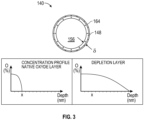
- Fig. 3 illustrates a schematic diagram of a particle 140 of reactive metal powder formed according to exemplary atomization methods described herein in which the heated metal source 16 is contacted with an additive gas.
- a first layer 148 (or layer 1) is formed on the outer surface of the particle body 156 (for example a Ti-6Al-4V particle). It results from the compounding of the heated metal with the electronegative atoms and/or molecules that are depleting through the thickness.
- a second layer 164 (or layer 2) being a native oxide layer is further formed on the surface of the particle body 156.
- the first layer 148 and the second layer 164 have a combined charge that is substantially neutral, thereby causing the formed particle 140 to have a substantially net zero charge (Q net ⁇ 0) and a lower ability to polarize.
- the amount of additive gas injected with the atomization gas to form an atomization mixture may be controlled as it varies quasi linearly with the production rate of metal powder having a predetermined particle size distribution.
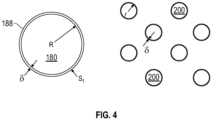
- the amount of additive gas needed to form the layer 1 is related to the total surface area of the metal particles which depends of the production rate and particle size distributions (see Fig. 4 ).
- the concentration of the additive gas and the thermal conditions of the metal particles will determine the depleting layer depth of the layer 1.
- the amount of additive gas injected with the atomization gas to form an atomization mixture may be controlled as it varies with the total area of the particles of the metal powder formed as shown in Fig. 4 .
- the amount of additive gas injected with the atomization gas to form an atomization mixture may be controlled as it varies with the temperature of the surface of the particles of the raw metal powder formed.
- the reaction rate ⁇ of such chemical reaction of activation energy E generally follows an Arhenius relation with the temperature T: ⁇ ⁇ e ⁇ E kT
- the injection of the additive gas at high temperature is thus more efficient and requires less additive gas concentration to generate the ideal depletion depth and form the layer 1.
- Fig. 4 illustrates a schematic diagram of a particle 180 having a radius R and a depletion depth of ⁇ at the surface of the particle 188.
- Fig. 4 further illustrates a schematic diagram of a plurality of particles (n particles) 200 of the same size having the same total mass as the mass of the particle 180.
- the particles 200 are smaller in size than particle 180 but they have a larger surface area in total than particle 180.
- the amount of surface additive added is thus a function of the total surface area as the volume that will be treated is the product of the total surface area by the depletion depth.
- the obtained metal powders can have less than about 100 150, 200, 300, 500, 1000 or 1500 ppm of an electronegative atom and/or molecule (for example an electronegative atom and/or molecule element that is comprised within the additive gas used to produce the powder).
- an electronegative atom and/or molecule for example an electronegative atom and/or molecule element that is comprised within the additive gas used to produce the powder.
- the atomizing gas is high purity argon (> 99.997%).
- Test 3 air was injected to the high purity argon to form an atomization mixture of 80 ppm of air with argon. Heated metal was contacted with the atomization mixture during the atomization process.
- Test 4 O 2 was injected to the high purity argon to form an atomization mixture of 50 ppm of O 2 with argon. Heated metal was contacted with this second atomization mixture during the atomization process.
- the sieved powder is then mixed to ensure homogeneity.
- the powder was further stirred in distilled water or demineralized water to remove static electricity charges accumulated during previous steps.
- the powder was dried in air at 80°C for 12 h.
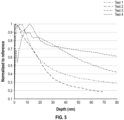
- Fig. 5 is a graph illustrating the oxygen profile comparison between different samples by TOF-SIMS.
- the TOF-SIMS signature of powder is obtained for Test 1 to 4.
- the presence of a depletion layer can be associated with the high flowability powders as can be seen in Table 1.
- the TOF-SIMS signature of a fine powder that has been treated can be clearly seen from the Fig. 5 .
- a tail in the oxygen content enters deeper in the surface layer. It is critical to obtain this depletion layer with a certain critical depth in order to get the improved flowability behavior.
- the TOF-SIMS results suggest that the depletion layer has a depth of the order of 100 nm.
- the depth can be estimated by calibrating the sputtering rate of the ion beam obtained on a Ti-6Al-4V bulk part with a profilometer. The sputtering rate depends of the ion beam intensity and of the type of material. The calibration is done prior to measurements and the ion beam energy is very stable.
- Table 1 Test 1 to 4 description with flowability and apparent density measured on a 15-45 ⁇ m particle size distribution Lot # Additive gas Concentration (ppm) Flowability (s) Apparent density (g/cm 3 ) Visual compaction in the collection bucket after atom ization Test 1 0 NF NA bad Test 2 0 NF NA bad Test 3 80 ppm air 27.3 2.51 good Test 4 50 ppm O2 27 2.50 good Per ASTM B213 Per ASTM B212 Table 2: Powder chemical composition of Test 1 to 4 on a 15-45 ⁇ m particle size distribution Chemical Composition (wt.
- the treatment performed maintains a satisfying chemical composition according to the composition of standard ASTM B348, ASTM F2924 and ASTM F3001. It would have also complied with those of AMS 4998 if the oxygen of the raw material would have been slightly higher.
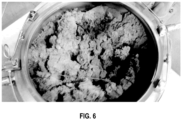
- Fig. 6 is a photograph of a batch of about 100 kg of metal powder formed according to an atomization process that does not include contacting with the additive gas. Due to agglomerates, 90% of the collecting bucket is filled and the visual compaction is bad.
- Fig. 7 is a photograph of a batch of about 100 kg of metal powder formed according to an atomization process in which the metal source is contacted with the additive gas. Due to improved flowability and lower surface interactions between particles, 20% of the collecting bucket is filled for the same amount of material as used during the run of Fig. 6 and the visual compaction is good.
- Tests similar to Test 3 and 4 have been carried by intermittently injecting the additive gas. It was found that the treatment was still effective while having the advantage of adding less impurity to the final product.
- Heat treatment was performed a posteriori on already-formed metal powder that was formed from a process in which additive gas was not used.
- the already-formed metal powder was heated in air atmosphere at about 250°C for 12 hours. It was expected that this heating would cause addition of oxygen to surface of particles of the raw metal powder and increase the thickness of the native oxide layer.
- the high temperature involved during the atomization and the low concentration of additive gas enable the oxidation/nitridation reaction that forms the depletion oxide/nitride layer when the metal source is contacted with the additive gas.
- Embodiments of paragraphs [0027] to [00192] of the present disclosure are presented in such a manner in the present disclosure so as to demonstrate that every combination of embodiments, when applicable can be made. These embodiments have thus been presented in the description in a manner equivalent to making dependent claims for all the embodiments that depend upon any of the preceding claims (covering the previously presented embodiments), thereby demonstrating that they can be combined together in all possible manners. For example, all the possible combination, when applicable, between the embodiments of paragraphs [0027] to [00192] and the processes of paragraphs [0006] to [0026] are hereby covered by the present disclosure.
Landscapes
- Chemical & Material Sciences (AREA)
- Organic Chemistry (AREA)
- Chemical Kinetics & Catalysis (AREA)
- Powder Metallurgy (AREA)
- Manufacture Of Metal Powder And Suspensions Thereof (AREA)
- Glanulating (AREA)
Applications Claiming Priority (4)
| Application Number | Priority Date | Filing Date | Title |
|---|---|---|---|
| US201562247794P | 2015-10-29 | 2015-10-29 | |
| EP16858532.1A EP3368238B1 (de) | 2015-10-29 | 2016-10-27 | Herstellungsverfahren für metallpulverzerstäubung |
| EP24194449.5A EP4454786A3 (de) | 2015-10-29 | 2016-10-27 | Herstellungsverfahren für metallpulverzerstäubung |
| PCT/CA2016/051240 WO2017070779A1 (en) | 2015-10-29 | 2016-10-27 | Metal powder atomization manufacturing processes |
Related Parent Applications (2)
| Application Number | Title | Priority Date | Filing Date |
|---|---|---|---|
| EP16858532.1A Division EP3368238B1 (de) | 2015-10-29 | 2016-10-27 | Herstellungsverfahren für metallpulverzerstäubung |
| EP24194449.5A Division EP4454786A3 (de) | 2015-10-29 | 2016-10-27 | Herstellungsverfahren für metallpulverzerstäubung |
Publications (2)
| Publication Number | Publication Date |
|---|---|
| EP4530000A2 true EP4530000A2 (de) | 2025-04-02 |
| EP4530000A3 EP4530000A3 (de) | 2025-10-29 |
Family
ID=58629652
Family Applications (5)
| Application Number | Title | Priority Date | Filing Date |
|---|---|---|---|
| EP24194449.5A Pending EP4454786A3 (de) | 2015-10-29 | 2016-10-27 | Herstellungsverfahren für metallpulverzerstäubung |
| EP25156286.4A Pending EP4529999A3 (de) | 2015-10-29 | 2016-10-27 | Verfahren zur herstellung von metallpulverzerstäubung |
| EP25157063.6A Pending EP4530000A3 (de) | 2015-10-29 | 2016-10-27 | Herstellungsverfahren für metallpulverzerstäubung |
| EP25156224.5A Pending EP4640343A1 (de) | 2015-10-29 | 2016-10-27 | Herstellungsverfahren für metallpulverzerstäubung |
| EP16858532.1A Active EP3368238B1 (de) | 2015-10-29 | 2016-10-27 | Herstellungsverfahren für metallpulverzerstäubung |
Family Applications Before (2)
| Application Number | Title | Priority Date | Filing Date |
|---|---|---|---|
| EP24194449.5A Pending EP4454786A3 (de) | 2015-10-29 | 2016-10-27 | Herstellungsverfahren für metallpulverzerstäubung |
| EP25156286.4A Pending EP4529999A3 (de) | 2015-10-29 | 2016-10-27 | Verfahren zur herstellung von metallpulverzerstäubung |
Family Applications After (2)
| Application Number | Title | Priority Date | Filing Date |
|---|---|---|---|
| EP25156224.5A Pending EP4640343A1 (de) | 2015-10-29 | 2016-10-27 | Herstellungsverfahren für metallpulverzerstäubung |
| EP16858532.1A Active EP3368238B1 (de) | 2015-10-29 | 2016-10-27 | Herstellungsverfahren für metallpulverzerstäubung |
Country Status (8)
| Country | Link |
|---|---|
| US (9) | US20190001416A1 (de) |
| EP (5) | EP4454786A3 (de) |
| JP (4) | JP7201155B2 (de) |
| KR (1) | KR102544904B1 (de) |
| CN (1) | CN108367361B (de) |
| AU (2) | AU2016344809B2 (de) |
| CA (4) | CA3003502C (de) |
| WO (1) | WO2017070779A1 (de) |
Families Citing this family (41)
| Publication number | Priority date | Publication date | Assignee | Title |
|---|---|---|---|---|
| CA2912282A1 (en) | 2014-03-11 | 2015-09-17 | Tekna Plasma Systems Inc. | Process and apparatus for producing powder particles by atomization of a feed material in the form of an elongated member |
| EP4454786A3 (de) * | 2015-10-29 | 2025-01-01 | AP&C Advanced Powders And Coatings Inc. | Herstellungsverfahren für metallpulverzerstäubung |
| HUE065423T2 (hu) | 2015-12-16 | 2024-05-28 | 6K Inc | Eljárás szferoidális dehidrogénezett titánötvözet részecskék elõállítására |
| US10987735B2 (en) | 2015-12-16 | 2021-04-27 | 6K Inc. | Spheroidal titanium metallic powders with custom microstructures |
| CA3097498C (en) * | 2016-04-11 | 2023-09-26 | Ap&C Advanced Powders & Coatings Inc. | Reactive metal powders in-flight heat treatment processes |
| CN107377983A (zh) * | 2017-08-04 | 2017-11-24 | 米亚索乐装备集成(福建)有限公司 | 一种制备合金金属粉末的雾化装置 |
| EP3479926A1 (de) | 2017-11-06 | 2019-05-08 | Technische Universität Graz | Verfahren zur veränderung der partikelform und der partikelgrössenverteilung von pulvern auf aluminiumbasis |
| JP7176219B2 (ja) * | 2018-04-04 | 2022-11-22 | 大同特殊鋼株式会社 | 金属粉末材料および金属粉末材料の製造方法 |
| US20210260650A1 (en) * | 2018-05-11 | 2021-08-26 | Equispheres Inc. | Additive manufacturing powder and additive manufacturing part made using same |
| AU2019290663B2 (en) | 2018-06-19 | 2023-05-04 | 6K Inc. | Process for producing spheroidized powder from feedstock materials |
| WO2020014287A2 (en) * | 2018-07-09 | 2020-01-16 | Ald Nanosolutions, Inc. | Modification of particles for additive manufacturing |
| EP3959026A1 (de) * | 2019-04-29 | 2022-03-02 | Global Advanced Metals USA, Inc. | Ti-zr-legierungspulver und anode damit |
| KR20240036705A (ko) | 2019-04-30 | 2024-03-20 | 6케이 인크. | 리튬 란타넘 지르코늄 산화물(llzo) 분말 |
| CA3134573A1 (en) | 2019-04-30 | 2020-11-05 | Sunil Bhalchandra BADWE | Mechanically alloyed powder feedstock |
| EP3962677A4 (de) * | 2019-05-02 | 2023-01-04 | Tekna Plasma Systems Inc. | Pulver für generative fertigung mit verbesserten physikalischen eigenschaften, verfahren zu seiner herstellung und seine verwendung |
| JP6734447B1 (ja) * | 2019-07-31 | 2020-08-05 | 株式会社ソディック | 金属積層造形用の材料粉体およびその製造方法 |
| KR102857801B1 (ko) * | 2019-09-27 | 2025-09-09 | 에이피앤드씨 어드밴스드 파우더스 앤드 코팅스 인크. | 알루미늄 기반 금속 분말들 및 그들의 제조 방법 |
| US20240051833A1 (en) | 2019-10-09 | 2024-02-15 | Tekna Plasma Systems Inc. | Nanosize powder advanced materials, method of manufacturing and of using same |
| WO2021118762A1 (en) | 2019-11-18 | 2021-06-17 | 6K Inc. | Unique feedstocks for spherical powders and methods of manufacturing |
| US11590568B2 (en) * | 2019-12-19 | 2023-02-28 | 6K Inc. | Process for producing spheroidized powder from feedstock materials |
| US12599962B2 (en) | 2020-01-30 | 2026-04-14 | Ap&C Advanced Powders & Coatings Inc. | System and method for treating additive powder |
| US11654483B2 (en) | 2020-04-07 | 2023-05-23 | General Electric Company | Method for forming high quality powder for an additive manufacturing process |
| JP7762144B2 (ja) | 2020-05-13 | 2025-10-29 | 株式会社大阪チタニウムテクノロジーズ | チタン粒子またはチタン合金粒子 |
| AU2021297476A1 (en) | 2020-06-25 | 2022-12-15 | 6K Inc. | Microcomposite alloy structure |
| KR102323008B1 (ko) * | 2020-07-09 | 2021-11-10 | 한국생산기술연구원 | 3차원 프린팅용 금속 분말의 표면처리 방법 및 이에 의해 제조된 3차원 프린팅용 금속 분말 |
| AU2021349358A1 (en) | 2020-09-24 | 2023-02-09 | 6K Inc. | Systems, devices, and methods for starting plasma |
| CA3193640A1 (en) * | 2020-09-25 | 2022-03-31 | Pawel MATYS | Method and apparatus for feeding material into a plasma |
| KR102295894B1 (ko) * | 2020-10-21 | 2021-08-31 | 박요설 | 조립화 공정을 이용한 3d 프린팅용 금속분말 제조 방법 |
| EP4237174A1 (de) * | 2020-10-30 | 2023-09-06 | 6K Inc. | Systeme und verfahren zur synthese von sphäroidisierten metallpulvern |
| EP4275239A4 (de) | 2021-01-11 | 2024-12-18 | 6K Inc. | Verfahren und systeme zur rückgewinnung von li-ionen-kathodenmaterialien mittels mikrowellenplasmaverarbeitung |
| AU2022246797A1 (en) | 2021-03-31 | 2023-10-05 | 6K Inc. | Systems and methods for additive manufacturing of metal nitride ceramics |
| CN113210620A (zh) * | 2021-05-16 | 2021-08-06 | 江苏萌达新材料科技有限公司 | 一种超细低氧锡粉制备方法及其设备 |
| WO2023215950A1 (en) * | 2022-05-12 | 2023-11-16 | Coogee Titanium Pty Ltd | Pyrophoric metals and metal alloys |
| WO2023229928A1 (en) | 2022-05-23 | 2023-11-30 | 6K Inc. | Microwave plasma apparatus and methods for processing materials using an interior liner |
| US12040162B2 (en) | 2022-06-09 | 2024-07-16 | 6K Inc. | Plasma apparatus and methods for processing feed material utilizing an upstream swirl module and composite gas flows |
| WO2024044498A1 (en) | 2022-08-25 | 2024-02-29 | 6K Inc. | Plasma apparatus and methods for processing feed material utilizing a powder ingress preventor (pip) |
| EP4619180A1 (de) * | 2022-11-15 | 2025-09-24 | Equispheres Inc. | Pulver zur generativen fertigung mit partikeln auf metallbasis und zugehörige verfahren |
| KR102625404B1 (ko) * | 2022-12-01 | 2024-01-15 | 이용복 | 플라즈마를 이용한 금속분말 처리장치 및 그 처리방법 |
| US12195338B2 (en) | 2022-12-15 | 2025-01-14 | 6K Inc. | Systems, methods, and device for pyrolysis of methane in a microwave plasma for hydrogen and structured carbon powder production |
| EP4491300A1 (de) | 2023-06-29 | 2025-01-15 | General Electric Company | System und verfahren zur verarbeitung von zerstäubtem pulver und verarbeitetes pulver |
| WO2025263265A1 (ja) * | 2024-06-18 | 2025-12-26 | 日本製鉄株式会社 | チタン材、加工品、および製品 |
Family Cites Families (125)
| Publication number | Priority date | Publication date | Assignee | Title |
|---|---|---|---|---|
| US3172753A (en) * | 1965-03-09 | Method for theproduction of | ||
| US3041672A (en) | 1958-09-22 | 1962-07-03 | Union Carbide Corp | Making spheroidal powder |
| US3347698A (en) | 1964-01-10 | 1967-10-17 | Metco Inc | Radio frequency plasma flame spraying |
| JPS4925554B1 (de) | 1969-05-16 | 1974-07-01 | ||
| US3891824A (en) | 1971-04-01 | 1975-06-24 | Philips Corp | Method of plasma-MIG-welding |
| US3944412A (en) | 1974-09-18 | 1976-03-16 | Hsin Liu | Method for recovering metals |
| GB1540810A (en) | 1975-04-09 | 1979-02-14 | Metallisation Ltd | Metal spraying devices |
| US4022872A (en) | 1975-11-12 | 1977-05-10 | Ppg Industries, Inc. | Process for preparing finely-divided refractory powders |
| US4374075A (en) * | 1981-06-17 | 1983-02-15 | Crucible Inc. | Method for the plasma-arc production of metal powder |
| CA1173784A (en) | 1981-07-30 | 1984-09-04 | William H. Gauvin | Transferred-arc plasma reactor for chemical and metallurgical applications |
| US5120352A (en) | 1983-06-23 | 1992-06-09 | General Electric Company | Method and apparatus for making alloy powder |
| US4631013A (en) | 1984-02-29 | 1986-12-23 | General Electric Company | Apparatus for atomization of unstable melt streams |
| JPS60255906A (ja) * | 1984-05-29 | 1985-12-17 | Kobe Steel Ltd | 活性金属粉末の製造方法及び設備 |
| GB8505811D0 (en) | 1985-03-06 | 1985-04-11 | Bekaert Sa Nv | Induction heating |
| US4544404A (en) | 1985-03-12 | 1985-10-01 | Crucible Materials Corporation | Method for atomizing titanium |
| US4690796A (en) | 1986-03-13 | 1987-09-01 | Gte Products Corporation | Process for producing aluminum-titanium diboride composites |
| EP0259459B1 (de) | 1986-03-13 | 1991-12-27 | CHENEY, Richard, F. | Pulversprühverfahren und vorrichtung |
| US4788402A (en) | 1987-03-11 | 1988-11-29 | Browning James A | High power extended arc plasma spray method and apparatus |
| JPS63266001A (ja) | 1987-04-22 | 1988-11-02 | Sumitomo Metal Mining Co Ltd | 複合球状粉末の製造方法 |
| US5114471A (en) | 1988-01-04 | 1992-05-19 | Gte Products Corporation | Hydrometallurgical process for producing finely divided spherical maraging steel powders |
| US5176938A (en) | 1988-11-23 | 1993-01-05 | Plasmacarb Inc. | Process for surface treatment of pulverulent material |
| US4982410A (en) | 1989-04-19 | 1991-01-01 | Mustoe Trevor N | Plasma arc furnace with variable path transferred arc |
| US5213610A (en) | 1989-09-27 | 1993-05-25 | Crucible Materials Corporation | Method for atomizing a titanium-based material |
| US5084091A (en) | 1989-11-09 | 1992-01-28 | Crucible Materials Corporation | Method for producing titanium particles |
| EP0586756B1 (de) | 1990-05-29 | 2002-04-17 | Sulzer Metco AG | Plasmasysteme zum thermischen Spritzen von Pulvern |
| US5296667A (en) | 1990-08-31 | 1994-03-22 | Flame-Spray Industries, Inc. | High velocity electric-arc spray apparatus and method of forming materials |
| US5147448A (en) * | 1990-10-01 | 1992-09-15 | Nuclear Metals, Inc. | Techniques for producing fine metal powder |
| JPH05503322A (ja) * | 1990-10-09 | 1993-06-03 | アイオワ・ステイト・ユニバーシティ・リサーチ・ファウンデーション・インコーポレイテッド | 環境に対して安定な反応性を有する合金粉末及びその製造方法 |
| DE4102101C2 (de) | 1991-01-25 | 2003-12-18 | Ald Vacuum Techn Ag | Einrichtung zum Herstellen von Pulvern aus Metallen |
| US5200595A (en) | 1991-04-12 | 1993-04-06 | Universite De Sherbrooke | High performance induction plasma torch with a water-cooled ceramic confinement tube |
| FR2679473B1 (fr) | 1991-07-25 | 1994-01-21 | Aubert Duval | Procede et dispositif de production de poudres et notamment de poudres metalliques par atomisation. |
| US5294242A (en) | 1991-09-30 | 1994-03-15 | Air Products And Chemicals | Method for making metal powders |
| US5176874A (en) | 1991-11-05 | 1993-01-05 | General Electric Company | Controlled process for the production of a spray of atomized metal droplets |
| US5198017A (en) * | 1992-02-11 | 1993-03-30 | General Electric Company | Apparatus and process for controlling the flow of a metal stream |
| CA2107421A1 (en) | 1992-10-16 | 1994-04-17 | Steven Alfred Miller | Atomization with low atomizing gas pressure |
| US5277705A (en) | 1992-12-30 | 1994-01-11 | Iowa State University Research Foundation, Inc. | Powder collection apparatus/method |
| US6146567A (en) | 1993-02-18 | 2000-11-14 | Massachusetts Institute Of Technology | Three dimensional printing methods |
| JPH06264115A (ja) * | 1993-03-09 | 1994-09-20 | Takeshi Masumoto | 金属粉末製造装置 |
| US5368657A (en) * | 1993-04-13 | 1994-11-29 | Iowa State University Research Foundation, Inc. | Gas atomization synthesis of refractory or intermetallic compounds and supersaturated solid solutions |
| JP3545783B2 (ja) | 1993-08-12 | 2004-07-21 | 株式会社日清製粉グループ本社 | 被覆粒子の製造方法 |
| US5480471A (en) | 1994-04-29 | 1996-01-02 | Crucible Materials Corporation | Re-Fe-B magnets and manufacturing method for the same |
| US5707419A (en) * | 1995-08-15 | 1998-01-13 | Pegasus Refractory Materials, Inc. | Method of production of metal and ceramic powders by plasma atomization |
| US6596224B1 (en) | 1996-05-24 | 2003-07-22 | Massachusetts Institute Of Technology | Jetting layers of powder and the formation of fine powder beds thereby |
| US5855642A (en) * | 1996-06-17 | 1999-01-05 | Starmet Corporation | System and method for producing fine metallic and ceramic powders |
| US5935461A (en) | 1996-07-25 | 1999-08-10 | Utron Inc. | Pulsed high energy synthesis of fine metal powders |
| US5939151A (en) | 1996-10-25 | 1999-08-17 | Iowa State University Research Foundation, Inc. | Method and apparatus for reactive plasma atomization |
| CA2214194C (en) | 1997-01-10 | 2002-04-09 | Basf Corporation | Multiple domain fibers having inter-domain boundary compatibilizing layer and methods of making the same |
| US5808270A (en) | 1997-02-14 | 1998-09-15 | Ford Global Technologies, Inc. | Plasma transferred wire arc thermal spray apparatus and method |
| US5940674A (en) | 1997-04-09 | 1999-08-17 | Massachusetts Institute Of Technology | Three-dimensional product manufacture using masks |
| US5989648A (en) | 1997-05-06 | 1999-11-23 | The Penn State Research Foundation | Plasma generation of supported metal catalysts |
| JPH10330806A (ja) | 1997-06-02 | 1998-12-15 | Sanyo Special Steel Co Ltd | 擬球状異形金属粉末の製造方法 |
| US6142382A (en) | 1997-06-18 | 2000-11-07 | Iowa State University Research Foundation, Inc. | Atomizing nozzle and method |
| AT409235B (de) | 1999-01-19 | 2002-06-25 | Boehler Edelstahl | Verfahren und vorrichtung zur herstellung von metallpulver |
| JP4004675B2 (ja) | 1999-01-29 | 2007-11-07 | 株式会社日清製粉グループ本社 | 酸化物被覆金属微粒子の製造方法 |
| JP3696429B2 (ja) | 1999-02-22 | 2005-09-21 | 日本化学工業株式会社 | 導電性無電解めっき粉体とその製造方法並びに該めっき粉体からなる導電性材料 |
| JP2003508633A (ja) | 1999-09-03 | 2003-03-04 | アメリカン インター − メタリックス、インコーポレイテッド | 粉末を生産する装置および方法 |
| JP2001226704A (ja) | 2000-02-10 | 2001-08-21 | Sumitomo Metal Ind Ltd | 金属粉末の製造装置および製造方法 |
| RU2263006C2 (ru) | 2000-02-10 | 2005-10-27 | Тетроникс Лимитед | Плазменно-дуговой реактор и способ получения тонких порошков |
| JP2001254103A (ja) | 2000-03-13 | 2001-09-18 | Sanei Kasei Kk | ナノコンポジット構造を有する金属粒子及び自己組織化によるその製造方法 |
| IL152119A0 (en) | 2000-04-10 | 2003-05-29 | Tetronics Ltd | Twin plasma torch apparatus |
| US6365867B1 (en) | 2000-11-01 | 2002-04-02 | Sandia Corporation | Plasma arc torch with coaxial wire feed |
| US20020125591A1 (en) | 2000-12-04 | 2002-09-12 | Jaynes Scot Eric | Process and apparatus for producing atomized powder using recirculating atomizing gas |
| US6398125B1 (en) | 2001-02-10 | 2002-06-04 | Nanotek Instruments, Inc. | Process and apparatus for the production of nanometer-sized powders |
| FR2821925B1 (fr) | 2001-03-06 | 2003-05-16 | Celes | Enceinte d'etancheite au gaz et au vide d'isolation thermique destinee a un dispositif de chauffage par induction |
| US6444009B1 (en) * | 2001-04-12 | 2002-09-03 | Nanotek Instruments, Inc. | Method for producing environmentally stable reactive alloy powders |
| US6915964B2 (en) | 2001-04-24 | 2005-07-12 | Innovative Technology, Inc. | System and process for solid-state deposition and consolidation of high velocity powder particles using thermal plastic deformation |
| US6693253B2 (en) | 2001-10-05 | 2004-02-17 | Universite De Sherbrooke | Multi-coil induction plasma torch for solid state power supply |
| GB0201600D0 (en) | 2002-01-24 | 2002-03-13 | Univ Cambridge Tech | Large- scale plasma synthesis of hollow nanostructures |
| DE10205897A1 (de) | 2002-02-13 | 2003-08-21 | Mepura Metallpulver | Verfahren zur Herstellung von partikelförmigem Material |
| US6780219B2 (en) | 2002-07-03 | 2004-08-24 | Osram Sylvania Inc. | Method of spheridizing silicon metal powders |
| JP2004091843A (ja) * | 2002-08-30 | 2004-03-25 | Hitachi Metals Ltd | 高純度高融点金属粉末の製造方法 |
| TW583043B (en) | 2002-12-27 | 2004-04-11 | Ind Tech Res Inst | Nanostructured metal powder and the method of fabricating the same |
| US6939389B2 (en) * | 2003-08-08 | 2005-09-06 | Frank Mooney | Method and apparatus for manufacturing fine powders |
| JP4754488B2 (ja) * | 2003-08-28 | 2011-08-24 | テクナ・プラズマ・システムズ・インコーポレーテッド | 粉末材料の合成や分離や精製のための方法 |
| US7131597B2 (en) | 2003-09-09 | 2006-11-07 | Scattergood John R | Atomization technique for producing fine particles |
| US7803235B2 (en) | 2004-01-08 | 2010-09-28 | Cabot Corporation | Passivation of tantalum and other metal powders using oxygen |
| SG111177A1 (en) | 2004-02-28 | 2005-05-30 | Wira Kurnia | Fine particle powder production |
| CN1709585A (zh) | 2004-06-18 | 2005-12-21 | 杭州宇通微粉有限公司 | 一种高压气体雾化喷嘴 |
| CN101208165B (zh) | 2005-05-11 | 2013-03-27 | 英孚拉玛特公司 | 磁性合成物及其制造和使用方法 |
| US7582135B2 (en) | 2005-10-17 | 2009-09-01 | Nisshin Seifun Group Inc. | Process for producing ultrafine particles |
| EP1777302B1 (de) | 2005-10-21 | 2009-07-15 | Sulzer Metco (US) Inc. | Verfahren zur Herstellung hochreinen fliessfähigen Metalloxidpulvers durch Plasmaschmelzen |
| CN101024248A (zh) | 2006-02-16 | 2007-08-29 | 精工爱普生株式会社 | 金属粉末生产设备和金属粉末 |
| US8859931B2 (en) | 2006-03-08 | 2014-10-14 | Tekna Plasma Systems Inc. | Plasma synthesis of nanopowders |
| US7967891B2 (en) | 2006-06-01 | 2011-06-28 | Inco Limited | Method producing metal nanopowders by decompositon of metal carbonyl using an induction plasma torch |
| JP5052291B2 (ja) | 2006-11-02 | 2012-10-17 | 株式会社日清製粉グループ本社 | 合金超微粒子、およびその製造方法 |
| US7753989B2 (en) | 2006-12-22 | 2010-07-13 | Cristal Us, Inc. | Direct passivation of metal powder |
| US7943084B1 (en) | 2007-05-23 | 2011-05-17 | The United States Of America As Represented By The Secretary Of The Navy | Metal powders with improved flowability |
| DE102008064648A1 (de) | 2008-01-23 | 2010-05-20 | Tradium Gmbh | Reaktionsgefäß zur Herstellung von Metallpulvern |
| US8092570B2 (en) | 2008-03-31 | 2012-01-10 | Hitachi Metals, Ltd. | Method for producing titanium metal |
| JP5322049B2 (ja) | 2008-07-08 | 2013-10-23 | 独立行政法人日本原子力研究開発機構 | ベリリウム材充填体およびベリリウム材充填体の成形方法 |
| JP2010018825A (ja) | 2008-07-08 | 2010-01-28 | Japan Atomic Energy Agency | 金属粒子の製造方法および製造装置、並びに製造された金属粒子 |
| US8778099B2 (en) * | 2008-12-09 | 2014-07-15 | United Technologies Corporation | Conversion process for heat treatable L12 aluminum alloys |
| WO2010135107A1 (en) | 2009-05-11 | 2010-11-25 | Regents Of The University Of Colorado, A Body Corporate | Ultra-thin metal oxide and carbon-metal oxide films prepared by atomic layer deposition (ald) |
| WO2011054113A1 (en) | 2009-11-05 | 2011-05-12 | Ap&C Advanced Powders & Coatings Inc. | Methods and apparatuses for preparing spheroidal powders |
| GB201001984D0 (en) * | 2010-02-08 | 2010-03-24 | Renewable Holdings Ltd | Biodiesel synthesis |
| GB2479721B (en) | 2010-04-19 | 2012-04-04 | Rolls Royce Plc | Method of producing a powder |
| JPWO2012070461A1 (ja) | 2010-11-22 | 2014-05-19 | 日立金属株式会社 | 金属チタン製造装置および金属チタンの製造方法 |
| JP5571537B2 (ja) | 2010-11-22 | 2014-08-13 | 日立金属株式会社 | 金属チタン製造装置および金属チタンの製造方法 |
| CN103429354B (zh) | 2010-12-22 | 2016-08-17 | 火焰喷射工业股份有限公司 | 利用等离子体转移金属丝电弧的改进的热喷涂方法和设备 |
| EP2671430B1 (de) | 2011-02-03 | 2018-05-16 | Tekna Plasma Systems Inc. | Hochleistungs-induktionsplasmabrenner |
| CN102094163B (zh) | 2011-02-25 | 2012-09-05 | 中国科学院金属研究所 | 一种CoNiCrAlY抗腐蚀热喷涂合金粉末及制备方法 |
| US20120325051A1 (en) | 2011-06-27 | 2012-12-27 | United Technologies Corporation | Production of atomized powder for glassy aluminum-based alloys |
| KR101436498B1 (ko) | 2011-10-20 | 2014-09-01 | 한국기계연구원 | 플라즈마를 이용한 500 ㎚-10 ㎛ 크기의 구형 분말의 제조장치 |
| US9956615B2 (en) | 2012-03-08 | 2018-05-01 | Carpenter Technology Corporation | Titanium powder production apparatus and method |
| US9650309B2 (en) | 2012-04-12 | 2017-05-16 | Iowa State University Research Foundation, Inc. | Stability of gas atomized reactive powders through multiple step in-situ passivation |
| CN103846447B (zh) * | 2012-12-06 | 2016-04-27 | 北京有色金属研究总院 | 一种微细球形钛或钛合金粉末的气雾化制备方法 |
| CN103223492A (zh) * | 2013-04-09 | 2013-07-31 | 宁夏新和新材科技有限公司 | 超细高活性铝粉的制备工艺及装置 |
| US9833837B2 (en) * | 2013-06-20 | 2017-12-05 | Iowa State University Research Foundation, Inc. | Passivation and alloying element retention in gas atomized powders |
| CN103433499B (zh) | 2013-08-27 | 2015-08-12 | 湖南航天工业总公司 | 一种球形金属粉末的超声雾化制备装置及制备方法 |
| US9981315B2 (en) | 2013-09-24 | 2018-05-29 | Iowa State University Research Foundation, Inc. | Atomizer for improved ultra-fine powder production |
| CN103769594A (zh) * | 2013-11-25 | 2014-05-07 | 王利民 | 一种等离子雾化制备高纯度球形超细/纳米级粉末材料的工艺方法和装备 |
| KR101516258B1 (ko) | 2013-11-27 | 2015-05-04 | 한국기계연구원 | 무게분율 조절이 가능한 마이크로-나노 크기 혼합 분말의 제조방법 및 이에 따라 제조되는 마이크로-나노 크기 혼합 분말 |
| CN103752822B (zh) * | 2014-02-20 | 2016-11-02 | 西华大学 | 一种复合粉体及其制备方法 |
| CA2912282A1 (en) | 2014-03-11 | 2015-09-17 | Tekna Plasma Systems Inc. | Process and apparatus for producing powder particles by atomization of a feed material in the form of an elongated member |
| KR101604251B1 (ko) * | 2014-04-02 | 2016-03-18 | 한국생산기술연구원 | 유동성이 우수한 금속분말 및 그 제조방법 |
| CA2945142A1 (en) * | 2014-04-07 | 2015-10-15 | Powder Treatment Technology LLC | Surface energy modified particles, method of making, and use thereof |
| KR102383340B1 (ko) | 2014-07-21 | 2022-04-07 | 누보 피그노네 에스알엘 | 적층 가공에 의한 기계 구성요소 제조 방법 |
| CN104148658B (zh) | 2014-09-09 | 2016-09-28 | 四川省有色冶金研究院有限公司 | 一种制备增材制造专用Ti6Al4V合金粉末工艺方法 |
| CN104894483B (zh) | 2015-05-15 | 2018-07-31 | 安泰科技股份有限公司 | 粉末冶金耐磨工具钢 |
| KR20160139240A (ko) | 2015-05-27 | 2016-12-07 | 주식회사 엘지화학 | 전극 합제, 이의 제조방법 및 이를 포함하는 이차전지 |
| EP3302855B1 (de) | 2015-06-05 | 2021-09-22 | Pyrogenesis Canada Inc. | Plasmavorrichtung zur herstellung von hochwertigen kugelförmigen pulvern bei hoher kapazität |
| AU2016288266B2 (en) | 2015-06-29 | 2021-05-13 | Tekna Plasma Systems Inc. | Induction plasma torch with higher plasma energy density |
| US11198179B2 (en) * | 2015-07-17 | 2021-12-14 | Ap&C Advanced Powders & Coating Inc. | Plasma atomization metal powder manufacturing processes and system therefor |
| EP4454786A3 (de) * | 2015-10-29 | 2025-01-01 | AP&C Advanced Powders And Coatings Inc. | Herstellungsverfahren für metallpulverzerstäubung |
| CA3097498C (en) | 2016-04-11 | 2023-09-26 | Ap&C Advanced Powders & Coatings Inc. | Reactive metal powders in-flight heat treatment processes |
-
2016
- 2016-10-27 EP EP24194449.5A patent/EP4454786A3/de active Pending
- 2016-10-27 CA CA3003502A patent/CA3003502C/en active Active
- 2016-10-27 EP EP25156286.4A patent/EP4529999A3/de active Pending
- 2016-10-27 CA CA3051236A patent/CA3051236C/en active Active
- 2016-10-27 US US15/772,418 patent/US20190001416A1/en not_active Abandoned
- 2016-10-27 WO PCT/CA2016/051240 patent/WO2017070779A1/en not_active Ceased
- 2016-10-27 KR KR1020187015104A patent/KR102544904B1/ko active Active
- 2016-10-27 AU AU2016344809A patent/AU2016344809B2/en active Active
- 2016-10-27 EP EP25157063.6A patent/EP4530000A3/de active Pending
- 2016-10-27 JP JP2018541458A patent/JP7201155B2/ja active Active
- 2016-10-27 CN CN201680073801.8A patent/CN108367361B/zh active Active
- 2016-10-27 CA CA3024473A patent/CA3024473C/en active Active
- 2016-10-27 EP EP25156224.5A patent/EP4640343A1/de active Pending
- 2016-10-27 CA CA3091111A patent/CA3091111C/en active Active
- 2016-10-27 EP EP16858532.1A patent/EP3368238B1/de active Active
-
2021
- 2021-10-22 JP JP2021173177A patent/JP7208331B2/ja active Active
-
2022
- 2022-09-30 AU AU2022241620A patent/AU2022241620B2/en active Active
-
2023
- 2023-01-05 JP JP2023000566A patent/JP7468977B2/ja active Active
-
2024
- 2024-04-02 JP JP2024059328A patent/JP2024088697A/ja active Pending
- 2024-07-29 US US18/786,757 patent/US20240383036A1/en active Pending
- 2024-12-31 US US19/006,468 patent/US20250135536A1/en active Pending
- 2024-12-31 US US19/006,491 patent/US20250135538A1/en active Pending
- 2024-12-31 US US19/006,449 patent/US20250128325A1/en active Pending
- 2024-12-31 US US19/006,345 patent/US12420338B2/en active Active
- 2024-12-31 US US19/006,478 patent/US20250135537A1/en active Pending
-
2025
- 2025-01-15 US US19/022,552 patent/US20250153244A1/en active Pending
- 2025-09-05 US US19/319,843 patent/US20260001128A1/en active Pending
Also Published As
Similar Documents
| Publication | Publication Date | Title |
|---|---|---|
| US12420338B2 (en) | Metal powder atomization manufacturing processes | |
| US11794247B2 (en) | Reactive metal powders in-flight heat treatment processes |
Legal Events
| Date | Code | Title | Description |
|---|---|---|---|
| PUAI | Public reference made under article 153(3) epc to a published international application that has entered the european phase |
Free format text: ORIGINAL CODE: 0009012 |
|
| STAA | Information on the status of an ep patent application or granted ep patent |
Free format text: STATUS: THE APPLICATION HAS BEEN PUBLISHED |
|
| AC | Divisional application: reference to earlier application |
Ref document number: 3368238 Country of ref document: EP Kind code of ref document: P Ref document number: 4454786 Country of ref document: EP Kind code of ref document: P |
|
| AK | Designated contracting states |
Kind code of ref document: A2 Designated state(s): AL AT BE BG CH CY CZ DE DK EE ES FI FR GB GR HR HU IE IS IT LI LT LU LV MC MK MT NL NO PL PT RO RS SE SI SK SM TR |
|
| REG | Reference to a national code |
Ref country code: DE Ref legal event code: R079 Free format text: PREVIOUS MAIN CLASS: B22F0001160000 Ipc: B22F0009160000 |
|
| PUAL | Search report despatched |
Free format text: ORIGINAL CODE: 0009013 |
|
| AK | Designated contracting states |
Kind code of ref document: A3 Designated state(s): AL AT BE BG CH CY CZ DE DK EE ES FI FR GB GR HR HU IE IS IT LI LT LU LV MC MK MT NL NO PL PT RO RS SE SI SK SM TR |
|
| RIC1 | Information provided on ipc code assigned before grant |
Ipc: B22F 9/16 20060101AFI20250923BHEP Ipc: B01J 2/02 20060101ALI20250923BHEP Ipc: B22F 9/08 20060101ALI20250923BHEP Ipc: B22F 1/052 20220101ALI20250923BHEP Ipc: B22F 1/14 20220101ALI20250923BHEP Ipc: B22F 1/00 20220101ALI20250923BHEP Ipc: B22F 1/16 20220101ALI20250923BHEP Ipc: B22F 9/14 20060101ALI20250923BHEP Ipc: C22C 1/04 20230101ALI20250923BHEP Ipc: B22F 9/04 20060101ALI20250923BHEP |