EP4516503A1 - Wärmeschrumpfbare mehrschichtfolie und verfahren zu ihrer herstellung - Google Patents
Wärmeschrumpfbare mehrschichtfolie und verfahren zu ihrer herstellung Download PDFInfo
- Publication number
- EP4516503A1 EP4516503A1 EP23795960.6A EP23795960A EP4516503A1 EP 4516503 A1 EP4516503 A1 EP 4516503A1 EP 23795960 A EP23795960 A EP 23795960A EP 4516503 A1 EP4516503 A1 EP 4516503A1
- Authority
- EP
- European Patent Office
- Prior art keywords
- multilayer film
- mass
- resin
- adhesive resin
- thermally shrinkable
- Prior art date
- Legal status (The legal status is an assumption and is not a legal conclusion. Google has not performed a legal analysis and makes no representation as to the accuracy of the status listed.)
- Pending
Links
Images
Classifications
-
- B—PERFORMING OPERATIONS; TRANSPORTING
- B32—LAYERED PRODUCTS
- B32B—LAYERED PRODUCTS, i.e. PRODUCTS BUILT-UP OF STRATA OF FLAT OR NON-FLAT, e.g. CELLULAR OR HONEYCOMB, FORM
- B32B7/00—Layered products characterised by the relation between layers; Layered products characterised by the relative orientation of features between layers, or by the relative values of a measurable parameter between layers, i.e. products comprising layers having different physical, chemical or physicochemical properties; Layered products characterised by the interconnection of layers
- B32B7/02—Physical, chemical or physicochemical properties
- B32B7/027—Thermal properties
- B32B7/028—Heat-shrinkability
-
- B—PERFORMING OPERATIONS; TRANSPORTING
- B32—LAYERED PRODUCTS
- B32B—LAYERED PRODUCTS, i.e. PRODUCTS BUILT-UP OF STRATA OF FLAT OR NON-FLAT, e.g. CELLULAR OR HONEYCOMB, FORM
- B32B27/00—Layered products comprising a layer of synthetic resin
- B32B27/06—Layered products comprising a layer of synthetic resin as the main or only constituent of a layer, which is next to another layer of the same or of a different material
- B32B27/08—Layered products comprising a layer of synthetic resin as the main or only constituent of a layer, which is next to another layer of the same or of a different material of synthetic resin
-
- B—PERFORMING OPERATIONS; TRANSPORTING
- B32—LAYERED PRODUCTS
- B32B—LAYERED PRODUCTS, i.e. PRODUCTS BUILT-UP OF STRATA OF FLAT OR NON-FLAT, e.g. CELLULAR OR HONEYCOMB, FORM
- B32B27/00—Layered products comprising a layer of synthetic resin
- B32B27/18—Layered products comprising a layer of synthetic resin characterised by the use of special additives
-
- B—PERFORMING OPERATIONS; TRANSPORTING
- B32—LAYERED PRODUCTS
- B32B—LAYERED PRODUCTS, i.e. PRODUCTS BUILT-UP OF STRATA OF FLAT OR NON-FLAT, e.g. CELLULAR OR HONEYCOMB, FORM
- B32B27/00—Layered products comprising a layer of synthetic resin
- B32B27/18—Layered products comprising a layer of synthetic resin characterised by the use of special additives
- B32B27/22—Layered products comprising a layer of synthetic resin characterised by the use of special additives using plasticisers
-
- B—PERFORMING OPERATIONS; TRANSPORTING
- B32—LAYERED PRODUCTS
- B32B—LAYERED PRODUCTS, i.e. PRODUCTS BUILT-UP OF STRATA OF FLAT OR NON-FLAT, e.g. CELLULAR OR HONEYCOMB, FORM
- B32B27/00—Layered products comprising a layer of synthetic resin
- B32B27/30—Layered products comprising a layer of synthetic resin comprising vinyl (co)polymers; comprising acrylic (co)polymers
-
- B—PERFORMING OPERATIONS; TRANSPORTING
- B32—LAYERED PRODUCTS
- B32B—LAYERED PRODUCTS, i.e. PRODUCTS BUILT-UP OF STRATA OF FLAT OR NON-FLAT, e.g. CELLULAR OR HONEYCOMB, FORM
- B32B27/00—Layered products comprising a layer of synthetic resin
- B32B27/30—Layered products comprising a layer of synthetic resin comprising vinyl (co)polymers; comprising acrylic (co)polymers
- B32B27/306—Layered products comprising a layer of synthetic resin comprising vinyl (co)polymers; comprising acrylic (co)polymers comprising vinyl acetate or vinyl alcohol (co)polymers
-
- B—PERFORMING OPERATIONS; TRANSPORTING
- B32—LAYERED PRODUCTS
- B32B—LAYERED PRODUCTS, i.e. PRODUCTS BUILT-UP OF STRATA OF FLAT OR NON-FLAT, e.g. CELLULAR OR HONEYCOMB, FORM
- B32B27/00—Layered products comprising a layer of synthetic resin
- B32B27/32—Layered products comprising a layer of synthetic resin comprising polyolefins
-
- B—PERFORMING OPERATIONS; TRANSPORTING
- B32—LAYERED PRODUCTS
- B32B—LAYERED PRODUCTS, i.e. PRODUCTS BUILT-UP OF STRATA OF FLAT OR NON-FLAT, e.g. CELLULAR OR HONEYCOMB, FORM
- B32B27/00—Layered products comprising a layer of synthetic resin
- B32B27/32—Layered products comprising a layer of synthetic resin comprising polyolefins
- B32B27/325—Layered products comprising a layer of synthetic resin comprising polyolefins comprising polycycloolefins
-
- B—PERFORMING OPERATIONS; TRANSPORTING
- B32—LAYERED PRODUCTS
- B32B—LAYERED PRODUCTS, i.e. PRODUCTS BUILT-UP OF STRATA OF FLAT OR NON-FLAT, e.g. CELLULAR OR HONEYCOMB, FORM
- B32B27/00—Layered products comprising a layer of synthetic resin
- B32B27/34—Layered products comprising a layer of synthetic resin comprising polyamides
-
- B—PERFORMING OPERATIONS; TRANSPORTING
- B32—LAYERED PRODUCTS
- B32B—LAYERED PRODUCTS, i.e. PRODUCTS BUILT-UP OF STRATA OF FLAT OR NON-FLAT, e.g. CELLULAR OR HONEYCOMB, FORM
- B32B27/00—Layered products comprising a layer of synthetic resin
- B32B27/36—Layered products comprising a layer of synthetic resin comprising polyesters
-
- B—PERFORMING OPERATIONS; TRANSPORTING
- B32—LAYERED PRODUCTS
- B32B—LAYERED PRODUCTS, i.e. PRODUCTS BUILT-UP OF STRATA OF FLAT OR NON-FLAT, e.g. CELLULAR OR HONEYCOMB, FORM
- B32B7/00—Layered products characterised by the relation between layers; Layered products characterised by the relative orientation of features between layers, or by the relative values of a measurable parameter between layers, i.e. products comprising layers having different physical, chemical or physicochemical properties; Layered products characterised by the interconnection of layers
- B32B7/04—Interconnection of layers
- B32B7/12—Interconnection of layers using interposed adhesives or interposed materials with bonding properties
-
- C—CHEMISTRY; METALLURGY
- C08—ORGANIC MACROMOLECULAR COMPOUNDS; THEIR PREPARATION OR CHEMICAL WORKING-UP; COMPOSITIONS BASED THEREON
- C08J—WORKING-UP; GENERAL PROCESSES OF COMPOUNDING; AFTER-TREATMENT NOT COVERED BY SUBCLASSES C08B, C08C, C08F, C08G or C08H
- C08J5/00—Manufacture of articles or shaped materials containing macromolecular substances
- C08J5/18—Manufacture of films or sheets
-
- C—CHEMISTRY; METALLURGY
- C08—ORGANIC MACROMOLECULAR COMPOUNDS; THEIR PREPARATION OR CHEMICAL WORKING-UP; COMPOSITIONS BASED THEREON
- C08L—COMPOSITIONS OF MACROMOLECULAR COMPOUNDS
- C08L23/00—Compositions of homopolymers or copolymers of unsaturated aliphatic hydrocarbons having only one carbon-to-carbon double bond; Compositions of derivatives of such polymers
- C08L23/02—Compositions of homopolymers or copolymers of unsaturated aliphatic hydrocarbons having only one carbon-to-carbon double bond; Compositions of derivatives of such polymers not modified by chemical after-treatment
- C08L23/04—Homopolymers or copolymers of ethene
-
- B—PERFORMING OPERATIONS; TRANSPORTING
- B29—WORKING OF PLASTICS; WORKING OF SUBSTANCES IN A PLASTIC STATE IN GENERAL
- B29C—SHAPING OR JOINING OF PLASTICS; SHAPING OF MATERIAL IN A PLASTIC STATE, NOT OTHERWISE PROVIDED FOR; AFTER-TREATMENT OF THE SHAPED PRODUCTS, e.g. REPAIRING
- B29C55/00—Shaping by stretching, e.g. drawing through a die; Apparatus therefor
- B29C55/02—Shaping by stretching, e.g. drawing through a die; Apparatus therefor of plates or sheets
- B29C55/04—Shaping by stretching, e.g. drawing through a die; Apparatus therefor of plates or sheets uniaxial, e.g. oblique
- B29C55/06—Shaping by stretching, e.g. drawing through a die; Apparatus therefor of plates or sheets uniaxial, e.g. oblique parallel with the direction of feed
-
- B—PERFORMING OPERATIONS; TRANSPORTING
- B29—WORKING OF PLASTICS; WORKING OF SUBSTANCES IN A PLASTIC STATE IN GENERAL
- B29K—INDEXING SCHEME ASSOCIATED WITH SUBCLASSES B29B, B29C OR B29D, RELATING TO MOULDING MATERIALS OR TO MATERIALS FOR MOULDS, REINFORCEMENTS, FILLERS OR PREFORMED PARTS, e.g. INSERTS
- B29K2023/00—Use of polyalkenes or derivatives thereof as moulding material
- B29K2023/04—Polymers of ethylene
- B29K2023/06—PE, i.e. polyethylene
- B29K2023/0608—PE, i.e. polyethylene characterised by its density
- B29K2023/0625—LLDPE, i.e. linear low density polyethylene
-
- B—PERFORMING OPERATIONS; TRANSPORTING
- B29—WORKING OF PLASTICS; WORKING OF SUBSTANCES IN A PLASTIC STATE IN GENERAL
- B29K—INDEXING SCHEME ASSOCIATED WITH SUBCLASSES B29B, B29C OR B29D, RELATING TO MOULDING MATERIALS OR TO MATERIALS FOR MOULDS, REINFORCEMENTS, FILLERS OR PREFORMED PARTS, e.g. INSERTS
- B29K2023/00—Use of polyalkenes or derivatives thereof as moulding material
- B29K2023/04—Polymers of ethylene
- B29K2023/08—Copolymers of ethylene
- B29K2023/083—EVA, i.e. ethylene vinyl acetate copolymer
-
- B—PERFORMING OPERATIONS; TRANSPORTING
- B29—WORKING OF PLASTICS; WORKING OF SUBSTANCES IN A PLASTIC STATE IN GENERAL
- B29K—INDEXING SCHEME ASSOCIATED WITH SUBCLASSES B29B, B29C OR B29D, RELATING TO MOULDING MATERIALS OR TO MATERIALS FOR MOULDS, REINFORCEMENTS, FILLERS OR PREFORMED PARTS, e.g. INSERTS
- B29K2023/00—Use of polyalkenes or derivatives thereof as moulding material
- B29K2023/38—Polymers of cycloalkenes, e.g. norbornene or cyclopentene
-
- B—PERFORMING OPERATIONS; TRANSPORTING
- B29—WORKING OF PLASTICS; WORKING OF SUBSTANCES IN A PLASTIC STATE IN GENERAL
- B29K—INDEXING SCHEME ASSOCIATED WITH SUBCLASSES B29B, B29C OR B29D, RELATING TO MOULDING MATERIALS OR TO MATERIALS FOR MOULDS, REINFORCEMENTS, FILLERS OR PREFORMED PARTS, e.g. INSERTS
- B29K2995/00—Properties of moulding materials, reinforcements, fillers, preformed parts or moulds
- B29K2995/0037—Other properties
- B29K2995/0049—Heat shrinkable
-
- B—PERFORMING OPERATIONS; TRANSPORTING
- B29—WORKING OF PLASTICS; WORKING OF SUBSTANCES IN A PLASTIC STATE IN GENERAL
- B29K—INDEXING SCHEME ASSOCIATED WITH SUBCLASSES B29B, B29C OR B29D, RELATING TO MOULDING MATERIALS OR TO MATERIALS FOR MOULDS, REINFORCEMENTS, FILLERS OR PREFORMED PARTS, e.g. INSERTS
- B29K2995/00—Properties of moulding materials, reinforcements, fillers, preformed parts or moulds
- B29K2995/0037—Other properties
- B29K2995/0065—Permeability to gases
- B29K2995/0067—Permeability to gases non-permeable
-
- B—PERFORMING OPERATIONS; TRANSPORTING
- B32—LAYERED PRODUCTS
- B32B—LAYERED PRODUCTS, i.e. PRODUCTS BUILT-UP OF STRATA OF FLAT OR NON-FLAT, e.g. CELLULAR OR HONEYCOMB, FORM
- B32B2250/00—Layers arrangement
- B32B2250/03—3 layers
-
- B—PERFORMING OPERATIONS; TRANSPORTING
- B32—LAYERED PRODUCTS
- B32B—LAYERED PRODUCTS, i.e. PRODUCTS BUILT-UP OF STRATA OF FLAT OR NON-FLAT, e.g. CELLULAR OR HONEYCOMB, FORM
- B32B2250/00—Layers arrangement
- B32B2250/24—All layers being polymeric
-
- B—PERFORMING OPERATIONS; TRANSPORTING
- B32—LAYERED PRODUCTS
- B32B—LAYERED PRODUCTS, i.e. PRODUCTS BUILT-UP OF STRATA OF FLAT OR NON-FLAT, e.g. CELLULAR OR HONEYCOMB, FORM
- B32B2272/00—Resin or rubber layer comprising scrap, waste or recycling material
-
- B—PERFORMING OPERATIONS; TRANSPORTING
- B32—LAYERED PRODUCTS
- B32B—LAYERED PRODUCTS, i.e. PRODUCTS BUILT-UP OF STRATA OF FLAT OR NON-FLAT, e.g. CELLULAR OR HONEYCOMB, FORM
- B32B2307/00—Properties of the layers or laminate
- B32B2307/30—Properties of the layers or laminate having particular thermal properties
-
- B—PERFORMING OPERATIONS; TRANSPORTING
- B32—LAYERED PRODUCTS
- B32B—LAYERED PRODUCTS, i.e. PRODUCTS BUILT-UP OF STRATA OF FLAT OR NON-FLAT, e.g. CELLULAR OR HONEYCOMB, FORM
- B32B2307/00—Properties of the layers or laminate
- B32B2307/30—Properties of the layers or laminate having particular thermal properties
- B32B2307/308—Heat stability
-
- B—PERFORMING OPERATIONS; TRANSPORTING
- B32—LAYERED PRODUCTS
- B32B—LAYERED PRODUCTS, i.e. PRODUCTS BUILT-UP OF STRATA OF FLAT OR NON-FLAT, e.g. CELLULAR OR HONEYCOMB, FORM
- B32B2307/00—Properties of the layers or laminate
- B32B2307/40—Properties of the layers or laminate having particular optical properties
-
- B—PERFORMING OPERATIONS; TRANSPORTING
- B32—LAYERED PRODUCTS
- B32B—LAYERED PRODUCTS, i.e. PRODUCTS BUILT-UP OF STRATA OF FLAT OR NON-FLAT, e.g. CELLULAR OR HONEYCOMB, FORM
- B32B2307/00—Properties of the layers or laminate
- B32B2307/40—Properties of the layers or laminate having particular optical properties
- B32B2307/408—Matt, dull surface
-
- B—PERFORMING OPERATIONS; TRANSPORTING
- B32—LAYERED PRODUCTS
- B32B—LAYERED PRODUCTS, i.e. PRODUCTS BUILT-UP OF STRATA OF FLAT OR NON-FLAT, e.g. CELLULAR OR HONEYCOMB, FORM
- B32B2307/00—Properties of the layers or laminate
- B32B2307/50—Properties of the layers or laminate having particular mechanical properties
- B32B2307/514—Oriented
-
- B—PERFORMING OPERATIONS; TRANSPORTING
- B32—LAYERED PRODUCTS
- B32B—LAYERED PRODUCTS, i.e. PRODUCTS BUILT-UP OF STRATA OF FLAT OR NON-FLAT, e.g. CELLULAR OR HONEYCOMB, FORM
- B32B2307/00—Properties of the layers or laminate
- B32B2307/50—Properties of the layers or laminate having particular mechanical properties
- B32B2307/514—Oriented
- B32B2307/518—Oriented bi-axially
-
- B—PERFORMING OPERATIONS; TRANSPORTING
- B32—LAYERED PRODUCTS
- B32B—LAYERED PRODUCTS, i.e. PRODUCTS BUILT-UP OF STRATA OF FLAT OR NON-FLAT, e.g. CELLULAR OR HONEYCOMB, FORM
- B32B2307/00—Properties of the layers or laminate
- B32B2307/50—Properties of the layers or laminate having particular mechanical properties
- B32B2307/546—Flexural strength; Flexion stiffness
-
- B—PERFORMING OPERATIONS; TRANSPORTING
- B32—LAYERED PRODUCTS
- B32B—LAYERED PRODUCTS, i.e. PRODUCTS BUILT-UP OF STRATA OF FLAT OR NON-FLAT, e.g. CELLULAR OR HONEYCOMB, FORM
- B32B2307/00—Properties of the layers or laminate
- B32B2307/70—Other properties
- B32B2307/72—Density
-
- B—PERFORMING OPERATIONS; TRANSPORTING
- B32—LAYERED PRODUCTS
- B32B—LAYERED PRODUCTS, i.e. PRODUCTS BUILT-UP OF STRATA OF FLAT OR NON-FLAT, e.g. CELLULAR OR HONEYCOMB, FORM
- B32B2307/00—Properties of the layers or laminate
- B32B2307/70—Other properties
- B32B2307/724—Permeability to gases, adsorption
- B32B2307/7242—Non-permeable
- B32B2307/7244—Oxygen barrier
-
- B—PERFORMING OPERATIONS; TRANSPORTING
- B32—LAYERED PRODUCTS
- B32B—LAYERED PRODUCTS, i.e. PRODUCTS BUILT-UP OF STRATA OF FLAT OR NON-FLAT, e.g. CELLULAR OR HONEYCOMB, FORM
- B32B2307/00—Properties of the layers or laminate
- B32B2307/70—Other properties
- B32B2307/732—Dimensional properties
- B32B2307/734—Dimensional stability
- B32B2307/736—Shrinkable
-
- B—PERFORMING OPERATIONS; TRANSPORTING
- B32—LAYERED PRODUCTS
- B32B—LAYERED PRODUCTS, i.e. PRODUCTS BUILT-UP OF STRATA OF FLAT OR NON-FLAT, e.g. CELLULAR OR HONEYCOMB, FORM
- B32B2307/00—Properties of the layers or laminate
- B32B2307/70—Other properties
- B32B2307/732—Dimensional properties
- B32B2307/737—Dimensions, e.g. volume or area
- B32B2307/7375—Linear, e.g. length, distance or width
- B32B2307/7376—Thickness
-
- B—PERFORMING OPERATIONS; TRANSPORTING
- B32—LAYERED PRODUCTS
- B32B—LAYERED PRODUCTS, i.e. PRODUCTS BUILT-UP OF STRATA OF FLAT OR NON-FLAT, e.g. CELLULAR OR HONEYCOMB, FORM
- B32B2439/00—Containers; Receptacles
- B32B2439/70—Food packaging
Definitions
- the present invention relates to a thermally shrinkable multilayer film containing a polyolefin-based resin and a method for producing the same.
- Thermally shrinkable films for packaging hams, sausages, and other food products have a plurality of required characteristics, such as sealing properties to package contents, mechanical characteristics to protect contents, gas barrier properties to keep freshness, and shrinkability to maintain good appearance, and laminated films of a plurality of resins have been widely used to meet these needs (e.g., see Patent Documents 1 to 3).
- such a thermally shrinkable multilayer film includes a polyolefin-based resin (hereinafter, also abbreviated as "PO”) having excellent sealing properties and extrusion characteristics and a polyamide-based resin having excellent mechanical characteristics and stretchability (hereinafter, also abbreviated as "PA”) as major layers.
- PO polyolefin-based resin
- PA polyamide-based resin having excellent mechanical characteristics and stretchability
- CEFLEX which is a consortium in Europe, presents a guideline describing a packaging material containing 90 mass% or more of PO and 5 mass% or less of each of the resins other than PO, such as PA, as being material recyclable.
- material recycling refers to an act of reuse of a plastic waste after treatments such as crushing and dissolving are performed.
- a thermally shrinkable multilayer film in which PO and PA are laminated as described above, does not fall within the guideline of CEFLEX in many cases, and cannot achieve performances that are practical for use as a material-recycled product because resins in layers are immiscible and mechanical characteristics and appearance are significantly impaired due to layer separation even when remolding is performed by melting and mixing after use.
- stretchability refers to, for example, stable film formability of inflation bubble (second bubble) in the inflation method (triple bubble process) described in Patent Document 2.
- a thermally shrinkable multilayer film for meat packaging is required to shrink at a temperature of 100°C or lower, and to satisfy this requirement, film formation is performed by an inflation method (triple bubble process), by which an oriented film having a high degree of orientation can be obtained at low cost.
- Patent Document 2 describes a thermally shrinkable multilayer film including a cyclic olefin copolymer (hereinafter, abbreviated as COC).
- COC cyclic olefin copolymer
- the film in this document has a fracture resistance of 2 to 10 J/mm ( ⁇ 1 to 150 N/mm) when the film is subjected to a puncturing test at a speed of 1 mm/min using a rod having a spherical ball with a ⁇ 2.5 tip, it is difficult to say that the film has enough strength to package contents with protrusions, such as meat on the bone.
- the film in this document is implemented as a film containing PA, and it is difficult to say that the film is a film suitable for reuse.
- material recyclability, stretchability, and modulus of elasticity of the film containing COC, and use in a sealant layer and performances (sealing strength, blocking property) in such use are not described.
- Film formation techniques of a known thermally shrinkable multilayer film including no PA include imparting a crosslinked structure to PO by electron beam irradiation and use of ionomer, as described in Patent Document 3.
- a crosslinked PO turns into a gel at the time of melting, material recyclability is inhibited.
- an ionomer is expensive, a cost is increased, and in addition, in comparison to a case where PA is included, mechanical characteristics are poor and the modulus of elasticity of the film is low, and thus suitability for use in a packaging machine is impaired due to lack of elasticity.
- a thermally shrinkable multilayer film is a multilayer film including at least three layers including an outer surface layer (a) containing a polyolefin-based resin, an intermediate layer (b) containing a gas-barrier resin, and an inner surface layer (c) containing a polyolefin-based resin, in which at least one layer of the multilayer film contains a cyclic olefin copolymer; when a total mass of the multilayer film is 100 mass%, a proportion of a mass of the polyolefin-based resin in the multilayer film is 80 mass% or more, and a proportion of a mass of the cyclic olefin copolymer in the multilayer film is 15 mass% or more.
- the polyolefin-based resin in the outer surface layer (a) and/or the inner surface layer (c) preferably contains at least one type selected from the group consisting of a very low density polyethylene and a linear low-density polyethylene, and a cyclic olefin copolymer.
- the thermally shrinkable multilayer film preferably has a tensile modulus of elasticity in a transverse direction (TD) of from 200 to 600 MPa.
- the thermally shrinkable multilayer film according to an embodiment of the present invention contains 80 mass% or more of a polyolefin-based resin and has excellent mechanical characteristics and thermal shrinkage properties.
- a thermally shrinkable multilayer film that is an environment-responsive packaging film and can be used as a packaging material having pinhole resistance for contents having protrusions is obtained.
- a thermally shrinkable multilayer film is a multilayer film including at least three layers including an outer surface layer (a) containing a polyolefin-based resin, an intermediate layer (b) containing a gas-barrier resin, and an inner surface layer (c) containing a polyolefin-based resin; at least one layer of the multilayer film containing a cyclic olefin copolymer; when a total mass of the multilayer film is 100 mass%, a proportion of a mass of the polyolefin-based resin in the multilayer film being 80 mass% or more, and a proportion of a mass of the cyclic olefin copolymer in the multilayer film being 15 mass% or more.
- the thermally shrinkable multilayer film according to an embodiment of the present invention contains a cyclic olefin copolymer in at least one layer of the multilayer film.
- the cyclic olefin copolymer is preferably contained in the outer surface layer (a) and/or the inner surface layer (c), and the cyclic olefin copolymer is more preferably contained in the inner surface layer (c).
- the proportion of the mass of the polyolefin-based resin in the multilayer film is 80 mass% or greater, preferably 90 mass% or greater, and more preferably 95 mass% or greater, from the viewpoint of material recyclability.
- the proportion of the mass of the polyolefin-based resin is less than the range described above, material recyclability is impaired due to immiscibility with a component other than the polyolefin-based resin.
- the proportion of the mass of the polyolefin-based resin (PO) can be calculated according to the following mathematical expression.
- Proportion of mass of polyolefin-based resin 100 ⁇ (total of "density ⁇ thickness" of layers containing polyolefin-based resin)/(total of "density ⁇ thickness” of all layers)
- the proportion of the mass of the PO is described as "PO mass proportion (wt%)"
- the "density" of a layer in which two or more types of resins are blended is a sum of densities obtained by multiplying densities of the resins by mixed proportions of the resins.
- a proportion of a mass of the cyclic olefin copolymer in the multilayer film is 15 mass% or greater, preferably from 15 to 80 mass%, more preferably from 15 to 50 mass%, and most preferably from 16 to 29 mass%.
- a proportion of the mass of the cyclic olefin copolymer is less than 15 mass%, tensile strength during stretching is poor and thus stable film formation is difficult.
- the proportion is greater than 80 mass%, flexibility of the film tends to be impaired.
- the proportion of the mass of the cyclic olefin copolymer (COC) can be calculated according to the following mathematical expression.
- Proportion of mass of cyclic olefin copolymer (%) 100 ⁇ (total of "density ⁇ thickness ⁇ COC mixed proportion" of layers containing COC)/(total of "density ⁇ thickness” of all layers)
- the proportion of the mass of the COC (mass%) is described as “COC mass proportion (wt%)"
- the "density" of a layer in which two or more types of resins are blended is a sum of densities obtained by multiplying densities of the resins by mixed proportions of the resins.
- stretching in an embodiment of the present invention refers to a process of biaxial stretching in film formation of a thermally shrinkable film.
- Representative examples of the method of biaxial stretching include a tenter method and an inflation method.
- an inflation method is particularly preferred.
- the inflation method is classified into a direct method (direct inflation) in which a fluid is directly charged into a molten resin extruded in a tubular shape, and a tubular stretching method (tubular biaxial stretching) including cooling and solidifying a molten resin extruded in a tubular shape once to form a tubular body, then heating the tubular body at an appropriate temperature, and performing stretching in a longitudinal direction (MD) and a transverse direction (TD) while charging a fluid into the inside of the tubular body, as described in Patent Document 2.
- the method for film formation of the thermally shrinkable film is particularly preferably the tubular stretching method.
- the tubular biaxial stretching may be separately referred to as double bubble inflation (double bubble process) and triple bubble inflation (triple bubble process) based on the number of bubbles formed during the film formation process. The difference between these are difference in a heat treatment process after biaxial stretching, and both of the film formation methods can be used. Because a good dimensional stability of the thermally shrinkable film tends to be achieved, the triple bubble inflation is more preferred.
- polyolefin-based resin (PO) in the outer surface layer (a) examples include an ethylene homopolymer; a propylene homopolymer; a copolymer of ⁇ -olefins having from 2 to 8 carbons, such as very low density polyethylene (VLDPE) and linear low density polyethylene (LLDPE); and a polyolefin-based copolymer such as a propylene-ethylene copolymer, a propylene-ethylene-butene-1 copolymer, an ethylene-vinyl acetate copolymer (EVA), an ethylene-acrylic acid copolymer (EAA), an ethylene-methacrylic acid copolymer (EMAA), an ethylene-methyl acrylate copolymer (EMA), an ethylene-ethyl acrylate copolymer (EEA), and an ethylene-butyl acrylate copolymer (EBA), and a cyclic olefin copolymer is also included.
- LLDPE or VLDPE are particularly preferred, and they include a resin produced by a Ziegler-Natta type catalytic reaction, and a resin produced by metallocene or a single-site reaction catalyst.
- polyolefin-based resin in the outer surface layer (a) a mixture of at least one type selected from VLDPE and LLDPE, and a COC can be used.
- the density of the LLDPE or VLDPE is preferably from 0.880 to 0.920 g/cm 3 , and more preferably from 0.890 to 0.915 g/cm 3 .
- the melt flow index (MI) of the LLDPE or VLDPE is preferably from 0.5 to 7.0 g/10 min, more preferably from 1.0 to 5.0 g/10 min, and even more preferably from 3.2 to 4.0 g/10 min. When the MI is from 3.2 to 4.0 g/10 min, excellent fluidity in a molten state is achieved, and variation in thickness of the film tends to be reduced while maintaining the puncture strength of the film.
- LLDPE or VLDPE is a product under a name "Evolue” sold by Prime Polymer Co., Ltd., and in this product, the ⁇ -olefin other than ethylene is 1-hexene. Note that MI is measured at 190°C in accordance with JIS K 7210.
- the COC in the outer surface layer (a) is a resin containing a constituent unit derived from a cyclic olefin and a constituent unit derived from an olefin other than cyclic olefins, such as ethylene.
- the cyclic olefin include, but are not limited to, norbornene and a derivative thereof (e.g., 2-norbornene and 5-methyl-2-norbornene); and cyclopentadiene and a derivative thereof (e.g., dicyclopentadiene and 2,3-dihydrocyclopentadiene).
- the olefin other than cyclic olefins include, but are not limited to, ⁇ -olefins such as ethylene, propylene, and butylene.
- examples of the COC in the outer surface layer (a) include a COC containing a constituent unit derived from ethylene in an amount of 60 to 90 mol%, and preferably 65 to 85 mol%, and a constituent unit derived from a cyclic olefin in an amount of 5 to 45 mol%, and preferably 10 to 40 mol%.
- the glass transition temperature (Tg) of the COC is measured based on a peak temperature of a loss modulus E" in data obtained under conditions of a temperature increase rate of 5°C/min, a frequency of 62.8 rad/sec, and a strain amount of 0.1% in a tension mode of dynamic mechanical analysis (DMA), and the value thereof is preferably from 50 to 68°C.
- the glass transition temperature is in the range described above, in the stretching process of the film, by setting such conditions that the surface temperature of the resins in a part just before TD stretching (a part just before a bottom shoulder forming part of an inflation bubble; ⁇ position in FIG.
- the surface temperature of the resins in a bottom shoulder forming part ( ⁇ position in FIG. 1 ) of the inflation bubble is lower than the surface temperature of the resins in the part just before TD stretching ( ⁇ position in FIG. 1 ) by a range of 5 to 30°C, adequate tensile stress (tensile strength) is exhibited with respect to the inner pressure of the fluid charged into the inside of the tubular body during stretching, and film formation tends to be stably performed by the triple bubble inflation method.
- the glass transition temperature When the glass transition temperature is lower than 50°C, the tensile strength during stretching is poor, and stable film formation tends to be difficult, and in addition, the modulus of elasticity of the film is small, and mechanical aptitude during content filling tends to be poor. Furthermore, when the glass transition temperature is higher than 68°C, the resin temperature during stretching needs to be increased, and because degree of orientation is small, a shrinkage rate in hot water tends to be small. In addition, elongation at break in the puncture test tends to be small.
- the melt flow index (MI) of the COC is preferably from 0.5 to 5.0 g/10 min, more preferably from 0.8 to 4.0 g/10 min, and even more preferably from 1.0 to 3.0 g/10 min.
- MI melt flow index
- the COC is, for example, sold by Polyplastics Co., Ltd., under a name of "TOPAS”. Note that MI is measured at 190°C in accordance with JIS K 7210.
- the polyolefin-based resin in the outer surface layer (a) has a melting point of preferably from 80 to 170°C and more preferably from 95 to 160°C as measured by a differential scanning calorimeter (DSC) at a temperature increase rate of 10°C/min in accordance with JIS K 7121.
- DSC differential scanning calorimeter
- the melt-kneading temperature for a thermally shrinkable multilayer film after use tends to be high when it is subjected to material recycling, and thus a recycled product tends to be yellowish due to thermal degradation.
- the gas barrier properties in an embodiment of the present invention refers to difficulty for an oxygen gas to permeate.
- a gas-barrier resin in an embodiment of the present invention refers to a resin having an oxygen permeability per 25 ⁇ m of a resin film at 23°C and 0%RH of 0.01 to 300 cm 3 /m 2 ⁇ day ⁇ atm, preferably 0.05 to 200 cm 3 /m 2 ⁇ day ⁇ atm, and most preferably 0.1 to 100 cm 3 /m 2 ⁇ day ⁇ atm.
- the gas-barrier resin in the intermediate layer (b) can be selected from a partially saponified product of an ethylene-vinyl acetate copolymer, which is referred to as an ethylene-vinyl alcohol copolymer (hereinafter, also abbreviated as EVOH), a glycolic acid (co)polymer resin (hereinafter, also abbreviated as PGA), a vinylidene chloride copolymer (hereinafter, also abbreviated as PVDC), polyvinyl alcohol (PVA), a crystalline polyamide (MXD6) obtained by a polycondensation reaction of m-xylylenediamine and adipic acid, an aliphatic polyamide (PA) resin (e.g., nylon 6), an amorphous aromatic polyamide-based resin (e.g., nylon 61-6T), a polyacrylonitrile-based copolymer (PAN), and polyethylene terephthalate (PET).
- the intermediate layer (b) is
- the gas-barrier resin preferred as the intermediate layer (b) is EVOH, and in particular, an EVOH having an ethylene content of 20 to 60 mol%, and preferably from 30 to 50 mol%, and having a degree of saponification of 95% or greater is preferred.
- an EVOH having an ethylene content of 20 to 60 mol%, and preferably from 30 to 50 mol%, and having a degree of saponification of 95% or greater is preferred.
- the ethylene content of the EVOH is lower than the range described above, stretching processability tends to be inhibited.
- the ethylene content is greater than 60 mol%, oxygen gas barrier properties tends to deteriorate.
- the degree of saponification of the EVOH is less than 95%, oxygen gas barrier properties tend to be poor.
- the EVOH is, for example, sold by Kuraray Co., Ltd., under a name of "EVAL".
- a gas-barrier resin preferred as the intermediate layer (b) is a glycolic acid (co)polymer resin.
- the glycolic acid (co)polymer resin include a homopolymer of polyglycolic acid and a copolymer of polyglycolic acid.
- the glycolic acid (co)polymer resin is preferably a glycolic acid (co)polymer resin made of a polyglycolic acid containing a repeating unit represented by the general formula below in a proportion of 60 mass% or more, more preferably a glycolic acid (co)polymer resin made of a polyglycolic acid containing the repeating unit in a proportion of 70 mass% or more, and particularly preferably a glycolic acid (co)polymer resin made of a polyglycolic acid containing the repeating unit in a proportion of 80 mass% or more.
- the repeating unit represented by the general formula below in the polyglycolic acid is less than the lower limit, the inherent crystallinity of the polyglycolic acid is impaired, and the gas barrier properties and heat resistance of the resulting thermally shrinkable multilayer film tend to deteriorate.
- the glycolic acid (co)polymer resin has a lower oxygen gas permeability per unit thickness as compared to those of other gas-barrier resins such as EVOH and PVDC, even when the intermediate layer (b) has a small thickness, gas barrier properties that are practical for use can be exhibited. As a result, a volume proportion of the polyolefin layer is increased, and improvement in recyclability can be expected.
- the glycolic acid (co)polymer resin is a hydrolyzable resin which forms a low molecular weight substance due to random cutting of the molecular chain upon hydrolysis, then breaks down when the molecular weight is reduced to a degree that cannot maintain its strength, and dissolves in water when the molecular weight is further reduced.
- the inner surface layer (c) contains a polyolefin-based resin as a sealable thermoplastic resin.
- the inner surface layer (c) is preferably a resin having excellent heat-sealing properties among properties required for the thermally shrinkable multilayer film, and is more preferably a resin having mechanical characteristics, shrinkage properties, water vapor-barrier properties, and a material recycling suitability in addition to the heat-sealing properties.
- the resin used for the inner surface layer (c) can be selected from the same polyolefin-based resins exemplified for the outer surface layer (a) and is particularly preferably a resin having a melting point of 80 to 150°C and preferably 95 to 130°C as measured by a differential scanning calorimeter (DSC) at a temperature increase rate of 10°C/min in accordance with JIS K 7121, taking heat-sealing properties into consideration.
- DSC differential scanning calorimeter
- a mixture of at least one type selected from VLDPE and LLDPE, and a COC can be used to suppress sticking (blocking) of the inner surface layers (c).
- the mass proportion (mixed proportion) of the COC in the mixture is preferably from 1 to 70 mass%, more preferably from 20 to 60 mass%, and even more preferably from 40 to 50 mass%.
- the mass of the COC is less than 1 mass%, sticking suppression effect tends to be poor.
- the mass is greater than 70 mass%, heat-sealing properties tend to deteriorate.
- the COC used for the inner surface layer (c) can be selected from the same COCs exemplified for the outer surface layer (a) and, for example, a COC having a glass transition temperature of 50 to 68°C can be used. Furthermore, to improve heat-sealing properties of the inner surface layer (c) at a low temperature, a COC having a glass transition temperature of 0 to 10°C can be further blended. That is, one or both of a COC having a glass transition temperature of 50 to 68°C and a COC having a glass transition temperature of -10 to 20°C can be used.
- the mass proportion (mixed proportion) of the COC having a glass transition temperature of 0 to 10°C is preferably from 5 to 30 mass%, and more preferably from 10 to 20 mass%, when the resin constituting the inner surface layer (c) is 100 mass%.
- improvement effect of low temperature heat-sealing properties tends to be poor.
- blocking suppression effect tends to deteriorate.
- the thermally shrinkable multilayer film according to an embodiment of the present invention contains the outer surface layer (a) containing the polyolefin-based resin, the intermediate layer (b) containing the gas-barrier resin, and the inner surface layer (c) containing the polyolefin-based resin described above as essential constitutional layers but may optionally contain a plurality of additional layers (z) as the intermediate layers besides the intermediate layer (b) containing the gas-barrier resin to improve mechanical properties or processability of the multilayer film or the like.
- additional layer (z) is preferably a layer containing the polyolefin-based resin.
- an adhesive resin layer may be provided.
- the adhesive resin layer may be provided between layers as needed.
- EVA, EEA, acid-modified polyolefins reaction products of an olefin homopolymer or copolymer or the like with an unsaturated carboxylic acid, such as maleic acid or fumaric acid, or an acid anhydride, ester, or metal salt thereof, e.g., acid-modified VLDPE, acid-modified LLDPE, and acid-modified EVA
- a preferred example is an olefin-based resin modified with an acid such as maleic acid, an anhydride thereof, or the like.
- the melting point of the thermoplastic resin selected as the additional layer (z) is preferably from 40 to 170°C, and more preferably from 50 to 160°C.
- the melting point is lower than 40°C, heat resistance of the multilayer film tends to deteriorate.
- the melting point is higher than 170°C, a melt-kneading temperature tends to be high when a thermally shrinkable multilayer film after use is subjected to material recycling, and thus a recycled product tends to be yellowish due to thermal degradation.
- an organic lubricant inorganic lubricant (antiblocking agent), and/or antistatic agent may be added to any of the layers.
- An organic and/or inorganic lubricant is preferably contained in, above all, the inner surface layer (c) or the outer surface layer (a) in order to improve film slipperiness during film production, bag-forming capability during secondary processing, and suitability for packaging machines during content filling. Additionally, the inner and outer surfaces of the film may be powdered with corn starch or the like if necessary.
- organic lubricant examples include hydrocarbon-based lubricants, fatty acid-based lubricants, fatty acid amide-based lubricants, ester-based lubricants, and metal soaps.
- the organic lubricant may be in liquid or solid form. Among these lubricant, fatty acid amide-based lubricants and metal soaps are preferred due to their miscibility with the polyolefin resin.
- the organic lubricant is preferably used in a proportion of 0.1 to 0.2 mass% in the desired layers.
- inorganic lubricant antioxidant (antiblocking agent)
- inorganic fillers added to a resin for the purpose of inhibiting sticking of the films, for example, talc, diatomaceous earth, silica, zeolite, calcium carbonate, and aluminosilicate.
- silica, aluminosilicate, and zeolite are preferred from the perspective of refractive index and dispersibility.
- the median volume average particle size D50 of the inorganic lubricant as measured by Coulter counter is preferably from 0.5 to 10 ⁇ m, and more preferably from 1 to 7 ⁇ m. For an inorganic lubricant having this average particle size, it is even more preferable to cut the portion of particles having a size greater than 10 ⁇ m.
- An inorganic lubricant is used in a proportion of, for example, 0.05 to 2 mass%, and particularly preferably 0.1 to 1 mass%, in the desired layers.
- the organic or inorganic lubricant is preferably added to the desired resin layer as a master batch containing the lubricant in the resin constituting the desired layer or a resin miscible therewith, in a concentration of, for example, from 1 to 10 mass%.
- a surfactant is preferably used.
- an anionic surfactant As the surfactant, an anionic surfactant, a cationic surfactant, a nonionic surfactant, an amphoteric surfactant, or a mixture thereof can be used.
- An antistatic agent may be added as necessary in a proportion of 0.05 to 2 mass% of the resin of the layer to which it is added.
- the thermally shrinkable multilayer film according to an embodiment of the present invention is preferably formed as a film having a final thickness in a range of 10 to 150 ⁇ m, especially 30 to 120 ⁇ m, by laminating the layers and stretching.
- the thickness of the outer surface layer (a) is, for example, from 0.5 to 50 ⁇ m, preferably from 0.5 to 30 ⁇ m, and more preferably from 0.5 to 20 ⁇ m.
- the thickness of the intermediate layer (b) is from 0.5 to 30 ⁇ m, and particularly preferably from 1 to 10 ⁇ m.
- the thickness of the intermediate layer (b) made of the gas-barrier resin is smaller than 0.5 ⁇ m, improvement effect of the oxygen barrier tends to be poor.
- the thickness is greater than 30 ⁇ m, stretching processing of the multilayer film becomes difficult, and material recyclability tends to be inhibited.
- the thickness of the inner surface layer (c) is preferably from 0.5 to 50 ⁇ m, and more preferably from 1 to 30 ⁇ m, to impart a required and adequate sealing strength to the multilayer film.
- each layer is preferably from 0.5 to 15 ⁇ m.
- the thickness of the intermediate layer (b) may be from 0.1 to 30 ⁇ m, and preferably from 0.2 to 10 ⁇ m, because of excellent oxygen gas barrier properties.
- the oxygen gas permeability (O 2 TR) of the thermally shrinkable multilayer film used in an embodiment of the present invention is measured using an oxygen permeation analyzer ("OX-TRAN 2/20", available from MOCON) under conditions at a temperature of 23°C and a relative humidity on both sides of 80% in accordance with JIS K 7126.
- OX-TRAN 2/20 available from MOCON
- the oxygen gas permeability of the thermally shrinkable multilayer film is preferably from 1 to 100 cm 3 /m 2 ⁇ day ⁇ atm, more preferably from 1 to 80 cm 3 /m 2 ⁇ day ⁇ atm, and particularly preferably from 1 to 60 cm 3 /m 2 ⁇ day ⁇ atm.
- oxygen gas permeability is greater than 100 cm 3 /m 2 ⁇ day ⁇ atm, preserving properties deteriorate due to oxidation degradation, and 40 days of storage under a condition at 5°C or lower tends to be not possible in a case where raw meat is packaged.
- a value obtained by dividing a measured value (N) at a maximum point until breakage, which is determined by puncturing a fixed sample from an inner surface layer thereof at a speed of 50 mm/min using a puncturing pin having a hemispherical tip with a radius of curvature of 0.5 mm in an atmosphere at 23°C and 50%RH, by a thickness ( ⁇ m) (puncture strength per unit thickness) is preferably from 0.20 to 0.50 N/ ⁇ m, more preferably from 0.22 to 0.45 N/ ⁇ m, and most preferably from 0.30 to 0.40 N/ ⁇ m.
- the tensile modulus of elasticity in TD is preferably from 200 to 600 MPa, and more preferably from 300 to 550 MPa. In a case where the modulus of elasticity is lower than 200 MPa, suitability for machines during content filling tends to be poor. In a case where the modulus of elasticity is greater than 600 MPa, the film tends to be hard and have inferior followability to contents.
- the tensile modulus of elasticity in the TD is a value measured by the method described in Examples below.
- the thermally shrinkable multilayer film according to an embodiment of the present invention contains a polyamide-based resin
- the polyamide-based resin is immiscible with a polyolefin-based resin, material recyclability is poor.
- the proportion of the thickness of a layer containing the polyamide relative to all the layers is preferably less than 10%, more preferably less than 5%, and even more preferably less than 2%, when the total thickness of all the layers is 100%.
- an aliphatic polyamide-based resin and an amorphous aromatic polyamide-based resin are preferably used.
- a polyamide 6 (nylon 6) polymer, a polyamide 6-66 (nylon 6-66) copolymer, a polyamide 6-69 (nylon 6-69) copolymer, a polyamide 6-12 (nylon 6-12) copolymer, and a polyamide 6-66-12 (nylon 6-66-12) copolymer are preferably used.
- amorphous aromatic polyamide-based resin for example, a polycondensate of an aliphatic diamine and, as main acid components, isophthalic acid and terephthalic acid is used.
- the thermally shrinkable multilayer film according to an embodiment of the present invention contains a polyester-based resin
- the polyester-based resin is immiscible with a polyolefin-based resin, material recyclability is poor.
- the proportion of the thickness of a layer containing the polyester relative to all the layers is preferably less than 10%, more preferably less than 5%, and even more preferably less than 2%, when the total thickness of all the layers is 100%.
- the diol component used in the polyester-based resin may be a diol used for producing a polyester by an ordinary production method, and examples include ethylene glycol, propylene glycol, tetramethylene glycol, neopentyl glycol, hexamethylene glycol, diethylene glycol, polyalkylene glycol, 1,4-cyclohexane dimethanol, 2-alkyl-1,3-propanediol, and 1,4-butanediol. Two or more types of these may also be used.
- the thermally shrinkable multilayer film according to an embodiment of the present invention preferably contains no ionomer and no electron beam crosslinked layer.
- An ionomer is not preferred from the viewpoint of cost and tends to result in a low puncture strength per unit thickness and a low modulus of elasticity.
- An electron beam crosslinked layer tends to inhibit material recyclability because the electron beam crosslinked layer turns into a gel at the time of melting.
- the proportion of the thickness of a layer containing the ionomer relative to all the layers is preferably less than 20%, more preferably less than 10%, and most preferably less than 5%, when the total thickness of all the layers is 100%. Since the puncture strength per unit thickness is small when the proportion of the ionomer resin is 20% or greater, when packages containing hard or protruding food products are distributed, a greater thickness tends to be needed to suppress breakage of the bag and occurrence of pinholes due to impact caused by falling or the like, and thus this is not preferred from the viewpoints of cost and film formability.
- the ionomer resin examples include a resin produced by neutralizing, with a cation, a carboxyl group in an ethylene-unsaturated carboxylic acid copolymer or an ethylene-ethylenic unsaturated carboxylic acid-ethylenic unsaturated carboxylate ternary copolymer (preferably ethylene-ethylenic unsaturated carboxylic acid-ethylenic unsaturated carboxylate ternary copolymer) as a base polymer.
- unsaturated carboxylic acid methacrylic acid and acrylic acid are preferred.
- unsaturated carboxylate a methacrylate or acrylate of an alkyl having from 1 to 6 carbons is preferred.
- ethylene-methacrylic acid (or acrylic acid)-alkyl methacrylate (or alkyl acrylate) such as ethylene-methacrylic acid-isobutyl acrylate is preferred.
- Examples of the cation include metal ions such as Na + , K + , Li + , Cs + , Ag + , Hg + , Cu + , Mg 2+ , Zn 2+ , Be 2+ , Ca 2+ , Ba 2+ , Cu 2+ , Cd 2+ , Hg 2+ , Sn 2+ , Pb 2+ , Fe 2+ , Co 2+ , Ni 2+ , Al 3+ , Sc 3+ , Fe 3+ , and y 3+ , and organic amines.
- Na + , K + , Ca 2+ , and Zn 2+ are preferred.
- the thermally shrinkable multilayer film according to an embodiment of the present invention is characterized in that it suppresses deterioration of appearance due to deterioration (decomposition/gelation) of the resin and layer separation at the time of melting and forming for reuse of a collected material of the thermally shrinkable multilayer film, and has excellent material recyclability.
- the degree of cloudiness (haze value) of a sheet produced by kneading the film as is in a melt-kneading machine and forming the kneaded product into a sheet having a thickness of 70 to 120 ⁇ m using a pressing machine by application of a pressure of 150 kgf/cm 2 is preferably from 1 to 85%, and more preferably from 1 to 80%, in terms of a value (HA) per 100 ⁇ m sheet thickness.
- the haze value (HA) in an embodiment of the present invention is preferably smaller, and when the haze value (HA) is greater than 85%, appearance of a material-recycled product is impaired.
- the internal haze value of a sheet produced by kneading the film as is in a melt-kneading machine and forming the kneaded product into a sheet having a thickness of 70 to 120 ⁇ m using a pressing machine by application of a pressure of 150 kgf/cm 2 is preferably from 1 to 80%, and more preferably from 1 to 75%, in terms of a value (HI) per 100 ⁇ m sheet thickness.
- the internal haze value (HI) in an embodiment of the present invention is greater than 80%, miscibility of the resin contained in the sheet may be remarkably poor, and mechanical characteristics tend to be poor.
- the value of degree of yellowness (b*) of a sheet produced by kneading the film as is in a melt-kneading machine and forming the kneaded product into a sheet having a thickness of 70 to 120 ⁇ m using a pressing machine by application of a pressure of 150 kgf/cm 2 is preferably from 1 to 10, more preferably from 1 to 8, and most preferably from 1 to 6, in terms of a value (BY) per 100 ⁇ m sheet thickness.
- the b* value (BY) in an embodiment of the present invention is preferably smaller, a larger numerical value tends to indicate decomposition of the resin, and when the numerical value is greater than 10, appearance of a material-recycled product is impaired.
- examples of the measurement methods of the degree of cloudiness (haze value), the internal haze value, and the value of degree of yellowness (b*) of a sheet formed after the film has been kneaded as is in a melt-kneading machine include the methods described in Examples below.
- the haze value (HA), the internal haze value (HI), and the b* value (BY) per 100 ⁇ m sheet thickness can be calculated based on the following mathematical expressions.
- Haze value (HA) per 100 ⁇ m measured value of haze value ⁇ measured sheet thickness ( ⁇ m)/100
- Internal haze value (HI) per 100 ⁇ m measured value of internal haze value ⁇ measured sheet thickness ( ⁇ m)/100
- BY measured value of b* value ⁇ measured sheet thickness ( ⁇ m)/100
- COC2 means another type of COC that is different from the COC.
- the thermally shrinkable multilayer film according to an embodiment of the present invention can be produced by, for example, a method including: forming a tubular body including at least three layers including an outer surface layer (a) containing a polyolefin-based resin, an intermediate layer (b) containing a gas-barrier resin, and an inner surface layer (c) containing a polyolefin-based resin by co-extruding molten resins in a tubular shape,
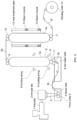
- the thermally shrinkable multilayer film according to an embodiment of the present invention can be produced by using, for example, an apparatus illustrated in FIG. 1 .
- a tubular body (parison) 3 including an outer surface layer, an intermediate layer, and an inner surface layer is co-extruded through an annular die 2 from a number of extruders 1 (only one extruder is illustrated) corresponding to the number of types of layered resins that constitute the multilayer film.
- a deblocking agent such as soybean oil, a glycerin fatty acid ester, and propylene glycol is enclosed as necessary.
- the molten tubular body 3 immediately after co-extrusion is flattened and taken up by pinch rollers 5 while being cooled in a water bath 4 to a temperature equal to or lower than the melting point of the resin primarily included in each of the layers, preferably to 20°C or lower, and more preferably to 15°C or lower.
- the flat body 3a that has been taken up is introduced into a hot water bath 6 at a temperature equal to or lower than the melting point of the resin primarily included in each of the layers, for example, 75 to 95°C.
- a deblocking agent such as soybean oil, a glycerin fatty acid ester, and propylene glycol is enclosed as necessary.
- a bubble-shaped tubular body 3c is formed from the flat body 3b by fluid air introduced between a pair of pinch rollers 7 and 8, and simultaneously biaxially stretched in the machine direction (longitudinal direction, MD) and the direction perpendicular to the machine direction (transverse direction, TD) while being cooled with a cooling medium blown from an airing device at 10 to 30°C and 5 to 20 m/s.
- MD machine direction
- TD transverse direction
- the surface temperature of the part just before TD stretching is lower than 75°C, because the yield point stress of the tubular body 3c is large, the internal pressure of the enclosed fluid air becomes high, and thus stretching tends to be difficult.
- the surface temperature is higher than 90°C, stretching in the TD tends to be difficult to stop.
- the surface temperature of the bottom shoulder forming part ( ⁇ position in FIG.
- the tubular body 3c is preferably cooled to a temperature that is lower than the temperature of the part just before TD stretching ( ⁇ position in FIG. 1 ) by a range of 5 to 30°C, and more preferably 10 to 20°C. In a case of 5°C or smaller, the tubular body 3c tends to be broken. In a case of 30°C or larger, the width of the tubular body 3c tends to be small.
- stretch ratios are calculated based on the following equations, and are preferably from 2.0 to 4.0 times, more preferably from 2.5 to 3.5 times, and particularly preferably from 2.8 to 3.5 times, in both the directions:
- MD Longitudinal direction
- TD Transverse direction
- stretch ratio width of flat body 3d/width of flat body 3b
- the flat body 3d after stretching is drawn downward, and a bubble-shaped tubular body 3e is again formed from the flat body 3d by fluid air introduced between a pair of pinch rollers 10 and 11, and then it is held inside a heat treatment pipe 12.
- steam is blown from the nozzles 13 of the heat treatment pipe 12, alone or together with air, and the tubular body 3e during heat treatment is heat-treated preferably at 50°C or higher and 100°C or lower, and more preferably at 60°C or higher and 95°C or lower.
- the heat treatment is performed for preferably approximately 1 second or longer and 20 seconds or shorter, and more preferably for approximately 1.5 seconds or longer and 10 seconds or shorter.
- the tubular body 3e during heat treatment is relaxed (shrunk) such that the relaxation ratios in the longitudinal direction (MD) and the transverse direction (TD) are preferably 2% or greater and 40% or less, and more preferably 5% or greater and 30% or less.
- Transverse direction (TD) relaxation ratio (1 - (width of flat body 3f/width of flat body 3d)) ⁇ 100 (%)
- the flat body 3f after such relaxing and heat treatment corresponds to the thermally shrinkable multilayer film according to an embodiment of the present invention, and is wound onto a winding roller 14.
- a strip-shaped film sample with a width of 20 mm and a length of 130 mm was mounted on a tensilon universal material testing instrument ("RTC-1210", available from Orientec Co., Ltd.) such that the distance between chucks was 100 mm, stretched for 5 mm in the machine direction (longitudinal direction, MD) and the direction perpendicular to the machine direction (transverse direction, TD) of the film at a tensile speed of 10 mm/min. The strain and the load at this time were measured. The tensile modulus of elasticity was calculated based on the obtained strain and load in accordance with JIS K 7161.
- thermally shrinkable multilayer films of Examples 1 to 5 and Comparative Examples 2 and 3 was charged in a kneading/extrusion molding evaluation tester Labo Plastomill ("4C150", available from Toyo Seiki Seisakusho, Ltd.) and melt-kneaded at a mixer rotation speed of 50 rpm for a kneading time of 3 minutes.
- this temperature is set to be preferably a reference temperature + 10°C or higher and 60°C or lower, more preferably the reference temperature + 15°C or higher and 50°C or lower, and most preferably the reference temperature + 20°C or higher and 35°C or lower.
- the set temperature is lower than the reference temperature + 10°C, unmelted resin tends to remain in the sheet as a foreign substance.
- the set temperature is higher than the reference temperature + 60°C, the molded sheet tends to be colored due to decomposition of the resin.
- the resin having the highest melting point is EVOH (157°C) in Examples 1 to 4, PGA (220°C) in Example 5, Co-PET (220°C) in Comparative Example 2, and PVDC (160°C) in Comparative Example 3.
- the melting point was measured by a differential scanning calorimeter (DSC) at a temperature increase rate of 10°C/min in accordance with JIS K 7121.
- the degree of cloudiness (haze value) of the obtained sheet was measured in accordance with JIS K 7136 by using a haze meter ("NDH 7000", available from Nippon Denshoku Industries Co., Ltd.) and using a light source D65.
- the internal haze value was measured by applying silicon on a surface of the film.
- the b* value of the obtained sheet was measured by the reflection method by placing the sheet on a white plate in accordance with JIS K 7373 by using a spectrophotometer ("SE 7700", available from Nippon Denshoku Industries Co., Ltd.) and using a light source D65.
- the b* value was an indicator of the degree of yellowness of the sheet.
Landscapes
- Chemical & Material Sciences (AREA)
- Engineering & Computer Science (AREA)
- Manufacturing & Machinery (AREA)
- Health & Medical Sciences (AREA)
- Chemical Kinetics & Catalysis (AREA)
- Medicinal Chemistry (AREA)
- Polymers & Plastics (AREA)
- Organic Chemistry (AREA)
- Physics & Mathematics (AREA)
- Thermal Sciences (AREA)
- Materials Engineering (AREA)
- Laminated Bodies (AREA)
Applications Claiming Priority (2)
| Application Number | Priority Date | Filing Date | Title |
|---|---|---|---|
| JP2022074263 | 2022-04-28 | ||
| PCT/JP2023/011242 WO2023210213A1 (ja) | 2022-04-28 | 2023-03-22 | 熱収縮性多層フィルム、及びその製造方法 |
Publications (2)
| Publication Number | Publication Date |
|---|---|
| EP4516503A1 true EP4516503A1 (de) | 2025-03-05 |
| EP4516503A4 EP4516503A4 (de) | 2025-06-18 |
Family
ID=88518668
Family Applications (1)
| Application Number | Title | Priority Date | Filing Date |
|---|---|---|---|
| EP23795960.6A Pending EP4516503A4 (de) | 2022-04-28 | 2023-03-22 | Wärmeschrumpfbare mehrschichtfolie und verfahren zu ihrer herstellung |
Country Status (5)
| Country | Link |
|---|---|
| US (1) | US20250282119A1 (de) |
| EP (1) | EP4516503A4 (de) |
| JP (1) | JP7696061B2 (de) |
| CN (1) | CN118946461A (de) |
| WO (1) | WO2023210213A1 (de) |
Families Citing this family (1)
| Publication number | Priority date | Publication date | Assignee | Title |
|---|---|---|---|---|
| EP4684953A1 (de) | 2024-07-23 | 2026-01-28 | Viscofan CZ, s.r.o. | Wiederverwendbare kunststoffhülle auf polyolefinbasis für gekochte würste |
Family Cites Families (22)
| Publication number | Priority date | Publication date | Assignee | Title |
|---|---|---|---|---|
| US5084352A (en) * | 1989-11-15 | 1992-01-28 | The Standard Oil Company | Multilayered barrier structures for packaging |
| JP3131251B2 (ja) * | 1991-08-21 | 2001-01-31 | 出光興産株式会社 | ラップフィルム |
| JP3335038B2 (ja) * | 1995-03-28 | 2002-10-15 | 株式会社興人 | ポリエチレン系熱収縮性共押出フィルム |
| JP4495264B2 (ja) * | 1998-04-24 | 2010-06-30 | 株式会社クレハ | 熱収縮性多層フィルム |
| US7288316B2 (en) * | 2003-11-21 | 2007-10-30 | Topas Advanced Polymers, Inc. | Cycloolefin copolymer heat sealable films |
| JP2005201987A (ja) * | 2004-01-13 | 2005-07-28 | Fuji Seal International Inc | ストレッチシュリンクラベル |
| WO2005097493A2 (en) * | 2004-03-26 | 2005-10-20 | Ipg Technologies, Inc. | Silicone-free multilayer olefinic shrink film |
| JP4468850B2 (ja) * | 2005-03-29 | 2010-05-26 | 三菱樹脂株式会社 | 熱収縮性ポリオレフィン系積層フィルム、熱収縮性ラベル及び該ラベルを装着した容器 |
| JP2005313389A (ja) * | 2004-04-27 | 2005-11-10 | Asahi Kasei Life & Living Corp | 熱収縮性バリアフィルム |
| JP4728113B2 (ja) * | 2005-12-09 | 2011-07-20 | 株式会社クレハ | 深絞り成形用熱収縮性多層フィルム及びその製造方法 |
| JP2007160573A (ja) * | 2005-12-09 | 2007-06-28 | Kureha Corp | 熱収縮性延伸多層フィルム、並びにそれを用いた包装材及び包装体 |
| NZ570359A (en) | 2006-02-16 | 2010-09-30 | Kureha Corp | Heat shrinkable multilayer film for packaging |
| JP2008062493A (ja) * | 2006-09-07 | 2008-03-21 | Fuji Seal International Inc | オレフィン系シュリンクフィルム |
| EP2794266A1 (de) * | 2011-12-22 | 2014-10-29 | Avery Dennison Corporation | Flexible sperrfilme mit cyclischen olefinen |
| JP6230127B2 (ja) | 2012-01-31 | 2017-11-15 | イー・アイ・デュポン・ドウ・ヌムール・アンド・カンパニーE.I.Du Pont De Nemours And Company | 環状オレフィンコポリマーを含む多層フィルム |
| WO2013121874A1 (ja) | 2012-02-16 | 2013-08-22 | 株式会社クレハ | 熱収縮性多層フィルム |
| WO2014141820A1 (ja) * | 2013-03-12 | 2014-09-18 | ポリプラスチックス株式会社 | 多層シュリンクフィルム |
| JP2016182674A (ja) * | 2015-03-25 | 2016-10-20 | 株式会社フジシールインターナショナル | シュリンクフィルム |
| JP2017137063A (ja) * | 2016-02-01 | 2017-08-10 | 積水フィルム株式会社 | 熱収縮フィルム及び熱収縮包装体 |
| JP6726911B2 (ja) * | 2016-09-30 | 2020-07-22 | 日本ポリエチレン株式会社 | 低反射易引裂性フィルム及び鑑識用補助シート |
| JP7003875B2 (ja) * | 2018-08-14 | 2022-01-21 | 三菱ケミカル株式会社 | 熱収縮性積層フィルム、包装資材、成形品及び容器 |
| US20220388748A1 (en) * | 2021-06-01 | 2022-12-08 | Klöckner Pentaplast Of America, Inc. | Thermoformable film for barrier packaging and methods of forming the same |
-
2023
- 2023-03-22 CN CN202380030796.2A patent/CN118946461A/zh active Pending
- 2023-03-22 JP JP2024517901A patent/JP7696061B2/ja active Active
- 2023-03-22 EP EP23795960.6A patent/EP4516503A4/de active Pending
- 2023-03-22 WO PCT/JP2023/011242 patent/WO2023210213A1/ja not_active Ceased
- 2023-03-22 US US18/859,446 patent/US20250282119A1/en active Pending
Also Published As
| Publication number | Publication date |
|---|---|
| EP4516503A4 (de) | 2025-06-18 |
| WO2023210213A1 (ja) | 2023-11-02 |
| US20250282119A1 (en) | 2025-09-11 |
| JP7696061B2 (ja) | 2025-06-19 |
| CN118946461A (zh) | 2024-11-12 |
| JPWO2023210213A1 (de) | 2023-11-02 |
Similar Documents
| Publication | Publication Date | Title |
|---|---|---|
| CN1286642C (zh) | 基于聚酰胺的低温抗冲击拉伸-取向多层薄膜 | |
| AU2007216113B2 (en) | Heat shrinkable multilayer film and packaging material using same | |
| JP5956115B2 (ja) | 二軸延伸ポリブチレンテレフタレート系フィルムを含むレトルト用包材 | |
| EP2521651B1 (de) | Wärmeschrumpfbare mehrlagige folie für tiefziehformen und herstellungsverfahren dafür | |
| JP6350276B2 (ja) | 二軸配向ポリアミド系樹脂フィルム | |
| CN1283150A (zh) | 积层包装材料及其制造方法 | |
| JP2016147373A (ja) | 熱収縮性多層フィルム | |
| JP4553482B2 (ja) | 深絞り成形用フィルム | |
| JP4628617B2 (ja) | 熱収縮性多層フィルム | |
| JPH09183200A (ja) | 積層フィルム | |
| EP4516503A1 (de) | Wärmeschrumpfbare mehrschichtfolie und verfahren zu ihrer herstellung | |
| CN101065303A (zh) | 掺入磺基间苯二甲酸改性聚酯多层共挤塑结构的物品 | |
| JPH0471701B2 (de) | ||
| JP7217455B2 (ja) | 二軸延伸ポリブチレンテレフタレート系フィルムを含む深絞り包装用蓋材 | |
| JP2005194292A (ja) | 樹脂組成物およびその多層構造体 | |
| JP5315599B2 (ja) | 樹脂組成物および多層構造物 | |
| JP4889075B2 (ja) | 深絞り包装用多層フィルムおよびそれからなる深絞り包装用容器 | |
| JP6191302B2 (ja) | ポリアミド系樹脂積層フィルム、及び、該フィルムを用いた包装体 | |
| JP3153437B2 (ja) | ポリエステル系多層シートと容器及びその製法 | |
| JP7194925B2 (ja) | 二軸延伸ポリブチレンテレフタレートフィルムを含む真空成形用又は真空圧空成形用包材 | |
| JP2004315793A (ja) | 樹脂組成物及び積層体 | |
| EP3539770A1 (de) | Wärmeschrumpfbare mehrschichtfolie | |
| EP3804980A1 (de) | Wärmeschrumpfbare mehrschichtfolie | |
| JP7528589B2 (ja) | 延伸多層フィルム及びこれから成る包装袋 | |
| JP2004131574A (ja) | 樹脂組成物およびその用途 |
Legal Events
| Date | Code | Title | Description |
|---|---|---|---|
| STAA | Information on the status of an ep patent application or granted ep patent |
Free format text: STATUS: THE INTERNATIONAL PUBLICATION HAS BEEN MADE |
|
| PUAI | Public reference made under article 153(3) epc to a published international application that has entered the european phase |
Free format text: ORIGINAL CODE: 0009012 |
|
| STAA | Information on the status of an ep patent application or granted ep patent |
Free format text: STATUS: REQUEST FOR EXAMINATION WAS MADE |
|
| 17P | Request for examination filed |
Effective date: 20241017 |
|
| AK | Designated contracting states |
Kind code of ref document: A1 Designated state(s): AL AT BE BG CH CY CZ DE DK EE ES FI FR GB GR HR HU IE IS IT LI LT LU LV MC ME MK MT NL NO PL PT RO RS SE SI SK SM TR |
|
| A4 | Supplementary search report drawn up and despatched |
Effective date: 20250519 |
|
| RIC1 | Information provided on ipc code assigned before grant |
Ipc: B32B 27/22 20060101ALI20250513BHEP Ipc: B32B 27/18 20060101ALI20250513BHEP Ipc: C08L 23/04 20060101ALI20250513BHEP Ipc: C08J 5/18 20060101ALI20250513BHEP Ipc: B32B 27/36 20060101ALI20250513BHEP Ipc: B32B 27/34 20060101ALI20250513BHEP Ipc: B32B 27/30 20060101ALI20250513BHEP Ipc: B32B 27/08 20060101ALI20250513BHEP Ipc: B32B 7/12 20060101ALI20250513BHEP Ipc: B65D 65/40 20060101ALI20250513BHEP Ipc: B32B 27/28 20060101ALI20250513BHEP Ipc: B32B 27/00 20060101ALI20250513BHEP Ipc: B32B 27/32 20060101AFI20250513BHEP |
|
| DAV | Request for validation of the european patent (deleted) | ||
| DAX | Request for extension of the european patent (deleted) |