EP4501409A2 - Traitement de tumeurs malignes des lymphocytes b par une combinaison d'inhibiteur jak et pi3k - Google Patents
Traitement de tumeurs malignes des lymphocytes b par une combinaison d'inhibiteur jak et pi3k Download PDFInfo
- Publication number
- EP4501409A2 EP4501409A2 EP24204941.9A EP24204941A EP4501409A2 EP 4501409 A2 EP4501409 A2 EP 4501409A2 EP 24204941 A EP24204941 A EP 24204941A EP 4501409 A2 EP4501409 A2 EP 4501409A2
- Authority
- EP
- European Patent Office
- Prior art keywords
- pyrimidin
- pyrrolo
- pyrazol
- inhibitor
- methyl
- Prior art date
- Legal status (The legal status is an assumption and is not a legal conclusion. Google has not performed a legal analysis and makes no representation as to the accuracy of the status listed.)
- Pending
Links
Images




Classifications
-
- A—HUMAN NECESSITIES
- A61—MEDICAL OR VETERINARY SCIENCE; HYGIENE
- A61K—PREPARATIONS FOR MEDICAL, DENTAL OR TOILETRY PURPOSES
- A61K31/00—Medicinal preparations containing organic active ingredients
- A61K31/33—Heterocyclic compounds
- A61K31/395—Heterocyclic compounds having nitrogen as a ring hetero atom, e.g. guanethidine or rifamycins
- A61K31/397—Heterocyclic compounds having nitrogen as a ring hetero atom, e.g. guanethidine or rifamycins having four-membered rings, e.g. azetidine
-
- A—HUMAN NECESSITIES
- A61—MEDICAL OR VETERINARY SCIENCE; HYGIENE
- A61K—PREPARATIONS FOR MEDICAL, DENTAL OR TOILETRY PURPOSES
- A61K31/00—Medicinal preparations containing organic active ingredients
- A61K31/33—Heterocyclic compounds
- A61K31/395—Heterocyclic compounds having nitrogen as a ring hetero atom, e.g. guanethidine or rifamycins
- A61K31/41—Heterocyclic compounds having nitrogen as a ring hetero atom, e.g. guanethidine or rifamycins having five-membered rings with two or more ring hetero atoms, at least one of which being nitrogen, e.g. tetrazole
- A61K31/415—1,2-Diazoles
- A61K31/4155—1,2-Diazoles non condensed and containing further heterocyclic rings
-
- A—HUMAN NECESSITIES
- A61—MEDICAL OR VETERINARY SCIENCE; HYGIENE
- A61K—PREPARATIONS FOR MEDICAL, DENTAL OR TOILETRY PURPOSES
- A61K31/00—Medicinal preparations containing organic active ingredients
- A61K31/33—Heterocyclic compounds
- A61K31/395—Heterocyclic compounds having nitrogen as a ring hetero atom, e.g. guanethidine or rifamycins
- A61K31/435—Heterocyclic compounds having nitrogen as a ring hetero atom, e.g. guanethidine or rifamycins having six-membered rings with one nitrogen as the only ring hetero atom
- A61K31/4353—Heterocyclic compounds having nitrogen as a ring hetero atom, e.g. guanethidine or rifamycins having six-membered rings with one nitrogen as the only ring hetero atom ortho- or peri-condensed with heterocyclic ring systems
- A61K31/437—Heterocyclic compounds having nitrogen as a ring hetero atom, e.g. guanethidine or rifamycins having six-membered rings with one nitrogen as the only ring hetero atom ortho- or peri-condensed with heterocyclic ring systems the heterocyclic ring system containing a five-membered ring having nitrogen as a ring hetero atom, e.g. indolizine, beta-carboline
-
- A—HUMAN NECESSITIES
- A61—MEDICAL OR VETERINARY SCIENCE; HYGIENE
- A61K—PREPARATIONS FOR MEDICAL, DENTAL OR TOILETRY PURPOSES
- A61K31/00—Medicinal preparations containing organic active ingredients
- A61K31/33—Heterocyclic compounds
- A61K31/395—Heterocyclic compounds having nitrogen as a ring hetero atom, e.g. guanethidine or rifamycins
- A61K31/495—Heterocyclic compounds having nitrogen as a ring hetero atom, e.g. guanethidine or rifamycins having six-membered rings with two or more nitrogen atoms as the only ring heteroatoms, e.g. piperazine or tetrazines
- A61K31/50—Pyridazines; Hydrogenated pyridazines
- A61K31/502—Pyridazines; Hydrogenated pyridazines ortho- or peri-condensed with carbocyclic ring systems, e.g. cinnoline, phthalazine
-
- A—HUMAN NECESSITIES
- A61—MEDICAL OR VETERINARY SCIENCE; HYGIENE
- A61K—PREPARATIONS FOR MEDICAL, DENTAL OR TOILETRY PURPOSES
- A61K31/00—Medicinal preparations containing organic active ingredients
- A61K31/33—Heterocyclic compounds
- A61K31/395—Heterocyclic compounds having nitrogen as a ring hetero atom, e.g. guanethidine or rifamycins
- A61K31/495—Heterocyclic compounds having nitrogen as a ring hetero atom, e.g. guanethidine or rifamycins having six-membered rings with two or more nitrogen atoms as the only ring heteroatoms, e.g. piperazine or tetrazines
- A61K31/505—Pyrimidines; Hydrogenated pyrimidines, e.g. trimethoprim
- A61K31/519—Pyrimidines; Hydrogenated pyrimidines, e.g. trimethoprim ortho- or peri-condensed with heterocyclic rings
-
- A—HUMAN NECESSITIES
- A61—MEDICAL OR VETERINARY SCIENCE; HYGIENE
- A61K—PREPARATIONS FOR MEDICAL, DENTAL OR TOILETRY PURPOSES
- A61K31/00—Medicinal preparations containing organic active ingredients
- A61K31/33—Heterocyclic compounds
- A61K31/395—Heterocyclic compounds having nitrogen as a ring hetero atom, e.g. guanethidine or rifamycins
- A61K31/495—Heterocyclic compounds having nitrogen as a ring hetero atom, e.g. guanethidine or rifamycins having six-membered rings with two or more nitrogen atoms as the only ring heteroatoms, e.g. piperazine or tetrazines
- A61K31/505—Pyrimidines; Hydrogenated pyrimidines, e.g. trimethoprim
- A61K31/519—Pyrimidines; Hydrogenated pyrimidines, e.g. trimethoprim ortho- or peri-condensed with heterocyclic rings
- A61K31/52—Purines, e.g. adenine
-
- A—HUMAN NECESSITIES
- A61—MEDICAL OR VETERINARY SCIENCE; HYGIENE
- A61K—PREPARATIONS FOR MEDICAL, DENTAL OR TOILETRY PURPOSES
- A61K45/00—Medicinal preparations containing active ingredients not provided for in groups A61K31/00 - A61K41/00
- A61K45/06—Mixtures of active ingredients without chemical characterisation, e.g. antiphlogistics and cardiaca
-
- A—HUMAN NECESSITIES
- A61—MEDICAL OR VETERINARY SCIENCE; HYGIENE
- A61P—SPECIFIC THERAPEUTIC ACTIVITY OF CHEMICAL COMPOUNDS OR MEDICINAL PREPARATIONS
- A61P25/00—Drugs for disorders of the nervous system
-
- A—HUMAN NECESSITIES
- A61—MEDICAL OR VETERINARY SCIENCE; HYGIENE
- A61P—SPECIFIC THERAPEUTIC ACTIVITY OF CHEMICAL COMPOUNDS OR MEDICINAL PREPARATIONS
- A61P35/00—Antineoplastic agents
-
- A—HUMAN NECESSITIES
- A61—MEDICAL OR VETERINARY SCIENCE; HYGIENE
- A61P—SPECIFIC THERAPEUTIC ACTIVITY OF CHEMICAL COMPOUNDS OR MEDICINAL PREPARATIONS
- A61P35/00—Antineoplastic agents
- A61P35/02—Antineoplastic agents specific for leukemia
-
- A—HUMAN NECESSITIES
- A61—MEDICAL OR VETERINARY SCIENCE; HYGIENE
- A61P—SPECIFIC THERAPEUTIC ACTIVITY OF CHEMICAL COMPOUNDS OR MEDICINAL PREPARATIONS
- A61P43/00—Drugs for specific purposes, not provided for in groups A61P1/00-A61P41/00
-
- A—HUMAN NECESSITIES
- A61—MEDICAL OR VETERINARY SCIENCE; HYGIENE
- A61K—PREPARATIONS FOR MEDICAL, DENTAL OR TOILETRY PURPOSES
- A61K2300/00—Mixtures or combinations of active ingredients, wherein at least one active ingredient is fully defined in groups A61K31/00 - A61K41/00
Definitions
- This invention relates to methods of treating B-cell malignancies using a combination of inhibitors of JAK1 and/or JAK2 and inhibitors of PI3K ⁇ .
- the B-cell receptor (BCR) is present on both normal and most malignant B-cells. Engagement of the BCR provides important survival signals, and interruption of the BCR signal can lead to B-cell death. Studies performed with siRNA to inhibit BCR expression have shown that constitutive signaling by the BCR is critical for the survival and proliferation of human B-cell lymphomas. The primary role of BCR signaling in these cells appears to be activation of spleen tyrosine kinase (Syk) which in turn leads to several downstream events that promote cell survival, including activation of Bruton tyrosine kinase (BTK), phosphatidylinositol 3 kinase (PI3K), and AKT.
- BTK Bruton tyrosine kinase
- PI3K phosphatidylinositol 3 kinase
- AKT AKT
- B-cell malignancies including diffuse large B-cell lymphomas (DLBCL) have been shown to be particularly dependent upon BCR survival signals as evidenced by their sensitivity to genetic and pharmacological inhibition of BCR signaling components in vitro. It has been shown that DLBCL cells engage PI3K, augmenting anti-apoptotic NF-kB signaling and survival signals and that inhibition of the P13K/AKT pathway synergizes with NF-kB inhibition in killing DLBCL cell lines in vitro.
- DLBCL diffuse large B-cell lymphomas
- JAKs Aberrant activation of JAKs, through production of cytokines and growth factors, has also been associated with increased malignant cell proliferation and survival in a number of tumor types. JAKs activate a number of downstream pathways implicated in the proliferation and survival of malignant cells including the STATs, a family of important latent transcription factors. Of clinical relevance, levels of serum IL-10 and IL-6, which signal through the JAKs, have been found to be elevated in patients with DLBCL compared to normal controls (Gupta et al, 2012). Further, patients with high scrum IL-10 levels were shown to have a shorter event-free survival (Gupta et al, 2012).
- JAK1 has been shown to cooperate with JAK2, JAK3, and TYK2 and to play a dominant role in mediating the signaling of a number of inflammatory cytokines including IL-6, IL-10 and interferon.
- DLBCL JAK pathway activation occurs through both autocrine and paracrine mechanisms.
- BCR signaling leads to increased IL-6 and IL-10 production through activation of the NF-kB pathway (Lam et al, 2008).
- a subset of DLBCLs has been characterized as having high expression of STAT3, IL-6, and/or IL-10 and it has been shown that JAK inhibition is cytotoxic in these DLBCL cell lines and synergizes with NF-kB inhibitors.
- the stromal compartment can also provide a source of these cytokines in a paracrine manner (Hodge et al, 2005).
- the present application provides a method of treating a B-cell malignancy in a patient in need thereof, comprising administering to said patient: (a) an inhibitor of JAK1 and/or JAK2; and (b) an inhibitor of PI3K ⁇ .
- the present application further provides a method of treating a disease selected from diffuse large B-cell lymphoma, chronic lymphocytic leukemia (CLL), Non-Hodgkin lymphoma, hairy cell leukemia, Mantle cell lymphoma, small lymphocytic lymphoma, follicular lymphoma, lymphoplasmacytic lymphoma, extranodal marginal zone lymphoma, Hodgkin's lymphoma, Burkitt lymphoma, Waldenstrom's macroglobulinemia, prolymphocytic leukemia, acute lymphoblastic leukemia, myelofibrosis, mucosa-associated lymphatic tissue (MALT) lymphoma, mediastinal (thymic) large B-cell lymphoma, lymphomatoid granulomatosis, splenic marginal zone lymphoma, primary effusion lymphoma, intravascular large B-cell lymphoma, plasma cell leukemia, extramedullary plasmacyto
- the inhibitor of JAK1 and/or JAK2 is selected from:
- the inhibitor of PI3K ⁇ is selected from:
- the present application also provides an inhibitor of JAK1 and/or JAK2 for use in combination with PI3K ⁇ inhibitor for the treatment of a B-cell malignancy or any of the diseases embodied herein.
- the present application further provides use of an inhibitor of JAK1 and/or JAK2 and an PI3K ⁇ inhibitor for preparation of a medicament for treatment of a B-cell malignancy or any of the diseases embodied herein.
- the present application provides, inter alia, a method of treating a disease selected from diffuse large B-cell lymphoma, chronic lymphocytic leukemia (CLL), Non-Hodgkin lymphoma, hairy cell leukemia, Mantle cell lymphoma, small lymphocytic lymphoma, follicular lymphoma, lymphoplasmacytic lymphoma, extranodal marginal zone lymphoma, Hodgkin's lymphoma, Burkitt lymphoma, Waldenstrom's macroglobulinemia, prolymphocytic leukemia, acute lymphoblastic leukemia, myelofibrosis, mucosa-associated lymphatic tissue (MALT) lymphoma, mediastinal (thymic) large B-cell lymphoma, lymphomatoid granulomatosis, splenic marginal zone lymphoma, primary effusion lymphoma, intravascular large B-cell lymphoma, plasma cell leukemia, extramedul
- the non-Hodgkin lymphoma is non-Hodgkin lymphoma (NHL) is relapsed or refractory NHL or rccucurrent follicular NHL.
- NHL non-Hodgkin lymphoma
- the disease is diffuse large B cell lymphoma (DLBCL).
- DLBCL diffuse large B cell lymphoma
- the disease is activated B-cell like (ABC) diffuse large B cell lymphoma (ABC-DLBCL) or germinal center B cell (GCB) diffuse large B cell lymphoma (GCB-DLBCL).
- ABSC activated B-cell like
- GCB germinal center B cell
- the inhibitor of JAK1 and/or JAK2 and the inhibitor of PI3K ⁇ are administered simultaneously.
- the inhibitor of JAK1 and/or JAK2 and the inhibitor of PI3K ⁇ are administered sequentially.
- the inhibitor of JAK1 and/or JAK2 is selective for JAK1 and JAK1 over JAK3 and TYK2. In some embodiments, the inhibitor of JAK1 and/or JAK2 is selective for JAK1 over JAK2, JAK3, and TYK2. For example, some of the compounds described herein, or a pharmaceutically acceptable salt thereof, preferentially inhibit JAK1 over one or more of JAK2, JAK3, and TYK2. In some embodiments, the compounds inhibit JAK1 preferentially over JAK2 (e.g., have a JAK1/JAK2 ICso ratio > I). In some embodiments, the compounds or salts are about 10-fold more selective for JAK1 over JAK2.
- the compounds or salts are about 3-fold, about 5-fold, about 10-fold, about 15-fold, or about 20-fold more selective for JAK1 over JAK2 as calculated by measuring IC 50 at 1 mM ATP (e.g., see Example A).
- the inhibitor of JAK1 and/or JAK2 is 3-cyclopentyl-3-[4-(7H-pyrrolo[2,3-d]pyrimidin-4-yl)-1H-pyrazol-1-yl]propanenitrile.
- the inhibitor of JAK1 and/or JAK2 is (3 R )-3-cyclopentyl-3-[4-(7H-pyrrolo[2,3-d]pyrimidin-4-yl)-1H-pyrazol-1-yl]propanenitrile (ruxolitinib; also known as 1NCB018424).
- Ruxolitinib has an IC 50 of less than 10 nM at 1 mM ATP (assay A) at JAK1 and JAK2.
- 3-Cyclopentyl-3-[4-(7H-pyrrolo[2,3-d]pyrimidin-4-yl)-1H-pyrazol-1-yl]propanenitrile and ruxolitinib can be made by the procedure described in US 7,598,257 (Example 67), filed December 12, 2006 , which is incorporated herein by reference in its entirety.
- the inhibitor of JAK1 and/or JAK2 is (3R)-3-cyclopentyl-3-[4-(7H-pyrrolo[2,3-d]pyrimidin-4-yl)-1H-pyrazol-1-yl]propanenitrile phosphoric acid salt.
- the inhibitor of JAK1 and/or JAK2 is a compound of Table 1, or a pharmaceutically acceptable salt thereof.
- the compounds in Table 1 are selective JAK1 inhibitors (selective over JAK2, JAK3, and TYK2).
- the ICsos obtained by the method of Assay A at 1 mM ATP are shown in Table 1. Table 1 # Prep.
- the inhibitor of JAK 1 and/or JAK2 is ⁇ 1- ⁇ 1-[3-fluoro-2-(trifluoromethyl)isonicotinoyl]piperidin-4-yl ⁇ -3-[4-(7H-pyrrolo[2,3-d]pyrimidin-4-yl)-1H-pyrazol-1-yl]azetidin-3-yl ⁇ acetonitrile, or a pharmaceutically acceptable salt thereof.
- the inhibitor of JAK1 and/or JAK2 is ⁇ 1- ⁇ 1-[3-fluoro-2-(trifluoromethyl)isonicotinoyl]piperidin-4-yl ⁇ -3-[4-(7H-pyrrolo[2,3-d]pyrimidin-4-yl)-1H-pyrazol-1-yl]azeridin-3-yl ⁇ acetonitrile adipic acid salt.
- the inhibitor of JAK1 and/or JAK2 is 4- ⁇ 3-(cyanomethyl)-3-[4-(7H-pyrrolo[2,3-d]pyrimidin-4-yl)-1H-pyrazol-1-yl]azetidin-1-yl ⁇ 1-2,5-difluoro-N-[(1S)-2,2,2-trifluoro-1-methylethyl]benzamide, or a pharmaceutically acceptable salt thereof.
- the inhibitor of JAK1 and/or JAK2 is selected from (R)-3-[1-(6-chloropyridin-2-yl)pyrrolidin-3-yl]-3-[4-(7H-pyrrolo[2,3-d]pyrimidin-4-yl)-1H-pyrazol-1-yl]propanenitrile, (R)-3-(1-[1,3]oxazolo[5,4-b]pyridin-2-ylpyrrolidin-3-yl)-3-[4-(7H-pyrrolo[2,3-d]pyrimidin-4-yl)-1H-pyrazol-1-yl]propancnitrilc, (R)-4-[(4- ⁇ 3-cyano-2-[4-(7H-pyrrolo[2,3-d]pyrimidin-4-yl)-1H-pyrazol-1-yl]propyl)piperazin-1-yl)carbonyl]-3-fluorobenzonitrile
- the compounds of Table 1 arc prepared by the synthetic procedures described in US Patent Publ. No. 2010/0298334, filed May 21, 2010 , US Patent Publ. No. 2011/005995 1, filed August 31, 2010 , US Patent Publ. No. 2011/0224190, filed March 9, 2011 , US Patent Publ. No. 2012/0149681, filed November 18, 2011 , US Patent Publ. No. 2012/0149682, filed November 18, 2011 , US Patent Publ. 2013/0018034, filed June 19, 2012 , US Patent Publ. No. 2013/0045963, filed August 17, 2012 , and US Patent Publ. No. 2014/0005166, filed May 17, 2013 , each of which is incorporated herein by reference in its entirety.
- the inhibitor of JAK1 and/or JAK2 is selected from the compounds of US Patent Publ. No. 2010/0298334, filed May 21, 2010 , US Patent Publ. No. 2011/0059951, filed August 31, 2010 , US Patent Publ. No. 2011/0224190, filed March 9, 2011 , US Patent Publ. No. 2012/0149681, filed November 18, 2011 , US Patent Publ. No. 2012/0149682, filed November 18, 2011 , US Patent Publ. 2013/0018034, filed June 19, 2012 , US Patent Publ. No. 2013/0045963, filed August 17, 2012 , and US Patent Publ. No. 2014/0005166, filed May 17, 2013 , each of which is incorporated herein by reference in its entirety.
- the inhibitors of PI3K ⁇ described herein can be selective.
- selective is meant that the compound binds to or inhibits a kinase with greater affinity or potency, respectively, compared to at least one other kinase.
- the compounds described herein arc selective inhibitors of PI3K ⁇ (e.g ., over PI3K ⁇ , PI3K ⁇ and PI3K ⁇ ).
- selectivity can be at least about 2-fold, 5-fold, 10-fold, at least about 20-fold, at least about 50-fold, at least about 1 00-fold, at least about 200-fold, at least about 500-fold or at least about 1000-fold. Selectivity can be measured by methods routine in the art.
- selectivity can be tested at the K m ATP concentration of each enzyme.
- the selectivity of compounds described herein can be determined by cellular assays associated with particular PI3K kinase activity.
- the inhibitor of PI3K ⁇ is a compound shown in Table 2.
- the compounds of Table 2 have been tested in Assay B and shown to be inhibitors of PI3K ⁇ with the IC 50 s in Table 2.
- Table 2 # Prep. Name Structure PI3K ⁇ IC 50 (nM) 27 US 2011/0015212 (Example 10) 7-(1-(9H-purin-6-ylamino)ethyl)-6-(3-fluorophenyl)-3-methyl-5H-thiazolo[3,2-a]pyrimidin-5-one + 28 US 2011/0015212 (Example 15) (S)-7-(1-(9H-purin-6-ylamino)ethyl)-6-(3-fluorophenyl)-3-methyl-5H-thiazolo[3,2-a]pyrimidin-5-one + 29 US 2013/ 0059835 (Example 269) 4-[1-(4-amino-3-methyl-1H-pyrazolo[3,
- the inhibitor of PI3K ⁇ is selected from:
- the inhibitor of PI3K ⁇ is (S)-7-(1-(9H-purin-6-ylamino)ethyl)-6-(3-fluorophenyl)-3-methyl-5H-thiazolo[3,2-a]pyrimidin-5-one, or a pharmaceutically acceptable salt thereof.
- the inhibitor of PI3K ⁇ is 4-[1-(4-amino-3-methyl-1H-pyrazolo[3,4-d]pyrimidin-1-yl)cthyl]-6-chloro-2- ⁇ 1-[(2S)-2-hydroxypropyl]azetidin-3-yl ⁇ -3-methoxybenzonitrile, or a pharmaceutically acceptable salt thereof
- the inhibitor of PI3K ⁇ is 4-[1-(4-amino-3-methyl-1H-pyrazolo[3,4-d]pyrimidin-1-yl)ethyl]-6-chloro-2-[1-(2-hydroxyethyl)azetidin-3-yl]-3-methoxybenzonitrile, or a pharmaceutically acceptable salt thereof
- the inhibitor of PI3K ⁇ is 5- ⁇ 3-[1-(4-amino-3-methyl-1H-pyrazolo[3,4-d]pyrimidin-1-yl)ethyl]-6-cyano-2-ethoxy-5-methylphenyl ⁇ -N,N-dimethylpyridine-2-carboxamide, or a pharmaceutically acceptable salt thereof
- the inhibitor of PI3K ⁇ is selected from:
- the inhibitor of PI3K ⁇ is a compound of US Patent Publ. No. US 2011/0015212, filed June 28, 2010 , US Patent Publ. No. 2013/0059835, filed August 31, 2013 , US Patent Publ. No. 2011/0183985, filed December 17, 2010 , or US Patent Publ. No. 2012/0157430, filed December 19, 2011 , each of which is incorporated herein by reference in its entirety.
- the compounds of Table 2 are prepared by the methods in US Patent Publ. No. US 2011/0015212, filed June 28, 2010 , US Patent Publ. No. 2013/0059835, filed August 31, 2013 , US Patent Publ. No. 2011/0183985, filed December 17, 2010 , or US Patent Publ. No. 2012/0157430, filed December 19, 2011 , each of which is incorporated herein by reference in its entirety.
- the inhibitor of JAK1 and/or JAK2 is (3R)-3-cyclopentyl-3-[4-(7H-pyrrolo[2,3-d]pyrimidin-4-yl)-1H-pyrazol-1-yl]propanenitrile, or a pharmaceutically acceptable salt thereof; and (7-(1-(9H-purin-6-ylamino)ethyl)-6-(3-fluorophcnyl)-3-mcthyl-5H-thiazolo[3,2-a]pyrimidin-5-onc, or a pharmaceutically acceptable salt thereof.
- the inhibitor of JAK1 and/or JAK2 is ⁇ 1- ⁇ 1-[3-fluoro-2-(trifluoromcthyl)isonicotinoyl]pipcridin-4-yl ⁇ -3-[4-(7H-pyrrolo[2,3-d]pyrimidin-4-yl)-IH-pyrazol-I-yl]azetidin-3-yl ⁇ acetonitrile, or pharmaceutically acceptable salt thereof; and the inhibitor of PI3K ⁇ is 7-(1-(9H-purin-6-ylamino)ethyl)-6-(3-fluorophenyl)-3-methyl-5H-thiazolo[3,2-a]pyrimidin-5-one, or a pharmaceutically acceptable salt thereof.
- the inhibitor of JAK1 and/or JAK2 is 4- ⁇ 3-(cyanomethyl)-3-[4-(7H-pyrrolo[2,3-d]pyrimidin-4-yl)-1H-pyrazol-1-yl]azetidin-1-yl ⁇ -2,5-difluoro-N-[(1S)-2,2,2-trifluoro-1-methylethyl]benzamide, or pharmaceutically acceptable salt thereof; and the inhibitor of PI3K ⁇ is 7-(1-(9H-purin-6-ylamino)ethyl)-6-(3-fluorophenyl)-3-methyl-5H-thiazolo[3,2-a]pyrimidin-5-one, or a pharmaceutically acceptable salt thereof.
- the present application provides a method of treating diffuse large B-cell lymphoma in a patient in need thereof, comprising administering to said patient (3R)-3-cyclopcntyl-3-[4-(7H-pyrrolo[2,3-d]pyrimidin-4-yl)-1H-pyrazol-1-yl]propanenitrile, or a pharmaceutically acceptable salt thereof; and the inhibitor of PI3K ⁇ is (7-(1-(9H-purin-6-ylamino)ethyl)-6-(3-fluorophenyl)-3-methyl-5H-thiazolo[3,2-a]pyrimidin-5-one, or a pharmaceutically acceptable salt thereof.
- the present application provides a method of treating diffuse large B-cell lymphoma in a patient in need thereof, comprising administering to said patient ⁇ 1- ⁇ 1-[3-fluoro-2-(trifluoromethyl)isonicotinoyl]piperidin-4-yl ⁇ -3-[4-(7H-pyrrolo[2,3-d]pyrimidin-4-yl)-1H-pyrazol-1 -yl]azetidin-3-yl ⁇ acetonitrile, or pharmaceutically acceptable salt thereof; and 7-(1-(9H-purin-6-ylamino)ethyl)-6-(3-fluorophcnyl)-3-mcthyl-5H-thiazolo[3,2-a]pyrimidin-5-onc, or a pharmaceutically acceptable salt thereof.
- the present application provides a method of treating diffuse large B-cell lymphoma in a patient in need thereof, comprising administering to said patient 4- ⁇ 3-(cyanomethyl)-3-[4-(7H-pyrrolo[2,3-d]pyrimidin-4-yl)-1H-pyrazol-1-yl]azetidin-1-yl ⁇ -2,5-difluoro-N-[(1S)-2,2,2-trifluoro-1-methylethyl]benzamide, or pharmaceutically acceptable salt thereof; and 7-(1-(9H-purin-6-ylamino)ethyl)-6-(3-fluorophenyl)-3-methyl-5H-thiazolo[3,2-a]pyrimidin-5-one, or a pharmaceutically acceptable salt thereof.
- the compounds described herein can be asymmetric ( e.g ., having one or more stercocenters). All stereoisomers, such as enantiomers and diastereomers, are intended unless otherwise indicated.
- Cis and trans geometric isomers of the compounds of the present invention are described and may be isolated as a mixture of isomers or as separated isomeric forms.
- the compound has the (R) -configuration.
- the compound has the (S) -configuration.
- An example method includes fractional recrystallizaion using a chiral resolving acid which is an optically active, salt-forming organic acid.
- Suitable resolving agents for fractional recrystallization methods are, for example, optically active acids, such as the D and L forms of tartaric acid, diacetyltartaric acid, dibenzoyltartaric acid, mandelic acid, malic acid, lactic acid or the various optically active camphorsulfonic acids such as ⁇ -camphorsulfonic acid.
- resolving agents suitable for fractional crystallization methods include stereoisomerically pure forms of ⁇ -mcthylbcnzylaminc (e.g., S and R forms, or diastcrcomerically pure forms), 2-phcnylglycinol, norephedrine, ephedrine, N-methylcphcdrinc, cyclohexylcthylamine, 1,2-diaminocyclohexane, and the like.
- stereoisomerically pure forms of ⁇ -mcthylbcnzylaminc e.g., S and R forms, or diastcrcomerically pure forms
- 2-phcnylglycinol norephedrine
- ephedrine ephedrine
- N-methylcphcdrinc N-methylcphcdrinc
- cyclohexylcthylamine 1,2-diaminocyclohex
- Resolution of racemic mixtures can also be carried out by elution on a column packed with an optically active resolving agent (e.g ., dinitrobenzoylphenylglycine).
- an optically active resolving agent e.g ., dinitrobenzoylphenylglycine
- Suitable elution solvent composition can be determined by one skilled in the art.
- Tautomeric forms result from the swapping of a single bond with an adjacent double bond together with the concomitant migration of a proton.
- Tautomeric forms include prototropic tautomers which are isomeric protonation states having the same empirical formula and total charge.
- Example prototropic tautomers include ketone - enol pairs, amide - imidic acid pairs, lactam - lactim pairs, enamine - imine pairs, and annular forms where a proton can occupy two or more positions of a heterocyclic system, for example, 1H- and 3H-imidazole, 1H-, 2H- and 4H- 1,2,4-triazole, 1H- and 2H- isoindole, and 1H- and 2H-pyrazole.
- Tautomeric forms can be in equilibrium or sterically locked into one form by appropriate substitution.
- Isotopes include those atoms having the same atomic number but different mass numbers.
- isotopes of hydrogen include tritium and deuterium.
- compound as used herein is meant to include all stereoisomers, geometric iosomcrs, tautomers, and isotopes of the structures depicted. Compounds herein identified by name or structure as one particular tautomeric form are intended to include other tautomeric forms unless otherwise specified.
- All compounds, and pharmaceutically acceptable salts thereof, can be found together with other substances such as water and solvents (e.g. hydrates and solvates) or can be isolated.
- the compounds described herein, or salts thereof arc substantially isolated.
- substantially isolated is meant that the compound is at least partially or substantially separated from the environment in which it was formed or detected.
- Partial separation can include, for example, a composition enriched in the compounds described herein.
- Substantial separation can include compositions containing at least about 50%, at least about 60%, at least about 70%, at least about 80%, at least about 90%, at least about 95%, at least about 97%, or at least about 99% by weight of the compounds described herein, or salt thereof. Methods for isolating compounds and their salts are routine in the art.
- phrases "pharmaceutically acceptable” is employed herein to refer to those compounds, materials, compositions, and/or dosage forms which arc, within the scope of sound medical judgment, suitable for use in contact with the tissues of human beings and animals without excessive toxicity, irritation, allergic response, or other problem or complication, commensurate with a reasonable benefit/risk ratio.
- ambient temperature and “room temperature” or “rt” as used herein, arc understood in the art, and refer generally to a temperature, e.g. a reaction temperature, that is about the temperature of the room in which the reaction is carried out, for example, a temperature from about 20 °C to about 30 °C.
- the present invention also includes pharmaceutically acceptable salts of the compounds described herein.
- pharmaceutically acceptable salts refers to derivatives of the disclosed compounds wherein the parent compound is modified by converting an existing acid or base moiety to its salt form.
- pharmaceutically acceptable salts include, but arc not limited to, mineral or organic acid salts of basic residues such as amines; alkali or organic salts of acidic residues such as carboxylic acids; and the like.
- the pharmaceutically acceptable salts of the present invention include the conventional non-toxic salts of the parent compound formed, for example, from non-toxic inorganic or organic acids.
- the pharmaceutically acceptable salts of the present invention can be synthesized from the parent compound which contains a basic or acidic moiety by conventional chemical methods.
- such salts can be prepared by reacting the free acid or base forms of these compounds with a stoichiometric amount of the appropriate base or acid in water or in an organic solvent, or in a mixture of the two; generally, non-aqueous media like ether, ethyl acetate, alcohols (e.g., methanol, ethanol, iso-propanol, or butanol) or acetonitrile (ACN) are preferred.
- non-aqueous media like ether, ethyl acetate, alcohols (e.g., methanol, ethanol, iso-propanol, or butanol) or acetonitrile (ACN) are preferred.
- ACN acetonitrile
- the term "individual” or “patient,” used interchangeably, refers to any animal, including mammals, preferably mice, rats, other rodents, rabbits, dogs, cats, swine, cattle, sheep, horses, or primates, and most preferably humans.
- the inhibitors are administered in a therapeutically effective amount.
- therapeutically effective amount refers to the amount of active compound or pharmaceutical agent that elicits the biological or medicinal response that is being sought in a tissue, system, animal, individual or human by a researcher, veterinarian, medical doctor or other clinician.
- the dosage of the compound, or a pharmaceutically acceptable salt thereof, administered to a patient or individual is about 1 mg to about 2 g, about 1 mg to about 1000 mg, about 1 mg to about 500 mg, about 1 mg to about 200 mg, about 1 mg to about 100 mg, about 1 mg to 50 mg, or about 50 mg to about 500 mg.
- treating refers to one or more of (1) inhibiting the disease; for example, inhibiting a disease, condition or disorder in an individual who is experiencing or displaying the pathology or symptomatology of the disease, condition or disorder (i.e., arresting further development of the pathology and/or symptomatology); and (2) ameliorating the disease; for example, ameliorating a disease, condition or disorder in an individual who is experiencing or displaying the pathology or symptomatology of the disease, condition or disorder (i.e., reversing the pathology and/or symptomatology) such as decreasing the severity of disease.
- One or more additional pharmaceutical agents such as, for example, chemotherapeutics, anti-inflammatory agents, steroids, immunosuppressants, as well as Bcr-Abl, Flt-3, EGFR, HER2, c-MET, VEGFR, PDGFR, cKit, IGF-1R, RAF, FAK,Akt mTOR, PIM, and AKT (e.g., AKT1, AKT2, or AKT3) kinase inhibitors such as, for example, those described in WO 2006/056399 , or other agents such as, therapeutic antibodies can be used in combination with the compounds of the present invention for treatment of PI3K-associated diseases, disorders or conditions.
- the one or more additional pharmaceutical agents can be administered to a patient simultaneously or sequentially.
- Example antibodies for use in combination therapy include but arc not limited to Trastuzumab (e.g. anti-HER2), Ranibizumab (e.g. anti-VEGF-A), Bcvacizumab (trade name Avastin, e.g. anti-VEGF, Panitumumab (e.g. anti-EGFR), Cetuximab (e.g. anti-EGFR), Rituxan (anti-CD20) and antibodies directed to c-MET.
- Trastuzumab e.g. anti-HER2
- Ranibizumab e.g. anti-VEGF-A
- Bcvacizumab trade name Avastin, e.g. anti-VEGF, Panitumumab (e.g. anti-EGFR), Cetuximab (e.g. anti-EGFR), Rituxan (anti-CD20) and antibodies directed to c-MET.
- a cytostatic agent cisplatin, doxorubicin, taxotere, taxol, etoposide, irinotecan, camptostar, topotecan, paclitaxel, docetaxel, epothilones, tamoxifcn, 5-fluorouracil, mcthoxtrcxatc, temozolomide, cyclophosphamide, SCH 66336, R115777, L778,123, BMS 214662, Iressa, Tarceva, antibodies to EGFR, Gleevec TM , intron, ara-C, adriamycin, cytoxan, gemcitabine, Uracil mustard, Chlormethine, Ifosfamide, Melphalan, Chlorambucil, Pipobroman, Triethylenemelamine, Triethylenethio
- Vinorelbine Porfimer, Erbitux, Liposomal, Thiotepa, Altrctamine, Melphalan, Trastuzumab, Lerozolc, Fulvestrant, Excmcstane, Fulvestrant, Ifosfomide, Rituximab, C225, Campath, Clofarabine, cladribine, aphidicolon, rituxan, sunitinib, dasatinib, tezacitabine, Sml1, fludarabine, pentostatin, triapine, didox, trimidox, amidox, 3-AP, MDL-101,731, bendamustine (Treanda), ofatumumab, or GS-1101 (also known as CAL-101).
- Example chemotherapeutics include proteosome inhibitors (e.g ., bortezomib), thalidomide, revlimid, and DNA-damaging agents such as melphalan, doxorubicin, cyclophosphamide, vincristine, etoposide, carmustine, and the like.
- proteosome inhibitors e.g ., bortezomib
- thalidomide thalidomide
- revlimid thalidomide
- DNA-damaging agents such as melphalan, doxorubicin, cyclophosphamide, vincristine, etoposide, carmustine, and the like.
- Example steroids include coriticosteroids such as dexamethasone or prednisone.
- Example Bcr-Abl inhibitors include the compounds, and pharmaceutically acceptable salts thereof, of the genera and species disclosed in U.S. Pat. No. 5,521,184 , WO 04/005281 , and U.S. Ser. No. 60/578,491 .
- Example suitable Flt-3 inhibitors include compounds, and their pharmaceutically acceptable salts, as disclosed in WO 03/037347 , WO 03/099771 , and WO 04/046120 .
- Example suitable RAF inhibitors include compounds, and their pharmaceutically acceptable salts, as disclosed in WO 00/09495 and WO 05/028444 .
- Example suitable FAK inhibitors include compounds, and their pharmaceutically acceptable salts, as disclosed in WO 04/080980 , WO 04/056786 , WO 03/024967 , WO 01/064655 , WO 00/053595 , and WO 01/014402 .
- Example suitable mTOR inhibitors include compounds, and their pharmaceutically acceptable salts, as disclosed in WO 2011/025889 .
- the compounds of the invention can be used in combination with one or more other kinase inhibitors including imatinib, particularly for treating patients resistant to imatinib or other kinase inhibitors.
- the compounds of the invention can be used in combination with a chemotherapeutic in the treatment of cancer, such as multiple myeloma, and may improve the treatment response as compared to the response to the chemotherapeutic agent alone, without exacerbation of its toxic effects.
- additional pharmaceutical agents used in the treatment of multiple myeloma can include, without limitation, melphalan, melphalan plus prednisone [MP], doxorubicin, dcxamcthasonc, and Velcade (bortezomib).
- Further additional agents used in the treatment of multiple myeloma include Bcr-Abl, Flt-3, RAF and FAK kinase inhibitors.
- Additive or synergistic effects are desirable outcomes of combining a PI3K inhibitor of the present invention with an additional agent. Furthermore, resistance of multiple myeloma cells to agents such as dexamethasone may be reversible upon treatment with the P13K inhibitor of the present invention.
- the agents can be combined with the present compound in a single or continuous dosage form, or the agents can be administered simultaneously or sequentially as separate dosage forms.
- a corticosteroid such as dexamethasone is administered to a patient in combination with the compounds of the invention where the dexamethasone is administered intermittently as opposed to continuously.
- combinations of the compounds of the invention with other therapeutic agents can be administered to a patient prior to, during, and/or after a bone marrow transplant or stem cell transplant.
- compositions When employed as pharmaceuticals, the compounds described herein can be administered in the form of pharmaceutical compositions. These compositions can be prepared in a manner well known in the pharmaceutical art, and can be administered by a variety of routes, depending upon whether local or systemic treatment is desired and upon the area to be treated. Administration may be topical (including transdermal, epidermal, ophthalmic and to mucous membranes including intranasal, vaginal and rectal delivery), pulmonary ( e.g ., by inhalation or insufflation of powders or aerosols, including by nebulizer, intratracheal or intranasal), oral or parenteral.
- topical including transdermal, epidermal, ophthalmic and to mucous membranes including intranasal, vaginal and rectal delivery
- pulmonary e.g ., by inhalation or insufflation of powders or aerosols, including by nebulizer, intratracheal or intranasal
- oral or parenteral
- Parenteral administration includes intravenous, intraarterial, subcutaneous, intraperitoneal intramuscular or injection or infusion; or intracranial, e.g ., intrathecal or intraventricular, administration.
- Parenteral administration can be in the form of a single bolus dose, or may be, for example, by a continuous perfusion pump.
- Pharmaceutical compositions and formulations for topical administration may include transdermal patches, ointments, lotions, creams, gels, drops, suppositories, sprays, liquids and powders. Conventional pharmaceutical carriers, aqueous, powder or oily bases, thickeners and the like may be necessary or desirable.
- compositions which contain, as the active ingredient, the compound described herein or a pharmaceutically acceptable salt thereof, in combination with one or more pharmaceutically acceptable carriers (excipients).
- the composition is suitable for topical administration.
- the active ingredient is typically mixed with an excipient, diluted by an excipient or enclosed within such a carrier in the form of, for example, a capsule, sachet, paper, or other container.
- the excipient serves as a diluent, it can be a solid, semisolid, or liquid material, which acts as a vehicle, carrier or medium for the active ingredient.
- compositions can be in the form of tablets, pills, powders, lozenges, sachets, cachets, elixirs, suspensions, emulsions, solutions, syrups, aerosols (as a solid or in a liquid medium), ointments containing, for example, up to 10% by weight of the active compound, soft and hard gelatin capsules, suppositories, sterile injectable solutions, and sterile packaged powders.
- the active compound can be milled to provide the appropriate particle size prior to combining with the other ingredients. If the active compound is substantially insoluble, it can be milled to a particle size of less than 200 mesh. If the active compound is substantially water soluble, the particle size can be adjusted by milling to provide a substantially uniform distribution in the formulation, e.g . about 40 mesh.
- the compounds described herein may be milled using known milling procedures such as wet milling to obtain a particle size appropriate for tablet formation and for other formulation types. Finely divided (nanoparticulate) preparations of the compounds described herein can be prepared by processes known in the art, e.g., see International App. No. WO 2002/000196 .
- excipients include lactose, dextrose, sucrose, sorbitol, mannitol, starches, gum acacia, calcium phosphate, alginates, tragacanth, gelatin, calcium silicate, microcrystalline cellulose, polyvinylpyrrolidone, cellulose, water, syrup, and methyl cellulose.
- the formulations can additionally include: lubricating agents such as talc, magnesium stearate, and mineral oil; wetting agents; emulsifying and suspending agents; preserving agents such as methyl- and propylhydroxy-benzoates; sweetening agents; and flavoring agents.
- the compositions of the invention can be formulated so as to provide quick, sustained or delayed release of the active ingredient after administration to the patient by employing procedures known in the art.
- compositions can be formulated in a unit dosage form, each dosage containing from about 5 to about 1000 mg (1 g), more usually about 100 to about 500 mg, of the active ingredient.
- unit dosage forms refers to physically discrete units suitable as unitary dosages for human subjects and other mammals, each unit containing a predetermined quantity of active material calculated to produce the desired therapeutic effect, in association with a suitable pharmaceutical excipient.
- compositions of the invention contain from about 5 to about 50 mg of the active ingredient.
- the compositions of the invention contain from about 5 to about 50 mg of the active ingredient.
- One having ordinary skill in the art will appreciate that this embodies compositions containing about 5 to about 10, about 10 to about 15, about 15 to about 20, about 20 to about 25, about 25 to about 30, about 30 to about 35, about 35 to about 40, about 40 to about 45, or about 45 to about 50 mg of the active ingredient.
- compositions of the invention contain from about 50 to about 500 mg of the active ingredient.
- the compositions of the invention contain from about 500 to about 1000 mg of the active ingredient.
- One having ordinary skill in the art will appreciate that this embodies compositions containing about 500 to about 550, about 550 to about 600, about 600 to about 650, about 650 to about 700, about 700 to about 750, about 750 to about 800, about 800 to about 850, about 850 to about 900, about 900 to about 950, or about 950 to about 1000 mg of the active ingredient.
- the active compound can be effective over a wide dosage range and is generally administered in a pharmaceutically effective amount. It will be understood, however, that the amount of the compound actually administered will usually be determined by a physician, according to the relevant circumstances, including the condition to be treated, the chosen route of administration, the actual compound administered, the age, weight, and response of the individual patient, the severity of the patient's symptoms, and the like.
- the principal active ingredient is mixed with a pharmaceutical excipient to form a solid preformulation composition containing a homogeneous mixture of a compound of the present invention.
- a solid preformulation composition containing a homogeneous mixture of a compound of the present invention.
- the active ingredient is typically dispersed evenly throughout the composition so that the composition can be readily subdivided into equally effective unit dosage forms such as tablets, pills and capsules.
- This solid preformulation is then subdivided into unit dosage forms of the type described above containing from, for example, about 0.1 to about 1000 mg of the active ingredient of the present invention.
- the tablets or pills of the present invention can be coated or otherwise compounded to provide a dosage form affording the advantage of prolonged action.
- the tablet or pill can comprise an inner dosage and an outer dosage component, the latter being in the form of an envelope over the former.
- the two components can be separated by an enteric layer which serves to resist disintegration in the stomach and permit the inner component to pass intact into the duodenum or to be delayed in release.
- enteric layers or coatings such materials including a number of polymeric acids and mixtures of polymeric acids with such materials as shellac, cetyl alcohol, and cellulose acetate.
- liquid forms in which the compounds and compositions of the present invention can be incorporated for administration orally or by injection include aqueous solutions, suitably flavored syrups, aqueous or oil suspensions, and flavored emulsions with edible oils such as cottonseed oil, sesame oil, coconut oil, or peanut oil, as well as elixirs and similar pharmaceutical vehicles.
- compositions for inhalation or insufflation include solutions and suspensions in pharmaceutically acceptable, aqueous or organic solvents, or mixtures thereof, and powders.
- the liquid or solid compositions may contain suitable pharmaceutically acceptable excipients as described supra.
- the compositions are administered by the oral or nasal respiratory route for local or systemic effect.
- Compositions can be nebulized by use of inert gases. Nebulized solutions may be breathed directly from the nebulizing device or the nebulizing device can be attached to a face mask, tent, or intermittent positive pressure breathing machine. Solution, suspension, or powder compositions can be administered orally or nasally from devices which deliver the formulation in an appropriate manner.
- Topical formulations can contain one or more conventional carriers.
- ointments can contain water and one or more hydrophobic carriers selected from, for example, liquid paraffin, polyoxyethylene alkyl ether, propylene glycol, white Vaseline, and the like.
- Carrier compositions of creams can be based on water in combination with glycerol and one or more other components, e.g. glycerinemonostearate, PEG-glycerinemonostearate and cetylstearyl alcohol.
- Gels can be formulated using isopropyl alcohol and water, suitably in combination with other components such as, for example, glycerol, hydroxyethyl cellulose, and the like.
- topical formulations contain at least about 0.1, at least about 0.25, at least about 0.5, at least about 1, at least about 2, or at least about 5 wt % of the compound described herein.
- the topical formulations can be suitably packaged in tubes of, for example, 100 g which are optionally associated with instructions for the treatment of the select indication, e.g., psoriasis or other skin condition.
- compositions can be administered to a patient already suffering from a disease in an amount sufficient to cure or at least partially arrest the symptoms of the disease and its complications. Effective doses will depend on the disease condition being treated as well as by the judgment of the attending clinician depending upon factors such as the severity of the disease, the age, weight and general condition of the patient, and the like.
- compositions administered to a patient can be in the form of pharmaceutical compositions described above. These compositions can be sterilized by conventional sterilization techniques, or may be sterile filtered. Aqueous solutions can be packaged for use as is, or lyophilized, the lyophilized preparation being combined with a sterile aqueous carrier prior to administration.
- the pH of the compound preparations typically will be between 3 and 11, more preferably from 5 to 9 and most preferably from 7 to 8. It will be understood that use of certain of the foregoing excipients, carriers, or stabilizers will result in the formation of pharmaceutical salts.
- the therapeutic dosage of a compound of the present invention can vary according to, for example, the particular use for which the treatment is made, the manner of administration of the compound, the health and condition of the patient, and the judgment of the prescribing physician.
- the proportion or concentration of a compound described herein in a pharmaceutical composition can vary depending upon a number of factors including dosage, chemical characteristics (e.g ., hydrophobicity), and the route of administration.
- the compounds described herein can be provided in an aqueous physiological buffer solution containing about 0.1 to about 10% w/v of the compound for parenteral administration. Some typical dose ranges are from about 1 ⁇ g/kg to about 1 g/kg of body weight per day.
- the dose range is from about 0.01 mg/kg to about 100 mg/kg of body weight per day.
- the dosage is likely to depend on such variables as the type and extent of progression of the disease or disorder, the overall health status of the particular patient, the relative biological efficacy of the compound selected, formulation of the excipient, and its route of administration. Effective doses can be extrapolated from dose-response curves derived from in vitro or animal model test systems.
- compositions of the invention can further include one or more additional pharmaceutical agents such as a chemotherapeutic, steroid, anti-inflammatory compound, or immunosuppressant, examples of which arc listed herein.
- additional pharmaceutical agents such as a chemotherapeutic, steroid, anti-inflammatory compound, or immunosuppressant, examples of which arc listed herein.
- kits useful for example, in the treatment or prevention of PI3K-associated diseases or disorders, such as cancer, which include one or more containers containing a pharmaceutical composition comprising a therapeutically effective amount of a compound described herein.
- kits can further include, if desired, one or more of various conventional pharmaceutical kit components, such as, for example, containers with one or more pharmaceutically acceptable carriers, additional containers, etc., as will be readily apparent to those skilled in the art.
- Instructions, either as inserts or as labels, indicating quantities of the components to be administered, guidelines for administration, and/or guidelines for mixing the components, can also be included in the kit.
- the reaction mixture was purged with N 2 three times, and then methylene chloride (21.3 mL), and 1.0 M tricthylborane in THF (130 ⁇ L, 0.13 mmol) was added sequentially. After stirring for 10 min, 2-vinyloxirane (0.150 g, 2.14 mmol) was added and the resulting mixture was stirred overnight. The reaction was diluted with dichloromethane and sat. NaHCO 3 solution. The organic layer was separated and dried over Na 2 SO 4 , filtered and concentrated. The crude residue was purified with flash chromatography (eluting with 0-50% ethyl acetate/hexanes) to give the desired product (0.271 g, 49%).
- Step 7 ((5S)-5-[(6-Nitrothieno[3,2-b]pyridin-7-yl)amino]-5,6-dihydro-2H-pyran-2-yl ⁇ methyl acetate
- Step X ⁇ (5S)-5-[(6-Atninothieno[3,2-b]pyridin-7-yl)amino]tetrahydro-2H-pyran-2-yl ⁇ methyl acetate
- Step 10 ((2R,5S)-5- ⁇ 2-[(1R)-1-Hydroxyethyl]-1H-imidazo[4,5-d]thieno[3,2-b]pyridin-1-yl ⁇ tetrahydro-2H-pyran-2-yl)methyl 4-methylbenzenesulfonate and ((2S,5S)-5- ⁇ 2-[(1R)-1-hydroxyethyl]-1H-imidazo[4,5-d]thieno[3,2-h]pyridin-1-yl ⁇ tetrahydro-2H-pyran-3-yl)methyl 4-methylbenzenesulfonate
- reaction mixture was concentrated, diluted with methanol, and purified with prep-LCMS (XBridge C18 column, eluting with a gradient of acctonitrilc/watcr containing 0.1% ammonium hydroxide, at flow rate of 60 mL/min) to give two peaks.
- prep-LCMS XBridge C18 column, eluting with a gradient of acctonitrilc/watcr containing 0.1% ammonium hydroxide, at flow rate of 60 mL/min
- Example 1a ((2R,5S)-5-(2-[(1R)-1-Hydroxyethyl]-1 H -imidazo[4,5-d]thieno[3,2-b]pyridin-1-yl ⁇ tetrahydro-2 H -pyran-2-yl)acetonitrile hydrate
- Example 25 ((2R,5S)-5- ⁇ 2-[(1R)-1-Hydroxyethyl]-1 H -imidazo[4,5-d]thieno[3,2-b]pyridin-1-yl ⁇ tetrahydro-2 H -pyran-2-yl)acetonitrile (52 mg, 0.15 mmol) from Example 25 was crystallized from a mixture of acetonitrile (8 mL) and water (4 mL). The resulting colorless prism crystal collected was suitable for X-ray crystal structure analysis.
- Results showed that the asymmetric unit contains one molecule and one water as shown with thermal ellipsoids drawn to the 50% probability level.
- the stereochemistry at each of three stereocenters was confirmed.
- reaction mixture was diluted with EtOAc (75 mL) and washed with IN HCl (50 mL), IN NaHCO 3 (60 mL), 20% brine (50 mL) and water (75 mL). The aqueous layers were extracted with EtOAc (100 mL). The organic layers were combined, dried over MgSO 4 . filtered and concentrated under reduced pressure to yield the desired product (7.59 g, 91.8%).
- Step 4 4-[3-(Cyanomethylene)azetidin-1-yl]-2,5-difluoro-N-[(1S)-2,2,2-trifluoro-1-methylethyl]benzamide
- Step 5 4- ⁇ 3-(Cyanomethyl)-3- ⁇ 4-(4,4,5,5-tetramethyl-1,3,2-dioxaborolan-2-yl)-1H-pyrazol-1-yl]azetidin-1-yl ⁇ -2,5-difluoro-N-[(1S)-2,2,2-trifluoro-1-methylethyl]benzamide
- Step 6 4-[3-(Cyanomethyl)-3-(3' , 5'-dimethyl- 1H,1'H-4,4'-bipyrazol-1-yl)azetidin-1-yl]-2,5-difluoro-N-[(1S)-2,2,2 -trifluoro-1-methylethyl]benzamide
- the reaction mixture was diluted with EtOAc, washed with water and brine, concentrated.
- the residue was purified first with silica gel (eluting with 0-100% EtOAc/hexanes followed by 10% methanol/dichloromethane), and then by prep-LCMS (XBridge C18 column, eluting with a gradient of acctonitrile/water containing 0.1% ammonium hydroxide, at flow rate of 60 mL/min) to give the desired product (30 mg, 9.7%).
- JAK1 a.a. 837-1142
- JAK2 a.a. 828-1132
- JAK3 a.a. 781-1124
- the catalytic activity of JAK1, JAK2 or JAK3 was assayed by measuring the phosphorylation of a biotinylated peptide.
- the phosphorylated peptide was detected by homogenous time resolved fluorescence (HTRF).
- IC 50 s of compounds were measured for each kinase in the 40 ⁇ L reactions that contain the enzyme, ATP and 500 nM peptide in 50 mM Tris (pH 7.8) buffer with 100 mM NaCl, 5 mM DTT, and 0.1 mg/mL (0.01%) BSA.
- ATP concentration in the reactions was 1 mM.
- Reactions were carried out at room temperature for 1 hour and then stopped with 20 ⁇ L 45 mM EDTA, 300 nM SA-APC, 6 nM Eu-Py20 in assay buffer (Perkin Elmer, Boston, MA).
- Binding to the Europium labeled antibody took place for 40 minutes and HTRF signal was measured on a PHERA star plate reader (BMG, Cary, NC).
- the data for the JAK1 and/or JAK2 inhibitors were obtained by testing the compounds in the Example A assay at 1 mM ATP.
- [ ⁇ - 33 P]ATP (10mCi/mL) was purchased from Perkin-Elmer (Waltham, MA).
- Lipid kinase substrate, D-myo-Phosphatidylinositol 4,5-bisphosphatc (PtdIns(4,5)P2)D (+)-sn-1,2-di-O-octanoylglyceryl, 3-O-phospho linked (PIP2), CAS 204858-53-7 was purchased from Echelon Biosciences (Salt Lake City, UT).
- PI3K ⁇ p110 ⁇ /p85 ⁇ was purchased from Millipore (Bedford, MA).
- ATP, MgClz, DTT, EDTA, MOPS and CHAPS were purchased from Sigma-Aldrich (St. Louis, MO).
- Wheat Germ Agglutinin (WGA) YSi SPA Scintillation Beads was purchased from GE healthcare life sciences (Piscataway, NJ).
- the kinase reaction was conducted in polystyrene 384-well matrix white plate from Thermo Fisher Scientific in a final volume of 25 ⁇ L. Inhibitors were first diluted serially in DMSO and added to the plate wells before the addition of other reaction components. The final concentration of DMSO in the assay was 0.5%.
- the PI3K assays were carried out at room temperature in 20 mM MOPS, pH 6.7, 10 mM MgCl 2 , 5 mM DTT and CHAPS 0.03%. Reactions were initiated by the addition of ATP, the final reaction mixture consisted of 20 ⁇ M PIP2, 20 ⁇ M ATP, 0.2 ⁇ Ci [ ⁇ - 33 P] ATP, 4 nM PI3K ⁇ .
- mice Female SCID mice, (5 to 8 weeks of age, Charles River Laboratories, Wilmington, MA) were inoculated with 1 ⁇ 107 tumor cells (Pfeiffer, ATCC #CRL-2632, Manassas, VA) and matrigel (BD Biosciences #354234) in 0.2 mL sterile saline. The inoculation was performed subcutaneously on the flank. Tumor tissue fragments (approximately 3 mm ⁇ 3 mm) were collected 3 to 6 weeks after the inoculation of cultured cells and implanted subcutaneously in lieu of cellular inoculation. Tissue fragments were implanted as solid pieces using blunt-tip forceps.
- Compound 32c (Table 2 supra) was evaluated as a single agent in the Pfeiffer human tumor xenograft model of diffuse large B-cell lymphoma, a subtype of NHL. Pfeiffer cancer cells were shown to be sensitive to the anti-proliferative effects of Example 347in vitro. Therefore, a tumor model was established based on subcutaneous inoculation of tumor cells into immune compromised SCID mice and tumor-bearing mice received twice daily oral doses of vehicle or Compound 32c at 0.3, 1, 3, or 10 mg/kg for 14 days. Compound 32c treatment inhibited tumor growth by 22%, 24%, 36%, and 58% (percent tumor growth inhibition) with increasing dose.
- Example E Levels of IL6 and IL10 in cell lines
- IL6 and IL10 were seen in various DLBCL cell lines ( FIG. 1A ). IL6 and IL10 were also shown to activate JAK/STAT signaling with IL10 being a stronger activator of JAK/STAT signaling than IL6 across a panel of DLBCL cell lines ( FIG. 1B ). High levels of IL6 and IL10 are present in serum from DLBCL patients and correlate with shorter event free survival and a higher International Prognostic Index score.
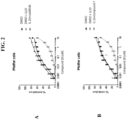
- Example F IL10 makes Pfeiffer cells resistant to PI3K ⁇ inhibition and can be reversed by JAK1/2 or JAK1 blockade
- Diffuse large B cell lymphoma cells were seeded at 2000 cell/well in 96 well culture plates in the absence or presence of 10 ng/ml IL14. Compounds were added to these cells after dilution in DMSO first, followed by dilution in culture medium (4x concentration). The cells were cultured in an incubator for 3 days with 5% CO 2 . Cell proliferation was assessed using the Cell titer-glow assay (Promega, Madison, WI).
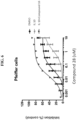
- the cell proliferation assay was carried out first in Pfeiffer cells (germinal center B cell (GCB) diffuse large B cell lymphoma (GCB-DLBCL) cells) and HBL-1 cells (activated B-cell like (ABC) diffuse large B cell lymphoma (ABC-DLBCL)).
- GCB germ center B cell
- BCC activated B-cell like
- FIG. 2A depicts % inhibition in the cellular proliferation assay in Pfeiffer cells as a function of the concentration of Compound 28 (a PI3K ⁇ inhibitor) with vehicle (DMSO), DMSO+IL10, and DMSO+IL10+ruxolitinib (a JAK1/JAK2 inhibitor).
- FIG. 2B depicts % inhibition in the cellular proliferation assay in Pfeiffer cells as a function of the concentration of Compound 28 (a PI3K ⁇ inhibitor) with vehicle (DMSO), DMSO+IL10, and DMSO+IL10+Compound 7 (a selective JAK1 inhibitor).
- FIG. 3 depicts % inhibition in the cellular proliferation assay in HBL-1 cells as a function of the concentration of Compound 28 (a PI3K ⁇ inhibitor) with vehicle (DMSO), DMSO+IL10, and DMSO+IL10+ruxolitinib (a JAK1/JAK2 inhibitor).
- Example G IL10-induced Expression Of Pim2 Is Blocked By a JAK1/2 Inhibitor
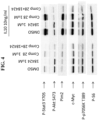
- FIG. 4 shows that 1L10-induced expression of Pim2 is blocked by ruxolitinib (a JAK1/JAK2 inhibitior). IL6 and IL10 promote cell survival through the expression of Pim2, which is dependent on JAK1 activity.
- FIG. 4 also shows a synergistic reduction of c-Myc and P-S6 in the presence of combined Compound 28 and ruxolitinib treatment.
- the reduction of c-Myc protein may be responsible for the synergistic effect for the combination treatment.
- FIG. 5 shows that ILIO-induced expression of Pim2 is blocked by a selective JAK1 inhibitor (Compound 7).
- Example I Increase in Potency of PI3K ⁇ Inhibitor by Selective JAK1 Inhibitor
- Pfeiffer cell line was used as a model system of DLBCL.
- Pfeiffer cells are of the germinal center B-cell (GCB) subtype of DLBCL, have been shown to express PI3K ⁇ , are sensitive to PI3K ⁇ inhibition, and activate the JAK/STAT pathway in response to multiple cytokines as shown above.
- GCB germinal center B-cell
- Pfeiffer cells were treated for 3 days with various concentrations of Compound 28 in the presence or absence of IL-10 and 1 ⁇ M of Compound 16, and cell growth was measured using an ATP readout (see table below). As shown in FIG.
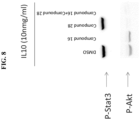
- Pfeiffer cells were treated with Compound 28 +/- Compound 16 for 4 hours and then stimulated with IL-10 for 15 minutes. Extracts were analyzed by Western blot for pAKT and pSTAT3. As shown in FIG. 8 , the AKT pathway was constitutively activated in Pfeiffer cells. Blockade of PI3K ⁇ signaling led to complete inhibition of pAKT whereas treatment with the JAK1 inhibitor had no effect. In contrast, Compound 16 led to inhibition of STATS phosphorylation whereas the PI3K ⁇ inhibitor did not. The combination of both compounds was required to block both pathways.
Landscapes
- Health & Medical Sciences (AREA)
- Veterinary Medicine (AREA)
- Life Sciences & Earth Sciences (AREA)
- Animal Behavior & Ethology (AREA)
- General Health & Medical Sciences (AREA)
- Public Health (AREA)
- Medicinal Chemistry (AREA)
- Pharmacology & Pharmacy (AREA)
- Chemical & Material Sciences (AREA)
- Epidemiology (AREA)
- Chemical Kinetics & Catalysis (AREA)
- General Chemical & Material Sciences (AREA)
- Nuclear Medicine, Radiotherapy & Molecular Imaging (AREA)
- Organic Chemistry (AREA)
- Engineering & Computer Science (AREA)
- Bioinformatics & Cheminformatics (AREA)
- Hematology (AREA)
- Oncology (AREA)
- Biomedical Technology (AREA)
- Neurology (AREA)
- Neurosurgery (AREA)
- Pharmaceuticals Containing Other Organic And Inorganic Compounds (AREA)
- Medicines Containing Plant Substances (AREA)
- Medicines That Contain Protein Lipid Enzymes And Other Medicines (AREA)
- Medicines Containing Material From Animals Or Micro-Organisms (AREA)
- Nitrogen Condensed Heterocyclic Rings (AREA)
- Plural Heterocyclic Compounds (AREA)
- Heterocyclic Carbon Compounds Containing A Hetero Ring Having Oxygen Or Sulfur (AREA)
- Nitrogen And Oxygen Or Sulfur-Condensed Heterocyclic Ring Systems (AREA)
- Micro-Organisms Or Cultivation Processes Thereof (AREA)
Applications Claiming Priority (4)
| Application Number | Priority Date | Filing Date | Title |
|---|---|---|---|
| US201461976815P | 2014-04-08 | 2014-04-08 | |
| EP15717381.6A EP3129021B1 (fr) | 2014-04-08 | 2015-04-07 | Traitement d'affections malignes par lymphocytes b par un inhibiteur jak et pi3k combiné |
| PCT/US2015/024676 WO2015157257A1 (fr) | 2014-04-08 | 2015-04-07 | Traitement d'affections malignes par lymphocytes b par un inhibiteur jak et pi3k combiné |
| EP20191540.2A EP3795152A1 (fr) | 2014-04-08 | 2015-04-07 | Traitement d'affections malignes par lymphocytes b par un inhibiteur jak et pi3k combiné |
Related Parent Applications (2)
| Application Number | Title | Priority Date | Filing Date |
|---|---|---|---|
| EP15717381.6A Division EP3129021B1 (fr) | 2014-04-08 | 2015-04-07 | Traitement d'affections malignes par lymphocytes b par un inhibiteur jak et pi3k combiné |
| EP20191540.2A Division EP3795152A1 (fr) | 2014-04-08 | 2015-04-07 | Traitement d'affections malignes par lymphocytes b par un inhibiteur jak et pi3k combiné |
Publications (2)
| Publication Number | Publication Date |
|---|---|
| EP4501409A2 true EP4501409A2 (fr) | 2025-02-05 |
| EP4501409A3 EP4501409A3 (fr) | 2025-05-14 |
Family
ID=52988487
Family Applications (3)
| Application Number | Title | Priority Date | Filing Date |
|---|---|---|---|
| EP15717381.6A Active EP3129021B1 (fr) | 2014-04-08 | 2015-04-07 | Traitement d'affections malignes par lymphocytes b par un inhibiteur jak et pi3k combiné |
| EP20191540.2A Withdrawn EP3795152A1 (fr) | 2014-04-08 | 2015-04-07 | Traitement d'affections malignes par lymphocytes b par un inhibiteur jak et pi3k combiné |
| EP24204941.9A Pending EP4501409A3 (fr) | 2014-04-08 | 2015-04-07 | Traitement de tumeurs malignes des lymphocytes b par une combinaison d'inhibiteur jak et pi3k |
Family Applications Before (2)
| Application Number | Title | Priority Date | Filing Date |
|---|---|---|---|
| EP15717381.6A Active EP3129021B1 (fr) | 2014-04-08 | 2015-04-07 | Traitement d'affections malignes par lymphocytes b par un inhibiteur jak et pi3k combiné |
| EP20191540.2A Withdrawn EP3795152A1 (fr) | 2014-04-08 | 2015-04-07 | Traitement d'affections malignes par lymphocytes b par un inhibiteur jak et pi3k combiné |
Country Status (29)
| Country | Link |
|---|---|
| US (4) | US10064866B2 (fr) |
| EP (3) | EP3129021B1 (fr) |
| JP (5) | JP6537527B2 (fr) |
| KR (4) | KR20240153401A (fr) |
| CN (2) | CN111494386A (fr) |
| AU (4) | AU2015244044B2 (fr) |
| CA (2) | CA2945151C (fr) |
| CL (1) | CL2016002566A1 (fr) |
| CY (1) | CY1123603T1 (fr) |
| DK (1) | DK3129021T3 (fr) |
| EA (2) | EA202191009A1 (fr) |
| ES (1) | ES2829914T3 (fr) |
| HR (1) | HRP20201887T1 (fr) |
| HU (1) | HUE051625T2 (fr) |
| IL (4) | IL295225A (fr) |
| LT (1) | LT3129021T (fr) |
| MA (2) | MA39984B1 (fr) |
| MX (2) | MX373202B (fr) |
| MY (1) | MY185686A (fr) |
| NZ (2) | NZ725778A (fr) |
| PH (3) | PH12020552277A1 (fr) |
| PL (1) | PL3129021T3 (fr) |
| PT (1) | PT3129021T (fr) |
| RS (1) | RS61058B1 (fr) |
| SG (3) | SG10201808870TA (fr) |
| SI (1) | SI3129021T1 (fr) |
| SM (1) | SMT202000656T1 (fr) |
| UA (1) | UA119767C2 (fr) |
| WO (1) | WO2015157257A1 (fr) |
Families Citing this family (47)
| Publication number | Priority date | Publication date | Assignee | Title |
|---|---|---|---|---|
| EP2455382B1 (fr) | 2005-12-13 | 2016-10-26 | Incyte Holdings Corporation | Pyrrolo[2,3-b]pyridines et pyrrolo[2,3-b]pyrimidines à substitution hétéroaryle en tant qu'inhibiteurs de la janus kinase |
| EP3070090B1 (fr) | 2007-06-13 | 2018-12-12 | Incyte Holdings Corporation | Utilisation des sels de l'inhibiteur de janus kinase (r)-3-(4- (7h-pyrrolo [2,3-d] pyrimidin-4-yl)-1h-pyrazol-1-yl) -3-cyclopentylpropanenitrile |
| SG176111A1 (en) | 2009-05-22 | 2011-12-29 | Incyte Corp | 3-[4-(7h-pyrrolo[2,3-d]pyrimidin-4-yl)-1h-pyrazol-1-yl]octane- or heptane-nitrile as jak inhibitors |
| PT3354652T (pt) | 2010-03-10 | 2020-07-20 | Incyte Holdings Corp | Derivados de piperidin-4-ilazetidina como inibidores de jak1 |
| RS54824B1 (sr) | 2010-05-21 | 2016-10-31 | Incyte Holdings Corp | Topikalna formulacija za inhibiciju jak-a |
| CA2818542A1 (fr) | 2010-11-19 | 2012-05-24 | Incyte Corporation | Derives pyrrolopyridine et pyrrolopyrimidine a substitution cyclobutyle utilises comme inhibiteurs des jak |
| MY165963A (en) | 2011-06-20 | 2018-05-18 | Incyte Holdings Corp | Azetidinyl phenyl, pyridyl or pyrazinyl carboxamide derivatives as jak inhibitors |
| EP2734205B1 (fr) | 2011-07-21 | 2018-03-21 | Tolero Pharmaceuticals, Inc. | Inhibiteurs de protéine kinase hétérocycliques |
| KR102507287B1 (ko) | 2011-09-02 | 2023-03-07 | 인사이트 홀딩스 코포레이션 | Pi3k 억제제로서 헤테로시클릴아민 |
| UA111854C2 (uk) | 2011-09-07 | 2016-06-24 | Інсайт Холдінгс Корпорейшн | Способи і проміжні сполуки для отримання інгібіторів jak |
| CN104918945B (zh) | 2012-11-01 | 2018-01-05 | 因赛特公司 | 作为jak抑制剂的三环稠合噻吩衍生物 |
| CN113384546A (zh) | 2012-11-15 | 2021-09-14 | 因赛特公司 | 鲁索利替尼的缓释剂型 |
| JP6437452B2 (ja) | 2013-01-14 | 2018-12-12 | インサイト・ホールディングス・コーポレイションIncyte Holdings Corporation | Pimキナーゼ阻害剤として有用な二環式芳香族カルボキサミド化合物 |
| RS60244B1 (sr) | 2013-01-15 | 2020-06-30 | Incyte Holdings Corp | Jedinjenja tiazolkarboksamida i piridinkarboksamida korisna kao inhibitori pim kinaze |
| WO2014138168A1 (fr) | 2013-03-06 | 2014-09-12 | Incyte Corporation | Procédés et intermédiaires pour la génération d'un inhibiteur de jak |
| SG10201801069QA (en) | 2013-08-07 | 2018-03-28 | Incyte Corp | Sustained release dosage forms for a jak1 inhibitor |
| CN105658653A (zh) | 2013-08-23 | 2016-06-08 | 因赛特公司 | 可用作pim激酶抑制剂的呋喃并-和噻吩并-吡啶甲酰胺化合物 |
| PH12020552277A1 (en) | 2014-04-08 | 2023-07-17 | Incyte Holdings Corp | Treatment of b-cell malignancies by a combination jak and pi3k inhibitor |
| CN106687462A (zh) | 2014-04-30 | 2017-05-17 | 因赛特公司 | Jak1抑制剂的制备方法以及其新形式 |
| WO2015191677A1 (fr) | 2014-06-11 | 2015-12-17 | Incyte Corporation | Dérivés d'hétéroarylaminoalkylphényle bicycliques à titre d'inhibiteurs de pi3k |
| WO2016010897A1 (fr) | 2014-07-14 | 2016-01-21 | Incyte Corporation | Composés carboxamide hétéroaromatiques bicycliques utiles en tant qu'inhibiteurs de kinases pim |
| US9580418B2 (en) | 2014-07-14 | 2017-02-28 | Incyte Corporation | Bicyclic aromatic carboxamide compounds useful as Pim kinase inhibitors |
| WO2016130501A1 (fr) | 2015-02-09 | 2016-08-18 | Incyte Corporation | Composés aza-hétéroaryle en tant qu'inhibiteurs de pi3k-gamma |
| SI3831833T1 (sl) | 2015-02-27 | 2023-03-31 | Incyte Holdings Corporation | Postopki za pripravo inhibitorja PI3K |
| WO2016196244A1 (fr) | 2015-05-29 | 2016-12-08 | Incyte Corporation | Composés de pyridineamine utiles en tant qu'inhibiteurs de kinase pim |
| TWI734699B (zh) | 2015-09-09 | 2021-08-01 | 美商英塞特公司 | Pim激酶抑制劑之鹽 |
| US9920032B2 (en) | 2015-10-02 | 2018-03-20 | Incyte Corporation | Heterocyclic compounds useful as pim kinase inhibitors |
| RS63359B1 (sr) | 2015-11-06 | 2022-07-29 | Incyte Corp | Heterociklična jedinjenja kao inhibitori pi3k-gama |
| WO2017097224A1 (fr) | 2015-12-11 | 2017-06-15 | 四川科伦博泰生物医药股份有限公司 | Dérivé d'azétidine, son procédé de préparation et son utilisation |
| WO2017120194A1 (fr) | 2016-01-05 | 2017-07-13 | Incyte Corporation | Pyridine et utilisation de composés de la pyridimine comme inhibiteurs de pi3k-gamma |
| WO2017223414A1 (fr) | 2016-06-24 | 2017-12-28 | Incyte Corporation | Composants hétérocycliques utilisés en tant qu'inhibiteurs de pi3k-y |
| KR20240152947A (ko) | 2017-10-18 | 2024-10-22 | 인사이트 코포레이션 | Pi3k-감마 저해제로서의 3차 하이드록시기로 치환된 축합된 이미다졸 유도체 |
| AR113922A1 (es) | 2017-12-08 | 2020-07-01 | Incyte Corp | Terapia de combinación de dosis baja para el tratamiento de neoplasias mieloproliferativas |
| EA202091830A1 (ru) | 2018-01-30 | 2020-12-29 | Инсайт Корпорейшн | Способы и промежуточные соединения для получения ингибитора jak |
| MD3773593T2 (ro) | 2018-03-30 | 2024-10-31 | Incyte Corp | Tratament hidradenitei supurative utilizând inhibitori ai JAK |
| CN117838695A (zh) | 2018-04-13 | 2024-04-09 | 住友制药肿瘤公司 | 用于治疗骨髓增殖性肿瘤和与癌症相关的纤维化的pim激酶抑制剂 |
| CN108484468A (zh) * | 2018-05-11 | 2018-09-04 | 南京大学 | 芳基氮杂环丁烷类化合物的制备方法 |
| CA3101323A1 (fr) | 2018-06-01 | 2019-12-05 | Incyte Corporation | Schema posologique destine au traitement de troubles lies a la pi3k |
| CR20250050A (es) | 2018-09-05 | 2025-03-19 | Incyte Corp | Formas cristalinas de un inhibidor de fosfoinositida 3–quinasa (pi3k) (divisional 2021-0165) |
| CN111320633B (zh) * | 2018-12-14 | 2022-09-27 | 中国医药研究开发中心有限公司 | 吡咯/咪唑并六元杂芳环类化合物及其制备方法和医药用途 |
| NZ778055A (en) | 2019-02-12 | 2025-11-28 | Sumitomo Pharma America Inc | Formulations comprising heterocyclic protein kinase inhibitors |
| CN114761013A (zh) | 2019-09-27 | 2022-07-15 | 迪斯克医药公司 | 治疗骨髓纤维化和相关病症的方法 |
| WO2021231798A1 (fr) | 2020-05-13 | 2021-11-18 | Disc Medicine, Inc. | Anticorps anti-hémojuvéline (hjv) pour le traitement de la myélofibrose |
| US11833155B2 (en) | 2020-06-03 | 2023-12-05 | Incyte Corporation | Combination therapy for treatment of myeloproliferative neoplasms |
| US20230190755A1 (en) | 2021-12-16 | 2023-06-22 | Incyte Corporation | Topical formulations of PI3K-delta inhibitors |
| EP4611753A1 (fr) | 2022-10-31 | 2025-09-10 | Sumitomo Pharma America, Inc. | Inhibiteur de pim-1 pour le traitement de néoplasmes myéloprolifératifs |
| KR102582097B1 (ko) | 2022-12-28 | 2023-09-25 | (주)메디언스 | 야누스키나아제 표적 억제제 및 이의 용도 |
Citations (29)
| Publication number | Priority date | Publication date | Assignee | Title |
|---|---|---|---|---|
| US5521184A (en) | 1992-04-03 | 1996-05-28 | Ciba-Geigy Corporation | Pyrimidine derivatives and processes for the preparation thereof |
| WO2000009495A1 (fr) | 1998-08-11 | 2000-02-24 | Novartis Ag | Derives d'isoquinoline possedant une activite d'inhibition de l'angiogenese |
| WO2000053595A1 (fr) | 1999-03-06 | 2000-09-14 | Astrazeneca Ab | Composes pyrimidine |
| WO2001064655A1 (fr) | 2000-03-01 | 2001-09-07 | Astrazeneca Ab | 2, 4-di(hetero-)arylamino (-oxy) pyrimidines substitues en 5, utilises comme agents antineoplasiques |
| WO2002000196A2 (fr) | 2000-06-28 | 2002-01-03 | Smithkline Beecham P.L.C. | Procede de broyage par voie humide |
| WO2003024967A2 (fr) | 2001-09-19 | 2003-03-27 | Aventis Pharma S.A. | Composes chimiques |
| WO2003037347A1 (fr) | 2001-10-30 | 2003-05-08 | Novartis Ag | Derives de staurosporine inhibiteurs de l'activite tyrosine kinase du recepteur flt3 |
| WO2003099771A2 (fr) | 2002-05-29 | 2003-12-04 | Novartis Ag | Derives de diaryle-uree utilises pour le traitement des maladies dependant des proteines kinases |
| WO2004005281A1 (fr) | 2002-07-05 | 2004-01-15 | Novartis Ag | Inhibiteurs de tyrosine kinases |
| WO2004046120A2 (fr) | 2002-11-15 | 2004-06-03 | Vertex Pharmaceuticals Incorporated | Diaminotriazoles convenant comme inhibiteurs de proteine kinases |
| WO2004056786A2 (fr) | 2002-12-20 | 2004-07-08 | Pfizer Products Inc. | Composes pour traiter le developpement anormal de cellules |
| WO2004080980A1 (fr) | 2003-03-14 | 2004-09-23 | Novartis Ag | 2,4-di(phenylamino)pyrimidines utilisees pour traiter des maladies neoplasiques, des troubles inflammatoires et des troubles du systeme immunitaire |
| WO2005028444A1 (fr) | 2003-09-24 | 2005-03-31 | Novartis Ag | Derives d'isoquinilone 1,4-disubstitues en tant qu'inhibiteurs de raf-kinase utiles pour le traitement de maladies proliferantes |
| WO2006056399A2 (fr) | 2004-11-24 | 2006-06-01 | Novartis Ag | Combinaisons d'inhibiteurs de kinase jak |
| US7598257B2 (en) | 2005-12-13 | 2009-10-06 | Incyte Corporation | Heteroaryl substituted pyrrolo[2,3-b]pyridines and pyrrolo[2,3-b]pyrimidines as janus kinase inhibitors |
| US20100298334A1 (en) | 2009-05-22 | 2010-11-25 | Rodgers James D | N-(HETERO)ARYL-PYRROLIDINE DERIVATIVES OF PYRAZOL-4-YL-PYRROLO[2,3-d]PYRIMIDINES AND PYRROL-3-YL-PYRROLO[2,3-d]PYRIMIDINES AS JANUS KINASE INHIBITORS |
| US20110015212A1 (en) | 2009-06-29 | 2011-01-20 | Yun-Long Li | Pyrimidinones as pi3k inhibitors |
| WO2011014402A1 (fr) | 2009-07-27 | 2011-02-03 | Felt Racing, Llc | Ensemble de fourche avant de bicyclette perfectionné |
| WO2011025889A1 (fr) | 2009-08-28 | 2011-03-03 | Takeda Pharmaceutical Company Limited | Composés d'hexahydrooxazinoptérine utilisés en tant qu'inhibiteurs de mtor |
| US20110059951A1 (en) | 2009-09-01 | 2011-03-10 | Rodgers James D | HETEROCYCLIC DERIVATIVES OF PYRAZOL-4-YL-PYRROLO[2,3-d]PYRIMIDINES AS JANUS KINASE INHIBITORS |
| US20110183985A1 (en) | 2009-12-18 | 2011-07-28 | Yun-Long Li | Substituted fused aryl and heteroaryl derivatives as pi3k inhibitors |
| US20110224190A1 (en) | 2010-03-10 | 2011-09-15 | Taisheng Huang | Piperidin-4-yl azetidine derivatives as jak1 inhibitors |
| US20120149681A1 (en) | 2010-11-19 | 2012-06-14 | Rodgers James D | Cyclobutyl substituted pyrrolopyridine and pyrrolopyrimidine derivatives as jak inhibitors |
| US20120149682A1 (en) | 2010-11-19 | 2012-06-14 | Rodgers James D | Heterocyclic-substituted pyrrolopyridines and pyrrolopyrimidines as jak inhibitors |
| US20120157430A1 (en) | 2010-12-20 | 2012-06-21 | Yun-Long Li | N-(1-(substituted-phenyl)ethyl)-9h-purin-6-amines as pi3k inhibitors |
| US20130018034A1 (en) | 2011-06-20 | 2013-01-17 | Incyte Corporation | Azetidinyl phenyl, pyridyl or pyrazinyl carboxamide derivatives as jak inhibitors |
| US20130045963A1 (en) | 2011-08-18 | 2013-02-21 | Incyte Corporation | Cyclohexyl Azetidine Derivatives as JAK Inhibitors |
| US20130059835A1 (en) | 2011-09-02 | 2013-03-07 | Incyte Corporation | Heterocyclylamines as pi3k inhibitors |
| US20140005166A1 (en) | 2012-05-18 | 2014-01-02 | Incyte Corporation | Piperidinylcyclobutyl substituted pyrrolopyridine and pyrrolopyrimidine derivatives as jak inhibitors |
Family Cites Families (38)
| Publication number | Priority date | Publication date | Assignee | Title |
|---|---|---|---|---|
| US6133031A (en) | 1999-08-19 | 2000-10-17 | Isis Pharmaceuticals Inc. | Antisense inhibition of focal adhesion kinase expression |
| EP2049119A2 (fr) * | 2006-06-29 | 2009-04-22 | Astex Therapeutics Limited | Combinaisons pharmaceutiques du 1-cyclopropyl-3-[3-(5-morphoolin-4-ylmethyl-1h-benzoimidazol-2-yl)-1h-1-pyrazol-4-yl]-urea |
| EP3070090B1 (fr) | 2007-06-13 | 2018-12-12 | Incyte Holdings Corporation | Utilisation des sels de l'inhibiteur de janus kinase (r)-3-(4- (7h-pyrrolo [2,3-d] pyrimidin-4-yl)-1h-pyrazol-1-yl) -3-cyclopentylpropanenitrile |
| CL2008001709A1 (es) | 2007-06-13 | 2008-11-03 | Incyte Corp | Compuestos derivados de pirrolo [2,3-b]pirimidina, moduladores de quinasas jak; composicion farmaceutica; y uso en el tratamiento de enfermedades tales como cancer, psoriasis, artritis reumatoide, entre otras. |
| CN102227422A (zh) * | 2008-09-30 | 2011-10-26 | 阿斯利康(瑞典)有限公司 | 杂环jak激酶抑制剂 |
| CL2009001884A1 (es) | 2008-10-02 | 2010-05-14 | Incyte Holdings Corp | Uso de 3-ciclopentil-3-[4-(7h-pirrolo[2,3-d]pirimidin-4-il)-1h-pirazol-1-il)propanonitrilo, inhibidor de janus quinasa, y uso de una composición que lo comprende para el tratamiento del ojo seco. |
| CA3121743A1 (fr) | 2009-01-15 | 2010-07-22 | Incyte Holdings Corporation | Procedes de preparation d'inhibiteurs de jak et composes intermediaires apparentes |
| CA2702567A1 (fr) | 2009-04-28 | 2010-10-28 | Katch Kan Holdings Ltd. | Appareil et methode de vidange de solides et de fluides d'un train de tiges servant au forage ou a l'entretien de puits |
| SG176111A1 (en) | 2009-05-22 | 2011-12-29 | Incyte Corp | 3-[4-(7h-pyrrolo[2,3-d]pyrimidin-4-yl)-1h-pyrazol-1-yl]octane- or heptane-nitrile as jak inhibitors |
| MX2012000178A (es) * | 2009-07-02 | 2012-02-28 | Novartis Ag | 2-carboxamida-cicloamino-ureas utiles como inhibidores de pi3k. |
| UA110324C2 (en) * | 2009-07-02 | 2015-12-25 | Genentech Inc | Jak inhibitory compounds based on pyrazolo pyrimidine |
| WO2011075643A1 (fr) | 2009-12-18 | 2011-06-23 | Incyte Corporation | Dérivés condensés d'hétéroaryles substitués à titre d'inhibiteurs de pi3k |
| EP2536729A1 (fr) | 2010-02-18 | 2012-12-26 | Incyte Corporation | Dérivés de cyclobutane et de méthylcyclobutane comme inhibiteurs de janus kinases |
| AR081823A1 (es) | 2010-04-14 | 2012-10-24 | Incyte Corp | DERIVADOS FUSIONADOS COMO INHIBIDORES DE PI3Kd |
| RS54824B1 (sr) | 2010-05-21 | 2016-10-31 | Incyte Holdings Corp | Topikalna formulacija za inhibiciju jak-a |
| US9062055B2 (en) | 2010-06-21 | 2015-06-23 | Incyte Corporation | Fused pyrrole derivatives as PI3K inhibitors |
| US9108984B2 (en) | 2011-03-14 | 2015-08-18 | Incyte Corporation | Substituted diamino-pyrimidine and diamino-pyridine derivatives as PI3K inhibitors |
| WO2012135009A1 (fr) | 2011-03-25 | 2012-10-04 | Incyte Corporation | Dérivés de pyrimidine-4,6-diamine en tant qu'inhibiteurs de pi3k |
| EP2518070A1 (fr) * | 2011-04-29 | 2012-10-31 | Almirall, S.A. | Dérivés de pyrrolotriazinon en tant qu'inhibiteurs PI3K |
| EP2741747A1 (fr) * | 2011-08-10 | 2014-06-18 | Novartis Pharma AG | Polythérapie par jak p13k/mtor |
| UA111854C2 (uk) | 2011-09-07 | 2016-06-24 | Інсайт Холдінгс Корпорейшн | Способи і проміжні сполуки для отримання інгібіторів jak |
| EP2780017A1 (fr) * | 2011-11-15 | 2014-09-24 | Novartis AG | Combinaison d'un inhibiteur de la phosphoinositide 3-kinase et d'un modulateur de la voie janus kinase 2 - transducteur de signal et activateur de transcription 5 |
| AR090548A1 (es) | 2012-04-02 | 2014-11-19 | Incyte Corp | Azaheterociclobencilaminas biciclicas como inhibidores de pi3k |
| CN104918945B (zh) | 2012-11-01 | 2018-01-05 | 因赛特公司 | 作为jak抑制剂的三环稠合噻吩衍生物 |
| CN113384546A (zh) | 2012-11-15 | 2021-09-14 | 因赛特公司 | 鲁索利替尼的缓释剂型 |
| TWI687220B (zh) | 2013-03-01 | 2020-03-11 | 美商英塞特控股公司 | 吡唑并嘧啶衍生物治療PI3Kδ相關病症之用途 |
| WO2014138168A1 (fr) | 2013-03-06 | 2014-09-12 | Incyte Corporation | Procédés et intermédiaires pour la génération d'un inhibiteur de jak |
| SMT201900223T1 (it) | 2013-05-17 | 2019-07-11 | Incyte Corp | Sale di bipirazolo come inibitore di jak |
| SG10201801069QA (en) | 2013-08-07 | 2018-03-28 | Incyte Corp | Sustained release dosage forms for a jak1 inhibitor |
| CN105555313A (zh) | 2013-08-20 | 2016-05-04 | 因赛特公司 | 在c-反应蛋白水平较高的实体肿瘤患者中的存活益处 |
| JP6576941B2 (ja) | 2014-02-28 | 2019-09-18 | インサイト・コーポレイションIncyte Corporation | 骨髄異形成症候群の治療のためのjak1阻害剤 |
| PH12020552277A1 (en) | 2014-04-08 | 2023-07-17 | Incyte Holdings Corp | Treatment of b-cell malignancies by a combination jak and pi3k inhibitor |
| CN106687462A (zh) | 2014-04-30 | 2017-05-17 | 因赛特公司 | Jak1抑制剂的制备方法以及其新形式 |
| US9498467B2 (en) | 2014-05-30 | 2016-11-22 | Incyte Corporation | Treatment of chronic neutrophilic leukemia (CNL) and atypical chronic myeloid leukemia (aCML) by inhibitors of JAK1 |
| SI3831833T1 (sl) | 2015-02-27 | 2023-03-31 | Incyte Holdings Corporation | Postopki za pripravo inhibitorja PI3K |
| US9988401B2 (en) | 2015-05-11 | 2018-06-05 | Incyte Corporation | Crystalline forms of a PI3K inhibitor |
| US9732097B2 (en) | 2015-05-11 | 2017-08-15 | Incyte Corporation | Process for the synthesis of a phosphoinositide 3-kinase inhibitor |
| US20160362424A1 (en) | 2015-05-11 | 2016-12-15 | Incyte Corporation | Salts of (s)-7-(1-(9h-purin-6-ylamino)ethyl)-6-(3-fluorophenyl)-3-methyl-5h-thiazolo[3,2-a]pyrimidin-5-one |
-
2015
- 2015-04-07 PH PH1/2020/552277A patent/PH12020552277A1/en unknown
- 2015-04-07 CA CA2945151A patent/CA2945151C/fr active Active
- 2015-04-07 IL IL295225A patent/IL295225A/en unknown
- 2015-04-07 SG SG10201808870TA patent/SG10201808870TA/en unknown
- 2015-04-07 SG SG11201608434TA patent/SG11201608434TA/en unknown
- 2015-04-07 HU HUE15717381A patent/HUE051625T2/hu unknown
- 2015-04-07 CN CN202010157115.7A patent/CN111494386A/zh active Pending
- 2015-04-07 EP EP15717381.6A patent/EP3129021B1/fr active Active
- 2015-04-07 MA MA39984A patent/MA39984B1/fr unknown
- 2015-04-07 EP EP20191540.2A patent/EP3795152A1/fr not_active Withdrawn
- 2015-04-07 MY MYPI2016001813A patent/MY185686A/en unknown
- 2015-04-07 MX MX2016013182A patent/MX373202B/es active IP Right Grant
- 2015-04-07 JP JP2016561810A patent/JP6537527B2/ja active Active
- 2015-04-07 US US14/680,659 patent/US10064866B2/en active Active
- 2015-04-07 EA EA202191009A patent/EA202191009A1/ru unknown
- 2015-04-07 UA UAA201611143A patent/UA119767C2/uk unknown
- 2015-04-07 NZ NZ725778A patent/NZ725778A/en unknown
- 2015-04-07 EA EA201692011A patent/EA201692011A1/ru unknown
- 2015-04-07 KR KR1020247033528A patent/KR20240153401A/ko active Pending
- 2015-04-07 MX MX2020004398A patent/MX392911B/es unknown
- 2015-04-07 SG SG10201912229XA patent/SG10201912229XA/en unknown
- 2015-04-07 WO PCT/US2015/024676 patent/WO2015157257A1/fr not_active Ceased
- 2015-04-07 AU AU2015244044A patent/AU2015244044B2/en active Active
- 2015-04-07 SI SI201531432T patent/SI3129021T1/sl unknown
- 2015-04-07 MA MA054622A patent/MA54622A/fr unknown
- 2015-04-07 CA CA3158254A patent/CA3158254C/fr active Active
- 2015-04-07 KR KR1020227015341A patent/KR20220066179A/ko not_active Ceased
- 2015-04-07 HR HRP20201887TT patent/HRP20201887T1/hr unknown
- 2015-04-07 PH PH1/2021/552949A patent/PH12021552949A1/en unknown
- 2015-04-07 PT PT157173816T patent/PT3129021T/pt unknown
- 2015-04-07 KR KR1020167030793A patent/KR102396717B1/ko active Active
- 2015-04-07 LT LTEP15717381.6T patent/LT3129021T/lt unknown
- 2015-04-07 SM SM20200656T patent/SMT202000656T1/it unknown
- 2015-04-07 ES ES15717381T patent/ES2829914T3/es active Active
- 2015-04-07 DK DK15717381.6T patent/DK3129021T3/da active
- 2015-04-07 NZ NZ763326A patent/NZ763326A/en unknown
- 2015-04-07 PL PL15717381T patent/PL3129021T3/pl unknown
- 2015-04-07 CN CN201580018986.8A patent/CN106413716B/zh active Active
- 2015-04-07 RS RS20201374A patent/RS61058B1/sr unknown
- 2015-04-07 EP EP24204941.9A patent/EP4501409A3/fr active Pending
- 2015-04-07 KR KR1020237009340A patent/KR102717075B1/ko active Active
-
2016
- 2016-10-06 PH PH12016501987A patent/PH12016501987A1/en unknown
- 2016-10-06 IL IL248198A patent/IL248198B/en active IP Right Grant
- 2016-10-07 CL CL2016002566A patent/CL2016002566A1/es unknown
-
2018
- 2018-07-27 US US16/047,853 patent/US10675284B2/en active Active
-
2019
- 2019-06-04 JP JP2019104593A patent/JP6862495B2/ja active Active
-
2020
- 2020-04-05 IL IL273802A patent/IL273802B/en unknown
- 2020-05-12 US US16/872,794 patent/US20210093638A1/en not_active Abandoned
- 2020-08-05 AU AU2020213313A patent/AU2020213313B2/en active Active
- 2020-12-07 CY CY20201101154T patent/CY1123603T1/el unknown
-
2021
- 2021-03-31 JP JP2021059028A patent/JP7206314B2/ja active Active
- 2021-11-18 IL IL288231A patent/IL288231B2/en unknown
-
2022
- 2022-07-18 AU AU2022206693A patent/AU2022206693B2/en active Active
-
2023
- 2023-01-04 JP JP2023000189A patent/JP2023040142A/ja active Pending
- 2023-05-08 US US18/144,593 patent/US20240091234A1/en not_active Abandoned
-
2024
- 2024-11-22 AU AU2024266792A patent/AU2024266792A1/en active Pending
-
2025
- 2025-10-31 JP JP2025184855A patent/JP2026021472A/ja active Pending
Patent Citations (29)
| Publication number | Priority date | Publication date | Assignee | Title |
|---|---|---|---|---|
| US5521184A (en) | 1992-04-03 | 1996-05-28 | Ciba-Geigy Corporation | Pyrimidine derivatives and processes for the preparation thereof |
| WO2000009495A1 (fr) | 1998-08-11 | 2000-02-24 | Novartis Ag | Derives d'isoquinoline possedant une activite d'inhibition de l'angiogenese |
| WO2000053595A1 (fr) | 1999-03-06 | 2000-09-14 | Astrazeneca Ab | Composes pyrimidine |
| WO2001064655A1 (fr) | 2000-03-01 | 2001-09-07 | Astrazeneca Ab | 2, 4-di(hetero-)arylamino (-oxy) pyrimidines substitues en 5, utilises comme agents antineoplasiques |
| WO2002000196A2 (fr) | 2000-06-28 | 2002-01-03 | Smithkline Beecham P.L.C. | Procede de broyage par voie humide |
| WO2003024967A2 (fr) | 2001-09-19 | 2003-03-27 | Aventis Pharma S.A. | Composes chimiques |
| WO2003037347A1 (fr) | 2001-10-30 | 2003-05-08 | Novartis Ag | Derives de staurosporine inhibiteurs de l'activite tyrosine kinase du recepteur flt3 |
| WO2003099771A2 (fr) | 2002-05-29 | 2003-12-04 | Novartis Ag | Derives de diaryle-uree utilises pour le traitement des maladies dependant des proteines kinases |
| WO2004005281A1 (fr) | 2002-07-05 | 2004-01-15 | Novartis Ag | Inhibiteurs de tyrosine kinases |
| WO2004046120A2 (fr) | 2002-11-15 | 2004-06-03 | Vertex Pharmaceuticals Incorporated | Diaminotriazoles convenant comme inhibiteurs de proteine kinases |
| WO2004056786A2 (fr) | 2002-12-20 | 2004-07-08 | Pfizer Products Inc. | Composes pour traiter le developpement anormal de cellules |
| WO2004080980A1 (fr) | 2003-03-14 | 2004-09-23 | Novartis Ag | 2,4-di(phenylamino)pyrimidines utilisees pour traiter des maladies neoplasiques, des troubles inflammatoires et des troubles du systeme immunitaire |
| WO2005028444A1 (fr) | 2003-09-24 | 2005-03-31 | Novartis Ag | Derives d'isoquinilone 1,4-disubstitues en tant qu'inhibiteurs de raf-kinase utiles pour le traitement de maladies proliferantes |
| WO2006056399A2 (fr) | 2004-11-24 | 2006-06-01 | Novartis Ag | Combinaisons d'inhibiteurs de kinase jak |
| US7598257B2 (en) | 2005-12-13 | 2009-10-06 | Incyte Corporation | Heteroaryl substituted pyrrolo[2,3-b]pyridines and pyrrolo[2,3-b]pyrimidines as janus kinase inhibitors |
| US20100298334A1 (en) | 2009-05-22 | 2010-11-25 | Rodgers James D | N-(HETERO)ARYL-PYRROLIDINE DERIVATIVES OF PYRAZOL-4-YL-PYRROLO[2,3-d]PYRIMIDINES AND PYRROL-3-YL-PYRROLO[2,3-d]PYRIMIDINES AS JANUS KINASE INHIBITORS |
| US20110015212A1 (en) | 2009-06-29 | 2011-01-20 | Yun-Long Li | Pyrimidinones as pi3k inhibitors |
| WO2011014402A1 (fr) | 2009-07-27 | 2011-02-03 | Felt Racing, Llc | Ensemble de fourche avant de bicyclette perfectionné |
| WO2011025889A1 (fr) | 2009-08-28 | 2011-03-03 | Takeda Pharmaceutical Company Limited | Composés d'hexahydrooxazinoptérine utilisés en tant qu'inhibiteurs de mtor |
| US20110059951A1 (en) | 2009-09-01 | 2011-03-10 | Rodgers James D | HETEROCYCLIC DERIVATIVES OF PYRAZOL-4-YL-PYRROLO[2,3-d]PYRIMIDINES AS JANUS KINASE INHIBITORS |
| US20110183985A1 (en) | 2009-12-18 | 2011-07-28 | Yun-Long Li | Substituted fused aryl and heteroaryl derivatives as pi3k inhibitors |
| US20110224190A1 (en) | 2010-03-10 | 2011-09-15 | Taisheng Huang | Piperidin-4-yl azetidine derivatives as jak1 inhibitors |
| US20120149681A1 (en) | 2010-11-19 | 2012-06-14 | Rodgers James D | Cyclobutyl substituted pyrrolopyridine and pyrrolopyrimidine derivatives as jak inhibitors |
| US20120149682A1 (en) | 2010-11-19 | 2012-06-14 | Rodgers James D | Heterocyclic-substituted pyrrolopyridines and pyrrolopyrimidines as jak inhibitors |
| US20120157430A1 (en) | 2010-12-20 | 2012-06-21 | Yun-Long Li | N-(1-(substituted-phenyl)ethyl)-9h-purin-6-amines as pi3k inhibitors |
| US20130018034A1 (en) | 2011-06-20 | 2013-01-17 | Incyte Corporation | Azetidinyl phenyl, pyridyl or pyrazinyl carboxamide derivatives as jak inhibitors |
| US20130045963A1 (en) | 2011-08-18 | 2013-02-21 | Incyte Corporation | Cyclohexyl Azetidine Derivatives as JAK Inhibitors |
| US20130059835A1 (en) | 2011-09-02 | 2013-03-07 | Incyte Corporation | Heterocyclylamines as pi3k inhibitors |
| US20140005166A1 (en) | 2012-05-18 | 2014-01-02 | Incyte Corporation | Piperidinylcyclobutyl substituted pyrrolopyridine and pyrrolopyrimidine derivatives as jak inhibitors |
Non-Patent Citations (4)
| Title |
|---|
| "Rei iington.s Pharmaceutical Sciences", 1985, MACK PUBLISHING COMPANY, EASTON, PA., pages: 1418 |
| JOURNAL OF PHARMACEUTICAL SCIENCE, vol. 66, 1977, pages 2 |
| no. 204858-53-7 |
| PARK ET AL., ANALVTICALBIOCHEMISTRY, vol. 269, 1999, pages 94 - 104 |
Also Published As
Similar Documents
| Publication | Publication Date | Title |
|---|---|---|
| AU2022206693B2 (en) | Treatment of b-cell malignancies by a combination jak and pi3k inhibitor | |
| HK40122816A (en) | Treatment of b-cell malignancies by a combination jak and pi3k inhibitor | |
| HK40049323A (en) | Treatment of b-cell malignancies by a combination jak and pi3k inhibitor | |
| HK1233180B (en) | Treatment of b-cell malignancies by a combination jak and pi3k inhibitor | |
| HK1233180A1 (en) | Treatment of b-cell malignancies by a combination jak and pi3k inhibitor | |
| EA045057B1 (ru) | Лечение b-клеточных злокачественных новообразований с применением комбинации ингибиторов jak и pi3k | |
| EA042264B1 (ru) | Лечение b-клеточных злокачественных новообразований с применением комбинации ингибиторов jak и pi3k | |
| BR122021024771B1 (pt) | Uso de uma combinação de inibidores de jak1/2e pi3ksigma no tratamento de mielofibrose |
Legal Events
| Date | Code | Title | Description |
|---|---|---|---|
| PUAI | Public reference made under article 153(3) epc to a published international application that has entered the european phase |
Free format text: ORIGINAL CODE: 0009012 |
|
| STAA | Information on the status of an ep patent application or granted ep patent |
Free format text: STATUS: THE APPLICATION HAS BEEN PUBLISHED |
|
| AC | Divisional application: reference to earlier application |
Ref document number: 3129021 Country of ref document: EP Kind code of ref document: P Ref document number: 3795152 Country of ref document: EP Kind code of ref document: P |
|
| AK | Designated contracting states |
Kind code of ref document: A2 Designated state(s): AL AT BE BG CH CY CZ DE DK EE ES FI FR GB GR HR HU IE IS IT LI LT LU LV MC MK MT NL NO PL PT RO RS SE SI SK SM TR |
|
| REG | Reference to a national code |
Ref country code: DE Ref legal event code: R079 Free format text: PREVIOUS MAIN CLASS: A61P0035020000 Ipc: A61K0031397000 |
|
| PUAL | Search report despatched |
Free format text: ORIGINAL CODE: 0009013 |
|
| AK | Designated contracting states |
Kind code of ref document: A3 Designated state(s): AL AT BE BG CH CY CZ DE DK EE ES FI FR GB GR HR HU IE IS IT LI LT LU LV MC MK MT NL NO PL PT RO RS SE SI SK SM TR |
|
| RIC1 | Information provided on ipc code assigned before grant |
Ipc: A61P 35/02 20060101ALI20250408BHEP Ipc: A61P 35/00 20060101ALI20250408BHEP Ipc: A61K 31/519 20060101ALI20250408BHEP Ipc: A61K 31/502 20060101ALI20250408BHEP Ipc: A61K 31/437 20060101ALI20250408BHEP Ipc: A61K 31/397 20060101AFI20250408BHEP |
|
| REG | Reference to a national code |
Ref country code: HK Ref legal event code: DE Ref document number: 40122816 Country of ref document: HK |
|
| STAA | Information on the status of an ep patent application or granted ep patent |
Free format text: STATUS: REQUEST FOR EXAMINATION WAS MADE |
|
| 17P | Request for examination filed |
Effective date: 20251113 |
|
| RAV | Requested validation state of the european patent: fee paid |
Extension state: MA Effective date: 20251113 |
|
| RAX | Requested extension states of the european patent have changed |
Extension state: BA Payment date: 20251113 Extension state: ME Payment date: 20251113 |