EP4455093A1 - Positivelektrodenmaterial für natriumionenbatterie, herstellungsverfahren dafür und verwendung davon - Google Patents
Positivelektrodenmaterial für natriumionenbatterie, herstellungsverfahren dafür und verwendung davon Download PDFInfo
- Publication number
- EP4455093A1 EP4455093A1 EP23916603.6A EP23916603A EP4455093A1 EP 4455093 A1 EP4455093 A1 EP 4455093A1 EP 23916603 A EP23916603 A EP 23916603A EP 4455093 A1 EP4455093 A1 EP 4455093A1
- Authority
- EP
- European Patent Office
- Prior art keywords
- sodium
- preparation
- source
- optionally
- cathode material
- Prior art date
- Legal status (The legal status is an assumption and is not a legal conclusion. Google has not performed a legal analysis and makes no representation as to the accuracy of the status listed.)
- Pending
Links
Images

Classifications
-
- C—CHEMISTRY; METALLURGY
- C01—INORGANIC CHEMISTRY
- C01G—COMPOUNDS CONTAINING METALS NOT COVERED BY SUBCLASSES C01D OR C01F
- C01G53/00—Compounds of nickel
- C01G53/40—Complex oxides containing nickel and at least one other metal element
- C01G53/42—Complex oxides containing nickel and at least one other metal element containing alkali metals, e.g. LiNiO2
- C01G53/44—Complex oxides containing nickel and at least one other metal element containing alkali metals, e.g. LiNiO2 containing manganese
- C01G53/50—Complex oxides containing nickel and at least one other metal element containing alkali metals, e.g. LiNiO2 containing manganese of the type (MnO2)n-, e.g. Li(NixMn1-x)O2 or Li(MyNixMn1-x-y)O2
-
- C—CHEMISTRY; METALLURGY
- C01—INORGANIC CHEMISTRY
- C01G—COMPOUNDS CONTAINING METALS NOT COVERED BY SUBCLASSES C01D OR C01F
- C01G53/00—Compounds of nickel
- C01G53/40—Complex oxides containing nickel and at least one other metal element
- C01G53/42—Complex oxides containing nickel and at least one other metal element containing alkali metals, e.g. LiNiO2
- C01G53/44—Complex oxides containing nickel and at least one other metal element containing alkali metals, e.g. LiNiO2 containing manganese
- C01G53/50—Complex oxides containing nickel and at least one other metal element containing alkali metals, e.g. LiNiO2 containing manganese of the type (MnO2)n-, e.g. Li(NixMn1-x)O2 or Li(MyNixMn1-x-y)O2
- C01G53/51—Complex oxides containing nickel and at least one other metal element containing alkali metals, e.g. LiNiO2 containing manganese of the type (MnO2)n-, e.g. Li(NixMn1-x)O2 or Li(MyNixMn1-x-y)O2 containing sodium
-
- H—ELECTRICITY
- H01—ELECTRIC ELEMENTS
- H01M—PROCESSES OR MEANS, e.g. BATTERIES, FOR THE DIRECT CONVERSION OF CHEMICAL ENERGY INTO ELECTRICAL ENERGY
- H01M10/00—Secondary cells; Manufacture thereof
- H01M10/05—Accumulators with non-aqueous electrolyte
- H01M10/054—Accumulators with insertion or intercalation of metals other than lithium, e.g. with magnesium or aluminium
-
- H—ELECTRICITY
- H01—ELECTRIC ELEMENTS
- H01M—PROCESSES OR MEANS, e.g. BATTERIES, FOR THE DIRECT CONVERSION OF CHEMICAL ENERGY INTO ELECTRICAL ENERGY
- H01M4/00—Electrodes
- H01M4/02—Electrodes composed of, or comprising, active material
- H01M4/13—Electrodes for accumulators with non-aqueous electrolyte, e.g. for lithium-accumulators; Processes of manufacture thereof
- H01M4/131—Electrodes based on mixed oxides or hydroxides, or on mixtures of oxides or hydroxides, e.g. LiCoOx
-
- H—ELECTRICITY
- H01—ELECTRIC ELEMENTS
- H01M—PROCESSES OR MEANS, e.g. BATTERIES, FOR THE DIRECT CONVERSION OF CHEMICAL ENERGY INTO ELECTRICAL ENERGY
- H01M4/00—Electrodes
- H01M4/02—Electrodes composed of, or comprising, active material
- H01M4/36—Selection of substances as active materials, active masses, active liquids
- H01M4/362—Composites
-
- H—ELECTRICITY
- H01—ELECTRIC ELEMENTS
- H01M—PROCESSES OR MEANS, e.g. BATTERIES, FOR THE DIRECT CONVERSION OF CHEMICAL ENERGY INTO ELECTRICAL ENERGY
- H01M4/00—Electrodes
- H01M4/02—Electrodes composed of, or comprising, active material
- H01M4/36—Selection of substances as active materials, active masses, active liquids
- H01M4/48—Selection of substances as active materials, active masses, active liquids of inorganic oxides or hydroxides
- H01M4/485—Selection of substances as active materials, active masses, active liquids of inorganic oxides or hydroxides of mixed oxides or hydroxides for inserting or intercalating light metals, e.g. LiTi2O4 or LiTi2OxFy
-
- H—ELECTRICITY
- H01—ELECTRIC ELEMENTS
- H01M—PROCESSES OR MEANS, e.g. BATTERIES, FOR THE DIRECT CONVERSION OF CHEMICAL ENERGY INTO ELECTRICAL ENERGY
- H01M4/00—Electrodes
- H01M4/02—Electrodes composed of, or comprising, active material
- H01M4/36—Selection of substances as active materials, active masses, active liquids
- H01M4/48—Selection of substances as active materials, active masses, active liquids of inorganic oxides or hydroxides
- H01M4/50—Selection of substances as active materials, active masses, active liquids of inorganic oxides or hydroxides of manganese
- H01M4/505—Selection of substances as active materials, active masses, active liquids of inorganic oxides or hydroxides of manganese of mixed oxides or hydroxides containing manganese for inserting or intercalating light metals, e.g. LiMn2O4 or LiMn2OxFy
-
- H—ELECTRICITY
- H01—ELECTRIC ELEMENTS
- H01M—PROCESSES OR MEANS, e.g. BATTERIES, FOR THE DIRECT CONVERSION OF CHEMICAL ENERGY INTO ELECTRICAL ENERGY
- H01M4/00—Electrodes
- H01M4/02—Electrodes composed of, or comprising, active material
- H01M4/36—Selection of substances as active materials, active masses, active liquids
- H01M4/48—Selection of substances as active materials, active masses, active liquids of inorganic oxides or hydroxides
- H01M4/52—Selection of substances as active materials, active masses, active liquids of inorganic oxides or hydroxides of nickel, cobalt or iron
- H01M4/525—Selection of substances as active materials, active masses, active liquids of inorganic oxides or hydroxides of nickel, cobalt or iron of mixed oxides or hydroxides containing iron, cobalt or nickel for inserting or intercalating light metals, e.g. LiNiO2, LiCoO2 or LiCoOxFy
-
- C—CHEMISTRY; METALLURGY
- C01—INORGANIC CHEMISTRY
- C01P—INDEXING SCHEME RELATING TO STRUCTURAL AND PHYSICAL ASPECTS OF SOLID INORGANIC COMPOUNDS
- C01P2002/00—Crystal-structural characteristics
- C01P2002/50—Solid solutions
- C01P2002/52—Solid solutions containing elements as dopants
- C01P2002/54—Solid solutions containing elements as dopants one element only
-
- C—CHEMISTRY; METALLURGY
- C01—INORGANIC CHEMISTRY
- C01P—INDEXING SCHEME RELATING TO STRUCTURAL AND PHYSICAL ASPECTS OF SOLID INORGANIC COMPOUNDS
- C01P2002/00—Crystal-structural characteristics
- C01P2002/70—Crystal-structural characteristics defined by measured X-ray, neutron or electron diffraction data
- C01P2002/72—Crystal-structural characteristics defined by measured X-ray, neutron or electron diffraction data by d-values or two theta-values, e.g. as X-ray diagram
-
- C—CHEMISTRY; METALLURGY
- C01—INORGANIC CHEMISTRY
- C01P—INDEXING SCHEME RELATING TO STRUCTURAL AND PHYSICAL ASPECTS OF SOLID INORGANIC COMPOUNDS
- C01P2004/00—Particle morphology
- C01P2004/01—Particle morphology depicted by an image
- C01P2004/03—Particle morphology depicted by an image obtained by SEM
-
- C—CHEMISTRY; METALLURGY
- C01—INORGANIC CHEMISTRY
- C01P—INDEXING SCHEME RELATING TO STRUCTURAL AND PHYSICAL ASPECTS OF SOLID INORGANIC COMPOUNDS
- C01P2004/00—Particle morphology
- C01P2004/60—Particles characterised by their size
- C01P2004/61—Micrometer sized, i.e. from 1-100 micrometer
-
- C—CHEMISTRY; METALLURGY
- C01—INORGANIC CHEMISTRY
- C01P—INDEXING SCHEME RELATING TO STRUCTURAL AND PHYSICAL ASPECTS OF SOLID INORGANIC COMPOUNDS
- C01P2006/00—Physical properties of inorganic compounds
- C01P2006/40—Electric properties
-
- H—ELECTRICITY
- H01—ELECTRIC ELEMENTS
- H01M—PROCESSES OR MEANS, e.g. BATTERIES, FOR THE DIRECT CONVERSION OF CHEMICAL ENERGY INTO ELECTRICAL ENERGY
- H01M4/00—Electrodes
- H01M4/02—Electrodes composed of, or comprising, active material
- H01M2004/026—Electrodes composed of, or comprising, active material characterised by the polarity
- H01M2004/028—Positive electrodes
-
- Y—GENERAL TAGGING OF NEW TECHNOLOGICAL DEVELOPMENTS; GENERAL TAGGING OF CROSS-SECTIONAL TECHNOLOGIES SPANNING OVER SEVERAL SECTIONS OF THE IPC; TECHNICAL SUBJECTS COVERED BY FORMER USPC CROSS-REFERENCE ART COLLECTIONS [XRACs] AND DIGESTS
- Y02—TECHNOLOGIES OR APPLICATIONS FOR MITIGATION OR ADAPTATION AGAINST CLIMATE CHANGE
- Y02E—REDUCTION OF GREENHOUSE GAS [GHG] EMISSIONS, RELATED TO ENERGY GENERATION, TRANSMISSION OR DISTRIBUTION
- Y02E60/00—Enabling technologies; Technologies with a potential or indirect contribution to GHG emissions mitigation
- Y02E60/10—Energy storage using batteries
Definitions
- the present application belongs to the technical field of sodium-ion batteries, such as a cathode material for sodium-ion batteries, a preparation method therefor, and an application thereof.
- the sodium-ion batteries have a low energy density but advantages in many aspects such as resource reserves, cost, safety, rate capability, and low-temperature performance. From this background, as an alternative route to the lithium-ion batteries, the development of the sodium-ion batteries has great economic value and strategic significance.
- the key characteristics of the high-performance sodium-ion battery are mainly determined by the cathode material.
- NaNi x Mn y Mg z O 2 a transition-metal layered oxide cathode material, has excellent comprehensive performance and an promising commercialization prospect.
- the main industrial preparation of the cathode materials mainly is the high-temperature solid-phase method and co-precipitation method.
- the high-temperature solid-phase method is simple and can achieve large-scale preparation, the products have uneven distributed chemical components, morphology-irregular and easily agglomerated particles, and low tap density.
- the above disadvantages can make the different batches of products have poor consistency and pass rate, and the optimal electrochemical performance cannot be achieved.
- CN110416521A discloses a magnesium-doped ternary cathode material for sodium-ion batteries and a preparation method therefor, wherein the Mg-doped quaternary NaNi 1/3-x Mg x Mn 1/3 Fe 1/3 O 2 cathode material is constructed by the sol-gel method.
- CN109817974A discloses a sodium-ion nickel-manganese-magnesium-iron quaternary cathode material and a preparation method therefor, wherein the Na x Ni y Mn z Mg 0.9-y-z Fe 0.1 O 2 with a P2/O3 phase composite layered structure is prepared by the electrospinning technology.
- the preparation method adopted by the above solution is the sol-gel method or electrospinning method.
- the products prepared by these methods are not uniform enough, and have low tap density and poor dispersion; the different batches of products has poor consistency, the material has a low pass rate, and the reliability is poor.
- these methods cannot achieve industrial-grade large-scale production, and the real commercialization prospect is low.
- the use of a single modification measure has a limitation on performance improvement, which cannot play a synergistic effect among different modification measures.
- For the layered oxide cathode material for sodium-ion batteries it is necessary to inhibit the multiple phase transition to improve structure stability, cycle performance, rate capability, and energy density.
- a single modification measure, such as elemental doping can effectively improve the structure stability but cannot improve the rate capability and energy density.
- the present application provides a cathode material for sodium-ion batteries, a preparation method therefor, and an application thereof.
- the chemical composition (B-doping) and microscopic morphology (radial-packed arrangement of primary particles) of the cathode material are synergistically modified and regulated by optimizing the co-precipitation process, so as to improve the element distribution uniformity, structure stability, cycle performance, rate capability, and production efficiency of the cathode material for sodium-ion batteries simultaneously.
- the present application adopts the following technical solutions.
- an embodiment of the present application provides a preparation method for a cathode material for sodium-ion batteries, and the preparation method comprises the following steps:
- an industrialized mature co-precipitation process is used to realize the preparation of B-doped radially-packed cathode material for sodium-ion batteries, and the prepared cathode material can achieve uniform distribution at the atomic level, has good dispersion of spherical particles, and has high tap density; the product has good consistency and repeatability.
- radial packing can alleviate the particle breakage caused by lattice expansion resulted from Li-ion intercalation to improve the structural strength and cycle performance; in another aspect, radial packing can ensure the exposure of the active crystal plane (010), improve the Li-ion intercalation kinetics, and thus improve the rate capability.
- the non-metallic element B by doping the non-metallic element B, the strong covalent B-O bond is constructed, so that oxygen atoms have more negative charges to reduce the excessive oxidation of oxygen effectively, thereby improving the lattice oxygen stability in the process of high-voltage deep sodium deintercalation, inhibiting multiple phase transition reactions, and increasing the voltage plateau and energy density simultaneously.
- the nickel source in step (1) comprises any one or a combination of at least two of nickel sulfate, nickel chloride, or nickel nitrate.
- the manganese source comprises any one or a combination of at least two of manganese sulfate, manganese chloride, or manganese nitrate.
- the magnesium source comprises any one or a combination of at least two of magnesium sulfate, magnesium chloride, or magnesium nitrate.
- metal ions in the ternary salt solution have a total concentration of 0.5-2.0 mol/L, such as 0.5 mol/L, 0.8 mol/L, 1 mol/L, 1.5 mol/L, or 2.0 mol/L.
- the precipitating agent in step (1) comprises a sodium hydroxide solution with a concentration of 6-10 mol/L (such as 6 mol/L, 7 mol/L, 8 mol/L, 9 mol/L, or 10 mol/L).
- the complexing agent comprises any one or a combination of at least two of aqueous ammonia, oxalic acid, sodium oxalate, or salicylic acid.
- the complexing agent has a concentration of 0.1-0.5 mol/L, such as 0.1 mol/L, 0.2 mol/L, 0.3 mol/L, 0.4 mol/L, or 0.5 mol/L.
- a solute of the boron source solution comprises any one or a combination of at least two of boric acid, boron oxide, or sodium borate.
- the boron source solution has a concentration of 1-3 mol/L, such as 1 mol/L, 1.5 mol/L, 2 mol/L, 2.5 mol/L, or 3 mol/L.
- the organic additive comprises any one or a combination of at least two of ethanol, ethylene glycol, or cetyltrimethylammonium bromide.
- the ternary salt solution in step (1) has a flow rate of 7-9 L/h, such as 7 L/h, 7.5 L/h, 8 L/h, 8.5 L/h, or 9 L/h.
- the precipitating agent has a flow rate of 2-4 L/h, such as 2 L/h, 2.5 L/h, 3 L/h, 3.5 L/h, or 4 L/h.
- the complexing agent has a flow rate of 1-1.5 L/h, such as 1 L/h, 1.1 L/h, 1.2 L/h, 1.3 L/h, 1.4 L/h, or 1.5 L/h.
- the boron source solution has a flow rate of 0.05-0.15 L/h, such as 0.05 L/h, 0.08 L/h, 0.1 L/h, 0.12 L/h, or 0.15 L/h.
- the organic additive has a flow rate of 0.1-0.3 L/h, such as 0.1 L/h, 0.15 L/h, 0.2 L/h, 0.25 L/h, or 0.3 L/h.
- the reaction in step (1) is performed at a temperature of 30-60 °C, such as 30 °C, 35 °C, 40 °C, 50 °C, or 60 °C.
- the reaction is performed at a stirring rate of 250-400 rpm, such as 250 rpm, 280 rpm, 300 rpm, 350 rpm, or 400 rpm.
- the reaction is performed at a pH of 9-12, such as 9, 9.5, 10, 11, or 12.
- the complexing agent in the reaction system, has a concentration of 1.5-3.0 mmol/L.
- washing and drying are performed after the reaction.
- a washing agent of the washing comprises any one or a combination of at least two of hot water, liquid sodium hydroxide, or ethanol.
- the B in the B-doped radially-packed hydroxide precursor in step (1) has a doping amount of 2000-10000 ppm, such as 2000 ppm, 4000 ppm, 6000 ppm, 8000 ppm, or 10000 ppm.
- the sodium source in step (2) comprises sodium hydroxide and/or sodium carbonate.
- a molar ratio of the sodium source to the hydroxide precursor is 1-1.2.
- the sintering treatment is performed at a temperature of 800-1000 °C, such as 800 °C, 850 °C, 900 °C, 950 °C, or 1000 °C.
- the sintering treatment is performed for a period of 10-20 h, such as 10 h, 12h, 15 h, 18 h, or 20 h.
- an embodiment of the present application provides a cathode material for sodium-ion batteries, and the cathode material for sodium-ion batteries is prepared by the method according to the first aspect.
- an embodiment of the present application provides a cathode sheet, and the cathode sheet comprises the cathode material for sodium-ion batteries according to the second aspect.
- an embodiment of the present application provides a sodium-ion battery, and the sodium-ion battery comprises the cathode sheet according to the third aspect.
- the present application has the following beneficial effects.
- This example provides a cathode material for sodium-ion batteries, and a preparation method for the cathode material for sodium-ion batteries comprises:
- This example provides a cathode material for sodium-ion batteries, and a preparation method for the cathode material for sodium-ion batteries comprises:
- Example 2 differs from Example 1 only in that the concentration of the complexing agent in the reaction system was controlled at 1.5 mmol/L, and other conditions and parameters were exactly the same as in Example 1.
- Example 2 differs from Example 1 only in that the concentration of the complexing agent in the reaction system was controlled at 3.0 mmol/L, and other conditions and parameters were exactly the same as in Example 1.
- Example 1 differs from Example 1 only in that the pH of the reaction system was 8.5, and other conditions and parameters were exactly the same as in Example 1.
- Example 1 differs from Example 1 only in that the pH of the reaction system was 12.5, and other conditions and parameters were exactly the same as in Example 1.
- This comparative example differs from Example 1 only in that the organic additive was not added, and other conditions and parameters were exactly the same as in Example 1.
- Example 1 This comparative example differs from Example 1 only in that the boron source was not added, and other conditions and parameters were exactly the same as in Example 1.
- the prepared cathode material for sodium-ion batteries, conductive carbon black, and a binder PVDF were weighed out according to a mass ratio of 7.5:1.5:1, and the above materials were evenly dispersed in N-methylpyrrolidone (NMP) to prepare a conductive slurry, then the slurry was coated on an aluminum foil, dried at 70 °C, and then cut and weighed.
- NMP N-methylpyrrolidone
- the half-battery was assembled according to the order of the sodium metal sheet, the separator, the cathode sheet, the spacer, and the spring sheet in a glove box filled with Ar gas.
- the assembled CR2032 button half-battery was subjected to electrochemical tests within the voltage window of 2.5-4.2 V (vs Li/Li + ).
- Example 1 Discharge capacity at 0.1 C (mAh/g) Discharge capacity at 2 C (mAh/g) Capacity retention rate after 100 cycles
- Example 1 143 108 92.78%
- Example 2 138 105 87.53%
- Example 3 132 98 85.06%
- Example 4 129 92 83.09%
- Example 5 130 91 86.98%
- Example 6 124 87 85.42% Comparative Example 1 98 42 43.24% Comparative Example 2 82 37 45.21%
- the battery prepared from the cathode material for sodium-ion batteries in the present application has a discharge capacity at 0.1 C of more than or equal to 138 mAh/g, a discharge capacity at 2 C of more than or equal to 105 mAh/g, and a capacity retention rate after 100 cycles of more than or equal to 87.53%, which indicates that an appropriate doping amount of B improves the structure stability and the cycle performance.
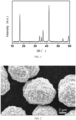
- Example 1 it can be found from the comparison of Example 1 and Examples 3-6 that in the preparation process of the cathode material for sodium-ion batteries in the present application, when the pH of the reaction system is controlled at 9-12 and the concentration of the complexing agent in the reaction system is controlled at 1.5-3.0 mmol/L, the radially-packed cathode material for sodium-ion batteries can be prepared. If the reaction conditions are beyond the ranges or inappropriately matched, the prepared precursor will be in random packing mode or close-packed planar stacking mode, or even the spherical precursors cannot be prepared.
- Example 1 It can be found from the comparison of Example 1 and Comparative Example 1 that in the preparation process of the cathode material for sodium-ion batteries in the present application, the organic additive is required to be added to prepare the radially-packed cathode material for sodium-ion batteries.
- the organic additive can be adsorbed on the specific crystal plane of the precursor, so as to contribute to the orientation growth of the crystal plane to obtain the radially-packed cathode material for sodium-ion batteries.
- Example 1 Comparative Example 2
- the strong covalent B-O bond is constructed, so that oxygen atoms have more negative charges to reduce the excessive oxidation of oxygen effectively, thereby improving the lattice oxygen stability in the process of high-voltage deep sodium deintercalation, inhibiting multiple phase transition reactions, and increasing the voltage plateau and cycling stability simultaneously.
Landscapes
- Chemical & Material Sciences (AREA)
- Chemical Kinetics & Catalysis (AREA)
- General Chemical & Material Sciences (AREA)
- Electrochemistry (AREA)
- Inorganic Chemistry (AREA)
- Engineering & Computer Science (AREA)
- Organic Chemistry (AREA)
- Materials Engineering (AREA)
- Manufacturing & Machinery (AREA)
- Composite Materials (AREA)
- Battery Electrode And Active Subsutance (AREA)
- Inorganic Compounds Of Heavy Metals (AREA)
- Secondary Cells (AREA)
Applications Claiming Priority (2)
| Application Number | Priority Date | Filing Date | Title |
|---|---|---|---|
| CN202310167453.2A CN116143195B (zh) | 2023-02-27 | 2023-02-27 | 一种钠离子电池正极材料及其制备方法和应用 |
| PCT/CN2023/087256 WO2024178794A1 (zh) | 2023-02-27 | 2023-04-10 | 一种钠离子电池正极材料及其制备方法和应用 |
Publications (2)
| Publication Number | Publication Date |
|---|---|
| EP4455093A1 true EP4455093A1 (de) | 2024-10-30 |
| EP4455093A4 EP4455093A4 (de) | 2026-01-28 |
Family
ID=86359840
Family Applications (1)
| Application Number | Title | Priority Date | Filing Date |
|---|---|---|---|
| EP23916603.6A Pending EP4455093A4 (de) | 2023-02-27 | 2023-04-10 | Positivelektrodenmaterial für natriumionenbatterie, herstellungsverfahren dafür und verwendung davon |
Country Status (6)
| Country | Link |
|---|---|
| US (1) | US12522515B2 (de) |
| EP (1) | EP4455093A4 (de) |
| JP (1) | JP7723395B2 (de) |
| KR (1) | KR102821608B1 (de) |
| CN (1) | CN116143195B (de) |
| WO (1) | WO2024178794A1 (de) |
Families Citing this family (5)
| Publication number | Priority date | Publication date | Assignee | Title |
|---|---|---|---|---|
| CN116462242A (zh) * | 2023-06-07 | 2023-07-21 | 荆门市格林美新材料有限公司 | 一种镍铁锰铜钠离子前驱体及其制备方法和应用 |
| CN116779832B (zh) * | 2023-08-25 | 2023-10-27 | 江苏正力新能电池技术有限公司 | 一种插层钠离子电池层状氧化物正极材料及其制备和应用 |
| CN119864419A (zh) * | 2023-10-19 | 2025-04-22 | 合肥国轩高科动力能源有限公司 | 一种钠离子电池正极材料及其制备方法与应用 |
| WO2025111942A1 (zh) * | 2023-11-30 | 2025-06-05 | 青美邦新能源材料有限公司 | 一种钛掺杂钠电层状氧化物材料及其制备方法与应用 |
| CN118380580B (zh) * | 2024-06-25 | 2024-09-13 | 成都大学 | 一种钠离子电池正极材料及其制备方法和应用 |
Family Cites Families (14)
| Publication number | Priority date | Publication date | Assignee | Title |
|---|---|---|---|---|
| JP2002042812A (ja) * | 2000-07-27 | 2002-02-08 | Yuasa Corp | リチウム二次電池用正極活物質及びそれを用いたリチウム二次電池 |
| CN1641914A (zh) * | 2004-12-24 | 2005-07-20 | 清华大学 | 一种锂离子电池的正极材料及其制备方法 |
| CN101621125B (zh) * | 2009-02-13 | 2011-03-30 | 成都晶元新材料技术有限公司 | 一种镍钴锰多元掺杂锂离子电池正极材料及其制备方法 |
| CN109817974B (zh) | 2019-03-27 | 2022-05-03 | 山东理工大学 | 一种钠离子镍锰镁铁四元正极材料及其制备方法 |
| CN110416521A (zh) | 2019-08-01 | 2019-11-05 | 上海应用技术大学 | 一种镁掺杂的钠离子电池三元正极材料及其制备方法 |
| CN110627127B (zh) * | 2019-08-30 | 2020-11-17 | 湖南金富力新能源股份有限公司 | 一种锰酸锂正极材料及其制备方法和应用 |
| CN111697210B (zh) * | 2019-09-25 | 2022-04-26 | 中南大学 | 一种钠离子电池多元正极材料及其制备方法 |
| CN111689528B (zh) | 2020-07-10 | 2023-03-31 | 湖北亿纬动力有限公司 | 一种三元材料前驱体及其制备方法和用途 |
| CN112758995A (zh) * | 2021-01-06 | 2021-05-07 | 上海卡耐新能源有限公司 | 一种三元正极前驱体及其制备方法和用途 |
| CN114566632B (zh) * | 2022-03-04 | 2024-02-06 | 上海苏迪恩新能源科技有限责任公司 | 一种钠离子电池用的正极材料及其制备方法 |
| CN115000399B (zh) * | 2022-05-25 | 2023-07-25 | 江苏聚烽新能源科技有限公司 | 一种类球状钠离子电池正极材料及其制备方法和钠离子电池 |
| CN114988494B (zh) * | 2022-06-10 | 2023-12-26 | 宁波容百新能源科技股份有限公司 | 硼元素掺杂的高镍三元前驱体材料、其制备方法与高镍三元正极材料 |
| CN115650318B (zh) * | 2022-11-16 | 2024-03-01 | 浙江吉利控股集团有限公司 | 一种掺杂的p2型层状镍锰酸钠正极材料及其制备方法 |
| CN117374248A (zh) | 2023-10-25 | 2024-01-09 | 湖北融通高科先进材料集团股份有限公司 | 钠离子电池层状三元正极材料及其制备方法、其应用 |
-
2023
- 2023-02-27 CN CN202310167453.2A patent/CN116143195B/zh active Active
- 2023-04-10 WO PCT/CN2023/087256 patent/WO2024178794A1/zh not_active Ceased
- 2023-04-10 JP JP2024544488A patent/JP7723395B2/ja active Active
- 2023-04-10 KR KR1020247026034A patent/KR102821608B1/ko active Active
- 2023-04-10 EP EP23916603.6A patent/EP4455093A4/de active Pending
- 2023-04-10 US US18/832,651 patent/US12522515B2/en active Active
Also Published As
| Publication number | Publication date |
|---|---|
| WO2024178794A1 (zh) | 2024-09-06 |
| JP2025512223A (ja) | 2025-04-17 |
| US12522515B2 (en) | 2026-01-13 |
| EP4455093A4 (de) | 2026-01-28 |
| KR20240134929A (ko) | 2024-09-10 |
| CN116143195B (zh) | 2024-04-26 |
| JP7723395B2 (ja) | 2025-08-14 |
| US20250145492A1 (en) | 2025-05-08 |
| KR102821608B1 (ko) | 2025-06-16 |
| CN116143195A (zh) | 2023-05-23 |
Similar Documents
| Publication | Publication Date | Title |
|---|---|---|
| EP4455093A1 (de) | Positivelektrodenmaterial für natriumionenbatterie, herstellungsverfahren dafür und verwendung davon | |
| US20230373814A1 (en) | Cathode material precursor and preparation method and application thereof | |
| CN110611080B (zh) | 一种过渡金属掺杂的磷酸钛锰钠/碳复合正极材料及其制备和在钠离子电池中的应用 | |
| WO2023184508A1 (zh) | 碳/类普鲁士蓝复合材料及制备方法和应用 | |
| US20230264975A1 (en) | Doped nickel-rich ternary material and preparation method thereof | |
| CN103811743A (zh) | 富锂正极材料、锂电池正极和锂电池 | |
| CN103633322A (zh) | 一种高密度球形磷酸铁锂材料的制备方法 | |
| CN111682174B (zh) | 一种锑包覆的锂电池正极材料及其制备方法和应用 | |
| CN117486269B (zh) | 高熵过渡金属层状氧化物、正极材料、电池及其制备方法 | |
| CN112723427A (zh) | 一种三元正极前驱体及其制备方法和用途 | |
| CN108336309B (zh) | 一种钙钛矿型开框架铁基氟化物正极材料及其制备方法和应用 | |
| CN114613959A (zh) | 一种阴阳离子共修饰富锂锰基复合材料、制备方法和应用 | |
| CN108400296B (zh) | 异质元素掺杂四氧化三铁/石墨烯负极材料 | |
| CN117577830A (zh) | 焦磷酸磷酸锰铁钠材料及其制备方法和应用 | |
| CN110085854B (zh) | 一种磷酸钒锂正极材料及其制备方法 | |
| CN103811753A (zh) | 富锂正极材料、锂电池正极和锂电池 | |
| CN119361676A (zh) | 一种掺杂型富锂锰氧化物正极材料及其制备方法与应用 | |
| KR20260017270A (ko) | 복합 탄소원으로 코팅된 인산망간철리튬 양극재 및 그 제조 방법 | |
| CN112186166A (zh) | 一种钼/钴氧化物-碳复合材料及其制备方法、锂离子电池负极极片和锂离子电池 | |
| CN115571929B (zh) | 一种镍锰二元复合正极材料及其制备方法 | |
| CN118943360A (zh) | 普鲁士蓝类正极材料及其制备方法、正极极片、二次电池和用电装置 | |
| CN114784243A (zh) | 一种氮掺杂还原氧化石墨烯负载磷化镍复合材料及其制备方法 | |
| CN119786583B (zh) | 草酸锂/cnt包覆改性富锂锰正极材料及其制备方法 | |
| CN118213653B (zh) | 钠离子层状正极材料、制备方法和正极极片 | |
| CN109904445A (zh) | 一种富锂锰基锂电池用正极材料的制备方法及材料 |
Legal Events
| Date | Code | Title | Description |
|---|---|---|---|
| STAA | Information on the status of an ep patent application or granted ep patent |
Free format text: STATUS: UNKNOWN |
|
| STAA | Information on the status of an ep patent application or granted ep patent |
Free format text: STATUS: THE INTERNATIONAL PUBLICATION HAS BEEN MADE |
|
| PUAI | Public reference made under article 153(3) epc to a published international application that has entered the european phase |
Free format text: ORIGINAL CODE: 0009012 |
|
| STAA | Information on the status of an ep patent application or granted ep patent |
Free format text: STATUS: REQUEST FOR EXAMINATION WAS MADE |
|
| 17P | Request for examination filed |
Effective date: 20240725 |
|
| AK | Designated contracting states |
Kind code of ref document: A1 Designated state(s): AL AT BE BG CH CY CZ DE DK EE ES FI FR GB GR HR HU IE IS IT LI LT LU LV MC ME MK MT NL NO PL PT RO RS SE SI SK SM TR |
|
| REG | Reference to a national code |
Ref country code: DE Ref legal event code: R079 Free format text: PREVIOUS MAIN CLASS: C01G0053000000 Ipc: C01G0053510000 |
|
| A4 | Supplementary search report drawn up and despatched |
Effective date: 20260108 |
|
| RIC1 | Information provided on ipc code assigned before grant |
Ipc: C01G 53/51 20250101AFI20251223BHEP Ipc: H01M 4/505 20100101ALI20251223BHEP Ipc: H01M 4/525 20100101ALI20251223BHEP Ipc: H01M 4/485 20100101ALI20251223BHEP Ipc: H01M 4/131 20100101ALI20251223BHEP Ipc: H01M 10/054 20100101ALI20251223BHEP |