EP4439745A1 - Aminbrom-zweielektronenelektrolyt einer flussbatterie und verwendung davon und flussbatterie - Google Patents
Aminbrom-zweielektronenelektrolyt einer flussbatterie und verwendung davon und flussbatterie Download PDFInfo
- Publication number
- EP4439745A1 EP4439745A1 EP22902750.3A EP22902750A EP4439745A1 EP 4439745 A1 EP4439745 A1 EP 4439745A1 EP 22902750 A EP22902750 A EP 22902750A EP 4439745 A1 EP4439745 A1 EP 4439745A1
- Authority
- EP
- European Patent Office
- Prior art keywords
- electrolyte
- flow battery
- mol
- bromine
- electron
- Prior art date
- Legal status (The legal status is an assumption and is not a legal conclusion. Google has not performed a legal analysis and makes no representation as to the accuracy of the status listed.)
- Pending
Links
Images
Classifications
-
- H—ELECTRICITY
- H01—ELECTRIC ELEMENTS
- H01M—PROCESSES OR MEANS, e.g. BATTERIES, FOR THE DIRECT CONVERSION OF CHEMICAL ENERGY INTO ELECTRICAL ENERGY
- H01M8/00—Fuel cells; Manufacture thereof
- H01M8/18—Regenerative fuel cells, e.g. redox flow batteries or secondary fuel cells
- H01M8/184—Regeneration by electrochemical means
- H01M8/188—Regeneration by electrochemical means by recharging of redox couples containing fluids; Redox flow type batteries
-
- H—ELECTRICITY
- H01—ELECTRIC ELEMENTS
- H01M—PROCESSES OR MEANS, e.g. BATTERIES, FOR THE DIRECT CONVERSION OF CHEMICAL ENERGY INTO ELECTRICAL ENERGY
- H01M2300/00—Electrolytes
- H01M2300/0002—Aqueous electrolytes
-
- H—ELECTRICITY
- H01—ELECTRIC ELEMENTS
- H01M—PROCESSES OR MEANS, e.g. BATTERIES, FOR THE DIRECT CONVERSION OF CHEMICAL ENERGY INTO ELECTRICAL ENERGY
- H01M2300/00—Electrolytes
- H01M2300/0002—Aqueous electrolytes
- H01M2300/0005—Acid electrolytes
-
- H—ELECTRICITY
- H01—ELECTRIC ELEMENTS
- H01M—PROCESSES OR MEANS, e.g. BATTERIES, FOR THE DIRECT CONVERSION OF CHEMICAL ENERGY INTO ELECTRICAL ENERGY
- H01M2300/00—Electrolytes
- H01M2300/0088—Composites
- H01M2300/0091—Composites in the form of mixtures
-
- Y—GENERAL TAGGING OF NEW TECHNOLOGICAL DEVELOPMENTS; GENERAL TAGGING OF CROSS-SECTIONAL TECHNOLOGIES SPANNING OVER SEVERAL SECTIONS OF THE IPC; TECHNICAL SUBJECTS COVERED BY FORMER USPC CROSS-REFERENCE ART COLLECTIONS [XRACs] AND DIGESTS
- Y02—TECHNOLOGIES OR APPLICATIONS FOR MITIGATION OR ADAPTATION AGAINST CLIMATE CHANGE
- Y02E—REDUCTION OF GREENHOUSE GAS [GHG] EMISSIONS, RELATED TO ENERGY GENERATION, TRANSMISSION OR DISTRIBUTION
- Y02E60/00—Enabling technologies; Technologies with a potential or indirect contribution to GHG emissions mitigation
- Y02E60/30—Hydrogen technology
- Y02E60/50—Fuel cells
Definitions
- the present application relates to a flow battery electrolyte, specifically to an amine-bromine two electron electrolyte of flow battery and use thereof, and a flow battery the field of multi-electron transfer aqueous iodine-based battery, which belongs to the field of flow battery.
- Bromine ions have typically high solubility and relatively good electrochemical activity, which is a kind of positive active material with development potential. Bromine has abundant valence changes and theoretically can achieve multi electron transfer reactions, but the current utilization of bromine is only a single-electron transfer reaction between bromide ions and bromine monomers, and further electron-loss products are rather unstable, which limits its energy density.
- the present invention aims to provide a method of preparing a bromine-based two-electron transfer electrolyte and its application in a flow battery.
- the present invention realizes a two-step two-electron transfer reaction, on the basis of single electron transfer between a bromide ion and a bromine monomer, by reacting the bromine monomer (after further loss of electrons) with the amino group on the amine compound with an electron-withdrawing group to generate a N-Bromo amines.
- This reaction broadens the reversible valence reaction of bromine from a single-electron reaction with negative monovalent to zero valence to a two-electron reaction with negative monovalent to positive monovalent, resulting in a doubling of the energy density. And this reaction can flexibly adjust solubility and voltage according to the different types of amino compounds.
- the flow batteries assembled using this two-electron reacting electrolyte can achieve high energy density, charging and discharging efficiency and stability with low cost, and can be applied in distributed energy storage systems with high energy density requirements.
- a flow battery electrolyte where the electrolyte comprises bromine ions, an amine compound with an electron-withdrawing group at the ortho-position of an amino group, and a supporting electrolyte; when the amine compound with an electron-withdrawing group at the ortho-position of an amino group itself carries an ion-conducting group, the electrolyte does not comprise a supporting electrolyte.
- the electrolyte consists of bromine ions, an amine compound with an electron-withdrawing group at the ortho-position of an amino group, and a supporting electrolyte; when the amine compound with an electron-withdrawing group at the ortho-position of an amino group itself carries an ion-conducting group, the electrolyte does not comprise a supporting electrolyte.
- the bromine ions, and the amine compound with an electron-withdrawing group at the ortho-position of an amino group are used as a positive active material; the bromine ions, and the amine compound with an electron-withdrawing group at the ortho-position of an amino group undergo an oxidation and/or a reduction reaction during a cycling process of a flow battery.
- bromine ions include one or more of hydrobromic acid, sodium bromide, potassium bromide, zinc bromide, ammonium bromide, zinc bromide and other salts containing bromide ion; preferably hydrobromic acid and zinc bromide.
- a concentration of the bromine ions is from 0.1 mol L -1 to 5 mol L -1 , preferably from 1 mol L -1 to 2 mol L -1 .
- the concentration of the bromine ions is selected from any value or a range value determined by any two of 0.1 mol L -1 , 0.5 mol L -1 , 1 mol L -1 , 2 mol L -1 , 2.5 mol L -1 , 3 mol L -1 , 3.5 mol L -1 , 4 mol L -1 , 4.5 mol L -1 , 5 mol L -1 .
- the amine compound includes one or more of sulfamic acid, sodium sulfamate, potassium sulfamate, ammonium sulfamate, sulfonamide, succinimide, acetamide, phthalimide, saccharin, sodium pyrrolidonecarboxylate, barbituric acid, dicyandiamide, methanesulfonamide, cyanuric acid, trifluoromethanesulfonamide, and 2-aminopyrimidine; preferably one or more of sulfamic acid, sodium sulfamate, potassium sulfamate, and ammonium sulfamate.
- a concentration of the amine compound is from 0.1 mol L -1 to 5 mol L -1 , preferably from 1 mol L -1 to 2 mol L -1 .
- the concentration of the amine compound is selected from any value or a range value determined by any two of 0.1 mol L -1 , 0.5 mol L -1 , 1 mol L -1 , 1.2 mol L -1 , 1.4 mol L -1 , 1.6mol L -1 , 1.8 mol L -1 , 2 mol L -1 , 2.5 mol L -1 , 3 mol L -1 , 3.5 mol L -1 , 4 mol L -1 , 4.5 mol L -1 , 5 mol L -1 .
- the concentration of the amine compound depends on its own solubility, for example, the solubility of sodium sulfamate can reach 8 mol L -1 .
- the supporting electrolyte includes one or more of sulfuric acid, acetic acid, glycolic acid, bromoacetic acid, potassium chloride, potassium acetate, sodium chloride, sodium acetate, and sodium sulfate; preferably one or two of sulfuric acid and potassium chloride, which are used in acidic and neutral environments, respectively.
- the amino compound itself can ionize conductive ions, it can also be used without adding another supporting electrolytes, such as sodium sulfamate, which can be used directly as a supporting electrolyte.
- a concentration of the supporting electrolyte is from 0.1 mol L -1 to 4 mol L -1 , preferably from 1 mol L -1 to 2 mol L -1 .
- the concentration of the supporting electrolyte is selected from any value or a range value determined by any two of 0.1 mol L -1 , 0.5 mol L -1 , 1 mol L -1 , 1.2 mol L -1 , 1.4 mol L -1 , 1.6mol L -1 , 1.8 mol L -1 , 2 mol L -1 , 2.5 mol L -1 , 3 mol L -1 , 3.5 mol L -1 , 4 mol L -1 .
- the electrolyte is an aqueous solution comprising the bromine ions, the amine compound with an electron-withdrawing group at the ortho-position of an amino group, and the supporting electrolyte.
- a negative electrolyte active material of the flow battery comprises one or more of titanium sulfate, hexafluorotitanic acid, titanium bromide, cadmium sulfate, cadmium bromide, cadmium chloride, lead chloride, stannous chloride, zinc bromide, and zinc acetate; preferably one or more of titanium sulfate, cadmium sulfate, and zinc bromide.
- a flow battery where the flow battery contains a positive electrode, a negative electrode, and a separator for separating the positive and negative electrodes; a chamber on the positive electrode side is filled with a positive electrolyte, and a chamber on the negative electrode is filled with a negative electrolyte; the positive electrolyte comprises at least one of the above electrolytes.
- An active material of the negative electrolyte is one or more of titanium sulfate, hexafluorotitanic acid, titanium bromide, cadmium sulfate, cadmium bromide, cadmium chloride, lead chloride, stannous chloride, zinc bromide, and zinc acetate.
- the flow battery contains a metal terminal plate, a current collector, a flow frame, an activated carbon felt or a graphite felt as an electrode, a separator for separating the positive and negative electrodes, and a rubber gasket for sealing; a chamber between the positive current collector and the separator is filled with a positive graphite felt or carbon felt and a positive electrolyte, and a chamber between the negative current collector and the separator is filled with a negative graphite felt or carbon felt and a negative electrolyte.
- the electrolyte is circulated between the chamber and a storage tank via one of a magnetic centrifugal pump or a peristaltic pump, and the positive electrolyte is optionally non-circulating and sealed in the chamber as a single flow battery.
- the metal terminal plate may be any one selected from the group consisting of an aluminum alloy plate, a stainless steel plate, and other acid corrosion-resistant metal plate, preferably a stainless steel plate;
- the current collector may be any one selected from the group consisting of a graphite plate, and a titanium plate, and the positive current collector is preferred to be a titanium plate;
- the separator may be any one selected from the group consisting of a perfluorosulfonic acid membrane, a porous polyolefin membrane, a sulfonated polyether ether ketone membrane, and a polybenzimidazole membrane; preferably a perfluorosulfonic acid membrane.
- an amine compound with an electron-withdrawing group at the ortho-position of an amino group is used to react with bromine, which is charged to a positive valence, so as to form an amine-bromine compound, such that positive-valence bromine is stabilized, and a reversible two-electron transfer reaction from bromine ions to amine-bromine compounds is achieved.
- the amine compounds have different solubilities and produce different voltages depending on their substituent groups, and thus have extensive adjustability and applicability for use in acidic, neutral, and weak alkaline flow battery systems. Flow batteries assembled with the electrolyte prepared using this reaction has the advantages of low cost and high energy density, and can achieve a longer cycle life and higher battery efficiency.
- the positive and negative electrolyte have the same composition, both consisting of 1mol L -1 of zinc bromide, 2 mol L -1 of sodium sulfamate, and 2 mol L -1 of potassium acetate.
- zinc bromide provides both zinc ions used for the negative electrode and bromine ions needed for the positive electrode.
- the structure of the single cell includes terminal plates, graphite plates for current collector, 6 ⁇ 8 cm carbon felt for the positive and negative electrodes, perfluorosulfonic acid separator using Nafion membranes, flow frames, silicone pads, terminal plates, positive and negative electrolyte storage tank, and pumps as well as piping.
- Constant-current charging and discharging mode was adopted, the flow rate of the electrolyte was 60 mL min -1 , the charging and discharging current was 40 mA cm -2 , the charging cut-off voltage was 2.0 V, and the discharging cut-off voltage was 0.1 V.
- the average values of the Coulombic efficiency CE, the voltage efficiency VE, and the energy efficiency EE for the first 100 cycles of the charging and discharging cycles were detected.
- Example 1 Composition and Performance of batteries in Different Examples and Comparative examples (Comparative) examples negative active material (mol L -1 ) Bromine source (mol L -1 ) Amine compounds (mol L -1 ) Supporting electrolytes (mol L -1 ) Energy density (WhL -1 ) CE VE EE
- Example 1 ZnBr 2 1.0 ZnBr 2 1.0 Sodium sulfamate 2.0 potassium acetate 2.0 172 98.89 85.15 84.20
- Example 2 CdSO 4 1.0 ZnBr 2 1.0 Sodium sulfamate 2.0 potassium acetate 2.0 160 98.81 84.55 83.54
- Example 3 ZnBr 2 1.0 ZnBr 2 1.0 Acetamide 2.0 potassium acetate 2.0 172 98.55 83.53 82.61
- Example 4 ZnBr 2 1.0 ZnBr 2 1.0 Sodium sulfamate 2.0
- the flow battery can achieve higher energy density, Coulombic efficiency, voltage efficiency, and energy efficiency.
- the negative active material can be selected from various sources, such as using both Zn 2+ /Zn and Cd 2+ /Cd as the negative redox pair can achieve high performance.
- the Zn 2+ /Zn negative redox pair has a lower standard electrode potential, and thus the voltage of the battery is higher, and the voltage efficiency and energy efficiency of the battery will be higher.
- the batteries are all able to achieve high performance within the range of selected amino compounds.
- the ortho position of the amino of acetamide is a carbonyl group
- the ortho position of the amino of sodium sulfamate is a sulfonic acid group, both of which are electron-withdrawing groups, and thus both can undergo a two-electron transfer reaction with bromine, resulting in a higher energy density. Since the electronic structure of each amino compound may differ, its ability to bind with bromine may also differ, thus showing different battery efficiencies.
- Example 1 and Example 4 when the amino compound itself can ionize conductive ions, a high battery efficiency can be obtained without addition of a supporting electrolyte.
- the sodium sulfamate itself is capable of ionizing sodium ions and thus has the function of conducting ions.
- not adding supporting electrolytes will lead to a decrease in the conductivity of the solution and a slight decrease in the voltage efficiency of the battery.
- Example 1 the batteries are all able to achieve high performance within the selected range of bromine ion sources.
- Example 1 uses zinc bromide as both a bromine source and a negative active material, and thus is able to save raw materials and reduce a portion of the cost.
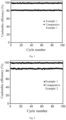
- Fig. 1 shows a chart of Coulomb efficiency for 100 cycles of the batteries of Example 1 and Comparative Example 1.
- the Coulombic efficiency of the battery of Comparative Example 1 is only 81% under the same energy density conditions, due to the absence of the addition of the amino compounds. This is mainly due to the fact that in the absence of the addition of the selected amino compounds, bromine can only undergo reversible single electron reactions, further charging will be charged to hypobromous or bromous acid, of which the reversibility is relatively poor, side reactions may occur, and thus it will lead to a decrease in the Coulombic efficiency.
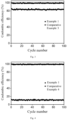
- Fig. 2 shows a chart of Coulomb efficiency for 100 cycles of the batteries of Example 1 and Comparative Example 2.
- glycine was added as an amino compound in Comparative Example 2
- the ortho position of the amino of glycine is methylene group, an electron-donating group, which cannot undergo reversible two electron transfer reaction with bromine. Therefore, similar to the reaction that occurs in Comparative Example 1, it will lead to lower Coulombic efficiency.
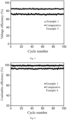
- Fig. 3 shows a chart of Coulomb efficiency for 100 cycles of the batteries of Example 1 and Comparative Example 3.
- the ortho position of the amino of ethanolamine is alcohol hydroxyl group, an electron-donating group, which cannot undergo reversible two electron transfer reaction with bromine. Therefore, similar to the reaction that occurs in Comparative Example 2, it will lead to lower Coulombic efficiency.
- Fig. 4 shows a chart of Coulomb efficiency for 100 cycles of the batteries of Example 1 and Comparative Example 4. As can be seen from the chart, due to the absence of a bromine source in Comparative Example 4, the Coulombic efficiency is very low. This indicates that amino compounds themselves do not have redox activity and require binding with bromine to undergo reversible electron transfer reactions. Otherwise, only oxygen evolution reactions can occur at the positive electrode, resulting in extremely low Coulombic efficiency.
- Fig. 5 shows a chart of voltage efficiency for 100 cycles of the batteries of Example 1 and Comparative Example 5. As can be seen from the chart, due to the absence of supporting electrolytes in Comparative Example 5, and the fact that acetamide itself cannot provide conductive ions, the conductivity of the solution is lower, resulting in lower voltage efficiency.
- Fig. 6 shows a chart of Coulomb efficiency for 100 cycles of the batteries of Example 1 and Comparative Example 6. No selected amino compound was added in Comparative Example 6, and only a single electron reaction could occur, resulting in an energy density half lower than the two-electron reaction in Example 1. Moreover, due to the volatilization and diffusion of bromine monomer in the later stage of charging, the Coulombic efficiency of the battery is lower.
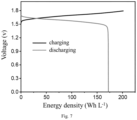
- FIG. 7 shows the charge/discharge curves of the flow battery of Example 1.
- the battery can achieve an energy density of 172 Wh L -1 , corresponding to the two-electron transfer reaction of bromine. At this energy density, the battery can still achieve high Coulombic efficiency, voltage efficiency, and energy efficiency.
- the two-electron transfer reaction of bromine can be realized, so that the flow battery can operate stably and efficiently at a high energy density.
Landscapes
- Life Sciences & Earth Sciences (AREA)
- Engineering & Computer Science (AREA)
- Manufacturing & Machinery (AREA)
- Sustainable Development (AREA)
- Sustainable Energy (AREA)
- Chemical & Material Sciences (AREA)
- Chemical Kinetics & Catalysis (AREA)
- Electrochemistry (AREA)
- General Chemical & Material Sciences (AREA)
- Hybrid Cells (AREA)
- Fuel Cell (AREA)
Applications Claiming Priority (2)
| Application Number | Priority Date | Filing Date | Title |
|---|---|---|---|
| CN202111481099.8A CN116231022A (zh) | 2021-12-06 | 2021-12-06 | 一种胺溴双电子液流电池电解液及其应用和液流电池 |
| PCT/CN2022/098184 WO2023103312A1 (zh) | 2021-12-06 | 2022-06-10 | 一种胺溴双电子液流电池电解液及其应用和液流电池 |
Publications (2)
| Publication Number | Publication Date |
|---|---|
| EP4439745A1 true EP4439745A1 (de) | 2024-10-02 |
| EP4439745A4 EP4439745A4 (de) | 2025-11-05 |
Family
ID=86581182
Family Applications (1)
| Application Number | Title | Priority Date | Filing Date |
|---|---|---|---|
| EP22902750.3A Pending EP4439745A4 (de) | 2021-12-06 | 2022-06-10 | Aminbrom-zweielektronenelektrolyt einer flussbatterie und verwendung davon und flussbatterie |
Country Status (5)
| Country | Link |
|---|---|
| US (1) | US20250038241A1 (de) |
| EP (1) | EP4439745A4 (de) |
| JP (1) | JP2024542283A (de) |
| CN (1) | CN116231022A (de) |
| WO (1) | WO2023103312A1 (de) |
Families Citing this family (1)
| Publication number | Priority date | Publication date | Assignee | Title |
|---|---|---|---|---|
| CN119581628A (zh) * | 2023-09-05 | 2025-03-07 | 中国科学院大连化学物理研究所 | 一种均相低毒的锌溴液流电池电解液 |
Family Cites Families (18)
| Publication number | Priority date | Publication date | Assignee | Title |
|---|---|---|---|---|
| US3558503A (en) * | 1968-07-22 | 1971-01-26 | Dow Chemical Co | Stable bromo-sulfamate composition |
| US4038459A (en) * | 1976-03-17 | 1977-07-26 | Eco-Control, Inc. | Halogen complexing alcohols and nitriles |
| US4038460A (en) * | 1976-03-17 | 1977-07-26 | Eco-Control, Inc. | Halogen complexing ethers |
| GB1569397A (en) * | 1976-04-07 | 1980-06-11 | Exxon Research Engineering Co | Metal-halogen electrochemical cell |
| JPS59111277A (ja) * | 1982-12-17 | 1984-06-27 | Meidensha Electric Mfg Co Ltd | 亜鉛―臭素二次電池 |
| US4491625A (en) * | 1984-03-26 | 1985-01-01 | Exxon Research & Engineering Co. | Zinc-bromine batteries with improved electrolyte |
| JPH02142071A (ja) * | 1988-11-24 | 1990-05-31 | Meidensha Corp | 亜鉛−臭素電池の電解液 |
| US6123870A (en) * | 1998-06-29 | 2000-09-26 | Nalco Chemical Company | Stable oxidizing bromine formulations, method of manufacture and uses thereof for biofouling control |
| CN102790233A (zh) * | 2011-05-20 | 2012-11-21 | 罗臬 | 液流型电化学电池 |
| CA2929694A1 (en) * | 2013-08-18 | 2015-02-26 | Ftorion, Inc. | Flow battery and regeneration system with improved safety |
| EA201790421A1 (ru) * | 2014-08-20 | 2017-06-30 | Альбемарл Корпорейшн | Галогениды четвертичного аммония с эфирными функциональными группами для применения в качестве электролитов батарей |
| JP2018512719A (ja) * | 2015-03-19 | 2018-05-17 | プリマス パワー コーポレイション | キレート剤および金属めっき促進剤を含むフロー電池電解質組成物 |
| KR101851376B1 (ko) * | 2016-02-02 | 2018-05-31 | 롯데케미칼 주식회사 | 레독스 흐름 전지용 전해액 및 레독스 흐름 전지 |
| US10892524B2 (en) * | 2016-03-29 | 2021-01-12 | Eos Energy Storage, Llc | Electrolyte for rechargeable electrochemical cell |
| CA2957877A1 (en) * | 2017-01-20 | 2018-07-20 | Albemarle Corporation | Quaternary ammonium halides with ether functional groups for use as battery electrolytes |
| CN110446771A (zh) * | 2017-02-13 | 2019-11-12 | Cmblu企划股份公司 | 氧化还原液流电池组电解质 |
| CN108711633B (zh) * | 2018-05-28 | 2021-09-10 | 安徽鹰龙工业设计有限公司 | 用于锌溴液流电池的电解液 |
| CN111244518B (zh) * | 2018-11-28 | 2021-02-12 | 中国科学院大连化学物理研究所 | 一种水系中性有机液流电池 |
-
2021
- 2021-12-06 CN CN202111481099.8A patent/CN116231022A/zh active Pending
-
2022
- 2022-06-10 JP JP2024533103A patent/JP2024542283A/ja active Pending
- 2022-06-10 EP EP22902750.3A patent/EP4439745A4/de active Pending
- 2022-06-10 US US18/716,946 patent/US20250038241A1/en active Pending
- 2022-06-10 WO PCT/CN2022/098184 patent/WO2023103312A1/zh not_active Ceased
Also Published As
| Publication number | Publication date |
|---|---|
| CN116231022A (zh) | 2023-06-06 |
| US20250038241A1 (en) | 2025-01-30 |
| EP4439745A4 (de) | 2025-11-05 |
| JP2024542283A (ja) | 2024-11-13 |
| WO2023103312A1 (zh) | 2023-06-15 |
Similar Documents
| Publication | Publication Date | Title |
|---|---|---|
| CN112467179B (zh) | 一种碱性全铁液流电池 | |
| EP3709421A1 (de) | Zink-iod-durchflussbatterie | |
| US11552324B2 (en) | High efficiency zinc-iodine adsorption-aided flow battery with a low cost membrane | |
| WO2016078491A1 (zh) | 一种长寿命锌溴液流电池 | |
| CN111261910B (zh) | 一种碱性锌铁液流电池用正极电解液及应用 | |
| KR102806882B1 (ko) | 음극 전해액 및 이를 포함하는 레독스 플로우 전지 | |
| CN108475802A (zh) | 再生燃料电池 | |
| CN113013460B (zh) | 一种碱性锌铁液流电池用负极电解液及锌铁液流电池 | |
| EP4439745A1 (de) | Aminbrom-zweielektronenelektrolyt einer flussbatterie und verwendung davon und flussbatterie | |
| AU2015349218B2 (en) | Quinone polyhalide flow battery | |
| CN116259808A (zh) | 近中性低电位锌络合电解液及其在液流电池中的应用 | |
| CN111293340A (zh) | 中性有机氧化还原液流电池 | |
| CN108123174A (zh) | 一种碱性锌铁液流电池用正极电解液及应用 | |
| CN119650783B (zh) | 一种溴铬液流电池电解液及液流电池 | |
| CN114614038A (zh) | 一种锌溴液流电池电解液及其在锌溴液流电池中的应用 | |
| Tian et al. | Influence of NH4Cl additive in a VO2+/VO2+-AQDS/AQDS2− solar redox flow battery | |
| CN106328975A (zh) | 一种全钒氧化还原液流电池 | |
| CN115377517B (zh) | 一种水系电解液及其在钠离子电池中的应用 | |
| CN116014182B (zh) | 一种提高水系有机液流电池正极电解液循环性能的方法 | |
| EP4439746A1 (de) | Wässrige iod-batterie auf der basis von multielektronentransfer | |
| CN110071317A (zh) | 一种锡溴液流电池 | |
| CN111326778A (zh) | 一种中性锂溴液流电池 | |
| CN116207315A (zh) | 一种双电子转移卤素液流电池电解液及其应用 | |
| CN114551935A (zh) | 一种锌溴单液流电池的性能恢复方法 | |
| CN115966740B (zh) | 一种碱性锌溴液流电池 |
Legal Events
| Date | Code | Title | Description |
|---|---|---|---|
| STAA | Information on the status of an ep patent application or granted ep patent |
Free format text: STATUS: THE INTERNATIONAL PUBLICATION HAS BEEN MADE |
|
| PUAI | Public reference made under article 153(3) epc to a published international application that has entered the european phase |
Free format text: ORIGINAL CODE: 0009012 |
|
| STAA | Information on the status of an ep patent application or granted ep patent |
Free format text: STATUS: REQUEST FOR EXAMINATION WAS MADE |
|
| 17P | Request for examination filed |
Effective date: 20240628 |
|
| AK | Designated contracting states |
Kind code of ref document: A1 Designated state(s): AL AT BE BG CH CY CZ DE DK EE ES FI FR GB GR HR HU IE IS IT LI LT LU LV MC MK MT NL NO PL PT RO RS SE SI SK SM TR |
|
| DAV | Request for validation of the european patent (deleted) | ||
| DAX | Request for extension of the european patent (deleted) | ||
| A4 | Supplementary search report drawn up and despatched |
Effective date: 20251007 |
|
| RIC1 | Information provided on ipc code assigned before grant |
Ipc: H01M 8/18 20060101AFI20250930BHEP |