EP4432384A2 - Procédé de fabrication d'un élément de batterie - Google Patents
Procédé de fabrication d'un élément de batterie Download PDFInfo
- Publication number
- EP4432384A2 EP4432384A2 EP24158757.5A EP24158757A EP4432384A2 EP 4432384 A2 EP4432384 A2 EP 4432384A2 EP 24158757 A EP24158757 A EP 24158757A EP 4432384 A2 EP4432384 A2 EP 4432384A2
- Authority
- EP
- European Patent Office
- Prior art keywords
- separator
- electrolyte
- cathode
- wetting
- pvdf
- Prior art date
- Legal status (The legal status is an assumption and is not a legal conclusion. Google has not performed a legal analysis and makes no representation as to the accuracy of the status listed.)
- Pending
Links
Images


Classifications
-
- H—ELECTRICITY
- H01—ELECTRIC ELEMENTS
- H01M—PROCESSES OR MEANS, e.g. BATTERIES, FOR THE DIRECT CONVERSION OF CHEMICAL ENERGY INTO ELECTRICAL ENERGY
- H01M50/00—Constructional details or processes of manufacture of the non-active parts of electrochemical cells other than fuel cells, e.g. hybrid cells
- H01M50/40—Separators; Membranes; Diaphragms; Spacing elements inside cells
- H01M50/489—Separators, membranes, diaphragms or spacing elements inside the cells, characterised by their physical properties, e.g. swelling degree, hydrophilicity or shut down properties
- H01M50/491—Porosity
-
- H—ELECTRICITY
- H01—ELECTRIC ELEMENTS
- H01M—PROCESSES OR MEANS, e.g. BATTERIES, FOR THE DIRECT CONVERSION OF CHEMICAL ENERGY INTO ELECTRICAL ENERGY
- H01M10/00—Secondary cells; Manufacture thereof
- H01M10/05—Accumulators with non-aqueous electrolyte
- H01M10/058—Construction or manufacture
-
- H—ELECTRICITY
- H01—ELECTRIC ELEMENTS
- H01M—PROCESSES OR MEANS, e.g. BATTERIES, FOR THE DIRECT CONVERSION OF CHEMICAL ENERGY INTO ELECTRICAL ENERGY
- H01M10/00—Secondary cells; Manufacture thereof
- H01M10/04—Construction or manufacture in general
- H01M10/0404—Machines for assembling batteries
-
- H—ELECTRICITY
- H01—ELECTRIC ELEMENTS
- H01M—PROCESSES OR MEANS, e.g. BATTERIES, FOR THE DIRECT CONVERSION OF CHEMICAL ENERGY INTO ELECTRICAL ENERGY
- H01M10/00—Secondary cells; Manufacture thereof
- H01M10/04—Construction or manufacture in general
- H01M10/0431—Cells with wound or folded electrodes
-
- H—ELECTRICITY
- H01—ELECTRIC ELEMENTS
- H01M—PROCESSES OR MEANS, e.g. BATTERIES, FOR THE DIRECT CONVERSION OF CHEMICAL ENERGY INTO ELECTRICAL ENERGY
- H01M10/00—Secondary cells; Manufacture thereof
- H01M10/04—Construction or manufacture in general
- H01M10/0468—Compression means for stacks of electrodes and separators
-
- H—ELECTRICITY
- H01—ELECTRIC ELEMENTS
- H01M—PROCESSES OR MEANS, e.g. BATTERIES, FOR THE DIRECT CONVERSION OF CHEMICAL ENERGY INTO ELECTRICAL ENERGY
- H01M10/00—Secondary cells; Manufacture thereof
- H01M10/05—Accumulators with non-aqueous electrolyte
- H01M10/052—Li-accumulators
- H01M10/0525—Rocking-chair batteries, i.e. batteries with lithium insertion or intercalation in both electrodes; Lithium-ion batteries
-
- H—ELECTRICITY
- H01—ELECTRIC ELEMENTS
- H01M—PROCESSES OR MEANS, e.g. BATTERIES, FOR THE DIRECT CONVERSION OF CHEMICAL ENERGY INTO ELECTRICAL ENERGY
- H01M10/00—Secondary cells; Manufacture thereof
- H01M10/05—Accumulators with non-aqueous electrolyte
- H01M10/056—Accumulators with non-aqueous electrolyte characterised by the materials used as electrolytes, e.g. mixed inorganic/organic electrolytes
- H01M10/0564—Accumulators with non-aqueous electrolyte characterised by the materials used as electrolytes, e.g. mixed inorganic/organic electrolytes the electrolyte being constituted of organic materials only
- H01M10/0566—Liquid materials
-
- H—ELECTRICITY
- H01—ELECTRIC ELEMENTS
- H01M—PROCESSES OR MEANS, e.g. BATTERIES, FOR THE DIRECT CONVERSION OF CHEMICAL ENERGY INTO ELECTRICAL ENERGY
- H01M10/00—Secondary cells; Manufacture thereof
- H01M10/05—Accumulators with non-aqueous electrolyte
- H01M10/058—Construction or manufacture
- H01M10/0583—Construction or manufacture of accumulators with folded construction elements except wound ones, i.e. folded positive or negative electrodes or separators, e.g. with "Z"-shaped electrodes or separators
-
- H—ELECTRICITY
- H01—ELECTRIC ELEMENTS
- H01M—PROCESSES OR MEANS, e.g. BATTERIES, FOR THE DIRECT CONVERSION OF CHEMICAL ENERGY INTO ELECTRICAL ENERGY
- H01M10/00—Secondary cells; Manufacture thereof
- H01M10/05—Accumulators with non-aqueous electrolyte
- H01M10/058—Construction or manufacture
- H01M10/0585—Construction or manufacture of accumulators having only flat construction elements, i.e. flat positive electrodes, flat negative electrodes and flat separators
-
- H—ELECTRICITY
- H01—ELECTRIC ELEMENTS
- H01M—PROCESSES OR MEANS, e.g. BATTERIES, FOR THE DIRECT CONVERSION OF CHEMICAL ENERGY INTO ELECTRICAL ENERGY
- H01M10/00—Secondary cells; Manufacture thereof
- H01M10/05—Accumulators with non-aqueous electrolyte
- H01M10/058—Construction or manufacture
- H01M10/0587—Construction or manufacture of accumulators having only wound construction elements, i.e. wound positive electrodes, wound negative electrodes and wound separators
-
- H—ELECTRICITY
- H01—ELECTRIC ELEMENTS
- H01M—PROCESSES OR MEANS, e.g. BATTERIES, FOR THE DIRECT CONVERSION OF CHEMICAL ENERGY INTO ELECTRICAL ENERGY
- H01M4/00—Electrodes
- H01M4/02—Electrodes composed of, or comprising, active material
- H01M4/04—Processes of manufacture in general
- H01M4/0402—Methods of deposition of the material
- H01M4/0404—Methods of deposition of the material by coating on electrode collectors
-
- H—ELECTRICITY
- H01—ELECTRIC ELEMENTS
- H01M—PROCESSES OR MEANS, e.g. BATTERIES, FOR THE DIRECT CONVERSION OF CHEMICAL ENERGY INTO ELECTRICAL ENERGY
- H01M4/00—Electrodes
- H01M4/02—Electrodes composed of, or comprising, active material
- H01M4/04—Processes of manufacture in general
- H01M4/0402—Methods of deposition of the material
- H01M4/0409—Methods of deposition of the material by a doctor blade method, slip-casting or roller coating
-
- H—ELECTRICITY
- H01—ELECTRIC ELEMENTS
- H01M—PROCESSES OR MEANS, e.g. BATTERIES, FOR THE DIRECT CONVERSION OF CHEMICAL ENERGY INTO ELECTRICAL ENERGY
- H01M4/00—Electrodes
- H01M4/02—Electrodes composed of, or comprising, active material
- H01M4/04—Processes of manufacture in general
- H01M4/0402—Methods of deposition of the material
- H01M4/0416—Methods of deposition of the material involving impregnation with a solution, dispersion, paste or dry powder
-
- H—ELECTRICITY
- H01—ELECTRIC ELEMENTS
- H01M—PROCESSES OR MEANS, e.g. BATTERIES, FOR THE DIRECT CONVERSION OF CHEMICAL ENERGY INTO ELECTRICAL ENERGY
- H01M4/00—Electrodes
- H01M4/02—Electrodes composed of, or comprising, active material
- H01M4/04—Processes of manufacture in general
- H01M4/043—Processes of manufacture in general involving compressing or compaction
- H01M4/0435—Rolling or calendering
-
- H—ELECTRICITY
- H01—ELECTRIC ELEMENTS
- H01M—PROCESSES OR MEANS, e.g. BATTERIES, FOR THE DIRECT CONVERSION OF CHEMICAL ENERGY INTO ELECTRICAL ENERGY
- H01M50/00—Constructional details or processes of manufacture of the non-active parts of electrochemical cells other than fuel cells, e.g. hybrid cells
- H01M50/40—Separators; Membranes; Diaphragms; Spacing elements inside cells
- H01M50/403—Manufacturing processes of separators, membranes or diaphragms
- H01M50/406—Moulding; Embossing; Cutting
-
- H—ELECTRICITY
- H01—ELECTRIC ELEMENTS
- H01M—PROCESSES OR MEANS, e.g. BATTERIES, FOR THE DIRECT CONVERSION OF CHEMICAL ENERGY INTO ELECTRICAL ENERGY
- H01M50/00—Constructional details or processes of manufacture of the non-active parts of electrochemical cells other than fuel cells, e.g. hybrid cells
- H01M50/40—Separators; Membranes; Diaphragms; Spacing elements inside cells
- H01M50/46—Separators, membranes or diaphragms characterised by their combination with electrodes
- H01M50/461—Separators, membranes or diaphragms characterised by their combination with electrodes with adhesive layers between electrodes and separators
-
- H—ELECTRICITY
- H01—ELECTRIC ELEMENTS
- H01M—PROCESSES OR MEANS, e.g. BATTERIES, FOR THE DIRECT CONVERSION OF CHEMICAL ENERGY INTO ELECTRICAL ENERGY
- H01M2300/00—Electrolytes
- H01M2300/0017—Non-aqueous electrolytes
- H01M2300/0025—Organic electrolyte
- H01M2300/0028—Organic electrolyte characterised by the solvent
-
- H—ELECTRICITY
- H01—ELECTRIC ELEMENTS
- H01M—PROCESSES OR MEANS, e.g. BATTERIES, FOR THE DIRECT CONVERSION OF CHEMICAL ENERGY INTO ELECTRICAL ENERGY
- H01M2300/00—Electrolytes
- H01M2300/0017—Non-aqueous electrolytes
- H01M2300/0025—Organic electrolyte
- H01M2300/0028—Organic electrolyte characterised by the solvent
- H01M2300/0037—Mixture of solvents
-
- Y—GENERAL TAGGING OF NEW TECHNOLOGICAL DEVELOPMENTS; GENERAL TAGGING OF CROSS-SECTIONAL TECHNOLOGIES SPANNING OVER SEVERAL SECTIONS OF THE IPC; TECHNICAL SUBJECTS COVERED BY FORMER USPC CROSS-REFERENCE ART COLLECTIONS [XRACs] AND DIGESTS
- Y02—TECHNOLOGIES OR APPLICATIONS FOR MITIGATION OR ADAPTATION AGAINST CLIMATE CHANGE
- Y02E—REDUCTION OF GREENHOUSE GAS [GHG] EMISSIONS, RELATED TO ENERGY GENERATION, TRANSMISSION OR DISTRIBUTION
- Y02E60/00—Enabling technologies; Technologies with a potential or indirect contribution to GHG emissions mitigation
- Y02E60/10—Energy storage using batteries
-
- Y—GENERAL TAGGING OF NEW TECHNOLOGICAL DEVELOPMENTS; GENERAL TAGGING OF CROSS-SECTIONAL TECHNOLOGIES SPANNING OVER SEVERAL SECTIONS OF THE IPC; TECHNICAL SUBJECTS COVERED BY FORMER USPC CROSS-REFERENCE ART COLLECTIONS [XRACs] AND DIGESTS
- Y02—TECHNOLOGIES OR APPLICATIONS FOR MITIGATION OR ADAPTATION AGAINST CLIMATE CHANGE
- Y02P—CLIMATE CHANGE MITIGATION TECHNOLOGIES IN THE PRODUCTION OR PROCESSING OF GOODS
- Y02P70/00—Climate change mitigation technologies in the production process for final industrial or consumer products
- Y02P70/50—Manufacturing or production processes characterised by the final manufactured product
Definitions
- the invention relates to a method for producing a battery cell according to the preamble of claim 1 and a process arrangement for carrying out such a method according to claim 8.
- the battery cell to be manufactured has a cell housing in which an electrode/separator arrangement is housed, which is wetted with a liquid electrolyte.
- the electrodes have a conductor foil that is coated on one or both sides with an active material layer.
- the battery cell is manufactured in the following process sequence: First, in a coating process, a continuous conductor foil web is coated with a viscous starting component of an electrode active material to form a continuous electrode web. This is followed by a drying process in which the continuous electrode web is dried. This is followed by a calendering process in which the active material layer coated on the continuous conductor foil web is compressed to a predefined layer thickness. In a subsequent cutting process, the continuous electrode web is cut to length and trimmed into electrodes, and a stacking or winding process is carried out to form an electrode/separator arrangement. This is housed in the cell housing. This is followed by an electrolyte filling in which an electrolyte is filled into the cell housing. After the battery cell has been assembled, a formation/aging process takes place in which the first charging/discharging processes of the battery cell take place.
- the wetting of the separator is a time-consuming process.
- the separator must be thoroughly wetted by the electrolyte so that the lithium ions can move.
- Wetting is a time-dependent process. To accelerate wetting, mechanical pressure and heat can be applied. However, this can damage the separator.
- wetting of the electrodes is also a time-consuming process.
- Cathode and anode are highly compacted during calendering. This reduces the pore size. This means that the denser the electrode, the more difficult it is for the electrolyte to penetrate. If the electrolyte does not penetrate the pores of the electrode, lithium ions cannot enter the pores of the electrode either.
- mechanical pressure can be applied to the electrode/separator assembly, which can lead to cracks in the separator. Both blocking large pores and reducing the total pore volume to a large extent leads to a small amount of electrolyte/particle interfaces available for lithium ion transfer. Reducing the electrolyte-particle interfaces can impair electrolyte wetting. This also contributes to a deterioration in electrochemical performance.
- a lithium-containing electrode with ceramic particles is known.
- the ceramic particles border on a first surface of the lithium metal electrode as a ceramic layer.
- EP 3 486 985 A1 A method for producing a battery cell is known. The method comprises providing an electrode/separator arrangement. The separator is permeable to an electrolyte dissolved in a solvent. The method further comprises wetting the arrangement in an electrolyte bath, wherein the electrolyte bath contains the electrolyte dissolved in the solvent.
- the object of the invention is to provide a method and a process arrangement for manufacturing a battery cell, by means of which the process time for manufacturing the battery cell is reduced compared to the prior art.
- the invention is based on a method for producing a battery cell with an electrode/separator arrangement arranged in the cell housing, which has at least one separator, an anode and a cathode, which are wetted with electrolyte.
- the method includes, among other things, a stacking or winding process in which the separator, the anode and the cathode are combined to form the electrode/separator arrangement.
- the separator, the anode and/or the cathode are wetted with the electrolyte in a wetting process before the stacking or winding process is carried out.
- electrolyte filling which in the prior art takes place after the electrode/separator stack has been enclosed in the cell housing.
- electrolyte filling is associated with a longer wetting time, which is necessary for the electrolyte to completely wet the separator, the anode and/or the cathode. According to the invention, such a wetting time can at least be reduced or eliminated completely.
- the separator, the anode and/or the cathode are each provided as a continuous web as part of a series production. This is passed through an electrolyte bath in the wetting process.
- the separator is passed through an electrolyte bath in which the separator is wetted by the electrolyte.
- mechanical pressure is applied to press the electrolyte into the separator. This wetting process takes place before the stacking process.
- the electrode can also be passed through an electrolyte bath before the stacking or winding process. After passing through the electrolyte bath, the electrodes are pressed before the stacking process. In this way, a mechanical force is exerted on the electrode in order to wet it better. According to the invention, the mechanical force is therefore not exerted on the electrode/separator arrangement, but directly on the electrodes. This procedure is more effective and less susceptible to cracks in the separator within the electrode/separator arrangement.
- Ethylene carbonate particles can be mixed into the viscous starting component of the cathode active material. To do this, the viscous starting component of the cathode active material is cooled to room temperature or to -7°C after drying. In this way, the ethylene carbonate crystallizes and is distributed in the cathode active material.
- the electrolyte in the viscous starting component of the cathode active material is in the form of solid crystals, which ultimately transform into the liquid electrolyte during the aging process at high temperatures.
- the cathode is wetted in all pores by ethylene carbonate.
- Ethylene carbonate has a melting point of around 30°C. Down to -7°C, ethylene carbonate is present as a gel-like structure. Below this temperature, a completely solid phase is formed. Ethylene carbonate is one of the most important components of the electrolyte.
- the ethylene carbonate can evaporate during the drying phase of the electrode (i.e. after a wet coating).
- the cathode can be covered with a PVDF coating in which ethylene carbonate particles are embedded. This coating is applied after the wetting process in the electrolyte bath.
- the additional PVDF coating provides an adhesive function between the separator and the cathode.
- the electrolyte does not drip from the pores inside the cathode. If the cathode is produced in a dry coating process, ethylene carbonate can be used directly in the active material powder. This also means that the separator does not have a PVDF coating, which makes it cheaper.
- the anode can also be coated with hard carbon in which aluminum oxide crystals are embedded. Hard carbon can support the wetting process due to its randomly distributed pores.
- the aluminum oxide protects against dendrite growth. This means that the separator does not necessarily have to have an aluminum oxide coating, which makes the separator cheaper.
- the separator is wettable with electrolyte before the winding or stacking process.
- the active material layer of the cathode can contain ethylene carbonate particles and/or be covered with a PVDF layer in which ethylene carbonate powder can be embedded.
- the cathode coating can be carried out at, for example, -7°C so that the ethylene carbonate in the PVDF layer remains in the solid phase.
- This PVDF coating can be carried out in the electrolyte bath before the wetting process.
- the wetting process is carried out at room temperature so that the ethylene carbonate particles in the PVDF do not melt during the stacking process. They only melt during the aging process at high temperatures.
- the cathode active material is coated with a solid ethylene carbonate powder.
- the PVDF coating is optional in this case.
- the anode may be coated with a hard carbon layer in which aluminum oxide particles are embedded. This coating is applied as an additional layer after the conventional wet coating of the anode.
- Both the cathode and the anode may be wetted with electrolyte in the electrolyte bath before the stacking or winding process.
- the separator, cathode and anode are mechanically pressurized using a roller arrangement after the wetting process so that the electrolyte fully penetrates into all pores.
- the separator does not necessarily have to have a PVDF coating in order to adhere to the cathode.
- the electrolyte coating acts like an adhesive when wetted.
- the PVDF coating is now on the cathode.
- the main aim is therefore to wet the separators and electrodes with electrolyte before the winding and stacking process. It is therefore no longer necessary to exert mechanical pressure on the electrode/separator arrangement. There is also no need for an additional storage time for the battery cell. Such a storage time is required in the prior art in order to achieve complete electrolyte wetting after the electrolyte has been filled. According to the invention, the formation/aging process can therefore be started immediately after the battery cell has been assembled without any storage time.
- the electrolyte filling known from the prior art is optional, since the electrolyte wets or soaks the separator and the electrode before the stacking process.
- the separator passes through an electrolyte bath, which is a liquid solution containing EC and DMC.
- the electrolyte bath can contain lithium salt that is not sensitive to ambient conditions, especially humidity, such as LiFSi. It is also possible to use only the solvent and ethylene carbonate (EC) / dimethylene carbonate (DMC) / ethylene methylene carbonate (EMC) without lithium salts. In this case, the lithium salts can be added in an electrolyte injection process after stacking.
- the electrolyte can enter the pores of the separator during the wetting process. Special wetting rollers help to introduce the liquid into the pores.
- the electrolyte bath can have a temperature of 50°C to 70°C to achieve faster wetting. This temperature does not affect the properties of the separator. Excess liquid can be removed by scraper rollers.
- the separator filled with electrolyte and (or without) pores filled with lithium salt is then transported to the stacking or winding process.
- PVDF coating it is possible to apply a PVDF coating to the separator before stacking to prevent the electrolyte from dripping from the separator.
- the PVDF coating provides better adhesion to the electrode. In this case, no PVDF coating is required on the cathode. PVDF coating of the separator before stacking or winding is only an option.
- the wetting rollers installed in the electrolyte bath can be made of titanium and have a special surface structure. This creates micro-depressions on the separator or electrode surface so that the separator or electrode surface can absorb more liquid.
- the wetting rollers can be connected to piezoelectric transducers. These convert electrical signals into mechanical vibrations. The rollers can therefore be subjected to mechanical vibrations of around 5 kHz in a radial direction. The rollers vibrate with an amplitude of around 10-15 ⁇ m. This vibration allows the liquid to penetrate deep into the pores of the separator or electrode.
- the wetting rollers are not intended for calendering; however, they exert a compressive force so that liquid can penetrate into the pores.
- the wetting rollers have two main functions: Firstly, they create a microstructure depression on the electrode or separator to hold more liquid on the surface. This helps to bond the separator to the electrode surface. Secondly, the mechanical pressure from the compression force and vibration of the wetting rollers can help the liquid to enter the pores of the separator. Directly above the wetting rollers are the rubber scraper rollers. They remove the excess electrolyte from the surface. The scraper rollers can also be set under vibration by means of piezo transducers. Here, the amplitude and frequency of the vibration can be lower than with the wetting rollers, since the main function of these rollers is to remove excess liquid from the surface of the separator.
- the process for manufacturing the cathode can be adapted to achieve accelerated electrolyte impregnation: PVDF can be added as a binder to the viscous starting component of the cathode active material, also CNT (carbon nanotubes) for conductivity as well as NMP as solvent and ethylene carbonate particles.
- the whole process is preferably carried out below the solidification temperature of EC, i.e. at about -7°C.
- the viscous starting component of the cathode active material is applied to a collector foil (i.e. an aluminum substrate) to form a cathode. This wet electrode is dried at about 120°C, which leads to melting of the EC, which collects in the pores of the cathode active material.
- the cathode After drying, the cathode is cooled again to, for example, -10°C to recrystallize the EC particles.
- the cathode is then passed through an electrolyte bath at room temperature, in which the EG remains in solid phase in the pores of the cathode.
- the cathode In the electrolyte wetting process, the cathode is pressed by a roller pressure so that the electrolyte enters the pores of the cathode.
- the cathode can be coated with a PVDF layer.
- the PVDF layer is applied using a dry process by passing the cathode between rollers and PVDF particles.
- the PVDF layer also serves as a protective medium for the cathode and as an adhesive for bonding the separator.
- the cathode is stacked in a wetted state with wetted separator and wetted anode. The EC is remelted during the aging process at high temperature and collects in the pores of the cathode.
- PVDF coating can be carried out in which PVDF is applied to the cathode surface using a calender roller. To achieve better adhesion, the PVDF coating can optionally be melted and then cooled.
- the rotary spray process can also be used for dry coating, in which PVDF powder is sprayed onto the cathode electrode using centrifugal force at high temperature (up to a maximum of 100°C) and speed.
- the process for manufacturing the anode can be adapted to achieve accelerated electrolyte impregnation:
- the anode can be coated with a thin layer of hard carbon embedded with aluminum oxide as part of the second layer on both surfaces of the anode.
- the first layer can consist of graphite with binder and conductive carbon.
- the anode is then wetted in a wetting process using the same method as the cathode or separator.
- the separator is wetted with electrolyte before the winding or stacking process.
- Ethylene carbonate particles can be mixed into the starting component of the cathode active material.
- the active material layer of the cathode can be covered with a PVDF layer in which ethylene carbonate powder is embedded.
- the cathode coating is carried out at -7°C so that the ethylene carbonate in the PVDF layer remains in the solid phase.
- This PVDF coating can be carried out before the wetting process that takes place in the electrolyte bath.
- the wetting process is carried out at room temperature so that the ethylene carbonate particles in the PVDF do not melt during the stacking process. They only melt during the aging process at high temperatures (approx. 60°C).
- the active material is coated with a solid ethylene carbonate powder.
- the PVDF coating is optional in this case.
- the advantages of the invention are summarized below: There is a faster wetting of the electrode and separator because the wetted electrode and separator are done before the stacking process.
- the separator does not need a PVDF coating and also no alumina. This makes the separator cheaper. Rather, the PVDF coating is transferred to the outer surface of the cathode, while the alumina coating is transferred to the anode.
- the infrastructure and costs required to let the cell rest for thorough wetting after the prior art electrolyte filling are reduced. Currently, wetting takes between 12 hours and a day.
- the PVDF coating on the cathode helps to bond the separator evenly to the cathode and thus reduces air pockets between the cathode and separator.
- the wetting of the electrode and separator takes place at the level of the electrode and separator and not at the level of the electrode/separator assembly. Therefore, the mechanical force and temperature at the separator/electrode level can be controlled without damaging the electrode/separator assembly.
- the anode has a hard carbon layer in which aluminum oxide particles are embedded. This enables faster lithium incorporation, faster wetting and better protection against dendrites.
- high porosity in the cathode is deliberately created by melting the ethylene carbonate embedded in the cathode active material during the aging process.
- the process steps indicated in the figures are integrated into a method for manufacturing a battery cell.
- the battery cell has a cell housing in which an electrode/separator arrangement is housed, which is saturated with a liquid electrolyte E or is wetted by it.
- the electrodes installed therein are each made of a conductor foil, which is coated on one or both sides with an electrode active material layer 23, 45.
- a conductor foil endless web 22 is first provided.
- the respective conductor foil endless web 22 is coated with a viscous starting component of an electrode active material, specifically to form a continuous electrode web A, K.
- a drying process for drying the active material layers 23, 45 is followed by a drying process for drying the active material layers 23, 45.
- a calendering process is then carried out in which the active material layers 23, 45 of the continuous electrode webs A, K are compressed to a predefined layer thickness.
- the continuous electrode web A, K is cut to length and/or cut to form the electrode (i.e.
- the anode or cathode and a continuous separator web S to form the separator.
- a winding or stacking process in which the cathodes, anodes and separators are combined to form the electrode/separator arrangement.
- This is then housed in the cell housing.
- An electrolyte filling process then takes place, in which the electrolyte E is filled into the cell housing.
- the battery cell is stored for a wetting period until the housed electrode/separator arrangement is completely wetted with the electrolyte E. After this wetting period is complete, a formation/aging process begins in which the battery cell is first charged/discharged.
- the method according to the invention has a wetting process in which the separator endless web S, the anode endless web S and/or the cathode endless web K are wetted with the electrolyte E before the stacking or winding process.
- the wetting time (which begins after the electrolyte has been filled into the cell housing) until the electrolyte is completely wetted can be reduced.
- separator, anode and/or cathode are at least reduced or eliminated completely.
- the process for manufacturing the separator is adapted to accelerate electrolyte wetting as follows:
- the separator endless web S is first fed to a separator wetting station 3 on a separator winding roll 2.
- the separator wetting station 3 has an electrolyte bath 5 in which the separator endless web S is guided in a meandering manner over a deflection roller arrangement 7. Downstream of the deflection roller arrangement 7 there is a wetting roller pair 9, through whose roller gap the separator endless web S runs.
- the wetting roller pair 9 exerts mechanical pressure on the separator endless web S in the roller gap in order to support the electrolyte entering the pores of the separator endless web S.
- rollers of the wetting roller pair 9 each have a surface structure 11 on the outer circumference ( Figure 4 ), by means of which micro-depressions can be created in the separator endless web S in order to increase electrolyte absorption.
- a stripper roller pair 13 is provided, which is arranged above the electrolyte level in the electrolyte bath 5.
- the separator endless web S runs through the roller gap of the stripper roller pair 13 in the direction of the outlet of the electrolyte bath 5. In this way, excess electrolyte E is stripped off the separator endless web S and runs back into the electrolyte bath 5 under the effect of gravity.
- the separator endless web S is guided through a roller gap of a transfer roller pair 10 in the direction of the stacking or winding process.
- the rollers of the wetting roller pair 9 can be set into vibration by means of piezo converters 15.
- the vibration of the rollers is set in such a way that electrolyte absorption into the separator endless web S is supported.
- the rollers of the stripper roller pair 13 can also be set into vibration in order to support electrolyte stripping from the separator endless web S.
- the bath temperature during the wetting process is approximately 50°C to 70°C.
- the process for manufacturing the cathode is adapted to accelerate electrolyte wetting as follows:
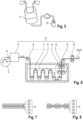
- Figure 5 A rough schematic of a mixing unit 17 is shown in which the viscous starting component of the cathode active material is produced.
- the viscous starting component contains, for example, 90 wt% NMC, 5 wt% CNT, 4 wt% PVDF as a binder and NMP as a solvent.
- ethylene carbonate solid particles are additionally mixed into the material mixture at a level of about 1 wt%.
- This material mixture is fed from the mixing unit 17 via a pump to an active material reservoir 19. From there, the viscous starting component of the cathode active material is coated onto a conductor foil endless web 22 in the coating process.
- the mixing, preparation and coating process of the viscous starting component of the cathode active material takes place at a process temperature of approx. -7°C, i.e. below the solidification point of ethylene carbonate.
- the cathode continuous web K produced in this way is subjected to a drying process in which the cathode continuous web K is heated to about 120°C, whereby the ethylene carbonate solid particles melt. After the drying process, the cathode continuous web K is cooled again to a process temperature (about -10°C) below the solidification point of ethylene carbonate. This is followed by the calendering process in which the cathode active material layer 23 is compressed to a predefined layer thickness. In the further course of the process, the cathode continuous web is fed to a cathode wetting station 21 ( Figure 6 ), which is identical to the separator wetting station 3 ( Figure 1 ), so that reference is made to its previous description.
- the process temperature in the wetting process of the cathode endless web K ( Figure 6 ) below the melting point of ethylene carbonate, for example at room temperature or at 0°C.
- the cathode endless web K is transferred through the roller gap of the transfer roller pair 10 to a PVDF coating ( Figure 9 ).
- the active material layer 23 of the cathode endless track K is coated with a PVDF layer 25 ( Figures 7 or 8 ).
- the PVDF layer 25 acts both as a protective layer and as an adhesive layer for connecting the separator in the electrode/separator arrangement.
- the PVDF layer 25 can be applied continuously to the cathode endless web K, for example in a hot-dip process.
- the PVDF layer 25 can be applied discontinuously, for example in a rotary spray process.
- An exemplary PVDF coating process is implemented as a dry process. Accordingly, the cathode endless web K is guided together with PVDF powder 27 through the nip of a first calender roller pair 29 and a second calender roller pair 31. In the first calender roller pair 29, the PVDF powder 27 is coated at room temperature with the cathode continuous web K is pressed. In the second pair of calender rollers 31, the pre-pressed PVDF layer is re-pressed at 120°C. In the further course of the process, the cathode continuous web K passes through a drying device 33 in which the PVDF layer 25 is melted. The drying device 33 has, for example, infrared dryers 34, while suction devices 35 extract gas from the drying room.
- a pair of cooling rollers 36 Downstream of the drying device 33 follows in the Figure 9 a pair of cooling rollers 36, through the roller gap of which the cathode continuous web K is guided to a thickness measurement 37 and a surface inspection 39.
- the cathode continuous web K is then wound onto a winding roller 41, which interacts with a transverse stretching roller 43, by means of which folds are removed from the cathode continuous web K.
- the process continues with a cutting process in which the cathode is cut to length and/or trimmed from the cathode continuous web K.
- the cathode is integrated into an electrode/separator arrangement that is housed in the cell casing.
- a formation/aging process in which the first charging/discharging processes are carried out in the battery cell.
- the formation/aging takes place at a process temperature well above the melting point of ethylene carbonate. This causes the ethylene carbonate to melt, forming a high level of porosity in the cathode active material.
- the process for manufacturing the anode is in accordance with the Figures 10 and 11 with regard to accelerated electrolyte wetting as follows: Accordingly, a coating process is carried out which is divided into a first sub-step and a second sub-step.
- a conductor foil endless web 22 ( Figure 10 ) is coated with an anode active material layer 45 as a base layer.
- the anode active material layer 45 comprises graphite with a binder and conductive carbon.
- the second sub-step in which the anode active material layer 45 (base layer) is coated with a hard carbon layer 47.
- Aluminum oxide particles 49 are embedded in the hard carbon layer 47.
- the hard carbon layer 47 has a large number of randomly distributed pores, whereby the wetting process ( Figure 11 ) is accelerated.
- the aluminum oxide particles 49 provide protection against dendrite growth.
- the anode continuous web A is Figure 11 shown anode wetting station 51, which is identical to the separator wetting station 3 ( Figure 1 ) or the cathode wetting station 21 ( Figure 6 ), so that reference is made to the previous description.
- the process temperature in the wetting process of the anode endless web A at a process temperature of, for example, 50°C to 70°C, in order to further accelerate the wetting process.
- the anode continuous web A is guided through the roller gap of the transfer roller pair 10 in the direction of the stacking/winding process.
- a cutting process (not shown) takes place in which the anode is cut to length and/or trimmed from the anode continuous web A.
- the anode is integrated into an electrode/separator arrangement that is housed in the cell housing. This is followed by a formation/aging process in which the first charging/discharging processes are carried out in the battery cell.
Landscapes
- Chemical & Material Sciences (AREA)
- Electrochemistry (AREA)
- General Chemical & Material Sciences (AREA)
- Chemical Kinetics & Catalysis (AREA)
- Engineering & Computer Science (AREA)
- Manufacturing & Machinery (AREA)
- Materials Engineering (AREA)
- Physics & Mathematics (AREA)
- Condensed Matter Physics & Semiconductors (AREA)
- General Physics & Mathematics (AREA)
- Inorganic Chemistry (AREA)
- Dispersion Chemistry (AREA)
- Cell Separators (AREA)
- Secondary Cells (AREA)
Applications Claiming Priority (1)
| Application Number | Priority Date | Filing Date | Title |
|---|---|---|---|
| DE102023202407.1A DE102023202407A1 (de) | 2023-03-16 | 2023-03-16 | Verfahren zur Fertigung einer Batteriezelle |
Publications (2)
| Publication Number | Publication Date |
|---|---|
| EP4432384A2 true EP4432384A2 (fr) | 2024-09-18 |
| EP4432384A3 EP4432384A3 (fr) | 2025-02-12 |
Family
ID=90038238
Family Applications (1)
| Application Number | Title | Priority Date | Filing Date |
|---|---|---|---|
| EP24158757.5A Pending EP4432384A3 (fr) | 2023-03-16 | 2024-02-21 | Procédé de fabrication d'un élément de batterie |
Country Status (3)
| Country | Link |
|---|---|
| EP (1) | EP4432384A3 (fr) |
| CN (1) | CN118676442A (fr) |
| DE (1) | DE102023202407A1 (fr) |
Citations (2)
| Publication number | Priority date | Publication date | Assignee | Title |
|---|---|---|---|---|
| EP3486985A1 (fr) | 2017-11-16 | 2019-05-22 | Technische Universität München | Cellule électrochimique, ainsi que procédé et dispositif pour sa fabrication |
| DE102021130558A1 (de) | 2021-02-10 | 2022-08-11 | GM Global Technology Operations LLC | Lithiumhaltige elektroden mit keramikteilchen und verfahren zu deren herstellung |
Family Cites Families (10)
| Publication number | Priority date | Publication date | Assignee | Title |
|---|---|---|---|---|
| KR102270893B1 (ko) * | 2012-10-04 | 2021-07-01 | 알케마 인코포레이티드 | 다공성 분리 물품 |
| DE102014226394B4 (de) * | 2014-12-18 | 2024-05-29 | Bayerische Motoren Werke Aktiengesellschaft | Verfahren zur Herstellung einer Lithium-Ionen-Zelle |
| TW201842697A (zh) * | 2017-04-10 | 2018-12-01 | 美商愛克瑪公司 | 鋰離子電池連結層 |
| DE102017218419A1 (de) * | 2017-10-16 | 2019-04-18 | Robert Bosch Gmbh | Verfahren zur Herstellung eines Elektrodenfilms und Elektrode |
| US11764353B2 (en) * | 2018-05-24 | 2023-09-19 | 24M Technologies, Inc. | High energy-density composition-gradient electrodes and methods of making the same |
| KR20210087995A (ko) * | 2018-11-08 | 2021-07-13 | 맥스웰 테크놀러지스 인코포레이티드 | 염 및/또는 폼을 포함하는 에너지 저장 장치를 위한 조성물 및 방법 |
| US20210184199A1 (en) * | 2019-12-11 | 2021-06-17 | GM Global Technology Operations LLC | Methods of lithiating metal anodes using electrolytes |
| DE102021207601B4 (de) * | 2021-07-16 | 2025-07-10 | Powerco Se | Verfahren zur Herstellung einer Elektrode einer Batteriezelle |
| DE102021208894A1 (de) * | 2021-08-13 | 2023-02-16 | Volkswagen Aktiengesellschaft | Verfahren und Vorrichtung zur Herstellung einer Elektrode für eine Lithium-Ionen-Batteriezelle |
| DE102021214966A1 (de) * | 2021-12-22 | 2023-06-22 | Volkswagen Aktiengesellschaft | Verfahren zur Herstellung einer Kathode für eine Lithium-Ionen-Batteriezelle |
-
2023
- 2023-03-16 DE DE102023202407.1A patent/DE102023202407A1/de active Pending
-
2024
- 2024-02-21 EP EP24158757.5A patent/EP4432384A3/fr active Pending
- 2024-03-15 CN CN202410298359.5A patent/CN118676442A/zh active Pending
Patent Citations (2)
| Publication number | Priority date | Publication date | Assignee | Title |
|---|---|---|---|---|
| EP3486985A1 (fr) | 2017-11-16 | 2019-05-22 | Technische Universität München | Cellule électrochimique, ainsi que procédé et dispositif pour sa fabrication |
| DE102021130558A1 (de) | 2021-02-10 | 2022-08-11 | GM Global Technology Operations LLC | Lithiumhaltige elektroden mit keramikteilchen und verfahren zu deren herstellung |
Also Published As
| Publication number | Publication date |
|---|---|
| DE102023202407A1 (de) | 2024-09-19 |
| EP4432384A3 (fr) | 2025-02-12 |
| CN118676442A (zh) | 2024-09-20 |
Similar Documents
| Publication | Publication Date | Title |
|---|---|---|
| EP4119323B1 (fr) | Procédé de fabrication d'un film sec, dispositif de laminage, ainsi que film sec et substrat revêtu du film sec | |
| DE69720386T2 (de) | Sekundär Lithium-Ion Batterien und Verfahren zur Herstellung | |
| DE19749867B4 (de) | Verfahren zur Herstellung von hoch-luftdichten porösen Separatoren sowie Verwendung der Separatoren | |
| DE69830712T2 (de) | Elektrode und batterie | |
| DE69635947T2 (de) | Elektrodenplatte für Sekundärbatterie mit nichtwasserigem Elektrolyt und Herstellungsverfahren | |
| DE102016115354B4 (de) | Verfahren zur herstellung eines zweischicht-separators | |
| DE69710666T2 (de) | Alkalischer Batterieseparator und Verfahren zur Herstellung | |
| DE102021214965B4 (de) | Stromableiter für eine Kathode einer Lithium-Ionen-Batteriezelle sowie Verfahren zur Herstellung eines solchen Stromableiters | |
| EP2368285B1 (fr) | Matériau textile plat destiné à une électrode de batterie | |
| DE102021208894A1 (de) | Verfahren und Vorrichtung zur Herstellung einer Elektrode für eine Lithium-Ionen-Batteriezelle | |
| DE102021207601B4 (de) | Verfahren zur Herstellung einer Elektrode einer Batteriezelle | |
| EP4008030B1 (fr) | Procédé de fourniture d'une feuille d'électrode pour la production d'une batterie rechargeable au lithium-ion et procédé de production d'une batterie rechargeable au lithium-ion | |
| EP1570113B1 (fr) | Procede de production de metaux etires revetus et utilisation de ces metaux en tant que derivateurs de courant dans des composants electrochimiques | |
| DE69911901T2 (de) | Feststoffbatterie mit Polymerelektrolyten und Verfahren zur Herstellung | |
| DE102021214966A1 (de) | Verfahren zur Herstellung einer Kathode für eine Lithium-Ionen-Batteriezelle | |
| EP4432384A2 (fr) | Procédé de fabrication d'un élément de batterie | |
| DE10251241B4 (de) | Verfahren zur Herstellung von Lithium-Polymer-Batterien | |
| DE102017209960A1 (de) | Verfahren zum Herstellen einer Elektrode, insbesondere für eine Batterie | |
| DE102011114613A1 (de) | Anordnung für eine elektrochemische Zelle, Verfahren zu ihrer Herstellung, elektrochemische Zelle und Batterie | |
| DE60102984T2 (de) | Herstellverfahren für eine dünne lithiumbatterie | |
| DE102023206995A1 (de) | Verfahren zur Fertigung einer Elektrode für eine Lithium-Ionen-Batteriezelle | |
| EP4402732A1 (fr) | Procédé de fabrication d'une électrode d'un élément de batterie à l'état solide | |
| DE102021214240A1 (de) | Verfahren zur Herstellung einer Festkörperbatterie | |
| DE102023201108B3 (de) | Batteriezelle | |
| DE102020103404A1 (de) | Passivierende Deckschicht auf einer Elektrode einer elektrochemischen Zelle |
Legal Events
| Date | Code | Title | Description |
|---|---|---|---|
| PUAI | Public reference made under article 153(3) epc to a published international application that has entered the european phase |
Free format text: ORIGINAL CODE: 0009012 |
|
| STAA | Information on the status of an ep patent application or granted ep patent |
Free format text: STATUS: THE APPLICATION HAS BEEN PUBLISHED |
|
| AK | Designated contracting states |
Kind code of ref document: A2 Designated state(s): AL AT BE BG CH CY CZ DE DK EE ES FI FR GB GR HR HU IE IS IT LI LT LU LV MC ME MK MT NL NO PL PT RO RS SE SI SK SM TR |
|
| PUAL | Search report despatched |
Free format text: ORIGINAL CODE: 0009013 |
|
| AK | Designated contracting states |
Kind code of ref document: A3 Designated state(s): AL AT BE BG CH CY CZ DE DK EE ES FI FR GB GR HR HU IE IS IT LI LT LU LV MC ME MK MT NL NO PL PT RO RS SE SI SK SM TR |
|
| RIC1 | Information provided on ipc code assigned before grant |
Ipc: H01M 50/491 20210101ALI20250108BHEP Ipc: H01M 50/46 20210101ALI20250108BHEP Ipc: H01M 50/406 20210101ALI20250108BHEP Ipc: H01M 10/0587 20100101ALI20250108BHEP Ipc: H01M 10/0585 20100101ALI20250108BHEP Ipc: H01M 10/0566 20100101ALI20250108BHEP Ipc: H01M 10/04 20060101ALI20250108BHEP Ipc: H01M 4/04 20060101AFI20250108BHEP |
|
| STAA | Information on the status of an ep patent application or granted ep patent |
Free format text: STATUS: REQUEST FOR EXAMINATION WAS MADE |
|
| 17P | Request for examination filed |
Effective date: 20250812 |