EP4432384A2 - Verfahren zur fertigung einer batteriezelle - Google Patents
Verfahren zur fertigung einer batteriezelle Download PDFInfo
- Publication number
- EP4432384A2 EP4432384A2 EP24158757.5A EP24158757A EP4432384A2 EP 4432384 A2 EP4432384 A2 EP 4432384A2 EP 24158757 A EP24158757 A EP 24158757A EP 4432384 A2 EP4432384 A2 EP 4432384A2
- Authority
- EP
- European Patent Office
- Prior art keywords
- separator
- electrolyte
- cathode
- wetting
- pvdf
- Prior art date
- Legal status (The legal status is an assumption and is not a legal conclusion. Google has not performed a legal analysis and makes no representation as to the accuracy of the status listed.)
- Pending
Links
Images


Classifications
-
- H—ELECTRICITY
- H01—ELECTRIC ELEMENTS
- H01M—PROCESSES OR MEANS, e.g. BATTERIES, FOR THE DIRECT CONVERSION OF CHEMICAL ENERGY INTO ELECTRICAL ENERGY
- H01M50/00—Constructional details or processes of manufacture of the non-active parts of electrochemical cells other than fuel cells, e.g. hybrid cells
- H01M50/40—Separators; Membranes; Diaphragms; Spacing elements inside cells
- H01M50/489—Separators, membranes, diaphragms or spacing elements inside the cells, characterised by their physical properties, e.g. swelling degree, hydrophilicity or shut down properties
- H01M50/491—Porosity
-
- H—ELECTRICITY
- H01—ELECTRIC ELEMENTS
- H01M—PROCESSES OR MEANS, e.g. BATTERIES, FOR THE DIRECT CONVERSION OF CHEMICAL ENERGY INTO ELECTRICAL ENERGY
- H01M10/00—Secondary cells; Manufacture thereof
- H01M10/05—Accumulators with non-aqueous electrolyte
- H01M10/058—Construction or manufacture
-
- H—ELECTRICITY
- H01—ELECTRIC ELEMENTS
- H01M—PROCESSES OR MEANS, e.g. BATTERIES, FOR THE DIRECT CONVERSION OF CHEMICAL ENERGY INTO ELECTRICAL ENERGY
- H01M10/00—Secondary cells; Manufacture thereof
- H01M10/04—Construction or manufacture in general
- H01M10/0404—Machines for assembling batteries
-
- H—ELECTRICITY
- H01—ELECTRIC ELEMENTS
- H01M—PROCESSES OR MEANS, e.g. BATTERIES, FOR THE DIRECT CONVERSION OF CHEMICAL ENERGY INTO ELECTRICAL ENERGY
- H01M10/00—Secondary cells; Manufacture thereof
- H01M10/04—Construction or manufacture in general
- H01M10/0431—Cells with wound or folded electrodes
-
- H—ELECTRICITY
- H01—ELECTRIC ELEMENTS
- H01M—PROCESSES OR MEANS, e.g. BATTERIES, FOR THE DIRECT CONVERSION OF CHEMICAL ENERGY INTO ELECTRICAL ENERGY
- H01M10/00—Secondary cells; Manufacture thereof
- H01M10/04—Construction or manufacture in general
- H01M10/0468—Compression means for stacks of electrodes and separators
-
- H—ELECTRICITY
- H01—ELECTRIC ELEMENTS
- H01M—PROCESSES OR MEANS, e.g. BATTERIES, FOR THE DIRECT CONVERSION OF CHEMICAL ENERGY INTO ELECTRICAL ENERGY
- H01M10/00—Secondary cells; Manufacture thereof
- H01M10/05—Accumulators with non-aqueous electrolyte
- H01M10/052—Li-accumulators
- H01M10/0525—Rocking-chair batteries, i.e. batteries with lithium insertion or intercalation in both electrodes; Lithium-ion batteries
-
- H—ELECTRICITY
- H01—ELECTRIC ELEMENTS
- H01M—PROCESSES OR MEANS, e.g. BATTERIES, FOR THE DIRECT CONVERSION OF CHEMICAL ENERGY INTO ELECTRICAL ENERGY
- H01M10/00—Secondary cells; Manufacture thereof
- H01M10/05—Accumulators with non-aqueous electrolyte
- H01M10/056—Accumulators with non-aqueous electrolyte characterised by the materials used as electrolytes, e.g. mixed inorganic/organic electrolytes
- H01M10/0564—Accumulators with non-aqueous electrolyte characterised by the materials used as electrolytes, e.g. mixed inorganic/organic electrolytes the electrolyte being constituted of organic materials only
- H01M10/0566—Liquid materials
-
- H—ELECTRICITY
- H01—ELECTRIC ELEMENTS
- H01M—PROCESSES OR MEANS, e.g. BATTERIES, FOR THE DIRECT CONVERSION OF CHEMICAL ENERGY INTO ELECTRICAL ENERGY
- H01M10/00—Secondary cells; Manufacture thereof
- H01M10/05—Accumulators with non-aqueous electrolyte
- H01M10/058—Construction or manufacture
- H01M10/0583—Construction or manufacture of accumulators with folded construction elements except wound ones, i.e. folded positive or negative electrodes or separators, e.g. with "Z"-shaped electrodes or separators
-
- H—ELECTRICITY
- H01—ELECTRIC ELEMENTS
- H01M—PROCESSES OR MEANS, e.g. BATTERIES, FOR THE DIRECT CONVERSION OF CHEMICAL ENERGY INTO ELECTRICAL ENERGY
- H01M10/00—Secondary cells; Manufacture thereof
- H01M10/05—Accumulators with non-aqueous electrolyte
- H01M10/058—Construction or manufacture
- H01M10/0585—Construction or manufacture of accumulators having only flat construction elements, i.e. flat positive electrodes, flat negative electrodes and flat separators
-
- H—ELECTRICITY
- H01—ELECTRIC ELEMENTS
- H01M—PROCESSES OR MEANS, e.g. BATTERIES, FOR THE DIRECT CONVERSION OF CHEMICAL ENERGY INTO ELECTRICAL ENERGY
- H01M10/00—Secondary cells; Manufacture thereof
- H01M10/05—Accumulators with non-aqueous electrolyte
- H01M10/058—Construction or manufacture
- H01M10/0587—Construction or manufacture of accumulators having only wound construction elements, i.e. wound positive electrodes, wound negative electrodes and wound separators
-
- H—ELECTRICITY
- H01—ELECTRIC ELEMENTS
- H01M—PROCESSES OR MEANS, e.g. BATTERIES, FOR THE DIRECT CONVERSION OF CHEMICAL ENERGY INTO ELECTRICAL ENERGY
- H01M4/00—Electrodes
- H01M4/02—Electrodes composed of, or comprising, active material
- H01M4/04—Processes of manufacture in general
- H01M4/0402—Methods of deposition of the material
- H01M4/0404—Methods of deposition of the material by coating on electrode collectors
-
- H—ELECTRICITY
- H01—ELECTRIC ELEMENTS
- H01M—PROCESSES OR MEANS, e.g. BATTERIES, FOR THE DIRECT CONVERSION OF CHEMICAL ENERGY INTO ELECTRICAL ENERGY
- H01M4/00—Electrodes
- H01M4/02—Electrodes composed of, or comprising, active material
- H01M4/04—Processes of manufacture in general
- H01M4/0402—Methods of deposition of the material
- H01M4/0409—Methods of deposition of the material by a doctor blade method, slip-casting or roller coating
-
- H—ELECTRICITY
- H01—ELECTRIC ELEMENTS
- H01M—PROCESSES OR MEANS, e.g. BATTERIES, FOR THE DIRECT CONVERSION OF CHEMICAL ENERGY INTO ELECTRICAL ENERGY
- H01M4/00—Electrodes
- H01M4/02—Electrodes composed of, or comprising, active material
- H01M4/04—Processes of manufacture in general
- H01M4/0402—Methods of deposition of the material
- H01M4/0416—Methods of deposition of the material involving impregnation with a solution, dispersion, paste or dry powder
-
- H—ELECTRICITY
- H01—ELECTRIC ELEMENTS
- H01M—PROCESSES OR MEANS, e.g. BATTERIES, FOR THE DIRECT CONVERSION OF CHEMICAL ENERGY INTO ELECTRICAL ENERGY
- H01M4/00—Electrodes
- H01M4/02—Electrodes composed of, or comprising, active material
- H01M4/04—Processes of manufacture in general
- H01M4/043—Processes of manufacture in general involving compressing or compaction
- H01M4/0435—Rolling or calendering
-
- H—ELECTRICITY
- H01—ELECTRIC ELEMENTS
- H01M—PROCESSES OR MEANS, e.g. BATTERIES, FOR THE DIRECT CONVERSION OF CHEMICAL ENERGY INTO ELECTRICAL ENERGY
- H01M50/00—Constructional details or processes of manufacture of the non-active parts of electrochemical cells other than fuel cells, e.g. hybrid cells
- H01M50/40—Separators; Membranes; Diaphragms; Spacing elements inside cells
- H01M50/403—Manufacturing processes of separators, membranes or diaphragms
- H01M50/406—Moulding; Embossing; Cutting
-
- H—ELECTRICITY
- H01—ELECTRIC ELEMENTS
- H01M—PROCESSES OR MEANS, e.g. BATTERIES, FOR THE DIRECT CONVERSION OF CHEMICAL ENERGY INTO ELECTRICAL ENERGY
- H01M50/00—Constructional details or processes of manufacture of the non-active parts of electrochemical cells other than fuel cells, e.g. hybrid cells
- H01M50/40—Separators; Membranes; Diaphragms; Spacing elements inside cells
- H01M50/46—Separators, membranes or diaphragms characterised by their combination with electrodes
- H01M50/461—Separators, membranes or diaphragms characterised by their combination with electrodes with adhesive layers between electrodes and separators
-
- H—ELECTRICITY
- H01—ELECTRIC ELEMENTS
- H01M—PROCESSES OR MEANS, e.g. BATTERIES, FOR THE DIRECT CONVERSION OF CHEMICAL ENERGY INTO ELECTRICAL ENERGY
- H01M2300/00—Electrolytes
- H01M2300/0017—Non-aqueous electrolytes
- H01M2300/0025—Organic electrolyte
- H01M2300/0028—Organic electrolyte characterised by the solvent
-
- H—ELECTRICITY
- H01—ELECTRIC ELEMENTS
- H01M—PROCESSES OR MEANS, e.g. BATTERIES, FOR THE DIRECT CONVERSION OF CHEMICAL ENERGY INTO ELECTRICAL ENERGY
- H01M2300/00—Electrolytes
- H01M2300/0017—Non-aqueous electrolytes
- H01M2300/0025—Organic electrolyte
- H01M2300/0028—Organic electrolyte characterised by the solvent
- H01M2300/0037—Mixture of solvents
-
- Y—GENERAL TAGGING OF NEW TECHNOLOGICAL DEVELOPMENTS; GENERAL TAGGING OF CROSS-SECTIONAL TECHNOLOGIES SPANNING OVER SEVERAL SECTIONS OF THE IPC; TECHNICAL SUBJECTS COVERED BY FORMER USPC CROSS-REFERENCE ART COLLECTIONS [XRACs] AND DIGESTS
- Y02—TECHNOLOGIES OR APPLICATIONS FOR MITIGATION OR ADAPTATION AGAINST CLIMATE CHANGE
- Y02E—REDUCTION OF GREENHOUSE GAS [GHG] EMISSIONS, RELATED TO ENERGY GENERATION, TRANSMISSION OR DISTRIBUTION
- Y02E60/00—Enabling technologies; Technologies with a potential or indirect contribution to GHG emissions mitigation
- Y02E60/10—Energy storage using batteries
-
- Y—GENERAL TAGGING OF NEW TECHNOLOGICAL DEVELOPMENTS; GENERAL TAGGING OF CROSS-SECTIONAL TECHNOLOGIES SPANNING OVER SEVERAL SECTIONS OF THE IPC; TECHNICAL SUBJECTS COVERED BY FORMER USPC CROSS-REFERENCE ART COLLECTIONS [XRACs] AND DIGESTS
- Y02—TECHNOLOGIES OR APPLICATIONS FOR MITIGATION OR ADAPTATION AGAINST CLIMATE CHANGE
- Y02P—CLIMATE CHANGE MITIGATION TECHNOLOGIES IN THE PRODUCTION OR PROCESSING OF GOODS
- Y02P70/00—Climate change mitigation technologies in the production process for final industrial or consumer products
- Y02P70/50—Manufacturing or production processes characterised by the final manufactured product
Definitions
- the invention relates to a method for producing a battery cell according to the preamble of claim 1 and a process arrangement for carrying out such a method according to claim 8.
- the battery cell to be manufactured has a cell housing in which an electrode/separator arrangement is housed, which is wetted with a liquid electrolyte.
- the electrodes have a conductor foil that is coated on one or both sides with an active material layer.
- the battery cell is manufactured in the following process sequence: First, in a coating process, a continuous conductor foil web is coated with a viscous starting component of an electrode active material to form a continuous electrode web. This is followed by a drying process in which the continuous electrode web is dried. This is followed by a calendering process in which the active material layer coated on the continuous conductor foil web is compressed to a predefined layer thickness. In a subsequent cutting process, the continuous electrode web is cut to length and trimmed into electrodes, and a stacking or winding process is carried out to form an electrode/separator arrangement. This is housed in the cell housing. This is followed by an electrolyte filling in which an electrolyte is filled into the cell housing. After the battery cell has been assembled, a formation/aging process takes place in which the first charging/discharging processes of the battery cell take place.
- the wetting of the separator is a time-consuming process.
- the separator must be thoroughly wetted by the electrolyte so that the lithium ions can move.
- Wetting is a time-dependent process. To accelerate wetting, mechanical pressure and heat can be applied. However, this can damage the separator.
- wetting of the electrodes is also a time-consuming process.
- Cathode and anode are highly compacted during calendering. This reduces the pore size. This means that the denser the electrode, the more difficult it is for the electrolyte to penetrate. If the electrolyte does not penetrate the pores of the electrode, lithium ions cannot enter the pores of the electrode either.
- mechanical pressure can be applied to the electrode/separator assembly, which can lead to cracks in the separator. Both blocking large pores and reducing the total pore volume to a large extent leads to a small amount of electrolyte/particle interfaces available for lithium ion transfer. Reducing the electrolyte-particle interfaces can impair electrolyte wetting. This also contributes to a deterioration in electrochemical performance.
- a lithium-containing electrode with ceramic particles is known.
- the ceramic particles border on a first surface of the lithium metal electrode as a ceramic layer.
- EP 3 486 985 A1 A method for producing a battery cell is known. The method comprises providing an electrode/separator arrangement. The separator is permeable to an electrolyte dissolved in a solvent. The method further comprises wetting the arrangement in an electrolyte bath, wherein the electrolyte bath contains the electrolyte dissolved in the solvent.
- the object of the invention is to provide a method and a process arrangement for manufacturing a battery cell, by means of which the process time for manufacturing the battery cell is reduced compared to the prior art.
- the invention is based on a method for producing a battery cell with an electrode/separator arrangement arranged in the cell housing, which has at least one separator, an anode and a cathode, which are wetted with electrolyte.
- the method includes, among other things, a stacking or winding process in which the separator, the anode and the cathode are combined to form the electrode/separator arrangement.
- the separator, the anode and/or the cathode are wetted with the electrolyte in a wetting process before the stacking or winding process is carried out.
- electrolyte filling which in the prior art takes place after the electrode/separator stack has been enclosed in the cell housing.
- electrolyte filling is associated with a longer wetting time, which is necessary for the electrolyte to completely wet the separator, the anode and/or the cathode. According to the invention, such a wetting time can at least be reduced or eliminated completely.
- the separator, the anode and/or the cathode are each provided as a continuous web as part of a series production. This is passed through an electrolyte bath in the wetting process.
- the separator is passed through an electrolyte bath in which the separator is wetted by the electrolyte.
- mechanical pressure is applied to press the electrolyte into the separator. This wetting process takes place before the stacking process.
- the electrode can also be passed through an electrolyte bath before the stacking or winding process. After passing through the electrolyte bath, the electrodes are pressed before the stacking process. In this way, a mechanical force is exerted on the electrode in order to wet it better. According to the invention, the mechanical force is therefore not exerted on the electrode/separator arrangement, but directly on the electrodes. This procedure is more effective and less susceptible to cracks in the separator within the electrode/separator arrangement.
- Ethylene carbonate particles can be mixed into the viscous starting component of the cathode active material. To do this, the viscous starting component of the cathode active material is cooled to room temperature or to -7°C after drying. In this way, the ethylene carbonate crystallizes and is distributed in the cathode active material.
- the electrolyte in the viscous starting component of the cathode active material is in the form of solid crystals, which ultimately transform into the liquid electrolyte during the aging process at high temperatures.
- the cathode is wetted in all pores by ethylene carbonate.
- Ethylene carbonate has a melting point of around 30°C. Down to -7°C, ethylene carbonate is present as a gel-like structure. Below this temperature, a completely solid phase is formed. Ethylene carbonate is one of the most important components of the electrolyte.
- the ethylene carbonate can evaporate during the drying phase of the electrode (i.e. after a wet coating).
- the cathode can be covered with a PVDF coating in which ethylene carbonate particles are embedded. This coating is applied after the wetting process in the electrolyte bath.
- the additional PVDF coating provides an adhesive function between the separator and the cathode.
- the electrolyte does not drip from the pores inside the cathode. If the cathode is produced in a dry coating process, ethylene carbonate can be used directly in the active material powder. This also means that the separator does not have a PVDF coating, which makes it cheaper.
- the anode can also be coated with hard carbon in which aluminum oxide crystals are embedded. Hard carbon can support the wetting process due to its randomly distributed pores.
- the aluminum oxide protects against dendrite growth. This means that the separator does not necessarily have to have an aluminum oxide coating, which makes the separator cheaper.
- the separator is wettable with electrolyte before the winding or stacking process.
- the active material layer of the cathode can contain ethylene carbonate particles and/or be covered with a PVDF layer in which ethylene carbonate powder can be embedded.
- the cathode coating can be carried out at, for example, -7°C so that the ethylene carbonate in the PVDF layer remains in the solid phase.
- This PVDF coating can be carried out in the electrolyte bath before the wetting process.
- the wetting process is carried out at room temperature so that the ethylene carbonate particles in the PVDF do not melt during the stacking process. They only melt during the aging process at high temperatures.
- the cathode active material is coated with a solid ethylene carbonate powder.
- the PVDF coating is optional in this case.
- the anode may be coated with a hard carbon layer in which aluminum oxide particles are embedded. This coating is applied as an additional layer after the conventional wet coating of the anode.
- Both the cathode and the anode may be wetted with electrolyte in the electrolyte bath before the stacking or winding process.
- the separator, cathode and anode are mechanically pressurized using a roller arrangement after the wetting process so that the electrolyte fully penetrates into all pores.
- the separator does not necessarily have to have a PVDF coating in order to adhere to the cathode.
- the electrolyte coating acts like an adhesive when wetted.
- the PVDF coating is now on the cathode.
- the main aim is therefore to wet the separators and electrodes with electrolyte before the winding and stacking process. It is therefore no longer necessary to exert mechanical pressure on the electrode/separator arrangement. There is also no need for an additional storage time for the battery cell. Such a storage time is required in the prior art in order to achieve complete electrolyte wetting after the electrolyte has been filled. According to the invention, the formation/aging process can therefore be started immediately after the battery cell has been assembled without any storage time.
- the electrolyte filling known from the prior art is optional, since the electrolyte wets or soaks the separator and the electrode before the stacking process.
- the separator passes through an electrolyte bath, which is a liquid solution containing EC and DMC.
- the electrolyte bath can contain lithium salt that is not sensitive to ambient conditions, especially humidity, such as LiFSi. It is also possible to use only the solvent and ethylene carbonate (EC) / dimethylene carbonate (DMC) / ethylene methylene carbonate (EMC) without lithium salts. In this case, the lithium salts can be added in an electrolyte injection process after stacking.
- the electrolyte can enter the pores of the separator during the wetting process. Special wetting rollers help to introduce the liquid into the pores.
- the electrolyte bath can have a temperature of 50°C to 70°C to achieve faster wetting. This temperature does not affect the properties of the separator. Excess liquid can be removed by scraper rollers.
- the separator filled with electrolyte and (or without) pores filled with lithium salt is then transported to the stacking or winding process.
- PVDF coating it is possible to apply a PVDF coating to the separator before stacking to prevent the electrolyte from dripping from the separator.
- the PVDF coating provides better adhesion to the electrode. In this case, no PVDF coating is required on the cathode. PVDF coating of the separator before stacking or winding is only an option.
- the wetting rollers installed in the electrolyte bath can be made of titanium and have a special surface structure. This creates micro-depressions on the separator or electrode surface so that the separator or electrode surface can absorb more liquid.
- the wetting rollers can be connected to piezoelectric transducers. These convert electrical signals into mechanical vibrations. The rollers can therefore be subjected to mechanical vibrations of around 5 kHz in a radial direction. The rollers vibrate with an amplitude of around 10-15 ⁇ m. This vibration allows the liquid to penetrate deep into the pores of the separator or electrode.
- the wetting rollers are not intended for calendering; however, they exert a compressive force so that liquid can penetrate into the pores.
- the wetting rollers have two main functions: Firstly, they create a microstructure depression on the electrode or separator to hold more liquid on the surface. This helps to bond the separator to the electrode surface. Secondly, the mechanical pressure from the compression force and vibration of the wetting rollers can help the liquid to enter the pores of the separator. Directly above the wetting rollers are the rubber scraper rollers. They remove the excess electrolyte from the surface. The scraper rollers can also be set under vibration by means of piezo transducers. Here, the amplitude and frequency of the vibration can be lower than with the wetting rollers, since the main function of these rollers is to remove excess liquid from the surface of the separator.
- the process for manufacturing the cathode can be adapted to achieve accelerated electrolyte impregnation: PVDF can be added as a binder to the viscous starting component of the cathode active material, also CNT (carbon nanotubes) for conductivity as well as NMP as solvent and ethylene carbonate particles.
- the whole process is preferably carried out below the solidification temperature of EC, i.e. at about -7°C.
- the viscous starting component of the cathode active material is applied to a collector foil (i.e. an aluminum substrate) to form a cathode. This wet electrode is dried at about 120°C, which leads to melting of the EC, which collects in the pores of the cathode active material.
- the cathode After drying, the cathode is cooled again to, for example, -10°C to recrystallize the EC particles.
- the cathode is then passed through an electrolyte bath at room temperature, in which the EG remains in solid phase in the pores of the cathode.
- the cathode In the electrolyte wetting process, the cathode is pressed by a roller pressure so that the electrolyte enters the pores of the cathode.
- the cathode can be coated with a PVDF layer.
- the PVDF layer is applied using a dry process by passing the cathode between rollers and PVDF particles.
- the PVDF layer also serves as a protective medium for the cathode and as an adhesive for bonding the separator.
- the cathode is stacked in a wetted state with wetted separator and wetted anode. The EC is remelted during the aging process at high temperature and collects in the pores of the cathode.
- PVDF coating can be carried out in which PVDF is applied to the cathode surface using a calender roller. To achieve better adhesion, the PVDF coating can optionally be melted and then cooled.
- the rotary spray process can also be used for dry coating, in which PVDF powder is sprayed onto the cathode electrode using centrifugal force at high temperature (up to a maximum of 100°C) and speed.
- the process for manufacturing the anode can be adapted to achieve accelerated electrolyte impregnation:
- the anode can be coated with a thin layer of hard carbon embedded with aluminum oxide as part of the second layer on both surfaces of the anode.
- the first layer can consist of graphite with binder and conductive carbon.
- the anode is then wetted in a wetting process using the same method as the cathode or separator.
- the separator is wetted with electrolyte before the winding or stacking process.
- Ethylene carbonate particles can be mixed into the starting component of the cathode active material.
- the active material layer of the cathode can be covered with a PVDF layer in which ethylene carbonate powder is embedded.
- the cathode coating is carried out at -7°C so that the ethylene carbonate in the PVDF layer remains in the solid phase.
- This PVDF coating can be carried out before the wetting process that takes place in the electrolyte bath.
- the wetting process is carried out at room temperature so that the ethylene carbonate particles in the PVDF do not melt during the stacking process. They only melt during the aging process at high temperatures (approx. 60°C).
- the active material is coated with a solid ethylene carbonate powder.
- the PVDF coating is optional in this case.
- the advantages of the invention are summarized below: There is a faster wetting of the electrode and separator because the wetted electrode and separator are done before the stacking process.
- the separator does not need a PVDF coating and also no alumina. This makes the separator cheaper. Rather, the PVDF coating is transferred to the outer surface of the cathode, while the alumina coating is transferred to the anode.
- the infrastructure and costs required to let the cell rest for thorough wetting after the prior art electrolyte filling are reduced. Currently, wetting takes between 12 hours and a day.
- the PVDF coating on the cathode helps to bond the separator evenly to the cathode and thus reduces air pockets between the cathode and separator.
- the wetting of the electrode and separator takes place at the level of the electrode and separator and not at the level of the electrode/separator assembly. Therefore, the mechanical force and temperature at the separator/electrode level can be controlled without damaging the electrode/separator assembly.
- the anode has a hard carbon layer in which aluminum oxide particles are embedded. This enables faster lithium incorporation, faster wetting and better protection against dendrites.
- high porosity in the cathode is deliberately created by melting the ethylene carbonate embedded in the cathode active material during the aging process.
- the process steps indicated in the figures are integrated into a method for manufacturing a battery cell.
- the battery cell has a cell housing in which an electrode/separator arrangement is housed, which is saturated with a liquid electrolyte E or is wetted by it.
- the electrodes installed therein are each made of a conductor foil, which is coated on one or both sides with an electrode active material layer 23, 45.
- a conductor foil endless web 22 is first provided.
- the respective conductor foil endless web 22 is coated with a viscous starting component of an electrode active material, specifically to form a continuous electrode web A, K.
- a drying process for drying the active material layers 23, 45 is followed by a drying process for drying the active material layers 23, 45.
- a calendering process is then carried out in which the active material layers 23, 45 of the continuous electrode webs A, K are compressed to a predefined layer thickness.
- the continuous electrode web A, K is cut to length and/or cut to form the electrode (i.e.
- the anode or cathode and a continuous separator web S to form the separator.
- a winding or stacking process in which the cathodes, anodes and separators are combined to form the electrode/separator arrangement.
- This is then housed in the cell housing.
- An electrolyte filling process then takes place, in which the electrolyte E is filled into the cell housing.
- the battery cell is stored for a wetting period until the housed electrode/separator arrangement is completely wetted with the electrolyte E. After this wetting period is complete, a formation/aging process begins in which the battery cell is first charged/discharged.
- the method according to the invention has a wetting process in which the separator endless web S, the anode endless web S and/or the cathode endless web K are wetted with the electrolyte E before the stacking or winding process.
- the wetting time (which begins after the electrolyte has been filled into the cell housing) until the electrolyte is completely wetted can be reduced.
- separator, anode and/or cathode are at least reduced or eliminated completely.
- the process for manufacturing the separator is adapted to accelerate electrolyte wetting as follows:
- the separator endless web S is first fed to a separator wetting station 3 on a separator winding roll 2.
- the separator wetting station 3 has an electrolyte bath 5 in which the separator endless web S is guided in a meandering manner over a deflection roller arrangement 7. Downstream of the deflection roller arrangement 7 there is a wetting roller pair 9, through whose roller gap the separator endless web S runs.
- the wetting roller pair 9 exerts mechanical pressure on the separator endless web S in the roller gap in order to support the electrolyte entering the pores of the separator endless web S.
- rollers of the wetting roller pair 9 each have a surface structure 11 on the outer circumference ( Figure 4 ), by means of which micro-depressions can be created in the separator endless web S in order to increase electrolyte absorption.
- a stripper roller pair 13 is provided, which is arranged above the electrolyte level in the electrolyte bath 5.
- the separator endless web S runs through the roller gap of the stripper roller pair 13 in the direction of the outlet of the electrolyte bath 5. In this way, excess electrolyte E is stripped off the separator endless web S and runs back into the electrolyte bath 5 under the effect of gravity.
- the separator endless web S is guided through a roller gap of a transfer roller pair 10 in the direction of the stacking or winding process.
- the rollers of the wetting roller pair 9 can be set into vibration by means of piezo converters 15.
- the vibration of the rollers is set in such a way that electrolyte absorption into the separator endless web S is supported.
- the rollers of the stripper roller pair 13 can also be set into vibration in order to support electrolyte stripping from the separator endless web S.
- the bath temperature during the wetting process is approximately 50°C to 70°C.
- the process for manufacturing the cathode is adapted to accelerate electrolyte wetting as follows:
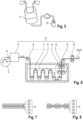
- Figure 5 A rough schematic of a mixing unit 17 is shown in which the viscous starting component of the cathode active material is produced.
- the viscous starting component contains, for example, 90 wt% NMC, 5 wt% CNT, 4 wt% PVDF as a binder and NMP as a solvent.
- ethylene carbonate solid particles are additionally mixed into the material mixture at a level of about 1 wt%.
- This material mixture is fed from the mixing unit 17 via a pump to an active material reservoir 19. From there, the viscous starting component of the cathode active material is coated onto a conductor foil endless web 22 in the coating process.
- the mixing, preparation and coating process of the viscous starting component of the cathode active material takes place at a process temperature of approx. -7°C, i.e. below the solidification point of ethylene carbonate.
- the cathode continuous web K produced in this way is subjected to a drying process in which the cathode continuous web K is heated to about 120°C, whereby the ethylene carbonate solid particles melt. After the drying process, the cathode continuous web K is cooled again to a process temperature (about -10°C) below the solidification point of ethylene carbonate. This is followed by the calendering process in which the cathode active material layer 23 is compressed to a predefined layer thickness. In the further course of the process, the cathode continuous web is fed to a cathode wetting station 21 ( Figure 6 ), which is identical to the separator wetting station 3 ( Figure 1 ), so that reference is made to its previous description.
- the process temperature in the wetting process of the cathode endless web K ( Figure 6 ) below the melting point of ethylene carbonate, for example at room temperature or at 0°C.
- the cathode endless web K is transferred through the roller gap of the transfer roller pair 10 to a PVDF coating ( Figure 9 ).
- the active material layer 23 of the cathode endless track K is coated with a PVDF layer 25 ( Figures 7 or 8 ).
- the PVDF layer 25 acts both as a protective layer and as an adhesive layer for connecting the separator in the electrode/separator arrangement.
- the PVDF layer 25 can be applied continuously to the cathode endless web K, for example in a hot-dip process.
- the PVDF layer 25 can be applied discontinuously, for example in a rotary spray process.
- An exemplary PVDF coating process is implemented as a dry process. Accordingly, the cathode endless web K is guided together with PVDF powder 27 through the nip of a first calender roller pair 29 and a second calender roller pair 31. In the first calender roller pair 29, the PVDF powder 27 is coated at room temperature with the cathode continuous web K is pressed. In the second pair of calender rollers 31, the pre-pressed PVDF layer is re-pressed at 120°C. In the further course of the process, the cathode continuous web K passes through a drying device 33 in which the PVDF layer 25 is melted. The drying device 33 has, for example, infrared dryers 34, while suction devices 35 extract gas from the drying room.
- a pair of cooling rollers 36 Downstream of the drying device 33 follows in the Figure 9 a pair of cooling rollers 36, through the roller gap of which the cathode continuous web K is guided to a thickness measurement 37 and a surface inspection 39.
- the cathode continuous web K is then wound onto a winding roller 41, which interacts with a transverse stretching roller 43, by means of which folds are removed from the cathode continuous web K.
- the process continues with a cutting process in which the cathode is cut to length and/or trimmed from the cathode continuous web K.
- the cathode is integrated into an electrode/separator arrangement that is housed in the cell casing.
- a formation/aging process in which the first charging/discharging processes are carried out in the battery cell.
- the formation/aging takes place at a process temperature well above the melting point of ethylene carbonate. This causes the ethylene carbonate to melt, forming a high level of porosity in the cathode active material.
- the process for manufacturing the anode is in accordance with the Figures 10 and 11 with regard to accelerated electrolyte wetting as follows: Accordingly, a coating process is carried out which is divided into a first sub-step and a second sub-step.
- a conductor foil endless web 22 ( Figure 10 ) is coated with an anode active material layer 45 as a base layer.
- the anode active material layer 45 comprises graphite with a binder and conductive carbon.
- the second sub-step in which the anode active material layer 45 (base layer) is coated with a hard carbon layer 47.
- Aluminum oxide particles 49 are embedded in the hard carbon layer 47.
- the hard carbon layer 47 has a large number of randomly distributed pores, whereby the wetting process ( Figure 11 ) is accelerated.
- the aluminum oxide particles 49 provide protection against dendrite growth.
- the anode continuous web A is Figure 11 shown anode wetting station 51, which is identical to the separator wetting station 3 ( Figure 1 ) or the cathode wetting station 21 ( Figure 6 ), so that reference is made to the previous description.
- the process temperature in the wetting process of the anode endless web A at a process temperature of, for example, 50°C to 70°C, in order to further accelerate the wetting process.
- the anode continuous web A is guided through the roller gap of the transfer roller pair 10 in the direction of the stacking/winding process.
- a cutting process (not shown) takes place in which the anode is cut to length and/or trimmed from the anode continuous web A.
- the anode is integrated into an electrode/separator arrangement that is housed in the cell housing. This is followed by a formation/aging process in which the first charging/discharging processes are carried out in the battery cell.
Landscapes
- Chemical & Material Sciences (AREA)
- Electrochemistry (AREA)
- General Chemical & Material Sciences (AREA)
- Chemical Kinetics & Catalysis (AREA)
- Engineering & Computer Science (AREA)
- Manufacturing & Machinery (AREA)
- Materials Engineering (AREA)
- Physics & Mathematics (AREA)
- Condensed Matter Physics & Semiconductors (AREA)
- General Physics & Mathematics (AREA)
- Inorganic Chemistry (AREA)
- Dispersion Chemistry (AREA)
- Cell Separators (AREA)
- Secondary Cells (AREA)
Abstract
Description
- Die Erfindung betrifft ein Verfahren zur Fertigung einer Batteriezelle nach dem Oberbegriff des Anspruches 1 sowie eine Prozessanordnung zur Durchführung eines solchen Verfahrens nach Anspruch 8.
- Die zu fertigende Batteriezelle weist ein Zellgehäuse auf, in dem eine Elektroden-/Separator-Anordnung eingehaust ist, die mit einem flüssigen Elektrolyt benetzt ist. Die Elektroden weisen eine Ableiterfolie auf, die ein- oder beidseitig mit einer Aktivmaterialschicht beschichtet ist.
- Die Batteriezelle wird in folgender Prozessabfolge gefertigt: Zunächst wird in einem Beschichtungsprozess eine Ableiterfolien-Endlosbahn mit einer zähflüssigen Ausgangskomponente eines Elektroden-Aktivmaterials beschichtet, und zwar unter Bildung einer Elektroden-Endlosbahn. Anschließend folgt ein Trockenprozess, in dem die Elektroden-Endlosbahn getrocknet wird. Danach folgt ein Kalandrierprozess, in dem die auf der Ableiterfolien-Endlosbahn beschichtete Aktivmaterial-Schicht auf eine vordefinierte Schichtdicke verdichtet wird. In einem anschließenden Schneidprozess wird die Elektroden-Endlosbahn zu Elektroden abgelängt sowie zugeschnitten und wird ein Stapel- oder Wickelprozess durchgeführt, um eine Elektroden-/Separator-Anordnung zu bilden. Diese wird in das Zellgehäuse eingehaust. Anschließend folgt eine Elektrolyt-Befüllung, in der ein Elektrolyt in das Zellgehäuse gefüllt wird. Nach dem Zusammenbau der Batteriezelle erfolgt eine Formation/Aging, in der erste Lade-/Entladevorgänge der Batteriezelle stattfinden.
- Bei einem solchen aus dem Stand der Technik bekannten Prozess ergeben sich die folgenden Probleme: Gemäß einem ersten Problem ist die Benetzung des Separators ist ein zeitintensiver Prozess. Der Separator muss gründlich vom Elektrolyt benetzt werden, damit sich die Lithiumionen bewegen können. Die Benetzung ist ein zeitabhängiger Prozess. Um die Benetzung zu beschleunigen, kann mechanischer Druck und Wärme angewendet werden. Dies kann jedoch den Separator beschädigen.
- Mit zunehmender Zellgröße und größerem Separator kann eine vollständige Benetzung nach der Elektrolyt-Befüllung einen Tag oder länger andauern. Es gibt kein Verfahren zur Überprüfung der Benetzung des Separators. Das bedeutet, dass die Kapazität der Zelle beeinträchtigt wird, wenn die Benetzung nicht vollständig erfolgt.
- Gemäß einem zweiten Problem ist auch die Benetzung der Elektroden ein zeitraubender Prozess. Kathode und Anode werden beim Kalandrieren stark verdichtet. Dadurch wird die Porengröße reduziert. Das bedeutet, je dichter die Elektrode ist, desto schwieriger ist es für den Elektrolyt, einzudringen. Wenn der Elektrolyt nicht in die Poren der Elektrode eindringt, können auch keine Lithium-Ionen in die Poren der Elektrode gelangen. Um die Benetzung der Elektrode zu erhöhen, kann mechanischer Druck auf die Elektroden-/Separator-Anordnung ausgeübt werden, was zu Rissen im Separator führen kann. Sowohl die Blockierung großer Poren als auch die Verringerung des gesamten Porenvolumens in hohem Maße führt zu einer geringen Menge an Elektrolyt/Partikel-Grenzflächen, die für den Lithium-Ionen-Transfer zur Verfügung stehen. Die Verringerung der Grenzflächen zwischen Elektrolyt und Partikeln kann die Elektrolytbenetzung beeinträchtigen. Dies trägt ebenfalls zu einer Verschlechterung der elektrochemischen Leistung bei.
- Aus der
DE 10 2021 130 558 A1 ist eine lithiumhaltige Elektrode mit Keramikteilchen bekannt. Die Keramikteilchen grenzen als keramische Schicht an eine erste Oberfläche der Lithiummetall-Elektrode an. Aus derEP 3 486 985 A1 ist ein Verfahren zur Herstellung einer Batteriezelle bekannt. Das Verfahren umfasst das Bereitstellen einer Elektroden-/Separator-Anordnung. Der Separator ist durchlässig für einen in einem Lösungsmittel gelösten Elektrolyt. Das Verfahren umfasst ferner das Benetzen der Anordnung in einem Elektrolytbad, wobei das Elektrolytbad den in dem Lösungsmittel gelösten Elektrolyten enthält. - Die Aufgabe der Erfindung besteht darin, ein Verfahren sowie eine Prozessanordnung zur Fertigung einer Batteriezelle bereitzustellen, mittels der die Prozessdauer zur Fertigung der Batteriezelle im Vergleich zum Stand der Technik reduziert ist.
- Die Aufgabe ist durch die Merkmale des Anspruches 1 oder 8 gelöst. Bevorzugte Weiterbildung der Erfindung sind in den Unteransprüchen offenbart.
- Die Erfindung geht von einem Verfahren zur Fertigung einer Batteriezelle mit einer im Zellgehäuse angeordneten Elektroden-/Separator-Anordnung aus, die zumindest einen Separator, eine Anode und eine Kathode aufweist, die mit Elektrolyt benetzt sind. In dem Verfahren erfolgt unter anderem ein Stapel- oder Wickelprozess, in dem der Separator, die Anode und die Kathode zur Elektroden-/Separator-Anordnung zusammengelegt werden. Gemäß dem kennzeichnenden Teil des Anspruches 1 werden der Separator, die Anode und/oder die Kathode in einem Benetzungsprozess bereits vor Durchführung des Stapel- oder Wickelprozesses mit dem Elektrolyt benetzt. Auf diese Weise kann gegebenenfalls auf eine Elektrolyt-Befüllung teilweise oder vollständig verzichtet werden, die im Stand der Technik nach der Einhausung des Elektroden-/Separator-Stapels in das Zellgehäuse erfolgt. Eine solche Elektrolyt-Befüllung ist mit einer längeren Benetzungszeitdauer verbunden, die erforderlich ist, damit der Elektrolyt den Separator, die Anode und/oder die Kathode vollständig benetzt. Erfindungsgemäß kann eine solche Benetzungszeitdauer zumindest reduziert werden oder komplett wegfallen.
- Der Separator, die Anode und/oder die Kathode werden im Rahmen einer Serienfertigung jeweils als Endlosbahn bereitgestellt. Diese wird im Benetzungsprozess durch ein Elektrolytbad geführt.
- Folgende Änderungen im Herstellungsprozess können vorgenommen werden, um die oben beschriebenen Probleme zu lösen:
Erfindungsgemäß kann der Separator wird durch ein Elektrolytbad geführt werden, in dem der Separator vom Elektrolyt benetzt wird. Außerdem wird mechanischer Druck ausgeübt, um den Elektrolyt in den Separator zu drücken. Dieser Benetzungsprozess erfolgt vor dem Stapelprozess. - In gleicher Weise kann auch die Elektrode vor dem Stapel -oder Wickelvorgang durch ein Elektrolytbad geführt werden. Die Elektroden werden nach dem Durchlaufen des Elektrolytbades vor dem Stapelvorgang gepresst. Auf diese Weise wird eine mechanische Kraft auf die Elektrode ausgeübt, um sie besser zu benetzen. Die mechanische Kraft wird daher erfindungsgemäß nicht auf die Elektroden/Separator-Anordnung, sondern direkt auf die Elektroden ausgeübt. Diese Vorgehensweise ist effektiver und weniger anfällig für Risse im Separator innerhalb der Elektroden/Separator-Anordnung.
- Der zähflüssige Ausgangskomponente des Kathodenaktivmaterials können Ethylenkarbonatpartikel beigemischt werden. Dazu wird die zähflüssige Ausgangskomponente des Kathodenaktivmaterials nach dem Trocknen auf Raumtemperatur oder auf -7°C abgekühlt. Auf diese Weise kristallisiert das Ethylencarbonat und verteilt es sich im Kathodenaktivmaterial.
- Das bedeutet, dass der Elektrolyt in der zähflüssige Ausgangskomponente des Kathodenaktivmaterials in Form von festen Kristallen vorliegt, die sich schließlich während des Aging-Prozesses bei hohen Temperaturen in den flüssigen Elektrolyt umwandeln. Auf diese Weise wird die Kathode in allen Poren von Ethylencarbonat benetzt. Ethylencarbonat weist einen Schmelzpunkt von etwa 30°C auf. Bis -7°C liegt das Ethylencarbonat als eine gelartige Struktur vor. Unterhalb dieser Temperatur ergibt sich eine vollständig feste Phase. Ethylencarbonat ist einer der wichtigsten Bestandteile des Elektrolyts.
- Gegebenenfalls kann das Ethylencarbonat während der Trocknungsphase der Elektrode (d.h. nach einer Nassbeschichtung) verdampfen. In diesem Fall kann die Kathode mit einer PVDF-Beschichtung bedeckt werden, in die Ethylencarbonatpartikel eingebettet sind. Diese Beschichtung erfolgt nach dem Benetzungsprozess im Elektrolytbad. Dies hat zwei Vorteile: Die zusätzliche PVDF-Beschichtung sorgt für eine Klebefunktion zwischen Separator und Kathode. Zudem tropft der Elektrolyt nicht aus den Poren im Inneren der Kathode. Wenn die Kathode in einem Trockenbeschichtungsprozess hergestellt wird, kann Ethylencarbonat direkt im aktiven Materialpulver verwendet werden. Das bedeutet auch, dass der Separator keine PVDF-Beschichtung hat, was ihn billiger macht.
- Die Anode kann zusätzlich mit Hartkohle beschichtet werden, in die Aluminiumoxidkristalle eingebettet sind. Hartkohlenstoff kann aufgrund seiner zufällig verteilten Poren den Benetzungsprozess unterstützen. Das Aluminiumoxid schützt vor Dendritenwachstum. Das bedeutet, dass der Separator nicht unbedingt eine Aluminiumoxidbeschichtung haben muss, was den Separator billiger macht.
- Die erfindungsgemäßen Aspekte können wie folgt zusammengefasst werden: Der Separator ist vor dem Wickel- oder Stapelprozess mit Elektrolyt benetzbar. Die Aktivmaterialschicht der Kathode kann Ethylencarbonatpartikel enthalten und/oder mit einer PVDF-Schicht bedeckt sein, in die Ethylencarbonatpulver eingebettet sein kann. Die Kathodenbeschichtung kann bei zum Beispiel -7°C erfolgen, damit das Ethylencarbonat in der PVDF-Schicht in fester Phase verbleibt. Diese PVDF-Beschichtung kann vor dem Benetzungsprozess im Elektrolytbad erfolgen. Der Benetzungsprozess wird bei Raumtemperatur durchgeführt, damit die Ethylencarbonatpartikel im PVDF während des Stapelprozesses nicht schmelzen. Sie schmelzen nur während des Aging-Prozesses bei hohen Temperaturen. Bei einer Trockenbeschichtung wird das Kathodenaktivmaterial mit einem festen Ethylencarbonat-Pulver beschichtet. Die PVDF-Beschichtung ist in diesem Fall optional.
- Die Anode kann mit einer harten Kohlenstoffschicht überzogen sein, in die Aluminiumoxidpartikel eingebettet sind. Diese Beschichtung wird als zusätzliche Schicht nach der herkömmlichen Nassbeschichtung der Anode aufgebracht. Sowohl die Kathode als auch die Anode können vor dem Stapel- oder Wickelvorgang im Elektrolytbad mit Elektrolyt benetzt werden. Der Separator, die Kathode und die Anode werden nach dem Benetzungsprozess mittels einer Walzenanordnung mechanisch unter Druck gesetzt, damit der Elektrolyt vollständig in alle Poren eindringt. Der Separator muss nicht unbedingt eine PVDF-Beschichtung haben, damit er an der Kathode haften kann. Die Elektrolytbeschichtung wirkt bei der Benetzung wie ein Klebstoff. Außerdem befindet sich die PVDF-Beschichtung jetzt auf der Kathode.
- Das Hauptziel besteht also darin, dass die Separatoren und Elektroden bereits vor dem Wickel- und Stapelprozess mit Elektrolyt benetzt werden. Es ist daher nicht mehr notwendig, mechanischen Druck auf die Elektroden-/Separator-Anordnung auszuüben. Es kann außerdem auf eine zusätzliche Lagerzeit der Batteriezelle verzichtet werden. Eine solche Lagerzeit ist im Stand der Technik erforderlich, um nach der Elektrolyt-Befüllung eine komplette Elektrolyt-Benetzung zu erzielen. Erfindungsgemäß kann daher unmittelbar nach dem Zusammenbau der Batteriezelle ohne Lagerzeit der Formations-/Agingprozess gestartet werden. Die aus dem Stand der Technik bekannte Elektrolyt-Befüllung ist optional, da der Elektrolyt bereits vor dem Stapelprozess den Separator und die Elektrode benetzt bzw. durchtränkt.
- Beispielhaft durchläuft der Separator ein Elektrolytbad, das eine flüssige Lösung ist, die EC und DMC enthält. Zudem kann das Elektrolytbad Lithiumsalz enthalten, das nicht empfindlich auf Raumbedingungen, insbesondere Feuchtigkeit, reagiert, wie etwa LiFSi. Es ist auch möglich, nur das Lösungsmittel sowie Ethylencarbonat (EC) / Dimethylencarbonat (DMC)/ Ethylenmethylencarbonat (EMC) ohne Lithiumsalze zu verwenden. In diesem Fall können die Lithiumsalze in einem Elektrolyt-Injektionsverfahren nach dem Stapeln hinzugefügt werden.
- Der Elektrolyt kann während des Benetzungsprozesses in die Poren des Separators eintreten. Spezielle Benetzungswalzen helfen dabei, die Flüssigkeit in die Poren einzuleiten. Das Elektrolytbad kann eine Temperatur von 50°C bis 70°C aufweisen, um eine schnellere Benetzung zu erreichen. Diese Temperatur hat keinen Einfluss auf die Eigenschaften des Separators. Überschüssige Flüssigkeit kann durch Abstreiferwalzen entfernt werden. Der mit Elektrolyt und (oder ohne) mit Lithiumsalz gefüllte Poren gefüllte Separator wird anschließend zum Stapel- oder Wickelvorgang transportiert.
- Es ist möglich, den Separator vor dem Stapelvorgang mit einer PVDF-Beschichtung zu versehen, damit der Elektrolyt nicht vom Separator tropft. Außerdem bewirkt die PVDF-Beschichtung eine bessere Haftung an der Elektrode. In diesem Fall ist keine PVDF-Beschichtung auf der Kathode erforderlich. Die PVDF-Beschichtung des Separators vor dem Stapeln oder Wickeln ist lediglich eine Option.
- Die im Elektrolytbad verbauten Benetzungswalzen können aus Titan bestehen und sind mit einer speziellen Oberflächenstruktur versehen. Diese erzeugt Mikrovertiefungen auf der Separator- oder Elektroden-Oberfläche, so dass die Separator- oder Elektroden-Oberfläche mehr Flüssigkeit aufnehmen kann. Die Benetzungswalzen können mit piezoelektrischen Wandlern verbunden werden. Diese wandeln elektrische Signale in mechanische Schwingungen um. Die Walzen können daher in radialer Richtung mit etwa 5 kHz mechanischer Schwingung beaufschlagt werden. Die Walzen vibrieren mit einer Amplitude von etwa 10-15 µm. Durch diese Vibration kann die Flüssigkeit tief in die Poren des Separators bzw. der Elektrode eindringen. Die Benetzungswalzen sind nicht zum Kalandrieren gedacht; jedoch üben eine Druckkraft aus, damit Flüssigkeit in die Poren eindringen kann. Das bedeutet, dass die Benetzungswalzen zwei Hauptfunktionen haben: Erstens erzeugen sie eine Mikrostrukturvertiefung auf der Elektrode bzw. dem Separator, um mehr Flüssigkeit auf der Oberfläche zu halten. Dies hilft, den Separator mit der Elektrodenoberfläche zu verkleben. Zweitens kann der mechanische Druck durch die Kompressionskraft und die Vibration der Benetzungswalzen dazu beitragen, dass die Flüssigkeit in die Poren des Separators gelangt. Direkt über den Benetzungswalzen befinden sich die Abstreiferwalzen aus Gummi. Sie entfernen den überschüssigen Elektrolyt von der Oberfläche. Die Abstreiferwalzen können ebenfalls mittels Piezowandler unter Vibration gesetzt werden. Hier können Amplitude und Frequenz der Vibration geringer sein als bei den Benetzungswalzen, da die Hauptfunktion dieser Walzen darin besteht, überschüssige Flüssigkeit von der Oberfläche des Separators zu entfernen. Wenn die Walzen und der Separator vibrieren, läuft der überschüssige Elektrolyt von den Walzen und dem Separator bzw. der Elektrode zurück in das Elektrolytbad. Es wird nur die Flüssigkeit entfernt, die nicht in die Poren des Separators eingedrungen ist und nicht fest an der Oberfläche des Separators anhaftet. Diese Gummiwalze ist optional. Sie ist nur dann notwendig, wenn Flüssigkeit aus dem Separator austritt und den Bereich zwischen Tank und nächstem Beschichtungsvorgang benetzt.
- Alternativ oder zusätzlich kann auch der Prozess zur Fertigung der Kathode angepasst werden, um eine beschleunigte Elektrolyt-Durchtränkung zu erzielen: So kann der zähflüssigen Ausgangskomponente des Kathodenaktivmaterials PVDF als Bindemittel beigemischt werden, außerdem CNT (Kohlenstoff-Nanoröhrchen) für die Leitfähigkeit sowie NMP als Lösungsmittel und Ethylencarbonat-Partikel. Der gesamte Prozess wird bevorzugt unterhalb der Erstarrungstemperatur von EC durchgeführt, d. h. bei etwa -7°C. Nach dem Mischen wird die zähflüssige Ausgangskomponente des Kathodenaktivmaterials auf eine Ableiterfolie (d.h. ein Aluminiumsubstrat) aufgetragen, um eine Kathode zu bilden. Diese nasse Elektrode wird bei ca. 120°C getrocknet, was zum Schmelzen des EC führt, das sich in den Poren des Kathodenaktivmaterials sammelt. Nach dem Trocknen wird die Kathode wieder auf zum Beispiel -10°C abgekühlt, um die EC-Partikel erneut zu kristallisieren. Die Kathode wird dann bei Raumtemperatur durch ein Elektrolytbad geleitet, in dem die EG in den Poren der Kathode in fester Phase verbleibt. Im Elektrolyt-Benetzungsprozess wird die Kathode durch einen Walzendruck gepresst, so dass der Elektrolyt in die Poren der Kathode gelangt.
- Die Kathode kann mit einer PVDF-Schicht überzogen sein. Die PVDF-Schicht wird im Trockenverfahren aufgebracht, indem die Kathode zwischen Walzen und PVDF-Partikeln hindurchgeführt wird. Die PVDF-Schicht dient auch als Schutzmedium für die Kathode und als Klebstoff zum Aufkleben des Separators. Die Kathode ist in benetztem Zustand mit benetztem Separator und benetzter Anode gestapelt. Das EC wird während des Aging-Prozesses bei hoher Temperatur wieder aufgeschmolzen und sammelt sich in den Poren der Kathode.
- Es gibt verschiedene Beschichtungstechniken, um eine durchgehende PVDF-Schicht auf die Kathodenbeschichtung aufzubringen. Beispielhaft kann eine Trockenbeschichtung durchgeführt werden, bei der PVDF mit einer Kalanderwalze auf die Kathodenoberfläche aufgetragen wird. Um eine bessere Haftung zu erreichen, kann die PVDF-Beschichtung optional aufgeschmolzen und dann abgekühlt werden. Für die Trockenbeschichtung kann auch das Rotationssprühverfahren verwendet werden, bei dem PVDF-Pulver mit Hilfe der Zentrifugalkraft bei hoher Temperatur (bis maximal 100°C) und Geschwindigkeit auf die Kathodenelektrode gesprüht wird.
- Alternativ oder zusätzlich kann auch der Prozess zur Fertigung der Anode angepasst werden, um eine beschleunigte Elektrolyt-Durchtränkung zu erzielen: So kann die Anode mit einer dünnen Schicht aus Hartkohlenstoff beschichtet werden, die mit Aluminiumoxid als Teil der zweiten Schicht auf beiden Oberflächen der Anode eingebettet ist. Die erste Schicht kann aus Graphit mit Bindemittel und leitfähigem Kohlenstoff bestehen. Die Anode wird dann nach dem gleichen Verfahren wie die Kathode bzw. der Separator in einem Benetzungsprozess benetzt.
- Nachfolgend sind die wesentlichen Unterschiede der Erfindung gegenüber dem Stand der Technik nochmals zusammengefasst: So wird der Separator vor dem Wickel- oder Stapelprozess mit Elektrolyt benetzt. Der Ausgangskomponente des Kathodenaktivmaterials kann Ethylencarbonatpartikel beigemischt werden. Alternativ oder zusätzlich kann die Aktivmaterialschicht der Kathode mit einer PVDF-Schicht bedeckt sein, in die Ethylencarbonatpulver eingebettet ist. Die Kathodenbeschichtung erfolgt bei -7°C, damit das Ethylencarbonat in der PVDF-Schicht in fester Phase verbleibt. Diese PVDF-Beschichtung kann vor dem im Elektrolytbad stattfindenden Benetzungsprozess erfolgen. Der Benetzungsprozess wird bei Raumtemperatur durchgeführt, damit die Ethylencarbonatpartikel im PVDF während des Stapelprozesses nicht schmelzen. Sie schmelzen nur während des Aging-Prozesses bei hohen Temperaturen (ca. 60°C). Bei der Trockenbeschichtung wird das Aktivmaterial mit einem festen Ethylencarbonat-Pulver beschichtet. Die PVDF-Beschichtung ist in diesem Fall optional.
- Die Vorteile der Erfindung sind nachfolgend zusammengefasst: Es erfolgt eine schnellere Benetzung von Elektrode und Separator, da die benetzte Elektrode und der Separator vor dem Stapelprozess erfolgt. Der Separator braucht keine PVDF-Beschichtung und auch kein Aluminiumoxid. Das macht den Separator billiger. Die PVDF-Beschichtung wird vielmehr auf die Außenfläche der Kathode übertragen, während die Aluminiumoxid-Beschichtung auf die Anode übertragen wird. Die Infrastruktur und die Kosten, die erforderlich sind, um die Zelle nach der aus dem Stand der Technik bekannten Elektrolyt-Befüllung für eine gründliche Benetzung ruhen zu lassen, werden reduziert. Derzeit dauert die Benetzung zwischen 12 Stunden und einem Tag. Die PVDF-Beschichtung auf der Kathode trägt dazu bei, dass der Separator gleichmäßig mit der Kathode verklebt und somit die Lufteinschlüsse zwischen Kathode und Separator reduziert werden. Die Befeuchtung der Elektrode und des Separators erfolgt auf der Ebene der Elektrode und des Separators und nicht auf Ebene der Elektroden-/Separator-Anordnung. Daher kann man die mechanische Kraft und die Temperatur auf der Separator-/Elektrodenebene kontrollieren, ohne die Elektroden-/Separator-Anordnung zu beschädigen. Die Anode weist eine Hartkohlenstoffschicht auf, in die Aluminiumoxidpartikel eingebettet sind. Dies ermöglicht eine schnellere Lithiumeinlagerung, eine schnellere Benetzung und einen besseren Schutz gegen Dendriten. Zudem ergibt sich eine hohe Porosität in der Kathode durch absichtliche Erzeugung durch Schmelzen des in dem Kathodenaktivmaterial eingebetteten Ethylenkarbonats während des Aging-Prozesses.
- Nachfolgend sind Ausführungsbeispiele der Erfindung anhand der beigefügten Figuren beschrieben. Es zeigen:
- Figuren 1 bis 11
- unterschiedliche Darstellungen, anhand derer Maßnahmen für eine beschleunigte Elektrolyt-Benetzung des Separators, der Anode und/oder der Kathode veranschaulicht sind.
- Die in den Figuren angedeuteten Prozessschritte sind in einem Verfahren zur Fertigung einer Batteriezelle eingebunden. Die Batteriezelle weist im fertiggestellten Zustand einer Zellgehäuse auf, in dem eine Elektroden-/Separator-Anordnung eingehaust ist, die mit einem flüssigen Elektrolyt E durchtränkt ist beziehungsweise von diesem benetzt ist. Die darin verbauten Elektroden sind jeweils aus einer Ableiterfolie aufgebaut, die ein- oder beidseitig mit einer Elektroden-Aktivmaterialschicht 23, 45 beschichtet sind.
- Im Hinblick auf ein einfacheres Verständnis der Erfindung wird zunächst eine herkömmliche Prozessabfolge zur Serienfertigung der Batteriezelle beschrieben, die den Ausgangspunkt der Erfindung bildet: Demnach wird zur Herstellung der Anode beziehungsweise der Kathode jeweils zunächst eine Ableiterfolien-Endlosbahn 22 bereitgestellt. In einem Beschichtungsprozess wird die jeweilige Ableiterfolien-Endlosbahn 22 mit einer zähflüssigen Ausgangskomponente eines Elektroden-Aktivmaterials beschichtet, und zwar unter Bildung einer Elektroden-Endlosbahn A, K. Anschließend folgt ein Trockenprozess zum Trocknen der Aktivmaterialschichten 23, 45. Danach wird ein Kalandrierprozess durchgeführt, in dem die Aktivmaterialschichten 23, 45 der Elektroden-Endlosbahnen A, K bis zu einer vordefinierten Schichtdicke verdichtet werden. In einem folgenden Schneidprozess wird die Elektroden-Endlosbahn A, K zur Elektrode (das heißt zur Anode oder Kathode) sowie eine Separator-Endlosbahn S zum Separator abgelängt und/oder zugeschnitten. Im Anschluss daran startet ein Wickel- oder Stapelprozess, in dem die Kathoden, Anoden und Separatoren zu der Elektroden-/Separator-Anordnung zusammengelegt werden. Diese wird in das Zellgehäuse eingehaust. Danach findet eine Elektrolyt-Befüllung statt, in der der Elektrolyt E in das Zellgehäuse gefüllt wird. Nach dem Zusammenbau wird die Batteriezelle über eine Benetzungszeitdauer solange gelagert, bis die eingehauste Elektroden-/Separator-Anordnung vollständig mit dem Elektrolyt E benetzt ist. Nach Abschluss dieser Benetzungszeitdauer startet eine Formation/Aging, in der erste Lade-/Entladevorgänge der Batteriezelle erfolgen.
- In Abkehr von diesem bekannten Fertigungsverfahren weist das erfindungsgemäße Verfahren einen Benetzungsprozess auf, in dem die Separator-Endlosbahn S, die Anoden-Endlosbahn S und/oder die Kathoden-Endlosbahn K bereits vor dem Stapel- oder Wickelprozess mit dem Elektrolyt E benetzt werden. Auf diese Weise kann die (nach einer Elektrolyt-Befüllung in das Zellgehäuse beginnende) Benetzungszeitdauer bis zur vollständigen Elektrolyt-Benetzung des Separators, der Anode und/oder der Kathode zumindest reduziert werden oder vollständig wegfallen.
- Der Prozess zur Fertigung des Separators ist im Hinblick auf eine beschleunigte Elektrolyt-Benetzung wie folgt angepasst: Gemäß der
Figur 1 wird die Separator-Endlosbahn S auf einer Separator-Wickelrolle 2 zunächst einer Separator-Benetzungsstation 3 zugeführt. Die Separator-Benetzungsstation 3 weist ein Elektrolytbad 5 auf, in dem die Separator-Endlosbahn S über eine Umlenkrollen-Anordnung 7 mäanderförmig geführt wird. Stromab der Umlenkrollen-Anordnung 7 folgt ein Benetzungswalzenpaar 9, durch dessen Walzenspalt die Separator-Endlosbahn S läuft. Das Benetzungswalzenpaar 9 übt im Walzenspalt einen mechanischen Druck auf die Separator-Endlosbahn S aus, um einen Elektrolyt-Eintritt in die Poren der Separator-Endlosbahn S zu unterstützen. Zudem weisen die Walzen des Benetzungswalzenpaars 9 am Außenumfang jeweils eine Oberflächenstruktur 11 (Figur 4 ) auf, mittels der Mikrovertiefungen in der Separator-Endlosbahn S erzeugbar sind, um eine Elektrolyt-Aufnahme zu steigern. In Fertigungsrichtung stromab des Benetzungswalzenpaars 9 ist ein Abstreiferwalzenpaar 13 bereitgestellt, das oberhalb des Elektrolyt-Pegels im Elektrolytbad 5 angeordnet ist. Die Separator-Endlosbahn S läuft durch den Walzenspalt des Abstreiferwalzenpaars 13 in Richtung Ausgang des Elektrolytbads 5. Auf diese Weise wird überschüssiger Elektrolyt E von der Separator-Endlosbahn S abgestreift und läuft dieser unter Schwerkraftwirkung in das Elektrolytbad 5 zurück. Am Ausgang des Elektrolytbads 5 wird die Separator-Endlosbahn S durch einen Walzenspalt eines Transferrollenpaars 10 in Richtung Stapel- oder Wickelprozess geführt. - Wie aus der
Figur 2 hervorgeht, können die Walzen des Benetzungswalzenpaars 9 mithilfe von Piezowandlern 15 in Vibration versetzt werden. Die Vibration der Walzen ist derart eingestellt, dass eine Elektrolyt-Aufnahme in die Separator-Endlosbahn S unterstützt wird. In gleicher Weise können auch die Walzen des Abstreiferwalzenpaars 13 in Vibrationen versetzt werden, um ein Elektrolyt-Abstreifen von der Separator-Endlosbahn S zu unterstützen. In derFigur 1 liegt die Badtemperatur während des Benetzungsprozesses bei etwa 50°C bis 70°C. - Der Prozess zur Fertigung der Kathode ist im Hinblick auf eine beschleunigte Elektrolyt-Benetzung wie folgt angepasst: So ist in der
Figur 5 grob schematisch eine Mischeinheit 17 gezeigt, in der die zähflüssige Ausgangskomponente des Kathoden-Aktivmaterials hergestellt wird. In der zähflüssigen Ausgangskomponente sind beispielhaft zu 90 w% NMC, zu 5 w% CNT, zu 4 w% PVDF als Binder sowie NMP als Lösungsmittel enthalten. Erfindungsgemäß sind der Materialmischung zusätzlich Ethylencarbonat-Feststoffpartikel zu etwa 1 w% beigemischt. - In der
Figur 5 wird diese Materialmischung von der Mischeinheit 17 über eine Pumpe zu einem Aktivmaterial-Reservoir 19 geleitet. Von dort wird die zähflüssige Ausgangskomponente des Kathodenaktivmaterials im Beschichtungsprozess auf eine Ableiterfolien-Endlosbahn 22 beschichtet. - Die Mischung, die Bereitstellung sowie der Prozess zur Beschichtung der zähflüssigen Ausgangskomponente des Kathodenaktivmaterials erfolgt bei einer Prozesstemperatur von ca. -7°C, das heißt unterhalb des Erstarrungspunkts von Ethylencarbonat.
- Die so hergestellte Kathoden-Endlosbahn K wird einem Trockenprozess unterworfen, in dem sich die Kathoden-Endlosbahn K bis auf etwa 120°C erwärmt, wodurch die Ethylencarbonat-Feststoffpartikel aufschmelzen. Nach dem Trockenvorgang wird die Kathoden-Endlosbahn K abermals auf eine Prozesstemperatur (ca. -10°C) unterhalb des Erstarrungspunktes von Ethylencarbonat abgekühlt. Danach folgt der Kalandrierprozess, in dem die Kathodenaktivmaterialschicht 23 auf eine vordefinierte Schichtdicke verdichtet wird. Im weiteren Prozessverlauf wird die Kathoden-Endlosbahn Keiner Kathoden-Benetzungsstation 21 (
Figur 6 ) zugeführt, die identisch wie die Separator-Benetzungsstation 3 (Figur 1 ) aufgebaut ist, so dass auf deren Vorbeschreibung verwiesen wird. Im Unterschied zur Separator-Benetzungsstation 3 liegt die Prozesstemperatur im Benetzungsprozess der Kathoden-Endlosbahn K (Figur 6 ) unterhalb des Schmelzpunkts von Ethylencarbonat, zum Beispiel bei Raumtemperatur oder bei 0°C. Am Ausgang des Elektrolytbads 5 wird die Kathoden-Endlosbahn K durch den Walzenspalt des Transferrollenpaars 10 zu einer PVDF-Beschichtung (Figur 9 ) geführt. - In der PVDF-Beschichtung (
Figur 9 ) wird die Aktivmaterialschicht 23 der Kathoden-Endlosbahn K mit einer PVDF-Schicht 25 (Figuren 7 oder 8 ) überzogen. Die PVDF-Schicht 25 wirkt sowohl als Schutzschicht als auch als Klebschicht zur Anbindung des Separators in der Elektroden-/Separator-Anordnung. Wie aus derFigur 7 hervorgeht, kann die PVDF-Schicht 25 kontinuierlich auf die Kathoden-Endlosbahn K aufgetragen werden, etwa in einem Schmelztauchprozess. Alternativ dazu kann gemäß derFigur 8 die PVDF-Schicht 25 diskontinuierlich, zum Beispiel in einem Drehsprühprozess, aufgetragen werden. - In der
Figur 9 ist ein beispielhafter PVDF-Beschichtungsprozess als Trockenprozess realisiert. Demnach wird die Kathoden-Endlosbahn K zusammen mit PVDF-Pulver 27 durch den Walzenspalt eines ersten Kalanderwalzenpaars 29 und eines zweiten Kalanderwalzenpaars 31 geführt. Im ersten Kalanderwalzenpaar 29 wird das PVDF-Pulver 27 bei Raumtemperatur mit der Kathoden-Endlosbahn K verpresst. Im zweiten Kalanderwalzenpaar 31 wird die vorgepresste PVDF-Schicht bei 120°C nachgepresst. Im weiteren Prozessverlauf durchläuft die Kathoden-Endlosbahn K eine Trocknungseinrichtung 33, in der die PVDF-Schicht 25 aufgeschmolzen wird. Die Trocknungseinrichtung 33 weist beispielhaft Infrarottrockner 34 auf, während Saugeinrichtungen 35 eine Gasabsaugung aus dem Trockenraum vornehmen. - Stromab der Trocknungseinrichtung 33 folgt in der
Figur 9 ein Kühlwalzenpaar 36, durch dessen Walzenspalt die Kathoden-Endlosbahn K bis zu einer Dickenmessung 37 und einer Oberflächenprüfung 39 geführt wird. Im Anschluss daran wird die Kathoden-Endlosbahn K auf einer Aufwickelrolle 41 aufgewickelt, die mit einer Querstreckrolle 43 zusammenwirkt, mittels der Falten aus der Kathoden-Endlosbahn K entfernt werden. - Im weiteren Prozessverlauf folgt ein Schneidprozess, in dem die Kathode aus der Kathoden-Endlosbahn K abgelängt und/oder zugeschnitten wird. Im Stapel- oder Wickelprozess wird die Kathode in einer Elektroden-/Separator-Anordnung integriert, die in das Zellgehäuse eingehaust wird. Danach folgt eine Formation/Aging, in der erste Lade-/Entladevorgänge in der Batteriezelle durchgeführt werden. Die Formation/Aging findet bei einer Prozesstemperatur weit oberhalb des Schmelzpunkts von Ethylencarbonat statt. Dadurch schmilzt das Ethylencarbonat unter Bildung einer hohen Porosität im Kathodenaktivmaterial auf.
- Der Prozess zur Fertigung der Anode ist gemäß den
Figuren 10 und 11 im Hinblick auf eine beschleunigte Elektrolyt-Benetzung wie folgt angepasst: Demnach wird ein Beschichtungsprozess durchgeführt, der in einem ersten Teilschritt und in einem zweiten Teilschritt aufgeteilt ist. Im ersten Teilschritt wird eine Ableiterfolien-Endlosbahn 22 (Figur 10 ) mit eine Anodenaktivmaterialschicht 45 als Basisschicht beschichtet. Das Anodenaktivmaterialschicht 45 weist Graphit mit einem Binder sowie mit leitfähigem Kohlenstoff auf. Anschließend folgt der zweite Teilschritt, in dem die Anodenaktivmaterialschicht 45 (Basisschicht) mit einer Hartkohlenstoffschicht 47 beschichtet wird. In der Hartkohlenstoffschicht 47 sind Aluminiumoxid-Partikel 49 eingebettet. Die Hartkohlenstoffschicht 47 weist eine Vielzahl zufällig verteilter Poren auf, wodurch der Benetzungsprozess (Figur 11 ) beschleunigt wird. Die Aluminiumoxid-Partikel 49 bieten einen Schutz vor Dendritenwachstum. - Im Anschluss daran findet gegebenenfalls ein Trockenprozess sowie ein Kalandrierprozess statt. Danach wird der erfindungsgemäße Benetzungsprozess durchgeführt. Hierzu wird die Anoden-Endlosbahn A einer in der
Figur 11 gezeigten Anoden-Benetzungsstation 51 zugeführt, die identisch wie die Separator-Benetzungsstation 3 (Figur 1 ) oder die Kathoden-Benetzungsstation 21 (Figur 6 ) aufgebaut ist, so dass auf deren Vorbeschreibung verwiesen wird. Im Unterschied zur Separator-Benetzungsstation 3 liegt die Prozesstemperatur im Benetzungsprozess der Anoden-Endlosbahn A (Figur 11 ) bei einer Prozesstemperatur von zum Beispiel 50°C bis 70°C, um den Benetzungsprozess weiter zu beschleunigen. Am Ausgang des Elektrolytbads 5 wird die Anoden-Endlosbahn A durch den Walzenspalt des Transferrollenpaars 10 in Richtung Stapel-/oder Wickelprozess geführt. Vorher erfolgt noch ein nicht gezeigter Schneidprozess, in dem die Anode aus der Anoden-Endlosbahn A abgelängt und/oder zugeschnitten wird. Im Stapel- oder Wickelprozess wird die Anode in einer Elektroden-/Separator-Anordnung integriert, die in das Zellgehäuse eingehaust wird. Danach folgt eine Formation/Aging, in der erste Lade-/Entladevorgänge in der Batteriezelle durchgeführt werden. -
- 2
- Wickelrolle
- 3
- Separator-Benetzungsstation
- 4
- Reinigungseinheit
- 5
- Elektrolytbad
- 7
- Umlenkrollen-Anordnung
- 8
- Spannrollen
- 9
- Benetzungswalzenpaar
- 10
- Transferrollen
- 11
- Oberflächenstruktur
- 13
- Abstreiferwalzenpaar
- 15
- Piezowandler
- 17
- Mischereinheit
- 19
- Reservoir
- 21
- Kathoden-Endlosbahn
- 22
- Ableiterfolien-Endlosbahn
- 23
- Kathodenaktivmaterialschicht
- 25
- PVDF-Schicht
- 27
- PVDF-Pulver
- 29
- erstes Kalanderwalzenpaar
- 31
- zweites Kalanderwalzenpaar
- 33
- Trockeneinrichtung
- 34
- Infrarottrockner
- 35
- Saugeinheiten
- 36
- Kühlwalzenpaar
- 37
- Dickenmessung
- 39
- Oberflächenprüfung
- 41
- Aufwickelrolle
- 43
- Querstreckrolle
- 45
- Anodenaktivmaterialschicht
- 47
- Hartkohlenstoffschicht
- 49
- Aluminiumoxid-Partikel
- 51
- Anoden-Beschichtungsstation
- S
- Separator-Endlosbahn
- A
- Anoden-Endlosbahn
- K
- Kathoden-Endlosbahn
- E
- Elektrolyt
Claims (10)
- Verfahren zur Fertigung einer Batteriezelle mit einer im Zellgehäuse angeordneten Elektroden-/Separator-Anordnung mit zumindest einem Separator, einer Anode und einer Kathode, die mit Elektrolyt (E) benetzt sind, mit einem Stapel- oder Wickelprozess, in dem der Separator, die Anode und die Kathode zur Elektroden-/Separatoranordnung zusammengelegt werden, dadurch gekennzeichnet, dass der Separator, die Anode und/oder die Kathode in einem Benetzungsprozess bereits vor dem Stapel- oder Wickelprozess mit dem Elektrolyt (E) benetzt werden, so dass insbesondere die nach einer Elektrolyt-Befüllung in das Zellgehäuse beginnende Benetzungszeitdauer zur Elektrolyt-Benetzung des Separators, der Anode und/oder der Kathode zumindest reduzierbar ist oder wegfällt.
- Verfahren nach Anspruch 1, dadurch gekennzeichnet, dass der Separator, die Anode und/oder die Kathode jeweils als Endlosbahn (S, K, A) bereitgestellt werden, die im Benetzungsprozess durch ein Elektrolytbad (5) geführt wird, und dass insbesondere im Elektrolytbad (5) ein Benetzungswalzenpaar (9) angeordnet ist, durch dessen Walzenspalt die Endlosbahn (S, K, A) läuft, und dass insbesondere das Benetzungswalzenpaar (9) im Walzenspalt einen mechanischen Druck auf die Endlosbahn (S, K, A) ausübt, um einen Elektrolyt-Eintritt in die Poren der Endlosbahn (S, K, A) zu unterstützen, und/oder dass die Benetzungswalzen am Außenumfang eine Oberflächenstruktur (11) aufweisen, mittels der zur Steigerung der Elektrolyt-Aufnahme Mikrovertiefungen in der Endlosbahn (S, K, A) erzeugt werden.
- Verfahren nach Anspruch 2, dadurch gekennzeichnet, dass insbesondere in Fertigungsrichtung stromab des Benetzungswalzenpaars (9) ein Abstreiferwalzenpaar (13) bereitgestellt ist, das oberhalb des Elektrolyt-Pegels im Elektrolytbad (5) angeordnet ist und durch dessen Walzenspalt die Endlosbahn (S, K, A) in Richtung Ausgang des Elektrolytbads (5) läuft, wodurch überschüssiger Elektrolyt (E) von der Endlosbahn (S, K, A) abgestreift wird sowie insbesondere unter Schwerkraftwirkung in das Elektrolytbad (5) zurückläuft, und/oder dass die Benetzungswalzen und/oder die Abstreiferwalzen insbesondere mittels eines Piezowandlers (15) in Vibration versetzbar sind, und dass insbesondere die Vibration der Benetzungswalzen derart eingestellt ist, dass eine Elektrolyt-Aufnahme der Endlosbahn (S, K, A) unterstürzt wird, oder dass insbesondere die Vibration der Abstreiferwalzen derart eingestellt ist, das ein Elektrolyt-Abstreifen von der Endlosbahn (S, K, A) unterstützt wird.
- Verfahren nach einem der vorhergehenden Ansprüche, dadurch gekennzeichnet, dass zur Durchführung eines Stapelprozesses eine Schneidstation bereitgestellt ist, in der die Endlosbahnen (S, K, A) zu Elektrodenblätter und Separatorblätter zugeschnitten werden, und dass die Elektrodenblätter und/oder Separatorblätter im Benetzungsprozess jeweils durch ein Elektrolytbad (5) geführt werden.
- Verfahren nach einem der vorhergehenden Ansprüche, dadurch gekennzeichnet, dass nach dem Benetzungsprozess sowie vor dem Stapel- oder Wickelprozess der Separator mit einer PVDF-Schicht beschichtet wird, um ein Abtropfen des Elektrolyts (E) aus dem Separator zu unterbinden und/oder um eine Haftung mit der Elektrode zu gewährleisten, und dass insbesondere die PVDF-Beschichtung des Separators durch Rotationsspritzen oder durch Auftragen von PVDF-Partikeln auf den Separator erfolgt, und anschließend die auf den Separator aufgetragenen PVDF-Partikel mittels Druckwalzen auf der Separatoroberfläche verdichtet werden.
- Verfahren nach einem der vorhergehenden Ansprüche, dadurch gekennzeichnet, dass das Verfahren die folgende Prozessabfolge aufweist:- Beschichtungsprozess, in dem eine Ableiter-Endlosbahn (22) insbesondere mit einem zähflüssigen Ausgangsmaterial eines Kathodenaktivmaterials (23) beschichtet wird, und zwar unter Bildung einer Kathoden-Endlosbahn (K), wobei dem Kathodenaktivmaterial (23) als Elektrolyt-Komponente insbesondere Ethylencarbonat-Feststoffpartikel beigemischt ist, sowie insbesondere PVDF als Binder, CNT für die Leitfähigkeit und NMP als Lösungsmittel beigemischt ist, und wobei der Beschichtungsprozess bei einer Prozesstemperatur (ca. -7°C) unterhalb des Erstarrungspunkts von Ethylencarbonat erfolgt;- insbesondere Trockenprozess zum Trocknen der Kathoden-Endlosbahn (K), wobei die Kathoden-Endlosbahn (K) bis auf etwa 120°C erwärmt wird, wodurch die Ethylencarbonat-Feststoffpartikel aufschmelzen, wobei insbesondere nach dem Trockenprozess die Kathoden-Endlosbahn (K) abermals auf eine Prozesstemperatur (ca. -10°C) unterhalb des Erstarrungspunktes von Ethylencarbonat abgekühlt wird;- Kalandrierprozess, in dem die Kathodenaktivmaterialschicht (23) auf eine vordefinierte Schichtdicke verdichtet wird;- Benetzungsprozess im Elektrolytbad (5), und zwar bei einer Prozesstemperatur (ca. Raumtemperatur) unterhalb des Schmelzpunkts von Ethylencarbonat, so dass das Ethylencarbonat in fester Phase in den Poren des Kathodenaktivmaterials (23) gehalten wird;- insbesondere PVDF-Beschichtungsprozess, bei dem die Kathodenaktivmaterialschicht (23) mit einer PVDF-Schicht (25) überzogen wird, wobei insbesondere die PVDF-Schicht (25) als Schutzschicht und als Klebschicht zur Anbindung des Separators wirkt;- Stapel- oder Wickelprozess zur Bildung der Elektroden-/Separator-Anordnung sowie Einhausung der Elektroden-/Separator-Anordnung in dem Zellgehäuse; und- Formation/Aging zur Durchführung erster Lade-/Entladevorgänge in der Batteriezelle, wobei die Formation/Aging bei einer Prozesstemperatur oberhalb des Schmelzpunkts von Ethylencarbonat erfolgt, so dass das Ethylencarbonat unter Bildung einer hohen Porosität im Kathodenaktivmaterial (23) aufschmilzt.
- Verfahren nach Anspruch 6, dadurch gekennzeichnet, dass für den Fall, dass das im Beschichtungsprozess dem Kathodenaktivmaterial (23) beigemischte Ethylencarbonat während des Trockenprozesses teilweise aus der Kathodenaktivmaterialschicht (23) verdampft, die folgende Maßnahme nach dem Benetzungsprozess durchführbar ist:- PVDF-Beschichtungsprozess, bei dem die Kathodenaktivmaterialschicht (23) mit einer PVDF-Schicht (25) überzogen wird, in die Ethylencarbonat-Partikel eingebettet sind, wobei insbesondere die PVDF-Schicht (25) als Klebschicht zur Anbindung des Separators wirkt, und/oder die PVDF-Schicht (25) ein Abtropfen von Elektrolyt (E) aus den Poren der Kathodenaktivmaterialschicht (23) unterbindet, und/oder dass insbesondere das in die PVDF-Schicht (25) eingebettete Ethylenkarbonat während des Aging-Prozesses (zum Beispiel bei etwa 60°C) aufschmilzt und die Poren der Kathodenaktivmaterialschicht (23) füllt, so dass bevorzugt die in der PVDF-Schicht (25) eingebetteten Ethylencarbonat-Partikel für eine gleichmäßige Durchtränkung dieser Poren mit Elektrolyt (E) gewährleisten.
- Verfahren nach Anspruch 6 oder 7, dadurch gekennzeichnet, dass der Beschichtungsprozess zu Herstellung der Kathoden-Endlosbahn (K) ein Trockenbeschichtungsprozess ist, bei dem der pulverförmigen Ausgangskomponente des Kathodenaktivmaterials (23) Ethylencarbonat beigemischt wird, und/oder dass zusätzlich die Kathoden-Endlosbahn (K) nach dem Benetzungsprozess mit PVDF beschichtbar ist, damit Ethylencarbonat und der Elektrolyt (E) aus dem Elektrolytbad (5) im weiterem Prozessverlauf nicht aus den Elektrodenporen tropfen.
- Verfahren nach Anspruch 6 bis 8, dadurch gekennzeichnet, dass der PVDF-Beschichtungsprozess als Trockenprozess realisierbar ist, bei dem die Kathoden-Endlosbahn (K) zusammen mit PVDF-Pulver (25) durch den Walzenspalt zumindest eines Kalanderwalzenpaars (29, 31) geführt wird, und zwar unter Bildung der PVDF-Schicht (25).
- Verfahren nach einem der vorhergehenden Ansprüche, dadurch gekennzeichnet, dass das Verfahren die folgende Prozessabfolge aufweist:- Beschichtungsprozess mit einem ersten Teilschritt, in dem eine Ableiter-Endlosbahn (22) mit einer Anodenaktivmaterialschicht (45) als Basisschicht aus Graphit mit Binder und leitfähigem Kohlenstoff beschichtet wird, und einem zweiten Teilschritt, in dem die Basisschicht (45) mit einer Hartkohlenstoffschicht (47) beschichtet wird, in der bevorzugt Aluminiumoxid-Partikel (49) eingebettet sind, wobei insbesondere die Hartkohlenstoffschicht (47) eine Vielzahl zufällig verteilter Poren bereitstellt, was den Benetzungsprozess beschleunigt, und die Aluminiumoxid-Partikel (49) einen Schutz vor Dendriten-Wachstum bieten;- insbesondere Trockenprozess zum Trocknen der Anoden-Endlosbahn (A);- insbesondere Kalandrierprozess, in dem die Anodenaktivmaterialschicht (45) auf eine vordefinierte Schichtdicke verdichtet wird;- Benetzungsprozess im Elektrolytbad (5);- Schneidprozess, in dem die Anoden-Endlosbahn (A) zur Anode abgelängt und/oder zugeschnitten wird;- Stapel- oder Wickelprozess zur Bildung der Elektroden-/Separator-Anordnung sowie Einhausung der Elektroden-/Separator-Anordnung in dem Zellgehäuse;- insbesondere Formation/Aging zur Durchführung erster Lade-/Entladevorgänge in der Batteriezelle.
Applications Claiming Priority (1)
| Application Number | Priority Date | Filing Date | Title |
|---|---|---|---|
| DE102023202407.1A DE102023202407A1 (de) | 2023-03-16 | 2023-03-16 | Verfahren zur Fertigung einer Batteriezelle |
Publications (2)
| Publication Number | Publication Date |
|---|---|
| EP4432384A2 true EP4432384A2 (de) | 2024-09-18 |
| EP4432384A3 EP4432384A3 (de) | 2025-02-12 |
Family
ID=90038238
Family Applications (1)
| Application Number | Title | Priority Date | Filing Date |
|---|---|---|---|
| EP24158757.5A Pending EP4432384A3 (de) | 2023-03-16 | 2024-02-21 | Verfahren zur fertigung einer batteriezelle |
Country Status (3)
| Country | Link |
|---|---|
| EP (1) | EP4432384A3 (de) |
| CN (1) | CN118676442A (de) |
| DE (1) | DE102023202407A1 (de) |
Citations (2)
| Publication number | Priority date | Publication date | Assignee | Title |
|---|---|---|---|---|
| EP3486985A1 (de) | 2017-11-16 | 2019-05-22 | Technische Universität München | Elektrochemische zelle, sowie verfahren und vorrichtung zur herstellung derselben |
| DE102021130558A1 (de) | 2021-02-10 | 2022-08-11 | GM Global Technology Operations LLC | Lithiumhaltige elektroden mit keramikteilchen und verfahren zu deren herstellung |
Family Cites Families (10)
| Publication number | Priority date | Publication date | Assignee | Title |
|---|---|---|---|---|
| IN2014DN10721A (de) * | 2012-10-04 | 2015-09-04 | Arkema Inc | |
| DE102014226394B4 (de) * | 2014-12-18 | 2024-05-29 | Bayerische Motoren Werke Aktiengesellschaft | Verfahren zur Herstellung einer Lithium-Ionen-Zelle |
| WO2019094063A1 (en) * | 2017-04-10 | 2019-05-16 | Arkema Inc | Lithium ion battery tie layer |
| DE102017218419A1 (de) * | 2017-10-16 | 2019-04-18 | Robert Bosch Gmbh | Verfahren zur Herstellung eines Elektrodenfilms und Elektrode |
| KR102905980B1 (ko) * | 2018-05-24 | 2025-12-31 | 24엠 테크놀로지즈, 인크. | 고 에너지 밀도 조성-경사 전극들 및 그 제작 방법들 |
| CN113302762A (zh) * | 2018-11-08 | 2021-08-24 | 麦斯韦尔技术股份有限公司 | 用于包含盐和/或泡沫的能量存储装置的组合物和方法 |
| US20210184199A1 (en) * | 2019-12-11 | 2021-06-17 | GM Global Technology Operations LLC | Methods of lithiating metal anodes using electrolytes |
| DE102021207601B4 (de) * | 2021-07-16 | 2025-07-10 | Powerco Se | Verfahren zur Herstellung einer Elektrode einer Batteriezelle |
| DE102021208894A1 (de) * | 2021-08-13 | 2023-02-16 | Volkswagen Aktiengesellschaft | Verfahren und Vorrichtung zur Herstellung einer Elektrode für eine Lithium-Ionen-Batteriezelle |
| DE102021214966A1 (de) * | 2021-12-22 | 2023-06-22 | Volkswagen Aktiengesellschaft | Verfahren zur Herstellung einer Kathode für eine Lithium-Ionen-Batteriezelle |
-
2023
- 2023-03-16 DE DE102023202407.1A patent/DE102023202407A1/de active Pending
-
2024
- 2024-02-21 EP EP24158757.5A patent/EP4432384A3/de active Pending
- 2024-03-15 CN CN202410298359.5A patent/CN118676442A/zh active Pending
Patent Citations (2)
| Publication number | Priority date | Publication date | Assignee | Title |
|---|---|---|---|---|
| EP3486985A1 (de) | 2017-11-16 | 2019-05-22 | Technische Universität München | Elektrochemische zelle, sowie verfahren und vorrichtung zur herstellung derselben |
| DE102021130558A1 (de) | 2021-02-10 | 2022-08-11 | GM Global Technology Operations LLC | Lithiumhaltige elektroden mit keramikteilchen und verfahren zu deren herstellung |
Also Published As
| Publication number | Publication date |
|---|---|
| CN118676442A (zh) | 2024-09-20 |
| EP4432384A3 (de) | 2025-02-12 |
| DE102023202407A1 (de) | 2024-09-19 |
Similar Documents
| Publication | Publication Date | Title |
|---|---|---|
| EP4119323B1 (de) | Verfahren zum herstellen eines trockenfilms, walzvorrichtung, sowie trockenfilm und mit dem trockenfilm beschichtetes substrat | |
| DE69720386T2 (de) | Sekundär Lithium-Ion Batterien und Verfahren zur Herstellung | |
| DE19749867B4 (de) | Verfahren zur Herstellung von hoch-luftdichten porösen Separatoren sowie Verwendung der Separatoren | |
| DE69830712T2 (de) | Elektrode und batterie | |
| DE69635947T2 (de) | Elektrodenplatte für Sekundärbatterie mit nichtwasserigem Elektrolyt und Herstellungsverfahren | |
| DE102016115354B4 (de) | Verfahren zur herstellung eines zweischicht-separators | |
| DE69710666T2 (de) | Alkalischer Batterieseparator und Verfahren zur Herstellung | |
| DE102021214965B4 (de) | Stromableiter für eine Kathode einer Lithium-Ionen-Batteriezelle sowie Verfahren zur Herstellung eines solchen Stromableiters | |
| EP2368285B1 (de) | Textiles flächiges material für eine batterieelektrode | |
| DE102021208894A1 (de) | Verfahren und Vorrichtung zur Herstellung einer Elektrode für eine Lithium-Ionen-Batteriezelle | |
| WO2016097090A1 (de) | Verfahren zur herstellung einer lithium-ionen-zelle | |
| DE102021207601B4 (de) | Verfahren zur Herstellung einer Elektrode einer Batteriezelle | |
| EP4008030B1 (de) | Verfahren zum bereitstellen einer elektrodenfolie zur herstellung eines lithium-ionen-akkumulators und verfahren zur herstellung eines lithium-ionen-akkumulators | |
| EP1570113B1 (de) | Verfahren zur herstellung von beschichteten streckmetallen und verwendung solcher metalle als stromableiter in elektrochemischen bauelementen | |
| DE69911901T2 (de) | Feststoffbatterie mit Polymerelektrolyten und Verfahren zur Herstellung | |
| DE102021214966A1 (de) | Verfahren zur Herstellung einer Kathode für eine Lithium-Ionen-Batteriezelle | |
| DE102023202407A1 (de) | Verfahren zur Fertigung einer Batteriezelle | |
| DE10251241B4 (de) | Verfahren zur Herstellung von Lithium-Polymer-Batterien | |
| DE102017209960A1 (de) | Verfahren zum Herstellen einer Elektrode, insbesondere für eine Batterie | |
| DE102011114613A1 (de) | Anordnung für eine elektrochemische Zelle, Verfahren zu ihrer Herstellung, elektrochemische Zelle und Batterie | |
| DE60102984T2 (de) | Herstellverfahren für eine dünne lithiumbatterie | |
| DE102023206995A1 (de) | Verfahren zur Fertigung einer Elektrode für eine Lithium-Ionen-Batteriezelle | |
| EP4402732A1 (de) | Verfahren zur herstellung einer elektrode einer festkörper-batteriezelle | |
| DE102021214240A1 (de) | Verfahren zur Herstellung einer Festkörperbatterie | |
| DE102023201108B3 (de) | Batteriezelle |
Legal Events
| Date | Code | Title | Description |
|---|---|---|---|
| PUAI | Public reference made under article 153(3) epc to a published international application that has entered the european phase |
Free format text: ORIGINAL CODE: 0009012 |
|
| STAA | Information on the status of an ep patent application or granted ep patent |
Free format text: STATUS: THE APPLICATION HAS BEEN PUBLISHED |
|
| AK | Designated contracting states |
Kind code of ref document: A2 Designated state(s): AL AT BE BG CH CY CZ DE DK EE ES FI FR GB GR HR HU IE IS IT LI LT LU LV MC ME MK MT NL NO PL PT RO RS SE SI SK SM TR |
|
| PUAL | Search report despatched |
Free format text: ORIGINAL CODE: 0009013 |
|
| AK | Designated contracting states |
Kind code of ref document: A3 Designated state(s): AL AT BE BG CH CY CZ DE DK EE ES FI FR GB GR HR HU IE IS IT LI LT LU LV MC ME MK MT NL NO PL PT RO RS SE SI SK SM TR |
|
| RIC1 | Information provided on ipc code assigned before grant |
Ipc: H01M 50/491 20210101ALI20250108BHEP Ipc: H01M 50/46 20210101ALI20250108BHEP Ipc: H01M 50/406 20210101ALI20250108BHEP Ipc: H01M 10/0587 20100101ALI20250108BHEP Ipc: H01M 10/0585 20100101ALI20250108BHEP Ipc: H01M 10/0566 20100101ALI20250108BHEP Ipc: H01M 10/04 20060101ALI20250108BHEP Ipc: H01M 4/04 20060101AFI20250108BHEP |
|
| STAA | Information on the status of an ep patent application or granted ep patent |
Free format text: STATUS: REQUEST FOR EXAMINATION WAS MADE |
|
| 17P | Request for examination filed |
Effective date: 20250812 |