EP4279366A1 - Grätschsitzfahrzeug - Google Patents
Grätschsitzfahrzeug Download PDFInfo
- Publication number
- EP4279366A1 EP4279366A1 EP23173832.9A EP23173832A EP4279366A1 EP 4279366 A1 EP4279366 A1 EP 4279366A1 EP 23173832 A EP23173832 A EP 23173832A EP 4279366 A1 EP4279366 A1 EP 4279366A1
- Authority
- EP
- European Patent Office
- Prior art keywords
- battery case
- straddle
- battery
- type vehicle
- front fork
- Prior art date
- Legal status (The legal status is an assumption and is not a legal conclusion. Google has not performed a legal analysis and makes no representation as to the accuracy of the status listed.)
- Pending
Links
Images





Classifications
-
- B—PERFORMING OPERATIONS; TRANSPORTING
- B62—LAND VEHICLES FOR TRAVELLING OTHERWISE THAN ON RAILS
- B62J—CYCLE SADDLES OR SEATS; AUXILIARY DEVICES OR ACCESSORIES SPECIALLY ADAPTED TO CYCLES AND NOT OTHERWISE PROVIDED FOR, e.g. ARTICLE CARRIERS OR CYCLE PROTECTORS
- B62J43/00—Arrangements of batteries
- B62J43/20—Arrangements of batteries characterised by the mounting
-
- B—PERFORMING OPERATIONS; TRANSPORTING
- B62—LAND VEHICLES FOR TRAVELLING OTHERWISE THAN ON RAILS
- B62J—CYCLE SADDLES OR SEATS; AUXILIARY DEVICES OR ACCESSORIES SPECIALLY ADAPTED TO CYCLES AND NOT OTHERWISE PROVIDED FOR, e.g. ARTICLE CARRIERS OR CYCLE PROTECTORS
- B62J43/00—Arrangements of batteries
- B62J43/10—Arrangements of batteries for propulsion
- B62J43/16—Arrangements of batteries for propulsion on motorcycles or the like
-
- B—PERFORMING OPERATIONS; TRANSPORTING
- B62—LAND VEHICLES FOR TRAVELLING OTHERWISE THAN ON RAILS
- B62J—CYCLE SADDLES OR SEATS; AUXILIARY DEVICES OR ACCESSORIES SPECIALLY ADAPTED TO CYCLES AND NOT OTHERWISE PROVIDED FOR, e.g. ARTICLE CARRIERS OR CYCLE PROTECTORS
- B62J43/00—Arrangements of batteries
- B62J43/20—Arrangements of batteries characterised by the mounting
- B62J43/28—Arrangements of batteries characterised by the mounting hidden within the cycle frame
-
- B—PERFORMING OPERATIONS; TRANSPORTING
- B62—LAND VEHICLES FOR TRAVELLING OTHERWISE THAN ON RAILS
- B62K—CYCLES; CYCLE FRAMES; CYCLE STEERING DEVICES; RIDER-OPERATED TERMINAL CONTROLS SPECIALLY ADAPTED FOR CYCLES; CYCLE AXLE SUSPENSIONS; CYCLE SIDECARS, FORECARS, OR THE LIKE
- B62K11/00—Motorcycles, engine-assisted cycles or motor scooters with one or two wheels
-
- B—PERFORMING OPERATIONS; TRANSPORTING
- B62—LAND VEHICLES FOR TRAVELLING OTHERWISE THAN ON RAILS
- B62K—CYCLES; CYCLE FRAMES; CYCLE STEERING DEVICES; RIDER-OPERATED TERMINAL CONTROLS SPECIALLY ADAPTED FOR CYCLES; CYCLE AXLE SUSPENSIONS; CYCLE SIDECARS, FORECARS, OR THE LIKE
- B62K11/00—Motorcycles, engine-assisted cycles or motor scooters with one or two wheels
- B62K11/02—Frames
- B62K11/04—Frames characterised by the engine being between front and rear wheels
-
- B—PERFORMING OPERATIONS; TRANSPORTING
- B62—LAND VEHICLES FOR TRAVELLING OTHERWISE THAN ON RAILS
- B62K—CYCLES; CYCLE FRAMES; CYCLE STEERING DEVICES; RIDER-OPERATED TERMINAL CONTROLS SPECIALLY ADAPTED FOR CYCLES; CYCLE AXLE SUSPENSIONS; CYCLE SIDECARS, FORECARS, OR THE LIKE
- B62K25/00—Axle suspensions
- B62K25/04—Axle suspensions for mounting axles resiliently on cycle frame or fork
- B62K25/06—Axle suspensions for mounting axles resiliently on cycle frame or fork with telescopic fork, e.g. including auxiliary rocking arms
- B62K25/08—Axle suspensions for mounting axles resiliently on cycle frame or fork with telescopic fork, e.g. including auxiliary rocking arms for front wheel
-
- B—PERFORMING OPERATIONS; TRANSPORTING
- B62—LAND VEHICLES FOR TRAVELLING OTHERWISE THAN ON RAILS
- B62M—RIDER PROPULSION OF WHEELED VEHICLES OR SLEDGES; POWERED PROPULSION OF SLEDGES OR SINGLE-TRACK CYCLES; TRANSMISSIONS SPECIALLY ADAPTED FOR SUCH VEHICLES
- B62M7/00—Motorcycles characterised by position of motor or engine
- B62M7/02—Motorcycles characterised by position of motor or engine with engine between front and rear wheels
- B62M7/04—Motorcycles characterised by position of motor or engine with engine between front and rear wheels below the frame
-
- B—PERFORMING OPERATIONS; TRANSPORTING
- B62—LAND VEHICLES FOR TRAVELLING OTHERWISE THAN ON RAILS
- B62K—CYCLES; CYCLE FRAMES; CYCLE STEERING DEVICES; RIDER-OPERATED TERMINAL CONTROLS SPECIALLY ADAPTED FOR CYCLES; CYCLE AXLE SUSPENSIONS; CYCLE SIDECARS, FORECARS, OR THE LIKE
- B62K2204/00—Adaptations for driving cycles by electric motor
Definitions
- the present disclosure relates to a straddle-type vehicle including a battery case that accommodates battery.
- WO2015/068753A1 discloses an electric straddle-type vehicle in which a drive wheel is driven by a motor.
- a battery case is mounted on the straddle-type vehicle.
- the battery case accommodates a battery for supplying electric power to the motor.
- the present disclosure provides a straddle-type vehicle which can improve a driving feeling thereof.
- a straddle-type vehicle includes: a vehicle body frame; at least one wheel; a drive source configured to generate power to be transmitted to the wheel; and a battery case including an accommodation space in which a battery for storing electric power is accommodated and an opening that opens the accommodation space upward for inserting and removing the battery.
- the battery case is inclined with respect to a vertical direction such that the opening faces obliquely upward and rearward.
- a lower end of the battery case is disposed in a front space of the drive source and located lower than an upper end of the drive source.
- the battery which is a heavy object can be disposed low, and a center of gravity of the straddle-type vehicle can be lowered. Further, since the battery case is inclined rearward from the lower end to the upper side, the upper portion of the battery case is easily disposed closer to the drive source. Accordingly, in the straddle-type vehicle, by bringing the drive source which is the heavy object and the battery case close to each other, the heavy objects can be easily disposed close to a center of gravity of a vehicle body. In this way, it is possible to improve operability when changing an attitude of the straddle-type vehicle, and to improve a driving feeling.
- a straddle-type vehicle according to an embodiment will be described with reference to the accompanying drawings.
- a front-rear direction, a left-right direction (lateral direction), and an upper-lower direction refer to directions viewed from a rider when the rider sits on the straddle-type vehicle.
- Fig. 1 is a side view of a straddle-type vehicle 1 (vehicle) according to a first embodiment. As shown in Fig. 1 , in the present embodiment, the straddle-type vehicle 1 is an electric motorcycle.
- the straddle-type vehicle 1 includes a front wheel 2, a rear wheel 3, and a vehicle body frame 4.
- the vehicle body frame 4 is supported by the front wheel 2 and the rear wheel 3.
- the straddle-type vehicle 1 includes front fork 5 connecting the front wheel 2 to the vehicle body frame 4 and provided between the front wheel 2 and the vehicle body frame 4.
- the front fork 5 is provided at a lower portion of a steering shaft 7, and is connected to a bracket 8 disposed at an interval in the upper-lower direction.
- the front fork 5 extends obliquely upward and rearward.
- the front fork 5 is provided with a front suspension 6, and the front fork 5 is configured to extend and contract in a longitudinal direction by elastic deformation of a spring inside the front suspension 6.
- the front fork 5 extends and contracts in the longitudinal direction to reduce an impact transmitted to the vehicle body frame 4.
- the steering shaft 7 connected to the bracket 8 is supported by a head pipe 4a, which is a part of the vehicle body frame 4, so as to be angularly displaceable.
- the straddle-type vehicle 1 further includes a rear suspension 9 connecting the rear wheel 3 to a rear portion of the vehicle body frame 4.
- a swing arm 10 that supports the rear wheel 3 and extends in the front-rear direction is supported on the vehicle body frame 4 so as to be angularly displaceable.
- the steering shaft 7 is provided with a handle bar 11 which a rider grippes by their hands.
- An outer lid 53 that covers an insertion opening for battery, which will be described later, is provided behind the handle bar 11.
- a seat 12 on which the rider sits is provided behind the outer lid 53.
- the straddle-type vehicle 1 includes a motor M as a drive source that generates power to be transmitted to the wheels.
- the motor M is mounted on the vehicle body frame 4 between the front wheel 2 and the rear wheel 3.
- the motor M functions as a prime mover that generates a rotational drive force to be transmitted to the rear wheel 3.
- the straddle-type vehicle 1 includes battery 14 and a battery case 13 that accommodates the battery 14 therein.
- the battery 14 is configured to store electric power supplied to electrical components.
- the battery 14 supplies the electric power to the motor M. Accordingly, the motor M is driven, and the straddle-type vehicle 1 travels.
- the battery 14 is connected to the motor M via an electric wire 15.
- the battery case 13 is attached to the vehicle body frame 4.
- the motor M includes a motor case Ma and a motor drive shaft Mb protruding from the motor case Ma.
- a sprocket 16 is provided on the motor drive shaft Mb so as to be rotated together with the motor drive shaft Mb.
- a gear or a pulley may be used as a rotary member instead of the sprocket 16.
- a chain 17 is connected to the sprocket 16 on a motor drive shaft Mb side. Accordingly, the drive force output from the motor drive shaft Mb is transmitted to the rear wheel 3 via the chain 17.
- the drive force output from the motor drive shaft Mb may not be transmitted to the rear wheel 3 by the chain, and may be transmitted by another power transmission member such as a belt.
- An electronic control unit controls driving of the drive motor M by adjusting the electric power supplied from the battery 14 to the motor M via a battery management unit (BMLT) and an inverter.
- a throttle device 18 is operated by a rider and controls the driving of the motor M in accordance with an operation of the rider.
- the front fork 5 When the rider drives the straddle-type vehicle 1 and an impact acts on the vehicle body due to unevenness or the like of a traveling path during traveling, the front fork 5 extends and contracts in the longitudinal direction. Since the front suspension 6 reduces the impact transmitted to the vehicle body frame 4 by the extension and contraction, the impact transmitted to the rider can be reduced. Accordingly, riding comfort of the rider can be improved.
- the straddle-type vehicle 1 further includes a linkage component connected to the front fork 5 and moving up and down together with the front fork 5 as the front fork 5 extends and contracts.
- a front fender 19 attached to the front fork 5 is provided as the linkage component so as to protrude in the front-rear direction from the front fork 5 and cover an upper side of the front wheel 2. Since the front fender 19 moves up and down together with the front fork 5, the front fender 19 does not move relative to the front wheel 2 even if the front fork 5 extends and contracts. Accordingly, the front fender 19 continues to cover an upper side of the front wheel 2 while maintaining a predetermined distance from the front wheel 2. Accordingly, even if foreign matters such as small stones and gravel are taken up by the rotation of the front wheel 2, the rider and the vehicle body are protected by the front fender 19.
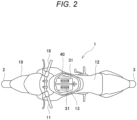
- Fig. 2 is a plan view of the straddle-type vehicle 1.
- the straddle-type vehicle 1 has an insertion opening 40 opened upward in order to mount the battery 14 on the battery case 13.
- the insertion opening 40 is provided above an opening of the battery case 13 at a position between the front fork 5 and the seat 12 in the front-rear direction in order for an operator to access the opening of the battery case 13 when inserting and removing the battery 14 into and from the battery case 13.
- Fig. 2 shows a state in which the outer lid 53 covering the insertion opening 40 of the straddle-type vehicle 1 is removed. Further, a state in which the battery 14 is not accommodated in an accommodation space of the battery case 13 is shown. Therefore, Fig. 2 shows case-side connector 31 in the battery case 13 to be described later.
- the battery case 13 is configured such that the two batteries 14 are disposed side by side in a width direction inside the battery case 13 and accommodated inside the battery case 13.
- Fig. 3 is a cross-sectional view of the battery case 13 taken along a surface extending in the front-rear direction.
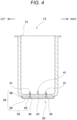
- Fig. 4 is a cross-sectional view of the battery case 13 taken along a surface extending in the width direction.
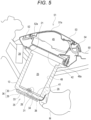
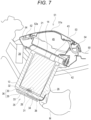
- Figs. 5 and 6 are cross-sectional views of a region in the periphery of the battery case taken along a surface extending in the front-rear direction.
- Fig. 5 shows a state in which, in the straddle-type vehicle 1, the outer lid 53 covering an insertion opening 40 of the straddle-type vehicle 1 for accessing the battery case 13 is closed.
- Fig. 5 shows a state in which, in the straddle-type vehicle 1, the outer lid 53 covering an insertion opening 40 of the straddle-type vehicle 1 for accessing the battery case 13 is closed.
- Fig. 6 shows a state in which the outer lid 53 covering the insertion opening 40 of the straddle-type vehicle 1 is opened and a lid 42 is removed.
- Fig. 7 shows a cross-sectional view of the region in the periphery of the battery case in a state in which the batteries 14 are accommodated inside the battery case 13, taken along a surface extending in the front-rear direction.
- the battery case 13 is configured as a housing capable of accommodating the batteries 14.
- the battery case 13 has an accommodation space 25 for accommodating the batteries 14.
- the battery case 13 includes an inner bottom wall 28 inclined downward toward the rear, and side walls 48 extending upward from the inner bottom wall 28 and surrounding a lateral side of the accommodation space 25.
- the battery case 13 has openings 21 that open the accommodation space 25 of the batteries 14 upward in order to insert and remove the batteries 14.
- the battery case 13 is inclined with respect to a vertical direction such that the openings 21 face obliquely upward and rearward when the battery case 13 is attached to the straddle-type vehicle 1. That is, the battery case 13 is attached to the straddle-type vehicle 1 so as to be inclined rearward from a lower end to an upper side.
- the accommodation space 25 of the battery case 13 is configured such that an area of a cross section orthogonal to an insertion direction D1 of the battery 14 decreases toward a lower side.
- steps 22 are provided on a front surface and a rear surface of an upper portion of an inner surface of the battery case 13. Further, below the portion of the inner surface of the battery case 13 where the steps 22 are provided, the battery case 13 is configured such that the front surface and the rear surface of the inner surface of the battery case 13 are formed in a tapered shape to approach each other toward the lower side.
- the battery case 13 is configured such that the inner surface thereof becomes narrow inward from the upper side to the lower side by a part where the steps 22 are provided on the upper portion thereof and a part 24 formed in the tapered shape on the lower portion thereof.
- the side wall 48 of the battery case 13 has a drain hole 26 for discharging water that has entered the accommodation space 25.
- the drain hole 26 opens at a lower and rear corner portion of the accommodation space 25 in the battery case 13.
- the drain hole 26 extends toward the outside of the battery case 13 in a direction having at least a downward component.
- the drain hole 26 is provided in a rear end portion 13d of the battery case 13 at a position close to the inner bottom wall 28 of the side wall 48 in the upper-lower direction.
- the drain hole 26 is configured to communicate the accommodation space 25 with the outside.
- the battery case 13 is configured to accommodate the two batteries 14 in the width direction.
- a partition portion 41 protruding from the inner bottom wall 28 of the battery case 13 toward the inside of the accommodation space 25 is provided so as to divide the accommodation space of the two batteries 14 disposed side by side in the width direction.
- the space in which the two batteries 14 are disposed is divided by the partition portion 41, and the batteries 14 can be disposed at appropriate positions.
- the straddle-type vehicle 1 includes the lid 42 disposed above the battery case 13. As shown in Fig. 5 , the lid 42 that closes the openings 21 is attached to the battery case 13. The lid 42 covers an upper side of the batteries 14 after the batteries 14 are accommodated in the battery case 13 to protect the batteries 14. In the present embodiment, the lid 42 is fixed to the battery case 13 by screwing.
- the straddle-type vehicle 1 includes an outer lid member 51 provided in front of the seat 12 and above the lid 42. As shown in Fig. 5 , the outer lid member 51 constitutes a part of an outer surface of the straddle-type vehicle 1 above the lid 42, and is configured to open and close the outer lid 53 above the battery case 13.
- the batteries 14 are protected by the battery case 13, the lid 42, and the outer lid member 51 when the batteries 14 are accommodated inside the battery case 13 mounted on the straddle-type vehicle 1.
- the outer lid member 51 is attached to an upper end 48a of the side wall 48 of the battery case 13.
- the outer lid member 51 is partially embedded in a cowl 50 of the straddle-type vehicle 1 at a position in front of the seat 12, and a portion protruding from the cowl 50 constitutes an outer surface of the straddle-type vehicle 1.
- the outer lid member 51 is located between legs of the rider when the rider straddles over the seat 12, and an upper end 51a of the outer lid member 51 protrudes upward from the seat 12.
- the outer lid member 51 includes a base 52 having an opening 52a, the outer lid 53 provided so as to be able to open and close the opening 52a of the base 52, and a hinge portion 54 rotatably connecting the outer lid 53 to the base 52.
- the hinge portion 54 is provided at a rear portion of the base 52 such that the outer lid 53 opens rearward.
- the hinge portion 54 is disposed at a position lower than a front end of the outer lid 53.
- the insertion opening 40 is provided inside the base 52 as a space through which the batteries 14 pass when the batteries 14 are inserted into and removed from the battery case 13.
- the insertion opening 40 is located above the battery case 13 along the insertion direction in which the batteries are inserted toward the battery case 13.
- the insertion opening 40 is provided in the outer lid member 51.
- the battery case 13 is adjacent to a front side of the motor M and is attached to the straddle-type vehicle 1.
- the battery case 13 is disposed between the front fork 5 and the motor M in the front-rear direction of the straddle-type vehicle 1.
- the battery case 13 is disposed in an inclined manner, and the front surface of the battery case 13 extends in the same direction as the longitudinal direction of the front fork 5.
- the lid 42 is configured to abut on an upper end 43 of the batteries 14 in a state in which the batteries 14 are accommodated inside the battery case 13. Since the batteries 14 are in contact with the lid 42 in a state of being accommodated in the battery case 13, the batteries 14 are pressed inside the battery case 13. Since the batteries 14 are pressed by the lid 42 even during traveling of the straddle-type vehicle 1, even if a force acts on the straddle-type vehicle 1 in the upper-lower direction during traveling, the batteries 14 can be prevented from moving in the upper-lower direction.
- a bottom portion of the battery case 13 has a double-bottom structure 35.
- the double-bottom structure 35 on the bottom portion of the battery case 13 includes an inner bottom wall 28, an outer bottom wall 29 covering the inner bottom wall 28 from below, and a peripheral wall 30 connecting the outer bottom wall 29 to the inner bottom wall 28.
- the inner bottom wall 28 and the outer bottom wall 29 are collectively referred to as a bottom wall 56.
- the bottom wall 56 is inclined downward as going rearward.
- the inner bottom wall 28 of the battery case 13 is provided with the case-side connector 31 protruding toward an inside of the accommodation space 25.
- the battery 14 is provided with a battery-side connector 32 connected to the case-side connector 31 when the battery 14 is accommodated in the accommodation space of the battery case 13.
- an electric wire 34 connected to the case-side connector 31 is disposed in a wiring space 33 between the outer bottom wall 29 and the inner bottom wall 28 in the double-bottom structure 35 of the battery case 13.
- the electric wire 34 extends from the case-side connector 31 toward the wiring space 33 through an inside of the inner bottom wall 28 of the battery case 13, and extends rearward through the inside of the wiring space 33 to an outside of the battery case 13.
- the battery case 13 includes the double-bottom structure 35, the case-side connector 31, and the electric wire 34.
- the outer bottom wall 29 and the peripheral wall 30 are formed separately from the inner bottom wall 28.
- the outer bottom wall 29 and the peripheral wall 30 constitute a one-piece bottom lid 36.
- Fig. 8 shows an enlarged cross-sectional view of the double-bottom structure 35 provided in a front portion of the battery case 13.
- a seal member 37 is interposed between mating surfaces of the inner bottom wall 28 and the bottom lid 36 of the battery case 13.
- a drain hole 38 is provided in the peripheral wall 30.
- the drain hole 38 is provided in the rear end portion 13d of the battery case 13 at a position close to the outer bottom wall 29.
- the drain hole 38 is configured to communicate the wiring space 33 with the outside.
- the outer bottom wall 29 is inclined to extend downward as going rearward, even if water enters the wiring space 33 of the battery case 13, the water that has entered the wiring space 33 flows along the outer bottom wall 29. The water that has entered the wiring space 33 is directed rearward in the wiring space 33.
- the drain hole 38 is provided in the inner surface of the battery case 13 at a position rearward and close to the outer bottom wall 29, the water that has entered proceeds toward the drain hole 38, and as a result, the water is discharged from the drain hole 38.
- the drain holes 26, 38 are provided in the accommodation space 25 and the wiring space 33 so as to drain the water that has entered the spaces.
- the straddle-type vehicle 1 further includes electrical component disposed in front of the battery case 13 such that at least part of the electrical component overlaps the battery case 13 in the upper-lower direction.
- Figs. 5 , 6 , and 7 show an electrical component arrangement space 39 in which the electrical component is disposed in front of the battery case 13.
- the electrical component used in the straddle-type vehicle 1 is disposed in the electrical component arrangement space 39.
- the battery case 13 is attached to the vehicle body frame 4 so as to be inclined rearward from the lower end to the upper side. Accordingly, the space in which objects can be disposed is formed in front of the battery case 13. Accordingly, in the present embodiment, it is not necessary to newly provide a space in which the electrical component is disposed, by disposing the electrical component in the space formed in front of the battery case 13. Therefore, the space inside the straddle-type vehicle 1 can be efficiently utilized. Accordingly, the straddle-type vehicle 1 can be downsized.
- the ECU is included in the electrical component provided in the electrical component arrangement space 39 formed in front of the battery case 13.
- the ECU By providing the electrical component including the ECU in the electrical component arrangement space 39 in front of the battery case 13, the ECU can be provided in the space that directly receives traveling wind. Accordingly, the ECU can be efficiently cooled by the traveling wind. In particular, since the ECU easily generates heat as the straddle-type vehicle 1 travels, the temperature of the ECU can be set to an appropriate temperature even during traveling of the straddle-type vehicle 1 by cooling the ECU with traveling wind.
- the outer lid 53 covering the insertion opening 40 is opened.
- the lid 42 above the battery case 13 is removed.
- the inside of the accommodation space 25 of the battery case 13 can be accessed from the outside.
- the battery 14 passes through the insertion opening 40 on the inner side in the front-rear direction of the base 52, passes through the openings 21 of the battery case 13, and is disposed in the accommodation space 25 of the battery case 13.
- the lid 42 is attached above the battery case 13 in a state in which the batteries 14 are accommodated in the accommodation space 25 of the battery case 13, and the insertion opening 40 is closed by the outer lid 53, whereby accommodation of the batteries 14 in the battery case 13 is completed.
- the inclination of the battery case 13 will be described with reference to Fig. 9 .
- the battery case 13 is inclined with respect to the vertical direction such that the openings 21 of the battery case 13 face obliquely upward and rearward, a line L1 connecting a center of the opening 21 at an upper end of the battery case 13 to a center of the inner bottom wall 28 is inclined.
- the battery 14 is inserted into the battery case 13 along the center line L1.
- a direction in which the battery 14 is inserted into the battery case 13 along the line L1 at this time is referred to as an insertion direction D2 of the battery 14 into the battery case 13, and an angle at which the line L1 is inclined with respect to a line L5 extending in the vertical direction at this time is referred to as an insertion angle ⁇ 1. Since the battery case 13 is disposed in the straddle-type vehicle 1 in a way of being inclined at the insertion angle ⁇ 1, a front surface 13a of an outer wall of the battery case 13 is inclined with respect to the vertical direction.
- a line along a longitudinal direction D4 of the front fork 5 is referred to as a line L2, and an angle at which the line L2 is inclined with respect to the line L5 extending in the vertical direction is referred to as an inclination angle ⁇ 2.
- the straddle-type vehicle 1 is configured such that the insertion angle ⁇ 1 of the battery 14 in the battery case 13 and the inclination angle ⁇ 2 of the longitudinal direction D4 of the front fork 5 with respect to the vertical direction are the same angle. Accordingly, the straddle-type vehicle 1 is configured such that the insertion direction D2 of the battery 14 into the openings 21 of the battery case 13 is the same as the longitudinal direction D4 of the front fork 5 when the battery 14 is accommodated in the battery case 13.
- the front fender 19 moves while maintaining a length g1 of a gap between a rear end 19a of the front fender 19 and the front surface 13a of the battery case 13 in an orthogonal direction D3 orthogonal to the insertion direction D2. Accordingly, in the orthogonal direction D3, the front fender 19 is prevented from moving toward the front surface 13a of the battery case 13.
- a line along a direction in which the front surface 13a of the battery case 13 extends is referred to as a line L3
- a line along an extending direction of a movement trajectory of the front end 19a of the front fender 19 linked with the extension and contraction of the front fork 5 is referred to as a line L4.
- the battery 14 accommodated in the battery case 13 of the straddle-type vehicle 1 is a heavy object. Since the battery 14 which is the heavy object can be disposed at the low position, a center of gravity of the straddle-type vehicle 1 can be lowered.
- the battery case 13 Since the battery case 13 can be disposed at the low position, in the present embodiment, the battery case 13 is disposed such that a lower end 13b of the battery case 13 is located lower than an upper end Mc of the motor M. The lower end 13b of the battery case 13 is disposed between the front fork 5 and the motor M in the front-rear direction of the straddle-type vehicle 1.
- the upper portion of the battery case 13 since the upper portion of the battery case 13 is located rearward of the lower portion of the battery case 13, the upper portion of the battery case 13 can be disposed close to the motor M. Specifically, the rear end portion of the upper portion of the battery case is located rearward of a front end portion of the motor.
- a center of gravity G1 of the battery 14 can be disposed closer to a center of gravity G2 (in other words, a roll axis) of the vehicle body of the straddle-type vehicle 1 compared with a case where the battery case is disposed vertically.
- G2 center of gravity
- the battery case 13 is disposed on the straddle-type vehicle 1 such that the lower end 13b of the battery case 13 is located above a lower end Md of the motor case Ma of the motor M. Since the lower end 13b of the battery case 13 is located above the lower end Md of the motor case Ma, the motor case Ma is likely to come into contact with an obstacle below the vehicle body before the battery case 13. Accordingly, the battery case 13 can be prevented from coming into contact with the obstacle, and the battery 14 inside the battery case 13 can be more reliably protected.
- the upper end position 14a of the battery accommodated in the battery case 13 is located below a lower end 12a of the seat 12.
- an upper rear end 13c of the battery case 13 is disposed behind the front end Me of the motor case Ma of the drive motor M.
- the upper rear end 13c of the battery case 13 is disposed forward of the seat front end 12b.
- the front fender 19 moves in response to the front fork 5 extending and contracting.
- the straddle-type vehicle 1 prevents the interference between the battery case 13 and the front fender 19 by the inclination of the battery case 13.
- the component (linkage component) that moves up and down in accordance with the extension and contraction of the front fork 5 may be a component other than the front fender 19.
- an aerodynamic part that is a part for obtaining down force may be the linkage component.
- the present invention can be suitably applied to a case where the aerodynamic part is attached to a portion that moves up and down in accordance with the extension and contraction of the front fork 5, and a rear end of the aerodynamic part is located close to the battery case 13.
- the insertion direction D2 of the battery 14 into the battery case 13 when the battery 14 is accommodated in the battery case 13 is the same as the longitudinal direction D4 of the front fork 5. Accordingly, when the battery 14 is inserted and removed from the battery case 13, it is possible to prevent the components provided on an upper portion of the front fork 5 from interfering with the operation of inserting and removing the battery 14.
- the steering shaft 7 is provided above the front fork 5, and the handle bar 11 is attached to the steering shaft 7. Generally, the steering shaft 7 extends along the extension direction D4 of the front fork 5, and the extension direction D4 of the front fork 5 and an extension direction of the steering shaft 7 are the same.
- the insertion direction D2 of the battery 14 is the same as the extension direction D4 of the front fork 5
- the insertion direction D2 of the battery 14 is substantially the same as the extension direction of the steering shaft 7. Accordingly, when the battery 14 is accommodated in the battery case 13, the interference between the battery 14 and the steering shaft 7 can be suppressed. Accordingly, the steering shaft 7 can be prevented from interfering with the operation of accommodating the battery 14.
- the battery case 13 is configured such that the inner surface thereof faces inward as going toward the lower side. Therefore, the openings 21 of the battery case 13 are formed to become large, and the battery 14 can be easily accommodated when the battery 14 is accommodated in the battery case 13. Further, in the present embodiment, since the steps 22 are provided on the upper portions of the front surface and the rear surface of the accommodation space 25 inside the battery case 13, the insertion position of the battery 14 can be located within a certain range when the battery 14 is inserted into the accommodation space 25 of the battery case 13. Further, in the present embodiment, the front surface and the rear surface of the lower portion of the steps 22 in the accommodation space 25 inside the battery case 13 are formed in the tapered shape so as to approach each other toward the lower side. Accordingly, the inner surface of the battery case 13 functions as a guide surface when the battery 14 is inserted. Therefore, by inserting the battery 14 along the inner surface of the battery case 13, the battery 14 can be disposed at an appropriate installation position in the battery case 13.
- the inner bottom wall 28 of the battery case 13 is provided with the case-side connector 31 protruding toward the accommodation space 25.
- the battery-side connector 32 is provided at the lower end of the battery 14 so as to protrude toward the inner bottom wall 28 of the battery case 13 when the battery 14 is accommodated in the battery case 13.
- the insertion position of the battery 14 is determined by the steps 22, and the battery 14 is guided by the tapered surfaces 24. Accordingly, in a process of inserting the battery 14, the battery 14 can be guided to the installation position of the battery case 13, and the battery 14 can be disposed at an appropriate installation position. Accordingly, it is possible to more reliably and appropriately connect the case-side connector 31 to the battery-side connector 32. Further, the operator who inserts the battery 14 can simplify the operation of positioning the battery 14 and the battery case 13.
- the outer bottom wall 29 and the peripheral wall 30 are formed as the one-piece bottom lid 36.
- the seal member 37 is interposed between the mating surfaces of the inner bottom wall 28 and the bottom lid 36 of the battery case 13. Accordingly, water is prevented from entering the wiring space 33 through between the inner bottom wall 28 and the bottom lid 36.
- the drain hole 38 is provided at the rear position on the inner surface of the wiring space 33. Even if water temporarily enters the wiring space 33, the water that has entered is discharged from the drain hole 38. Accordingly, the inside of the wiring space 33 is protected with high waterproof properties.
- the water that has entered is discharged from the drain hole 26. Accordingly, the inside of the accommodation space 25 is protected with high waterproof properties.
- the bottom portion of the battery case 13 is configured to have the double-bottom structure 35, strength of the bottom portion 55 of the battery case 13 can be improved.
- the bottom portion 55 of the battery case 13 is disposed in a posture of relatively facing a front of the straddle-type vehicle 1. Therefore, the bottom portion 55 of the battery case 13 is disposed at a position where the bottom portion 55 is likely to receive wind pressure caused by the traveling wind.
- the strength of the bottom portion 55 of the battery case 13 is improved by the double-bottom structure 35, even if the bottom portion 55 receives a strong wind pressure, durability of the battery case 13 is ensured.
- the bottom portion can receive the load acting on the battery case 13 by the surface. Accordingly, the load acting on the bottom portion of the battery case 13 per unit area can be reduced, and the durability of the battery case 13 can be improved.
- the straddle-type vehicle 1 includes a storage 45 disposed above the battery case 13 and capable of accommodating objects.
- the battery case 13 is attached to the vehicle body frame 4 in the inclined manner, whereby the battery case 13 can be disposed at the low position of the straddle-type vehicle 1. Since the battery case 13 is disposed at the relatively low position inside the straddle-type vehicle 1, a space is formed above the battery case 13 in the straddle-type vehicle 1. Accordingly, the space can be used as the storage 45 capable of accommodating objects.
- the storage 45 is provided inside the outer lid 53 of the outer lid member 51. Accordingly, the storage 45 serving as an accommodation space can be provided in the straddle-type vehicle 1 without increasing a height of the straddle-type vehicle 1.
- the straddle-type vehicle 1 can be easily used while suppressing an increase in size of the straddle-type vehicle 1.
- the space of the storage 45 can be accessed by opening the outer lid 53, and the objects can be taken out from the storage 45 when the objects are accommodated in the storage 45.
- the objects are stored inside the storage 45 in a state where the lid 42 is attached to the battery case 13.
- the present invention is not limited thereto.
- the front surface 13a of the battery case 13 may extend in a direction away from the front fork 5 to the rear, as going upward. Accordingly, even if the front fender 19 moves up and down together with the front fork 5, the interference between the battery case 13 and the front fender 19 can be suppressed.
- the straddle-type vehicle 1 may include one wheel or three or more wheels.
- the straddle-type vehicle 1 may include at least one wheel.
- the angle ⁇ 1 at which the insertion direction D2 of the battery 14 into the battery case 13 is inclined with respect to the vertical direction and the angle ⁇ 2 at which the extension direction of the front fork 5 is inclined with respect to the vertical direction are the same, but the present invention is not limited thereto.
- the angle ⁇ 1 at which the insertion direction D2 of the battery 14 into the battery case 13 is inclined with respect to the vertical direction may be larger than the angle ⁇ 2 at which the front fork 5 is inclined.
- the battery case 13 is disposed such that the front surface 13a of the battery case 13 extends in the direction away from the front fork 5 to the rear as going upward, and the battery case 13 is away from the front fork 5 toward the upper side.
- the steps 22 are provided on the upper portion of the front surface and the rear surface of the inner surface of the battery case 13, and the front surface and the rear surface of the lower portion of the steps 22 of the inner surface of the battery case 13 are formed in the tapered shape so as to approach each other toward the lower side is described, but the present invention is not limited thereto.
- the steps 22 may be provided on both side surfaces of the inner surface of the battery case 13.
- both the side surfaces of the lower portion of the steps 22 on the inner surface of the battery case may be formed in the tapered shape so as to approach each other toward the lower side.
- the steps 22 may not be provided on the front surface and the rear surface of the inner surface of the battery case 13, and the steps 22 may be provided only on both the side surfaces of the inner surface of the battery case 13.
- the front surface and the rear surface of the inner surface of the battery case 13 may not be formed in the tapered shape, and only both the side surfaces of the inner surface of the battery case 13 may be formed in the tapered shape.
- the battery case 13 may have either a configuration in which the steps are provided on the upper portion of the inner surface of the battery case 13 or a configuration in which the inner surface of the battery case 13 is formed in the tapered shape. Further, the battery case 13 may be configured such that the steps are provided on the upper portions of the front surface and the rear surface or both the side surfaces of the inner surface of the battery case 13, and the other of the front surface and the rear surface or both the side surfaces of the inner surface of the battery case is formed in the tapered shape. That is, in the inner surface of the battery case 13, the surfaces on which the steps 22 are provided may be different from the surfaces 24 formed in the tapered shape.
- the drain hole 26 is formed in the rear end portion 13d of the battery case 13 so as to penetrate the side wall 48 in the direction orthogonal to the insertion direction D1 of the battery 14, but the present invention is not limited thereto.
- the drain hole 26 may have another configuration as long as the water that has entered the accommodation space 25 can be drained to the outside.
- the drain hole 26 may be formed to penetrate the inner bottom wall 28 along the insertion direction D1 of the battery 14, and may be configured to drain the water that has entered the accommodation space 25 to the outside.
- the drain hole 26 is required to be formed at a position outside the bottom lid 36 so as not to interfere with the bottom lid 36.
- the drain hole 38 is formed in the rear end portion 13d of the battery case 13 so as to penetrate the peripheral wall 30 in the direction orthogonal to the insertion direction D1 of the battery 14, but the present invention is not limited thereto.
- the drain hole 38 may have another configuration as long as the water that has entered the wiring space 33 can be drained to the outside.
- the drain hole 38 may be formed to penetrate the outer bottom wall 29 along the insertion direction D1 of the battery 14, and may be configured to drain the water that has entered the wiring space 33 to the outside.
- the straddle-type vehicle 1 may include a drive source other than the motor.
- the straddle-type vehicle 1 may include an engine as the drive source.
- the drive source may not be a single one, and the straddle-type vehicle 1 may be driven by using drive forces generated by a plurality of drive sources.
- the electric power stored in the battery 14 may be supplied to the electrical component other than the drive source and used therein.
- the embodiment has been described as an example of the technique disclosed in the present application.
- the technology disclosed in the present disclosure is not limited thereto, and is also applicable to embodiments in which changes, replacements, additions, omissions, and the like are appropriately performed.
- a part of a configuration or a method in one embodiment may be applied to another embodiment, and a part of a configuration in the embodiment may be freely extracted from another configuration in the embodiment.
- the constituent elements described in the accompanying drawings and the detailed description include not only constituent elements essential for solving the problem but also constituent elements that are not essential for solving the problem in order to illustrate the technique.
- a straddle-type vehicle includes: a vehicle body frame; at least one wheel; a drive source configured to generate power to be transmitted to the wheel; and a battery case including an accommodation space in which a battery for storing electric power is accommodated and an opening that opens the accommodation space upward for inserting and removing the battery.
- the battery case is inclined with respect to a vertical direction such that the opening faces obliquely upward and rearward.
- a lower end of the battery case is disposed in a front space of the drive source and located lower than an upper end of the drive source.
- the at least one wheel may include a front wheel and a rear wheel.
- the straddle-type vehicle may further include: a front fork connecting the vehicle body frame to the front wheel and extending obliquely upward and rearward, and configured to extend and contract in a longitudinal direction to reduce an impact transmitted to the vehicle body frame.
- the lower end of the battery case may be disposed between the front fork and the drive source in a front-rear direction of the straddle-type vehicle.
- a front surface of the battery case may extend away from the front fork toward the same direction as the longitudinal direction of the front fork or toward an upper side of the front fork.
- the at least one wheel may include a front wheel and a rear wheel.
- the straddle-type vehicle may further include: a front fork connecting the vehicle body frame to the front wheel and extending obliquely upward and rearward, and configured to extend and contract in a longitudinal direction to reduce an impact transmitted to the vehicle body frame; and a linkage component connected to the front fork and moving up and down together with the front fork in response to extension and contraction of the front fork.
- a front surface of the battery case may be located rearward of a movement trajectory of the linkage component linked with the extension and contraction of the front fork.
- the at least one wheel may include a front wheel and a rear wheel.
- the straddle-type vehicle may further include: a front fork connecting the vehicle body frame to the front wheel and extending obliquely upward and rearward, and configured to extend and contract in a longitudinal direction to reduce an impact transmitted to the vehicle body frame.
- the lower end of the battery case may be disposed between the front fork and the drive source in a front-rear direction of the straddle-type vehicle.
- An insertion direction of the battery may be a direction spaced away from the front fork toward the same direction as the longitudinal direction of the front fork or toward an upper side of the front fork.
- the accommodation space of the battery case may be configured such that an area of a cross section of the battery case orthogonal to an insertion direction of the battery decreases toward a lower side of the battery case.
- the battery case may include a bottom wall that supports the battery.
- the bottom wall of the battery case may be inclined downward and rearward.
- the battery case may have a drain hole opening at a corner portion arranged at a lower side and a rear side of the accommodation space.
- the straddle-type vehicle may further include an arrangement space may be a space for housing an electrical component.
- the arrangement space may be disposed in front of the battery case such that at least part of the electrical component overlaps the battery case in an upper-lower direction.
- an inner bottom wall of the battery case may be provided with a case-side connector that is connectable to a battery-side connector provided on the battery.
Landscapes
- Engineering & Computer Science (AREA)
- Mechanical Engineering (AREA)
- Chemical & Material Sciences (AREA)
- Combustion & Propulsion (AREA)
- Transportation (AREA)
- Automatic Cycles, And Cycles In General (AREA)
Applications Claiming Priority (1)
| Application Number | Priority Date | Filing Date | Title |
|---|---|---|---|
| JP2022081273A JP2023169930A (ja) | 2022-05-18 | 2022-05-18 | 鞍乗車両 |
Publications (1)
| Publication Number | Publication Date |
|---|---|
| EP4279366A1 true EP4279366A1 (de) | 2023-11-22 |
Family
ID=86386770
Family Applications (1)
| Application Number | Title | Priority Date | Filing Date |
|---|---|---|---|
| EP23173832.9A Pending EP4279366A1 (de) | 2022-05-18 | 2023-05-17 | Grätschsitzfahrzeug |
Country Status (4)
| Country | Link |
|---|---|
| US (1) | US12612128B2 (de) |
| EP (1) | EP4279366A1 (de) |
| JP (1) | JP2023169930A (de) |
| CN (1) | CN117104376A (de) |
Cited By (2)
| Publication number | Priority date | Publication date | Assignee | Title |
|---|---|---|---|---|
| EP4279365A1 (de) * | 2022-05-19 | 2023-11-22 | Kawasaki Motors, Ltd. | Grätschsitzfahrzeug |
| EP4311752A1 (de) * | 2022-07-25 | 2024-01-31 | Kawasaki Motors, Ltd. | Grätschsitzelektrofahrzeug |
Families Citing this family (1)
| Publication number | Priority date | Publication date | Assignee | Title |
|---|---|---|---|---|
| JP7787019B2 (ja) * | 2022-05-19 | 2025-12-16 | カワサキモータース株式会社 | 鞍乗車両 |
Citations (6)
| Publication number | Priority date | Publication date | Assignee | Title |
|---|---|---|---|---|
| EP2210803A2 (de) * | 2009-01-21 | 2010-07-28 | Markus Christ | Akkueinheit für ein Elektromotorrad sowie Elektromotorrad |
| EP2623404A1 (de) * | 2010-09-30 | 2013-08-07 | Suzuki Motor Corporation | Elektrisches zweirädriges fahrzeug |
| WO2015068753A1 (ja) | 2013-11-06 | 2015-05-14 | ヤマハ発動機株式会社 | 鞍乗型電動車両 |
| US9884566B2 (en) * | 2015-05-29 | 2018-02-06 | Yamaha Hatsudoki Kabushiki Kaisha | Straddled electric vehicle |
| WO2019211946A1 (ja) * | 2018-05-03 | 2019-11-07 | 本田技研工業株式会社 | 鞍乗型電動車両 |
| WO2021005765A1 (ja) * | 2019-07-10 | 2021-01-14 | 本田技研工業株式会社 | 鞍乗型電動車両 |
Family Cites Families (25)
| Publication number | Priority date | Publication date | Assignee | Title |
|---|---|---|---|---|
| JP4274759B2 (ja) * | 2002-08-16 | 2009-06-10 | ヤマハ発動機株式会社 | 電動二輪車 |
| JP4130571B2 (ja) * | 2002-11-14 | 2008-08-06 | ヤマハ発動機株式会社 | 鞍乗型電動車両 |
| US9132878B2 (en) * | 2010-11-18 | 2015-09-15 | Kawasaki Jukogyo Kabushiki Kaisha | Electric motorcycle |
| WO2012066601A1 (ja) * | 2010-11-18 | 2012-05-24 | 川崎重工業株式会社 | 鞍乗型電動車両 |
| JP5853025B2 (ja) * | 2011-10-28 | 2016-02-09 | 川崎重工業株式会社 | 鞍乗型電動車両 |
| US20150210339A1 (en) * | 2011-12-22 | 2015-07-30 | Takeshi Igarashi | Straddle-type electric vehicle |
| CN103946108B (zh) * | 2011-12-28 | 2016-08-24 | 川崎重工业株式会社 | 跨乘式电动车辆 |
| US20130270021A1 (en) * | 2012-01-16 | 2013-10-17 | Fibres S.R.O. | Electric-Drive Motorcycle |
| JP6183089B2 (ja) | 2013-09-17 | 2017-08-23 | スズキ株式会社 | 電動車両 |
| IN2014DE03073A (de) * | 2013-11-05 | 2015-07-10 | Suzuki Motor Corp | |
| JP6399741B2 (ja) * | 2013-11-06 | 2018-10-03 | ヤマハ発動機株式会社 | 鞍乗型電動車両 |
| JP6284746B2 (ja) * | 2013-11-06 | 2018-02-28 | ヤマハ発動機株式会社 | 鞍乗型電動車両 |
| JP2015089756A (ja) * | 2013-11-06 | 2015-05-11 | ヤマハ発動機株式会社 | 鞍乗型電動車両 |
| JP6536353B2 (ja) * | 2015-10-27 | 2019-07-03 | スズキ株式会社 | 電動車両のコンバータ配置構造 |
| KR101839824B1 (ko) * | 2016-12-26 | 2018-03-19 | 주식회사 동양모터스 | 전동이륜차용 프레임 |
| DE112017007897B4 (de) * | 2017-09-29 | 2024-10-10 | Honda Motor Co., Ltd. | Elektrofahrzeug vom satteltyp |
| TWI674980B (zh) * | 2018-02-02 | 2019-10-21 | 光陽工業股份有限公司 | 電動車的電池盒開啟控制結構 |
| JP2019155985A (ja) * | 2018-03-08 | 2019-09-19 | ヤマハ発動機株式会社 | 鞍乗型電動車両 |
| EP4043326A4 (de) * | 2019-10-11 | 2024-02-07 | Honda Motor Co., Ltd. | Batterieaufnahmevorrichtung und elektrisches fahrzeug |
| JP2024067997A (ja) * | 2022-11-07 | 2024-05-17 | カワサキモータース株式会社 | 鞍乗車両 |
| JP2024118004A (ja) * | 2023-02-20 | 2024-08-30 | ヤマハ発動機株式会社 | 電動鞍乗型車両 |
| JP2024135146A (ja) * | 2023-03-22 | 2024-10-04 | 本田技研工業株式会社 | バッテリの支持構造および支持方法 |
| JP7637173B2 (ja) * | 2023-03-29 | 2025-02-27 | 本田技研工業株式会社 | 電動車両 |
| JP2025059439A (ja) * | 2023-09-29 | 2025-04-10 | スズキ株式会社 | 鞍乗型車両 |
| US20250019033A1 (en) * | 2024-09-30 | 2025-01-16 | Shenzhen Coswheel Technology Co., Ltd | Electric motorcycle frame |
-
2022
- 2022-05-18 JP JP2022081273A patent/JP2023169930A/ja active Pending
-
2023
- 2023-05-17 CN CN202310558411.1A patent/CN117104376A/zh active Pending
- 2023-05-17 EP EP23173832.9A patent/EP4279366A1/de active Pending
- 2023-05-17 US US18/198,399 patent/US12612128B2/en active Active
Patent Citations (6)
| Publication number | Priority date | Publication date | Assignee | Title |
|---|---|---|---|---|
| EP2210803A2 (de) * | 2009-01-21 | 2010-07-28 | Markus Christ | Akkueinheit für ein Elektromotorrad sowie Elektromotorrad |
| EP2623404A1 (de) * | 2010-09-30 | 2013-08-07 | Suzuki Motor Corporation | Elektrisches zweirädriges fahrzeug |
| WO2015068753A1 (ja) | 2013-11-06 | 2015-05-14 | ヤマハ発動機株式会社 | 鞍乗型電動車両 |
| US9884566B2 (en) * | 2015-05-29 | 2018-02-06 | Yamaha Hatsudoki Kabushiki Kaisha | Straddled electric vehicle |
| WO2019211946A1 (ja) * | 2018-05-03 | 2019-11-07 | 本田技研工業株式会社 | 鞍乗型電動車両 |
| WO2021005765A1 (ja) * | 2019-07-10 | 2021-01-14 | 本田技研工業株式会社 | 鞍乗型電動車両 |
Cited By (2)
| Publication number | Priority date | Publication date | Assignee | Title |
|---|---|---|---|---|
| EP4279365A1 (de) * | 2022-05-19 | 2023-11-22 | Kawasaki Motors, Ltd. | Grätschsitzfahrzeug |
| EP4311752A1 (de) * | 2022-07-25 | 2024-01-31 | Kawasaki Motors, Ltd. | Grätschsitzelektrofahrzeug |
Also Published As
| Publication number | Publication date |
|---|---|
| JP2023169930A (ja) | 2023-12-01 |
| CN117104376A (zh) | 2023-11-24 |
| US12612128B2 (en) | 2026-04-28 |
| US20230373583A1 (en) | 2023-11-23 |
Similar Documents
| Publication | Publication Date | Title |
|---|---|---|
| EP4279366A1 (de) | Grätschsitzfahrzeug | |
| EP3067259B1 (de) | Elektrisches sattelfahrzeug | |
| EP2873599B1 (de) | Elektrisches Sattelfahrzeug | |
| US9346421B2 (en) | Saddle-type electric vehicle | |
| US9545968B2 (en) | Saddle-type electric vehicle | |
| CN1043565C (zh) | 用于电动车辆的电池储存箱保护结构 | |
| TWI725366B (zh) | 跨坐型車輛 | |
| US20150122563A1 (en) | Battery and saddle-type electric vehicle equipped therewith | |
| JP7058092B2 (ja) | 鞍乗型車両 | |
| WO2023120113A1 (ja) | 電動作業車 | |
| EP4417497A1 (de) | Grätschsitzelektrofahrzeug | |
| US20240149967A1 (en) | Straddled vehicle | |
| CN117985151A (zh) | 电动车辆 | |
| EP2546129B1 (de) | Zweirädriges Kraftfahrzeug | |
| JP7546543B2 (ja) | 電動作業車 | |
| JP6756031B2 (ja) | 鞍乗り型車両のバッテリ配置構造 | |
| JP2024101025A5 (de) | ||
| EP3936356A1 (de) | Grätschsitzfahrzeug | |
| JP6972079B2 (ja) | 鞍乗型電動車両 | |
| CN222663665U (zh) | 鞍乘型车辆 | |
| JP7083797B2 (ja) | 鞍乗型電動車両 | |
| JP6752962B2 (ja) | 車両のバッテリ配置構造 | |
| JP2023147107A (ja) | 鞍乗り型車両 | |
| JP2023047999A (ja) | 鞍乗り型車両 |
Legal Events
| Date | Code | Title | Description |
|---|---|---|---|
| PUAI | Public reference made under article 153(3) epc to a published international application that has entered the european phase |
Free format text: ORIGINAL CODE: 0009012 |
|
| STAA | Information on the status of an ep patent application or granted ep patent |
Free format text: STATUS: REQUEST FOR EXAMINATION WAS MADE |
|
| 17P | Request for examination filed |
Effective date: 20230517 |
|
| AK | Designated contracting states |
Kind code of ref document: A1 Designated state(s): AL AT BE BG CH CY CZ DE DK EE ES FI FR GB GR HR HU IE IS IT LI LT LU LV MC ME MK MT NL NO PL PT RO RS SE SI SK SM TR |