EP4265755A1 - Procédé pour la liquéfaction de niobium et de tantale, et procédé pour la production de solution de niobium et de solution de tantale - Google Patents
Procédé pour la liquéfaction de niobium et de tantale, et procédé pour la production de solution de niobium et de solution de tantale Download PDFInfo
- Publication number
- EP4265755A1 EP4265755A1 EP22770956.5A EP22770956A EP4265755A1 EP 4265755 A1 EP4265755 A1 EP 4265755A1 EP 22770956 A EP22770956 A EP 22770956A EP 4265755 A1 EP4265755 A1 EP 4265755A1
- Authority
- EP
- European Patent Office
- Prior art keywords
- niobium
- tantalum
- solution
- substance
- precipitate
- Prior art date
- Legal status (The legal status is an assumption and is not a legal conclusion. Google has not performed a legal analysis and makes no representation as to the accuracy of the status listed.)
- Pending
Links
- GUVRBAGPIYLISA-UHFFFAOYSA-N tantalum atom Chemical compound [Ta] GUVRBAGPIYLISA-UHFFFAOYSA-N 0.000 title claims abstract description 95
- GUCVJGMIXFAOAE-UHFFFAOYSA-N niobium atom Chemical compound [Nb] GUCVJGMIXFAOAE-UHFFFAOYSA-N 0.000 title claims abstract description 94
- 229910052758 niobium Inorganic materials 0.000 title claims abstract description 93
- 239000010955 niobium Substances 0.000 title claims abstract description 93
- 229910052715 tantalum Inorganic materials 0.000 title claims abstract description 93
- 238000000034 method Methods 0.000 title claims abstract description 30
- 238000004519 manufacturing process Methods 0.000 title claims abstract description 10
- 239000000126 substance Substances 0.000 claims abstract description 109
- 239000000243 solution Substances 0.000 claims abstract description 56
- 239000002244 precipitate Substances 0.000 claims abstract description 43
- 238000006243 chemical reaction Methods 0.000 claims abstract description 33
- 239000002253 acid Substances 0.000 claims abstract description 30
- 239000007788 liquid Substances 0.000 claims abstract description 30
- 239000000725 suspension Substances 0.000 claims abstract description 26
- 238000000926 separation method Methods 0.000 claims abstract description 25
- 239000007864 aqueous solution Substances 0.000 claims abstract description 23
- WWILHZQYNPQALT-UHFFFAOYSA-N 2-methyl-2-morpholin-4-ylpropanal Chemical compound O=CC(C)(C)N1CCOCC1 WWILHZQYNPQALT-UHFFFAOYSA-N 0.000 claims abstract description 17
- 239000000203 mixture Substances 0.000 claims abstract description 17
- QAOWNCQODCNURD-UHFFFAOYSA-N Sulfuric acid Chemical compound OS(O)(=O)=O QAOWNCQODCNURD-UHFFFAOYSA-N 0.000 claims abstract description 14
- VEXZGXHMUGYJMC-UHFFFAOYSA-N Hydrochloric acid Chemical compound Cl VEXZGXHMUGYJMC-UHFFFAOYSA-N 0.000 claims abstract description 12
- GRYLNZFGIOXLOG-UHFFFAOYSA-N Nitric acid Chemical compound O[N+]([O-])=O GRYLNZFGIOXLOG-UHFFFAOYSA-N 0.000 claims abstract description 5
- 229910017604 nitric acid Inorganic materials 0.000 claims abstract description 5
- 150000003863 ammonium salts Chemical class 0.000 claims description 55
- KRHYYFGTRYWZRS-UHFFFAOYSA-N Fluorane Chemical compound F KRHYYFGTRYWZRS-UHFFFAOYSA-N 0.000 claims description 50
- 238000010438 heat treatment Methods 0.000 claims description 18
- 239000002904 solvent Substances 0.000 claims description 8
- BFNBIHQBYMNNAN-UHFFFAOYSA-N ammonium sulfate Chemical compound N.N.OS(O)(=O)=O BFNBIHQBYMNNAN-UHFFFAOYSA-N 0.000 claims description 7
- 229910052921 ammonium sulfate Inorganic materials 0.000 claims description 7
- 235000011130 ammonium sulphate Nutrition 0.000 claims description 7
- 238000002156 mixing Methods 0.000 claims description 3
- 239000000843 powder Substances 0.000 claims description 3
- 239000002994 raw material Substances 0.000 abstract description 24
- 238000003723 Smelting Methods 0.000 abstract description 23
- 239000012535 impurity Substances 0.000 abstract description 16
- 239000003795 chemical substances by application Substances 0.000 abstract 1
- NTIZESTWPVYFNL-UHFFFAOYSA-N Methyl isobutyl ketone Chemical compound CC(C)CC(C)=O NTIZESTWPVYFNL-UHFFFAOYSA-N 0.000 description 9
- UIHCLUNTQKBZGK-UHFFFAOYSA-N Methyl isobutyl ketone Natural products CCC(C)C(C)=O UIHCLUNTQKBZGK-UHFFFAOYSA-N 0.000 description 9
- 150000007513 acids Chemical class 0.000 description 9
- XLYOFNOQVPJJNP-UHFFFAOYSA-N water Substances O XLYOFNOQVPJJNP-UHFFFAOYSA-N 0.000 description 8
- 239000007787 solid Substances 0.000 description 7
- QGZKDVFQNNGYKY-UHFFFAOYSA-N ammonia Natural products N QGZKDVFQNNGYKY-UHFFFAOYSA-N 0.000 description 5
- 150000002500 ions Chemical group 0.000 description 5
- 238000002844 melting Methods 0.000 description 5
- 230000008018 melting Effects 0.000 description 5
- XEEYBQQBJWHFJM-UHFFFAOYSA-N Iron Chemical compound [Fe] XEEYBQQBJWHFJM-UHFFFAOYSA-N 0.000 description 4
- 238000009835 boiling Methods 0.000 description 4
- 238000004090 dissolution Methods 0.000 description 4
- 239000000047 product Substances 0.000 description 4
- -1 and then Chemical compound 0.000 description 3
- 230000015572 biosynthetic process Effects 0.000 description 3
- WUKWITHWXAAZEY-UHFFFAOYSA-L calcium difluoride Chemical compound [F-].[F-].[Ca+2] WUKWITHWXAAZEY-UHFFFAOYSA-L 0.000 description 3
- 150000001875 compounds Chemical class 0.000 description 3
- 230000000694 effects Effects 0.000 description 3
- 229910052751 metal Inorganic materials 0.000 description 3
- 239000002184 metal Substances 0.000 description 3
- 150000002739 metals Chemical class 0.000 description 3
- 239000002245 particle Substances 0.000 description 3
- 239000002699 waste material Substances 0.000 description 3
- QGZKDVFQNNGYKY-UHFFFAOYSA-O Ammonium Chemical compound [NH4+] QGZKDVFQNNGYKY-UHFFFAOYSA-O 0.000 description 2
- NINIDFKCEFEMDL-UHFFFAOYSA-N Sulfur Chemical compound [S] NINIDFKCEFEMDL-UHFFFAOYSA-N 0.000 description 2
- 229910021529 ammonia Inorganic materials 0.000 description 2
- 239000012153 distilled water Substances 0.000 description 2
- 239000012776 electronic material Substances 0.000 description 2
- 150000002222 fluorine compounds Chemical class 0.000 description 2
- 239000010436 fluorite Substances 0.000 description 2
- 229910052742 iron Inorganic materials 0.000 description 2
- 238000010667 large scale reaction Methods 0.000 description 2
- 229910000484 niobium oxide Inorganic materials 0.000 description 2
- URLJKFSTXLNXLG-UHFFFAOYSA-N niobium(5+);oxygen(2-) Chemical compound [O-2].[O-2].[O-2].[O-2].[O-2].[Nb+5].[Nb+5] URLJKFSTXLNXLG-UHFFFAOYSA-N 0.000 description 2
- BPUBBGLMJRNUCC-UHFFFAOYSA-N oxygen(2-);tantalum(5+) Chemical compound [O-2].[O-2].[O-2].[O-2].[O-2].[Ta+5].[Ta+5] BPUBBGLMJRNUCC-UHFFFAOYSA-N 0.000 description 2
- 231100000614 poison Toxicity 0.000 description 2
- 230000007096 poisonous effect Effects 0.000 description 2
- 239000006104 solid solution Substances 0.000 description 2
- 229910052717 sulfur Inorganic materials 0.000 description 2
- 239000011593 sulfur Substances 0.000 description 2
- 229910001936 tantalum oxide Inorganic materials 0.000 description 2
- 239000008399 tap water Substances 0.000 description 2
- 235000020679 tap water Nutrition 0.000 description 2
- 239000002351 wastewater Substances 0.000 description 2
- VHUUQVKOLVNVRT-UHFFFAOYSA-N Ammonium hydroxide Chemical compound [NH4+].[OH-] VHUUQVKOLVNVRT-UHFFFAOYSA-N 0.000 description 1
- XUIMIQQOPSSXEZ-UHFFFAOYSA-N Silicon Chemical compound [Si] XUIMIQQOPSSXEZ-UHFFFAOYSA-N 0.000 description 1
- ATJFFYVFTNAWJD-UHFFFAOYSA-N Tin Chemical compound [Sn] ATJFFYVFTNAWJD-UHFFFAOYSA-N 0.000 description 1
- 229910001634 calcium fluoride Inorganic materials 0.000 description 1
- 239000003990 capacitor Substances 0.000 description 1
- 230000001413 cellular effect Effects 0.000 description 1
- 238000005119 centrifugation Methods 0.000 description 1
- 239000000039 congener Substances 0.000 description 1
- 238000000354 decomposition reaction Methods 0.000 description 1
- 230000002939 deleterious effect Effects 0.000 description 1
- 238000000605 extraction Methods 0.000 description 1
- 238000001914 filtration Methods 0.000 description 1
- 239000007789 gas Substances 0.000 description 1
- XLYOFNOQVPJJNP-UHFFFAOYSA-M hydroxide Chemical compound [OH-] XLYOFNOQVPJJNP-UHFFFAOYSA-M 0.000 description 1
- 238000002386 leaching Methods 0.000 description 1
- WPBNNNQJVZRUHP-UHFFFAOYSA-L manganese(2+);methyl n-[[2-(methoxycarbonylcarbamothioylamino)phenyl]carbamothioyl]carbamate;n-[2-(sulfidocarbothioylamino)ethyl]carbamodithioate Chemical compound [Mn+2].[S-]C(=S)NCCNC([S-])=S.COC(=O)NC(=S)NC1=CC=CC=C1NC(=S)NC(=O)OC WPBNNNQJVZRUHP-UHFFFAOYSA-L 0.000 description 1
- 239000000463 material Substances 0.000 description 1
- 238000005259 measurement Methods 0.000 description 1
- WPCMRGJTLPITMF-UHFFFAOYSA-I niobium(5+);pentahydroxide Chemical compound [OH-].[OH-].[OH-].[OH-].[OH-].[Nb+5] WPCMRGJTLPITMF-UHFFFAOYSA-I 0.000 description 1
- 230000003647 oxidation Effects 0.000 description 1
- 238000007254 oxidation reaction Methods 0.000 description 1
- 230000001737 promoting effect Effects 0.000 description 1
- 230000009257 reactivity Effects 0.000 description 1
- 238000007670 refining Methods 0.000 description 1
- 229910052710 silicon Inorganic materials 0.000 description 1
- 239000010703 silicon Substances 0.000 description 1
- 238000005245 sintering Methods 0.000 description 1
- 238000000638 solvent extraction Methods 0.000 description 1
- ZIRLXLUNCURZTP-UHFFFAOYSA-I tantalum(5+);pentahydroxide Chemical compound [OH-].[OH-].[OH-].[OH-].[OH-].[Ta+5] ZIRLXLUNCURZTP-UHFFFAOYSA-I 0.000 description 1
Images

Classifications
-
- C—CHEMISTRY; METALLURGY
- C22—METALLURGY; FERROUS OR NON-FERROUS ALLOYS; TREATMENT OF ALLOYS OR NON-FERROUS METALS
- C22B—PRODUCTION AND REFINING OF METALS; PRETREATMENT OF RAW MATERIALS
- C22B3/00—Extraction of metal compounds from ores or concentrates by wet processes
- C22B3/04—Extraction of metal compounds from ores or concentrates by wet processes by leaching
- C22B3/06—Extraction of metal compounds from ores or concentrates by wet processes by leaching in inorganic acid solutions, e.g. with acids generated in situ; in inorganic salt solutions other than ammonium salt solutions
-
- C—CHEMISTRY; METALLURGY
- C22—METALLURGY; FERROUS OR NON-FERROUS ALLOYS; TREATMENT OF ALLOYS OR NON-FERROUS METALS
- C22B—PRODUCTION AND REFINING OF METALS; PRETREATMENT OF RAW MATERIALS
- C22B1/00—Preliminary treatment of ores or scrap
- C22B1/02—Roasting processes
- C22B1/06—Sulfating roasting
-
- C—CHEMISTRY; METALLURGY
- C22—METALLURGY; FERROUS OR NON-FERROUS ALLOYS; TREATMENT OF ALLOYS OR NON-FERROUS METALS
- C22B—PRODUCTION AND REFINING OF METALS; PRETREATMENT OF RAW MATERIALS
- C22B3/00—Extraction of metal compounds from ores or concentrates by wet processes
- C22B3/04—Extraction of metal compounds from ores or concentrates by wet processes by leaching
- C22B3/06—Extraction of metal compounds from ores or concentrates by wet processes by leaching in inorganic acid solutions, e.g. with acids generated in situ; in inorganic salt solutions other than ammonium salt solutions
- C22B3/08—Sulfuric acid, other sulfurated acids or salts thereof
-
- C—CHEMISTRY; METALLURGY
- C22—METALLURGY; FERROUS OR NON-FERROUS ALLOYS; TREATMENT OF ALLOYS OR NON-FERROUS METALS
- C22B—PRODUCTION AND REFINING OF METALS; PRETREATMENT OF RAW MATERIALS
- C22B3/00—Extraction of metal compounds from ores or concentrates by wet processes
- C22B3/20—Treatment or purification of solutions, e.g. obtained by leaching
- C22B3/22—Treatment or purification of solutions, e.g. obtained by leaching by physical processes, e.g. by filtration, by magnetic means, or by thermal decomposition
-
- C—CHEMISTRY; METALLURGY
- C22—METALLURGY; FERROUS OR NON-FERROUS ALLOYS; TREATMENT OF ALLOYS OR NON-FERROUS METALS
- C22B—PRODUCTION AND REFINING OF METALS; PRETREATMENT OF RAW MATERIALS
- C22B34/00—Obtaining refractory metals
- C22B34/20—Obtaining niobium, tantalum or vanadium
- C22B34/24—Obtaining niobium or tantalum
-
- H—ELECTRICITY
- H01—ELECTRIC ELEMENTS
- H01G—CAPACITORS; CAPACITORS, RECTIFIERS, DETECTORS, SWITCHING DEVICES, LIGHT-SENSITIVE OR TEMPERATURE-SENSITIVE DEVICES OF THE ELECTROLYTIC TYPE
- H01G9/00—Electrolytic capacitors, rectifiers, detectors, switching devices, light-sensitive or temperature-sensitive devices; Processes of their manufacture
- H01G9/004—Details
- H01G9/04—Electrodes or formation of dielectric layers thereon
- H01G9/048—Electrodes or formation of dielectric layers thereon characterised by their structure
- H01G9/052—Sintered electrodes
- H01G9/0525—Powder therefor
Definitions
- the present invention relates to a method for liquefying niobium and tantalum and a method for producing a niobium solution and a tantalum solution. Specifically, the present invention relates to a method for liquefying niobium and tantalum and a method for producing a niobium solution and a tantalum solution, which can liquefy niobium and tantalum or produce a niobium solution and a tantalum solution safely and efficiently from a smelting raw material containing niobium and tantalum.
- niobium and tantalum have been used in various applications as electronic materials.
- solid electrolytic capacitors with anode electrodes formed from tantalum have been rapidly and widely used as components of cellular phones, personal computers, and the like due to their small size but large capacity.
- niobium which is a congener of tantalum, is less expensive and has a higher dielectric constant than tantalum, so that it has been studied for use in anode electrodes.
- the anode electrodes are formed by sintering tantalum powder and niobium powder into porous sintered bodies and subjecting the porous sintered bodies to chemical conversion and oxidation.
- Patent Literature 1 and Patent Literature 2 a liquefaction treatment method using hydrofluoric acid has generally been proposed.
- Patent Literature 2 For example, a liquefaction treatment method disclosed in Patent Literature 2 will be described.
- An ore such as tantalite and a raw material such as iron scrap are pulverized and dissolved in hydrofluoric acid, and then, sulfuric acid is added to adjust the concentration of the solution.
- the adjusted solution is next filtered through a filter press to form a clean solution and subjected to solvent extraction with MIBK (methyl isobutyl ketone), with which niobium and tantalum are extracted into MIBK.
- MIBK methyl isobutyl ketone
- niobium hydroxide and tantalum hydroxide precipitates niobium hydroxide and tantalum hydroxide. Further, the hydroxide precipitate is filtered, dried, and finally calcined to obtain niobium oxide and tantalum oxide.
- hydrofluoric acid used in the foregoing Patent Literature 1 and Patent Literature 2 is an industrially important chemical substance.
- hydrofluoric acid is a substance that is very dangerous to handle because contact therewith poses a risk of significantly corroding an affected part and can lead to a fatal accident in the worst case, therefore, hydrofluoric acid is designated as a poisonous substance under Poisonous and Deleterious Substances Control Act in Japan.
- fluorite which is a raw material for hydrofluoric acid
- fluorite or its primary processed products are imported from other countries under the present circumstances.
- the price of particularly high-purity products has surged, making it difficult to stably secure quality and quantity.
- the present invention was invented in view of the foregoing points, and relates to a method for liquefying niobium and tantalum and a method for producing a niobium solution and a tantalum solution, which can liquefy niobium and tantalum or produce a niobium solution and a tantalum solution safely and efficiently from a smelting raw material containing niobium and tantalum.
- a method for liquefying niobium and tantalum of the present invention includes the steps of forming a molten substance in which an ammonium salt is mixed into a powdered substance containing at least one element of niobium or tantalum, dissolving the molten substance having been solidified in a predetermined amount of solvent to form a suspension, subjecting the suspension to solid-liquid separation into a precipitate and a liquid, and dissolving the precipitate by reaction with an acid solution.
- a method for producing a niobium solution and a tantalum solution of the present invention includes the steps of forming a molten substance in which an ammonium salt is mixed into a powdered substance containing at least one element of niobium or tantalum, dissolving the molten substance having been solidified in a predetermined amount of solvent to form a suspension, subjecting the suspension to solid-liquid separation into a precipitate and a liquid, and dissolving the precipitate by reaction with an acid solution.
- the mixture can be melted to cause the ammonium salt to react with the powdered substance and changed into a chemical form that is soluble in acids other than hydrofluoric acid.
- the reaction rate with the ammonium salt can be promoted.
- the step of forming the molten substance includes a step of forming a mixture in which a powder form of the ammonium salt is mixed into the powdered substance
- the reaction between the powdered substance and the ammonium salt can be promoted by heating the resulting mixture.
- the step of forming the molten substance includes a step of forming a mixture in which the powdered substance and a molten form of the ammonium salt are mixed
- the reaction between the powdered substance and the ammonium salt can be promoted by further heating the mixture in which the powdered substance is mixed into the previously melted ammonium salt.
- the powdered substance containing niobium or tantalum and the ammonium salt contained in the mixture can be reacted to form the molten substance.
- the substance containing niobium or tantalum forms a rigid oxide solid solution, but high chemical activity of the thermally decomposed ammonium salt can break the bonds of the oxide solid solution and change it into a substance that is soluble also in common acids other than hydrofluoric acid.
- the precipitate obtained by the solid-liquid separation becomes a compound containing niobium or tantalum close to a pure state in which most impurities have been removed, and thus becomes a substance soluble in common acids.
- the liquid can be disposed of as an ammonium-containing waste solution or can be recycled and reused as an ammonium salt.
- the precipitate is in the form of a substance soluble also in common acids, as described above, so that the precipitate can be easily dissolved and liquefied without using, for example, hydrofluoric acid, which is a highly dangerous acid.
- the solution containing the liquefied niobium or tantalum can be subjected to mutual separation and reduction through, for example, a refining process, and processed into products such as metals, oxides, and fluorides.
- the step of forming the mixture includes mixing the ammonium salt in a weight ratio of about twice or more relative to the powdered substance, the reaction with the powdered substance containing niobium or tantalum can be promoted to make the powdered substance be a molten substance.
- the heating energy and the amount of wastewater increase in proportion to the amount of ammonium salt used, and a large-scale reaction vessel is also required for use in the reaction. Accordingly, the upper limit of the ammonium salt to be mixed can be appropriately changed in consideration of the reaction cost.
- the step of forming the molten substance includes heating for a predetermined period of time so that a temperature of the molten substance becomes about 400 to 500°C, the ammonium salt reaches the melting point to liquefy and then is raised in temperature to near the boiling point, thereby allowing the powdered substance to be incorporated into the molten substance.
- the melting point thereof is approximately 147°C, so that the reaction can be promoted even at a low temperature.
- the heating condition is preferably set so that the temperature of the molten substance is about 400 to 500°C in order to ensure that the powdered substance is incorporated into the molten substance at a low cost.
- the step of forming the suspension includes using an aqueous solution of about one or more times a weight of the molten substance, unreacted ammonium salt generated in the step of forming the molten substance and the impurities present in the molten substance can be dissolved.
- the aqueous solution can be appropriately selected from, for example, distilled water, pure water, ion exchanged water, tap water, or dilute acids. Further, the upper limit of the aqueous solution can be appropriately changed in consideration of solid-liquid separation, which is a post-process.
- the powdered substance can be easily made into a molten substance and the ammonium hydrogen sulfate or ammonium sulfate has high reactivity to niobium and tantalum, so that the precipitate containing niobium or tantalum can be stably liquefied from the powdered substance.
- the liquefaction can be performed using hydrochloric acid, sulfuric acid, or nitric acid, which does not involve any particular risk in handling. This is because the precipitate containing niobium or tantalum close to the pure state in which the impurities have been removed changes to a compound bonded with acid ions, and then reaches a state of being soluble also in common acids.
- hydrofluoric acid which has conventionally been used for liquefying chemical substances containing niobium or tantalum
- the precipitate containing niobium or tantalum close to the pure state in which the impurities have been removed can be liquefied with a very small amount of hydrofluoric acid. Therefore, the amount of hydrofluoric acid used can be significantly reduced compared with the conventional treatment.
- a step of heating the precipitate at a predetermined temperature to obtain a heated substance is included after the step of subjecting the suspension to solid-liquid separation into a precipitate and a liquid and before the step of dissolving the precipitate by reaction with an acid solution
- the step of dissolving the precipitate by reaction with an acid solution includes a step of dissolving the heated substance with hydrofluoric acid
- the heated substance obtained by heating the precipitate is an oxide and thus reacts with hydrofluoric acid as the acid solution.
- the method for liquefying niobium and tantalum and the method for producing a niobium solution and a tantalum solution according to the present invention can liquefy niobium and tantalum or produce a niobium solution and a tantalum solution safely and efficiently from a smelting raw material containing niobium and tantalum.
- FIG. 1 shows a process chart of a method for liquefying niobium and tantalum according to an embodiment of the present invention.
- the method for liquefying niobium and tantalum is mainly composed of the steps of mixing a predetermined amount of ammonium salt into a powdered substance (a smelting raw material) containing a predetermined amount of niobium and tantalum and pulverized into a predetermined particle size to form a mixture (Step 1), heating the mixture having been formed in Step 1 to form a molten substance (Step 2), dissolving the molten substance having been formed by the reaction of Step 2 in an aqueous solution to form a suspension (Step 3), subjecting the formed suspension to solid-liquid separation into a precipitate and an ammonium-containing waste solution (Step 4), and dissolving the precipitate by reaction with an acid solution (Step 5).
- the scope of application of the present invention is mainly assumed to be ores. However, it can be applied to, for example, smelting residues such as tin, or scrap materials including waste electronic materials as long as niobium or tantalum is contained, and inclusive thereof, and these are defined as "smelting raw materials".
- smelting raw materials smelting residues such as tin, or scrap materials including waste electronic materials as long as niobium or tantalum is contained, and inclusive thereof, and these are defined as "smelting raw materials”.
- the particle size of pulverized smelting raw materials is not particularly limited, but the smaller the particle size, the more the reaction with the ammonium salt can be promoted.
- niobium and tantalum generally coexist in an ore, but the present invention can be applied to a smelting raw material containing at least one element of niobium or tantalum.
- the ammonium salt used for the reaction is basically a solid one, but an aqueous solution of the ammonium salt can also be used.
- an aqueous solution of the ammonium salt can also be used.
- ammonium hydrogen sulfate or ammonium sulfate is preferably used as the ammonium salt in terms of promoting the reaction with niobium or tantalum.
- the ammonium salt can be appropriately selected from ammonium salts capable of reacting with niobium or tantalum.
- the amount of the ammonium salt used in the reaction it is preferably used in a weight ratio of about twice or more relative to the smelting raw material as a guide, but should not be limited thereto. However, when the amount of the ammonium salt is less than about two times the smelting raw material in the weight ratio, the reaction does not proceed sufficiently and the smelting raw material may not be able to be incorporated into the molten substance.
- the heating energy and the amount of wastewater for reaction, and furthermore a large-scale reaction vessel are required, so that the upper limit of the ammonium salt can be appropriately changed in consideration of the treatment cost.
- the reaction temperature of the smelting raw material and the ammonium salt can be appropriately changed in accordance with the boiling point of the ammonium salt used.
- ammonium hydrogen sulfate when used as the ammonium salt, it liquefies at approximately 147°C or higher and starts to react with the smelting raw material, and when it is raised in temperature to approximately 490°C, which is the boiling point, the smelting raw material can be incorporated into the molten substance.
- ammonium sulfate is used as the ammonium salt, it liquefies at approximately 120°C or higher, starts to react with the smelting raw material, changes into ammonium hydrogen sulfate at approximately 350°C, and thereafter, undergoes the same reaction.
- the high chemical activity of the thermally decomposed ammonium salt can break the bonds between niobium and tantalum and change them into a chemical form that is soluble also in general acids other than hydrofluoric acid.
- Unreacted ammonium salt and impurities remain in the molten substance formed by the reaction with the ammonium salt. Therefore, by adding a predetermined amount of aqueous solution to the molten substance to form a suspension, it becomes easier to remove these impurities and the like.
- the aqueous solution is added about one or more times the weight of the molten substance as a guide.
- ammonium hydrogen sulfate or ammonium sulfate is used as the ammonium salt
- the remaining ammonium salt and impurities can be completely dissolved by adding the aqueous solution of about one or more times the weight of the molten substance in consideration of the saturation solubility of these ammonium salts, the volatilization amount by heating, or the decomposition amount of the smelting raw material.
- the aqueous solution to be used can be appropriately selected from distilled water, pure water, ion exchanged water, tap water, and the like to be used. Further, dilute acids can be used as solvents.
- the suspension formed by adding the aqueous solution to the molten substance is separated into a liquid and a precipitate containing niobium and tantalum by solid-liquid separation.
- the solid-liquid separation method can be appropriately selected from known solid-liquid separation methods such as a filtration method, a pressure method, and a centrifugal separation method.
- the precipitate is composed of nearly pure niobium and tantalum containing almost no impurities and becomes a compound that can be dissolved in general acids other than hydrofluoric acid by bonding with acid ions.
- the acid used for dissolution for example, high-concentration hydrochloric acid, sulfuric acid, nitric acid, or the like can be used.
- hydrofluoric acid even when hydrofluoric acid is used, the precipitate can be easily acid-dissolved in a very small amount of hydrofluoric acid as compared with the prior art. Thus, there is no need to use hydrofluoric acid, which has a high scarcity value, in a large amount.
- the precipitate obtained by the solid-liquid separation of Step 4 may be once heated, and the heated substance obtained by the heating may be provided for Step 5.
- impurities such as sulfur and ammonia contained in the precipitate are removed by heating, so that the obtained heated substance is composed of niobium and tantalum with higher purity.
- the heated substance is an oxide and thus reacts with only hydrofluoric acid as the acid solution.
- the impurities have been removed as described above, so that the heated substance can be easily acid-dissolved in a very small amount of hydrofluoric acid.
- the aqueous solution containing the acid-dissolved niobium and tantalum can be subjected to mutual separation and reduction in the subsequent smelting process, and can be processed into products such as metals, oxides, and fluorides.
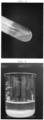
- the test tube was attached to an evaporator, and a bottom portion of the test tube was heated with a gas burner for about 7 minutes while rotating the test tube at a speed of 100 rpm. Since the melting point of ammonium hydrogen sulfate is approximately 147°C, the mixture in the test tube quickly became a molten substance by heating ( FIG. 3 ). When exposed to room temperature, the molten substance becomes a solid substance after a certain period of time.
- aqueous solution (ion exchanged water in the example of the present invention) of about twice the weight of the solid substance into which the molten substance has been solidified was placed in a test tube and thoroughly stirred. At this time, unreacted ammonium hydrogen sulfate and impurities remaining in the solid substance were dissolved into the aqueous solution, and a suspension in which white particulates were suspended was formed ( FIG. 4 ).
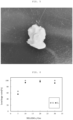
- the suspension was subjected to solid-liquid separation by centrifugation, whereby a white precipitate was recovered ( FIG. 5 ).
- the white precipitate obtained by the solid-liquid separation was easily dissolved to form a solution, when put into a high-concentration hydrochloric acid.
- the method for liquefying niobium and tantalum and the method for producing a niobium solution and a tantalum solution according to the present invention can liquefy niobium and tantalum or produce a niobium solution and a tantalum solution safely and efficiently from a smelting raw material containing niobium and tantalum.
Landscapes
- Chemical & Material Sciences (AREA)
- Engineering & Computer Science (AREA)
- Organic Chemistry (AREA)
- Materials Engineering (AREA)
- Mechanical Engineering (AREA)
- Metallurgy (AREA)
- Manufacturing & Machinery (AREA)
- Life Sciences & Earth Sciences (AREA)
- Environmental & Geological Engineering (AREA)
- General Life Sciences & Earth Sciences (AREA)
- Geochemistry & Mineralogy (AREA)
- Geology (AREA)
- Inorganic Chemistry (AREA)
- Inorganic Compounds Of Heavy Metals (AREA)
- Manufacture And Refinement Of Metals (AREA)
Applications Claiming Priority (2)
| Application Number | Priority Date | Filing Date | Title |
|---|---|---|---|
| JP2021041753A JP6910690B1 (ja) | 2021-03-15 | 2021-03-15 | ニオブ、及びタンタルの液化処理方法 |
| PCT/JP2022/005190 WO2022196197A1 (fr) | 2021-03-15 | 2022-02-09 | Procédé pour la liquéfaction de niobium et de tantale, et procédé pour la production de solution de niobium et de solution de tantale |
Publications (2)
| Publication Number | Publication Date |
|---|---|
| EP4265755A1 true EP4265755A1 (fr) | 2023-10-25 |
| EP4265755A4 EP4265755A4 (fr) | 2025-01-01 |
Family
ID=76968301
Family Applications (1)
| Application Number | Title | Priority Date | Filing Date |
|---|---|---|---|
| EP22770956.5A Pending EP4265755A4 (fr) | 2021-03-15 | 2022-02-09 | Procédé pour la liquéfaction de niobium et de tantale, et procédé pour la production de solution de niobium et de solution de tantale |
Country Status (7)
| Country | Link |
|---|---|
| US (1) | US11987862B2 (fr) |
| EP (1) | EP4265755A4 (fr) |
| JP (1) | JP6910690B1 (fr) |
| CN (1) | CN116940698B (fr) |
| AU (1) | AU2022238127B2 (fr) |
| CA (1) | CA3205677C (fr) |
| WO (1) | WO2022196197A1 (fr) |
Families Citing this family (2)
| Publication number | Priority date | Publication date | Assignee | Title |
|---|---|---|---|---|
| JP7671994B2 (ja) * | 2022-11-09 | 2025-05-07 | 学校法人福岡工業大学 | 触媒の処理方法 |
| JP2024172074A (ja) * | 2023-05-31 | 2024-12-12 | 学校法人福岡工業大学 | ニオブ、及びタンタルの回収方法 |
Family Cites Families (14)
| Publication number | Priority date | Publication date | Assignee | Title |
|---|---|---|---|---|
| JPS58176128A (ja) | 1982-04-09 | 1983-10-15 | Agency Of Ind Science & Technol | ニオブおよびタンタルを含む鉱石よりニオブおよびタンタルを回収する方法 |
| JPS62185841A (ja) * | 1986-02-10 | 1987-08-14 | Nishimura Watanabe Chiyuushiyutsu Kenkyusho:Kk | 金属ニオブまたは金属タンタルの製造方法 |
| JPS62241824A (ja) * | 1986-04-10 | 1987-10-22 | Sumitomo Chem Co Ltd | タンタルとニオブの分離精製方法 |
| BR8703766A (pt) * | 1987-07-20 | 1989-01-31 | Mamore Mineracao E Metalurgica | Processo para a abertura de minerios |
| DE4207145C1 (en) * | 1992-03-06 | 1993-04-29 | H.C. Starck Gmbh & Co Kg, 3380 Goslar, De | Hydro:methallurgical process for recovery of tantalum and niobium - by digesting material e.g. columbite ore with hydrofluoric acid followed by solvent extn. of formed fluoro:complexes |
| SE512978C2 (sv) * | 1998-10-26 | 2000-06-12 | G S G As | Bearbetning av niob-och tantalinnehållande material |
| JP2001213626A (ja) * | 2000-01-31 | 2001-08-07 | Mitsui Mining & Smelting Co Ltd | 原料の再利用に適した水酸化タンタルおよび/または水酸化ニオブの製造方法 |
| JP3641190B2 (ja) * | 2000-05-18 | 2005-04-20 | 三井金属鉱業株式会社 | タンタル/ニオブ含有原料の処理方法 |
| JP4183926B2 (ja) | 2001-04-19 | 2008-11-19 | 三井金属鉱業株式会社 | タンタル/ニオブ含有の炭化物系原料からのタンタル/ニオブの回収方法 |
| JP4183539B2 (ja) * | 2003-03-26 | 2008-11-19 | 三井金属鉱業株式会社 | 酸化ニオブおよびその製造方法 |
| JP4202195B2 (ja) * | 2003-06-10 | 2008-12-24 | 三井金属鉱業株式会社 | 水酸化タンタル、水酸化ニオブ、酸化タンタル、酸化ニオブ、およびこれらの製造方法 |
| CN1952187A (zh) * | 2006-04-10 | 2007-04-25 | 段立成 | 从废旧硬质合金中提取金属钨和其他稀有金属的方法 |
| CN102977135B (zh) * | 2012-11-02 | 2016-01-20 | 中国科学技术大学 | 一种铌配合物水溶液的制备方法 |
| CN104745807A (zh) * | 2013-12-31 | 2015-07-01 | 北京有色金属研究总院 | 一种提取铌钽矿中有价金属元素的方法 |
-
2021
- 2021-03-15 JP JP2021041753A patent/JP6910690B1/ja active Active
-
2022
- 2022-02-09 US US18/278,826 patent/US11987862B2/en active Active
- 2022-02-09 AU AU2022238127A patent/AU2022238127B2/en active Active
- 2022-02-09 WO PCT/JP2022/005190 patent/WO2022196197A1/fr not_active Ceased
- 2022-02-09 CN CN202280017835.0A patent/CN116940698B/zh active Active
- 2022-02-09 CA CA3205677A patent/CA3205677C/fr active Active
- 2022-02-09 EP EP22770956.5A patent/EP4265755A4/fr active Pending
Also Published As
| Publication number | Publication date |
|---|---|
| WO2022196197A1 (fr) | 2022-09-22 |
| US11987862B2 (en) | 2024-05-21 |
| US20240084417A1 (en) | 2024-03-14 |
| JP2022141441A (ja) | 2022-09-29 |
| CN116940698A (zh) | 2023-10-24 |
| AU2022238127A1 (en) | 2023-09-07 |
| CA3205677C (fr) | 2024-03-05 |
| BR112023015399A2 (pt) | 2023-09-26 |
| EP4265755A4 (fr) | 2025-01-01 |
| CN116940698B (zh) | 2024-03-12 |
| JP6910690B1 (ja) | 2021-07-28 |
| CA3205677A1 (fr) | 2022-09-22 |
| AU2022238127B2 (en) | 2024-03-28 |
Similar Documents
| Publication | Publication Date | Title |
|---|---|---|
| Kabangu et al. | Separation of niobium and tantalum from Mozambican tantalite by ammonium bifluoride digestion and octanol solvent extraction | |
| JP5904459B2 (ja) | 高純度硫酸ニッケルの製造方法 | |
| KR20140010015A (ko) | 광석 또는 선광물로부터 적어도 하나의 원소 니오븀 또는 탄탈륨 및 적어도 하나의 다른 원소 우라늄 또는 희토류의 용해 및 회수 | |
| US11987862B2 (en) | Method for liquefying niobium and tantalum, and method for producing niobium solution and tantalum solution | |
| JPH06304486A (ja) | 使用済み触媒の溶解方法 | |
| CN113337723A (zh) | 分离提取分银渣中银钯铜锗的方法 | |
| KR102802314B1 (ko) | 비수용액을 이용한 선택적 침출에 의한 백금과 팔라듐의 분리 회수 방법 및 이를 위한 침출액 | |
| WO1997036013A1 (fr) | Procede de recuperation de metaux de valeur dans des solides, par digestion dans un milieu d'acide sulfurique contenant un reducteur | |
| JP7423467B2 (ja) | ルテニウムの回収方法 | |
| JP7392539B2 (ja) | 合金の処理方法 | |
| CN113186399B (zh) | 一种提取钽和铌的方法 | |
| EP3575420A1 (fr) | Procédé de purification de bismuth | |
| US3684489A (en) | Method of recovering metals from sulfide-containing mixtures | |
| WO2022168805A1 (fr) | Procédé de récupération de métal précieux et dispositif de récupération | |
| JP5423592B2 (ja) | 低塩素硫酸ニッケル/コバルト溶液の製造方法 | |
| JP2022170169A (ja) | 有価金属の回収方法 | |
| JP5498040B2 (ja) | ルテニウムの回収方法 | |
| BR112023015399B1 (pt) | Método para a liquefação de nióbio e de tântalo e método para a produção de uma solução de nióbio e uma solução de tântalo | |
| WO2024247413A1 (fr) | Procédé de récupération de niobium et de tantale | |
| CN113151695A (zh) | 一种酸法分解低品位钽铌资源并提取钽铌的方法 | |
| US20250137094A1 (en) | Alkali microwave extraction | |
| EP4481072A1 (fr) | Procédé de récupération de zinc | |
| JPS63162827A (ja) | ニオブ含有合金の処理方法 | |
| Pierret et al. | Caustic fusion of columbite-tantalite concentrates with subsequent separation of niobium and tantalum | |
| JP2004224619A (ja) | タンタル及び/又はニオブの粗酸化物の精製方法 |
Legal Events
| Date | Code | Title | Description |
|---|---|---|---|
| STAA | Information on the status of an ep patent application or granted ep patent |
Free format text: STATUS: THE INTERNATIONAL PUBLICATION HAS BEEN MADE |
|
| PUAI | Public reference made under article 153(3) epc to a published international application that has entered the european phase |
Free format text: ORIGINAL CODE: 0009012 |
|
| STAA | Information on the status of an ep patent application or granted ep patent |
Free format text: STATUS: REQUEST FOR EXAMINATION WAS MADE |
|
| 17P | Request for examination filed |
Effective date: 20230718 |
|
| AK | Designated contracting states |
Kind code of ref document: A1 Designated state(s): AL AT BE BG CH CY CZ DE DK EE ES FI FR GB GR HR HU IE IS IT LI LT LU LV MC MK MT NL NO PL PT RO RS SE SI SK SM TR |
|
| DAV | Request for validation of the european patent (deleted) | ||
| DAX | Request for extension of the european patent (deleted) | ||
| A4 | Supplementary search report drawn up and despatched |
Effective date: 20241204 |
|
| RIC1 | Information provided on ipc code assigned before grant |
Ipc: H01G 9/052 20060101ALN20241128BHEP Ipc: C22B 3/08 20060101ALI20241128BHEP Ipc: C22B 1/06 20060101ALI20241128BHEP Ipc: C22B 3/22 20060101ALI20241128BHEP Ipc: C22B 3/06 20060101ALI20241128BHEP Ipc: C22B 34/24 20060101ALI20241128BHEP Ipc: C22B 1/00 20060101AFI20241128BHEP |