EP4234084A1 - Silicium-aluminium-molekularsiebkatalysator sowie herstellung und anwendung davon - Google Patents
Silicium-aluminium-molekularsiebkatalysator sowie herstellung und anwendung davon Download PDFInfo
- Publication number
- EP4234084A1 EP4234084A1 EP21885065.9A EP21885065A EP4234084A1 EP 4234084 A1 EP4234084 A1 EP 4234084A1 EP 21885065 A EP21885065 A EP 21885065A EP 4234084 A1 EP4234084 A1 EP 4234084A1
- Authority
- EP
- European Patent Office
- Prior art keywords
- catalyst
- acid content
- mixture
- aluminum
- molecular sieve
- Prior art date
- Legal status (The legal status is an assumption and is not a legal conclusion. Google has not performed a legal analysis and makes no representation as to the accuracy of the status listed.)
- Pending
Links
Images


Classifications
-
- B—PERFORMING OPERATIONS; TRANSPORTING
- B01—PHYSICAL OR CHEMICAL PROCESSES OR APPARATUS IN GENERAL
- B01J—CHEMICAL OR PHYSICAL PROCESSES, e.g. CATALYSIS OR COLLOID CHEMISTRY; THEIR RELEVANT APPARATUS
- B01J29/00—Catalysts comprising molecular sieves
- B01J29/04—Catalysts comprising molecular sieves having base-exchange properties, e.g. crystalline zeolites
- B01J29/06—Crystalline aluminosilicate zeolites; Isomorphous compounds thereof
- B01J29/40—Crystalline aluminosilicate zeolites; Isomorphous compounds thereof of the pentasil type, e.g. types ZSM-5, ZSM-8 or ZSM-11, as exemplified by patent documents US3702886, GB1334243 and US3709979, respectively
- B01J29/42—Crystalline aluminosilicate zeolites; Isomorphous compounds thereof of the pentasil type, e.g. types ZSM-5, ZSM-8 or ZSM-11, as exemplified by patent documents US3702886, GB1334243 and US3709979, respectively containing iron group metals, noble metals or copper
- B01J29/46—Iron group metals or copper
-
- B—PERFORMING OPERATIONS; TRANSPORTING
- B01—PHYSICAL OR CHEMICAL PROCESSES OR APPARATUS IN GENERAL
- B01J—CHEMICAL OR PHYSICAL PROCESSES, e.g. CATALYSIS OR COLLOID CHEMISTRY; THEIR RELEVANT APPARATUS
- B01J29/00—Catalysts comprising molecular sieves
- B01J29/04—Catalysts comprising molecular sieves having base-exchange properties, e.g. crystalline zeolites
- B01J29/06—Crystalline aluminosilicate zeolites; Isomorphous compounds thereof
- B01J29/40—Crystalline aluminosilicate zeolites; Isomorphous compounds thereof of the pentasil type, e.g. types ZSM-5, ZSM-8 or ZSM-11, as exemplified by patent documents US3702886, GB1334243 and US3709979, respectively
-
- B—PERFORMING OPERATIONS; TRANSPORTING
- B01—PHYSICAL OR CHEMICAL PROCESSES OR APPARATUS IN GENERAL
- B01J—CHEMICAL OR PHYSICAL PROCESSES, e.g. CATALYSIS OR COLLOID CHEMISTRY; THEIR RELEVANT APPARATUS
- B01J35/00—Catalysts, in general, characterised by their form or physical properties
- B01J35/30—Catalysts, in general, characterised by their form or physical properties characterised by their physical properties
- B01J35/34—Mechanical properties
- B01J35/36—Mechanical strength
-
- B—PERFORMING OPERATIONS; TRANSPORTING
- B01—PHYSICAL OR CHEMICAL PROCESSES OR APPARATUS IN GENERAL
- B01J—CHEMICAL OR PHYSICAL PROCESSES, e.g. CATALYSIS OR COLLOID CHEMISTRY; THEIR RELEVANT APPARATUS
- B01J35/00—Catalysts, in general, characterised by their form or physical properties
- B01J35/40—Catalysts, in general, characterised by their form or physical properties characterised by dimensions, e.g. grain size
-
- B—PERFORMING OPERATIONS; TRANSPORTING
- B01—PHYSICAL OR CHEMICAL PROCESSES OR APPARATUS IN GENERAL
- B01J—CHEMICAL OR PHYSICAL PROCESSES, e.g. CATALYSIS OR COLLOID CHEMISTRY; THEIR RELEVANT APPARATUS
- B01J35/00—Catalysts, in general, characterised by their form or physical properties
- B01J35/40—Catalysts, in general, characterised by their form or physical properties characterised by dimensions, e.g. grain size
- B01J35/45—Nanoparticles
-
- B—PERFORMING OPERATIONS; TRANSPORTING
- B01—PHYSICAL OR CHEMICAL PROCESSES OR APPARATUS IN GENERAL
- B01J—CHEMICAL OR PHYSICAL PROCESSES, e.g. CATALYSIS OR COLLOID CHEMISTRY; THEIR RELEVANT APPARATUS
- B01J35/00—Catalysts, in general, characterised by their form or physical properties
- B01J35/70—Catalysts, in general, characterised by their form or physical properties characterised by their crystalline properties, e.g. semi-crystalline
-
- B—PERFORMING OPERATIONS; TRANSPORTING
- B01—PHYSICAL OR CHEMICAL PROCESSES OR APPARATUS IN GENERAL
- B01J—CHEMICAL OR PHYSICAL PROCESSES, e.g. CATALYSIS OR COLLOID CHEMISTRY; THEIR RELEVANT APPARATUS
- B01J35/00—Catalysts, in general, characterised by their form or physical properties
- B01J35/70—Catalysts, in general, characterised by their form or physical properties characterised by their crystalline properties, e.g. semi-crystalline
- B01J35/77—Compounds characterised by their crystallite size
-
- B—PERFORMING OPERATIONS; TRANSPORTING
- B01—PHYSICAL OR CHEMICAL PROCESSES OR APPARATUS IN GENERAL
- B01J—CHEMICAL OR PHYSICAL PROCESSES, e.g. CATALYSIS OR COLLOID CHEMISTRY; THEIR RELEVANT APPARATUS
- B01J37/00—Processes, in general, for preparing catalysts; Processes, in general, for activation of catalysts
- B01J37/0009—Use of binding agents; Moulding; Pressing; Powdering; Granulating; Addition of materials ameliorating the mechanical properties of the product catalyst
-
- B—PERFORMING OPERATIONS; TRANSPORTING
- B01—PHYSICAL OR CHEMICAL PROCESSES OR APPARATUS IN GENERAL
- B01J—CHEMICAL OR PHYSICAL PROCESSES, e.g. CATALYSIS OR COLLOID CHEMISTRY; THEIR RELEVANT APPARATUS
- B01J37/00—Processes, in general, for preparing catalysts; Processes, in general, for activation of catalysts
- B01J37/0009—Use of binding agents; Moulding; Pressing; Powdering; Granulating; Addition of materials ameliorating the mechanical properties of the product catalyst
- B01J37/0018—Addition of a binding agent or of material, later completely removed among others as result of heat treatment, leaching or washing,(e.g. forming of pores; protective layer, desintegrating by heat)
-
- B—PERFORMING OPERATIONS; TRANSPORTING
- B01—PHYSICAL OR CHEMICAL PROCESSES OR APPARATUS IN GENERAL
- B01J—CHEMICAL OR PHYSICAL PROCESSES, e.g. CATALYSIS OR COLLOID CHEMISTRY; THEIR RELEVANT APPARATUS
- B01J37/00—Processes, in general, for preparing catalysts; Processes, in general, for activation of catalysts
- B01J37/04—Mixing
-
- B—PERFORMING OPERATIONS; TRANSPORTING
- B01—PHYSICAL OR CHEMICAL PROCESSES OR APPARATUS IN GENERAL
- B01J—CHEMICAL OR PHYSICAL PROCESSES, e.g. CATALYSIS OR COLLOID CHEMISTRY; THEIR RELEVANT APPARATUS
- B01J37/00—Processes, in general, for preparing catalysts; Processes, in general, for activation of catalysts
- B01J37/06—Washing
-
- B—PERFORMING OPERATIONS; TRANSPORTING
- B01—PHYSICAL OR CHEMICAL PROCESSES OR APPARATUS IN GENERAL
- B01J—CHEMICAL OR PHYSICAL PROCESSES, e.g. CATALYSIS OR COLLOID CHEMISTRY; THEIR RELEVANT APPARATUS
- B01J37/00—Processes, in general, for preparing catalysts; Processes, in general, for activation of catalysts
- B01J37/08—Heat treatment
-
- C—CHEMISTRY; METALLURGY
- C07—ORGANIC CHEMISTRY
- C07C—ACYCLIC OR CARBOCYCLIC COMPOUNDS
- C07C15/00—Cyclic hydrocarbons containing only six-membered aromatic rings as cyclic parts
- C07C15/02—Monocyclic hydrocarbons
- C07C15/067—C8H10 hydrocarbons
- C07C15/073—Ethylbenzene
-
- C—CHEMISTRY; METALLURGY
- C07—ORGANIC CHEMISTRY
- C07C—ACYCLIC OR CARBOCYCLIC COMPOUNDS
- C07C2/00—Preparation of hydrocarbons from hydrocarbons containing a smaller number of carbon atoms
- C07C2/54—Preparation of hydrocarbons from hydrocarbons containing a smaller number of carbon atoms by addition of unsaturated hydrocarbons to saturated hydrocarbons or to hydrocarbons containing a six-membered aromatic ring with no unsaturation outside the aromatic ring
- C07C2/64—Addition to a carbon atom of a six-membered aromatic ring
- C07C2/66—Catalytic processes
-
- B—PERFORMING OPERATIONS; TRANSPORTING
- B01—PHYSICAL OR CHEMICAL PROCESSES OR APPARATUS IN GENERAL
- B01J—CHEMICAL OR PHYSICAL PROCESSES, e.g. CATALYSIS OR COLLOID CHEMISTRY; THEIR RELEVANT APPARATUS
- B01J2235/00—Indexing scheme associated with group B01J35/00, related to the analysis techniques used to determine the catalysts form or properties
-
- B—PERFORMING OPERATIONS; TRANSPORTING
- B01—PHYSICAL OR CHEMICAL PROCESSES OR APPARATUS IN GENERAL
- B01J—CHEMICAL OR PHYSICAL PROCESSES, e.g. CATALYSIS OR COLLOID CHEMISTRY; THEIR RELEVANT APPARATUS
- B01J2235/00—Indexing scheme associated with group B01J35/00, related to the analysis techniques used to determine the catalysts form or properties
- B01J2235/15—X-ray diffraction
-
- B—PERFORMING OPERATIONS; TRANSPORTING
- B01—PHYSICAL OR CHEMICAL PROCESSES OR APPARATUS IN GENERAL
- B01J—CHEMICAL OR PHYSICAL PROCESSES, e.g. CATALYSIS OR COLLOID CHEMISTRY; THEIR RELEVANT APPARATUS
- B01J2235/00—Indexing scheme associated with group B01J35/00, related to the analysis techniques used to determine the catalysts form or properties
- B01J2235/30—Scanning electron microscopy; Transmission electron microscopy
-
- C—CHEMISTRY; METALLURGY
- C07—ORGANIC CHEMISTRY
- C07C—ACYCLIC OR CARBOCYCLIC COMPOUNDS
- C07C2529/00—Catalysts comprising molecular sieves
- C07C2529/04—Catalysts comprising molecular sieves having base-exchange properties, e.g. crystalline zeolites, pillared clays
- C07C2529/06—Crystalline aluminosilicate zeolites; Isomorphous compounds thereof
- C07C2529/40—Crystalline aluminosilicate zeolites; Isomorphous compounds thereof of the pentasil type, e.g. types ZSM-5, ZSM-8 or ZSM-11
-
- Y—GENERAL TAGGING OF NEW TECHNOLOGICAL DEVELOPMENTS; GENERAL TAGGING OF CROSS-SECTIONAL TECHNOLOGIES SPANNING OVER SEVERAL SECTIONS OF THE IPC; TECHNICAL SUBJECTS COVERED BY FORMER USPC CROSS-REFERENCE ART COLLECTIONS [XRACs] AND DIGESTS
- Y02—TECHNOLOGIES OR APPLICATIONS FOR MITIGATION OR ADAPTATION AGAINST CLIMATE CHANGE
- Y02P—CLIMATE CHANGE MITIGATION TECHNOLOGIES IN THE PRODUCTION OR PROCESSING OF GOODS
- Y02P20/00—Technologies relating to chemical industry
- Y02P20/50—Improvements relating to the production of bulk chemicals
- Y02P20/52—Improvements relating to the production of bulk chemicals using catalysts, e.g. selective catalysts
Definitions
- the present application relates to the field of aromatics alkylation catalysts, particularly to an aluminosilicate molecular sieve catalyst useful for alkylation of aromatics with olefins, its preparation and application thereof.
- Ethylbenzene is an important basic organic raw material and is mainly used for producing styrene, which has wide applications.
- styrene is an important monomer for producing polystyrene, styrene-butadiene rubber, ABS, SBS and the like, and is also applied in pharmaceutical industry, coating industry and textile industry.
- Ethylbenzene is mainly produced by the alkylation reaction between benzene and ethylene, and in practical catalytic reaction process, gas-phase alkylation of benzene with ethylene is a complex reaction system with coexisting serial and parallel side reactions, and in addition to the ethylbenzene, byproducts such as diethylbenzene, triethylbenzene, toluene, xylene, propylbenzene, methyl ethylbenzene, butylbenzene and the like may be generated.
- xylene has a boiling point close to that of ethylbenzene and is difficult to be effectively removed by fractional distillation, so that the control of the xylene content in the alkylation product is particularly important.
- polyethylbenzene e.g. diethylbenzene and triethylbenzene
- the reduction of the polyethylbenzene content in the alkylation product may lead to a reduction of the load of subsequent transalkylation reaction, and has important significance for energy conservation and efficiency improvement of enterprises.
- Benzene and ethylene alkylation catalysts used in industry have certain requirements on shape and mechanical strength, and thus a large amount of binder needs to be added in the process of shaping the molecular sieve catalyst.
- the addition of the large amount of binder increases the mechanical strength of the catalyst, but also brings some negative effects, such as dilution of active centers of the catalyst, blockage of pore channels of the molecular sieve, and causing more side reactions, thereby resulting in a reduction of product purity.
- methods for producing binderless catalysts are disclosed in prior arts.
- CN107512729B discloses a method for producing a binderless ZSM-5 molecular sieve, comprising the following steps: a) providing a synthesized ZSM-5 molecular sieve; b) mixing the synthesized ZSM-5 molecular sieve with a binder, a pore-forming agent and an aqueous acid solution, shaping and drying to obtain a ZSM-5 molecular sieve precursor; the binder is at least one selected from silica sol or alumina; wherein the silica sol provides a first silicon source, and the alumina provides a first aluminum source; c) crystallizing a mixture of the ZSM-5 molecular sieve precursor, a second silicon source, a second aluminum source, an alkali source, an organic template and water, separating the resulting solid product, and drying to obtain the binderless ZSM-5 molecular sieve.
- An object of the present application is to provide an aluminosilicate molecular sieve catalyst useful for alkylation of aromatics with olefins, its preparation and application thereof.
- the catalyst When used for producing alkyl aromatics by gas-phase alkylation of aromatics with olefins, the catalyst has high activity, selectivity and stability, and can significantly reduce the content of byproducts.
- the present application provides an aluminosilicate molecular sieve catalyst, which shows a desorption curve having three peaks P1, P2 and P3 in its NH 3 -TPD pattern, and the desorption temperatures corresponding to the summits of the three peaks P1, P2 and P3 are respectively in a range of 180-220 °C, 250-290 °C and 370-410 °C.
- the peak heights H1, H2 and H3 of the three peaks P1, P2 and P3 satisfy the relationship H1> H2> H3.
- the present application provides a method for producing an aluminosilicate molecular sieve catalyst, comprising the steps of:
- the silicon powder used in step 2) comprises two types of silica particles having different sizes, the sizes of the two types of silica particles are respectively in a range of 0.1-2 ⁇ m and 4-12 ⁇ m, and the mass ratio of the two types of silica particles is (0.5-2.0): 1.
- the present application provides a process for gas-phase alkylation of an aromatic hydrocarbon with an olefin, comprising the step of subjecting the aromatic hydrocarbon and the olefin to an alkylation reaction in the presence of the catalyst of the present application or a catalyst obtained by the method of the present application, to obtain an alkylaromatic hydrocarbon.
- the aluminosilicate molecular sieve catalyst of the present application provides the following benefits:
- any specific numerical value, including the endpoints of a numerical range, described in the context of the present application is not restricted to the exact value thereof, but should be interpreted to further encompass all values close to said exact value, for example all values within ⁇ 5% of said exact value.
- any numerical range described herein arbitrary combinations can be made between the endpoints of the range, between each endpoint and any specific value within the range, or between any two specific values within the range, to provide one or more new numerical range(s), where said new numerical range(s) should also be deemed to have been specifically described in the present application.
- polyhydroxy high molecular compound refers to a high molecular compound having a plurality of hydroxyl groups within its molecule, including but not limited to hydroxyethylcellulose, hydroxymethylcellulose, hydroxypropylmethylcellulose, methylcellulose, casein, or gum arabic.
- the term "acidic molecular sieve” has the meaning commonly understood in the art and refers to a molecular sieve having B acid and/or L acid sites.
- the pressures given are gauge pressures.
- any matter or matters not mentioned are considered to be the same as those known in the art without any change.
- any of the embodiments described herein can be freely combined with another one or more embodiments described herein, and the technical solutions or ideas thus obtained are considered as part of the original disclosure or original description of the present application, and should not be considered to be a new matter that has not been disclosed or anticipated herein, unless it is clear to the person skilled in the art that such a combination is obviously unreasonable.
- the present application provides an aluminosilicate molecular sieve catalyst, which shows a desorption curve having three peaks P1, P2 and P3 in its NH 3 -TPD pattern, and the desorption temperatures corresponding to the summits of the three peaks P1, P2 and P3 are respectively in a range of 180-220 °C, 250-290 °C and 370-410 °C, preferably in a range of 190-210 °C, 260-280 °C and 380-400 °C.
- the desorption temperature in the NH 3 -TPD pattern are divided into three ranges, which are 100-240 °C, 240-300 °C and 300-500 °C, respectively, and the integral areas of the desorption curve within the three temperature ranges correspond to the weak acid content S1, the medium-strong acid content S2 and the strong acid content S3 of the catalyst, respectively.
- the proportion of the weak acid content S1 to the total acid content (i.e. the total of the weak acid content, the medium-strong acid content and the strong acid content) of the catalyst is 40-50%, the proportion of the medium-strong acid content S2 to the total acid content is 15-25%, and the proportion of the strong acid content S3 to the total acid content is 35-45%, wherein the proportions of the weak acid content S1, the medium-strong acid content S2 and the strong acid content S3 to the total acid content are respectively calculated from the proportions of the integral areas of the NH 3 -TPD desorption curve of the catalyst within the temperature ranges of 100-240 °C, 240-300 °C and 300-500 °C to the total integral area in the temperature range of 100-500 °C.
- the proportion of the super-strong acid content to the total acid content of the catalyst is less than 5%, preferably less than 3%, wherein the proportion of the super-strong acid content to the total acid content is calculated from the proportion of the integral area of the desorption curve in the temperature range above 500 °C in the NH 3 -TPD pattern of the catalyst to the total integral area of the desorption curve within the temperature range of 100-500 °C in the NH 3 -TPD pattern of the catalyst.
- the aluminosilicate molecular sieve catalyst is a binderless aluminosilicate molecular sieve catalyst, more preferably, the aluminosilicate molecular sieve is an acidic molecular sieve having a ten- or twelve-membered ring pore structure, and particularly preferably, the aluminosilicate molecular sieve is a ZSM-5 molecular sieve.
- no additional modifying metallic or non-metallic component such as zinc, magnesium, calcium, iron, cobalt, nickel, phosphorus, lanthanum, copper, zirconium, chromium, manganese, silver, ruthenium, palladium, platinum, titanium, tin, strontium, barium, vanadium, lithium, and the like, is supported on the aluminosilicate molecular sieve catalyst.
- the aluminosilicate molecular sieve catalyst has two different sizes of crystalline grains, which are in a range of 10-300 nm and 400-1600 nm, respectively. More preferably, the number of crystalline grains in the range of 10 to 300nm accounts for 5-60%, preferably 30-60%, of the total number of crystalline grains; the number of crystalline grains in the range of 400-1600 nm accounts for 40-95%, preferably 40-70%, of the total number of the crystalline grains.
- the isolated aluminum content of the catalyst is 97.5- 100%, preferably 99-100%.
- the mechanical strength of the aluminosilicate molecular sieve catalyst is 100-170 N/cm, more preferably 110-160 N/cm.
- the aluminosilicate molecular sieve catalyst has a SiO 2 /Al 2 O 3 molar ratio of from 30 to 400.
- the present application provides a method for producing an aluminosilicate molecular sieve catalyst, comprising the steps of:
- the template used in step 1) is one or more selected from the group consisting of tetrapropylammonium hydroxide, tetrapropylammonium bromide, tetraethylammonium hydroxide, and tetraethylammonium bromide;
- the silicon source is one or more selected from the group consisting of silica sol, white carbon black, tetraethyl silicate and silicon powder;
- the first aluminum source is one or more selected from the group consisting of aluminum chloride, aluminum nitrate, aluminum sulfate, aluminum isopropoxide and pseudo-boehmite.
- the process of mixing the template, the silicon source, the first aluminum source and water while heating in step 1) to obtain the first mixture is carried out by: mixing the template, the silicon source, the first aluminum source and water in a closed container while stirring for 4-20 hours at a temperature of 90-150 °C.
- the silicon powder used in step 2) comprises two types of silica particles having different sizes, wherein the sizes of the two types of silica particles are respectively in a range of 0.1-2 ⁇ m and 4-12 ⁇ m, and the mass ratio of the two types of silica particles is (0.5-2.0): 1;
- the second aluminum source is one or more selected from the group consisting of aluminum chloride, aluminum nitrate, aluminum sulfate, aluminum alkoxide, pseudo-boehmite and aluminum hydroxide.
- the ratios between the first mixture, the silicon powder and the second aluminum source used in step 2) are respectively as follows: the weight ratio of the first mixture to the silicon powder is (0.2-0.8): 1; the molar ratio of the silicon powder to the second aluminum source is (30-400): 1, wherein the silicon powder is calculated by SiO 2 , and the second aluminum source is calculated by Al 2 O 3 .
- the shaping of the catalyst may be performed by methods commonly used in the art, for example, by extrusion molding.
- the third mixture in step 3), can be formed into various shapes in view of the need, for example, the third mixture can be formed into strips, of which the section can be in a circular shape, a gear shape, a trefoil shape, a four-leaf clover shape, or a honeycomb shape.
- the third mixture has a diameter of 1.0 to 6.0 mm and a length of 3 to 10 mm.
- the alkali source used in step 4) is one or more selected from the group consisting of tetrapropylammonium hydroxide, tetraethylammonium hydroxide, aqueous ammonia, ethylamine, ethylenediamine, n-butylamine, hexamethylenediamine, cyclohexylamine, piperidine, hexamethyleneimine, homopiperazine, and dicyclohexylamine.
- the regulator used in step 4) is one or more selected from the group consisting of hydroxyethylcellulose, hydroxymethylcellulose, hydroxypropylmethylcellulose, methylcellulose, casein, and gum arabic.
- the process of contacting the third mixture, the alkali source and the regulator to obtain the fourth mixture in step 4) is carried out by: mixing the alkali source and the regulator while stirring at 30-60 °C for 3-10 hours, then adding thereto the third mixture, and standing for 5-10 hours at 30-60 °C in a closed space.
- the process of treating the fourth mixture to obtain the aluminosilicate molecular sieve catalyst in step 5) is carried out by: subjecting the fourth mixture to standing or stirring for 12-72 hours at 130-190 °C in a closed space, optionally followed by washing, drying, calcinating and acid washing.
- the washing e.g.
- drying and calcining can be carried out by conventional ways, for example, the drying conditions may include: a drying temperature of 80-150 °C, and a drying time of 5-12 hours; the calcining conditions may include: a calcining temperature of 500-600 °C, and a calcining time of 4-10 hours; the conditions for the acid washing may include: an acid washing temperature of 30-90 °C, an acid washing time of 2-10 hours, an acid that is at least one of hydrochloric acid, sulfuric acid, oxalic acid or nitric acid, and a mass concentration of the acid solution of 0.5% -5%.
- the drying conditions may include: a drying temperature of 80-150 °C, and a drying time of 5-12 hours; the calcining conditions may include: a calcining temperature of 500-600 °C, and a calcining time of 4-10 hours; the conditions for the acid washing may include: an acid washing temperature of 30-90 °C, an acid washing time of 2-10 hours,
- the properties of the aluminosilicate molecular sieve catalyst obtained by the method of the present application are as described above in the first aspect, and of which a detailed description is omitted herein for brevity.
- the present application provides a process for gas-phase alkylation of an aromatic hydrocarbon with an olefin, comprising the step of subjecting the aromatic hydrocarbon and the olefin to an alkylation reaction in the presence of the catalyst of the present application or a catalyst obtained by the method of the present application, to obtain an alkylaromatic hydrocarbon.
- the aromatic hydrocarbon is selected from benzene, alkylbenzene or a combination thereof, preferably selected from benzene, toluene, ethylbenzene, n-propylbenzene, isopropylbenzene, n-butylbenzene, isobutylbenzene, tert-butylbenzene or a combination thereof;
- the olefin is selected from C2-C6 olefins, preferably selected from ethylene, propylene, n-butene, isobutylene or a combination thereof.
- the alkylation conditions include: a reaction temperature of 260 °C to 400 °C, a reaction pressure of 0.1 to 3.0 MPa, a mass space velocity of the olefin of 0.1 to 10.0 h -1 , and a molar ratio of the aromatic hydrocarbon to the olefin of 2 to 20.
- the present application provides the use of the catalyst according to the present application or a catalyst obtained by the method of the present application for catalyzing the gas-phase alkylation of an aromatic hydrocarbon with an olefin.
- the XRD pattern of the catalyst was measured using an Ultima IV X-ray powder diffractometer from Rigaku, Japan, with a voltage of 35 kV, a current of 30 mA, and a scanning speed of 1° ⁇ min -1 .
- the acidity distribution of the catalyst was determined by NH 3 -TPD test, wherein the NH 3 -TPD spectrum was obtained using a 200906PX18 Temperature Programmed Desorption Apparatus from Tianjin Golden Eagle Technology Co., Ltd as follows: 0.05-0.20 g of a sample (20-40 meshes) obtained after tabletting and sieving was placed into a quartz sample tube, activated while which is first heated for 1 hours in the helium atmosphere for activation and stabilized for 1 hours, then cooled down to below 40 °C, and then heated again to 100 °C, subjected to ammonia adsorption at 100 °C until saturation, finally blown with helium for 1 hours, and then subjected to temperature programmed desorption by heating to 600 °C at a rate of 10 °C/min, and a working curve was recorded.
- the mechanical strength of the catalyst was measured using a smart particle strength tester, in which the mechanical strength of the calcined catalyst was measured using a DLIII Smart Particle Strength Tester from Dalian Penghui Technology Development Co., Ltd by placing the catalyst to be measured horizontally on the tester, measuring the maximum pressure to which the catalyst was subjected when it was broken, and calculating the average value of the crushing strength of 20 measured catalyst particles.
- the SEM image was obtained using Hitachi S-4800 Cold Field Emission High Resolution Scanning Electron Microscope from Hitachi, Ltd.).
- the grain size distribution was obtained based the statistical data for at least 300 grains in the corresponding SEM image by calculating the proportion of the number of grains in a certain grain size range to the total number of the grains.
- the SiO 2 /Al 2 O 3 molar ratio of the catalyst was determined by ICP test using Model S-35 ICP-AES Analyzer from Kontron, in which 50 mg of sample was completely dissolved in 50 g of hydrofluoric acid solution before the ICP test.
- the isolated aluminum content of the catalyst was measured as follows: firstly, the synthesized catalyst was subjected to ion exchange to obtain a Na-type catalyst, in which the catalyst was mixed with a sodium chloride solution with a concentration of 0.5mol/L at a solid-liquid mass ratio of 1:100, stirred for 4 hours at room temperature, then drained the solution, the resulting solid was washed with deionized water, the liquid obtained after washing was detected with a silver nitrate solution, and the washing was terminated until no white precipitate was generated in the liquid obtained after washing, thereby obtaining the Na-type catalyst; then, the Na-type catalyst was subjected to Co 2+ ion exchange, in which the Na-type catalyst was mixed with a cobalt nitrate solution with a concentration of 0.05mol/L at a solid-liquid mass ratio of 1 : 200, stirred at room temperature for 10 hours, then drained the solution, the resulting solid was washed with deionized water,
- reagents and starting materials used are commercially available products of reagent pure grade.
- the mixture B1 was shaped by extrusion molding to obtain a mixture C1 (in a cylindrical shape with a diameter of 1.8mm and a length of 5 mm). 5 g of ethylamine and 0.5 g of hydroxyethylcellulose were mixed while stirring at 50 °C for 5 hours, and then 50 g of the mixture C1 was added and allowed to stand at 30 °C for 10 hours in a closed space to obtain a mixture D1.
- the mixture D1 was allowed to stand in a closed space at 130 °C for 72 hours, then washed with deionized water until a pH value of 8 was obtained, dried at 80 °C for 12 hours, calcined at 500 °C for 10 hours, and subjected to acid washing for 5 hours at 60 °C with oxalic acid having a mass concentration of 3%, to obtain an aluminosilicate molecular sieve catalyst E1.
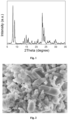
- the XRD pattern of the aluminosilicate catalyst E1 is shown in Fig. 1 , and has typical diffraction peaks of MFI topological structure, indicating that the catalyst is a ZSM-5 molecular sieve catalyst.
- the SEM image of the aluminosilicate molecular sieve catalyst E1 is shown in Fig. 2 , from which it can be seen that the catalyst comprises two types of crystalline grains of different sizes, the sizes of the two types of crystalline grains are respectively 50-200nm and 400-1000nm, and the proportion of number of the two types of crystalline grains is respectively 35% and 65%.
- the NH 3 -TPD pattern of the aluminosilicate molecular sieve catalyst E1 is shown in Fig.
- the aluminosilicate molecular sieve catalyst E1 has a mechanical strength of 155N/cm, a SiO 2 /Al 2 O 3 molar ratio of 50.8, and an isolated aluminum content of 99.0%.
- mixture A2 60 g of silicon powder comprising two types of silica particles with a size in a range of 1.2-2 ⁇ m and 9-12 ⁇ m and present in an amount of 30 g and 30 g, respectively, and 1.665 g of aluminum sulfate octadecahydrate were mixed to obtain a mixture B2.
- the mixture B2 was shaped by extrusion molding to obtain a mixture C2 (in a cylindrical shape with a diameter of 2.2mm and a length of 5 mm).
- a mixture of 20 g of cyclohexylamine, 0.5 g of casein and 2 g of hydroxypropylmethylcellulose was stirred at 50 °C for 5 hours, then 50 g of the mixture C2 was added, and allowed to stand at 60 °C for 5 hours in a closed space to obtain a mixture D2.
- the mixture D2 was allowed to stand in a closed space at 190 °C for 12 hours, then washed with deionized water until a pH value of 7 was obtained, dried for 5 hours at 150 °C, calcined for 4 hours at 600 °C, and subjected to acid washing for 10 hours at 30 °C with oxalic acid having a mass concentration of 0.5%, to obtain an aluminosilicate molecular sieve catalyst E2.
- the XRD pattern of the aluminosilicate catalyst E2 is shown in Fig. 4 , which has typical diffraction peaks of MFI topological structure, indicating that the catalyst is a ZSM-5 molecular sieve catalyst.
- the SEM image of the aluminosilicate molecular sieve catalyst E2 shows that the catalyst comprises two types of crystalline grains of different sizes, and the sizes of the two types of crystalline grains are respectively 250-300nm and 1000-1600nm according to the statistical analysis, and the proportion of number of the two types of crystalline grains is respectively 40% and 60%.
- the aluminosilicate molecular sieve catalyst E2 has a mechanical strength of 112N/cm, a SiO 2 /Al 2 O 3 molar ratio of 398, and an isolated aluminum content of 99.6%.
- mixture A3 24 g of the mixture A3, 60 g of silicon powder comprising two types of silica particles with a size in a range of 0.1-0.3 ⁇ m and 4-7 ⁇ m and present in an amount of 40 g and 20 g, respectively, and 6.66 g of aluminum sulfate octadecahydrate were mixed to obtain a mixture B3.
- the mixture B3 was shaped by extrusion molding to obtain a mixture C3 (in a cylindrical shape with a diameter of 1.2mm and a length of 5 mm).
- the XRD pattern of the aluminosilicate catalyst E3 is shown in Fig. 5 , which has typical diffraction peaks of MFI topological structure, indicating that the catalyst is a ZSM-5 molecular sieve.
- the SEM image of the aluminosilicate molecular sieve catalyst E3 shows that the catalyst comprises two types of crystalline grains of different sizes, and the sizes of the two types of crystalline grains are respectively 10-100nm and 400-700nm according to the statistical analysis, and the proportion of number of the two types of crystalline grains is respectively 56% and 44%.
- the aluminosilicate molecular sieve catalyst E3 has a mechanical strength of 145N/cm, a SiO 2 /Al 2 O 3 molar ratio of 125, and an isolated aluminum content of 99.2%.
- a catalyst was prepared as described in Example 3, except that silicon powder comprising only one type of silica particles have a size in a range of 0.1 to 0.3 ⁇ m was used, and no regulator was added in step 4).
- the catalyst was prepared as follows: 126 g of a 40wt% aqueous tetrapropylammonium hydroxide solution, 66 g of tetrapropylammonium bromide, 208.3 g of tetraethyl silicate, 6.66 g of aluminum sulfate octadecahydrate and 50 g of water were mixed uniformly and stirred in a closed vessel at 120 °C for 12 hours to obtain a mixture A4.
- mixture B4 24 g of the mixture A4, 60 g of silicon powder comprising only one type of silica particles have a size in a range of 0.1 to 0.3 ⁇ m, 6.66 g of aluminum sulfate octadecahydrate were mixed to obtain a mixture B4.
- the mixture B4 was shaped by extrusion molding to obtain a mixture C4 (in a cylindrical shape with a diameter of 1.2mm and a length of 5 mm). 10 g of n-butylamine was stirred at 50 °C for 5 hours, then 50 g of the mixture C4 was added thereto, and the mixture was allowed to stand at 40 °C for 7 hours in a closed space to obtain a mixture D4.
- the mixture D4 was allowed to stand in a closed space at 170 °C for 36 hours, then washed with deionized water until a pH value of 7.5 was obtained, dried for 8 hours at 100 °C, calcined for 6 hours at 550 °C, and subjected to acid washing for 6 hours at 60 °C with hydrochloric acid having a mass concentration of 3% to obtain an aluminosilicate molecular sieve catalyst F1.
- the SEM image of the aluminosilicate molecular sieve catalyst F1 is shown in Fig. 6 , from which it can be seen that the catalyst comprises only one type of crystalline grains having a size in a range of 180-250 nm according to the statistical analysis.
- the NH 3 -TPD pattern of the aluminosilicate molecular sieve catalyst F1 is shown in Fig.
- the aluminosilicate molecular sieve catalyst F1 has a mechanical strength of 155N/cm, a SiO 2 /Al 2 O 3 molar ratio of 128, and an isolated aluminum content of 95.8%.
- a catalyst was prepared as described in Example 1, except that the order of addition of the regulator hydroxyethylcellulose was changed.
- the catalyst was prepared as follows: 27.7 g of a 40wt% aqueous tetrapropylammonium hydroxide solution, 60 g of white carbon black, 13.32 g of aluminum sulfate octadecahydrate, 54 g of water and 0.5 g of hydroxyethylcellulose were uniformly mixed, and stirred in a closed vessel at 90 °C for 20 hours, to obtain a mixture A5.
- the mixture D5 was allowed to stand in a closed space at 130 °C for 72 hours, then washed with deionized water until a pH value of 8 was obtained, dried at 80 °C for 12 hours, calcined at 500 °C for 10 hours, and subjected to acid washing for 5 hours at 60 °C with oxalic acid having a mass concentration of 3%, to obtain an aluminosilicate molecular sieve catalyst F2.
- the SEM image of the aluminosilicate molecular sieve catalyst F2 shows that the catalyst comprises two types of crystalline grains of different sizes, and the sizes of the two types of crystalline grains are respectively 200-420nm and 1500-2000nm according to the statistical analysis.
- the aluminosilicate molecular sieve catalyst F2 has a mechanical strength of 135N/cm, a SiO 2 /Al 2 O 3 molar ratio of 52.4, and an isolated aluminum content of 96.6%.
- a catalyst was prepared as described in Example 3, except that silicon powder comprising only one type of silica particles with a size in a range of 0.1 to 0.3 ⁇ m was used.
- the catalyst was prepared as follows: 126 g of a 40wt% aqueous tetrapropylammonium hydroxide solution, 66 g of tetrapropylammonium bromide, 208.3 g of tetraethyl silicate, 6.66 g of aluminum sulfate octadecahydrate and 50 g of water were mixed uniformly and stirred in a closed vessel at 120 °C for 12 hours to obtain a mixture A6.
- mixture A6 60 g of silicon powder comprising only one type of silica particles with a size in a range of 0.1-0.3 ⁇ m, 6.66 g of aluminum sulfate octadecahydrate were mixed to obtain a mixture B6.
- the mixture B6 was shaped by extrusion molding to obtain a mixture C6 (in a cylindrical shape with a diameter of 1.2mm and a length of 5 mm). 10 g of n-butylamine and 1.5 g of gum arabic were stirred at 50 °C for 5 hours, then 50 g of the mixture C6 was added, and allowed to stand at 40 °C for 7 hours in a closed space to obtain a mixture D6.
- the mixture D6 was allowed to stand in a closed space at 170 °C for 36 hours, then washed with deionized water until a pH value of 7.5 was obtained, dried for 8 hours at 100 °C, calcined for 6 hours at 550 °C, and subjected to acid washing for 6 hours at 60 °C with hydrochloric acid having a mass concentration of 3%, to obtain an aluminosilicate molecular sieve catalyst F3.
- the SEM image of the aluminosilicate catalyst F3 shows that the catalyst comprises only one type of crystalline grains having a size in a range of 170-245 nm according to the statistical analysis.
- the aluminosilicate molecular sieve catalyst F3 has a mechanical strength of 142N/cm, a SiO 2 /Al 2 O 3 molar ratio of 126, and an isolated aluminum content of 97.3%.
- TPAOH tetrapropylammonium hydroxide
- ZSM-5 molecular sieve precursor 41.866 g of the synthesized ZSM-5 molecular sieve, 37.5 g of alkaline silica sol (with a SiO 2 content of 40.0 wt%), 0.5616 g of methylcellulose and a 5 wt% aqueous nitric acid solution were uniformly mixed, and extruded into strips with a section of four-leaf clover shape, a diameter of 1.2mm and a length of 5mm, to obtain a molecular sieve precursor comprising 70 wt% of ZSM-5 molecular sieve.
- Preparation of a targeted catalyst 1.97 g of sodium aluminate (comprising 43.0 wt% of Al 2 O 3 , 35.0 wt% of Na 2 O), 247 g of water, 8.865 g of n-butylamine (with a concentration of 99.0 wt%) were uniformly mixed, and then mixed with all of the molecular sieve precursor obtained above, and the resulting mixture was crystallized at 150 °C for 28 hours.
- sodium aluminate comprising 43.0 wt% of Al 2 O 3 , 35.0 wt% of Na 2 O
- 247 g of water 8.865 g of n-butylamine (with a concentration of 99.0 wt%) were uniformly mixed, and then mixed with all of the molecular sieve precursor obtained above, and the resulting mixture was crystallized at 150 °C for 28 hours.
- the resultant was filtered, washed, dried, calcined at 550 °C in air for 5 h, subjected to ammonium exchange with 10wt% ammonium sulfate solution for 3 times, and calcined at 550 °C in air for 5 h to obtain a binderless ZSM-5 molecular sieve catalyst F4.
- the SEM image of the catalyst F4 shows that the catalyst comprises only one type of crystalline grains having a size in a range of 300-450 nm according to the statistical analysis.
- the catalyst F4 has a mechanical strength of 78N/cm, a SiO 2 /Al 2 O 3 molar ratio of 145, and an isolated aluminum content of 93.7%.
- the grain size of the catalyst of the present application has a bimodal distribution, and the NH 3 -TPD desorption curve of which shows three distinct peaks.
- the catalyst of the present application shows a significantly different acidity distribution, particularly the proportion of the medium-strong acid content is significantly improved, and meanwhile, the proportion of the strong acid content is reduced while the proportion of the weak acid content is improved.
- the aluminosilicate molecular sieve catalysts E1-E3 obtained in Examples 1-3 and the catalysts F1-F4 obtained in Comparative Examples 1-4 were respectively applied to a gas-phase alkylation reaction of benzene with ethylene, and the reaction was conducted for 10 hours under the conditions including a reaction temperature of 380 °C, a reaction pressure of 1.5MPa, an ethylene mass space velocity of 2.2 h -1 and a molar ratio of benzene to ethylene of 5.5, and the xylene content, the diethylbenzene and triethylbenzene content in the alkylation product were detected, and the ethylene conversion and the ethyl selectivity were calculated.
- the single-pass lifetime of the aluminosilicate molecular sieve catalysts E1-E3 obtained in Examples 1-3 and the catalysts F1-F4 obtained in Comparative Examples 1-4 in the gas-phase alkylation reaction of benzene with ethylene was respectively tested under reaction conditions involving an ultrahigh ethylene space velocity, wherein the detailed conditions included a reaction temperature of 400 °C, a pressure of 2.0MPa, an ethylene mass space velocity of 6 h -1 , and a molar ratio of benzene to ethylene of 2.
- the single-pass lifetime refers to the time period from the beginning of the reaction to the time when the ethylene conversion is reduced to 60% of the initial conversion.
- the reaction results are shown in Table 3 below. Table 3 Results of the single-pass lifetime test of the catalyst under ultrahigh space velocity conditions Catalyst No. Single-pass lifetime, h E1 240 E2 282 E3 256 F1 175 F2 146 F3 155 F4 123
- the catalyst of the present application shows a higher activity and selectivity in the alkylation reaction of aromatics with olefins, and can significantly reduce the content of byproducts and improve the conversion of olefin and the selectivity of product.
- the mass content of the key impurity xylene in the resulting alkylation product can be reduced to a level below 500 ppm, and the mass content of diethylbenzene and triethylbenzene can be reduced to a level below 8%.
- the catalyst of the present application shows a higher stability in the gas-phase alkylation of benzene with ethylene under reaction conditions involving an ultrahigh ethylene space velocity, and a significantly increased single-pass lifetime.
Landscapes
- Chemical & Material Sciences (AREA)
- Organic Chemistry (AREA)
- Chemical Kinetics & Catalysis (AREA)
- Engineering & Computer Science (AREA)
- Materials Engineering (AREA)
- Crystallography & Structural Chemistry (AREA)
- Physics & Mathematics (AREA)
- Thermal Sciences (AREA)
- Catalysts (AREA)
- Organic Low-Molecular-Weight Compounds And Preparation Thereof (AREA)
- Silicates, Zeolites, And Molecular Sieves (AREA)
- Low-Molecular Organic Synthesis Reactions Using Catalysts (AREA)
Applications Claiming Priority (2)
| Application Number | Priority Date | Filing Date | Title |
|---|---|---|---|
| CN202011158111.7A CN114471672B (zh) | 2020-10-26 | 2020-10-26 | 一种苯和乙烯烷基化的催化剂及其制备方法和应用 |
| PCT/CN2021/125964 WO2022089338A1 (zh) | 2020-10-26 | 2021-10-25 | 硅铝分子筛催化剂及其制备和应用 |
Publications (2)
| Publication Number | Publication Date |
|---|---|
| EP4234084A1 true EP4234084A1 (de) | 2023-08-30 |
| EP4234084A4 EP4234084A4 (de) | 2024-05-01 |
Family
ID=81383340
Family Applications (1)
| Application Number | Title | Priority Date | Filing Date |
|---|---|---|---|
| EP21885065.9A Pending EP4234084A4 (de) | 2020-10-26 | 2021-10-25 | Silicium-aluminium-molekularsiebkatalysator sowie herstellung und anwendung davon |
Country Status (8)
| Country | Link |
|---|---|
| US (1) | US20230398524A1 (de) |
| EP (1) | EP4234084A4 (de) |
| JP (1) | JP7812851B2 (de) |
| KR (1) | KR20230097108A (de) |
| CN (1) | CN114471672B (de) |
| CA (1) | CA3199797A1 (de) |
| TW (1) | TWI893234B (de) |
| WO (1) | WO2022089338A1 (de) |
Families Citing this family (6)
| Publication number | Priority date | Publication date | Assignee | Title |
|---|---|---|---|---|
| CN114471685B (zh) * | 2020-10-26 | 2023-08-29 | 中国石油化工股份有限公司 | 一种无粘结剂Beta分子筛催化剂及其制备方法和应用 |
| CN115894142B (zh) * | 2022-10-19 | 2024-11-26 | 东南大学 | 适用于制备伯胺类化合物的催化剂、催化剂制备及催化方法 |
| CN118005029B (zh) * | 2022-11-08 | 2026-01-02 | 中国石油化工股份有限公司 | Lsx分子筛、调控lsx分子筛晶簇大小的方法及其应用 |
| CN116618020A (zh) * | 2023-07-24 | 2023-08-22 | 山东恒昌圣诚化工股份有限公司 | 一种净化空气的分子筛及其制备方法 |
| CN119612540B (zh) * | 2023-09-12 | 2025-10-31 | 中国石油化工股份有限公司 | 一种zsm-5分子筛及其制备和应用 |
| CN120132895A (zh) * | 2025-04-23 | 2025-06-13 | 成都锐逊科技有限公司 | 一种双功能二氧化碳加氢联产乙苯分子筛催化剂及其制备方法 |
Family Cites Families (16)
| Publication number | Priority date | Publication date | Assignee | Title |
|---|---|---|---|---|
| JP2009262098A (ja) * | 2008-04-28 | 2009-11-12 | Ne Chemcat Corp | 選択還元触媒を用いた排気ガス浄化方法 |
| CN101584993B (zh) * | 2009-06-19 | 2011-11-16 | 中国科学院大连化学物理研究所 | 一种稀乙烯与苯烷基化制乙苯用催化剂及其制备方法 |
| CN102441414B (zh) * | 2010-10-13 | 2013-08-28 | 中国石油化工股份有限公司 | 一种用于烷基化反应催化剂及其制备方法和应用 |
| CN103007983B (zh) * | 2012-10-08 | 2015-07-08 | 太原理工大学 | 一种用于甲醇制汽油的hzsm-5分子筛催化剂及其制备方法和应用 |
| CN103878013B (zh) * | 2012-12-20 | 2015-12-09 | 中国石油化工股份有限公司 | 甲苯歧化与烷基转移催化剂及其制备方法和应用 |
| CN104549437B (zh) * | 2013-10-12 | 2017-05-31 | 中国石油化工股份有限公司 | 一种磷和稀土改性的zsm‑5分子筛催化剂及其制备方法和应用 |
| CN104646047B (zh) * | 2013-11-22 | 2017-04-05 | 中国石油天然气股份有限公司 | 一种多级孔复合分子筛及其制备和应用 |
| CN103818925B (zh) * | 2014-03-17 | 2017-01-04 | 中国石油天然气股份有限公司 | 酸碱耦合制备等级孔zsm-5分子筛的方法 |
| CN105271300B (zh) * | 2014-07-02 | 2018-05-18 | 中国石油化工股份有限公司 | 一种分子筛催化剂、制备方法以及应用 |
| CN104759290B (zh) * | 2015-04-29 | 2017-03-01 | 太原理工大学 | Zn改性的多级孔HZSM‑5催化剂及其在液化气芳构化中的应用 |
| CN106807324A (zh) * | 2015-12-02 | 2017-06-09 | 中国科学院大连化学物理研究所 | 一种分子筛酸性和孔结构的复合调变方法 |
| CN107512729B (zh) * | 2016-06-18 | 2020-04-17 | 中国石油化工股份有限公司 | 无粘结剂zsm-5分子筛的制备方法 |
| CN107511170B (zh) * | 2016-06-18 | 2020-12-29 | 中国石油化工股份有限公司 | 无粘结剂zsm-5分子筛催化剂的制备方法 |
| KR20190101162A (ko) * | 2018-02-22 | 2019-08-30 | 서울대학교산학협력단 | 벤젠 제조용 촉매 및 그 제조 방법 |
| CN110882715B (zh) * | 2018-09-07 | 2021-03-26 | 中国科学院大连化学物理研究所 | 一种乙醇与苯气相烷基化制备乙苯催化剂及其制备和应用 |
| CN109647329A (zh) * | 2019-01-29 | 2019-04-19 | 大连理工大学盘锦产业技术研究院 | 一种无粘结剂复合分子筛制备方法及其在油品吸附脱硫中的应用 |
-
2020
- 2020-10-26 CN CN202011158111.7A patent/CN114471672B/zh active Active
-
2021
- 2021-10-25 TW TW110139471A patent/TWI893234B/zh active
- 2021-10-25 CA CA3199797A patent/CA3199797A1/en active Pending
- 2021-10-25 KR KR1020237017870A patent/KR20230097108A/ko active Pending
- 2021-10-25 EP EP21885065.9A patent/EP4234084A4/de active Pending
- 2021-10-25 US US18/250,320 patent/US20230398524A1/en active Pending
- 2021-10-25 JP JP2023525051A patent/JP7812851B2/ja active Active
- 2021-10-25 WO PCT/CN2021/125964 patent/WO2022089338A1/zh not_active Ceased
Also Published As
| Publication number | Publication date |
|---|---|
| WO2022089338A1 (zh) | 2022-05-05 |
| TW202216598A (zh) | 2022-05-01 |
| US20230398524A1 (en) | 2023-12-14 |
| EP4234084A4 (de) | 2024-05-01 |
| TWI893234B (zh) | 2025-08-11 |
| KR20230097108A (ko) | 2023-06-30 |
| JP2023547894A (ja) | 2023-11-14 |
| CN114471672B (zh) | 2023-04-07 |
| CN114471672A (zh) | 2022-05-13 |
| JP7812851B2 (ja) | 2026-02-10 |
| CA3199797A1 (en) | 2022-05-05 |
Similar Documents
| Publication | Publication Date | Title |
|---|---|---|
| US20230398524A1 (en) | Silicon-aluminum molecular sieve catalyst, and preparation and application thereof | |
| CN104511271B (zh) | 一种分子筛、其制造方法及其应用 | |
| JP2017128495A (ja) | Scm−11モレキュラーシーブ、その製造方法及びその使用 | |
| CN107512726B (zh) | 无粘结剂Beta分子筛的制备方法 | |
| CN107512727B (zh) | 无粘结剂mww结构分子筛的制备方法 | |
| US20250262612A1 (en) | Solid acid alkylation catalyst, and preparation method therefor and use thereof | |
| CN115999621B (zh) | 一种硅铝分子筛催化剂及其制备和应用 | |
| CN115999622B (zh) | 一种硅铝型分子筛催化剂及其制备和应用 | |
| CN102441420A (zh) | C8芳烃异构催化剂及其制备方法和应用 | |
| RU2846032C1 (ru) | Кремниево-алюминиевый молекулярно-ситовый катализатор, его приготовление и применение | |
| CN104710263B (zh) | 一种稀乙烯液相法制乙苯的方法 | |
| CN108970636B (zh) | 一种苯烷基化催化剂的制备方法 | |
| CN115475653A (zh) | 苯与乙醇气相烷基化催化剂及其制备方法和应用 | |
| CN1253858A (zh) | 甲苯歧化与烷基转移的催化剂及工艺 | |
| CN115722256B (zh) | 一种烷基化催化剂的制备方法、催化剂和应用 | |
| CN119707615B (zh) | 一种环己基苯的制备方法 | |
| CN119612540B (zh) | 一种zsm-5分子筛及其制备和应用 | |
| CN115703071B (zh) | 一种芳烃甲基化催化剂及其制备方法和应用 | |
| CN117920333A (zh) | 一种Beta型分子筛催化剂及其制备方法和应用 | |
| CN119899073A (zh) | 一种烷基化方法 | |
| CN117920334A (zh) | 一种mww结构分子筛催化剂及其制备方法和应用 | |
| CN119318990A (zh) | 烷基转移催化剂、制备方法及其应用和芳烃液相烷基转移的方法 | |
| CN121913521A (zh) | 纳米H-Beta分子筛及其制备方法和应用和二异丙苯的制备方法 | |
| US20140221194A1 (en) | Methods for producing zeolite catalysts and methods for producing alkylated aromatic compounds using the zeolite catalysts | |
| CN117964443A (zh) | 一种苯与乙烷粗裂解气烷基化制备乙苯的方法 |
Legal Events
| Date | Code | Title | Description |
|---|---|---|---|
| STAA | Information on the status of an ep patent application or granted ep patent |
Free format text: STATUS: THE INTERNATIONAL PUBLICATION HAS BEEN MADE |
|
| PUAI | Public reference made under article 153(3) epc to a published international application that has entered the european phase |
Free format text: ORIGINAL CODE: 0009012 |
|
| STAA | Information on the status of an ep patent application or granted ep patent |
Free format text: STATUS: REQUEST FOR EXAMINATION WAS MADE |
|
| 17P | Request for examination filed |
Effective date: 20230516 |
|
| AK | Designated contracting states |
Kind code of ref document: A1 Designated state(s): AL AT BE BG CH CY CZ DE DK EE ES FI FR GB GR HR HU IE IS IT LI LT LU LV MC MK MT NL NO PL PT RO RS SE SI SK SM TR |
|
| DAV | Request for validation of the european patent (deleted) | ||
| DAX | Request for extension of the european patent (deleted) | ||
| A4 | Supplementary search report drawn up and despatched |
Effective date: 20240328 |
|
| RIC1 | Information provided on ipc code assigned before grant |
Ipc: B01J 29/40 20060101AFI20240322BHEP |