EP4182984B1 - Anode für eine magnesiumbatterie sowie verfahren zur herstellung - Google Patents
Anode für eine magnesiumbatterie sowie verfahren zur herstellung Download PDFInfo
- Publication number
- EP4182984B1 EP4182984B1 EP21746634.1A EP21746634A EP4182984B1 EP 4182984 B1 EP4182984 B1 EP 4182984B1 EP 21746634 A EP21746634 A EP 21746634A EP 4182984 B1 EP4182984 B1 EP 4182984B1
- Authority
- EP
- European Patent Office
- Prior art keywords
- protective layer
- anode
- magnesium
- core element
- copper
- Prior art date
- Legal status (The legal status is an assumption and is not a legal conclusion. Google has not performed a legal analysis and makes no representation as to the accuracy of the status listed.)
- Active
Links
Images
Classifications
-
- H—ELECTRICITY
- H01—ELECTRIC ELEMENTS
- H01M—PROCESSES OR MEANS, e.g. BATTERIES, FOR THE DIRECT CONVERSION OF CHEMICAL ENERGY INTO ELECTRICAL ENERGY
- H01M4/00—Electrodes
- H01M4/02—Electrodes composed of, or comprising, active material
- H01M4/04—Processes of manufacture in general
- H01M4/0402—Methods of deposition of the material
- H01M4/0404—Methods of deposition of the material by coating on electrode collectors
-
- H—ELECTRICITY
- H01—ELECTRIC ELEMENTS
- H01M—PROCESSES OR MEANS, e.g. BATTERIES, FOR THE DIRECT CONVERSION OF CHEMICAL ENERGY INTO ELECTRICAL ENERGY
- H01M4/00—Electrodes
- H01M4/02—Electrodes composed of, or comprising, active material
- H01M4/62—Selection of inactive substances as ingredients for active masses, e.g. binders, fillers
- H01M4/628—Inhibitors, e.g. gassing inhibitors, corrosion inhibitors
-
- H—ELECTRICITY
- H01—ELECTRIC ELEMENTS
- H01M—PROCESSES OR MEANS, e.g. BATTERIES, FOR THE DIRECT CONVERSION OF CHEMICAL ENERGY INTO ELECTRICAL ENERGY
- H01M4/00—Electrodes
- H01M4/02—Electrodes composed of, or comprising, active material
- H01M4/13—Electrodes for accumulators with non-aqueous electrolyte, e.g. for lithium-accumulators; Processes of manufacture thereof
- H01M4/134—Electrodes based on metals, Si or alloys
-
- H—ELECTRICITY
- H01—ELECTRIC ELEMENTS
- H01M—PROCESSES OR MEANS, e.g. BATTERIES, FOR THE DIRECT CONVERSION OF CHEMICAL ENERGY INTO ELECTRICAL ENERGY
- H01M10/00—Secondary cells; Manufacture thereof
- H01M10/05—Accumulators with non-aqueous electrolyte
- H01M10/052—Li-accumulators
-
- H—ELECTRICITY
- H01—ELECTRIC ELEMENTS
- H01M—PROCESSES OR MEANS, e.g. BATTERIES, FOR THE DIRECT CONVERSION OF CHEMICAL ENERGY INTO ELECTRICAL ENERGY
- H01M10/00—Secondary cells; Manufacture thereof
- H01M10/05—Accumulators with non-aqueous electrolyte
- H01M10/054—Accumulators with insertion or intercalation of metals other than lithium, e.g. with magnesium or aluminium
-
- H—ELECTRICITY
- H01—ELECTRIC ELEMENTS
- H01M—PROCESSES OR MEANS, e.g. BATTERIES, FOR THE DIRECT CONVERSION OF CHEMICAL ENERGY INTO ELECTRICAL ENERGY
- H01M10/00—Secondary cells; Manufacture thereof
- H01M10/05—Accumulators with non-aqueous electrolyte
- H01M10/056—Accumulators with non-aqueous electrolyte characterised by the materials used as electrolytes, e.g. mixed inorganic/organic electrolytes
-
- H—ELECTRICITY
- H01—ELECTRIC ELEMENTS
- H01M—PROCESSES OR MEANS, e.g. BATTERIES, FOR THE DIRECT CONVERSION OF CHEMICAL ENERGY INTO ELECTRICAL ENERGY
- H01M4/00—Electrodes
- H01M4/02—Electrodes composed of, or comprising, active material
- H01M4/04—Processes of manufacture in general
-
- H—ELECTRICITY
- H01—ELECTRIC ELEMENTS
- H01M—PROCESSES OR MEANS, e.g. BATTERIES, FOR THE DIRECT CONVERSION OF CHEMICAL ENERGY INTO ELECTRICAL ENERGY
- H01M4/00—Electrodes
- H01M4/02—Electrodes composed of, or comprising, active material
- H01M4/04—Processes of manufacture in general
- H01M4/0402—Methods of deposition of the material
- H01M4/0421—Methods of deposition of the material involving vapour deposition
-
- H—ELECTRICITY
- H01—ELECTRIC ELEMENTS
- H01M—PROCESSES OR MEANS, e.g. BATTERIES, FOR THE DIRECT CONVERSION OF CHEMICAL ENERGY INTO ELECTRICAL ENERGY
- H01M4/00—Electrodes
- H01M4/02—Electrodes composed of, or comprising, active material
- H01M4/04—Processes of manufacture in general
- H01M4/0402—Methods of deposition of the material
- H01M4/0421—Methods of deposition of the material involving vapour deposition
- H01M4/0428—Chemical vapour deposition
-
- H—ELECTRICITY
- H01—ELECTRIC ELEMENTS
- H01M—PROCESSES OR MEANS, e.g. BATTERIES, FOR THE DIRECT CONVERSION OF CHEMICAL ENERGY INTO ELECTRICAL ENERGY
- H01M4/00—Electrodes
- H01M4/02—Electrodes composed of, or comprising, active material
- H01M4/04—Processes of manufacture in general
- H01M4/0438—Processes of manufacture in general by electrochemical processing
- H01M4/044—Activating, forming or electrochemical attack of the supporting material
- H01M4/0445—Forming after manufacture of the electrode, e.g. first charge, cycling
-
- H—ELECTRICITY
- H01—ELECTRIC ELEMENTS
- H01M—PROCESSES OR MEANS, e.g. BATTERIES, FOR THE DIRECT CONVERSION OF CHEMICAL ENERGY INTO ELECTRICAL ENERGY
- H01M4/00—Electrodes
- H01M4/02—Electrodes composed of, or comprising, active material
- H01M4/13—Electrodes for accumulators with non-aqueous electrolyte, e.g. for lithium-accumulators; Processes of manufacture thereof
- H01M4/131—Electrodes based on mixed oxides or hydroxides, or on mixtures of oxides or hydroxides, e.g. LiCoOx
-
- H—ELECTRICITY
- H01—ELECTRIC ELEMENTS
- H01M—PROCESSES OR MEANS, e.g. BATTERIES, FOR THE DIRECT CONVERSION OF CHEMICAL ENERGY INTO ELECTRICAL ENERGY
- H01M4/00—Electrodes
- H01M4/02—Electrodes composed of, or comprising, active material
- H01M4/13—Electrodes for accumulators with non-aqueous electrolyte, e.g. for lithium-accumulators; Processes of manufacture thereof
- H01M4/136—Electrodes based on inorganic compounds other than oxides or hydroxides, e.g. sulfides, selenides, tellurides, halogenides or LiCoFy
-
- H—ELECTRICITY
- H01—ELECTRIC ELEMENTS
- H01M—PROCESSES OR MEANS, e.g. BATTERIES, FOR THE DIRECT CONVERSION OF CHEMICAL ENERGY INTO ELECTRICAL ENERGY
- H01M4/00—Electrodes
- H01M4/02—Electrodes composed of, or comprising, active material
- H01M4/13—Electrodes for accumulators with non-aqueous electrolyte, e.g. for lithium-accumulators; Processes of manufacture thereof
- H01M4/139—Processes of manufacture
-
- H—ELECTRICITY
- H01—ELECTRIC ELEMENTS
- H01M—PROCESSES OR MEANS, e.g. BATTERIES, FOR THE DIRECT CONVERSION OF CHEMICAL ENERGY INTO ELECTRICAL ENERGY
- H01M4/00—Electrodes
- H01M4/02—Electrodes composed of, or comprising, active material
- H01M4/13—Electrodes for accumulators with non-aqueous electrolyte, e.g. for lithium-accumulators; Processes of manufacture thereof
- H01M4/139—Processes of manufacture
- H01M4/1395—Processes of manufacture of electrodes based on metals, Si or alloys
-
- H—ELECTRICITY
- H01—ELECTRIC ELEMENTS
- H01M—PROCESSES OR MEANS, e.g. BATTERIES, FOR THE DIRECT CONVERSION OF CHEMICAL ENERGY INTO ELECTRICAL ENERGY
- H01M4/00—Electrodes
- H01M4/02—Electrodes composed of, or comprising, active material
- H01M4/36—Selection of substances as active materials, active masses, active liquids
- H01M4/362—Composites
- H01M4/366—Composites as layered products
-
- H—ELECTRICITY
- H01—ELECTRIC ELEMENTS
- H01M—PROCESSES OR MEANS, e.g. BATTERIES, FOR THE DIRECT CONVERSION OF CHEMICAL ENERGY INTO ELECTRICAL ENERGY
- H01M4/00—Electrodes
- H01M4/02—Electrodes composed of, or comprising, active material
- H01M4/36—Selection of substances as active materials, active masses, active liquids
- H01M4/38—Selection of substances as active materials, active masses, active liquids of elements or alloys
- H01M4/46—Alloys based on magnesium or aluminium
- H01M4/466—Magnesium based
-
- H—ELECTRICITY
- H01—ELECTRIC ELEMENTS
- H01M—PROCESSES OR MEANS, e.g. BATTERIES, FOR THE DIRECT CONVERSION OF CHEMICAL ENERGY INTO ELECTRICAL ENERGY
- H01M4/00—Electrodes
- H01M4/02—Electrodes composed of, or comprising, active material
- H01M2004/026—Electrodes composed of, or comprising, active material characterised by the polarity
- H01M2004/027—Negative electrodes
-
- Y—GENERAL TAGGING OF NEW TECHNOLOGICAL DEVELOPMENTS; GENERAL TAGGING OF CROSS-SECTIONAL TECHNOLOGIES SPANNING OVER SEVERAL SECTIONS OF THE IPC; TECHNICAL SUBJECTS COVERED BY FORMER USPC CROSS-REFERENCE ART COLLECTIONS [XRACs] AND DIGESTS
- Y02—TECHNOLOGIES OR APPLICATIONS FOR MITIGATION OR ADAPTATION AGAINST CLIMATE CHANGE
- Y02E—REDUCTION OF GREENHOUSE GAS [GHG] EMISSIONS, RELATED TO ENERGY GENERATION, TRANSMISSION OR DISTRIBUTION
- Y02E60/00—Enabling technologies; Technologies with a potential or indirect contribution to GHG emissions mitigation
- Y02E60/10—Energy storage using batteries
Definitions
- the invention relates to an anode for a magnesium battery and a method for producing an anode for a magnesium battery.
- a magnesium battery is an electrochemical storage device whose anode is essentially made of magnesium.
- the anode is made of a magnesium foam and has a polymer layer that covers the magnesium foam on all surfaces.
- the US 2016 / 0 254 541 A1 describes an electrode active material for a magnesium battery containing a ⁇ -MnO 2 phase.
- the US 2018 / 0 190 981 A1 discloses a device having a first electrode made of metallic magnesium and a coating containing a first polymer.
- the JP 2014 143 191 A (paras. 28-35) describes a magnesium battery with a negative electrode comprising magnesium, a positive electrode comprising copper or a copper alloy and an electrolyte comprising citric acid, sodium chloride and water.
- the side of the negative electrode facing away from the positive electrode is coated with a coating comprising tin.
- magnesium batteries usually consist of several battery cells, with each battery cell having several anodes and cathodes arranged in an electrolyte.
- a boundary layer forms on the magnesium anode between the electrolyte and the magnesium anode, which reduces the service life and performance, in particular the impedance and cycle stability of the magnesium battery. This boundary layer can form when the magnesium anode is exposed to ambient air.
- the object of the invention is to create a long-lasting anode for a magnesium battery. Furthermore, the anode should be inexpensive to manufacture and the performance of the magnesium battery.
- the object is achieved by the subject matter of claims 1 and 7. Preferred embodiments can be found in the dependent claims, the description and the figures.
- the magnesium of the magnesium coating preferably has a purity of at least 99.9%.
- the magnesium coating is the active material of the anode.
- the active material is intended to interact with a cathode.
- the protective layer is arranged entirely on the surface of the magnesium coating.
- the protective layer is in particular formed on the surface of the magnesium coating in such a way that the electrolyte of the magnesium battery either has no direct, i.e. immediate, contact with the magnesium coating of the anode, but only contacts the protective layer arranged on the surface of the magnesium coating or has a positive influence on the anode behavior through interaction with the magnesium coating.
- the protective layer protects the magnesium coating from oxidation during production. Furthermore, the protective layer enables a reduction in the interface resistance and an improvement in the kinetics of dissolution and deposition processes. Furthermore, the protective layer optimizes the cyclability of the anode.
- the protective layer is metallic and preferably made of one of the following elements: aluminum, copper, silicon, titanium, tantalum, niobium, nickel, molybdenum, silver.
- the protective layer is made of an alloy of at least two of the following elements: aluminum, copper, tin, silicon, titanium, tantalum, niobium, nickel, molybdenum, silver.
- the protective layer is made of aluminum or an aluminum alloy.
- the protective layer is made of copper or a copper alloy.
- the protective layer is made of a tin alloy.
- the protective layer is made of silicon or a silicon alloy.
- the protective layer is made of titanium or a titanium alloy.
- the protective layer is made of tantalum or a tantalum alloy.
- the protective layer is made of niobium or a niobium alloy.
- the protective layer is made of nickel or a nickel alloy.
- the protective layer is made of molybdenum or a molybdenum alloy.
- the protective layer is made of silver or a silver alloy.
- the protective layer is ceramic and consists of elements from the group comprising aluminum, copper, tin, silicon, titanium, tantalum, niobium, nickel, molybdenum, silver, carbon, nitrogen, oxygen.
- the ceramic protective layer is a metal oxide layer.
- the protective layer is at least partially or completely made of aluminum oxide.
- the protective layer is at least partially or completely made of copper oxide.
- the protective layer is at least partially or made entirely of tin oxide.
- the protective layer is made at least partially or entirely of silicon oxide.
- the protective layer is made at least partially or entirely of titanium oxide.
- the protective layer is made at least partially or entirely of tantalum oxide.
- the protective layer is made at least partially or entirely of niobium oxide.
- the protective layer is made at least partially or entirely of nickel oxide.
- the protective layer is made at least partially or entirely of molybdenum oxide.
- the protective layer is made at least partially or entirely of silver oxide.
- the ceramic protective layer is formed from a carbide and/or nitride compound.
- the protective layer is formed at least partially or completely from silicon nitride.
- the protective layer is formed at least partially or completely from titanium nitride.
- the protective layer is formed at least partially or completely from niobium nitride.
- the protective layer is formed at least partially or completely from tantalum nitride.
- the protective layer consists of metal sulfide, wherein at least one of the following elements from the group comprising aluminum, copper, tin, silicon, titanium, tantalum, niobium, nickel, molybdenum, silver forms the metal sulfide.
- the protective layer is formed at least partially or completely from molybdenum sulfide.
- the protective layer may comprise sulfidic and/or nitridic compounds.
- the protective layer consists of carbon or doped carbon.
- the doping of the doped carbon layer i.e. the protective layer formed largely from carbon, is a maximum of 45 atomic %.
- One or more elements from the group comprising aluminum, copper, tin, silicon, titanium, tantalum, niobium, nickel, molybdenum, silver, and hydrogen are preferably used as doping element(s).
- the protective layer has a layer thickness of at least 0.5 nm to at most 5 ⁇ m.
- a layer thickness of the protective layer of at least 5 nm to at most 250 nm contributes particularly well to maintaining an energy density of the anode.
- the core element which is also known as a conductor, is at least partially made of aluminum, copper, steel or a polymer material.
- the core element is made of aluminum or an aluminum alloy.
- the core element is made of copper or a copper alloy.
- the core element is made of steel or a steel alloy.
- the steel alloy is a stainless steel, i.e. a steel whose degree of purity is such that a sulfur and phosphorus content is at most 0.025 wt.%.
- the steel alloy is corrosion-resistant and has at least chromium and/or nickel as alloying elements.
- the alloy composition of the steel alloy can be determined, for example, by means of spectral analysis (OES) or by means of X-ray fluorescence analysis (XRF). Wt.% is the abbreviation for weight percent.
- a core element is provided.
- the core element is preferably made of a core material made of aluminum, copper, steel or a polymer material.
- a magnesium coating is then applied to at least part of a surface of the core element.
- a protective layer is then applied to the surface of the magnesium coating.
- the magnesium coating is applied to at least part or the entire surface of the core element by a galvanic process, lamination process, PVD process, CVD process, ALD process, plating process, thermal spray process or melting process.
- the magnesium coating preferably has a layer thickness in the range of 50 nm to 200 ⁇ m, in particular 1 ⁇ m to 50 ⁇ m.
- the electrochemical deposition of magnesium onto the core element takes place, for example in an electrolytic bath.
- coated material for example the magnesium coating and the protective layer, is transferred or laminated onto a structured core element.
- plating processes also known as plating, metal layers are formed on the substrate or core element using pressure and temperature, in particular by subsequent heat treatment.
- thermal spraying processes liquefied magnesium is sprayed onto the substrate, i.e. the core element.
- PVD is the abbreviation for "Physical Vapour Deposition".
- the PVD process is a process that is carried out under vacuum and at temperatures between 150°C and 500°C. Using physical processes, the starting material for the magnesium coating is transferred into the gas phase. The gaseous material is then fed to the surface of the core element, where it condenses and forms the magnesium coating. For example, in the PVD process, particles are released from a magnesium target by sputtering and transported to the surface of the core element in a plasma. Particularly pure and homogeneous coatings can be produced using the PVD process.
- CVD is the abbreviation for the English term "Chemical Vapour Deposition”.
- the layer is deposited on the heated surface of the core element due to a chemical reaction from a gas phase.
- the CVD process is characterized by at least one reaction on the surface of the core element. This reaction involves at least one gaseous starting compound and at least two reaction products, at least one of which is in the solid phase. Particularly uniform coatings can be produced using the CVD process.
- ALD is the abbreviation for "Atomic Layer Deposition".
- the ALD process is a significantly modified CVD process with at least two cyclically performed self-limiting surface reactions.
- the material to be deposited is chemically bound to one or more carrier gases.
- the carrier gases are alternately fed into a reaction chamber and reacted with the surface of the core element, whereupon the magnesium bound in the gas is deposited on the surface of the core element.
- Particularly thin coatings can be produced using the ALD process.
- the magnesium is melted and applied to the core element, for example by dipping or spraying. Melting processes not only offer a cost advantage, but also the advantage of forming a fast and large-area coating.
- the protective layer is applied to the entire surface of the magnesium coating by a PVD process, CVD process or ALD process.
- the protective layer is also possible to coat the protective layer on a magnesium foil, which is then applied to the core element.
- the magnesium foil is preferably produced using a rolling process.
- the protective layer is applied to the surface of the magnesium coating during operation of the anode.
- the battery cell is designed such that during operation of the magnesium battery, a protective layer is created on the magnesium coating of the anode, which protects the magnesium coating from oxidation, optimizes the cyclability of the anode, enables a reduction in the interface resistance and an improvement in the kinetics of dissolution and deposition processes.
- the electrolyte is designed such that one of the following elements is deposited as a protective layer on the magnesium coating of the anode: aluminum, copper, silicon, titanium, tantalum, niobium, nickel, molybdenum, silver.
- an alloy of at least two elements from the group comprising aluminum, copper, tin, silicon, titanium, tantalum, niobium, nickel, molybdenum, silver is deposited.
- the invention further relates to a magnesium battery with an anode according to the invention.
- the magnesium battery has a plurality of battery cells wherein each battery cell has a plurality of anodes and cathodes arranged in a liquid electrolyte or solid electrolyte.
- a cathode made of a cathode material containing a sulfur component has proven to be suitable together with the anode according to the invention.
- V 2 O 5 or MgMn 2 O 4 have proven to be particularly suitable as base materials for an intercalation reaction to form the cathode.
- Sulfur-infiltrated carbon, sulfur-carbon composites or SPAN sulfurized poly(acrylonitrile) have proven to be particularly suitable as base materials for a conversion reaction to form the cathode.
- Electrolyte salts have proven to be effective in forming an electrolyte for the magnesium battery, such as MgTFSL 2 Magnesium bis(trifluoromethanesulfonimide) Mg(B(hfip) 4 ) 2 Magnesium tetrakis(hexafluoroisopropyloxy) borate Mg(BH 4 ) 2 Magnesium borohydride
- Mg(HMDS) 2 - based magnesium bis-(hexamethyldisilazide)-based electrolyte salts has proven successful.
- TEG Tetraethylene glycol dimethyl ether, Tetraglyme
- DEG Diethylene glycol dimethyl ether, Diglyme
- DME 1,2-Dimethoxyethane, Ethylene glycol dimethyl ether, Monoglyme
- TEG and DME have proven to be suitable solvents for dissolving the electrolyte salts.
- THF tetrahydrofuran
- Pyr 14 TFSI 1-butyl-1-methylpyrrolidinium bis(trifluoromethylsulfonyl)imide
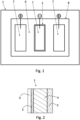
- a magnesium battery 2 according to the invention is shown in a highly simplified manner.
- the magnesium battery 2 has several battery cells 8, whereby in the present case only a part of a single battery cell 8 is shown for the sake of simplicity.
- the battery cell 8 has several anodes 1 and cathodes 7, which are arranged in an electrolyte 6. A surface of the respective anode 1 is completely covered with a protective layer 5.
- FIG 2 shows a section of the anode 1 according to Figure 1 .
- the anode 1 has a core element 3, which in this case is made of the core material aluminum.
- a magnesium coating 4 as the active material of the anode 1 is arranged on a surface of the core element 3, the magnesium coating 4 being formed, for example, using a melting process.
- the protective layer 5 is arranged on a surface of the magnesium coating 4.
- the protective layer 5 is made of aluminum or ceramically from a copper oxide.
- the PVD process is particularly suitable for forming the protective layer 5.
- the protective layer 5 preferably has a layer thickness of at least 0.5 nm to at most 5 ⁇ m.
- the electrolyte 6 does not border on the magnesium coating 4, but only on the protective layer 5. This increases the longevity of the anode 1 and increases the performance of the magnesium battery 2.
Landscapes
- Chemical & Material Sciences (AREA)
- Chemical Kinetics & Catalysis (AREA)
- Electrochemistry (AREA)
- General Chemical & Material Sciences (AREA)
- Engineering & Computer Science (AREA)
- Manufacturing & Machinery (AREA)
- Materials Engineering (AREA)
- Inorganic Chemistry (AREA)
- Composite Materials (AREA)
- Secondary Cells (AREA)
- Battery Electrode And Active Subsutance (AREA)
- Cell Electrode Carriers And Collectors (AREA)
Description
- Die Erfindung betrifft eine Anode für eine Magnesiumbatterie sowie ein Verfahren zur Herstellung einer Anode für eine Magnesiumbatterie. Unter einer Magnesiumbatterie ist ein elektrochemischer Speicher zu verstehen, dessen Anode im Wesentlichen aus Magnesium gebildet ist.
- Aus der
US 2020 / 0 112 028 A1 geht eine Anode für eine Magnesiumbatterie hervor. Die Anode ist aus einem Magnesiumschaum ausgebildet und weist eine Polymerschicht auf, die den Magnesiumschaum auf allen Oberflächen abdeckt. - Die
US 2016 / 0 254 541 A1 beschreibt ein Elektrodenaktivmaterial für eine Magnesiumbatterie enthaltend eine λ-MnO2-Phase. - Die
US 2018 / 0 190 981 A1 offenbart eine Vorrichtung mit einer ersten Elektrode aus metallischem Magnesium und einer Beschichtung enthaltend ein erstes Polymer. - Die
JP 2014 143 191 A - Allgemein ist bekannt, dass Magnesiumbatterien in der Regel aus mehreren Batteriezellen bestehen, wobei eine jeweilige Batteriezelle mehrere Anoden und Kathoden aufweist, die in einem Elektrolyten angeordnet sind. Im Betrieb der Magnesiumbatterie bildet sich zwischen dem Elektrolyten und der Magnesiumanode eine Grenzschicht auf der Magnesiumanode aus, die die Lebensdauer und Leistungsfähigkeit, insbesondere die Impedanz und Zyklenfestigkeit der Magnesiumbatterie verringert. Diese Grenzschicht kann sich bereits bei der Exposition der Magnesiumanode an Umgebungsluft bilden.
- Die Aufgabe der Erfindung besteht darin, eine langlebige Anode für eine Magnesiumbatterie zu schaffen. Ferner soll die Anode günstig herzustellen sein und die Leistungsfähigkeit der Magnesiumbatterie steigern. Die Aufgabe wird gelöst durch den Gegenstand der Ansprüche 1 und 7. Bevorzugte Ausführungsformen sind den abhängigen Ansprüchen, der Beschreibung und den Figuren zu entnehmen.
- Eine erfindungsgemäße Anode für eine Magnesiumbatterie weist ein Kernelement aus einem Kernmaterial auf, wobei an einer Oberfläche des Kernelements zumindest teilweise eine Magnesiumbeschichtung angeordnet ist, wobei an einer Oberfläche der Magnesiumbeschichtung eine Schutzschicht angeordnet ist, und wobei die Schutzschicht entweder
- metallisch ausgebildet ist und aus einem der nachfolgenden Elemente ausgebildet ist: Aluminium, Kupfer, Silizium, Titan, Tantal, Niob, Nickel, Molybdän, Silber, oder aus einer Legierung aus mindestens zwei der nachfolgenden Elemente besteht: Aluminium, Kupfer, Zinn, Silizium, Titan, Tantal, Niob, Nickel, Molybdän, Silber, oder
- keramisch ausgebildet ist und aus Elementen der Gruppe umfassend Aluminium, Kupfer, Zinn, Silizium, Titan, Tantal, Niob, Nickel, Molybdän, Silber, Kohlenstoff, Stickstoff, Sauerstoff, besteht, oder
- die Schutzschicht aus Metallsulfid besteht, wobei mindestens eines der nachfolgenden Elemente aus der Gruppe umfassend Aluminium, Kupfer, Zinn, Silizium, Titan, Tantal, Niob, Nickel, Molybdän, Silber, das Metallsulfid ausbildet, oder
- die Schutzschicht aus Kohlenstoff oder dotiertem Kohlenstoff besteht.
- Mit anderen Worten ist zumindest ein Teil der Oberfläche des Kernelements oder die gesamte Oberfläche des Kernelements mit der Magnesiumbeschichtung beschichtet, wobei das Magnesium der Magnesiumbeschichtung vorzugsweise einen Reinheitsgrad von mindestens 99,9% aufweist. Die Magnesiumbeschichtung ist das Aktivmaterial der Anode. Das Aktivmaterial ist zur Wechselwirkung mit einer Kathode vorgesehen. An der Oberfläche der Magnesiumbeschichtung ist vollständig die Schutzschicht angeordnet. Die Schutzschicht ist insbesondere derart an der Oberfläche der Magnesiumbeschichtung ausgebildet, dass der Elektrolyt der Magnesiumbatterie entweder keinen direkten, also unmittelbaren Kontakt zu der Magnesiumbeschichtung der Anode aufweist, sondern lediglich die Schutzschicht, die an der Oberfläche der Magnesiumbeschichtung angeordnet ist, kontaktiert oder durch eine Interaktion mit der Magnesiumbeschichtung einen positiven Einfluss auf das Anodenverhalten aufweist. Dadurch ergibt sich der Vorteil, dass sich auf der Magnesiumbeschichtung keine spontane Grenzsicht zum Elektrolyten ausbildet, die die Lebensdauer und Leistungsfähigkeit, insbesondere die Impedanz und Zyklenfestigkeit der Magnesiumbatterie verringert. Insbesondere schützt die Schutzschicht die Magnesiumbeschichtung bei der Produktion vor Oxidation. Ferner ermöglicht die Schutzschicht eine Reduktion des Grenzflächenwiderstands sowie eine Verbesserung der Kinetik von Auflöse- und Abscheidevorgängen. Des Weiteren erfolgt mittels der Schutzschicht eine Optimierung der Zyklierbarkeit der Anode.
- Um diese Vorteile zu erzielen, ist die Schutzschicht metallisch und aus vorzugsweise einem der nachfolgenden Elemente ausgebildet: Aluminium, Kupfer, Silizium, Titan, Tantal, Niob, Nickel, Molybdän, Silber. Alternativ ist die Schutzschicht aus einer Legierung von mindestens zwei der nachfolgenden Elemente ausgebildet: Aluminium, Kupfer, Zinn, Silizium, Titan, Tantal, Niob, Nickel, Molybdän, Silber.
- Beispielsweise ist die Schutzschicht aus Aluminium oder einer Aluminiumlegierung ausgebildet. Beispielsweise ist die Schutzschicht aus Kupfer oder einer Kupferlegierung ausgebildet. Beispielsweise ist die Schutzschicht aus einer Zinnlegierung ausgebildet. Beispielsweise ist die Schutzschicht aus Silizium oder einer Siliziumlegierung ausgebildet. Beispielsweise ist die Schutzschicht aus Titan oder einer Titanlegierung ausgebildet. Beispielsweise ist die Schutzschicht aus Tantal oder einer Tantallegierung ausgebildet. Beispielsweise ist die Schutzschicht aus Niob oder einer Nioblegierung ausgebildet. Beispielsweise ist die Schutzschicht aus Nickel oder einer Nickellegierung ausgebildet. Beispielsweise ist die Schutzschicht aus Molybdän oder einer Molybdänlegierung ausgebildet. Beispielsweise ist die Schutzschicht aus Silber oder einer Silberlegierung ausgebildet.
- In einer alternativen Ausführungsform ist die Schutzschicht keramisch ausgebildet und besteht aus Elementen der Gruppe umfassend Aluminium, Kupfer, Zinn, Silizium, Titan, Tantal, Niob, Nickel, Molybdän, Silber, Kohlenstoff, Stickstoff, Sauerstoff.
- Insbesondere ist die keramische Schutzschicht eine Metalloxidschicht. Beispielsweise ist die Schutzschicht zumindest teilweise oder vollständig aus Aluminiumoxid ausgebildet. Beispielsweise ist die Schutzschicht zumindest teilweise oder vollständig aus Kupferoxid ausgebildet. Beispielsweise ist die Schutzschicht zumindest teilweise oder vollständig aus Zinnoxid ausgebildet. Beispielsweise ist die Schutzschicht zumindest teilweise oder vollständig aus Siliziumoxid ausgebildet. Beispielsweise ist die Schutzschicht zumindest teilweise oder vollständig aus Titanoxid ausgebildet. Beispielsweise ist die Schutzschicht zumindest teilweise oder vollständig aus Tantaloxid ausgebildet. Beispielsweise ist die Schutzschicht zumindest teilweise oder vollständig aus Nioboxid ausgebildet. Beispielsweise ist die Schutzschicht zumindest teilweise oder vollständig aus Nickeloxid ausgebildet. Beispielsweise ist die Schutzschicht zumindest teilweise oder vollständig aus Molybdänoxid ausgebildet. Beispielsweise ist die Schutzschicht zumindest teilweise oder vollständig aus Silberoxid ausgebildet.
- In einer weiteren bevorzugten Ausführungsform ist die keramische Schutzschicht aus einer karbidischen und/oder nitridischen Verbindung gebildet. Beispielsweise ist die Schutzschicht zumindest teilweise oder vollständig aus Siliziumnitrid ausgebildet. Beispielsweise ist die Schutzschicht zumindest teilweise oder vollständig aus Titannitrid ausgebildet. Beispielsweise ist die Schutzschicht zumindest teilweise oder vollständig aus Niobnitrid ausgebildet. Beispielsweise ist die Schutzschicht zumindest teilweise oder vollständig aus Tantalnitrid ausgebildet.
- In einer weiteren alternativen Ausführungsform besteht die Schutzschicht aus Metallsulfid besteht, wobei mindestens eines der nachfolgenden Elemente aus der Gruppe umfassend Aluminium, Kupfer, Zinn, Silizium, Titan, Tantal, Niob, Nickel, Molybdän, Silber, das Metallsulfid ausbildet. Beispielsweise ist die Schutzschicht zumindest teilweise oder vollständig aus Molybdänsulfid ausgebildet.
- Gemäß einer weiteren bevorzugten Ausführungsform kann die Schutzschicht sulfidische und/oder nitridische Verbindungen aufweisen.
- In einer weiteren alternativen Ausführungsform besteht die Schutzschicht aus Kohlenstoff oder dotiertem Kohlenstoff. Die Dotierung der dotierten Kohlenstoffschicht, also der größtenteils aus Kohlenstoff ausgebildeten Schutzschicht, beträgt maximal 45 Atom-%. Als Dotierungselement(e) werden hier bevorzugt ein oder mehrere Elemente aus der Gruppe umfassend Aluminium, Kupfer, Zinn, Silizium, Titan, Tantal, Niob, Nickel, Molybdän, Silber, Wasserstoff, verwendet.
- Gemäß einer bevorzugten Ausführungsform der Erfindung weist die Schutzschicht eine Schichtdicke von mindestens 0,5 nm bis höchstens 5 µm auf. Insbesondere hat sich herausgestellt, dass eine Schichtdicke der Schutzschicht von mindestens 5 nm bis höchstens 250 nm besonders gut zur Erhaltung einer Energiedichte der Anode beiträgt.
- Vorzugsweise ist das Kernelement, welches auch als Ableiter bekannt ist, zumindest teilweise aus Aluminium, Kupfer, Stahl oder einem Polymerwerkstoff ausgebildet. Beispielsweise ist das Kernelement aus Aluminium oder einer Aluminiumlegierung ausgebildet. Beispielsweise ist das Kernelement aus Kupfer oder einer Kupferlegierung ausgebildet. Beispielsweise ist das Kernelement aus Stahl oder einer Stahllegierung ausgebildet. Insbesondere ist die Stahllegierung ein Edelstahl, also ein Stahl, dessen Reinheitsgrad derart ist, dass ein Schwefel- und Phosphorgehalt höchstens 0,025 Gew.-% beträgt. Insbesondere ist die Stahllegierung korrosionsbeständig und weist zumindest Chrom und/oder Nickel als Legierungselemente auf. Die Legierungszusammensetzung der Stahllegierung lässt sich beispielsweise mittels Spektralanalyse (OES) oder mittels Röntgenfluoreszenzanalyse (RFA) bestimmen. Gew.-% ist die Abkürzung für Gewichtsprozent.
- Zur Herstellung einer erfindungsgemäßen Anode werden folgende Verfahrensschritte durchgeführt: Zunächst wir ein Kernelement bereitgestellt. Das Kernelement ist bevorzugt aus einem Kernmaterial aus Aluminium, Kupfer, Stahl oder einem Polymerwerkstoff ausgebildet. Danach erfolgt das Aufbringen einer Magnesiumbeschichtung auf zumindest einem Teil einer Oberfläche des Kernelements. Anschließend erfolgt das Aufbringen einer Schutzschicht auf der Oberfläche der Magnesiumbeschichtung.
- Gemäß einer bevorzugten Ausführungsform der Erfindung wird die Magnesiumbeschichtung durch ein galvanisches Verfahren, Laminationsverfahren, PVD-Verfahren, CVD-Verfahren, ALD-Verfahren, Plattierverfahren, thermische Spritzverfahren oder Schmelzverfahren auf zumindest einem Teil oder der gesamten Oberfläche des Kernelements aufgebracht.
- Die Magnesiumbeschichtung weist bevorzugt eine Schichtdicke im Bereich von 50 nm bis 200 µm, insbesondere 1 µm bis 50 µm, auf.
- Bei galvanischen Verfahren erfolgt die elektrochemische Abscheidung von Magnesium auf das Kernelement beispielsweise in einem elektrolytischen Bad. Bei Laminationsverfahren wird beschichtetes Material, beispielsweise die Magnesiumbeschichtung und die Schutzschicht auf ein strukturiertes Kernelement übertragen bzw. laminiert. Bei Plattierverfahren, auch Plattieren genannt, erfolgt das Ausbilden von Metalllagen auf das Substrat oder Kernelement durch Druck und Temperatur, insbesondere auch durch eine anschließende Wärmebehandlung. Bei thermischen Spritzverfahren wird verflüssigtes Magnesium auf das Substrat, also das Kernelement, gespritzt.
- PVD ist die Abkürzung für den englischen Begriff "Physical Vapour Deposition". Bei dem PVD-Verfahren handelt es sich um einen Prozess, der unter Vakuum und bei Temperaturen zwischen 150°C und 500°C durchgeführt wird. Mithilfe physikalischer Verfahren wird das Ausgangsmaterial für die Magnesiumbeschichtung in die Gasphase überführt. Das gasförmige Material wird anschließend zu der Oberfläche des Kernelements geführt, wo es kondensiert und die Magnesiumbeschichtung bildet. Beispielsweise werden im PVD-Verfahren durch Sputtern Partikel aus einem Magnesiumtarget herausgelöst und in einem Plasma auf die Oberfläche des Kernelements transportiert. Mittels PVD-Verfahren können besonders reine und homogene Beschichtungen erzeugt werden.
- CVD ist die Abkürzung für den englischen Begriff "Chemical Vapour Deposition". Bei dem CVD-Verfahren erfolgt die Schichtabscheidung an der erhitzten Oberfläche des Kernelements aufgrund einer chemischen Reaktion aus einer Gasphase. Das CVD-Verfahren zeichnet sich durch mindestens eine Reaktion an der Oberfläche des Kernelements aus. An dieser Reaktion sind mindestens eine gasförmige Ausgangsverbindung und mindestens zwei Reaktionsprodukte, wobei mindestens eines davon in der festen Phase vorliegt, beteiligt. Mittels CVD-Verfahren können besonders gleichmäßige Beschichtungen erzeugt werden.
- ALD ist die Abkürzung für den englischen Begriff "Atomic Layer Deposition". Bei dem ALD-Verfahren handelt es sich um ein stark verändertes CVD-Verfahren mit mindestens zwei zyklisch durchgeführten selbstbegrenzenden Oberflächenreaktionen. Das abzuscheidende Material ist in chemischer Form an ein oder mehrere Trägergase gebunden. Die Trägergase werden abwechselnd in eine Reaktionskammer geleitet und dort zur Reaktion mit der Oberfläche des Kernelements gebracht, woraufhin das im Gas gebundene Magnesium sich auf der Oberfläche des Kernelements abscheidet. Mittels ALD-Verfahren können besonders dünne Beschichtungen erzeugt werden.
- Bei dem Schmelzverfahren wird das Magnesium aufgeschmolzen und beispielsweise durch Tauchen oder Sprühen auf das Kernelement aufgebracht. Schmelzverfahren bieten nicht nur einen Kostenvorteil, sondern auch den Vorteil der Ausbildung einer schnellen sowie großflächigen Beschichtung.
- Gemäß einer bevorzugten Ausführungsform der Erfindung wird die Schutzschicht durch ein PVD-Verfahren, CVD-Verfahren oder ALD-Verfahren auf der gesamten Oberfläche der Magnesiumbeschichtung aufgebracht.
- Ferner besteht die Möglichkeit, die Schutzschicht auf eine Magnesiumfolie zu beschichten, die dann auf das Kernelement aufgebracht wird Die Magnesiumfolie wird vorzugsweise mit einem Walzverfahren hergestellt.
- Gemäß einer bevorzugten Ausführungsform der Erfindung wird die Schutzschicht im Betrieb der Anode auf der Oberfläche der Magnesiumbeschichtung aufgebracht. Mit anderen Worten ist die Batteriezelle derart ausgebildet, dass während des Betriebs der Magnesiumbatterie eine Schutzschicht auf der Magnesiumbeschichtung der Anode erzeugt wird, die die Magnesiumbeschichtung vor Oxidation schützt, die Zyklierbarkeit der Anode optimiert, eine Reduktion des Grenzflächenwiderstands sowie eine Verbesserung der Kinetik von Auflöse- und Abscheidevorgängen ermöglicht. Beispielsweise ist dazu der Elektrolyt derart ausgebildet, dass eines der nachfolgenden Elemente als Schutzschicht auf die Magnesiumbeschichtung der Anode abgeschieden wird: Aluminium, Kupfer, Silizium, Titan, Tantal, Niob, Nickel, Molybdän, Silber. Alternativ wird eine Legierung aus mindestens zwei Elementen der Gruppe umfassend Aluminium, Kupfer, Zinn, Silizium, Titan, Tantal, Niob, Nickel, Molybdän, Silber, abgeschieden.
- Ferner betrifft die Erfindung eine Magnesiumbatterie mit einer erfindungsgemäßen Anode. Insbesondere weist die Magnesiumbatterie eine Vielzahl von Batteriezellen auf, wobei jede Batteriezelle mehrere Anoden und Kathoden aufweist, die in einem Flüssigelektrolyten oder Festkörperelektrolyten angeordnet sind.
- Als Kathode hat sich zusammen mit der erfindungsgemäßen Anode eine aus einem Kathodenmaterial enthaltend einen Schwefelanteil bewährt. Als Basismaterialien für eine Interkalationsreaktion haben sich zur Ausbildung der Kathode insbesondere V2O5 oder MgMn2O4 bewährt. Als Basismaterialien für eine Konversionsreaktion haben sich zur Ausbildung der Kathode insbesondere Schwefel-infiltrierter Kohlenstoff. SchwefelKohlenstoff-Komposite oder auch SPAN ( sulfurized poly(acrylonitrile) ) bewährt.
- Zur Ausbildung eines Elektrolyten für die Magnesiumbatterie haben sich Elektrolytsalze bewährt wie
MgTFSl2 Magnesium bis(trifluoromethanesulfonimide) Mg(B(hfip)4)2 Magnesium tetrakis(hexafluoroisopropyloxy) borate Mg(BH4)2 Magnesiumborhydrid - Auch Mischungen von Mg(BH4)2 und Li(BH4) ( = Lithiumborhydrid ) oder von Mg(B(hfip)4)2 und Li(B(hfip)4) ( = Lithium tetrakis(hexafluoroisopropyloxy)borat ) haben sich als leistungssteigernd erwiesen.
- Weiterhin hat sich der Einsatz von Mg(HMDS)2 - basierten ( = Magnesium bis-(hexamethyldisilazide)-basierten ) Elektrolytsalzen bewährt.
- Als Lösungsmittel zur Lösung der Elektrolytsalze habe sich Glyme, insbesondere TEG ( = Tetraethylene glycol dimethyl ether, Tetraglyme), DEG ( = Diethylene glycol dimethyl ether, Diglyme), DME ( = 1,2-Dimethoxyethan, Ethylene glycol dimethyl ether, Monoglyme), oder eine Mischung aus TEG und DME, bewährt.
- Weiterhin bewährt als Lösungsmittel haben sich THF (Tetrahydrofuran) oder auch ionische Flüssigkeiten, wie bspw. Pyr14TFSI ( = 1-Butyl-1-methylpyrrolidinium bis(trifluoromethylsulfonyl)imide ).
- Weitere die Erfindung verbessernde Maßnahmen werden nachstehend gemeinsam mit der Beschreibung eines bevorzugten Ausführungsbeispiels der Erfindung anhand der beiden Figuren näher dargestellt, wobei gleiche Elemente mit dem gleichen Bezugszeichen versehen sind. Dabei zeigt
- Figur 1
- eine stark vereinfachte schematische Schnittdarstellung einer nur teilweise dargestellten erfindungsgemäßen Magnesiumbatterie,
- Figur 2
- eine stark vereinfachte schematische Schnittdarstellung einer nur teilweise dargestellten erfindungsgemäßen Anode.
- In
Figur 1 ist eine erfindungsgemäße Magnesiumbatterie 2 stark vereinfacht dargestellt. Die Magnesiumbatterie 2 weist mehrere Batteriezellen 8 auf, wobei vorliegend zur Vereinfachung nur ein Teil einer einzigen Batteriezelle 8 dargestellt ist. Die Batteriezelle 8 weist mehrere Anoden 1 und Kathoden 7 auf, die in einem Elektrolyten 6 angeordnet sind. Eine Oberfläche der jeweiligen Anode 1 ist vollständig mit einer Schutzschicht 5 bedeckt. -
Figur 2 zeigt einen Ausschnitt der Anode 1 gemäßFigur 1 . Die Anode 1 weist ein Kernelement 3 auf, das vorliegend aus dem Kernmaterial Aluminium ausgebildet ist. An einer Oberfläche des Kernelements 3 ist eine Magnesiumbeschichtung 4 als Aktivmaterial der Anode 1 angeordnet, wobei die Magnesiumbeschichtung 4 beispielsweise im Schmelzverfahren ausgebildet wurde. An einer Oberfläche der Magnesiumbeschichtung 4 ist die Schutzschicht 5 angeordnet. Beispielsweise ist die Schutzschicht 5 metallisch aus Aluminium ausgebildet oder keramisch aus einem Kupferoxid ausgebildet. Insbesondere eignet sich das PVD-Verfahren zur Ausbildung der Schutzschicht 5. Die Schutzschicht 5 weist bevorzugt eine Schichtdicke von mindestens 0,5 nm bis höchstens 5 µm auf. Der Elektrolyt 6 grenzt nicht an der Magnesiumbeschichtung 4 an, sondern nur an der Schutzschicht 5. Dadurch wird die Langlebigkeit der Anode 1 erhöht und die Leistungsfähigkeit der Magnesiumbatterie 2 gesteigert. -
- 1
- Anode
- 2
- Magnesiumbatterie
- 3
- Kernelement
- 4
- Magnesiumbeschichtung
- 5
- Schutzschicht
- 6
- Elektrolyt
- 7
- Kathode
- 8
- Batteriezelle
Claims (10)
- Anode (1) für eine Magnesiumbatterie (2), aufweisend ein Kernelement (3) aus einem Kernmaterial, wobei an einer Oberfläche des Kernelements (3) zumindest teilweise eine Magnesiumbeschichtung (4) angeordnet ist, wobei an einer Oberfläche der Magnesiumbeschichtung (4) eine Schutzschicht (5) angeordnet ist,
dadurch gekennzeichnet, dass die Schutzschicht (5) entweder- metallisch ausgebildet ist und aus einem der nachfolgenden Elemente besteht: Aluminium, Kupfer, Silizium, Titan, Tantal, Niob, Nickel, Molybdän, Silber, oder aus einer Legierung aus mindestens zwei der nachfolgenden Elemente besteht: Aluminium, Kupfer, Zinn, Silizium, Titan, Tantal, Niob, Nickel, Molybdän, Silber, oder- keramisch ausgebildet ist und aus Elementen der Gruppe umfassend Aluminium, Kupfer, Zinn, Silizium, Titan, Tantal, Niob, Nickel, Molybdän, Silber, Kohlenstoff, Stickstoff, Sauerstoff, besteht, oder- die Schutzschicht (5) aus Metallsulfid besteht, wobei mindestens eines der nachfolgenden Elemente aus der Gruppe umfassend Aluminium, Kupfer, Zinn, Silizium, Titan, Tantal, Niob, Nickel, Molybdän, Silber, das Metallsulfid ausbildet, oder- die Schutzschicht (5) aus Kohlenstoff oder dotiertem Kohlenstoff besteht. - Anode (1) nach Anspruch 1,
dadurch gekennzeichnet, dass die keramische Schutzschicht (5) eine Metalloxidschicht ist. - Anode (1) nach Anspruch 1,
dadurch gekennzeichnet, dass die keramische Schutzschicht (5) aus einer karbidischen und/oder nitridischen Verbindung gebildet ist. - Anode (1) nach einem der vorhergehenden Ansprüche,
dadurch gekennzeichnet, dass die Schutzschicht (5) eine Schichtdicke von mindestens 0,5 nm bis höchstens 5 µm aufweist. - Anode (1) nach einem der vorhergehenden Ansprüche,
dadurch gekennzeichnet, dass die Magnesiumbeschichtung (4) eine Schichtdicke im Bereich von 50 nm bis 200 µm aufweist. - Anode (1) nach einem der vorhergehenden Ansprüche,
dadurch gekennzeichnet, dass das Kernmaterial aus mindestens einem Material der Gruppe umfassend Aluminium, Kupfer, Stahl,Polymerwerkstoff, ausgebildet ist. - Verfahren zur Herstellung einer Anode (1) nach einem der Ansprüche 1 bis 6, umfassend zumindest die Verfahrensschritte:- Bereitstellen des Kernelements (3),- Aufbringen der Magnesiumbeschichtung (4) auf zumindest einem Teil einer Oberfläche des Kernelements (3), und- Aufbringen der Schutzschicht (5) auf die Oberfläche der Magnesiumbeschichtung (4).
- Verfahren nach Anspruch 7,
dadurch gekennzeichnet, dass die Magnesiumbeschichtung (4) durch ein galvanisches Verfahren, Laminationsverfahren, PVD-Verfahren, CVD-Verfahren, ALD-Verfahren, Plattierverfahren, thermisches Spritzverfahren oder Schmelzverfahren auf zumindest einem Teil der Oberfläche des Kernelements (3) aufgebracht wird. - Verfahren nach Anspruch 7 oder 8,
dadurch gekennzeichnet, dass die Schutzschicht (5) durch ein galvanisches Verfahren, PVD-Verfahren, CVD-Verfahren, Plattierverfahren oder ALD-Verfahren auf der Oberfläche der Magnesiumbeschichtung (4) aufgebracht wird. - Magnesiumbatterie (2) mit mindestens einer Anode (1) nach einem der Ansprüche 1 bis 6 und mindestens einer Kathode (7) aus einem Kathodenmaterial enthaltend einen Schwefelanteil.
Applications Claiming Priority (2)
| Application Number | Priority Date | Filing Date | Title |
|---|---|---|---|
| DE102020118666 | 2020-07-15 | ||
| PCT/DE2021/100582 WO2022012715A1 (de) | 2020-07-15 | 2021-07-05 | Anode für eine magnesiumbatterie sowie verfahren zur herstellung |
Publications (3)
| Publication Number | Publication Date |
|---|---|
| EP4182984A1 EP4182984A1 (de) | 2023-05-24 |
| EP4182984B1 true EP4182984B1 (de) | 2024-04-24 |
| EP4182984C0 EP4182984C0 (de) | 2024-04-24 |
Family
ID=77103744
Family Applications (1)
| Application Number | Title | Priority Date | Filing Date |
|---|---|---|---|
| EP21746634.1A Active EP4182984B1 (de) | 2020-07-15 | 2021-07-05 | Anode für eine magnesiumbatterie sowie verfahren zur herstellung |
Country Status (7)
| Country | Link |
|---|---|
| US (1) | US20230223543A1 (de) |
| EP (1) | EP4182984B1 (de) |
| JP (1) | JP7566935B2 (de) |
| KR (1) | KR102870274B1 (de) |
| CN (1) | CN115668540B (de) |
| DE (1) | DE102021117231A1 (de) |
| WO (1) | WO2022012715A1 (de) |
Families Citing this family (2)
| Publication number | Priority date | Publication date | Assignee | Title |
|---|---|---|---|---|
| JP7698980B2 (ja) * | 2021-05-26 | 2025-06-26 | Tdk株式会社 | リチウムイオン二次電池 |
| CN115064660A (zh) * | 2022-07-04 | 2022-09-16 | 中国科学院青岛生物能源与过程研究所 | 一种镁金属电池负极功能涂层、负极极片的制备方法及应用 |
Citations (1)
| Publication number | Priority date | Publication date | Assignee | Title |
|---|---|---|---|---|
| JP5737727B2 (ja) * | 2012-12-27 | 2015-06-17 | 株式会社東洋製作所 | マグネシウム電池 |
Family Cites Families (17)
| Publication number | Priority date | Publication date | Assignee | Title |
|---|---|---|---|---|
| DE2455048A1 (de) * | 1973-11-23 | 1975-11-13 | Anvar | Verfahren zur herstellung von oberflaechenueberzuegen, sowie mittels desselben erhaltene ueberzuege und ueberzogene werkstuecke |
| US4411748A (en) * | 1981-09-18 | 1983-10-25 | Great Lakes Carbon Corporation | Anode and process for magnesium production |
| JP2000012016A (ja) | 1998-06-22 | 2000-01-14 | Matsushita Electric Ind Co Ltd | 電池用負極およびその製造方法 |
| JPH11345610A (ja) * | 1998-06-02 | 1999-12-14 | Matsushita Electric Ind Co Ltd | 電池用負極およびその製造方法 |
| US20110183156A1 (en) * | 2010-01-27 | 2011-07-28 | Gm Global Technology Operations, Inc. | Sacrificial anodic coatings for magnesium alloys |
| JP2012531725A (ja) * | 2010-09-17 | 2012-12-10 | エルジー・ケム・リミテッド | マグネシウム二次電池用電極及びこれを備えたマグネシウム二次電池 |
| JP6011071B2 (ja) * | 2012-01-16 | 2016-10-19 | 大日本印刷株式会社 | 電池パック |
| JP2014209421A (ja) | 2013-03-28 | 2014-11-06 | 三鷹光器株式会社 | マグネシウム電池 |
| JP2014232571A (ja) | 2013-05-28 | 2014-12-11 | 三鷹光器株式会社 | マグネシウム電池 |
| KR102196363B1 (ko) | 2013-10-29 | 2020-12-30 | 삼성전자주식회사 | 마그네슘 전지용 전극 활물질, 이를 포함하는 전극 및 마그네슘 전지, 및 마그네슘 전지용 전극 활물질의 제조방법 |
| WO2016209983A1 (en) | 2015-06-22 | 2016-12-29 | Alliance For Sustainable Energy, Llc | Magnesium metal devices and methods of making the same |
| KR20170003309A (ko) * | 2015-06-30 | 2017-01-09 | 주식회사 엘지화학 | 마그네슘 전지용 전극 활물질, 이의 제조 방법, 이를 포함하는 전극, 및 상기 전극을 포함하는 마그네슘 전지 |
| KR20170021096A (ko) * | 2015-08-17 | 2017-02-27 | 전자부품연구원 | 마그네슘 전지 음극 표면 처리용 화합물, 이를 이용한 마그네슘 전지 음극 표면 처리 방법 및 이에 의하여 표면 처리된 마그네슘 전지 음극 |
| KR101876665B1 (ko) | 2017-02-02 | 2018-07-09 | 한국산업기술대학교산학협력단 | 마그네슘 전극, 이를 포함하는 마그네슘 이차전지 및 하이브리드 전지 |
| JP2019186026A (ja) | 2018-04-10 | 2019-10-24 | 三菱マテリアル株式会社 | マグネシウム燃料極の製造方法、及び、マグネシウム燃料極の製造装置 |
| US10541419B1 (en) | 2018-08-24 | 2020-01-21 | Toyota Motor Engineering & Manufacturing North America, Inc. | Electro-polymerized protective layer for 3D magnesium battery |
| JP7061537B2 (ja) * | 2018-08-29 | 2022-04-28 | 太平洋セメント株式会社 | 二次電池用電極、及びその製造方法、並びにそれを用いた二次電池 |
-
2021
- 2021-07-05 US US18/016,023 patent/US20230223543A1/en active Pending
- 2021-07-05 DE DE102021117231.4A patent/DE102021117231A1/de not_active Withdrawn
- 2021-07-05 CN CN202180038934.2A patent/CN115668540B/zh active Active
- 2021-07-05 EP EP21746634.1A patent/EP4182984B1/de active Active
- 2021-07-05 JP JP2022577292A patent/JP7566935B2/ja active Active
- 2021-07-05 WO PCT/DE2021/100582 patent/WO2022012715A1/de not_active Ceased
- 2021-07-05 KR KR1020227041644A patent/KR102870274B1/ko active Active
Patent Citations (1)
| Publication number | Priority date | Publication date | Assignee | Title |
|---|---|---|---|---|
| JP5737727B2 (ja) * | 2012-12-27 | 2015-06-17 | 株式会社東洋製作所 | マグネシウム電池 |
Also Published As
| Publication number | Publication date |
|---|---|
| US20230223543A1 (en) | 2023-07-13 |
| KR20230003131A (ko) | 2023-01-05 |
| WO2022012715A1 (de) | 2022-01-20 |
| KR102870274B1 (ko) | 2025-10-15 |
| DE102021117231A1 (de) | 2022-01-20 |
| CN115668540B (zh) | 2026-03-17 |
| EP4182984A1 (de) | 2023-05-24 |
| EP4182984C0 (de) | 2024-04-24 |
| CN115668540A (zh) | 2023-01-31 |
| JP7566935B2 (ja) | 2024-10-15 |
| JP2023530973A (ja) | 2023-07-20 |
Similar Documents
| Publication | Publication Date | Title |
|---|---|---|
| DE102008064085B4 (de) | Metallkomposit für elektrochemische Vorrichtungen und Verfahren zu dessen Herstellung, elektrochemische Brennstoffzelle und darin verwendete Bipolarplatte | |
| DE3118320C2 (de) | ||
| DE102016102947B4 (de) | Aktivmaterialkompositteilchen und Lithiumbatterie | |
| DE69308396T2 (de) | Elektrode mit verbesserter Lebensdauer | |
| DE102019102037A1 (de) | Plasmavorbehandlung an stromabnehmern für dünnschicht lithium-metallisierung | |
| EP3625840B1 (de) | Verfahren zum herstellen eines mit einer lithiumschicht beschichteten substrats mittels einer vermittlerschicht sowie ein beschichtetes substrat | |
| DE60003851T2 (de) | Korrosionsbeständige beschichtete brennstoffzelle bipolare platte mit einer schutzschicht aus graphit und verfahren zur herstellung | |
| EP4182984B1 (de) | Anode für eine magnesiumbatterie sowie verfahren zur herstellung | |
| DE102013209918B4 (de) | Verfahren zum Abscheiden einer dauerhaften dünnen Goldbeschichtung auf Brennstoffzellen-Bipolarplatten | |
| DE102019109376A1 (de) | Verfahren zur herstellung von lithium-metallanoden | |
| EP1595301A1 (de) | Schutzschicht für hochtemperaturbelastete substrate sowie verfahren zur herstellung derselben | |
| DE112013003600T5 (de) | Brennstoffzellenseparator | |
| DE3047636C2 (de) | ||
| DE3022492A1 (de) | Aktivierte elektrode auf nickel-basis und deren verwendung fuer die wasser-elektrolyse | |
| DE112014005697T5 (de) | Positive Elektrode für einen Lithium-Schwefel-Akkumulator und ein Verfahren zur Herstellung desselben | |
| EP3665734A1 (de) | Verfahren zur herstellung von bauteilen sowie danach hergestellte bauteile | |
| DE102023129843A1 (de) | Lithiophile metalloxidbeschichtung auf einem edelstahlstromkollektor | |
| DE69922924T2 (de) | Kohlenstoff-freie anoden auf basis von metallen für aluminium-elektrogewinnungszellen | |
| WO2023280984A1 (de) | Verbessertes verfahren zur herstellung einer polarplatte | |
| DE102008006038B4 (de) | Verfahren zur Herstellung einer Bipolarplatte für eine Brennstoffzelleneinheit und Bipolarplatte | |
| DE2710802C3 (de) | Verfahren zur Herstellung von Elektroden für Elektrolysezellen | |
| DE102020213780A1 (de) | Leitfähiges, antikorrosives magnesium-titanoxid-material | |
| DE19620504C2 (de) | Elektrode für eine Schmelzkarbonatbrennstoffzelle und Verfahren zur Herstellung einer solchen sowie deren Verwendung | |
| DE69921491T2 (de) | Mehrschichtige, kohlenstofffreie anoden auf basis von metallen für aluminium-elektrogewinnungszellen | |
| DE19523635C2 (de) | Stromkollektor für eine Hochtemperaturbrennstoffzelle mit vermindertem Oberflächenwiderstand, sowie Verfahren zur Herstellung eines solchen und dessen Verwendung |
Legal Events
| Date | Code | Title | Description |
|---|---|---|---|
| STAA | Information on the status of an ep patent application or granted ep patent |
Free format text: STATUS: UNKNOWN |
|
| STAA | Information on the status of an ep patent application or granted ep patent |
Free format text: STATUS: THE INTERNATIONAL PUBLICATION HAS BEEN MADE |
|
| PUAI | Public reference made under article 153(3) epc to a published international application that has entered the european phase |
Free format text: ORIGINAL CODE: 0009012 |
|
| STAA | Information on the status of an ep patent application or granted ep patent |
Free format text: STATUS: REQUEST FOR EXAMINATION WAS MADE |
|
| 17P | Request for examination filed |
Effective date: 20230215 |
|
| AK | Designated contracting states |
Kind code of ref document: A1 Designated state(s): AL AT BE BG CH CY CZ DE DK EE ES FI FR GB GR HR HU IE IS IT LI LT LU LV MC MK MT NL NO PL PT RO RS SE SI SK SM TR |
|
| P01 | Opt-out of the competence of the unified patent court (upc) registered |
Effective date: 20230524 |
|
| DAV | Request for validation of the european patent (deleted) | ||
| DAX | Request for extension of the european patent (deleted) | ||
| GRAP | Despatch of communication of intention to grant a patent |
Free format text: ORIGINAL CODE: EPIDOSNIGR1 |
|
| STAA | Information on the status of an ep patent application or granted ep patent |
Free format text: STATUS: GRANT OF PATENT IS INTENDED |
|
| INTG | Intention to grant announced |
Effective date: 20240208 |
|
| GRAS | Grant fee paid |
Free format text: ORIGINAL CODE: EPIDOSNIGR3 |
|
| GRAA | (expected) grant |
Free format text: ORIGINAL CODE: 0009210 |
|
| STAA | Information on the status of an ep patent application or granted ep patent |
Free format text: STATUS: THE PATENT HAS BEEN GRANTED |
|
| AK | Designated contracting states |
Kind code of ref document: B1 Designated state(s): AL AT BE BG CH CY CZ DE DK EE ES FI FR GB GR HR HU IE IS IT LI LT LU LV MC MK MT NL NO PL PT RO RS SE SI SK SM TR |
|
| REG | Reference to a national code |
Ref country code: GB Ref legal event code: FG4D Free format text: NOT ENGLISH |
|
| REG | Reference to a national code |
Ref country code: CH Ref legal event code: EP |
|
| REG | Reference to a national code |
Ref country code: DE Ref legal event code: R096 Ref document number: 502021003500 Country of ref document: DE |
|
| REG | Reference to a national code |
Ref country code: IE Ref legal event code: FG4D Free format text: LANGUAGE OF EP DOCUMENT: GERMAN |
|
| U01 | Request for unitary effect filed |
Effective date: 20240425 |
|
| P04 | Withdrawal of opt-out of the competence of the unified patent court (upc) registered |
Effective date: 20240429 |
|
| U07 | Unitary effect registered |
Designated state(s): AT BE BG DE DK EE FI FR IT LT LU LV MT NL PT SE SI Effective date: 20240503 |
|
| U20 | Renewal fee for the european patent with unitary effect paid |
Year of fee payment: 4 Effective date: 20240724 |
|
| PG25 | Lapsed in a contracting state [announced via postgrant information from national office to epo] |
Ref country code: IS Free format text: LAPSE BECAUSE OF FAILURE TO SUBMIT A TRANSLATION OF THE DESCRIPTION OR TO PAY THE FEE WITHIN THE PRESCRIBED TIME-LIMIT Effective date: 20240824 |
|
| PG25 | Lapsed in a contracting state [announced via postgrant information from national office to epo] |
Ref country code: HR Free format text: LAPSE BECAUSE OF FAILURE TO SUBMIT A TRANSLATION OF THE DESCRIPTION OR TO PAY THE FEE WITHIN THE PRESCRIBED TIME-LIMIT Effective date: 20240424 |
|
| PG25 | Lapsed in a contracting state [announced via postgrant information from national office to epo] |
Ref country code: GR Free format text: LAPSE BECAUSE OF FAILURE TO SUBMIT A TRANSLATION OF THE DESCRIPTION OR TO PAY THE FEE WITHIN THE PRESCRIBED TIME-LIMIT Effective date: 20240725 |
|
| PG25 | Lapsed in a contracting state [announced via postgrant information from national office to epo] |
Ref country code: ES Free format text: LAPSE BECAUSE OF FAILURE TO SUBMIT A TRANSLATION OF THE DESCRIPTION OR TO PAY THE FEE WITHIN THE PRESCRIBED TIME-LIMIT Effective date: 20240424 |
|
| PG25 | Lapsed in a contracting state [announced via postgrant information from national office to epo] |
Ref country code: PL Free format text: LAPSE BECAUSE OF FAILURE TO SUBMIT A TRANSLATION OF THE DESCRIPTION OR TO PAY THE FEE WITHIN THE PRESCRIBED TIME-LIMIT Effective date: 20240424 |
|
| PG25 | Lapsed in a contracting state [announced via postgrant information from national office to epo] |
Ref country code: PL Free format text: LAPSE BECAUSE OF FAILURE TO SUBMIT A TRANSLATION OF THE DESCRIPTION OR TO PAY THE FEE WITHIN THE PRESCRIBED TIME-LIMIT Effective date: 20240424 Ref country code: NO Free format text: LAPSE BECAUSE OF FAILURE TO SUBMIT A TRANSLATION OF THE DESCRIPTION OR TO PAY THE FEE WITHIN THE PRESCRIBED TIME-LIMIT Effective date: 20240724 Ref country code: IS Free format text: LAPSE BECAUSE OF FAILURE TO SUBMIT A TRANSLATION OF THE DESCRIPTION OR TO PAY THE FEE WITHIN THE PRESCRIBED TIME-LIMIT Effective date: 20240824 Ref country code: HR Free format text: LAPSE BECAUSE OF FAILURE TO SUBMIT A TRANSLATION OF THE DESCRIPTION OR TO PAY THE FEE WITHIN THE PRESCRIBED TIME-LIMIT Effective date: 20240424 Ref country code: GR Free format text: LAPSE BECAUSE OF FAILURE TO SUBMIT A TRANSLATION OF THE DESCRIPTION OR TO PAY THE FEE WITHIN THE PRESCRIBED TIME-LIMIT Effective date: 20240725 Ref country code: ES Free format text: LAPSE BECAUSE OF FAILURE TO SUBMIT A TRANSLATION OF THE DESCRIPTION OR TO PAY THE FEE WITHIN THE PRESCRIBED TIME-LIMIT Effective date: 20240424 Ref country code: RS Free format text: LAPSE BECAUSE OF FAILURE TO SUBMIT A TRANSLATION OF THE DESCRIPTION OR TO PAY THE FEE WITHIN THE PRESCRIBED TIME-LIMIT Effective date: 20240724 |
|
| P05 | Withdrawal of opt-out of the competence of the unified patent court (upc) changed |
Free format text: CASE NUMBER: APP_23576/2024 Effective date: 20240503 |
|
| PG25 | Lapsed in a contracting state [announced via postgrant information from national office to epo] |
Ref country code: CZ Free format text: LAPSE BECAUSE OF FAILURE TO SUBMIT A TRANSLATION OF THE DESCRIPTION OR TO PAY THE FEE WITHIN THE PRESCRIBED TIME-LIMIT Effective date: 20240424 |
|
| PG25 | Lapsed in a contracting state [announced via postgrant information from national office to epo] |
Ref country code: RO Free format text: LAPSE BECAUSE OF FAILURE TO SUBMIT A TRANSLATION OF THE DESCRIPTION OR TO PAY THE FEE WITHIN THE PRESCRIBED TIME-LIMIT Effective date: 20240424 Ref country code: SK Free format text: LAPSE BECAUSE OF FAILURE TO SUBMIT A TRANSLATION OF THE DESCRIPTION OR TO PAY THE FEE WITHIN THE PRESCRIBED TIME-LIMIT Effective date: 20240424 |
|
| REG | Reference to a national code |
Ref country code: DE Ref legal event code: R097 Ref document number: 502021003500 Country of ref document: DE |
|
| PG25 | Lapsed in a contracting state [announced via postgrant information from national office to epo] |
Ref country code: SM Free format text: LAPSE BECAUSE OF FAILURE TO SUBMIT A TRANSLATION OF THE DESCRIPTION OR TO PAY THE FEE WITHIN THE PRESCRIBED TIME-LIMIT Effective date: 20240424 |
|
| PG25 | Lapsed in a contracting state [announced via postgrant information from national office to epo] |
Ref country code: SM Free format text: LAPSE BECAUSE OF FAILURE TO SUBMIT A TRANSLATION OF THE DESCRIPTION OR TO PAY THE FEE WITHIN THE PRESCRIBED TIME-LIMIT Effective date: 20240424 Ref country code: SK Free format text: LAPSE BECAUSE OF FAILURE TO SUBMIT A TRANSLATION OF THE DESCRIPTION OR TO PAY THE FEE WITHIN THE PRESCRIBED TIME-LIMIT Effective date: 20240424 Ref country code: RO Free format text: LAPSE BECAUSE OF FAILURE TO SUBMIT A TRANSLATION OF THE DESCRIPTION OR TO PAY THE FEE WITHIN THE PRESCRIBED TIME-LIMIT Effective date: 20240424 Ref country code: CZ Free format text: LAPSE BECAUSE OF FAILURE TO SUBMIT A TRANSLATION OF THE DESCRIPTION OR TO PAY THE FEE WITHIN THE PRESCRIBED TIME-LIMIT Effective date: 20240424 |
|
| PG25 | Lapsed in a contracting state [announced via postgrant information from national office to epo] |
Ref country code: MC Free format text: LAPSE BECAUSE OF FAILURE TO SUBMIT A TRANSLATION OF THE DESCRIPTION OR TO PAY THE FEE WITHIN THE PRESCRIBED TIME-LIMIT Effective date: 20240424 |
|
| PLBE | No opposition filed within time limit |
Free format text: ORIGINAL CODE: 0009261 |
|
| REG | Reference to a national code |
Ref country code: CH Ref legal event code: PL |
|
| STAA | Information on the status of an ep patent application or granted ep patent |
Free format text: STATUS: NO OPPOSITION FILED WITHIN TIME LIMIT |
|
| 26N | No opposition filed |
Effective date: 20250127 |
|
| PG25 | Lapsed in a contracting state [announced via postgrant information from national office to epo] |
Ref country code: CH Free format text: LAPSE BECAUSE OF NON-PAYMENT OF DUE FEES Effective date: 20240731 |
|
| PG25 | Lapsed in a contracting state [announced via postgrant information from national office to epo] |
Ref country code: IE Free format text: LAPSE BECAUSE OF NON-PAYMENT OF DUE FEES Effective date: 20240705 |
|
| U20 | Renewal fee for the european patent with unitary effect paid |
Year of fee payment: 5 Effective date: 20250728 |
|
| PG25 | Lapsed in a contracting state [announced via postgrant information from national office to epo] |
Ref country code: CY Free format text: LAPSE BECAUSE OF FAILURE TO SUBMIT A TRANSLATION OF THE DESCRIPTION OR TO PAY THE FEE WITHIN THE PRESCRIBED TIME-LIMIT; INVALID AB INITIO Effective date: 20210705 |
|
| PG25 | Lapsed in a contracting state [announced via postgrant information from national office to epo] |
Ref country code: HU Free format text: LAPSE BECAUSE OF FAILURE TO SUBMIT A TRANSLATION OF THE DESCRIPTION OR TO PAY THE FEE WITHIN THE PRESCRIBED TIME-LIMIT; INVALID AB INITIO Effective date: 20210705 |
|
| GBPC | Gb: european patent ceased through non-payment of renewal fee |
Effective date: 20250705 |
|
| PG25 | Lapsed in a contracting state [announced via postgrant information from national office to epo] |
Ref country code: GB Free format text: LAPSE BECAUSE OF NON-PAYMENT OF DUE FEES Effective date: 20250705 |