EP4156427A1 - Protection circuit - Google Patents
Protection circuit Download PDFInfo
- Publication number
- EP4156427A1 EP4156427A1 EP22200218.0A EP22200218A EP4156427A1 EP 4156427 A1 EP4156427 A1 EP 4156427A1 EP 22200218 A EP22200218 A EP 22200218A EP 4156427 A1 EP4156427 A1 EP 4156427A1
- Authority
- EP
- European Patent Office
- Prior art keywords
- battery pack
- protection circuit
- batteries
- heating resistor
- protection
- Prior art date
- Legal status (The legal status is an assumption and is not a legal conclusion. Google has not performed a legal analysis and makes no representation as to the accuracy of the status listed.)
- Pending
Links
Images


Classifications
-
- H—ELECTRICITY
- H02—GENERATION; CONVERSION OR DISTRIBUTION OF ELECTRIC POWER
- H02H—EMERGENCY PROTECTIVE CIRCUIT ARRANGEMENTS
- H02H7/00—Emergency protective circuit arrangements specially adapted for specific types of electric machines or apparatus or for sectionalised protection of cable or line systems, and effecting automatic switching in the event of an undesired change from normal working conditions
- H02H7/18—Emergency protective circuit arrangements specially adapted for specific types of electric machines or apparatus or for sectionalised protection of cable or line systems, and effecting automatic switching in the event of an undesired change from normal working conditions for batteries; for accumulators
-
- H02J7/52—
-
- H02J7/60—
-
- H02J7/62—
-
- H02J7/64—
-
- H—ELECTRICITY
- H01—ELECTRIC ELEMENTS
- H01H—ELECTRIC SWITCHES; RELAYS; SELECTORS; EMERGENCY PROTECTIVE DEVICES
- H01H85/00—Protective devices in which the current flows through a part of fusible material and this current is interrupted by displacement of the fusible material when this current becomes excessive
- H01H85/02—Details
- H01H85/46—Circuit arrangements not adapted to a particular application of the protective device
- H01H2085/466—Circuit arrangements not adapted to a particular application of the protective device with remote controlled forced fusing
-
- Y—GENERAL TAGGING OF NEW TECHNOLOGICAL DEVELOPMENTS; GENERAL TAGGING OF CROSS-SECTIONAL TECHNOLOGIES SPANNING OVER SEVERAL SECTIONS OF THE IPC; TECHNICAL SUBJECTS COVERED BY FORMER USPC CROSS-REFERENCE ART COLLECTIONS [XRACs] AND DIGESTS
- Y02—TECHNOLOGIES OR APPLICATIONS FOR MITIGATION OR ADAPTATION AGAINST CLIMATE CHANGE
- Y02E—REDUCTION OF GREENHOUSE GAS [GHG] EMISSIONS, RELATED TO ENERGY GENERATION, TRANSMISSION OR DISTRIBUTION
- Y02E60/00—Enabling technologies; Technologies with a potential or indirect contribution to GHG emissions mitigation
- Y02E60/10—Energy storage using batteries
-
- Y—GENERAL TAGGING OF NEW TECHNOLOGICAL DEVELOPMENTS; GENERAL TAGGING OF CROSS-SECTIONAL TECHNOLOGIES SPANNING OVER SEVERAL SECTIONS OF THE IPC; TECHNICAL SUBJECTS COVERED BY FORMER USPC CROSS-REFERENCE ART COLLECTIONS [XRACs] AND DIGESTS
- Y02—TECHNOLOGIES OR APPLICATIONS FOR MITIGATION OR ADAPTATION AGAINST CLIMATE CHANGE
- Y02T—CLIMATE CHANGE MITIGATION TECHNOLOGIES RELATED TO TRANSPORTATION
- Y02T10/00—Road transport of goods or passengers
- Y02T10/60—Other road transportation technologies with climate change mitigation effect
- Y02T10/70—Energy storage systems for electromobility, e.g. batteries
Definitions
- the present invention relates to a protection circuit which protects a battery pack from overcurrents and overvoltages using a protection device having heating resistors and fuse elements provided on a circuit board.
- lithium-ion battery market As mobile electronic devices such as cellular telephones or notebook PCs have been widely used, the lithium-ion battery market has been expanded. These mobile electronic devices typically employ a battery pack, as its power supply, which has one to four lithium-ion batteries connected in series. Such a battery pack may ignite or cause smoke when the lithium-ion battery is overcharged (i.e., becomes under an overvoltage) during recharging, and is thus provided with a protection circuit to avoid overcharges.
- a battery pack as its power supply, which has one to four lithium-ion batteries connected in series.
- Such a battery pack may ignite or cause smoke when the lithium-ion battery is overcharged (i.e., becomes under an overvoltage) during recharging, and is thus provided with a protection circuit to avoid overcharges.
- This protection circuit is required to protect the batteries from both overcurrents and overvoltages.
- a protection circuit which includes a protection device having heating resistors and fuse elements provided on a circuit board, and a sensing device for detecting an overvoltage and switching a current flowing into the protection device.
- This protection circuit is designed such that the fuse element is melted in an overcurrent condition, while in an overvoltage condition, the sensing device allows a current to suddenly flow through the heating resistor, thereby causing the heating resistor to generate heat by which the fuse element is melted (Patent Document 1).
- Patent Document 1 Publication of Japanese Patent No. 2790433
- the voltage applied across the heating resistor of the protection device is dependent on the number of serially connected batteries that are included in the battery pack. Accordingly, to ensure that the fuse element of the protection device is melted in an overcharge condition, a lineup of protection devices has to be prepared each of which is provided with a heating resistor having an appropriate resistance value for each number of serially connected batteries.
- battery packs have a variety of voltage ratings for four or less to about ten serially connected lithium-ion batteries, this has become problematic due to an increase in costs or prices resulting from many different protection devices being produced.
- protection devices 2A and 2B each include heating resistors 3 and fuse elements 4 which are provided on a circuit board, its operable power is 10 to 20W, one battery 6 within a battery pack 5 has the maximum voltage of 4V, and a voltage sensing IC 8 and an FET 9 are provided as sensing means 7.
- the protection devices 2A and 2B have to be prepared such that the heating resistor 3 has the resistance values of Table 1 for each number of serially connected batteries 6 that are included in the battery pack 5.
- Table 1 Number of serially connected batteries Resistance value ( ⁇ ) 1 0.8 - 1.6 2 3.2 - 6.4 3 7.2 - 14 4 13 - 26 5 20 - 40 ... ... 10 80 - 160
- the protection circuit 1X of Fig. 6 is formed using a 25 ⁇ heating resistor corresponding to a battery pack 5 having four serially connected batteries.
- the voltage sensing IC 8 detects an overvoltage across the battery pack 5 resulting in a change in the gate potential of the FET 9.
- a battery pack used in a mobile electronic device operating on a large current requires the protection device to include a large-current fuse element. From this point of view, a lineup of protection devices with fuse elements of various ratings is required, which has become problematic due to an increase in costs or prices of the protection device.
- This protection circuit is intended to share a protection device regardless of the current rating of the battery pack or regardless of the number of serially connected batteries in the battery pack.
- the inventors have completed the present invention by finding the following facts in a protection circuit, which protects a battery pack having a plurality of rechargeable batteries connected in series from overcurrents and overvoltages, in an attempt to allow a voltage to be applied to heating resistors of the protection device within an operable range of the protection device when the protection circuit is activated due to an overvoltage. That is, (1) it is effective to allow the voltage of not the total number of serially connected batteries in the battery pack but a predetermined number of batteries to be applied to the heating resistor in an overvoltage condition.
- the voltage to be detected needs not always to be the voltage of the total number of serially connected batteries in the battery pack but may be the voltage of a predetermined number of serially connected batteries. It was also found that to allow the shared use of a protection device, which has a rating for normal applications, in large-current applications, the protection devices should be arranged in parallel in a plurality of stages.
- a first aspect of the present invention is to provide a protection circuit for protecting a battery pack having rechargeable batteries connected in series from overcurrents and overvoltages.
- the protection circuit comprises: a protection device having a heating resistor and a fuse element provided on a circuit board; and sensing means for detecting an overvoltage across any of the batteries in the battery pack and switching a current flowing into the heating resistor.
- the protection circuit is designed such that the fuse element is melted in an overcurrent condition, and in an overvoltage condition on any of the batteries, the sensing means switches on the current flowing into the heating resistor, thereby causing the heating resistor to generate heat and the fuse element to be melted.
- the protection circuit may be provided with a plurality of sensing means for detecting an overvoltage between different batteries.
- a second aspect of the present invention is to provide a protection circuit for protecting a battery pack having rechargeable batteries connected in series from overcurrents and overvoltages.
- the protection circuit comprises: protection devices each having a heating resistor and a fuse element provided on a circuit board; and sensing means for detecting an overvoltage across any of the batteries in the battery pack and switching a current flowing into the heating resistor.
- the plurality of protection devices are connected in parallel. In an overcurrent condition, the fuse element is melted at each protection device.
- the sensing means switches on the current flowing into the heating resistor, thereby causing a voltage across a predetermined number of the batteries in the battery pack to be applied to the heating resistor of each protection device, the heating resistor to generate heat, and the fuse element to be melted.
- the first and second aspects of the present invention are each to provide a protection circuit which protects a battery pack having rechargeable batteries connected in series from overcurrents and overvoltages.
- the protection circuit includes a protection device having heating resistors and fuse elements provided on a circuit board, and overvoltage sensing means.
- the sensing means senses an overvoltage to switch on a current flowing into the heating resistor of the protection device and apply a voltage to the heating resistor of the protection device.
- the sensed voltage is not the voltage of the total number of serially connected batteries in the battery pack but the voltage across any of the serially connected batteries.
- the heating' resistor can be shared between a protection device used in a protection circuit for a battery pack having a larger number of serially connected batteries and a protection device used in a protection circuit for a battery pack having a smaller number serially connected batteries. This makes it possible to avoid producing many different protection devices, thereby reducing the manufacturing costs of the protection circuit.
- a voltage sensing IC having a low voltage rating can detect an overvoltage on a battery pack having a high voltage rating.
- the sensed voltage is a voltage across an individual battery between any batteries, it is possible to observe a charged condition according to a variation in the characteristics of each individual battery in the battery pack.
- a plurality of sensing means can be provided to detect an overvoltage between different batteries in the battery pack.
- the protection devices are connected in parallel, and thus the fuse elements are also connected in parallel.
- the fuse element of the protection device can be shared between a protection circuit allowing a larger current to flow through the battery pack and a protection circuit allowing a smaller current to flow through the battery pack, thereby reducing the manufacturing costs of the protection device. Accordingly, the protection circuit can be manufactured at reduced costs as a whole.
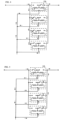
- Fig. 1 shows a protection circuit 1A according to one embodiment of the first aspect of the present invention.
- the protection circuit 1A protects a battery pack 5 having ten serially connected rechargeable batteries 6-1 to 6-10 from overcurrents and overvoltages, and includes a protection device 2A and sensing means 7.
- the protection device 2A is designed to have heating resistors 3 and fuse elements 4 provided on a circuit board, so that a current flows through the heating resistors 3 to generate heat thereby causing the fuse element 4 to be melted.
- the sensing means 7 includes a voltage sensing IC 8 and an FET 9.
- the voltage sensing IC 8 is connected so as to sense a voltage between the first battery 6-1 and the fourth battery 6-4, and output the sensed signal to the gate of the FET 9.
- the voltage sensing IC 8 suitable for sensing the serial voltage of four batteries can be used to detect an overvoltage on the battery pack 5 having ten serially connected batteries.
- the voltage sensing IC 8 is connected so as to also detect a voltage on individual batteries between the first battery 6-1 and the fourth battery 6-4. Accordingly, it is possible to detect an overvoltage on each battery even in the presence of variations in characteristics of the individual batteries accommodated in the battery pack 5 and variations in voltage on the individual batteries during charging.
- an overcurrent flowing through the battery pack 5 would cause the fuse element 4 of the protection device 2A to be melted.
- an overvoltage on the battery pack 5 would cause the FET 9 to have a gate potential above a predetermined voltage and to be thereby switched on. This in turn causes a current to suddenly flow through the drain - source of the FET 9 and thus a current to suddenly flow through the heating resistor 3 of the protection device 1A, thereby causing the heating resistor 3 to generate heat and the fuse element 4 to be melted.
- the heating resistor 3 suitable for a serial voltage across four batteries applied to the heating resistor 3 under the switched-on condition can also be used to cope with an overvoltage on the battery pack 5 having ten serially connected batteries, thereby providing the protection circuit at reduced costs.
- a voltage across as many serially connected batteries as possible is preferably applied to the heating resistor 3 under the switched-on condition.
- a voltage across two or more serially connected batteries may be applied to the heating resistor 3 in practice.
- the protection circuit 1A of Fig. 1 is provided with a resistor R between the gate and the source of the FET 9. This is because the gate potential of the FET 9 needs to be made higher to a certain extent than the source potential in order to switch on the N-channel TFT when the voltage sensing IC 8 has detected an overvoltage.
- a protection circuit 1B of Fig. 2 is designed such that a voltage sensing IC 8-1 is connected so as to sense a voltage between the first battery 6-1 and the fourth battery 6-4, and a voltage sensing IC 8-2 is also connected between the remaining battery 6-5 and the seventh battery 6-7, thus providing two voltage sensing ICs.
- the fuse element 4 of the protection device 2A is melted to thereby protect the battery pack 5 from being overcharged.
- the voltage sensing IC 8-1 raises the gate potential of an FET 9-3 causing the FET 9-3 to be switched on. This in turn causes a current to suddenly flow through the heating resistor 3 of the protection device, thereby allowing the heating resistor 3 to generate heat and the fuse element 4 to be melted.
- the voltage sensing IC 8-2 raises first the gate potential of an FET 9-1 causing a current to suddenly flow through the drain - source of the FET 9-1 and thereby lowering the gate potential of a FET 9-2. Since this FET 9-2 is a P-channel FET, the FET 9-2 is switched on due to a drop in the gate potential, causing a current to suddenly flow through the drain - source. This raises the gate potential of the FET 9-3 causing the FET 9-3 to be switched on, thus allowing a current to suddenly flow through heating resistor 3 of the protection device. The heating resistor 3 thus generates heat to melt the fuse element 4.
- diodes D-1 and D-2 are provided in order to prevent the raised gate potential of the FET 9-3 from being lowered via other parts of the circuit.
- the voltage sensing ICs 8-1 and 8-2 corresponding to, for example, three or four serially connected batteries can be used to perfectly prevent an overvoltage occurring on the battery pack having ten serially connected batteries.
- a voltage sensing IC is not available which has a high voltage rating and detects an overvoltage on the whole battery pack due to its larger number of serially connected batteries, it is possible to form a protection circuit using an existing voltage sensing IC having a low voltage rating corresponding to a battery pack having a smaller number of serially connected batteries.
- Fig. 3 is a protection circuit 1C according to one embodiment of the second aspect of the present invention directed to a large-current battery pack.
- the protection circuit 1C is provided with four protection devices 2A in parallel, which are the same as the one described above. Accordingly, even when a large current flows into the battery pack 5 in its normal conducting condition and the fuse element 4 would be melted in a case of the protection device 2A being singly provided, the protection circuit 1C allows the conduction path to be branched into four shunts in the protection device 2A, thus preventing the fuse element 4 from being melted.
- the fuse element 4 of each protection device 2A is melted.
- the fuse element of the protection device can be shared between a protection circuit allowing a larger current to flow into the battery pack and a protection circuit allowing a smaller current to flow into the battery pack, thereby reducing the manufacturing costs of the protection device.
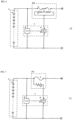
- an overcurrent causes the fuse element 4 to be melted, for example, in a way as shown in Fig. 4 or Fig. 5 .
- a rectifier element is preferably connected to the heating resistor, and thus in the protection circuit 1C shown in Fig. 3 , a diode is connected to the protection device 2A.
- an FET may also be connected as the rectifier element to the protection device 2A.
- the protection circuit 1C is provided with three voltage sensing IC stages, and each of voltage sensing ICs 8-1, 8-2, and 8-3 employed is suitable for sensing the voltage of two to four serially connected batteries.
- Each of the voltage sensing ICs 8-1, 8-2, and 8-3 senses not only the voltage across a row of batteries respectively but also the voltage on individual batteries.
- any one of the three voltage sensing ICs 8-1, 8-2, and 8-3 senses it, causing the FET 9-3 to be switched on.
- the protection circuit according to the present invention is useful as the protection circuit for battery packs with various voltage ratings or current ratings, such as those used with cellular telephones, notebook personal computers, electric cars, or electric motorcycles.
- a protection circuit for protecting a battery pack having rechargeable batteries connected in series from overcurrents and overvoltages comprising:
- the protection circuit according to the 1 st subject comprises a plurality of sensing means for sensing an overvoltage between different batteries, wherein in an overvoltage condition on any of the batteries, the sensing means switches on a current flowing into the heating resistor.
- a voltage across a predetermined number of the batteries in the battery pack is applied to the heating resistor.
- protection circuit for protecting a battery pack having rechargeable batteries connected in series from overcurrents and overvoltages, the protection circuit comprising:
- the heating resistor is connected with a rectifier element to prevent conduction resistance from remaining via the heating resistor when an overcurrent has caused the fuse element to be melted incompletely.
Landscapes
- Protection Of Static Devices (AREA)
- Charge And Discharge Circuits For Batteries Or The Like (AREA)
- Connection Of Batteries Or Terminals (AREA)
- Battery Mounting, Suspending (AREA)
Applications Claiming Priority (5)
| Application Number | Priority Date | Filing Date | Title |
|---|---|---|---|
| JP2004291756A JP4207877B2 (ja) | 2004-10-04 | 2004-10-04 | 保護回路 |
| PCT/JP2005/016281 WO2006038412A1 (ja) | 2004-10-04 | 2005-09-06 | 保護回路 |
| EP05778471.2A EP1798833B1 (en) | 2004-10-04 | 2005-09-06 | Protection circuit |
| EP19163089.6A EP3525309B1 (en) | 2004-10-04 | 2005-09-06 | Protection circuit |
| EP20203270.2A EP3823123B1 (en) | 2004-10-04 | 2005-09-06 | Protection circuit |
Related Parent Applications (3)
| Application Number | Title | Priority Date | Filing Date |
|---|---|---|---|
| EP19163089.6A Division EP3525309B1 (en) | 2004-10-04 | 2005-09-06 | Protection circuit |
| EP20203270.2A Division EP3823123B1 (en) | 2004-10-04 | 2005-09-06 | Protection circuit |
| EP05778471.2A Division EP1798833B1 (en) | 2004-10-04 | 2005-09-06 | Protection circuit |
Publications (1)
| Publication Number | Publication Date |
|---|---|
| EP4156427A1 true EP4156427A1 (en) | 2023-03-29 |
Family
ID=36142494
Family Applications (4)
| Application Number | Title | Priority Date | Filing Date |
|---|---|---|---|
| EP22200218.0A Pending EP4156427A1 (en) | 2004-10-04 | 2005-09-06 | Protection circuit |
| EP05778471.2A Expired - Lifetime EP1798833B1 (en) | 2004-10-04 | 2005-09-06 | Protection circuit |
| EP20203270.2A Expired - Lifetime EP3823123B1 (en) | 2004-10-04 | 2005-09-06 | Protection circuit |
| EP19163089.6A Expired - Lifetime EP3525309B1 (en) | 2004-10-04 | 2005-09-06 | Protection circuit |
Family Applications After (3)
| Application Number | Title | Priority Date | Filing Date |
|---|---|---|---|
| EP05778471.2A Expired - Lifetime EP1798833B1 (en) | 2004-10-04 | 2005-09-06 | Protection circuit |
| EP20203270.2A Expired - Lifetime EP3823123B1 (en) | 2004-10-04 | 2005-09-06 | Protection circuit |
| EP19163089.6A Expired - Lifetime EP3525309B1 (en) | 2004-10-04 | 2005-09-06 | Protection circuit |
Country Status (7)
| Country | Link |
|---|---|
| US (1) | US7679330B2 (cg-RX-API-DMAC10.html) |
| EP (4) | EP4156427A1 (cg-RX-API-DMAC10.html) |
| JP (1) | JP4207877B2 (cg-RX-API-DMAC10.html) |
| KR (1) | KR101201569B1 (cg-RX-API-DMAC10.html) |
| CN (1) | CN101040415B (cg-RX-API-DMAC10.html) |
| TW (1) | TW200625362A (cg-RX-API-DMAC10.html) |
| WO (1) | WO2006038412A1 (cg-RX-API-DMAC10.html) |
Families Citing this family (50)
| Publication number | Priority date | Publication date | Assignee | Title |
|---|---|---|---|---|
| KR100807063B1 (ko) | 2006-05-24 | 2008-02-25 | 삼성에스디아이 주식회사 | 전지 팩 |
| TWI343683B (en) | 2007-06-28 | 2011-06-11 | Delta Electronics Inc | Circuit and method for protecting energy storage device |
| KR100938080B1 (ko) | 2007-09-28 | 2010-01-21 | 삼성에스디아이 주식회사 | 안전 회로 및 이를 이용한 배터리 팩 |
| KR101081078B1 (ko) * | 2008-11-14 | 2011-11-07 | 주식회사 엘지화학 | 센스 저항 파괴를 감지하여 배터리 팩을 보호하는 장치 및 방법 |
| KR101016825B1 (ko) * | 2009-02-24 | 2011-02-21 | 삼성에스디아이 주식회사 | 배터리 팩 및 과방전 보호 방법 |
| JP5351860B2 (ja) | 2009-09-04 | 2013-11-27 | 乾坤科技股▲ふん▼有限公司 | 保護装置 |
| TWI456617B (zh) * | 2010-05-14 | 2014-10-11 | Cyntec Co Ltd | 保護元件及電子裝置 |
| TWI452592B (zh) * | 2010-04-16 | 2014-09-11 | Cyntec Co Ltd | 保護元件及電子裝置 |
| JP5192524B2 (ja) | 2009-09-04 | 2013-05-08 | 乾坤科技股▲ふん▼有限公司 | 保護装置 |
| US9025295B2 (en) | 2009-09-04 | 2015-05-05 | Cyntec Co., Ltd. | Protective device and protective module |
| US8531263B2 (en) * | 2009-11-24 | 2013-09-10 | Littelfuse, Inc. | Circuit protection device |
| KR101093888B1 (ko) * | 2009-12-28 | 2011-12-13 | 삼성에스디아이 주식회사 | 배터리 팩 및 이의 단선 검출 방법 |
| JP5415318B2 (ja) * | 2010-02-19 | 2014-02-12 | デクセリアルズ株式会社 | 保護回路、バッテリ制御装置、及び、バッテリパック |
| US20110304943A1 (en) * | 2010-06-10 | 2011-12-15 | Bruce Barton | Relocatable surge suppression or surge protection device |
| CN102652268A (zh) * | 2010-08-31 | 2012-08-29 | 松下电器产业株式会社 | 电池电源装置以及电池电源系统 |
| JP5764911B2 (ja) * | 2010-11-01 | 2015-08-19 | ソニー株式会社 | 組電池及び電力消費機器 |
| JP5683372B2 (ja) * | 2011-04-27 | 2015-03-11 | デクセリアルズ株式会社 | 充放電制御装置、バッテリパック、電気機器、及び、充放電制御方法 |
| TWI488208B (zh) | 2011-08-18 | 2015-06-11 | Ind Tech Res Inst | 保護元件及應用此保護元件之保護裝置 |
| CN102354593A (zh) * | 2011-09-29 | 2012-02-15 | 贵州天义汽车电器有限公司 | 一种汽车风扇调速电阻器 |
| WO2013094565A1 (ja) | 2011-12-19 | 2013-06-27 | デクセリアルズ株式会社 | 保護素子、保護素子の製造方法、及び、保護素子が組み込まれたバッテリモジュール |
| KR101440888B1 (ko) | 2011-12-27 | 2014-09-17 | 삼성에스디아이 주식회사 | 배터리 보호 회로 |
| JP5759911B2 (ja) * | 2012-01-30 | 2015-08-05 | Jx日鉱日石エネルギー株式会社 | 太陽電池ユニット及び太陽電池モジュール |
| US9608430B2 (en) * | 2013-04-11 | 2017-03-28 | International Business Machines Corporation | Battery circuit fault protection in uninterruptable power sources |
| JP6292802B2 (ja) * | 2013-09-06 | 2018-03-14 | デクセリアルズ株式会社 | バッテリ回路、保護回路 |
| KR101658863B1 (ko) * | 2013-10-07 | 2016-09-22 | 주식회사 엘지화학 | 오작동 방지 알고리즘을 포함하는 배터리 관리 장치 및 방법 |
| JP6202992B2 (ja) * | 2013-11-01 | 2017-09-27 | デクセリアルズ株式会社 | 保護回路、バッテリ回路、保護素子、保護素子の駆動方法 |
| JP6173925B2 (ja) * | 2014-01-15 | 2017-08-02 | 株式会社マキタ | 電動作業機器 |
| KR102042569B1 (ko) | 2014-01-15 | 2019-11-11 | 데쿠세리아루즈 가부시키가이샤 | 보호 회로 및 보호 회로의 제어 방법 |
| JP2016067165A (ja) * | 2014-09-25 | 2016-04-28 | エスアイアイ・セミコンダクタ株式会社 | 充放電制御装置およびバッテリ装置 |
| CN104935024B (zh) | 2015-03-06 | 2017-03-29 | 广东欧珀移动通信有限公司 | 充电电池组件和终端设备 |
| CN105470596A (zh) * | 2015-06-30 | 2016-04-06 | 巫立斌 | 一种降低锂电池保护板功耗方法 |
| CN106468896B (zh) * | 2015-08-21 | 2019-09-06 | 浙江正泰电器股份有限公司 | 组合式保护器 |
| JP6510674B2 (ja) | 2015-11-25 | 2019-05-08 | ヤマハ発動機株式会社 | リチウムイオン二次電池の保護回路及び電池パック |
| TWI597754B (zh) * | 2016-05-20 | 2017-09-01 | 聚鼎科技股份有限公司 | 保護元件及其電路保護裝置 |
| JP6544805B2 (ja) * | 2016-10-05 | 2019-07-17 | ショット日本株式会社 | 保護回路 |
| KR102390002B1 (ko) * | 2018-08-31 | 2022-04-22 | 주식회사 엘지에너지솔루션 | 불량 모드 감지를 통한 퓨즈 제어 시스템 및 방법 |
| KR102646285B1 (ko) | 2018-12-21 | 2024-03-13 | 에스케이온 주식회사 | 배터리 시스템 |
| JP7129355B2 (ja) * | 2019-02-01 | 2022-09-01 | デクセリアルズ株式会社 | 保護回路 |
| EP3709393A1 (de) * | 2019-03-11 | 2020-09-16 | Hilti Aktiengesellschaft | Batteriesicherung |
| TWI699026B (zh) * | 2019-06-10 | 2020-07-11 | 聚鼎科技股份有限公司 | 二次電池及其保護元件 |
| JP7377070B2 (ja) * | 2019-11-08 | 2023-11-09 | デクセリアルズ株式会社 | 保護回路、バッテリパック及び保護回路の動作方法 |
| JP7377069B2 (ja) | 2019-11-08 | 2023-11-09 | デクセリアルズ株式会社 | 保護回路、バッテリパック及び保護回路の動作方法 |
| TWI797641B (zh) * | 2020-06-17 | 2023-04-01 | 日商肖特(日本)股份有限公司 | 保護電路 |
| KR102504270B1 (ko) | 2020-09-22 | 2023-02-24 | 삼성에스디아이 주식회사 | 배터리 보호 장치 및 이를 포함하는 배터리 시스템 |
| CN112290514A (zh) * | 2020-10-30 | 2021-01-29 | 珠海迈巨微电子有限责任公司 | 用于电流和/或电压过载保护的装置及集成电路装置 |
| US20240235182A9 (en) * | 2021-02-24 | 2024-07-11 | Panasonic Energy Co.,Ltd. | Power supply equipped with battery unit |
| JP7570295B2 (ja) * | 2021-07-16 | 2024-10-21 | ショット日本株式会社 | 保護回路 |
| KR20230056280A (ko) * | 2021-10-20 | 2023-04-27 | 주식회사 엘지에너지솔루션 | 화재 예방 장치 및 그것의 동작 방법 |
| DE202022106322U1 (de) * | 2022-11-10 | 2022-11-29 | Robert Bosch Gesellschaft mit beschränkter Haftung | Steuerschaltung zum Betrieb eines elektrischen Energiespeichers |
| CN121399821A (zh) * | 2023-06-15 | 2026-01-23 | 松下知识产权经营株式会社 | 电池保护装置以及电池包 |
Citations (5)
| Publication number | Priority date | Publication date | Assignee | Title |
|---|---|---|---|---|
| JP2790433B2 (ja) | 1993-08-31 | 1998-08-27 | ソニー株式会社 | 保護素子及び回路基板 |
| JP2000285778A (ja) | 1999-03-31 | 2000-10-13 | Sony Chem Corp | 保護素子 |
| US6208117B1 (en) * | 1999-07-30 | 2001-03-27 | Fujitsu Limited | Battery pack and electronic apparatus using the same |
| EP1289096A2 (en) * | 2001-08-29 | 2003-03-05 | Hitachi, Ltd. | Battery apparatus for controlling plural batteries and control method of plural batteries |
| JP2004193000A (ja) * | 2002-12-12 | 2004-07-08 | Sony Chem Corp | 二次電池装置 |
Family Cites Families (5)
| Publication number | Priority date | Publication date | Assignee | Title |
|---|---|---|---|---|
| JP3500000B2 (ja) * | 1996-03-22 | 2004-02-23 | 三洋電機株式会社 | 二次電池の充電制御方法 |
| JP3982078B2 (ja) * | 1998-08-26 | 2007-09-26 | ソニー株式会社 | 電池保護回路及び電子装置 |
| JP2002315202A (ja) * | 2001-04-17 | 2002-10-25 | Nec Tokin Tochigi Ltd | 多直用電池パック |
| JP2003111268A (ja) * | 2001-09-28 | 2003-04-11 | Mitsubishi Materials Corp | 過充電保護回路付き二次電池 |
| DE10158494C1 (de) | 2001-11-29 | 2003-08-07 | Dialog Semiconductor Gmbh | Lade/Entlade-Schutzschaltung |
-
2004
- 2004-10-04 JP JP2004291756A patent/JP4207877B2/ja not_active Expired - Lifetime
-
2005
- 2005-09-06 EP EP22200218.0A patent/EP4156427A1/en active Pending
- 2005-09-06 EP EP05778471.2A patent/EP1798833B1/en not_active Expired - Lifetime
- 2005-09-06 KR KR1020077007630A patent/KR101201569B1/ko not_active Expired - Fee Related
- 2005-09-06 WO PCT/JP2005/016281 patent/WO2006038412A1/ja not_active Ceased
- 2005-09-06 US US10/598,924 patent/US7679330B2/en not_active Expired - Lifetime
- 2005-09-06 CN CN2005800336030A patent/CN101040415B/zh not_active Expired - Fee Related
- 2005-09-06 EP EP20203270.2A patent/EP3823123B1/en not_active Expired - Lifetime
- 2005-09-06 EP EP19163089.6A patent/EP3525309B1/en not_active Expired - Lifetime
- 2005-09-12 TW TW094131275A patent/TW200625362A/zh not_active IP Right Cessation
Patent Citations (6)
| Publication number | Priority date | Publication date | Assignee | Title |
|---|---|---|---|---|
| JP2790433B2 (ja) | 1993-08-31 | 1998-08-27 | ソニー株式会社 | 保護素子及び回路基板 |
| JP2000285778A (ja) | 1999-03-31 | 2000-10-13 | Sony Chem Corp | 保護素子 |
| US6208117B1 (en) * | 1999-07-30 | 2001-03-27 | Fujitsu Limited | Battery pack and electronic apparatus using the same |
| EP1289096A2 (en) * | 2001-08-29 | 2003-03-05 | Hitachi, Ltd. | Battery apparatus for controlling plural batteries and control method of plural batteries |
| JP2004193000A (ja) * | 2002-12-12 | 2004-07-08 | Sony Chem Corp | 二次電池装置 |
| US7333315B2 (en) * | 2002-12-12 | 2008-02-19 | Sony Chemical & Information Device Corporation | Secondary battery devices |
Also Published As
| Publication number | Publication date |
|---|---|
| CN101040415A (zh) | 2007-09-19 |
| EP1798833A4 (en) | 2017-09-06 |
| JP2006109596A (ja) | 2006-04-20 |
| KR20070098987A (ko) | 2007-10-08 |
| US7679330B2 (en) | 2010-03-16 |
| HK1110705A1 (en) | 2008-07-18 |
| EP3525309B1 (en) | 2020-11-04 |
| EP3823123B1 (en) | 2022-11-09 |
| KR101201569B1 (ko) | 2012-11-14 |
| EP1798833B1 (en) | 2019-04-17 |
| TWI296122B (cg-RX-API-DMAC10.html) | 2008-04-21 |
| WO2006038412A1 (ja) | 2006-04-13 |
| EP3525309A1 (en) | 2019-08-14 |
| EP3823123A1 (en) | 2021-05-19 |
| JP4207877B2 (ja) | 2009-01-14 |
| US20070159138A1 (en) | 2007-07-12 |
| TW200625362A (en) | 2006-07-16 |
| CN101040415B (zh) | 2011-05-25 |
| EP1798833A1 (en) | 2007-06-20 |
Similar Documents
| Publication | Publication Date | Title |
|---|---|---|
| EP3823123B1 (en) | Protection circuit | |
| US7638977B2 (en) | Battery pack protective circuit for detecting overcharge or wire disconnect | |
| JP4254227B2 (ja) | バッテリーパック | |
| US9048677B2 (en) | Semiconductor device for protecting secondary battery, battery pack, and electronic device using same | |
| JP4771096B2 (ja) | 保護回路 | |
| JP4186052B2 (ja) | 充電制御機能付き電池パック | |
| KR101182430B1 (ko) | 배터리 팩 | |
| CN1078966C (zh) | 用于便携式电装置的带内设安全电路的可充电电池 | |
| EP3644473B1 (en) | Battery protection circuit and battery pack comprising same | |
| JP2002540756A (ja) | 再充電可能な素子の保護のための装置および方法 | |
| US20080192399A1 (en) | Secondary battery apparatus and a protection circuit thereof | |
| US20110299209A1 (en) | Battery protection module | |
| KR101729730B1 (ko) | 과전류로부터 배터리를 보호하는 장치 | |
| US7541777B2 (en) | Battery protection circuit | |
| JP2009077610A (ja) | 充放電保護回路および電池パック | |
| JP2002281660A (ja) | 電池パックの保護装置 | |
| JP2004266882A (ja) | バイパス抵抗付き二次電池と二次電池の保護方法 | |
| JP2004355837A (ja) | 過電流保護回路を備えるパック電池 | |
| KR20070076627A (ko) | 배터리 보호회로 | |
| KR101724025B1 (ko) | Mit 기술을 적용한 과열 및 과전류 차단 배터리 보호 장치 | |
| HK1110705B (en) | Protection circuit | |
| JP4333907B2 (ja) | リチウムイオン二次電池の過放電防止回路 | |
| KR20170062763A (ko) | 하나의 ic 칩을 이용한 배터리 보호 장치 | |
| JP2025160545A (ja) | 充電制御装置、及び、電池パック | |
| JP2025097522A (ja) | 電圧検出回路、充放電制御装置及びバッテリ装置 |
Legal Events
| Date | Code | Title | Description |
|---|---|---|---|
| PUAI | Public reference made under article 153(3) epc to a published international application that has entered the european phase |
Free format text: ORIGINAL CODE: 0009012 |
|
| STAA | Information on the status of an ep patent application or granted ep patent |
Free format text: STATUS: THE APPLICATION HAS BEEN PUBLISHED |
|
| AC | Divisional application: reference to earlier application |
Ref document number: 1798833 Country of ref document: EP Kind code of ref document: P Ref document number: 3525309 Country of ref document: EP Kind code of ref document: P Ref document number: 3823123 Country of ref document: EP Kind code of ref document: P |
|
| AK | Designated contracting states |
Kind code of ref document: A1 Designated state(s): AT BE BG CH CY CZ DE DK EE ES FI FR GB GR HU IE IS IT LI LT LU LV MC NL PL PT RO SE SI SK TR |
|
| STAA | Information on the status of an ep patent application or granted ep patent |
Free format text: STATUS: REQUEST FOR EXAMINATION WAS MADE |
|
| 17P | Request for examination filed |
Effective date: 20230929 |
|
| RBV | Designated contracting states (corrected) |
Designated state(s): AT BE BG CH CY CZ DE DK EE ES FI FR GB GR HU IE IS IT LI LT LU LV MC NL PL PT RO SE SI SK TR |