EP4128525B9 - Schwimmende pv-anlage - Google Patents
Schwimmende pv-anlage Download PDFInfo
- Publication number
- EP4128525B9 EP4128525B9 EP21719540.3A EP21719540A EP4128525B9 EP 4128525 B9 EP4128525 B9 EP 4128525B9 EP 21719540 A EP21719540 A EP 21719540A EP 4128525 B9 EP4128525 B9 EP 4128525B9
- Authority
- EP
- European Patent Office
- Prior art keywords
- film
- layer
- accordance
- float
- photovoltaic
- Prior art date
- Legal status (The legal status is an assumption and is not a legal conclusion. Google has not performed a legal analysis and makes no representation as to the accuracy of the status listed.)
- Active
Links
Images


Classifications
-
- H—ELECTRICITY
- H02—GENERATION; CONVERSION OR DISTRIBUTION OF ELECTRIC POWER
- H02S—GENERATION OF ELECTRIC POWER BY CONVERSION OF INFRARED RADIATION, VISIBLE LIGHT OR ULTRAVIOLET LIGHT, e.g. USING PHOTOVOLTAIC [PV] MODULES
- H02S10/00—PV power plants; Combinations of PV energy systems with other systems for the generation of electric power
- H02S10/40—Mobile PV generator systems
-
- B—PERFORMING OPERATIONS; TRANSPORTING
- B63—SHIPS OR OTHER WATERBORNE VESSELS; RELATED EQUIPMENT
- B63B—SHIPS OR OTHER WATERBORNE VESSELS; EQUIPMENT FOR SHIPPING
- B63B35/00—Vessels or similar floating structures specially adapted for specific purposes and not otherwise provided for
- B63B35/44—Floating buildings, stores, drilling platforms, or workshops, e.g. carrying water-oil separating devices
-
- H—ELECTRICITY
- H02—GENERATION; CONVERSION OR DISTRIBUTION OF ELECTRIC POWER
- H02S—GENERATION OF ELECTRIC POWER BY CONVERSION OF INFRARED RADIATION, VISIBLE LIGHT OR ULTRAVIOLET LIGHT, e.g. USING PHOTOVOLTAIC [PV] MODULES
- H02S20/00—Supporting structures for PV modules
-
- B—PERFORMING OPERATIONS; TRANSPORTING
- B63—SHIPS OR OTHER WATERBORNE VESSELS; RELATED EQUIPMENT
- B63B—SHIPS OR OTHER WATERBORNE VESSELS; EQUIPMENT FOR SHIPPING
- B63B35/00—Vessels or similar floating structures specially adapted for specific purposes and not otherwise provided for
- B63B35/44—Floating buildings, stores, drilling platforms, or workshops, e.g. carrying water-oil separating devices
- B63B2035/4433—Floating structures carrying electric power plants
- B63B2035/4453—Floating structures carrying electric power plants for converting solar energy into electric energy
-
- Y—GENERAL TAGGING OF NEW TECHNOLOGICAL DEVELOPMENTS; GENERAL TAGGING OF CROSS-SECTIONAL TECHNOLOGIES SPANNING OVER SEVERAL SECTIONS OF THE IPC; TECHNICAL SUBJECTS COVERED BY FORMER USPC CROSS-REFERENCE ART COLLECTIONS [XRACs] AND DIGESTS
- Y02—TECHNOLOGIES OR APPLICATIONS FOR MITIGATION OR ADAPTATION AGAINST CLIMATE CHANGE
- Y02E—REDUCTION OF GREENHOUSE GAS [GHG] EMISSIONS, RELATED TO ENERGY GENERATION, TRANSMISSION OR DISTRIBUTION
- Y02E10/00—Energy generation through renewable energy sources
- Y02E10/50—Photovoltaic [PV] energy
Definitions
- the present invention also relates to a method for producing such a floating photovoltaic system.
- Floating installations e.g. offshore, for PV systems require special constructions to withstand the enormous forces of the waves.
- a floating PV system e.g. for offshore applications, such a system must be sufficiently stable to withstand high waves and strong winds.
- the system must be sufficiently stable to prevent capsizing and/or drifting away.
- Rigid floating structures are usually too expensive for the commercial use of PV systems, especially at sea.
- Such a floating photovoltaic system is from the CN 206481252 U which discloses a floating platform provided with ballast weights and comprising a rigid solar module indirectly mounted on the platform.
- the platform consists of a floating foam concrete slab and a floating stabilization vessel.
- the well-known floating photovoltaic system therefore has a relatively high dry weight before operation as a floating body.
- a floating photovoltaic system with a float and at least one photovoltaic module, wherein the float has an upper surface, the photovoltaic module is arranged at a predetermined position on the upper surface, the float is constructed from a layer stack, the layer stack comprises at least one upper layer and a lower layer, the upper layer has a first surface which is attached to a second surface of the lower layer.
- the lower layer consists of a permeable foam which absorbs water.
- the upper layer consists of a non-water-permeable foam.
- the PV system is provided with a floating base in the form of a floating mattress, which has a water-absorbing lower layer.
- the water-absorbing lower layer at least partially or completely below the water surface. Due to the water absorbed, the PV system receives an increased moment of inertia through the lower layer, while the upper layer does not absorb water, but provides an upward buoyancy force, so that the float in combination has a greater resistance to capsizing and / or drifting.
- the invention of the floating photovoltaic system described above comprises a wrapping film, with the advantage that the upper and lower layers remain connected for a long period of time, possibly several years, for example 20 years at sea. Adhesives, on the other hand, prove to be inadequate.
- the film is a solution that avoids the use of adhesives, since it can be securely attached by welding.
- the wrapping film is provided as a film web and wrapped around the layers of the float, as will be explained in more detail later. Therefore, the wrapping film is also referred to below as a wrapping film.
- the designation as a "wrapping" film is not intended to exclude other embodiments of how the wrapping film can wrap the layer stack and hold the individual layers together.
- the wrapping film can, for example, be designed as a tube that is pulled over the layer stack, or it can be designed as a three-dimensionally shaped hood, so that, for example, the layer stack can be wrapped by two such hoods, or by a hood and a flat cover film, or by two comparatively flat hoods and an additional flat film that runs between the two flat hoods around the layer stack and connects the two flat hoods.
- the wrapping or wrapping film primarily serves to ensure that the layers of the stack of layers hold together. It is even essential for the lower layer to be able to absorb water.
- the wrapping can therefore be designed in such a way that it surrounds and encloses the stack of layers in a watertight manner. In this case, the wrapping would have a filling opening so that after transport over land, with the advantage a low weight, the float can be filled with water before or after it is placed in the water.
- the invention provides the floating photovoltaic system described above, in which the layer stack is wrapped by one or more film sleeves.
- the invention provides that the layer stack is wrapped by a series of film sleeves.
- non-overlapping film sleeves can reduce or prevent wrinkling of the films, which can lead to tearing of one or more films.
- the invention provides the floating photovoltaic system described above, wherein a periphery of the float comprises one or more flexible couplings.
- the one or more flexible couplings can be used to connect a number of floating photovoltaic systems to each other to form a floating island of photovoltaic systems.
- the one or more flexible couplings are provided on the wrapping film or the one or more film sleeves.
- the floating photovoltaic system comprises a photovoltaic module mounted on a float.
- the float consists of a two-layer or multi-layer body comprising a stack of an upper layer or an upper part and a lower layer or a lower plate, the layer stack being wrapped in a wrapping film.
- the upper and lower layers are made of low-density plastic, the density of each being lower than the density of water.
- the upper layer consists of a non-permeable foam that is not permeable to water.
- the lower layer consists of a permeable foam that can absorb water.
- the impermeable foam material of the top layer is a closed cell structural foam, such as closed cell polyurethane, expanded polystyrene, polyethylene foam, polypropylene foam, or neoprene rubber.
- the permeable foam material of the bottom layer is an open cell structural foam such as open cell foamed polyurethane or latex foam rubber.
- Alternative designs such as three dimensional woven or non-woven and water permeable materials such as wool or other water absorbent fibers can also be used to construct the bottom layer.
- the water-absorbing material of the lower layer has a high porosity with a pore size of approximately 1 mm and a density of approximately 30 kg/m 3 and a high air permeability of at least 4,500 l/m 2 and typically of approximately 4,500 l/m 2.
- the air permeability refers to the fact that water can penetrate into the foam material of the lower layer and thereby displace the air from the pores of the foam material.
- the layers Due to the different materials used for the upper and lower layers of the float, and because the lower layer is soaked with water during use, the layers have different flexibility and different expansion and compression coefficients. For example, the lower layer is significantly more flexible than the upper layer and can be compressed and stretched more easily.
- the deformations of the upper layer are always limited to such a small extent that the PV modules mounted on the floats are not damaged.
- the layers are wrapped in the wrapping film and wrapped together.
- the wrapping film used is an ethylene vinyl acetate (EVA) film, but a polyvinyl chloride (PVC) film may alternatively be used. Both types of film materials can be attached to themselves, i.e. connected to each other, by a welding technique such as thermal welding or chemical welding, or possibly purely mechanically, such as by sewing, thus avoiding the use of glue or other fastening means.
- EVA ethylene vinyl acetate
- PVC polyvinyl chloride
- the width of the upper and lower layers is each approximately 2 m and the length is a multiple of the width, here e.g. 12 m, wherein the upper layer is designed as a plate with a thickness of approximately 10 cm and the lower layer is designed as a plate with a thickness of approximately 0.5 m to 1 m.
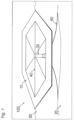
- Fig. 1 shows in a perspective view obliquely from above an island 100 of floating photovoltaic systems 10 of a first embodiment at sea.
- six floating photovoltaic systems 10 are connected to one another to create the island 100.
- the island 100 of six floating photovoltaic systems 10 floats on a water surface 50 and is anchored to a seabed 20 via a central, floating spindle 30.
- power cables 40 are also connected to the island 100 in order to enable the transport of energy generated from the floating photovoltaic system 10 to the shore.
- Anchoring means as known to those skilled in the art, for example in the form of anchor lines 60 or buoys, can also be used to anchor the island 100.
- the floating photovoltaic systems 10 partially float on the water surface 50, while they are also partially submerged. As a result, the moment of inertia of the photovoltaic systems 10 is below the water surface 50, which ensures a stable flow and prevents the systems from drifting. Furthermore, the shape of the floating photovoltaic systems 10 becomes somewhat similar to the (set) wave shape of the water surface 50.
- the deformable, partially floating structure of the floating photovoltaic system 10 is described with reference to Fig. 6 explained in more detail.
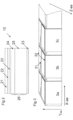
- Fig. 2 shows a cross section of a floating photovoltaic system 10 according to an embodiment, with a flexible photovoltaic module 21, a carrier film 22, a wrapping film 23 and a float 26, which in turn has an upper layer 24 and a lower layer 25.
- the upper layer 24 and the lower layer 25 of the float 26 are each designed as a rectangular plate, wherein a horizontal width and length is greater than that in Fig. 2 shown vertical thickness.
- the lower and upper layers 24 and 25 are stacked 23 on top of each other and, held together by the wrapping film 23, form a float 26.
- the upper layer 24 provides buoyancy to the floating photovoltaic system 10 so that the upper layer 24 essentially floats above the water surface 50.
- the upper layer 24 is constructed from a non-permeable floating material that is not permeable to water.
- the wrapping foil 23 is applied around the outer surfaces of most, preferably all, of the stacked layers 24 and 25. Water exchange between the lower layer 25 and the surrounding water is possible; the wrapping foil 23 does not cover the layers completely, but about 80% of their surface. As a result, the wrapping foil 23 causes little deceleration of the water flowing into and out of the system 10, thereby keeping the moment of inertia of the system 10 below the water surface 50.
- the carrier film 22 is designed according to the size of the top of the upper layer 24 and is firmly attached to the wrapping film 23. This connection can be achieved by welding or sewing the layers.
- the carrier film 22 can either be integrated as an integrated film layer and/or integrated into the wrapping film 23 in such a way that the wrapping film 2.3 has the functionality of the carrier film 22, i.e. the wrapping film 23 is also used as a carrier film. In this case, a separate carrier film can be omitted.
- the flexible photovoltaic module 21 is attached to the carrier film 22 with a butylene type. This makes it possible to maintain and replace the photovoltaic module 21 without lifting the float 26 out of the water.
- the lower layer 25 has absorbed water and the weight of the lower layer 25 has increased significantly due to the water absorption in the layer 25.
- the photovoltaic module 21 can be attached to the carrier film 22 via an alternative detachable, for example mechanical, connection such as screws, zippers, a hook or "Velcro" fastener, or with adhesive.
- tabs or strips made of a weldable material can be provided, which are either attached to the carrier film 22 as separate elements, e.g. as "welding strips", e.g. welded, or the tabs can be formed by protruding sections of the carrier film 22.
- a rigid module such as a framework, with a flexible coupling between the module and the float 26 so that the float 26 can deform independently of the rigid module according to the water surface 50.
- Several photovoltaic modules can be used on a float 26 of the floating photovoltaic system 10.
- Fig. 3 shows schematically that the winding film 23 is arranged in a series of film sleeves 3a, 3b, 3c, and even more in addition, whereby the edges of the film sleeves 3a, 3b, 3c do not overlap, but leave sufficiently large gaps between them so that the foam elements can move, in particular deform.
- the film sleeves 3a, 3b, 3c are each hooked together under (pre-)tension, as indicated at 31, so that both ends lie on the upper side 32 and are then chemically laminated on top of each other, whereby each film sleeve 3a, 3b, 3c forms a closed ring-shaped film in which the winding direction is parallel to the Fig. 3
- the individual film covers 3a, 3b, 3c each have a freedom of movement relative to each other in the direction of the Fig. 3 marked X-axis.
- Fig. 4 and 5 show an additional layer 4a of the winding film 23, the winding direction being parallel to the X-axis.
- This layer 4a is firmly connected to the last film sleeve from each row of film sleeves, here film sleeve 4d, both at the top and from Fig. 4 visible, as well as below, as in Fig. 5 This can be seen from the underside 51 there.
- this additional layer 4a of the wrapping film 23 is then always attached to the next film cover 4c, 4b, whereby the additional layer 4a runs below, but hangs loosely between the film covers, as in Fig. 5 at 52, in such a way that the necessary freedom of movement is possible, as can be seen from Fig. 6 is explained in more detail.
- Fig. 6 shows the entire buoyancy body, on which a closing or end foil 61 is attached along the X-axis, which is always attached to each wrapping foil, either to the Fig. 4 and 5 shown two ends, parallel to the X-axis, or at the Fig. 3 shown second to penultimate film shells are parallel to the Z axis.
- the end film 61 provides a stable layer that cannot be influenced by stretching, compression or shrinking, i.e. does not allow deformation in the direction of the X or Z axis, but is easily deformable in the Y axis direction. Since the entire block is rigid at the top, the block underneath is lengthened and shortened, i.e. the bending line is shifted upwards from the center of the entire block by this behavior. This allows PV elements to be placed on the surface thus obtained without subjecting these elements to forces in the plane formed by the X and Z axes.
- Fig. 7 shows the buoyancy system with a photovoltaic module 21, which in this embodiment is designed as a thin-film PV element 71. This is one of the methods of how a PV element 21 can be mounted.
- connecting elements 72 and 73 can be mounted on the floating photovoltaic system 10.
- the photovoltaic system 10 is shown with a float, which in this embodiment is marked with 74, and in a wrapping film 75, to which the thin-film photovoltaic element 71 is attached at the top.
- the system has closure elements of a hook closure, which run in the form of the strips 72.
- the system can be connected to one or more additional systems in order to form a floating photovoltaic island, as in Fig.1
- Other connections alternative to the hook fastener strips 72 and the cooperating counter strips (hook and fleece parts) are known to the person skilled in the art and can be, for example, hook and / or lip connections, cable connections and the like, as indicated by the dotted lines 73.
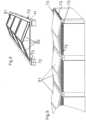
- Fig. 8 shows an embodiment of a floating photovoltaic system, which is intended for use on relatively calm inland waters such as ponds or lakes. Since no high waves are to be expected on these waters, the photovoltaic system can have rigid photovoltaic elements 81 based on semiconductor substrate and does not depend on the photovoltaic elements being flexible in themselves like the thin-film photovoltaic elements 71.
- the floats are in the embodiment of the Fig. 8 arranged in the form of two lines and serve to support a frame made up of several struts 82, to which the photovoltaic elements 81 are in turn attached.
- the frame is designed to be torsionally rigid so that the rigid photovoltaic elements 81 are not subjected to bending, torsion or similar deformations to a harmful extent.
- the floats are provided with the previously mentioned connecting elements in order to Fig. 8 to be able to connect the photovoltaic system shown with other, similar photovoltaic systems to form a larger island.
- the photovoltaic system shown has strips 72 as a first component of a hook closure as well as further connecting elements 73, which can be designed, for example, in the form of a zipper element.
- Fig. 9 shows a further embodiment of a floating photovoltaic system with rigid photovoltaic elements 81, whereby this photovoltaic system is intended for use at sea. Due to the expected sea state, which generates higher waves than on an inland waterway, in this embodiment the photovoltaic elements 81 are each in the Arranged on the floats in such a way that a kind of hinge line is created between adjacent photovoltaic elements 81, so that the floats can bend as described, in adaptation to the waves, without the individual photovoltaic elements 81 having to deform themselves.
- Two photovoltaic elements 81 are arranged in a similar way to a gable roof, i.e. like an inverted V, and between two such adjacent arrangements there is a free space that acts like a hinge line, so that the two adjacent roof-shaped arrangements can be moved relative to each other when the floats deform. Even within a roof-shaped arrangement, the two photovoltaic elements 81 can be movably connected to each other, so that - to stay with the example of a gable roof mentioned - the ridge of the roof acts like a hinge for the two adjoining roof surfaces or photovoltaic elements 81.
- the strips 72 and the connecting elements 73 are arranged on the outside so that the floating photovoltaic system shown can be connected to several similar photovoltaic systems to form a larger island.
- the individual photovoltaic elements 81 are also arranged in pairs like the roof surfaces of a gable roof.
- the ridge line of such a roof runs in the longitudinal direction of the floats, and the struts 82 of the frame provide the entire photovoltaic system shown with inherent rigidity, so that deformations are kept to a minimum and the individual photovoltaic elements 81 are not damaged.
- the ridge lines transverse to the longitudinal direction of the photovoltaic system or its floats, so that the floats can bend upwards or downwards along their length and can thus follow the wave movements.
- the method creates a float in such a way that during use in water, the first layer as a lower layer of the layer stack will be partially submerged in the water, the second layer is an upper layer of the layer stack which mainly floats above the water surface.
- the method further comprises applying a photovoltaic module to a free surface of the second layer, on the side facing away from the first layer, wherein the photovoltaic module is connected to the film layer extending over the free surface.
- the film layer is part of the wrapping film, or the film layer is a carrier film which is applied to the wrapping film in a process step before the photovoltaic module is brought onto the free surface.
Landscapes
- Engineering & Computer Science (AREA)
- Architecture (AREA)
- Civil Engineering (AREA)
- Structural Engineering (AREA)
- Chemical & Material Sciences (AREA)
- Combustion & Propulsion (AREA)
- Mechanical Engineering (AREA)
- Ocean & Marine Engineering (AREA)
- Photovoltaic Devices (AREA)
- Cleaning Or Clearing Of The Surface Of Open Water (AREA)
Applications Claiming Priority (2)
| Application Number | Priority Date | Filing Date | Title |
|---|---|---|---|
| DE102020108429.3A DE102020108429A1 (de) | 2020-03-26 | 2020-03-26 | Schwimmende PV-Anlage |
| PCT/EP2021/057858 WO2021191403A1 (de) | 2020-03-26 | 2021-03-25 | Schwimmende pv-anlage |
Publications (4)
| Publication Number | Publication Date |
|---|---|
| EP4128525A1 EP4128525A1 (de) | 2023-02-08 |
| EP4128525B1 EP4128525B1 (de) | 2024-04-24 |
| EP4128525C0 EP4128525C0 (de) | 2024-04-24 |
| EP4128525B9 true EP4128525B9 (de) | 2024-10-23 |
Family
ID=75562701
Family Applications (1)
| Application Number | Title | Priority Date | Filing Date |
|---|---|---|---|
| EP21719540.3A Active EP4128525B9 (de) | 2020-03-26 | 2021-03-25 | Schwimmende pv-anlage |
Country Status (8)
| Country | Link |
|---|---|
| US (1) | US20230019361A1 (pl) |
| EP (1) | EP4128525B9 (pl) |
| JP (1) | JP2023518901A (pl) |
| KR (1) | KR20220158750A (pl) |
| CA (1) | CA3177174A1 (pl) |
| DE (1) | DE102020108429A1 (pl) |
| PL (1) | PL4128525T3 (pl) |
| WO (1) | WO2021191403A1 (pl) |
Families Citing this family (5)
| Publication number | Priority date | Publication date | Assignee | Title |
|---|---|---|---|---|
| US20240266454A1 (en) * | 2018-12-27 | 2024-08-08 | Solarpaint Ltd. | Flexible and Rollable Self-Floating and Self-Buoyant Solar Panels and Photovoltaic Devices |
| EP4267893A4 (en) * | 2020-12-22 | 2024-12-04 | Guy Gavish | FLOATING PLATFORM FOR SOLAR PANEL ARRANGEMENTS |
| CN117485500B (zh) * | 2023-11-01 | 2024-06-07 | 天津大学 | 一种海上光伏索膜浮岛结构的自排水清洁装置 |
| DE102024112319A1 (de) | 2024-05-02 | 2025-11-06 | Crystalsol Gmbh | Verwendung eines Solarmoduls und Solarmodul |
| CN119037649B (zh) * | 2024-10-25 | 2025-03-04 | 烟台三维岩土工程技术有限公司 | 三维蚌式自平衡海上光伏发电浮动平台 |
Family Cites Families (9)
| Publication number | Priority date | Publication date | Assignee | Title |
|---|---|---|---|---|
| US20080029148A1 (en) * | 2004-10-29 | 2008-02-07 | Thompson Daniel S | Floating support structure for a solar panel array |
| US8001932B2 (en) * | 2007-04-03 | 2011-08-23 | Fountainhead, Llc | Fish spawning structure |
| US20100065106A1 (en) * | 2008-09-17 | 2010-03-18 | Barak Yekutiely | Floating water integrated photovoltaic module |
| CH701870A2 (de) | 2009-09-17 | 2011-03-31 | Tnc Consulting Ag | Schwimmende Photovoltaik-Anordnung. |
| CN206481252U (zh) | 2017-02-27 | 2017-09-08 | 山东鑫宏光电科技有限公司 | 一种泡沫水泥板漂浮式太阳能发电装置 |
| JP2019038353A (ja) * | 2017-08-24 | 2019-03-14 | 積水化成品工業株式会社 | 水上フロート |
| CN208226926U (zh) * | 2018-05-03 | 2018-12-11 | 阳光电源股份有限公司 | 一种光伏组件的支撑装置及光伏系统 |
| CN209710003U (zh) * | 2019-03-01 | 2019-11-29 | 中工国际工程股份有限公司 | 浮毯式薄膜光伏发电组件 |
| CN210942165U (zh) | 2019-09-28 | 2020-07-07 | 孚龙光伏(厦门)有限公司 | 一种可用于水上光伏的浮台 |
-
2020
- 2020-03-26 DE DE102020108429.3A patent/DE102020108429A1/de active Pending
-
2021
- 2021-03-25 EP EP21719540.3A patent/EP4128525B9/de active Active
- 2021-03-25 PL PL21719540.3T patent/PL4128525T3/pl unknown
- 2021-03-25 KR KR1020227035691A patent/KR20220158750A/ko active Pending
- 2021-03-25 WO PCT/EP2021/057858 patent/WO2021191403A1/de not_active Ceased
- 2021-03-25 JP JP2022558494A patent/JP2023518901A/ja not_active Ceased
- 2021-03-25 CA CA3177174A patent/CA3177174A1/en active Pending
-
2022
- 2022-09-26 US US17/952,491 patent/US20230019361A1/en not_active Abandoned
Also Published As
| Publication number | Publication date |
|---|---|
| KR20220158750A (ko) | 2022-12-01 |
| EP4128525A1 (de) | 2023-02-08 |
| EP4128525B1 (de) | 2024-04-24 |
| EP4128525C0 (de) | 2024-04-24 |
| DE102020108429A1 (de) | 2021-09-30 |
| JP2023518901A (ja) | 2023-05-08 |
| US20230019361A1 (en) | 2023-01-19 |
| CA3177174A1 (en) | 2021-09-30 |
| PL4128525T3 (pl) | 2024-09-30 |
| WO2021191403A1 (de) | 2021-09-30 |
Similar Documents
| Publication | Publication Date | Title |
|---|---|---|
| EP4128525B9 (de) | Schwimmende pv-anlage | |
| DE202020005675U1 (de) | Schwimmende PV-Anlage | |
| DE60019103T2 (de) | Ein Notwasserwehr | |
| DE2754552C2 (de) | Wellenbrechende Schwimmbarriere zur Eingrenzung von auf einer Wasserfläche schwimmendem Öl | |
| DE60025925T2 (de) | Unterwasseranlage und verfahren | |
| DE2150591A1 (de) | Vorrichtung zur Aufnahme einer OElverschuettung | |
| WO2013087361A1 (de) | Schwimmende abdeckfolie mit solarmodul | |
| DE2357398C3 (de) | Großflächige schwimmende Traginsel | |
| EP3693261B1 (de) | Offshore-solaranlagenfeld und ein verfahren zu dessen aufbau | |
| DE112021001211T5 (de) | Kolkschutzsystem für eine Pfahlgründung eines Offshore-Windparks und zugehöriges Verfahren | |
| DE2726774A1 (de) | Aufblasbare schwimmbruecke | |
| EP1377712A1 (de) | Netze für gewässer | |
| DE102013210341A1 (de) | Abdichtungssystem | |
| DE102016011712A1 (de) | Schwimmendes Energieerzeugungssystem | |
| WO2013178202A1 (de) | In wasser schwimmende photovoltaikanlage mit einer gewichtsvorrichtung | |
| DE4322980C2 (de) | Kraftwerk, vorgefertigte Einheit des Kraftwerks sowie Verfahren zu dessen Herstellung | |
| DE102012007699A1 (de) | Offshore-Bauwerk und Verfahren zum Übergang von einem Schiff zu einem Offshore-Bauwerk | |
| DE2734259A1 (de) | Vorrichtung zur verringerung der wasserwellenhoehe | |
| DE2717070A1 (de) | Solardecke fuer fluessigkeitsbecken | |
| DE69212718T2 (de) | Ein Gerät für die Pflanzenkultur | |
| DE102011108222B3 (de) | Kanalabdichtung | |
| DE4137569A1 (de) | Anlage zur erzeugung von wasserstoff | |
| DE2224095A1 (de) | Verfahren und Vorrichtung zum Eingrenzen und Rückgewinnen ausgelaufenen Öls | |
| DE2162559A1 (de) | Verfahren und Vorrichtung für die Erzeugung und Befestigung von Ablagerungen von Sedimentmaterial am Boden von Gewässern | |
| DE3206866A1 (de) | Sonnenwaermekollektor aus flexiblem material |
Legal Events
| Date | Code | Title | Description |
|---|---|---|---|
| STAA | Information on the status of an ep patent application or granted ep patent |
Free format text: STATUS: UNKNOWN |
|
| STAA | Information on the status of an ep patent application or granted ep patent |
Free format text: STATUS: THE INTERNATIONAL PUBLICATION HAS BEEN MADE |
|
| PUAI | Public reference made under article 153(3) epc to a published international application that has entered the european phase |
Free format text: ORIGINAL CODE: 0009012 |
|
| STAA | Information on the status of an ep patent application or granted ep patent |
Free format text: STATUS: REQUEST FOR EXAMINATION WAS MADE |
|
| 17P | Request for examination filed |
Effective date: 20221007 |
|
| AK | Designated contracting states |
Kind code of ref document: A1 Designated state(s): AL AT BE BG CH CY CZ DE DK EE ES FI FR GB GR HR HU IE IS IT LI LT LU LV MC MK MT NL NO PL PT RO RS SE SI SK SM TR |
|
| DAV | Request for validation of the european patent (deleted) | ||
| DAX | Request for extension of the european patent (deleted) | ||
| GRAP | Despatch of communication of intention to grant a patent |
Free format text: ORIGINAL CODE: EPIDOSNIGR1 |
|
| STAA | Information on the status of an ep patent application or granted ep patent |
Free format text: STATUS: GRANT OF PATENT IS INTENDED |
|
| INTG | Intention to grant announced |
Effective date: 20231201 |
|
| GRAS | Grant fee paid |
Free format text: ORIGINAL CODE: EPIDOSNIGR3 |
|
| GRAA | (expected) grant |
Free format text: ORIGINAL CODE: 0009210 |
|
| STAA | Information on the status of an ep patent application or granted ep patent |
Free format text: STATUS: THE PATENT HAS BEEN GRANTED |
|
| AK | Designated contracting states |
Kind code of ref document: B1 Designated state(s): AL AT BE BG CH CY CZ DE DK EE ES FI FR GB GR HR HU IE IS IT LI LT LU LV MC MK MT NL NO PL PT RO RS SE SI SK SM TR |
|
| REG | Reference to a national code |
Ref country code: GB Ref legal event code: FG4D Free format text: NOT ENGLISH |
|
| REG | Reference to a national code |
Ref country code: CH Ref legal event code: EP |
|
| REG | Reference to a national code |
Ref country code: DE Ref legal event code: R096 Ref document number: 502021003474 Country of ref document: DE |
|
| REG | Reference to a national code |
Ref country code: IE Ref legal event code: FG4D Free format text: LANGUAGE OF EP DOCUMENT: GERMAN |
|
| U01 | Request for unitary effect filed |
Effective date: 20240523 |
|
| U07 | Unitary effect registered |
Designated state(s): AT BE BG DE DK EE FI FR IT LT LU LV MT NL PT SE SI Effective date: 20240604 |
|
| GRAT | Correction requested after decision to grant or after decision to maintain patent in amended form |
Free format text: ORIGINAL CODE: EPIDOSNCDEC |
|
| REG | Reference to a national code |
Ref country code: CH Ref legal event code: PK Free format text: BERICHTIGUNG B9 |
|
| PG25 | Lapsed in a contracting state [announced via postgrant information from national office to epo] |
Ref country code: IS Free format text: LAPSE BECAUSE OF FAILURE TO SUBMIT A TRANSLATION OF THE DESCRIPTION OR TO PAY THE FEE WITHIN THE PRESCRIBED TIME-LIMIT Effective date: 20240824 |
|
| PG25 | Lapsed in a contracting state [announced via postgrant information from national office to epo] |
Ref country code: HR Free format text: LAPSE BECAUSE OF FAILURE TO SUBMIT A TRANSLATION OF THE DESCRIPTION OR TO PAY THE FEE WITHIN THE PRESCRIBED TIME-LIMIT Effective date: 20240424 |
|
| PG25 | Lapsed in a contracting state [announced via postgrant information from national office to epo] |
Ref country code: GR Free format text: LAPSE BECAUSE OF FAILURE TO SUBMIT A TRANSLATION OF THE DESCRIPTION OR TO PAY THE FEE WITHIN THE PRESCRIBED TIME-LIMIT Effective date: 20240725 |
|
| PG25 | Lapsed in a contracting state [announced via postgrant information from national office to epo] |
Ref country code: ES Free format text: LAPSE BECAUSE OF FAILURE TO SUBMIT A TRANSLATION OF THE DESCRIPTION OR TO PAY THE FEE WITHIN THE PRESCRIBED TIME-LIMIT Effective date: 20240424 |
|
| PG25 | Lapsed in a contracting state [announced via postgrant information from national office to epo] |
Ref country code: NO Free format text: LAPSE BECAUSE OF FAILURE TO SUBMIT A TRANSLATION OF THE DESCRIPTION OR TO PAY THE FEE WITHIN THE PRESCRIBED TIME-LIMIT Effective date: 20240724 Ref country code: IS Free format text: LAPSE BECAUSE OF FAILURE TO SUBMIT A TRANSLATION OF THE DESCRIPTION OR TO PAY THE FEE WITHIN THE PRESCRIBED TIME-LIMIT Effective date: 20240824 Ref country code: HR Free format text: LAPSE BECAUSE OF FAILURE TO SUBMIT A TRANSLATION OF THE DESCRIPTION OR TO PAY THE FEE WITHIN THE PRESCRIBED TIME-LIMIT Effective date: 20240424 Ref country code: GR Free format text: LAPSE BECAUSE OF FAILURE TO SUBMIT A TRANSLATION OF THE DESCRIPTION OR TO PAY THE FEE WITHIN THE PRESCRIBED TIME-LIMIT Effective date: 20240725 Ref country code: ES Free format text: LAPSE BECAUSE OF FAILURE TO SUBMIT A TRANSLATION OF THE DESCRIPTION OR TO PAY THE FEE WITHIN THE PRESCRIBED TIME-LIMIT Effective date: 20240424 Ref country code: RS Free format text: LAPSE BECAUSE OF FAILURE TO SUBMIT A TRANSLATION OF THE DESCRIPTION OR TO PAY THE FEE WITHIN THE PRESCRIBED TIME-LIMIT Effective date: 20240724 |
|
| PG25 | Lapsed in a contracting state [announced via postgrant information from national office to epo] |
Ref country code: CZ Free format text: LAPSE BECAUSE OF FAILURE TO SUBMIT A TRANSLATION OF THE DESCRIPTION OR TO PAY THE FEE WITHIN THE PRESCRIBED TIME-LIMIT Effective date: 20240424 |
|
| PG25 | Lapsed in a contracting state [announced via postgrant information from national office to epo] |
Ref country code: RO Free format text: LAPSE BECAUSE OF FAILURE TO SUBMIT A TRANSLATION OF THE DESCRIPTION OR TO PAY THE FEE WITHIN THE PRESCRIBED TIME-LIMIT Effective date: 20240424 Ref country code: SK Free format text: LAPSE BECAUSE OF FAILURE TO SUBMIT A TRANSLATION OF THE DESCRIPTION OR TO PAY THE FEE WITHIN THE PRESCRIBED TIME-LIMIT Effective date: 20240424 |
|
| REG | Reference to a national code |
Ref country code: DE Ref legal event code: R097 Ref document number: 502021003474 Country of ref document: DE |
|
| PG25 | Lapsed in a contracting state [announced via postgrant information from national office to epo] |
Ref country code: SM Free format text: LAPSE BECAUSE OF FAILURE TO SUBMIT A TRANSLATION OF THE DESCRIPTION OR TO PAY THE FEE WITHIN THE PRESCRIBED TIME-LIMIT Effective date: 20240424 |
|
| PG25 | Lapsed in a contracting state [announced via postgrant information from national office to epo] |
Ref country code: SM Free format text: LAPSE BECAUSE OF FAILURE TO SUBMIT A TRANSLATION OF THE DESCRIPTION OR TO PAY THE FEE WITHIN THE PRESCRIBED TIME-LIMIT Effective date: 20240424 Ref country code: SK Free format text: LAPSE BECAUSE OF FAILURE TO SUBMIT A TRANSLATION OF THE DESCRIPTION OR TO PAY THE FEE WITHIN THE PRESCRIBED TIME-LIMIT Effective date: 20240424 Ref country code: RO Free format text: LAPSE BECAUSE OF FAILURE TO SUBMIT A TRANSLATION OF THE DESCRIPTION OR TO PAY THE FEE WITHIN THE PRESCRIBED TIME-LIMIT Effective date: 20240424 Ref country code: CZ Free format text: LAPSE BECAUSE OF FAILURE TO SUBMIT A TRANSLATION OF THE DESCRIPTION OR TO PAY THE FEE WITHIN THE PRESCRIBED TIME-LIMIT Effective date: 20240424 |
|
| PLBE | No opposition filed within time limit |
Free format text: ORIGINAL CODE: 0009261 |
|
| STAA | Information on the status of an ep patent application or granted ep patent |
Free format text: STATUS: NO OPPOSITION FILED WITHIN TIME LIMIT |
|
| 26N | No opposition filed |
Effective date: 20250127 |
|
| PGFP | Annual fee paid to national office [announced via postgrant information from national office to epo] |
Ref country code: PL Payment date: 20250326 Year of fee payment: 5 |
|
| U20 | Renewal fee for the european patent with unitary effect paid |
Year of fee payment: 5 Effective date: 20250325 |
|
| PG25 | Lapsed in a contracting state [announced via postgrant information from national office to epo] |
Ref country code: MC Free format text: LAPSE BECAUSE OF FAILURE TO SUBMIT A TRANSLATION OF THE DESCRIPTION OR TO PAY THE FEE WITHIN THE PRESCRIBED TIME-LIMIT Effective date: 20240424 |
|
| REG | Reference to a national code |
Ref country code: CH Ref legal event code: H13 Free format text: ST27 STATUS EVENT CODE: U-0-0-H10-H13 (AS PROVIDED BY THE NATIONAL OFFICE) Effective date: 20251024 |
|
| GBPC | Gb: european patent ceased through non-payment of renewal fee |
Effective date: 20250325 |
|
| PG25 | Lapsed in a contracting state [announced via postgrant information from national office to epo] |
Ref country code: GB Free format text: LAPSE BECAUSE OF NON-PAYMENT OF DUE FEES Effective date: 20250325 |
|
| PG25 | Lapsed in a contracting state [announced via postgrant information from national office to epo] |
Ref country code: CH Free format text: LAPSE BECAUSE OF NON-PAYMENT OF DUE FEES Effective date: 20250331 |
|
| PG25 | Lapsed in a contracting state [announced via postgrant information from national office to epo] |
Ref country code: IE Free format text: LAPSE BECAUSE OF NON-PAYMENT OF DUE FEES Effective date: 20250325 |