EP4115236B1 - Lichtmodulator mit in einem betrachtungsbereich eingebetteten verbundenen strukturen - Google Patents
Lichtmodulator mit in einem betrachtungsbereich eingebetteten verbundenen strukturen Download PDFInfo
- Publication number
- EP4115236B1 EP4115236B1 EP21765104.1A EP21765104A EP4115236B1 EP 4115236 B1 EP4115236 B1 EP 4115236B1 EP 21765104 A EP21765104 A EP 21765104A EP 4115236 B1 EP4115236 B1 EP 4115236B1
- Authority
- EP
- European Patent Office
- Prior art keywords
- fluid
- substrate
- recess
- mould
- light modulator
- Prior art date
- Legal status (The legal status is an assumption and is not a legal conclusion. Google has not performed a legal analysis and makes no representation as to the accuracy of the status listed.)
- Active
Links
Images






Classifications
-
- G—PHYSICS
- G02—OPTICS
- G02F—OPTICAL DEVICES OR ARRANGEMENTS FOR THE CONTROL OF LIGHT BY MODIFICATION OF THE OPTICAL PROPERTIES OF THE MEDIA OF THE ELEMENTS INVOLVED THEREIN; NON-LINEAR OPTICS; FREQUENCY-CHANGING OF LIGHT; OPTICAL LOGIC ELEMENTS; OPTICAL ANALOGUE/DIGITAL CONVERTERS
- G02F1/00—Devices or arrangements for the control of the intensity, colour, phase, polarisation or direction of light arriving from an independent light source, e.g. switching, gating or modulating; Non-linear optics
- G02F1/01—Devices or arrangements for the control of the intensity, colour, phase, polarisation or direction of light arriving from an independent light source, e.g. switching, gating or modulating; Non-linear optics for the control of the intensity, phase, polarisation or colour
- G02F1/0102—Constructional details, not otherwise provided for in this subclass
- G02F1/0107—Gaskets, spacers or sealing of cells; Filling and closing of cells
-
- E—FIXED CONSTRUCTIONS
- E06—DOORS, WINDOWS, SHUTTERS, OR ROLLER BLINDS IN GENERAL; LADDERS
- E06B—FIXED OR MOVABLE CLOSURES FOR OPENINGS IN BUILDINGS, VEHICLES, FENCES OR LIKE ENCLOSURES IN GENERAL, e.g. DOORS, WINDOWS, BLINDS, GATES
- E06B3/00—Window sashes, door leaves, or like elements for closing wall or like openings; Layout of fixed or moving closures, e.g. windows in wall or like openings; Features of rigidly-mounted outer frames relating to the mounting of wing frames
- E06B3/66—Units comprising two or more parallel glass or like panes permanently secured together
- E06B3/67—Units comprising two or more parallel glass or like panes permanently secured together characterised by additional arrangements or devices for heat or sound insulation or for controlled passage of light
- E06B3/6715—Units comprising two or more parallel glass or like panes permanently secured together characterised by additional arrangements or devices for heat or sound insulation or for controlled passage of light specially adapted for increased thermal insulation or for controlled passage of light
- E06B3/6722—Units comprising two or more parallel glass or like panes permanently secured together characterised by additional arrangements or devices for heat or sound insulation or for controlled passage of light specially adapted for increased thermal insulation or for controlled passage of light with adjustable passage of light
-
- E—FIXED CONSTRUCTIONS
- E06—DOORS, WINDOWS, SHUTTERS, OR ROLLER BLINDS IN GENERAL; LADDERS
- E06B—FIXED OR MOVABLE CLOSURES FOR OPENINGS IN BUILDINGS, VEHICLES, FENCES OR LIKE ENCLOSURES IN GENERAL, e.g. DOORS, WINDOWS, BLINDS, GATES
- E06B9/00—Screening or protective devices for wall or similar openings, with or without operating or securing mechanisms; Closures of similar construction
- E06B9/24—Screens or other constructions affording protection against light, especially against sunshine; Similar screens for privacy or appearance; Slat blinds
-
- G—PHYSICS
- G02—OPTICS
- G02B—OPTICAL ELEMENTS, SYSTEMS OR APPARATUS
- G02B26/00—Optical devices or arrangements for the control of light using movable or deformable optical elements
- G02B26/004—Optical devices or arrangements for the control of light using movable or deformable optical elements based on a displacement or a deformation of a fluid
- G02B26/005—Optical devices or arrangements for the control of light using movable or deformable optical elements based on a displacement or a deformation of a fluid based on electrowetting
-
- G—PHYSICS
- G02—OPTICS
- G02F—OPTICAL DEVICES OR ARRANGEMENTS FOR THE CONTROL OF LIGHT BY MODIFICATION OF THE OPTICAL PROPERTIES OF THE MEDIA OF THE ELEMENTS INVOLVED THEREIN; NON-LINEAR OPTICS; FREQUENCY-CHANGING OF LIGHT; OPTICAL LOGIC ELEMENTS; OPTICAL ANALOGUE/DIGITAL CONVERTERS
- G02F1/00—Devices or arrangements for the control of the intensity, colour, phase, polarisation or direction of light arriving from an independent light source, e.g. switching, gating or modulating; Non-linear optics
- G02F1/01—Devices or arrangements for the control of the intensity, colour, phase, polarisation or direction of light arriving from an independent light source, e.g. switching, gating or modulating; Non-linear optics for the control of the intensity, phase, polarisation or colour
- G02F1/13—Devices or arrangements for the control of the intensity, colour, phase, polarisation or direction of light arriving from an independent light source, e.g. switching, gating or modulating; Non-linear optics for the control of the intensity, phase, polarisation or colour based on liquid crystals, e.g. single liquid crystal display cells
- G02F1/133—Constructional arrangements; Operation of liquid crystal cells; Circuit arrangements
- G02F1/1333—Constructional arrangements; Manufacturing methods
- G02F1/133354—Arrangements for aligning or assembling substrates
-
- G—PHYSICS
- G02—OPTICS
- G02F—OPTICAL DEVICES OR ARRANGEMENTS FOR THE CONTROL OF LIGHT BY MODIFICATION OF THE OPTICAL PROPERTIES OF THE MEDIA OF THE ELEMENTS INVOLVED THEREIN; NON-LINEAR OPTICS; FREQUENCY-CHANGING OF LIGHT; OPTICAL LOGIC ELEMENTS; OPTICAL ANALOGUE/DIGITAL CONVERTERS
- G02F1/00—Devices or arrangements for the control of the intensity, colour, phase, polarisation or direction of light arriving from an independent light source, e.g. switching, gating or modulating; Non-linear optics
- G02F1/01—Devices or arrangements for the control of the intensity, colour, phase, polarisation or direction of light arriving from an independent light source, e.g. switching, gating or modulating; Non-linear optics for the control of the intensity, phase, polarisation or colour
- G02F1/13—Devices or arrangements for the control of the intensity, colour, phase, polarisation or direction of light arriving from an independent light source, e.g. switching, gating or modulating; Non-linear optics for the control of the intensity, phase, polarisation or colour based on liquid crystals, e.g. single liquid crystal display cells
- G02F1/133—Constructional arrangements; Operation of liquid crystal cells; Circuit arrangements
- G02F1/1333—Constructional arrangements; Manufacturing methods
- G02F1/133377—Cells with plural compartments or having plurality of liquid crystal microcells partitioned by walls, e.g. one microcell per pixel
-
- G—PHYSICS
- G02—OPTICS
- G02F—OPTICAL DEVICES OR ARRANGEMENTS FOR THE CONTROL OF LIGHT BY MODIFICATION OF THE OPTICAL PROPERTIES OF THE MEDIA OF THE ELEMENTS INVOLVED THEREIN; NON-LINEAR OPTICS; FREQUENCY-CHANGING OF LIGHT; OPTICAL LOGIC ELEMENTS; OPTICAL ANALOGUE/DIGITAL CONVERTERS
- G02F1/00—Devices or arrangements for the control of the intensity, colour, phase, polarisation or direction of light arriving from an independent light source, e.g. switching, gating or modulating; Non-linear optics
- G02F1/01—Devices or arrangements for the control of the intensity, colour, phase, polarisation or direction of light arriving from an independent light source, e.g. switching, gating or modulating; Non-linear optics for the control of the intensity, phase, polarisation or colour
- G02F1/13—Devices or arrangements for the control of the intensity, colour, phase, polarisation or direction of light arriving from an independent light source, e.g. switching, gating or modulating; Non-linear optics for the control of the intensity, phase, polarisation or colour based on liquid crystals, e.g. single liquid crystal display cells
- G02F1/133—Constructional arrangements; Operation of liquid crystal cells; Circuit arrangements
- G02F1/1333—Constructional arrangements; Manufacturing methods
- G02F1/1341—Filling or closing of cells
-
- G—PHYSICS
- G02—OPTICS
- G02F—OPTICAL DEVICES OR ARRANGEMENTS FOR THE CONTROL OF LIGHT BY MODIFICATION OF THE OPTICAL PROPERTIES OF THE MEDIA OF THE ELEMENTS INVOLVED THEREIN; NON-LINEAR OPTICS; FREQUENCY-CHANGING OF LIGHT; OPTICAL LOGIC ELEMENTS; OPTICAL ANALOGUE/DIGITAL CONVERTERS
- G02F1/00—Devices or arrangements for the control of the intensity, colour, phase, polarisation or direction of light arriving from an independent light source, e.g. switching, gating or modulating; Non-linear optics
- G02F1/01—Devices or arrangements for the control of the intensity, colour, phase, polarisation or direction of light arriving from an independent light source, e.g. switching, gating or modulating; Non-linear optics for the control of the intensity, phase, polarisation or colour
- G02F1/15—Devices or arrangements for the control of the intensity, colour, phase, polarisation or direction of light arriving from an independent light source, e.g. switching, gating or modulating; Non-linear optics for the control of the intensity, phase, polarisation or colour based on an electrochromic effect
- G02F1/153—Constructional details
- G02F1/1533—Constructional details structural features not otherwise provided for
-
- G—PHYSICS
- G02—OPTICS
- G02F—OPTICAL DEVICES OR ARRANGEMENTS FOR THE CONTROL OF LIGHT BY MODIFICATION OF THE OPTICAL PROPERTIES OF THE MEDIA OF THE ELEMENTS INVOLVED THEREIN; NON-LINEAR OPTICS; FREQUENCY-CHANGING OF LIGHT; OPTICAL LOGIC ELEMENTS; OPTICAL ANALOGUE/DIGITAL CONVERTERS
- G02F1/00—Devices or arrangements for the control of the intensity, colour, phase, polarisation or direction of light arriving from an independent light source, e.g. switching, gating or modulating; Non-linear optics
- G02F1/01—Devices or arrangements for the control of the intensity, colour, phase, polarisation or direction of light arriving from an independent light source, e.g. switching, gating or modulating; Non-linear optics for the control of the intensity, phase, polarisation or colour
- G02F1/15—Devices or arrangements for the control of the intensity, colour, phase, polarisation or direction of light arriving from an independent light source, e.g. switching, gating or modulating; Non-linear optics for the control of the intensity, phase, polarisation or colour based on an electrochromic effect
- G02F1/153—Constructional details
- G02F1/161—Gaskets; Spacers; Sealing of cells; Filling or closing of cells
-
- G—PHYSICS
- G02—OPTICS
- G02F—OPTICAL DEVICES OR ARRANGEMENTS FOR THE CONTROL OF LIGHT BY MODIFICATION OF THE OPTICAL PROPERTIES OF THE MEDIA OF THE ELEMENTS INVOLVED THEREIN; NON-LINEAR OPTICS; FREQUENCY-CHANGING OF LIGHT; OPTICAL LOGIC ELEMENTS; OPTICAL ANALOGUE/DIGITAL CONVERTERS
- G02F1/00—Devices or arrangements for the control of the intensity, colour, phase, polarisation or direction of light arriving from an independent light source, e.g. switching, gating or modulating; Non-linear optics
- G02F1/01—Devices or arrangements for the control of the intensity, colour, phase, polarisation or direction of light arriving from an independent light source, e.g. switching, gating or modulating; Non-linear optics for the control of the intensity, phase, polarisation or colour
- G02F1/165—Devices or arrangements for the control of the intensity, colour, phase, polarisation or direction of light arriving from an independent light source, e.g. switching, gating or modulating; Non-linear optics for the control of the intensity, phase, polarisation or colour based on translational movement of particles in a fluid under the influence of an applied field
- G02F1/1675—Constructional details
- G02F1/1679—Gaskets; Spacers; Sealing of cells; Filling or closing of cells
- G02F1/1681—Gaskets; Spacers; Sealing of cells; Filling or closing of cells having two or more microcells partitioned by walls, e.g. of microcup type
-
- E—FIXED CONSTRUCTIONS
- E06—DOORS, WINDOWS, SHUTTERS, OR ROLLER BLINDS IN GENERAL; LADDERS
- E06B—FIXED OR MOVABLE CLOSURES FOR OPENINGS IN BUILDINGS, VEHICLES, FENCES OR LIKE ENCLOSURES IN GENERAL, e.g. DOORS, WINDOWS, BLINDS, GATES
- E06B9/00—Screening or protective devices for wall or similar openings, with or without operating or securing mechanisms; Closures of similar construction
- E06B9/24—Screens or other constructions affording protection against light, especially against sunshine; Similar screens for privacy or appearance; Slat blinds
- E06B2009/2411—Coloured fluid flow for light transmission control
-
- E—FIXED CONSTRUCTIONS
- E06—DOORS, WINDOWS, SHUTTERS, OR ROLLER BLINDS IN GENERAL; LADDERS
- E06B—FIXED OR MOVABLE CLOSURES FOR OPENINGS IN BUILDINGS, VEHICLES, FENCES OR LIKE ENCLOSURES IN GENERAL, e.g. DOORS, WINDOWS, BLINDS, GATES
- E06B9/00—Screening or protective devices for wall or similar openings, with or without operating or securing mechanisms; Closures of similar construction
- E06B9/24—Screens or other constructions affording protection against light, especially against sunshine; Similar screens for privacy or appearance; Slat blinds
- E06B2009/2464—Screens or other constructions affording protection against light, especially against sunshine; Similar screens for privacy or appearance; Slat blinds featuring transparency control by applying voltage, e.g. LCD, electrochromic panels
-
- G—PHYSICS
- G02—OPTICS
- G02F—OPTICAL DEVICES OR ARRANGEMENTS FOR THE CONTROL OF LIGHT BY MODIFICATION OF THE OPTICAL PROPERTIES OF THE MEDIA OF THE ELEMENTS INVOLVED THEREIN; NON-LINEAR OPTICS; FREQUENCY-CHANGING OF LIGHT; OPTICAL LOGIC ELEMENTS; OPTICAL ANALOGUE/DIGITAL CONVERTERS
- G02F1/00—Devices or arrangements for the control of the intensity, colour, phase, polarisation or direction of light arriving from an independent light source, e.g. switching, gating or modulating; Non-linear optics
- G02F1/01—Devices or arrangements for the control of the intensity, colour, phase, polarisation or direction of light arriving from an independent light source, e.g. switching, gating or modulating; Non-linear optics for the control of the intensity, phase, polarisation or colour
- G02F1/13—Devices or arrangements for the control of the intensity, colour, phase, polarisation or direction of light arriving from an independent light source, e.g. switching, gating or modulating; Non-linear optics for the control of the intensity, phase, polarisation or colour based on liquid crystals, e.g. single liquid crystal display cells
- G02F1/133—Constructional arrangements; Operation of liquid crystal cells; Circuit arrangements
- G02F1/1333—Constructional arrangements; Manufacturing methods
- G02F1/1339—Gaskets; Spacers; Sealing of cells
-
- G—PHYSICS
- G02—OPTICS
- G02F—OPTICAL DEVICES OR ARRANGEMENTS FOR THE CONTROL OF LIGHT BY MODIFICATION OF THE OPTICAL PROPERTIES OF THE MEDIA OF THE ELEMENTS INVOLVED THEREIN; NON-LINEAR OPTICS; FREQUENCY-CHANGING OF LIGHT; OPTICAL LOGIC ELEMENTS; OPTICAL ANALOGUE/DIGITAL CONVERTERS
- G02F2202/00—Materials and properties
- G02F2202/28—Adhesive materials or arrangements
-
- G—PHYSICS
- G02—OPTICS
- G02F—OPTICAL DEVICES OR ARRANGEMENTS FOR THE CONTROL OF LIGHT BY MODIFICATION OF THE OPTICAL PROPERTIES OF THE MEDIA OF THE ELEMENTS INVOLVED THEREIN; NON-LINEAR OPTICS; FREQUENCY-CHANGING OF LIGHT; OPTICAL LOGIC ELEMENTS; OPTICAL ANALOGUE/DIGITAL CONVERTERS
- G02F2203/00—Function characteristic
- G02F2203/48—Variable attenuator
Definitions
- the present invention relates to light modulator devices that are optically switchable and comprise a fluid or gel layer, and especially to devices that have flexible substrates. Such devices preferably have a polymer structure within the viewing area to maintain the gap between the substrates and to support handling in use including bending and laminating to glass or another substrate. Examples of product applications include switchable smart windows, outdoor information displays, and flexible display devices.
- This invention relates to light modulators, that is to say to variable transmission windows, mirrors and similar devices designed to modulate the amount of light or other electro-magnetic radiation passing there through.
- the term "light” will normally be used herein, but this term should be understood in a broad sense to include electro-magnetic radiation at non-visible wavelengths.
- the present invention may be applied to provide windows which can modulate infra-red radiation for controlling temperatures within buildings.
- this invention relates to light modulators which use particle-based electrophoretic media to control light modulation. Examples of electrophoretic media that may be incorporated into various embodiments of the present invention include, for example, the electrophoretic media described in U.S. Patent No. 10,809,590 and U.S. Patent Publication No. 2018/0366069 .
- solutions that have polymer structure in the fluid or gel layer, and suitable for use with the invention include US 8,508,695 to Vlyte Innovations Ltd. , which discloses dispersing fluid droplets (1 to 5 microns in diameter) in a continuous polymer matrix that is cured in place to both substrates, to contain liquid crystals. Additionally, U.S. 10,809,590 to E Ink Corporation discloses microencapsulating fluid droplets and deforming them to form a monolayer of close packed polymer shells in a polymer matrix on one substrate and subsequently applying an adhesive layer to bond the capsule layer to a substrate.
- EP1264210 to E Ink California discloses embossing a micro-cup structure on one substrate, filling the cups with fluid having polymerizable components and polymerizing the components to form a sealing layer on the fluid/cup surface, then applying an adhesive layer to bond to the second substrate.
- EP2976676 to Vlyte Innovations Ltd discloses forming a wall structure on one substrate, coating the tops of walls with adhesive, filling the cavities defined by the walls with fluid, and polymerizing the adhesive to bond the tops of walls to the opposing substrate.
- EP3281055 describes a flexible device including solid polymer microstructures embedded in its viewing area and the microstructures are on both substrates.
- the microstructures join (i.e. fasten) the substrates of the device to each other by engaging with each other over a length orthogonal to the substrates.
- the joined microstructures incorporate a wall structure that divides a device's fluid layer into a monolayer of discrete volumes contained within corresponding cavities. This provides the device with significant structural strength.
- mating microstructures i.e.
- the electro-optical fluid is not exposed to a polymerization step.
- a limitation of the method is that it requires precise alignment and dimensional stability in the X and Y axis of the faces to be joined over large distances, typically over one or more meters in smart glass applications.
- Particle-based electrophoretic displays in which a plurality of charged particles move through a suspending fluid under the influence of an electric field, have been the subject of intense research and development for a number of years. Such displays can have attributes of good brightness and contrast, wide viewing angles, state bistability, and low power consumption when compared with liquid crystal displays.
- bistable and “bistability” are used herein in their conventional meaning in the art to refer to displays comprising display elements having first and second display states differing in at least one optical property, and such that after any given element has been driven, by means of an addressing pulse of finite duration, to assume either its first or second display state, after the addressing pulse has terminated, that state will persist for at least several times, for example at least four times, the minimum duration of the addressing pulse required to change the state of the display element.
- some particle-based electrophoretic displays capable of gray scale are stable not only in their extreme black and white states but also in their intermediate gray states, and the same is true of some other types of electro-optic displays. This type of display is properly called “multi-stable” rather than bistable, although for convenience the term “bistable” may be used herein to cover both bistable and multi-stable displays.
- electrophoretic media require the presence of a suspending fluid.
- this suspending fluid is a liquid, but electrophoretic media can be produced using gaseous suspending fluids; see, for example, Kitamura, T., et al., "Electrical toner movement for electronic paper-like display", IDW Japan, 2001, Paper HCS1-1 , and Yamaguchi, Y, et al., "Toner display using insulative particles charged triboelectrically", IDW Japan, 2001, Paper AMD4-4 ).
- Encapsulated electrophoretic media comprise numerous small capsules, each of which itself comprises an internal phase containing electrophoretically-mobile particles in a fluid medium, and a capsule wall surrounding the internal phase. Typically, the capsules are themselves held within a polymeric binder to form a coherent layer positioned between two electrodes.
- the charged particles and the fluid are not encapsulated within microcapsules but instead are retained within a plurality of cavities formed within a carrier medium, typically a polymeric film.
- the technologies described in these patents and applications include:
- the walls surrounding the discrete microcapsules in an encapsulated electrophoretic medium could be replaced by a continuous phase, thus producing a so-called polymer-dispersed electrophoretic display, in which the electrophoretic medium comprises a plurality of discrete droplets of an electrophoretic fluid and a continuous phase of a polymeric material, and that the discrete droplets of electrophoretic fluid within such a polymer-dispersed electrophoretic display may be regarded as capsules or microcapsules even though no discrete capsule membrane is associated with each individual droplet; see for example, the aforementioned 2002/0131147 . Accordingly, for purposes of the present application, such polymer-dispersed electrophoretic media are regarded as sub-species of encapsulated electrophoretic media.
- microcell electrophoretic display A related type of electrophoretic display is a so-called "microcell electrophoretic display".
- the charged particles and the suspending fluid are not encapsulated within microcapsules but instead are retained within a plurality of cavities formed within a carrier medium, typically a polymeric film.
- a carrier medium typically a polymeric film.
- Electrophoretic media are often opaque (since, for example, in many electrophoretic media, the particles substantially block transmission of visible light through the display) and operate in a reflective mode. This functionality is illustrated in FIG. 5A, where the reflectivity of light striking a surface is modulated by moving black or white charged particles toward a viewing surface with a suitable voltage.
- electrophoretic devices can also be made to operate in a so-called “shutter mode,” in which one display state is substantially opaque and one is light-transmissive. See, for example, the aforementioned U.S. Pat. Nos. 6,130,774 and 6,172,798 , and U.S. Pat. Nos.
- Dielectrophoretic displays which are similar to electrophoretic displays but rely upon variations in electric field strength, can operate in a similar mode; see U.S. Pat. No. 4,418,346 .
- Other types of electro-optic displays may also be capable of operating in shutter mode. In particular, when this "shutter mode" electrophoretic device is constructed on a transparent substrate, it is possible to regulate transmission of light through the device.
- An encapsulated or microcell electrophoretic display typically does not suffer from the clustering and settling failure mode of traditional electrophoretic devices and provides further advantages, such as the ability to print or coat the display on a wide variety of flexible and rigid substrates.
- printing is intended to include all forms of printing and coating, including, but without limitation: pre-metered coatings such as patch die coating, slot or extrusion coating, slide or cascade coating, curtain coating; roll coating such as knife over roll coating, forward and reverse roll coating; gravure coating; dip coating; spray coating; meniscus coating; spin coating; brush coating; air knife coating; silk screen printing processes; electrostatic printing processes; thermal printing processes; ink jet printing processes; electrophoretic deposition; and other similar techniques.
- pre-metered coatings such as patch die coating, slot or extrusion coating, slide or cascade coating, curtain coating
- roll coating such as knife over roll coating, forward and reverse roll coating
- gravure coating dip coating
- spray coating meniscus coating
- spin coating spin coating
- brush coating air knife coating
- silk screen printing processes
- electrophoretic media One potentially important market for electrophoretic media is windows with variable light transmission. As the energy performance of buildings and vehicles becomes increasingly important, electrophoretic media could be used as coatings on windows to enable the proportion of incident radiation transmitted through the windows to be electronically controlled by varying the optical state of the electrophoretic media.
- Effective implementation of such "variable-transmissivity" (“VT") technology in buildings is expected to provide (1) reduction of unwanted heating effects during hot weather, thus reducing the amount of energy needed for cooling, the size of air conditioning plants, and peak electricity demand; (2) increased use of natural daylight, thus reducing energy used for lighting and peak electricity demand; and (3) increased occupant comfort by increasing both thermal and visual comfort. Even greater benefits would be expected to accrue in an automobile, where the ratio of glazed surface to enclosed volume is significantly larger than in a typical building.
- VT technology in automobiles is expected to provide not only the aforementioned benefits but also (1) increased motoring safety, (2) reduced glare, (3) enhanced mirror performance (by using an electro-optic coating on the mirror), and (4) increased ability to use heads-up displays.
- Other potential applications of VT technology include privacy glass and glare-guards in electronic devices.
- JP2014032285A relates to a reflective display device that includes a display medium containing at least one kind of electrophoretic material sealed between two substrates opposing to each other, at least one of which is transparent, and displays predetermined information by the display medium when a predetermined electric field is given between the two substrates.
- a partition wall is formed into a predetermined pattern on one of the substrates; and the display medium is disposed in each region as a cell segmented by the partition wall.
- a hole is formed at a top part in a branching region of the partition wall; an adhesive is disposed on the top part of the partition wall; and the other substrate is adhered to the adhesive.
- US2008170298A1 relates to a device comprising a first layer of material, a second layer of material and walls defining tight cavities between the first and second layers of material, at least partially filled with a fluid, blocks rigidly connected to the first layer of material, and defining a housing filled at least partially of the material of the second layer.
- the housings of the blocks each form an adhesion point of a sealing material of the cavities.
- US2014078575A1 relates to an electronic paper display device that includes a first substrate, partition walls defining cell regions disposed on the first substrate, a first electrode disposed on a bottom surface of the cell regions, microcapsules disposed on the first electrode, a second electrode having one side facing the first electrode, and a second substrate disposed on the other side of the second electrode, in which the electronic paper display device may include first adhesive fixing parts including a plurality of patterns provided between the second electrode and the partition walls.
- US2015022772A1 relates to a liquid crystal panel and its manufacturing method that can ensure a bonding strength between substrates that a sealed portion provides, while achieving a narrowed frame.
- the liquid crystal panel includes a pair of corrective structures provided in a manner protruding from an array substrate toward a counter substrate.
- the liquid crystal panel further includes a counter structure disposed in at least a portion of the frame area and provided in a manner protruding from the counter substrate toward the array substrate, the leading end of the structure coming closer to the surface of the array substrate than the leading ends of the corrective structures and positioned between the corrective structures.
- a sealed portion arranged to bond the substrates to each other is formed through curing of a fluidic sealing material and provided between the corrective structures and the counter structure.
- US2015098124A1 relates to a method for sealing microcells. More specifically, the formation of covalent bonding between a sealing layer and a microcell structure. It also relates to a microcell-based display device that has a strong adhesion between the sealing layer and partition walls in the microcell structure which can prevent defects and significantly improve reliability of the device.
- Described herein is an improved architecture for a switchable light modulator that can be used for a window, mirror, display, sun shade, or sign, among many other applications.
- the described design is more robust than variable transmission devices such as electrochromic films, and provides a better viewing experience due to an improved clear (open state) with reduced haze.
- a switchable light modulator in a first aspect, is provided.
- the fluid pre-cursor does not contact the modulating fluid or the modulating gel.
- the fluid pre-cursor extends beyond side walls defining the recess, and into the cavity.
- the mould includes a colorant, and the colorant matches a colour of a particle that is disposed in the modulating fluid or modulating gel.
- the fluid pre-cursor comprises an elastomeric polymer having a glass transition temperature (Tg) less than 20 °C.
- the elastomer polymer is a polyurethane.
- the recess has a maximum depth that is greater than or equal to 5% of the orthogonal distance between the first major surface and the second major surface.
- the cavities are between 0.3 mm and 3 cm in longest dimension, and the center-to-center distance of adjacent cavities is between 0.6 mm and 10 cm.
- mould parts have differences in the respective shapes of their recesses including variation in the depth and width of the recesses.
- the polymer wall structures additionally include bracing features.
- the first substrate or the second substrate comprises a flexible transparent material.
- the switchable light modulator has a first state that strongly attenuates light, and a second state that is substantially transparent to visible light.
- the modulating fluid or the modulating gel includes electrophoretic particles, liquid crystals, a combination of polar and non-polar liquids, an electrochromic fluid, a thermochromic fluid, or a photochromic fluid.
- a method of making a switchable light modulator is provided in claim 9.
- the wall structure is bonded to the first substrate before the step of providing a modulating fluid or modulating gel in discrete volumes within said plurality of cavities.
- curing the fluid pre-cursor to bond the second substrate and a surface of the recess together comprises heating the fluid pre-cursor or exposing the fluid precursor to UV light.
- disposing the polymer wall structure between the first major surface and the second major surface further includes compressing the polymer wall structure between the first and second substrates with a roller.
- a switchable light modulator device having a first substrate and a second substrate with opposite major surfaces spaced apart by one or more polymer structures that each comprise two or more parts and define wall features for a plurality of cavities, said cavities sealing a fluid or gel in discrete volumes, wherein each of said one or more polymer structures comprises a mould part bonded to said first substrate and defining a recess, and its cast part filling said recess and bonded to said second substrate and a surface of said recess, said cast part being enclosed by said surface of said recess and said second substrate replicating the surfaces of both, wherein the mould part is optically transparent and the cast part obscures light and includes a colorant, a filler material, or a light scattering material.
- a switchable light modulator device In a further aspect, there is provided a switchable light modulator device.
- the mould part is optically transparent (i.e. comprising only optically transparent polymer) and the cast part obscures light. Light is obscured by the cast part by dispersing or solubilizing in its polymer structure one or more of: a colorant, a filler material, or a light scattering material.
- the color of the colorant is selected to match the color or tint of one or more switchable light states.
- a particular advantage of keeping the mould part optically transparent is that when it is formed by an embossing process that relies on rapid ultra-violet (UV) initiated polymerization then absorption of the UV is minimized.
- the mould has light absorbing material then polymerization of deep wall sections (e.g., 20 microns or more) would at least be slowed and most likely would not be possible.
- the mould precursor will have seconds to cure before releasing/peeling from the drum surface.
- the cast part is cast in place in the device and so cast parts with light absorbing material can be thermally cured over a suitably long time period.
- Embodiments provide a switchable light modulator device with a fluid layer.
- the device has solid polymer structures embedded in its fluid layer and the structures have a height (orthogonal to the juxtaposed major faces of the substrates) and width on the micron scale.
- the polymer structures are referred to as microstructures (or micro-structures) in this document.
- the polymer microstructures are arranged in two parts with the first part bonded to the first substrate and the second part bonded to the second substrate. The two parts are also bonded to each other and as a consequence join or fix the substrates of the device to each other.
- the first part incorporates a wall feature that divides the device's fluid layer into a monolayer of discrete volumes corresponding to cavities
- the second part incorporates a sealant feature that seals the volumes so that cavities are isolated from each other. Even though the second part seals, its polymer structure is near completely isolated from contact with the device's fluid layer by the polymer of the first part.
- the first part of the two-part polymer structures are referred to as mould microstructures and they are covalently bonded to the inner major face of the first substrate.
- the mould microstructures are made by micro-replicating the surface of a tool onto the first substrate in an embossing or moulding step.
- the mould microstructures are patterned with recess features (the recess feature could also be called a channel, a notch, or an indentation).
- the recesses are filled by the second part of the two-part polymer structures. This second part is referred to as cast microstructures and they are covalently bonded to the inner face of the second substrate.
- the cast microstructures replicate the recesses by being cast from them but are not separated from the mould microstructures after casting.
- the prepolymer used for casting is printed or otherwise coated to fill the recesses in the mould microstructures.
- the device is assembled with its fluid layer disposed between the opposite spaced apart major surfaces of the first and second substrates.
- the mould microstructures extend from the major surface of the first substrate into the fluid layer and contact the opposite major face of the second substrate. In this way, the mould microstructures define the cell gap of the fluid layer.
- the recesses are filled with the cast microstructures' prepolymer and the cavities are filled with the fluid.
- the prepolymer is polymerized in the casting step to form the cast microstructures and covalently bond them to the mould microstructures and to the inner major face of the second substrate.
- the casting step succeeds the moulding step and occurs in place with the fluid layer and between the substrates.
- the prepolymer bulk in the recess has no contact with the fluid and after polymerization the cast is enclosed by the mould microstructure and isolated from the fluid.
- Embodiments are characterised by two-part polymer structures comprising a mould microstructure part and its cast microstructure part.
- the light modulator of embodiments selectively changes one or more of light attenuation, colour, specular transmittance, or diffuse reflection in response to electrical, optical or thermal changes and switches providing two or more light states.
- light states include one extreme state that is transparent to visible light and another that strongly attenuates light.
- An important application for embodiments is in smart windows. Some embodiments incorporate the device into a window as a layer within a glass laminate. In other embodiments, the device is flexible and bonds to a glass pane. In both smart window embodiments, the film device has significant structural strength and compartmentalises the fluid layer with each discrete fluid volume self-sealed. The structural strength of embodiments derives from the design of its mould and cast microstructures and selection of their polymer materials.
- the structural strength includes that necessary to withstand the glass lamination or bonding process, to withstand the loads encountered when handling and installing large smart windows, and to withstand loads placed on the device over its life by environmental shocks such as wind and temperature extremes. Furthermore, in transport applications the device's polymer structure is selected to be resistant to vibrations.
- embodiments for the device include use as a light shutter, a light attenuator, a variable light transmittance sheet, a variable light absorptance sheet, a variable light reflectance sheet, a mirror, a sun visor for a vehicle, an electronic skin, a monochrome display, a colour display, or a see-through display.
- embodiments are particularly suited to applications that require a large area such as from 0.25M2 to 5M2.
- a device that is a roll of film can have an area of 1,000M2 or more.
- Embodiments are described with reference to the three dimensional projection views shown in the figures.
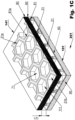
- Figures 1a to 1c are used to describe embodiment 201.
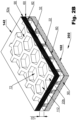
- Figures 2A and 2B describe embodiment 202
- Figures 3A and 3B describe embodiment 203
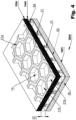
- Figure 4 describes embodiment 204
- Figure 5 describes embodiment 205.
- the embodiments comprise a fluid or gel layer (71, 72, 73, 74) held between first (101, 102, 103) and second (141, 142, 143, 143) substrates.
- the fluid layer (71, 72, 73, 74) can be described as an electro-optical layer, e.g., as described above.
- the substrates are spaced apart by polymer micro-structures (21, 22, 23) to define a cell gap (121, 122, 123, 124) for the fluid layer.
- the micro-structures also divide the fluid layer into discrete, sealed cavities (111, 112, 113, 114) or compartments.
- the micro-structures are in two parts, one part is a mould micro-structure (21, 22, 23) that replicates the surface of a tool and was formed in an embossing or moulding step on the first substrate prior to assembling the device, and the other is a cast micro-structure (81, 82, 83, 84) formed in a recess (31, 32, 33) in the mould micro-structure and on the second substrate after assembling the device. Consequently, a cast microstructure derives directly from its interface (or intimate contact, or shared surface) with the recess in the mould's microstructure and its interface (or intimate contact, or shared surface) with the second substrate.
- one or both substrates is a transparent flexible film (90) that is coated on the fluid side with a transparent electrode (60).
- the electrodes' major surfaces face each other and are juxtaposed parallel.
- the opposite surfaces of the substrates form the viewing faces of the embodiments.
- the substrates (and device) does not have electrode coatings in the viewing (or switchable area).
- the mould microstructures (21, 22, 23) have features described as (or corresponding to) cavity walls (21a, 22a, 23a), recesses (31, 32, 33), recess walls (31a, 32a, 33a), and wall braces (23c). These features, while considered separately from the whole (21, 22, 23) of which they are a part, are formed in a single embossing step.
- the cast microstructures (81, 82, 83, 84) are formed in a separate step and in some embodiments have a different material to the mould microstructures.
- Figures 1C , 2B , 3B , 4 and 5 just seven complete fluid cavities (111, 112, 113, 114) are shown with the section cutting through adjacent cavities and the fluid (71, 72, 73, 74) within these cavities.
- the section through fluid is not shown with hatched lines but the presence of fluid is generally indicated.
- the figures of embodiments correspond to a local area (or section) of a much larger device and the figures are not to scale.
- the pitch of the cavities (or the fluid volumes defined thereby) is from 50 microns to 3,000 microns.
- the longest dimension (L.D. in Figure 1A ) for a hexagonal cavity, e.g., as shown in Figure 1A may be between 0.3 mm and 3 cm.
- the corresponding center-to-center distance may be between 0.6 mm and 10 cm.
- the relationship between the longest dimension of a cavity and the center-to-center distance may vary depending upon the geometry of the cavities with respect to each other.
- the cavities may be a collection of irregular polygons, which may reduce the moiré or other optical interference effect.
- a smart glass device with a pitch of 250 microns would typically have between 2,000 and 6,000 discrete fluid cavities across its face and from 2,000 to 20,000 along its face, or a total number of cavities of between 4 million and 120 million.
- a larger pitch may be used to improve the viewing experience, i.e., with reduced haze and moiré.
- the eye resolves the visible pattern as a grid (or array) and perceives the cast parts as a grid of opaque areas that are the color of the light attenuating particles.
- the cast parts are indistinguishable on the face of the light modulator when the light modulator is switched to the first (opaque/darkened) light state.
- the light modulator is switched to an open, light-transmissive (second) state, the colored particles collect adjacent the viewable cast parts, effecting an overall appearance of an insect screen.
- the larger size of the cavities greatly improves the haze.
- Anecdotal studies suggest that for larger applications (e.g., windows of vehicles or buildings) the presence of the viewable cell walls is less objectionable than the higher haze that may be present with smaller pitch designs.
- Fig. 1a shows first substrate 101 of embodiment 201 (the latter is shown in fig. 1c ).
- the mould microstructure 21 is a wall structure that defines hexagonally shaped cavities 111 and is bonded to the inner face of substrate 101.
- the latter is shown in Figure 1A as microstructure 21 bonded to the surface of optional electrode 60 on flexible film 90.
- the cavity wall feature (or constituent) of microstructure 21 is indicated by 21b and its height orthogonal to the substrate face is shown by dimension 1021 and its width by 1051.
- the microstructure 21 On the side opposite to substrate 101 the microstructure 21 has a recess 31.
- the walls (or sides) of microstructure 21 that define recess 31 are indicated by 21a and shown in magnified view 1001.
- the width of recess 31 is indicated by 1041 and its height by 1031.
- the width 1051 of the majority of wall sections embedded in the viewing area is from 7.5 microns to 175 microns, more preferably, from 12 microns to 125 microns, and most preferably, from 15 microns to 90 microns.
- the width 1041 of the majority of recesses is from 2.5 microns to 100 microns, more preferably, from 7.5 microns to 85 microns, and most preferably, from 10 microns to 75 microns.
- the height (or depth) 1031 orthogonal to the second substrate's face for the majority of recesses is from 2.5% to 99% of the cell gap 121, more preferable, from 5% to 66%, and most preferably, from 6.25% to 46%.
- Figure 1B shows first substrate 101 after prepolymer 41 was printed or coated into recess 31 in the mould microstructure 21.
- suitable printing processes for this step in the device assembly (or preparation or manufacture) include screen printing or ink-jet printing.
- the preferred printing direction is indicated by arrow 1010. This avoids printing into a recess area that is parallel to the printing squeegee.
- Prepolymer 41 is the precursor to cast 81. Preferably it is a high viscosity (1,000 cst or more) resin curable by free-radical polymerization (suitable materials are described later).
- the top surface of prepolymer 41 is indicated by 41a. This surface preferably coincides or exceeds the wall surface 21a. In some embodiments an excess of prepolymer 41 can coat the top wall surface 21a after the printing step and before the fluid lamination step.
- fluid layer is indicated as 71 and it occupies part of the volume defined between the optional electrodes 60 of substrates 101 and 141.
- the cell gap 121 corresponds to the orthogonal distance between the respective interfaces of fluid layer 71 with the first and second substrates.
- Fluid 71 is divided into discrete fluid volumes by the walls 21b that in turn are part of mould microstructure 21 with each fluid volume being defined by a cavity 111.
- the fluid cavities 111 are side-by-side in a hexagonal grid and are in a monolayer. In some embodiments the cavities have an irregular shape resulting in a side-by-side arrangement having a degree of irregularity or randomness.
- Embodiment 201 is assembled in a laminating step using a pair of NIP rollers orientated horizontally and having a vertical direction of feed (w.r.t. passage between the NIP rollers).
- the substrates are held under tension by unwinder and/or rewinder stations or modules as part of a roll-to-roll system.
- the device's fluid 71 is introduced between the substrates 101 and 141 forming a reservoir before passing in a vertical orientation through the NIP rollers.
- the preferred direction of lamination with respect to the orientation of the hexagonal cavities is indicated by arrow 1010 in Figure 1B (described earlier in relation to printing prepolymer 41).
- fluid 71 does not experience cavity walls that are parallel to the NIP point of the laminating rollers (i.e. parallel to the rollers) making it easier to force excess fluid from a cavity as the device passes the NIP point.
- the prepolymer 41 in recess 31 (in the mould microstructure 21) is cast in a curing stage to derive cast microstructure 81 from microstructure 21.
- curing is by free-radical polymerization. The latter is preferably accomplished in a high-intensity, ultra-violet radiation module as part of the roll-to-roll process.
- Alternative curing methods include thermal curing, and alternative types of chain-growth polymerization, include anionic, cationic and coordination polymerization.
- the cast microstructure 81 is strongly bonded to the second substrate 141 and to the mould microstructure 21. Because the cast microstructure 81 is cast in the volume between the mould's recess 31 and the inner face of the second substrate 141, it is surrounded and enclosed by both, and derived and defined by both. The cast 81 replicates both interface surfaces and is a 3D imprint of their surfaces and the volume there between. By selecting the prepolymer 41 to be chemically compatible with both surfaces, the cured cast 81 strongly bonds to both. Cast 81 is the child of parent mould microstructure 21, and the two-parts (or pair) are described as mould 21 and its cast 81.
- thermoplastic polymer is applied in liquid form as prepolymer 41 and allowed solidify before the fluid lamination step.
- the casting step is completed by subjecting the device to high temperature sufficient to cause the thermoplastic polymer 41 to reflow. As it cools thermoplastic polymer 41 bonds to mould microstructure 21 and the second substrate 141 as it solidifies into cast 81.
- thermoplastics include poly(methyl methacrylate) (PMMA) (known by trade names such as Lucite ® , Perspex ® and Plexiglas ® ) and polycarbonate. Grades suitable for use in outdoor settings and especially automotive applications are preferred. Most preferred are soft thermoplastics with a shore A hardness from 30 to 100 including grades of low density polyethylene (LDPE).
- the cast 81 is continuous with respect to a cavity 111 and together with the mould 21 surrounds a cavity's fluid 71. The fluid is sealed and isolated from adjacent cavities 111.
- the top surface of cast 81 is shown as 81a and the top surface of mould 21 is shown as 21a.
- Cast 81 continuously seals a cavity 111 by chemically bonding to the second substrate 141 and to the mould microstructure 21. The latter in turn is continuously sealed by chemical bonding to the first substrate 101.
- the mould microstructure 21 defines a cavity's surrounding walls and the cast microstructure 81 defines a cavity's fluid sealant.
- the fluid laminating step substantially forces the fluid out of the contact area between the cast prepolymer 41 and the second substrate 141. Applying compression force while laminating brings the prepolymer 41 into intimate contact with the second substrate 141 and excess prepolymer is squeezed from recess 31 and onto the top of the recess walls 21a in a thin layer.
- the casting step also seals cavities by polymerizing an excess prepolymer thin layer between the top of the mould microstructure 21 and the second substrate 141.
- the cured thin layer is also known as flashing.
- the cured thin layer has a thickness of less than 5 micron, more preferably, less than 3 microns, and most preferably, less than 2 microns. In some embodiments excess polymer from the cast microstructure extends beyond the mould top surface 21a into the cavity side of the recess walls.
- the fluid 70 has little exposure to the cast's prepolymer 41 as the latter is contained in recess 31.
- Lamination squeezes the fluid 70 from the contact area of the prepolymer 41 with the second substrate 141 affording little exposure of prepolymer 41 to the fluid during the lamination step and substantially isolating prepolymer 41 (a high viscosity fluid) from the optical fluid 71.
- the lamination step is a non-permanent sealing of prepolymer 41 between recess 31 and top substrate 141.
- the polymerization step cures the prepolymer making the seal permanent (i.e. by forming cast 81).
- the prepolymer bulk in the recess 31 has no contact with the fluid 70. The only possible contact is with any excess prepolymer squeezed into the cavity during lamination. By selecting and controlling the volume of prepolymer 41 printed into recess 31 excess prepolymer can be minimized or avoided as desired.
- the juxtaposed parallel spaced apart (from the first substrate) major surface of the second substrate 141 has a polymer insulating and/or adhesive layer over its electrode layer 60 (not shown in Figure 1C ).
- the polymer layer is polymerized at the same time as polymerizing the prepolymer 41 of cast 41. In this way the adhesive layer enhances the peel adhesion of the cast 41 to the second substrate.
- the cell gap 121 is less than or equal to the wall height 1021 of mould microstructure 21 (see Figure 1A ).
- fluid 71 is under suction within cavities 111 because the walls 21b are under compression or load from the fluid laminating step resulting in a reduced wall height within devices corresponding to the cell gap 121.
- a fluid under suction refers to a fluid that is at a lower pressure to the atmospheric pressure of surroundings.
- a wall height 121 is less than the height outside the device 1021, and preferably the wall height within the device is less than or equal to 0.99 times the height outside the device.
- Figure 2A shows the first substrate 102 of embodiment 202. The latter is shown in Figure 2B .
- Embodiment 202 is similar to embodiment 201 described earlier.
- the walls (or sides) of microstructure 22 that define recess 32 are indicated by 22a and shown in magnified view 1002.
- the wall height is 1022 and its width is 1052.
- the width of recess 32 is indicated by 1042 and its height by 1032.
- the recess 32 has outward sloping curved (or rounded) walls as indicated by 22a in magnified view 1002.
- the walls 22a of the recess 32 narrow to an edge on the side opposite the first substrate.
- the cavities are 112 and are filled with fluid 72.
- the cell gap is 122.
- the walls 22a of the recess 32 narrow to an edge on contacting (or approaching, or adjacent) the second substrate 142. Consequently the top surface 82a of cast 82 overlaps substantially all of the top surface 22a of mould 22 as shown in Figure 2B .
- a viewer perceives both microstructures as being coloured when viewing a viewing face of the embodiment.
- the material of the mould and cast microstructures is the same and in others there are differences.
- the mould part is optically transparent and the cast part obscures light and includes one or more of a colorant (pigment or dye), a filler material, or a light scattering material.
- the color of the colorant is selected to match the colour or tint of one or more switchable light states of the switchable light modulator device.
- an embodiment that has black, clear, and intermediate tinted states has optically clear mould microstructures comprising polymer and black cast microstructures comprising carbon black loaded polymer.
- an embodiment that has white, clear, and intermediate tinted states has optically clear mould microstructures comprising polymer and white cast microstructures comprising titanium dioxide loaded polymer.
- the cast microstructures are black to minimise haze and colour perception in the clear light state.
- a particular advantage of keeping the mould part optically transparent is that when it is formed by an embossing process that relies on rapid ultra-violet (UV) initiated polymerization then absorption of the UV is minimized.
- the mould has light absorbing material then polymerisation of deep wall sections (e.g., 20 microns or more) would at least be slowed and most likely would not be possible.
- the mould precursor will have seconds to cure before releasing/peeling from the drum surface.
- the cast part is cast in place in the device and so cast parts with light absorbing material can be thermally cured over a suitably long time period.
- Figure 3A shows the first substrate 103 of embodiment 203. The latter is shown in Figure 3B .
- Embodiment 203 is similar to embodiments 201 and 202 described earlier.
- the walls (or sides) of microstructure 23 that define recess 33 are indicated by 23a and shown in magnified view 1003.
- the cavity walls are indicated by 23b, their height is 1023, and width, 1053.
- the recess 33 has outward sloping walls as indicated by 23a in magnified view 1003.
- the walls 23a of the recess 33 narrow to a ledge on the side opposite the first substrate.
- the width of recess 33 is indicated by 1043 within the recess and as 1063 between the ledge areas where the recess is at its widest.
- the height (or depth) of the recess is indicated by 1033.
- the recess 33 has a "V" shaped cross section.
- moulds have differences in the shape of their recesses including variation in the shape, or depth or width of the recesses.
- the cavities are 113 and are filled with a liquid crystal fluid 73.
- the cell gap is 123.
- the walls 23a of the recess 33 narrow to a ledge on contacting (or approaching, or adjacent) the second substrate 143. Consequently the top surface 83a of cast 83 overlaps substantially all of the top surface 23a of mould 23 as shown in Figure 3B .
- the second substrate 143 comprises substrate 142 (shown in Figure 2B ) and a liquid crystal alignment layer 193.
- the alignment layer 193 can be coated onto the electrode surface of substrate 142 before the liquid crystal fluid is laminated.
- the cavities 113 are sealed by curing the cast 83. Sealing does not interfere with the alignment layer 193 where it is in contact with the liquid crystal 73.
- the wall feature 23b of the mould microstructure 23 has bracing features 23c.
- the latter are included to provide additional strength to the walls. This is beneficial when releasing the mould microstructure for the embossing tool (described earlier) and subsequently when the embodiment is laminated between glass panes.
- the width of bracing feature 23c is shown as 1073 and its height as 1083 in magnified view 1003. In some embodiments the height is the same as the wall height 1023 and preferably in such devices the bracing feature has a recess and the recess is joined to the cavity wall recess. In this way the bracing feature also has an associated cast part and adds to the peel adhesion of the device (the peel adhesion refers to the adhesion between the first and second substrates).
- Device 204 is shown in Figure 4 and shares many elements with device 201 (shown in Figure 1C ). The common elements are indicated with the same numbers in both figures.
- the second substrate 144 of device 204 is different to the second substrate 141 of device 201.
- the second substrate 144 is shown fixed to optional release liner 154.
- release liner 154 is a sacrificial layer that is intended to be removed when the device is in use (or before in a manufacturing step).
- the second substrate 144 is continuous and its thickness (or dimension orthogonal to its major faces) is between 0.5 microns and 50 microns, preferably between 1 micron and 35 microns, and most preferably between 1.25 microns and 25 microns.
- this thin sheet (i.e. second substrate 144) can be a thin solid polymer and function as one or more of: a covering layer for cavities, an insulating layer, a barrier layer, or a hard coat.
- the second substrate 144 is optically clear, in other embodiments it has colorant, and in yet other embodiments it reflects sunlight.
- a distinguishing feature of the second substrate 144 (device 204) w.r.t. second substrate 141 (device 201) is the lack of an electrode layer 60 on the former.
- cast microstructure 84 is analogous to cast 81 in embodiment 201.
- Cast 84 is strongly bonded to the second substrate 144 and to the mould microstructure 21. Because the cast microstructure 84 is cast in the volume between the mould's recess 31 and the inner face of the second substrate 144, it is surrounded and enclosed by both, and derived and defined by them both. The cast 84 replicates both interface surfaces and is a 3D imprint of their surfaces and the volume there between.
- embodiment 204's fluid layer is indicated as 74 and it occupies part of the volume defined between the electrode 60 of substrate 101 and the inner face (or interface) of the second substrate 144.
- the cell gap 124 corresponds to the orthogonal distance between the respective interfaces of fluid layer 74 with the first and second substrates.
- Fluid 74 is divided into discrete fluid volumes by the walls 21b that in turn are part of mould microstructure 21 with each fluid volume being defined by a cavity 114.
- the cast 84 is continuous with respect to a cavity 114 and together with the mould 21 surrounds a cavity's fluid 74, sealing and isolating the fluid from adjacent cavities 114.
- an electrode 60 on the first substrate 101 is patterned into segments and in use the fluid 74 is subjected to the influence of an electrical field by applying different voltage polarities and/or levels to adjacent segments.
- the second substrate may not have an electrode layer associated with it (i.e. the device forms light states with a single electrode layer and can be said to use in-plane switching).
- Embodiment 205 is shown in Figure 5 and includes embodiment 204 as indicated (with release liner 154 removed) fixed to an active matrix backplane 165.
- the fixing can be by any suitable means including by adhesive (not shown in Figure 5 ). If an adhesive/polymer layer is used then preferably its thickness is kept to the minimum necessary (i.e. from 0.5 micron to 15 microns) to uniformly fix device 204 to backplane 165 and achieve adequate peel adhesion between the parts.
- the active matrix backplane 165 has electrodes patterned to form pixels and together with active matrix transistors allow device 205 to operate embodiment 204 as a matrix of pixel areas from which arbitrary images can be displayed. Examples of products (205) include ebook readers and electronic shelf labels.
- a switchable light modulator device includes one of the following types, or hybrid versions thereof: an electrophoretic device, a liquid crystal device, an electro-wetting device, an electrokinetic device, an electrochromic device incorporating an electrolytic fluid/gel, a thermochromic device, or a photochromic device.
- the fluid layer has contact with part of the juxtaposed parallel spaced apart major surfaces of the substrates including a substrate surface comprising: an electrode layer (60), an inorganic dielectric layer, an organic dielectric layer, an alignment layer (193), an electrochromic layer, an ion storage layer, or an active matrix layer.
- the fluid is an electrolytic gel and has contact with an electrochromic layer that overlays an electrode on one substrate and an ion storage layer that overlays the other electrode on the other substrate.
- An example of an electrochromic device is described in Gentex's US 6,934,067 .
- the switchable material is a liquid or gel. The switchable liquid or gel is described in Switch Material's US 8,837,032 .
- the fluid is preferably a chiral nematic liquid crystal and a suitable device is described by the applicant in British Patent Application No. 1416385.1 titled "A Chiral Nematic Liquid Crystal Light Shutter".
- An electrokinetic device is a hybrid of an electrophoretic device and comprises an ink that includes charged particles suspended in a fluid; see for example Crown Electrokinetics US 2019/0256625 .
- the fluid layer can comprise fluids described in Sun Chemical Corp.'s US 8,854,714 .
- isolated mould and cast parts can be located within a cavity.
- a cavity can have a centrally located post with a recess (the mould microstructure) and be bonded to the opposing substrate through a cast microstructure cured in its recess. This provides peel adhesion within a cavity that supplements the peel adhesion provided by the cavity walls.
- the centrally located microstructures also act as additional spacers in the fluid layer making a device more resistant to externally applied point pressure.
- a peripheral edge seal about the viewing area uses mould and cast polymer parts.
- the mould part of the edge seal is replicated onto its substrate in a moulding or embossing step at the same time as the mould microstructures are replicated.
- Devices made with such a peripheral edge seal are suited to the volume production of identical devices such as automotive sunroofs or visors.
- the device can be produced as a repeated device on a continuous roll of film and then stamp cut or laser cut from the roll of film.
- the added peel adhesion of the peripheral edge seal is well suited to more extreme conditions such as when the device's edges are exposed.
- a smart window embodiment can be bonded to a glass pane on one side only leaving its other substrate and edge area exposed.
- the substrates can be any suitable transparent sheet material such as polymer or glass and can be flexible or rigid.
- Flexible substrates include a polymer such as PET (i.e. polyethylene terephthalate), PEN (i.e. polyethylene napthalate), PES (i.e. polyether sulfone), PC (i.e. polycarbonate), PI (i.e. polyimide), or FRP (i.e. fiber reinforced plastic), or flexible glass (e.g., 50 micron or 100 micron glass from Nippon Electric Glass Co. Ltd.).
- a rigid substrate can use float glass, or heat treated float glass, or polished glass, or tinted/colored glass, or heat absorbing/reflecting glass, or an active matrix glass.
- Electrodes (60) can be any suitable transparent conductor.
- ITO i.e. indium tin oxide
- carbon nanotubes carbon nanotubes
- silver nanowires or a conductive polymer such as PEDOT (i.e. poly(ethylenedioxythiophene).
- PEDOT i.e. poly(ethylenedioxythiophene).
- a top electrode can be one type such as ITO and a bottom electrode another type such as PEDOT.
- PEDOT coated PET substrates are available from Kodak (US), and ITO coated PET substrates are available from Sheldahl (US).
- the microstructures and the substrates have sufficient flexibility to allow the device to conform to the curvature of a cylinder of radius 300 mm, and preferably, radius 100 mm, and most preferably, radius 50 mm.
- the polymer used in a cast microstructure is cured by photo or thermal means and covalently bonds to its surrounding mould microstructure and the inner surface of its boundary substrate.
- the cast's prepolymer is not soluble in the fluid of the fluid layer and has a majority by weight of high molecular weight components and a high viscosity.
- the mould and cast microstructures are at least as flexible as a device's substrates.
- a suitable flexible (or deformable) polymer for use preferably in the mould (21, 22, 23) and cast (81, 82, 83) microstructures of embodiments includes thermosetting polymers and more especially, elastomeric solid polymer.
- the elastomer is characterized by a glass transition temperature (i.e. Tg) less than 20 degrees Celsius (i.e. 293K) and possessing crosslinks.
- Tg is less than the minimum operating temperature required for an application.
- the rigidity of a microstructure's elastomer polymer can be selected using the level of crosslinking.
- an elastomer can be filled with dispersed hard material (i.e.
- filler to increase its rigidity, tear strength and durability under loading.
- filler material include precipitated silica, fumed silica, ground quartz, black pigment nanoparticles, carbon fibers or nanoparticles, or ceramic fibers or nanoparticles.
- the elastic modulus of the solid polymer is selected to provide suitable elastic deforming of the mould and cast microstructures, and the modulus lies in the range 2MPa to 200MPa, and more preferably, 3MPa to 100MPa.
- the tear strength of the solid polymer used in the microstructures is selected to lie in the range 7.5 kN/m to 75 kN/m at 20 degrees Celsius, and more preferably, 9 kN/m to 50 kN/m.
- the minimum tear strength at the maximum operating temperature (e.g., 90 degrees Celsius) is selected to be ⁇ 7.5 kN/m.
- the linear thermal expansion coefficients of the polymers used in the mould and cast microstructures are matched.
- the elastomer for one or both microstructure parts is polyurethane (i.e. contains polyurethane linkages).
- Preferred polyurethanes have acrylate/methacrylate groups that are cured to form crosslinks.
- the polymer precursor formulation has di-functional polyurethane chains in solution with mono-functional monomers. Both of these components can be fluorinated to improve chemical resistance to swelling by an embodiment's fluid (71, 72, 73, 74).
- optical grade prepolymer suitable for use as the elastomeric polymer in embodiments includes the following from Norland Products (www.norlandprod.com): NOA78, NOA75, NOA68, NOA68T, and fluorinated grades NOA142, NOA139, NOA, 138, and NOA13825.
- some embodiments match the refractive indices of the mould and cast microstructures to the fluid, preferably to within 0.02 of each other, more preferably, 0.005, and most preferably, 0.002.
- Other embodiments include a colorant in the polymer of the cast microstructures to absorb and/or reflect light.
- solar pigments that reflect the sunlight infra-red spectrum are used for the colorant.
- the colorant is black to avoid light scattering (and consequently haze).
- a black colorant in the solid polymer of the cast microstructures allows mismatched refractive indices for the fluid and the black solid polymer.
- embodiments that use black colorant in the solid polymer of the cast microstructures can use polymer that is not optically transparent.
- the solid polymer can incorporate dispersed, hard filler material.
- the polymer can have a semi-crystalline structure.
- the polymer of the cast microstructures is conductive and the cast microstructures also function as cast electrodes within the device.
- moulding techniques are described to make the mould microstructures within embodiments.
- the moulding techniques can also be described as replication techniques. These and other suitable replication techniques are described in the Vlyte Innovations' EP3396446 titled "An Electrophoretic Device Having a Transparent Light State”.
- a hard or soft tool surface is used as a negative mould master and in moulding steps the inverse of the three dimensional (3D) shape of the master's surface is transferred to (i.e. replicated) a substrate to form the mould microstructures.
- An example of a hard tool surface is electroformed nickel and its surface is suitable for making up to 100,000 replicas onto a substrate.
- An example of a soft tool surface is cross-linked polydimethylsiloxane and it can make up to 1,000 replicas.
- the moulding steps comprise coating the master's surface with a prepolymer and laminating the substrate (optionally the coating is done as part of laminating), curing the coating to inversely replicate the shape of the master's surface in polymer bonded to the substrate, and peeling from the master leaving the replicated microstructure on the substrate.
- the mould microstructures of a device can be repeated (by replication) continuously on a roll of film in a roll-to-roll process.
- the surface of a drum is the hard tool.
- a continuous roll of film can be cut into sheets corresponding to a device, and then the mould microstructures replicated on each substrate in a sheet process.
- an electroformed sheet is a suitable hard tool or P(DMS) on PET is a suitable soft tool.
- a hard, negative, mould master can be made from a polymer template by electroforming nickel onto the template's surface and thereby transferring the polymer template's shape to the surface of a hard mould master.
- the polymer template's surface is directly formed by optically writing a microstructure into a photosensitive polymer known as a photoresist and developing the resist.
- the direct writing of the template's surface in a photosensitive polymer includes the technologies described as direct-write lithography, single-point laser writing, laser interferometry, and electron-beam lithography. Any suitable photoresist can be used including the SU8 series available from www.microchem.com. Directly writing the microstructure exposes the photosensitive polymer and the exposed structure is developed in solution in a separate step.
- a computer controlled system uses a laser beam or electron beam (e-beam) to expose the photosensitive polymer and form the mould microstructures with wall features and recess features.
- e-beam electron beam
- the template Prior to electroforming the negative mould master on the surface of the polymer template, the template is made more compatible (with electroforming) by depositing a thin ( ⁇ 250 nm) metallic or ceramic conformal coating (or coatings) onto its polymer surface.
- the three-dimensional surface in a hard master (e.g., stainless steel, copper, electroformed nickel, silicon, fused silica, or calcium fluoride) is directly formed by material removal.
- the hard surface can be formed by mechanical milling (e.g., Single Point Diamond Turning), chemical etching, ion-beam milling, reactive-ion etching, or laser ablation to directly form (or write) the replicating surface.
- the inverse image i.e. the negative
- shims metal foil copies of this area
Landscapes
- Physics & Mathematics (AREA)
- Nonlinear Science (AREA)
- Optics & Photonics (AREA)
- General Physics & Mathematics (AREA)
- Crystallography & Structural Chemistry (AREA)
- Chemical & Material Sciences (AREA)
- Mathematical Physics (AREA)
- Engineering & Computer Science (AREA)
- Structural Engineering (AREA)
- Civil Engineering (AREA)
- Architecture (AREA)
- Electrochromic Elements, Electrophoresis, Or Variable Reflection Or Absorption Elements (AREA)
- Liquid Crystal (AREA)
Claims (11)
- Schaltbarer Lichtmodulator (201, 202, 203, 204, 205) umfassend:ein erstes Substrat (101, 102, 103) mit einer ersten Hauptoberfläche;ein zweites Substrat (141, 142, 143, 144) mit einer zweiten Hauptoberfläche;eine Polymerwandstruktur (21, 22, 23) mit einer Oberseite und einer Unterseite, wobei die Polymerwandstruktur zwischen der ersten Hauptoberfläche und der zweiten Hauptoberfläche angeordnet ist, um eine Vielzahl von Hohlräumen (111, 112, 113, 114) zu erzeugen, die ein Modulationsfluid (71, 72, 73, 74) oder ein Modulationsgel in diskreten Volumina innerhalb der Hohlräume (111, 112, 113, 114) enthalten, wobei die Polymerwandstruktur (21, 22, 23) einen Formwerkzeugteil (31, 32, 33) enthält, der eine Vertiefung entlang der Oberseite der Polymerwandstruktur (21, 22, 23) definiert; undeinen Gussteil (81, 82, 83, 84), der durch Anordnen eines fluiden Vorläufers in der Vertiefung und Füllen der Vertiefung und anschließendes Härten des fluiden Vorläufers gebildet wird, um das zweite Substrat an eine Oberfläche der Vertiefung zu binden,wobei der Formwerkzeugteil optisch transparent ist und der Gussteil Licht dämpft und ein Farbmittel, ein Füllmaterial oder ein lichtstreuendes Material enthält.
- Schaltbarer Lichtmodulator nach Anspruch 1, wobei die Unterseite der Polymerwandstruktur an das erste Substrat gebunden ist.
- Schaltbarer Lichtmodulator nach Anspruch 1, wobei das Farbmittel zu einer Farbe eines Partikels passt, das in dem Modulationsfluid oder Modulationsgel angeordnet ist.
- Schaltbarer Lichtmodulator nach Anspruch 1, wobei die Vertiefung eine größte Tiefe (1031, 1032) aufweist, die größer als oder gleich 5 % des orthogonalen Abstands (121, 122) zwischen der ersten Hauptoberfläche und der zweiten Hauptoberfläche ist.
- Schaltbarer Lichtmodulator nach Anspruch 1, wobei Formwerkzeugteile Unterschiede in den jeweiligen Formen ihrer Vertiefungen aufweisen, einschließlich Variation von Tiefe (1031, 1032) und Breite (1041, 1042) der Vertiefungen.
- Schaltbarer Lichtmodulator nach Anspruch 1, wobei die Polymerwandstrukturen zusätzlich Versteifungselemente (23c) enthalten.
- Schaltbarer Lichtmodulator nach Anspruch 1, wobei das Modulationsfluid oder das Modulationsgel elektrophoretische Partikel, Flüssigkristalle, eine Kombination von polaren und unpolaren Flüssigkeiten, ein elektrochromes Fluid, ein thermochromes Fluid oder ein photochromes Fluid enthält.
- Anzeige, Fenster, Spiegel, Sonnenschutz oder Zeichen, enthaltend einen schaltbaren Lichtmodulator nach Anspruch 1.
- Verfahren zur Herstellung eines schaltbaren Lichtmodulators (201, 202, 203, 204, 205), umfassend:Bereitstellen eines ersten Substrats (101, 102, 103), das eine erste Hauptoberfläche enthält;Bereitstellen eines zweiten Substrats (141, 142, 143, 144), das eine zweite Hauptoberfläche enthält;Bereitstellen einer Polymerwandstruktur (21, 22, 23) mit einer Oberseite und einer Unterseite, wobei die Polymerwandstruktur (21, 22, 23) einen Formwerkzeugteil (31, 32, 33) enthält, der eine Vertiefung entlang der Oberseite der Polymerwandstruktur (21, 22, 23) definiert;wobei die Polymerwandstruktur (21, 22, 23) an die erste Hauptoberfläche gebunden ist, um eine Vielzahl von Hohlräumen (111, 112, 113, 114) zu definieren;Füllen der Vertiefung mit einem fluiden Vorläufer;Bereitstellen eines Modulationsfluids (71, 72, 73, 74) oder Modulationsgels in diskreten Volumina innerhalb der Vielzahl von Hohlräumen (111, 112, 113, 114);Anordnen der Polymerwandstruktur (21, 22, 23) zwischen der ersten Hauptoberfläche und der zweiten Hauptoberfläche; undHärten des fluiden Vorläufers, um das zweite Substrat und eine Oberfläche der Vertiefung aneinander zu binden,wobei der Formwerkzeugteil optisch transparent ist und der gehärtete fluide Vorläufer Licht dämpft und ein Farbmittel, ein Füllmaterial oder ein lichtstreuendes Material enthält.
- Verfahren zur Herstellung eines schaltbaren Lichtmodulators nach Anspruch 9, wobei die Wandstruktur vor dem Schritt des Bereitstellens eines Modulationsfluids (71, 72, 73, 74) oder Modulationsgels in diskreten Volumina innerhalb der Vielzahl von Hohlräumen (111, 112, 113, 114) an das erste Substrat gebunden wird.
- Verfahren zur Herstellung eines schaltbaren Lichtmodulators nach Anspruch 9, wobei Härten des fluiden Vorläufers zum Zusammenbinden des zweiten Substrats und einer Oberfläche der Vertiefung Erwärmen des fluiden Vorläufers oder Exponieren des fluiden Vorläufers gegenüber UV-Licht umfasst.
Applications Claiming Priority (2)
| Application Number | Priority Date | Filing Date | Title |
|---|---|---|---|
| GB2003224.9A GB2593150A (en) | 2020-03-05 | 2020-03-05 | A light modulator having bonded structures embedded in its viewing area |
| PCT/US2021/021019 WO2021178753A1 (en) | 2020-03-05 | 2021-03-05 | Light modulator having bonded structures embedded in viewing area |
Publications (4)
| Publication Number | Publication Date |
|---|---|
| EP4115236A1 EP4115236A1 (de) | 2023-01-11 |
| EP4115236A4 EP4115236A4 (de) | 2024-05-01 |
| EP4115236C0 EP4115236C0 (de) | 2025-06-11 |
| EP4115236B1 true EP4115236B1 (de) | 2025-06-11 |
Family
ID=70278304
Family Applications (1)
| Application Number | Title | Priority Date | Filing Date |
|---|---|---|---|
| EP21765104.1A Active EP4115236B1 (de) | 2020-03-05 | 2021-03-05 | Lichtmodulator mit in einem betrachtungsbereich eingebetteten verbundenen strukturen |
Country Status (7)
| Country | Link |
|---|---|
| US (5) | US11237419B2 (de) |
| EP (1) | EP4115236B1 (de) |
| JP (3) | JP7532538B2 (de) |
| CN (2) | CN115210639B (de) |
| ES (1) | ES3035597T3 (de) |
| GB (1) | GB2593150A (de) |
| WO (1) | WO2021178753A1 (de) |
Families Citing this family (6)
| Publication number | Priority date | Publication date | Assignee | Title |
|---|---|---|---|---|
| GB2593150A (en) * | 2020-03-05 | 2021-09-22 | Vlyte Ltd | A light modulator having bonded structures embedded in its viewing area |
| JP2025005990A (ja) * | 2023-06-28 | 2025-01-17 | 大日本印刷株式会社 | 調光部材、合わせ板 |
| CN117342519A (zh) * | 2023-09-27 | 2024-01-05 | 江汉大学 | 一种基于电场诱导聚合物形成微杯结构的制备方法 |
| WO2025105806A1 (ko) * | 2023-11-13 | 2025-05-22 | 주식회사 엘지화학 | 기판 |
| CN118131545B (zh) * | 2023-11-20 | 2024-11-12 | 惠科股份有限公司 | 显示面板和显示装置 |
| CN120469132A (zh) * | 2025-07-17 | 2025-08-12 | 上海追得新材料科技有限公司 | 一种弱应力柔性电致调光薄膜 |
Family Cites Families (89)
| Publication number | Priority date | Publication date | Assignee | Title |
|---|---|---|---|---|
| US3009348A (en) | 1957-11-12 | 1961-11-21 | Lawrence L Colbert | Combined bicycle pedal and lock |
| US4418346A (en) | 1981-05-20 | 1983-11-29 | Batchelder J Samuel | Method and apparatus for providing a dielectrophoretic display of visual information |
| US5745094A (en) | 1994-12-28 | 1998-04-28 | International Business Machines Corporation | Electrophoretic display |
| US5626772A (en) | 1995-03-20 | 1997-05-06 | Philips Electronics North America Corporation | Plasma addressed liquid crystal display with etched plasma channels |
| US7411719B2 (en) | 1995-07-20 | 2008-08-12 | E Ink Corporation | Electrophoretic medium and process for the production thereof |
| US6866760B2 (en) | 1998-08-27 | 2005-03-15 | E Ink Corporation | Electrophoretic medium and process for the production thereof |
| US5940201A (en) | 1997-04-02 | 1999-08-17 | Gentex Corporation | Electrochromic mirror with two thin glass elements and a gelled electrochromic medium |
| US7002728B2 (en) | 1997-08-28 | 2006-02-21 | E Ink Corporation | Electrophoretic particles, and processes for the production thereof |
| US7075502B1 (en) | 1998-04-10 | 2006-07-11 | E Ink Corporation | Full color reflective display with multichromatic sub-pixels |
| AU3767899A (en) | 1998-04-27 | 1999-11-16 | E-Ink Corporation | Shutter mode microencapsulated electrophoretic display |
| US6241921B1 (en) | 1998-05-15 | 2001-06-05 | Massachusetts Institute Of Technology | Heterogeneous display elements and methods for their fabrication |
| US6271823B1 (en) | 1998-09-16 | 2001-08-07 | International Business Machines Corporation | Reflective electrophoretic display with laterally adjacent color cells using a reflective panel |
| US6225971B1 (en) | 1998-09-16 | 2001-05-01 | International Business Machines Corporation | Reflective electrophoretic display with laterally adjacent color cells using an absorbing panel |
| US6184856B1 (en) | 1998-09-16 | 2001-02-06 | International Business Machines Corporation | Transmissive electrophoretic display with laterally adjacent color cells |
| US6144361A (en) | 1998-09-16 | 2000-11-07 | International Business Machines Corporation | Transmissive electrophoretic display with vertical electrodes |
| US7012600B2 (en) | 1999-04-30 | 2006-03-14 | E Ink Corporation | Methods for driving bistable electro-optic displays, and apparatus for use therein |
| US8009348B2 (en) | 1999-05-03 | 2011-08-30 | E Ink Corporation | Machine-readable displays |
| EP1072931A3 (de) | 1999-07-27 | 2002-02-13 | Minolta Co., Ltd. | Flüssigkristallanzeige und Verfahren zur Herstellung einer Flüssigkristallanzeige |
| US6930818B1 (en) | 2000-03-03 | 2005-08-16 | Sipix Imaging, Inc. | Electrophoretic display and novel process for its manufacture |
| US6672921B1 (en) | 2000-03-03 | 2004-01-06 | Sipix Imaging, Inc. | Manufacturing process for electrophoretic display |
| US6788449B2 (en) | 2000-03-03 | 2004-09-07 | Sipix Imaging, Inc. | Electrophoretic display and novel process for its manufacture |
| US7715088B2 (en) | 2000-03-03 | 2010-05-11 | Sipix Imaging, Inc. | Electrophoretic display |
| AU2002250304A1 (en) | 2001-03-13 | 2002-09-24 | E Ink Corporation | Apparatus for displaying drawings |
| US7679814B2 (en) | 2001-04-02 | 2010-03-16 | E Ink Corporation | Materials for use in electrophoretic displays |
| CN1282027C (zh) | 2001-04-02 | 2006-10-25 | 伊英克公司 | 具有改善的图像稳定性的电泳介质 |
| US20020188053A1 (en) | 2001-06-04 | 2002-12-12 | Sipix Imaging, Inc. | Composition and process for the sealing of microcups in roll-to-roll display manufacturing |
| US7535624B2 (en) | 2001-07-09 | 2009-05-19 | E Ink Corporation | Electro-optic display and materials for use therein |
| US6982178B2 (en) | 2002-06-10 | 2006-01-03 | E Ink Corporation | Components and methods for use in electro-optic displays |
| JP4348180B2 (ja) * | 2001-07-09 | 2009-10-21 | イー インク コーポレイション | 積層接着剤層を有する電気光学ディスプレイ |
| US7525719B2 (en) | 2001-09-19 | 2009-04-28 | Bridgestone Corporation | Particles and device for displaying image |
| AU2002349683A1 (en) | 2001-12-10 | 2003-06-23 | Bridgestone Corporation | Image display |
| EP1482354B1 (de) | 2002-03-06 | 2008-04-30 | Bridgestone Corporation | Bildanzeigevorrichtung und verfahren |
| JP2003280051A (ja) | 2002-03-25 | 2003-10-02 | Minolta Co Ltd | 画像表示媒体 |
| EP1501194B1 (de) | 2002-04-17 | 2012-03-14 | Bridgestone Corporation | Elektrodenstruktur für eine Anzeigevorrichtung basierend auf trockenen Teilchen |
| US7116318B2 (en) | 2002-04-24 | 2006-10-03 | E Ink Corporation | Backplanes for display applications, and components for use therein |
| US7646530B2 (en) | 2002-04-26 | 2010-01-12 | Bridgestone Corporation | Particle and device for image display |
| KR100729970B1 (ko) | 2002-06-21 | 2007-06-20 | 가부시키가이샤 브리지스톤 | 화상 표시 장치 및 화상 표시 장치의 제조 방법 |
| US7646358B2 (en) | 2002-07-09 | 2010-01-12 | Bridgestone Corporation | Image display device |
| JPWO2004008239A1 (ja) | 2002-07-17 | 2005-11-10 | 株式会社ブリヂストン | 画像表示装置 |
| EP3056941B1 (de) | 2002-09-03 | 2019-01-09 | E Ink Corporation | Elektrophoretisches medium |
| US7839564B2 (en) | 2002-09-03 | 2010-11-23 | E Ink Corporation | Components and methods for use in electro-optic displays |
| TWI229230B (en) | 2002-10-31 | 2005-03-11 | Sipix Imaging Inc | An improved electrophoretic display and novel process for its manufacture |
| US7495819B2 (en) | 2002-12-17 | 2009-02-24 | Bridgestone Corporation | Method of manufacturing image display panel, method of manufacturing image display device, and image display device |
| US6922276B2 (en) | 2002-12-23 | 2005-07-26 | E Ink Corporation | Flexible electro-optic displays |
| JP4384991B2 (ja) | 2002-12-24 | 2009-12-16 | 株式会社ブリヂストン | 画像表示装置 |
| EP2423740A3 (de) | 2003-02-25 | 2012-05-30 | Bridgestone Corporation | Bildanzeigetafel und bildanzeigeeinheit |
| JPWO2004079442A1 (ja) | 2003-03-06 | 2006-06-08 | 株式会社ブリヂストン | 画像表示装置の製造方法及び画像表示装置 |
| JP4579823B2 (ja) | 2003-04-02 | 2010-11-10 | 株式会社ブリヂストン | 画像表示媒体に用いる粒子、それを用いた画像表示用パネル及び画像表示装置 |
| CN100476551C (zh) * | 2003-10-16 | 2009-04-08 | 夏普株式会社 | 基板、面板及其制造方法、和液晶显示面板及其制造方法 |
| GB0325747D0 (en) * | 2003-11-05 | 2003-12-10 | Koninkl Philips Electronics Nv | Active matrix display device and method of producing the same |
| JP4626157B2 (ja) | 2004-02-27 | 2011-02-02 | 富士ゼロックス株式会社 | 画像表示媒体 |
| JP2005326436A (ja) | 2004-05-12 | 2005-11-24 | Bridgestone Corp | 画像表示用パネル及びその製造方法 |
| US7453445B2 (en) | 2004-08-13 | 2008-11-18 | E Ink Corproation | Methods for driving electro-optic displays |
| JP4667016B2 (ja) | 2004-11-22 | 2011-04-06 | 株式会社ブリヂストン | 情報表示用パネルの製造方法 |
| US7417787B2 (en) * | 2006-05-19 | 2008-08-26 | Xerox Corporation | Electrophoretic display device |
| CN101490614A (zh) * | 2006-07-10 | 2009-07-22 | 索尼株式会社 | 透镜阵列 |
| US20150005720A1 (en) | 2006-07-18 | 2015-01-01 | E Ink California, Llc | Electrophoretic display |
| FR2911403B1 (fr) * | 2007-01-16 | 2010-01-15 | Commissariat Energie Atomique | Realisation de cavites remplies par un materiau fluidique dans un compose microtechnologique optique |
| EP2176377B1 (de) | 2007-06-25 | 2012-09-26 | Vlyte Innovations Limited | Polymerdispergierte flüssigkristallstrukturen |
| JP5272504B2 (ja) | 2008-05-09 | 2013-08-28 | 大日本印刷株式会社 | 電気泳動表示装置の製造方法 |
| CN101598880A (zh) | 2008-06-05 | 2009-12-09 | 奇信电子股份有限公司 | 容置结构与应用此容置结构的电泳显示器 |
| CN102460291B (zh) | 2009-06-11 | 2015-11-25 | 思维奇材料公司 | 可变透光率滤光片及其应用 |
| JP5285517B2 (ja) * | 2009-06-30 | 2013-09-11 | パナソニック株式会社 | 映像信号処理装置、映像処理システム及び半導体集積回路並びに映像信号処理方法 |
| KR101504406B1 (ko) | 2009-08-04 | 2015-03-19 | 썬 케미칼 코포레이션 | 전기습윤 및 전기유체 기술을 위한 착색된 전도성 유체 |
| US9104072B2 (en) * | 2010-12-20 | 2015-08-11 | Citizen Holdings Co., Ltd. | Liquid crystal device |
| JP5625974B2 (ja) | 2011-02-09 | 2014-11-19 | セイコーエプソン株式会社 | 電気泳動表示シート、電気泳動表示シートの製造方法および電子機器。 |
| JP2014032285A (ja) * | 2012-08-02 | 2014-02-20 | Dainippon Printing Co Ltd | 反射型表示装置 |
| US9279906B2 (en) | 2012-08-31 | 2016-03-08 | E Ink California, Llc | Microstructure film |
| KR101989162B1 (ko) * | 2012-09-18 | 2019-06-17 | 한국전자통신연구원 | 전자종이 디스플레이 장치 및 그 제조 방법 |
| CN105026032B (zh) * | 2013-03-06 | 2017-07-28 | 三菱瓦斯化学株式会社 | 吸氧剂组合物 |
| CN105074543B (zh) * | 2013-03-13 | 2018-10-23 | 3M创新有限公司 | 电子可切换的保密装置 |
| EP3396446B1 (de) | 2013-03-22 | 2020-06-03 | Vlyte Innovations Limited | Elektrophoretische vorrichtung mit einem transparenten lichtzustand |
| JP2015022120A (ja) * | 2013-07-18 | 2015-02-02 | 株式会社ジャパンディスプレイ | 表示素子及びその製造方法 |
| TWI537642B (zh) * | 2013-10-04 | 2016-06-11 | 電子墨水加利福尼亞有限責任公司 | 密封微單元之組成物及方法 |
| WO2015148398A1 (en) * | 2014-03-25 | 2015-10-01 | E Ink California, Llc | Magnetophoretic display assembly and driving scheme |
| JP2015197468A (ja) | 2014-03-31 | 2015-11-09 | 大日本印刷株式会社 | セル型電気泳動表示装置の製造方法 |
| JP6350016B2 (ja) * | 2014-06-24 | 2018-07-04 | セイコーエプソン株式会社 | 表示装置および表示装置の製造方法 |
| CN105261163B (zh) | 2014-07-10 | 2019-02-22 | 元太科技工业股份有限公司 | 智能提醒药盒 |
| GB201416385D0 (en) | 2014-09-17 | 2014-10-29 | Vlyte Innovations Ltd | A chiral nematic liqid crystal light shutter |
| GB201506147D0 (en) * | 2015-04-10 | 2015-05-27 | Hanna Moore & Curley | A Micro-Fastened, Sealed Light Modulator |
| JP7122965B2 (ja) * | 2015-09-02 | 2022-08-22 | コンコード (エイチケー) インターナショナル エデュケーション リミテッド | 内部全反射型画像ディスプレイにおける双安定性強化 |
| KR102629389B1 (ko) * | 2016-03-25 | 2024-01-25 | 삼성디스플레이 주식회사 | 액정 렌즈 및 이를 포함하는 표시 장치 |
| EP3639088B1 (de) | 2017-06-16 | 2023-08-09 | E Ink Corporation | Elektrooptische medien mit eingekapselten pigmenten in einem gelatinebindemittel |
| CN115453796B (zh) | 2017-06-16 | 2026-02-13 | 伊英克公司 | 可变透射电泳装置 |
| EP3752867A1 (de) | 2018-02-16 | 2020-12-23 | Crown Electrokinetics Corp. | Brechungsindex-angepasstes harz für elektrophoretische anzeigen und andere anwendungen |
| KR102261236B1 (ko) | 2018-04-17 | 2021-06-04 | 주식회사 엘지화학 | 격벽 패턴 필름 및 이의 제조방법 |
| GB201914105D0 (en) | 2019-09-30 | 2019-11-13 | Vlyte Innovations Ltd | A see-through electrophoretic device having a visible grid |
| CN110850658B (zh) | 2019-11-29 | 2022-08-16 | 上海天马微电子有限公司 | 一种电浆显示模组、其制作方法及显示装置 |
| GB2593150A (en) * | 2020-03-05 | 2021-09-22 | Vlyte Ltd | A light modulator having bonded structures embedded in its viewing area |
-
2020
- 2020-03-05 GB GB2003224.9A patent/GB2593150A/en not_active Withdrawn
-
2021
- 2021-03-05 CN CN202180017953.7A patent/CN115210639B/zh active Active
- 2021-03-05 WO PCT/US2021/021019 patent/WO2021178753A1/en not_active Ceased
- 2021-03-05 CN CN202311823391.2A patent/CN117555180A/zh active Pending
- 2021-03-05 JP JP2022552554A patent/JP7532538B2/ja active Active
- 2021-03-05 US US17/193,051 patent/US11237419B2/en active Active
- 2021-03-05 ES ES21765104T patent/ES3035597T3/es active Active
- 2021-03-05 EP EP21765104.1A patent/EP4115236B1/de active Active
-
2022
- 2022-01-24 US US17/582,042 patent/US11567356B2/en active Active
-
2023
- 2023-01-05 US US18/093,424 patent/US11774791B2/en active Active
- 2023-07-31 US US18/228,179 patent/US12147108B2/en active Active
-
2024
- 2024-04-19 JP JP2024068311A patent/JP7785841B2/ja active Active
- 2024-10-21 US US18/921,090 patent/US20250044630A1/en active Pending
-
2025
- 2025-11-12 JP JP2025191894A patent/JP2026015463A/ja active Pending
Also Published As
| Publication number | Publication date |
|---|---|
| GB2593150A (en) | 2021-09-22 |
| GB202003224D0 (en) | 2020-04-22 |
| CN115210639B (zh) | 2024-01-05 |
| US20230152618A1 (en) | 2023-05-18 |
| US20220146877A1 (en) | 2022-05-12 |
| JP2026015463A (ja) | 2026-01-29 |
| CN117555180A (zh) | 2024-02-13 |
| WO2021178753A1 (en) | 2021-09-10 |
| US11237419B2 (en) | 2022-02-01 |
| EP4115236C0 (de) | 2025-06-11 |
| US11567356B2 (en) | 2023-01-31 |
| US20210278720A1 (en) | 2021-09-09 |
| US11774791B2 (en) | 2023-10-03 |
| JP7785841B2 (ja) | 2025-12-15 |
| JP2024086966A (ja) | 2024-06-28 |
| JP2023516988A (ja) | 2023-04-21 |
| CN115210639A (zh) | 2022-10-18 |
| EP4115236A4 (de) | 2024-05-01 |
| US12147108B2 (en) | 2024-11-19 |
| EP4115236A1 (de) | 2023-01-11 |
| US20230408856A1 (en) | 2023-12-21 |
| JP7532538B2 (ja) | 2024-08-13 |
| ES3035597T3 (en) | 2025-09-05 |
| US20250044630A1 (en) | 2025-02-06 |
Similar Documents
| Publication | Publication Date | Title |
|---|---|---|
| US12147108B2 (en) | Method of making a switchable light modulator by embossing a polymer film to create a polymer wall structure surrounding each of a plurality of cavities | |
| US12399393B2 (en) | Electrophoretic device having a transparent light state | |
| WO2023049481A1 (en) | Electrophoretic particle film having reduced diffraction in an open state | |
| HK40100964A (zh) | 具有嵌入观察区域中的结合结构的光调制器 | |
| HK40074870A (en) | Light modulator having bonded structures embedded in viewing area | |
| HK40074870B (zh) | 具有嵌入观察区域中的结合结构的光调制器 | |
| US20250028216A1 (en) | Switchable electrophoretic light modulator having reduced aperture diffraction | |
| AU2024356934A1 (en) | Large-area electro-optic light modulator or display |
Legal Events
| Date | Code | Title | Description |
|---|---|---|---|
| STAA | Information on the status of an ep patent application or granted ep patent |
Free format text: STATUS: THE INTERNATIONAL PUBLICATION HAS BEEN MADE |
|
| PUAI | Public reference made under article 153(3) epc to a published international application that has entered the european phase |
Free format text: ORIGINAL CODE: 0009012 |
|
| STAA | Information on the status of an ep patent application or granted ep patent |
Free format text: STATUS: REQUEST FOR EXAMINATION WAS MADE |
|
| 17P | Request for examination filed |
Effective date: 20221005 |
|
| AK | Designated contracting states |
Kind code of ref document: A1 Designated state(s): AL AT BE BG CH CY CZ DE DK EE ES FI FR GB GR HR HU IE IS IT LI LT LU LV MC MK MT NL NO PL PT RO RS SE SI SK SM TR |
|
| DAV | Request for validation of the european patent (deleted) | ||
| DAX | Request for extension of the european patent (deleted) | ||
| REG | Reference to a national code |
Ref country code: DE Ref legal event code: R079 Free format text: PREVIOUS MAIN CLASS: G02F0001133900 Ipc: G02F0001133300 Ref document number: 602021032171 Country of ref document: DE |
|
| A4 | Supplementary search report drawn up and despatched |
Effective date: 20240328 |
|
| RIC1 | Information provided on ipc code assigned before grant |
Ipc: B60J 3/04 20060101ALN20240322BHEP Ipc: G02F 1/1334 20060101ALN20240322BHEP Ipc: G02F 1/1341 20060101ALN20240322BHEP Ipc: G02F 1/1339 20060101ALN20240322BHEP Ipc: E06B 9/24 20060101ALI20240322BHEP Ipc: E06B 3/67 20060101ALI20240322BHEP Ipc: G02F 1/1681 20190101ALI20240322BHEP Ipc: G02F 1/1333 20060101AFI20240322BHEP |
|
| STAA | Information on the status of an ep patent application or granted ep patent |
Free format text: STATUS: EXAMINATION IS IN PROGRESS |
|
| 17Q | First examination report despatched |
Effective date: 20241107 |
|
| GRAP | Despatch of communication of intention to grant a patent |
Free format text: ORIGINAL CODE: EPIDOSNIGR1 |
|
| STAA | Information on the status of an ep patent application or granted ep patent |
Free format text: STATUS: GRANT OF PATENT IS INTENDED |
|
| RIC1 | Information provided on ipc code assigned before grant |
Ipc: B60J 3/04 20060101ALN20250130BHEP Ipc: G02F 1/1334 20060101ALN20250130BHEP Ipc: G02F 1/1341 20060101ALN20250130BHEP Ipc: G02F 1/1339 20060101ALN20250130BHEP Ipc: E06B 9/24 20060101ALI20250130BHEP Ipc: E06B 3/67 20060101ALI20250130BHEP Ipc: G02F 1/1681 20190101ALI20250130BHEP Ipc: G02F 1/1333 20060101AFI20250130BHEP |
|
| RIC1 | Information provided on ipc code assigned before grant |
Ipc: B60J 3/04 20060101ALN20250131BHEP Ipc: G02F 1/1334 20060101ALN20250131BHEP Ipc: G02F 1/1341 20060101ALN20250131BHEP Ipc: G02F 1/1339 20060101ALN20250131BHEP Ipc: E06B 9/24 20060101ALI20250131BHEP Ipc: E06B 3/67 20060101ALI20250131BHEP Ipc: G02F 1/1681 20190101ALI20250131BHEP Ipc: G02F 1/1333 20060101AFI20250131BHEP |
|
| INTG | Intention to grant announced |
Effective date: 20250217 |
|
| GRAS | Grant fee paid |
Free format text: ORIGINAL CODE: EPIDOSNIGR3 |
|
| GRAA | (expected) grant |
Free format text: ORIGINAL CODE: 0009210 |
|
| STAA | Information on the status of an ep patent application or granted ep patent |
Free format text: STATUS: THE PATENT HAS BEEN GRANTED |
|
| AK | Designated contracting states |
Kind code of ref document: B1 Designated state(s): AL AT BE BG CH CY CZ DE DK EE ES FI FR GB GR HR HU IE IS IT LI LT LU LV MC MK MT NL NO PL PT RO RS SE SI SK SM TR |
|
| REG | Reference to a national code |
Ref country code: GB Ref legal event code: FG4D |
|
| REG | Reference to a national code |
Ref country code: CH Ref legal event code: EP |
|
| REG | Reference to a national code |
Ref country code: DE Ref legal event code: R096 Ref document number: 602021032171 Country of ref document: DE |
|
| REG | Reference to a national code |
Ref country code: IE Ref legal event code: FG4D |
|
| U01 | Request for unitary effect filed |
Effective date: 20250709 |
|
| U07 | Unitary effect registered |
Designated state(s): AT BE BG DE DK EE FI FR IT LT LU LV MT NL PT RO SE SI Effective date: 20250716 |
|
| REG | Reference to a national code |
Ref country code: ES Ref legal event code: FG2A Ref document number: 3035597 Country of ref document: ES Kind code of ref document: T3 Effective date: 20250905 |
|
| PG25 | Lapsed in a contracting state [announced via postgrant information from national office to epo] |
Ref country code: GR Free format text: LAPSE BECAUSE OF FAILURE TO SUBMIT A TRANSLATION OF THE DESCRIPTION OR TO PAY THE FEE WITHIN THE PRESCRIBED TIME-LIMIT Effective date: 20250912 Ref country code: NO Free format text: LAPSE BECAUSE OF FAILURE TO SUBMIT A TRANSLATION OF THE DESCRIPTION OR TO PAY THE FEE WITHIN THE PRESCRIBED TIME-LIMIT Effective date: 20250911 |
|
| PG25 | Lapsed in a contracting state [announced via postgrant information from national office to epo] |
Ref country code: HR Free format text: LAPSE BECAUSE OF FAILURE TO SUBMIT A TRANSLATION OF THE DESCRIPTION OR TO PAY THE FEE WITHIN THE PRESCRIBED TIME-LIMIT Effective date: 20250611 |
|
| PG25 | Lapsed in a contracting state [announced via postgrant information from national office to epo] |
Ref country code: RS Free format text: LAPSE BECAUSE OF FAILURE TO SUBMIT A TRANSLATION OF THE DESCRIPTION OR TO PAY THE FEE WITHIN THE PRESCRIBED TIME-LIMIT Effective date: 20250911 |
|
| U1N | Appointed representative for the unitary patent procedure changed after the registration of the unitary effect |
Representative=s name: KILBURN & STRODE LLP; GB |
|
| PG25 | Lapsed in a contracting state [announced via postgrant information from national office to epo] |
Ref country code: IS Free format text: LAPSE BECAUSE OF FAILURE TO SUBMIT A TRANSLATION OF THE DESCRIPTION OR TO PAY THE FEE WITHIN THE PRESCRIBED TIME-LIMIT Effective date: 20251011 |
|
| PG25 | Lapsed in a contracting state [announced via postgrant information from national office to epo] |
Ref country code: SM Free format text: LAPSE BECAUSE OF FAILURE TO SUBMIT A TRANSLATION OF THE DESCRIPTION OR TO PAY THE FEE WITHIN THE PRESCRIBED TIME-LIMIT Effective date: 20250611 |
|
| PG25 | Lapsed in a contracting state [announced via postgrant information from national office to epo] |
Ref country code: CZ Free format text: LAPSE BECAUSE OF FAILURE TO SUBMIT A TRANSLATION OF THE DESCRIPTION OR TO PAY THE FEE WITHIN THE PRESCRIBED TIME-LIMIT Effective date: 20250611 |
|
| PG25 | Lapsed in a contracting state [announced via postgrant information from national office to epo] |
Ref country code: PL Free format text: LAPSE BECAUSE OF FAILURE TO SUBMIT A TRANSLATION OF THE DESCRIPTION OR TO PAY THE FEE WITHIN THE PRESCRIBED TIME-LIMIT Effective date: 20250611 |
|
| PG25 | Lapsed in a contracting state [announced via postgrant information from national office to epo] |
Ref country code: SK Free format text: LAPSE BECAUSE OF FAILURE TO SUBMIT A TRANSLATION OF THE DESCRIPTION OR TO PAY THE FEE WITHIN THE PRESCRIBED TIME-LIMIT Effective date: 20250611 |