EP4098756A1 - Antioxidans zur verwendung beim erwärmen von legierungsmaterial und verfahren zum erwärmen von legierungsmaterial unter verwendung desselben - Google Patents
Antioxidans zur verwendung beim erwärmen von legierungsmaterial und verfahren zum erwärmen von legierungsmaterial unter verwendung desselben Download PDFInfo
- Publication number
- EP4098756A1 EP4098756A1 EP21748377.5A EP21748377A EP4098756A1 EP 4098756 A1 EP4098756 A1 EP 4098756A1 EP 21748377 A EP21748377 A EP 21748377A EP 4098756 A1 EP4098756 A1 EP 4098756A1
- Authority
- EP
- European Patent Office
- Prior art keywords
- alloy material
- heating
- antioxidant agent
- sub
- antioxidant
- Prior art date
- Legal status (The legal status is an assumption and is not a legal conclusion. Google has not performed a legal analysis and makes no representation as to the accuracy of the status listed.)
- Granted
Links
Images



Classifications
-
- C—CHEMISTRY; METALLURGY
- C03—GLASS; MINERAL OR SLAG WOOL
- C03C—CHEMICAL COMPOSITION OF GLASSES, GLAZES OR VITREOUS ENAMELS; SURFACE TREATMENT OF GLASS; SURFACE TREATMENT OF FIBRES OR FILAMENTS MADE FROM GLASS, MINERALS OR SLAGS; JOINING GLASS TO GLASS OR OTHER MATERIALS
- C03C8/00—Enamels; Glazes; Fusion seal compositions being frit compositions having non-frit additions
- C03C8/14—Glass frit mixtures having non-frit additions, e.g. opacifiers, colorants, mill-additions
- C03C8/16—Glass frit mixtures having non-frit additions, e.g. opacifiers, colorants, mill-additions with vehicle or suspending agents, e.g. slip
-
- C—CHEMISTRY; METALLURGY
- C03—GLASS; MINERAL OR SLAG WOOL
- C03C—CHEMICAL COMPOSITION OF GLASSES, GLAZES OR VITREOUS ENAMELS; SURFACE TREATMENT OF GLASS; SURFACE TREATMENT OF FIBRES OR FILAMENTS MADE FROM GLASS, MINERALS OR SLAGS; JOINING GLASS TO GLASS OR OTHER MATERIALS
- C03C3/00—Glass compositions
- C03C3/04—Glass compositions containing silica
- C03C3/076—Glass compositions containing silica with 40% to 90% silica, by weight
- C03C3/083—Glass compositions containing silica with 40% to 90% silica, by weight containing aluminium oxide or an iron compound
- C03C3/085—Glass compositions containing silica with 40% to 90% silica, by weight containing aluminium oxide or an iron compound containing an oxide of a divalent metal
- C03C3/087—Glass compositions containing silica with 40% to 90% silica, by weight containing aluminium oxide or an iron compound containing an oxide of a divalent metal containing calcium oxide, e.g. common sheet or container glass
-
- C—CHEMISTRY; METALLURGY
- C21—METALLURGY OF IRON
- C21D—MODIFYING THE PHYSICAL STRUCTURE OF FERROUS METALS; GENERAL DEVICES FOR HEAT TREATMENT OF FERROUS OR NON-FERROUS METALS OR ALLOYS; MAKING METAL MALLEABLE, e.g. BY DECARBURISATION OR TEMPERING
- C21D1/00—General methods or devices for heat treatment, e.g. annealing, hardening, quenching or tempering
- C21D1/68—Temporary coatings or embedding materials applied before or during heat treatment
-
- C—CHEMISTRY; METALLURGY
- C21—METALLURGY OF IRON
- C21D—MODIFYING THE PHYSICAL STRUCTURE OF FERROUS METALS; GENERAL DEVICES FOR HEAT TREATMENT OF FERROUS OR NON-FERROUS METALS OR ALLOYS; MAKING METAL MALLEABLE, e.g. BY DECARBURISATION OR TEMPERING
- C21D1/00—General methods or devices for heat treatment, e.g. annealing, hardening, quenching or tempering
- C21D1/68—Temporary coatings or embedding materials applied before or during heat treatment
- C21D1/70—Temporary coatings or embedding materials applied before or during heat treatment while heating or quenching
-
- C—CHEMISTRY; METALLURGY
- C22—METALLURGY; FERROUS OR NON-FERROUS ALLOYS; TREATMENT OF ALLOYS OR NON-FERROUS METALS
- C22C—ALLOYS
- C22C38/00—Ferrous alloys, e.g. steel alloys
- C22C38/18—Ferrous alloys, e.g. steel alloys containing chromium
Definitions
- the present invention relates to an antioxidant agent for heating an alloy material, and a heating method for an alloy material using the same.
- an alloy material for example, an alloy material containing Cr is known.
- the alloy material is produced by the following process. At first, molten steel is produced. The molten steel is cast to obtain a cast material (slab, bloom, ingot). The cast material is heated. The heated cast material is hot-worked. An intermediate material obtained by hot working is shaped by cold-working or the like as necessary.
- the alloy material is heated before hot working.
- the alloy material produces a passive coating on a surface during heating before hot working.
- the passive coating is a coating mainly containing chromia (Cr 2 O 3 ).
- the coating mainly containing chromia (Cr 2 O 3 ) will also be referred to as a Cr 2 O 3 coating.
- the Cr 2 O 3 coating suppresses oxidation of the alloy material.
- the alloy material may be heated at a high temperature of 1000°C or more, for example.
- scales mainly containing Fe are easily produced on the surface of the alloy material instead of Cr 2 O 3 coating. If the scales mainly containing Fe are produced on the surface of the alloy material, by subsequent hot working, flaws attributable to the scales mainly containing Fe may occur on the surface of the alloy material. Therefore, oxidation of the alloy material is desirably suppressed even when heating is performed at a high temperature before hot working.
- Patent Literature 1 Japanese Patent Application Publication No. 2007-314875
- Patent Literature 2 Japanese Patent Application Publication No. 2-209420
- Patent Literature 3 Japanese Patent Application Publication No. 3-291325
- Patent Literature 4 Japanese Patent Application Publication No. 4-072019
- Patent Literature 5 Japanese Patent Application Publication No. 4-072011
- Patent Literature 6 Japanese Patent Application Publication No. 6-158153
- Patent Literature 8 Japanese Patent Application Publication No. 7-062429
- Patent Literature 9 Japanese Patent Application Publication No. 6-198310
- Patent Literatures 1 to 9 each discloses the technique that suppresses oxidation of an alloy material by using an antioxidant agent.
- Patent Literatures 1 to 3 assume heating for a short time with treatment times of about 20 minutes to 4 hours.
- Patent Literature 4 does not cover the heating time before hot working.
- Patent Literatures 5 to 8 cover alloy materials after working.
- Patent Literature 1 assumes heat treatment with a treatment time of about 20 minutes.
- An antioxidant agent composition of Patent Literature 1 contains a plurality of glass frits with different softening points. Thereby, the antioxidant agent composition maintains proper viscosity according to different temperature ranges, and the antioxidant agent composition is held on the steel surface.
- Patent Literature 1 indicates that as the result, in the heat treatment, production of scales is suppressed.
- Patent Literature 2 assumes heat treatment with a treatment time of about one hour.
- An antioxidant agent for high temperature of Patent Literature 2 contains a glass component with a softening point of 1000°C or less, and consists of a glass composition with a viscosity as a whole at a temperature of 1200°C being 10 3 poises or more.
- Patent Literature 2 indicates that thereby, the glass composition can be maintained on the steel surface, and formation of scales is suppressed at the time of heat treatment at a high temperature.
- Patent Literature 3 assumes heat treatment with a treatment time of about 4 hours.
- a high-temperature oxidation prevention method for a metallic material in Patent Literature 3 is characterized by coating a steel material heating antioxidant agent consisting of 50 to 95% by weight of a glass component and 5 to 50% by weight of an aggregate to a thickness of 50 to 500 ⁇ m prior to heating, when heating and rolling the metallic material.
- Patent Literature 3 indicates that thereby, even if the metallic material is heated to 900 to 1300°C in an oxidizing atmosphere, outer layer oxidation can be prevented.
- Patent Literature 4 a surface of a cast piece is coated with an antioxidant agent, and a part or all parts of the surface is covered with a steel sheet to be heated. Patent Literature 4 indicates that this suppresses intergranular oxidation.
- Patent Literature 5 to Patent Literature 8 proposes a technique of suppressing scales to an alloy processing material in annealing treatment after hot rolling and/or cold rolling.
- Patent Literature 5 to Patent Literature 8 are considered to assume heat treatment with a treatment time of about one hour.
- Patent Literature 5 to Patent Literature 8 use worked steel materials as objects to be heat-treated.
- a pipe-making method of a seamless stainless pipe in Patent Literature 9 heats a starting material of an iron-based alloy containing 12 wt% or more of chrome to a predetermined temperature, feeds the starting material to a next rolling machine to apply predetermined rolling, wherein an outer surface of the starting material is coated with an antioxidant agent before heating, and the antioxidant agent is removed before start of rolling by the rolling machine.
- Patent Literature 9 indicates that this prevents production of a scale as a high-temperature oxide.
- a batch type reheating furnace When heating the alloy material, a batch type reheating furnace may be used. In the batch type reheating furnace, the alloy materials are heated in a state stacked up and down. After heating is completed, the alloy materials are extracted one by one from the reheating furnace by transport means such as a crane. Specifically, a ceiling of the reheating furnace is opened. Subsequently, of a plurality of alloy materials stacked in the reheating furnace, the alloy material disposed on an uppermost position is grasped by the transport means such as a crane, the grasped alloy material is pulled up from the reheating furnace, and is extracted from the reheating furnace. The extracted alloy material is disposed on a transport path leading to a hot working device such as a rolling device.
- a hot working device such as a rolling device
- the alloy materials that are stacked up and down may adhere to each other by antioxidant agent on the surfaces. If the alloy materials adhere to each other, it may be difficult to extract the alloy materials separately from the reheating furnace. In the present description, it is called blocking that the alloy materials adhere to each other so that it is difficult to extract the alloy materials separately from the reheating furnace. When blocking occurs, extracting work of the alloy materials from the reheating furnace is remarkably complicated, and workability is remarkably reduced. Therefore, the antioxidant agent is required to have excellent blocking resistance.
- Patent Literature 1 to Patent Literature 9 do not describe adhesion of the alloy materials. In other words, Patent Literature 1 to Patent Literature 9 do not even consider blocking.
- the alloy material contains a large amount of alloying elements. Therefore, segregation tends to occur in the alloy material. If heating is carried out at a high temperature for a long time, diffusion of the alloying elements advances, and segregation is reduced. Consequently, for the alloy materials, heating may be carried out at a high temperature for a long time. Specifically, before hot working, hold at a temperature of 1000 to 1350°C for 15 to 50 hours, in particular, for 25 hours or more may be carried out.
- the antioxidant agent is required to have excellent oxidation resistance even when heating is performed at a high temperature for a long time.
- Patent Literature 1 to Patent Literature 9 do not mainly aim at high-temperature long-time heating for the purpose of reducing segregation of alloy materials. Therefore, when the antioxidant agents disclosed in Patent Literature 1 to Patent Literature 9 are applied to the high-temperature long-time heating (hold) of the alloy materials described above, production of scales is sometimes unable to be suppressed sufficiently.
- An object of the present invention is to provide an antioxidant agent for heating an alloy material excellent in blocking resistance, and excellent in oxidation resistance even when high-temperature long-time heating is performed, and a heating method for an alloy material that can suppress blocking, and can suppress oxidation of the alloy material even when high-temperature long-time heating is performed.
- An antioxidant agent for heating an alloy material of the present disclosure consists of,
- a heating method for an alloy material of the present disclosure includes
- the antioxidant agent for heating an alloy material of the present disclosure is excellent in blocking resistance, and further excellent in oxidation resistance even when heated at a high temperature for a long time. Further, the heating method for an alloy material of the present disclosure can suppress blocking and can suppress oxidation of an alloy material even when the alloy material is heated at a high temperature for a long time.
- the present inventors have conducted various investigations and studies on antioxidant agents for heating alloy materials that are excellent in blocking resistance, and further excellent in oxidation resistance even when performing high-temperature long-time heating.
- treatment of heating at a temperature of 1000 to 1350°C for 15 to 50 hours will be referred to as "high-temperature long-time heating”.
- the present inventors investigated the cause of the case in which sufficient oxidation resistance was not obtained when performing high-temperature long-time heating even by using the antioxidant agents disclosed in Patent Literature 1 to Patent Literature 9 described above.
- the present inventors have investigated an antioxidant agent that can suppress breakaway oxidation.
- the present inventors carried out high-temperature long-time heating to the alloy materials in which surfaces are coated with the conventional antioxidant agents.
- the antioxidant agents ran down or dripped from the surfaces of the alloy materials, while the high-temperature long-time heating was carried out.
- the alloy materials that were the objects to be heated are not configured by only planes parallel to a horizontal plane, but each has a three-dimensional morphology having an upper surface, a lower surface, side surfaces and the like.
- the antioxidant agents are softened during heating for a long time, and drips from the surface of the alloy material.
- the antioxidant agent coated on the side surfaces and the lower surface of the alloy material in a furnace easily drips down during long-tine heating.
- the Cr 2 O 3 coating easily breaks, and breakaway oxidation easily occurs.
- the present inventors have investigated an antioxidant agent that hardly drips from the alloy material surface during high-temperature long-time heating, in other words, an antioxidant agent that tends to remain on the alloy material surface even during high-temperature long-time heating.
- the present inventors considered to raise a softening point of an antioxidant agent for an alloy to cause the antioxidant agent for an alloy to remain on the alloy material surface.
- the present inventors considered that when the softening point of the antioxidant agent for heating an alloy material is 800°C or more, the antioxidant agent for heating an alloy material hardly drips from the surface of the alloy material, and the antioxidant agent for heating an alloy material easily remains on the surface of the alloy material, even when the high-temperature long-time heating is carried out. Therefore, the present inventors investigated a composition of the antioxidant agent for heating an alloy material in which the softening point can be raised to 800°C or more, and obtained the antioxidant agent for heating an alloy material in which the softening point is 800°C or more.
- a glass frit As the antioxidant agent for heating an alloy material, a glass frit is generally used. A glass frit means flaky, granular, or powdery glass obtained by crushing glass to an appropriate size. As the glass frit, B 2 O 3 is generally used. However, B 2 O 3 reacts with the Cr 2 O 3 coating to melt the Cr 2 O 3 coating. Accordingly, in the antioxidant agent for heating an alloy material of the present embodiment, a content of B 2 O 3 is preferably reduced as much as possible.
- Na 2 O is also generally used as the glass frit for the antioxidant agent for heating an alloy material.
- Na 2 O also reacts with the Cr 2 O 3 coating to melt the Cr 2 O 3 coating similarly to B 2 O 3 . Accordingly, in the antioxidant agent for heating an alloy material of the present embodiment, a content of Na 2 O is also preferably reduced as much as possible.
- the present inventors examined the components of the antioxidant agent having the softening point of 800°C or more while suppressing the contents of B 2 O 3 and Na 2 O that easily react with the Cr 2 O 3 coating in the high-temperature long-time heating time.
- the antioxidant agent for heating an alloy material having the above described composition and softening point was sometimes unable to suppress the aforementioned blocking even though it was able to suppress oxidation of the alloy material in the high-temperature long-time heating.
- the present inventors investigated the cause of this in detail. As a result, the present inventors have obtained the following finding.
- the antioxidant agent for heating an alloy material is a flaky, granular, or powdery, for example, before heating.
- the antioxidant agent for heating an alloy material melts by being heated.
- Network structures are formed in the melted antioxidant agent for heating an alloy material.
- the network structures are structures that expand in a net form in the melted antioxidant agent for heating an alloy material, and can be connected to one another.
- the melted antioxidant agent for heating an alloy material increases in spinnability by the network structures connecting to one another.
- Spinnability refers to a property extending in a thread form. When the spinnability of the antioxidant agent for heating an alloy material is high, the antioxidant agent for heating an alloy material easily extend in a thread form.
- a batch type reheating furnace may be used as the reheating furnace that heats the alloy material.
- the alloy materials are heated in a stacked state in the batch type reheating furnace.
- the alloy material is stacked on other alloy materials in a state in which the antioxidant agent is attached to the surface. Therefore, the antioxidant agent is interposed among the stacked alloy materials.
- the spinnability of the antioxidant agent is high, the alloy materials stacked on one another adhere to one another via the antioxidant agent under a high-temperature environment. If the alloy materials stacked on one another excessively adhere to one another, it becomes difficult to extract the alloy materials separately from the reheating furnace.
- the present inventors further conducted studies on the antioxidant agent that has a composition hardly reacting with Cr 2 O 3 , has a softening point of 800°C or more, and further can suppress blocking, from a viewpoint of the composition. As a result, the present inventors have further obtained the following finding.
- Components that form network structures in the coating are SiO 2 and Al 2 O 3 .
- components that cut the network structure are MgO, B 2 O 3 , Na 2 O, K 2 O and CaO.
- the components that form the network structure increase spinnability of the antioxidant agent for heating an alloy material.
- the components that cut the network structure reduce the spinnability of the antioxidant agent for heating an alloy material. Therefore, the present inventors considered that it is possible to reduce the spinnability of the antioxidant agent for heating an alloy material by properly adjusting a balance of the components forming the network structures, and the components that cut the network structures.
- the antioxidant agent for heating an alloy material satisfies Formula (1), it can reduce spinnability: (2SiO 2 + Al 2 O 3 ) / (0.1MgO + 0.2B 2 O 3 + 6Na 2 O + 1.4K 2 O + 2CaO) ⁇ 2.50 (1) where, the content in mass% of the corresponding component is substituted for each chemical formula in Formula (1).
- An antioxidant agent for heating an alloy material and a heating method for an alloy material of the present embodiment that is completed based on the above findings have the following configurations.
- the antioxidant agent for heating an alloy material of the present embodiment is suitable for the case of heating an alloy material producing Cr 2 O 3 coating at a temperature of 1000 to 1350°C for 15 to 50 hours, and is particularly suitable for the case of heating the alloy material at a high temperature of 1300°C or more for 25 hours or more.
- the alloy material is excellent in oxidation resistance even when heating for a long time that is kept at a temperature of 1000 to 1350°C for 15 to 50 hours is carried out in the alloy material that produces the Cr 2 O 3 coating.
- the antioxidant agent for heating an alloy material of the present embodiment is further excellent in blocking resistance.
- % means mass% when a total amount of the compositions of compounds of the antioxidant agent for heating an alloy material is set as 100%, unless otherwise noted.
- the antioxidant agent for heating an alloy material of the present embodiment contains the following compounds. If the antioxidant agent for heating an alloy material is composed of the following compounds, the softening point of the antioxidant agent for heating an alloy material can be made 800°C or more.
- the antioxidant agent for heating an alloy material is a flaky, granular, or powdery glass frit, and the content of each compound is a content that one grain of the glass frit contains on average.
- Silica (SiO 2 ) forms a protection coating on the alloy material surface with the other components during high-temperature long-time heating.
- SiO 2 is a matrix of the protection coating.
- the protection coating suppresses supply of oxygen to the alloy material surface.
- SiO 2 further has a high softening point of 1600°C or more.
- the antioxidant agent for heating an alloy material contains SiO 2 , the softening point of the antioxidant agent for heating an alloy material is raised. Accordingly, even during high-temperature long-time heating, the antioxidant agent for heating an alloy material hardly drips from the alloy material surface, and easily remains on the alloy material surface.
- the antioxidant agent for heating an alloy material has 40.0% or more of SiO 2 content
- the antioxidant agent for heating an alloy material coats the alloy material surface, and can suppress supply of the oxygen to the alloy material surface, even during high-temperature long-time heating. As a result, oxidation resistance is increased. If the oxidation resistance is increased, soot and dust derived from MoO 3 can be suppressed when an alloy material containing Mo is used. In other words, dust proof is increased.
- the SiO 2 content is less than 40.0%, viscosity of the antioxidant agent for heating an alloy material becomes low, and the antioxidant agent for heating an alloy material easily drips, during high-temperature long-time heating. As a result, the above described effect cannot be obtained sufficiently.
- the softening point of the antioxidant agent for heating an alloy material becomes too high. In this case, the antioxidant agent for heating an alloy material is less likely to get wet and spread. As a result, it becomes difficult to coat the entire alloy material surface uniformly with the antioxidant agent for heating an alloy material, and oxidation resistance is reduced. When the oxidation resistance is reduced, the dust proof is also reduced when an alloy material containing Mo is used.
- the SiO 2 content becomes more than 80.0%, the softening point of the antioxidant agent for heating an alloy material becomes higher. Consequently, the components that are mixed become less likely to melt, and production of the antioxidant agent for heating an alloy material itself becomes difficult.
- the SiO 2 content is 40.0 to 80.0%.
- a lower limit of the SiO 2 content is preferably 45.0%, and more preferably 50.0%.
- An upper limit of the SiO 2 content is preferably 75.0%, and more preferably 70.0%.
- Alumina may not be contained.
- an Al 2 O 3 content may be 0%.
- Al 2 O 3 forms a protection coating on the alloy material surface during high-temperature long-time heating similarly to SiO 2 .
- Al 2 O 3 further raises the softening point of the antioxidant agent for heating an alloy material. Therefore, during high-temperature long-time heating, the antioxidant agent for heating an alloy material hardly drips down, and easily remains on the alloy material surface. As a result, the oxidation resistance of the alloy material is increased. When the oxidation resistance of the alloy material is increased, dust proof is also increased when an alloy material containing Mo is used.
- the Al 2 O 3 content is 0 to 30.0%.
- a lower limit of the Al 2 O 3 content is preferably 1.0%, more preferably 5.0%, and even more preferably 10.0%.
- An upper limit of the Al 2 O 3 content is preferably 28.0%, and more preferably 25.0%.
- MgO Magnesia
- a MgO content may be 0%.
- MgO forms a protection coating on an alloy material surface during high-temperature long-time heating, similarly to SiO 2 and Al 2 O 3 .
- MgO further lowers the softening point of the antioxidant agent for heating an alloy material. Consequently, during high-temperature long-time heating, the antioxidant agent for heating an alloy material gets wet and spreads to cover the alloy material surface uniformly.
- MgO content becomes more than 5.0%, MgO melts the Cr 2 O 3 coating that is a protection coating, so that the Cr 2 O 3 coating is not sufficiently formed. As a result, oxidation resistance is reduced.
- the MgO content is 0 to 5.0%.
- a lower limit of the MgO content is preferably 0.1%, and more preferably 0.2%.
- An upper limit of the MgO content is preferably 4.0%, and more preferably 3.0%.
- Na 2 O is more than 0%
- K 2 O is more than 0%
- CaO is more than 0%.
- the total content of one kind or more selected from the group consisting of Na 2 O: 10.0% or less, K 2 O: 20.00% or less, and CaO: 25.0% or less is less than 10.00%
- flowability of the antioxidant agent for heating an alloy material at a high temperature is reduced.
- the total content of one kind or more selected from the group consisting of Na 2 O: 10.0% or less, K 2 O: 20.00% or less, and CaO: 25.0% or less is more than 50.00%
- the softening point of the antioxidant agent for heating an alloy material is excessively reduced.
- the antioxidant agent for heating an alloy material drips from the alloy material surface during high-temperature long-time heating. Accordingly, the total content of one kind or more selected from the group consisting of Na 2 O: 10.0% or less, K 2 O: 20.00% or less, and CaO: 25.0% or less is 10.00 to 50.00%.
- a lower limit of the total content of one kind or more selected from the group consisting of Na 2 O: 10.0% or less, K 2 O: 20.00% or less, and CaO: 25.0% or less is preferably 15.00%, and is more preferably 20.00%.
- An upper limit of the total content of one kind or more selected from the group consisting of Na 2 O: 10.0% or less, K 2 O: 20.00% or less, and CaO: 25.0% or less is preferably 45.00%, and is more preferably 40.00%.
- Na 2 O sodium oxide
- Na 2 O sodium oxide
- Na 2 O increases flowability of the antioxidant agent for heating an alloy material at a high temperature.
- Na 2 O reacts with the Cr 2 O 3 coating and causes the Cr 2 O 3 coating to easily break.
- the Cr content of the alloy material is less than 20.0% by mass, the Cr 2 O 3 coating easily breaks.
- the Na 2 O content is more than 10.0%, the softening point of the antioxidant agent for heating an alloy material is excessively lowered. Accordingly, the Na 2 O content is 10.0% or less, and more specifically, the Na 2 O content is more than 0% to 10.0%.
- a lower limit of Na 2 O is preferably 0.1%, and more preferably 0.2%.
- An upper limit of the Na 2 O content is preferably 9.0%, more preferably 7.0%, even more preferably 6.0%, even more preferably 5.0%, even more preferably 4.0%, even more preferably 3.0%, and even more preferably 2.0%.
- Potassium oxide (K 2 O) is unavoidably contained in the antioxidant agent for heating an alloy material mainly containing SiO 2 .
- K 2 O lowers the softening point of the antioxidant agent for heating an alloy material.
- the softening point is lowered, flowability at a high temperature is increased, and the antioxidant agent for heating an alloy material easily gets wet and spreads.
- the alloy material surface is easily coated uniformly with the antioxidant agent for heating an alloy material.
- a K 2 O content becomes more than 20.00%, the softening point of the antioxidant agent for heating an alloy material is excessively lowered.
- the antioxidant agent for heating an alloy material drips from the alloy material surface, and breakaway oxidation easily occurs.
- the antioxidant agent for heating an alloy material drips from the alloy material surface, soot and dust derived from MoO 3 are easily generated when the alloy material containing Mo is used.
- the K 2 O content is 20.00% or less, and more specifically, the K 2 O content is more than 0% to 20.00%.
- a lower limit of the K 2 O content is preferably 0.01%, and more preferably 0.02%.
- An upper limit of the K 2 O content is preferably 19.50%, and more preferably 19.00%.
- Calcium oxide (CaO) is unavoidably contained in the antioxidant agent for heating an alloy material mainly containing SiO 2 .
- CaO lowers the softening point of the antioxidant agent for heating an alloy material, similarly to K 2 O.
- the softening point is lowered, flowability at a high temperature is increased, and the antioxidant agent for heating an alloy material easily gets wet and spreads to the alloy material surface.
- the alloy material surface is easily coated uniformly with the antioxidant agent for heating an alloy material.
- a CaO content becomes more than 25.0%, the softening point of the antioxidant agent for heating an alloy material is excessively lowered.
- the CaO content is 25.0% or less, and more specifically, the CaO content is more than 0% to 25.0%.
- a lower limit of the CaO content is preferably 0.6%, more preferably 0.8%, even more preferably 10.0%, even more preferably 11.0%, and even more preferably 12.0%.
- An upper limit of the CaO content is preferably 24.5%, and more preferably 24.0%.
- B 2 O 3 Boric acid
- a B 2 O 3 content may be 0%.
- B 2 O 3 is a well-known compound as an antioxidant agent.
- B 2 O 3 reacts with the Cr 2 O 3 coating, and melts the Cr 2 O 3 coating during high-temperature long-time heating. In this case, breakaway oxidation easily occurs.
- the B 2 O 3 content is 0 to less than 0.5%.
- the B 2 O 3 content is preferably as low as possible.
- An upper limit of the B 2 O 3 content is preferably 0.4%, more preferably 0.3%, and even more preferably 0%.
- impurities mean those mixed from an inorganic material as a raw material, or a production environment or the like when the antioxidant agent for heating an alloy material is industrially produced, and allowed in a range without having an adverse effect on the antioxidant agent for heating an alloy material of the present embodiment.
- the antioxidant agent for heating an alloy material satisfies Formula (1): (2SiO 2 + Al 2 O 3 ) / (0.1MgO + 0.2B 2 O 3 + 6Na 2 O + 1.4K 2 O + 2CaO) ⁇ 2.50 (1) where a content in mass% of a corresponding component is substituted for each chemical formula in Formula (1).
- F1 becomes more than 2.50, the components that form network structures are excessively contained with respect to the components that cut the network structures, in the components of the antioxidant agent for heating an alloy material. Therefore, spinnability of the antioxidant agent for heating an alloy material is increased. As a result, after high-temperature long-time heating, the alloy materials adhere to each other, and blocking occurs. Accordingly, F1 ⁇ 2.50 is established.
- An upper limit of F1 is preferably 2.45, more preferably 2.40, and even more preferably 2.30.
- a lower limit of F1 is not particularly limited, but is 0.62, for example.
- the softening point of the antioxidant agent for heating an alloy material is 800°C or more.
- the softening point of the antioxidant agent for heating an alloy material gets wet and spreads to the entire alloy material surface, and covers the surface, when high-temperature long-time heating is carried out. As a result, oxidation of the alloy material surface is suppressed.
- the softening point of the antioxidant agent for heating an alloy material is less than 800°C, the antioxidant agent for heating an alloy material drips from the alloy material surface, and the alloy material surface is partially exposed, when high-temperature long-time heating is carried out. In the exposed part, supply of oxygen to the alloy material surface cannot be suppressed.
- the softening point of the antioxidant agent for heating an alloy material is 800°C or more.
- a lower limit of the softening point of the antioxidant agent for heating an alloy material is preferably 820°C, more preferably 840°C, and even more preferably 860°C.
- An upper limit of the softening point of the antioxidant agent for heating an alloy material is not particularly limited, but is 1100°C, for example.
- the softening point of the antioxidant agent for heating an alloy material is determined by the compositions of the compounds of the antioxidant agent for heating an alloy material. With the compositions of the compounds of the antioxidant agent for heating an alloy material of the present embodiment, the softening point is 800°C or more.
- the softening point of the antioxidant agent for heating an alloy material is measured by using a simultaneous thermogravimetry/differential thermal analysis device (TG-DTA). Specifically, this is as follows. 10 mg of the antioxidant agent for heating an alloy material is placed in a test specimen holder of TG-DTA. The antioxidant agent for heating an alloy material is heated to 1300°C at a heating rate of 10°C/minute. The atmosphere during heating is air. Differential thermal at this time is measured, and a fourth inflection point in a DTA (differential thermal) chart is determined as the softening point of the antioxidant agent for heating an alloy material.
- TG-DTA simultaneous thermogravimetry/differential thermal analysis device
- the aforementioned antioxidant agent for heating an alloy material is excellent in blocking resistance, and is excellent in oxidation resistance even when high-temperature long-time heating is performed.
- the present inventors have further found that when coated on the alloy material containing Mo, the aforementioned antioxidant agent for heating an alloy material shows excellent dust proof.
- the antioxidant agent for heating an alloy material of the present embodiment When the antioxidant agent for heating an alloy material of the present embodiment is used, the Cr 2 O 3 coating is hardly melted. Therefore, Mo inside of the alloy material is hardly oxidized, and MoO 3 is hardly produced. As a result, generation of white soot and dust derived from MoO 3 can be suppressed during high-temperature long-time heating and during hot working.
- the antioxidant agent for heating an alloy material is a glass frit.
- a glass frit is glass obtained by melting powder of each of the above-described components and solidifying, and thereafter crushing.
- the antioxidant agent for heating an alloy material is flaky, granular, or powdery, for example.
- a particle size is preferably 25 ⁇ m or less.
- the particle size mentioned here is a volume average particle size (median diameter) D50.
- the volume average particle size D50 can be obtained by the following method.
- the volume particle size distribution of the glass frit is obtained by a particle counter.
- a particle size at which a cumulative volume becomes 50% from a small particle size side in the cumulative volume distribution is defined as the volume average particle size D50. If the particle size is 25 ⁇ m or less, the antioxidant agent for heating an alloy material easily disperses into a solution (water) at a normal temperature, and a slurry is easily produced.
- the antioxidant agent for heating an alloy material of the present embodiment is produced by the following method.
- the above described components composing the antioxidant agent for heating an alloy material are mixed.
- the mixed components are melted, and rapidly cooled in water or air to vitrify.
- the melting temperature is, for example, 1400 to 1600°C. Rapid cooling is performed after melting, and crushing is performed.
- the particle size of the antioxidant agent for heating an alloy material of the present embodiment is, for example, 1 ⁇ m to 25 ⁇ m. Thereby, the softening point can be adjusted to the softening point of the antioxidant agent for heating an alloy material of the present embodiment.
- the antioxidant agent for heating an alloy material of the present embodiment is produced by the above process.
- the antioxidant agent for heating an alloy material of the present embodiment can be used in production of an alloy material.
- the antioxidant agent for heating an alloy material of the present embodiment can be applied to a time of carrying out heating (high-temperature long-time heating) at 1000 to 1350°C for 15 to 50 hours to the alloy material having 12 to 50% by mass Cr content, for example.
- the antioxidant agent for heating an alloy material of the present embodiment is particularly preferable for heating at 1300°C or more for 25 hours or more. Even when heating at a temperature of 1000 to 1350°C for a short time of less than 15 hours is carried out, it has excellent oxidation resistance.
- this point will be described.
- An alloy material as an object for which the antioxidant agent for heating an alloy material of the present embodiment is used is a Fe-based or Ni-based alloy material containing Cr.
- the Fe-based alloy material is an alloy material having 50% by mass or more Fe content.
- the Ni-based alloy material is an alloy material having 50% by mass or more Ni content.
- a Cr content in the alloy material may be 12 to 50% in mass%.
- the Cr content in the alloy material may be 20 to 40% in mass%.
- the alloy material containing Cr may be, for example, an alloy material containing Si: 0 to 5%, Mn: 0 to 20%, Cr: 12 to 50%, Mo: 0 to 15%, W: 0 to 10%, Cu: 0 to 5%, Ti: 0 to 3%, V: 0 to 1%, and Al: 0 to 5%, in which a total content of the above described elements, and Fe and/or Ni is 99% or more.
- the Cr content of the alloy material is 20% by mass or more, the Cr 2 O 3 coating is easily maintained for a longer time.
- the antioxidant agent for heating an alloy material of the present embodiment is particularly suitable for alloy materials of cast materials.
- the alloy materials are, for example, stainless steel materials, which are, for example, martensitic stainless steel materials, ferrite stainless steel materials, austenitic stainless steel materials, precipitation hardening stainless steel materials, and duplex stainless steel materials.
- the antioxidant agent for heating an alloy material of the present embodiment is particularly suitable for the alloy materials of cast materials.
- the antioxidant agent for heating an alloy material of the present embodiment is not limited to the cast materials, but may be applied to worked materials obtained by carrying out hot working to the cast materials. In short, the antioxidant agent for heating an alloy material of the present embodiment is widely applicable to alloy materials (cast materials, worked materials).
- the antioxidant agent for heating an alloy material of the present embodiment has excellent dust proof when alloy materials that are the above described alloy materials and have more than 0% of Mo content are used.
- the Cr 2 O 3 coating easily melts.
- MoO 3 is produced.
- soot and dust derived from MoO 3 are generated.
- the antioxidant agent for heating an alloy material of the present embodiment is used, the Cr 2 O 3 coating can be maintained for a longer time, so that production of MoO 3 can be suppressed.
- the heating method for an alloy material of the present embodiment includes a step of coating a surface of an alloy material with an antioxidant agent for heating an alloy material, and a step of heating the alloy material coated with the antioxidant agent for heating an alloy material.
- an antioxidant agent for heating an alloy material is prepared first.
- the prepared antioxidant agent for heating an alloy material is made a slurry, for example.
- the slurry is produced by mixing water in the antioxidant agent for heating an alloy material, for example.
- a surface (an upper surface, a lower surface, and side surfaces) of the alloy material before heating is coated with the slurry.
- a preferable content of water is 70 to 100 parts by mass with respect to 100 parts by mass the antioxidant agent for heating an alloy material.
- the antioxidant agent for heating an alloy material is difficult to coat. If the content of water is adjusted, viscosity of the slurry can be adjusted to such an extent that the surface of the alloy material can be coated substantially uniformly at a normal temperature.
- the slurry may further contain a suspending agent and a dispersing agent.
- the suspending agent substantially uniformly disperses the antioxidant agent for heating an alloy material into a solution (water).
- the suspending agent contains, for example, potter's clay, and bentonite and/or sepiolite.
- the antioxidant agent for heating an alloy material of the present embodiment is coated on the surface of the alloy material with potter's clay, and bentonite and/or sepiolite, the antioxidant agent for heating an alloy material hardly drips on the surface of the alloy material, and the antioxidant agent for heating an alloy material hardly peels from the surface of the alloy material when dried and solidified.
- the potter's clay contains kaolinic clay, and a plurality of quartz particles. More specifically, the potter's clay contains kaolinite, halloysite, and quartz.
- the potter's clay increases dripping resistance of the liquid antioxidant agent for heating an alloy material.
- the slurry containing the potter's clay hardly drips after coated on the surface of the alloy material at a normal temperature. Therefore, if containing the potter's clay, the antioxidant agent for heating an alloy material easily covers the entire surface of the alloy material at a normal temperature.
- a preferable content of the potter's clay is 4 parts by mass or more, with respect to 100 parts by mass the antioxidant agent for heating an alloy material, in the slurry.
- the antioxidant agent for heating an alloy material at a normal temperature hardly drips.
- the content of the potter's clay is more preferably 5 parts by mass or more, and even more preferably 6 parts by mass or more. If the slurry excessively contains potter's clay, the antioxidant agent for heating an alloy material in the slurry hardly disperses uniformly on the surface of the alloy material, and oxidation resistance is reduced. Accordingly, an upper limit of the content of the potter's clay is preferably 30 parts by mass.
- Bentonite is clay having montmorillonite as a main component. Bentonite may further contain silicic acid minerals such as quartz and opal, silicate minerals such as feldspar and zeolite, carbonate minerals such as dolomite and sulfate minerals, sulfide minerals such as pyrite or the like.
- silicic acid minerals such as quartz and opal
- silicate minerals such as feldspar and zeolite
- carbonate minerals such as dolomite and sulfate minerals
- sulfide minerals such as pyrite or the like.
- Sepiolite is hydrous magnesium silicate, and is represented by a chemical formula of Mg 8 Si 12 O 30 (OH) 4 (OH 2 ) 4 ⁇ 8H 2 O, for example.
- Bentonite and sepiolite both prevent the antioxidant agent for heating an alloy material from peeling. Specifically, liquid slurry is coated on the surface of the alloy material. Subsequently, moisture in the slurry coated on the alloy material is evaporated by heating or drying, and the antioxidant agent for heating an alloy material is solidified.
- the slurry contains bentonite and/or sepiolite
- bentonite and sepiolite prevent the solidified antioxidant agent for heating an alloy material from peeling from the surface of the alloy material.
- the slurry containing bentonite and/or sepiolite hardly peels off even when receiving an external force.
- the slurry contains bentonite and/or sepiolite, the slurry can contain any one kind or more of bentonite and sepiolite.
- a lower limit of the content of bentonite and/or sepiolite is preferably 4 parts by mass or more with respect to 100 parts by mass the antioxidant agent for heating an alloy material, in the slurry.
- the content of bentonite and/or sepiolite is 4 parts by mass or more, anti-peeling property of the antioxidant agent for heating an alloy material is further increased.
- a lower limit of a total value of a bentonite content and a sepiolite content is preferably 5 parts by mass or more.
- an upper limit of the content of bentonite and/or sepiolite is preferably less than 9 parts by mass with respect to 100 parts by mass the antioxidant agent for heating an alloy material.
- the antioxidant agent for heating an alloy material is hardly dispersed in the liquid slurry. In other words, it becomes difficult for the antioxidant agent for heating an alloy material to form a slurry.
- an upper limit of a total value of the content of bentonite and the content of sepiolite is preferably less than 8 parts by mass.
- the suspending agent may contain other clays than the aforementioned potter's clay, bentonite and sepiolite.
- the clays contain iron oxide (Fe 2 O 3 ), for example.
- the slurry may not contain a dispersing agent.
- the slurry preferably contains a dispersing agent. If the slurry contains a dispersing agent, the amount of water that disperses the antioxidant agent for heating an alloy material can be reduced, and as a result, adhesiveness is increased.
- the dispersing agent is one kind or more selected from a group consisting of sodium tripolyphosphate, sodium hexametaphosphate, ultrapolysodium phosphate, acidic sodium hexametaphosphate, boric acid soda, sodium carbonate, inorganic salt such as polymethaphosphate, sodium citrate, sodium tartrate, polyacrylic acid, sodium polyacrylate, sodium sulphonate, polycarboxylate, ⁇ -naphthalene sulfonates, melanin sulfonates, and naphthalene sulfonic acid.
- a preferable content of the dispersing agent is less than 4.5 parts by mass in total with respect to 100 parts by mass the antioxidant agent for heating an alloy material in the slurry.
- the antioxidant agent for heating an alloy material formed into a slurry is coated on the surface of the alloy material before heating.
- the antioxidant agent for heating an alloy material formed into a slurry is coated on the surface of the alloy material at a normal temperature.
- a coating method of the antioxidant agent for heating an alloy material formed into a slurry is not particularly limited.
- a worker may coat the surface of the alloy material with the antioxidant agent for heating an alloy material formed in a slurry by using a brush. Further, the surface of the alloy material may be coated with the antioxidant agent for heating an alloy material formed into a slurry by spray or the like.
- a bath in which the antioxidant agent for heating an alloy material formed in a slurry is stored is prepared, and the alloy material may be dipped in the bath (so-called "dipping").
- the antioxidant agent for heating an alloy material is coated on the surface of the alloy material. After the antioxidant agent for heating an alloy material is coated on the surface of the alloy material, the antioxidant agent for heating an alloy material may be dried.
- the alloy material coated with the antioxidant agent for heating an alloy material is heated (heating step).
- heating is applied at a temperature of 1000 to 1350°C for 15 to 50 hours, for example, to the alloy material coated with the antioxidant agent for heating an alloy material.
- the antioxidant agent for heating an alloy material of the present embodiment contains the aforementioned compounds.
- the aforementioned compounds hardly react with the Cr 2 O 3 coating on the alloy material surface. Therefore, it prevents the Cr 2 O 3 coating from breaking during high-temperature long-time heating. Further, when it is used to the alloy material containing Mo, soot and dust derived from MoO 3 can be suppressed.
- the antioxidant agent for heating an alloy material of the present embodiment further has the softening point of 800°C or more. Therefore, even during high-temperature long-time heating, the antioxidant agent for heating an alloy material hardly drips from the alloy material surface, and remains on the alloy material surface.
- the antioxidant agent for heating an alloy of the present embodiment further satisfies Formula (1). Therefore, spinnability of the antioxidant agent for heating an alloy material is low. As a result, adhesion of the alloy materials can be suppressed, and blocking can be suppressed.
- the antioxidant agent for heating an alloy material of the present embodiment will be described more specifically based on an example.
- Conditions in the following example are one condition example that is adopted to confirm implementability and effects of the antioxidant agent for heating an alloy material of the present embodiment. Accordingly, the antioxidant agent for heating an alloy material of the present embodiment is not limited to the one condition example.
- a plurality of antioxidant agents for heating an alloy material that have different compositions of compounds were prepared.
- An oxidation confirmation test, and an oxidation weight reduction measurement test were carried out as evaluations of oxidation resistance, by using the plurality of antioxidant agents for heating an alloy material that were prepared.
- Antioxidant agents for heating an alloy material shown in Table 1 were prepared.
- Test number 1-1 and Test number 1-4 had compositions described in Table 1, and the balances were impurities.
- the compositions of the antioxidant agents for heating an alloy material were obtained by producing the antioxidant agents for heating an alloy material, thereafter drying them, and performing highfrequency inductively coupled plasma (ICP: Inductively Coupled Plasma) analysis. Specifically, the contents of Si, Al, Mg, Na, K, Ca and B that were obtained by ICP were respectively converted into the contents of SiO 2 , Al 2 O 3 , MgO, Na 2 O, K 2 O, CaO and B 2 O 3 , and the contents of the respective components were obtained.
- the product name AKNAS softening point: 700°C
- Compositions of compounds of the product name AKNAS were unknown.
- the softening point of the antioxidant agent for heating an alloy material of each test number was measured by using a simultaneous thermogravimetry/differential thermal analysis device (TG-DTA). Specifically, this is as follows. 10 mg of the antioxidant agent for heating an alloy material was placed in a test specimen holder of TG-DTA. The antioxidant agent for heating an alloy material was heated to 1300°C at a heating rate of 10°C/minute. The atmosphere during heating is air. A latent heat at this time was measured, and the fourth inflection point of the DTA (differential thermal) chart was determined as the softening point of the antioxidant agent for heating an alloy material. The result is shown in Table 1.
- TG-DTA simultaneous thermogravimetry/differential thermal analysis device
- a plate-shaped test specimen simulating an alloy material was prepared.
- a duplex stainless steel material corresponding to A240 UNS S39274 defined in ASTM was used as the plate-shaped test specimen.
- the size of the plate-shaped test specimen was 13 mm thick, 40 mm long and 100 mm wide.
- the slurry was produced by mixing 6 parts by mass potter's clay, 5 parts by mass bentonite, and 70 to 100 parts by mass water, with respect to 100 parts by mass the antioxidant agent for heating an alloy material.
- the obtained slurry was coated on the surface of 40 mm by 100 mm that is the upper surface of the plate-shaped test specimen by using a brush, and thereafter was dried.
- the plate-shaped test specimen after coated with the antioxidant agent for heating an alloy material was heated at 1300°C for 25 hours.
- the atmosphere simulated LNG combustion. Specifically, the atmospheric gas was adjusted so that the composition of the atmospheric gas was such that 2 to 3% of O 2 , 8 to 10% of CO 2 , 15 to 20% of H 2 O and the balance being N 2 .
- FIG. 1 is a plan view of a plate-shaped test specimen of test number 1-1.
- FIG. 2 is a plan view of a plate-shaped test specimen of test number 1-2.
- FIG. 3 is a plan view of a plate-shaped test specimen of test number 1-3.
- FIG. 4 is a sectional observation view by SEM of test number 1-1.
- FIG. 5 is a sectional observation view by SEM of test number 1-2.
- FIG. 6 is a sectional observation view by SEM of test number 1-3.
- breakaway oxidation was not observed as in FIG. 4 , it was determined that breakaway oxidation did not occur.
- a region having breakaway oxidation was clearly observed in a section perpendicular to the surface of 40 mm by 100 mm (for example, when the state in which scales like reference sign 3 in FIG. 5 and reference sign 4 in FIG. 6 were generated and the thickness of the base metal was reduced was observed), it was determined that breakaway oxidation occurred.
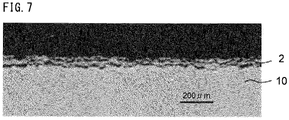
- FIG. 7 is a view showing an element mapping analysis result of test number 1-1.
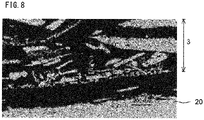
- FIG. 8 is a view showing an element mapping analysis result of test number 1-2.
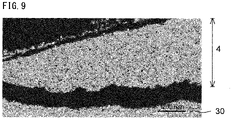
- FIG. 9 is a view showing an element mapping analysis result of test number 1-3.
- test number 1-1 the compositions of the compounds were appropriate, and therefore, the softening point of the antioxidant agent for heating an alloy material was 800°C or more. Therefore, referring to FIG. 1 and FIG. 7 , a Cr 2 O 3 coating 2 with uniform thickness was formed on the surface of the plate-shaped test specimen, and normal oxidation was observed. Furthermore, referring to FIG. 4 , in test number 1-1, there was no thickness reduction of a base metal 10. In other words, by using the antioxidant agent for heating an alloy material of test number 1-1, oxidation resistance of the alloy material was improved.
- test number 1-4 the composition of the compounds were also appropriate, and therefore, the softening point of the antioxidant agent for heating an alloy material was 800°C or more. As a result, a Cr 2 O 3 coating with uniform thickness was formed on the surface of the plate-shaped test specimen, and normal oxidation was observed. Further, in test number 1-4, there was no thickness reduction of the base metal. In other words, by using the antioxidant agent for heating an alloy material of test number 1-4, oxidation resistance of the alloy material was improved.
- the softening point of the antioxidant agent for heating an alloy material was less than 800°C. Since the softening point was less than 800°C, it is conceivable that the compositions of the compounds were not appropriate, either, in test number 1-2. Therefore, referring to FIG. 2 , breakaway oxidation 1 occurred. Referring to FIG. 5 , further in test number 1-2, a recess with a depth of approximately 1.5 mm was produced in a base metal 20. Referring to FIG. 8 , further in test number 1-2, a scale 3 mainly containing Fe was formed. By using the antioxidant agent for heating an alloy material of test number 1-2, oxidation resistance of the alloy material was not improved.
- test number 1-3 the antioxidant agent for heating an alloy material was not used. Therefore, referring to FIG. 3 , the entire surface of the plate-shaped test specimen was severely oxidized. Further, in test number 1-3, referring to FIG. 6 , an entire surface of a base metal 30 was reduced in thickness by approximately 0.8 mm, and a scale 4 was formed. Further in test number 1-3, referring to FIG. 9 , the scale 4 mainly containing Fe and Cr was formed.
- the antioxidant agents for heating an alloy material shown in Table 2 were prepared.
- Test numbers 2-2 to 2-4 had the compositions described in Table 2.
- a total amount of the respective components described in Table 2 was 100% by mass.
- a total amount of the respective components described in Table 2 was less than 100% by mass, and the balance was impurities.
- the composition of each of the antioxidant agents for heating an alloy material was obtained by producing the antioxidant agent for heating an alloy material, thereafter, drying the antioxidant agent for heating an alloy material, and performing ICP analysis.
- the contents of the respective components were obtained by converting the contents of Si, Al, Mg, Na, K, Ca and B obtained by ICP into the contents of SiO 2 , Al 2 O 3 , MgO, Na 2 O, K 2 O, CaO and B 2 O 3 respectively.
- a plate-shaped test specimen simulating an alloy material was prepared.
- the plate-shaped test specimen was a stainless steel material containing, in mass%, 87% Fe, and 13% Cr.
- the size of the plate-shaped test specimen was 10 mm thick, 20 mm long and 20 mm wide.
- the mass (g) of the plate-shaped test specimen before coating a slurry was measured, and determined as a pre-test mass (g).
- the slurries were each produced by mixing 6 parts by mass potter's clay, 5 parts by mass bentonite, and 70 to 100 parts by mass water to 100 parts by mass the antioxidant agent for heating an alloy material.
- the obtained slurries were each coated on the entire surface (an upper surface, a lower surface, and four side surfaces) of the plate-shaped test specimen by using a brush, and thereafter, dried.
- the heating step was simulated, and the plate-shaped test specimens were heated at 1200°C for two hours.
- the atmosphere simulated LNG combustion.
- the atmospheric gas was adjusted so that the composition of the atmospheric gas was 2 to 3% of O 2 , 8 to 10% of CO 2 , 15 to 20% of H 2 O, and the balance being N 2 .
- Scales adhering to the plate-shaped test specimen by heating were removed by being dipped into an alkaline aqueous solution, and thereafter, being dipped into a citric acid aqueous solution.
- the mass (g) of the plate-shaped test specimen after scale removal was measured, and was determined as a post-test mass (g).
- a value obtained by dividing a difference between the mass (g) of the plate-shaped test specimen before heating and the mass (g) of the plate-shaped test specimen after heating by a surface area (1200 mm 2 ) of the surface (the upper surface, and the four side surfaces) of the plate-shaped test specimen was determined as an oxidation weight reduction. What had an oxidation weight reduction of 0.200 g/mm 2 or less was determined to be excellent in oxidation resistance.
- Test number 2-2 had appropriate compositions of compounds, and therefore has the softening point of the antioxidant agent for heating an alloy material of 800°C or more. As a result, the antioxidant agent for heating an alloy material of test number 2-2 has an oxidation weight reduction of 0.200 g/mm 2 or less, and was excellent in oxidation resistance.
- test number 2-1 an antioxidant agent for heating an alloy material was not used. Therefore, the oxidation weight reduction was higher than 0.200 g/mm 2 , and oxidation resistance was inferior.
- test number 2-3 the total content of Na 2 O, K 2 O and CaO was low. Therefore, the softening point was less than 800°C. Accordingly, flowability of the antioxidant agent for heating an alloy material was low. As a result, the oxidation weight reduction was higher than 0.200 g/mm 2 , and the oxidation resistance was inferior.
- test number 2-4 the content of Na 2 O was high. Therefore, the Cr 2 O 3 coating that is the protection coating was melted. As a result, the oxidation weigh reduction was higher than 0.200 g/mm 2 , and the oxidation resistance was inferior.
- Test numbers 3-1 to 3-5 have the compositions described in Table 3. In test number 3-3, a total amount of the respective components described in Table 3 was 100% by mass. In test numbers 3-1, 3-2, 3-4 and 3-5, the total amounts of the respective components described in Table 3 were less than 100% by mass, and the balances were impurities.
- the composition of each of the antioxidant agents for heating an alloy material was obtained by producing and thereafter drying the antioxidant agent for heating an alloy material, and performing ICP analysis.
- Test number 3-1 is the same as test number 1-1.
- Test number 3-2 is the same as test number 1-4.
- Test number 3-3 is the same as test number 2-2.
- the plate-shaped test specimen simulating an alloy material was prepared.
- a duplex stainless steel material corresponding to A240 UNS S39274 specified by ASTM was used as the plate-shaped test specimen.
- the size of the plate-shaped test specimen was 4 mm thick, 25 mm long and 80 mm wide.
- the slurries were each produced by mixing 6 parts by mass potter's clay, 5 parts by mass bentonite, and 70 to 100 parts by mass water to 100 parts by mass the antioxidant agent for heating an alloy material.
- the obtained slurries were each coated on a surface of 25 mm by 20 mm at the end portion, of the surface of 25 mm by 80 mm that was the upper surface of the plate-shaped test specimen by using a brush, and thereafter dried.
- the two plate-shaped test specimens were overlaid on each other so that the slurry coated surfaces contact each other on the entire surfaces.
- the plate-shaped test specimens after coated with the antioxidant agents for heating an alloy material were heated at 1300°C for 2 hours.
- the atmosphere was under the air atmosphere.
- FIG. 11 is a schematic view of a device for evaluating blocking resistance. Whether or not the two plate-shaped test specimens adhered to each other was evaluated by using the device shown in FIG. 11 .
- a metal bar 100 was fixed by welding to an end portion of one plate-shaped test specimen A of the two plate-shaped test specimens.
- the plate-shaped test specimen A to which the metal bar 100 was welded and the other plate-shaped test specimen B were overlaid on each other so that slurry coated surfaces contact each other on the entire surfaces.
- the plate-shaped test specimen B was fixed into a tube furnace 110 via a fixture 120.
- the metal bar 100 was pulled out in a horizontal direction, and an adhesive force F (kg) when peeling out the two plate-shaped test specimens in a horizontal direction with respect to the surface of 25 mm by 80 mm was measured.
- F adhesive force
- the Digital suspension scale TDTB-25 made by TRUSCO Nakayama Corporation was used.
- the test specimen heating temperature during measurement was 1300°C, the measurement environment was an air atmosphere, and a tensile speed was 10 to 20 cm/second.
- the result is shown in column "adhesive force (kg)" in Table 3.
- the antioxidant agents for heating an alloy material of test numbers 3-1 to 3-3 and 3-5 had suitable contents of the respective components, and satisfied Formula (1). Therefore, the adhesive forces when peeling out the two plate-shaped test specimens were 2.60 kg or less.
- the antioxidant agents for heating an alloy material of test numbers 3-1 to 3-3 and 3-5 were excellent in blocking resistance.
- the antioxidant agents for heating an alloy material of test number 3-4 had appropriate contents of the respective components, but did not satisfy Formula (1). Therefore, the adhesive force when peeling out the two plate-shaped test specimens was 2.84 kg. The antioxidant agent for heating an alloy material of test number 3-4 was not excellent in blocking resistance.
- the antioxidant agents for heating an alloy material of test number 1-1 in Table 1 and test number 1-2 in Table 1 were prepared.
- As the test specimen a steel material of JIS SUS312L was prepared.
- the slurry of the antioxidant agent for heating an alloy material of test number 1-1 in Table 1 was coated on the steel material.
- the slurry of the antioxidant agent for heating an alloy material was produced by mixing 6 parts by mass potter's clay, 5 parts by mass bentonite, and 70 to 100 parts by mass water with respect to 100 parts by mass the antioxidant agent for heating an alloy material.
- the obtained slurry was coated on the surface (the upper surface, the lower surface, and the four side surfaces) of the steel material, and thereafter was dried, and hold treatment was performed.
- the hold treatment was carried out at 1270°C for 50 hours.
- exhaust gas was recovered from a stack of the soaking pit every one hour. The recovered exhaust gas amount was measured by the exhaust gas measurement device.
- the slurry produced in the same ratio as the ratio of test number 1-1 was coated on the surface (the upper surface, lower surface, and four side surfaces) of the steel material.
- the hold treatment was carried out similarly to test number 1-1, with respect to the steel material coated with the antioxidant agent for heating an alloy material of test number 1-2.
- the dust generation amount during hold treatment was obtained similarly to the case in which the antioxidant agent for heating an alloy material of test number 1-1 was used, with respect to the antioxidant agent for heating an alloy material of test number 1-2. The result is shown in FIG. 10 .
- the antioxidant agent for heating an alloy material of test number 1-1 had a remarkably smaller dust generation amount than the antioxidant agent for heating an alloy material of test number 1-2, and was excellent in dust proof.
- the aforementioned embodiment is only an illustration for carrying out the present invention. Accordingly, the present invention is not limited to the aforementioned embodiment, and can be carried out by properly changing the aforementioned embodiment within the range without departing from the gist of the present invention.
Landscapes
- Chemical & Material Sciences (AREA)
- Engineering & Computer Science (AREA)
- Materials Engineering (AREA)
- Organic Chemistry (AREA)
- Physics & Mathematics (AREA)
- Geochemistry & Mineralogy (AREA)
- General Chemical & Material Sciences (AREA)
- Chemical Kinetics & Catalysis (AREA)
- Life Sciences & Earth Sciences (AREA)
- Thermal Sciences (AREA)
- Crystallography & Structural Chemistry (AREA)
- Mechanical Engineering (AREA)
- Metallurgy (AREA)
- Anti-Oxidant Or Stabilizer Compositions (AREA)
- Resistance Heating (AREA)
- Glass Compositions (AREA)
- Other Surface Treatments For Metallic Materials (AREA)
Applications Claiming Priority (2)
| Application Number | Priority Date | Filing Date | Title |
|---|---|---|---|
| JP2020015660 | 2020-01-31 | ||
| PCT/JP2021/002990 WO2021153657A1 (ja) | 2020-01-31 | 2021-01-28 | 合金材加熱用酸化防止剤、及び、それを用いた合金材の加熱方法 |
Publications (3)
| Publication Number | Publication Date |
|---|---|
| EP4098756A1 true EP4098756A1 (de) | 2022-12-07 |
| EP4098756A4 EP4098756A4 (de) | 2023-11-15 |
| EP4098756B1 EP4098756B1 (de) | 2025-07-09 |
Family
ID=77078234
Family Applications (1)
| Application Number | Title | Priority Date | Filing Date |
|---|---|---|---|
| EP21748377.5A Active EP4098756B1 (de) | 2020-01-31 | 2021-01-28 | Antioxidationsmittel zum erhitzen von legierungsmaterial und verfahren zum erhitzen von legierungsmaterial unter verwendung desselben |
Country Status (4)
| Country | Link |
|---|---|
| EP (1) | EP4098756B1 (de) |
| JP (1) | JP7333837B2 (de) |
| CN (1) | CN115023509B (de) |
| WO (1) | WO2021153657A1 (de) |
Families Citing this family (1)
| Publication number | Priority date | Publication date | Assignee | Title |
|---|---|---|---|---|
| WO2025211451A1 (ja) * | 2024-04-05 | 2025-10-09 | 日本製鉄株式会社 | 塗布剤、及び、それを用いた鋼材の製造方法 |
Family Cites Families (25)
| Publication number | Priority date | Publication date | Assignee | Title |
|---|---|---|---|---|
| JPS5853050B2 (ja) * | 1975-12-27 | 1983-11-26 | 新日本製鐵株式会社 | レンゾクチユウゾウチユウヘンノ チユウシンタコウシツセイケツカンノボウシホウホウ |
| JPS5626603A (en) | 1979-08-08 | 1981-03-14 | Sumitomo Metal Ind Ltd | Preventing method for edge crack in rolling work for steel |
| JPS6026804B2 (ja) * | 1981-03-06 | 1985-06-26 | 住友金属工業株式会社 | 酸化防止剤 |
| JPS6395140A (ja) * | 1986-10-09 | 1988-04-26 | Sumitomo Metal Ind Ltd | 酸化物系表面処理剤 |
| JPH02209420A (ja) | 1989-02-08 | 1990-08-20 | Nippon Fueroo Kk | 鋼材に対する高温用酸化防止剤 |
| JPH03291325A (ja) | 1990-04-09 | 1991-12-20 | Sumitomo Metal Ind Ltd | 金属材の高温酸化防止方法 |
| JPH0472019A (ja) | 1990-07-12 | 1992-03-06 | Kawasaki Steel Corp | ステンレス鋼帯の連続焼鈍方法及びその装置 |
| JPH0674450B2 (ja) | 1990-07-12 | 1994-09-21 | 川崎製鉄株式会社 | 鋼帯の酸化防止剤 |
| JP3371142B2 (ja) * | 1991-09-27 | 2003-01-27 | 日本フエロー株式会社 | 鋼材の酸化脱炭防止用組成物 |
| JPH06158153A (ja) | 1992-11-30 | 1994-06-07 | Kawasaki Steel Corp | ステンレス鋼帯の製造方法 |
| JPH06198310A (ja) | 1993-01-07 | 1994-07-19 | Sumitomo Metal Ind Ltd | 継目無ステンレス鋼管の製管方法 |
| JP3252301B2 (ja) * | 1993-02-23 | 2002-02-04 | 住友金属工業株式会社 | 高Crまたは高Cr−Ni合金用スケール除去用組成物 |
| JPH0762429A (ja) | 1993-08-24 | 1995-03-07 | Hakuto Co Ltd | 鋼帯の酸化防止剤 |
| JP4557191B2 (ja) * | 1998-01-13 | 2010-10-06 | 株式会社ナトー研究所 | 水硬性シリカ系バインダーならびに耐水・耐熱性固化体 |
| JP2001207217A (ja) * | 2000-01-25 | 2001-07-31 | Nisshin Steel Co Ltd | 鋼材の酸化脱炭防止用シート状成形物およびその利用法 |
| US6423415B1 (en) * | 2000-08-31 | 2002-07-23 | Corning Incorporated | Potassium silicate frits for coating metals |
| JP4259151B2 (ja) * | 2003-03-20 | 2009-04-30 | Jfeスチール株式会社 | 耐熱材料 |
| JP2007314875A (ja) * | 2006-04-24 | 2007-12-06 | Sumitomo Metal Ind Ltd | 鋼管の熱処理用酸化防止剤組成物 |
| CN101426938B (zh) * | 2007-01-31 | 2010-06-02 | 中国科学院过程工程研究所 | 一种钢材防氧化涂料及钢材的防氧化方法 |
| JP5482533B2 (ja) * | 2010-07-16 | 2014-05-07 | 新日鐵住金株式会社 | 酸化防止剤、酸化防止剤の製造方法及び金属材の製造方法 |
| JP5408104B2 (ja) * | 2010-10-26 | 2014-02-05 | 新日鐵住金株式会社 | 酸化防止剤及び金属材の製造方法 |
| JP5979320B2 (ja) * | 2013-11-12 | 2016-08-24 | 新日鐵住金株式会社 | Ni−Cr合金材およびそれを用いた油井用継目無管 |
| JP6394153B2 (ja) * | 2014-07-29 | 2018-09-26 | 新日鐵住金株式会社 | スケール発生防止剤及び鋼管の製造方法 |
| JP6493566B2 (ja) * | 2016-01-05 | 2019-04-03 | 新日鐵住金株式会社 | オーステナイト系耐熱合金及びその製造方法 |
| CN109415787A (zh) * | 2016-06-29 | 2019-03-01 | 新日铁住金株式会社 | 铁素体系耐热钢及铁素体系传热构件 |
-
2021
- 2021-01-28 CN CN202180011845.9A patent/CN115023509B/zh active Active
- 2021-01-28 EP EP21748377.5A patent/EP4098756B1/de active Active
- 2021-01-28 JP JP2021574096A patent/JP7333837B2/ja active Active
- 2021-01-28 WO PCT/JP2021/002990 patent/WO2021153657A1/ja not_active Ceased
Also Published As
| Publication number | Publication date |
|---|---|
| CN115023509B (zh) | 2025-02-14 |
| WO2021153657A1 (ja) | 2021-08-05 |
| EP4098756B1 (de) | 2025-07-09 |
| JP7333837B2 (ja) | 2023-08-25 |
| EP4098756A4 (de) | 2023-11-15 |
| JPWO2021153657A1 (de) | 2021-08-05 |
| CN115023509A (zh) | 2022-09-06 |
Similar Documents
| Publication | Publication Date | Title |
|---|---|---|
| Maki et al. | Galvanisability of silicon free CMnAl TRIP steels | |
| JP7222445B1 (ja) | 無方向性電磁鋼板および無方向性電磁鋼板の製造方法 | |
| KR102810694B1 (ko) | 핫 스탬프 성형품 및 핫 스탬프용 강판 | |
| EP3524704A1 (de) | Fe-cr-ni-legierung und verfahren zur herstellung davon | |
| JP6990337B1 (ja) | 表面性状に優れたNi基合金およびその製造方法 | |
| CN113046616B (zh) | 表面性状优异的不锈钢和其制造方法 | |
| EP4098756B1 (de) | Antioxidationsmittel zum erhitzen von legierungsmaterial und verfahren zum erhitzen von legierungsmaterial unter verwendung desselben | |
| WO2023062855A1 (ja) | 表面性状に優れたニッケル合金およびその製造方法 | |
| TWI771963B (zh) | 鋼板及琺瑯製品 | |
| CN109837460A (zh) | 一种铁路客车货车车轴用钢inc35e及其制造方法 | |
| CN121712914A (zh) | 表面性状优异的Ni基合金 | |
| JP2590626B2 (ja) | 清浄性およびエッチング穿孔性に優れたFe−Ni系合金冷延板およびその製造方法 | |
| US2150094A (en) | Treatment of nickel and nickel alloys and products resulting therefrom | |
| TWI910318B (zh) | 表面性狀優異的Fe-Ni合金及其製造方法、CFRP用模具 | |
| CN116497290B (zh) | 一种具有良好切削性和切削破坏性的不锈钢材料 | |
| JP7697117B1 (ja) | Ni-Cr-Mo-Fe系Ni基合金用連続鋳造用モールドパウダーおよび連続鋳造方法 | |
| JP7723156B1 (ja) | Ni-Cu系Ni基合金用連続鋳造用モールドパウダーおよび連続鋳造方法 | |
| CN114888215B (zh) | 一种无缩孔氧化冶金缺陷的钢材的生产方法 | |
| JP7438437B1 (ja) | 表面性状および機械的特性に優れたNi合金 | |
| CN116867917B (zh) | 表面性状优异的Fe-Ni合金及其制造方法、CFRP用模具 | |
| JP4312276B2 (ja) | 表面性状およびほうろう性に優れたほうろう用高酸素鋼板およびその製造方法 | |
| JP2002206144A (ja) | 表面性状に優れたFe−Ni系合金およびその製造方法 | |
| JP2025033390A (ja) | 鋳造用パウダーおよび鋳造方法 | |
| CN117418070A (zh) | 钢板的制备方法和钢板 | |
| TW202542337A (zh) | Fe系非晶質合金及Fe系非晶質合金薄帶 |
Legal Events
| Date | Code | Title | Description |
|---|---|---|---|
| STAA | Information on the status of an ep patent application or granted ep patent |
Free format text: STATUS: THE INTERNATIONAL PUBLICATION HAS BEEN MADE |
|
| PUAI | Public reference made under article 153(3) epc to a published international application that has entered the european phase |
Free format text: ORIGINAL CODE: 0009012 |
|
| STAA | Information on the status of an ep patent application or granted ep patent |
Free format text: STATUS: REQUEST FOR EXAMINATION WAS MADE |
|
| 17P | Request for examination filed |
Effective date: 20220719 |
|
| AK | Designated contracting states |
Kind code of ref document: A1 Designated state(s): AL AT BE BG CH CY CZ DE DK EE ES FI FR GB GR HR HU IE IS IT LI LT LU LV MC MK MT NL NO PL PT RO RS SE SI SK SM TR |
|
| DAV | Request for validation of the european patent (deleted) | ||
| DAX | Request for extension of the european patent (deleted) | ||
| REG | Reference to a national code |
Ref country code: DE Ref legal event code: R079 Free format text: PREVIOUS MAIN CLASS: C21D0001700000 Ipc: C03C0003087000 Ref country code: DE Ref legal event code: R079 Ref document number: 602021033809 Country of ref document: DE Free format text: PREVIOUS MAIN CLASS: C21D0001700000 Ipc: C03C0003087000 |
|
| A4 | Supplementary search report drawn up and despatched |
Effective date: 20231012 |
|
| RIC1 | Information provided on ipc code assigned before grant |
Ipc: C22C 38/18 20060101ALN20231006BHEP Ipc: C21D 1/68 20060101ALI20231006BHEP Ipc: C21D 1/70 20060101ALI20231006BHEP Ipc: C03C 8/16 20060101ALI20231006BHEP Ipc: C03C 3/087 20060101AFI20231006BHEP |
|
| RIC1 | Information provided on ipc code assigned before grant |
Ipc: C22C 38/18 20060101ALN20241129BHEP Ipc: C21D 1/68 20060101ALI20241129BHEP Ipc: C21D 1/70 20060101ALI20241129BHEP Ipc: C03C 8/16 20060101ALI20241129BHEP Ipc: C03C 3/087 20060101AFI20241129BHEP |
|
| GRAP | Despatch of communication of intention to grant a patent |
Free format text: ORIGINAL CODE: EPIDOSNIGR1 |
|
| STAA | Information on the status of an ep patent application or granted ep patent |
Free format text: STATUS: GRANT OF PATENT IS INTENDED |
|
| RIC1 | Information provided on ipc code assigned before grant |
Ipc: C22C 38/18 20060101ALN20250114BHEP Ipc: C21D 1/68 20060101ALI20250114BHEP Ipc: C21D 1/70 20060101ALI20250114BHEP Ipc: C03C 8/16 20060101ALI20250114BHEP Ipc: C03C 3/087 20060101AFI20250114BHEP |
|
| INTG | Intention to grant announced |
Effective date: 20250212 |
|
| GRAS | Grant fee paid |
Free format text: ORIGINAL CODE: EPIDOSNIGR3 |
|
| GRAA | (expected) grant |
Free format text: ORIGINAL CODE: 0009210 |
|
| STAA | Information on the status of an ep patent application or granted ep patent |
Free format text: STATUS: THE PATENT HAS BEEN GRANTED |
|
| AK | Designated contracting states |
Kind code of ref document: B1 Designated state(s): AL AT BE BG CH CY CZ DE DK EE ES FI FR GB GR HR HU IE IS IT LI LT LU LV MC MK MT NL NO PL PT RO RS SE SI SK SM TR |
|
| REG | Reference to a national code |
Ref country code: GB Ref legal event code: FG4D |
|
| REG | Reference to a national code |
Ref country code: CH Ref legal event code: EP |
|
| REG | Reference to a national code |
Ref country code: DE Ref legal event code: R096 Ref document number: 602021033809 Country of ref document: DE |
|
| REG | Reference to a national code |
Ref country code: IE Ref legal event code: FG4D |
|
| REG | Reference to a national code |
Ref country code: NL Ref legal event code: MP Effective date: 20250709 |
|
| PG25 | Lapsed in a contracting state [announced via postgrant information from national office to epo] |
Ref country code: PT Free format text: LAPSE BECAUSE OF FAILURE TO SUBMIT A TRANSLATION OF THE DESCRIPTION OR TO PAY THE FEE WITHIN THE PRESCRIBED TIME-LIMIT Effective date: 20251110 |
|
| PG25 | Lapsed in a contracting state [announced via postgrant information from national office to epo] |
Ref country code: NL Free format text: LAPSE BECAUSE OF FAILURE TO SUBMIT A TRANSLATION OF THE DESCRIPTION OR TO PAY THE FEE WITHIN THE PRESCRIBED TIME-LIMIT Effective date: 20250709 |
|
| REG | Reference to a national code |
Ref country code: AT Ref legal event code: MK05 Ref document number: 1811729 Country of ref document: AT Kind code of ref document: T Effective date: 20250709 |
|
| PG25 | Lapsed in a contracting state [announced via postgrant information from national office to epo] |
Ref country code: IS Free format text: LAPSE BECAUSE OF FAILURE TO SUBMIT A TRANSLATION OF THE DESCRIPTION OR TO PAY THE FEE WITHIN THE PRESCRIBED TIME-LIMIT Effective date: 20251109 |
|
| PG25 | Lapsed in a contracting state [announced via postgrant information from national office to epo] |
Ref country code: NO Free format text: LAPSE BECAUSE OF FAILURE TO SUBMIT A TRANSLATION OF THE DESCRIPTION OR TO PAY THE FEE WITHIN THE PRESCRIBED TIME-LIMIT Effective date: 20251009 |
|
| REG | Reference to a national code |
Ref country code: LT Ref legal event code: MG9D |
|
| PG25 | Lapsed in a contracting state [announced via postgrant information from national office to epo] |
Ref country code: AT Free format text: LAPSE BECAUSE OF FAILURE TO SUBMIT A TRANSLATION OF THE DESCRIPTION OR TO PAY THE FEE WITHIN THE PRESCRIBED TIME-LIMIT Effective date: 20250709 |
|
| PG25 | Lapsed in a contracting state [announced via postgrant information from national office to epo] |
Ref country code: FI Free format text: LAPSE BECAUSE OF FAILURE TO SUBMIT A TRANSLATION OF THE DESCRIPTION OR TO PAY THE FEE WITHIN THE PRESCRIBED TIME-LIMIT Effective date: 20250709 |
|
| PG25 | Lapsed in a contracting state [announced via postgrant information from national office to epo] |
Ref country code: HR Free format text: LAPSE BECAUSE OF FAILURE TO SUBMIT A TRANSLATION OF THE DESCRIPTION OR TO PAY THE FEE WITHIN THE PRESCRIBED TIME-LIMIT Effective date: 20250709 |
|
| PG25 | Lapsed in a contracting state [announced via postgrant information from national office to epo] |
Ref country code: GR Free format text: LAPSE BECAUSE OF FAILURE TO SUBMIT A TRANSLATION OF THE DESCRIPTION OR TO PAY THE FEE WITHIN THE PRESCRIBED TIME-LIMIT Effective date: 20251010 |
|
| PG25 | Lapsed in a contracting state [announced via postgrant information from national office to epo] |
Ref country code: SE Free format text: LAPSE BECAUSE OF FAILURE TO SUBMIT A TRANSLATION OF THE DESCRIPTION OR TO PAY THE FEE WITHIN THE PRESCRIBED TIME-LIMIT Effective date: 20250709 |
|
| PG25 | Lapsed in a contracting state [announced via postgrant information from national office to epo] |
Ref country code: LV Free format text: LAPSE BECAUSE OF FAILURE TO SUBMIT A TRANSLATION OF THE DESCRIPTION OR TO PAY THE FEE WITHIN THE PRESCRIBED TIME-LIMIT Effective date: 20250709 |
|
| PG25 | Lapsed in a contracting state [announced via postgrant information from national office to epo] |
Ref country code: BG Free format text: LAPSE BECAUSE OF FAILURE TO SUBMIT A TRANSLATION OF THE DESCRIPTION OR TO PAY THE FEE WITHIN THE PRESCRIBED TIME-LIMIT Effective date: 20250709 Ref country code: PL Free format text: LAPSE BECAUSE OF FAILURE TO SUBMIT A TRANSLATION OF THE DESCRIPTION OR TO PAY THE FEE WITHIN THE PRESCRIBED TIME-LIMIT Effective date: 20250709 |
|
| PG25 | Lapsed in a contracting state [announced via postgrant information from national office to epo] |
Ref country code: RS Free format text: LAPSE BECAUSE OF FAILURE TO SUBMIT A TRANSLATION OF THE DESCRIPTION OR TO PAY THE FEE WITHIN THE PRESCRIBED TIME-LIMIT Effective date: 20251009 |
|
| PG25 | Lapsed in a contracting state [announced via postgrant information from national office to epo] |
Ref country code: ES Free format text: LAPSE BECAUSE OF FAILURE TO SUBMIT A TRANSLATION OF THE DESCRIPTION OR TO PAY THE FEE WITHIN THE PRESCRIBED TIME-LIMIT Effective date: 20250709 |