EP4009733A1 - Data split between multiple sites - Google Patents
Data split between multiple sites Download PDFInfo
- Publication number
- EP4009733A1 EP4009733A1 EP21205184.1A EP21205184A EP4009733A1 EP 4009733 A1 EP4009733 A1 EP 4009733A1 EP 21205184 A EP21205184 A EP 21205184A EP 4009733 A1 EP4009733 A1 EP 4009733A1
- Authority
- EP
- European Patent Office
- Prior art keywords
- data
- enodeb
- wtru
- base station
- entity
- Prior art date
- Legal status (The legal status is an assumption and is not a legal conclusion. Google has not performed a legal analysis and makes no representation as to the accuracy of the status listed.)
- Pending
Links
Images







Classifications
-
- H—ELECTRICITY
- H04—ELECTRIC COMMUNICATION TECHNIQUE
- H04W—WIRELESS COMMUNICATION NETWORKS
- H04W76/00—Connection management
- H04W76/10—Connection setup
- H04W76/15—Setup of multiple wireless link connections
-
- H—ELECTRICITY
- H04—ELECTRIC COMMUNICATION TECHNIQUE
- H04W—WIRELESS COMMUNICATION NETWORKS
- H04W28/00—Network traffic management; Network resource management
- H04W28/02—Traffic management, e.g. flow control or congestion control
- H04W28/08—Load balancing or load distribution
- H04W28/086—Load balancing or load distribution among access entities
-
- H—ELECTRICITY
- H04—ELECTRIC COMMUNICATION TECHNIQUE
- H04L—TRANSMISSION OF DIGITAL INFORMATION, e.g. TELEGRAPHIC COMMUNICATION
- H04L5/00—Arrangements affording multiple use of the transmission path
- H04L5/0091—Signalling for the administration of the divided path, e.g. signalling of configuration information
-
- H—ELECTRICITY
- H04—ELECTRIC COMMUNICATION TECHNIQUE
- H04B—TRANSMISSION
- H04B7/00—Radio transmission systems, i.e. using radiation field
- H04B7/14—Relay systems
- H04B7/15—Active relay systems
- H04B7/155—Ground-based stations
- H04B7/15592—Adapting at the relay station communication parameters for supporting cooperative relaying, i.e. transmission of the same data via direct - and relayed path
-
- H—ELECTRICITY
- H04—ELECTRIC COMMUNICATION TECHNIQUE
- H04L—TRANSMISSION OF DIGITAL INFORMATION, e.g. TELEGRAPHIC COMMUNICATION
- H04L5/00—Arrangements affording multiple use of the transmission path
- H04L5/0001—Arrangements for dividing the transmission path
- H04L5/0003—Two-dimensional division
- H04L5/0005—Time-frequency
- H04L5/0007—Time-frequency the frequencies being orthogonal, e.g. OFDM(A) or DMT
-
- H—ELECTRICITY
- H04—ELECTRIC COMMUNICATION TECHNIQUE
- H04L—TRANSMISSION OF DIGITAL INFORMATION, e.g. TELEGRAPHIC COMMUNICATION
- H04L5/00—Arrangements affording multiple use of the transmission path
- H04L5/003—Arrangements for allocating sub-channels of the transmission path
- H04L5/0053—Allocation of signalling, i.e. of overhead other than pilot signals
-
- H—ELECTRICITY
- H04—ELECTRIC COMMUNICATION TECHNIQUE
- H04L—TRANSMISSION OF DIGITAL INFORMATION, e.g. TELEGRAPHIC COMMUNICATION
- H04L61/00—Network arrangements, protocols or services for addressing or naming
- H04L61/50—Address allocation
- H04L61/5007—Internet protocol [IP] addresses
-
- H—ELECTRICITY
- H04—ELECTRIC COMMUNICATION TECHNIQUE
- H04W—WIRELESS COMMUNICATION NETWORKS
- H04W16/00—Network planning, e.g. coverage or traffic planning tools; Network deployment, e.g. resource partitioning or cells structures
- H04W16/24—Cell structures
- H04W16/32—Hierarchical cell structures
-
- H—ELECTRICITY
- H04—ELECTRIC COMMUNICATION TECHNIQUE
- H04W—WIRELESS COMMUNICATION NETWORKS
- H04W28/00—Network traffic management; Network resource management
- H04W28/02—Traffic management, e.g. flow control or congestion control
- H04W28/0278—Traffic management, e.g. flow control or congestion control using buffer status reports
-
- H—ELECTRICITY
- H04—ELECTRIC COMMUNICATION TECHNIQUE
- H04W—WIRELESS COMMUNICATION NETWORKS
- H04W28/00—Network traffic management; Network resource management
- H04W28/02—Traffic management, e.g. flow control or congestion control
- H04W28/06—Optimizing the usage of the radio link, e.g. header compression, information sizing, discarding information
-
- H—ELECTRICITY
- H04—ELECTRIC COMMUNICATION TECHNIQUE
- H04W—WIRELESS COMMUNICATION NETWORKS
- H04W28/00—Network traffic management; Network resource management
- H04W28/02—Traffic management, e.g. flow control or congestion control
- H04W28/06—Optimizing the usage of the radio link, e.g. header compression, information sizing, discarding information
- H04W28/065—Optimizing the usage of the radio link, e.g. header compression, information sizing, discarding information using assembly or disassembly of packets
-
- H—ELECTRICITY
- H04—ELECTRIC COMMUNICATION TECHNIQUE
- H04W—WIRELESS COMMUNICATION NETWORKS
- H04W28/00—Network traffic management; Network resource management
- H04W28/02—Traffic management, e.g. flow control or congestion control
- H04W28/08—Load balancing or load distribution
- H04W28/086—Load balancing or load distribution among access entities
- H04W28/0861—Load balancing or load distribution among access entities between base stations
-
- H—ELECTRICITY
- H04—ELECTRIC COMMUNICATION TECHNIQUE
- H04W—WIRELESS COMMUNICATION NETWORKS
- H04W36/00—Hand-off or reselection arrangements
- H04W36/0005—Control or signalling for completing the hand-off
- H04W36/0055—Transmission or use of information for re-establishing the radio link
- H04W36/0069—Transmission or use of information for re-establishing the radio link in case of dual connectivity, e.g. decoupled uplink/downlink
- H04W36/00692—Transmission or use of information for re-establishing the radio link in case of dual connectivity, e.g. decoupled uplink/downlink using simultaneous multiple data streams, e.g. cooperative multipoint [CoMP], carrier aggregation [CA] or multiple input multiple output [MIMO]
-
- H—ELECTRICITY
- H04—ELECTRIC COMMUNICATION TECHNIQUE
- H04W—WIRELESS COMMUNICATION NETWORKS
- H04W36/00—Hand-off or reselection arrangements
- H04W36/08—Reselecting an access point
-
- H—ELECTRICITY
- H04—ELECTRIC COMMUNICATION TECHNIQUE
- H04W—WIRELESS COMMUNICATION NETWORKS
- H04W80/00—Wireless network protocols or protocol adaptations to wireless operation
- H04W80/02—Data link layer protocols
-
- H—ELECTRICITY
- H04—ELECTRIC COMMUNICATION TECHNIQUE
- H04W—WIRELESS COMMUNICATION NETWORKS
- H04W88/00—Devices specially adapted for wireless communication networks, e.g. terminals, base stations or access point devices
- H04W88/02—Terminal devices
-
- H—ELECTRICITY
- H04—ELECTRIC COMMUNICATION TECHNIQUE
- H04B—TRANSMISSION
- H04B7/00—Radio transmission systems, i.e. using radiation field
- H04B7/02—Diversity systems; Multi-antenna system, i.e. transmission or reception using multiple antennas
- H04B7/022—Site diversity; Macro-diversity
-
- H—ELECTRICITY
- H04—ELECTRIC COMMUNICATION TECHNIQUE
- H04B—TRANSMISSION
- H04B7/00—Radio transmission systems, i.e. using radiation field
- H04B7/14—Relay systems
- H04B7/15—Active relay systems
-
- H—ELECTRICITY
- H04—ELECTRIC COMMUNICATION TECHNIQUE
- H04W—WIRELESS COMMUNICATION NETWORKS
- H04W92/00—Interfaces specially adapted for wireless communication networks
- H04W92/04—Interfaces between hierarchically different network devices
- H04W92/10—Interfaces between hierarchically different network devices between terminal device and access point, i.e. wireless air interface
-
- H—ELECTRICITY
- H04—ELECTRIC COMMUNICATION TECHNIQUE
- H04W—WIRELESS COMMUNICATION NETWORKS
- H04W92/00—Interfaces specially adapted for wireless communication networks
- H04W92/16—Interfaces between hierarchically similar devices
- H04W92/20—Interfaces between hierarchically similar devices between access points
Definitions
- LTE Release 8 may be referred to herein as LTE R8 or R8-LTE.
- SC-FDMA Single Carrier Frequency Division Multiple Access
- DFT-S-OFDM Discrete Fourier Transform Spread Orthogonal Frequency Division Multiplexing
- a wireless transmit/receive unit (WTRU), alternatively referred to as a user equipment (UE), transmits on the uplink using a limited, contiguous set of assigned sub-carriers in a Frequency Division Multiple Access (FDMA) arrangement.
- FDMA Frequency Division Multiple Access
- OFDM Orthogonal Frequency Division Multiplexing
- a first given WTRU may be assigned to transmit on sub-carriers 1-12
- a second WTRU may be assigned to transmit on sub-carriers 13-24, and so on.
- an evolved Node-B (eNodeB) serving the WTRUs may receive the composite uplink signal across the entire transmission bandwidth.
- eNodeB evolved Node-B
- LTE Advanced (which includes LTE Release 10 (R10), also referred to herein as LTE-A, LTE R10, or R10-LTE, and which may include future releases such as Release 11) is an enhancement of the LTE standard that provides a fully-compliant 4G upgrade path for LTE and 3G networks.
- LTE-A carrier aggregation is supported, and, unlike in LTE, multiple carriers may be assigned to the uplink, downlink, or both.
- a UE In both LTE and LTE-A, a UE, and therefore a user, may experience service degradation at a cell edge. Throughput, quality of service (QoS), and other factors may be affected by interference from other cells when a UE is operated at the edge of a cell. What is needed in the art are methods and systems that leverage the capabilities of LTE-A to address the problems with US operation at the edge of a cell
- Data may be split to use multiple base stations for transmission to user equipment, or may be split by user equipment for transmission to multiple base stations.
- data splitting may be performed at the Packet Data Convergence Protocol (PDCP) layer.
- PDCP Packet Data Convergence Protocol
- RLC Radio Link Control
- MAC Media Access Control
- data may be split on user equipment and/or on a base station.
- data may instead be split at the user plane, such as in a serving gateway.
- FIG. 1A is a diagram of an example communications system 100 in which one or more disclosed embodiments may be implemented.
- the communications system 100 may be a multiple access system that provides content, such as voice, data, video, messaging, broadcast, etc., to multiple wireless users.
- the communications system 100 may enable multiple wireless users to access such content through the sharing of system resources, including wireless bandwidth.
- the communications systems 100 may employ one or more channel access methods, such as code division multiple access (CDMA), time division multiple access (TDMA), frequency division multiple access (FDMA), orthogonal FDMA (OFDMA), single-carrier FDMA (SC-FDMA), and the like.
- CDMA code division multiple access
- TDMA time division multiple access
- FDMA frequency division multiple access
- OFDMA orthogonal FDMA
- SC-FDMA single-carrier FDMA
- the communications system 100 may include wireless transmit/receive units (WTRUs) 102a, 102b, 102c, 102d, a radio access network (RAN) 104, a core network 106, a public switched telephone network (PSTN) 108, the Internet 110, and other networks 112, though it will be appreciated that the disclosed embodiments contemplate any number of WTRUs, base stations, networks, and/or network elements.
- WTRUs 102a, 102b, 102c, 102d may be any type of device configured to operate and/or communicate in a wireless environment.
- the WTRUs 102a, 102b, 102c, 102d may be configured to transmit and/or receive wireless signals and may include user equipment (UE), a mobile station, a fixed or mobile subscriber unit, a pager, a cellular telephone, a personal digital assistant (PDA), a smartphone, a laptop, a netbook, a personal computer, a wireless sensor, consumer electronics, and the like.
- UE user equipment
- PDA personal digital assistant
- smartphone a laptop
- netbook a personal computer
- a wireless sensor consumer electronics, and the like.
- the communications systems 100 may also include a base station 114a and a base station 114b.
- Each of the base stations 114a, 114b may be any type of device configured to wirelessly interface with at least one of the WTRUs 102a, 102b, 102c, 102d to facilitate access to one or more communication networks, such as the core network 106, the Internet 110, and/or the networks 112.
- the base stations 114a, 114b may be a base transceiver station (BTS), a Node-B, an eNodeB, a Home Node B, a Home eNodeB, a site controller, an access point (AP), a wireless router, and the like. While the base stations 114a, 114b are each depicted as a single element, it will be appreciated that the base stations 114a, 114b may include any number of interconnected base stations and/or network elements.
- the base station 114a may be part of the RAN 104, which may also include other base stations and/or network elements (not shown), such as a base station controller (BSC), a radio network controller (RNC), relay nodes, etc.
- BSC base station controller
- RNC radio network controller
- the base station 114a and/or the base station 114b may be configured to transmit and/or receive wireless signals within a particular geographic region, which may be referred to as a cell (not shown).
- the cell may further be divided into cell sectors.
- the cell associated with the base station 114a may be divided into three sectors.
- the base station 114a may include three transceivers, i.e., one for each sector of the cell.
- the base station 114a may employ multiple-input multiple output (MIMO) technology and, therefore, may utilize multiple transceivers for each sector of the cell.
- MIMO multiple-input multiple output
- the base stations 114a, 114b may communicate with one or more of the WTRUs 102a, 102b, 102c, 102d over an air interface 116, which may be any suitable wireless communication link (e.g., radio frequency (RF), microwave, infrared (IR), ultraviolet (UV), visible light, etc. ) .
- the air interface 116 may be established using any suitable radio access technology (RAT).
- RAT radio access technology
- the communications system 100 may be a multiple access system and may employ one or more channel access schemes, such as CDMA, TDMA, FDMA, OFDMA, SC-FDMA, and the like.
- the base station 114a in the RAN 104 and the WTRUs 102a, 102b, 102c may implement a radio technology such as Universal Mobile Telecommunications System (UMTS) Terrestrial Radio Access (UTRA), which may establish the air interface 116 using wideband CDMA (WCDMA).
- WCDMA may include communication protocols such as High-Speed Packet Access (HSPA) and/or Evolved HSPA (HSPA+).
- HSPA may include High-Speed Downlink Packet Access (HSDPA) and/or High-Speed Uplink Packet Access (HSUPA).
- the base station 114a and the WTRUs 102a, 102b, 102c may implement a radio technology such as Evolved UMTS Terrestrial Radio Access (E-UTRA), which may establish the air interface 116 using Long Term Evolution (LTE) and/or LTE-Advanced (LTE-A).
- E-UTRA Evolved UMTS Terrestrial Radio Access
- LTE Long Term Evolution
- LTE-A LTE-Advanced
- the base station 114a and the WTRUs 102a, 102b, 102c may implement radio technologies such as IEEE 802.16 (i.e ., Worldwide Interoperability for Microwave Access (WiMAX)), CDMA2000, CDMA2000 IX, CDMA2000 EV-DO, Interim Standard 2000 (IS-2000), Interim Standard 95 (IS-95), Interim Standard 856 (IS-856), Global System for Mobile communications (GSM), Enhanced Data rates for GSM Evolution (EDGE), GSM EDGE (GERAN), and the like.
- IEEE 802.16 i.e ., Worldwide Interoperability for Microwave Access (WiMAX)
- CDMA2000, CDMA2000 IX, CDMA2000 EV-DO Code Division Multiple Access 2000
- IS-95 Interim Standard 95
- IS-856 Interim Standard 856
- GSM Global System for Mobile communications
- GSM Global System for Mobile communications
- EDGE Enhanced Data rates for GSM Evolution
- GERAN GSM EDGERAN
- the base station 114b in FIG. 1A may be a wireless router, Home Node B, Home eNodeB, or access point, for example, and may utilize any suitable RAT for facilitating wireless connectivity in a localized area, such as a place of business, a home, a vehicle, a campus, and the like.
- the base station 114b and the WTRUs 102c, 102d may implement a radio technology such as IEEE 802.11 to establish a wireless local area network (WLAN).
- the base station 114b and the WTRUs 102c, 102d may implement a radio technology such as IEEE 802.15 to establish a wireless personal area network (WPAN).
- WLAN wireless local area network
- WPAN wireless personal area network
- the base station 114b and the WTRUs 102c, 102d may utilize a cellular-based RAT (e.g., WCDMA, CDMA2000, GSM, LTE, LTE-A, etc .) to establish a picocell or femtocell.
- a cellular-based RAT e.g., WCDMA, CDMA2000, GSM, LTE, LTE-A, etc .
- the base station 114b may have a direct connection to the Internet 110.
- the base station 114b may not be required to access the Internet 110 via the core network 106.
- the RAN 104 may be in communication with the core network 106, which may be any type of network configured to provide voice, data, applications, and/or voice over internet protocol (VoIP) services to one or more of the WTRUs 102a, 102b, 102c, 102d.
- the core network 106 may provide call control, billing services, mobile location-based services, pre-paid calling, Internet connectivity, video distribution, etc., and/or perform high-level security functions, such as user authentication.
- the RAN 104 and/or the core network 106 may be in direct or indirect communication with other RANs that employ the same RAT as the RAN 104 or a different RAT.
- the core network 106 may also be in communication with another RAN (not shown) employing a GSM radio technology.
- the core network 106 may also serve as a gateway for the WTRUs 102a, 102b, 102c, 102d to access the PSTN 108, the Internet 110, and/or other networks 112.
- the PSTN 108 may include circuit-switched telephone networks that provide plain old telephone service (POTS).
- POTS plain old telephone service
- the Internet 110 may include a global system of interconnected computer networks and devices that use common communication protocols, such as the transmission control protocol (TCP), user datagram protocol (UDP) and the internet protocol (IP) in the TCP/IP internet protocol suite.
- the networks 112 may include wired or wireless communications networks owned and/or operated by other service providers.
- the networks 112 may include another core network connected to one or more RANs, which may employ the same RAT as the RAN 104 or a different RAT.
- the WTRUs 102a, 102b, 102c, 102d in the communications system 100 may include multi-mode capabilities, i.e., the WTRUs 102a, 102b, 102c, 102d may include multiple transceivers for communicating with different wireless networks over different wireless links.
- the WTRU 102c shown in FIG. 1A may be configured to communicate with the base station 114a, which may employ a cellular-based radio technology, and with the base station 114b, which may employ an IEEE 802 radio technology.
- FIG. 1B is a system diagram of an example WTRU 102.
- the WTRU 102 may include a processor 118, a transceiver 120, a transmit/receive element 122, a speaker/microphone 124, a keypad 126, a display/touchpad 128, non-removable memory 130, removable memory 132, a power source 134, a global positioning system (GPS) chipset 136, and other peripherals 138.
- GPS global positioning system
- the processor 118 may be a general purpose processor, a special purpose processor, a conventional processor, a digital signal processor (DSP), a plurality of microprocessors, one or more microprocessors in association with a DSP core, a controller, a microcontroller, Application Specific Integrated Circuits (ASICs), Field Programmable Gate Array (FPGAs) circuits, any other type of integrated circuit (IC), a state machine, and the like.
- the processor 118 may perform signal coding, data processing, power control, input/output processing, and/or any other functionality that enables the WTRU 102 to operate in a wireless environment.
- the processor 118 may be coupled to the transceiver 120, which may be coupled to the transmit/receive element 122. While FIG. 1B depicts the processor 118 and the transceiver 120 as separate components, it will be appreciated that the processor 118 and the transceiver 120 may be integrated together in an electronic package or chip.
- the transmit/receive element 122 may be configured to transmit signals to, or receive signals from, a base station (e.g ., the base station 114a) over the air interface 116.
- a base station e.g ., the base station 114a
- the transmit/receive element 122 may be an antenna configured to transmit and/or receive RF signals.
- the transmit/receive element 122 may be an emitter/detector configured to transmit and/or receive IR, UV, or visible light signals, for example.
- the transmit/receive element 122 may be configured to transmit and receive both RF and light signals. It will be appreciated that the transmit/receive element 122 may be configured to transmit and/or receive any combination of wireless signals.
- the WTRU 102 may include any number of transmit/receive elements 122. More specifically, the WTRU 102 may employ MIMO technology. Thus, in one embodiment, the WTRU 102 may include two or more transmit/receive elements 122 ( e.g., multiple antennas) for transmitting and receiving wireless signals over the air interface 116.
- the transceiver 120 may be configured to modulate the signals that are to be transmitted by the transmit/receive element 122 and to demodulate the signals that are received by the transmit/receive element 122.
- the WTRU 102 may have multi-mode capabilities.
- the transceiver 120 may include multiple transceivers for enabling the WTRU 102 to communicate via multiple RATs, such as UTRA and IEEE 802.11, for example.
- the processor 118 of the WTRU 102 may be coupled to, and may receive user input data from, the speaker/microphone 124, the keypad 126, and/or the display/touchpad 128 (e.g., a liquid crystal display (LCD) display unit or organic light-emitting diode (OLED) display unit).
- the processor 118 may also output user data to the speaker/microphone 124, the keypad 126, and/or the display/touchpad 128.
- the processor 118 may access information from, and store data in, any type of suitable memory, such as the non-removable memory 130 and/or the removable memory 132.
- the non-removable memory 130 may include random-access memory (RAM), read-only memory (ROM), a hard disk, or any other type of memory storage device.
- the removable memory 132 may include a subscriber identity module (SIM) card, a memory stick, a secure digital (SD) memory card, and the like.
- SIM subscriber identity module
- SD secure digital
- the processor 118 may access information from, and store data in, memory that is physically located remote from the WTRU 102, such as on a server or a home computer (not shown).
- the processor 118 may receive power from the power source 134, and may be configured to distribute and/or control the power to the other components in the WTRU 102.
- the power source 134 may be any suitable device for powering the WTRU 102.
- the power source 134 may include one or more dry cell batteries (e.g ., nickel-cadmium (NiCd), nickel-zinc (NiZn), nickel metal hydride (NiMH), lithium-ion (Li-ion), etc. ) , solar cells, fuel cells, and the like.
- the processor 118 may also be coupled to the GPS chipset 136, which may be configured to provide location information (e.g., longitude and latitude) regarding the current location of the WTRU 102.
- location information e.g., longitude and latitude
- the WTRU 102 may receive location information over the air interface 116 from a base station (e.g., base stations 114a, 114b) and/or determine its location based on the timing of the signals being received from two or more nearby base stations. It will be appreciated that the WTRU 102 may acquire location information by way of any suitable location-determination method while remaining consistent with an embodiment.
- the processor 118 may further be coupled to other peripherals 138, which may include one or more software and/or hardware modules that provide additional features, functionality and/or wired or wireless connectivity.
- the peripherals 138 may include an accelerometer, an e-compass, a satellite transceiver, a digital camera (for photographs or video), a universal serial bus (USB) port, a vibration device, a television transceiver, a hands free headset, a Bluetooth ® module, a frequency modulated (FM) radio unit, a digital music player, a media player, a video game player module, an Internet browser, and the like.
- the peripherals 138 may include an accelerometer, an e-compass, a satellite transceiver, a digital camera (for photographs or video), a universal serial bus (USB) port, a vibration device, a television transceiver, a hands free headset, a Bluetooth ® module, a frequency modulated (FM) radio unit, a digital music player, a media player, a video
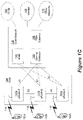
- FIG. 1C is a system diagram of the RAN 104 and the core network 106 according to an embodiment.
- the RAN 104 may employ an E-UTRA radio technology to communicate with the WTRUs 102a, 102b, 102c over the air interface 116.
- the RAN 104 may also be in communication with the core network 106.
- the RAN 104 may include eNodeBs 140a, 140b, 140c, though it will be appreciated that the RAN 104 may include any number of eNodeBs while remaining consistent with an embodiment.
- the eNodeBs 140a, 140b, 140c may each include one or more transceivers for communicating with the WTRUs 102a, 102b, 102c over the air interface 116.
- the eNodeBs 140a, 140b, 140c may implement MIMO technology.
- the eNodeB 140a for example, may use multiple antennas to transmit wireless signals to, and receive wireless signals from, the WTRU 102a.
- Each of the eNodeBs 140a, 140b, 140c may be associated with a particular cell (not shown) and may be configured to handle radio resource management decisions, handover decisions, scheduling of users in the uplink and/or downlink, and the like. As shown in FIG. 1C , the eNodeBs 140a, 140b, 140c may communicate with one another over an X2 interface.
- the core network 106 shown in FIG. 1C may include a mobility management gateway (MME) 142, a serving gateway 144, and a packet data network (PDN) gateway 146. While each of the foregoing elements are depicted as part of the core network 106, it will be appreciated that any one of these elements may be owned and/or operated by an entity other than the core network operator.
- MME mobility management gateway
- PDN packet data network
- the MME 142 may be connected to each of the eNodeBs 142a, 142b, 142c in the RAN 104 via an S1 interface and may serve as a control node.
- the MME 142 may be responsible for authenticating users of the WTRUs 102a, 102b, 102c, bearer activation/deactivation, selecting a particular serving gateway during an initial attach of the WTRUs 102a, 102b, 102c, and the like.
- the MME 142 may also provide a control plane function for switching between the RAN 104 and other RANs (not shown) that employ other radio technologies, such as GSM or WCDMA.
- the serving gateway 144 may be connected to each of the eNodeBs 140a, 140b, 140c in the RAN 104 via the S1 interface.
- the serving gateway 144 may generally route and forward user data packets to/from the WTRUs 102a, 102b, 102c.
- the serving gateway 144 may also perform other functions, such as anchoring user planes during inter-eNodeB handovers, triggering paging when downlink data is available for the WTRUs 102a, 102b, 102c, managing and storing contexts of the WTRUs 102a, 102b, 102c, and the like.
- the serving gateway 144 may also be connected to the PDN gateway 146, which may provide the WTRUs 102a, 102b, 102c with access to packet-switched networks, such as the Internet 110, to facilitate communications between the WTRUs 102a, 102b, 102c and IP-enabled devices.
- the PDN gateway 146 may provide the WTRUs 102a, 102b, 102c with access to packet-switched networks, such as the Internet 110, to facilitate communications between the WTRUs 102a, 102b, 102c and IP-enabled devices.
- the core network 106 may facilitate communications with other networks.
- the core network 106 may provide the WTRUs 102a, 102b, 102c with access to circuit-switched networks, such as the PSTN 108, to facilitate communications between the WTRUs 102a, 102b, 102c and traditional land-line communications devices.
- the core network 106 may include, or may communicate with, an IP gateway (e.g., an IP multimedia subsystem (IMS) server) that serves as an interface between the core network 106 and the PSTN 108.
- IMS IP multimedia subsystem
- the core network 106 may provide the WTRUs 102a, 102b, 102c with access to the networks 112, which may include other wired or wireless networks that are owned and/or operated by other service providers.
- the LTE downlink (DL) transmission scheme may be based on an OFDMA air interface.
- LTE uplink (UL) direction single-carrier (SC) transmission based on DFT-spread OFDMA (DFT-S-OFDMA) may be used.
- SC single-carrier
- DFT-S-OFDMA DFT-spread OFDMA
- a UE may be allocated by an eNodeB to receive its data anywhere across the whole LTE transmission bandwidth (e.g., an OFDMA scheme may be used.)
- the LTE DL may have an unused DC offset subcarrier in the center of the spectrum.
- the R8 LTE system may be based on DTF-S-OFDMA or SC-FDMA transmission.
- While a UE may, in the DL direction, receive its signal anywhere across the frequency domain of the entire LTE transmission bandwidth, in the UL direction a UE may transmit on a limited (or only on a limited), yet in an embodiment contiguous, set of assigned subcarriers in an Frequency Division Multiple Access (FDMA) arrangement. This arrangement may be referred to as Single Carrier (SC) FDMA.
- FDMA Frequency Division Multiple Access
- SC Single Carrier
- a first given UE may be assigned to transmit its own signal on sub-carriers 1-12, a second given UE may transmit on subcarriers 13-24, and so on.
- An eNodeB may receive the composite UL signal across the entire transmission bandwidth from one or more UEs in the same time, but each UE may transmit (or only transmit) into a subset of the available transmission bandwidth.
- DFT-S-OFDM in the UL may therefore be viewed as a conventional form of OFDM transmission with the additional constraint that the time-frequency resource assigned to a UE must consist of a set of frequency-consecutive sub-carriers.
- there may be no DC subcarrier. Frequency hopping may be applied in one mode of operation to UL transmissions by a UE.
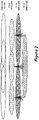
- LTE-A may support carrier aggregation (CA) and flexible bandwidth arrangement features. This may allow DL and UL transmission bandwidths to exceed 20 MHz ( e.g., as in R8 LTE). For example, transmission bandwidths of 40 MHz or up to 100 MHz may be supported. In LTE R10, component carriers (CC) may enable this spectrum aggregation feature. In an embodiment, there may be up to 100MHz aggregated spectrum, with 20MHz maximum bandwidth for each CC, and therefore at least 5 CCs. In LTE-A, different CCs may have different coverage.
- CA carrier aggregation
- LTE R10 component carriers
- CC component carriers
- different CCs may have different coverage.
- different cells may use different sets of CCs. Such cells may have different ranges and may have effective frequency reuse patterns greater than 1, as illustrated in Figure 2 .
- Carrier aggregation using multiple CC may be relevant for UEs in an RRC CONNECTED state.
- Idle UEs may access the network via a single UL and DL carrier pair (e.g., using frequency division duplexing (FDD)).
- FDD frequency division duplexing
- carrier aggregation in one serving eNodeB may be supported. This configuration may reduce the CA cell handover options to the allocation of target candidate CCs after handover or before handover. Allocating target candidates after handover may increase user plane delay, therefore allocation before handover may provide better performance, and may require adding an X2 interface message for measurement info exchange between a target and a source eNodeB.
- CCs may be used to mitigate the cell edge problem when a UE is in a good coverage area of a certain CC at a given time.
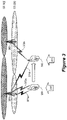
- overlaying CCs may be created with different cell edges by coordinating adjacent eNodeBs (cell sites) to vary the transmit power of each CC in a way that changes the distance to the cell edge, as show in Figure 3 .
- UE 350 may be at position 310 and may be communicating 371a via CC 320 with eNodeB 361, and may be communicating 372a via CC 330 with eNodeB 361.
- UE 350 may still communicate 371b via CC 320 with eNodeB 361, but may now communicate 372b via CC 330 with eNodeB 362. This may enable UE 350 to stay near a cell center by handing over to different CCs at different locations while the network maintains a frequency reuse factor of 1.
- full capability base stations including those with and without an associated radio head (RRH)
- RRH radio head
- eNodeB 361 and eNodeB 362 are referred to as eNodeBs, these network elements may be any other type of device and/or network element that is capable of performing the functions described herein.
- eNodeB 361 and/or eNodeB 362 may be a remote radio head (RRH), a sector antenna, any type of base station, or any combination of these or any other network element.
- RRH remote radio head
- Any such device or network element may be configured to perform any of the functions described herein that are described as being performed by a base station, eNodeB, gateway, node, or any other network element, and all such embodiments are contemplated as within the scope of the present disclosure.
- support of multiple CCs for carrier aggregation may be limited to one serving eNodeB. This may prevent a UE from maintaining a data connection using one CC with different eNodeBs.
- the network radio resource management (RRM) entity may determine whether to handover to another cell site instead of taking full advantage of the data throughput increase by using multiple CCs from different sites.
- the corresponding data stream may be routed to and from the associated eNodeB.
- Each data stream has associated resources (bandwidth and buffer) used to support transmission and reception.
- the aggregate bandwidth for each CC may be known by a network planner but the instantaneous bandwidth available for a UE on a CC is typically a dynamic decision of an eNodeB scheduler. The decision of how much data to send to each CC may have a direct impact on the resource requirements of each cooperating site.
- a cooperating eNodeB may feed back information on its available resources, for example, to a serving eNodeB that may determine if and how to perform data splitting, and that may be configured to receive the complete ( e.g., split ratio or unsplit) data flow.
- the data throughput of a service architecture evolution (SAE) bearer from eNodeB to a UE may be increased by coordinate splitting of data stream to multiple sites in the radio access network (RAN).
- the data splitting may be implemented at any layer of the RAN stack, including at the Packet Data Convergence Protocol layer (PDCP), the Radio Link Control (RLC) layer, the Media Access Control (MAC) layer, or at any combination or using any means as disclosed herein. Data splitting may also occur in the user plane. Systems and methods for performing such data splitting are disclosed in more detail herein.
- Uplink data and downlink data may be split across multiple eNodeBs and other sites (e.g., an RRH) in the RAN.
- an eNodeB may split the incoming data stream into N streams corresponding to the number of cooperating CCs.
- Data splitting may be based on bandwidth availability as reported by cooperating CCs, a buffer status as reported from the buffering entity, and/or the data rate from bearer QoS requirement.
- An eNodeB may also support interactive procedures to determine how to split data, such as a loading sensitive mechanism. This mechanism may use an algorithm that is based on the instantaneous buffer status, another measure of buffer status ( e.g., average) and/or bandwidth of an existing entity on the peer eNodeB.
- the flow control mechanism may be capable of buffering the data that is not yet acknowledged in order to recover from unrecoverable transmission errors on any of the cooperating CCs and/or buffering the data received from the data splitting entity and transmit it based on the bandwidth availability.
- an eNodeB may also support the ability to add or remove cooperating CCs dynamically without tearing down the SAE bearer.
- the eNodeB may also support load monitoring of the transmission path in order to provide periodic and/or event triggered measurement reports on the current buffer status to the data splitting entity and to provide periodic and/or event triggered measurement report on the bandwidth utilization.
- a UE may buffer the received data and perform reordering of the data received from different links to make sure that the data is provided to the upper layers in the order it was sent. This functionality may be used where layers above the entity do generally does not have the ability to perform such reordering (e.g., such as not having the ability to perform such reordering in the normal course of operation).
- a UE may also support in-sequence delivery and may configure affected layers to set up a data path that corresponds to the data stream splits.
- the X2 interface may support certain functions.
- the X2 application protocol (X2 AP) may provide the configuration and controls of the data split entities and may be responsible for delivering measurement and/or bandwidth monitoring reports and delivering entity setup, modification, and/or release configuration.
- the X2 data transport or tunneling protocol may connect the data split entities between serving and cooperating eNodeBs to provide transmit and/or receipt of data between connected eNodeBs and/or transfer data control messages (e.g., reset messages, buffer status, bandwidth monitoring reports, etc. ) between the two connected entities.
- the X2 data transport or tunneling protocol may also support flow control exchange over either the X2 AP or via in-band signaling through the tunneling protocol.
- a UE may split the incoming data stream into N streams corresponding to the number of cooperating CCs.
- Data splitting may be based on the bandwidth availability as scheduled by cooperating CCs, the buffer status as reported from the buffering entity, and/or the data rate from bearer QoS requirement.
- a UE may support a loading sensitive flow control mechanism that uses an algorithm that is based on the instantaneous or other measure (e.g., average) buffer status and/or eNodeB scheduled UL bandwidth.
- the flow control mechanism may be capable of buffering the data that is not yet acknowledged to recover from unrecoverable transmission errors on any of the cooperating CCs and/or buffering the data received from the data splitting entity and transmit it based on the bandwidth availability.
- a UE may also support the configuration to add or remove cooperating CCs dynamically without tearing down the SAE Bearer.
- a UE may support load monitoring of transmission path to provide periodic and/or event triggered measurement reports on the current buffer status to the data splitting entity and/or periodic and/or event triggered measurement report on the bandwidth utilization.
- an eNodeB may be configured to schedule (with or without cooperating eNodeB synchronization) bandwidth to a UE and buffer received data and perform reordering of data received from different links to ensure that the data is provided to the upper layers in the order it was sent.
- This reordering functionality may be use where layers above the entity does generally not have the ability to perform reordering ( e.g., such as not having the ability to perform such reordering in the normal course of operation).
- An eNodeB may also support in-sequence delivery and configuration of affected layers to set up a data path corresponding to the data stream splits.
- the X2 interface may support certain functions.
- the X2 application protocol may provide the configuration, may control the data split entities, and may be responsible for delivering measurement and/or bandwidth reports and/or delivering entity setup, modification, and/or release configuration.
- the tunneling protocol may connect the data split entity between serving and cooperating eNodeBs to provide for transmitting data between connected eNodeBs and/or transfer data control messages (e.g., reset messages, measurement reports, etc .) between the two connected entities.
- data splitting may be performed at the PDCP layer.
- An interworking function (PDCP IWF) may be used at a source eNodeB to forward compressed IP packets (PDCP PDU) to a PDCP IWF at cooperating eNodeB before forwarding to the RLC layer for transmit buffering.
- the PDCP IWF may provide support for multiple radio bearers per SAE bearer.
- FIG. 4 illustrates an exemplary DL data flow and system configuration that may be used in data splitting embodiment performing data splitting at the PDCP layer.
- UE 401 may be in a location that allows it to communicate with both eNodeB 410 and eNodeB 420.
- IP packet 405 may be received at eNodeB 410 and may have UE 401 as its destination.
- IP packet 405 maybe transmitted to eNodeB 410 vie SAE bearer 402, which may include radio bearers 403a and 403b.
- PDCP IWF 450 may facilitate splitting data between eNodeB 410 and eNodeB 420, in part with the use of inter-eNodeB tunnel 440.
- IP header compression may be performed at header compression modules 411a and 411b to reduce the number of bits needed to transmit over the radio interface.
- Robust header compression may be used, in any mode (e.g., unidirectional mode (U-mode), bidirectional optimistic mode (O-mode), and bidirectional reliable mode (R-mode)).
- O-mode and R-mode may utilize a feedback channel for error recovery. Because compression uses prior frame information, header compression processing performed by header compression modules 411a and 411b may be performed before data splitting with feedback processing being performed in one entity (e.g., only in one entity).
- Ciphering and integrity protection of the transmitted data may be performed at ciphering modules 412a and 412b.
- Inter-eNodeB tunnel 440 may carry a portion of the PDCP PDU as a split data stream sub-flow to cooperating eNodeB 420 but after ciphering to avoid having to signal and maintain multiple hyper-frame numbers (HFN) and PDCP sequence numbers (SN).
- HFN hyper-frame numbers
- SN PDCP sequence numbers
- Data may be split at the PDCP Inter-eNodeB multiplexer 413, and the data split off for eNodeB 420 may be transmitted to eNodeB 420 via Inter-eNodeB Tunnel 440.
- the data that is to be transmitted from eNodeB 410 may be provided to RLC buffers 414a and 414b, multiplexed at the MAC layer by MAC multiplexer 415, modulated and encoded at the physical layer by PHY Modulation and Coding module 417, and ultimately transmitted to UE 401 via CC 471.
- the data that is to be transmitted from eNodeB 420 may be provided to RLC buffers 424a and 424b, multiplexed at the MAC layer by MAC multiplexer 425, modulated and encoded at the physical layer by PHY Modulation and Coding module 427, and ultimately transmitted to UE 401 via CC 472.
- eNodeB 410 and eNodeB 420 may have MAC schedulers 416 and 426, respectively, that receive channel status data 419 and 429 from UE 401 ( e.g., downlink channel quality information) and data from RLC buffers and coordinates the transmission of data with the MAC multiplexers and PHY Modulation and Coding modules.
- a scheduler e.g., a simple round-robin distribution of received PDCP packet to active sites or based on some splitting algorithm with buffer status or transmit rate feedback from destination eNodeB 420
- a scheduler may be used to forward a PDCP PDU (e.g., containing a portion of IP packet 405) to another site (e.g., eNodeB 420) for transmit via another CC.
- This configuration provides for two or more (in an embodiment, depending on number of co-transmit sites) data streams (e.g., PDCP/RLC/MAC) set up per radio bearer (e.g., one per participating CC and N for a UE where N is total number of participating CCs).
- the scheduler residing on the PDCP/RLC interface may be responsible for the scheduling of data forwarding to different sites, including a main serving site and a cooperative site for further processing in RLC layer.
- a flow mechanism may be used to avoid loss of data in the event of congested or limited physical layer (PHY) bandwidth at cooperating CCs causing a buffer overflow.
- the flow mechanism may be a feedback-over-tunneling protocol providing data buffer status (e.g., RLC buffer occupancy) and/or instantaneous or some other measure of bandwidth information for a cooperating CC.
- the corresponding UL data split at the PDCP layer as shown in Figure 5 utilizes the same module layout as in DL, but reverses the data path direction.
- the inverse function may be performed by the same modules and/or entities in Figure 5 , or such inverse functions may be performed by different modules or entities.
- the MAC multiplexers of eNodeBs 410 and 420 may also perform demultiplexing for UL signals. Both DL and UL may be configured with a PDCP entity per each participating CC.
- data merger may be performed at eNodeB 410 by a merger entity of PDCP inter-eNodeB multiplexer 413.
- physical layer HARQ ACK/NACK may be handled independently with the transmitting cells.
- the data that is to be transmitted from UE 401 may be provided by PDCP IWF data split (not shown) to RLC buffers 434a and 434b configured on UE 401, multiplexed at the MAC layer by MAC multiplexer 435, modulated and encoded at the physical layer by PHY Modulation and Coding module 437, split and ultimately transmitted to eNodeB 410 via CC 473 and eNodeB 420 via CC 474.
- eNodeB 410 and eNodeB 420 may have MAC schedulers 416 and 426, respectively, that receive channel status data 419 and 429 from UE 401 ( e.g., uplink channel quality information).
- data merger may be performed to remerge the data split and in embodiments where the connection is configured for "RLC - in sequence delivery", the merger entity may perform this task instead of the RLC entity since an individual RLC entity may have received a partial PDCP data stream.
- the data merger may have access to a buffer that may be used to store out-of-order delivery due to different transmission path delay over an air interface (Iu).
- data merger may be performed at UE 401 by merger entity 407.
- Data splitting at the PDCP layer may have minor impact to established system architectures, requiring changes that are limited to PDCP. This configuration may also minimize configuration changes, and allow for independent PDCP PDU delivery from separate routes/sites ( e.g., eNodeBs, RRH, NodeB, etc. ) .
- a seamless handover may be guaranteed by the RAN with data duplication during preparation before or during the handover (HO).
- a data route tunnel to forward the data stream
- the source eNodeB may forward the PDCP packet transmission status (PDCP SN) to a target eNodeB to synchronize transmit status so that no packets are lost.
- PDCP SN PDCP packet transmission status
- the corresponding HO procedure may be performed in several ways.
- the HO command may be modified to handle multiple CCs.
- a handover similar to a conventional handover may be performed.
- the CC cooperation configurations may need to be updated to maintain the cooperation structure and, where a handover destination cannot support the needed service quality, the cooperation structure may need to be reorganized. Seamless data transmission may be assured with PDCP SN synchronization.
- a subset of a conventional handover procedure may be performed, where tunneling may be established between the source cooperating eNodeB and the target cooperating eNodeB.
- Data forwarding may be handled by either a new tunneling protocol or by reusing an existing GPRS tunneling protocol (in an embodiment, with some modification) between eNodeBs. Additional modification may be performed on handover preparation information (e.g., X2 signaling) and handover commands (e.g., RRC peer message over the air) to indicate that a serving CC has not changed.
- handover preparation information e.g., X2 signaling
- handover commands e.g., RRC peer message over the air
- the X2 interface may support inter-eNodeB RESOURCE (e.g., cell capacity) STATUS REQUEST and UPDATE.
- Cell capacity may be provided in terms of a percentage of UL/DL guaranteed bit rate (GBR) / non-GBR / total physical resource block (PRB) usage as well as UL/DL S1 transport network layer (TNL) load ( e.g., low/medium/high/over load) or via a new IE that may indicate a number of PDCP PDUs that may be waiting in the RLC transmission buffer.
- GBR UL/DL guaranteed bit rate
- PRB physical resource block
- TNL transport network layer
- new IE may indicate a number of PDCP PDUs that may be waiting in the RLC transmission buffer.
- this may be sufficient for PDCP level data splitting and to optimize the splitting scheduler algorithm efficiency.
- the X2 interface may be handled in several ways. Initial establishment may be treated as a partial handover, in which case the handover preparation information message may be used. In an embodiment, it may not be necessary to create a new X2 signaling protocol for this purpose. In an embodiment, a new X2 signaling message for a source eNodeB to request a target eNodeB to allocate resources (e.g., PDCP/RLC/MAC) may be created that supports cooperative transmission. Such a message may carry sufficient information to support some minimum data rate and QoS. Note that the architecture and configuration shown in Figures 4 and 5 may be used with any embodiment disclosed herein, including those that perform data splitting other than at the PDCP layer.
- data splitting may be performed at the RLC layer.
- an acknowledge mode (AM) mode bearer may be configured, but the disclosure set forth herein may be implemented with bearers of other modes.
- Data splitting may be achieved by splitting a single stream of data received from higher layers into multiple streams of data. Each stream of the split data may be referred to as a flow herein. Each flow may be analogous to an RLC entity as it is currently defined in 3GPP standards documents.
- Each flow may be input into a device (e.g., an eNodeB) as service data units (SDUs) with sequence numbers and may be output from the device as a stream of SDUs.
- SDUs service data units
- the SDUs may be broken down into protocol data units (PDUs) and may be reassembled on a peer node.
- PDUs protocol data units
- additional functionality performed at the RLC layer may include a data splitter entity that is responsible for splitting the data into one or more flows. Each flow on the transmitting side is functionally equivalent to a current version of the RLC.
- the data split entity may ensure that all the SDUs it receives from upper layers are buffered even if some of the SDUs are sent on a CC to an eNodeB so that the data can be retransmitted if there is a transmission failure, for example over the radio line, or some other problem between one of the CCs and the UE.
- a data merge entity may receive inputs from one or more flows and may buffer and reorder the SDUs before sending them to higher layers.
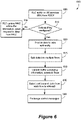
- FIG. 6 illustrates method 600 of performing UL data splitting at the RLC layer.
- an RLC entity on a UE may receives an SDU from PDCP.
- a determination is made as to whether data splitting is configured. Without data split configured, at block 615 RLC may update the MAC layer with the buffer information and await a data request from MAC. If data splitting is configured, at block 620, the data may be provided to the data split entity residing on the UE.
- the data split entity may split the data into multiple flows at block 625 (where each flow may act like an RLC AM entity by itself).
- the decision on how the data is to be split may be based on multiple factors including the bandwidth available on each CC based on input from MAC and the current buffer status on each flow.
- buffer occupancy information may be updated for MAC, and the MAC entity may determine the scheduling of the data for transmission over the air.
- the MAC scheduler may be modified to accommodate the concept of multiple flows.
- the MAC scheduler entity may select data from each flow and forward it to PHY for transmission to the destination eNodeB over an air interface (Iu).
- Iu air interface
- appropriate control messages are exchanged between the UE and the eNodeB on the same flow for acknowledging the data or for requesting a retransmission.
- EPC Enhanced Packet Core Network
- the RLC entity on the primary eNodeB that receives the flows from other RLC entities provides the data to a merge functionality or entity.
- the merge entity is responsible for merging the received data and for making sure that the data is in order before it is provided to PDCP.
- FIG. 7 illustrates an exemplary data flow and architecture that may be used in accordance with an embodiment where RLC layer data splitting is performed.
- UE 730 may receive data at PDCP layer 739 and provide the data to RLC layer 737.
- data split entity 736 splits the data into flows 731 and 732, which are provided to MAC 735.
- Data split entity 736 may track RLC SDUs as it divides the data into separate flows.
- MAC 735 may provide the data to PHY 734, which may transmit distinct portions of the data over different CCs (as flows 731 and 732) to eNodeB 710 and eNodeB 720.
- eNodeB 720 may receive the data at PHY 724 and provide it to MAC 725, which in turn provides the data of flow 732 to RLC 727. RLC 727 may then provide the flow data to eNodeB 710 via tunnel 740.
- data flow 731 may be received at PHY 714 which may provide it to MAC 715, which in turn provides the data of flow 731 to RLC 717.
- Data merge entity 718 of RLC 717 may then merge the data flows into properly ordered SDUs and provide the resultant data to PDCP 719, which may transmit the data as IP packets to a network. Data merge entity 718 may track RLC SDUs.
- X2 signaling 750 may be used to exchange control information between eNodeB 710 and eNodeB 720.
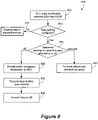
- FIG. 8 illustrates method 800 of performing DL data splitting at the RLC layer.
- an RLC entity on an eNodeB entity that has context with the EPC for the given UE receives the data that is destined for the UE. In normal mode when there is no CC involved, this may result in a change in the total buffer occupancy for the channel.
- the RLC entity on the eNodeB may determine whether data split is configured. If so, at block 820 the RLC entity may check with the data splitting entity to determine if the SDU is to be transmitted to the peer eNodeB or if it is available for local transmission. If data splitting is not configured, processing the received data may proceed normally at block 815.
- the data splitting entity may determine if the data is to be sent to the peer RLC or not based on a range of factors that may include the bandwidth available at the peer entity, current buffer status of the peer entity, etc. As the instantaneous buffer status may not be available over the X2 interface, the algorithm that determines the data split may determine the split based on assumed data rate or the last reported measurements and predictions based on the time since the last reported measurements.
- buffer occupancy information may be provided to MAC to be updated at block 825, and at block 830, the RLC may transmit the data to the MAC layer when the data is requested.
- the data may be transmitted to the UE at block 835.
- the data may be sent over the eNodeB-eNodeB tunnel to the peer eNodeB at block 840.
- the receiving RLC on the peer eNodeB may behave the same way as if it received the data from upper layers.
- the difference may be that the RLC transmission status feedback (e.g., RLC buffer status and the information about SDUs not transmitted) is forwarded to the RLC data split entity on the source eNodeB by the cooperating RLC entity. This may enable the data split entity to transmit a failed packet over another available CC as well as maintaining an up-to-date buffer status for a seamless handover.
- the RLC entity on each CC may update the buffer occupancy information it provides to the MAC layer.
- a MAC entity may schedule the data transmission based on the data and bandwidth availabilities.
- the reassembly functionality may be performed as per the current RLC standard independently for each flow. If there is any RLC Control information that has to be transmitted, the MAC on the UE side may be informed of the flow on which the data is to be transmitted.
- the SDUs Once the SDUs are formed they are provided to the data merge functionality that is responsible for reordering the SDUs (if it is so configured).
- the SDUs may be ordered before they are sent out of RLC to the PDCP layer. Reordering may be done based on the sequence numbers added to the SDU or based on the sequence number provided by PDCP.
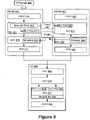
- FIG. 9 illustrates an exemplary data flow and architecture that may be used in accordance with an embodiment where RLC layer data splitting is performed.
- eNodeB 910 may receive IP packets 990 at PDCP layer 919 and provide the data to RLC layer 917.
- data split entity 918 may split the data into flows 931 and 932.
- Data split entity 918 may determine that flow 932 is to be transmitted to a peer eNodeB while flow 931 is to be transmitted locally ( i.e., directly to UE 930).
- Data split entity 918 may provide flow 931 to MAC 915 ( e.g., upon request after updating buffer occupancy information).
- Data split entity 918 may track RLC SDUs as it divides the data into separate flows.
- MAC 915 may provide the data for flow 931 to PHY 914, which may transmit flow 931 over a first CC to UE 930.
- eNodeB Flow 910 may provide flow 932 to eNodeB 920 via tunnel 940.
- RLC layer 927 may provide flow 932 to MAC 925 ( e.g., upon request after updating buffer occupancy information).
- MAC 925 may provide the data for flow 932 to PHY 924, which may transmit flow 932 over a second CC to UE 930.
- X2 signaling 950 may be used to exchange control information between eNodeB 910 and eNodeB 920.
- data flows 931 and 932 may be received at PHY 934 which may provide them to MAC 935, which in turn provides the data of flows 931 and 932 to RLC 937.
- Data merge entity 936 of RLC 937 may then merge the data flows into properly ordered SDUs and provide the resultant data to PDCP 939, which may transmit the data as IP packets to a network.
- Data merge entity 938 may track RLC SDUs.
- handover operations may be performed using any means or methods disclosed herein, including the mean disclosed in regards to PDCP layer data splitting.
- data splitting may be performed at the MAC layer.
- a MAC IWF may be configured on a source eNodeB that forwards RLC packets (e.g., PDUs) to a MAC IWF configured on a cooperating eNodeB that may provide transmit buffering.
- RLC packets e.g., PDUs
- MAC layer data splitting may be applied as described herein to high speed packet access (HSPA) configurations as well as LTE and LTE-A configurations.
- HSPA high speed packet access
- a serving eNodeB in LTE-A may be equivalent to a serving radio network controller (RNC) in HSPA
- RNC radio network controller
- a cooperating eNodeB in LTE-A may be equivalent to a NodeB or an RNC in HSPA.
- FIG. 10 illustrates an exemplary DL data flow and architecture that may be used in accordance with an embodiment where MAC layer data splitting is performed.
- eNodeB 1010 may receive IP packets 1090 at PDCPs 1019a and 1019b which may perform PDCP encoding and provide the data to RLC buffers layer 1017a and 1017b.
- RLC buffers 1017a and 1017b may provide the data to MAC 1015, which may include multiplexing entity 1019 that may determine the appropriate data split and splits the data into at least two portions.
- Multiplexing entity 1019 may take into account the available bandwidth for peer eNodeBs, and may forward the RLC PDU in performing data multiplexing.
- the data that is determined to be sent using a peer eNodeB may be provided to eNodeB 1020 by forwarding entity 1018 via inter-eNodeB tunnel 1040.
- the data that is determined to be transmitted locally i.e., directly from eNodeB 1010 to UE 1030 may be provided to hybrid ARQ (HARQ) entity 1016 that may perform any HARQ functions, and forward the data to PHY 1014 for transmission 1061 using a first CC to UE 1030.
- HARQ hybrid ARQ
- eNodeB 1020 upon receipt of data for UE 1030 from eNodeB 1010 via inter-eNodeB tunnel 1040, may buffer such data at inter-eNodeB buffer 1028.
- Buffer 1028 may provide the data to MAC 1025 for multiplexing by multiplexing entity 1029 and HARQ functions performed by HARQ entity 1026.
- the data may be provided to PHY 1024 for transmission 1062 using a second CC to UE 1030.
- MAC scheduler 1012 on serving eNodeB 1010 may use reported ( e.g., estimated or predetermined guaranteed or averaged transmission, etc .) supporting data rate from cooperating eNodeB 1020 as the reference in the payload selection algorithm to request the RLC PDU to be forwarded to cooperating inter-site CC for transmission.
- reported e.g., estimated or predetermined guaranteed or averaged transmission, etc .
- MAC scheduler 1022 at cooperating eNodeB 1020 may report (e.g., an estimated, predetermined, or calculated guaranteed or average transmission, etc. ) data rate that can be supported on eNodeB 1020 to serving eNodeB 1010 on a periodic basis, updating the supporting rate while a connection exists between the two eNodeB.
- This and other control information may be exchanged between eNodeBs via X2 signaling interface 1050.
- X2 interface per cell radio resource status may be requested but the update of radio resource status that provides DL/UL GBR/non-GBR/Total PRB may be optional.
- the PRB status may also be used as an alternative for scheduling input if such information is available.
- MAC scheduler 1022 at cooperating eNodeB 1020 may also perform standard payload selection for the cooperating CC using the RLC PDU buffers available in inter-eNodeB buffer 1028 either as a fixed size PDU or resize by multiplexing 1029 for available radio resources.
- RLC PDU size selection may be performed by serving eNodeB MAC scheduler 1012 to accommodate the reported supporting data rate or the guaranteed rate.
- MAC inter-eNodeB data forwarding entity 1018 on eNodeB 1010 may be a passive relay unit that may deliver MAC data to PHY for processing and/or to eNodeB 1020 via tunnel 1040.
- MAC inter-eNodeB buffer 1028 at cooperating eNodeB 1020 may serve as a temporary "parking" area on cooperating eNodeB 1020 to accommodate variable latency that may be due to data tunneling on X2 interface.
- Inter-site tunnel 1040 may be a data pipe that forwards RLC PDUs from serving eNodeB 1010 to cooperating eNodeB 1020. There may be one tunnel per each cooperating eNodeB.
- the configuration and data flow described herein in regard to Figure 10 and MAC layer data splitting may be implemented with minor impact to the system architecture and with changes limited to the MAC layer. Such changes may be minimal, and may be configuration changes that may be the same or with minor differences from those required to support Coordinated Multipoint Transmission (CoMP) procedures. In an embodiment, some of the CoMP procedures may be reused with some modification. In an embodiment, air interface resource reservation for participating sites may be used to reduce X2 interface delay. RLC SDU or in-sequence delivery may require that all relevant RLC PDUs be received correctly before RLC can deliver them to the upper layers. Note that the RLC PDUs may be transmitted over two different physical layer interfaces, each of which may have different latency than the other. Therefore, there may be a requirement on a receiving RLC entity to buffer additional input data. The cooperating CC may need to transmit the RLC PDU within the upper layer retransmit timer limit.
- CoMP Coordinated Multipoint Transmission
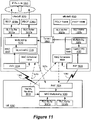
- the corresponding UL MAC layer data split data flows and architectures are illustrated in Figure 11 , using the same devices and entities described for Figure 10 .
- the functions shown in Figure 11 may be mostly or entirely compatible with existing LTE and/or LTE-A signaling structures, but may also include the enhancement of the configuration for multiple CCs and corresponding scheduling from network.
- the corresponding network requirement to forward successfully received MAC PDUs to RLC on a serving eNodeB may be the same as what is needed to introduce CoMP procedures.
- data may be received at RLC buffers 1037a and 1037b on UE 1030, and may be provided to MAC multiplexing entity 1039 that may determine the data split and provide the data to PHY 1034 for transmission on separate CCs 1063 and 1064 to eNodeB 1010 and 1020, respectively.
- Priority handling data may be used by MAC multiplexing entity 1039. Such data may be exchanged between priority handling entity 1032 and MAC schedulers 1012 and 1022.
- PHY 1014 of eNodeB 1010 may provide the data to MAC 1015, which may perform HARQ functions and provide the data to multiplexing entity 1019.
- Multiplexing entity 1019 may demultiplex the data with the data received from eNodeB 1020 via tunnel 1040.
- PHY 1024 of eNodeB 1020 may provide the data to MAC 1025, which may perform HARQ functions and provide the data to multiplexing entity 1029, which may demultiplex the data and provide it to eNodeB 1010 via tunnel 1040.
- the data may be provided to RLC buffers 1017a and 1017b, PDCP decoders 1019a and 1019b, and then transmitted to the network as IP packets 1091.
- Buffer status 1073 and 1074 may be provided by UE 1030 to MAC schedulers 1012 and 1022, respectively.
- basic handover features supported by LTE R8 may support handover as described herein with the addition of a configuration that supports reorganizing and/or maintaining a cooperation structure and support of partial handover on the X2 signaling interface.
- Partial handover of a serving CC or cooperating CCs may use the establishment of an additional data path between eNodeBs. There may be no need for data copy since MAC packet lost during path establishment or reestablishment may be handled autonomously with RLC level retransmission (for cooperating CC handover since RLC is always on the serving CC and may not have moved) or PDCP retransmission (for serving CC handover since PDCP transmission status is forwarded to a target cell).
- the X2 handover signal interface may encapsulate the handover preparation information defined by the RRC layer. Therefore, the signaling issue of communicating a partial handover may be addressed with the modification of an RRC handover message to provide the context of the cooperation structure in handover preparation information.
- user plane data splitting may be implemented in an exemplary system.
- the serving eNodeB may need to take into account the resources available and local scheduling information from the remote eNodeBs.
- a specialized "inter-working function" may be used to buffer downlink frames to mitigate the delay introduced by X2 link.
- the serving eNodeB may consider the X2 delay and may reduce X2 latency by initiating a serving gateway (S-GW) data-split instead of a RAN data split.
- S-GW serving gateway
- a serving eNodeB may transmit a control signal to a serving gateway instructing the serving gateway to begin splitting data.
- user-plane load on the X2 interface may be reduced by building the framework to allow the data-splitting to occur at the Serving Gateway, and extending the LTE R8 handover to allow for carrier-specific handover.
- a message sequence that allows a serving eNodeB to indicate the carrier-specific handover decision to the Serving Gateway and enable it to split the UE traffic in a carrier-specific manner may be used.
- eNodeB-MME messaging may be extended to support an indication of a handover of a list of affected radio access bearers (RABs), and require the MME to support carrier-specific PATH_SWITCH_REQUEST messages.
- RABs radio access bearers
- an eNodeB UE context may be established when the transition to an active state for a UE is completed or in a target eNodeB after completion of a handover resource allocation during handover preparation.
- An eNodeB UE context may be a block of information in an eNodeB associated with one active UE. This block of information may contain the necessary information required to maintain the E-UTRAN services towards the active UE.
- UE state information, security information, UE capability information and the identities of the UE-associated logical S1-connection may be included in the eNodeB UE context.
- user plane data splitting may be performed at a serving gateway, as illustrated in Figure 12 .
- IP packets 405 may be received at packet data network (PDN) gateway 1210 and transmitted to serving gateway 1220.
- Serving gateway 1220 may split the data and transmit one portion of the data to eNodeB 1230 via S1 bearer 1251 and the other portion of the data to eNodeB 1240 via S1 bearer 1252.
- eNodeBs 1230 and 1240 may then transmit the data to UE 1270 via radio bearers.
- Unacknowledged PDCP SDUs 1261 and 1262 may be transferred between eNodeBs to allow for lossless handover.
- Data-splitting for bearers associated with individual CCs at the serving gateway may be enabled based on input from the eNodeB and/or a load-balancing algorithm running on the Serving Gateway.
- a single component carrier may be associated with a HARQ entity.
- Logical channels may be transparently mapped to the different component carriers.
- the source eNodeB may indicate to the MME associated with the Serving Gateway (either directly or through a target eNodeB) the radio bearers that were being carried on the component carrier. This may be achieved by creating a message to be transmitted from the source eNodeB to the MME associated with the Serving Gateway, or by extending the Path Switch Request Message.
- the Path Switch Message may be exchanged between an eNodeB and an MME to request the switch of a downlink GPRS tunneling protocol (GTP) tunnel towards a new GTP tunnel endpoint.
- the Path Switch Message may carry the EUTRAN RAB (E-RAB) to be switched in the Downlink List information element (IE), which may be the list of all the E-RABs that need to be switched from the source eNodeB to target eNodeBs. If the E-RAB to be switched in the Downlink List IE in the PATH SWITCH REQUEST message may not include all E-RABs previously included in the UE Context, the MME may consider the non included E-RABs as implicitly released by the eNodeB.
- EUTRAN RAB EUTRAN RAB
- IE Downlink List information element
- the Path Switch Request (or an alternate message) may carry a list of RABs that need to be switched. However, the MME and Serving Gateway may continue forwarding the rest of the traffic to the source eNodeB as before.
- An eNodeB may determine how to request the splitting of data at the Serving Gateway (S-GW).
- S-GW Serving Gateway
- an eNodeB may request data-splitting at the RAB level, in which case the Path Switch Message may include a list of all RABs that need to be split. If the eNodeB does not want to split data at the RAB level, it may send an indicator with the percentage of traffic that should be redirected to the new eNodeB. In an embodiment, a "RAB to keep" list may be used to avoid potential compatibility or interpretation issues with older equipment.
- a serving eNodeB may also implement a routing algorithm to decide the optimum RAB/RB mapping based on AS information that may not be available to MME.
- An optional IE that provide routing suggestions may be included in the "PATH SWITCH REQUEST" where MME/S-GW may decide to adopt the data split routing as suggested by an eNodeB or alternatives.
- Some potential active inputs to the decision of determining data split routing may include RB/RAB split assignment (mapping of RAB/RB to specific eNodeB MAC address), percentage of data split, and other inputs.
- Partial data from a radio bearer may be sent on a component carrier, and this may be indicated by a special indicator to allow the Serving Gateway the option to split the traffic to mirror a similar arrangement.
- the special indicator may be a one-time event, or a periodic notification from the serving eNodeB to the S-GW/MME to change the splitting ratio based on channel quality measurements.
- MME/S-GW may implement some routing intelligence that is used to make the data flow split decision based on eNodeB-provided status inputs.
- Such inputs may include available eNodeB (e.g., PDCP) buffer, mean transmission latency (e.g., on UE or per specific RAB/RB), supportable traffic loading distribution (e.g., % load per eNodeB), and others.
- the packets sent from an S-GW may be IP traffic encapsulated in GTP tunnels, and may require the creation of two GTP tunnels, one terminating at the source eNodeB and another terminating at the target eNodeB for a single E-RAB identity. This may vary from some implementations that mandate a one-to-one RAB to radio bearer mapping.
- a UE may have one RRC connection with the network, with one special cell that would provide security and NAS information.
- UE 350 at position 311 is associated with an RRC connection with eNodeB 361, and established component carrier set of CC 320 and CC 330B.
- UE 350 may be associated with a serving cell (or special cell) at eNodeB 361, and may get the security and NAS mobility information from eNodeB 361 until a serving cell handover takes place.
- UE 350 moving to position 311 may cause an RRC Connection Handover, signaled using RRC Connection Reconfiguration, and may cause the reset of the MAC/RLC layers to account for new security parameters.
- UE 350 may maintain its RRC Connection with eNodeB 361 as it moves from position 310 to Position 311. Security procedures may need additional mechanisms for handover as described below.
- An eNodeB UE context may be established when the transition to active state for a UE is completed or in a target eNodeB after completion of handover resource allocation during handover preparation.
- a handover procedure may trigger the target eNodeB and the UE to generate fresh keys for a ciphering and encryption algorithm, derived from a ⁇ K eNB* , NCC ⁇ pair sent from a source eNodeB.
- the target eNodeB may use this tuple to generate a fresh K eNB .
- the K UPenc key (derived from K eNB ) may be used for the protection of user plane traffic with a particular encryption algorithm.
- the PDCP entity running in target eNodeB 362 may need to continue using the same keys as source eNodeB 361. This may allow the UE to receive PDCP entities from different eNodeBs simultaneously. These keys may be exchanged with the Handover Command in the handover preparation phase of handover from the source eNodeB to the target eNodeB. In an embodiment, this information may be conveyed during the Initial Context Setup from the S-GW.
- uplink reports may be available at a target eNodeB, and may either be transferred from a source eNodeB to target eNB over X2-AP, or the UE may send the reports separately to the two eNodeBs.
- the UE may send the reports on the serving cell to the "serving eNodeB".
- this may introduces latency in the availability of input for the scheduler at the target eNodeB, which may result in some implementations in non-optimum scheduling decisions.
- LTE R8 mechanisms may not support intra-frequency measurements because measurements may be based on serving cells.
- an eNodeB may own three carriers F1, F2, and F3, and may be using F1 and F2, and F1 may be the serving cell.
- F3 When the signal quality of F3 is better than F2, it may be desirable to have a measurement scheme to handle this situation so that the UE can report this situation.
- Carrier-specific measurements, including from non-serving cells, may be desired in some implementations.
- ROM read only memory
- RAM random access memory
- register cache memory
- semiconductor memory devices magnetic media such as internal hard disks and removable disks, magneto-optical media, and optical media such as CD-ROM disks, and digital versatile disks (DVDs).
- a processor in association with software may be used to implement a radio frequency transceiver for use in a WTRU, UE, terminal, base station, RNC, or any host computer.
Landscapes
- Engineering & Computer Science (AREA)
- Signal Processing (AREA)
- Computer Networks & Wireless Communication (AREA)
- Mobile Radio Communication Systems (AREA)
Applications Claiming Priority (4)
| Application Number | Priority Date | Filing Date | Title |
|---|---|---|---|
| US30376910P | 2010-02-12 | 2010-02-12 | |
| US30437710P | 2010-02-12 | 2010-02-12 | |
| PCT/US2011/024438 WO2011100492A1 (en) | 2010-02-12 | 2011-02-11 | Data split between multiple sites |
| EP11705371.0A EP2534875B1 (en) | 2010-02-12 | 2011-02-11 | Data split between multiple sites |
Related Parent Applications (2)
| Application Number | Title | Priority Date | Filing Date |
|---|---|---|---|
| EP11705371.0A Division EP2534875B1 (en) | 2010-02-12 | 2011-02-11 | Data split between multiple sites |
| EP11705371.0A Division-Into EP2534875B1 (en) | 2010-02-12 | 2011-02-11 | Data split between multiple sites |
Publications (1)
| Publication Number | Publication Date |
|---|---|
| EP4009733A1 true EP4009733A1 (en) | 2022-06-08 |
Family
ID=43821759
Family Applications (2)
| Application Number | Title | Priority Date | Filing Date |
|---|---|---|---|
| EP21205184.1A Pending EP4009733A1 (en) | 2010-02-12 | 2011-02-11 | Data split between multiple sites |
| EP11705371.0A Active EP2534875B1 (en) | 2010-02-12 | 2011-02-11 | Data split between multiple sites |
Family Applications After (1)
| Application Number | Title | Priority Date | Filing Date |
|---|---|---|---|
| EP11705371.0A Active EP2534875B1 (en) | 2010-02-12 | 2011-02-11 | Data split between multiple sites |
Country Status (7)
| Country | Link |
|---|---|
| US (2) | US9392515B2 (enExample) |
| EP (2) | EP4009733A1 (enExample) |
| JP (6) | JP2013520096A (enExample) |
| KR (2) | KR101480929B1 (enExample) |
| CN (2) | CN103039109B (enExample) |
| IL (1) | IL221420A (enExample) |
| WO (1) | WO2011100492A1 (enExample) |
Families Citing this family (277)
| Publication number | Priority date | Publication date | Assignee | Title |
|---|---|---|---|---|
| US11451275B2 (en) | 2004-04-02 | 2022-09-20 | Rearden, Llc | System and method for distributed antenna wireless communications |
| US11309943B2 (en) | 2004-04-02 | 2022-04-19 | Rearden, Llc | System and methods for planned evolution and obsolescence of multiuser spectrum |
| US10985811B2 (en) | 2004-04-02 | 2021-04-20 | Rearden, Llc | System and method for distributed antenna wireless communications |
| US10886979B2 (en) | 2004-04-02 | 2021-01-05 | Rearden, Llc | System and method for link adaptation in DIDO multicarrier systems |
| US9826537B2 (en) | 2004-04-02 | 2017-11-21 | Rearden, Llc | System and method for managing inter-cluster handoff of clients which traverse multiple DIDO clusters |
| US8654815B1 (en) | 2004-04-02 | 2014-02-18 | Rearden, Llc | System and method for distributed antenna wireless communications |
| US10200094B2 (en) | 2004-04-02 | 2019-02-05 | Rearden, Llc | Interference management, handoff, power control and link adaptation in distributed-input distributed-output (DIDO) communication systems |
| US10749582B2 (en) | 2004-04-02 | 2020-08-18 | Rearden, Llc | Systems and methods to coordinate transmissions in distributed wireless systems via user clustering |
| US10425134B2 (en) | 2004-04-02 | 2019-09-24 | Rearden, Llc | System and methods for planned evolution and obsolescence of multiuser spectrum |
| US11394436B2 (en) | 2004-04-02 | 2022-07-19 | Rearden, Llc | System and method for distributed antenna wireless communications |
| US10277290B2 (en) | 2004-04-02 | 2019-04-30 | Rearden, Llc | Systems and methods to exploit areas of coherence in wireless systems |
| US9819403B2 (en) | 2004-04-02 | 2017-11-14 | Rearden, Llc | System and method for managing handoff of a client between different distributed-input-distributed-output (DIDO) networks based on detected velocity of the client |
| US9312929B2 (en) | 2004-04-02 | 2016-04-12 | Rearden, Llc | System and methods to compensate for Doppler effects in multi-user (MU) multiple antenna systems (MAS) |
| US8542763B2 (en) | 2004-04-02 | 2013-09-24 | Rearden, Llc | Systems and methods to coordinate transmissions in distributed wireless systems via user clustering |
| US9685997B2 (en) | 2007-08-20 | 2017-06-20 | Rearden, Llc | Systems and methods to enhance spatial diversity in distributed-input distributed-output wireless systems |
| WO2011100673A1 (en) | 2010-02-12 | 2011-08-18 | Interdigital Patent Holdings, Inc. | Method and apparatus for enhancing cell-edge user performance and signaling radio link failure conditions via downlink cooperative component carriers |
| CN103039109B (zh) | 2010-02-12 | 2018-02-16 | 交互数字技术公司 | 多个站点间的数据分割 |
| EP2544496B1 (en) * | 2010-03-05 | 2019-06-19 | Sharp Kabushiki Kaisha | Wireless communication system, base station apparatus and communication control program |
| CN102934475A (zh) * | 2010-06-08 | 2013-02-13 | 三菱电机株式会社 | 无线通信系统以及终端装置 |
| CN104967507B (zh) * | 2010-06-09 | 2019-03-08 | 三星电子株式会社 | 移动通信系统和移动通信系统中的分组控制方法 |
| WO2011156769A1 (en) * | 2010-06-10 | 2011-12-15 | Interdigital Patent Holdings, Inc. | Reconfiguration and handover procedures for fuzzy cells |
| WO2012070048A1 (en) * | 2010-11-24 | 2012-05-31 | Elta Systems Ltd. | Handover initiation methods and systems for improvement of cellular network performance |
| US9271290B2 (en) | 2010-12-03 | 2016-02-23 | Interdigital Patent Holdings, Inc. | Methods, apparatus and systems for performing multi-radio access technology carrier aggregation |
| EP2656658A1 (en) * | 2010-12-22 | 2013-10-30 | Fujitsu Limited | Wireless communication method for monitoring a communication interface between access nodes |
| US8902833B2 (en) * | 2010-12-23 | 2014-12-02 | Qualcomm Incorporated | System and method for performing a radio link control (RLC) reset in a downlink multipoint system |
| EP2676476B1 (en) * | 2011-02-16 | 2018-10-31 | Nokia Solutions and Networks Oy | Radio link control |
| WO2012136256A1 (en) * | 2011-04-07 | 2012-10-11 | Nokia Siemens Networks Oy | Functional split for a multi-node carrier aggregation transmission scheme |
| KR20140035364A (ko) | 2011-04-07 | 2014-03-21 | 인터디지탈 패튼 홀딩스, 인크 | 로컬 데이터 캐싱 방법 및 장치 |
| EP3923639B1 (en) | 2011-05-17 | 2023-12-13 | InterDigital Patent Holdings, Inc. | Ue power adaptation for concurrent transmission over the pusch |
| US9294235B2 (en) * | 2011-06-07 | 2016-03-22 | Qualcomm Incorporated | Methods and apparatuses for user equipment-based enhancements of radio link control for multi-point wireless transmission |
| US20130010620A1 (en) * | 2011-07-10 | 2013-01-10 | Esmael Dinan | Connection Reconfiguration in a Multicarrier OFDM Network |
| KR101572933B1 (ko) * | 2011-07-13 | 2015-11-30 | 후아웨이 테크놀러지 컴퍼니 리미티드 | 다중반송파 주파수 전력증폭기 자원의 제어 방법 및 장치 |
| US8395985B2 (en) | 2011-07-25 | 2013-03-12 | Ofinno Technologies, Llc | Time alignment in multicarrier OFDM network |
| CN110366255B (zh) | 2011-07-29 | 2023-08-18 | 交互数字专利控股公司 | 用于多无线电接入技术无线系统中的无线电资源管理的方法和设备 |
| US9749992B2 (en) | 2011-08-10 | 2017-08-29 | Interdigital Patent Holdings, Inc. | Uplink feedback for multi-site scheduling |
| WO2013025562A2 (en) | 2011-08-12 | 2013-02-21 | Interdigital Patent Holdings, Inc. | Methods, apparatus and systems for power control and timing advance |
| CN103748927B (zh) | 2011-08-22 | 2018-05-08 | 三星电子株式会社 | 用于在移动通信系统中支持多频带的方法和装置 |
| KR102092579B1 (ko) | 2011-08-22 | 2020-03-24 | 삼성전자 주식회사 | 이동통신 시스템에서 복수 개의 주파수 밴드 지원 방법 및 장치 |
| US20130088960A1 (en) * | 2011-10-07 | 2013-04-11 | Futurewei Technologies, Inc. | System and Method for Information Delivery with Multiple Point Transmission |
| US9838089B2 (en) | 2011-10-07 | 2017-12-05 | Futurewei Technologies, Inc. | System and method for multiple point transmission in a communications system |
| CN103096474B (zh) * | 2011-10-27 | 2016-06-08 | 华为技术有限公司 | 数据分流传输方法、用户设备和基站 |
| CN103108404B (zh) * | 2011-11-14 | 2018-07-24 | 南京中兴新软件有限责任公司 | 业务建立方法及装置 |
| JP5879112B2 (ja) * | 2011-12-07 | 2016-03-08 | Kddi株式会社 | 無線制御装置、移動通信システムおよびコンピュータプログラム |
| US20130148588A1 (en) * | 2011-12-12 | 2013-06-13 | Telefonaktiebolaget Lm Ericsson | Scheduler and scheduling method for carrier aggregated communications |
| CN104137600B (zh) | 2012-01-09 | 2018-10-12 | 三星电子株式会社 | 用于记录的方法和装置 |
| CN103200615B (zh) * | 2012-01-10 | 2016-01-13 | 上海贝尔股份有限公司 | 一种在通信网络中进行数据传输的方法及装置 |
| WO2013104413A1 (en) * | 2012-01-10 | 2013-07-18 | Nokia Siemens Networks Oy | Providing a radio bearer on a plurality of component carriers |
| JP5806742B2 (ja) | 2012-01-19 | 2015-11-10 | 京セラ株式会社 | 移動通信システム、基地局、CoMP制御装置、及び通信制御方法 |
| US8964683B2 (en) | 2012-04-20 | 2015-02-24 | Ofinno Technologies, Llc | Sounding signal in a multicarrier wireless device |
| US9237537B2 (en) | 2012-01-25 | 2016-01-12 | Ofinno Technologies, Llc | Random access process in a multicarrier base station and wireless device |
| EP3937551A3 (en) | 2012-01-25 | 2022-02-09 | Comcast Cable Communications, LLC | Random access channel in multicarrier wireless communications with timing advance groups |
| US8526389B2 (en) | 2012-01-25 | 2013-09-03 | Ofinno Technologies, Llc | Power scaling in multicarrier wireless device |
| WO2013112021A1 (ko) | 2012-01-27 | 2013-08-01 | 삼성전자 주식회사 | 이동통신 시스템에서 복수의 캐리어를 이용해서 데이터를 송수신하는 방법 및 장치 |
| KR101980093B1 (ko) * | 2012-01-27 | 2019-05-20 | 삼성전자주식회사 | 차세대 무선 통신 시스템에서 서비스 제공 방법 및 시스템 |
| CN104081866B (zh) | 2012-01-31 | 2018-11-02 | Sca艾普拉控股有限公司 | 通信终端和方法 |
| GB2498959A (en) * | 2012-01-31 | 2013-08-07 | Sca Ipla Holdings Inc | Reducing and relieving the burden on the interface between base stations of a co-operating set of base stations |
| GB2498960A (en) * | 2012-01-31 | 2013-08-07 | Sca Ipla Holdings Inc | Relieving the burden on the interface between base stations of a co-operating set of base stations |
| US9525526B2 (en) * | 2012-02-02 | 2016-12-20 | Nokia Solutions And Networks Oy | Signaling of uplink scheduling information in case of carrier aggregation |
| US20150009923A1 (en) * | 2012-02-07 | 2015-01-08 | Nokia Corporation | Method and Apparatus to Report and Handle Buffer Status for User Equipment Working in Inter-Site Carrier Aggregation Mode |
| WO2013137802A2 (en) * | 2012-03-14 | 2013-09-19 | Telefonaktiebolaget L M Ericsson (Publ) | Methods and devices for reporting in a cellular radio network |
| EP2826191B1 (en) * | 2012-03-15 | 2022-10-05 | Nokia Solutions and Networks Oy | Wireless multi-flow communications in the uplink |
| EP2832149B1 (en) | 2012-03-30 | 2019-01-16 | Nokia Solutions and Networks Oy | Devices, methods and computer program products for an improved handover in inter-site carrier aggregation scenarios |
| US11943813B2 (en) | 2012-04-01 | 2024-03-26 | Comcast Cable Communications, Llc | Cell grouping for wireless communications |
| EP2835023B1 (en) | 2012-04-01 | 2021-09-01 | Comcast Cable Communications, LLC | Cell group configuration in a wireless device and base station with timing advance groups |
| US9084270B2 (en) | 2012-04-01 | 2015-07-14 | Ofinno Technologies, Llc | Radio access for a wireless device and base station |
| US9210664B2 (en) | 2012-04-17 | 2015-12-08 | Ofinno Technologies. LLC | Preamble transmission in a wireless device |
| EP2839705B1 (en) | 2012-04-16 | 2017-09-06 | Comcast Cable Communications, LLC | Cell group configuration for uplink transmission in a multicarrier wireless device and base station with timing advance groups |
| US11252679B2 (en) | 2012-04-16 | 2022-02-15 | Comcast Cable Communications, Llc | Signal transmission power adjustment in a wireless device |
| US8964593B2 (en) | 2012-04-16 | 2015-02-24 | Ofinno Technologies, Llc | Wireless device transmission power |
| US11582704B2 (en) | 2012-04-16 | 2023-02-14 | Comcast Cable Communications, Llc | Signal transmission power adjustment in a wireless device |
| US11825419B2 (en) | 2012-04-16 | 2023-11-21 | Comcast Cable Communications, Llc | Cell timing in a wireless device and base station |
| US9179425B2 (en) | 2012-04-17 | 2015-11-03 | Ofinno Technologies, Llc | Transmit power control in multicarrier communications |
| US9806873B2 (en) | 2012-05-09 | 2017-10-31 | Samsung Electronics Co., Ltd. | Method and apparatus for controlling discontinuous reception in mobile communication system |
| EP3982580B1 (en) | 2012-05-09 | 2024-12-11 | Samsung Electronics Co., Ltd. | Method and apparatus for transmitting and receiving data using plurality of carriers in mobile communication system |
| KR101896440B1 (ko) * | 2012-05-14 | 2018-09-11 | 삼성전자 주식회사 | 기지국간 반송파 집적 기술을 사용하는 무선통신시스템에서 버퍼 상태 보고를 처리하는 방법 및 장치 |
| WO2013176473A1 (ko) | 2012-05-21 | 2013-11-28 | 삼성전자 주식회사 | 이동통신 시스템에서 데이터를 송수신하는 방법 및 장치 |
| CN103458526B (zh) * | 2012-06-04 | 2017-07-14 | 电信科学技术研究院 | 一种缓冲区状态上报的方法、系统和设备 |
| US10560882B2 (en) | 2012-06-08 | 2020-02-11 | Blackberry Limited | Method and apparatus for multi-rat transmission |
| US9107206B2 (en) | 2012-06-18 | 2015-08-11 | Ofinne Technologies, LLC | Carrier grouping in multicarrier wireless networks |
| US9113387B2 (en) | 2012-06-20 | 2015-08-18 | Ofinno Technologies, Llc | Handover signalling in wireless networks |
| US9210619B2 (en) | 2012-06-20 | 2015-12-08 | Ofinno Technologies, Llc | Signalling mechanisms for wireless device handover |
| US9084228B2 (en) | 2012-06-20 | 2015-07-14 | Ofinno Technologies, Llc | Automobile communication device |
| US11882560B2 (en) | 2012-06-18 | 2024-01-23 | Comcast Cable Communications, Llc | Carrier grouping in multicarrier wireless networks |
| US8971298B2 (en) | 2012-06-18 | 2015-03-03 | Ofinno Technologies, Llc | Wireless device connection to an application server |
| US11622372B2 (en) | 2012-06-18 | 2023-04-04 | Comcast Cable Communications, Llc | Communication device |
| US9179457B2 (en) | 2012-06-20 | 2015-11-03 | Ofinno Technologies, Llc | Carrier configuration in wireless networks |
| US10355846B2 (en) * | 2012-06-26 | 2019-07-16 | Telefonaktiebolaget Lm Ericsson (Publ) | Methods and nodes for soft cell uplink prioritization |
| CN102869047A (zh) * | 2012-06-27 | 2013-01-09 | 中兴通讯股份有限公司 | 一种实现负载均衡的方法和装置 |
| US9408125B2 (en) | 2012-07-05 | 2016-08-02 | Qualcomm Incorporated | Aggregation of data bearers for carrier aggregation |
| EP2866506B1 (en) * | 2012-07-20 | 2018-02-21 | Huawei Technologies Co., Ltd. | Service transmission method, device and system |
| EP2869656B1 (en) * | 2012-07-23 | 2018-05-30 | Huawei Technologies Co., Ltd. | Data offloading method, macro base station, and small node |
| EP2871811B1 (en) * | 2012-07-25 | 2018-04-04 | Huawei Technologies Co., Ltd. | Data shunting method, data transmission device and shunting node device |
| WO2014021761A2 (en) * | 2012-08-02 | 2014-02-06 | Telefonaktiebolaget L M Ericsson (Publ) | A node and method for handing over a sub-set of bearers to enable multiple connectivity of a terminal towards several base stations |
| CN103828456B (zh) * | 2012-08-17 | 2018-07-13 | 华为技术有限公司 | 数据发送方法和装置 |
| WO2014031998A1 (en) | 2012-08-23 | 2014-02-27 | Interdigital Patent Holdings, Inc. | Providing physical layer resources to different serving sites |
| WO2014031989A1 (en) | 2012-08-23 | 2014-02-27 | Interdigital Patent Holdings, Inc. | Operating with multiple schedulers in a wireless system |
| JP5871750B2 (ja) | 2012-08-28 | 2016-03-01 | 株式会社Nttドコモ | 移動通信システム、無線基地局及び移動局 |
| JP5964698B2 (ja) * | 2012-08-29 | 2016-08-03 | 日本無線株式会社 | 無線通信システム |
| CN103686708B (zh) * | 2012-09-13 | 2018-01-19 | 电信科学技术研究院 | 一种密钥隔离方法及设备 |
| EP2901633A4 (en) * | 2012-09-28 | 2016-06-01 | Nec Corp | COMMUNICATION SYSTEM, CONTROL DEVICE, CONTROL PROCEDURE AND PROGRAM |
| EP2713651A1 (en) * | 2012-09-28 | 2014-04-02 | Alcatel Lucent | Method for handover management within heterogeneous networks |
| CN109769278A (zh) * | 2012-09-28 | 2019-05-17 | 三菱电机株式会社 | 移动通信系统 |
| BR112015006662A2 (pt) * | 2012-10-02 | 2017-07-04 | Rearden Llc | sistemas e métodos para backhaul sem fio em sistemas sem fio de entrada distribuída e saída distribuída utilizando multiplas antenas (mas) e múltiplos usuários (um) |
| EP2906008B1 (en) * | 2012-10-05 | 2021-09-01 | NEC Corporation | Radio communication system, first and second radio station, radio terminal, network apparatus and corresponding methods to implement inter-enb carrier aggregation |
| WO2014056152A1 (en) * | 2012-10-10 | 2014-04-17 | Empire Technology Development Llc | A carrier selection policy for joint scheduling for carrier aggregation in an lte-advanced system |
| US9240870B2 (en) * | 2012-10-25 | 2016-01-19 | Telefonaktiebolaget L M Ericsson (Publ) | Queue splitting for parallel carrier aggregation scheduling |
| CN104041102A (zh) * | 2012-11-13 | 2014-09-10 | 华为技术有限公司 | 传输数据的方法、基站和用户设备 |
| US10194346B2 (en) | 2012-11-26 | 2019-01-29 | Rearden, Llc | Systems and methods for exploiting inter-cell multiplexing gain in wireless cellular systems via distributed input distributed output technology |
| US11190947B2 (en) | 2014-04-16 | 2021-11-30 | Rearden, Llc | Systems and methods for concurrent spectrum usage within actively used spectrum |
| US11189917B2 (en) | 2014-04-16 | 2021-11-30 | Rearden, Llc | Systems and methods for distributing radioheads |
| US11050468B2 (en) | 2014-04-16 | 2021-06-29 | Rearden, Llc | Systems and methods for mitigating interference within actively used spectrum |
| US9998983B2 (en) | 2012-12-06 | 2018-06-12 | At&T Intellectual Property I, L.P. | Network-assisted device-based intelligent radio access control |
| US9544842B2 (en) * | 2012-12-06 | 2017-01-10 | At&T Intellectual Property I, L.P. | Network-based intelligent radio access control |
| US9374773B2 (en) | 2012-12-06 | 2016-06-21 | At&T Intellectual Property I, L.P. | Traffic steering across cell-types |
| US9549343B2 (en) | 2012-12-06 | 2017-01-17 | At&T Intellectual Property I, L.P. | Traffic steering across radio access technologies and radio frequencies utilizing cell broadcast messages |
| US10129822B2 (en) | 2012-12-06 | 2018-11-13 | At&T Intellectual Property I, L.P. | Device-based idle mode load balancing |
| US9544841B2 (en) | 2012-12-06 | 2017-01-10 | At&T Intellectual Property I, L.P. | Hybrid network-based and device-based intelligent radio access control |
| KR102018529B1 (ko) * | 2012-12-11 | 2019-09-05 | 한국전자통신연구원 | 이웃 셀의 버퍼 상태를 이용한 자원 배분 방법 및 장치 |
| ES2885401T3 (es) * | 2012-12-24 | 2021-12-13 | Innovative Sonic Corp | Métodos y aparatos de mejora en celdas pequeñas en un sistema de comunicación inalámbrica |
| JP6402629B2 (ja) | 2012-12-28 | 2018-10-10 | 日本電気株式会社 | 無線通信システム、無線局、無線端末、通信制御方法、及びプログラム |
| KR102000589B1 (ko) * | 2013-01-02 | 2019-07-16 | 삼성전자주식회사 | 무선 통신 시스템에서 이동국의 이동성을 지원하는 방법 |
| US9603192B2 (en) | 2013-01-16 | 2017-03-21 | Ncore Communications, Inc. | Methods and apparatus for hybrid access to a core network |
| CN103945461A (zh) * | 2013-01-23 | 2014-07-23 | 中兴通讯股份有限公司 | 数据多流传输方法及装置 |
| KR101670311B1 (ko) * | 2013-01-30 | 2016-10-28 | 이노베이티브 소닉 코포레이션 | 무선 통신 시스템에서 인터-노드 접속성을 처리하기 위한 방법 및 장치 |
| WO2014117335A1 (zh) | 2013-01-30 | 2014-08-07 | 华为技术有限公司 | 上行传输方法、基站和用户设备 |
| US9391881B2 (en) * | 2013-02-20 | 2016-07-12 | Ip Technology Labs, Llc | System and methods for dynamic network address modification |
| US9386619B2 (en) | 2013-02-22 | 2016-07-05 | Htc Corporation | Method of handling a cell addition for dual connectivity and related communication device |
| CN105009678B (zh) * | 2013-02-22 | 2019-04-05 | 三星电子株式会社 | 用于在多个e节点b和用户设备之间提供同时连接的方法和系统 |
| JP5851539B2 (ja) * | 2013-02-22 | 2016-02-03 | 宏達國際電子股▲ふん▼有限公司 | 複数の基地局および関連する通信装置との同時通信方法 |
| JP6154160B2 (ja) * | 2013-03-04 | 2017-06-28 | 株式会社Nttドコモ | 移動通信システム及び無線基地局 |
| US9161263B2 (en) * | 2013-03-07 | 2015-10-13 | Verizon Patent And Licensing Inc. | End-to-end quality of service optimization based on network performance indicators |
| US9923657B2 (en) | 2013-03-12 | 2018-03-20 | Rearden, Llc | Systems and methods for exploiting inter-cell multiplexing gain in wireless cellular systems via distributed input distributed output technology |
| US9973246B2 (en) | 2013-03-12 | 2018-05-15 | Rearden, Llc | Systems and methods for exploiting inter-cell multiplexing gain in wireless cellular systems via distributed input distributed output technology |
| US10488535B2 (en) | 2013-03-12 | 2019-11-26 | Rearden, Llc | Apparatus and method for capturing still images and video using diffraction coded imaging techniques |
| US10164698B2 (en) | 2013-03-12 | 2018-12-25 | Rearden, Llc | Systems and methods for exploiting inter-cell multiplexing gain in wireless cellular systems via distributed input distributed output technology |
| US10547358B2 (en) | 2013-03-15 | 2020-01-28 | Rearden, Llc | Systems and methods for radio frequency calibration exploiting channel reciprocity in distributed input distributed output wireless communications |
| WO2014139588A1 (en) * | 2013-03-15 | 2014-09-18 | Nokia Solutions And Networks Oy | Coordinated multipoint joint transmission with relaxed backhaul requirements |
| CN104066133B (zh) * | 2013-03-21 | 2019-10-22 | 北京三星通信技术研究有限公司 | 一种支持切换的方法 |
| US10075881B2 (en) * | 2013-04-02 | 2018-09-11 | Lg Electronics Inc. | Method for performing a cell change procedure in a wireless communication system and a device therefor |
| US9100883B2 (en) | 2013-04-03 | 2015-08-04 | Blackberry Limited | Methods and systems for wireless communication in heterogeneous networks |
| CA2908598C (en) * | 2013-04-03 | 2020-03-10 | Blackberry Limited | Methods and systems for wireless communication in heterogeneous networks |
| US9961683B2 (en) * | 2013-04-05 | 2018-05-01 | Nokia Solutions And Networks Oy | UL serving link's role change in heterogeneous network |
| ES2638501T3 (es) * | 2013-04-05 | 2017-10-23 | Alcatel Lucent | Red de conectividad dual |
| US10085188B2 (en) * | 2013-04-05 | 2018-09-25 | Telefonaktiebolaget Lm Ericsson (Publ) | Handover request indicating split of a radio bearer between cells |
| US20140307622A1 (en) * | 2013-04-12 | 2014-10-16 | Qualcomm Incorporated | Packet-level splitting for data transmission via multiple carriers |
| CN104322099B (zh) * | 2013-04-26 | 2018-10-19 | 华为技术有限公司 | 业务分流方法、装置及系统 |
| EP2991418B1 (en) | 2013-04-26 | 2021-06-23 | Huawei Technologies Co., Ltd. | Method and apparatus for multi-stream aggregation |
| US9629025B2 (en) * | 2013-05-03 | 2017-04-18 | Blackberry Limited | Controlling data offload in response to feedback information |
| EP2995163B1 (en) * | 2013-05-10 | 2017-03-29 | Telefonaktiebolaget LM Ericsson (publ) | Bearer configuration signaling |
| JP2016518793A (ja) * | 2013-05-10 | 2016-06-23 | アルカテル−ルーセント | デュアル・コネクティビティをサポートするための方法 |
| US10251171B2 (en) | 2013-05-15 | 2019-04-02 | Lg Electronics Inc. | Method for allocating uplink resources in a wireless communication system and a device therefor |
| EP2806689B1 (en) | 2013-05-21 | 2016-07-20 | Alcatel Lucent | A telecommunications method, telecommunications system, primary node, secondary node and use equipment |
| US9497682B2 (en) * | 2013-06-07 | 2016-11-15 | Intel Corporation | Central processing unit and methods for supporting coordinated multipoint transmission in an LTE network |
| US20140369329A1 (en) * | 2013-06-18 | 2014-12-18 | Qualcomm Incorporated | Lte and external wifi bandwidth aggregation |
| CN104244349B (zh) * | 2013-06-18 | 2021-06-15 | 索尼公司 | 通信装置和通信方法 |
| KR102091265B1 (ko) | 2013-07-10 | 2020-03-19 | 삼성전자주식회사 | 무선 통신 시스템에서 빔포밍을 이용한 다중 셀 통신 장치 및 방법 |
| EP2824986B1 (en) * | 2013-07-11 | 2023-03-22 | Fujitsu Limited | Buffer status reporting in small cell networks |
| US20160150440A1 (en) * | 2013-07-26 | 2016-05-26 | Lg Electronics Inc. | Method for triggering a burffer status reporting and a device therefor |
| JP6125939B2 (ja) * | 2013-07-29 | 2017-05-10 | 京セラ株式会社 | ユーザ端末及びプロセッサ |
| US9999033B2 (en) | 2013-07-29 | 2018-06-12 | Lg Electronics Inc. | Method for calculating and reporting a buffer status and device therefor |
| CN104349467A (zh) * | 2013-08-01 | 2015-02-11 | 上海贝尔股份有限公司 | 支持多连接的数据承载的多流传输的方法和装置 |
| WO2015018451A1 (en) * | 2013-08-09 | 2015-02-12 | Nokia Solutions And Networks Oy | Use of packet status report from secondary base station to master base station in wireless network |
| ES2770786T3 (es) * | 2013-08-09 | 2020-07-03 | Alcatel Lucent | Configuración o modificación de flujos de datos entre equipos de usuario en conectividad dual |
| CN104349308B (zh) | 2013-08-09 | 2018-06-05 | 宏达国际电子股份有限公司 | 双连结中分配无线网络暂时识别的方法、通信装置以及网络端 |
| KR102139721B1 (ko) * | 2013-08-29 | 2020-07-30 | 삼성전자주식회사 | 다중 경로 프로토콜에서 이중으로 네트워크 코딩을 적용하는 방법 및 그 장치 |
| WO2015029406A1 (ja) * | 2013-08-29 | 2015-03-05 | セイコーエプソン株式会社 | 送信システム、送信装置、及び、データ送信方法 |
| CN104427554A (zh) * | 2013-08-29 | 2015-03-18 | 中兴通讯股份有限公司 | 一种协作多流传输数据的方法及基站 |
| WO2015032565A1 (en) * | 2013-09-09 | 2015-03-12 | Nokia Solutions And Networks Oy | Selective bearer splitting in cell system |
| US9380646B2 (en) | 2013-09-24 | 2016-06-28 | At&T Intellectual Property I, L.P. | Network selection architecture |
| US20150089382A1 (en) * | 2013-09-26 | 2015-03-26 | Wu-chi Feng | Application context migration framework and protocol |
| EP2854444A1 (en) | 2013-09-27 | 2015-04-01 | Panasonic Intellectual Property Corporation of America | Efficient uplink scheduling mechanism for dual connectivity |
| US9924405B2 (en) * | 2013-10-04 | 2018-03-20 | Industrial Technology Research Institute | Method for buffer status report in dual connectivity |
| US9226197B2 (en) | 2013-10-21 | 2015-12-29 | At&T Intellectual Property I, L.P. | Network based speed dependent load balancing |
| EP3048845B1 (en) * | 2013-10-21 | 2018-04-11 | Huawei Technologies Co., Ltd. | Device and method for data transmission |
| WO2015059055A2 (en) * | 2013-10-22 | 2015-04-30 | Alcatel Lucent | Integration of cellular and wlan systems |
| US9241305B2 (en) | 2013-10-28 | 2016-01-19 | At&T Intellectual Property I, L.P. | Access network discovery and selection function enhancement with cell-type management object |
| US10721728B2 (en) * | 2013-10-31 | 2020-07-21 | Nec Corporation | Radio communication system, base station apparatus, radio terminal, and communication control method |
| GB2519975A (en) | 2013-11-01 | 2015-05-13 | Nec Corp | Communication system |
| CN105122867B (zh) | 2013-11-07 | 2019-07-09 | 华为技术有限公司 | 一种测量用户终端业务传输情况的方法和服务站点 |
| CN104798320B (zh) * | 2013-11-11 | 2018-11-09 | 华为技术有限公司 | 数据传输方法及装置 |
| US10037410B2 (en) | 2013-11-27 | 2018-07-31 | General Electric Company | Cloud-based clinical information systems and methods of use |
| KR102155526B1 (ko) | 2013-11-29 | 2020-09-15 | 삼성전자 주식회사 | 빔 포밍 기반의 무선 통신 시스템에서 베어러 관리 방법 및 장치 |
| WO2015096030A1 (zh) | 2013-12-24 | 2015-07-02 | 华为技术有限公司 | 一种数据传输的方法、设备和系统 |
| US20150208313A1 (en) * | 2014-01-23 | 2015-07-23 | Humax Holdings Co., Ltd. | System for bearer assembling in lte dual connectivity |
| US10075381B2 (en) * | 2014-01-28 | 2018-09-11 | Mediatek Inc. | Buffer status report and logical channel prioritization for dual connectivity |
| WO2015122622A1 (en) | 2014-02-13 | 2015-08-20 | Lg Electronics Inc. | Method and apparatus for transmitting and receiving broadcast signal |
| WO2015137644A2 (en) * | 2014-03-12 | 2015-09-17 | Lg Electronics Inc. | Method for calculating and reporting an amount of data available for transmission and a device therefor |
| KR102279486B1 (ko) * | 2014-03-13 | 2021-07-20 | 삼성전자 주식회사 | 무선 통신 시스템에서 연결을 생성하는 방법 및 장치 |
| WO2015141478A1 (ja) * | 2014-03-19 | 2015-09-24 | 株式会社Nttドコモ | ユーザ装置及びアップリンクデータ送信方法 |
| JP6114876B2 (ja) | 2014-03-20 | 2017-04-12 | 京セラ株式会社 | 通信システム、セルラ基地局及びwlan管理装置 |
| WO2015141845A1 (ja) | 2014-03-20 | 2015-09-24 | 京セラ株式会社 | マスタ基地局、移動局及び通信制御方法 |
| US11290162B2 (en) | 2014-04-16 | 2022-03-29 | Rearden, Llc | Systems and methods for mitigating interference within actively used spectrum |
| CN106165511A (zh) * | 2014-04-18 | 2016-11-23 | 株式会社Ntt都科摩 | 用户装置、基站、上行数据分割比率计算方法、以及上行数据分割比率提供方法 |
| US9755726B2 (en) * | 2014-04-21 | 2017-09-05 | Alcatel Lucent | Method and apparatus for improved multi-carrier communication |
| JP6084754B2 (ja) * | 2014-05-08 | 2017-02-22 | 京セラ株式会社 | セルラ基地局、ユーザ端末、及びプロセッサ |
| US9888513B2 (en) * | 2014-06-09 | 2018-02-06 | Nokia Solutions And Networks Oy | Inter-eNB carrier aggregation |
| EP3167648B1 (en) * | 2014-07-08 | 2019-02-20 | Intel Corporation | Devices for packet system bearer splitting |
| CN105451355B (zh) * | 2014-08-18 | 2019-06-18 | 上海诺基亚贝尔股份有限公司 | 用于向自身服务的用户设备传输数据的方法、基站和系统 |
| US20160057687A1 (en) * | 2014-08-19 | 2016-02-25 | Qualcomm Incorporated | Inter/intra radio access technology mobility and user-plane split measurement configuration |
| KR101814248B1 (ko) | 2014-09-05 | 2018-01-04 | 주식회사 케이티 | 무선랜 캐리어를 이용한 데이터 전송 방법 및 장치 |
| US9844070B2 (en) * | 2014-09-10 | 2017-12-12 | Cisco Technology, Inc. | System and method for decoupling long term evolution media access control scheduling from subframe rate procedures |
| CN105472721B (zh) * | 2014-09-11 | 2019-04-19 | 上海诺基亚贝尔股份有限公司 | 用于基站的干扰协调方法 |
| US10440765B2 (en) | 2014-09-24 | 2019-10-08 | Apple Inc. | Multi-RAT radio resource aggregation with split bearer support |
| US10736175B2 (en) * | 2014-10-02 | 2020-08-04 | Kt Corporation | Method for processing data using WLAN carrier and apparatus therefor |
| KR102263688B1 (ko) | 2014-10-07 | 2021-06-10 | 삼성전자주식회사 | 무선 통신 시스템에서 다른 무선 접속 기술을 이용한 다중 연결을 제공하기 위한 장치 및 방법 |
| CN104320812B (zh) * | 2014-10-13 | 2018-12-28 | 中国联合网络通信集团有限公司 | 一种联合传输的方法、装置及系统 |
| US9398518B2 (en) | 2014-10-21 | 2016-07-19 | At&T Intellectual Property I, L.P. | Cell broadcast for signaling resource load from radio access networks |
| US9906973B2 (en) | 2014-11-28 | 2018-02-27 | Industrial Technology Research Institute | Evolved NodeB and traffic dispatch method thereof |
| US10219310B2 (en) * | 2014-12-12 | 2019-02-26 | Alcatel Lucent | WiFi boost with LTE IP anchor |
| US10708810B2 (en) | 2014-12-23 | 2020-07-07 | Interdigital Patent Holdings, Inc. | Methods for WiFi integration in cellular systems |
| WO2016101171A1 (en) * | 2014-12-24 | 2016-06-30 | Qualcomm Incorporated | Inter-sim aggregation |
| WO2016114767A1 (en) * | 2015-01-13 | 2016-07-21 | Hitachi, Ltd. | Location based cooperative caching at the ran |
| US9699153B2 (en) * | 2015-01-19 | 2017-07-04 | Intel IP Corporation | Systems, methods and devices for direct communication |
| CN105992272A (zh) * | 2015-01-27 | 2016-10-05 | 中国移动通信集团公司 | 一种数据发送及接收方法、装置和数据传输系统 |
| US9954771B1 (en) * | 2015-01-30 | 2018-04-24 | Marvell Israel (M.I.S.L) Ltd. | Packet distribution with prefetch in a parallel processing network device |
| US10869344B2 (en) * | 2015-03-19 | 2020-12-15 | Acer Incorporated | Method of radio bearer transmission in dual connectivity |
| CN106161300B (zh) * | 2015-03-25 | 2019-05-24 | 上海诺基亚贝尔股份有限公司 | 用于动态实施频率复用的方法和分析器 |
| EP3270622A4 (en) * | 2015-04-10 | 2018-03-07 | Kyocera Corporation | User equipment and wireless communication device |
| KR102237511B1 (ko) * | 2015-04-29 | 2021-04-07 | 삼성전자주식회사 | 무선 통신 시스템에서 단말의 통신 제어 방법 및 장치 |
| US10230650B2 (en) * | 2015-06-26 | 2019-03-12 | Huawei Technologies Co., Ltd. | Joint radio link control (RLC) signaling with network coding |
| CN106332152B (zh) * | 2015-06-30 | 2019-09-27 | 华为技术有限公司 | 一种数据传输方法以及相关设备 |
| WO2017062057A1 (en) * | 2015-10-08 | 2017-04-13 | Intel Corporation | Network utility maximization with multi-rat aggregation |
| KR102448173B1 (ko) * | 2015-11-19 | 2022-09-28 | 삼성전자 주식회사 | 캐리어 집적을 지원하는 무선 통신 시스템에서의 데이터 전송 방법 및 장치 |
| US10021597B2 (en) | 2016-04-04 | 2018-07-10 | At&T Intellectual Property I, L.P. | Flow control in multi-RAT 5G wireless networks |
| CN107371207A (zh) * | 2016-05-13 | 2017-11-21 | 电信科学技术研究院 | 一种数据传输方法、ue、基站和系统 |
| WO2017200227A1 (ko) * | 2016-05-19 | 2017-11-23 | 엘지전자(주) | 무선 통신 시스템에서 데이터를 송수신하기 위한 방법 및 이를 지원하는 장치 |
| BR112018017299A2 (pt) * | 2016-06-08 | 2019-01-02 | Huawei Tech Co Ltd | porta de comunicação, nó de acesso mestre e métodos dos mesmos |
| US10523280B2 (en) | 2016-06-16 | 2019-12-31 | Lg Electronics Inc. | Method and device for receiving signal in wireless communication system to which multiple-transmission technique is applied |
| WO2018000644A1 (zh) * | 2016-06-30 | 2018-01-04 | 华为技术有限公司 | 多连接通信方法和设备 |
| KR102337555B1 (ko) * | 2016-07-11 | 2021-12-09 | 삼성전자 주식회사 | 무선 통신 시스템에서 멀티링크를 이용한 데이터 송수신 방법 및 장치 |
| US11140578B2 (en) * | 2016-07-11 | 2021-10-05 | Samsung Electronics Co., Ltd. | Method and apparatus for transmitting and receiving data using multilinks in wireless communication system |
| WO2018091227A1 (en) * | 2016-11-18 | 2018-05-24 | Telefonaktiebolaget Lm Ericsson (Publ) | Technique for transferring data in a radio communication |
| JP6612204B2 (ja) * | 2016-12-07 | 2019-11-27 | ソフトバンク株式会社 | 無線通信システム、基地局及び移動局 |
| US10292081B2 (en) * | 2017-02-03 | 2019-05-14 | Lg Electronics Inc. | Method and apparatus for performing partial handover for continuous data transmission in wireless communication system |
| KR102809858B1 (ko) | 2017-02-28 | 2025-05-19 | 삼성전자주식회사 | 기지국간 캐리어 집적을 지원하기 위한 패킷 생성 및 분배 방법 및 장치 |
| US10237784B2 (en) * | 2017-03-24 | 2019-03-19 | Motorola Mobility Llc | Split bearer packet data converge protocol protocol data unit routing |
| CN106817191A (zh) * | 2017-03-27 | 2017-06-09 | 成都凯力科技有限公司 | 干扰消除方法 |
| WO2018206855A1 (en) * | 2017-05-12 | 2018-11-15 | Nokia Technologies Oy | Protocol data unit session splitting function and signalling |
| RU2671845C1 (ru) * | 2017-06-02 | 2018-11-07 | Хуавэй Текнолоджиз Ко., Лтд. | Способ передачи данных, базовая станция и пользовательское оборудование |
| CN109151944A (zh) * | 2017-06-15 | 2019-01-04 | 维沃移动通信有限公司 | 数据传输方法、装置、用户终端、网络节点、计算机可读存储介质 |
| CN109429368B (zh) * | 2017-06-23 | 2022-03-01 | 中兴通讯股份有限公司 | 消息发送方法、系统、装置、网元、存储介质及处理器 |
| KR102386305B1 (ko) * | 2017-07-25 | 2022-04-14 | 삼성전자주식회사 | 무선 네트워크 시스템에서 트래픽을 처리하는 방법 및 장치 |
| WO2019030981A1 (ja) | 2017-08-09 | 2019-02-14 | 日本電気株式会社 | 無線アクセスネットワークノード、コアネットワークノード、及び無線端末並びにこれらの方法 |
| CN110572882B (zh) * | 2017-08-11 | 2021-03-05 | 华为技术有限公司 | 一种通信方法、装置、计算机存储介质和通信系统 |
| KR102413507B1 (ko) * | 2017-10-30 | 2022-06-24 | 후아웨이 테크놀러지 컴퍼니 리미티드 | 서비스 신뢰성 개선 방법, 디바이스 및 시스템 |
| WO2019140558A1 (zh) | 2018-01-16 | 2019-07-25 | Oppo广东移动通信有限公司 | 数据复制的数据量的上报方法、用户设备及网络设备 |
| WO2019140872A1 (zh) * | 2018-01-16 | 2019-07-25 | Oppo广东移动通信有限公司 | 数据复制的数据量的上报方法、用户设备及网络设备 |
| US11140675B2 (en) * | 2018-09-27 | 2021-10-05 | Mediatek Inc. | Methods of efficient bandwidth part switching in carrier aggregation |
| CN111181697B (zh) * | 2018-11-13 | 2025-09-09 | 三星电子株式会社 | 用于tcp ack包的传输的方法和系统 |
| JP6672445B2 (ja) * | 2018-12-18 | 2020-03-25 | 株式会社Nttドコモ | 移動通信システム |
| US12063543B2 (en) * | 2019-01-21 | 2024-08-13 | Telefonaktiebolaget Lm Ericsson (Publ) | Network nodes and methods supporting multiple connectivity |
| KR102207499B1 (ko) * | 2019-02-12 | 2021-01-25 | 주식회사 엘지유플러스 | 단말에서 전송되는 업링크 신호의 전송 경로를 결정하는 방법 및 장치 |
| CN113455050B (zh) * | 2019-02-22 | 2024-12-20 | 苹果公司 | 用于减少切换中断的系统和方法 |
| WO2020213169A1 (ja) | 2019-04-19 | 2020-10-22 | 富士通株式会社 | 基地局、端末装置、および通信システム |
| US10999883B1 (en) * | 2019-06-04 | 2021-05-04 | Sprint Spectrum L.P. | Use of uplink power headroom as a basis to control configuration of dual-connectivity service |
| US11403106B2 (en) * | 2019-09-28 | 2022-08-02 | Tencent America LLC | Method and apparatus for stateless parallel processing of tasks and workflows |
| US12507116B2 (en) * | 2019-12-06 | 2025-12-23 | Sharp Kabushiki Kaisha | User equipment and method thereof, and base station and method thereof |
| US11514729B2 (en) | 2020-02-28 | 2022-11-29 | Toyota Motor North America, Inc. | Transport behavior observation |
| US11461087B2 (en) | 2020-02-28 | 2022-10-04 | Toyota Motor North America, Inc. | Transport sensor data update |
| US11265945B1 (en) | 2020-07-09 | 2022-03-01 | Sprint Spectrum L.P. | Dynamic restriction of split-uplink-mode operation in response to high level of voice muting |
| US11337113B2 (en) | 2020-08-05 | 2022-05-17 | Sprint Spectrum L.P. | Use of uplink communication quality as basis to control split-uplink operation for dual-connectivity service |
| US11343717B1 (en) | 2020-08-28 | 2022-05-24 | Sprint Spectrum L.P. | Dynamic control of uplink communication from a dual-connected device, based on uplink backhaul congestion per connection |
| US11350313B1 (en) | 2020-09-03 | 2022-05-31 | Sprint Spectrum L.P. | Dynamic control of uplink communication from a dual-connected device, based on antenna pattern efficiency per connection |
| US11323924B1 (en) | 2020-10-26 | 2022-05-03 | Sprint Spectrum L.P. | Controlling intra-RAT handover under first RAT based on spectral efficiency under second RAT |
| US11419008B1 (en) | 2020-11-13 | 2022-08-16 | Sprint Spectrum L.P. | Use of per-connection insertion loss as basis for dynamic control of air-interface communication with dual-connected device |
| US11582645B1 (en) | 2020-11-13 | 2023-02-14 | Sprint Spectrum Llc | Use of per-connection frequency bandwidth as basis for dynamic control of air-interface communication with dual-connected device |
| US11363495B1 (en) | 2020-11-13 | 2022-06-14 | Sprint Spectrum L.P. | Use of per-connection spectral efficiency as basis for dynamic control of air-interface communication with dual-connected device |
| US11418237B1 (en) | 2020-11-13 | 2022-08-16 | Sprint Spectrum L.P. | Use of per-connection MIMO support as basis for dynamic control of air-interface communication with dual-connected device |
| US11516863B1 (en) * | 2020-11-13 | 2022-11-29 | Sprint Spectrum Lp | Use of per-connection fading as basis for dynamic control of Air-Interface communication with dual-connected device |
| US11533768B1 (en) | 2020-11-13 | 2022-12-20 | Sprint Spectrum Lp | Use of per-connection beamforming support as basis for dynamic control of air-interface communication with dual-connected device |
| US11546792B1 (en) | 2021-02-18 | 2023-01-03 | Sprint Spectrum Lp | Dynamic control of split-uplink-mode operation to help facilitate resource availability for UEs served without split uplink |
| US12041488B2 (en) * | 2022-01-05 | 2024-07-16 | Dell Products, L.P. | Radio unit cascading in radio access networks |
| US20230254737A1 (en) | 2022-02-10 | 2023-08-10 | Sterlite Technologies Limited | Managing data networks on user equipments |
| US12464459B2 (en) * | 2022-03-21 | 2025-11-04 | Intel Corporation | Wireless communication systems |
| KR20230174912A (ko) | 2022-06-22 | 2023-12-29 | 동우 화인켐 주식회사 | 안테나용 회로 기판, 이를 포함하는 안테나 패키지 및 이를 포함하는 화상 표시 장치 |
| CN117835355A (zh) * | 2022-09-30 | 2024-04-05 | 华为技术有限公司 | 数据传输方法和通信装置 |
| CN118413863A (zh) * | 2023-01-30 | 2024-07-30 | 索尼集团公司 | 电子设备、通信方法和计算机可读存储介质 |
Citations (2)
| Publication number | Priority date | Publication date | Assignee | Title |
|---|---|---|---|---|
| US20070286126A1 (en) * | 2006-06-07 | 2007-12-13 | Rajat Prakash | Methods and apparatus for using control values to control communications processing |
| US20080220787A1 (en) * | 2007-03-07 | 2008-09-11 | Nextwave Broadband, Inc. | Channel Aggregation |
Family Cites Families (65)
| Publication number | Priority date | Publication date | Assignee | Title |
|---|---|---|---|---|
| US20060121921A1 (en) | 2003-06-27 | 2006-06-08 | Mitsubishi Denki Kabushiki Kaisha | Transmitter apparatus, receiver apparatus and radio communication apparatus |
| EP1728339A4 (en) | 2004-08-05 | 2007-04-25 | Lg Electronics Inc | Distinction of protocol packets in a wireless communication system |
| US8233450B2 (en) | 2004-09-10 | 2012-07-31 | Interdigital Technology Corporation | Wireless communication methods and components for facilitating multiple network type compatibility |
| CN100499935C (zh) * | 2005-05-10 | 2009-06-10 | 华为技术有限公司 | 一种无线接入网及无线接入系统和方法 |
| CN100463560C (zh) | 2005-06-06 | 2009-02-18 | 上海原动力通信科技有限公司 | 基于时分双工系统的小区切换方法 |
| WO2007100547A2 (en) | 2006-02-24 | 2007-09-07 | Interdigital Technology Corporation | Wireless communication method and apparatus for selecting between transmission of short-version and full-version uplink scheduling requests |
| US7929912B2 (en) | 2006-04-04 | 2011-04-19 | Texas Instruments Incorporated | Apparatus for and method of Bluetooth and WiMAX coexistence in a mobile handset |
| US20080056171A1 (en) * | 2006-08-21 | 2008-03-06 | Khayrallah Ali S | Arrangement and method for cellular data transmission |
| CN101529969B (zh) * | 2006-11-02 | 2012-05-30 | 株式会社Ntt都科摩 | 移动通信系统、无线基站以及切换控制方法 |
| US8498284B2 (en) * | 2007-02-02 | 2013-07-30 | Interdigital Technology Corporation | Method and apparatus for enhancing RLC for flexible RLC PDU size |
| US7826411B2 (en) | 2007-05-10 | 2010-11-02 | Broadcom Corporation | Cooperative transceiving between wireless interface devices of a host device with shared modules |
| EP2165480A4 (en) * | 2007-07-06 | 2010-06-23 | Ericsson Telefon Ab L M | OVERLOAD CONTROL IN A TRANSMISSION NETWORK NODE |
| CN101394338A (zh) * | 2007-09-21 | 2009-03-25 | 华为技术有限公司 | 一种数据调度的方法、系统和装置 |
| GB2454650A (en) | 2007-10-29 | 2009-05-20 | Nec Corp | Resource Allocation for persistently allocated resources |
| WO2009062066A2 (en) * | 2007-11-08 | 2009-05-14 | Interdigital Technology Corporation | Method and apparatus for combined medium access control and radio link control processing |
| JP5188784B2 (ja) * | 2007-11-15 | 2013-04-24 | 京セラ株式会社 | 通信方法およびそれらを利用した制御装置、端末装置、基地局装置 |
| KR100924833B1 (ko) | 2007-12-18 | 2009-11-03 | 한국전자통신연구원 | 다중 주파수 채널 동시 접속 단말기 및 그 프로토콜 데이터유닛 순서 정렬 방법 |
| US8184658B1 (en) | 2007-12-21 | 2012-05-22 | Marvell International Ltd. | Wireless media access control arbitration |
| KR101529852B1 (ko) * | 2008-01-02 | 2015-07-01 | 인터디지탈 테크날러지 코포레이션 | 협력적 무선 통신을 위한 방법 및 장치 |
| WO2009097481A1 (en) | 2008-02-01 | 2009-08-06 | Interdigital Patent Holdings, Inc. | Method and apparatus for serving high speed downlink shared channel cell change |
| US9065646B2 (en) * | 2008-02-04 | 2015-06-23 | Nokia Solutions And Networks Oy | ACK/NACK channelization for resource blocks containing both ACK/NACK and CQI |
| WO2009120125A1 (en) | 2008-03-25 | 2009-10-01 | Telefonaktiebolaget L M Ericsson (Publ) | Anchor carrier selection in multi-carrier wireless network |
| EP2107731B1 (en) * | 2008-03-31 | 2016-11-09 | Mitsubishi Electric R&D Centre Europe B.V. | Method and a device for transferring a flow of data by a first telecommunication device to a second telecommunication device |
| JP5086176B2 (ja) * | 2008-05-27 | 2012-11-28 | 京セラ株式会社 | 携帯通信端末および無線通信方法 |
| US8711811B2 (en) * | 2008-06-19 | 2014-04-29 | Telefonaktiebolaget L M Ericsson (Publ) | Identifying multi-component carrier cells |
| US8195991B2 (en) * | 2008-06-20 | 2012-06-05 | Qualcomm Incorporated | Handling of integrity check failure in a wireless communication system |
| US8577363B2 (en) * | 2008-07-14 | 2013-11-05 | Nokia Corporation | Setup of device-to-device connection |
| US8537802B2 (en) | 2008-07-23 | 2013-09-17 | Marvell World Trade Ltd. | Channel measurements in aggregated-spectrum wireless systems |
| US8942165B2 (en) | 2008-08-01 | 2015-01-27 | Qualcomm Incorporated | System and method for distributed multiple-input multiple-output (MIMO) in a wireless communication system |
| US8639239B2 (en) | 2008-09-22 | 2014-01-28 | Sharp Kabushiki Kaisha | Base station apparatus, mobile station apparatus, mobile communication system and communication method having selectable inter-frequency measurement methods |
| CN101686557B (zh) | 2008-09-22 | 2014-04-02 | 华为技术有限公司 | 一种多小区调度信息发送方法、装置及用户设备 |
| US20100075698A1 (en) * | 2008-09-23 | 2010-03-25 | Telefonaktiebolaget L M Ericsson (Publ) | Location registration and paging in telecommunications network |
| US20120230240A1 (en) * | 2008-10-31 | 2012-09-13 | Wi-Lan, Inc. | Multicast broadcast service controller |
| US8107547B2 (en) | 2008-11-17 | 2012-01-31 | Texas Instruments Incorporated | Receivers for embedded ACK/NAK in CQI reference signals in wireless networks |
| US9516553B2 (en) | 2008-12-23 | 2016-12-06 | Qualcomm Incorporated | Handover control based on closed subscriber group subscription information |
| CN102301801B (zh) | 2009-01-29 | 2015-08-05 | Lg电子株式会社 | 用于控制信号发送功率的方法及其装置 |
| US8457056B2 (en) | 2009-02-09 | 2013-06-04 | Qualcomm Incorporated | Non-scheduled grants in multi-carrier enhanced uplink |
| CN102308640A (zh) | 2009-02-09 | 2012-01-04 | 交互数字专利控股公司 | 利用多载波的无线发射/接收单元的上行链路功率控制的装置和方法 |
| WO2011100673A1 (en) | 2010-02-12 | 2011-08-18 | Interdigital Patent Holdings, Inc. | Method and apparatus for enhancing cell-edge user performance and signaling radio link failure conditions via downlink cooperative component carriers |
| KR101674947B1 (ko) * | 2009-04-21 | 2016-11-10 | 엘지전자 주식회사 | 효율적인 보안 관련 처리 |
| KR101377680B1 (ko) | 2009-04-23 | 2014-03-25 | 인터디지탈 패튼 홀딩스, 인크 | 멀티 캐리어 무선 단말기를 위한 전력 스케일링 방법 및 장치 |
| US9008050B2 (en) | 2010-04-01 | 2015-04-14 | Panasonic Intellectual Property Corporation Of America | Transmit power control for physical random access channels |
| US9634806B2 (en) | 2009-06-11 | 2017-04-25 | Qualcomm Incorporated | Data prioritization for a power-limited UE in a wireless communication system |
| US8458353B2 (en) | 2009-08-13 | 2013-06-04 | Qualcomm Incorporated | Method and apparatus for link aggregation in a heterogeneous communication system |
| IN2012DN01520A (enExample) | 2009-08-21 | 2015-06-05 | Interdigital Patent Holdings | |
| KR20110020195A (ko) | 2009-08-21 | 2011-03-02 | 엘지전자 주식회사 | 복수의 상향링크 주파수 상으로 데이터 블록 전송 방법 및 장치 |
| TW201611639A (zh) | 2009-10-01 | 2016-03-16 | 內數位專利控股公司 | 功綠控制方法及裝置 |
| JP2013511916A (ja) | 2009-11-19 | 2013-04-04 | インターデイジタル パテント ホールディングス インコーポレイテッド | マルチキャリアシステムにおけるコンポーネントキャリアのアクティブ化/非アクティブ化 |
| US20110134831A1 (en) * | 2009-12-03 | 2011-06-09 | Nokia Corporation | Architecture Providing Multi-System Carrier Aggregation |
| US20140254468A1 (en) * | 2010-01-08 | 2014-09-11 | Bernhard Raaf | Downlink Control Signaling for a Backhaul Link |
| CN102149179B (zh) | 2010-02-09 | 2013-08-14 | 华为技术有限公司 | 一种功率控制方法和设备 |
| CN103039109B (zh) | 2010-02-12 | 2018-02-16 | 交互数字技术公司 | 多个站点间的数据分割 |
| RU2559201C2 (ru) | 2010-04-01 | 2015-08-10 | Панасоник Интеллекчуал Проперти Корпорэйшн оф Америка | Управление мощностью передачи для физических каналов произвольного доступа |
| US8874117B2 (en) | 2010-05-04 | 2014-10-28 | Motorola Mobility Llc | Handover during carrier aggregation operation in wireless communication network |
| CN104967507B (zh) * | 2010-06-09 | 2019-03-08 | 三星电子株式会社 | 移动通信系统和移动通信系统中的分组控制方法 |
| US10375689B2 (en) | 2010-06-18 | 2019-08-06 | Kyocera Corporation | Control channel architecture with control information distributed over multiple subframes on different carriers |
| US20110310859A1 (en) | 2010-06-22 | 2011-12-22 | Texas Instruments Incorporated | Basic service set scheduling based on media access controller states |
| US8798663B2 (en) | 2010-10-01 | 2014-08-05 | Acer Incorporated | Method of performing power headroom reporting and communication device thereof |
| US9271290B2 (en) | 2010-12-03 | 2016-02-23 | Interdigital Patent Holdings, Inc. | Methods, apparatus and systems for performing multi-radio access technology carrier aggregation |
| US9801174B2 (en) | 2011-01-10 | 2017-10-24 | Samsung Electronics Co., Ltd. | Method and apparatus for obtaining identifier of small cell in wireless communication system having hierarchical cell structure |
| US8792376B2 (en) | 2011-01-11 | 2014-07-29 | Samsung Electronics Co., Ltd. | Secondary carrier activation/deactivation method and apparatus for mobile communication system supporting carrier aggregation |
| EP2670191A4 (en) | 2011-01-27 | 2017-02-08 | Nec Corporation | Base station, mobile station, communication control system and method of controlling communication |
| CN102238716A (zh) | 2011-07-15 | 2011-11-09 | 电信科学技术研究院 | 一种调整发射功率的方法及装置 |
| US8553580B2 (en) | 2011-09-30 | 2013-10-08 | Intel Corporation | Multi-radio medium-agnostic access architecture |
| US9408125B2 (en) | 2012-07-05 | 2016-08-02 | Qualcomm Incorporated | Aggregation of data bearers for carrier aggregation |
-
2011
- 2011-02-11 CN CN201180018570.8A patent/CN103039109B/zh active Active
- 2011-02-11 JP JP2012553013A patent/JP2013520096A/ja active Pending
- 2011-02-11 EP EP21205184.1A patent/EP4009733A1/en active Pending
- 2011-02-11 CN CN201810059028.0A patent/CN108124287B/zh active Active
- 2011-02-11 US US13/578,735 patent/US9392515B2/en active Active
- 2011-02-11 KR KR1020127023795A patent/KR101480929B1/ko active Active
- 2011-02-11 WO PCT/US2011/024438 patent/WO2011100492A1/en not_active Ceased
- 2011-02-11 KR KR1020147024073A patent/KR20140116554A/ko not_active Withdrawn
- 2011-02-11 EP EP11705371.0A patent/EP2534875B1/en active Active
-
2012
- 2012-08-12 IL IL221420A patent/IL221420A/en active IP Right Grant
-
2015
- 2015-04-02 JP JP2015075577A patent/JP2015164317A/ja active Pending
-
2016
- 2016-07-11 US US15/207,422 patent/US9973322B2/en active Active
-
2017
- 2017-11-27 JP JP2017227257A patent/JP2018061283A/ja active Pending
-
2020
- 2020-02-10 JP JP2020020501A patent/JP7267962B2/ja active Active
-
2022
- 2022-08-12 JP JP2022128794A patent/JP7746235B2/ja active Active
-
2024
- 2024-10-11 JP JP2024179188A patent/JP2025011240A/ja active Pending
Patent Citations (2)
| Publication number | Priority date | Publication date | Assignee | Title |
|---|---|---|---|---|
| US20070286126A1 (en) * | 2006-06-07 | 2007-12-13 | Rajat Prakash | Methods and apparatus for using control values to control communications processing |
| US20080220787A1 (en) * | 2007-03-07 | 2008-09-11 | Nextwave Broadband, Inc. | Channel Aggregation |
Non-Patent Citations (1)
| Title |
|---|
| DIMOU K ET AL: "Generic link layer: a solution for multi-radio transmission diversity in communication networks beyond 3G", VEHICULAR TECHNOLOGY CONFERENCE, 2005. VTC-2005-FALL. 2005 IEEE 62ND DALLAS, TX, USA 25-28 SEPT., 2005, PISCATAWAY, NJ, USA,IEEE, vol. 3, 25 September 2005 (2005-09-25), pages 1672 - 1676, XP010878729, ISBN: 978-0-7803-9152-9, DOI: 10.1109/VETECF.2005.1558226 * |
Also Published As
| Publication number | Publication date |
|---|---|
| WO2011100492A1 (en) | 2011-08-18 |
| JP2025011240A (ja) | 2025-01-23 |
| JP7746235B2 (ja) | 2025-09-30 |
| US20130176988A1 (en) | 2013-07-11 |
| JP7267962B2 (ja) | 2023-05-02 |
| EP2534875A1 (en) | 2012-12-19 |
| KR101480929B1 (ko) | 2015-01-12 |
| JP2020099078A (ja) | 2020-06-25 |
| IL221420A (en) | 2017-03-30 |
| JP2013520096A (ja) | 2013-05-30 |
| US9973322B2 (en) | 2018-05-15 |
| JP2018061283A (ja) | 2018-04-12 |
| KR20120118502A (ko) | 2012-10-26 |
| JP2015164317A (ja) | 2015-09-10 |
| JP2022163174A (ja) | 2022-10-25 |
| US20160323790A1 (en) | 2016-11-03 |
| CN108124287A (zh) | 2018-06-05 |
| CN108124287B (zh) | 2021-07-20 |
| IL221420A0 (en) | 2012-10-31 |
| KR20140116554A (ko) | 2014-10-02 |
| CN103039109B (zh) | 2018-02-16 |
| CN103039109A (zh) | 2013-04-10 |
| EP2534875B1 (en) | 2021-12-08 |
| US9392515B2 (en) | 2016-07-12 |
Similar Documents
| Publication | Publication Date | Title |
|---|---|---|
| JP7746235B2 (ja) | 複数のサイト間のデータ分割 | |
| US9967066B2 (en) | Wireless communication in multi-RAT system | |
| JP5999269B2 (ja) | マルチratシステムにおける無線通信 | |
| KR101860811B1 (ko) | 무선 시스템에서의 다중 스케줄러들을 이용한 동작 | |
| US20140321282A1 (en) | High-rate dual-band cellular communications | |
| BR112015019401B1 (pt) | Rede de acesso via rádio de evolução de longo prazo | |
| WO2011156769A1 (en) | Reconfiguration and handover procedures for fuzzy cells | |
| CA2920660A1 (en) | Method and system for protocol layer enhancements in data offload over small cells | |
| KR20150035283A (ko) | 이중연결 방식을 이용하는 무선통신 시스템에서 서빙셀의 변경 방법 및 장치 | |
| CN104429109B (zh) | 一种通信方法及装置 | |
| KR20150067605A (ko) | 이중연결 방식을 이용하는 무선통신 시스템에서 주서빙셀 변경 방법 및 장치 | |
| WO2024026748A1 (en) | Methods and apparatus for handling pdu sets in xr traffic | |
| WO2024026728A1 (en) | Methods and apparatus for handling pdu sets in xr traffic |
Legal Events
| Date | Code | Title | Description |
|---|---|---|---|
| PUAI | Public reference made under article 153(3) epc to a published international application that has entered the european phase |
Free format text: ORIGINAL CODE: 0009012 |
|
| STAA | Information on the status of an ep patent application or granted ep patent |
Free format text: STATUS: THE APPLICATION HAS BEEN PUBLISHED |
|
| AC | Divisional application: reference to earlier application |
Ref document number: 2534875 Country of ref document: EP Kind code of ref document: P |
|
| AK | Designated contracting states |
Kind code of ref document: A1 Designated state(s): AL AT BE BG CH CY CZ DE DK EE ES FI FR GB GR HR HU IE IS IT LI LT LU LV MC MK MT NL NO PL PT RO RS SE SI SK SM TR |
|
| STAA | Information on the status of an ep patent application or granted ep patent |
Free format text: STATUS: REQUEST FOR EXAMINATION WAS MADE |
|
| 17P | Request for examination filed |
Effective date: 20221208 |
|
| RBV | Designated contracting states (corrected) |
Designated state(s): AL AT BE BG CH CY CZ DE DK EE ES FI FR GB GR HR HU IE IS IT LI LT LU LV MC MK MT NL NO PL PT RO RS SE SI SK SM TR |
|
| STAA | Information on the status of an ep patent application or granted ep patent |
Free format text: STATUS: EXAMINATION IS IN PROGRESS |
|
| 17Q | First examination report despatched |
Effective date: 20240606 |
|
| RAP1 | Party data changed (applicant data changed or rights of an application transferred) |
Owner name: INTERDIGITAL PATENT HOLDINGS, INC. |