EP3969639B1 - 1,2,4-triazolo[1,5-a]pyrimidin-derivat als kupferkorrosionsinhibitor - Google Patents
1,2,4-triazolo[1,5-a]pyrimidin-derivat als kupferkorrosionsinhibitor Download PDFInfo
- Publication number
- EP3969639B1 EP3969639B1 EP20728609.7A EP20728609A EP3969639B1 EP 3969639 B1 EP3969639 B1 EP 3969639B1 EP 20728609 A EP20728609 A EP 20728609A EP 3969639 B1 EP3969639 B1 EP 3969639B1
- Authority
- EP
- European Patent Office
- Prior art keywords
- corrosion inhibitor
- copper
- inhibitor composition
- corrosion
- ppm
- Prior art date
- Legal status (The legal status is an assumption and is not a legal conclusion. Google has not performed a legal analysis and makes no representation as to the accuracy of the status listed.)
- Active
Links
Images

Classifications
-
- C—CHEMISTRY; METALLURGY
- C02—TREATMENT OF WATER, WASTE WATER, SEWAGE, OR SLUDGE
- C02F—TREATMENT OF WATER, WASTE WATER, SEWAGE, OR SLUDGE
- C02F5/00—Softening water; Preventing scale; Adding scale preventatives or scale removers to water, e.g. adding sequestering agents
- C02F5/08—Treatment of water with complexing chemicals or other solubilising agents for softening, scale prevention or scale removal, e.g. adding sequestering agents
- C02F5/10—Treatment of water with complexing chemicals or other solubilising agents for softening, scale prevention or scale removal, e.g. adding sequestering agents using organic substances
- C02F5/12—Treatment of water with complexing chemicals or other solubilising agents for softening, scale prevention or scale removal, e.g. adding sequestering agents using organic substances containing nitrogen
-
- C—CHEMISTRY; METALLURGY
- C07—ORGANIC CHEMISTRY
- C07D—HETEROCYCLIC COMPOUNDS
- C07D487/00—Heterocyclic compounds containing nitrogen atoms as the only ring hetero atoms in the condensed system, not provided for by groups C07D451/00 - C07D477/00
- C07D487/02—Heterocyclic compounds containing nitrogen atoms as the only ring hetero atoms in the condensed system, not provided for by groups C07D451/00 - C07D477/00 in which the condensed system contains two hetero rings
- C07D487/04—Ortho-condensed systems
-
- C—CHEMISTRY; METALLURGY
- C09—DYES; PAINTS; POLISHES; NATURAL RESINS; ADHESIVES; COMPOSITIONS NOT OTHERWISE PROVIDED FOR; APPLICATIONS OF MATERIALS NOT OTHERWISE PROVIDED FOR
- C09D—COATING COMPOSITIONS, e.g. PAINTS, VARNISHES OR LACQUERS; FILLING PASTES; CHEMICAL PAINT OR INK REMOVERS; INKS; CORRECTING FLUIDS; WOODSTAINS; PASTES OR SOLIDS FOR COLOURING OR PRINTING; USE OF MATERIALS THEREFOR
- C09D5/00—Coating compositions, e.g. paints, varnishes or lacquers, characterised by their physical nature or the effects produced; Filling pastes
- C09D5/08—Anti-corrosive paints
-
- C—CHEMISTRY; METALLURGY
- C23—COATING METALLIC MATERIAL; COATING MATERIAL WITH METALLIC MATERIAL; CHEMICAL SURFACE TREATMENT; DIFFUSION TREATMENT OF METALLIC MATERIAL; COATING BY VACUUM EVAPORATION, BY SPUTTERING, BY ION IMPLANTATION OR BY CHEMICAL VAPOUR DEPOSITION, IN GENERAL; INHIBITING CORROSION OF METALLIC MATERIAL OR INCRUSTATION IN GENERAL
- C23F—NON-MECHANICAL REMOVAL OF METALLIC MATERIAL FROM SURFACE; INHIBITING CORROSION OF METALLIC MATERIAL OR INCRUSTATION IN GENERAL; MULTI-STEP PROCESSES FOR SURFACE TREATMENT OF METALLIC MATERIAL INVOLVING AT LEAST ONE PROCESS PROVIDED FOR IN CLASS C23 AND AT LEAST ONE PROCESS COVERED BY SUBCLASS C21D OR C22F OR CLASS C25
- C23F11/00—Inhibiting corrosion of metallic material by applying inhibitors to the surface in danger of corrosion or adding them to the corrosive agent
- C23F11/08—Inhibiting corrosion of metallic material by applying inhibitors to the surface in danger of corrosion or adding them to the corrosive agent in other liquids
- C23F11/10—Inhibiting corrosion of metallic material by applying inhibitors to the surface in danger of corrosion or adding them to the corrosive agent in other liquids using organic inhibitors
-
- C—CHEMISTRY; METALLURGY
- C23—COATING METALLIC MATERIAL; COATING MATERIAL WITH METALLIC MATERIAL; CHEMICAL SURFACE TREATMENT; DIFFUSION TREATMENT OF METALLIC MATERIAL; COATING BY VACUUM EVAPORATION, BY SPUTTERING, BY ION IMPLANTATION OR BY CHEMICAL VAPOUR DEPOSITION, IN GENERAL; INHIBITING CORROSION OF METALLIC MATERIAL OR INCRUSTATION IN GENERAL
- C23F—NON-MECHANICAL REMOVAL OF METALLIC MATERIAL FROM SURFACE; INHIBITING CORROSION OF METALLIC MATERIAL OR INCRUSTATION IN GENERAL; MULTI-STEP PROCESSES FOR SURFACE TREATMENT OF METALLIC MATERIAL INVOLVING AT LEAST ONE PROCESS PROVIDED FOR IN CLASS C23 AND AT LEAST ONE PROCESS COVERED BY SUBCLASS C21D OR C22F OR CLASS C25
- C23F11/00—Inhibiting corrosion of metallic material by applying inhibitors to the surface in danger of corrosion or adding them to the corrosive agent
- C23F11/08—Inhibiting corrosion of metallic material by applying inhibitors to the surface in danger of corrosion or adding them to the corrosive agent in other liquids
- C23F11/10—Inhibiting corrosion of metallic material by applying inhibitors to the surface in danger of corrosion or adding them to the corrosive agent in other liquids using organic inhibitors
- C23F11/14—Nitrogen-containing compounds
- C23F11/149—Heterocyclic compounds containing nitrogen as hetero atom
-
- C—CHEMISTRY; METALLURGY
- C02—TREATMENT OF WATER, WASTE WATER, SEWAGE, OR SLUDGE
- C02F—TREATMENT OF WATER, WASTE WATER, SEWAGE, OR SLUDGE
- C02F1/00—Treatment of water, waste water, or sewage
- C02F1/72—Treatment of water, waste water, or sewage by oxidation
-
- C—CHEMISTRY; METALLURGY
- C02—TREATMENT OF WATER, WASTE WATER, SEWAGE, OR SLUDGE
- C02F—TREATMENT OF WATER, WASTE WATER, SEWAGE, OR SLUDGE
- C02F2103/00—Nature of the water, waste water, sewage or sludge to be treated
- C02F2103/02—Non-contaminated water, e.g. for industrial water supply
- C02F2103/023—Water in cooling circuits
-
- C—CHEMISTRY; METALLURGY
- C02—TREATMENT OF WATER, WASTE WATER, SEWAGE, OR SLUDGE
- C02F—TREATMENT OF WATER, WASTE WATER, SEWAGE, OR SLUDGE
- C02F2303/00—Specific treatment goals
- C02F2303/04—Disinfection
-
- C—CHEMISTRY; METALLURGY
- C02—TREATMENT OF WATER, WASTE WATER, SEWAGE, OR SLUDGE
- C02F—TREATMENT OF WATER, WASTE WATER, SEWAGE, OR SLUDGE
- C02F2303/00—Specific treatment goals
- C02F2303/08—Corrosion inhibition
-
- C—CHEMISTRY; METALLURGY
- C02—TREATMENT OF WATER, WASTE WATER, SEWAGE, OR SLUDGE
- C02F—TREATMENT OF WATER, WASTE WATER, SEWAGE, OR SLUDGE
- C02F2303/00—Specific treatment goals
- C02F2303/22—Eliminating or preventing deposits, scale removal, scale prevention
Definitions
- the present disclosure generally relates to corrosion inhibitors and methods of inhibiting corrosion. More specifically, the disclosure relates to 1,2,4-triazolo[1,5,-a] pyrimidine derivatives as corrosion inhibitors and methods of inhibiting corrosion of metallic surfaces in aqueous environments.
- Copper and copper alloy components are commonly used in industrial systems due to the high thermal conductivity and anti-microbial properties of copper. Copper and copper alloys (e.g., bronze and brass) are relatively resistant to corrosion as a result of protective film layers that naturally coat the surface of copper, which include an inner cuprous oxide film layer and an outer cupric oxide film layer. Under anaerobic conditions, these protective layers generally reduce the rate of further corrosion of the metal surface. However, under certain conditions, copper and copper alloys are susceptible to corrosion. In the presence of oxygen and under acidic conditions, oxidation of copper and dissolution of the copper (II) ion into water can occur.
- II copper ion into water
- Copper corrosion inhibitors are commonly added to industrial water systems to prevent and reduce dissolution of copper from system surfaces.
- nitrogen-containing compounds such as azoles
- nitrogen-containing compounds such as azoles
- the nitrogen lone pair electrons coordinate to the metal, resulting in the formation of a thin organic film layer that protects the copper surface from elements present in the aqueous system.
- Nitrogen-containing compounds, such as azoles are also known to precipitate copper (II) from the aqueous solution, hindering corrosion that can occur due to galvanic reactions between copper and other metals.
- Oxidizing halogens are commonly used as biocides in industrial systems to control slime and microbiological growth in water.
- the protective film provided by many azoles erodes in the presence of oxidizing halogens, such as chlorine, hypochlorite, and hypobromite, thereby reducing the effectiveness of the corrosion inhibitor.
- oxidizing halogens such as chlorine, hypochlorite, and hypobromite
- a decrease in copper (II) precipitation often occurs in the presence of oxidizing halogens due to halogen attack of the corrosion inhibitor in solution.
- an excess or continuous injection of corrosion inhibitor is often required to maintain the organic protective film.
- Corrosion inhibitor compositions comprising 1,2,4-triazolo[1,5,-a]pyrimidine or a derivative thereof for inhibiting corrosion of metal surfaces are disclosed in CN 101824621 , XP055719031 and XP036495325.
- a method of inhibiting corrosion of a metal surface in contact with an aqueous system as defined in claim 1. comprises adding a corrosion inhibitor composition to the aqueous system, wherein the aqueous system comprises an oxidizing halogen compound or a non-halogen-containing oxidizing biocide.
- the corrosion inhibitor composition comprises a compound or salt thereof of formula (I): where R 2 may be hydrogen, a substituted or unsubstituted C 1 -C 4 alkyl group, - COOR 5 , -CH 2 COOR 5 , chloro, bromo, or iodo; R 5 may be hydrogen or a substituted or unsubstituted C 1 -C 20 alkyl group; R 1 , R 3 , and R 4 are each independently hydrogen, a substituted or unsubstituted C 1 -C 4 alkyl group, - COOH, chloro, bromo, or iodo.
- R 4 may be hydrogen or a substituted or unsubstituted C 1 -C 4 alkyl group.
- R 3 is hydrogen or a substituted or unsubstituted C 1 -C 4 alkyl group.
- the metal surface comprises iron, copper, an iron alloy, a copper alloy, admiralty brass, about 90% copper and about 10% nickel, about 80% copper and about 20% nickel, about 70% copper and about 30% nickel, aluminium brass, manganese brass, leaded naval bronze, phosphor bronze, or any combination thereof.
- the metal surface comprises copper.
- the corrosion inhibitor composition may be added to the aqueous system at a dosage rate of from about 0.01 ppm to about 500 ppm.
- the aqueous system may include an oxidizing halogen compound.
- the oxidizing halogen compound is selected from the group consisting of hypochlorite bleach, chlorine, bromine, hypochlorite, hypobromite, chlorine dioxide, iodine/hypoiodous acid, hypobromous acid, a halogenated hydantoin, and any combination thereof.
- the aqueous system may include a non-halogen-containing oxidizing biocide.
- the non-halogen-containing oxidizing biocide is selected from the group consisting of: 5-chloro-2-methyl-4-isothiazolin-3-one, 2-methyl-4-isothiazolin-3-one, glutaraldehyde, dibromo propionic acid, quaternary ammonium salts, a peroxide, a persulfate, a permanganate, a peracetic acid, and any combination thereof.
- the corrosion inhibitor composition comprises a water-miscible co-solvent.
- the water-miscible co-solvent is selected from the group consisting of acetone, methanol, ethanol, propanol, formic acid, formamide, propylene glycol, ethylene glycol, and any combination thereof.
- the corrosion inhibitor composition comprises an additive.
- the additive is selected from the group consisting of an additional corrosion inhibitor, a treatment polymer, an anti-microbial agent, an anti-scaling agent, a colorant, a filler, a buffer, a surfactant, a viscosity modifier, a chelating agent, a dispersant, a deodorant, a masking agent, an oxygen scavenger, an indicator dye, and any combination thereof.
- the aqueous system may be a cooling system, a boiler system, a heating system, a membrane system, a paper making system, a food and beverage system, an oil and gas system, or any system that comprises water.
- a coating on a metal surface that comprises the corrosion inhibitor composition of any one of claims 12-13.
- FIG. 1 shows a graph depicting corrosion data for pyrimidine derivative before and after addition of bleach to the water.
- Alkoxy refers to a moiety of the formula RO-, where R is alkyl, alkenyl, or alkynyl.
- Alkyl refers to a straight-chain or branched alkyl substituent. Examples of such substituents include, but are not limited to, methyl, ethyl, propyl, isopropyl, n-butyl, sec-butyl, isobutyl, tent-butyl, pentyl, isoamyl, hexyl, and the like.
- Alkylheteroaryl refers to an alkyl group linked to a heteroaryl group.
- Alkenyl refers to a straight or branched hydrocarbon having, for example, 2, 3, 4, 5, 6, 7, 8, 9, 10, 11, 12, 13, 14, 15, or 16 carbon atoms, and having one or more carbon-carbon double bonds.
- Alkenyl groups include, but are not limited to, ethenyl, 1-propenyl, 2-propenyl (allyl), iso-propenyl, 2-methyl-1-propenyl, 1-butenyl, and 2-butenyl. Alkenyl groups may be unsubstituted or substituted by one or more suitable substituents.
- Alkylthio refers to a moiety of the formula RS-, where R is alkyl, aryl, alkenyl, or alkynyl.
- Alkynyl refers to a straight or branched hydrocarbon having, for example, 2, 3, 4, 5, 6, 7, 8, 9, 10, 11, 12, 13, 14, 15, or 16 carbon atoms, and having one or more carbon-carbon triple bonds.
- Alkynyl groups include, but are not limited to, ethynyl, propynyl, and butynyl. Alkynyl groups may be unsubstituted or substituted by one or more suitable substituents.
- Aminoalkyl refers to a nitrogen substituent attached to one or more carbon groups, such as alkyl or aryl.
- Aqueous system refers to any system containing one or more metallic surfaces / components, which are in contact with water on a periodic or continuous basis.
- Aryl refers to an unsubstituted or substituted aromatic carbocyclic substituent, as commonly understood in the art, and the term “C 6 -C 10 aryl” includes phenyl and naphthyl. It is understood that the term “aryl” applies to cyclic substituents that are planar and comprise 4n+2n electrons, according to Hückel's Rule.
- Carbonyl refers to a substituent comprising a carbon double bonded to an oxygen.
- substituents include aldehydes, ketones, carboxylic acids, esters, amides, and carbamates.
- Cycloalkyl refers to a cyclic alkyl substituent containing from, for example, about 3 to about 8 carbon atoms, about 4 to about 7 carbon atoms, or from about 4 to about 6 carbon atoms. Examples of such substituents include cyclopropyl, cyclobutyl, cyclopentyl, cyclohexyl, cycloheptyl, cyclooctyl, and the like.
- the cyclic alkyl groups may be unsubstituted or further substituted with alkyl groups, such as methyl groups, ethyl groups, and the like.
- Halogen or "halo” refers to F, CI, Br, and I.
- Halosubstituted alkyl refers to an alkyl group as described above substituted with one or more halogens, such as chloromethyl, trifluoromethyl, 2,2,2-trichloroethyl, and the like.
- Heteroaryl refers to a monocyclic or bicyclic 5- or 6-membered ring system, wherein the heteroaryl group is unsaturated and satisfies Hückel's rule.
- Non-limiting examples of heteroaryl groups include furanyl, thiophenyl, pyrrolyl, pyrazolyl, imidazolyl, 1,2,3-triazolyl, 1,2,4-triazolyl, isoxazolyl, oxazolyl, isothiazolyl, thiazolyl, 1,3,4-oxadiazol-2-yl, 1,2,4-oxadiazol-2-yl, 5-methyl-1,3,4-oxadiazole, 3-methyl-1,2,4-oxadiazole, pyridinyl, pyrimidinyl, pyrazinyl, triazinyl, benzofuranyl, benzothiophenyl, indolyl, quinolinyl, isoquinolinyl, benzimid
- Industry water system means any system that circulates water as a component.
- Industrial water systems include cooling systems, boiler systems, heating systems, membrane systems, paper making systems, food and beverage systems, oil and gas systems, and any other system that circulates or includes water.
- isomer refers to a molecule that has the same molecular formula as another molecule but has a different chemical structure than the other molecule.
- An isomer of a molecule has the same number of atoms of each element of the molecule but has a different arrangement of its atoms.
- Metal steel refers to carbon and low alloy steels.
- Oxidizing halogen refers to an oxidizing agent comprising at least one halogen.
- oxidizing halogens include, but are not limited to, chlorine bleach, chlorine, bromine, iodine, hypochlorite, hypobromite, iodine/hypoiodous acid, hypobromous acid, halogenated hydantoins, chlorine dioxide, stabilized versions of hypochlorous or hypobromous acids, and compounds or chemical groups capable of releasing chlorine, bromine, or iodine.
- Water means any substance that has water as a component or a primary component. Water may include pure water, tap water, fresh water, recycled water, brine, steam, and/or any aqueous solution or aqueous blend.
- the present disclosure relates to corrosion inhibitor compositions, methods of inhibiting corrosion, and formulations useful for inhibiting corrosion.
- Inhibiting corrosion includes, for example, reducing corrosion, completely eliminating corrosion or prohibiting corrosion from occurring for some period of time, lowering a rate of corrosion, etc.
- the corrosion inhibitor compositions are useful for inhibiting corrosion of metallic surfaces in aqueous environments.
- the corrosion inhibitor compositions and/or formulations comprise one or more 1,2,4-triazolo[1,5,-a] pyrimidine derivatives.
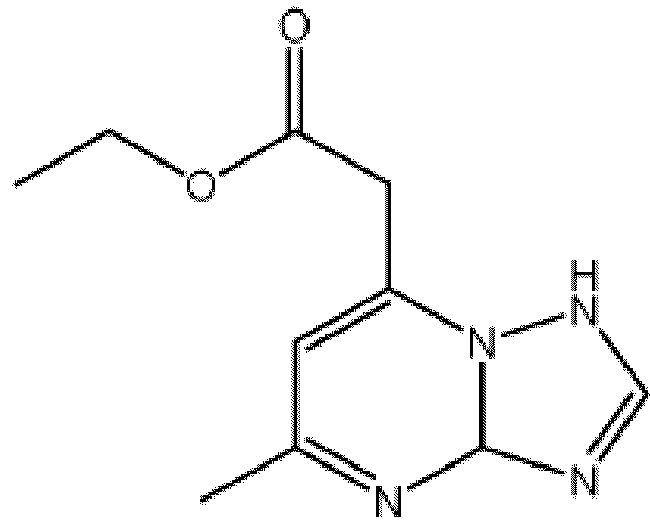
- a corrosion inhibitor composition or formulation may comprise ethyl 2-(5-methyl-1,3a-dihydro-[1,2,4]triazolo[1,5-a]pyrimidin-7-yl)acetate, or a salt thereof.
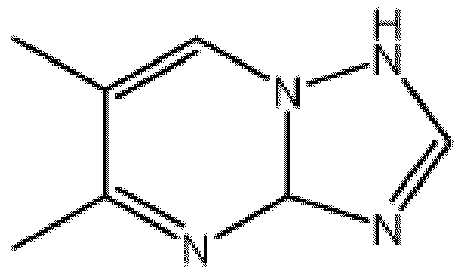
- the presently disclosed corrosion inhibitor composition or formulation comprises 5,6-dimethyl-1,3a-dihydro-[1,2,4]triazolo[1,5-a]pyrimidine, or a salt thereof.
- the pyrimidine derivatives disclosed herein display superior performance as corrosion inhibitors and the inhibition efficiency was found to increase with an increase in the concentration of these corrosion inhibitors.
- the presently disclosed pyrimidine derivatives also have a high tolerance to calcium hardness and bleach.
- the corrosion inhibitor compositions and formulations disclosed herein achieve a corrosion rate of less than 0.00254 mm per year (0.1 mpy) in the presence and in the absence of bleach 1 mpy is equal to 0.0254 mm per year.
- the presently disclosed corrosion inhibitor composition comprises the following compound of formula (I) or a salt thereof:
- the corrosion inhibitor compositions / formulations disclosed herein may provide corrosion protection for any metal including, but not limited to, iron, copper, iron alloys, copper alloys, admiralty brass, copper nickel (90/10, 80/20 and 70/30), aluminium brass, manganese brass, leaded naval bronze, and phosphor bronze.
- the metal surface comprises iron, copper, an iron alloy, a copper alloy, admiralty brass, about 90% copper and about 10% nickel, about 80% copper and about 20% nickel, about 70% copper and about 30% nickel, aluminium brass, manganese brass, leaded naval bronze, phosphor bronze, or any combination thereof.
- the presently disclosed corrosion inhibitor compositions / formulations may also be used to protect silver, steel (e.g., galvanized steel) and/or aluminum, for example.
- a corrosion inhibitor composition and/or formulation as disclosed herein can be used to protect any copper alloy, including bronze and brass.
- Bronze commonly comprises copper and tin, but may comprise other elements including aluminum, manganese, silicon, arsenic, and phosphorus.
- Brass comprises copper and zinc is commonly used in piping in water boiler systems.
- a corrosion inhibitor composition and/or formulation as disclosed herein is added to an aqueous system in contact with a metal surface comprising bronze to inhibit metal corrosion.
- a corrosion inhibitor composition and/or formulation as disclosed herein is added to an aqueous system in contact with a metal surface comprising brass to inhibit metal corrosion.
- a corrosion inhibitor composition and/or formulation as disclosed herein is added to an aqueous system in contact with a metal surface comprising a copper-nickel alloy to inhibit metal corrosion.
- a corrosion inhibitor composition and/or formulation as disclosed herein inhibits the corrosion of mild steel. In certain embodiments, a corrosion inhibitor composition and/or formulation as disclosed herein inhibits the corrosion of metal alloys including, but not limited to, galvanized steel, stainless steel, cast iron, nickel, and combinations thereof.
- a corrosion inhibitor composition and/or formulation as disclosed herein inhibits pitting corrosion of a metallic surface, such as a surface comprising mild steel.
- a corrosion inhibitor composition and/or formulation as disclosed herein provides a metal corrosion rate that is acceptable according to industry standards, e.g., about 1 mpy is equal to 0.0254 mm per year. In certain embodiments, a corrosion inhibitor composition and/or formulation as disclosed herein provides a metal corrosion rate of about 0.1 mpy or less.
- a corrosion inhibitor composition and/or formulation as disclosed herein provides a metal corrosion rate of about 0.1 mpy or less, about 0.05 mpy or less, about 0.04 mpy or less, about 0.03 mpy or less, about 0.02 mpy or less, about 0.01 mpy or less, about 0.005 mpy or less, or about 0.002 mpy or less.
- a corrosion inhibitor composition and/or formulation as disclosed herein can be added to an aqueous system at any dosage rate, it is generally added to an aqueous system at a dosage rate of from about 0.01 ppm to about 500 ppm.
- a corrosion inhibitor composition and/or formulation as disclosed herein is added to an aqueous system at a dosage rate of from about 0.01 ppm to about 100 ppm, from about 0.01 ppm to about 75 ppm, from about 0.01 ppm to about 50 ppm, from about 0.01 ppm to about 25 ppm, from about 0.01 ppm to about 10 ppm, from about 0.01 ppm to about 5 ppm, from about 0.1 ppm to about 100 ppm, from about 0.1 ppm to about 75 ppm, from about 0.1 ppm to about 50 ppm, from about 0.1 ppm to about 25 ppm, from about 0.1 ppm to about 10 ppm, from about 0.1 ppm to
- the corrosion inhibitor compositions and/or formulations as disclosed herein can be used to inhibit corrosion of metal in an aqueous system having any pH.
- a corrosion inhibitor composition and/or formulation as disclosed herein is added to an aqueous system having a pH of from about 6 to about 12, from about 6 to about 11, from about 6 to about 10, from about 6 to about 9, from about 6 to about 8, from about 7 to about 12, from about 8 to about 12, from about 9 to about 12, from about 7 to about 10, or from about 8 to about 10.
- a corrosion inhibitor composition and/or formulation as disclosed herein inhibits metal corrosion in the presence of oxidizing halogen compounds including, but not limited to, hypochlorite bleach, chlorine, bromine, hypochlorite, hypobromite, chlorine dioxide, iodine/hypoiodous acid, hypobromous acid, halogenated hydantoins, stabilized versions of hypochlorous or hypobromous acids, or combinations thereof.
- the metal corrosion rate provided by the corrosion inhibitor compositions and/or formulations in the presence of an oxidizing compound is not limited.
- a corrosion inhibitor composition and/or formulation as disclosed herein provides a metal corrosion rate in the presence of an oxidizing halogen compound of about 0.2 mpy or less.
- a corrosion inhibitor composition and/or formulation as disclosed herein provides a metal corrosion rate in the presence of an oxidizing halogen compound of about 0.1 mpy or less, such as about 0.05 mpy or less, about 0.04 mpy or less, about 0.03 mpy or less, about 0.02 mpy or less, about 0.01 mpy or less, about 0.005 mpy or less, or about 0.002 mpy or less.
- the metal corrosion rate provided by a corrosion inhibitor composition and/or formulation as disclosed herein is essentially the same in the absence or presence of an oxidizing halogen compound.
- a corrosion inhibitor composition and/or formulation as disclosed herein inhibits metal corrosion when added to an aqueous system comprising a non-halogen-containing oxidizing biocide including, but not limited to, peroxides (e.g., hydrogen peroxide), persulfates, permanganates, and peracetic acids.
- a non-halogen-containing oxidizing biocide including, but not limited to, peroxides (e.g., hydrogen peroxide), persulfates, permanganates, and peracetic acids.
- Another advantage of using the corrosion inhibitor compositions and/or formulations as disclosed herein is a smaller amount of oxidizing halogen compound is required to maintain low microbial levels because the corrosion inhibitor compositions and/or formulations as disclosed herein generally have reduced interactions with the oxidizing halogen compound. Furthermore, halogenated azoles that result from the reaction between an azole and oxidizing agent are known to be environmentally undesirable due to their toxicity. Thus, another advantage of the present disclosure is that the corrosion inhibitor compositions and/or formulations as disclosed herein are resistant (or essentially resistant) to halogen attack, and do not lead to the release of halogenated azoles into the environment.
- the aqueous system is a cooling water system.
- the cooling water system can be a closed loop cooling water system or an open loop cooling water system.
- a corrosion inhibitor composition and/or formulation as disclosed herein is added to a closed loop cooling water system at a dosage rate of from about 0.01 ppm to about 200 ppm.
- a corrosion inhibitor composition and/or formulation as disclosed herein is added to an open loop cooling water system at a dosage rate of from about 0.01 ppm to about 20 ppm.
- the corrosion inhibitor compositions and/or formulations as disclosed herein are contacted with a metal surface by any suitable method.
- a corrosion inhibitor composition (or solution comprising the composition) and/or formulation as disclosed herein is contacted with a metal surface by immersion, spraying, or other coating techniques.
- a corrosion inhibitor composition and/or formulation is introduced into the water of the aqueous system by any conventional method, such as manually or automatically using a chemical injection pump, and is fed into the aqueous system on either a periodic or continuous basis.
- a corrosion inhibitor composition and/or formulation as disclosed herein if a corrosion inhibitor composition and/or formulation as disclosed herein is relatively insoluble in water, the composition may be made soluble by forming an organic or inorganic salt of one or more of the compounds within the composition / formulation.
- a corrosion inhibitor composition and/or formulation as disclosed herein comprises a water-soluble salt of one or more of the compounds disclosed herein.
- a corrosion inhibitor composition and/or formulation as disclosed herein is added as a solution in a water-miscible co-solvent including, but not limited to, acetone, methanol, ethanol, propanol, formic acid, formamide, propylene glycol, or ethylene glycol.
- a co-solvent is used to achieve maximum solubility of a corrosion inhibitor composition and/or formulation as disclosed herein in the aqueous system.
- a co-solvent for example, low molecular weight polyethylene glycol, polypropylene glycol, a surfactant (e.g., organic sulfonic acid), or combinations thereof are used to increase the solubility of a corrosion inhibitor composition and/or formulation as disclosed herein.
- the corrosion inhibitor compositions and/or formulations disclosed herein can be added to an aqueous system alone or in combination with other corrosion inhibitors or treatment chemicals. Multiple corrosion inhibitors can be dosed as a combined corrosion inhibitor formulation or each corrosion inhibitor can be added separately, including two or more corrosion inhibitor compositions as disclosed herein. Moreover, the corrosion inhibitor compositions and/or formulations disclosed herein can be added to an aqueous system in combination with a variety of additional corrosion inhibitors including, but not limited to, azoles, orthophosphate, polyphosphates, phosphonates, molybdates, silicates, oximes, and nitrites.
- the corrosion inhibitor compositions and/or formulations disclosed herein also can be added to an aqueous system in combination with a variety of additional additives, such as treatment polymers, anti-microbial agents, anti-scaling agents, colorants, fillers, buffers, surfactants, viscosity modifiers, chelating agents, dispersants, deodorants, masking agents, oxygen scavengers, and indicator dyes.
- additional additives such as treatment polymers, anti-microbial agents, anti-scaling agents, colorants, fillers, buffers, surfactants, viscosity modifiers, chelating agents, dispersants, deodorants, masking agents, oxygen scavengers, and indicator dyes.
- Certain embodiments of the formulation also comprise a base, such as sodium hydroxide.
- a base such as sodium hydroxide.
- sodium hydroxide may be added to the formulation as a 50% aqueous solution. In some embodiments, sodium hydroxide is added until the formulation has a pH of about 9 to about 10.
- the formulation may comprise various amounts of each component.
- the formulation may comprise about 70% by weight water and about 30% by weight of one or more corrosion inhibitor compounds.
- the formulations may also comprise a base, such as sodium hydroxide, in whatever amount is necessary to achieve the desired pH.
- the formulation may comprise from about 1% to about 10% base, from about 80% to about 60% water, and from about 40% to about 20% of one or more corrosion inhibitor compounds.
- the formulation comprises about 1% base, about 69% water, and about 30% of one or more corrosion inhibitor compounds.
- a formulation is obtained by dissolving a corrosion inhibitor compound, such as bis-benzotriazole, in water.
- the pH of the water may be from about 9 to about 10. pH adjustment may help make the corrosion inhibitor compound soluble in water. pH adjustment can be accomplished using a base, such as diluted NaOH (about 50% in water).
- the formulation may comprise one or more corrosion inhibitor compounds.
- the corrosion inhibitor compositions and/or formulations as disclosed herein can be added to an aqueous system in any form.
- a corrosion inhibitor composition and/or formulation is added to an aqueous system as a dried solid.
- a corrosion inhibitor composition and/or formulation is added to an aqueous system as a solution in a co-solvent miscible with water.
- a corrosion inhibitor composition and/or formulation as disclosed herein is added to an aqueous system as an aqueous solution.
- a corrosion inhibitor composition and/or formulation as disclosed herein is added to a laundry system, a warewashing system, an aqueous system that recirculates water, and/or an aqueous system that has stagnant water.
- the corrosion inhibitor compositions, formulations, and methods of inhibiting corrosion disclosed herein can be applied to open loop or closed loop recirculating water systems, such as cooling water systems.
- Certain embodiments, of the presently disclosed corrosion inhibitor compositions and/or formulations achieve corrosion rates of 0.2 mpy or less, and these low rates can be achieved in the presence or absence of bleach.
- the temperature of the water in the aqueous system may be up to about 60 °C, such as from about 10 °C to about 60 °C.
- the presently disclosed corrosion inhibitor compositions and/or formulations have a chloride tolerance up to about 1000 ppm as Cl.
- the presently disclosed corrosion inhibitor compositions and/or formulations are stable for a Holding time index of about 150 hours.
- Example 1 Corrosion performance of pyrimidine derivative.
- the analysis was conducted using the following testing conditions: initial E: about -0.02V; final E: about +0.02V; scan rate: about 0.5 mV/s; sample period: about 1 second; repeat time: about 15 minutes; sample area: about 5 cm 2 ; density: about 8.89 g/cm 3 .
- composition / formulation disclosed herein may comprise, consist of, or consist essentially of any of the compounds / components disclosed herein.
- the phrases “consist essentially of,” “consists essentially of,” “consisting essentially of,” and the like limit the scope of a claim to the specified materials or steps and those materials or steps that do not materially affect the basic and novel characteristic(s) of the claimed invention.
- the term "about” refers to the cited value being within the errors arising from the standard deviation found in their respective testing measurements, and if those errors cannot be determined, then “about” refers to within 10% of the cited value.
- compositions, formulations, and methods disclosed and claimed herein can be made and executed without undue experimentation in light of the present disclosure. While this invention may be embodied in many different forms, there are described in detail herein specific embodiments of the invention. The present disclosure is an exemplification of the principles of the invention and is not intended to limit the invention to the particular embodiments illustrated.
- a corrosion inhibitor compound is intended to include “at least one corrosion inhibitor compound” or “one or more corrosion inhibitor compounds.”
Landscapes
- Chemical & Material Sciences (AREA)
- Organic Chemistry (AREA)
- Engineering & Computer Science (AREA)
- Materials Engineering (AREA)
- Mechanical Engineering (AREA)
- Metallurgy (AREA)
- Life Sciences & Earth Sciences (AREA)
- Chemical Kinetics & Catalysis (AREA)
- General Chemical & Material Sciences (AREA)
- Hydrology & Water Resources (AREA)
- Environmental & Geological Engineering (AREA)
- Water Supply & Treatment (AREA)
- Wood Science & Technology (AREA)
- Preventing Corrosion Or Incrustation Of Metals (AREA)
Claims (15)
- Verfahren zum Hemmen von Korrosion einer Metalloberfläche, die mit einem wässrigen System in Berührung steht, umfassend:Zugeben einer Korrosionshemmstoffzusammensetzung zu dem wässrigen System, die Korrosionshemmstoffzusammensetzung umfassend eine Verbindung der Formel (I):
 oder ein Salz davon, wobeiR2 Wasserstoff, eine substituierte oder unsubstituierte C1-C4-Alkylgruppe, -COOR5, -CH2COOR5, Chlor, Brom, oder Iod ist;R5 Wasserstoff oder eine substituierte oder unsubstituierte C1-C20-Alkylgruppe ist; undR1, R3 und R4 jeweils unabhängig Wasserstoff, eine substituierte oder unsubstituierte C1-C4-Alkylgruppe, -COOH, Chlor, Brom oder Iod ist;wobei das wässrige System eine oxidierende Halogenverbindung umfasst oder wobei das wässrige System ein nicht halogenhaltiges oxidierendes Biozid umfasst.
 - Verfahren nach Anspruch 1, wobei die Metalloberfläche Eisen, Kupfer, eine Eisenlegierung, eine Kupferlegierung, Admiralitätsmessing, etwa 90 % Kupfer und etwa 10 % Nickel, etwa 80 % Kupfer und etwa 20 % Nickel, etwa 70 % Kupfer und etwa 30 % Nickel, Aluminiummessing, Manganmessing, bleihaltige Marinebronze, Phosphorbronze oder eine beliebige Kombination davon umfasst.
- Verfahren nach Anspruch 1 oder 2, wobei die Metalloberfläche Kupfer umfasst.
- Verfahren nach einem der Ansprüche 1 bis 3, wobei R4 Wasserstoff oder eine substituierte oder unsubstituierte C1-C4-Alkylgruppe ist, und/oder
wobei R3 Wasserstoff oder eine substituierte oder unsubstituierte C1-C4-Alkylgruppe ist. - Verfahren nach einem der Ansprüche 1 bis 3, wobei die Verbindung der Formel (I) aus der Gruppe ausgewählt ist, bestehend aus:

- Verfahren nach einem der Ansprüche 1 bis 5, wobei die Korrosionshemmstoffzusammensetzung zu dem wässrigen System mit einer Dosisrate von 0,01 ppm bis 500 ppm zugegeben wird.
- Verfahren nach einem der Ansprüche 1 bis 6, wobei die oxidierende Halogenverbindung aus der Gruppe ausgewählt ist, bestehend aus Hypochloritbleichmittel, Chlor, Brom, Hypochlorit, Hypobromit, Chlordioxid, Jod-/hypoiodiger Säure, Hypobromsäure, einem halogenierten Hydantoin und einer beliebigen Kombination davon.
- Verfahren nach einem der Ansprüche 1 bis 7, wobei das nicht halogenhaltige oxidierende Biozid aus der Gruppe ausgewählt ist, bestehend aus: 5-Chlor-2-methyl-4-isothiazolin-3-on, 2-Methyl-4-isothiazolin-3-on, Glutaraldehyd, Dibrompropionsäure, quartären Ammoniumsalzen, einem Peroxid, einem Persulfat, einem Permanganat, einer Peressigsäure und einer beliebigen Kombination davon.
- Verfahren nach einem der Ansprüche 1 bis 8, wobei die Korrosionshemmstoffzusammensetzung ein wassermischbares Co-Lösungsmittel umfasst, wobei das wassermischbare Co-Lösungsmittel vorzugsweise aus der Gruppe ausgewählt ist, bestehend aus Aceton, Methanol, Ethanol, Propanol, Ameisensäure, Formamid, Propylenglykol, Ethylenglykol und einer beliebigen Kombination davon.
- Verfahren nach einem der Ansprüche 1 bis 9, wobei die Korrosionshemmstoffzusammensetzung ein Additiv umfasst, wobei das Additiv vorzugsweise aus der Gruppe ausgewählt ist, bestehend aus einem zusätzlichen Korrosionshemmstoff, einem Behandlungspolymer, einem antimikrobiellen Mittel, einem Antiablagerungsmittel, einem Färbemittel, einem Füllstoff, einem Puffer, einem Tensid, einem Viskositätsmodifizierer, einem chelatbildenden Mittel, einem Dispergiermittel, einem Deodorant, einem Maskierungsmittel, einem Sauerstoff-Scavenger, einem Indikatorfarbstoff und einer beliebigen Kombination davon.
- Verfahren nach einem der Ansprüche 1 bis 10, wobei das wässrige System ein Kühlsystem, ein Boilersystem, ein Heizsystem, ein Membransystem, ein Papierherstellungssystem, ein Lebensmittel- und Getränkesystem, ein Öl- und Gassystem oder ein beliebiges System ist, das Wasser umfasst.
- Korrosionshemmstoffzusammensetzung, umfassend
- Korrosionshemmstoffzusammensetzung nach Anspruch 12, ferner umfassend
- Beschichtung auf einer Metalloberfläche, umfassend die Korrosionshemmstoffzusammensetzung nach einem der Ansprüche 12 bis 13.
- Verwendung der Korrosionshemmstoffzusammensetzung nach einem der Ansprüche 12 bis 13 zum Hemmen der Korrosion von Kupfer oder Kupferlegierungen.
Applications Claiming Priority (2)
| Application Number | Priority Date | Filing Date | Title |
|---|---|---|---|
| US201962847009P | 2019-05-13 | 2019-05-13 | |
| PCT/US2020/031782 WO2020231723A1 (en) | 2019-05-13 | 2020-05-07 | 1,2,4-triazolo[1,5-a] pyrimidine derivative as copper corrosion inhibitor |
Publications (3)
| Publication Number | Publication Date |
|---|---|
| EP3969639A1 EP3969639A1 (de) | 2022-03-23 |
| EP3969639C0 EP3969639C0 (de) | 2025-03-12 |
| EP3969639B1 true EP3969639B1 (de) | 2025-03-12 |
Family
ID=70857254
Family Applications (1)
| Application Number | Title | Priority Date | Filing Date |
|---|---|---|---|
| EP20728609.7A Active EP3969639B1 (de) | 2019-05-13 | 2020-05-07 | 1,2,4-triazolo[1,5-a]pyrimidin-derivat als kupferkorrosionsinhibitor |
Country Status (5)
| Country | Link |
|---|---|
| US (1) | US11814734B2 (de) |
| EP (1) | EP3969639B1 (de) |
| CN (1) | CN113874377A (de) |
| ES (1) | ES3025805T3 (de) |
| WO (1) | WO2020231723A1 (de) |
Family Cites Families (80)
| Publication number | Priority date | Publication date | Assignee | Title |
|---|---|---|---|---|
| DE246999C (de) | ||||
| DE276284C (de) | ||||
| BE472445A (de) | 1946-04-11 | |||
| US2837521A (en) | 1956-04-11 | 1958-06-03 | Eastman Kodak Co | Method for making polyazaindenes |
| ES338687A1 (es) * | 1966-04-06 | 1968-04-01 | Monsanto Co | Procedimiento para obtener composiciones de fluidos funcio-nales. |
| JPS4834220B1 (de) | 1970-12-28 | 1973-10-19 | ||
| JPS4835456B1 (de) | 1970-12-28 | 1973-10-27 | ||
| JPS4831894B1 (de) | 1970-12-28 | 1973-10-02 | ||
| DE2533120A1 (de) | 1975-07-24 | 1977-02-10 | Bayer Ag | S-triazolopyrimidinmethyl(thiono) thiolphosphor(phosphon)-saeureester, verfahren zu ihrer herstellung und ihre verwendung als insektizide, akarizide und nematizide |
| JPS56127383A (en) | 1980-03-10 | 1981-10-06 | Mochida Pharmaceut Co Ltd | Preparation of s-triazolo- 1,5-a -pyrimidine derivative |
| JPS57175193A (en) | 1981-04-17 | 1982-10-28 | Sankyo Co Ltd | Preparation of triazolopyrimidine derivative |
| GB8431305D0 (en) | 1984-12-12 | 1985-01-23 | Ici Plc | Extraction of metals |
| JPS62273980A (ja) | 1986-05-23 | 1987-11-28 | Teijin Aguro Chem Kk | 新規トリアゾロピリミジン誘導体およびその製造法 |
| HU205762B (en) | 1987-11-20 | 1992-06-29 | Biogal Gyogyszergyar | Process for producing high purity 5-methyl-7-(diethylamino)-s-triazolo/1,5-a/pyrimidine |
| US5061797A (en) * | 1988-03-29 | 1991-10-29 | Buckman Laboratories International, Inc. | 1-methyl-3,5,7-triaza-1-azoniatricyclodecane compounds |
| US4988812A (en) | 1989-11-06 | 1991-01-29 | Dow Elanco | Aqueous process for the preparation of 5-methyl-n-(aryl)-1,2,4-triazolo(1,5-A)pyrimidine-2-sulfonamides |
| FR2687676B1 (fr) | 1992-02-24 | 1994-07-08 | Union Pharma Scient Appl | Nouveaux derives de polyazaindenes antagonistes des recepteurs a l'angiotensine ii; leurs procedes de preparation, compositions pharmaceutiques les contenant. |
| JPH0765352A (ja) | 1993-08-23 | 1995-03-10 | Fuji Photo Film Co Ltd | 磁気記録媒体 |
| GB9321162D0 (en) | 1993-10-13 | 1993-12-01 | Boots Co Plc | Therapeutic agents |
| JPH10114774A (ja) | 1996-08-20 | 1998-05-06 | Otsuka Pharmaceut Factory Inc | 一酸化窒素合成酵素阻害剤 |
| DE19706337A1 (de) | 1997-02-19 | 1998-08-20 | Basf Ag | Verfahren zur Herstellung von enantiomerenreinen Estern |
| DE19706336A1 (de) | 1997-02-19 | 1998-08-20 | Basf Ag | Verfahren zur Herstellung von enantiomerenreinen Alkoholen |
| FR2765875B1 (fr) | 1997-07-14 | 1999-11-19 | American Cyanamid Co | 5-alkyl-triazolopyrimidines fongicides |
| US5994360A (en) | 1997-07-14 | 1999-11-30 | American Cyanamid Company | Fungicidal 5-alkyl-triazolopyrimidines |
| AU750489B2 (en) | 1998-02-11 | 2002-07-18 | Wyeth Holdings Corporation | Fungicidal 7-alkyl-triazolopyrimidines |
| PL188652B1 (pl) | 1998-12-30 | 2005-03-31 | Univ Mikolaja Kopernika | Pochodne 1,2,4-triazolo-[1,5a]-pirymidyny i sposób ich wytwarzania |
| GB9906130D0 (en) | 1999-03-18 | 1999-05-12 | Knoll Ag | Compounds for use in therapy |
| GB9906124D0 (en) | 1999-03-18 | 1999-05-12 | Knoll Ag | Therapeutic agent |
| GB9906126D0 (en) | 1999-03-18 | 1999-05-12 | Knoll Ag | Pharmaceutical formulations |
| JP4951808B2 (ja) | 2000-10-26 | 2012-06-13 | 日立化成工業株式会社 | 金属用研磨液及び研磨方法 |
| WO2003038883A1 (en) * | 2001-10-31 | 2003-05-08 | Hitachi Chemical Co., Ltd. | Polishing fluid and polishing method |
| US7316603B2 (en) * | 2002-01-22 | 2008-01-08 | Cabot Microelectronics Corporation | Compositions and methods for tantalum CMP |
| CN100336179C (zh) | 2002-04-30 | 2007-09-05 | 日立化成工业株式会社 | 研磨液及研磨方法 |
| US7026478B2 (en) | 2002-05-10 | 2006-04-11 | Studiengesellschaft Kohle Mbh | Iron catalyzed cross coupling reactions of aromatic compounds |
| JP2004031443A (ja) * | 2002-06-21 | 2004-01-29 | Hitachi Chem Co Ltd | 研磨液及び研磨方法 |
| TWI257126B (en) * | 2002-07-25 | 2006-06-21 | Hitachi Chemical Co Ltd | Slurry and polishing method |
| WO2004011467A1 (ja) | 2002-07-29 | 2004-02-05 | Hokko Chemical Industry Co., Ltd. | トリアゾロピリミジン誘導体および農園芸用殺菌剤 |
| AU2004277341A1 (en) | 2003-10-01 | 2005-04-14 | Basf Aktiengesellschaft | Fungicidal mixtures |
| CN101232814A (zh) | 2005-07-27 | 2008-07-30 | 巴斯福股份公司 | 基于唑并嘧啶基胺的杀真菌混合物 |
| WO2007120259A2 (en) | 2005-11-08 | 2007-10-25 | Advanced Technology Materials, Inc. | Formulations for removing copper-containing post-etch residue from microelectronic devices |
| WO2007099092A1 (de) | 2006-02-28 | 2007-09-07 | Basf Se | Substituierte 6-phenyl-7-amino-[1,2,4]-triazolo[1,5-a]pyrimidine und deren verwendung zur bekämpfung von schadpilzen |
| WO2007116011A2 (de) | 2006-04-10 | 2007-10-18 | Basf Se | Substituierte triazolopyrimidine, verfahren zu ihrer herstellung und ihre verwendung zur bekämpfung von schadpilzen sowie sie enthaltende mittel |
| US7883738B2 (en) | 2007-04-18 | 2011-02-08 | Enthone Inc. | Metallic surface enhancement |
| US10017863B2 (en) | 2007-06-21 | 2018-07-10 | Joseph A. Abys | Corrosion protection of bronzes |
| US8609541B2 (en) * | 2007-07-05 | 2013-12-17 | Hitachi Chemical Co., Ltd. | Polishing slurry for metal films and polishing method |
| GB0719803D0 (en) | 2007-10-10 | 2007-11-21 | Cancer Rec Tech Ltd | Therapeutic compounds and their use |
| TWI453301B (zh) | 2007-11-08 | 2014-09-21 | Enthone | 浸鍍銀塗層上的自組分子 |
| US7972655B2 (en) | 2007-11-21 | 2011-07-05 | Enthone Inc. | Anti-tarnish coatings |
| US9216983B2 (en) | 2007-12-21 | 2015-12-22 | Board Of Regents, University Of Texas System | Dihydroorotate dehydrogenase inhibitors with selective anti-malarial activity |
| JP2010065024A (ja) | 2008-08-14 | 2010-03-25 | Ishihara Sangyo Kaisha Ltd | トリアゾロピリミジン誘導体又はその塩を含有する有害生物防除剤 |
| CN102149716A (zh) | 2008-09-09 | 2011-08-10 | 阿斯利康(瑞典)有限公司 | 制备[1S-[1α,2α,3β(1S*,2R*),5β]]-3-[7-[2-(3,4-二氟苯基)-环丙氨基]-5-(丙硫基)-3H-1,2,3-三唑并[4,5-d]嘧啶-3-基]-5-(2-羟乙氧基)环戊烷-1,2-二醇的方法及其中间体 |
| EP2438069A1 (de) | 2009-04-01 | 2012-04-11 | NeuroSearch A/S | Substituierte [1,2,4]triazol[1,5-a]pyrimidine und iihre verwendung als kaliumkanalmodulatoren |
| WO2010112484A1 (en) | 2009-04-01 | 2010-10-07 | Neurosearch A/S | SUBSTITUTED [1,2,4]TRIAZOLO[1,5-a]PYRIMIDINES AND THEIR USE AS POTASSIUM CHANNEL MODULATORS |
| CN101824621A (zh) * | 2010-04-12 | 2010-09-08 | 海宁市科泰克金属表面技术有限公司 | 一种高性能铜、镍保护剂 |
| US8771665B2 (en) | 2010-12-17 | 2014-07-08 | Cocrystal Discovery, Inc. | Inhibitors of hepatitis C virus polymerase |
| CN102653539B (zh) | 2011-03-01 | 2014-09-17 | 秦引林 | 一种抗血小板聚集化合物及其药物组合 |
| UA111640C2 (uk) | 2011-11-08 | 2016-05-25 | Ф. Хоффманн-Ля Рош Аг | ПОХІДНІ [1,2,3]ТРИАЗОЛО[4,5-d]ПІРИМІДИНУ ЯК АГОНІСТИ КАНАБІНОЇДНОГО РЕЦЕПТОРА 2 |
| SG11201405708VA (en) * | 2012-03-14 | 2014-11-27 | Hitachi Chemical Co Ltd | Polishing method |
| US9707215B2 (en) | 2012-06-20 | 2017-07-18 | Cocrystal, Discovery, Inc. | Inhibitors of hepatitis C virus polymerase |
| FR2994861B1 (fr) | 2012-08-30 | 2014-08-22 | IFP Energies Nouvelles | Procede d'absorption de composes acides contenus dans un effluent gazeux au moyen d'une solution aqueuse a base d'amine |
| WO2014081878A2 (en) | 2012-11-21 | 2014-05-30 | Stategics, Inc. | Substituted triazolo-pyrimidine compounds for modulating cell proliferation, differentiation and survival |
| JP6133907B2 (ja) | 2013-01-31 | 2017-05-24 | 三井化学アグロ株式会社 | 縮合環ピリミジン化合物及びそれを含む有害生物防除剤 |
| FR3008976A1 (fr) * | 2013-07-23 | 2015-01-30 | Servier Lab | "nouveaux derives d'indolizine, leur procede de preparation et les compositions pharmaceutiques qui les contiennent" |
| JP5894133B2 (ja) | 2013-10-17 | 2016-03-23 | 株式会社オートネットワーク技術研究所 | 電気接続構造、及び電気接続構造の製造方法 |
| JP5864509B2 (ja) | 2013-10-17 | 2016-02-17 | 株式会社オートネットワーク技術研究所 | 油膜保持機能を有する組成物およびこれを用いた防食剤ならびに端子付き絶縁電線 |
| ES2902806T3 (es) | 2014-04-23 | 2022-03-29 | Dart Neuroscience Llc | Composiciones que contienen compuestos de [1,2,4]triazolo[1,5-a]pirimidin-7-ilo sustituidos como inhibidores de PDE2 |
| WO2016018773A1 (en) | 2014-08-01 | 2016-02-04 | Merck Sharp & Dohme Corp. | Ccr9 antagonist compounds |
| EP3191485A1 (de) | 2014-09-11 | 2017-07-19 | Bristol-Myers Squibb Company | Triazolpyridin- und triazolpyrimidininhibitoren von myeloperoxidase |
| TWI568737B (zh) | 2014-11-05 | 2017-02-01 | 達特神經科學(開曼)有限責任公司 | 作為pde2抑制劑之經取代的5-甲基-[1,2,4]三唑并[1,5-a]嘧啶-2-胺化合物 |
| SG11201704936SA (en) * | 2014-12-22 | 2017-07-28 | Lonza Ag | Corrosion inhibitor compositions for acidizing treatments |
| NZ731664A (en) | 2014-12-23 | 2024-02-23 | Novartis Ag | Triazolopyrimidine compounds and uses thereof |
| KR102220260B1 (ko) | 2015-02-18 | 2021-02-25 | 버크 인스티튜트 포 리서치 온 에이징 | 스트레스-유도성 p-tau 를 낮추는 트리아졸로피리딘 및 트리아졸로피리미딘 |
| US10946494B2 (en) | 2015-03-10 | 2021-03-16 | Showa Denko Materials Co., Ltd. | Polishing agent, stock solution for polishing agent, and polishing method |
| PL231234B1 (pl) | 2015-04-10 | 2019-02-28 | Univ Mikolaja Kopernika W Toruniu | Związki metaloorganiczne rutenu(II) z analogami zasad purynowych i sposób ich wytwarzania |
| CN107667188B (zh) * | 2015-05-28 | 2020-10-30 | 艺康美国股份有限公司 | 基于嘌呤的腐蚀抑制剂 |
| US11370793B2 (en) | 2015-08-27 | 2022-06-28 | Nantneuro, Llc | Triazolopyridines and triazolopyrimidines that lower stress-induced p-tau |
| US20190048283A1 (en) | 2015-09-28 | 2019-02-14 | Autonetworks Technologies, Ltd. | Anticorrosive agent and terminal fitted electric wire |
| PL230465B1 (pl) | 2015-11-12 | 2018-10-31 | Univ Mikolaja Kopernika W Toruniu | Nowe cyklobutano-1,1-dikarboksylowe kompleksy platyny(II) z 5,7-dipodstawionymi-1,2,4-triazolo[ 1,5-a] pirymidynami i sposób ich wytwarzania |
| CN106478639B (zh) | 2016-09-05 | 2018-09-18 | 郑州大学 | 嘧啶并1,2,4–三氮唑类的lsd1抑制剂、其制备方法及应用 |
| US11136474B2 (en) * | 2017-02-08 | 2021-10-05 | Showa Denko Materials Co., Ltd. | Polishing liquid and polishing method |
-
2020
- 2020-05-07 EP EP20728609.7A patent/EP3969639B1/de active Active
- 2020-05-07 US US16/868,752 patent/US11814734B2/en active Active
- 2020-05-07 CN CN202080035195.7A patent/CN113874377A/zh active Pending
- 2020-05-07 WO PCT/US2020/031782 patent/WO2020231723A1/en not_active Ceased
- 2020-05-07 ES ES20728609T patent/ES3025805T3/es active Active
Also Published As
| Publication number | Publication date |
|---|---|
| US20200362467A1 (en) | 2020-11-19 |
| EP3969639C0 (de) | 2025-03-12 |
| US11814734B2 (en) | 2023-11-14 |
| CA3138307A1 (en) | 2020-11-19 |
| CN113874377A (zh) | 2021-12-31 |
| EP3969639A1 (de) | 2022-03-23 |
| ES3025805T3 (en) | 2025-06-09 |
| WO2020231723A1 (en) | 2020-11-19 |
Similar Documents
| Publication | Publication Date | Title |
|---|---|---|
| US10190222B2 (en) | Corrosion inhibitors | |
| JP6959145B2 (ja) | プリン系腐食抑制剤及びこれを使用する方法 | |
| US10519116B2 (en) | Water-soluble pyrazole derivatives as corrosion inhibitors | |
| EP3735398B1 (de) | Benzotriazolderivate als korrosionsinhibitoren | |
| EP3969639B1 (de) | 1,2,4-triazolo[1,5-a]pyrimidin-derivat als kupferkorrosionsinhibitor | |
| CA3138307C (en) | 1,2,4-triazolo[1,5-a] pyrimidine derivative as copper corrosion inhibitor | |
| RU2779759C2 (ru) | Производные бензотриазола как ингибиторы коррозии | |
| BR112020013534B1 (pt) | Método para inibir a corrosão de uma superfície de metal em contato com um sistema aquoso, formulação inibidora de corrosão, e, uso da formulação |
Legal Events
| Date | Code | Title | Description |
|---|---|---|---|
| STAA | Information on the status of an ep patent application or granted ep patent |
Free format text: STATUS: UNKNOWN |
|
| STAA | Information on the status of an ep patent application or granted ep patent |
Free format text: STATUS: THE INTERNATIONAL PUBLICATION HAS BEEN MADE |
|
| PUAI | Public reference made under article 153(3) epc to a published international application that has entered the european phase |
Free format text: ORIGINAL CODE: 0009012 |
|
| STAA | Information on the status of an ep patent application or granted ep patent |
Free format text: STATUS: REQUEST FOR EXAMINATION WAS MADE |
|
| 17P | Request for examination filed |
Effective date: 20211103 |
|
| AK | Designated contracting states |
Kind code of ref document: A1 Designated state(s): AL AT BE BG CH CY CZ DE DK EE ES FI FR GB GR HR HU IE IS IT LI LT LU LV MC MK MT NL NO PL PT RO RS SE SI SK SM TR |
|
| DAV | Request for validation of the european patent (deleted) | ||
| DAX | Request for extension of the european patent (deleted) | ||
| REG | Reference to a national code |
Ref country code: DE Ref legal event code: R079 Free format text: PREVIOUS MAIN CLASS: C23F0011100000 Ipc: C02F0103020000 Ref country code: DE Ref legal event code: R079 Ref document number: 602020047576 Country of ref document: DE Free format text: PREVIOUS MAIN CLASS: C23F0011100000 Ipc: C02F0103020000 |
|
| GRAP | Despatch of communication of intention to grant a patent |
Free format text: ORIGINAL CODE: EPIDOSNIGR1 |
|
| STAA | Information on the status of an ep patent application or granted ep patent |
Free format text: STATUS: GRANT OF PATENT IS INTENDED |
|
| RIC1 | Information provided on ipc code assigned before grant |
Ipc: C02F 5/12 20060101ALI20241010BHEP Ipc: C23F 11/10 20060101ALI20241010BHEP Ipc: C23F 11/14 20060101ALI20241010BHEP Ipc: C02F 1/72 20060101ALI20241010BHEP Ipc: C02F 103/02 20060101AFI20241010BHEP |
|
| INTG | Intention to grant announced |
Effective date: 20241022 |
|
| GRAS | Grant fee paid |
Free format text: ORIGINAL CODE: EPIDOSNIGR3 |
|
| GRAA | (expected) grant |
Free format text: ORIGINAL CODE: 0009210 |
|
| STAA | Information on the status of an ep patent application or granted ep patent |
Free format text: STATUS: THE PATENT HAS BEEN GRANTED |
|
| AK | Designated contracting states |
Kind code of ref document: B1 Designated state(s): AL AT BE BG CH CY CZ DE DK EE ES FI FR GB GR HR HU IE IS IT LI LT LU LV MC MK MT NL NO PL PT RO RS SE SI SK SM TR |
|
| REG | Reference to a national code |
Ref country code: GB Ref legal event code: FG4D |
|
| REG | Reference to a national code |
Ref country code: CH Ref legal event code: EP |
|
| REG | Reference to a national code |
Ref country code: DE Ref legal event code: R096 Ref document number: 602020047576 Country of ref document: DE |
|
| REG | Reference to a national code |
Ref country code: IE Ref legal event code: FG4D |
|
| U01 | Request for unitary effect filed |
Effective date: 20250411 |
|
| REG | Reference to a national code |
Ref country code: ES Ref legal event code: FG2A Ref document number: 3025805 Country of ref document: ES Kind code of ref document: T3 Effective date: 20250609 |
|
| U07 | Unitary effect registered |
Designated state(s): AT BE BG DE DK EE FI FR IT LT LU LV MT NL PT RO SE SI Effective date: 20250508 |
|
| U20 | Renewal fee for the european patent with unitary effect paid |
Year of fee payment: 6 Effective date: 20250522 |
|
| PG25 | Lapsed in a contracting state [announced via postgrant information from national office to epo] |
Ref country code: RS Free format text: LAPSE BECAUSE OF FAILURE TO SUBMIT A TRANSLATION OF THE DESCRIPTION OR TO PAY THE FEE WITHIN THE PRESCRIBED TIME-LIMIT Effective date: 20250612 |
|
| PGFP | Annual fee paid to national office [announced via postgrant information from national office to epo] |
Ref country code: GB Payment date: 20250522 Year of fee payment: 6 Ref country code: ES Payment date: 20250625 Year of fee payment: 6 |
|
| PG25 | Lapsed in a contracting state [announced via postgrant information from national office to epo] |
Ref country code: NO Free format text: LAPSE BECAUSE OF FAILURE TO SUBMIT A TRANSLATION OF THE DESCRIPTION OR TO PAY THE FEE WITHIN THE PRESCRIBED TIME-LIMIT Effective date: 20250612 |
|
| PG25 | Lapsed in a contracting state [announced via postgrant information from national office to epo] |
Ref country code: HR Free format text: LAPSE BECAUSE OF FAILURE TO SUBMIT A TRANSLATION OF THE DESCRIPTION OR TO PAY THE FEE WITHIN THE PRESCRIBED TIME-LIMIT Effective date: 20250312 |
|
| PG25 | Lapsed in a contracting state [announced via postgrant information from national office to epo] |
Ref country code: GR Free format text: LAPSE BECAUSE OF FAILURE TO SUBMIT A TRANSLATION OF THE DESCRIPTION OR TO PAY THE FEE WITHIN THE PRESCRIBED TIME-LIMIT Effective date: 20250613 |
|
| PG25 | Lapsed in a contracting state [announced via postgrant information from national office to epo] |
Ref country code: SM Free format text: LAPSE BECAUSE OF FAILURE TO SUBMIT A TRANSLATION OF THE DESCRIPTION OR TO PAY THE FEE WITHIN THE PRESCRIBED TIME-LIMIT Effective date: 20250312 |
|
| PG25 | Lapsed in a contracting state [announced via postgrant information from national office to epo] |
Ref country code: PL Free format text: LAPSE BECAUSE OF FAILURE TO SUBMIT A TRANSLATION OF THE DESCRIPTION OR TO PAY THE FEE WITHIN THE PRESCRIBED TIME-LIMIT Effective date: 20250312 |
|
| PG25 | Lapsed in a contracting state [announced via postgrant information from national office to epo] |
Ref country code: CZ Free format text: LAPSE BECAUSE OF FAILURE TO SUBMIT A TRANSLATION OF THE DESCRIPTION OR TO PAY THE FEE WITHIN THE PRESCRIBED TIME-LIMIT Effective date: 20250312 |
|
| PG25 | Lapsed in a contracting state [announced via postgrant information from national office to epo] |
Ref country code: SK Free format text: LAPSE BECAUSE OF FAILURE TO SUBMIT A TRANSLATION OF THE DESCRIPTION OR TO PAY THE FEE WITHIN THE PRESCRIBED TIME-LIMIT Effective date: 20250312 |
|
| PG25 | Lapsed in a contracting state [announced via postgrant information from national office to epo] |
Ref country code: IS Free format text: LAPSE BECAUSE OF FAILURE TO SUBMIT A TRANSLATION OF THE DESCRIPTION OR TO PAY THE FEE WITHIN THE PRESCRIBED TIME-LIMIT Effective date: 20250712 |
|
| REG | Reference to a national code |
Ref country code: CH Ref legal event code: H13 Free format text: ST27 STATUS EVENT CODE: U-0-0-H10-H13 (AS PROVIDED BY THE NATIONAL OFFICE) Effective date: 20251223 |
|
| PLBE | No opposition filed within time limit |
Free format text: ORIGINAL CODE: 0009261 |
|
| STAA | Information on the status of an ep patent application or granted ep patent |
Free format text: STATUS: NO OPPOSITION FILED WITHIN TIME LIMIT |
|
| PG25 | Lapsed in a contracting state [announced via postgrant information from national office to epo] |
Ref country code: CH Free format text: LAPSE BECAUSE OF NON-PAYMENT OF DUE FEES Effective date: 20250531 |
|
| REG | Reference to a national code |
Ref country code: CH Ref legal event code: L10 Free format text: ST27 STATUS EVENT CODE: U-0-0-L10-L00 (AS PROVIDED BY THE NATIONAL OFFICE) Effective date: 20260121 |
|
| PG25 | Lapsed in a contracting state [announced via postgrant information from national office to epo] |
Ref country code: MC Free format text: LAPSE BECAUSE OF FAILURE TO SUBMIT A TRANSLATION OF THE DESCRIPTION OR TO PAY THE FEE WITHIN THE PRESCRIBED TIME-LIMIT Effective date: 20250312 |