EP3955304B1 - Integrated colour led micro-display - Google Patents
Integrated colour led micro-display Download PDFInfo
- Publication number
- EP3955304B1 EP3955304B1 EP21200332.1A EP21200332A EP3955304B1 EP 3955304 B1 EP3955304 B1 EP 3955304B1 EP 21200332 A EP21200332 A EP 21200332A EP 3955304 B1 EP3955304 B1 EP 3955304B1
- Authority
- EP
- European Patent Office
- Prior art keywords
- layer
- colour
- light
- gan
- micro
- Prior art date
- Legal status (The legal status is an assumption and is not a legal conclusion. Google has not performed a legal analysis and makes no representation as to the accuracy of the status listed.)
- Active
Links
Images







Classifications
-
- H—ELECTRICITY
- H10—SEMICONDUCTOR DEVICES; ELECTRIC SOLID-STATE DEVICES NOT OTHERWISE PROVIDED FOR
- H10H—INORGANIC LIGHT-EMITTING SEMICONDUCTOR DEVICES HAVING POTENTIAL BARRIERS
- H10H29/00—Integrated devices, or assemblies of multiple devices, comprising at least one light-emitting semiconductor element covered by group H10H20/00
- H10H29/10—Integrated devices comprising at least one light-emitting semiconductor component covered by group H10H20/00
- H10H29/14—Integrated devices comprising at least one light-emitting semiconductor component covered by group H10H20/00 comprising multiple light-emitting semiconductor components
- H10H29/142—Two-dimensional arrangements, e.g. asymmetric LED layout
-
- H—ELECTRICITY
- H10—SEMICONDUCTOR DEVICES; ELECTRIC SOLID-STATE DEVICES NOT OTHERWISE PROVIDED FOR
- H10H—INORGANIC LIGHT-EMITTING SEMICONDUCTOR DEVICES HAVING POTENTIAL BARRIERS
- H10H20/00—Individual inorganic light-emitting semiconductor devices having potential barriers, e.g. light-emitting diodes [LED]
- H10H20/01—Manufacture or treatment
- H10H20/011—Manufacture or treatment of bodies, e.g. forming semiconductor layers
- H10H20/018—Bonding of wafers
-
- H—ELECTRICITY
- H10—SEMICONDUCTOR DEVICES; ELECTRIC SOLID-STATE DEVICES NOT OTHERWISE PROVIDED FOR
- H10H—INORGANIC LIGHT-EMITTING SEMICONDUCTOR DEVICES HAVING POTENTIAL BARRIERS
- H10H20/00—Individual inorganic light-emitting semiconductor devices having potential barriers, e.g. light-emitting diodes [LED]
- H10H20/80—Constructional details
- H10H20/81—Bodies
- H10H20/819—Bodies characterised by their shape, e.g. curved or truncated substrates
- H10H20/82—Roughened surfaces, e.g. at the interface between epitaxial layers
-
- H—ELECTRICITY
- H10—SEMICONDUCTOR DEVICES; ELECTRIC SOLID-STATE DEVICES NOT OTHERWISE PROVIDED FOR
- H10H—INORGANIC LIGHT-EMITTING SEMICONDUCTOR DEVICES HAVING POTENTIAL BARRIERS
- H10H20/00—Individual inorganic light-emitting semiconductor devices having potential barriers, e.g. light-emitting diodes [LED]
- H10H20/80—Constructional details
- H10H20/81—Bodies
- H10H20/822—Materials of the light-emitting regions
- H10H20/824—Materials of the light-emitting regions comprising only Group III-V materials, e.g. GaP
- H10H20/825—Materials of the light-emitting regions comprising only Group III-V materials, e.g. GaP containing nitrogen, e.g. GaN
-
- H—ELECTRICITY
- H10—SEMICONDUCTOR DEVICES; ELECTRIC SOLID-STATE DEVICES NOT OTHERWISE PROVIDED FOR
- H10H—INORGANIC LIGHT-EMITTING SEMICONDUCTOR DEVICES HAVING POTENTIAL BARRIERS
- H10H20/00—Individual inorganic light-emitting semiconductor devices having potential barriers, e.g. light-emitting diodes [LED]
- H10H20/80—Constructional details
- H10H20/85—Packages
- H10H20/851—Wavelength conversion means
- H10H20/8514—Wavelength conversion means characterised by their shape, e.g. plate or foil
-
- H—ELECTRICITY
- H10—SEMICONDUCTOR DEVICES; ELECTRIC SOLID-STATE DEVICES NOT OTHERWISE PROVIDED FOR
- H10H—INORGANIC LIGHT-EMITTING SEMICONDUCTOR DEVICES HAVING POTENTIAL BARRIERS
- H10H20/00—Individual inorganic light-emitting semiconductor devices having potential barriers, e.g. light-emitting diodes [LED]
- H10H20/80—Constructional details
- H10H20/85—Packages
- H10H20/851—Wavelength conversion means
- H10H20/8515—Wavelength conversion means not being in contact with the bodies
-
- H—ELECTRICITY
- H10—SEMICONDUCTOR DEVICES; ELECTRIC SOLID-STATE DEVICES NOT OTHERWISE PROVIDED FOR
- H10H—INORGANIC LIGHT-EMITTING SEMICONDUCTOR DEVICES HAVING POTENTIAL BARRIERS
- H10H20/00—Individual inorganic light-emitting semiconductor devices having potential barriers, e.g. light-emitting diodes [LED]
- H10H20/80—Constructional details
- H10H20/85—Packages
- H10H20/855—Optical field-shaping means, e.g. lenses
-
- H—ELECTRICITY
- H10—SEMICONDUCTOR DEVICES; ELECTRIC SOLID-STATE DEVICES NOT OTHERWISE PROVIDED FOR
- H10H—INORGANIC LIGHT-EMITTING SEMICONDUCTOR DEVICES HAVING POTENTIAL BARRIERS
- H10H20/00—Individual inorganic light-emitting semiconductor devices having potential barriers, e.g. light-emitting diodes [LED]
- H10H20/80—Constructional details
- H10H20/85—Packages
- H10H20/855—Optical field-shaping means, e.g. lenses
- H10H20/856—Reflecting means
-
- H—ELECTRICITY
- H10—SEMICONDUCTOR DEVICES; ELECTRIC SOLID-STATE DEVICES NOT OTHERWISE PROVIDED FOR
- H10H—INORGANIC LIGHT-EMITTING SEMICONDUCTOR DEVICES HAVING POTENTIAL BARRIERS
- H10H20/00—Individual inorganic light-emitting semiconductor devices having potential barriers, e.g. light-emitting diodes [LED]
- H10H20/80—Constructional details
- H10H20/85—Packages
- H10H20/857—Interconnections, e.g. lead-frames, bond wires or solder balls
-
- H—ELECTRICITY
- H10—SEMICONDUCTOR DEVICES; ELECTRIC SOLID-STATE DEVICES NOT OTHERWISE PROVIDED FOR
- H10W—GENERIC PACKAGES, INTERCONNECTIONS, CONNECTORS OR OTHER CONSTRUCTIONAL DETAILS OF DEVICES COVERED BY CLASS H10
- H10W90/00—Package configurations
-
- H—ELECTRICITY
- H10—SEMICONDUCTOR DEVICES; ELECTRIC SOLID-STATE DEVICES NOT OTHERWISE PROVIDED FOR
- H10H—INORGANIC LIGHT-EMITTING SEMICONDUCTOR DEVICES HAVING POTENTIAL BARRIERS
- H10H20/00—Individual inorganic light-emitting semiconductor devices having potential barriers, e.g. light-emitting diodes [LED]
- H10H20/01—Manufacture or treatment
- H10H20/036—Manufacture or treatment of packages
- H10H20/0361—Manufacture or treatment of packages of wavelength conversion means
-
- H—ELECTRICITY
- H10—SEMICONDUCTOR DEVICES; ELECTRIC SOLID-STATE DEVICES NOT OTHERWISE PROVIDED FOR
- H10H—INORGANIC LIGHT-EMITTING SEMICONDUCTOR DEVICES HAVING POTENTIAL BARRIERS
- H10H20/00—Individual inorganic light-emitting semiconductor devices having potential barriers, e.g. light-emitting diodes [LED]
- H10H20/01—Manufacture or treatment
- H10H20/036—Manufacture or treatment of packages
- H10H20/0363—Manufacture or treatment of packages of optical field-shaping means
-
- H—ELECTRICITY
- H10—SEMICONDUCTOR DEVICES; ELECTRIC SOLID-STATE DEVICES NOT OTHERWISE PROVIDED FOR
- H10H—INORGANIC LIGHT-EMITTING SEMICONDUCTOR DEVICES HAVING POTENTIAL BARRIERS
- H10H20/00—Individual inorganic light-emitting semiconductor devices having potential barriers, e.g. light-emitting diodes [LED]
- H10H20/01—Manufacture or treatment
- H10H20/036—Manufacture or treatment of packages
- H10H20/0364—Manufacture or treatment of packages of interconnections
-
- H—ELECTRICITY
- H10—SEMICONDUCTOR DEVICES; ELECTRIC SOLID-STATE DEVICES NOT OTHERWISE PROVIDED FOR
- H10H—INORGANIC LIGHT-EMITTING SEMICONDUCTOR DEVICES HAVING POTENTIAL BARRIERS
- H10H20/00—Individual inorganic light-emitting semiconductor devices having potential barriers, e.g. light-emitting diodes [LED]
- H10H20/80—Constructional details
- H10H20/84—Coatings, e.g. passivation layers or antireflective coatings
-
- H—ELECTRICITY
- H10—SEMICONDUCTOR DEVICES; ELECTRIC SOLID-STATE DEVICES NOT OTHERWISE PROVIDED FOR
- H10H—INORGANIC LIGHT-EMITTING SEMICONDUCTOR DEVICES HAVING POTENTIAL BARRIERS
- H10H20/00—Individual inorganic light-emitting semiconductor devices having potential barriers, e.g. light-emitting diodes [LED]
- H10H20/80—Constructional details
- H10H20/882—Scattering means
Definitions
- the present invention relates to a low power consumption high brightness display. More particularly, the present invention relates to an integrated colour light emitting diode (LED) micro-display and a method of manufacturing the integrated colour LED micro-display.
- LED light emitting diode
- OLED organic light emitting diode
- MEMS Liquid Crystal
- OLED organic light emitting diode
- the latter two are based on pattern generators located externally to a light source that is permanently on full brightness, and consequently require extra components to form the micro-display.
- a further basic drawback then relates to the power loss as all pixels must be addressed with light even if they are not used to display the image. The contrast ratio of such displays is also compromised.
- OLED technology is an emissive technology and in simple terms is based on an anode and cathode surrounding a fluorescent emitting layer. These techniques often use white light with colour filters for small pixel formation. Consequently, approximately 60 to 70% of the spectral range of the white pixels are lost/not needed to achieve the colour gamut in a RGB display.
- white OLEDs are in themselves less efficient than monochrome OLEDs, such that in the end only 10 to 20 % of the emitted light can actually be used. This does not take into account for the efficiencies of the overall OLED structure or how the light is extracted.
- the OLED structure is also more complex and involves electron transport layer, hole blocking layer and electron blocking layer all carefully controlled in thickness and refractive index. This is important for improved display performance as the electrically doped electron and hole transport layers enable enhanced charge injection and low operating voltages.
- the charge blocking layers help to confine charge carriers within the emission layer.
- other issues relate to the poor efficiencies and limited lifetimes in the blue OLED wavelength region and coupled with the low brightness levels mean that the display has fundamental limitations in performance.
- a GaN layer comprising p and n doped GaN regions and layers optimized for efficient light generation on top of which there is an ohmic current spreading layer and a layer of silicon dioxide.
- the ohmic current spreading layer may have a thickness of 20 nm.
- the layer of silicon dioxide may have a thickness of about 200 nm.
- the substrate layer may have a thickness of about 200 ⁇ m.
- the substrate layer may be any suitable material such as sapphire, silicon, GaN or silicon carbide.
- Example materials for the ohmic current spreading layer may be Ni/ Au or Ni/ Pt or Au/ Pt or Pt/ Ni/ Au Ni/ Ag or Pd or ITO or Ni/ ITO.
- the process may start with selective deactivation of p-GaN to form a pixel or an array of pixels. This can be described as follows:
- the process may start with a pixel or an array of pixel formation using physical etching of the p-GaN. This can be described as follows:
- the layer of silicon dioxide on the top of the pixels may then be removed and then re-deposited in the form of a complete layer of silicon dioxide.
- the complete layer of silicon dioxide may have a thickness of about 200 nm and may be deposited using any suitable technique such as PECVD.
- the area of the complete layer of silicon dioxide above the pixels may then be etched away to form windows to the ohmic current spreading layer and a window where the common contact is to be formed. In this embodiment this is the common n contact region.
- the silicon dioxide must be formed on the sidewall to provide passivation.
- the passivation of the sidewall is required when the n-contact region is etched locally.
- an n contact metal layer may be deposited in the area of the etch.
- the n contact metal may be Ti/ Au and may have a thickness of about 50/ 250 nm.
- the n contact metal layer may form a global contact and has an electrical function and/or functions as a guide for controlling a further etch step (an etch stop) in the manufacturing process.
- Bond pads may then be deposited to form n and p contacts.
- the bond pads may have a height of about 2 ⁇ m and a cross-section of about 8 ⁇ m x 8 ⁇ m. It is the intention to have the p and n bond pads of the same height.
- the bond pads can be formed on a masking layer such that the metal is deposited everywhere. This then this provide a means for chemical polishing of the device to provide a flat top layer with the metal and dielectric planar. Such a top structure then provides the means for uniform bonding (p and n bond pad stacks) at the same height.
- CMOS GaN to backplane control
- CMOS complementary metal-oxide-semiconductor
- NMOS complementary metal-oxide-semiconductor
- CMOS complementary metal-oxide-semiconductor
- TFT active Matrix OLED
- a temporary wafer made from Silicon may be bonded to the GaN wafer.
- the temporary wafer may have a thickness of about 500 ⁇ m and is significantly thicker than the GaN layer.
- the substrate layer may then be removed off with any suitable technique such as laser lift-off.
- any suitable technique such as laser lift-off.
- the substrate layer is silicon
- chemical mechanical polishing and etching or a combination of the techniques is possible. This has the added capability of forming micron features in the silicon substrate which can be used in the overall design.
- the buffer or n-GaN layer may then be etched to form optical features which in the preferred embodiment may be in the form of micro-lenses.
- the optical features may be convex in shape to maximize emission and minimise optical crosstalk between pixels.
- the optical features may have a width of about 8 ⁇ m.
- the etching process may form roughened areas in proximity to the pixel.
- the roughened areas of 1 um in depth may be used to improve light extraction.
- GaN pillars may be formed.
- the GaN pillars may have a height of about 2 ⁇ m.
- the GaN pillars are also preferably truncated in shape to maximise optical isolation between LED pixel output to reduce optical crosstalk.
- the n-side etch process may be accurately controlled by etching to the n contact metal layer on the other side of the wafer to provide a suitable etch stop.
- etching By using real time plasma monitoring technique such as end point detection the etching depth can be accurately controlled in respect to the position of the GaN quantum well.
- the n contact layer may be used as an etch stop to control the lens thickness.
- the end point detection may be used during the lens etch to simultaneously open through to the n contact metal layer and provide control of the lens thickness.
- the conductive metal grid and/or opaque layer may reduce n-contact resistance hence and has a shielding effect.
- the metal grid and/or opaque layer may have a thickness of about 200nm and may be deposited using any suitable technique.
- an ITO conductive layer may be deposited instead of metal to create a transparent conductive layer.
- the selection of the appropriate ITO thickness may result in an anti-reflection coating to increase light transmission.
- GaN pillars may be coated with a layer of n metal to cover the sidewalls to minimize crosstalk.
- the layer of n metal may have a thickness of about 200 nm.
- the curved area of the optical features, or roughened areas may be covered with a dielectric coating.
- the dielectric coating may be made from silicon dioxide and may have a thickness of about 80 nm.
- the process also requires use of a colour converter which in some embodiments can have high reflectivity layers adjacent to sub-pixels to improve colour conversion efficiency and display contrast.
- the colour converter comprises a colour conversion layer, a substrate, a transparent layer and a mask.
- the colour conversion layer may be made from phosphor, quantum dot, organic substance or a combination thereof.
- the colour conversion layer may have a thickness of about 1 - 20 ⁇ m or preferably about 1 - 10 ⁇ m.
- the substrate may be made from glass, sapphire, silicon or any other suitable material. If blue light is used to optically pump the colour converter, not in accordance with the present invention, then it is not necessary to convert the incident light for the blue sub-pixel of the display.
- the mask is reflective and may be made from Au, Al or Ag.
- colour converter there may be a short pass filter which allows blue light to enter, but reflects longer converted light such as green and red.
- a colour converter which can be described as operating like a waveguide.
- a colour conversion layer transparent layer and a mask.
- a modified refractive index transparent layer which provides an optical waveguiding function and an un-modified refractive index layer.
- a colour converter which can be described as a long pass filter.
- the colour converter may have a long pass filter located below the colour conversion layer.
- the long pass filter may allow converted light to exit, but recycles blur unconverted light.
- the colour converter is brought up to and aligned with the LED layer.
- the colour converter may then be attached to the rest of the device.
- the colour converter may be pumped with blue light and there is a red/green colour conversion layer which is the phosphor layer.
- the layer may be a quantum dot or transparent/diffusing layer (blue) or a mixture thereof.
- the reflective mask has the ability to recirculate the light, minimises crosstalk and enhances display contrast.
- the reflective mask therefore has the ability to transmit blue light and reflect red and green light when a filter is placed before the transmittive layer. In an alternative, if the filter is placed after the transmittive layer then the blue light will be recirculate and the red and green transmitted.
- the temporary layer may be removed.
- the electronic drive layer may then be brought up to and aligned and attached to the metal bond pads on the LED.
- the bonding layer stack may include a low temperature solder material such as tin or indium, or alloys thereof.
- the planarity of the GaN p-layer also provides the capability to use low temperature direct bonding, including van der Waals forces, hydrogen bonds and strong covalent bonds.
- the electronic drive layer may be a CMOS, TFT or NMOS NMOS layer.
- the ability to use direct bonding techniques permits the ability to adapt thin film transistor techniques employed in matrix organic light emitting diode (AMOLED) micro-displays.
- AMOLED matrix organic light emitting diode
- the integrated colour LED micro-display may have a pixel layout implementation.
- three sub-pixels may be arranged in a 20 x 20 micron cell with the bond pads being positioned away from the pixels.
- the pixel layout implementation may comprise four sub-pixels included in each pixel with the bond pads positioned over the pixels.
- the present invention therefore resides in the provision of an integrated colour LED micro-display which provides a low power consumption high brightness display.
- the integrated colour LED micro-display may be formed as defined in the first aspect.
- the colour converter may comprise a colour conversion layer, a substrate, a transparent layer and a mask.
- the colour conversion layer may be made from phosphor, quantum dot, organic substance or a combination thereof.
- the colour conversion layer may have a thickness of about 5 - 20 ⁇ m or preferably about 10 - 12 ⁇ m.
- the substrate may be made from glass, sapphire, silicon or any other suitable material.
- the transparent layer may allow blue light to exit or alternatively may provide a diffusing or scattering function.
- the mask is reflective.
- the LED may comprise optical features which are in the form of lenses.
- the optical features may be convex in shape and maximize emission and minimise spectral crosstalk.
- the LED may also comprise a mask which may be opaque/black or reflective and may be made from metal such as Al or resin/polymer.
- the LED may also comprise bond pads which are deposited to form n and p contacts.
- the bond pads may have a height of about 2 ⁇ m and a cross-section of about 8 ⁇ m x 8 ⁇ m.
- the backplane control may comprise an electronic drive layer which has bond pads.
- the electronic drive layer may be a CMOS, TFT or NMOS NMOS layer.
- the bond pads on the backplane control are attached to bond pads on the LED.
- the present invention resides in the provision of a low power consumption high brightness display.
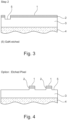
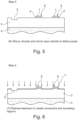
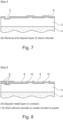
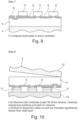
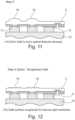
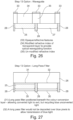
- Figures 1 to 41 show the process of making a micro-display according to the present invention. This is discussed below.
- Figure 1 shows a light emitting GaN layer 3 on top of which there is an ohmic current spreading layer 2 and a layer of silicon dioxide 1.
- the ohmic current spreading layer 2 has a thickness of about 20nm.
- the layer of silicon dioxide 1 has a thickness of about 200nm.
- the substrate layer 4 has a thickness of about 200um
- the substrate layer 4 can be any suitable material such as sapphire, silicon, GaN and silicon carbide.
- Example materials for the ohmic current spreading layer 2 are Ni/ Au or Ni/ Pt or Au/ Pt or Pt/ Ni/ Au Ni/ Ag or Pd or ITO or Ni/ ITO.
- Figure 2 represents an alternative process method where the GaN layer 3 has etched pixels comprising a layer of silicon dioxide 1 and ohmic current spreading layer 2. This is a standard technique to form the LED pixel.
- the spreading layer 2 is defined, typically to be the same size as the final pixel dimension.
- an etching process is performed on the device shown in Figure 1 which is a GaN modification process.
- the etching produces an etched area 5 where the GaN layer 3 is etched.
- the etching process is performed using any suitable etching process but is preferably performed by plasma etching using CF 3 but other techniques such as wet etching may be used. Etching down to the n material may be performed using plasma etching using Cl.
- a mask is then applied so as to enable pixel formation.
- There is a further etching process where the ohmic current spreading layer 2 and the layer of silicon dioxide 1 are etched away to form pixels 6.
- the etching process is performed using any suitable plasma etching process such as CHF 3 .
- the pixels 6 can be formed in a matrix pattern. This leaves pixels with dimensions of between 0.5 ⁇ m and 100 ⁇ m. A typical dimension is about 3 ⁇ m.
- a plasma treatment 7 which is used to create conductive and insulating regions.
- the unprotected GaN is exposed to a GaN modification process e.g. a plasma such as CHF 3 .
- the removal of the patterned feature may then be performed followed by annealing of the structure to form highly resistive layers in the areas exposed to plasma, whilst retaining conductive e.g. ohmic contact at the layers protected by the mask to form a pixel or an array of pixels.
- a mask layer is formed.
- the layer of silicon dioxide 1 on the top of the pixels 6 is removed and then re-deposited in the form of a complete layer 8 of a photoresist only or a dielectric e.g. SiO 2 with photoresist on top to pattern the SiO 2 layer.
- the mask is then opened above the n-contact area and the spreading material.
- a conductive contact is then deposited e.g. Ti:Au or other combinations. It should be apparent that the etch sidewall at the n-contact area has an electrical insulating layer on the sidewalls to prevent shorting across the p-n junction.
- the area of the complete layer 8 of silicon dioxide above the pixels 6 is etched away to form contact windows 10 to the ohmic current spreading layer 2 below to create contact.
- an n contact metal layer 9 is deposited in the area of the etch 5.
- the n contact metal layer 9 forms a global contact and has an electrical function and/or functions as a guide for controlling a further etch step in the manufacturing process.
- bond pads 11 are deposited to form n and p contacts. This may use the same masking layer or alternatively a new mask.
- the p and n bond pad have the advantage of having the same height and thus improve the bonding probability of success for an array of LEDs.
- the n-pad etch depth can be used as both an accurate etch stop for the process later on i.e. when etching from the GaN side, exposed after laser lift off, and as a means to provide a connection for a distributed electrical contact on the backside of the wafer.
- the mask layer for forming the bond pad metal can provide a layer without topology and as such a process such as CMP - chemical mechanical polishing (damscene) can be used to planarise the metal to the top of the mask layer.
- This polishing process then enables the ability to have a flat bonding surface. Consequently, it will be possible to use a range of bonding processes including but not limited to flip-chip bump bonding (thermo-sonic or thermo-compression), or direct bonding or any other technique to form a mechanical and electrical bond to a backplane, e.g. CMOS, TFT or NMOS layer.
- the substrate layer 4 is removed off with any suitable technique such as laser lift-off.
- the substrate layer 4 can then undergo silicone, chemical mechanical polishing and etching for the silicone.
- the GaN on substrate (sapphire, etc.) is then bonded to a temporary wafer with the GaN surface in contact to this layer.
- Industry standard techniques may be used to detach the GaN layer from the substrate. In this particular example laser lift off is used.
- CMP can be used to remove silicon or GaN. This can then be combined with etching of the substrate so that features can be etched into the substrate.
- pillars can be left from the Si to provide isolation between sub-pixels.
- the temporary wafer 13 has a thickness which is significantly thicker than the GaN layer 3.
- the GaN layer is exposed on the backside a range of features can be formed in this structure. This can be to provide the means of extracting more light and/or providing features to reduce optical cross-talk between sub-pixels.
- the GaN layer 3 is etched to form optical features 14 which are in the form of lenses.
- the optical features 14 are convex in shape and maximize emission and minimise spectral crosstalk. It is also possible to deposit a layer on these features such as SiO 2 to act as an anti-reflection coating. In this particular feature, lenses are formed (the height can be accurately determined by using the etch stop) to increase light extraction and to reduce optical crosstalk between sub-pixels.
- the etching may be used to form roughened areas 15.
- the roughened areas 15 may be used to improve light extraction.
- a scattering surface is formed from etching.
- a layer or layers can be deposited to reduce the Fresnel reflections.
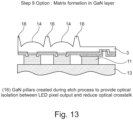
- Figure 13 is a further alternative where in the matrix etching process, GaN pillars 16 are formed.
- pillars 16 can therefore be formed between the light extraction features (in this example lenses). This can be formed in the GaN at the same time as the light extraction features using standard techniques.
- the pillars 16 can be formed in the original substrate (description in Figure 10 ) or they can be formed in the colour conversion substrate (described in Figure 23 ).
- the pillars 16 will ideally have smooth surfaces and a highly reflective structure, irrespective of the technique.
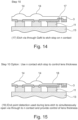
- the process as shown in Figure 14 then involves a further etching process where the GaN layer 3 is etched through to form an etched area 17 to the n contact metal layer 9 over the etched area 5.
- the light extraction feature (lens) and n opening can be simultaneously formed.
- the etching is performed by any suitable etching technique.
- Figure 15 shows an alternative where the n contact layer 9 is used as an etch stop to control the lens thickness.
- the end point detection is used during the lens etch 18 to simultaneously open through to the n contact metal layer 9 and provide control of the lens thickness.
- the preferred embodiment for the Figure 14 process is that the n-contact can be used as an etch stop so as to accurately control the etch depth of the lens and thus its proximity to the QW layers.
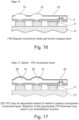
- Figure 16 shows that there is a deposition step where there is a deposition of conductive metal grid and/or opaque layer 19. This is similar to as described in Figure 9 and the described ability to form a distributed electrical contact on the exposed GaN face. In this instance this forms an electrical bridge between the bond pad and the conductive GaN face. In this instance an opaque conductor is used. Consequently, this is not deposited over the light extraction features.
- the conductive metal grid and/or opaque layer 40 reduces bias and has a shielding effect.
- Figure 17 represents an alternative where an ITO conductive layer 20 is deposited instead of metal to create a transparent conductive layer 20.
- the selection of the appropriate ITO thickness may result in an anti-reflection coating.
- a distributed n-contact can be formed.
- a transparent ITO layer can be deposited uniformly across the surface (can also be patterned so as not covering the light extraction feature). This can also be designed to have a thickness to reduce Fresnel reflections.
- Figure 18 is a further alternative where the GaN pillars 16 are coated with a layer 21 of n metal and may also cover the sidewalls to minimize crosstalk.
- This is a combination of Figures 10 and 17 where the metal can be patterned to provide distributed electrical contact and also provide reflective pillars.
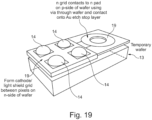
- Figure 19 is a schematic to illustrate the principle of forming light extraction features, an etch stop, distributed n contact and all bonded to a temporary carrier wafer such as silicon. This summarises the completed GaN chip which can then be integrated to a backplane control substrate and a colour converting substrate.
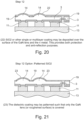
- a layer of SiOz or any other suitable type of single or multi-layer coating 22 may be deposited over the surface of the GaN lens 14 and the n metal layer 19. This provides both protection and an anti-reflection function.
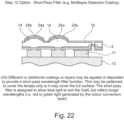
- coatings 24a, 24b may be deposited.
- the coatings 24a, 24b may be patterned to cover the optical features 14 only or it may cover the full surface.
- the short pass filter may be designed to allow blue light to exit the GaN but reflect longer wavelengths (i.e. the red or green light generated by the colour conversion layer).
- a short pass filter is employed. This efficiently transmits light in the pump wavelength region.
- each colour convertor provides a sub-pixel and is optically pumped (UV light).
- UV light In the case a blue pump wavelength is used, not in accordance with the present invention, the blue sub-pixel has no colour convertor substance but may have a material to mimic the colour convertor so that it has similar emission properties e.g.
- each LED pump is UV and there is a colour convertor for red, green and blue.
- a matrix is also formed between the sub-pixels for improved contrast and to prevent light leakage into the adjacent pixel. This may be a black matrix or a reflective structure.
- the matrix is formed on the colour conversion substrate.
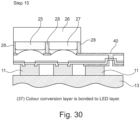
- the colour converter comprises a colour conversion layer 25, a substrate 26, a transparent layer 27 and a mask 28.
- the substrate 26 may be made from glass, sapphire, silicon or any other suitable material.
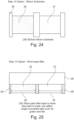
- Figure 24 represents the option for forming the matrix for the colour converter region.
- the GaN on silicon substrate route it is possible to easily polish and etch the silicon substrate (for other substrates such as sapphire or SiC this is a much more difficult process). Consequently, it is possible to etch a matrix into the silicon using wet or dry etching capabilities. Using either etching technique can form matrices with high aspect ratio i.e. height to width of structure. The silicon will absorb light in the visible wavelength region, thus enhancing contrast. It is also possible to metallise the silicon matrix to provide reflection and enhance light conversion/ output.
- the colour converter comprises a colour conversion layer 25, a transparent layer 27 and an etched silicon area 29.
- Figure 25 is a further alternative colour converter.
- the short pass filter transmits light in blue and reflects at longer wavelengths i.e. green and red.
- a multi-layer coating can be formed on all cells. Consequently, the light converted, which is isotropic in nature, is reflected and will exit in the intended direction.
- the filter In the case of the blue emission pixel it may or may not be appropriate to have the filter. If pumping with UV light then the filter will be placed over all cells and have the properties of transmitting the UV pump but reflecting the longer wavelengths.
- Figure 26 is a further alternative colour converter which can be described as operating like a waveguide.
- a colour conversion layer 25 transparent layer 27 and a mask 28.
- a modified refractive index transparent layer 34 which provides an optical waveguiding function and an un-modified refractive index layer 35.
- the transparent layer 27 For the colour convertor transparent substrate (on which the colour convertors and matrix is formed), it is possible to modify the transparent layer 27. This can enable waveguides normal to the substrate plane to be formed. Consequently, the higher index layers will enhance optical waveguiding and enable the light to exit with a lower divergence.
- the index of the substrate can be modified as an example by laser induced effects to form the waveguide or can be formed by the etching and filling using higher index material. It is possible to use a transparent layer 34 of standard thickness of 0.5 to 2 mm. Furthermore, it is possible to use substrate layers 34 with thicknesses down to 20 ⁇ m.
- Figure 27 is a further alternative colour converter which can be described as a long pass filter.
- a further option/embodiment for the colour convertor transparent substrate is to also deposit a long pass filter, prior to the colour convertor being deposited on the substrate. This works in a similar fashion as Figure 24 except in this arrangement the unconverted blue light is reflected back to the colour conversion region.
- the colour convertor is patterned so as not to cover the blue sub-pixel.
- the colour converter has a long pass filter 31 located below the colour conversion layer 25.
- the long pass filter 31 allows converted light to exit, but recycles blue unconverted light.
- Figure 27 also shows that a long pass filter 32 would not be deposited over blue pixels to allow transmission of blue light.
- a colour converter is brought up to and aligned with the LED layer.
- the colour conversion layer is therefore aligned to the LED substrate. This is in preparation for bonding of the two structures and is completed in such a manner that the GaN sub-pixel LEDs are aligned to the respective colour conversion region.
- the colour converter is attached to the rest of the device. Therefore, once suitable alignment has been completed the two layers are brought into contact and bonded together. As an example, this may be an epoxy type bonding process. It is also possible to perform this bond of the layer to provide a localised hermetic seal between the two substrates, thus providing enhanced protection to the colour conversion layer.
- the colour converter is pumped with blue light and there is a red/green colour conversion layer which is the phosphor layer.
- the layer is a quantum dot or transparent/diffusing layer (blue) or a mixture thereof.
- Figure 30 shows that extending vertically down from the glass substrate there is a reflective mask 28.
- the reflective mask 28 has the ability to recirculate the light, minimises crosstalk and enhances display contrast.
- the reflective mask 28 therefore has the ability to transmit blue light and reflect red and green light when a filter is placed before the layer. In an alternative, if the filter is placed after the layer then the blue light will be recirculate and the red and green transmitted.
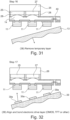
- the temporary layer 13 is removed from the combined layers. This may be achieved by heating, solvent and or any other standard technique.
- an electronic drive layer 39 is brought up to and aligned with the metal bond pads 11.
- the electronic drive layer 39 is a CMOS, TFT or NMOS layer.
- this is showing the bond stack with topology for clarity.
- the GaN modified LEDs can be used with a planarised surface. ( Figure 9 description is the way to provide a flat smooth surface). With no or little topology a range of different control backplanes can be bonded to the GaN surface including but not limited to CMOS, NMOS, TFT, etc.
- Figure 34 is a plan view of pixel layout implementation in layout A.
- the three sub-pixels 43 are arranged in a 20 x 20 micron cell. This highlights the possible layout of the GaN led sub-pixels.
- three LEDs 43 are placed within the, as an example, 20 ⁇ m x 20 ⁇ m pixel region.
- the bond pads 39a are shown as being positioned away from the pixels 43.
- the bond pads associated with each LED sub-pixel are in general larger. This can distribute the bond force and reduce the likelihood of physical damage. Furthermore, the resistance can be reduced by increasing the bond pad dimensions.
- Using techniques such as GaN mod definition of the sub-pixel leads to improved performance as it reduces topology on the GaN surface and can provide LED sub-pixels with well-defined isolation layers.
- Figure 36 is a plan view of pixel layout implementation in layout B. In the embodiment shown there are four sub-pixels 44 included in each pixel. This is similar to Figure 34 but in this instance four GaN led sub-pixels 44 are defined within the 20 ⁇ m x 20 ⁇ m pixel region.
- the bond pads 46 may be positioned over the pixel 44. This is similar to Figure 35 with larger bond pads over each sub-pixel shown in Figure 36 .
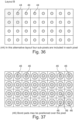
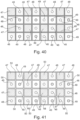
- FIG 39 there is shown an opaque/reflecting matrix 50. This is similar to Figure 38 also showing the matrix isolating each sub-pixel.
- Figure 41 there is a matrix of red colour conversion cells 47, green colour conversion cells 48, blue pixels without colour conversion cells 49 and an opaque/reflecting matrix 50. This is similar to Figure 40 and shows the matrix isolating each sub-pixel.
Landscapes
- Led Devices (AREA)
- Devices For Indicating Variable Information By Combining Individual Elements (AREA)
Applications Claiming Priority (3)
| Application Number | Priority Date | Filing Date | Title |
|---|---|---|---|
| GBGB1420452.3A GB201420452D0 (en) | 2014-11-18 | 2014-11-18 | Integrated colour led micro-display |
| PCT/GB2015/053496 WO2016079505A1 (en) | 2014-11-18 | 2015-11-18 | Integrated colour led micro-display |
| EP15801484.5A EP3221890B1 (en) | 2014-11-18 | 2015-11-18 | Integrated led micro-display and method of fabricating the same |
Related Parent Applications (2)
| Application Number | Title | Priority Date | Filing Date |
|---|---|---|---|
| EP15801484.5A Division EP3221890B1 (en) | 2014-11-18 | 2015-11-18 | Integrated led micro-display and method of fabricating the same |
| EP15801484.5A Division-Into EP3221890B1 (en) | 2014-11-18 | 2015-11-18 | Integrated led micro-display and method of fabricating the same |
Publications (2)
| Publication Number | Publication Date |
|---|---|
| EP3955304A1 EP3955304A1 (en) | 2022-02-16 |
| EP3955304B1 true EP3955304B1 (en) | 2024-01-03 |
Family
ID=52248509
Family Applications (2)
| Application Number | Title | Priority Date | Filing Date |
|---|---|---|---|
| EP21200332.1A Active EP3955304B1 (en) | 2014-11-18 | 2015-11-18 | Integrated colour led micro-display |
| EP15801484.5A Active EP3221890B1 (en) | 2014-11-18 | 2015-11-18 | Integrated led micro-display and method of fabricating the same |
Family Applications After (1)
| Application Number | Title | Priority Date | Filing Date |
|---|---|---|---|
| EP15801484.5A Active EP3221890B1 (en) | 2014-11-18 | 2015-11-18 | Integrated led micro-display and method of fabricating the same |
Country Status (7)
| Country | Link |
|---|---|
| US (3) | US10008645B2 (enExample) |
| EP (2) | EP3955304B1 (enExample) |
| JP (1) | JP6505226B2 (enExample) |
| KR (1) | KR101968592B1 (enExample) |
| CN (2) | CN107210315B (enExample) |
| GB (1) | GB201420452D0 (enExample) |
| WO (1) | WO2016079505A1 (enExample) |
Families Citing this family (157)
| Publication number | Priority date | Publication date | Assignee | Title |
|---|---|---|---|---|
| GB201420452D0 (en) * | 2014-11-18 | 2014-12-31 | Mled Ltd | Integrated colour led micro-display |
| US10304811B2 (en) * | 2015-09-04 | 2019-05-28 | Hong Kong Beida Jade Bird Display Limited | Light-emitting diode display panel with micro lens array |
| KR102416470B1 (ko) * | 2015-12-21 | 2022-07-04 | 엘지디스플레이 주식회사 | 광효율 향상을 위한 표시패널, 표시장치 및 표시패널을 제조하는 방법 |
| CN112289821A (zh) * | 2016-04-14 | 2021-01-29 | 群创光电股份有限公司 | 显示装置 |
| US10134802B2 (en) * | 2016-05-12 | 2018-11-20 | Ostendo Technologies, Inc. | Nanophosphors-converted quantum photonic imagers and methods for making the same |
| KR102617466B1 (ko) * | 2016-07-18 | 2023-12-26 | 주식회사 루멘스 | 마이크로 led 어레이 디스플레이 장치 |
| DE102016113763A1 (de) * | 2016-07-26 | 2018-02-01 | Endress+Hauser Conducta Gmbh+Co. Kg | Sensoranordnung zum Einsatz in der Prozessautomatisierung |
| US10606121B2 (en) | 2016-09-12 | 2020-03-31 | Seoul Semiconductor Co., Ltd. | Display apparatus |
| CN106444250A (zh) * | 2016-10-28 | 2017-02-22 | 江苏新广联半导体有限公司 | 3led微显示投影模块 |
| CN112230433A (zh) | 2016-10-31 | 2021-01-15 | 德遁公司 | 毫微微投影仪光学系统 |
| WO2018084919A1 (en) * | 2016-11-04 | 2018-05-11 | VerLASE TECHNOLOGIES LLC | Color-converting structures and light-emitting structures and visual displays made therewith |
| EP3547376B1 (en) * | 2016-11-24 | 2023-05-17 | Lg Innotek Co., Ltd. | Semiconductor device and display device comprising same |
| FR3061358B1 (fr) * | 2016-12-27 | 2021-06-11 | Aledia | Procede de fabrication d’un dispositif optoelectronique comportant des plots photoluminescents de photoresine |
| WO2018132070A1 (en) | 2017-01-13 | 2018-07-19 | Massachusetts Institute Of Technology | A method of forming a multilayer structure for a pixelated display and a multilayer structure for a pixelated display |
| DE102017100798A1 (de) * | 2017-01-17 | 2018-07-19 | Osram Opto Semiconductors Gmbh | Anzeigevorrichtung |
| TWI678411B (zh) * | 2017-01-26 | 2019-12-01 | 南韓商Lg化學股份有限公司 | 微型led以及包含此微型led的顯示器 |
| WO2018199901A1 (en) | 2017-04-24 | 2018-11-01 | Hewlett-Packard Development Company, L.P. | Micro light-emitting diode display with 3d orifice plating and light filtering |
| CN107230685A (zh) * | 2017-06-02 | 2017-10-03 | 南京迈智芯微光电科技有限公司 | 一种全彩化的半导体发光微显示器及其制造工艺 |
| CN112510060B (zh) * | 2017-06-02 | 2023-06-30 | 南京昀光科技有限公司 | 一种全彩半导体发光微显示器及其制造工艺 |
| CN108987423B (zh) * | 2017-06-05 | 2023-09-12 | 三星电子株式会社 | 显示装置 |
| KR102395993B1 (ko) * | 2017-06-05 | 2022-05-11 | 삼성전자주식회사 | 디스플레이 장치 |
| KR102399464B1 (ko) * | 2017-06-27 | 2022-05-19 | 주식회사 루멘스 | 엘이디 패널 |
| KR102455483B1 (ko) * | 2017-06-30 | 2022-10-19 | 삼성전자주식회사 | Led 장치 및 그 제조 방법 |
| WO2019040688A1 (en) * | 2017-08-24 | 2019-02-28 | Corning Incorporated | HIGH DYNAMIC RANGE MICRO-LED BACKLIGHT SYSTEMS AND METHODS |
| CN111108613B (zh) * | 2017-09-13 | 2024-01-16 | 夏普株式会社 | Led单元、图像显示元件及其制造方法 |
| CN108323215B (zh) | 2017-09-28 | 2020-10-30 | 歌尔股份有限公司 | 微发光二极管转移方法、制造方法和显示装置 |
| US10768515B2 (en) | 2017-12-12 | 2020-09-08 | Tectus Corporation | Method for manufacturing ultra-dense LED projector using thinned gallium nitride |
| US10388641B2 (en) | 2017-10-19 | 2019-08-20 | Tectus Corporation | Ultra-dense LED projector |
| KR102486391B1 (ko) | 2017-11-09 | 2023-01-09 | 삼성전자주식회사 | 고해상도 디스플레이 장치 |
| KR102509639B1 (ko) | 2017-12-12 | 2023-03-15 | 삼성전자주식회사 | 발광소자 패키지 제조방법 |
| US20190198564A1 (en) * | 2017-12-20 | 2019-06-27 | Lumileds Llc | Monolithic segmented led array architecture with islanded epitaxial growth |
| US11335835B2 (en) | 2017-12-20 | 2022-05-17 | Lumileds Llc | Converter fill for LED array |
| US11961875B2 (en) | 2017-12-20 | 2024-04-16 | Lumileds Llc | Monolithic segmented LED array architecture with islanded epitaxial growth |
| US10957820B2 (en) | 2017-12-21 | 2021-03-23 | Lumileds Llc | Monolithic, segmented light emitting diode array |
| US20190198720A1 (en) * | 2017-12-22 | 2019-06-27 | Lumileds Llc | Particle systems and patterning for monolithic led arrays |
| KR102521100B1 (ko) | 2018-01-08 | 2023-04-14 | 삼성디스플레이 주식회사 | 표시 장치 |
| US11404400B2 (en) | 2018-01-24 | 2022-08-02 | Apple Inc. | Micro LED based display panel |
| TWI658446B (zh) * | 2018-02-01 | 2019-05-01 | 鴻海精密工業股份有限公司 | 微型led觸控顯示面板 |
| US10673414B2 (en) | 2018-02-05 | 2020-06-02 | Tectus Corporation | Adaptive tuning of a contact lens |
| KR102493479B1 (ko) | 2018-02-06 | 2023-02-01 | 삼성디스플레이 주식회사 | 표시 장치의 제조 방법 |
| KR102136921B1 (ko) * | 2018-03-02 | 2020-07-28 | 주식회사 루멘스 | 차량 외판 부착형 플렉시블 디스플레이 장치 |
| US10529290B1 (en) * | 2018-02-27 | 2020-01-07 | Facebook Technologies, Llc | Non-uniformly patterned photonic crystal structures with quantum dots for pixelated color conversion |
| US10503007B1 (en) | 2018-02-27 | 2019-12-10 | Facebook Technologies, Llc | Directional color conversion using photonic crystals with quantum dots |
| CN110212064B (zh) | 2018-02-28 | 2020-10-09 | 华为技术有限公司 | 一种发光二极管芯片及其制备方法 |
| KR102521582B1 (ko) | 2018-04-03 | 2023-04-12 | 삼성전자주식회사 | 발광 다이오드 디스플레이 장치 |
| KR102022310B1 (ko) * | 2018-04-04 | 2019-09-18 | 한국광기술원 | 능동소자 집적형 미세 led 칩 및 이에 대한 제조방법 |
| KR102551354B1 (ko) * | 2018-04-20 | 2023-07-04 | 삼성전자 주식회사 | 반도체 발광 소자 및 그 제조 방법 |
| DE102018111417A1 (de) | 2018-05-14 | 2019-11-14 | Osram Opto Semiconductors Gmbh | Konversionselement, optoelektronisches bauteil, verfahren zur herstellung einer vielzahl von konversionselementen, verfahren zur herstellung einer vielzahl von optoelektronischen bauteilen und verfahren zur herstellung eines optoelektronischen bauteils |
| US10649239B2 (en) | 2018-05-30 | 2020-05-12 | Tectus Corporation | Eyeglasses with embedded femtoprojectors |
| KR20190137458A (ko) | 2018-06-01 | 2019-12-11 | 삼성전자주식회사 | Led를 이용한 디스플레이 모듈 제조방법 |
| KR102591768B1 (ko) | 2018-07-17 | 2023-10-20 | 삼성디스플레이 주식회사 | 표시 장치 |
| CN108987446A (zh) * | 2018-07-17 | 2018-12-11 | 南方科技大学 | 一种Micro-LED显示面板及其制造方法 |
| EP3608959B1 (en) | 2018-08-06 | 2023-11-15 | Nichia Corporation | Light emitting device and method for manufacturing same |
| TWI720339B (zh) | 2018-08-31 | 2021-03-01 | 東貝光電科技股份有限公司 | 應用於微型led顯示器之led發光模組及應用該led發光模組所製成之顯示器 |
| KR20260018189A (ko) * | 2018-09-05 | 2026-02-06 | 가부시키가이샤 한도오따이 에네루기 켄큐쇼 | 표시 장치, 표시 모듈, 전자 기기, 및 표시 장치의 제작 방법 |
| KR102650659B1 (ko) | 2018-09-13 | 2024-03-25 | 삼성전자주식회사 | 디스플레이 장치 |
| CN109216590B (zh) * | 2018-09-21 | 2020-11-03 | 福州大学 | 一种柔性彩色micro-LED显示器件制备方法 |
| US20200135988A1 (en) | 2018-10-26 | 2020-04-30 | Tectus Corporation | Methods of modifying the composition of material layers |
| CN109449259B (zh) * | 2018-10-31 | 2020-07-10 | 海信视像科技股份有限公司 | 微型发光二极管灯板、其制作方法、背光模组及显示装置 |
| KR102698293B1 (ko) * | 2018-11-27 | 2024-08-23 | 삼성전자주식회사 | 디스플레이 장치 및 제조 방법 |
| KR102733562B1 (ko) | 2018-12-03 | 2024-11-25 | 삼성전자주식회사 | 디스플레이 장치 |
| US10991865B2 (en) | 2018-12-20 | 2021-04-27 | Samsung Display Co., Ltd. | Display device |
| CN109860241B (zh) * | 2018-12-29 | 2021-07-27 | 苏州清越光电科技股份有限公司 | 高分辨率Micro-OLED显示模组及其制备方法 |
| JPWO2020157811A1 (ja) * | 2019-01-28 | 2021-11-25 | 堺ディスプレイプロダクト株式会社 | マイクロledデバイスおよびその製造方法 |
| KR102704782B1 (ko) | 2019-02-08 | 2024-09-10 | 삼성디스플레이 주식회사 | 표시 장치 |
| KR102690987B1 (ko) | 2019-02-25 | 2024-08-01 | 삼성디스플레이 주식회사 | 표시 장치 및 이의 제조 방법 |
| US11637219B2 (en) | 2019-04-12 | 2023-04-25 | Google Llc | Monolithic integration of different light emitting structures on a same substrate |
| FR3095550B1 (fr) * | 2019-04-26 | 2021-05-21 | Commissariat Energie Atomique | Procede de realisation d’un dispositif photo-emetteur et/ou photo-recepteur a grille de separation optique metallique |
| KR20200142685A (ko) | 2019-06-13 | 2020-12-23 | 삼성전자주식회사 | 마이크로 led 전사 방법 및 이에 의해 제조된 디스플레이 모듈 |
| KR102730932B1 (ko) | 2019-06-19 | 2024-11-19 | 삼성디스플레이 주식회사 | 표시 장치 |
| US11271032B2 (en) | 2019-06-20 | 2022-03-08 | Samsung Display Co., Ltd. | Display device |
| KR102827322B1 (ko) | 2019-06-21 | 2025-07-02 | 삼성디스플레이 주식회사 | 표시 장치 및 그의 제조 방법 |
| KR102746084B1 (ko) | 2019-07-08 | 2024-12-26 | 삼성전자주식회사 | 발광소자 패키지 및 이를 이용한 디스플레이 패널 |
| KR102684757B1 (ko) | 2019-08-22 | 2024-07-16 | 삼성디스플레이 주식회사 | 표시 장치 |
| US11624882B2 (en) * | 2019-09-13 | 2023-04-11 | Avicenatech Corp. | Optical interconnects using microLEDs |
| KR102739953B1 (ko) | 2019-10-22 | 2024-12-06 | 삼성전자주식회사 | 마이크로 led 소자 및 그 제조 방법 |
| KR102787185B1 (ko) | 2019-11-12 | 2025-03-28 | 삼성디스플레이 주식회사 | 표시 장치 및 그의 제조 방법 |
| US11121289B2 (en) | 2019-11-20 | 2021-09-14 | Tectus Corporation | Ultra-dense quantum dot color converters |
| KR102877707B1 (ko) | 2019-11-26 | 2025-10-29 | 삼성디스플레이 주식회사 | 표시패널 및 이의 제조 방법 |
| US11674795B2 (en) | 2019-12-18 | 2023-06-13 | Lumileds Llc | Miniature pattern projector using microLEDs and micro-optics |
| KR102856221B1 (ko) * | 2019-12-19 | 2025-09-05 | 엘지디스플레이 주식회사 | 마이크로 엘이디 표시 장치 및 이의 제조방법 |
| TWI725757B (zh) | 2020-03-05 | 2021-04-21 | 財團法人工業技術研究院 | 子畫素結構、畫素結構以及應用於其的發光二極體晶粒 |
| US11848402B2 (en) | 2020-03-11 | 2023-12-19 | Lumileds Llc | Light emitting diode devices with multilayer composite film including current spreading layer |
| US11942507B2 (en) | 2020-03-11 | 2024-03-26 | Lumileds Llc | Light emitting diode devices |
| US11569415B2 (en) | 2020-03-11 | 2023-01-31 | Lumileds Llc | Light emitting diode devices with defined hard mask opening |
| US11735695B2 (en) | 2020-03-11 | 2023-08-22 | Lumileds Llc | Light emitting diode devices with current spreading layer |
| JP2023523910A (ja) | 2020-04-30 | 2023-06-08 | ルミレッズ リミテッド ライアビリティ カンパニー | 集積光学フィルタリング素子を有するカラーled |
| KR102906650B1 (ko) * | 2020-05-11 | 2025-12-30 | 삼성전자주식회사 | 전자 소자, 이의 제조 방법, 및 이를 포함하는 표시 장치 |
| WO2021231772A1 (en) | 2020-05-15 | 2021-11-18 | Lumileds Llc | Light-emitting device with configurable spatial distribution of emission intensity |
| KR102787637B1 (ko) | 2020-05-19 | 2025-03-27 | 삼성디스플레이 주식회사 | 표시 장치 |
| GB2599065B (en) * | 2020-05-22 | 2023-05-10 | Plessey Semiconductors Ltd | Light emitting device array |
| GB2595715B (en) * | 2020-06-04 | 2022-08-17 | Plessey Semiconductors Ltd | Enhanced colour conversion and collimation of micro-LED devices |
| US11764095B2 (en) | 2020-07-10 | 2023-09-19 | Samsung Electronics Co., Ltd. | Wet alignment method for micro-semiconductor chip and display transfer structure |
| KR102885870B1 (ko) | 2020-09-08 | 2025-11-12 | 삼성전자주식회사 | 마이크로 발광 소자 및 이를 포함한 디스플레이 장치 |
| US11626538B2 (en) | 2020-10-29 | 2023-04-11 | Lumileds Llc | Light emitting diode device with tunable emission |
| US11901491B2 (en) | 2020-10-29 | 2024-02-13 | Lumileds Llc | Light emitting diode devices |
| US12040432B2 (en) | 2020-10-30 | 2024-07-16 | Lumileds Llc | Light emitting diode devices with patterned TCO layer including different thicknesses |
| KR102992813B1 (ko) * | 2020-11-06 | 2026-07-20 | 삼성디스플레이 주식회사 | 반도체 나노입자, 이를 포함한 전자 장치 및 상기 반도체 나노입자의 제조 방법 |
| EP4244896A4 (en) * | 2020-11-11 | 2024-11-06 | Applied Materials, Inc. | FRONT PANEL DEVICE FOR DISPLAY UNIT |
| US11955583B2 (en) | 2020-12-01 | 2024-04-09 | Lumileds Llc | Flip chip micro light emitting diodes |
| US11705534B2 (en) | 2020-12-01 | 2023-07-18 | Lumileds Llc | Methods of making flip chip micro light emitting diodes |
| US11600656B2 (en) | 2020-12-14 | 2023-03-07 | Lumileds Llc | Light emitting diode device |
| TW202226609A (zh) * | 2020-12-21 | 2022-07-01 | 美商菲絲博克科技有限公司 | 用於微發光二極體的光束整形二次光學組件 |
| DE102021101657B4 (de) | 2021-01-26 | 2024-12-12 | Infineon Technologies Ag | Verfahren zur Herstellung eines hybriden Bauelements |
| CN112908196B (zh) * | 2021-01-29 | 2023-12-19 | 厦门天马微电子有限公司 | 一种显示面板以及显示装置 |
| DE102021106332A1 (de) | 2021-03-16 | 2022-09-22 | OSRAM Opto Semiconductors Gesellschaft mit beschränkter Haftung | Optoelektronische baugruppe, displayanordnung und verfahren |
| US11721796B2 (en) | 2021-03-29 | 2023-08-08 | Tectus Corporation | LED displays fabricated using hybrid bonding |
| KR102964174B1 (ko) | 2021-04-29 | 2026-05-13 | 삼성디스플레이 주식회사 | 표시 장치 |
| CN115274773A (zh) | 2021-04-29 | 2022-11-01 | 三星显示有限公司 | 显示装置 |
| KR20220149880A (ko) | 2021-04-30 | 2022-11-09 | 삼성디스플레이 주식회사 | 표시 장치 및 그 제조 방법 |
| KR102788201B1 (ko) | 2021-04-30 | 2025-03-28 | 삼성디스플레이 주식회사 | 표시 장치 및 그 제조 방법 |
| US12532591B2 (en) | 2021-04-30 | 2026-01-20 | Samsung Display Co., Ltd. | Display device having partition wall structure that finely divides wavelength conversion portions |
| US12453228B2 (en) | 2021-04-30 | 2025-10-21 | Samsung Display Co., Ltd. | Display device and method of manufacturing the same |
| KR102791843B1 (ko) | 2021-04-30 | 2025-04-09 | 삼성디스플레이 주식회사 | 표시 장치 및 그의 제조 방법 |
| KR102866873B1 (ko) | 2021-04-30 | 2025-10-01 | 삼성디스플레이 주식회사 | 표시 장치 및 표시 장치의 제조 방법 |
| US12336350B2 (en) | 2021-04-30 | 2025-06-17 | Samsung Display Co., Ltd. | High resolution display device with reduced current consumption and load |
| US12191340B2 (en) | 2021-04-30 | 2025-01-07 | Samsung Display Co., Ltd. | Display device |
| KR102877038B1 (ko) | 2021-04-30 | 2025-10-28 | 삼성디스플레이 주식회사 | 표시 장치 및 그의 제조 방법 |
| US12446387B2 (en) | 2021-04-30 | 2025-10-14 | Samsung Display Co., Ltd. | Display device and manufacturing method thereof |
| US12610858B2 (en) * | 2021-05-14 | 2026-04-21 | Seoul Viosys Co., Ltd. | Light emitting module and display apparatus having the same |
| TWI799929B (zh) * | 2021-07-29 | 2023-04-21 | 錼創顯示科技股份有限公司 | 微型發光二極體顯示裝置及其製造方法 |
| KR102881169B1 (ko) | 2021-08-10 | 2025-11-05 | 삼성디스플레이 주식회사 | 표시 장치와 그의 제조 방법 |
| EP4386876A4 (en) * | 2021-08-30 | 2024-12-04 | Sony Group Corporation | LIGHT EMITTING DEVICE AND IMAGE DISPLAY DEVICE |
| US12484346B2 (en) | 2021-09-03 | 2025-11-25 | Lumileds Singapore Pte. Ltd. | Light emitting diode devices with bonding and/or ohmic contact-reflective material |
| US12402440B2 (en) | 2021-09-03 | 2025-08-26 | Lumileds Llc | Light emitting diode devices with bonding and/or ohmic contact-reflective material |
| US12419137B2 (en) | 2021-09-10 | 2025-09-16 | Lumileds Llc | Light emitting diodes with segmented anodes by pixel |
| US12433080B2 (en) | 2021-09-29 | 2025-09-30 | Lumileds Singapore Pte. Ltd. | Hybrid CMOS micro-LED display layout |
| US12431478B2 (en) | 2021-09-29 | 2025-09-30 | Lumileds Singapore Pte. Ltd. | Hybrid CMOS micro-LED display layout |
| US12568728B2 (en) | 2021-09-29 | 2026-03-03 | Lumileds Singapore Pte. Ltd. | Hybrid CMOS micro-LED display layout |
| KR20230053014A (ko) | 2021-10-13 | 2023-04-21 | 삼성디스플레이 주식회사 | 표시 장치 및 그 제조 방법 |
| KR102959229B1 (ko) | 2021-10-13 | 2026-04-30 | 삼성디스플레이 주식회사 | 표시 장치와 그의 제조 방법 |
| US11935987B2 (en) | 2021-11-03 | 2024-03-19 | Lumileds Llc | Light emitting diode arrays with a light-emitting pixel area |
| US12604572B2 (en) | 2021-11-12 | 2026-04-14 | Lumileds Singapore Pte. Ltd. | Thin-film LED array with low refractive index patterned structures and reflector |
| US12490570B2 (en) | 2021-11-12 | 2025-12-02 | Lumileds Singapore Pte. Ltd. | Thin-film LED array with low refractive index patterned structures |
| US12588326B2 (en) | 2021-11-12 | 2026-03-24 | Lumileds Singapore Pte. Ltd. | Composite cathode contact for monolithically integrated micro-LEDs, mini-LEDs and LED arrays |
| KR102959281B1 (ko) | 2021-11-15 | 2026-04-30 | 삼성디스플레이 주식회사 | 표시 장치 |
| KR102871988B1 (ko) | 2021-12-23 | 2025-10-16 | 삼성전자주식회사 | 적층형 디스플레이 구동 집적 회로 및 이를 포함하는 디스플레이 장치 |
| KR20230101993A (ko) | 2021-12-29 | 2023-07-07 | 삼성디스플레이 주식회사 | 표시 장치 및 이의 제조 방법 |
| CN114361145A (zh) * | 2021-12-31 | 2022-04-15 | 湖北长江新型显示产业创新中心有限公司 | 一种显示面板及其制造方法、一种显示装置 |
| US12625366B2 (en) * | 2022-01-10 | 2026-05-12 | Samsung Electronics Co., Ltd. | Display device, augmented reality device including display device, and method of manufacturing display device |
| US12424599B2 (en) | 2022-02-28 | 2025-09-23 | The Hong Kong University Of Science And Technology | Full-color light-emitting diode micro-display and the fabrication method thereof |
| US12610671B2 (en) | 2022-03-22 | 2026-04-21 | Apple Inc. | Pixel optical structures for display optical efficiency |
| US12660401B2 (en) | 2022-03-22 | 2026-06-16 | Apple Inc. | Pixel optical structures for display optical efficiency |
| EP4250379A1 (en) * | 2022-03-24 | 2023-09-27 | Micledi Microdisplays BV | An optoelectronic device with color conversion and with conformal dbr and an associated fabrication method |
| US20250151479A1 (en) * | 2022-03-24 | 2025-05-08 | Micledi Microdisplays Bv | An optoelectronic device with color conversion and with conformal dbr and an associated fabrication method |
| CN114937731B (zh) * | 2022-04-29 | 2023-04-07 | 福建兆元光电有限公司 | 一种Micro LED光投射芯片及其制造方法 |
| WO2023230932A1 (zh) * | 2022-05-31 | 2023-12-07 | 京东方科技集团股份有限公司 | 芯片结构、芯片制备方法、显示基板和显示装置 |
| KR20230171529A (ko) | 2022-06-13 | 2023-12-21 | 삼성디스플레이 주식회사 | 표시 장치 |
| JP2024070034A (ja) * | 2022-11-10 | 2024-05-22 | 国立研究開発法人情報通信研究機構 | 半導体発光素子及び発光モジュール |
| JP2024070035A (ja) * | 2022-11-10 | 2024-05-22 | 国立研究開発法人情報通信研究機構 | 半導体発光素子、半導体発光素子の製造方法、発光モジュール及び発光モジュールの製造方法 |
| WO2024156371A1 (en) | 2023-01-27 | 2024-08-02 | Ams-Osram International Gmbh | Optoelectronic device and method for manufacturing the same |
| JP2024154752A (ja) * | 2023-04-19 | 2024-10-31 | 豊田合成株式会社 | 発光素子および発光装置 |
| FR3153690B1 (fr) * | 2023-09-29 | 2025-08-29 | Aledia | Dispositif optoélectronique et procédé de fabrication |
| US12666759B2 (en) | 2023-10-31 | 2026-06-23 | Lumileds Singapore Pte. Ltd. | Tunnel-junction cascade LED with different pump wavelengths |
| CN117525254A (zh) * | 2023-12-20 | 2024-02-06 | 西安赛富乐斯半导体科技有限公司 | Led发光构件及其构造方法 |
| TW202601586A (zh) * | 2024-01-04 | 2026-01-01 | 加拿大商弗瑞爾公司 | 微顯示器 |
| US12666774B2 (en) | 2024-04-30 | 2026-06-23 | Lumileds Singapore Pte. Ltd. | High efficacy polychromic light-emitting diode (LED) |
Family Cites Families (25)
| Publication number | Priority date | Publication date | Assignee | Title |
|---|---|---|---|---|
| US5661371A (en) | 1990-12-31 | 1997-08-26 | Kopin Corporation | Color filter system for light emitting display panels |
| US20050146258A1 (en) * | 1999-06-02 | 2005-07-07 | Shimon Weiss | Electronic displays using optically pumped luminescent semiconductor nanocrystals |
| US6410942B1 (en) * | 1999-12-03 | 2002-06-25 | Cree Lighting Company | Enhanced light extraction through the use of micro-LED arrays |
| CN1742384A (zh) * | 2003-01-27 | 2006-03-01 | 3M创新有限公司 | 利用全内反射的基于荧光粉的光源 |
| US7595511B2 (en) * | 2003-08-08 | 2009-09-29 | Sang-Kyu Kang | Nitride micro light emitting diode with high brightness and method of manufacturing the same |
| JP2008010298A (ja) * | 2006-06-29 | 2008-01-17 | Idemitsu Kosan Co Ltd | 色変換基板及びカラー表示装置 |
| TWI367465B (en) * | 2008-02-15 | 2012-07-01 | Foxsemicon Integrated Tech Inc | Led display |
| JP2010040976A (ja) * | 2008-08-08 | 2010-02-18 | Sony Corp | 発光素子及びこれを用いた照明装置並びに表示装置 |
| JP2010087224A (ja) * | 2008-09-30 | 2010-04-15 | Toyoda Gosei Co Ltd | Led表示装置およびled表示装置用隔壁の製造方法 |
| US8513685B2 (en) * | 2008-11-13 | 2013-08-20 | 3M Innovative Properties Company | Electrically pixelated luminescent device incorporating optical elements |
| CN102341740B (zh) * | 2009-06-22 | 2015-09-16 | 财团法人工业技术研究院 | 发光单元阵列、其制造方法和投影设备 |
| US8642363B2 (en) * | 2009-12-09 | 2014-02-04 | Nano And Advanced Materials Institute Limited | Monolithic full-color LED micro-display on an active matrix panel manufactured using flip-chip technology |
| JP2011216668A (ja) * | 2010-03-31 | 2011-10-27 | Sony Corp | 発光装置 |
| JP5512888B2 (ja) * | 2010-06-29 | 2014-06-04 | クーレッジ ライティング インコーポレイテッド | 柔軟な基板を有する電子素子 |
| JP5643720B2 (ja) * | 2011-06-30 | 2014-12-17 | 株式会社沖データ | ディスプレイモジュール及びその製造方法と表示装置 |
| US20150171372A1 (en) * | 2012-07-04 | 2015-06-18 | Sharp Kabushiki Kaisha | Fluorescent material, fluorescent coating material, phosphor substrate, electronic apparatus, and led package |
| KR101452768B1 (ko) * | 2012-08-21 | 2014-10-21 | 엘지전자 주식회사 | 반도체 발광 소자를 이용한 디스플레이 장치 및 이의 제조방법 |
| KR101422037B1 (ko) * | 2012-09-04 | 2014-07-23 | 엘지전자 주식회사 | 반도체 발광 소자를 이용한 디스플레이 장치 |
| US9424775B2 (en) * | 2012-10-15 | 2016-08-23 | The Hong Kong University Of Science And Technology | LEDoS projection system |
| US9153171B2 (en) * | 2012-12-17 | 2015-10-06 | LuxVue Technology Corporation | Smart pixel lighting and display microcontroller |
| JP6438978B2 (ja) * | 2014-06-18 | 2018-12-19 | エックス−セレプリント リミテッドX−Celeprint Limited | マイクロ組立ledディスプレイ |
| GB201420452D0 (en) * | 2014-11-18 | 2014-12-31 | Mled Ltd | Integrated colour led micro-display |
| US10177127B2 (en) * | 2015-09-04 | 2019-01-08 | Hong Kong Beida Jade Bird Display Limited | Semiconductor apparatus and method of manufacturing the same |
| US10700121B2 (en) * | 2017-02-13 | 2020-06-30 | Sct Ltd. | Integrated multilayer monolithic assembly LED displays and method of making thereof |
| WO2019147738A1 (en) * | 2018-01-23 | 2019-08-01 | Light Share, LLC | Full-color monolithic micro-led pixels |
-
2014
- 2014-11-18 GB GBGB1420452.3A patent/GB201420452D0/en not_active Ceased
-
2015
- 2015-11-18 EP EP21200332.1A patent/EP3955304B1/en active Active
- 2015-11-18 EP EP15801484.5A patent/EP3221890B1/en active Active
- 2015-11-18 US US15/526,279 patent/US10008645B2/en active Active
- 2015-11-18 KR KR1020177015032A patent/KR101968592B1/ko not_active Expired - Fee Related
- 2015-11-18 WO PCT/GB2015/053496 patent/WO2016079505A1/en not_active Ceased
- 2015-11-18 CN CN201580073686.XA patent/CN107210315B/zh not_active Expired - Fee Related
- 2015-11-18 JP JP2017526124A patent/JP6505226B2/ja not_active Expired - Fee Related
- 2015-11-18 CN CN202011118790.5A patent/CN112234076A/zh active Pending
-
2018
- 2018-05-08 US US15/974,581 patent/US10367122B2/en active Active
-
2019
- 2019-06-14 US US16/442,324 patent/US10862010B2/en active Active
Also Published As
| Publication number | Publication date |
|---|---|
| CN107210315B (zh) | 2020-11-03 |
| KR20170084139A (ko) | 2017-07-19 |
| KR101968592B1 (ko) | 2019-04-12 |
| JP6505226B2 (ja) | 2019-04-24 |
| EP3221890A1 (en) | 2017-09-27 |
| EP3955304A1 (en) | 2022-02-16 |
| GB201420452D0 (en) | 2014-12-31 |
| US20170309798A1 (en) | 2017-10-26 |
| CN112234076A (zh) | 2021-01-15 |
| US20200028036A1 (en) | 2020-01-23 |
| JP2017538290A (ja) | 2017-12-21 |
| US10862010B2 (en) | 2020-12-08 |
| EP3221890B1 (en) | 2022-01-12 |
| CN107210315A (zh) | 2017-09-26 |
| US10367122B2 (en) | 2019-07-30 |
| WO2016079505A1 (en) | 2016-05-26 |
| US10008645B2 (en) | 2018-06-26 |
| US20180261736A1 (en) | 2018-09-13 |
Similar Documents
| Publication | Publication Date | Title |
|---|---|---|
| US10862010B2 (en) | Integrated colour LED micro-display | |
| KR102955267B1 (ko) | 광전자 장치를 위한 집적 구조물 및 그 제조 방법 | |
| CN114649322B (zh) | Micro LED显示器件及制备方法 | |
| US20250275341A1 (en) | Micro led micro-display chip and manufacturing method thereof | |
| CN111525006B (zh) | 发光堆叠件和具有该发光堆叠件的显示装置 | |
| JP4555880B2 (ja) | 積層半導体発光装置及び画像形成装置 | |
| JP2019153783A (ja) | 画像表示素子 | |
| CN111615749A (zh) | 基于微型led的显示面板 | |
| KR20120038539A (ko) | 픽셀화된 led | |
| US11482566B2 (en) | Light emitting device for display and display apparatus having the same | |
| US10461218B2 (en) | Semiconductor device | |
| US12154934B2 (en) | Light emitting device for display and display apparatus having the same | |
| US20230105156A1 (en) | Display panel, display apparatus, and preparation method for display panel | |
| US20250261484A1 (en) | Micro-led chip, and preparation method and use thereof | |
| CN215815879U (zh) | Led芯片结构、显示模组及电子设备 | |
| CN118943262A (zh) | 一种显示结构及其制备方法 | |
| KR20230019832A (ko) | 고효율 마이크로 led 디스플레이를 위한 스페이서 led 아키텍처 | |
| KR102669057B1 (ko) | 반사체가 적용된 마이크로디스플레이 패널 제조 방법 | |
| US20240419215A1 (en) | Display apparatus and method of manufacturing the same | |
| CN119108465A (zh) | 一种显示面板制备方法及显示面板 | |
| CN121924927A (zh) | 微型发光器件及其制备方法 | |
| CN118472149A (zh) | 一种发光器件、显示模组及电子设备 |
Legal Events
| Date | Code | Title | Description |
|---|---|---|---|
| PUAI | Public reference made under article 153(3) epc to a published international application that has entered the european phase |
Free format text: ORIGINAL CODE: 0009012 |
|
| STAA | Information on the status of an ep patent application or granted ep patent |
Free format text: STATUS: REQUEST FOR EXAMINATION WAS MADE |
|
| 17P | Request for examination filed |
Effective date: 20210930 |
|
| AC | Divisional application: reference to earlier application |
Ref document number: 3221890 Country of ref document: EP Kind code of ref document: P |
|
| AK | Designated contracting states |
Kind code of ref document: A1 Designated state(s): AL AT BE BG CH CY CZ DE DK EE ES FI FR GB GR HR HU IE IS IT LI LT LU LV MC MK MT NL NO PL PT RO RS SE SI SK SM TR |
|
| GRAP | Despatch of communication of intention to grant a patent |
Free format text: ORIGINAL CODE: EPIDOSNIGR1 |
|
| STAA | Information on the status of an ep patent application or granted ep patent |
Free format text: STATUS: GRANT OF PATENT IS INTENDED |
|
| RIC1 | Information provided on ipc code assigned before grant |
Ipc: H01L 33/58 20100101ALN20230125BHEP Ipc: H01L 33/50 20100101ALI20230125BHEP Ipc: H01L 27/15 20060101AFI20230125BHEP |
|
| INTG | Intention to grant announced |
Effective date: 20230222 |
|
| GRAJ | Information related to disapproval of communication of intention to grant by the applicant or resumption of examination proceedings by the epo deleted |
Free format text: ORIGINAL CODE: EPIDOSDIGR1 |
|
| STAA | Information on the status of an ep patent application or granted ep patent |
Free format text: STATUS: REQUEST FOR EXAMINATION WAS MADE |
|
| P01 | Opt-out of the competence of the unified patent court (upc) registered |
Effective date: 20230525 |
|
| GRAP | Despatch of communication of intention to grant a patent |
Free format text: ORIGINAL CODE: EPIDOSNIGR1 |
|
| STAA | Information on the status of an ep patent application or granted ep patent |
Free format text: STATUS: GRANT OF PATENT IS INTENDED |
|
| INTC | Intention to grant announced (deleted) | ||
| RIC1 | Information provided on ipc code assigned before grant |
Ipc: H01L 33/58 20100101ALN20230626BHEP Ipc: H01L 33/50 20100101ALI20230626BHEP Ipc: H01L 27/15 20060101AFI20230626BHEP |
|
| INTG | Intention to grant announced |
Effective date: 20230801 |
|
| GRAS | Grant fee paid |
Free format text: ORIGINAL CODE: EPIDOSNIGR3 |
|
| RAP3 | Party data changed (applicant data changed or rights of an application transferred) |
Owner name: META PLATFORMS TECHNOLOGIES, LLC |
|
| GRAA | (expected) grant |
Free format text: ORIGINAL CODE: 0009210 |
|
| STAA | Information on the status of an ep patent application or granted ep patent |
Free format text: STATUS: THE PATENT HAS BEEN GRANTED |
|
| AC | Divisional application: reference to earlier application |
Ref document number: 3221890 Country of ref document: EP Kind code of ref document: P |
|
| AK | Designated contracting states |
Kind code of ref document: B1 Designated state(s): AL AT BE BG CH CY CZ DE DK EE ES FI FR GB GR HR HU IE IS IT LI LT LU LV MC MK MT NL NO PL PT RO RS SE SI SK SM TR |
|
| REG | Reference to a national code |
Ref country code: GB Ref legal event code: FG4D |
|
| REG | Reference to a national code |
Ref country code: CH Ref legal event code: EP |
|
| REG | Reference to a national code |
Ref country code: DE Ref legal event code: R096 Ref document number: 602015087211 Country of ref document: DE |
|
| REG | Reference to a national code |
Ref country code: IE Ref legal event code: FG4D |
|
| REG | Reference to a national code |
Ref country code: LT Ref legal event code: MG9D |
|
| PG25 | Lapsed in a contracting state [announced via postgrant information from national office to epo] |
Ref country code: ES Free format text: LAPSE BECAUSE OF FAILURE TO SUBMIT A TRANSLATION OF THE DESCRIPTION OR TO PAY THE FEE WITHIN THE PRESCRIBED TIME-LIMIT Effective date: 20240103 |
|
| PG25 | Lapsed in a contracting state [announced via postgrant information from national office to epo] |
Ref country code: ES Free format text: LAPSE BECAUSE OF FAILURE TO SUBMIT A TRANSLATION OF THE DESCRIPTION OR TO PAY THE FEE WITHIN THE PRESCRIBED TIME-LIMIT Effective date: 20240103 |
|
| REG | Reference to a national code |
Ref country code: NL Ref legal event code: MP Effective date: 20240103 |
|
| REG | Reference to a national code |
Ref country code: AT Ref legal event code: MK05 Ref document number: 1647709 Country of ref document: AT Kind code of ref document: T Effective date: 20240103 |
|
| PG25 | Lapsed in a contracting state [announced via postgrant information from national office to epo] |
Ref country code: NL Free format text: LAPSE BECAUSE OF FAILURE TO SUBMIT A TRANSLATION OF THE DESCRIPTION OR TO PAY THE FEE WITHIN THE PRESCRIBED TIME-LIMIT Effective date: 20240103 |
|
| PG25 | Lapsed in a contracting state [announced via postgrant information from national office to epo] |
Ref country code: NL Free format text: LAPSE BECAUSE OF FAILURE TO SUBMIT A TRANSLATION OF THE DESCRIPTION OR TO PAY THE FEE WITHIN THE PRESCRIBED TIME-LIMIT Effective date: 20240103 |
|
| PG25 | Lapsed in a contracting state [announced via postgrant information from national office to epo] |
Ref country code: IS Free format text: LAPSE BECAUSE OF FAILURE TO SUBMIT A TRANSLATION OF THE DESCRIPTION OR TO PAY THE FEE WITHIN THE PRESCRIBED TIME-LIMIT Effective date: 20240503 |
|
| PG25 | Lapsed in a contracting state [announced via postgrant information from national office to epo] |
Ref country code: LT Free format text: LAPSE BECAUSE OF FAILURE TO SUBMIT A TRANSLATION OF THE DESCRIPTION OR TO PAY THE FEE WITHIN THE PRESCRIBED TIME-LIMIT Effective date: 20240103 |
|
| PG25 | Lapsed in a contracting state [announced via postgrant information from national office to epo] |
Ref country code: GR Free format text: LAPSE BECAUSE OF FAILURE TO SUBMIT A TRANSLATION OF THE DESCRIPTION OR TO PAY THE FEE WITHIN THE PRESCRIBED TIME-LIMIT Effective date: 20240404 |
|
| PG25 | Lapsed in a contracting state [announced via postgrant information from national office to epo] |
Ref country code: HR Free format text: LAPSE BECAUSE OF FAILURE TO SUBMIT A TRANSLATION OF THE DESCRIPTION OR TO PAY THE FEE WITHIN THE PRESCRIBED TIME-LIMIT Effective date: 20240103 Ref country code: RS Free format text: LAPSE BECAUSE OF FAILURE TO SUBMIT A TRANSLATION OF THE DESCRIPTION OR TO PAY THE FEE WITHIN THE PRESCRIBED TIME-LIMIT Effective date: 20240403 |
|
| PG25 | Lapsed in a contracting state [announced via postgrant information from national office to epo] |
Ref country code: AT Free format text: LAPSE BECAUSE OF FAILURE TO SUBMIT A TRANSLATION OF THE DESCRIPTION OR TO PAY THE FEE WITHIN THE PRESCRIBED TIME-LIMIT Effective date: 20240103 Ref country code: CZ Free format text: LAPSE BECAUSE OF FAILURE TO SUBMIT A TRANSLATION OF THE DESCRIPTION OR TO PAY THE FEE WITHIN THE PRESCRIBED TIME-LIMIT Effective date: 20240103 |
|
| PG25 | Lapsed in a contracting state [announced via postgrant information from national office to epo] |
Ref country code: RS Free format text: LAPSE BECAUSE OF FAILURE TO SUBMIT A TRANSLATION OF THE DESCRIPTION OR TO PAY THE FEE WITHIN THE PRESCRIBED TIME-LIMIT Effective date: 20240403 Ref country code: NO Free format text: LAPSE BECAUSE OF FAILURE TO SUBMIT A TRANSLATION OF THE DESCRIPTION OR TO PAY THE FEE WITHIN THE PRESCRIBED TIME-LIMIT Effective date: 20240403 Ref country code: LT Free format text: LAPSE BECAUSE OF FAILURE TO SUBMIT A TRANSLATION OF THE DESCRIPTION OR TO PAY THE FEE WITHIN THE PRESCRIBED TIME-LIMIT Effective date: 20240103 Ref country code: IS Free format text: LAPSE BECAUSE OF FAILURE TO SUBMIT A TRANSLATION OF THE DESCRIPTION OR TO PAY THE FEE WITHIN THE PRESCRIBED TIME-LIMIT Effective date: 20240503 Ref country code: HR Free format text: LAPSE BECAUSE OF FAILURE TO SUBMIT A TRANSLATION OF THE DESCRIPTION OR TO PAY THE FEE WITHIN THE PRESCRIBED TIME-LIMIT Effective date: 20240103 Ref country code: GR Free format text: LAPSE BECAUSE OF FAILURE TO SUBMIT A TRANSLATION OF THE DESCRIPTION OR TO PAY THE FEE WITHIN THE PRESCRIBED TIME-LIMIT Effective date: 20240404 Ref country code: CZ Free format text: LAPSE BECAUSE OF FAILURE TO SUBMIT A TRANSLATION OF THE DESCRIPTION OR TO PAY THE FEE WITHIN THE PRESCRIBED TIME-LIMIT Effective date: 20240103 Ref country code: BG Free format text: LAPSE BECAUSE OF FAILURE TO SUBMIT A TRANSLATION OF THE DESCRIPTION OR TO PAY THE FEE WITHIN THE PRESCRIBED TIME-LIMIT Effective date: 20240103 Ref country code: AT Free format text: LAPSE BECAUSE OF FAILURE TO SUBMIT A TRANSLATION OF THE DESCRIPTION OR TO PAY THE FEE WITHIN THE PRESCRIBED TIME-LIMIT Effective date: 20240103 |
|
| PG25 | Lapsed in a contracting state [announced via postgrant information from national office to epo] |
Ref country code: PL Free format text: LAPSE BECAUSE OF FAILURE TO SUBMIT A TRANSLATION OF THE DESCRIPTION OR TO PAY THE FEE WITHIN THE PRESCRIBED TIME-LIMIT Effective date: 20240103 Ref country code: PT Free format text: LAPSE BECAUSE OF FAILURE TO SUBMIT A TRANSLATION OF THE DESCRIPTION OR TO PAY THE FEE WITHIN THE PRESCRIBED TIME-LIMIT Effective date: 20240503 |
|
| PG25 | Lapsed in a contracting state [announced via postgrant information from national office to epo] |
Ref country code: SE Free format text: LAPSE BECAUSE OF FAILURE TO SUBMIT A TRANSLATION OF THE DESCRIPTION OR TO PAY THE FEE WITHIN THE PRESCRIBED TIME-LIMIT Effective date: 20240103 Ref country code: PT Free format text: LAPSE BECAUSE OF FAILURE TO SUBMIT A TRANSLATION OF THE DESCRIPTION OR TO PAY THE FEE WITHIN THE PRESCRIBED TIME-LIMIT Effective date: 20240503 Ref country code: PL Free format text: LAPSE BECAUSE OF FAILURE TO SUBMIT A TRANSLATION OF THE DESCRIPTION OR TO PAY THE FEE WITHIN THE PRESCRIBED TIME-LIMIT Effective date: 20240103 Ref country code: LV Free format text: LAPSE BECAUSE OF FAILURE TO SUBMIT A TRANSLATION OF THE DESCRIPTION OR TO PAY THE FEE WITHIN THE PRESCRIBED TIME-LIMIT Effective date: 20240103 |
|
| REG | Reference to a national code |
Ref country code: DE Ref legal event code: R097 Ref document number: 602015087211 Country of ref document: DE |
|
| PG25 | Lapsed in a contracting state [announced via postgrant information from national office to epo] |
Ref country code: DK Free format text: LAPSE BECAUSE OF FAILURE TO SUBMIT A TRANSLATION OF THE DESCRIPTION OR TO PAY THE FEE WITHIN THE PRESCRIBED TIME-LIMIT Effective date: 20240103 |
|
| PG25 | Lapsed in a contracting state [announced via postgrant information from national office to epo] |
Ref country code: SM Free format text: LAPSE BECAUSE OF FAILURE TO SUBMIT A TRANSLATION OF THE DESCRIPTION OR TO PAY THE FEE WITHIN THE PRESCRIBED TIME-LIMIT Effective date: 20240103 |
|
| PG25 | Lapsed in a contracting state [announced via postgrant information from national office to epo] |
Ref country code: EE Free format text: LAPSE BECAUSE OF FAILURE TO SUBMIT A TRANSLATION OF THE DESCRIPTION OR TO PAY THE FEE WITHIN THE PRESCRIBED TIME-LIMIT Effective date: 20240103 |
|
| PG25 | Lapsed in a contracting state [announced via postgrant information from national office to epo] |
Ref country code: SK Free format text: LAPSE BECAUSE OF FAILURE TO SUBMIT A TRANSLATION OF THE DESCRIPTION OR TO PAY THE FEE WITHIN THE PRESCRIBED TIME-LIMIT Effective date: 20240103 |
|
| PG25 | Lapsed in a contracting state [announced via postgrant information from national office to epo] |
Ref country code: SM Free format text: LAPSE BECAUSE OF FAILURE TO SUBMIT A TRANSLATION OF THE DESCRIPTION OR TO PAY THE FEE WITHIN THE PRESCRIBED TIME-LIMIT Effective date: 20240103 Ref country code: SK Free format text: LAPSE BECAUSE OF FAILURE TO SUBMIT A TRANSLATION OF THE DESCRIPTION OR TO PAY THE FEE WITHIN THE PRESCRIBED TIME-LIMIT Effective date: 20240103 Ref country code: RO Free format text: LAPSE BECAUSE OF FAILURE TO SUBMIT A TRANSLATION OF THE DESCRIPTION OR TO PAY THE FEE WITHIN THE PRESCRIBED TIME-LIMIT Effective date: 20240103 Ref country code: EE Free format text: LAPSE BECAUSE OF FAILURE TO SUBMIT A TRANSLATION OF THE DESCRIPTION OR TO PAY THE FEE WITHIN THE PRESCRIBED TIME-LIMIT Effective date: 20240103 Ref country code: DK Free format text: LAPSE BECAUSE OF FAILURE TO SUBMIT A TRANSLATION OF THE DESCRIPTION OR TO PAY THE FEE WITHIN THE PRESCRIBED TIME-LIMIT Effective date: 20240103 |
|
| PLBE | No opposition filed within time limit |
Free format text: ORIGINAL CODE: 0009261 |
|
| STAA | Information on the status of an ep patent application or granted ep patent |
Free format text: STATUS: NO OPPOSITION FILED WITHIN TIME LIMIT |
|
| REG | Reference to a national code |
Ref country code: DE Ref legal event code: R079 Ref document number: 602015087211 Country of ref document: DE Free format text: PREVIOUS MAIN CLASS: H01L0027150000 Ipc: H10H0029140000 |
|
| PG25 | Lapsed in a contracting state [announced via postgrant information from national office to epo] |
Ref country code: IT Free format text: LAPSE BECAUSE OF FAILURE TO SUBMIT A TRANSLATION OF THE DESCRIPTION OR TO PAY THE FEE WITHIN THE PRESCRIBED TIME-LIMIT Effective date: 20240103 |
|
| 26N | No opposition filed |
Effective date: 20241007 |
|
| PG25 | Lapsed in a contracting state [announced via postgrant information from national office to epo] |
Ref country code: IT Free format text: LAPSE BECAUSE OF FAILURE TO SUBMIT A TRANSLATION OF THE DESCRIPTION OR TO PAY THE FEE WITHIN THE PRESCRIBED TIME-LIMIT Effective date: 20240103 |
|
| PG25 | Lapsed in a contracting state [announced via postgrant information from national office to epo] |
Ref country code: SI Free format text: LAPSE BECAUSE OF FAILURE TO SUBMIT A TRANSLATION OF THE DESCRIPTION OR TO PAY THE FEE WITHIN THE PRESCRIBED TIME-LIMIT Effective date: 20240103 |
|
| REG | Reference to a national code |
Ref country code: CH Ref legal event code: PL |
|
| PG25 | Lapsed in a contracting state [announced via postgrant information from national office to epo] |
Ref country code: MC Free format text: LAPSE BECAUSE OF FAILURE TO SUBMIT A TRANSLATION OF THE DESCRIPTION OR TO PAY THE FEE WITHIN THE PRESCRIBED TIME-LIMIT Effective date: 20240103 |
|
| PG25 | Lapsed in a contracting state [announced via postgrant information from national office to epo] |
Ref country code: LU Free format text: LAPSE BECAUSE OF NON-PAYMENT OF DUE FEES Effective date: 20241118 |
|
| REG | Reference to a national code |
Ref country code: CH Ref legal event code: PL |
|
| PG25 | Lapsed in a contracting state [announced via postgrant information from national office to epo] |
Ref country code: CH Free format text: LAPSE BECAUSE OF NON-PAYMENT OF DUE FEES Effective date: 20241130 |
|
| REG | Reference to a national code |
Ref country code: BE Ref legal event code: MM Effective date: 20241130 |
|
| PG25 | Lapsed in a contracting state [announced via postgrant information from national office to epo] |
Ref country code: FI Free format text: LAPSE BECAUSE OF FAILURE TO SUBMIT A TRANSLATION OF THE DESCRIPTION OR TO PAY THE FEE WITHIN THE PRESCRIBED TIME-LIMIT Effective date: 20240103 |
|
| PG25 | Lapsed in a contracting state [announced via postgrant information from national office to epo] |
Ref country code: BE Free format text: LAPSE BECAUSE OF NON-PAYMENT OF DUE FEES Effective date: 20241130 |
|
| PG25 | Lapsed in a contracting state [announced via postgrant information from national office to epo] |
Ref country code: FR Free format text: LAPSE BECAUSE OF NON-PAYMENT OF DUE FEES Effective date: 20241130 |
|
| PG25 | Lapsed in a contracting state [announced via postgrant information from national office to epo] |
Ref country code: IE Free format text: LAPSE BECAUSE OF NON-PAYMENT OF DUE FEES Effective date: 20241118 |
|
| PGFP | Annual fee paid to national office [announced via postgrant information from national office to epo] |
Ref country code: DE Payment date: 20251127 Year of fee payment: 11 |
|
| PGFP | Annual fee paid to national office [announced via postgrant information from national office to epo] |
Ref country code: GB Payment date: 20251128 Year of fee payment: 11 |
|
| PG25 | Lapsed in a contracting state [announced via postgrant information from national office to epo] |
Ref country code: HU Free format text: LAPSE BECAUSE OF FAILURE TO SUBMIT A TRANSLATION OF THE DESCRIPTION OR TO PAY THE FEE WITHIN THE PRESCRIBED TIME-LIMIT; INVALID AB INITIO Effective date: 20151118 |
|
| PG25 | Lapsed in a contracting state [announced via postgrant information from national office to epo] |
Ref country code: CY Free format text: LAPSE BECAUSE OF FAILURE TO SUBMIT A TRANSLATION OF THE DESCRIPTION OR TO PAY THE FEE WITHIN THE PRESCRIBED TIME-LIMIT; INVALID AB INITIO Effective date: 20151118 |
|
| PG25 | Lapsed in a contracting state [announced via postgrant information from national office to epo] |
Ref country code: TR Free format text: LAPSE BECAUSE OF FAILURE TO SUBMIT A TRANSLATION OF THE DESCRIPTION OR TO PAY THE FEE WITHIN THE PRESCRIBED TIME-LIMIT Effective date: 20240103 |