EP3894288B1 - Verfahren und vorrichtung zur durchführung einer autonomen bremsung bei einem einspurigen kraftfahrzeug - Google Patents
Verfahren und vorrichtung zur durchführung einer autonomen bremsung bei einem einspurigen kraftfahrzeug Download PDFInfo
- Publication number
- EP3894288B1 EP3894288B1 EP19783470.8A EP19783470A EP3894288B1 EP 3894288 B1 EP3894288 B1 EP 3894288B1 EP 19783470 A EP19783470 A EP 19783470A EP 3894288 B1 EP3894288 B1 EP 3894288B1
- Authority
- EP
- European Patent Office
- Prior art keywords
- rider
- vehicle deceleration
- readiness
- driver
- braking
- Prior art date
- Legal status (The legal status is an assumption and is not a legal conclusion. Google has not performed a legal analysis and makes no representation as to the accuracy of the status listed.)
- Active
Links
Images

Classifications
-
- B—PERFORMING OPERATIONS; TRANSPORTING
- B60—VEHICLES IN GENERAL
- B60T—VEHICLE BRAKE CONTROL SYSTEMS OR PARTS THEREOF; BRAKE CONTROL SYSTEMS OR PARTS THEREOF, IN GENERAL; ARRANGEMENT OF BRAKING ELEMENTS ON VEHICLES IN GENERAL; PORTABLE DEVICES FOR PREVENTING UNWANTED MOVEMENT OF VEHICLES; VEHICLE MODIFICATIONS TO FACILITATE COOLING OF BRAKES
- B60T8/00—Arrangements for adjusting wheel-braking force to meet varying vehicular or ground-surface conditions, e.g. limiting or varying distribution of braking force
- B60T8/17—Using electrical or electronic regulation means to control braking
- B60T8/1701—Braking or traction control means specially adapted for particular types of vehicles
- B60T8/1706—Braking or traction control means specially adapted for particular types of vehicles for single-track vehicles, e.g. motorcycles
-
- B—PERFORMING OPERATIONS; TRANSPORTING
- B60—VEHICLES IN GENERAL
- B60T—VEHICLE BRAKE CONTROL SYSTEMS OR PARTS THEREOF; BRAKE CONTROL SYSTEMS OR PARTS THEREOF, IN GENERAL; ARRANGEMENT OF BRAKING ELEMENTS ON VEHICLES IN GENERAL; PORTABLE DEVICES FOR PREVENTING UNWANTED MOVEMENT OF VEHICLES; VEHICLE MODIFICATIONS TO FACILITATE COOLING OF BRAKES
- B60T7/00—Brake-action initiating means
- B60T7/12—Brake-action initiating means for automatic initiation; for initiation not subject to will of driver or passenger
- B60T7/22—Brake-action initiating means for automatic initiation; for initiation not subject to will of driver or passenger initiated by contact of vehicle, e.g. bumper, with an external object, e.g. another vehicle, or by means of contactless obstacle detectors mounted on the vehicle
-
- B—PERFORMING OPERATIONS; TRANSPORTING
- B60—VEHICLES IN GENERAL
- B60T—VEHICLE BRAKE CONTROL SYSTEMS OR PARTS THEREOF; BRAKE CONTROL SYSTEMS OR PARTS THEREOF, IN GENERAL; ARRANGEMENT OF BRAKING ELEMENTS ON VEHICLES IN GENERAL; PORTABLE DEVICES FOR PREVENTING UNWANTED MOVEMENT OF VEHICLES; VEHICLE MODIFICATIONS TO FACILITATE COOLING OF BRAKES
- B60T8/00—Arrangements for adjusting wheel-braking force to meet varying vehicular or ground-surface conditions, e.g. limiting or varying distribution of braking force
-
- B—PERFORMING OPERATIONS; TRANSPORTING
- B60—VEHICLES IN GENERAL
- B60T—VEHICLE BRAKE CONTROL SYSTEMS OR PARTS THEREOF; BRAKE CONTROL SYSTEMS OR PARTS THEREOF, IN GENERAL; ARRANGEMENT OF BRAKING ELEMENTS ON VEHICLES IN GENERAL; PORTABLE DEVICES FOR PREVENTING UNWANTED MOVEMENT OF VEHICLES; VEHICLE MODIFICATIONS TO FACILITATE COOLING OF BRAKES
- B60T8/00—Arrangements for adjusting wheel-braking force to meet varying vehicular or ground-surface conditions, e.g. limiting or varying distribution of braking force
- B60T8/17—Using electrical or electronic regulation means to control braking
-
- B—PERFORMING OPERATIONS; TRANSPORTING
- B60—VEHICLES IN GENERAL
- B60T—VEHICLE BRAKE CONTROL SYSTEMS OR PARTS THEREOF; BRAKE CONTROL SYSTEMS OR PARTS THEREOF, IN GENERAL; ARRANGEMENT OF BRAKING ELEMENTS ON VEHICLES IN GENERAL; PORTABLE DEVICES FOR PREVENTING UNWANTED MOVEMENT OF VEHICLES; VEHICLE MODIFICATIONS TO FACILITATE COOLING OF BRAKES
- B60T8/00—Arrangements for adjusting wheel-braking force to meet varying vehicular or ground-surface conditions, e.g. limiting or varying distribution of braking force
- B60T8/17—Using electrical or electronic regulation means to control braking
- B60T8/171—Detecting parameters used in the regulation; Measuring values used in the regulation
-
- B—PERFORMING OPERATIONS; TRANSPORTING
- B60—VEHICLES IN GENERAL
- B60T—VEHICLE BRAKE CONTROL SYSTEMS OR PARTS THEREOF; BRAKE CONTROL SYSTEMS OR PARTS THEREOF, IN GENERAL; ARRANGEMENT OF BRAKING ELEMENTS ON VEHICLES IN GENERAL; PORTABLE DEVICES FOR PREVENTING UNWANTED MOVEMENT OF VEHICLES; VEHICLE MODIFICATIONS TO FACILITATE COOLING OF BRAKES
- B60T8/00—Arrangements for adjusting wheel-braking force to meet varying vehicular or ground-surface conditions, e.g. limiting or varying distribution of braking force
- B60T8/26—Arrangements for adjusting wheel-braking force to meet varying vehicular or ground-surface conditions, e.g. limiting or varying distribution of braking force characterised by producing differential braking between front and rear wheels
- B60T8/261—Arrangements for adjusting wheel-braking force to meet varying vehicular or ground-surface conditions, e.g. limiting or varying distribution of braking force characterised by producing differential braking between front and rear wheels specially adapted for use in motorcycles
-
- B—PERFORMING OPERATIONS; TRANSPORTING
- B60—VEHICLES IN GENERAL
- B60T—VEHICLE BRAKE CONTROL SYSTEMS OR PARTS THEREOF; BRAKE CONTROL SYSTEMS OR PARTS THEREOF, IN GENERAL; ARRANGEMENT OF BRAKING ELEMENTS ON VEHICLES IN GENERAL; PORTABLE DEVICES FOR PREVENTING UNWANTED MOVEMENT OF VEHICLES; VEHICLE MODIFICATIONS TO FACILITATE COOLING OF BRAKES
- B60T8/00—Arrangements for adjusting wheel-braking force to meet varying vehicular or ground-surface conditions, e.g. limiting or varying distribution of braking force
- B60T8/32—Arrangements for adjusting wheel-braking force to meet varying vehicular or ground-surface conditions, e.g. limiting or varying distribution of braking force responsive to a speed condition, e.g. acceleration or deceleration
- B60T8/321—Arrangements for adjusting wheel-braking force to meet varying vehicular or ground-surface conditions, e.g. limiting or varying distribution of braking force responsive to a speed condition, e.g. acceleration or deceleration deceleration
- B60T8/3225—Systems specially adapted for single-track vehicles, e.g. motorcycles
-
- B—PERFORMING OPERATIONS; TRANSPORTING
- B60—VEHICLES IN GENERAL
- B60T—VEHICLE BRAKE CONTROL SYSTEMS OR PARTS THEREOF; BRAKE CONTROL SYSTEMS OR PARTS THEREOF, IN GENERAL; ARRANGEMENT OF BRAKING ELEMENTS ON VEHICLES IN GENERAL; PORTABLE DEVICES FOR PREVENTING UNWANTED MOVEMENT OF VEHICLES; VEHICLE MODIFICATIONS TO FACILITATE COOLING OF BRAKES
- B60T2201/00—Particular use of vehicle brake systems; Special systems using also the brakes; Special software modules within the brake system controller
- B60T2201/02—Active or adaptive cruise control system; Distance control
- B60T2201/022—Collision avoidance systems
-
- B—PERFORMING OPERATIONS; TRANSPORTING
- B60—VEHICLES IN GENERAL
- B60T—VEHICLE BRAKE CONTROL SYSTEMS OR PARTS THEREOF; BRAKE CONTROL SYSTEMS OR PARTS THEREOF, IN GENERAL; ARRANGEMENT OF BRAKING ELEMENTS ON VEHICLES IN GENERAL; PORTABLE DEVICES FOR PREVENTING UNWANTED MOVEMENT OF VEHICLES; VEHICLE MODIFICATIONS TO FACILITATE COOLING OF BRAKES
- B60T2210/00—Detection or estimation of road or environment conditions; Detection or estimation of road shapes
Definitions
- the republished EN 10 2017 210 500 A1 relates to a method for operating a driver assistance system for a two-wheeler, which is characterized in that in an intervention step the driver assistance system intervenes depending on a driver-specific driving dynamics profile and a current driving state, wherein the driving dynamics profile maps a relationship between lean angle values previously driven by a driver of the two-wheeler and acceleration values driven during this time and the driving state is characterized by a currently detected acceleration value and a currently detected lean angle value.
- the EN 10 2012 221 615 A1 a method for carrying out autonomous braking in a single-track motor vehicle, in which the need for vehicle deceleration is detected, depending on this a driver-independent vehicle deceleration is initiated, after initiating the vehicle deceleration a driver readiness value is determined and depending on the driver readiness value the temporal course of the vehicle deceleration is continued.
- WO 2018/185577 A1 and the WO 2018/154398 A1 A method for carrying out autonomous braking in a single-track motor vehicle is known, whereby the need for Vehicle deceleration is detected by means of an environmental sensor and then a driver-independent vehicle deceleration is initiated.
- the invention allows the risk of automatic emergency braking of a two-wheeler to be reduced.
- a driver who is not prepared for braking and is distracted can completely lose control of the two-wheeler in such a situation, so it is sensible to include a driver readiness variable that characterizes the driver's readiness to master the vehicle deceleration maneuver in the emergency braking maneuver.
- An advantageous embodiment of the invention is characterized in that the environmental sensors are radar sensors, lidar sensors or video sensors. Such sensors are already widely used in the passenger car sector and can also be used in the two-wheeler sector.
- the weaker emergency braking draws the attention of a distracted driver to the current driving situation, as the emergency braking also acts as a driver warning.
- An advantageous embodiment of the invention is characterized in that the driver readiness value is determined after initiation of the driver-independent vehicle deceleration based on the output signals of an inertial sensor system attached to the motor vehicle.
- An advantageous embodiment of the invention is characterized in that the driver readiness value is determined after initiation of the driver-independent vehicle deceleration based on the steering angle and/or the steering torque.
- An advantageous embodiment of the invention is characterized in that the driver readiness value is determined after initiation of the driver-independent vehicle deceleration based on the output signals of pressure-sensitive touch sensors attached to the motor vehicle.
- An advantageous embodiment of the invention is characterized in that the driver readiness value is determined after initiation of the driver-independent vehicle deceleration based on the output signals of wheel speed sensors or suspension travel sensors.
- the invention further comprises a device containing means designed to carry out the method according to the invention. These are the sensors required for this purpose and a control device in which the Program code for carrying out the method according to the invention is stored.
- the drawing includes the Figures 1 to 3 .
- Fig.1 the chronological sequence of an embodiment of the invention is shown.
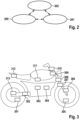
- Fig.2 A state diagram for three driver states is shown.
- Fig.3 is a schematic side view of a motorcycle with essential motorcycle components that can be used for the invention.
- a predictive sensor system initiates a braking maneuver
- the reaction of the entire system consisting of the vehicle and driver can be determined after the braking maneuver has been initiated using sensors on the vehicle.
- the current state of the driver can be modeled from this determined reaction.
- the further braking maneuver can be parameterized depending on this driver state. If it is determined that the driver is not ready to brake, the deceleration is reduced or completely canceled so that the maneuver remains controllable. Because the automatic braking maneuver begins before the driver's assessment is complete, a considerable braking distance can be saved in emergency braking with strong deceleration.
- the predictive sensors or environmental sensors can be radar, lidar or video sensors.
- networked systems can also be seen as virtual sensors that can initiate an autonomous braking maneuver.
- a target deceleration is determined and a trigger signal is sent to the braking system, which initiates the braking maneuver.
- the braking system initiates the deceleration by reducing the engine torque or increasing the braking torque, without first knowing the driver's state. In particular, a neutral driver state can be assumed. By measuring the The driver's state can be modeled using the overall system reaction.
- the driver's readiness to maneuver can be derived from the measurement results of the inertial sensors. For example, if a deceleration torque is applied and the driver only has one hand on the handlebars, the driver's support torque causes the handlebars to move.
- the driver model can contain three states, as in Fig.2 There, block 200 indicates the state “neutral”, block 201 the state "not ready for maneuver” and block 202 the state "ready for maneuver”.
- either the target braking is carried out if the driver state "ready for maneuver" has been detected. If the driver state "not ready for maneuver” has been determined, a maneuver with an adjusted deceleration is carried out. For example, the amount of deceleration during the adjusted braking can be reduced compared to the target value. In addition or alternatively, the jerk, i.e. the time derivative of the deceleration, can be reduced. If the driver's state changes during the maneuver, the braking maneuver can also be varied accordingly.
- Fig.1 shows the chronological sequence of an embodiment of the invention.
- an environment detection is carried out in block 102. This determines whether automatic braking or emergency braking is required. If this is the case, automatic braking is started in block 103. If no braking is required, block 103 returns to block 102.
- the driver's current readiness to control automatic braking is determined in block 104 using a driver state model. Depending on this, a decision is made in block 105 about the further course of braking.
- Two possible temporal braking force curves are used as examples. If the driver's state is determined to be ready to brake, then in block 106 the automatic braking that has begun is continued as planned with its target curve. If, on the other hand, the driver's state is determined to be not ready to brake, then in block 107 the automatic braking that has begun is only carried out in a weakened form or even aborted. The process ends in block 108.
Landscapes
- Engineering & Computer Science (AREA)
- Transportation (AREA)
- Mechanical Engineering (AREA)
- Regulating Braking Force (AREA)
- Control Of Driving Devices And Active Controlling Of Vehicle (AREA)
- Traffic Control Systems (AREA)
Description
- Die nachveröffentlichte
DE 10 2017 210 500 A1 bezieht sich auf ein Verfahren zum Betreiben eines Fahrerassistenzsystems für ein Zweirad, das dadurch gekennzeichnet ist, dass in einem Schritt des Eingreifens das Fahrerassistenzsystem in Abhängigkeit von einem fahrerspezifischen Fahrdynamikprofil und einem momentanen Fahrzustand eingreift, wobei das Fahrdynamikprofil einen Zusammenhang zwischen zurückliegend durch einen Fahrer des Zweirads gefahrenen Schräglagewerten und dabei gefahrenen Beschleunigungswerten abbildet und der Fahrzustand durch einen momentan erfassten Beschleunigungswert und einen momentan erfassten Schräglagenwert gekennzeichnet ist. - Ferner offenbart die
DE 10 2012 221 615 A1 ein Verfahren zur Durchführung einer autonomen Bremsung bei einem einspurigen Kraftfahrzeug, bei dem die Notwendigkeit einer Fahrzeugverzögerung detektiert wird, abhängig davon eine fahrerunabhängige Fahrzeugverzögerung eingeleitet wird, nach Einleiten der Fahrzeugverzögerung eine Fahrerbereitschaftsgröße ermittelt wird und abhängig von der Fahrerbereitschaftsgröße der zeitliche Verlauf der Fahrzeugverzögerung fortgesetzt wird. - Darüber hinaus sind aus der
WO 2018/185577 A1 sowie derWO 2018/154398 A1 Verfahren zur Durchführung einer autonomen Bremsung bei einem einspurigen Kraftfahrzeug bekannt, wobei die Notwendigkeit einer Fahrzeugverzögerung mittels einer Umfeldsensorik detektiert wird und daraufhin eine fahrerunabhängige Fahrzeugverzögerung eingeleitet wird. - Die Erfindung betrifft ein Verfahren zur Durchführung einer autonomen Bremsung bei einem einspurigen Kraftfahrzeug, insbesondere einem Motorrad, bei dem
- mittels einer Umfeldsensorik die Notwendigkeit einer Fahrzeugverzögerung detektiert wird,
- abhängig davon eine fahrerunabhängige Fahrzeugverzögerung eingeleitet wird,
- nach Einleiten der Fahrzeugverzögerung eine die Bereitschaft des Fahrers für die Beherrschung des Fahrzeugverzögerungsmanövers kennzeichnende Fahrerbereitschaftsgröße ermittelt wird und
- abhängig von der Fahrerbereitschaftsgröße der zeitliche Verlauf der Fahrzeugverzögerung fortgesetzt wird.
- Die Erfindung erlaubt die Reduzierung der Gefahr bei einer automatischen Notbremsung eines Zweirads. Ein nicht auf die Bremsung vorbereiteter und abgelenkter Fahrer kann in einer solchen Situation völlig die Kontrolle über das Zweirad verlieren, deshalb ist die Einbeziehung einer die Bereitschaft des Fahrers für die Beherrschung des Fahrzeugverzögerungsmanövers kennzeichnenden Fahrerbereitschaftsgröße in das Notbremsmanöver sinnvoll. Eine vorteilhafte Ausgestaltung der Erfindung ist dadurch gekennzeichnet, dass es sich bei der Umfeldsensorik um eine Radarsensorik, eine Lidarsensorik oder eine Videosensorik handelt. Derartige Sensoriken sind im PKW-Bereich bereits weit verbreitet und können im Zweiradbereich mitbenutzt werden.
- Erfindungsgemäß nimmt die Fahrerbereitschaftsgröße drei Werte an, wobei
- einer der drei Werte einen für das Fahrzeugverzögerungsmanöver bereiten Zustand des Fahrers signalisiert,
- ein anderer der drei Werte einen neutralen Zustand des Fahrers signalisiert und
- der verbleibende der drei Werte einen für das Fahrzeugverzögerungmanöver nicht bereiten Zustand des Fahrers signalisiert.
- Dabei wird
- bei einem bereiten Zustand des Fahrers die autonome Bremsung mit einem geplanten Sollbremskraftverlauf durchgeführt,
- bei einem neutralen Zustand des Fahrers die autonome Bremsung mit einem Bremskraftverlauf durchgeführt, welcher im Vergleich zum geplanten Sollbremskraftverlauf eine geringere Verzögerung und/oder einen geringeren Ruck aufweist.
- bei einem nicht bereiten Zustand des Fahrers die autonome Bremsung entweder abgebrochen oder mit einem Bremskraftverlauf durchgeführt, welcher im Vergleich zum Bremskraftverlauf bei einem neutralen Zustand des Fahrers eine geringere Verzögerung und/oder einen geringeren Ruck aufweist.
- Durch die Durchführung der Notbremsung mit einer geringeren Intensität bei einem als nicht bereit erkannten Fahrerzustand kann das Risiko des Sturzes des Fahrers infolge eines Kontrollverlustes über das Zweirad reduziert werden. Dennoch wird durch die schwächere Notbremsung die Aufmerksamkeit eines abgelenkten Fahrers auf die aktuelle Fahrsituation gelenkt, da die Notbremsung zugleich als Fahrerwarnung wirkt.
- Eine vorteilhafte Ausgestaltung der Erfindung ist dadurch gekennzeichnet, dass die Fahrerbereitschaftsgröße nach Einleiten der fahrerunabhängigen Fahrzeugverzögerung anhand der Ausgangssignale einer am Kraftfahrzeug angebrachten Inertialsensorik ermittelt wird.
- Eine vorteilhafte Ausgestaltung der Erfindung ist dadurch gekennzeichnet, dass die Fahrerbereitschaftsgröße nach Einleiten der fahrerunabhängigen Fahrzeugverzögerung anhand des Lenkwinkels und/oder des Lenkmoments ermittelt wird.
- Eine vorteilhafte Ausgestaltung der Erfindung ist dadurch gekennzeichnet, dass die Fahrerbereitschaftsgröße nach Einleiten der fahrerunabhängigen Fahrzeugverzögerung anhand der Ausgangssignale am Kraftfahrzeug angebrachter druckempfindlicher Berührungssensoren ermittelt wird.
- Eine vorteilhafte Ausgestaltung der Erfindung ist dadurch gekennzeichnet, dass die Fahrerbereitschaftsgröße nach Einleiten der fahrerunabhängigen Fahrzeugverzögerung anhand der Ausgangssignale von Raddrehzahlsensoren oder Einfederwegsensoren ermittelt wird.
- Weiter umfasst die Erfindung eine Vorrichtung, enthaltend Mittel, die zur Durchführung der erfindungsgemäßen Verfahren ausgestaltet sind. Dabei handelt es sich um die hierzu erforderlichen Sensoren sowie ein Steuergerät, in welchem der Programmcode zur Durchführung der erfindungsgemäßen Verfahren hinterlegt ist.
- Die Zeichnung umfasst die
Figuren 1 bis 3 . - In
Fig. 1 ist der zeitliche Ablauf einer Ausgestaltung der Erfindung dargestellt. - In
Fig. 2 ist ein Zustandsdiagramm für drei Fahrerzustände dargestellt. - In
Fig. 3 ist eine schematische Seitenansicht eines Motorrads mit wesentlichen, für die Erfindung nutzbaren Motorradkomponenten dargestellt. - Leitet eine vorausschauende Sensorik ein Bremsmanöver ein, dann kann nach eingeleitetem Bremsmanöver mit Hilfe sich am Fahrzeug befindender Sensoren die Reaktion des aus Fahrzeug und Fahrer bestehenden Gesamtsystems ermittelt werden. Aus dieser ermittelten Reaktion lässt sich der aktuelle Zustand des Fahrers modellieren. In Abhängigkeit dieses Fahrerzustands kann das weitere Bremsmanöver parametriert werden. Wird festgestellt, dass der Fahrer nicht bremsbereit ist, dann wird die Verzögerung reduziert oder ganz zurückgenommen, damit das Manöver kontrollierbar bleibt. Dadurch, dass das automatische Bremsmanöver bereits beginnt, bevor die Bewertung des Fahrers abgeschlossen ist, kann bei Notbremsungen mit starker Verzögerung ein erheblicher Bremsweg eingespart werden.
- Bei der vorausschauenden Sensorik bzw. Umfeldsensorik kann es sich um eine Radar-, eine Lidar- oder eine Videosensorik handeln. Zudem können in Zukunft vernetzte Systeme als virtuelle Sensoren angesehen werden, welche ein autonomes Bremsmanöver einleiten können.
- Anhand der Ausgangssignale der Umfeldsensorik wird eine Sollverzögerung ermittelt und ein Triggersignal an das Bremssystem gesendet, welches das Bremsmanöver einleitet. Das Bremssystem leitet die Verzögerung über eine Motormomentabsenkung oder eine Bremsmomenterhöhung ein, ohne zunächst den Zustand des Fahrers zu kennen. Insbesondere kann ein neutraler Fahrerzustand angenommen werden. Durch Messung der Gesamtsystemreaktion kann der Zustand des Fahrers modelliert werden. In einem ersten Schritt kann dazu aus Messergebnissen der Inertialsensorik eine Manöverbereitschaft des Fahrers abgeleitet werden. Wird beispielsweise ein Verzögerungsmoment aufgebracht und der Fahrer hat nur eine Hand am Lenker, dann bewirkt das Abstützmoment des Fahrers eine Lenkerbewegung. Diese Bewegung bewirkt eine Änderung der Dynamik des Gesamtsystems bestehend aus Fahrer und Fahrzeug, welche mit einer Inertialmesstechnik registriert wird. Daraus kann geschlossen werden, dass der Fahrer nur eine Hand fest am Lenker hat und damit nicht bereit für das Verzögerungsmanöver ist.
- Das Modell des Fahrers kann zum Beispiel drei Zustände beinhalten, wie es in
Fig. 2 dargestellt ist. Dort kennzeichnet Block 200 den Zustand "neutral", Block 201 den Zustand "nicht bereit für Manöver" und Block 202 den Zustand "bereit für Manöver". - Abhängig von diesem Zustand wird bei einer ausgelösten Bremsung entweder die Sollbremsung ausgeführt, wenn der Fahrerzustand "bereit für Manöver" detektiert wurde. Falls der Fahrerzustand "nicht bereit für Manöver" ermittelt wurde, wird ein Manöver mit angepasster Verzögerung durchgeführt. Beispielsweise kann der Betrag der Verzögerung bei der angepassten Bremsung gegenüber dem Sollwert reduziert werden. Ergänzend oder alternativ kann der Ruck, d.h. die zeitliche Ableitung der Verzögerung, reduziert werden. Wechselt im Verlauf des Manövers der Zustand des Fahrers, dann kann auch das Bremsmanöver entsprechend variiert werden.
- Weiterhin können zur Ermittlung des Fahrerzustands die folgenden Sensorsignale ausgewertet werden:
- anhand des Lenkwinkels und/oder des Lenkmoments kann eine Lenkreaktion des Fahrzeugs ermittelt werden,
- mittels einer Federwegsensorik kann die Nickbewegung des Fahrzeugs ermittelt werden,
- Raddrehzahlsensoren,
- druckempfindliche Berührungssensoren, um das Maß der Abstützung an Kontaktpunkten wie z.B. an Griffen, Knien oder Füßen zu messen.
-
Fig. 1 zeigt den zeitlichen Ablauf einer Ausgestaltung der Erfindung. Nach dem Start des Verfahrens in Block 101 wird in Block 102 eine Umfelderfassung durchgeführt. Bei dieser wird ermittelt, ob eine automatische Bremsung bzw. Notbremsung erforderlich ist. Ist dies der Fall, dann wird in Block 103 eine automatische Bremsung gestartet. Ist keine Bremsung erforderlich, dann wird von Block 103 zu Block 102 zurückgekehrt. Anhand während der Bremsung erfasster Daten wird in Block 104 mittels eines Fahrerzustandsmodells die momentane Bereitschaft des Fahrers zur Beherrschung der automatischen Bremsung ermittelt. Abhängig davon in Block 105 über den weiteren Verlauf der Bremsung entschieden. InFig. 1 werden dazu beispielhaft zwei mögliche zeitliche Bremskraftverläufe verwendet. Wird der Fahrerzustand als bremsbereit ermittelt, dann wird in Block 106 die begonnene automatische Bremsung wie geplant mit ihrem Sollverlauf fortgeführt. Wird der Fahrerzustand hingegen als nicht bremsbereit ermittelt, dann wird in Block 107 die begonnene automatische Bremsung nur in abgeschwächter Form ausgeführt oder sogar abgebrochen. In Block 108 endet das Verfahren. -
Fig. 2 zeigt in Form eines Zustandsgraphen beispielhaft die folgenden Zustände: - Block 200: Fahrerzustand neutral
- Block 201: Fahrerzustand "nicht bereit für automatisches Bremsmanöver"
- Block 202: Fahrerzustand "bereit für automatisches Bremsmanöver"
- Die beidseitig gerichteten Pfeilverbindungen zwischen den drei Zuständen weisen darauf hin, dass auch ein Übergang zwischen den unterschiedlichen Zuständen möglich ist, wenn sich der Fahrerzustand während des automatischen Bremsmanövers ändert.
- In
Fig. 3 ist eine schematische Seitenansicht eines Motorrads mit den folgenden wesentlichen, für die Erfindung nutzbaren Motorradkomponenten dargestellt. - 301: Hinterradbremse
- 302: Federwegsensor am Hinterrad
- 303: Bremssteuergerät
- 304: Motorsteuergerät
- 305: Vorderradbremse
- 306: Raddrehzahlsensor am Vorderrad
- 307: Federwegsensor am Vorderrad
- 308: Umgebungssensor
- 309: Lenkwinkelsensor
- 310 Lenkmomentensensor
- 311: Auswerteeinheit für den Fahrerzustand
- 312: Inertialmesstechnik
- 313: Raddrehzahlsensor am Vorderrad
Claims (7)
- Verfahren zur Durchführung einer autonomen Bremsung bei einem einspurigen Kraftfahrzeug, bei dem- mittels einer Umfeldsensorik (308) die Notwendigkeit einer Fahrzeugverzögerung detektiert wird (102),- abhängig davon eine fahrerunabhängige Fahrzeugverzögerung eingeleitet wird (103),- nach Einleiten der Fahrzeugverzögerung (103) eine die Bereitschaft des Fahrers für die Beherrschung des Fahrzeugverzögerungsmanövers kennzeichnende Fahrerbereitschaftsgröße ermittelt wird (104) und- abhängig von der Fahrerbereitschaftsgröße der zeitliche Verlauf der Fahrzeugverzögerung fortgesetzt wird (106, 107),dadurch gekennzeichnet, dass
die Fahrerbereitschaftsgröße drei Werte annehmen kann, wobei- einer der drei Werte einen für das Fahrzeugverzögerungsmanöver bereiten Zustand des Fahrers signalisiert (202),- ein anderer der drei Werte einen neutralen Zustand des Fahrers signalisiert (200) und- der verbleibende der drei Werte einen für das Fahrzeugverzögerungsmanöver nicht bereiten Zustand des Fahrers signalisiert (201), und dass- bei einem bereiten Zustand des Fahrers (202) die autonome Bremsung mit einem geplanten Sollbremskraftverlauf durchgeführt wird (106),- bei einem neutralen Zustand des Fahrers (200) die autonome Bremsung mit einem Bremskraftverlauf durchgeführt wird, welcher im Vergleich zum geplanten Sollbremskraftverlauf eine geringere Verzögerung und/oder einen geringeren Ruck aufweist,- bei einem nicht bereiten Zustand (201) des Fahrers die autonome Bremsung entweder abgebrochen wird oder mit einem Bremskraftverlauf durchgeführt wird, welcher im Vergleich zum Bremskraftverlauf bei einem neutralen Zustand des Fahrers eine geringere Verzögerung und/oder einen geringeren Ruck aufweist (107). - Verfahren nach Anspruch 1, dadurch gekennzeichnet, dass es sich bei der Umfeldsensorik (308) um eine Radarsensorik, eine Lidarsensorik oder eine Videosensorik handelt.
- Verfahren nach Anspruch 1, dadurch gekennzeichnet, dass die Fahrerbereitschaftsgröße (200, 201, 202) nach Einleiten der fahrerunabhängigen Fahrzeugverzögerung anhand der Ausgangssignale einer am Kraftfahrzeug angebrachten Inertialsensorik ermittelt wird (312).
- Verfahren nach Anspruch 1, dadurch gekennzeichnet, dass die Fahrerbereitschaftsgröße (200, 201, 202) nach Einleiten der fahrerunabhängigen Fahrzeugverzögerung anhand des Lenkwinkels (309) und/oder des Lenkmoments (310) ermittelt wird.
- Verfahren nach Anspruch 1, dadurch gekennzeichnet, dass die Fahrerbereitschaftsgröße (200, 201, 202) nach Einleiten der fahrerunabhängigen Fahrzeugverzögerung anhand der Ausgangssignale am Kraftfahrzeug angebrachter druckempfindlicher Berührungssensoren ermittelt wird.
- Verfahren nach Anspruch 1, dadurch gekennzeichnet, dass die Fahrerbereitschaftsgröße (200, 201, 202) nach Einleiten der fahrerunabhängigen Fahrzeugverzögerung anhand der Ausgangssignale von Raddrehzahlsensoren (306, 313) oder Einfederwegsensoren (302, 307) ermittelt wird.
- Vorrichtung, enthaltend ein Steuergerät (303), das zur Durchführung der erfindungsgemäßen Verfahren ausgestaltet ist.
Applications Claiming Priority (2)
| Application Number | Priority Date | Filing Date | Title |
|---|---|---|---|
| DE102018221720.3A DE102018221720A1 (de) | 2018-12-13 | 2018-12-13 | Verfahren und Vorrichtung zur Durchführung einer autonomen Bremsung bei einem einspurigen Kraftfahrzeug |
| PCT/EP2019/076562 WO2020119976A1 (de) | 2018-12-13 | 2019-10-01 | Verfahren und vorrichtung zur durchführung einer autonomen bremsung bei einem einspurigen kraftfahrzeug |
Publications (2)
| Publication Number | Publication Date |
|---|---|
| EP3894288A1 EP3894288A1 (de) | 2021-10-20 |
| EP3894288B1 true EP3894288B1 (de) | 2024-04-24 |
Family
ID=68165526
Family Applications (1)
| Application Number | Title | Priority Date | Filing Date |
|---|---|---|---|
| EP19783470.8A Active EP3894288B1 (de) | 2018-12-13 | 2019-10-01 | Verfahren und vorrichtung zur durchführung einer autonomen bremsung bei einem einspurigen kraftfahrzeug |
Country Status (6)
| Country | Link |
|---|---|
| US (1) | US12214767B2 (de) |
| EP (1) | EP3894288B1 (de) |
| JP (2) | JP7489982B2 (de) |
| CN (1) | CN113165611B (de) |
| DE (1) | DE102018221720A1 (de) |
| WO (1) | WO2020119976A1 (de) |
Families Citing this family (6)
| Publication number | Priority date | Publication date | Assignee | Title |
|---|---|---|---|---|
| CN113631470B (zh) | 2019-03-29 | 2023-02-03 | 本田技研工业株式会社 | 跨骑型车辆的驾驶支援装置 |
| DE112019007123B4 (de) * | 2019-03-29 | 2024-05-08 | Honda Motor Co., Ltd. | Fahr-assistenz-vorrichtung für ein fahrzeug vom satteltyp |
| DE102019209864A1 (de) | 2019-07-04 | 2021-01-07 | Robert Bosch Gmbh | Verfahren und Vorrichtung zur Durchführung einer autonomen Bremsung bei einem einspurigen Kraftfahrzeug |
| WO2021079497A1 (ja) * | 2019-10-25 | 2021-04-29 | ヤマハ発動機株式会社 | リーン車両用リアルタイム情報提示制御装置 |
| CN115123210B (zh) * | 2022-07-07 | 2024-09-20 | 重庆长安汽车股份有限公司 | 车辆aeb的触发方法、装置、车辆及存储介质 |
| EP4357152B1 (de) * | 2022-10-19 | 2025-08-20 | Hochschule Für Angewandte Wissenschaften München | Antiblockier-bremssystem |
Family Cites Families (20)
| Publication number | Priority date | Publication date | Assignee | Title |
|---|---|---|---|---|
| DE102004018394B4 (de) | 2004-04-16 | 2014-07-24 | Daimler Ag | Insassenschutzsystem |
| JP2010173408A (ja) | 2009-01-28 | 2010-08-12 | Honda Motor Co Ltd | 自動二輪車のサスペンションストローク検出装置 |
| DE102011002920A1 (de) | 2011-01-20 | 2012-07-26 | Robert Bosch Gmbh | Verfahren zur Überwachung der Körperhaltung eines Motorradfahrers |
| DE102011082413A1 (de) * | 2011-09-09 | 2013-03-14 | Robert Bosch Gmbh | Lenkunterstützungssystem für ein Zweirad sowie Steuerung für ein solches Lenkunterstützungssystem |
| DE102012221615A1 (de) * | 2012-11-27 | 2014-05-28 | Robert Bosch Gmbh | Verfahren zur Durchführung eines Bremsvorganges in einem Fahrzeug |
| US9254824B2 (en) * | 2013-12-30 | 2016-02-09 | Automotive Research & Testing Center | Adaptive anti-collision method for vehicle |
| CN106415078B (zh) * | 2014-01-23 | 2018-04-17 | 株式会社F.C.C. | 跨乘型车辆 |
| DE102015217257A1 (de) * | 2015-09-10 | 2017-03-16 | Robert Bosch Gmbh | Verfahren zur fahrerunabhängigen Durchführung einer Fahrerassistenzfunktion bei einem zweispurigen Kraftfahrzeug |
| JP6604148B2 (ja) | 2015-11-05 | 2019-11-13 | スズキ株式会社 | 前後輪駆動車両の駆動制御システムおよびその駆動制御方法 |
| US10029683B1 (en) * | 2017-01-25 | 2018-07-24 | Harley-Davidson Motor Company Group, LLC | Saddle-ride vehicle with autonomous braking and method of operating same |
| DE102017201693A1 (de) | 2017-02-02 | 2018-08-02 | Robert Bosch Gmbh | Verfahren und Vorrichtung zur Beeinflussung eines Längsabstandsregelungssystems eines einspurigen Kraftfahrzeugs |
| JP2018134991A (ja) * | 2017-02-22 | 2018-08-30 | ローベルト ボッシュ ゲゼルシャフト ミット ベシュレンクテル ハフツング | 制御装置、制御方法及びブレーキシステム |
| JP2018134990A (ja) * | 2017-02-22 | 2018-08-30 | ローベルト ボッシュ ゲゼルシャフト ミット ベシュレンクテル ハフツング | 制御装置、制御方法及びブレーキシステム |
| JPWO2018173670A1 (ja) * | 2017-03-22 | 2019-11-14 | 川崎重工業株式会社 | ハイブリッド車両 |
| JP2018176861A (ja) | 2017-04-06 | 2018-11-15 | ローベルト ボッシュ ゲゼルシャフト ミット ベシュレンクテル ハフツング | 制御装置、制御方法及びブレーキシステム |
| JP6853878B2 (ja) * | 2017-04-12 | 2021-03-31 | 川崎重工業株式会社 | 乗物の疑似感情生成システムおよび会話情報出力方法 |
| DE102017206485A1 (de) * | 2017-04-18 | 2018-10-18 | Robert Bosch Gmbh | Vorrichtung und Verfahren zur Steuerung eines Fahrzeugs |
| JP6991434B2 (ja) | 2017-05-24 | 2022-01-12 | カワサキモータース株式会社 | 鞍乗型車両の制御装置 |
| DE102017210500A1 (de) | 2017-06-22 | 2018-12-27 | Robert Bosch Gmbh | Verfahren und Vorrichtung zum Betreiben eines Fahrerassistenzsystems für ein Zweirad |
| JP6648181B2 (ja) | 2018-03-29 | 2020-02-14 | 本田技研工業株式会社 | 制御装置 |
-
2018
- 2018-12-13 DE DE102018221720.3A patent/DE102018221720A1/de not_active Withdrawn
-
2019
- 2019-10-01 EP EP19783470.8A patent/EP3894288B1/de active Active
- 2019-10-01 JP JP2021532440A patent/JP7489982B2/ja active Active
- 2019-10-01 WO PCT/EP2019/076562 patent/WO2020119976A1/de not_active Ceased
- 2019-10-01 CN CN201980082592.7A patent/CN113165611B/zh active Active
- 2019-10-01 US US17/277,615 patent/US12214767B2/en active Active
-
2023
- 2023-05-16 JP JP2023080744A patent/JP2023116454A/ja active Pending
Also Published As
| Publication number | Publication date |
|---|---|
| JP2022513741A (ja) | 2022-02-09 |
| US20210347343A1 (en) | 2021-11-11 |
| EP3894288A1 (de) | 2021-10-20 |
| WO2020119976A1 (de) | 2020-06-18 |
| DE102018221720A1 (de) | 2020-06-18 |
| JP2023116454A (ja) | 2023-08-22 |
| US12214767B2 (en) | 2025-02-04 |
| JP7489982B2 (ja) | 2024-05-24 |
| CN113165611B (zh) | 2024-04-05 |
| CN113165611A (zh) | 2021-07-23 |
Similar Documents
| Publication | Publication Date | Title |
|---|---|---|
| EP3894288B1 (de) | Verfahren und vorrichtung zur durchführung einer autonomen bremsung bei einem einspurigen kraftfahrzeug | |
| EP3672848B1 (de) | Notbremssystem eines einspurfahrzeugs | |
| DE102017110034A1 (de) | Fahrunterstützungssteuerungsvorrichtung eines fahrzeugs | |
| DE102010001581B4 (de) | Fahrerassistenzsystem und Verfahren zur Fahrerassistenz zum automatischen Fahren | |
| WO2013011058A1 (de) | Verfahren zur verbesserung der fahrstabilität | |
| DE102005054754B4 (de) | Zeitpunktermittlung zum Einleiten eines notwendigen Bremseingriffs für ein Kraftfahrzeug | |
| DE102012218361B4 (de) | Verfahren zum sicheren Betrieb eines Kraftfahrzeugs | |
| EP4037941B1 (de) | Verfahren und vorrichtung zur durchführung einer abstands- oder geschwindigkeitsregelungsfunktion für ein einspuriges kraftfahrzeug | |
| WO2015044043A1 (de) | Verfahren, steuergerät und system zum ermitteln einer profiltiefe eines profils zumindest eines reifens | |
| EP3994039B1 (de) | Verfahren und vorrichtung zur durchführung einer autonomen bremsung bei einem einspurigen kraftfahrzeug | |
| DE102012206228A1 (de) | Verfahren zur Kollisionsvermeidung eines Kraftfahrzeugs | |
| DE102013225483A1 (de) | Verfahren zur Detektion und Korrektur einer unbeabsichtigten Pedalbetätigung des Fahrers eines Kraftfahrzeugs | |
| DE10248432A1 (de) | Verfahren und Vorrichtung zur Bestimmung der momentanen Fahrbahnsteigung | |
| EP2145793B1 (de) | Verfahren und Vorrichtung zur Fahreranwesenheitserkennung | |
| DE102015217256A1 (de) | Verfahren und Vorrichtung zur Durchführung eines Notbremsvorgangs bei einem einspurigen Kraftfahrzeug | |
| DE102017216457A1 (de) | Verfahren zur Bestimmung einer maximalen Geschwindigkeit eines Fahrzeugs während eines Einparkmanövers | |
| WO2007115918A1 (de) | Situationsabhängige bremsstrategie einer sicherheitsfunktion | |
| EP1588910B1 (de) | Verfahren zur Analyse und Regelung der Fahrdynamik eines Kraftfahrzeugs sowie Kraftfahrzeug zur Durchführung des Verfahrens | |
| DE102006060456A1 (de) | Verfahren und System zum Lenken eines Fahrzeugs in eine Parklücke | |
| DE102011103604A1 (de) | Verfahren zum Unterstützen eines Fahrers eines Kraftfahrzeugs in einer Gegenverkehrssituation durch Erkennen eines starken Beschleunigungswunsches | |
| WO2020104085A1 (de) | Steuervorrichtung und verfahren zum betreiben mindestens einer bremsvorrichtung eines fahrzeugs | |
| EP2589522B1 (de) | Verfahren zum Verarbeiten eines Signals eines Längsbeschleunigungssensors in einem Fahrzeug, sowie Fahrzeug | |
| DE102019214780A1 (de) | Verfahren zur Durchführung eines Bremsvorganges eines Fahrzeuges | |
| DE102023112655A1 (de) | Steuervorrichtung und verfahren zum betrieb eines notbremsassistenten für ein kraftfahrzeug | |
| DE102016008933A1 (de) | Verfahren zur Unterstützung eines Fahrers |
Legal Events
| Date | Code | Title | Description |
|---|---|---|---|
| STAA | Information on the status of an ep patent application or granted ep patent |
Free format text: STATUS: UNKNOWN |
|
| STAA | Information on the status of an ep patent application or granted ep patent |
Free format text: STATUS: THE INTERNATIONAL PUBLICATION HAS BEEN MADE |
|
| PUAI | Public reference made under article 153(3) epc to a published international application that has entered the european phase |
Free format text: ORIGINAL CODE: 0009012 |
|
| STAA | Information on the status of an ep patent application or granted ep patent |
Free format text: STATUS: REQUEST FOR EXAMINATION WAS MADE |
|
| 17P | Request for examination filed |
Effective date: 20210713 |
|
| AK | Designated contracting states |
Kind code of ref document: A1 Designated state(s): AL AT BE BG CH CY CZ DE DK EE ES FI FR GB GR HR HU IE IS IT LI LT LU LV MC MK MT NL NO PL PT RO RS SE SI SK SM TR |
|
| DAV | Request for validation of the european patent (deleted) | ||
| DAX | Request for extension of the european patent (deleted) | ||
| GRAP | Despatch of communication of intention to grant a patent |
Free format text: ORIGINAL CODE: EPIDOSNIGR1 |
|
| STAA | Information on the status of an ep patent application or granted ep patent |
Free format text: STATUS: GRANT OF PATENT IS INTENDED |
|
| INTG | Intention to grant announced |
Effective date: 20230714 |
|
| GRAJ | Information related to disapproval of communication of intention to grant by the applicant or resumption of examination proceedings by the epo deleted |
Free format text: ORIGINAL CODE: EPIDOSDIGR1 |
|
| STAA | Information on the status of an ep patent application or granted ep patent |
Free format text: STATUS: REQUEST FOR EXAMINATION WAS MADE |
|
| GRAP | Despatch of communication of intention to grant a patent |
Free format text: ORIGINAL CODE: EPIDOSNIGR1 |
|
| STAA | Information on the status of an ep patent application or granted ep patent |
Free format text: STATUS: GRANT OF PATENT IS INTENDED |
|
| INTC | Intention to grant announced (deleted) | ||
| INTG | Intention to grant announced |
Effective date: 20231128 |
|
| GRAS | Grant fee paid |
Free format text: ORIGINAL CODE: EPIDOSNIGR3 |
|
| GRAA | (expected) grant |
Free format text: ORIGINAL CODE: 0009210 |
|
| STAA | Information on the status of an ep patent application or granted ep patent |
Free format text: STATUS: THE PATENT HAS BEEN GRANTED |
|
| AK | Designated contracting states |
Kind code of ref document: B1 Designated state(s): AL AT BE BG CH CY CZ DE DK EE ES FI FR GB GR HR HU IE IS IT LI LT LU LV MC MK MT NL NO PL PT RO RS SE SI SK SM TR |
|
| REG | Reference to a national code |
Ref country code: GB Ref legal event code: FG4D Free format text: NOT ENGLISH |
|
| REG | Reference to a national code |
Ref country code: CH Ref legal event code: EP |
|
| REG | Reference to a national code |
Ref country code: DE Ref legal event code: R096 Ref document number: 502019011132 Country of ref document: DE |
|
| REG | Reference to a national code |
Ref country code: IE Ref legal event code: FG4D Free format text: LANGUAGE OF EP DOCUMENT: GERMAN |
|
| REG | Reference to a national code |
Ref country code: LT Ref legal event code: MG9D |
|
| REG | Reference to a national code |
Ref country code: NL Ref legal event code: MP Effective date: 20240424 |
|
| PG25 | Lapsed in a contracting state [announced via postgrant information from national office to epo] |
Ref country code: NL Free format text: LAPSE BECAUSE OF FAILURE TO SUBMIT A TRANSLATION OF THE DESCRIPTION OR TO PAY THE FEE WITHIN THE PRESCRIBED TIME-LIMIT Effective date: 20240424 |
|
| PG25 | Lapsed in a contracting state [announced via postgrant information from national office to epo] |
Ref country code: NL Free format text: LAPSE BECAUSE OF FAILURE TO SUBMIT A TRANSLATION OF THE DESCRIPTION OR TO PAY THE FEE WITHIN THE PRESCRIBED TIME-LIMIT Effective date: 20240424 |
|
| PG25 | Lapsed in a contracting state [announced via postgrant information from national office to epo] |
Ref country code: IS Free format text: LAPSE BECAUSE OF FAILURE TO SUBMIT A TRANSLATION OF THE DESCRIPTION OR TO PAY THE FEE WITHIN THE PRESCRIBED TIME-LIMIT Effective date: 20240824 |
|
| PG25 | Lapsed in a contracting state [announced via postgrant information from national office to epo] |
Ref country code: BG Free format text: LAPSE BECAUSE OF FAILURE TO SUBMIT A TRANSLATION OF THE DESCRIPTION OR TO PAY THE FEE WITHIN THE PRESCRIBED TIME-LIMIT Effective date: 20240424 |
|
| PG25 | Lapsed in a contracting state [announced via postgrant information from national office to epo] |
Ref country code: HR Free format text: LAPSE BECAUSE OF FAILURE TO SUBMIT A TRANSLATION OF THE DESCRIPTION OR TO PAY THE FEE WITHIN THE PRESCRIBED TIME-LIMIT Effective date: 20240424 Ref country code: FI Free format text: LAPSE BECAUSE OF FAILURE TO SUBMIT A TRANSLATION OF THE DESCRIPTION OR TO PAY THE FEE WITHIN THE PRESCRIBED TIME-LIMIT Effective date: 20240424 |
|
| PG25 | Lapsed in a contracting state [announced via postgrant information from national office to epo] |
Ref country code: GR Free format text: LAPSE BECAUSE OF FAILURE TO SUBMIT A TRANSLATION OF THE DESCRIPTION OR TO PAY THE FEE WITHIN THE PRESCRIBED TIME-LIMIT Effective date: 20240725 |
|
| PG25 | Lapsed in a contracting state [announced via postgrant information from national office to epo] |
Ref country code: PT Free format text: LAPSE BECAUSE OF FAILURE TO SUBMIT A TRANSLATION OF THE DESCRIPTION OR TO PAY THE FEE WITHIN THE PRESCRIBED TIME-LIMIT Effective date: 20240826 |
|
| PG25 | Lapsed in a contracting state [announced via postgrant information from national office to epo] |
Ref country code: ES Free format text: LAPSE BECAUSE OF FAILURE TO SUBMIT A TRANSLATION OF THE DESCRIPTION OR TO PAY THE FEE WITHIN THE PRESCRIBED TIME-LIMIT Effective date: 20240424 |
|
| PG25 | Lapsed in a contracting state [announced via postgrant information from national office to epo] |
Ref country code: PL Free format text: LAPSE BECAUSE OF FAILURE TO SUBMIT A TRANSLATION OF THE DESCRIPTION OR TO PAY THE FEE WITHIN THE PRESCRIBED TIME-LIMIT Effective date: 20240424 |
|
| PG25 | Lapsed in a contracting state [announced via postgrant information from national office to epo] |
Ref country code: LV Free format text: LAPSE BECAUSE OF FAILURE TO SUBMIT A TRANSLATION OF THE DESCRIPTION OR TO PAY THE FEE WITHIN THE PRESCRIBED TIME-LIMIT Effective date: 20240424 |
|
| PG25 | Lapsed in a contracting state [announced via postgrant information from national office to epo] |
Ref country code: PT Free format text: LAPSE BECAUSE OF FAILURE TO SUBMIT A TRANSLATION OF THE DESCRIPTION OR TO PAY THE FEE WITHIN THE PRESCRIBED TIME-LIMIT Effective date: 20240826 Ref country code: PL Free format text: LAPSE BECAUSE OF FAILURE TO SUBMIT A TRANSLATION OF THE DESCRIPTION OR TO PAY THE FEE WITHIN THE PRESCRIBED TIME-LIMIT Effective date: 20240424 Ref country code: NO Free format text: LAPSE BECAUSE OF FAILURE TO SUBMIT A TRANSLATION OF THE DESCRIPTION OR TO PAY THE FEE WITHIN THE PRESCRIBED TIME-LIMIT Effective date: 20240724 Ref country code: LV Free format text: LAPSE BECAUSE OF FAILURE TO SUBMIT A TRANSLATION OF THE DESCRIPTION OR TO PAY THE FEE WITHIN THE PRESCRIBED TIME-LIMIT Effective date: 20240424 Ref country code: IS Free format text: LAPSE BECAUSE OF FAILURE TO SUBMIT A TRANSLATION OF THE DESCRIPTION OR TO PAY THE FEE WITHIN THE PRESCRIBED TIME-LIMIT Effective date: 20240824 Ref country code: HR Free format text: LAPSE BECAUSE OF FAILURE TO SUBMIT A TRANSLATION OF THE DESCRIPTION OR TO PAY THE FEE WITHIN THE PRESCRIBED TIME-LIMIT Effective date: 20240424 Ref country code: GR Free format text: LAPSE BECAUSE OF FAILURE TO SUBMIT A TRANSLATION OF THE DESCRIPTION OR TO PAY THE FEE WITHIN THE PRESCRIBED TIME-LIMIT Effective date: 20240725 Ref country code: FI Free format text: LAPSE BECAUSE OF FAILURE TO SUBMIT A TRANSLATION OF THE DESCRIPTION OR TO PAY THE FEE WITHIN THE PRESCRIBED TIME-LIMIT Effective date: 20240424 Ref country code: ES Free format text: LAPSE BECAUSE OF FAILURE TO SUBMIT A TRANSLATION OF THE DESCRIPTION OR TO PAY THE FEE WITHIN THE PRESCRIBED TIME-LIMIT Effective date: 20240424 Ref country code: BG Free format text: LAPSE BECAUSE OF FAILURE TO SUBMIT A TRANSLATION OF THE DESCRIPTION OR TO PAY THE FEE WITHIN THE PRESCRIBED TIME-LIMIT Effective date: 20240424 Ref country code: RS Free format text: LAPSE BECAUSE OF FAILURE TO SUBMIT A TRANSLATION OF THE DESCRIPTION OR TO PAY THE FEE WITHIN THE PRESCRIBED TIME-LIMIT Effective date: 20240724 |
|
| PG25 | Lapsed in a contracting state [announced via postgrant information from national office to epo] |
Ref country code: DK Free format text: LAPSE BECAUSE OF FAILURE TO SUBMIT A TRANSLATION OF THE DESCRIPTION OR TO PAY THE FEE WITHIN THE PRESCRIBED TIME-LIMIT Effective date: 20240424 |
|
| PG25 | Lapsed in a contracting state [announced via postgrant information from national office to epo] |
Ref country code: EE Free format text: LAPSE BECAUSE OF FAILURE TO SUBMIT A TRANSLATION OF THE DESCRIPTION OR TO PAY THE FEE WITHIN THE PRESCRIBED TIME-LIMIT Effective date: 20240424 |
|
| PG25 | Lapsed in a contracting state [announced via postgrant information from national office to epo] |
Ref country code: CZ Free format text: LAPSE BECAUSE OF FAILURE TO SUBMIT A TRANSLATION OF THE DESCRIPTION OR TO PAY THE FEE WITHIN THE PRESCRIBED TIME-LIMIT Effective date: 20240424 |
|
| PG25 | Lapsed in a contracting state [announced via postgrant information from national office to epo] |
Ref country code: RO Free format text: LAPSE BECAUSE OF FAILURE TO SUBMIT A TRANSLATION OF THE DESCRIPTION OR TO PAY THE FEE WITHIN THE PRESCRIBED TIME-LIMIT Effective date: 20240424 Ref country code: SK Free format text: LAPSE BECAUSE OF FAILURE TO SUBMIT A TRANSLATION OF THE DESCRIPTION OR TO PAY THE FEE WITHIN THE PRESCRIBED TIME-LIMIT Effective date: 20240424 |
|
| REG | Reference to a national code |
Ref country code: DE Ref legal event code: R097 Ref document number: 502019011132 Country of ref document: DE |
|
| PG25 | Lapsed in a contracting state [announced via postgrant information from national office to epo] |
Ref country code: SM Free format text: LAPSE BECAUSE OF FAILURE TO SUBMIT A TRANSLATION OF THE DESCRIPTION OR TO PAY THE FEE WITHIN THE PRESCRIBED TIME-LIMIT Effective date: 20240424 |
|
| PG25 | Lapsed in a contracting state [announced via postgrant information from national office to epo] |
Ref country code: SM Free format text: LAPSE BECAUSE OF FAILURE TO SUBMIT A TRANSLATION OF THE DESCRIPTION OR TO PAY THE FEE WITHIN THE PRESCRIBED TIME-LIMIT Effective date: 20240424 Ref country code: SK Free format text: LAPSE BECAUSE OF FAILURE TO SUBMIT A TRANSLATION OF THE DESCRIPTION OR TO PAY THE FEE WITHIN THE PRESCRIBED TIME-LIMIT Effective date: 20240424 Ref country code: RO Free format text: LAPSE BECAUSE OF FAILURE TO SUBMIT A TRANSLATION OF THE DESCRIPTION OR TO PAY THE FEE WITHIN THE PRESCRIBED TIME-LIMIT Effective date: 20240424 Ref country code: EE Free format text: LAPSE BECAUSE OF FAILURE TO SUBMIT A TRANSLATION OF THE DESCRIPTION OR TO PAY THE FEE WITHIN THE PRESCRIBED TIME-LIMIT Effective date: 20240424 Ref country code: DK Free format text: LAPSE BECAUSE OF FAILURE TO SUBMIT A TRANSLATION OF THE DESCRIPTION OR TO PAY THE FEE WITHIN THE PRESCRIBED TIME-LIMIT Effective date: 20240424 Ref country code: CZ Free format text: LAPSE BECAUSE OF FAILURE TO SUBMIT A TRANSLATION OF THE DESCRIPTION OR TO PAY THE FEE WITHIN THE PRESCRIBED TIME-LIMIT Effective date: 20240424 |
|
| PLBE | No opposition filed within time limit |
Free format text: ORIGINAL CODE: 0009261 |
|
| STAA | Information on the status of an ep patent application or granted ep patent |
Free format text: STATUS: NO OPPOSITION FILED WITHIN TIME LIMIT |
|
| 26N | No opposition filed |
Effective date: 20250127 |
|
| PG25 | Lapsed in a contracting state [announced via postgrant information from national office to epo] |
Ref country code: SI Free format text: LAPSE BECAUSE OF FAILURE TO SUBMIT A TRANSLATION OF THE DESCRIPTION OR TO PAY THE FEE WITHIN THE PRESCRIBED TIME-LIMIT Effective date: 20240424 |
|
| REG | Reference to a national code |
Ref country code: CH Ref legal event code: PL |
|
| GBPC | Gb: european patent ceased through non-payment of renewal fee |
Effective date: 20241001 |
|
| PG25 | Lapsed in a contracting state [announced via postgrant information from national office to epo] |
Ref country code: MC Free format text: LAPSE BECAUSE OF FAILURE TO SUBMIT A TRANSLATION OF THE DESCRIPTION OR TO PAY THE FEE WITHIN THE PRESCRIBED TIME-LIMIT Effective date: 20240424 |
|
| PG25 | Lapsed in a contracting state [announced via postgrant information from national office to epo] |
Ref country code: GB Free format text: LAPSE BECAUSE OF NON-PAYMENT OF DUE FEES Effective date: 20241001 |
|
| PG25 | Lapsed in a contracting state [announced via postgrant information from national office to epo] |
Ref country code: BE Free format text: LAPSE BECAUSE OF NON-PAYMENT OF DUE FEES Effective date: 20241031 Ref country code: LU Free format text: LAPSE BECAUSE OF NON-PAYMENT OF DUE FEES Effective date: 20241001 |
|
| PG25 | Lapsed in a contracting state [announced via postgrant information from national office to epo] |
Ref country code: FR Free format text: LAPSE BECAUSE OF NON-PAYMENT OF DUE FEES Effective date: 20241031 |
|
| PG25 | Lapsed in a contracting state [announced via postgrant information from national office to epo] |
Ref country code: CH Free format text: LAPSE BECAUSE OF NON-PAYMENT OF DUE FEES Effective date: 20241031 |
|
| REG | Reference to a national code |
Ref country code: BE Ref legal event code: MM Effective date: 20241031 |
|
| PG25 | Lapsed in a contracting state [announced via postgrant information from national office to epo] |
Ref country code: SE Free format text: LAPSE BECAUSE OF FAILURE TO SUBMIT A TRANSLATION OF THE DESCRIPTION OR TO PAY THE FEE WITHIN THE PRESCRIBED TIME-LIMIT Effective date: 20240424 |
|
| PG25 | Lapsed in a contracting state [announced via postgrant information from national office to epo] |
Ref country code: IE Free format text: LAPSE BECAUSE OF NON-PAYMENT OF DUE FEES Effective date: 20241001 |
|
| REG | Reference to a national code |
Ref country code: AT Ref legal event code: MM01 Ref document number: 1679286 Country of ref document: AT Kind code of ref document: T Effective date: 20241001 |
|
| PGFP | Annual fee paid to national office [announced via postgrant information from national office to epo] |
Ref country code: DE Payment date: 20251209 Year of fee payment: 7 |
|
| PG25 | Lapsed in a contracting state [announced via postgrant information from national office to epo] |
Ref country code: AT Free format text: LAPSE BECAUSE OF NON-PAYMENT OF DUE FEES Effective date: 20241001 |
|
| PGFP | Annual fee paid to national office [announced via postgrant information from national office to epo] |
Ref country code: IT Payment date: 20251031 Year of fee payment: 7 |
|
| PG25 | Lapsed in a contracting state [announced via postgrant information from national office to epo] |
Ref country code: CY Free format text: LAPSE BECAUSE OF FAILURE TO SUBMIT A TRANSLATION OF THE DESCRIPTION OR TO PAY THE FEE WITHIN THE PRESCRIBED TIME-LIMIT; INVALID AB INITIO Effective date: 20191001 |
|
| PG25 | Lapsed in a contracting state [announced via postgrant information from national office to epo] |
Ref country code: HU Free format text: LAPSE BECAUSE OF FAILURE TO SUBMIT A TRANSLATION OF THE DESCRIPTION OR TO PAY THE FEE WITHIN THE PRESCRIBED TIME-LIMIT; INVALID AB INITIO Effective date: 20191001 |