EP3871663A1 - Pansement aqueux - Google Patents
Pansement aqueux Download PDFInfo
- Publication number
- EP3871663A1 EP3871663A1 EP18906715.0A EP18906715A EP3871663A1 EP 3871663 A1 EP3871663 A1 EP 3871663A1 EP 18906715 A EP18906715 A EP 18906715A EP 3871663 A1 EP3871663 A1 EP 3871663A1
- Authority
- EP
- European Patent Office
- Prior art keywords
- adhesive
- aqueous
- test
- cross
- gel intensity
- Prior art date
- Legal status (The legal status is an assumption and is not a legal conclusion. Google has not performed a legal analysis and makes no representation as to the accuracy of the status listed.)
- Pending
Links
Images


Classifications
-
- A—HUMAN NECESSITIES
- A61—MEDICAL OR VETERINARY SCIENCE; HYGIENE
- A61K—PREPARATIONS FOR MEDICAL, DENTAL OR TOILETRY PURPOSES
- A61K9/00—Medicinal preparations characterised by special physical form
- A61K9/70—Web, sheet or filament bases ; Films; Fibres of the matrix type containing drug
- A61K9/7023—Transdermal patches and similar drug-containing composite devices, e.g. cataplasms
- A61K9/703—Transdermal patches and similar drug-containing composite devices, e.g. cataplasms characterised by shape or structure; Details concerning release liner or backing; Refillable patches; User-activated patches
- A61K9/7038—Transdermal patches of the drug-in-adhesive type, i.e. comprising drug in the skin-adhesive layer
- A61K9/7046—Transdermal patches of the drug-in-adhesive type, i.e. comprising drug in the skin-adhesive layer the adhesive comprising macromolecular compounds
- A61K9/7053—Transdermal patches of the drug-in-adhesive type, i.e. comprising drug in the skin-adhesive layer the adhesive comprising macromolecular compounds obtained by reactions only involving carbon to carbon unsaturated bonds, e.g. polyvinyl, polyisobutylene, polystyrene
- A61K9/7061—Polyacrylates
-
- A—HUMAN NECESSITIES
- A61—MEDICAL OR VETERINARY SCIENCE; HYGIENE
- A61K—PREPARATIONS FOR MEDICAL, DENTAL OR TOILETRY PURPOSES
- A61K31/00—Medicinal preparations containing organic active ingredients
- A61K31/185—Acids; Anhydrides, halides or salts thereof, e.g. sulfur acids, imidic, hydrazonic or hydroximic acids
- A61K31/19—Carboxylic acids, e.g. valproic acid
- A61K31/195—Carboxylic acids, e.g. valproic acid having an amino group
- A61K31/196—Carboxylic acids, e.g. valproic acid having an amino group the amino group being directly attached to a ring, e.g. anthranilic acid, mefenamic acid, diclofenac, chlorambucil
-
- A—HUMAN NECESSITIES
- A61—MEDICAL OR VETERINARY SCIENCE; HYGIENE
- A61K—PREPARATIONS FOR MEDICAL, DENTAL OR TOILETRY PURPOSES
- A61K47/00—Medicinal preparations characterised by the non-active ingredients used, e.g. carriers or inert additives; Targeting or modifying agents chemically bound to the active ingredient
- A61K47/02—Inorganic compounds
-
- A—HUMAN NECESSITIES
- A61—MEDICAL OR VETERINARY SCIENCE; HYGIENE
- A61K—PREPARATIONS FOR MEDICAL, DENTAL OR TOILETRY PURPOSES
- A61K47/00—Medicinal preparations characterised by the non-active ingredients used, e.g. carriers or inert additives; Targeting or modifying agents chemically bound to the active ingredient
- A61K47/06—Organic compounds, e.g. natural or synthetic hydrocarbons, polyolefins, mineral oil, petrolatum or ozokerite
- A61K47/08—Organic compounds, e.g. natural or synthetic hydrocarbons, polyolefins, mineral oil, petrolatum or ozokerite containing oxygen, e.g. ethers, acetals, ketones, quinones, aldehydes, peroxides
- A61K47/12—Carboxylic acids; Salts or anhydrides thereof
-
- A—HUMAN NECESSITIES
- A61—MEDICAL OR VETERINARY SCIENCE; HYGIENE
- A61K—PREPARATIONS FOR MEDICAL, DENTAL OR TOILETRY PURPOSES
- A61K47/00—Medicinal preparations characterised by the non-active ingredients used, e.g. carriers or inert additives; Targeting or modifying agents chemically bound to the active ingredient
- A61K47/06—Organic compounds, e.g. natural or synthetic hydrocarbons, polyolefins, mineral oil, petrolatum or ozokerite
- A61K47/08—Organic compounds, e.g. natural or synthetic hydrocarbons, polyolefins, mineral oil, petrolatum or ozokerite containing oxygen, e.g. ethers, acetals, ketones, quinones, aldehydes, peroxides
- A61K47/14—Esters of carboxylic acids, e.g. fatty acid monoglycerides, medium-chain triglycerides, parabens or PEG fatty acid esters
-
- A—HUMAN NECESSITIES
- A61—MEDICAL OR VETERINARY SCIENCE; HYGIENE
- A61K—PREPARATIONS FOR MEDICAL, DENTAL OR TOILETRY PURPOSES
- A61K47/00—Medicinal preparations characterised by the non-active ingredients used, e.g. carriers or inert additives; Targeting or modifying agents chemically bound to the active ingredient
- A61K47/06—Organic compounds, e.g. natural or synthetic hydrocarbons, polyolefins, mineral oil, petrolatum or ozokerite
- A61K47/26—Carbohydrates, e.g. sugar alcohols, amino sugars, nucleic acids, mono-, di- or oligo-saccharides; Derivatives thereof, e.g. polysorbates, sorbitan fatty acid esters or glycyrrhizin
-
- A—HUMAN NECESSITIES
- A61—MEDICAL OR VETERINARY SCIENCE; HYGIENE
- A61K—PREPARATIONS FOR MEDICAL, DENTAL OR TOILETRY PURPOSES
- A61K47/00—Medicinal preparations characterised by the non-active ingredients used, e.g. carriers or inert additives; Targeting or modifying agents chemically bound to the active ingredient
- A61K47/30—Macromolecular organic or inorganic compounds, e.g. inorganic polyphosphates
- A61K47/32—Macromolecular compounds obtained by reactions only involving carbon-to-carbon unsaturated bonds, e.g. carbomers, poly(meth)acrylates, or polyvinyl pyrrolidone
-
- A—HUMAN NECESSITIES
- A61—MEDICAL OR VETERINARY SCIENCE; HYGIENE
- A61K—PREPARATIONS FOR MEDICAL, DENTAL OR TOILETRY PURPOSES
- A61K47/00—Medicinal preparations characterised by the non-active ingredients used, e.g. carriers or inert additives; Targeting or modifying agents chemically bound to the active ingredient
- A61K47/30—Macromolecular organic or inorganic compounds, e.g. inorganic polyphosphates
- A61K47/36—Polysaccharides; Derivatives thereof, e.g. gums, starch, alginate, dextrin, hyaluronic acid, chitosan, inulin, agar or pectin
- A61K47/38—Cellulose; Derivatives thereof
-
- C—CHEMISTRY; METALLURGY
- C09—DYES; PAINTS; POLISHES; NATURAL RESINS; ADHESIVES; COMPOSITIONS NOT OTHERWISE PROVIDED FOR; APPLICATIONS OF MATERIALS NOT OTHERWISE PROVIDED FOR
- C09J—ADHESIVES; NON-MECHANICAL ASPECTS OF ADHESIVE PROCESSES IN GENERAL; ADHESIVE PROCESSES NOT PROVIDED FOR ELSEWHERE; USE OF MATERIALS AS ADHESIVES
- C09J129/00—Adhesives based on homopolymers or copolymers of compounds having one or more unsaturated aliphatic radicals, each having only one carbon-to-carbon double bond, and at least one being terminated by an alcohol, ether, aldehydo, ketonic, acetal, or ketal radical; Adhesives based on hydrolysed polymers of esters of unsaturated alcohols with saturated carboxylic acids; Adhesives based on derivatives of such polymers
- C09J129/02—Homopolymers or copolymers of unsaturated alcohols
- C09J129/04—Polyvinyl alcohol; Partially hydrolysed homopolymers or copolymers of esters of unsaturated alcohols with saturated carboxylic acids
-
- C—CHEMISTRY; METALLURGY
- C09—DYES; PAINTS; POLISHES; NATURAL RESINS; ADHESIVES; COMPOSITIONS NOT OTHERWISE PROVIDED FOR; APPLICATIONS OF MATERIALS NOT OTHERWISE PROVIDED FOR
- C09J—ADHESIVES; NON-MECHANICAL ASPECTS OF ADHESIVE PROCESSES IN GENERAL; ADHESIVE PROCESSES NOT PROVIDED FOR ELSEWHERE; USE OF MATERIALS AS ADHESIVES
- C09J133/00—Adhesives based on homopolymers or copolymers of compounds having one or more unsaturated aliphatic radicals, each having only one carbon-to-carbon double bond, and at least one being terminated by only one carboxyl radical, or of salts, anhydrides, esters, amides, imides, or nitriles thereof; Adhesives based on derivatives of such polymers
- C09J133/02—Homopolymers or copolymers of acids; Metal or ammonium salts thereof
-
- A—HUMAN NECESSITIES
- A61—MEDICAL OR VETERINARY SCIENCE; HYGIENE
- A61K—PREPARATIONS FOR MEDICAL, DENTAL OR TOILETRY PURPOSES
- A61K47/00—Medicinal preparations characterised by the non-active ingredients used, e.g. carriers or inert additives; Targeting or modifying agents chemically bound to the active ingredient
- A61K47/06—Organic compounds, e.g. natural or synthetic hydrocarbons, polyolefins, mineral oil, petrolatum or ozokerite
- A61K47/08—Organic compounds, e.g. natural or synthetic hydrocarbons, polyolefins, mineral oil, petrolatum or ozokerite containing oxygen, e.g. ethers, acetals, ketones, quinones, aldehydes, peroxides
- A61K47/10—Alcohols; Phenols; Salts thereof, e.g. glycerol; Polyethylene glycols [PEG]; Poloxamers; PEG/POE alkyl ethers
-
- C—CHEMISTRY; METALLURGY
- C08—ORGANIC MACROMOLECULAR COMPOUNDS; THEIR PREPARATION OR CHEMICAL WORKING-UP; COMPOSITIONS BASED THEREON
- C08K—Use of inorganic or non-macromolecular organic substances as compounding ingredients
- C08K3/00—Use of inorganic substances as compounding ingredients
- C08K3/30—Sulfur-, selenium- or tellurium-containing compounds
- C08K2003/3045—Sulfates
- C08K2003/3081—Aluminum sulfate
-
- C—CHEMISTRY; METALLURGY
- C08—ORGANIC MACROMOLECULAR COMPOUNDS; THEIR PREPARATION OR CHEMICAL WORKING-UP; COMPOSITIONS BASED THEREON
- C08K—Use of inorganic or non-macromolecular organic substances as compounding ingredients
- C08K5/00—Use of organic ingredients
- C08K5/04—Oxygen-containing compounds
- C08K5/05—Alcohols; Metal alcoholates
- C08K5/053—Polyhydroxylic alcohols
-
- C—CHEMISTRY; METALLURGY
- C08—ORGANIC MACROMOLECULAR COMPOUNDS; THEIR PREPARATION OR CHEMICAL WORKING-UP; COMPOSITIONS BASED THEREON
- C08L—COMPOSITIONS OF MACROMOLECULAR COMPOUNDS
- C08L2205/00—Polymer mixtures characterised by other features
- C08L2205/02—Polymer mixtures characterised by other features containing two or more polymers of the same C08L -group
- C08L2205/025—Polymer mixtures characterised by other features containing two or more polymers of the same C08L -group containing two or more polymers of the same hierarchy C08L, and differing only in parameters such as density, comonomer content, molecular weight, structure
-
- C—CHEMISTRY; METALLURGY
- C08—ORGANIC MACROMOLECULAR COMPOUNDS; THEIR PREPARATION OR CHEMICAL WORKING-UP; COMPOSITIONS BASED THEREON
- C08L—COMPOSITIONS OF MACROMOLECULAR COMPOUNDS
- C08L2205/00—Polymer mixtures characterised by other features
- C08L2205/03—Polymer mixtures characterised by other features containing three or more polymers in a blend
- C08L2205/035—Polymer mixtures characterised by other features containing three or more polymers in a blend containing four or more polymers in a blend
Definitions
- the present invention relates to an aqueous adhesive for use in cataplasm.
- a cataplasm is in structure of three layers including support, adhesive and release film (liner), as shown in figure 1 .
- gel is formed by dispersing aqueous macromolecules, wherein cross-linking points exist, in water and cross-linking them.
- aqueous macromolecules wherein cross-linking points exist, in water and cross-linking them.
- uncross-linked aqueous macromolecules, polyhydric alcohols and hydrophobic components etc. are confined, so that release of drugs and water etc. is controlled.
- cooling performance and drug permeability are important for cataplasms.
- permeability of drugs it is known that when water content in an adhesive attached to the skin is higher, its drug absorbency improves.
- water content in an adhesive increases, its shape retention performance deteriorates, which easily causes exudation and extrusion from support. Therefore, as a countermeasure, in order to harden the adhesive and improve its shape retention performance, more cross-linking agents are needed.
- the adhesive becomes hard.
- its adhesive force deteriorates, so that it loses its function as an adhesive, which is problematic.
- some thickener and/or tackifier are normally added. However, it may cause some defects such as rash and skin irritation due to the physical properties of the adhesive.
- the present invention aims to solve the above problems and defects in prior art.
- an adhesive with good shape retention performance can be provided by formulating two or more aqueous macromolecules, polyhydric alcohols, aqueous and insoluble cross-linking agents, so that the present invention is completed.
- the aqueous adhesive of the present invention has both good moldability and strong adhesive force to the skin. It also provides good feeling when it is used.
- the adhesive of the present invention comprises 60% by mass or more, preferably 70 to 85% by mass of water. When the water amount is in this range, water can be retained in the skin where the adhesive is attached.
- the aqueous macromolecular compounds used in present invention are not especially limited. They can be occasionally selected. Their examples include polyacrylic acid and the like, such as polyacrylic acid or sodium polyacrylate etc., polyacrylic acid, a partially neutralized product thereof or a salt thereof, gelatin, polyvinyl alcohol, polyvinyl pyrrolidone, carboxyvinyl polymer, carboxy methylcellulose or a salt thereof, hydroxypropylcellulose, hydroxyethylcellulose, methylcellulose, sodium alginate, xanthan gum, arabia gum, tragacanth gum, karaya gum and anhydride maleic copolymer etc.
- polyacrylic acid and the like such as polyacrylic acid or sodium polyacrylate etc., polyacrylic acid, a partially neutralized product thereof or a salt thereof, gelatin, polyvinyl alcohol, polyvinyl pyrrolidone, carboxyvinyl polymer, carboxy methylcellulose or a salt thereof, hydroxypropylcellulose, hydroxy
- aqueous refers to dissolution in water at a concentration of 1% by mass or more.
- Contents of the aqueous macromolecular compounds are not especially limited. They can be occasionally selected.
- polyacrylic acid and/or its partially neutralized product, and its salt are used as the aqueous macromolecular compounds, their contents are preferably 3 to 15% by mass, and more preferably 5 to 10% by mass.
- carboxyvinyl polymer and/or carboxymethylcellulose or salts thereof are used as the aqueous macromolecular compounds, their contents are preferably 1 to 10% by mass, and more preferably 2 to 5% by mass.
- polyvinyl alcohol When polyvinyl alcohol is used as the aqueous macromolecular compound, its content is preferably 10% by mass or less, and more preferably 3 to 8% by mass.
- cross-linking agents multivalent metal compounds are used.
- Adhesive force of a patch to the skin can be adjusted by adding a cross-linking agent, which reacts with aqueous macromolecular compounds. If the adhesive force is improved, effect of reducing the pain felt when a patch is peeled away from the skin can be achieved. In addition, change in viscosity of a coating solution for non-aqueous adhesive layer is inhibited during its preparation, so that coating performance on liner or support is improved. Besides, patch productivity can also be improved.
- Examples of multivalent metal compounds used in the present invention include magnesium compounds, calcium compounds, zinc compounds, aluminum compounds, titanium compounds, tin compounds, iron compounds, manganese compounds, cobalt compounds and nickel compounds etc., among which aluminum compounds, magnesium compounds and calcium compounds are preferable from the viewpoint of safety to the skin.
- antacids containing aluminum or magnesium can also be formulated as multivalent metal salts.
- aqueous multivalent metal compounds with insoluble multivalent metal compounds particularly the combination of aluminum potassium sulfate with dihydroxy aluminum amino acetate, are preferable.
- the amount of multivalent metal compounds formulated is preferably 0.01 to 1 portion by mass, and more preferably 0.05 to 0.3 portion by mass based on 100 portions by mass of the total composition for the adhesive layer added with water and other optional additives.
- the polyhydric alcohols are not limited. They can be occasionally selected. Their examples include dihydric alcohols, trihydric alcohols, tetrahydric alcohols, pentahydric alcohols and hexahydric alcohols.
- dihydric alcohols examples include polyethylene glycol, ethylene glycol, propylene glycol, 1,3-butylene glycol, diethylene glycol, dipropylene glycol and 1,3-hexylene glycol etc.
- trihydric alcohols examples include glycerin and trimethylolpropane etc.
- tetrahydric alcohols examples include erythritol, pentaerythritol and diglycerin etc.
- Examples of the pentahydric alcohols include xylitol etc.
- hexahydric alcohols examples include sorbitol and dipentaerythritol etc.
- Trihydric alcohols particularly glycerin, are preferable polyhydric alcohols.
- the amount of polyhydric alcohols formulated is preferably 30 weight% or less, and more preferably 5 to 15 weight%, based on the total components for the adhesive layer added with polyhydric alcohols, water and other optional additives.
- the curing speed may slow down.
- a pH adjuster promotes metal ion elution from multivalent metal compounds. At the same time, it functions as a pH controller for the composition that forms adhesive layer.
- pH adjusters include tartaric acid, lactic acid and citric acid etc., among which tartaric acid is especially preferable.
- the pH adjusters can be used alone or in combination of two or more.
- the amount of the pH adjusters to be used it is preferable that when water, a polyhydric alcohol and other optional additives etc. are added to form a composition of adhesive layer, the pH value of the composition falls into the range of 3 to 7.
- the amount of pH adjusters used is preferably 0.01 to 3% by mass based on 100 portions by mass of total composition for the adhesive layer added with water, polyhydric alcohol and other optional additives.
- the adhesive of the present invention is preferably molded as thin as 0.1 to 10 mm, as long as the adhesive does not peel off during use due to its dryness and its reduce in adhesive force to the skin by its cracks, etc.
- the gel intensity during the coating is 100 g/50 cm 2 or more, preferably 120 to 250 g/50 cm 2 , wherein the said "gel intensity during the coating” refers to the intensity of an adhesive in which no exudation or extrusion occurs when the adhesive is coated in shape of a sheet and applied by mass on the sheet immediately thereafter (within 0 to 30 minutes).
- the adhesive force of the adhesive of the present invention is ball tack 26 or more, preferably ball tack 28 to 32.
- the normal gel intensity of the adhesive of the present invention is 250 g/50 cm 2 or more, preferably 300 g/50 cm 2 or more, wherein the said "normal gel intensity” refers to the gel intensity of an adhesive which has sufficiently hardened when its cross-linking has progressed 3 days or longer after manufacture.
- the aqueous adhesive of the present invention may be used to remove local heat or as a supporter. Besides, it can also be formulated with pharmacologically active ingredients.
- pharmacologically active ingredients include anti-inflammatory agents, such as glycol salicylate, methyl salicylate, alclofenac, anphenac sodium, ufenamate, spurophen, bufexamac, anpiroxicam, piroxicam, meloxicam, indomethacin, ketoprofen, zaltoprofen, sulindac, tenoxicam, acetaminophen, mefenamic acid, flufenamic acid, ibuprofen, loxoprofen, pranoprofen, fenbufen, diclofenac, diclofenac sodium, oxyphenbutazone, felbinac and flurbiprofen etc.
- anti-inflammatory agents such as glycol salicylate, methyl salicylate, alclofenac
- nonsteroidal antiinflammatory drugs and amcinonide prednisolone valerate acetate, diflucortolone valerate, dexamethasone valerate, betamethasone valerate, diflorazone acetate, dexamethasone acetate, hydrocortisone acetate, methylprednisolone acetate, diflupredonato, betamethasone dipropionate, dexamethasone, triamcinolone acetonide, harcinonide , flumetasone pivalate, budesonide, mometasone furoate, fluocinonide, fluocinolone acetonide, fludroxiocortide, prednisolone, alclomethasone propionate, clobetasol propionate, dexamethasone propionate, deprodone propionate, beclomethasone propionate, betamethasone, clobetasone buty
- additives which are usually formulated into aqueous adhesives can be formulated in the aqueous adhesive of the present invention.
- cross-linking rate modifier such as chelators like edetate sodium and sodium metaphosphate etc.
- organic acids like lactic acid, citric acid and tartaric acid etc.
- inorganic acids like sulfuric acid and hydrochloric acid etc.
- organic bases like diethylamine, diethanolamine, triethanolamine and diisopropanolamine etc.
- inorganic bases like sodium hydroxide and ammonia etc.
- fillers such as kaolin, titanium, light anhydrous silica and hydrophobic light anhydrous silica etc.
- antioxidants such as sulfites like anhydrous sodium sulfite, sodium bisulfite, sodium pyrosulfite, sodium thiosulfate, rongalite, sodium edetate, dibutylhydroxytoluene and dibutylhydroxyanisole etc.
- surfactants, perfumes and preservatives etc. can also be formulated, if necessary.
- Manufacturing methods for the aqueous adhesive of the present invention are not particularly limited. Conventional manufacturing methods for aqueous adhesives are used. For example, when used as an aqueous patch, the above essential components and other necessary components are mixed with water and kneaded thoroughly to form a uniform paste. Then, it is spread on support such as paper, woven cloth, non-woven cloth and plastic film etc. and coated with polyethylene film etc., if necessary.
- the adhesive was coated to non-woven cloth to make 3000 g, 2000 g, 1000 g and 500 g/1 m 2 , respectively, which were then bonded with polyethylene film, as release film, and cut into pieces in sizes of 14 cm x 5 cm and 5 cm x 10 cm, as products.
- examples 2 to 9 and comparative examples 1 to 11 products were manufactured in the same way as that in example 1 by charging all specified components into a stirrer and stirring at 30 rpm for 15 minutes.
- Coating performance was evaluated when the products were coated as thin as 3000 g and 500 g/1 m 2 . Those which could be coated uniformly were assessed at " ⁇ ". Those which could be coated but not uniformly were assessed at " ⁇ ”. Those which could not be coated because the adhesive was too hard, or those which could not be coated continuously because the adhesive was too soft so that it exuded, extruded or fell back from non-woven cloth were assessed at " ⁇ ".
- the adhesive becomes hard. Accordingly, it is difficult to coat an adhesive into shape of a thin sheet, so that it is difficult to manufacture.
- the gel intensity is weak, and the adhesive is soft, it is easy to mold it into shape of a sheet.
- pressure is applied, exudation and extrusion may occur.
- a product has insufficient gel intensity, its release film (liner) cannot be peeled away.
- liner release film
- two or more sheets are put in piles, exudation or extrusion may occur.
- adhesive remains on the skin where attached, which causes quality problems.
- the adhesive becomes difficult to be coated thinly.
- the products were cut into sheets in size of 5 cm x 10 cm.
- the sheets were applied with pressure of 10 to 300 g/50 cm 2 before being left to stand for 24 hours.
- the gel intensity (pressure resistance) wherein no exudation or extrusion occurred was assessed.
- the adhesive cannot be peeled away from the release film. Besides, the sheet that cannot be easily peeled away stretches, which causes problems when used. Therefore, the gel intensity is more preferably 220 g/50 cm 2 or more. It cannot be used as a product unless its gel intensity is 200 g/50 cm 2 or more. In order to increase gel intensity, although heating may be conducted, it is desirable to let it stand still to increase its gel intensity rapidly from the viewpoint of productivity. In this test, products were coated as thin as 2000 g/1 m 2 and cut into sheets in size of 5 cm ⁇ 10 cm. Each sheet was put into an aluminum bag and sealed before it was let to stand.
- the method of inclined ball tack testing (6.12.3.2) described in the Japanese Pharmacopoeia, 17th editi on (JP17) was used.
- the assessment was conducted using the rolling ball tack method.
- the value of ball tack is 20 or less, the adhesive peels off or gradually slips off from pasting point. Accordingly, the value of ball tack is preferably 26 or more, desirably 28 to 32 or more.
- the water content in sheets affects drug release and cooling performance on pasting point. Meanwhile, cooling performance is achieved from graduate water vaporization. Water content decreases while the water in sheets gets lost gradually. As the function of sheets, if the water retention time is longer, the water content in sheets can be maintained for a longer time, which results in persistent drug release and cooling performance.
- cross-linking agent insoluble cross-linking agent dihydroxy aluminum acetate 0.150% 0.15% 0.100% 0.200% 0.150% 0.180% 0.200% 0.300% 0.300% 0.150% insoluble cross-linking agent (aluminum hydroxide) 0.200% aqueous cross-linking agent (aluminum potassium sulfate) 0.020% 0.020% 0.020% 0.010% 0.005% 0.020% 0.020% 0.05% 0.02% aqueous cross-linking agent (aluminum sulfate) C.
- carboxyvinyl polymer 1.00% 1.00% 1.00% 0.50% 1.00% 1.00% 0.50% 0.10% 1.00% 1.00% 1.00% sodium carboxymethy lcellulose 1.00% 1.00% 0.50% 1.00% 0.50% 0.50% 1.00% 1.00% gelatin 1.00% F.
- pH adjuster tartaric acid 0.10% 0.10% 0.10% 0.10% 0.10% 0.10% 0.10% 0.10% 0.10% 0.10% 0.10% 0.10% preservative methylparaben 0.10% 0.10% 0.10% 0.10% 0.10% 0.10% 0.10% 0.10% 0.10% 0.10% 0.10% surfactant polysorbate 80 0.10% 0.10% 0.10% 0.10% 0.10% 0.10% 0.10% 0.10% 0.10% 0.10% active ingredient: menthol 0.10% 0.10% 0.10% 0.10% 0.10% 0.10% 0.10% 0.10% 0.10% 0.10% 0.10% 0.10% 0.10% water purified water 74.43% 73.43% 72.48% 75.39% 72.40% 74.43% 83.40% 90.25% 44.30% 74.30% 80.93% Table 2 Formulation Examples Comparative examples 1 2 3 4 5 6 7 8 1 2 3 pH test pH (4.5-6.5) 4.8 5.0 5.5 4.8 4.7 4.8 4.5 5.0 4.8 4.7 4.9 Test 1
- tests were conducted with products of example 1 and comparative examples 4 to 8.
- products were manufactured without using any aqueous cross-linking agent.
- exudation occurred both at the time of the manufacture and one month later.
- skin residue was found in the evaluation test of release, so that they were assessed at "inappropriate”.
- comparative examples 6, 7 and 8 products were manufactured without using any insoluble cross-linking agent.
- the adhesive over cured and could not be coated into shape of a sheet as thin as 500 g and 3000 g/1 m 2 . Accordingly, evaluations could not be conducted except pH test.
- cross-linking agent insoluble cross-linking agent (dihydroxy aluminum acetate) 0.150% 0.300% 0.150% aqueous cross-linking agent (aluminum potassium sulfate) 0.020% 0.020% 0.050% 0.100%
- Tests were conducted with products of example 1 and comparative examples 9 and 10. As a result, regarding tests 1 to 5, difference from example 1 was not found either in comparative examples 9 or 10. However, regarding test 6 of evaluation of peeling performance, the adhesives were attached to the skin. Pain was confirmed as a result when they were peeled away. Regarding test 7, water retention time decreased. The amounts of components formulated in the example and comparative examples are shown in Table 5. The test results are shown in Table 6. Table 5 Formulation Example 1 Comparative example 9 Comparative example 10 A. polyacrylic acid and the like polyacrylic acid 3.00% 3.00% 3.00% sodium polyacrylate 5.00% 5.00% 5.00% B.
- cross-linking agent insoluble cross-linking agent dihydroxy aluminum acetate 0.150% 0.150% 0.150% aqueous cross-linking agent (aluminum potassium sulfate) 0.020% 0.020% 0.020% C. polyhydric alcohols glycerin 10.00% 15.00% 12.00% D. aqueous macromolecule polyvinyl alcohol 5.00% 5.00% E. carboxyvinyl polymer 1.00% 1.00% sodium carboxymethylcellulose 1.00% 1.00% F.
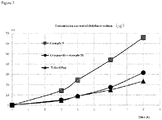
- the amount of diclofenac sodium permeated in example 9 was about 3 times larger compared with those of comparative example 11 wherein the water content was decreased, and the commercial product.
- the amounts of components formulated in example 9 and comparative example 11 are shown in Table 7.
- the results of the permeability test are shown in Table 8 and Figure 3 .
- Comparative example 12 A. polyacrylic acid and the like polyacrylic acid 1.50% 1.50% Naboal Pap sodium polyacrylate 5.70% 5.70% B. cross-linking agent insoluble cross-linking agent (dihydroxy aluminum acetate) 0.120% 0.120% aqueous cross-linking agent (aluminum potassium sulfate) 0.020% 0.020% C. polyhydric alcohol glycerin 7.00% 30.00% 1,3-butylene glycol 7.00% 7.00% D. aqueous macromolecule polyvinyl alcohol 3.00% 3.00% E. carboxyvinyl polymer 0.00% 0.00% sodium carboxymethylcellulose 1.00% 1.00% F.
Landscapes
- Health & Medical Sciences (AREA)
- Chemical & Material Sciences (AREA)
- Life Sciences & Earth Sciences (AREA)
- Epidemiology (AREA)
- Veterinary Medicine (AREA)
- Medicinal Chemistry (AREA)
- Pharmacology & Pharmacy (AREA)
- Public Health (AREA)
- Animal Behavior & Ethology (AREA)
- General Health & Medical Sciences (AREA)
- Engineering & Computer Science (AREA)
- Bioinformatics & Cheminformatics (AREA)
- Dermatology (AREA)
- Oil, Petroleum & Natural Gas (AREA)
- General Chemical & Material Sciences (AREA)
- Inorganic Chemistry (AREA)
- Chemical Kinetics & Catalysis (AREA)
- Organic Chemistry (AREA)
- Biochemistry (AREA)
- Molecular Biology (AREA)
- Medicinal Preparation (AREA)
- Adhesives Or Adhesive Processes (AREA)
Applications Claiming Priority (1)
| Application Number | Priority Date | Filing Date | Title |
|---|---|---|---|
| PCT/JP2018/028571 WO2020026329A1 (fr) | 2018-07-31 | 2018-07-31 | Pansement aqueux |
Publications (2)
| Publication Number | Publication Date |
|---|---|
| EP3871663A1 true EP3871663A1 (fr) | 2021-09-01 |
| EP3871663A4 EP3871663A4 (fr) | 2022-07-20 |
Family
ID=69232409
Family Applications (1)
| Application Number | Title | Priority Date | Filing Date |
|---|---|---|---|
| EP18906715.0A Pending EP3871663A4 (fr) | 2018-07-31 | 2018-07-31 | Pansement aqueux |
Country Status (6)
| Country | Link |
|---|---|
| US (1) | US11504343B2 (fr) |
| EP (1) | EP3871663A4 (fr) |
| JP (1) | JP6967253B2 (fr) |
| CN (1) | CN111315366A (fr) |
| MY (1) | MY198249A (fr) |
| WO (1) | WO2020026329A1 (fr) |
Families Citing this family (2)
| Publication number | Priority date | Publication date | Assignee | Title |
|---|---|---|---|---|
| JP7798754B2 (ja) * | 2022-11-21 | 2026-01-14 | 久光製薬株式会社 | マイクロニードル貼付剤 |
| CN117064626A (zh) * | 2023-08-21 | 2023-11-17 | 浙江银达生物技术有限公司 | 一种医用水凝胶贴 |
Family Cites Families (11)
| Publication number | Priority date | Publication date | Assignee | Title |
|---|---|---|---|---|
| JPH0794383B2 (ja) * | 1986-12-12 | 1995-10-11 | 日本純薬株式会社 | パツプ剤 |
| JP3468066B2 (ja) * | 1997-11-04 | 2003-11-17 | ライオン株式会社 | 含水系パップ剤組成物 |
| JP4275768B2 (ja) * | 1998-06-18 | 2009-06-10 | 久光製薬株式会社 | 水性粘着膏体 |
| JP4054936B2 (ja) * | 1999-07-09 | 2008-03-05 | ライオン株式会社 | インドメタシン貼付剤 |
| JP3655781B2 (ja) | 1999-08-25 | 2005-06-02 | 帝國製薬株式会社 | ビタミンc又はその誘導体を配合したパップ剤 |
| JP2003095929A (ja) * | 2001-09-27 | 2003-04-03 | Lion Corp | 貼付剤 |
| JP3734743B2 (ja) * | 2001-11-19 | 2006-01-11 | 東亞合成株式会社 | パップ剤基剤 |
| JP2003277637A (ja) * | 2002-03-27 | 2003-10-02 | Daicel Chem Ind Ltd | 水性ゲルおよびその製造方法 |
| JP2008150311A (ja) * | 2006-12-15 | 2008-07-03 | Lintec Corp | 水性ジェル組成物および水性ジェル貼付剤 |
| JP5217422B2 (ja) * | 2007-12-26 | 2013-06-19 | ライオン株式会社 | 含水粘着剤、貼付剤及び含水粘着剤の製造方法 |
| CN104546803A (zh) * | 2013-10-24 | 2015-04-29 | 和心医药科技(上海)有限公司 | 一种氟比洛芬水凝胶贴膏及其组合物 |
-
2018
- 2018-07-31 EP EP18906715.0A patent/EP3871663A4/fr active Pending
- 2018-07-31 JP JP2019540119A patent/JP6967253B2/ja active Active
- 2018-07-31 MY MYPI2019005210A patent/MY198249A/en unknown
- 2018-07-31 CN CN201880001420.8A patent/CN111315366A/zh active Pending
- 2018-07-31 WO PCT/JP2018/028571 patent/WO2020026329A1/fr not_active Ceased
- 2018-07-31 US US16/499,919 patent/US11504343B2/en active Active
Also Published As
| Publication number | Publication date |
|---|---|
| WO2020026329A1 (fr) | 2020-02-06 |
| JPWO2020026329A1 (ja) | 2021-08-05 |
| US20210401767A1 (en) | 2021-12-30 |
| EP3871663A4 (fr) | 2022-07-20 |
| JP6967253B2 (ja) | 2021-11-17 |
| CN111315366A (zh) | 2020-06-19 |
| US11504343B2 (en) | 2022-11-22 |
| MY198249A (en) | 2023-08-17 |
Similar Documents
| Publication | Publication Date | Title |
|---|---|---|
| AU694243B2 (en) | Compositions for topical administration of anesthetic agents | |
| US5900247A (en) | Mucoadhesive pharmaceutical composition for the controlled release of active principles | |
| DE69911116T2 (de) | Hydrophile Klebmassen | |
| TWI488644B (zh) | Preparation method of adhesive preparation, adhesive agent and packaging body | |
| JPWO2001043729A1 (ja) | 貼付剤 | |
| CN103796646B (zh) | 水性贴剂 | |
| JP2000119195A (ja) | 吸収促進剤及び該吸収促進剤を有してなる経皮吸収製剤 | |
| US11504343B2 (en) | Aqueous adhesive | |
| CA2905907A1 (fr) | Compositions d'amphetamine transdermiques stables et procedes de fabrication | |
| WO1999036061A1 (fr) | Plastifiant et timbre adhesif contenant ce plastifiant | |
| JPH04217919A (ja) | エペリゾンまたはトルペリゾン経皮吸収製剤 | |
| JP5021952B2 (ja) | 選択的セロトニン再取込阻害成分を含有する製剤 | |
| JPH0723306B2 (ja) | 新規貼付製剤 | |
| JPH0749050B2 (ja) | 含水ゲル組成物 | |
| JP5586888B2 (ja) | 非含水貼付製剤 | |
| JP3193161B2 (ja) | 経皮吸収性製剤 | |
| JP2007513916A (ja) | 架橋親水性重合体を基礎とする投与剤形 | |
| JP2006248996A (ja) | 経皮吸収型貼付剤 | |
| JPS63203613A (ja) | 親水性経皮投与製剤 | |
| JP3525272B2 (ja) | 皮膚貼付用シート | |
| JP4567998B2 (ja) | 親水性粘着剤を用いた親水性皮膚外用粘着剤組成物および親水性貼付剤 | |
| TWI878765B (zh) | 泥敷劑及其製造方法 | |
| JPS6116369B2 (fr) | ||
| HK40121265A (en) | Poultice and method for manufacturing same | |
| US20190192662A1 (en) | Transdermal pharmaceutical compositions with reduced skin irritation |
Legal Events
| Date | Code | Title | Description |
|---|---|---|---|
| STAA | Information on the status of an ep patent application or granted ep patent |
Free format text: STATUS: UNKNOWN |
|
| STAA | Information on the status of an ep patent application or granted ep patent |
Free format text: STATUS: THE INTERNATIONAL PUBLICATION HAS BEEN MADE |
|
| PUAI | Public reference made under article 153(3) epc to a published international application that has entered the european phase |
Free format text: ORIGINAL CODE: 0009012 |
|
| STAA | Information on the status of an ep patent application or granted ep patent |
Free format text: STATUS: REQUEST FOR EXAMINATION WAS MADE |
|
| 17P | Request for examination filed |
Effective date: 20190830 |
|
| AK | Designated contracting states |
Kind code of ref document: A1 Designated state(s): AL AT BE BG CH CY CZ DE DK EE ES FI FR GB GR HR HU IE IS IT LI LT LU LV MC MK MT NL NO PL PT RO RS SE SI SK SM TR |
|
| DAV | Request for validation of the european patent (deleted) | ||
| DAX | Request for extension of the european patent (deleted) | ||
| A4 | Supplementary search report drawn up and despatched |
Effective date: 20220621 |
|
| RIC1 | Information provided on ipc code assigned before grant |
Ipc: C08K 3/30 20060101ALI20220614BHEP Ipc: C08K 5/053 20060101ALI20220614BHEP Ipc: A61K 47/10 20170101ALI20220614BHEP Ipc: C09J 133/02 20060101ALI20220614BHEP Ipc: C09J 129/04 20060101ALI20220614BHEP Ipc: A61K 47/38 20060101ALI20220614BHEP Ipc: A61K 47/32 20060101ALI20220614BHEP Ipc: A61K 9/70 20060101AFI20220614BHEP |
|
| STAA | Information on the status of an ep patent application or granted ep patent |
Free format text: STATUS: EXAMINATION IS IN PROGRESS |
|
| 17Q | First examination report despatched |
Effective date: 20250618 |