EP3852592B1 - Reinigungskopf für eine oberflächenbehandlungsvorrichtung mit einem oder mehreren stabilisatoren und oberflächenbehandlungsvorrichtung damit - Google Patents
Reinigungskopf für eine oberflächenbehandlungsvorrichtung mit einem oder mehreren stabilisatoren und oberflächenbehandlungsvorrichtung damit Download PDFInfo
- Publication number
- EP3852592B1 EP3852592B1 EP19863315.8A EP19863315A EP3852592B1 EP 3852592 B1 EP3852592 B1 EP 3852592B1 EP 19863315 A EP19863315 A EP 19863315A EP 3852592 B1 EP3852592 B1 EP 3852592B1
- Authority
- EP
- European Patent Office
- Prior art keywords
- stabilizer
- cleaning head
- surface cleaning
- neck
- main body
- Prior art date
- Legal status (The legal status is an assumption and is not a legal conclusion. Google has not performed a legal analysis and makes no representation as to the accuracy of the status listed.)
- Active
Links
Images






Classifications
-
- A—HUMAN NECESSITIES
- A47—FURNITURE; DOMESTIC ARTICLES OR APPLIANCES; COFFEE MILLS; SPICE MILLS; SUCTION CLEANERS IN GENERAL
- A47L—DOMESTIC WASHING OR CLEANING; SUCTION CLEANERS IN GENERAL
- A47L9/00—Details or accessories of suction cleaners, e.g. mechanical means for controlling the suction or for effecting pulsating action; Storing devices specially adapted to suction cleaners or parts thereof; Carrying-vehicles specially adapted for suction cleaners
- A47L9/02—Nozzles
- A47L9/04—Nozzles with driven brushes or agitators
- A47L9/0455—Bearing means therefor
-
- A—HUMAN NECESSITIES
- A47—FURNITURE; DOMESTIC ARTICLES OR APPLIANCES; COFFEE MILLS; SPICE MILLS; SUCTION CLEANERS IN GENERAL
- A47L—DOMESTIC WASHING OR CLEANING; SUCTION CLEANERS IN GENERAL
- A47L5/00—Structural features of suction cleaners
- A47L5/12—Structural features of suction cleaners with power-driven air-pumps or air-compressors, e.g. driven by motor vehicle engine vacuum
- A47L5/22—Structural features of suction cleaners with power-driven air-pumps or air-compressors, e.g. driven by motor vehicle engine vacuum with rotary fans
- A47L5/28—Suction cleaners with handles and nozzles fixed on the casings, e.g. wheeled suction cleaners with steering handle
-
- A—HUMAN NECESSITIES
- A47—FURNITURE; DOMESTIC ARTICLES OR APPLIANCES; COFFEE MILLS; SPICE MILLS; SUCTION CLEANERS IN GENERAL
- A47L—DOMESTIC WASHING OR CLEANING; SUCTION CLEANERS IN GENERAL
- A47L9/00—Details or accessories of suction cleaners, e.g. mechanical means for controlling the suction or for effecting pulsating action; Storing devices specially adapted to suction cleaners or parts thereof; Carrying-vehicles specially adapted for suction cleaners
- A47L9/0009—Storing devices ; Supports, stands or holders
- A47L9/0054—Stands or the like for temporary interruption of work
-
- A—HUMAN NECESSITIES
- A47—FURNITURE; DOMESTIC ARTICLES OR APPLIANCES; COFFEE MILLS; SPICE MILLS; SUCTION CLEANERS IN GENERAL
- A47L—DOMESTIC WASHING OR CLEANING; SUCTION CLEANERS IN GENERAL
- A47L9/00—Details or accessories of suction cleaners, e.g. mechanical means for controlling the suction or for effecting pulsating action; Storing devices specially adapted to suction cleaners or parts thereof; Carrying-vehicles specially adapted for suction cleaners
- A47L9/009—Carrying-vehicles; Arrangements of trollies or wheels; Means for avoiding mechanical obstacles
Definitions
- the present invention is generally directed to surface treatment apparatuses and more specifically to a cleaning head for a surface treatment apparatus having one or more stabilizers.
- Surface treatment apparatuses may include vacuum cleaners configured to suction debris from a surface (e.g., a floor).
- the vacuum cleaner may include a surface cleaning head having one or more brush rolls configured to agitate a surface (e.g., a carpet) to urge debris into an airflow generated by the vacuum cleaner. The debris within the airflow may then be deposited in a debris collector for later disposal.
- US 8,429,791 B2 disclosed an upright surface treating appliance including a main body and a stand pivotable relative to the main body between a supporting position and a retracted position.
- a stand retaining mechanism for releasably retaining the stand in the supporting position, and which includes a locking member pivotably moveable about a first axis to release the stand as it is moved from the supporting position to the retracted position, and about a second axis spaced from the first axis to retain the stand as it is returned to the supporting position.
- US 2015/0067981 A1 discloses an upright vacuum cleaner having a nozzle and a support moveable between a projected state and a retracted state. The support, in its projected state, is adapted to support the vacuum cleaner in a self-standing position. The support is mounted to the nozzle and projects from the nozzle in its projected state.
- JP 2003102663 A discloses a floor surface washing cleaner in which an auxiliary plate is fitted to a brush case fitted with an operation handle rotatable with respect to the floor surface and an extensible damper is fitted between the operation handle and the auxiliary plate.
- US 2010/0088842 A1 discloses a surface treating appliance including a device generating a flow of fluid in the form of a motor and a fan, housed in a main body.
- a hose and wand assembly, a surface treating head and a rotary change over valve are also provided. The valve is selectively rotatable to allow fluid flow from either the surface-treating head or the hose.
- a support assembly is moveable between a supporting position in which it supports the main body and a retracted position.
- US 2009/064450 A1 discloses a surface-treating appliance including a main body, a surface-treating head and a stand.
- the stand is located on a rear portion of the appliance and is moveable between a supporting position in which is supports the main body in an upright position and a stored position.
- the stand is moveable between the supporting and stored positions in response to movement of the main body between its upright position and an inclined position.
- the present disclosure is generally directed to a surface treatment apparatus having an upright portion and a surface cleaning head pivotally coupled to the upright portion.
- the upright portion is transitionable between an in-use position and a storage position by pivoting the upright portion relative to the surface cleaning head.
- the surface cleaning head includes at least one stabilizer configured to transition from an extended position to a retracted position in response to, for example, transitioning the upright portion between the storage position and the in-use position.
- the stabilizer may improve the stability of the surface treatment apparatus when, for example, the surface treatment apparatus is not in-use without substantially interfering with the usage of the surface treatment apparatus. This may prevent the surface treatment apparatus from inadvertently tipping over and causing damage to, for example, itself, other objects, an animal, and/or a person.
- FIG. 1 shows a schematic view of a vacuum cleaner 100 including a surface cleaning head 102 having one or more wheels 103 rotatably coupled thereto, an upright section 104, a dust cup 106, and a suction motor 108.
- the suction motor 108 is configured generate an airflow into an inlet 110 of the surface cleaning head 102 such that debris can be suctioned from a surface to be cleaned (e.g., a floor). At least a portion of debris that is entrained within the airflow is deposited in the dust cup 106 for later disposal by a user of the vacuum cleaner 100. After passing through the dust cup 106, the airflow is exhausted from the suction motor 108 at an exhaust outlet 112.
- the suction motor 108 can be powered by, for example, one or more batteries and/or an electrical grid.
- the upright section 104 is in a storage (or upright) position.
- the upright section 104 is pivotally coupled to a main body 101 of the surface cleaning head 102 such that the upright section 104 can be pivoted to an in-use (or reclined) position (e.g., as shown FIG. 2 ).
- An axis about which the upright section 104 pivots when transitioning between the storage and in-use positions can extend substantially parallel to an axis about which the one or more wheels 103 rotate.
- One or more stabilizers 114 can be provided that are configured to transition between an extended (e.g., as shown in FIG. 1 ) and retracted (e.g., as shown in FIG. 2 ) position in response to, for example, the upright section 104 transitioning between the storage and in-use positions and/or in response to a user interaction.
- the stabilizer 114 can be configured to extend from the vacuum cleaner 100 and engage (e.g., contact) a surface (e.g., a floor) when the upright section 104 is in the storage position. Such a configuration may improve the stability of the vacuum cleaner 100 when compared to a vacuum cleaner 100 that does not include the stabilizer 114.
- the stabilizer 114 can move towards the retracted position for at least a portion of the pivotal movement such that the stabilizer 114 does not substantially interfere with the use of the vacuum cleaner 100.
- the surface cleaning head 102 can be moved across a surface to be cleaned (e.g., a floor) without the stabilizer 114 engaging (e.g., contacting) the surface to be cleaned.
- the stability of the vacuum cleaner 100 can be improved without substantially interfering with the maneuverability of the vacuum cleaner 100.
- FIG. 3 shows a perspective view of a surface cleaning head 300, which may be an example of the surface cleaning head 102 of FIG. 1 .
- the surface cleaning head 300 includes a neck 302 pivotally coupled to a main body 303 of the surface cleaning head 300.
- the neck 302 is configured to receive a wand 304 such that the neck 302 and the wand 304 can be described as collectively forming at least a portion of an upright section of a vacuum cleaner such as, for example, the vacuum cleaner 100 of FIG. 1 .
- the surface cleaning head 300 can include one or more main wheels 306 that are configured to rotate about a rotation axis 308 in response to the surface cleaning head 300 being urged across a surface to be cleaned 301 (e.g., a floor).
- the neck 302 can be configured to pivot about one or more axes.
- the neck 302 can be configured to pivot about a first pivot axis 310 that extends substantially parallel to the rotation axis 308 of the one or more wheels 306.
- the neck 302 and the wand 304 can be transitioned between a storage position (e.g., as shown in FIG. 3 ) and an in-use position (e.g., as shown in FIG. 4 ) in response to pivoting about the first pivot axis 310.
- the neck 302 can be configured to pivot side-to-side about a second pivot axis 312 that extends transverse to (e.g., perpendicular to) the rotation axis 308 of the one or more wheels 306.
- a second pivot axis 312 that extends transverse to (e.g., perpendicular to) the rotation axis 308 of the one or more wheels 306.
- the wand 304 can define a fluid channel 314 such that air drawn into the surface cleaning head 300 through an air inlet 316 can pass through the wand 304.
- the wand 304 can be fluidly coupled to the surface cleaning head 300.
- the wand 304 can be removably coupled to the neck 302 such that the wand 304 can be used independently of the surface cleaning head 300 (e.g., the wand 304 may be configured to couple to a surface cleaning accessory).
- the surface cleaning head 300 includes at least one stabilizer 318 configured to transition between an extended position (e.g., as shown in FIG. 3 ) in which the stabilizer 318 engages (e.g., contacts) the surface to be cleaned 301 and a retracted position (e.g., as shown in FIG. 4 ) in which the stabilizer 318 is configured to be disengaged from the surface to be cleaned 301.
- the stabilizer 318 is configured to transition between the extended position and the retracted position in response to the neck 302 being pivoted between the storage position and the in-use position.
- the stabilizer 318 can transition from the extended position to the retracted position.
- the stabilizer 318 should not substantially interfere with the movement of the surface cleaning head 300 across a surface to be cleaned 301 when the neck 302 is in the in-use position.
- the stabilizer 318 can transition from the retracted position to the extended position.
- the stabilizers 318 can improve the stability of the surface cleaning head 300 such that, for example, it is less likely to tip over.
- the stabilizer 318 can include one or more wheels coupled thereto (e.g., the at least one wheel 306 and/or an additional wheel).
- the one or more wheels can be configured to engage (e.g., contact) the surface to be cleaned 301 such that the wheels can rollingly engage the surface to be cleaned 301.
- the stabilizer 318 can be configured to extend or retract for only a portion of the pivotal movement of the neck 302. For example, the stabilizer 318 can begin to extend when the neck 302 is being transitioned towards the storage position and when the neck 302 is within a predetermined number of degrees (e.g., 2°, 5°, 7°, 10°, 15°, and/or any other suitable number of degrees) of the storage position. In other words, the stabilizer 318 can be configured to transition between extended and retracted positions in response to the neck 302 pivoting within a predetermined range.
- a predetermined number of degrees e.g., 2°, 5°, 7°, 10°, 15°, and/or any other suitable number of degrees
- the stabilizer 318 when the stabilizer 318 is in the extended position, the stabilizer 318 extends behind the one or more wheels 306 such that the one or more wheels 306 are disposed between at least a portion of the stabilizer 318 and the air inlet 316 of the surface cleaning head 300. Additionally, or alternatively, when the stabilizer 318 is in the extended position, the wand 304 can be positioned between the main body 303 of the surface cleaning head 300 and a distal most portion of the stabilizer 318 (e.g., a portion of the stabilizer 318 configured to engage the surface to be cleaned 301).
- the stabilizer 318 When the stabilizer 318 is in the retracted position, at least a portion of the stabilizer 318 can transition into a cavity defined within the main body 303 of the surface cleaning head 300 such that the one or more wheels 306 are disposed between the surface to be cleaned 301 and at least a portion of the stabilizer 318.
- a plurality of stabilizers 318 can be provided.
- a longitudinal axis 320 of each stabilizer 318 extends transverse to a forward movement direction 322 of the surface cleaning head 300.
- the longitudinal axes 320 extend transverse to each other.
- a separation distance 324 extending between the stabilizers 318 increases as the stabilizers 318 approach the surface to be cleaned 301 such that the stability of the surface cleaning head 300 may be improved.
- the longitudinal axes 320 can extend parallel to each other and/or the forward movement direction 322.
- the surface cleaning head 500 may include a protrusion 504 (shown in hidden lines) configured to urge the stabilizer 318 between the extended and retracted position.
- the protrusion 504 can extend from the neck 302.
- the protrusion 504 can be configured to rotate in response to transitioning the neck 302 between the storage and in-use positions.
- the protrusion 504 can be coupled to a linkage 600 that is configured to engage (e.g., contact) the stabilizer 318.
- the linkage 600 can be pivotally coupled to the protrusion 504 such that, as the protrusion 504 is rotated in response to the transitioning of the neck 302 between the in-use and storage positions, the linkage 600 urges the stabilizer 318 to transition between the retracted and extended positions.
- the linkage 600 can include a pivot arm 602 and a plunger 604 slidably disposed therein such that, as the linkage 600 pivots, the plunger 604 slides within the pivot arm 602.
- a biasing mechanism e.g., a spring
- a biasing mechanism can be provided to urge the plunger 604 into engagement with the stabilizer 318.
- the stabilizer 318 can include a rib 506 that is configured to retain the stabilizer 318 in the extended position until the neck 302 is transitioned towards the storage position.
- the rib 506 can be configured to engage (e.g., contact) a detent.
- FIGS. 7-9 show multiple views of a surface cleaning head 700, which may be an example of the surface cleaning head 300 of FIG. 3 .
- the stabilizer 318 can include a plurality of teeth 702 configured to engage a corresponding gear such that a rack and pinion is formed.
- the plurality of teeth 702 can be configured to engage a gear that rotates in response to the neck 302 transitioning between a storage and an in-use position.
- FIG. 10 shows an example of a surface cleaning head 1000, which may be an example of the surface cleaning head 102 of FIG. 1 .
- the surface cleaning head 1000 includes a neck 1002 pivotally coupled to a main body 1001 of the surface cleaning head 1000.
- the neck 1002 can be configured to pivot relative to the main body 1001 of the surface cleaning head 1000 about one or more axes.
- the neck 1002 can be configured to pivot between an upright position (e.g., as shown in FIG. 10 ) and an in-use position (e.g., as shown in FIG. 11 ).
- the neck 1002 can also be configured to pivot side-to-side.
- the neck 1002 includes one or more stabilizers 1004 configured to transition between an extended position (e.g., as shown in FIG. 10 ) and a retracted position (e.g., as shown in FIG. 11 ).
- an extended position e.g., as shown in FIG. 10
- a retracted position e.g., as shown in FIG. 11
- the stabilizer 1004 is configured to move towards the main body 1001 of the surface cleaning head 1000.
- a portion of the stabilizer 1004 slides within a slot 1006 formed within the neck 1002, wherein the slot 1006 extends longitudinally along the neck 1002.
- the stabilizer 1004 when transitioning to the retracted position, at least a portion of the stabilizer 1004 moves in a direction of the main body 1001 and at least a portion of the stabilizer moves away from the main body 1001 such that the stabilizer 1004 comes out of engagement with a surface to be cleaned (e.g., a floor).
- a surface to be cleaned e.g., a floor
- a pivot arm 1008 can also be provided to constrain the extension distance of the stabilizer 1004.
- the pivot arm 1008 can be pivotally coupled to the stabilizer 1004 and to the neck 1002 or the main body 1001 of the surface cleaning head 1000. As such, as the stabilizer 1004 slides along the slot 1006, the pivot arm 1008 pivots relative to the stabilizer 1004 and the neck 1002 or the main body 1001.
- the stabilizer 1004 can be configured to extend or retract for only a portion of the pivotal movement of the neck 1002. For example, the stabilizer 1004 can begin to extend when the neck 1002 is being transitioned towards the storage position and when the neck 1002 is within a predetermined number of degrees (e.g., 2°, 5°, 7°, 10°, 15°, and/or any other suitable number of degrees) of the storage position. In other words, the stabilizer 1004 can be configured to transition between extended and retracted positions in response to the neck 1002 pivoting within a predetermined range.
- a predetermined number of degrees e.g., 2°, 5°, 7°, 10°, 15°, and/or any other suitable number of degrees
- FIG. 12 is a perspective view of the surface cleaning head 1000 of FIG. 10 .
- the neck 1002 can include a plurality of stabilizers 1004 configured to extend therefrom.
- a longitudinal axis 1200 of each of the stabilizers 1004 can extend transverse to a forward direction of travel 1202.
- the longitudinal axes 1200 can extend transverse to each other.
- a separation distance 1204 extending between the stabilizers 1004 can increase as the stabilizers 1004 extend in a direction away from the main body 1001 of the surface cleaning head 1000.
- the longitudinal axes 1200 can extend parallel to each other.
- FIG. 13 shows a perspective view of the neck 1002 of FIG. 10 having the stabilizers 1004 in the retracted position and
- FIG. 14 shows a perspective view of the neck 1002 having the stabilizers 1004 in the extended position.
- FIG. 15 shows a side view of the surface cleaning head 1000 having the neck 1002 in an in-use position.
- FIG. 16 shows a perspective view of a surface cleaning head 1600, which may be an example of the surface cleaning head 102 of FIG. 1 .
- the surface cleaning head 1600 includes a neck 1602 pivotally coupled to a main body 1601 of the surface cleaning head 1600.
- the neck 1602 is configured to pivot between a storage and an in-use position. In some instances, the neck 1602 can also be configured to pivot side-to-side.
- One or more stabilizers 1604 are coupled to the neck 1602 and configured to transition between an extended position (e.g., as shown in FIG. 16 ) and a retracted position (e.g., as shown in FIG. 17 ).
- the stabilizers 1604 can be configured to transition from the retracted position to the extended position in response to actuation of a lever 1606.
- the lever 1606 can be configured to be actuated by a user (e.g., in response to a user depressing the lever 1606 using a foot).
- the one or more stabilizers 1604 can be configured to transition from the extended position to the retracted position in response to a subsequent actuation of the lever 1606.
- the stabilizers 1604 can be configured such that a subsequent actuation of the lever 1606 causes a biasing mechanism (e.g., a spring) to urge the stabilizers 1604 towards the retracted position.
- a biasing mechanism e.g., a spring
- the stabilizers 1604 can be configured to transition from the extended position to the retracted position in response to transitioning the neck 1602 from a storage position towards an in-use position.
- a pivot arm 1610 may also be pivotally coupled to the stabilizer 1604 and the neck 1602 or the main body 1601 of the surface cleaning head 1600.
- the pivot arm 1610 limits the distance that the stabilizer 1604 can extend from the main body 1601 of the surface cleaning head 1600.
- a plurality of stabilizers 1604 can be coupled to the neck 1602.
- a longitudinal axis 1612 of each stabilizer 1604 can extend transverse to a forward movement direction 1614 of the surface cleaning head 1600.
- the longitudinal axes 1612 can extend transverse to each other.
- the longitudinal axes 1612 can extend parallel to each other.
- the stabilizers 1604 and lever 1606 may be part of a stabilizer assembly that is removably coupled to the neck 1602. As such, the stabilizer assembly can be installed by a user of the vacuum cleaner.
- FIG. 18 shows a perspective view of a surface cleaning head 1800, which may be an example of the surface cleaning head 102 of FIG. 1 .
- the surface cleaning head 1800 includes a neck 1802 pivotally coupled to a main body 1801 of the surface cleaning head 1800.
- the neck 1802 can be configured to pivot side-to-side and between a storage position (e.g., as shown in FIG. 18 ) and an in-use position (e.g., as shown in FIG. 19 ).
- a stabilizer 1804 is configured to extend from the main body 1801 of the surface cleaning head 1800.
- the stabilizer 1804 can be configured such that it transitions to an extended position (e.g., as shown in FIG. 18 ) when the neck 1802 transitions to the storage position.
- the stabilizer 1804 can include a biasing mechanism that urges the stabilizer 1804 towards the extended position.
- the neck 1802 may cause a latch to be released such that the stabilizer 1804 extends.
- the stabilizer 1804 includes a plurality of telescoping parts 1806, wherein at least one of the telescoping parts 1806 is configured to receive at least one other telescoping part 1806.
- a distal most telescoping part 1806 can include a support 1808 extending therefrom. The support 1808 can extend from the distal most telescoping part 1806 at an angle such that the support 1808 extends substantially parallel to a surface on which the surface cleaning head 1800 rests (e.g., a floor).
- the stabilizer 1804 may transition from the extended position to a retracted position (e.g., as shown in FIG. 19 ) in response to a user exerting a force on the telescoping parts 1806 such that one or more of the telescoping parts 1806 are received within at least one other telescoping part 1806. In some instances, the stabilizer 1804 may be transitioned from the extended position to the retracted position in response to the neck 1802 being transitioned from the in-use position to the storage position.
- FIG. 20 shows a perspective view of the stabilizer 1804 in the extended position
- FIG. 21 shows a perspective view of the stabilizer 1804 in the retracted position.
- the stabilizer 1804 can include a first plurality of telescoping parts 2000 and a second plurality of telescoping parts 2002.
- the first and second plurality of telescoping parts 2000 and 2002 are disposed on opposing sides of the surface cleaning head 1800.
- the neck 1802 and one or more wheels 2004 can be disposed between at least a portion of the first and second plurality of telescoping parts 2000 and 2002.
- the support 1808 can extend between the first and second plurality of telescoping parts 2000 and 2002.
- a user may exert a force on the support 1808 (e.g., using a foot).
- a user may, while causing the neck 1802 to be transitioned into an in-use position, transition the stabilizer 1804 into the retracted position.
- FIG. 22 shows a perspective view of a surface cleaning head 2200, which may be an example of the surface cleaning head 102 of FIG. 1 .
- the surface cleaning head 2200 includes a neck 2202 pivotally coupled to a main body 2204 of the surface cleaning head 2200.
- the neck 2202 can be configured to pivot side-to-side and between a storage position (e.g., as shown in FIG. 22 ) and an in-use position (e.g., as shown in FIG. 23 ).
- the surface cleaning head 2200 can include a stabilizer 2206 configured to transition between an extended position (e.g., as shown in FIG. 22 ) and a retracted position (e.g., as shown in FIG. 23 ).
- the stabilizer 2206 can transition between the extended and retracted positions in response to, for example, the transitioning of the neck 2202 between the storage and in-use positions.
- the stabilizer 2206 can be configured to extend or retract for only a portion of the pivotal movement of the neck 2202. For example, the stabilizer 2206 can begin to extend when the neck 2202 is being transitioned towards the storage position and when the neck 2202 is within a predetermined number of degrees (e.g., 2°, 5°, 7°, 10°, 15°, and/or any other suitable number of degrees) of the storage position. In other words, the stabilizer 2206 can be configured to transition between extended and retracted positions in response to the neck 2202 pivoting within a predetermined range.
- a predetermined number of degrees e.g., 2°, 5°, 7°, 10°, 15°, and/or any other suitable number of degrees
- the stabilizer 2206 can be coupled to one or more wheels 2208. As such, when the stabilizer 2206 transitions between the extended and retracted positions, the stabilizer 2206 urges the one or more wheels 2208 between an extended position (e.g., as shown in FIG. 22 ) and a retracted position (e.g., as shown in FIG. 23 ). When in the retracted position, the one or more wheels 2208 can be used to maneuver the surface cleaning head 2200 over a surface (e.g., a floor) during a cleaning operation.
- a surface e.g., a floor
- the one or more wheels 2208 may improve the stability of the surface cleaning head 2200 when the neck 2202 is in the storage position while still allowing the surface cleaning head 2200 to be maneuvered over the surface using the one or more wheels 2208 (e.g., as shown in FIG. 24 ).
- the stabilizer 2206 can be configured to slideably engage a track 2210 defined in at least a portion of the main body 2204 of the surface cleaning head 2200. Additionally, or alternatively, the track 2210 can be defined in at least a portion of the neck 2202. In some instances, and as shown, the track 2210 can be configured to extend beyond a rearward most portion of the one or more wheels 2208 when the one or more wheels 2208 are in the retracted position. In other words, when in the retracted position, the one or more wheels 2208 can be disposed between the main body 2204 of the surface cleaning head 2200 and a distal most portion of the track 2210. In other instances, the track 2210 may be defined within the main body 2204 such that the track does not extend beyond the one or more wheels 2208 when the one or more wheels 2208 are in the retracted position.
- FIG. 25 shows a schematic view of a surface cleaning head 2500, which may be an example of the surface cleaning head 102 of FIG. 1 .
- the surface cleaning head 2500 includes a plurality of stabilizers 2502 configured to rotate about a rotation axis 2504.
- the rotation axis 2504 may be the axis about which one or more wheels 2506 rotatably coupled to a main body 2508 of the surface cleaning head 2500 rotate.
- the one or more wheels 2506 When in the extended position (e.g., as shown in FIG. 25 ) the one or more wheels 2506 are disposed between at least a portion of the stabilizers 2502 and the main body 2508 of the surface cleaning head 2500.
- the stabilizers 2502 When in the retracted position, the stabilizers 2502 are received within a corresponding receptacle 2510 defined within the main body 2508 of the surface cleaning head 2500.
- the stabilizers 2502 are shown as having an "L” shape, other configurations are possible.
- the stabilizers 2502 may have a "J" shape, a "P” shape, a “T” shape, and/or any other suitable shape.
- the stabilizers 2502 may be substantially straight and may not include a portion that is configured to extend behind the one or more wheels 2506.
- the stabilizers 2502 may be coupled together such that the stabilizers 2502 collectively form a "U" shaped stabilizer.
- the "U" shaped stabilizer maybe configured such that is extends between the wheels 2506 or such that the wheels 2506 are disposed within the area defined within the "U" shaped stabilizer.
- FIGS. 26 and 27 show perspective side views of a surface cleaning head 2600, which may be an example of the surface cleaning head 102 of FIG. 1 .
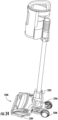
- the surface cleaning head 2600 includes a main body 2602, a neck 2604 that is pivotally coupled to the main body 2602 and that is configured to receive a wand (e.g., the wand 304 of FIG. 3 ), a plurality of main wheels 2606 (e.g., wheels used to maneuver the surface cleaning head 2600 during use while cleaning) rotatably coupled to the main body 2602, and a plurality of stabilizers 2608 configured to transition between an extended position (e.g., as shown in FIG. 26 ) and a retracted position (e.g., as shown in FIG.
- a wand e.g., the wand 304 of FIG. 3
- main wheels 2606 e.g., wheels used to maneuver the surface cleaning head 2600 during use while cleaning
- stabilizers 2608 configured to transition between an extended position (
- the stabilizers 2608 can each include a respective stabilizer wheel 2610.
- a substantial portion of the stabilizer wheels 2610 e.g., at least 95% of a diameter of the stabilizer wheels 2610 can extend beyond a rearmost surface 2609 of the main body 2602 and, when in the retracted position, the stabilizer wheels 2610 can extend substantially between the rearmost surface 2609 and a forwardmost surface 2611 of the neck 2604 (e.g., a measure of a length of the stabilizer wheel 2610 extending beyond a respective surface measures less than 5% of a diameter of the stabilizer wheels 2610).
- the stabilizers 2608 extend from a respective stabilizer opening 2612 defined in the main body 2602.
- Each stabilizer opening 2612 can be configured to be angled in a direction of a surface to be cleaned 2616 and may be defined in the main body 2602 at a location between a top surface 2614 of the main body 2602 and a respective main wheel 2606. As such, at least a portion of each stabilizer 2608 can extend over at least a portion of a respective main wheel 2606.
- the stabilizer opening 2612 can be defined in the main body 2602 such that at least a portion is disposed on opposing sides of a central longitudinal axis 2613 of the neck 2604.
- the stabilizer wheels 2610 transition into engagement (e.g., contact) with the surface to be cleaned 2616.
- the stabilizer wheels 2610 transition out of engagement (e.g., contact) with the surface to be cleaned 2616.
- the stabilizers 2608 can extend from the main body 2602 at an angle and in a direction of the surface to be cleaned 2616 such that the stabilizer wheels 2610 transition into and out of engagement with the surface to be cleaned 2616.
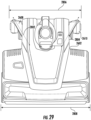
- the stabilizers 2608 extend outwardly from the main body 2602 along respective extension axes 2802 and 2804.
- the first extension axis 2802 extends transverse to the second extension axis 2804.
- a stabilizer width 2806 increases with increasing distance from the main body 2602.
- a separation distance 2807 extending between the stabilizers 2608 increases with increasing distance from the main body 2602.
- the stabilizer width 2806 extends between outermost surfaces of the stabilizer wheels 2610.
- the stabilizer width 2806 may measure substantially equal to a surface cleaning head width 2808.
- the stabilizer width 2608 may, for example, measure less than the surface cleaning head width 2808.
- FIG. 30 shows an exploded perspective view of a portion of the surface cleaning head 2600, wherein the stabilizers 2608 are in the extended position. As shown, each stabilizer 2608 is configured to be urged between the extended and retracted position in response to the neck 2604 engaging a linkage 3000.
- the linkage 3000 can be pivotally coupled to a portion of the main body 2602 of the surface cleaning head 2600 and the neck 2604 can include a protrusion 3002 configured to engage at least a portion of the linkage 3000. The engagement between the protrusion 3002 and the linkage 3000 causes the linkage 3000 to pivot relative to the main body 2602 in response to pivotal movement of the neck 2604.
- each linkage 3000 is configured to cause a respective stabilizer 2608 to transition between the extended and retracted positions in response to the pivotal movement of the neck 2604.
- the linkage 3000 can be configured to resist pivotal movement when the linkage 3000 is in the first pivot position and/or the second pivot position such that the stabilizers 2608 are maintained in a respective one of the extended or retracted positions.
- the linkage 3000 may be configured to engage and/or form a portion of a mechanical locking mechanism (e.g., a detent, a snap fit, a friction fit, and/or any other mechanical locking mechanism) and, when the stabilizers 2608 are in the retracted position and the linkage 3000 is in the second pivot position, the linkage 3000 may be biased to the second pivot position by a biasing mechanism (e.g., a spring, an elastic material, such as a rubber, and/or any other biasing mechanism).
- a biasing mechanism e.g., a spring, an elastic material, such as a rubber, and/or any other biasing mechanism
- Such a configuration may allow the stabilizers 2608 to be urged into the retracted position by the biasing force exerted on the linkage 3000 by the biasing mechanism.
- the linkage 3000 may be retained in the first and second pivot positions using a mechanical locking mechanism.
- the protrusion 3002 can extend from the neck 2604 and engage a recess 3004 defined in the linkage 3000.
- the recess 3004 can be defined in an outer surface 3006 of a pivot arm 3008 of the linkage 3000.
- the protrusion 3002 engages at least a portion of the recess 3004 such that at least a portion of the linkage 3000 is caused to pivot in a direction opposite that of the neck 2604.
- FIG. 31 shows a perspective view of the linkage 3000 of FIG. 30 .
- the pivot arm 3008 defines a channel 3102 configured to slideably receive a plunger 3104.
- the plunger 3104 slides within the channel 3102.
- the recess 3004 can have a generally arcuate shape. Additionally, or alternatively, at least a portion of the recess 3004 can be tapered.
- the plunger 3104 can define a plunger opening 3106.
- the plunger opening 3106 can be configured to receive a shaft therethrough such that the shaft rotates relative to the plunger opening 3106.
- the plunger 3104 can be pivotally coupled to a respective stabilizer 2608 using a shaft that extends through the stabilizer 2608 and the plunger opening 3106.
- the linkage 3000 can generally be described as being pivotally coupled to the stabilizer 2608.
- the plunger opening 3106 can include a bearing to facilitate rotation of the shaft relative to the plunger opening 3106.
- the pivot arm 3008 can include a pivot arm opening 3108.
- the pivot arm opening 3108 can be configured to receive a shaft therethrough such that the shaft rotates relative to the pivot arm opening 3108.
- the pivot arm 3008 can be coupled to the main body 2602 of the surface cleaning head 2600 using a shaft that extends from the main body 2602 such that the pivot arm 3008 can be pivotally coupled to the main body 2602 of the surface cleaning head 2600.
- the linkage 3000 can generally be described as being pivotally coupled to the main body 2602 and the stabilizer 2608.
- the pivot arm opening 3108 can include a bearing to facilitate rotation of the shaft relative to the pivot arm opening 3108.
- the pivot arm 3008 can also include a rib 3110 that extends proximate to and radially outward from the pivot arm opening 3108. As shown, the rib 3110 extends between a boss 3112 that extends around the pivot arm opening 3108 and the recess 3004. The rib 3110 can be configured to engage one or more detents configured to retain the linkage in the first and/or second pivot positions.
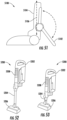
- FIGS. 32 and 33 show a perspective view of the stabilizer 2608 and a linkage 3000 coupled thereto.
- the linkage 3000 is pivotally coupled to the stabilizer 2608.
- the plunger 3104 can be pivotally coupled to the stabilizer 2608.
- an extension distance 3202 of the plunger 3104 may increase as the stabilizer 2608 transitions from the extended position (e.g., as shown in FIG. 32 ) to the retracted position (e.g., as shown in FIG. 33 ).
- FIG. 34 shows a perspective view of the stabilizer 2608.
- the stabilizer 2608 includes a stabilizer body 3400 pivotally coupled to the stabilizer wheel 2610.
- the stabilizer body 3400 includes a longitudinal portion 3402 that extends along a stabilizer longitudinal axis 3404 of the stabilizer 2608 and a wheel coupling portion 3406 that extends in a direction transverse to the stabilizer longitudinal axis 3404.
- the longitudinal portion 3402 can have an arcuate shape, wherein the concave portion of the arc faces the surface to be cleaned 2616.
- the wheel coupling portion 3406 includes a wheel receptacle 3408 configured to receive at least a portion of the stabilizer wheel 2610. As shown, the wheel receptacle 3408 extends at least partially around the stabilizer wheel 2610 and is vertically spaced apart from the longitudinal portion 3402 of the stabilizer body 3400.
- the stabilizer wheel 2610 is rotatably coupled to the wheel receptacle 3408 such that the stabilizer wheel 2610 rotates about a stabilizer wheel rotation axis 3410.
- the wheel receptacle 3408 is configured such that the stabilizer wheel rotation axis 3410 extends transverse to the stabilizer longitudinal axis 3404 at a non-perpendicular angle. Such a configuration may orient the stabilizer wheel 2610 such that the stabilizer wheel rotation axis 3410 is perpendicular to a forward movement direction of the surface cleaning head 2600.
- FIGS. 35 and 36 show a schematic view of a surface cleaning head 3500, which may be an example of the surface cleaning head 102 of FIG. 1 .
- the surface cleaning head 3500 includes a main body 3502, a neck 3504 pivotally coupled to the main body 3502, at least one wheel 3506, and a stabilizer 3508.
- the stabilizer 3508 is pivotally coupled to the main body 3502 of the surface cleaning head 3500 at a first pivot point 3510.
- the at least one wheel 3506 is rotatably coupled to the stabilizer 3508 at a second pivot point 3512.
- the first pivot point 3510 is spaced apart from the second pivot point 3512 such that, as the stabilizer 3508 rotates about the first pivot point 3510, the at least one wheel transitions between an extended position (e.g., as shown in FIG. 35 ) and a retracted position (e.g., as shown in FIG. 36 ) by being rotated around the first pivot point 3510.
- the stabilizer 3508 can be caused to rotate about the first pivot point 3510 in response to, for example, the neck 3504 being transitioned between a storage position (e.g., as shown in FIG. 35 ) and an in-use position (e.g., as shown in FIG. 36 ).
- the at least one wheel 3506 when transitioning between the extended position and the retracted position, can be rotated 180° around the first pivot point 3510 (e.g., in a clockwise or a counter-clockwise direction). Additionally, or alternatively, when transitioning between the extended position and the retracted position the at least one wheel 3506 can be rotated less than or greater than 180° around the first pivot point 3510 (e.g., in a clockwise or a counter-clockwise direction).
- the at least one wheel 3506 can be rotated around the first pivot point 3510 such that a floor facing surface 3514 of the main body 3502 extends transverse to a surface to be cleaned 3516 (e.g., a floor).
- FIGS. 37 and 38 show a perspective view of a surface cleaning head 3700, which may be an example of the surface cleaning head 2200 of FIG. 22 .
- the surface cleaning head 3700 includes a main body 3702, a neck 3704 pivotally coupled to the main body 3702, at least one stabilizer 3706, and at least one wheel 3708 rotatably coupled to the at least one stabilizer 3706.
- the neck 3704 is configured to pivot side-to-side and between a storage position (e.g., as shown in FIG. 37 ) and an in-use position (e.g., as shown in FIG. 38 ).
- the at least one stabilizer 3706 urges the at least one wheel 3708 from an extended position (e.g., as shown in FIG. 37 ) towards a retracted position (e.g., as shown in FIG. 38 ).
- the neck 3704 includes at least one protrusion 3710 configured to engage (e.g., contact) a swivel 3712 pivotally coupled to the main body 3702 of the surface cleaning head 3700.
- the protrusion 3710 is configured to cause the swivel 3712 to pivot in response to the neck 3704 being transitioned between the storage and in-use positions.
- the swivel 3712 is configured to urge the stabilizer 3706 along a track 3714 such that the at least one wheel 3708 is transitioned between the extended and retracted positions in response to the neck 3704 being transitioned between the storage and in-use positions.
- the swivel 3712 can be biased such that the swivel 3712 urges the stabilizer 3706 towards the main body 3702 of the surface cleaning head 3700.
- the swivel can be configured to urge the at least one wheel 3708 towards the retracted position.
- the swivel 3712 can be biased by a spring (e.g., a torsion spring, a compression spring, an extension spring, and/or any other spring).
- the stabilizer 3706 can be coupled to a biasing mechanism (e.g., a spring such as a torsion spring, a compression spring, an extension spring, and/or any other spring).
- a biasing mechanism e.g., a spring such as a torsion spring, a compression spring, an extension spring, and/or any other spring.
- an extension spring 3900 can be coupled to a main body 3902 of a surface cleaning head 3901 and a stabilizer 3906 such that, as the stabilizer 3906 is urged along a track 3914 in a direction away from the main body 3902 of the surface cleaning head 3901, the extension spring 3900 is extended. As the extension spring 3900 extends, the extension spring 3900 exerts a force on the stabilizer 3906 that urges the stabilizer 3906 towards the main body 3902 of the surface cleaning head 3901.
- FIGS. 44 and 45 show a schematic view of a surface cleaning head 4401, which may be an example of the surface cleaning head 102 of FIG. 1 .
- the surface cleaning head 4401 includes a stabilizer 4400 configured to transition between an extended position (e.g., as shown in FIG. 44 ) and a retracted position (e.g., as shown in FIG. 45 ).
- the stabilizer 4400 can include a plurality of links 4402.
- the links 4402 are pivotally coupled to each other such that stabilizer 4400 can transition between the extended position and the retracted position.
- the stabilizer 4400 may generally be referred to as being a scissor mechanism.
- At least one wheel 4404 is coupled to the stabilizer 4400 (e.g., a distal most one of the plurality of links 4402) such that as the stabilizer 4400 is transitioned between the extended and retracted positions, the wheel 4404 is urged between an extended positioned (e.g., as shown in FIG. 44 ) and a retracted position (e.g., as shown in FIG. 45 ).
- FIGS. 46 and 47 show a schematic view of a surface cleaning head 4600, which may be an example of the surface cleaning head 102 of FIG. 1 .
- the surface cleaning head 4600 includes a stabilizer 4602 configured to transition between an extended position (e.g., as shown in FIG. 46 ) and a retracted position (e.g., as shown in FIG. 47 ).
- the stabilizer 4602 includes a lever 4604 configured to pivot about a pivot point 4606 in response to a neck 4608 transitioning between an in-use position (e.g., as shown in FIG. 46 ) and a storage position (e.g., as shown in FIG. 47 ).
- a protrusion 4610 coupled to the neck 4608 engages (e.g., contacts) the lever 4604 such that the lever 4604 is caused to pivot about the pivot point 4606.
- the lever 4604 urges a plunger 4612 along a track 4614.
- the plunger 4612 can be coupled to at least one wheel 4616 such that the plunger 4612 urges the at least one wheel 4616 between an extended position (e.g., as shown in FIG. 46 ) and a retracted position (e.g., as shown in FIG. 47 ).
- FIG. 48 shows a side view of a surface cleaning head 4800, which may be an example of the surface cleaning head 102 of FIG. 1 .
- the surface cleaning head 4800 includes a main body 4802, a neck 4804 pivotally coupled to the main body 4802, and a stabilizer 4806 configured to transition between an extended and retracted position.
- the stabilizer 4806 includes a pivot arm 4808 pivotally coupled to the main body 4802 such that, as the pivot arm 4808 pivots about a pivot point 4810, the pivot arm 4808 urges a plunger 4812 along a track 4814.
- the pivot arm 4808 may be biased (e.g., using a spring) such that the pivot arm urges the plunger 4812 towards the main body 4802 of the surface cleaning head 4800.
- the neck 4804 may include a protrusion 4816 configured to engage (e.g., contact) the pivot arm 4808 such that the plunger 4812 moves along the track 4814 in response to transitioning the neck 4804 between a storage and in-use position.
- at least one wheel 4818 can be coupled to the plunger 4812 such that the at least one wheel 4818 transitions between extended and retracted positions in response to the neck 4804 being transitioned between the storage and in-use positions.
- FIGS. 49 and 50 show a schematic example of a stabilizer 4900, which may be an example of the stabilizer 114 of FIG. 1 , coupled to a portion of a main body 4902 of a surface cleaning head 4904.
- the stabilizer 4900 can include one or more struts 4906 pivotally coupled to the main body 4902 and a wheel 4908.
- the wheel 4908 can be a main wheel of the surface cleaning head 4904.
- the one or more struts 4906 may extend generally parallel to a surface of the main body 4902 of the surface cleaning head 4904 and, when the stabilizer is in the extended position (e.g., as shown in FIG. 50 ), the struts 4906 may extend in a direction away from and behind the main body 4902.
- FIG. 51 shows a schematic example of a surface cleaning head 5100, which may be an example of the surface cleaning head 102 of FIG. 1 .
- the surface cleaning head 5100 includes a stabilizer 5102 pivotally coupled to a neck 5104 of the surface cleaning head 5100.
- the stabilizer 5102 is configured to pivot between an extended and a retracted position (both positions being illustrated in FIG. 51 for purposes of clarity). When in the retracted position, the stabilizer 5102 extends generally parallel to a longitudinal axis 5106 of the neck 5104 and, when in the extended position, the stabilizer 5102 extends in a direction away from the neck 5104 and towards a surface to be cleaned (e.g., a floor).
- the stabilizer 5102 can be configured to be removably coupled to the neck 5104, which may facilitate use of the stabilizer 5102 between multiple surface treatment apparatuses (e.g., vacuum cleaners).
- FIGS. 52 and 53 show a schematic view of an example of a stabilizing system configured to improve the stability of a vacuum cleaner 5200.
- a suction body 5202 e.g., having a suction motor and dust cup
- the vacuum cleaner 5200 is configured to slide along a wand 5204 in a direction of a surface cleaning head 5206 such that a location of a center of mass of the vacuum cleaner can be positioned closer to the surface cleaning head 5206.
- the wand 5204 can be received at least partially within a flexible hose 5208.
- the flexible hose 5208 extends along the suction body 5202.
- An example of a surface cleaning head may include a main body, a neck pivotally coupled to the main body, a stabilizer, and a linkage pivotally coupled to the main body and the stabilizer.
- the linkage may be configured to cause the stabilizer to transition between an extended position and a retracted position in response to a pivotal movement of the neck.
- the neck may include a protrusion configured to engage at least a portion of the linkage.
- the protrusion may be configured to urge the linkage to pivot in response to the pivotal movement of the neck.
- the linkage may include a pivot arm and a plunger.
- the pivot arm may define a channel for receiving the plunger.
- the plunger is configured to slide within the channel in response to the pivotal movement of the neck.
- the stabilizer may include a wheel.
- the surface cleaning head includes a plurality of stabilizers, wherein each stabilizer extends along a respective one of a first axis and a second axis.
- the first axis may extend transverse to the second axis such that a separation distance between the stabilizers increases with increasing distance from the main body.
- the main body may include an opening from which the stabilizer extends.
- the opening may be disposed between a top surface of the main body and a main wheel.
- at least a portion of the stabilizer may extend over at least a portion of the main wheel.
- An example of a vacuum cleaner may include a wand and a surface cleaning head.
- the surface cleaning head may include a main body, a neck, a stabilizer, and a linkage.
- the neck may be configured to receive the wand.
- the neck may be pivotally coupled to the main body such that the wand is configured to transition between a storage position and an in-use position.
- the linkage may be pivotally coupled to the main body and the stabilizer.
- the linkage may be configured to cause the stabilizer to transition between an extended position and a retracted position in response to a pivotal movement of the neck.
- the neck may include a protrusion configured to engage at least a portion of the linkage.
- the protrusion may be configured to urge the linkage to pivot in response to the pivotal movement of the neck.
- the linkage may include a pivot arm and a plunger.
- the pivot arm may define a channel for receiving the plunger.
- the plunger may be configured to slide within the channel in response to the pivotal movement of the neck.
- the stabilizer may include a wheel.
- the surface cleaning head may include a plurality of stabilizers, wherein each stabilizer extends along a respective one of a first axis and a second axis.
- the first axis may extend transverse to the second axis such that a separation distance between the stabilizers increases with increasing distance from the main body.
- the main body may include an opening from which the stabilizer extends.
- the opening may be disposed between a top surface of the main body and a main wheel.
- at least a portion of the stabilizer may extend over at least a portion of the main wheel.
Landscapes
- Engineering & Computer Science (AREA)
- Mechanical Engineering (AREA)
- Nozzles For Electric Vacuum Cleaners (AREA)
- Cleaning Implements For Floors, Carpets, Furniture, Walls, And The Like (AREA)
Claims (15)
- Oberflächenreinigungskopf (300, 500), umfassend:einen Hauptkörper (303, 501);einen Hals (302), der schwenkbar an den Hauptkörper (303, 501) gekoppelt ist;einen Stabilisator (318); undein Gestänge (600), das schwenkbar an den Hauptkörper (303, 501) und den Stabilisator (318) gekoppelt ist, wobei das Gestänge (600) dazu konfiguriert ist, zu bewirken, dass der Stabilisator (318) als Reaktion auf eine Schwenkbewegung des Halses (302) zwischen einer Aufbewahrungsposition und einer Verwendungsposition zwischen einer ausgefahrenen Position und einer eingefahrenen Position bewegbar ist,dadurch gekennzeichnet, dass das Gestänge (600) einen Schwenkarm (602) und einen Kolben (604) beinhaltet, wobei der Schwenkarm (602) einen Kanal zum Aufnehmen des Kolbens (604) definiert.
- Oberflächenreinigungskopf (300, 500) nach Anspruch 1, wobei der Kolben (302) einen Vorsprung (504) beinhaltet, der dazu konfiguriert ist, mindestens einen Abschnitt des Gestänges (600) in Eingriff zu nehmen, wobei der Vorsprung (504) dazu konfiguriert ist, das Gestänge (600) als Reaktion auf die Schwenkbewegung des Halses (302) zu drängen.
- Oberflächenreinigungskopf (300, 500) nach Anspruch 1, wobei der Kolben (604) dazu konfiguriert ist, als Reaktion auf die Schwenkbewegung des Halses (302) innerhalb des Kanals zu gleiten.
- Oberflächenreinigungskopf (300, 500) nach Anspruch 1, wobei der Stabilisator (318) ein Rad beinhaltet.
- Oberflächenreinigungskopf (300, 500) nach Anspruch 1, ferner umfassend eine Vielzahl von Stabilisatoren (318), wobei sich jeder Stabilisator (318) entlang einer entsprechenden von einer ersten Achse (320) und einer zweiten Achse (320) erstreckt.
- Oberflächenreinigungskopf (300, 500) nach Anspruch 5, wobei sich die erste Achse (320) quer zu der zweiten Achse (320) erstreckt, sodass ein Trennabstand (324) zwischen den Stabilisatoren (318) mit zunehmendem Abstand von dem Hauptkörper (303, 501) zunimmt.
- Oberflächenreinigungskopf (300, 500) nach Anspruch 1, wobei der Hauptkörper (303, 501) eine Öffnung beinhaltet, von der sich der Stabilisator (318) erstreckt.
- Oberflächenreinigungskopf (300, 500) nach Anspruch 7, wobei die Öffnung zwischen einer Oberseite des Hauptkörpers (330, 501) und einem Hauptrad (306) angeordnet ist; und optional oder vorzugsweise wobei sich mindestens ein Abschnitt des Stabilisators (318) über mindestens einen Abschnitt des Hauptrads (306) erstreckt.
- Staubsauger (100), umfassend:eine Wand (304); undeinen Oberflächenreinigungskopf (300, 500) nach Anspruch 1, wobei der Hals (302) dazu konfiguriert ist, die Wand (304) aufzunehmen, und der Hals (302) schwenkbar an den Hauptkörper (303, 501) gekoppelt ist, sodass die Wand (304) dazu konfiguriert ist, zwischen einer Aufbewahrungsposition und einer Verwendungsposition überzugehen.
- Staubsauger (100) nach Anspruch 9, wobei der Hals (302) einen Vorsprung (504) beinhaltet, der dazu konfiguriert ist, mindestens einen Abschnitt des Gestänges (600) in Eingriff zu nehmen, wobei der Vorsprung (504) dazu konfiguriert ist, das Gestänge (600) zu drängen, damit es als Reaktion auf die Schwenkbewegung des Halses (302) schwenkt.
- Staubsauger (100) nach Anspruch 9, wobei der Kolben (604) dazu konfiguriert ist, als Reaktion auf die Schwenkbewegung des Halses (302) innerhalb des Kanals zu gleiten.
- Staubsauger (100) nach Anspruch 9, wobei der Stabilisator (318) ein Rad beinhaltet.
- Staubsauger (100) nach Anspruch 9, ferner umfassend eine Vielzahl von Stabilisatoren (318), wobei sich jeder Stabilisator (318) entlang einer jeweiligen von einer ersten Achse (320) und einer zweiten Achse (320) erstreckt; und optional oder vorzugsweise wobei sich die erste Achse (320) quer zu der zweiten Achse (320) erstreckt, sodass ein Trennabstand (324) zwischen den Stabilisatoren (318) mit zunehmendem Abstand von dem Hauptkörper (303, 501) zunimmt.
- Staubsauger (100) nach Anspruch 9, wobei der Hauptkörper (303, 501) eine Öffnung beinhaltet, von der sich der Stabilisator (318) erstreckt.
- Staubsauger (100) nach Anspruch 14, wobei die Öffnung zwischen einer Oberseite des Hauptkörpers (330, 501) und einem Hauptrad (306) angeordnet ist; und optional oder vorzugsweise wobei sich mindestens ein Abschnitt des Stabilisators (318) über mindestens einen Abschnitt des Hauptrads (306) erstreckt.
Applications Claiming Priority (3)
| Application Number | Priority Date | Filing Date | Title |
|---|---|---|---|
| US201862733239P | 2018-09-19 | 2018-09-19 | |
| US201962862436P | 2019-06-17 | 2019-06-17 | |
| PCT/US2019/051889 WO2020061285A1 (en) | 2018-09-19 | 2019-09-19 | Cleaning head for a surface treatment apparatus having one or more stabilizers and surface treatment apparatus having the same |
Publications (3)
| Publication Number | Publication Date |
|---|---|
| EP3852592A1 EP3852592A1 (de) | 2021-07-28 |
| EP3852592A4 EP3852592A4 (de) | 2022-06-29 |
| EP3852592B1 true EP3852592B1 (de) | 2025-03-05 |
Family
ID=69773659
Family Applications (1)
| Application Number | Title | Priority Date | Filing Date |
|---|---|---|---|
| EP19863315.8A Active EP3852592B1 (de) | 2018-09-19 | 2019-09-19 | Reinigungskopf für eine oberflächenbehandlungsvorrichtung mit einem oder mehreren stabilisatoren und oberflächenbehandlungsvorrichtung damit |
Country Status (8)
| Country | Link |
|---|---|
| US (2) | US12053140B2 (de) |
| EP (1) | EP3852592B1 (de) |
| JP (1) | JP7200362B2 (de) |
| KR (1) | KR102481702B1 (de) |
| CN (2) | CN113015473B (de) |
| AU (1) | AU2019342737B2 (de) |
| CA (1) | CA3113028C (de) |
| WO (1) | WO2020061285A1 (de) |
Families Citing this family (21)
| Publication number | Priority date | Publication date | Assignee | Title |
|---|---|---|---|---|
| US11647881B2 (en) | 2015-10-21 | 2023-05-16 | Sharkninja Operating Llc | Cleaning apparatus with combing unit for removing debris from cleaning roller |
| AU2018230518B2 (en) | 2017-03-10 | 2021-05-27 | Sharkninja Operating Llc | Agitator with debrider and hair removal |
| US11202542B2 (en) | 2017-05-25 | 2021-12-21 | Sharkninja Operating Llc | Robotic cleaner with dual cleaning rollers |
| AU2018336913B2 (en) | 2017-09-22 | 2021-02-25 | Sharkninja Operating Llc | Hand-held surface cleaning device |
| USD906609S1 (en) * | 2018-07-31 | 2020-12-29 | Sharkninja Operating Llc | Vacuum body for a vacuum cleaner |
| US11399675B2 (en) | 2018-07-31 | 2022-08-02 | Sharkninja Operating Llc | Upright surface treatment apparatus having removable pod |
| US12053140B2 (en) * | 2018-09-19 | 2024-08-06 | Sharkninja Operating Llc | Cleaning head for a surface treatment apparatus having one or more stabilizers and surface treatment apparatus having the same |
| US12414664B2 (en) | 2019-07-11 | 2025-09-16 | Sharkninja Operating Llc | Smart nozzle and a surface cleaning device implementing same |
| WO2021207139A1 (en) | 2020-04-06 | 2021-10-14 | Sharkninja Operating Llc | Allergen reduction device |
| WO2021211551A1 (en) | 2020-04-13 | 2021-10-21 | Sharkninja Operating Llc | Caster locking arrangement and surface cleaning device implementing same |
| CN115996657A (zh) | 2020-07-29 | 2023-04-21 | 尚科宁家运营有限公司 | 用于表面处理设备的管嘴和具有该管嘴的表面处理设备 |
| GB2605743B (en) * | 2020-12-18 | 2023-11-22 | Numatic Int Ltd | Floor treatment machine |
| EP4322812A4 (de) | 2021-04-12 | 2025-04-23 | SharkNinja Operating LLC | Reinigungsroboter |
| US12339324B2 (en) | 2021-04-23 | 2025-06-24 | Sharkninja Operating Llc | Determining state of charge for battery powered devices including battery powered surface treatment apparatuses |
| US20230043567A1 (en) | 2021-08-03 | 2023-02-09 | Sharkninja Operating Llc | Surface cleaning device with odor management |
| US12433461B2 (en) | 2022-07-05 | 2025-10-07 | Sharkninja Operating Llc | Vacuum cleaner |
| WO2023018947A1 (en) | 2021-08-13 | 2023-02-16 | Sharkninja Operating Llc | Robotic cleaner |
| CN117940051A (zh) | 2021-09-07 | 2024-04-26 | 尚科宁家运营有限公司 | 机器人清洁器 |
| CN220144215U (zh) | 2021-11-05 | 2023-12-08 | 尚科宁家运营有限公司 | 表面清洁装置 |
| EP4570153A3 (de) * | 2021-12-20 | 2025-10-15 | Bissell Inc. | Oberflächenreinigungsvorrichtung |
| US12329350B2 (en) | 2022-05-09 | 2025-06-17 | Sharkninja Operating Llc | Robotic cleaner |
Family Cites Families (66)
| Publication number | Priority date | Publication date | Assignee | Title |
|---|---|---|---|---|
| US1983567A (en) | 1932-04-09 | 1934-12-11 | Citizens Trust Company Of Tole | Support for air-method cleaners |
| US2120011A (en) * | 1936-04-11 | 1938-06-07 | P A Geier Co | Suction cleaner |
| US2784441A (en) * | 1951-06-22 | 1957-03-12 | Hoover Co | Nozzle adjustment for suction cleaners |
| US3939518A (en) * | 1973-11-30 | 1976-02-24 | Clarke-Gravely Corporation | Floor treatment machine |
| US4156952A (en) | 1977-10-04 | 1979-06-05 | Chemko Industries, Inc. | Carpet soil extractor having a powered brush |
| US4513472A (en) | 1983-11-07 | 1985-04-30 | Wells R Leon | Height adjustment mechanism |
| JPS60194919A (ja) | 1984-03-16 | 1985-10-03 | 松下電器産業株式会社 | 電気掃除機 |
| DE3422152A1 (de) | 1984-06-14 | 1985-12-19 | Alfred Teves Gmbh, 6000 Frankfurt | Hydraulische servofahrzeugbremse |
| JPS62151835A (ja) | 1985-12-26 | 1987-07-06 | Matsushita Electric Ind Co Ltd | 複写装置 |
| DE3834686C1 (en) | 1988-10-12 | 1989-12-07 | Rowenta-Werke Gmbh, 6050 Offenbach, De | Floor-type vacuum cleaner (cylinder vacuum cleaner) |
| JPH02172427A (ja) | 1988-12-26 | 1990-07-04 | Tokyo Electric Co Ltd | 電気掃除機 |
| JPH02234733A (ja) | 1989-03-08 | 1990-09-17 | Tokyo Electric Co Ltd | アップライト形電気掃除機 |
| JPH033956A (ja) | 1989-05-31 | 1991-01-10 | Suzuki Motor Corp | 空燃比制御装置 |
| JPH034825A (ja) | 1989-05-31 | 1991-01-10 | Tokyo Electric Co Ltd | アップライト形電気掃除機 |
| US5101615A (en) | 1989-08-18 | 1992-04-07 | Fassauer Arthur L | Air-floated apparatus |
| JPH04258730A (ja) | 1991-02-12 | 1992-09-14 | Kyowa Electron Instr Co Ltd | ダイアフラム型変換器 |
| JPH07322972A (ja) | 1994-06-01 | 1995-12-12 | Matsushita Electric Ind Co Ltd | 縦型電気掃除機 |
| CN1118241A (zh) | 1994-06-22 | 1996-03-13 | 大宇电子株式会社 | 双模式真空吸尘器 |
| GB2304549A (en) | 1995-09-04 | 1997-03-26 | Black & Decker Inc | A wheeled blower vacuum device |
| US5850666A (en) | 1997-01-10 | 1998-12-22 | Royal Appliance Mfg. Co. | Upright vacuum cleaner |
| CN2303758Y (zh) | 1997-01-18 | 1999-01-13 | 田锦霞 | 旅行箱搬运装置 |
| KR100274436B1 (ko) | 1997-12-05 | 2000-12-15 | 배길성 | 업라이트청소기 |
| CN2324840Y (zh) | 1998-02-18 | 1999-06-23 | 王敏玲 | 可防箱体倾倒的撑持装置 |
| JP2000116574A (ja) | 1998-10-19 | 2000-04-25 | Sharp Corp | 電気掃除機 |
| GB9927129D0 (en) | 1998-11-18 | 2000-01-12 | White Consolidated Ind Inc | Battery power combination vacuum cleaner |
| US6173474B1 (en) | 1999-01-08 | 2001-01-16 | Fantom Technologies Inc. | Construction of a vacuum cleaner head |
| US6256833B1 (en) | 1999-01-20 | 2001-07-10 | Bissell Homecare, Inc. | Upright vacuum cleaner with handle-mounted lamp assembly and height adjustment |
| CN1225222C (zh) | 2000-01-31 | 2005-11-02 | 松下电器产业株式会社 | 电动吸尘器 |
| JP4000249B2 (ja) | 2001-09-28 | 2007-10-31 | アマノ株式会社 | 床面洗浄清掃機 |
| KR100774508B1 (ko) | 2001-10-18 | 2007-11-08 | 엘지전자 주식회사 | 자립형 진공청소기 |
| GB2391459A (en) * | 2002-08-09 | 2004-02-11 | Dyson Ltd | A surface treating appliance with increased manoeuverability |
| US7150068B1 (en) | 2002-08-12 | 2006-12-19 | Gary Dean Ragner | Light-weight self-propelled vacuum cleaner |
| ITMO20030277A1 (it) | 2003-10-09 | 2005-04-10 | T P A Impex Spa | Elettrodomestico aspirante con manico di manovra. |
| DE602005002177D1 (de) | 2004-04-28 | 2007-10-11 | Gmca Pty Ltd | Vorrichtung um Trümmer anzusaugen und/oder abzublasen |
| DE102004029832A1 (de) | 2004-06-19 | 2005-12-29 | Vorwerk & Co. Interholding Gmbh | Vorrichtung wie insbesondere ein verfahrbarer Staubsauger sowie Laufrolle für eine solche Vorrichtung |
| US7987552B2 (en) * | 2004-11-17 | 2011-08-02 | Techtronic Floor Care Technology Limited | Floor care appliance with a plurality of cleaning modes |
| CN100539920C (zh) | 2004-11-29 | 2009-09-16 | 乐金电子(天津)电器有限公司 | 立式吸尘器的伸缩支架轮 |
| US7805804B2 (en) * | 2004-12-21 | 2010-10-05 | Royal Appliance Mfg. Co. | Steerable upright vacuum cleaner |
| GB2422094B8 (en) * | 2005-01-18 | 2008-06-05 | Dyson Technology Ltd | Surface-treating appliance |
| EP1709897A1 (de) * | 2005-04-04 | 2006-10-11 | JohnsonDiversey, Inc. | Bodenreinigungsmaschine mit einer höhenverstellbaren Wasserabstreiflippe |
| CN100574833C (zh) | 2006-08-01 | 2009-12-30 | 乔山健康科技股份有限公司 | 可呈扁平收折形态的跑步机 |
| GB0619181D0 (en) * | 2006-09-29 | 2006-11-08 | Dyson Technology Ltd | Surface treating appliance |
| WO2008142642A1 (en) | 2007-05-22 | 2008-11-27 | Koninklijke Philips Electronics N.V. | Motor driven stair-climbing device |
| DE102007040954A1 (de) | 2007-08-30 | 2009-03-05 | Miele & Cie. Kg | Upright-Staubsauger |
| DE102007040960B4 (de) | 2007-08-30 | 2012-08-16 | Miele & Cie. Kg | Upright-Staubsauger |
| GB2452548B (en) * | 2007-09-08 | 2011-11-30 | Dyson Technology Ltd | A surface treating appliance |
| GB2452549B (en) * | 2007-09-08 | 2012-03-21 | Dyson Technology Ltd | A surface treating appliance |
| KR101390924B1 (ko) | 2007-10-08 | 2014-05-07 | 삼성전자주식회사 | 조향유닛을 구비한 업라이트 진공청소기 |
| KR20090043383A (ko) | 2007-10-29 | 2009-05-06 | 삼성광주전자 주식회사 | 바퀴연결장치 및 이를 구비하는 청소기 |
| KR101457430B1 (ko) | 2008-01-02 | 2014-11-06 | 삼성전자주식회사 | 조향유닛을 구비한 업라이트 진공청소기 |
| KR101052161B1 (ko) | 2008-04-16 | 2011-07-26 | 엘지전자 주식회사 | 진공 청소기 |
| KR101003601B1 (ko) | 2008-04-16 | 2010-12-23 | 엘지전자 주식회사 | 진공 청소기 |
| DE202008017137U1 (de) | 2008-12-31 | 2009-03-19 | National Kaohsiung First University Of Science And Technology | Fahrbares Reinigungsgerät |
| GB2474471B (en) * | 2009-10-15 | 2013-10-23 | Dyson Technology Ltd | A surface treating appliance |
| GB2474478B (en) | 2009-10-15 | 2013-10-23 | Dyson Technology Ltd | An upright cleaning appliance |
| DE102011001631A1 (de) | 2010-03-30 | 2011-10-06 | Vorwerk & Co. Interholding Gmbh | Feuchtreinigungsgerät |
| KR101199397B1 (ko) | 2010-07-06 | 2012-11-09 | 엘지전자 주식회사 | 업라이트형 진공청소기 |
| KR101187078B1 (ko) | 2010-08-09 | 2012-09-27 | 엘지전자 주식회사 | 업라이트형 진공청소기 |
| KR101660987B1 (ko) | 2010-08-17 | 2016-09-28 | 엘지전자 주식회사 | 업라이트형 진공 청소기 |
| US8627545B2 (en) * | 2011-03-18 | 2014-01-14 | Panasonic Corporation Of North America | Vacuum cleaner with enhanced maneuverability |
| US9622630B2 (en) * | 2012-03-19 | 2017-04-18 | Aktiebolaget Electrolux | Upright vacuum cleaner having a support |
| DE102012110182A1 (de) * | 2012-10-25 | 2014-04-30 | Miele & Cie. Kg | Upright-Staubsauger |
| US9364127B2 (en) * | 2013-02-28 | 2016-06-14 | Omachron Intellectual Property Inc. | Surface cleaning apparatus |
| US8978207B2 (en) * | 2013-03-15 | 2015-03-17 | Electrolux Home Care Products, Inc. | Vacuum cleaner edge cleaning system |
| GB2542999B (en) * | 2014-07-25 | 2021-04-28 | Sharkninja Operating Llc | Surface cleaning apparatus with a sideways pivoting handle |
| US12053140B2 (en) * | 2018-09-19 | 2024-08-06 | Sharkninja Operating Llc | Cleaning head for a surface treatment apparatus having one or more stabilizers and surface treatment apparatus having the same |
-
2019
- 2019-09-19 US US16/575,891 patent/US12053140B2/en active Active
- 2019-09-19 JP JP2021515189A patent/JP7200362B2/ja active Active
- 2019-09-19 CN CN201980074896.9A patent/CN113015473B/zh active Active
- 2019-09-19 AU AU2019342737A patent/AU2019342737B2/en active Active
- 2019-09-19 EP EP19863315.8A patent/EP3852592B1/de active Active
- 2019-09-19 CN CN201921560474.6U patent/CN212186355U/zh active Active
- 2019-09-19 KR KR1020217011620A patent/KR102481702B1/ko active Active
- 2019-09-19 CA CA3113028A patent/CA3113028C/en active Active
- 2019-09-19 WO PCT/US2019/051889 patent/WO2020061285A1/en not_active Ceased
-
2024
- 2024-07-03 US US18/763,290 patent/US20250031925A1/en active Pending
Also Published As
| Publication number | Publication date |
|---|---|
| US12053140B2 (en) | 2024-08-06 |
| JP7200362B2 (ja) | 2023-01-06 |
| US20250031925A1 (en) | 2025-01-30 |
| EP3852592A1 (de) | 2021-07-28 |
| US20200085267A1 (en) | 2020-03-19 |
| CN212186355U (zh) | 2020-12-22 |
| KR102481702B1 (ko) | 2022-12-26 |
| WO2020061285A1 (en) | 2020-03-26 |
| CA3113028A1 (en) | 2020-03-26 |
| AU2019342737A1 (en) | 2021-04-15 |
| JP2022500183A (ja) | 2022-01-04 |
| KR20210057810A (ko) | 2021-05-21 |
| AU2019342737B2 (en) | 2023-02-09 |
| CA3113028C (en) | 2023-09-05 |
| EP3852592A4 (de) | 2022-06-29 |
| CN113015473A (zh) | 2021-06-22 |
| CN113015473B (zh) | 2023-10-03 |
Similar Documents
| Publication | Publication Date | Title |
|---|---|---|
| EP3852592B1 (de) | Reinigungskopf für eine oberflächenbehandlungsvorrichtung mit einem oder mehreren stabilisatoren und oberflächenbehandlungsvorrichtung damit | |
| EP3749159B1 (de) | Zubehör für eine oberflächenbehandlungsvorrichtung | |
| CN100593387C (zh) | 真空吸尘器 | |
| US20230200604A1 (en) | Vacuum cleaner | |
| US20190357740A1 (en) | Vacuum cleaner having reconfigurable weight distribution | |
| CN109715018B (zh) | 用于真空吸尘器的清洁头 | |
| JP5179554B2 (ja) | 表面処理電気器具 | |
| CA2765319C (en) | Canister vacuum cleaner incorporating a control handle and nozzle assembly with upright swivel lock | |
| JP6940324B2 (ja) | 電気掃除機の吸込具 | |
| CN115381329A (zh) | 具有制动组件的表面清洁装置 | |
| KR102268576B1 (ko) | 진공청소기 | |
| TW201716024A (zh) | 打掃工具及真空吸塵器 | |
| JP6800048B2 (ja) | 電気掃除機の寝具用吸込口体 | |
| JP4091514B2 (ja) | 電気掃除機 | |
| US20090056055A1 (en) | Upright vacuum cleaner | |
| JP4946727B2 (ja) | 吸込具およびこれに用いた電気掃除機 | |
| JP2014221130A (ja) | 電気掃除機 | |
| JP2006025920A (ja) | 電気掃除機 | |
| JP2020069109A (ja) | 電気掃除機用の支持部材および電気掃除機 | |
| US10178930B2 (en) | Maneuverable cordless stick vacuum | |
| JP7400858B2 (ja) | 掃除具、電気掃除機、及びコードレス型掃除機 | |
| JP2019141734A (ja) | 掃除具及びバキューム掃除機 |
Legal Events
| Date | Code | Title | Description |
|---|---|---|---|
| STAA | Information on the status of an ep patent application or granted ep patent |
Free format text: STATUS: THE INTERNATIONAL PUBLICATION HAS BEEN MADE |
|
| PUAI | Public reference made under article 153(3) epc to a published international application that has entered the european phase |
Free format text: ORIGINAL CODE: 0009012 |
|
| STAA | Information on the status of an ep patent application or granted ep patent |
Free format text: STATUS: REQUEST FOR EXAMINATION WAS MADE |
|
| 17P | Request for examination filed |
Effective date: 20210401 |
|
| AK | Designated contracting states |
Kind code of ref document: A1 Designated state(s): AL AT BE BG CH CY CZ DE DK EE ES FI FR GB GR HR HU IE IS IT LI LT LU LV MC MK MT NL NO PL PT RO RS SE SI SK SM TR |
|
| DAV | Request for validation of the european patent (deleted) | ||
| DAX | Request for extension of the european patent (deleted) | ||
| A4 | Supplementary search report drawn up and despatched |
Effective date: 20220527 |
|
| RIC1 | Information provided on ipc code assigned before grant |
Ipc: A47L 5/28 20060101ALI20220520BHEP Ipc: A47L 9/00 20060101AFI20220520BHEP |
|
| GRAP | Despatch of communication of intention to grant a patent |
Free format text: ORIGINAL CODE: EPIDOSNIGR1 |
|
| STAA | Information on the status of an ep patent application or granted ep patent |
Free format text: STATUS: GRANT OF PATENT IS INTENDED |
|
| INTG | Intention to grant announced |
Effective date: 20241018 |
|
| GRAS | Grant fee paid |
Free format text: ORIGINAL CODE: EPIDOSNIGR3 |
|
| GRAA | (expected) grant |
Free format text: ORIGINAL CODE: 0009210 |
|
| STAA | Information on the status of an ep patent application or granted ep patent |
Free format text: STATUS: THE PATENT HAS BEEN GRANTED |
|
| AK | Designated contracting states |
Kind code of ref document: B1 Designated state(s): AL AT BE BG CH CY CZ DE DK EE ES FI FR GB GR HR HU IE IS IT LI LT LU LV MC MK MT NL NO PL PT RO RS SE SI SK SM TR |
|
| REG | Reference to a national code |
Ref country code: GB Ref legal event code: FG4D |
|
| REG | Reference to a national code |
Ref country code: CH Ref legal event code: EP |
|
| REG | Reference to a national code |
Ref country code: DE Ref legal event code: R096 Ref document number: 602019067017 Country of ref document: DE |
|
| REG | Reference to a national code |
Ref country code: IE Ref legal event code: FG4D |
|
| PG25 | Lapsed in a contracting state [announced via postgrant information from national office to epo] |
Ref country code: RS Free format text: LAPSE BECAUSE OF FAILURE TO SUBMIT A TRANSLATION OF THE DESCRIPTION OR TO PAY THE FEE WITHIN THE PRESCRIBED TIME-LIMIT Effective date: 20250605 |
|
| PG25 | Lapsed in a contracting state [announced via postgrant information from national office to epo] |
Ref country code: FI Free format text: LAPSE BECAUSE OF FAILURE TO SUBMIT A TRANSLATION OF THE DESCRIPTION OR TO PAY THE FEE WITHIN THE PRESCRIBED TIME-LIMIT Effective date: 20250305 |
|
| REG | Reference to a national code |
Ref country code: NL Ref legal event code: MP Effective date: 20250305 |
|
| PG25 | Lapsed in a contracting state [announced via postgrant information from national office to epo] |
Ref country code: ES Free format text: LAPSE BECAUSE OF FAILURE TO SUBMIT A TRANSLATION OF THE DESCRIPTION OR TO PAY THE FEE WITHIN THE PRESCRIBED TIME-LIMIT Effective date: 20250305 |
|
| REG | Reference to a national code |
Ref country code: LT Ref legal event code: MG9D |
|
| PG25 | Lapsed in a contracting state [announced via postgrant information from national office to epo] |
Ref country code: NO Free format text: LAPSE BECAUSE OF FAILURE TO SUBMIT A TRANSLATION OF THE DESCRIPTION OR TO PAY THE FEE WITHIN THE PRESCRIBED TIME-LIMIT Effective date: 20250605 |
|
| PG25 | Lapsed in a contracting state [announced via postgrant information from national office to epo] |
Ref country code: HR Free format text: LAPSE BECAUSE OF FAILURE TO SUBMIT A TRANSLATION OF THE DESCRIPTION OR TO PAY THE FEE WITHIN THE PRESCRIBED TIME-LIMIT Effective date: 20250305 |
|
| PG25 | Lapsed in a contracting state [announced via postgrant information from national office to epo] |
Ref country code: LV Free format text: LAPSE BECAUSE OF FAILURE TO SUBMIT A TRANSLATION OF THE DESCRIPTION OR TO PAY THE FEE WITHIN THE PRESCRIBED TIME-LIMIT Effective date: 20250305 |
|
| PG25 | Lapsed in a contracting state [announced via postgrant information from national office to epo] |
Ref country code: BG Free format text: LAPSE BECAUSE OF FAILURE TO SUBMIT A TRANSLATION OF THE DESCRIPTION OR TO PAY THE FEE WITHIN THE PRESCRIBED TIME-LIMIT Effective date: 20250305 Ref country code: GR Free format text: LAPSE BECAUSE OF FAILURE TO SUBMIT A TRANSLATION OF THE DESCRIPTION OR TO PAY THE FEE WITHIN THE PRESCRIBED TIME-LIMIT Effective date: 20250606 |
|
| REG | Reference to a national code |
Ref country code: AT Ref legal event code: MK05 Ref document number: 1772093 Country of ref document: AT Kind code of ref document: T Effective date: 20250305 |
|
| PG25 | Lapsed in a contracting state [announced via postgrant information from national office to epo] |
Ref country code: NL Free format text: LAPSE BECAUSE OF FAILURE TO SUBMIT A TRANSLATION OF THE DESCRIPTION OR TO PAY THE FEE WITHIN THE PRESCRIBED TIME-LIMIT Effective date: 20250305 |
|
| PG25 | Lapsed in a contracting state [announced via postgrant information from national office to epo] |
Ref country code: SE Free format text: LAPSE BECAUSE OF FAILURE TO SUBMIT A TRANSLATION OF THE DESCRIPTION OR TO PAY THE FEE WITHIN THE PRESCRIBED TIME-LIMIT Effective date: 20250305 |
|
| PG25 | Lapsed in a contracting state [announced via postgrant information from national office to epo] |
Ref country code: SM Free format text: LAPSE BECAUSE OF FAILURE TO SUBMIT A TRANSLATION OF THE DESCRIPTION OR TO PAY THE FEE WITHIN THE PRESCRIBED TIME-LIMIT Effective date: 20250305 |
|
| PG25 | Lapsed in a contracting state [announced via postgrant information from national office to epo] |
Ref country code: PT Free format text: LAPSE BECAUSE OF FAILURE TO SUBMIT A TRANSLATION OF THE DESCRIPTION OR TO PAY THE FEE WITHIN THE PRESCRIBED TIME-LIMIT Effective date: 20250707 |
|
| PGFP | Annual fee paid to national office [announced via postgrant information from national office to epo] |
Ref country code: DE Payment date: 20250702 Year of fee payment: 7 |
|
| PG25 | Lapsed in a contracting state [announced via postgrant information from national office to epo] |
Ref country code: IT Free format text: LAPSE BECAUSE OF FAILURE TO SUBMIT A TRANSLATION OF THE DESCRIPTION OR TO PAY THE FEE WITHIN THE PRESCRIBED TIME-LIMIT Effective date: 20250305 Ref country code: PL Free format text: LAPSE BECAUSE OF FAILURE TO SUBMIT A TRANSLATION OF THE DESCRIPTION OR TO PAY THE FEE WITHIN THE PRESCRIBED TIME-LIMIT Effective date: 20250305 |
|
| PGFP | Annual fee paid to national office [announced via postgrant information from national office to epo] |
Ref country code: GB Payment date: 20250703 Year of fee payment: 7 |
|
| PG25 | Lapsed in a contracting state [announced via postgrant information from national office to epo] |
Ref country code: AT Free format text: LAPSE BECAUSE OF FAILURE TO SUBMIT A TRANSLATION OF THE DESCRIPTION OR TO PAY THE FEE WITHIN THE PRESCRIBED TIME-LIMIT Effective date: 20250305 |
|
| PGFP | Annual fee paid to national office [announced via postgrant information from national office to epo] |
Ref country code: FR Payment date: 20250708 Year of fee payment: 7 |
|
| PG25 | Lapsed in a contracting state [announced via postgrant information from national office to epo] |
Ref country code: CZ Free format text: LAPSE BECAUSE OF FAILURE TO SUBMIT A TRANSLATION OF THE DESCRIPTION OR TO PAY THE FEE WITHIN THE PRESCRIBED TIME-LIMIT Effective date: 20250305 Ref country code: EE Free format text: LAPSE BECAUSE OF FAILURE TO SUBMIT A TRANSLATION OF THE DESCRIPTION OR TO PAY THE FEE WITHIN THE PRESCRIBED TIME-LIMIT Effective date: 20250305 |
|
| PG25 | Lapsed in a contracting state [announced via postgrant information from national office to epo] |
Ref country code: RO Free format text: LAPSE BECAUSE OF FAILURE TO SUBMIT A TRANSLATION OF THE DESCRIPTION OR TO PAY THE FEE WITHIN THE PRESCRIBED TIME-LIMIT Effective date: 20250305 |
|
| PG25 | Lapsed in a contracting state [announced via postgrant information from national office to epo] |
Ref country code: SK Free format text: LAPSE BECAUSE OF FAILURE TO SUBMIT A TRANSLATION OF THE DESCRIPTION OR TO PAY THE FEE WITHIN THE PRESCRIBED TIME-LIMIT Effective date: 20250305 |
|
| PG25 | Lapsed in a contracting state [announced via postgrant information from national office to epo] |
Ref country code: IS Free format text: LAPSE BECAUSE OF FAILURE TO SUBMIT A TRANSLATION OF THE DESCRIPTION OR TO PAY THE FEE WITHIN THE PRESCRIBED TIME-LIMIT Effective date: 20250705 |
|
| REG | Reference to a national code |
Ref country code: DE Ref legal event code: R097 Ref document number: 602019067017 Country of ref document: DE |
|
| PLBE | No opposition filed within time limit |
Free format text: ORIGINAL CODE: 0009261 |
|
| STAA | Information on the status of an ep patent application or granted ep patent |
Free format text: STATUS: NO OPPOSITION FILED WITHIN TIME LIMIT |
|
| PG25 | Lapsed in a contracting state [announced via postgrant information from national office to epo] |
Ref country code: DK Free format text: LAPSE BECAUSE OF FAILURE TO SUBMIT A TRANSLATION OF THE DESCRIPTION OR TO PAY THE FEE WITHIN THE PRESCRIBED TIME-LIMIT Effective date: 20250305 |
|
| REG | Reference to a national code |
Ref country code: CH Ref legal event code: L10 Free format text: ST27 STATUS EVENT CODE: U-0-0-L10-L00 (AS PROVIDED BY THE NATIONAL OFFICE) Effective date: 20260114 |
|
| 26N | No opposition filed |
Effective date: 20251208 |