EP3825774B1 - Image heating device and image formation device - Google Patents
Image heating device and image formation device Download PDFInfo
- Publication number
- EP3825774B1 EP3825774B1 EP19837330.0A EP19837330A EP3825774B1 EP 3825774 B1 EP3825774 B1 EP 3825774B1 EP 19837330 A EP19837330 A EP 19837330A EP 3825774 B1 EP3825774 B1 EP 3825774B1
- Authority
- EP
- European Patent Office
- Prior art keywords
- image
- heating
- recording material
- regions
- control target
- Prior art date
- Legal status (The legal status is an assumption and is not a legal conclusion. Google has not performed a legal analysis and makes no representation as to the accuracy of the status listed.)
- Active
Links
Images







Classifications
-
- G—PHYSICS
- G03—PHOTOGRAPHY; CINEMATOGRAPHY; ANALOGOUS TECHNIQUES USING WAVES OTHER THAN OPTICAL WAVES; ELECTROGRAPHY; HOLOGRAPHY
- G03G—ELECTROGRAPHY; ELECTROPHOTOGRAPHY; MAGNETOGRAPHY
- G03G15/00—Apparatus for electrographic processes using a charge pattern
- G03G15/20—Apparatus for electrographic processes using a charge pattern for fixing, e.g. by using heat
- G03G15/2003—Apparatus for electrographic processes using a charge pattern for fixing, e.g. by using heat using heat
- G03G15/2014—Apparatus for electrographic processes using a charge pattern for fixing, e.g. by using heat using heat using contact heat
- G03G15/2039—Apparatus for electrographic processes using a charge pattern for fixing, e.g. by using heat using heat using contact heat with means for controlling the fixing temperature
-
- G—PHYSICS
- G03—PHOTOGRAPHY; CINEMATOGRAPHY; ANALOGOUS TECHNIQUES USING WAVES OTHER THAN OPTICAL WAVES; ELECTROGRAPHY; HOLOGRAPHY
- G03G—ELECTROGRAPHY; ELECTROPHOTOGRAPHY; MAGNETOGRAPHY
- G03G15/00—Apparatus for electrographic processes using a charge pattern
- G03G15/20—Apparatus for electrographic processes using a charge pattern for fixing, e.g. by using heat
- G03G15/2003—Apparatus for electrographic processes using a charge pattern for fixing, e.g. by using heat using heat
- G03G15/2014—Apparatus for electrographic processes using a charge pattern for fixing, e.g. by using heat using heat using contact heat
- G03G15/2039—Apparatus for electrographic processes using a charge pattern for fixing, e.g. by using heat using heat using contact heat with means for controlling the fixing temperature
- G03G15/2042—Apparatus for electrographic processes using a charge pattern for fixing, e.g. by using heat using heat using contact heat with means for controlling the fixing temperature specially for the axial heat partition
-
- G—PHYSICS
- G03—PHOTOGRAPHY; CINEMATOGRAPHY; ANALOGOUS TECHNIQUES USING WAVES OTHER THAN OPTICAL WAVES; ELECTROGRAPHY; HOLOGRAPHY
- G03G—ELECTROGRAPHY; ELECTROPHOTOGRAPHY; MAGNETOGRAPHY
- G03G15/00—Apparatus for electrographic processes using a charge pattern
- G03G15/20—Apparatus for electrographic processes using a charge pattern for fixing, e.g. by using heat
- G03G15/2003—Apparatus for electrographic processes using a charge pattern for fixing, e.g. by using heat using heat
- G03G15/2014—Apparatus for electrographic processes using a charge pattern for fixing, e.g. by using heat using heat using contact heat
- G03G15/2064—Apparatus for electrographic processes using a charge pattern for fixing, e.g. by using heat using heat using contact heat combined with pressure
-
- G—PHYSICS
- G03—PHOTOGRAPHY; CINEMATOGRAPHY; ANALOGOUS TECHNIQUES USING WAVES OTHER THAN OPTICAL WAVES; ELECTROGRAPHY; HOLOGRAPHY
- G03G—ELECTROGRAPHY; ELECTROPHOTOGRAPHY; MAGNETOGRAPHY
- G03G15/00—Apparatus for electrographic processes using a charge pattern
- G03G15/65—Apparatus which relate to the handling of copy material
- G03G15/6588—Apparatus which relate to the handling of copy material characterised by the copy material, e.g. postcards, large copies, multi-layered materials, coloured sheet material
- G03G15/6594—Apparatus which relate to the handling of copy material characterised by the copy material, e.g. postcards, large copies, multi-layered materials, coloured sheet material characterised by the format or the thickness, e.g. endless forms
-
- G—PHYSICS
- G03—PHOTOGRAPHY; CINEMATOGRAPHY; ANALOGOUS TECHNIQUES USING WAVES OTHER THAN OPTICAL WAVES; ELECTROGRAPHY; HOLOGRAPHY
- G03G—ELECTROGRAPHY; ELECTROPHOTOGRAPHY; MAGNETOGRAPHY
- G03G2215/00—Apparatus for electrophotographic processes
- G03G2215/00362—Apparatus for electrophotographic processes relating to the copy medium handling
- G03G2215/00535—Stable handling of copy medium
- G03G2215/00717—Detection of physical properties
- G03G2215/00734—Detection of physical properties of sheet size
-
- G—PHYSICS
- G03—PHOTOGRAPHY; CINEMATOGRAPHY; ANALOGOUS TECHNIQUES USING WAVES OTHER THAN OPTICAL WAVES; ELECTROGRAPHY; HOLOGRAPHY
- G03G—ELECTROGRAPHY; ELECTROPHOTOGRAPHY; MAGNETOGRAPHY
- G03G2215/00—Apparatus for electrophotographic processes
- G03G2215/20—Details of the fixing device or porcess
- G03G2215/2003—Structural features of the fixing device
-
- G—PHYSICS
- G03—PHOTOGRAPHY; CINEMATOGRAPHY; ANALOGOUS TECHNIQUES USING WAVES OTHER THAN OPTICAL WAVES; ELECTROGRAPHY; HOLOGRAPHY
- G03G—ELECTROGRAPHY; ELECTROPHOTOGRAPHY; MAGNETOGRAPHY
- G03G2215/00—Apparatus for electrophotographic processes
- G03G2215/20—Details of the fixing device or porcess
- G03G2215/2003—Structural features of the fixing device
- G03G2215/2016—Heating belt
- G03G2215/2025—Heating belt the fixing nip having a rotating belt support member opposing a pressure member
-
- G—PHYSICS
- G03—PHOTOGRAPHY; CINEMATOGRAPHY; ANALOGOUS TECHNIQUES USING WAVES OTHER THAN OPTICAL WAVES; ELECTROGRAPHY; HOLOGRAPHY
- G03G—ELECTROGRAPHY; ELECTROPHOTOGRAPHY; MAGNETOGRAPHY
- G03G2215/00—Apparatus for electrophotographic processes
- G03G2215/20—Details of the fixing device or porcess
- G03G2215/2003—Structural features of the fixing device
- G03G2215/2016—Heating belt
- G03G2215/2035—Heating belt the fixing nip having a stationary belt support member opposing a pressure member
Definitions
- the present invention relates to an image formation apparatus, such as a printer, a copier, and a facsimile machine, that uses an electrophotographic system or an electrostatic recording system.
- the present invention also relates to an image heating apparatus, such as a glossing apparatus that increases the gloss value of a toner image by reheating the fixing unit in the image formation apparatus and the toner image fixed to a recording material.
- a known image heating apparatus includes an endless belt (also referred to as a fixing film), a heater, which is in contact with the inner surface of the endless belt and generates heat when energized, and a roller, which forms a nip portion together with the heater via the endless belt.
- an image heating apparatus has a small heat capacity, and thus has excellent quick-start and power-saving capabilities.
- This configuration includes a division heater, the heating area of which is divided into a plurality of heating blocks arranged in the longitudinal direction of the heater (the direction perpendicular to the conveying direction of the recording material P).
- the division heater controls to selectively heat each heating block depending on the presence or absence of a toner image on the recording material. That is, a heating block corresponding to a portion of the recording material that is free of a toner image (an image-free portion) is not energized to save electric power.
- a technique has been introduced that increases the target fixing temperature of the heater (hereinafter referred to as a control target temperature) while processing one recording material from the leading edge to the trailing edge, at intervals corresponding to the rotation cycle of the fixing member or the pressure member (hereinafter, this technique is referred to as a recording material in-process temperature control) (PTL 3).
- the recording material in-process temperature control which has been employed to accommodate the reduced heat capacities of image heating apparatuses, is designed to secure the fixing performance toward the trailing edge of a recording material even when the unfixed toner image formed on the recording material removes heat from the fixing member or the pressure member while passing through the fixing nip.
- An image having a large amount of toner removes a large amount of heat from the fixing member and the pressure member, lowering the fixing performance toward the trailing edge of the recording material.
- the recording material in-process temperature control may provide optimum conditions by increasing the control target temperature toward the trailing edge, for example. This causes an image having a small amount of toner to receive an amount of heat that is greater than required. As a result, it has been found that a recording material that receives a heat amount greater than required can be warped. Such a phenomenon is called curling.
- an image heating apparatus that uses a division heater having a plurality of heating blocks may control to selectively heat only the toner image portion according to the image information.
- a heating block with a toner image does not cause a problem because the toner image removes the heat.
- a heating block without a toner image suffers a temperature rise in the components toward the recording material trailing edge due to the absence of a toner image removing the heat. It is also found that when fixing is continuously performed in such a state, the portions of the fixing member or the pressure member corresponding to the image-free heating block undergo a significant temperature rise, thereby increasing the curling and reducing the durability.
- the temperatures of the sections of these members corresponding to the heating blocks with a toner image remain adequate, so that these members have varying surface temperatures along the longitudinal direction immediately after the recording material passes out of the fixing nip.
- the longitudinal direction is a direction perpendicular to the conveying direction of the recording material P.
- Over-melted toner has a low viscosity and may be split (be parted) within the toner layer when the recording material is separated from the fixing film, leaving some toner on the fixing film.
- the toner remaining on the fixing film is fixed to the recording material after one rotation of the fixing film, staining the recording material.
- US 2019/101854 A discloses an image forming apparatus with a fixing portion by heating a recording material in a plurality of regions along the conveying direction.
- a CPU defines a plurality of regions in a sheet region of a recording material based on the circumferential length of the fixing film, and the CPU determines whether an image is present for each of the plurality of regions.
- EP 3 264 194 A1 discloses an image heating apparatus in which a recording material is defined in a plurality of regions in a width direction perpendicular to the conveying direction. In printing the defined regions are dedicated to image heating portions for an image to be printed, and to non image heating portions where no image is to be printed.
- US 2018/004135 A1 discloses an image heating apparatus in which a recording material is defined in a plurality of heating regions in a width direction perpendicular to the conveying direction.
- the heating regions correspond to heating blocks for separately heating the recording material.
- the heating regions are divided into separate heating regions in the conveying direction of the recording material.
- JP 2007 206327 A discloses a heating device for preventing gloss non-uniformity by changing a switching period of a heat regulation temperature in a recording paper.
- a CPU changes the temperature of a fixing heater from the leading end to the trailing end of the recording paper. Separate heated regions are defined by dividing the recording paper in the conveying direction.
- JP 2001 100588 A discloses a heater for preventing fixing defects. Electric energy supplied by the heater is changed with a rotation period of a pressure roller to compensate reduction of heat amount supplied from the pressure roller.
- a more appropriate heating control can be performed according to the type of an image formed on the recording material.
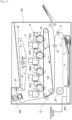
- Fig. 1 is a schematic cross-sectional view of an image formation apparatus of an embodiment according to the present invention.
- the present invention is applicable to image formation apparatuses such as printers, copier, and facsimile machines that use an electrophotographic system or an electrostatic recording system.
- the present invention is applied to a laser beam printer.
- An image formation apparatus 100 of the present embodiment is a laser beam printer that receives print signals, which are image information sent from an external device such as a personal computer, and forms images on recording materials P using an electrophotographic system.
- the external device and the image formation apparatus 100 are connected via a control circuit 400 serving as a control portion in the image formation apparatus 100.
- the control circuit 400 forms an image as follows.
- a scanner unit 20 emits a laser beam modulated according to image information, and scans the surface of a photosensitive drum 19, which is charged with a predetermined polarity by a charging roller 16. A latent image is thus formed on the photosensitive drum 19.
- Toner developer
- Toner images of four colors are sequentially transferred to and superimposed on an intermediate transfer member (intermediate transfer belt) 103 by the transfer electric field applied to primary transfer rollers 21, forming a toner image consisting of a plurality of colors on the intermediate transfer member 103.
- the secondary transfer portion which is formed by the intermediate transfer member 103 and a secondary transfer roller 22, secondary-transfers the toner image that has been transferred to the intermediate transfer member 103 to a recording material P by the transfer electric field applied to the secondary transfer roller 22.
- Recording materials P are stacked and stored in a paper feed cassette 11.
- the recording materials P are fed one by one from the paper feed cassette 11 by a pickup roller 12, and are conveyed through a pair of conveying rollers 13 and a pair of resist rollers 14 and to the secondary transfer portion at the timing synchronized with toner images formed on the intermediate transfer member 103.
- a recording material P to which a toner image is transferred from the intermediate transfer member 103 of the secondary transfer portion is then heated and pressed by a fixing apparatus (image heating apparatus) 200 serving as a fixing portion (an image heating portion).
- the toner image is thus heated and fixed to the recording material P.
- the heating source of the fixing apparatus 200 generates heat when supplied with electric power by the control circuit 400.
- a pair of conveying rollers 26 discharges the recording material P carrying the fixed toner image onto a tray in the upper section of the image formation apparatus 100.
- a photosensitive drum 19, a charging roller 16, a cleaning unit including a drum cleaner 18, a developing roller 17, and a developing unit containing toner are integrated as a process cartridge 15, which is configured to be attachable to and removable from the image formation apparatus 100.
- Four process cartridges 15 are provided for respective colors of cyan, magenta, yellow, and black, and have the same configuration except for the color of the contained toner.
- the photosensitive drums 19, the charging rollers 16, the scanner unit 20, the developing rollers 17, the transfer rollers 21 and 22, and other components form an image forming portion for forming an unfixed toner image on a recording material P.
- the image formation apparatus 100 includes the fixing apparatus 200 and the process cartridges 15, are operated by the driving force obtained from a motor 30 serving as a driving source provided in the apparatus main body.
- the image formation apparatus 100 of this embodiment has a maximum paper passage width of 216 mm in a direction perpendicular to the conveying direction of the recording material P, and is capable of printing 40 sheets of A4-sized [210 mm ⁇ 297 mm] plain paper per minute at a conveyance speed of 230 mm/sec.
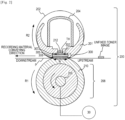
- Fig. 2 is a schematic cross-sectional view of the fixing apparatus 200 of the present embodiment.
- the fixing apparatus 200 includes a fixing film 202 serving as an endless belt, a pressure roller 208 serving as a pressure member in contact with the outer surface of the fixing film 202, and a metal stay 204.
- the pressure roller 208 forms a fixing nip portion N together with the heater 300 via the fixing film 202.
- the fixing film 202 is a highly heat-resistant fixing film 202 having a multi-layered tubular structure, and has a base layer of a heat-resistant resin, such as polyimide, or a metal, such as stainless steel. To improve heat resistance and prevent toner adherence, the surface of the fixing film 202 is coated with a highly functional fluororesin having excellent releasability, such as PFA, to form a release layer. Further, to improve the image quality, an elastic layer, which is of a highly heat-resistant rubber such as silicone rubber, may be formed between the base layer and the release layer.
- the fixing film 202 used in the present embodiment has an elastic layer and an outer diameter of 24 mm.
- the pressure roller 208 includes a core metal 209, which is made of a material such as iron or aluminum, and an elastic layer 210, which is made of a highly heat-resistant rubber material such as silicone rubber. This configuration allows the pressure roller 208 to have an appropriate hardness, providing the fixing nip N that is in accordance with the specifications of the fixing apparatus 200.
- the pressure roller 208 of the present embodiment has a 4-mm-thick elastic layer and an outer diameter of 25 mm.
- a heater including ceramic as the base material is used as the heater 300. That is, the heater 300 has a ceramic substrate 305, which may be made of alumina and has high electrical insulation, excellent thermal conductivity, and low heat capacity. On the surface of the ceramic substrate 305 opposite to the surface facing toward the fixing film 202, an energization heating resistance layer 302 (heating element) is formed by screen printing, for example.
- the energization heating resistance layer 302 extends in the longitudinal direction of the substrate (the direction perpendicular to the drawing plane, the direction perpendicular to the recording material conveying direction) and is made of silver-palladium, for example. Further, to insulate the energization heating resistance layer 302, the energization heating resistance layer 302 is covered with a thin protective glass layer 307 of about 50 ⁇ m.
- the ceramic substrate 305 used in the present embodiment includes alumina (Al 2 O 3 ) as the base material.
- a slide glass layer 308 of about 10 ⁇ m is formed to provide sliding characteristics against the fixing film 202.
- fluorine-based grease (not shown) having a high heat resistance is applied to the slide glass layer 308.
- the energization heating resistance layer 302 When supplied with an AC voltage from the electrodes (not shown) at the two longitudinal ends of the heater 300, the energization heating resistance layer 302 generates heat, causing the temperature of the entire heater 300, including the ceramic substrate 305, the protective glass layer 307, and the slide glass layer 308, to rapidly rise.
- the temperature rise of the heater 300 is detected by thermistors TH (temperature detection elements), which are arranged on the back surface of the heater 300 and serve as a temperature detection portion, and is sent to the control circuit 400 as feedback.
- the control circuit 400 controls the electric power by controlling the phase and wave number of the AC voltage applied to the energization heating resistance layer 302 to maintain the temperature of the heater 300 detected by the thermistors TH at a predetermined control target temperature.
- the control circuit 400 maintains the control target temperature by the deviation integral differentiation (PID) control.
- PID deviation integral differentiation
- safety elements 212 such as thermo-switches or temperature fuses, that operate in response to abnormal heating of the heater 300 and cut off the electric power supplied to the heater 300, are in direct contact with the heater 300, or in indirect contact through a heater holding member 201.
- the heater 300 which is held by the heater holding member 201 made of heat-resistant resin, heats the inside of the fixing nip portion N to heat the fixing film 202.
- the heater holding member 201 also has a guide function of guiding the rotation of the fixing film 202.
- the metal stay 204 receives a pressing force (not shown) and presses the heater holding member 201 toward the pressure roller 208.
- the pressure roller 208 receives a rotational driving force from the motor 30 and rotates in the direction of Arrow R1. As the pressure roller 208 rotates, the fixing film 202 is driven to rotate in the direction of Arrow R2.
- a recording material P is held and conveyed through the fixing nip N while the unfixed toner image on the recording material P receives heat from the heater 300 through the fixing film 202 and is thus fixed.
- the base control target temperature is used to control the energization of the heater 300 such that the surface temperature of the fixing film 202 is within a temperature range that does not cause faulty fixation.
- the lower limit of the temperature range is set to a temperature that does not cause faulty fixation (a phenomenon in which a toner image is not fixed to the recording material P as a permanent image), and the upper limit is set to a temperature that does not cause hot offset.
- the film-heating fixing apparatus 200 using the thin fixing film 202 as a fixing member includes components whose heat capacities are reduced to achieve quick start, which puts the fixing apparatus 200 into a state ready for fixing in an extremely short time.
- a component with a small heat capacity has a small heat storage capacity. As such, continuous fixing with the control target temperature set to a constant temperature will increase the temperature of the component. This may lead to hot offset.
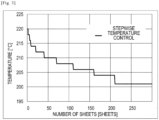
- a stepwise temperature control may be incorporated that, as the temperature of the components rises, reduces the control target temperature in a stepwise manner according to the number of recording materials P to be fixed as shown in Fig. 3 .
- the surface temperatures of the fixing film 202 and the pressure roller 208 decrease as a recording material P passes through the fixing nip N. This may result in an insufficient heat amount applied toward the trailing edge of the recording material P.
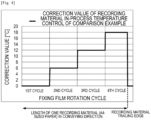
- a recording material in-process temperature control may be incorporated that corrects and increases the control target temperature at intervals corresponding to the rotation cycle of the fixing film 202 or the pressure roller 208 while one recording material P is processed, as shown in Fig. 4 . This achieves a uniform surface temperature of the fixing film 202 and the pressure roller from the leading to trailing edges of the recording material.
- Fig. 4 shows an example of the recording material in-process temperature control used in a comparison example.
- a correction is made at each rotation cycle of the fixing film with a cumulative correction amount of +6 [°C].
- the correction value becomes 0°C during the fourth rotation cycle of the fixing film because the A4-sized recording material passes out of the fixing nip at this timing.
- the temperature needs to be set in preparation for the subsequent recording material P. This timing varies depending on the size of the recording material P used.
- a fixing unit temperature-rise state control may also be incorporated that is based on the temperature rise state of the fixing apparatus 200 that is determined by the temperature detected by thermistors T at the start of fixing.
- the fixing unit temperature-rise state control determines that the temperature of the fixing apparatus 200 has risen when the detection temperature is high and corrects and lowers the control target temperature accordingly. When the detection temperature is low, the fixing apparatus 200 is determined to be in a cold state, and the control target temperature is corrected and increased accordingly.
- Table 1 shows the correction values for the fixing unit temperature-rise state control. [Table 1] Initial detection temperature [°C] Correction value [°C] ⁇ 50 0 51-80 -1 81-120 -2 120 ⁇ 160 -3 161 ⁇ -4
- control target temperature may be set according to the type of the recording material P.
- types of recording material P include paper with a basis weight of 65 to 80 [g/m 2 ], which is widely used generally for clerical work, recording material P having a larger basis weight, glossy paper, envelopes, and label paper.
- a paper type control that accommodates various types of recording materials P may be incorporated, in which a control target temperature is set for each of the various recording materials P.
- an environmental correction control may be used that detects the temperature and humidity of the environment in which the image formation apparatus 100 is placed with an environment detection means, such as a temperature/humidity sensor, and uses the control target temperature that is suitable for the environment.
- an environment detection means such as a temperature/humidity sensor
- the control target temperature is thus increased to prevent faulty fixation.
- the recording materials P and the toner have higher temperatures.
- the control target temperature is thus reduced to prevent hot offset and curling.
- Recording materials P that have smaller widths than a recording material P having the maximum width that can pass through the image formation apparatus 100 include A5-sized (148-mm-wide) recording paper and envelopes of "Long No. 4" (90-mm-wide), which is a standard envelope size in Japan.
- Such a recording material P when fed, does not remove a heat amount from the heater 300 in the regions through which the recording material P does not pass (i.e., non-paper portions). The excess heat that is not removed is accumulated in the non-paper portions of the fixing film 202 and the pressure roller 208. This causes a non-paper portion temperature-rise state, in which the temperature exceeds the control target temperature.
- a non-paper portion temperature-rise limiting control may be employed that limits the temperature rise of the non-paper portion by detecting the temperature rise of the non-paper portion with thermistors positioned at the longitudinal ends of the heater 300 and lengthening the conveyance intervals of the recording materials P when the detected temperature reaches a fixed temperature, to lengthen the time period in which the heater 300 does not generate heat.
- the various fixation controls described above may be performed to enable the fixing apparatus 200 to perform stable fixation regardless of the use conditions selected by the user.
- these various fixation controls ones that are required according to the specifications of the image formation apparatus 100 and the fixing apparatus 200 are incorporated.
- the recording material in-process temperature control performs corrections so as not to degrade the fixing performance toward the trailing edge of a recording material P even under most adverse conditions in terms of fixing performance.
- a recording material P and the toner image carried on the recording material P remove a heat amount from the fixing film 202 and the pressure roller 208.
- the paper type control functions to maintain the appropriate heat amount for the recording material P, the effect of the toner image depends on the amount of toner. A smaller toner amount removes a smaller amount of heat, and a greater toner amount removes a greater amount of heat.
- a "full secondary-color" image which has a secondary color of red, blue, or green on the whole area of the image, removes the largest amount of heat and thus has adverse effects on the fixing performance toward the trailing edge of the recording material P.
- the conventional recording material in-process temperature control performs corrections with reference to an image that has the greatest adverse effects on the fixing performance toward the trailing edge of the recording material P.
- the conventional control therefore avoids faulty fixation with any types of images, but has the following issues.
- PB PAPER 64 [g/m 2 ] (manufactured by Canon Inc.), which had a tendency to curl and had a small basis weight, was used.
- the paper was let stand for one week before being fed for single-sided printing.
- the fixing apparatus 200 was sufficiently cooled to the room temperature, ten sheets were continuously fed.
- the discharged recording materials P were placed on a flat plate, and the curl amounts at the four corners (the heights from the flat plate of the four corners that were warped upward from the flat plate) were measured.
- the numerical values in the table are the amounts of curling curved away from the printed surface.
- the average value is the average of a total of 40 data pieces of the four corners of the ten sheets, and the maximum value is the maximum value of the 40 data pieces.
- the image patterns used were four image types including full secondary-color of red, which has the greatest adverse effects on the fixing performance, full primary-color of black, table with characters, and characters only.
- the present embodiment modifies the recording material in-process temperature control according to the information on the toner image to be printed on the recording material P.
- One advantageous effect of the present embodiment is that the curling is minimized.
- Toner image information includes a maximum toner amount and a toner occupancy ratio.
- the maximum toner amount is the maximum value of toner amounts in minimum pixels (unit pixels) and calculated by the following process flow.
- Image data sent from an external device, such as a host computer, to the image formation apparatus 100 is converted into bitmap data by the control circuit 400, which serves as an obtainment portion and has a function of obtaining toner images.
- the number of pixels of the image formation apparatus 100 of this embodiment is 600 dpi, and the control circuit 400 generates bitmap data (image density data of each of CMYK colors) corresponding to the transmitted image data.
- Image data of each of CMYK colors is obtained for each pixel from the generated bitmap data, and d(C), d(M), d(Y), and d(K) are obtained as image data of the CMYK colors of each pixel.
- the total value of these data pieces is calculated as d(CMYK) for each pixel. This calculation is performed for all pixels of the entire recording material P.
- the control circuit 400 uses 8-bit image signals.
- the image data of each color is represented in the range of the minimum density of 00 hex to the maximum density of FF hex.
- the total value of the colors d(CMYK) is represented by signals of two 8-bit bytes.
- the image formation apparatus 100 of the present embodiment is designed in terms of colors such that the maximum amount of toner on the recording material P is 230 [%].
- the d(CMYK) value obtained by the calculation described above is used as the maximum toner amount.
- An image with a maximum toner amount exceeding 100% involves a high image density on the recording material P and a large toner amount. Accordingly, a large amount of heat is needed to fuse and fix the toner, requiring a higher control target temperature.
- control target temperature is set to a temperature that achieves reliable fixing performance even for an image having such a maximum toner amount.
- the toner occupancy ratio is the ratio (proportion) of the area where a toner image is actually formed to the area where a toner image is formable on the recording material P.
- the correction values used by the recording material in-process temperature control of the present embodiment are set as shown in Table 3 according to the toner image information of the maximum toner amount and the toner occupancy ratio calculated as described above.
- a larger correction value is set for a larger maximum toner amount and a higher toner occupancy ratio, while a smaller correction value is set for a smaller maximum toner amount and a lower toner occupancy ratio. The control thus accommodates various images used by users.
- the maximum toner amounts and toner occupancy ratios are maximum toner amount: 200 [%]/toner occupancy ratio: 100 [%] for the full secondary-color, maximum toner amount: 100 [%]/toner occupancy ratio: 100 [%] for the full primary-color, maximum toner amount: 100 [%]/toner occupancy ratio 16 [%] for the table, and maximum toner amount: 100 [%]/toner occupancy ratio: 4 [%] for the characters.
- the recording material in-process temperature control of the present embodiment uses the same correction value as the conventional control for the full secondary-color, but the correction values for the full primary-color, table, and characters, which involve less amounts of toner, are reduced according to Table 3. That is, the correction amount (the amount of increment of the control target temperature) cumulatively added from the leading edge region to the trailing edge region of the recording material is set according to the type and content of the unfixed toner image to be formed on the recording material. As such, the amount of heat applied to the recording material P is optimized by changing the correction value of the recording material in-process temperature control according to the toner image.
- Each of the images used in the present embodiment has a toner image over the entire area as shown in Table 4, and the recording material in-process temperature control corrects the temperature at each rotation cycle of the fixing film 202.
- the following derivative embodiments are also contemplated.
- the temperature is not corrected when the trailing edge region of the recording material P does not have a toner image. In another example, if a toner image changes to another on one recording material P, the temperature is corrected according to the changed toner image information.
- the recording material in-process temperature control may include a combination of these examples, and the selection may be made as necessary.
- Embodiment 1 according to the present invention performs the recording material in-process temperature control that is suitable for the toner image to be printed. This minimizes the curl amount regardless of the image pattern and achieves the fixing apparatus 200 that does not have the problem of curling.
- sections T i are set by the division based on the circumferential length of the fixing film 202, but the division may be based on the circumferential length of the pressure roller 208.
- Embodiment 2 which is an application example of Embodiment 1, relates to a fixing apparatus 200b that employs a division heater having a plurality of heating elements.
- a division heater 300b of the present embodiment is first described.
- Fig. 6A is a cross-sectional view of the heater 300b
- Fig. 6B is a plan view of each layer of the heater 300b
- Fig. 6C is a diagram illustrating a method for connecting electric contacts C to the heater 300b.
- Fig. 6B shows a conveyance reference position X for the recording material P in the image formation apparatus 100 of the present embodiment.
- the conveyance reference in this embodiment is the center reference, and the recording material P is conveyed such that its centerline extending through the center in the direction perpendicular to the conveying direction moves on the conveyance reference position X.
- Fig. 6A is a cross-sectional view of the heater 300b taken at the conveyance reference position X.
- the heater 300b includes a ceramic substrate 305, a back surface layer 1 provided on the substrate 305, a back surface layer 2 covering the back surface layer 1, a sliding surface layer 1 provided on the surface of the substrate 305 opposite to the back surface layer 1, and a sliding surface layer 2 covering the sliding surface layer 1.
- the back surface layer 1 includes conductors 301 (301a and 301b) provided along the longitudinal direction of the heater 300b.
- the conductors 301 include separate conductors 301a and 301b, and the conductor 301b is arranged on the downstream side of the conductor 301a in the conveying direction of the recording material P.
- the back surface layer 1 includes conductors 303 (303-1 to 303-7), which are arranged parallel to the conductors 301a and 301b.
- the conductors 303 are provided between the conductors 301a and 301b along the longitudinal direction of the heater 300b.
- the back surface layer 1 includes heating elements 302a (302a-1 to 302a-7) and heating elements 302b (302b-1 to 302b-7).
- the heating elements 302a are provided between the conductor 301a and the conductors 303 and generate heat when supplied with electric power via the conductors 301a and 303.
- the heating elements 302b are provided between the conductor 301b and the conductors 303 and generate heat when supplied with electric power via the conductors 301b and 303.
- the heating portion consisting of the conductors 301 and 303 and heating elements 302a and 302b is divided into seven heating blocks (HB 1 to RB 7 ) in the longitudinal direction of the heater 300b. That is, the heating elements 302a include seven divided regions of heating elements 302a-1 to 302a-7 arranged in the longitudinal direction of the heater 300b. The heating elements 302b also include seven divided regions of heating elements 302b-1 to 302b-7 arranged in the longitudinal direction of the heater 300b. Additionally, the conductors 303 include seven divided regions of conductors 303-1 to 303-7 positioned corresponding to the division of the heating elements 302a and 302b.
- the heating area of the present embodiment extends from the left end of the heating block HB 1 as viewed in the drawing to the right end of the heating block HB 7 as viewed in the drawing, and has a total length of 220 mm.
- the heating blocks have the same longitudinal length of 31.4 mm, but they may have different lengths.
- the back surface layer 1 also includes electrodes E (E 1 to E 7 , E 8-1 , and E 8-2 ).
- the electrodes E 1 to E 7 are provided in the regions of the conductors 303-1 to 303-7, respectively, and supply electric power to the heating blocks HB 1 to HB 7 via the conductors 303-1 to 303-7, respectively.
- the electrodes E 8-1 and E 8-2 are provided at the longitudinal ends of the heater 300b to be connected to the conductors 301, and supply electric power to the heating blocks HB 1 to HB 7 via the conductors 301.
- the electrodes E 8-1 and E 8-2 are provided at both longitudinal ends of the heater 300b, but only the electrode E 8-1 may be provided at one end, for example.
- the conductors 301a and 301b are supplied with electric power via common electrodes, but individual electrodes may be provided for each of the conductors 301a and 301b to supply power to each conductor.
- the back surface layer 2 is formed by an insulative surface protective layer 307 (glass in this embodiment), and covers the conductors 301 and 303 and the heating elements 302a and 302b.
- the surface protective layer 307 is formed except for the sections of the electrodes E, so that the electric contacts C are connectable to the electrodes E from the side corresponding to the back surface layer 2 of the heater 300b.
- the sliding surface layer 1 is provided on the surface of the substrate 305 opposite to the surface on which the back surface layer 1 is provided, and includes thermistors TH (TH1-1 to TH1-4 and TH2-5 to TH2-7) for detecting the temperatures of the heating blocks HB1 to HB7.
- the thermistors TH are made of a material having the PTC characteristics or the NTC characteristics (the NTC characteristics in this embodiment), and their values of resistance are detected to detect the temperatures of the heating blocks.
- the sliding surface layer 1 includes conductors ET (ET1-1 to ET1-4 and ET2-5 to ET2-7) and conductors EG (EG1 and EG2).
- the conductors ET1-1 to ET1-4 are connected to the thermistors TH1-1 to TH1-4, respectively.
- the conductors ET2-5 to ET2-7 are connected to the thermistors TH2-5 to TH2-7, respectively.
- the conductor EG1 is connected to four thermistors TH1-1 to TH1-4 to form a common conductive path.
- the conductor EG2 is connected to three thermistors TH2-5 to TH2-7 to form a common conductive path.
- Each of the conductors ET and EG extends in the longitudinal direction of the heater 300b to the corresponding longitudinal end and is connected to the control circuit 400 via an electric contact (not shown) at the longitudinal end of the heater 300b.
- the sliding surface layer 2 is formed by a surface protective layer 308 having sliding and insulating characteristics (glass in this embodiment), covers the thermistors TH and the conductors ET and EG, and provides sliding characteristics against the inner surface of the fixing film 202.
- the surface protective layer 308 is formed except for the longitudinal ends of the heater 300b. A method for connecting electric contacts C to the electrodes E is now described.
- Fig. 6C is a plan view of a state in which the electric contacts C are connected to the electrodes E as viewed from the heater holding member 201.
- the heater holding member 201 has through holes at positions corresponding to the electrodes E (E 1 to E 7 , E 8-1 , and E 8-2 ).
- the electric contacts C (C 1 to C 7 , C 8-1 , and C 8-2 ) are electrically connected to the electrodes E (E 1 to E 7 , E 8-1 , and E 8-2 ) by a means such as urging with a spring or welding.
- the electric contacts C are connected to the control circuit 400 of the heater 300b, which will be described below, via a conductive material (not shown) provided between the metal stay 204 and the heater holding member 201.
- Fig. 7 is a circuit diagram of the control circuit 400 of the heater 300b of Embodiment 1.
- the image formation apparatus 100 is connected to a commercial AC power source 401.
- the power of the heater 300b is controlled by energization/cutoff of triacs 411 to 417.
- the triacs 411 to 417 operate according to FUSER1 to FUSER7 signals from the CPU 420, respectively.
- the drive circuits of the triacs 411 to 417 are not shown.
- the control circuit 400 of the heater 300b has a circuit configuration in which the seven triacs 411 to 417 independently control the seven heating blocks HB 1 to HB 7 .
- a zero cross detection portion 421 is a circuit that detects the zero cross point of the commercial AC power supply that activates the image formation apparatus 100, and outputs a zero cross signal to the CPU 420.
- the zero cross signal is used to detect the timing for phase control and wave number control of the triacs 411 to 417, for example.
- the thermistors TH (TH1-1 to TH1-4 and TH2-5 to TH2-7) detect the temperature of the heater 300b.
- the CPU 420 detects the voltage division of the thermistors TH1-1 to TH1-4 and the resistors 451 to 454 as TH1-1 to TH1-4 signals, and converts the TH1-1 to TH1-4 signals into temperatures.
- the CPU 420 detects the voltage division of the thermistors TH2-5 to TH2-7 and the resistors 465 to 467 as TH2-5 to TH2-7 signals, and converts the TH2-5 to TH2-7 signals into temperatures.
- the electric power to be supplied is calculated by, for example, the proportional integration control (PI control) based on the control target temperatures TGTi of heating blocks, which will be described below, and the detection temperatures of the thermistors TH. Further, the electric power to be supplied is converted into control levels of the phase angle (phase control) and the wave number (wave number control) corresponding to this electric power, and the triacs 411 to 417 are controlled according to the obtained control conditions.
- the CPU 420 may perform various calculations and energization controls relating to the temperature control of the heater 300.
- Relays 430 and 440 ensure safety by serving as a means for shutting off the electric power to the heater 300b when the temperature of the heater 300b rises excessively due to a failure or the like.
- the relay 430 is set in a non-conducting state to ensure safety.
- the relay 440 is set in a non-conducting state to ensure safety.
- the transistor 433 When the RLON signal is in high state, the transistor 433 is turned ON, the secondary coil of the relay 430 is energized from the power-supply voltage Vcc, and the primary contact of the relay 430 is turned ON.
- the transistor 433 When the RLON signal is in low state, the transistor 433 is turned OFF, the current flowing from the power-supply voltage Vcc to the secondary coil of the relay 430 is cut off, and the primary contact of the relay 430 is turned OFF.
- the transistor 443 when the RLON signal is in high state, the transistor 443 is turned ON, the secondary coil of the relay 440 is energized from the power-supply voltage Vcc, and the primary contact of the relay 440 is turned ON.
- the resistors 434 and 444 are current limiting resistors.
- a comparison portion 431 operates a latch portion 432, and the latch portion 432 latches the RLOFF1 signal in low state.
- the transistor 433 is kept in OFF state even if the CPU 420 sets the RLON signal in high state, so that the relay 430 is kept in OFF state (safe state).
- the latch portion 432 in non-latch state outputs the RLOFF1 signal in open state.
- the comparison portion 441 operates the latch portion 442, and the latch portion 442 latches the RLOFF2 signal in low state.
- the transistor 443 is kept in OFF state even if the CPU 420 sets the RLON signal in high state, so that the relay 440 is kept in OFF state (safe state).
- the latch portion 442 in non-latch state outputs the RLOFF2 signal in open state.
- Fig. 8 is a diagram showing the relationship between the heating blocks of the heater 300b and heating regions A 1 to A 7 in the present embodiment, with reference to an A4-seized recording material.
- the classification of the heating regions Ai according to the position of the toner image formed on a recording material P is now described.
- the recording material P passing through the fixing nip N is divided into sections with respect to a predetermined time Tn, and the recording material in-process temperature control is performed for each heating region A i .
- the present embodiment is characterized in that the sectioning is based on one rotation cycle of the fixing film (75.4 mm). From the leading edge of the recording material P, the first section is a section T 1 , the second section is a section T 2 , the third section is a section T 3 , and so on.
- the heating regions A i are classified as shown in the table of Fig.
- the electric power supplied to the heating blocks HB i determines the amount of heat generated by each heating block HB i .
- the amount of heat generated by a heating block HB 1 increases when more electric power is supplied to the heating blocks HB i .
- the amount of heat generated by a heating block HB 1 decreases when less electric power is supplied to the heating blocks HB i .
- the present embodiment calculates the electric power to be supplied by the PID control such that the detection temperatures of the thermistors TH1-1 to 4 and TH2-5 to 7 are equal to the control target temperatures TGT i of the heating blocks HB i .
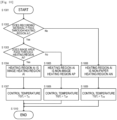
- the control target temperature TGT i of each heating block is set according to the classification of the heating region A i determined as shown in the flowchart of Fig. 10 .
- Each heating region A i is classified based on the image data (image information) sent from an external device (not shown), such as a host computer, and the size information of the recording material P. That is, it is determined whether the recording material P passes through the heating region A i (S 1002), and if the recording material P does not pass, the heating region A i is classified as a non-paper heating region AN (S1006). If the recording material P passes through the heating region A i , it is determined whether the image area passes through the heating region A i (S1003). If the image area passes, the heating region A i is classified as an image heating region AI (S1004), and if the image area does not pass, the heating region A i is classified as a non-image heating region AP (S1005).
- T AI denotes an image heating region reference temperature, which is set as a temperature suitable to fix an unfixed toner image to the recording material P.
- T AI 220°C. It is desirable that the image heating region reference temperature T AI be corrected by the paper type control described in Embodiment 1.
- the present embodiment with the division heater 300b uses the maximum toner amount, which serves as the toner image information of each heating region A i , and changes the image heating region reference temperature T AI with the correction values shown in Table 5 to save energy. That is, the correction value is 0 for the full secondary-color, which has adverse effects on the fixing performance, and the image heating region reference temperature T AI is corrected with a smaller value for a smaller maximum toner amount.
- Table 5 Maximum toner deposition amount [%] 105 or less 106 ⁇ 140 141 ⁇ 170 171 ⁇ 200 201 ⁇ 230 Correction value [°C] -4 -3 -2 -1 ⁇ 0
- TGT i T AP (S1008).
- T AP denotes a non-image heating region reference temperature, which is set to a value lower than the image heating reference temperature T AI so that the amount of heat generated by a heating block HB i for a non-image heating region AP is lower than that for an image heating region AI, thereby reducing the power consumed by the image formation apparatus 100.
- an excessively low non-image heating region reference temperature T AP may cause the temperature to fail to rise to the control target temperature T AP for the image portion when the heating region A i changes from a non-image heating region AP to an image heating region AI even if the largest possible electric power is applied to the heating block HB i .
- faulty fixation which is a phenomenon where a toner image is not reliably fixed to the recording material P, can occur.
- the heating regions A 5 to A 7 are classified as image heating regions AI for the sections T 1 and T 2 and controlled with the image heating reference temperature T AI as the control target temperature.
- the heating regions A 5 to A 7 are classified as non-image heating region AP and controlled with the non-image heating reference temperature T AP as the control target temperature.
- TGT i T AN (S1009).
- T AN denotes a non-paper heating region reference temperature, which is set to a value lower than the non-image heating reference temperature T AP so that the amount of heat generated by a heating block HB 1 for a non-paper heating region AN is lower than that for a non-image heating region AP, thereby reducing the power consumed by the fixing apparatus 200b.
- an excessively low non-paper heating region reference temperature T AN reduces the sliding characteristics between the inner surface of the fixing film 202 and the heater 300b, leading to unstable conveyance of the recording material P.
- the non-paper heating region reference temperature T AN should be determined in consideration of the configuration of the fixing apparatus 200b, including the viscosity characteristics of the grease, and is not limited to 128°C.
- Embodiment 2 uses the correction values shown in Fig. 4 of Embodiment 1 to secure the fixing performance toward the trailing edge of the recording material P even when a secondary-color image, which has the largest maximum toner amount, is formed over the entire area.
- Embodiment 2 optimizes the correction values of the recording material in-process temperature control according to the toner image information corresponding to each heating region. Since a plurality of divided heating elements is provided, Embodiment 2 performs the recording material in-process temperature control that is more suited to the toner image, as compared with Embodiment 1.
- As toner image information Embodiment 2 uses the maximum toner amount and the toner occupancy ratio as in Embodiment 1.
- the graph corresponding to the heating regions A 5 to A 7 is formed by secondary colors and has a maximum toner amount of 200%.
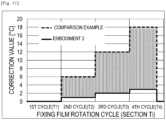
- the corrections of the recording material in-process temperature control of the comparison example uses a value of +6°C since the comparison example is not based on toner image information.
- Embodiment 2 uses a correction value of +1°C, which is the correction value suitable for a toner occupancy ratio of 4% according to Table 3.
- Fig. 11 shows the control target temperatures of the recording material in-process temperature control for the heating regions A 1 to A 4 of the comparison example and Embodiment 2.
- the recording material in-process temperature control based on the toner amount makes smaller corrections to the control target temperature for the heating regions A 1 to A 4 , resulting in a lower target temperature. This reduces the heat amount corresponding to the shaded section.
- Embodiment 2 has an advantageous effect of reducing the amount of heat applied to the recording material P as described below. This advantageous effect was verified by referring to the curling of the recording material P also in Embodiment 2.
- the verification conditions were the same as those in Embodiment 1, and the same image formation apparatus 100 as in Embodiment 1 was used except for the fixing apparatus 200b having the division heater 300b.
- Table 6 shows the verification results. [Table 6] Recording material in-process temperature control [°C] Curl [mm] Heating regions A 1 ⁇ 4 Heating regions A 5 ⁇ 7 Average value Difference between right and left Comparison example +6 +6 14 9 Embodiment 2 +1 +6 6 3
- the recording material in-process temperature control of Embodiment 2 is verified to reduce the difference between the left side curling and the right side curling.
- Embodiment 2 reduces the control target temperature for the heating regions A 1 to A 4 corresponding to a smaller amount of toner, allowing for a uniform heat amount given to the left and right sides of the recording material P. This eliminates the difference between the right side curling and the left side curling.
- the fixing member and the pressure member do not receive an excessive amount of heat, and therefore the degrees of thermal deterioration of these members are small. That is, in addition to the effect of reducing the heat amount corresponding to the shaded section in Fig. 10 , the increased durability improves the stability of the image heating apparatus.
- the correction value of the recording material in-process temperature control of the heating regions A 5 to A 7 is +6 [°C], which is suitable for the maximum toner amount in the sections T 1 and T 2 , is also used to correct the sections T 3 and T 4 .
- the following Application Mode 1 may be used.
- the corrections for the sections T 3 and T 4 without a toner image are performed using the correction value of the recording material in-process temperature control that is suitable for a section without a toner image (that is, the maximum toner amount and the toner occupancy ratio in the regions corresponding to the sections T 3 and T 4 are both 0%), which is +1 [°C] according to Table 3.
- Fig. 12 shows the transition of the control target temperature in Application Mode 1 of Embodiment 2.
- the recording material in-process temperature control does not make corrections for the section T 3 without a toner image, and the image heating reference temperature T AI for the section T 2 , which is 228 [°C], is maintained.
- Fig. 13 shows the transition of the control target temperature in Application Mode 2 of Embodiment 2.
- the control target temperature for the section T 4 which is the latter of successive sections without a toner image, is set to the image heating reference temperature T AI of 222 [°C], in preparation for the fixing of the subsequent recording material P.
- Fig. 13 shows the transition of the control target temperature in Application Mode 3 of Embodiment 2.
- the temperature is modified from the section T 4 , but the temperature may be reset from the section T 3 , which is the first one of the successive sections without a toner image.
- Application Modes 1 to 3 described above are examples in which the heating regions A 5 to A 7 for the leading sections T 1 and T 2 of the recording material P correspond to a toner image, like the image of Fig. 9A .
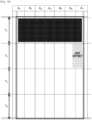
- Application Mode 4 may be used for an image having a toner image in the trailing sections T 3 and T 4 as shown in Fig. 14 .
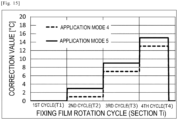
- the recording material in-process temperature control of the heating regions A 5 to A 7 for such an image uses the control target temperatures shown in Fig. 15 to control according to the presence or absence of a toner image.
- the recording material in-process temperature control of the heating regions A 5 to A 7 for the sections T 1 and T 2 without a toner image uses a correction value of +1 [°C] according to Table 3 (that is, the maximum toner amount and the toner occupancy ratio in the regions corresponding to the sections T 1 and T 2 are both 0%).
- a correction value of +6 [°C] is used for the sections T 3 and T 4 with a toner image (that is, the maximum toner amount is 200%, and the toner occupancy ratio is about 23% in the regions corresponding to the sections T 3 and T 4 ).
- Application Mode 5 which is a derivative example of Application Mode 4, starts corrections from the section T 2 as the recording material in-process temperature control in preparation for the fixing of the section T 3 with a toner image.
- the section T2 does not have a toner image
- the subsequent section T3 has a toner image.
- the correction for the section T2 of Application Mode 5 uses a correction value of +3 [°C], which is larger than that of Application Mode 4.
- the correction value used in the recording material in-process temperature control performed in preparation for the section T i having a toner image is preferably set to a value suitable for the fixing apparatus 200b or the image formation apparatus 100.
- Embodiment 2 performs, as the control based on the toner amount, the recording material in-process temperature control that uses the maximum toner amount and the toner occupancy ratio.
- the present invention is not limited to this and its objective may be achieved by a control based on either toner image information, or a control based on other toner image information.
- Embodiment 2 As described above, in the image heating apparatus including the division heater having a plurality of heating elements of Embodiment 2 according to the present invention, the energization of the divided heating regions is independently controlled according to the image to be printed by a user, thereby reducing the curling. Embodiment 2 also has an advantageous effect of saving energy by reducing the amount of applying heat.
- Embodiment 3 is an application example of Embodiment 2 and modifies the recording material in-process temperature control according to the toner image information corresponding to an adjacent heating region of the division heater.
- An electrophotographic image formation apparatus prints various images, many of which do not have a toner image on the right or left end.
- the heating regions A 1 to A 5 are image heating regions with a toner image
- the heating regions A 6 and A 7 are non-image heating regions without a toner image.
- the absence of a toner image that removes heat from the heating regions A 6 and A 7 increases the surface temperature of the section of the fixing film 202 corresponding to the heating regions A 6 and A 7 , even with the corrections of the recording material in-process temperature control of Embodiment 2.
- the surface temperature of the section of the fixing film 202 corresponding to the heating regions A 6 and A 7 is found to be higher than that of the section corresponding to the heating regions A 1 to A 5 .
- the surface temperature of the heating region A 7 is found to be particularly high.
- the toner image is present in the heating region A 5 , which is adjacent to the heating region A 6 .
- heat moves from the heating region A 6 into the heating region A 5 , reducing a rise in the surface temperature of the section of the fixing film 202 corresponding to the heating region A 6 .
- the heat is not removed from the heating region A 7 since a toner image is also absent in the adjacent heating region A 6 , causing a significant rise in the surface temperature of the section of the fixing film 202 corresponding to the heating region A 7 .
- Fig. 17 shows the measurement results of a comparison example.
- the corrections of the recording material in-process temperature control of Embodiment 2 were made, and while a large number of sheets were continuously printed, the surface temperature of the section of the fixing film 202 corresponding to the heating region A 7 was measured immediately after each sheet passed out of the fixing nip.
- Fig. 17 shows that the temperature rose, although slowly, as a large number of sheets were continuously printed. It is found that hot offset can occur in the section corresponding to the heating region A 7 , where a temperature rise is particularly large, when an image as shown in Fig. 18 is printed on the subsequent recording material P in a state where the surface temperature of the fixing film 202 is increased.
- the present embodiment sets the correction value of the recording material in-process temperature control to 0 for the heating regions A 6 and A 7 , which are non-image heating regions, to limit a rise in the surface temperature of the fixing film 202.
- the present embodiment performs the recording material in-process temperature control as shown in Fig. 19 .
- the present embodiment sets the correction value to 0 for the sections T 3 and T 4 , which are closer to the trailing edge of the recording material.
- the timing for setting the correction value to 0 is not limited to this, and may be set as appropriate according to the apparatus configuration.
- the correction value may be set to 0 from the section T 2 , or the correction value for the section T 4 may be set to 0.
- Embodiment 2 was used as a comparison example.
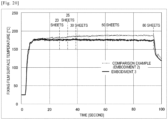
- Table 7 shows the verification results. [Table 7] Number of sheets continuously fed [unit: sheets] Hot offset Comparison example (Embodiment 2) Embodiment 3 20 Did not occur Did not occur 25 Did not occur Did not occur 30 Occurred to some extent Did not occur 50 Occurred Did not occur 80 Occurred Did not occur
- Fig. 20 shows the results of measurement of the surface temperature of the section of the fixing film 202 corresponding to the heating region A7 in the comparison example and the present embodiment.
- the temperature rises, although slowly, while the present embodiment limits a rise in the surface temperature of the fixing film 202, achieving an image heating apparatus that does not cause hot offset.
- the present embodiment does not make a correction for the non-image heating region A i without a toner image by the recording material in-process temperature control.
- the following application mode is also available.
- this application mode for an image with which non-image heating regions are adjacent to each other, as the heating regions A 6 and A 7 in Fig. 16 , a negative value smaller than 0 may be used in the recording material in-process temperature control for the heating region A 7 adjacent to the heating regions A 6 , which is a non-image heating region.
- This application mode is contemplated from the fact that, of the non-image heating regions A 6 and A 7 , the fixing film 202 undergoes a larger temperature rise in the heating region A 7 .
- a toner image is present in the heating region A 5 , which is an image heating region adjacent to the heating region A 6 .
- heat moves from the heating region A 6 into the heating region A 5 , resulting in a small temperature rise in the section of the fixing film 202 corresponding to the heating region A 6 .
- heat is not removed from the heating region A 7 adjacent to the heating region A 6 , which is a non-image heating region, and the surface of the section of the fixing film 202 corresponding to the heating region A 7 undergoes a large temperature rise.
- the correction value is thus set to a negative value. This allows the surface temperature of the fixing film 202 to be uniform.
- the recording material in-process temperature control for the non-image heating region A 6 adjacent to the image heating regions A 1 to A 5 uses a correction value of 0, that is, the temperature is not corrected.
- the recording material in-process temperature control for the non-image heating region A 7 adjacent to the non-image heating region A 6 uses -1 [°C], that is, a negative correction is made. This limits a temperature rise and allows the surface temperature of the fixing film 202 to be uniform.
- the correction value of the recording material in-process temperature control for a heating region A i without a toner image described in the present embodiment should be selected according to the fixing apparatus 200b and the image formation apparatus 100 to be used.
- the number of sheets that are continuously fed affects the temperature rise of the fixing film 202 in a non-image heating region.
- the correction value is set to 0 when it is known that the number of sheets to be continuously fed is small, and a negative correction is made when it is known that the number of sheets to be continuously fed is large.
- a negative correction starts while sheets are continuously fed.
- Another possible configuration includes a means for detecting a temperature rise of the surface temperature of the fixing film 202, and changes the correction value of the recording material in-process temperature control according to the detected temperature.
- the corrections in the recording material in-process temperature control are changed according to the toner image information corresponding to an adjacent region. This achieves a uniform surface temperature of the fixing film 202 and stabilizes the image quality of the subsequent sheets.
Landscapes
- Physics & Mathematics (AREA)
- General Physics & Mathematics (AREA)
- Fixing For Electrophotography (AREA)
- Control Or Security For Electrophotography (AREA)
Applications Claiming Priority (2)
| Application Number | Priority Date | Filing Date | Title |
|---|---|---|---|
| JP2018134919A JP7073217B2 (ja) | 2018-07-18 | 2018-07-18 | 像加熱装置及び画像形成装置 |
| PCT/JP2019/027691 WO2020017452A1 (ja) | 2018-07-18 | 2019-07-12 | 像加熱装置及び画像形成装置 |
Publications (3)
| Publication Number | Publication Date |
|---|---|
| EP3825774A1 EP3825774A1 (en) | 2021-05-26 |
| EP3825774A4 EP3825774A4 (en) | 2022-03-30 |
| EP3825774B1 true EP3825774B1 (en) | 2024-10-02 |
Family
ID=69164453
Family Applications (1)
| Application Number | Title | Priority Date | Filing Date |
|---|---|---|---|
| EP19837330.0A Active EP3825774B1 (en) | 2018-07-18 | 2019-07-12 | Image heating device and image formation device |
Country Status (6)
| Country | Link |
|---|---|
| US (2) | US11320768B2 (enExample) |
| EP (1) | EP3825774B1 (enExample) |
| JP (1) | JP7073217B2 (enExample) |
| KR (1) | KR102575264B1 (enExample) |
| CN (1) | CN112424701B (enExample) |
| WO (1) | WO2020017452A1 (enExample) |
Families Citing this family (7)
| Publication number | Priority date | Publication date | Assignee | Title |
|---|---|---|---|---|
| JP7073217B2 (ja) * | 2018-07-18 | 2022-05-23 | キヤノン株式会社 | 像加熱装置及び画像形成装置 |
| JP7541877B2 (ja) | 2020-08-31 | 2024-08-29 | キヤノン株式会社 | 画像形成装置およびその制御方法 |
| CN119768202A (zh) | 2022-07-18 | 2025-04-04 | 精呼吸股份有限公司 | 小步长高分辨率气溶胶生成系统及方法 |
| US12092976B2 (en) | 2023-01-25 | 2024-09-17 | Toshiba Tec Kabushiki Kaisha | Fixing device and image forming apparatus with temperature sensor and controller |
| US12130570B2 (en) | 2023-02-24 | 2024-10-29 | Toshiba Tec Kabushiki Kaisha | Fixing device and image forming apparatus |
| CN118818937A (zh) * | 2023-04-19 | 2024-10-22 | 珠海奔图电子有限公司 | 一种定影温度控制方法 |
| JP2025161162A (ja) * | 2024-04-11 | 2025-10-24 | キヤノン株式会社 | 画像形成装置 |
Family Cites Families (23)
| Publication number | Priority date | Publication date | Assignee | Title |
|---|---|---|---|---|
| JP2516886B2 (ja) | 1987-06-16 | 1996-07-24 | キヤノン株式会社 | 像加熱装置 |
| JPH0695540A (ja) * | 1992-09-11 | 1994-04-08 | Canon Inc | 加熱装置及び画像形成装置 |
| JP3513283B2 (ja) | 1995-09-28 | 2004-03-31 | キヤノン株式会社 | 画像形成装置 |
| JP2001100588A (ja) * | 1999-09-28 | 2001-04-13 | Canon Inc | 加熱装置および画像形成装置 |
| US6466750B2 (en) * | 2000-12-01 | 2002-10-15 | Hewlett-Packard Company | Method and system of fusing portions of a print medium |
| JP4757046B2 (ja) * | 2006-02-01 | 2011-08-24 | キヤノン株式会社 | 定着装置 |
| JP2008003326A (ja) * | 2006-06-22 | 2008-01-10 | Sharp Corp | 定着装置およびそれを備えてなる画像形成装置 |
| US8295752B2 (en) * | 2009-02-25 | 2012-10-23 | Fuji Xerox Co., Ltd. | Fixing device and image forming apparatus |
| CN103826335B (zh) * | 2009-09-11 | 2016-01-13 | 佳能株式会社 | 加热器和包括该加热器的图像加热装置 |
| JP5861446B2 (ja) * | 2011-12-21 | 2016-02-16 | 富士ゼロックス株式会社 | 定着装置及び画像形成装置 |
| JP2014077873A (ja) * | 2012-10-10 | 2014-05-01 | Ricoh Co Ltd | 定着装置の温度制御方法及び定着装置並びに画像形成装置 |
| JP5772852B2 (ja) * | 2013-03-22 | 2015-09-02 | コニカミノルタ株式会社 | 画像形成装置 |
| JP6183046B2 (ja) * | 2013-08-09 | 2017-08-23 | 富士ゼロックス株式会社 | 画像形成装置 |
| JP6202381B2 (ja) * | 2013-08-13 | 2017-09-27 | 株式会社リコー | 定着装置及び画像形成装置 |
| JP6661311B2 (ja) * | 2015-09-11 | 2020-03-11 | キヤノン株式会社 | 像加熱装置及び像加熱装置に用いるヒータ |
| JP6180555B2 (ja) * | 2016-01-08 | 2017-08-16 | キヤノン株式会社 | 画像形成装置 |
| JP6914623B2 (ja) * | 2016-07-01 | 2021-08-04 | キヤノン株式会社 | 画像形成装置及び像加熱装置 |
| JP6723845B2 (ja) | 2016-07-01 | 2020-07-15 | キヤノン株式会社 | 像加熱装置及び画像形成装置 |
| JP6593368B2 (ja) | 2017-02-20 | 2019-10-23 | テイ・エス テック株式会社 | 車両用シート |
| JP7073220B2 (ja) * | 2017-08-04 | 2022-05-23 | キヤノン株式会社 | 像加熱装置及び画像形成装置 |
| US10520864B2 (en) * | 2017-10-04 | 2019-12-31 | Canon Kabushiki Kaisha | Image forming apparatus that controls a target temperature of a heating member based on whether pixels for forming an image are a predetermined density or more |
| JP7073217B2 (ja) * | 2018-07-18 | 2022-05-23 | キヤノン株式会社 | 像加熱装置及び画像形成装置 |
| JP7433956B2 (ja) * | 2020-02-12 | 2024-02-20 | キヤノン株式会社 | 定着装置、及びそれを用いた画像形成装置 |
-
2018
- 2018-07-18 JP JP2018134919A patent/JP7073217B2/ja not_active Expired - Fee Related
-
2019
- 2019-07-12 KR KR1020217003815A patent/KR102575264B1/ko active Active
- 2019-07-12 WO PCT/JP2019/027691 patent/WO2020017452A1/ja not_active Ceased
- 2019-07-12 EP EP19837330.0A patent/EP3825774B1/en active Active
- 2019-07-12 CN CN201980046927.XA patent/CN112424701B/zh not_active Expired - Fee Related
-
2021
- 2021-01-15 US US17/150,621 patent/US11320768B2/en not_active Expired - Fee Related
-
2022
- 2022-03-21 US US17/699,639 patent/US11809104B2/en active Active
Also Published As
| Publication number | Publication date |
|---|---|
| KR102575264B1 (ko) | 2023-09-06 |
| JP2020012966A (ja) | 2020-01-23 |
| US11809104B2 (en) | 2023-11-07 |
| EP3825774A1 (en) | 2021-05-26 |
| US11320768B2 (en) | 2022-05-03 |
| CN112424701B (zh) | 2023-11-10 |
| KR20210028692A (ko) | 2021-03-12 |
| WO2020017452A1 (ja) | 2020-01-23 |
| US20220206417A1 (en) | 2022-06-30 |
| CN112424701A (zh) | 2021-02-26 |
| US20210132529A1 (en) | 2021-05-06 |
| JP7073217B2 (ja) | 2022-05-23 |
| EP3825774A4 (en) | 2022-03-30 |
Similar Documents
| Publication | Publication Date | Title |
|---|---|---|
| US11809104B2 (en) | Image heating apparatus and image formation apparatus with power supply control that sets a target temperature for each of a plurality of regions of recording material | |
| EP3276429B1 (en) | Image heating apparatus and image forming apparatus | |
| US7193181B2 (en) | Image heating apparatus and heater used therefor | |
| US10802427B2 (en) | Heating device for fixing device of image forming apparatus having plurality of resistance heating elements and power interrupter | |
| US10915045B2 (en) | Fixing apparatus and image forming apparatus that set target temperatures of heat generating elements for heating a developer image in each of a plurality of regions | |
| EP3264194B1 (en) | Image forming apparatus and image heating apparatus | |
| US11016425B2 (en) | Image heating device and image forming apparatus | |
| JP7086691B2 (ja) | 像加熱装置及び画像形成装置 | |
| CN110501890B (zh) | 图像加热装置 | |
| JP7130189B2 (ja) | 画像形成装置 | |
| JP7106333B2 (ja) | 画像形成装置 | |
| JP7277230B2 (ja) | 像加熱装置 | |
| JP2019128551A (ja) | 像加熱装置及び画像形成装置 | |
| JP2001282036A (ja) | 画像形成装置 | |
| US20210041809A1 (en) | Image forming apparatus | |
| JP7581042B2 (ja) | 像加熱装置及び画像形成装置 | |
| JP7478346B2 (ja) | ヒーター部材、加熱装置、定着装置および画像形成装置 | |
| JP2020034621A (ja) | 像加熱装置及び画像形成装置 | |
| JP6840545B2 (ja) | 画像形成装置 | |
| JP7330442B2 (ja) | 画像形成装置 | |
| JP7558672B2 (ja) | 画像形成装置 | |
| JP2023156013A (ja) | 像加熱装置および画像形成装置 |
Legal Events
| Date | Code | Title | Description |
|---|---|---|---|
| STAA | Information on the status of an ep patent application or granted ep patent |
Free format text: STATUS: THE INTERNATIONAL PUBLICATION HAS BEEN MADE |
|
| PUAI | Public reference made under article 153(3) epc to a published international application that has entered the european phase |
Free format text: ORIGINAL CODE: 0009012 |
|
| STAA | Information on the status of an ep patent application or granted ep patent |
Free format text: STATUS: REQUEST FOR EXAMINATION WAS MADE |
|
| 17P | Request for examination filed |
Effective date: 20210218 |
|
| AK | Designated contracting states |
Kind code of ref document: A1 Designated state(s): AL AT BE BG CH CY CZ DE DK EE ES FI FR GB GR HR HU IE IS IT LI LT LU LV MC MK MT NL NO PL PT RO RS SE SI SK SM TR |
|
| DAV | Request for validation of the european patent (deleted) | ||
| DAX | Request for extension of the european patent (deleted) | ||
| A4 | Supplementary search report drawn up and despatched |
Effective date: 20220228 |
|
| RIC1 | Information provided on ipc code assigned before grant |
Ipc: G03G 15/00 20060101ALI20220222BHEP Ipc: G03G 21/20 20060101ALI20220222BHEP Ipc: G03G 21/00 20060101ALI20220222BHEP Ipc: G03G 15/20 20060101AFI20220222BHEP |
|
| GRAP | Despatch of communication of intention to grant a patent |
Free format text: ORIGINAL CODE: EPIDOSNIGR1 |
|
| STAA | Information on the status of an ep patent application or granted ep patent |
Free format text: STATUS: GRANT OF PATENT IS INTENDED |
|
| INTG | Intention to grant announced |
Effective date: 20240426 |
|
| GRAS | Grant fee paid |
Free format text: ORIGINAL CODE: EPIDOSNIGR3 |
|
| GRAA | (expected) grant |
Free format text: ORIGINAL CODE: 0009210 |
|
| STAA | Information on the status of an ep patent application or granted ep patent |
Free format text: STATUS: THE PATENT HAS BEEN GRANTED |
|
| AK | Designated contracting states |
Kind code of ref document: B1 Designated state(s): AL AT BE BG CH CY CZ DE DK EE ES FI FR GB GR HR HU IE IS IT LI LT LU LV MC MK MT NL NO PL PT RO RS SE SI SK SM TR |
|
| REG | Reference to a national code |
Ref country code: GB Ref legal event code: FG4D |
|
| REG | Reference to a national code |
Ref country code: CH Ref legal event code: EP |
|
| REG | Reference to a national code |
Ref country code: DE Ref legal event code: R096 Ref document number: 602019059799 Country of ref document: DE |
|
| REG | Reference to a national code |
Ref country code: IE Ref legal event code: FG4D |
|
| REG | Reference to a national code |
Ref country code: LT Ref legal event code: MG9D |
|
| REG | Reference to a national code |
Ref country code: NL Ref legal event code: MP Effective date: 20241002 |
|
| REG | Reference to a national code |
Ref country code: AT Ref legal event code: MK05 Ref document number: 1728918 Country of ref document: AT Kind code of ref document: T Effective date: 20241002 |
|
| PG25 | Lapsed in a contracting state [announced via postgrant information from national office to epo] |
Ref country code: NL Free format text: LAPSE BECAUSE OF FAILURE TO SUBMIT A TRANSLATION OF THE DESCRIPTION OR TO PAY THE FEE WITHIN THE PRESCRIBED TIME-LIMIT Effective date: 20241002 |
|
| PG25 | Lapsed in a contracting state [announced via postgrant information from national office to epo] |
Ref country code: NL Free format text: LAPSE BECAUSE OF FAILURE TO SUBMIT A TRANSLATION OF THE DESCRIPTION OR TO PAY THE FEE WITHIN THE PRESCRIBED TIME-LIMIT Effective date: 20241002 |
|
| PG25 | Lapsed in a contracting state [announced via postgrant information from national office to epo] |
Ref country code: PT Free format text: LAPSE BECAUSE OF FAILURE TO SUBMIT A TRANSLATION OF THE DESCRIPTION OR TO PAY THE FEE WITHIN THE PRESCRIBED TIME-LIMIT Effective date: 20250203 Ref country code: HR Free format text: LAPSE BECAUSE OF FAILURE TO SUBMIT A TRANSLATION OF THE DESCRIPTION OR TO PAY THE FEE WITHIN THE PRESCRIBED TIME-LIMIT Effective date: 20241002 Ref country code: IS Free format text: LAPSE BECAUSE OF FAILURE TO SUBMIT A TRANSLATION OF THE DESCRIPTION OR TO PAY THE FEE WITHIN THE PRESCRIBED TIME-LIMIT Effective date: 20250202 |
|
| PG25 | Lapsed in a contracting state [announced via postgrant information from national office to epo] |
Ref country code: FI Free format text: LAPSE BECAUSE OF FAILURE TO SUBMIT A TRANSLATION OF THE DESCRIPTION OR TO PAY THE FEE WITHIN THE PRESCRIBED TIME-LIMIT Effective date: 20241002 |
|
| PG25 | Lapsed in a contracting state [announced via postgrant information from national office to epo] |
Ref country code: BG Free format text: LAPSE BECAUSE OF FAILURE TO SUBMIT A TRANSLATION OF THE DESCRIPTION OR TO PAY THE FEE WITHIN THE PRESCRIBED TIME-LIMIT Effective date: 20241002 |
|
| PG25 | Lapsed in a contracting state [announced via postgrant information from national office to epo] |
Ref country code: ES Free format text: LAPSE BECAUSE OF FAILURE TO SUBMIT A TRANSLATION OF THE DESCRIPTION OR TO PAY THE FEE WITHIN THE PRESCRIBED TIME-LIMIT Effective date: 20241002 |
|
| PG25 | Lapsed in a contracting state [announced via postgrant information from national office to epo] |
Ref country code: NO Free format text: LAPSE BECAUSE OF FAILURE TO SUBMIT A TRANSLATION OF THE DESCRIPTION OR TO PAY THE FEE WITHIN THE PRESCRIBED TIME-LIMIT Effective date: 20250102 |
|
| PG25 | Lapsed in a contracting state [announced via postgrant information from national office to epo] |
Ref country code: AT Free format text: LAPSE BECAUSE OF FAILURE TO SUBMIT A TRANSLATION OF THE DESCRIPTION OR TO PAY THE FEE WITHIN THE PRESCRIBED TIME-LIMIT Effective date: 20241002 Ref country code: LV Free format text: LAPSE BECAUSE OF FAILURE TO SUBMIT A TRANSLATION OF THE DESCRIPTION OR TO PAY THE FEE WITHIN THE PRESCRIBED TIME-LIMIT Effective date: 20241002 Ref country code: GR Free format text: LAPSE BECAUSE OF FAILURE TO SUBMIT A TRANSLATION OF THE DESCRIPTION OR TO PAY THE FEE WITHIN THE PRESCRIBED TIME-LIMIT Effective date: 20250103 |
|
| PG25 | Lapsed in a contracting state [announced via postgrant information from national office to epo] |
Ref country code: PL Free format text: LAPSE BECAUSE OF FAILURE TO SUBMIT A TRANSLATION OF THE DESCRIPTION OR TO PAY THE FEE WITHIN THE PRESCRIBED TIME-LIMIT Effective date: 20241002 Ref country code: CZ Free format text: LAPSE BECAUSE OF FAILURE TO SUBMIT A TRANSLATION OF THE DESCRIPTION OR TO PAY THE FEE WITHIN THE PRESCRIBED TIME-LIMIT Effective date: 20241002 |
|
| PG25 | Lapsed in a contracting state [announced via postgrant information from national office to epo] |
Ref country code: RS Free format text: LAPSE BECAUSE OF FAILURE TO SUBMIT A TRANSLATION OF THE DESCRIPTION OR TO PAY THE FEE WITHIN THE PRESCRIBED TIME-LIMIT Effective date: 20250102 |
|
| PG25 | Lapsed in a contracting state [announced via postgrant information from national office to epo] |
Ref country code: SM Free format text: LAPSE BECAUSE OF FAILURE TO SUBMIT A TRANSLATION OF THE DESCRIPTION OR TO PAY THE FEE WITHIN THE PRESCRIBED TIME-LIMIT Effective date: 20241002 |
|
| REG | Reference to a national code |
Ref country code: DE Ref legal event code: R097 Ref document number: 602019059799 Country of ref document: DE |
|
| PG25 | Lapsed in a contracting state [announced via postgrant information from national office to epo] |
Ref country code: DK Free format text: LAPSE BECAUSE OF FAILURE TO SUBMIT A TRANSLATION OF THE DESCRIPTION OR TO PAY THE FEE WITHIN THE PRESCRIBED TIME-LIMIT Effective date: 20241002 |
|
| PG25 | Lapsed in a contracting state [announced via postgrant information from national office to epo] |
Ref country code: EE Free format text: LAPSE BECAUSE OF FAILURE TO SUBMIT A TRANSLATION OF THE DESCRIPTION OR TO PAY THE FEE WITHIN THE PRESCRIBED TIME-LIMIT Effective date: 20241002 |
|
| PG25 | Lapsed in a contracting state [announced via postgrant information from national office to epo] |
Ref country code: RO Free format text: LAPSE BECAUSE OF FAILURE TO SUBMIT A TRANSLATION OF THE DESCRIPTION OR TO PAY THE FEE WITHIN THE PRESCRIBED TIME-LIMIT Effective date: 20241002 |
|
| PG25 | Lapsed in a contracting state [announced via postgrant information from national office to epo] |
Ref country code: SK Free format text: LAPSE BECAUSE OF FAILURE TO SUBMIT A TRANSLATION OF THE DESCRIPTION OR TO PAY THE FEE WITHIN THE PRESCRIBED TIME-LIMIT Effective date: 20241002 |
|
| PG25 | Lapsed in a contracting state [announced via postgrant information from national office to epo] |
Ref country code: IT Free format text: LAPSE BECAUSE OF FAILURE TO SUBMIT A TRANSLATION OF THE DESCRIPTION OR TO PAY THE FEE WITHIN THE PRESCRIBED TIME-LIMIT Effective date: 20241002 |
|
| PLBE | No opposition filed within time limit |
Free format text: ORIGINAL CODE: 0009261 |
|
| STAA | Information on the status of an ep patent application or granted ep patent |
Free format text: STATUS: NO OPPOSITION FILED WITHIN TIME LIMIT |
|
| PG25 | Lapsed in a contracting state [announced via postgrant information from national office to epo] |
Ref country code: SE Free format text: LAPSE BECAUSE OF FAILURE TO SUBMIT A TRANSLATION OF THE DESCRIPTION OR TO PAY THE FEE WITHIN THE PRESCRIBED TIME-LIMIT Effective date: 20241002 |
|
| 26N | No opposition filed |
Effective date: 20250703 |
|
| REG | Reference to a national code |
Ref country code: DE Ref legal event code: R119 Ref document number: 602019059799 Country of ref document: DE |
|
| REG | Reference to a national code |
Ref country code: CH Ref legal event code: H13 Free format text: ST27 STATUS EVENT CODE: U-0-0-H10-H13 (AS PROVIDED BY THE NATIONAL OFFICE) Effective date: 20260224 |
|
| PG25 | Lapsed in a contracting state [announced via postgrant information from national office to epo] |
Ref country code: LU Free format text: LAPSE BECAUSE OF NON-PAYMENT OF DUE FEES Effective date: 20250712 |
|
| GBPC | Gb: european patent ceased through non-payment of renewal fee |
Effective date: 20250712 |
|
| REG | Reference to a national code |
Ref country code: BE Ref legal event code: MM Effective date: 20250731 |
|
| PG25 | Lapsed in a contracting state [announced via postgrant information from national office to epo] |
Ref country code: GB Free format text: LAPSE BECAUSE OF NON-PAYMENT OF DUE FEES Effective date: 20250712 |
|
| PG25 | Lapsed in a contracting state [announced via postgrant information from national office to epo] |
Ref country code: DE Free format text: LAPSE BECAUSE OF NON-PAYMENT OF DUE FEES Effective date: 20260203 |
|
| PG25 | Lapsed in a contracting state [announced via postgrant information from national office to epo] |
Ref country code: BE Free format text: LAPSE BECAUSE OF NON-PAYMENT OF DUE FEES Effective date: 20250731 |
|
| PG25 | Lapsed in a contracting state [announced via postgrant information from national office to epo] |
Ref country code: FR Free format text: LAPSE BECAUSE OF NON-PAYMENT OF DUE FEES Effective date: 20250731 |
|
| PG25 | Lapsed in a contracting state [announced via postgrant information from national office to epo] |
Ref country code: CH Free format text: LAPSE BECAUSE OF NON-PAYMENT OF DUE FEES Effective date: 20250731 |
|
| PG25 | Lapsed in a contracting state [announced via postgrant information from national office to epo] |
Ref country code: LT Free format text: LAPSE BECAUSE OF FAILURE TO SUBMIT A TRANSLATION OF THE DESCRIPTION OR TO PAY THE FEE WITHIN THE PRESCRIBED TIME-LIMIT Effective date: 20241002 |
|
| PG25 | Lapsed in a contracting state [announced via postgrant information from national office to epo] |
Ref country code: IE Free format text: LAPSE BECAUSE OF NON-PAYMENT OF DUE FEES Effective date: 20250712 |
|
| PG25 | Lapsed in a contracting state [announced via postgrant information from national office to epo] |
Ref country code: MC Free format text: LAPSE BECAUSE OF FAILURE TO SUBMIT A TRANSLATION OF THE DESCRIPTION OR TO PAY THE FEE WITHIN THE PRESCRIBED TIME-LIMIT Effective date: 20241002 |
|
| PG25 | Lapsed in a contracting state [announced via postgrant information from national office to epo] |
Ref country code: CY Free format text: LAPSE BECAUSE OF FAILURE TO SUBMIT A TRANSLATION OF THE DESCRIPTION OR TO PAY THE FEE WITHIN THE PRESCRIBED TIME-LIMIT Effective date: 20241002 |