EP3810941B1 - Schraube zur verschraubung in kunststoff - Google Patents
Schraube zur verschraubung in kunststoff Download PDFInfo
- Publication number
- EP3810941B1 EP3810941B1 EP19737668.4A EP19737668A EP3810941B1 EP 3810941 B1 EP3810941 B1 EP 3810941B1 EP 19737668 A EP19737668 A EP 19737668A EP 3810941 B1 EP3810941 B1 EP 3810941B1
- Authority
- EP
- European Patent Office
- Prior art keywords
- thread
- area
- radius
- profile contour
- screw
- Prior art date
- Legal status (The legal status is an assumption and is not a legal conclusion. Google has not performed a legal analysis and makes no representation as to the accuracy of the status listed.)
- Active
Links
Images






Classifications
-
- F—MECHANICAL ENGINEERING; LIGHTING; HEATING; WEAPONS; BLASTING
- F16—ENGINEERING ELEMENTS AND UNITS; GENERAL MEASURES FOR PRODUCING AND MAINTAINING EFFECTIVE FUNCTIONING OF MACHINES OR INSTALLATIONS; THERMAL INSULATION IN GENERAL
- F16B—DEVICES FOR FASTENING OR SECURING CONSTRUCTIONAL ELEMENTS OR MACHINE PARTS TOGETHER, e.g. NAILS, BOLTS, CIRCLIPS, CLAMPS, CLIPS OR WEDGES; JOINTS OR JOINTING
- F16B25/00—Screws that cut thread in the body into which they are screwed, e.g. wood screws
- F16B25/001—Screws that cut thread in the body into which they are screwed, e.g. wood screws characterised by the material of the body into which the screw is screwed
- F16B25/0015—Screws that cut thread in the body into which they are screwed, e.g. wood screws characterised by the material of the body into which the screw is screwed the material being a soft organic material, e.g. wood or plastic
-
- F—MECHANICAL ENGINEERING; LIGHTING; HEATING; WEAPONS; BLASTING
- F16—ENGINEERING ELEMENTS AND UNITS; GENERAL MEASURES FOR PRODUCING AND MAINTAINING EFFECTIVE FUNCTIONING OF MACHINES OR INSTALLATIONS; THERMAL INSULATION IN GENERAL
- F16B—DEVICES FOR FASTENING OR SECURING CONSTRUCTIONAL ELEMENTS OR MACHINE PARTS TOGETHER, e.g. NAILS, BOLTS, CIRCLIPS, CLAMPS, CLIPS OR WEDGES; JOINTS OR JOINTING
- F16B35/00—Screw-bolts; Stay-bolts; Screw-threaded studs; Screws; Set screws
- F16B35/04—Screw-bolts; Stay-bolts; Screw-threaded studs; Screws; Set screws with specially-shaped head or shaft in order to fix the bolt on or in an object
- F16B35/041—Specially-shaped shafts
-
- F—MECHANICAL ENGINEERING; LIGHTING; HEATING; WEAPONS; BLASTING
- F16—ENGINEERING ELEMENTS AND UNITS; GENERAL MEASURES FOR PRODUCING AND MAINTAINING EFFECTIVE FUNCTIONING OF MACHINES OR INSTALLATIONS; THERMAL INSULATION IN GENERAL
- F16B—DEVICES FOR FASTENING OR SECURING CONSTRUCTIONAL ELEMENTS OR MACHINE PARTS TOGETHER, e.g. NAILS, BOLTS, CIRCLIPS, CLAMPS, CLIPS OR WEDGES; JOINTS OR JOINTING
- F16B2/00—Friction-grip releasable fastenings
- F16B2/02—Clamps, i.e. with gripping action effected by positive means other than the inherent resistance to deformation of the material of the fastening
- F16B2/06—Clamps, i.e. with gripping action effected by positive means other than the inherent resistance to deformation of the material of the fastening external, i.e. with contracting action
- F16B2/065—Clamps, i.e. with gripping action effected by positive means other than the inherent resistance to deformation of the material of the fastening external, i.e. with contracting action using screw-thread elements
-
- F—MECHANICAL ENGINEERING; LIGHTING; HEATING; WEAPONS; BLASTING
- F16—ENGINEERING ELEMENTS AND UNITS; GENERAL MEASURES FOR PRODUCING AND MAINTAINING EFFECTIVE FUNCTIONING OF MACHINES OR INSTALLATIONS; THERMAL INSULATION IN GENERAL
- F16B—DEVICES FOR FASTENING OR SECURING CONSTRUCTIONAL ELEMENTS OR MACHINE PARTS TOGETHER, e.g. NAILS, BOLTS, CIRCLIPS, CLAMPS, CLIPS OR WEDGES; JOINTS OR JOINTING
- F16B25/00—Screws that cut thread in the body into which they are screwed, e.g. wood screws
- F16B25/0036—Screws that cut thread in the body into which they are screwed, e.g. wood screws characterised by geometric details of the screw
- F16B25/0042—Screws that cut thread in the body into which they are screwed, e.g. wood screws characterised by geometric details of the screw characterised by the geometry of the thread, the thread being a ridge wrapped around the shaft of the screw
- F16B25/0047—Screws that cut thread in the body into which they are screwed, e.g. wood screws characterised by geometric details of the screw characterised by the geometry of the thread, the thread being a ridge wrapped around the shaft of the screw the ridge being characterised by its cross-section in the plane of the shaft axis
-
- F—MECHANICAL ENGINEERING; LIGHTING; HEATING; WEAPONS; BLASTING
- F16—ENGINEERING ELEMENTS AND UNITS; GENERAL MEASURES FOR PRODUCING AND MAINTAINING EFFECTIVE FUNCTIONING OF MACHINES OR INSTALLATIONS; THERMAL INSULATION IN GENERAL
- F16B—DEVICES FOR FASTENING OR SECURING CONSTRUCTIONAL ELEMENTS OR MACHINE PARTS TOGETHER, e.g. NAILS, BOLTS, CIRCLIPS, CLAMPS, CLIPS OR WEDGES; JOINTS OR JOINTING
- F16B25/00—Screws that cut thread in the body into which they are screwed, e.g. wood screws
- F16B25/0036—Screws that cut thread in the body into which they are screwed, e.g. wood screws characterised by geometric details of the screw
- F16B25/0042—Screws that cut thread in the body into which they are screwed, e.g. wood screws characterised by geometric details of the screw characterised by the geometry of the thread, the thread being a ridge wrapped around the shaft of the screw
- F16B25/0057—Screws that cut thread in the body into which they are screwed, e.g. wood screws characterised by geometric details of the screw characterised by the geometry of the thread, the thread being a ridge wrapped around the shaft of the screw the screw having distinct axial zones, e.g. multiple axial thread sections with different pitch or thread cross-sections
-
- F—MECHANICAL ENGINEERING; LIGHTING; HEATING; WEAPONS; BLASTING
- F16—ENGINEERING ELEMENTS AND UNITS; GENERAL MEASURES FOR PRODUCING AND MAINTAINING EFFECTIVE FUNCTIONING OF MACHINES OR INSTALLATIONS; THERMAL INSULATION IN GENERAL
- F16B—DEVICES FOR FASTENING OR SECURING CONSTRUCTIONAL ELEMENTS OR MACHINE PARTS TOGETHER, e.g. NAILS, BOLTS, CIRCLIPS, CLAMPS, CLIPS OR WEDGES; JOINTS OR JOINTING
- F16B25/00—Screws that cut thread in the body into which they are screwed, e.g. wood screws
- F16B25/0036—Screws that cut thread in the body into which they are screwed, e.g. wood screws characterised by geometric details of the screw
- F16B25/0042—Screws that cut thread in the body into which they are screwed, e.g. wood screws characterised by geometric details of the screw characterised by the geometry of the thread, the thread being a ridge wrapped around the shaft of the screw
- F16B25/0068—Screws that cut thread in the body into which they are screwed, e.g. wood screws characterised by geometric details of the screw characterised by the geometry of the thread, the thread being a ridge wrapped around the shaft of the screw with multiple-threads, e.g. a double thread screws
Definitions
- the invention relates to a screw, in particular for screwing into plastic, according to the preamble of claim 1.
- the US 5,795,120 B , the EP 1 877 233 A2 , JP 5243906 B2 ,as well as the DT 25 43 960 A1 each disclose a screw for insertion into a component provided with a pilot hole.
- the screw has a formed thread area and a supporting thread area, wherein the thread profile in the formed thread area is proportionally larger than the thread profile in the supporting thread area.
- This design has the disadvantage that, particularly when the screw is used in plastics, the component is subjected to high loads if a larger pitch and a smaller flank angle are to be achieved.
- a similar screw, especially concrete screw, as in the EP 1 887 233 A2 is in the DE 10 2015 120 470 A1 disclosed, in which case, in addition to the known reduction of the outer diameter, there may also be a flank angle which is larger in the area of the forming thread than in the area of the supporting thread.
- the EP 2 703 658 B1 discloses a screw for soft materials with different flank angles in a forming area and a supporting area, wherein a pitch jump is provided between the forming area and the supporting area in order to compensate for the resulting gap and thereby increase the fastening forces.
- the object of the invention is to provide a screw which achieves low mechanical stress on the component with a low screwing-in torque and can thereby achieve high extraction values.
- a screw has a screw central axis, a drive and a thread-bearing shank.
- the shank carries at least one thread turn which extends at least partially along the shank in a helix of constant pitch, thus forming a main thread with a changing profile contour that has an average thread radius over its length.
- the profile contour is formed by the intersection of the thread turn in a sectional plane of the helix, with the screw central axis lying in the sectional plane.
- the thread radius is the maximum orthogonal distance from the screw central axis to the profile contour of the thread turn.
- the main thread has a load-bearing region and a forming region, with a forming profile contour with a forming region radius being produced in the forming region and a supporting profile contour with a supporting region radius being produced in the supporting region.
- the form profile contour is defined by the projection of the thread pitch along the helix, particularly in the direction of the drive, over an axially extending area with a length of three times the average thread radius, starting from the free end of the shaft, onto a sectional plane of the helix, with the screw center axis M lying in the sectional plane.
- the projection therefore corresponds to the projection of the rectilinear development of the thread pitch onto a sectional plane of the helix in which the screw center axis lies.
- This form profile contour has a maximum orthogonal distance to the screw center axis, which defines the form area radius.
- the forming area ends at the point on the helix where the maximum extension of the forming profile contour closest to the drive is in the range of 85% of the mean thread radius in the radial direction outwards, before the subsequent profile contours are again within the forming profile contour.
- the support profile contour is formed by the projection of the thread pitch onto a section plane of the helix along the helix, particularly in the direction of the drive, over an axially extending area that begins at a distance of 2/3 of the mean thread radius to the end of the forming area and ends at 5/3 of the mean thread radius.
- This area forms at least a partial area of the Support area. This can extend further along the main thread in the direction of the drive, as long as the profile contour does not extend beyond the support profile contour.
- This support profile contour has a maximum orthogonal distance from the screw center axis, which defines the support area radius.
- the support profile contour and the form profile contour are coordinated in such a way that when the support profile contour and the form profile contour overlap along the helix, the support profile contour lies completely within the form profile contour at least in the area that extends from 85% of the form area radius in the radial direction outwards.
- the shaped profile contour delimits a shaped profile surface which, measured in a range of 10% of the shaped area radius starting from the maximum orthogonal distance of the shaped profile contour to the screw center axis radially inwards, is larger than a supporting profile surface delimited by the supporting profile contour, measured in a range of 10% of the shaped area radius starting from the maximum orthogonal distance of the supporting profile contour to the screw center axis radially inwards.
- the profile contour adjustment according to the invention allows springback compensation in the nut thread to be achieved even with relatively small flank angles, while ensuring sufficient flank overlap. This prevents damage to the component material, as occurs with a screw with a proportionally enlarged thread form area.
- the shaped profile contour and the supporting profile contour have a flank angle of less than 35°.
- the flank angle of the shaped profile contour corresponds to 180° less the sum of the two base angles of a trapezoid formed by dividing the base sides of the trapezoid by the intersection lines parallel to the screw axis at 85% of the shaped profile radius R F and at 95% of the Form profile radius R F are formed.
- Base angles are the angles on the longer base side of the trapezoid, i.e. at the intersection line at 85%.
- the analogous rule for determining the flank angle applies to the supporting profile contour, where the cutting lines are placed at 85% of the supporting profile radius R T and 95% of the supporting profile radius R T.
- the flank angle is typically between 20° and 30°. This is a proven flank angle for plastic screw connections.
- the support area radius is between 1% and 3% smaller than the forming area radius. This results in minimal material damage to the plastic component, while still allowing a sufficiently large distance between the forming profile contour and the support profile contour to accommodate the material springback.
- the support profile contour has an axial width at 95% of the support area radius that is smaller than the axial width of the formed profile contour at 95% of the formed area radius. This allows for a simple design of the thread profile so that the formed profile area is larger than the support profile area.
- the width of the support profile contour is at least 10%, in particular at least 20% smaller than the width of the shaped profile contour.
- the shaped profile contour and/or the supporting profile contour can be symmetrical.
- the forming area is less than 2 x the pitch.
- the thread pitch increases up to its forming profile contour and then remains constant over a range up to the end of the forming area.
- the ratio of core radius to mean thread radius is 0.6 to 0.8. These are typical ratios for plastic screws.
- the support profile contour lies at least partially outside the forming profile contour. This allows for a more flexible design of the flank transition to the thread root, which can better accommodate the material properties.
- the core diameter in the forming area is smaller than or equal to the core diameter in the supporting area.
- the shaft can have a starting thread at the free end of the screw shaft, wherein the starting thread comprises at least two starting thread turns, the radius of which reaches at most 90% of the forming area radius and forms a starting area.
- the attachment thread area is formed where the attachment threads have the same diameter profile and the thread radius of the main thread is less than or equal to the thread radius of the attachment threads.
- the main thread in the attachment area has the same thread radius as the attachment thread, while maintaining the same axial distance from the free end of the screw shaft.
- at least three identical attachment points are realized by the attachment threads, in particular two, and the main thread, which enable particularly straight attachment of the screw.
- all threads in the attachment area begin in the same cross-sectional plane. Furthermore, all threads in the attachment area have the same cross-sectional contour. They are thus of similar design. For example, the main thread and the two attachment threads begin at the same point and follow the same path.
- At least three attachment threads can be provided, in which case the thread radius of the main thread in the attachment area is in particular smaller than the radius of the attachment thread.
- the attachment threads begin at the core, with the radius of the attachment threads steadily increasing from the core to the end of the attachment area. This ensures continuous and even attachment of the screw.
- the threads with the same thread radius can be evenly distributed around the circumference at the same axial height in the attachment area. This ensures symmetrical engagement with the pilot hole of the plastic component.
- the diameter of the free end of the screw is at least 20%, in particular at least 30%, in particular at least 40%, in particular at least 50%, in particular at least 60% of twice the forming area radius.
- a blunt tip is common for plastic screws.
- the starting thread can be directly connected to the free end of the screw. This ensures that the screw is perfectly guided from the first insertion.
- the thread can begin at a distance from the free end of the screw. This allows the area toward the end of the screw to serve as a search function.
- the starting thread and the main thread may be rolled threads.
- the threads in the attachment area can have a more obtuse flank angle than the main thread outside the attachment area. This has the advantage of good centering without one-sided grooving of the attachment threads and facilitates repeat assembly.
- the threads can taper abruptly at the end of the starting area. This has the advantage of minimizing friction when further screwing the screw into a narrow pilot hole.
- the attachment thread can extend over a maximum of two turns. This promotes efficient screwing while still ensuring optimal alignment of the screw.
- Interruptions in the threads may be provided within a thread, but the interpolated course of the thread radius remains the same.
- this relates to a method for producing a screw connection comprising a screw according to the invention as described above.
- the screw according to the invention is screwed into a pilot hole in a plastic component, wherein a counter thread or nut thread with the shaped profile contour is formed into the plastic in the forming area.
- a counter thread or nut thread with the shaped profile contour is formed into the plastic in the forming area.
- the screw according to the invention is screwed into a pilot hole whose radius corresponds to approximately 80% of the mold area radius.
- the invention relates to a screw connection produced according to the method described above.
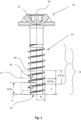
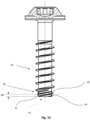
- Fig. 1 shows a side view of a screw 10 according to the invention, comprising a screw center axis M, a drive 12 and a thread-bearing shank 14.
- the direction along the screw center axis M is referred to below as the axial direction.
- the shank 14 carries at least one thread turn 16, which extends in a helix of constant pitch along the shank and thus forms a main thread 18 with a changing profile contour 20.
- the main thread 18 has a mean thread radius R M over its length.
- the mean thread radius R M is the average thread radius across the main thread 18 and will usually lie between the forming area radius and the supporting area radius.
- the mean thread radius R M will therefore approximately correspond to the nominal radius.
- the profile contour 20 is formed by the section of the thread in a section plane H of the helix in which the screw center axis M lies.
- the thread radius R is defined as the maximum orthogonal distance from the screw center axis M to the profile contour 20 of the thread pitch 16. This is Fig. 3a explained in more detail.
- the main thread 18 has a supporting area T and a forming area F, whereby in the forming area a forming profile contour 24 with a forming area radius R F is obtained and in the supporting area T a supporting profile contour 22 with a supporting area radius R T is obtained.
- the shaped profile contour 24 is formed by the projection of the thread 16 along the helix over an axially extending area with a length of three times the mean thread radius (3 x R M ). starting from the free end of the shaft 25 to a cutting plane of the helix H. This is defined in the Fig. 3c described in more detail.
- the projection therefore corresponds to the projection of the straight development of the thread onto the section plane H of the helix, which contains the screw center axis M.
- Fig. 2 shows the screw 10 in side view with the screw center axis M.
- the section plane H is shown, in which the screw center axis M lies.
- the Fig.3 b shows the front view of the development, which corresponds to a section plane of the helix.
- the projection onto the section plane results in the profile contour 24 according to Fig. 3c with a maximum extension that represents the effective form profile contour 24, which then creates the nut thread in the component.
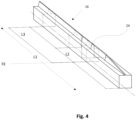
- the forming area F ends at the forming area end FE, i.e. at the point of the main thread 18, at which the maximum extension of the forming profile contour 24 closest to the drive in the range of 85% of the mean thread radius in the radial direction outwards is still present, before the following profile contour in the range up to the end of L1, i.e. the corresponding length of the thread to the length 3 x R M in the axial direction, is again within the forming profile contour 24.
- the position of the forming area end FE is in Fig. 4 shown.
- the form profile contour 24, starting from the beginning of the thread is present for the last time before the profile contour, after a transition area, transitions into the support profile contour 22, which in the present example is maintained over the remaining screw length of the main thread 18.
- the transition area from the forming area F to the support area T is as short as possible.
- the transition area is shorter than L2 in the developed view and less than or equal to 2/3 x R M in the axial direction.
- the support area T has a length of at least L3 - L2 in the developed view, so that a basic holding function of the screw is fulfilled.
- the developed view of the part of the thread 16, which at least partially forms the support area is shown in Fig. 5a shown.
- Fig. 5b shows a front view of the development and Fig. 5c the corresponding projection of the development onto the section plane H of the helix, which defines the support profile contour 22.
- the front view and the projection are identical in this case, since the profile contour in the support area in this case consistently corresponds to the support profile contour 22.
- Fig. 6 It is shown that the support profile contour 22 and the shaped profile contour 24 are matched to one another in such a way that when the support profile contour 22 and the shaped profile contour 24 overlap, at least in the area E, which extends from 85% of the forming area radius R F in the radial direction outwards, the support profile contour 22 lies completely within the shaped profile contour 24.
- An enlargement of the area E is shown in Fig. 7
- the distance A1 between the flanks of the shaped profile contour 24 and the supporting profile contour 22 can be adjusted to the elasticity of the material, but is preferably between 0.03 mm and 0.05 mm, in particular 0.04 mm, for a screw with a nominal diameter of 5 mm. The distance preferably remains constant over the entire flank, at least in area E.
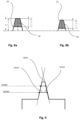
- Fig. 8a shows an enlargement of the area E of the shaped profile contour 24, which delimits a shaped profile surface 26, which is formed radially inwards, measured in a range of 10% of the shaped area radius, starting from the maximum orthogonal distance of the shaped profile contour to the screw center axis.
- Fig. 8b shows an enlargement of the area E of the support profile contour 22, wherein the support profile contour 22 delimits a support profile surface 28, which is in a range of 10% of the forming area radius R F starting from maximum orthogonal distance of the support profile contour, which corresponds to R T , to the screw center axis measured radially inwards.
- the shaped profile surface 26 is larger than the supporting profile surface 28. This has the advantage that even acute flank angles can be realized without excessively stressing the material into which the screw is screwed, and a high extraction force is achieved with a low screwing-in torque.
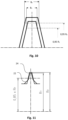
- the flank angle alpha of the form profile contour 24 is, as in Fig. 9 shown. It corresponds to 180° minus the sum of the base angles (beta 1, beta 2) of a trapezoid formed by the base sides of the trapezoid being formed by the intersection lines parallel to the screw axis at 85% of the profile radius RF and at 95% of the profile radius RF .
- Base angles are the angles on the longer base side of the trapezoid, i.e. at the intersection line at 85%.
- the flank angle is less than 35°, especially between 20° and 30°.
- Fig. 10 shows the comparison of the width B F of the shaped profile contour at 95% of the shape radius and the width of the supporting profile contour B T .
- the width B F of the shaped profile contour 24 is greater than the width B T of the supporting profile contour 22.
- the width B T of the support profile contour 22 is approximately 10% smaller than the width B F of the shaped profile contour 24.
- both the shaped profile contour 24 and the support profile contour 22 are symmetrical.
- the axis of symmetry is orthogonal to the screw center axis M, which intersects the profile contours 22 and 24 at half the width B T and B F , respectively.
- Fig. 11 shows a further embodiment of the thread in the supporting area T, wherein the transition from the thread flank to the thread root is flatter than in the previously described figures. Accordingly, the supporting profile contour 22 lies at least partially outside the forming area contour 24 in the area radially within 85% of the forming area radius.
- Fig. 12 shows a further embodiment of a screw according to the invention, wherein the shaft further comprises a thread 30 at the free end of the screw shaft.
- the thread comprises at least two thread turns 32, 34, which in their radius are at most 90% of the Form area radius R F and form an attachment area AB in which the attachment threads 32, 34 have the same radius profile over their associated helix and, in addition, the thread radius of the main thread is less than or equal to the thread radius of the attachment threads at the same axial distance from the free end 25 of the screw.
- the thread pitch 16 of the main thread 18 in the starting area has the same thread radius R as the starting thread 30, while maintaining the same axial distance from the free end of the screw.
- the starting thread pitches 32, 34 begin directly at the free end 25 of the screw shaft at the core. This ensures that ideal guidance of the screw is achieved immediately upon initial insertion.
- the starting thread 30 extends over approximately one turn, with the starting area ending at approximately one-third of a turn.
- the diameter of the free end of the screw shaft corresponds to at least 65% of twice the forming area radius R F .
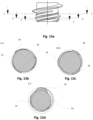
- the starting area is in the Figures 13a to 13d described in more detail.
- Fig. 13a shows an enlarged side view of the free end 25 of the screw shaft with three cross-sectional lines.
- the first cross-sectional line PP lies in the center of the attachment area AB.
- the cross-sectional line QQ lies at the end of the attachment area AB, and the cross-sectional line SS lies above the attachment area.
- Fig. 13b shows the cross section at the cross section line PP.
- all threads in the attachment area namely the two attachment threads 32, 34 and thread pitch 16 have the same thread radius.
- Fig. 13c at the end of the starting area, where all existing threads 16, 32, 34 still have the same thread radius R at the same axial distance from the free end of the screw axis.
- the cross-section along cross-section line SS illustrates the thread radii of the two locating threads 32, 34 and the thread pitch 16 of the main thread outside the locating area AB.
- the thread radii R of the locating threads 32, 34 are significantly smaller than the thread radius of the thread pitch 16 of the main thread 18 at this cross-section line.
- the locating threads taper off gently after the locating area, whereas the main thread pitch continues to grow until it reaches its profile contour.
- Fig. 14 shows a sectional view when creating a screw connection 40.
- the form profile contour 50 is in Fig. 15a
- the following thread with the support profile contour 58 in the support area of the screw is shown in Fig. 15b shown in the detailed view.
- the thread in the nut thread is shown in its spring-backed state with the contour line 56.
- the thread flanks of the support profile contour 58 are still spaced A2 from the spring-backed nut thread despite the spring-back of the nut thread. In this way, the thread of the support area can be screwed into the nut thread with almost no friction. Only when the screw 42 is finally tightened is the thread in the support area pressed against the flank of the nut thread, creating a force-locking connection in the direction of rotation.
Landscapes
- Engineering & Computer Science (AREA)
- General Engineering & Computer Science (AREA)
- Mechanical Engineering (AREA)
- Physics & Mathematics (AREA)
- Geometry (AREA)
- Wood Science & Technology (AREA)
- Chemical & Material Sciences (AREA)
- Dispersion Chemistry (AREA)
- Life Sciences & Earth Sciences (AREA)
- Moulds For Moulding Plastics Or The Like (AREA)
- Surgical Instruments (AREA)
- Injection Moulding Of Plastics Or The Like (AREA)
- Transmission Devices (AREA)
- Closures For Containers (AREA)
- Length-Measuring Instruments Using Mechanical Means (AREA)
- Mutual Connection Of Rods And Tubes (AREA)
- Dowels (AREA)
Applications Claiming Priority (2)
| Application Number | Priority Date | Filing Date | Title |
|---|---|---|---|
| DE102018114984.0A DE102018114984A1 (de) | 2018-06-21 | 2018-06-21 | Schraube zur Verschraubung in Kunststoff |
| PCT/EP2019/066531 WO2019243606A1 (de) | 2018-06-21 | 2019-06-21 | Schraube zur verschraubung in kunststoff |
Publications (3)
| Publication Number | Publication Date |
|---|---|
| EP3810941A1 EP3810941A1 (de) | 2021-04-28 |
| EP3810941B1 true EP3810941B1 (de) | 2025-06-04 |
| EP3810941C0 EP3810941C0 (de) | 2025-06-04 |
Family
ID=67226212
Family Applications (1)
| Application Number | Title | Priority Date | Filing Date |
|---|---|---|---|
| EP19737668.4A Active EP3810941B1 (de) | 2018-06-21 | 2019-06-21 | Schraube zur verschraubung in kunststoff |
Country Status (15)
| Country | Link |
|---|---|
| US (2) | US12372111B2 (pl) |
| EP (1) | EP3810941B1 (pl) |
| JP (2) | JP7633024B2 (pl) |
| KR (1) | KR102891375B1 (pl) |
| CN (1) | CN112313418B (pl) |
| DE (1) | DE102018114984A1 (pl) |
| ES (1) | ES3037908T3 (pl) |
| MX (1) | MX2020013341A (pl) |
| MY (1) | MY208677A (pl) |
| PH (1) | PH12020552201A1 (pl) |
| PL (1) | PL3810941T3 (pl) |
| SG (1) | SG11202012665XA (pl) |
| TW (1) | TWI799603B (pl) |
| WO (1) | WO2019243606A1 (pl) |
| ZA (1) | ZA202007888B (pl) |
Families Citing this family (3)
| Publication number | Priority date | Publication date | Assignee | Title |
|---|---|---|---|---|
| DE102018114984A1 (de) * | 2018-06-21 | 2019-12-24 | Ejot Gmbh & Co. Kg | Schraube zur Verschraubung in Kunststoff |
| CN216241731U (zh) * | 2021-07-29 | 2022-04-08 | 浙江印天健康科技有限公司 | 一种紧固螺钉及使用该紧固螺钉的升降桌 |
| KR20240123504A (ko) | 2023-02-07 | 2024-08-14 | 대동하이렉스 주식회사 | 발포 및 일반 플라스틱 범용 스크루 |
Citations (1)
| Publication number | Priority date | Publication date | Assignee | Title |
|---|---|---|---|---|
| JP2002089525A (ja) * | 2000-09-11 | 2002-03-27 | Shiga Fastener:Kk | ねじ釘 |
Family Cites Families (40)
| Publication number | Priority date | Publication date | Assignee | Title |
|---|---|---|---|---|
| US3426642A (en) * | 1962-02-05 | 1969-02-11 | Res Eng & Mfg | Self-tapping screws with threadforming projections |
| US3351115A (en) | 1965-11-22 | 1967-11-07 | Roger W Boehlow | Thread-forming and fastening screw |
| US3527136A (en) * | 1969-02-27 | 1970-09-08 | Standard Pressed Steel Co | Self-retained thread rolling screw |
| US3861269A (en) * | 1971-01-04 | 1975-01-21 | Superior Dry Wall Screw Mfg Co | Fastener with improved thread construction |
| US3878759A (en) * | 1972-12-29 | 1975-04-22 | Textron Inc | Bi-lobular self-thread forming fastener |
| DE2543960A1 (de) * | 1975-10-02 | 1977-04-07 | Bosch Gmbh Robert | Selbstschneidende befestigungsschraube |
| DE3411319C2 (de) | 1984-03-28 | 1986-12-04 | Boehringer Ingelheim KG, 6507 Ingelheim | Verwendung von Citronensäureestern als Treib- und/oder Nucleierungsmittel zur Herstellung thermoplastischer Kunststoffschäume |
| JP2571805Y2 (ja) * | 1991-05-30 | 1998-05-20 | 日東精工株式会社 | タッピンねじ |
| JPH0741929Y2 (ja) * | 1992-11-27 | 1995-09-27 | 若井産業株式会社 | セルフドリリングタッピングスクリュー |
| US5800107A (en) | 1996-04-19 | 1998-09-01 | Giannuzzi; Louis N. | Self-tapping, screw-type masonry anchor |
| US5795120A (en) | 1996-05-13 | 1998-08-18 | Hurdle; Donald R. | Reduced-friction thread forming or thread cutting screw |
| JPH1162933A (ja) | 1997-08-22 | 1999-03-05 | Nitto Seiko Co Ltd | ね じ |
| JP3469846B2 (ja) * | 1999-07-13 | 2003-11-25 | 株式会社メイドー | 案内ボス部溝付ボルト |
| JP2001107932A (ja) | 1999-10-13 | 2001-04-17 | Fukasawa:Kk | ネ ジ |
| AUPQ919200A0 (en) | 2000-08-04 | 2000-08-24 | Hanstock Fasteners Pty Limited | Improvements relating to screws for concrete and masonry |
| DE10235817B4 (de) | 2002-08-05 | 2004-08-05 | Ejot Gmbh & Co. Kg | Selbstfurchende Schraube |
| JP4064950B2 (ja) | 2004-07-09 | 2008-03-19 | 福井鋲螺株式会社 | 弛み止めねじ |
| JP4792850B2 (ja) | 2005-07-15 | 2011-10-12 | 富士ゼロックス株式会社 | 記録媒体 |
| RU2292491C1 (ru) | 2005-08-10 | 2007-01-27 | Государственное образовательное учреждение высшего профессионального образования Волгоградский государственный технический университет (ВолгГТУ) | Самозапирающийся винт |
| US7255523B2 (en) * | 2005-12-22 | 2007-08-14 | Prime Source Building Products, Inc. | Dual threaded screw for composite materials |
| DE102006037006B4 (de) | 2006-08-08 | 2014-08-07 | TOGE-Dübel A. Gerhard KG | Beton-Schraube |
| EP2176559B1 (en) * | 2007-08-13 | 2014-10-08 | Research Engineering&Manufacturing, Inc. | Thread forming fastener |
| JP5243906B2 (ja) | 2007-09-28 | 2013-07-24 | 日東精工株式会社 | ねじ部品におけるねじ山 |
| CN201461667U (zh) | 2009-09-02 | 2010-05-12 | 赵恩 | 自钻快牙螺钉 |
| TW201137246A (en) * | 2010-04-16 | 2011-11-01 | Kwantex Res Inc | Wood screws |
| JP2012072840A (ja) | 2010-09-29 | 2012-04-12 | Kitamura Seiko Kk | 木ねじ |
| BR112013027465A2 (pt) | 2011-04-28 | 2017-09-19 | Nitto Seiko Kk | parafuso auto-atarraxante |
| US20130058735A1 (en) * | 2011-09-01 | 2013-03-07 | Pen-Chang Yu | Structure of concrete screw |
| US9523383B2 (en) * | 2013-03-26 | 2016-12-20 | Simpson Strong-Tie Company, Inc. | Variable thread fastener |
| US9404524B2 (en) | 2013-07-19 | 2016-08-02 | Conti Fasteners | High performance thread rolling screw/bolt for use in an unthreaded nut anchor |
| EP3147473B1 (en) | 2014-05-23 | 2022-06-29 | Nissan Motor Co., Ltd. | Cooling circuit including an internal combustion engine |
| US20170254352A1 (en) | 2014-11-13 | 2017-09-07 | Essence Method Refine Co., Ltd. | Fastener |
| US9581183B2 (en) * | 2015-02-17 | 2017-02-28 | The Hillman Group, Inc. | Screw-type fastener |
| DE102015120470A1 (de) | 2015-11-26 | 2017-06-01 | Fischerwerke Gmbh & Co. Kg | Betonschraube |
| DE102016103931A1 (de) * | 2016-03-04 | 2017-09-07 | Lisa Dräxlmaier GmbH | Schraube für Bauteile aus geschäumten Kunststoff |
| DE202016002905U1 (de) * | 2016-04-29 | 2017-08-02 | Arnold Umformtechnik Gmbh & Co. Kg | Schraube |
| TWI568939B (zh) * | 2016-05-04 | 2017-02-01 | 徐國泰 | 螺絲 |
| TWI623690B (zh) * | 2017-01-25 | 2018-05-11 | Cement screw | |
| WO2019199430A1 (en) * | 2018-04-09 | 2019-10-17 | The Hillman Group, Inc. | Screw-type fastener for concrete and hurricane resistance applications |
| DE102018114984A1 (de) * | 2018-06-21 | 2019-12-24 | Ejot Gmbh & Co. Kg | Schraube zur Verschraubung in Kunststoff |
-
2018
- 2018-06-21 DE DE102018114984.0A patent/DE102018114984A1/de active Pending
-
2019
- 2019-06-18 TW TW108121140A patent/TWI799603B/zh active
- 2019-06-21 KR KR1020217001884A patent/KR102891375B1/ko active Active
- 2019-06-21 JP JP2020570951A patent/JP7633024B2/ja active Active
- 2019-06-21 PL PL19737668.4T patent/PL3810941T3/pl unknown
- 2019-06-21 WO PCT/EP2019/066531 patent/WO2019243606A1/de not_active Ceased
- 2019-06-21 SG SG11202012665XA patent/SG11202012665XA/en unknown
- 2019-06-21 EP EP19737668.4A patent/EP3810941B1/de active Active
- 2019-06-21 CN CN201980041366.4A patent/CN112313418B/zh active Active
- 2019-06-21 MY MYPI2020006762A patent/MY208677A/en unknown
- 2019-06-21 MX MX2020013341A patent/MX2020013341A/es unknown
- 2019-06-21 ES ES19737668T patent/ES3037908T3/es active Active
- 2019-06-21 US US17/251,795 patent/US12372111B2/en active Active
-
2020
- 2020-12-17 PH PH12020552201A patent/PH12020552201A1/en unknown
- 2020-12-17 ZA ZA2020/07888A patent/ZA202007888B/en unknown
-
2024
- 2024-01-04 JP JP2024000253A patent/JP2024029181A/ja active Pending
-
2025
- 2025-07-21 US US19/275,646 patent/US20260110324A1/en active Pending
Patent Citations (1)
| Publication number | Priority date | Publication date | Assignee | Title |
|---|---|---|---|---|
| JP2002089525A (ja) * | 2000-09-11 | 2002-03-27 | Shiga Fastener:Kk | ねじ釘 |
Also Published As
| Publication number | Publication date |
|---|---|
| CN112313418B (zh) | 2023-03-28 |
| ES3037908T3 (en) | 2025-10-08 |
| KR102891375B1 (ko) | 2025-11-27 |
| WO2019243606A1 (de) | 2019-12-26 |
| CN112313418A (zh) | 2021-02-02 |
| US20260110324A1 (en) | 2026-04-23 |
| EP3810941C0 (de) | 2025-06-04 |
| TW202001110A (zh) | 2020-01-01 |
| JP2024029181A (ja) | 2024-03-05 |
| EP3810941A1 (de) | 2021-04-28 |
| US20210364030A1 (en) | 2021-11-25 |
| MX2020013341A (es) | 2021-02-02 |
| SG11202012665XA (en) | 2021-01-28 |
| JP7633024B2 (ja) | 2025-02-19 |
| MY208677A (en) | 2025-05-23 |
| ZA202007888B (en) | 2025-05-28 |
| PH12020552201A1 (en) | 2021-06-28 |
| US12372111B2 (en) | 2025-07-29 |
| JP2021527786A (ja) | 2021-10-14 |
| PL3810941T3 (pl) | 2025-09-08 |
| KR20210021561A (ko) | 2021-02-26 |
| TWI799603B (zh) | 2023-04-21 |
| BR112020025275A2 (pt) | 2021-03-09 |
| CA3103053A1 (en) | 2019-12-26 |
| DE102018114984A1 (de) | 2019-12-24 |
Similar Documents
| Publication | Publication Date | Title |
|---|---|---|
| DE4333791C2 (de) | Gewindeschneidschraube | |
| DE2907360C2 (de) | Gewindeformende Schraube und Rohling zu deren Herstellung | |
| DE60317842T2 (de) | Befestiger mit mehrfach buckligem Gewinde | |
| EP3976977B1 (de) | Verbindungselement | |
| DE2917811A1 (de) | Gewindeformende schraube | |
| DE2461546A1 (de) | Gewindeformende schraube | |
| EP3405686B1 (de) | Kunststoff-gewindeelement sowie verbindungsanordnung bestehend aus einem kunststoffträgerteil und einem kunststoff-gewindeelement | |
| DE10003619A1 (de) | Mutterneinheit | |
| WO2019243606A1 (de) | Schraube zur verschraubung in kunststoff | |
| DE3117624A1 (de) | Selbstformende universalschraube | |
| EP3810942B1 (de) | Selbstfurchende schraube | |
| DE4108771A1 (de) | Spanplattenschraube | |
| DE102009005336A1 (de) | Schraubenelement, Schraubverbindung sowie Verfahren zum Herstellen eines Schraubenelementes | |
| EP3004665A1 (de) | Gewindeformer und walzbacken | |
| DE69715944T2 (de) | Verfahren zur Herstellung von Gewindebolzen oder Gewindezugstangen | |
| EP2261517A1 (de) | Furchschraube | |
| EP4577750B1 (de) | Schraube für die direktverschraubung in ein bauteil | |
| EP4069986B1 (de) | Buchse mit freigestelltem gewindeabschnitt zur aufnahme eines befestigungselements | |
| DE102008057552A1 (de) | Kunststoff-Bauteil mit einem Einsteckloch für einen Haltezapfen mit Verankerungsrippen | |
| EP4577749A1 (de) | Schraube für die direktverschraubung in ein bauteil | |
| WO2017186838A1 (de) | Schraube zum einfurchen eines gewindes | |
| DE102017103073A1 (de) | Werkzeug zum Gewindewalzen einer gewindeformenden Schraube, Verfahren zum Herstellen einer lochformenden und/oder gewindeformenden Schraube, sowie eine gewindeformende und/oder lochformende Schraube | |
| DE102017002069A1 (de) | Einschraubdübel und Befestigungssystem mit einem Einschraubdübel | |
| DE202024103005U1 (de) | Herstellungsoptimiertes Gewindebauteil | |
| DE102023110239A1 (de) | Holzschraube |
Legal Events
| Date | Code | Title | Description |
|---|---|---|---|
| STAA | Information on the status of an ep patent application or granted ep patent |
Free format text: STATUS: UNKNOWN |
|
| STAA | Information on the status of an ep patent application or granted ep patent |
Free format text: STATUS: THE INTERNATIONAL PUBLICATION HAS BEEN MADE |
|
| PUAI | Public reference made under article 153(3) epc to a published international application that has entered the european phase |
Free format text: ORIGINAL CODE: 0009012 |
|
| STAA | Information on the status of an ep patent application or granted ep patent |
Free format text: STATUS: REQUEST FOR EXAMINATION WAS MADE |
|
| 17P | Request for examination filed |
Effective date: 20210119 |
|
| AK | Designated contracting states |
Kind code of ref document: A1 Designated state(s): AL AT BE BG CH CY CZ DE DK EE ES FI FR GB GR HR HU IE IS IT LI LT LU LV MC MK MT NL NO PL PT RO RS SE SI SK SM TR |
|
| AX | Request for extension of the european patent |
Extension state: BA ME |
|
| RIN1 | Information on inventor provided before grant (corrected) |
Inventor name: ACHENBACH, MICHAEL Inventor name: BIRKELBACH, RALF Inventor name: DIECKMANN, VOLKER Inventor name: DRATSCHMIDT, FRANK Inventor name: HELLMIG, RALPH J. Inventor name: SELIMI, ILIR Inventor name: WEITZEL, STEPHAN Inventor name: HACKLER, JAN Inventor name: BEHLE, JUERGEN Inventor name: GERBER, RENE |
|
| DAV | Request for validation of the european patent (deleted) | ||
| DAX | Request for extension of the european patent (deleted) | ||
| STAA | Information on the status of an ep patent application or granted ep patent |
Free format text: STATUS: EXAMINATION IS IN PROGRESS |
|
| 17Q | First examination report despatched |
Effective date: 20230315 |
|
| RAP1 | Party data changed (applicant data changed or rights of an application transferred) |
Owner name: EJOT SE & CO. KG |
|
| GRAP | Despatch of communication of intention to grant a patent |
Free format text: ORIGINAL CODE: EPIDOSNIGR1 |
|
| STAA | Information on the status of an ep patent application or granted ep patent |
Free format text: STATUS: GRANT OF PATENT IS INTENDED |
|
| INTG | Intention to grant announced |
Effective date: 20240816 |
|
| GRAJ | Information related to disapproval of communication of intention to grant by the applicant or resumption of examination proceedings by the epo deleted |
Free format text: ORIGINAL CODE: EPIDOSDIGR1 |
|
| STAA | Information on the status of an ep patent application or granted ep patent |
Free format text: STATUS: EXAMINATION IS IN PROGRESS |
|
| GRAP | Despatch of communication of intention to grant a patent |
Free format text: ORIGINAL CODE: EPIDOSNIGR1 |
|
| STAA | Information on the status of an ep patent application or granted ep patent |
Free format text: STATUS: GRANT OF PATENT IS INTENDED |
|
| INTG | Intention to grant announced |
Effective date: 20250102 |
|
| GRAS | Grant fee paid |
Free format text: ORIGINAL CODE: EPIDOSNIGR3 |
|
| GRAA | (expected) grant |
Free format text: ORIGINAL CODE: 0009210 |
|
| STAA | Information on the status of an ep patent application or granted ep patent |
Free format text: STATUS: THE PATENT HAS BEEN GRANTED |
|
| AK | Designated contracting states |
Kind code of ref document: B1 Designated state(s): AL AT BE BG CH CY CZ DE DK EE ES FI FR GB GR HR HU IE IS IT LI LT LU LV MC MK MT NL NO PL PT RO RS SE SI SK SM TR |
|
| REG | Reference to a national code |
Ref country code: GB Ref legal event code: FG4D Free format text: NOT ENGLISH |
|
| REG | Reference to a national code |
Ref country code: CH Ref legal event code: EP |
|
| REG | Reference to a national code |
Ref country code: DE Ref legal event code: R096 Ref document number: 502019013410 Country of ref document: DE |
|
| REG | Reference to a national code |
Ref country code: IE Ref legal event code: FG4D Free format text: LANGUAGE OF EP DOCUMENT: GERMAN |
|
| U01 | Request for unitary effect filed |
Effective date: 20250606 |
|
| U07 | Unitary effect registered |
Designated state(s): AT BE BG DE DK EE FI FR IT LT LU LV MT NL PT RO SE SI Effective date: 20250702 |
|
| U20 | Renewal fee for the european patent with unitary effect paid |
Year of fee payment: 7 Effective date: 20250730 |
|
| REG | Reference to a national code |
Ref country code: ES Ref legal event code: FG2A Ref document number: 3037908 Country of ref document: ES Kind code of ref document: T3 Effective date: 20251008 |
|
| PGFP | Annual fee paid to national office [announced via postgrant information from national office to epo] |
Ref country code: ES Payment date: 20250829 Year of fee payment: 7 |
|
| PG25 | Lapsed in a contracting state [announced via postgrant information from national office to epo] |
Ref country code: NO Free format text: LAPSE BECAUSE OF FAILURE TO SUBMIT A TRANSLATION OF THE DESCRIPTION OR TO PAY THE FEE WITHIN THE PRESCRIBED TIME-LIMIT Effective date: 20250904 Ref country code: GR Free format text: LAPSE BECAUSE OF FAILURE TO SUBMIT A TRANSLATION OF THE DESCRIPTION OR TO PAY THE FEE WITHIN THE PRESCRIBED TIME-LIMIT Effective date: 20250905 |
|
| PG25 | Lapsed in a contracting state [announced via postgrant information from national office to epo] |
Ref country code: HR Free format text: LAPSE BECAUSE OF FAILURE TO SUBMIT A TRANSLATION OF THE DESCRIPTION OR TO PAY THE FEE WITHIN THE PRESCRIBED TIME-LIMIT Effective date: 20250604 |
|
| PGFP | Annual fee paid to national office [announced via postgrant information from national office to epo] |
Ref country code: CH Payment date: 20250828 Year of fee payment: 7 |
|
| PG25 | Lapsed in a contracting state [announced via postgrant information from national office to epo] |
Ref country code: RS Free format text: LAPSE BECAUSE OF FAILURE TO SUBMIT A TRANSLATION OF THE DESCRIPTION OR TO PAY THE FEE WITHIN THE PRESCRIBED TIME-LIMIT Effective date: 20250904 |
|
| PG25 | Lapsed in a contracting state [announced via postgrant information from national office to epo] |
Ref country code: IS Free format text: LAPSE BECAUSE OF FAILURE TO SUBMIT A TRANSLATION OF THE DESCRIPTION OR TO PAY THE FEE WITHIN THE PRESCRIBED TIME-LIMIT Effective date: 20251004 |
|
| PG25 | Lapsed in a contracting state [announced via postgrant information from national office to epo] |
Ref country code: SM Free format text: LAPSE BECAUSE OF FAILURE TO SUBMIT A TRANSLATION OF THE DESCRIPTION OR TO PAY THE FEE WITHIN THE PRESCRIBED TIME-LIMIT Effective date: 20250604 |
|
| PG25 | Lapsed in a contracting state [announced via postgrant information from national office to epo] |
Ref country code: SK Free format text: LAPSE BECAUSE OF FAILURE TO SUBMIT A TRANSLATION OF THE DESCRIPTION OR TO PAY THE FEE WITHIN THE PRESCRIBED TIME-LIMIT Effective date: 20250604 |
|
| PG25 | Lapsed in a contracting state [announced via postgrant information from national office to epo] |
Ref country code: MC Free format text: LAPSE BECAUSE OF FAILURE TO SUBMIT A TRANSLATION OF THE DESCRIPTION OR TO PAY THE FEE WITHIN THE PRESCRIBED TIME-LIMIT Effective date: 20250604 |
|
| PLBE | No opposition filed within time limit |
Free format text: ORIGINAL CODE: 0009261 |
|
| STAA | Information on the status of an ep patent application or granted ep patent |
Free format text: STATUS: NO OPPOSITION FILED WITHIN TIME LIMIT |
|
| PG25 | Lapsed in a contracting state [announced via postgrant information from national office to epo] |
Ref country code: IE Free format text: LAPSE BECAUSE OF NON-PAYMENT OF DUE FEES Effective date: 20250621 |
|
| REG | Reference to a national code |
Ref country code: CH Ref legal event code: L10 Free format text: ST27 STATUS EVENT CODE: U-0-0-L10-L00 (AS PROVIDED BY THE NATIONAL OFFICE) Effective date: 20260416 |
|
| 26N | No opposition filed |
Effective date: 20260305 |
|
| REG | Reference to a national code |
Ref country code: CH Ref legal event code: U11 Free format text: ST27 STATUS EVENT CODE: U-0-0-U10-U11 (AS PROVIDED BY THE NATIONAL OFFICE) Effective date: 20260701 |
|
| PGFP | Annual fee paid to national office [announced via postgrant information from national office to epo] |
Ref country code: GB Payment date: 20260623 Year of fee payment: 8 Ref country code: PL Payment date: 20260609 Year of fee payment: 8 |
|
| PGFP | Annual fee paid to national office [announced via postgrant information from national office to epo] |
Ref country code: CZ Payment date: 20260609 Year of fee payment: 8 |
|
| U20 | Renewal fee for the european patent with unitary effect paid |
Year of fee payment: 8 Effective date: 20260629 |
|
| PG25 | Lapsed in a contracting state [announced via postgrant information from national office to epo] |
Ref country code: CY Free format text: LAPSE BECAUSE OF FAILURE TO SUBMIT A TRANSLATION OF THE DESCRIPTION OR TO PAY THE FEE WITHIN THE PRESCRIBED TIME-LIMIT Effective date: 20250604 |