EP3750876A1 - Verfahren zur herstellung von triacetonamin, 2,2,4,6-tetramethylpiperidin und/oder den salzen des 2,2,4,6-tetramethylpiperidins - Google Patents
Verfahren zur herstellung von triacetonamin, 2,2,4,6-tetramethylpiperidin und/oder den salzen des 2,2,4,6-tetramethylpiperidins Download PDFInfo
- Publication number
- EP3750876A1 EP3750876A1 EP19179843.8A EP19179843A EP3750876A1 EP 3750876 A1 EP3750876 A1 EP 3750876A1 EP 19179843 A EP19179843 A EP 19179843A EP 3750876 A1 EP3750876 A1 EP 3750876A1
- Authority
- EP
- European Patent Office
- Prior art keywords
- group
- tetramethylpiperidine
- iso
- mesityl oxide
- weight
- Prior art date
- Legal status (The legal status is an assumption and is not a legal conclusion. Google has not performed a legal analysis and makes no representation as to the accuracy of the status listed.)
- Withdrawn
Links
- 238000000034 method Methods 0.000 title claims abstract description 84
- JWUXJYZVKZKLTJ-UHFFFAOYSA-N Triacetonamine Chemical compound CC1(C)CC(=O)CC(C)(C)N1 JWUXJYZVKZKLTJ-UHFFFAOYSA-N 0.000 title claims abstract description 35
- NGBCPOUXXDBLMT-UHFFFAOYSA-N 2,2,4,6-tetramethylpiperidine Chemical compound CC1CC(C)NC(C)(C)C1 NGBCPOUXXDBLMT-UHFFFAOYSA-N 0.000 title claims abstract description 31
- 150000003839 salts Chemical class 0.000 title abstract description 11
- 239000012043 crude product Substances 0.000 claims abstract description 28
- LOKZDHRCJWJADP-UHFFFAOYSA-N 2,2,4,6-tetramethyl-3h-pyridine Chemical compound CC1=CC(C)=NC(C)(C)C1 LOKZDHRCJWJADP-UHFFFAOYSA-N 0.000 claims abstract description 8
- 238000002360 preparation method Methods 0.000 claims abstract description 6
- CSCPPACGZOOCGX-UHFFFAOYSA-N Acetone Chemical compound CC(C)=O CSCPPACGZOOCGX-UHFFFAOYSA-N 0.000 claims description 96
- JUJWROOIHBZHMG-UHFFFAOYSA-N Pyridine Chemical compound C1=CC=NC=C1 JUJWROOIHBZHMG-UHFFFAOYSA-N 0.000 claims description 67
- SHOJXDKTYKFBRD-UHFFFAOYSA-N mesityl oxide Natural products CC(C)=CC(C)=O SHOJXDKTYKFBRD-UHFFFAOYSA-N 0.000 claims description 60
- QGZKDVFQNNGYKY-UHFFFAOYSA-N Ammonia Chemical compound N QGZKDVFQNNGYKY-UHFFFAOYSA-N 0.000 claims description 55
- OZXIZRZFGJZWBF-UHFFFAOYSA-N 1,3,5-trimethyl-2-(2,4,6-trimethylphenoxy)benzene Chemical compound CC1=CC(C)=CC(C)=C1OC1=C(C)C=C(C)C=C1C OZXIZRZFGJZWBF-UHFFFAOYSA-N 0.000 claims description 54
- 239000003054 catalyst Substances 0.000 claims description 45
- 229910052751 metal Inorganic materials 0.000 claims description 45
- 239000002184 metal Substances 0.000 claims description 45
- 238000006243 chemical reaction Methods 0.000 claims description 35
- 238000004821 distillation Methods 0.000 claims description 35
- WYURNTSHIVDZCO-UHFFFAOYSA-N Tetrahydrofuran Chemical compound C1CCOC1 WYURNTSHIVDZCO-UHFFFAOYSA-N 0.000 claims description 34
- 239000002904 solvent Substances 0.000 claims description 33
- RTZKZFJDLAIYFH-UHFFFAOYSA-N Diethyl ether Chemical compound CCOCC RTZKZFJDLAIYFH-UHFFFAOYSA-N 0.000 claims description 30
- YXFVVABEGXRONW-UHFFFAOYSA-N Toluene Chemical compound CC1=CC=CC=C1 YXFVVABEGXRONW-UHFFFAOYSA-N 0.000 claims description 27
- 229910021529 ammonia Inorganic materials 0.000 claims description 27
- UHOVQNZJYSORNB-UHFFFAOYSA-N Benzene Chemical compound C1=CC=CC=C1 UHOVQNZJYSORNB-UHFFFAOYSA-N 0.000 claims description 24
- YMWUJEATGCHHMB-UHFFFAOYSA-N Dichloromethane Chemical compound ClCCl YMWUJEATGCHHMB-UHFFFAOYSA-N 0.000 claims description 24
- VLKZOEOYAKHREP-UHFFFAOYSA-N n-Hexane Chemical compound CCCCCC VLKZOEOYAKHREP-UHFFFAOYSA-N 0.000 claims description 24
- SECXISVLQFMRJM-UHFFFAOYSA-N N-Methylpyrrolidone Chemical compound CN1CCCC1=O SECXISVLQFMRJM-UHFFFAOYSA-N 0.000 claims description 20
- QMMFVYPAHWMCMS-UHFFFAOYSA-N Dimethyl sulfide Chemical compound CSC QMMFVYPAHWMCMS-UHFFFAOYSA-N 0.000 claims description 18
- NTIZESTWPVYFNL-UHFFFAOYSA-N Methyl isobutyl ketone Chemical compound CC(C)CC(C)=O NTIZESTWPVYFNL-UHFFFAOYSA-N 0.000 claims description 18
- ZMANZCXQSJIPKH-UHFFFAOYSA-N Triethylamine Chemical compound CCN(CC)CC ZMANZCXQSJIPKH-UHFFFAOYSA-N 0.000 claims description 18
- 238000009835 boiling Methods 0.000 claims description 18
- 229910052725 zinc Inorganic materials 0.000 claims description 18
- 150000001875 compounds Chemical class 0.000 claims description 17
- YLQBMQCUIZJEEH-UHFFFAOYSA-N tetrahydrofuran Natural products C=1C=COC=1 YLQBMQCUIZJEEH-UHFFFAOYSA-N 0.000 claims description 17
- IMNFDUFMRHMDMM-UHFFFAOYSA-N N-Heptane Chemical compound CCCCCCC IMNFDUFMRHMDMM-UHFFFAOYSA-N 0.000 claims description 16
- OFBQJSOFQDEBGM-UHFFFAOYSA-N Pentane Chemical compound CCCCC OFBQJSOFQDEBGM-UHFFFAOYSA-N 0.000 claims description 16
- 229910052749 magnesium Inorganic materials 0.000 claims description 16
- 229910052709 silver Inorganic materials 0.000 claims description 16
- 229910052802 copper Inorganic materials 0.000 claims description 15
- -1 hydrocarbon radical Chemical class 0.000 claims description 14
- UIHCLUNTQKBZGK-UHFFFAOYSA-N Methyl isobutyl ketone Natural products CCC(C)C(C)=O UIHCLUNTQKBZGK-UHFFFAOYSA-N 0.000 claims description 13
- 239000002638 heterogeneous catalyst Substances 0.000 claims description 12
- 125000000217 alkyl group Chemical group 0.000 claims description 11
- 229910052739 hydrogen Inorganic materials 0.000 claims description 11
- 239000001257 hydrogen Substances 0.000 claims description 11
- 150000002902 organometallic compounds Chemical class 0.000 claims description 11
- UMJSCPRVCHMLSP-UHFFFAOYSA-N pyridine Natural products COC1=CC=CN=C1 UMJSCPRVCHMLSP-UHFFFAOYSA-N 0.000 claims description 11
- ZFPGARUNNKGOBB-UHFFFAOYSA-N 1-Ethyl-2-pyrrolidinone Chemical compound CCN1CCCC1=O ZFPGARUNNKGOBB-UHFFFAOYSA-N 0.000 claims description 10
- BNXZHVUCNYMNOS-UHFFFAOYSA-N 1-butylpyrrolidin-2-one Chemical compound CCCCN1CCCC1=O BNXZHVUCNYMNOS-UHFFFAOYSA-N 0.000 claims description 10
- BZLVMXJERCGZMT-UHFFFAOYSA-N Methyl tert-butyl ether Chemical compound COC(C)(C)C BZLVMXJERCGZMT-UHFFFAOYSA-N 0.000 claims description 10
- 229910052801 chlorine Inorganic materials 0.000 claims description 10
- GNOIPBMMFNIUFM-UHFFFAOYSA-N hexamethylphosphoric triamide Chemical compound CN(C)P(=O)(N(C)C)N(C)C GNOIPBMMFNIUFM-UHFFFAOYSA-N 0.000 claims description 10
- 229910052794 bromium Inorganic materials 0.000 claims description 9
- 229910052740 iodine Inorganic materials 0.000 claims description 9
- 238000000926 separation method Methods 0.000 claims description 9
- DURPTKYDGMDSBL-UHFFFAOYSA-N 1-butoxybutane Chemical compound CCCCOCCCC DURPTKYDGMDSBL-UHFFFAOYSA-N 0.000 claims description 8
- 239000004215 Carbon black (E152) Substances 0.000 claims description 8
- XDTMQSROBMDMFD-UHFFFAOYSA-N Cyclohexane Chemical compound C1CCCCC1 XDTMQSROBMDMFD-UHFFFAOYSA-N 0.000 claims description 8
- CTQNGGLPUBDAKN-UHFFFAOYSA-N O-Xylene Chemical compound CC1=CC=CC=C1C CTQNGGLPUBDAKN-UHFFFAOYSA-N 0.000 claims description 8
- 239000003153 chemical reaction reagent Substances 0.000 claims description 8
- 229930195733 hydrocarbon Natural products 0.000 claims description 8
- 229910052744 lithium Inorganic materials 0.000 claims description 8
- 239000008096 xylene Substances 0.000 claims description 8
- 125000003118 aryl group Chemical group 0.000 claims description 7
- 229910052726 zirconium Inorganic materials 0.000 claims description 7
- WSLDOOZREJYCGB-UHFFFAOYSA-N 1,2-Dichloroethane Chemical compound ClCCCl WSLDOOZREJYCGB-UHFFFAOYSA-N 0.000 claims description 6
- RYHBNJHYFVUHQT-UHFFFAOYSA-N 1,4-Dioxane Chemical compound C1COCCO1 RYHBNJHYFVUHQT-UHFFFAOYSA-N 0.000 claims description 6
- JWUJQDFVADABEY-UHFFFAOYSA-N 2-methyltetrahydrofuran Chemical compound CC1CCCO1 JWUJQDFVADABEY-UHFFFAOYSA-N 0.000 claims description 6
- 125000006414 CCl Chemical group ClC* 0.000 claims description 6
- HTIRHQRTDBPHNZ-UHFFFAOYSA-N Dibutyl sulfide Chemical compound CCCCSCCCC HTIRHQRTDBPHNZ-UHFFFAOYSA-N 0.000 claims description 6
- XTHFKEDIFFGKHM-UHFFFAOYSA-N Dimethoxyethane Chemical compound COCCOC XTHFKEDIFFGKHM-UHFFFAOYSA-N 0.000 claims description 6
- UFHFLCQGNIYNRP-UHFFFAOYSA-N Hydrogen Chemical compound [H][H] UFHFLCQGNIYNRP-UHFFFAOYSA-N 0.000 claims description 6
- JGFZNNIVVJXRND-UHFFFAOYSA-N N,N-Diisopropylethylamine (DIPEA) Chemical compound CCN(C(C)C)C(C)C JGFZNNIVVJXRND-UHFFFAOYSA-N 0.000 claims description 6
- 125000003342 alkenyl group Chemical group 0.000 claims description 6
- 125000000304 alkynyl group Chemical group 0.000 claims description 6
- 229910052731 fluorine Inorganic materials 0.000 claims description 6
- 125000001072 heteroaryl group Chemical group 0.000 claims description 6
- 150000002431 hydrogen Chemical class 0.000 claims description 6
- GUVUOGQBMYCBQP-UHFFFAOYSA-N dmpu Chemical compound CN1CCCN(C)C1=O GUVUOGQBMYCBQP-UHFFFAOYSA-N 0.000 claims description 5
- 125000005842 heteroatom Chemical group 0.000 claims description 5
- 229910052719 titanium Inorganic materials 0.000 claims description 5
- 229910020366 ClO 4 Inorganic materials 0.000 claims description 4
- 229910052793 cadmium Inorganic materials 0.000 claims description 4
- 150000007942 carboxylates Chemical class 0.000 claims description 4
- 125000000753 cycloalkyl group Chemical group 0.000 claims description 4
- 229910052737 gold Inorganic materials 0.000 claims description 4
- 229910052753 mercury Inorganic materials 0.000 claims description 4
- 125000003107 substituted aryl group Chemical group 0.000 claims description 4
- 150000007944 thiolates Chemical class 0.000 claims description 4
- 239000006227 byproduct Substances 0.000 abstract description 19
- 239000000047 product Substances 0.000 abstract description 16
- 125000002524 organometallic group Chemical group 0.000 abstract description 7
- GCICAPWZNUIIDV-UHFFFAOYSA-N lithium magnesium Chemical compound [Li].[Mg] GCICAPWZNUIIDV-UHFFFAOYSA-N 0.000 abstract description 4
- 238000006263 metalation reaction Methods 0.000 abstract description 4
- 238000007306 functionalization reaction Methods 0.000 abstract description 3
- KWGKDLIKAYFUFQ-UHFFFAOYSA-M lithium chloride Chemical compound [Li+].[Cl-] KWGKDLIKAYFUFQ-UHFFFAOYSA-M 0.000 description 30
- CQTRUFMMCCOKTA-UHFFFAOYSA-N 4-amino-4-methylpentan-2-one Chemical compound CC(=O)CC(C)(C)N CQTRUFMMCCOKTA-UHFFFAOYSA-N 0.000 description 28
- SWXVUIWOUIDPGS-UHFFFAOYSA-N diacetone alcohol Chemical compound CC(=O)CC(C)(C)O SWXVUIWOUIDPGS-UHFFFAOYSA-N 0.000 description 28
- 229910052750 molybdenum Inorganic materials 0.000 description 26
- PXHVJJICTQNCMI-UHFFFAOYSA-N nickel Substances [Ni] PXHVJJICTQNCMI-UHFFFAOYSA-N 0.000 description 25
- PIFBMJMXJMZZRG-UHFFFAOYSA-N 2,2,4,6,6-pentamethyl-1,5-dihydropyrimidine Chemical compound CC1=NC(C)(C)NC(C)(C)C1 PIFBMJMXJMZZRG-UHFFFAOYSA-N 0.000 description 19
- 230000015572 biosynthetic process Effects 0.000 description 18
- 229910052804 chromium Inorganic materials 0.000 description 18
- XEEYBQQBJWHFJM-UHFFFAOYSA-N iron Substances [Fe] XEEYBQQBJWHFJM-UHFFFAOYSA-N 0.000 description 17
- 239000011777 magnesium Substances 0.000 description 17
- HJOVHMDZYOCNQW-UHFFFAOYSA-N isophorone Chemical compound CC1=CC(=O)CC(C)(C)C1 HJOVHMDZYOCNQW-UHFFFAOYSA-N 0.000 description 16
- 239000000203 mixture Substances 0.000 description 16
- 238000003786 synthesis reaction Methods 0.000 description 16
- OKKJLVBELUTLKV-UHFFFAOYSA-N Methanol Chemical compound OC OKKJLVBELUTLKV-UHFFFAOYSA-N 0.000 description 15
- 150000001412 amines Chemical class 0.000 description 15
- 239000010949 copper Substances 0.000 description 13
- 229910052759 nickel Inorganic materials 0.000 description 13
- MTZWHHIREPJPTG-UHFFFAOYSA-N phorone Chemical compound CC(C)=CC(=O)C=C(C)C MTZWHHIREPJPTG-UHFFFAOYSA-N 0.000 description 13
- KDLHZDBZIXYQEI-UHFFFAOYSA-N palladium Substances [Pd] KDLHZDBZIXYQEI-UHFFFAOYSA-N 0.000 description 12
- HBAQYPYDRFILMT-UHFFFAOYSA-N 8-[3-(1-cyclopropylpyrazol-4-yl)-1H-pyrazolo[4,3-d]pyrimidin-5-yl]-3-methyl-3,8-diazabicyclo[3.2.1]octan-2-one Chemical class C1(CC1)N1N=CC(=C1)C1=NNC2=C1N=C(N=C2)N1C2C(N(CC1CC2)C)=O HBAQYPYDRFILMT-UHFFFAOYSA-N 0.000 description 11
- 239000002253 acid Substances 0.000 description 11
- CCERQOYLJJULMD-UHFFFAOYSA-M magnesium;carbanide;chloride Chemical compound [CH3-].[Mg+2].[Cl-] CCERQOYLJJULMD-UHFFFAOYSA-M 0.000 description 11
- RYEXTBOQKFUPOE-UHFFFAOYSA-M magnesium;propane;chloride Chemical compound [Mg+2].[Cl-].CC[CH2-] RYEXTBOQKFUPOE-UHFFFAOYSA-M 0.000 description 11
- 150000002739 metals Chemical class 0.000 description 10
- 239000000126 substance Substances 0.000 description 10
- 150000007513 acids Chemical class 0.000 description 9
- 229910017052 cobalt Inorganic materials 0.000 description 9
- 239000010941 cobalt Substances 0.000 description 9
- GUTLYIVDDKVIGB-UHFFFAOYSA-N cobalt atom Chemical compound [Co] GUTLYIVDDKVIGB-UHFFFAOYSA-N 0.000 description 9
- 229910052742 iron Inorganic materials 0.000 description 9
- 229910052763 palladium Inorganic materials 0.000 description 9
- 229920002223 polystyrene Polymers 0.000 description 9
- RYGMFSIKBFXOCR-UHFFFAOYSA-N Copper Chemical compound [Cu] RYGMFSIKBFXOCR-UHFFFAOYSA-N 0.000 description 8
- 229920000557 Nafion® Polymers 0.000 description 8
- 239000007868 Raney catalyst Substances 0.000 description 8
- 229910000564 Raney nickel Inorganic materials 0.000 description 8
- BQCADISMDOOEFD-UHFFFAOYSA-N Silver Chemical compound [Ag] BQCADISMDOOEFD-UHFFFAOYSA-N 0.000 description 8
- 238000004519 manufacturing process Methods 0.000 description 8
- 229910052697 platinum Inorganic materials 0.000 description 8
- BASFCYQUMIYNBI-UHFFFAOYSA-N platinum Substances [Pt] BASFCYQUMIYNBI-UHFFFAOYSA-N 0.000 description 8
- 239000004332 silver Substances 0.000 description 8
- 239000007858 starting material Substances 0.000 description 8
- 239000004793 Polystyrene Substances 0.000 description 7
- 229910052782 aluminium Inorganic materials 0.000 description 7
- 230000003197 catalytic effect Effects 0.000 description 7
- 239000007859 condensation product Substances 0.000 description 7
- XLYOFNOQVPJJNP-UHFFFAOYSA-N water Substances O XLYOFNOQVPJJNP-UHFFFAOYSA-N 0.000 description 7
- NLXLAEXVIDQMFP-UHFFFAOYSA-N Ammonia chloride Chemical compound [NH4+].[Cl-] NLXLAEXVIDQMFP-UHFFFAOYSA-N 0.000 description 6
- OKTJSMMVPCPJKN-UHFFFAOYSA-N Carbon Chemical group [C] OKTJSMMVPCPJKN-UHFFFAOYSA-N 0.000 description 6
- XEKOWRVHYACXOJ-UHFFFAOYSA-N Ethyl acetate Chemical compound CCOC(C)=O XEKOWRVHYACXOJ-UHFFFAOYSA-N 0.000 description 6
- VYPSYNLAJGMNEJ-UHFFFAOYSA-N Silicium dioxide Chemical compound O=[Si]=O VYPSYNLAJGMNEJ-UHFFFAOYSA-N 0.000 description 6
- HEMHJVSKTPXQMS-UHFFFAOYSA-M Sodium hydroxide Chemical compound [OH-].[Na+] HEMHJVSKTPXQMS-UHFFFAOYSA-M 0.000 description 6
- 230000002378 acidificating effect Effects 0.000 description 6
- 125000001931 aliphatic group Chemical group 0.000 description 6
- 229920001429 chelating resin Polymers 0.000 description 6
- 239000012039 electrophile Substances 0.000 description 6
- 239000007789 gas Substances 0.000 description 6
- 238000004817 gas chromatography Methods 0.000 description 6
- 238000005984 hydrogenation reaction Methods 0.000 description 6
- 229910052710 silicon Inorganic materials 0.000 description 6
- PAWQVTBBRAZDMG-UHFFFAOYSA-N 2-(3-bromo-2-fluorophenyl)acetic acid Chemical compound OC(=O)CC1=CC=CC(Br)=C1F PAWQVTBBRAZDMG-UHFFFAOYSA-N 0.000 description 5
- LFQSCWFLJHTTHZ-UHFFFAOYSA-N Ethanol Chemical compound CCO LFQSCWFLJHTTHZ-UHFFFAOYSA-N 0.000 description 5
- 150000003863 ammonium salts Chemical class 0.000 description 5
- 125000004122 cyclic group Chemical group 0.000 description 5
- UAOMVDZJSHZZME-UHFFFAOYSA-N diisopropylamine Chemical compound CC(C)NC(C)C UAOMVDZJSHZZME-UHFFFAOYSA-N 0.000 description 5
- 229910052748 manganese Inorganic materials 0.000 description 5
- 229910052703 rhodium Inorganic materials 0.000 description 5
- 229910052707 ruthenium Inorganic materials 0.000 description 5
- 239000010944 silver (metal) Substances 0.000 description 5
- HEDRZPFGACZZDS-UHFFFAOYSA-N Chloroform Chemical compound ClC(Cl)Cl HEDRZPFGACZZDS-UHFFFAOYSA-N 0.000 description 4
- VEXZGXHMUGYJMC-UHFFFAOYSA-N Hydrochloric acid Chemical compound Cl VEXZGXHMUGYJMC-UHFFFAOYSA-N 0.000 description 4
- KFZMGEQAYNKOFK-UHFFFAOYSA-N Isopropanol Chemical compound CC(C)O KFZMGEQAYNKOFK-UHFFFAOYSA-N 0.000 description 4
- 239000002841 Lewis acid Substances 0.000 description 4
- LRHPLDYGYMQRHN-UHFFFAOYSA-N N-Butanol Chemical compound CCCCO LRHPLDYGYMQRHN-UHFFFAOYSA-N 0.000 description 4
- NQRYJNQNLNOLGT-UHFFFAOYSA-N Piperidine Chemical compound C1CCNCC1 NQRYJNQNLNOLGT-UHFFFAOYSA-N 0.000 description 4
- KAESVJOAVNADME-UHFFFAOYSA-N Pyrrole Chemical compound C=1C=CNC=1 KAESVJOAVNADME-UHFFFAOYSA-N 0.000 description 4
- QAOWNCQODCNURD-UHFFFAOYSA-N Sulfuric acid Chemical compound OS(O)(=O)=O QAOWNCQODCNURD-UHFFFAOYSA-N 0.000 description 4
- DKGAVHZHDRPRBM-UHFFFAOYSA-N Tert-Butanol Chemical compound CC(C)(C)O DKGAVHZHDRPRBM-UHFFFAOYSA-N 0.000 description 4
- 229910045601 alloy Inorganic materials 0.000 description 4
- 239000000956 alloy Substances 0.000 description 4
- 229920001577 copolymer Polymers 0.000 description 4
- DIOQZVSQGTUSAI-UHFFFAOYSA-N decane Chemical compound CCCCCCCCCC DIOQZVSQGTUSAI-UHFFFAOYSA-N 0.000 description 4
- JQVDAXLFBXTEQA-UHFFFAOYSA-N dibutylamine Chemical compound CCCCNCCCC JQVDAXLFBXTEQA-UHFFFAOYSA-N 0.000 description 4
- DMBHHRLKUKUOEG-UHFFFAOYSA-N diphenylamine Chemical compound C=1C=CC=CC=1NC1=CC=CC=C1 DMBHHRLKUKUOEG-UHFFFAOYSA-N 0.000 description 4
- 239000002815 homogeneous catalyst Substances 0.000 description 4
- 150000007517 lewis acids Chemical class 0.000 description 4
- 239000011572 manganese Substances 0.000 description 4
- 238000000746 purification Methods 0.000 description 4
- 229920006395 saturated elastomer Polymers 0.000 description 4
- 125000002130 sulfonic acid ester group Chemical group 0.000 description 4
- VZGDMQKNWNREIO-UHFFFAOYSA-N tetrachloromethane Chemical compound ClC(Cl)(Cl)Cl VZGDMQKNWNREIO-UHFFFAOYSA-N 0.000 description 4
- 239000010936 titanium Substances 0.000 description 4
- 235000019270 ammonium chloride Nutrition 0.000 description 3
- 239000002585 base Substances 0.000 description 3
- 230000008901 benefit Effects 0.000 description 3
- 125000000524 functional group Chemical group 0.000 description 3
- 150000002429 hydrazines Chemical class 0.000 description 3
- 229910052741 iridium Inorganic materials 0.000 description 3
- 239000000463 material Substances 0.000 description 3
- 229910052762 osmium Inorganic materials 0.000 description 3
- 229920001798 poly[2-(acrylamido)-2-methyl-1-propanesulfonic acid] polymer Polymers 0.000 description 3
- 239000000376 reactant Substances 0.000 description 3
- 239000011541 reaction mixture Substances 0.000 description 3
- 239000000377 silicon dioxide Substances 0.000 description 3
- 235000012239 silicon dioxide Nutrition 0.000 description 3
- 239000007787 solid Substances 0.000 description 3
- 150000003460 sulfonic acids Chemical class 0.000 description 3
- 238000012360 testing method Methods 0.000 description 3
- FOYUGSIADQEOEK-UHFFFAOYSA-N 1,1,2,2-tetrafluoro-2-({1,1,1,2,3,3-hexafluoro-3-[(trifluoroethenyl)oxy]propan-2-yl}oxy)ethanesulfonic acid; tetrafluoroethylene Chemical compound FC(F)=C(F)F.OS(=O)(=O)C(F)(F)C(F)(F)OC(F)(C(F)(F)F)C(F)(F)OC(F)=C(F)F FOYUGSIADQEOEK-UHFFFAOYSA-N 0.000 description 2
- RKMGAJGJIURJSJ-UHFFFAOYSA-N 2,2,6,6-tetramethylpiperidine Chemical compound CC1(C)CCCC(C)(C)N1 RKMGAJGJIURJSJ-UHFFFAOYSA-N 0.000 description 2
- DGCOGZQDAXUUBY-UHFFFAOYSA-N 2,2-difluoro-1,3-benzodioxole Chemical compound C1=CC=C2OC(F)(F)OC2=C1 DGCOGZQDAXUUBY-UHFFFAOYSA-N 0.000 description 2
- 229920003934 Aciplex® Polymers 0.000 description 2
- DKPFZGUDAPQIHT-UHFFFAOYSA-N Butyl acetate Natural products CCCCOC(C)=O DKPFZGUDAPQIHT-UHFFFAOYSA-N 0.000 description 2
- VTYYLEPIZMXCLO-UHFFFAOYSA-L Calcium carbonate Chemical compound [Ca+2].[O-]C([O-])=O VTYYLEPIZMXCLO-UHFFFAOYSA-L 0.000 description 2
- UXVMQQNJUSDDNG-UHFFFAOYSA-L Calcium chloride Chemical compound [Cl-].[Cl-].[Ca+2] UXVMQQNJUSDDNG-UHFFFAOYSA-L 0.000 description 2
- GRYLNZFGIOXLOG-UHFFFAOYSA-N Nitric acid Chemical compound O[N+]([O-])=O GRYLNZFGIOXLOG-UHFFFAOYSA-N 0.000 description 2
- NBIIXXVUZAFLBC-UHFFFAOYSA-N Phosphoric acid Chemical compound OP(O)(O)=O NBIIXXVUZAFLBC-UHFFFAOYSA-N 0.000 description 2
- XBDQKXXYIPTUBI-UHFFFAOYSA-M Propionate Chemical compound CCC([O-])=O XBDQKXXYIPTUBI-UHFFFAOYSA-M 0.000 description 2
- GWEVSGVZZGPLCZ-UHFFFAOYSA-N Titan oxide Chemical compound O=[Ti]=O GWEVSGVZZGPLCZ-UHFFFAOYSA-N 0.000 description 2
- KXKVLQRXCPHEJC-UHFFFAOYSA-N acetic acid trimethyl ester Natural products COC(C)=O KXKVLQRXCPHEJC-UHFFFAOYSA-N 0.000 description 2
- 125000002015 acyclic group Chemical group 0.000 description 2
- 150000001298 alcohols Chemical class 0.000 description 2
- 150000001338 aliphatic hydrocarbons Chemical class 0.000 description 2
- 229910052784 alkaline earth metal Inorganic materials 0.000 description 2
- 150000001350 alkyl halides Chemical class 0.000 description 2
- 239000003849 aromatic solvent Substances 0.000 description 2
- 239000001110 calcium chloride Substances 0.000 description 2
- 229910001628 calcium chloride Inorganic materials 0.000 description 2
- 235000013877 carbamide Nutrition 0.000 description 2
- 125000004432 carbon atom Chemical group C* 0.000 description 2
- 239000011651 chromium Substances 0.000 description 2
- 150000003950 cyclic amides Chemical class 0.000 description 2
- HPNMFZURTQLUMO-UHFFFAOYSA-N diethylamine Chemical compound CCNCC HPNMFZURTQLUMO-UHFFFAOYSA-N 0.000 description 2
- 150000002012 dioxanes Chemical class 0.000 description 2
- POLCUAVZOMRGSN-UHFFFAOYSA-N dipropyl ether Chemical compound CCCOCCC POLCUAVZOMRGSN-UHFFFAOYSA-N 0.000 description 2
- 230000000694 effects Effects 0.000 description 2
- 150000002148 esters Chemical class 0.000 description 2
- 150000002170 ethers Chemical class 0.000 description 2
- 239000010931 gold Substances 0.000 description 2
- 229910052736 halogen Inorganic materials 0.000 description 2
- FUZZWVXGSFPDMH-UHFFFAOYSA-M hexanoate Chemical compound CCCCCC([O-])=O FUZZWVXGSFPDMH-UHFFFAOYSA-M 0.000 description 2
- 150000002496 iodine Chemical class 0.000 description 2
- 239000003456 ion exchange resin Substances 0.000 description 2
- 229920003303 ion-exchange polymer Polymers 0.000 description 2
- 150000002500 ions Chemical class 0.000 description 2
- 125000001449 isopropyl group Chemical group [H]C([H])([H])C([H])(*)C([H])([H])[H] 0.000 description 2
- 239000004611 light stabiliser Substances 0.000 description 2
- AFRJJFRNGGLMDW-UHFFFAOYSA-N lithium amide Chemical class [Li+].[NH2-] AFRJJFRNGGLMDW-UHFFFAOYSA-N 0.000 description 2
- PKMBLJNMKINMSK-UHFFFAOYSA-N magnesium;azanide Chemical class [NH2-].[NH2-].[Mg+2] PKMBLJNMKINMSK-UHFFFAOYSA-N 0.000 description 2
- BDAGIHXWWSANSR-UHFFFAOYSA-N methanoic acid Natural products OC=O BDAGIHXWWSANSR-UHFFFAOYSA-N 0.000 description 2
- 125000002496 methyl group Chemical group [H]C([H])([H])* 0.000 description 2
- YKYONYBAUNKHLG-UHFFFAOYSA-N n-Propyl acetate Natural products CCCOC(C)=O YKYONYBAUNKHLG-UHFFFAOYSA-N 0.000 description 2
- DYUWTXWIYMHBQS-UHFFFAOYSA-N n-prop-2-enylprop-2-en-1-amine Chemical compound C=CCNCC=C DYUWTXWIYMHBQS-UHFFFAOYSA-N 0.000 description 2
- 229910017604 nitric acid Inorganic materials 0.000 description 2
- TVMXDCGIABBOFY-UHFFFAOYSA-N octane Chemical compound CCCCCCCC TVMXDCGIABBOFY-UHFFFAOYSA-N 0.000 description 2
- 150000007524 organic acids Chemical class 0.000 description 2
- 235000005985 organic acids Nutrition 0.000 description 2
- TWNQGVIAIRXVLR-UHFFFAOYSA-N oxo(oxoalumanyloxy)alumane Chemical compound O=[Al]O[Al]=O TWNQGVIAIRXVLR-UHFFFAOYSA-N 0.000 description 2
- 150000003003 phosphines Chemical class 0.000 description 2
- 229920000570 polyether Polymers 0.000 description 2
- 239000002952 polymeric resin Substances 0.000 description 2
- BDERNNFJNOPAEC-UHFFFAOYSA-N propan-1-ol Chemical compound CCCO BDERNNFJNOPAEC-UHFFFAOYSA-N 0.000 description 2
- 229940090181 propyl acetate Drugs 0.000 description 2
- 150000003254 radicals Chemical group 0.000 description 2
- 230000035484 reaction time Effects 0.000 description 2
- VWDWKYIASSYTQR-UHFFFAOYSA-N sodium nitrate Chemical compound [Na+].[O-][N+]([O-])=O VWDWKYIASSYTQR-UHFFFAOYSA-N 0.000 description 2
- 239000000758 substrate Substances 0.000 description 2
- 229920003002 synthetic resin Polymers 0.000 description 2
- YBRBMKDOPFTVDT-UHFFFAOYSA-N tert-butylamine Chemical compound CC(C)(C)N YBRBMKDOPFTVDT-UHFFFAOYSA-N 0.000 description 2
- CZDYPVPMEAXLPK-UHFFFAOYSA-N tetramethylsilane Chemical compound C[Si](C)(C)C CZDYPVPMEAXLPK-UHFFFAOYSA-N 0.000 description 2
- 150000003568 thioethers Chemical class 0.000 description 2
- 150000003672 ureas Chemical class 0.000 description 2
- NQPDZGIKBAWPEJ-UHFFFAOYSA-N valeric acid Chemical compound CCCCC(O)=O NQPDZGIKBAWPEJ-UHFFFAOYSA-N 0.000 description 2
- 229910052720 vanadium Inorganic materials 0.000 description 2
- DYLIWHYUXAJDOJ-OWOJBTEDSA-N (e)-4-(6-aminopurin-9-yl)but-2-en-1-ol Chemical compound NC1=NC=NC2=C1N=CN2C\C=C\CO DYLIWHYUXAJDOJ-OWOJBTEDSA-N 0.000 description 1
- QSSWKPVVDJURMQ-UHFFFAOYSA-N 2,2,4,4,6-pentamethyl-1,3-diazinane Chemical compound CC1CC(C)(C)NC(C)(C)N1 QSSWKPVVDJURMQ-UHFFFAOYSA-N 0.000 description 1
- HXSQEBMGGRYTEY-UHFFFAOYSA-N 2,2,6,6-tetramethyl-n-propan-2-ylpiperidin-4-amine Chemical compound CC(C)NC1CC(C)(C)NC(C)(C)C1 HXSQEBMGGRYTEY-UHFFFAOYSA-N 0.000 description 1
- OSWFIVFLDKOXQC-UHFFFAOYSA-N 4-(3-methoxyphenyl)aniline Chemical compound COC1=CC=CC(C=2C=CC(N)=CC=2)=C1 OSWFIVFLDKOXQC-UHFFFAOYSA-N 0.000 description 1
- BNJIIZZMXIYZEJ-UHFFFAOYSA-N 4-methyl-n-propan-2-ylpentan-2-amine Chemical compound CC(C)CC(C)NC(C)C BNJIIZZMXIYZEJ-UHFFFAOYSA-N 0.000 description 1
- QRYKFXJVWYBCGX-UHFFFAOYSA-N 4-methyl-n-propan-2-ylpentan-2-imine Chemical compound CC(C)CC(C)=NC(C)C QRYKFXJVWYBCGX-UHFFFAOYSA-N 0.000 description 1
- IYMGSKVIGMEPRJ-UHFFFAOYSA-N 4-methylpent-3-en-2-one Chemical compound CC(C)=CC(C)=O.CC(C)=CC(C)=O IYMGSKVIGMEPRJ-UHFFFAOYSA-N 0.000 description 1
- ZCYVEMRRCGMTRW-UHFFFAOYSA-N 7553-56-2 Chemical compound [I] ZCYVEMRRCGMTRW-UHFFFAOYSA-N 0.000 description 1
- LSNNMFCWUKXFEE-UHFFFAOYSA-M Bisulfite Chemical compound OS([O-])=O LSNNMFCWUKXFEE-UHFFFAOYSA-M 0.000 description 1
- VEXZGXHMUGYJMC-UHFFFAOYSA-M Chloride anion Chemical compound [Cl-] VEXZGXHMUGYJMC-UHFFFAOYSA-M 0.000 description 1
- 239000007818 Grignard reagent Substances 0.000 description 1
- DGAQECJNVWCQMB-PUAWFVPOSA-M Ilexoside XXIX Chemical compound C[C@@H]1CC[C@@]2(CC[C@@]3(C(=CC[C@H]4[C@]3(CC[C@@H]5[C@@]4(CC[C@@H](C5(C)C)OS(=O)(=O)[O-])C)C)[C@@H]2[C@]1(C)O)C)C(=O)O[C@H]6[C@@H]([C@H]([C@@H]([C@H](O6)CO)O)O)O.[Na+] DGAQECJNVWCQMB-PUAWFVPOSA-M 0.000 description 1
- 239000005909 Kieselgur Substances 0.000 description 1
- FYYHWMGAXLPEAU-UHFFFAOYSA-N Magnesium Chemical compound [Mg] FYYHWMGAXLPEAU-UHFFFAOYSA-N 0.000 description 1
- 229910000831 Steel Inorganic materials 0.000 description 1
- UCKMPCXJQFINFW-UHFFFAOYSA-N Sulphide Chemical compound [S-2] UCKMPCXJQFINFW-UHFFFAOYSA-N 0.000 description 1
- RTAQQCXQSZGOHL-UHFFFAOYSA-N Titanium Chemical compound [Ti] RTAQQCXQSZGOHL-UHFFFAOYSA-N 0.000 description 1
- 229910021536 Zeolite Inorganic materials 0.000 description 1
- QCWXUUIWCKQGHC-UHFFFAOYSA-N Zirconium Chemical compound [Zr] QCWXUUIWCKQGHC-UHFFFAOYSA-N 0.000 description 1
- YKTSYUJCYHOUJP-UHFFFAOYSA-N [O--].[Al+3].[Al+3].[O-][Si]([O-])([O-])[O-] Chemical compound [O--].[Al+3].[Al+3].[O-][Si]([O-])([O-])[O-] YKTSYUJCYHOUJP-UHFFFAOYSA-N 0.000 description 1
- 238000005882 aldol condensation reaction Methods 0.000 description 1
- 239000003513 alkali Substances 0.000 description 1
- 150000001342 alkaline earth metals Chemical class 0.000 description 1
- 150000004703 alkoxides Chemical class 0.000 description 1
- 125000003545 alkoxy group Chemical group 0.000 description 1
- XAGFODPZIPBFFR-UHFFFAOYSA-N aluminium Chemical compound [Al] XAGFODPZIPBFFR-UHFFFAOYSA-N 0.000 description 1
- 229910000147 aluminium phosphate Inorganic materials 0.000 description 1
- 150000001408 amides Chemical class 0.000 description 1
- 229940065285 cadmium compound Drugs 0.000 description 1
- 150000001662 cadmium compounds Chemical class 0.000 description 1
- 229910000019 calcium carbonate Inorganic materials 0.000 description 1
- 229910052799 carbon Inorganic materials 0.000 description 1
- 125000003178 carboxy group Chemical group [H]OC(*)=O 0.000 description 1
- 239000012876 carrier material Substances 0.000 description 1
- 238000006555 catalytic reaction Methods 0.000 description 1
- 239000003729 cation exchange resin Substances 0.000 description 1
- 229940023913 cation exchange resins Drugs 0.000 description 1
- 239000007795 chemical reaction product Substances 0.000 description 1
- 238000009833 condensation Methods 0.000 description 1
- 230000005494 condensation Effects 0.000 description 1
- 238000010924 continuous production Methods 0.000 description 1
- 125000004093 cyano group Chemical group *C#N 0.000 description 1
- 230000005595 deprotonation Effects 0.000 description 1
- 238000010537 deprotonation reaction Methods 0.000 description 1
- 238000010586 diagram Methods 0.000 description 1
- GUJOJGAPFQRJSV-UHFFFAOYSA-N dialuminum;dioxosilane;oxygen(2-);hydrate Chemical compound O.[O-2].[O-2].[O-2].[Al+3].[Al+3].O=[Si]=O.O=[Si]=O.O=[Si]=O.O=[Si]=O GUJOJGAPFQRJSV-UHFFFAOYSA-N 0.000 description 1
- 229940043279 diisopropylamine Drugs 0.000 description 1
- HNPSIPDUKPIQMN-UHFFFAOYSA-N dioxosilane;oxo(oxoalumanyloxy)alumane Chemical compound O=[Si]=O.O=[Al]O[Al]=O HNPSIPDUKPIQMN-UHFFFAOYSA-N 0.000 description 1
- 238000007700 distillative separation Methods 0.000 description 1
- 229910052675 erionite Inorganic materials 0.000 description 1
- 125000004185 ester group Chemical group 0.000 description 1
- 238000002474 experimental method Methods 0.000 description 1
- 238000001914 filtration Methods 0.000 description 1
- 235000019253 formic acid Nutrition 0.000 description 1
- 150000004795 grignard reagents Chemical class 0.000 description 1
- 150000004820 halides Chemical class 0.000 description 1
- 238000007210 heterogeneous catalysis Methods 0.000 description 1
- 231100000086 high toxicity Toxicity 0.000 description 1
- 238000007172 homogeneous catalysis Methods 0.000 description 1
- 150000002443 hydroxylamines Chemical class 0.000 description 1
- 229910001410 inorganic ion Inorganic materials 0.000 description 1
- PNDPGZBMCMUPRI-UHFFFAOYSA-N iodine Chemical compound II PNDPGZBMCMUPRI-UHFFFAOYSA-N 0.000 description 1
- 239000011630 iodine Substances 0.000 description 1
- 238000002955 isolation Methods 0.000 description 1
- 239000007788 liquid Substances 0.000 description 1
- 238000011068 loading method Methods 0.000 description 1
- 239000011159 matrix material Substances 0.000 description 1
- 150000002731 mercury compounds Chemical class 0.000 description 1
- 229910052901 montmorillonite Inorganic materials 0.000 description 1
- 229910052680 mordenite Inorganic materials 0.000 description 1
- 239000012299 nitrogen atmosphere Substances 0.000 description 1
- 231100000252 nontoxic Toxicity 0.000 description 1
- 230000003000 nontoxic effect Effects 0.000 description 1
- 150000002894 organic compounds Chemical class 0.000 description 1
- 239000012074 organic phase Substances 0.000 description 1
- 239000007800 oxidant agent Substances 0.000 description 1
- 238000012856 packing Methods 0.000 description 1
- 239000002245 particle Substances 0.000 description 1
- 230000000737 periodic effect Effects 0.000 description 1
- 239000012071 phase Substances 0.000 description 1
- 229910000064 phosphane Inorganic materials 0.000 description 1
- 150000003002 phosphanes Chemical class 0.000 description 1
- 150000004714 phosphonium salts Chemical class 0.000 description 1
- 125000002270 phosphoric acid ester group Chemical group 0.000 description 1
- 229920001467 poly(styrenesulfonates) Polymers 0.000 description 1
- 238000006116 polymerization reaction Methods 0.000 description 1
- 239000011970 polystyrene sulfonate Substances 0.000 description 1
- 229960002796 polystyrene sulfonate Drugs 0.000 description 1
- 229910021426 porous silicon Inorganic materials 0.000 description 1
- 239000002244 precipitate Substances 0.000 description 1
- 239000012429 reaction media Substances 0.000 description 1
- 238000004064 recycling Methods 0.000 description 1
- 238000011160 research Methods 0.000 description 1
- 229940100890 silver compound Drugs 0.000 description 1
- 150000003379 silver compounds Chemical class 0.000 description 1
- 239000011734 sodium Substances 0.000 description 1
- 229910052708 sodium Inorganic materials 0.000 description 1
- 235000010344 sodium nitrate Nutrition 0.000 description 1
- 239000004317 sodium nitrate Substances 0.000 description 1
- 210000002023 somite Anatomy 0.000 description 1
- 241000894007 species Species 0.000 description 1
- 239000010959 steel Substances 0.000 description 1
- 125000001424 substituent group Chemical group 0.000 description 1
- BFKJFAAPBSQJPD-UHFFFAOYSA-N tetrafluoroethene Chemical group FC(F)=C(F)F BFKJFAAPBSQJPD-UHFFFAOYSA-N 0.000 description 1
- 239000004408 titanium dioxide Substances 0.000 description 1
- 239000002699 waste material Substances 0.000 description 1
- 239000010457 zeolite Substances 0.000 description 1
Images


Classifications
-
- C—CHEMISTRY; METALLURGY
- C07—ORGANIC CHEMISTRY
- C07D—HETEROCYCLIC COMPOUNDS
- C07D211/00—Heterocyclic compounds containing hydrogenated pyridine rings, not condensed with other rings
- C07D211/04—Heterocyclic compounds containing hydrogenated pyridine rings, not condensed with other rings with only hydrogen or carbon atoms directly attached to the ring nitrogen atom
- C07D211/06—Heterocyclic compounds containing hydrogenated pyridine rings, not condensed with other rings with only hydrogen or carbon atoms directly attached to the ring nitrogen atom having no double bonds between ring members or between ring members and non-ring members
- C07D211/08—Heterocyclic compounds containing hydrogenated pyridine rings, not condensed with other rings with only hydrogen or carbon atoms directly attached to the ring nitrogen atom having no double bonds between ring members or between ring members and non-ring members with hydrocarbon or substituted hydrocarbon radicals directly attached to ring carbon atoms
- C07D211/10—Heterocyclic compounds containing hydrogenated pyridine rings, not condensed with other rings with only hydrogen or carbon atoms directly attached to the ring nitrogen atom having no double bonds between ring members or between ring members and non-ring members with hydrocarbon or substituted hydrocarbon radicals directly attached to ring carbon atoms with radicals containing only carbon and hydrogen atoms attached to ring carbon atoms
- C07D211/12—Heterocyclic compounds containing hydrogenated pyridine rings, not condensed with other rings with only hydrogen or carbon atoms directly attached to the ring nitrogen atom having no double bonds between ring members or between ring members and non-ring members with hydrocarbon or substituted hydrocarbon radicals directly attached to ring carbon atoms with radicals containing only carbon and hydrogen atoms attached to ring carbon atoms with only hydrogen atoms attached to the ring nitrogen atom
-
- C—CHEMISTRY; METALLURGY
- C07—ORGANIC CHEMISTRY
- C07D—HETEROCYCLIC COMPOUNDS
- C07D211/00—Heterocyclic compounds containing hydrogenated pyridine rings, not condensed with other rings
- C07D211/04—Heterocyclic compounds containing hydrogenated pyridine rings, not condensed with other rings with only hydrogen or carbon atoms directly attached to the ring nitrogen atom
- C07D211/68—Heterocyclic compounds containing hydrogenated pyridine rings, not condensed with other rings with only hydrogen or carbon atoms directly attached to the ring nitrogen atom having one double bond between ring members or between a ring member and a non-ring member
- C07D211/72—Heterocyclic compounds containing hydrogenated pyridine rings, not condensed with other rings with only hydrogen or carbon atoms directly attached to the ring nitrogen atom having one double bond between ring members or between a ring member and a non-ring member with hetero atoms or with carbon atoms having three bonds to hetero atoms, with at the most one bond to halogen, directly attached to ring carbon atoms
- C07D211/74—Oxygen atoms
Definitions
- the present invention relates to a process for the preparation of triacetonamine, 2,2,4,6-tetramethylpiperidine and / or the salts of 2,2,4,6-tetramethylpiperidine.
- the process is characterized in that the by-products contained in the crude product in addition to triacetone amine are isolated particularly efficiently and, above all, freed from the by-product 2,2,4,6-tetramethyl-2,3-dihydropyridine, which is otherwise difficult to separate.
- the by-product 2,2,4,6-tetramethylpiperidine obtained in the process in addition to triacetonamine is a base and a product of value. It can be used as an organometallic, for example Grignard or magnesium-lithium compound, for the metalation and functionalization of aromatics.
- Triacetonamine (2,2,6,6-tetramethyl-4-piperidinone; CAS number: 826-36-8 ; hereinafter "TAA"
- TAA Triacetonamine
- HALS hindered amine light stabilizers
- oxidizing agents e.g. nitroxyl radicals
- TAA is basically possible with both homogeneous catalysis (mostly by ammonium salts) and heterogeneous catalysis (e.g. on acidic ion exchangers).
- TAA is made in a matrix in which the acetone is in large excess and serves both as a reactant and as a solvent. Therefore, at the end of the reaction there is a crude product which, in addition to TAA, contains a large proportion of acetone, unconverted ammonia, water formed by the condensation and, in the case of homogeneous catalytic processes, the catalyst.
- other secondary components are included, such as. B. acyclic condensation products (e.g. diacetone alcohol, diacetonamine, mesityl oxide, Phoron, etc.), cyclic condensation products [e.g. B. acetonine, 2,2,4,6-tetramethyl-2,3-dihydropyridine ( CAS number: 63681-01-6 , hereinafter "TMDH-pyridine”)] or higher molecular weight condensation products (“high boilers”).
- acyclic condensation products e.g. diacetone alcohol, diacetonamine, mesityl oxide, Phoron, etc.
- TMDH-pyridine (boiling point at normal pressure ⁇ 170 ° C). It has a high stability and can therefore in contrast to the Most of the other by-products of TAA synthesis cannot be reused as starting materials in the synthesis of TAA. In this sense, TMDH-pyridine is an organosynthetic "dead end". Due to the TMDH pyridine, many acetone equivalents are lost in the TAA synthesis process. The costly disposal of the TMDH pyridine is therefore necessary and usually takes place by incineration. In addition to the expenditure on disposal, it therefore leads to high CO 2 emissions.
- TMDH-pyridine complicates the distillative purification of the TAA from the resulting reaction mixture in that it is "smeared", that is, has a broad boiling range. In the case of purification by distillation, many distillation stages are therefore necessary to remove unreacted starting material such as acetone or other by-products such as. B. Separate mesity oxide as pure and free of TMDH-pyridine as possible. This in turn requires complex distillation apparatus, such as a column with a large number of theoretical plates.
- organometallic reagents that are used in many different ways in organic chemistry, for example for metalation and regioselective functionalization of aromatics.
- Such reagents are in the WO 2007/082911 A1 and the WO 2008/087057 A1 described.
- sterically hindered amines are required.
- illustration 1 shows selected components of the gas chromatogram of overhead stream 2.
- the x-axis denotes the respective fraction.
- the y-axis shows the proportion of the respective selected component in area percent of the GC: the solid line denotes TMDH-pyridine, the dashed line denotes acetonine, the dotted line denotes mesityl oxide.
- Figure 2 shows selected components of the gas chromatogram of the hydrogenation product of overhead stream 1.
- the x-axis denotes the respective fraction.
- the y-axis shows the proportion of the respective selected component in area percent of the GC: the solid line denotes iso -TEMP, the broken line denotes 4-methylpentan-2-one.
- Figure 3 shows selected components of the gas chromatogram of the hydrogenation product of overhead stream 2.
- the x-axis denotes the respective fraction.
- the y-axis shows the proportion of the respective selected component in area percent of the GC: the solid line denotes iso -TEMP, the dashed line denotes 4-methyl-pentan-2-one, the dotted line denotes methanol, the alternating dotted / dashed line Line denotes further secondary components.
- the aforementioned object is achieved by means of the present invention. It was found, surprisingly, that a particularly efficient process for the production of TAA from acetone and ammonia is made possible by at least partially removing TMDH-pyridine and mesityl oxide from the resulting crude product, TMDH-pyridine in the mixture thus obtained at least partially to 2 , 2,4,6-tetramethylpiperidine (hereinafter “ iso- TEMP”) and separates iso-TEMP from the hydrogenation product 4-methyl-pentan-2-one formed from mesityl oxide.
- the iso- TEMP obtained in this way can then be added to the salts of the iso- TEMP, e.g. B. organometallic compounds are implemented.
- step (a) of the process according to the invention acetone and ammonia are reacted in the presence of a catalyst K 1 .
- a crude product RP 1 comprising triacetonamine is obtained.
- this includes mesityl oxide as a by-product.
- Mesityloxide is the simplest condensation product, which is always formed at least in small quantities during the conversion of ammonia and acetone to TAA by aldol condensation of two molecules of acetone.
- TMDH-pyridine is also formed in the reaction in step (a). This is therefore included in the crude product RP 1 .
- by-products which are optionally included in RP 1 , are selected from the group consisting of diacetone alcohol, diacetonamine, acetonine, phosphoron, isophorone, preferably selected from the group consisting of diacetone alcohol, diacetonamine, acetonine, isophorone.
- step (a) can be carried out continuously or in batch operation.
- any reactor known to those skilled in the art can be used in the continuous reaction, e.g. B. a continuous flow tube, a continuous stirred tank, a stirred tank cascade, and possible combinations of these individual elements.
- a combination of one or more reactors with internal or external circulation, followed by a postreactor with flow tube characteristics, is preferably used.
- the reaction time in step (a) of the process according to the invention in batch operation is in the range from 1 to 15 hours, preferably in the range from 3 to 9 hours, particularly preferably in Range from 5 to 7 hours.
- the reaction times for the continuous process result from the total residence time of the reactants in the reactor and are in the range specified for batch operation.
- the " volume space velocity " for ammonia in continuous operation in step (a) of the process according to the invention is in particular from 0.01 to 124.20 h -1 , preferably 0.03 to 5.25 h -1 , most preferably 0.06 h -1 (this corresponds to the volume at Ammonia, which flows through this reactor per hour and per volume of the reactor, abbreviated as "LHSV").
- the " volume space velocity " for acetone in continuous operation in step (a) of the process according to the invention is in particular 0.15 to 1.33 h -1 , preferably 0.66 to 1.17 h -1 (this corresponds to the volume of acetone, which is per hour and per volume of the reactor flows through this reactor).
- step (a) of the process according to the invention can take place in the presence of further solvents or only in acetone, that is to say without the addition of further solvents. In those cases in which a solvent is used in step (a), all solvents can be used which do not prevent the reaction.
- the possible solvents are aliphatic solvents, preferably pentane, hexane, heptane, octane, decane, cyclohexane, tetramethylsilane; aromatic solvents, preferably benzene, toluene, xylene; Ether compounds, preferably diethyl ether, dipropyl ether, dibutyl ether, methyl tert-butyl ether; halogenated solvents, preferably dichloromethane, chloroform, carbon tetrachloride; Alcohols, preferably methanol, ethanol, propanol, isopropanol, butanol, tert- butanol; Esters, preferably methyl acetate, ethyl acetate, propyl acetate, butyl acetate.
- the reaction in step (a) of the process according to the invention is particularly preferably carried out in acetone, without the addition of further solvents
- the reaction in step (a) is preferably carried out at elevated temperature, in particular at temperatures in the range from 20 ° C. to 180 ° C., preferably in the range from 40 ° C. to 100 ° C., more preferably in the range from 55 ° C. to 90 ° C, more preferably in the range of 60 ° C to 90 ° C, most preferably at 75 ° C.
- the reaction in step (a) is carried out in particular either under the autogenous pressure of the components or under increased pressure.
- the reaction in step (a) is preferably at a pressure in the range from 1 to 16 bar, more preferably at a pressure in the range from 1 to 15 bar, even more preferably at a pressure in the range from 7 to 14 bar, even more preferred carried out at a pressure of 12 bar.
- Ammonia is preferably used as a pure substance in step (a) of the process according to the invention, i.e. H. metered in as a gas and is in particular dissolved in acetone or dissolved in the reaction mixture during the reaction.
- Acetone is preferably metered in as a pure substance in step (a) of the process according to the invention.
- acetone can be used, which was separated off in step (b) of a previous round of the process according to the invention and is recycled in this way.
- condensation products of the acetone with itself or ammonia can then be present in the reaction solution in step (a). These can originate from previous conversion steps from ammonia and acetone to TAA.
- Step (a) of the process according to the invention is carried out in the presence of a catalyst K 1 .
- All catalysts mentioned in the prior art for this type of reaction can be used as catalyst K 1 .
- the catalyst K 1 can be homogeneous or heterogeneous, but is preferably heterogeneous.
- homogeneous catalyst K 1 As a homogeneous catalyst K 1 , all homogeneous catalysts described in the prior art for this type of reaction are suitable, for. B. Brönstedt acids, salts of these acids or Lewis acids, as they are in the EP 2 706 056 A1 are described.
- Brönsted acids in the context of the invention includes in particular hydrochloric acid, sulfuric acid, nitric acid, organic acids (RCOOH) or sulfonic acids (RSO 3 H), where R is selected from the group consisting of saturated, unsaturated, branched, unbranched, ring-closed , open-chain aliphatic, aromatic, substituted, unsubstituted hydrocarbon radicals.
- Substituted hydrocarbon radicals in the context of the invention are hydrocarbon radicals which are substituted by heteroatoms, in particular hydrocarbon radicals which are substituted by one or more substituents selected from -OH, -NH, -CN, alkoxy, halogen radicals, preferably substituted by one or more halogen radicals , are particularly preferably substituted with one or more radicals selected from F, Cl, Br and I, are very particularly preferably substituted with one or more radicals selected from F and Cl.
- “Salts of a Brönstedt acid” in the context of the invention are in particular ammonium salts (ie salts with ammonia, amines, hydrazines, hydroxylamines) or phosphonium salts (ie salts with phosphanes).
- Lewis acids for the purposes of the invention are in particular compounds of the 4th and 13th groups of the periodic table, preferably halides (AlCl 3 , BF 3 , TiCl 4 ), alkoxides [Al (OR **) 3 , B (OR **) 3 , Ti (OR **) 4 ] or alkyl compounds (e.g. AlR ** 3 ), where R ** is selected from the group consisting of saturated, unsaturated, branched, unbranched, ring-closed, open-chain aliphatic, aromatic, substituted , unsubstituted hydrocarbon radicals.
- Lewis acids in the context of the invention are also salts of Lewis acidic alkali or alkaline earth metals (for example CaCl 2 , MgCl 2 , LiCl).
- K 1 is a homogeneous catalyst
- this is preferably selected from the group of ammonium salts, in particular from the group comprising salts of ammonia and strong Brönsted acids [e.g. B. hydrochloric acid, sulfuric acid, nitric acid, organic acids (R *** COOH) or sulfonic acids (R *** SO 3 H), where R *** is selected from the group consisting of saturated, unsaturated, branched, unbranched, ring-closed , open-chain aliphatic, aromatic, substituted, unsubstituted hydrocarbon radicals].
- B hydrochloric acid, sulfuric acid, nitric acid, organic acids (R *** COOH) or sulfonic acids (R *** SO 3 H)
- R *** is selected from the group consisting of saturated, unsaturated, branched, unbranched, ring-closed , open-chain aliphatic, aromatic, substituted, unsubstituted hydrocarbon radicals.
- ammonium nitrate has the advantage that it is cheap, non-toxic, halide-free and therefore less corrosive.
- catalyst K 1 preference is given to using a heterogeneous catalyst, in particular a solid, acidic catalyst, as is used, for example, in US Pat DE 28 07 172 A1 , the CN 103224465 A or the DE 10 2010 062 804 A1 is described. These are catalysts which are practically insoluble in the reaction medium. For this purpose, preference is given to using a catalyst which is inorganic or organic and has active acidic groups, preferably sulfonic acid ester groups or phosphoric acid ester groups.
- K 1 is accordingly selected in particular from the group consisting of aluminum hydrosilicates of the betonite and / or montmorillonite type, inorganic ion exchangers based on aluminum silicate of the zeolite type, mordenite type, erionite type or with phosphoric acid at 700 to 1100 ° C, as in CA 772 201 described, treated diatomaceous earth.
- Heterogeneous catalysts which are particularly preferred for K 1 are ion exchange resins, in particular cation exchange resins. These are preferably acidic.
- ion exchange resins for K 1 there are in particular those based on inorganic (for example silicon dioxide) or organic (for example polystyrene or polystyrene copolymers, such as styrene-divinylbenzene copolymers), preferably organic, the protic acid groups, in particular alkyl sulfonic acid ester groups, sulfonic acid ester groups (-SO 3 - ), Have phosphoric ester groups, in particular sulfonic acid ester groups, in question.
- K 1 is a heterogeneous catalyst which has a polymer resin, in particular polystyrene or styrene-divinylbenzene copolymer, preferably polystyrene, and protic acids, in particular -SO 3 - groups, as functional groups (commercially available as "Amberlyst® 15 “,” Amberlite® 200 “,” Lewatit® SP 120 “or” Lewatit® K2621 ").
- a polymer resin in particular polystyrene or styrene-divinylbenzene copolymer, preferably polystyrene
- protic acids in particular -SO 3 - groups
- the use ratios of the starting materials in step (a) of the process according to the invention can be chosen within wide ranges, in particular acetone is used in excess to ammonia.
- the molar ratio of acetone used in step (a) to ammonia used in step (a) is preferably 3: 1 to 20: 1, a ratio of 6: 1 to 10: 1 being preferred and a ratio of 7: 1 being particularly preferred is.
- the amount of catalyst K 1 used is not particularly restricted and can be determined by a person skilled in the art.
- the catalyst is a homogeneous one from the group of the Brönsted acids, salts of these acids or Lewis acids, preferably an ammonium salt, more preferably ammonium nitrate
- this can be in a molar ratio of ammonia to catalyst, preferably ammonium nitrate, in the range from 1: 0.8 to 1 : 0.02 can be used.
- the molar ratio of acetone: ammonia: ammonium nitrate is very particularly preferably in the range from 7 to 8: 0.9 to 1.1: 0.085 to 0.098.
- this can be used as a fixed bed, for example in an amount of 10 to 20% by volume based on the total amount of the process according to the invention in step (a) acetone used and - if one was used - mesityloxide.
- a crude product RP 1 is then obtained which, in addition to the desired product, comprises triacetonamine as a by-product, mesityl oxide and TMDH-pyridine.
- RP 1 can also comprise unreacted acetone.
- RP 1 may also include water.
- RP 1 can also include at least one further by-product selected from the group consisting of diacetone alcohol, diacetonamine, acetonine, phoron, isophorone, preferably selected from the group consisting of diacetone alcohol, diacetonamine, acetonin, phoron, isophorone.
- the proportion of TAA, TMDH-pyridine, mesityl oxide and the mentioned by-products in RP 1 is not restricted further and results from the stoichiometry and the special reaction conditions.
- the proportion of the respective compound can be determined by GC. For example, after the reaction there is a mixture in which the total content of acetone is 55 to 60% by weight, of mesityl oxide is 10% by weight, and of TMDH-pyridine is 5 to 6% by weight Diacetonamine, diacetone alcohol and Phoron is 4 to 6% by weight, of TAA is 14 to 16% by weight, and of components having a higher boiling point than TAA (for example iso- phorone) is 3 to 4% by weight, and the proportion of water is 7% by weight.
- step (b) of the process according to the invention at least some of the TMDH-pyridine and mesityl oxide are separated off from RP 1 as crude product RP 11 .
- a crude product RP 11 is thus obtained which has a lower amount of triacetonamine than RP 1 . It makes sense to separate triacetonamine from TMDH-pyridine as well as possible in step (b), since triacetonamine is to be obtained as a valuable substance and not to be subjected to further reactions like TMDH-pyridine.
- the content of triacetone amine in RP 11 is 10% by weight, preferably 1% by weight, more preferably 0.1% by weight, even more preferably 0.1% by weight, even more preferably 0.01% by weight, even more more preferably 1 ppm based on the content of triacetonamine in RP 1 .
- Step (b) of the process according to the invention can take place in any form known to the person skilled in the art, by means of which a separated crude product RP 11 comprising TMDH-pyridine and mesityl oxide is obtained at the end of step (b).
- the at least partial separation of TMDH-pyridine and mesityl oxide from RP 1 in step (b) is preferably carried out by distillation, more preferably in a distillation column.
- the crude product RP 11 is a fraction, which means that RP 11 was obtained from RP 1 as a distillate in at least one distillative purification step .
- the temperature range used in the distillation in step (b) is even more preferably below the boiling point of triacetonamine.
- step (b) TAA can then also be removed from RP 1 by methods known to the person skilled in the art.
- step (b) in which step (b) is carried out by distillation and the temperature range used in the distillation in step (b) is below the boiling point of triacetonamine, the separation of the TAA from TMDH-pyridine is even easier to achieve since TAA remains in the bottom of the distillation and TMDH-pyridine is separated off together with mesityl oxide as distillate RP 11 .
- the mesityl oxide separated from RP 1 in step (b) of the process according to the invention does not necessarily have to be found completely in RP 11 .
- a certain amount, in particular 50% by weight, preferably 80% by weight, more preferably 90% by weight even more preferably 99% by weight, of the mesityl oxide comprised by RP 1 can also be removed from RP 1 in a first step, preferably without removing TMDH-pyridine.
- a crude product RP 111 is initially obtained, in which the total content of mesityl oxide is reduced compared to the total content of mesityl oxide in RP 1 .
- TMDH pyridine is then removed from RP 111 together with mesityl oxide as RP 112 .
- mesityl oxide is first separated from the crude product RP 1 by distillation, preferably in a first distillation column column 1 (for low boilers), and a crude product RP 111 is thus obtained, so that the total content of mesityl oxide in RP 111 (i.e. the distillation residue) compared to the total content of mesityl oxide in RP 1 and in particular ⁇ 50% by weight, preferably ⁇ 20% by weight, more preferably ⁇ 10% by weight even more preferably ⁇ 1% by weight of the total mesityl oxide content in RP 1 corresponds.
- the content of mesityl oxide in the distillation residue RP 111 thus obtained is reduced in accordance with what has been said above, but is> 0.
- TMDH-pyridine is separated off from RP 111 together with mesityl oxide as distillate RP 112 .
- RP 112 comprises TMDH-pyridine and mesityl oxide and in this preferred variant of the process according to the invention is then fed as RP 11 to step (c) of the process according to the invention.
- RP 112 can again be distilled, preferably in a third distillation column, column 3 , partly TMDH-pyridine, which still comprises mesityl oxide, can be distilled as distillate RP 113 .
- RP 113 comprises TMDH-pyridine and mesityl oxide and is then fed as RP 11 to step (c) of the process according to the invention.
- a fourth distillative step preferably a fourth distillation column column 4 , again partially TMDH-pyridine, which still comprises a small proportion of mesityl oxide, can be distilled from RP 113 .
- This distillate comprises TMDH-pyridine and mesityl oxide and can then, preferably in one or more further distillation columns, repeatedly be subjected to new distillation steps.
- the distillate obtained in the last distillation step is then fed as RP 11 to step (c) of the process according to the invention.
- the benefit of the present invention is based on the fact that an efficient separation of mesityl oxide from TMDH-pyridine is precisely not possible with distillation. Thus, even in the preferred embodiments of the present invention, in which three or more distillative steps are carried out, mesityl oxide and TMDH-pyridine are always obtained as a mixture.
- the reaction product RP 11 obtained at the end of step (b) of the process according to the invention which is preferably a fraction, comprises TMDH-pyridine and mesityl oxide.
- the proportion by weight of TMDH-pyridine in RP 11 is in particular 50 to 90% by weight, preferably 50 to 85% by weight, more preferably 53.75 to 60% by weight, and that of mesityl oxide> 0 to 25% by weight. -%, preferably 0.01 to 25% by weight, more preferably 0.1 to ⁇ 10% by weight, the remaining compounds being in particular acetone, ammonia, diacetone alcohol, diacetonamine, acetonine, phoron, isophorone, preferably diacetone alcohol, diacetonamine.
- the ratio of the total weight of TMDH-pyridine to the total weight of the mesityl oxide is 25.6: 1 to 1: 200, preferably 16.5: 1 to 1: 100, preferably 8.5: 1 to 1:50, more preferably 1: 1 to 1 : 25.7, more preferably 1: 5 to 1: 8.3.
- An exemplary composition of RP 11 is 0.42% by weight of acetone, 6.48% by weight of mesityl oxide, 3.11% by weight of diacetone alcohol, 9.4% by weight of diacetonamine, 53.75% by weight of TMDH-pyridine, 23.35% by weight of acetonin , 1.33 wt .-% Phoron, 0.32 wt .-% TAA with 1.54 wt .-% unknown residues.
- composition of RP 11 (which is obtained if TMDH-pyridine and mesityl oxide are distilled again from the above-mentioned composition) is 2.1% by weight acetone, 3.3% by weight mesityl oxide, 84.8% by weight TMDH-pyridine, 7.5 wt% acetonin.
- the catalyst K 1 is also separated off during or before, preferably before, step (b). This can be done by adding a base.
- a base For example will in particular, NaOH is added if K 1 is an ammonium salt, and the sodium nitrate which then precipitates is then separated off.
- RP 11 i.e. the TMDH pyridine and mesityl oxide comprised by RP 11
- RP 12 is at least partially, preferably over a heterogeneous catalyst K 2 with hydrogen, to a crude product RP 12 comprising 2,2,4, 6-tetramethylpiperidine and 4-methylpentan-2-one implemented.
- the conversion of the TMDH-pyridine to 2,2,4,6-tetramethylpiperidine preferably takes place over a heterogeneous catalyst K 2 with hydrogen.
- a heterogeneous catalyst K 2 with hydrogen is also known to the person skilled in the art and from NC Hancox in Austr. J. Chem. 1953, 6, 143-151 described.
- the preferred heterogeneous catalyst K 2 is a supported catalyst such as that used, for example, in US Pat EP 3 048 096 A1 is described, or an unsupported catalyst, such as in the EP 3 266 766 A1 is described, used.
- Step (c) of the process according to the invention can be carried out without adding further solvents or with the addition of a solvent.
- the possible solvents are aliphatic solvents, preferably pentane, hexane, heptane, octane, decane, cyclohexane, tetramethylsilane; aromatic solvents, preferably benzene, toluene, xylene; Ether compounds, preferably diethyl ether, dipropyl ether, dibutyl ether, methyl tert-butyl ether; halogenated solvents, preferably dichloromethane, chloroform, carbon tetrachloride; Alcohols, preferably methanol, ethanol, propanol, isopropanol, butanol, tert- butanol; Esters, preferably methyl a
- “Supported catalyst” means in particular that the catalyst metal of K 2 , which is preferably present in the elemental state, is applied to a support known to the person skilled in the art, which in particular is selected from the group consisting of activated carbon, calcium carbonate, aluminum oxide, titanium dioxide, in particular consisting of the group made of aluminum oxide, activated carbon.
- the catalyst metal of the supported catalyst is in particular selected from the group consisting of V, Cr, Mo, Mn, Ni, Pd, Pt, Fe, Ru, Os, Co, Rh, Ir, Cu; preferably selected from the group consisting of V, Cr, Mo, Mn, Ni, Pd, Pt, Fe, Ru, Os, Co, Rh, Ir, Cu; more preferably selected from the group consisting of Cr, Mo, Mn, Ni, Pd, Pt, Ru, Rh; more preferably selected from the group consisting of Cr, Ni, Pd, Pt; most preferably selected from the group consisting of Ni, Pd.
- An “unsupported catalyst” is known to the person skilled in the art and is a shaped body that is completely penetrated by the catalytic material. It thus differs from the “supported catalyst” in which the catalytically active component is applied to a support different from the catalytically active component.
- the at least one metal in the unsupported catalyst is in particular in the elemental state or as a compound of the metal, for example as an oxide or sulfide, but preferably in the elemental state.
- the unsupported catalyst is preferably an unsupported catalyst comprising a metal selected from the group consisting of Ag, V, Cr, Mo, Mn, Ni, Pd, Pt, Fe, Ru, Os, Co, Rh, Ir, Cu; in particular selected from the group consisting of Ag, Fe, Cr, Mo, Mn, Ni, Co, Cu, Pd, Pt, Ru, Rh; preferably selected from the group consisting of Ag, Fe, Cr, Ni, Co, Cu, Pd, Pt; more preferably selected from the group consisting of Ag, Fe, Ni, Co, Cu, Pd, Pt; more preferably selected from the group consisting of Ag, Fe, Ni, Co, Cu; even more preferably selected from the group consisting of Co, Ni; most preferably Ni.
- the full catalyst can be an alloy of the metal (the metal u being at least> 50% by weight in the alloy, based on the total weight of the alloy) and, for example, in addition to the metal, at least one different metal or semi-metal selected from Al Si, Mg, Zn, Mo, Cr, in particular Al.
- the all-active catalyst is selected from the group consisting of Raney cobalt, Raney copper, Raney silver, Raney iron, Raney nickel, in particular selected from Raney nickel, Raney cobalt, most preferably selected from Raney nickel .
- the proportion of nickel based on the total weight of Raney nickel is in particular at least> 50% by weight, preferably at least 60% by weight, more preferably at least 70% by weight, even more preferably at least 80% by weight , even more preferred at least 85% by weight, even more preferably at least 90% by weight, with the Raney nickel in particular also other metals and / or semi-metals (such as Al, Mo, Si, Mg, Zn, Mo, Cr) in such an amount that the sum of the weights of nickel and the other metals and semimetals is 100% by weight.
- the Raney nickel can in particular be doped with Zn, Mo, Cr, preferably Mo, in order to improve the catalytic properties.
- the proportion of cobalt based on the total weight of Raney cobalt is in particular at least> 50% by weight, preferably at least 60% by weight, more preferably at least 70% by weight, even more preferably at least 80% by weight , even more preferably at least 85% by weight, even more preferably at least 90% by weight, the Raney cobalt in particular also other metals and / or semi-metals (such as Al, Mo, Si, Mg, Zn, Mo, Cr) in such an amount that the sum of the weights of cobalt and the other metals and semi-metals results in 100% by weight.
- the Raney cobalt can in particular be doped with Zn, Mo, Cr, preferably Mo, in order to improve the catalytic properties.
- the proportion of copper based on the total weight of Raney copper is in particular at least> 50% by weight, preferably at least 60% by weight, more preferably at least 70% by weight, even more preferably at least 80% by weight , even more preferably at least 85% by weight, even more preferably at least 90% by weight, the Raney copper in particular also other metals and / or semi-metals (such as Al, Mo, Si, Mg, Zn, Mo, Cr) in such an amount that the sum of the weights of copper and the other metals and semimetals is 100% by weight.
- the Raney copper can in particular be doped with Zn, Mo, Cr, preferably Mo, in order to improve the catalytic properties.
- the proportion of silver based on the total weight of Raney silver is in particular at least> 50% by weight, preferably at least 60% by weight, more preferably at least 70% by weight, even more preferably at least 80% by weight , even more preferably at least 85% by weight, even more preferably at least 90% by weight, the Raney silver in particular also other metals and / or semi-metals (such as Al, Mo, Si, Mg, Zn, Mo, Cr) in such an amount that the sum of the weights of silver and the other metals and semimetals is 100% by weight.
- the Raney silver can in particular be doped with Zn, Mo, Cr, preferably Mo, in order to improve the catalytic properties.
- the proportion of iron based on the total weight of Raney iron is in particular at least> 50% by weight, preferably at least 60% by weight, more preferably at least 70% by weight, even more preferably at least 80% by weight , even more preferred at least 85% by weight, even more preferably at least 90% by weight, with the Raney iron in particular also other metals and / or semi-metals (such as Al, Mo, Si, Mg, Zn, Mo, Cr) in such an amount that the sum of the weights of iron and the other metals and semimetals is 100% by weight.
- the Raney iron can in particular be doped with Zn, Mo, Cr, preferably Mo, in order to improve the catalytic properties.
- Raney nickel is for example in the U.S. 1,629,190 , DE 20 2010 007837 U1 described.
- Ni is alloyed with Al, Si, Mg or Zn (especially with Al, preferably in a ratio of 1: 1) and the catalytically inactive metal (Al) is at least partially removed from the alloy after mechanical comminution with alkalis (especially NaOH).
- Raney copper, Raney cobalt, Raney silver or Raney iron are also produced accordingly (described for example in DE 20 2010 007837 U1 ).
- step (c) of the process according to the invention preference is given to using a supported catalyst as K 2 , in which the catalyst metal is preferably Pd and the support has activated carbon.
- Step (c) of the process according to the invention is carried out in particular at a temperature of 20 ° C. to 300 ° C., preferably 100 ° C. to 200 ° C .; more preferably carried out at 140 ° C.
- Step (c) of the process according to the invention is carried out in particular at a pressure of 1 to 300 bar, preferably 2 to 100 bar, more preferably 3 to 40 bar, even more preferably 20 to 25 bar.
- step (c) of the process according to the invention to obtain a crude product comprising besides RP 12 iso -TEMP and 4-methyl-pentan-2-on preferably further by-products such as di iso propylamine, iso -propyl iso -propylenamin, N - iso- propyl-4-methylpentan-2-amine, N - iso- propyl-4-methylpentan-2-imine, 2,2,4,5-tetrahydro-2,2,4,6-tetramethyl-pyridine, acetonine, iso- propyl- (2,2,6,6-tetramethyl-piperidin-4-yl) amine.
- further by-products such as di iso propylamine, iso -propyl iso -propylenamin, N - iso- propyl-4-methylpentan-2-amine, N - iso- propyl-4-methylpentan-2-imine, 2,2,4,5-tetrahydr
- iso -TEMP is obtained both as a cis and as a trans isomer, each of which is present as two enantiomers.
- the proportion of the cis enantiomers is higher than that of the trans enantiomers, but the case also occurs that the proportion of the cis enantiomers is lower than that of the trans enantiomers.
- mixtures containing all four enantiomers of the iso -TEMP in which the proportion of the cis isomers is greater than that of the trans isomers, and in which the proportion of the 4 (S), 6 (R) cis enantiomer is obtained portion of the 4 (R), 6 (S) cis -enantiomer predominates and the proportion of the 4 (S), 6 (S) trans -enantiomer outweighs the amount of 4 (R), 6 (R) trans -enantiomer.
- Mixtures containing all four enantiomers of the iso -TEMP can also be obtained in which the proportion of the cis isomers is smaller than that of the trans isomers, and in which the proportion of the 4 (S), 6 (R) cis enantiomer is portion of the 4 (R), 6 (S) cis -enantiomer predominates and the proportion of the 4 (S), 6 (S) trans -enantiomer outweighs the amount of 4 (R), 6 (R) trans -enantiomer.
- Mixtures containing all four enantiomers of the iso -TEMP can also be obtained, in which the proportion of the cis isomers is greater than that of the trans isomers, and in which the proportion of the 4 (R), 6 (S) cis enantiomer is portion of the 4 (S), 6 (R) cis -enantiomer predominates and the proportion of the 4 (S), 6 (S) trans -enantiomer outweighs the amount of 4 (R), 6 (R) trans -enantiomer.
- Mixtures containing all four enantiomers of the iso -TEMP can also be obtained, in which the proportion of the cis isomers is smaller than that of the trans isomers, and in which the proportion of the 4 (R), 6 (S) cis enantiomer is portion of the 4 (S), 6 (R) cis -enantiomer predominates and the proportion of the 4 (S), 6 (S) trans -enantiomer outweighs the amount of 4 (R), 6 (R) trans -enantiomer.
- mixtures containing all four enantiomers of the iso -TEMP in which the proportion of the cis isomers is greater than that of the trans isomers, and in which the proportion of the 4 (S), 6 (R) cis enantiomer is obtained portion of the 4 (R), 6 (S) cis -enantiomer predominates and the proportion of the 4 (R), 6 (R) -enantiomer of trans outweighs the percentage of the 4 (S), 6 (S) trans -enantiomer.
- Mixtures containing all four enantiomers of the iso -TEMP can also be obtained in which the proportion of the cis isomers is smaller than that of the trans isomers, and in which the proportion of the 4 (S), 6 (R) cis enantiomer is portion of the 4 (R), 6 (S) cis -enantiomer predominates and the proportion of the 4 (R), 6 (R) -enantiomer of trans outweighs the percentage of the 4 (S), 6 (S) trans -enantiomer.
- the 2,2,4,6-tetramethylpiperidine contained in RP 12 is contained in the RP 12 4-methyl-pentan-2-one is at least partially separated.
- step (d) of the process according to the invention is carried out with distillation. It has been shown that a much better separation of the 4-methyl-pentan-2-one is possible if this takes place from a solution comprising 2,2,4,6-tetramethylpiperidine instead of TMDH-pyridine.
- the further surprising effect of the inventive method is, however, that after completion of the inventive method, the valuable substance iso -TEMP is obtained instead of the conventional TMDH-pyridine.
- This can be used for any purpose known to the person skilled in the art.
- Iso -TEMP is preferably used for the use discussed below [namely step (e) of the process according to the invention].
- 2,2,4,6-Tetramethylpiperidine is a valuable material and is used in many different ways in organic chemistry.
- metal amides for example lithium amides, magnesium amides or amidozincates, but also mixed-metallic organic compounds are used for the metalation of aromatics [ M. Schlosser, Angew. Chem. Int. Ed. 2005, 44, 376-393 ; A. Turck, N. Ple, F. Mongin, G. Queguiner, Tetrahedron 2001, 57, 4489-4505 ; F. Mongin, G. Queguiner, Tetrahedron 2001, 57, 4059-4090 , M. Schlosser, Eur. J. Org. Chem.
- Lithium magnesium compounds which start from 2,2,6,6-tetramethylpiperidine (hereinafter "TEMP"), namely TEMP 2 Mg ⁇ 2LiCl and TEMPMgCl ⁇ LiCl.
- TEMP 2,2,6,6-tetramethylpiperidine
- step (d) is suitable as a starting material for the production of such (mixed) organometallic adducts.
- step (e) in a step (e) the iso -TEMP separated off in step (d) is reacted with a reagent of the formula iso- PropylMgCl ⁇ LiCl or MethylMgCl.
- the solvent used in step (e) of the process according to the invention is not restricted further and is preferably selected from the group consisting of cyclic, unbranched, branched mono- or polyethers, thioethers, amines, phosphines, preferably tetrahydrofuran (THF), 2-methyltetrahydrofuran, dibutyl ether, diethyl ether, tert-butyl methyl ether, dimethoxyethane, dioxanes, preferably 1,4-dioxane, triethylamine, ethyl di iso propylamine, dimethyl sulfide, dibutylsulfide; cyclic amides, preferably N- methyl-2-pyrrolidone (NMP), N- ethyl-2-pyrrolidone (NEP), N- butyl-2-pyrrolidone (NBP); cyclic, unbranched or branched haloalkanes
- step (e) of the process according to the invention are known to the person skilled in the art and are described in the literature ( WO 2008/087057 A1 , EP 1 810 974 A1 ).
- Step (e) of the process according to the invention is therefore preferably carried out at a temperature in the range from -50.degree. C. to 25.degree. C., preferably in the range from -40.degree. C. to 0.degree.
- the compound Me A m1 R n1 Y 1 n2 ⁇ zMe B m2 Y 2 n3 is initially introduced into the solvent in question and the iso- TEMP obtained in step (e) is then added.
- organometallic compounds of 2,2,4,6-tetramethylpiperidine obtained in step (e) of the process according to the invention are suitable for use in a wide variety of reactions organic chemistry, particularly for use in reaction with an electrophile or for deprotonating substrates that can form stabilized or unstabilized carbanions.
- the organometallic compound of the iso-TEMP of the general formula Me A m1 [R iso-TEMP ] n1 Y 1 n2 ⁇ zMe B m2 Y 2 n3 is preferably present in a solvent which, in particular, consists of the group consisting of cyclic, unbranched, branched mono - or polyethers, thioethers, amines, phosphines, preferably tetrahydrofuran (THF), 2-methyltetrahydrofuran, dibutyl ether, diethyl ether, tert-butyl methyl ether, dimethoxyethane, dioxanes, preferably 1,4-dioxane, triethylamine, ethyl di iso propylamine, dimethyl sulfide, dibutylsulfide; cyclic amides, preferably N-methyl-2-pyrrolidone (NMP), N- eth
- the organometallic compound of iso-TEMP of the general formula Me A m1 [R iso-TEMP ] n1 Y 1 n2 ⁇ zMe B m2 Y 2 n3 is particularly preferably present in a solvent which is selected from the group consisting of tetrahydrofuran (THF), 2 -Methyltetrahydrofuran, dibutyl ether, diethyl ether, tert-butyl methyl ether, dimethoxyethane, 1,4-dioxane, triethylamine, ethyl di iso propylamine, dimethyl sulfide, dibutyl sulfide, N-methyl-2-pyrrolidone (NMP), N-ethyl-2-pyrrolidone (NEP) , N- butyl-2-pyrrolidone (NBP), dichloromethane, 1,2-dichloroethane, CCl 4 , N
- this compound is suitable for use in a reaction with an electrophile or for the deprotonation of substrates which can form stabilized or unstabilized carbanions.
- the compounds produced from the Grignard compound show activities similar to those of the organometallic compounds produced with the corresponding lithium-magnesium adducts.
- the LHSV liquid hourly space velocity, ie the volume of reactants added per hour based on the reactor volume
- the first three lines show the area percent (including water) of the respective component in the GC diagram.
- the last line is as follows: Based on the total mass of the sump (200 g), the masses of the respective components in the sump were determined from the percentage of the respective compound in the GC. From this, the amount of substance of the respective component in the sump and thus also the amount of substance of acetone equivalents to which the respective component corresponds can be calculated.
- Acetone corresponds to one acetone equivalent.
- overhead stream 1 was analyzed by gas chromatography. The GC method was that given under point 1.
- TMDH-pyridine was distilled again from the top stream 1 obtained in point 2 (temperature of the bottom: 100 to 110 ° C., temperature at the top, 90 to 100 ° C., pressure 120 to 180 mbar). All fractions which contained more than 80% by weight of TMDH-pyridine were combined and the composition of these distillates (hereinafter "overhead stream 2") was analyzed by gas chromatography as described under point 2:
- the top stream 1 obtained under point 2 was then hydrogenated directly in a batch autoclave for 35 to 45 hours at 20 to 25 bar H 2 and 140.degree. Palladium on charcoal (10% by weight) was used as the catalyst. No solvent was added.
- the corresponding iodine derivative of DFBD [abbreviated as DFBD (I)] could be obtained.
- the determination of the content of the iodine derivative gives direct information about the efficiency of the respective amine in the test reaction.
Landscapes
- Chemical & Material Sciences (AREA)
- Organic Chemistry (AREA)
- Hydrogenated Pyridines (AREA)
Abstract
Die vorliegende Erfindung betrifft ein Verfahren zur Herstellung von Triacetonamin, 2,2,4,6-Tetramethylpiperidin und/oder den Salzen des 2,2,4,6-Tetramethylpiperidins. Das Verfahren zeichnet sich dadurch aus, dass die neben Triacetonamin im Rohprodukt enthaltenen Nebenprodukte besonders effizient isoliert und vor allem von dem ansonsten schwer abtrennbaren Nebenprodukt 2,2,4,6-Tetramethyl-2,3-dihydropyridin befreit werden. Das im Verfahren neben Triacetonamin erhaltene Nebenprodukt 2,2,4,6-Tetramethylpiperidin ist eine Base und ein Wertprodukt. Es kann als metallorganische, beispielsweise Grignard- oder Magnesium-LithiumVerbindung, zur Metallierung und Funktionalisierung von Aromaten eingesetzt werden.
Description
- Die vorliegende Erfindung betrifft ein Verfahren zur Herstellung von Triacetonamin, 2,2,4,6-Tetramethylpiperidin und/oder den Salzen des 2,2,4,6-Tetramethylpiperidins. Das Verfahren zeichnet sich dadurch aus, dass die neben Triacetonamin im Rohprodukt enthaltenen Nebenprodukte besonders effizient isoliert und vor allem von dem ansonsten schwer abtrennbaren Nebenprodukt 2,2,4,6-Tetramethyl-2,3-dihydropyridin befreit werden. Das im Verfahren neben Triacetonamin erhaltene Nebenprodukt 2,2,4,6-Tetramethylpiperidin ist eine Base und ein Wertprodukt. Es kann als metallorganische, beispielsweise Grignard- oder Magnesium-LithiumVerbindung, zur Metallierung und Funktionalisierung von Aromaten eingesetzt werden.
- Triacetonamin (2,2,6,6-Tetramethyl-4-piperidinon; CAS-Nummer: 826-36-8; im Folgenden "TAA") ist ein wichtiges chemisches Intermediat, welches zur Synthese zahlreicher Folgeprodukte wie beispielsweise Lichtstabilisatoren (hindered amine light stabilizers; [HALS]), Oxidationsmitteln und Polymerisationsmoderatoren (z. B. Nitroxyl-Radikale) eingesetzt wird.
- Die Herstellung von TAA aus Aceton und Ammoniak ist in Form verschiedener Verfahren dokumentiert. Dabei gliedern sich die Herstellungsverfahren in die direkte (einstufige) Synthese von TAA aus den Edukten, beispielsweise beschrieben in
DE 24 29 937 A1 ,US 4,536,581 A ,JPS54-88275 A DE 24 29 935 A1 oderDE 24 29 936 A1 , oder über Phoron (2,6-Dimethyl-2,5-heptadien-4-on), z. B. beschrieben inDE 2 352 127 A1 . Bei der zweistufigen TAA-Synthese über Acetonin wird dies zunächst ausgehend von Aceton und Ammoniak gebildet und reagiert dann in einem anschließenden Schritt unter Abspaltung von einem Äquivalent Ammoniak weiter zu TAA. Im Falle des Syntheseverfahrens über Acetonin werden jedoch immer beide Spezies (TAA und Acetonin) gleichzeitig gebildet, die Acetoninbildung ist allerdings kinetisch gegenüber der TAA-Bildung stark bevorzugt. In der "einstufigen" TAA-Synthese wird Acetonin lediglich nicht isoliert. - Die Herstellung von TAA ist grundsätzlich sowohl homogen katalysiert (meist durch Ammoniumsalze) als auch heterogen katalysiert (z. B. an sauren Ionentauschern) möglich.
- Die meisten Schriften aus dem Stand der Technik beziehen sich auf homogen katalysierte Reaktionen. Am häufigsten werden dabei Calciumchlorid (z.B. in Chemical Industries 2003, 89, 559-564; Zeitschrift für Naturforschung 1976, 328 - 337 und 338 - 345), Ammoniumchlorid (z. B. in
JP 2003-206277 A JP 2001-31651 A JPH4-154762 A JPS54-88275 A JPS54-112873 A - Demgegenüber wurden auch Reaktionen an heterogenen Katalysatoren beschrieben, wie zum Beispiel in der
DE 28 07 172 A1 und derCN 103224465 A . - Im Allgemeinen wird TAA in einer Matrix hergestellt, bei der das Aceton in großem Überschuss vorliegt und sowohl als Reaktionspartner als auch als Lösungsmittel dient. Daher ergibt sich am Ende der Reaktion ein Rohprodukt, welches neben TAA einen großen Anteil an Aceton, nicht umgesetzten Ammoniak, durch die Kondensation gebildetes Wasser und bei homogenkatalytischen Verfahren den Katalysator enthält. Darüber hinaus sind weitere Nebenkomponenten enthalten, wie z. B. acyclische Kondensationsprodukte (z. B. Diacetonalkohol, Diacetonamin, Mesityloxid, Phoron etc.), cyclische Kondensationsprodukte [z. B. Acetonin, 2,2,4,6-Tetramethyl-2,3-dihydropyridin (CAS-Nummer: 63681-01-6, im Folgenden "TMDH-Pyridin")] oder höhermolekulare Kondensationsprodukte ("Hochsieder").
- Das Auftreten dieser Nebenprodukte stellt einen Nachteil der herkömmlichen Verfahren dar. Zwar können einige acyclische Additions- und Kondensationsprodukte (z. B. Diacetonalkohol [4-Hydroxy-4-methylpentan-2-on], Diacetonamin [4-Amino-4-methylpentan-2-on], Mesityloxid [4-Methylpent-3-en-2-on], Phoron etc.) anstatt Aceton als Edukte mit Ammoniak zu TAA umgesetzt werden. Dies kann man sich beispielsweise in Verfahren mit einem prozessinternen Recyclingstrom zunutze machen (
DE 28 07 172 A1 ,CN 108383704 A ,CN 108383776 A ). - Ein Nachteil der herkömmlichen Verfahren zur TAA-Synthese besteht aber darin, dass die beschriebenen Nebenprodukte aufwendig aus dem Rohprodukt und vor allem von dem gewünschten Produkt TAA abzutrennen sind. Die Siedepunkte der typischen Nebenprodukte Diacetonalkohol (CAS-Nummer 123-42-2; Siedepunkt bei Normaldruck: 166 °C), Acetonin (CAS-Nummer 556-72-9; Siedepunkt ∼ 170 °C), Diacetonamin (CAS-Nummer 625-04-7, Siedepunkt ∼ 180 °C), Phoron (CAS-Nummer 504-20-1; Siedepunkt bei Normaldruck: 197 °C) liegen zwischen den Siedepunkten des Acetons (CAS-Nummer 67-64-1; Siedepunkt bei Normaldruck: 56 °C) bzw. Mesityloxids (CAS-Nummer 141-79-7; Siedepunkt bei Normaldruck: 130 °C) und des TAAs (Siedepunkt bei Normaldruck: 205 °C), und im Falle des Isophorons (CAS-Nummer 78-59-1; Siedepunkt bei Normaldruck: 215 °C) auch darüber.
- Das problematischste Nebenprodukt bei der Synthese des TAA ist TMDH-Pyridin (Siedepunkt bei Normaldruck ∼ 170 °C). Es besitzt eine hohe Stabilität und kann deshalb im Gegensatz zu den meisten anderen Nebenprodukten der TAA-Synthese nicht wieder als Ausgangsstoff in der Synthese zum TAA eingesetzt werden. TMDH-Pyridin ist in diesem Sinne eine organosynthetische "Sackgasse". Aufgrund des TMDH-Pyridins gehen im TAA-Syntheseverfahren viele Acetonäquivalente verloren. Die kostenaufwändige Entsorgung des TMDH-Pyridins ist somit notwendig und erfolgt üblicherweise durch Verbrennung. Neben dem Entsorgungsaufwand führt sie demnach zu einem hohen CO2-Ausstoß.
- Darüber hinaus verkompliziert TMDH-Pyridin die destillative Reinigung des TAAs aus dem erhaltenen Reaktionsgemisch dadurch, dass es "verschmiert", das heißt einen breiten Siedebereich aufweist. Bei der destillativen Reinigung sind darum viele Destillationsstufen nötig, um unreagiertes Edukt wie Aceton oder andere Nebenprodukte wie z. B. Mesityloxid möglichst rein und frei von TMDH-Pyridin abzutrennen. Dies wiederum erfordert aufwendige Destillationsapparaturen, wie zum Beispiel eine Kolonne mit einer hohen Anzahl theoretischer Böden.
- Daneben besteht eine Nachfrage nach organometallischen Reagenzien, die vielfältige Anwendung in der organischen Chemie finden, beispielsweise zur Metallierung und regioselektiven Funktionalisierung von Aromaten. Solche Reagenzien sind in der
WO 2007/082911 A1 und derWO 2008/087057 A1 beschrieben. Zur Herstellung der in diesen Veröffentlichungen beschriebenen gemischten Magnesium/ Lithium-Amide und -Bisamide werden sterisch gehinderte Amine benötigt. - Es besteht deshalb der Bedarf nach einem effizienten Verfahren zur Synthese von TAA, welches die vorgenannten Probleme der herkömmlichen TAA-Syntheseverfahren nicht aufweist und insbesondere ein möglichst reines Produkt TAA liefert, wobei gleichzeitig die effiziente Verwertung der in der TAA-Synthese erhaltenen Nebenprodukte ermöglicht werden soll. Daneben besteht das Bedürfnis nach Aminen für die Herstellung metallorganischer Reagenzien.
-
Abbildung 1 (=Figur 1 ) zeigt ausgewählte Komponenten des Gaschromatogramms des Kopfstromes 2. Die x-Achse bezeichnet die jeweilige Fraktion. Die y-Achse gibt den Anteil der jeweiligen ausgewählten Komponente in Flächenprozent des GC wieder: die durchgezogene Linie bezeichnet TMDH-Pyridin, die gestrichelte Linie bezeichnet Acetonin, die gepunktete Linie bezeichnet Mesityloxid. -
Abbildung 2 (=Figur 2 ) zeigt ausfewählte Komponenten des Gaschromatogramms des Hydrierungsproduktes des Kopfstromes 1. Die x-Achse bezeichnet die jeweilige Fraktion. Die y-Achse gibt den Anteil der jeweiligen ausgewählten Komponente in Flächenprozent des GC wieder: die durchgezogene Linie bezeichnet iso-TEMP, die gestrichelte Linie bezeichnet 4-Methyl-pentan-2-on. -
Abbildung 3 (=Figur 3 ) zeigt ausgewählte Komponenten des Gaschromatogramms des Hydrierungsproduktes des Kopfstromes 2. Die x-Achse bezeichnet die jeweilige Fraktion. Die y-Achse gibt den Anteil der jeweiligen ausgewählten Komponente in Flächenprozent des GC wieder: die durchgezogene Linie bezeichnet iso-TEMP, die gestrichelte Linie bezeichnet 4-Methyl-pentan-2-on, die gepunktete Linie bezeichnet Methanol, die abwechselnd gepunktete/gestrichelte Linie bezeichnet weitere Nebenkomponenten. - Die vorgenannte Aufgabe wird mittels der vorliegenden Erfindung gelöst. Es wurde nämlich überraschend festgestellt, dass ein besonders effizientes Verfahren zur Herstellung von TAA aus Aceton und Ammoniak dadurch ermöglicht wird, dass man aus dem erhaltenen Rohprodukt mindestens teilweise TMDH-Pyridin und Mesityloxid entfernt, TMDH-Pyridin in der so erhaltenen Mischung mindestens teilweise zu 2,2,4,6-Tetramethylpiperidin (im Folgenden "iso-TEMP") umsetzt und iso-TEMP von dem aus Mesityloxid entstehenden Hydrierungsprodukt 4-Methyl-pentan-2-on abtrennt. Das so erhaltene iso-TEMP kann danach zu den Salzen des iso-TEMPs, z. B. metallorganischen Verbindungen, umgesetzt werden.
- Die vorliegende Erfindung betrifft demnach ein Verfahren zur Herstellung von Triacetonamin, 2,2,4,6-Tetramethylpiperidin und/oder einer metallorganischen Verbindung des 2,2,4,6-Tetramethylpiperidins, umfassend die folgenden Schritte
- (a) Umsetzen von Ammoniak und Aceton in Gegenwart eines Katalysators K1 zu einem Rohprodukt RP1 umfassend Triacetonamin, TMDH-Pyridin und Mesityloxid,
- (b) mindestens teilweise Abtrennung eines Rohprodukts RP11 umfassend TMDH-Pyridin und Mesityloxid aus RP1, wobei RP11 eine gegenüber RP1 verringerte Menge an Triacetonamin aufweist,
dadurch gekennzeichnet, dass - (c) RP11 mindestens teilweise, bevorzugt an einem heterogenen Katalysator K2 mit Wasserstoff, zu einem Rohprodukt RP12 umfassend 2,2,4,6-Tetramethylpiperidin und 4-Methyl-pentan-2-on umgesetzt wird,
- (d) das in RP12 enthaltenen 2,2,4,6-Tetramethylpiperidin durch Destillation mindestens teilweise vom in RP12 enthaltenen 4-Methyl-pentan-2-on abgetrennt wird.
- Es hat sich nämlich überraschenderweise gezeigt, dass die destillative Abtrennung des 4-Methyl-pentan-2-ons von iso-TEMP viel effizienter durchgeführt werden kann als die Abtrennung des Mesityloxids von TMDH-Pyridin. Dies erlaubt eine effizientere Isolierung der Wertprodukte. Daneben liefert das Verfahren neben dem Produkt Triacetonamin das Wertprodukt iso-TEMP, welches sich im Gegensatz zu TMDH-Pyridin vielfältig anwenden lässt, zum Beispiel als Ausgangsmaterial zur Herstellung metallorganischer Reagenzien.
- Im Schritt (a) des erfindungsgemäßen Verfahrens werden Aceton und Ammoniak in Gegenwart eines Katalysators K1 umgesetzt.
- Dabei wird ein Rohprodukt RP1 umfassend Triacetonamin erhalten. Dieses umfasst neben dem gewünschten Produkt TAA als Nebenprodukt Mesityloxid. Mesityloxid ist das einfachste Kondensationsprodukt, das stets zumindest in geringer Menge bei der Umsetzung von Ammoniak und Aceton zu TAA durch Aldolkondensation zweier Moleküle Aceton gebildet wird. Als höhermolekulares Kondensationsprodukte des Acetons mit sich und Ammoniak entsteht bei der Umsetzung im Schritt (a) auch TMDH-Pyridin. Dies ist deshalb vom Rohprodukt RP1 mit umfasst. Weitere Nebenprodukte, die gegebenenfalls von RP1 umfasst sind, sind ausgewählt aus der Gruppe bestehend aus Diacetonalkohol, Diacetonamin, Acetonin, Phoron, Isophoron, bevorzugt ausgewählt aus der Gruppe bestehend aus Diacetonalkohol, Diacetonamin, Acetonin, Isophoron.
- Die Umsetzung in Schritt (a), wie auch das gesamte erfindungsgemäße Verfahren, kann kontinuierlich oder im Batch-Betrieb durchgeführt werden.
- Im Falle des Batch-Betriebs werden bevorzugt alle Edukte zusammengegeben, dann wird die Reaktionsmischung erwärmt. Als Reaktor kommen dabei alle üblichen Reaktortypen in Frage, z. B. Rührreaktoren, Schlaufenreaktoren oder Reaktoren mit innenliegenden Wärmetauschern.
- Im kontinuierlichen Betrieb werden bevorzugt alle Chemikalien gleichzeitig bei der Reaktionstemperatur zudosiert. Bei der kontinuierlichen Reaktion kann jeder dem Fachmann bekannte Reaktor eingesetzt werden, z. B. ein kontinuierliches Strömungsrohr, ein kontinuierlicher Rührkessel, eine Rührkesselkaskade, sowie mögliche Kombinationen aus diesen einzelnen Elementen. Dabei wird bevorzugt eine Kombination von einem oder mehreren Reaktoren mit internem oder externem Kreislauf, gefolgt von einem Nachreaktor mit Strömungsrohrcharakteristik, eingesetzt.
- Die Reaktionszeit in Schritt (a) des erfindungsgemäßen Verfahrens im Batch-Betrieb liegt im Bereich von 1 bis 15 Stunden, bevorzugt im Bereich von 3 bis 9 Stunden, besonders bevorzugt im Bereich von 5 bis 7 Stunden. Die Reaktionszeiten für die kontinuierliche Verfahrensführung ergeben sich durch die Gesamt-Verweilzeit der Reaktanden im Reaktor und liegen in dem für den Batch-Betrieb genannten Bereich.
- Die "volume space velocity" für Ammoniak im kontinuierlichen Betrieb liegt in Schritt (a) des erfindungsgemäßen Verfahrens insbesondere bei 0.01 bis 124.20 h-1, bevorzugt 0.03 bis 5.25 h-1, am bevorzugtesten bei 0.06 h-1 (dies entspricht dem Volumen an Ammoniak, was pro Stunde und pro Volumen des Reaktors durch diesen Reaktor fließt, abgekürzt als "LHSV").
- Die "volume space velocity" für Aceton im kontinuierlichen Betrieb liegt in Schritt (a) des erfindungsgemäßen Verfahrens insbesondere bei 0.15 bis 1.33 h-1, bevorzugt 0.66 bis 1.17 h-1 (dies entspricht dem Volumen an Aceton, was pro Stunde und pro Volumen des Reaktors durch diesen Reaktor fließt).
- Die Umsetzung in Schritt (a) des erfindungsgemäßen Verfahrens kann in Gegenwart weiterer Lösungsmittel oder nur in Aceton, also ohne Zugabe weiterer Lösungsmittel, stattfinden. In den Fällen, in denen ein Lösungsmittel in Schritt (a) eingesetzt wird, können sämtliche Lösungsmittel eingesetzt werden, die die Reaktion nicht verhindern. Insbesondere sind die möglichen Lösungsmittel aliphatische Lösungsmittel, bevorzugt Pentan, Hexan, Heptan, Octan, Decan, Cyclohexan, Tetramethylsilan; aromatische Lösungsmittel, bevorzugt Benzol, Toluol, Xylol; Ether-Verbindungen, bevorzugt Diethylether, Dipropylether, Dibutylether, Methyl-tert-Butylether; halogenierte Lösungsmittel, bevorzugt Dichlormethan, Chloroform, Tetrachlormethan; Alkohole, bevorzugt Methanol, Ethanol, Propanol, Isopropanol, Butanol, tert-Butanol; Ester, bevorzugt Methylacetat, Ethylacetat, Propylacetat, Butylacetat. Besonders bevorzugt findet die Umsetzung in Schritt (a) des erfindungsgemäßen Verfahrens in Aceton, ohne Zugabe weiterer Lösungsmittel, statt.
- Die Umsetzung in Schritt (a) wird vorzugsweise bei erhöhter Temperatur durchgeführt, insbesondere bei Temperaturen im Bereich von 20 °C bis 180°C, bevorzugt im Bereich von 40 °C bis 100 °C, bevorzugter im Bereich von 55 °C bis 90°C, noch bevorzugter im Bereich von 60 °C bis 90 °C, am bevorzugtesten bei 75 °C.
- Die Umsetzung in Schritt (a) wird insbesondere entweder bei Eigendruck der Komponenten oder bei erhöhtem Druck durchgeführt. So wird die Umsetzung in Schritt (a) bevorzugt bei einem Druck im Bereich von 1 bis 16 bar, bevorzugter bei einem Druck im Bereich von 1 bis 15 bar, noch bevorzugter bei einem Druck im Bereich von 7 bis 14 bar, noch viel mehr bevorzugter bei einem Druck von 12 bar durchgeführt.
- Ammoniak wird im Schritt (a) des erfindungsgemäßen Verfahrens bevorzugt als Reinstoff, d. h. als Gas zudosiert und liegt insbesondere während der Reaktion gelöst in Aceton bzw. gelöst im Reaktionsgemisch vor.
- Aceton wird im Schritt (a) des erfindungsgemäßen Verfahrens bevorzugt als Reinstoff zudosiert. Alternativ kann Aceton verwendet werden, was in Schritt (b) einer vorher durchlaufenen Runde des erfindungsgemäßen Verfahrens abgetrennt wurde und auf diese Weise rezykliert wird. Es versteht sich von selbst, dass dann in der Reaktionslösung im Schritt (a) neben Aceton und Ammoniak Kondensationsprodukte des Acetons mit sich selbst oder Ammoniak vorliegen können. Diese können aus vorhergehenden Umsetzungsschritten von Ammoniak und Aceton zu TAA stammen.
- Der Schritt (a) des erfindungsgemäßen Verfahrens wird in Gegenwart eines Katalysators K1 durchgeführt. Als Katalysator K1 sind alle im Stand der Technik für diesen Reaktionstyp genannten Katalysatoren einsetzbar. Der Katalysator K1 kann dabei homogen oder heterogen sein, ist bevorzugt jedoch heterogen.
- Als homogener Katalysator K1 sind alle im Stand der Technik für diesen Reaktionstyp beschriebenen homogenen Katalysatoren geeignet, z. B. Brönstedt-Säuren, Salze dieser Säuren oder Lewissäuren, wie sie in der
EP 2 706 056 A1 beschrieben sind. - Der Begriff "Brönsted-Säuren" im Sinne der Erfindung umfasst insbesondere Salzsäure, Schwefelsäure, Salpetersäure, organische Säuren (RCOOH) oder Sulfonsäuren (RSO3H), wobei R ausgewählt ist aus der Gruppe bestehend aus gesättigten, ungesättigten, verzweigten, unverzweigten, ringgeschlossenen, offenkettigen aliphatischen, aromatischen, substituierten, unsubstituierten Kohlenwasserstoffresten. Substituierte Kohlenwasserstoffreste im Sinne der Erfindung sind Kohlenwasserstoffreste, die mit Heteroatomen substituiert sind, insbesondere Kohlenwasserstoffreste, welche mit einem oder mehreren Substituenten ausgewählt aus -OH, -NH, -CN, Alkoxy-, Halogenresten substituiert sind, bevorzugt mit einem oder mehreren Halogenresten substituiert sind, besonders bevorzugt mit einem oder mehreren Resten ausgewählt aus F, Cl, Br und I substituiert sind, ganz besonders bevorzugt mit einem oder mehreren Resten ausgewählt aus F und Cl substituiert sind.
- "Salze einer Brönstedtsäure" im Sinne der Erfindung sind insbesondere Ammoniumsalze (d. h. Salze mit Ammoniak, Aminen, Hydrazinen, Hydroxylaminen) oder Phosphoniumsalze (d. h. Salze mit Phosphanen). Lewis-Säuren im Sinne der Erfindung sind insbesondere Verbindungen der 4. und der 13. Gruppe des Periodensystems, bevorzugt Halogenide (AlCl3, BF3, TiCl4), Alkoxide [Al(OR**)3, B(OR**)3, Ti(OR**)4] oder Alkylverbindungen (z. B. AlR**3), wobei R** ausgewählt ist aus der Gruppe bestehend aus gesättigten, ungesättigten, verzweigten, unverzweigten, ringgeschlossenen, offenkettigen aliphatischen, aromatischen, substituierten, unsubstituierten Kohlenwasserstoffresten.
- Lewis-Säuren im Sinne der Erfindung sind auch Salze Lewis-saurer Alkali- bzw. Erdalkalimetalle (z.B. CaCl2, MgCl2, LiCl).
- Vorzugsweise ist in den Fällen, in denen K1 ein homogene Katalysator ist, dieser ausgewählt aus der Gruppe der Ammoniumsalze, insbesondere aus der Gruppe umfassend Salze aus Ammoniak und starken Brönsted-Säuren [z. B. Salzsäure, Schwefelsäure, Salpetersäure, organische Säuren (R***COOH) oder Sulfonsäuren (R***SO3H), wobei R*** ausgewählt ist aus der Gruppe bestehend aus gesättigten, ungesättigten, verzweigten, unverzweigten, ringgeschlossenen, offenkettigen aliphatischen, aromatischen, substituierten, unsubstituierten Kohlenwasserstoffresten].
- Bevorzugt ist in den Fällen, in denen K1 ein homogener Katalysator ist, dieser dann Ammoniumnitrat. Ammoniumnitrat hat den Vorteil, dass es günstig, nicht toxisch, halogenidfrei und damit weniger korrosiv ist.
- Bevorzugt wird als Katalysator K1 jedoch ein heterogener Katalysator, insbesondere ein fester, saurer Katalysator eingesetzt, wie er beispielsweise in der
DE 28 07 172 A1 , derCN 103224465 A oder derDE 10 2010 062 804 A1 beschrieben ist. Dies sind solche Katalysatoren, die in dem Reaktionsmedium praktisch unlöslich sind. Bevorzugt wird dazu ein Katalysator genutzt, der anorganisch oder organisch ist und aktive saure Gruppen, bevorzugt Sulfonsäureestergruppen oder Phosphorsäureestergruppen, aufweist. - K1 ist demnach insbesondere ausgewählt aus der Gruppe bestehend aus Aluminiumhydrosilikaten vom Betonit- und/oder Montmorillonit-Typ, anorganischen Ionenaustauschern auf Aluminiumsilikat-Basis vom Zeolithtyp, Mordenittyp, Erionittyp oder auch mit Phosphorsäure bei 700 bis 1100 °C, wie in
CA 772 201 beschrieben, behandelter Diatomerde. - Besonders für K1 bevorzugte heterogene Katalysatoren sind lonenaustauscherharze, insbesondere Kationenaustauscherharze. Diese sind bevorzugt sauer.
- Als lonenaustauscherharze für K1 kommen insbesondere solche auf anorganischer (beispielsweise Siliciumdioxid) oder organischer (beispielsweise Polystyrol oder Polystyrolcopolymere, wie Styrol-Divinylbenzol-Copolymere), bevorzugt organischer, Basis, die protische Säuregruppen, insbesondere Alkylsulfonsäureestergruppen, Sulfonsäureestergruppen (-SO3 -), Phosphorsäureestergruppen, insbesondere Sulfonsäureestergruppen aufweisen, in Frage.
- Ein besonders bevorzugter heterogener Katalysator für K1 ist ausgewählt aus der folgenden Gruppe:
- Ein Katalysator, der ein Polymerharz, insbesondere Polystyrol oder Styrol-Divinylbenzol-Copolymer, bevorzugt Polystyrol, und protische Säuren, insbesondere -SO3 --Gruppen, als funktionelle Gruppen aufweist (käuflich erwerblich als "Amberlyst® 15", "Amberlite® 200", "Lewatit® SP 120" bzw. "Lewatit® K2621"); daneben ist auch Polystyrolsulfonat mit der CAS-Nummer: 28210-41-5 einsetzbar;
- Ein Katalysator, der protische Säuren, insbesondere Sulfonsäure in polymerer Form aufweist und perfluoriert sein kann (beschrieben in
DE 10 2010 062 804 A1 ,US 4,831,146 ). Dieser kann zum Beispiel sulfoniertes Tetrafluorethylen (CAS-Nummer: 31175-20-9) oder eine feste geträgerte perfluorierte Sulfonsäure in polymerer Form mit Siliciumdioxid als Trägermaterial sein. Derartige Katalysatoren sind unter anderem unter den Handelsnamen Nafion®, Aciplex® F, Femion®, Neosepta®, Fumion® F erhältlich. Ein bevorzugter Katalysator ist Nafion® SAC-13. Bei Nafion® SAC-13 handelt es sich um poröse Siliciumdioxidpartikel, auf dem Nafion® in einer Beladung von etwa 13 Gew.-% adsorbiert worden ist; - Poly(2-acrylamido-2-methyl-1-propanesulfonsäure), vertrieben als PolyAMPS® von Lubrizol.
- Am bevorzugtesten wird als K1 ein heterogener Katalysator eingesetzt, der ein Polymerharz, insbesondere Polystyrol oder Styrol-Divinylbenzol-Copolymer, bevorzugt Polystyrol, und protische Säuren, insbesondere -SO3 --Gruppen, als funktionelle Gruppen aufweist (käuflich erwerblich als "Amberlyst® 15", "Amberlite® 200", "Lewatit® SP 120" bzw. "Lewatit® K2621").
- Die Einsatzverhältnisse der Edukte im Schritt (a) des erfindungsgemäßen Verfahrens können in weiten Bereichen gewählt werden, insbesondere wird Aceton im Überschuss zu Ammoniak eingesetzt. Bevorzugt beträgt das Molverhältnis von in Schritt (a) eingesetztem Aceton zu in Schritt (a) eingesetztem Ammoniak 3 : 1 bis 20 : 1, wobei ein Verhältnis von 6 : 1 bis 10 : 1 bevorzugt ist und ein Verhältnis von 7 : 1 besonders bevorzugt ist.
- Die eingesetzte Menge an Katalysator K1 ist nicht besonders beschränkt und kann vom Fachmann bestimmt werden. Typischerweise kann, wenn der Katalysator ein homogener aus der Gruppe der Brönstedt-Säuren, Salze dieser Säuren oder Lewissäuren, bevorzugt ein Ammoniumsalz, noch bevorzugter Ammoniumnitrat ist, dieser im Molverhältnis von Ammoniak zu Katalysator, vorzugsweise Ammoniumnitrat, im Bereich von 1 : 0.8 bis 1 : 0.02 eingesetzt werden. Ganz besonders bevorzugt liegt in diesen Fällen das Molverhältnis von Aceton : Ammoniak : Ammoniumnitrat im Bereich von 7 bis 8 : 0.9 bis 1.1 : 0.085 bis 0.098.
- In der bevorzugten Ausführungsform, in welcher ein fester, saurer Ionenaustauscher für K1 eingesetzt wird, kann dieser als Festbett eingesetzt werden, beispielsweise in einer Menge von 10 bis 20 Vol.-% bezogen auf die Gesamtmenge des in Schritt (a) des erfindungsgemäßen Verfahrens eingesetzten Acetons und - falls ein solches eingesetzt wurde - des Mesityloxids.
- Im Anschluss an Schritt (a) des erfindungsgemäßen Verfahrens wird dann ein Rohprodukt RP1 erhalten, welches neben dem gewünschten Produkt Triacetonamin als Nebenprodukt Mesityloxid und TMDH-Pyridin umfasst. Gegebenenfalls kann RP1 auch unreagiertes Aceton umfassen. Daneben umfasst RP1 gegebenenfalls auch Wasser.
- Daneben kann RP1 auch mindestens ein weiteres Nebenprodukt ausgewählt aus der Gruppe bestehend aus Diacetonalkohol, Diacetonamin, Acetonin, Phoron, Isophoron, bevorzugt ausgewählt aus der Gruppe bestehend aus Diacetonalkohol, Diacetonamin, Acetonin, Phoron, Isophoron, umfassen.
- Der Anteil des TAA, TMDH-Pyridins, Mesityloxids und der genannten Nebenprodukte in RP1 ist nicht weiter beschränkt und ergibt sich aus der Stöchiometrie und den speziellen Reaktionsbedingungen. Der Anteil der jeweiligen Verbindung kann per GC bestimmt werden. Beispielsweise liegt nach der Reaktion ein Gemisch vor, in dem der Gehalt an Aceton bei 55 bis 60 Gew.-%, an Mesityloxid bei 10 Gew.-%, an TMDH-Pyridin bei 5 bis 6 Gew.-%, an der Summe aus Diacetonamin, Diacetonalkohol und Phoron bei 4 bis 6 Gew.-%, an TAA bei 14 bis 16 Gew.-%, und an höher als TAA siedenden Komponenten (zum Beispiel iso-Phoron) bei 3 bis 4 Gew.-% liegt, und der Anteil von Wasser 7 Gew.-% ist.
- Im Schritt (b) des erfindungsgemäßen Verfahrens werden mindestens teilweise TMDH-Pyridin und Mesityloxid als Rohprodukt RP11 aus RP1 abgetrennt. Es wird also ein Rohprodukt RP11 erhalten, welches eine gegenüber RP1 verringerte Menge an Triacetonamin aufweist. Es ist dabei sinnvoll, in Schritt (b) Triacetonamin so gut wie möglich von TMDH-Pyridin zu trennen, da Triacetonamin als Wertstoff erhalten und nicht wie TMDH-Pyridin weiteren Reaktionen unterworfen werden soll.
- Somit beträgt insbesondere der Gehalt an Triacetonamin in RP11 10 Gew.-%, bevorzugt 1 Gew.-%, bevorzugter 0.1 Gew.-%, noch bevorzugter 0.1 Gew.-‰, noch mehr bevorzugter 0.01 Gew.-‰, noch viel mehr bevorzugter 1 ppm bezogen auf den Gehalt an Triacetonamin in RP1.
- Dabei kann der Schritt (b) des erfindungsgemäßen Verfahrens in jeder dem Fachmann bekannten Form erfolgen, durch die am Ende des Schrittes (b) ein abgetrenntes Rohprodukt RP11 umfassend TMDH-Pyridin und Mesityloxid erhalten wird. Bevorzugt erfolgt die mindestens teilweise Abtrennung von TMDH-Pyridin und Mesityloxid aus RP1 in Schritt (b) destillativ, noch bevorzugter in einer Destillationskolonne. In dieser bevorzugten Ausführungsform handelt es sich bei dem Rohprodukt RP11 um eine Fraktion, was bedeutet, dass RP11 als Destillat in mindestens einem destillativen Reinigungsschritt aus RP1 erhalten wurde.
- In dieser Ausführungsform des erfindungsgemäßen Verfahrens liegt der bei der Destillation in Schritt (b) eingesetzte Temperaturbereich noch bevorzugter unterhalb der Siedetemperatur von Triacetonamin.
- In Schritt (b) kann TAA dann ebenso nach dem Fachmann bekannten Verfahren aus RP1 entfernt werden. In der bevorzugten Ausführungsform des erfindungsgemäßen Verfahrens, in der Schritt (b) destillativ durchgeführt wird und bei der Destillation in Schritt (b) eingesetzte Temperaturbereich unterhalb der Siedetemperatur von Triacetonamin liegt, ist die Abtrennung des TAA noch einfacher von TMDH-Pyridin zu erreichen, da TAA im Sumpf der Destillation verbleibt und TMDH-Pyridin zusammen mit Mesityloxid als Destillat RP11 abgetrennt wird.
- Es versteht sich von selbst, dass sich das im Schritt (b) des erfindungsgemäßen Verfahrens von RP1 abgetrennte Mesityloxid nicht zwangsläufig vollständig in RP11 wiederfinden muss. Natürlich kann aus RP1 auch in einem ersten Schritt eine gewisse Menge, insbesondere 50 Gew.-%, bevorzugt 80 Gew.-% bevorzugter 90 Gew.-% noch bevorzugter 99 Gew.-% des von RP1 umfassten Mesityloxids entfernt werden, bevorzugt ohne TMDH-Pyridin mitzuentfernen. Dadurch wird zunächst ein Rohprodukt RP111 erhalten, in dem der Gesamtgehalt an Mesityloxid gegenüber dem Gesamtgehalt an Mesityloxid in RP1 verringert ist. In einem zweiten Schritt wird dann aus RP111 TMDH-Pyridin zusammen mit Mesityloxid als RP112 entfernt.
- In einer bevorzugten Variante des erfindungsgemäßen Verfahrens werden demnach aus dem Rohprodukt RP1 zunächst destillativ, bevorzugt in einer ersten Destillationskolonne Kol1 (für Leichtsieder), teilweise Mesityloxid abgetrennt und so ein Rohprodukt RP111 erhalten, so dass der Gesamtgehalt an Mesityloxid in RP111 (also dem Destillationsrückstand) gegenüber dem Gesamtgehalt an Mesityloxid in RP1 verringert ist und insbesondere ≤ 50 Gew.-%, bevorzugt ≤ 20 Gew.-% bevorzugter ≤ 10 Gew.-% noch bevorzugter ≤ 1 Gew.-% des Gesamtgehalts an Mesityloxid in RP1 entspricht. Es versteht sich von selbst, dass der Gehalt an Mesityloxid im so erhaltenen Destillationsrückstand RP111 zwar entsprechend dem vorher Gesagten verringert, aber > 0 ist.
- Dann wird aus RP111 in einem zweiten destillativen Schritt, der bevorzugt in einer zweiten Destillationskolonne Kol2 (für Mittelsieder) erfolgt, TMDH-Pyridin zusammen mit Mesityloxid als Destillat RP112 abgetrennt. RP112 umfasst TMDH-Pyridin und Mesityloxid und wird in dieser bevorzugten Variante des erfindungsgemäßen Verfahrens dann als RP11 dem Schritt (c) des erfindungsgemäßen Verfahrens zugeführt.
- In einer alternativen bevorzugten Variante des erfindungsgemäßen Verfahrens kann aus RP112 wieder destillativ, bevorzugt in einer dritten Destillationskolonne Kol3, teilweise TMDH-Pyridin, welches immer noch Mesityloxid umfasst, als Destillat RP113 destilliert werden. RP113 umfasst TMDH-Pyridin und Mesityloxid und wird dann als RP11 dem Schritt (c) des erfindungsgemäßen Verfahrens zugeführt.
- In weiteren alternativen bevorzugten Varianten des erfindungsgemäßen Verfahrens kann aus RP113 in einem vierten destillativen Schritt, bevorzugt einer vierten Destillationskolonne Kol4, wiederum teilweise TMDH-Pyridin, welches immer noch einen geringen Anteil von Mesityloxid umfasst, destilliert werden. Dieses Destillat umfasst TMDH-Pyridin und Mesityloxid und kann dann, bevorzugt in einer oder mehreren weiteren Destillationskolonnen, immer wieder neuen Destillationsschritten unterworfen werden. Das in im letzten Destillationsschritt erhaltene Destillat wird dann als RP11 dem Schritt (c) des erfindungsgemäßen Verfahrens zugeführt.
- Der Nutzen der vorliegenden Erfindung liegt darin begründet, dass eine effiziente Trennung von Mesityloxid von TMDH-Pyridin gerade mit Destillation nicht möglich ist. Somit werden auch in den bevorzugten Ausführungsformen der vorliegenden Erfindung, in der drei oder mehr destillative Schritte durchgeführt werden, stets Mesityloxid und TMDH-Pyridin als Mischung erhalten.
- Das am Ende von Schritt (b) des erfindungsgemäßen Verfahrens erhaltene Reaktionsprodukt RP11, bei dem es sich bevorzugt um eine Fraktion handelt, umfasst TMDH-Pyridin und Mesityloxid. Dabei ist der Gewichtsanteil von TMDH-Pyridin in RP11 insbesondere bei 50 bis 90 Gew.-%, bevorzugt 50 bis 85 Gew.-%, bevorzugter bei 53.75 bis 60 Gew.-%, und der von Mesityloxid > 0 bis 25 Gew.-%, bevorzugt 0.01 bis 25 Gew.-%, bevorzugter 0.1 bis < 10 Gew.-% wobei es sich bei den restlichen Verbindungen insbesondere um Aceton, Ammoniak, Diacetonalkohol, Diacetonamin, Acetonin, Phoron, Isophoron, bevorzugt Diacetonalkohol, Diacetonamin handelt.
- Insbesondere liegt in RP11 das Verhältnis des Gesamtgewichts an TMDH-Pyridin zum Gesamtgewicht des Mesityloxid bei 25.6 : 1 bis 1 : 200, bevorzugt 16.5 : 1 bis 1 : 100, bevorzugt 8.5 : 1 bis 1 : 50, bevorzugter 1 : 1 bis 1 : 25.7, noch bevorzugter bevorzugt 1 : 5 bis 1 : 8.3.
- Eine beispielhafte Zusammensetzung von RP11 ist 0.42 Gew.-% Aceton, 6.48 Gew.-% Mesityloxid, 3.11 Gew.-% Diacetonalkohol, 9.4 Gew.-% Diacetonamin, 53.75 Gew.-% TMDH-Pyridin, 23.35 Gew.-% Acetonin, 1.33 Gew.-% Phoron, 0.32 Gew.-% TAA mit 1.54 Gew.-% unbekannten Resten.
- Eine alternative mögliche Zusammensetzung von RP11 (welche erhalten wird, wenn aus der vorgenannten Zusammensetzung nochmalig TMDH-Pyridin und Mesityloxid destilliert wird) ist 2.1 Gew.-% Aceton, 3.3 Gew.-% Mesityloxid, 84.8 Gew.-% TMDH-Pyridin, 7.5 Gew.-% Acetonin.
- Gegebenenfalls findet während oder vor, bevorzugt vor, dem Schritt (b) auch eine Abtrennung des Katalysators K1 statt. Dies kann durch Zugabe einer Base geschehen. Zum Beispiel wird insbesondere NaOH zugegeben, wenn K1 ein Ammoniumsalz ist, und das dann ausgefallene Natriumnitrat wird anschließend abgetrennt.
- Bei Verwendung eines heterogenen Katalysators erübrigt sich ein separater Reinigungsschritt oder ist zumindest deutlich einfacher, da beispielsweise bei Verwendung eines Festbettkatalysators dieser Katalysator im Reaktor verbleibt oder in anderen Fällen im Reaktionskessel verbleiben kann und/ oder durch Filtration abgetrennt werden kann. Auch deshalb ist die Verwendung eines heterogenen Katalysators für K1 vorzuziehen.
- Im kennzeichnenden Schritt (c) des erfindungsgemäßen Verfahrens wird RP11, also das von RP11 umfasste TMDH-Pyridin und Mesityloxid, mindestens teilweise, bevorzugt an einem heterogenen Katalysator K2 mit Wasserstoff, zu einer Rohprodukt RP12 umfassend 2,2,4,6-Tetramethylpiperidin und 4-Methyl-pentan-2-on umgesetzt.
- Dem Fachmann sind Verfahren zur Umsetzung von TMDH-Pyridin zu 2,2,4,6-Tetramethylpiperidin bekannt. So beschreibt E. Matter in Helv. Chim. Acta 1948, 31, 612 - 622 entsprechende Verfahren unter Verwendung von Ameisensäure oder Natrium und Alkohol.
- Bevorzugt findet die Umsetzung des TMDH-Pyridins zu 2,2,4,6-Tetramethylpiperidin an einem heterogenen Katalysator K2 mit Wasserstoff statt. Eine solche Umsetzung ist dem Fachmann ebenfalls bekannt und von N.C Hancox in Austr. J. Chem. 1953, 6, 143 - 151 beschrieben. Bevorzugt wird als heterogener Katalysator K2 ein Trägerkatalysator, wie er beispielsweise in der
EP 3 048 096 A1 beschrieben ist, oder ein Vollkatalysator, wie beispielsweise in derEP 3 266 766 A1 beschrieben ist, eingesetzt. - Der Schritt (c) des erfindungsgemäßen Verfahrens kann ohne Zugabe weiterer Lösungsmittel oder unter Zugabe eines Lösungsmittels durchgeführt werden. In den Fällen, in denen ein Lösungsmittel in Schritt (c) eingesetzt wird, können sämtliche Lösungsmittel eingesetzt werden, die die Reaktion nicht verhindern. Insbesondere sind die möglichen Lösungsmittel aliphatische Lösungsmittel, bevorzugt Pentan, Hexan, Heptan, Octan, Decan, Cyclohexan, Tetramethylsilan; aromatische Lösungsmittel, bevorzugt Benzol, Toluol, Xylol; Ether-Verbindungen, bevorzugt Diethylether, Dipropylether, Dibutylether, Methyl-tert-Butylether; halogenierte Lösungsmittel, bevorzugt Dichlormethan, Chloroform, Tetrachlormethan; Alkohole, bevorzugt Methanol, Ethanol, Propanol, Isopropanol, Butanol, tert-Butanol; Ester, bevorzugt Methylacetat, Ethylacetat, Propylacetat, Butylacetat. Wird ein Lösungsmittel eingesetzt, ist Methanol vorzuziehen.
- "Trägerkatalysator" bedeutet insbesondere, dass das Katalysatormetall von K2, welches bevorzugt im elementaren Zustand vorliegt, auf einem dem Fachmann bekannten Träger aufgebracht ist, welcher insbesondere ausgewählt aus der Gruppe bestehend aus Aktivkohle, Calciumcarbonat, Aluminiumoxid, Titandioxid, insbesondere aus der Gruppe bestehend aus Aluminiumoxid, Aktivkohle sein kann. Das Katalysatormetall des Trägerkatalysators ist insbesondere ausgewählt aus der Gruppe bestehend aus V, Cr, Mo, Mn, Ni, Pd, Pt, Fe, Ru, Os, Co, Rh, Ir, Cu; bevorzugt ausgewählt aus der Gruppe bestehend aus V, Cr, Mo, Mn, Ni, Pd, Pt, Fe, Ru, Os, Co, Rh, Ir, Cu; bevorzugter ausgewählt aus der Gruppe bestehend aus Cr, Mo, Mn, Ni, Pd, Pt, Ru, Rh; noch bevorzugter ausgewählt aus der Gruppe bestehend aus Cr, Ni, Pd, Pt; am bevorzugtesten ausgewählt aus der Gruppe bestehend aus Ni, Pd.
- Ein "Vollkatalysator" ist dem Fachmann bekannt und ist ein vollständig von dem katalytischen Material durchdrungener Formkörper. Er unterscheidet sich damit vom "Trägerkatalysator", bei dem die katalytisch aktive Komponente auf einem von der katalytisch aktiven Komponente verschiedenen Träger aufgebracht ist.
- Das mindestens eine Metall im Vollkatalysator liegt insbesondere im elementaren Zustand oder als Verbindung des Metalls, beispielsweise als Oxid, Sulfid, vor, bevorzugt jedoch im elementaren Zustand.
- Bevorzugt handelt es sich bei dem Vollkatalysator um einen Vollkatalysator aufweisend ein Metall ausgewählt aus der Gruppe bestehend aus Ag, V, Cr, Mo, Mn, Ni, Pd, Pt, Fe, Ru, Os, Co, Rh, Ir, Cu; insbesondere ausgewählt aus der Gruppe bestehend aus Ag, Fe, Cr, Mo, Mn, Ni, Co, Cu, Pd, Pt, Ru, Rh; bevorzugt ausgewählt aus der Gruppe bestehend aus Ag, Fe, Cr, Ni, Co, Cu, Pd, Pt; bevorzugter ausgewählt aus der Gruppe bestehend aus Ag, Fe, Ni, Co, Cu, Pd, Pt; noch bevorzugter ausgewählt aus der Gruppe bestehend aus Ag, Fe, Ni, Co, Cu; noch mehr bevorzugter ausgewählt aus der Gruppe bestehend Co, Ni; am bevorzugtesten Ni.
- Der Vollkatalysator kann eine Legierung des Metalls sein (wobei das Metall u mindestens > 50 Gew.-% in der Legierung vorliegt, bezogen auf das Gesamtgewicht der Legierung) und beispielsweise außer dem Metall noch mindestens ein davon verschiedenes Metall bzw. Halbmetall ausgewählt aus Al, Si, Mg, Zn, Mo, Cr insbesondere Al, aufweisen.
- Noch mehr bevorzugter ist der Vollkatalysator ausgewählt aus der Gruppe bestehend aus Raney-Kobalt, Raney-Kupfer, Raney-Silber, Raney-Eisen, Raney-Nickel, insbesondere ausgewählt aus Raney-Nickel, Raney-Kobalt, am bevorzugtesten ausgewählt aus Raney-Nickel.
- Im Raney-Nickel ist der Anteil des Nickels bezogen auf das Gesamtgewicht des Raney-Nickels insbesondere mindestens > 50 Gew.-%, bevorzugt mindestens 60 Gew.-%, bevorzugter mindestens 70 Gew.-%, noch bevorzugter mindestens 80 Gew.-%, noch mehr bevorzugter mindestens 85 Gew.-%, noch viel mehr bevorzugter mindestens 90 Gew.-%, wobei das Raney-Nickel insbesondere daneben noch weitere von Nickel verschiedene Metalle und/oder Halbmetalle (wie beispielsweise Al, Mo, Si, Mg, Zn, Mo, Cr) in einer solchen Menge aufweist, dass die Summe der Gewichte aus Nickel und den übrigen Metallen und Halbmetallen 100 Gew.-% ergibt. Das Raney-Nickel kann insbesondere mit Zn, Mo, Cr, bevorzugt Mo dotiert sein, um die katalytischen Eigenschaften zu verbessern.
- Im Raney-Kobalt ist der Anteil des Kobalts bezogen auf das Gesamtgewicht des Raney-Kobalts insbesondere mindestens > 50 Gew.-%, bevorzugt mindestens 60 Gew.-%, bevorzugter mindestens 70 Gew.-%, noch bevorzugter mindestens 80 Gew.-%, noch mehr bevorzugter mindestens 85 Gew.-%, noch viel mehr bevorzugter mindestens 90 Gew.-%, wobei das Raney-Kobalt insbesondere daneben noch weitere von Kobalt verschiedene Metalle und/oder Halbmetalle (wie beispielsweise Al, Mo, Si, Mg, Zn, Mo, Cr) in einer solchen Menge aufweist, dass die Summe der Gewichte aus Kobalt und den übrigen Metallen und Halbmetallen 100 Gew.-% ergibt. Das Raney-Kobalt kann insbesondere mit Zn, Mo, Cr, bevorzugt Mo dotiert sein, um die katalytischen Eigenschaften zu verbessern.
- Im Raney-Kupfer ist der Anteil des Kupfers bezogen auf das Gesamtgewicht des Raney-Kupfers insbesondere mindestens > 50 Gew.-%, bevorzugt mindestens 60 Gew.-%, bevorzugter mindestens 70 Gew.-%, noch bevorzugter mindestens 80 Gew.-%, noch mehr bevorzugter mindestens 85 Gew.-%, noch viel mehr bevorzugter mindestens 90 Gew.-%, wobei das Raney-Kupfer insbesondere daneben noch weitere von Kupfer verschiedene Metalle und/oder Halbmetalle (wie beispielsweise Al, Mo, Si, Mg, Zn, Mo, Cr) in einer solchen Menge aufweist, dass die Summe der Gewichte aus Kupfer und den übrigen Metallen und Halbmetallen 100 Gew.-% ergibt. Das Raney-Kupfer kann insbesondere mit Zn, Mo, Cr, bevorzugt Mo dotiert sein, um die katalytischen Eigenschaften zu verbessern.
- Im Raney-Silber ist der Anteil des Silbers bezogen auf das Gesamtgewicht des Raney-Silbers insbesondere mindestens > 50 Gew.-%, bevorzugt mindestens 60 Gew.-%, bevorzugter mindestens 70 Gew.-%, noch bevorzugter mindestens 80 Gew.-%, noch mehr bevorzugter mindestens 85 Gew.-%, noch viel mehr bevorzugter mindestens 90 Gew.-%, wobei das Raney-Silber insbesondere daneben noch weitere von Silber verschiedene Metalle und/oder Halbmetalle (wie beispielsweise Al, Mo, Si, Mg, Zn, Mo, Cr) in einer solchen Menge aufweist, dass die Summe der Gewichte aus Silber und den übrigen Metallen und Halbmetallen 100 Gew.-% ergibt. Das Raney-Silber kann insbesondere mit Zn, Mo, Cr, bevorzugt Mo dotiert sein, um die katalytischen Eigenschaften zu verbessern.
- Im Raney-Eisen ist der Anteil des Eisens bezogen auf das Gesamtgewicht des Raney-Eisens insbesondere mindestens > 50 Gew.-%, bevorzugt mindestens 60 Gew.-%, bevorzugter mindestens 70 Gew.-%, noch bevorzugter mindestens 80 Gew.-%, noch mehr bevorzugter mindestens 85 Gew.-%, noch viel mehr bevorzugter mindestens 90 Gew.-%, wobei das Raney-Eisen insbesondere daneben noch weitere von Eisen verschiedene Metalle und/oder Halbmetalle (wie beispielsweise Al, Mo, Si, Mg, Zn, Mo, Cr) in einer solchen Menge aufweist, dass die Summe der Gewichte aus Eisen und den übrigen Metallen und Halbmetallen 100 Gew.-% ergibt. Das Raney-Eisen kann insbesondere mit Zn, Mo, Cr, bevorzugt Mo dotiert sein, um die katalytischen Eigenschaften zu verbessern.
- Die Herstellung der Vollkatalysatoren ist dem Fachmann bekannt. Die Herstellung des Raney-Nickels ist zum Beispiel in den
US 1,629,190 ,DE 20 2010 007837 U1 beschrieben. Dazu legiert man Ni mit Al, Si, Mg oder Zn (insbesondere mit Al, bevorzugt im Verhältnis 1:1) und löst aus der Legierung nach mechanischer Zerkleinerung mit Alkalien (insbesondere NaOH) das katalytisch unwirksame Metall (AI) mindestens teilweise heraus. - Entsprechend werden auch Raney-Kupfer, Raney-Kobalt, Raney Silber oder Raney-Eisen hergestellt (beschrieben zum Beispiel in der
DE 20 2010 007837 U1 ). - In Schritt (c) des erfindungsgemäßen Verfahrens wird bevorzugt ein Trägerkatalysator als K2 eingesetzt, in dem bevorzugt das Katalysatormetall Pd ist und der Träger Aktivkohle aufweist.
- Schritt (c) des erfindungsgemäßen Verfahrens wird insbesondere bei einer Temperatur von 20 °C bis 300 °C, bevorzugt 100 °C bis 200 °C; bevorzugter 140 °C durchgeführt.
- Schritt (c) des erfindungsgemäßen Verfahrens wird insbesondere bei einem Druck von 1 bis 300 bar, bevorzugt 2 bis 100 bar, bevorzugter 3 bis 40 bar, noch bevorzugter 20 bis 25 bar durchgeführt.
- Am Ende des Schrittes (c) des erfindungsgemäßen Verfahrens erhält man ein Rohprodukt RP12 umfassend neben iso-TEMP und 4-Methyl-pentan-2-on bevorzugt weitere Nebenprodukte wie Di-isopropylamin, iso-Propyl-iso-propylenamin, N-iso-Propyl-4-methylpentan-2-amin, N-iso-Propyl-4-methylpentan-2-imin, 2,2,4,5-Tetrahydro-2,2,4,6-tetramethyl-pyridin, Acetonin, iso-Propyl-(2,2,6,6-tetramethyl-piperidin-4-yl)amin.
- iso-TEMP wird dabei sowohl als cis- als auch als trans-Isomer erhalten, welche jeweils als zwei Enantiomere vorliegen.

- Dabei ist in vielen Fällen der Anteil der cis-Enantiomere höher als der der trans-Enantiomere, es tritt aber auch der Fall auf, dass der der Anteil der cis-Enantiomere niedriger als der der trans-Enantiomere ist.
- Beispielsweise können Mischungen enthaltend alle vier Enantiomere des iso-TEMPs erhalten werden, in denen der Anteil der cis-Isomerer größer als der der trans-Isomere ist, und in denen der Anteil des 4(S),6(R) cis-Enantiomers den Anteil des 4(R),6(S) cis-Enantiomers überwiegt und der Anteil des 4(S),6(S) trans-Enantiomers den Anteil des 4(R),6(R) trans-Enantiomers überwiegt.
- Ebenso können Mischungen enthaltend alle vier Enantiomere des iso-TEMPs erhalten werden, in denen der Anteil der cis-Isomerer kleiner als der der trans-Isomere ist, und in denen der Anteil des 4(S),6(R) cis-Enantiomers den Anteil des 4(R),6(S) cis-Enantiomers überwiegt und der Anteil des 4(S),6(S) trans-Enantiomers den Anteil des 4(R),6(R) trans-Enantiomers überwiegt.
- Ebenso können Mischungen enthaltend alle vier Enantiomere des iso-TEMPs erhalten werden, in denen der Anteil der cis-Isomerer größer als der der trans-Isomere ist, und in denen der Anteil des 4(R),6(S) cis-Enantiomers den Anteil des 4(S),6(R) cis-Enantiomers überwiegt und der Anteil des 4(S),6(S) trans-Enantiomers den Anteil des 4(R),6(R) trans-Enantiomers überwiegt.
- Ebenso können Mischungen enthaltend alle vier Enantiomere des iso-TEMPs erhalten werden, in denen der Anteil der cis-Isomerer kleiner als der der trans-Isomere ist, und in denen der Anteil des 4(R),6(S) cis-Enantiomers den Anteil des 4(S),6(R) cis-Enantiomers überwiegt und der Anteil des 4(S),6(S) trans-Enantiomers den Anteil des 4(R),6(R) trans-Enantiomers überwiegt.
- Beispielsweise können Mischungen enthaltend alle vier Enantiomere des iso-TEMPs erhalten werden, in denen der Anteil der cis-Isomerer größer als der der trans-Isomere ist, und in denen der Anteil des 4(S),6(R) cis-Enantiomers den Anteil des 4(R),6(S) cis-Enantiomers überwiegt und der Anteil des 4(R),6(R) trans-Enantiomers den Anteil des 4(S),6(S) trans-Enantiomers überwiegt.
- Ebenso können Mischungen enthaltend alle vier Enantiomere des iso-TEMPs erhalten werden, in denen der Anteil der cis-Isomerer kleiner als der der trans-Isomere ist, und in denen der Anteil des 4(S),6(R) cis-Enantiomers den Anteil des 4(R),6(S) cis-Enantiomers überwiegt und der Anteil des 4(R),6(R) trans-Enantiomers den Anteil des 4(S),6(S) trans-Enantiomers überwiegt.
- Im kennzeichnenden Schritt (d) des erfindungsgemäßen Verfahrens wird das in RP12 enthaltenen 2,2,4,6-Tetramethylpiperidin vom in RP12 enthaltenen 4-Methyl-pentan-2-on mindestens teilweise abgetrennt.
- Die Abtrennung von 2,2,4,6-Tetramethylpiperidin aus RP12 erfolgt mit Destillation, welche bevorzugt in einer nachfolgenden Destillationskolonne stattfindet, erfolgen.
- Die Vorteile des erfindungsgemäßen Verfahrens verwirklichen sich, da der Schritt (d) des erfindungsgemäßen Verfahrens mit Destillation durchgeführt wird. Es hat sich nämlich gezeigt, dass eine viel bessere Abtrennung des 4-Methyl-pentan-2-on möglich ist, wenn diese aus einer Lösung umfassend 2,2,4,6-Tetramethylpiperidin anstatt TMDH-Pyridins stattfindet.
- Der weitere überraschende Effekt des erfinderischen Verfahrens ist jedoch, dass man nach Abschluss des erfinderischen Verfahrens anstatt wie herkömmlich TMDH-Pyridin den Wertstoff iso-TEMP erhält. Dieser kann jedem dem Fachmann bekannten Verwendungszweck zugeführt werden. Bevorzugt wird iso-TEMP der im Folgenden diskutierten Verwendung [nämlich Schritt (e) des erfindungsgemäßen Verfahrens] zugeführt.
- 2,2,4,6-Tetramethylpiperidin ist ein Wertstoff und findet vielfältige Anwendung in der organischen Chemie.
- Eine Anwendung solcher Amine ist der Einsatz als metallorganische Addukte. So werden zur Metallierung von Aromaten etwa Metallamide, beispielsweise Lithiumamide, Magnesiumamide oder Amidozinkate, aber auch gemischtmetallische organische Verbindungen eingesetzt [M. Schlosser, Angew. Chem. Int. Ed. 2005, 44, 376-393; A. Turck, N. Ple, F. Mongin, G. Queguiner, Tetrahedron 2001, 57, 4489-4505; F. Mongin, G. Queguiner, Tetrahedron 2001, 57, 4059-4090, M. Schlosser, Eur. J. Org. Chem. 2001, 21, 3975-3984; D. M. Hodgson, C. D. Bray, N. D. Kindon, Org. Lett. 2005, 7, 2305-2308; J-C. Plaquevent, T. Perrard, D. Cahard, Chem. Eur. J. 2002, 8, 3300-3307; C. -C. Chang, M. S. Ameerunisha, Coord. Chem. Rev. 1999, 189, 199-278; K. W. Henderson, W. J. Kerr, Chem.-A Eur. J. 2001, 7, 3430-3437; K. W. Henderson, W. J. Kerr, J. H. Moir, Tetrahedron 2002, 58, 4573-4587; M. C. Whisler, S. MacNeil, V. Snieckus, P. Beak, Angew. Chem. Int. Ed. 2004, 43, 2206-2225; G. Queguiner, F. Marsais, V. Snieckus, J. Epsztajn, Adv. in Het. Chem. 1991, 52, 187-304; M. Veith, S. Wieczorek, K. Fries, V. Huch, Z. Anorg. Allg. Chem. 2000, 626, 1237-1245].
- Beispielsweise beschreiben
WO 2008/087057 A1 undEP 1 810 974 A1 Lithiummagnesiumverbindungen, die von 2,2,6,6-Tetramethylpiperidin (im Folgenden "TEMP") ausgehen, nämlich TEMP2Mg·2LiCl und TEMPMgCl·LiCl. - Es hat sich nun gezeigt, dass sich das im Schritt (d) erhaltene iso-TEMP als Ausgangsstoff für die Herstellung solcher (gemischt)metallorganischer Addukte eignet.
- In einem bevorzugten Aspekt des erfindungsgemäßen Verfahrens wird deshalb in einem Schritt (e) das in Schritt (d) abgetrennte iso-TEMP mit einem Reagenz der Formel MeA m1Rn1Y1 n2·zMeB m2Y2 n3 in einem Lösungsmittel umgesetzt,
wobei m1, n1, m2, n3 unabhängig voneinander jeweils eine ganze Zahl > 0 sind, und wobei n2, z unabhängig voneinander jeweils eine ganze Zahl ≥ 0 sind,
wobei m1 die Wertigkeit des Metalls MeA angibt und wobei m2 die Wertigkeit des Metalls MeB angibt, wobei gilt, dass m1 + z·m2 = n1 + n2 + z·n3,
und bevorzugt m1 = 2 (dann ist das Metall MeA zweiwertig), m2 = 1 (dann ist das Metall MeB einwertig), n1 = n2 = n3 = 1, z = 0 oder z = 1, noch bevorzugter z = 1,
wobei R ein Kohlenwasserstoffrest ausgewählt aus Alkylgruppe, Alkenylgruppe, Arylgruppe, Alkinylgruppe ist und bevorzugt eine Alkylgruppe ist, noch bevorzugter eine Alkylgruppe mit 1 bis 6 Kohlenstoffatomen, bei der es sich am bevorzugtesten um Methyl oder iso-Propyl handelt, ist,
wobei MeA, MeB unabhängig voneinander jeweils ein Metall ausgewählt aus der Gruppe bestehend aus Li, Mg, Zn, Zr, Ti, Cu, Au, Ag, Hg, Cd, bevorzugt aus der Gruppe Li, Mg, Zn, Zr, Cu, besonders bevorzugt aus der Gruppe Li, Mg ist, am allerbevorzugtesten MeA = Mg und MeB = Li ist,
und wobei Y1 und Y2 unabhängig voneinander aus der Gruppe bestehend aus F, Cl, Br, I, CN, SCN, NCO, ClO3, ClO4, BrO3, BrO4, IO3, IO41 NO3, BF4, PF6, Wasserstoff, ein Carboxylat der allgemeinen Formel RxCO2, ein Alkoholat der allgemeinen Formel ORx; ein Thiolat der allgemeinen Formel SRx, RxP(O)O2, or SCORx, SCSRx, O2SRx, O3SRx, NO2 ausgewählt sind,
wobei Rx ausgewählt ist aus der Gruppe bestehend aus unsubstituierter oder substituierter Arylest oder Heteroarylrest mit einem oder mehreren Heteroatomen, verzweigter oder unverzweigter Alkylrest, Cycloalkylrest, Alkenylrest, Alkinylrest, Wasserstoff oder als Addukt mit einem Lösungsmittel, bevorzugt Y1 und Y2 unabhängig voneinander aus der Gruppe bestehend aus Cl, Br, I ausgewählt sind, noch bevorzugter Y1 = Y2 = Cl,
wodurch eine metallorganische Verbindung des iso-TEMPs der allgemeinen Formel MeA m1[Riso-TEMP]n1Y1 n2·zMeB m2Y2 n3 mit Riso-TEMP =
- In einer bevorzugten Ausführungsform des erfindungsgemäßen Verfahrens wird deshalb in einem Schritt (e) das in Schritt (d) abgetrennte iso-TEMP mit einem Reagenz der Formel MgRY·LiY oder MgRY mit R = Alkylgruppe, bevorzugt mit 1 bis 6, bevorzugter 1 bis 4, noch bevorzugter 1 bis 3 Kohlenstoffatomen, bei der es sich noch bevorzugter um iso-Propyl oder Methyl handelt, und Y = Cl, Br, I, bevorzugt Y = Cl, Br, bevorzugter Y = Cl in einem Lösungsmittel umgesetzt.
- In einer noch bevorzugteren Ausführungsform des erfindungsgemäßen Verfahrens wird in einem Schritt (e) das in Schritt (d) abgetrennte iso-TEMP mit einem Reagenz der Formel iso-PropylMgCl·LiCl oder MethylMgCl umgesetzt.
- Das in Schritt (e) des erfindungsgemäßen Verfahrens verwendete Lösungsmittel ist nicht weiter beschränkt und bevorzugt aus der Gruppe bestehend aus cyclischen, unverzweigten, verzweigten Mono- oder Polyethern, Thioethern, Aminen, Phosphinen, bevorzugt Tetrahydrofuran (THF), 2-Methyltetrahydrofuran, Dibutylether, Diethylether, tert-Butylmethylether, Dimethoxyethan, Dioxane, bevorzugt 1,4-Dioxan, Triethylamin, Ethyldiisopropylamin, Dimethylsulfid, Dibutylsulfid; cyclische Amide, bevorzugt N-Methyl-2-pyrrolidon (NMP), N-Ethyl-2-pyrrolidon (NEP), N-Butyl-2-pyrrolidon (NBP); cyclische, unverzweigte oder verzweigte Haloalkane und Haloalkene, bevorzugt Dichlormethan, 1,2-Dichlorethan, CCl4; Harnstoffe, bevorzugt N,N'-Dimethylpropylenharnstoff (DMPU); aromatische, heteroaromatische oder aliphatische Kohlenwasserstoffe, bevorzugt Benzol, Toluol, Xylol, Pyridin, Pentan, Cyclohexan, Hexan, Heptan; Hexamethylphosphorsäuretriamid (HMPA), CS2.
- Besonders bevorzugt ist das in Schritt (e) eingesetzte Lösungsmittel aus der Gruppe bestehend aus Tetrahydrofuran (THF), 2-Methyltetrahydrofuran, Dibutylether, Diethylether, tert-Butylmethylether, Dimethoxyethan, 1,4-Dioxan, Triethylamin, Ethyldiisopropylamin, Dimethylsulfid, Dibutylsulfid, N-Methyl-2-pyrrolidon (NMP), N-Ethyl-2-pyrrolidon (NEP), N-Butyl-2-pyrrolidon (NBP), Dichlormethan, 1,2-Dichlorethan, CCl4, N,N'-Dimethylpropylenharnstoff (DMPU), Benzol, Toluol, Xylol, Pyridin, Pentan, Cyclohexan, Hexan, Heptan; Hexamethylphosphorsäuretriamid (HMPA), CS2 ausgewählt, ganz besonders bevorzugt ist es THF oder Diethylether, noch bevorzugter THF.
- Die Verfahrensbedingungen im Schritt (e) des erfindungsgemäßen Verfahrens sind dem Fachmann bekannt und in der Literatur beschrieben (
WO 2008/087057 A1 ,EP 1 810 974 A1 ). - Für Magnesiumamide beispielsweise beschreiben dies M-X. Zhang, P. E. Eaton, Angew. Chem. Int. Ed. 2002, 41, 2169-2171; Y. Kondo, Y. Akihiro, T. Sakamoto, J. Chem. Soc, Perkin Trans. 1: Org. Bio-Org. Chem. 1996, 19, 2331-2332; P. E. Eaton, C. H. Lee, Y. Xiong, J. Am. Chem. Soc. 1989, 111, 8016-8018; P. E. Eaton, M-X. Zhang, N. Komiya, C-G. Yang, I. Steele, R. Gilardi, Synlett 2003, 9, 1275-1278.; P. E. Eaton, R. M. Martin, J. Org. Chem. 1988, 53, 2728-2732; M. Shilai, Y. Kondo, T. Sakamoto, J. Chem. Soc, Perkin Trans. 1: Org. Bio-Org. Chem. 2001, 4, 442; P. Knochel, W. Dohle, N. Gommermann, F. F. Kneisel, F. Kopp, T. Korn, I. Sapountzis, V. A. Vu, Angew. Chem. 2003, 115, 4438-4456.
- Für Zinkate beschreiben dies Y. Kondo, M. Shilai, M. Uchiyama, T. Sakamoto, J. Am. Chem. Soc. 1999, 121, 3539-3540; T. Imahori, M. Uchiyama, T. Sakamoto, Y. Kondo, Chem. Comm. 2001, 23, 2450-2451.
- Für auf Titan und Zirkonium basierende Verbindungen beschreiben dies B. Weidman und D. Seebach, Angew. Chem. 1983, 95, 12-26.
- Für Cuprate beschreiben dies beispielsweise J.F. Normant, Synthesis 1972, 2, 63-80 und C.G. Chavdarian, C.H. Heathcock, J. Am. Chem. Soc. 1975, 97, 3822-3823.
- Für Aurate beschreiben das beispielsweise P. Lange, A. Schier, J. Riede, H. Schmidbaur, Z. Naturforsch. 1994, 49b, 642-646 und L. Cao, M.C. Jennings, R.J. Puddephatt, Inorg. Chem. 2007, 46, 1361-1368.
- Für organische Silberverbindungen beschreiben das beispielsweise X. Xu, W. Xu, J. Wu, J. He, H. Xu, Org. Biomol. Chem. 2016, 14, 9970-9973 und C. Wang, Q. Chen, Q. Guo, H. Liu, Z. Xu, Y. Liu, M. Wang, R. Wang, J. Org. Chem. 2016, 81, 5782-5788.
- Für organische Quecksilberverbindungen beschreibt das H.O. Calvery, Org. Synth. 1929, 9, 54 und R.C. Larock, Angew. Chem. 1978, 90, 28-38.
- Für organische Cadmiumverbindungen beschreiben das J.R. Sanders und E.C. Ashby, J. Organomet. Chem. 1971, 25, 277-286.
- Der Schritt (e) des erfindungsgemäßen Verfahrens wird demnach bevorzugt bei einer Temperatur im Bereich von - 50 °C bis 25 °C, bevorzugt im Bereich von - 40 °C bis 0 °C durchgeführt. Typischerweise wird die Verbindung MeA m1Rn1Y1 n2·zMeB m2Y2 n3 in dem betreffenden Lösungsmittel vorgelegt und dann das in Schritt (e) erhaltene iso-TEMP hinzugegeben.
- Die in Schritt (e) des erfindungsgemäßen Verfahrens erhaltenen metallorganischen Verbindungen des 2,2,4,6-Tetramethylpiperidins eignen sich zum Einsatz für vielfältige Reaktionen der organischen Chemie, insbesondere zur Verwendung in der Reaktion mit einem Elektrophil oder zur Deprotonierung von Substraten, die stabilisierte oder unstabilisierte Carbanionen bilden können.
- In einem Aspekt der vorliegenden Erfindung betrifft diese demnach auch eine metallorganische Verbindung des iso-TEMPs der allgemeinen Formel MeA m1[Riso-TEMP]n1Y1 n2·zMeB m2Y2 n3 mit Riso-TEMP =

wobei m1 die Wertigkeit des Metalls MeA angibt und wobei m2 die Wertigkeit des Metalls MeB angibt, wobei gilt, dass m1 + z·m2 = n1 + n2 + z·n3,
und bevorzugt m1 = 2 (dann ist das Metall MeA zweiwertig), m2 = 1 (dann ist das Metall MeB einwertig), n1 = n2 = n3 = 1, z = 0 oder z = 1, noch bevorzugter z = 1,
wobei MeA, MeB unabhängig voneinander jeweils ein Metall ausgewählt aus der Gruppe bestehend aus Li, Mg, Zn, Zr, Ti, Cu, Au, Ag, Hg, Cd, bevorzugt aus der Gruppe Li, Mg, Zn, Zr, Cu, besonders bevorzugt aus der Gruppe Li, Mg ist, am allerbevorzugtesten MeA = Mg und MeB = Li ist,
und wobei Y1 und Y2 unabhängig voneinander aus der Gruppe bestehend aus F, Cl, Br, I, CN, SCN, NCO, ClO3, ClO4, BrO3, BrO4, IO3, IO41 NO3, BF4, PF6, Wasserstoff, ein Carboxylat der allgemeinen Formel RxCO2, ein Alkoholat der allgemeinen Formel ORx; ein Thiolat der allgemeinen Formel SRx, RxP(O)O2, or SCORx, SCSRx, O2SRx, O3SRx, NO2 ausgewählt sind,
wobei Rx ausgewählt ist aus der Gruppe bestehend aus unsubstituierter oder substituierter Arylest oder Heteroarylrest mit einem oder mehreren Heteroatomen, verzweigter oder unverzweigter Alkylrest, Cycloalkylrest, Alkenylrest, Alkinylrest, Wasserstoff oder als Addukt mit einem Lösungsmittel, bevorzugt Y1 und Y2 unabhängig voneinander aus der Gruppe bestehend aus Cl, Br, I ausgewählt sind, noch bevorzugter Y1 = Y2 = Cl. - Bevorzugt liegt die metallorganische Verbindung des iso-TEMPs der allgemeinen Formel MeA m1[Riso-TEMP]n1Y1 n2·zMeB m2Y2 n3 in einem Lösungsmittel vor, welches insbesondere aus der Gruppe bestehend aus cyclischen, unverzweigten, verzweigten Mono- oder Polyethern, Thioethern, Aminen, Phosphinen, bevorzugt Tetrahydrofuran (THF), 2-Methyltetrahydrofuran, Dibutylether, Diethylether, tert-Butylmethylether, Dimethoxyethan, Dioxane, bevorzugt 1,4-Dioxan, Triethylamin, Ethyldiisopropylamin, Dimethylsulfid, Dibutylsulfid; cyclische Amide, bevorzugt N-Methyl-2-pyrrolidon (NMP), N-Ethyl-2-pyrrolidon (NEP), N-Butyl-2-pyrrolidon (NBP); cyclische, unverzweigte oder verzweigte Haloalkane und Haloalkene, bevorzugt Dichlormethan, 1,2-Dichlorethan, CCl4; Harnstoffe, bevorzugt N,N'-Dimethylpropylenharnstoff (DMPU); aromatische, heteroaromatische oder aliphatische Kohlenwasserstoffe, bevorzugt Benzol, Toluol, Xylol, Pyridin, Pentan, Cyclohexan, Hexan, Heptan; Hexamethylphosphorsäuretriamid (HMPA), CS2 ausgewählt ist.
- Besonders bevorzugt liegt die metallorganische Verbindung des iso-TEMPs der allgemeinen Formel MeA m1[Riso-TEMP]n1Y1 n2·zMeB m2Y2 n3 in einem Lösungsmittel vor, welches aus der Gruppe bestehend aus Tetrahydrofuran (THF), 2-Methyltetrahydrofuran, Dibutylether, Diethylether, tert-Butylmethylether, Dimethoxyethan, 1,4-Dioxan, Triethylamin, Ethyldiisopropylamin, Dimethylsulfid, Dibutylsulfid, N-Methyl-2-pyrrolidon (NMP), N-Ethyl-2-pyrrolidon (NEP), N-Butyl-2-pyrrolidon (NBP), Dichlormethan, 1,2-Dichlorethan, CCl4, N,N'-Dimethylpropylenharnstoff (DMPU), Benzol, Toluol, Xylol, Pyridin, Pentan, Cyclohexan, Hexan, Heptan; Hexamethylphosphorsäuretriamid (HMPA), CS2 ausgewählt ist und ganz besonders bevorzugt THF oder Diethylether, noch bevorzugter THF ist.
- Wie in den nachfolgenden Beispielen gezeigt, eignet sich diese Verbindung zur Verwendung in einer Reaktion mit einem Elektrophil oder zur Deprotonierung von Substraten, die stabilisierte oder unstabilisierte Carbanionen bilden können. Dabei zeigen die aus dem Grignardverbindung hergestellten Verbindungen ähnliche Aktivitäten wie die mit den entsprechenden Lithium-Magnesium-Addukten hergestellten metallorganischen Verbindungen.
- Die nachfolgenden Beispiele sollen die Erfindung illustrieren, ohne diese zu beschränken.
- Zwei in Reihe geschaltete zylindrische Reaktoren wurden mit Lewatit K2621 (Polystyrol-Katalysator mit -SO3 - als funktionelle Gruppe; von Lanxess) so gefüllt, dass dieses Katalysatormaterial durch Siebe oben und unten begrenzt, angeordnet war. Das Schüttvolumen des Katalysators betrug je 600 mL im wasserfeuchten Zustand. Der Reaktor wurde kontinuierlich mit 630 g/h Aceton und 25 g/h Ammoniak beschickt. Dabei wurde eine Temperatur von 75 °C und ein Druck von 14 bar eingestellt. Der Zulauf betrug insgesamt 961.83 g (16.58 mol) Aceton. Die LHSV (liquid hourly space velocity, also das Volumen an Reaktanden die pro Stunde bezogen auf das Reaktorvolumen zugegeben wurden), betrug im Falle des Ammoniaks 0.03 bis 0.06 h-1, und im Falle des Acetons 0.66 bis 1.33 h-1.
- 1 kg des Reaktoraustrages wurde mit 3 bis 5 Gew.-% Wasser, bezogen auf die ursprünglich eingesetzte Menge an Aceton, versetzt und anschließend destillativ an einer Rektifikationskolonne aufgearbeitet. Dabei wurde so lange destilliert, dass eine Abtrennung sämtlicher Leichtsieder (Aceton, Mesityloxid, Diacetonalkohol, Diacetonamin) gelang, TMDHPyridin und TAA und weitere entstandene Hochsieder jedoch als Abfall- bzw. Wertprodukt über den Sumpf abgetrennt wurden. Zwischensieder, wie Acetonin und Phoron, wurden zu einem möglichst hohen Anteil in leichtsiedende Komponenten hydrolisiert und waren dadurch abtrennbar.
- Danach wurde der Anteil an den verschiedenen Komponenten im Sumpf und im Destillat per GC [Säule: HP-50 (30m), Temperaturprogramm: 5 °C/min 60 - 130°C, 15 °C/min - 270°C, 10 min] bestimmt. Der relative Anteil der jeweiligen Komponenten im Reaktoraustrag, Destillat und Sumpf wurde bestimmt und ist in der folgenden Tabelle 1 aufgeführt. In der folgenden Tabelle 1 sind (mit Ausnahme des Wassers) die Komponenten im Reaktionsaustrag von links nach rechts gemäß ihrer Siedepunkte aufgeführt ("n.i." = nicht identifiziert).
- Die ersten drei Zeilen geben die Flächenprozente (inklusive Wasser) der jeweiligen Komponente im GC-Diagramm wieder.
- Die letzte Zeile ergibt sich wie folgt:
Basierend auf der Gesamtmasse des Sumpfes (200 g) wurden die Massen der jeweiligen Komponente im Sumpf aus dem prozentualen Anteil der jeweiligen Verbindung im GC ermittelt. Daraus lässt sich die Stoffmenge der jeweiligen Komponente im Sumpf und somit auch die Stoffmenge an Acetonäquivalenten berechnen, denen die jeweilige Komponente entspricht. - Dabei entspricht Aceton einem Acetonäquivalent.
- Dabei entsprechen die folgenden Verbindungen zwei Acetonäquivalenten: Mesityloxid (und Isomer), Diacetonalkohol, Diacetonamin.
- Dabei entsprechen die folgenden Verbindungen drei Acetonäquivalenten: Acetonin, Phoron, Isophoron.
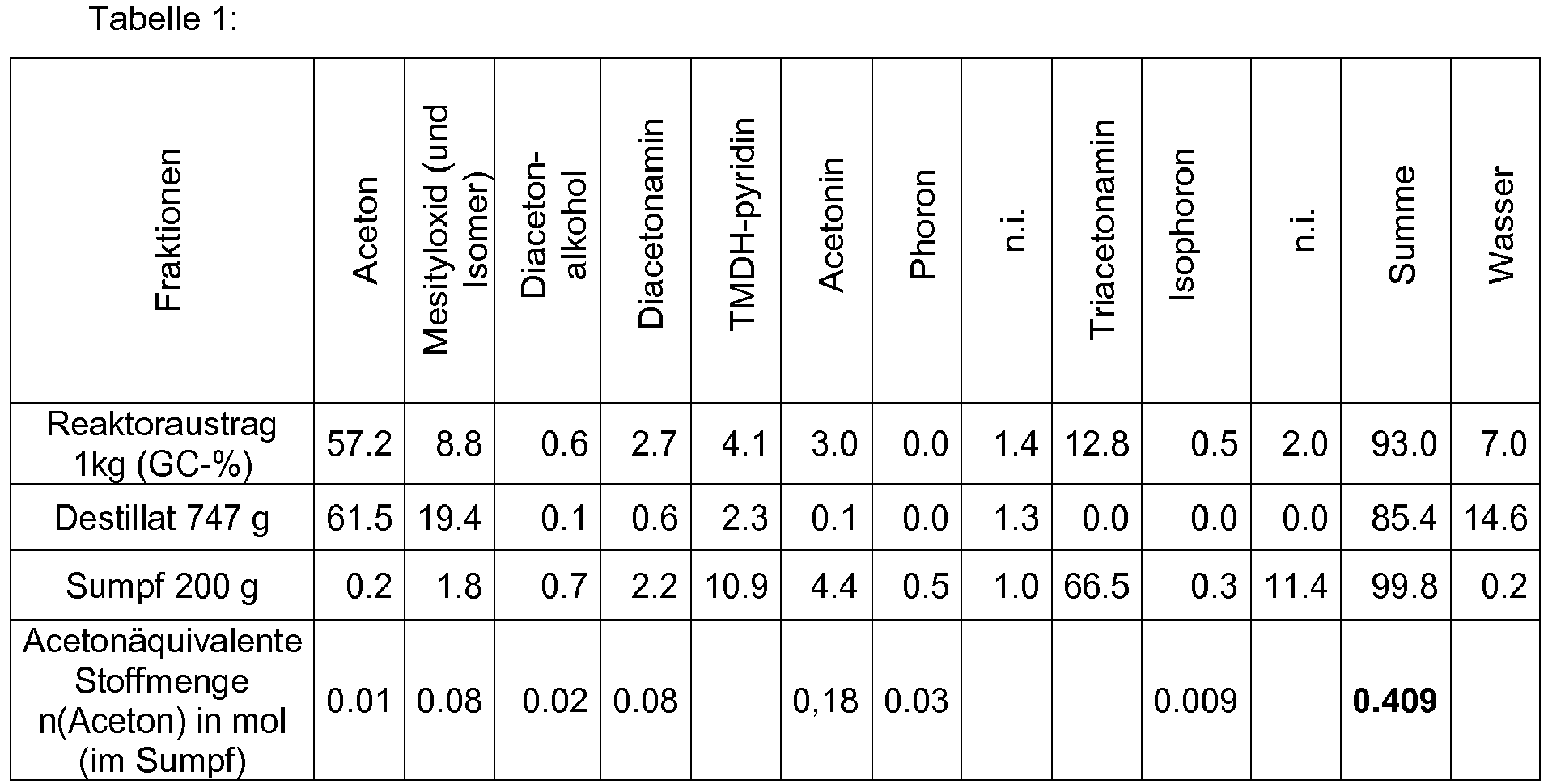
- Der unter Punkt 1 erhaltene Sumpfstrom wurde in einer weiteren Rektifikationskolonne destilliert, um TMDH-Pyridin abzutrennen (100-110 °C Sumpf, 70-100 °C Kopf, 160-50 mbar Kopf). Es wurden 10 Fraktionen genommen
Der erhaltene Kopfstrom (im Folgenden "Kopfstrom 1") wurde gaschromatographisch analysiert. Die GC-Methode war die unter Punkt 1 angegebene. Der Kopfstrom enthielt folgende Komponenten ("n.i."= nicht identifiziert).
- Aus dem in Punkt 2 erhaltene Kopfstrom 1 wurde erneut TMDH-Pyridin destilliert (Temperatur des Sumpfs: 100 bis 110 °C, Temperatur am Kopf, 90 bis 100 °C, Druck 120 bis 180 mbar). Es wurden alle Fraktionen, die mehr als 80 Gew.-% TMDH-Pyridin enthielten, vereinigt und die Zusammensetzung dieser Destillate (im Folgenden "Kopfstrom 2") gaschromatographisch wie unter Punkt 2 beschrieben analysiert:

- Das entsprechende Chromatogramm des Kopfstroms 2 ist in
Figur 1 gezeigt. - Der unter Punkt 2 erhaltene Kopfstrom 1 wurde dann direkt in einem Batch-Autoklaven für 35 bis 45 Stunden bei 20 bis 25 bar H2 und 140 °C hydriert. Als Katalysator diente Palladium auf Kohle (10 Gew.%). Ein Lösungsmittel wurde nicht hinzugefügt.
- 20 kg des unter Punkt 3 erhaltene Kopfstrom 2 wurde in einem Batch-Autoklaven für 36 bis 48 Stunden bei 20 bis 25 bar H2 und 60 °C bis 140 °C hydriert. Als Katalysator diente Palladium auf Kohle (10 Gew.%). Als Lösungsmittel wurden 29 kg Methanol eingesetzt.
- 5.1 Das in Punkt 4.1 erhaltene Rohprodukt wurde fraktioniert in einer Kolonne mit strukturierter Packung destilliert (Sumpf: 100 bis 120 °C, Druck: nicht detektierbar bis 100 mbar, Kopftemperatur 60 bis 85 °C). Es wurden insgesamt 10 Fraktionen genommen, und der Inhalt jeder Fraktion wurde gaschromatographisch vermessen.
- Das entsprechende Chromatogramm ist in
Figur 2 gezeigt. - 5.2 Das in Punkt 4.2 erhaltene Rohprodukt wurde wiederum fraktioniert destilliert. Es wurden insgesamt 13 Fraktionen genommen, und der Inhalt jeder Fraktion wurde gaschromatographisch vermessen. Das entsprechende Chromatogramm ist in
Figur 3 gezeigt. - Aus dem Vergleich des in
Figur 1 gezeigten Gaschromatogramms mit den inFigur 2 und3 gezeigten Gaschromatogrammen ergibt sich: - Aus
Figur 1 ist ersichtlich, dass sich die Peaks von Mesityloxid und TMDH-Pyridin in fünf Fraktionen überschneiden. Die Abtrennung des einen Stoffs vom anderen ist nur schwer möglich. - Demgegenüber überlappen die Peaks von 4-Methyl-pentan-2-on und iso-TEMP nur in zwei Fraktionen, wie sowohl in
Figur 2 als auchFigur 3 ersichtlich. - Es zeigte sich somit überraschend, dass eine saubere Fraktion iso-TEMP erhalten werden konnte, wenn nach dem erfindungsgemäßen Verfahren vorgegangen wird.
- Demgegenüber ist eine Abtrennung von TMDH-Pyridin von Mesityloxid nur schwer möglich.
- Zusätzlich ermöglicht das erfindungsgemäße Verfahren außerdem, 4-Methyl-pentan-2-on viel reiner, als dies im Falle des Mesityloxids möglich wäre, als Rohprodukt zu erhalten.
- Die Eigenschaft von iso-TEMP, als Elektrophil zu fungieren, wurde anhand eines Testsystems untersucht. Zu diesem Zweck wurde 2,2-Difluoro-1,3-benzodioxole (DFBD, CAS-No.: 1583-59-1) mit der aus dem jeweiligen Amin erhaltenen Grignard-Verbindung umgesetzt. Letztere wurde mit verschiedenen Aminen R*NH entsprechend der Reaktion
iso-PrMgCl•LiCl + R*NH → R*NMgCl•LiCl + iso-PrH oder
MeMgCI + R*NH → R*NMgCl + MeH
hergestellt, wobei R* für den entsprechenden aliphatischen oder aromatischen Rest des jeweiligen Amins steht. Durch Reaktion der so erhaltenen Grignardverbindung mit DFBD und Abfangen der Zwischenstufe mit lod konnte das entsprechende lodderivat des DFBD [abgekürzt als DFBD(I)] erhalten werden. Die Bestimmung des Gehalts des lodderivats gibt direkt Auskunft über die Effizienz des jeweiligen Amins in der Testreaktion.
- Es wurden als Amine die in der folgenden Tabelle gezeigten Amine getestet, also TEMP, iso-TEMP, Diphenylamin, Diisopropylamin, tert-Butylamin, Dibutylamin, Diethylamin, Pyrrol, Piperidin, Diallylamin.
- In jedem Versuch wurden 0.06 mol der jeweiligen Grignard-Verbindung (iPrMgCl•LiCl bzw. MeMgCl) in 50 mL THF unter Stickstoffatmosphäre gelöst und anschließend 0.06 mol des wasserfreien Amins hinzugetropft. Die resultierende Mischung wurde über Nacht bei Raumtemperatur gerührt.
- In einem zweiten Kolben wurden 0.05 Mol (7.91 g) DFBD in 25 mL THF gelöst und die am Vortag angesetzte Grignard/Amin-Mischung langsam über 30 Minuten hinzugetropft. Es wurde mit 5 mL THF nachgewaschen. Anschließend wurde die Mischung bei Raumtemperatur gerührt. Nach vier sowie 24 Stunden wurde eine Probe (3 mL) entnommen, diese mit 2 mL einer 1 M-Iodlösung bei 0 °C versetzt und anschließend für 30 Minuten gerührt. Anschließend wurde eine gesättigte, wässrige Ammoniumchlorid-Lösung (2 mL) hinzugegeben und 2 mL Wasser hinzugefügt. Es wurde auf Raumtemperatur erwärmt, ehe 2.5 mL Toluol zugegeben und die Phasen im Scheidetrichter getrennt wurden. Die organische Phase wurde anschließend mittels Gaschromatographie hinsichtlich des Umsatzes an DFBD(I) nach 4 Stunden analysiert. Der erfinderische Versuch ist fett gedruckt, die anderen Versuche entsprechen Vergleichen.
Base Grignard-Reagenz Umsatz TEMP iPrMgCl•LiCl 66 % MeMgCl 41 % iso-TEMP iPrMgCl•Cl 37 % MeMgCl 35 % Diphenylamin iPrMgCl•LiCl 0 % MeMgCl 0 % Diisopropylamin iPrMgCl•LiCl 39 % MeMgCl 41 % tert-Butylamin iPrMgCl•LiCl 0 % MeMgCl 0 % Dibutylamin iPrMgCl•LiCl 0 % MeMgCl 0 % Diethylamin iPrMgCl•LiCl 0 % MeMgCl 0 % Pyrrol iPrMgCl•LiCl 0 % MeMgCl 0 % Piperidin iPrMgCl•LiCl 0 % MeMgCl 0 % Diallylamin iPrMgCl•LiCl 0 % MeMgCl 0 % - Aus den in der Tabelle dargestellten Versuchsergebnissen geht hervor, dass mit iso-TEMP eine gute Ausbeute zum Produkt DFBD(I) erhalten werden konnte. DFBD(I) fungiert damit überraschend gut als Elektrophil.
Claims (14)
- Verfahren zur Herstellung von Triacetonamin, 2,2,4,6-Tetramethylpiperidin und/oder einer metallorganischen Verbindung des 2,2,4,6-Tetramethylpiperidins, umfassend die folgenden Schritte(a) Umsetzen von Ammoniak und Aceton in Gegenwart eines Katalysators K1 zu einem Rohprodukt RP1 umfassend Triacetonamin, 2,2,4,6-Tetramethyl-2,3-dihydropyridin und Mesityloxid,(b) mindestens teilweise Abtrennung eines Rohprodukts RP11 umfassend 2,2,4,6-Tetramethyl-2,3-dihydropyridin und Mesityloxid aus RP1, wobei RP11 eine gegenüber RP1 verringerte Menge an Triacetonamin aufweist,
dadurch gekennzeichnet, dass(c) RP11 mindestens teilweise zu einem Rohprodukt RP12 umfassend 2,2,4,6-Tetramethylpiperidin und 4-Methyl-pentan-2-on umgesetzt wird,(d) das in RP12 enthaltenen 2,2,4,6-Tetramethylpiperidin durch Destillation mindestens teilweise vom in RP12 enthaltenen 4-Methyl-pentan-2-on abgetrennt wird. - Verfahren nach Anspruch 1, wobei die mindestens teilweise Abtrennung von RP11 aus RP1 destillativ erfolgt.
- Verfahren nach Anspruch 2, wobei in Schritt (b)(i) aus dem Rohprodukt RP1 zunächst teilweise Mesityloxid destillativ abgetrennt werden und so ein Rohprodukt RP111 erhalten wird, so dass der Gesamtgehalt an Mesityloxid in RP111 gegenüber dem Gesamtgehalt an Mesityloxid in RP1 verringert ist,(ii) dann aus RP111 destillativ 2,2,4,6-Tetramethyl-2,3-dihydropyridin zusammen mit Mesityloxid als Destillat RP112 abgetrennt wird und(iiiA) RP112 als RP11 dem Schritt (c) zugeführt wird, oder(iiiB) aus RP112 teilweise 2,2,4,6-Tetramethyl-2,3-dihydropyridin, welches Mesityloxid umfasst, als Destillat RP113 destilliert wird, und dann RP113 als RP11 dem Schritt (c) zugeführt wird.
- Verfahren nach Anspruch 2 oder 3, wobei der bei der Destillation in Schritt (b) eingesetzte Temperaturbereich unterhalb der Siedetemperatur von Triacetonamin liegt.
- Verfahren nach einem der Ansprüche 1 bis 4, wobei der Schritt (a) bei einer Temperatur von 20 °C bis 180 °C durchgeführt wird.
- Verfahren nach einem der Ansprüche 1 bis 5, wobei das Molverhältnis von in Schritt (a) eingesetztem Aceton zu in Schritt (a) eingesetztem Ammoniak 3 : 1 bis 20 : 1 beträgt.
- Verfahren nach einem der Ansprüche 1 bis 6, wobei K1 ein heterogener Katalysator ist.
- Verfahren nach einem der Ansprüche 1 bis 7, wobei K2 ein Träger- oder Vollkatalysator ist.
- Verfahren nach einem der Ansprüche 1 bis 8, wobei Schritt (c) bei einer Temperatur von 20 °C bis 300 °C und einem Druck von 1 bis 300 bar durchgeführt wird.
- Verfahren nach einem der Ansprüche 1 bis 9 zur Herstellung einer metallorganischen Verbindung des 2,2,4,6-Tetramethylpiperidins,
wobei das in Schritt (d) abgetrennte 2,2,4,6-Tetramethylpiperidin in einem Schritt (e) mit einem Reagenz der Formel MeA m1Rn1Y1 n2·zMeB m2Y2 n3 in einem Lösungsmittel umgesetzt wird,
wobei m1, n1, m2, n3 unabhängig voneinander jeweils eine ganze Zahl > 0 sind,
und wobei n2, z unabhängig voneinander jeweils eine ganze Zahl ≥ 0 sind,
wobei m1 die Wertigkeit des Metalls MeA angibt und wobei m2 die Wertigkeit des Metalls MeB angibt, wobei gilt, dass m1 + z·m2 = n1 + n2 + z·n3,
wobei R ein Kohlenwasserstoffrest aus gewählt aus Alkylgruppe, Alkenylgruppe, Arylgruppe, Alkinylgruppe ist,
wobei MeA, MeB unabhängig voneinander jeweils ein Metall ausgewählt aus der Gruppe bestehend aus Li, Mg, Zn, Zr, Ti, Cu, Au, Ag, Hg, Cd ist,
und wobei Y1 und Y2 unabhängig voneinander aus der Gruppe bestehend aus F, Cl, Br, I, CN, SCN, NCO, ClO3, ClO4, BrO3, BrO4, IO3, IO41 NO3, BF4, PF6, Wasserstoff, ein Carboxylat der allgemeinen Formel RxCO2, ein Alkoholat der allgemeinen Formel ORx; ein Thiolat der allgemeinen Formel SRx, RxP(O)O2, or SCORx, SCSRx, O2SRx, O3SRx, NO2 ausgewählt sind,
wobei Rx ausgewählt ist aus der Gruppe bestehend aus unsubstituierter oder substituierter Arylest oder Heteroarylrest mit einem oder mehreren Heteroatomen, verzweigter oder unverzweigter Alkylrest, Cycloalkylrest, Alkenylrest, Alkinylrest, Wasserstoff oder als Addukt mit einem Lösungsmittel,
wodurch eine metallorganische Verbindung des 2,2,4,6-Tetramethylpiperidins der allgemeinen Formel MeA m1[Riso-TEMP]n1Y1 n2·zMeB m2Y2 n3 mit Riso-TEMP =
- Verfahren nach Anspruch 10, wobei Schritt (e) bei einer Temperatur im Bereich von - 50 °C bis 25 °C durchgeführt wird.
- Verfahren nach Anspruch 10 oder 11, wobei das Lösungsmittel ausgewählt ist aus der Gruppe bestehend aus Tetrahydrofuran, 2-Methyltetrahydrofuran, Dibutylether, Diethylether, tert-Butylmethylether, Dimethoxyethan, 1,4-Dioxan, Triethylamin, Ethyldiisopropylamin, Dimethylsulfid, Dibutylsulfid, N-Methyl-2-pyrrolidon, N-Ethyl-2-pyrrolidon, N-Butyl-2-pyrrolidon, Dichlormethan, 1,2-Dichlorethan, CCl4, N,N'-Dimethylpropylenharnstoff, Benzol, Toluol, Xylol, Pyridin, Pentan, Cyclohexan, Hexan, Heptan, Hexamethylphosphorsäuretriamid, CS2.
- Verbindung der allgemeinen Formel MeA m1[Riso-TEMP]n1Y1 n2·zMeB m2Y2 n3
mit Riso-TEMP =
wobei m1 die Wertigkeit des Metalls MeA angibt und wobei m2 die Wertigkeit des Metalls MeB angibt, wobei gilt, dass m1 + z·m2 = n1 + n2 + z·n3,
wobei MeA, MeB unabhängig voneinander jeweils ein Metall ausgewählt aus der Gruppe bestehend aus Li, Mg, Zn, Zr, Ti, Cu, Au, Ag, Hg, Cd, sind,
und wobei Y1 und Y2 unabhängig voneinander aus der Gruppe bestehend aus F, Cl, Br, I, CN, SCN, NCO, ClO3, ClO4, BrO3, BrO4, IO3, IO41 NO3, BF4, PF6, Wasserstoff, ein Carboxylat der allgemeinen Formel RxCO2, ein Alkoholat der allgemeinen Formel ORx; ein Thiolat der allgemeinen Formel SRx, RxP(O)O2, or SCORx, SCSRx, O2SRx, O3SRx, NO2 ausgewählt sind,
wobei Rx ausgewählt ist aus der Gruppe bestehend aus unsubstituierter oder substituierter Arylest oder Heteroarylrest mit einem oder mehreren Heteroatomen, verzweigter oder unverzweigter Alkylrest, Cycloalkylrest, Alkenylrest, Alkinylrest, Wasserstoff oder als Addukt mit einem Lösungsmittel. - Verbindung nach Anspruch 13, wobei das Lösungsmittel ausgewählt ist aus der Gruppe bestehend aus Tetrahydrofuran, 2-Methyltetrahydrofuran, Dibutylether, Diethylether, tert-Butylmethylether, Dimethoxyethan, 1,4-Dioxan, Triethylamin, Ethyldiisopropylamin, Dimethylsulfid, Dibutylsulfid, N-Methyl-2-pyrrolidon, N-Ethyl-2-pyrrolidon, N-Butyl-2-pyrrolidon, Dichlormethan, 1,2-Dichlorethan, CCl4, N,N'-Dimethylpropylenharnstoff, Benzol, Toluol, Xylol, Pyridin, Pentan, Cyclohexan, Hexan, Heptan, Hexamethylphosphorsäuretriamid, CS2.
Priority Applications (2)
| Application Number | Priority Date | Filing Date | Title |
|---|---|---|---|
| EP19179843.8A EP3750876A1 (de) | 2019-06-13 | 2019-06-13 | Verfahren zur herstellung von triacetonamin, 2,2,4,6-tetramethylpiperidin und/oder den salzen des 2,2,4,6-tetramethylpiperidins |
| EP20175224.3A EP3750877A1 (de) | 2019-06-13 | 2020-05-18 | Verfahren zur herstellung von triacetonamin und 2,2,4,6-tetramethylpiperidin |
Applications Claiming Priority (1)
| Application Number | Priority Date | Filing Date | Title |
|---|---|---|---|
| EP19179843.8A EP3750876A1 (de) | 2019-06-13 | 2019-06-13 | Verfahren zur herstellung von triacetonamin, 2,2,4,6-tetramethylpiperidin und/oder den salzen des 2,2,4,6-tetramethylpiperidins |
Publications (1)
| Publication Number | Publication Date |
|---|---|
| EP3750876A1 true EP3750876A1 (de) | 2020-12-16 |
Family
ID=66857698
Family Applications (2)
| Application Number | Title | Priority Date | Filing Date |
|---|---|---|---|
| EP19179843.8A Withdrawn EP3750876A1 (de) | 2019-06-13 | 2019-06-13 | Verfahren zur herstellung von triacetonamin, 2,2,4,6-tetramethylpiperidin und/oder den salzen des 2,2,4,6-tetramethylpiperidins |
| EP20175224.3A Withdrawn EP3750877A1 (de) | 2019-06-13 | 2020-05-18 | Verfahren zur herstellung von triacetonamin und 2,2,4,6-tetramethylpiperidin |
Family Applications After (1)
| Application Number | Title | Priority Date | Filing Date |
|---|---|---|---|
| EP20175224.3A Withdrawn EP3750877A1 (de) | 2019-06-13 | 2020-05-18 | Verfahren zur herstellung von triacetonamin und 2,2,4,6-tetramethylpiperidin |
Country Status (1)
| Country | Link |
|---|---|
| EP (2) | EP3750876A1 (de) |
Cited By (1)
| Publication number | Priority date | Publication date | Assignee | Title |
|---|---|---|---|---|
| US11731940B2 (en) | 2020-05-07 | 2023-08-22 | Evonik Operations Gmbh | Process for preparing triacetonamine |
Citations (31)
| Publication number | Priority date | Publication date | Assignee | Title |
|---|---|---|---|---|
| US1629190A (en) | 1925-01-12 | 1927-05-17 | Int Harvester Co | Knotter cam oiler for harvesters |
| CA772201A (en) | 1967-11-21 | Kurashiki Rayon Company Limited | Synthesis of alcohol by hydration of olefin | |
| DE2352127A1 (de) | 1972-10-20 | 1974-04-25 | Ciba Geigy Ag | Verfahren zur herstellung von triacetonamin |
| DE2429935A1 (de) | 1973-06-29 | 1975-01-16 | Ciba Geigy Ag | Verfahren zur herstellung von 2,2,6,6tetramethyl-4-oxopiperidin |
| DE2429936A1 (de) | 1973-06-25 | 1975-01-16 | Ciba Geigy Ag | Verfahren zur herstellung von 2,2,6,6tetramethyl-4-oxo-piperidin |
| DE2429937A1 (de) | 1973-06-25 | 1975-01-16 | Ciba Geigy Ag | Verfahren zur herstellung von 2,2,6,6tetramethyl-4-oxo-piperidin |
| JPS5488275A (en) | 1977-12-21 | 1979-07-13 | Adeka Argus Chem Co Ltd | Production of 2,2,6,6-tetramethyl-4-oxopiperidine |
| DE2807172A1 (de) | 1978-02-20 | 1979-08-23 | Huels Chemische Werke Ag | Verfahren zur herstellung von 2,2,6,6-tetramethylpiperidon-(4) |
| JPS54112873A (en) | 1978-02-23 | 1979-09-04 | Adeka Argus Chem Co Ltd | Preparation of 2,2,6,6-tetramethyl-4-oxopiperidine |
| US4356308A (en) * | 1980-04-05 | 1982-10-26 | Hoechst Aktiengesellschaft | Process for the preparation of 2,2,6,6-tetramethylpiperidone-4 |
| US4536581A (en) | 1978-03-31 | 1985-08-20 | Ciba-Geigy S.P.A. | Process for preparing 2,2,6,6-tetramethyl-4-piperidone |
| EP0243148A1 (de) * | 1986-04-24 | 1987-10-28 | Texas Alkyls, Inc. | Organomagnesium-Lösungen mit niedriger Viskosität |
| US4831146A (en) | 1988-03-21 | 1989-05-16 | Air Products And Chemicals, Inc. | Process for preparing triacetone amine and other oxopiperidines |
| JPH04154762A (ja) | 1990-10-16 | 1992-05-27 | Daicel Chem Ind Ltd | 2.2.6.6.―テトラメチル―4―オキソピペリジンの製造法 |
| JP2001031651A (ja) | 1999-07-15 | 2001-02-06 | Sumitomo Chem Co Ltd | 2,2,6,6−テトラメチル−4−オキソピペリジンの製造方法 |
| JP2003206277A (ja) | 2002-01-10 | 2003-07-22 | Mitsui Chemicals Inc | 2,2,6,6−テトラメチル−4−ピペリドンの製造方法 |
| EP1810974A1 (de) | 2006-01-18 | 2007-07-25 | Ludwig-Maximilians-Universität München | Herstellung und Verwendung von Magnesiumamiden |
| DE102007022490A1 (de) * | 2007-05-14 | 2008-11-20 | Ludwig-Maximilians-Universität | Bisamid-Zinkbasen |
| DE202010007837U1 (de) | 2010-06-10 | 2010-10-07 | Hasenpusch, Wolfgang, Prof. Dr. | Vorrichtung bei der Herstellung von RANEY-Metallen |
| DE102010062804A1 (de) | 2010-01-12 | 2011-07-14 | Evonik Degussa GmbH, 45128 | Verfahren zur Herstellung von 1,1 Diarylalkanen und Derivativen davon |
| CN103224465A (zh) | 2013-01-31 | 2013-07-31 | 天津大学 | 2,2,6,6-四甲基-4-哌啶酮连续合成方法 |
| WO2013120878A1 (en) * | 2012-02-17 | 2013-08-22 | Bayer Intellectual Property Gmbh | Alkaline earth metal-complexed metal amides |
| WO2013120911A1 (en) * | 2012-02-17 | 2013-08-22 | Bayer Intellectual Property Gmbh | Alkaline earth metal-complexed metal bisamides |
| EP2706056A1 (de) | 2012-09-07 | 2014-03-12 | Evonik Industries AG | Verfahren zur Herstellung und Aufarbeitung eines Triacetonamin-haltigen Reaktionsgemisches |
| WO2014124915A1 (en) * | 2013-02-12 | 2014-08-21 | Bayer Cropscience Ag | Preparation of alkaline earth metal-complexed metal bisamides from metal monoamides |
| EP3048096A1 (de) | 2015-01-22 | 2016-07-27 | Evonik Degussa GmbH | Synthese von triacetondiaminverbindungen durch reduktive aminierung ausgehend von triacetondiamin und dessen derivaten |
| WO2017117189A1 (en) * | 2015-12-30 | 2017-07-06 | Tetraphase Pharmaceuticals, Inc. | Preparation of mixed amidomagnesium halides |
| WO2017125759A1 (en) * | 2016-01-20 | 2017-07-27 | The Queen's University Of Belfast | Process for the preparation of glycerol carbonate |
| EP3266766A1 (de) | 2016-07-07 | 2018-01-10 | Evonik Degussa GmbH | Synthese von triacetondiaminverbindungen durch reduktive aminierung ausgehend von triacetondiamin und dessen derivaten |
| CN108383776A (zh) | 2018-05-01 | 2018-08-10 | 衡水凯亚化工有限公司 | 一种利用丙酮和合成三丙酮胺过程副产物制备三丙酮胺 |
| CN108383704A (zh) | 2018-05-01 | 2018-08-10 | 衡水凯亚化工有限公司 | 一种利用合成三丙酮胺过程副产物制备丙酮的方法 |
-
2019
- 2019-06-13 EP EP19179843.8A patent/EP3750876A1/de not_active Withdrawn
-
2020
- 2020-05-18 EP EP20175224.3A patent/EP3750877A1/de not_active Withdrawn
Patent Citations (33)
| Publication number | Priority date | Publication date | Assignee | Title |
|---|---|---|---|---|
| CA772201A (en) | 1967-11-21 | Kurashiki Rayon Company Limited | Synthesis of alcohol by hydration of olefin | |
| US1629190A (en) | 1925-01-12 | 1927-05-17 | Int Harvester Co | Knotter cam oiler for harvesters |
| DE2352127A1 (de) | 1972-10-20 | 1974-04-25 | Ciba Geigy Ag | Verfahren zur herstellung von triacetonamin |
| DE2429936A1 (de) | 1973-06-25 | 1975-01-16 | Ciba Geigy Ag | Verfahren zur herstellung von 2,2,6,6tetramethyl-4-oxo-piperidin |
| DE2429937A1 (de) | 1973-06-25 | 1975-01-16 | Ciba Geigy Ag | Verfahren zur herstellung von 2,2,6,6tetramethyl-4-oxo-piperidin |
| DE2429935A1 (de) | 1973-06-29 | 1975-01-16 | Ciba Geigy Ag | Verfahren zur herstellung von 2,2,6,6tetramethyl-4-oxopiperidin |
| JPS5488275A (en) | 1977-12-21 | 1979-07-13 | Adeka Argus Chem Co Ltd | Production of 2,2,6,6-tetramethyl-4-oxopiperidine |
| DE2807172A1 (de) | 1978-02-20 | 1979-08-23 | Huels Chemische Werke Ag | Verfahren zur herstellung von 2,2,6,6-tetramethylpiperidon-(4) |
| JPS54112873A (en) | 1978-02-23 | 1979-09-04 | Adeka Argus Chem Co Ltd | Preparation of 2,2,6,6-tetramethyl-4-oxopiperidine |
| US4536581A (en) | 1978-03-31 | 1985-08-20 | Ciba-Geigy S.P.A. | Process for preparing 2,2,6,6-tetramethyl-4-piperidone |
| US4356308A (en) * | 1980-04-05 | 1982-10-26 | Hoechst Aktiengesellschaft | Process for the preparation of 2,2,6,6-tetramethylpiperidone-4 |
| EP0243148A1 (de) * | 1986-04-24 | 1987-10-28 | Texas Alkyls, Inc. | Organomagnesium-Lösungen mit niedriger Viskosität |
| US4831146A (en) | 1988-03-21 | 1989-05-16 | Air Products And Chemicals, Inc. | Process for preparing triacetone amine and other oxopiperidines |
| JPH04154762A (ja) | 1990-10-16 | 1992-05-27 | Daicel Chem Ind Ltd | 2.2.6.6.―テトラメチル―4―オキソピペリジンの製造法 |
| JP2001031651A (ja) | 1999-07-15 | 2001-02-06 | Sumitomo Chem Co Ltd | 2,2,6,6−テトラメチル−4−オキソピペリジンの製造方法 |
| JP2003206277A (ja) | 2002-01-10 | 2003-07-22 | Mitsui Chemicals Inc | 2,2,6,6−テトラメチル−4−ピペリドンの製造方法 |
| EP1810974A1 (de) | 2006-01-18 | 2007-07-25 | Ludwig-Maximilians-Universität München | Herstellung und Verwendung von Magnesiumamiden |
| WO2008087057A1 (en) | 2006-01-18 | 2008-07-24 | Ludwig-Maximilians-Universitaet Muenchen | Preparation and use of magnesium amides |
| WO2007082911A1 (en) | 2006-01-18 | 2007-07-26 | Ludwig-Maximilians-Universitaet Muenchen | Preparation and use of magnesium amides |
| DE102007022490A1 (de) * | 2007-05-14 | 2008-11-20 | Ludwig-Maximilians-Universität | Bisamid-Zinkbasen |
| DE102010062804A1 (de) | 2010-01-12 | 2011-07-14 | Evonik Degussa GmbH, 45128 | Verfahren zur Herstellung von 1,1 Diarylalkanen und Derivativen davon |
| DE202010007837U1 (de) | 2010-06-10 | 2010-10-07 | Hasenpusch, Wolfgang, Prof. Dr. | Vorrichtung bei der Herstellung von RANEY-Metallen |
| WO2013120911A1 (en) * | 2012-02-17 | 2013-08-22 | Bayer Intellectual Property Gmbh | Alkaline earth metal-complexed metal bisamides |
| WO2013120878A1 (en) * | 2012-02-17 | 2013-08-22 | Bayer Intellectual Property Gmbh | Alkaline earth metal-complexed metal amides |
| EP2706056A1 (de) | 2012-09-07 | 2014-03-12 | Evonik Industries AG | Verfahren zur Herstellung und Aufarbeitung eines Triacetonamin-haltigen Reaktionsgemisches |
| CN103224465A (zh) | 2013-01-31 | 2013-07-31 | 天津大学 | 2,2,6,6-四甲基-4-哌啶酮连续合成方法 |
| WO2014124915A1 (en) * | 2013-02-12 | 2014-08-21 | Bayer Cropscience Ag | Preparation of alkaline earth metal-complexed metal bisamides from metal monoamides |
| EP3048096A1 (de) | 2015-01-22 | 2016-07-27 | Evonik Degussa GmbH | Synthese von triacetondiaminverbindungen durch reduktive aminierung ausgehend von triacetondiamin und dessen derivaten |
| WO2017117189A1 (en) * | 2015-12-30 | 2017-07-06 | Tetraphase Pharmaceuticals, Inc. | Preparation of mixed amidomagnesium halides |
| WO2017125759A1 (en) * | 2016-01-20 | 2017-07-27 | The Queen's University Of Belfast | Process for the preparation of glycerol carbonate |
| EP3266766A1 (de) | 2016-07-07 | 2018-01-10 | Evonik Degussa GmbH | Synthese von triacetondiaminverbindungen durch reduktive aminierung ausgehend von triacetondiamin und dessen derivaten |
| CN108383776A (zh) | 2018-05-01 | 2018-08-10 | 衡水凯亚化工有限公司 | 一种利用丙酮和合成三丙酮胺过程副产物制备三丙酮胺 |
| CN108383704A (zh) | 2018-05-01 | 2018-08-10 | 衡水凯亚化工有限公司 | 一种利用合成三丙酮胺过程副产物制备丙酮的方法 |
Non-Patent Citations (37)
| Title |
|---|
| A. TURCKN. PLEF. MONGING. QUEGUINER, TETRAHEDRON, vol. 57, 2001, pages 4059 - 4090 |
| B. WEIDMAND. SEEBACH, ANGEW. CHEM., vol. 95, 1983, pages 12 - 26 |
| C. -C. CHANGM. S. AMEERUNISHA, COORD. CHEM. REV., vol. 189, 1999, pages 199 - 278 |
| C. WANGQ. CHENQ. GUOH. LIUZ. XUY. LIUM. WANGR. WANG, J. ORG. CHEM., vol. 81, 2016, pages 5782 - 5788 |
| C.G. CHAVDARIANC.H. HEATHCOCK, J. AM. CHEM. SOC., vol. 97, 1975, pages 3822 - 3823 |
| CHEMICAL ABSTRACTS, Columbus, Ohio, US; abstract no. 31175-20-9 |
| CHEMICAL INDUSTRIES, vol. 89, 2003, pages 559 - 564 |
| D. M. HODGSONC. D. BRAYN. D. KINDON, ORG. LETT., vol. 7, 2005, pages 2305 - 2308 |
| E. MATTER, HELV. CHIM. ACTA, vol. 31, 1948, pages 612 - 622 |
| G. QUEGUINERF. MARSAISV. SNIECKUSJ. EPSZTAJN, ADV. IN HET. CHEM., vol. 52, 1991, pages 187 - 304 |
| GLIOZZI GHERARDO ET AL: "Towards a more sustainable production of triacetoneamine with heterogeneous catalysis", JOURNAL OF MOLECULAR CATALYSIS A: CHEMICAL, vol. 393, 2014, pages 325 - 332, XP029041319, ISSN: 1381-1169, DOI: 10.1016/J.MOLCATA.2014.06.023 * |
| H.O. CALVERY, ORG. SYNTH., vol. 9, 1929, pages 54 |
| J.F. NORMANT, SYNTHESIS, vol. 2, 1972, pages 63 - 80 |
| J.R. SANDERSE.C. ASHBY, J. ORGANOMET. CHEM., vol. 25, 1971, pages 277 - 286 |
| J-C. PLAQUEVENTT. PERRARDD. CAHARD, CHEM. EUR. J., vol. 8, 2002, pages 3300 - 3307 |
| K. W. HENDERSONW. J. KERR, CHEM.-A EUR. J., vol. 7, 2001, pages 3430 - 3437 |
| K. W. HENDERSONW. J. KERRJ. H. MOIR, TETRAHEDRON, vol. 58, 2002, pages 4573 - 4587 |
| L. CAOM.C. JENNINGSR.J. PUDDEPHATT, INORG. CHEM., vol. 46, 2007, pages 1361 - 1368 |
| M. C. WHISLERS. MACNEILV. SNIECKUSP. BEAK, ANGEW. CHEM. INT. ED., vol. 43, 2004, pages 2206 - 2225 |
| M. SCHLOSSER, ANGEW. CHEM. INT. ED., vol. 44, 2005, pages 376 - 393 |
| M. SCHLOSSER, EUR. J. ORG. CHEM., vol. 21, 2001, pages 3975 - 3984 |
| M. SHILAIY. KONDOT. SAKAMOTO, J. CHEM. SOC, PERKIN TRANS. 1: ORG. BIO-ORG. CHEM., vol. 4, 2001, pages 442 |
| M. VEITHS. WIECZOREKK. FRIESV. HUCH, Z. ANORG. ALLG. CHEM., vol. 626, 2000, pages 1237 - 1245 |
| M-X. ZHANGP. E. EATON, ANGEW. CHEM. INT. ED., vol. 41, 2002, pages 2169 - 2171 |
| N.C HANCOX, AUSTR. J. CHEM., vol. 6, 1953, pages 143 - 151 |
| NC HANCOX: "The reaction between acetone and ammonia. III. Reduced pyridine, deriviaties", AUSTRALIAN JOURNAL OF CHEMISTRY: AN INTERNATIONAL JOURNAL FOR CHEMICAL SCIENCE, vol. 6, no. 2, 1 January 1953 (1953-01-01), AU, pages 143-151, XP055629258, ISSN: 0004-9425, DOI: 10.1071/CH9530143 * |
| P. E. EATONC. H. LEEY. XIONG, J. AM. CHEM. SOC., vol. 111, 1989, pages 8016 - 8018 |
| P. E. EATONM-X. ZHANGN. KOMIYAC-G. YANGI. STEELER. GILARDI, SYNLETT, vol. 9, 2003, pages 1275 - 1278 |
| P. E. EATONR. M. MARTIN, J. ORG. CHEM., vol. 53, 1988, pages 2728 - 2732 |
| P. KNOCHELW. DOHLEN. GOMMERMANNF. F. KNEISELF. KOPPT. KORNI. SAPOUNTZISV. A. VU, ANGEW. CHEM., vol. 115, 2003, pages 4438 - 4456 |
| P. LANGEA. SCHIERJ. RIEDEH. SCHMIDBAUR, Z. NATURFORSCH., vol. 49b, 1994, pages 642 - 646 |
| R.C. LAROCK, ANGEW. CHEM., vol. 90, 1978, pages 28 - 38 |
| T. IMAHORIM. UCHIYAMAT. SAKAMOTOY. KONDO, CHEM. COMM., vol. 23, 2001, pages 2450 - 2451 |
| X. XUW. XUJ. WUJ. HEH. XU, ORG. BIOMOL. CHEM., vol. 14, 2016, pages 9970 - 9973 |
| Y. KONDOM. SHILAIM. UCHIYAMAT. SAKAMOTO, J. AM. CHEM. SOC., vol. 121, 1999, pages 3539 - 3540 |
| Y. KONDOY. AKIHIROT. SAKAMOTO, J. CHEM. SOC, PERKIN TRANS. 1: ORG. BIO-ORG. CHEM., vol. 19, 1996, pages 2331 - 2332 |
| ZEITSCHRIFT FÜR NATURFORSCHUNG, 1976, pages 328 - 337,338-345 |
Cited By (1)
| Publication number | Priority date | Publication date | Assignee | Title |
|---|---|---|---|---|
| US11731940B2 (en) | 2020-05-07 | 2023-08-22 | Evonik Operations Gmbh | Process for preparing triacetonamine |
Also Published As
| Publication number | Publication date |
|---|---|
| EP3750877A1 (de) | 2020-12-16 |
Similar Documents
| Publication | Publication Date | Title |
|---|---|---|
| EP3663284B1 (de) | Verbessertes verfahren zur herstellung von triacetonamin | |
| DE3021955A1 (de) | Verfahren zur herstellung primaerer mono- und diamine aus oxoverbindungen | |
| EP2706056B1 (de) | Verfahren zur Herstellung und Aufarbeitung eines Triacetonamin-haltigen Reaktionsgemisches | |
| EP3750877A1 (de) | Verfahren zur herstellung von triacetonamin und 2,2,4,6-tetramethylpiperidin | |
| EP1541540B1 (de) | Verfahren zur Herstellung alkoxidreiner Magnesiumalkoxide | |
| DE2324390C2 (de) | Verfahren zur Herstellung von Derivaten des 2,2-Dichlor- bzw. 2,2-Dibromcyclopropans | |
| DE1643555B2 (de) | Verfahren zur herstellung von bis- eckige klammer auf beta-(n,n- dimethyl-amino)-alkyl eckige klammer zu -aethern | |
| EP3010880B1 (de) | Verfahren zur herstellung von 2-chlordialkylbenzylaminen durch hydrierung | |
| EP1541541B1 (de) | Verfahren zur Herstellung alkoxyreiner Erdalkalialkoxide | |
| EP2297101B1 (de) | Verfahren zur herstellung von magnesiumamiden | |
| EP3907217B1 (de) | Verbessertes verfahren zur herstellung von triacetonamin | |
| WO1999065861A1 (de) | Verfahren zur symmetrischen und unsymmetrischen disubstitution von carbonsäureamiden mit organotitanaten und grignard-reagenzien | |
| EP4359372A1 (de) | Hydrierung von estern zu alkoholen in gegenwart eines mn-pnn-komplexes | |
| DE10222330A1 (de) | Verfahren zur katalysatorfreien Herstellung von Alkoxybenzonitrilen | |
| DE2201455C3 (de) | Verfahren zur Herstellung von Aldehyden | |
| WO2019162120A1 (de) | Verfahren zur abreicherung von 2-methoxyethanol (moe) | |
| EP1295887B1 (de) | Verfahren zur Herstellung von reinen Aryllithiumverbindungen | |
| DE19637429A1 (de) | Verfahren zur Herstellung von Cyclopentanolen | |
| EP2657216B1 (de) | Verfahren zum Umsetzen von Farnesol zu Nerolidol in Gegenwart von alpha-Bisabolol | |
| DE3307164A1 (de) | Verfahren zur herstellung von nitrophenetolen | |
| DE102017101371B4 (de) | Verfahren zur Aminocarbonylierung zyklischer Diene | |
| WO1999065862A1 (de) | Verfahren zur katalytischen, symmetrischen disubstitution von carbonsäureamiden mit grignard-reagenzien | |
| EP2855409B1 (de) | Verfahren zur aufarbeitung von gemischen | |
| DE4334809A1 (de) | Verfahren zur Herstellung sekundärer oder tertiärer Amine | |
| EP3878834A1 (de) | Verfahren zur desodorisierung von 1,2-alkandiolen durch destillation |
Legal Events
| Date | Code | Title | Description |
|---|---|---|---|
| PUAI | Public reference made under article 153(3) epc to a published international application that has entered the european phase |
Free format text: ORIGINAL CODE: 0009012 |
|
| STAA | Information on the status of an ep patent application or granted ep patent |
Free format text: STATUS: THE APPLICATION HAS BEEN PUBLISHED |
|
| AK | Designated contracting states |
Kind code of ref document: A1 Designated state(s): AL AT BE BG CH CY CZ DE DK EE ES FI FR GB GR HR HU IE IS IT LI LT LU LV MC MK MT NL NO PL PT RO RS SE SI SK SM TR |
|
| AX | Request for extension of the european patent |
Extension state: BA ME |
|
| STAA | Information on the status of an ep patent application or granted ep patent |
Free format text: STATUS: THE APPLICATION IS DEEMED TO BE WITHDRAWN |
|
| 18D | Application deemed to be withdrawn |
Effective date: 20210617 |