EP1810974A1 - Preparation and use of magnesium amides - Google Patents
Preparation and use of magnesium amides Download PDFInfo
- Publication number
- EP1810974A1 EP1810974A1 EP06001017A EP06001017A EP1810974A1 EP 1810974 A1 EP1810974 A1 EP 1810974A1 EP 06001017 A EP06001017 A EP 06001017A EP 06001017 A EP06001017 A EP 06001017A EP 1810974 A1 EP1810974 A1 EP 1810974A1
- Authority
- EP
- European Patent Office
- Prior art keywords
- cyclic
- mgx
- zliy
- derivatives
- linear
- Prior art date
- Legal status (The legal status is an assumption and is not a legal conclusion. Google has not performed a legal analysis and makes no representation as to the accuracy of the status listed.)
- Withdrawn
Links
- 238000002360 preparation method Methods 0.000 title claims abstract description 11
- PKMBLJNMKINMSK-UHFFFAOYSA-N magnesium;azanide Chemical class [NH2-].[NH2-].[Mg+2] PKMBLJNMKINMSK-UHFFFAOYSA-N 0.000 title description 9
- 150000001408 amides Chemical class 0.000 claims abstract description 20
- 125000004122 cyclic group Chemical group 0.000 claims abstract description 16
- 125000003118 aryl group Chemical group 0.000 claims abstract description 12
- 238000000034 method Methods 0.000 claims abstract description 11
- 125000001072 heteroaryl group Chemical group 0.000 claims abstract description 9
- 125000005842 heteroatom Chemical group 0.000 claims abstract description 9
- 125000003342 alkenyl group Chemical group 0.000 claims abstract description 8
- 125000000217 alkyl group Chemical group 0.000 claims abstract description 8
- 125000000304 alkynyl group Chemical group 0.000 claims abstract description 8
- 230000008569 process Effects 0.000 claims abstract description 8
- 229910052731 fluorine Inorganic materials 0.000 claims abstract description 3
- 125000001181 organosilyl group Chemical group [SiH3]* 0.000 claims abstract description 3
- WYURNTSHIVDZCO-UHFFFAOYSA-N Tetrahydrofuran Chemical compound C1CCOC1 WYURNTSHIVDZCO-UHFFFAOYSA-N 0.000 claims description 42
- KWGKDLIKAYFUFQ-UHFFFAOYSA-M lithium chloride Chemical compound [Li+].[Cl-] KWGKDLIKAYFUFQ-UHFFFAOYSA-M 0.000 claims description 37
- YLQBMQCUIZJEEH-UHFFFAOYSA-N tetrahydrofuran Natural products C=1C=COC=1 YLQBMQCUIZJEEH-UHFFFAOYSA-N 0.000 claims description 23
- 238000006243 chemical reaction Methods 0.000 claims description 20
- 239000002904 solvent Substances 0.000 claims description 18
- 150000004795 grignard reagents Chemical class 0.000 claims description 17
- 239000007818 Grignard reagent Substances 0.000 claims description 12
- SECXISVLQFMRJM-UHFFFAOYSA-N N-Methylpyrrolidone Chemical compound CN1CCCC1=O SECXISVLQFMRJM-UHFFFAOYSA-N 0.000 claims description 12
- YMWUJEATGCHHMB-UHFFFAOYSA-N Dichloromethane Chemical compound ClCCl YMWUJEATGCHHMB-UHFFFAOYSA-N 0.000 claims description 11
- RTZKZFJDLAIYFH-UHFFFAOYSA-N Diethyl ether Chemical compound CCOCC RTZKZFJDLAIYFH-UHFFFAOYSA-N 0.000 claims description 11
- 239000003153 chemical reaction reagent Substances 0.000 claims description 11
- 239000012039 electrophile Substances 0.000 claims description 11
- OFBQJSOFQDEBGM-UHFFFAOYSA-N Pentane Chemical compound CCCCC OFBQJSOFQDEBGM-UHFFFAOYSA-N 0.000 claims description 10
- UHOVQNZJYSORNB-UHFFFAOYSA-N Benzene Chemical compound C1=CC=CC=C1 UHOVQNZJYSORNB-UHFFFAOYSA-N 0.000 claims description 9
- QMMFVYPAHWMCMS-UHFFFAOYSA-N Dimethyl sulfide Chemical compound CSC QMMFVYPAHWMCMS-UHFFFAOYSA-N 0.000 claims description 9
- JUJWROOIHBZHMG-UHFFFAOYSA-N Pyridine Chemical compound C1=CC=NC=C1 JUJWROOIHBZHMG-UHFFFAOYSA-N 0.000 claims description 9
- YXFVVABEGXRONW-UHFFFAOYSA-N Toluene Chemical compound CC1=CC=CC=C1 YXFVVABEGXRONW-UHFFFAOYSA-N 0.000 claims description 9
- ZMANZCXQSJIPKH-UHFFFAOYSA-N Triethylamine Chemical compound CCN(CC)CC ZMANZCXQSJIPKH-UHFFFAOYSA-N 0.000 claims description 9
- IUYHWZFSGMZEOG-UHFFFAOYSA-M magnesium;propane;chloride Chemical group [Mg+2].[Cl-].C[CH-]C IUYHWZFSGMZEOG-UHFFFAOYSA-M 0.000 claims description 9
- VLKZOEOYAKHREP-UHFFFAOYSA-N n-Hexane Chemical compound CCCCCC VLKZOEOYAKHREP-UHFFFAOYSA-N 0.000 claims description 9
- 238000010537 deprotonation reaction Methods 0.000 claims description 8
- 230000005595 deprotonation Effects 0.000 claims description 7
- 229910052757 nitrogen Inorganic materials 0.000 claims description 7
- ZFPGARUNNKGOBB-UHFFFAOYSA-N 1-Ethyl-2-pyrrolidinone Chemical compound CCN1CCCC1=O ZFPGARUNNKGOBB-UHFFFAOYSA-N 0.000 claims description 6
- BNXZHVUCNYMNOS-UHFFFAOYSA-N 1-butylpyrrolidin-2-one Chemical compound CCCCN1CCCC1=O BNXZHVUCNYMNOS-UHFFFAOYSA-N 0.000 claims description 6
- IMNFDUFMRHMDMM-UHFFFAOYSA-N N-Heptane Chemical compound CCCCCCC IMNFDUFMRHMDMM-UHFFFAOYSA-N 0.000 claims description 6
- 150000001412 amines Chemical class 0.000 claims description 6
- 229910003002 lithium salt Inorganic materials 0.000 claims description 6
- 159000000002 lithium salts Chemical class 0.000 claims description 6
- XVDBWWRIXBMVJV-UHFFFAOYSA-N n-[bis(dimethylamino)phosphanyl]-n-methylmethanamine Chemical compound CN(C)P(N(C)C)N(C)C XVDBWWRIXBMVJV-UHFFFAOYSA-N 0.000 claims description 6
- VZGDMQKNWNREIO-UHFFFAOYSA-N tetrachloromethane Chemical compound ClC(Cl)(Cl)Cl VZGDMQKNWNREIO-UHFFFAOYSA-N 0.000 claims description 6
- 150000003950 cyclic amides Chemical class 0.000 claims description 5
- 229910052794 bromium Inorganic materials 0.000 claims description 4
- 229910052801 chlorine Inorganic materials 0.000 claims description 4
- 229910052740 iodine Inorganic materials 0.000 claims description 4
- 229910052760 oxygen Inorganic materials 0.000 claims description 4
- UMJSCPRVCHMLSP-UHFFFAOYSA-N pyridine Natural products COC1=CC=CN=C1 UMJSCPRVCHMLSP-UHFFFAOYSA-N 0.000 claims description 4
- 239000000758 substrate Substances 0.000 claims description 4
- 229910052717 sulfur Inorganic materials 0.000 claims description 4
- WSLDOOZREJYCGB-UHFFFAOYSA-N 1,2-Dichloroethane Chemical compound ClCCCl WSLDOOZREJYCGB-UHFFFAOYSA-N 0.000 claims description 3
- RYHBNJHYFVUHQT-UHFFFAOYSA-N 1,4-Dioxane Chemical compound C1COCCO1 RYHBNJHYFVUHQT-UHFFFAOYSA-N 0.000 claims description 3
- DURPTKYDGMDSBL-UHFFFAOYSA-N 1-butoxybutane Chemical compound CCCCOCCCC DURPTKYDGMDSBL-UHFFFAOYSA-N 0.000 claims description 3
- JWUJQDFVADABEY-UHFFFAOYSA-N 2-methyltetrahydrofuran Chemical compound CC1CCCO1 JWUJQDFVADABEY-UHFFFAOYSA-N 0.000 claims description 3
- XDTMQSROBMDMFD-UHFFFAOYSA-N Cyclohexane Chemical compound C1CCCCC1 XDTMQSROBMDMFD-UHFFFAOYSA-N 0.000 claims description 3
- HTIRHQRTDBPHNZ-UHFFFAOYSA-N Dibutyl sulfide Chemical compound CCCCSCCCC HTIRHQRTDBPHNZ-UHFFFAOYSA-N 0.000 claims description 3
- XTHFKEDIFFGKHM-UHFFFAOYSA-N Dimethoxyethane Chemical compound COCCOC XTHFKEDIFFGKHM-UHFFFAOYSA-N 0.000 claims description 3
- BZLVMXJERCGZMT-UHFFFAOYSA-N Methyl tert-butyl ether Chemical compound COC(C)(C)C BZLVMXJERCGZMT-UHFFFAOYSA-N 0.000 claims description 3
- JGFZNNIVVJXRND-UHFFFAOYSA-N N,N-Diisopropylethylamine (DIPEA) Chemical compound CCN(C(C)C)C(C)C JGFZNNIVVJXRND-UHFFFAOYSA-N 0.000 claims description 3
- CTQNGGLPUBDAKN-UHFFFAOYSA-N O-Xylene Chemical compound CC1=CC=CC=C1C CTQNGGLPUBDAKN-UHFFFAOYSA-N 0.000 claims description 3
- 150000001335 aliphatic alkanes Chemical class 0.000 claims description 3
- 150000001338 aliphatic hydrocarbons Chemical class 0.000 claims description 3
- 150000001336 alkenes Chemical class 0.000 claims description 3
- 150000002012 dioxanes Chemical class 0.000 claims description 3
- GUVUOGQBMYCBQP-UHFFFAOYSA-N dmpu Chemical compound CN1CCCN(C)C1=O GUVUOGQBMYCBQP-UHFFFAOYSA-N 0.000 claims description 3
- 229910052736 halogen Inorganic materials 0.000 claims description 3
- 150000002367 halogens Chemical class 0.000 claims description 3
- 125000004435 hydrogen atom Chemical group [H]* 0.000 claims description 3
- 150000003003 phosphines Chemical class 0.000 claims description 3
- 229910052698 phosphorus Inorganic materials 0.000 claims description 3
- 229920000570 polyether Polymers 0.000 claims description 3
- 150000003568 thioethers Chemical class 0.000 claims description 3
- 150000003672 ureas Chemical class 0.000 claims description 3
- 239000008096 xylene Substances 0.000 claims description 3
- 150000007942 carboxylates Chemical class 0.000 claims description 2
- PXBRQCKWGAHEHS-UHFFFAOYSA-N dichlorodifluoromethane Chemical compound FC(F)(Cl)Cl PXBRQCKWGAHEHS-UHFFFAOYSA-N 0.000 claims description 2
- 150000007944 thiolates Chemical class 0.000 claims description 2
- 125000002924 primary amino group Chemical group [H]N([H])* 0.000 claims 1
- 150000003335 secondary amines Chemical class 0.000 claims 1
- 239000011777 magnesium Substances 0.000 description 16
- RKMGAJGJIURJSJ-UHFFFAOYSA-N 2,2,6,6-Tetramethylpiperidine Substances CC1(C)CCCC(C)(C)N1 RKMGAJGJIURJSJ-UHFFFAOYSA-N 0.000 description 12
- ZGTGCCOCZWJUCL-UHFFFAOYSA-N [Li+].[NH2-].[Mg] Chemical compound [Li+].[NH2-].[Mg] ZGTGCCOCZWJUCL-UHFFFAOYSA-N 0.000 description 12
- AWJUIBRHMBBTKR-UHFFFAOYSA-N isoquinoline Chemical compound C1=NC=CC2=CC=CC=C21 AWJUIBRHMBBTKR-UHFFFAOYSA-N 0.000 description 12
- FDDBUIWRNBGXHB-UHFFFAOYSA-N 1-iodoisoquinoline Chemical compound C1=CC=C2C(I)=NC=CC2=C1 FDDBUIWRNBGXHB-UHFFFAOYSA-N 0.000 description 11
- ZMXDDKWLCZADIW-UHFFFAOYSA-N N,N-Dimethylformamide Chemical compound CN(C)C=O ZMXDDKWLCZADIW-UHFFFAOYSA-N 0.000 description 9
- 238000006263 metalation reaction Methods 0.000 description 9
- ULKSWZAXQDJMJT-UHFFFAOYSA-M magnesium;2,2,6,6-tetramethylpiperidin-1-ide;chloride Chemical compound [Cl-].CC1(C)CCCC(C)(C)N1[Mg+] ULKSWZAXQDJMJT-UHFFFAOYSA-M 0.000 description 8
- -1 alkyl lithium Chemical compound 0.000 description 7
- 239000000047 product Substances 0.000 description 7
- ZCSHNCUQKCANBX-UHFFFAOYSA-N lithium diisopropylamide Chemical compound [Li+].CC(C)[N-]C(C)C ZCSHNCUQKCANBX-UHFFFAOYSA-N 0.000 description 6
- 229910052749 magnesium Inorganic materials 0.000 description 6
- FYYHWMGAXLPEAU-UHFFFAOYSA-N Magnesium Chemical compound [Mg] FYYHWMGAXLPEAU-UHFFFAOYSA-N 0.000 description 5
- XKRFYHLGVUSROY-UHFFFAOYSA-N Argon Chemical compound [Ar] XKRFYHLGVUSROY-UHFFFAOYSA-N 0.000 description 4
- 150000001875 compounds Chemical class 0.000 description 4
- 230000000694 effects Effects 0.000 description 4
- AFRJJFRNGGLMDW-UHFFFAOYSA-N lithium amide Chemical class [Li+].[NH2-] AFRJJFRNGGLMDW-UHFFFAOYSA-N 0.000 description 4
- QNRUKMBLUVIEBO-UHFFFAOYSA-L lithium;magnesium;dichloride Chemical compound [Li+].[Mg+2].[Cl-].[Cl-] QNRUKMBLUVIEBO-UHFFFAOYSA-L 0.000 description 4
- 150000003230 pyrimidines Chemical class 0.000 description 4
- 238000010791 quenching Methods 0.000 description 4
- 230000000171 quenching effect Effects 0.000 description 4
- 239000011541 reaction mixture Substances 0.000 description 4
- VQGHOUODWALEFC-UHFFFAOYSA-N 2-phenylpyridine Chemical compound C1=CC=CC=C1C1=CC=CC=N1 VQGHOUODWALEFC-UHFFFAOYSA-N 0.000 description 3
- 230000002378 acidificating effect Effects 0.000 description 3
- 239000006227 byproduct Substances 0.000 description 3
- UAOMVDZJSHZZME-UHFFFAOYSA-N diisopropylamine Chemical compound CC(C)NC(C)C UAOMVDZJSHZZME-UHFFFAOYSA-N 0.000 description 3
- 125000000623 heterocyclic group Chemical group 0.000 description 3
- 125000004433 nitrogen atom Chemical group N* 0.000 description 3
- 241000894007 species Species 0.000 description 3
- FCEHBMOGCRZNNI-UHFFFAOYSA-N 1-benzothiophene Chemical compound C1=CC=C2SC=CC2=C1 FCEHBMOGCRZNNI-UHFFFAOYSA-N 0.000 description 2
- FILKGCRCWDMBKA-UHFFFAOYSA-N 2,6-dichloropyridine Chemical compound ClC1=CC=CC(Cl)=N1 FILKGCRCWDMBKA-UHFFFAOYSA-N 0.000 description 2
- SOSPMXMEOFGPIM-UHFFFAOYSA-N 3,5-dibromopyridine Chemical compound BrC1=CN=CC(Br)=C1 SOSPMXMEOFGPIM-UHFFFAOYSA-N 0.000 description 2
- SMWDFEZZVXVKRB-UHFFFAOYSA-N Quinoline Chemical compound N1=CC=CC2=CC=CC=C21 SMWDFEZZVXVKRB-UHFFFAOYSA-N 0.000 description 2
- YTPLMLYBLZKORZ-UHFFFAOYSA-N Thiophene Chemical compound C=1C=CSC=1 YTPLMLYBLZKORZ-UHFFFAOYSA-N 0.000 description 2
- 229910052786 argon Inorganic materials 0.000 description 2
- IOJUPLGTWVMSFF-UHFFFAOYSA-N benzothiazole Chemical compound C1=CC=C2SC=NC2=C1 IOJUPLGTWVMSFF-UHFFFAOYSA-N 0.000 description 2
- 230000015572 biosynthetic process Effects 0.000 description 2
- XGIUDIMNNMKGDE-UHFFFAOYSA-N bis(trimethylsilyl)azanide Chemical compound C[Si](C)(C)[N-][Si](C)(C)C XGIUDIMNNMKGDE-UHFFFAOYSA-N 0.000 description 2
- JHIVVAPYMSGYDF-UHFFFAOYSA-N cyclohexanone Chemical compound O=C1CCCCC1 JHIVVAPYMSGYDF-UHFFFAOYSA-N 0.000 description 2
- 238000007306 functionalization reaction Methods 0.000 description 2
- FFUAGWLWBBFQJT-UHFFFAOYSA-N hexamethyldisilazane Chemical compound C[Si](C)(C)N[Si](C)(C)C FFUAGWLWBBFQJT-UHFFFAOYSA-N 0.000 description 2
- 125000001449 isopropyl group Chemical group [H]C([H])([H])C([H])(*)C([H])([H])[H] 0.000 description 2
- 150000002576 ketones Chemical class 0.000 description 2
- 229910052744 lithium Inorganic materials 0.000 description 2
- 150000002894 organic compounds Chemical class 0.000 description 2
- 229940083082 pyrimidine derivative acting on arteriolar smooth muscle Drugs 0.000 description 2
- 150000003248 quinolines Chemical class 0.000 description 2
- 238000003786 synthesis reaction Methods 0.000 description 2
- 238000006478 transmetalation reaction Methods 0.000 description 2
- ZGIKWINFUGEQEO-UHFFFAOYSA-N 3-bromoquinoline Chemical compound C1=CC=CC2=CC(Br)=CN=C21 ZGIKWINFUGEQEO-UHFFFAOYSA-N 0.000 description 1
- NLXLAEXVIDQMFP-UHFFFAOYSA-N Ammonia chloride Chemical compound [NH4+].[Cl-] NLXLAEXVIDQMFP-UHFFFAOYSA-N 0.000 description 1
- 0 CCOC(c(c(*Cl)c1)cc(C(OCC)=O)c1Br)=O Chemical compound CCOC(c(c(*Cl)c1)cc(C(OCC)=O)c1Br)=O 0.000 description 1
- YQFGGHQFBHQZNL-UHFFFAOYSA-N CCOC(c(cc(C(OCC)=O)c(I)c1)c1Br)=O Chemical compound CCOC(c(cc(C(OCC)=O)c(I)c1)c1Br)=O YQFGGHQFBHQZNL-UHFFFAOYSA-N 0.000 description 1
- AMIIIXXHQPWVFM-UHFFFAOYSA-N CCOC(c(cc1)cc(C(OCC)=O)c1Br)=O Chemical compound CCOC(c(cc1)cc(C(OCC)=O)c1Br)=O AMIIIXXHQPWVFM-UHFFFAOYSA-N 0.000 description 1
- WHXSMMKQMYFTQS-UHFFFAOYSA-N Lithium Chemical compound [Li] WHXSMMKQMYFTQS-UHFFFAOYSA-N 0.000 description 1
- 239000007832 Na2SO4 Substances 0.000 description 1
- PMZURENOXWZQFD-UHFFFAOYSA-L Sodium Sulfate Chemical compound [Na+].[Na+].[O-]S([O-])(=O)=O PMZURENOXWZQFD-UHFFFAOYSA-L 0.000 description 1
- FZWLAAWBMGSTSO-UHFFFAOYSA-N Thiazole Chemical compound C1=CSC=N1 FZWLAAWBMGSTSO-UHFFFAOYSA-N 0.000 description 1
- SHPAMMOQIWIHNP-UHFFFAOYSA-N [I].C1=CC=C2C(I)=NC=CC2=C1 Chemical compound [I].C1=CC=C2C(I)=NC=CC2=C1 SHPAMMOQIWIHNP-UHFFFAOYSA-N 0.000 description 1
- 125000003368 amide group Chemical group 0.000 description 1
- 229940111121 antirheumatic drug quinolines Drugs 0.000 description 1
- 239000008346 aqueous phase Substances 0.000 description 1
- 229910052788 barium Inorganic materials 0.000 description 1
- 230000008901 benefit Effects 0.000 description 1
- HUMNYLRZRPPJDN-UHFFFAOYSA-N benzaldehyde Chemical compound O=CC1=CC=CC=C1 HUMNYLRZRPPJDN-UHFFFAOYSA-N 0.000 description 1
- PASDCCFISLVPSO-UHFFFAOYSA-N benzoyl chloride Chemical compound ClC(=O)C1=CC=CC=C1 PASDCCFISLVPSO-UHFFFAOYSA-N 0.000 description 1
- 229910052790 beryllium Inorganic materials 0.000 description 1
- 229910052796 boron Inorganic materials 0.000 description 1
- 229910052793 cadmium Inorganic materials 0.000 description 1
- 229910052791 calcium Inorganic materials 0.000 description 1
- 229910052799 carbon Inorganic materials 0.000 description 1
- 238000004440 column chromatography Methods 0.000 description 1
- DOBRDRYODQBAMW-UHFFFAOYSA-N copper(i) cyanide Chemical compound [Cu+].N#[C-] DOBRDRYODQBAMW-UHFFFAOYSA-N 0.000 description 1
- 238000006880 cross-coupling reaction Methods 0.000 description 1
- 239000013078 crystal Substances 0.000 description 1
- 125000000753 cycloalkyl group Chemical group 0.000 description 1
- 230000001419 dependent effect Effects 0.000 description 1
- 238000011161 development Methods 0.000 description 1
- 230000018109 developmental process Effects 0.000 description 1
- 229940043279 diisopropylamine Drugs 0.000 description 1
- YCBJOQUNPLTBGG-UHFFFAOYSA-N ethyl 4-iodobenzoate Chemical compound CCOC(=O)C1=CC=C(I)C=C1 YCBJOQUNPLTBGG-UHFFFAOYSA-N 0.000 description 1
- 238000011156 evaluation Methods 0.000 description 1
- 238000002474 experimental method Methods 0.000 description 1
- 239000007789 gas Substances 0.000 description 1
- 238000004817 gas chromatography Methods 0.000 description 1
- 101150008103 hal gene Proteins 0.000 description 1
- 150000002390 heteroarenes Chemical class 0.000 description 1
- 238000011065 in-situ storage Methods 0.000 description 1
- JHBZAAACZVPPRQ-UHFFFAOYSA-L lithium;magnesium;2,2,6,6-tetramethylpiperidin-1-ide;dichloride Chemical compound [Li+].[Cl-].[Cl-].CC1(C)CCCC(C)(C)N1[Mg+] JHBZAAACZVPPRQ-UHFFFAOYSA-L 0.000 description 1
- 239000000463 material Substances 0.000 description 1
- 239000000203 mixture Substances 0.000 description 1
- COCAUCFPFHUGAA-MGNBDDOMSA-N n-[3-[(1s,7s)-5-amino-4-thia-6-azabicyclo[5.1.0]oct-5-en-7-yl]-4-fluorophenyl]-5-chloropyridine-2-carboxamide Chemical compound C=1C=C(F)C([C@@]23N=C(SCC[C@@H]2C3)N)=CC=1NC(=O)C1=CC=C(Cl)C=N1 COCAUCFPFHUGAA-MGNBDDOMSA-N 0.000 description 1
- 150000002900 organolithium compounds Chemical class 0.000 description 1
- 125000001979 organolithium group Chemical group 0.000 description 1
- 125000002734 organomagnesium group Chemical group 0.000 description 1
- 125000002524 organometallic group Chemical group 0.000 description 1
- 238000010651 palladium-catalyzed cross coupling reaction Methods 0.000 description 1
- 230000037361 pathway Effects 0.000 description 1
- 125000001997 phenyl group Chemical group [H]C1=C([H])C([H])=C(*)C([H])=C1[H] 0.000 description 1
- 230000035484 reaction time Effects 0.000 description 1
- 230000009257 reactivity Effects 0.000 description 1
- 229920006395 saturated elastomer Polymers 0.000 description 1
- 238000013341 scale-up Methods 0.000 description 1
- 238000007086 side reaction Methods 0.000 description 1
- 229910052938 sodium sulfate Inorganic materials 0.000 description 1
- 239000011877 solvent mixture Substances 0.000 description 1
- 239000007858 starting material Substances 0.000 description 1
- 229910052712 strontium Inorganic materials 0.000 description 1
- 239000000126 substance Substances 0.000 description 1
- 229930192474 thiophene Natural products 0.000 description 1
- 230000009466 transformation Effects 0.000 description 1
- 238000000844 transformation Methods 0.000 description 1
- 125000000026 trimethylsilyl group Chemical group [H]C([H])([H])[Si]([*])(C([H])([H])[H])C([H])([H])[H] 0.000 description 1
- 229910052725 zinc Inorganic materials 0.000 description 1
- 239000011701 zinc Substances 0.000 description 1
- 150000003751 zinc Chemical class 0.000 description 1
- 239000011592 zinc chloride Substances 0.000 description 1
- JIAARYAFYJHUJI-UHFFFAOYSA-L zinc dichloride Chemical compound [Cl-].[Cl-].[Zn+2] JIAARYAFYJHUJI-UHFFFAOYSA-L 0.000 description 1
Classifications
-
- C—CHEMISTRY; METALLURGY
- C07—ORGANIC CHEMISTRY
- C07B—GENERAL METHODS OF ORGANIC CHEMISTRY; APPARATUS THEREFOR
- C07B49/00—Grignard reactions
-
- C—CHEMISTRY; METALLURGY
- C07—ORGANIC CHEMISTRY
- C07F—ACYCLIC, CARBOCYCLIC OR HETEROCYCLIC COMPOUNDS CONTAINING ELEMENTS OTHER THAN CARBON, HYDROGEN, HALOGEN, OXYGEN, NITROGEN, SULFUR, SELENIUM OR TELLURIUM
- C07F3/00—Compounds containing elements of Groups 2 or 12 of the Periodic Table
- C07F3/003—Compounds containing elements of Groups 2 or 12 of the Periodic Table without C-Metal linkages
-
- C—CHEMISTRY; METALLURGY
- C07—ORGANIC CHEMISTRY
- C07F—ACYCLIC, CARBOCYCLIC OR HETEROCYCLIC COMPOUNDS CONTAINING ELEMENTS OTHER THAN CARBON, HYDROGEN, HALOGEN, OXYGEN, NITROGEN, SULFUR, SELENIUM OR TELLURIUM
- C07F3/00—Compounds containing elements of Groups 2 or 12 of the Periodic Table
- C07F3/02—Magnesium compounds
Definitions
- the present application relates to magnesium amides, a method for the preparation of magnesium amides and the use of these amides.
- a further object of the present invention is to provide a magnesium base showing a high kinetic activity.
- mixed magnesium and lithium amides of type R 1 R 2 N-MgXzLiY (I) can be prepared by reacting an amine R 1 R 2 NH with a Grignard reagent R 3 MgX in the presence of LiY or with R 3 MgX ⁇ zLiY in a solvent.
- R 1 , R 2 and R 3 independently are selected from substituted or unsubstituted aryl or heteroaryl containing one or more heteroatoms, linear, branched or cyclic, substituted or unsubstituted alkyl, alkenyl, alkynyl, or derivatives thereof, and, for R 1 and R 2 only, the silyl derivatives thereof.
- One of R 1 and R 2 may be H; or R 1 and R 2 together can be part of a cyclic or polymeric structure.
- the solvent is selected from cyclic, linear or branched mono or polyethers, thioethers, amines, phosphines, and derivatives thereof containing one or more additional heteroatoms selected from O, N, S and P, preferably tetrahydrofuran (THF), 2-methyltetrahydrofuran, dibutyl ether, diethyl ether, tert-butylmethyl ether, dimethoxyethane, dioxanes, preferably 1,4-dioxane, triethylamine, ethyldiisopropylamine, dimethylsulfide, dibutylsulfide; cyclic amides, preferably N-methyl-2-pyrrolidone (NMP), N-ethy
- the process of the invention is carried out by contacting an amine R 1 R 2 NH with a Grignard reagent R 3 MgX in the presence of LiY or with R 3 MgX ⁇ zLiY in a solvent.
- the materials are contacted preferably at room temperature for the minimum time necessary to provide the desired yield. Temperatures between 0°C and 50°C are preferred, however, higher or lower reaction temperatures are also suitable.
- X and Y are independently or both Cl, Br or I, and preferably Cl.
- the preparation is achieved by i PrMgCl ⁇ LiCl [5] .
- This embodiment is particularly preferred since i PrMgCl ⁇ LiCl is commercially available.
- any Grignard reagent can be used to prepare the mixed Mg/Li-amides in the presence of any lithium salt. It is nevertheless preferred to use a Grignard reagent the side or by-products of which can easily be removed from the reaction mixture.
- the presence of a lithium salt accelerates the exchange reaction compared to homoleptic reagents RMgX and R 2 Mg without the use of a lithium salt.
- the present invention is directed to the mixed Mg/Li amide R 1 R 2 N-MgX ⁇ zLiY (I), wherein R 1 , R 2 , X, Y and z are defined as above. It is to be understood that the adduct of a solvent is also comprised by this formula.
- a third aspect of the present invention is directed to a solution of the amide (I) in a solvent.
- the solvent can be any suitable solvent capable of dissolving the amide (I).
- Especially preferred solvents are the solvents listed above for the preparation of the amide (I).
- the present invention is related to the use of mixed Mg/Li amides (I).
- the amides of the present invention can be used to remove acidic protons.
- the deprotonated species can then subsequently be quenched with an electrophile.
- electrophiles that are, for example, cited in the following references, but are not limited thereto:
- the final aspect of the invention relates to the product of the reaction of an electrophile with a substrate which has been deprotonated with a reagent of the general formula R 1 R 2 N-MgX ⁇ zLiY wherein R 1 , R 2 , X, Y and z are defined as above.
- z is preferably in the range from 0.01 - 5, more preferably from 0.5 - 2, even more preferably from 0.9 to 1.2 and most preferred about 1. In the most preferred embodiment of the invention, z is used in an equimolar ratio compared to the amide.
- the present invention is described in the following on the basis of specific examples. Especially, i -PrMgCl is used as Grignard reagent. However, it is to be understood that the present invention is not limited to such examples.
- alkyl refers to linear, cyclic and branched, substituted and unsubstitued C 1 -C 20 compounds. Preferred ranges for these compounds are C 1 -C 10 , preferably C 1 -C 5 (lower alkyl) and C 2 -C 10 and preferably C 2 -C 5 , respectively, for alkenyl and alkynyl.
- cycloalkyl generally refers to linear and branched, substituted and unsubstitued C 3 -C 20 cycloalkanes.
- preferred ranges are C 3 -C 15 , more preferably C 3 -C 8 .
- R 1 and R 2 can be part of a cyclic structure
- R 1 and R 2 together are a divalent saturated or unsaturated, linear or branched alkyl, alkenyl or alkynyl which forms in connection with the nitrogen atom of the amide (I) a cyclic amide.
- An example of such a cyclic amide is the amide of TMPH.
- the residues R 1 and R 2 can be part of a polymeric structure.
- the nitrogen atom of the amide is the connected to a polymeric backbone which may even contain more than one nitrogen atom for the formation of an amide according to the invention.
- aryl refers to substituted or unsubstituted C 4 -C 24 aryl.
- heteroaryl a substituted or unsubstituted C 3 -C 24 heteroaryl, containing one or more heteroatoms as B, O, N, S, Se, P, is meant. Preferred ranges for both are C 4 -C 15 , more preferably C 4 -C 10 .
- TMPH 2,2,6,6-tetramethylpiperidine
- the activity of the amides (I) can be shown on the basis of the magnesiation of isoquinoline.
- Diisopropylamido magnesium chloride-lithium chloride 5a leads to the magnesiated isoquinoline 6 after 12 h reaction time at 25°C and by using 2 equivalents of the base.
- the iodoisoquinoline 7a is isolated in 88% yield (Scheme 2).
- Even more active is the sterically more hindered and less aggregated 2,2,6,6-tetramethylpiperidino magnesium chloride-lithium chloride reagent 5b . It leads to a complete magnesiation within 2 h at 25°C.
- Grignard reagents generated by deprotonation with 5b (1.1 equiv.) such as 6 are readily transmetalated to the corresponding zinc derivative (ZnCl 2 (1.1 equiv.), 0°C, 5 min.) and undergo a Negishi-cross-coupling reaction using Pd(dba) 2 (5 mol%), P(2-fur) 3 (7 mol%) with ethyl 4-iodobenzoate (1.2 equiv.; 50°C, 12 h) leading to the arylated quinoline (7c) in 82% yield.
- the magnesiation of heterocycles bearing more acidic protons [7] such as thiazole, thiophene, furan, benzothiophene or benzothiazole proceeds smoothly between 0°C and 25°C leading to the organomagnesium derivatives 14a-c and 16a-b. After trapping with standard electrophiles, the expected products 15a-c and 17a-b are obtained in 81-98% yield (entries 10-14 of table 1).
- the metalation of pyrimidine derivatives is a challenging problem due to the propensity of these heterocycles to add organometallic reagents.
- the inventors found that the inverse addition of the pyrimidine derivatives 18-20 to a THF solution of 5b (1.05 equiv.) at -55°C for approx. 5 min. provides the corresponding magnesiated derivatives 21-23 in 83-90% yields as indicated by iodolysis experiments leading to the iodinated pyrimidines 24-26 (scheme 3).
- the mixed magnesium-lithium amide 5b is also well suited for the regioselective metalation of polyfunctional aromatic systems.
- the reaction of 2-phenylpyridine 27 in THF at 55°C with 5b (2.0 equiv.) for 24 h provides the Grignard reagent 28 showing a rare case where a phenyl ring is preferentially metalated compared to a pyridine ring.
- the ortho- iodinated product 29 is obtained in 80% yield.
- the metalation of polyfunctional aromatics such as the bromodiester 30 also succeeds using only the stoichiometric amount of base 5b (1.1 equiv.) in THF (-30°C, 0.5 h) leading regioselectively to the arylmagnesium species ( 31 ) which after iodolysis furnishes the polyfunctional aromatic derivative 32 in 88% yield.
- TMPMgCl ⁇ LiCl can easily be prepared in THF due to its excellent solubility and it is stable for more than 6 months at 25°C.
- the use of TMPMgCl ⁇ LiCl allows for the regioselective functionalization of various aromatics and heteroaromatics. It gives access to new magnesium species not readily available via a Br/Mg-exchange reactions or by previously reported metalation procedures.
- R 1 and R 2 are not limited to organic compounds.
- R 1 and R 2 may also be silylated compounds like trimethylsilyl.
- the preparation of the bis(trimethylsilyl) amide 33 can be achieved by reacting bis(trimethylsilyl)amine with i -PrMgCl ⁇ LiCl at room temperature (see Scheme 5). This base can efficiently be used to deprotonate ketones like e.g. cyclohexanone as can be seen from Scheme 5.
- the Grignard reagents can also be used to prepare a polymeric base.
- 2,2,6,6-tetramethyl piperidine (TMPH) is a well known base. It can be used to prepare the corresponding mixed Mg/Li amide TMPMgCl ⁇ LiCl 5b. This monomeric base is very reactive but also very expensive.
- a corresponding polymeric base to TMPH is chimassorb 994, the structure of which is shown in Scheme 6.
- Chimassorb 994 can be used to prepare the corresponding mixed Mg/Li amide by reacting chimassorb 994 with i -PrMgCl ⁇ LiCl at room temperature (see Scheme 5).
- This base is stable and soluble in THF before and after deprotonation.
- As being a polymeric base it can be easily removed after completion of the reaction. Since chimassorb 994 is much cheaper than TMP, a corresponding base can be prepared at reduced costs.
- the polymeric base 34 shows slightly lower activity than monomeric TMPMgCl ⁇ LiCl but is nevertheless very effective in deprotonating compounds with acidic protons like isoquinoline.
- a corresponding example is shown in Scheme 7.
- the polymeric base can be used to deprotonate various substrates. For example, isoquinoline reacts at room temperature with the base 34 affording after quenching with iodine 1-iodoisoquinoline 7a .
- the new mixed Mg/Li-bases are very effective in deprotonating organic compounds.
- the deprotonation can be achieved in different solvents and can preferably be conducted at temperatures between -90°C and 100°C.
- the amides of the present invention preferably only require the use of 0.9 - 5 equivalents, more preferably 1 - 2 equivalents and most preferably 1.1 - 1.5 equivalents per proton to be deprotonated.
Landscapes
- Chemical & Material Sciences (AREA)
- Organic Chemistry (AREA)
- Chemical Kinetics & Catalysis (AREA)
- Organic Low-Molecular-Weight Compounds And Preparation Thereof (AREA)
- Furan Compounds (AREA)
- Pyridine Compounds (AREA)
- Heterocyclic Compounds Containing Sulfur Atoms (AREA)
- Quinoline Compounds (AREA)
- Thiazole And Isothizaole Compounds (AREA)
- Other In-Based Heterocyclic Compounds (AREA)
- Plural Heterocyclic Compounds (AREA)
Abstract
The present application relates to mixed Mg/Li amides of the general formula
R1R2N-MgX·zLiY (I),
wherein
R1, R2 and R3 independently are selected from substituted or unsubstituted aryl or heteroaryl containing one or more heteroatoms, linear, branched or cyclic, substituted or unsubstituted alkyl, alkenyl, alkynyl, or derivatives thereof, and, for R1 and R2 only, the silyl derivatives thereof; one of R1 and R2 may be H; or R1 and R2 together can be part of a cyclic or polymeric structure;
X and Y independently are selected amongst others from the group consisting of F; Cl; Br; I; CN; SCN; NCO; and z > 0, as well as a process for the preparation of the mixed Mg/Li amides and the use of these amides, e.g. as bases.
R1R2N-MgX·zLiY (I),
wherein
R1, R2 and R3 independently are selected from substituted or unsubstituted aryl or heteroaryl containing one or more heteroatoms, linear, branched or cyclic, substituted or unsubstituted alkyl, alkenyl, alkynyl, or derivatives thereof, and, for R1 and R2 only, the silyl derivatives thereof; one of R1 and R2 may be H; or R1 and R2 together can be part of a cyclic or polymeric structure;
X and Y independently are selected amongst others from the group consisting of F; Cl; Br; I; CN; SCN; NCO; and z > 0, as well as a process for the preparation of the mixed Mg/Li amides and the use of these amides, e.g. as bases.
Description
- The present application relates to magnesium amides, a method for the preparation of magnesium amides and the use of these amides.
- The metalation of aromatics is one of the most useful transformations in organic synthesis since it allows the regioselective functionalization of various aryl derivatives.[1] Traditionally, strong bases such as alkyl lithium (RLi) or lithium amides (R2NLi) have been used to perform such deprotonations. However, these highly reactive bases display often undesirable side reactions due to the too high reactivity of the resulting aryl lithium compounds. Another serious limitation is the low stability of lithium amides in THF solutions at room temperature which requires an in situ generation of these reagents. Furthermore, the deprotonation of aromatics by lithium bases often requires very low temperatures (-78°C to -90°C) which complicates the scale-up of these reactions and the use of solvent mixtures such as THF/pentane may be needed.
- Alternative methods have been developed using magnesium amides[2] such as compounds 1-3 or amido zincates[3] 4 (see scheme 1). The low solubility of the magnesium amides R2NMgCl (1) could be improved by Eaton who developed the use of magnesium amides of type R2NMgR' (2) and (R2N)2Mg (3). Nevertheless, for achieving high conversions it is usually necessary to use a large excess of the magnesium amides (2-12 equivalents), which complicates further quenching reactions with electrophiles (up to 10 equivalents of electrophile may have to be used). Similarly, the dialkyl amino zincate 4 requires the use of 3.5-4 equivalents of an electrophile in subsequent quenching reactions.

- The use of these bases is thus either limited by their poor solubility, or they are not very efficient in view of the amounts of base and the amount of electrophile needed to perform the desired conversion.
- It is an object of the present invention to provide an inexpensive magnesium base which is highly soluble. A further object of the present invention is to provide a magnesium base showing a high kinetic activity.
- These objects are achieved by the features of the independent claims. Preferred embodiments are set forth in the dependent claims.
- Recently, the inventors found that mixed magnesium and lithium amides of type R1R2N-MgXzLiY (I) can be prepared by reacting an amine R1R2NH with a Grignard reagent R3MgX in the presence of LiY or with R3MgX·zLiY in a solvent.

- R1, R2 and R3 independently are selected from substituted or unsubstituted aryl or heteroaryl containing one or more heteroatoms, linear, branched or cyclic, substituted or unsubstituted alkyl, alkenyl, alkynyl, or derivatives thereof, and, for R1 and R2 only, the silyl derivatives thereof. One of R1 and R2 may be H; or R1 and R2 together can be part of a cyclic or polymeric structure.
- X and Y independently are selected from the group consisting of F; Cl; Br; I; CN; SCN; NCO; HalOn, wherein n = 3 or 4 and Hal is selected from Cl, Br and I; NO3; BF4; PF6; H; a carboxylate of the general formula RxCO2; an alcoholate of the general formula ORx; a thiolate of the general formula SRx; RxP(O)O2; or SCORx; OnSRx, wherein n = 2 or 3; or NOn, wherein n = 2 or 3; and a derivative thereof;
wherein Rx is a substituted or unsubstituted aryl or heteroaryl containing one or more heteroatoms; linear, branched or cyclic, substituted or unsubstituted alkyl, alkenyl, alkynyl, or derivatives thereof; or H. z>0. - Many common solvents can be used in the present invention. In principle, any solvent capable of dissolving the specific amine used and the Grignard reagent used as starting materials and the resulting products. In a preferred embodiment of the present invention, the solvent is selected from cyclic, linear or branched mono or polyethers, thioethers, amines, phosphines, and derivatives thereof containing one or more additional heteroatoms selected from O, N, S and P, preferably tetrahydrofuran (THF), 2-methyltetrahydrofuran, dibutyl ether, diethyl ether, tert-butylmethyl ether, dimethoxyethane, dioxanes, preferably 1,4-dioxane, triethylamine, ethyldiisopropylamine, dimethylsulfide, dibutylsulfide; cyclic amides, preferably N-methyl-2-pyrrolidone (NMP), N-ethyl-2-pyrrolidone (NEP), N-butyl-2-pyrrolidone (NBP); cyclic, linear or branched alkanes and/or alkenes wherein one or more hydrogens are replaced by a halogen, preferably dichloromethane, 1,2-dichloroethane, CCl4; urea derivatives, preferably N,N'-dimethylpropyleneurea (DMPU); aromatic, heteroaromatic or aliphatic hydrocarbons, preferably benzene, toluene, xylene, pyridine, pentane, cyclohexane, hexane, heptane; hexamethylphosphorus triamide (HMPA), CS2; or combinations thereof.
- The process of the invention is carried out by contacting an amine R1R2NH with a Grignard reagent R3MgX in the presence of LiY or with R3MgX·zLiY in a solvent. The materials are contacted preferably at room temperature for the minimum time necessary to provide the desired yield. Temperatures between 0°C and 50°C are preferred, however, higher or lower reaction temperatures are also suitable.
- In another preferred embodiment, X and Y are independently or both Cl, Br or I, and preferably Cl.
- In yet another preferred embodiment, the preparation is achieved by iPrMgCl·LiCl[5]. This embodiment is particularly preferred since iPrMgCl·LiCl is commercially available.
- Generally, any Grignard reagent can be used to prepare the mixed Mg/Li-amides in the presence of any lithium salt. It is nevertheless preferred to use a Grignard reagent the side or by-products of which can easily be removed from the reaction mixture. The presence of a lithium salt accelerates the exchange reaction compared to homoleptic reagents RMgX and R2Mg without the use of a lithium salt.
- According to a second aspect, the present invention is directed to the mixed Mg/Li amide R1R2N-MgX·zLiY (I), wherein R1, R2, X, Y and z are defined as above. It is to be understood that the adduct of a solvent is also comprised by this formula.
- A third aspect of the present invention is directed to a solution of the amide (I) in a solvent. The solvent can be any suitable solvent capable of dissolving the amide (I). Especially preferred solvents are the solvents listed above for the preparation of the amide (I).
- In a fourth aspect, the present invention is related to the use of mixed Mg/Li amides (I). The amides of the present invention can be used to remove acidic protons. The deprotonated species can then subsequently be quenched with an electrophile. In principle it is possible to use all kinds of electrophiles that are, for example, cited in the following references, but are not limited thereto:
- a) Handbook of Grignard reagents; edited by Gary S. Silverman and Philip E. Rakita (Chemical industries; v. 64).
- b) Grignard reagents New Developments; edited by Herman G. Richey, Jr., 2000, John Wiley & Sons Ltd.
- c) Methoden der Organischen Chemie, Houben-Weyl, Band XIII/2a, Metallorganische Verbindungen Be, Mg, Ca, Sr, Ba, Zn, Cd. 1973.
- d) The chemistry of the metal-carbon bond, vol 4. edited by Frank R. Hartley. 1987, John Wiley & Sons.
- The final aspect of the invention relates to the product of the reaction of an electrophile with a substrate which has been deprotonated with a reagent of the general formula R1R2N-MgX·zLiY wherein R1, R2, X, Y and z are defined as above.
- In all aspects of the invention, z is preferably in the range from 0.01 - 5, more preferably from 0.5 - 2, even more preferably from 0.9 to 1.2 and most preferred about 1. In the most preferred embodiment of the invention, z is used in an equimolar ratio compared to the amide.
- The present invention is described in the following on the basis of specific examples. Especially, i-PrMgCl is used as Grignard reagent. However, it is to be understood that the present invention is not limited to such examples.
- Unless otherwise defined, all technical and scientific terms used herein have the same meaning as commonly understood by one of ordinary skill in the art to which this invention belongs. All publications and other references mentioned herein are incorporated by reference in their entirety.
- As used herein, the terms "alkyl", "alkenyl" and "alkynyl" refer to linear, cyclic and branched, substituted and unsubstitued C1-C20 compounds. Preferred ranges for these compounds are C1-C10, preferably C1-C5 (lower alkyl) and C2-C10 and preferably C2-C5, respectively, for alkenyl and alkynyl. The term "cycloalkyl" generally refers to linear and branched, substituted and unsubstitued C3-C20 cycloalkanes. Here, preferred ranges are C3-C15, more preferably C3-C8.
- When R1 and R2 can be part of a cyclic structure, it is to be understood that R1 and R2 together are a divalent saturated or unsaturated, linear or branched alkyl, alkenyl or alkynyl which forms in connection with the nitrogen atom of the amide (I) a cyclic amide. An example of such a cyclic amide is the amide of TMPH. Further, the residues R1 and R2 can be part of a polymeric structure. The nitrogen atom of the amide is the connected to a polymeric backbone which may even contain more than one nitrogen atom for the formation of an amide according to the invention.
- The term "aryl" as used herein refers to substituted or unsubstituted C4-C24 aryl. By "heteroaryl", a substituted or unsubstituted C3-C24 heteroaryl, containing one or more heteroatoms as B, O, N, S, Se, P, is meant. Preferred ranges for both are C4-C15, more preferably C4-C10.
- Mixed magnesium and lithium amides R2NMgCl·LiCl (R = i-Pr or R2N = 2,2,6,6-tetramethylpiperidyl) can be prepared by reacting i-PrMgCl·LiCl[4,5] with diisopropylamine or 2,2,6,6-tetramethylpiperidine (TMPH), respectively, in THF (-20°C - 80°C, 0.1-48 h). The resulting Li/Mg-reagents 5a (R = i-Pr) and 5b (R2N = 2,2,6,6-tetramethylpiperidyl) proved to have an excellent solubility in THF (0.6 M and 1.2 M, respectively) as well as an improved kinetic acidity and regioselectivity for the magnesation of various aromatics and heterocycles.
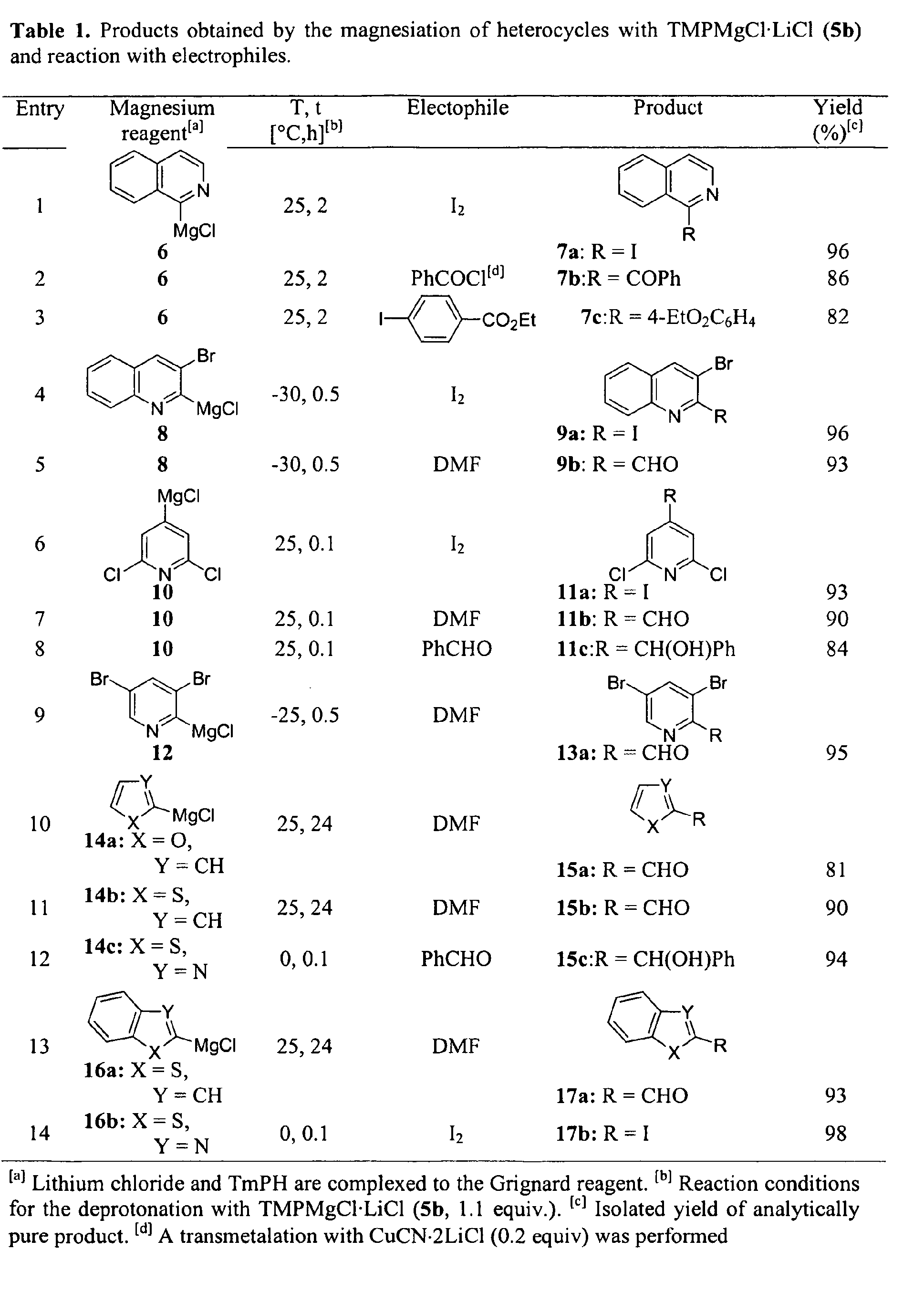
- The activity of the amides (I) can be shown on the basis of the magnesiation of isoquinoline. Diisopropylamido magnesium chloride-lithium chloride 5a leads to the magnesiated isoquinoline 6 after 12 h reaction time at 25°C and by using 2 equivalents of the base. After iodolysis, the iodoisoquinoline 7a is isolated in 88% yield (Scheme 2). Even more active is the sterically more hindered and less aggregated 2,2,6,6-tetramethylpiperidino magnesium chloride-lithium chloride reagent 5b. It leads to a complete magnesiation within 2 h at 25°C. Remarkably, with this base only 1.1 equivalents are required to achieve a complete metalation. The resulting Grignard reagent 6 provides after iodolysis, the iodoisoquinoline 7a in 96% yield (Scheme 2 and Table 1).

- After the magnesation of a reagent, it can be subjected to a transmetalation. After e.g. a transmetalation with CuCN·2LiCl (20 mol %), the addition of benzoyl chloride (1.2 equiv.) provides the ketone 7b in 86% yield (entry 2 of Table 1).
- The presence of an excess of magnesium amides often hampers the performance of palladium-catalyzed cross-couplings. The inventors found that the Grignard reagents generated by deprotonation with 5b (1.1 equiv.) such as 6 are readily transmetalated to the corresponding zinc derivative (ZnCl2 (1.1 equiv.), 0°C, 5 min.) and undergo a Negishi-cross-coupling reaction using Pd(dba)2 (5 mol%), P(2-fur)3 (7 mol%) with ethyl 4-iodobenzoate (1.2 equiv.; 50°C, 12 h) leading to the arylated quinoline (7c) in 82% yield. This behaviour is general and 3-bromoquinoline is metalated with 5b (1.1 equiv., -30°C, 0.5 h) leading to the 2-magnesiated quinoline 8 (entries 4 and 5 of Table 1). Thus, the quenching of 8 with I2 and N,N-dimethylformamide (DMF) provides the two quinolines 9a and 9b in 96-93%.
- Whereas the deprotonation of 2,6-dichloropyridine with i-Pr2NMgCl·LiCl 5a and lithium diisopropylamide (LDA)[8j] provides a 1:1 mixture of 3- and 4-magnesiated 2,6-dichloropyridine, the use of TMPMgCl·LiCl 5b furnishes only the 4-magnesiated pyridine 10. Its reaction with typical electrophiles (I2, DMF and PhCHO) provides the expected products 11a-c in 84 - 93% yield (entries 6-8 of Table 1). Interestingly, metalation of 3,5-dibromopyridine with LDA proceeds selectively at 4-position[6b] while in the case of (TMPMgCl·LiCl 5b 1.1 equiv, -20°C, 0.5h) regioselective metalation of 3,5-dibromopyridine is observed leading after the reaction with DMF to the pyridylaldehyde 13 in 95% yield (entry 9 of Table 1).
- The magnesiation of heterocycles bearing more acidic protons[7] such as thiazole, thiophene, furan, benzothiophene or benzothiazole proceeds smoothly between 0°C and 25°C leading to the organomagnesium derivatives 14a-c and 16a-b. After trapping with standard electrophiles, the expected products 15a-c and 17a-b are obtained in 81-98% yield (entries 10-14 of table 1).
- The metalation of pyrimidine derivatives is a challenging problem due to the propensity of these heterocycles to add organometallic reagents.[8] The inventors found that the inverse addition of the pyrimidine derivatives 18-20 to a THF solution of 5b (1.05 equiv.) at -55°C for approx. 5 min. provides the corresponding magnesiated derivatives 21-23 in 83-90% yields as indicated by iodolysis experiments leading to the iodinated pyrimidines 24-26 (scheme 3).

- The mixed magnesium-lithium amide 5b is also well suited for the regioselective metalation of polyfunctional aromatic systems. Thus, the reaction of 2-phenylpyridine 27 in THF at 55°C with 5b (2.0 equiv.) for 24 h provides the Grignard reagent 28 showing a rare case where a phenyl ring is preferentially metalated compared to a pyridine ring. After iodolysis, the ortho-iodinated product 29 is obtained in 80% yield. Interestingly, the metalation of polyfunctional aromatics such as the bromodiester 30 also succeeds using only the stoichiometric amount of base 5b (1.1 equiv.) in THF (-30°C, 0.5 h) leading regioselectively to the arylmagnesium species (31) which after iodolysis furnishes the polyfunctional aromatic derivative 32 in 88% yield.

- A solution of TMPMgCl·LiCl can easily be prepared in THF due to its excellent solubility and it is stable for more than 6 months at 25°C. The use of TMPMgCl·LiCl allows for the regioselective functionalization of various aromatics and heteroaromatics. It gives access to new magnesium species not readily available via a Br/Mg-exchange reactions or by previously reported metalation procedures.
- The residues R1 and R2 are not limited to organic compounds. R1 and R2 may also be silylated compounds like trimethylsilyl. The preparation of the bis(trimethylsilyl) amide 33 can be achieved by reacting bis(trimethylsilyl)amine with i-PrMgCl·LiCl at room temperature (see Scheme 5). This base can efficiently be used to deprotonate ketones like e.g. cyclohexanone as can be seen from Scheme 5.

- The Grignard reagents can also be used to prepare a polymeric base. 2,2,6,6-tetramethyl piperidine (TMPH) is a well known base. It can be used to prepare the corresponding mixed Mg/Li amide TMPMgCl·LiCl 5b. This monomeric base is very reactive but also very expensive. A corresponding polymeric base to TMPH is chimassorb 994, the structure of which is shown in Scheme 6.

- Chimassorb 994 can be used to prepare the corresponding mixed Mg/Li amide by reacting chimassorb 994 with i-PrMgCl·LiCl at room temperature (see Scheme 5). This base is stable and soluble in THF before and after deprotonation. As being a polymeric base, it can be easily removed after completion of the reaction. Since chimassorb 994 is much cheaper than TMP, a corresponding base can be prepared at reduced costs. The polymeric base 34 shows slightly lower activity than monomeric TMPMgCl·LiCl but is nevertheless very effective in deprotonating compounds with acidic protons like isoquinoline. A corresponding example is shown in Scheme 7. The polymeric base can be used to deprotonate various substrates. For example, isoquinoline reacts at room temperature with the base 34 affording after quenching with iodine 1-iodoisoquinoline 7a.

- The above given examples show that the new mixed Mg/Li-bases of the general type R1R2NMgX·zLiY have a high kinetic activity due to the presence of a lithium salt which breaks oligomeric aggregates of magnesium amides.
- As can be seen from the above given examples, the new mixed Mg/Li-bases are very effective in deprotonating organic compounds. The deprotonation can be achieved in different solvents and can preferably be conducted at temperatures between -90°C and 100°C. Further, due to the effective deprotonation reaction, the amides of the present invention preferably only require the use of 0.9 - 5 equivalents, more preferably 1 - 2 equivalents and most preferably 1.1 - 1.5 equivalents per proton to be deprotonated.
- With this new type of base, which is highly soluble and the side products of which do not disturb the following reactions, many new products may be obtained, or known reactions pathways will be more efficient. A person skilled in the art will easily recognise the benefit of the new Mg/Li-base and will be able to use this base in a wide variety of chemical reactions.
- In the following, examples are given to illustrate the present invention. However, these examples are given for illustrative purposes only and are not supposed to limit the scope of the invention which is determined by the claims below.
- A dry and argon flushed 250 mL flask, equipped with a magnetic stirrer and a septum, was charged with freshly titrated i-PrMgCl·LiCl (100 mL, 1.2 M in THF, 120 mmol). 2,2,6,6-tetramethylpiperidine (TMPH) (19.8 g, 126 mmol, 1.05 equiv) was added dropwise at room temperature. The reaction mixture was stirred until gas evaluation was completed (ca. 24 h) at room temperature.
- A dry and argon flushed 10 mL flask, equipped with a magnetic stirrer and a septum, was charged with TMPMgCl·LiCl (5 mL, 1.2 M in THF, 6.0 mmol). Isoquinoline (703 mg, 5.45 mmol) in THF (5 ml) was added dropwise at room temperature. During addition, the reaction mixture became red and the metalation was complete after 2 h (as checked by GC analysis of reaction aliquots quenched with a solution of I2 in THF, the conversion was more than 98%). A solution of I2 in THF (6 ml, 1 M in THF, 6.0 mmol) was slowly added at -20°C. The reaction mixture was quenched with sat. aqueous NH4Cl solution (10 mL). The aqueous phase was extracted with ether (4 x 10 mL), dried with Na2SO4 and concentrated in vacuo. The crude residue was purified by filter column chromatography (CH2Cl2/pentane) yielding 1-iodoisoquinoline (7a; 1.33 mg, 96%) as slightly yellow crystals (mp = 74-76°C).
- The products listed in table 1 below can be produced according to the preparation of 1-iodoisoquinoline (7a).
-
- [1] a) M. Schlosser, Angew. Chem. Int. Ed. 2005, 44, 376-393. b) A. Turck, N. Ple, F. Mongin, G. Qúeguiner, Tetrahedron 2001, 57, 4489-4505. c) F. Mongin, G. Qúeguiner, Tetrahedron 2001, 57, 4059-4090 d) M. Schlosser, Eur. J. Org. Chem. 2001, 21, 3975-3984 . e) D. M. Hodgson, C. D. Bray, N. D. Kindon, Org. Lett. 2005, 7, 2305-2308. f) J-C. Plaquevent, T. Perrard, D. Cahard, Chem. Eur. J. 2002, 8, 3300-3307. g) C. -C. Chang, M. S. Ameerunisha, Coord. Chem. Rev. 1999, 189, 199-278. h) J. Clayden, Organolithiums: Selectivity for Synthesis. Editor(s): J. E. Baldwin, R. M. Williams 2002, Publisher: Elsevier. i) F. Leroux, M. Schlosser, E. Zohar, I. Marek, The preparation of organolithium reagents and intermediates Editor(s): Rappoport, Zvi; Marek, Ilan. Chemistry of Organolithium Compounds 2004, 1, 435-493. Publisher: John Wiley & Sons Ltd. j) K. W. Henderson, W. J. Kerr, Chem.-A Eur. J. 2001, 7(16), 3430-3437. k) K. W. Henderson, W. J. Kerr, J. H. Moir, Tetrahedron 2002, 58(23), 4573-4587.1) M. C. Whisler, S. MacNeil, V. Snieckus, P. Beak, Angew. Chem. Int. Ed. 2004, 43(17), 2206-2225. m) G. Queguiner, F. Marsais, V. Snieckus, J. Epsztajn, Adv. in Het. Chem. 1991, 52, 187-304. n) M. Veith, S. Wieczorek, K. Fries, V. Huch, Z. Anorg. Allg. Chem. 2000, 626(5), 1237-1245.
- [2] a) M-X. Zhang, P. E. Eaton, Angew. Chem. Int. Ed. 2002, 41, 2169-2171. b) Y. Kondo, Y. Akihiro, T. Sakamoto, J. Chem. Soc., Perkin Trans. 1: Org. Bio-Org. Chem. 1996, 19, 2331-2332. c) P. E. Eaton, C. H. Lee, Y. Xiong, J. Am. Chem. Soc. 1989, 111, 8016-18. d) P. E. Eaton, M-X. Zhang, N. Komiya, C-G. Yang, I. Steele, R. Gilardi, Synlett 2003, 9, 1275-1278. e) P. E. Eaton, R. M. Martin, J. Org. Chem. 1988, 53, 2728-32. f) M. Shilai, Y. Kondo, T. Sakamoto, J. Chem. Soc., Perkin Trans. 1: Org. Bio-Org. Chem. 2001, 4, 442.
- [3] a) Y. Kondo, M. Shilai, M. Uchiyama, T. Sakamoto, J. Am. Chem. Soc. 1999, 121, 3539-3540. b) T. Imahori, M. Uchiyama, T. Sakamoto, Y. Kondo, Chem. Comm. 2001, 23, 2450-2451.
- [4] A. Krasovskiy, P. Knochel, Angew. Chem. 2004, 116, 4438; Angew. Chem. Int. Ed. 2004, 43, 3333. b) H. Ren, A. Krasovskiy, P. Knochel, Chem. Commun. 2005, 543. c) H. Ren, A. Krasovskiy, P. Knochel, Org. Lett. 2004, 6, 4215.
- [5] i-PrMgCl·LiCl is commercially available from Chemetall GmbH (Frankfurt)
- [6] a) A. J. Clarke, S. McNamara, O. Meth-Cohn, Tetrahedron Lett. 1974, 27, 2373-6. b) Y. G. Gu,; E. K. Bayburt, Tetrahedron Lett. 1996, 37, 2565.
- [7] a) H. Froehlich, W. Kalt, J. Org. Chem. 1990, 55, 2993-5. b) C. Peyron, J-M. Navarre, N. Van Craynest, R. Benhida, Tetrahedron Lett. 2005, 46, 3315-3318 . c) D. W. Slocum, P. L. Gierer, J. Org. Chem. 1976, 41, 3668-74.
- [8] a) Y. G. Gu, E. K. Bayburt, Tetrahedron Lett. 1996, 37, 2565-8. b) W. Schlecker, A. Huth, E. Ottow, J. Mulzer, Lieb. Ann. 1995, 8, 1441-6. c) W. Schlecker, A. Huth, E. Ottow, J. Mulzer, J. Org. Chem. 1995, 60, 8414-16. d) A. Bouillon, J-C. Lancelot, V. Collot, P. R. Bovy, S. Rault, Tetrahedron 2002, 58, 3323-3328. e) A. Bouillon, J-C. Lancelot, J. S. de O. Santos, V. Collot, P. R. Bovy, S. Rault, Tetrahedron 2003, 59, 10043-10049. f) A. Bouillon, J-C. Lancelot, V. Collot, P. R. Bovy, S. Rault, Tetrahedron 2002, 58, 4369-4373. g) A. Bouillon, J-C. Lancelot, V. Collot, P. R. Bovy, S. Rault, Tetrahedron 2002, 58, 2885-2890. h) H. Awad, F. Mongin, F. Trecourt, G. Queguiner, F. Marsais, Tetrahedron Lett. 2004, 45, 7873-7877. i) D. L. Comins, M. O. Killpack, J. Org. Chem. 1990, 55, 69-73. j) R. Radinov, Kh. Chanev, M. Khaimova, J. Org. Chem. 1991, 56, 4793-6. k) S. Choppin, P. Gros, Y. Fort, Org. Lett. 2000, 2, 803-805.
Claims (12)
- Process for the preparation of a mixed Mg/Li amide comprising reacting a primary or secondary amine with a Grignard reagent in the presence of a lithium salt or with a Grignard reagent complexed with a lithium salt in a solvent.
- Process for the preparation of a reagent having the general formula
R1R2N-MgX·zLiY (I)
comprising reacting R1R2NH with a Grignard reagent R3MgX in the presence of LiY or with R3MgX·zLiY in a solvent,
wherein
R1, R2 and R3 independently are selected from substituted or unsubstituted aryl or heteroaryl containing one or more heteroatoms, linear, branched or cyclic, substituted or unsubstituted alkyl, alkenyl, alkynyl, or derivatives thereof, and, for R1 and R2 only, the silyl derivatives thereof; one of R1 and R2 may be H; or R1 and R2 together can be part of a cyclic or polymeric structure;
X and Y independently are selected from the group consisting of F; Cl; Br; I; CN; SCN; NCO; HalOn, wherein n = 3 or 4 and Hal is selected from Cl, Br and I; NO3; BF4; PF6; H; a carboxylate of the general formula RxCO2; an alcoholate of the general formula ORx; a thiolate of the general formula SRx; RxP(O)O2; or SCORx; or SCSRx; OnSRx,
wherein n = 2 or 3; or NOn, wherein n = 2 or 3; and a derivative thereof;
wherein Rx is a substituted or unsubstituted aryl or heteroaryl containing one or more heteroatoms, linear, branched or cyclic, substituted or unsubstituted alkyl, alkenyl, alkynyl, or derivatives thereof, or H;
z>0. - Process according to claim 2, wherein X and Y are independently or both Cl, Br or I, and preferably Cl.
- Process according to claim 2 or 3, wherein z is in the range from 0.01 - 5, preferably from 0.5 - 2, more preferably from 0.9 to 1.2 and most preferred about 1.
- Process according to any of the preceding claims, wherein the Grignard reagent is iPrMgCl·LiCl.
- Process according to any of the preceding claims, wherein the solvent is selected from cyclic, linear or branched mono or polyethers, thioethers, amines, phosphines, and derivatives thereof containing one or more additional heteroatoms selected from O, N, S and P, preferably tetrahydrofuran (THF), 2-methyltetrahydrofuran, dibutyl ether, diethyl ether, tert-butylmethyl ether, dimethoxyethane, dioxanes, preferably 1,4-dioxane, triethylamine, ethyldiisopropylamine, dimethylsulfide, dibutylsulfide; cyclic amides, preferably N-methyl-2-pyrrolidone (NMP), N-ethyl-2-pyrrolidone (NEP), N-butyl-2-pyrrolidone (NBP); cyclic, linear or branched alkanes and/or alkenes wherein one or more hydrogens are replaced by a halogen, preferably dichloromethane, 1,2-dichloroethane, CCl4; urea derivatives, preferably N,N'-dimethylpropyleneurea (DMPU); aromatic, heteroaromatic or aliphatic hydrocarbons, preferably benzene, toluene, xylene, pyridine, pentane, cyclohexane, hexane, heptane; hexamethylphosphorus triamide (HMPA), CS2; or combinations thereof.
- A reagent having the general formula
R1R2N-MgX·zLiY
wherein R1, R2, X, Y and z are defined as in claim 2, or as adduct with a solvent, defined in claim 6. - Solution of R1R2N-MgX·zLiY in a solvent, wherein R1, R2, X, Y and z are defined as in claim 2.
- Solution according to claim 8, wherein the solvent is selected from cyclic, linear or branched mono or polyethers, thioethers, amines, phosphines, and derivatives thereof containing one or more additional heteroatoms selected from O, N, S and P, preferably tetrahydrofuran (THF), 2-methyltetrahydrofuran, dibutyl ether, diethyl ether, tert-butylmethyl ether, dimethoxyethane, dioxanes, preferably 1,4-dioxane, triethylamine, ethyldiisopropylamine, dimethylsulfide, dibutylsulfide; cyclic amides, preferably N-methyl-2-pyrrolidone (NMP), N-ethyl-2-pyrrolidone (NEP), N-butyl-2-pyrrolidone (NBP); cyclic, linear or branched alkanes and/or alkenes wherein one or more hydrogens are replaced by a halogen, preferably dichloromethane, 1,2-dichloroethane, CCl4; urea derivatives, preferably N,N'-dimethylpropyleneurea (DMPU); aromatic, heteroaromatic or aliphatic hydrocarbons, preferably benzene, toluene, xylene, pyridine, pentane, cyclohexane, hexane, heptane; hexamethylphosphorus triamide (HMPA), CS2; or combinations thereof.
- Use of R1R2N-MgX·zLiY wherein R1, R2, X, Y and z are defined as in claim 2, in a reaction with an electrophile.
- Use of R1R2N-MgX·zLiY wherein R1, R2, X, Y and z are defined as in claim 2, for the deprotonation of any substrate which can form stabilized or unstabilized carbaniones.
- Product of a reaction of an electrophile with a substrate which has been deprotonated with a reagent of the general formula R1R2N-MgX·zLiY (I) wherein R1, R2, X, Y and z are defined as in claim 2.
Priority Applications (14)
| Application Number | Priority Date | Filing Date | Title |
|---|---|---|---|
| EP06001017A EP1810974A1 (en) | 2006-01-18 | 2006-01-18 | Preparation and use of magnesium amides |
| EP07703987A EP1981893B1 (en) | 2006-01-18 | 2007-01-18 | Preparation and use of magnesium amides |
| AT07703987T ATE512156T1 (en) | 2006-01-18 | 2007-01-18 | PRODUCTION AND USE OF MAGNESIUM AMIDES |
| ES11166878.6T ES2605239T3 (en) | 2006-01-18 | 2007-01-18 | Preparation and use of magnesium amides |
| JP2008550757A JP5638758B2 (en) | 2006-01-18 | 2007-01-18 | Preparation and use of magnesium amide |
| ES07703987T ES2369973T3 (en) | 2006-01-18 | 2007-01-18 | PREPARATION AND USE OF MAGNESIUM AMIDAS. |
| CN2007800024216A CN101370815B (en) | 2006-01-18 | 2007-01-18 | Preparation and use of magnesium amides |
| EP11166878.6A EP2360161B1 (en) | 2006-01-18 | 2007-01-18 | Preparation and use of magnesium amides |
| US12/087,351 US8134005B2 (en) | 2006-01-18 | 2007-01-18 | Preparation and use of magnesium amides |
| PCT/EP2007/050492 WO2007082911A1 (en) | 2006-01-18 | 2007-01-18 | Preparation and use of magnesium amides |
| CN200880002287A CN101622260A (en) | 2006-01-18 | 2008-01-04 | Preparation and application of aminomagnesium compounds |
| JP2009545884A JP2010516649A (en) | 2006-01-18 | 2008-01-04 | Preparation and use of magnesium amide |
| US12/522,494 US20100144516A1 (en) | 2006-01-18 | 2008-01-04 | Preparation and use of magnesium amides |
| PCT/EP2008/050066 WO2008087057A1 (en) | 2006-01-18 | 2008-01-04 | Preparation and use of magnesium amides |
Applications Claiming Priority (1)
| Application Number | Priority Date | Filing Date | Title |
|---|---|---|---|
| EP06001017A EP1810974A1 (en) | 2006-01-18 | 2006-01-18 | Preparation and use of magnesium amides |
Publications (1)
| Publication Number | Publication Date |
|---|---|
| EP1810974A1 true EP1810974A1 (en) | 2007-07-25 |
Family
ID=36603708
Family Applications (3)
| Application Number | Title | Priority Date | Filing Date |
|---|---|---|---|
| EP06001017A Withdrawn EP1810974A1 (en) | 2006-01-18 | 2006-01-18 | Preparation and use of magnesium amides |
| EP11166878.6A Active EP2360161B1 (en) | 2006-01-18 | 2007-01-18 | Preparation and use of magnesium amides |
| EP07703987A Active EP1981893B1 (en) | 2006-01-18 | 2007-01-18 | Preparation and use of magnesium amides |
Family Applications After (2)
| Application Number | Title | Priority Date | Filing Date |
|---|---|---|---|
| EP11166878.6A Active EP2360161B1 (en) | 2006-01-18 | 2007-01-18 | Preparation and use of magnesium amides |
| EP07703987A Active EP1981893B1 (en) | 2006-01-18 | 2007-01-18 | Preparation and use of magnesium amides |
Country Status (7)
| Country | Link |
|---|---|
| US (2) | US8134005B2 (en) |
| EP (3) | EP1810974A1 (en) |
| JP (2) | JP5638758B2 (en) |
| CN (2) | CN101370815B (en) |
| AT (1) | ATE512156T1 (en) |
| ES (2) | ES2605239T3 (en) |
| WO (2) | WO2007082911A1 (en) |
Cited By (4)
| Publication number | Priority date | Publication date | Assignee | Title |
|---|---|---|---|---|
| DE102009003179A1 (en) | 2008-05-21 | 2009-11-26 | Chemetall Gmbh | Process for the preparation of magnesium amides |
| CN105189477A (en) * | 2013-05-17 | 2015-12-23 | 巴斯夫欧洲公司 | Process for preparing n-substituted 1h-pyrazole-5-carboxylic acid compounds and derivatives thereof |
| WO2016058895A1 (en) * | 2014-10-14 | 2016-04-21 | Syngenta Participations Ag | Process for the preparation of halo-substituted benzenes |
| EP3750877A1 (en) | 2019-06-13 | 2020-12-16 | Evonik Operations GmbH | Method for preparing triacetone amine and 2,2,4,6-tetramethylpiperidine |
Families Citing this family (16)
| Publication number | Priority date | Publication date | Assignee | Title |
|---|---|---|---|---|
| EP1810974A1 (en) * | 2006-01-18 | 2007-07-25 | Ludwig-Maximilians-Universität München | Preparation and use of magnesium amides |
| DE102007022490A1 (en) * | 2007-05-14 | 2008-11-20 | Ludwig-Maximilians-Universität | Bisamide-zinc bases |
| JP5443342B2 (en) | 2007-06-08 | 2014-03-19 | ジヤンセン・フアーマシユーチカ・ナームローゼ・フエンノートシヤツプ | Piperidine / piperazine derivatives |
| JO2972B1 (en) | 2007-06-08 | 2016-03-15 | جانسين فارماسوتيكا ان. في | Piperidine/Piperazine derivatives |
| ES2617619T3 (en) | 2008-06-05 | 2017-06-19 | Janssen Pharmaceutica, N.V. | Drug combinations comprising a DGAT inhibitor and a PPAR agonist |
| EP2396337B1 (en) | 2009-02-13 | 2016-07-13 | Ludwig-Maximilians-Universität München | Preparation and use of zinc-amides |
| KR20130034020A (en) * | 2010-03-16 | 2013-04-04 | 바스프 에스이 | A process using grignard reagents |
| JP2013542199A (en) * | 2010-09-30 | 2013-11-21 | ビーエーエスエフ ソシエタス・ヨーロピア | Method for synthesizing thiotriazolo group-containing compound |
| US8541133B2 (en) * | 2010-10-27 | 2013-09-24 | Toyota Motor Engineering & Manufacturing North America, Inc. | Electrochemical device with a magnesium anode and a stable, safe electrolyte compatible with sulfur |
| CN108586500B (en) | 2010-12-22 | 2021-06-25 | 慕尼黑路德维希马克西米利安斯大学 | Zinc coordination complex and method for preparing organozinc reagent |
| CN103435635B (en) * | 2013-08-02 | 2015-09-30 | 上虞华伦化工有限公司 | A kind of preparation method of magnesium dichloride (2,2,6,6-tetramethyl piperidine) lithium salts |
| JP6235932B2 (en) * | 2014-02-26 | 2017-11-22 | 東ソー・ファインケム株式会社 | Method for producing 2-cyanophenylboronic acid derivative |
| WO2018116139A1 (en) | 2016-12-19 | 2018-06-28 | Novartis Ag | New picolinic acid derivatives and their use as intermediates |
| CN109232385B (en) * | 2018-10-27 | 2022-02-08 | 阜新孚隆宝医药科技有限公司 | A kind of preparation method of magnesium dichloride (2,2,6,6-tetramethylpiperidine) lithium salt |
| FR3104584B1 (en) * | 2019-12-17 | 2021-12-03 | Michelin & Cie | Asymmetric diorganomagnesium compound |
| JP7210501B2 (en) * | 2020-04-21 | 2023-01-23 | 信越化学工業株式会社 | Method for producing 2-isopropenyl-5-methyl-4-hexenoic acid, 2-isopropenyl-5-methyl-4-hexene-1-ol and carboxylic acid ester thereof |
Citations (2)
| Publication number | Priority date | Publication date | Assignee | Title |
|---|---|---|---|---|
| EP0650971A1 (en) * | 1993-11-01 | 1995-05-03 | Albemarle Corporation | Deprotonation of cyclopentadienyl derivatives |
| EP1582523A1 (en) * | 2004-04-02 | 2005-10-05 | Ludwig-Maximilians-Universität München | Method of preparing organomagnesium compounds |
Family Cites Families (6)
| Publication number | Priority date | Publication date | Assignee | Title |
|---|---|---|---|---|
| US4944894A (en) * | 1988-02-25 | 1990-07-31 | Lithium Corporatoin Of America | Ether free organometallic amide compositions |
| US5300252A (en) * | 1987-03-13 | 1994-04-05 | Fmc Corporation | Ether free organometallic amide compositions |
| ES2074054T3 (en) * | 1987-03-13 | 1995-09-01 | Lithium Corp | COMPOSITIONS OF ETHER-FREE ORGANOMETALLIC AMIDES. |
| US5002689A (en) * | 1988-02-25 | 1991-03-26 | Lithium Corporation Of America | Preparation of organometallic amide compositions |
| US5610227A (en) * | 1995-06-07 | 1997-03-11 | Bridgestone/Firestone, Inc. | Lithium amino magnesiate polymerization initiators and elastomers having reduced hysteresis |
| EP1810974A1 (en) | 2006-01-18 | 2007-07-25 | Ludwig-Maximilians-Universität München | Preparation and use of magnesium amides |
-
2006
- 2006-01-18 EP EP06001017A patent/EP1810974A1/en not_active Withdrawn
-
2007
- 2007-01-18 ES ES11166878.6T patent/ES2605239T3/en active Active
- 2007-01-18 CN CN2007800024216A patent/CN101370815B/en active Active
- 2007-01-18 ES ES07703987T patent/ES2369973T3/en active Active
- 2007-01-18 EP EP11166878.6A patent/EP2360161B1/en active Active
- 2007-01-18 US US12/087,351 patent/US8134005B2/en active Active
- 2007-01-18 WO PCT/EP2007/050492 patent/WO2007082911A1/en not_active Ceased
- 2007-01-18 AT AT07703987T patent/ATE512156T1/en active
- 2007-01-18 EP EP07703987A patent/EP1981893B1/en active Active
- 2007-01-18 JP JP2008550757A patent/JP5638758B2/en active Active
-
2008
- 2008-01-04 CN CN200880002287A patent/CN101622260A/en active Pending
- 2008-01-04 US US12/522,494 patent/US20100144516A1/en not_active Abandoned
- 2008-01-04 WO PCT/EP2008/050066 patent/WO2008087057A1/en not_active Ceased
- 2008-01-04 JP JP2009545884A patent/JP2010516649A/en not_active Withdrawn
Patent Citations (2)
| Publication number | Priority date | Publication date | Assignee | Title |
|---|---|---|---|---|
| EP0650971A1 (en) * | 1993-11-01 | 1995-05-03 | Albemarle Corporation | Deprotonation of cyclopentadienyl derivatives |
| EP1582523A1 (en) * | 2004-04-02 | 2005-10-05 | Ludwig-Maximilians-Universität München | Method of preparing organomagnesium compounds |
Non-Patent Citations (2)
| Title |
|---|
| KNOCHEL P ET AL: "SYNTHESE HOCH FUNKTIONALISIERTER ORGANOMAGNESIUM-REAGENTIEN DURCH HALOGEN-METALL-AUSTAUSCH", ANGEWANDTE CHEMIE, VCH VERLAGSGESELLSCHAFT, WEINHEIM, DE, vol. 115, 2003, pages 4438 - 4456, XP002294440, ISSN: 0044-8249 * |
| MULVEY, ROBERT E.: "s-Block metal inverse crowns: synthetic and structural synergism in mixed alkali metal?magnesium (or zinc) amide chemistry", CHEM. COMMUN., no. 12, 2001, pages 1049 - 1056, XP002388730 * |
Cited By (9)
| Publication number | Priority date | Publication date | Assignee | Title |
|---|---|---|---|---|
| DE102009003179A1 (en) | 2008-05-21 | 2009-11-26 | Chemetall Gmbh | Process for the preparation of magnesium amides |
| EP2297101B1 (en) * | 2008-05-21 | 2016-07-13 | Chemetall GmbH | Method for manufacturing magnesium amides |
| US9688632B2 (en) | 2008-05-21 | 2017-06-27 | Alexander Murso | Method for manufacturing magnesium amides |
| CN106928258A (en) * | 2008-05-21 | 2017-07-07 | 罗克伍德锂有限责任公司 | method for preparing amino magnesium |
| CN105189477A (en) * | 2013-05-17 | 2015-12-23 | 巴斯夫欧洲公司 | Process for preparing n-substituted 1h-pyrazole-5-carboxylic acid compounds and derivatives thereof |
| WO2016058895A1 (en) * | 2014-10-14 | 2016-04-21 | Syngenta Participations Ag | Process for the preparation of halo-substituted benzenes |
| US10087126B2 (en) | 2014-10-14 | 2018-10-02 | Syngenta Participations Ag | Process for the preparation of halo-substituted benzenes |
| EP3750877A1 (en) | 2019-06-13 | 2020-12-16 | Evonik Operations GmbH | Method for preparing triacetone amine and 2,2,4,6-tetramethylpiperidine |
| EP3750876A1 (en) | 2019-06-13 | 2020-12-16 | Evonik Operations GmbH | Method for preparing triacetone amine, 2,2,4,6-tetramethylpiperidine and/or the salts of 2,2,4,6-tetramethylpiperidine |
Also Published As
| Publication number | Publication date |
|---|---|
| US20090176988A1 (en) | 2009-07-09 |
| JP5638758B2 (en) | 2014-12-10 |
| US8134005B2 (en) | 2012-03-13 |
| EP1981893B1 (en) | 2011-06-08 |
| EP2360161A1 (en) | 2011-08-24 |
| ES2369973T3 (en) | 2011-12-09 |
| EP2360161B1 (en) | 2016-08-31 |
| WO2008087057A1 (en) | 2008-07-24 |
| WO2007082911A1 (en) | 2007-07-26 |
| EP1981893A1 (en) | 2008-10-22 |
| JP2009523765A (en) | 2009-06-25 |
| CN101622260A (en) | 2010-01-06 |
| CN101370815B (en) | 2012-05-23 |
| CN101370815A (en) | 2009-02-18 |
| JP2010516649A (en) | 2010-05-20 |
| US20100144516A1 (en) | 2010-06-10 |
| ATE512156T1 (en) | 2011-06-15 |
| ES2605239T3 (en) | 2017-03-13 |
Similar Documents
| Publication | Publication Date | Title |
|---|---|---|
| EP2360161B1 (en) | Preparation and use of magnesium amides | |
| JP5059294B2 (en) | Method for producing organomagnesium compound | |
| US8513416B2 (en) | Bisamide-zinc bases | |
| CA2752179C (en) | Preparation and use of zinc amides | |
| CN101410404B (en) | Methods for the synthesis of organic elemental compounds | |
| EP1582524B1 (en) | Method of preparing organomagnesium compounds | |
| WO2007128601A2 (en) | Method for the preparation of a compound of the general formula r1-r1 and/or r1-r2 using homo and hetero coupling reactions | |
| Yin et al. | Trisyl-based multidentate ligands: synthesis and their transition-metal complexes | |
| EP2142556A1 (en) | Preparation and use of magnesium amides | |
| US9227987B2 (en) | Method for producing amido-zinc halide/alkali-metal halide compounds |
Legal Events
| Date | Code | Title | Description |
|---|---|---|---|
| PUAI | Public reference made under article 153(3) epc to a published international application that has entered the european phase |
Free format text: ORIGINAL CODE: 0009012 |
|
| AK | Designated contracting states |
Kind code of ref document: A1 Designated state(s): AT BE BG CH CY CZ DE DK EE ES FI FR GB GR HU IE IS IT LI LT LU LV MC NL PL PT RO SE SI SK TR |
|
| AX | Request for extension of the european patent |
Extension state: AL BA HR MK YU |
|
| AKX | Designation fees paid | ||
| STAA | Information on the status of an ep patent application or granted ep patent |
Free format text: STATUS: THE APPLICATION IS DEEMED TO BE WITHDRAWN |
|
| 18D | Application deemed to be withdrawn |
Effective date: 20080126 |
|
| REG | Reference to a national code |
Ref country code: DE Ref legal event code: 8566 |