EP3730685B1 - Meltblown non-woven fabric - Google Patents
Meltblown non-woven fabric Download PDFInfo
- Publication number
- EP3730685B1 EP3730685B1 EP18890630.9A EP18890630A EP3730685B1 EP 3730685 B1 EP3730685 B1 EP 3730685B1 EP 18890630 A EP18890630 A EP 18890630A EP 3730685 B1 EP3730685 B1 EP 3730685B1
- Authority
- EP
- European Patent Office
- Prior art keywords
- woven fabric
- meltblown non
- straight
- rate
- fibers
- Prior art date
- Legal status (The legal status is an assumption and is not a legal conclusion. Google has not performed a legal analysis and makes no representation as to the accuracy of the status listed.)
- Active
Links
Images
Classifications
-
- D—TEXTILES; PAPER
- D04—BRAIDING; LACE-MAKING; KNITTING; TRIMMINGS; NON-WOVEN FABRICS
- D04H—MAKING TEXTILE FABRICS, e.g. FROM FIBRES OR FILAMENTARY MATERIAL; FABRICS MADE BY SUCH PROCESSES OR APPARATUS, e.g. FELTS, NON-WOVEN FABRICS; COTTON-WOOL; WADDING ; NON-WOVEN FABRICS FROM STAPLE FIBRES, FILAMENTS OR YARNS, BONDED WITH AT LEAST ONE WEB-LIKE MATERIAL DURING THEIR CONSOLIDATION
- D04H3/00—Non-woven fabrics formed wholly or mainly of yarns or like filamentary material of substantial length
- D04H3/08—Non-woven fabrics formed wholly or mainly of yarns or like filamentary material of substantial length characterised by the method of strengthening or consolidating
- D04H3/16—Non-woven fabrics formed wholly or mainly of yarns or like filamentary material of substantial length characterised by the method of strengthening or consolidating with bonds between thermoplastic filaments produced in association with filament formation, e.g. immediately following extrusion
-
- D—TEXTILES; PAPER
- D04—BRAIDING; LACE-MAKING; KNITTING; TRIMMINGS; NON-WOVEN FABRICS
- D04H—MAKING TEXTILE FABRICS, e.g. FROM FIBRES OR FILAMENTARY MATERIAL; FABRICS MADE BY SUCH PROCESSES OR APPARATUS, e.g. FELTS, NON-WOVEN FABRICS; COTTON-WOOL; WADDING ; NON-WOVEN FABRICS FROM STAPLE FIBRES, FILAMENTS OR YARNS, BONDED WITH AT LEAST ONE WEB-LIKE MATERIAL DURING THEIR CONSOLIDATION
- D04H3/00—Non-woven fabrics formed wholly or mainly of yarns or like filamentary material of substantial length
- D04H3/016—Non-woven fabrics formed wholly or mainly of yarns or like filamentary material of substantial length characterised by the fineness
-
- A—HUMAN NECESSITIES
- A61—MEDICAL OR VETERINARY SCIENCE; HYGIENE
- A61F—FILTERS IMPLANTABLE INTO BLOOD VESSELS; PROSTHESES; DEVICES PROVIDING PATENCY TO, OR PREVENTING COLLAPSING OF, TUBULAR STRUCTURES OF THE BODY, e.g. STENTS; ORTHOPAEDIC, NURSING OR CONTRACEPTIVE DEVICES; FOMENTATION; TREATMENT OR PROTECTION OF EYES OR EARS; BANDAGES, DRESSINGS OR ABSORBENT PADS; FIRST-AID KITS
- A61F13/00—Bandages or dressings; Absorbent pads
- A61F13/15—Absorbent pads, e.g. sanitary towels, swabs or tampons for external or internal application to the body; Supporting or fastening means therefor; Tampon applicators
-
- A—HUMAN NECESSITIES
- A61—MEDICAL OR VETERINARY SCIENCE; HYGIENE
- A61F—FILTERS IMPLANTABLE INTO BLOOD VESSELS; PROSTHESES; DEVICES PROVIDING PATENCY TO, OR PREVENTING COLLAPSING OF, TUBULAR STRUCTURES OF THE BODY, e.g. STENTS; ORTHOPAEDIC, NURSING OR CONTRACEPTIVE DEVICES; FOMENTATION; TREATMENT OR PROTECTION OF EYES OR EARS; BANDAGES, DRESSINGS OR ABSORBENT PADS; FIRST-AID KITS
- A61F13/00—Bandages or dressings; Absorbent pads
- A61F13/15—Absorbent pads, e.g. sanitary towels, swabs or tampons for external or internal application to the body; Supporting or fastening means therefor; Tampon applicators
- A61F13/51—Absorbent pads, e.g. sanitary towels, swabs or tampons for external or internal application to the body; Supporting or fastening means therefor; Tampon applicators characterised by the outer layers of the pads
- A61F13/514—Backsheet, i.e. the impermeable cover or layer furthest from the skin
-
- A—HUMAN NECESSITIES
- A61—MEDICAL OR VETERINARY SCIENCE; HYGIENE
- A61L—METHODS OR APPARATUS FOR STERILISING MATERIALS OR OBJECTS IN GENERAL; DISINFECTION, STERILISATION OR DEODORISATION OF AIR; CHEMICAL ASPECTS OF BANDAGES, DRESSINGS, ABSORBENT PADS OR SURGICAL ARTICLES; MATERIALS FOR BANDAGES, DRESSINGS, ABSORBENT PADS OR SURGICAL ARTICLES
- A61L15/00—Chemical aspects of, or use of materials for, bandages, dressings or absorbent pads
- A61L15/16—Bandages, dressings or absorbent pads for physiological fluids such as urine or blood, e.g. sanitary towels, tampons
- A61L15/22—Bandages, dressings or absorbent pads for physiological fluids such as urine or blood, e.g. sanitary towels, tampons containing macromolecular materials
- A61L15/24—Macromolecular compounds obtained by reactions only involving carbon-to-carbon unsaturated bonds; Derivatives thereof
-
- D—TEXTILES; PAPER
- D04—BRAIDING; LACE-MAKING; KNITTING; TRIMMINGS; NON-WOVEN FABRICS
- D04H—MAKING TEXTILE FABRICS, e.g. FROM FIBRES OR FILAMENTARY MATERIAL; FABRICS MADE BY SUCH PROCESSES OR APPARATUS, e.g. FELTS, NON-WOVEN FABRICS; COTTON-WOOL; WADDING ; NON-WOVEN FABRICS FROM STAPLE FIBRES, FILAMENTS OR YARNS, BONDED WITH AT LEAST ONE WEB-LIKE MATERIAL DURING THEIR CONSOLIDATION
- D04H1/00—Non-woven fabrics formed wholly or mainly of staple fibres or like relatively short fibres
- D04H1/40—Non-woven fabrics formed wholly or mainly of staple fibres or like relatively short fibres from fleeces or layers composed of fibres without existing or potential cohesive properties
- D04H1/42—Non-woven fabrics formed wholly or mainly of staple fibres or like relatively short fibres from fleeces or layers composed of fibres without existing or potential cohesive properties characterised by the use of certain kinds of fibres insofar as this use has no preponderant influence on the consolidation of the fleece
- D04H1/4382—Stretched reticular film fibres; Composite fibres; Mixed fibres; Ultrafine fibres; Fibres for artificial leather
- D04H1/43838—Ultrafine fibres, e.g. microfibres
-
- D—TEXTILES; PAPER
- D04—BRAIDING; LACE-MAKING; KNITTING; TRIMMINGS; NON-WOVEN FABRICS
- D04H—MAKING TEXTILE FABRICS, e.g. FROM FIBRES OR FILAMENTARY MATERIAL; FABRICS MADE BY SUCH PROCESSES OR APPARATUS, e.g. FELTS, NON-WOVEN FABRICS; COTTON-WOOL; WADDING ; NON-WOVEN FABRICS FROM STAPLE FIBRES, FILAMENTS OR YARNS, BONDED WITH AT LEAST ONE WEB-LIKE MATERIAL DURING THEIR CONSOLIDATION
- D04H1/00—Non-woven fabrics formed wholly or mainly of staple fibres or like relatively short fibres
- D04H1/40—Non-woven fabrics formed wholly or mainly of staple fibres or like relatively short fibres from fleeces or layers composed of fibres without existing or potential cohesive properties
- D04H1/54—Non-woven fabrics formed wholly or mainly of staple fibres or like relatively short fibres from fleeces or layers composed of fibres without existing or potential cohesive properties by welding together the fibres, e.g. by partially melting or dissolving
- D04H1/542—Adhesive fibres
- D04H1/544—Olefin series
-
- D—TEXTILES; PAPER
- D04—BRAIDING; LACE-MAKING; KNITTING; TRIMMINGS; NON-WOVEN FABRICS
- D04H—MAKING TEXTILE FABRICS, e.g. FROM FIBRES OR FILAMENTARY MATERIAL; FABRICS MADE BY SUCH PROCESSES OR APPARATUS, e.g. FELTS, NON-WOVEN FABRICS; COTTON-WOOL; WADDING ; NON-WOVEN FABRICS FROM STAPLE FIBRES, FILAMENTS OR YARNS, BONDED WITH AT LEAST ONE WEB-LIKE MATERIAL DURING THEIR CONSOLIDATION
- D04H1/00—Non-woven fabrics formed wholly or mainly of staple fibres or like relatively short fibres
- D04H1/40—Non-woven fabrics formed wholly or mainly of staple fibres or like relatively short fibres from fleeces or layers composed of fibres without existing or potential cohesive properties
- D04H1/54—Non-woven fabrics formed wholly or mainly of staple fibres or like relatively short fibres from fleeces or layers composed of fibres without existing or potential cohesive properties by welding together the fibres, e.g. by partially melting or dissolving
- D04H1/56—Non-woven fabrics formed wholly or mainly of staple fibres or like relatively short fibres from fleeces or layers composed of fibres without existing or potential cohesive properties by welding together the fibres, e.g. by partially melting or dissolving in association with fibre formation, e.g. immediately following extrusion of staple fibres
-
- D—TEXTILES; PAPER
- D04—BRAIDING; LACE-MAKING; KNITTING; TRIMMINGS; NON-WOVEN FABRICS
- D04H—MAKING TEXTILE FABRICS, e.g. FROM FIBRES OR FILAMENTARY MATERIAL; FABRICS MADE BY SUCH PROCESSES OR APPARATUS, e.g. FELTS, NON-WOVEN FABRICS; COTTON-WOOL; WADDING ; NON-WOVEN FABRICS FROM STAPLE FIBRES, FILAMENTS OR YARNS, BONDED WITH AT LEAST ONE WEB-LIKE MATERIAL DURING THEIR CONSOLIDATION
- D04H3/00—Non-woven fabrics formed wholly or mainly of yarns or like filamentary material of substantial length
- D04H3/005—Synthetic yarns or filaments
- D04H3/007—Addition polymers
Definitions
- the present invention relates to a meltblown non-woven fabric produced by meltblowing.
- Meltblown non-woven fabrics are non-woven fabrics produced by meltblowing and have been known to have a short inter-fiber distance and a high water resistance because fine fibers are densely entangled ( WO 2012/102398 A ) .
- Meltblowing is a process including: a spinning step of blowing a molten thermoplastic resin composition through a die with multiple nozzles by using a high-temperature and high-speed air stream to draw the thermoplastic resin composition into a fiber; and a deposition step of depositing the resulting fibers on a collection surface to fuse one another, so that the process is suitable for producing fine fibers.
- EP 2 527 508 A1 discloses a nonwoven fabric according to the preamble of claim 1.
- Other technology is shown in EP 3 255 188 A1 or US 2013/266874 A1 .
- the present invention provides a meltblown non-woven fabric as defined in independent claim 1.
- the meltblown non-woven fabric has a ratio of the rate of straight-running fibers in the first direction to the rate of straight-running fibers in the second direction (the rate of straight-running fibers in the first direction/the rate of straight-running fibers in the second direction) of from 1 to 2.5.
- the meltblown non-woven fabric has a water pressure resistance of from 100 mm H 2 O to 10000 mm H 2 O. In an embodiment, the meltblown non-woven fabric has a water pressure resistance retention rate of 85% or higher when the meltblown non-woven fabric is deformed in the second direction.
- the meltblown non-woven fabric has a filling factor of 3% or more and/or 30% or less.
- the meltblown non-woven fabric has a formation index of 30 or more and/or 300 or less.
- the meltblown non-woven fabric has a ratio of the rate of straight-running fibers in the first direction to the rate of straight-running fibers in the second direction (the rate of straight-running fibers in the first direction/the rate of straight-running fibers in the second direction) of from 1 to 1.9.
- the meltblown non-woven fabric has a filling factor of 6% or more and/or 15% or less.
- the meltblown non-woven fabric has a formation index of 30 or more and/or 300 or less and optionally 200 or less.
- the fibers have a heat of fusion of 20 mJ/mg or more and/or 80 mJ/mg or less.
- the invention provides a leakage prevention sheet having the meltblown non-woven fabric, as defined in independent claim 6.
- the invention provides an absorption article as defined in independent claim 7 including:
- the invention provides a method of producing a meltblown non-woven fabric as defined in independent claim 8, including a spinning step of discharging a molten thermoplastic resin composition from a nozzle to produce a fiber by using an air stream.
- meltblown non-woven fabric with an average fiber diameter of 4 um or less is produced.
- the temperature of the air stream is set to a melting point or higher of the thermoplastic resin composition.
- the heat of fusion of the thermoplastic resin composition is set to more than 5 mJ/mg and/or less than 94 mJ/mg.
- the temperature of the air stream is set to 260°C or less, optionally 250°C or less, and optionally 240°C or less.
- the thermoplastic resin composition includes two or more different polyolefins having distinct heats of fusion.
- the thermoplastic resin composition includes a polyolefin compound including a first polyolefin having a heat of fusion of 94 mJ/mg or more and a second polyolefin having a heat of fusion of less than 94 mJ/mg.
- the second polyolefin includes at least one compound selected from a low crystalline polypropylene with an MFR of 400 g/10 min or more, a low crystalline polypropylene with an MFR of less than 400 g/10 min, and a polypropylene-based elastomer with an MFR of less than 400 g/10 min.
- the polyolefin compound includes at least one compound selected from a homopolymer of ⁇ -olefin or a copolymer of at least two different ⁇ -olefins.
- the ⁇ -olefin homopolymer includes at least one compound selected from a highly crystalline polyolefin or a low crystalline polyolefin.
- the copolymer of at least two different ⁇ -olefins includes at least one compound selected from a low crystalline olefin-based elastomer or an amorphous olefin-based elastomer.
- the first polyolefin includes a highly crystalline polyolefin, the highly crystalline polyolefin having a melt flow rate of 100 g/10 min or more and/or 2000 g/10 min or less.
- the first polyolefin includes a highly crystalline polyolefin, the highly crystalline polyolefin having a melt flow rate of 300 g/10 min or more and/or 1800 g/10 min or less.
- content of the second polyolefin with respect to the total amount of the first polyolefin and the second polyolefin is
- the production method further includes a deposition step of depositing the fiber obtained in the spinning step on a collection surface.
- the distance between the nozzle and the collection surface is set to 400 mm or shorter, optionally 300 mm or shorter, and optionally 150 mm or shorter, and/or 50 mm or longer.
- the production method includes a heating step of heating the fiber obtained in the spinning step, before the fiber obtained in the spinning step is deposited on the collection surface.
- the invention provides a meltblown non-woven fabric produced by the above production method.
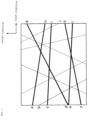
- Fig. 1 is a schematic diagram illustrating an example of SEM image of a meltblown non-woven fabric according to the invention.
- the non-woven fabric transfer direction during production of a meltblown non-woven fabric is referred to as a machine direction (MD direction) and a direction orthogonal to the MD direction is referred to as a cross direction (CD direction).
- MD direction machine direction
- CD direction cross direction
- meltblown non-woven fabric in the MD direction is sufficient, but the strength in the CD direction is low. This may cause a marked decrease in water resistance of the meltblown non-woven fabric because an inter-fiber distance is likely to extend and a gap thus occurs when, for instance, a tensile load is applied in the CD direction and deformation thus occurs.
- a meltblown non-woven fabric is used at a site where deformation may occur due to a load application, a high-strength spunbonded non-woven fabric and/or an air-through non-woven fabric are layered and used so as to cover the meltblown non-woven fabric.
- the invention relates to a meltblown non-woven fabric in which a decrease in water pressure resistance due to deformation is suppressed.
- the meltblown non-woven fabric according to the invention can suppress the decrease in water pressure resistance due to deformation.
- the meltblown non-woven fabric of the invention includes fibers with an average fiber diameter of 4 um or less. As the average fiber diameter becomes smaller, the water pressure resistance in a region with a low filling factor increases.
- the average fiber diameter is preferably 3.6 um or less, more preferably 3.2 um or less, still more preferably 3 um or less, still more preferably 2.5 um or less, and particularly preferably 2 um or less.
- the average fiber diameter is preferably 0.1 um or larger, more preferably 0.2 um or larger, and still more preferably 0.3 um or larger.
- the average fiber diameter is preferably from 0.1 um to 4 um, more preferably from 0.2 um to 3.6 um, still more preferably from 0.3 um to 3.2 um, still more preferably from 0.3 um to 3 um, still more preferably from 0.3 um to 2.5 um, and particularly preferably from 0.3 um to 2 um.
- the average fiber diameter of the meltblown non-woven fabric according to the invention can be calculated as follows. First, a scanning electron microscope is used to capture an SEM image on a visual field in which 20 to 60 fibers are seen. Fiber diameters with respect to all the fibers in the visual field are each measured once and averaged. The average is rounded off to the 10 nm place to give an average fiber diameter. The average fiber diameter is represented in ⁇ m.
- the meltblown non-woven fabric according to the invention has: a first direction that is along a plane of the meltblown non-woven fabric and has the highest rate of straight-running fibers; and a second direction orthogonal to the first direction.
- the rate of straight-running fibers in the first direction and the rate of straight-running fibers in the second direction are each preferably 35% or higher, more preferably 38% or higher, still more preferably 40% or higher and preferably 90% or lower, more preferably 85% or lower, and still more preferably 80% or lower.
- the rates are preferably from 35% to 90%, more preferably from 38% to 85%, and still more preferably from 40% to 80%.
- the first direction is the MD direction during the production.
- the second direction is the CD direction during the production.
- the rate of straight-running fibers in the first direction and the rate of straight-running fibers in the second direction are each this lower limit or more, an inter-fiber gap is unlikely to be formed when deformation occurs in any of the first direction or the second direction. This suppresses a decrease in the water pressure resistance.
- the first direction is a direction that is along a plane of the meltblown non-woven fabric and has the highest rate of straight-running fibers; and the second direction is a direction orthogonal to the first direction.
- the ratio (A/B) of the rate (A) of straight-running fibers in the first direction to the rate (B) of straight-running fibers in the second direction is 1 or higher and 2.5 or lower, more preferably 2.1 or lower, and still more preferably 1.9 or lower.
- the ratio (A/B) is from 1 to 2.5, more preferably from 1 to 2.1, and still more preferably from 1 to 1.9.
- the ratio (A/B) is this upper limit or less, an inter-fiber gap is unlikely to be formed even when deformation occurs in any of the first direction or the second direction. This suppresses a decrease in the water pressure resistance.
- the meltblown non-woven fabric according to the invention has a water pressure resistance of preferably 100 mm H 2 O or higher and preferably 10000 mm H 2 O or lower.
- the water pressure resistance retention rate is preferably 85% or higher, more preferably 88% or higher, and still more preferably 90% or higher.
- the water pressure resistance retention rate is 100% or less.
- the water pressure resistance retention rate of the meltblown non-woven fabric according to the invention when deformed in the second direction is this lower limit or higher, an inter-fiber gap is hardly formed even upon deformation in any of the first direction or the second direction. This can suppress a decrease in the water pressure resistance even if deformation occurs upon usage without layering a spunbonded non-woven fabric or an air-through non-woven fabric.
- the following steps (a) to (g) are used to determine the first direction having the highest rate of straight-running fibers of the meltblown non-woven fabric according to the invention, the second direction orthogonal to the first direction as well as the rate (A) of straight-running fibers in the first direction and the rate (B) of straight-running fibers in the second direction.
- the "first direction having the highest rate of straight-running fibers" of the meltblown non-woven fabric according to the invention means a direction determined through the following steps (a) to (g) and is sometimes different from an actual direction having the highest rate of straight-running fibers.
- the fiber reaching the one end of each SEM image in the long-side direction is counted as a "fiber that intersects the one end in the longitudinal direction". The same applies to the other end.
- Fig. 1 is a schematic diagram illustrating an example of SEM image, the long-side direction of which is parallel to the first direction. Note that in Fig. 1 , the fibers are depicted as straight lines because the illustration is simplified. The shape of actual fibers, however, is not limited to a linear shape. In addition, the number of fibers seen in each SEM image may be different from the actual number.
- the number of fibers that intersect a left end in the long-side direction is 6 involving intersection points a to f and the number of fibers that intersect a right end in the long-side direction is 6 involving intersection points g to l.
- the total number of fibers that continuously extend from the left end to the right end in the long-side direction is 5 involving straight line ah, straight line ci, straight line dg, straight line el, and straight line fk.
- the angle ⁇ degrees when the visual field is altered may be any value and preferably 15 degrees or less, more preferably 10 degrees or less, and still more preferably 5 degrees or less. Meanwhile, when the above-described measurement is conducted multiple times, the conditions such as the observation positions and/or the angle ⁇ may be different and as a result of which each determined "direction having the highest straight-running rate" may be different. In this case, a direction having the highest straight-running rate among the multiple measurement results may be adopted as the first direction.
- the rate of straight-running fibers of the meltblown non-woven fabric according to the invention is 35% or higher in each of the first direction having the highest rate of straight-running fibers and the second direction orthogonal thereto, an inter-fiber gap hardly occurs upon deformation. This can suppress a decrease in the water pressure resistance. Further, even if the meltblown non-woven fabric according to the invention is used without layering a spunbonded non-woven fabric or an air-through non-woven fabric and is then deformed, it is possible to suppress a decrease in the water pressure resistance.
- the decrease in the water pressure resistance due to deformation of the meltblown non-woven fabric according to the invention can be evaluated using a ratio (water pressure resistance retention rate) of post-deformation water pressure resistance to pre-deformation water pressure resistance.
- the water pressure resistance and the water pressure resistance retention rate may be measured by the below-described protocol.
- the meltblown non-woven fabric may be integrated with a backing, such as a spunbonded non-woven fabric or an air-through non-woven fabric, by thermal embossing.
- the integrated meltblown non-woven fabric is subjected to drawing in an integrated state and the water pressure resistance is then measured. In the case where the meltblown non-woven fabric is integrated with a resin film by thermal embossing, only a film on a non-embossed region is removed and the corresponding fabric is to be measured.
- the meltblown non-woven fabric according to the invention may be obtained by adjusting a heat of fusion of thermoplastic resin composition as a component of fiber, by adjusting the temperature of air stream during the spinning step, or by heating the fiber after the spinning step and before the deposition step.
- the temperature of air stream during the spinning step and the heating of the fiber will be described later.
- the thermoplastic resin composition includes at least one thermoplastic resin and is a mixture optionally including another component, if appropriate.
- the heat of fusion of thermoplastic resin composition is preferably larger than 5 mJ/mg, more preferably 10 mJ/mg or higher, and particularly preferably 20 mJ/mg or higher.
- the heat of fusion is preferably less than 94 mJ/mg, more preferably 90 mJ/mg or less, still more preferably 80 mJ/mg or less, still more preferably 75 mJ/mg or less, still more preferably 45 mJ/mg or less, and particularly preferably 35 mJ/mg or less.
- the heat of fusion is preferably more than 5 mJ/mg but less than 94 mJ/mg, more preferably from 10 mJ/mg to 90 mJ/mg, still more preferably from 20 mJ/mg to 80 mJ/mg, still more preferably from 20 mJ/mg to 75 mJ/mg, still more preferably from 20 mJ/mg to 45 mJ/mg, and particularly preferably from 20 mJ/mg to 35 mJ/mg.
- the heat of fusion is an indicator for indicating flexibility, that is, how much crystalline region exists in a thermoplastic resin composition.
- the heat of fusion of thermoplastic resin composition can be set to be within a desired range by adjusting a thermoplastic resin used and its content.
- the heat of fusion of thermoplastic resin composition can be calculated by the below-described protocol after 1 mg of measurement piece is sampled from a center portion of the meltblown non-woven fabric.
- the thermoplastic resin composition may singly include a thermoplastic resin having a heat of fusion within a desired range.
- a thermoplastic resin having a heat of fusion within a desired range may be mixed.
- a thermoplastic resin with a heat of fusion of the upper limit of the desired range or more and a thermoplastic resin with a heat of fusion of the lower limit of the desired range or less may be blended to have a heat of fusion within the desired range.
- a plurality of thermoplastic resins, each having a heat of fusion within the desired range may be blended.
- thermoplastic resin examples include polyolefin, polyester, polyetheretherketone, polyphenylene sulfide, or polyamide.
- polyolefin or polyester is preferable, and polyolefin is particularly preferable.
- one kind of these thermoplastic resins may be used singly, or two or more kinds may be used in combination.
- the thermoplastic resin composition contains a polyolefin in an amount of 70 mass% or higher.
- the polyolefin more preferably occupies 80 mass% or more and still more preferably occupies 90 mass% or more of the thermoplastic resin composition.
- polystyrene resin As the polyolefin, it is possible to use a homopolymer of ⁇ -olefin or a copolymer of at least two different ⁇ -olefins. They may be used singly, or two or more kinds thereof may be used in combination. As the polyolefin, it is possible to use, for instance, a copolymer of ⁇ -olefin and any of an unsaturated carboxylic acid, such as acrylic acid, methacrylic acid, or maleic acid, an ester of the unsaturated carboxylic acid, or an acid anhydride.
- an unsaturated carboxylic acid such as acrylic acid, methacrylic acid, or maleic acid, an ester of the unsaturated carboxylic acid, or an acid anhydride.
- the ⁇ -olefin preferably contains from 2 to 20 carbon atoms and more preferably contains from 2 to 10 carbon atoms.
- propylene, ethylene, 1-butene, 1-hexene, 1-octene, 4-methyl-1-pentene, or the like is preferable; propylene or ethylene is more preferable; and propylene is most preferable.
- the ⁇ -olefin homopolymer it is possible to use a highly crystalline polyolefin or a low crystalline polyolefin.
- the highly crystalline polyolefin is a polyolefin having a highly stereoregular ⁇ -olefin.
- Specific examples of the highly crystalline polyolefin include: a highly crystalline polypropylene such as an isotactic polypropylene or a syndiotactic polypropylene; and a highly crystalline polyethylene such as a high-density polyethylene or a medium-density polyethylene.
- Each highly crystalline polypropylene commonly used for meltblown non-woven fabrics has a heat of fusion of more than 94 mJ/mg and is a hard resin with large crystalline regions. Because a shear flow occurs on a spinning line during the spinning step, a rigid fiber with large crystalline regions is readily oriented in the air stream direction. The air stream is blown onto a collection surface that moves in the MD direction. Accordingly, the fiber should be deposited on the collection surface while the orientation direction is the same as the MD direction.
- the heat of fusion of thermoplastic resin composition as a component of the fiver is set to less than 94 mJ/mg. This makes it unlikely to orient the fiber in the shear direction because there are many soft amorphous regions in the fiber. As a result, a non-woven fabric deposited on the collection surface should have a smaller fiber orientation in the MD direction. Consequently, the straight-running rate in the CD direction should be high.
- the heat of fusion of the highly crystalline polyolefin is preferably larger than 94 mJ/mg, more preferably 96 mJ/mg or higher, and still more preferably 98 mJ/mg or higher and preferably less than 120 mJ/mg, more preferably 115 mJ/mg or lower, and still more preferably 110 mJ/mg or lower.
- the heat of fusion is larger than 94 mJ/mg but less than 120 mJ/mg, more preferably from 96 mJ/mg to 115 mJ/mg, and still more preferably from 98 mJ/mg to 110 mJ/mg.
- the melt flow rate (MFR) (at 230°C) of the highly crystalline polyolefin is preferably 100 g/10 min or higher and more preferably 300 g/10 min or higher and preferably 2000 g/10 min or lower and more preferably 1800 g/10 min or lower. Specifically, the melt flow rate is preferably from 100 g/10 min to 2000 g/10 min and more preferably from 300 g/10 min to 1800 g/10 min.
- the MFR can be measured, based on JIS K7210, at a load of 2.16 kg and a temperature of 230°C. When the MFR is this upper limit or lower, the resin fluidity during the spinning step is not too high. This prevents thread breakage, thereby easily realizing fine fibers. Also, when the MFR is this lower limit or higher, the resin is flowable. This makes it possible to sufficiently draw the fiber during the spinning step, thereby capable of making the fiber diameter smaller.
- the highly crystalline polyolefin has a molecular weight distribution (weight-average molecular weight (Mw)/number-average molecular weight (Mn)) of preferably 1.1 or higher, more preferably 1.5 or higher, and still more preferably 2 or higher and preferably 5 or lower, more preferably 4 or lower, and still more preferably 3.5 or lower.
- Mw weight-average molecular weight
- Mn number-average molecular weight
- the molecular weight distribution is preferably from 1.1 to 5, more preferably from 1.5 to 4, and still more preferably from 2 to 3.5.
- the heat of fusion of the low crystalline polyolefin is preferably larger than 0 mJ/mg, more preferably 3 mJ/mg or higher, and still more preferably 5 mJ/mg or higher and preferably less than 94 mJ/mg, more preferably 85 mJ/mg or lower, and still more preferably 70 mJ/mg or lower.
- the heat of fusion is larger than 0 mJ/mg but less than 94 mJ/mg, more preferably from 3 mJ/mg to 85 mJ/mg, and still more preferably from 5 mJ/mg to 70 mJ/mg.
- the MFR (at 230°C) of the low crystalline polyolefin is preferably 100 g/10 min or higher, more preferably 1000 g/10 min or higher, and still more preferably 1800 g/10 min and preferably 2500 g/10 min or lower, more preferably 2300 g/10 min or lower, and still more preferably 2100 g/10 min or lower.
- the MFR is preferably from 100 g/10 min to 2500 g/10 min, more preferably from 1000 g/10 min to 2300 g/10 min, and still more preferably from 1800 g/10 min to 2100 g/10 min.
- the MFR can be measured, based on JIS K7210, at a load of 2.16 kg and a temperature of 230°C.
- the low crystalline polyolefin has a weight-average molecular weight (Mw) of preferably 5000 or higher, more preferably 20000 or higher, and still more preferably 30000 or higher and preferably 150000 or lower, more preferably 70000 or lower, and still more preferably 50000 or lower.
- Mw is preferably from 5000 to 150000, more preferably from 20000 to 70000, and still more preferably from 30000 to 50000.
- the copolymer of two or more different ⁇ -olefins is a low crystalline or amorphous olefin-based elastomer.
- the ⁇ -olefin copolymer it is possible to use a random copolymer, a block copolymer, a graft copolymer, or an alternating copolymer.
- the ⁇ -olefins are linked using an atactic structure.
- the copolymer of two or more different ⁇ -olefins is referred to as an olefin-based elastomer.
- the olefin-based elastomer has a heat of fusion of larger than 0 mJ/mg but less than 94 mJ/mg, preferably 3 mJ/mg or larger, more preferably 5 mJ/mg or larger and preferably 90 mJ/mg or less and more preferably 85 mJ/mg or less.
- the olefin-based elastomer may optionally include, in addition to the ⁇ -olefins, at least one kind selected from the group consisting of polyene compound units such as butadiene, isoprene, ethylidene norbornane, and dicyclopentadiene units, cyclic olefin units, and vinyl aromatic compound units as a monomer(s).
- polyene compound units such as butadiene, isoprene, ethylidene norbornane, and dicyclopentadiene units, cyclic olefin units, and vinyl aromatic compound units as a monomer(s).
- the MFR (at 230°C) of the olefin-based elastomer is preferably 10 g/10 min or higher and more preferably 300 g/10 min or higher and preferably 2000 g/10 min or lower and more preferably 1800 g/10 min or lower.
- the MFR can be measured, based on JIS K7210, at a load of 2.16 kg and a temperature of 230°C.
- the olefin-based elastomer has a molecular weight distribution (weight-average molecular weight (Mw)/number-average molecular weight (Mn)) of preferably 1.1 or higher, more preferably 1.3 or higher, and still more preferably 1.5 or higher and preferably 5 or lower, more preferably 4 or lower, and still more preferably 3.5 or lower.
- Mw weight-average molecular weight
- Mn number-average molecular weight
- the olefin-based elastomer may be produced using a polymerization catalyst such as a publicly known Ziegler-Natta catalyst or a single-site catalyst (e.g. a metallocene catalyst).
- a polymerization catalyst such as a publicly known Ziegler-Natta catalyst or a single-site catalyst (e.g. a metallocene catalyst).
- thermoplastic resin composition contains a highly crystalline polyolefin and a low crystalline polyolefin or a polyolefin-based elastomer.
- thermoplastic resin composition contains a mixture of a first polyolefin with a heat of fusion of 94 mJ/mg or higher and a second polyolefin with a heat of fusion of less than 94 mJ/mg.
- thermoplastic resin composition contains a mixture of a highly crystalline polypropylene that is commonly used in meltblowing and has a heat of fusion of 94 mJ/mg or higher and a low crystalline polypropylene or a polypropylene-based elastomer that has a heat of fusion of less than 94 mJ/mg.
- the second polyolefin include a highly flowable low crystalline polypropylene with a MFR of 400 g/10 min or higher, a less flowable low crystalline polypropylene with an MFR of less than 400 g/10 min, or a less flowable polypropylene-based elastomer with an MFR of less than 400 g/10 min.
- the content of the highly flowable low crystalline polypropylene with an MFR of 400 g/10 min or higher is preferably 90 mass% or less, more preferably 80 mass% or less, and still more preferably 70 mass% or less with respect to the total of the thermoplastic resin composition.
- the content of the highly flowable low crystalline polypropylene is preferably 3 mass% or higher, more preferably 10 mass% or higher, and still more preferably 20 mass% or higher, and still more preferably 50 mass% or higher.
- the content is preferably from 3 mass% to 90 mass%, more preferably from 10 mass% to 80 mass%, still more preferably from 20 mass% to 70 mass%, and still more preferably from 50 mass% to 70 mass%.
- amorphous regions in the fiber are not too many. This can prevent fusion between the fibers and make an inter-fiber distance shorter, thereby capable of improving the water pressure resistance. Also, when the content of the highly flowable low crystalline polypropylene is this lower limit or higher, amorphous regions in the fiber are adequately present and make the fiber soft. As a result, the orientation during the spinning step is unlikely to occur.
- the content of the low crystalline polypropylene with an MFR of less than 400 g/10 min or the polypropylene-based elastomer with an MFR of less than 400 g/10 min is preferably 30 mass% or less, more preferably less than 30 mass%, still more preferably 20 mass% or less, and still more preferably 15 mass% or less with respect to the total of the thermoplastic resin composition.
- the content of the polypropylene-based elastomer is preferably 3 mass% or higher, more preferably 5 mass% or higher, still more preferably 10 mass% or higher, and particularly preferably 20 mass% or higher.
- the content is preferably from 3 mass% to 30 mass%, more preferably from 3 mass% to less than 30 mass%, still more preferably from 5 mass% to 20 mass%, still more preferably from 10 mass% to 20 mass%, particularly preferably from 20 mass% to 15 mass%, and most preferably from 10 mass% to 15 mass%.
- the low crystalline polypropylene with an MFR of less than 400 g/10 min and the polypropylene-based elastomer with an MFR of less than 400 g/10 min have lower fluidity than polypropylene resins for meltblowing.
- the content is this upper limit or lower, the whole resin fluidity is increased. This makes it possible to sufficiently draw the fiber during the spinning step, thereby making the fiber diameter smaller.
- the content of the low crystalline polypropylene with an MFR of less than 400 g/10 min or the polypropylene-based elastomer with an MFR of less than 400 g/10 min is within the above ranges.
- first polyolefin examples include a highly crystalline polypropylene.
- the mass-based blending ratio between the first polypropylene and the second polypropylene is selected depending on their kinds.
- the blending ratio is preferably larger than 5/95, more preferably 10/90 or larger, still more preferably 20/80 or larger, still more preferably 30/70 or larger and preferably 97/3 or less, more preferably 90/10 or less, still more preferably 80/20 or less, and still more preferably 50/50 or less.
- the blending ratio is preferably from larger than 5/95 to 97/3, more preferably from 10/90 to 90/10, still more preferably from 20/80 to 80/20, and still more preferably from 30/70 to 50/50.
- the less flowable low crystalline polypropylene that can be used as the second polypropylene include L-MODU (registered trademark) S600 with an MFR of 350 g/10 min or L-MODU (registered trademark) S901 with an MFR of 50 g/10 min (the both manufactured by Idemitsu Kosan Co., Ltd.).
- L-MODU registered trademark
- L-MODU registered trademark
- S901 with an MFR of 50 g/10 min (the both manufactured by Idemitsu Kosan Co., Ltd.).
- the polypropylene-based elastomer that can be used as the second propylene include TAFTHREN (registered trademark) H5002 with an MFR of 10 g/10 min (manufactured by Sumitomo Chemical Industry Company Limited).
- the blending ratio (the first polypropylene/the second polypropylene) is preferably 70/30 or larger, more preferably 75/25 or larger, still more preferably 80/20 or larger, and still more preferably 85/15 or larger and preferably 97/3 or less, more preferably 95/5 or less, and still more preferably 90/10 or less.
- the blending ratio is preferably from 70/30 to 95/5, more preferably from 75/25 to 95/5, still more preferably from 80/20 to 90/10, and still more preferably from 85/15 to 90/10.
- polyester for instance, polyethylene terephthalate, polybutylene terephthalate, or polytrimethylene terephthalate may be used. Among them, polyethylene terephthalate or polybutylene terephthalate is preferable.
- the content of any of the polyesters is preferably 50 mass% or larger, more preferably 70 mass% or larger, and still more preferably 90 mass% or larger with respect to the whole polyesters.
- polyamide 3 polyamide 4, polyamide 6, polyamide 66, or polyamide 12 may be used.
- the thermoplastic resin composition may contain an additive such as a nucleating agent, a dulling agent, a pigment, a dye, an antifungal, an antimicrobial, a flame retardant, a hydrophilic agent, a photostabilizer, an antioxidant, an aging inhibitor, synthetic oil, wax, a coloring inhibitor, and/or a viscosity modifier, to the extent without impairing the advantages of the invention.
- an additive such as a nucleating agent, a dulling agent, a pigment, a dye, an antifungal, an antimicrobial, a flame retardant, a hydrophilic agent, a photostabilizer, an antioxidant, an aging inhibitor, synthetic oil, wax, a coloring inhibitor, and/or a viscosity modifier, to the extent without impairing the advantages of the invention.
- the filling factor of the meltblown non-woven fabric according to the invention is preferably 3% or higher, more preferably 5% or higher, and still more preferably 6% or higher. As the filling factor becomes larger, the fibers are present more densely and the water pressure resistance of the meltblown non-woven fabric is thus increased. As the filling factor is increased, the meltblown non-woven fabric becomes more rigid. As the filling factor is lowered, the meltblown non-woven fabric becomes softer. A soft meltblown non-woven fabric is preferred when used as clothing. Accordingly, the filling factor is preferably 30% or less, more preferably 20% or less, and still more preferably 15% or less. The filling factor of the meltblown non-woven fabric according to the invention is preferably from 3% to 30%, more preferably from 5% to 20%, and still more preferably from 6% to 15%.
- the filling factor can be made the above lower limit or higher by setting, to 400 mm or shorter, the distance from the nozzles to the collection surface of the below-described non-woven fabric production machine, thereby making the resulting fiber compact by using the blowing pressure of air stream.
- the meltblown non-woven fabric is compacted using, for instance, a calendar roll during production and the filling factor can then be adjusted to the above lower limit or higher.
- the thickness of a meltblown non-woven fabric obtained by the below-described procedure is measured by using a laser displacement meter manufactured by OMRON Corporation while a load is imposed to the non-woven fabric such that a pressure of 4 kPa is applied thereto.
- the filling factor is determined using the below-described Expression (2) in accordance with the below-described protocol.
- the formation index of the meltblown non-woven fabric according to the invention is preferably 300 or less, more preferably 280 or less, still more preferably 260 or less, still more preferably 250 or less, and particularly preferably 200 or less.
- the formation index can be made the above upper limit or less by setting, to 400 mm or less, the distance from the nozzles to the collection surface of the below-described non-woven fabric production machine, thereby preventing unevenness from occurring while the fibers are deposited.
- the formation index when a non-woven fabric is produced by meltblowing is at least about 30 in practice. As the formation index becomes smaller, the fibers are present more uniformly. This causes the water pressure resistance of the meltblown non-woven fabric to become larger.
- the formation index is measured, using the below-described protocol, at random positions in the longitudinal direction, which positions are in a center portion in the widthwise direction of the meltblown non-woven fabric.
- meltblown non-woven fabric which has been integrated with a backing such as a spunbonded non-woven fabric or an air-through non-woven fabric by thermal embossing, may have a hole created when a sample is obtained by peeling.
- the formation index of the sample with an open hole is calculated by using the standard deviation and the average of absorbance obtained after the hole-derived absorbance E is subtracted.
- the basis weight of the meltblown non-woven fabric according to the invention is preferably 20 g/m 2 or less, more preferably 15 g/m 2 or less, and still more preferably 10 g/m 2 or less.
- the basis weight is this upper limit or less, the fiber has a small volume in response to the blowing pressure of air stream and is thus easily compacted. This causes the filling factor to be sufficient.
- the basis weight is this upper limit or less, the fibers are uniformly deposited during the deposition step and the formation index is thus adequate.
- the basis weight is preferably 1 g/m 2 or larger and more preferably 2 g/m 2 or larger.
- the basis weight of the meltblown non-woven fabric according to the invention is preferably from 1 g/m 2 to 20 g/m 2 , more preferably from 1 g/m 2 to 15 g/m 2 , and still more preferably from 2 g/m 2 to 10 g/m 2 or less.
- the basis weight may be determined from the weight per 0.05 m square area.
- the meltblown non-woven fabric is a composite obtained by bonding it to a backing such as a resin film or paper, a spunbonded non-woven fabric, or an air-through non-woven fabric by using a hotmelt, etc.
- the fabric is first treated with a cold spray or heated with, for instance, a dryer to lower the bonding strength of the hotmelt. Then, the meltblown non-woven fabric is peeled off from the backing.
- the hotmelt attached to the meltblown non-woven fabric is dissolved by soaking the meltblown non-woven fabric in a hotmelt-miscible organic solvent, such as toluene, in large excess for 24 h.
- a hotmelt-miscible organic solvent such as toluene
- the meltblown non-woven fabric is collected from the organic solvent and is then dried. After that, the basis weight of the meltblown non-woven fabric is measured by the above procedure.
- meltblown non-woven fabric is integrated with a backing such as a resin film, a spunbonded non-woven fabric, or an air-through non-woven fabric by thermal embossing
- the meltblown non-woven fabric is first peeled off so as to remove embossed portions.
- the area of the meltblown non-woven fabric in a state in which holes are created at the embossed portion sites is calculated by image processing such as binarization. Then, the weight at that time may be used to determine the basis weight.
- the meltblown non-woven fabric that has a 0.05 m-square area and is subject to the basis weight measurement is preferably obtained from a continuous meltblown non-woven fabric. If the area of a piece of the meltblown non-woven fabric that can be obtained from a product is small, the sum of areas of a plurality of meltblown non-woven fabrics obtained from the product may be used.
- meltblown non-woven fabric When the meltblown non-woven fabric is integrated with a backing such as a resin film, a spunbonded non-woven fabric, or an air-through non-woven fabric by thermal embossing, the meltblown non-woven fabric is peeled off, if appropriate, such that embossed portions are not included, and is to be measured except for the below-described water pressure resistance measurement and post-deformation water pressure resistance measurement.
- a backing such as a resin film, a spunbonded non-woven fabric, or an air-through non-woven fabric by thermal embossing
- the meltblown non-woven fabric according to the invention has an average fiber diameter of 4 um or less and the rate of straight-running fibers in each of a first direction that is along a plane thereof and has the highest rate of straight-running fibers and a second direction orthogonal to the first direction is 35% or higher. Consequently, the water pressure resistance is excellent, an inter-fiber gap is unlikely to occur upon deformation, and a decrease in the water pressure resistance can be suppressed.
- the water pressure resistance of the meltblown non-woven fabric may be measured by obtaining a meltblown non-woven fabric by using substantially the same way as above.
- the meltblown non-woven fabric is integrated with a backing such as a spunbonded non-woven fabric or an air-through non-woven fabric by thermal embossing
- the water pressure resistance is measured while the form is as it is and the value is defined as the water pressure resistance of the meltblown non-woven fabric.
- the finely meshed meltblown non-woven fabric is a layer that determines the water pressure resistance. Accordingly, the water pressure resistance of the meltblown non-woven fabric is considered to be the water pressure resistance of the whole layered non-woven fabric.
- meltblown non-woven fabric according to the invention are not particularly limited and the meltblown non-woven fabric can be used for various applications taking advantage of its characteristics.
- the meltblown non-woven fabric according to the invention may be used as a single layer or may be layered.
- a plurality of the meltblown non-woven fabrics according to the invention may be layered or the meltblown non-woven fabric and another publicly known non-woven fabric such as a spunbonded non-woven fabric or an air-through non-woven fabric are layered together.
- the meltblown non-woven fabric according to the invention may be subjected to embossing, if necessary.
- a spunbonded layer and a meltblown layer may each be produced by spinning and they are then layered and integrated by thermal embossing.
- a spunbonded non-woven fabric is produced by spinning, a separately prepared meltblown non-woven fabric may be layered and embossed.
- a meltblown non-woven fabric and a spunbonded non-woven fabric may be separately produced and then integrated by thermal embossing.
- the meltblown non-woven fabric may be peeled off, if appropriate, such that embossed portions are not included in the same manner as above, and the basis weight may then be measured.
- the meltblown non-woven fabric according to the invention is applicable to structural members of absorption article such as a disposable diaper, a sanitary napkin, or an incontinence pad, and is suitable as a leakage prevention sheet that requires water resistance, in particular, because a decrease in the water pressure resistance due to deformation is suppressed.
- Such an absorption article may be produced by layering a leakage prevention sheet made of the meltblown non-woven fabric according to the invention, an absorbent, and a surface sheet.
- the meltblown non-woven fabric according to the invention may be used for a hygiene mask, a liquid filter, an air filter, a battery separator, a glove, or the like.
- the meltblown non-woven fabric according to the invention may be produced by meltblowing using a publicly known non-woven fabric production machine that has been conventionally used during manufacture of meltblown non-woven fabrics.
- the non-woven fabric production machine for instance, is provided with an extruder equipped with a barrel having a built-in screw and a raw material inlet; a die connected directly or via a gear pump, etc., to the extruder; and a collection surface for depositing a fiber-shaped molten material.
- an extruder equipped with a barrel having a built-in screw and a raw material inlet; a die connected directly or via a gear pump, etc., to the extruder; and a collection surface for depositing a fiber-shaped molten material.
- multiple nozzles for discharging a molten material are arranged in series. Blowing ports are provided on both sides of each nozzle, a high-temperature and high-pressure air stream (hot wind) is jetted from the blowing ports, and the molten material discharged from each nozzle is drawn to produce a fiber.
- the multiple nozzles are preferably arranged in series with a constant interval.
- the diameter of each nozzle is several hundred um.
- the high-temperature and high-pressure air stream is preferably an air stream, but may be another gas stream.
- a publicly known surface such as a net conveyer or a collection screen may be used.
- the method of producing a meltblown non-woven fabric according to the invention is a method of producing a meltblown non-woven fabric having an average fiber diameter of 4 um or less, the method including a spinning step of supplying a thermoplastic resin composition, for instance, in a pellet form from a raw material inlet to an extruder, heating and melting it in the extruder, then feeding the resulting molten material to a die and discharging the material from each nozzle, and drawing the discharged molten material by using a high-temperature and high-pressure air stream (hot wind) to produce a fiber.
- the fiber-shaped molten material is deposited on the collection surface during the deposition step and the fibers are fused to one another to produce a meltblown non-woven fabric.
- thermoplastic resin composition used in the method of producing a meltblown non-woven fabric according to the invention.
- the thermoplastic resin composition may be prepared by directly injecting a thermoplastic resin and an optionally blended component, instead of the pellet, to the extruder.
- the temperature (hot wind temperature) of air stream during the spinning step is 260°C or lower, preferably 250°C or lower, and more preferably 240°C or lower.
- the air stream temperature is this upper limit or lower, the time during which the fiber is tacky is shortened. This can cause the fibers to be unlikely entangled, suppress air resistance to the fiber, less orient the fiber in the MD direction during the spinning step, and increase the rate of straight-running fibers in the CD direction.
- the lower limit of the air stream temperature should be the melting point or higher of the thermoplastic resin composition.
- the melting point is measured by differential scanning calorimetry (DSC). The temperature is raised from 30°C at a rate of 20°C/min to yield a DSC curve. Then, the melting point is set to the temperature of an endothermic peak at the highest temperature seen between 30 and 240°C.
- the thermoplastic resin composition contains a highly crystalline polypropylene.
- the hot wind temperature is preferably 160°C, which is the melting point of the highly crystalline polypropylene, or higher, more preferably 180°C or higher, and still more preferably 200°C or higher.
- the hot wind temperature is preferably from 160°C to 260°C, more preferably from 180°C to 250°C, and still more preferably from 200°C to 240°C.
- the flow rate of air stream during the spinning step is preferably 500 Nm 3 /hr or higher and more preferably 700 Nm 3 /hr or higher per air stream blowing width of 1 m.
- the air stream flow rate is preferably 1700 Nm 3 /hr or lower and more preferably 1300 Nm 3 /hr or lower per air stream blowing width of 1 m.
- the distance from the nozzles to the collection surface of the non-woven fabric production machine is preferably 400 mm or shorter, more preferably 300 mm or shorter, and still more preferably 150 mm or shorter.
- the fibers can be deposited densely. This should increase the water pressure resistance.
- the meltblowing the molten fibers are cooled and deposited. This prevents the molten fibers from being unified, thereby capable of improving the water pressure resistance. Because of the above, it is preferable that the fiber is cold by the time of fiber deposition.
- the distance from the nozzles to the collection surface is preferably 50 mm or longer, more preferably 80 mm or longer, and still more preferably 100 mm or longer.
- the method of producing a meltblown non-woven fabric according to the invention preferably includes a heating step of heating the fiber after the spinning step and before the deposition step of depositing the fiber on the collection surface. From the viewpoint of just giving heat to the fiber without giving any disturbance such as a wind during the heating step, it is preferable to use an IR heater instead of a hot wind.
- the fiber-heating position is located preferably 100 mm or more and preferably 200 mm or less below the nozzles.
- the fiber-heating position is located preferably 80 mm or more and more preferably 100 mm or more and preferably 200 mm or less and more preferably 180 mm or less in a direction perpendicular to the spinning line.
- the air stream temperature during the spinning step is set to 260°C or lower and the heat of fusion of thermoplastic resin composition as a component of the fiber is set to be larger than 5 mJ/mg but less than 94 mJ/mg. This makes it possible to obtain a meltblown non-woven fabric in which the rate of straight-running fibers in the CD direction is 35% or higher.
- thermoplastic resin compositions in Examples 1 to 11 and Comparative Examples 1 to 4 are as follows:
- meltblown non-woven fabrics used in Comparative Examples 5 and 6 are as follows:
- thermoplastic resin composition The heat of fusion of each thermoplastic resin composition was measured by differential scanning calorimetry (DSC). A DSC curve was plotted while the temperature was raised from 30°C at a rate of 20°C/min, and the heat amount at an endothermic peak seen between 100 and 200°C was defined as a heat of fusion.
- the basis weight of each meltblown non-woven fabric was determined by excising three 50-mm square measurement pieces from a center portion of the meltblown non-woven fabric, measuring the mass (g) of each measurement piece, dividing the mass by the area (m 2 ) of the measurement piece, and taking the arithmetic means of the three pieces to yield the basis weight.
- the filling factor of each meltblown non-woven fabric can be calculated using the following Equation (2).
- the thickness of each meltblown non-woven fabric was measured by using a laser displacement meter, manufactured by OMRON Corporation, while a load was imposed so as to apply a pressure of 4 kPa. Each thickness measurement was repeated five times and was averaged to yield the thickness of each meltblown non-woven fabric.
- the fiber density was measured by the procedure described in JIS K 7112, specifically, pycnometry.
- Filling factor (%) [(Basis weight [g/m 2 ] / 10000) / (Thickness [ ⁇ m] / 10000) ⁇ Fiber density [g/m 3 ] ⁇ 100]
- each meltblown non-woven fabric sample was placed on a sample table and a CCD camera was used to capture a transmission image when one surface side of the sample was irradiated with light while the height of the CCD camera was set to 26 cm, the effective size was set to 10 cm ⁇ 10 cm, and the moving average pixel was set to 1.
- the effective size 10 cm ⁇ 10 cm was resolved into 320 ⁇ 230 pixels.
- V T is a transmitted light volume when lighting is on (there is a sample);
- V R is a transmitted light volume when lighting is off (there is a sample);
- V 100 is a transmitted light volume when lighting is on (there is no sample);
- V 0 is a transmitted light volume when lighting is off (there is no sample).
- the sample may be placed on the center of a test table and measured by setting the effective size to be less than the dimension of the sample but the area to be as large as possible, so as to calculate the formation index of the sample.
- meltblown non-woven fabrics according to Examples and Comparative Examples the above-described way was used to calculate the rates of straight-running fibers in the first direction and the second direction.
- the MD direction and the CD direction of each non-woven fabric in Examples and Comparative Examples had been known, the MD direction was set to the first direction and the CD direction was set to the second direction.
- the water pressure resistance was measured in accordance with the A method (low water pressure method) in the water penetration test (hydrostatic test) of JIS L1092-1998.
- a nylon mesh sheet DO-ML-20 with a pore size of 133 um and a thickness of 121 um; manufactured by KURABO INDUSTRIES LTD.
- the water pressure resistance can be measured by substantially the same method whereas an apparatus was assembled so as to reduce the measurement area such that water is applied to the test piece having an area capable of being collected.
- the CD direction and the MD direction during production of each meltblown non-woven fabric according to Examples and Comparative Examples were set to the lengthwise direction and the widthwise direction, respectively. Then, the meltblown non-woven fabric was excised into the size of a length of 130 mm or longer ⁇ a width of 150 mm. Next, chucks (in a tensile tester AG-IS, manufactured by Shimadzu Corporation) were used for immobilization such that the distance between the chucks in the lengthwise direction was set to 130 mm.
- each meltblown non-woven fabric was drawn (at a tensile rate of 1 cm/5 sec) such that the distance between the chucks in the lengthwise direction reached 150 mm, and the meltblown non-woven fabric was held for 5 sec and then deformed in the CD direction. After that, the chucks were released and the post-deformation water pressure resistance was measured, on a center portion of the deformed meltblown non-woven fabric, in substantially the same manner as in the water pressure resistance measurement of the above (7).
- the thermoplastic resin composition was used to produce a meltblown non-woven fabric according to Example 1.
- the production conditions for the meltblown non-woven fabric according to Example 1 were as follows. Table 1 lists the production conditions.
- meltblown non-woven fabric according to Example 12 was produced in the same manner as in Example 1 except for the above production condition. In addition, like Example 1, various physical properties of the resulting meltblown non-woven fabric were measured. Table 2 shows the results.
- the meltblown non-woven fabrics according to Examples 1 to 12 had an average fiber diameter of 4 um or less and the rate of straight-running fibers in each of a first direction having the highest rate of straight-running fibers and a second direction orthogonal to the first direction was 35% or higher.
- the average fiber diameter is 4 um or less and the ratio of the rate of straight-running fibers in the first direction to the rate of straight-running fibers in the second direction of a plane of the meltblown non-woven fabric was 2.5 or less. This has demonstrated that the water pressure resistance retention rate was high and a decrease in the water pressure resistance due to deformation was suppressed.
Landscapes
- Health & Medical Sciences (AREA)
- Engineering & Computer Science (AREA)
- Textile Engineering (AREA)
- General Health & Medical Sciences (AREA)
- Epidemiology (AREA)
- Veterinary Medicine (AREA)
- Public Health (AREA)
- Life Sciences & Earth Sciences (AREA)
- Animal Behavior & Ethology (AREA)
- Chemical & Material Sciences (AREA)
- Biomedical Technology (AREA)
- Vascular Medicine (AREA)
- Heart & Thoracic Surgery (AREA)
- Dermatology (AREA)
- Chemical Kinetics & Catalysis (AREA)
- Hematology (AREA)
- Materials Engineering (AREA)
- Nonwoven Fabrics (AREA)
- Absorbent Articles And Supports Therefor (AREA)
- Spinning Methods And Devices For Manufacturing Artificial Fibers (AREA)
Applications Claiming Priority (3)
| Application Number | Priority Date | Filing Date | Title |
|---|---|---|---|
| JP2017244951 | 2017-12-21 | ||
| JP2018215397A JP6771012B2 (ja) | 2017-12-21 | 2018-11-16 | メルトブロー不織布 |
| PCT/JP2018/046653 WO2019124408A1 (ja) | 2017-12-21 | 2018-12-18 | メルトブロー不織布 |
Publications (3)
| Publication Number | Publication Date |
|---|---|
| EP3730685A1 EP3730685A1 (en) | 2020-10-28 |
| EP3730685A4 EP3730685A4 (en) | 2021-09-15 |
| EP3730685B1 true EP3730685B1 (en) | 2024-06-12 |
Family
ID=67222384
Family Applications (1)
| Application Number | Title | Priority Date | Filing Date |
|---|---|---|---|
| EP18890630.9A Active EP3730685B1 (en) | 2017-12-21 | 2018-12-18 | Meltblown non-woven fabric |
Country Status (6)
| Country | Link |
|---|---|
| EP (1) | EP3730685B1 (https=) |
| JP (1) | JP6771012B2 (https=) |
| KR (1) | KR102233538B1 (https=) |
| CN (1) | CN111527254B (https=) |
| RU (1) | RU2754413C1 (https=) |
| TW (1) | TWI720392B (https=) |
Families Citing this family (7)
| Publication number | Priority date | Publication date | Assignee | Title |
|---|---|---|---|---|
| WO2021215492A1 (ja) * | 2020-04-22 | 2021-10-28 | 花王株式会社 | 衛生用不織布並びにこれを備える衛生品及び吸収性物品、並びに衛生用不織布の製造方法 |
| JP7518676B2 (ja) * | 2020-06-30 | 2024-07-18 | 出光興産株式会社 | メルトブローン不織布及び不織布積層体 |
| JP7664690B2 (ja) * | 2020-09-02 | 2025-04-18 | 東レ・ファインケミカル株式会社 | 不織布およびその製造方法 |
| JP2023024412A (ja) * | 2021-08-06 | 2023-02-16 | 花王株式会社 | 衛生用不織布及びその製造方法 |
| CN115323506B (zh) * | 2022-06-30 | 2023-06-27 | 武汉纺织大学 | 管道式强啮合挤压机和制备pps纤维及无纺布的方法 |
| CN115012118B (zh) * | 2022-06-30 | 2023-05-09 | 武汉纺织大学 | 一种低熔指聚丙烯熔喷纤维无纺布的制备方法 |
| CN121335950A (zh) * | 2023-08-15 | 2026-01-13 | “西布尔控股”公共股份公司 | 一种含再生丙烯聚合物的聚烯烃组合物 |
Family Cites Families (20)
| Publication number | Priority date | Publication date | Assignee | Title |
|---|---|---|---|---|
| JP3082791B2 (ja) * | 1991-09-20 | 2000-08-28 | 三井化学株式会社 | 熱可塑性樹脂不織布及びその製造方法 |
| JPH0860515A (ja) * | 1994-08-22 | 1996-03-05 | Toray Ind Inc | メルトブロー不織布およびその製造方法 |
| US6521555B1 (en) * | 1999-06-16 | 2003-02-18 | First Quality Nonwovens, Inc. | Method of making media of controlled porosity and product thereof |
| BRPI0617146A2 (pt) * | 2005-08-19 | 2011-07-12 | Dow Global Technologies Inc | pano meltblown, laminado não tecido e estrutura laminada não tecida |
| JP5529392B2 (ja) * | 2007-06-26 | 2014-06-25 | 出光興産株式会社 | 弾性不織布及びこれを用いた繊維製品 |
| JP5305961B2 (ja) * | 2009-02-13 | 2013-10-02 | 日本バイリーン株式会社 | 極細繊維不織布 |
| ES2493890T3 (es) * | 2009-03-25 | 2014-09-12 | Toray Industries, Inc. | Método de producción para tela no tejida de filamentos |
| WO2011041575A1 (en) * | 2009-10-02 | 2011-04-07 | Exxonmobil Chemical Patents Inc. | Multi-layered meltblown composite and methods for making same |
| JP5663189B2 (ja) * | 2010-01-21 | 2015-02-04 | 出光興産株式会社 | ポリプロピレン系不織布 |
| WO2012014501A1 (ja) * | 2010-07-29 | 2012-02-02 | 三井化学株式会社 | 繊維不織布、およびその製造方法と製造装置 |
| KR20130111591A (ko) * | 2010-12-06 | 2013-10-10 | 미쓰이 가가쿠 가부시키가이샤 | 멜트블로운 부직포, 그의 제조 방법 및 장치 |
| CN103380242B (zh) * | 2011-01-28 | 2016-03-02 | 特布乐丝株式会社 | 由极细纤维构成的熔喷无纺布、该熔喷无纺布的制造方法及用于制造该熔喷无纺布的装置 |
| JP2014176775A (ja) * | 2013-03-13 | 2014-09-25 | Idemitsu Kosan Co Ltd | フィルター及びフィルター積層体、並びにこれらを有する繊維製品 |
| EP3004241B1 (en) * | 2013-06-04 | 2021-08-11 | ExxonMobil Chemical Patents Inc. | Polymer compositions and nonwoven compositions prepared therefrom |
| JP6208509B2 (ja) * | 2013-09-20 | 2017-10-04 | Kbセーレン株式会社 | メルトブロー不織布の製造方法 |
| CN104153119B (zh) * | 2013-12-16 | 2017-02-01 | 多氟多化工股份有限公司 | 一种高效过滤pm2.5的熔喷无纺材料及其制备方法 |
| TWI634987B (zh) * | 2014-08-28 | 2018-09-11 | 可樂麗股份有限公司 | 導電性不織布及使用於該導電性不織布之熔噴不織布的製造方法 |
| TWI588089B (zh) * | 2015-10-20 | 2017-06-21 | Acelon Chem & Fiber Corp | 製備石墨烯摻混天然纖維素熔噴不織布的方法 |
| CN105734834A (zh) * | 2016-03-03 | 2016-07-06 | 张家港高品诚医械科技有限公司 | 连续式熔喷无纺布的方法和无纺布 |
| EP3255188B1 (en) * | 2016-06-06 | 2019-08-07 | Borealis AG | Melt blown web with good water barrier properties |
-
2018
- 2018-11-16 JP JP2018215397A patent/JP6771012B2/ja active Active
- 2018-12-18 CN CN201880082713.3A patent/CN111527254B/zh active Active
- 2018-12-18 RU RU2020123901A patent/RU2754413C1/ru active
- 2018-12-18 EP EP18890630.9A patent/EP3730685B1/en active Active
- 2018-12-18 KR KR1020207018580A patent/KR102233538B1/ko not_active Expired - Fee Related
- 2018-12-21 TW TW107146367A patent/TWI720392B/zh not_active IP Right Cessation
Also Published As
| Publication number | Publication date |
|---|---|
| KR20200096937A (ko) | 2020-08-14 |
| KR102233538B1 (ko) | 2021-03-29 |
| EP3730685A1 (en) | 2020-10-28 |
| CN111527254B (zh) | 2023-07-07 |
| JP2019112757A (ja) | 2019-07-11 |
| JP6771012B2 (ja) | 2020-10-21 |
| CN111527254A (zh) | 2020-08-11 |
| TW201940763A (zh) | 2019-10-16 |
| EP3730685A4 (en) | 2021-09-15 |
| TWI720392B (zh) | 2021-03-01 |
| RU2754413C1 (ru) | 2021-09-02 |
Similar Documents
| Publication | Publication Date | Title |
|---|---|---|
| EP3730685B1 (en) | Meltblown non-woven fabric | |
| EP3848492A1 (en) | Nonwoven cloth laminated body, stretchable nonwoven cloth laminated body, fiber product, absorbent article, and sanitary mask | |
| KR101581518B1 (ko) | 권축 복합 섬유, 및 당해 섬유로 이루어지는 부직포 | |
| JP5289459B2 (ja) | 捲縮複合繊維、及び当該繊維からなる不織布 | |
| EP1425171B1 (en) | Composite elastic in one direction and extensible in another direction | |
| US6632212B1 (en) | Breathable laminate permanently conformable to the contours of a wearer | |
| US20130239283A1 (en) | Spunbonded nonwoven fabric-laminated multilayer structure | |
| EP2677074A1 (en) | Spunbonded nonwoven fabric | |
| WO2011129211A1 (ja) | 捲縮複合繊維、及び当該繊維からなる不織布 | |
| TW201641768A (zh) | 不織布積層體、伸縮性不織布積層體、纖維製品、吸收性物品及衛生口罩 | |
| CN113474505A (zh) | 纺粘无纺布、卫生材料及纺粘无纺布的制造方法 | |
| US20110183568A1 (en) | Fibers and nonwovens with increased surface roughness | |
| JP7710113B2 (ja) | 捲縮多成分繊維を含む不織布材料 | |
| JP7013486B2 (ja) | スパンボンド不織布、衛生材料、及びスパンボンド不織布の製造方法 | |
| US11306415B2 (en) | Process for producing a non-woven fabric | |
| CN103038406B (zh) | 粘合纤维网及其制备 | |
| WO2019124408A1 (ja) | メルトブロー不織布 | |
| WO2018017169A1 (en) | Polypropylene nonwoven fibers, fabrics and methods for making same | |
| JP7619786B2 (ja) | メルトブロー不織布の製造方法 | |
| JP2021161564A (ja) | スパンボンド不織布、衛生材料、及びスパンボンド不織布の延伸方法 | |
| JP2024042784A (ja) | スパンボンド不織布、ならびに、これを用いてなる衛生材料 | |
| JP2024170251A (ja) | メルトブローン不織布、衛生材料、耐水シート及び医療用シート | |
| WO2025177860A1 (ja) | 不織布およびその製造方法 |
Legal Events
| Date | Code | Title | Description |
|---|---|---|---|
| STAA | Information on the status of an ep patent application or granted ep patent |
Free format text: STATUS: THE INTERNATIONAL PUBLICATION HAS BEEN MADE |
|
| PUAI | Public reference made under article 153(3) epc to a published international application that has entered the european phase |
Free format text: ORIGINAL CODE: 0009012 |
|
| STAA | Information on the status of an ep patent application or granted ep patent |
Free format text: STATUS: REQUEST FOR EXAMINATION WAS MADE |
|
| 17P | Request for examination filed |
Effective date: 20200716 |
|
| AK | Designated contracting states |
Kind code of ref document: A1 Designated state(s): AL AT BE BG CH CY CZ DE DK EE ES FI FR GB GR HR HU IE IS IT LI LT LU LV MC MK MT NL NO PL PT RO RS SE SI SK SM TR |
|
| AX | Request for extension of the european patent |
Extension state: BA ME |
|
| DAV | Request for validation of the european patent (deleted) | ||
| DAX | Request for extension of the european patent (deleted) | ||
| A4 | Supplementary search report drawn up and despatched |
Effective date: 20210817 |
|
| RIC1 | Information provided on ipc code assigned before grant |
Ipc: D04H 3/016 20120101ALI20210811BHEP Ipc: D04H 1/56 20060101ALI20210811BHEP Ipc: D04H 1/544 20120101ALI20210811BHEP Ipc: D04H 1/4382 20120101ALI20210811BHEP Ipc: D04H 3/007 20120101ALI20210811BHEP Ipc: A61L 15/24 20060101ALI20210811BHEP Ipc: A61F 13/514 20060101ALI20210811BHEP Ipc: A61F 13/15 20060101ALI20210811BHEP Ipc: D04H 3/16 20060101AFI20210811BHEP |
|
| STAA | Information on the status of an ep patent application or granted ep patent |
Free format text: STATUS: EXAMINATION IS IN PROGRESS |
|
| 17Q | First examination report despatched |
Effective date: 20221222 |
|
| GRAP | Despatch of communication of intention to grant a patent |
Free format text: ORIGINAL CODE: EPIDOSNIGR1 |
|
| STAA | Information on the status of an ep patent application or granted ep patent |
Free format text: STATUS: GRANT OF PATENT IS INTENDED |
|
| INTG | Intention to grant announced |
Effective date: 20240403 |
|
| GRAS | Grant fee paid |
Free format text: ORIGINAL CODE: EPIDOSNIGR3 |
|
| GRAA | (expected) grant |
Free format text: ORIGINAL CODE: 0009210 |
|
| STAA | Information on the status of an ep patent application or granted ep patent |
Free format text: STATUS: THE PATENT HAS BEEN GRANTED |
|
| P01 | Opt-out of the competence of the unified patent court (upc) registered |
Effective date: 20240502 |
|
| AK | Designated contracting states |
Kind code of ref document: B1 Designated state(s): AL AT BE BG CH CY CZ DE DK EE ES FI FR GB GR HR HU IE IS IT LI LT LU LV MC MK MT NL NO PL PT RO RS SE SI SK SM TR |
|
| REG | Reference to a national code |
Ref country code: GB Ref legal event code: FG4D |
|
| REG | Reference to a national code |
Ref country code: CH Ref legal event code: EP |
|
| REG | Reference to a national code |
Ref country code: IE Ref legal event code: FG4D |
|
| REG | Reference to a national code |
Ref country code: DE Ref legal event code: R096 Ref document number: 602018070659 Country of ref document: DE |
|
| PG25 | Lapsed in a contracting state [announced via postgrant information from national office to epo] |
Ref country code: BG Free format text: LAPSE BECAUSE OF FAILURE TO SUBMIT A TRANSLATION OF THE DESCRIPTION OR TO PAY THE FEE WITHIN THE PRESCRIBED TIME-LIMIT Effective date: 20240612 |
|
| PG25 | Lapsed in a contracting state [announced via postgrant information from national office to epo] |
Ref country code: FI Free format text: LAPSE BECAUSE OF FAILURE TO SUBMIT A TRANSLATION OF THE DESCRIPTION OR TO PAY THE FEE WITHIN THE PRESCRIBED TIME-LIMIT Effective date: 20240612 Ref country code: HR Free format text: LAPSE BECAUSE OF FAILURE TO SUBMIT A TRANSLATION OF THE DESCRIPTION OR TO PAY THE FEE WITHIN THE PRESCRIBED TIME-LIMIT Effective date: 20240612 |
|
| REG | Reference to a national code |
Ref country code: LT Ref legal event code: MG9D |
|
| PG25 | Lapsed in a contracting state [announced via postgrant information from national office to epo] |
Ref country code: GR Free format text: LAPSE BECAUSE OF FAILURE TO SUBMIT A TRANSLATION OF THE DESCRIPTION OR TO PAY THE FEE WITHIN THE PRESCRIBED TIME-LIMIT Effective date: 20240913 |
|
| REG | Reference to a national code |
Ref country code: NL Ref legal event code: MP Effective date: 20240612 |
|
| PG25 | Lapsed in a contracting state [announced via postgrant information from national office to epo] |
Ref country code: ES Free format text: LAPSE BECAUSE OF FAILURE TO SUBMIT A TRANSLATION OF THE DESCRIPTION OR TO PAY THE FEE WITHIN THE PRESCRIBED TIME-LIMIT Effective date: 20240612 |
|
| PG25 | Lapsed in a contracting state [announced via postgrant information from national office to epo] |
Ref country code: LV Free format text: LAPSE BECAUSE OF FAILURE TO SUBMIT A TRANSLATION OF THE DESCRIPTION OR TO PAY THE FEE WITHIN THE PRESCRIBED TIME-LIMIT Effective date: 20240612 |
|
| PG25 | Lapsed in a contracting state [announced via postgrant information from national office to epo] |
Ref country code: NO Free format text: LAPSE BECAUSE OF FAILURE TO SUBMIT A TRANSLATION OF THE DESCRIPTION OR TO PAY THE FEE WITHIN THE PRESCRIBED TIME-LIMIT Effective date: 20240912 Ref country code: LV Free format text: LAPSE BECAUSE OF FAILURE TO SUBMIT A TRANSLATION OF THE DESCRIPTION OR TO PAY THE FEE WITHIN THE PRESCRIBED TIME-LIMIT Effective date: 20240612 Ref country code: HR Free format text: LAPSE BECAUSE OF FAILURE TO SUBMIT A TRANSLATION OF THE DESCRIPTION OR TO PAY THE FEE WITHIN THE PRESCRIBED TIME-LIMIT Effective date: 20240612 Ref country code: GR Free format text: LAPSE BECAUSE OF FAILURE TO SUBMIT A TRANSLATION OF THE DESCRIPTION OR TO PAY THE FEE WITHIN THE PRESCRIBED TIME-LIMIT Effective date: 20240913 Ref country code: FI Free format text: LAPSE BECAUSE OF FAILURE TO SUBMIT A TRANSLATION OF THE DESCRIPTION OR TO PAY THE FEE WITHIN THE PRESCRIBED TIME-LIMIT Effective date: 20240612 Ref country code: ES Free format text: LAPSE BECAUSE OF FAILURE TO SUBMIT A TRANSLATION OF THE DESCRIPTION OR TO PAY THE FEE WITHIN THE PRESCRIBED TIME-LIMIT Effective date: 20240612 Ref country code: BG Free format text: LAPSE BECAUSE OF FAILURE TO SUBMIT A TRANSLATION OF THE DESCRIPTION OR TO PAY THE FEE WITHIN THE PRESCRIBED TIME-LIMIT Effective date: 20240612 Ref country code: RS Free format text: LAPSE BECAUSE OF FAILURE TO SUBMIT A TRANSLATION OF THE DESCRIPTION OR TO PAY THE FEE WITHIN THE PRESCRIBED TIME-LIMIT Effective date: 20240912 |
|
| PG25 | Lapsed in a contracting state [announced via postgrant information from national office to epo] |
Ref country code: NL Free format text: LAPSE BECAUSE OF FAILURE TO SUBMIT A TRANSLATION OF THE DESCRIPTION OR TO PAY THE FEE WITHIN THE PRESCRIBED TIME-LIMIT Effective date: 20240612 |
|
| REG | Reference to a national code |
Ref country code: AT Ref legal event code: MK05 Ref document number: 1694318 Country of ref document: AT Kind code of ref document: T Effective date: 20240612 |
|
| PG25 | Lapsed in a contracting state [announced via postgrant information from national office to epo] |
Ref country code: NL Free format text: LAPSE BECAUSE OF FAILURE TO SUBMIT A TRANSLATION OF THE DESCRIPTION OR TO PAY THE FEE WITHIN THE PRESCRIBED TIME-LIMIT Effective date: 20240612 |
|
| PG25 | Lapsed in a contracting state [announced via postgrant information from national office to epo] |
Ref country code: PT Free format text: LAPSE BECAUSE OF FAILURE TO SUBMIT A TRANSLATION OF THE DESCRIPTION OR TO PAY THE FEE WITHIN THE PRESCRIBED TIME-LIMIT Effective date: 20241014 |
|
| PG25 | Lapsed in a contracting state [announced via postgrant information from national office to epo] |
Ref country code: PT Free format text: LAPSE BECAUSE OF FAILURE TO SUBMIT A TRANSLATION OF THE DESCRIPTION OR TO PAY THE FEE WITHIN THE PRESCRIBED TIME-LIMIT Effective date: 20241014 |
|
| PG25 | Lapsed in a contracting state [announced via postgrant information from national office to epo] |
Ref country code: PL Free format text: LAPSE BECAUSE OF FAILURE TO SUBMIT A TRANSLATION OF THE DESCRIPTION OR TO PAY THE FEE WITHIN THE PRESCRIBED TIME-LIMIT Effective date: 20240612 |
|
| PG25 | Lapsed in a contracting state [announced via postgrant information from national office to epo] |
Ref country code: EE Free format text: LAPSE BECAUSE OF FAILURE TO SUBMIT A TRANSLATION OF THE DESCRIPTION OR TO PAY THE FEE WITHIN THE PRESCRIBED TIME-LIMIT Effective date: 20240612 |
|
| PG25 | Lapsed in a contracting state [announced via postgrant information from national office to epo] |
Ref country code: IS Free format text: LAPSE BECAUSE OF FAILURE TO SUBMIT A TRANSLATION OF THE DESCRIPTION OR TO PAY THE FEE WITHIN THE PRESCRIBED TIME-LIMIT Effective date: 20241012 Ref country code: AT Free format text: LAPSE BECAUSE OF FAILURE TO SUBMIT A TRANSLATION OF THE DESCRIPTION OR TO PAY THE FEE WITHIN THE PRESCRIBED TIME-LIMIT Effective date: 20240612 |
|
| PG25 | Lapsed in a contracting state [announced via postgrant information from national office to epo] |
Ref country code: CZ Free format text: LAPSE BECAUSE OF FAILURE TO SUBMIT A TRANSLATION OF THE DESCRIPTION OR TO PAY THE FEE WITHIN THE PRESCRIBED TIME-LIMIT Effective date: 20240612 |
|
| PG25 | Lapsed in a contracting state [announced via postgrant information from national office to epo] |
Ref country code: SK Free format text: LAPSE BECAUSE OF FAILURE TO SUBMIT A TRANSLATION OF THE DESCRIPTION OR TO PAY THE FEE WITHIN THE PRESCRIBED TIME-LIMIT Effective date: 20240612 Ref country code: RO Free format text: LAPSE BECAUSE OF FAILURE TO SUBMIT A TRANSLATION OF THE DESCRIPTION OR TO PAY THE FEE WITHIN THE PRESCRIBED TIME-LIMIT Effective date: 20240612 |
|
| PG25 | Lapsed in a contracting state [announced via postgrant information from national office to epo] |
Ref country code: SM Free format text: LAPSE BECAUSE OF FAILURE TO SUBMIT A TRANSLATION OF THE DESCRIPTION OR TO PAY THE FEE WITHIN THE PRESCRIBED TIME-LIMIT Effective date: 20240612 |
|
| PG25 | Lapsed in a contracting state [announced via postgrant information from national office to epo] |
Ref country code: SM Free format text: LAPSE BECAUSE OF FAILURE TO SUBMIT A TRANSLATION OF THE DESCRIPTION OR TO PAY THE FEE WITHIN THE PRESCRIBED TIME-LIMIT Effective date: 20240612 Ref country code: SK Free format text: LAPSE BECAUSE OF FAILURE TO SUBMIT A TRANSLATION OF THE DESCRIPTION OR TO PAY THE FEE WITHIN THE PRESCRIBED TIME-LIMIT Effective date: 20240612 Ref country code: RO Free format text: LAPSE BECAUSE OF FAILURE TO SUBMIT A TRANSLATION OF THE DESCRIPTION OR TO PAY THE FEE WITHIN THE PRESCRIBED TIME-LIMIT Effective date: 20240612 Ref country code: PL Free format text: LAPSE BECAUSE OF FAILURE TO SUBMIT A TRANSLATION OF THE DESCRIPTION OR TO PAY THE FEE WITHIN THE PRESCRIBED TIME-LIMIT Effective date: 20240612 Ref country code: IS Free format text: LAPSE BECAUSE OF FAILURE TO SUBMIT A TRANSLATION OF THE DESCRIPTION OR TO PAY THE FEE WITHIN THE PRESCRIBED TIME-LIMIT Effective date: 20241012 Ref country code: EE Free format text: LAPSE BECAUSE OF FAILURE TO SUBMIT A TRANSLATION OF THE DESCRIPTION OR TO PAY THE FEE WITHIN THE PRESCRIBED TIME-LIMIT Effective date: 20240612 Ref country code: CZ Free format text: LAPSE BECAUSE OF FAILURE TO SUBMIT A TRANSLATION OF THE DESCRIPTION OR TO PAY THE FEE WITHIN THE PRESCRIBED TIME-LIMIT Effective date: 20240612 Ref country code: AT Free format text: LAPSE BECAUSE OF FAILURE TO SUBMIT A TRANSLATION OF THE DESCRIPTION OR TO PAY THE FEE WITHIN THE PRESCRIBED TIME-LIMIT Effective date: 20240612 |
|
| PG25 | Lapsed in a contracting state [announced via postgrant information from national office to epo] |
Ref country code: IT Free format text: LAPSE BECAUSE OF FAILURE TO SUBMIT A TRANSLATION OF THE DESCRIPTION OR TO PAY THE FEE WITHIN THE PRESCRIBED TIME-LIMIT Effective date: 20240612 |
|
| REG | Reference to a national code |
Ref country code: DE Ref legal event code: R097 Ref document number: 602018070659 Country of ref document: DE |
|
| PG25 | Lapsed in a contracting state [announced via postgrant information from national office to epo] |
Ref country code: DK Free format text: LAPSE BECAUSE OF FAILURE TO SUBMIT A TRANSLATION OF THE DESCRIPTION OR TO PAY THE FEE WITHIN THE PRESCRIBED TIME-LIMIT Effective date: 20240612 |
|
| PLBE | No opposition filed within time limit |
Free format text: ORIGINAL CODE: 0009261 |
|
| STAA | Information on the status of an ep patent application or granted ep patent |
Free format text: STATUS: NO OPPOSITION FILED WITHIN TIME LIMIT |
|
| 26N | No opposition filed |
Effective date: 20250313 |
|
| PG25 | Lapsed in a contracting state [announced via postgrant information from national office to epo] |
Ref country code: MC Free format text: LAPSE BECAUSE OF FAILURE TO SUBMIT A TRANSLATION OF THE DESCRIPTION OR TO PAY THE FEE WITHIN THE PRESCRIBED TIME-LIMIT Effective date: 20240612 |
|
| REG | Reference to a national code |
Ref country code: CH Ref legal event code: PL |
|
| PG25 | Lapsed in a contracting state [announced via postgrant information from national office to epo] |
Ref country code: LU Free format text: LAPSE BECAUSE OF NON-PAYMENT OF DUE FEES Effective date: 20241218 |
|
| PG25 | Lapsed in a contracting state [announced via postgrant information from national office to epo] |
Ref country code: SE Free format text: LAPSE BECAUSE OF FAILURE TO SUBMIT A TRANSLATION OF THE DESCRIPTION OR TO PAY THE FEE WITHIN THE PRESCRIBED TIME-LIMIT Effective date: 20240612 |
|
| REG | Reference to a national code |
Ref country code: BE Ref legal event code: MM Effective date: 20241231 |
|
| PG25 | Lapsed in a contracting state [announced via postgrant information from national office to epo] |
Ref country code: BE Free format text: LAPSE BECAUSE OF NON-PAYMENT OF DUE FEES Effective date: 20241231 |
|
| PG25 | Lapsed in a contracting state [announced via postgrant information from national office to epo] |
Ref country code: CH Free format text: LAPSE BECAUSE OF NON-PAYMENT OF DUE FEES Effective date: 20241231 |
|
| PG25 | Lapsed in a contracting state [announced via postgrant information from national office to epo] |
Ref country code: IE Free format text: LAPSE BECAUSE OF NON-PAYMENT OF DUE FEES Effective date: 20241218 |
|
| PGFP | Annual fee paid to national office [announced via postgrant information from national office to epo] |
Ref country code: DE Payment date: 20251028 Year of fee payment: 8 |
|
| PGFP | Annual fee paid to national office [announced via postgrant information from national office to epo] |
Ref country code: GB Payment date: 20251030 Year of fee payment: 8 |
|
| PGFP | Annual fee paid to national office [announced via postgrant information from national office to epo] |
Ref country code: FR Payment date: 20251110 Year of fee payment: 8 |