EP3710465B1 - Salts and crystal forms of gabaa positive allosteric modulator - Google Patents
Salts and crystal forms of gabaa positive allosteric modulator Download PDFInfo
- Publication number
- EP3710465B1 EP3710465B1 EP19842855.9A EP19842855A EP3710465B1 EP 3710465 B1 EP3710465 B1 EP 3710465B1 EP 19842855 A EP19842855 A EP 19842855A EP 3710465 B1 EP3710465 B1 EP 3710465B1
- Authority
- EP
- European Patent Office
- Prior art keywords
- compound
- exhibits
- xrpd
- peaks
- theta
- Prior art date
- Legal status (The legal status is an assumption and is not a legal conclusion. Google has not performed a legal analysis and makes no representation as to the accuracy of the status listed.)
- Active
Links
Images











































Classifications
-
- C—CHEMISTRY; METALLURGY
- C07—ORGANIC CHEMISTRY
- C07J—STEROIDS
- C07J43/00—Normal steroids having a nitrogen-containing hetero ring spiro-condensed or not condensed with the cyclopenta(a)hydrophenanthrene skeleton
- C07J43/003—Normal steroids having a nitrogen-containing hetero ring spiro-condensed or not condensed with the cyclopenta(a)hydrophenanthrene skeleton not condensed
-
- A—HUMAN NECESSITIES
- A61—MEDICAL OR VETERINARY SCIENCE; HYGIENE
- A61K—PREPARATIONS FOR MEDICAL, DENTAL OR TOILETRY PURPOSES
- A61K9/00—Medicinal preparations characterised by special physical form
- A61K9/20—Pills, tablets, discs, rods
-
- A—HUMAN NECESSITIES
- A61—MEDICAL OR VETERINARY SCIENCE; HYGIENE
- A61K—PREPARATIONS FOR MEDICAL, DENTAL OR TOILETRY PURPOSES
- A61K9/00—Medicinal preparations characterised by special physical form
- A61K9/20—Pills, tablets, discs, rods
- A61K9/2004—Excipients; Inactive ingredients
-
- A—HUMAN NECESSITIES
- A61—MEDICAL OR VETERINARY SCIENCE; HYGIENE
- A61P—SPECIFIC THERAPEUTIC ACTIVITY OF CHEMICAL COMPOUNDS OR MEDICINAL PREPARATIONS
- A61P25/00—Drugs for disorders of the nervous system
- A61P25/08—Antiepileptics; Anticonvulsants
-
- A—HUMAN NECESSITIES
- A61—MEDICAL OR VETERINARY SCIENCE; HYGIENE
- A61P—SPECIFIC THERAPEUTIC ACTIVITY OF CHEMICAL COMPOUNDS OR MEDICINAL PREPARATIONS
- A61P25/00—Drugs for disorders of the nervous system
- A61P25/22—Anxiolytics
-
- A—HUMAN NECESSITIES
- A61—MEDICAL OR VETERINARY SCIENCE; HYGIENE
- A61P—SPECIFIC THERAPEUTIC ACTIVITY OF CHEMICAL COMPOUNDS OR MEDICINAL PREPARATIONS
- A61P25/00—Drugs for disorders of the nervous system
- A61P25/24—Antidepressants
-
- A—HUMAN NECESSITIES
- A61—MEDICAL OR VETERINARY SCIENCE; HYGIENE
- A61K—PREPARATIONS FOR MEDICAL, DENTAL OR TOILETRY PURPOSES
- A61K31/00—Medicinal preparations containing organic active ingredients
- A61K31/33—Heterocyclic compounds
- A61K31/395—Heterocyclic compounds having nitrogen as a ring hetero atom, e.g. guanethidine or rifamycins
- A61K31/41—Heterocyclic compounds having nitrogen as a ring hetero atom, e.g. guanethidine or rifamycins having five-membered rings with two or more ring hetero atoms, at least one of which being nitrogen, e.g. tetrazole
- A61K31/4164—1,3-Diazoles
-
- C—CHEMISTRY; METALLURGY
- C07—ORGANIC CHEMISTRY
- C07B—GENERAL METHODS OF ORGANIC CHEMISTRY; APPARATUS THEREFOR
- C07B2200/00—Indexing scheme relating to specific properties of organic compounds
- C07B2200/13—Crystalline forms, e.g. polymorphs
Definitions
- the present disclosure relates to salts of 3 ⁇ -hydroxy-3 ⁇ -methoxymethyl-21-(1'-imidazolyl)-5 ⁇ -pregnan-20-one, crystal forms thereof and processes for preparing such salts and crystal forms.
- Compound 1 3 ⁇ -Hydroxy-3 ⁇ -methoxymethyl-21-(1'-imidazolyl)-5 ⁇ -pregnan-20-one (Compound 1) is a synthetic neuroactive steroid. Its primary molecular target is the ⁇ -aminobutyric acid type A (GABA A ) receptor, where it acts as a positive allosteric modulator (PAM) of channel function.
- GABA A ⁇ -aminobutyric acid type A receptor
- PAM positive allosteric modulator
- Neuroactive steroid GABA A PAMs have demonstrated clinical efficacy in epilepsy, post-partum depression, and major depression.
- This invention provides crystalline form A of the citrate salt of Compound 1.
- the disclosure also provides pharmaceutical compositions comprising crystalline form A of the citrate salt of Compound 1.
- hydrobromide malate maleate, mesylate, phosphate, tartrate, hydrochloride, tosylate, glucuronate, ethanesulfonate, fumarate, sulfate, napthalene-2-sulfonate, ascorbate, oxalate, napthalene-1,5-disulfonate, malonate, aminosalicylate, benzenesulfonate, isethionate, gentisate, 1-hydroxy-2-napthoate, dichloroacetate, cyclamate, and ethane-1,2-disulfonate salts of Compound 1.
- Described herein, but not forming part of the present invention are crystalline forms of hydrobromide, malate, maleate, mesylate, phosphate, tartrate, hydrochloride, tosylate, glucuronate, ethanesulfonate, fumarate, sulfate, napthalene-2-sulfonate, ascorbate, oxalate, napthalene-1,5-disulfonate, malonate, aminosalicylate, benzenesulfonate, isethionate, gentisate, 1-hydroxy-2-napthoate, dichloroacetate, cyclamate, and ethane-1,2-disulfonate salts of Compound 1.
- hydrobromide salts of Compound 1 Described herein, but not forming part of the present invention are hydrobromide salts of Compound 1.
- the present disclosure provides crystalline forms of hydrobromide salts of Compound 1 ("Compound 1 HBr").
- the present disclosure provides Compound 1 HBr (Form A).
- the present disclosure provides Compound 1 HBr (Form B).
- the present disclosure provides Compound 1 HBr (Form C).
- the present disclosure provides Compound 1 HBr (Form D).
- the present disclosure provides Compound 1 HBr (Form E).
- the present invention also provides crystalline form A of the citrate salt of Compound 1 for use in methods of treating a disease, disorder, or condition comprising administering a therapeutically effective amount crystalline form A of the citrate salt of compound 1.
- the crystalline form A of the citrate salt of Compound 1 is orally administered.
- the disease, disorder, or condition is selected from epilepsy, post-partum depression, major depressive disorder, bipolar disorder, treatment resistant depression and anxiety.
- administer refers to either directly administering Compound 1 or pharmaceutically acceptable salt thereof or a composition comprising Compound 1 or pharmaceutically acceptable salt to a patient.
- aprotic solvent refers to an organic solvent or a mixture of organic solvents that is not readily deprotonated in the presence of a strongly basic reactant.
- non-protic solvents include ethers, dimethylformamide (DMF), dimethylacetamide (DMAC), 1 ,3-dimethyl-3,4,5,6-tetrahydro-2(1 H )-pyrimidinone (DMPU), 1,3-dimethyl-2-imidazolidinone (DMI), N-methylpyrrolidinone (NMP), formamide, N-methylacetamide, N-methylformamide, acetonitrile, dimethyl sulfoxide, propionitrile, ethyl formate, methyl acetate, methyl isobutyl ketone, hexachloroacetone, acetone, ethyl methyl ketone, methyl ethyl ketone (
- carrier encompasses carriers, excipients, and diluents, meaning a material, composition or vehicle, such as a liquid or solid filler, diluent, excipient, solvent or encapsulating material involved in carrying or transporting a pharmaceutical agent from one organ, or portion of the body, to another organ or portion of the body.
- disorder is used in this disclosure to mean, and is used interchangeably with, the terms disease, condition, or illness, unless otherwise indicated.
- an effective amount of a salt of Compound 1 is that amount that is required to reduce at least one symptom of depression in a patient.
- the actual amount that comprises the "effective amount” or “therapeutically effective amount” will vary depending on a number of conditions including, but not limited to, the severity of the disorder, the size and health of the patient, and the route of administration. A skilled medical practitioner can readily determine the appropriate amount using methods known in the medical arts.
- isomers refers to compounds having the same chemical formula but may have different stereochemical formula, structural formula, or special arrangements of atoms.
- isomers include stereoisomers, diastereomers, enantiomers, conformational isomers, rotamers, geometric isomers, and atropisomers.
- peak refers to a line having a substantial intensity in the XRPD diffractogram (or pattern) obtained from a sample using standard XRPD collection techniques.
- a peak is a line in the XRPD diffractogram having an intensity that is, for example, at least about 10% of the intensity of the largest peak in the XRPD diffractogram.
- phrases "pharmaceutically acceptable” as used herein refers to those compounds, materials, compositions, and/or dosage forms which are, within the scope of sound medical judgment, suitable for use in contact with the tissues of human beings and animals without excessive toxicity, irritation, allergic response, or other problem or complication, commensurate with a reasonable benefit/risk ratio.
- protic solvent refers to a solvent or a solvent mixture that is capable of functioning as an acid for purposes of protonating any unreacted, strongly basic reaction intermediates.
- protic solvents include water, methanol, ethanol, 2-nitroethanol, 2-fluoroethanol, 2,2,2-trifluoroethanol, ethylene glycol, 1-propanol, 2-propanol, 2-methoxyethanol, 1-butanol, 2-butanol, i-butyl alcohol, t-butyl alcohol, 2-ethoxyethanol, diethylene glycol, 1-, 2-, or 3- pentanol, neo- pentyl alcohol, t-pentyl alcohol, diethylene glycol monomethyl ether, diethylene glycol monoethyl ether, cyclohexanol, benzyl alcohol, phenol, glycerol, and the like.
- salts as used herein embraces pharmaceutically acceptable salts commonly used to form addition salts of free bases. The nature of the salt is not critical provided that it is pharmaceutically acceptable.
- salts also includes solvates of addition salts, such as hydrates, as well as polymorphs of addition salts. Suitable pharmaceutically acceptable acid addition salts can be prepared from an inorganic acid or from an organic acid. In a salt, proton transfer occurs between Compound 1 free base and an organic acid or an inorganic acid. However, in some cases proton transfer is incomplete. In such cases, Compound 1 and the "co-former" molecules in the solid (i.e., "co-crystal") interact through non-ionic forces such as hydrogen bonding.
- an acid co-former is a solid at about 23°C (i.e., room temperature) and there is no, or partial, proton transfer between Compound 1 and the acid co-former, a co-crystal of the co-former and Compound 1 is provided.
- the term “salt” encompasses co-crystal forms of Compound 1.
- substantially similar means an analytical spectrum, such as XRPD pattern, DSC thermogram, etc., which resembles the reference spectrum to a great degree in both the peak locations and peak intensity.
- treating refers to improving at least one symptom of the patient's disorder. Treating can be curing, improving, or at least partially ameliorating a disorder.
- therapeutic effect refers to a desired or beneficial effect provided by the method and/or the composition.
- the method for treating depression provides a therapeutic effect when the method reduces at least one symptom of depression in a patient.
- the symbol “ ⁇ ” means “not more than” or “equal to or less than”; “ ⁇ ” means “less than”; “ ⁇ ” means “not less than” or “equal to or more than”; and “>” means “more than”.
- the numerical numbers when used herein in connection with purity or impurity content, include not only the exact number but also the approximate range around the number. For example, the phrase “purity of 99.0%” denotes a purity of about 99.0%.
- Compound 1 is a neuroactive steroid GABA-A positive allosteric modulator (PAM) with high potency similar to clinical stage neuroactive steroids (allopregnanolone, ganaxolone, SAGE-217, alphaxolone).
- PAM neuroactive steroid GABA-A positive allosteric modulator
- Compound 1 is poorly soluble at the pH found in the lower GI tract, which may limit Compound 1's oral bioavailability.
- the present invention provides crystalline form A of the citrate salt of Compound 1.
- crystalline forms of a salt of Compound 1 wherein only the crystalline form A of the citrate salt of Compound 1 constitutes the present invention.
- Other crystalline forms of this salt and all forms of other salts are disclosed herein for the purposes of comparison only.
- Polymorphism can be characterized as the ability of a compound to crystallize into different crystal forms while maintaining the same structural formula (i.e., the covalent bonds in the compound are the same in different crystal forms).
- a crystalline polymorph of a given drug substance is chemically identical to any other crystalline polymorph of that drug substance in containing the same atoms bonded to one another in the same way, but differs in its crystal forms, which can affect one or more physical properties, such as stability, solubility, melting point, bulk density, flow properties, etc., or pharmacological properties such as bioavailability, etc.
- the crystalline forms are characterized by the interlattice plane intervals determined by an X-ray powder diffraction pattern (XRPD).
- XRPD diffractogram is typically represented by a diagram plotting the intensity of the peaks versus the location of the peaks, i.e., diffraction angle 2 ⁇ (two-theta) in degrees.
- the characteristic peaks of a given XRPD diffractogram can be selected according to the peak locations and their relative intensity to conveniently distinguish this crystalline structure from others.
- the % intensity of the peaks relative to the most intense peak may be represented as I/Io.
- the XRPD diffractograms described throughout the present disclosure were obtained using copper K-alpha radiation.
- the measurements of the XRPD peak locations and/or intensity for a given crystalline form of the same compound will vary within a margin of error.
- the values of degree 2 ⁇ allow appropriate error margins.
- the error margins are represented by " ⁇ ".
- the degree 2 ⁇ of about "8.716 ⁇ 0.2” denotes a range from about 8.716+0.2, i.e., about 8.916, to about 8.716-0.2, i.e., about 8.516.
- the appropriate error of margins for an XRPD can be about ⁇ 0.7; ⁇ 0.6; ⁇ 0.5; ⁇ 0.4; ⁇ 0.3; ⁇ 0.2; ⁇ 0.1; ⁇ 0.05; or less.
- the crystalline forms may be characterized by Differential Scanning Calorimetry (DSC).
- DSC Differential Scanning Calorimetry
- the DSC thermogram is typically expressed by a diagram plotting the normalized heat flow in units of Watts/gram ("W/g") versus the measured sample temperature in degree C.
- W/g Watts/gram
- the DSC thermogram is usually evaluated for extrapolated onset and end (outset) temperatures, peak temperature, and heat of fusion.
- a peak characteristic value of a DSC thermogram is often used as the characteristic peak to distinguish this crystalline structure from others.
- the measurements of the DSC thermogram for a given crystalline form of the same compound will vary within a margin of error.
- the values of a single peak characteristic value, expressed in degree C, allow appropriate error margins.
- the error margins are represented by " ⁇ ".
- the single peak characteristic value of about "53.09 ⁇ 2.0" denotes a range from about 53.09+2, i.e., about 55.09, to about 53.09-2, i.e., about 51.09.
- the appropriate error of margins for a single peak characteristic value can be ⁇ 2.5; ⁇ 2.0; ⁇ 1.5; ⁇ 1.0; ⁇ 0.5; or less.
- Compound 1 HBr hydrobromide salt of Compound 1
- the present disclosure provides a crystalline form of Compound 1 HBr.
- the present disclosure provides Compound 1 HBr (Form A).
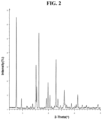
- the Compound 1 HBr (Form A) exhibits an XRPD comprising one or more peaks (particularly, three or more peaks) at about 7.6, 15.2, 16.3, 19.8 and 22.9 degrees two-theta with the margin of error of about ⁇ 0.5; about ⁇ 0.4; about ⁇ 0.3; about ⁇ 0.2; about ⁇ 0.1; about ⁇ 0.05; or less (particularly, about ⁇ 0.2).
- the Compound 1 HBr (Form A) exhibits an XRPD comprising three or more peaks at about 7.6, 15.2, 16.3, 19.8 and 22.9 degrees two-theta with the margin of error of ⁇ 0.2.
- the XRPD of the Compound 1 HBr (Form A) further comprises one or more peaks at about 15.5, 19.2, 20.6, 26.1, and 31.3 degrees two-theta with the margin of error of about ⁇ 0.5; about ⁇ 0.4; about ⁇ 0.3; about ⁇ 0.2; about ⁇ 0.1; about ⁇ 0.05; or less (particularly, about ⁇ 0.2).
- the Compound 1 HBr (Form A) exhibits an XRPD comprising peaks shown in Table 1 below: Table 1.
- Some embodiments provide Compound 1 HBr (Form A), wherein in the range from 15.2 ⁇ 0.2 to 16.3 ⁇ 0.2 degrees two-theta in the XRPD pattern, the Form A exhibits only three peaks.
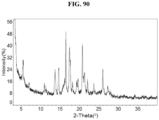
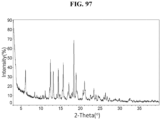
- the Compound 1 HBr exhibits an XRPD that is substantially similar to Fig. 2 .
- the Compound 1 HBr (Form A) exhibits a DSC thermogram comprising an endotherm (for example, a sharp endotherm) at about 243.1 °C with the error of margin of about ⁇ 2.5; about ⁇ 2.0; about ⁇ 1.5; about ⁇ 1.0; about ⁇ 0.5; or less (particularly, about ⁇ 2.0).
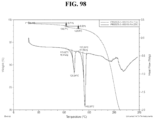
- the Compound 1 HBr (Form A) exhibits a DSC thermogram that is substantially similar to Fig. 3 .
- the Compound 1 HBr (Form A) exhibits a TGA thermogram that is substantially similar to Fig. 3 . In some embodiments, the TGA thermogram of the Compound 1 HBr (Form A) exhibits a weight loss of about 0.0 to 1.9% in the temperature range of 25 to 230° C.
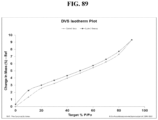
- the Compound 1 HBr (Form A) exhibits a DVS isotherm plot that is substantially similar to Fig. 4 . In some embodiments, the Compound 1 HBr (Form A) exhibits a gravimetric moisture sorption of about 1.1% (by weight) at 80% Relative Humidity.
- the present disclosure provides Compound 1 HBr (Form B).
- the Compound 1 HBr (Form B) exhibits an XRPD comprising one or more peaks (particularly, three or more peaks) at about 3.6, 16.3, 17.7, 21.4 and 23.5 degrees two-theta with the margin of error of about ⁇ 0.5; about ⁇ 0.4; about ⁇ 0.3; about ⁇ 0.2; about ⁇ 0.1; about ⁇ 0.05; or less (particularly, about ⁇ 0.2).
- the XRPD of the Compound 1 HBr (Form B) further comprises one or more peaks at about 14.4, 18.7, 24.8, 27.3 and 28.2 degrees two-theta with the margin of error of about ⁇ 0.5; about ⁇ 0.4; about ⁇ 0.3; about ⁇ 0.2; about ⁇ 0.1; about ⁇ 0.05; or less (particularly, about ⁇ 0.2).
- the Compound 1 HBr (Form B) exhibits an XRPD comprising peaks shown in Table 2 below: Table 2.
- the Compound 1 HBr exhibits an XRPD that is substantially similar to Fig. 5 .
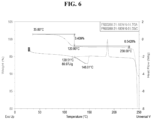
- the Compound 1 HBr (Form B) exhibits a DSC thermogram comprising an endotherm at about 121 °C with the error of margin of about ⁇ 2.5; about ⁇ 2.0; about ⁇ 1.5; about ⁇ 1.0; about ⁇ 0.5; or less (particularly, about ⁇ 2.0). In some embodiments, the Compound 1 HBr (Form B) exhibits a DSC thermogram that is substantially similar to Fig. 6 .
- the Compound 1 HBr (Form B) exhibits a TGA thermogram that is substantially similar to Fig. 6 . In some embodiments, the TGA thermogram of the Compound 1 HBr (Form B) exhibits a weight loss of about 0.0 to 3.4% in the temperature range of 25 to 120° C.
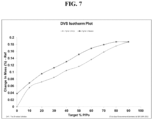
- the Compound 1 HBr (Form B) exhibits a DVS isotherm plot that is substantially similar to Fig. 7 . In some embodiments, the Compound 1 HBr (Form B) exhibits a gravimetric moisture sorption of about 0.2% (by weight) at 80% Relative Humidity.
- the present disclosure provides Compound 1 HBr (Form C).
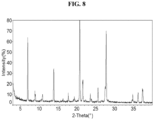
- the Compound 1 HBr (Form C) exhibits an XRPD comprising one or more peaks (particularly, three or more peaks) at about 6.9, 13.8, 20.8, 21.6 and 27.7 degrees two-theta with the margin of error of about ⁇ 0.5; about ⁇ 0.4; about ⁇ 0.3; about ⁇ 0.2; about ⁇ 0.1; about ⁇ 0.05; or less (particularly, about ⁇ 0.2).
- the XRPD of the Compound 1 HBr (Form C) further comprises one or more peaks at about 8.8, 25.6, 27.5, 36.2 and 37.3 degrees two-theta with the margin of error of about ⁇ 0.5; about ⁇ 0.4; about ⁇ 0.3; about ⁇ 0.2; about ⁇ 0.1; about ⁇ 0.05; or less (particularly, about ⁇ 0.2).
- the Compound 1 HBr (Form C) exhibits an XRPD comprising peaks shown in Table 3 below: Table 3.
- the Compound 1 HBr exhibits an XRPD that is substantially similar to Fig. 8 .
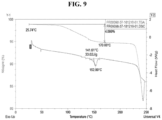
- the Compound 1 HBr (Form C) exhibits a DSC thermogram comprising an endotherm (for example, a sharp endotherm) at about 141 °C with the error of margin of about ⁇ 2.5; about ⁇ 2.0; about ⁇ 1.5; about ⁇ 1.0; about ⁇ 0.5; or less (particularly, about ⁇ 2.0).
- the Compound 1 HBr (Form C) exhibits a DSC thermogram that is substantially similar to Fig. 9 .
- the Compound 1 HBr (Form C) exhibits a TGA thermogram that is substantially similar to Fig. 9 . In some embodiments, the TGA thermogram of the Compound 1 HBr (Form C) exhibits a weight loss of about 0.0 to 4.1 % in the temperature range of 25 to 170° C.
- the Compound 1 HBr (Form C) exhibits a DVS isotherm plot that is substantially similar to Fig. 10 . In some embodiments, the Compound 1 HBr (Form C) exhibits a gravimetric moisture sorption of about 0.25% (by weight) at 80% Relative Humidity.
- the present disclosure provides Compound 1 HBr (Form D).
- the Compound 1 HBr (Form D) exhibits an XRPD comprising one or more peaks (particularly, three or more peaks) at about 14.7, 15.2, 15.6, 16.4, and 23.1 degrees two-theta with the margin of error of about ⁇ 0.5; about ⁇ 0.4; about ⁇ 0.3; about ⁇ 0.2; about ⁇ 0.1; about ⁇ 0.05; or less (particularly, about ⁇ 0.2).
- the XRPD of the Compound 1 HBr (Form D) further comprises one or more peaks at about 18.2, 19.9, 21.3, 22.2, and 23.4 degrees two-theta with the margin of error of about ⁇ 0.5; about ⁇ 0.4; about ⁇ 0.3; about ⁇ 0.2; about ⁇ 0.1; about ⁇ 0.05; or less (particularly, about ⁇ 0.2).
- the Compound 1 HBr (Form D) exhibits an XRPD comprising peaks shown in Table 4 below: Table 4.
- the Compound 1 HBr exhibits an XRPD that is substantially similar to Fig. 11 .
- the Compound 1 HBr (Form D) exhibits a DSC thermogram comprising a endotherm (for example, a sharp endotherm) at about 248 °C with the error of margin of about ⁇ 2.5; about ⁇ 2.0; about ⁇ 1.5; about ⁇ 1.0; about ⁇ 0.5; or less (particularly, about ⁇ 2.0).
- the Compound 1 HBr (Form D) exhibits a DSC thermogram that is substantially similar to Fig. 12 .
- the Compound 1 HBr (Form D) exhibits a TGA thermogram that is substantially similar to Fig. 12 . In some embodiments, the TGA thermogram of the Compound 1 HBr (Form D) exhibits a weight loss of about 0.0 to 1.7% in the temperature range of 29 to 150° C.
- the present disclosure provides Compound 1 HBr (Form E).
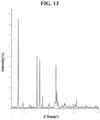
- the Compound 1 HBr (Form E) exhibits an XRPD comprising one or more peaks (particularly, three or more peaks) at about 7.6, 15.2, 16.3, 22.9 and 23.2 degrees two-theta with the margin of error of about ⁇ 0.5; about ⁇ 0.4; about ⁇ 0.3; about ⁇ 0.2; about ⁇ 0.1; about ⁇ 0.05; or less (particularly, about ⁇ 0.2).
- the Compound 1 HBr (Form E) exhibits an XRPD comprising three or more peaks at about 7.6, 15.2, 16.3, 22.9 and 23.2 degrees two-theta with the margin of error of ⁇ 0.2.
- the XRPD of the Compound 1 HBr (Form E) further comprises one or more peaks at about 9.6, 17.4, 22.4, 23.6 and 31.2 degrees two-theta with the margin of error of about ⁇ 0.5; about ⁇ 0.4; about ⁇ 0.3; about ⁇ 0.2; about ⁇ 0.1; about ⁇ 0.05; or less (particularly, about ⁇ 0.2).
- the Compound 1 HBr (Form E) exhibits an XRPD comprising peaks shown in Table 5 below: Table 5.
- Some embodiments provide Compound 1 HBr (Form E), wherein in the range from 15.2 ⁇ 0.2 to 16.3 ⁇ 0.2 degrees two-theta in the XRPD pattern, the Form E exhibits only two peaks.
- the Compound 1 HBr exhibits an XRPD that is substantially similar to Fig. 13 .
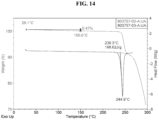
- the Compound 1 HBr (Form E) exhibits a DSC thermogram comprising a endotherm (for example, a sharp endotherm) at about 245 °C with the error of margin of about ⁇ 2.5; about ⁇ 2.0; about ⁇ 1.5; about ⁇ 1.0; about ⁇ 0.5; or less (particularly, about ⁇ 2.0).
- the Compound 1 HBr (Form E) exhibits a DSC thermogram that is substantially similar to Fig. 14 .
- the Compound 1 HBr (Form E) exhibits a TGA thermogram that is substantially similar to Fig. 14 . In some embodiments, the TGA thermogram of the Compound 1 HBr (Form E) exhibits a weight loss of about 0.0 to 0.5% in the temperature range of 28 to 150° C.
- Citrate salt (the present invention, in as far as it exists in crystalline form A)
- the present disclosure provides a citrate salt of Compound 1 ("Compound 1 Citrate"). In some embodiments, the present disclosure provides a crystalline form of Compound 1 Citrate.
- the present invention provides Compound 1 Citrate (Form A).
- crystalline form A of the citrate salt of Compound 1 is defined by reference to the XRPD peaks indicated in claim 1 and is preferably further characterised by the additional XRPD peaks and other data referred to in dependent claims 2-9.
- the characterisations of form A of the citrate salt of Compound 1 mentioned below constitute additional information with regard to this crystalline form A of this salt, but the invention remains defined by the data referred to in the claims 1-9 as explained above.
- the Compound 1 Citrate (Form A) exhibits an XRPD comprising one or more peaks (particularly, three or more peaks) at about 5.7, 11.9, 17.1, 20.1, and 20.3 degrees two-theta with the margin of error of about ⁇ 0.5; about ⁇ 0.4; about ⁇ 0.3; about ⁇ 0.2; about ⁇ 0.1; about ⁇ 0.05; or less (particularly, about ⁇ 0.2).
- the Compound 1 Citrate (Form A) exhibits an XRPD comprising three or more peaks at about 5.7, 11.9, 17.1, 20.1, and 20.3 degrees two-theta with the margin of error of about ⁇ 0.2.
- the XRPD of the Compound 1 Citrate (Form A) further comprises one or more peaks at about 12.7, 13.0, 13.6, 15.3, and 16.8 degrees two-theta with the margin of error of about ⁇ 0.5; about ⁇ 0.4; about ⁇ 0.3; about ⁇ 0.2; about ⁇ 0.1; about ⁇ 0.05; or less (particularly, about ⁇ 0.2).
- the Compound 1 Citrate (Form A) exhibits an XRPD comprising peaks shown in Table 6 below: Table 6.
- the Compound 1 Citrate (Form A) exhibits an XRPD comprising peaks at about: 5.7 ⁇ 0.2; 12.5 ⁇ 0.2 and 13.0 ⁇ 0.2; or 5.7 ⁇ 0.2, 12.5 ⁇ 0.2 and 20.1 ⁇ 0.2; or 5.7 ⁇ 0.2; 12.5 ⁇ 0.2 and 20.3 ⁇ 0.2; or 5.7 ⁇ 0.2; 12.7 ⁇ 0.2 and 13.0 ⁇ 0.2; or 5.7 ⁇ 0.2; 12.7 ⁇ 0.2 and 20.3 ⁇ 0.2; or 5.7 ⁇ 0.2, 13.0 ⁇ 0.2 and 20.3 ⁇ 0.2; or 5.7 ⁇ 0.2, 16.8 ⁇ 0.2 and 20.1 ⁇ 0.2; or 5.7 ⁇ 0.2; 20.1 ⁇ 0.2 and 20.3 ⁇ 0.2; or 12.5 ⁇ 0.2, 13.0 ⁇ 0.2 and 20.3 ⁇ 0.2; or 12.7 ⁇ 0.2, 13.0 ⁇ 0.2 and 20.3 ⁇ 0.2; or 16.8 ⁇ 0.2, 20.1 ⁇ 0.2 and 20.3 ⁇ 0.2 degrees two-theta.
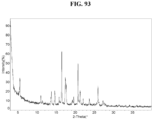
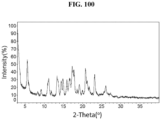
- the Compound 1 Citrate (Form A) exhibits an XRPD that is substantially similar to Fig. 15 .
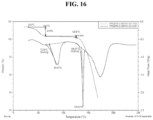
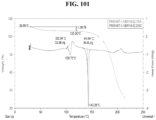
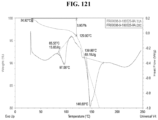
- the Compound 1 Citrate (Form A) exhibits a DSC thermogram comprising a endotherm at about 89.0 °C with the error of margin of about ⁇ 2.5; about ⁇ 2.0; about ⁇ 1.5; about ⁇ 1.0; about ⁇ 0.5; or less (particularly, about ⁇ 2.0). In some embodiments, the Compound 1 Citrate (Form A) exhibits a DSC thermogram comprising an endotherm at about 89.0 ⁇ 2.0 °C.
- the Compound 1 Citrate (Form A) exhibits a DSC thermogram comprising an endotherm (for example, a sharp endotherm) at about 139.5 °C with the error of margin of about ⁇ 2.5; about ⁇ 2.0; about ⁇ 1.5; about ⁇ 1.0; about ⁇ 0.5; or less (particularly, about ⁇ 2.0).
- the Compound 1 Citrate (Form A) exhibits a DSC thermogram comprising an endotherm (for example, a sharp endotherm) at about 139.5 ⁇ 2.0°C.
- the Compound 1 Citrate (Form A) exhibits a DSC thermogram that is substantially similar to Fig. 16 .
- the Compound 1 Citrate (Form A) exhibits a TGA thermogram that is substantially similar to Fig. 16 . In some embodiments, the TGA thermogram of the Compound 1 Citrate (Form A) exhibits a weight loss of 0.0 to 2.6% in the temperature range of 25 to 65° C.
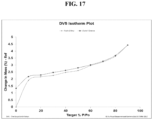
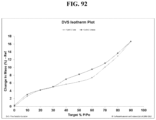
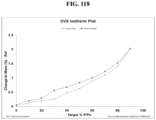
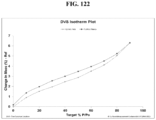
- the Compound 1 Citrate (Form A) exhibits a DVS isotherm plot that is substantially similar to Fig. 17 .
- the Compound 1-citrate (Form A) exhibits a gravimetric moisture sorption of about 3.6% (by weight) at 80% Relative Humidity.
- the present disclosure provides Compound 1 Citrate (Form B).
- the Compound 1 Citrate (Form B) exhibits an XRPD comprising one or more peaks (particularly, three or more peaks) at about 5.5, 5.7, 10.9, 16.3 and 20.5 degrees two-theta with the margin of error of about ⁇ 0.5; about ⁇ 0.4; about ⁇ 0.3; about ⁇ 0.2; about ⁇ 0.1; about ⁇ 0.05; or less (particularly, about ⁇ 0.2).
- the XRPD of the Compound 1 Citrate (Form B) further comprises one or more peaks at about 3.4, 11.8, 14.6, 17.2 and 21.1 degrees two-theta with the margin of error of about ⁇ 0.5; about ⁇ 0.4; about ⁇ 0.3; about ⁇ 0.2; about ⁇ 0.1; about ⁇ 0.05; or less (particularly, about ⁇ 0.2).
- the Compound 1 Citrate (Form B) exhibits an XRPD comprising peaks shown in Table 7 below: Table 7.
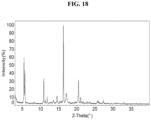
- the Compound 1 Citrate (Form B) exhibits an XRPD that is substantially similar to Fig. 18 .
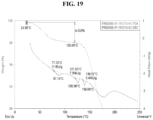
- the Compound 1 Citrate (Form B) exhibits a DSC thermogram comprising an endotherm at about 77.7 °C with the error of margin of about ⁇ 2.5; about ⁇ 2.0; about ⁇ 1.5; about ⁇ 1.0; about ⁇ 0.5; or less (particularly, about ⁇ 2.0). In some embodiments, the Compound 1 Citrate (Form B) exhibits a DSC thermogram comprising an endotherm at about 121.5 °C with the error of margin of about ⁇ 2.5; about ⁇ 2.0; about ⁇ 1.5; about ⁇ 1.0; about ⁇ 0.5; or less (particularly, about ⁇ 2.0).
- the Compound 1 Citrate (Form B) exhibits a DSC thermogram comprising an endotherm at about 136.6 °C with the error of margin of about ⁇ 2.5; about ⁇ 2.0; about ⁇ 1.5; about ⁇ 1.0; about ⁇ 0.5; or less (particularly, about ⁇ 2.0). In some embodiments, the Compound 1 Citrate (Form B) exhibits a DSC thermogram that is substantially similar to Fig. 19 .
- the Compound 1 Citrate (Form B) exhibits a TGA thermogram that is substantially similar to Fig. 19 . In some embodiments, the TGA thermogram of the Compound 1 Citrate (Form B) exhibits a weight loss of about 0.0 to 4.5% in the temperature range of 25 to 120° C.
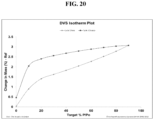
- the Compound 1 Citrate (Form B) exhibits a DVS isotherm plot that is substantially similar to Fig. 20 . In some embodiments, the Compound 1 Citrate (Form B) exhibits a gravimetric moisture sorption of about 2.8% (by weight) at 80% Relative Humidity.
- the present disclosure provides Compound 1 Citrate (Form C).
- the Compound 1 Citrate (Form C) exhibits an XRPD comprising one or more peaks (particularly, three or more peaks) at about 15.4, 18.7, 19.7, 20.6 and 27.1 degrees two-theta with the margin of error of about ⁇ 0.5; about ⁇ 0.4; about ⁇ 0.3; about ⁇ 0.2; about ⁇ 0.1; about ⁇ 0.05; or less (particularly, about ⁇ 0.2).
- the XRPD of the Compound 1 Citrate (Form C) further comprises one or more peaks at about 13.5, 15.5, 16.2, 17.0 and 22.1 degrees two-theta with the margin of error of about ⁇ 0.5; about ⁇ 0.4; about ⁇ 0.3; about ⁇ 0.2; about ⁇ 0.1; about ⁇ 0.05; or less (particularly, about ⁇ 0.2).
- the Compound 1 Citrate (Form C) exhibits an XRPD comprising peaks shown in Table 8 below. Table 8.
- the Compound 1 Citrate exhibits an XRPD that is substantially similar to Fig. 21 .
- the present disclosure provides a mesylate salt of Compound 1 ("Compound 1 Mesylate"). In some embodiments, the present disclosure provides a crystalline form of Compound 1 Mesylate.
- the present disclosure provides Compound 1 Mesylate (Form A).
- the Compound 1 Mesylate (Form A) exhibits an XRPD comprising one or more peaks (particularly, three or more peaks) at about 3.6, 7.1, 14.2, 19.1 and 25.9 degrees two-theta with the margin of error of about ⁇ 0.5; about ⁇ 0.4; about ⁇ 0.3; about ⁇ 0.2; about ⁇ 0.1; about ⁇ 0.05; or less (particularly, about ⁇ 0.2).
- the XRPD of the Compound 1 Mesylate (Form A) further comprises one or more peaks at about 7.7, 12.7, 17.8, 19.4, and 21.4 degrees two-theta with the margin of error of about ⁇ 0.5; about ⁇ 0.4; about ⁇ 0.3; about ⁇ 0.2; about ⁇ 0.1; about ⁇ 0.05; or less (particularly, about ⁇ 0.2).
- the Compound 1 Mesylate (Form A) exhibits an XRPD comprising peaks shown in Table 9 below: Table 9.
- the Compound 1 Mesylate (Form A) exhibits an XRPD that is substantially similar to Fig. 22 .
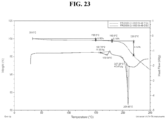
- the Compound 1 Mesylate (Form A) exhibits a DSC thermogram comprising an endotherm at about 170.9 °C with the error of margin of about ⁇ 2.5; about ⁇ 2.0; about ⁇ 1.5; about ⁇ 1.0; about ⁇ 0.5; or less (particularly, about ⁇ 2.0). In some embodiments, the Compound 1 Mesylate (Form A) exhibits a DSC thermogram comprising a endotherm (for example, a sharp endotherm) at about 209.7 °C with the error of margin of about ⁇ 2.5; about ⁇ 2.0; about ⁇ 1.5; about ⁇ 1.0; about ⁇ 0.5; or less (particularly, about ⁇ 2.0). In some embodiments, the Compound 1 Mesylate (Form A) exhibits a DSC thermogram that is substantially similar to Fig. 23 .
- the Compound 1 Mesylate (Form A) exhibits a TGA thermogram that is substantially similar to Fig. 23 . In some embodiments, the TGA thermogram of the Compound 1 Mesylate (Form A) exhibits a weight loss of 0.0 to 0.5% in the temperature range of 25 to 150° C.
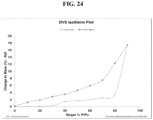
- the Compound 1 Mesylate (Form A) exhibits a DVS isotherm plot that is substantially similar to Fig. 24 . In some embodiments, the Compound 1 Mesylate (Form A) exhibits a gravimetric moisture sorption of about 3.4% (by weight) at 80% Relative Humidity.
- the present disclosure provides Compound 1 Mesylate (Form B).
- the Compound 1 Mesylate (Form B) exhibits an XRPD comprising one or more peaks (particularly, three or more peaks) at about 7.1, 14.3, 15.9, 21.4, and 22.6 degrees two-theta with the margin of error of about ⁇ 0.5; about ⁇ 0.4; about ⁇ 0.3; about ⁇ 0.2; about ⁇ 0.1; about ⁇ 0.05; or less (particularly, about ⁇ 0.2).
- the Compound 1 Mesylate (Form B) exhibits an XRPD comprising peaks shown in Table 10A below: Table 10A.
- Table of Compound 1 Mesylate (Form B) 2-Theta Intensity % 7.1 100 14.3 25.8 15.9 11.3 19.0 3.5 21.4 9.1 22.6 6.1
- the Compound 1 Mesylate exhibits an XRPD that is substantially similar to Fig. 25A .
- the present disclosure provides Compound 1 Mesylate (Form C).
- the Compound 1 Mesylate (Form C) exhibits an XRPD comprising one or more peaks (particularly, three or more peaks) at about 7.5, 15.0, 19.4, 22.5, and 30.2 degrees two-theta with the margin of error of about ⁇ 0.5; about ⁇ 0.4; about ⁇ 0.3; about ⁇ 0.2; about ⁇ 0.1; about ⁇ 0.05; or less (particularly, about ⁇ 0.2).
- the Compound 1 Mesylate (Form C) exhibits an XRPD comprising peaks shown in Table 10B below: Table 10B. XRPD Table of Compound 1 Mesylate (Form C) 2-Theta Intensity % 7.5 100 15.0 33.1 19.4 3.1 22.5 13.3 30.2 3
- the Compound 1 Mesylate exhibits an XRPD that is substantially similar to Fig. 25B .
- the present disclosure provides Compound 1 Mesylate (Form D).
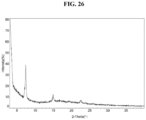
- the Compound 1 Mesylate (Form D) exhibits an XRPD comprising one or more peaks (particularly, three or more peaks) at about 7.4, 15.0, and 22.6 degrees two-theta with the margin of error of about ⁇ 0.5; about ⁇ 0.4; about ⁇ 0.3; about ⁇ 0.2; about ⁇ 0.1; about ⁇ 0.05; or less (particularly, about ⁇ 0.2).
- the Compound 1 Mesylate (Form D) exhibits an XRPD comprising peaks shown in Table 11 below: Table 11.
- Table of Compound 1 Mesylate (Form D) 2-Theta Intensity % 7.4 100 15.0 21.1 22.6 10
- the Compound 1 Mesylate exhibits an XRPD that is substantially similar to Fig. 26 .
- the present disclosure provides a phosphate salt of Compound 1 ("Compound 1 Phosphate"). In some embodiments, the present disclosure provides a crystalline form of Compound 1 Phosphate.
- the present disclosure provides Compound 1 Phosphate (Form A).
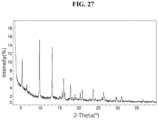
- the Compound 1 Phosphate (Form A) exhibits an XRPD comprising one or more peaks (particularly, three or more peaks) at about 3.3, 3.6, 5.4, 9.9, and 13.1 degrees two-theta with the margin of error of about ⁇ 0.5; about ⁇ 0.4; about ⁇ 0.3; about ⁇ 0.2; about ⁇ 0.1; about ⁇ 0.05; or less (particularly, about ⁇ 0.2).
- the XRPD of the Compound 1 Phosphate (Form A) further comprises one or more peaks at about 16.1, 17.9, 20.9, 23.7, and 26.4 degrees two-theta with the margin of error of about ⁇ 0.5; about ⁇ 0.4; about ⁇ 0.3; about ⁇ 0.2; about ⁇ 0.1; about ⁇ 0.05; or less (particularly, about ⁇ 0.2).
- the Compound 1 Phosphate (Form A) exhibits an XRPD comprising peaks shown in Table 12 below: Table 12.
- the Compound 1 Phosphate (Form A) exhibits an XRPD that is substantially similar to Fig. 27 .
- the Compound 1 Phosphate (Form A) exhibits a DSC thermogram comprising a endotherm (for example, a sharp endotherm) at about 217.6 °C with the error of margin of about ⁇ 2.5; about ⁇ 2.0; about ⁇ 1.5; about ⁇ 1.0; about ⁇ 0.5; or less (particularly, about ⁇ 2.0).
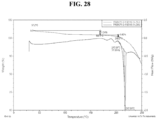
- the Compound 1 Phosphate (Form A) exhibits a DSC thermogram that is substantially similar to Fig. 28 .
- the Compound 1 Phosphate (Form A) exhibits a TGA thermogram that is substantially similar to Fig. 28 . In some embodiments, the TGA thermogram of the Compound 1 Phosphate (Form A) exhibits a weight loss of 0.0 to 1.7% in the temperature range of 25 to 204° C.
- the Compound 1 Phosphate (Form A) exhibits a DVS isotherm plot that is substantially similar to Fig. 29 . In some embodiments, the Compound 1 Phosphate (Form A) exhibits a gravimetric moisture sorption of about 2.1% (by weight) at 80% Relative Humidity.
- Tartrate salt (not part of the present invention)
- the present disclosure provides a tartrate salt of Compound 1 ("Compound 1 Tartrate”). In some embodiments, the present disclosure provides a D(-)-tartrate salt of Compound 1 ("Compound 1 D(-)-Tartrate”). In some embodiments, the present disclosure provides an L(+)-tartrate salt of Compound 1 ("Compound 1 L(+)-Tartrate”).
- the present disclosure provides a crystalline form of Compound 1 Tartrate. In some embodiments, the present disclosure provides a crystalline form of Compound 1 D(-)-Tartrate. In some embodiments, the present disclosure provides a crystalline form of Compound 1 L(+)-Tartrate.
- the present disclosure provides Compound 1 L(+)-Tartrate (Form A).
- the Compound 1 L(+)-Tartrate (Form A) exhibits an XRPD comprising one or more peaks (particularly, three or more peaks) at about 3.6, 4.7, 13.9, 18.6, and 22.8 degrees two-theta with the margin of error of about ⁇ 0.5; about ⁇ 0.4; about ⁇ 0.3; about ⁇ 0.2; about ⁇ 0.1; about ⁇ 0.05; or less (particularly, about ⁇ 0.2).
- the XRPD of the Compound 1 L(+)-Tartrate (Form A) further comprises one or more peaks at about 14.6, 17.8 and 18.1 degrees two-theta with the margin of error of about ⁇ 0.5; about ⁇ 0.4; about ⁇ 0.3; about ⁇ 0.2; about ⁇ 0.1; about ⁇ 0.05; or less (particularly, about ⁇ 0.2).
- the Compound 1 L(+)-Tartrate (Form A) exhibits an XRPD comprising peaks shown in Table 13 below: Table 13.
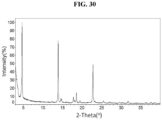
- the Compound 1 L(+)-Tartrate (Form A) exhibits an XRPD that is substantially similar to Fig. 30 .
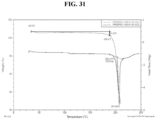
- the Compound 1 L(+)-Tartrate (Form A) exhibits a DSC thermogram comprising a endotherm (for example, a sharp endotherm) at about 207.6 °C with the error of margin of about ⁇ 2.5; about ⁇ 2.0; about ⁇ 1.5; about ⁇ 1.0; about ⁇ 0.5; or less (particularly, about ⁇ 2.0).
- the Compound 1 L(+)-Tartrate (Form A) exhibits a DSC thermogram that is substantially similar to Fig. 31 .
- the Compound 1 L(+)-Tartrate (Form A) exhibits a TGA thermogram that is substantially similar to Fig. 31 . In some embodiments, the TGA thermogram of the Compound 1 L(+)-Tartrate (Form A) exhibits a weight loss of 0.0 to 1.2% in the temperature range of 25 to 189° C.
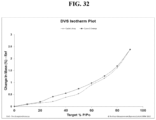
- the Compound 1 L(+)-Tartrate (Form A) exhibits a DVS isotherm plot that is substantially similar to Fig. 32 . In some embodiments, the Compound 1 L(+)-Tartrate (Form A) exhibits a gravimetric moisture sorption of about 1.6% (by weight) at 80% Relative Humidity.
- the present disclosure provides Compound 1 L(+)-Tartrate (Form B).
- the Compound 1 L(+)-Tartrate (Form B) exhibits an XRPD comprising one or more peaks (particularly, three or more peaks) at about 3.6, 4.6, 12.4, 13.9, and 22.7 degrees two-theta with the margin of error of about ⁇ 0.5; about ⁇ 0.4; about ⁇ 0.3; about ⁇ 0.2; about ⁇ 0.1; about ⁇ 0.05; or less (particularly, about ⁇ 0.2).
- the XRPD of the Compound 1 L(+)-Tartrate (Form B) further comprises one or more peaks at about 14.8, 18.3 and 18.5 degrees two-theta with the margin of error of about ⁇ 0.5; about ⁇ 0.4; about ⁇ 0.3; about ⁇ 0.2; about ⁇ 0.1; about ⁇ 0.05; or less (particularly, about ⁇ 0.2).
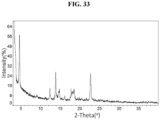
- the Compound 1 L(+)-Tartrate (Form B) exhibits an XRPD comprising peaks shown in Table 14 below: Table 14.
- the Compound 1 L(+)-Tartrate exhibits an XRPD that is substantially similar to Fig. 33 .
- the Compound 1 L(+)-Tartrate (Form B) exhibits a DSC thermogram comprising an endotherm (for example, a sharp endotherm) at about 207.3 °C with the error of margin of about ⁇ 2.5; about ⁇ 2.0; about ⁇ 1.5; about ⁇ 1.0; about ⁇ 0.5; or less (particularly, about ⁇ 2.0).
- the Compound 1 L(+)-Tartrate (Form B) exhibits a DSC thermogram that is substantially similar to Fig. 34 .
- the Compound 1 L(+)-Tartrate (Form B) exhibits a TGA thermogram that is substantially similar to Fig. 34 . In some embodiments, the TGA thermogram of the Compound 1 L(+)-Tartrate (Form B) exhibits a weight loss of 0.0 to 0.6% in the temperature range of 25 to 180° C.
- the Compound 1 L(+)-Tartrate (Form B) exhibits a DVS isotherm plot that is substantially similar to Fig. 35 . In some embodiments, the Compound 1 L(+)-Tartrate (Form B) exhibits a gravimetric moisture sorption of about 1.7% (by weight) at 80% Relative Humidity.
- the present disclosure provides a fumarate salt of Compound 1 ("Compound 1 Fumarate"). In some embodiments, the present disclosure provides a crystalline form of Compound 1 Fumarate.
- the present disclosure provides Compound 1 Fumarate (Form A).
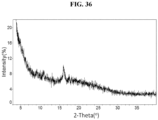
- the Compound 1 Fumarate (Form A) exhibits an XRPD comprising one or more peaks at about 3.5 and 16.0 degrees two-theta with the margin of error of about ⁇ 0.5; about ⁇ 0.4; about ⁇ 0.3; about ⁇ 0.2; about ⁇ 0.1; about ⁇ 0.05; or less (particularly, about ⁇ 0.2).
- the Compound 1 Fumarate (Form A) exhibits an XRPD comprising peaks shown in Table 15 below: Table 15. XRPD Table of Compound 1 Fumarate (Form A) 2-Theta Intensity % 3.5 100 16.0 13.4
- the Compound 1 Fumarate (Form A) exhibits an XRPD that is substantially similar to Fig. 36 .
- the Compound 1 Fumarate (Form A) exhibits a DSC thermogram comprising an endotherm (for example, a sharp endotherm) at about 87.0 °C with the error of margin of about ⁇ 2.5; about ⁇ 2.0; about ⁇ 1.5; about ⁇ 1.0; about ⁇ 0.5; or less (particularly, about ⁇ 2.0).
- the Compound 1 Fumarate (Form A) exhibits a DSC thermogram that is substantially similar to Fig. 37 .
- the Compound 1 Fumarate (Form A) exhibits a TGA thermogram that is substantially similar to Fig. 37 . In some embodiments, the TGA thermogram of the Compound 1 Fumarate (Form A) exhibits a weight loss of 0.0 to 0.9% in the temperature range of 25 to 75° C.
- the present disclosure provides Compound 1 Fumarate (Form B).
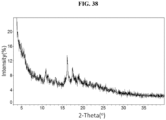
- the Compound 1 Fumarate (Form B) exhibits an XRPD comprising one or more peaks (particularly, three or more peaks) at about 3.6, 11.0, 16.2, and 17.5 degrees two-theta with the margin of error of about ⁇ 0.5; about ⁇ 0.4; about ⁇ 0.3; about ⁇ 0.2; about ⁇ 0.1; about ⁇ 0.05; or less (particularly, about ⁇ 0.2).
- the Compound 1 Fumarate (Form B) exhibits an XRPD comprising peaks shown in Table 16 below: Table 16.
- Table of Compound 1 Fumarate (Form B) 2-Theta Intensity % 3.6 100 11.0 12.8 16.2 23.4 17.5 13.1
- the Compound 1 Fumarate exhibits an XRPD that is substantially similar to Fig. 38 .
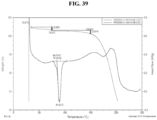
- the Compound 1 Fumarate (Form B) exhibits a DSC thermogram comprising an endotherm (for example, a sharp endotherm) at about 89.9 °C with the error of margin of about ⁇ 2.5; about ⁇ 2.0; about ⁇ 1.5; about ⁇ 1.0; about ⁇ 0.5; or less (particularly, about ⁇ 2.0).
- the Compound 1 Fumarate (Form B) exhibits a DSC thermogram that is substantially similar to Fig. 39 .
- the Compound 1 Fumarate (Form B) exhibits a TGA thermogram that is substantially similar to Fig. 39 . In some embodiments, the TGA thermogram of the Compound 1 Fumarate (Form B) exhibits a weight loss of 0.0 to 1.85% in the temperature range of 25 to 150° C.
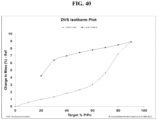
- the Compound 1 Fumarate (Form B) exhibits a DVS isotherm plot that is substantially similar to Fig. 40 . In some embodiments, the Compound 1 Fumarate (Form B) exhibits a gravimetric moisture sorption of about 7.2% (by weight) at 80% Relative Humidity.
- the present disclosure provides Compound 1 Fumarate (Form C).
- the Compound 1 Fumarate (Form C) exhibits an XRPD comprising one or more peaks (particularly, three or more peaks) at about 14.5, 15.4, 16.7, 17.6, and 28.8 degrees two-theta with the margin of error of about ⁇ 0.5; about ⁇ 0.4; about ⁇ 0.3; about ⁇ 0.2; about ⁇ 0.1; about ⁇ 0.05; or less (particularly, about ⁇ 0.2).
- the XRPD of the Compound 1 Fumarate (Form C) further comprises one or more peaks at about 8.4, 19.7, 20.5, 22.9, and 38.1 degrees two-theta with the margin of error of about ⁇ 0.5; about ⁇ 0.4; about ⁇ 0.3; about ⁇ 0.2; about ⁇ 0.1; about ⁇ 0.05; or less (particularly, about ⁇ 0.2).
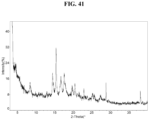
- the Compound 1 Fumarate (Form C) exhibits an XRPD comprising peaks shown in Table 17 below: Table 17.
- the Compound 1 Fumarate exhibits an XRPD that is substantially similar to Fig. 41 .
- the present disclosure provides Compound 1 Fumarate (Form D).
- the Compound 1 Fumarate (Form D) exhibits an XRPD comprising one or more peaks (particularly, three or more peaks) at about 5.2, 12.2, 15.2, 15.5, and 19.9 degrees two-theta with the margin of error of about ⁇ 0.5; about ⁇ 0.4; about ⁇ 0.3; about ⁇ 0.2; about ⁇ 0.1; about ⁇ 0.05; or less (particularly, about ⁇ 0.2).
- the XRPD of the Compound 1 Fumarate (Form D) further comprises one or more peaks at about 10.4, 13.6, 14.2, 21.2, and 22.3 degrees two-theta with the margin of error of about ⁇ 0.5; about ⁇ 0.4; about ⁇ 0.3; about ⁇ 0.2; about ⁇ 0.1; about ⁇ 0.05; or less (particularly, about ⁇ 0.2).
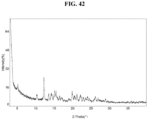
- the Compound 1 Fumarate (Form D) exhibits an XRPD comprising peaks shown in Table 18 below: Table 18.
- the Compound 1 Fumarate exhibits an XRPD that is substantially similar to Fig. 42 .
- the present disclosure provides a tosylate salt of Compound 1 ("Compound 1 Tosylate"). In some embodiments, the present disclosure provides a crystalline form of Compound 1 Tosylate.
- the present disclosure provides Compound 1 Tosylate (Form A).
- the Compound 1 Tosylate (Form A) exhibits an XRPD comprising one or more peaks (particularly, three or more peaks) at about 3.4, 9.8, 10.3, 12.5, and 15.3 degrees two-theta with the margin of error of about ⁇ 0.5; about ⁇ 0.4; about ⁇ 0.3; about ⁇ 0.2; about ⁇ 0.1; about ⁇ 0.05; or less (particularly, about ⁇ 0.2).
- the XRPD of the Compound 1 Tosylate (Form A) further comprises one or more peaks at about 17.4, 17.9, 19.6, 23.2 and 26.0 degrees two-theta with the margin of error of about ⁇ 0.5; about ⁇ 0.4; about ⁇ 0.3; about ⁇ 0.2; about ⁇ 0.1; about ⁇ 0.05; or less (particularly, about ⁇ 0.2).
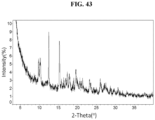
- the Compound 1 Tosylate (Form A) exhibits an XRPD comprising peaks shown in Table 19 below: Table 19. XRPD Table of Compound 1 Tosylate (Form A) 2-Theta Intensity % 3.4 100 9.8 3.1 10.3 3 12.5 7 15.3 6.3 15.8 1.1 16.5 0.9 16.9 1.1 17.4 2.2 17.9 1.8 19.0 1.4 19.6 2.6 20.7 1.3 21.4 1.5 23.2 1.7 23.6 1.1 26.0 1.9 27.2 1.1 27.5 1.3 28.7 1 29.6 0.7 30.7 0.9
- the Compound 1 Tosylate exhibits an XRPD that is substantially similar to Fig. 43 .
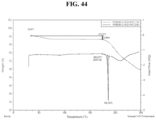
- the Compound 1 Tosylate (Form A) exhibits a DSC thermogram comprising an endotherm (for example, a sharp endotherm) at about 186.2 °C with the error of margin of about ⁇ 2.5; about ⁇ 2.0; about ⁇ 1.5; about ⁇ 1.0; about ⁇ 0.5; or less (particularly, about ⁇ 2.0).
- the Compound 1 Tosylate (Form A) exhibits a DSC thermogram that is substantially similar to Fig. 44 .
- the Compound 1 Tosylate (Form A) exhibits a TGA thermogram that is substantially similar to Fig. 44 . In some embodiments, the TGA thermogram of the Compound 1 Tosylate (Form A) exhibits a weight loss of 0.0 to 0.9% in the temperature range of 25 to 175° C.
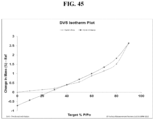
- the Compound 1 Tosylate (Form A) exhibits a DVS isotherm plot that is substantially similar to Fig. 45 . In some embodiments, the Compound 1 Tosylate (Form A) exhibits a gravimetric moisture sorption of about 1.5% (by weight) at 80% Relative Humidity.
- the present disclosure provides Compound 1 Tosylate (Form B).
- the Compound 1 Tosylate (Form B) exhibits an XRPD comprising one or more peaks (particularly, three or more peaks) at about 10.0, 15.2, 15.5, 17.2, and 19.4 degrees two-theta with the margin of error of about ⁇ 0.5; about ⁇ 0.4; about ⁇ 0.3; about ⁇ 0.2; about ⁇ 0.1; about ⁇ 0.05; or less (particularly, about ⁇ 0.2).
- the XRPD of the Compound 1 Tosylate (Form B) further comprises one or more peaks at about 10.3, 16.7, 19.1, 20.1 and 20.8 degrees two-theta with the margin of error of about ⁇ 0.5; about ⁇ 0.4; about ⁇ 0.3; about ⁇ 0.2; about ⁇ 0.1; about ⁇ 0.05; or less (particularly, about ⁇ 0.2).
- the Compound 1 Tosylate exhibits an XRPD comprising peaks shown in Table 20 below: Table 20.
- Table 20 XRPD Table of Compound 1 Tosylate (Form B) 2-Theta Intensity % 6.8 16.7 9.1 24.4 10.0 100 10.3 39.9 11.0 12.8 11.9 23.8 12.2 25.9 13.0 15.5 13.5 19.3 15.2 58.3 15.5 65.5 16.2 27.1 16.7 35.1 17.2 47.9 18.5 23.2 19.1 29.2 19.4 41.7 19.8 28.0 20.1 32.1 20.8 40.2 21.7 25.6 22.2 25.3 23.2 21.7 24.4 20.5 25.6 26.8 26.2 26.8 27.2 18.5 28.4 17.9 29.0 12.8
- the Compound 1 Tosylate exhibits an XRPD that is substantially similar to Fig. 46 .
- the present disclosure provides Compound 1 Tosylate (Form C).
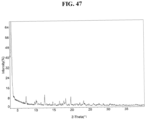
- the Compound 1 Tosylate (Form C) exhibits an XRPD comprising one or more peaks (particularly, three or more peaks) at about 7.4, 10.2, 12.5, 18.3, and 19.7 degrees two-theta with the margin of error of about ⁇ 0.5; about ⁇ 0.4; about ⁇ 0.3; about ⁇ 0.2; about ⁇ 0.1; about ⁇ 0.05; or less (particularly, about ⁇ 0.2).
- the XRPD of the Compound 1 Tosylate (Form C) further comprises one or more peaks at about 9.8, 14.7, 16.6, 17.8, and 23.2 degrees two-theta with the margin of error of about ⁇ 0.5; about ⁇ 0.4; about ⁇ 0.3; about ⁇ 0.2; about ⁇ 0.1; about ⁇ 0.05; or less (particularly, about ⁇ 0.2).
- the Compound 1 Tosylate exhibits an XRPD comprising peaks shown in Table 21 below: Table 21.
- Table 21 Table of Compound 1 Tosylate (Form C) 2-Theta Intensity % 7.4 70 9.8 28.2 10.2 46.9 10.8 16.4 11.4 21.8 12.5 100 13.1 15.6 13.8 17.1 14.7 34.2 15.3 16.7 16.6 40.2 16.9 16 17.4 16.2 17.8 41.6 18.3 65.1 19.7 85.6 20.3 8 20.7 14.2 21.1 18.9 21.4 16 22.2 26.7 22.8 9.3 23.2 46.4 23.6 14.9 24.2 11.8 24.7 16.9 25.9 21.6 27.2 11.3 27.5 20.9 28.6 17.8 30.5 16.2 30.8 13.8 31.2 12.4 37.8 11.1
- the Compound 1 Tosylate exhibits an XRPD that is substantially similar to Fig. 47 .
- the present disclosure provides a glucuronate salt of Compound 1 ("Compound 1 Glucuronate”). In some embodiments, the present disclosure provides a D-glucuronate salt of Compound 1 ("Compound 1 D-Glucuronate”). In some embodiments, the present disclosure provides L-glucuronate salt of Compound 1 (“Compound 1 L-Glucuronate”).
- the present disclosure provides a crystalline form of Compound 1 Glucuronate. In some embodiments, the present disclosure provides a crystalline form of Compound 1 D-Glucuronate. In some embodiments, the present disclosure provides a crystalline form of Compound 1 L-Glucuronate.
- the present disclosure provides Compound 1 D-Glucuronate (Form A).
- the Compound 1 D-Glucuronate (Form A) exhibits an XRPD comprising one or more peaks (particularly, three or more peaks) at about 4.3, 12.9, 16.8, 20.2 and 20.9 degrees two-theta with the margin of error of about ⁇ 0.5; about ⁇ 0.4; about ⁇ 0.3; about ⁇ 0.2; about ⁇ 0.1; about ⁇ 0.05; or less (particularly, about ⁇ 0.2).
- the XRPD of the Compound 1 D-Glucuronate (Form A) further comprises one or more peaks at about 3.3, 14.7, 17.3, 21.6, and 24.8 degrees two-theta with the margin of error of about ⁇ 0.5; about ⁇ 0.4; about ⁇ 0.3; about ⁇ 0.2; about ⁇ 0.1; about ⁇ 0.05; or less (particularly, about ⁇ 0.2).
- the Compound 1 D-Glucuronate (Form A) exhibits an XRPD comprising peaks shown in Table 22 below: Table 22.
- the Compound 1 D-Glucuronate exhibits an XRPD that is substantially similar to Fig. 48 .
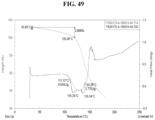
- the Compound 1 D-Glucuronate (Form A) exhibits a DSC thermogram comprising a endotherm at about 116.2 °C with the error of margin of about ⁇ 2.5; about ⁇ 2.0; about ⁇ 1.5; about ⁇ 1.0; about ⁇ 0.5; or less (particularly, about ⁇ 2.0). In some embodiments, the Compound 1 D-Glucuronate (Form A) exhibits a DSC thermogram comprising a endotherm at about 139.3 °C with the error of margin of about ⁇ 2.5; about ⁇ 2.0; about ⁇ 1.5; about ⁇ 1.0; about ⁇ 0.5; or less (particularly, about ⁇ 2.0). In some embodiments, the Compound 1 D-Glucuronate (Form A) exhibits a DSC thermogram that is substantially similar to Fig. 49 .
- the Compound 1 D-Glucuronate (Form A) exhibits a TGA thermogram that is substantially similar to Fig. 49 . In some embodiments, the TGA thermogram of the Compound 1 D-Glucuronate (Form A) exhibits a weight loss of 0.0 to 3.0% in the temperature range of 25 to 120° C.
- the Compound 1 D-Glucuronate (Form A) exhibits a DVS isotherm plot that is substantially similar to Fig. 50 . In some embodiments, the Compound 1 D-Glucuronate (Form A) exhibits a gravimetric moisture sorption of about 1.4% (by weight) at 80% Relative Humidity.
- the present disclosure provides Compound 1 D-Glucuronate (Form B).
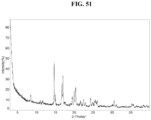
- the Compound 1 D-Glucuronate (Form B) exhibits an XRPD comprising one or more peaks (particularly, three or more peaks) at about 14.7, 16.7, 17.0, 20.0 and 20.4 degrees two-theta with the margin of error of about ⁇ 0.5; about ⁇ 0.4; about ⁇ 0.3; about ⁇ 0.2; about ⁇ 0.1; about ⁇ 0.05; or less (particularly, about ⁇ 0.2).
- the XRPD of the Compound 1 D-Glucuronate (Form B) further comprises one or more peaks at about 8.5, 15.0, 19.5, 22.5 and 24.3 degrees two-theta with the margin of error of about ⁇ 0.5; about ⁇ 0.4; about ⁇ 0.3; about ⁇ 0.2; about ⁇ 0.1; about ⁇ 0.05; or less (particularly, about ⁇ 0.2).
- the Compound 1 D-Glucuronate (Form B) exhibits an XRPD comprising peaks shown in Table 23 below: Table 23.
- the Compound 1 D-Glucuronate exhibits an XRPD that is substantially similar to Fig. 51 .
- the present disclosure provides an ethanesulfonate salt of Compound 1 ("Compound 1 Ethanesulfonate"). In some embodiments, the present disclosure provides a crystalline form of Compound 1 Ethanesulfonate.
- the present disclosure provides Compound 1 Ethanesulfonate (Form A).
- the Compound 1 Ethanesulfonate (Form A) exhibits an XRPD comprising one or more peaks (particularly, three or more peaks) at about 3.4, 3.7, 7.6, 15.3, and 23.0 degrees two-theta with the margin of error of about ⁇ 0.5; about ⁇ 0.4; about ⁇ 0.3; about ⁇ 0.2; about ⁇ 0.1; about ⁇ 0.05; or less (particularly, about ⁇ 0.2).
- the XRPD of the Compound 1 Ethanesulfonate (Form A) further comprises one or more peaks at about 23.3 and 30.8 degrees two-theta with the margin of error of about ⁇ 0.5; about ⁇ 0.4; about ⁇ 0.3; about ⁇ 0.2; about ⁇ 0.1; about ⁇ 0.05; or less (particularly, about ⁇ 0.2).
- the Compound 1 Ethanesulfonate (Form A) exhibits an XRPD comprising peaks shown in Table 24 below: Table 24.
- Table 24 Table of Compound 1 Ethanesulfonate (Form A) 2-Theta Intensity % 3.4 22.4 3.7 11.7 7.6 100 15.3 70.3 23.0 21.6 23.3 1.6 30.8 4.3
- the Compound 1 Ethanesulfonate exhibits an XRPD that is substantially similar to Fig. 52 .
- the Compound 1 Ethanesulfonate (Form A) exhibits a DSC thermogram comprising a endotherm at about 177.9 °C with the error of margin of about ⁇ 2.5; about ⁇ 2.0; about ⁇ 1.5; about ⁇ 1.0; about ⁇ 0.5; or less (particularly, about ⁇ 2.0). In some embodiments, the Compound 1 Ethanesulfonate (Form A) exhibits a DSC thermogram comprising a endotherm at about 207.0 °C with the error of margin of about ⁇ 2.5; about ⁇ 2.0; about ⁇ 1.5; about ⁇ 1.0; about ⁇ 0.5; or less (particularly, about ⁇ 2.0). In some embodiments, the Compound 1 Ethanesulfonate (Form A) exhibits a DSC thermogram that is substantially similar to Fig. 53 .
- the Compound 1 Ethanesulfonate (Form A) exhibits a TGA thermogram that is substantially similar to Fig. 53 . In some embodiments, the TGA thermogram of the Compound 1 Ethanesulfonate (Form A) exhibits a weight loss of 0.0 to 2.9% in the temperature range of 25 to 180° C.
- the Compound 1 Ethanesulfonate (Form A) exhibits a DVS isotherm plot that is substantially similar to Fig. 54 . In some embodiments, the Compound 1 Ethanesulfonate (Form A) exhibits a gravimetric moisture sorption of about 1.4% (by weight) at 80% Relative Humidity.
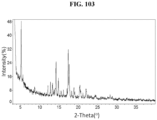
- the present disclosure provides a sulfate salt of Compound 1 ("Compound 1 Sulfate"). In some embodiments, the present disclosure provides a crystalline form of Compound 1 Sulfate.
- the present disclosure provides Compound 1 Sulfate (Form A).
- the Compound 1 Sulfate (Form A) exhibits an XRPD comprising one or more peaks (particularly, three or more peaks) at about 3.6, 5.2, 7.8, 8.1, and 15.1 degrees two-theta with the margin of error of about ⁇ 0.5; about ⁇ 0.4; about ⁇ 0.3; about ⁇ 0.2; about ⁇ 0.1; about ⁇ 0.05; or less (particularly, about ⁇ 0.2).
- the XRPD of the Compound 1 Sulfate (Form A) further comprises one or more peaks at about 14.7, 17.4, 18.2, 18.4, and 19.7 degrees two-theta with the margin of error of about ⁇ 0.5; about ⁇ 0.4; about ⁇ 0.3; about ⁇ 0.2; about ⁇ 0.1; about ⁇ 0.05; or less (particularly, about ⁇ 0.2).
- the Compound 1 Sulfate (Form A) exhibits an XRPD comprising peaks shown in Table 25 below: Table 25.
- the Compound 1 Sulfate (Form A) exhibits an XRPD that is substantially similar to Fig. 55 .
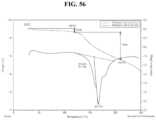
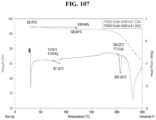
- the Compound 1 Sulfate (Form A) exhibits a DSC thermogram comprising a endotherm at about 167.1 °C with the error of margin of about ⁇ 2.5; about ⁇ 2.0; about ⁇ 1.5; about ⁇ 1.0; about ⁇ 0.5; or less (particularly, about ⁇ 2.0). In some embodiments, the Compound 1 Sulfate (Form A) exhibits a DSC thermogram that is substantially similar to Fig. 56 .
- the Compound 1 Sulfate (Form A) exhibits a TGA thermogram that is substantially similar to Fig. 56 . In some embodiments, the TGA thermogram of the Compound 1 Sulfate (Form A) exhibits a weight loss of 0.0 to 1.0% in the temperature range of 25 to 120° C.
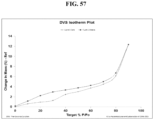
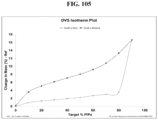
- the Compound 1 Sulfate (Form A) exhibits a DVS isotherm plot that is substantially similar to Fig. 57 . In some embodiments, the Compound 1 Sulfate (Form A) exhibits a gravimetric moisture sorption of about 6.2% (by weight) at 80% Relative Humidity.
- the present disclosure provides an ascorbate salt of Compound 1 ("Compound 1 Ascorbate"). In some embodiments, the present disclosure provides a crystalline form of Compound 1 Ascorbate.
- the present disclosure provides Compound 1 Ascorbate (Form A).
- the Compound 1 Ascorbate (Form A) exhibits an XRPD comprising one or more peaks (particularly, three or more peaks) at about 3.6, 5.6, 16.6, 19.6, and 19.8 degrees two-theta with the margin of error of about ⁇ 0.5; about ⁇ 0.4; about ⁇ 0.3; about ⁇ 0.2; about ⁇ 0.1; about ⁇ 0.05; or less (particularly, about ⁇ 0.2).
- the XRPD of the Compound 1 Ascorbate (Form A) further comprises one or more peaks at about 11.5, 11.9, 21.6, 24.1, and 24.5 degrees two-theta with the margin of error of about ⁇ 0.5; about ⁇ 0.4; about ⁇ 0.3; about ⁇ 0.2; about ⁇ 0.1; about ⁇ 0.05; or less (particularly, about ⁇ 0.2).
- the Compound 1 Ascorbate (Form A) exhibits an XRPD comprising peaks shown in Table 26 below: Table 26.
- Table 26 Table of Compound 1 Ascorbate (Form A) 2-Theta Intensity % 3.6 28.5 5.6 31.7 9.6 9.7 11.0 8.8 11.5 13.8 11.9 13.3 14.5 12.9 16.6 100 18.9 6.3 19.6 31.9 19.8 22.5 21.6 14.7 22.1 5.1 22.9 6 23.2 10.6 24.1 15.1 24.5 21.1
- the Compound 1 Ascorbate exhibits an XRPD that is substantially similar to Fig. 58 .
- the Compound 1 Ascorbate (Form A) exhibits a DSC thermogram comprising a endotherm at about 46.3 °C with the error of margin of about ⁇ 2.5; about ⁇ 2.0; about ⁇ 1.5; about ⁇ 1.0; about ⁇ 0.5; or less (particularly, about ⁇ 2.0). In some embodiments, the Compound 1 Ascorbate (Form A) exhibits a DSC thermogram comprising a endotherm at about 124.3 °C with the error of margin of about ⁇ 2.5; about ⁇ 2.0; about ⁇ 1.5; about ⁇ 1.0; about ⁇ 0.5; or less (particularly, about ⁇ 2.0). In some embodiments, the Compound 1 Ascorbate (Form A) exhibits a DSC thermogram that is substantially similar to Fig. 59 .
- the Compound 1 Ascorbate (Form A) exhibits a TGA thermogram that is substantially similar to Fig. 59 . In some embodiments, the TGA thermogram of the Compound 1 Ascorbate (Form A) exhibits a weight loss of 0.0 to 5.6% in the temperature range of 25 to 120° C.
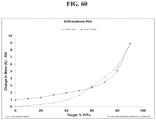
- the Compound 1 Ascorbate (Form A) exhibits a DVS isotherm plot that is substantially similar to Fig. 60 . In some embodiments, the Compound 1 Ascorbate (Form A) exhibits a gravimetric moisture sorption of about 5.7% (by weight) at 80% Relative Humidity.
- the present disclosure provides Compound 1 Ascorbate (Form B).
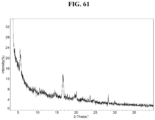
- the Compound 1 Ascorbate (Form B) exhibits an XRPD comprising one or more peaks (particularly, three or more peaks) at about 5.5, 16.6, 19.7, 20.1, and 28.3 degrees two-theta with the margin of error of about ⁇ 0.5; about ⁇ 0.4; about ⁇ 0.3; about ⁇ 0.2; about ⁇ 0.1; about ⁇ 0.05; or less (particularly, about ⁇ 0.2).
- the XRPD of the Compound 1 Ascorbate (Form B) further comprises one or more peaks at about 14.7 and 23.6 degrees two-theta with the margin of error of about ⁇ 0.5; about ⁇ 0.4; about ⁇ 0.3; about ⁇ 0.2; about ⁇ 0.1; about ⁇ 0.05; or less (particularly, about ⁇ 0.2).
- the Compound 1 Ascorbate (Form B) exhibits an XRPD comprising peaks shown in Table 27 below: Table 27.
- Table 27. XRPD Table of Compound 1 Ascorbate (Form B) 2-Theta Intensity % 5.5 74.9 14.7 21.2 16.6 100 19.7 29.6 20.1 38 23.6 22.9 28.3 39.7
- the Compound 1 Ascorbate exhibits an XRPD that is substantially similar to Fig. 61 .
- the present disclosure provides a napadisylate salt of Compound 1 ("Compound 1 Napadisylate"). In some embodiments, the present disclosure provides a crystalline form of Compound 1 Napadisylate.
- the present disclosure provides Compound 1 Napadisylate (Form A).
- the Compound 1 Napadisylate (Form A) exhibits an XRPD comprising one or more peaks (particularly, three or more peaks) at about 3.3, 9.4, 14.2, 16.4, and 17.8 degrees two-theta with the margin of error of about ⁇ 0.5; about ⁇ 0.4; about ⁇ 0.3; about ⁇ 0.2; about ⁇ 0.1; about ⁇ 0.05; or less (particularly, about ⁇ 0.2).
- the XRPD of the Compound 1 Napadisylate (Form A) further comprises one or more peaks at about 9.7, 17.3, 20.3, 24.4, and 26.1 degrees two-theta with the margin of error of about ⁇ 0.5; about ⁇ 0.4; about ⁇ 0.3; about ⁇ 0.2; about ⁇ 0.1; about ⁇ 0.05; or less (particularly, about ⁇ 0.2).
- the Compound 1 Napadisylate (Form A) exhibits an XRPD comprising peaks shown in Table 28 below: Table 28.
- the Compound 1 Napadisylate exhibits an XRPD that is substantially similar to Fig. 62 .
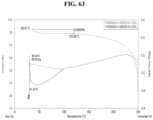
- the Compound 1 Napadisylate (Form A) exhibits a DSC thermogram comprising a endotherm at about 41.7 °C with the error of margin of about ⁇ 2.5; about ⁇ 2.0; about ⁇ 1.5; about ⁇ 1.0; about ⁇ 0.5; or less (particularly, about ⁇ 2.0). In some embodiments, the Compound 1 Napadisylate (Form A) exhibits a DSC thermogram that is substantially similar to Fig. 63 .
- the Compound 1 Napadisylate (Form A) exhibits a TGA thermogram that is substantially similar to Fig. 63 . In some embodiments, the TGA thermogram of the Compound 1 Napadisylate (Form A) exhibits a weight loss of 0.0 to 0.7% in the temperature range of 25 to 120° C.
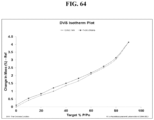
- the Compound 1 Napadisylate exhibits a DVS isotherm plot that is substantially similar to Fig. 64 .
- the Compound 1 Napadisylate exhibits a gravimetric moisture sorption of about 3.1% (by weight) at 80% Relative Humidity.
- the present disclosure provides Compound 1 Napadisylate (Form B).
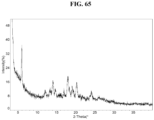
- the Compound 1 Napadisylate (Form B) exhibits an XRPD comprising one or more peaks (particularly, three or more peaks) at about 6.0, 14.2, 18.1, 19.0, and 20.3 degrees two-theta with the margin of error of about ⁇ 0.5; about ⁇ 0.4; about ⁇ 0.3; about ⁇ 0.2; about ⁇ 0.1; about ⁇ 0.05; or less (particularly, about ⁇ 0.2).
- the XRPD of the Compound 1 Napadisylate (Form B) further comprises one or more peaks at about 12.0, 16.9, 18.4, 19.4, and 24.1 degrees two-theta with the margin of error of about ⁇ 0.5; about ⁇ 0.4; about ⁇ 0.3; about ⁇ 0.2; about ⁇ 0.1; about ⁇ 0.05; or less (particularly, about ⁇ 0.2).
- the Compound 1 Napadisylate exhibits an XRPD comprising peaks shown in Table 29 below: Table 29.
- Table 29. XRPD Table of Compound 1 Napadisylate (Form B) 2-Theta Intensity % 6.0 100 12.0 18.2 13.3 14.8 13.5 12.4 14.2 33.8 16.9 23.6 18.1 51.1 18.4 22.9 19.0 26.3 19.4 17 20.3 39.9 21.7 10.5 24.1 22.4 25.8 11.2
- the Compound 1 Napadisylate exhibits an XRPD that is substantially similar to Fig. 65 .
- the present disclosure provides a malonate salt of Compound 1 ("Compound 1 Malonate"). In some embodiments, the present disclosure provides a crystalline form of Compound 1 Malonate.
- the present disclosure provides Compound 1 Malonate (Form A).
- the Compound 1 Malonate (Form A) exhibits an XRPD comprising one or more peaks (particularly, three or more peaks) at about 15.1, 18.0, 18.8, 23.4, and 23.8 degrees two-theta with the margin of error of about ⁇ 0.5; about ⁇ 0.4; about ⁇ 0.3; about ⁇ 0.2; about ⁇ 0.1; about ⁇ 0.05; or less (particularly, about ⁇ 0.2).
- the XRPD of the Compound 1 Malonate (Form A) further comprises one or more peaks at about 3.6, 13.8, 15.6, 21.4, and 27.6 degrees two-theta with the margin of error of about ⁇ 0.5; about ⁇ 0.4; about ⁇ 0.3; about ⁇ 0.2; about ⁇ 0.1; about ⁇ 0.05; or less (particularly, about ⁇ 0.2).
- the Compound 1 Malonate (Form A) exhibits an XRPD comprising peaks shown in Table 30 below: Table 30.
- Table 30 Table of Compound 1 Malonate (Form A) 2-Theta Intensity % 3.6 26.7 10.9 13.6 11.7 6.7 12.1 17.6 13.8 25 14.6 15 15.1 60.1 15.6 29.2 16.7 7.4 18.0 100 18.8 85.6 20.6 18.3 21.4 24.8 21.7 24.1 23.1 17.8 23.4 43.3 23.8 56.3 25.0 8.2 25.6 8.3 27.6 37.3 29.4 17.5
- the Compound 1 Malonate exhibits an XRPD that is substantially similar to Fig. 66 .
- the Compound 1 Malonate (Form A) exhibits a DSC thermogram comprising a endotherm at about 36.9 °C with the error of margin of about ⁇ 2.5; about ⁇ 2.0; about ⁇ 1.5; about ⁇ 1.0; about ⁇ 0.5; or less (particularly, about ⁇ 2.0). In some embodiments, the Compound 1 Malonate (Form A) exhibits a DSC thermogram comprising a endotherm at about 124.6 °C with the error of margin of about ⁇ 2.5; about ⁇ 2.0; about ⁇ 1.5; about ⁇ 1.0; about ⁇ 0.5; or less (particularly, about ⁇ 2.0). In some embodiments, the Compound 1 Malonate (Form A) exhibits a DSC thermogram that is substantially similar to Fig. 67 .
- the Compound 1 Malonate (Form A) exhibits a TGA thermogram that is substantially similar to Fig. 67 . In some embodiments, the TGA thermogram of the Compound 1 Malonate (Form A) exhibits a weight loss of 0.0 to 1.9% in the temperature range of 25 to 120° C.
- the present disclosure provides a besylate salt of Compound 1 ("Compound 1 Besylate"). In some embodiments, the present disclosure provides a crystalline form of Compound 1 Besylate.
- the present disclosure provides Compound 1 Besylate (Form A).
- the Compound 1 Besylate (Form A) exhibits an XRPD comprising one or more peaks (particularly, three or more peaks) at about 14.7, 15.8, 22.1, 23.2, and 26.6 degrees two-theta with the margin of error of about ⁇ 0.5; about ⁇ 0.4; about ⁇ 0.3; about ⁇ 0.2; about ⁇ 0.1; about ⁇ 0.05; or less (particularly, about ⁇ 0.2).
- the XRPD of the Compound 1 Besylate (Form A) further comprises one or more peaks at about 3.7, 16.2, 17.8, 19.5, and 30.4 degrees two-theta with the margin of error of about ⁇ 0.5; about ⁇ 0.4; about ⁇ 0.3; about ⁇ 0.2; about ⁇ 0.1; about ⁇ 0.05; or less (particularly, about ⁇ 0.2).
- the Compound 1 Besylate (Form A) exhibits an XRPD comprising peaks shown in Table 31 below: Table 31.
- Table 31. XRPD Table of Compound 1 Besylate (Form A) 2-Theta Intensity % 3.3 21.9 3.7 7 7.4 100 14.7 41.9 15.8 3.5 16.2 19.3 17.2 5.7 17.8 9.1 19.5 9.3 22.1 21.4 23.2 20.6 26.6 3.8 29.6 3.6 30.4 7.3
- the Compound 1 Besylate exhibits an XRPD that is substantially similar to Fig. 68 .
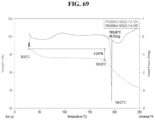
- the Compound 1 Besylate (Form A) exhibits a DSC thermogram comprising an endotherm (for example, a sharp endotherm) at about 194.2 °C with the error of margin of about ⁇ 2.5; about ⁇ 2.0; about ⁇ 1.5; about ⁇ 1.0; about ⁇ 0.5; or less (particularly, about ⁇ 2.0).
- the Compound 1 Besylate (Form A) exhibits a DSC thermogram that is substantially similar to Fig. 69 .
- the Compound 1 Besylate (Form A) exhibits a TGA thermogram that is substantially similar to Fig. 69 . In some embodiments, the TGA thermogram of the Compound 1 Besylate (Form A) exhibits a weight loss of 0.0 to 3.3% in the temperature range of 25 to 120° C.
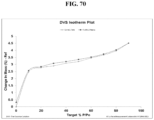
- the Compound 1 Besylate (Form A) exhibits a DVS isotherm plot that is substantially similar to Fig. 70 . In some embodiments, the Compound 1 Besylate (Form A) exhibits a gravimetric moisture sorption of about 4.0% (by weight) at 80% Relative Humidity.
- the present disclosure provides Compound 1 Besylate (Form B).
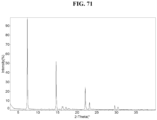
- the Compound 1 Besylate exhibits an XRPD comprising one or more peaks (particularly, three or more peaks) at about 7.3, 14.7, 22.1, 23.2, and 29.6 degrees two-theta with the margin of error of about ⁇ 0.5; about ⁇ 0.4; about ⁇ 0.3; about ⁇ 0.2; about ⁇ 0.1; about ⁇ 0.05; or less (particularly, about ⁇ 0.2).
- the XRPD of the Compound 1 Besylate (Form B) further comprises one or more peaks at about 7.9, 16.2, 16.4, 17.2, and 30.4 degrees two-theta with the margin of error of about ⁇ 0.5; about ⁇ 0.4; about ⁇ 0.3; about ⁇ 0.2; about ⁇ 0.1; about ⁇ 0.05; or less (particularly, about ⁇ 0.2).
- the Compound 1 Besylate exhibits an XRPD comprising peaks shown in Table 32 below: Table 32.
- Table 32 XRPD Table of Compound 1 Besylate (Form B) 2-Theta Intensity % 7.3 100 7.9 0.5 14.7 51.7 16.2 3.4 16.4 3.0 17.2 2.7 22.1 24.5 23.2 7.7 29.6 4.4 30.4 2.7
- the Compound 1 Besylate exhibits an XRPD that is substantially similar to Fig. 71 .
- the present disclosure provides an isethionate salt of Compound 1 ("Compound 1 Isethionate"). In some embodiments, the present disclosure provides a crystalline form of Compound 1 Isethionate.
- the present disclosure provides Compound 1 Isethionate (Form A).
- the Compound 1 Isethionate exhibits an XRPD comprising one or more peaks (particularly, three or more peaks) at about 5.6, 16.7, 16.9, 18, and 20.9 degrees two-theta with the margin of error of about ⁇ 0.5; about ⁇ 0.4; about ⁇ 0.3; about ⁇ 0.2; about ⁇ 0.1; about ⁇ 0.05; or less (particularly, about ⁇ 0.2).
- the XRPD of the Compound 1 Isethionate (Form A) further comprises one or more peaks at about 3.7, 15.7, 16.2, 20.7, and 25.1 degrees two-theta with the margin of error of about ⁇ 0.5; about ⁇ 0.4; about ⁇ 0.3; about ⁇ 0.2; about ⁇ 0.1; about ⁇ 0.05; or less (particularly, about ⁇ 0.2).
- the Compound 1 Isethionate exhibits an XRPD comprising peaks shown in Table 33 below: Table 33.
- the Compound 1 Isethionate exhibits an XRPD that is substantially similar to Fig. 72 .
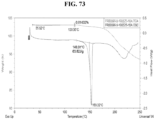
- the Compound 1 Isethionate (Form A) exhibits a DSC thermogram comprising an endotherm (for example, a sharp endotherm) at about 153.3 °C with the error of margin of about ⁇ 2.5; about ⁇ 2.0; about ⁇ 1.5; about ⁇ 1.0; about ⁇ 0.5; or less (particularly, about ⁇ 2.0).
- the Compound 1 Isethionate (Form A) exhibits a DSC thermogram that is substantially similar to Fig. 73 .
- the Compound 1 Isethionate (Form A) exhibits a TGA thermogram that is substantially similar to Fig. 73 . In some embodiments, the TGA thermogram of the Compound 1 Isethionate (Form A) exhibits a weight loss of 0.0 to 0.0% in the temperature range of 25 to 120° C.
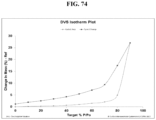
- the Compound 1 Isethionate (Form A) exhibits a DVS isotherm plot that is substantially similar to Fig. 74 . In some embodiments, the Compound 1 Isethionate (Form A) exhibits a gravimetric moisture sorption of about 4.9% (by weight) at 80% Relative Humidity.
- the present disclosure provides Compound 1 Isethionate (Form B).
- the Compound 1 Isethionate (Form B) exhibits an XRPD comprising one or more peaks (particularly, three or more peaks) at about 14.5, 15.8, 17.9, 18.1, and 18.6 degrees two-theta with the margin of error of about ⁇ 0.5; about ⁇ 0.4; about ⁇ 0.3; about ⁇ 0.2; about ⁇ 0.1; about ⁇ 0.05; or less (particularly, about ⁇ 0.2).
- the XRPD of the Compound 1 Isethionate (Form B) further comprises one or more peaks at about 11.4, 13.1, 14.2, 15.0, and 17.0 degrees two-theta with the margin of error of about ⁇ 0.5; about ⁇ 0.4; about ⁇ 0.3; about ⁇ 0.2; about ⁇ 0.1; about ⁇ 0.05; or less (particularly, about ⁇ 0.2).
- the Compound 1 Isethionate exhibits an XRPD comprising peaks shown in Table 34 below: Table 34.
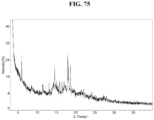
- Table 34 Table of Compound 1 Isethionate (Form B) 2-Theta Intensity % 8.5 15.7 11.4 27.1 13.1 29.2 14.2 26.5 14.5 71.4 15.0 23.4 15.8 30.5 17.0 24.0 17.9 100 18.1 54.8 18.6 75.1 19.5 14.8 22.1 14.8 24.2 16.9 27.2 15.4 27.5 10.5
- the Compound 1 Isethionate exhibits an XRPD that is substantially similar to Fig. 75 .
- the present disclosure provides a gentisate salt of Compound 1 ("Compound 1 Gentisate"). In some embodiments, the present disclosure provides a crystalline form of Compound 1 Gentisate.
- the present disclosure provides Compound 1 Gentisate (Form A).
- the Compound 1 Gentisate (Form A) exhibits an XRPD comprising one or more peaks (particularly, three or more peaks) at about 3.4, 3.6, 7.0, 14.6, and 21.4 degrees two-theta with the margin of error of about ⁇ 0.5; about ⁇ 0.4; about ⁇ 0.3; about ⁇ 0.2; about ⁇ 0.1; about ⁇ 0.05; or less (particularly, about ⁇ 0.2).
- the XRPD of the Compound 1 Gentisate (Form A) further comprises one or more peaks at about 16.0, 18.0, 18.5, 19.5, and 21.1 degrees two-theta with the margin of error of about ⁇ 0.5; about ⁇ 0.4; about ⁇ 0.3; about ⁇ 0.2; about ⁇ 0.1; about ⁇ 0.05; or less (particularly, about ⁇ 0.2).
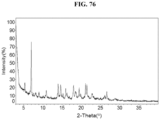
- the Compound 1 Gentisate (Form A) exhibits an XRPD comprising peaks shown in Table 35 below: Table 35.
- Table 35 Table of Compound 1 Gentisate (Form A) 2-Theta Intensity % 3.4 100 3.6 54.6 5.3 10.1 7.0 88.3 7.6 5.8 8.1 12.3 9.0 8.2 10.9 20 14.0 18.5 14.6 42.3 16.0 30.1 16.3 25.7 18.0 40.3 18.5 28.1 19.5 31.7 19.8 11.8 21.1 39.1 21.4 48 21.8 6.8 22.8 22.4 23.3 7.8
- the Compound 1 Gentisate exhibits an XRPD that is substantially similar to Fig. 76 .
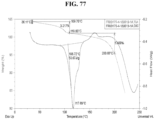
- the Compound 1 Gentisate (Form A) exhibits a DSC thermogram comprising an endotherm (for example, a sharp endotherm) at about 117.7 °C with the error of margin of about ⁇ 2.5; about ⁇ 2.0; about ⁇ 1.5; about ⁇ 1.0; about ⁇ 0.5; or less (particularly, about ⁇ 2.0).
- the Compound 1 Gentisate (Form A) exhibits a DSC thermogram that is substantially similar to Fig. 77 .
- the Compound 1 Gentisate (Form A) exhibits a TGA thermogram that is substantially similar to Fig. 77 . In some embodiments, the TGA thermogram of the Compound 1 Gentisate (Form A) exhibits a weight loss of 0.0 to 9.0% in the temperature range of 25 to 200° C.
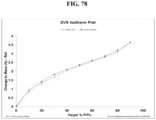
- the Compound 1 Gentisate (Form A) exhibits a DVS isotherm plot that is substantially similar to Fig. 78 . In some embodiments, the Compound 1 Gentisate (Form A) exhibits a gravimetric moisture sorption of about 3.1% (by weight) at 80% Relative Humidity.
- the present disclosure provides Compound 1 Gentisate (Form B).
- the Compound 1 Gentisate (Form B) exhibits an XRPD comprising one or more peaks (particularly, three or more peaks) at about 5.5, 10.9, 16.4, 21.9, and 22.8 degrees two-theta with the margin of error of about ⁇ 0.5; about ⁇ 0.4; about ⁇ 0.3; about ⁇ 0.2; about ⁇ 0.1; about ⁇ 0.05; or less (particularly, about ⁇ 0.2).
- the XRPD of the Compound 1 Gentisate (Form B) further comprises one or more peaks at about 9.2, 13.0, 17.2, 18.7, and 27.8 degrees two-theta with the margin of error of about ⁇ 0.5; about ⁇ 0.4; about ⁇ 0.3; about ⁇ 0.2; about ⁇ 0.1; about ⁇ 0.05; or less (particularly, about ⁇ 0.2).
- the Compound 1 Gentisate exhibits an XRPD comprising peaks shown in Table 36 below: Table 36.
- Table 36 Table of Compound 1 Gentisate (Form B) 2-Theta Intensity % 5.5 100 9.2 12.5 10.9 25.5 11.6 2.7 13.0 5.4 14.8 3.1 16.4 70.6 17.2 11.2 18.3 5.2 18.7 11.2 20.5 1.7 21.9 12.8 22.8 20.9 23.2 4.5 23.8 2.6 26.0 1.5 26.2 2.1 27.2 2.7 27.5 2.6 27.8 5.6 28.7 1.8 28.9 2.3
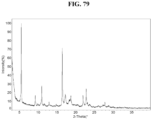
- the Compound 1 Gentisate exhibits an XRPD that is substantially similar to Fig. 79 .
- the present disclosure provides Compound 1 Gentisate (Form C).
- the Compound 1 Gentisate (Form C) exhibits an XRPD comprising one or more peaks (particularly, three or more peaks) at about 5.3, 15.2, 15.9, 21.4, and 26.6 degrees two-theta with the margin of error of about ⁇ 0.5; about ⁇ 0.4; about ⁇ 0.3; about ⁇ 0.2; about ⁇ 0.1; about ⁇ 0.05; or less (particularly, about ⁇ 0.2).
- the XRPD of the Compound 1 Gentisate (Form C) further comprises one or more peaks at about 7.6, 10.6, 13.8, 16.9, and 19.8 degrees two-theta with the margin of error of about ⁇ 0.5; about ⁇ 0.4; about ⁇ 0.3; about ⁇ 0.2; about ⁇ 0.1; about ⁇ 0.05; or less (particularly, about ⁇ 0.2).
- the Compound 1 Gentisate exhibits an XRPD comprising peaks shown in Table 37 below: Table 37.
- the Compound 1 Gentisate exhibits an XRPD that is substantially similar to Fig. 80 .
- the present disclosure provides a 1-hydroxy-2-napthoate salt of Compound 1 ("Compound 1 1-Hydroxy-2-napthoate"). In some embodiments, the present disclosure provides a crystalline form of Compound 1 1-Hydroxy-2-napthoate.
- the present disclosure provides Compound 1 1-Hydroxy-2-napthoate (Form A).
- the Compound 1 1-Hydroxy-2-napthoate (Form A) exhibits an XRPD comprising one or more peaks (particularly, three or more peaks) at about 3.2, 6.2, 13.8, 21.2, and 21.6 degrees two-theta with the margin of error of about ⁇ 0.5; about ⁇ 0.4; about ⁇ 0.3; about ⁇ 0.2; about ⁇ 0.1; about ⁇ 0.05; or less (particularly, about ⁇ 0.2).
- the XRPD of the Compound 1 1-Hydroxy-2-napthoate (Form A) further comprises one or more peaks at about 13.4, 16.2, 19.9, 20.2, and 24.7 degrees two-theta with the margin of error of about ⁇ 0.5; about ⁇ 0.4; about ⁇ 0.3; about ⁇ 0.2; about ⁇ 0.1; about ⁇ 0.05; or less (particularly, about ⁇ 0.2).
- the Compound 1 1-Hydroxy-2-napthoate exhibits an XRPD comprising peaks shown in Table 38 below: Table 38.
- Table 38 Table of Compound 1 1-Hydroxy-2-napthoate (Form A) 2-Theta Intensity % 3.2 100 6.2 17.9 10.6 7.3 10.8 8.9 13.4 16.2 13.8 21.9 16.2 14.2 16.7 5.5 18.2 7.1 19.9 14.7 20.2 10.3 21.2 29.4 21.6 22.6 22.8 5.8 24.7 9.6
- the Compound 1 1-Hydroxy-2-napthoate exhibits an XRPD that is substantially similar to Fig. 81 .
- the Compound 1 1-Hydroxy-2-napthoate (Form A) exhibits a DSC thermogram comprising a endotherm at about 57.7 °C with the error of margin of about ⁇ 2.5; about ⁇ 2.0; about ⁇ 1.5; about ⁇ 1.0; about ⁇ 0.5; or less (particularly, about ⁇ 2.0).
- the Compound 1 1-Hydroxy-2-napthoate (Form A) exhibits a DSC thermogram comprising a endotherm at about 79.1 °C with the error of margin of about ⁇ 2.5; about ⁇ 2.0; about ⁇ 1.5; about ⁇ 1.0; about ⁇ 0.5; or less (particularly, about ⁇ 2.0).
- the Compound 1 1-Hydroxy-2-napthoate (Form A) exhibits a DSC thermogram comprising a endotherm at about 116.1 °C with the error of margin of about ⁇ 2.5; about ⁇ 2.0; about ⁇ 1.5; about ⁇ 1.0; about ⁇ 0.5; or less (particularly, about ⁇ 2.0). In some embodiments, the Compound 1 1-Hydroxy-2-napthoate (Form A) exhibits a DSC thermogram comprising a endotherm at about 164.7 °C with the error of margin of about ⁇ 2.5; about ⁇ 2.0; about ⁇ 1.5; about ⁇ 1.0; about ⁇ 0.5; or less (particularly, about ⁇ 2.0). In some embodiments, the Compound 1 1-Hydroxy-2-napthoate (Form A) exhibits a DSC thermogram that is substantially similar to Fig. 82 .
- the Compound 1 1-Hydroxy-2-napthoate (Form A) exhibits a TGA thermogram that is substantially similar to Fig. 82 .
- the TGA thermogram of the Compound 1 1-Hydroxy-2-napthoate (Form A) exhibits a weight loss of 0.0 to 3.6% in the temperature range of 25 to 120° C.
- the Compound 1 1-Hydroxy-2-napthoate (Form A) exhibits a DVS isotherm plot that is substantially similar to Fig. 83 .
- the Compound 1 1-Hydroxy-2-napthoate (Form A) exhibits a gravimetric moisture sorption of about 4.6% (by weight) at 80% Relative Humidity.
- the present disclosure provides Compound 1 1-Hydroxy-2-napthoate (Form B).
- the Compound 1 1-Hydroxy-2-napthoate (Form B) exhibits an XRPD comprising one or more peaks (particularly, three or more peaks) at about 8.0, 8.6, 13.5, 13.8, and 20.6 degrees two-theta with the margin of error of about ⁇ 0.5; about ⁇ 0.4; about ⁇ 0.3; about ⁇ 0.2; about ⁇ 0.1; about ⁇ 0.05; or less (particularly, about ⁇ 0.2).
- the XRPD of the Compound 1 1-Hydroxy-2-napthoate further comprises one or more peaks at about 14.4, 15.2, 16.1, 21.4, and 23.8 degrees two-theta with the margin of error of about ⁇ 0.5; about ⁇ 0.4; about ⁇ 0.3; about ⁇ 0.2; about ⁇ 0.1; about ⁇ 0.05; or less (particularly, about ⁇ 0.2).
- the Compound 1 1-Hydroxy-2-napthoate exhibits an XRPD comprising peaks shown in Table 39 below: Table 39.
- Table 39. Table of Compound 1 1-Hydroxy-2-napthoate (Form B) 2-Theta Intensity % 8.0 34.8 8.6 37.1 10.6 6.9 11.8 15 13.5 57.4 13.8 37 14.4 20.9 15.2 15.9 15.6 11.1 16.1 17.7 16.5 7.3 17.2 7.7 18.3 9.5 19.3 8.5 19.6 7 20.0 6.8 20.6 100 21.4 26.6 22.4 8.9 23.3 5.5 23.8 19.9 24.9 7 25.1 6.3 26.0 4.4 26.4 4.6 27.0 10.7 27.5 8.4 27.9 6.6 28.3 14.4 28.7 5.5 34.3 4.7 36.4 4.2 38.3 4.6 38.6 3.7
- the Compound 1 1-Hydroxy-2-napthoate exhibits an XRPD that is substantially similar to Fig. 84 .
- the present disclosure provides Compound 1 1-Hydroxy-2-napthoate (Form C).
- the Compound 1 1-Hydroxy-2-napthoate (Form C) exhibits an XRPD comprising one or more peaks (particularly, three or more peaks) at about 8.5, 13.7, 14.2, 17.3, and 21.4 degrees two-theta with the margin of error of about ⁇ 0.5; about ⁇ 0.4; about ⁇ 0.3; about ⁇ 0.2; about ⁇ 0.1; about ⁇ 0.05; or less (particularly, about ⁇ 0.2).
- the XRPD of the Compound 1 1-Hydroxy-2-napthoate further comprises one or more peaks at about 7.7, 15.4, 20.2, 20.6, and 21.1 degrees two-theta with the margin of error of about ⁇ 0.5; about ⁇ 0.4; about ⁇ 0.3; about ⁇ 0.2; about ⁇ 0.1; about ⁇ 0.05; or less (particularly, about ⁇ 0.2).
- the Compound 1 1-Hydroxy-2-napthoate exhibits an XRPD comprising peaks shown in Table 40 below: Table 40.
- Table 40 Table of Compound 1 1-Hydroxy-2-napthoate (Form C) 2-Theta Intensity % 5.0 20.3 5.4 22.3 7.7 43.6 8.0 27.8 8.5 77.3 10.5 17.5 10.7 18.6 11.0 15.1 12.5 25.1 13.7 80.1 14.2 100 15.4 62.2 16.1 22.7 17.3 72.9 17.6 28.5 17.8 18.2 18.2 22.7 19.2 13.4 20.2 35.1 20.6 42.3 20.8 29.2 21.1 46 21.4 70.4 27.5 15.5
- the Compound 1 1-Hydroxy-2-napthoate exhibits an XRPD that is substantially similar to Fig. 85 .
- the present disclosure provides Compound 1 1-Hydroxy-2-napthoate (Form D).
- the Compound 1 1-Hydroxy-2-napthoate (Form D) exhibits an XRPD comprising one or more peaks (particularly, three or more peaks) at about 10.4, 12.9, 13.5, 20.4, and 20.9 degrees two-theta with the margin of error of about ⁇ 0.5; about ⁇ 0.4; about ⁇ 0.3; about ⁇ 0.2; about ⁇ 0.1; about ⁇ 0.05; or less (particularly, about ⁇ 0.2).
- the XRPD of the Compound 1 1-Hydroxy-2-napthoate further comprises one or more peaks at about 6.3, 9.1, 11.2, 13.2, and 19.9 degrees two-theta with the margin of error of about ⁇ 0.5; about ⁇ 0.4; about ⁇ 0.3; about ⁇ 0.2; about ⁇ 0.1; about ⁇ 0.05; or less (particularly, about ⁇ 0.2).
- the Compound 1 1-Hydroxy-2-napthoate exhibits an XRPD comprising peaks shown in Table 41 below: Table 41.
- Table 41 Table of Compound 1 1-Hydroxy-2-napthoate (Form D) 2-Theta Intensity % 6.3 20.2 9.1 14.6 10.4 46.3 11.2 16.5 12.1 11.3 12.9 29.9 13.2 22.5 13.5 40.5 19.5 14.4 19.9 21.1 20.4 40.1 20.9 100 22.6 7.7 28.2 6.1 31.5 5.6
- the Compound 1 1-Hydroxy-2-napthoate exhibits an XRPD that is substantially similar to Fig. 86 .
- the present disclosure provides a cyclamate salt of Compound 1 ("Compound 1 Cyclamate"). In some embodiments, the present disclosure provides a crystalline form of Compound 1 Cyclamate.
- the present disclosure provides Compound 1 Cyclamate (Form A).
- the Compound 1 Cyclamate (Form A) exhibits an XRPD comprising one or more peaks (particularly, three or more peaks) at about 6.6, 7.2, 18.5, 19.5, and 21.6 degrees two-theta with the margin of error of about ⁇ 0.5; about ⁇ 0.4; about ⁇ 0.3; about ⁇ 0.2; about ⁇ 0.1; about ⁇ 0.05; or less (particularly, about ⁇ 0.2).
- the XRPD of the Compound 1 Cyclamate (Form A) further comprises one or more peaks at about 14.3, 14.8, 17.2, 17.6, and 18.2 degrees two-theta with the margin of error of about ⁇ 0.5; about ⁇ 0.4; about ⁇ 0.3; about ⁇ 0.2; about ⁇ 0.1; about ⁇ 0.05; or less (particularly, about ⁇ 0.2).
- the Compound 1 Cyclamate (Form A) exhibits an XRPD comprising peaks shown in Table 42 below: Table 42.
- Table 42 Table of Compound 1 Cyclamate (Form A) 2-Theta Intensity % 6.6 100 7.2 42.7 8.6 9.3 14.3 19.8 14.8 18.7 17.2 11.3 17.6 12.9 18.2 24.9 18.5 28.8 19.5 27 20.9 6.1 21.6 35.6 26.1 5
- the Compound 1 Cyclamate (Form A) exhibits an XRPD that is substantially similar to Fig. 87 .
- the Compound 1 Cyclamate (Form A) exhibits a DSC thermogram comprising a endotherm at about 60.1 °C with the error of margin of about ⁇ 2.5; about ⁇ 2.0; about ⁇ 1.5; about ⁇ 1.0; about ⁇ 0.5; or less (particularly, about ⁇ 2.0). In some embodiments, the Compound 1 Cyclamate (Form A) exhibits a DSC thermogram comprising a endotherm at about 168.5 °C with the error of margin of about ⁇ 2.5; about ⁇ 2.0; about ⁇ 1.5; about ⁇ 1.0; about ⁇ 0.5; or less (particularly, about ⁇ 2.0). In some embodiments, the Compound 1 Cyclamate (Form A) exhibits a DSC thermogram that is substantially similar to Fig. 88 .
- the Compound 1 Cyclamate (Form A) exhibits a TGA thermogram that is substantially similar to Fig. 88 . In some embodiments, the TGA thermogram of the Compound 1 Cyclamate (Form A) exhibits a weight loss of 0.0 to 5.1% in the temperature range of 25 to 180° C.
- the Compound 1 Cyclamate (Form A) exhibits a DVS isotherm plot that is substantially similar to Fig. 89 . In some embodiments, the Compound 1 Cyclamate (Form A) exhibits a gravimetric moisture sorption of about 7.3% (by weight) at 80% Relative Humidity.
- the present disclosure provides an ethane-1, 2-disulfonate salt of Compound 1 ("Compound 1 Ethane-1,2-disulfonate"). In some embodiments, the present disclosure provides a crystalline form of Compound 1 Ethane-1,2-disulfonate.
- the present disclosure provides Compound 1 Ethane-1,2-disulfonate (Form A).
- the Compound 1 Ethane-1,2-disulfonate (Form A) exhibits an XRPD comprising one or more peaks (particularly, three or more peaks) at about 16.2, 16.5, 17.5, 20.7, and 21.3 degrees two-theta with the margin of error of about ⁇ 0.5; about ⁇ 0.4; about ⁇ 0.3; about ⁇ 0.2; about ⁇ 0.1; about ⁇ 0.05; or less (particularly, about ⁇ 0.2).
- the XRPD of the Compound 1 Ethane-1,2-disulfonate (Form A) further comprises one or more peaks at about 3.7, 5.5, 13.8, 14.7, and 26.0 degrees two-theta with the margin of error of about ⁇ 0.5; about ⁇ 0.4; about ⁇ 0.3; about ⁇ 0.2; about ⁇ 0.1; about ⁇ 0.05; or less (particularly, about ⁇ 0.2).
- the Compound 1 Ethane-1,2-disulfonate exhibits an XRPD comprising peaks shown in Table 43 below: Table 43.
- Table 43 XRPD Table of Compound 1 Ethane-1,2-disulfonate (Form A) 2-Theta Intensity % 3.7 55.6 5.5 38.8 11.0 16.4 11.4 11 13.8 50.4 14.7 38 15.8 10.3 16.2 58 16.5 93.5 17.5 100 18.2 6.8 19.3 27.4 19.6 34.6 20.7 90.4 21.3 62.5 22.0 13.3 23.7 21.2 26.0 40.4 27.2 23.7 34.2 5.9 38.5 5.8
- the Compound 1 Ethane-1,2-disulfonate exhibits an XRPD that is substantially similar to Fig. 90 .
- the Compound 1 Ethane-1,2-disulfonate (Form A) exhibits a DSC thermogram comprising a endotherm at about 59.0 °C with the error of margin of about ⁇ 2.5; about ⁇ 2.0; about ⁇ 1.5; about ⁇ 1.0; about ⁇ 0.5; or less (particularly, about ⁇ 2.0).
- the Compound 1 Ethane-1,2-disulfonate (Form A) exhibits a DSC thermogram comprising a endotherm at about 154.8 °C with the error of margin of about ⁇ 2.5; about ⁇ 2.0; about ⁇ 1.5; about ⁇ 1.0; about ⁇ 0.5; or less (particularly, about ⁇ 2.0).
- the Compound 1 Ethane-1, 2-disulfonate (Form A) exhibits a DSC thermogram that is substantially similar to Fig. 91 .
- the Compound 1 Ethane-1,2-disulfonate (Form A) exhibits a TGA thermogram that is substantially similar to Fig. 91 . In some embodiments, the TGA thermogram of the Compound 1 Ethane-1,2-disulfonate (Form A) exhibits a weight loss of 0.0 to 0.7% in the temperature range of 25 to 120° C.
- the Compound 1 Ethane-1,2-disulfonate (Form A) exhibits a DVS isotherm plot that is substantially similar to Fig. 92 . In some embodiments, the Compound 1 Ethane-1,2-disulfonate (Form A) exhibits a gravimetric moisture sorption of about 12.9% (by weight) at 80% Relative Humidity.
- the present disclosure provides Compound 1 Ethane-1,2-disulfonate (Form B).
- the Compound 1 Ethane-1,2-disulfonate (Form B) exhibits an XRPD comprising one or more peaks (particularly, three or more peaks) at about 5.5, 16.4, 17.4, 17.6, and 20.7 degrees two-theta with the margin of error of about ⁇ 0.5; about ⁇ 0.4; about ⁇ 0.3; about ⁇ 0.2; about ⁇ 0.1; about ⁇ 0.05; or less (particularly, about ⁇ 0.2).
- the XRPD of the Compound 1 Ethane-1,2-disulfonate (Form B) further comprises one or more peaks at about 10.9, 13.7, 14.6, 21.2, and 22.1 degrees two-theta with the margin of error of about ⁇ 0.5; about ⁇ 0.4; about ⁇ 0.3; about ⁇ 0.2; about ⁇ 0.1; about ⁇ 0.05; or less (particularly, about ⁇ 0.2)
- the Compound 1 Ethane-1,2-disulfonate exhibits an XRPD comprising peaks shown in Table 44 below: Table 44.
- Table 44. XRPD Table of Compound 1 Ethane-1,2-disulfonate (Form B) 2-Theta Intensity % 5.5 33.4 10.9 15.5 11.4 11.1 13.7 22.1 14.6 25.3 15.0 7.4 15.2 6.3 15.7 8.1 16.0 7.5 16.4 100 17.4 36.4 17.6 29.9 19.6 10.2 20.7 42.5 21.0 6.1 21.2 16.9 22.1 16.8 24.7 5.8 25.9 14.7 26.2 5.4 27.1 5.3 27.4 5.4 27.9 5.2
- the Compound 1 Ethane-1,2-disulfonate exhibits an XRPD that is substantially similar to Fig. 93 .
- the present disclosure provides a dichloroacetate salt of Compound 1 ("Compound 1 Dichloroacetate"). In some embodiments, the present disclosure provides a crystalline form of Compound 1 Dichloroacetate.
- the present disclosure provides Compound 1 Dichloroacetate (Form A).
- the Compound 1 Dichloroacetate (Form A) exhibits an XRPD comprising one or more peaks (particularly, three or more peaks) at about 3.4, 3.6, 16.2, 17.1 and 19.5 degrees two-theta with the margin of error of about ⁇ 0.5; about ⁇ 0.4; about ⁇ 0.3; about ⁇ 0.2; about ⁇ 0.1; about ⁇ 0.05; or less (particularly, about ⁇ 0.2).
- the XRPD of the Compound 1 Dichloroacetate (Form A) further comprises one or more peaks at about 8.1, 11.4, 12.8, 16.7 and 20.0 degrees two-theta with the margin of error of about ⁇ 0.5; about ⁇ 0.4; about ⁇ 0.3; about ⁇ 0.2; about ⁇ 0.1; about ⁇ 0.05; or less (particularly, about ⁇ 0.2).
- the Compound 1 Dichloroacetate (Form A) exhibits an XRPD comprising peaks shown in Table 45 below: Table 45.
- the Compound 1 Dichloroacetate exhibits an XRPD that is substantially similar to Fig. 94 .
- the Compound 1 Dichloroacetate (Form A) exhibits a DSC thermogram comprising an endotherm (for example, a sharp endotherm) at about 117.7 °C with the error of margin of about ⁇ 2.5; about ⁇ 2.0; about ⁇ 1.5; about ⁇ 1.0; about ⁇ 0.5; or less (particularly, about ⁇ 2.0).
- the Compound 1 Dichloroacetate (Form A) exhibits a DSC thermogram that is substantially similar to Fig. 95 .
- the Compound 1 Dichloroacetate (Form A) exhibits a TGA thermogram that is substantially similar to Fig. 95 . In some embodiments, the TGA thermogram of the Compound 1 Dichloroacetate (Form A) exhibits a weight loss of 0.0 to 3.7% in the temperature range of 25 to 150° C.
- the Compound 1 Dichloroacetate (Form A) exhibits a DVS isotherm plot that is substantially similar to Fig. 96 . In some embodiments, the Compound 1 Dichloroacetate (Form A) exhibits a gravimetric moisture sorption of about 1.8% (by weight) at 80% Relative Humidity.
- the present disclosure provides a malate salt of Compound 1 ("Compound 1 Malate”). In some embodiments, the present disclosure provides a D-malate salt of Compound 1 ("Compound 1 D-Malate”). In some embodiments, the present disclosure provides an L-malate salt of Compound 1 (“Compound 1 L-malate”).
- the present disclosure provides a crystalline form of Compound 1 Malate. In some embodiments, the present disclosure provides a crystalline form of Compound 1 D-Malate. In some embodiments, the present disclosure provides a crystalline form of Compound 1 L-Malate.
- the present disclosure provides Compound 1 L-Malate (Form A).
- the Compound 1 L-Malate (Form A) exhibits an XRPD comprising one or more peaks (particularly, three or more peaks) at about 3.2, 12.5, 14.4, 15.7, and 18.4 degrees two-theta with the margin of error of about ⁇ 0.5; about ⁇ 0.4; about ⁇ 0.3; about ⁇ 0.2; about ⁇ 0.1; about ⁇ 0.05; or less (particularly, about ⁇ 0.2).
- the XRPD of the Compound 1 L-Malate (Form A) further comprises one or more peaks at about 3.6, 6.1, 13.2, 18.9, and 21.1 degrees two-theta with the margin of error of about ⁇ 0.5; about ⁇ 0.4; about ⁇ 0.3; about ⁇ 0.2; about ⁇ 0.1; about ⁇ 0.05; or less (particularly, about ⁇ 0.2).
- the Compound 1 L-Malate exhibits an XRPD comprising peaks shown in Table 46 below: Table 46.
- Table 46. Table of Compound 1 L-Malate (Form A) 2-Theta Intensity % 3.2 93.3 3.6 45.4 6.1 42.2 8.4 9.8 10.4 5.9 10.6 6.2 11.1 14.2 12.2 19.5 12.5 68.8 13.2 47.8 14.1 7.2 14.4 53.1 15.5 16.6 15.7 63.1 16.9 12.3 17.1 27.8 17.8 7.6 18.0 9.5 18.4 100 18.9 43.6 19.2 11.5 20.7 16.7 21.1 32.6 21.2 17.9 22.6 7.7 23.1 6.3 23.4 20.3 23.9 8.8 24.5 8.9 24.9 6 26.0 8.5 26.4 13.8 26.8 6.9 27.4 5.5 28.5 3.5 28.9 4.6 29.2 3 29.9 4.5 32.3 3.9 32.6 6.3 33.0 2.4
- the Compound 1 L-Malate exhibits an XRPD that is substantially similar to Fig. 97 .
- the Compound 1 L-Malate (Form A) exhibits a DSC thermogram comprising an endotherm (for example, a sharp endotherm) at about 120.9 °C with the error of margin of about ⁇ 2.5; about ⁇ 2.0; about ⁇ 1.5; about ⁇ 1.0; about ⁇ 0.5; or less (particularly, about ⁇ 2.0).
- the Compound 1 L-Malate (Form A) exhibits a DSC thermogram comprising an endotherm (for example, a sharp endotherm) at about 142.3 °C with the error of margin of about ⁇ 2.5; about ⁇ 2.0; about ⁇ 1.5; about ⁇ 1.0; about ⁇ 0.5; or less (particularly, about ⁇ 2.0).
- the Compound 1 L-Malate (Form A) exhibits a DSC thermogram that is substantially similar to Fig. 98 .
- the Compound 1 L-Malate (Form A) exhibits a TGA thermogram that is substantially similar to Fig. 98 . In some embodiments, the TGA thermogram of the Compound 1 L-Malate (Form A) exhibits a weight loss of 0.0 to 0.7% in the temperature range of 25 to 105° C.
- the Compound 1 L-Malate (Form A) exhibits a DVS isotherm plot that is substantially similar to Fig. 99 . In some embodiments, the Compound 1 L-Malate (Form A) exhibits a gravimetric moisture sorption of about 2.0% (by weight) at 80% Relative Humidity.
- the present disclosure provides Compound 1 L-Malate (Form B).
- the Compound 1 L-Malate (Form B) exhibits an XRPD comprising one or more peaks (particularly, three or more peaks) at about 5.6, 13.4, 17.3, 20.8 and 23.2 degrees two-theta with the margin of error of about ⁇ 0.5; about ⁇ 0.4; about ⁇ 0.3; about ⁇ 0.2; about ⁇ 0.1; about ⁇ 0.05; or less (particularly, about ⁇ 0.2).
- the XRPD of the Compound 1 L-Malate (Form B) further comprises one or more peaks at about 3.7, 11.2, 14.4, 14.9 and 17.8 degrees two-theta with the margin of error of about ⁇ 0.5; about ⁇ 0.4; about ⁇ 0.3; about ⁇ 0.2; about ⁇ 0.1; about ⁇ 0.05; or less (particularly, about ⁇ 0.2).
- the Compound 1 L-Malate exhibits an XRPD comprising peaks shown in Table 47 below: Table 47.
- Table 47 XRPD Table of Compound 1 L-Malate (Form B) 2-Theta Intensity % 3.7 57.5 5.6 100 6.0 23.7 8.3 12.1 9.2 19.4 11.2 56.7 11.9 14.1 13.4 63.7 14.4 44.5 14.9 53.1 16.0 39.4 16.6 34 17.3 83.5 17.8 62.3 18.6 14.3 19.2 28.2 20.0 13.7 20.8 77.2 21.3 44.5 23.2 69 25.7 10.6 26.1 29.5
- the Compound 1 L-Malate exhibits an XRPD that is substantially similar to Fig. 100 .
- the Compound 1 L-Malate (Form B) exhibits a DSC thermogram comprising an endotherm at about 108.7 °C with the error of margin of about ⁇ 2.5; about ⁇ 2.0; about ⁇ 1.5; about ⁇ 1.0; about ⁇ 0.5; or less (particularly, about ⁇ 2.0). In some embodiments, the Compound 1 L-Malate (Form B) exhibits a DSC thermogram comprising an endotherm (for example, a sharp endotherm) at about 143.3 °C with the error of margin of about ⁇ 2.5; about ⁇ 2.0; about ⁇ 1.5; about ⁇ 1.0; about ⁇ 0.5; or less (particularly, about ⁇ 2.0). In some embodiments, the Compound 1 L-Malate (Form B) exhibits a DSC thermogram that is substantially similar to Fig. 101 .
- the Compound 1 L-Malate (Form B) exhibits a TGA thermogram that is substantially similar to Fig. 101 . In some embodiments, the TGA thermogram of the Compound 1 L-Malate (Form B) exhibits a weight loss of 0.0 to 1.2% in the temperature range of 25 to 120° C.
- the Compound 1 L-Malate (Form B) exhibits a DVS isotherm plot that is substantially similar to Fig. 102 . In some embodiments, the Compound 1 L-Malate (Form B) exhibits a gravimetric moisture sorption of about 3.5% (by weight) at 80% Relative Humidity.
- the present disclosure provides a hydrochloride salt of Compound 1 ("Compound 1 Hydrochloride"). In some embodiments, the present disclosure provides a crystalline form of Compound 1 Hydrochloride.
- the present disclosure provides Compound 1 Hydrochloride (Form A).
- the Compound 1 Hydrochloride (Form A) exhibits an XRPD comprising one or more peaks (particularly, three or more peaks) at about 3.6, 5.2, 14.2, 17.4 and 17.7 degrees two-theta with the margin of error of about ⁇ 0.5; about ⁇ 0.4; about ⁇ 0.3; about ⁇ 0.2; about ⁇ 0.1; about ⁇ 0.05; or less (particularly, about ⁇ 0.2).
- the XRPD of the Compound 1 Hydrochloride (Form A) further comprises one or more peaks at about 12.8, 13.4, 14.9, 18.9 and 20.4 degrees two-theta with the margin of error of about ⁇ 0.5; about ⁇ 0.4; about ⁇ 0.3; about ⁇ 0.2; about ⁇ 0.1; about ⁇ 0.05; or less (particularly, about ⁇ 0.2).
- the Compound 1 Hydrochloride (Form A) exhibits an XRPD comprising peaks shown in Table 48 below: Table 48.
- the Compound 1 Hydrochloride (Form A) exhibits an XRPD that is substantially similar to Fig. 103 .
- the Compound 1 Hydrochloride (Form A) exhibits a DSC thermogram comprising an endotherm at about 225.0 °C with the error of margin of about ⁇ 2.5; about ⁇ 2.0; about ⁇ 1.5; about ⁇ 1.0; about ⁇ 0.5; or less (particularly, about ⁇ 2.0). In some embodiments, the Compound 1 Hydrochloride (Form A) exhibits a DSC thermogram comprising an endotherm at about 232.7 °C with the error of margin of about ⁇ 2.5; about ⁇ 2.0; about ⁇ 1.5; about ⁇ 1.0; about ⁇ 0.5; or less (particularly, about ⁇ 2.0). In some embodiments, the Compound 1 Hydrochloride (Form A) exhibits a DSC thermogram that is substantially similar to Fig. 104 .
- the Compound 1 Hydrochloride (Form A) exhibits a TGA thermogram that is substantially similar to Fig. 104 . In some embodiments, the TGA thermogram of the Compound 1 Hydrochloride (Form A) exhibits a weight loss of 0.0 to 1.2% in the temperature range of 25 to 150° C.
- the Compound 1 Hydrochloride (Form A) exhibits a DVS isotherm plot that is substantially similar to Fig. 105 . In some embodiments, the Compound 1 Hydrochloride (Form A) exhibits a gravimetric moisture sorption of about 3.6% (by weight) at 80% Relative Humidity.
- the present disclosure provides Compound 1 Hydrochloride (Form B).
- the Compound 1 Hydrochloride (Form B) exhibits an XRPD comprising one or more peaks (particularly, three or more peaks) at about 3.3, 7.8, 15.4, 16.6 and 23.2 degrees two-theta with the margin of error of about ⁇ 0.5; about ⁇ 0.4; about ⁇ 0.3; about ⁇ 0.2; about ⁇ 0.1; about ⁇ 0.05; or less (particularly, about ⁇ 0.2).
- the XRPD of the Compound 1 Hydrochloride (Form B) further comprises one or more peaks at about 15.0, 18.8, 20.4, 23.5, and 26.5 degrees two-theta with the margin of error of about ⁇ 0.5; about ⁇ 0.4; about ⁇ 0.3; about ⁇ 0.2; about ⁇ 0.1; about ⁇ 0.05; or less (particularly, about ⁇ 0.2).
- the Compound 1 Hydrochloride (Form B) exhibits an XRPD comprising peaks shown in Table 49 below: Table 49.
- the Compound 1 Hydrochloride (Form B) exhibits an XRPD that is substantially similar to Fig. 106 .
- the Compound 1 Hydrochloride (Form B) exhibits a DSC thermogram comprising an endotherm at about 87.1 °C with the error of margin of about ⁇ 2.5; about ⁇ 2.0; about ⁇ 1.5; about ⁇ 1.0; about ⁇ 0.5; or less (particularly, about ⁇ 2.0). In some embodiments, the Compound 1 Hydrochloride (Form B) exhibits a DSC thermogram comprising a sharp endotherm at about 207.3 °C with the error of margin of about ⁇ 2.5; about ⁇ 2.0; about ⁇ 1.5; about ⁇ 1.0; about ⁇ 0.5; or less (particularly, about ⁇ 2.0). In some embodiments, the Compound 1 Hydrochloride (Form B) exhibits a DSC thermogram that is substantially similar to Fig. 107 .
- the Compound 1 Hydrochloride (Form B) exhibits a TGA thermogram that is substantially similar to Fig. 107 . In some embodiments, the TGA thermogram of the Compound 1 Hydrochloride (Form B) exhibits a weight loss of 0.0 to 0.7% in the temperature range of 25 to 120° C.
- the Compound 1 Hydrochloride (Form B) exhibits a DVS isotherm plot that is substantially similar to Fig. 108 . In some embodiments, the Compound 1 Hydrochloride (Form B) exhibits a gravimetric moisture sorption of about 2.9% (by weight) at 80% Relative Humidity.
- the present disclosure provides Compound 1 Hydrochloride (Form C).
- the Compound 1 Hydrochloride (Form C) exhibits an XRPD comprising one or more peaks (particularly, three or more peaks) at about 14.6, 16.5, 18.0, 21.5, and 21.9 degrees two-theta with the margin of error of about ⁇ 0.5; about ⁇ 0.4; about ⁇ 0.3; about ⁇ 0.2; about ⁇ 0.1; about ⁇ 0.05; or less (particularly, about ⁇ 0.2).
- the XRPD of the Compound 1 Hydrochloride (Form C) further comprises one or more peaks at about 3.6, 18.8, 19.9, 22.1, and 23.7 degrees two-theta with the margin of error of about ⁇ 0.5; about ⁇ 0.4; about ⁇ 0.3; about ⁇ 0.2; about ⁇ 0.1; about ⁇ 0.05; or less (particularly, about ⁇ 0.2).
- the Compound 1 Hydrochloride (Form C) exhibits an XRPD comprising peaks shown in Table 50 below: Table 50.
- Table 50 Table of Compound 1 Hydrochloride (Form C) 2-Theta Intensity % 3.6 36.5 9.1 13.5 10.8 8.4 12.0 16.4 13.3 24.3 14.2 27.6 14.6 62.6 16.1 9.1 16.5 100 16.9 30.1 18.0 46.2 18.8 32.2 19.6 17.7 19.9 31.3 20.5 16.4 21.5 94.7 21.9 61.3 22.1 41.1 22.9 7.1 23.7 32 24.4 8.9
- the Compound 1 Hydrochloride exhibits an XRPD that is substantially similar to Fig. 109 .
- the Compound 1 Hydrochloride (Form C) exhibits a DSC thermogram comprising an endotherm at about 132.9 °C with the error of margin of about ⁇ 2.5; about ⁇ 2.0; about ⁇ 1.5; about ⁇ 1.0; about ⁇ 0.5; or less (particularly, about ⁇ 2.0). In some embodiments, the Compound 1 Hydrochloride (Form C) exhibits a DSC thermogram that is substantially similar to Fig. 110 .
- the Compound 1 Hydrochloride (Form C) exhibits a TGA thermogram that is substantially similar to Fig. 110 . In some embodiments, the TGA thermogram of the Compound 1 Hydrochloride (Form C) exhibits a weight loss of 0.0 to 3.8% in the temperature range of 25 to 120° C.
- the Compound 1 Hydrochloride (Form C) exhibits a DVS isotherm plot that is substantially similar to Fig. 111 . In some embodiments, the Compound 1 Hydrochloride (Form C) exhibits a gravimetric moisture sorption of about 0.7% (by weight) at 80% Relative Humidity.
- the present disclosure provides a napsylate salt of Compound 1 ("Compound 1 Napsylate"). In some embodiments, the present disclosure provides a crystalline form of Compound 1 Napsylate.
- the present disclosure provides Compound 1 Napsylate (Form A).
- the Compound 1 Napsylate (Form A) exhibits an XRPD comprising one or more peaks (particularly, three or more peaks) at about 3.4, 9.5, 16.6, 17.0, and 17.5 degrees two-theta with the margin of error of about ⁇ 0.5; about ⁇ 0.4; about ⁇ 0.3; about ⁇ 0.2; about ⁇ 0.1; about ⁇ 0.05; or less (particularly, about ⁇ 0.2).
- the XRPD of the Compound 1 Napsylate (Form A) further comprises one or more peaks at about 8.3, 8.7, 19.8, 25.0, and 25.5 degrees two-theta with the margin of error of about ⁇ 0.5; about ⁇ 0.4; about ⁇ 0.3; about ⁇ 0.2; about ⁇ 0.1; about ⁇ 0.05; or less (particularly, about ⁇ 0.2).
- the Compound 1 Napsylate exhibits an XRPD comprising peaks shown in Table 51 below: Table 51.
- Table 51 Table of Compound 1 Napsylate (Form A) 2-Theta Intensity % 3.4 100 8.3 5.3 8.7 5.1 9.5 5.8 16.6 22 17.0 31.5 17.5 11.5 19.8 4.4 25.0 4.5 25.5 5.4
- the Compound 1 Napsylate exhibits an XRPD that is substantially similar to Fig. 112 .
- the Compound 1 Napsylate (Form A) exhibits a DSC thermogram comprising an endotherm at about 100.1 °C with the error of margin of about ⁇ 2.5; about ⁇ 2.0; about ⁇ 1.5; about ⁇ 1.0; about ⁇ 0.5; or less (particularly, about ⁇ 2.0). In some embodiments, the Compound 1 Napsylate (Form A) exhibits a DSC thermogram comprising an endotherm (for example, a sharp endotherm) at about 202.3 °C with the error of margin of about ⁇ 2.5; about ⁇ 2.0; about ⁇ 1.5; about ⁇ 1.0; about ⁇ 0.5; or less (particularly, about ⁇ 2.0). In some embodiments, the Compound 1 Napsylate exhibits a DSC thermogram that is substantially similar to Fig. 113 .
- the Compound 1 Napsylate exhibits a TGA thermogram that is substantially similar to Fig. 113 .
- the TGA thermogram of the Compound 1 Napsylate exhibits a weight loss of 0.0 to 1.7% in the temperature range of 25 to 180° C.
- the Compound 1 Napsylate (Form A) exhibits a DVS isotherm plot that is substantially similar to Fig. 114 . In some embodiments, the Compound 1 Napsylate (Form A) exhibits a gravimetric moisture sorption of about 3.9% (by weight) at 80% Relative Humidity.
- the present disclosure provides Compound 1 Napsylate (Form B).
- the Compound 1 Napsylate (Form B) exhibits an XRPD comprising one or more peaks (particularly, three or more peaks) at about 9.1, 15.6, 16.1, 18.2, and 19.7 degrees two-theta with the margin of error of about ⁇ 0.5; about ⁇ 0.4; about ⁇ 0.3; about ⁇ 0.2; about ⁇ 0.1; about ⁇ 0.05; or less (particularly, about ⁇ 0.2).
- the XRPD of the Compound 1 Napsylate (Form B) further comprises one or more peaks at about 8.6, 12.9, 17.1, 25.8, and 26.2 degrees two-theta with the margin of error of about ⁇ 0.5; about ⁇ 0.4; about ⁇ 0.3; about ⁇ 0.2; about ⁇ 0.1; about ⁇ 0.05; or less (particularly, about ⁇ 0.2).
- the Compound 1 Napsylate exhibits an XRPD comprising peaks shown in Table 52 below: Table 52.
- Table 52 Table of Compound 1 Napsylate (Form B) 2-Theta Intensity % 8.6 29.7 9.1 100 12.9 34.5 15.6 87.2 16.1 62.8 17.1 54.1 18.2 85.8 19.7 64.9 21.4 22.3 25.8 25.7 26.2 35.1
- the Compound 1 Napsylate exhibits an XRPD that is substantially similar to Figure 115 .
- the present disclosure provides an oxalate salt of Compound 1 ("Compound 1 Oxalate"). In some embodiments, the present disclosure provides a crystalline form of Compound 1 Oxalate.
- the present disclosure provides Compound 1 Oxalate (Form A).
- the Compound 1 Oxalate (Form A) exhibits an XRPD comprising one or more peaks (particularly, three or more peaks) at about 6.1, 18.2, 19.1, 19.8, and 24.3 degrees two-theta with the margin of error of about ⁇ 0.5; about ⁇ 0.4; about ⁇ 0.3; about ⁇ 0.2; about ⁇ 0.1; about ⁇ 0.05; or less (particularly, about ⁇ 0.2).
- the XRPD of the Compound 1 Oxalate (Form A) further comprises one or more peaks at about 12.1, 13.9, 21.1, 21.7, and 24.7 degrees two-theta with the margin of error of about ⁇ 0.5; about ⁇ 0.4; about ⁇ 0.3; about ⁇ 0.2; about ⁇ 0.1; about ⁇ 0.05; or less (particularly, about ⁇ 0.2).
- the Compound 1 Oxalate (Form A) exhibits an XRPD comprising peaks shown in Table 53 below: Table 53.
- Table 53 XRPD Table of Compound 1 Oxalate (Form A) 2-Theta Intensity % 6.1 32.9 9.9 5.3 11.4 8.9 12.1 13.7 13.5 12.1 13.9 23.6 14.5 12.6 15.8 6.2 16.2 5.8 17.0 8.5 18.2 52.7 19.1 26.2 19.8 100 21.1 23.9 21.7 14.1 24.3 28.3 24.7 13.6 25.6 10.7 25.9 10.9 29.9 7.2 31.8 5.3 33.7 6 38.7 5.8
- the Compound 1 Oxalate (Form A) exhibits an XRPD that is substantially similar to Fig. 116 .
- the Compound 1 Oxalate (Form A) exhibits a DSC thermogram comprising an endotherm at about 163.8 °C with the error of margin of about ⁇ 2.5; about ⁇ 2.0; about ⁇ 1.5; about ⁇ 1.0; about ⁇ 0.5; or less (particularly, about ⁇ 2.0). In some embodiments, the Compound 1 Oxalate (Form A) exhibits a DSC thermogram comprising an endotherm (for example, a sharp endotherm) at about 198.6 °C with the error of margin of about ⁇ 2.5; about ⁇ 2.0; about ⁇ 1.5; about ⁇ 1.0; about ⁇ 0.5; or less (particularly, about ⁇ 2.0). In some embodiments, the Compound 1 Oxalate exhibits a DSC thermogram that is substantially similar to Fig. 117 .
- the Compound 1 Oxalate exhibits a TGA thermogram that is substantially similar to Fig. 117 .
- the TGA thermogram of the Compound 1 Oxalate exhibits a weight loss of 0.0 to 0.4% in the temperature range of 25 to 150° C.
- the Compound 1 Oxalate (Form A) exhibits a DVS isotherm plot that is substantially similar to Fig. 118 . In some embodiments, the Compound 1 Oxalate (Form A) exhibits a gravimetric moisture sorption of about 1.4% (by weight) at 80% Relative Humidity.
- the present disclosure provides Compound 1 Oxalate (Form B).
- the Compound 1 Oxalate (Form B) exhibits an XRPD comprising one or more peaks (particularly, three or more peaks) at about 6.0, 6.3, 18.2, 18.8, and 20.0 degrees two-theta with the margin of error of about ⁇ 0.5; about ⁇ 0.4; about ⁇ 0.3; about ⁇ 0.2; about ⁇ 0.1; about ⁇ 0.05; or less (particularly, about ⁇ 0.2).
- the XRPD of the Compound 1 Oxalate (Form B) further comprises one or more peaks at about 12.1, 12.5, 17.8, 20.7, and 23.5 degrees two-theta with the margin of error of about ⁇ 0.5; about ⁇ 0.4; about ⁇ 0.3; about ⁇ 0.2; about ⁇ 0.1; about ⁇ 0.05; or less (particularly, about ⁇ 0.2).
- the Compound 1 Oxalate (Form B) exhibits an XRPD comprising peaks shown in Table 54 below: Table 54.
- Table 54 XRPD Table of Compound 1 Oxalate (Form B) 2-Theta Intensity % 6.0 37.1 6.3 56.6 9.7 13.9 9.9 13.2 12.1 27.1 12.5 34.1 13.4 23.2 14.0 22.5 14.9 22.5 16.9 21.6 17.8 30.4 18.2 47.3 18.8 100 19.8 23.4 20.0 42.9 20.7 28.3 22.7 16 23.5 33.6 25.5 9 29.5 10.2 29.9 7
- the Compound 1 Oxalate exhibits an XRPD that is substantially similar to Fig. 119 .
- the present disclosure provides a p-aminosalicylate salt of Compound 1 ("Compound 1 P-Aminosalicylate"). In some embodiments, the present disclosure provides a crystalline form of Compound 1 P-Aminosalicylate.
- the present disclosure provides Compound 1 P-Aminosalicylate (Form A).
- the Compound 1 P-Aminosalicylate (Form A) exhibits an XRPD comprising one or more peaks (particularly, three or more peaks) at about 5.4, 13.8, 15.7, 20.7, and 21.2 degrees two-theta with the margin of error of about ⁇ 0.5; about ⁇ 0.4; about ⁇ 0.3; about ⁇ 0.2; about ⁇ 0.1; about ⁇ 0.05; or less (particularly, about ⁇ 0.2).
- the XRPD of the Compound 1 P-Aminosalicylate (Form A) further comprises one or more peaks at about 12.5, 13.5, 15.3, 19.2, and 27.6 degrees two-theta with the margin of error of about ⁇ 0.5; about ⁇ 0.4; about ⁇ 0.3; about ⁇ 0.2; about ⁇ 0.1; about ⁇ 0.05; or less (particularly, about ⁇ 0.2).
- the Compound 1 P-Aminosalicylate exhibits an XRPD comprising peaks shown in Table 55 below: Table 55.
- Table 55 Table of Compound 1 P-Aminosalicylate (Form A) 2-Theta Intensity % 5.4 46.7 7.0 8.2 9.9 6.4 12.5 27.2 13.0 18.7 13.5 18.8 13.8 42.3 14.9 5.6 15.3 20.5 15.7 32.9 16.6 18.3 17.5 5.7 18.5 10.8 18.9 10.9 19.2 25.3 19.9 10.9 20.7 91.8 21.2 100 21.8 9.1 22.1 9 23.0 9.1 23.3 8.9 24.2 13.3 27.6 29.6 28.1 15.2
- the Compound 1 P-Aminosalicylate exhibits an XRPD that is substantially similar to Fig. 120 .
- the Compound 1 P-Aminosalicylate (Form A) exhibits a DSC thermogram comprising an endotherm at about 97.1 °C with the error of margin of about ⁇ 2.5; about ⁇ 2.0; about ⁇ 1.5; about ⁇ 1.0; about ⁇ 0.5; or less (particularly, about ⁇ 2.0). In some embodiments, the Compound 1 P-Aminosalicylate (Form A) exhibits a DSC thermogram comprising a endotherm at about 146.8 °C with the error of margin of about ⁇ 2.5; about ⁇ 2.0; about ⁇ 1.5; about ⁇ 1.0; about ⁇ 0.5; or less (particularly, about ⁇ 2.0). In some embodiments, the Compound 1 P-Aminosalicylate (Form A) exhibits a DSC thermogram that is substantially similar to Fig. 121 .
- the Compound 1 P-Aminosalicylate (Form A) exhibits a TGA thermogram that is substantially similar to Fig. 121 . In some embodiments, the TGA thermogram of the Compound 1 P-Aminosalicylate (Form A) exhibits a weight loss of 0.0 to 4.0% in the temperature range of 25 to 120° C.
- the Compound 1 P-Aminosalicylate (Form A) exhibits a DVS isotherm plot that is substantially similar to Fig. 122 . In some embodiments, the Compound 1 P-Aminosalicylate (Form A) exhibits a gravimetric moisture sorption of about 4.0% (by weight) at 80% Relative Humidity.
- the present disclosure provides Compound 1 P-Aminosalicylate (Form B).
- the Compound 1 P-Aminosalicylate (Form B) exhibits an XRPD comprising one or more peaks (particularly, three or more peaks) at about 12.3, 15.2, 17.3, 19.9, and 22.9 degrees two-theta with the margin of error of about ⁇ 0.5; about ⁇ 0.4; about ⁇ 0.3; about ⁇ 0.2; about ⁇ 0.1; about ⁇ 0.05; or less (particularly, about ⁇ 0.2).
- the XRPD of the Compound 1 P-Aminosalicylate further comprises one or more peaks at about 6.3, 12.5, 14.8, 16.4, and 20.7 degrees two-theta with the margin of error of about ⁇ 0.5; about ⁇ 0.4; about ⁇ 0.3; about ⁇ 0.2; about ⁇ 0.1; about ⁇ 0.05; or less (particularly, about ⁇ 0.2).
- the Compound 1 P-Aminosalicylate exhibits an XRPD comprising peaks shown in Table 56 below: Table 56.
- Table 56 Table of Compound 1 P-Aminosalicylate (Form B) 2-Theta Intensity % 6.3 47.2 12.3 100 12.5 44.8 14.0 18 14.8 42.6 15.2 83.7 16.4 47.8 16.9 31.3 17.3 66.8 18.3 17.9 18.9 17.7 19.5 41.3 19.9 84.9 20.7 42.4 22.0 19.9 22.9 65.1 23.2 31.9 25.9 21.4 28.1 19.6 29.1 23
- the Compound 1 P-Aminosalicylate exhibits an XRPD that is substantially similar to Fig. 123 .
- the present disclosure provides a maleate salt of Compound 1 ("Compound 1 Maleate"). In some embodiments, the present disclosure provides a crystalline form of Compound 1 maleate.
- the present disclosure provides Compound 1 Maleate (Form A).
- the Compound 1 Maleate (Form A) exhibits an XRPD comprising one or more peaks (particularly, three or more peaks) at about 6.4, 9.5, 11.2, 13.1, 15.0, and 17.6 degrees two-theta with the margin of error of about ⁇ 0.5; about ⁇ 0.4; about ⁇ 0.3; about ⁇ 0.2; about ⁇ 0.1; about ⁇ 0.05; or less (particularly, about ⁇ 0.2).
- the XRPD of the Compound 1 Maleate (Form A) further comprises one or more peaks at about 11.2, 12.6, 14.0, 16.7, and 19.2 degrees two-theta with the margin of error of about ⁇ 0.5; about ⁇ 0.4; about ⁇ 0.3; about ⁇ 0.2; about ⁇ 0.1; about ⁇ 0.05; or less (particularly, about ⁇ 0.2).
- the Compound 1 Maleate (Form A) exhibits an XRPD comprising peaks shown in Table 57 below: Table 57.
- Table 57 XRPD Table of Compound 1 Maleate (Form A) 2-Theta Intensity % 6.4 100 8.1 24.2 9.5 74.6 11.2 54.4 11.6 24.6 12.6 31.0 13.1 57.1 14.0 39.7 15.0 86.5 16.7 46.4 17.6 65.1 19.2 44.4 23.6 21.0 24.2 16.3 24.8 15.9
- the Compound 1 Maleate (Form A) exhibits an XRPD that is substantially similar to Fig. 124 .
- Salts of Compound 1 may be prepared, for example, by mixing Compound 1 free base and an acid (such as hydrochloric acid) in a suitable solvent to provide the Compound 1 salt as a suspension in the suitable solvent.
- the Compound 1 salts may be prepared by slow evaporation, slow cooling or antisolvent addition to the mixture of Compound 1 free base and an acid.
- the present disclosure provides methods of making crystalline forms of salts of Compound 1.
- a salt of Compound 1 is suspended in a suitable solvent for a time sufficient to provide a suspension of a crystalline form of the salt of Compound 1.
- a salt of Compound 1 is dissolved in a suitable solvent to provide a solution and a crystalline form of the salt of Compound 1 is precipitated from the solution.
- the salt of Compound 1 is dissolved by heating a mixture of a salt of Compound 1 and a suitable solvent.
- a crystalline form of the salt of Compound 1 is precipitated from the solution by cooling the solution.
- the crystalline form of the salt of Compound 1 is precipitated from the solution by adding an anti-solvent (i.e., a solvent that decreases the solubility of the crystalline form of the salt of Compound 1) the solution.
- an anti-solvent i.e., a solvent that decreases the solubility of the crystalline form of the salt of Compound 1
- a crystalline form of the salt of Compound 1 is precipitated from the solution by evaporating a portion of the suitable solvent from the solution.
- the suitable solvent comprises water.
- a salt of Compound 1 is heated to provide a melt and the melt is cooled to provide a crystalline form of the salt of Compound 1.
- a salt of Compound 1 is compressed at a pressure and for a time sufficient (for example, 5 mPa for 5 minutes) to provide a crystalline form of the salt of Compound 1.
- a salt of Compound 1 is ground (for example, using a mortar and pestle or a mill) to provide a crystalline form of the salt of Compound 1.
- a salt of Compound 1 is ground in the presence of a suitable solvent to provide crystalline form of the salt of Compound 1.
- a salt of Compound 1 is subjected to a relative humidity and temperature (for example, 75% relative humidity at 45°C), for a time sufficient to provide a crystalline form of the salt of Compound 1.
- the suitable solvent comprises a non-protic solvent.
- the non-protic solvent comprises at least one solvent selected from dimethylformamide (DMF), dimethylacetamide (DMAC), 1 ,3-dimethyl-3,4,5,6- tetrahydro-2(1 H )-pyrimidinone (DMPU), 1,3-dimethyl-2-imidazolidinone (DMI), N-methylpyrrolidinone (NMP), formamide, N-methylacetamide, N-methylformamide, acetonitrile, dimethyl sulfoxide, propionitrile, ethyl formate, methyl acetate, methyl ethyl ketone (MEK), hexachloroacetone, acetone, ethyl methyl ketone, ethyl acetate, sulfolane, N,N- dimethylpropionamide, tetramethylurea, nitromethane, nitrobenzene, or hex
- the suitable solvent comprises protic solvent.
- the protic solvent comprises at least one solvent selected from water, methanol, ethanol, 2-nitroethanol, 2-fluoroethanol, 2,2,2-trifluoroethanol, ethylene glycol, 1-propanol, 2-propanol, 2-methoxyethanol, 1-butanol, 2-butanol, i -butyl alcohol, t -butyl alcohol, 2-ethoxyethanol, diethylene glycol, 1-, 2-, or 3- pentanol, neo- pentyl alcohol, t -pentyl alcohol, diethylene glycol monomethyl ether, diethylene glycol monoethyl ether, cyclohexanol, benzyl alcohol, phenol, and glycerol.
- the protic solvent comprises a mixture of 2-propanol and water.
- the suitable solvent is a single solvent. In some embodiments, the solvent is a mixture of solvents. In some embodiments, the suitable solvent is a mixture of a protic solvent and a non-protic solvent.
- the Compound 1 salts are isolated after they are prepared.
- the isolation of the salts (or crystalline forms of the salts) may be accomplished using methods such as filtration, decantation, centrifugation or other suitable separation technique.
- the isolated salts are optionally washed with a liquid such as an anti-solvent, acetonitrile, methanol, ethanol, ethyl acetate, methyl ethyl ketone, acetone, tetrahydrofuran, or a combination thereof.
- a liquid such as an anti-solvent, acetonitrile, methanol, ethanol, ethyl acetate, methyl ethyl ketone, acetone, tetrahydrofuran, or a combination thereof.
- the salts of Compound 1 prepared by the embodiments above are substantially pure.
- the chemical purity of the salt of Compound 1 may comprise at least about 99.9%, about 99.8%, about 99.7%, about 99.6%, about 99.5%, about 99.4%, about 99.3%, about 99.2%, about 99.1%, about 99.0 %, about 98%, about 97%, about 96%, or about 95% of the salt of Compound 1.
- Chemical purity may be determined using methods known to those skilled in the area (for example, HPLC chromatography with a suitable solvent and column detecting a wavelength of 210 nm).
- the substantial purity is determined on a weight percent basis.
- the substantial purity is determined on an area under the curve basis.
- the salts of Compound 1 prepared by the embodiments above are crystalline.
- the crystalline salts of Compound 1 prepared by the embodiments above are substantially pure.
- the polymorphic purity of the crystalline salt of Compound 1 may comprise at least about 99.9%, about 99.8%, about 99.7%, about 99.6%, about 99.5%, about 99.4%, about 99.3%, about 99.2%, about 99.1%, about 99.0 %, about 98%, about 97%, about 96%, about 95%, about 94%, about 93%, about 92%, about 91%, about 90%, about 85%, about 80%, about 75%, about 70%, about 65%, about 60%, about 55% or about 50% of a single crystalline form (for example, Compound 1 Hydrochloride (Form A)).
- Polymorphic purity may be determined using methods known to those skilled in the art (including, among others, X-ray powder crystallography as described in Shah, B., et al., Analytical techniques for quantification of amorphous/crystalline phases in pharmaceutical solids, J. Pharm. Sci. 2006, 95(8), pages 1641-1665 .
- the salts of Compound 1 prepared by the embodiments above are epimerically enriched at one or more positions compared to the epimeric purity of the Compound 1 free base starting material.
- the salt of Compound 1 may comprise at least about 8:1, about 9:1, about 10:1, about 11:1, about 12:1, about 13:1, about 14:1, about 15:1, or about 20:1 of 17- ⁇ : 17 ⁇ epimer of Compound 1.
- the salt of Compound 1 may comprise at least about 8:1, about 9:1, about 10:1, about 11:1, about 12:1, about 13:1, about 14:1, about 15:1, or about 20:1 of 3 ⁇ -hydroxy: 3 ⁇ -hydroxy of Compound 1.
- the epimeric purity of the salts of Compound 1 as described herein is substantially the same as the epimeric purity of the Compound 1 free base starting material.
- compositions are only part of the present invention in as far as they contain crystalline form A of the citrate salt of Compound 1.
- the present disclosure provides a pharmaceutical composition comprising a salt of Compound 1.
- the salt of Compound 1 is Compound 1 Hydrobromide, Compound 1 Citrate, Compound 1 L-Malate, Compound 1 Mesylate, Compound 1 Phosphate, Compound 1 L(+)-Tartrate, Compound 1 Hydrochloride, Compound 1 Tosylate, Compound 1 Glucuronate, or Compound 1 Ethanesulfonate.
- the salt of Compound 1 is Compound 1 Hydrobromide (Form A).
- the salt of Compound 1 is Compound 1 Hydrobromide (Form B).
- the salt of Compound 1 is Compound 1 Hydrobromide (Form C). In some embodiments, the salt of Compound 1 is Compound 1 Hydrobromide (Form D). In some embodiments, the salt of Compound 1 is Compound 1 Hydrobromide (Form E). In some embodiments, the salt of Compound 1 is Compound 1 Citrate (Form A). In some embodiments, the salt of Compound 1 is Compound 1 Citrate (Form B). In some embodiments, the salt of Compound 1 is Compound 1 Citrate (Form C).
- compositions may be administered by a suitable route, including, but not limited to, orally, parenterally, rectally, topically and locally.
- suitable route including, but not limited to, orally, parenterally, rectally, topically and locally.
- the compositions may be in liquid, semiliquid or solid form and may be formulated using methods known to those skilled in the art in a manner suitable for each route of administration.
- Orally administered dosage forms include, for example, solid dosage forms (such as tablets, capsules, pills, granules, and the like) and liquid dosage forms (such as oral solutions, oral suspensions, syrups and the like).
- the pharmaceutical composition comprises a therapeutically effective amount of a salt of Compound 1 or solvate thereof and a pharmaceutically acceptable excipient.
- the present invention provides the claimed crystalline form A of the citrate salt of compound 1 for use in methods of treating a disease or condition in a subject in need thereof comprising administering to the subject a therapeutically effective amount of said crystalline form A.
- the disease or condition is depression. In some embodiments, the disease or condition is treatment resistant depression. In some embodiments, the disease or condition is post-partum depression. In some embodiments, the disease or condition is maj or depressive disorder. In some embodiments, the disease or condition is bipolar disorder. In some embodiments, the disease or condition is epilepsy. In some embodiments, the disease or condition is anxiety.
- example 2 is an example according to the present invention, however, only in as far as it relates to crystalline form A of the citrate salt of Compound 1 (crystalline forms B and C of this salt as disclosed in example 2 are not part of the present invention). All other examples are for the purposes of comparison only (including example 2 in as far as it relates to crystalline forms B and C of the citrate salt of Compound 1).
- EtOAc means ethyl acetate.
- (m)DSC means (modulated) differential scanning calorimetry.
- ACN means acetonitrile.
- AR means analytically pure.
- DCM means dichloromethane.
- DMF means dimethyl formamide.
- DMSO means dimethylsulfoxide.
- DI means distilled.
- DSC differential scanning calorimetry.
- DVS means dynamic vapor sorption.
- e.q.” means equivalents.
- EtOH means ethyl alcohol.
- FaSSIF means fasted state simulated intestinal fluids.
- FeSSIF means fed state simulated intestinal fluids.
- 1H-NMR means proton nuclear magnetic resonance.
- IPA means isopropanol.
- IPAC means isopropyl acetate.
- IPE means diisopropyl ether.
- LC means low crystallinity.
- MEK means methyl ethyl ketone.
- MeOH means methyl alcohol.
- MIBK means methyl isobutyl ketone.
- MTBE means Methyl Tert-Butyl ether.
- NMR means nuclear magnetic resonance.
- PLM means polarized light microscope.
- RH means relative humidity.
- RRT means relative retention time.
- RT means Room temperature.
- RT(min) means Retention time.
- SGF means simulated gastric fluids.
- TGA Thermal gravimetric analysis.
- THF means Tetrahydrofuran.
- UPLC means ultra performance liquid chromatography.
- XRPD means X-ray Powder Diffractometer.
- the ratio of Compound 1: acid in the Compound 1 salts described herein was determined by the ion chromatography (IC) using the following method: 25 ⁇ L of 10.0 ⁇ g/mL sample or standard were injected into a Dionex IonPac AG18 column with a flow rate of 1.0 mL/min and detected by a Thermo ICS-2100 Conductivity detector. ASRS-4mm suppressor was set at 38 mA and the column temperature was 30°C. The chromatographic elution was 15 mM KOH with a total run time of 20 minutes.
- a suitable single crystal with good diffraction quality was separated out of the block-like crystal sample and was wrapped with Paratone-N (an oil based cryoprotectant).
- the crystal was mounted on a mylar loop in a random orientation and immersed in a stream of nitrogen at the temperature specified in the Example, below.
- DSC data were collected on a TA Q2000. For each sample analyzed approximately 1 mg of the sample was placed in a hermetic aluminum pan containing a pinhole and heated from 25°C to 250°C ramped at 10°C/min.
- TGA data were collected on TA Q5000. For each sample analyzed approximately 4 mg of material was placed in an open platinum pan and heated from 30°C to 300°C or weight % ⁇ 80% at a rate of 10°C/min.
- Dynamic Vapor Sorption were collected conducted using an SMS DVS Advantage 1 system. For each sample analyzed approximately 10 mg of material was transferred into the DVS instrument and recorded the weight change with respect to the atmospheric humidity at 25°C using the following parameters: Equilibrium dm/dt: 0.01%/min, (for min: 10 min and max: 180 min); drying setting were 0% RH for 120 min; RH (%) measurement step at 10% and RH (%) measurement step scope of 0-90-0%.
- 1 H-NMR were collected on a Bruker 400 MHz magnet. For each sample analyzed, approximately 6 mg of material was dissolved in 0.6 mL of d 6 -DMSO for analysis. As is known to those skilled in the art, the relative ppm shift and integration values for 1 H-NMR resonances may vary depending on various sample factors, including, for example, water content in the d 6 -DMSO, ion concentration in the sample, etc. Thus, the 1 H-NMR values reported in the following examples should not be considered characteristic for the respective salt and polymorphic form.
- UPLC data were collected by injecting a 0.5 ⁇ L of sample or standard into a Waters Acquity UPLC Shield RP18 column with a flow rate of 0.8 mL/min by an Agilent 1290 UPLC (detection wavelength: 210 nm).
- the column was equilibrated with mobile phase A which consisted of 0.1%H 3 PO 4 in water.
- Mobile phase B was acetonitrile (ACN).
- the chromatographic elution was programed as follows with an additional minute after for reequilibration and a total run time of 6 minutes: Time (min) A(%) B(%) 0 90 10 4 10 90 5 10 90
- the crystalline salts described herein were characterized by polarized light microscopy. In some embodiments, the crystalline salts described herein exhibit birefringence, which indicates crystallinity.
- Hydrobromide Salts of Compound 1 may be prepared from Compound 1 using the following exemplary methods.
- the resulting solid is Compound 1 HBr (Form A).
- the ratio of Compound 1:HBr in Compound 1 HBr (Form A) is 1:1.02 as determined by ion chromatography.
- the XPRD is shown in Fig. 2 ; the DSC and TGA are shown in Fig. 3 ; and the DVS is shown in Fig. 4 .
- Compound 1 HBr (Form A) was dissolved in 4.5 mL of DMSO to generate a clear solution, then 31.5 mL of water (anti-solvent) was added to the DMSO solution. The solution was left at room temperature for seven days. Afterward, the precipitated material was isolated. The obtained wet product was vacuum dried at 30°C for three days resulting in powder with yield of 66.1%.
- the ratio of Compound 1:HBr in Compound 1 HBr (Form C) is 1:1.09 as determined by ion chromatography.
- the XPRD is shown in Fig. 8 ; the DSC and TGA are shown in Fig. 9 ; and the DVS is shown in Fig. 10 .
- Form D is observed by VT-XRPD when heating Form B to 160 °C.
- the XRPD is shown in Fig. 11 ; the TGA and DSC are shown in Fig. 12 .
- each salt approximately 5 mg compound was added into an 8 mL glass vial with a multi-hole aluminum foil cap, and kept at 60°C, 40°C/75% RH for 1 week.
- the compound in vial without cap was kept in photo-stability chamber and exposed to a total illumination of 1.2 million lux-hrs, while the sample in vial covered with aluminum foil completely was considered as the dark control. Appearance by visual observation were recorded followed by purity assessment and XPRD data collection on the residual solids.
- Cell parameters and an orientation matrix for data collection were retrieved and refined (least-squares refinement) by CrysAlisPro ( Rigaku, V.171.40.14e, 2018 ) software using the setting angles of 45416 reflections in the range 3.488° ⁇ ⁇ ⁇ 75.836°.
- the data were collected to a minimum diffraction angle ( ⁇ ) of 3.506° and a maximum diffraction angle ( ⁇ ) of 68.243° at 120.00 K.
- the final completeness is 100 %.
- the mean I/ ⁇ of the data is 91.7 and the maximum resolution that was achieved was 0.83 ⁇ .
- Citrate Salts of Compound 1 may be prepared from Compound 1 using the following exemplary methods.
- the resulting solid is Compound 1 Citrate (Form A).
- the ratio of Compound 1: citric acid in Compound 1 Citrate (Form A) is 1:1.02 as determined by HPLC.
- the XPRD is shown in Fig. 15 ; the DSC and TGA are shown in Fig. 16 ; and the DVS is shown in Fig. 17 .
- Compound 1 Citrate (Form A) 500 mg was dissolved in 4.0 mL of 0.901 water activity solution (65% water in acetone, v/v) to generate a suspension targeting 125 mg/mL. The suspension was stirred at 300 rpm and held at 50°C for 3 days. The suspension was centrifuged and the precipitate collected. The wet crude product was vacuum dried at 30°C for one day resulting in powder with yield of 56.9%.
- the ratio of Compound 1: citric acid in Compound 1 Citrate (Form B) is 1:1.17 as determined by ion chromatography.
- the XPRD is shown in Fig. 18 ; the DSC and TGA are shown in Fig. 19 ; and the DVS is shown in Fig. 20 .
- Solubility Tests in Simulated Gastric and Intestinal Fluids was carried out using the procedures set forth in Example 1.
- a block-like single crystal sample Compound 1 Citrate Form A used for SCXRD characterization was crystallized from THF solvent by slow evaporation method.
- Cell parameters and an orientation matrix for data collection were retrieved and refined (least-squares refinement) by CrysAlisPro ( Rigaku, V1.171.40.14e, 2018 ) software using the setting angles of 64393 reflections in the range 3.7580° ⁇ ⁇ ⁇ 75.8720°.
- the data were collected to a minimum diffraction angle ( ⁇ ) of 3.785° and a maximum diffraction angle ( ⁇ ) of 66.597° at 120.00 K.
- the final completeness is 99.3 %.
- the mean I/ ⁇ of the data is 81.3 and the maximum resolution that was achieved was 0.84 ⁇ .
- a Mesylate Salt of Compound 1 may be prepared from Compound 1 using the following exemplary methods.
- the resulting solid is Compound 1 Mesylate (Form A).
- the ratio of Compound 1: methanesulfonic acid in Compound 1 Mesylate (Form A) is 1:1.08 as determined by ion chromatography.
- the XPRD is shown in Fig. 22 ; the DSC and TGA are shown in Fig. 23 ; and the DVS is shown in Fig. 24 .
- Compound 1 Mesylate (Form C) was prepared using solvent ACN solvent and methane sulfonic acid. For liquid counter-ion, 50 mg Compound 1 was weighed into 2 mL vials, and 743 ⁇ L solvents were added in the vials subsequently. Then 1.1 e.q. counter-ions solutions of corresponding solvent (257 ⁇ L, concentration: 0.5 mol/L) was added to the vial. The vial was placed on the thermo-mixer with a stirrer bar and heated to 50°C. After keeping at 50°C under stirring at 900 rpm for 18 hrs, the vial was then cooled to 25°C. After keeping at 25°C for 1 hr, the solids in suspensions were isolated by centrifugation and dried in the vacuum oven at 30°C overnight.
- Compound 1 Mesylate (Form A) was added into an 8 mL glass vial with a multi-hole aluminum foil cap, and kept at 60°C, 40°C/75% RH for 1 week. Appearance by visual observation were recorded followed by purity assessment and XPRD data collection on the residual solids. The resulting solid is Compound 1 Mesylate (Form D). The dried solids were characterized by PLM and XRPD.
- the XPRD is shown in Fig. 26 .
- Solubility Tests in Simulated Gastric and Intestinal Fluids was carried out using the procedures set forth in Example 1.
- a Phosphate Salt of Compound 1 may be prepared from Compound 1 using the following exemplary method.
- the resulting solid is Compound 1 Phosphate (Form A).
- the ratio of Compound 1: phosphoric acid in Compound 1 Phosphate (Form A) is 1:0.9 as determined by ion chromatography.
- the XPRD is shown in Fig. 27 ; the DSC and TGA are shown in Fig. 28 ; and the DVS is shown in Fig. 29 .
- Solubility Tests in Simulated Gastric and Intestinal Fluids was carried out using the procedures set forth in Example 1.
- L(+)-Tartrate Salts of Compound 1 may be prepared from Compound 1 using the following exemplary methods.
- the resulting solid is Compound 1 L(+)-Tartrate (Form A).
- the ratio of Compound 1: tartaric acid in Compound 1 L(+)-Tartrate (Form A) is 1:1.15 as determined by ion chromatography.
- the XPRD is shown in Fig. 30 ; the DSC and TGA are shown in Fig. 31 ; and the DVS is shown in Fig. 32 .
- the resulting solid is Compound 1 L(+)-Tartrate (Form B).
- the ratio of Compound 1: tartaric acid in Compound 1 L(+)-Tartrate (Form B) is 1:1.19 as determined by ion chromatography.
- the XPRD is shown in Fig. 33 ; the DSC and TGA are shown in Fig. 34 ; and the DVS is shown in Fig. 35 .
- Solubility Tests in Simulated Gastric and Intestinal Fluids was carried out using the procedures set forth in Example 1.
- Fumarate Salts of Compound 1 may be prepared from Compound 1 using the following exemplary method.
- Compound 1 200 mg was dissolved in 10.0 mL of acetone at 60°C while stirring at 500 rpm and held at 60°C for 1.5 hrs.
- 1.1 e.q. fumaric acid powder 60 mg, 0.51 mmol was then added into the Compound 1 solution and incubated at 60°C for 3 hrs, then cooled to 25°C and held at 25°C for 20 hrs.
- a 2-fold volume of heptane was then added to the acetone mixture which produced a suspension. This suspension was centrifuged and the precipitate collected, then vacuum dried at 25°C for 42 hrs resulting in 75.58 mg of powder with a yield of 29.1%.
- the resulting solid is Compound 1 Fumarate (Form A).
- the ratio of Compound 1: fumaric acid in Compound 1 Fumarate (Form A) is 1:1.37 as determined by ion chromatography.
- the XPRD is shown in Fig. 36 and the DSC and TGA are shown in Fig. 37 .
- the resulting solid is Compound 1 Fumarate (Form B).
- the ratio of Compound 1: fumaric acid in Compound 1 Fumarate (Form B) is 1:1.55 as determined by ion chromatography.
- the XPRD is shown in Fig. 38 ; the DSC and TGA are shown in Fig. 39 ; and the DVS is Fig. 40 .
- the resulting solid is Compound 1 Fumarate (Form C).
- the dried solids were characterized by PLM and XRPD.
- the XPRD is shown in Fig. 41 .
- Compound 1 Fumarate (Form A) was added into an 8 mL glass vial with a multi-hole aluminum foil cap, and kept at 60°C, 40°C/75% RH for 1 week. Appearance by visual observation were recorded followed by purity assessment and XPRD data collection on the residual solids. The resulting solid is Compound 1 Fumarate (Form D). The dried solids were characterized by PLM and XRPD. The XPRD is shown in Fig. 42 .
- Solubility Tests in Simulated Gastric and Intestinal Fluids was carried out using the procedures set forth in Example 1.
- a Tosylate Salt of Compound 1 may be prepared from Compound 1 using the following exemplary methods.
- the resulting solid is Compound 1 Tosylate (Form A).
- the ratio of Compound 1: toluenesulfonic acid in Compound 1 Tosylate (Form A) is 1:1.09 as determined by ion chromatography.
- the XPRD is shown in Fig. 43 ; the DSC and TGA are shown in Fig. 44 ; and the DVS is shown in Fig. 45 .
- Compound 1 Tosylate (Form A) was added into an 8 mL glass vial with a multi-hole aluminum foil cap, and kept at 60°C, 40°C/75% RH for 1 week. Appearance by visual observation were recorded followed by purity assessment and XPRD data collection on the residual solids. The resulting solid is Compound 1 Tosylate (Form C). The dried solids were characterized by PLM and XRPD.
- Solubility Tests in Simulated Gastric and Intestinal Fluids was carried out using the procedures set forth in Example 1.
- a Glucuronate Salt of Compound 1 may be prepared from Compound 1 using the following exemplary method.
- the resulting solid is Compound 1 Glucuronate (Form A).
- the ratio of Compound 1: glucuronic acid in Compound 1 Glucuronate (Form A) is 1:1.09 as determined by ion chromatography.
- the XPRD is shown in Fig. 48 ; the DSC and TGA are shown in Fig. 49 ; and the DVS is shown in Fig. 50 .
- Solubility Tests in Simulated Gastric and Intestinal Fluids was carried out using the procedures set forth in Example 1.
- the dried solids were characterized by PLM and XRPD ( Fig. 51 ).
- An Ethanesulfonate Salt of Compound 1 may be prepared from Compound 1 using the following exemplary method.
- the resulting solid is Compound 1 Ethanesulfonate (Form A).
- the ratio of Compound 1: ethanesulfonic acid in Compound 1 Ethanesulfonate (Form A) is 1:1.17 as determined by ion chromatography.
- the XPRD is shown in Fig. 52 ; the DSC and TGA are shown in Fig. 53 ; and the DVS is shown in Fig. 54 .
- Solubility Tests in Simulated Gastric and Intestinal Fluids was carried out using the procedures set forth in Example 1.
- a Sulfate Salt of Compound 1 may be prepared from Compound 1 using the following exemplary method.
- the resulting solid is Compound 1 Sulfate (Form A).
- the ratio of Compound 1: sulfuric acid in Compound 1 Sulfate (Form A) is 1:1.03 as determined by ion chromatography.
- the XPRD is shown in Fig. 55 ; the DSC and TGA are shown in Fig. 56 ; and the DVS is shown in Fig. 57 .
- Solubility Tests in Simulated Gastric and Intestinal Fluids was carried out using the procedures set forth in Example 1.
- An Ascorbate Salt of Compound 1 may be prepared from Compound 1 using the following exemplary method.
- the resulting solid is Compound 1 Ascorbate (Form A).
- the ratio of Compound 1: ascorbic acid in Compound 1 Ascorbate (Form A) is 1:0.98 as determined by ion chromatography.
- the XPRD is shown in Fig. 58 ; the DSC and TGA are shown in Fig. 59 ; and the DVS is shown in Fig. 60 .
- Solubility Tests in Simulated Gastric and Intestinal Fluids was carried out using the procedures set forth in Example 1.
- the obtained dried solids were characterized by PLM and XRPD ( Fig. 61 ).
- a Napadisylate Salt of Compound 1 may be prepared from Compound 1 using the following exemplary method.
- the resulting solid is Compound 1 Napadisylate (Form A).
- the ratio of Compound 1: naphthalene-1, 5-disulfonic acid in Compound 1 Napadisylate (Form A) is 1:0.7 as determined by ion chromatography.
- the XPRD is shown in Fig. 62 ; the DSC and TGA are shown in Fig. 63 ; and the DVS is shown in Fig. 64 .
- Solubility Tests in Simulated Gastric and Intestinal Fluids was carried out using the procedures set forth in Example 1.
- the dried solids were characterized by PLM and XRPD ( Fig. 65 ).
- a Malonate Salt of Compound 1 may be prepared from Compound 1 using the following exemplary method.
- the resulting solid is Compound 1 Malonate (Form A).
- the ratio of Compound 1: malonic acid in Compound 1 Malonate (Form A) is 1:1.28 as determined by ion chromatography.
- the XPRD is shown in Fig. 66 ; and the DSC and TGA are shown in Fig. 67 .
- Solubility Tests in Simulated Gastric and Intestinal Fluids was carried out using the procedures set forth in Example 1.
- a Besylate Salt of Compound 1 may be prepared from Compound 1 using the following exemplary method.
- the resulting solid is Compound 1 Besylate (Form A).
- the ratio of Compound 1: benzenesulfonic acid in Compound 1 Besylate (Form A) is 1:0.94 as determined by ion chromatography.
- the XPRD is shown in Fig. 68 ; the DSC and TGA are shown in Fig. 69 ; and the DVS is shown in Fig. 70 .
- Solubility Tests in Simulated Gastric and Intestinal Fluids was carried out using the procedures set forth in Example 1.
- the obtained dried solids were characterized by PLM and XRPD ( Fig. 71 ).
- An Isethionate Salt of Compound 1 may be prepared from Compound 1 using the following exemplary method.
- the resulting solid is Compound 1 Isethionate (Form A).
- the ratio of Compound 1: 2-hydroxyethanesulphonic acid in Compound 1 Isethionate (Form A) is 1:1.09 as determined by ion chromatography.
- the XPRD is shown in Fig. 72 ; the DSC and TGA are shown in Fig. 73 ; and the DVS is shown in Fig. 74 .
- Solubility Tests in Simulated Gastric and Intestinal Fluids was carried out using the procedures set forth in Example 1.
- a Gentisate Salt of Compound 1 may be prepared from Compound 1 using the following exemplary method.
- the resulting solid is Compound 1 Gentisate (Form A).
- the ratio of Compound 1: gentisic acid in Compound 1 Gentisate (Form A) is 1:1.03 as determined by ion chromatography.
- the XPRD is shown in Fig. 76 ; the DSC and TGA are shown in Fig. 77 ; and the DVS is shown in Fig. 78 .
- the dried solids were characterized by PLM and XRPD ( Fig. 79 ).
- the dried solids were characterized by PLM and XRPD ( Fig. 80 ).
- Solubility Tests in Simulated Gastric and Intestinal Fluids was carried out using the procedures set forth in Example 1.
- a 1-Hydroxy-2-Napthoate Salt of Compound 1 may be prepared from Compound 1 using the following exemplary method.
- the resulting solid is Compound 1 1-Hydroxy-2-Napthoate (Form A).
- the ratio of Compound 1: 1-Hydroxy-2-Napthoic acid in Compound 1 1-Hydroxy-2-Napthoate (Form A) is 1:1.15 as determined by ion chromatography.
- the XPRD is shown in Fig. 81 ; the DSC and TGA are shown in Fig. 82 ; and the DVS is shown in Fig. 83 .
- Solubility Tests in Simulated Gastric and Intestinal Fluids was carried out using the procedures set forth in Example 1.
- the dried solids were characterized by PLM and XRPD ( Fig. 84 ).
- the dried solids were characterized by PLM and XRPD ( Fig. 85 ).
- the dried solids were characterized by PLM and XRPD ( Fig. 86 ).
- a Cyclamate Salt of Compound 1 may be prepared from Compound 1 using the following exemplary method.
- the resulting solid is Compound 1 Cyclamate (Form A).
- the ratio of Compound 1: cyclamic acid in Compound 1 Cyclamate (Form A) is 1:1.00 as determined by ion chromatography.
- the XPRD is shown in Fig. 87 ; the DSC and TGA are shown in Fig. 88 ; and the DVS is shown in Fig. 89 .
- Solubility Tests in Simulated Gastric and Intestinal Fluids was carried out using the procedures set forth in Example 1.
- a Ethane-1,2-Disulfonate Salt of Compound 1 may be prepared from Compound 1 using the following exemplary method.
- the resulting solid is Compound 1 Ethane-1,2-Disulfonate (Form A).
- the ratio of Compound 1: Ethane-1,2-Disulfonic acid in Compound 1 Ethane-1,2-Disulfonate (Form A) is 1:2.4 as determined by ion chromatography.
- the XPRD is shown in Fig. 90 ; the DSC and TGA are shown in Fig. 91 ; and the DVS is shown in Fig. 92 .
- the dried solids were characterized by PLM and XRPD ( Fig. 93 ).
- Solubility Tests in Simulated Gastric and Intestinal Fluids was carried out using the procedures set forth in Example 1.
- a Dichloroacetate Salt of Compound 1 may be prepared from Compound 1 using the following exemplary method.
- the resulting solid is Compound 1 Dichloroacetate (Form A).
- the ratio of Compound 1: Dichloroacetic acid in Compound 1 Dichloroacetate (Form A) is 1:1.14 as determined by ion chromatography.
- the XPRD is shown in Fig. 94 ; the DSC and TGA are shown in Fig. 95 ; and the DVS is shown in Fig. 96 .
- Solubility Tests in Simulated Gastric and Intestinal Fluids was carried out using the procedures set forth in Example 1.
- L-Malate Salts of Compound 1 may be prepared from Compound 1 using the following exemplary method.
- the resulting solid is Compound 1 L-Malate (Form A).
- the ratio of Compound 1: Malic acid in Compound 1 L-Malate (Form A) is 1: 1.35 as determined by ion chromatography.
- the XPRD is shown in Fig. 97 ; the DSC and TGA are shown in Fig. 98 ; and the DVS is shown in Fig. 99 .
- the resulting solid is Compound 1 L-Malate (Form B).
- the ratio of Compound 1: Malic acid in Compound 1 L-Malate (Form B) is 1: 1.26 as determined by ion chromatography.
- the XPRD is shown in Fig. 100 ; the DSC and TGA are shown in Fig. 101 ; and the DVS is shown in Fig. 102 .
- Solubility Tests in Simulated Gastric and Intestinal Fluids was carried out using the procedures set forth in Example 1.
- Hydrochloride Salts of Compound 1 may be prepared from Compound 1 using the following exemplary methods.
- the resulting solid is Compound 1 Hydrochloride (Form A).
- the ratio of Compound 1: hydrochloric acid in Compound 1 Hydrochloride (Form A) is 1:0.94 as determined by ion chromatography.
- the XPRD is shown in Fig. 103 ; the DSC and TGA are shown in Fig. 104 ; and the DVS is shown in Fig. 105 .
- the resulting solid is Compound 1 Hydrochloride (Form B).
- the ratio of Compound 1: hydrochloric acid in Compound 1 Hydrochloride (Form B) is 1:0.96 as determined by ion chromatography.
- the XPRD is shown in Fig. 106 ; the DSC and TGA are shown in Fig. 107 ; and the DVS is shown in Fig. 108 .
- hydrochloride salt (Form A) was suspended in 6.0 mL of 0.901 water activity solution at 50°C under stirring at 700 rpm which produced a clear solution. Then 200 mg of the hydrochloride salt was added which produced a suspension. The suspension remained under constant stirring at 700 rpm and held at 50°C for 1 week. Then the suspension was centrifuged and the precipitate collected, vacuum dried at 30°C for 24 hrs resulting in 400 mg of powder with a yield of 80.0%.
- the resulting solid is Compound 1 Hydrochloride (Form C).
- the ratio of Compound 1: Hydrochloric acid in Compound 1 Hydrochloride (Form C) is 1:0.97 as determined by ion chromatography.
- the XPRD is shown in Fig. 109 ; the DSC and TGA are shown in Fig. 110 ; and the DVS is shown in Fig. 111 .
- a Napsylate Salt of Compound 1 may be prepared from Compound 1 using the following exemplary method.
- the resulting solid is Compound 1 Napsylate (Form A).
- the ratio of Compound 1: naphthalene-2-sulfonic acid in Compound 1 Napsylate (Form A) is 1:1.04 as determined by ion chromatography.
- the XPRD is shown in Fig. 112 ; the DSC and TGA are shown in Fig. 113 ; and the DVS is shown in Fig. 114 .
- Solubility Tests in Simulated Gastric and Intestinal Fluids was carried out using the procedures set forth in Example 1.
- the obtained dried solids were characterized by PLM and XRPD ( Fig. 115 ).
- An Oxalate Salt of Compound 1 may be prepared from Compound 1 using the following exemplary method.
- the resulting solid is Compound 1 Oxalate (Form A).
- the ratio of Compound 1: oxalic acid in Compound 1 Oxalate (Form A) is 1:0.91 as determined by ion chromatography.
- the XPRD is shown in Fig. 116 ; the DSC and TGA are shown in Fig. 117 ; and the DVS is shown in Fig. 118 .
- Solubility Tests in Simulated Gastric and Intestinal Fluids was carried out using the procedures set forth in Example 1.
- the dried solids were characterized by PLM and XRPD ( Fig. 119 ).
- a P-Aminosalicylate Salt of Compound 1 may be prepared from Compound 1 using the following exemplary method.
- the resulting solid is Compound 1 P-Aminosalicylate (Form A).
- the ratio of Compound 1: 4-aminosalicylic acid in Compound 1 P-Aminosalicylate (Form A) is 1:1.03 as determined by ion chromatography.
- the XPRD is shown in Fig. 120 ; the DSC and TGA are shown in Fig. 121 ; and the DVS is shown in Fig. 122 .
- Solubility Tests in Simulated Gastric and Intestinal Fluids was carried out using the procedures set forth in Example 1.
- the dried solids were characterized by PLM and XRPD ( Fig. 123 ).
- Maleate Salts of Compound 1 may be prepared from Compound 1 using the following exemplary methods.
- the obtained dried solids were characterized by PLM and XRPD ( Fig. 124 ).
- Acid Solvent Maleic Acid Ethyl Acetate IPA/Water (95:5 V:V) L-Malic Acid IPA/Water (95:5 V:V) Succinic Acid Acetone; ACN; IPA/Water (95:5 V:V) Naphthalene-2-sulfonic Acid IPA/Water (95:5 V:V) Ascorbic Acid IPA/Water (95:5 V:V) Salicylic Acid Acetone; ACN; IPA/Water (95:5 V:V) Lactic Acid Acetone 2-Hydroxyethanesulfonic acid Acetone, Ethyl acetate D-Mandelic Acid Acetone; ACN; IPA/Water (95:5 V:V) Cyclamic Acid IPA/Water (95:5 V:V) Dichloroacetic acid Ethyl acetate; ACN; IPA/Water (95:5 V:V)
- Compound ' 1 Citrate (Form A) are best for preparing solid pharmaceutical dosage forms (such as tablet formulations) and for economical storage of the active pharmaceutical ingredient (API) (i.e., because of its high bulk density).
- Compressibility is an important property of an API and, in general, APIs that are more compressible are more easily compressed into a tablet formulation than an API that is less compressible.
- Carr's index is a measure of a powder's compressibility, and a low Carr's Index indicates that a powder has good compressibility and a high Carr's Index indicates poor compressibility.
- Compound 1 Citrate (Form A) has a significantly lower Carr's Index compared to the other tested polymorphs indicating the best compressibility among the tested forms.
- Hausner Ratio is a measure of a powder's flow properties. A high Hausner ratio indicates that a powder has poor flow properties and a low Hausner ratio indicates good flow properties. Compound 1 Citrate (Form A) has a significantly lower Hausner Ratio compared to the other tested polymorphs indicating the best flow properties among the tested forms.
- HBr (Form A)
- Compound 1 HBr (Form A) has excellent manufacturability and has been prepared on the kilogram scale (Example 1).
- the large-scale synthesis utilizes pharmaceutically acceptable solvents and does not require seeding the crystallization with Compound 1 HBr (Form A).
Landscapes
- Health & Medical Sciences (AREA)
- Chemical & Material Sciences (AREA)
- General Health & Medical Sciences (AREA)
- Organic Chemistry (AREA)
- Medicinal Chemistry (AREA)
- Pharmacology & Pharmacy (AREA)
- Life Sciences & Earth Sciences (AREA)
- Animal Behavior & Ethology (AREA)
- Public Health (AREA)
- Veterinary Medicine (AREA)
- Epidemiology (AREA)
- Engineering & Computer Science (AREA)
- General Chemical & Material Sciences (AREA)
- Bioinformatics & Cheminformatics (AREA)
- Biomedical Technology (AREA)
- Neurology (AREA)
- Neurosurgery (AREA)
- Chemical Kinetics & Catalysis (AREA)
- Nuclear Medicine, Radiotherapy & Molecular Imaging (AREA)
- Pain & Pain Management (AREA)
- Psychiatry (AREA)
- Pharmaceuticals Containing Other Organic And Inorganic Compounds (AREA)
- Medicinal Preparation (AREA)
- Pyridine Compounds (AREA)
- Steroid Compounds (AREA)
- Organic Low-Molecular-Weight Compounds And Preparation Thereof (AREA)
- Liquid Crystal Substances (AREA)
Priority Applications (1)
| Application Number | Priority Date | Filing Date | Title |
|---|---|---|---|
| EP24194131.9A EP4458357A3 (en) | 2018-08-31 | 2019-08-30 | Salts and crystal forms of gabaa positive allosteric modulator |
Applications Claiming Priority (3)
| Application Number | Priority Date | Filing Date | Title |
|---|---|---|---|
| US201862725805P | 2018-08-31 | 2018-08-31 | |
| US16/517,369 US10562930B1 (en) | 2018-08-31 | 2019-07-19 | Salts and crystal forms of GABAA positive allosteric modulator |
| PCT/US2019/049103 WO2020047434A1 (en) | 2018-08-31 | 2019-08-30 | Salts and crystal forms of gabaa positive allosteric modulator |
Related Child Applications (1)
| Application Number | Title | Priority Date | Filing Date |
|---|---|---|---|
| EP24194131.9A Division EP4458357A3 (en) | 2018-08-31 | 2019-08-30 | Salts and crystal forms of gabaa positive allosteric modulator |
Publications (3)
| Publication Number | Publication Date |
|---|---|
| EP3710465A4 EP3710465A4 (en) | 2020-09-23 |
| EP3710465A1 EP3710465A1 (en) | 2020-09-23 |
| EP3710465B1 true EP3710465B1 (en) | 2024-08-14 |
Family
ID=69528249
Family Applications (2)
| Application Number | Title | Priority Date | Filing Date |
|---|---|---|---|
| EP19842855.9A Active EP3710465B1 (en) | 2018-08-31 | 2019-08-30 | Salts and crystal forms of gabaa positive allosteric modulator |
| EP24194131.9A Pending EP4458357A3 (en) | 2018-08-31 | 2019-08-30 | Salts and crystal forms of gabaa positive allosteric modulator |
Family Applications After (1)
| Application Number | Title | Priority Date | Filing Date |
|---|---|---|---|
| EP24194131.9A Pending EP4458357A3 (en) | 2018-08-31 | 2019-08-30 | Salts and crystal forms of gabaa positive allosteric modulator |
Country Status (13)
| Country | Link |
|---|---|
| US (4) | US10562930B1 (enExample) |
| EP (2) | EP3710465B1 (enExample) |
| JP (3) | JP7199739B2 (enExample) |
| KR (1) | KR102845326B1 (enExample) |
| CN (1) | CN113473991A (enExample) |
| AU (1) | AU2019333310B8 (enExample) |
| BR (1) | BR112021003727A2 (enExample) |
| CA (1) | CA3111193A1 (enExample) |
| IL (1) | IL281143B2 (enExample) |
| MA (1) | MA50921A (enExample) |
| MX (1) | MX2021002382A (enExample) |
| TW (2) | TWI850138B (enExample) |
| WO (1) | WO2020047434A1 (enExample) |
Families Citing this family (10)
| Publication number | Priority date | Publication date | Assignee | Title |
|---|---|---|---|---|
| WO2016061527A1 (en) * | 2014-10-16 | 2016-04-21 | Sage Therapeutics, Inc. | Compositions and methods for treating cns disorders |
| US10562930B1 (en) | 2018-08-31 | 2020-02-18 | Praxis Precision Medicines, Inc. | Salts and crystal forms of GABAA positive allosteric modulator |
| AU2019397565A1 (en) * | 2018-12-14 | 2021-07-08 | Praxis Precision Medicines, Inc. | Methods for the treatment of depression |
| PE20221911A1 (es) | 2020-03-25 | 2022-12-23 | Sage Therapeutics Inc | Uso de agentes para el tratamiento de condiciones respiratorias |
| WO2022006541A1 (en) * | 2020-07-02 | 2022-01-06 | Praxis Precision Medicines, Inc. | Methods for the treatment of adjustment disorder |
| WO2022177718A1 (en) | 2021-02-18 | 2022-08-25 | Sage Therapeutics, Inc. | Use of neuroactive steroid for treatment of sexual dysfunction |
| JP2024506942A (ja) * | 2021-02-18 | 2024-02-15 | プラクシス プレシジョン メディシンズ, インコーポレイテッド | Gaba-aポジティブアロステリック調節物質のヘミ-クエン酸塩およびその結晶形態 |
| WO2022231309A1 (ko) | 2021-04-27 | 2022-11-03 | 경북대학교 산학협력단 | 저분자 콜라겐을 유효성분으로 포함하는 근감소증의 예방 또는 개선용 식품 조성물 및 약학적 조성물 |
| WO2023159035A1 (en) | 2022-02-16 | 2023-08-24 | Sage Therapeutics, Inc. | Neuroactive steroids for treatment of cns-related disorders |
| WO2023164386A1 (en) * | 2022-02-28 | 2023-08-31 | Sage Therapeutics, Inc. | Neuroactive steroids for treatment of gastrointestinal diseases or conditions |
Family Cites Families (42)
| Publication number | Priority date | Publication date | Assignee | Title |
|---|---|---|---|---|
| AU698834B2 (en) * | 1993-05-24 | 1998-11-12 | Purdue Pharma Ltd. | Methods and compositions for inducing sleep |
| US5939545A (en) | 1994-02-14 | 1999-08-17 | Cocensys, Inc. | Method, compositions, and compounds for allosteric modulation of the gaba receptor by members of the androstane and pregnane series |
| KR19990022323A (ko) | 1995-06-06 | 1999-03-25 | 씨. 랜 낸시 | 안드로스탄 및 프레그난 시리즈의 신경활성 스테로이드 |
| US6780853B1 (en) | 1995-06-06 | 2004-08-24 | Euro-Celtique S.A. | Neuroactive steroids of the androstane and pregnane series |
| WO1998005337A1 (en) | 1996-08-01 | 1998-02-12 | Cocensys, Inc. | Use of gaba and nmda receptor ligands for the treatment of migraine headache |
| YU77701A (sh) | 1999-04-29 | 2005-07-19 | Euro-Celtique S.A. | 3-α-HIDROKSI-3Гџ-METOKSIMETIL-21-HETEROCIKLIČNO SUPSTITUISANI STEROIDI SA ANESTETIČKIM DEJSTVOM |
| CN1688288A (zh) * | 2002-08-05 | 2005-10-26 | 巴克斯特国际公司 | 具有多晶型控制的亚微米粒度颗粒的制备和新多晶型伊曲康唑 |
| WO2004072079A1 (en) | 2003-02-11 | 2004-08-26 | Pfizer Limited | Hydrated and anhydrous sildenafil hemi-citrate compound |
| WO2005007600A2 (en) | 2003-07-11 | 2005-01-27 | Eisai Co., Ltd. | Novel methods using aminobenzoic acid compounds |
| EP1656353B1 (en) | 2003-08-14 | 2010-01-27 | F. Hoffmann-La Roche Ag | Gabanergic modulators |
| WO2005105822A2 (en) | 2004-04-23 | 2005-11-10 | Euro-Celtique S.A. | 3-alpha-hydroxy 21-n- heteroaryl-pregnane derivatives for modulation of brain excitability and a process for the production thereof |
| US20060074059A1 (en) | 2004-08-26 | 2006-04-06 | Goliber Philip A | Isomorphic crystalline habits of 3alpha-hydroxy-21-(1'-imidazolyl)-3beta-methoxymethyl-5alpha-pregnane-20-one |
| EP1888080B1 (en) | 2005-06-09 | 2010-04-14 | Euro-Celtique S.A. | Pharmaceutical compositions of a neuroactive steroid and uses thereof |
| EP1942879A1 (en) | 2005-10-31 | 2008-07-16 | Braincells, Inc. | Gaba receptor mediated modulation of neurogenesis |
| WO2007111880A2 (en) | 2006-03-22 | 2007-10-04 | Mount Sinai School Of Medicine | Intranasal administration of ketamine to treat depression |
| US20090074677A1 (en) | 2007-01-08 | 2009-03-19 | Duke University | Neuroactive steroid compositions and methods of use therefor |
| CN103936716B (zh) * | 2009-04-23 | 2016-09-07 | 施万呼吸有限责任公司 | 具蕈毒碱受体拮抗剂和β2肾上腺素受体激动剂活性的二酰胺化合物 |
| MX2012009821A (es) * | 2010-02-24 | 2012-10-09 | Univ Ramot | Formas cristalinas de la sal de tri-mesilato de perfenazina-gaba y proceso para producirlas. |
| SG190224A1 (en) * | 2010-11-11 | 2013-06-28 | Akron Molecules Gmbh | Compounds and methods for treating pain |
| WO2013006857A1 (en) | 2011-07-07 | 2013-01-10 | The Children's Hospital Of Philadelphia | Genetic alterations associated with autism and the autistic phenotype and methods of use thereof for the diagnosis and treatment of autism |
| PL3024458T3 (pl) | 2013-07-24 | 2018-08-31 | Commissariat à l'énergie atomique et aux énergies alternatives | Zastosowanie flekainidu jako środka anty-koneksynowego oraz sposób wzmacniania efektów działania leku psychotropowego |
| AU2015296117B2 (en) * | 2014-08-01 | 2019-05-16 | Jiangsu Hansoh Pharmaceutical Group Co., Ltd. | Crystalline free bases of C-Met inhibitor or crystalline acid salts thereof, and preparation methods and uses thereof |
| JOP20200195A1 (ar) | 2014-09-08 | 2017-06-16 | Sage Therapeutics Inc | سترويدات وتركيبات نشطة عصبياً، واستخداماتها |
| WO2016061527A1 (en) * | 2014-10-16 | 2016-04-21 | Sage Therapeutics, Inc. | Compositions and methods for treating cns disorders |
| TWI777515B (zh) | 2016-08-18 | 2022-09-11 | 美商愛戴爾製藥股份有限公司 | 治療嗜伊紅性食道炎之方法 |
| US10391105B2 (en) | 2016-09-09 | 2019-08-27 | Marinus Pharmaceuticals Inc. | Methods of treating certain depressive disorders and delirium tremens |
| US10420773B2 (en) | 2017-09-26 | 2019-09-24 | Ovid Therapeutics Inc. | Methods of treating developmental disorders and/or seizure disorders with etifoxine |
| AU2018364659A1 (en) | 2017-11-10 | 2020-05-28 | Marinus Pharmaceuticals, Inc. | Ganaxolone for use in treating genetic epileptic disoders |
| US10562930B1 (en) | 2018-08-31 | 2020-02-18 | Praxis Precision Medicines, Inc. | Salts and crystal forms of GABAA positive allosteric modulator |
| AU2019397565A1 (en) * | 2018-12-14 | 2021-07-08 | Praxis Precision Medicines, Inc. | Methods for the treatment of depression |
| CN113226326B (zh) | 2018-12-17 | 2024-09-20 | 细胞内治疗公司 | 有机化合物 |
| EP3934655A4 (en) | 2019-03-04 | 2022-12-21 | Praxis Precision Medicines, Inc. | PERIMENOPAUSE AND MENOPAUSE TREATMENT METHODS |
| WO2020185710A1 (en) | 2019-03-08 | 2020-09-17 | Alairion, Inc. | Method for treating sleep fragmentation disorders using neurosteroid positive allosteric modulators of the gabaa receptor |
| WO2021025985A1 (en) | 2019-08-02 | 2021-02-11 | Praxis Precision Medicines, Inc. | Methods of treating substance abuse disorder, dyspnea, tinnitus, and child and adolescent depression |
| AU2020358002A1 (en) | 2019-10-02 | 2022-04-21 | Praxis Precision Medicines, Inc. | Combinations of GABA-A receptor positive allosteric modulators and NMDA antagonists, NMDA negative allosteric modulators or NMDA partial agonists |
| WO2021168106A1 (en) | 2020-02-18 | 2021-08-26 | Praxis Precision Medicines, Inc. | Deuterated neurosteroid |
| WO2022006541A1 (en) | 2020-07-02 | 2022-01-06 | Praxis Precision Medicines, Inc. | Methods for the treatment of adjustment disorder |
| WO2022040545A1 (en) | 2020-08-20 | 2022-02-24 | Intra-Cellular Therapies, Inc. | Organic compounds |
| JP2024506942A (ja) | 2021-02-18 | 2024-02-15 | プラクシス プレシジョン メディシンズ, インコーポレイテッド | Gaba-aポジティブアロステリック調節物質のヘミ-クエン酸塩およびその結晶形態 |
| CN117715641A (zh) | 2021-04-26 | 2024-03-15 | 普拉西斯精密医药公司 | 用神经活性类固醇进行治疗的方法 |
| WO2023159094A2 (en) | 2022-02-16 | 2023-08-24 | Praxis Precision Medicines, Inc. | PROCESS OF MAKING 3α-HYDROXY-3β-METHOXYMETHYL-21-(1'- IMIDAZOLYL)-5α-PREGNAN-20-ONE |
| WO2023211856A1 (en) | 2022-04-26 | 2023-11-02 | Praxis Precision Medicines, Inc. | Methods for the treatment of neurological disorders |
-
2019
- 2019-07-19 US US16/517,369 patent/US10562930B1/en active Active
- 2019-08-30 MX MX2021002382A patent/MX2021002382A/es unknown
- 2019-08-30 EP EP19842855.9A patent/EP3710465B1/en active Active
- 2019-08-30 EP EP24194131.9A patent/EP4458357A3/en active Pending
- 2019-08-30 IL IL281143A patent/IL281143B2/en unknown
- 2019-08-30 TW TW112141287A patent/TWI850138B/zh active
- 2019-08-30 AU AU2019333310A patent/AU2019333310B8/en active Active
- 2019-08-30 JP JP2020517339A patent/JP7199739B2/ja active Active
- 2019-08-30 TW TW108131297A patent/TWI823999B/zh active
- 2019-08-30 CA CA3111193A patent/CA3111193A1/en active Pending
- 2019-08-30 CN CN201980071246.9A patent/CN113473991A/zh active Pending
- 2019-08-30 BR BR112021003727-6A patent/BR112021003727A2/pt unknown
- 2019-08-30 KR KR1020217009437A patent/KR102845326B1/ko active Active
- 2019-08-30 MA MA050921A patent/MA50921A/fr unknown
- 2019-08-30 WO PCT/US2019/049103 patent/WO2020047434A1/en not_active Ceased
- 2019-11-27 US US16/698,057 patent/US10927141B2/en active Active
-
2021
- 2021-01-07 US US17/143,602 patent/US20220024967A1/en not_active Abandoned
-
2022
- 2022-12-14 JP JP2022199092A patent/JP2023036708A/ja active Pending
-
2023
- 2023-12-05 US US18/529,117 patent/US12404297B2/en active Active
-
2024
- 2024-10-03 JP JP2024174009A patent/JP2025020120A/ja active Pending
Also Published As
Similar Documents
| Publication | Publication Date | Title |
|---|---|---|
| EP3710465B1 (en) | Salts and crystal forms of gabaa positive allosteric modulator | |
| US20250243223A1 (en) | Solid state forms of ixazomib citrate | |
| HK40118203A (en) | Salts and crystal forms of gabaa positive allosteric modulator | |
| HK40037178B (en) | Salts and crystal forms of gabaa positive allosteric modulator | |
| HK40037178A (en) | Salts and crystal forms of gabaa positive allosteric modulator | |
| US11434226B2 (en) | Salt and polymorph of benzopyrimidinone compound and pharmaceutical composition and use thereof | |
| EP4450488A1 (en) | Crystalline form of aromatic ring derivative, and preparation method therefor and application thereof | |
| US11420945B2 (en) | Solid state forms of Pemafibrate |
Legal Events
| Date | Code | Title | Description |
|---|---|---|---|
| STAA | Information on the status of an ep patent application or granted ep patent |
Free format text: STATUS: UNKNOWN |
|
| STAA | Information on the status of an ep patent application or granted ep patent |
Free format text: STATUS: THE INTERNATIONAL PUBLICATION HAS BEEN MADE |
|
| PUAI | Public reference made under article 153(3) epc to a published international application that has entered the european phase |
Free format text: ORIGINAL CODE: 0009012 |
|
| STAA | Information on the status of an ep patent application or granted ep patent |
Free format text: STATUS: REQUEST FOR EXAMINATION WAS MADE |
|
| 17P | Request for examination filed |
Effective date: 20200207 |
|
| A4 | Supplementary search report drawn up and despatched |
Effective date: 20200731 |
|
| AK | Designated contracting states |
Kind code of ref document: A1 Designated state(s): AL AT BE BG CH CY CZ DE DK EE ES FI FR GB GR HR HU IE IS IT LI LT LU LV MC MK MT NL NO PL PT RO RS SE SI SK SM TR |
|
| AX | Request for extension of the european patent |
Extension state: BA ME |
|
| REG | Reference to a national code |
Ref country code: HK Ref legal event code: DE Ref document number: 40037178 Country of ref document: HK |
|
| STAA | Information on the status of an ep patent application or granted ep patent |
Free format text: STATUS: EXAMINATION IS IN PROGRESS |
|
| 17Q | First examination report despatched |
Effective date: 20230424 |
|
| GRAP | Despatch of communication of intention to grant a patent |
Free format text: ORIGINAL CODE: EPIDOSNIGR1 |
|
| STAA | Information on the status of an ep patent application or granted ep patent |
Free format text: STATUS: GRANT OF PATENT IS INTENDED |
|
| INTG | Intention to grant announced |
Effective date: 20240402 |
|
| GRAS | Grant fee paid |
Free format text: ORIGINAL CODE: EPIDOSNIGR3 |
|
| GRAA | (expected) grant |
Free format text: ORIGINAL CODE: 0009210 |
|
| STAA | Information on the status of an ep patent application or granted ep patent |
Free format text: STATUS: THE PATENT HAS BEEN GRANTED |
|
| RAP3 | Party data changed (applicant data changed or rights of an application transferred) |
Owner name: PRAXIS PRECISION MEDICINES, INC. |
|
| AK | Designated contracting states |
Kind code of ref document: B1 Designated state(s): AL AT BE BG CH CY CZ DE DK EE ES FI FR GB GR HR HU IE IS IT LI LT LU LV MC MK MT NL NO PL PT RO RS SE SI SK SM TR |
|
| REG | Reference to a national code |
Ref country code: GB Ref legal event code: FG4D |
|
| REG | Reference to a national code |
Ref country code: CH Ref legal event code: EP |
|
| REG | Reference to a national code |
Ref country code: DE Ref legal event code: R096 Ref document number: 602019057125 Country of ref document: DE |
|
| P01 | Opt-out of the competence of the unified patent court (upc) registered |
Free format text: CASE NUMBER: APP_45162/2024 Effective date: 20240805 |
|
| REG | Reference to a national code |
Ref country code: IE Ref legal event code: FG4D |
|
| REG | Reference to a national code |
Ref country code: LT Ref legal event code: MG9D |
|
| REG | Reference to a national code |
Ref country code: NL Ref legal event code: MP Effective date: 20240814 |
|
| PG25 | Lapsed in a contracting state [announced via postgrant information from national office to epo] |
Ref country code: NO Free format text: LAPSE BECAUSE OF FAILURE TO SUBMIT A TRANSLATION OF THE DESCRIPTION OR TO PAY THE FEE WITHIN THE PRESCRIBED TIME-LIMIT Effective date: 20241114 |
|
| REG | Reference to a national code |
Ref country code: AT Ref legal event code: MK05 Ref document number: 1713239 Country of ref document: AT Kind code of ref document: T Effective date: 20240814 |
|
| PG25 | Lapsed in a contracting state [announced via postgrant information from national office to epo] |
Ref country code: PT Free format text: LAPSE BECAUSE OF FAILURE TO SUBMIT A TRANSLATION OF THE DESCRIPTION OR TO PAY THE FEE WITHIN THE PRESCRIBED TIME-LIMIT Effective date: 20241216 Ref country code: FI Free format text: LAPSE BECAUSE OF FAILURE TO SUBMIT A TRANSLATION OF THE DESCRIPTION OR TO PAY THE FEE WITHIN THE PRESCRIBED TIME-LIMIT Effective date: 20240814 Ref country code: NL Free format text: LAPSE BECAUSE OF FAILURE TO SUBMIT A TRANSLATION OF THE DESCRIPTION OR TO PAY THE FEE WITHIN THE PRESCRIBED TIME-LIMIT Effective date: 20240814 Ref country code: GR Free format text: LAPSE BECAUSE OF FAILURE TO SUBMIT A TRANSLATION OF THE DESCRIPTION OR TO PAY THE FEE WITHIN THE PRESCRIBED TIME-LIMIT Effective date: 20241115 Ref country code: PL Free format text: LAPSE BECAUSE OF FAILURE TO SUBMIT A TRANSLATION OF THE DESCRIPTION OR TO PAY THE FEE WITHIN THE PRESCRIBED TIME-LIMIT Effective date: 20240814 |
|
| PG25 | Lapsed in a contracting state [announced via postgrant information from national office to epo] |
Ref country code: BG Free format text: LAPSE BECAUSE OF FAILURE TO SUBMIT A TRANSLATION OF THE DESCRIPTION OR TO PAY THE FEE WITHIN THE PRESCRIBED TIME-LIMIT Effective date: 20240814 |
|
| PG25 | Lapsed in a contracting state [announced via postgrant information from national office to epo] |
Ref country code: LV Free format text: LAPSE BECAUSE OF FAILURE TO SUBMIT A TRANSLATION OF THE DESCRIPTION OR TO PAY THE FEE WITHIN THE PRESCRIBED TIME-LIMIT Effective date: 20240814 |
|
| PG25 | Lapsed in a contracting state [announced via postgrant information from national office to epo] |
Ref country code: AT Free format text: LAPSE BECAUSE OF FAILURE TO SUBMIT A TRANSLATION OF THE DESCRIPTION OR TO PAY THE FEE WITHIN THE PRESCRIBED TIME-LIMIT Effective date: 20240814 Ref country code: IS Free format text: LAPSE BECAUSE OF FAILURE TO SUBMIT A TRANSLATION OF THE DESCRIPTION OR TO PAY THE FEE WITHIN THE PRESCRIBED TIME-LIMIT Effective date: 20241214 |
|
| PG25 | Lapsed in a contracting state [announced via postgrant information from national office to epo] |
Ref country code: HR Free format text: LAPSE BECAUSE OF FAILURE TO SUBMIT A TRANSLATION OF THE DESCRIPTION OR TO PAY THE FEE WITHIN THE PRESCRIBED TIME-LIMIT Effective date: 20240814 |
|
| PG25 | Lapsed in a contracting state [announced via postgrant information from national office to epo] |
Ref country code: ES Free format text: LAPSE BECAUSE OF FAILURE TO SUBMIT A TRANSLATION OF THE DESCRIPTION OR TO PAY THE FEE WITHIN THE PRESCRIBED TIME-LIMIT Effective date: 20240814 Ref country code: RS Free format text: LAPSE BECAUSE OF FAILURE TO SUBMIT A TRANSLATION OF THE DESCRIPTION OR TO PAY THE FEE WITHIN THE PRESCRIBED TIME-LIMIT Effective date: 20241114 |
|
| PG25 | Lapsed in a contracting state [announced via postgrant information from national office to epo] |
Ref country code: RS Free format text: LAPSE BECAUSE OF FAILURE TO SUBMIT A TRANSLATION OF THE DESCRIPTION OR TO PAY THE FEE WITHIN THE PRESCRIBED TIME-LIMIT Effective date: 20241114 Ref country code: PT Free format text: LAPSE BECAUSE OF FAILURE TO SUBMIT A TRANSLATION OF THE DESCRIPTION OR TO PAY THE FEE WITHIN THE PRESCRIBED TIME-LIMIT Effective date: 20241216 Ref country code: PL Free format text: LAPSE BECAUSE OF FAILURE TO SUBMIT A TRANSLATION OF THE DESCRIPTION OR TO PAY THE FEE WITHIN THE PRESCRIBED TIME-LIMIT Effective date: 20240814 Ref country code: NO Free format text: LAPSE BECAUSE OF FAILURE TO SUBMIT A TRANSLATION OF THE DESCRIPTION OR TO PAY THE FEE WITHIN THE PRESCRIBED TIME-LIMIT Effective date: 20241114 Ref country code: NL Free format text: LAPSE BECAUSE OF FAILURE TO SUBMIT A TRANSLATION OF THE DESCRIPTION OR TO PAY THE FEE WITHIN THE PRESCRIBED TIME-LIMIT Effective date: 20240814 Ref country code: LV Free format text: LAPSE BECAUSE OF FAILURE TO SUBMIT A TRANSLATION OF THE DESCRIPTION OR TO PAY THE FEE WITHIN THE PRESCRIBED TIME-LIMIT Effective date: 20240814 Ref country code: IS Free format text: LAPSE BECAUSE OF FAILURE TO SUBMIT A TRANSLATION OF THE DESCRIPTION OR TO PAY THE FEE WITHIN THE PRESCRIBED TIME-LIMIT Effective date: 20241214 Ref country code: HR Free format text: LAPSE BECAUSE OF FAILURE TO SUBMIT A TRANSLATION OF THE DESCRIPTION OR TO PAY THE FEE WITHIN THE PRESCRIBED TIME-LIMIT Effective date: 20240814 Ref country code: GR Free format text: LAPSE BECAUSE OF FAILURE TO SUBMIT A TRANSLATION OF THE DESCRIPTION OR TO PAY THE FEE WITHIN THE PRESCRIBED TIME-LIMIT Effective date: 20241115 Ref country code: FI Free format text: LAPSE BECAUSE OF FAILURE TO SUBMIT A TRANSLATION OF THE DESCRIPTION OR TO PAY THE FEE WITHIN THE PRESCRIBED TIME-LIMIT Effective date: 20240814 Ref country code: ES Free format text: LAPSE BECAUSE OF FAILURE TO SUBMIT A TRANSLATION OF THE DESCRIPTION OR TO PAY THE FEE WITHIN THE PRESCRIBED TIME-LIMIT Effective date: 20240814 Ref country code: BG Free format text: LAPSE BECAUSE OF FAILURE TO SUBMIT A TRANSLATION OF THE DESCRIPTION OR TO PAY THE FEE WITHIN THE PRESCRIBED TIME-LIMIT Effective date: 20240814 Ref country code: AT Free format text: LAPSE BECAUSE OF FAILURE TO SUBMIT A TRANSLATION OF THE DESCRIPTION OR TO PAY THE FEE WITHIN THE PRESCRIBED TIME-LIMIT Effective date: 20240814 |
|
| PG25 | Lapsed in a contracting state [announced via postgrant information from national office to epo] |
Ref country code: SM Free format text: LAPSE BECAUSE OF FAILURE TO SUBMIT A TRANSLATION OF THE DESCRIPTION OR TO PAY THE FEE WITHIN THE PRESCRIBED TIME-LIMIT Effective date: 20240814 Ref country code: DK Free format text: LAPSE BECAUSE OF FAILURE TO SUBMIT A TRANSLATION OF THE DESCRIPTION OR TO PAY THE FEE WITHIN THE PRESCRIBED TIME-LIMIT Effective date: 20240814 Ref country code: RO Free format text: LAPSE BECAUSE OF FAILURE TO SUBMIT A TRANSLATION OF THE DESCRIPTION OR TO PAY THE FEE WITHIN THE PRESCRIBED TIME-LIMIT Effective date: 20240814 |
|
| PG25 | Lapsed in a contracting state [announced via postgrant information from national office to epo] |
Ref country code: EE Free format text: LAPSE BECAUSE OF FAILURE TO SUBMIT A TRANSLATION OF THE DESCRIPTION OR TO PAY THE FEE WITHIN THE PRESCRIBED TIME-LIMIT Effective date: 20240814 |
|
| PG25 | Lapsed in a contracting state [announced via postgrant information from national office to epo] |
Ref country code: CZ Free format text: LAPSE BECAUSE OF FAILURE TO SUBMIT A TRANSLATION OF THE DESCRIPTION OR TO PAY THE FEE WITHIN THE PRESCRIBED TIME-LIMIT Effective date: 20240814 |
|
| PG25 | Lapsed in a contracting state [announced via postgrant information from national office to epo] |
Ref country code: SK Free format text: LAPSE BECAUSE OF FAILURE TO SUBMIT A TRANSLATION OF THE DESCRIPTION OR TO PAY THE FEE WITHIN THE PRESCRIBED TIME-LIMIT Effective date: 20240814 Ref country code: IT Free format text: LAPSE BECAUSE OF FAILURE TO SUBMIT A TRANSLATION OF THE DESCRIPTION OR TO PAY THE FEE WITHIN THE PRESCRIBED TIME-LIMIT Effective date: 20240814 |
|
| REG | Reference to a national code |
Ref country code: DE Ref legal event code: R097 Ref document number: 602019057125 Country of ref document: DE |
|
| VS25 | Lapsed in a validation state [announced via postgrant information from nat. office to epo] |
Ref country code: MD Free format text: LAPSE BECAUSE OF FAILURE TO SUBMIT A TRANSLATION OF THE DESCRIPTION OR TO PAY THE FEE WITHIN THE PRESCRIBED TIME-LIMIT Effective date: 20240814 |
|
| PLBE | No opposition filed within time limit |
Free format text: ORIGINAL CODE: 0009261 |
|
| STAA | Information on the status of an ep patent application or granted ep patent |
Free format text: STATUS: NO OPPOSITION FILED WITHIN TIME LIMIT |
|
| PG25 | Lapsed in a contracting state [announced via postgrant information from national office to epo] |
Ref country code: MC Free format text: LAPSE BECAUSE OF FAILURE TO SUBMIT A TRANSLATION OF THE DESCRIPTION OR TO PAY THE FEE WITHIN THE PRESCRIBED TIME-LIMIT Effective date: 20240814 |
|
| 26N | No opposition filed |
Effective date: 20250515 |
|
| PG25 | Lapsed in a contracting state [announced via postgrant information from national office to epo] |
Ref country code: SE Free format text: LAPSE BECAUSE OF FAILURE TO SUBMIT A TRANSLATION OF THE DESCRIPTION OR TO PAY THE FEE WITHIN THE PRESCRIBED TIME-LIMIT Effective date: 20240814 |
|
| PGFP | Annual fee paid to national office [announced via postgrant information from national office to epo] |
Ref country code: LU Payment date: 20250827 Year of fee payment: 7 |
|
| PGFP | Annual fee paid to national office [announced via postgrant information from national office to epo] |
Ref country code: DE Payment date: 20250827 Year of fee payment: 7 |
|
| PGFP | Annual fee paid to national office [announced via postgrant information from national office to epo] |
Ref country code: BE Payment date: 20250827 Year of fee payment: 7 Ref country code: GB Payment date: 20250827 Year of fee payment: 7 |
|
| PGFP | Annual fee paid to national office [announced via postgrant information from national office to epo] |
Ref country code: FR Payment date: 20250825 Year of fee payment: 7 |
|
| PGFP | Annual fee paid to national office [announced via postgrant information from national office to epo] |
Ref country code: CH Payment date: 20250901 Year of fee payment: 7 |
|
| PGFP | Annual fee paid to national office [announced via postgrant information from national office to epo] |
Ref country code: IE Payment date: 20250827 Year of fee payment: 7 |