EP3707099B1 - Verfahren zur herstellung von hydrogenierten amorphen siliciumhaltigen kolloiden und/oder komposit-kolloiden und zur verkapselung von substanzen mit hydrogenierten amorphen siliciumhaltigen komposit-kolloiden, sowie hydrogenierte amorphe siliciumhaltige kolloide und/oder komposit-kolloide und mit siliciumhaltigen komposit-schichten verkapselte substanzen und deren verwendung - Google Patents
Verfahren zur herstellung von hydrogenierten amorphen siliciumhaltigen kolloiden und/oder komposit-kolloiden und zur verkapselung von substanzen mit hydrogenierten amorphen siliciumhaltigen komposit-kolloiden, sowie hydrogenierte amorphe siliciumhaltige kolloide und/oder komposit-kolloide und mit siliciumhaltigen komposit-schichten verkapselte substanzen und deren verwendung Download PDFInfo
- Publication number
- EP3707099B1 EP3707099B1 EP18807853.9A EP18807853A EP3707099B1 EP 3707099 B1 EP3707099 B1 EP 3707099B1 EP 18807853 A EP18807853 A EP 18807853A EP 3707099 B1 EP3707099 B1 EP 3707099B1
- Authority
- EP
- European Patent Office
- Prior art keywords
- colloids
- silicon
- composite
- amorphous silicon
- hydrogenated amorphous
- Prior art date
- Legal status (The legal status is an assumption and is not a legal conclusion. Google has not performed a legal analysis and makes no representation as to the accuracy of the status listed.)
- Active
Links
Images





Classifications
-
- B—PERFORMING OPERATIONS; TRANSPORTING
- B01—PHYSICAL OR CHEMICAL PROCESSES OR APPARATUS IN GENERAL
- B01J—CHEMICAL OR PHYSICAL PROCESSES, e.g. CATALYSIS OR COLLOID CHEMISTRY; THEIR RELEVANT APPARATUS
- B01J13/00—Colloid chemistry, e.g. the production of colloidal materials or their solutions, not otherwise provided for; Making microcapsules or microballoons
- B01J13/02—Making microcapsules or microballoons
- B01J13/04—Making microcapsules or microballoons by physical processes, e.g. drying, spraying
-
- C—CHEMISTRY; METALLURGY
- C01—INORGANIC CHEMISTRY
- C01B—NON-METALLIC ELEMENTS; COMPOUNDS THEREOF; METALLOIDS OR COMPOUNDS THEREOF NOT COVERED BY SUBCLASS C01C
- C01B33/00—Silicon; Compounds thereof
- C01B33/02—Silicon
- C01B33/021—Preparation
- C01B33/027—Preparation by decomposition or reduction of gaseous or vaporised silicon compounds other than silica or silica-containing material
- C01B33/029—Preparation by decomposition or reduction of gaseous or vaporised silicon compounds other than silica or silica-containing material by decomposition of monosilane
-
- B—PERFORMING OPERATIONS; TRANSPORTING
- B01—PHYSICAL OR CHEMICAL PROCESSES OR APPARATUS IN GENERAL
- B01J—CHEMICAL OR PHYSICAL PROCESSES, e.g. CATALYSIS OR COLLOID CHEMISTRY; THEIR RELEVANT APPARATUS
- B01J13/00—Colloid chemistry, e.g. the production of colloidal materials or their solutions, not otherwise provided for; Making microcapsules or microballoons
- B01J13/0086—Preparation of sols by physical processes
-
- B—PERFORMING OPERATIONS; TRANSPORTING
- B01—PHYSICAL OR CHEMICAL PROCESSES OR APPARATUS IN GENERAL
- B01J—CHEMICAL OR PHYSICAL PROCESSES, e.g. CATALYSIS OR COLLOID CHEMISTRY; THEIR RELEVANT APPARATUS
- B01J13/00—Colloid chemistry, e.g. the production of colloidal materials or their solutions, not otherwise provided for; Making microcapsules or microballoons
- B01J13/02—Making microcapsules or microballoons
-
- C—CHEMISTRY; METALLURGY
- C01—INORGANIC CHEMISTRY
- C01B—NON-METALLIC ELEMENTS; COMPOUNDS THEREOF; METALLOIDS OR COMPOUNDS THEREOF NOT COVERED BY SUBCLASS C01C
- C01B32/00—Carbon; Compounds thereof
- C01B32/90—Carbides
- C01B32/914—Carbides of single elements
- C01B32/956—Silicon carbide
-
- C—CHEMISTRY; METALLURGY
- C01—INORGANIC CHEMISTRY
- C01B—NON-METALLIC ELEMENTS; COMPOUNDS THEREOF; METALLOIDS OR COMPOUNDS THEREOF NOT COVERED BY SUBCLASS C01C
- C01B33/00—Silicon; Compounds thereof
- C01B33/02—Silicon
- C01B33/021—Preparation
- C01B33/027—Preparation by decomposition or reduction of gaseous or vaporised silicon compounds other than silica or silica-containing material
-
- B—PERFORMING OPERATIONS; TRANSPORTING
- B82—NANOTECHNOLOGY
- B82Y—SPECIFIC USES OR APPLICATIONS OF NANOSTRUCTURES; MEASUREMENT OR ANALYSIS OF NANOSTRUCTURES; MANUFACTURE OR TREATMENT OF NANOSTRUCTURES
- B82Y30/00—Nanotechnology for materials or surface science, e.g. nanocomposites
-
- B—PERFORMING OPERATIONS; TRANSPORTING
- B82—NANOTECHNOLOGY
- B82Y—SPECIFIC USES OR APPLICATIONS OF NANOSTRUCTURES; MEASUREMENT OR ANALYSIS OF NANOSTRUCTURES; MANUFACTURE OR TREATMENT OF NANOSTRUCTURES
- B82Y40/00—Manufacture or treatment of nanostructures
-
- B—PERFORMING OPERATIONS; TRANSPORTING
- B82—NANOTECHNOLOGY
- B82Y—SPECIFIC USES OR APPLICATIONS OF NANOSTRUCTURES; MEASUREMENT OR ANALYSIS OF NANOSTRUCTURES; MANUFACTURE OR TREATMENT OF NANOSTRUCTURES
- B82Y5/00—Nanobiotechnology or nanomedicine, e.g. protein engineering or drug delivery
-
- C—CHEMISTRY; METALLURGY
- C01—INORGANIC CHEMISTRY
- C01P—INDEXING SCHEME RELATING TO STRUCTURAL AND PHYSICAL ASPECTS OF SOLID INORGANIC COMPOUNDS
- C01P2002/00—Crystal-structural characteristics
- C01P2002/02—Amorphous compounds
-
- C—CHEMISTRY; METALLURGY
- C01—INORGANIC CHEMISTRY
- C01P—INDEXING SCHEME RELATING TO STRUCTURAL AND PHYSICAL ASPECTS OF SOLID INORGANIC COMPOUNDS
- C01P2002/00—Crystal-structural characteristics
- C01P2002/80—Crystal-structural characteristics defined by measured data other than those specified in group C01P2002/70
- C01P2002/82—Crystal-structural characteristics defined by measured data other than those specified in group C01P2002/70 by IR- or Raman-data
-
- C—CHEMISTRY; METALLURGY
- C01—INORGANIC CHEMISTRY
- C01P—INDEXING SCHEME RELATING TO STRUCTURAL AND PHYSICAL ASPECTS OF SOLID INORGANIC COMPOUNDS
- C01P2002/00—Crystal-structural characteristics
- C01P2002/80—Crystal-structural characteristics defined by measured data other than those specified in group C01P2002/70
- C01P2002/85—Crystal-structural characteristics defined by measured data other than those specified in group C01P2002/70 by XPS, EDX or EDAX data
-
- C—CHEMISTRY; METALLURGY
- C01—INORGANIC CHEMISTRY
- C01P—INDEXING SCHEME RELATING TO STRUCTURAL AND PHYSICAL ASPECTS OF SOLID INORGANIC COMPOUNDS
- C01P2004/00—Particle morphology
- C01P2004/01—Particle morphology depicted by an image
- C01P2004/03—Particle morphology depicted by an image obtained by SEM
-
- C—CHEMISTRY; METALLURGY
- C01—INORGANIC CHEMISTRY
- C01P—INDEXING SCHEME RELATING TO STRUCTURAL AND PHYSICAL ASPECTS OF SOLID INORGANIC COMPOUNDS
- C01P2004/00—Particle morphology
- C01P2004/01—Particle morphology depicted by an image
- C01P2004/04—Particle morphology depicted by an image obtained by TEM, STEM, STM or AFM
-
- C—CHEMISTRY; METALLURGY
- C01—INORGANIC CHEMISTRY
- C01P—INDEXING SCHEME RELATING TO STRUCTURAL AND PHYSICAL ASPECTS OF SOLID INORGANIC COMPOUNDS
- C01P2004/00—Particle morphology
- C01P2004/30—Particle morphology extending in three dimensions
- C01P2004/32—Spheres
-
- C—CHEMISTRY; METALLURGY
- C01—INORGANIC CHEMISTRY
- C01P—INDEXING SCHEME RELATING TO STRUCTURAL AND PHYSICAL ASPECTS OF SOLID INORGANIC COMPOUNDS
- C01P2004/00—Particle morphology
- C01P2004/30—Particle morphology extending in three dimensions
- C01P2004/32—Spheres
- C01P2004/34—Spheres hollow
-
- C—CHEMISTRY; METALLURGY
- C01—INORGANIC CHEMISTRY
- C01P—INDEXING SCHEME RELATING TO STRUCTURAL AND PHYSICAL ASPECTS OF SOLID INORGANIC COMPOUNDS
- C01P2004/00—Particle morphology
- C01P2004/60—Particles characterised by their size
- C01P2004/61—Micrometer sized, i.e. from 1-100 micrometer
-
- C—CHEMISTRY; METALLURGY
- C01—INORGANIC CHEMISTRY
- C01P—INDEXING SCHEME RELATING TO STRUCTURAL AND PHYSICAL ASPECTS OF SOLID INORGANIC COMPOUNDS
- C01P2004/00—Particle morphology
- C01P2004/60—Particles characterised by their size
- C01P2004/62—Submicrometer sized, i.e. from 0.1-1 micrometer
-
- C—CHEMISTRY; METALLURGY
- C01—INORGANIC CHEMISTRY
- C01P—INDEXING SCHEME RELATING TO STRUCTURAL AND PHYSICAL ASPECTS OF SOLID INORGANIC COMPOUNDS
- C01P2004/00—Particle morphology
- C01P2004/60—Particles characterised by their size
- C01P2004/64—Nanometer sized, i.e. from 1-100 nanometer
-
- C—CHEMISTRY; METALLURGY
- C01—INORGANIC CHEMISTRY
- C01P—INDEXING SCHEME RELATING TO STRUCTURAL AND PHYSICAL ASPECTS OF SOLID INORGANIC COMPOUNDS
- C01P2006/00—Physical properties of inorganic compounds
- C01P2006/40—Electric properties
-
- H—ELECTRICITY
- H01—ELECTRIC ELEMENTS
- H01M—PROCESSES OR MEANS, e.g. BATTERIES, FOR THE DIRECT CONVERSION OF CHEMICAL ENERGY INTO ELECTRICAL ENERGY
- H01M4/00—Electrodes
- H01M4/02—Electrodes composed of, or comprising, active material
- H01M4/36—Selection of substances as active materials, active masses, active liquids
- H01M4/38—Selection of substances as active materials, active masses, active liquids of elements or alloys
- H01M4/386—Silicon or alloys based on silicon
-
- Y—GENERAL TAGGING OF NEW TECHNOLOGICAL DEVELOPMENTS; GENERAL TAGGING OF CROSS-SECTIONAL TECHNOLOGIES SPANNING OVER SEVERAL SECTIONS OF THE IPC; TECHNICAL SUBJECTS COVERED BY FORMER USPC CROSS-REFERENCE ART COLLECTIONS [XRACs] AND DIGESTS
- Y02—TECHNOLOGIES OR APPLICATIONS FOR MITIGATION OR ADAPTATION AGAINST CLIMATE CHANGE
- Y02E—REDUCTION OF GREENHOUSE GAS [GHG] EMISSIONS, RELATED TO ENERGY GENERATION, TRANSMISSION OR DISTRIBUTION
- Y02E60/00—Enabling technologies; Technologies with a potential or indirect contribution to GHG emissions mitigation
- Y02E60/10—Energy storage using batteries
Definitions
- the invention relates to a process for producing hydrogenated amorphous silicon-containing colloids or composite colloids and for encapsulating substances with hydrogenated amorphous silicon-containing composite layers, as well as hydrogenated amorphous silicon-containing colloids or composite colloids and substances encapsulated with silicon-containing composite layers and their use.
- the invention further relates to hydrogenated amorphous silicon-containing colloids or composite colloids which are hollow and have a silicon-containing shell.
- gaseous, lower silanes, ie silicon-hydrogen compounds such as monosilane (SiH 4 ) and disilane (Si 2 H 6 ) are used as precursors to produce silicon-containing nanoparticles by means of vacuum processes such as PECVD (plasma-enhanced chemical vapor deposition), hot-wire CVD or hot-wall reactors.
- PECVD plasma-enhanced chemical vapor deposition
- hot-wire CVD hot-wall reactors.
- cyclohexasilane Si 6 H 12
- a gas-phase pyrolysis process is known that enables the production of amorphous and hydrogen-containing nanoparticles, but is carried out at temperatures between 900 °C and 1100 °C.
- the process is described in the publication " Synthesis of silicon quantum dots using cyclohexasilane (Si6H12)", Guruvenket et al., J. Mater. Chem. C, 2016, 4, 8206 described.
- the inventors are not aware of any processes that make it possible to produce colloids or composite colloids at room temperature and atmospheric pressure based on liquid silicon-hydrogen-containing compounds and acoustic cavitation.
- the inventors are also not aware of any hydrogenated silicon-containing composite colloids that are hollow and hydrogenated without further chemical treatment steps and have a silicon-containing shell.
- the state-of-the-art processes usually result in crystalline or non-hydrogenated nanoparticles.
- the processes are technically complex and are based on gas-phase high-temperature or plasma or laser technology processes or require high pressure.
- These disadvantages of the state-of-the-art mean, for example, that direct encapsulation of materials or foreign substances with hydrogenated amorphous silicon-containing coatings is not possible.
- a process for polymerizing a composition containing hydridosilanes and the subsequent use of the polymers for producing silicon-containing layers, in which a substrate is provided, a composition is provided containing at least one hydridosilane which is either dissolved in at least one organic and/or inorganic solvent or containing at least one hydridosilane which is already liquid even without a solvent, wherein the aforementioned hydridosilanes comprise at least one linear and/or branched hydridosilane of the general formula SiH with n 2 3 and/or a cyclic hydridosilane of the general formula SiH with n 2 3 and a polymerization of the aforementioned composition is carried out by means of acoustic cavitation.
- Liquid hydridosilane precursor prepared from cyclopentasilane via sonication at low temperatures without the action of light by APC Bedini, S. Muthmann, J. Allgaier. K. Bittkau, F. Finger and R. Carius; Ultrasonics Sonochemistry, Vol.34, May 26, 2016, pages 289-293 discloses a process for producing an ink in which the ink consists of liquid hydridosilanes and in which a precursor solution consisting of cyclopentasilane is fed with ultrasound at 75°C in a N 2 atmosphere so that a ring-opening polymerization of the cyclopentasilane takes place.
- Amorphous, hydrogenated silicon particles or nanoparticles with an amorphous silicon-containing shell are known from the prior art.
- no composite colloids and their use are known that have a silicon-containing shell, a spherical geometry and a spherical cavity.
- Such composite colloids cannot be produced using the processes known from the prior art either.
- the method should be able to be carried out at low temperatures, such as room temperature, and lower pressures, such as atmospheric pressure. The method should be easy to carry out and require little equipment.
- the method should also enable the encapsulation or embedding of additives or substances with these hydrogenated amorphous silicon-containing composite colloids or enable them to be coated with hydrogenated amorphous silicon-containing composite colloids. Furthermore, hydrogenated amorphous silicon-containing composite colloids as well as substances encapsulated with hydrogenated, amorphous, silicon-containing coatings are to be provided.
- colloids refers to both liquid and solid nanoparticles as well as liquid or solid particles that do not have nanoscale dimensions, such as microparticles or agglomerates.
- the colloids can be emulsions or suspensions of droplets or gases in a liquid, which are converted into solid colloids during or after the sonication/cavitation according to the invention.
- composite colloid refers to colloids that consist of more than just silicon, such as colloids in which, for example, a carbon or a drug has been co-synthesized and/or embedded and/or encapsulated.
- the term "encapsulation” is generally understood to mean a coating or embedding of a substance with or in a colloid.
- the method according to the invention it is now possible to provide a method for producing hydrogenated amorphous silicon-containing colloids or composite colloids and for encapsulating substances with hydrogenated amorphous silicon-containing colloids or composite colloids, as well as hydrogenated, amorphous, silicon-containing colloids or composite colloids and substances encapsulated with silicon-containing colloids or composite colloids and their use, which avoids the above-mentioned disadvantages.
- the method can be carried out at low temperatures, such as room temperature, and lower pressures, such as atmospheric pressure. The method is easy to carry out and requires little equipment.
- the method also enables the encapsulation of substances with hydrogenated amorphous silicon-containing colloids or composite colloids or with hydrogenated amorphous silicon-containing coatings. Furthermore, hydrogenated amorphous silicon-containing composite colloids as well as substances encapsulated with hydrogenated, amorphous, silicon-containing coatings can be provided.
- the process enables the production of hydrogenated amorphous silicon-containing colloids and composite colloids that have a silicon-containing shell, a spherical geometry and a spherical cavity.
- colloids and composite colloids produced by the process according to the invention have additional advantageous properties.
- the silicon-containing colloids or composite colloids according to the invention preferably have a spherical geometry.
- a silicon-containing or hydrogenated silicon-containing shell surrounds the cavity of the colloids or composite colloids.
- the colloids or composite colloids preferably have a diameter of between 50 and 200 nm.
- the silicon-containing shell preferably has a thickness in the range of 3 to 10 nm.
- the outer surface is terminated with various hydrogen-containing groups, namely with -SiH, -SiH 2 and -SiH 3 groups.
- the surface is in a non-oxidized state (with oxygen), the special properties of the surfaces significantly facilitate the effort of functionalizing the surface chemistry of the colloids or composite colloids.
- colloids or composite colloids Another advantageous property of the colloids or composite colloids is the nano- or mesoporous arrangement according to the invention, which allows them to be used as thin layers on solid substrates Depending on the application, such layers can be produced by means of rotation, drop, spray, doctor blade or rack coating. Without any addition of binding or conductivity agents, these porous layers produced according to the invention have surprisingly high specific capacities and long stabilities during lithiation in lithium-ion half-cells and are therefore predominantly advantageous compared to the prior art. Advantageous developments of the invention are specified in the subclaims.
- a hydridosilane or a hydrodosilane derivative or a mixture of different hydridosilanes and/or hydridosilane derivatives which are either dissolved in at least one organic and/or inorganic solvent or at least one hydridosilane or a hydrodosilane derivative or a mixture of different hydridosilanes and/or hydridosilane derivatives which are already liquid without solvent is subjected to cavitation.
- the cavitation can be generated, for example, by a magnetostrictive or piezoelectric ultrasound source and/or by a liquid-operated or gas-operated sound transducer.
- colloids are also understood to mean, for example, solids or particles or aggregates or agglomerates which have a size of between 0.1 nm and 100 ⁇ m in at least one length dimension.
- hydridosilanes which can be used are at least one component from the group consisting of linear or branched silanes with the molecular formula Si n H 2n + 2 (with n ⁇ 2) or cyclic silanes with the molecular formula Si n H 2n (with n > 4) or organosilanes, halosilanes or organohalosilanes, preferably from the group trisilane, tetrasilane, pentasilane, hexasilane, heptasilane, cyclopentasilane, cyclohexasilane, neopentasilane, trichlorosilane, or also liquid germanes (Ge n H 2n + 2 , with n ⁇ 2).
- Mixed solutions are solutions containing mixtures of different hydridosilanes or of different hydridosilane derivatives or a combination of hydridosilanes and hydridosilane derivatives.
- At least two hydridosilanes can also be used, so that the composite colloid produced by the process is a subcombination of at least two components, in particular the hydridosilanes mentioned.
- microbubbles created by cavitation implode in the solution.
- solvents Both organic and inorganic solvents are suitable as solvents.
- solvents that can be used are linear (n) and iso (i) alkanes such as n- or i-pentane (C 6 H 12 ), n- or i-hexane (C 6 H 14 ), as well as cyclic alkanes such as cyclohexane (C 6 H 12 ), cycloheptane (C 7 H 14 ), cyclooctane (C a H 16 ), or aromatic compounds such as benzene, toluene, xylene, naphthalene.
- alkanes such as n- or i-pentane (C 6 H 12 ), n- or i-hexane (C 6 H 14 )
- cyclic alkanes such as cyclohexane (C 6 H 12 ), cycloheptane (C 7 H 14 ), cyclooctane (C
- Oxygen-containing or inorganic compounds such as water, alcohols, ethers, alkoxyalkanes, siloxanes can also be used as solvents.
- solvents known to the person skilled in the art, in particular high-boiling solvents such as higher alkanes or terpenes such as n-dodecane or squalene, can also be used.
- the process can be carried out in a temperature range between -120 °C and 250 °C. A temperature range between -30 °C and 125 °C is preferred. In particular, the process can be carried out at ambient temperature, in particular room temperature.
- the process can be carried out in a pressure range between 0.5 bar and 1000 bar.
- a pressure range between 1 bar and 100 bar is preferred.
- the process can be carried out at normal pressure, in particular atmospheric pressure.
- ultrasound can be in a frequency range of 15 kHz - 50 MHz, but is not limited to this range.
- the solution can also contain additives.
- additives is understood to mean substances which, when used in a solution before, during or after sonication, lead to no and/or weak and/or strong chemical bonds with the hydrogen and/or silicon of the colloids produced.
- Additives that lead to chemical bonds can be solid, liquid or gaseous substances, such as lithium-containing compounds or dopants such as boron-containing and/or phosphorus-containing compounds or compounds of all kinds that lead to corresponding compositions, alloys or composite colloids.
- composite colloid is to be understood as colloids that do not only consist of hydrogen and silicon as a result of the process according to the invention.
- Additives that are intended to form no and/or only weak chemical bonds with the hydrogen and/or silicon of the colloids produced can be solid, liquid or gaseous molecules, such as nanoparticles or therapeutics.
- additives are also called substances "to be encapsulated” or “to be coated”. If these substances are located inside and/or on the surface of the colloid produced, this process is understood in the context of the present invention as an “embedding” or “encapsulation” or also as a “coating”. In contrast to encapsulation, with coating it is possible that the coating represents an incomplete encapsulation in which the substances are not 100% inside and/or on the surface of the colloid produced. According to the invention, the original target effect of these substances should be partially or completely retained.
- the substances that are to be embedded or encapsulated should preferably be so small that they fit into the bubbles produced by the cavitation. They should therefore advantageously have a diameter of ⁇ 100 ⁇ m.
- the substances When coated, the substances can also have a larger diameter of > 100 ⁇ m, since these substances are gradually coated on the surface of the composite colloids by being added near the bubbles during sonication or during the implosion of the cavitation bubbles.
- the additives or substances result in silicon-containing compositions and composite colloids being able to be synthesized.
- At least one additive can be added to the solution, but a combination of at least two additives, in particular the additives mentioned, can also be used.
- the additives can be added before or during the synthesis of the hydridosilane solution.
- the concentration of the hydridosilane or hydridosilanes in the solvent can be between 0 and ⁇ 100 wt.%
- the rest is Solvents.
- the rest consists of hydridosilanes and solvents.
- This process can be used to produce composite colloids with a particle size in the range of 0.5 nm - 10 ⁇ m, especially in the range of 1.5 nm - 1 ⁇ m.
- the process enables the inventive production of special colloids with advantageous properties such as the formation of agglomerates and aggregates larger than 200 nm by long sonication times and/or filtering or separation processes such as, for example, by using membrane filters or centrifugation and/or subsequent thermal and/or photolytic treatment.
- the inventive process can be used to produce additives or substances which are coated with hydrogenated amorphous silicon-containing coatings.
- At least one substance is added to the solution comprising the solvent and the hydridosilane and optionally at least one additive, which substance is to be coated with hydrogenated amorphous silicon-containing material by the action of ultrasound on the solution.
- the additives or substances to be encapsulated can be solid and/or liquid and/or gaseous.
- Nanoparticles and/or colloids consisting of, but not limited to, Au, c-Si, CdSe, CuO, Cu 2 O, Cu 2 S, CuS, Fe 3 O 4 , Fe 2 O 3 , FeS, FeS 2 , FeSi 2 , Li, LiH, SnS, ZnS, ZrS and also molecules such as alendronate, cisplatin, doxorubicin, epirubicin, fluorouracil, idarubicin, as well as compounds from the group of pentines such as 1- or 2-pentine or boranes such as diborane, pentaborane or decaborane, white phosphorus or general compounds such as phosphines or phosphines can be used as additives or as substances to be coated and/or embedded and/or encapsulated. At least two substances, in particular from the group of additives or substances mentioned, can also be used to produce coated mixtures of substances.
- additives or substances in solution can be directly implosively embedded or encapsulated in a shell of hydrogenated amorphous silicon-containing colloids. This is not possible with other methods, since standard particle syntheses are based on classic photolytic and/or thermolytic processes or growth by means of nucleation mechanisms.
- composite colloids are also understood to mean colloids that are synthesized using solid and/or liquid and/or gaseous additives or substances by means of cavitation and where the additives or substances are completely encapsulated with hydrogenated amorphous silicon-containing coatings or partially or completely coated with hydrogenated amorphous silicon-containing layers.
- the additives or substances can be present in the composite colloid with or without chemical compounds to the hydrogen and/or silicon.
- the preparation of the hydrogenated amorphous silicon-containing colloids should preferably be carried out in an Ar or N 2 atmosphere, such as in a glovebox with H 2 O and O 2 concentrations of typically ⁇ 10 ppm.
- the invention enables the direct embedding and/or encapsulation of substances that may be located within imploding microbubbles.
- the hydrogenated, amorphous, silicon-containing composite colloids obtained according to the invention can be used, for example, in photovoltaic or photocatalytic applications as light absorber and/or doping material or plasmonic reflection gratings or light-scattering layers, for sensors, quantum dot light-emitting diodes, waveguides, singlet oxygen generation, wastewater treatment, as anode material in energy storage applications, such as in lithium-ion, sodium ion or lithium sulfide battery cells.
- the substances coated or encapsulated with hydrogenated amorphous silicon-containing colloids or composite colloids obtained according to the invention can be used for in vitro or in vivo drug carriers, for in vitro or in vivo photofluorescent or magnetic resonance imaging methods as a fluorescent marker and/or magnetic resonance imaging marker or contrast agent, as an in vitro or in vivo therapeutic agent, drug carrier and/or hyperthermia therapeutic agent, or in photodynamic therapy.
- colloids or composite colloids or the coated or encapsulated substances can be used for solar cells, anodes for lithium-ion battery cells and as therapeutics in the bio- or nanomedical field.
- composite colloids and substances encapsulated with hydrogenated amorphous silicon-containing composite colloids are provided, which are characterized in that they can be produced by the process according to the invention.
- sintering and/or crystallization can be carried out in a hydrogen-containing and/or low-pressure atmosphere after coating.
- UV irradiation and/or microwave irradiation and/or active cooling can be carried out during production.
- the colloids or composite colloids of trisilane according to the invention are prepared using deionized water as a solvent.
- the nanoparticles thus prepared are hydrophilic and form stable dispersions in water and are both oxidized and hydrogenated.
- Example 1 - X-ray photoelectron spectrum of silicon carbide composite colloids prepared by sonication of a trisilane solution with 2-pentyne as additive
- the X-ray photoelectron spectroscopy (XPS) measurement shown shows the synthesis of silicon carbide composite colloids according to the invention.
- the SCPS spectrum shows the C 1s peak of carbon.
- the abscissa X indicates the binding energy in (eV) and the ordinate Y indicates the XPS intensity in relative units (rE).
- the cyclooctane solution used has a trisilane concentration of 25 vol% and 2-pentyne with a concentration of 13 vol% was used as an additive.
- the dried composite colloids were measured on a gold-coated glass substrate.
- Component (A) at approx. 283 eV in Figure 1 indicates silicon-carbon bonds. Consequently, an embedding of carbon atoms in silicon-containing composite colloids can be observed.
- Example 3 Scanning transmission electron microscope image and elemental analysis by energy dispersive X-ray spectroscopy of Fe 3 O 4 nanoparticles without ultrasonic treatment according to the invention
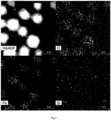
- HAADF scanning transmission electron microscope image in Figure 3
- top left shows Fe 3 O 4 nanoparticles on a carbon grid extracted from an untreated trisilane-cyclooctane solution.
- the remaining images taken by energy dispersive X-ray spectroscopy show spatially resolved element-specific distributions of oxygen (O), iron (Fe) and silicon (Si).
- O oxygen
- Fe iron
- Si silicon
- Example 4 Scanning transmission electron microscope image in Figure 4 (HAADF) and elemental analysis by energy dispersive X-ray spectroscopy of Fe 3 O 4 nanoparticles coated with a thin silicon layer after ultrasonic treatment according to the invention
- the scanning transmission electron microscope image at the top left shows Fe 3 O 4 nanoparticles on a carbon grid that were extracted from the solution of Example 3 after 140 minutes of sonication with a sonotrode amplitude of 230 ⁇ m.
- the remaining images taken using energy dispersive X-ray spectroscopy show spatially resolved element-specific distributions of oxygen (O), iron (Fe) and silicon (Si).
- O oxygen
- Fe iron
- Si silicon
- Example 5 Scanning electron microscope image of silicon-containing colloids prepared according to the invention at low temperature
- Example 6 Scanning electron microscope image of a silicon-containing coral-like colloid produced according to the invention after tempering
- the scanning electron microscope image of Figure 6 shows silicon-containing colloids after drop coating and subsequent annealing at approx. 450 °C for 20 minutes.
- the morphology takes on a coral-like shape.
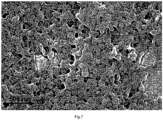
- Example 7 Scanning electron microscope image of a highly porous layer of silicon-containing colloids prepared at room temperature by spin coating
- the scanning electron microscope image of Figure 7 shows silicon-containing colloids after spin coating at room temperature.
- the colloid layer has a sponge-like morphology.
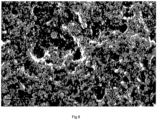
- Example 8 Scanning electron microscope close-up of a highly porous layer of silicon-containing colloids prepared at room temperature by spin coating
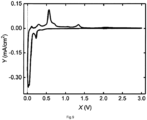
- Figure 9 shows the first lithiation or delithiation cycle of an anode produced according to the invention in a three-electrode arrangement with metallic lithium as reference and counter electrode.
- the abscissa X indicates the voltage in (V) and the ordinate Y indicates the specific capacity in (mA/cm 2 ).
- the anode consists of silicon-containing composite colloids with between 10 - 15 at% carbon on the surface produced by annealing at 300 °C for 10 minutes.
- the electrolyte consists of 1 M LiClO 4 in propylene carbonate. The measurements were taken at 1 mVls and the voltage is given against Li/Li + .
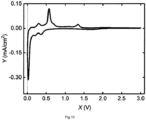
- Figure 10 shows the second lithiation or delithiation cycle. No binders and/or conductive additives were used to produce the anode.
- Example 10 Galvanostatic measurements on porous thin-film anodes made of silicon-containing nanoparticles produced according to the invention
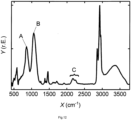
- Example 11 Fourier transformed infrared spectrum of silicon-hydrogen-containing composite colloids according to the invention prepared by sonicating a solution of trichlorosilane instead of trisilane.
- Figure 12 shows a Fourier-Transformed-Infrared (FTIR) spectrum of silicon-hydrogen-containing composite colloids made from trichlorosilane.
- the composite colloids were applied to a silicon wafer, dried and then measured at room temperature.
- the abscissa X indicates the wave number in (cm -1 ) and the ordinate Y the FTIR signal intensity in relative units (rE).
- the mode (A) indicates Si-H 1,2 bending or scissor vibrations
- the mode (B) indicates the Si-O-Si stretching vibrations
- the modes (C) indicate Si-H 1.2 stretching modes. These modes are characteristic for amorphous silicon-hydrogen-containing solid-state colloids.
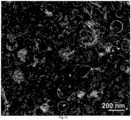
- Example 12 Scanning transmission electron microscope (STEM) images and elemental analysis using energy dispersive X-ray spectroscopy of silicon-containing nanoparticles synthesized in aqueous medium
- Figure 13 shows a HAADF image using STEM, on which silicon-containing colloids with diameters between 50 - 200 nm are shown.
- the nature of these colloids according to the invention is characterized by the fact that they, like Figure 13 shows, preferably have a spherical geometry, are hollow and have a shell which preferably has a thickness of between 3 - 10 nm.
- This inventive architecture of the colloids is made possible by the inventive method using trisilane precursor (Si 3 H 8 ) and deionized water (H 2 O) as solvent and a special choice of duty cycle (60 - 70%), amplitude (190 - 220 ⁇ m), trisilane concentration (5 - 15 vol%) and temperature (5 - 10 °C).
- duty cycle in percent indicates the active period of a sonotrode of the ultrasound source in relation to the total sonication time. For example, a duty cycle of 60% means that the sonotrode is switched on for 600 milliseconds and switched off for 400 milliseconds.
- the amplitude specification means the sonotrode amplitude, i.e. the maximum spatial back and forth movement of the sonotrode tip.
- the element analysis shows the silicon-containing composition of the colloids.
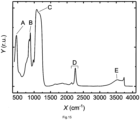
- Figure 15 shows an FTIR spectrum of silicon-hydrogen-containing composite colloids made from trisilane using deionized water (H 2 O) as solvent.
- the composite colloids were taken from a stable dispersion and applied to a silicon wafer, dried and then measured at room temperature.
- the abscissa X indicates the wave number in (cm -1 ) and the ordinate Y the signal intensity in relative units (rE).
- the mode (A) indicates the SiO bending vibration
- the mode (B) indicates the SiHx bending vibration
- the modes (C) indicate the Si-O-Si stretching vibration
- the modes (D) indicate O y Si-H x stretching vibrations
- the mode (E) indicates H 2 O stretching vibrations.
- These modes are characteristic of amorphous silicon-hydrogen-containing colloids.
- modes (C) and (D) indicate that these composite colloids are both oxidized (containing oxygen) and hydrogenated (containing hydrogen).
Landscapes
- Chemical & Material Sciences (AREA)
- Organic Chemistry (AREA)
- Dispersion Chemistry (AREA)
- Chemical Kinetics & Catalysis (AREA)
- Inorganic Chemistry (AREA)
- Silicon Compounds (AREA)
- Manufacturing Of Micro-Capsules (AREA)
Description
- Die Erfindung betrifft ein Verfahren zur Herstellung von hydrogenierten amorphen siliciumhaltigen Kolloiden oder Komposit-Kolloiden und zur Verkapselung von Substanzen mit hydrogenierten amorphen siliciumhaltigen Komposit-Schichten, sowie hydrogenierte amorphe siliciumhaltige Kolloide oder Komposit-Kolloide und mit siliciumhaltigen Komposit-Schichten verkapselte Substanzen und deren Verwendung. Die Erfindung betrifft weiterhin hydrogenierte amorphe siliciumhaltige Kolloide oder Komposit-Kolloide, die hohl sind und eine siliciumhaltige Schale aufweisen.
- Nach dem Stand der Technik werden gasförmige, niedere Silane, d.h. Silicium-WasserstoffVerbindungen, wie Monosilan (SiH4) und Disilan (Si2H6) als Precursoren verwendet um siliciumhaltige Nanopartikel mittels Vakuumprozessen wie z.B. PECVD (Plasma-Enhanced Chemical Vapor Deposition) Hot-Wire-CVD oder Hot-Wall Reaktoren herzustellen.
- Mit Silanen, die flüssig vorliegen, wie z.B. Trisilan Si3H8 sind der Anmelderin keine Verfahren nach dem Stand der Technik bekannt, bei denen bei Normaldruck und Normaltemperatur gearbeitet wird.
- Ein Verfahren, wie es in L.E. Pell, et.al., "Synthesis of amorphous silicon colloids by trisilane thermolysis in high temperature supercritical solvents", Langmuir 20 (2004) 6546-6548 beschrieben wird, offenbart eine Methode bei der amorphe und wasserstoffhaltige Kolloide in einem Autoklaven bei Temperaturen zwischen 400 °C und 500 °C und Drücken zwischen 200 bar und 400 bar hergestellt werden.
- Für Cyclohexasilan (Si6H12) ist ein Gasphasen-Pyrolyse-Verfahren bekannt, das die Herstellung von amorphen und wasserstoffhaltigen Nanopartikeln ermöglicht, welches jedoch bei Temperaturen zwischen 900 °C und 1100 °C durchgeführt wird. Das Verfahren ist in der Veröffentlichung "Synthesis of silicon quantum dots using cyclohexasilane (Si6H12)", Guruvenket et al., J. Mater. Chem. C, 2016, 4, 8206 beschrieben.
- Den Erfindern sind keine Verfahren bekannt, die es ermöglichen, basierend auf flüssigen silicium-wasserstoffhaltigen Verbindungen und akustischer Kavitation, Kolloide oder Komposit-Kolloide bei Raumtemperatur und Atmosphärendruck herzustellen. Den Erfindern sind weiterhin keine hydrogenierten siliciumhaltigen Komposit-Kolloide bekannt, die ohne weitere chemische Behandlungsschritte hohl und hydrogeniert sind und eine siliciumhaltige Schale aufweisen.
- Mit den Verfahren nach dem Stand der Technik sind verschiedene Nachteile verbunden. Meist führen die Verfahren nach dem Stand der Technik zu kristallinen oder nicht hydrogenierten Nanopartikeln. Die Verfahren sind technisch aufwändig und beruhen auf Gasphasen-Hochtemperatur- oder Plasma- oder Laser-Technik-Verfahren oder benötigen Hochdruck. Diese Nachteile des Stands der Technik haben beispielsweise zur Folge, dass eine direkte Verkapselung von Stoffen bzw. Fremdsubstanzen mit hydrogenierten amorphen siliciumhaltigen Beschichtungen nicht möglich ist.
- Aus der
WO2015085980 ist ein Verfahren zur Polymerisation einer Zusammensetzung enthaltend Hydridosilane und die anschließende Verwendung der Polymerisate zur Herstellung von siliziumhaltigen Schichten bekannt, bei dem ein Substrat bereitgestellt wird, eine Zusammensetzung bereitgestellt wird, enthaltend wenigstens ein Hydridosilan, das entweder in mindestens einem organischen und/oder anorganischen Lösungsmittel gelöst ist oder enthaltend wenigstens ein Hydridosilan, das auch ohne Lösungsmittel bereits flüssig vorliegt, wobei die zuvor genannten Hydridosilane wenigstens ein lineares und/oder verzweigtes Hydridosilan der allgemeinen Formel SiH mit n 2 3 und/oder ein zyklisches Hydridosilan der allgemeinen Formel SiH mit n 2 3 umfassen und einer Polymerisation der zuvor genannten Zusammensetzung mittels akustischer Kavitation durchgeführt wird. - Aus der Veröffentlichung "Liquid hydridosilane precursor prepared from cyclopentasilane via sonication at low temperatures without the action of light" von APC Bedini, S. Muthmann, J. Allgaier. K. Bittkau, F. Finger und R. Carius; Ultrasonics Sonochemistry, Bd.34, 26. Mai 2016, Seiten 289-293 wird ein Verfahren zur Herstellung einer Tinte offenbart, bei der die Tinte aus flüssigen Hydridosilanen besteht und bei dem eine Vorläuferlösung bestehend aus Cyclopentasilan in einer N2-Atmosphäre mit Ultraschall bei 75°C beschickt wird, so dass eine Ringöffnungspolymerisation des Cyclopentasilans stattfindet.
- Aus der
EP3026736 sind amorphe, hydrogenierte Siliciumpartikel bekannt, die als Anodedenmaterial eingesetzt werden. - Aus der
EP1867993 sind metallische Nanopartikel bekannt, die mit einer amorphen siliciumhaltigen Schale beschichtet sind, die für biomedizinsiche Zwecke verwendet werden. - Aus dem Stand der Technik sind zwar amorphe, hydrogenierte Siliciumpartikel oder Nanopartikel mit einer amorphen siliciumhaltigen Schale bekannt. Jedoch sind keine Kompositkolloide und deren Verwendung bekannt, die sowohl eine siliciumhaltigen Schale aufweisen, eine sphärische Geometrie aufweisen und einen sphärischen Hohlraum aufweisen. Auch mit den nach dem Stand der Technik bekannten Verfahren können keine derartigen Komposit-kolloide hergestellt werden.
- Es ist daher die Aufgabe der Erfindung ein Verfahren zur Herstellung von hydrogenierten amorphen siliciumhaltigen Komposit-Kolloiden, die eine siliciumhaltigen Schale aufweisen, eine sphärische Geometrie aufweisen und einen sphärischen Hohlraum aufweisen, bereitzustellen und ein Verfahren zur Verkapselung von Substanzen mit diesen hydrogenierten amorphen siliciumhaltigen Komposit-Kolloiden bereitzustellen, sowie diese hydrogenierten amorphen siliciumhaltigen Komposit-Kolloide und deren Verwendung zur Verfügung zu stellen.. Insbesondere soll das Verfahren bei niedrigen Temperaturen, wie beispielsweise Raumtemperatur und niedrigeren Drücken, wie beispielsweise Atmosphärendruck durchgeführt werden können. Das Verfahren soll einfach durchführbar sein und wenig apparativen Aufwand erfordern. Das Verfahren soll auch die Verkapselung oder Einbettung von Additiven oder Substanzen mit diesen hydrogenierten amorphen siliciumhaltigen Komposit-Kolloiden ermöglichen oder eine Beschichtung dieser mit hydrogenierten amorphen siliciumhaltigen Komposit-Kolloiden ermöglichen. Weiterhin sollen hydrogenierte amorphe siliciumhaltige Komposit-Kolloide, sowie Substanzen zur Verfügung gestellt werden, welche mit hydrogenierten, amorphen, siliciumhaltigen Beschichtungen verkapselt sind.
- Im Rahmen der vorliegenden Erfindung werden unter der Bezeichnung "Kolloid" sowohl flüssige als auch feste Nanopartikel als auch flüssige oder feste Partikel verstanden, die nicht nanoskalige Maße aufweisen, wie beispielsweise Mikropartikel oder Agglomerate. Die Kolloide können Emulsionen oder Suspensionen von Tröpfchen oder Gasen in einer Flüssigkeit sein, die während oder nach der erfindungsgemäßen Beschallung/Kavitation zu festen Kolloiden umgewandelt werden.
- Im Rahmen der vorliegenden Anmeldung werden unter der Bezeichnung "Komposit-Kolloid" Kolloide verstanden, die mehr als nur aus Silicium bestehen, wie beispielsweise Kolloide bei denen beispielsweise ein Kohlenstoff oder ein Medikament mitsynthetisiert und/oder eingebettet und/oder verkapselt wurde.
- Im Rahmen der vorliegenden Anmeldung wird unter der Bezeichnung "Verkapselung" allgemein eine Beschichtung oder Einbettung einer Substanz mit oder in ein Kolloid verstanden.
- Ausgehend vom Oberbegriff des Anspruchs 1 und der nebengeordneten Ansprüche wird die Aufgabe erfindungsgemäß gelöst mit den im kennzeichnenden Teil des Anspruchs 1 und der nebengeordneten Ansprüche angegebenen Merkmalen.
- Mit dem erfindungsgemäßen Verfahren ist es nunmehr möglich, ein Verfahren zur Herstellung von hydrogenierten amorphen siliciumhaltigen Koloiden oder Komposit-Kolloiden und zur Verkapselung von Substanzen mit hydrogenierten amorphen siliciumhaltigen kolloiden oder Komposit-Kolloiden, sowie hydrogenierte, amorphe, siliciumhaltige Kolloide oder Komposit-Kolloide und mit siliciumhaltigen Kolloiden oder Komposit-Kolloiden verkapselte Substanzen und deren Verwendung zur Verfügung zu stellen, welches die o.g. Nachteile meidet. Insbesondere, kann das Verfahren bei niedrigen Temperaturen, wie beispielsweise Raumtemperatur und niedrigeren Drücken, wie beispielsweise Atmosphärendruck durchgeführt werden. Das Verfahren ist einfach durchführbar und erfordert wenig apparativen Aufwand. Das Verfahren ermöglicht auch die Verkapselung von Stoffen mit hydrogenierten amorphen siliciumhaltigen Kolloiden oder Komposit-Kolloiden oder mit hydrogenierten amorphen siliciumhaltigen Beschichtungen. Weiterhin können hydrogenierte amorphe siliciumhaltige Komposit-Kolloide, sowie Substanzen zur Verfügung gestellt werden, welche mit hydrogenierten, amorphen, siliciumhaltigen Beschichtungen verkapselt sind. Das Verfahren ermöglicht die Herstellung von hydrogenierten amorphen siliciumhaltigen Kolloiden und Komposit-Kolloiden, die eine siliciumhaltige Schale aufweisen, eine sphärische Geometrie aufweisen und einen sphärischen Hohlraum aufweisen.
- Die nach dem erfindungsgemäßen Verfahren hergestellten Kolloide und Komposit-Kolloide weisen zusätzliche vorteilhafte Eigenschaften auf.
- Die erfindungsgemäßen siliciumhaltigen Kolloide oder Komposit -Kolloide haben bevorzugt eine sphärische Geometrie. Eine siliciumhaltige oder auch eine hydrogenierte siliciumhaltige Schale umgibt den Hohlraum der Kolloide oder Koposit-Kolloide. Die Kolloide oder Komposit -Kolloide haben vorzugsweise einen Durchmesser zwischen 50 bis 200 nm. Die siliciumhaltige Schale hat vorzugsweise eine Dicke im Bereich von 3 bis 10 nm.
- Beispielsweise ist nicht nur das Volumen aber auch die äußere Oberfläche mit verschieden wasserstoffhaltigen Gruppen terminiert, nämlich mit -SiH, -SiH2 und -SiH3 Gruppen. Darüber hinaus, da sich die Oberfläche in einem nichtoxidierten Zustand (mit Sauerstoff) befindet, erleichtern die besonderen Eigenschaften der Oberflächen erheblich den Aufwand der Funktionalisierung der Oberflächenchemie der Kolloide bzw. Komposit-Kolloide.
- Eine weitere vorteilhafte Eigenschaft der Kolloide bzw. Komposit-Kolloide, ist die erfindungsgemäße nano- bzw. mesoporöse Anordnung, die sie als dünne Schichten auf festen Substraten aufweisen. Gemäß Anwendung können solche Schichten mittels Rotations-, Drop-, Sprüh-, Doktorblade- oder Rackelbeschichtung hergestellt werden. Ohne keinerlei Zugabe von Binde- oder Leitfähigkeitsmitteln weisen diese erfindungsgemäß hergestellten porösen Schichten überraschend hohe spezifische Kapazitäten und lange Stabilitäten bei der Lithiierung in Lithium-Ionen-Halb-Zellen aus und sind damit überwiegend vorteilhaft gegenüber dem Stand der Technik. Vorteilhafte Weiterbildungen der Erfindung sind in den Unteransprüchen angegeben.
- Im Folgenden wird die Erfindung in ihrer allgemeinen Form beschrieben, ohne dass dies einschränkend auszulegen ist.
- Gemäß dem erfindungsgemäßen Verfahren, wird ein Hydridosilan oder ein Hydrodosilan-Derivat oder eine Mischung von verschiedenen Hydridosilanen und/oder Hydridosilan-Derivaten, die entweder in mindestens einem organischen und/oder anorganischen Lösungsmittel gelöst sind oder wenigstens ein Hydridosilan oder ein Hydrodosilan-Derivat oder eine Mischung von verschiedenen Hydridosilanen und/oder Hydridosilan-Derivaten, die ohne Lösungsmittel bereits flüssig vorliegen mit Kavitation beaufschlagt. Die Kavitation kann beispielsweise durch eine magnetostriktive oder piezoelektrische Ultraschallquelle und/oder durch einen flüssigkeitsbetriebenen oder gasbetriebenen Schallwandler erzeugt werden.
- Dabei entstehen erfindungsgemäß hydrogenierte, amorphe, siliciumhaltige Komposit-Kolloide. Unter Kolloid sollen im Rahmen der vorliegenden Erfindung beispielsweise auch Festkörper oder Partikel oder Teilchen oder Aggregate oder Agglomerate verstanden werden, die in mindestens einer Längendimension eine Größe zwischen 0,1 nm und 100 µm aufweisen.
- Als Hydridosilane können erfindungsgemäß folgende Verbindungen eingesetzt werden: lineare oder verzweigte Siliciumwasserstoffe der Summenformel SinH2n+n, mit n = 1, 2, 3, ..., oder cyclische Siliciumwasserstoffe der Form SinH2n, mit n = 5, 6, ....
- So können beispielsweise als Hydridosilane mindestens eine Komponente aus der Gruppe, bestehend aus linearen oder verzweigten Silanen mit der Summenformel SinH2n+2 (mit n ≥ 2) oder zyklischen Silanen mit der Summenformel SinH2n (mit n > 4) oder aus Organosilanen, Halogensilanen oder Organohalogensilanen, vorzugsweise aus der Gruppe Trisilan, Tetrasilan, Pentasilan, Hexasilan, Heptasilan, Cyclopentasilan, Cyclohexasilan, Neopentasilan, Trichlorsilan, oder auch flüssige Germane (GenH2n+2, mit n ≥ 2) eingesetzt werden.
- Als Hydridosilan-Derivate können erfindungsgemäß folgende Verbindungen eingesetzt werden: Verbindungen mit allgemeiner Formel SiHnX4-n (mit X = F, Cl, Br, I, CH3 und 1 < n < 4).
- Unter Mischlösung sind Lösungen zu verstehen, enthaltend Mischungen aus verschiedenen Hydridosilanen oder aus verschiedenen Hydridosilan-Derivaten oder eine Kombination von Hydridosilanen und Hydridosilan-Derivaten.
- Es können auch mindestens zwei Hydridosilane eingesetzt werden, so dass das durch das Verfahren hergestellte Komposit-Kolloid eine Unterkombination aus mindestens zwei Komponenten, insbesondere der genannten Hydridosilane ist.
- Bei dem Verfahren implodieren durch die Kavitation erzeugten Mikrobläschen in der Lösung.
- Als Lösungsmittel sind sowohl organische als auch anorganische Lösungsmittel geeignet. Als Lösungsmittel können beispielsweise lineare (n) und iso (i) Alkane wie n- oder i-Pentan (C6H12), n- oder i-Hexan (C6H14), sowie zyklische Alkane wie Cyclohexan (C6H12), Cycloheptan (C7H14), Cyclooctan (CaH16), oder auch aromatische Verbindungen wie Benzol, Toluol, Xylol, Naphthalin eingesetzt werden.
- Als Lösungsmittel können auch sauerstoffhaltige oder anorganische Verbindungen wie Wasser, Alkohole, Ether, Alkoxyalkane, Siloxane eingesetzt werden.
- Aber auch alle gemäß Stand der Technik weiteren geeigneten und dem Fachmann bekannten organischen Lösungsmittel, insbesondere hochsiedende Lösungsmittel wie höhere Alkane oder Terpene, wie beispielsweise n-Dodecan oder Squalen, können eingesetzt werden. Als Lösungsmittel kann auch ein Lösungsmittelgemisch aus mindestens zwei Komponenten, insbesondere der zuvor genannten Lösungsmittel eingesetzt werden.
- Das Verfahren kann in einem Temperaturbereich zwischen -120 °C und 250 °C durchgeführt werden. Bevorzugt ist ein Temperaturbereich zwischen -30 °C und 125 °C. Insbesondere kann das Verfahren bei Umgebungstemperatur, insbesondere Raumtemperatur durchgeführt werden.
- Das Verfahren kann in einem Druckbereich zwischen 0,5 bar und 1000 bar durchgeführt werden. Bevorzugt ist ein Druckbereich zwischen 1 bar und 100 bar. Insbesondere kann das Verfahren bei Normaldruck, insbesondere Atmosphärendruck durchgeführt werden.
- Der Ultraschall kann beispielsweise in einem Frequenzbereich von 15 kHz - 50 MHz liegen, ist aber nicht auf diesen Bereich beschränkt.
- In einer weiteren Ausgestaltung der Erfindung kann die Lösung auch Additive enthalten. Unter der Bezeichnung "Additive" sollen im Rahmen der vorliegenden Erfindung Substanzen verstanden werden, die beim Einsetzen in einer Lösung vor, während, oder nach der Beschallung, zu keinen und/oder schwachen und/oder starken chemischen Bindungen mit dem Wasserstoff und/oder dem Silicium der erzeugten Kolloide führen.
- Additive, die zu chemischen Bindungen führen, können feste, flüssige oder gasförmige Substanzen sein, wie beispielsweise lithiumhaltige Verbindungen oder Dotierstoffe wie borhaltige und/oder phosphorhaltige Verbindungen oder Verbindungen aller Art, die zu entsprechenden Zusammensetzungen, Legierungen oder Komposit-Kolloiden überführen. Unter dem Begriff "Komposit-Kolloid" soll verstanden werden, Kolloide, die durch das erfindungsgemäße Verfahren nicht nur aus Wasserstoff und Silicium bestehen.
- Additive, die keine und/oder nur schwache chemische Bindungen mit dem Wasserstoff und/oder mit dem Silicium der erzeugten Kolloide eingehen sollen, können feste, flüssige oder gasförmige Moleküle sein, wie beispielsweise Nanopartikel oder Therapeutika.
- Diese Additive werden auch "zu verkapselnden" oder "zu beschichtenden" Substanzen genannt. Befinden sich diese Substanzen innerhalb und/oder auf der Oberfläche des erzeugten Kolloids, wird dieser Prozess im Rahmen der vorliegenden Erfindung als eine "Einbettung" oder "Verkapselung" oder aber auch als "Beschichtung" verstanden. Im Unterschied zur Verkapselung ist es bei der Beschichtung möglich, dass die Beschichtung eine unvollkommene Verkapselung darstellt, bei der sich die Substanzen nicht zu 100% innerhalb und/oder auf der Oberfläche des erzeugten Kolloids befinden. Erfindungsgemäß soll die ursprüngliche Zielwirkung dieser Substanzen teilweise oder vollkommen erhalten bleiben. Die Substanzen, die eingebettet oder verkapselt werden sollen, sollten bevorzugt so klein sein, dass sie in die Bläschen die durch die Kavitation erzeugt werden, hineinpassen. Sie sollten daher vorteilhaft einen Durchmesser von < 100 µm aufweisen.
- Bei einer Beschichtung können die Substanzen auch einen größeren Durchmesser von > 100 µm aufweisen, da diese Substanzen nach und nach auf der Oberfläche der Komposit-Kolloide beschichtet werden, in dem sie bei der Beschallung bzw. bei der Implosion der Kavitationsbläschen in der Nähe dieser Bläschen zugegeben werden. Die Additive oder Substanzen haben zur Folge dass, siliciumhaltige Zusammensetzungen und Komposit-Kolloide synthetisiert werden können. Der Lösung kann mindestens ein Additiv beigefügt sein, es kann aber auch eine Kombination von mindestens zwei Additiven, insbesondere der genannten Additive eingesetzt werden. Zur Herstellung der Komposit-Kolloide können die Additive vor oder während der Synthese der Hydridosilanlösung zugegeben werden.
- Die Konzentration des Hydridosilans bzw. der Hydridosilane im Lösungsmittel kann zwischen 0 bis ≤ 100 Gew.% betragen Bei Verwendung einer Hydridosilanlösung ohne Additive wird beispielsweise eine 0,1 - 50 Gew. %ige Hydridosilankonzentration verwendet, der Rest ist Lösungsmittel. Bei Verwendung einer Hydridosilanlösung mit Additiven wird beispielsweise eine 0,01 - 50 gew.%ige Konzentration von Additiven verwendet, der Rest besteht aus Hydridosilanen und Lösungsmitteln.
- Mit diesem Verfahren können Komposit-Kolloide einer Partikelgröße in einem Bereich von 0,5 nm - 10 µm hergestellt werden, insbesondere in einem Bereich von 1,5 nm - 1 µm.
- Das Verfahren ermöglicht durch lange Beschallungszeiten und/oder Filterung-bzw. Trennverfahren wie beispielsweise durch Anwendung von Membranfiltern oder Zentrifugation und/oder anschließende thermische und/oder photolytische Behandlung die erfindungsgemäße Herstellung von besonderen Kolloiden mit vorteilhaften Eigenschaften wie die Bildung von Agglomeraten und Aggregaten größer als 200 nm. In einer weiteren Ausführungsform können mit dem erfindungsgemäßen Verfahren Additive oder Substanzen hergestellt werden, welche mit hydrogenierten amorphen siliciumhaltigen Beschichtungen umhüllt sind.
- Dazu werden der Lösung, umfassend das Lösungsmittel und das Hydridosilan und fakultativ mindestens ein Additiv, mindestens eine Substanz zugefügt, welche durch die Einwirkung des Ultraschalls auf die Lösung mit hydrogeniertem amorphem siliciumhaltigem Material beschichtet werden soll.
- Die Additive oder Substanzen, die verkapselt werden sollen, können fest und/oder flüssig und/oder gasförmig sein.
- Als Additive oder als zu beschichtende und/oder einzubettende und/oder zu verkapselnde Substanzen können Nanopartikel und/oder auch Kolloide bestehend, aber nicht beschränkend, aus Au, c-Si, CdSe, CuO, Cu2O, Cu2S, CuS, Fe3O4, Fe2O3, FeS, FeS2, FeSi2, Li, LiH, SnS, ZnS, ZrS und auch Moleküle wie Alendronate, Cisplatin, Doxorubicin, Epirubicin, Fluorouracil, Idarubicin, sowie auch Verbindungen aus der Gruppe der Pentine wie 1- oder 2-Pentin oder Borane wie Diboran, Pentaboran oder Decaboran, weißer Phosphor oder auch allgemeine Verbindungen wie Phosphane oder Phosphine eingesetzt werden. Es können auch mindestens zwei Substanzen, insbesondere aus der Gruppe der genannten Additive oder Substanzen verwendet werden um damit beschichtete Gemische von Substanzen herzustellen.
- Mit dem erfindungsgemäßen Verfahren können Additive oder Substanzen in Lösung direkt implosiv in eine Hülle von hydrogenierten amorphen siliciumhaltigen Kolloiden eingebettet, bzw. verkapselt werden. Dies ist mit anderen Verfahren nicht möglich, da Standard-Partikelsynthesen auf klassischen photolytischen und/oder thermolytischen Prozessen bzw. Wachstum mittels Nukleationsmechanismen beruhen.
- Unter Komposit-Kolloiden werden im Sinne der Erfindung darüber hinaus auch Kolloide verstanden, die unter Verwendung von festen und/oder flüssigen und/oder gasförmigen Additiven oder Substanzen, mittels Kavitation synthetisiert sind und wo die Additive oder Substanzen mit hydrogenierten amorphen siliciumhaltigen Beschichtungen vollkommen verkapselt oder teilweise oder vollkommen mit hydrogenierten amorphen siliciumhaltigen Schichten beschichtet sind. Die Additive oder Substanzen können mit oder ohne chemische Verbindungen zum Wasserstoff und/oder Silicium im Komposit-Kolloid vorhanden sein.
- Da das Verfahren ein Flüssigphasenprozess ist, der bei Raum- oder niedrigen Temperaturen und Normaldruck durchführbar ist, wird keine Hochvakuum-Technik benötigt, was einen erfindungsgemäßen Vorteil darstellt.
- In einer vorteilhaften Ausführung des Verfahrens sollte die Herstellung der hydrogenierten amorphen siliciumhaltigen Kolloide vorzugsweise in einer Ar- oder N2-Atmosphäre durchgeführt werden, wie beispielsweise in einer Glovebox mit H2O- und O2-Konzentrationen von typischerweise < 10 ppm.
- Die Erfindung ermöglicht die direkte Einbettung und/oder Verkapselung von Substanzen, die sich innerhalb von implodierenden Mikrobläschen befinden können.
- Die erfindungsgemäß erhaltenen hydrogenierten, amorphen, siliciumhaltigen Komposit-Kolloide, können beispielsweise in photovoltaischen oder photokatalytischen Anwendungen als Lichtabsorber- und/oder Dotiermaterial oder plasmonische Reflexionsgitter oder lichtstreuende Schichten, für Sensoren, Quantum-Dot Leuchtdioden, Wellenleiter, Singulett-Sauerstoff-Erzeugung, Abwasseraufbereitung, als Anodenmaterial in energiespeichernden Anwendungen, wie beispielsweise in Lithium-Ionen-, Natrium-lonen- bzw. Lithium-Sulfid-Batteriezellen verwendet werden. Die erfindungsgemäß erhaltenen mit hydrogenierten amorphen siliciumhaltigen Kolloiden bzw. Komposit-Kolloiden beschichteten bzw. verkapselten Substanzen können für in vitro oder in vivo Medikamententräger, für in vitro oder in vivo photofluoreszente oder magnetresonanztomographische bildgebende Verfahren als fluoreszenter Marker und/oder magnetresonanztomographischer Marker oder Kontrastmittel, als in vitro oder in vivo Therapeutikum, Medikamententräger und/oder Hyperthermie-Therapeutikum, oder in photodynamischer Therapie verwendet werden.
- Insbesondere können die Kolloide bzw. die Komposit-Kolloide bzw. die beschichteten bzw. verkapselten Substanzen für Solarzellen, Anoden für Lithium-Ionen-Batteriezellen und als Therapeutika in bio- oder nanomedizinischem Bereich verwendet werden.
- Erfindungsgemäß werden Komposit-Kolloide und mit hydrogenierten amorphen siliciumhaltigen Komposit-Kolloiden verkapselte Substanzen zur Verfügung gestellt, die dadurch gekennzeichnet sind, dass sie mit dem erfindungsgemäßen Verfahren hergestellt werden können.
- In einer vorteilhaften Ausführung des Verfahrens kann nach der Beschichtung eine Sinterung und/oder Kristallisation in wasserstoffhaltiger und/oder Niederdruck-Atmosphäre durchgeführt werden.
- In einer weiteren vorteilhaften Ausführung des Verfahrens kann während der Herstellung eine UV-Bestrahlung und/oder Mikrowellen-Bestrahlung und/oder aktive Kühlung vorgenommen werden.
- In einer besonders bevorzugten Ausführung werden die erfindungsgemäßen Kolloide oder Komposit-Kolloide aus Trisilan unter Verwendung von deionisiertem Wasser als Lösungsmittel hergestellt. Diese so hergestellten Nanopartikel sind hydrophil und bilden stabile Dispersionen im Wasser und sind sowohl oxidiert als auch hydrogeniert.
- Nachfolgend wird der Gegenstand der Erfindung anhand von Ausführungsbeispielen und Figuren näher erläutert, ohne dass der Gegenstand der Erfindung dadurch beschränkt wird.
- Es zeigen:
-
Figur 1 - Röntgenphotoelektronen-Spektrum an Siliciumcarbid Komposit-Kolloiden hergestellt durch Beschallung einer Trisilan-Lösung mit 2-Pentin als Additiv. -
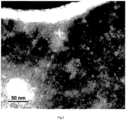
Figur 2 - Transmissionselektronenmikroskop-Aufnahme von Siliciumcarbid Komposit-Kolloiden. -
Figur 3 - Rastertransmissionselektronenmikroskop-Aufnahme und Elementanalyse mittels energiedispersiver Röntgenspektroskopie von Fe3O4-Nanopartikeln ohne erfindungsgemäße Ultraschallbehandlung -
Figur 4 - Rastertransmissionselektronenmikroskop-Aufnahme inFigur 4 (HAADF) und Elementanalyse mittels energiedispersiver Röntgenspektroskopie von Fe3O4-Nanopartikeln beschichtet mit einer dünnen Siliciumschicht nach erfindungsgemäßer Ultraschallbehandlung -
Figur 5 - Rasterelektronenmikroskop-Aufnahme von erfindungsgemäß hergestellten siliciumhaltigen Kolloiden. -
Figur 6 - Rasterelektronenmikroskop-Aufnahme eines erfindungsgemäß hergestellten siliciumhaltigen korallenartigen Kolloids nach Tempervorgang. -
Figur 7 - Rasterelektronenmikroskop-Aufnahme einer hochporösen Schicht aus siliciumhaltigen Kolloiden hergestellt bei Raumtemperatur mittels Rotationsbeschichtung. -
Figur 8 - Rasterelektronenmikroskop-Nahaufnahme einer hochporösen Schicht aus siliciumhaltigen Kolloiden hergestellt bei Raumtemperatur mittels Rotationsbeschichtung. -
Figur 9 - Cyclovoltammetrie-Messung des ersten Lithiierungs- bzw. Delithiierungszyklus von einer porösen Dünnschicht-Anode aus erfindungsgemäß hergestellten siliciumhaltigen Komposit-Kolloiden. -
Figur 10 - Cyclovoltammetrie-Messung des zweiten Lithiierungs- bzw. Delithiierungszyklus von einer porösen Dünnschicht-Anode aus erfindungsgemäß hergestellten siliciumhaltigen Komposit-Kolloiden. -
Figur 11 - Galvanostatische Zyklisierung und Coulomb-Effizienz von einer porösen Dünnschicht-Anode aus erfindungsgemäß hergestellten siliciumhaltigen Komposit-Kolloiden. -
Figur 12 - Fourier-Transform-Infrarot-Spektrum von erfindungsgemäßen silicium-wasserstoffhaltigen Komposit-Kolloiden hergestellt durch Beschallung einer Lösung aus Trichlorsilan anstatt Trisilan. -
Figur 13 - HAADF-Aufnahme mittels STEM worauf erfindungsgemäße siliciumhaltigen Nanopartikel mit Durchmessern zwischen 50 - 200 nm dargestellt sind -
Figur 14 - HAADF-Aufnahme vom Bereich der Schale eines erfindungsgemäßen Nanopartikels und im Einsatzbild oben rechts die dazugehörige ortsaufgelöste elementspezifische Verteilung von Silicium (Si) mittels energiedispersiver Röntgenspektroskopie. -
Figur 15 - FTIR-Spektrum von aus Trisilan hergestellten silicium-wasserstoffhaltigen Komposit-Kolloiden unter Verwendung von deionisiertem Wasser (H2O) als Lösungsmittel. - Anhand von in
Figur 1 dargestellter Röntgenphotoelektronenspektroskopie (XPS) Messung ist die erfindungsgemäße Synthese von Siliciumcarbid Komposit-Kolloiden gezeigt. Das SCPS-Spektrum zeigt den C 1s Peak von Kohlenstoff. Die Abszisse X gibt die Bindungsenergie in (eV) an und die Ordinate Y gibt die XPS-Intensität in relativen Einheiten (r.E.) an. Die verwendete Cyclooctan-Lösung weist eine Trisilan Konzentration von 25 Vol% auf und als Additiv wurde 2-Pentin mit einer Konzentration von 13 Vol% verwendet. Die erfindungsgemäßen Bedingungen für die Beschallung waren wie folgt: Prozesstemperatur = 8 °C, Beschallungsdauer = 320 min, Sonotrodenamplitude = 216 µm. Die getrockneten Komposit-Kolloide wurden auf einem mit Gold beschichteten Glassubstrat vermessen. Die Komponente (A) bei ca. 283 eV inFigur 1 weist auf Silicium-Kohlenstoff Bindungen hin. Folglich kann eine Einbettung von Kohlenstoff-Atomen in siliciumhaltige Komposit-Kolloide festgestellt werden. - Um die Siliciumcarbid-Komposit-Kolloide aus Beispiel 1 darzustellen ist in
Figur 2 eine Rasterelektronenmikroskop-Aufnahme gezeigt. Die Nanopartikel sind sphärisch und weisen Durchmesser zwischen 2 nm und 7 nm auf - In der Rastertransmissionselektronenmikroskop-Aufnahme in
Figur 3 (HAADF) oben links sind Fe3O4-Nanopartikel auf einem Kohlenstoffgitter gezeigt, die aus einer unbehandelten Trisilan-Cyclooctan-Lösung extrahiert wurden. Die restlichen mittels energiedispersiver Röntgenspektroskopie aufgenommenen Bilder zeigen ortsaufgelöste elementspezifische Verteilungen von Sauerstoff (O), Eisen (Fe) und Silicium (Si). Es gibt keine örtliche Korrelation zwischen der Si-Verteilung und der Position der Fe3O4-Nanopartikel. Folglich kann kein Rückschluss auf eine Beschichtung oder Verkapselung der Fe3O4-Nanopartikel mit Silicium gezogen werden. - In der Rastertransmissionselektronenmikroskop-Aufnahme oben links sind Fe3O4-Nanopartikel auf einem Kohlenstoffgitter gezeigt, die aus der Lösung vom Beispiel 3 nach 140-minütiger Beschallung mit einer Sonotrodenamplitude von 230 µm extrahiert wurden. Die restlichen mittels energiedispersiver Röntgenspektroskopie aufgenommenen Bilder zeigen ortsaufgelöste elementspezifische Verteilungen von Sauerstoff (O), Eisen (Fe) und Silicium (Si). Es ist eine örtliche Korrelation zwischen der Si-Verteilung und der Position der Fe3O4-Nanopartikel zu erkennen. Folglich kann eine Beschichtung oder Verkapselung der Fe3O4-Nanopartikel mit Silicium festgestellt werden.
- Wie in der Rasterelektronenmikroskop-Aufnahme von
Figur 5 gezeigt wird, führt eine Beschallung bei einer Temperatur von ca. -3 °C und eine anschließende Filterung (0,1 µm PTFE-Spritzenvorsatzfilter) zur Herstellung von u.a. gut definierten ca. 200 nm großen siliciumhaltigen Kolloid-Agglomeraten. - Die Rasterelektronenmikroskop-Aufnahme von
Figur 6 zeigt siliciumhaltige Kolloide nach Tropfenbeschichtung und anschließender Temperung bei ca. 450 °C für 20 Minuten. Die Morphologie nimmt eine korallenartige Form an. - Die Rasterelektronenmikroskop-Aufnahme von
Figur 7 zeigt siliciumhaltige Kolloide nach Rotationsbeschichtung bei Raumtemperatur. Die Kolloid-Schicht weist eine schwammartige Morphologie auf. - Die Rasterelektronenmikroskop-Nahaufnahme von
Figur 8 zeigt die hochporöse Morphologie von siliciumhaltigen Kolloid-Dünnschichten. -
Figur 9 zeigt den ersten Lithiierungs- bzw. Delithiierungszyklus einer erfindungsgemäßen hergestellten Anode in einer Drei-Elektroden-Anordnung mit metallischem Lithium als Referenz- und Gegenelektrode. Die Abszisse X gibt die Spannung in (V) an und die Ordinate Y gibt die spezifische Kapazität in (mA/cm2) an. Die Anode besteht aus siliciumhaltigen Komposit-Kolloiden mit zwischen 10 - 15 at% Kohlenstoff an der Oberfläche hergestellt durch Tempern bei 300 °C für 10 Minuten. Der Elektrolyt besteht aus 1 M LiClO4 in Propylencarbonat. Die Messungen wurden bei 1 mVls aufgenommen und die Spannung ist gegen Li/Li+ angegeben.Figur 10 zeigt den zweiten Lithiierungs- bzw. Delithiierungszyklus. Keinerlei Bindemittel und/oder leitfähige Zusatzstoffe wurden für die Herstellung der Anode verwendet. - In
Figur 11 sind galvanostatische Messungen an der Anode aus Beispiel 9 gezeigt. Die Abszisse X gibt die Zyklusnummer und die Ordinate Y1 die spezifische Kapazität in (mA/cm2) an. Die Ordinate Y2 gibt die Coulomb-Effizienz an. Die Messungen wurden bei einer Auf- bzw. Entladerate von 0.5 C (104 2 µA) mit Grenzspannungen von 0 V und 3 V aufgenommen. Die Coulomb-Effizienz beträgt mehr als 99.7% nach 80 Zyklen. -
Figur 12 zeigt ein Fourier-Transformiertes-Infrarot (FTIR)-Spektrum von aus Trichlorsilan hergestellten silicium-wasserstoffhaltigen Komposit-Kolloiden, Die Komposit-Kolloide wurden auf ein Silicium-Wafer aufgebracht, getrocknet und anschließend bei Raumtemperatur vermessen. Die Abszisse X gibt die Wellenzahl in (cm-1) und die Ordinate Y die FTIR-Signalintensität in relativen Einheiten (r.E.) an. Die Mode (A) deutet auf Si-H1,2 Biege- bzw. Scherenschwingen, die Mode (B) deutet auf die Si-O-Si Streckschwingen, und die Moden (C) deuten auf Si-H1.2 Streckschwingen hin. Diese Moden sind charakteristisch für amorphe silicium-wasserstoffhaltige Festkörper-Kolloide. -
Figur 13 zeigt eine HAADF-Aufnahme mittels STEM, worauf siliciumhaltige Kolloide mit Durchmessern zwischen 50 - 200 nm dargestellt sind. Die Beschaffenheit dieser erfindungsgemäßen Kolloide ist dadurch gekennzeichnet, dass sie, wieFigur 13 zeigt, bevorzugt eine sphärische Geometrie aufweisen, hohl sind und eine Schale aufweisen, die bevorzugt eine Dicke zwischen 3 - 10 nm aufweist. Diese erfindungsgemäße Architektur der Kolloide ist durch das erfindungsgemäße Verfahren unter Verwendung von Trisilan-Precursor (Si3H8) und deionisiertem Wasser (H2O) als Lösungsmittel und eine besondere Wahl aus Arbeitszyklus (60 - 70 %), Amplitude (190 - 220 µm) Trisilan-Konzentration (5 - 15 vol%) und Temperatur (5 - 10 °C) ermöglicht. Unter der Bezeichnung Arbeitszyklus in Prozent- Angabe ist der aktive Zeitraum einer Sonotrodelder Ultraschallquelle an der gesamten Beschallungszeit. So bedeutet ein Arbeitszyklus von 60%, dass die Sonotrode für 600 Millisekunden eingeschaltet und für 400 Millisekunden ausgeschaltet ist. Die Angabe zur Amplitude bedeutet, die Sonotrodenamplitude, d. h. die maximale räumliche Hin-und Her-Bewegung der Sonotrodenspitze. -
Figur 14 zeigt eine HAADF-Aufnahme vom Bereich der Schale eines erfindungsgemäßen Kolloids und im Einsatzbild oben rechts die dazugehörige ortsaufgelöste elementspezifische Verteilung mittels energiedispersiver Röntgenspektroskopie (= EDX) von Silicium (Si). Die Elementanalyse zeigt die siliciumhaltige Zusammensetzung der Kolloide. -
Figur 15 zeigt ein FTIR-Spektrum von aus Trisilan hergestellten silicium-wasserstoffhaltigen Komposit-Kolloiden unter Verwendung von deionisiertem Wasser (H2O) als Lösungsmittel. Die Komposit-Kolloide wurden von einer stabilen Dispersion entnommen und auf einen Silicium-Wafer aufgebrachten, getrocknet und anschließend bei Raumtemperatur vermessen. Die Abszisse X gibt die Wellenzahl in (cm-1) und die Ordinate Y die Signalintensität in relativen Einheiten (r.E.) an. Die Mode (A) deutet auf die SiO Biegeschwingung, die Mode (B) deutet auf die SiHx Biegeschwingung, die Moden (C) deuten auf die Si-O-Si StreckSchwingung, die Moden (D) deuten auf OySi-Hx Streckschwingungen und die Mode (E) deuten auf H2O Streckschwingung hin. Diese Moden sind charakteristisch für amorphe silicium-wasserstoffhaltige Kolloide. Insbesondere ist aufgrund von Moden (C) und (D) zurückzuschließen, dass diese Komposit-Kolloide sowohl oxidiert (sauerstoffhaltig) als auch hydrogeniert (wasserstoffhaltig) sind.
Claims (9)
- Hydrogenierte amorphe siliciumhaltige Kolloide oder Komposit-Kolloide dadurch gekennzeichnet,
dass sie eine siliciumhaltige Schale aufweisen, die die hohlen Kolloide oder Komposit-Kolloide umgeben, wobei diese eine sphärische Geometrie aufweisen, wobei die siliciumhaltigen Komposit-Kolloide in rasterelektronenmikroskopischen Aufnahmen eine sphärische Geometrie und einen Durchmesser zwischen 2 nm und 7 nm aufweisen und wobei die siliciumhaltigen Kolloide in rastertransmissionselektronenmikroskopischen Aufnahmen eine sphärische Geometrie mit einem Hohlraum und einem Durchmesser zwischen 50 bis 200 nm aufweisen, wobei der Hohlraum von einer Schale mit einer Dicke zwischen 3 bis 10 nm umgeben ist. - Verfahren zur Herstellung von hydrogenierten amorphen siliciumhaltigen Kolloiden oder Komposit-Kolloiden nach Anspruch 1 sowie zur Verkapselung von Substanzen mit diesen hydrogenierten amorphen siliciumhaltigen Komposit-Kolloiden, sowie hydrogenierte amorphe siliciumhaltige Komposit-Kolloide und mit hydrogenierten amorphen siliciumhaltigen Komposit-Kolloiden verkapselte Substanzen, dadurch gekennzeichnet,
dass zur Herstellung der Komposit-Kolloide eine Trisilan-Cyclooctan Lösung mit einem Additiv, wobei die Trisilan Konzentration 25 Vol% und die Additiv Konzentration 13 Vol% beträgt, mit Kavitation durch eine Sonotrode beaufschlagt wird, und die Beschallung durch die Sonotrode bei einer Prozesstemperatur von 8°C, einer Beschallungsdauer von 320 min und einer Sonotrodenamplitude von 216 µm durchgeführt wird und zur Herstellung der Kolloide ein Trisilan- Precursor (Si3H8) in Wasser als Lösungsmittel mit Kavitation durch eine Sonotrode beaufschlagt wird, mit einem Arbeitszyklus von 60-70%, einer Sonotrodenamplitude zwischen 190-220 µm, einer Trisilankonzentration zwischen 5 bis 15 Vol%, bei einer Prozesstemperatur zwischen 5-10°C. - Verfahren nach einem der vorhergehenden Ansprüche,
dadurch gekennzeichnet,
dass als Additiv Substanzen eingesetzt werden, die fest, flüssig oder gasförmig sind. - Verfahren nach einem der vorhergehenden Ansprüche,
dadurch gekennzeichnet,
dass als Additiv oder als Substanz mindestens eine Komponente aus der Gruppe Nanopartikel, vorzugsweise aus Au, c-Si, CdSe, CuO, Cu2O, Cu2S, CuS, Li, LiH, Fe3O4, Fe2O3, FeS, FeS2, FeSi2, SnS, ZnS, ZrS, Moleküle, vorzugsweise Alendronate, Cisplatin, Doxorubicin, Epirubicin, Fluorouracil, Idarubicin, Verbindungen aus der Gruppe der Pentine, vorzugsweise 1- oder 2-Pentin oder lithiumhaltige Verbindungen oder Dotierstoffe, wie borhaltige und/oder phosphorhaltige Verbindungen, oder Borane, vorzugsweise Diboran, Pentaboran oder Decaboran, weißer Phosphor oder allgemeine Verbindungen wie Phosphane oder Phosphine eingesetzt wird. - Verfahren nach einem der vorhergehenden Ansprüche,
dadurch gekennzeichnet,
dass mindestens eine Substanz zugefügt wird, welche bedingt durch die vorhergehenden Verfahrensschritte mit einer siliciumhaltigen Schicht verkapselt bzw. beschichtet bzw. in eine siliciumhaltige Schicht eingebettet wird. - Verfahren nach einem der vorhergehenden Ansprüche,
dadurch gekennzeichnet,
dass nach der Beschichtung eine Sinterung und/oder Kristallisation in wasserstoffhaltiger und/oder Niederdruck-Atmosphäre durchgeführt wird. - Verfahren nach einem der vorhergehenden Ansprüche,
dadurch gekennzeichnet,
dass während der Herstellung eine UV-Bestrahlung und/oder Mikrowellen-Bestrahlung und/oder aktive Kühlung vorgenommen wird. - Verwendung von einem hydrogenierten amorphen siliciumhaltigen Komposit-Kolloid nach Anspruch 1 zur Anwendung als Anodenmaterial in einem energiespeichernden Bauelement.
- Verwendung von einem hydrogenierten amorphen siliciumhaltigen Komposit-Kolloid nach Anspruch 1 zur Anwendung als Therapeutikum, Medikamententräger und/oder fluoreszenter Marker und/oder magnetresonanztomographischer Marker oder Kontrastmittel und/oder Hyperthermie-Therapeutikum.
Applications Claiming Priority (2)
| Application Number | Priority Date | Filing Date | Title |
|---|---|---|---|
| DE102017010263.5A DE102017010263A1 (de) | 2017-11-07 | 2017-11-07 | Verfahren zur Herstellung von hydrogenierten amorphen siliziumhaltigen Komposit-Kolloiden und zur Verkapselung von Substanzen mit hydrogenierten amorphen siliziumhaltigen Komposit-Schichten, sowie hydrogenierte amorphe siliziumhaltige Komposit-Kolloide und mit siliziumhaltigen Komposit-Schichten verkapselte Substanzen und deren Verwendung |
| PCT/DE2018/000320 WO2019091506A1 (de) | 2017-11-07 | 2018-10-30 | Verfahren zur herstellung von hydrogenierten amorphen siliciumhaltigen kolloiden und/oder komposit-kolloiden und zur verkapselung von substanzen mit hydrogenierten amorphen siliciumhaltigen komposit-kolloiden, sowie hydrogenierte amorphe siliciumhaltige kolloide und/oder komposit-kolloide und mit siliciumhaltigen komposit-schichten verkapselte substanzen und deren verwendung |
Publications (2)
| Publication Number | Publication Date |
|---|---|
| EP3707099A1 EP3707099A1 (de) | 2020-09-16 |
| EP3707099B1 true EP3707099B1 (de) | 2024-10-16 |
Family
ID=64456723
Family Applications (1)
| Application Number | Title | Priority Date | Filing Date |
|---|---|---|---|
| EP18807853.9A Active EP3707099B1 (de) | 2017-11-07 | 2018-10-30 | Verfahren zur herstellung von hydrogenierten amorphen siliciumhaltigen kolloiden und/oder komposit-kolloiden und zur verkapselung von substanzen mit hydrogenierten amorphen siliciumhaltigen komposit-kolloiden, sowie hydrogenierte amorphe siliciumhaltige kolloide und/oder komposit-kolloide und mit siliciumhaltigen komposit-schichten verkapselte substanzen und deren verwendung |
Country Status (6)
| Country | Link |
|---|---|
| US (1) | US10940456B2 (de) |
| EP (1) | EP3707099B1 (de) |
| JP (1) | JP7372236B2 (de) |
| CN (1) | CN111328320B (de) |
| DE (2) | DE102017010263A1 (de) |
| WO (1) | WO2019091506A1 (de) |
Families Citing this family (4)
| Publication number | Priority date | Publication date | Assignee | Title |
|---|---|---|---|---|
| RU2737850C1 (ru) * | 2019-11-05 | 2020-12-03 | Федеральное государственное бюджетное образовательное учреждение высшего образования "Тамбовский государственный университет имени Г.Р. Державина" (ФГБОУ ВО "Тамбовский государственный университет имени Г.Р. Державина, ТГУ им. Г.Р. Державина") | Способ получения коллоидного раствора трисульфида циркония с противомикробными свойствами |
| JP7797481B2 (ja) * | 2020-08-18 | 2026-01-13 | グループ14・テクノロジーズ・インコーポレイテッド | 非常に低いzを含むシリコン-カーボン複合体 |
| CN113181934B (zh) * | 2021-04-27 | 2022-11-01 | 中国矿业大学 | 基于photo-Fenton反应降解四环素的自驱动催化剂及其制备与应用 |
| WO2023034268A1 (en) * | 2021-08-30 | 2023-03-09 | The Coretec Group Inc. | Method for fabricating silicon quantum dots |
Family Cites Families (12)
| Publication number | Priority date | Publication date | Assignee | Title |
|---|---|---|---|---|
| JPS55167119A (en) * | 1979-06-15 | 1980-12-26 | Fuji Photo Film Co Ltd | Amorphous silicon fine powder |
| JPS5767941A (en) * | 1980-10-15 | 1982-04-24 | Asahi Chem Ind Co Ltd | Photoconductive toner |
| JP2001131414A (ja) * | 1999-11-02 | 2001-05-15 | Kanegafuchi Chem Ind Co Ltd | ヒドロシリル化反応方法 |
| US6548264B1 (en) * | 2000-05-17 | 2003-04-15 | University Of Florida | Coated nanoparticles |
| EP1760045A1 (de) | 2005-09-03 | 2007-03-07 | Degussa GmbH | Nanoskalige Siliziumteilchen |
| JP5747329B2 (ja) | 2011-12-26 | 2015-07-15 | 国立大学法人 名古屋工業大学 | シリカ殻からなるナノ中空粒子の製造方法 |
| US20160015652A1 (en) * | 2012-02-16 | 2016-01-21 | The Administrators Of The Tulane Educational Fund | Hollow nanoparticles with hybrid double layers |
| KR20150002628A (ko) | 2012-04-17 | 2015-01-07 | 모멘티브 퍼포먼스 머티리얼즈 인크. | 하이드로실릴화 반응을 위한 고 활성 촉매 및 그 제조방법 |
| AU2013205612A1 (en) | 2012-05-03 | 2013-11-21 | Makebook Pty Ltd | A Computerized Method and Software Product for Producing User Interactive Electronic Documents |
| JP6036247B2 (ja) | 2012-12-10 | 2016-11-30 | 株式会社豊田自動織機 | 負極活物質、及び、リチウムイオン二次電池 |
| DE102013020518A1 (de) | 2013-12-11 | 2015-06-11 | Forschungszentrum Jülich GmbH Fachbereich Patente | Verfahren und Vorrichtung zur Polymerisation einer Zusammensetzung enthaltend Hydridosilane und anschließenden Verwendung der Polymerisate zur Herstellung von siliziumhaltigen Schichten |
| US20160156031A1 (en) * | 2014-11-28 | 2016-06-02 | Samsung Electronics Co., Ltd. | Anode active material for lithium secondary battery and lithium secondary battery including the anode active material |
-
2017
- 2017-11-07 DE DE102017010263.5A patent/DE102017010263A1/de not_active Withdrawn
-
2018
- 2018-10-30 DE DE112018005765.8T patent/DE112018005765A5/de not_active Withdrawn
- 2018-10-30 JP JP2020517871A patent/JP7372236B2/ja active Active
- 2018-10-30 US US16/753,800 patent/US10940456B2/en active Active
- 2018-10-30 CN CN201880065195.4A patent/CN111328320B/zh not_active Expired - Fee Related
- 2018-10-30 EP EP18807853.9A patent/EP3707099B1/de active Active
- 2018-10-30 WO PCT/DE2018/000320 patent/WO2019091506A1/de not_active Ceased
Also Published As
| Publication number | Publication date |
|---|---|
| JP7372236B2 (ja) | 2023-10-31 |
| CN111328320A (zh) | 2020-06-23 |
| DE102017010263A1 (de) | 2019-05-09 |
| US10940456B2 (en) | 2021-03-09 |
| US20200254416A1 (en) | 2020-08-13 |
| JP2021501733A (ja) | 2021-01-21 |
| DE112018005765A5 (de) | 2020-07-23 |
| CN111328320B (zh) | 2023-06-09 |
| WO2019091506A1 (de) | 2019-05-16 |
| EP3707099A1 (de) | 2020-09-16 |
Similar Documents
| Publication | Publication Date | Title |
|---|---|---|
| EP3707099B1 (de) | Verfahren zur herstellung von hydrogenierten amorphen siliciumhaltigen kolloiden und/oder komposit-kolloiden und zur verkapselung von substanzen mit hydrogenierten amorphen siliciumhaltigen komposit-kolloiden, sowie hydrogenierte amorphe siliciumhaltige kolloide und/oder komposit-kolloide und mit siliciumhaltigen komposit-schichten verkapselte substanzen und deren verwendung | |
| EP3080192B1 (de) | Verfahren zur polymerisation einer zusammensetzung enthaltend hydridosilane und anschliessenden verwendung der polymerisate zur herstellung von siliciumhaltigen schichten | |
| Lu et al. | Large-scale synthesis of tungsten oxide nanofibers by electrospinning | |
| EP3230205B1 (de) | Verfahren zum herstellen eines elektrodenmaterials für eine batterieelektrode | |
| EP3954652B1 (de) | Wasserdispergierbare graphennanofolie | |
| EP2560918A1 (de) | Verfahren zur herstellung von zweidimensionalen sandwich-nanomaterialien auf basis von graphen | |
| DE112018001227T5 (de) | Elektrokatalysator für die Wasserstoffentwicklungsreaktion | |
| DE102013220575A9 (de) | Verbundkörper, hergestellt aus verschiedenen Materialien und Verfahren zu dessen Herstellung | |
| DE102014210613B4 (de) | Verfahren zur Herstellung von sphärischen Silizium-Kohlenstoff-Nanokompositen | |
| DE112020004928T5 (de) | Verfahren zur Herstellung eines γ-Ga2O3-Nanomaterials | |
| EP3347303A1 (de) | Verfahren zur herstellung von strukturierten oberflächen | |
| Xu et al. | A facile preparation method for MoS2 nanosheets and their well-controllable interfacial assembly with PEDOT: PSS for effective electrochemical hydrogen evolution reactions | |
| Chen et al. | Synthesis of graphene quantum dots for their supramolecular polymorphic architectures | |
| DE102006029276B4 (de) | Wärmeübertragungsflüssigkeiten mit heteroatomhaltigen Kohlenstoff-Nanokapseln | |
| CN102923773B (zh) | 形貌可控钨酸铋、钒酸铋纳米材料的无离子源制备方法 | |
| WO2016146477A1 (de) | Verfahren zum herstellen einer elektrode, elektrode und elektrolysevorrichtung | |
| KR20090124213A (ko) | 금속산화물/탄소나노튜브 복합체 및 금속산화물 나노막대의제조 | |
| WO2003023787A1 (de) | Elektrisch leitfähige teilchen, insbesondere zum einbringen in flüssige medien und verfahren zur deren herstellung | |
| DE102012221669A1 (de) | Verfahren zum Herstellen kohlenstoffhaltiger Hydridosilane | |
| DE102021113087A1 (de) | Verfahren zur herstellung von atomaren dünnschichten aus übergangsmetalloxiden und/oder -hydroxiden | |
| JP2011111367A (ja) | 薄片化黒鉛分散液の製造方法、薄片化黒鉛分散液及び薄膜の製造方法 | |
| TWI379908B (en) | Method for continuously fabricating silver nanowire | |
| DE102007023103A1 (de) | Siliciumdioxid-Dispersion und Verfahren zur Beschichtung von Substraten | |
| DE102011109457A1 (de) | Graphendispersionen | |
| Hu et al. | Synthesis of Multishelled Silica Particles by Using Choline Hydroxide as Catalyst |
Legal Events
| Date | Code | Title | Description |
|---|---|---|---|
| STAA | Information on the status of an ep patent application or granted ep patent |
Free format text: STATUS: UNKNOWN |
|
| STAA | Information on the status of an ep patent application or granted ep patent |
Free format text: STATUS: THE INTERNATIONAL PUBLICATION HAS BEEN MADE |
|
| PUAI | Public reference made under article 153(3) epc to a published international application that has entered the european phase |
Free format text: ORIGINAL CODE: 0009012 |
|
| STAA | Information on the status of an ep patent application or granted ep patent |
Free format text: STATUS: REQUEST FOR EXAMINATION WAS MADE |
|
| 17P | Request for examination filed |
Effective date: 20200428 |
|
| AK | Designated contracting states |
Kind code of ref document: A1 Designated state(s): AL AT BE BG CH CY CZ DE DK EE ES FI FR GB GR HR HU IE IS IT LI LT LU LV MC MK MT NL NO PL PT RO RS SE SI SK SM TR |
|
| AX | Request for extension of the european patent |
Extension state: BA ME |
|
| DAV | Request for validation of the european patent (deleted) | ||
| DAX | Request for extension of the european patent (deleted) | ||
| RAP3 | Party data changed (applicant data changed or rights of an application transferred) |
Owner name: FORSCHUNGSZENTRUM JUELICH GMBH |
|
| STAA | Information on the status of an ep patent application or granted ep patent |
Free format text: STATUS: EXAMINATION IS IN PROGRESS |
|
| 17Q | First examination report despatched |
Effective date: 20210812 |
|
| GRAP | Despatch of communication of intention to grant a patent |
Free format text: ORIGINAL CODE: EPIDOSNIGR1 |
|
| STAA | Information on the status of an ep patent application or granted ep patent |
Free format text: STATUS: GRANT OF PATENT IS INTENDED |
|
| INTG | Intention to grant announced |
Effective date: 20240607 |
|
| GRAS | Grant fee paid |
Free format text: ORIGINAL CODE: EPIDOSNIGR3 |
|
| GRAA | (expected) grant |
Free format text: ORIGINAL CODE: 0009210 |
|
| STAA | Information on the status of an ep patent application or granted ep patent |
Free format text: STATUS: THE PATENT HAS BEEN GRANTED |
|
| AK | Designated contracting states |
Kind code of ref document: B1 Designated state(s): AL AT BE BG CH CY CZ DE DK EE ES FI FR GB GR HR HU IE IS IT LI LT LU LV MC MK MT NL NO PL PT RO RS SE SI SK SM TR |
|
| REG | Reference to a national code |
Ref country code: GB Ref legal event code: FG4D Free format text: NOT ENGLISH |
|
| REG | Reference to a national code |
Ref country code: CH Ref legal event code: EP |
|
| REG | Reference to a national code |
Ref country code: IE Ref legal event code: FG4D Free format text: LANGUAGE OF EP DOCUMENT: GERMAN |
|
| REG | Reference to a national code |
Ref country code: DE Ref legal event code: R096 Ref document number: 502018015240 Country of ref document: DE |
|
| PGFP | Annual fee paid to national office [announced via postgrant information from national office to epo] |
Ref country code: DE Payment date: 20241108 Year of fee payment: 7 |
|
| REG | Reference to a national code |
Ref country code: LT Ref legal event code: MG9D |
|
| REG | Reference to a national code |
Ref country code: NL Ref legal event code: MP Effective date: 20241016 |
|
| PG25 | Lapsed in a contracting state [announced via postgrant information from national office to epo] |
Ref country code: NL Free format text: LAPSE BECAUSE OF FAILURE TO SUBMIT A TRANSLATION OF THE DESCRIPTION OR TO PAY THE FEE WITHIN THE PRESCRIBED TIME-LIMIT Effective date: 20241016 |
|
| PG25 | Lapsed in a contracting state [announced via postgrant information from national office to epo] |
Ref country code: NL Free format text: LAPSE BECAUSE OF FAILURE TO SUBMIT A TRANSLATION OF THE DESCRIPTION OR TO PAY THE FEE WITHIN THE PRESCRIBED TIME-LIMIT Effective date: 20241016 |
|
| PG25 | Lapsed in a contracting state [announced via postgrant information from national office to epo] |
Ref country code: HR Free format text: LAPSE BECAUSE OF FAILURE TO SUBMIT A TRANSLATION OF THE DESCRIPTION OR TO PAY THE FEE WITHIN THE PRESCRIBED TIME-LIMIT Effective date: 20241016 Ref country code: PT Free format text: LAPSE BECAUSE OF FAILURE TO SUBMIT A TRANSLATION OF THE DESCRIPTION OR TO PAY THE FEE WITHIN THE PRESCRIBED TIME-LIMIT Effective date: 20250217 Ref country code: IS Free format text: LAPSE BECAUSE OF FAILURE TO SUBMIT A TRANSLATION OF THE DESCRIPTION OR TO PAY THE FEE WITHIN THE PRESCRIBED TIME-LIMIT Effective date: 20250216 |
|
| PG25 | Lapsed in a contracting state [announced via postgrant information from national office to epo] |
Ref country code: FI Free format text: LAPSE BECAUSE OF FAILURE TO SUBMIT A TRANSLATION OF THE DESCRIPTION OR TO PAY THE FEE WITHIN THE PRESCRIBED TIME-LIMIT Effective date: 20241016 |
|
| PG25 | Lapsed in a contracting state [announced via postgrant information from national office to epo] |
Ref country code: BG Free format text: LAPSE BECAUSE OF FAILURE TO SUBMIT A TRANSLATION OF THE DESCRIPTION OR TO PAY THE FEE WITHIN THE PRESCRIBED TIME-LIMIT Effective date: 20241016 |
|
| PG25 | Lapsed in a contracting state [announced via postgrant information from national office to epo] |
Ref country code: ES Free format text: LAPSE BECAUSE OF FAILURE TO SUBMIT A TRANSLATION OF THE DESCRIPTION OR TO PAY THE FEE WITHIN THE PRESCRIBED TIME-LIMIT Effective date: 20241016 |
|
| PG25 | Lapsed in a contracting state [announced via postgrant information from national office to epo] |
Ref country code: NO Free format text: LAPSE BECAUSE OF FAILURE TO SUBMIT A TRANSLATION OF THE DESCRIPTION OR TO PAY THE FEE WITHIN THE PRESCRIBED TIME-LIMIT Effective date: 20250116 |
|
| PG25 | Lapsed in a contracting state [announced via postgrant information from national office to epo] |
Ref country code: GR Free format text: LAPSE BECAUSE OF FAILURE TO SUBMIT A TRANSLATION OF THE DESCRIPTION OR TO PAY THE FEE WITHIN THE PRESCRIBED TIME-LIMIT Effective date: 20250117 Ref country code: LV Free format text: LAPSE BECAUSE OF FAILURE TO SUBMIT A TRANSLATION OF THE DESCRIPTION OR TO PAY THE FEE WITHIN THE PRESCRIBED TIME-LIMIT Effective date: 20241016 |
|
| PG25 | Lapsed in a contracting state [announced via postgrant information from national office to epo] |
Ref country code: PL Free format text: LAPSE BECAUSE OF FAILURE TO SUBMIT A TRANSLATION OF THE DESCRIPTION OR TO PAY THE FEE WITHIN THE PRESCRIBED TIME-LIMIT Effective date: 20241016 |
|
| PG25 | Lapsed in a contracting state [announced via postgrant information from national office to epo] |
Ref country code: RS Free format text: LAPSE BECAUSE OF FAILURE TO SUBMIT A TRANSLATION OF THE DESCRIPTION OR TO PAY THE FEE WITHIN THE PRESCRIBED TIME-LIMIT Effective date: 20250116 |
|
| REG | Reference to a national code |
Ref country code: CH Ref legal event code: PL |
|
| PG25 | Lapsed in a contracting state [announced via postgrant information from national office to epo] |
Ref country code: SM Free format text: LAPSE BECAUSE OF FAILURE TO SUBMIT A TRANSLATION OF THE DESCRIPTION OR TO PAY THE FEE WITHIN THE PRESCRIBED TIME-LIMIT Effective date: 20241016 |
|
| PG25 | Lapsed in a contracting state [announced via postgrant information from national office to epo] |
Ref country code: MC Free format text: LAPSE BECAUSE OF FAILURE TO SUBMIT A TRANSLATION OF THE DESCRIPTION OR TO PAY THE FEE WITHIN THE PRESCRIBED TIME-LIMIT Effective date: 20241016 |
|
| PG25 | Lapsed in a contracting state [announced via postgrant information from national office to epo] |
Ref country code: DK Free format text: LAPSE BECAUSE OF FAILURE TO SUBMIT A TRANSLATION OF THE DESCRIPTION OR TO PAY THE FEE WITHIN THE PRESCRIBED TIME-LIMIT Effective date: 20241016 |
|
| PG25 | Lapsed in a contracting state [announced via postgrant information from national office to epo] |
Ref country code: BE Free format text: LAPSE BECAUSE OF NON-PAYMENT OF DUE FEES Effective date: 20241031 Ref country code: LU Free format text: LAPSE BECAUSE OF NON-PAYMENT OF DUE FEES Effective date: 20241030 |
|
| REG | Reference to a national code |
Ref country code: DE Ref legal event code: R097 Ref document number: 502018015240 Country of ref document: DE |
|
| PG25 | Lapsed in a contracting state [announced via postgrant information from national office to epo] |
Ref country code: EE Free format text: LAPSE BECAUSE OF FAILURE TO SUBMIT A TRANSLATION OF THE DESCRIPTION OR TO PAY THE FEE WITHIN THE PRESCRIBED TIME-LIMIT Effective date: 20241016 |
|
| PG25 | Lapsed in a contracting state [announced via postgrant information from national office to epo] |
Ref country code: CH Free format text: LAPSE BECAUSE OF NON-PAYMENT OF DUE FEES Effective date: 20241031 |
|
| PG25 | Lapsed in a contracting state [announced via postgrant information from national office to epo] |
Ref country code: RO Free format text: LAPSE BECAUSE OF FAILURE TO SUBMIT A TRANSLATION OF THE DESCRIPTION OR TO PAY THE FEE WITHIN THE PRESCRIBED TIME-LIMIT Effective date: 20241016 |
|
| PG25 | Lapsed in a contracting state [announced via postgrant information from national office to epo] |
Ref country code: SK Free format text: LAPSE BECAUSE OF FAILURE TO SUBMIT A TRANSLATION OF THE DESCRIPTION OR TO PAY THE FEE WITHIN THE PRESCRIBED TIME-LIMIT Effective date: 20241016 |
|
| PG25 | Lapsed in a contracting state [announced via postgrant information from national office to epo] |
Ref country code: CZ Free format text: LAPSE BECAUSE OF FAILURE TO SUBMIT A TRANSLATION OF THE DESCRIPTION OR TO PAY THE FEE WITHIN THE PRESCRIBED TIME-LIMIT Effective date: 20241016 |
|
| PG25 | Lapsed in a contracting state [announced via postgrant information from national office to epo] |
Ref country code: IT Free format text: LAPSE BECAUSE OF FAILURE TO SUBMIT A TRANSLATION OF THE DESCRIPTION OR TO PAY THE FEE WITHIN THE PRESCRIBED TIME-LIMIT Effective date: 20241016 |
|
| REG | Reference to a national code |
Ref country code: BE Ref legal event code: MM Effective date: 20241031 |
|
| PLBE | No opposition filed within time limit |
Free format text: ORIGINAL CODE: 0009261 |
|
| STAA | Information on the status of an ep patent application or granted ep patent |
Free format text: STATUS: NO OPPOSITION FILED WITHIN TIME LIMIT |
|
| PG25 | Lapsed in a contracting state [announced via postgrant information from national office to epo] |
Ref country code: SE Free format text: LAPSE BECAUSE OF FAILURE TO SUBMIT A TRANSLATION OF THE DESCRIPTION OR TO PAY THE FEE WITHIN THE PRESCRIBED TIME-LIMIT Effective date: 20241016 |
|
| 26N | No opposition filed |
Effective date: 20250717 |
|
| GBPC | Gb: european patent ceased through non-payment of renewal fee |
Effective date: 20250116 |
|
| PG25 | Lapsed in a contracting state [announced via postgrant information from national office to epo] |
Ref country code: GB Free format text: LAPSE BECAUSE OF NON-PAYMENT OF DUE FEES Effective date: 20250116 |
|
| PG25 | Lapsed in a contracting state [announced via postgrant information from national office to epo] |
Ref country code: FR Free format text: LAPSE BECAUSE OF NON-PAYMENT OF DUE FEES Effective date: 20241216 |
|
| PG25 | Lapsed in a contracting state [announced via postgrant information from national office to epo] |
Ref country code: IE Free format text: LAPSE BECAUSE OF NON-PAYMENT OF DUE FEES Effective date: 20241030 |
|
| REG | Reference to a national code |
Ref country code: AT Ref legal event code: MM01 Ref document number: 1732805 Country of ref document: AT Kind code of ref document: T Effective date: 20241030 |
|
| PG25 | Lapsed in a contracting state [announced via postgrant information from national office to epo] |
Ref country code: AT Free format text: LAPSE BECAUSE OF NON-PAYMENT OF DUE FEES Effective date: 20241030 |
|
| PG25 | Lapsed in a contracting state [announced via postgrant information from national office to epo] |
Ref country code: HU Free format text: LAPSE BECAUSE OF FAILURE TO SUBMIT A TRANSLATION OF THE DESCRIPTION OR TO PAY THE FEE WITHIN THE PRESCRIBED TIME-LIMIT; INVALID AB INITIO Effective date: 20181030 |
|
| PG25 | Lapsed in a contracting state [announced via postgrant information from national office to epo] |
Ref country code: CY Free format text: LAPSE BECAUSE OF FAILURE TO SUBMIT A TRANSLATION OF THE DESCRIPTION OR TO PAY THE FEE WITHIN THE PRESCRIBED TIME-LIMIT; INVALID AB INITIO Effective date: 20181030 |