EP3705181B1 - Verfahren zur herstellung eines lithiumadsorptionsvorläufers - Google Patents
Verfahren zur herstellung eines lithiumadsorptionsvorläufers Download PDFInfo
- Publication number
- EP3705181B1 EP3705181B1 EP19787705.3A EP19787705A EP3705181B1 EP 3705181 B1 EP3705181 B1 EP 3705181B1 EP 19787705 A EP19787705 A EP 19787705A EP 3705181 B1 EP3705181 B1 EP 3705181B1
- Authority
- EP
- European Patent Office
- Prior art keywords
- lithium
- precursor
- manganese
- hydroxide
- mixing
- Prior art date
- Legal status (The legal status is an assumption and is not a legal conclusion. Google has not performed a legal analysis and makes no representation as to the accuracy of the status listed.)
- Active
Links
Images






Classifications
-
- B—PERFORMING OPERATIONS; TRANSPORTING
- B01—PHYSICAL OR CHEMICAL PROCESSES OR APPARATUS IN GENERAL
- B01J—CHEMICAL OR PHYSICAL PROCESSES, e.g. CATALYSIS OR COLLOID CHEMISTRY; THEIR RELEVANT APPARATUS
- B01J39/00—Cation exchange; Use of material as cation exchangers; Treatment of material for improving the cation exchange properties
- B01J39/08—Use of material as cation exchangers; Treatment of material for improving the cation exchange properties
- B01J39/10—Oxides or hydroxides
-
- B—PERFORMING OPERATIONS; TRANSPORTING
- B01—PHYSICAL OR CHEMICAL PROCESSES OR APPARATUS IN GENERAL
- B01J—CHEMICAL OR PHYSICAL PROCESSES, e.g. CATALYSIS OR COLLOID CHEMISTRY; THEIR RELEVANT APPARATUS
- B01J20/00—Solid sorbent compositions or filter aid compositions; Sorbents for chromatography; Processes for preparing, regenerating or reactivating thereof
- B01J20/02—Solid sorbent compositions or filter aid compositions; Sorbents for chromatography; Processes for preparing, regenerating or reactivating thereof comprising inorganic material
- B01J20/04—Solid sorbent compositions or filter aid compositions; Sorbents for chromatography; Processes for preparing, regenerating or reactivating thereof comprising inorganic material comprising compounds of alkali metals, alkaline earth metals or magnesium
- B01J20/041—Oxides or hydroxides
-
- B—PERFORMING OPERATIONS; TRANSPORTING
- B01—PHYSICAL OR CHEMICAL PROCESSES OR APPARATUS IN GENERAL
- B01J—CHEMICAL OR PHYSICAL PROCESSES, e.g. CATALYSIS OR COLLOID CHEMISTRY; THEIR RELEVANT APPARATUS
- B01J20/00—Solid sorbent compositions or filter aid compositions; Sorbents for chromatography; Processes for preparing, regenerating or reactivating thereof
- B01J20/02—Solid sorbent compositions or filter aid compositions; Sorbents for chromatography; Processes for preparing, regenerating or reactivating thereof comprising inorganic material
- B01J20/06—Solid sorbent compositions or filter aid compositions; Sorbents for chromatography; Processes for preparing, regenerating or reactivating thereof comprising inorganic material comprising oxides or hydroxides of metals not provided for in group B01J20/04
-
- B—PERFORMING OPERATIONS; TRANSPORTING
- B01—PHYSICAL OR CHEMICAL PROCESSES OR APPARATUS IN GENERAL
- B01J—CHEMICAL OR PHYSICAL PROCESSES, e.g. CATALYSIS OR COLLOID CHEMISTRY; THEIR RELEVANT APPARATUS
- B01J20/00—Solid sorbent compositions or filter aid compositions; Sorbents for chromatography; Processes for preparing, regenerating or reactivating thereof
- B01J20/30—Processes for preparing, regenerating, or reactivating
- B01J20/3078—Thermal treatment, e.g. calcining or pyrolizing
-
- B—PERFORMING OPERATIONS; TRANSPORTING
- B01—PHYSICAL OR CHEMICAL PROCESSES OR APPARATUS IN GENERAL
- B01J—CHEMICAL OR PHYSICAL PROCESSES, e.g. CATALYSIS OR COLLOID CHEMISTRY; THEIR RELEVANT APPARATUS
- B01J20/00—Solid sorbent compositions or filter aid compositions; Sorbents for chromatography; Processes for preparing, regenerating or reactivating thereof
- B01J20/30—Processes for preparing, regenerating, or reactivating
- B01J20/3085—Chemical treatments not covered by groups B01J20/3007 - B01J20/3078
-
- C—CHEMISTRY; METALLURGY
- C01—INORGANIC CHEMISTRY
- C01G—COMPOUNDS CONTAINING METALS NOT COVERED BY SUBCLASSES C01D OR C01F
- C01G45/00—Compounds of manganese
-
- C—CHEMISTRY; METALLURGY
- C01—INORGANIC CHEMISTRY
- C01G—COMPOUNDS CONTAINING METALS NOT COVERED BY SUBCLASSES C01D OR C01F
- C01G45/00—Compounds of manganese
- C01G45/12—Complex oxides containing manganese and at least one other metal element
- C01G45/1207—Permanganates ([MnO4)-] or manganates ([MnO4)2-]
- C01G45/1214—Permanganates ([MnO4)-] or manganates ([MnO4)2-] containing alkali metals
-
- C—CHEMISTRY; METALLURGY
- C02—TREATMENT OF WATER, WASTE WATER, SEWAGE, OR SLUDGE
- C02F—TREATMENT OF WATER, WASTE WATER, SEWAGE, OR SLUDGE
- C02F1/00—Treatment of water, waste water, or sewage
- C02F1/28—Treatment of water, waste water, or sewage by sorption
- C02F1/281—Treatment of water, waste water, or sewage by sorption using inorganic sorbents
-
- C—CHEMISTRY; METALLURGY
- C01—INORGANIC CHEMISTRY
- C01P—INDEXING SCHEME RELATING TO STRUCTURAL AND PHYSICAL ASPECTS OF SOLID INORGANIC COMPOUNDS
- C01P2002/00—Crystal-structural characteristics
- C01P2002/70—Crystal-structural characteristics defined by measured X-ray, neutron or electron diffraction data
- C01P2002/72—Crystal-structural characteristics defined by measured X-ray, neutron or electron diffraction data by d-values or two theta-values, e.g. as X-ray diagram
-
- C—CHEMISTRY; METALLURGY
- C01—INORGANIC CHEMISTRY
- C01P—INDEXING SCHEME RELATING TO STRUCTURAL AND PHYSICAL ASPECTS OF SOLID INORGANIC COMPOUNDS
- C01P2004/00—Particle morphology
- C01P2004/01—Particle morphology depicted by an image
- C01P2004/03—Particle morphology depicted by an image obtained by SEM
-
- C—CHEMISTRY; METALLURGY
- C02—TREATMENT OF WATER, WASTE WATER, SEWAGE, OR SLUDGE
- C02F—TREATMENT OF WATER, WASTE WATER, SEWAGE, OR SLUDGE
- C02F2101/00—Nature of the contaminant
- C02F2101/10—Inorganic compounds
Definitions
- the present invention relates to a method for producing a precursor of a lithium adsorbent, and more specifically, a method for producing a precursor of a lithium adsorbent that adsorbs lithium from an aqueous solution containing lithium.
- Lithium is broadly used in industry as, such as addition agents for ceramic or glass, glass flux for steel continuous casting, grease, pharmaceutical products, batteries, and the like.
- lithium ion batteries that are secondary batteries have high energy density and high voltage, and thus the applications thereof as batteries for electronic equipment such as notebook personal computers or on-vehicle batteries for electric vehicles and hybrid vehicles are currently expanding and causing a sudden surge in demand therefor. This causes a sudden increase in demand for lithium as a raw material.
- Lithium has been produced in the form of lithium hydroxide or lithium carbonate by purifying salt lake brine or lithium-containing ores, such as spodumene (Li 2 O ⁇ Al 2 O 3 ⁇ 2SiO 4 ) as raw materials.
- salt lake brine or lithium-containing ores such as spodumene (Li 2 O ⁇ Al 2 O 3 ⁇ 2SiO 4 ) as raw materials.
- spodumene Li 2 O ⁇ Al 2 O 3 ⁇ 2SiO 4
- a known process for selectively collecting lithium alone is a method in which lithium manganese oxide that is an inorganic adsorbent is used.
- Lithium manganese oxide having a spinel structure has good capacity of selectively adsorbing lithium as a result of pre-treatment; that is, lithium-hydrogen exchange via contacting with acid, and thus can be repeatedly used through adsorption and liquation in a manner similar to ion-exchange resins.
- lithium manganese oxide serves as a precursor of a lithium adsorbent.
- a method for producing the lithium manganese oxide include dry methods for producing the lithium manganese oxide by firing alone and wet methods for producing the same in aqueous solutions.
- Patent literature 1 or 2 discloses a method for producing lithium manganese oxide by such a dry method.
- the dry method involves milling and mixing trimanganese tetroxide and lithium hydroxide, and then firing the mixture in air or in an oxygen atmosphere for preparation.
- Patent Literature 3 discloses a method for producing lithium manganese oxide by a wet method. This wet method involves preparing the lithium manganese oxide via reaction in an aqueous solution, and then performing heat treatment to accelerate crystallization reaction.
- the above wet method involves mixing ⁇ -manganese oxyhydroxide with lithium hydroxide and letting them reacted hydrothermally at 100°C to 140°C under pressure, so as to obtain lithium manganese oxide(LiMn 2 O 4 ), and then performing heat treatment at temperatures ranging from 400°C to 700°C, so as to oxidize trivalent manganese to tetravalent manganese, whereby lithium manganese oxide(Li 2 Mn 2 O 5 ) can be stably obtained without causing any structural change.
- Patent Literature 4 discloses a method for preparing a manganese-based lithium-ion sieve adsorbent.
- the method comprises the following steps: adopting lithium hydroxide and divalent manganese salt as raw materials, dissolving the raw materials in an ethanol solution with volume fraction being 2-10%, stirring uniformly, adding H 2 O 2 and lithium hydroxide, synthesizing an intermediate through the low-temperature hydrothermal method, obtaining lithium-ion sieve precursor through low-temperature roasting, and performing solvent dipping on the precursor to elute lithium ions so as to obtain the corresponding lithium-ion sieve adsorbent.
- Patent Literature 5 discloses a process in which a manganese oxide seed is prepared, which is then grown to obtain manganese oxide having large particle diameters. The manganese oxide obtained is reacted with a lithium compound, whereby lithium manganate having large particle diameters can be obtained.
- Patent Literature 6 discloses a lithium manganate useful as an active material of positive electrodes for lithium batteries, and a process for producing the same, a positive electrode which uses the same as an active material of a positive electrode, and a lithium battery.
- the lithium manganate has a cubic particle form and contains voids in the particles.
- Patent Literature 3 involves performing reaction under pressurizing conditions, and thus requires a pressurization vessel such as an autoclave.
- a pressurization vessel such as an autoclave.
- an autoclave for commercial-scale production (for example, in the order of several tons) is an expensive facility and is problematic in high thermal cost.
- an autoclave is a pressure vessel, and thus is problematic in requirement of strict control since it is under regulation by law for safety assurance.
- an object of the present invention is to provide a method for producing lithium manganese oxide that is a precursor of a lithium adsorbent under atmospheric pressure, which requires no pressure vessel.
- the method for producing a precursor of a lithium adsorbent according to the present invention comprises the following steps (1) to (3):
- the method for producing a precursor of a lithium adsorbent comprises the above (1) 1 st mixing step, (2) 2 nd mixing step, and (3) oxidation step, so that lithium manganese oxide; that is, a precursor of a lithium adsorbent can be produced.
- These steps can be performed under atmospheric pressure, so that any expensive facility such as an autoclave is not used and a precursor of a lithium adsorbent can be produced while limiting the running cost such as thermal cost. Furthermore, this lowers the need of taking legal regulations on the use of high pressure devices such as autoclaves into consideration.
- the method preferably further comprises a step of firing the oxide after the oxidation step.
- the method further comprises a step of firing the oxide after the oxidation step, so that oxidation is more reliably performed to give an oxide.
- the oxidizing agent is preferably sodium hypochlorite.
- the oxidizing agent is sodium hypochlorite, so that the reaction cost is limited because of the use of such an inexpensive material, as well as the thus increased oxidation capacity enables more reliable oxidation.
- the manganese salt is preferably manganese sulfate.
- the manganese salt is manganese sulfate, so that the reaction cost can be limited because of the use of such an inexpensive material.
- the manganese salt is preferably manganese nitrate
- the above alkali hydroxide is preferably lithium hydroxide
- the above oxidizing agent is preferably ammonium peroxodisulfate and/or sodium peroxodisulfate.
- the manganese salt is manganese nitrate
- the alkali hydroxide is lithium hydroxide
- the oxidizing agent is ammonium peroxodisulfate and/or sodium peroxodisulfate, so that a precursor of a lithium adsorbent can be produced more reliably.
- the molar amount of the alkali hydroxide in the 1 st mixing step is preferably 2 or more times and 10 or less times the molar amount of the manganese sulfate used in 1 st mixing step. This leads to a decrease in the amount of the alkali hydroxide to be used, so as to be able to reduce the cost, as well as the total amount of the manganese sulfate used herein can be consumed to give the lithium manganese oxide.
- the molar amount of the lithium hydroxide in the 2 nd mixing step is preferably 4 or more times and 20 or less times the molar amount of the manganese sulfate in the 1 st mixing step. This leads to a decrease in the amount of the lithium hydroxide to be used so as to be able to limit the cost, as well as lithium can be intercalated more reliably.
- the oxidation-reduction potential of the aqueous solution in the oxidation step is preferably 300 mV or more and 1000 mV or less at a silver-silver chloride electrode. This makes it possible to require no special facility capable of working with high potential, and thus to reduce the facility cost, as well as the total amount of the manganese hydroxide obtained in the 2 nd mixing step can be used to give lithium manganese oxide.
- the oxidation step is preferably performed at 50°C or higher and 80°C or lower. This makes it possible to require no special facility capable of working with high temperatures and thus to limit the facility cost, as well as the reaction rate can be effectively increased in the oxidation step wherein lithium manganese oxide is generated through lithium intercalation.
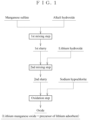
- Fig. 1 shows the method for producing a precursor of a lithium adsorbent according to the 1 st embodiment of the present invention.
- the 1 st mixing step involves mixing manganese sulfate and alkali hydroxide to obtain the 1 st slurry containing manganese hydroxide.
- the 1 st mixing step is a step for neutralization. Note that the 1 st slurry is obtained by mixing an aqueous solution containing manganese sulfate and an aqueous solution containing alkali hydroxide, or a solution or an aqueous solution which is obtained by mixing solids such as reagents, and then dissolving the mixture in a solvent such as water.
- a case of mixing aqueous solutions is as described below.
- a method for preparing an aqueous solution containing manganese sulfate, and an aqueous solution containing alkali hydroxide is not particularly limited.
- an aqueous solution is prepared by dissolving a hydrate such as NaOH ⁇ H 2 O in water.
- the concentrations of both aqueous solutions are not particularly limited. However, the concentration should be at the same or lower than the solubility in order to prepare an aqueous solution.
- the solubility of manganese sulfate in water is about 63 g/100 g-H 2 O at 20°C.
- sodium hydroxide is employed as one of alkalis
- the solubility of the sodium hydroxide is about 109 g/100 g-H 2 O at 20°C.
- lithium hydroxide is employed as one of alkalis
- the solubility of the lithium hydroxide is about 12 g/100 g-H 2 O at 20°C.
- the concentrations of the aqueous solutions are determined in view of these solubilities.
- the molar amount of the alkali hydroxide to be added is theoretically required to be 2 times the molar amount of the manganese sulfate.
- the molar amount of the alkali hydroxide is preferably an equivalent amount; that is, 2 or more times the molar amount of the manganese sulfate.
- the molar amount of the alkali hydroxide is preferably 10 or less times the molar amount of the manganese sulfate.
- sodium hydroxide is used as one of alkali hydroxides, but alkali hydroxides are not particularly limited thereto as long as they are capable of neutralizing manganese sulfate.
- lithium hydroxide, potassium hydroxide or the like can be used.
- manganese sulfate is used in the 1 st mixing step, but other manganese salts may also be used.
- the 2 nd mixing step involves adding lithium hydroxide to the 1 st slurry obtained in the 1 st mixing step and then mixing the mixture to obtain the 2 nd slurry.
- lithium hydroxide is added as a lithium manganese oxide source.
- the lithium hydroxide may be added in the form of aqueous solution with no problem, but it is preferably added in the form of solid in order to prevent the liquid volume from increasing.
- the Li/Mn ratio of lithium manganese oxide having high adsorption capacity as a Li adsorbent is known to be 0.5 or more times and 1.0 or less times that of LiMn 2 O 4 .
- the Li/Mn ratio of Li 1 . 6 Mn 1.6 O 4 is 1.0.
- the molar amount of the lithium hydroxide should be determined in view of the above ratios.
- the molar amount of the lithium hydroxide in the 2 nd mixing step is preferably 4 or more times the molar amount of the manganese sulfate in the 1 st mixing step.
- the molar amount of the lithium hydroxide is preferably 20 or less times the molar amount of the manganese sulfate.
- the alkali hydroxide in 1 st mixing step is lithium hydroxide
- the 1 st mixing step may be omitted.
- the oxidation step involves adding sodium hypochlorite to the 2 nd slurry obtained in the 2 nd mixing step to obtain an oxide.
- the sodium hypochlorite may be added in the form of solid such as crystal, or in the form of aqueous solution or the like in which it is dissolved in advance.
- the sodium hypochlorite is added to the 2 nd slurry obtained in the 2 nd mixing step, so that an oxide, lithium manganese oxide; that is, a precursor of a lithium adsorbent, is obtained (see [Formula 2]).
- [Formula 2] Mn(OH) 2 +LiOH+NaClO -> 0.625Li 1 . 6 Mn 1.6 O 4 +1. 5H 2 O+NaCl
- the oxidation-reduction potential of the aqueous solution in the oxidation step is preferably 300 mV or more and 1000 mV or less at a silver-silver chloride electrode.
- the oxidation-reduction potential is less than 300 mV, the total amount of the manganese hydroxide obtained in the 1 st mixing step may not be used to give lithium manganese oxide.
- the oxidation-reduction potential is higher than 1000 mV, the facility for the oxidation step is required to be resistant to such high oxidation-reduction potential.
- the oxidation-reduction potential of the aqueous solution in the oxidation step is 300 mV or more and 1000 mV or less at a silver-silver chloride electrode, so that no special facility capable of working with high potential is required and thus the facility cost can be limited, and the total amount of the manganese hydroxide obtained in 2 nd mixing step can be used to give lithium manganese oxide.
- the sodium hypochlorite is preferably added gradually in small quantities.
- the sodium hypochlorite is consumed when manganese is oxidized. Addition of the sodium hypochlorite causes a temporary increase in oxidation-reduction potential. However, the sodium hypochlorite is consumed as manganese is oxidized, along which the oxidation-reduction potential decreases.
- the sodium hypochlorite is added in such a manner that the oxidation-reduction potential is 300 mV or more.
- the oxidation step is preferably performed at 50°C or higher and 80°C or lower, and further preferably at 60°C or higher and 80°C or lower.
- the oxidation step lithium is intercalated, so that lithium manganese oxide is generated.
- the temperature for the oxidation step is lower than 50°C, the reaction rate for intercalation is not sufficiently increased.
- the temperature for the oxidation step is higher than 80°C, the facility for the oxidation step should be resistant to temperatures higher than 80°C.
- the oxidation step is performed at 50°C or higher and 80°C or lower, so that no special facility capable of working with high temperatures is required, and thus the facility cost is limited, as well as the reaction rate can be effectively increased in the oxidation step wherein lithium manganese oxide is generated through lithium intercalation.
- the oxidizing agent sodium hypochlorite
- the 2 nd slurry kept at a temperature of 50°C or higher and 80°C or lower. The mixture is stirred under the conditions, and thus manganese in the solution is oxidized.
- pressure to be employed in the oxidation step may be atmospheric pressure with no problem and no pressurization is required. Further, stirring and mixing are preferably continued at the above temperature for 3 or more hours for reliable generation of an oxide, lithium manganese oxide.
- lithium manganese oxide that is, a precursor of a lithium adsorbent, undergoes solid-liquid separation to be powdered.
- sodium hypochlorite is used as an oxidizing agent, but other oxidizing agents can also be used. Specifically, oxoacid of chlorine (e.g., hypochlorous acid and chlorous acid) and salts thereof (e.g., sodium salt and potassium salt), chlorine and the like can be used.
- hypochlorous acid and chlorous acid e.g., hypochlorous acid and chlorous acid
- salts thereof e.g., sodium salt and potassium salt
- lithium manganese oxide which is a precursor of an excellent lithium adsorbent, can be obtained.
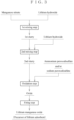
- Fig. 2 shows the method for producing a precursor of a lithium adsorbent according to the 2 nd embodiment of the present invention.
- a difference between the 1 st and the 2 nd embodiments is that the method comprises a step of firing after the oxidation step.
- Description of the 2 nd embodiment mentions only a difference between the 1 st and the 2 nd embodiments. Hence, portions, descriptions of which are omitted herein, are the same as those in the 1 st embodiment.
- the firing step involves firing the oxide obtained in the oxidation step to obtain a precursor of a lithium adsorbent.
- the oxide obtained in the oxidation step is lithium manganese oxide.
- the lithium manganese oxide powder is separated, and then dried to prepare dry powder.
- the dry powder is fired using a firing furnace such as an electric furnace for 2 or more hours and 24 or less hours. Atmosphere within the furnace at this time may be any environment in which oxygen is present. Such an environment can be realized by supplying air or the like into the furnace.
- the temperature at this time is preferably 500°C or higher and 700°C or lower for acceleration of crystallization.
- Fig. 3 shows the method for producing a precursor of a lithium adsorbent according to the 3 rd embodiment of the present invention.
- differences between the 1 st and the 3 rd embodiments are that: substances to be mixed in the 1 st mixing step are different; the oxidizing agents in the oxidation step are different; and the oxidation step is followed by a firing step.
- Description of the 3 rd embodiment mentions only differences between the 1 st and the 3 rd embodiments. Hence, portions, descriptions of which are omitted herein, are the same as those in the 1 st embodiment.
- the 1 st mixing step involves mixing manganese nitrate and lithium hydroxide to obtain a 1 st slurry containing manganese hydroxide.
- the 1 st slurry is obtained by mixing aqueous solutions in which manganese nitrate and lithium hydroxide have been dissolved, respectively, or, using a solution or an aqueous solution obtained by mixing solids such as reagents and then dissolving them in solvents such as water.
- solvents such as water
- a method for preparing an aqueous solution containing manganese nitrate and an aqueous solution containing lithium hydroxide is not particularly limited.
- such an aqueous solution is prepared by dissolving a hydrate such as Mn(NO 3 ) 2 ⁇ 6H 2 O, or LiOH ⁇ H 2 0 in water.
- the concentrations of both aqueous solutions are not particularly limited. However, the concentration should be at the same or lower than the solubility in order to prepare an aqueous solution.
- the solubility of manganese nitrate in water is about 140g/100g-water at 20°C.
- the solubility of lithium hydroxide is about 12g/100g-water at 20°C.
- the concentrations of the aqueous solutions are determined in view of these solubilities.
- the molar amount of the lithium hydroxide to be added is theoretically required to be 2 times the molar amount of the manganese nitrate.
- the molar amount of the lithium hydroxide is preferably an equivalent amount; that is, 2 or more times the molar amount of the manganese nitrate and 10 or less times the molar amount of the manganese nitrate.
- the 2 nd mixing step involves adding lithium hydroxide to the 1 st slurry obtained in the 1 st mixing step, and then mixing the mixture to obtain a 2 nd slurry.
- lithium hydroxide is added as a lithium manganese oxide source.
- the lithium hydroxide may be added in the form of aqueous solution with no problem, but it is preferably added in the form of solid in order to prevent the liquid volume from increasing.
- the Li/Mn ratio of the lithium manganese oxide having high adsorption capacity as a Li adsorbent is known to be 0.5 or more times and 1.0 or less times that of LiMn 2 O 4 .
- the Li/Mn ratio of Li 1.33 Mn 1.67 O 4 is 0.8.
- the molar amount of the lithium hydroxide in the 1 st step should be determined in view of the above ratios.
- the molar amount of the lithium hydroxide in the 2 nd mixing step is preferably 10 or more times and 50 or less times the molar amount of the manganese nitrate used in the 1 st step.
- the oxidation step involves adding ammonium peroxodisulfate and/or sodium peroxodisulfate to the 2 nd slurry obtained in the 2 nd mixing step to obtain an oxide.
- ammonium peroxodisulfate and/or sodium peroxodisulfate may be added in the form of solid such as crystal or in the form of aqueous solution or the like in which ammonium peroxodisulfate and/or sodium peroxodisulfate is dissolved in advance.
- the total molar amount of the ammonium peroxodisulfate (ammonium persulfate) and/or the sodium peroxodisulfate(sodium persulfate) to be added in the oxidation step is preferably 0.5 or more times and 5 or less times the molar amount of the manganese nitrate used in the 1 st mixing step.
- the amount of the ammonium peroxodisulfate is specified as described above, so that the total amount of the manganese nitrate used in the 1 st mixing step can be consumed to give the lithium manganese oxide.
- an oxidizing agent(s), ammonium peroxodisulfate and/or sodium peroxodisulfate, is added to the 2 nd slurry kept at a temperature of 70°C or higher, and preferably 80°C or lower. The mixture is stirred under the conditions, and thus manganese in the solution is oxidized.
- the reason of keeping the 2 nd slurry at the above temperature is that in the oxidation step, lithium manganese oxide is generated through lithium intercalation, and increasing the reaction temperature is effective to increasing the reaction rate.
- Pressure to be employed for the reaction may be atmospheric pressure with no problem, and there is no need to perform pressurization to increase the temperature to a level higher than 100°C.
- stirring and mixing are preferably continued for 5 or more hours at the above temperatures for reliable generation of an oxide, lithium manganese oxide.
- the firing step involves firing the oxide obtained in the oxidation step to obtain a precursor of a lithium adsorbent.
- the oxide obtained in the oxidation step is lithium manganese oxide.
- the lithium manganese oxide powder is separated, and then dried to obtain dry powder thereof, and then the dry powder is fired under an oxygen atmosphere using a firing furnace such as an electric furnace for 2 or more hours and 24 or less hours.
- the temperature for firing is preferably 500°C or higher and 700°C or lower for accelerating crystallization.
- Example 1 is an example of the 1 st embodiment.
- a 200-L heat-resistant Dailite tank was filled with about 100 L of water, 19.4 kg of powdery manganese sulfate monohydrate (manganese sulfate: 115 mol) was added thereto and then dissolved by stirring and mixing with an impeller. And then 20 kg of an aqueous caustic soda solution (sodium hydroxide: 240 mol) with a weight concentration of 48% was added thereto, thereby preparing a slurry of manganese hydroxide.
- sodium hydroxide sodium hydroxide
- Powdery lithium hydroxide monohydrate (19.3 kg) (lithium hydroxide: 460 mol) was added into the slurry of manganese hydroxide, and then the mixture was heated using a Teflon (registered trademark) heater while stirring and mixing, thereby adjusting the temperature of the slurry at 50°C or higher.
- an aqueous hypochlorous acid solution with a concentration by weight of 12% was added dropwise so that the oxidation-reduction potential was 300 mV or higher at a silver-silver chloride electrode.
- An aqueous hypochlorous acid solution (66 L) was required for the electrode to finally and stably exhibit the oxidation-reduction potential of 300 mV or higher.
- stirring and mixing were continued for 5 hours.
- heating was continued using a Teflon (registered trademark) heater for keeping the temperature at 50°C or lower.
- the oxidation-reduction potential during stirring and mixing was confirmed using an ORP meter with a glass electrode.
- Black-colored powder was obtained by the procedure. After the completion of stirring, filtration by suction was performed using a Buchner funnel for solid-liquid separation, thereby collecting powder. The thus collected powder was washed with pure water to remove a liquid adhering thereto, and then dried in air for about 24 hours at 80°C. The weight of the lithium manganese oxide powder (a precursor of a lithium adsorbent) obtained after drying was 12 kg.
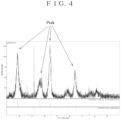
- Fig. 4 The result of analyzing the thus obtained precursor of the lithium adsorbent by XRD (X-ray diffraction) is shown in Fig. 4 .
- Fig. 4 the presence of 4 peaks pointed by arrows indicates that Li 1.6 Mn 1.6 O 4 was obtained.
- SEM image of the precursor of the lithium adsorbent is shown in Fig. 5 .
- Fig. 5 the condition of the precursor of the lithium adsorbent can be understood.
- a portion (10 g) of the thus obtained precursor of the lithium adsorbent was separated and then added into a 200-mL beaker, and then 150 mL of an aqueous hydrochloric acid solution prepared at 1.0 mol/L through dilution of hydrochloric acid (Wako Pure Chemical Corporation) with pure water was added, followed by about 1 hour of mixing and stirring. After mixing and stirring, the slurry was filtered by suction using a Buchner funnel for solid-liquid separation, thereby collecting powder.
- the collected powder was added again into a 200-mL beaker, and then 150 mL of an aqueous hydrochloric acid solution prepared at 1.0 mol/L was added, followed by about 1 hour of mixing and stirring. After mixing and stirring, the slurry was filtered by suction using a Buchner funnel for solid-liquid separation, thereby collecting powder. The thus collected powder was washed with about 500 mL of pure water to remove a liquid adhering thereto, and then dried using a dryer at 60°C for about 24 hours in air. An adsorbent (7 g) was obtained by the procedure. The filtrate collected by solid-liquid separation was analyzed by ICP-AES, so as to find the liquation rate of lithium from the precursor. The liquation rate of lithium was about 78%.
- Lithium chloride, sodium chloride, magnesium chloride and potassium chloride (all produced by Wako Pure Chemical Corporation) were dissolved in pure water to prepare an aqueous solution with a lithium concentration of 5 g/L, a sodium concentration of 13 g/L, a magnesium concentration of 91 g/L, and a potassium concentration of 23 g/L.
- About 70 mL of the prepared aqueous solution and 7 g of the adsorbent prepared by acid treatment were added into a 200 mL beaker and then mixed and stirred. Since the pH of the aqueous solution decreases as lithium adsorption proceeds, a 8 mol/L aqueous sodium hydroxide solution (Wako Pure Chemical Corporation) was added during mixing and stirring to adjust the pH at pH 7.
- Fig. 6 The relationship between the time of stirring and mixing and the adsorption amount of lithium is shown in Fig. 6 .
- the horizontal axis indicates time
- the vertical axis indicates the adsorption amount of lithium.
- Example 2 is an example of the 2 nd embodiment.
- Manganese sulfate pentahydrate (Wako Pure Chemical Corporation) (241 g) and 84 g of lithium hydroxide monohydrate were each dissolved in pure water to result in a volume of 1 L, thereby preparing an aqueous manganese sulfate solution (1.0 mol/L) and an aqueous lithium hydroxide solution (2.0 mol/L).
- the thus prepared aqueous solutions were added into 3-L beakers, and then stirred and mixed, thereby preparing a manganese hydroxide slurry (1 st slurry).
- 420 g (10 mol) of solid lithium hydroxide monohydrate was added, and then stirring and mixing were continued (2 nd slurry).
- the 2 nd slurry was heated to 50°C, an industrial aqueous sodium hypochlorite solution with an effective concentration of 12% was added dropwise until the oxidation-reduction potential was about 400 mV as measured at the silver-silver chloride electrode.
- stirring and mixing were continued using a water bath at a temperature between 50°C and 60°C for about 5 hours.
- the thus obtained powder (oxide) appeared blackish brown.
- vacuum filtration was performed, the powder was washed with pure water, and then vacuum-dried at ordinary temperature.
- the thus dried powder was pulverized in a mortar, and then fired in an oxidative atmosphere at 600°C for 24 hours. After firing, about 103 g of a precursor of a lithium adsorbent; that is, the powder of lithium manganese oxide was obtained.
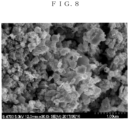
- Fig. 7 The result of analyzing the thus obtained precursor by XRD (X-ray diffraction) is shown in Fig. 7 . As shown in Fig. 7 , the presence of 4 peaks pointed by arrows indicates that Li 1.6 Mn 1.6 O 4 was obtained. Furthermore, the SEM image of the precursor of the lithium adsorbent is shown in Fig. 8 . As shown in Fig. 8 , the condition of the precursor of the lithium adsorbent can be understood.
- Lithium chloride, sodium chloride, magnesium chloride and potassium chloride (all produced by Wako Pure Chemical Corporation) were dissolved in pure water to prepare an aqueous solution with a lithium concentration of 5 g/L, a sodium concentration of 12 g/L, a magnesium concentration of 74 g/L, and a potassium concentration of 18 g/L.
- the prepared aqueous solution (800 mL) and 80 g of an adsorbent prepared in the above "Preparation of lithium adsorbent" were added into a 1-L beaker and then mixed and stirred. Since the pH of the aqueous solution decreases as lithium adsorption proceeds, a 8 mol/L aqueous sodium hydroxide solution (Wako Pure Chemical Corporation) was added during mixing and stirring to adjust the pH at pH 7.
- Fig. 9 The relationship between the time of stirring and mixing and the adsorption amount of lithium is shown in Fig. 9 .
- the horizontal axis indicates time
- the vertical axis indicates the adsorption amount of lithium.
- Example 3 is an example of the 3 rd embodiment.
- Manganese nitrate hexahydrate (28.70 g) (Wako Pure Chemical Corporation), 11.41 g of ammonium peroxodisulfate (Wako Pure Chemical Corporation), 8.39 g of lithium hydroxide monohydrate (Wako Pure Chemical Corporation) were each weighed in beakers, and then dissolved in ion exchanged water. Each aqueous solution was then diluted to result in a volume of 100 ml, thereby preparing an aqueous manganese nitrate solution (1.0 mol/L), an aqueous lithium hydroxide solution (1.0 mol/L), and an aqueous ammonium peroxodisulfate solution (0.5 mol/L).
- the total amount of the aqueous manganese nitrate solution (1.0 mol/L) was added into a Pyrex (registered trademark) 500-ml Erlenmeyer flask, and then the total amount of the aqueous lithium hydroxide solution (1.0 mol/L) was added dropwise while stirring with a stirrer (1 st mixing step). With further mixing and stirring, 41.96 g of solid lithium hydroxide monohydrate was added to make a slurry (2 nd mixing step).
- the slurry was heated to 85°C with a hot stirrer, and then the total amount of the aqueous ammonium peroxodisulfate solution (0.5 mol/L) was added dropwise to the slurry (oxidation step). Thereafter, stirring and mixing were continued while maintaining the temperature at 85°C for 10 hours. The thus obtained powder appeared brown.
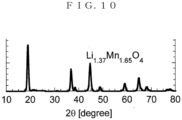
- Fig. 10 The result of analyzing the thus obtained precursor by XRD (X-ray diffraction) is shown in Fig. 10 .
- Fig. 10 Li 1.37 M 1.65 O 4 was obtained.
- SEM image of the precursor is shown in Fig. 11 .
- Fig. 11 the condition of the obtained precursor of the lithium adsorbent can be understood.
- a buffer solution prepared to have a pH ranging from 8.5 to 8.6 using ammonium chloride and a 25% aqueous ammonia solution was mixed with 0.1356 g of lithium chloride.
- the mixture was diluted to result in a volume of 200 mL, thereby preparing an aqueous lithium chloride solution (16 mol/L).
- the aqueous lithium chloride solution (10 mL) and 0.01 g of an adsorbent that had been subjected to acid treatment were added into a 50-mL Erlenmeyer flask, and then the resultant was subjected to shaking at 160 rpm with the penetration time set at 5 minutes, 10 minutes, 15 minutes, 30 minutes, 1 hour, 2 hours, 7 hours, and 24 hours.
- the lithium adsorption amount with respect to the time of shaking is shown in Fig. 12 .
- the horizontal axis indicates time
- the vertical axis indicates the adsorption amount of lithium.
Landscapes
- Chemical & Material Sciences (AREA)
- Organic Chemistry (AREA)
- Chemical Kinetics & Catalysis (AREA)
- Inorganic Chemistry (AREA)
- Analytical Chemistry (AREA)
- Life Sciences & Earth Sciences (AREA)
- Hydrology & Water Resources (AREA)
- Engineering & Computer Science (AREA)
- Environmental & Geological Engineering (AREA)
- Water Supply & Treatment (AREA)
- Thermal Sciences (AREA)
- Physics & Mathematics (AREA)
- Solid-Sorbent Or Filter-Aiding Compositions (AREA)
- Inorganic Compounds Of Heavy Metals (AREA)
Claims (7)
- Verfahren zur Herstellung eines Vorläufers für ein Lithium-Adsorptionsmittel, das die Schritte (1) bis (3) umfasst:(1) einen ersten Mischschritt: den Schritt des Mischens eines Mangansalzes und Alkalihydroxids, um eine erste Aufschlämmung zu erhalten, die Manganhydroxid enthält;(2) einen zweiten Mischschritt: den Schritt der Zugabe von Lithiumhydroxid zu der ersten Aufschlämmung und das Mischen der Mischung, um eine zweite Aufschlämmung zu erhalten;(3) einen Oxidationsschritt: den Schritt der Zugabe eines Oxidationsmittels zu der zweiten Aufschlämmung, um ein Oxid zu erhalten.
- Verfahren zur Herstellung eines Vorläufers für ein Lithium-Adsorptionsmittel nach Anspruch 1, das ferner einen Schritt des Brennens des Oxids nach dem Oxidationsschritt umfasst.
- Verfahren zur Herstellung eines Vorläufers eines Lithium-Adsorptionsmittels nach Anspruch 1 oder 2, wobei das Oxidationsmittel Natriumhypochlorit ist.
- Verfahren zur Herstellung eines Vorläufers für ein Lithium-Adsorptionsmittel nach einem der Ansprüche 1 bis 3, wobei das Mangansalz Mangansulfat ist.
- Verfahren zur Herstellung eines Vorläufers eines Lithium-Adsorptionsmittels nach Anspruch 1 oder 2, wobei das Mangansalz Mangannitrat ist, das Alkalihydroxid Lithiumhydroxid ist, das Oxidationsmittel Ammoniumperoxodisulfat und/oder Natriumperoxodisulfat ist.
- Verfahren zur Herstellung eines Vorläufers eines Lithium-Adsorptionsmittels nach einem der Ansprüche 1 bis 5, wobei das Oxidations-Reduktions-Potential der wässrigen Lösung im Oxidationsschritt an einer Silber-Silberchlorid-Elektrode 300 mV oder mehr und 1000 mV oder weniger beträgt.
- Verfahren zur Herstellung eines Vorläufers eines Lithium-Adsorptionsmittels nach einem der Ansprüche 1 bis 6, wobei der Oxidationsschritt bei 50°C oder mehr und 80°C oder weniger durchgeführt wird.
Applications Claiming Priority (4)
| Application Number | Priority Date | Filing Date | Title |
|---|---|---|---|
| JP2018081217 | 2018-04-20 | ||
| JP2018215586 | 2018-11-16 | ||
| JP2018215587 | 2018-11-16 | ||
| PCT/JP2019/016479 WO2019203274A1 (ja) | 2018-04-20 | 2019-04-17 | リチウム吸着剤の前駆体の製造方法 |
Publications (4)
| Publication Number | Publication Date |
|---|---|
| EP3705181A1 EP3705181A1 (de) | 2020-09-09 |
| EP3705181A4 EP3705181A4 (de) | 2021-06-02 |
| EP3705181B1 true EP3705181B1 (de) | 2024-09-25 |
| EP3705181C0 EP3705181C0 (de) | 2024-09-25 |
Family
ID=68238942
Family Applications (1)
| Application Number | Title | Priority Date | Filing Date |
|---|---|---|---|
| EP19787705.3A Active EP3705181B1 (de) | 2018-04-20 | 2019-04-17 | Verfahren zur herstellung eines lithiumadsorptionsvorläufers |
Country Status (8)
| Country | Link |
|---|---|
| US (1) | US12090464B2 (de) |
| EP (1) | EP3705181B1 (de) |
| JP (1) | JP7280573B2 (de) |
| CN (1) | CN111601656A (de) |
| AU (1) | AU2019256018B2 (de) |
| CA (1) | CA3087389A1 (de) |
| CL (1) | CL2020002115A1 (de) |
| WO (1) | WO2019203274A1 (de) |
Families Citing this family (2)
| Publication number | Priority date | Publication date | Assignee | Title |
|---|---|---|---|---|
| CN112791691B (zh) | 2020-12-23 | 2023-07-25 | 礼思(上海)材料科技有限公司 | 一种包覆型锂离子筛及其制备方法 |
| JP2023006193A (ja) * | 2021-06-30 | 2023-01-18 | 住友金属鉱山株式会社 | リチウム吸着用造粒体の製造方法 |
Citations (2)
| Publication number | Priority date | Publication date | Assignee | Title |
|---|---|---|---|---|
| EP1243556B1 (de) * | 1999-12-24 | 2007-02-14 | Ishihara Sangyo Kaisha, Ltd. | Verfahren zur herstellung von lithiummanganat |
| EP0969537B1 (de) * | 1997-12-22 | 2012-02-15 | Ishihara Sangyo Kaisha, Ltd. | Lithium manganat, verfahren zu dessen herstellung und so hergestellte lithiumzelle |
Family Cites Families (14)
| Publication number | Priority date | Publication date | Assignee | Title |
|---|---|---|---|---|
| DE2333966C3 (de) | 1973-07-04 | 1979-10-11 | Bayer Ag, 5090 Leverkusen | Unter Wasserausschluß lagerfähige plastische fungicid wirkende Organopolysiloxanformmassen |
| JPH0632762B2 (ja) | 1988-04-04 | 1994-05-02 | 工業技術院長 | マンガン酸化物系リチウム吸着剤からリチウムの脱着方法 |
| US5135732A (en) | 1991-04-23 | 1992-08-04 | Bell Communications Research, Inc. | Method for preparation of LiMn2 O4 intercalation compounds and use thereof in secondary lithium batteries |
| JPH0687970B2 (ja) * | 1992-07-21 | 1994-11-09 | 工業技術院長 | リチウム吸着剤及びその製造方法 |
| JP3388406B2 (ja) * | 1999-09-22 | 2003-03-24 | 独立行政法人産業技術総合研究所 | リチウム吸着剤の製造方法 |
| JP3822437B2 (ja) | 1999-12-24 | 2006-09-20 | 石原産業株式会社 | マンガン酸リチウムの製造方法及び該マンガン酸リチウムを用いてなるリチウム電池 |
| JP3937865B2 (ja) | 2002-02-22 | 2007-06-27 | 財団法人北九州産業学術推進機構 | リチウム吸着剤の製造方法 |
| AU2003218018A1 (en) | 2002-03-06 | 2003-09-22 | Enviroscrub Technologies Corporation | Regeneration, pretreatment and precipitation of oxides of manganese |
| US20040101457A1 (en) | 2002-06-11 | 2004-05-27 | Pahlman John E. | Disassociation processing of metal oxides |
| KR100939516B1 (ko) | 2007-11-29 | 2010-02-03 | 한국지질자원연구원 | 리튬 망간 산화물 및 그의 제조방법, 및 상기 산화물을이용하는 리튬 흡착제 |
| JP2010058008A (ja) | 2008-09-01 | 2010-03-18 | Toda Kogyo Corp | 吸着剤 |
| WO2011058841A1 (ja) * | 2009-11-10 | 2011-05-19 | 財団法人北九州産業学術推進機構 | リチウム吸着剤の製造方法及びリチウム吸着剤、リチウム吸着剤用原料、リチウム濃縮方法、リチウム濃縮装置 |
| CN103272554B (zh) * | 2013-06-03 | 2015-08-19 | 长沙矿冶研究院有限责任公司 | 锂锰氧化物型锂吸附剂的制备方法 |
| CN104941569A (zh) * | 2015-06-17 | 2015-09-30 | 浙江工业大学 | 一种制备锰系锂离子筛吸附剂的方法 |
-
2019
- 2019-04-17 AU AU2019256018A patent/AU2019256018B2/en active Active
- 2019-04-17 CN CN201980008356.0A patent/CN111601656A/zh active Pending
- 2019-04-17 WO PCT/JP2019/016479 patent/WO2019203274A1/ja not_active Ceased
- 2019-04-17 JP JP2020514416A patent/JP7280573B2/ja active Active
- 2019-04-17 CA CA3087389A patent/CA3087389A1/en active Pending
- 2019-04-17 EP EP19787705.3A patent/EP3705181B1/de active Active
- 2019-04-17 US US16/975,036 patent/US12090464B2/en active Active
-
2020
- 2020-08-17 CL CL2020002115A patent/CL2020002115A1/es unknown
Patent Citations (2)
| Publication number | Priority date | Publication date | Assignee | Title |
|---|---|---|---|---|
| EP0969537B1 (de) * | 1997-12-22 | 2012-02-15 | Ishihara Sangyo Kaisha, Ltd. | Lithium manganat, verfahren zu dessen herstellung und so hergestellte lithiumzelle |
| EP1243556B1 (de) * | 1999-12-24 | 2007-02-14 | Ishihara Sangyo Kaisha, Ltd. | Verfahren zur herstellung von lithiummanganat |
Also Published As
| Publication number | Publication date |
|---|---|
| US12090464B2 (en) | 2024-09-17 |
| US20200391177A1 (en) | 2020-12-17 |
| CA3087389A1 (en) | 2019-10-24 |
| CN111601656A (zh) | 2020-08-28 |
| AU2019256018B2 (en) | 2024-03-14 |
| JPWO2019203274A1 (ja) | 2021-07-15 |
| AU2019256018A1 (en) | 2020-06-18 |
| EP3705181A1 (de) | 2020-09-09 |
| EP3705181A4 (de) | 2021-06-02 |
| EP3705181C0 (de) | 2024-09-25 |
| WO2019203274A1 (ja) | 2019-10-24 |
| JP7280573B2 (ja) | 2023-05-24 |
| CL2020002115A1 (es) | 2021-01-29 |
Similar Documents
| Publication | Publication Date | Title |
|---|---|---|
| TWI877188B (zh) | 自廢鋰離子電池中回收鋰之方法 | |
| JP7645862B2 (ja) | リチウム及び他の金属を廃イオン電池から回収する方法 | |
| EP3821043B1 (de) | Verfahren zur rückgewinnung eines übergangsmetalls | |
| Chitrakar et al. | Lithium recovery from salt lake brine by H 2 TiO 3 | |
| US12152287B2 (en) | Process for the recovery of lithium and transition metal using heat | |
| EP3892588A1 (de) | Herstellungsverfahren für lithiumhaltige lösung | |
| KR101628884B1 (ko) | 알칼리금속 티탄산염의 제조 방법 | |
| TW202134182A (zh) | 純化鋰鹽的方法 | |
| JP7315887B2 (ja) | リチウムイオン二次電池用正極活物質前駆体の製造方法、リチウムイオン二次電池用正極活物質中間物の製造方法、及びそれらを併せたリチウムイオン二次電池用正極活物質の製造方法 | |
| Zhang et al. | A novel study on preparation of H 2 TiO 3–lithium adsorbent with titanyl sulfate as titanium source by inorganic precipitation–peptization method | |
| EP3705181B1 (de) | Verfahren zur herstellung eines lithiumadsorptionsvorläufers | |
| Sastre et al. | Resynthesis of cathode active material from heterogenous leachate composition produced by electric vehicle (EV) battery recycling stream | |
| AU2022405659A1 (en) | Oxidative and reductive leaching methods | |
| Zandevakili et al. | Synthesis of lithium ion sieve nanoparticles and optimizing uptake capacity by taguchi method | |
| RU2834777C1 (ru) | Способ очистки литиевых солей | |
| RU2790318C2 (ru) | Способ извлечения лития и переходного металла с применением нагревания | |
| EP4405303A1 (de) | Verfahren zur herstellung von vorläufern von kathodenaktivmaterialen für lithium-ionen-batterien | |
| JP2020106379A (ja) | 焼却灰の検査方法およびバナジウム化合物の製造方法 |
Legal Events
| Date | Code | Title | Description |
|---|---|---|---|
| STAA | Information on the status of an ep patent application or granted ep patent |
Free format text: STATUS: THE INTERNATIONAL PUBLICATION HAS BEEN MADE |
|
| PUAI | Public reference made under article 153(3) epc to a published international application that has entered the european phase |
Free format text: ORIGINAL CODE: 0009012 |
|
| STAA | Information on the status of an ep patent application or granted ep patent |
Free format text: STATUS: REQUEST FOR EXAMINATION WAS MADE |
|
| 17P | Request for examination filed |
Effective date: 20200602 |
|
| AK | Designated contracting states |
Kind code of ref document: A1 Designated state(s): AL AT BE BG CH CY CZ DE DK EE ES FI FR GB GR HR HU IE IS IT LI LT LU LV MC MK MT NL NO PL PT RO RS SE SI SK SM TR |
|
| AX | Request for extension of the european patent |
Extension state: BA ME |
|
| A4 | Supplementary search report drawn up and despatched |
Effective date: 20210503 |
|
| RIC1 | Information provided on ipc code assigned before grant |
Ipc: B01J 20/06 20060101AFI20210426BHEP Ipc: B01J 20/30 20060101ALI20210426BHEP Ipc: B01J 20/04 20060101ALI20210426BHEP Ipc: B01J 39/10 20060101ALI20210426BHEP Ipc: C01G 45/00 20060101ALI20210426BHEP |
|
| DAV | Request for validation of the european patent (deleted) | ||
| DAX | Request for extension of the european patent (deleted) | ||
| STAA | Information on the status of an ep patent application or granted ep patent |
Free format text: STATUS: EXAMINATION IS IN PROGRESS |
|
| 17Q | First examination report despatched |
Effective date: 20240116 |
|
| GRAP | Despatch of communication of intention to grant a patent |
Free format text: ORIGINAL CODE: EPIDOSNIGR1 |
|
| STAA | Information on the status of an ep patent application or granted ep patent |
Free format text: STATUS: GRANT OF PATENT IS INTENDED |
|
| INTG | Intention to grant announced |
Effective date: 20240423 |
|
| GRAS | Grant fee paid |
Free format text: ORIGINAL CODE: EPIDOSNIGR3 |
|
| GRAA | (expected) grant |
Free format text: ORIGINAL CODE: 0009210 |
|
| STAA | Information on the status of an ep patent application or granted ep patent |
Free format text: STATUS: THE PATENT HAS BEEN GRANTED |
|
| AK | Designated contracting states |
Kind code of ref document: B1 Designated state(s): AL AT BE BG CH CY CZ DE DK EE ES FI FR GB GR HR HU IE IS IT LI LT LU LV MC MK MT NL NO PL PT RO RS SE SI SK SM TR |
|
| REG | Reference to a national code |
Ref country code: GB Ref legal event code: FG4D |
|
| REG | Reference to a national code |
Ref country code: CH Ref legal event code: EP |
|
| REG | Reference to a national code |
Ref country code: DE Ref legal event code: R096 Ref document number: 602019059480 Country of ref document: DE |
|
| REG | Reference to a national code |
Ref country code: IE Ref legal event code: FG4D |
|
| U01 | Request for unitary effect filed |
Effective date: 20241008 |
|
| U07 | Unitary effect registered |
Designated state(s): AT BE BG DE DK EE FI FR IT LT LU LV MT NL PT RO SE SI Effective date: 20241028 |
|
| PG25 | Lapsed in a contracting state [announced via postgrant information from national office to epo] |
Ref country code: NO Free format text: LAPSE BECAUSE OF FAILURE TO SUBMIT A TRANSLATION OF THE DESCRIPTION OR TO PAY THE FEE WITHIN THE PRESCRIBED TIME-LIMIT Effective date: 20241225 |
|
| PG25 | Lapsed in a contracting state [announced via postgrant information from national office to epo] |
Ref country code: GR Free format text: LAPSE BECAUSE OF FAILURE TO SUBMIT A TRANSLATION OF THE DESCRIPTION OR TO PAY THE FEE WITHIN THE PRESCRIBED TIME-LIMIT Effective date: 20241226 |
|
| PG25 | Lapsed in a contracting state [announced via postgrant information from national office to epo] |
Ref country code: RS Free format text: LAPSE BECAUSE OF FAILURE TO SUBMIT A TRANSLATION OF THE DESCRIPTION OR TO PAY THE FEE WITHIN THE PRESCRIBED TIME-LIMIT Effective date: 20241225 |
|
| PG25 | Lapsed in a contracting state [announced via postgrant information from national office to epo] |
Ref country code: RS Free format text: LAPSE BECAUSE OF FAILURE TO SUBMIT A TRANSLATION OF THE DESCRIPTION OR TO PAY THE FEE WITHIN THE PRESCRIBED TIME-LIMIT Effective date: 20241225 Ref country code: NO Free format text: LAPSE BECAUSE OF FAILURE TO SUBMIT A TRANSLATION OF THE DESCRIPTION OR TO PAY THE FEE WITHIN THE PRESCRIBED TIME-LIMIT Effective date: 20241225 Ref country code: GR Free format text: LAPSE BECAUSE OF FAILURE TO SUBMIT A TRANSLATION OF THE DESCRIPTION OR TO PAY THE FEE WITHIN THE PRESCRIBED TIME-LIMIT Effective date: 20241226 |
|
| PG25 | Lapsed in a contracting state [announced via postgrant information from national office to epo] |
Ref country code: IS Free format text: LAPSE BECAUSE OF FAILURE TO SUBMIT A TRANSLATION OF THE DESCRIPTION OR TO PAY THE FEE WITHIN THE PRESCRIBED TIME-LIMIT Effective date: 20250125 |
|
| PG25 | Lapsed in a contracting state [announced via postgrant information from national office to epo] |
Ref country code: SM Free format text: LAPSE BECAUSE OF FAILURE TO SUBMIT A TRANSLATION OF THE DESCRIPTION OR TO PAY THE FEE WITHIN THE PRESCRIBED TIME-LIMIT Effective date: 20240925 |
|
| PG25 | Lapsed in a contracting state [announced via postgrant information from national office to epo] |
Ref country code: ES Free format text: LAPSE BECAUSE OF FAILURE TO SUBMIT A TRANSLATION OF THE DESCRIPTION OR TO PAY THE FEE WITHIN THE PRESCRIBED TIME-LIMIT Effective date: 20240925 |
|
| PG25 | Lapsed in a contracting state [announced via postgrant information from national office to epo] |
Ref country code: PL Free format text: LAPSE BECAUSE OF FAILURE TO SUBMIT A TRANSLATION OF THE DESCRIPTION OR TO PAY THE FEE WITHIN THE PRESCRIBED TIME-LIMIT Effective date: 20240925 Ref country code: CZ Free format text: LAPSE BECAUSE OF FAILURE TO SUBMIT A TRANSLATION OF THE DESCRIPTION OR TO PAY THE FEE WITHIN THE PRESCRIBED TIME-LIMIT Effective date: 20240925 |
|
| PG25 | Lapsed in a contracting state [announced via postgrant information from national office to epo] |
Ref country code: SK Free format text: LAPSE BECAUSE OF FAILURE TO SUBMIT A TRANSLATION OF THE DESCRIPTION OR TO PAY THE FEE WITHIN THE PRESCRIBED TIME-LIMIT Effective date: 20240925 |
|
| U20 | Renewal fee for the european patent with unitary effect paid |
Year of fee payment: 7 Effective date: 20250416 |
|
| PLBE | No opposition filed within time limit |
Free format text: ORIGINAL CODE: 0009261 |
|
| STAA | Information on the status of an ep patent application or granted ep patent |
Free format text: STATUS: NO OPPOSITION FILED WITHIN TIME LIMIT |
|
| 26N | No opposition filed |
Effective date: 20250626 |
|
| REG | Reference to a national code |
Ref country code: CH Ref legal event code: H13 Free format text: ST27 STATUS EVENT CODE: U-0-0-H10-H13 (AS PROVIDED BY THE NATIONAL OFFICE) Effective date: 20251125 |