EP3605095B1 - Kit, verfahren und reagens zur messung einer messzielsubstanz - Google Patents
Kit, verfahren und reagens zur messung einer messzielsubstanz Download PDFInfo
- Publication number
- EP3605095B1 EP3605095B1 EP18775758.8A EP18775758A EP3605095B1 EP 3605095 B1 EP3605095 B1 EP 3605095B1 EP 18775758 A EP18775758 A EP 18775758A EP 3605095 B1 EP3605095 B1 EP 3605095B1
- Authority
- EP
- European Patent Office
- Prior art keywords
- group
- particle
- formula
- measurement target
- target substance
- Prior art date
- Legal status (The legal status is an assumption and is not a legal conclusion. Google has not performed a legal analysis and makes no representation as to the accuracy of the status listed.)
- Active
Links
Images


Classifications
-
- C—CHEMISTRY; METALLURGY
- C07—ORGANIC CHEMISTRY
- C07F—ACYCLIC, CARBOCYCLIC OR HETEROCYCLIC COMPOUNDS CONTAINING ELEMENTS OTHER THAN CARBON, HYDROGEN, HALOGEN, OXYGEN, NITROGEN, SULFUR, SELENIUM OR TELLURIUM
- C07F5/00—Compounds containing elements of Groups 3 or 13 of the Periodic Table
- C07F5/02—Boron compounds
- C07F5/022—Boron compounds without C-boron linkages
-
- G—PHYSICS
- G01—MEASURING; TESTING
- G01N—INVESTIGATING OR ANALYSING MATERIALS BY DETERMINING THEIR CHEMICAL OR PHYSICAL PROPERTIES
- G01N33/00—Investigating or analysing materials by specific methods not covered by groups G01N1/00 - G01N31/00
- G01N33/48—Biological material, e.g. blood, urine; Haemocytometers
- G01N33/50—Chemical analysis of biological material, e.g. blood, urine; Testing involving biospecific ligand binding methods; Immunological testing
- G01N33/58—Chemical analysis of biological material, e.g. blood, urine; Testing involving biospecific ligand binding methods; Immunological testing involving labelled substances
- G01N33/582—Chemical analysis of biological material, e.g. blood, urine; Testing involving biospecific ligand binding methods; Immunological testing involving labelled substances with fluorescent label
-
- C—CHEMISTRY; METALLURGY
- C07—ORGANIC CHEMISTRY
- C07D—HETEROCYCLIC COMPOUNDS
- C07D209/00—Heterocyclic compounds containing five-membered rings, condensed with other rings, with one nitrogen atom as the only ring hetero atom
- C07D209/56—Ring systems containing three or more rings
-
- C—CHEMISTRY; METALLURGY
- C07—ORGANIC CHEMISTRY
- C07F—ACYCLIC, CARBOCYCLIC OR HETEROCYCLIC COMPOUNDS CONTAINING ELEMENTS OTHER THAN CARBON, HYDROGEN, HALOGEN, OXYGEN, NITROGEN, SULFUR, SELENIUM OR TELLURIUM
- C07F5/00—Compounds containing elements of Groups 3 or 13 of the Periodic Table
- C07F5/02—Boron compounds
-
- C—CHEMISTRY; METALLURGY
- C09—DYES; PAINTS; POLISHES; NATURAL RESINS; ADHESIVES; COMPOSITIONS NOT OTHERWISE PROVIDED FOR; APPLICATIONS OF MATERIALS NOT OTHERWISE PROVIDED FOR
- C09K—MATERIALS FOR MISCELLANEOUS APPLICATIONS, NOT PROVIDED FOR ELSEWHERE
- C09K11/00—Luminescent, e.g. electroluminescent, chemiluminescent materials
- C09K11/06—Luminescent, e.g. electroluminescent, chemiluminescent materials containing organic luminescent materials
-
- G—PHYSICS
- G01—MEASURING; TESTING
- G01N—INVESTIGATING OR ANALYSING MATERIALS BY DETERMINING THEIR CHEMICAL OR PHYSICAL PROPERTIES
- G01N21/00—Investigating or analysing materials by the use of optical means, i.e. using sub-millimetre waves, infrared, visible or ultraviolet light
- G01N21/62—Systems in which the material investigated is excited whereby it emits light or causes a change in wavelength of the incident light
- G01N21/63—Systems in which the material investigated is excited whereby it emits light or causes a change in wavelength of the incident light optically excited
- G01N21/64—Fluorescence; Phosphorescence
- G01N21/645—Specially adapted constructive features of fluorimeters
- G01N21/648—Specially adapted constructive features of fluorimeters using evanescent coupling or surface plasmon coupling for the excitation of fluorescence
-
- G—PHYSICS
- G01—MEASURING; TESTING
- G01N—INVESTIGATING OR ANALYSING MATERIALS BY DETERMINING THEIR CHEMICAL OR PHYSICAL PROPERTIES
- G01N33/00—Investigating or analysing materials by specific methods not covered by groups G01N1/00 - G01N31/00
- G01N33/48—Biological material, e.g. blood, urine; Haemocytometers
- G01N33/50—Chemical analysis of biological material, e.g. blood, urine; Testing involving biospecific ligand binding methods; Immunological testing
- G01N33/53—Immunoassay; Biospecific binding assay; Materials therefor
- G01N33/543—Immunoassay; Biospecific binding assay; Materials therefor with an insoluble carrier for immobilising immunochemicals
- G01N33/54393—Improving reaction conditions or stability, e.g. by coating or irradiation of surface, by reduction of non-specific binding, by promotion of specific binding
-
- G—PHYSICS
- G01—MEASURING; TESTING
- G01N—INVESTIGATING OR ANALYSING MATERIALS BY DETERMINING THEIR CHEMICAL OR PHYSICAL PROPERTIES
- G01N33/00—Investigating or analysing materials by specific methods not covered by groups G01N1/00 - G01N31/00
- G01N33/48—Biological material, e.g. blood, urine; Haemocytometers
- G01N33/50—Chemical analysis of biological material, e.g. blood, urine; Testing involving biospecific ligand binding methods; Immunological testing
- G01N33/53—Immunoassay; Biospecific binding assay; Materials therefor
- G01N33/543—Immunoassay; Biospecific binding assay; Materials therefor with an insoluble carrier for immobilising immunochemicals
- G01N33/551—Immunoassay; Biospecific binding assay; Materials therefor with an insoluble carrier for immobilising immunochemicals the carrier being inorganic
- G01N33/553—Metal or metal coated
-
- G—PHYSICS
- G01—MEASURING; TESTING
- G01N—INVESTIGATING OR ANALYSING MATERIALS BY DETERMINING THEIR CHEMICAL OR PHYSICAL PROPERTIES
- G01N33/00—Investigating or analysing materials by specific methods not covered by groups G01N1/00 - G01N31/00
- G01N33/48—Biological material, e.g. blood, urine; Haemocytometers
- G01N33/50—Chemical analysis of biological material, e.g. blood, urine; Testing involving biospecific ligand binding methods; Immunological testing
- G01N33/58—Chemical analysis of biological material, e.g. blood, urine; Testing involving biospecific ligand binding methods; Immunological testing involving labelled substances
-
- G—PHYSICS
- G01—MEASURING; TESTING
- G01N—INVESTIGATING OR ANALYSING MATERIALS BY DETERMINING THEIR CHEMICAL OR PHYSICAL PROPERTIES
- G01N33/00—Investigating or analysing materials by specific methods not covered by groups G01N1/00 - G01N31/00
- G01N33/48—Biological material, e.g. blood, urine; Haemocytometers
- G01N33/50—Chemical analysis of biological material, e.g. blood, urine; Testing involving biospecific ligand binding methods; Immunological testing
- G01N33/58—Chemical analysis of biological material, e.g. blood, urine; Testing involving biospecific ligand binding methods; Immunological testing involving labelled substances
- G01N33/585—Chemical analysis of biological material, e.g. blood, urine; Testing involving biospecific ligand binding methods; Immunological testing involving labelled substances with a particulate label, e.g. coloured latex
Definitions
- the present invention relates to a kit for measuring a measurement target substance, a method for measuring a measurement target substance, and a reagent for measuring a measurement target substance.
- a fluorescence detection method is widely used as a highly sensitive and easy measurement method for quantifying a protein, an enzyme, an inorganic compound, or the like.
- the fluorescence detection method is a method for confirming the presence of a measurement target substance by detecting the fluorescence emitted in the case where excitation light of a specific wavelength is applied to a sample considered to contain a measurement target substance which is excited by the light of a specific wavelength to emit fluorescence.
- the presence of the measurement target substance can be confirmed by bring a substance in which a substance specifically binding to the measurement target substance is labeled with a fluorescent dye into contact with a sample, and then detecting the fluorescence emitted in the case where excitation light is applied in the same manner as described above.
- a method for utilizing the effect of electric field enhancement by plasmon resonance to improve sensitivity for detecting a measurement target substance present in a small amount in order to generate plasmon resonance, a sensor chip having a metal layer in a predetermined area on a transparent support is prepared, and excitation light is incident from a surface side of the support opposite to a surface on which metal layer is formed, with respect to an interface between the support and the metal film, at a predetermined angle equal to or more than the total reflection angle.
- the surface plasmon is generated in the metal layer by the irradiation with the excitation light, and the signal/noise ratio (S/N ratio) is improved by fluorescence enhancement, which is induced by the electric field enhancement effect caused by generation of the surface plasmon, and thus high-sensitive measurement can be achieved.
- the fluorescence detection method by surface plasmon excitation (hereinafter referred to as "SPF method") is about 10 times stronger in a signal enhancement degree than the fluorescence detection method by epi-excitation (also referred to as epi-fluorescence method), and thus high-sensitive measurement can be achieved.
- XU JUNCHAO ET AL "meso-C6F5 substituted BODIPYs with distinctive spectroscopic properties and their application for bioimaging in living cells", TETRAHEDRON, vol. 70, no. 35, pages 5800-5805 , US 2011/054187 A1 , Mandy Hecht ET AL: "Fluorinated Boron-Dipyrromethene (BODIPY) dyes: Bright and Versatile Probes for Surface Analysis", Chemistry Open, vol. 2, no. 1, 9 January 2013, pages 25-38 , and US 5326692 A disclose BIDIPY dyes having high fluorescence and quantum yield for use as biological marker substances.
- Patent Document 1 discloses fluorescent microparticles produced by blending an initial donor dye having a preferable excitation peak and a final receptor dye having a preferable luminescence peak in polymer microparticles.
- a polyazaindacene dye is used as the dye.
- Non-Patent Document 1 discloses that a novel distyryl BODIPY R (registered trademark, abbreviation of boron-dipyrromethene) dye is designed and synthesized, and the synthesized distyryl BODIPY R dye has been analyzed for absorption and emission spectra in a chloromethane solution.
- a novel distyryl BODIPY R registered trademark, abbreviation of boron-dipyrromethene
- Patent Document 2 describes that in an immunological measurement method, in particular, an immunological measurement method utilizing aggregation, in order to prevent a nonspecific immune reaction of a sensitized particle having a size of 0.3 to 2.0 ⁇ m, an ultrafine particle having a size of 0.2 ⁇ m or less, to which a substance capable of reacting to a substance causing the nonspecific immune reaction is bound, is used.
- Patent Document 3 describes that in a method for detecting a test substance by an immunoagglutination reaction utilizing a sensitized particle having a size of 0.4 ⁇ m or more, in which an insoluble carrier particle having a size of 0.01 ⁇ m to 0.5 ⁇ m is used as a particle used in blocking.
- Patent Document 4 describes a method in which a substance obtained by immobilizing an antigen or an antibody that does not immunologically react with a non-measurement substance to a particle smaller than a particle reacting specifically is added, for the purpose of suppressing the nonspecific reaction.
- Patent Document 5 describes a nonspecific reaction inhibitor which is used in an immunoassay method in which an immunoassay particle obtained by supporting an antigen or an antibody that immunologically reacts with a substance to be measured on a carrier having an average particle size of 0.05 to 0.5 ⁇ m is used, and also describes that the nonspecific reaction inhibitor includes an insoluble carrier supporting an antigen or an antibody that does not immunologically react with a substance to be measured in the presence of an organic solvent and an average particle size of the insoluble carriers are smaller than an average particle size of the carriers.
- Patent Document 6 describes that in an immunodetection method using a fluorescence spectroscopy technique, influence of a nonspecific reaction is suppressed by a particle having an outer diameter of 1 ⁇ m or less.
- Patent Document 7 describes a detection method comprising: using a sensor chip comprising a sensor portion with a stacked structure including a metal layer adjacent to a dielectric plate on one side of the dielectric plate; bringing a sample into contact with the sensor portion to cause a fluorescent labeled binding substance of which an amount corresponds to an amount of a substance to be detected contained in a sample to bind to the sensor portion, the fluorescent labeled binding substance including a fluorescent label and a binding substance labeled with the fluorescent label; irradiating the sensor portion with excitation light to generate an enhanced optical electric-field on the sensor portion; and exciting the fluorescent label by the enhanced optical electric-field and detecting the amount of the substance to be detected based on an amount of light generated due to the excitation, in which a fluorescent substance including a plurality of first fluorescent dye molecules and a first particle which is formed of a light transmitting material transmitting fluorescence generated from the plurality of first fluorescent dye molecules and encompasses the plurality of first fluorescent dye molecules is used as the fluorescent label, and
- Non-Patent Document 1 Olivier Galangau et al., Org. Biomol. Chem., 2010, Vol. 8, pp. 4546 to 4553
- the SPF method is known as a method capable of high-sensitive measurement by a simple measurement method, the SPF method is not sufficiently satisfactory for the measurement of a very small amount of a measurement target substance.
- the detection methods in a competition method for measuring small molecules that cannot be sandwiched by antibodies, it has been necessary to lower a concentration of fluorescent labels in the reaction system in order to raise the detection sensitivity in a region where a concentration of a measurement target substance is low.
- the fluorescence intensity in the high concentration range of the measurement target substance is insufficient, an error becomes very large in the high concentration range, and thus there has remained a problem that the measurement target substance cannot be measured with high precision.
- Patent Documents 2 to 6 there are a specific sample in which false positive due to a nonspecific immune reaction-causing substance present in the sample is a problem, fine particles provided with a substance interacting with the nonspecific immune reaction-causing substance are used, and thus false positive can be avoided.
- the methods described in Patent Documents 2, 3, 4 and 5 have problems that the measurement by an aggregation method has low sensitivity and cannot be used for detecting an extremely small amount of a measurement target substance.
- the immunoassay method disclosed in Patent Document 2 has a disadvantage that a washing step or a centrifugation operation is required, and thus the method is not a simple measurement method.
- Patent Document 6 describes that in an immunodetection method using a fluorescence spectroscopy technique, influence of a nonspecific reaction is suppressed by a particle having an outer diameter of 1 ⁇ m or less, but the method is not very simple measurement.
- Patent Documents 7 and 8 simple immunoassay methods using a flow channel are disclosed, a specimen is measured by a measurement method using a fluorescence method, but a technique for raising detection sensitivity in a range where a concentration of a measurement target substance is low is not disclosed.
- An object of the present invention is to provide a kit, a method, and a reagent which prevent the problem of false positive due to nonspecific adsorption, suppress the increase in noise to be generated, and are capable of achieving high-precision measurement of a measurement target substance in a wide concentration range from a low concentration to a high concentration, in measurement of the measurement target substance in a biological sample by SPF method.
- a kit for measuring a measurement target substance including: a first particle having a label and modified with a first binding substance capable of specifically binding to a measurement target substance; a second particle having no label and modified with a second binding substance incapable of specifically binding to the measurement target substance; a flow channel for flowing the first particle and the second particle; and a substrate having a third binding substance capable of specifically binding to the measurement target substance or a substance capable of binding to the first binding substance, by using a particular labeled particle described below, the labeled particle having an emission maximum wavelength in a long wavelength range of 680 nm or longer and exhibiting a high quantum yield as the first particle having a label, the object can be achieved.
- subject-matter of the present invention is a kit as claimed in independent claim 1, a method as claimed in independent claim 10, and a reagent as claimed in independent claim 13.
- Embodiments of the invention are claimed in the respective dependent claims.
- the kit, the method, and the reagent of the present invention it is possible to prevent the problem of false positive due to nonspecific adsorption, suppress the increase of noise to be generated, and achieve high-precision measurement of a measurement target substance in a biological sample in a wide concentration range from a low concentration to a high concentration.
- the reagent of the present invention is used.
- the numerical range indicated by using “to” means a range including numerical values described before and after “to” as a minimum value and a maximum value, respectively.
- a kit for measuring a measurement target substance includes: a first particle having a label and modified with a first binding substance capable of specifically binding to a measurement target substance; a second particle having no label and modified with a second binding substance incapable of specifically binding to the measurement target substance; a flow channel for flowing the first particle and the second particle; and a substrate having a third binding substance capable of specifically binding to the measurement target substance or a substance capable of binding to the first binding substance, in which the first particle having a label is a luminescent labeled particle containing at least one kind of compound represented by Formula (1) and a particle.
- a second particle having no label and modified with a second binding substance incapable of specifically binding to a measurement target substance is used. Due to the above characteristics, a nonspecific reaction of the measurement target substance can be suppressed, and thus false positive can be avoided and high sensitivity can be achieved.
- a measurement target substance in a biological sample can be measured.
- the biological sample is not particularly limited as long as the sample is a sample that may contain the measurement target substance.
- biologic samples particularly body fluids (for example, blood, serums, plasma, spinal fluid, tears, sweat, urine, pus, runny nose, or sputum) or excrements (for example, feces), or e.g. organs, tissues, mucous membranes, or skin of animals (for example, humans, dogs, cats, horses) can be mentioned.
- the measurement target substance is not particularly limited.
- thyroxine (T4) triiodothyronine (T3), estradiol (E2), aldosterone, symmetrical dimethyl arginine (SDMA), bile acid, cortisol, cholesterol, corticosterone, progesterone, testosterone, estrogen, vitamins, creatinine, amino acids, ⁇ -carotene, creatinine, digoxin, theophylline, folic acid, proteins such as inflammatory markers and sepsis markers can be mentioned.
- Progesterone is a sex hormone that is secreted from ovaries and placenta and is involved in luteal function and pregnancy. Progesterone is used to diagnose menstrual cycle abnormality and infertility. Progesterone is also used to check the mating timing of dogs and ovarian remnants of cats.
- the material and form of the particles (a first particle and a second particle) in the present invention are not particularly limited, and for example, organic polymer particles such as polystyrene beads or inorganic particles such as glass beads can be used.
- organic polymer particles such as polystyrene beads or inorganic particles such as glass beads can be used.
- Specific examples of the material of the particles include a homopolymer obtained by polymerizing a monomer such as styrene, methacrylic acid, glycidyl (meth)acrylate, butadiene, vinyl chloride, vinyl acetate acrylate, methyl methacrylate, ethyl methacrylate, phenyl methacrylate, or butyl methacrylate, and a copolymer obtained by polymerizing two or more monomers.
- a latex in which the homopolymer or the copolymer is uniformly suspended may also be used.
- the particles include other organic polymer powders, inorganic substance powders, microorganisms, blood cells, cell membrane fragments, liposomes, and microcapsules. Latex particles are preferable as particles.
- the material of the latex include polystyrene, a styrene-acrylic acid copolymer, a styrene-methacrylic acid copolymer, a styrene-glycidyl (meth)acrylate copolymer, a styrene-styrene sulfonate copolymer, a methacrylic acid polymer, an acrylic acid polymer, an acrylonitrile-butadiene-styrene copolymer, a vinyl chloride-acrylic acid ester copolymer, and polyvinyl acetate acrylate.
- the latex a copolymer containing at least styrene as a monomer is preferable, and a copolymer of styrene and acrylic acid or methacrylic acid is particularly preferable.
- the method for preparing the latex is not particularly limited, and the latex can be prepared by any polymerization method.
- the luminescent particle of the present invention is used by labeling with an antibody, the presence of a surfactant makes it difficult to immobilize the antibody. Therefore, for the preparation of a latex, emulsifier-free emulsion polymerization, that is, emulsion polymerization without using an emulsifier such as a surfactant is preferable.
- the first binding substance used in the present invention is a substance capable of binding to the measurement target substance.
- an antigen, an antibody, or a complex thereof can be used, but the first binding substance is not limited thereto.
- the first binding substance is an antibody.
- the first binding substance is an antibody
- antibodies capable of binding to the measurement target substance for example, an antiserum prepared from a serum of an animal immunized with the measurement target substance, an immunoglobulin fraction purified from the antiserum, a monoclonal antibody obtained by cell fusion using spleen cells of an animal immunized with the measurement target substance, or a fragment thereof [for example, F(ab') 2 , Fab, Fab', or Fv] can be used.
- Preparation of these antibodies can be performed by a conventional method.
- the antibody may be modified as in the case of e.g. a chimeric antibody, or a commercially available antibody or an antibody prepared from an animal serum or culture supernatant by known methods can be used.
- an anti-progesterone antibody capable of binding to progesterone preferably, specifically recognizing progesterone is used as the first binding substance.
- a method for preparing an anti-progesterone antibody is described below as an example.
- a progesterone-BSA conjugate can be prepared by mixing progesterone, bovine serum albumin (hereinafter referred to as BSA), and a condensing agent. Using the conjugate as a mouse immunization antigen, mice are subcutaneously immunized at the back several times. In this case, complete Freund's adjuvant (CFA) and/or incomplete Freund's adjuvant (IFA) can be appropriately selected and then used as a mixture with the immunization antigen.
- CFA complete Freund's adjuvant
- IFA incomplete Freund's adjuvant
- the complete Freund's adjuvant is a substance that stimulates immunity and is a mixture of paraffin and ARLACEL.
- the incomplete Freund's adjuvant is an adjuvant in which dead mycobacteria or dead bacteria of Mycobacterium tuberculosis are added to the complete Freund's adjuvant to further enhance the antigenicity.
- a blood sample is collected from the mice and antibody titers are measured.
- the antigen is administered intraperitoneally in the case where a sufficient rise in the antibody titers is observed, and the spleen is isolated several days later. By fusing the spleen cells isolated from the immunized mice with mutant myeloma cells (myeloma), it is possible to prepare fused cells having an antibody-producing ability.
- Only antibody-producing cells against a target antigen are selected from the fused cells, and limiting dilution is performed to proliferate only the cell line.
- Culture (cloning) of the cells after dilution can be performed.
- the fusion cell line thus obtained is injected into the abdominal cavity of a mouse, monoclonal antibodies can be produced in ascites fluid by proliferating ascites-type antibody-producing cells, and thus a target antibody can be obtained by recovering these antibodies.
- a first particle having a label used in the present invention is a labeled particle containing at least one kind of compound represented by Formula (1) and a particle, and is also described as a fluorescent labeled particle.
- an ordinary dye compound is influenced by association in the case where the amount of incorporation into particles is increased, and thus the quantum yield decreases (this is also referred to as concentration quenching).
- concentration quenching a fluorescent dye compound having a long absorption wavelength of 650 nm or longer tends to exhibit concentration quenching, whereby it is difficult to maintain a quantum yield.
- Inclusion of a conjugated substituent in the compound represented by Formula (1) used in the present invention makes it possible to emit light of long wavelength and inclusion of a plurality of substituents in the dipyrromethene skeleton makes it also possible to suppress a decrease in the quantum yield in the polymer particle.
- suppression of intermolecular interaction for example, ⁇ - ⁇ interaction
- a plurality of substituents projecting in a direction perpendicular to the dipyrromethene skeleton is considered.
- it is possible to produce a luminescent labeled particle preferably a fluorescent particle, and more preferably a fluorescent nanoparticle having high luminance, particularly in the long wavelength range.
- the luminance is the fluorescence intensity.
- the luminescence quantum yield is high in the region of the window of the living body (in the vicinity of 650 to 900 nm which is a near-infrared wavelength range which is easy to transmit through the living body), the sensitivity of sensing using luminescence can be improved.
- the alkyl group may be any of linear, branched, cyclic, or a combination thereof, and the number of carbon atoms in the linear or branched alkyl group is preferably 1 to 36, more preferably 1 to 18, still more preferably 1 to 12, and particularly preferably 1 to 6.
- the cyclic alkyl group may be, for example, a cycloalkyl group having 3 to 8 carbon atoms.
- alkyl group examples include a methyl group, an ethyl group, an n-propyl group, an isopropyl group, an n-butyl group, an iso-butyl group, a sec-butyl group, a t-butyl group, an n-pentyl group, an n-hexyl group, an n-heptyl group, an n-octyl group, an n-nonyl group, an n-decyl group, an n-undecyl group, an n-dodecyl group, an n-tridecyl group, an n-tetradecyl group, an n-pentadecyl group, an n-hexadecyl group, an n-heptadecyl group, an n-octadecyl group, and a cyclohexyl group.
- the aryl group is preferably an aryl group having 6 to 48 carbon atoms, more preferably an aryl group having 6 to 24 carbon atoms, and still more preferably an aryl group having 6 to 14 carbon atoms, and examples thereof include a phenyl group, a naphthyl group, an anthryl group, a pyrenyl group, a phenanthrenyl group, a biphenyl group, and a fluorenyl group.
- the heterocyclic group is preferably any of 5- to 7-membered substituted or unsubstituted, saturated or unsaturated, aromatic or non-aromatic, or monocyclic or fused heterocyclic groups.
- the heterocyclic group is preferably a heterocyclic group having a ring-constituting atom selected from a carbon atom, a nitrogen atom, an oxygen atom and a sulfur atom and having at least one hetero atom selected from a nitrogen atom, an oxygen atom, or a sulfur atom, and more preferably a 5- or 6-membered aromatic heterocyclic group having 3 to 30 carbon atoms.
- heterocyclic group examples include a furyl group, a benzofuryl group, a dibenzofuryl group, a thienyl group, a benzothienyl group, a dibenzothienyl group, a pyridyl group, a pyrimidinyl group, a quinolyl group, an isoquinolyl group, an acridinyl group, a phenanthridinyl group, a pteridinyl group, a pyrazinyl group, a quinoxalinyl group, a pyrimidinyl group, a quinazolyl group, a pyridazinyl group, a cinnolinyl group, a phthalazinyl group, a triazinyl group, an oxazolyl group, a benzoxazolyl group, a thiazolyl group, a benzothiazolyl group, an imidazolyl group
- the acyl group is preferably a linear or branched alkanoyl group having 2 to 15 carbon atoms, and examples thereof include an acetyl group, a propionyl group, a butyryl group, an isobutyryl group, a valeryl group, an isovaleryl group, a pivaloyl group, a hexanoyl group, a heptanoyl group, and a benzoyl group.
- the alkoxy group is preferably an alkoxy group having 1 to 20 carbon atoms, and examples thereof include a methoxy group, an ethoxy group, a propoxy group, an n-butoxy group, a pentyloxy group, a hexyloxy group, and a heptyloxy group.
- the aryloxy group is preferably an aryloxy group having 6 to 14 carbon atoms, and examples thereof include a phenoxy group, a naphthoxy group, and an anthryloxy group.
- the alkylthio group is preferably an alkylthio group having 1 to 30 carbon atoms, and examples thereof include a methylthio group, an ethylthio group, and an n-hexadecylthio group.
- the arylthio group is preferably an arylthio group having 6 to 30 carbon atoms, and examples thereof include a phenylthio group, a p-chlorophenylthio group, and an m-methoxyphenylthio group.
- examples of the halogen atom include a fluorine atom, a chlorine atom, a bromine atom, and an iodine atom.
- examples of the aromatic ring include aromatic hydrocarbon rings such as a benzene ring, a naphthalene ring, an anthracene ring, a phenanthrene ring, a pyrene ring, a perylene ring, and a terylene ring; aromatic heterocyclic rings such as an indene ring, an azulene ring, a pyridine ring, a pyrazine ring, a pyrimidine ring, a pyrazole ring, a pyrazolidine ring, a thiazolidine ring, an oxazolidine ring, a pyran ring, a chromene ring, a pyrrole ring, a pyrrolidine ring, a benzimidazole ring, an imidazoline ring, an imidazolidine ring, an imidazole ring, a pyrazole ring, a triazo
- aromatic ring may have a substituent
- aromatic ring means both an aromatic ring having a substituent and an aromatic ring having no substituent.
- substituent of the aromatic ring the substituents described in Substituent group A to be mentioned later can be mentioned.
- examples of the amino group include an amino group; an alkyl-substituted amino group such as a mono- or dimethylamino group, a mono- or diethylamino group, or a mono or di(n-propyl)amino group; an amino group substituted with an aromatic residue such as a mono- or diphenylamino group or a mono- or a dinaphthylamino group; an amino group substituted with one alkyl group and one aromatic residue, such as a monoalkylmonophenylamino group; a benzylamino group, an acetylamino group, and a phenylacetylamino group.
- the aromatic residue means a group in which one hydrogen atom is removed from an aromatic ring, and the aromatic ring is as described above in the present specification.
- the alkyl group or aryl group represented by R 11 to R 15 may have a substituent.
- Substituent group A a sulfamoyl group, a cyano group, an isocyano group, a thiocyanato group, an isothiocyanato group, a nitro group, a nitrosyl group, a halogen atom, a hydroxy group, an amino group, a mercapto group, an amido group, an alkoxy group, an aryloxy group, an alkylthio group, an arylthio group, a carbamoyl group, an acyl group, an aldehyde group, a carbonyl group, an aryl group, an alkyl group, an alkyl group substituted with a halogen atom, an ethenyl group, an ethynyl group, a silyl group, and a trialkylsilyl group (such as a trimethylsilyl group).
- the aryl group represented by Ar 1 and Ar 2 may have a substituent.
- substituents include the substituents described in Substituent group A.
- R 11 and R 15 each independently represent an alkyl group or an aryl group, each of which may have a substituent.
- X 1 and X 2 each represent a fluorine atom.
- Ar 1 and Ar 2 each independently represent an aryl group, each of which may have a substituent.
- L 1 and L 2 each independently represent Formula (L-1) or (L-2).
- a preferred example of the compound represented by Formula (1) is a compound represented by Formula (3).
- R 11 , R 12 , R 14 , R 15 , X 1 , X 2 , Ar 1 , Ar 2 , L 1 , and L 2 are as defined in Formula (1), and preferred ranges thereof are also the same as the preferred ranges in Formula (1).
- R 31 to R 35 each independently represent a hydrogen atom, a halogen atom, an alkyl group, an aryl group, a heterocyclic group, an ethenyl group, an ethynyl group, an amino group, a cyano group, an acyl group, an alkoxy group, an aryloxy group, an alkylthio group, or an arylthio group, each of which may have a substituent (examples of the substituent include the substituents described in Substituent group A), and any one of R 31 , R 32 , R 34 , or R 35 is a group consisting of two or more atoms.
- the group consisting of two or more atoms is preferably an alkyl group, an aryl group, an ethenyl group, an ethynyl group, an amino group, a cyano group, or an alkoxy group and more preferably an alkyl group.
- alkyl groups an alkyl group consisting only of carbon atoms and hydrogen atoms or an alkyl group substituted with a halogen atom is preferable; an alkyl group consisting only of 1 to 6 carbon atoms and hydrogen atoms or an alkyl group substituted with a fluorine atom is more preferable; a methyl group, an isopropyl group, a t-butyl group, or a trifluoromethyl group is still more preferable; and a methyl group is particularly preferable.
- a preferred example of the compound represented by Formula (1) is a compound represented by Formula (4).
- R 12 , R 13 , R 14 , X 1 , X 2 , Ar 1 , Ar 2 , L 1 , and L 2 are as defined in Formula (1), and the preferred ranges thereof are also the same as the preferred ranges in Formula (1).
- R 41 and R 42 each independently represent an aryl group, each of which may have a substituent.
- substituents include the substituents described in Substituent group A.
- R 41 and R 42 are each independently an aryl group, from the viewpoint of improving a quantum yield. It is preferred to have at least one substituent at the ortho or meta position of the aryl group, and it is more preferred to have at least one substituent at the ortho position of the aryl group.
- the number of the substituent substituting for the aryl group is preferably 1 to 3 and more preferably 2 or 3.
- the substituent substituting for the aryl group is preferably an alkyl group, more preferably a methyl group, an isopropyl group, or a t-butyl group, and still more preferably a methyl group.
- a preferred example of the compound represented by Formula (1) is a compound represented by Formula (5).
- R 11 to R 15 , X 1 , X 2 , L 1 , and L 2 are as defined in Formula (1), and the preferred ranges thereof are also the same as the preferred ranges in Formula (1).
- R 51 and R 52 each independently represent an alkyl group, an aryl group, a heteroaryl group, an amino group, an acyl group, an alkoxy group, an aryloxy group, an alkylthio group, or an arylthio group, each of which may have a substituent.
- substituents described in Substituent group A include the substituents described in Substituent group A.
- R 51 and R 52 each independently are preferably an alkyl group or an alkoxy group, and from the viewpoint of improving a quantum yield, more preferably an alkyl group, still more preferably a methyl group, an ethyl group, an isopropyl group, or a t-butyl group, and particularly preferably a methyl group.
- R 51 and R 52 each independently are more preferably an alkoxy group, still more preferably a methoxy group, an ethoxy group, an isopropyloxy group, or a t-butyloxy group, and particularly preferably a methoxy group.
- Q 1 and Q 2 each independently represent an aromatic hydrocarbon ring, each of which may have a substituent.
- substituents include the substituents described in Substituent group A.
- Q 1 and Q 2 are each preferably a benzene ring, a naphthalene ring, an anthracene ring, a phenanthrene ring, or a pyrene ring, more preferably a benzene ring or a naphthalene ring, and particularly preferably a benzene ring.
- a tolyl group, a xylyl group, or a mesityl group is preferable; a xylyl group or a mesityl group is more preferable; a xylyl group having methyl groups at both ends of the ortho position relative to the bonding position with L 1 or L 2 , or a mesityl group having methyl groups at both ends of the ortho position and at the para position relative to the bonding position with L 1 or L 2 is still more preferable; and a mesityl group having methyl groups at both ends of the ortho position and at the para position relative to the bonding position with L 1 or L 2 is particularly preferable.
- the compound represented by Formula (5) is more preferably a compound represented by Formula (6).
- R 11 , R 12 , R 14 , and R 15 each independently represent an alkyl group or an aryl group, each of which may have a substituent.
- X 1 and X 2 each represent a fluorine atom.
- R 31 to R 35 each independently represent a hydrogen atom, a halogen atom, an alkyl group, an aryl group, a heterocyclic group, an ethenyl group, an ethynyl group, an amino group, an acyl group, a cyano group, an alkoxy group, an aryloxy group, an alkylthio group, or an arylthio group, each of which may have a substituent, and any one of R 31 , ..., or R 35 is a hydrogen atom.
- R 51 and R 52 each independently represent an alkyl group, an aryl group, a heteroaryl group, an amino group, an acyl group, an alkoxy group, an aryloxy group, an alkylthio group, or an arylthio group, each of which may have a substituent.
- Q 1 and Q 2 each independently represent an aromatic hydrocarbon ring, each of which may have a substituent.
- L 1 and L 2 each independently represent Formulae (L-1) or (L-2).
- R 11 and R 15 are each independently an alkyl group or an aryl group, preferably that as defined in R 41 and R 42 , that is, an aryl group. From the viewpoint of improving a quantum yield, the aryl group is preferable, while from the viewpoint of increasing a wavelength, an ethenyl group or an ethynyl group would be preferable. In the case of being an aryl group, it is preferred to have at least one substituent at the ortho or meta position of the aryl group, and it is more preferred to have at least one substituent at the ortho position of the aryl group.
- the number of the substituent substituting for the aryl group is preferably 1 to 3 and more preferably 2 or 3.
- the substituent substituting for the aryl group is preferably an alkyl group, more preferably a methyl group, an isopropyl group, or a t-butyl group, and still more preferably a methyl group.
- Compounds F-1 to F-16, F-21 to F-36, F-45 to F-57, F-59 to F-64 and F-73 to F-92 are Examples of the compounds represented by Formulae (1) to (6), while compounds F-17 to F-20, F-37 to F-44, F-58 and F-65 to F-72 are not Examples of such compounds.
- Me represents a methyl group
- Et represents an ethyl group
- iPr represents an isopropyl group
- a labeled particle may be a labeled particle containing at least one kind of energy donor compound, at least one kind of energy acceptor compound, and a particle, and in such a case, at least one kind of the energy donor compound or the energy acceptor compound is the compound represented by Formula (1).
- a luminescent particle contains the compound represented by Formula (1) as one of an energy donor compound or an energy acceptor compound, and a compound represented by Formula (10) as the other of an energy donor compound or an energy acceptor compound. That is, the luminescent particle may be a luminescent particle containing the compound represented by Formula (1) as the energy donor compound and the compound represented by Formula (10) as the energy acceptor compound, or may be a luminescent particle containing the compound represented by Formula (1) as the energy acceptor compound and the compound represented by Formula (10) as the energy donor compound.
- m1 and m2 each independently represent an integer of 0 to 4, and any one of m1 or m2 is at least one.
- M represents a metalloid atom or a metal atom.
- R 1 , R 2 , and R 3 each independently represent a hydrogen atom, an alkyl group, an aryl group, a heterocyclic group, an ethenyl group, an ethynyl group, an acyl group, an alkoxy group, an aryloxy group, an alkylthio group, or an arylthio group, each of which may have a substituent.
- Y 1 and Y 2 each independently represent a halogen atom, an alkyl group, an aryl group, a heterocyclic group, a hydroxy group, an alkoxy group, an aryloxy group, an alkylthio group, an arylthio group, an ethenyl group, or an ethynyl group, each of which may have a substituent, and Y 1 and Y 2 may be linked to each other to form a ring.
- Ar 11 and Ar 12 each independently represent an aromatic ring which may have a substituent.
- Z 1 and Z 2 each independently represent an aryl group, a heterocyclic group, or an amino group, each of which may have a substituent. In the case where m1 is two or more, a plurality of Z 1 's may be the same group or different groups, and in the case where m2 is two or more, a plurality of Z 2 's may be the same group or different groups.
- m1 and m2 each independently represent an integer of 0 to 4, and preferably both m1 and m2 are one or more.
- m1 and m2 may be the same integer or different integers, and are preferably the same integer.
- m1 and m2 are each independently one or two, more preferably, both m1 and m2 are one or two, and particularly preferably both m1 and m2 are one.
- M represents a metalloid atom or a metal atom, preferably a metalloid atom, and particularly preferably a boron atom.
- R 1 , R 2 , and R 3 each independently represent a hydrogen atom, an alkyl group, an aryl group, a heterocyclic group, an ethenyl group, an ethynyl group, an acyl group, an alkoxy group, an aryloxy group, an alkylthio group, or an arylthio group, each of which may have a substituent.
- R 1 and R 2 each independently represent an aryl group or a heterocyclic group, each of which may have a substituent.
- R 1 and R 2 may be the same as or different from each other, and are preferably the same as each other.
- R 1 and R 2 are not linked to each other to form a ring.
- R 3 represents a hydrogen atom, an alkyl group, an aryl group, or a heterocyclic group, each of which may have a substituent. More preferably, R 3 is a hydrogen atom.
- Y 1 and Y 2 each independently represent a halogen atom, an alkyl group, an aryl group, a heterocyclic group, a hydroxy group, an alkoxy group, an aryloxy group, an alkylthio group, an arylthio group, an ethenyl group, or an ethynyl group, each of which may have a substituent, and Y 1 and Y 2 may be linked to each other to form a ring.
- Y 1 and Y 2 each independently represent a halogen atom, an alkyl group, an aryl group, a hydroxy group, an alkoxy group, or an aryloxy group, each of which may have a substituent, and Y 1 and Y 2 may be linked to each other to form a ring.
- Y 1 and Y 2 are each independently halogen atoms.
- Y 1 and Y 2 are fluorine atoms.
- Y 1 and Y 2 may be the same as or different from each other, and are preferably the same as each other.
- Ar 1 and Ar 2 each independently represent an aromatic ring which may have a substituent.
- Ar 1 and Ar 2 each represent a benzene ring.
- Z 1 to Z 2 each independently represent a halogen atom, an alkyl group, an aryl group, a heterocyclic group, an ethenyl group, an ethynyl group, an acyl group, an alkoxy group, an aryloxy group, an alkylthio group, an arylthio group, or an amino group, each of which may have a substituent.
- a plurality of Z 1 's may be the same group or different groups
- a plurality of Z 2 's may be the same group or different groups.
- Z 1 and Z 2 each independently represent an aryl group which may have a substituent.
- Z 1 and Z 2 each independently represent a phenyl group, a naphthyl group, or an anthryl group, each of which may have a substituent.
- a plurality of Z 1 's are the same group.
- a plurality of Z 2 's are the same group. It is preferred that the compound represented by Formula (2) does not have acidic groups, such as a carboxylic acid group, a phosphoric acid group, and a sulfonic acid group, in a molecule.
- a preferred example of the compound represented by Formula (10) is a compound represented by Formula (10A).
- Y 1 to Y 2 each independently represent a halogen atom, an alkyl group, an aryl group, a heterocyclic group, a hydroxy group, an alkoxy group, an aryloxy group, an alkylthio group, or an arylthio group, an ethenyl group, or an ethynyl group, each of which may have a substituent.
- substituents include the substituents described in Substituent group A.
- Y 1 and Y 2 each independently represent halogen atoms.
- Y 1 and Y 2 are fluorine atoms.
- R 3 represents a hydrogen atom, an alkyl group, an aryl group, a heterocyclic group, an ethenyl group, an ethynyl group, or an acyl group, each of which may have a substituent.
- R 3 represents a hydrogen atom, an alkyl group, an aryl group, or a heterocyclic group, each of which may have a substituent.
- R 3 is a hydrogen atom.
- Ar 3 and Ar 4 each independently represent an aryl group or a heterocyclic group, each of which may have a substituent.
- substituents include the substituents described in Substituent group A.
- R 34 to R 41 each independently represent a hydrogen atom, a halogen atom, an alkyl group, an aryl group, a heterocyclic group, an ethenyl group, an ethynyl group, an acyl group, an alkoxy group, an aryloxy group, an alkylthio group, an arylthio group, or an amino group, each of which may have a substituent.
- substituents described in Substituent group A examples include the substituents described in Substituent group A.
- R 34 is preferably an aryl group which may have a substituent.
- At least one of R 34 , ..., or R 37 is an aryl group which may have a substituent
- at least one of R 38 , ..., or R 41 is an aryl group which may have a substituent.
- At least one of R 34 , ..., or R 41 is a group represented by Formula (11). Still more preferably, at least one of R 34 , ..., or R 37 is a group represented by Formula (11), and at least one of R 38 , ..., or R 41 is a group represented by Formula (11).
- R 201 to R 205 are each a hydrogen atom, a halogen atom, an alkyl group, an aryl group, a heterocyclic group, an ethenyl group, an ethynyl group, an acyl group, an alkoxy group, an aryloxy group, an alkylthio group, an arylthio group, or an amino group, and at least one of R 201 , ..., or R 205 , is an atom or group other than a hydrogen atom.
- R 201 and R 202 may be linked to each other to form a ring
- R 202 and R 203 may be linked to each other to form a ring
- R 203 and R 204 may be linked to each other to form a ring
- R 204 and R 205 may be linked to each other to form a ring.
- At least one of R 34 , ..., or R 41 is a group represented by Formula (12). More preferably, at least one of R 34 , ..., or R 37 is a group represented by Formula (12), and at least one of R 38 , ..., or R 41 is a group represented by Formula (12).
- R 101 represents a hydrogen atom, an alkyl group, an aryl group, a heterocyclic group, an ethenyl group, an ethynyl group, or an acyl group, each of which may have a substituent.
- substituents described in Substituent group A include the substituents described in Substituent group A.
- Ar 101 represents an aryl group or a heterocyclic group, each of which may have a substituent. Examples of the substituent include the substituents described in Substituent group A.
- Ar 101 and R 101 may be linked to each other to form a ring.
- the compound represented by Formula (10) does not have acidic groups, such as a carboxylic acid group, a phosphoric acid group, and a sulfonic acid group, in a molecule.
- Me represents a methyl group
- Bu represents an n-butyl group
- Ph represents a phenyl group.
- an absorption maximum wavelength of the energy acceptor compound is on the longer wavelength side by about 10 to 100 nm than an absorption wavelength of the energy donor compound. It is more preferred that an absorption maximum wavelength of the energy acceptor compound is on the longer wavelength side by about 10 to 70 nm than an absorption wavelength of the energy donor compound.
- the emission wavelength of the energy donor compound is than absorption wavelength (the size of the Stokes shift) varies depending on compounds, and thus it is difficult to be defined uniformly.
- the compound represented by Formula (1) has maximum emission in a wavelength which is longer than the absorption maximum wavelength by about 30 nm, and has an emission spectrum in a range of the wavelength to a wavelength longer than the wavelength by about 100 nm, it is assumed that an energy transfer system can be realized by combined use of an acceptor compound with absorption in the vicinity of the emission spectrum.
- the absorption wavelength of each compound not only can be measured after synthesizing the compounds, but also can be predicted from calculation by Gaussian or the like. Additionally, it is possible to estimate a combination of the energy donor compound and the energy acceptor compound from the relationship between the calculated values.
- the size of the Stokes shift is preferably 25 nm or more, more preferably 30 nm or more, still more preferably 35 nm or more, even more preferably 40 nm or more, even still more preferably 45 nm or more, particularly preferably 50 nm or more, and most preferably 60 nm or more.
- An upper limit of the size of the Stokes shift is not particularly limited, but is generally 150 nm or less.
- the content of the compound represented by Formula (1) for the particles used in the present invention is preferably 0.5 ⁇ mol/g to 400 ⁇ mol/g, more preferably 1 ⁇ mol/g to 300 ⁇ mol/g, still more preferably 2 ⁇ mol/g to 200 ⁇ mol/g, and particularly preferably 3 ⁇ mol/g to 100 ⁇ mol/g.
- the content of the compounds represented by Formulae (1) to (6) for the particles used in the present invention is preferably 0.1% by mass to 30% by mass, more preferably 0.2% by mass to 20% by mass, still more preferably 0.3% by mass to 10% by mass, and particularly preferably 0.4% by mass to 8% by mass.
- At least one compound represented by Formulae (1) to (6) is used, but two or more compounds represented by Formulae (1) to (6) may be used. In the case where two or more kinds of compounds represented by Formulae (1) to (6) are used, it is preferred that the total amount of the compounds falls within the above range.
- the molar ratio of the energy donor compound to the energy acceptor compound is preferably 1:10 to 20:1, more preferably 1:10 to 10:1, and still more preferably 1:5 to 10:1.
- the compounds represented by Formulae (1) to (6) can be produced, for example, according to a synthesis scheme shown in Examples which will be described later.
- Compound (3) can be produced through Compound (3-A), Compound (3-B), and Compound (3-C) from 3,5-bis(trifluoromethyl)benzaldehyde and 2,4-dimethylpyrrole as starting compounds according to the synthesis scheme of ⁇ Synthesis Example 2> in Examples which will be described later.
- Compound (1) and Compound (3) are within the definition of the compound represented by Formula (1).
- the compound represented by Formula (1) other than Compound (1) and Compound (3) can also be produced by substituting the compound used in the reaction with a compound having a substituent corresponding to a desired target compound represented by Formula (1).
- the compound represented by Formula (10) can be produced, for example, according to the following synthesis scheme.
- R 1 and Z 1 in the above synthesis scheme are the same as the definitions of R 1 and Z 1 in formula (10).
- Compound A-30 can be synthesized by reacting Compound A-10 with Compound A-20 according to the method described in Macromolecules 2010, 43, 193 to 200 . Then, Compound A-30, a compound represented by a formula of Z 1 -B(OH) 2 , and cesium fluoride (CsF) are added to a mixed solution of dimethoxyethane (DME) and water, and vacuum drawing and nitrogen substitution are repeated for degassing.
- DME dimethoxyethane
- Compound D-10 can be produced by adding palladium acetate (Pd(OAc) 2 ) and 2-dicyclohexylphosphino-2',6'-dimethoxybiphenyl (SPhos) thereto, raising the temperature, and performing the reaction under reflux for a predetermined time (for example, 2 to 24 hours).
- Pd(OAc) 2 palladium acetate
- SPhos 2-dicyclohexylphosphino-2',6'-dimethoxybiphenyl
- Compound D-10 is within the definition of the compound represented by Formula (10).
- the compound represented by Formula (10) other than Compound D-10 can also be produced by substituting any one or more of Compound A-10, Compound A-20, or the compound represented by a formula of Z 1 -B(OH) 2 with corresponding compounds.
- the luminescent labeled particle in the present invention exhibits high quantum yield and high luminance by including the compound represented by Formula (1).
- An excitation maximum wavelength of the luminescent labeled particle is a wavelength with the largest fluorescence intensity in the excitation spectrum.
- a fluorescence maximum wavelength of the luminescent labeled particle is a wavelength with the largest fluorescence intensity in the fluorescence spectrum.
- the excitation spectrum exhibits the excitation wavelength dependency of the fluorescence label intensity
- the fluorescence spectrum exhibits the fluorescence wavelength dependency of the fluorescence intensity.
- the excitation maximum wavelength of the luminescent labeled particle is preferably 640 nm to 900 nm, more preferably 640 nm to 800 nm, and still more preferably 650 nm to 750 nm.
- the fluorescence maximum wavelength of the luminescent labeled particle is preferably 660 nm to 900 nm, more preferably 660 nm to 800 nm, and still more preferably 670 nm to 750 nm.
- the fluorescence intensity of the luminescent labeled particle is fluorescence intensity in the case of being measured under a certain measurement condition, and since the fluorescence intensity depends on the measurement condition, the fluorescence intensity is generally used to make a relative comparison.
- the excitation maximum wavelength, fluorescence maximum wavelength, and fluorescence intensity of the luminescent labeled particle can be measured using a commercially available fluorescence spectrophotometer, and for example, can be measured using a fluorescence spectrophotometer RF-5300PC manufactured by Shimadzu Corporation.
- the quantum yield of the luminescent labeled particles is the ratio of the number of photons emitted as fluorescence to the number of photons absorbed by luminescent labeled particles.
- the quantum yield of the luminescent labeled particle is preferably 0.25 or more, more preferably 0.30 or more, and still more preferably 0.40 or more.
- An upper limit of the quantum yield is not particularly limited, but generally is 1.0 or less.
- the quantum yield of the luminescent labeled particles can be measured using a commercially available quantum yield measuring apparatus, and for example, can be measured using an absolute PL quantum yield spectrometer C9920-02 manufactured by Hamamatsu Photonics K.K.
- the method for producing the luminescent labeled particles is not particularly limited, but the luminescent particles can be produced by mixing particles with at least one kind of compound represented by Formula (1).
- the luminescent labeled particles can be prepared by adding the compound represented by Formula (1) to particles such as latex particles. More specifically, the luminescent labeled particles can be produced by adding a solution containing the compound represented by Formula (1) to a solution of particles containing at least one of water or a water-soluble organic solvent (e.g. tetrahydrofuran, methanol) and stirring the mixture.
- a water-soluble organic solvent e.g. tetrahydrofuran, methanol
- a dispersion liquid containing the above-described luminescent labeled particle of the present invention may be prepared.
- the dispersion liquid can be produced by dispersing the luminescent labeled particles of the present invention in a dispersion medium.
- the dispersion medium include water, an organic solvent, and a mixture of water and an organic solvent.
- an alcohol such as methanol, ethanol, or isopropanol, or an ether-based solvent such as tetrahydrofuran can be used as the organic solvent.
- the concentration of the solid content of the luminescent labeled particles in the dispersion liquid is not particularly limited, but is generally 0.1% to 20% by mass, preferably 0.5% to 10% by mass, and more preferably 1% to 5% by mass.
- the method for immobilizing the first binding substance on the luminescent labeled particle is described, for example, in JP2000-206115A or the protocol attached to FluoSpheres (registered trademark) polystyrene microsphere F8813 of Thermo Fisher Scientific Inc., and any known method for preparing a reagent for an immunoagglutination reaction can be used.
- any principle of immobilizing an antibody as a binding substance on particles any principle of physical adsorption or a chemical bond by a covalent bond can be adopted.
- a blocking agent that is, the first blocking agent covering a particle surface which is not coated with the antibody after immobilizing the antibody on the particle
- a blocking agent for example, albumin (such as BSA), skim milk, casein, a soybean-derived component, a fish-derived component, or polyethylene glycol
- blocking agents for an immune reaction containing the substances as well as substances having the same property as that of the substances can be used.
- These blocking agents can be subjected to pretreatment such as partial modification e.g. with heat, acid or alkali, as necessary.
- an antibody globulin which is incapable of binding to the measurement target substance or a protein (Protein A and Protein G) which is not used in a test area can be used.
- a specific method for immobilizing an antibody on particles is exemplified below.
- An antibody solution of which concentration is adjusted to 0.01 to 20 mg/mL is added to a liquid in which the particles are dispersed such that the concentration of the solid content of the particles becomes 0.1% to 10% by mass, and mixing is performed. Stirring is continued for 5 minutes to 48 hours under a condition of a temperature of 4°C to 50°C.
- the particle and the solution are separated by centrifugation or other methods to sufficiently remove antibodies not bound to the particle contained in the solution. Then, an operation of washing the particle with a buffer solution is repeated 0 to 10 times.
- a portion of the particle surface to which the antibody is not bound is protected using a blocking agent such as the components which do not participate in the antigen-antibody reaction, preferably protein, and more preferably globulin, albumin, BLOCKACE (registered trademark), skim milk, and casein.
- a blocking agent such as the components which do not participate in the antigen-antibody reaction, preferably protein, and more preferably globulin, albumin, BLOCKACE (registered trademark), skim milk, and casein.
- a stabilizer can be added, as necessary.
- the stabilizer is not particularly limited as long as the stabilizer stabilizes an antigen or an antibody, like a synthetic polymer or a natural polymer, such as polysaccharides or sucrose, and commercially available stabilizers such as Immunoassay Stabilizer (Advanced Biotechnologies Inc.) can also be used.
- the labeled particle having the first binding substance is contained in the kit according to the embodiment of the present invention, and an aspect in which the labeled particle is contained in a container, for example, a cup, which is a part of the kit is preferable.
- the measurement target substance in the biological sample can be bound to the first binding substance by injecting the biological sample into a container containing the labeled particle, and mixing and stirring components.
- a second particle having no label in the present invention is modified with a second binding substance incapable of specifically binding to a measurement target substance.
- a second binding substance for example, there is no particular limitation as long as the substance is a compound incapable of specifically binding to a measurement target substance, such as a binding substance (antibody) or a protein (Protein A or Protein G) which binds to the binding substance (antibody), and not having an affinity for a first binding substance, and any compound can be preferably used.
- the second binding substance is an antibody
- an antiserum prepared from a serum of an animal immunized with the measurement target substance an immunoglobulin fraction purified from the antiserum, a monoclonal antibody obtained by cell fusion using spleen cells of an animal immunized with the measurement target substance, or a fragment thereof [for example, F(ab') 2 , Fab, Fab', or Fv]
- Preparation of these antibodies can be performed by a conventional method.
- the antibody may be modified as in the case of e.g. a chimeric antibody, or a commercially available antibody or an antibody prepared from an animal serum or culture supernatant by known methods can be used.
- the method for immobilizing the second binding substance such as an antibody on the particle is described, for example, in JP2000-206115A or the protocol attached to FluoSpheres (registered trademark) polystyrene microsphere F8813 of Molecular Probes Inc., and any known method for preparing a reagent for an immunoagglutination reaction can be used.
- any principle of immobilizing an antibody as a binding substance on particles any principle of physical adsorption or a chemical bond by a covalent bond can be adopted.
- blocking agent covering a particle surface which is not coated with the antibody after immobilizing the antibody on the particle known substances, for example, BSA, skim milk, casein, a soybean-derived component, a fish-derived component, or polyethylene glycol, and commercially available blocking agents for an immune reaction containing the substances as well as substances having the same property as that of the substances can be used.
- These blocking agents can be subjected to pretreatment such as partial modification with e.g. heat, acid or alkali, as necessary.
- a mass ratio of the second particle to the first particle is preferably 1 to 6, and more preferably 2 to 6.
- Average particle sizes of the first particles and the second particles are not particularly limited, and generally 70 nm to 500 nm, preferably 70 nm to 400 nm, more preferably 70 nm to 300 nm, still more preferably 100 nm to 200 nm, even more preferably 100 nm to 190 nm, and particularly preferably 130 nm to 180 nm.
- the average particle size e.g. optical microscopy, confocal laser microscopy, electron microscopy, atomic force microscopy, static light scattering method, laser diffraction method, dynamic light scattering method, centrifugal sedimentation method, electric pulse measurement method, chromatography method, or ultrasonic attenuation method
- optical microscopy confocal laser microscopy, electron microscopy, atomic force microscopy, static light scattering method, laser diffraction method, dynamic light scattering method, centrifugal sedimentation method, electric pulse measurement method, chromatography method, or ultrasonic attenuation method
- the first particle (particle having a label) and the second particle used in the present invention may be stored in a dry state and may be used by mixing with a biological sample containing a measurement target substance at the time of measurement.
- the particles may become larger due to aggregation or fusion between the particles, and the measurement precision may change. Therefore, in this case, the first particles and the second particles can be stored in a dry state. Particles stored in a dry state are also referred to as dry particles.
- Dry particles refer to particles in a state where an amount of moisture contained is removed until a mass of the moisture (water content) to a mass of a solid content of particles which contain a labeled substance not containing moisture is preferably 30% by mass or less, more preferably 25% by mass or less, and still more preferably 20% by mass or less.
- Means for performing drying is not particularly limited and known drying means, for example, a drying method using a dehumidifying agent, a reduced-pressure drying method, and a freeze-drying method can be used.
- the first particles and the second particles may be separately dried to obtain dry particles, or may be mixed in a desired mass ratio in a solution state and then dried to obtain dry particles.
- a substrate in this case, it is preferred to use a substrate having a metal film on a surface.
- a metal constituting the metal film is not particularly limited as long as the metal can cause surface plasmon resonance.
- free-electron metals such as gold, silver, copper, aluminum, or platinum can be mentioned, and gold is particularly preferable.
- the detection area described later is on the gold film.
- the metals can be used alone or in a combination thereof. Further, in consideration of the adhesiveness to the substrate, an intervening layer including e.g.
- chromium may be provided between the substrate and the layer including metal. Thickness of the metal film is randomly determined, but for example, is preferably 1 nm or more and 500 nm or less, and particularly preferably 10 nm or more and 200 nm or less. In the case where the thickness exceeds 500 nm, a surface plasmon phenomenon of a medium cannot be detected sufficiently. Moreover, in the case of providing an intervening layer which includes e.g. chromium, it is preferred that thickness of the intervening layer is 0.1 nm or more and 10 nm or less.
- the formation of the metal film may be carried out by a conventional method, and can be carried out, for example, by a sputtering method, a vapor deposition method, an ion plating method, an electroplating method, or a non-electrolytic plating method.
- a sputtering method a vapor deposition method, an ion plating method, an electroplating method, or a non-electrolytic plating method.
- thickness of the mixed layer of the substrate material and the metal film is not particularly limited as long as sufficient adhesiveness can be ensured, and 10 nm or less is preferable.
- the metal film is preferably disposed on the substrate.
- disposed on the substrate includes a case where the metal film is disposed to be in direct contact with the substrate, and a case where the metal film is disposed not in direct contact with the substrate but in contact with the substrate through other layers.
- the material of the substrate that can be used in the present invention is, for example, optical glass such as BK7 (borosilicate glass), which is a type of general optical glass, or synthetic resin, specifically a substance formed of a material transparent to laser light, such as polymethyl methacrylate, polyethylene terephthalate, polycarbonate, or a cycloolefin polymer can be used.
- Such a substrate is preferably a material that does not exhibit anisotropy with respect to polarization and has excellent processability.
- a substrate in which a gold film is vapor-deposited on polymethyl methacrylate (PMMA) can be mentioned.
- the substrate comprises a detection area having a third binding substance capable of specifically binding to a measurement target substance or having a substance capable of binding to the first binding substance.
- a third binding substance capable of specifically binding to a measurement target substance or a substance capable of binding to the first binding substance is immobilized on the substrate to form a reaction site.
- Preferred examples of the binding substances immobilized on the reaction site include an antigen, an antibody, or a complex thereof, but are not limited thereto.
- the binding substance is an antibody
- antibodies having specificity to the measurement target substance for example, an antiserum prepared from a serum of an animal immunized with the measurement target substance, an immunoglobulin fraction purified from the antiserum, a monoclonal antibody obtained by cell fusion using spleen cells of an animal immunized with the measurement target substance, or a fragment thereof [for example, F(ab') 2 , Fab, Fab', or Fv] can be used.
- Preparation of these antibodies can be performed by a conventional method.
- the antibody may be modified as in the case of e.g.
- a chimeric antibody or a commercially available antibody or an antibody prepared from an animal serum or culture supernatant by known methods can be used.
- the first binding substance and the third binding substance are antibodies to the same antigen but epitopes recognized by the first binding substance and the third binding substance are different from each other.
- a measurement target substance itself or a substance having a portion similar to the measurement target substance and having the same epitope to the first binding substance as the measurement target substance is mentioned.
- Antibodies can be used regardless of animal species or subclasses thereof.
- an antibody that can be used in the present invention is an antibody derived from an organism in which an immune reaction can occur, such as mice, rats, hamsters, goats, rabbits, sheep, cows, or chickens, specific examples thereof include mouse IgG, mouse IgM, rat IgG, rat IgM, hamster IgG, IgM rabbit IgG, rabbit IgM, goat IgG, goat IgM, sheep IgG, sheep IgM, bovine IgG, bovine IgM, or chicken IgY, and the antibody can be applied to both of a polyclonal antibody and a monoclonal antibody.
- a fragmented antibody is a molecule derived from a complete antibody, having at least one antigen binding site, and is specifically e.g. Fab, F(ab') 2 .
- These fragmented antibodies are molecules obtained by an enzyme or chemical treatment or by using genetic engineering techniques.
- a method for immobilizing a third binding substance such as an antibody or a substance capable of binding to the first binding substance on a substrate is described in, for example, Tech Notes Vols. 2 to 12 provided by Nunc Corporation and all known methods for preparing a general Enzyme-linked immunosorbent assay (ELISA) reagent can be used.
- surface modification may be performed by placing e.g. a self-assembled monolayer (SAM) on a substrate, and in the case where an antibody is used as the third binding substance, as a principle for immobilizing the antibody on the substrate, any principle of physical adsorption or a chemical bond by a covalent bond can be adopted.
- SAM self-assembled monolayer
- blocking agent covering a substrate surface which is not coated with the antibody after immobilizing the antibody on the substrate
- known substances for example, BSA, skim milk, casein, a soybean-derived component, a fish-derived component, or polyethylene glycol
- blocking agents for an immune reaction containing the substances as well as substances having the same property as that of the substances can be used.
- These blocking agents can be subjected to pretreatment such as partial modification with e.g. heat, acid, or alkali, as necessary.
- a test area can be provided on the substrate to detect the presence or absence of the measurement target substance in the biological sample.
- an antigen can be quantified by capturing an antigen which is a measurement target substance and detecting and quantifying the amount of labels bound to the antigen.
- the antigen can be quantified by a method in which only the labels bound to the antigen is caused not to be bound, only labels not bound to the antigen is captured, and the amount of labels bound to the antigen is calculated. This detection method is referred to as a competition method and herein, the substrate relating to the competition method will be described.
- the test area of the substrate has a site for reacting with the binding substance (for example, antibody) present on the labeled particle.
- the binding substance for example, antibody
- an aspect in which the antigen present in the biological sample is on the test area of the substrate is preferable.
- the antigen and BSA are reacted in the presence of a condensing agent to prepare an antigen-BSA conjugate, and a test area can be prepared by adsorbing the conjugate onto the test area.
- the antigen-BSA conjugate which is the measurement target substance can be bound to the test area on a substrate by a method in which the conjugate is dissolved in a buffer solution, and the resultant is spotted on the substrate and left to stand for a predetermined time, the supernatant is sucked, and drying is performed.
- a control area is provided on the substrate, and the information on the test area is standardized by the information on the control area, thereby enabling the environmental dependency to be suppressed extremely low.
- the control area is preferably designed to be capable of binding to all the labels regardless of the amount of the measurement target substance present in the biological sample to be used. It is preferred to provide an antibody that interacts with all the antibodies present on the labeled particle.
- An antibody to be present in the control area preferably has a function of recognizing a binding substance (for example, antibody) present on the labeled particle, in the case where the antibody is derived from a mouse, an anti-mouse antibody is preferable, and in the case where the antibody on the labeled particle is derived from a goat, an anti-goat antibody is preferable.
- a binding substance for example, antibody
- an anti-mouse antibody is preferable
- an anti-goat antibody is preferable.
- a negative biological sample which does not contain a measurement target substance but also a biological sample which becomes negative by reacting to even a positive biological sample which contains a measurement target substance are present, and the solution to the problem of deviation at a high value is recognized as an issue.
- the cause of the false negative is not clear, but it is considered that the presence of labeled particles which are originally not desired to bind due to nonspecific interaction between the labeled particle surface not covered with the antibody and the detection area (test area) is one of the causes.
- the same substance as the substance present on the test area is present on the surface of the labeled particle, and e.g. a free antibody is present in the biological sample, even in the measurement of a positive biological sample containing the measurement target substance, the antibody may be detected as negative by binding to both the substances present on the test area and the substance on the surface of the labeled particle.
- blocking with BSA is used to suppress nonspecific adsorption onto a solid phase surface (for example, a labeled particle surface, and a gold film surface of a substrate).
- an immunoglobulin other than the immunoglobulin capable of binding to the measurement target substance specifically, an antiserum prepared from a serum of an animal immunized with an antigen different from the measurement target substance, an immunoglobulin fraction purified from the antiserum, a monoclonal antibody obtained by cell fusion using spleen cells of an animal immunized with the measurement target substance, or a fragment thereof [for example, F(ab') 2 , Fab, Fab', or Fv] can be used. Preparation of these antibodies can be performed by a conventional method. Furthermore, the antibody may be modified as in the case of e.g. a chimeric antibody, or a commercially available antibody or an antibody prepared from an animal serum or culture supernatant by known methods can be used.
- antibodies can be used regardless of animal species or subclasses thereof.
- an antibody that can be used in the present invention is an antibody derived from an organism in which an immune reaction can occur, such as mice, rats, hamsters, goats, rabbits, sheep, cows, or chickens.
- an immune reaction such as mice, rats, hamsters, goats, rabbits, sheep, cows, or chickens.
- specific examples thereof include mouse IgG, mouse IgM, rat IgG, rat IgM, hamster IgG, hamster IgM, rabbit IgG, rabbit IgM, goat IgG, goat IgM, sheep IgG, sheep IgM, bovine IgG, bovine IgM, and chicken IgY, and either polyclonal or monoclonal antibody can be used.
- a fragmented antibody is a molecule derived from a complete antibody, having at least one antigen binding site, and is specifically e.g. Fab, or F(ab') 2 .
- These fragmented antibodies are molecules obtained by an enzyme or chemical treatment or by using genetic engineering techniques.
- the kit according to the embodiment of the present invention is used in a method for measuring a measurement target substance.
- the kit in the case where the measurement target substance is bile acid, the kit is a kit for bile acid measurement and diagnosis, and in the case where the measurement target substance is progesterone, the kit is a kit for progesterone measurement and diagnosis.
- the kit in the case of performing measurement of a measurement target substance, the kit includes a substrate on which a second binding substance is immobilized, and a sensor chip including a member holding labeled particles such as fluorescent particles, but may include various instruments or apparatuses used in measurement of a measurement target substance, such as a surface plasmon excitation apparatus and a fluorescence measurement device.
- a sample containing a known amount of the measurement target substance, or an instruction manual may be included as an element of the kit.
- the method for measuring a measurement target substance in a biological sample is a method including a reaction step of reacting a biological sample with a labeled particle having a first binding substance capable of binding to a measurement target substance, a capturing step of capturing the labeled particle on a substrate having a second binding substance capable of binding to any one of the measurement target substance or the first binding substance by bringing a reaction product obtained in the reaction step into contact with the substrate, and a label information acquisition step of acquiring label information related to the measurement target substance, in which the labeled particle is a luminescent labeled particle containing at least one kind of compound represented by Formula (1) and a particle.
- the measurement target substance is measured by the measurement target substance-related label information acquisition step of acquiring label information related to the amount of the measurement target substance.
- the measurement in the present invention is interpreted as the broadest concept as long as the measurement is measurement of the amount of the measurement target substance.
- a competition method and a sandwich method are mentioned, and the competition method is preferable.
- a progesterone immunoassay substrate on which a progesterone-albumin conjugate is immobilized is brought into contact with a biological sample containing progesterone and an anti-progesterone antibody-labeled fluorescent particle.
- an antigen-antibody reaction occurs on the substrate by the anti-progesterone antibody-labeled fluorescent particle and progesterone on the substrate (that is, progesterone in a progesterone-albumin conjugate).
- an antigen-antibody reaction occurs between progesterone in the biological sample and the anti-progesterone antibody-labeled fluorescent particle, and an antigen-antibody reaction between the anti-progesterone antibody-labeled fluorescent particle and the progesterone on the substrate (that is, progesterone in the progesterone-albumin conjugate) is inhibited.
- anti-progesterone antibody-labeled fluorescent particles that do not bind to albumin on the substrate are removed.
- an immune complex that is, the complex of the anti-progesterone antibody-labeled fluorescent particle and progesterone in the progesterone-albumin conjugate on the substrate
- the concentration of progesterone (or of another test substance) in the biological sample can be measured.
- the measurement form of the fluorescence in the competition method can adopt either plate reader measurement or flow measurement, and for example, measurement can be performed by the following method.
- a plurality of samples with known amounts of progesterone having different progesterone concentrations are prepared, and these samples and the anti-progesterone antibody-labeled fluorescent particles are mixed in advance.
- This liquid mixture is brought into contact with an area where the progesterone-albumin conjugate is immobilized.
- the fluorescence signal from the area where the progesterone-albumin conjugate is immobilized is measured as a plurality of fluorescence signals while the liquid mixture is in contact with the conjugate at specific time intervals.
- temporal change (slope) in the fluorescence amount is acquired at each progesterone concentration.
- the temporal change is plotted as a Y axis and the progesterone concentration is plotted as an X axis, and a relational expression of the progesterone concentration with respect to the temporal change in the fluorescence amount is acquired using an appropriate fitting method such as the least squares method.
- the amount of progesterone contained in the biological sample can be quantified using the result of the temporal change in the fluorescence amount using the biological sample to be tested based on the relational expression thus acquired.
- the quantification is preferably performed within 10 minutes, more preferably within 8 minutes, and still more preferably within 6 minutes.
- This quantification time preferably includes time required to convert the amount of progesterone which is contained in the biological sample, based on the result of the temporal change in the fluorescence amount acquired using the biological sample to be tested after the sample and the anti-progesterone antibody-labeled fluorescent particles are brought into contact with detection area where the progesterone-albumin conjugate is immobilized, by using the relational expression between the temporal change in the fluorescence amount and the progesterone concentration, which is acquired in advance using an appropriate fitting method such as the least squares method.
- the sandwich method is not particularly limited and for example, the measurement target substance can be measured by the following procedure.
- a biological sample which may contain a measurement target substance and fluorescent particles having a first binding substance capable of binding to the measurement target substance are brought into contact with each other on a substrate.
- a binding reaction such as an antigen-antibody reaction
- the measurement target substance is present in the biological sample, a binding reaction (such as an antigen-antibody reaction) occurs among the measurement target substance, the fluorescent particles, and the substrate.
- an immune complex including a second binding substance bound to the substrate, the measurement target substance, and the fluorescent particles having the first binding substance is formed.
- the sandwich method after a reaction among the second binding substance, the measurement target substance, and the fluorescent particles having the first binding substance is completed, fluorescent particles having a first binding substance, which do not form the above-mentioned immune complex, are removed and washing is performed.
- the concentration of the measurement target substance or the like can be measured by detecting the degree of the formation of the immune complex as fluorescence intensity.
- the fluorescence intensity and the concentration of the measurement target substance have a positive correlation.
- the kit according to the invention comprises a flow channel, and in a preferred aspect of the present invention, a liquid mixture obtained by mixing a biological sample that may contain a measurement target substance, a first particle having a label, and a second particle is applied onto a substrate and developed into a flow channel.
- the flow channel is not particularly limited as long as the flow channel is a passage that allows the biological sample, the first particle having a label, and the second particle to flow down to the reaction site.
- a preferred aspect of the flow channel is a flow channel having a structure in which a spotting port for spotting a biological sample liquid containing the first particles having a label and the second particles, a metal thin film as a reaction site on which a third binding substance is immobilized, and a flow channel beyond the metal thin film are provided and the biological sample can pass over the metal thin film.
- a suction port can be provided on a side opposite to the spotting port with respect to the metal thin film.
- the method for detecting a label such as fluorescence in the present invention is not particularly limited.
- fluorescence intensity is detected using a device capable of detecting fluorescence intensity, specifically, a microplate reader or a biosensor for performing fluorescence detection by surface plasmon excitation (SPF).
- label information related to the amount of the measurement target substance can be acquired by fluorescence detection by using surface plasmon resonance.
- a form of measurement of fluorescence may be plate reader measurement or flow measurement.
- the measurement can be performed with higher sensitivity than in a fluorescence detection method by epi-excitation (epi-fluorescence method).
- a surface plasmon fluorescence (SPF) biosensor As a surface plasmon fluorescence (SPF) biosensor, a sensor described in JP2008-249361A , comprising: an optical waveguide formed of a material which transmits excitation light of a predetermined wavelength; a metal film formed on one surface of the optical waveguide; a light source for generating a light beam; an optical system for passing the light beam through the optical waveguide and causing the light beam to be incident on an interface between the optical waveguide and the metal film at an incidence angle generating the surface plasmon; and fluorescence detection means for detecting fluorescence generated by being excited by an evanescent wave enhanced due to the surface plasmon can be used.
- SPF surface plasmon fluorescence
- the fluorescence detection (SPF) system by surface plasmon excitation using the fluorescent particles of the present invention is preferably an assay method for detecting fluorescence from the fluorescent substance depending on the amount of the measurement target substance immobilized on the metal film on the substrate, and for example, is a method different from a so-called latex agglutination method in which a change in optical transparency by the progress of a reaction in a solution is detected as turbidity.
- a so-called latex agglutination method an antibody-sensitized latex in a latex reagent and an antigen in a biological sample are bound to be agglutinated by an antibody reaction.
- the latex agglutination method is a method in which the agglutinate increases over time, and the antigen concentration is quantified from the change in absorbance per unit time obtained by irradiating the agglutinate with near-infrared light.
- the method according to the embodiment of the present invention may be a method further including: a labeled particle-related label information acquisition step of acquiring label information related to the amount of the labeled particle; and a standardization step of standardizing label information acquired in a measurement target substance-related label information acquisition step of acquiring label information related to the amount of the measurement target substance, by the label information acquired in the labeled particle-related label information acquisition step.
- a step of measuring intensity of the fluorescence by the surface plasmon generated on the detection area is the measurement target substance-related label information acquisition step of acquiring label information related to the amount of the measurement target substance, and a step of measuring intensity of the fluorescence by the surface plasmon generated on the reference area is the labeled particle-related label information acquisition step.
- a step of acquiring an increase rate in the unit time of the fluorescence intensity acquired in these two steps as change rate of fluorescence signal values and dividing a change rate of signal values of the detection area by a change rate of the signal value of the reference area is a standardization step.
- a reagent for measuring a measurement target substance including: (a) first particle having a label and an average particle size of 70 nm to 500 nm, and modified with a first binding substance capable of specifically binding to a measurement target substance; and (b) second particle having no label and an average particle size of 70 nm to 500 nm, and modified with a second binding substance incapable of specifically binding to the measurement target substance, wherein the first particle having a label is a luminescent labeled particle containing at least one kind of compound represented by Formula (1) and a particle.
- the method for measuring a measurement target substance according to the embodiment of the present invention can be performed by using the above-mentioned reagent for measuring a measurement target substance.
- the obtained latex particles were re-dispersed in ultrapure water. Pure water was added thereto to prepare a diluted solution so that a concentration of the solid content was 2% by mass.
- the obtained latex particles were re-dispersed in ultrapure water. Pure water was added thereto to prepare a diluted solution so that a concentration of the solid content was 2% by mass.
- latex particles having an average particle size of 100 nm were prepared in the same manner as in the preparation of latex particles having an average particle size of 150 nm, except that a temperature at the time of raising temperature was appropriately adjusted in the preparation of latex particles having an average particle size of 150 nm.
- the average particle size was measured in the same manner as in ⁇ 1>.
- Comparative fluorescent particles modified with an anti-progesterone antibody were prepared as follows.
- a supernatant liquid was removed, 750 ⁇ L of a phosphate buffered saline (PBS, manufactured by Wako Pure Chemical Industries, Ltd.) solution (pH of 7.4) was added, and the fluorescent latex particles were re-dispersed with an ultrasonic cleaner. Centrifugation (15,000 rpm, 4°C, 15 minutes) was performed, a supernatant liquid was removed, followed by addition of 750 ⁇ L of a PBS (pH of 7.4) solution containing 1% by mass of BSA, and then the fluorescent latex particles were re-dispersed to obtain a solution of 1 mass% anti-progesterone antibody-bound fluorescent latex particles. Fluorescent latex particles having an average particle size of 200 nm or 100 nm were modified with an anti-progesterone antibody in the same manner as described above.
- PBS phosphate buffered saline
- 250 ⁇ L of a 50 mM MES buffer (pH of 6.0) solution was added to 250 ⁇ L of an aqueous solution of latex particles (average particle size of 150 nm) of 2% by mass (solid content concentration) and 100 ⁇ L of a 5 mg/mL anti-T4 monoclonal antibody (Medix Biochemica, Anti-Thyroxine monoclonal antibody (6901)) was added thereto, followed by stirring at room temperature for 15 minutes. Thereafter, 5 ⁇ L of an aqueous solution of 10 mg/mL 1-ethyl-3-(3-dimethylaminopropyl) carbodiimide (EDC) was added, followed by stirring at room temperature for 2 hours.
- EDC 1-ethyl-3-(3-dimethylaminopropyl) carbodiimide
- Latex particles having an average particle size of 220 nm or 100 nm were modified with an anti-T4 antibody in the same manner as described above.
- anti-hCG antibody modification was performed on latex particles having an average particle size of 220 nm, 150 nm, or 100 nm by using an anti-hCG antibody (Medix Biochemica, Anti-hCG beta monoclonal antibody (5008)), and thus a solution of 1 mass% anti-hCG antibody-bound fluorescent latex particles was prepared.
- Compound (8) is not a compound according to the invention.
- the resulting crude product was purified by silica gel column chromatography (developing solvent: hexane/ethyl acetate) and then dissolved in 5 ml of dichloromethane, 15 ml of methanol was further added, and then dichloromethane was distilled off, followed by reprecipitation. The precipitate was filtered to obtain 206 mg of Compound (5-C).
- Compound (8) is not a compound according to the invention.
Landscapes
- Health & Medical Sciences (AREA)
- Life Sciences & Earth Sciences (AREA)
- Chemical & Material Sciences (AREA)
- Engineering & Computer Science (AREA)
- Immunology (AREA)
- Molecular Biology (AREA)
- Biomedical Technology (AREA)
- Hematology (AREA)
- Urology & Nephrology (AREA)
- Physics & Mathematics (AREA)
- Biochemistry (AREA)
- Organic Chemistry (AREA)
- Pathology (AREA)
- General Physics & Mathematics (AREA)
- General Health & Medical Sciences (AREA)
- Analytical Chemistry (AREA)
- Biotechnology (AREA)
- Microbiology (AREA)
- Medicinal Chemistry (AREA)
- Food Science & Technology (AREA)
- Cell Biology (AREA)
- Chemical Kinetics & Catalysis (AREA)
- Inorganic Chemistry (AREA)
- Nuclear Medicine, Radiotherapy & Molecular Imaging (AREA)
- Materials Engineering (AREA)
- Investigating Or Analysing Materials By The Use Of Chemical Reactions (AREA)
- Investigating, Analyzing Materials By Fluorescence Or Luminescence (AREA)
- Plural Heterocyclic Compounds (AREA)
Claims (15)
- Kit zur Messung einer Messzielsubstanz, wobei das Kit Folgendes umfasst:Einen ersten Partikel, der eine Markierung aufweist und mit einer ersten Bindungssubstanz modifiziert ist, die in der Lage ist, spezifisch an eine Messzielsubstanz zu binden;einen zweiten Partikel, der keine Markierung aufweist und mit einer zweiten Bindungssubstanz modifiziert ist, die nicht in der Lage ist, spezifisch an die Messzielsubstanz zu binden;einen Strömungskanal zum Fließenlassen des ersten Partikels und des zweiten Partikels; undein Substrat mit einer dritten Bindungssubstanz, die in der Lage ist, spezifisch an die Messzielsubstanz zu binden, oder einer Substanz, die in der Lage ist, an die erste Bindungssubstanz zu binden,wobei der erste Partikel mit einer Markierung ein lumineszent markierter Partikel ist, der mindestens eine Art von Verbindung, die durch Formel (1) dargestellt wird, und einen Partikel umfasst,
 wobei in der Formel R11 und R15 jeweils unabhängig voneinander eine Alkylgruppe oder eine Arylgruppe darstellen, die jeweils einen Substituenten haben können; R12 und R14 jeweils unabhängig voneinander eine Alkylgruppe darstellen, die einen Substituenten haben kann; R13 eine Arylgruppe darstellt, die einen Substituenten haben kann; X1 und X2 jeweils ein Fluoratom darstellen; Ar1 und Ar2 jeweils unabhängig voneinander eine Arylgruppe darstellen, die jeweils einen Substituenten haben kann; und L1 und L2 jeweils unabhängig voneinander Formel (L-1) oder (L-2) darstellen,
- Kit nach Anspruch 1,wobei die durch Formel (1) dargestellte Verbindung eine durch Formel (3) dargestellte Verbindung ist,
 wobei in der Formel R11, R12, R14, R15, X1, X2, Ar1, Ar2, L1 und L2 wie in Formel (1) definiert sind; und R31 bis R35 jeweils unabhängig voneinander ein Wasserstoffatom, ein Halogenatom, eine Alkylgruppe, eine Arylgruppe, eine heterocyclische Gruppe, eine Ethenylgruppe, eine Ethinylgruppe, eine Aminogruppe, eine Acylgruppe, eine Cyanogruppe, eine Alkoxygruppe, eine Aryloxygruppe, eine Alkylthiogruppe oder eine Arylthiogruppe darstellen, die jeweils einen Substituenten aufweisen können, und jedes von R31, R32, R34 oder R35 eine Gruppe ist, die aus zwei oder mehr Atomen besteht.
 - Kit nach Anspruch 1 oder 2,wobei die durch Formel (1) dargestellte Verbindung eine durch Formel (4) dargestellte Verbindung ist,
 wobei in der Formel R12, R13, R14, X1, X2, Ar1, Ar2, L1 und L2 wie in Formel (1) definiert sind; und R41 und R42 jeweils unabhängig voneinander eine Arylgruppe darstellen, die jeweils einen Substituenten aufweisen kann.
 - Kit nach einem der Ansprüche 1 bis 3,wobei die durch Formel (1) dargestellte Verbindung eine durch Formel (5) dargestellte Verbindung ist,
 wobei in der Formel R11 bis R15, X1, X2, L1 und L2 wie in Formel (1) definiert sind; R51 und R52 jeweils unabhängig voneinander eine Alkylgruppe, eine Arylgruppe, eine Heteroarylgruppe, eine Aminogruppe, eine Acylgruppe, eine Alkoxygruppe, eine Aryloxygruppe, eine Alkylthiogruppe oder eine Arylthiogruppe darstellen, die jeweils einen Substituenten aufweisen können; und Q1 und Q2 jeweils unabhängig voneinander einen aromatischen Kohlenwasserstoffring darstellen, der jeweils einen Substituenten aufweisen kann.
 - Kit nach einem der Ansprüche 1 bis 4,
wobei der markierte Partikel ein lumineszierender Partikel ist, der mindestens eine Art von Energiedonorverbindung, mindestens eine Art von Energieakzeptorverbindung und einen Partikel enthält, und mindestens eine Art der Energiedonorverbindung oder der Energieakzeptorverbindung die durch Formel (1) dargestellte Verbindung ist. - Kit nach Anspruch 5,
wobei mindestens eine Art der durch Formel (1) dargestellten Verbindung als Energiedonorverbindung enthalten ist und mindestens eine Art der durch Formel (1) dargestellten Verbindung als Energieakzeptorverbindung enthalten ist. - Kit nach Anspruch 5 oder 6,
worin ein molares Verhältnis der Energiedonorverbindung zur Energieakzeptorverbindung 1:10 bis 10:1 beträgt. - Kit nach einem der Ansprüche 5 bis 7,
wobei eine Stokes-Verschiebung zwischen der Energiedonorverbindung und der Energieakzeptorverbindung 40 nm oder mehr beträgt. - Kit nach einem der Ansprüche 1 bis 8,
wobei der erste Partikel mit einer Markierung ein fluoreszierender Latexpartikel ist und der zweite Partikel ein Latexpartikel ist. - Verfahren zur Messung einer Messzielsubstanz, wobei das Verfahren umfasst:einen Schritt (i) des Mischens von (a) einem ersten Partikel, der eine Markierung aufweist und mit einer ersten Bindungssubstanz modifiziert ist, die in der Lage ist, spezifisch an eine Messzielsubstanz zu binden, (b) einem zweiten Partikel, der keine Markierung aufweist und mit einer zweiten Bindungssubstanz modifiziert ist, die nicht in der Lage ist, spezifisch an die Messzielsubstanz zu binden, und (c) einer Testprobenlösung, die die Messzielsubstanz enthält, um eine flüssige Mischung zu erhalten;einen Schritt (ii) des Auftragens der in Schritt (i) erhaltenen flüssigen Mischung auf ein Substrat;einen Schritt (iii) des Einfangens der Messzielsubstanz oder der ersten Bindungssubstanz an einer Reaktionsstelle auf dem Substrat, die eine dritte Bindungssubstanz aufweist, die in der Lage ist, spezifisch an die Messzielsubstanz oder eine Substanz zu binden, die in der Lage ist, an die erste Bindungssubstanz zu binden; undeinen Schritt (iv) des Nachweises der Messzielsubstanz oder der ersten Bindungssubstanz, die an der Reaktionsstelle eingefangen wurde,wobei das erste Partikel mit einer Markierung ein lumineszent markierter Partikel ist, der mindestens eine Art von Verbindung, die durch Formel (1) dargestellt wird, und einen Partikel enthält,
 wobei in der Formel R11 und R15 jeweils unabhängig voneinander eine Alkylgruppe oder eine Arylgruppe darstellen, die jeweils einen Substituenten haben können; R12 und R14 jeweils unabhängig voneinander eine Alkylgruppe darstellen, die einen Substituenten haben kann; R13 eine Arylgruppe darstellt, die einen Substituenten haben kann; X1 und X2 jeweils ein Fluoratom darstellen; Ar1 und Ar2 jeweils unabhängig voneinander eine Arylgruppe darstellen, die jeweils einen Substituenten haben kann; und L1 und L2 jeweils unabhängig voneinander Formel (L-1) oder (L-2) darstellen,
- Verfahren nach Anspruch 10,
wobei der erste Partikel mit einer Markierung ein fluoreszierender Latexpartikel und der zweite Partikel ein Latextpartikel ist. - Verfahren nach Anspruch 10 oder 11,
wobei in Schritt (iv) die an der Reaktionsstelle eingefangene Messzielsubstanz durch ein Oberflächenplasmonen-Fluoreszenzverfahren nachgewiesen wird. - Reagenz zur Messung einer Messzielsubstanz, wobei das Reagenz umfasst:(a) einen ersten Partikel, der eine Markierung aufweist und mit einer ersten Bindungssubstanz modifiziert ist, die in der Lage ist, spezifisch an eine Zielsubstanz für die Messzielsubstanz zu binden; und(b) einen zweiten Partikel, das keine Markierung aufweist und mit einer zweiten Bindungssubstanz modifiziert ist, die nicht in der Lage ist, spezifisch an die Messzielsubstanz zu binden,wobei der erste Partikel mit einer Markierung ein lumineszent markierte Partikel ist, der mindestens eine Art von Verbindung, die durch Formel (1) dargestellt wird, und einen Partikel enthält,
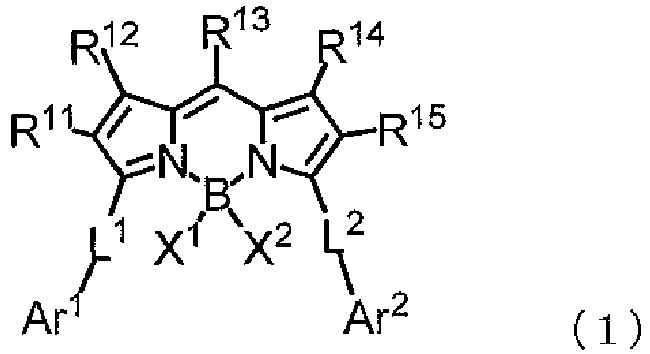 wobei in der Formel R11 und R15 jeweils unabhängig voneinander eine Alkylgruppe oder eine Arylgruppe darstellen, die jeweils einen Substituenten haben können; R12 und R14 jeweils unabhängig voneinander eine Alkylgruppe darstellen, die einen Substituenten haben kann; R13 eine Arylgruppe darstellt, die einen Substituenten haben kann; X1 und X2 jeweils ein Fluoratom darstellen; Ar1 und Ar2 jeweils unabhängig voneinander eine Arylgruppe darstellen, die jeweils einen Substituenten haben kann; und L1 und L2 jeweils unabhängig voneinander Formel (L-1) oder (L-2) darstellen,
- Reagenz zur Messung einer Messzielsubstanz nach Anspruch 13,
wobei die erste Bindungssubstanz, die in der Lage ist, spezifisch an die Messzielsubstanz zu binden, ein Antikörper ist. - Reagenz zur Messung einer Messzielsubstanz nach Anspruch 13 oder 14,
wobei der erste Partikel mit einer Markierung ein fluoreszierender Latexpartikel ist und der zweite Partikel ein Latexpartikel ist.
Applications Claiming Priority (2)
| Application Number | Priority Date | Filing Date | Title |
|---|---|---|---|
| JP2017066925 | 2017-03-30 | ||
| PCT/JP2018/013408 WO2018181798A1 (ja) | 2017-03-30 | 2018-03-29 | 測定対象物質を測定するためのキット、方法及び試薬 |
Publications (3)
| Publication Number | Publication Date |
|---|---|
| EP3605095A1 EP3605095A1 (de) | 2020-02-05 |
| EP3605095A4 EP3605095A4 (de) | 2020-03-11 |
| EP3605095B1 true EP3605095B1 (de) | 2024-07-17 |
Family
ID=63676180
Family Applications (1)
| Application Number | Title | Priority Date | Filing Date |
|---|---|---|---|
| EP18775758.8A Active EP3605095B1 (de) | 2017-03-30 | 2018-03-29 | Kit, verfahren und reagens zur messung einer messzielsubstanz |
Country Status (6)
| Country | Link |
|---|---|
| US (1) | US11733244B2 (de) |
| EP (1) | EP3605095B1 (de) |
| JP (1) | JP6808821B2 (de) |
| KR (1) | KR20190120330A (de) |
| CN (1) | CN110520732A (de) |
| WO (1) | WO2018181798A1 (de) |
Families Citing this family (8)
| Publication number | Priority date | Publication date | Assignee | Title |
|---|---|---|---|---|
| JP6756839B2 (ja) * | 2016-08-23 | 2020-09-16 | 富士フイルム株式会社 | 発光性粒子及び化合物 |
| CN110476062A (zh) | 2017-03-30 | 2019-11-19 | 富士胶片株式会社 | 用于测定活体样品中的测定对象物质的试剂盒及方法 |
| KR20190120325A (ko) | 2017-03-30 | 2019-10-23 | 후지필름 가부시키가이샤 | 생체 시료 중의 측정 대상 물질을 측정하기 위한 키트 및 방법 |
| JP6936383B2 (ja) | 2018-02-22 | 2021-09-15 | 富士フイルム株式会社 | プロゲステロン測定キット、プロゲステロンの測定方法およびプロゲステロン測定試薬 |
| KR20210058883A (ko) * | 2018-10-11 | 2021-05-24 | 휴렛-팩커드 디벨롭먼트 컴퍼니, 엘.피. | 분석 칩들 상의 분석물들을 갖는 마이크로도트들의 퇴적 |
| EP3922992A4 (de) | 2019-02-06 | 2022-05-11 | FUJIFILM Corporation | Kit zur messung eines analyten und verfahren zur bestimmung eines analyten |
| CN111606937B (zh) * | 2020-06-24 | 2021-07-16 | 南京工业大学 | 一种光敏剂探针tfdb及其制备方法与应用 |
| WO2025070448A1 (ja) * | 2023-09-26 | 2025-04-03 | 富士フイルム株式会社 | 対称性ジメチルアルギニンを測定するためのキットおよび対称性ジメチルアルギニンの測定方法 |
Family Cites Families (39)
| Publication number | Priority date | Publication date | Assignee | Title |
|---|---|---|---|---|
| JPS60256057A (ja) | 1984-06-01 | 1985-12-17 | Dai Ichi Pure Chem Co Ltd | 免疫学的測定法 |
| US5670381A (en) | 1988-01-29 | 1997-09-23 | Abbott Laboratories | Devices for performing ion-capture binding assays |
| US5326692B1 (en) | 1992-05-13 | 1996-04-30 | Molecular Probes Inc | Fluorescent microparticles with controllable enhanced stokes shift |
| US5723218A (en) | 1990-04-16 | 1998-03-03 | Molecular Probes, Inc. | Dipyrrometheneboron difluoride labeled flourescent microparticles |
| JP3185215B2 (ja) | 1990-07-13 | 2001-07-09 | 三菱化学株式会社 | 免疫測定法 |
| CA2109924A1 (en) | 1991-05-30 | 1992-12-10 | Janina Adamczyk | Reagents containing a nonspecific binding blocker in ion-capture binding assays |
| DE9216110U1 (de) | 1992-11-26 | 1993-01-28 | Biolab GmbH, 80995 München | Progesteron-Schnelltest für Mensch und Haustiere |
| JPH10153599A (ja) | 1996-11-22 | 1998-06-09 | Nof Corp | 蛋白質非特異的吸着防止剤およびその用途 |
| JP3623657B2 (ja) | 1998-05-22 | 2005-02-23 | 積水化学工業株式会社 | 非特異反応抑制剤、免疫測定試薬及び免疫測定方法 |
| JP4086266B2 (ja) | 1998-11-26 | 2008-05-14 | 日本化薬株式会社 | 免疫測定方法 |
| JP2000206115A (ja) | 1999-01-11 | 2000-07-28 | Eiken Chem Co Ltd | 抗体断片を用いた免疫凝集反応試薬 |
| JP2001021563A (ja) | 1999-07-06 | 2001-01-26 | Nitto Denko Corp | 特異的結合体 |
| US20060172357A1 (en) | 2004-12-31 | 2006-08-03 | Genentech | Detecting human antibodies in non-human serum |
| JP4668768B2 (ja) | 2005-11-01 | 2011-04-13 | 積水化学工業株式会社 | 免疫測定方法及び非特異反応抑制方法 |
| CN1944540A (zh) * | 2006-09-15 | 2007-04-11 | 大连理工大学 | 生物分析用近红外氟化硼络合二吡咯甲川类荧光染料 |
| JP2010019553A (ja) | 2006-11-02 | 2010-01-28 | Olympus Corp | 一分子蛍光分析による分子の特異的結合反応検出方法 |
| JP2008190946A (ja) | 2007-02-02 | 2008-08-21 | Kyushu Institute Of Technology | タンパク質吸着阻害剤を用いた免疫測定法と免疫測定用の基板及びキット |
| JP2008249361A (ja) | 2007-03-29 | 2008-10-16 | Fujifilm Corp | 表面プラズモンセンサーおよび免疫学的測定方法 |
| JP2010190880A (ja) | 2008-04-18 | 2010-09-02 | Fujifilm Corp | 光信号検出方法、光信号検出装置、光信号検出用試料セルおよび光信号検出用キット |
| JP5152917B2 (ja) | 2008-11-04 | 2013-02-27 | 富士フイルム株式会社 | 検出方法、検出用試料セルおよび検出用キット |
| DE102009028982A1 (de) * | 2009-08-28 | 2011-03-03 | BAM Bundesanstalt für Materialforschung und -prüfung | Difluoroboradiazaindacen-Farbstoffe |
| JP5573499B2 (ja) | 2010-08-30 | 2014-08-20 | コニカミノルタ株式会社 | 蛍光測定方法 |
| CN102174144B (zh) | 2011-01-31 | 2013-03-20 | 长沙三诺生物传感技术股份有限公司 | 一种荧光乳胶颗粒及其制备方法 |
| EP2833144B1 (de) * | 2012-03-28 | 2017-11-08 | Konica Minolta, Inc. | Verfahren zum nachweis einer biologischen substanz |
| FR2993565B1 (fr) | 2012-07-19 | 2016-01-08 | Centre Nat Rech Scient | Composes fluorescents de type thienyldipyrromethene bores et leurs utilisations. |
| JP2015072249A (ja) * | 2013-03-29 | 2015-04-16 | 富士フイルム株式会社 | 被検物質の測定方法、被検物質測定キット及び被検物質測定試薬 |
| KR20140137676A (ko) | 2013-05-23 | 2014-12-03 | 도레이케미칼 주식회사 | 광학필름용 폴리머닷 및 이를 포함하는 광학필름 |
| JP6236881B2 (ja) | 2013-06-03 | 2017-11-29 | コニカミノルタ株式会社 | 免疫染色方法、蛍光免疫染色用前処理液および免疫染色用キット |
| JP6627747B2 (ja) | 2014-02-26 | 2020-01-08 | コニカミノルタ株式会社 | 表面プラズモン励起増強蛍光分光測定用センサーチップ |
| JP6277099B2 (ja) | 2014-09-09 | 2018-02-07 | 富士フイルム株式会社 | 試薬キット、測定キット及び被検物質の測定方法。 |
| CN105462576B (zh) | 2015-09-01 | 2018-03-30 | 南京林业大学 | 一种近红外bodipy类荧光染料及其制备方法 |
| JP6532594B2 (ja) | 2016-02-29 | 2019-06-19 | 富士フイルム株式会社 | 生体試料中の測定対象物質を定量するためのキット及び生体試料中の測定対象物質を定量する方法 |
| CN106008581B (zh) | 2016-07-15 | 2017-10-20 | 福州大学 | 含六个三氟甲基基团的氟硼二吡咯衍生物及其制备和应用 |
| JP6756839B2 (ja) * | 2016-08-23 | 2020-09-16 | 富士フイルム株式会社 | 発光性粒子及び化合物 |
| WO2018038137A1 (ja) * | 2016-08-23 | 2018-03-01 | 富士フイルム株式会社 | 発光性粒子 |
| CN110476062A (zh) | 2017-03-30 | 2019-11-19 | 富士胶片株式会社 | 用于测定活体样品中的测定对象物质的试剂盒及方法 |
| KR20190120325A (ko) * | 2017-03-30 | 2019-10-23 | 후지필름 가부시키가이샤 | 생체 시료 중의 측정 대상 물질을 측정하기 위한 키트 및 방법 |
| JP6936383B2 (ja) | 2018-02-22 | 2021-09-15 | 富士フイルム株式会社 | プロゲステロン測定キット、プロゲステロンの測定方法およびプロゲステロン測定試薬 |
| EP3922992A4 (de) | 2019-02-06 | 2022-05-11 | FUJIFILM Corporation | Kit zur messung eines analyten und verfahren zur bestimmung eines analyten |
-
2018
- 2018-03-29 EP EP18775758.8A patent/EP3605095B1/de active Active
- 2018-03-29 JP JP2019510173A patent/JP6808821B2/ja active Active
- 2018-03-29 CN CN201880022538.9A patent/CN110520732A/zh active Pending
- 2018-03-29 KR KR1020197028409A patent/KR20190120330A/ko not_active Ceased
- 2018-03-29 WO PCT/JP2018/013408 patent/WO2018181798A1/ja not_active Ceased
-
2019
- 2019-09-27 US US16/585,758 patent/US11733244B2/en active Active
Also Published As
| Publication number | Publication date |
|---|---|
| EP3605095A1 (de) | 2020-02-05 |
| KR20190120330A (ko) | 2019-10-23 |
| US20200025771A1 (en) | 2020-01-23 |
| JP6808821B2 (ja) | 2021-01-06 |
| WO2018181798A1 (ja) | 2018-10-04 |
| EP3605095A4 (de) | 2020-03-11 |
| CN110520732A (zh) | 2019-11-29 |
| US11733244B2 (en) | 2023-08-22 |
| JPWO2018181798A1 (ja) | 2020-05-14 |
Similar Documents
| Publication | Publication Date | Title |
|---|---|---|
| EP3605095B1 (de) | Kit, verfahren und reagens zur messung einer messzielsubstanz | |
| US11821896B2 (en) | Kit and method for measuring measurement target substance in biological sample | |
| US11674954B2 (en) | Kit and method for measuring measurement target substance in biological sample | |
| EP3757569B1 (de) | Kit zur progesteronmessung, progesteronmessverfahren und progesteronmessreagenz | |
| EP3605091B1 (de) | Kit, verfahren und reagens zur messung einer messzielsubstanz | |
| US11674966B2 (en) | Kit and method for measuring measurement target substance in biological sample | |
| US11486879B2 (en) | Kit and method for measuring measurement target substance in biological sample |
Legal Events
| Date | Code | Title | Description |
|---|---|---|---|
| STAA | Information on the status of an ep patent application or granted ep patent |
Free format text: STATUS: THE INTERNATIONAL PUBLICATION HAS BEEN MADE |
|
| PUAI | Public reference made under article 153(3) epc to a published international application that has entered the european phase |
Free format text: ORIGINAL CODE: 0009012 |
|
| STAA | Information on the status of an ep patent application or granted ep patent |
Free format text: STATUS: REQUEST FOR EXAMINATION WAS MADE |
|
| 17P | Request for examination filed |
Effective date: 20190926 |
|
| AK | Designated contracting states |
Kind code of ref document: A1 Designated state(s): AL AT BE BG CH CY CZ DE DK EE ES FI FR GB GR HR HU IE IS IT LI LT LU LV MC MK MT NL NO PL PT RO RS SE SI SK SM TR |
|
| AX | Request for extension of the european patent |
Extension state: BA ME |
|
| A4 | Supplementary search report drawn up and despatched |
Effective date: 20200210 |
|
| RIC1 | Information provided on ipc code assigned before grant |
Ipc: G01N 33/543 20060101AFI20200204BHEP Ipc: C07F 5/02 20060101ALI20200204BHEP Ipc: G01N 21/78 20060101ALI20200204BHEP Ipc: G01N 21/64 20060101ALI20200204BHEP Ipc: G01N 37/00 20060101ALI20200204BHEP |
|
| DAV | Request for validation of the european patent (deleted) | ||
| DAX | Request for extension of the european patent (deleted) | ||
| STAA | Information on the status of an ep patent application or granted ep patent |
Free format text: STATUS: EXAMINATION IS IN PROGRESS |
|
| 17Q | First examination report despatched |
Effective date: 20210216 |
|
| RAP3 | Party data changed (applicant data changed or rights of an application transferred) |
Owner name: FUJIFILM CORPORATION |
|
| GRAP | Despatch of communication of intention to grant a patent |
Free format text: ORIGINAL CODE: EPIDOSNIGR1 |
|
| STAA | Information on the status of an ep patent application or granted ep patent |
Free format text: STATUS: GRANT OF PATENT IS INTENDED |
|
| INTG | Intention to grant announced |
Effective date: 20240220 |
|
| GRAS | Grant fee paid |
Free format text: ORIGINAL CODE: EPIDOSNIGR3 |
|
| GRAA | (expected) grant |
Free format text: ORIGINAL CODE: 0009210 |
|
| STAA | Information on the status of an ep patent application or granted ep patent |
Free format text: STATUS: THE PATENT HAS BEEN GRANTED |
|
| AK | Designated contracting states |
Kind code of ref document: B1 Designated state(s): AL AT BE BG CH CY CZ DE DK EE ES FI FR GB GR HR HU IE IS IT LI LT LU LV MC MK MT NL NO PL PT RO RS SE SI SK SM TR |
|
| P01 | Opt-out of the competence of the unified patent court (upc) registered |
Free format text: CASE NUMBER: APP_34722/2024 Effective date: 20240610 |
|
| REG | Reference to a national code |
Ref country code: CH Ref legal event code: EP |
|
| REG | Reference to a national code |
Ref country code: DE Ref legal event code: R096 Ref document number: 602018071888 Country of ref document: DE |
|
| REG | Reference to a national code |
Ref country code: IE Ref legal event code: FG4D |
|
| REG | Reference to a national code |
Ref country code: LT Ref legal event code: MG9D |
|
| REG | Reference to a national code |
Ref country code: NL Ref legal event code: MP Effective date: 20240717 |
|
| PG25 | Lapsed in a contracting state [announced via postgrant information from national office to epo] |
Ref country code: PT Free format text: LAPSE BECAUSE OF FAILURE TO SUBMIT A TRANSLATION OF THE DESCRIPTION OR TO PAY THE FEE WITHIN THE PRESCRIBED TIME-LIMIT Effective date: 20241118 |
|
| REG | Reference to a national code |
Ref country code: AT Ref legal event code: MK05 Ref document number: 1704605 Country of ref document: AT Kind code of ref document: T Effective date: 20240717 |
|
| PG25 | Lapsed in a contracting state [announced via postgrant information from national office to epo] |
Ref country code: NL Free format text: LAPSE BECAUSE OF FAILURE TO SUBMIT A TRANSLATION OF THE DESCRIPTION OR TO PAY THE FEE WITHIN THE PRESCRIBED TIME-LIMIT Effective date: 20240717 |
|
| PG25 | Lapsed in a contracting state [announced via postgrant information from national office to epo] |
Ref country code: PT Free format text: LAPSE BECAUSE OF FAILURE TO SUBMIT A TRANSLATION OF THE DESCRIPTION OR TO PAY THE FEE WITHIN THE PRESCRIBED TIME-LIMIT Effective date: 20241118 Ref country code: NL Free format text: LAPSE BECAUSE OF FAILURE TO SUBMIT A TRANSLATION OF THE DESCRIPTION OR TO PAY THE FEE WITHIN THE PRESCRIBED TIME-LIMIT Effective date: 20240717 |
|
| PG25 | Lapsed in a contracting state [announced via postgrant information from national office to epo] |
Ref country code: NO Free format text: LAPSE BECAUSE OF FAILURE TO SUBMIT A TRANSLATION OF THE DESCRIPTION OR TO PAY THE FEE WITHIN THE PRESCRIBED TIME-LIMIT Effective date: 20241017 |
|
| PG25 | Lapsed in a contracting state [announced via postgrant information from national office to epo] |
Ref country code: GR Free format text: LAPSE BECAUSE OF FAILURE TO SUBMIT A TRANSLATION OF THE DESCRIPTION OR TO PAY THE FEE WITHIN THE PRESCRIBED TIME-LIMIT Effective date: 20241018 Ref country code: FI Free format text: LAPSE BECAUSE OF FAILURE TO SUBMIT A TRANSLATION OF THE DESCRIPTION OR TO PAY THE FEE WITHIN THE PRESCRIBED TIME-LIMIT Effective date: 20240717 Ref country code: PL Free format text: LAPSE BECAUSE OF FAILURE TO SUBMIT A TRANSLATION OF THE DESCRIPTION OR TO PAY THE FEE WITHIN THE PRESCRIBED TIME-LIMIT Effective date: 20240717 |
|
| PG25 | Lapsed in a contracting state [announced via postgrant information from national office to epo] |
Ref country code: BG Free format text: LAPSE BECAUSE OF FAILURE TO SUBMIT A TRANSLATION OF THE DESCRIPTION OR TO PAY THE FEE WITHIN THE PRESCRIBED TIME-LIMIT Effective date: 20240717 |
|
| PG25 | Lapsed in a contracting state [announced via postgrant information from national office to epo] |
Ref country code: LV Free format text: LAPSE BECAUSE OF FAILURE TO SUBMIT A TRANSLATION OF THE DESCRIPTION OR TO PAY THE FEE WITHIN THE PRESCRIBED TIME-LIMIT Effective date: 20240717 |
|
| PG25 | Lapsed in a contracting state [announced via postgrant information from national office to epo] |
Ref country code: IS Free format text: LAPSE BECAUSE OF FAILURE TO SUBMIT A TRANSLATION OF THE DESCRIPTION OR TO PAY THE FEE WITHIN THE PRESCRIBED TIME-LIMIT Effective date: 20241117 Ref country code: AT Free format text: LAPSE BECAUSE OF FAILURE TO SUBMIT A TRANSLATION OF THE DESCRIPTION OR TO PAY THE FEE WITHIN THE PRESCRIBED TIME-LIMIT Effective date: 20240717 |
|
| PG25 | Lapsed in a contracting state [announced via postgrant information from national office to epo] |
Ref country code: HR Free format text: LAPSE BECAUSE OF FAILURE TO SUBMIT A TRANSLATION OF THE DESCRIPTION OR TO PAY THE FEE WITHIN THE PRESCRIBED TIME-LIMIT Effective date: 20240717 |
|
| PG25 | Lapsed in a contracting state [announced via postgrant information from national office to epo] |
Ref country code: ES Free format text: LAPSE BECAUSE OF FAILURE TO SUBMIT A TRANSLATION OF THE DESCRIPTION OR TO PAY THE FEE WITHIN THE PRESCRIBED TIME-LIMIT Effective date: 20240717 Ref country code: RS Free format text: LAPSE BECAUSE OF FAILURE TO SUBMIT A TRANSLATION OF THE DESCRIPTION OR TO PAY THE FEE WITHIN THE PRESCRIBED TIME-LIMIT Effective date: 20241017 |
|
| PG25 | Lapsed in a contracting state [announced via postgrant information from national office to epo] |
Ref country code: RS Free format text: LAPSE BECAUSE OF FAILURE TO SUBMIT A TRANSLATION OF THE DESCRIPTION OR TO PAY THE FEE WITHIN THE PRESCRIBED TIME-LIMIT Effective date: 20241017 Ref country code: PL Free format text: LAPSE BECAUSE OF FAILURE TO SUBMIT A TRANSLATION OF THE DESCRIPTION OR TO PAY THE FEE WITHIN THE PRESCRIBED TIME-LIMIT Effective date: 20240717 Ref country code: NO Free format text: LAPSE BECAUSE OF FAILURE TO SUBMIT A TRANSLATION OF THE DESCRIPTION OR TO PAY THE FEE WITHIN THE PRESCRIBED TIME-LIMIT Effective date: 20241017 Ref country code: LV Free format text: LAPSE BECAUSE OF FAILURE TO SUBMIT A TRANSLATION OF THE DESCRIPTION OR TO PAY THE FEE WITHIN THE PRESCRIBED TIME-LIMIT Effective date: 20240717 Ref country code: IS Free format text: LAPSE BECAUSE OF FAILURE TO SUBMIT A TRANSLATION OF THE DESCRIPTION OR TO PAY THE FEE WITHIN THE PRESCRIBED TIME-LIMIT Effective date: 20241117 Ref country code: HR Free format text: LAPSE BECAUSE OF FAILURE TO SUBMIT A TRANSLATION OF THE DESCRIPTION OR TO PAY THE FEE WITHIN THE PRESCRIBED TIME-LIMIT Effective date: 20240717 Ref country code: GR Free format text: LAPSE BECAUSE OF FAILURE TO SUBMIT A TRANSLATION OF THE DESCRIPTION OR TO PAY THE FEE WITHIN THE PRESCRIBED TIME-LIMIT Effective date: 20241018 Ref country code: FI Free format text: LAPSE BECAUSE OF FAILURE TO SUBMIT A TRANSLATION OF THE DESCRIPTION OR TO PAY THE FEE WITHIN THE PRESCRIBED TIME-LIMIT Effective date: 20240717 Ref country code: ES Free format text: LAPSE BECAUSE OF FAILURE TO SUBMIT A TRANSLATION OF THE DESCRIPTION OR TO PAY THE FEE WITHIN THE PRESCRIBED TIME-LIMIT Effective date: 20240717 Ref country code: BG Free format text: LAPSE BECAUSE OF FAILURE TO SUBMIT A TRANSLATION OF THE DESCRIPTION OR TO PAY THE FEE WITHIN THE PRESCRIBED TIME-LIMIT Effective date: 20240717 Ref country code: AT Free format text: LAPSE BECAUSE OF FAILURE TO SUBMIT A TRANSLATION OF THE DESCRIPTION OR TO PAY THE FEE WITHIN THE PRESCRIBED TIME-LIMIT Effective date: 20240717 |
|
| PGFP | Annual fee paid to national office [announced via postgrant information from national office to epo] |
Ref country code: DE Payment date: 20250204 Year of fee payment: 8 |
|
| PG25 | Lapsed in a contracting state [announced via postgrant information from national office to epo] |
Ref country code: SM Free format text: LAPSE BECAUSE OF FAILURE TO SUBMIT A TRANSLATION OF THE DESCRIPTION OR TO PAY THE FEE WITHIN THE PRESCRIBED TIME-LIMIT Effective date: 20240717 Ref country code: DK Free format text: LAPSE BECAUSE OF FAILURE TO SUBMIT A TRANSLATION OF THE DESCRIPTION OR TO PAY THE FEE WITHIN THE PRESCRIBED TIME-LIMIT Effective date: 20240717 Ref country code: RO Free format text: LAPSE BECAUSE OF FAILURE TO SUBMIT A TRANSLATION OF THE DESCRIPTION OR TO PAY THE FEE WITHIN THE PRESCRIBED TIME-LIMIT Effective date: 20240717 |
|
| REG | Reference to a national code |
Ref country code: DE Ref legal event code: R097 Ref document number: 602018071888 Country of ref document: DE |
|
| PG25 | Lapsed in a contracting state [announced via postgrant information from national office to epo] |
Ref country code: EE Free format text: LAPSE BECAUSE OF FAILURE TO SUBMIT A TRANSLATION OF THE DESCRIPTION OR TO PAY THE FEE WITHIN THE PRESCRIBED TIME-LIMIT Effective date: 20240717 |
|
| PG25 | Lapsed in a contracting state [announced via postgrant information from national office to epo] |
Ref country code: CZ Free format text: LAPSE BECAUSE OF FAILURE TO SUBMIT A TRANSLATION OF THE DESCRIPTION OR TO PAY THE FEE WITHIN THE PRESCRIBED TIME-LIMIT Effective date: 20240717 |
|
| PGFP | Annual fee paid to national office [announced via postgrant information from national office to epo] |
Ref country code: FR Payment date: 20250210 Year of fee payment: 8 |
|
| PG25 | Lapsed in a contracting state [announced via postgrant information from national office to epo] |
Ref country code: SK Free format text: LAPSE BECAUSE OF FAILURE TO SUBMIT A TRANSLATION OF THE DESCRIPTION OR TO PAY THE FEE WITHIN THE PRESCRIBED TIME-LIMIT Effective date: 20240717 |
|
| PGFP | Annual fee paid to national office [announced via postgrant information from national office to epo] |
Ref country code: GB Payment date: 20250206 Year of fee payment: 8 |
|
| PLBE | No opposition filed within time limit |
Free format text: ORIGINAL CODE: 0009261 |
|
| STAA | Information on the status of an ep patent application or granted ep patent |
Free format text: STATUS: NO OPPOSITION FILED WITHIN TIME LIMIT |
|
| 26N | No opposition filed |
Effective date: 20250422 |
|
| PG25 | Lapsed in a contracting state [announced via postgrant information from national office to epo] |
Ref country code: SE Free format text: LAPSE BECAUSE OF FAILURE TO SUBMIT A TRANSLATION OF THE DESCRIPTION OR TO PAY THE FEE WITHIN THE PRESCRIBED TIME-LIMIT Effective date: 20240717 |
|
| PG25 | Lapsed in a contracting state [announced via postgrant information from national office to epo] |
Ref country code: MC Free format text: LAPSE BECAUSE OF FAILURE TO SUBMIT A TRANSLATION OF THE DESCRIPTION OR TO PAY THE FEE WITHIN THE PRESCRIBED TIME-LIMIT Effective date: 20240717 |
|
| REG | Reference to a national code |
Ref country code: CH Ref legal event code: H13 Free format text: ST27 STATUS EVENT CODE: U-0-0-H10-H13 (AS PROVIDED BY THE NATIONAL OFFICE) Effective date: 20251023 |
|
| PG25 | Lapsed in a contracting state [announced via postgrant information from national office to epo] |
Ref country code: LU Free format text: LAPSE BECAUSE OF NON-PAYMENT OF DUE FEES Effective date: 20250329 |