EP3601639B1 - Chemisch beständiger, oxidischer elektrokatalysator für die sauerstoffentwicklung während der alkalischen wasserelektrolyse - Google Patents
Chemisch beständiger, oxidischer elektrokatalysator für die sauerstoffentwicklung während der alkalischen wasserelektrolyse Download PDFInfo
- Publication number
- EP3601639B1 EP3601639B1 EP18719060.8A EP18719060A EP3601639B1 EP 3601639 B1 EP3601639 B1 EP 3601639B1 EP 18719060 A EP18719060 A EP 18719060A EP 3601639 B1 EP3601639 B1 EP 3601639B1
- Authority
- EP
- European Patent Office
- Prior art keywords
- perovskite
- mixed oxide
- electrically conductive
- document
- particularly preferably
- Prior art date
- Legal status (The legal status is an assumption and is not a legal conclusion. Google has not performed a legal analysis and makes no representation as to the accuracy of the status listed.)
- Active
Links
Images
Classifications
-
- B—PERFORMING OPERATIONS; TRANSPORTING
- B01—PHYSICAL OR CHEMICAL PROCESSES OR APPARATUS IN GENERAL
- B01J—CHEMICAL OR PHYSICAL PROCESSES, e.g. CATALYSIS OR COLLOID CHEMISTRY; THEIR RELEVANT APPARATUS
- B01J21/00—Catalysts comprising the elements, oxides, or hydroxides of magnesium, boron, aluminium, carbon, silicon, titanium, zirconium, or hafnium
- B01J21/06—Silicon, titanium, zirconium or hafnium; Oxides or hydroxides thereof
- B01J21/063—Titanium; Oxides or hydroxides thereof
-
- B—PERFORMING OPERATIONS; TRANSPORTING
- B01—PHYSICAL OR CHEMICAL PROCESSES OR APPARATUS IN GENERAL
- B01J—CHEMICAL OR PHYSICAL PROCESSES, e.g. CATALYSIS OR COLLOID CHEMISTRY; THEIR RELEVANT APPARATUS
- B01J23/00—Catalysts comprising metals or metal oxides or hydroxides, not provided for in group B01J21/00
- B01J23/002—Mixed oxides other than spinels, e.g. perovskite
-
- B—PERFORMING OPERATIONS; TRANSPORTING
- B01—PHYSICAL OR CHEMICAL PROCESSES OR APPARATUS IN GENERAL
- B01J—CHEMICAL OR PHYSICAL PROCESSES, e.g. CATALYSIS OR COLLOID CHEMISTRY; THEIR RELEVANT APPARATUS
- B01J23/00—Catalysts comprising metals or metal oxides or hydroxides, not provided for in group B01J21/00
- B01J23/70—Catalysts comprising metals or metal oxides or hydroxides, not provided for in group B01J21/00 of the iron group metals or copper
- B01J23/76—Catalysts comprising metals or metal oxides or hydroxides, not provided for in group B01J21/00 of the iron group metals or copper combined with metals, oxides or hydroxides provided for in groups B01J23/02 - B01J23/36
- B01J23/78—Catalysts comprising metals or metal oxides or hydroxides, not provided for in group B01J21/00 of the iron group metals or copper combined with metals, oxides or hydroxides provided for in groups B01J23/02 - B01J23/36 with alkali- or alkaline earth metals
-
- B—PERFORMING OPERATIONS; TRANSPORTING
- B01—PHYSICAL OR CHEMICAL PROCESSES OR APPARATUS IN GENERAL
- B01J—CHEMICAL OR PHYSICAL PROCESSES, e.g. CATALYSIS OR COLLOID CHEMISTRY; THEIR RELEVANT APPARATUS
- B01J35/00—Catalysts, in general, characterised by their form or physical properties
- B01J35/19—Catalysts containing parts with different compositions
-
- C—CHEMISTRY; METALLURGY
- C25—ELECTROLYTIC OR ELECTROPHORETIC PROCESSES; APPARATUS THEREFOR
- C25B—ELECTROLYTIC OR ELECTROPHORETIC PROCESSES FOR THE PRODUCTION OF COMPOUNDS OR NON-METALS; APPARATUS THEREFOR
- C25B1/00—Electrolytic production of inorganic compounds or non-metals
- C25B1/01—Products
- C25B1/02—Hydrogen or oxygen
- C25B1/04—Hydrogen or oxygen by electrolysis of water
-
- C—CHEMISTRY; METALLURGY
- C25—ELECTROLYTIC OR ELECTROPHORETIC PROCESSES; APPARATUS THEREFOR
- C25B—ELECTROLYTIC OR ELECTROPHORETIC PROCESSES FOR THE PRODUCTION OF COMPOUNDS OR NON-METALS; APPARATUS THEREFOR
- C25B11/00—Electrodes; Manufacture thereof not otherwise provided for
- C25B11/04—Electrodes; Manufacture thereof not otherwise provided for characterised by the material
- C25B11/051—Electrodes formed of electrocatalysts on a substrate or carrier
-
- C—CHEMISTRY; METALLURGY
- C25—ELECTROLYTIC OR ELECTROPHORETIC PROCESSES; APPARATUS THEREFOR
- C25B—ELECTROLYTIC OR ELECTROPHORETIC PROCESSES FOR THE PRODUCTION OF COMPOUNDS OR NON-METALS; APPARATUS THEREFOR
- C25B11/00—Electrodes; Manufacture thereof not otherwise provided for
- C25B11/04—Electrodes; Manufacture thereof not otherwise provided for characterised by the material
- C25B11/051—Electrodes formed of electrocatalysts on a substrate or carrier
- C25B11/052—Electrodes comprising one or more electrocatalytic coatings on a substrate
-
- C—CHEMISTRY; METALLURGY
- C25—ELECTROLYTIC OR ELECTROPHORETIC PROCESSES; APPARATUS THEREFOR
- C25B—ELECTROLYTIC OR ELECTROPHORETIC PROCESSES FOR THE PRODUCTION OF COMPOUNDS OR NON-METALS; APPARATUS THEREFOR
- C25B11/00—Electrodes; Manufacture thereof not otherwise provided for
- C25B11/04—Electrodes; Manufacture thereof not otherwise provided for characterised by the material
- C25B11/051—Electrodes formed of electrocatalysts on a substrate or carrier
- C25B11/055—Electrodes formed of electrocatalysts on a substrate or carrier characterised by the substrate or carrier material
- C25B11/069—Electrodes formed of electrocatalysts on a substrate or carrier characterised by the substrate or carrier material consisting of at least one single element and at least one compound; consisting of two or more compounds
-
- C—CHEMISTRY; METALLURGY
- C25—ELECTROLYTIC OR ELECTROPHORETIC PROCESSES; APPARATUS THEREFOR
- C25B—ELECTROLYTIC OR ELECTROPHORETIC PROCESSES FOR THE PRODUCTION OF COMPOUNDS OR NON-METALS; APPARATUS THEREFOR
- C25B11/00—Electrodes; Manufacture thereof not otherwise provided for
- C25B11/04—Electrodes; Manufacture thereof not otherwise provided for characterised by the material
- C25B11/051—Electrodes formed of electrocatalysts on a substrate or carrier
- C25B11/073—Electrodes formed of electrocatalysts on a substrate or carrier characterised by the electrocatalyst material
- C25B11/075—Electrodes formed of electrocatalysts on a substrate or carrier characterised by the electrocatalyst material consisting of a single catalytic element or catalytic compound
- C25B11/077—Electrodes formed of electrocatalysts on a substrate or carrier characterised by the electrocatalyst material consisting of a single catalytic element or catalytic compound the compound being a non-noble metal oxide
- C25B11/0773—Electrodes formed of electrocatalysts on a substrate or carrier characterised by the electrocatalyst material consisting of a single catalytic element or catalytic compound the compound being a non-noble metal oxide of the perovskite type
-
- H—ELECTRICITY
- H01—ELECTRIC ELEMENTS
- H01M—PROCESSES OR MEANS, e.g. BATTERIES, FOR THE DIRECT CONVERSION OF CHEMICAL ENERGY INTO ELECTRICAL ENERGY
- H01M12/00—Hybrid cells; Manufacture thereof
- H01M12/04—Hybrid cells; Manufacture thereof composed of a half-cell of the fuel-cell type and of a half-cell of the primary-cell type
- H01M12/06—Hybrid cells; Manufacture thereof composed of a half-cell of the fuel-cell type and of a half-cell of the primary-cell type with one metallic and one gaseous electrode
-
- H—ELECTRICITY
- H01—ELECTRIC ELEMENTS
- H01M—PROCESSES OR MEANS, e.g. BATTERIES, FOR THE DIRECT CONVERSION OF CHEMICAL ENERGY INTO ELECTRICAL ENERGY
- H01M4/00—Electrodes
- H01M4/86—Inert electrodes with catalytic activity, e.g. for fuel cells
- H01M4/88—Processes of manufacture
- H01M4/8825—Methods for deposition of the catalytic active composition
-
- H—ELECTRICITY
- H01—ELECTRIC ELEMENTS
- H01M—PROCESSES OR MEANS, e.g. BATTERIES, FOR THE DIRECT CONVERSION OF CHEMICAL ENERGY INTO ELECTRICAL ENERGY
- H01M4/00—Electrodes
- H01M4/86—Inert electrodes with catalytic activity, e.g. for fuel cells
- H01M4/88—Processes of manufacture
- H01M4/8825—Methods for deposition of the catalytic active composition
- H01M4/8846—Impregnation
- H01M4/885—Impregnation followed by reduction of the catalyst salt precursor
-
- H—ELECTRICITY
- H01—ELECTRIC ELEMENTS
- H01M—PROCESSES OR MEANS, e.g. BATTERIES, FOR THE DIRECT CONVERSION OF CHEMICAL ENERGY INTO ELECTRICAL ENERGY
- H01M4/00—Electrodes
- H01M4/86—Inert electrodes with catalytic activity, e.g. for fuel cells
- H01M4/88—Processes of manufacture
- H01M4/8878—Treatment steps after deposition of the catalytic active composition or after shaping of the electrode being free-standing body
- H01M4/8882—Heat treatment, e.g. drying, baking
-
- H—ELECTRICITY
- H01—ELECTRIC ELEMENTS
- H01M—PROCESSES OR MEANS, e.g. BATTERIES, FOR THE DIRECT CONVERSION OF CHEMICAL ENERGY INTO ELECTRICAL ENERGY
- H01M4/00—Electrodes
- H01M4/86—Inert electrodes with catalytic activity, e.g. for fuel cells
- H01M4/90—Selection of catalytic material
- H01M4/9016—Oxides, hydroxides or oxygenated metallic salts
-
- H—ELECTRICITY
- H01—ELECTRIC ELEMENTS
- H01M—PROCESSES OR MEANS, e.g. BATTERIES, FOR THE DIRECT CONVERSION OF CHEMICAL ENERGY INTO ELECTRICAL ENERGY
- H01M4/00—Electrodes
- H01M4/86—Inert electrodes with catalytic activity, e.g. for fuel cells
- H01M2004/8678—Inert electrodes with catalytic activity, e.g. for fuel cells characterised by the polarity
- H01M2004/8684—Negative electrodes
Definitions
- the present invention relates to a catalyst for the oxygen evolution reaction in alkaline water electrolysis.
- a catalyst for the oxygen evolution reaction in alkaline water electrolysis relates to an electrically conductive mixed oxide based on BaCoO 3- ⁇ , a catalyst for the oxygen evolution reaction in alkaline water electrolysis, an anode comprising the mixed oxide according to the invention, the use of the anode in water electrolysis or in metal-air batteries, the use the mixed oxide for the production of the anodes mentioned, the use of the catalyst in alkaline water electrolysis or in metal-air batteries, and a production process for the anode.
- An amorphous mixed oxide with a TTB (Tetragonal Tungsten Bronze) structure is also claimed.
- the electrically conductive two-phase mixed oxide according to the invention is distinguished by high chemical stability and, at the same time, high current density. It is based on a perovskite structure (BaCoO 3- ⁇ ) which is modified with Co 3 O 4 and doped with Ti as defined in claim 1.
- ⁇ defines the vacancies in the perovskite structure and is in the range from approx. 0.1 to 0.8, preferably 0.3 to 0.7, particularly preferably approx. 0.5 to 0.6.
- a decomposition product of the above-mentioned mixed oxide which forms in the course of the oxygen evolution reaction and, according to the non-binding assumption of the inventors, is the actual catalytically active species of this material system in the oxygen evolution reaction of the alkaline water electrolysis.
- Electrochemical reactions are a conceptually simple method of efficiently providing and storing electrical energy using chemical bonds. Energy can be stored in particular through the electrochemical splitting of water into hydrogen and oxygen. The electrical energy required for this can be obtained, for example, from photovoltaics or other environmentally friendly, sustainable electricity variants such as electricity from hydropower or wind. The subsequent reaction of these two gases in a fuel cell can therefore provide clean electrical energy with the only by-product being water.
- the energy efficiency of the electrolysis of water is over 70%.
- Several plant manufacturers e.g. Electrolyser Corp., Brown Boveri, Lurgi, De Nora, Epoch Energy Technology Corp.
- Electrolyser Corp. Brown Boveri, Lurgi, De Nora, Epoch Energy Technology Corp.
- electrolysis devices with an even higher degree of efficiency - over 80%.
- the electrolyte concentration and the temperature of an electrolyte solution have a major influence on the cell resistance and thus on the energy costs, a 25 to 30 percent potassium hydroxide solution is used in modern systems, the temperature is around 70-90 ° C.
- the current density is approx. 0.15-0.5 A / cm 2 , the voltage approx. 1.90 V.
- an electrical energy of 4.3 is required in modern systems -4.9 kWh required.
- a large pressure electrolyser from Lurgi has an output of 760 m 3 / h hydrogen at approx. 3.5 MW (stack output) and approx. 4.5 MW input power (AC voltage).
- the overvoltage can be reduced by approx. 80 mV by means of electrocatalysts (for cathodes eg Ni-Co-Zn, Ni-Mo, for anodes: nickel-lanthanum perovskite, nickel-cobalt spinel).
- an alkaline electrolyzer hydrogen is generally formed at the cathode and oxygen at the anode at a direct voltage of at least 1.5 volts.
- Potash lye potassium hydroxide solution, KOH
- KOH potassium hydroxide solution
- So-called "DSA electrodes" dimensionally stable anodes, mostly titanium electrodes with a ruthenium oxide coating
- These are expanded metals that are coated with a noble metal catalyst oxide - for example ruthenium or iridium oxide. But there is also systems with Raney nickel catalysts in a gas diffusion electrode.
- Alkaline electrolysers are used on a large scale around the world.
- the oxygen evolution reaction (OER) that takes place at the anode during water electrolysis can, in principle, take place in an acidic environment 2 H 2 O ⁇ 4H + + 4e - + O 2 ⁇ as well as in an alkaline environment 4 OH - ⁇ 2 H 2 O + 4 e - + O 2 ⁇ .
- the oxygen evolution reaction (OER), like the oxygen reduction reaction (ORR), shows very unfavorable slow kinetics in both an alkaline and an acidic medium.
- the main advantage of the alkaline variant is that cheaper alternatives can be used instead of expensive noble metal catalysts, while with the acidic variant only a few very expensive electrode materials show adequate stability, such as oxides of Pt, Ir and Ru (DOCUMENT 10, p. 1803).
- the known, cheaper catalysts which are described below, dissolve in an alkaline medium. For a long time, there has therefore been great interest in the development of inexpensive catalysts for OER in an alkaline medium.
- RHE reversible hydrogen electrode
- the OER is thermodynamically favored above the potential, the ORR below it. However, since the kinetics of the OER are very unfavorable, a large deviation from the half-cell potential is required (referred to as overpotential) in order to generate a noticeable current with a corresponding metabolic rate on the electrode surface (DOCUMENT 7, p. 1405).
- the most popular oxide catalysts for OER today include nickel-iron-cobalt oxides. These require overpotentials of approx. 0.4 V at 10 mA cm geo (DOCUMENT 7, p. 1405). Metal alloys, oxides or nitrides are generally used as catalysts.
- OER oxygen evolution reaction
- electrocatalysts are required that have high chemical stability in highly concentrated alkaline solutions and during the evolution of oxygen at low material costs.
- the overpotential of the oxygen evolution reaction should be kept as low as possible in order to achieve high current densities in electrolysis.
- Oxidic catalysts are an alternative to the base metal electrodes, as they have very low overpotentials for the development of oxygen.
- Transition metal oxides such as perovskites of the formula ABO 3 , which are built up from rare earth and alkaline earth elements (A) and transition metal cations (B), are of particular interest here because they have intrinsic activities similar to those of "gold standard” OER catalysts such as IrO 2 and RuO 2 are comparable (DOCUMENT 4, p. 2)
- Prominent examples of very active perovskite catalysts are Pr 0.5 Ba 0.5 CoO 3 (PBCO) (DOCUMENT 4) and Ba 0.5 Sr 0.5 Co 0.8 Fe 0.2 O 3- ⁇ (BSCF) (DOCUMENT 5).
- perovskites examples include LaCu 0.5 Mn 0.5 O 3 , La 0.5 Ca 0.5 CoO 3- ⁇ , LaNiO 3 , LaCoO 3 (LCO), LaMnO 3 (LMO), La 0.4 Sr 0.6 CoO 3- ⁇ (LSC46), Ba 0.5 Sr 0.5 Co 0.8 Fe 0.2 O 3- ⁇ (BSCF82), SrCo o, 8 Fe 0.2 O 3- ⁇ (SCF82) , LaNiO 3 , LaFeO 3 , LaMnO 3 , LaCrO 3 , La 0.4 Sr 0.6 CoO 3- ⁇ (LSC46), GdBaCo 2 O 5 + ⁇ (GBCO), SmBaCo 2 O 5 + ⁇ (SBCO), HoBaCo 2 O 5 + ⁇ (HBCO), PrBaCo 2 O 5 +
- metal ions are leached out of the perovskite lattice and often the electrocatalyst is amorphized (see e.g. DOCUMENT 9, DOCUMENT 7, DOCUMENT 8).
- oxide electrocatalysts are mostly poor electrical conductivity (DOCUMENT 2).
- perovskites are often mixed with electrically or ionically conductive binders such as Nafion® (sulfonated tetrafluoropolyethylene polymer), which increases the conductivity but decreases the chemical stability.
- the inventors have already proposed a model to explain the stability and degradation of perovskite electrocatalysts in OER and developed a lifetime test (ESLT, End of Service Life Test) in order to be able to compare different oxidic OER catalysts (DOCUMENT 11, in particular p 157, right column).
- ESLT End of Service Life Test
- DOCUMENT 11 The decomposition of PBCO during OER has been shown to be related to defect chemistry (DOCUMENT 11).
- DOCUMENT 14 discloses a water vapor electrolysis cell consisting of an anode layer, a cathode layer and a proton-conducting oxide-electrolyte layer arranged between them.
- a catalyst for water electrolysis with a variable composition of Ba and Co with a perovskite structure is disclosed, to which cobalt oxide can be added, among other things.
- Other oxides that can be added to the catalyst are silver oxide, nickel oxide, iron oxide and a composite oxide such as nickel ferrite and cobalt ferrite. Neither doping with Ti nor simultaneous enrichment with Co 3 O 4 and doping with Ti is described with regard to the catalyst.
- DOCUMENT 14 discloses a proton-conducting electrolyte, consisting of a perovskite of extremely variable compositions, in addition to Zr, Ce and Sc also Ti being mentioned in the B-place. Furthermore, according to DOCUMENT 14, it is preferred that at least a part of the A-place and the B-place is substituted with one or more elements selected from La, Ce, Pr, Nd, Sm, Gd, Eu, Yb, Sc, Y , In, Ga, Fe, Co, Ni, Zn, Ta and Nb.
- DOCUMENT 14 particularly recommends perovskites of the types Sr-Zr-Y, Sr-Zr-Ce-Y, Ca-Zr-In, La-Sc, Sr-Ce-Yb and La-Sr-Ti-Nb as electron-conducting electrolytes.
- DOCUMENT 15 is a review article on the developments and perspectives of oxide-based catalysts for OER.
- Semiconducting oxides that can be used as OER catalysts are particularly those with a medium bond strength for oxygen, namely RuO 2 , Co 3 O 4 , NiO, PtO 2 , SrCoO 3 , LaNiO 3 , SrCoO 3 and SrNiO 3 .
- DOCUMENT 16 is also a review article on the water oxidation reaction. Technologically relevant catalysts for generating energy from abundant metals are discussed, in particular Co 3 O 4 , or CoO x in addition to iron oxides, nickel oxides, manganese oxides and mixed oxides such as Ni 0.9 Fe 0.1 O x and NiFe 2 O 4 . Perovskites are also mentioned, in particular Ba-Sr-Co-Fe-perovskites.
- DOCUMENT 16 undergo structural changes from the crystalline to the amorphous state during water oxidation, which could be attributed to a transformation of the local structure from the octahedron connected via the corners to the octahedron connected via the edges and, according to DOCUMENT 16, could be associated with increased activity.
- DOCUMENT 17 relates to the synthesis of magnetoresistive La 1-x (Ca, Sr) x MnO 3 films from metal propionates.
- the propionates for their part are made from the corresponding Acetates obtained.
- propionates of La, Mn, Ca and Sr are disclosed.
- the synthesis takes place by dissolving the metal acetates in a mixture of propionic acid and propionic anhydride by heating under reflux.
- the solution obtained is applied to a Pt — TiO 2 —Si support, for example by means of spin coating, and then calcined at 550-750 ° C.
- the films have a thickness of approx. 50 nm. They can also be generated using multiple orders.
- DOCUMENT 18 discloses the production of thin BaTiO 3 or SrTiO 3 films from the corresponding acetates, propionates, 2-methyl propionates and 2-ethylhexanoates as A-place precursor materials and stabilized Ti-tetrabutoxide as titanium precursors by a chemical solution deposition process.
- the applied films are predried at 250 to 450 ° C. before calcination.
- US 2016/328257 A1 discloses an electrically conductive mixed oxide based on perovskite of the structure ABO 3 , comprising Ba, Co and Ti, and its use as an OER catalyst.
- the object of the invention is to provide a catalyst for the oxygen evolution reaction in alkaline water electrolysis with high chemical stability, which works with the lowest possible overpotential and is inexpensive, and to provide a manufacturing process for it.
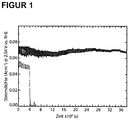
- Fig. 1 shows the result of the end of service life test (ESLT) with an anode according to the invention in comparison with a known PBCO anode. What is shown is the current density (at 2.04 V vs. RHE) as a function of the time of the BaCoO 3- based material systems (a) Pr 0.2 Ba 0.8 CoO 3 as a comparison with the lifetime of the electrocatalyst produced in the example below, plotted as (b) . Both samples are 100 nm thin and have been tested in 1 M KOH at 80 ° C. The listed electrocatalyst (b) has an eight-fold increased service life and 20 mA / cm 2 higher current densities than comparison (a).
- ESLT end of service life test
- Claim 3 relates to a catalyst for the oxygen evolution reaction, comprising the mixed oxide according to the invention.
- Claims 4 and 5 define anodes according to the invention, comprise the mixed oxide according to the invention.
- Claim 6 relates to the use of the catalyst in alkaline water electrolysis or in metal-air batteries.
- Claim 7 relates to the use of the mixed oxide according to the invention for producing an anode for the purposes mentioned.
- Claims 8 to 14 relate to a method for producing an anode.
- Claim 15 defines an amorphous mixed oxide which has a Co: Ba ratio of approx.
- TTB Tetragonal Tungsten Bronze
- This amorphous mixed oxide is an amorphous reaction product of the electrically conductive mixed oxide according to the invention based on perovskite according to one of claims 1 or 2, which has a Co: Ba ratio of 2: 1 and a TTB (Tetragonal Tungsten Bronze) -like near structure, obtainable by using the mixed oxide as a catalyst in the oxygen evolution reaction of the alkaline water electrolysis, whereby the aforementioned amorphous mixed oxide is formed by leaching Ba.
- the oxidic catalyst is often produced in a solid reaction by grinding stoichiometric amounts of the corresponding metal oxides with one another and sintering them in air.
- the anodes for the OER are then produced by drop casting an ink containing the mixed oxide onto an electrode made of amorphous carbon (made of acetylene black with Nafion®) (DOCUMENT 4, DOCUMENT 8).
- a nitrate combustion method, a coprecipitation method or the Pechini method are also used (DOCUMENT 8).
- the mixed oxide according to the invention comprises an electrically conductive perovskite phase ABO 3 , in particular BaCoO 3 .
- the inventors carried out experiments with other perovskites such as PrCoO 3 , BaSrCoFeO 3 and the well-known PrBaCoO 3 (PBCO) as well as pure BaCoO 3 . It has been shown that the two-phase perovskite BaCoO 3 + Co 3 O 4 achieves by far the best results in OER.
- the electrical conductivity of the perovskite is further increased by adding Co 3 O 4.
- Co 3 O 4 By adding Co 3 O 4 , a two-phase mixed oxide is obtained, the first phase being BaCoO 3 and the second phase being Co 3 O 4 .
- the process of dissolving the perovskite in the alkaline electrolysis medium ie the leaching of metal ions
- the doping is used to adjust the oxygen stoichiometry, ie oxygen vacancies are generated by the doping element.
- DOCUMENT 11 A precise representation of the resulting rearrangements of the perovskite crystal structure can be found in DOCUMENT 11, the content of which is included here in full. In particular, on p. 111,
- the doping element is according to the invention which can easily adopt the +4 oxidation state and whose atomic radius fits into the crystal lattice.
- Ti 4+ is relatively large, it works surprisingly well in accordance with the invention. Experiments with Hf 4+ have shown less good catalysts. Therefore, Ti is used as a dopant.
- ⁇ defines the oxygen vacancies in the perovskite structure.
- the mixed oxide according to the invention particularly preferably has the formula BaCo 0.98 Ti 0.02 O 3- ⁇ : Co 3 O 4 .
- the mixed oxide according to the invention is therefore an oxygen-deficient mixed conductor.
- ⁇ means that the oxide has oxygen vacancies.
- ⁇ is in the range from 0.1 to 0.8. Values from 0.3 to 0.7 or particularly preferably 0.5 to 0.6 are possible.
- transition metals While most important non-transition metal oxides have only one oxidation state (tin oxide is a major exception), the opposite is true for transition metals. This facilitates the formation of oxygen vacancies (point defects). When an oxygen atom is removed from the crystal, electrons left behind by it can be absorbed by the metal cations and the defect can be stabilized. Due to the large selection of cations with which the A and B positions in perovskites can be occupied, combinations could be found which allow the perovskite structure to take up high oxygen non-stoichiometries. These high concentrations of oxygen vacancies achieve a high ionic conductivity, which has made it possible to develop perovskites, which are known as very good mixed conductors.
- the perovskite phase of the BaO-Bi 2 O 3 system can be viewed as a mixed conductor.
- the highest electronic conductivity was found with a composition of Ba 0.67 (Bi 2 O 3 ) 0.33 , in which a pure perovskite phase was identified, which corresponds to the stoichiometry BaBiO 2.5.
- the number of oxygen vacancies is ⁇ so 0.5.
- Amorphization takes place within a few seconds during the oxygen evolution reaction with the catalyst according to the invention as anode material, but surprisingly this does not affect the positive electrochemical properties of the electrocatalyst. After less than 5% of the life of the catalytic converter, the entire catalytic converter layer has already changed to the amorphous state.
- Perovskites generally decompose by losing A cations through leaching. This is accompanied by the amorphization of the mixed oxide.
- the two-phase doped mixed oxide according to the invention reaches a stable state during the decomposition. This state can be described as an amorphous oxide with a pronounced near structure. Crystals generally have long chains of symmetry.
- This periodicity enables interferences to be recognized, for example, in X-ray structure analysis. If you break this periodicity, there is no longer any interference in the X-ray structure analysis.
- the arrangement according to the invention means a range of less than 100 nm.
- This near structure according to the invention is related to the tetragonal tungsten bronze (Tetragonal Tungsten Bronze TTB).
- chemically stable means that the leaching of Ba is greatly slowed down, the catalytic properties remain constant over the entire decomposition process and the ESLT results in the longest possible operating times / 100nm (in the laboratory test) until the layer has completely decomposed. The slower the dissolution, the more stable the film (with constant catalytic behavior).
- the invention thus provides a chemically stable alternative for oxidic electrocatalysts which has a simultaneously low overpotential and a high current density in alkaline water electrolysis.
- the catalyst according to the invention comprises the above mixed oxide and, if appropriate, further customary suitable additives such as, for example, Nafion®, although surprisingly, in particular without such additives, it shows very good activity and stability. Therefore, according to the invention, preferably no such additive is used.
- the mixed oxide according to the invention is preferably applied to a suitable electrically conductive electrode substrate material in a wet chemical process described below in order to produce the anode according to the invention.
- the electrically conductive substrate can be any common substrate used for anodes in OER and have any size and shape customary for this, e.g. sheet metal, grid, foam.
- Si (100) wafer coated with a TiO 2 adhesive layer and a polycrystalline Pt (111) layer is used in the present description.
- Other customary adhesive layers are also possible, for example TiN and / or AlO x .
- the orientation of the Si wafer is, for example, (100), although Si wafers with different preferred orientations can also be used. Si wafers are pulled single crystals. So there are only oriented cuts of it.
- the Si serves as a shaping base by means of which the adhesive layer can be used to apply the Pt layer.
- the Pt layer is produced on the Si wafer in the usual way, in particular by sputtering, for example magnetron sputtering (PVD, physical vapor deposition).
- Pt (111) layers are used according to the invention, which are obtained by on Si (100) wafer Pt applied by magnetron sputtering and the orientation of which is then reinforced by annealing. It is crucial that the applied Pt layer is dense and smooth.
- the orientation of the polycrystalline Pt layer is, for example, (111). Other orientations are also suitable as long as polycrystalline perovskite layers can be deposited on the surface. It is crucial that the Pt surface has crystallization points that enable the crystal growth of the perovskite phase.
- Si wafers with a TiO 2 adhesive layer and a polycrystalline Pt (111) layer applied thereon are preferably used.
- the Si wafer is preferably a Si (100) wafer.
- the orientation of the Pt layer is reinforced with conventional methods, in particular by heating to a temperature of 800 to 900 ° C, preferably 850 ° C for 5 to 10 minutes, preferably 8 minutes, e.g. under a stream of oxygen.
- the orientation of the Pt layer can also be achieved at lower temperatures for a correspondingly longer time.
- the thickness of the adhesive layer is 2 to 10 nm, preferably 4 to 7 nm and particularly preferably 5 nm.
- the thickness of the Pt (111) layer is 20 to 80 nm, preferably 30 to 70 nm and particularly preferably 50 nm.
- the thickness of all layers is determined within the scope of the invention using conventional methods, in particular using XRR (X-ray reflectrometry) and SEM (scanning tunneling microscope images of the sample cross-section).
- the catalyst according to the invention is preferably prepared by dissolving the starting metal salts in a suitable solvent in the desired ratio and stirring the solution under reflux for a time of about 0.5 to 2 hours, preferably about 1 hour. A precursor solution is thereby obtained. Longer heating does not make a difference in the mixed oxide, but it is also possible, for example up to 24 hours.
- the starting metal salts are salts of Ba, Co and Ti in the desired proportions.
- Salts used are those which form oxides when heated with oxygen supply, e.g. salts of organic carboxylic acids, dicarboxylic acids or tricarboxylic acids, or other oxide-forming salts such as nitrates, ammonium salts or salts of amino acids, hydroxycarboxylic acids, carbonates, ß-diketonates, metal alkoxides, metal amino alkoxides, Sulfates and other oxide-forming salts known to those skilled in the art.
- Salts of carboxylic acids or dicarboxylic acids e.g.
- acetates, propionates, oxalates, pentanedionates, are preferred. Acetates and pentanedionates are particularly preferred.
- the salts of the same acids are suitably used, but also salts of different acids, as well as in the reaction of the respective metals with alcohols, ether alcohols such as butoxyethanol, propoxyethanol, methoxyethanol and the like. Salts obtained from amines or amino alcohols in the corresponding solvents are suitable (e.g. Ba-diaminoethoxide in aminoethanol, see e.g. DOCUMENT 12).
- acetates and pentanedionates are used together, e.g. barium acetate with cobalt acetate and titanium (IV) oxide-bis-2,4-pentanedionate.
- Suitable solvents which are customary in the prior art for dissolving salts are non-aqueous solvents.
- Mixtures of organic carboxylic acids with the corresponding anhydrides are preferably used; in particular, a mixture of propionic acid / propionic anhydride has proven to be advantageous.
- the mixing ratio (by volume) of carboxylic acid to carboxylic acid anhydride is 10: 1 to 1: 1, preferably 7: 1 to 4: 1, particularly preferably 5: 1.
- the boiling point under normal conditions is approx. 140 ° C., which is suitable for completely dissolving the salts.
- the amount of the solvent is chosen so that, after all the salts have been dissolved, a final concentration of 0.05 to 0.25 mol / l, preferably 0.10 to 0.20 mol / l, particularly preferably 0.15 mol / l based on the Ba cation is achieved.
- the molarity of the solution determines the crystal quality and the layer thickness per deposition step. In general, 0.15 M solutions are used according to the invention.
- Co 3 O 4 in the end product mixed oxide is achieved by using a corresponding amount of Co salt, in particular cobalt acetate, which is in excess compared to the perovskite phase.
- the doping with Ti is achieved by adding the corresponding salt of Ti, in particular Ti (IV) oxide bis (2,4-pentanedionate), in the desired amount.
- the resulting precursor solution can, if desired, be filtered after cooling, e.g. through a 0.2 ⁇ m PTFE filter or other conventional filters.
- the filtration results in a better layer quality in the subsequent spin coating process.
- the precursor solution obtained in this way is applied to the substrate described above by customary wet-chemical processes, preferably in steps.
- a spin coating process is preferably used, but spray coating or dip coating processes, dropping, spreading, knife coating, rolling and other common processes are also possible.
- the coated substrate is heated to a temperature of about 250 to 400 ° C., preferably 300 to 380 ° C., particularly preferably 350 ° C., for example on a hot plate, for a few minutes, for example 1 to 5 minutes 2 min, dried before the next layer of the precursor solution is applied.
- At least 3 layers are preferably applied, more preferably a total of 5 layers, but even more catalyst layers are possible. So many layers are applied until the desired total layer thickness of the catalyst layer is achieved.
- the coated anode is baked for 5 to 12 minutes, preferably 6 to 10 minutes, even more preferably 8 minutes in a stream of oxygen to about 700 to 1000 ° C., preferably 800 to 900 ° C., particularly preferably 850 ° C.
- the thickness of the catalyst layer finally obtained on the substrate after heating is approx. 50 to 150 nm, preferably 80 to 130 nm, particularly preferably 100 nm.
- the layer thickness is determined by SEM as described above. This layer thickness is particularly suitable for laboratory tests. Larger layer thicknesses are common for industrial applications and can also be produced according to the invention.
- the anode obtained in this way is a model for testing the material system and its properties.
- the oxidic catalyst according to the invention can be used in other anode systems obtainable in the usual way on an industrial scale in electrolysers, and in metal-air batteries.
- the electrocatalyst according to the invention has a service life that is more than eight times longer than that of the comparative catalyst PBCO and a current density that is 20 mA / cm 2 higher, as is shown in the following example.
- a silicon wafer Si (100) is provided with a 5 nm thick adhesive layer (TiO 2 ) and a polycrystalline 50 nm thick Pt (111) layer which is applied by magnetron sputtering. To reinforce the Pt (111) preferred orientation, this substrate is baked out for 8 min under a 4 sccm O 2 flow at 850 ° C.
- the precursor is now gradually applied to the substrate.
- first 200 ⁇ l of the precursor produced above are applied to the substrate by means of spin coating. It is then dried at 350 ° C. on a hot plate for 2 minutes. This procedure is repeated for a further 4 runs, but only with 100 ⁇ l per run. Finally, heating is then carried out for 8 min under a 4 sccm O 2 flow at 850 ° C.
- the catalyst layer now has a thickness of approx. 100 nm, determined by SEM.
- Continuous CV measurement cycles (cyclic voltammetry) were carried out with the sample at a scan rate of 100 mVs ⁇ 1 in a range from 1 V to 2.1 V against an RHE.
- the measurement was carried out in 1 M potassium hydroxide solution at 80 ° C.
- the result of the experiment at 2.04 V is in Figure 1 shown.
- the anode according to the invention had a service life of 380,000 s with a constant course of the current density. After this time, the catalyst layer had completely dissolved.
- the comparison anode on the other hand, only had a service life of 40,000 s.
- the electrocatalyst according to the invention has a service life that is more than eight times longer than that of the comparative catalyst and a current density that is 20 mA / cm 2 higher.
- BaCoO 3- ⁇ (BCO) is not suitable as an electrocatalyst because it passivates after a short operating time.
Landscapes
- Chemical & Material Sciences (AREA)
- Engineering & Computer Science (AREA)
- Chemical Kinetics & Catalysis (AREA)
- Materials Engineering (AREA)
- Electrochemistry (AREA)
- Organic Chemistry (AREA)
- Metallurgy (AREA)
- General Chemical & Material Sciences (AREA)
- Manufacturing & Machinery (AREA)
- Inorganic Chemistry (AREA)
- Physics & Mathematics (AREA)
- Thermal Sciences (AREA)
- Catalysts (AREA)
- Electrodes For Compound Or Non-Metal Manufacture (AREA)
- Inert Electrodes (AREA)
- Hybrid Cells (AREA)
Applications Claiming Priority (2)
| Application Number | Priority Date | Filing Date | Title |
|---|---|---|---|
| DE102017205339.9A DE102017205339A1 (de) | 2017-03-29 | 2017-03-29 | Chemisch beständiger, oxidischer Elektrokatalysator für die Sauerstoffentwicklung während der alkalischen Wasserelektrolyse basierend auf BaCoO3-delta, Verfahren zu seiner Herstellung und ihn umfassende Anode sowie katalytisch aktives und chemisch stabiles Reaktionsprodukt davon |
| PCT/EP2018/057880 WO2018178135A1 (de) | 2017-03-29 | 2018-03-28 | Chemisch beständiger, oxidischer elektrokatalysator für die sauerstoffentwicklung während der alkalischen wasserelektrolyse basierend auf bacooj_5, verfahren zu seiner herstellung und ihn umfassende anode sowie katalytisch aktives und chemisch stabiles reaktionsprodukt davon |
Publications (2)
| Publication Number | Publication Date |
|---|---|
| EP3601639A1 EP3601639A1 (de) | 2020-02-05 |
| EP3601639B1 true EP3601639B1 (de) | 2021-11-10 |
Family
ID=62027938
Family Applications (1)
| Application Number | Title | Priority Date | Filing Date |
|---|---|---|---|
| EP18719060.8A Active EP3601639B1 (de) | 2017-03-29 | 2018-03-28 | Chemisch beständiger, oxidischer elektrokatalysator für die sauerstoffentwicklung während der alkalischen wasserelektrolyse |
Country Status (8)
| Country | Link |
|---|---|
| US (1) | US11111587B2 (da) |
| EP (1) | EP3601639B1 (da) |
| JP (1) | JP7121037B2 (da) |
| CN (1) | CN110494595B (da) |
| DE (1) | DE102017205339A1 (da) |
| DK (1) | DK3601639T3 (da) |
| ES (1) | ES2904973T3 (da) |
| WO (1) | WO2018178135A1 (da) |
Families Citing this family (13)
| Publication number | Priority date | Publication date | Assignee | Title |
|---|---|---|---|---|
| JP7020440B2 (ja) * | 2019-02-14 | 2022-02-16 | トヨタ自動車株式会社 | 空気電池、空気電池システム、及び空気電池システムを搭載している乗り物 |
| KR102424816B1 (ko) * | 2020-09-18 | 2022-07-25 | 울산과학기술원 | 페로브스카이트-IrO2 복합체의 제조방법 |
| JP7261418B2 (ja) | 2020-10-15 | 2023-04-20 | 国立大学法人京都大学 | アルカリ水電解用アノード及びその製造方法 |
| JP7694893B2 (ja) * | 2020-10-15 | 2025-06-18 | 国立大学法人京都大学 | アルカリ水電解用アノード及びその製造方法 |
| CN113502494B (zh) * | 2021-05-26 | 2022-06-21 | 浙江工业大学 | 高价态金属离子掺杂富含氧空位的氧化钴纳米复合材料及其制备与应用 |
| CN113430561B (zh) * | 2021-07-09 | 2023-06-09 | 苏州阳光氢能材料科技有限公司 | 基于过渡金属盐的析氧电催化材料、其制备方法及应用 |
| EP4444466A4 (en) * | 2021-12-07 | 2025-12-24 | Univ Oregon State | CATALYST AND PROCESSES FOR MANUFACTURE AND USE |
| CN115331747B (zh) * | 2022-07-29 | 2023-03-21 | 北京科技大学 | 过渡金属氢氧化物析氧电催化剂的智能设计方法及系统 |
| CN115449815B (zh) * | 2022-10-10 | 2025-03-28 | 深圳国科氢源科技有限公司 | 一种用于电催化水分解制氢的稀土铕和氧空位缺陷共掺杂的四氧化三钴催化剂的制备方法 |
| JP7690436B2 (ja) * | 2022-11-15 | 2025-06-10 | 東京瓦斯株式会社 | 水電解セル、及び水電解セルスタック |
| CN116666670B (zh) * | 2023-08-01 | 2023-10-31 | 成都岷山绿氢能源有限公司 | 一种镧铌共掺杂的中温sofc阴极材料及其制备方法和应用 |
| CN116815219B (zh) * | 2023-08-12 | 2026-03-17 | 浙江海晫新能源科技有限公司 | 一种电解装置的极板及其应用的电解装置 |
| CN120719331B (zh) * | 2025-08-27 | 2025-11-07 | 中国计量大学 | 一种双相中空高熵氧化物催化剂及其制备方法和应用 |
Family Cites Families (14)
| Publication number | Priority date | Publication date | Assignee | Title |
|---|---|---|---|---|
| JP4419332B2 (ja) * | 2001-02-06 | 2010-02-24 | 三菱マテリアル株式会社 | ペロブスカイト型酸化物膜の基板表面構造とその基板およびペロブスカイト型酸化物膜 |
| US7563533B2 (en) * | 2003-06-05 | 2009-07-21 | California Institute Of Technology | Ba-Sr-Co-Fe-O based perovskite mixed conducting materials as cathode materials for solid oxide fuel cells |
| JP4969843B2 (ja) | 2005-12-09 | 2012-07-04 | 新日鉄マテリアルズ株式会社 | 排ガス浄化用触媒及び排ガス浄化触媒部材 |
| GB0719260D0 (en) * | 2007-10-03 | 2007-11-14 | Univ Napier | Method for the manufacturing of an anode for fuel cell |
| JP5740645B2 (ja) * | 2010-04-13 | 2015-06-24 | 国立研究開発法人産業技術総合研究所 | 配向ペロブスカイト酸化物薄膜 |
| JP5327977B2 (ja) * | 2010-04-21 | 2013-10-30 | 独立行政法人科学技術振興機構 | 導電性膜形成用組成物および導電性膜の形成方法 |
| JP2012227142A (ja) * | 2011-04-19 | 2012-11-15 | Samsung Electronics Co Ltd | 燃料電池用正極材料、これを含む燃料電池用正極および固体酸化物形燃料電池 |
| GB2493022B (en) * | 2011-07-21 | 2014-04-23 | Ilika Technologies Ltd | Vapour deposition process for the preparation of a phosphate compound |
| CN103623828B (zh) * | 2013-11-01 | 2015-09-30 | 中国石油化工股份有限公司 | 一种合成液态烃钴基催化剂及其制备方法和应用 |
| CN103811774B (zh) * | 2014-02-28 | 2016-08-31 | 南京工业大学 | 一种贵金属与钙钛矿类氧化物混合的电催化剂 |
| EP3176287B1 (en) * | 2014-07-28 | 2020-11-18 | Nippon Shokubai Co., Ltd. | Steam electrolysis cell |
| US9941559B2 (en) * | 2014-11-11 | 2018-04-10 | Toyota Motor Engineering & Manufacturing North America, Inc. | Water enhanced ionic liquid electrolytes for metal-air batteries |
| JP5869169B1 (ja) * | 2015-06-01 | 2016-02-24 | 公立大学法人大阪府立大学 | 酸素発生反応用ペロブスカイト酸化物触媒 |
| JP6615682B2 (ja) * | 2016-04-12 | 2019-12-04 | デノラ・ペルメレック株式会社 | アルカリ水電解用陽極及びアルカリ水電解用陽極の製造方法 |
-
2017
- 2017-03-29 DE DE102017205339.9A patent/DE102017205339A1/de not_active Withdrawn
-
2018
- 2018-03-28 CN CN201880022518.1A patent/CN110494595B/zh not_active Expired - Fee Related
- 2018-03-28 EP EP18719060.8A patent/EP3601639B1/de active Active
- 2018-03-28 JP JP2019553861A patent/JP7121037B2/ja active Active
- 2018-03-28 DK DK18719060.8T patent/DK3601639T3/da active
- 2018-03-28 ES ES18719060T patent/ES2904973T3/es active Active
- 2018-03-28 WO PCT/EP2018/057880 patent/WO2018178135A1/de not_active Ceased
- 2018-03-28 US US16/499,537 patent/US11111587B2/en active Active
Non-Patent Citations (1)
| Title |
|---|
| None * |
Also Published As
| Publication number | Publication date |
|---|---|
| EP3601639A1 (de) | 2020-02-05 |
| US11111587B2 (en) | 2021-09-07 |
| JP2020515405A (ja) | 2020-05-28 |
| CN110494595B (zh) | 2022-05-27 |
| DK3601639T3 (da) | 2022-01-24 |
| DE102017205339A1 (de) | 2018-10-04 |
| JP7121037B2 (ja) | 2022-08-17 |
| US20200040473A1 (en) | 2020-02-06 |
| WO2018178135A1 (de) | 2018-10-04 |
| ES2904973T3 (es) | 2022-04-06 |
| CN110494595A (zh) | 2019-11-22 |
Similar Documents
| Publication | Publication Date | Title |
|---|---|---|
| EP3601639B1 (de) | Chemisch beständiger, oxidischer elektrokatalysator für die sauerstoffentwicklung während der alkalischen wasserelektrolyse | |
| Tian et al. | Achieving strong coherency for a composite electrode via one-pot method with enhanced electrochemical performance in reversible solid oxide cells | |
| DE69213488T2 (de) | Verfahren zur Herstellung einer Lanthanchromitschicht und Verfahren zur Herstellung einer Zellenverbindungsschicht für Festelektrolytbrennstoffzellen | |
| DE69317970T2 (de) | Festoxidbrennstoffzellen | |
| DE112015001452B4 (de) | Sauerstoffreduktionskatalysator und Herstellungsverfahren dafür | |
| EP4337808B1 (en) | Electrode for gas evolution in electrolytic processes | |
| DE69507269T2 (de) | Elektrophoretische Abscheidung dünner Zirkonoxid-Filme | |
| DE112010005461B4 (de) | Brennstoffzelle | |
| DE69505784T2 (de) | Fester Elektrolyt für eine Brennstoffzelle und sein Herstellungsverfahren | |
| DE69108160T2 (de) | Brennstoffelektroden für Festoxid-Brennstoffzellen und Verfahren zu ihrer Herstellung. | |
| WO2005045979A2 (de) | Kathodenwerkstoff für eine hochtemperatur-brennstoffzelle (sofc) sowie eine daraus herstellbare kathode | |
| DE112005000891B4 (de) | Brennstoffzellenkathode und Verwendung | |
| DE102005023048B4 (de) | Verfahren zur Herstellung eines Kathoden-Elektrolyt-Verbundes und eine Hochtemperatur-Brennstoffzelle | |
| EP4051637B1 (de) | Elektrodenmaterial, verfahren zu dessen herstellung und dessen verwendung | |
| WO1998015961A1 (de) | Elektrode für eine elektrochemische zelle, elektroden-elektrolyt-einheit und zugehöriges herstellungsverfahren | |
| Kawano et al. | Studies on synthetic conditions of spray pyrolysis by acids addition for development of highly active Ni-SDC cermet anode | |
| Summerer | Electrochemical switching of perovskite-type exsolution catalysts | |
| KR102818360B1 (ko) | 음이온 교환막 수전해용 페로브스카이트계 산화촉매 및 공침법을 이용한 산화촉매의 제조 방법 | |
| KR20210033744A (ko) | 이산화탄소 분해용 고체산화물 전해전지의 캐소드 조성물, 이산화탄소 분해용 고체산화물 전해전지 및 캐소드 조성물의 제조 방법 | |
| US7803348B1 (en) | Complex cobalt oxide catalysts for oxygen reduction electrodes in alkaline fuel cells | |
| DE102024102778A1 (de) | Elektrokatalysator-trägermaterial | |
| WO2025056199A1 (de) | Festoxidelektrolysezelle mit kathode und verfahren | |
| EP4510248A2 (de) | Festoxidzelle mit nickelfreier brennstoffelektrode | |
| EP4553191A1 (de) | Ruthenium-iridium-mischoxidkatalysatoren für die wasserelektrolyse | |
| DE10251263A1 (de) | Hochtemperatur-Festelektrolyt-Brennstoffzelle umfassend einen Verbund aus nanoporösen Dünnschichtelektroden und einem strukturiertem Elektrolyt |
Legal Events
| Date | Code | Title | Description |
|---|---|---|---|
| STAA | Information on the status of an ep patent application or granted ep patent |
Free format text: STATUS: UNKNOWN |
|
| STAA | Information on the status of an ep patent application or granted ep patent |
Free format text: STATUS: THE INTERNATIONAL PUBLICATION HAS BEEN MADE |
|
| PUAI | Public reference made under article 153(3) epc to a published international application that has entered the european phase |
Free format text: ORIGINAL CODE: 0009012 |
|
| STAA | Information on the status of an ep patent application or granted ep patent |
Free format text: STATUS: REQUEST FOR EXAMINATION WAS MADE |
|
| 17P | Request for examination filed |
Effective date: 20190903 |
|
| AK | Designated contracting states |
Kind code of ref document: A1 Designated state(s): AL AT BE BG CH CY CZ DE DK EE ES FI FR GB GR HR HU IE IS IT LI LT LU LV MC MK MT NL NO PL PT RO RS SE SI SK SM TR |
|
| AX | Request for extension of the european patent |
Extension state: BA ME |
|
| DAV | Request for validation of the european patent (deleted) | ||
| DAX | Request for extension of the european patent (deleted) | ||
| STAA | Information on the status of an ep patent application or granted ep patent |
Free format text: STATUS: EXAMINATION IS IN PROGRESS |
|
| 17Q | First examination report despatched |
Effective date: 20200812 |
|
| RAP3 | Party data changed (applicant data changed or rights of an application transferred) |
Owner name: RWTH AACHEN Owner name: FORSCHUNGSZENTRUM JUELICH GMBH |
|
| GRAP | Despatch of communication of intention to grant a patent |
Free format text: ORIGINAL CODE: EPIDOSNIGR1 |
|
| STAA | Information on the status of an ep patent application or granted ep patent |
Free format text: STATUS: GRANT OF PATENT IS INTENDED |
|
| RIC1 | Information provided on ipc code assigned before grant |
Ipc: B01J 21/06 20060101ALI20210401BHEP Ipc: B01J 35/00 20060101ALI20210401BHEP Ipc: B01J 23/78 20060101ALI20210401BHEP Ipc: B01J 23/00 20060101ALI20210401BHEP Ipc: H01M 12/06 20060101ALI20210401BHEP Ipc: H01M 4/90 20060101ALI20210401BHEP Ipc: H01M 4/88 20060101ALI20210401BHEP Ipc: C25B 11/077 20210101ALI20210401BHEP Ipc: C25B 11/069 20210101ALI20210401BHEP Ipc: C25B 11/052 20210101ALI20210401BHEP Ipc: C25B 1/04 20210101AFI20210401BHEP |
|
| INTG | Intention to grant announced |
Effective date: 20210503 |
|
| GRAJ | Information related to disapproval of communication of intention to grant by the applicant or resumption of examination proceedings by the epo deleted |
Free format text: ORIGINAL CODE: EPIDOSDIGR1 |
|
| STAA | Information on the status of an ep patent application or granted ep patent |
Free format text: STATUS: EXAMINATION IS IN PROGRESS |
|
| GRAP | Despatch of communication of intention to grant a patent |
Free format text: ORIGINAL CODE: EPIDOSNIGR1 |
|
| STAA | Information on the status of an ep patent application or granted ep patent |
Free format text: STATUS: GRANT OF PATENT IS INTENDED |
|
| INTC | Intention to grant announced (deleted) | ||
| RIN1 | Information on inventor provided before grant (corrected) |
Inventor name: WASER, RAINER Inventor name: SCHNELLER, THEODOR Inventor name: VALOV, ILIA Inventor name: BICK, DANIEL |
|
| GRAS | Grant fee paid |
Free format text: ORIGINAL CODE: EPIDOSNIGR3 |
|
| GRAA | (expected) grant |
Free format text: ORIGINAL CODE: 0009210 |
|
| STAA | Information on the status of an ep patent application or granted ep patent |
Free format text: STATUS: THE PATENT HAS BEEN GRANTED |
|
| INTG | Intention to grant announced |
Effective date: 20210924 |
|
| AK | Designated contracting states |
Kind code of ref document: B1 Designated state(s): AL AT BE BG CH CY CZ DE DK EE ES FI FR GB GR HR HU IE IS IT LI LT LU LV MC MK MT NL NO PL PT RO RS SE SI SK SM TR |
|
| REG | Reference to a national code |
Ref country code: GB Ref legal event code: FG4D Free format text: NOT ENGLISH |
|
| REG | Reference to a national code |
Ref country code: AT Ref legal event code: REF Ref document number: 1446170 Country of ref document: AT Kind code of ref document: T Effective date: 20211115 Ref country code: CH Ref legal event code: EP |
|
| REG | Reference to a national code |
Ref country code: DE Ref legal event code: R096 Ref document number: 502018007769 Country of ref document: DE |
|
| REG | Reference to a national code |
Ref country code: IE Ref legal event code: FG4D Free format text: LANGUAGE OF EP DOCUMENT: GERMAN |
|
| RAP4 | Party data changed (patent owner data changed or rights of a patent transferred) |
Owner name: RWTH AACHEN Owner name: FORSCHUNGSZENTRUM JUELICH GMBH |
|
| REG | Reference to a national code |
Ref country code: DK Ref legal event code: T3 Effective date: 20220120 |
|
| REG | Reference to a national code |
Ref country code: NL Ref legal event code: FP |
|
| REG | Reference to a national code |
Ref country code: SE Ref legal event code: TRGR |
|
| RAP4 | Party data changed (patent owner data changed or rights of a patent transferred) |
Owner name: RWTH AACHEN Owner name: FORSCHUNGSZENTRUM JUELICH GMBH |
|
| REG | Reference to a national code |
Ref country code: LT Ref legal event code: MG9D |
|
| REG | Reference to a national code |
Ref country code: NL Ref legal event code: PD Owner name: FORSCHUNGSZENTRUM JUELICH GMBH; DE Free format text: DETAILS ASSIGNMENT: CHANGE OF OWNER(S), ASSIGNMENT; FORMER OWNER NAME: RWTH AACHEN Effective date: 20220125 |
|
| REG | Reference to a national code |
Ref country code: NO Ref legal event code: T2 Effective date: 20211110 |
|
| REG | Reference to a national code |
Ref country code: ES Ref legal event code: FG2A Ref document number: 2904973 Country of ref document: ES Kind code of ref document: T3 Effective date: 20220406 |
|
| PG25 | Lapsed in a contracting state [announced via postgrant information from national office to epo] |
Ref country code: RS Free format text: LAPSE BECAUSE OF FAILURE TO SUBMIT A TRANSLATION OF THE DESCRIPTION OR TO PAY THE FEE WITHIN THE PRESCRIBED TIME-LIMIT Effective date: 20211110 Ref country code: LT Free format text: LAPSE BECAUSE OF FAILURE TO SUBMIT A TRANSLATION OF THE DESCRIPTION OR TO PAY THE FEE WITHIN THE PRESCRIBED TIME-LIMIT Effective date: 20211110 Ref country code: FI Free format text: LAPSE BECAUSE OF FAILURE TO SUBMIT A TRANSLATION OF THE DESCRIPTION OR TO PAY THE FEE WITHIN THE PRESCRIBED TIME-LIMIT Effective date: 20211110 Ref country code: BG Free format text: LAPSE BECAUSE OF FAILURE TO SUBMIT A TRANSLATION OF THE DESCRIPTION OR TO PAY THE FEE WITHIN THE PRESCRIBED TIME-LIMIT Effective date: 20220210 |
|
| PG25 | Lapsed in a contracting state [announced via postgrant information from national office to epo] |
Ref country code: IS Free format text: LAPSE BECAUSE OF FAILURE TO SUBMIT A TRANSLATION OF THE DESCRIPTION OR TO PAY THE FEE WITHIN THE PRESCRIBED TIME-LIMIT Effective date: 20220310 Ref country code: PT Free format text: LAPSE BECAUSE OF FAILURE TO SUBMIT A TRANSLATION OF THE DESCRIPTION OR TO PAY THE FEE WITHIN THE PRESCRIBED TIME-LIMIT Effective date: 20220310 Ref country code: PL Free format text: LAPSE BECAUSE OF FAILURE TO SUBMIT A TRANSLATION OF THE DESCRIPTION OR TO PAY THE FEE WITHIN THE PRESCRIBED TIME-LIMIT Effective date: 20211110 Ref country code: LV Free format text: LAPSE BECAUSE OF FAILURE TO SUBMIT A TRANSLATION OF THE DESCRIPTION OR TO PAY THE FEE WITHIN THE PRESCRIBED TIME-LIMIT Effective date: 20211110 Ref country code: HR Free format text: LAPSE BECAUSE OF FAILURE TO SUBMIT A TRANSLATION OF THE DESCRIPTION OR TO PAY THE FEE WITHIN THE PRESCRIBED TIME-LIMIT Effective date: 20211110 Ref country code: GR Free format text: LAPSE BECAUSE OF FAILURE TO SUBMIT A TRANSLATION OF THE DESCRIPTION OR TO PAY THE FEE WITHIN THE PRESCRIBED TIME-LIMIT Effective date: 20220211 |
|
| PG25 | Lapsed in a contracting state [announced via postgrant information from national office to epo] |
Ref country code: SM Free format text: LAPSE BECAUSE OF FAILURE TO SUBMIT A TRANSLATION OF THE DESCRIPTION OR TO PAY THE FEE WITHIN THE PRESCRIBED TIME-LIMIT Effective date: 20211110 Ref country code: SK Free format text: LAPSE BECAUSE OF FAILURE TO SUBMIT A TRANSLATION OF THE DESCRIPTION OR TO PAY THE FEE WITHIN THE PRESCRIBED TIME-LIMIT Effective date: 20211110 Ref country code: RO Free format text: LAPSE BECAUSE OF FAILURE TO SUBMIT A TRANSLATION OF THE DESCRIPTION OR TO PAY THE FEE WITHIN THE PRESCRIBED TIME-LIMIT Effective date: 20211110 Ref country code: EE Free format text: LAPSE BECAUSE OF FAILURE TO SUBMIT A TRANSLATION OF THE DESCRIPTION OR TO PAY THE FEE WITHIN THE PRESCRIBED TIME-LIMIT Effective date: 20211110 Ref country code: CZ Free format text: LAPSE BECAUSE OF FAILURE TO SUBMIT A TRANSLATION OF THE DESCRIPTION OR TO PAY THE FEE WITHIN THE PRESCRIBED TIME-LIMIT Effective date: 20211110 |
|
| REG | Reference to a national code |
Ref country code: DE Ref legal event code: R097 Ref document number: 502018007769 Country of ref document: DE |
|
| PLBE | No opposition filed within time limit |
Free format text: ORIGINAL CODE: 0009261 |
|
| STAA | Information on the status of an ep patent application or granted ep patent |
Free format text: STATUS: NO OPPOSITION FILED WITHIN TIME LIMIT |
|
| 26N | No opposition filed |
Effective date: 20220811 |
|
| PG25 | Lapsed in a contracting state [announced via postgrant information from national office to epo] |
Ref country code: MC Free format text: LAPSE BECAUSE OF FAILURE TO SUBMIT A TRANSLATION OF THE DESCRIPTION OR TO PAY THE FEE WITHIN THE PRESCRIBED TIME-LIMIT Effective date: 20211110 Ref country code: AL Free format text: LAPSE BECAUSE OF FAILURE TO SUBMIT A TRANSLATION OF THE DESCRIPTION OR TO PAY THE FEE WITHIN THE PRESCRIBED TIME-LIMIT Effective date: 20211110 |
|
| REG | Reference to a national code |
Ref country code: CH Ref legal event code: PL |
|
| PG25 | Lapsed in a contracting state [announced via postgrant information from national office to epo] |
Ref country code: SI Free format text: LAPSE BECAUSE OF FAILURE TO SUBMIT A TRANSLATION OF THE DESCRIPTION OR TO PAY THE FEE WITHIN THE PRESCRIBED TIME-LIMIT Effective date: 20211110 |
|
| REG | Reference to a national code |
Ref country code: BE Ref legal event code: MM Effective date: 20220331 |
|
| PG25 | Lapsed in a contracting state [announced via postgrant information from national office to epo] |
Ref country code: LU Free format text: LAPSE BECAUSE OF NON-PAYMENT OF DUE FEES Effective date: 20220328 Ref country code: LI Free format text: LAPSE BECAUSE OF NON-PAYMENT OF DUE FEES Effective date: 20220331 Ref country code: IE Free format text: LAPSE BECAUSE OF NON-PAYMENT OF DUE FEES Effective date: 20220328 Ref country code: CH Free format text: LAPSE BECAUSE OF NON-PAYMENT OF DUE FEES Effective date: 20220331 |
|
| PG25 | Lapsed in a contracting state [announced via postgrant information from national office to epo] |
Ref country code: BE Free format text: LAPSE BECAUSE OF NON-PAYMENT OF DUE FEES Effective date: 20220331 |
|
| PG25 | Lapsed in a contracting state [announced via postgrant information from national office to epo] |
Ref country code: IT Free format text: LAPSE BECAUSE OF FAILURE TO SUBMIT A TRANSLATION OF THE DESCRIPTION OR TO PAY THE FEE WITHIN THE PRESCRIBED TIME-LIMIT Effective date: 20211110 |
|
| P01 | Opt-out of the competence of the unified patent court (upc) registered |
Effective date: 20230508 |
|
| PG25 | Lapsed in a contracting state [announced via postgrant information from national office to epo] |
Ref country code: MK Free format text: LAPSE BECAUSE OF FAILURE TO SUBMIT A TRANSLATION OF THE DESCRIPTION OR TO PAY THE FEE WITHIN THE PRESCRIBED TIME-LIMIT Effective date: 20211110 Ref country code: CY Free format text: LAPSE BECAUSE OF FAILURE TO SUBMIT A TRANSLATION OF THE DESCRIPTION OR TO PAY THE FEE WITHIN THE PRESCRIBED TIME-LIMIT Effective date: 20211110 |
|
| REG | Reference to a national code |
Ref country code: AT Ref legal event code: MM01 Ref document number: 1446170 Country of ref document: AT Kind code of ref document: T Effective date: 20230328 |
|
| PG25 | Lapsed in a contracting state [announced via postgrant information from national office to epo] |
Ref country code: HU Free format text: LAPSE BECAUSE OF FAILURE TO SUBMIT A TRANSLATION OF THE DESCRIPTION OR TO PAY THE FEE WITHIN THE PRESCRIBED TIME-LIMIT; INVALID AB INITIO Effective date: 20180328 |
|
| PG25 | Lapsed in a contracting state [announced via postgrant information from national office to epo] |
Ref country code: TR Free format text: LAPSE BECAUSE OF FAILURE TO SUBMIT A TRANSLATION OF THE DESCRIPTION OR TO PAY THE FEE WITHIN THE PRESCRIBED TIME-LIMIT Effective date: 20211110 |
|
| PG25 | Lapsed in a contracting state [announced via postgrant information from national office to epo] |
Ref country code: AT Free format text: LAPSE BECAUSE OF NON-PAYMENT OF DUE FEES Effective date: 20230328 |
|
| PG25 | Lapsed in a contracting state [announced via postgrant information from national office to epo] |
Ref country code: AT Free format text: LAPSE BECAUSE OF NON-PAYMENT OF DUE FEES Effective date: 20230328 |
|
| PG25 | Lapsed in a contracting state [announced via postgrant information from national office to epo] |
Ref country code: MT Free format text: LAPSE BECAUSE OF FAILURE TO SUBMIT A TRANSLATION OF THE DESCRIPTION OR TO PAY THE FEE WITHIN THE PRESCRIBED TIME-LIMIT Effective date: 20211110 |
|
| PGFP | Annual fee paid to national office [announced via postgrant information from national office to epo] |
Ref country code: ES Payment date: 20250417 Year of fee payment: 8 |
|
| PGFP | Annual fee paid to national office [announced via postgrant information from national office to epo] |
Ref country code: SE Payment date: 20260320 Year of fee payment: 9 |
|
| PGFP | Annual fee paid to national office [announced via postgrant information from national office to epo] |
Ref country code: GB Payment date: 20260325 Year of fee payment: 9 |
|
| PGFP | Annual fee paid to national office [announced via postgrant information from national office to epo] |
Ref country code: DK Payment date: 20260323 Year of fee payment: 9 Ref country code: NO Payment date: 20260318 Year of fee payment: 9 Ref country code: DE Payment date: 20260318 Year of fee payment: 9 |
|
| PGFP | Annual fee paid to national office [announced via postgrant information from national office to epo] |
Ref country code: AT Payment date: 20260410 Year of fee payment: 5 |
|
| PGFP | Annual fee paid to national office [announced via postgrant information from national office to epo] |
Ref country code: NL Payment date: 20260320 Year of fee payment: 9 |
|
| PGFP | Annual fee paid to national office [announced via postgrant information from national office to epo] |
Ref country code: FR Payment date: 20260319 Year of fee payment: 9 |