EP3599659B1 - Microwave synthesis of lithium thiophosphate composite materials - Google Patents
Microwave synthesis of lithium thiophosphate composite materials Download PDFInfo
- Publication number
- EP3599659B1 EP3599659B1 EP19188120.0A EP19188120A EP3599659B1 EP 3599659 B1 EP3599659 B1 EP 3599659B1 EP 19188120 A EP19188120 A EP 19188120A EP 3599659 B1 EP3599659 B1 EP 3599659B1
- Authority
- EP
- European Patent Office
- Prior art keywords
- composite
- lithium thiophosphate
- target lithium
- thiophosphate
- prepare
- Prior art date
- Legal status (The legal status is an assumption and is not a legal conclusion. Google has not performed a legal analysis and makes no representation as to the accuracy of the status listed.)
- Active
Links
Images



Classifications
-
- H—ELECTRICITY
- H01—ELECTRIC ELEMENTS
- H01M—PROCESSES OR MEANS, e.g. BATTERIES, FOR THE DIRECT CONVERSION OF CHEMICAL ENERGY INTO ELECTRICAL ENERGY
- H01M4/00—Electrodes
- H01M4/02—Electrodes composed of, or comprising, active material
- H01M4/36—Selection of substances as active materials, active masses, active liquids
- H01M4/58—Selection of substances as active materials, active masses, active liquids of inorganic compounds other than oxides or hydroxides, e.g. sulfides, selenides, tellurides, halogenides or LiCoFy; of polyanionic structures, e.g. phosphates, silicates or borates
- H01M4/5825—Oxygenated metallic salts or polyanionic structures, e.g. borates, phosphates, silicates, olivines
-
- C—CHEMISTRY; METALLURGY
- C01—INORGANIC CHEMISTRY
- C01B—NON-METALLIC ELEMENTS; COMPOUNDS THEREOF; METALLOIDS OR COMPOUNDS THEREOF NOT COVERED BY SUBCLASS C01C
- C01B25/00—Phosphorus; Compounds thereof
- C01B25/14—Sulfur, selenium, or tellurium compounds of phosphorus
-
- B—PERFORMING OPERATIONS; TRANSPORTING
- B01—PHYSICAL OR CHEMICAL PROCESSES OR APPARATUS IN GENERAL
- B01J—CHEMICAL OR PHYSICAL PROCESSES, e.g. CATALYSIS OR COLLOID CHEMISTRY; THEIR RELEVANT APPARATUS
- B01J19/00—Chemical, physical or physico-chemical processes in general; Their relevant apparatus
- B01J19/08—Processes employing the direct application of electric or wave energy, or particle radiation; Apparatus therefor
- B01J19/12—Processes employing the direct application of electric or wave energy, or particle radiation; Apparatus therefor employing electromagnetic waves
- B01J19/122—Incoherent waves
- B01J19/126—Microwaves
-
- C—CHEMISTRY; METALLURGY
- C01—INORGANIC CHEMISTRY
- C01D—COMPOUNDS OF ALKALI METALS, i.e. LITHIUM, SODIUM, POTASSIUM, RUBIDIUM, CAESIUM, OR FRANCIUM
- C01D15/00—Lithium compounds
- C01D15/06—Sulfates; Sulfites
-
- H—ELECTRICITY
- H01—ELECTRIC ELEMENTS
- H01M—PROCESSES OR MEANS, e.g. BATTERIES, FOR THE DIRECT CONVERSION OF CHEMICAL ENERGY INTO ELECTRICAL ENERGY
- H01M10/00—Secondary cells; Manufacture thereof
- H01M10/05—Accumulators with non-aqueous electrolyte
- H01M10/052—Li-accumulators
- H01M10/0525—Rocking-chair batteries, i.e. batteries with lithium insertion or intercalation in both electrodes; Lithium-ion batteries
-
- H—ELECTRICITY
- H01—ELECTRIC ELEMENTS
- H01M—PROCESSES OR MEANS, e.g. BATTERIES, FOR THE DIRECT CONVERSION OF CHEMICAL ENERGY INTO ELECTRICAL ENERGY
- H01M10/00—Secondary cells; Manufacture thereof
- H01M10/05—Accumulators with non-aqueous electrolyte
- H01M10/056—Accumulators with non-aqueous electrolyte characterised by the materials used as electrolytes, e.g. mixed inorganic/organic electrolytes
- H01M10/0561—Accumulators with non-aqueous electrolyte characterised by the materials used as electrolytes, e.g. mixed inorganic/organic electrolytes the electrolyte being constituted of inorganic materials only
- H01M10/0562—Solid materials
-
- H—ELECTRICITY
- H01—ELECTRIC ELEMENTS
- H01M—PROCESSES OR MEANS, e.g. BATTERIES, FOR THE DIRECT CONVERSION OF CHEMICAL ENERGY INTO ELECTRICAL ENERGY
- H01M10/00—Secondary cells; Manufacture thereof
- H01M10/05—Accumulators with non-aqueous electrolyte
- H01M10/058—Construction or manufacture
- H01M10/0585—Construction or manufacture of accumulators having only flat construction elements, i.e. flat positive electrodes, flat negative electrodes and flat separators
-
- H—ELECTRICITY
- H01—ELECTRIC ELEMENTS
- H01M—PROCESSES OR MEANS, e.g. BATTERIES, FOR THE DIRECT CONVERSION OF CHEMICAL ENERGY INTO ELECTRICAL ENERGY
- H01M2300/00—Electrolytes
- H01M2300/0017—Non-aqueous electrolytes
- H01M2300/0065—Solid electrolytes
- H01M2300/0068—Solid electrolytes inorganic
-
- Y—GENERAL TAGGING OF NEW TECHNOLOGICAL DEVELOPMENTS; GENERAL TAGGING OF CROSS-SECTIONAL TECHNOLOGIES SPANNING OVER SEVERAL SECTIONS OF THE IPC; TECHNICAL SUBJECTS COVERED BY FORMER USPC CROSS-REFERENCE ART COLLECTIONS [XRACs] AND DIGESTS
- Y02—TECHNOLOGIES OR APPLICATIONS FOR MITIGATION OR ADAPTATION AGAINST CLIMATE CHANGE
- Y02E—REDUCTION OF GREENHOUSE GAS [GHG] EMISSIONS, RELATED TO ENERGY GENERATION, TRANSMISSION OR DISTRIBUTION
- Y02E60/00—Enabling technologies; Technologies with a potential or indirect contribution to GHG emissions mitigation
- Y02E60/10—Energy storage using batteries
-
- Y—GENERAL TAGGING OF NEW TECHNOLOGICAL DEVELOPMENTS; GENERAL TAGGING OF CROSS-SECTIONAL TECHNOLOGIES SPANNING OVER SEVERAL SECTIONS OF THE IPC; TECHNICAL SUBJECTS COVERED BY FORMER USPC CROSS-REFERENCE ART COLLECTIONS [XRACs] AND DIGESTS
- Y02—TECHNOLOGIES OR APPLICATIONS FOR MITIGATION OR ADAPTATION AGAINST CLIMATE CHANGE
- Y02P—CLIMATE CHANGE MITIGATION TECHNOLOGIES IN THE PRODUCTION OR PROCESSING OF GOODS
- Y02P70/00—Climate change mitigation technologies in the production process for final industrial or consumer products
- Y02P70/50—Manufacturing or production processes characterised by the final manufactured product
Definitions
- This disclosure is directed to a method to prepare Lithium thiophosphate composite materials which is useful as an industrial scale process in terms of product quality, operation time and energy requirement.
- Li-ion battery has become an integral part of society, which enabled the revolution of portable electronic devices, notably cell phones and laptops.
- the next epoch will be the integration of batteries into the transportation and grid storage industries, further intensifying society's dependence on batteries.
- State-of-the-art Li-ion cells utilize a liquid electrolyte consisting of lithium hexafluorophosphate salt dissolved in carbonate-based organic solvents. Recently it has become more evident that inorganic solid electrolytes are a superior alternative to liquid electrolytes which are flammable and present environmental issues.
- a primary function of the solid Li-ion conductive phase is to conduct Li + ions from the anode side to the cathode side during discharge and from the cathode side to the anode side during charge while blocking the direct transport of electrons between electrodes within the battery.
- lithium batteries constructed with nonaqueous electrolytes are known to form dendritic lithium metal structures projecting from the anode to the cathode over repeated discharge and charge cycles. If and when such a dendrite structure projects to the cathode and shorts the battery energy is rapidly released and may initiate ignition of the organic solvent of the nonaqueous electrolyte.
- Li-ion conducting materials which would lead to an all solid state lithium battery.
- ionically conducting oxides such as for example, LISICON (Li 14 ZnGe 4 O 16 ), NASICON(Li 1.3 Al 0.3 Ti 1.7 (PO 4 ) 3 ), perovskite (for example, La 0.5 Li 0.5 TiO 3 ), garnet (Li 7 La 3 Zr 2 O 12 ), LiPON (for example, Li 2.88 PO 3.73 N 0.14 ) and sulfides, such as, for example, Li 3 PS 4 , Li 7 P 3 S 11 and LGPS (Li 10 GeP 2 S 12 ).
- LISICON Li 14 ZnGe 4 O 16
- perovskite for example, La 0.5 Li 0.5 TiO 3
- garnet Li 7 La 3 Zr 2 O 12
- LiPON for example, Li 2.88 PO 3.73 N 0.14
- Li + conducting crystal lattices tend to provide better ionic conductivity and malleability.
- the structural characteristics of effective Li + conducting crystal lattices have been described by Ceder et al. (Nature Materials, 14, 2015, 1026-1031 ) in regard to known Li + ion conductors Li 10 GeP 2 S 12 and Li 7 P 3 S 11 , where the sulfur sublattice of both materials was shown to very closely match a bcc lattice structure. Further, Li + ion hopping across adjacent tetrahedral coordinated Li + lattice sites was indicated to offer a path of lowest activation energy. However, their utility has been hampered by their known air-sensitivity.
- lithium thiophosphates are being investigated for use as a non-volatile and thermally stable solid electrolytes in all-solid-state lithium-ion batteries.
- the most notable examples of lithium thiophosphate solid electrolytes include Li 3 PS 4 , Li 7 P 3 S 11 and Li 10 GeP 2 S 12 .
- Thermally stable solid-state electrolytes allow for a paradigm shift in battery pack design by simplifying thermal management and allowing bipolar stacking, thereby dramatically improving the energy density beyond what would be possible for a Li-ion battery containing liquid electrolyte.
- LTP electrolytes are synthesized by mechanochemical milling (i.e. ball milling) or melt quenching.
- mechanochemical milling i.e. ball milling
- melt quenching i.e. ball milling
- ball milling is tedious and it is debatable whether it can be cost effectively scaled up for bulk-scale synthesis.
- Li 2 S and P 2 S 5 powders are loaded into a stainless steel enclosure filled with stainless steel balls and shaken or rotated for 3 days before sieving the product and cleaning the steel enclosure and balls.
- This method can also produce large, non-uniform particle sizes, requiring subsequent pulverization to obtain the desired particle size distribution. From a manufacturing point of view, scaling-up this technology would be labor and energy intensive.
- Solution synthesis of LTP is an alternative that offers numerous potential advantages, but it typically takes 1-3 days, which saves no time in comparison with mechanochemical milling.
- amorphous -Li 3 PS 4 is synthesized by mechanochemical milling a 3:1 molar ratio of Li 2 S and P 2 S 5 powders for 72 hours.
- the amorphous phase is desirable over the crystalline phases ( ⁇ , ⁇ , ⁇ ) due to its enhanced conductivity.
- amorphous -Li 3 PS 4 has a conductivity of about 0.1 mS/cm while crystalline ⁇ -Li 3 PS 4 has a conductivity of about 0.001 mS/cm.
- an object of this application is to provide a method to prepare a range of lithium thiophosphate composite materials which is suitable for product provision on an industrial scale.
- Another object is to provide a method for the production of amorphous Li 3 PS 4 .
- Another object is to provide a method for the production of Li 7 P 3 S 11 .
- the first embodiment of which includes a method to prepare a target lithium thiophosphate composite comprising: preparing an anhydrous mixture comprising: Li 2 S; P 2 S 5 ; optionally a component B; and a nonaqueous polar solvent; protecting the anhydrous mixture from air and humidity; mixing the anhydrous mixture to at least partially dissolve the Li 2 S, P 2 S 5 and component B if present; applying microwave energy to the protected anhydrous mixture to raise the reaction temperature to an optimum value for synthesis of the target lithium thiophosphate composite to obtain the target lithium thiophosphate composite; and removing the polar solvent from the obtained lithium thiophosphate composite; wherein a molar ratio of Li 2 S to P 2 S 5 and to B, if present, is determined by the composition of the target lithium thiophosphate composite.
- the component B when the component B is present the component B is at least one compound selected from the group consisting of Li 3 N, P 2 O 5 Li 2 O, LiN 3 , GeS 2 or LiX wherein X is I, Cl or Br.
- the nonaqueous polar solvent is selected from the group consisting of ethers, nitriles, alcohols, carbonates and esters, with the proviso that the polar solvent is volatile under reduced pressure at a temperature less than a phase transition temperature of the target lithium thiophosphate composite.
- the target lithium thiophosphate composite is amorphous Li 3 PS 4 , a ratio of Li 2 S/ P 2 S 5 is approximately 3/1, the solvent is tetrahydrofuran and no B component is present.
- the target lithium thiophosphate composite is Li 7 P 3 S 11 , a ratio of Li 2 S/ P 2 S 5 is approximately 1.05/0.45, the solvent is acetonitrile and no B component is present.
- the target lithium thiophosphate composite is xLi 2 S ⁇ yP 2 S 5 ⁇ (100-x-y)B, a ratio of Li 2 S/ P 2 S 5 is approximately x/y, and a B component is present in an amount of 100-x-y.
- electrochemical cell and “battery” may be employed interchangeably unless the context of the description clearly distinguishes an electrochemical cell from a battery.
- solid-state electrolyte and “solid-state ion conductor” may be employed interchangeably unless explicitly specified differently.
- approximately when associated with a numerical value conveys a range from - 10% of the base value to + 10% of the base value.
- Lithium thiophosphate compounds of interest also include Li 3 PS 4 , Li 7 P 3 S 11 and Li 10 GeP 2 S 12 .
- Microwave irradiation has been successfully applied in the synthesis of both inorganic and organic materials.
- Kawaji et al. (US 2016/0181657 ) describe the solid state synthesis of composite materials based on Li 4 Sn 3 O 8 doped with one or more of+2, +3, +4 and +5 metals.
- reactions heated by microwaves may produce higher yields with milder reaction conditions and possibly shorter reaction times.
- Microwaves have a high-frequency electric field, which oscillates polar molecules and charged species, generating heat very quickly through friction. Additionally, heat is generated uniformly throughout the reaction vessel as opposed to flowing toward the reaction site via convection or conduction.
- the Li 2 S reactant is a salt comprised of Li + and S 2- ions that can interact strongly with the electric field of the microwaves to produce heat locally.
- the solvent may be heated beyond its boiling point, which could potentially increase the solubility of reactants including Li 2 S and P 2 S 5 in the solvent.
- the inventors have studied the synthesis of amorphous Li 3 PS 4 and of crystalline Li 7 P 3 S 11 as described in the examples. Unexpectedly, solid state synthesis methods such as described by Kawaji et al. did not achieve the target results. However, it was surprisingly discovered that when the microwave synthesis was conducted at significantly lower temperatures in polar organic solvents high yield of the target products could be obtained.
- amorphous -Li 3 PS 4 is synthesized by mechanochemical milling a 3:1 molar ratio of Li 2 S and P 2 S 5 powders for 72 hours.
- the amorphous phase is desirable over the crystalline phases ( ⁇ , ⁇ ) due to its enhanced conductivity.
- amorphous - Li 3 PS 4 has a conductivity of about 0.1 mS/cm while crystalline ⁇ -Li 3 PS 4 has a conductivity of about 0.001 mS/cm.
- a solid-state, microwave synthesis of Li 3 PS 4 by directly reacting Li 2 S and P 2 S 5 powders in the absence of solvent was attempted (Example 1).
- the PS 4 3- anion was the sole product when the reaction was carried out in THF at 130°C for 30 min, albeit as ⁇ -Li 3 PS 4 with residual Li 2 S as shown in Figure 2 .
- Extending the reaction time to 3 h eliminated the residual Li 2 S but still produced ⁇ -Li 3 PS 4 ( Fig. 2 ).
- Thermal gravimetric analysis (TGA) showed that the THF molecules can be readily removed over a temperature range from 80°C to 130°C, as shown in Fig.3 .
- the weight loss obtained from the TGA curve suggests a chemical composition of 2Li 3 PS 4 ⁇ 5THF.
- Amorphous Li 3 PS 4 was obtained by microwaving a 3:1 molar ratio of Li 2 S and P 2 S 5 in THF at 100°C for 3 hours ( Fig. 2 ).
- the microwaved sample is devoid of a P 2 S 6 4- anion impurity.
- the coordinated THF was removed at 130°C under vacuum, resulting in a 50% weight loss.
- the resulting particles were either large and blocky or small as shown in Fig 4 .
- Fig. 6 displays an Arrhenius plot of the Li + conductivity of microwave-synthesized amorphous-Li 3 PS 4 between -10°C and 80°C measured using electrochemical impedance spectroscopy (EIS), yielding values of 0.1 mS/cm at 25°C and 1 mS/cm at 80°C.
- EIS electrochemical impedance spectroscopy
- Fig.7 shows the voltage profile of a solid state Li/_amorphous_-Li 3 PS 4 /Li cell as it was cycled at room temperature for 20 cycles to demonstrate the feasibility of microwave-synthesized LTP as a Li-ion electrolyte.
- the stripping and plating of Li occurred at an overpotential of 47 mV, at 0.1 mA/cm 2 for 2 h each half-cycle.
- Crystalline Li 7 P 3 S 11 is comprised of PS 4 3- and P 2 S 7 4- anions in a 1:1 ratio.
- crystalline Li 7 P 3 S 11 is synthesized in two steps: 1) Ball milling a 70 Li 2 S : 30 P 2 S 5 molar ratio of powder for 3 days produces an amorphous phase of 7Li 2 S-3P 2 S 5 referred to as the pre-cursor. 2) Crystalline Li 7 P 3 S 11 is formed by heating the pre-cursor powder above the crystallization temperature ( ⁇ 260°C). To demonstrate the broad applicability of the microwave solvothermal synthesis technique, the synthesis of crystalline Li 7 P 3 S 11 was attempted.
- Li 7 P 3 S 11 was synthesized in ACN, and the product compared with ball milled Li 7 P 3 S 11 that had been soaked in ACN overnight.
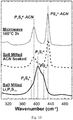
- Fig. 10 indicates that the Raman spectrum of the microwaved pre-cursor (dotted line) is similar to the soaked, ball milled Li 7 P 3 S 11 pre-cursor (dashed line). Although the Raman spectrum reveals both the P 2 S 6 4- and PS 4 3- anions, Li 7 P 3 S 11 can be formed by heating these pre-cursors to initiate a solid-state reaction between the Li 3 PS 4 and Li 2 P 2 S 6 .
- Fig. 11 shows the TGA analysis for both microwaved (dotted, grey line) and soaked, ball-milled (solid line) pre-cursors, demonstrating that ACN can be removed by heating to approximately 200°C.
- the solvothermal microwave promoted synthesis method may have general utility for lithium thiophosphate composite materials and thus provide a synthesis production method suitable to produce the target product in quantities necessary for commercial scale manufacture in support of advanced energy generation and storage devices.
- the present disclosure provides a method to prepare a target lithium thiophosphate composite, comprising:
- the target composite lithium thiophosphate may be any composite material as may be prepared according to the stoichiometric charge or molar ratio of the Li 2 S, P 2 S 5 and B if included. As indicated by the examples described herein, once the target lithium thiophosphate composite is identified optimization of polar solvent, reaction temperature and reaction time along with other reaction variables may be achieved by routine experimentation based on the actual composite product obtained, the product yield and the product quality.
- B may be included as a component and B may be one or a combination of components selected from Li 3 N, P 2 O 5 Li 2 O, LiN 3 , GeS 2 or LiX wherein X is I, Cl or Br.
- the disclosure is not necessarily limited to only this list of B components and one of skill in the art may select other components as a B unit in a lithium thiophosphate composite.
- the target lithium thiophosphate composite is of formula (I): xLi 2 S ⁇ yP 2 S 5 ⁇ (100-x-y)B wherein B is a composite material selected from the group of materials including Li 3 N, P 2 O 5 Li 2 O, LiN 3 , GeS 2 or LiX wherein X is I, Cl or Br, each of x and y represent a mass % value of from 33.3 % to 50 % such that the total mass % of Li 2 S, P 2 S 5 and B is 100%.
- the nonaqueous polar solvent may be any of ethers, nitriles, alcohols, carbonates and esters, with the proviso that the polar solvent is volatile under reduced pressure at a temperature less than a phase transition temperature of the target lithium thiophosphate composite.
- the target lithium thiophosphate composite may be obtained as a solid precipitate in the anhydrous polar solvent.
- the solid may be isolated from the mother liquor by any method known in the art, including decantation, filtration and centrifugation.
- the solid material obtained from the isolation may contain coordinated solvent molecules which may be removed to obtain the solvent-free composite material.
- the coordinated solvent may be removed by any method known for such purpose and may require heating the material to an elevated temperature, preferably under reduced pressure, more preferably under vacuum. As previously described the temperature at which the solvent is removed must be at a value less than a phase transition temperature associated with the target lithium thiophosphate composite.
- the target lithium thiophosphate composite is amorphous Li 3 PS 4 , a ratio of Li 2 S/ P 2 S 5 is approximately 3/1, the solvent is tetrahydrofuran and no B component is present.
- the temperature of the microwave induced solvothermal reaction may be conducted at a temperature of approximately 100°C or less for a reaction time of approximately 30 minutes to 3 hours.
- the product amorphous -Li 3 PS 4 may be obtained by isolation from the mother liquor portion of the THF and then removal of the THF coordinated with the amorphous- Li 3 PS 4 .
- the target lithium thiophosphate composite is Li 7 P 3 S 11 , a ratio of Li 2 S/ P 2 S 5 is approximately 70/30, the solvent is THF or acetonitrile and no B component is present.
- the temperature of the microwave induced solvothermal reaction may be conducted at a temperature of approximately 75°C or less for a reaction time of approximately 1 to 3 hours.
- the precursor product to Li 7 P 3 S 11 may be obtained by isolation from the mother liquor portion of the THF or acetonitrile and then removal of the coordinated solvent. Li 7 P 3 S 11 may then be obtained by annealing to form the crystalline Li 7 P 3 S 11 .
- the target lithium thiophosphate composite is xLi 2 S ⁇ yP 2 S 5 ⁇ (100-x-y)B, a ratio of Li 2 S/ P 2 S 5 is approximately x/y, and a B component is present in an amount of 100-x-y.
- the anhydrous polar solvent, temperature of the microwave induced reaction and time of the reaction may be determined by routine experimentation.
- the anhydrous polar solvent may be selected from ethers, nitriles, alcohols, carbonates and esters, with the proviso that the polar solvent is volatile under reduced pressure at a temperature less than a phase transition temperature of the target lithium thiophosphate composite.
- the time of the microwave induced reaction may be from 30 minutes to 5 hours, preferably from 30 minutes to 4 hours and most preferable from 30 minutes to 3 hours.
- the reaction temperature may be from 50°C to 200 °C, preferably 70 °C to 150 °C and most preferably from 75 °C to 130 °C.
- the target lithium thiophosphate composite may be isolated from the mother liquor by methods previously described and freed of coordinated solvent as previously described.
- Fig. 2 the Raman spectra of the insoluble product of a microwaved reaction of a 3:1 molar ratio of Li 2 S to P 2 S 5 in THF is shown.
- the long-dashed line represents a reaction carried out at 130°C for 30 min; the short-dashed line represents a reaction carried out at 130°C for 3h; the dotted line represents a reaction carried out at 100°C for 3h.
- the solid line is ball milled, amorphous Li 3 PS 4 for comparison.
- Amorphous Li 3 PS 4 was obtained by microwaving a 3:1 molar ratio of Li 2 S and P 2 S 5 in THF at 100°C for 3 hours ( Fig. 2 ).
- the microwaved sample was devoid of a P 2 S 6 4- anion impurity.
- the coordinated THF was removed at 130°C under vacuum, resulting in a 50% weight loss.
- the resulting particles were either large and blocky or small as shown in Fig. 4 .
- Annealing is the conversion of the amorphous product into a partially or completely crystalline form. Before annealing, the absence of any reflections (i.e. peaks) in the XRD pattern, shown in Fig. 5 (lowermost scan), inferred that the sample was amorphous. Confirmation of the Li 3 PS 4 product was established by heating the powder at 150°C for 1 hour to form ⁇ -Li 3 PS 4 , which can be positively identified by its fingerprint XRD pattern, as shown in Fig. 5 (uppermost scan). In Fig. 5 the broad hump centered at about 21° is from the quartz capillary.
- Fig. 6 shows an Arrhenius plot of the Li + conductivity of microwave-synthesized amorphous -Li 3 PS 4 between -10°C and 80°C (measured using EIS), yielding values of 0.1 mS/cm at 25°C and 1 mS/cm at 80°C.
- Fig. 6 shows an Arrhenius plot of the Li + conductivity of microwave-synthesized amorphous -Li 3 PS 4 between -10°C and 80°C (measured using EIS), yielding values of 0.1 mS/cm at 25°C and 1 mS/cm at 80°C.
- FIG. 7 shows the voltage profile of a solid state Li/ ⁇ -Li 3 PS 4 /Li cell as it was cycled at room temperature at 0.1 mA/cm 2 with 2 h half-cycles for 20 cycles to demonstrate the feasibility of microwave-synthesized LTP as a Li-ion electrolyte.
- the stripping and plating of Li occurred at an overpotential of 47 mV, at 0.1 mA/cm 2 for 2 h each half-cycle.
- Crystalline Li 7 P 3 S 11 is comprised of PS 4 3- and P 2 S 7 4- anions in a 1:1 ratio.
- Microwave, solid-state synthesis of a 70:30 molar ratio of Li 2 S and P 2 S 5 at 300°C for 30 min yielded a material having the Raman spectra shown in Fig. 8 (solid line) containing P 2 S 6 4- as indicated by the Raman band at 385 cm -1 and PS 4 3- as indicated by the Raman band at 424 cm -1 but none of the desired P 2 S 7 4- which is characterized by a Raman band at 405 cm -1 .
- a 70:30 molar ratio of Li 2 S and P 2 S 5 was mixed in THF and microwave heated to 75°C for 2 hours. As indicated in Fig. 8 (upper dotted curve) the desired composition of 1 P 2 S 7 4- : 1 PS 4 3- was obtained.
- the TGA analysis, displayed in Fig. 9 indicates that the coordinated THF can be removed by heating the product to 150°C, resulting in a ⁇ 45% weight loss.
- the dried product powder was annealed to obtain the crystalline form of Li 7 P 3 S 11 .
- a 70:30 molar ratio of Li 2 S and P 2 S 5 was mixed in acetonitrile (ACN) and microwave heated to 100°C for 3 hours. As indicated in Fig. 10 (upper dotted curve) the desired composition of 1 P 2 S 7 4- : 1 PS 4 3- was obtained.
- the TGA analysis, displayed in Fig.11 indicates that the coordinated THF can be removed by heating the product to 150°C, resulting in a ⁇ 45% weight loss.
- the solid line in Fig. 11 represents ball milled reaction of a 7:3 molar ratio of Li 2 S to P 2 S 5 .
- the dashed line is the product of soaking ball milled, amorphous Li 7 P 3 S 11 in acetonitrile (ACN) for 24 hours, followed by acetonitrile removal.
- the dotted line represents the product of the microwave reaction in acetonitrile described above.
- P 2 S 6 4- ⁇ ACN and "PS 4 3- ⁇ ACN” (dotted lines) show how ACN coordination increased the Raman excitation energy of those vibrations.
- the vial was returned to the glove box and the white insoluble product was removed using suction filtration.
- the residue was slurried in anhydrous heptane (10 mL) and the insoluble product was collected by suction filtration.
- the coordinated solvent i.e. THF was removed from the insoluble product by heating it to 124°C on a hot plate in the glove box for 3 hours.
- the vial was returned to the glove box and the acetonitrile was removed at 50°C under vacuum, leaving behind a white product.
- the coordinated solvent i.e. ACN
- TGA analysis was performed within an Ar glove box (H 2 O, O 2 ⁇ 0.1 ppm) using a Netzsch Luxx STA 409 PC.
- About 8 mg of sample powder was loaded into a cold-sealable, DSC pan with a 75 ⁇ m diameter hole in the lid.
- the DSC pan was crimped, loaded into the Netzsch Luxx and heated at 2°C/min.
- the reference was an empty, crimped DSC pan with a hole in the lid.
- Raman spectroscopy was performed with a Horiba LabRAM HR spectrometer equipped with an inverted optical microscope. A 50x lwr objective lens was used to focus a 532 nm laser onto the powder sample, which was pressed against the inside surface of a sealed cuvette to protect it from air. The back-scattered light was dispersed using a 600 grating/mm grating onto a CCD camera. Spectra were collected by performing 20 sequential scans, each with a 1 second duration. Spectra were collected from four different spots on each sample and compared to confirm sample homogeneity.
- SEM images were collected using a JEOL 7800 FLV at a magnification of 500x with an acceleration voltage of 5 kV and a beam current of 8 (43 pA).
- a Rigaku SmartLab 3kW fitted with an Anton-Paar HTK 1200N oven chamber and capillary extension was used to collect the XRD patterns.
- the 0.3 mm diameter quartz capillary was filled with dried, amorphous Li 3 PS 4 and sealed with epoxy in the glove box before transferring it to the diffractometer. Patterns were collected with a 0.035° step size at a rate of 0.4167°/min. After the amorphous material was scanned, the capillary was heated to 150°C to crystallize the material into ⁇ -Li 3 PS 4 . Multiple scans were performed so that the first and final patterns could be compared to confirm that the pattern did not change with time and, therefore, that the sample was successfully protected from air. The repeated scans were then added together to form the final XRD patterns.
- Li 3 PS 4 powder Into a Macor pellet die, 100 mg of Li 3 PS 4 powder was added and then pressed at 66.4 bar for 1 min to form an 11.28 mm diameter pellet (i.e. 1.0 cm 2 ), 596 ⁇ m thick. Then, polished and flattened lithium foil discs (99.8%, Honjo Metal) were applied to both sides of the pellet, followed by 508 ⁇ m-thick 400 nickel spacers (McMaster-Carr) and 9.5 mm diameter wave springs (McMaster-Carr).
- the spring/spacer/Li/solid electrolyte/Li/spacer/spring stack was compressed to 8.8 MPa in a cell, transferred to a 25°C oven and cycled in an air-tight container using a Bio-logic VMP3 potentiostat.
- the cell was cycled galvanostatically at 100 ⁇ A/cm 2 with 0.2 mAh/cm 2 half-cycles.
Landscapes
- Chemical & Material Sciences (AREA)
- Engineering & Computer Science (AREA)
- Chemical Kinetics & Catalysis (AREA)
- Electrochemistry (AREA)
- General Chemical & Material Sciences (AREA)
- Organic Chemistry (AREA)
- Manufacturing & Machinery (AREA)
- Inorganic Chemistry (AREA)
- Materials Engineering (AREA)
- Physics & Mathematics (AREA)
- Condensed Matter Physics & Semiconductors (AREA)
- General Physics & Mathematics (AREA)
- Toxicology (AREA)
- General Health & Medical Sciences (AREA)
- Health & Medical Sciences (AREA)
- Electromagnetism (AREA)
- Crystallography & Structural Chemistry (AREA)
- Secondary Cells (AREA)
- Battery Electrode And Active Subsutance (AREA)
Applications Claiming Priority (1)
| Application Number | Priority Date | Filing Date | Title |
|---|---|---|---|
| US16/043,944 US11325096B2 (en) | 2018-07-24 | 2018-07-24 | Microwave synthesis of lithium thiophosphate composite materials |
Publications (2)
| Publication Number | Publication Date |
|---|---|
| EP3599659A1 EP3599659A1 (en) | 2020-01-29 |
| EP3599659B1 true EP3599659B1 (en) | 2021-06-23 |
Family
ID=67438733
Family Applications (1)
| Application Number | Title | Priority Date | Filing Date |
|---|---|---|---|
| EP19188120.0A Active EP3599659B1 (en) | 2018-07-24 | 2019-07-24 | Microwave synthesis of lithium thiophosphate composite materials |
Country Status (4)
| Country | Link |
|---|---|
| US (1) | US11325096B2 (https=) |
| EP (1) | EP3599659B1 (https=) |
| JP (1) | JP7362332B2 (https=) |
| CN (1) | CN110783567B (https=) |
Families Citing this family (11)
| Publication number | Priority date | Publication date | Assignee | Title |
|---|---|---|---|---|
| KR102938244B1 (ko) * | 2019-11-20 | 2026-03-12 | 사이언스코 | 리튬 티오포스페이트의 제조 방법 |
| JP2021122866A (ja) | 2020-01-31 | 2021-08-30 | セイコーエプソン株式会社 | ロボット、ロボット搭載用移動体および移動ロボット |
| US20210336291A1 (en) * | 2020-04-22 | 2021-10-28 | Ut-Battelle, Llc | Solid thiophosphate electrolyte composition for lithium-based batteries |
| CN113991167A (zh) * | 2021-10-26 | 2022-01-28 | 西安交通大学 | 一种卤化物固态电解质材料及其制备方法和应用 |
| WO2023140178A1 (ja) * | 2022-01-18 | 2023-07-27 | 出光興産株式会社 | 硫化物固体電解質の製造方法 |
| CN115588734B (zh) * | 2022-09-08 | 2025-06-20 | 中国科学院化学研究所 | 一种复合补锂剂及其制备方法 |
| JPWO2024075618A1 (https=) * | 2022-10-07 | 2024-04-11 | ||
| CN115838287B (zh) * | 2023-02-10 | 2023-06-27 | 中国科学院宁波材料技术与工程研究所 | 多步烧结制备硫化物电解质的方法及制备的硫化物电解质 |
| WO2024204581A1 (ja) * | 2023-03-28 | 2024-10-03 | 公立大学法人大阪 | 固体電解質材料、固体電解質複合体、電極及び固体電解質材料の製造方法 |
| FR3157375A1 (fr) | 2023-12-21 | 2025-06-27 | IFP Energies Nouvelles | Méthode de synthèse en solution de particules thiophosphate de sodium ou lithium |
| FR3164317A1 (fr) | 2024-07-02 | 2026-01-09 | IFP Energies Nouvelles | Procédé de synthèse de particules de thiophosphate Li3PS4 |
Family Cites Families (25)
| Publication number | Priority date | Publication date | Assignee | Title |
|---|---|---|---|---|
| US20090117020A1 (en) * | 2007-11-05 | 2009-05-07 | Board Of Regents, The University Of Texas System | Rapid microwave-solvothermal synthesis and surface modification of nanostructured phospho-olivine cathodes for lithium ion batteries |
| JP5510036B2 (ja) | 2009-05-28 | 2014-06-04 | Tdk株式会社 | 活物質、活物質の製造方法及びリチウムイオン二次電池 |
| KR101748406B1 (ko) * | 2009-08-07 | 2017-06-16 | 가부시키가이샤 한도오따이 에네루기 켄큐쇼 | 양극 활물질의 제작 방법 |
| WO2011096532A1 (ja) | 2010-02-05 | 2011-08-11 | 国立大学法人秋田大学 | 固体電解質及び電気化学素子 |
| WO2011100487A2 (en) | 2010-02-12 | 2011-08-18 | Applied Materials, Inc. | HYDROTHERMAL SYNTHESIS OF LiFePO4 NANOPARTICLES |
| WO2011118801A1 (ja) | 2010-03-26 | 2011-09-29 | 国立大学法人東京工業大学 | 硫化物固体電解質材料、電池および硫化物固体電解質材料の製造方法 |
| WO2013069083A1 (ja) | 2011-11-07 | 2013-05-16 | トヨタ自動車株式会社 | 全固体電池 |
| CN102391387B (zh) * | 2011-11-07 | 2013-02-27 | 沈阳科思高科技有限公司 | 高等植物或食药用真菌类中活性多糖的微波化学提取方法 |
| US20140377664A1 (en) | 2012-01-10 | 2014-12-25 | The Regents Of The University Of Colorado, A Body Corporate | Lithium all-solid-state battery |
| JP5851251B2 (ja) * | 2012-01-16 | 2016-02-03 | ネットエージェント株式会社 | 通信パケット保存装置 |
| CN102787146B (zh) * | 2012-07-28 | 2014-02-19 | 江南大学 | 一种用微波辅助脂肪酶催化合成酯化改性egcg的方法 |
| ITTO20120709A1 (it) | 2012-08-07 | 2014-02-08 | Fond Istituto Italiano Di Tecnologia | Procedimento di sintesi colloidale di litio ferro fosfato |
| EP2997621B1 (de) * | 2013-05-16 | 2019-01-09 | Albemarle Germany GmbH | Aktives lithiumreservoir für lithiumionenbatterien |
| JP2014229490A (ja) | 2013-05-22 | 2014-12-08 | 東京電力株式会社 | 電池用固体電解質の製造方法 |
| JP6003831B2 (ja) | 2013-06-28 | 2016-10-05 | トヨタ自動車株式会社 | 硫化物固体電解質材料、硫化物ガラス、リチウム固体電池、および、硫化物固体電解質材料の製造方法 |
| CN103349917B (zh) * | 2013-07-26 | 2016-01-13 | 北京工业大学 | 一种微波强化层层组装聚电解质多层薄膜的方法 |
| US9887419B2 (en) * | 2013-08-26 | 2018-02-06 | Samsung Electronics Co., Ltd. | Active material, method of preparing the active material electrode including the active material, and secondary battery including the electrode |
| JP6425426B2 (ja) | 2014-06-10 | 2018-11-21 | 三星電子株式会社Samsung Electronics Co.,Ltd. | 硫化物固体電解質、および硫化物固体電解質の製造方法 |
| JP2015220200A (ja) * | 2014-05-21 | 2015-12-07 | 株式会社Gsユアサ | 蓄電素子の製造方法及び蓄電素子 |
| KR101646416B1 (ko) | 2014-12-18 | 2016-08-05 | 현대자동차주식회사 | 붕산염이 첨가된 전고체 이차전지용 황화물계 결정화 유리 및 이의 제조방법 |
| JP2016119257A (ja) | 2014-12-22 | 2016-06-30 | 株式会社日立製作所 | 固体電解質、それを用いた全固体電池及び固体電解質の製造方法 |
| JP6531674B2 (ja) * | 2016-02-26 | 2019-06-19 | トヨタ自動車株式会社 | 硫化物固体電解質材料、リチウム固体電池および硫化物固体電解質材料の製造方法 |
| CN107394262A (zh) * | 2017-07-25 | 2017-11-24 | 深圳市沃特玛电池有限公司 | 一种复合固态电解质的制备方法 |
| KR101983046B1 (ko) * | 2017-11-08 | 2019-05-29 | 한국기초과학지원연구원 | 이차전지용 음극활물질, 그 제조방법 및 이를 포함하는 리튬이차전지 |
| US12166212B2 (en) * | 2018-01-12 | 2024-12-10 | Toyota Motor Engineering & Manufacturing North America, Inc. | Interphase between lithium metal and solid electrolyte |
-
2018
- 2018-07-24 US US16/043,944 patent/US11325096B2/en active Active
-
2019
- 2019-07-24 EP EP19188120.0A patent/EP3599659B1/en active Active
- 2019-07-24 CN CN201910672318.7A patent/CN110783567B/zh active Active
- 2019-07-24 JP JP2019136447A patent/JP7362332B2/ja active Active
Also Published As
| Publication number | Publication date |
|---|---|
| CN110783567B (zh) | 2024-06-11 |
| EP3599659A1 (en) | 2020-01-29 |
| US20200030768A1 (en) | 2020-01-30 |
| CN110783567A (zh) | 2020-02-11 |
| JP7362332B2 (ja) | 2023-10-17 |
| JP2020015661A (ja) | 2020-01-30 |
| US11325096B2 (en) | 2022-05-10 |
Similar Documents
| Publication | Publication Date | Title |
|---|---|---|
| EP3599659B1 (en) | Microwave synthesis of lithium thiophosphate composite materials | |
| EP2555307B1 (en) | Sulfide solid electrolyte material, battery, and method for producing sulfide solid electrolyte material | |
| US20210323824A1 (en) | Solid lithium ion conducting material and process for preparation thereof | |
| Choi et al. | Thermal stability and phase transformation of electrochemically charged/discharged LiMnPO 4 cathode for Li-ion batteries | |
| Zhu et al. | Ether-based electrolyte enabled Na/FeS2 rechargeable batteries | |
| US10361451B2 (en) | Sulfide solid electrolyte material, lithium solid battery, and producing method for sulfide solid electrolyte material | |
| Tamaru et al. | Layered Na2RuO3 as a cathode material for Na-ion batteries | |
| EP3007262A1 (en) | Sulfide solid electrolyte material, cell, and method for producing sulfide solid electrolyte material | |
| US12476276B2 (en) | Lithium-ion conducting haloboro-oxysulfides | |
| JP2016511730A (ja) | ドープされたニッケル酸塩 | |
| US20200328451A1 (en) | Sulfide solid electrolyte, method for producing sulfide solid electrolyte, electrode, and all solid state battery | |
| US20160197374A1 (en) | Sulfide solid electrolyte material, battery, and producing method for sulfide solid electrolyte material | |
| JP2015507333A (ja) | 硫酸塩電極 | |
| EP2762449B1 (en) | Method of manufacturing a silicon oxide-carbon composite | |
| EP3415467B1 (en) | Method for manufacturing vanadium lithium phosphate | |
| Allcorn et al. | Thermal stability of Sb and Cu2Sb anodes in lithium-ion batteries | |
| JP2012193051A (ja) | 無機固体電解質の製造方法 | |
| Choi et al. | Comparative investigation of electrochemical properties of Li1. 5Al0. 5Ti1. 5 (PO4) 3 ceramic electrolyte synthesized using different chelating agents for all solid-state batteries | |
| EP4654286A1 (en) | Materials for use in batteries and methods of manufacturing the same, and batteries | |
| KR20230038420A (ko) | 신규 고체 황화물 전해질 | |
| US11316155B2 (en) | Cathode active material precursor for non-aqueous electrolyte secondary battery | |
| Narumi et al. | Tailoring the room-temperature miscibility gap in ordered spinel LiNi 0.5 Mn 1.5 O 4 cathodes by multi-element doping | |
| WO2020203045A1 (ja) | 硫化物系無機固体電解質材料用の五硫化二リン組成物 | |
| JP2020164366A (ja) | 硫化物系無機固体電解質材料用の五硫化二リン組成物 | |
| JP6794518B2 (ja) | 固体電解質材料の製造方法 |
Legal Events
| Date | Code | Title | Description |
|---|---|---|---|
| PUAI | Public reference made under article 153(3) epc to a published international application that has entered the european phase |
Free format text: ORIGINAL CODE: 0009012 |
|
| STAA | Information on the status of an ep patent application or granted ep patent |
Free format text: STATUS: REQUEST FOR EXAMINATION WAS MADE |
|
| 17P | Request for examination filed |
Effective date: 20190814 |
|
| AK | Designated contracting states |
Kind code of ref document: A1 Designated state(s): AL AT BE BG CH CY CZ DE DK EE ES FI FR GB GR HR HU IE IS IT LI LT LU LV MC MK MT NL NO PL PT RO RS SE SI SK SM TR |
|
| AX | Request for extension of the european patent |
Extension state: BA ME |
|
| GRAP | Despatch of communication of intention to grant a patent |
Free format text: ORIGINAL CODE: EPIDOSNIGR1 |
|
| STAA | Information on the status of an ep patent application or granted ep patent |
Free format text: STATUS: GRANT OF PATENT IS INTENDED |
|
| RIC1 | Information provided on ipc code assigned before grant |
Ipc: C01B 25/14 20060101ALI20201223BHEP Ipc: H01M 10/0525 20100101ALI20201223BHEP Ipc: H01M 10/0562 20100101AFI20201223BHEP |
|
| INTG | Intention to grant announced |
Effective date: 20210119 |
|
| GRAS | Grant fee paid |
Free format text: ORIGINAL CODE: EPIDOSNIGR3 |
|
| GRAA | (expected) grant |
Free format text: ORIGINAL CODE: 0009210 |
|
| STAA | Information on the status of an ep patent application or granted ep patent |
Free format text: STATUS: THE PATENT HAS BEEN GRANTED |
|
| AK | Designated contracting states |
Kind code of ref document: B1 Designated state(s): AL AT BE BG CH CY CZ DE DK EE ES FI FR GB GR HR HU IE IS IT LI LT LU LV MC MK MT NL NO PL PT RO RS SE SI SK SM TR |
|
| REG | Reference to a national code |
Ref country code: GB Ref legal event code: FG4D |
|
| REG | Reference to a national code |
Ref country code: CH Ref legal event code: EP |
|
| REG | Reference to a national code |
Ref country code: DE Ref legal event code: R096 Ref document number: 602019005528 Country of ref document: DE Ref country code: AT Ref legal event code: REF Ref document number: 1405101 Country of ref document: AT Kind code of ref document: T Effective date: 20210715 |
|
| REG | Reference to a national code |
Ref country code: IE Ref legal event code: FG4D |
|
| REG | Reference to a national code |
Ref country code: LT Ref legal event code: MG9D |
|
| PG25 | Lapsed in a contracting state [announced via postgrant information from national office to epo] |
Ref country code: HR Free format text: LAPSE BECAUSE OF FAILURE TO SUBMIT A TRANSLATION OF THE DESCRIPTION OR TO PAY THE FEE WITHIN THE PRESCRIBED TIME-LIMIT Effective date: 20210623 Ref country code: LT Free format text: LAPSE BECAUSE OF FAILURE TO SUBMIT A TRANSLATION OF THE DESCRIPTION OR TO PAY THE FEE WITHIN THE PRESCRIBED TIME-LIMIT Effective date: 20210623 Ref country code: FI Free format text: LAPSE BECAUSE OF FAILURE TO SUBMIT A TRANSLATION OF THE DESCRIPTION OR TO PAY THE FEE WITHIN THE PRESCRIBED TIME-LIMIT Effective date: 20210623 Ref country code: BG Free format text: LAPSE BECAUSE OF FAILURE TO SUBMIT A TRANSLATION OF THE DESCRIPTION OR TO PAY THE FEE WITHIN THE PRESCRIBED TIME-LIMIT Effective date: 20210923 |
|
| REG | Reference to a national code |
Ref country code: AT Ref legal event code: MK05 Ref document number: 1405101 Country of ref document: AT Kind code of ref document: T Effective date: 20210623 |
|
| PG25 | Lapsed in a contracting state [announced via postgrant information from national office to epo] |
Ref country code: SE Free format text: LAPSE BECAUSE OF FAILURE TO SUBMIT A TRANSLATION OF THE DESCRIPTION OR TO PAY THE FEE WITHIN THE PRESCRIBED TIME-LIMIT Effective date: 20210623 Ref country code: RS Free format text: LAPSE BECAUSE OF FAILURE TO SUBMIT A TRANSLATION OF THE DESCRIPTION OR TO PAY THE FEE WITHIN THE PRESCRIBED TIME-LIMIT Effective date: 20210623 Ref country code: LV Free format text: LAPSE BECAUSE OF FAILURE TO SUBMIT A TRANSLATION OF THE DESCRIPTION OR TO PAY THE FEE WITHIN THE PRESCRIBED TIME-LIMIT Effective date: 20210623 Ref country code: NO Free format text: LAPSE BECAUSE OF FAILURE TO SUBMIT A TRANSLATION OF THE DESCRIPTION OR TO PAY THE FEE WITHIN THE PRESCRIBED TIME-LIMIT Effective date: 20210923 Ref country code: GR Free format text: LAPSE BECAUSE OF FAILURE TO SUBMIT A TRANSLATION OF THE DESCRIPTION OR TO PAY THE FEE WITHIN THE PRESCRIBED TIME-LIMIT Effective date: 20210924 |
|
| REG | Reference to a national code |
Ref country code: NL Ref legal event code: MP Effective date: 20210623 |
|
| PG25 | Lapsed in a contracting state [announced via postgrant information from national office to epo] |
Ref country code: SK Free format text: LAPSE BECAUSE OF FAILURE TO SUBMIT A TRANSLATION OF THE DESCRIPTION OR TO PAY THE FEE WITHIN THE PRESCRIBED TIME-LIMIT Effective date: 20210623 Ref country code: ES Free format text: LAPSE BECAUSE OF FAILURE TO SUBMIT A TRANSLATION OF THE DESCRIPTION OR TO PAY THE FEE WITHIN THE PRESCRIBED TIME-LIMIT Effective date: 20210623 Ref country code: EE Free format text: LAPSE BECAUSE OF FAILURE TO SUBMIT A TRANSLATION OF THE DESCRIPTION OR TO PAY THE FEE WITHIN THE PRESCRIBED TIME-LIMIT Effective date: 20210623 Ref country code: SM Free format text: LAPSE BECAUSE OF FAILURE TO SUBMIT A TRANSLATION OF THE DESCRIPTION OR TO PAY THE FEE WITHIN THE PRESCRIBED TIME-LIMIT Effective date: 20210623 Ref country code: RO Free format text: LAPSE BECAUSE OF FAILURE TO SUBMIT A TRANSLATION OF THE DESCRIPTION OR TO PAY THE FEE WITHIN THE PRESCRIBED TIME-LIMIT Effective date: 20210623 Ref country code: PT Free format text: LAPSE BECAUSE OF FAILURE TO SUBMIT A TRANSLATION OF THE DESCRIPTION OR TO PAY THE FEE WITHIN THE PRESCRIBED TIME-LIMIT Effective date: 20211025 Ref country code: NL Free format text: LAPSE BECAUSE OF FAILURE TO SUBMIT A TRANSLATION OF THE DESCRIPTION OR TO PAY THE FEE WITHIN THE PRESCRIBED TIME-LIMIT Effective date: 20210623 Ref country code: CZ Free format text: LAPSE BECAUSE OF FAILURE TO SUBMIT A TRANSLATION OF THE DESCRIPTION OR TO PAY THE FEE WITHIN THE PRESCRIBED TIME-LIMIT Effective date: 20210623 Ref country code: AT Free format text: LAPSE BECAUSE OF FAILURE TO SUBMIT A TRANSLATION OF THE DESCRIPTION OR TO PAY THE FEE WITHIN THE PRESCRIBED TIME-LIMIT Effective date: 20210623 |
|
| PG25 | Lapsed in a contracting state [announced via postgrant information from national office to epo] |
Ref country code: PL Free format text: LAPSE BECAUSE OF FAILURE TO SUBMIT A TRANSLATION OF THE DESCRIPTION OR TO PAY THE FEE WITHIN THE PRESCRIBED TIME-LIMIT Effective date: 20210623 |
|
| REG | Reference to a national code |
Ref country code: DE Ref legal event code: R097 Ref document number: 602019005528 Country of ref document: DE |
|
| PG25 | Lapsed in a contracting state [announced via postgrant information from national office to epo] |
Ref country code: MC Free format text: LAPSE BECAUSE OF FAILURE TO SUBMIT A TRANSLATION OF THE DESCRIPTION OR TO PAY THE FEE WITHIN THE PRESCRIBED TIME-LIMIT Effective date: 20210623 |
|
| REG | Reference to a national code |
Ref country code: BE Ref legal event code: MM Effective date: 20210731 |
|
| PG25 | Lapsed in a contracting state [announced via postgrant information from national office to epo] |
Ref country code: DK Free format text: LAPSE BECAUSE OF FAILURE TO SUBMIT A TRANSLATION OF THE DESCRIPTION OR TO PAY THE FEE WITHIN THE PRESCRIBED TIME-LIMIT Effective date: 20210623 |
|
| PLBE | No opposition filed within time limit |
Free format text: ORIGINAL CODE: 0009261 |
|
| STAA | Information on the status of an ep patent application or granted ep patent |
Free format text: STATUS: NO OPPOSITION FILED WITHIN TIME LIMIT |
|
| 26N | No opposition filed |
Effective date: 20220324 |
|
| PG25 | Lapsed in a contracting state [announced via postgrant information from national office to epo] |
Ref country code: LU Free format text: LAPSE BECAUSE OF NON-PAYMENT OF DUE FEES Effective date: 20210724 Ref country code: AL Free format text: LAPSE BECAUSE OF FAILURE TO SUBMIT A TRANSLATION OF THE DESCRIPTION OR TO PAY THE FEE WITHIN THE PRESCRIBED TIME-LIMIT Effective date: 20210623 |
|
| PG25 | Lapsed in a contracting state [announced via postgrant information from national office to epo] |
Ref country code: IT Free format text: LAPSE BECAUSE OF FAILURE TO SUBMIT A TRANSLATION OF THE DESCRIPTION OR TO PAY THE FEE WITHIN THE PRESCRIBED TIME-LIMIT Effective date: 20210623 Ref country code: IE Free format text: LAPSE BECAUSE OF NON-PAYMENT OF DUE FEES Effective date: 20210724 Ref country code: BE Free format text: LAPSE BECAUSE OF NON-PAYMENT OF DUE FEES Effective date: 20210731 |
|
| REG | Reference to a national code |
Ref country code: GB Ref legal event code: 732E Free format text: REGISTERED BETWEEN 20220922 AND 20220928 |
|
| REG | Reference to a national code |
Ref country code: DE Ref legal event code: R081 Ref document number: 602019005528 Country of ref document: DE Owner name: TOYOTA JIDOSHA KABUSHIKI KAISHA, TOYOTA-SHI, JP Free format text: FORMER OWNER: TOYOTA MOTOR ENGINEERING & MANUFACTURING NORTH AMERICA, INC., PLANO, TX, US |
|
| REG | Reference to a national code |
Ref country code: CH Ref legal event code: PL |
|
| PG25 | Lapsed in a contracting state [announced via postgrant information from national office to epo] |
Ref country code: LI Free format text: LAPSE BECAUSE OF NON-PAYMENT OF DUE FEES Effective date: 20220731 Ref country code: CH Free format text: LAPSE BECAUSE OF NON-PAYMENT OF DUE FEES Effective date: 20220731 |
|
| P01 | Opt-out of the competence of the unified patent court (upc) registered |
Effective date: 20230523 |
|
| PG25 | Lapsed in a contracting state [announced via postgrant information from national office to epo] |
Ref country code: CY Free format text: LAPSE BECAUSE OF FAILURE TO SUBMIT A TRANSLATION OF THE DESCRIPTION OR TO PAY THE FEE WITHIN THE PRESCRIBED TIME-LIMIT Effective date: 20210623 |
|
| PG25 | Lapsed in a contracting state [announced via postgrant information from national office to epo] |
Ref country code: HU Free format text: LAPSE BECAUSE OF FAILURE TO SUBMIT A TRANSLATION OF THE DESCRIPTION OR TO PAY THE FEE WITHIN THE PRESCRIBED TIME-LIMIT; INVALID AB INITIO Effective date: 20190724 |
|
| REG | Reference to a national code |
Ref country code: DE Ref legal event code: R084 Ref document number: 602019005528 Country of ref document: DE |
|
| REG | Reference to a national code |
Ref country code: GB Ref legal event code: 746 Effective date: 20231113 |
|
| PG25 | Lapsed in a contracting state [announced via postgrant information from national office to epo] |
Ref country code: MK Free format text: LAPSE BECAUSE OF FAILURE TO SUBMIT A TRANSLATION OF THE DESCRIPTION OR TO PAY THE FEE WITHIN THE PRESCRIBED TIME-LIMIT Effective date: 20210623 |
|
| PG25 | Lapsed in a contracting state [announced via postgrant information from national office to epo] |
Ref country code: MT Free format text: LAPSE BECAUSE OF FAILURE TO SUBMIT A TRANSLATION OF THE DESCRIPTION OR TO PAY THE FEE WITHIN THE PRESCRIBED TIME-LIMIT Effective date: 20210623 |
|
| PGFP | Annual fee paid to national office [announced via postgrant information from national office to epo] |
Ref country code: GB Payment date: 20250605 Year of fee payment: 7 |
|
| PGFP | Annual fee paid to national office [announced via postgrant information from national office to epo] |
Ref country code: FR Payment date: 20250610 Year of fee payment: 7 |
|
| PGFP | Annual fee paid to national office [announced via postgrant information from national office to epo] |
Ref country code: DE Payment date: 20250528 Year of fee payment: 7 |
|
| PG25 | Lapsed in a contracting state [announced via postgrant information from national office to epo] |
Ref country code: TR Free format text: LAPSE BECAUSE OF FAILURE TO SUBMIT A TRANSLATION OF THE DESCRIPTION OR TO PAY THE FEE WITHIN THE PRESCRIBED TIME-LIMIT Effective date: 20210623 |