EP3597689B1 - Hochmolekulare verbindung mit substituiertem triarylamingerüst - Google Patents
Hochmolekulare verbindung mit substituiertem triarylamingerüst Download PDFInfo
- Publication number
- EP3597689B1 EP3597689B1 EP18767921.2A EP18767921A EP3597689B1 EP 3597689 B1 EP3597689 B1 EP 3597689B1 EP 18767921 A EP18767921 A EP 18767921A EP 3597689 B1 EP3597689 B1 EP 3597689B1
- Authority
- EP
- European Patent Office
- Prior art keywords
- group
- molecular weight
- high molecular
- weight compound
- structural unit
- Prior art date
- Legal status (The legal status is an assumption and is not a legal conclusion. Google has not performed a legal analysis and makes no representation as to the accuracy of the status listed.)
- Active
Links
Images























Classifications
-
- C—CHEMISTRY; METALLURGY
- C08—ORGANIC MACROMOLECULAR COMPOUNDS; THEIR PREPARATION OR CHEMICAL WORKING-UP; COMPOSITIONS BASED THEREON
- C08G—MACROMOLECULAR COMPOUNDS OBTAINED OTHERWISE THAN BY REACTIONS ONLY INVOLVING UNSATURATED CARBON-TO-CARBON BONDS
- C08G61/00—Macromolecular compounds obtained by reactions forming a carbon-to-carbon link in the main chain of the macromolecule
- C08G61/12—Macromolecular compounds containing atoms other than carbon in the main chain of the macromolecule
-
- C—CHEMISTRY; METALLURGY
- C08—ORGANIC MACROMOLECULAR COMPOUNDS; THEIR PREPARATION OR CHEMICAL WORKING-UP; COMPOSITIONS BASED THEREON
- C08G—MACROMOLECULAR COMPOUNDS OBTAINED OTHERWISE THAN BY REACTIONS ONLY INVOLVING UNSATURATED CARBON-TO-CARBON BONDS
- C08G61/00—Macromolecular compounds obtained by reactions forming a carbon-to-carbon link in the main chain of the macromolecule
- C08G61/12—Macromolecular compounds containing atoms other than carbon in the main chain of the macromolecule
- C08G61/121—Macromolecular compounds containing atoms other than carbon in the main chain of the macromolecule derived from organic halides
-
- C—CHEMISTRY; METALLURGY
- C09—DYES; PAINTS; POLISHES; NATURAL RESINS; ADHESIVES; COMPOSITIONS NOT OTHERWISE PROVIDED FOR; APPLICATIONS OF MATERIALS NOT OTHERWISE PROVIDED FOR
- C09K—MATERIALS FOR MISCELLANEOUS APPLICATIONS, NOT PROVIDED FOR ELSEWHERE
- C09K11/00—Luminescent materials, e.g. electroluminescent or chemiluminescent
- C09K11/06—Luminescent materials, e.g. electroluminescent or chemiluminescent containing organic luminescent materials
-
- H—ELECTRICITY
- H10—SEMICONDUCTOR DEVICES; ELECTRIC SOLID-STATE DEVICES NOT OTHERWISE PROVIDED FOR
- H10K—ORGANIC ELECTRIC SOLID-STATE DEVICES
- H10K50/00—Organic light-emitting devices
- H10K50/10—OLEDs or polymer light-emitting diodes [PLED]
- H10K50/17—Carrier injection layers
-
- H—ELECTRICITY
- H10—SEMICONDUCTOR DEVICES; ELECTRIC SOLID-STATE DEVICES NOT OTHERWISE PROVIDED FOR
- H10K—ORGANIC ELECTRIC SOLID-STATE DEVICES
- H10K50/00—Organic light-emitting devices
- H10K50/10—OLEDs or polymer light-emitting diodes [PLED]
- H10K50/18—Carrier blocking layers
- H10K50/181—Electron blocking layers
-
- H—ELECTRICITY
- H10—SEMICONDUCTOR DEVICES; ELECTRIC SOLID-STATE DEVICES NOT OTHERWISE PROVIDED FOR
- H10K—ORGANIC ELECTRIC SOLID-STATE DEVICES
- H10K85/00—Organic materials used in the body or electrodes of devices covered by this subclass
- H10K85/10—Organic polymers or oligomers
- H10K85/111—Organic polymers or oligomers comprising aromatic, heteroaromatic, or aryl chains, e.g. polyaniline, polyphenylene or polyphenylene vinylene
-
- H—ELECTRICITY
- H10—SEMICONDUCTOR DEVICES; ELECTRIC SOLID-STATE DEVICES NOT OTHERWISE PROVIDED FOR
- H10K—ORGANIC ELECTRIC SOLID-STATE DEVICES
- H10K85/00—Organic materials used in the body or electrodes of devices covered by this subclass
- H10K85/10—Organic polymers or oligomers
- H10K85/111—Organic polymers or oligomers comprising aromatic, heteroaromatic, or aryl chains, e.g. polyaniline, polyphenylene or polyphenylene vinylene
- H10K85/115—Polyfluorene; Derivatives thereof
-
- H—ELECTRICITY
- H10—SEMICONDUCTOR DEVICES; ELECTRIC SOLID-STATE DEVICES NOT OTHERWISE PROVIDED FOR
- H10K—ORGANIC ELECTRIC SOLID-STATE DEVICES
- H10K85/00—Organic materials used in the body or electrodes of devices covered by this subclass
- H10K85/10—Organic polymers or oligomers
- H10K85/151—Copolymers
-
- C—CHEMISTRY; METALLURGY
- C08—ORGANIC MACROMOLECULAR COMPOUNDS; THEIR PREPARATION OR CHEMICAL WORKING-UP; COMPOSITIONS BASED THEREON
- C08G—MACROMOLECULAR COMPOUNDS OBTAINED OTHERWISE THAN BY REACTIONS ONLY INVOLVING UNSATURATED CARBON-TO-CARBON BONDS
- C08G2261/00—Macromolecular compounds obtained by reactions forming a carbon-to-carbon link in the main chain of the macromolecule
- C08G2261/10—Definition of the polymer structure
- C08G2261/12—Copolymers
-
- C—CHEMISTRY; METALLURGY
- C08—ORGANIC MACROMOLECULAR COMPOUNDS; THEIR PREPARATION OR CHEMICAL WORKING-UP; COMPOSITIONS BASED THEREON
- C08G—MACROMOLECULAR COMPOUNDS OBTAINED OTHERWISE THAN BY REACTIONS ONLY INVOLVING UNSATURATED CARBON-TO-CARBON BONDS
- C08G2261/00—Macromolecular compounds obtained by reactions forming a carbon-to-carbon link in the main chain of the macromolecule
- C08G2261/10—Definition of the polymer structure
- C08G2261/12—Copolymers
- C08G2261/124—Copolymers alternating
-
- C—CHEMISTRY; METALLURGY
- C08—ORGANIC MACROMOLECULAR COMPOUNDS; THEIR PREPARATION OR CHEMICAL WORKING-UP; COMPOSITIONS BASED THEREON
- C08G—MACROMOLECULAR COMPOUNDS OBTAINED OTHERWISE THAN BY REACTIONS ONLY INVOLVING UNSATURATED CARBON-TO-CARBON BONDS
- C08G2261/00—Macromolecular compounds obtained by reactions forming a carbon-to-carbon link in the main chain of the macromolecule
- C08G2261/10—Definition of the polymer structure
- C08G2261/14—Side-groups
- C08G2261/141—Side-chains having aliphatic units
- C08G2261/1412—Saturated aliphatic units
-
- C—CHEMISTRY; METALLURGY
- C08—ORGANIC MACROMOLECULAR COMPOUNDS; THEIR PREPARATION OR CHEMICAL WORKING-UP; COMPOSITIONS BASED THEREON
- C08G—MACROMOLECULAR COMPOUNDS OBTAINED OTHERWISE THAN BY REACTIONS ONLY INVOLVING UNSATURATED CARBON-TO-CARBON BONDS
- C08G2261/00—Macromolecular compounds obtained by reactions forming a carbon-to-carbon link in the main chain of the macromolecule
- C08G2261/10—Definition of the polymer structure
- C08G2261/14—Side-groups
- C08G2261/148—Side-chains having aromatic units
-
- C—CHEMISTRY; METALLURGY
- C08—ORGANIC MACROMOLECULAR COMPOUNDS; THEIR PREPARATION OR CHEMICAL WORKING-UP; COMPOSITIONS BASED THEREON
- C08G—MACROMOLECULAR COMPOUNDS OBTAINED OTHERWISE THAN BY REACTIONS ONLY INVOLVING UNSATURATED CARBON-TO-CARBON BONDS
- C08G2261/00—Macromolecular compounds obtained by reactions forming a carbon-to-carbon link in the main chain of the macromolecule
- C08G2261/10—Definition of the polymer structure
- C08G2261/16—End groups
- C08G2261/164—End groups comprising organic end groups
- C08G2261/1646—End groups comprising organic end groups comprising aromatic or heteroaromatic end groups
-
- C—CHEMISTRY; METALLURGY
- C08—ORGANIC MACROMOLECULAR COMPOUNDS; THEIR PREPARATION OR CHEMICAL WORKING-UP; COMPOSITIONS BASED THEREON
- C08G—MACROMOLECULAR COMPOUNDS OBTAINED OTHERWISE THAN BY REACTIONS ONLY INVOLVING UNSATURATED CARBON-TO-CARBON BONDS
- C08G2261/00—Macromolecular compounds obtained by reactions forming a carbon-to-carbon link in the main chain of the macromolecule
- C08G2261/10—Definition of the polymer structure
- C08G2261/18—Definition of the polymer structure conjugated
-
- C—CHEMISTRY; METALLURGY
- C08—ORGANIC MACROMOLECULAR COMPOUNDS; THEIR PREPARATION OR CHEMICAL WORKING-UP; COMPOSITIONS BASED THEREON
- C08G—MACROMOLECULAR COMPOUNDS OBTAINED OTHERWISE THAN BY REACTIONS ONLY INVOLVING UNSATURATED CARBON-TO-CARBON BONDS
- C08G2261/00—Macromolecular compounds obtained by reactions forming a carbon-to-carbon link in the main chain of the macromolecule
- C08G2261/10—Definition of the polymer structure
- C08G2261/22—Molecular weight
- C08G2261/228—Polymers, i.e. more than 10 repeat units
-
- C—CHEMISTRY; METALLURGY
- C08—ORGANIC MACROMOLECULAR COMPOUNDS; THEIR PREPARATION OR CHEMICAL WORKING-UP; COMPOSITIONS BASED THEREON
- C08G—MACROMOLECULAR COMPOUNDS OBTAINED OTHERWISE THAN BY REACTIONS ONLY INVOLVING UNSATURATED CARBON-TO-CARBON BONDS
- C08G2261/00—Macromolecular compounds obtained by reactions forming a carbon-to-carbon link in the main chain of the macromolecule
- C08G2261/30—Monomer units or repeat units incorporating structural elements in the main chain
- C08G2261/31—Monomer units or repeat units incorporating structural elements in the main chain incorporating aromatic structural elements in the main chain
- C08G2261/312—Non-condensed aromatic systems, e.g. benzene
-
- C—CHEMISTRY; METALLURGY
- C08—ORGANIC MACROMOLECULAR COMPOUNDS; THEIR PREPARATION OR CHEMICAL WORKING-UP; COMPOSITIONS BASED THEREON
- C08G—MACROMOLECULAR COMPOUNDS OBTAINED OTHERWISE THAN BY REACTIONS ONLY INVOLVING UNSATURATED CARBON-TO-CARBON BONDS
- C08G2261/00—Macromolecular compounds obtained by reactions forming a carbon-to-carbon link in the main chain of the macromolecule
- C08G2261/30—Monomer units or repeat units incorporating structural elements in the main chain
- C08G2261/31—Monomer units or repeat units incorporating structural elements in the main chain incorporating aromatic structural elements in the main chain
- C08G2261/314—Condensed aromatic systems, e.g. perylene, anthracene or pyrene
- C08G2261/3142—Condensed aromatic systems, e.g. perylene, anthracene or pyrene fluorene-based, e.g. fluorene, indenofluorene, or spirobifluorene
-
- C—CHEMISTRY; METALLURGY
- C08—ORGANIC MACROMOLECULAR COMPOUNDS; THEIR PREPARATION OR CHEMICAL WORKING-UP; COMPOSITIONS BASED THEREON
- C08G—MACROMOLECULAR COMPOUNDS OBTAINED OTHERWISE THAN BY REACTIONS ONLY INVOLVING UNSATURATED CARBON-TO-CARBON BONDS
- C08G2261/00—Macromolecular compounds obtained by reactions forming a carbon-to-carbon link in the main chain of the macromolecule
- C08G2261/30—Monomer units or repeat units incorporating structural elements in the main chain
- C08G2261/31—Monomer units or repeat units incorporating structural elements in the main chain incorporating aromatic structural elements in the main chain
- C08G2261/316—Monomer units or repeat units incorporating structural elements in the main chain incorporating aromatic structural elements in the main chain bridged by heteroatoms, e.g. N, P, Si or B
- C08G2261/3162—Arylamines
-
- C—CHEMISTRY; METALLURGY
- C08—ORGANIC MACROMOLECULAR COMPOUNDS; THEIR PREPARATION OR CHEMICAL WORKING-UP; COMPOSITIONS BASED THEREON
- C08G—MACROMOLECULAR COMPOUNDS OBTAINED OTHERWISE THAN BY REACTIONS ONLY INVOLVING UNSATURATED CARBON-TO-CARBON BONDS
- C08G2261/00—Macromolecular compounds obtained by reactions forming a carbon-to-carbon link in the main chain of the macromolecule
- C08G2261/30—Monomer units or repeat units incorporating structural elements in the main chain
- C08G2261/33—Monomer units or repeat units incorporating structural elements in the main chain incorporating non-aromatic structural elements in the main chain
- C08G2261/332—Monomer units or repeat units incorporating structural elements in the main chain incorporating non-aromatic structural elements in the main chain containing only carbon atoms
- C08G2261/3325—Monomer units or repeat units incorporating structural elements in the main chain incorporating non-aromatic structural elements in the main chain containing only carbon atoms derived from other polycyclic systems
-
- C—CHEMISTRY; METALLURGY
- C08—ORGANIC MACROMOLECULAR COMPOUNDS; THEIR PREPARATION OR CHEMICAL WORKING-UP; COMPOSITIONS BASED THEREON
- C08G—MACROMOLECULAR COMPOUNDS OBTAINED OTHERWISE THAN BY REACTIONS ONLY INVOLVING UNSATURATED CARBON-TO-CARBON BONDS
- C08G2261/00—Macromolecular compounds obtained by reactions forming a carbon-to-carbon link in the main chain of the macromolecule
- C08G2261/50—Physical properties
- C08G2261/51—Charge transport
- C08G2261/512—Hole transport
-
- C—CHEMISTRY; METALLURGY
- C08—ORGANIC MACROMOLECULAR COMPOUNDS; THEIR PREPARATION OR CHEMICAL WORKING-UP; COMPOSITIONS BASED THEREON
- C08G—MACROMOLECULAR COMPOUNDS OBTAINED OTHERWISE THAN BY REACTIONS ONLY INVOLVING UNSATURATED CARBON-TO-CARBON BONDS
- C08G2261/00—Macromolecular compounds obtained by reactions forming a carbon-to-carbon link in the main chain of the macromolecule
- C08G2261/50—Physical properties
- C08G2261/52—Luminescence
-
- C—CHEMISTRY; METALLURGY
- C08—ORGANIC MACROMOLECULAR COMPOUNDS; THEIR PREPARATION OR CHEMICAL WORKING-UP; COMPOSITIONS BASED THEREON
- C08G—MACROMOLECULAR COMPOUNDS OBTAINED OTHERWISE THAN BY REACTIONS ONLY INVOLVING UNSATURATED CARBON-TO-CARBON BONDS
- C08G2261/00—Macromolecular compounds obtained by reactions forming a carbon-to-carbon link in the main chain of the macromolecule
- C08G2261/90—Applications
- C08G2261/95—Use in organic luminescent diodes
-
- C—CHEMISTRY; METALLURGY
- C09—DYES; PAINTS; POLISHES; NATURAL RESINS; ADHESIVES; COMPOSITIONS NOT OTHERWISE PROVIDED FOR; APPLICATIONS OF MATERIALS NOT OTHERWISE PROVIDED FOR
- C09K—MATERIALS FOR MISCELLANEOUS APPLICATIONS, NOT PROVIDED FOR ELSEWHERE
- C09K2211/00—Chemical nature of organic luminescent or tenebrescent compounds
- C09K2211/14—Macromolecular compounds
- C09K2211/1408—Carbocyclic compounds
- C09K2211/1416—Condensed systems
-
- C—CHEMISTRY; METALLURGY
- C09—DYES; PAINTS; POLISHES; NATURAL RESINS; ADHESIVES; COMPOSITIONS NOT OTHERWISE PROVIDED FOR; APPLICATIONS OF MATERIALS NOT OTHERWISE PROVIDED FOR
- C09K—MATERIALS FOR MISCELLANEOUS APPLICATIONS, NOT PROVIDED FOR ELSEWHERE
- C09K2211/00—Chemical nature of organic luminescent or tenebrescent compounds
- C09K2211/14—Macromolecular compounds
- C09K2211/1408—Carbocyclic compounds
- C09K2211/1425—Non-condensed systems
-
- C—CHEMISTRY; METALLURGY
- C09—DYES; PAINTS; POLISHES; NATURAL RESINS; ADHESIVES; COMPOSITIONS NOT OTHERWISE PROVIDED FOR; APPLICATIONS OF MATERIALS NOT OTHERWISE PROVIDED FOR
- C09K—MATERIALS FOR MISCELLANEOUS APPLICATIONS, NOT PROVIDED FOR ELSEWHERE
- C09K2211/00—Chemical nature of organic luminescent or tenebrescent compounds
- C09K2211/14—Macromolecular compounds
- C09K2211/1408—Carbocyclic compounds
- C09K2211/1433—Carbocyclic compounds bridged by heteroatoms, e.g. N, P, Si or B
-
- H—ELECTRICITY
- H10—SEMICONDUCTOR DEVICES; ELECTRIC SOLID-STATE DEVICES NOT OTHERWISE PROVIDED FOR
- H10K—ORGANIC ELECTRIC SOLID-STATE DEVICES
- H10K2101/00—Properties of the organic materials covered by group H10K85/00
- H10K2101/10—Triplet emission
-
- H—ELECTRICITY
- H10—SEMICONDUCTOR DEVICES; ELECTRIC SOLID-STATE DEVICES NOT OTHERWISE PROVIDED FOR
- H10K—ORGANIC ELECTRIC SOLID-STATE DEVICES
- H10K50/00—Organic light-emitting devices
- H10K50/10—OLEDs or polymer light-emitting diodes [PLED]
- H10K50/11—OLEDs or polymer light-emitting diodes [PLED] characterised by the electroluminescent [EL] layers
-
- H—ELECTRICITY
- H10—SEMICONDUCTOR DEVICES; ELECTRIC SOLID-STATE DEVICES NOT OTHERWISE PROVIDED FOR
- H10K—ORGANIC ELECTRIC SOLID-STATE DEVICES
- H10K50/00—Organic light-emitting devices
- H10K50/10—OLEDs or polymer light-emitting diodes [PLED]
- H10K50/14—Carrier transporting layers
- H10K50/15—Hole transporting layers
-
- H—ELECTRICITY
- H10—SEMICONDUCTOR DEVICES; ELECTRIC SOLID-STATE DEVICES NOT OTHERWISE PROVIDED FOR
- H10K—ORGANIC ELECTRIC SOLID-STATE DEVICES
- H10K50/00—Organic light-emitting devices
- H10K50/10—OLEDs or polymer light-emitting diodes [PLED]
- H10K50/18—Carrier blocking layers
Definitions
- the present invention relates to a high molecular weight compound that is suitable for use in an organic electroluminescent element (organic EL element) that is a self-emissive element that is preferably used in various types of display apparatuses, and the organic electroluminescent element.
- organic electroluminescent element organic EL element
- organic electroluminescent element organic electroluminescent element
- organic EL elements that are self-emissive elements and thus are brighter than liquid crystal elements, have excellent display viewability, and can provide a clear display.
- An organic EL element has a configuration in which a thin film (organic layer) made of an organic compound is interposed between an anode and a cathode.
- the method for forming the thin film can be roughly classified into a vacuum deposition method and a coating method.
- the vacuum deposition method is a method in which a thin film is formed on a substrate in vacuum using mainly a low molecular weight material, and is a technique that is already in practical use.
- the coating method is a method in which a thin film is formed on a substrate through inkjet printing or printing using a solution composed mainly of a high molecular weight material. This method is a technique that is essential for future large area organic EL displays because it has high material usage efficiency and is suitable for larger area and higher resolution displays.
- the vacuum deposition method in which a low molecular weight material is used has very low material usage efficiency. Accordingly, if the vacuum deposition method is used to produce a large display, there may be significant warping of a shadow mask, which makes it difficult to deposit a uniform thin film on a large substrate. There is also the issue of the production cost being high.
- a uniform film can be formed even on a large substrate by applying a solution prepared by dissolving the polymer material in an organic solvent.
- a coating method as typified by an inkjet printing method or a printing method can be used. Accordingly, the material usage efficiency can be increased, and thus the cost of producing elements can be reduced significantly.
- TFB fluorene polymer
- Patent Literatures 6 and 7 a fluorene polymer called TFB
- TFB has insufficient hole transportability and insufficient electron blockability. Accordingly, there is a problem in that some electrons pass through a light emitting layer, and thus an improvement in light emission efficiency cannot be expected.
- TFB has low film adhesion to adjacent layers, and thus an increase in the lifespan of elements cannot be expected.
- Patent Literature 8 relates to a semiconductive conjugated polymer, and uses thereof.
- Patent Literature 9 relates to triarylamine containing monomers for optoelectronic devices.
- the inventors according to the present invention noticed that a substituted triarylamine structure has high hole injection/transport capability, and conducted studies by synthesizing high molecular weight compounds having various types of substituted triarylamine structures. As a result, they found a high molecular weight compound with a novel structure that has, in addition to the hole injection/transport capability, heat resistance and thin film stability. The present invention has thereby been accomplished.
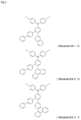
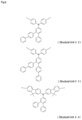
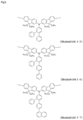
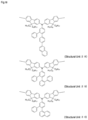
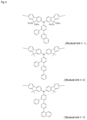
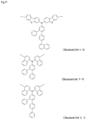
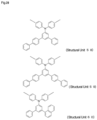
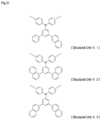
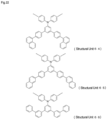
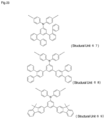
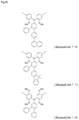
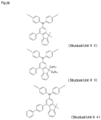
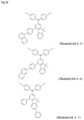
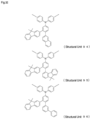
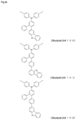
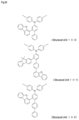
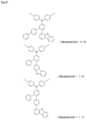
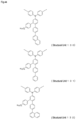
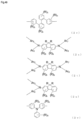
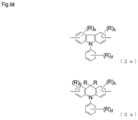
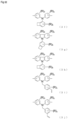
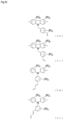
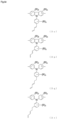
- the present invention provides a high molecular weight compound comprising a substituted triarylamine structural unit represented by a general formula (1) below, a structural unit represented by a general formula (2a) to (2x) shown in Figs. 46 to 50 , and a structural unit represented by a general formula (3a) to (3y) shown in Figs. 51 to 56 as repeating units, and having a weight average molecular weight of 10,000 or more and less than 1,000,000 on a polystyrene conversion basis,
- the high molecular weight compound according to the present invention that includes a substituted triarylamine structural unit (divalent group) represented by the general formula (1) given above is a polymer that includes the structural unit as a repeating unit, and has a weight average molecular weight on a polystyrene conversion basis measured using GPC (gel permeation chromatography) of 10,000 or more and less than 1,000,000.
- GPC gel permeation chromatography
- the heterocyclic ring of the divalent aromatic heterocyclic group may be a monocyclic ring or a condensed ring.
- the heterocyclic ring include a pyridine ring, a pyrimidine ring, a triazine ring, a quinoline ring, an isoquinoline ring, a benzofuran ring, a benzothiophene ring, an indole ring, a carbazole ring, a benzoxazole ring, a benzothiazole ring, a dibenzofuran ring, a quinoxaline ring, a benzimidazole ring, a pyrazoline ring, a dibenzofuran ring, a dibenzothiophene ring, a naphthyridine ring, a phenanthroline ring, an acridine ring, and a carboline ring.
- These aromatic heterocyclic rings may also have a substitu
- the substituent group that may be included in the aromatic ring and the aromatic heterocyclic ring described above may be a heavy hydrogen atom, a cyano group, a nitro group, or the like.
- Other examples include the following:
- the substituent groups listed above may further have any of the substituent groups listed above.
- substituent groups are each independently present.
- substituent groups may be bonded to each other to form a ring via a single bond, a methylene group that may have a substituent group, an oxygen atom, or a sulfur atom.
- examples of the alkyl group, the alkyloxy group, the cycloalkyl group, the cycloalkyloxy group, the alkenyl group, and the aryloxy group are as follows.
- alkyl group examples include a methyl group, an ethyl group, an n-propyl group, an isopropyl group, an n-butyl group, an isobutyl group, a tert-butyl group, an n-pentyl group, an isopentyl group, a neopentyl group, an n-hexyl group, and the like.
- Examples of the cycloalkyl group (C 5 to C 10 ) include a cyclopentyl group, a cyclohexyl group, a 1-adamantyl group, a 2-adamantyl group, and the like.
- Examples of the cycloalkyloxy group (C 5 to C 10 ) include a cyclopentyloxy group, a cyclohexyloxy group, a cycloheptyloxy group, a cyclooctyloxy group, a 1-adamantyloxy group, a 2-adamantyloxy group, and the like.
- alkenyl group examples include a vinyl group, an allyl group, an isopropenyl group, a 2-butenyl group, and the like.
- aryloxy group examples include a phenyloxy group, a tolyloxy group, and the like.
- the groups R 1 and R 2 described above may have a substituent group. These substituent groups are groups similar to the substituent groups that may be included in the divalent groups Ar 1 and Ar 2 . Also, as with the substituent groups that may be included in Ar 1 and Ar 2 , these substituent groups may further have a substituent group. Furthermore, it is desirable that the groups R 1 and R 2 , and various substituent groups are each independently present. However, as with the substituent groups that may be included in Ar 1 and Ar 2 , these substituent groups may be bonded to each other to form a ring.
- the groups R 1 and R 2 described above are preferably a hydrogen atom and a heavy hydrogen atom, and more preferably a hydrogen atom in view of synthesizing.
- Examples of the groups represented by R 1 and R 2 are as described above. Examples of the aryl group and the heteroaryl group described above are as follows.
- heteroaryl group (monovalent aromatic heterocyclic group) include a pyridyl group, a pyrimidinyl group, a triazinyl group, a furyl group, a pyrrolyl group, a thienyl group, a quinolyl group, an isoquinolyl group, a benzofuranyl group, a benzothienyl group, an indolyl group, a carbazolyl group, a benzooxazolyl group, a benzothiazolyl group, a quinoxalinyl group, a benzimidazolyl group, a pyrazolyl group, a dibenzofuranyl group, a dibenzothienyl group, a naphthyridinyl group, a phenanthrolinyl group, an acridinyl group, a carbolinyl group, and the like.
- the aryl group and the heteroaryl group described above may have a phenyl group as the substituent group.
- the phenyl group may further have a phenyl group as a substituent group. That is, in the case of an aryl group, the aryl group may be a biphenylyl group, a terphenylyl group, or a triphenylenyl group.
- aryl group and the heteroaryl group described above as well as various types of substituent groups are each independently present.
- substituent groups that may be included in Ar 1 and Ar 2 these substituent groups may be bonded to each other to form a ring.
- a combination of the groups represented by X to Z may be in the following patterns (a) to (c).
- Pattern (b) is a pattern in which X and Z are an aryl group or a heteroaryl group, and Y is another group.
- Pattern (c) is a pattern in which X, Y and Z are an aryl group or a heteroaryl group.
- the aryl group and the heteroaryl group are a phenyl group, a biphenylyl group, a terphenyl group, a naphthyl group, a phenanthrenyl group, a fluorenyl group, a naphthyl phenyl group, or a triphenylenyl group.
- Z or Y that is a group other than the aryl group and the heteroaryl group is a hydrogen atom or a heavy hydrogen atom.
- each broken line indicates a bond to an adjacent structural unit, and for each solid line that extends from a ring and has a free end, unlike the general formula (1), the free end indicates a methyl group.
- the high molecular weight compound according to the present invention that includes a structural unit represented by the general formula (1) given above has excellent characteristics such as hole injection characteristics, hole mobility, electron blocking capability, thin film stability, and heat resistance.
- the high molecular weight compound according to the present invention is a polymer that includes the above-described structural unit as a repeating unit, and has a weight average molecular weight on a polystyrene conversion basis measured using GPC in a range of 10,000 or more and less than 1,000,000, more preferably in a range of 10,000 or more and less than 500,000, and even more preferably in a range of 10,000 or more and less than 200,000.
- the high molecular weight compound according to the present invention is a copolymer of the above-described structural unit and another structural unit.
- the other structural unit is a structural unit for enhancing the solubility in an organic solvent, and a structural unit for enhancing the thermal crosslinkability of polymers.
- each broken line indicates a bond to an adjacent structural unit, and for each solid line that extends from a ring and has a free end, the free end indicates a methyl group.
- R represents:
- Ar 5 to Ar 8 may be the same or different from each other, and represent a monovalent or divalent aromatic hydrocarbon group, or a monovalent or divalent aromatic heterocyclic group.
- Examples of the monovalent aromatic hydrocarbon group or aromatic heterocyclic group may be the same as those listed as examples of the aryl group and the heteroaryl group represented by the groups X to Z in the general formula (1).
- examples of the divalent aromatic hydrocarbon group and the divalent aromatic heterocyclic group are the same as those listed as examples of the groups represented by the groups Ar 1 and Ar 2 in the general formula (1). It will be appreciated that all of these groups may have a substituent group.
- the structural unit for enhancing thermal crosslinkability is shown as formulas (3a) to (3y) in Figs. 51 to 56 .
- the amount of structural unit A is preferably 1 mol% or more, and more preferably 5 mol% or more.
- the high molecular weight compound according to the present invention includes the structural unit B in an amount of preferably 1 mol% or more, and more preferably 30 to 90 mol%, and the structural unit C in an amount of preferably 1 mol% or more, and more preferably 5 to 20 mol%.
- the high molecular weight compound according to the present invention is a terpolymer that includes the structural units A, B, and C so as to satisfy the above conditions.
- the high molecular weight compound according to the present invention described above can be synthesized by forming C-C bonds or C-N bonds through a Suzuki polymerization reaction or a HARTWIG-BUCHWALD polymerization reaction so as to connect the structural units.
- the high molecular weight compound according to the present invention can be synthesized by preparing unit compounds that respectively have the above-described structural units, and subjecting the unit compounds to borate esterification or halogenation as appropriate and then to a polycondensation reaction using an appropriate catalyst.
- a triarylamine derivative represented by the following general formula (1a) can be used as the compound for introducing the structural unit represented by the general formula (1).
- the high molecular weight compound according to the present invention described above is dissolved in an aromatic organic solvent such as benzene, toluene, xylene, or anisole so as to prepare a coating solution, and the coating solution is applied to a predetermined substrate to form a coating, and then the coating is heated and dried.
- an aromatic organic solvent such as benzene, toluene, xylene, or anisole
- the coating solution is applied to a predetermined substrate to form a coating, and then the coating is heated and dried.
- a thin film that has excellent characteristics such as hole injectionability, hole transportability, and electron blockability can be formed.
- the thin film also has good heat resistance and good adhesion to other layers.
- the high molecular weight compound described above can be used as a constituent material of a hole injection layer and/or a hole transport layer included in an organic EL element.
- the hole injection layer or the hole transport layer formed using the high molecular weight compound described above has higher hole injectionability, greater mobility, and higher electron blockability than the hole injection layer or the hole transport layer formed using a conventional material.
- the hole injection layer or the hole transport layer formed using the high molecular weight compound described above can confine excitons generated in a light emitting layer, improve the probability of recombination of holes and electrons, and provide high light emission efficiency, and at the same time, achieve advantages of reducing the driving voltage and improving the durability of the organic EL element.
- the high molecular weight compound according to the present invention that has the electrical characteristics described above can also be preferably used to form an electron blocking layer or a light emitting layer.
- An organic EL element that includes an organic layer formed using the high molecular weight compound according to the present invention described above has, for example, a structure shown in Fig. 57 .
- a transparent anode 2 a hole injection layer 3, a hole transport layer 4, a light emitting layer 5, an electron transport layer 6, and a cathode 7 are formed on a glass substrate 1 (which may be a transparent substrate such as a transparent resin substrate).
- the layer structure of the organic EL element to which the high molecular weight compound according to the present invention is applied is not limited to that described above.
- a hole blocking layer may be formed between the light emitting layer 5 and the electron transport layer 6.
- an electron blocking layer or the like may be formed between the hole transport layer 4 and the light emitting layer 5.
- an electron injection layer may be formed between the cathode 7 and the electron transport layer 6.
- some layers may be omitted.
- the organic EL element may have a simple layer structure in which a positive electrode 2, a hole transport layer 4, a light emitting layer 5, an electron transport layer 6, and a cathode 7 are formed on a substrate 1.
- a double-layer structure may be used in which layers having the same function are overlaid.
- the high molecular weight compound according to the present invention is preferably used as a material for forming an organic layer (for example, a hole injection layer 3, a hole transport layer 4, a light emitting layer 5, or an unshown hole blocking layer) that is formed between the anode 2 and the cathode 7.
- an organic layer for example, a hole injection layer 3, a hole transport layer 4, a light emitting layer 5, or an unshown hole blocking layer
- the transparent anode 2 may be made of an electrode material that is known per se, and is formed by depositing an electrode material that has a large work function, such as ITO or gold, on a substrate 1 (a transparent substrate such as a glass substrate).
- the hole injection layer 3 formed on the transparent anode 2 can be formed using a coating solution prepared by dissolving the high molecular weight compound according to the present invention in, for example, an aromatic organic solvent such as toluene, xylene, or anisole. That is, the hole injection layer 3 can be formed by applying the coating solution to the transparent anode 2 through spin coating, inkjet printing, or the like so as to form a coating.
- a coating solution prepared by dissolving the high molecular weight compound according to the present invention in, for example, an aromatic organic solvent such as toluene, xylene, or anisole. That is, the hole injection layer 3 can be formed by applying the coating solution to the transparent anode 2 through spin coating, inkjet printing, or the like so as to form a coating.
- the hole injection layer 3 can also be formed using a conventionally known material, without using the high molecular weight compound according to the present invention.
- Examples of the conventionally known material include:
- a layer (thin film) made of any of the materials listed above can be formed through coating using a deposition method, a spin-coating method, an inkjet printing method, or the like. The same applies to other layers. Film-forming is performed using a deposition method or a coating method according to the type of film-forming material.
- the hole transport layer 4 formed on the hole injection layer 3 can also be formed through coating such as spin-coating or inkjet printing using the high molecular weight compound according to the present invention.
- the hole transport layer 4 can also be formed using a conventionally known hole transport material.
- Typical examples of the hole transport material include:
- the compounds for forming a hole transport layer including the high molecular weight compound according to the present invention, may be used alone or in combination of two or more to form a hole transport layer.
- a multi-layer film in which a plurality of layers formed using one or more of the compounds listed above are stacked may be used as the hole transport layer.
- the hole injection layer 3 and the hole transport layer 4 may be combined into one layer.
- Such a hole injection/transport layer can be formed through coating using a polymer material such as PEDOT.
- the unshown electron blocking layer (which can be formed between the hole transport layer 4 and the light emitting layer 5) can also be formed using a known electron blocking compound that has an electron blocking function such as, for example, a carbazole derivative or a compound that has a triphenylsilyl group and a triarylamine structure.
- a known electron blocking compound that has an electron blocking function such as, for example, a carbazole derivative or a compound that has a triphenylsilyl group and a triarylamine structure.
- Specific examples of the carbazole derivative and the compound that has a triarylamine structure are as follows.
- carbazole derivative examples include:
- Examples of the compound that has a triarylamine structure include 9-[4-(carbazole-9-yl)phenyl]-9-[4-(triphenylsilyl)phenyl]-9H-fluorene.
- the electron blocking layer is formed using one or more of the known electron blocking materials listed above. However, a multi-layer film in which a plurality of layers are formed using one or more of the electron blocking materials are stacked may be used as the electron blocking layer.
- the light emitting layer 5 of the organic EL element can be formed using a light emitting material such as a metal complex of a quinolinol derivative such as Alq 3 .
- a light emitting material such as a metal complex of a quinolinol derivative such as Alq 3 .
- Other examples of the light emitting material include various types of metal complexes of zinc, beryllium, aluminum and the like, an anthracene derivative, a bisstyrylbenzene derivative, a pyrene derivative, an oxazole derivative, and a poly (p-phenylene vinylene) derivative.
- the light emitting layer 5 can also be formed using a host material and a dopant material.
- a host material in addition to the light emitting materials listed above, a thiazole derivative, a benzimidazole derivative, a polydialkylfluorene derivative, and the like can be used. Furthermore, the high molecular weight compound according to the present invention described above can also be used.
- quinacridone As the dopant material, quinacridone, coumalin, rubrene, perylene, and derivatives thereof, a benzopyran derivative, a rhodamine derivative, an aminostyryl derivative, and the like can be used.
- the light emitting layer 5 described above may have a single-layer structure in which one or more of the light emitting materials listed above is used, or a multi-layer structure in which a plurality of layers are stacked.
- the light emitting layer 5 can also be formed using a phosphorescent light emitting material as the light emitting material.
- a phosphorescent emitter of a metal complex of iridium, platinum, or the like can be used as the phosphorescent light emitting material.
- a green phosphorescent emitter such as Ir(ppy) 3
- a blue phosphorescent emitter such as FIrpic or FIr 6
- a red phosphorescent emitter such as Btp 2 Ir (acac), or the like
- the phosphorescent light emitting material is used by being doped into a host material that has hole injectionability/transportability or a host material that has electron transportability.
- a carbazole derivative such as 4,4'-di(N-carbazolyl)biphenyl (hereinafter referred to simply as CBP), TCTA, or mCP, or the like can be used.
- CBP 4,4'-di(N-carbazolyl)biphenyl
- TCTA 4,4'-di(N-carbazolyl)biphenyl
- mCP mCP
- UGH2 p-bis(triphenylsilyl)benzene
- TPBI 2,2',2"-(1,3,5-phenylene)-tris(1-phenyl-1H-benzimidazole)
- the host material with the phosphorescent light emitting material through co-deposition in an amount of 1 to 30 wt% relative to the entire light emitting layer.
- a material that emits delayed fluorescence such as a CDCB derivative, specifically, PIC-TRZ, CC2TA, PXZ-TRZ, 4CzIPN, or the like can also be used (see Appl. Phys. Let., 98, 083302 (2011 )).
- the light emitting layer 5 may be formed by causing the high molecular weight compound according to the present invention to carry a fluorescent emitter or a phosphorescent emitter that is called a dopant, or a material that emits delayed fluorescence. In this way, an organic EL element that has a low driving voltage and improved light emission efficiency can be achieved.
- the hole blocking layer (not shown in the diagram) formed between the light emitting layer 5 and the electron transport layer 6 can be formed using a hole blocking compound that is known per se.
- Examples of the known hole blocking compound include:
- the hole blocking layer may also be used as the electron transport layer 6.
- the hole blocking layer may also have a single or multi-layer stack structure in which each layer is formed using one or more of the hole blocking compounds listed above and the high molecular weight compound according to the present invention.
- the electron transport layer 6 is formed using, in addition to the naphthotriazole derivative of the present invention, an electron transport compound that is known per se.
- the known electron transport compound include metal complexes of quinolinol derivatives such as Alq 3 and BAlq, various types of metal complexes, a triazole derivative, a triazine derivative, an oxadiazole derivative, a thiadiazole derivative, a carbodiimide derivative, a quinoxaline derivative, a phenanthroline derivative, a silole derivative, and the like.
- the electron transport layer 6 may also have a single or multi-layer stack structure in which each layer is formed using one or more of the electron transport compounds listed above.
- the electron injection layer formed optionally can also be formed using a material that is known per se.
- the known material include: alkali metal salts such as lithium fluoride and cesium fluoride; alkaline earth metal salts such as magnesium fluoride; metal oxides such as aluminum oxide; and the like.
- the cathode 7 of the organic EL element is formed using an electrode material that has a low work function such as aluminum, or an alloy that has an even lower work function such as a magnesium-silver alloy, a magnesium-indium alloy, or an aluminum-magnesium alloy is used as the electrode material.
- At least one of the hole injection layer 3, the hole transport layer 4, the light emitting layer 5, and the unshown electron blocking layer is formed using the high molecular weight compound that includes a substituted triarylamine structure represented by the general formula (1) given above.
- the organic EL element that has high light emission efficiency, high power efficiency, a low actual driving voltage, a low light-emission start voltage, and outstanding durability can be obtained.
- the organic EL element has a low driving voltage, improved current tolerance, and improved maximum light emission luminance while having high light emission efficiency.
- structural unit A the structural unit represented by the general formula (1) included in the high molecular weight compound according to the present invention
- structural unit B the structural unit introduced to enhance the solubility in an organic solvent
- structural unit C the structural unit introduced to enhance thermal crosslinkability
- the intermediate 1 is an intermediate compound used to introduce the structural unit A included in the high molecular weight compound according to the present invention.
- the intermediate 2 is a compound obtained by dibromizing the intermediate 1, and is used to polymerize the intermediate 1 that is a unit compound for introducing the structural unit A.
- the intermediate 3 is an intermediate compound used to introduce the structural unit A included in the high molecular weight compound according to the present invention.
- the intermediate 4 is an intermediate compound used to introduce the structural unit A included in the high molecular weight compound according to the present invention.
- the intermediate 9 is an intermediate compound used to introduce the structural unit A included in the high molecular weight compound according to the present invention.
- the intermediate 10 is a compound obtained by dibromizing the intermediate 9, and is used to polymerize the intermediate 9 that is a unit compound for introducing the structural unit A.
- the intermediate 11 is an intermediate compound used to introduce the structural unit B included in the high molecular weight compound according to the present invention.
- the intermediate 12 is an intermediate compound used to introduce the structural unit B included in the high molecular weight compound according to the present invention.
- the intermediate 13 is a compound obtained by diborating the intermediate 12, and is used to polymerize the intermediate 11 that is a unit compound for introducing the structural unit B.
- the intermediate 14 is an intermediate compound used to introduce the structural unit A included in the high molecular weight compound according to the present invention.
- the intermediate 15 is an intermediate compound used to introduce the structural unit A included in the high molecular weight compound according to the present invention.
- the intermediate 16 is a compound obtained by dibromizing the intermediate 15, and is used to polymerize the intermediate 15 that is a unit compound for introducing the structural unit A.
- the intermediate 17 is an intermediate compound used to introduce the structural unit A included in the high molecular weight compound according to the present invention.
- the intermediate 18 is an intermediate compound used to introduce the structural unit A included in the high molecular weight compound according to the present invention.
- the intermediate 19 is a compound obtained by dibromizing the intermediate 18, and is used to polymerize the intermediate 18 that is a unit compound for introducing the structural unit A.
- the intermediate 20 is an intermediate compound used to introduce the structural unit A included in the high molecular weight compound according to the present invention.
- the intermediate 21 is an intermediate compound used to introduce the structural unit A included in the high molecular weight compound according to the present invention.
- the intermediate 22 is a compound obtained by dibromizing the intermediate 21, and is used to polymerize the intermediate 21 that is a unit compound for introducing the structural unit A.
- the intermediate 23 is an intermediate compound used to introduce the structural unit A included in the high molecular weight compound according to the present invention.
- the intermediate 24 is an intermediate compound used to introduce the structural unit A included in the high molecular weight compound according to the present invention.
- the intermediate 25 is an intermediate compound used to introduce the structural unit A included in the high molecular weight compound according to the present invention.
- the intermediate 28 is an intermediate compound used to introduce the structural unit A included in the high molecular weight compound according to the present invention.
- the intermediate 29 is an intermediate compound used to introduce the structural unit A included in the high molecular weight compound according to the present invention.
- the intermediate 30 is an intermediate compound used to introduce the structural unit A included in the high molecular weight compound according to the present invention.
- the intermediate 31 is an intermediate compound used to introduce the structural unit A included in the high molecular weight compound according to the present invention.
- the intermediate 32 is a compound obtained by dibromizing the intermediate 31, and is used to polymerize the intermediate 31 that is a unit compound for introducing the structural unit A.
- the intermediate 33 is an intermediate compound used to introduce the structural unit A included in the high molecular weight compound according to the present invention.
- the intermediate 34 is an intermediate compound used to introduce the structural unit A included in the high molecular weight compound according to the present invention.
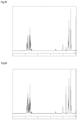
- Fig. 64 shows the result of 1 H-NMR measurement.
- the average molecular weight measured using GPC, the degree of dispersion, and the chemical composition of the high molecular weight compound were as follows.
- the high molecular weight compound G contained 47 mol% of structural unit A represented by the general formula (1), 43 mol% of structural unit B for improving the solubility in an organic solvent, and 9 mol% of structural unit C for improving thermal crosslinkability.
- the average molecular weight measured using GPC, the degree of dispersion, and the chemical composition of the high molecular weight compound were as follows
- the high molecular weight compound H contained 47 mol% of structural unit A represented by the general formula (1), 44 mol% of structural unit B for improving the solubility in an organic solvent, and 9 mol% of structural unit C for improving thermal crosslinkability.
- Fig. 66 shows the result of 1 H-NMR measurement.
- the average molecular weight measured using GPC, the degree of dispersion, and the chemical composition of the high molecular weight compound were as follows
- the high molecular weight compound I contained 46 mol% of structural unit A represented by the general formula (1), 46 mol% of structural unit B for improving the solubility in an organic solvent, and 8 mol% of structural unit C for improving thermal crosslinkability.
- Fig. 67 shows the result of 1 H-NMR measurement.
- the high molecular weight compound J contained 46 mol% of structural unit A represented by the general formula (1), 45 mol% of structural unit B for improving the solubility in an organic solvent, and 9 mol% of structural unit C for improving thermal crosslinkability.
- Fig. 68 shows the result of 1 H-NMR measurement.
- the average molecular weight measured using GPC, the degree of dispersion, and the chemical composition of the high molecular weight compound were as follows
- the high molecular weight compound K contained 40 mol% of structural unit A represented by the general formula (1), 50 mol% of structural unit B for improving the solubility in an organic solvent, and 10 mol% of structural unit C for improving thermal crosslinkability.
- Fig. 69 shows the result of 1 H-NMR measurement.
- the average molecular weight measured using GPC, the degree of dispersion, and the chemical composition of the high molecular weight compound were as follows
- the high molecular weight compound L contained 40 mol% of structural unit A represented by the general formula (1), 50 mol% of structural unit B for improving the solubility in an organic solvent, and 10 mol% of structural unit C for improving thermal crosslinkability.
- Deposition films each having a thickness of 100 nm were formed on an ITO substrate using the high molecular weight compounds A to L synthesized in Examples 1 to 12, and work function was measured using an ionization potential measurement apparatus (Model PYS-202 available from Sumitomo Heavy Industries, Ltd.). The result was as follows.
- the high molecular weight compounds A to L according to the present invention exhibited an energy level higher than 5.4 eV that is the work function of ordinary hole transport materials such as NPD and TPD, from which it can be seen that the high molecular weight compound A to L has good hole transport capability.
- An organic EL element having a layer structure shown in Fig. 57 was produced in the following manner.
- a glass substrate 1 on which an ITO film having a thickness of 50 nm was formed was washed with an organic solvent, and then UV/ozone treatment was performed to wash the surface of the ITO film.
- a compound having the following structural formula (AQ-1200 available from Solvay) was applied using a spin coating method so as to cover the transparent anode 2 (ITO film) formed on the glass substrate 1, and a 55 nm thick film was thereby formed.
- the film was dried on a hot plate at 170°C for 10 minutes, and a hole injection layer 3 was thereby formed.
- a coating solution was prepared by dissolving the high molecular weight compound A obtained in Example 1 in toluene at a concentration of 0.6 wt%.
- the substrate on which the hole injection layer 3 was formed in the manner described above was placed in a glove box whose internal air was replaced with dry nitrogen, and a coating layer having a thickness of 20 nm was formed on the hole injection layer 3 through spin coating using the coating solution described above, and dried on a hot plate at 200°C for 10 minutes, and a hole transport layer 4 was thereby formed.
- the substrate on which the hole transport layer 4 was formed in the manner described above was set in a vacuum deposition apparatus, and the pressure was reduced to 0.001 Pa or less.
- a light emitting layer 5 having a thickness of 40 nm was formed on the hole transport layer 4 through dual deposition using SBD 2460 (EMD-1) available from SFC and ABH 401 (EMH-1) available from SFC.
- An electron transport material 6 having a thickness of 20 nm was formed on the light emitting layer 5 formed above through dual deposition using the electron transport materials (ETM-1) and (ETM-2).
- the glass substrate on which the transparent anode 2, the hole injection layer 3, the hole transport layer 4, the light emitting layer 5, the electron transport material 6, and the cathode 7 were formed was placed in a glove box whose internal air was replaced with dry nitrogen, and another glass substrate for sealing was bonded using a UV curable resin, and an organic EL element was thereby produced.
- the characteristics of the produced organic EL element were measured in an atmosphere at room temperature.
- An organic EL element was produced as in Example 14, except that the hole transport layer 4 was formed using a coating solution prepared by dissolving, instead of the high molecular weight compound A, the compound (the high molecular weight compound B) of Example 2 in toluene at a concentration of 0.6 wt%.
- the characteristics of the produced organic EL element were measured in an atmosphere at room temperature. The measurement results of light emission characteristics as measured by applying a DC voltage to the produced organic EL element as shown in Table 1.
- An organic EL element was produced as in Example 14, except that the hole transport layer 4 was formed using a coating solution prepared by dissolving, instead of the high molecular weight compound A, the compound (the high molecular weight compound C) of Example 3 in toluene at a concentration of 0.6 wt%.
- the characteristics of the produced organic EL element were measured in an atmosphere at room temperature. The measurement results of light emission characteristics as measured by applying a DC voltage to the produced organic EL element as shown in Table 1.
- An organic EL element was produced as in Example 14, except that the hole transport layer 4 was formed using a coating solution prepared by dissolving, instead of the high molecular weight compound A, the compound (the high molecular weight compound D) of Example 4 in toluene at a concentration of 0.6 wt%.
- the characteristics of the produced organic EL element were measured in an atmosphere at room temperature. The measurement results of light emission characteristics as measured by applying a DC voltage to the produced organic EL element as shown in Table 1.
- An organic EL element was produced as in Example 14, except that the hole transport layer 4 was formed using a coating solution prepared by dissolving, instead of the high molecular weight compound A, the compound (the high molecular weight compound E) of Example 5 in toluene at a concentration of 0.6 wt%.
- the characteristics of the produced organic EL element were measured in an atmosphere at room temperature. The measurement results of light emission characteristics as measured by applying a DC voltage to the produced organic EL element as shown in Table 1.
- An organic EL element was produced as in Example 14, except that the hole transport layer 4 was formed using a coating solution prepared by dissolving, instead of the high molecular weight compound A, the compound (the high molecular weight compound F) of Example 6 in toluene at a concentration of 0.6 wt%.
- the characteristics of the produced organic EL element were measured in an atmosphere at room temperature. The measurement results of light emission characteristics as measured by applying a DC voltage to the produced organic EL element as shown in Table 1.
- An organic EL element was produced as in Example 14, except that the hole transport layer 4 was formed using a coating solution prepared by dissolving, instead of the high molecular weight compound A, the compound (the high molecular weight compound G) of Example 7 in toluene at a concentration of 0.6 wt%.
- the characteristics of the produced organic EL element were measured in an atmosphere at room temperature. The measurement results of light emission characteristics as measured by applying a DC voltage to the produced organic EL element as shown in Table 1.
- An organic EL element was produced as in Example 14, except that the hole transport layer 4 was formed using a coating solution prepared by dissolving, instead of the high molecular weight compound A, the compound (the high molecular weight compound H) of Example 8 in toluene at a concentration of 0.6 wt%.
- the characteristics of the produced organic EL element were measured in an atmosphere at room temperature. The measurement results of light emission characteristics as measured by applying a DC voltage to the produced organic EL element as shown in Table 1.
- An organic EL element was produced as in Example 14, except that the hole transport layer 4 was formed using a coating solution prepared by dissolving, instead of the high molecular weight compound A, the compound (the high molecular weight compound I) of Example 9 in toluene at a concentration of 0.6 wt%.
- the characteristics of the produced organic EL element were measured in an atmosphere at room temperature. The measurement results of light emission characteristics as measured by applying a DC voltage to the produced organic EL element as shown in Table 1.
- An organic EL element was produced as in Example 14, except that the hole transport layer 4 was formed using a coating solution prepared by dissolving, instead of the high molecular weight compound A, the compound (the high molecular weight compound J) of Example 10 in toluene at a concentration of 0.6 wt%.
- the characteristics of the produced organic EL element were measured in an atmosphere at room temperature. The measurement results of light emission characteristics as measured by applying a DC voltage to the produced organic EL element as shown in Table 1.
- An organic EL element was produced as in Example 14, except that the hole transport layer 4 was formed using a coating solution prepared by dissolving, instead of the high molecular weight compound A, the compound (the high molecular weight compound K) of Example 11 in toluene at a concentration of 0.6 wt%.
- the characteristics of the produced organic EL element were measured in an atmosphere at room temperature. The measurement results of light emission characteristics as measured by applying a DC voltage to the produced organic EL element as shown in Table 1.
- An organic EL element was produced as in Example 14, except that the hole transport layer 4 was formed using a coating solution prepared by dissolving, instead of the high molecular weight compound A, the compound (the high molecular weight compound L) of Example 12 in toluene at a concentration of 0.6 wt%.
- the characteristics of the produced organic EL element were measured in an atmosphere at room temperature. The measurement results of light emission characteristics as measured by applying a DC voltage to the produced organic EL element as shown in Table 1.
- An organic EL element was produced as in Example 14, except that the hole transport layer 4 was formed using a coating solution prepared by dissolving, instead of the high molecular weight compound A, TFB (hole transport polymer) shown below in toluene at a concentration of 0.6 wt%.
- TFB hole transport polymer
- element lifespan is defined as the time taken for light emission luminance to decay to 560 cd/m 2 (corresponding to 80% of the initial luminance being set to 100%: at a decay of 80%) when constant current driving is performed, with the light emission luminance (initial luminance) when light emission starts being set to 700 cd/m 2 .
- the light emission efficiency at an electric current density of 10 mA/cm 2 was 7.9 cd/A in the organic EL element of Example 14, 8.7 cd/A in the organic EL element of Example 15, 8.3 cd/A in the organic EL element of Example 16, 6.8 cd/A in the organic EL element of Example 17, 8.7 cd/A in the organic EL element of Example 18, 9.0 cd/A in the organic EL element of Example 19, 8.6 cd/A in the organic EL element of Example 20, 8.8 cd/A in the organic EL element of Example 21, 9.2 cd/A in the organic EL element of Example 22, 9.6 cd/A in the organic EL element of Example 23, 8.3 cd/A in the organic EL element of Example 24, and 10.7 cd/A in the organic EL element of Example 25, relative to 6.7 cd/A in the organic EL element of Comparative Example 1. That is, all of the organic EL elements of these examples exhibited high efficiency.
- the element lifespan (at a decay of 80%) was 205 hours in the organic EL element of Example 14, 531 hours in the organic EL element of Example 15, 276 hours in the organic EL element of Example 16, 231 hours in the organic EL element of Example 17, 251 hours in the organic EL element of Example 18, 478 hours in the organic EL element of Example 19, 312 hours in the organic EL element of Example 20, 264 hours in the organic EL element of Example 21, 380 hours in the organic EL element of Example 22, 260 hours in the organic EL element of Example 23, and 210 hours in the organic EL element of Example 24, relative to 194 hours in the organic EL element of Comparative Example 1. That is, the organic EL elements of these examples exhibited a long lifespan.
- an organic EL element including an organic layer formed using the high molecular weight compound according to the present invention can have higher light emission efficiency and a longer lifespan as compared with a conventional organic EL element.
- a thin film was formed on a glass substrate through spin coating using a solution prepared by dissolving the high molecular weight compound A synthesized in Example 1 in toluene at a concentration of 0.6 wt%.
- the obtained film was placed in a glove box whose internal air was replaced with dry nitrogen, and baked on a hot plate at 200°C for 1 hour.
- the film that has undergone absorption intensity measurement was rinsed with toluene using a spin coater at 2000 rpm for 15 seconds.
- the absorption intensity of the rinsed film was measured using a spectrophotometer (U-3000 available from Hitachi, Ltd.).
- the residual film ratio was calculated as in Example 26, except that the high molecular weight compound A was changed to the high molecular weight compound B synthesized in Example 2. The result is shown in Table 2.
- the residual film ratio was calculated as in Example 26, except that the high molecular weight compound A was changed to the high molecular weight compound C synthesized in Example 3. The result is shown in Table 2.
- the residual film ratio was calculated as in Example 26, except that the high molecular weight compound A was changed to the high molecular weight compound D synthesized in Example 4. The result is shown in Table 2.
- the residual film ratio was calculated as in Example 26, except that the high molecular weight compound A was changed to the high molecular weight compound E synthesized in Example 5. The result is shown in Table 2.
- the residual film ratio was calculated as in Example 26, except that the high molecular weight compound A was changed to the high molecular weight compound F synthesized in Example 6. The result is shown in Table 2.
- the residual film ratio was calculated as in Example 26, except that the high molecular weight compound A was changed to the high molecular weight compound G synthesized in Example 7. The result is shown in Table 2.
- the residual film ratio was calculated as in Example 26, except that the high molecular weight compound A was changed to the high molecular weight compound H synthesized in Example 8. The result is shown in Table 2.
- the residual film ratio was calculated as in Example 26, except that the high molecular weight compound A was changed to the high molecular weight compound I synthesized in Example 9. The result is shown in Table 2.
- the residual film ratio was calculated as in Example 26, except that the high molecular weight compound A was changed to the high molecular weight compound J synthesized in Example 10. The result is shown in Table 2.
- the residual film ratio was calculated as in Example 26, except that the high molecular weight compound A was changed to the high molecular weight compound K synthesized in Example 11. The result is shown in Table 2.
- the residual film ratio was calculated as in Example 26, except that the high molecular weight compound A was changed to the high molecular weight compound L synthesized in Example 12. The result is shown in Table 2.
- Example 26 High molecular weight compound A 91.7%
- Example 27 High molecular weight compound B 100%
- Example 28 High molecular weight compound C 100%
- Example 29 High molecular weight compound D 100%
- Example 30 High molecular weight compound E 98.5%
- Example 31 High molecular weight compound F 94.9%
- Example 32 High molecular weight compound G 100%
- Example 33 High molecular weight compound H 100%
- Example 34 High molecular weight compound I 99.1%
- Example 35 High molecular weight compound J 97.3%
- Example 36 High molecular weight compound K 100%
- Example 37 High molecular weight compound L 100% Comparative Example 2 TFB 28.9%
- the high molecular weight compound according to the present invention has high hole transport capability, excellent electron blocking capability, and good thermal crosslinkability. Accordingly, the high molecular weight compound according to the present invention is usable as a compound for producing coating type organic EL elements.
- coating type organic EL elements By producing coating type organic EL elements using the compound, it is possible to obtain high light emission efficiency and high power efficiency, and also possible to improve durability.
- the coating type organic EL elements can be applied to, for example, home electric appliances and lighting equipment.
Landscapes
- Chemical & Material Sciences (AREA)
- Engineering & Computer Science (AREA)
- Materials Engineering (AREA)
- Organic Chemistry (AREA)
- Physics & Mathematics (AREA)
- Health & Medical Sciences (AREA)
- Chemical Kinetics & Catalysis (AREA)
- Medicinal Chemistry (AREA)
- Polymers & Plastics (AREA)
- Optics & Photonics (AREA)
- Electroluminescent Light Sources (AREA)
- Polyoxymethylene Polymers And Polymers With Carbon-To-Carbon Bonds (AREA)
- Addition Polymer Or Copolymer, Post-Treatments, Or Chemical Modifications (AREA)
Claims (7)
- Verbindung mit hohem Molekulargewicht, die eine substituierte Triarylamin-Struktureinheit, die durch die nachstehende allgemeine Formel (1) dargestellt wird, eine Struktureinheit, die durch eine nachstehende allgemeine Formel (2a) bis (2x) dargestellt wird, und eine Struktureinheit, die durch die nachstehende allgemeine Formel (3a) bis (3y) dargestellt wird, als sich wiederholende Einheiten umfasst, und ein Gewichtsmittel des Molekulargewichts von 10.000 oder mehr und weniger als 1.000.000 auf einer Polystyrol-Umwandlungsbasis aufweist,
 wobei Ar1 und Ar2 jeweils eine zweiwertige aromatische Kohlenwasserstoffgruppe oder eine zweiwertige aromatische heterocyclische Gruppe sind,R1 und R2 jeweils ein Wasserstoffatom, ein schweres Wasserstoffatom, ein Fluoratom, ein Chloratom, eine Cyanogruppe, eine Nitrogruppe, eine Alkylgruppe mit 1 bis 8 Kohlenstoffatomen, eine Cycloalkylgruppe mit 5 bis 10 Kohlenstoffatomen, eine Alkenylgruppe mit 2 bis 6 Kohlenstoffatomen, eine Alkyloxygruppe mit 1 bis 6 Kohlenstoffatomen oder eine Cycloalkyloxygruppe mit 5 bis 10 Kohlenstoffatomen darstellen, undX und Y eine Phenylgruppe, eine Biphenylylgruppe, eine Terphenylgruppe, eine Naphthylgruppe, eine Phenanthrenylgruppe, eine Fluorenylgruppe, eine Naphthylphenylgruppe oder eine Triphenylenylgruppe sind und Z ein Wasserstoffatom oder ein schweres Wasserstoffatom ist, oderX und Z eine Phenylgruppe, eine Biphenylylgruppe, eine Terphenylgruppe, eine Naphthylgruppe, eine Phenanthrenylgruppe, eine Fluorenylgruppe, eine Naphthylphenylgruppe oder eine Triphenylenylgruppe sind, und Y ein Wasserstoffatom oder ein schweres Wasserstoffatom ist, oderX, Y und Z eine Phenylgruppe, eine Biphenylylgruppe, eine Terphenylgruppe, eine Naphthylgruppe, eine Phenanthrenylgruppe, eine Fluorenylgruppe, eine Naphthylphenylgruppe oder eine Triphenylenylgruppe sind,
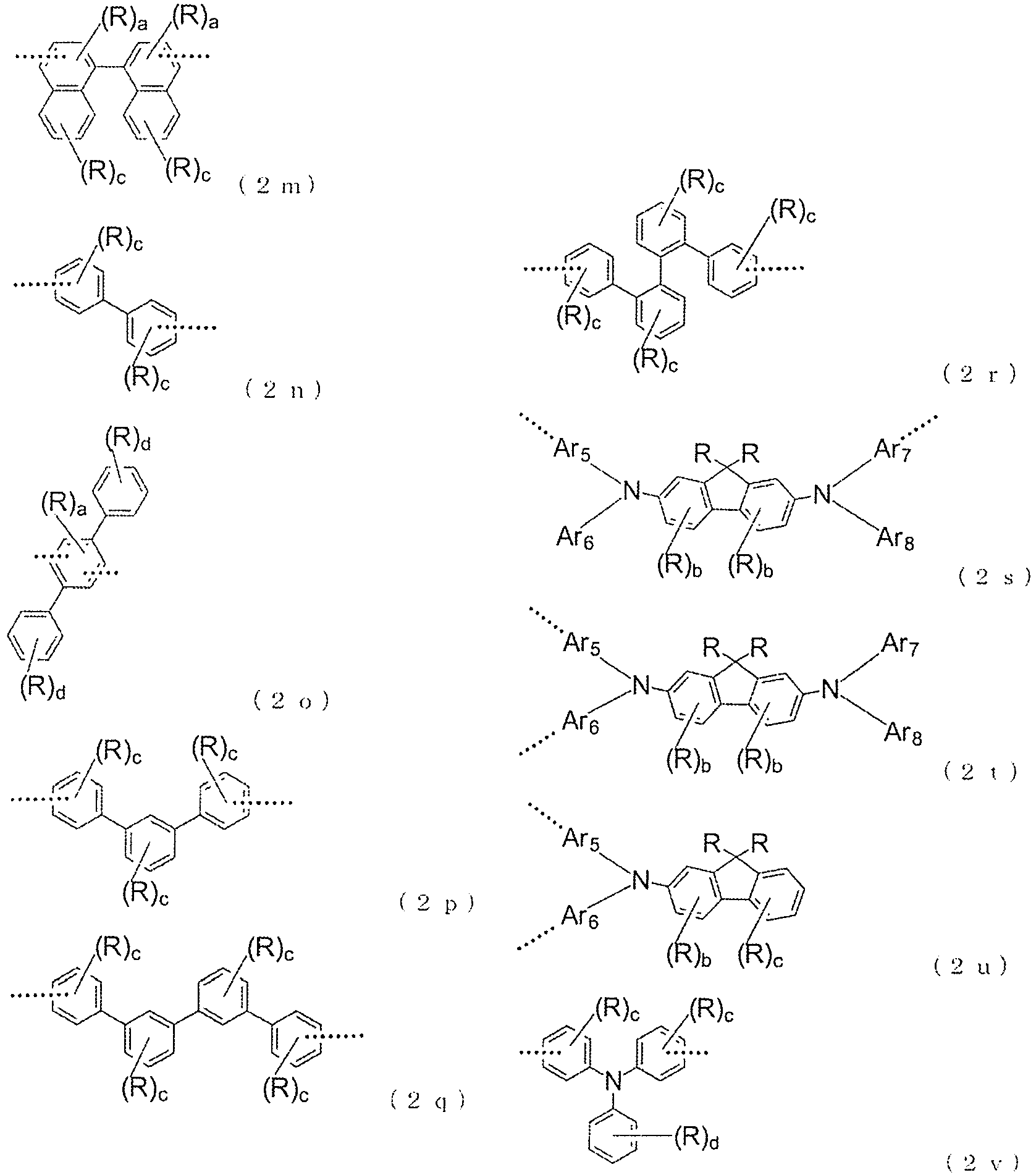


 wobei jede gestrichelte Linie eine Bindung zu einer benachbarten Struktureinheit anzeigt,R darstellt:
ein Wasserstoffatom, ein schweres Wasserstoffatom, eine Cyanogruppe, eine Nitrogruppe; ein Fluoratom, ein Chloratom, ein Bromatom oder ein Jodatom; oder eine Alkylgruppe, eine Cycloalkylgruppe, eine Alkoxygruppe oder eine Thioalkoxygruppe mit 40 Kohlenstoffatomen oder weniger;Ar5 bis Ar8 können identisch oder verschieden voneinander sein und eine einwertige oder zweiwertige aromatische Kohlenwasserstoffgruppe oder eine einwertige oder zweiwertige aromatische heterocyclische Gruppe darstellen, unddie Indizes a bis d für die folgenden Zahlen stehen.a = 0, 1 oder 2b = 0, 1, 2 oder 3c = 0, 1, 2, 3 oder 4d = 0, 1, 2, 3, 4 oder 5. - Verbindung mit hohem Molekulargewicht nach Anspruch 1, wobei in der obigen allgemeinen Formel (1) R1 und R2 ein Wasserstoffatom oder ein schweres Wasserstoffatom sind.
- Organisches Elektrolumineszenzelement, umfassend:ein Paar von Elektroden; undmindestens eine organische Schicht, die zwischen dem Paar von Elektroden angeordnet ist,wobei die organische Schicht die in Anspruch 1 beschriebene hochmolekulare Verbindung enthält.
- Organisches Elektrolumineszenzelement nach Anspruch 3, wobei die organische Schicht eine Lochtransportschicht ist.
- Organisches Elektrolumineszenzelement nach Anspruch 3, wobei die organische Schicht eine Elektronensperrschicht ist.
- Organisches Elektrolumineszenzelement nach Anspruch 3, wobei die organische Schicht eine Lochinjektionsschicht ist.
- Organisches Elektrolumineszenzelement nach Anspruch 3, wobei die organische Schicht eine lichtemittierende Schicht ist.
Applications Claiming Priority (2)
| Application Number | Priority Date | Filing Date | Title |
|---|---|---|---|
| JP2017049629 | 2017-03-15 | ||
| PCT/JP2018/009117 WO2018168667A1 (ja) | 2017-03-15 | 2018-03-09 | 置換トリアリールアミン骨格を有する高分子量化合物 |
Publications (3)
| Publication Number | Publication Date |
|---|---|
| EP3597689A1 EP3597689A1 (de) | 2020-01-22 |
| EP3597689A4 EP3597689A4 (de) | 2021-01-13 |
| EP3597689B1 true EP3597689B1 (de) | 2025-02-26 |
Family
ID=63523282
Family Applications (1)
| Application Number | Title | Priority Date | Filing Date |
|---|---|---|---|
| EP18767921.2A Active EP3597689B1 (de) | 2017-03-15 | 2018-03-09 | Hochmolekulare verbindung mit substituiertem triarylamingerüst |
Country Status (7)
| Country | Link |
|---|---|
| US (1) | US11196004B2 (de) |
| EP (1) | EP3597689B1 (de) |
| JP (1) | JP7017558B2 (de) |
| KR (1) | KR102500364B1 (de) |
| CN (1) | CN110382590B (de) |
| TW (1) | TWI779018B (de) |
| WO (1) | WO2018168667A1 (de) |
Families Citing this family (11)
| Publication number | Priority date | Publication date | Assignee | Title |
|---|---|---|---|---|
| JP7318233B2 (ja) * | 2019-03-04 | 2023-08-01 | 株式会社レゾナック | 有機エレクトロニクス材料及びその利用 |
| CN113891904A (zh) * | 2019-06-05 | 2022-01-04 | 保土谷化学工业株式会社 | 含有取代三芳基胺结构单元的高分子量化合物及有机电致发光元件 |
| KR102843444B1 (ko) * | 2019-10-09 | 2025-08-06 | 호도가야 가가쿠 고교 가부시키가이샤 | 고분자량 화합물로 이루어지는 유기층을 갖는 유기 일렉트로 루미네선스 소자 |
| JP7594870B2 (ja) * | 2019-10-15 | 2024-12-05 | 住友化学株式会社 | 組成物及びそれを含有する発光素子 |
| CN113929585B (zh) * | 2020-07-14 | 2024-09-24 | 北京鼎材科技有限公司 | 有机化合物及有机电致发光器件 |
| JP7791827B2 (ja) * | 2020-09-23 | 2025-12-24 | 保土谷化学工業株式会社 | 熱架橋性低分子化合物を含む発光ダイオード用組成物 |
| JP7642347B2 (ja) | 2020-11-02 | 2025-03-10 | キヤノン株式会社 | 光学素子、光学機器、撮像装置および化合物 |
| CN112920758B (zh) * | 2021-01-20 | 2022-06-14 | 华南理工大学 | 一种通过苯胺基交联的双组分半导体型胶粘剂及其制备方法与应用 |
| WO2022191141A1 (ja) * | 2021-03-12 | 2022-09-15 | 保土谷化学工業株式会社 | インデノジベンゾヘテロール構造を部分構造として有する高分子量化合物、およびこれらの高分子量化合物を含む有機エレクトロルミネッセンス素子 |
| KR20240011130A (ko) * | 2021-05-21 | 2024-01-25 | 호도가야 가가쿠 고교 가부시키가이샤 | 트리아릴아민 고분자량 화합물 및 이들 고분자량 화합물을 포함하는 유기 일렉트로루미네선스 소자 |
| JPWO2023167253A1 (de) * | 2022-03-04 | 2023-09-07 |
Family Cites Families (30)
| Publication number | Priority date | Publication date | Assignee | Title |
|---|---|---|---|---|
| JP4013282B2 (ja) | 1997-05-09 | 2007-11-28 | コニカミノルタホールディングス株式会社 | 電界発光素子 |
| US6309763B1 (en) | 1997-05-21 | 2001-10-30 | The Dow Chemical Company | Fluorene-containing polymers and electroluminescent devices therefrom |
| GB0006367D0 (en) | 2000-03-16 | 2000-05-03 | Avecia Ltd | Charge transport material |
| GB0125620D0 (en) * | 2001-10-25 | 2001-12-19 | Cambridge Display Tech Ltd | Monomers and low band gap polymers formed therefrom |
| JP4182245B2 (ja) | 2001-11-09 | 2008-11-19 | 住友化学株式会社 | 高分子化合物およびそれを用いた高分子発光素子 |
| TWI249542B (en) | 2001-11-09 | 2006-02-21 | Sumitomo Chemical Co | Polymer compound and polymer light-emitting device using the same |
| JP4256102B2 (ja) | 2002-02-08 | 2009-04-22 | 三井化学株式会社 | アミン化合物 |
| CN1894199B (zh) | 2003-11-14 | 2011-04-13 | 住友化学株式会社 | 卤代双二芳基氨基多环芳族化合物及其聚合物 |
| GB0329364D0 (en) | 2003-12-19 | 2004-01-21 | Cambridge Display Tech Ltd | Optical device |
| JP4736471B2 (ja) | 2004-02-26 | 2011-07-27 | 住友化学株式会社 | 高分子化合物およびそれを用いた高分子発光素子 |
| JP4956898B2 (ja) | 2004-03-03 | 2012-06-20 | 東ソー株式会社 | トリアリールアミンポリマー及びその製造方法 |
| US20060091359A1 (en) * | 2004-10-29 | 2006-05-04 | Jun-Liang Lai | Organic light emitting compounds for a blue-light electroluminescent device |
| GB0428445D0 (en) | 2004-12-29 | 2005-02-02 | Cambridge Display Tech Ltd | Blue-shifted triarylamine polymer |
| JP2007119763A (ja) | 2005-09-29 | 2007-05-17 | Sumitomo Chemical Co Ltd | 高分子材料及び高分子発光素子 |
| JP5217153B2 (ja) | 2005-11-18 | 2013-06-19 | 住友化学株式会社 | 高分子化合物およびそれを用いた高分子発光素子 |
| JP5018043B2 (ja) | 2005-12-01 | 2012-09-05 | 住友化学株式会社 | 高分子化合物およびそれを用いた高分子発光素子 |
| US7425723B2 (en) | 2005-12-21 | 2008-09-16 | Xerox Corporation | Organic thin-film transistors |
| JP5125213B2 (ja) | 2007-05-08 | 2013-01-23 | 東ソー株式会社 | 新規なトリアリールアミンポリマー、その製造方法及び用途 |
| EP2270069B1 (de) | 2008-02-15 | 2017-03-29 | Mitsubishi Chemical Corporation | Konjugiertes polymer, insolubilisiertes polymer, material für organische elektrolumineszenzvorrichtung, zusammensetzung für organische elektrolumineszenzvorrichtung, verfahren zur herstellung von polymer, organische elektrolumineszenzvorrichtung, organische el-anzeige und organischer el-illuminator |
| US8580393B2 (en) | 2008-03-05 | 2013-11-12 | Idemitsu Kosan Co., Ltd. | Polymer and organic electroluminescent device including the same |
| WO2010074440A2 (ko) | 2008-12-24 | 2010-07-01 | 제일모직 주식회사 | 고분자 중합체, 이를 포함하는 유기 광전 소자, 및 이를 포함하는 표시장치 |
| JP5568976B2 (ja) | 2009-12-16 | 2014-08-13 | 東ソー株式会社 | 多置換ホスフィン化合物及び該ホスフィン化合物を含む触媒 |
| JP5505123B2 (ja) | 2010-06-22 | 2014-05-28 | 東ソー株式会社 | 新規トリアリールアミンポリマー、その製造方法およびその用途 |
| CN102372670B (zh) | 2010-08-20 | 2014-02-26 | 清华大学 | 一种含芳基吡啶基团的芳胺类化合物及其应用 |
| JP5609614B2 (ja) | 2010-12-15 | 2014-10-22 | 東ソー株式会社 | 新規アリールアミンデンドリマー状化合物、その製造方法およびその用途 |
| TWI421279B (zh) * | 2011-02-01 | 2014-01-01 | Eternal Chemical Co Ltd | 可固化材料及其應用 |
| GB201108865D0 (en) | 2011-05-26 | 2011-07-06 | Ct For Process Innovation The Ltd | Semiconductor compounds |
| EP2684932B8 (de) | 2012-07-09 | 2016-12-21 | Hodogaya Chemical Co., Ltd. | Diarylamino matrix material dotiert mit einer mesomeren radialenverbindung |
| WO2015089027A1 (en) | 2013-12-12 | 2015-06-18 | E. I. Du Pont De Nemours And Company | Solvent-resistant hole transport layers |
| JP2017022194A (ja) | 2015-07-08 | 2017-01-26 | 三星ディスプレイ株式會社Samsung Display Co.,Ltd. | 有機エレクトロルミネッセンス素子用材料及びそれを用いた有機エレクトロルミネッセンス素子 |
-
2018
- 2018-03-09 JP JP2019505956A patent/JP7017558B2/ja active Active
- 2018-03-09 EP EP18767921.2A patent/EP3597689B1/de active Active
- 2018-03-09 CN CN201880011024.3A patent/CN110382590B/zh active Active
- 2018-03-09 KR KR1020197023096A patent/KR102500364B1/ko active Active
- 2018-03-09 WO PCT/JP2018/009117 patent/WO2018168667A1/ja not_active Ceased
- 2018-03-09 US US16/487,554 patent/US11196004B2/en active Active
- 2018-03-13 TW TW107108352A patent/TWI779018B/zh active
Also Published As
| Publication number | Publication date |
|---|---|
| US20190378989A1 (en) | 2019-12-12 |
| JPWO2018168667A1 (ja) | 2020-02-13 |
| WO2018168667A1 (ja) | 2018-09-20 |
| US11196004B2 (en) | 2021-12-07 |
| TW201839029A (zh) | 2018-11-01 |
| CN110382590B (zh) | 2022-03-08 |
| JP7017558B2 (ja) | 2022-02-08 |
| TWI779018B (zh) | 2022-10-01 |
| EP3597689A4 (de) | 2021-01-13 |
| KR102500364B1 (ko) | 2023-02-16 |
| EP3597689A1 (de) | 2020-01-22 |
| KR20190126059A (ko) | 2019-11-08 |
| CN110382590A (zh) | 2019-10-25 |
Similar Documents
| Publication | Publication Date | Title |
|---|---|---|
| EP3597689B1 (de) | Hochmolekulare verbindung mit substituiertem triarylamingerüst | |
| US11999818B2 (en) | High molecular weight triarylamine compound comprising terphenyl structure in molecular main chain and organic electroluminescent element comprising said high molecular weight compound | |
| EP3549970B1 (de) | Verbindung mit hohem molekulargewicht mit substituierter struktureller triarylamineinheit | |
| JP7523873B2 (ja) | 置換トリアリールアミン構造単位を含む高分子量化合物および有機エレクトロルミネッセンス素子 | |
| EP4043512A1 (de) | Organisches elektrolumineszenzelement mit organischer schicht mit einer hochmolekularen verbindung | |
| US20240260288A1 (en) | High molecular weight triarylamine compounds, and organic electroluminescent elements containing these high molecular weight compounds | |
| EP4108701A1 (de) | Hochmolekulare verbindung und lichtemittierende diode mit dieser hochmolekularen verbindung | |
| JP2024127866A (ja) | 高分子量化合物および有機エレクトロルミネッセンス素子 | |
| EP4219586A1 (de) | Thermisch vernetzbare zusammensetzung mit einer verbindung mit niedrigem molekulargewicht für eine leuchtdiode | |
| KR20240007066A (ko) | 고분자량 화합물 및 이들을 사용한 유기 일렉트로 루미네선스 소자 | |
| KR20230156317A (ko) | 인데노디벤조헤테롤 구조를 부분 구조로서 갖는 고분자량화합물, 및 이들 고분자량 화합물을 함유하는 유기 일렉트로루미네선스 소자 | |
| KR20240155182A (ko) | 트리아릴아민 고분자량 화합물 및 유기 일렉트로 루미네선스 소자 |
Legal Events
| Date | Code | Title | Description |
|---|---|---|---|
| STAA | Information on the status of an ep patent application or granted ep patent |
Free format text: STATUS: THE INTERNATIONAL PUBLICATION HAS BEEN MADE |
|
| PUAI | Public reference made under article 153(3) epc to a published international application that has entered the european phase |
Free format text: ORIGINAL CODE: 0009012 |
|
| STAA | Information on the status of an ep patent application or granted ep patent |
Free format text: STATUS: REQUEST FOR EXAMINATION WAS MADE |
|
| 17P | Request for examination filed |
Effective date: 20190812 |
|
| AK | Designated contracting states |
Kind code of ref document: A1 Designated state(s): AL AT BE BG CH CY CZ DE DK EE ES FI FR GB GR HR HU IE IS IT LI LT LU LV MC MK MT NL NO PL PT RO RS SE SI SK SM TR |
|
| AX | Request for extension of the european patent |
Extension state: BA ME |
|
| DAV | Request for validation of the european patent (deleted) | ||
| DAX | Request for extension of the european patent (deleted) | ||
| A4 | Supplementary search report drawn up and despatched |
Effective date: 20201211 |
|
| RIC1 | Information provided on ipc code assigned before grant |
Ipc: H01L 51/50 20060101ALI20201207BHEP Ipc: C08G 61/12 20060101AFI20201207BHEP |
|
| STAA | Information on the status of an ep patent application or granted ep patent |
Free format text: STATUS: EXAMINATION IS IN PROGRESS |
|
| 17Q | First examination report despatched |
Effective date: 20240111 |
|
| GRAP | Despatch of communication of intention to grant a patent |
Free format text: ORIGINAL CODE: EPIDOSNIGR1 |
|
| STAA | Information on the status of an ep patent application or granted ep patent |
Free format text: STATUS: GRANT OF PATENT IS INTENDED |
|
| RIC1 | Information provided on ipc code assigned before grant |
Ipc: C08G 61/12 20060101AFI20241114BHEP |
|
| INTG | Intention to grant announced |
Effective date: 20241126 |
|
| GRAS | Grant fee paid |
Free format text: ORIGINAL CODE: EPIDOSNIGR3 |
|
| GRAA | (expected) grant |
Free format text: ORIGINAL CODE: 0009210 |
|
| STAA | Information on the status of an ep patent application or granted ep patent |
Free format text: STATUS: THE PATENT HAS BEEN GRANTED |
|
| P01 | Opt-out of the competence of the unified patent court (upc) registered |
Free format text: CASE NUMBER: APP_68148/2024 Effective date: 20241227 |
|
| AK | Designated contracting states |
Kind code of ref document: B1 Designated state(s): AL AT BE BG CH CY CZ DE DK EE ES FI FR GB GR HR HU IE IS IT LI LT LU LV MC MK MT NL NO PL PT RO RS SE SI SK SM TR |
|
| REG | Reference to a national code |
Ref country code: GB Ref legal event code: FG4D |
|
| REG | Reference to a national code |
Ref country code: CH Ref legal event code: EP |
|
| REG | Reference to a national code |
Ref country code: DE Ref legal event code: R096 Ref document number: 602018079604 Country of ref document: DE |
|
| REG | Reference to a national code |
Ref country code: IE Ref legal event code: FG4D |
|
| PGFP | Annual fee paid to national office [announced via postgrant information from national office to epo] |
Ref country code: DE Payment date: 20250325 Year of fee payment: 8 |
|
| REG | Reference to a national code |
Ref country code: NL Ref legal event code: MP Effective date: 20250226 |
|
| PG25 | Lapsed in a contracting state [announced via postgrant information from national office to epo] |
Ref country code: RS Free format text: LAPSE BECAUSE OF FAILURE TO SUBMIT A TRANSLATION OF THE DESCRIPTION OR TO PAY THE FEE WITHIN THE PRESCRIBED TIME-LIMIT Effective date: 20250526 |
|
| PG25 | Lapsed in a contracting state [announced via postgrant information from national office to epo] |
Ref country code: FI Free format text: LAPSE BECAUSE OF FAILURE TO SUBMIT A TRANSLATION OF THE DESCRIPTION OR TO PAY THE FEE WITHIN THE PRESCRIBED TIME-LIMIT Effective date: 20250226 |
|
| PG25 | Lapsed in a contracting state [announced via postgrant information from national office to epo] |
Ref country code: PL Free format text: LAPSE BECAUSE OF FAILURE TO SUBMIT A TRANSLATION OF THE DESCRIPTION OR TO PAY THE FEE WITHIN THE PRESCRIBED TIME-LIMIT Effective date: 20250226 |
|
| PG25 | Lapsed in a contracting state [announced via postgrant information from national office to epo] |
Ref country code: ES Free format text: LAPSE BECAUSE OF FAILURE TO SUBMIT A TRANSLATION OF THE DESCRIPTION OR TO PAY THE FEE WITHIN THE PRESCRIBED TIME-LIMIT Effective date: 20250226 |
|
| REG | Reference to a national code |
Ref country code: LT Ref legal event code: MG9D |
|
| PG25 | Lapsed in a contracting state [announced via postgrant information from national office to epo] |
Ref country code: IS Free format text: LAPSE BECAUSE OF FAILURE TO SUBMIT A TRANSLATION OF THE DESCRIPTION OR TO PAY THE FEE WITHIN THE PRESCRIBED TIME-LIMIT Effective date: 20250626 Ref country code: NO Free format text: LAPSE BECAUSE OF FAILURE TO SUBMIT A TRANSLATION OF THE DESCRIPTION OR TO PAY THE FEE WITHIN THE PRESCRIBED TIME-LIMIT Effective date: 20250526 |
|
| PG25 | Lapsed in a contracting state [announced via postgrant information from national office to epo] |
Ref country code: NL Free format text: LAPSE BECAUSE OF FAILURE TO SUBMIT A TRANSLATION OF THE DESCRIPTION OR TO PAY THE FEE WITHIN THE PRESCRIBED TIME-LIMIT Effective date: 20250226 |
|
| PG25 | Lapsed in a contracting state [announced via postgrant information from national office to epo] |
Ref country code: HR Free format text: LAPSE BECAUSE OF FAILURE TO SUBMIT A TRANSLATION OF THE DESCRIPTION OR TO PAY THE FEE WITHIN THE PRESCRIBED TIME-LIMIT Effective date: 20250226 |
|
| PG25 | Lapsed in a contracting state [announced via postgrant information from national office to epo] |
Ref country code: LV Free format text: LAPSE BECAUSE OF FAILURE TO SUBMIT A TRANSLATION OF THE DESCRIPTION OR TO PAY THE FEE WITHIN THE PRESCRIBED TIME-LIMIT Effective date: 20250226 Ref country code: PT Free format text: LAPSE BECAUSE OF FAILURE TO SUBMIT A TRANSLATION OF THE DESCRIPTION OR TO PAY THE FEE WITHIN THE PRESCRIBED TIME-LIMIT Effective date: 20250626 |
|
| PG25 | Lapsed in a contracting state [announced via postgrant information from national office to epo] |
Ref country code: GR Free format text: LAPSE BECAUSE OF FAILURE TO SUBMIT A TRANSLATION OF THE DESCRIPTION OR TO PAY THE FEE WITHIN THE PRESCRIBED TIME-LIMIT Effective date: 20250527 Ref country code: BG Free format text: LAPSE BECAUSE OF FAILURE TO SUBMIT A TRANSLATION OF THE DESCRIPTION OR TO PAY THE FEE WITHIN THE PRESCRIBED TIME-LIMIT Effective date: 20250226 |
|
| REG | Reference to a national code |
Ref country code: AT Ref legal event code: MK05 Ref document number: 1770585 Country of ref document: AT Kind code of ref document: T Effective date: 20250226 |
|
| PG25 | Lapsed in a contracting state [announced via postgrant information from national office to epo] |
Ref country code: SE Free format text: LAPSE BECAUSE OF FAILURE TO SUBMIT A TRANSLATION OF THE DESCRIPTION OR TO PAY THE FEE WITHIN THE PRESCRIBED TIME-LIMIT Effective date: 20250226 |
|
| PG25 | Lapsed in a contracting state [announced via postgrant information from national office to epo] |
Ref country code: SM Free format text: LAPSE BECAUSE OF FAILURE TO SUBMIT A TRANSLATION OF THE DESCRIPTION OR TO PAY THE FEE WITHIN THE PRESCRIBED TIME-LIMIT Effective date: 20250226 |
|
| PG25 | Lapsed in a contracting state [announced via postgrant information from national office to epo] |
Ref country code: DK Free format text: LAPSE BECAUSE OF FAILURE TO SUBMIT A TRANSLATION OF THE DESCRIPTION OR TO PAY THE FEE WITHIN THE PRESCRIBED TIME-LIMIT Effective date: 20250226 |
|
| PG25 | Lapsed in a contracting state [announced via postgrant information from national office to epo] |
Ref country code: IT Free format text: LAPSE BECAUSE OF FAILURE TO SUBMIT A TRANSLATION OF THE DESCRIPTION OR TO PAY THE FEE WITHIN THE PRESCRIBED TIME-LIMIT Effective date: 20250226 |
|
| PG25 | Lapsed in a contracting state [announced via postgrant information from national office to epo] |
Ref country code: AT Free format text: LAPSE BECAUSE OF FAILURE TO SUBMIT A TRANSLATION OF THE DESCRIPTION OR TO PAY THE FEE WITHIN THE PRESCRIBED TIME-LIMIT Effective date: 20250226 |
|
| PG25 | Lapsed in a contracting state [announced via postgrant information from national office to epo] |
Ref country code: EE Free format text: LAPSE BECAUSE OF FAILURE TO SUBMIT A TRANSLATION OF THE DESCRIPTION OR TO PAY THE FEE WITHIN THE PRESCRIBED TIME-LIMIT Effective date: 20250226 Ref country code: CZ Free format text: LAPSE BECAUSE OF FAILURE TO SUBMIT A TRANSLATION OF THE DESCRIPTION OR TO PAY THE FEE WITHIN THE PRESCRIBED TIME-LIMIT Effective date: 20250226 |
|
| PG25 | Lapsed in a contracting state [announced via postgrant information from national office to epo] |
Ref country code: RO Free format text: LAPSE BECAUSE OF FAILURE TO SUBMIT A TRANSLATION OF THE DESCRIPTION OR TO PAY THE FEE WITHIN THE PRESCRIBED TIME-LIMIT Effective date: 20250226 |
|
| REG | Reference to a national code |
Ref country code: CH Ref legal event code: H13 Free format text: ST27 STATUS EVENT CODE: U-0-0-H10-H13 (AS PROVIDED BY THE NATIONAL OFFICE) Effective date: 20251024 |
|
| PG25 | Lapsed in a contracting state [announced via postgrant information from national office to epo] |
Ref country code: SK Free format text: LAPSE BECAUSE OF FAILURE TO SUBMIT A TRANSLATION OF THE DESCRIPTION OR TO PAY THE FEE WITHIN THE PRESCRIBED TIME-LIMIT Effective date: 20250226 |
|
| PG25 | Lapsed in a contracting state [announced via postgrant information from national office to epo] |
Ref country code: LU Free format text: LAPSE BECAUSE OF NON-PAYMENT OF DUE FEES Effective date: 20250309 |
|
| REG | Reference to a national code |
Ref country code: DE Ref legal event code: R097 Ref document number: 602018079604 Country of ref document: DE |
|
| REG | Reference to a national code |
Ref country code: BE Ref legal event code: MM Effective date: 20250331 |
|
| PG25 | Lapsed in a contracting state [announced via postgrant information from national office to epo] |
Ref country code: MC Free format text: LAPSE BECAUSE OF FAILURE TO SUBMIT A TRANSLATION OF THE DESCRIPTION OR TO PAY THE FEE WITHIN THE PRESCRIBED TIME-LIMIT Effective date: 20250226 |
|
| PLBE | No opposition filed within time limit |
Free format text: ORIGINAL CODE: 0009261 |
|
| STAA | Information on the status of an ep patent application or granted ep patent |
Free format text: STATUS: NO OPPOSITION FILED WITHIN TIME LIMIT |
|
| PG25 | Lapsed in a contracting state [announced via postgrant information from national office to epo] |
Ref country code: FR Free format text: LAPSE BECAUSE OF NON-PAYMENT OF DUE FEES Effective date: 20250426 |
|
| PG25 | Lapsed in a contracting state [announced via postgrant information from national office to epo] |
Ref country code: BE Free format text: LAPSE BECAUSE OF NON-PAYMENT OF DUE FEES Effective date: 20250331 |
|
| PG25 | Lapsed in a contracting state [announced via postgrant information from national office to epo] |
Ref country code: CH Free format text: LAPSE BECAUSE OF NON-PAYMENT OF DUE FEES Effective date: 20250331 |
|
| PG25 | Lapsed in a contracting state [announced via postgrant information from national office to epo] |
Ref country code: IE Free format text: LAPSE BECAUSE OF NON-PAYMENT OF DUE FEES Effective date: 20250309 |
|
| GBPC | Gb: european patent ceased through non-payment of renewal fee |
Effective date: 20250526 |
|
| 26N | No opposition filed |
Effective date: 20251127 |
|
| PG25 | Lapsed in a contracting state [announced via postgrant information from national office to epo] |
Ref country code: GB Free format text: LAPSE BECAUSE OF NON-PAYMENT OF DUE FEES Effective date: 20250526 |