EP3594430A1 - Unterlegematte für fussbodenbeläge - Google Patents
Unterlegematte für fussbodenbeläge Download PDFInfo
- Publication number
- EP3594430A1 EP3594430A1 EP19195907.1A EP19195907A EP3594430A1 EP 3594430 A1 EP3594430 A1 EP 3594430A1 EP 19195907 A EP19195907 A EP 19195907A EP 3594430 A1 EP3594430 A1 EP 3594430A1
- Authority
- EP
- European Patent Office
- Prior art keywords
- adhesive
- underlay mat
- polyurethane layer
- layer
- polyurethane
- Prior art date
- Legal status (The legal status is an assumption and is not a legal conclusion. Google has not performed a legal analysis and makes no representation as to the accuracy of the status listed.)
- Granted
Links
Images
Classifications
-
- B—PERFORMING OPERATIONS; TRANSPORTING
- B32—LAYERED PRODUCTS
- B32B—LAYERED PRODUCTS, i.e. PRODUCTS BUILT-UP OF STRATA OF FLAT OR NON-FLAT, e.g. CELLULAR OR HONEYCOMB, FORM
- B32B27/00—Layered products comprising a layer of synthetic resin
- B32B27/12—Layered products comprising a layer of synthetic resin next to a fibrous or filamentary layer
-
- B—PERFORMING OPERATIONS; TRANSPORTING
- B32—LAYERED PRODUCTS
- B32B—LAYERED PRODUCTS, i.e. PRODUCTS BUILT-UP OF STRATA OF FLAT OR NON-FLAT, e.g. CELLULAR OR HONEYCOMB, FORM
- B32B27/00—Layered products comprising a layer of synthetic resin
- B32B27/06—Layered products comprising a layer of synthetic resin as the main or only constituent of a layer, which is next to another layer of the same or of a different material
-
- B—PERFORMING OPERATIONS; TRANSPORTING
- B32—LAYERED PRODUCTS
- B32B—LAYERED PRODUCTS, i.e. PRODUCTS BUILT-UP OF STRATA OF FLAT OR NON-FLAT, e.g. CELLULAR OR HONEYCOMB, FORM
- B32B27/00—Layered products comprising a layer of synthetic resin
- B32B27/06—Layered products comprising a layer of synthetic resin as the main or only constituent of a layer, which is next to another layer of the same or of a different material
- B32B27/08—Layered products comprising a layer of synthetic resin as the main or only constituent of a layer, which is next to another layer of the same or of a different material of synthetic resin
-
- B—PERFORMING OPERATIONS; TRANSPORTING
- B32—LAYERED PRODUCTS
- B32B—LAYERED PRODUCTS, i.e. PRODUCTS BUILT-UP OF STRATA OF FLAT OR NON-FLAT, e.g. CELLULAR OR HONEYCOMB, FORM
- B32B27/00—Layered products comprising a layer of synthetic resin
- B32B27/18—Layered products comprising a layer of synthetic resin characterised by the use of special additives
- B32B27/20—Layered products comprising a layer of synthetic resin characterised by the use of special additives using fillers, pigments, thixotroping agents
-
- B—PERFORMING OPERATIONS; TRANSPORTING
- B32—LAYERED PRODUCTS
- B32B—LAYERED PRODUCTS, i.e. PRODUCTS BUILT-UP OF STRATA OF FLAT OR NON-FLAT, e.g. CELLULAR OR HONEYCOMB, FORM
- B32B27/00—Layered products comprising a layer of synthetic resin
- B32B27/36—Layered products comprising a layer of synthetic resin comprising polyesters
-
- B—PERFORMING OPERATIONS; TRANSPORTING
- B32—LAYERED PRODUCTS
- B32B—LAYERED PRODUCTS, i.e. PRODUCTS BUILT-UP OF STRATA OF FLAT OR NON-FLAT, e.g. CELLULAR OR HONEYCOMB, FORM
- B32B27/00—Layered products comprising a layer of synthetic resin
- B32B27/40—Layered products comprising a layer of synthetic resin comprising polyurethanes
-
- B—PERFORMING OPERATIONS; TRANSPORTING
- B32—LAYERED PRODUCTS
- B32B—LAYERED PRODUCTS, i.e. PRODUCTS BUILT-UP OF STRATA OF FLAT OR NON-FLAT, e.g. CELLULAR OR HONEYCOMB, FORM
- B32B5/00—Layered products characterised by the non- homogeneity or physical structure, i.e. comprising a fibrous, filamentary, particulate or foam layer; Layered products characterised by having a layer differing constitutionally or physically in different parts
- B32B5/02—Layered products characterised by the non- homogeneity or physical structure, i.e. comprising a fibrous, filamentary, particulate or foam layer; Layered products characterised by having a layer differing constitutionally or physically in different parts characterised by structural features of a fibrous or filamentary layer
- B32B5/022—Non-woven fabric
-
- B—PERFORMING OPERATIONS; TRANSPORTING
- B32—LAYERED PRODUCTS
- B32B—LAYERED PRODUCTS, i.e. PRODUCTS BUILT-UP OF STRATA OF FLAT OR NON-FLAT, e.g. CELLULAR OR HONEYCOMB, FORM
- B32B5/00—Layered products characterised by the non- homogeneity or physical structure, i.e. comprising a fibrous, filamentary, particulate or foam layer; Layered products characterised by having a layer differing constitutionally or physically in different parts
- B32B5/02—Layered products characterised by the non- homogeneity or physical structure, i.e. comprising a fibrous, filamentary, particulate or foam layer; Layered products characterised by having a layer differing constitutionally or physically in different parts characterised by structural features of a fibrous or filamentary layer
- B32B5/028—Net structure, e.g. spaced apart filaments bonded at the crossing points
-
- B—PERFORMING OPERATIONS; TRANSPORTING
- B32—LAYERED PRODUCTS
- B32B—LAYERED PRODUCTS, i.e. PRODUCTS BUILT-UP OF STRATA OF FLAT OR NON-FLAT, e.g. CELLULAR OR HONEYCOMB, FORM
- B32B7/00—Layered products characterised by the relation between layers; Layered products characterised by the relative orientation of features between layers, or by the relative values of a measurable parameter between layers, i.e. products comprising layers having different physical, chemical or physicochemical properties; Layered products characterised by the interconnection of layers
- B32B7/04—Interconnection of layers
- B32B7/12—Interconnection of layers using interposed adhesives or interposed materials with bonding properties
-
- E—FIXED CONSTRUCTIONS
- E04—BUILDING
- E04B—GENERAL BUILDING CONSTRUCTIONS; WALLS, e.g. PARTITIONS; ROOFS; FLOORS; CEILINGS; INSULATION OR OTHER PROTECTION OF BUILDINGS
- E04B1/00—Constructions in general; Structures which are not restricted either to walls, e.g. partitions, or floors or ceilings or roofs
- E04B1/62—Insulation or other protection; Elements or use of specified material therefor
- E04B1/74—Heat, sound or noise insulation, absorption, or reflection; Other building methods affording favourable thermal or acoustical conditions, e.g. accumulating of heat within walls
- E04B1/82—Heat, sound or noise insulation, absorption, or reflection; Other building methods affording favourable thermal or acoustical conditions, e.g. accumulating of heat within walls specifically with respect to sound only
- E04B1/84—Sound-absorbing elements
- E04B1/8409—Sound-absorbing elements sheet-shaped
-
- E—FIXED CONSTRUCTIONS
- E04—BUILDING
- E04B—GENERAL BUILDING CONSTRUCTIONS; WALLS, e.g. PARTITIONS; ROOFS; FLOORS; CEILINGS; INSULATION OR OTHER PROTECTION OF BUILDINGS
- E04B5/00—Floors; Floor construction with regard to insulation; Connections specially adapted therefor
-
- E—FIXED CONSTRUCTIONS
- E04—BUILDING
- E04F—FINISHING WORK ON BUILDINGS, e.g. STAIRS, FLOORS
- E04F15/00—Flooring
- E04F15/18—Separately-laid insulating layers; Other additional insulating measures; Floating floors
-
- E—FIXED CONSTRUCTIONS
- E04—BUILDING
- E04F—FINISHING WORK ON BUILDINGS, e.g. STAIRS, FLOORS
- E04F15/00—Flooring
- E04F15/18—Separately-laid insulating layers; Other additional insulating measures; Floating floors
- E04F15/182—Underlayers coated with adhesive or mortar to receive the flooring
-
- E—FIXED CONSTRUCTIONS
- E04—BUILDING
- E04F—FINISHING WORK ON BUILDINGS, e.g. STAIRS, FLOORS
- E04F15/00—Flooring
- E04F15/18—Separately-laid insulating layers; Other additional insulating measures; Floating floors
- E04F15/186—Underlayers covered with a mesh or the like
-
- B—PERFORMING OPERATIONS; TRANSPORTING
- B32—LAYERED PRODUCTS
- B32B—LAYERED PRODUCTS, i.e. PRODUCTS BUILT-UP OF STRATA OF FLAT OR NON-FLAT, e.g. CELLULAR OR HONEYCOMB, FORM
- B32B2250/00—Layers arrangement
- B32B2250/05—5 or more layers
-
- B—PERFORMING OPERATIONS; TRANSPORTING
- B32—LAYERED PRODUCTS
- B32B—LAYERED PRODUCTS, i.e. PRODUCTS BUILT-UP OF STRATA OF FLAT OR NON-FLAT, e.g. CELLULAR OR HONEYCOMB, FORM
- B32B2264/00—Composition or properties of particles which form a particulate layer or are present as additives
- B32B2264/10—Inorganic particles
-
- B—PERFORMING OPERATIONS; TRANSPORTING
- B32—LAYERED PRODUCTS
- B32B—LAYERED PRODUCTS, i.e. PRODUCTS BUILT-UP OF STRATA OF FLAT OR NON-FLAT, e.g. CELLULAR OR HONEYCOMB, FORM
- B32B2307/00—Properties of the layers or laminate
- B32B2307/70—Other properties
- B32B2307/718—Weight, e.g. weight per square meter
-
- B—PERFORMING OPERATIONS; TRANSPORTING
- B32—LAYERED PRODUCTS
- B32B—LAYERED PRODUCTS, i.e. PRODUCTS BUILT-UP OF STRATA OF FLAT OR NON-FLAT, e.g. CELLULAR OR HONEYCOMB, FORM
- B32B2307/00—Properties of the layers or laminate
- B32B2307/70—Other properties
- B32B2307/72—Density
-
- B—PERFORMING OPERATIONS; TRANSPORTING
- B32—LAYERED PRODUCTS
- B32B—LAYERED PRODUCTS, i.e. PRODUCTS BUILT-UP OF STRATA OF FLAT OR NON-FLAT, e.g. CELLULAR OR HONEYCOMB, FORM
- B32B2307/00—Properties of the layers or laminate
- B32B2307/70—Other properties
- B32B2307/732—Dimensional properties
-
- B—PERFORMING OPERATIONS; TRANSPORTING
- B32—LAYERED PRODUCTS
- B32B—LAYERED PRODUCTS, i.e. PRODUCTS BUILT-UP OF STRATA OF FLAT OR NON-FLAT, e.g. CELLULAR OR HONEYCOMB, FORM
- B32B2307/00—Properties of the layers or laminate
- B32B2307/70—Other properties
- B32B2307/748—Releasability
-
- B—PERFORMING OPERATIONS; TRANSPORTING
- B32—LAYERED PRODUCTS
- B32B—LAYERED PRODUCTS, i.e. PRODUCTS BUILT-UP OF STRATA OF FLAT OR NON-FLAT, e.g. CELLULAR OR HONEYCOMB, FORM
- B32B2471/00—Floor coverings
Definitions
- the present invention relates to an underlay mat for floor coverings.
- Floor coverings exist in a wide variety of designs. In addition to the very common floor panels made of wood or wood-based materials, coverings made of plastic materials such as PVC or, more recently, polyurethane (PU) are increasingly being used. As a rule, such floor coverings are glued directly to the substrate, for example by means of a liquid adhesive applied to the screed.
- plastic materials such as PVC or, more recently, polyurethane (PU)
- Such a mat should have good properties with regard to impact sound and walking sound insulation, but still be very thin and remain permanently elastic and flexible in order to be able to compensate for uneven surfaces and good resilience against punctual ones To show burdens.
- Other desired properties are good deconstruction of the floor covering and high dimensional stability.
- PVC materials In connection with plastic floors, the growing requirements regarding their environmental compatibility represent an additional challenge.
- PVC materials often contain harmful substances such as Plasticizers that are considered harmful to health.
- the underlay mat should be as free as possible of such substances that are harmful to the environment or health, without their mechanical properties such as their flexibility and elasticity being impaired.
- it should not be affected by emissions that can penetrate downwards into the mat from the floor coverings, such as PVC coverings.
- This underlay should also meet the above-mentioned requirements for impact sound insulation, footfall sound reduction, elasticity, resilience, dimensional stability and deconstruction.
- the underlay mat according to the invention comprises a layer of polyurethane (PU) which ensures the essential properties with regard to impact sound insulation, walking comfort, elasticity and flexibility as well as the residual impression behavior.
- PU polyurethane
- the use of polyurethane for this layer represents a major advance over plastics that contain environmentally harmful additives.
- it can be polyurethane be used, which is made from renewable raw materials such as corresponding rapeseed and castor oils and is free of any harmful additives such as plasticizers, formaldehyde, heavy metals or the like.
- the polyurethane layer is therefore completely emission-free and extremely environmentally friendly, without having to compromise on its insulating properties or its stability.
- the polyurethane layer can be very flexible and pliable and still form a stable, insulating layer when laid.
- the underlay mat according to the invention is already fully equipped for installing the floor covering, i.e. there is no need to apply a liquid adhesive.
- the adhesive layer is stabilized by the scrim.
- a suitable choice of the adhesive makes it possible to make initial corrections when laying the elements of the floor covering. Subsequent curing of the adhesive creates the desired stable connection between the fully installed floor covering and the underlay mat.
- the top of the self-adhesive film is covered by a removable protective film.
- the underlay mat is therefore easy to handle, for example as a rolled sheet material. After or during rolling out, the protective film can be removed to expose the self-adhesive film.
- the underlay mat according to the invention offers an optimal combination of flexibility, elasticity and stability. The latter is ensured in particular by the carrier film and the scrim.
- the polyurethane layer also contains mineral in addition to polyurethane (PU) Fillers for weight gain.
- PU polyurethane
- Fillers for weight gain can be sand or chalk, for example.
- the density of the polyurethane layer, including the fillers, is preferably up to 1800 kg / m 3 .
- the specific weight of the polyurethane in the polyurethane layer is more preferably 800 to 1200 kg / m 3 .
- the thickness of the polyurethane layer is 1 to 5 mm, preferably about 2 mm.
- the carrier film consists of polyethylene terephthalate (PET).
- the adhesive of the self-adhesive film is an acrylate adhesive.
- the carrier film is applied directly to the top of the polyurethane layer. This forms a firm bond between the stable carrier film and the polyurethane layer, which can have elastic properties.
- the fleece is applied directly to the underside of the polyurethane layer and forms the underside of the underlay mat. Unevenness in the surface on which the underlay mat is laid can thus press through the fleece into the polyurethane layer.
- the underlay mat adapts well to uneven surfaces.
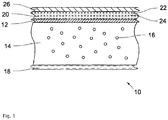
- the underlay mat shown in the figure is designated in its entirety by reference number 10. It represents a layered structure which contains layers of different materials with different mechanical and chemical properties and which will be explained in more detail below.
- the underlay mat 10 is shown in accordance with its intended orientation when laying, i.e. the side lying on the substrate (e.g. screed) is its underside, which is below in the figure, while a floor covering, not shown, rests on its top.
- the terms “underside” and “top side” used here and in the rest of the application are not intended to limit the present invention to a specific orientation of the underlay mat 10, but merely serve to clearly differentiate the opposite sides of the underlay mat 10.
- the layer thicknesses are shown and size relationships in the figure are not to scale and are also not restrictive.
- the underlay mat 10 comprises a polyurethane layer 14, which consists of polyurethane (PU) and additional mineral fillers 16, such as sand or chalk, which have a higher density than the polyurethane and therefore increase the weight of the polyurethane layer 14 and of the entire underlay mat 10.
- the fillers 16 are distributed relatively homogeneously within the polyurethane layer 14. Their representation in the figure is only schematic and does not represent the density of their distribution to scale.
- the polyurethane layer 14, including the fillers 16, has a density of up to 1800 kg / m 3 .
- the polyurethane contained therein has a density between 800 and 1200 kg / m 3 .
- Their thickness is between 1 and 5 mm, advantageously about 2 mm.
- the polyurethane layer 14 is on its underside, which in Fig. 1 is arranged at the bottom in accordance with the usual orientation when laying the underlay mat 10, covered by a fleece 18.
- the fleece 18 forms a relatively soft fiber mat, which can be glued to the underside of the polyurethane layer 14, for example by a spray adhesive.
- the underlay mat 10 thus consists of relatively soft materials on its underside. In this way, an unevenness on the substrate on which the underlay mat 10 is laid can be pressed into the fleece 18 and into the polyurethane layer 14. The underlay 10 thus ensures good compensation for such unevenness.
- a self-adhesive film 20 is applied to the upper side of the polyurethane layer 14 and comprises a carrier film 12, an adhesive layer 22 arranged on the carrier film 12 and a scrim 24 embedded therein.
- the scrim 24 consists of loose, i.e. with relatively large gaps between the fibers, which can easily be penetrated by the adhesive.
- the adhesive of the adhesive layer 22 can be an acrylate adhesive, for example. The adhesive properties and the flowability are thus not impaired by the scrim 24.
- the scrim 24 provides additional stability of the layer structure of the underlay mat 10 in its upper cross-sectional area.
- the top of the self-adhesive film 20 is covered by a protective film 26 which can be removed by hand.
- the protective film 26 thus only adheres to the adhesive 22 of the self-adhesive film 20 and does not form a firm bond with it.
- the self-adhesive film 20 offers an adhesive surface for receiving and connecting to a floor covering to be arranged thereon.
- a floor element such as a floor panel placed on the self-adhesive film 20 immediately after the protective film 26 has been removed can be corrected in its position, that is to say shifted laterally to a certain extent, until it one has reached its final position.
- a firm layer bond is formed between the floor covering and the underlay mat 10 arranged underneath, which ensures advantageous properties of the finished floor.
- the fleece 18 on the underside of the underlay mat 10 only lies loosely on the substrate, the floor can be removed without leaving any residue.
- An acrylate adhesive is also very resistant to plasticizers, which can escape particularly from PVC (polyvinyl chloride) floor coverings.
- the present underlay 10 is therefore well suited for laying such PVC floor coverings.
- the underlay mat 10 has a high weight despite its relatively small thickness, as well as great flexibility and flexibility, so that it can easily be rolled up as a web and easily processed on site.
- the layers in their upper cross-sectional area, in particular the carrier film 12 and the scrim 24 within the self-adhesive film 20, give it high stability and good resistance to punctiform mechanical loads.
- the polyurethane layer 14 arranged below ensures sufficient elasticity.
- a product with the layer structure according to the present invention described above and shown in the figure can have, for example, the following technical specifications.
- Width 1,000 mm ( ⁇ 1.00 mm) DIN CEN / TS 16354
- This product can be easily cut with a cutter knife.
- the product is permanently resistant to plasticizers and the adhesive layer has a low initial adhesion for any necessary correction work.
- the adhesive effect increases up to the completely firm adhesion of the top covering.
- This underlay is suitable for use under PVC cuts (dryback), LPT, LVT and laminate systems.
Landscapes
- Engineering & Computer Science (AREA)
- Architecture (AREA)
- Civil Engineering (AREA)
- Structural Engineering (AREA)
- Physics & Mathematics (AREA)
- Acoustics & Sound (AREA)
- Electromagnetism (AREA)
- Textile Engineering (AREA)
- Floor Finish (AREA)
- Laminated Bodies (AREA)
- Carpets (AREA)
Abstract
- eine Polyurethan-Schicht (14),
- ein Vlies (18) auf der Unterseite der Polyurethan-Schicht (14),
- einen Selbstklebefilm (20) auf der Oberseite der Polyurethan-Schicht (14), umfassend eine Trägerfolie (12), eine auf die Trägerfolie (12) aufgebrachte Klebstoffschicht (22), und ein Gittergelege (24) aus Fasern, das in die Klebstoffschicht (22) eingebettet ist,
- und eine abziehbare Schutzfolie (26) auf der Oberseite des Selbstklebefilms (20).
Description
- Die vorliegende Erfindung betrifft eine Unterlegematte für Fußbodenbeläge.
- Fußbodenbeläge existieren in einer großen Vielfalt von Ausführungsformen. Neben den sehr verbreiteten Bodenpaneelen aus Holz oder Holzwerkstoffen werden zunehmend auch Beläge aus Kunststoffmaterialien wie etwa PVC oder neuerdings Polyurethan (PU) eingesetzt. In der Regel werden solche Bodenbeläge unmittelbar auf den Untergrund aufgeklebt, beispielsweise mittels eines auf den Estrich aufgetragenen Flüssigklebers.
- Solche Fußböden weisen allerdings eine unzureichende Trittschalldämmung und Gehschallreduzierung auf. Auch der Gehkomfort ist nicht zufriedenstellend. Darüber hinaus soll der Bodenbelag möglichst einfach, schnell und sauber zu verlegen sein, was im Fall der Verwendung eines Flüssigklebers nur mit hoher Sorgfalt und viel Erfahrung möglich ist. An sich ist es erwünscht, auch flexible Bodenbelagselemente der oben erwähnten Art schwimmend zu verlegen, so wie es z.B. von Holzpaneelen mit Verriegelungsprofilen bekannt ist. Mit den bekannten Mitteln ist dies jedoch bisher nicht möglich. Beispielsweise lassen sich die Unterlegematten, die zur schwimmenden Verlegung von Laminatfußböden eingesetzt werden, nicht für derartige Kunststoffbeläge einsetzen, da sie nicht die gewünschten Anforderungen erfüllen. Eine derartige Matte sollte gute Eigenschaften hinsichtlich der Trittschall- und Gehschalldämmung aufweisen, dennoch aber sehr dünn sein und dauerhaft elastisch und flexibel bleiben, um punktuelle Unebenheiten des Untergrunds ausgleichen zu können und ein gutes Rückstellverhalten gegenüber punktuellen Belastungen aufzuweisen. Weitere gewünschte Eigenschaften sind eine gute Rückbaubarkeit des Bodenbelags und eine hohe Dimensionsstabilität.
- Im Zusammenhang mit Kunststofffußböden stellen die gewachsenen Anforderungen an deren Umweltverträglichkeit eine zusätzliche Herausforderung dar. Beispielsweise enthalten PVC-Materialien häufig schädliche Stoffe wie z.B. Weichmacher, die als gesundheitsschädlich gelten. Die Unterlegematte soll möglichst frei von solchen umweit- oder gesundheitsschädlichen Stoffen sein, ohne dass ihre mechanischen Eigenschaften wie etwa ihre Flexibilität und Elastizität beeinträchtigt sind. Gleichzeitig soll sie selbst nicht durch Emissionen beeinträchtigt werden, die aus den darauf verlegten Fußbodenbelägen, wie etwa PVC-Belägen, nach unten in die Matte eindringen können. Beispielsweise besteht die Gefahr, dass die Unterlegematte durch die bereits erwähnten Weichmacher oder auch andere Stoffe auf Dauer zerstört wird.
- Es ist daher eine Aufgabe der vorliegenden Erfindung, eine neuartige Unterlegematte für Fußbodenbeläge zu schaffen, die einfach und sauber zu verlegen ist und praktisch vollständig emissionsfrei ist, selbst aber auch nicht durch die Emissionen aus einem darauf verlegten Fußbodenbelag zu beeinträchtigen ist, so dass sie die gewünschten mechanischen Eigenschaften dauerhaft beibehält. Diese Unterlegematte sollte ferner die oben erwähnten Anforderungen an Trittschalldämmung, Gehschallreduzierung, Elastizität, Rückstellverhalten, Dimensionsstabilität und Rückbaubarkeit erfüllen.
- Diese Aufgaben werden erfindungsgemäß durch eine Unterlegematte mit den Merkmalen des Anspruchs 1 gelöst.
- Die erfindungsgemäße Unterlegematte umfasst eine Schicht aus Polyurethan (PU), die für die maßgeblichen Eigenschaften bezüglich der Trittschalldämmung, des Gehkomforts, der Elastizität und Flexibilität sowie des Resteindruckverhaltens sorgt. Die Verwendung von Polyurethan für diese Schicht stellt einen großen Fortschritt gegenüber Kunststoffen dar, die umweltschädliche Zusatzstoffe enthalten. Es kann insbesondere Polyurethan verwendet werden, das aus nachwachsenden Rohstoffen wie etwa entsprechenden Raps- und Rizinusölen hergestellt wird und frei von jeglichen schädlichen Zusatzstoffen wie etwa Weichmachern, Formaldehyd, Schwermetallen oder dergleichen mehr ist. Die Polyurethanschicht ist damit vollständig emissionsfrei und äußerst umweltfreundlich, ohne dass Kompromisse bezüglich ihrer dämmenden Eigenschaften oder ihrer Stabilität gemacht werden müssen. Insbesondere kann die Polyurethanschicht sehr flexibel und biegsam sein und dennoch im verlegten Zustand eine stabile, dämmende Schicht bilden.
- Auf der Unterseite der Polyurethanschicht befindet sich ein Vlies. Auf ihrer Oberseite befindet sich ein Selbstklebefilm, der eine Trägerfolie, eine auf die Trägerfolie aufgebrachte Klebstoffschicht und ein Gittergelege aus Fasern umfasst, das in die Klebstoffschicht eingebettet ist. Der Klebstoff dient dazu, mit dem auf die Unterlegematte aufgelegten Fußbodenbelag verklebt zu werden. Hierdurch wird die erfindungsgemäße Unterlegematte bereits fertig zur Installation des Fußbodenbelags ausgerüstet, d.h., der Auftrag eines flüssigen Klebstoffs erübrigt sich. Die Klebstoffschicht wird durch das Gittergelege stabilisiert. Durch geeignete Wahl des Klebstoffs sind anfängliche Korrekturen beim Verlegen der Elemente des Fußbodenbelags möglich. Ein späteres Aushärten des Klebstoffs schafft die gewünschte stabile Verbindung des fertig installierten Fußbodenbelags mit der Unterlegematte.
- Der Selbstklebefilm wird auf seiner Oberseite durch eine abziehbare Schutzfolie abgedeckt. Die Unterlegematte ist somit leicht handhabbar, etwa als aufgerolltes Bahnenmaterial. Nach bzw. während des Ausrollens kann die Schutzfolie abgezogen werden, um den Selbstklebefilm freizulegen.
- Die erfindungsgemäße Unterlegematte bietet eine optimale Kombination aus Flexibilität, Elastizität und Stabilität. Letztere wird insbesondere durch die Trägerfolie und das Gittergelege gewährleistet.
- Gemäß einer bevorzugten Ausführungsform der vorliegenden Erfindung enthält die Polyurethanschicht außer Polyurethan (PU) zusätzlich mineralische Füllstoffe zur Gewichtserhöhung. Bei diesen Füllstoffen kann es sich beispielsweise um Sand oder Kreide handeln.
- Vorzugsweise beträgt die Dichte der Polyurethanschicht einschließlich der Füllstoffe bis zu 1800 kg/m3.
- Weiter vorzugsweise beträgt das spezifische Gewicht des Polyurethans in der Polyurethan-Schicht 800 bis 1200 kg/m3.
- Weiter vorzugsweise beträgt die Dicke der Polyurethanschicht 1 bis 5 mm, vorzugsweise ca. 2 mm.
- Gemäß einer weiteren bevorzugten Ausführungsform der Erfindung besteht die Trägerfolie aus Polyethylenterephthalat (PET).
- Gemäß einer weiteren bevorzugten Ausführungsform der Erfindung ist der Klebstoff des Selbstklebefilms ein Acrylatkleber.
- Weiter vorzugsweise ist die Trägerfolie unmittelbar auf die Oberseite der Polyurethan-Schicht aufgebracht. Hierdurch wird ein fester Verbund zwischen der stabilen Trägerfolie und der Polyurethanschicht gebildet, die elastische Eigenschaften aufweisen kann.
- Gemäß einer weiteren bevorzugten Ausführungsform ist das Vlies unmittelbar auf die Unterseite der Polyurethanschicht aufgebracht und bildet die Unterseite der Unterlegematte. Unebenheiten des Untergrundes, auf dem die Unterlegematte verlegt wird, können sich somit durch das Vlies hindurch in die Polyurethanschicht eindrücken. Die Unterlegematte passt sich hierdurch gut an unebene Untergründe an.
- Im folgenden wird eine bevorzugte Ausführungsform der Erfindung anhand der Zeichnung näher erläutert.
- Die einzige Figur ist ein schematischer Querschnitt durch eine Ausführungsform der erfindungsgemäßen Unterlegematte.
- Die in der Figur dargestellte Unterlegematte ist in ihrer Gesamtheit mit der Bezugsziffer 10 bezeichnet. Sie stellt ein Schichtgebilde dar, das Schichten aus unterschiedlichen Materialien mit unterschiedlichen mechanischen und chemischen Eigenschaften enthält und welche im Folgenden näher erläutert werden sollen.
- Die Unterlegematte 10 ist gemäß ihrer vorgesehenen Orientierung bei der Verlegung abgebildet, d.h. die auf dem Untergrund (z.B. Estrich) aufliegende Seite ist ihre Unterseite, die in der Figur unten ist, während auf ihrer Oberseite ein nicht näher dargestellter Bodenbelag aufliegt. Die hier und in der übrigen Anmeldung verwendeten Begriffe "Unterseite" und "Oberseite" sollen jedoch nicht die vorliegende Erfindung auf eine bestimmte Orientierung der Unterlegematte 10 beschränken, sondern dienen lediglich zur anschaulichen Unterscheidung der gegenüberliegenden Seiten der Unterlegematte 10. Ferner ist die Darstellung der Schichtdicken und Größenverhältnisse in der Figur nicht maßstabsgerecht und ebenfalls nicht beschränkend.
- Im einzelnen umfasst die Unterlegematte 10 eine Polyurethanschicht 14, die aus Polyurethan (PU) sowie zusätzlichen mineralischen Füllstoffen 16 wie etwa Sand oder Kreide besteht, welche eine höhere Dichte als das Polyurethan aufweisen und daher das Gewicht der Polyurethanschicht 14 sowie der gesamten Unterlegematte 10 erhöhen. Die Füllstoffe 16 sind relativ homogen innerhalb der Polyurethanschicht 14 verteilt. Ihre Darstellung in der Figur ist lediglich schematisch und stellt die Dichte ihrer Verteilung nicht maßstabsgerecht dar.
- Die Polyurethanschicht 14 weist einschließlich der Füllstoffe 16 eine Dichte von bis zu 1800 kg/m3 auf. Das darin enthaltene Polyurethan weist eine Dichte zwischen 800 und 1200 kg/m3 auf. Ihre Dicke liegt zwischen 1 und 5 mm, vorteilhafterweise etwa bei 2 mm.
- Die Polyurethanschicht 14 ist an ihrer Unterseite, die in
Fig. 1 entsprechend der üblichen Ausrichtung bei der Verlegung der Unterlegematte 10 unten angeordnet ist, durch ein Vlies 18 abgedeckt. Das Vlies 18 bildet eine relativ weiche Fasermatte, die beispielsweise durch einen Sprühkleber auf die Unterseite der Polyurethanschicht 14 aufgeklebt sein kann. Die Unterlegematte 10 besteht also auf ihrer Unterseite aus relativ weichen Materialien. Eine Unebenheit auf dem Untergrund, auf dem die Unterlegematte 10 verlegt wird, kann sich auf diese Weise in das Vlies 18 und bis in die Polyurethanschicht 14 hinein eindrücken. Die Unterlegematte 10 sorgt somit für einen guten Ausgleich solcher Unebenheiten. - Auf die Oberseite der Polyurethanschicht 14 ist ein Selbstklebefilm 20 aufgebracht, der eine Trägerfolie 12, eine auf der Trägerfolie 12 angeordnete Klebstoffschicht 22 und ein darin eingebettetes Gittergelege 24 umfasst. Das Gittergelege 24 besteht aus locker, d.h. mit relativ großen Zwischenräumen verlegten Fasern, die problemlos vom Klebstoff durchdrungen werden können. Bei dem Klebstoff der Klebstoffschicht 22 kann es sich beispielsweise um einen Acrylatkleber handeln. Die Klebeeigenschaften sowie die Fließfähigkeit werden somit durch das Gittergelege 24 nicht beeinträchtigt. Andererseits sorgt das Gittergelege 24 für eine zusätzliche Stabilität des Schichtgebildes der Unterlegematte 10 in ihrem oberen Querschnittsbereich.
- Die Oberseite des Selbstklebefilms 20 ist durch eine Schutzfolie 26 abgedeckt, die von Hand abgezogen werden kann. Die Schutzfolie 26 haftet also lediglich auf dem Klebstoff 22 des Selbstklebefilms 20 und geht mit diesem keinen festen Verbund ein. Der Selbstklebefilm 20 bietet nach dem Abziehen der Schutzfolie 26 eine Klebefläche zur Aufnahme und Verbindung mit einem darauf anzuordnenden Fußbodenbelag.
- Bei Verwendung eines Acrylatklebers für die Klebstoffschicht 22, so wie im vorliegenden Ausführungsbeispiel, lässt sich ein auf den Selbstklebefilm 20 unmittelbar nach dem Abziehen der Schutzfolie 26 aufgelegtes Fußbodenelement, wie etwa ein Fußbodenpaneel, in seiner Position korrigieren, d.h. in gewissem Umfang seitlich verschieben, bis es eine endgültige Position erreicht hat. Nach dem Aushärten des Acrylatklebers wird ein fester Schichtverbund zwischen dem Fußbodenbelag und der darunter angeordneten Unterlegematte 10 gebildet, der für vorteilhafte Eigenschaften des fertig verlegten Fußbodens sorgt. Da jedoch das Vlies 18 an der Unterseite der Unterlegematte 10 lediglich lose auf dem Untergrund aufliegt, ist der Fußboden rückstandsfrei rückbaubar.
- Ein Acrylatkleber ist zudem sehr beständig gegenüber Weichmachern, die insbesondere aus Bodenbelägen aus PVC (Polyvinylchlorid) austreten können. Die vorliegende Unterlegematte 10 eignet sich somit gut zur Verlegung solcher Bodenbeläge aus PVC.
- Die Unterlegematte 10 weist trotz relativ geringer Dicke ein hohes Gewicht auf, sowie eine große Flexibilität und Biegsamkeit, so dass sie sich ohne weiteres als Bahn aufrollen und bequem vor Ort verarbeiten lässt. Die Schichten in ihrem oberen Querschnittsbereich, also insbesondere die Trägerfolie 12 und das Gittergelege 24 innerhalb des Selbstklebefilms 20, verleihen ihr eine hohe Stabilität und eine gute Widerstandsfähigkeit gegenüber punktuellen mechanischen Belastungen. Hingegen sorgt die darunter angeordnete Polyurethanschicht 14 für eine ausreichende Elastizität.
- Ein Produkt mit dem oben beschriebenen und in der Figur dargestellten Schichtaufbau gemäß der vorliegenden Erfindung kann beispielsweise die folgenden technischen Spezifikationen aufweisen.
Dicke: ∼1,80 mm (± 0,15 mm) DIN CEN/TS 16354 Flächengewicht: ∼2,60 kg/m2 (± 0,15 kg/m2) Länge: Bis 8.500 mm (± 15,00 mm) DIN CEN/TS 16354 Breite: 1.000 mm (± 1,00 mm) DIN CEN/TS 16354 Gehschallreduzierung: bis zu 6% (± 2%) EPLF Norm WD 021029-5 Trittschall reduzie rung: Bis zu 15 dB (± 2 dB) DIN EN 16251-1 Wärmedurchlasswiderstand: DIN CEN/TS 16354 0,01 m2K/W (geeignet für Fußbodenheizung) Resteindruck: < 0,20 mm (DIN EN 3385) Druckfestigkeit: > 45 t/m2 (> 450 kPa) DIN EN 826 Beständigkeit gg. Druck-Kriechverformung: > 55 kPa DIN CEN/TS 16354 Beständigkeit bei dynamischen Belastungen: > 100.000 Zyklen DIN CEN/TS 16354 Stoßbeanspruchung: ∼ 750 mm DIN CEN/TS 16354 Ausgleich punktueller Unebenheiten: ∼ 0,55 mm DIN CEN/TS 16354 Brandklassifikation: Efl DIN EN 13501-1 (ohne Oberbelag) - Bei diesem Produkt ist ein leichtes Zuschneiden mit einem Cutter-Messer möglich. Das Produkt ist dauerhaft weichmacherbeständig, und die Klebeschicht weist eine geringe Anfangsadhäsion für gegebenenfalls notwenige Korrekturarbeiten auf. Die Klebewirkung verstärkt sich bis hin zur komplett festen Anhaftung des Oberbelags. Diese Unterlegematte eignet sich zur Verwendung unter PVC-Zuschnitten (Dryback), LPT-, LVT- und Laminat-Systemen.
Claims (10)
- Unterlegematte (10) für Fußbodenbeläge, gekennzeichnet durch:- eine Polyurethan-Schicht (14),- ein Vlies (18) auf der Unterseite der Polyurethan-Schicht (14),- einen Selbstklebefilm (20) auf der Oberseite der Polyurethan-Schicht (14), umfassend eine Trägerfolie (12), eine auf die Trägerfolie (12) aufgebrachte Klebstoffschicht (22), und ein Gittergelege (24) aus Fasern, das in die Klebstoffschicht (22) eingebettet ist,- und eine abziehbare Schutzfolie (26) auf der Oberseite des Selbstklebefilms (20).
- Unterlegematte gemäß Anspruch 1, dadurch gekennzeichnet, dass die Polyurethan-Schicht (14) ausser Polyurethan (PU) zusätzlich mineralische Füllstoffe (16) zur Gewichtserhöhung enthält.
- Unterlegematte gemäß Anspruch 2, dadurch gekennzeichnet, dass das spezifische Gewicht der Polyurethan-Schicht (14) einschließlich der Füllstoffe (16) bis zu 1800 kg/m3 beträgt.
- Unterlegematte gemäß einem der Ansprüche 1 bis 3, dadurch gekennzeichnet, dass das spezifische Gewicht des Polyurethans in der Polyurethan-Schicht (14) 800 bis 1200 kg/m3 beträgt.
- Unterlegematte gemäß einem der vorhergehenden Ansprüche, dadurch gekennzeichnet, dass die Dicke der Polyurethan-Schicht (14) 1 bis 5 mm beträgt.
- Unterlegematte gemäß Anspruch 4, dadurch gekennzeichnet, dass die Dicke der Polyurethan-Schicht (14) etwa 2 mm beträgt.
- Unterlegematte gemäß einem der vorhergehenden Ansprüche, dadurch gekennzeichnet, dass die Trägerfolie (12) aus Polyethylenterephthalat (PET) besteht.
- Unterlegematte gemäß einem der vorhergehenden Ansprüche, dadurch gekennzeichnet, dass der Klebstoff (22) des Selbstklebefilms (20) ein Acrylatkleber ist.
- Unterlegematte gemäß einem der vorhergehenden Ansprüche, dadurch gekennzeichnet, dass die Trägerfolie (12) unmittelbar auf die Oberseite der Polyurethan-Schicht (14) aufgebracht ist.
- Unterlegematte gemäß einem der vorhergehenden Ansprüche, dadurch gekennzeichnet, dass das Vlies (18) unmittelbar auf die Unterseite der Polyurethan-Schicht (14) aufgebracht ist und die Unterseite der Unterlegematte (10) bildet.
Applications Claiming Priority (2)
| Application Number | Priority Date | Filing Date | Title |
|---|---|---|---|
| DE202015106139.0U DE202015106139U1 (de) | 2015-11-13 | 2015-11-13 | Unterlegematte für Fußbodenbeläge |
| EP16197897.8A EP3168388B1 (de) | 2015-11-13 | 2016-11-09 | Unterlegematte für fussbodenbeläge |
Related Parent Applications (2)
| Application Number | Title | Priority Date | Filing Date |
|---|---|---|---|
| EP16197897.8A Division EP3168388B1 (de) | 2015-11-13 | 2016-11-09 | Unterlegematte für fussbodenbeläge |
| EP16197897.8A Division-Into EP3168388B1 (de) | 2015-11-13 | 2016-11-09 | Unterlegematte für fussbodenbeläge |
Publications (3)
| Publication Number | Publication Date |
|---|---|
| EP3594430A1 true EP3594430A1 (de) | 2020-01-15 |
| EP3594430C0 EP3594430C0 (de) | 2023-06-07 |
| EP3594430B1 EP3594430B1 (de) | 2023-06-07 |
Family
ID=57256187
Family Applications (2)
| Application Number | Title | Priority Date | Filing Date |
|---|---|---|---|
| EP19195907.1A Active EP3594430B1 (de) | 2015-11-13 | 2016-11-09 | Unterlegematte für fussbodenbeläge |
| EP16197897.8A Active EP3168388B1 (de) | 2015-11-13 | 2016-11-09 | Unterlegematte für fussbodenbeläge |
Family Applications After (1)
| Application Number | Title | Priority Date | Filing Date |
|---|---|---|---|
| EP16197897.8A Active EP3168388B1 (de) | 2015-11-13 | 2016-11-09 | Unterlegematte für fussbodenbeläge |
Country Status (6)
| Country | Link |
|---|---|
| US (2) | US10493736B2 (de) |
| EP (2) | EP3594430B1 (de) |
| DE (3) | DE202015106139U1 (de) |
| DK (1) | DK3168388T3 (de) |
| ES (1) | ES2762924T3 (de) |
| PL (1) | PL3168388T3 (de) |
Cited By (4)
| Publication number | Priority date | Publication date | Assignee | Title |
|---|---|---|---|---|
| EP4438290A1 (de) | 2023-03-28 | 2024-10-02 | Unilin, BV | Bodenbelag, unterlage und bodenelement |
| EP4585412A1 (de) | 2024-01-11 | 2025-07-16 | Unilin, BV | Bodenbelag und unterlage |
| EP4644123A2 (de) | 2023-03-28 | 2025-11-05 | Unilin, BV | Bodenbelag, unterlage und bodenelement |
| WO2026126007A1 (en) | 2024-12-13 | 2026-06-18 | Unilin, Bv | Floor covering and underlayment. |
Families Citing this family (14)
| Publication number | Priority date | Publication date | Assignee | Title |
|---|---|---|---|---|
| US10316527B2 (en) * | 2014-10-15 | 2019-06-11 | Keene Building Products Co., Inc. | Uncoupling mat |
| DE202015106139U1 (de) * | 2015-11-13 | 2017-02-16 | Wpt Gmbh | Unterlegematte für Fußbodenbeläge |
| US10544595B2 (en) | 2016-08-26 | 2020-01-28 | Quickstyle Industries Inc. | Tile with protected imitation grout line |
| US9938726B2 (en) | 2016-08-26 | 2018-04-10 | Quickstyle Industries Inc. | Densified foam core (DFC) tile with imitation grout line |
| US12392139B2 (en) | 2016-08-26 | 2025-08-19 | Quickstyle Industries, Inc. | Tile with imitation grout line |
| DE102017109280A1 (de) * | 2017-04-28 | 2018-10-31 | Windmöller Gmbh | Fußbodenpaneel mit Schalldämmschicht und Verfahren zur Herstellung des Fußbodenpaneels |
| CN108930386A (zh) * | 2017-05-26 | 2018-12-04 | 高志明 | 一种天然纤维高强度复合地板 |
| WO2018226572A1 (en) * | 2017-06-05 | 2018-12-13 | Gcp Applied Technologies Inc. | Vapor impermeable flooring underlayment |
| CA178841S (en) * | 2017-12-19 | 2019-05-30 | Torlys Inc | Flooring underlayment |
| PL242886B1 (pl) * | 2018-01-05 | 2023-05-08 | Decora Spolka Akcyjna | Mata podkładowa do okładzin podłogowych |
| TWM560856U (zh) * | 2018-02-26 | 2018-06-01 | Web Pro Corp | 一種拋棄式保液地墊結構 |
| PL242772B1 (pl) | 2019-01-07 | 2023-04-24 | Fair Packaging Spolka Z Ograniczona Odpowiedzialnoscia Spolka Komandytowa | Podkład podłogowy i sposób wytwarzania podkładu podłogowego |
| DE102019128881A1 (de) | 2019-10-25 | 2021-04-29 | Windmöller Gmbh | Dimensionsstabiler Bodenbelag und Verfahren zu seiner Herstellung |
| DE102020109979A1 (de) | 2020-04-09 | 2021-10-14 | Windmöller Gmbh | Unterlegematte mit strukturierter Unterseite |
Citations (5)
| Publication number | Priority date | Publication date | Assignee | Title |
|---|---|---|---|---|
| WO2000070168A1 (de) * | 1999-05-18 | 2000-11-23 | Witex Ag | Schalldämmvorrichtung für bodenbeläge |
| FR2805836A1 (fr) * | 2000-03-01 | 2001-09-07 | Vetrotex France Sa | Substrat pour la realisation de l'isolation acoustique d'une dalle flottante |
| FR2831909A1 (fr) * | 2001-11-02 | 2003-05-09 | Akzo Nobel Nv | Plancher insonorise et procede de preparation de ce plancher |
| DE102005002303A1 (de) * | 2005-01-17 | 2006-07-27 | Pelzer Acoustic Products Gmbh | Raumbegrenzungselement |
| WO2014117181A1 (en) * | 2013-01-28 | 2014-07-31 | Armstrong World Industries, Inc. | Flooring underlayment and apparatus, flooring system and floor installation method using the same |
Family Cites Families (26)
| Publication number | Priority date | Publication date | Assignee | Title |
|---|---|---|---|---|
| US4880683A (en) * | 1981-12-28 | 1989-11-14 | Minnesota Mining And Manufacturing Company | Hot-tackifying adhesive tape |
| US4647484A (en) * | 1983-06-13 | 1987-03-03 | Milliken Research Corporation | Carpet underlay |
| US4751108A (en) * | 1985-03-15 | 1988-06-14 | Minnesota Mining And Manufacturing Company | Method of making a pressure-sensitive adhesive tape having a substantially tack-free surface |
| AU639944B2 (en) * | 1989-09-14 | 1993-08-12 | Avery Dennison Corporation | Tackified dual cure pressure-sensitive adhesive |
| US5082705A (en) * | 1990-07-03 | 1992-01-21 | E. R. Carpenter Company, Inc. | Carpet underlay |
| NL9301034A (nl) | 1993-06-15 | 1995-01-02 | Osbe Parket B V | Werkwijze voor het leggen van een vloer. |
| AT401908B (de) * | 1993-11-29 | 1996-12-27 | Greiner & Soehne C A | Mehrlagiges bauelement sowie verfahren und vorrichtung zu seiner herstellung |
| ATE208850T1 (de) | 1997-03-11 | 2001-11-15 | Akustik Ag | Bodenbelag mit schalldämmatte |
| PL191021B1 (pl) | 1998-11-06 | 2006-03-31 | Kozlowski Henryk | Warstwowa konstrukcja podłogowa i sposób wykonywania warstwowej konstrukcji podłogowej |
| DE29904628U1 (de) | 1999-03-12 | 1999-06-02 | Stadur Produktions GmbH & Co. KG, 21684 Stade | Bodenaufbauelement mit dünner Lastverteilungsschicht |
| DE29908733U1 (de) | 1999-05-18 | 1999-08-12 | Witex AG, 32832 Augustdorf | Schalldämmvorrichtung für Bodenbeläge |
| DE29919038U1 (de) | 1999-10-29 | 2001-03-15 | Witex AG, 32832 Augustdorf | Unterlage für Fußbodenbeläge |
| US6586066B1 (en) * | 2000-03-21 | 2003-07-01 | Awi Licensing Company | Preglued underlayment composite and associated flooring installation system |
| FR2812300B1 (fr) | 2000-07-28 | 2003-01-10 | Cypher Science | Encre liquide securisee revelable optiquement et procede de marquage de produits par une telle encre |
| DE20102072U1 (de) | 2001-02-07 | 2001-05-17 | BTF Produktentwicklungs- und Vertriebs-GmbH, 95445 Bayreuth | Trittschalldämpfendes Flächenelement |
| US20030232171A1 (en) * | 2002-06-14 | 2003-12-18 | Keith J. Todd | Carpet tile constructions and methods |
| DE102005023661B4 (de) | 2005-05-23 | 2024-05-23 | Pergo (Europe) Ab | Fußbodenbpaneel |
| US20080012455A1 (en) * | 2005-07-08 | 2008-01-17 | Jinhua Zhenfei Tools Co., Ltd. | Tool cabinet |
| US7735279B2 (en) * | 2006-09-22 | 2010-06-15 | Johns Manville | Polymer-based composite structural underlayment board and flooring system |
| US20090029097A1 (en) * | 2007-06-11 | 2009-01-29 | Riddle Dennis L | Flooring products and methods |
| US20090047464A1 (en) | 2007-08-16 | 2009-02-19 | Foxall David G | Floor carpet underlay |
| DE202007018098U1 (de) | 2007-12-21 | 2009-05-14 | Witex Flooring Products Gmbh | Unterlegematte |
| US20130284364A1 (en) * | 2010-10-25 | 2013-10-31 | Marysusan Couturier | Adhesives For Construction Materials Such As Tiles |
| DE102013100361A1 (de) | 2013-01-15 | 2014-07-17 | Sandro Thronicke | Zwischenschicht für eine Belagskonstruktion |
| DE202015106139U1 (de) * | 2015-11-13 | 2017-02-16 | Wpt Gmbh | Unterlegematte für Fußbodenbeläge |
| KR102492572B1 (ko) * | 2016-12-02 | 2023-01-30 | 쓰리엠 이노베이티브 프로퍼티즈 캄파니 | 다층 접착 물품 |
-
2015
- 2015-11-13 DE DE202015106139.0U patent/DE202015106139U1/de not_active Expired - Lifetime
-
2016
- 2016-11-09 EP EP19195907.1A patent/EP3594430B1/de active Active
- 2016-11-09 EP EP16197897.8A patent/EP3168388B1/de active Active
- 2016-11-09 PL PL16197897T patent/PL3168388T3/pl unknown
- 2016-11-09 ES ES16197897T patent/ES2762924T3/es active Active
- 2016-11-09 DE DE202016008833.6U patent/DE202016008833U1/de active Active
- 2016-11-09 DE DE202016008813.1U patent/DE202016008813U1/de active Active
- 2016-11-09 DK DK16197897.8T patent/DK3168388T3/da active
- 2016-11-10 US US15/347,846 patent/US10493736B2/en active Active
-
2019
- 2019-11-22 US US16/692,315 patent/US11186071B2/en active Active
Patent Citations (5)
| Publication number | Priority date | Publication date | Assignee | Title |
|---|---|---|---|---|
| WO2000070168A1 (de) * | 1999-05-18 | 2000-11-23 | Witex Ag | Schalldämmvorrichtung für bodenbeläge |
| FR2805836A1 (fr) * | 2000-03-01 | 2001-09-07 | Vetrotex France Sa | Substrat pour la realisation de l'isolation acoustique d'une dalle flottante |
| FR2831909A1 (fr) * | 2001-11-02 | 2003-05-09 | Akzo Nobel Nv | Plancher insonorise et procede de preparation de ce plancher |
| DE102005002303A1 (de) * | 2005-01-17 | 2006-07-27 | Pelzer Acoustic Products Gmbh | Raumbegrenzungselement |
| WO2014117181A1 (en) * | 2013-01-28 | 2014-07-31 | Armstrong World Industries, Inc. | Flooring underlayment and apparatus, flooring system and floor installation method using the same |
Non-Patent Citations (1)
| Title |
|---|
| E. WICKLEIN GMBH: "ewifoam Acoustic Insulation : "Trittschalldämmungen & Parkettunterlagsbahnen" Produkte 2009/2010", KATALOGUE PRODUKTE 2009/2010, 1 January 2009 (2009-01-01), pages 1 - 35, XP055540996 * |
Cited By (6)
| Publication number | Priority date | Publication date | Assignee | Title |
|---|---|---|---|---|
| EP4438290A1 (de) | 2023-03-28 | 2024-10-02 | Unilin, BV | Bodenbelag, unterlage und bodenelement |
| EP4644123A2 (de) | 2023-03-28 | 2025-11-05 | Unilin, BV | Bodenbelag, unterlage und bodenelement |
| EP4644123A3 (de) * | 2023-03-28 | 2026-02-18 | Unilin, BV | Bodenbelag, unterlage und bodenelement |
| US12662825B2 (en) | 2023-03-28 | 2026-06-23 | Unilin, Bv | Floor covering, underlayment and floor element |
| EP4585412A1 (de) | 2024-01-11 | 2025-07-16 | Unilin, BV | Bodenbelag und unterlage |
| WO2026126007A1 (en) | 2024-12-13 | 2026-06-18 | Unilin, Bv | Floor covering and underlayment. |
Also Published As
| Publication number | Publication date |
|---|---|
| DE202016008833U1 (de) | 2020-01-16 |
| EP3168388B1 (de) | 2019-10-16 |
| PL3168388T3 (pl) | 2020-04-30 |
| ES2762924T3 (es) | 2020-05-26 |
| DE202016008813U1 (de) | 2019-11-15 |
| EP3594430C0 (de) | 2023-06-07 |
| DE202015106139U1 (de) | 2017-02-16 |
| EP3594430B1 (de) | 2023-06-07 |
| DK3168388T3 (da) | 2020-01-06 |
| US20170136731A1 (en) | 2017-05-18 |
| US10493736B2 (en) | 2019-12-03 |
| US11186071B2 (en) | 2021-11-30 |
| US20200101702A1 (en) | 2020-04-02 |
| EP3168388A1 (de) | 2017-05-17 |
Similar Documents
| Publication | Publication Date | Title |
|---|---|---|
| EP3594430B1 (de) | Unterlegematte für fussbodenbeläge | |
| EP1634696B1 (de) | Bodenbelagelement | |
| DE102005017392A1 (de) | Fußbodenbelag | |
| AT510089A1 (de) | Bodenbelag | |
| DE102013101797A1 (de) | Paneel | |
| DE102014002154A1 (de) | Gebäudeplatte, insbesondere zur Verwendung als Boden-, Wand- oder Deckenplatte | |
| DE20108358U1 (de) | Laminat, insbesondere Fußbodenlaminat | |
| DE202005020617U1 (de) | Fussbodenbelag | |
| DE102014006552A1 (de) | Paneel | |
| DE102016110497A1 (de) | Paneel und Kern für ein Paneel | |
| DE102013114524A1 (de) | Fußbodenelement | |
| DE202015100204U1 (de) | Tritt- und Raumschalldämmunterlage | |
| EP2615222A2 (de) | Unterlage für einen Laminat- oder Parkettboden | |
| DE102015005379A1 (de) | Verfahren zum Herstellen von Platten, Scheiben und anderen Körpern aus Birkenrindenstücken | |
| DE202009002023U1 (de) | Sportbodensegment | |
| DE102016225575A1 (de) | Verfahren zur Herstellung von Bodenelementen und Bodenelemente | |
| EP2949832A1 (de) | Trittschallplatte | |
| EP3615746B1 (de) | Verfahren zur herstellung eines fussbodenpaneels mit schalldämmschicht | |
| DE202016001597U1 (de) | Fußbodenbelagplatte | |
| DE202013003715U1 (de) | Verbundplatte zum Verlegen eines Fußbodens | |
| DE202018000075U1 (de) | Unterlegematte für Fußbodenbeläge | |
| DE102016109399A1 (de) | Unterkonstruktion | |
| DE202020106500U1 (de) | Dämmunterlage für Bodenbeläge | |
| DE4343372A1 (de) | Massivholzdielenboden und Arbeitsverfahren zu seiner Verlegung | |
| DE102017120913A1 (de) | Plattenförmiges Bauelement mit Dampfdiffusionsbremse oder Dampfdiffusionssperre |
Legal Events
| Date | Code | Title | Description |
|---|---|---|---|
| STAA | Information on the status of an ep patent application or granted ep patent |
Free format text: STATUS: EXAMINATION IS IN PROGRESS |
|
| PUAI | Public reference made under article 153(3) epc to a published international application that has entered the european phase |
Free format text: ORIGINAL CODE: 0009012 |
|
| 17P | Request for examination filed |
Effective date: 20191118 |
|
| AC | Divisional application: reference to earlier application |
Ref document number: 3168388 Country of ref document: EP Kind code of ref document: P |
|
| AK | Designated contracting states |
Kind code of ref document: A1 Designated state(s): AL AT BE BG CH CY CZ DE DK EE ES FI FR GB GR HR HU IE IS IT LI LT LU LV MC MK MT NL NO PL PT RO RS SE SI SK SM TR |
|
| RBV | Designated contracting states (corrected) |
Designated state(s): AL AT BE BG CH CY CZ DE DK EE ES FI FR GB GR HR HU IE IS IT LI LT LU LV MC MK MT NL NO PL PT RO RS SE SI SK SM TR |
|
| RIC1 | Information provided on ipc code assigned before grant |
Ipc: B32B 5/02 20060101ALN20220614BHEP Ipc: B32B 7/12 20060101ALN20220614BHEP Ipc: B32B 27/36 20060101ALN20220614BHEP Ipc: B32B 27/20 20060101ALN20220614BHEP Ipc: B32B 27/08 20060101ALN20220614BHEP Ipc: B32B 27/06 20060101ALN20220614BHEP Ipc: B32B 27/40 20060101ALI20220614BHEP Ipc: E04F 15/18 20060101AFI20220614BHEP |
|
| RIC1 | Information provided on ipc code assigned before grant |
Ipc: B32B 5/02 20060101ALN20220623BHEP Ipc: B32B 7/12 20060101ALN20220623BHEP Ipc: B32B 27/36 20060101ALN20220623BHEP Ipc: B32B 27/20 20060101ALN20220623BHEP Ipc: B32B 27/08 20060101ALN20220623BHEP Ipc: B32B 27/06 20060101ALN20220623BHEP Ipc: B32B 27/40 20060101ALI20220623BHEP Ipc: E04F 15/18 20060101AFI20220623BHEP |
|
| RIC1 | Information provided on ipc code assigned before grant |
Ipc: B32B 5/02 20060101ALN20220707BHEP Ipc: B32B 7/12 20060101ALN20220707BHEP Ipc: B32B 27/36 20060101ALN20220707BHEP Ipc: B32B 27/20 20060101ALN20220707BHEP Ipc: B32B 27/08 20060101ALN20220707BHEP Ipc: B32B 27/06 20060101ALN20220707BHEP Ipc: B32B 27/40 20060101ALI20220707BHEP Ipc: E04F 15/18 20060101AFI20220707BHEP |
|
| GRAP | Despatch of communication of intention to grant a patent |
Free format text: ORIGINAL CODE: EPIDOSNIGR1 |
|
| RIC1 | Information provided on ipc code assigned before grant |
Ipc: B32B 5/02 20060101ALN20220823BHEP Ipc: B32B 7/12 20060101ALN20220823BHEP Ipc: B32B 27/36 20060101ALN20220823BHEP Ipc: B32B 27/20 20060101ALN20220823BHEP Ipc: B32B 27/08 20060101ALN20220823BHEP Ipc: B32B 27/06 20060101ALN20220823BHEP Ipc: B32B 27/40 20060101ALI20220823BHEP Ipc: E04F 15/18 20060101AFI20220823BHEP |
|
| STAA | Information on the status of an ep patent application or granted ep patent |
Free format text: STATUS: GRANT OF PATENT IS INTENDED |
|
| INTG | Intention to grant announced |
Effective date: 20220929 |
|
| GRAS | Grant fee paid |
Free format text: ORIGINAL CODE: EPIDOSNIGR3 |
|
| GRAA | (expected) grant |
Free format text: ORIGINAL CODE: 0009210 |
|
| STAA | Information on the status of an ep patent application or granted ep patent |
Free format text: STATUS: THE PATENT HAS BEEN GRANTED |
|
| AC | Divisional application: reference to earlier application |
Ref document number: 3168388 Country of ref document: EP Kind code of ref document: P |
|
| AK | Designated contracting states |
Kind code of ref document: B1 Designated state(s): AL AT BE BG CH CY CZ DE DK EE ES FI FR GB GR HR HU IE IS IT LI LT LU LV MC MK MT NL NO PL PT RO RS SE SI SK SM TR |
|
| REG | Reference to a national code |
Ref country code: GB Ref legal event code: FG4D Free format text: NOT ENGLISH |
|
| REG | Reference to a national code |
Ref country code: CH Ref legal event code: EP Ref country code: AT Ref legal event code: REF Ref document number: 1575500 Country of ref document: AT Kind code of ref document: T Effective date: 20230615 Ref country code: DE Ref legal event code: R096 Ref document number: 502016015858 Country of ref document: DE |
|
| U01 | Request for unitary effect filed |
Effective date: 20230626 |
|
| U07 | Unitary effect registered |
Designated state(s): AT BE BG DE DK EE FI FR IT LT LU LV MT NL PT SE SI Effective date: 20230630 |
|
| REG | Reference to a national code |
Ref country code: LT Ref legal event code: MG9D |
|
| PG25 | Lapsed in a contracting state [announced via postgrant information from national office to epo] |
Ref country code: NO Free format text: LAPSE BECAUSE OF FAILURE TO SUBMIT A TRANSLATION OF THE DESCRIPTION OR TO PAY THE FEE WITHIN THE PRESCRIBED TIME-LIMIT Effective date: 20230907 Ref country code: ES Free format text: LAPSE BECAUSE OF FAILURE TO SUBMIT A TRANSLATION OF THE DESCRIPTION OR TO PAY THE FEE WITHIN THE PRESCRIBED TIME-LIMIT Effective date: 20230607 |
|
| PG25 | Lapsed in a contracting state [announced via postgrant information from national office to epo] |
Ref country code: RS Free format text: LAPSE BECAUSE OF FAILURE TO SUBMIT A TRANSLATION OF THE DESCRIPTION OR TO PAY THE FEE WITHIN THE PRESCRIBED TIME-LIMIT Effective date: 20230607 Ref country code: HR Free format text: LAPSE BECAUSE OF FAILURE TO SUBMIT A TRANSLATION OF THE DESCRIPTION OR TO PAY THE FEE WITHIN THE PRESCRIBED TIME-LIMIT Effective date: 20230607 Ref country code: GR Free format text: LAPSE BECAUSE OF FAILURE TO SUBMIT A TRANSLATION OF THE DESCRIPTION OR TO PAY THE FEE WITHIN THE PRESCRIBED TIME-LIMIT Effective date: 20230908 |
|
| U20 | Renewal fee for the european patent with unitary effect paid |
Year of fee payment: 8 Effective date: 20231103 |
|
| PG25 | Lapsed in a contracting state [announced via postgrant information from national office to epo] |
Ref country code: SK Free format text: LAPSE BECAUSE OF FAILURE TO SUBMIT A TRANSLATION OF THE DESCRIPTION OR TO PAY THE FEE WITHIN THE PRESCRIBED TIME-LIMIT Effective date: 20230607 |
|
| PG25 | Lapsed in a contracting state [announced via postgrant information from national office to epo] |
Ref country code: IS Free format text: LAPSE BECAUSE OF FAILURE TO SUBMIT A TRANSLATION OF THE DESCRIPTION OR TO PAY THE FEE WITHIN THE PRESCRIBED TIME-LIMIT Effective date: 20231007 |
|
| PG25 | Lapsed in a contracting state [announced via postgrant information from national office to epo] |
Ref country code: SM Free format text: LAPSE BECAUSE OF FAILURE TO SUBMIT A TRANSLATION OF THE DESCRIPTION OR TO PAY THE FEE WITHIN THE PRESCRIBED TIME-LIMIT Effective date: 20230607 Ref country code: SK Free format text: LAPSE BECAUSE OF FAILURE TO SUBMIT A TRANSLATION OF THE DESCRIPTION OR TO PAY THE FEE WITHIN THE PRESCRIBED TIME-LIMIT Effective date: 20230607 Ref country code: RO Free format text: LAPSE BECAUSE OF FAILURE TO SUBMIT A TRANSLATION OF THE DESCRIPTION OR TO PAY THE FEE WITHIN THE PRESCRIBED TIME-LIMIT Effective date: 20230607 Ref country code: IS Free format text: LAPSE BECAUSE OF FAILURE TO SUBMIT A TRANSLATION OF THE DESCRIPTION OR TO PAY THE FEE WITHIN THE PRESCRIBED TIME-LIMIT Effective date: 20231007 Ref country code: CZ Free format text: LAPSE BECAUSE OF FAILURE TO SUBMIT A TRANSLATION OF THE DESCRIPTION OR TO PAY THE FEE WITHIN THE PRESCRIBED TIME-LIMIT Effective date: 20230607 |
|
| PG25 | Lapsed in a contracting state [announced via postgrant information from national office to epo] |
Ref country code: PL Free format text: LAPSE BECAUSE OF FAILURE TO SUBMIT A TRANSLATION OF THE DESCRIPTION OR TO PAY THE FEE WITHIN THE PRESCRIBED TIME-LIMIT Effective date: 20230607 |
|
| REG | Reference to a national code |
Ref country code: DE Ref legal event code: R097 Ref document number: 502016015858 Country of ref document: DE |
|
| PLBE | No opposition filed within time limit |
Free format text: ORIGINAL CODE: 0009261 |
|
| STAA | Information on the status of an ep patent application or granted ep patent |
Free format text: STATUS: NO OPPOSITION FILED WITHIN TIME LIMIT |
|
| 26N | No opposition filed |
Effective date: 20240308 |
|
| REG | Reference to a national code |
Ref country code: CH Ref legal event code: PL |
|
| PG25 | Lapsed in a contracting state [announced via postgrant information from national office to epo] |
Ref country code: MC Free format text: LAPSE BECAUSE OF FAILURE TO SUBMIT A TRANSLATION OF THE DESCRIPTION OR TO PAY THE FEE WITHIN THE PRESCRIBED TIME-LIMIT Effective date: 20230607 |
|
| PG25 | Lapsed in a contracting state [announced via postgrant information from national office to epo] |
Ref country code: CH Free format text: LAPSE BECAUSE OF NON-PAYMENT OF DUE FEES Effective date: 20231130 |
|
| PG25 | Lapsed in a contracting state [announced via postgrant information from national office to epo] |
Ref country code: MC Free format text: LAPSE BECAUSE OF FAILURE TO SUBMIT A TRANSLATION OF THE DESCRIPTION OR TO PAY THE FEE WITHIN THE PRESCRIBED TIME-LIMIT Effective date: 20230607 Ref country code: CH Free format text: LAPSE BECAUSE OF NON-PAYMENT OF DUE FEES Effective date: 20231130 |
|
| REG | Reference to a national code |
Ref country code: IE Ref legal event code: MM4A |
|
| PG25 | Lapsed in a contracting state [announced via postgrant information from national office to epo] |
Ref country code: IE Free format text: LAPSE BECAUSE OF NON-PAYMENT OF DUE FEES Effective date: 20231109 |
|
| PG25 | Lapsed in a contracting state [announced via postgrant information from national office to epo] |
Ref country code: IE Free format text: LAPSE BECAUSE OF NON-PAYMENT OF DUE FEES Effective date: 20231109 |
|
| U20 | Renewal fee for the european patent with unitary effect paid |
Year of fee payment: 9 Effective date: 20241111 |
|
| U1N | Appointed representative for the unitary patent procedure changed after the registration of the unitary effect |
Representative=s name: PATENTANWAELTE BAUER VORBERG KAYSER; DE |
|
| PG25 | Lapsed in a contracting state [announced via postgrant information from national office to epo] |
Ref country code: CY Free format text: LAPSE BECAUSE OF FAILURE TO SUBMIT A TRANSLATION OF THE DESCRIPTION OR TO PAY THE FEE WITHIN THE PRESCRIBED TIME-LIMIT; INVALID AB INITIO Effective date: 20161109 |
|
| PG25 | Lapsed in a contracting state [announced via postgrant information from national office to epo] |
Ref country code: HU Free format text: LAPSE BECAUSE OF FAILURE TO SUBMIT A TRANSLATION OF THE DESCRIPTION OR TO PAY THE FEE WITHIN THE PRESCRIBED TIME-LIMIT; INVALID AB INITIO Effective date: 20161109 |
|
| PG25 | Lapsed in a contracting state [announced via postgrant information from national office to epo] |
Ref country code: TR Free format text: LAPSE BECAUSE OF FAILURE TO SUBMIT A TRANSLATION OF THE DESCRIPTION OR TO PAY THE FEE WITHIN THE PRESCRIBED TIME-LIMIT Effective date: 20230607 |
|
| U20 | Renewal fee for the european patent with unitary effect paid |
Year of fee payment: 10 Effective date: 20251117 |
|
| PGFP | Annual fee paid to national office [announced via postgrant information from national office to epo] |
Ref country code: GB Payment date: 20251120 Year of fee payment: 10 |