EP3568419B1 - Polybutadiene, deren herstellung und verwendung - Google Patents
Polybutadiene, deren herstellung und verwendung Download PDFInfo
- Publication number
- EP3568419B1 EP3568419B1 EP18700672.1A EP18700672A EP3568419B1 EP 3568419 B1 EP3568419 B1 EP 3568419B1 EP 18700672 A EP18700672 A EP 18700672A EP 3568419 B1 EP3568419 B1 EP 3568419B1
- Authority
- EP
- European Patent Office
- Prior art keywords
- polybutadiene
- butadiene
- polybutadienes
- monomer units
- proportion
- Prior art date
- Legal status (The legal status is an assumption and is not a legal conclusion. Google has not performed a legal analysis and makes no representation as to the accuracy of the status listed.)
- Active
Links
Classifications
-
- C—CHEMISTRY; METALLURGY
- C08—ORGANIC MACROMOLECULAR COMPOUNDS; THEIR PREPARATION OR CHEMICAL WORKING-UP; COMPOSITIONS BASED THEREON
- C08F—MACROMOLECULAR COMPOUNDS OBTAINED BY REACTIONS ONLY INVOLVING CARBON-TO-CARBON UNSATURATED BONDS
- C08F36/00—Homopolymers and copolymers of compounds having one or more unsaturated aliphatic radicals, at least one having two or more carbon-to-carbon double bonds
- C08F36/02—Homopolymers and copolymers of compounds having one or more unsaturated aliphatic radicals, at least one having two or more carbon-to-carbon double bonds the radical having only two carbon-to-carbon double bonds
- C08F36/04—Homopolymers and copolymers of compounds having one or more unsaturated aliphatic radicals, at least one having two or more carbon-to-carbon double bonds the radical having only two carbon-to-carbon double bonds conjugated
- C08F36/06—Butadiene
-
- C—CHEMISTRY; METALLURGY
- C08—ORGANIC MACROMOLECULAR COMPOUNDS; THEIR PREPARATION OR CHEMICAL WORKING-UP; COMPOSITIONS BASED THEREON
- C08F—MACROMOLECULAR COMPOUNDS OBTAINED BY REACTIONS ONLY INVOLVING CARBON-TO-CARBON UNSATURATED BONDS
- C08F136/00—Homopolymers of compounds having one or more unsaturated aliphatic radicals, at least one having two or more carbon-to-carbon double bonds
- C08F136/02—Homopolymers of compounds having one or more unsaturated aliphatic radicals, at least one having two or more carbon-to-carbon double bonds the radical having only two carbon-to-carbon double bonds
- C08F136/04—Homopolymers of compounds having one or more unsaturated aliphatic radicals, at least one having two or more carbon-to-carbon double bonds the radical having only two carbon-to-carbon double bonds conjugated
- C08F136/06—Butadiene
-
- C—CHEMISTRY; METALLURGY
- C08—ORGANIC MACROMOLECULAR COMPOUNDS; THEIR PREPARATION OR CHEMICAL WORKING-UP; COMPOSITIONS BASED THEREON
- C08F—MACROMOLECULAR COMPOUNDS OBTAINED BY REACTIONS ONLY INVOLVING CARBON-TO-CARBON UNSATURATED BONDS
- C08F2/00—Processes of polymerisation
- C08F2/04—Polymerisation in solution
- C08F2/06—Organic solvent
-
- C—CHEMISTRY; METALLURGY
- C08—ORGANIC MACROMOLECULAR COMPOUNDS; THEIR PREPARATION OR CHEMICAL WORKING-UP; COMPOSITIONS BASED THEREON
- C08F—MACROMOLECULAR COMPOUNDS OBTAINED BY REACTIONS ONLY INVOLVING CARBON-TO-CARBON UNSATURATED BONDS
- C08F2/00—Processes of polymerisation
- C08F2/38—Polymerisation using regulators, e.g. chain terminating agents, e.g. telomerisation
-
- C—CHEMISTRY; METALLURGY
- C08—ORGANIC MACROMOLECULAR COMPOUNDS; THEIR PREPARATION OR CHEMICAL WORKING-UP; COMPOSITIONS BASED THEREON
- C08F—MACROMOLECULAR COMPOUNDS OBTAINED BY REACTIONS ONLY INVOLVING CARBON-TO-CARBON UNSATURATED BONDS
- C08F4/00—Polymerisation catalysts
- C08F4/42—Metals; Metal hydrides; Metallo-organic compounds; Use thereof as catalyst precursors
- C08F4/44—Metals; Metal hydrides; Metallo-organic compounds; Use thereof as catalyst precursors selected from light metals, zinc, cadmium, mercury, copper, silver, gold, boron, gallium, indium, thallium, rare earths or actinides
- C08F4/52—Metals; Metal hydrides; Metallo-organic compounds; Use thereof as catalyst precursors selected from light metals, zinc, cadmium, mercury, copper, silver, gold, boron, gallium, indium, thallium, rare earths or actinides selected from boron, aluminium, gallium, indium, thallium or rare earths
-
- C—CHEMISTRY; METALLURGY
- C08—ORGANIC MACROMOLECULAR COMPOUNDS; THEIR PREPARATION OR CHEMICAL WORKING-UP; COMPOSITIONS BASED THEREON
- C08F—MACROMOLECULAR COMPOUNDS OBTAINED BY REACTIONS ONLY INVOLVING CARBON-TO-CARBON UNSATURATED BONDS
- C08F4/00—Polymerisation catalysts
- C08F4/42—Metals; Metal hydrides; Metallo-organic compounds; Use thereof as catalyst precursors
- C08F4/44—Metals; Metal hydrides; Metallo-organic compounds; Use thereof as catalyst precursors selected from light metals, zinc, cadmium, mercury, copper, silver, gold, boron, gallium, indium, thallium, rare earths or actinides
- C08F4/60—Metals; Metal hydrides; Metallo-organic compounds; Use thereof as catalyst precursors selected from light metals, zinc, cadmium, mercury, copper, silver, gold, boron, gallium, indium, thallium, rare earths or actinides together with refractory metals, iron group metals, platinum group metals, manganese, rhenium technetium or compounds thereof
- C08F4/607—Catalysts containing a specific non-metal or metal-free compound
- C08F4/609—Catalysts containing a specific non-metal or metal-free compound organic
- C08F4/6097—Catalysts containing a specific non-metal or metal-free compound organic containing phosphorus
-
- C—CHEMISTRY; METALLURGY
- C08—ORGANIC MACROMOLECULAR COMPOUNDS; THEIR PREPARATION OR CHEMICAL WORKING-UP; COMPOSITIONS BASED THEREON
- C08F—MACROMOLECULAR COMPOUNDS OBTAINED BY REACTIONS ONLY INVOLVING CARBON-TO-CARBON UNSATURATED BONDS
- C08F4/00—Polymerisation catalysts
- C08F4/42—Metals; Metal hydrides; Metallo-organic compounds; Use thereof as catalyst precursors
- C08F4/44—Metals; Metal hydrides; Metallo-organic compounds; Use thereof as catalyst precursors selected from light metals, zinc, cadmium, mercury, copper, silver, gold, boron, gallium, indium, thallium, rare earths or actinides
- C08F4/60—Metals; Metal hydrides; Metallo-organic compounds; Use thereof as catalyst precursors selected from light metals, zinc, cadmium, mercury, copper, silver, gold, boron, gallium, indium, thallium, rare earths or actinides together with refractory metals, iron group metals, platinum group metals, manganese, rhenium technetium or compounds thereof
- C08F4/619—Component covered by group C08F4/60 containing a transition metal-carbon bond
- C08F4/61912—Component covered by group C08F4/60 containing a transition metal-carbon bond in combination with an organoaluminium compound
-
- C—CHEMISTRY; METALLURGY
- C08—ORGANIC MACROMOLECULAR COMPOUNDS; THEIR PREPARATION OR CHEMICAL WORKING-UP; COMPOSITIONS BASED THEREON
- C08F—MACROMOLECULAR COMPOUNDS OBTAINED BY REACTIONS ONLY INVOLVING CARBON-TO-CARBON UNSATURATED BONDS
- C08F4/00—Polymerisation catalysts
- C08F4/42—Metals; Metal hydrides; Metallo-organic compounds; Use thereof as catalyst precursors
- C08F4/44—Metals; Metal hydrides; Metallo-organic compounds; Use thereof as catalyst precursors selected from light metals, zinc, cadmium, mercury, copper, silver, gold, boron, gallium, indium, thallium, rare earths or actinides
- C08F4/60—Metals; Metal hydrides; Metallo-organic compounds; Use thereof as catalyst precursors selected from light metals, zinc, cadmium, mercury, copper, silver, gold, boron, gallium, indium, thallium, rare earths or actinides together with refractory metals, iron group metals, platinum group metals, manganese, rhenium technetium or compounds thereof
- C08F4/70—Iron group metals, platinum group metals or compounds thereof
- C08F4/7095—Cobalt, nickel or compounds thereof
- C08F4/7096—Cobalt or compounds thereof
-
- C—CHEMISTRY; METALLURGY
- C08—ORGANIC MACROMOLECULAR COMPOUNDS; THEIR PREPARATION OR CHEMICAL WORKING-UP; COMPOSITIONS BASED THEREON
- C08L—COMPOSITIONS OF MACROMOLECULAR COMPOUNDS
- C08L21/00—Compositions of unspecified rubbers
-
- C—CHEMISTRY; METALLURGY
- C08—ORGANIC MACROMOLECULAR COMPOUNDS; THEIR PREPARATION OR CHEMICAL WORKING-UP; COMPOSITIONS BASED THEREON
- C08L—COMPOSITIONS OF MACROMOLECULAR COMPOUNDS
- C08L47/00—Compositions of homopolymers or copolymers of compounds having one or more unsaturated aliphatic radicals, at least one having two or more carbon-to-carbon double bonds; Compositions of derivatives of such polymers
-
- C—CHEMISTRY; METALLURGY
- C08—ORGANIC MACROMOLECULAR COMPOUNDS; THEIR PREPARATION OR CHEMICAL WORKING-UP; COMPOSITIONS BASED THEREON
- C08L—COMPOSITIONS OF MACROMOLECULAR COMPOUNDS
- C08L9/00—Compositions of homopolymers or copolymers of conjugated diene hydrocarbons
-
- C—CHEMISTRY; METALLURGY
- C09—DYES; PAINTS; POLISHES; NATURAL RESINS; ADHESIVES; COMPOSITIONS NOT OTHERWISE PROVIDED FOR; APPLICATIONS OF MATERIALS NOT OTHERWISE PROVIDED FOR
- C09J—ADHESIVES; NON-MECHANICAL ASPECTS OF ADHESIVE PROCESSES IN GENERAL; ADHESIVE PROCESSES NOT PROVIDED FOR ELSEWHERE; USE OF MATERIALS AS ADHESIVES
- C09J109/00—Adhesives based on homopolymers or copolymers of conjugated diene hydrocarbons
Definitions
- the present invention relates to polybutadiene which contains the monomer units derived from 1,3-butadiene with a vinylic double bond (formula (A) as defined below) in a proportion of 25 to 75 mol percent, with a trans double bond (formula (B) as defined below) with a proportion of 0 to 10 mol percent and with a cis double bond (formula (C) as defined below) with a proportion of 25 to 75 mol percent, with the proviso that the totality of the monomer units (A), (B) and (C) supplemented to 100 mol percent, and which is characterized in that it has a number average molar mass of 1,000 to 3,000 g / mol, a process for the production of these polybutadienes, the use of the polybutadienes according to the invention and compositions containing polybutadienes according to the invention.
- Polybutadienes which have vinyl groups can be crosslinked via these with themselves or with other compounds, which is why polybutadienes z. B. as components such. B. as a plasticizer, in the production of rubber or synthetic rubber, or as a coating agent or coating agent component use.
- Liquid polybutadienes with higher vinyl contents are becoming increasingly important because they can be crosslinked by peroxide and thus the use of sulfur for vulcanization can be reduced or sulfur can be dispensed with entirely.
- DE 2,261,782 describes a process for the preparation of such a liquid polybutadiene using cobalt in conjunction with an organic phosphorus species, an alkyl aluminum halide and water.
- a major disadvantage of the process is that the required amount of butadiene is initially charged in full, so that if the dosage is incorrect, there is a high potential for energy and therefore a hazard. Such a reaction can no longer be carried out under today's safety standards.
- the required reaction times described are very long (5 h) and the monomer concentrations (12.9% butadiene in benzene) are very low, which leads to low space / time yields and has thus hitherto prevented economic production.
- JP S51 30287 A (SUMITOMO CHEM CO LTD) discloses a catalyst for the production of liquid polybutadiene, which contains 35 to 65% vinyl units, 30 to 65% cis-1,4 units and less than 10% trans-1,4 units and a number average molecular weight of 300 has up to 500 g / mol.
- JP 2000 072823 A discloses a liquid polybutadiene which contains 10 to 50% 1,2 structural units, 40 to 80% cis-1,4 structural units and less than 40% trans-1,4 structural units and a number average molecular weight of 5000 up to 70,000 g / mol, and its use in rubber compositions.
- the object of the present invention was therefore to provide an improved process for the preparation of liquid polybutadienes with a vinyl content of greater than 25 mol percent (25 mol percent of monomer units (A) as defined below).
- the present invention therefore relates to polybutadiene, a process for producing polybutadiene according to the invention, the use of the polybutadienes according to the invention and compositions containing polybutadienes according to the invention, as defined below and in the claims.
- the polybutadienes according to the invention have the advantage that they can be produced more safely and, because of the higher space / time yield, with less use of resources (solvents, energy).
- the molecular weight of the liquid polybutadienes according to the invention which is preferred according to the invention favors the achievement of the required curing speeds when used in adhesive formulations.
- the polybutadienes according to the invention also have the advantage that they are liquid at 20 ° C and normal pressure and preferably have a viscosity at this temperature in the range from 2,000 to 8,000 mPa s, which makes processing and metering, especially in the production of synthetic rubber, rubber - and adhesive compositions, is easily possible.
- the method according to the invention has the advantage that when significantly lower temperatures are used, higher conversions can be achieved in a shorter time. Furthermore, the method according to the invention has an improved temperature control.
- a further advantage of the method according to the invention is that the required amount of butadiene can be continuously metered in and thus a safer process management is made possible.
- the process according to the invention also enables the use of a reaction solution which has a significantly higher proportion of butadiene in the reaction solution, as a result of which higher space / time yields can be achieved.
- polybutadiene is understood to mean a polymerisation of monomer units each having at least two conjugated double bonds, with at least 80, 85, 90, 95, 98, 99 or 99.9% in order of increasing preference of the monomer units, preferably exclusively 1,3-butadiene.
- further compounds can e.g. B. alkanes or alkenes with 3 to 5 carbon atoms, especially propene, 1-butene or 1,2-butadiene.
- Polybutadiene according to the invention which contains the monomer units derived from 1,3-butadiene and comprises, is characterized in that the proportion of units of the formula (A) in the total of the monomer units derived from 1,3-butadiene contained in the polybutadiene is 25 to 75 mol percent, preferably 50 to 65 mol percent and preferably 59 to 62 mol percent, the The proportion of units of the formula (B) in the total of the monomer units derived from 1,3-butadiene contained in the polybutadiene is 0 to 10 mol percent, preferably 1 to 8 mol percent and preferably 2 to 6 mol percent, and the proportion of units of the formula (C ) of the total of the monomer units derived from 1,3-butadiene contained in the polybutadiene is 25 to 75 mol percent, preferably 25 to 40 mol percent and preferably 35 to 39 mol percent, with the proviso that the total of all monomer units (A), (B ) and (C) added to 100 mole
- the bonds provided with the respective square brackets do not end with a methyl group, but the corresponding monomer units are connected to a further monomer unit via this bond.
- the monomer units (A), (B) and (C) can be arranged in any order in the polymer. A statistical arrangement is preferred.
- the proportion of monomer units in the polybutadiene according to the invention that do not meet any of the formula (A), (B) or (C) is preferably less than 20 mol percent, preferably less than 5 mol percent, particularly preferably less than 1 mol percent and very particularly preferably less than 0.1 mol percent based on the totality of the monomer units.
- the proportion of monomer units in the polybutadiene according to the invention which do not meet any of the formula (A), (B) or (C) can be increased by using 1,3-butadiene, which is preferably less than 20 mol percent, preferably less than 5 mol percent, particularly preferably less than 1 mol percent and very particularly preferably less than 0.1 mol percent of impurities, in particular of dienes that are not 1,3-butadiene, can be controlled in the production process.
- the number / weight average molar mass and the dispersity are determined by gel permeation chromatography (GPC): The measurements were carried out at 40 ° C. in tetrahydrofuran (THF) at a concentration of 1 g / L and a flow rate of 0.3 ml / min.
- a pre-column of the type PSS SDV Micro 5 ⁇ / 4.6 x 30 mm and a separation column of the type PSS SDV Micro linear S 5 ⁇ / 4.6 x 250 mm (2x) were used for the chromatographic separation. Detection was carried out using an RI detector. The calibration was carried out using polybutadiene standards (PSS kit polybutadiene-1,4, Mp 831-106000, Part No.:PSS-bdfkit, Mn: 1830/4330/9300/18000/33500).
- the polybutadiene according to the invention preferably has a viscosity at 20 ° C. of from 2,000 to 8,000 mPa s, preferably from 3,000 to 6500 mPa s.
- the viscosity (cone plate) was determined using a Physica MCR 301 rheometer from ANTON PAAR Germany GmbH in accordance with DIN 53018.
- the polybutadiene according to the invention has a dispersity of 2.1 to 3.0, preferably 2.5 to 3.0, preferably 2.6 to 2.9.
- the dispersity is defined as number average molecular weight (Mn) divided by weight average molecular weight (Mw).
- Preferred polybutadienes according to the invention have a viscosity of 2,000 to 8,000 mPa s, preferably 3,000 to 6,500 mPa s and a dispersity of 2.1 to 3.0, preferably 2.6 to 2.9.
- Particularly preferred polybutadienes according to the invention are those in which the proportion of units of the formula (A) in the totality of monomer units derived from 1,3-butadiene in the polybutadiene is from 50 to 65 mol percent and preferably 59 to 62 mol percent, the proportion of units of the formula (B) in the total of the monomer units derived from 1,3-butadiene contained in the polybutadiene is 1 to 8 mol percent and preferably 2 to 6 mol percent, and the proportion of units of the formula (C) in that contained in the polybutadiene from 1, 3-butadiene-derived total of the monomer units 25 to 40 mol percent and preferably 35 to 39 mol percent, with the proviso that the total of the monomer units (A), (B) and (C) add up to 100 mol percent, and the polybutadiene is a number average Molar mass of 1,100 to 1,800 g / mol, preferably 1,200 to 1,700 g / mol.
- polybutadienes according to the invention are very particularly preferred if they have a viscosity of 2,000 to 8,000 mPa s, preferably 3,000 to 6,500 mPa s and a dispersity of 2.1 to 3.0, preferably 2.6 to 2.9 and the proportion of the monomer units which do not satisfy any of the formula (A), (B) or (C), less than 5 mol percent, preferably less than 1 mol percent, particularly preferably less than 0.1 mol percent and very particularly preferably 0 mol percent, based on the totality of the monomer units.
- the polybutadiene according to the invention is preferably obtained by the process according to the invention described below for the preparation of polybutadiene according to the invention.
- the process according to the invention for producing polybutadienes according to the invention by polymerizing 1,3-butadiene in the presence of a solvent and a catalyst system comprising a cobalt compound, an organoaluminum compound, an organic phosphorus compound and water is characterized in that a mixture of catalyst system and solvent is initially introduced and the 1,3-butadiene is metered into this mixture.
- the 1,3-butadiene used can exclusively contain 1,3-butadiene or else 1,3-butadiene, which has impurities.
- 1,3-Butadiene is preferably used, which contains less than 20 mol percent, preferably less than 5 mol percent, particularly preferably less than 1 mol percent and very particularly preferably less than 0.1 mol percent of impurities, in particular of dienes that are not 1.3- Butadiene are, as impurities, has.
- Solvents that can be used in the process according to the invention are, in particular, those selected from the group comprising aliphatics, aromatics, esters and ethers, each of which is liquid at room temperature.
- the solvent is an aliphatic that is liquid at room temperature, for example hexane, heptane, octane, cyclohexane, an aromatic that is liquid at room temperature (25 ° C.), for example benzene, toluene, and one at room temperature liquid ester, for example ethyl acetate, butyl acetate, or an ether which is liquid at room temperature, for example diethyl and diisopropyl ether, dioxane and tetrahydrofuran.
- the preferred solvent used is an aliphatic which is liquid at room temperature, preferably hexane, heptane, octane or cyclohexane, or an aromatic which is liquid at room temperature, preferably benzene or toluene. Benzene is particularly preferably used as the solvent.
- the proportion of the solvent in the reaction mixture is preferably 25 to 75% by mass, preferably 40 to 70% by mass and particularly preferably 45 to 60% by mass, based on the mass of the reaction mixture.
- the 1,3-butadiene is preferably metered in in portions or continuously in such a way that, after half the total metering time, 25 to 60%, preferably 40 to 55%, preferably 50% of the amount of 1,3-butadiene to be metered in the mixture was admitted.
- the metering in of the same portions is preferably carried out at a constant frequency, that is to say quasi continuously or continuously.
- the polymerization is preferably carried out over a period of 0.5 to 20 hours, preferably 1 to 10 hours and particularly preferably 2.5 to 4 hours.
- the polymerization is preferably carried out at a pressure of 2 to 8 bar, preferably 3 to 7 bar.
- An inert gas is preferably used to regulate the pressure.
- inert gas means a gas or gas mixture which in its entirety is inert.
- the inert gas used is preferably nitrogen, noble gases or mixtures thereof, particularly preferably nitrogen.
- the polymerization is preferably carried out at a temperature of the reaction mixture of 20 to 60.degree. C., preferably 25 to 40.degree. C. and preferably 30.degree. It is therefore preferred to carry out the polymerization in a reactor which is equipped with appropriate means, such as. B. is equipped with heat exchangers in order to regulate the temperature of the reaction mixture can.
- the polymerization is particularly preferably carried out at a pressure of 2 to 8 bar, preferably 3 to 7 bar and a temperature of the reaction mixture of 20 to 60.degree. C., preferably 25 to 40.degree. C. and preferably 30.degree.
- cobalt compounds in particular organic cobalt compounds
- a catalyst system is preferably used which has cobalt 2-ethyl hexanoate, cobalt chloride or cobalt acetylacetonate, preferably cobalt 2-ethyl hexanoate or cobalt acetylacetonate, particularly preferably cobalt 2-ethyl hexanoate, as the cobalt compound.
- organic phosphorus compounds for. B. phosphines, such as. B. triphenylphosphine or phosphites can be used.
- organic phosphorus compounds can be those of the general formula P (OR 1 ) (OR 2 ) (OR 3 ) where R 1 , R 2 and R 3 are identical or different alkyl, alkenyl, phenyl, tolyl or benzyl radicals.
- Preferred alkyl radicals are straight-chain, branched or cyclic radicals having 1 to 12 carbon atoms, such as methyl, ethyl, propyl, isopropyl, butyl, isobutyl, hexyl, octyl, cyclohexyl, nonyl, decanyl, undecanyl and dodecanyl.
- Trimethyl, triethyl, tripropyl, tricyclohexyl, triallyl, triphenyl, diphenylethyl, diphenylallyl, diphenylbutyl, diethylphenyl or dibutylphenyl phosphite are preferably used in the process according to the invention.
- Tris (2,4-di-tert-butylphenyl) phosphite or tris (ortho phenyl phenyl) phosphite is particularly preferably used as the organic phosphorus compound.
- organoaluminum compounds can be used as organoaluminum compounds. Preference is given to using dimethyl aluminum chloride, diethyl aluminum chloride, diisobutyl aluminum chloride or ethyl aluminum sesquichloride, preferably diethyl aluminum chloride or ethyl aluminum sesquichloride.
- Preferred catalyst systems contain all of the above-mentioned components which are preferably used with particular preference or with very particular preference.
- the amount of catalyst system is preferably such that the molar ratio of cobalt compound to the total amount of 1,3-butadiene used is from 1 to 2,500 to 1 to 15,000, preferably 1 to 5,000 to 1 to 7,500 and preferably 1 to 5,500 to 1 to 6,500 amounts to.
- the polymerization is preferably carried out in such a way that a conversion of 50%, preferably a conversion of 70% and particularly preferably greater than 80%, based on the monomers used, is obtained. This can be achieved in particular in that the 1,3-butadiene is metered in in portions or continuously in the preferred manner described above.
- quenching for. B. water or methanol can be used.
- An amount of quenching agent, preferably water, is preferably used that the volume ratio of quenching agent to the reaction mixture is 0.005 to 1 to 1 to 0.1, preferably from 0.01 to 1 to 1 to 0.5 and particularly preferably from 0.05 to 1 to 1 to 0.75.
- the reaction mixture obtained after the polymerization which may optionally contain a quenching agent, is preferably worked up in order to separate the polybutadiene from one or more of the constituents of the reaction mixture.
- the polybutadiene is preferably separated from all other constituents contained in the reaction mixture.
- the separation is preferably carried out in two stages.
- a separation into organic and aqueous phases preferably takes place in a first stage.
- the organic phase is separated.
- This can e.g. B. be done by thermal separation processes, e.g. B. by distillative treatment of the organic phase or by treatment of the organic phase in a rotary, falling film or thin film evaporator.
- the thermal separation process can be carried out at normal pressure or reduced pressure.
- the thermal separation process is carried out at negative pressure, e.g. B. carried out at a water jet pump or oil pump vacuum, preferably at a pressure less than 1 mbar abs .
- the process of the invention can be carried out using conventional, commercially available equipment.
- the equipment can, for. B. those made of glass or steel, in particular stainless steel (z. B. V2A or V4A steel) can be used.
- glass or metal reactors with jacket temperature control via a thermostat with a stirred reactor or temperature control via an external circuit (loop reactor), flash containers, separating funnels and / or pressure filtration devices can be used.
- polybutadienes according to the invention can be produced with the method according to the invention.
- the polybutadienes of the invention can, for. B. for the production of rubber, synthetic rubber, tires, adhesive formulations, flexographic printing plates, coating agents, coating compositions, coating agent components, in the recycling of rubber and as plasticizers
- compositions according to the invention are therefore those which contain the polybutadienes according to the invention or reaction products of polybutadienes according to the invention with other compounds.
- compositions according to the invention are those in which the proportion of the polybutadienes contained in the composition or used to prepare the reaction products, based on the composition, is from 0.1 to 90% by weight, preferably from 1 to 50% by weight. % and particularly preferably from 5 to 40% by weight amounts to.
- the pressure in the reaction vessel was increased to 3.5 bar by means of nitrogen and 11.85 mol of butadiene were quickly metered in. After the addition was complete, 29.51 mmol of diethylaluminum chloride were added and the reaction mixture was stirred for 4 h and kept constant at about 50 ° C. by means of a jacket cooler and thermostat.
- reaction mixture was quenched with 600 ml of water and remaining butadiene was expelled using nitrogen.
- the pressure in the reaction vessel was increased to 3.5 bar by means of nitrogen and 11.84 mol of butadiene was added continuously over a period of 2.4 h. Over the course of the reaction, the reaction mixture was kept constant at about 30 ° C. by means of a jacket cooler via a thermostat. After the addition was complete, the reaction mixture was stirred for an additional 5 minutes. To terminate the polymerization, the reaction mixture was quenched with 1,000 ml of water and remaining butadiene was expelled using nitrogen.
- the pressure in the reaction vessel was increased to 3.5 bar by means of nitrogen and 17.76 mol of butadiene was added continuously over a period of 3.5 h. Over the course of the reaction, the reaction mixture was kept constant at about 28 ° C. by means of a jacket cooler via a thermostat. After the addition was complete, the reaction mixture was stirred for an additional 20 minutes. To terminate the polymerization, the reaction mixture was quenched with 1,500 ml of water and remaining butadiene was expelled using nitrogen.
- the pressure in the reaction vessel was increased to 3.5 bar by means of nitrogen and 23.13 mol of butadiene were added continuously over a period of 2.5 h. Over the course of the reaction, the reaction mixture was kept constant at about 20 ° C. by means of a jacket cooler via a thermostat. After the addition was complete, the reaction mixture was stirred for an additional 20 minutes. To terminate the polymerization, the reaction mixture was quenched with 1,250 ml of water and remaining butadiene was expelled using nitrogen.
- the pressure in the reaction vessel was increased to 3.5 bar by means of nitrogen and 23.12 mol of butadiene were added continuously over a period of 2.5 h. Over the course of the reaction, the reaction mixture was kept constant at about 45 ° C. by means of a jacket cooler via a thermostat. After the addition was complete, the reaction mixture was stirred for an additional 20 minutes. To terminate the polymerization, the reaction mixture was quenched with 1,250 ml of water and remaining butadiene was expelled using nitrogen.
- the polybutadiene according to the comparative examples has a viscosity that is clearly outside the range that is desirable for simple processing / application.
- Example 4 results from the combination of six individual experiments according to Example 1, Example 5 from the combination of four individual experiments according to Example 2. Furthermore, the product LITHERNE® PH from Synthomer was used. The properties investigated are shown in Table 1b. Table 1b: Properties of the investigated polybutadienes # 1,2-vinyl [%] 1,4-cis [%] 1,4-trans [%] Mn [g / mol] Mw [g / mol] D.
- the polybutadienes prepared according to the invention are distinguished by a high 1,4-cis and low 1,4-trans content and a low viscosity based on the high 1,2-vinyl content.
- polybutadienes listed in Tables 1a and 1b were used in adhesive formulations and tested against the LITHENE® PH reference.
- the polybutadienes were mixed in a vacuum dissolver with the same amount of the raw materials customary for this application, such as ZnO, stearic acid, chalk, talc, sulfur, vulcanization accelerators, etc.
- the exact composition of the formulations tested can be found in Table 2.
- Table 2 Composition of the formulations (data in% by mass) formulation 1 2 LITHENE® PH (Synthomer) 19th - Example 5 - 19th POLYVEST® MA 75 (Evonik Industries AG) 4th 4th Polyisoprene LIR 50 (liquid rubber from Kuraray) 8th 8th IONOL® LC (Raschig GmbH) 1 1 IRGAFOS® 168 (BASFSE) 0.2 0.2 IRGANOX® 1520 L (BASFSE) 0.1 0.1 Flammruss 101 (Orion Engineered Carbons GmbH) 1 1 sulfur 3.3 3.3 ZnO 3 3 Stearic acid 0.3 0.3 CaO 1 1 Alpha Talc CT P (Alpha Calcit Filler GmbH & Co.
- the Shore A hardness was determined in accordance with DIN 53505-A using the SHOREdigital Shore Durometer A device from BAQ GmbH on test specimens with a diameter of 50 mm and a thickness of 6 mm, more than 16 hours after vulcanization at 23 ° C. A measurement was carried out at 6 different points on each test specimen. The specified Shore A hardnesses are mean values of the individual measurements.
- the tensile strength and elongation at break were determined as follows: Films with a defined layer thickness of 3 mm were created and crosslinked at 170 ° C. for 30 minutes. The actual test specimens 15 mm wide and approx. 100 mm long were cut from said films. The tensile tests were carried out with the universal testing machine inspekt table 10kn-1EDC2 / 300W, TM Standard from Hegewald and Peschke. The test was carried out in accordance with DIN EN ISO 527 with a clamping length of 50 mm, at room temperature and a test speed of 5 mm / min.
- Table 3 Results of the tensile strength and elongation at break test Properties of the formulation 1 2 Viscosity [Pa s] at 23 ° C 1 [1 / s] 1,432 839 Stoving conditions for 30 minutes 170 ° C Shore hardness A 74 72 Tensile strength [MPa] 2.4 2.87 Elongation at break [%] 91 98
- formulation 2 based on Example 5 has a significantly lower viscosity and the better ratio of strength to elasticity.
- the tensile shear strength was determined as follows: To determine the tensile shear strength, formulations 1 to 2 were bonded to an area of 25 ⁇ 20 mm on various substrates and crosslinked at 170 ° C. for 30 minutes.
Landscapes
- Chemical & Material Sciences (AREA)
- Organic Chemistry (AREA)
- Health & Medical Sciences (AREA)
- Chemical Kinetics & Catalysis (AREA)
- Medicinal Chemistry (AREA)
- Polymers & Plastics (AREA)
- Engineering & Computer Science (AREA)
- Materials Engineering (AREA)
- Crystallography & Structural Chemistry (AREA)
- Addition Polymer Or Copolymer, Post-Treatments, Or Chemical Modifications (AREA)
- Transition And Organic Metals Composition Catalysts For Addition Polymerization (AREA)
Description
- Die vorliegende Erfindung betrifft Polybutadien, welches die aus 1,3-Butadien abgeleiteten Monomereinheiten mit vinylischer Doppelbindung (Formel (A) wie unten definiert) mit einem Anteil von 25 bis 75 Molprozent, mit trans-Doppelbindung (Formel (B) wie unten definiert) mit einem Anteil von 0 bis 10 Molprozent und mit cis-Doppelbindung (Formel (C) wie unten definiert) mit einem Anteil von 25 bis 75 Molprozent enthält, mit der Maßgabe, dass sich die Gesamtheit der Monomereinheiten (A), (B) und (C) zu 100 Molprozent ergänzt, und welches dadurch gekennzeichnet ist, dass es eine zahlenmittlere Molmasse von 1.000 bis 3.000 g/mol aufweist, ein Verfahren zur Herstellung von diesen Polybutadienen, die Verwendung der erfindungs-gemäßen Polybutadiene sowie Zusammensetzungen enthaltend erfindungsgemäße Polybutadiene.
- Die Herstellung von flüssigen Polybutadienen mittels Ziegler-Natta Katalysatoren ist bereits seit den 1960er Jahren bekannt, z. B. aus
US 3,040,016 . Seitdem wurde eine Vielzahl von Übergangsmetallen wie z.B. Nickel, Titan, Vanadium, Chrom, Molybdän und Cobalt untersucht (US 4,751,275 ;US 3,778,424 ;US 6,291,591 ). Durch Wahl des entsprechenden Übergangsmetalls, können die Polymereigenschaften wie Molekulargewicht und Mikrostruktur gezielt eingestellt werden. - Polybutadiene, die Vinylgruppen aufweisen, können über diese mit sich selbst oder mit anderen Verbindungen vernetzt werden, weshalb Polybutadiene z. B. als Komponenten, wie z. B. als Weichmacher, bei der Herstellung von Gummi oder Kunstkautschuk, oder als Beschichtungsmittel oder Beschichtungsmittelkomponente Verwendung finden.
- Flüssige Polybutadiene mit höheren Vinylgehalten (25 bis 75 Molprozent wie nachfolgend definiert) gewinnen zunehmend an Bedeutung, da sie peroxidisch vernetzt werden können und somit der Einsatz von Schwefel zur Vulkanisation reduziert, oder auf Schwefel ganz verzichtet werden kann.
-
DE 2,261,782 beschreibt ein Verfahren zur Herstellung eines solchen, flüssigen Polybutadiens unter Verwendung von Cobalt in Verbindung mit einer organischen Phosphorspezies, einem Alkylaluminiumhalogenid und Wasser. Ein wesentlicher Nachteil des Verfahrens besteht darin, dass die erforderliche Butadienmenge vollständig vorgelegt wird, sodass bei Fehldosierung ein hohes Energie- und damit Gefährdungspotential besteht. Eine solche Reaktionsführung ist unter heutigen Sicherheitsstandards nicht mehr durchführbar. Darüber hinaus sind die beschriebenen erforderlichen Laufzeiten der Reaktion sehr lang (5 h) und die Monomerkonzentrationen (12,9 % Butadien in Benzol) sehr gering, was zu geringen Raum-/Zeit-Ausbeuten führt und damit bisher die wirtschaftliche Herstellung verhindert hat. -
JP S51 30287 A -
JP 2000 072823 A - Aufgabe der vorliegenden Erfindung war deshalb die Bereitstellung eines verbesserten Verfahrens zur Herstellung von flüssigen Polybutadienen mit einem Vinylgehalt von größer 25 Molprozent (25 Molprozent Monomereinheiten (A) wie nachfolgend definiert).
- Überraschenderweise wurde gefunden, dass diese Aufgabe durch Polybutadiene und ein Verfahren zu deren Herstellung wie nachfolgend sowie in den Ansprüchen definiert gelöst werden kann.
- Gegenstand der vorliegenden Erfindung ist deshalb Polybutadien, ein Verfahren zur Herstellung von erfindungsgemäßem Polybutadien, die Verwendung der erfindungsgemäßen Polybutadiene sowie Zusammensetzungen enthaltend erfindungsgemäße Polybutadiene, wie nachfolgend und in den Ansprüchen definiert.
- Die erfindungsgemäßen Polybutadiene haben den Vorteil, dass sie sicherer und wegen der höheren Raum-/Zeit-Ausbeute unter geringerem Einsatz von Ressourcen (Lösungsmittel, Energie) hergestellt werden können.
- Das erfindungsgemäß bevorzugte Molekulargewicht der erfindungsgemäßen flüssigen Polybutadiene begünstigt das Erreichen der benötigten Aushärtungsgeschwindigkeiten bei der Verwendung in Klebstoffformulierungen.
- Die erfindungsgemäßen Polybutadiene haben außerdem den Vorteil, dass sie bei 20 °C und Normaldruck flüssig sind und vorzugsweise eine Viskosität bei dieser Temperatur im Bereich von 2.000 bis 8.000 mPa s aufweisen, wodurch die Verarbeitung und Dosierung, insbesondere bei der Herstellung von Kunstkautschuk-, Gummi- und Klebstoffzusammensetzungen, einfach möglich ist.
- Das erfindungsgemäße Verfahren hat den Vorteil, dass bei Einsatz deutlich geringerer Temperaturen höhere Umsätze in kürzerer Zeit erzielt werden können. Des Weiteren weist das erfindungsgemäße Verfahren eine verbesserte Temperaturführung auf.
- Ein weiterer Vorteil des erfindungsgemäßen Verfahrens besteht darin, dass die erforderliche Menge an Butadien fortlaufend zudosiert werden kann und somit eine sicherere Prozessführung ermöglicht wird.
- Das erfindungsgemäße Verfahren ermöglicht außerdem den Einsatz einer Reaktionslösung, die einen deutlich höheren Anteil an Butadien in der Reaktionslösung aufweist, wodurch höhere Raum-/Zeit-Ausbeuten erzielt werden können.
- Das erfindungsgemäße Polybutadien, das erfindungsgemäße Verfahren zur Herstellung der Zubereitungen und die erfindungsgemäße Verwendung des Polybutadiens werden nachfolgend beispielhaft beschrieben, ohne dass die Erfindung auf diese beispielhaften Ausführungsformen beschränkt sein soll. Sind nachfolgend Bereiche, allgemeine Formeln oder Verbindungsklassen angegeben, so sollen diese nicht nur die entsprechenden Bereiche oder Gruppen von Verbindungen umfassen, die explizit erwähnt sind, sondern auch alle Teilbereiche und Teilgruppen von Verbindungen, die durch Herausnahme von einzelnen Werten (Bereichen) oder Verbindungen erhalten werden können. Werden im Rahmen der vorliegenden Beschreibung Dokumente zitiert, so soll deren Inhalt, insbesondere bezüglich der in Bezug genommenen Sachverhalte vollständig zum Offenbarungsgehalt der vorliegenden Erfindung gehören. Werden nachfolgend Angaben in Prozent gemacht, so handelt es sich, wenn nicht anders angegeben um Angaben in Gewichts-%. Werden nachfolgend Mittelwerte, z. B. Molmassen-Mittelwerte angegeben, so handelt es sich, wenn nicht anders angegeben um das Zahlenmittel. Werden nachfolgend Stoffeigenschaften, wie z. B. Viskositäten oder ähnliches angegeben, so handelt es sich, wenn nicht anders angegeben, um die Stoffeigenschaften bei 25 °C. Werden in der vorliegenden Erfindung chemische (Summen-)Formeln verwendet, so können die angegebenen Indizes sowohl absolute Zahlen als auch Mittelwerte darstellen. Bei polymeren Verbindungen stellen die Indizes vorzugsweise Mittelwerte dar.
- Im Rahmen der vorliegenden Erfindung wird unter dem Begriff "Polybutadien" ein durch Polymerisation von Monomereinheiten mit jeweils wenigstens zwei konjugierten Doppelbindungen verstanden, wobei es sich in Reihenfolge zunehmender Bevorzugung bei wenigstens 80, 85, 90, 95, 98, 99 oder 99,9 % der Monomereinheiten, bevorzugt ausschließlich um 1,3-Butadien handelt. Mögliche weitere Verbindungen (Verunreinigungen) können z. B. Alkane oder Alkene mit 3 bis 5 Kohlenstoffatomen, insbesondere Propen, 1-Buten oder 1,2-Butadien sein.
- Erfindungsgemäßes Polybutadien, welches die aus 1,3-Butadien abgeleiteten Monomereinheiten


und das Polybutadien eine zahlenmittlere Molmasse von 1.000 bis 3.000 g/mol, vorzugsweise 1.100 bis 1.800 g/mol und bevorzugt 1.200 bis 1.700 g/mol aufweist. - In den mit den Formeln (A), (B) bzw. (C) dargestellten Monomereinheiten, wobei eine eckige Klammer bei der in dieser Anmeldung gewählten formelmäßigen Darstellung die im Polybutadien enthaltenen aus 1,3-Butadien abgeleiteten Monomereinheiten (A), (B) bzw. (C) zeigt, enden die mit der jeweiligen eckigen Klammer versehenen Bindungen nicht etwa mit einer Methylgruppe, sondern die entsprechenden Monomereinheiten sind über diese Bindung mit einer weiteren Monomereinheit verbunden. Die Monomereinheiten (A), (B) und (C) können dabei in beliebiger Reihenfolge im Polymer angeordnet sein. Bevorzugt ist eine statistische Anordnung.
- Der Anteil der Monomereinheiten im erfindungsgemäßen Polybutadien, die keiner der Formel (A), (B) oder (C) genügen, beträgt vorzugsweise kleiner 20 Molprozent, bevorzugt kleiner 5 Molprozent, besonders bevorzugt kleiner 1 Molprozent und ganz besonders bevorzugt kleiner 0,1 Molprozent bezogen auf die Gesamtheit der Monomereinheiten. Der Anteil der Monomereinheiten im erfindungsgemäßen Polybutadien, die keiner der Formel (A), (B) oder (C) genügen, kann durch Verwendung von 1,3-Butadien, welches entsprechend vorzugsweise weniger als 20 Molprozent, bevorzugt weniger als 5 Molprozent, besonders bevorzugt weniger als 1 Molprozent und ganz besonders bevorzugt weniger als 0,1 Molprozent an Verunreinigungen, insbesondere an Dienen, die nicht 1,3-Butadien sind, aufweist, im Herstellprozess gesteuert werden.
- Die Bestimmung der molaren Anteile der Monomereinheiten gemäß den Formel (A), (B), und (C) erfolgt durch IR-Spektroskopie bezüglich Polybutadien Standards. Dazu werden die Proben (ca. 80 bis 250 mg) in 10 ml Schwefelkohlenstoff (CS2) gelöst. Bei hohem Vinylgehalt werden niedrige Konzentrationen, bei hohem cis-Gehalt höhere Konzentrationen verwendet. Die Messungen erfolgt in IR-Küvetten mit NaCI-Fenstern und 0,5 mm Schichtdicke. Das Lösemittel wird subtrahiert und das Spektrum im Auswertebereich 1.100 bis 600 cm-1 in Extinktion dargestellt. Bei Extinktionen über 1 wird die Messung mit geringerer Konzentration wiederholt. Die Extinktionen über Basislinien der folgenden Signale werden bestimmt:
- trans-1,4-Polybutadien: 968 cm-1
- 1,2-Polybutadien: 911 cm-1
- cis-1,4-Polybutadien: 730 cm-1
- Die molaren Anteile der Monomerkomponenten ergeben sich zu

- Ext(i) = Extinktion über Basislinie
- E(i) = Extinktionskoeffizient (Stoff-spezifisch, durch Kalibration zu ermitteln) [E] = L/(g*cm)
- d = Schichtdicke der Küvette in cm
- c = Konzentration der Probe in g/L
- Die Bestimmung der zahlen-/gewichtsmittleren Molmasse und der Dispersität erfolgt durch Gelpermeationschromatie (GPC):
Die Messungen wurden bei 40 °C in Tetrahydrofuran (THF) bei einer Konzentration von 1 g/L und einer Flussrate von 0,3 ml/min durchgeführt. Zur chromatographischen Trennung wurden eine Vorsäule des Typs PSS SDV Micro 5µ / 4,6 x 30 mm und eine Trennsäule des Typs PSS SDV Micro linear S 5µ / 4,6 x 250 mm (2x) verwendet. Die Detektion erfolgte mittels RI-Detektor. Die Kalibration wurde mittels Polybutadienstandards (PSS-Kit Polybutadien-1,4, Mp 831-106000, Part No.:PSS-bdfkit, Mn: 1830/4330/9300/18000/33500) durchgeführt. - Das erfindungsgemäße Polybutadien weist vorzugsweise eine Viskosität bei 20 °C von 2.000 bis 8.000 mPa s, bevorzugt von 3000 bis 6500 mPa s auf. Die Bestimmung der Viskosität (Kegelplatte) erfolgte mit einem Rheometer Physica MCR 301 der ANTON PAAR Germany GmbH gemäß DIN 53018.
- Es kann vorteilhaft sein, wenn das erfindungsgemäße Polybutadien eine Dispersität von 2,1 bis 3,0, vorzugsweise 2,5 bis 3,0, bevorzugt 2,6 bis 2,9 aufweist. Die Dispersität ist definiert als zahlenmittlere Molmasse (Mn) geteilt durch gewichtsmittlere Molmasse (Mw).
- Bevorzugte erfindungsgemäße Polybutadiene weisen eine Viskosität von 2.000 bis 8.000 mPa s, bevorzugt von 3.000 bis 6.500 mPa s und eine Dispersität von 2,1 bis 3,0, bevorzugt 2,6 bis 2,9 auf.
- Besonders bevorzugte erfindungsgemäße Polybutadiene sind solche, bei denen der Anteil von Einheiten der Formel (A) an der im Polybutadien enthaltenen aus 1,3-Butadien abgeleiteten Gesamtheit der Monomereinheiten von 50 bis 65 Molprozent und bevorzugt 59 bis 62 Molprozent beträgt, der Anteil von Einheiten der Formel (B) an der im Polybutadien enthaltenen aus 1,3-Butadien abgeleiteten Gesamtheit der Monomereinheiten 1 bis 8 Molprozent und bevorzugt 2 bis 6 Molprozent beträgt, und der Anteil von Einheiten der Formel (C) an der im Polybutadien enthaltenen aus 1,3-Butadien abgeleiteten Gesamtheit der Monomereinheiten 25 bis 40 Molprozent und bevorzugt 35 bis 39 Molprozent beträgt, mit der Maßgabe, dass sich die Gesamtheit der Monomereinheiten (A), (B) und (C) zu 100 Molprozent ergänzt, und das Polybutadien eine zahlenmittlere Molmasse von 1.100 bis 1.800 g/mol, bevorzugt 1.200 bis 1.700 g/mol aufweist. Ganz besonders bevorzugt sind diese erfindungsgemäßen Polybutadiene, wenn sie eine Viskosität von 2.000 bis 8.000 mPa s, bevorzugt von 3.000 bis 6.500 mPa s und eine Dispersität von 2,1 bis 3,0, bevorzugt 2,6 bis 2,9 aufweisen und der Anteil der Monomereinheiten, die keiner der Formel (A), (B) oder(C) genügen, kleiner 5 Molprozent, bevorzugt kleiner 1 Molprozent, besonders bevorzugt kleiner 0,1 Molprozent und ganz besonders bevorzugt 0 Molprozent bezogen auf die Gesamtheit der Monomereinheiten beträgt.
- Das erfindungsgemäße Polybutadien wird bevorzugt durch das nachfolgend beschriebene erfindungsgemäße Verfahren zur Herstellung von erfindungsgemäßen Polybutadien erhalten.
- Das erfindungsgemäße Verfahren zur Herstellung von erfindungsgemäßen Polybutadienen durch Polymerisation von 1,3-Butadien in Gegenwart eines Lösungsmittels und eines Katalysatorsystems umfassend eine Cobaltverbindung, eine aluminiumorganische Verbindung, eine organische Phosphorverbindung und Wasser, zeichnet sich dadurch aus, dass eine Mischung aus Katalysatorsystem und Lösungsmittel vorgelegt wird, und das 1,3-Butadien zu dieser Mischung zudosiert wird.
- Das eingesetzte 1,3-Butadien kann ausschließlich 1,3-Butadien oder aber auch 1,3-Butadien, welches Verunreinigungen aufweist, enthalten. Vorzugsweise wird 1,3-Butadien eingesetzt, welches weniger als 20 Molprozent, bevorzugt weniger als 5 Molprozent, besonders bevorzugt weniger als 1 Molprozent und ganz besonders bevorzugt weniger als 0,1 Molprozent an Verunreinigungen, insbesondere an Dienen, die nicht 1,3-Butadien sind, als Verunreinigungen, aufweist.
- Als Lösungsmittel können in dem erfindungsgemäßen Verfahren insbesondere solche ausgewählt aus der Gruppe umfassend, Aliphaten, Aromaten, Ester und Ether, die jeweils bei Raumtemperatur flüssig sind. In einer bevorzugten Ausführungsform handelt es sich bei dem Lösungsmittel um einen bei der Raumtemperatur flüssigen Aliphaten, beispielsweise Hexan, Heptan, Octan, Cyclohexan, um einen bei der Raumtemperatur (25 °C) flüssigen Aromaten, beispielsweise Benzol, Toluol, um einen bei der Raumtemperatur flüssigen Ester, beispielsweise Ethylacetat, Butylacetat, oder um einen bei der Raumtemperatur flüssigen Ether, beispielsweise Diethyl- und Diisopropylether, Dioxan und Tetrahydrofuran. Lösungsmittelgemische der genannten Lösungsmittel sind in beliebigen Mengenverhältnissen möglich. Bevorzugt wird als Lösungsmittel ein bei Raumtemperatur flüssiger Aliphat, vorzugsweise Hexan, Heptan, Octan oder Cyclohexan, oder ein bei Raumtemperatur flüssiger Aromat, vorzugsweise Benzol oder Toluol eingesetzt. Besonders bevorzugt wird als Lösungsmittel Benzol eingesetzt. Der Anteil des Lösungsmittels am Reaktionsgemisch beträgt vorzugsweise 25 bis 75 Massen-%, bevorzugt 40 bis 70 Massen-% und besonders bevorzugt 45 bis 60 Massen-% bezogen auf die Masse des Reaktionsgemisches.
- Das Zudosieren des 1,3-Butadien erfolgt vorzugsweise portionsweise oder kontinuierlich in der Weise, dass nach der Hälfte der gesamten Dauer der Zudosierung 25 bis 60 % vorzugsweise 40 bis 55 %, bevorzugt 50 % der zuzudosierenden Menge an 1,3-Butadien der Mischung zugegeben wurde. Bevorzugt erfolgt die Zudosierung von gleichen Portionen mit gleichbleibender Frequenz, also quasi kontinuierlich oder kontinuierlich.
- Die Polymerisation wird vorzugsweise über eine Dauer von 0,5 bis 20 Stunden, bevorzugt 1 bis 10 Stunden und besonders bevorzugt 2,5 bis 4 Stunden durchgeführt.
- In dem erfindungsgemäßen Verfahren wird die Polymerisation vorzugsweise bei einem Druck von 2 bis 8 bar, vorzugsweise 3 bis 7 bar durchgeführt. Zur Regulierung des Drucks wird vorzugsweise ein Inertgas verwendet. Der Begriff "Inertgas" bedeutet im Rahmen der vorliegenden Erfindung ein Gas oder Gasgemisch, das in seiner Gesamtheit reaktionsträge ist. Bevorzugt handelt es sich bei dem eingesetzten Inertgas um Stickstoff, Edelgase oder Mischungen davon, besonders bevorzugt um Stickstoff.
- Die Polymerisation wird bevorzugt bei einer Temperatur der Reaktionsmischung von 20 bis 60 °C, vorzugsweise 25 bis 40 °C und bevorzugt 30 °C durchgeführt. Es ist deshalb bevorzugt, die Polymerisation in einem Reaktor durchzuführen, der mit entsprechenden Mitteln, wie z. B. Wärmetauschern ausgestattet ist, um die Temperatur der Reaktionsmischung regulieren zu können.
- Besonders bevorzugt erfolgt die Polymerisation bei einem Druck von 2 bis 8 bar, vorzugsweise 3 bis 7 bar und einer Temperatur der Reaktionsmischung von 20 bis 60 °C, vorzugsweise 25 bis 40 °C und bevorzugt 30 °C.
- In dem erfindungsgemäßen Verfahren können als Katalysatorsystem alle geeigneten Cobaltverbindungen, insbesondere organischen Cobaltverbindungen eingesetzt werden. Vorzugsweise wird ein Katalysatorsystem eingesetzt, welches als Cobaltverbindung Cobalt 2-Ethyl-Hexanoat, Cobaltchlorid oder Cobaltacetylacetonat, bevorzugt Cobalt 2-Ethyl-Hexanoat oder Cobaltacetylacetonat, besonders bevorzugt Cobalt 2-Ethyl-Hexanoat, aufweist.
- Als organische Phosphorverbindungen können z. B. Phosphine, wie z. B. Triphenylphosphin oder Phosphite eingesetzt werden. Insbesondere können als organische Phosphorverbindungen solche der allgemeinen Formel P(OR1)(OR2)(OR3) wobei R1, R2 und R3 gleiche oder verschiedene Alkyl-Alkenyl-, Phenyl-, Tolyl- oder Benzylreste sind. Bevorzugte Alkylreste sind geradkettige, verzweigte oder cyclische Reste mit 1 bis 12 Kohlenstoffatomen, wie Methyl, Ethyl, Propyl, Isopropyl, Butyl, Isobutyl, Hexyl, Octyl, Cyclohexyl, Nonyl, Decanyl, Undecanyl und Dodecanyl. Bevorzugt werden in dem erfindungsgemäßen Verfahren Trimethyl-, Triethyl-, Tripropyl-, Tricyclohexyl-, Triallyl-, Triphenyl-, Diphenylethyl-, Diphenylallyl-, Diphenylbutyl-, Diethylphenyl- oder Dibutylphenylphosphit eingesetzt. Besonders bevorzugt wird als organische Phosphorverbindung Tris (2,4-ditertbutylphenyl)phosphit oder Tris (ortho phenyl phenyl)phosphit eingesetzt.
- Als aluminiumorganische Verbindung können alle geeigneten aluminiumorganischen Verbindungen eingesetzt werden. Vorzugsweise werden Dimethylaluminiumchlorid, Diethylaluminiumchlorid, Diisobutylaluminiumchlorid oder Ethylaluminiumsesquichlorid, bevorzugt Diethylaluminiumchlorid oder Ethylaluminiumsesquichlorid eingesetzt.
- Bevorzugte Katalysatorsysteme enthalten alle der vorstehend genannten vorzugsweise insbesondere bevorzugt oder ganz besonders bevorzugt eingesetzten Komponenten.
- Die Menge an Katalysatorsystem wird vorzugsweise so bemessen, dass das molare Verhältnis von Cobaltverbindung zu Gesamtmenge an eingesetzten 1,3-Butadien von 1 zu 2.500 bis 1 zu 15.000, vorzugsweise 1 zu 5.000 bis 1 zu 7.500 und bevorzugt 1 zu 5.500 bis 1 zu 6.500 beträgt.
- Die Polymerisation wird vorzugsweise so durchgeführt, dass ein Umsatz von 50 %, bevorzugt ein Umsatz von 70 % und besonders bevorzugt von größer 80 % bezogen auf die eingesetzten Monomere erhalten wird. Dies kann insbesondere dadurch erreicht werden, dass das Zudosieren des 1,3-Butadien in der oben beschriebenen bevorzugten Weise portionsweise oder kontinuierlich erfolgt.
- Zum Abschluss der Polymerisation kann es vorteilhaft sein, die Polymerisationsreaktion abzubrechen. Dies erfolgt vorzugsweise durch quenchen. Als Quenchmittel kann z. B. Wasser oder Methanol eingesetzt werden. Bevorzugt wird eine Menge an Quenchmittel, bevorzugt Wasser, eingesetzt, dass das Volumenverhältnis von Quenchmittel zur Reaktionsgemisch von 0,005 zu 1 bis 1 zu 0,1, bevorzugt von 0,01 zu 1 bis 1 zu 0,5 und besonders bevorzugt von 0,05 zu 1 bis 1 zu 0,75 beträgt.
- Das nach der Polymerisation erhaltene Reaktionsgemisch, welches gegebenenfalls ein Quenchmittel enthalten kann, wird vorzugsweise aufgearbeitet, um das Polybutadien von einem oder mehreren der Bestandteile des Reaktionsgemisches zu trennen. Vorzugsweise wird das Polybutadien von allen anderen im Reaktionsgemisch enthaltenen Bestandteilen getrennt.
- Die Trennung erfolgt vorzugsweise in zwei Stufen. Bevorzugt erfolgt in einer ersten Stufe eine Trennung in organische und wässrige Phase. In einer zweiten Stufe erfolgt eine Auftrennung der organischen Phase. Dies kann z. B. durch thermische Trennverfahren erfolgen, z. B. durch destillative Behandlung der organischen Phase oder durch Behandlung der organischen Phase in einem Rotations-, Fallfilm- oder Dünnschichtverdampfer. Das thermische Trennverfahren kann bei Normaldruck oder Unterdruck durchgeführt werden. Vorzugsweise wird das thermische Trennverfahren bei Unterdruck, z. B. bei Wasserstrahlpumpen- oder Ölpumpenvakuum, vorzugsweise bei einem Druck kleiner 1 mbarabs durchgeführt.
- Das erfindungsgemäße Verfahren kann unter Verwendung von herkömmlichen, kommerziell verfügbaren Apparaturen durchgeführt werden. Als Apparaturen können z. B. solche aus Glas oder Stahl, insbesondere Edelstahl (z. B. V2A oder V4A Stahl), eingesetzt werden. Einsetzbar sind beispielsweise Glas- oder Metallreaktoren mit Manteltemperierung via Thermostat mit Rührreaktor oder Temperierung über einen externen Kreislauf (Loop Reaktor), Flashbehälter, Scheidetrichter und/oder Druckfiltrationsvorrichtungen.
- Mit dem erfindungsgemäßen Verfahren lassen sich die oben beschriebenen erfindungsgemäßen Polybutadiene herstellen.
- Die erfindungsgemäßen Polybutadiene können z. B. zur Herstellung von Gummi, Kunstkautschuk, Reifen, Klebstoffformulierungen, Flexodruckplatten, Beschichtungsmittel, Beschichtungszusammensetzungen, Beschichtungsmittelkomponente, im Recycling von Gummi und als Weichmacher verwendet werden
- Entsprechende erfindungsgemäße Zusammensetzungen sind deshalb solche, die die erfindungsgemäßen Polybutadiene oder Umsetzungsprodukte von erfindungsgemäßen Polybutadienen mit anderen Verbindungen enthalten.
- Bevorzugte erfindungsgemäße Zusammensetzungen sind solche, bei denen der Anteil der Polybutadiene, die in der Zusammensetzung enthalten sind oder zur Herstellung der Umsetzungsprodukte eingesetzt wurden, bezogen auf die Zusammensetzung von 0,1 bis 90 Gew.-%, vorzugsweise von 1 bis 50 Gew.-% und besonders bevorzugt von 5 bis 40 Gew.-% beträgt.
- Auch ohne weitere Ausführungen wird davon ausgegangen, dass ein Fachmann die obige Beschreibung im weitesten Umfang nutzen kann. Die bevorzugten Ausführungsformen und Beispiele sind deswegen lediglich als beschreibende, keinesfalls als in irgendeiner Weise limitierende Offenbarung aufzufassen.
- Nachfolgend wird die vorliegende Erfindung anhand von Beispielen näher erläutert, ohne darauf beschränkt zu sein. Alternative Ausführungsformen der vorliegenden Erfindung sind in analoger Weise erhältlich.
- In einem 5L Metallreaktor wurden 980 ml Benzol, 1,48 mmol Co(2-Ethylhexanoat), 3,03 mmol Tri phenyl phosphit und 27,6 mmol Wasser vereinigt.
- Mittels Stickstoff wurde der Druck im Reaktionsgefäß auf 3,5 bar erhöht und 11,85 mol Butadien rasch zudosiert. Nach vollständiger Zugabe wurden 29,51 mmol Diethylaluminiumchlorid hinzugefügt und das Reaktionsgemisch für 4 h gerührt und mittels Mantelkühler und Thermostat konstant auf ca. 50 °C temperiert.
- Zur Terminierung der Polymerisation wurde das Reaktionsgemisch mit 600 ml Wasser gequencht und verbleibendes Butadien mittels Stickstoff ausgetrieben.
- Die organische Phase wurde von der wässrigen Phase getrennt, filtriert und am Rotationsverdampfer bzw. über einen Dünnschichtverdampfer im Vakuum (p < 1 mbar, T = 130 °C) vom Lösungsmittel befreit.
- In einem 5L Metallreaktorwurden 982 ml Benzol, 2,01 mmol Co(2-Ethylhexanoat), 6,03 mmol Tris(2,4-di-tert-butylphenyl) phosphit, 19,22 mmol Wasser und 16,28 mmol Ethylaluminiumsesquichlorid vereinigt und bei Raumtemperatur für 10 min gerührt.
- Mittels Stickstoff wurde der Druck im Reaktionsgefäß auf 3,5 bar erhöht und 11,84 mol Butadien wurde über einen Zeitraum von 2,4 h kontinuierlich zugegeben. Das Reaktionsgemisch wurde über den Verlauf der Reaktion konstant auf ca. 30 °C mittels Mantelkühler über Thermostat temperiert. Nach Abschluss der Zugabe wurde das Reaktionsgemisch für weitere 5 min gerührt. Zur Terminierung der Polymerisation wurde das Reaktionsgemisch mit 1.000 ml Wasser gequencht und verbleibendes Butadien mittels Stickstoff ausgetrieben.
- Die organische Phase wurde von der wässrigen Phase getrennt, filtriert und am Rotationsverdampfer bzw. über einen Dünnschichtverdampfer im Vakuum (p < 1 mbar, T = 130 °C) vom Lösungsmittel befreit.
- In einem 5L Metallreaktor wurden 1.403 ml Benzol, 3,01 mmol Co(2-Ethylhexanoat), 10,22 mmol Tris(2,4-di-tert-butylphenyl) phosphit, 24,81 mmol Wasser und 27,15 mmol Ethylaluminiumsesquichlorid vereinigt und bei Raumtemperatur für 10 min gerührt.
- Mittels Stickstoff wurde der Druck im Reaktionsgefäß auf 3,5 bar erhöht und 17,76 mol Butadien wurde über einen Zeitraum von 3,5 h kontinuierlich zugegeben. Das Reaktionsgemisch wurde über den Verlauf der Reaktion konstant auf ca. 28 °C mittels Mantelkühler über Thermostat temperiert. Nach Abschluss der Zugabe wurde das Reaktionsgemisch für weitere 20 min gerührt. Zur Terminierung der Polymerisation wurde das Reaktionsgemisch mit 1.500 ml Wasser gequencht und verbleibendes Butadien mittels Stickstoff ausgetrieben.
- Die organische Phase wurde von der wässrigen Phase getrennt, filtriert und am Rotationsverdampfer bzw. über einen Dünnschichtverdampfer im Vakuum (p < 1 mbar, T = 130 °C) vom Lösungsmittel befreit.
- In einem 5L Metallreaktor wurden 1.933 ml Benzol, 3,91 mmol Co(2-Ethylhexanoat), 9,04 mmol Tris(2,4-di-tert-butylphenyl) phosphite, 30,37 mmol Wasser und 30,34 mmol Ethylaluminiumsesquichlorid vereinigt und bei Raumtemperatur für 10 min gerührt.
- Mittels Stickstoff wurde der Druck im Reaktionsgefäß auf 3,5 bar erhöht und 23,13 mol Butadien wurden über einen Zeitraum von 2,5 h kontinuierlich zugegeben. Das Reaktionsgemisch wurde über den Verlauf der Reaktion konstant auf ca. 20°C mittels Mantelkühler über Thermostat temperiert. Nach Abschluss der Zugabe wurde das Reaktionsgemisch für weitere 20 min gerührt. Zur Terminierung der Polymerisation wurde das Reaktionsgemisch mit 1.250 ml Wasser gequencht und verbleibendes Butadien mittels Stickstoff ausgetrieben.
- Die organische Phase wurde von der wässrigen Phase getrennt, filtriert und am Rotationsverdampfer bzw. über einen Dünnschichtverdampfer im Vakuum (p < 1 mbar, T = 130°C) vom Lösungsmittel befreit.
- In einem 5L Metallreaktor wurden 1.942 ml Benzol, 3,91 mmol Co(2-Ethylhexanoat), 13,32 mmol Tris(2,4-di-tert-butylphenyl) phosphite, 29,86 mmol Wasser und 30,02 mmol Ethylaluminiumsesquichlorid vereinigt und bei Raumtemperatur für 10 min gerührt.
- Mittels Stickstoff wurde der Druck im Reaktionsgefäß auf 3,5 bar erhöht und 23,12 mol Butadien wurden über einen Zeitraum von 2,5 h kontinuierlich zugegeben. Das Reaktionsgemisch wurde über den Verlauf der Reaktion konstant auf ca. 45°C mittels Mantelkühler über Thermostat temperiert. Nach Abschluss der Zugabe wurde das Reaktionsgemisch für weitere 20 min gerührt. Zur Terminierung der Polymerisation wurde das Reaktionsgemisch mit 1.250 ml Wasser gequencht und verbleibendes Butadien mittels Stickstoff ausgetrieben.
- Die organische Phase wurde von der wässrigen Phase getrennt, filtriert und am Rotationsverdampfer bzw. über einen Dünnschichtverdampfer im Vakuum (p < 1 mbar, T = 130°C) vom Lösungsmittel befreit.
- Einige Eigenschaften der hergestellten Polybutadiene wurden wie oben beschrieben bestimmt. Die Ergebnisse sind in Tabelle 1a wiedergegeben.
Tabelle 1a: Eigenschaften der hergestellten Polybutadiene # 1,2-Vinyl [%] 1,4-cis [%] 1,4-trans [%] Mn [g/mol] Mw [g/mol] D Viskosität [mPa*s] Umsatz [%] Beispiel 1 59 37 4 1.748 3.921 2,24 3.578 51,6 Beispiel 2 58 38 4 1.526 4.245 2,78 4.432 81,7 Beispiel 3 61 36 3 1.264 3.628 2,87 5.228 83,8 Vergleichsbeispiel I 52 44 4 3.214 11.438 3,56 31.740 87,1 Vergleichsbeispiel II 61 37 2 893 2.713 3.04 1.570 62,0 - Wie Tabelle 1a zu entnehmen ist, weist das Polybutadien gemäß Vergleichsbeispielen eine Viskosität auf, die deutlich außerhalb des Bereichs liegt, der für eine einfache Verarbeitung/Anwendung wünschenswert ist.
- Zur Untersuchung der Eigenschaften in Klebstoffformulierungen wurden mehrere Reaktionsansätze gemäß der Beispiele 1 und 2 durchgeführt, vereinigt und am Dünnschichtverdampfer von restlichem Lösungsmittel befreit. Beispiel 4 resultiert aus der Vereinigung von sechs Einzelversuchen gemäß Beispiel 1, Beispiel 5 aus der Vereinigung von vier Einzelversuchen gemäß Beispiel 2. Des Weiteren wurde das Produkt LITHERNE® PH der Firma Synthomer verwendet. Die untersuchten Eigenschaften sind in Tabelle 1b dargestellt.
Tabelle 1b: Eigenschaften der untersuchten Polybutadiene # 1,2-Vinyl [%] 1,4-cis [%] 1,4-trans [%] Mn [g/mol ] Mw [g/mol] D Viskosität [mPa*s] Beispiel 4 59 37 4 1.571 3.486 2,22 3.531 Beispiel 5 58 38 4 1.480 4.018 2,71 4.940 LITHENE® PH = Referenz 45 34 21 2.653 6.600 2,49 11.240 - Wie den Tabellen 1a und 1b zu entnehmen ist, zeichnen sich die erfindungsgemäß hergestellten Polybutadiene durch einen hohen 1,4-cis und niedrigen 1,4-trans Gehalt sowie eine niedrige Viskosität bezogen auf den hohen 1,2-vinyl-Gehalt aus.
- Einige der in den Tabellen 1a und 1b genannten Polybutadiene wurden in Klebstoffformulierungen eingesetzt und im Vergleich zur Referenz LITHENE® PH geprüft. Dazu wurden die Polybutadiene in einem Vakuumdissolver mit der gleichen Menge, der für diese Anwendung üblichen Rohstoffe, wie ZnO, Stearinsäure, Kreide, Talkum, Schwefel, Vulkanisationsbeschleuniger etc. vermischt. Die genaue Zusammensetzung der geprüften Formulierungen sind Tabelle 2 zu entnehmen.
Tabelle 2: Zusammensetzung der Formulierungen (Angaben in Massen-%) Formulierung 1 2 LITHENE® PH (Synthomer) 19 - Beispiel 5 - 19 POLYVEST® MA 75 (Evonik Industries AG) 4 4 Polyisopren LIR 50 (Flüssigkautschuk der Kuraray) 8 8 IONOL® LC (Raschig GmbH) 1 1 IRGAFOS® 168 (BASFSE) 0,2 0,2 IRGANOX® 1520 L (BASFSE) 0,1 0,1 Flammruss 101 (Orion Engineered Carbons GmbH) 1 1 Schwefel 3,3 3,3 ZnO 3 3 Stearinsäure 0,3 0,3 CaO 1 1 Alpha Talc CT P (Alpha Calcit Füllstoff GmbH & Co. KG) 6 6 OMYACARB® 2 AL (Omya) 50 50 VULKACIT® DM/C (Lanxess) 3 3 VULKACIT® ZBEC (Lanxess) 0,1 0,1 100 100 - Die Bestimmung der Härte nach Shore A erfolgte entsprechend der DIN 53505-A mit dem Gerät SHOREdigital Shore Durometer A der Fa. BAQ GmbH an Probekörpern mit 50 mm Durchmesser und 6 mm Dicke, mehr als 16 Stunden nach der Vulkanisation bei 23 °C. An jedem Probekörper wurde an 6 verschiedenen Stellen je eine Messung ausgeführt. Die angegebenen Härten nach Shore A sind Mittelwerte der Einzelmessungen.
- Die Zugfestigkeit und Reißdehnung wurden wie folgt bestimmt:
Es wurden Folien mit definierter Schichtstärke von 3 mm erstellt und 30 Minuten bei 170 °C vernetzt. Aus besagten Folien wurden die eigentlichen Prüfkörper von 15 mm Breite und ca. 100 mm Länge geschnitten. Die Zugversuche wurden mit der Universalprüfmaschine inspekt table 10kn-1EDC2/300W, TM Standard von der Fa. Hegewald und Peschke durchgeführt. Die Prüfung erfolgte nach DIN EN ISO 527 mit einer Einspannlänge von 50 mm, bei Raumtemperatur und einer Prüfgeschwindigkeit von 5 mm/min. Die Ergebnisse sind in Tabelle 3 dargestellt:Tabelle 3: Ergebnisse der Zugfestigkeit- und Reißdehnungsprüfung Eigenschaften der Formulierung 1 2 Viskosität [Pa s] bei 23 °C 1[1/s] 1.432 839 Einbrennbedingungen 30 Minuten 170 °C Shore Härte A 74 72 Zugfestigkeit [MPa] 2,4 2,87 Reißdehnung [%] 91 98 - Wie der Tabelle 3 entnommen werden kann, weist die auf Beispiel 5 basierte Formulierung 2 eine deutlich niedrigere Viskosität und das bessere Verhältnis Festigkeit zu Elastizität auf.
- Die Zugscherfestigkeit wurde wie folgt bestimmt:
Zur Bestimmung der Zugscherfestigkeit wurde auf verschiedenen Substraten eine Fläche von 25 x 20 mm mit den Formulierungen 1 bis 2 verklebt und 30 Minuten bei 170 °C vernetzt. - Die Zugscherversuche wurden mit der Universalprüfmaschine inspekt table 10kn-1 EDC2/300W, TM Standard von der Fa. Hegewald und Peschke durchgeführt. Die Prüfung erfolgte nach DIN EN 1465 bei Raumtemperatur und einer Prüfgeschwindigkeit von 5 mm/min. Die Ergebnisse sind in Tabelle 4 dargestellt:
Tabelle 4: Ergebnisse der Zugscherfestigkeitsprüfung Eigenschaften der Formulierung 1 2 Einbrennbedingungen 30 min. 170 °C Zugscherfestigkeit auf Stahl [MPa] 2,63 3,0 Zugscherfestigkeit auf galvanisierten Stahl [MPa] 2,58 2,9 Zugscherfestigkeit auf Aluminium [MPa] 2,44 2,7 Zugscherfestigkeit auf Elektrotauchlack [MPa] 2,02 2,4 - Die Ergebnisse der Ausprüfung sind in Tabelle 4 dargestellt. Es ist deutlich zu erkennen, dass die Verwendung von erfindungsgemäßen bzw. erfindungsgemäß hergestellten Polybutadienen bessere Zugscherfestigkeiten auf allen genannten Substraten führt, als die Referenz, die mit Verfahren nach dem Stand der Technik hergestellt wurde.
Claims (14)
- Polybutadien, welches die aus 1,3-Butadien abgeleiteten Monomereinheiten

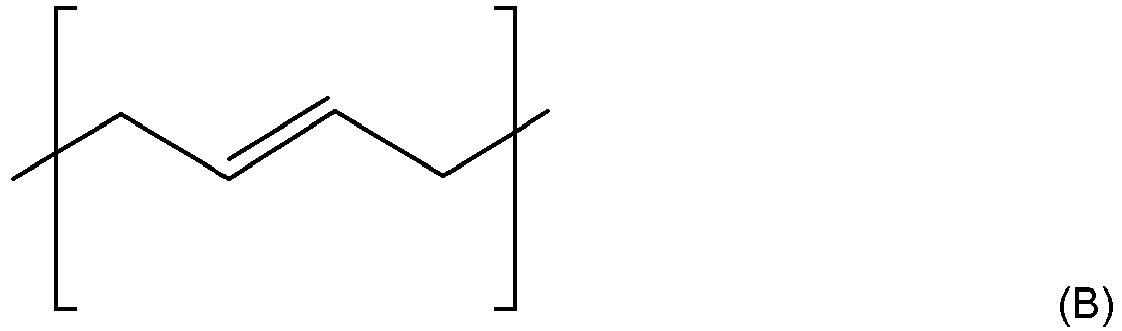

dadurch gekennzeichnet, dass der Anteil von Einheiten der Formel (A) an der im Polybutadien enthaltenen aus 1,3-Butadien abgeleiteten Gesamtheit der Monomereinheiten 25 bis 75 Molprozent beträgt, der Anteil von Einheiten der Formel (B) an der im Polybutadien enthaltenen aus 1,3-Butadien abgeleiteten Gesamtheit der Monomereinheiten 0 bis 10 Molprozent beträgt und der Anteil von Einheiten der Formel (C) an der im Polybutadien enthaltenen aus 1,3-Butadien abgeleiteten Gesamtheit der Monomereinheiten 25 bis 75 Molprozent beträgt, mit der Maßgabe, dass sich die Gesamtheit der Monomereinheiten (A), (B) und (C) zu 100 Molprozent ergänzt, und das Polybutadien eine zahlenmittlere Molmasse von 1.000 bis 3.000 g/mol aufweist. - Polybutadien nach Anspruch 1, dadurch gekennzeichnet, dass das Polybutadien eine Viskosität von 2.000 bis 8.000 mPa s aufweist.
- Polybutadien nach Anspruch 1 oder 2, dadurch gekennzeichnet, dass es eine Dispersität von 2,1 bis 3,0 aufweist.
- Polybutadien nach mindestens einem der Ansprüche 1 bis 3, dadurch gekennzeichnet, dass es mit einem Verfahren gemäß einem der Ansprüche 5 bis 11 erhalten wurde.
- Verfahren zur Herstellung von Polybutadienen gemäß einem der Ansprüche 1 bis 4 durch Polymerisation von 1,3-Butadien in Gegenwart eines Lösungsmittels und eines Katalysatorsystems umfassenda) eine Cobaltverbindung,b) eine aluminiumorganische Verbindung,c) eine organische Phosphorverbindung undd) Wasser,dadurch gekennzeichnet, dass eine Mischung aus Katalysatorsystem und Lösungsmittel vorgelegt wird, und das 1,3-Butadien zu dieser Mischung zudosiert wird.
- Verfahren nach Anspruch 5, dadurch gekennzeichnet, dass die Polymerisation bei einem Druck von 2 bis 7 bar durchgeführt wird.
- Verfahren nach Anspruch 5 oder 6, dadurch gekennzeichnet, dass die Polymerisation bei einer Temperatur der Reaktionsmischung von 20 bis 60 °C durchgeführt wird.
- Verfahren nach mindestens einem der Ansprüche 5 bis 7, dadurch gekennzeichnet, dass als Cobaltverbindung Cobalt 2-Ethyl-Hexanoat eingesetzt wird.
- Verfahren nach mindestens einem der Ansprüche 5 bis 8, dadurch gekennzeichnet, dass als organische Phosphorverbindung Tris (2,4-ditertbutylphenyl)phosphit oder Tris (ortho phenyl phenyl)phosphit eingesetzt wird.
- Verfahren nach mindestens einem der Ansprüche 5 bis 9, dadurch gekennzeichnet, dass als aluminiumorganische Verbindung Ethylaluminiumsesquichlorid oder Diethylaluminiumchlorid eingesetzt wird.
- Verfahren nach mindestens einem der Ansprüche 5 bis 10, dadurch gekennzeichnet, dass das molare Verhältnis von Cobaltverbindung zu Gesamtmenge an eingesetzten 1,3-Butadien von 1 zu 2.500 bis 1 zu 15.000 beträgt.
- Verwendung von Polybutadienen gemäß einem der Ansprüche 1 bis 4 zur Herstellung von Gummi, Kunstkautschuk, Reifen, Klebstoffformulierungen, Beschichtungszusammensetzungen, Flexodruckplatten, Beschichtungsmittel, Beschichtungsmittelkomponenten, im Recycling von Gummi und als Weichmacher.
- Zusammensetzungen enthaltend Polybutadiene gemäß einem der Ansprüche 1 bis 4 oder Umsetzungsprodukte von Polybutadienen gemäß einem der Ansprüche 1 bis 4 mit anderen Verbindungen.
- Zusammensetzung nach Anspruch 13, dadurch gekennzeichnet, dass der Anteil der Polybutadiene, die in der Zusammensetzung enthalten sind oder zur Herstellung der Umsetzungsprodukte eingesetzt wurden, bezogen auf die Zusammensetzung von 0,1 bis 90 Gew.-% beträgt.
Priority Applications (1)
| Application Number | Priority Date | Filing Date | Title |
|---|---|---|---|
| PL18700672T PL3568419T3 (pl) | 2017-01-16 | 2018-01-16 | Polibutadien, jego wytwarzanie i zastosowanie |
Applications Claiming Priority (2)
| Application Number | Priority Date | Filing Date | Title |
|---|---|---|---|
| EP17151585.1A EP3348589B1 (de) | 2017-01-16 | 2017-01-16 | Polybutadiene, deren herstellung und verwendung |
| PCT/EP2018/050942 WO2018130703A1 (de) | 2017-01-16 | 2018-01-16 | Polybutadiene, deren herstellung und verwendung |
Publications (2)
| Publication Number | Publication Date |
|---|---|
| EP3568419A1 EP3568419A1 (de) | 2019-11-20 |
| EP3568419B1 true EP3568419B1 (de) | 2021-09-08 |
Family
ID=57838209
Family Applications (2)
| Application Number | Title | Priority Date | Filing Date |
|---|---|---|---|
| EP17151585.1A Active EP3348589B1 (de) | 2017-01-16 | 2017-01-16 | Polybutadiene, deren herstellung und verwendung |
| EP18700672.1A Active EP3568419B1 (de) | 2017-01-16 | 2018-01-16 | Polybutadiene, deren herstellung und verwendung |
Family Applications Before (1)
| Application Number | Title | Priority Date | Filing Date |
|---|---|---|---|
| EP17151585.1A Active EP3348589B1 (de) | 2017-01-16 | 2017-01-16 | Polybutadiene, deren herstellung und verwendung |
Country Status (11)
| Country | Link |
|---|---|
| US (2) | US10851189B2 (de) |
| EP (2) | EP3348589B1 (de) |
| JP (1) | JP7038720B2 (de) |
| KR (1) | KR102426169B1 (de) |
| CN (1) | CN110177813A (de) |
| ES (2) | ES2748248T3 (de) |
| HU (2) | HUE046471T2 (de) |
| PL (2) | PL3348589T3 (de) |
| PT (2) | PT3348589T (de) |
| RU (1) | RU2749397C2 (de) |
| WO (1) | WO2018130703A1 (de) |
Families Citing this family (5)
| Publication number | Priority date | Publication date | Assignee | Title |
|---|---|---|---|---|
| EP3907256A1 (de) | 2020-05-04 | 2021-11-10 | Evonik Operations GmbH | Gummigemische mit verbesserten eigenschaften |
| JP2022183009A (ja) | 2021-05-27 | 2022-12-08 | エボニック オペレーションズ ゲーエムベーハー | ポリエステル-ポリエーテル修飾ポリブタジエンおよびその製造方法 |
| JP2022183014A (ja) | 2021-05-27 | 2022-12-08 | エボニック オペレーションズ ゲーエムベーハー | 有機官能性修飾ポリブタジエンに基づくユニバーサル接着促進剤 |
| JP2022183010A (ja) | 2021-05-27 | 2022-12-08 | エボニック オペレーションズ ゲーエムベーハー | 有機官能基で変性されたポリブタジエンをベースとする消泡剤組成物 |
| TW202607044A (zh) | 2024-03-25 | 2026-02-16 | 德商贏創運營有限公司 | 脫硫橡膠及其製造方法 |
Family Cites Families (29)
| Publication number | Priority date | Publication date | Assignee | Title |
|---|---|---|---|---|
| US3040016A (en) | 1960-03-28 | 1962-06-19 | Shell Oil Co | Polymerization process |
| BE759763A (fr) | 1969-12-02 | 1971-05-17 | Ube Industries | Procede pour la preparption de 1,2-polybutadiene |
| DE2261782C3 (de) | 1972-12-16 | 1978-09-14 | Battelle-Institut E.V., 6000 Frankfurt | Galvanische Abscheidung einer Chrom-Nickel-Eisen-Legierung |
| SU533326A3 (ru) | 1973-12-12 | 1976-10-25 | Хемише Верке Хюльс (Фирма) | Катализаторна система дл получени ненасыщенных углеводородных полимеров |
| DE2361782C3 (de) * | 1973-12-12 | 1982-05-06 | Chemische Werke Hüls AG, 4370 Marl | Verfahren zur herstellung von niedermolekularem Polybutadien |
| DE2447203C3 (de) | 1974-10-03 | 1982-03-18 | Chemische Werke Hüls AG, 4370 Marl | Verfahren zur Herstellung von Polybutadien |
| JPS5618006B2 (de) * | 1974-06-21 | 1981-04-25 | ||
| JPS5130287A (ja) * | 1974-09-06 | 1976-03-15 | Sumitomo Chemical Co | Ekijohoributajennoseizohoho |
| DE3538130A1 (de) | 1985-10-26 | 1987-04-30 | Bunawerke Huels Gmbh | Verfahren und katalysator zur herstellung von syndiotaktischem 1,2-polybutadien |
| JP3463811B2 (ja) * | 1991-04-24 | 2003-11-05 | Jsr株式会社 | ブタジエン系重合体の製造方法 |
| JPH06116315A (ja) * | 1992-10-02 | 1994-04-26 | Japan Synthetic Rubber Co Ltd | 高ビニル結合を有するブタジエン系重合体の製造方法 |
| JPH06116317A (ja) * | 1992-10-02 | 1994-04-26 | Japan Synthetic Rubber Co Ltd | 高ビニル結合を有するブタジエン系重合体の製造方法 |
| IT1273753B (it) * | 1994-02-11 | 1997-07-10 | Eniriceche Spa | Sistema catalitico e processo per la produzione di polidiolefine |
| EP0816398B1 (de) * | 1996-06-28 | 2002-08-14 | Ube Industries, Ltd. | Verfahren zur Herstellung von Polybutadien |
| JP3841138B2 (ja) * | 1998-06-16 | 2006-11-01 | 宇部興産株式会社 | ポリブタジエンの製造方法 |
| US6291591B1 (en) | 2000-04-13 | 2001-09-18 | Bridgestone Corporation | Process for producing blends of syndiotactic 1,2-polybutadiene and rubbery elastomers with a chromium-based catalyst system |
| KR100472621B1 (ko) * | 2001-05-24 | 2005-03-08 | 금호석유화학 주식회사 | 1,2-비닐 폴리부타디엔의 제조방법 |
| DE10163783A1 (de) | 2001-12-22 | 2003-07-03 | Degussa | Verfahren zur Herstellung epoxidierter Polyalkenylene und Verwendung von Phosphonsäuren und deren Derivaten als Katalysator |
| DE102006038661A1 (de) | 2006-08-18 | 2008-02-21 | Evonik Goldschmidt Gmbh | Verwendung niedrigviskoser wässriger Polyurethanheißweichschaumstabilisatorlösungen enthaltend Polyethersiloxane bei der Herstellung von Polyurethanheißweichschäumen |
| DE102009027447A1 (de) | 2009-07-03 | 2011-01-05 | Evonik Degussa Gmbh | Modifizierte Polyolefine mit besonderem Eigenschaftsprofil, Verfahren zu deren Herstellung und deren Verwendung |
| DE102009027445A1 (de) | 2009-07-03 | 2011-01-05 | Evonik Degussa Gmbh | Modifizierte Polyolefine mit besonderem Eigenschaftsprofil, Verfahren zu deren Herstellung und deren Verwendung |
| DE102009027446A1 (de) | 2009-07-03 | 2011-01-05 | Evonik Degussa Gmbh | Modifizierte Polyolefine mit besonderem Eigenschaftsprofil, Verfahren zu deren Herstellung und deren Verwendung |
| DE102011003148A1 (de) | 2011-01-26 | 2012-07-26 | Evonik Goldschmidt Gmbh | Verwendung von Silikonpolyetherblock-Copolymere mit hochmolekularen nicht endverkappten Polyetherresten als Stabilisatoren zur Herstellung von Polyuretherschäumen niedriger Dichte |
| EP2492292A1 (de) | 2012-05-29 | 2012-08-29 | Evonik Industries AG | Polymerisation von Dien |
| PL2679605T3 (pl) | 2012-06-29 | 2016-03-31 | Evonik Degussa Gmbh | Polibutadien z grupami epoksy |
| JP6055827B2 (ja) * | 2012-07-04 | 2016-12-27 | 株式会社ブリヂストン | ポリブタジエンの製造方法、ポリブタジエン、ゴム組成物及びタイヤ |
| DE102013204991A1 (de) * | 2013-03-21 | 2014-09-25 | Evonik Industries Ag | Herstellung von Polyurethanschäumen, die Polyole auf Polyolefinbasis enthalten |
| WO2016180649A1 (de) | 2015-05-13 | 2016-11-17 | Evonik Degussa Gmbh | Verbesserung des rollwiderstands von dienkautschukreifen durch silanmodifizierte polybutadiene |
| EP3184568A1 (de) | 2015-12-21 | 2017-06-28 | Evonik Degussa GmbH | Acrylat-terminierte urethanpolybutadiene aus monomerarmen 1:1 monoaddukten aus reaktiven olefinischen verbindungen und diisocyanaten sowie hydroxy-terminierte polybutadiene für optisch klare flüssige klebstoffe |
-
2017
- 2017-01-16 PL PL17151585T patent/PL3348589T3/pl unknown
- 2017-01-16 EP EP17151585.1A patent/EP3348589B1/de active Active
- 2017-01-16 PT PT171515851T patent/PT3348589T/pt unknown
- 2017-01-16 HU HUE17151585A patent/HUE046471T2/hu unknown
- 2017-01-16 ES ES17151585T patent/ES2748248T3/es active Active
-
2018
- 2018-01-16 RU RU2019124723A patent/RU2749397C2/ru active
- 2018-01-16 US US16/469,855 patent/US10851189B2/en active Active
- 2018-01-16 KR KR1020197023562A patent/KR102426169B1/ko active Active
- 2018-01-16 HU HUE18700672A patent/HUE057073T2/hu unknown
- 2018-01-16 CN CN201880007112.6A patent/CN110177813A/zh active Pending
- 2018-01-16 ES ES18700672T patent/ES2893274T3/es active Active
- 2018-01-16 WO PCT/EP2018/050942 patent/WO2018130703A1/de not_active Ceased
- 2018-01-16 JP JP2019534885A patent/JP7038720B2/ja active Active
- 2018-01-16 PT PT187006721T patent/PT3568419T/pt unknown
- 2018-01-16 EP EP18700672.1A patent/EP3568419B1/de active Active
- 2018-01-16 PL PL18700672T patent/PL3568419T3/pl unknown
-
2020
- 2020-10-09 US US17/066,921 patent/US11365270B2/en active Active
Also Published As
| Publication number | Publication date |
|---|---|
| WO2018130703A1 (de) | 2018-07-19 |
| CN110177813A (zh) | 2019-08-27 |
| US11365270B2 (en) | 2022-06-21 |
| US10851189B2 (en) | 2020-12-01 |
| EP3348589A1 (de) | 2018-07-18 |
| ES2893274T3 (es) | 2022-02-08 |
| HUE057073T2 (hu) | 2022-04-28 |
| KR20190103363A (ko) | 2019-09-04 |
| US20210024666A1 (en) | 2021-01-28 |
| KR102426169B1 (ko) | 2022-07-27 |
| RU2019124723A3 (de) | 2021-02-16 |
| PT3568419T (pt) | 2021-09-23 |
| PL3348589T3 (pl) | 2020-02-28 |
| RU2019124723A (ru) | 2021-02-16 |
| BR112019014639A2 (pt) | 2020-07-07 |
| ES2748248T3 (es) | 2020-03-16 |
| RU2749397C2 (ru) | 2021-06-09 |
| HUE046471T2 (hu) | 2020-02-28 |
| EP3568419A1 (de) | 2019-11-20 |
| PL3568419T3 (pl) | 2022-01-10 |
| JP7038720B2 (ja) | 2022-03-18 |
| PT3348589T (pt) | 2019-10-18 |
| US20190315895A1 (en) | 2019-10-17 |
| EP3348589B1 (de) | 2019-08-07 |
| JP2020515656A (ja) | 2020-05-28 |
Similar Documents
| Publication | Publication Date | Title |
|---|---|---|
| EP3348589B1 (de) | Polybutadiene, deren herstellung und verwendung | |
| DE2731067C3 (de) | Verfahren zur Herstellung von Polybutadien mit einem hohen Gehalt an Monomereneinheiten in cis-1,4- Struktur | |
| EP2861629B1 (de) | Hoch mooney ndbr mit mooneysprung | |
| DE3224288C2 (de) | ||
| DE1420456A1 (de) | Verfahren zur Polymerisation und Mischpolymerisation konjugierter Olefinkohlenwasserstoffe | |
| WO2009021906A1 (de) | Nanostrukturierte polymere auf basis von konjugierten dienen | |
| DE3033175C2 (de) | Polybutadienkautschukzusammensetzungen | |
| DE3938927C2 (de) | ||
| EP1245600B1 (de) | Verfahren zur Herstellung eines Blockcopolymerisates auf Basis von konjugierten Diolefinen und polaren Monomeren | |
| WO2009021917A1 (de) | Modifizierte polymere auf basis von konjugierten dienen oder von konjugierten dienen und vinylaromatischen verbindungen, ein verfahren zu deren herstellung sowie deren verwendung | |
| EP2603533B1 (de) | Teilhydrierte nitrilkautschuke | |
| DE1694359A1 (de) | Verfahren zum Vermitteln einer Klebrigkeit bei natuerlichen und synthetischen Kautschukmassen | |
| EP0095629B1 (de) | Verfahren zur Herstellung von Materialien und Konstruktionselementen, die zum Abdichten gegen unpolare, organische Medien geeignet sind | |
| DE1104703B (de) | Verfahren zur Herstellung von 1, 3-Butadienpolymeren | |
| EP0129016B1 (de) | Verbundmaterialien und Verbundkonstruktionselemente auf Basis von EP(D)M | |
| DE1241119B (de) | Verfahren zur Herstellung von niedermolekularen, fluessigen, ungesaettigten Polymeren | |
| DE1299865B (de) | Verfahren zur Polymerisation von konjugierten Dien-Kohlenwasserstoffen | |
| DE2350941A1 (de) | Verfahren zur polymerisation von butadien und butadien in mischung mit anderen diolefinen | |
| EP3720885B1 (de) | Verfahren zur herstellung von nitrilkautschuken mit ruthenium-komplexkatalysatoren | |
| DE68911189T2 (de) | Polymerisation in umgekehrter Phase. | |
| DE1258095B (de) | Verfahren zur Polymerisation von konjugierten Diolefinen | |
| EP2802610B1 (de) | Verfahren zur kontinuierlichen herstellung von polyisobutylen | |
| DE2644439C2 (de) | Verfahren zur Herstellung von modifiziertem und stabilisiertem synthetischem cis-1,4-Polyisopren | |
| DE1292845B (de) | Verfahren zur Herstellung von Polybutadien mit ueberwiegender 1, 2-Struktur | |
| DE2000119A1 (de) | Katalysatorsystem und Verfahren zur stereospezifischen Polymerisation von Butadien |
Legal Events
| Date | Code | Title | Description |
|---|---|---|---|
| STAA | Information on the status of an ep patent application or granted ep patent |
Free format text: STATUS: UNKNOWN |
|
| STAA | Information on the status of an ep patent application or granted ep patent |
Free format text: STATUS: THE INTERNATIONAL PUBLICATION HAS BEEN MADE |
|
| PUAI | Public reference made under article 153(3) epc to a published international application that has entered the european phase |
Free format text: ORIGINAL CODE: 0009012 |
|
| STAA | Information on the status of an ep patent application or granted ep patent |
Free format text: STATUS: REQUEST FOR EXAMINATION WAS MADE |
|
| 17P | Request for examination filed |
Effective date: 20190712 |
|
| AK | Designated contracting states |
Kind code of ref document: A1 Designated state(s): AL AT BE BG CH CY CZ DE DK EE ES FI FR GB GR HR HU IE IS IT LI LT LU LV MC MK MT NL NO PL PT RO RS SE SI SK SM TR |
|
| AX | Request for extension of the european patent |
Extension state: BA ME |
|
| RAP1 | Party data changed (applicant data changed or rights of an application transferred) |
Owner name: EVONIK OPERATIONS GMBH |
|
| DAV | Request for validation of the european patent (deleted) | ||
| DAX | Request for extension of the european patent (deleted) | ||
| STAA | Information on the status of an ep patent application or granted ep patent |
Free format text: STATUS: EXAMINATION IS IN PROGRESS |
|
| 17Q | First examination report despatched |
Effective date: 20210113 |
|
| GRAP | Despatch of communication of intention to grant a patent |
Free format text: ORIGINAL CODE: EPIDOSNIGR1 |
|
| STAA | Information on the status of an ep patent application or granted ep patent |
Free format text: STATUS: GRANT OF PATENT IS INTENDED |
|
| INTG | Intention to grant announced |
Effective date: 20210602 |
|
| GRAS | Grant fee paid |
Free format text: ORIGINAL CODE: EPIDOSNIGR3 |
|
| GRAA | (expected) grant |
Free format text: ORIGINAL CODE: 0009210 |
|
| STAA | Information on the status of an ep patent application or granted ep patent |
Free format text: STATUS: THE PATENT HAS BEEN GRANTED |
|
| AK | Designated contracting states |
Kind code of ref document: B1 Designated state(s): AL AT BE BG CH CY CZ DE DK EE ES FI FR GB GR HR HU IE IS IT LI LT LU LV MC MK MT NL NO PL PT RO RS SE SI SK SM TR |
|
| REG | Reference to a national code |
Ref country code: GB Ref legal event code: FG4D Free format text: NOT ENGLISH |
|
| REG | Reference to a national code |
Ref country code: AT Ref legal event code: REF Ref document number: 1428551 Country of ref document: AT Kind code of ref document: T Effective date: 20210915 Ref country code: CH Ref legal event code: EP |
|
| REG | Reference to a national code |
Ref country code: PT Ref legal event code: SC4A Ref document number: 3568419 Country of ref document: PT Date of ref document: 20210923 Kind code of ref document: T Free format text: AVAILABILITY OF NATIONAL TRANSLATION Effective date: 20210917 |
|
| REG | Reference to a national code |
Ref country code: IE Ref legal event code: FG4D Free format text: LANGUAGE OF EP DOCUMENT: GERMAN |
|
| REG | Reference to a national code |
Ref country code: DE Ref legal event code: R096 Ref document number: 502018006956 Country of ref document: DE |
|
| REG | Reference to a national code |
Ref country code: LT Ref legal event code: MG9D |
|
| REG | Reference to a national code |
Ref country code: NL Ref legal event code: FP |
|
| PG25 | Lapsed in a contracting state [announced via postgrant information from national office to epo] |
Ref country code: SE Free format text: LAPSE BECAUSE OF FAILURE TO SUBMIT A TRANSLATION OF THE DESCRIPTION OR TO PAY THE FEE WITHIN THE PRESCRIBED TIME-LIMIT Effective date: 20210908 Ref country code: RS Free format text: LAPSE BECAUSE OF FAILURE TO SUBMIT A TRANSLATION OF THE DESCRIPTION OR TO PAY THE FEE WITHIN THE PRESCRIBED TIME-LIMIT Effective date: 20210908 Ref country code: HR Free format text: LAPSE BECAUSE OF FAILURE TO SUBMIT A TRANSLATION OF THE DESCRIPTION OR TO PAY THE FEE WITHIN THE PRESCRIBED TIME-LIMIT Effective date: 20210908 Ref country code: FI Free format text: LAPSE BECAUSE OF FAILURE TO SUBMIT A TRANSLATION OF THE DESCRIPTION OR TO PAY THE FEE WITHIN THE PRESCRIBED TIME-LIMIT Effective date: 20210908 Ref country code: NO Free format text: LAPSE BECAUSE OF FAILURE TO SUBMIT A TRANSLATION OF THE DESCRIPTION OR TO PAY THE FEE WITHIN THE PRESCRIBED TIME-LIMIT Effective date: 20211208 Ref country code: LT Free format text: LAPSE BECAUSE OF FAILURE TO SUBMIT A TRANSLATION OF THE DESCRIPTION OR TO PAY THE FEE WITHIN THE PRESCRIBED TIME-LIMIT Effective date: 20210908 Ref country code: BG Free format text: LAPSE BECAUSE OF FAILURE TO SUBMIT A TRANSLATION OF THE DESCRIPTION OR TO PAY THE FEE WITHIN THE PRESCRIBED TIME-LIMIT Effective date: 20211208 |
|
| REG | Reference to a national code |
Ref country code: ES Ref legal event code: FG2A Ref document number: 2893274 Country of ref document: ES Kind code of ref document: T3 Effective date: 20220208 |
|
| PG25 | Lapsed in a contracting state [announced via postgrant information from national office to epo] |
Ref country code: LV Free format text: LAPSE BECAUSE OF FAILURE TO SUBMIT A TRANSLATION OF THE DESCRIPTION OR TO PAY THE FEE WITHIN THE PRESCRIBED TIME-LIMIT Effective date: 20210908 Ref country code: GR Free format text: LAPSE BECAUSE OF FAILURE TO SUBMIT A TRANSLATION OF THE DESCRIPTION OR TO PAY THE FEE WITHIN THE PRESCRIBED TIME-LIMIT Effective date: 20211209 |
|
| REG | Reference to a national code |
Ref country code: HU Ref legal event code: AG4A Ref document number: E057073 Country of ref document: HU |
|
| PG25 | Lapsed in a contracting state [announced via postgrant information from national office to epo] |
Ref country code: IS Free format text: LAPSE BECAUSE OF FAILURE TO SUBMIT A TRANSLATION OF THE DESCRIPTION OR TO PAY THE FEE WITHIN THE PRESCRIBED TIME-LIMIT Effective date: 20220108 Ref country code: SM Free format text: LAPSE BECAUSE OF FAILURE TO SUBMIT A TRANSLATION OF THE DESCRIPTION OR TO PAY THE FEE WITHIN THE PRESCRIBED TIME-LIMIT Effective date: 20210908 Ref country code: SK Free format text: LAPSE BECAUSE OF FAILURE TO SUBMIT A TRANSLATION OF THE DESCRIPTION OR TO PAY THE FEE WITHIN THE PRESCRIBED TIME-LIMIT Effective date: 20210908 Ref country code: RO Free format text: LAPSE BECAUSE OF FAILURE TO SUBMIT A TRANSLATION OF THE DESCRIPTION OR TO PAY THE FEE WITHIN THE PRESCRIBED TIME-LIMIT Effective date: 20210908 Ref country code: EE Free format text: LAPSE BECAUSE OF FAILURE TO SUBMIT A TRANSLATION OF THE DESCRIPTION OR TO PAY THE FEE WITHIN THE PRESCRIBED TIME-LIMIT Effective date: 20210908 Ref country code: AL Free format text: LAPSE BECAUSE OF FAILURE TO SUBMIT A TRANSLATION OF THE DESCRIPTION OR TO PAY THE FEE WITHIN THE PRESCRIBED TIME-LIMIT Effective date: 20210908 |
|
| REG | Reference to a national code |
Ref country code: DE Ref legal event code: R097 Ref document number: 502018006956 Country of ref document: DE |
|
| PLBE | No opposition filed within time limit |
Free format text: ORIGINAL CODE: 0009261 |
|
| STAA | Information on the status of an ep patent application or granted ep patent |
Free format text: STATUS: NO OPPOSITION FILED WITHIN TIME LIMIT |
|
| PG25 | Lapsed in a contracting state [announced via postgrant information from national office to epo] |
Ref country code: DK Free format text: LAPSE BECAUSE OF FAILURE TO SUBMIT A TRANSLATION OF THE DESCRIPTION OR TO PAY THE FEE WITHIN THE PRESCRIBED TIME-LIMIT Effective date: 20210908 |
|
| 26N | No opposition filed |
Effective date: 20220609 |
|
| PG25 | Lapsed in a contracting state [announced via postgrant information from national office to epo] |
Ref country code: SI Free format text: LAPSE BECAUSE OF FAILURE TO SUBMIT A TRANSLATION OF THE DESCRIPTION OR TO PAY THE FEE WITHIN THE PRESCRIBED TIME-LIMIT Effective date: 20210908 Ref country code: MC Free format text: LAPSE BECAUSE OF FAILURE TO SUBMIT A TRANSLATION OF THE DESCRIPTION OR TO PAY THE FEE WITHIN THE PRESCRIBED TIME-LIMIT Effective date: 20210908 |
|
| PG25 | Lapsed in a contracting state [announced via postgrant information from national office to epo] |
Ref country code: LU Free format text: LAPSE BECAUSE OF NON-PAYMENT OF DUE FEES Effective date: 20220116 |
|
| PG25 | Lapsed in a contracting state [announced via postgrant information from national office to epo] |
Ref country code: IE Free format text: LAPSE BECAUSE OF NON-PAYMENT OF DUE FEES Effective date: 20220116 |
|
| P01 | Opt-out of the competence of the unified patent court (upc) registered |
Effective date: 20230524 |
|
| REG | Reference to a national code |
Ref country code: AT Ref legal event code: MM01 Ref document number: 1428551 Country of ref document: AT Kind code of ref document: T Effective date: 20230116 |
|
| PG25 | Lapsed in a contracting state [announced via postgrant information from national office to epo] |
Ref country code: AT Free format text: LAPSE BECAUSE OF NON-PAYMENT OF DUE FEES Effective date: 20230116 |
|
| PG25 | Lapsed in a contracting state [announced via postgrant information from national office to epo] |
Ref country code: MK Free format text: LAPSE BECAUSE OF FAILURE TO SUBMIT A TRANSLATION OF THE DESCRIPTION OR TO PAY THE FEE WITHIN THE PRESCRIBED TIME-LIMIT Effective date: 20210908 Ref country code: CY Free format text: LAPSE BECAUSE OF FAILURE TO SUBMIT A TRANSLATION OF THE DESCRIPTION OR TO PAY THE FEE WITHIN THE PRESCRIBED TIME-LIMIT Effective date: 20210908 Ref country code: AT Free format text: LAPSE BECAUSE OF NON-PAYMENT OF DUE FEES Effective date: 20230116 |
|
| PG25 | Lapsed in a contracting state [announced via postgrant information from national office to epo] |
Ref country code: MT Free format text: LAPSE BECAUSE OF FAILURE TO SUBMIT A TRANSLATION OF THE DESCRIPTION OR TO PAY THE FEE WITHIN THE PRESCRIBED TIME-LIMIT Effective date: 20210908 |
|
| REG | Reference to a national code |
Ref country code: CH Ref legal event code: U11 Free format text: ST27 STATUS EVENT CODE: U-0-0-U10-U11 (AS PROVIDED BY THE NATIONAL OFFICE) Effective date: 20260201 |
|
| PGFP | Annual fee paid to national office [announced via postgrant information from national office to epo] |
Ref country code: NL Payment date: 20260121 Year of fee payment: 9 |
|
| PGFP | Annual fee paid to national office [announced via postgrant information from national office to epo] |
Ref country code: HU Payment date: 20260123 Year of fee payment: 9 |
|
| PGFP | Annual fee paid to national office [announced via postgrant information from national office to epo] |
Ref country code: GB Payment date: 20260123 Year of fee payment: 9 |
|
| PGFP | Annual fee paid to national office [announced via postgrant information from national office to epo] |
Ref country code: ES Payment date: 20260227 Year of fee payment: 9 |
|
| PGFP | Annual fee paid to national office [announced via postgrant information from national office to epo] |
Ref country code: DE Payment date: 20260121 Year of fee payment: 9 |
|
| PGFP | Annual fee paid to national office [announced via postgrant information from national office to epo] |
Ref country code: AT Payment date: 20260410 Year of fee payment: 5 |
|
| PGFP | Annual fee paid to national office [announced via postgrant information from national office to epo] |
Ref country code: IT Payment date: 20260126 Year of fee payment: 9 Ref country code: BE Payment date: 20260121 Year of fee payment: 9 |
|
| PGFP | Annual fee paid to national office [announced via postgrant information from national office to epo] |
Ref country code: FR Payment date: 20260123 Year of fee payment: 9 |
|
| PGFP | Annual fee paid to national office [announced via postgrant information from national office to epo] |
Ref country code: TR Payment date: 20260115 Year of fee payment: 9 |
|
| PGFP | Annual fee paid to national office [announced via postgrant information from national office to epo] |
Ref country code: PT Payment date: 20260108 Year of fee payment: 9 Ref country code: CH Payment date: 20260201 Year of fee payment: 9 Ref country code: CZ Payment date: 20260114 Year of fee payment: 9 |
|
| PGFP | Annual fee paid to national office [announced via postgrant information from national office to epo] |
Ref country code: PL Payment date: 20260112 Year of fee payment: 9 |