EP3556729B1 - Verwendung einer zusammensetzung enthaltend silikotitanat mit sitinakitstruktur und niobium - Google Patents
Verwendung einer zusammensetzung enthaltend silikotitanat mit sitinakitstruktur und niobium Download PDFInfo
- Publication number
- EP3556729B1 EP3556729B1 EP18212548.4A EP18212548A EP3556729B1 EP 3556729 B1 EP3556729 B1 EP 3556729B1 EP 18212548 A EP18212548 A EP 18212548A EP 3556729 B1 EP3556729 B1 EP 3556729B1
- Authority
- EP
- European Patent Office
- Prior art keywords
- silicotitanate
- composition
- mole ratio
- ray diffraction
- less
- Prior art date
- Legal status (The legal status is an assumption and is not a legal conclusion. Google has not performed a legal analysis and makes no representation as to the accuracy of the status listed.)
- Active
Links
Images




Classifications
-
- B—PERFORMING OPERATIONS; TRANSPORTING
- B01—PHYSICAL OR CHEMICAL PROCESSES OR APPARATUS IN GENERAL
- B01J—CHEMICAL OR PHYSICAL PROCESSES, e.g. CATALYSIS OR COLLOID CHEMISTRY; THEIR RELEVANT APPARATUS
- B01J20/00—Solid sorbent compositions or filter aid compositions; Sorbents for chromatography; Processes for preparing, regenerating or reactivating thereof
- B01J20/02—Solid sorbent compositions or filter aid compositions; Sorbents for chromatography; Processes for preparing, regenerating or reactivating thereof comprising inorganic material
- B01J20/10—Solid sorbent compositions or filter aid compositions; Sorbents for chromatography; Processes for preparing, regenerating or reactivating thereof comprising inorganic material comprising silica or silicate
-
- C—CHEMISTRY; METALLURGY
- C01—INORGANIC CHEMISTRY
- C01B—NON-METALLIC ELEMENTS; COMPOUNDS THEREOF; METALLOIDS OR COMPOUNDS THEREOF NOT COVERED BY SUBCLASS C01C
- C01B33/00—Silicon; Compounds thereof
- C01B33/20—Silicates
-
- B—PERFORMING OPERATIONS; TRANSPORTING
- B01—PHYSICAL OR CHEMICAL PROCESSES OR APPARATUS IN GENERAL
- B01J—CHEMICAL OR PHYSICAL PROCESSES, e.g. CATALYSIS OR COLLOID CHEMISTRY; THEIR RELEVANT APPARATUS
- B01J20/00—Solid sorbent compositions or filter aid compositions; Sorbents for chromatography; Processes for preparing, regenerating or reactivating thereof
- B01J20/02—Solid sorbent compositions or filter aid compositions; Sorbents for chromatography; Processes for preparing, regenerating or reactivating thereof comprising inorganic material
- B01J20/0203—Solid sorbent compositions or filter aid compositions; Sorbents for chromatography; Processes for preparing, regenerating or reactivating thereof comprising inorganic material comprising compounds of metals not provided for in B01J20/04
- B01J20/0214—Compounds of V, Nb, Ta
-
- B—PERFORMING OPERATIONS; TRANSPORTING
- B01—PHYSICAL OR CHEMICAL PROCESSES OR APPARATUS IN GENERAL
- B01J—CHEMICAL OR PHYSICAL PROCESSES, e.g. CATALYSIS OR COLLOID CHEMISTRY; THEIR RELEVANT APPARATUS
- B01J20/00—Solid sorbent compositions or filter aid compositions; Sorbents for chromatography; Processes for preparing, regenerating or reactivating thereof
- B01J20/28—Solid sorbent compositions or filter aid compositions; Sorbents for chromatography; Processes for preparing, regenerating or reactivating thereof characterised by their form or physical properties
- B01J20/28002—Solid sorbent compositions or filter aid compositions; Sorbents for chromatography; Processes for preparing, regenerating or reactivating thereof characterised by their form or physical properties characterised by their physical properties
- B01J20/28011—Other properties, e.g. density, crush strength
-
- B—PERFORMING OPERATIONS; TRANSPORTING
- B01—PHYSICAL OR CHEMICAL PROCESSES OR APPARATUS IN GENERAL
- B01J—CHEMICAL OR PHYSICAL PROCESSES, e.g. CATALYSIS OR COLLOID CHEMISTRY; THEIR RELEVANT APPARATUS
- B01J20/00—Solid sorbent compositions or filter aid compositions; Sorbents for chromatography; Processes for preparing, regenerating or reactivating thereof
- B01J20/28—Solid sorbent compositions or filter aid compositions; Sorbents for chromatography; Processes for preparing, regenerating or reactivating thereof characterised by their form or physical properties
- B01J20/28014—Solid sorbent compositions or filter aid compositions; Sorbents for chromatography; Processes for preparing, regenerating or reactivating thereof characterised by their form or physical properties characterised by their form
- B01J20/28016—Particle form
-
- B—PERFORMING OPERATIONS; TRANSPORTING
- B01—PHYSICAL OR CHEMICAL PROCESSES OR APPARATUS IN GENERAL
- B01J—CHEMICAL OR PHYSICAL PROCESSES, e.g. CATALYSIS OR COLLOID CHEMISTRY; THEIR RELEVANT APPARATUS
- B01J20/00—Solid sorbent compositions or filter aid compositions; Sorbents for chromatography; Processes for preparing, regenerating or reactivating thereof
- B01J20/30—Processes for preparing, regenerating, or reactivating
- B01J20/3007—Moulding, shaping or extruding
-
- C—CHEMISTRY; METALLURGY
- C02—TREATMENT OF WATER, WASTE WATER, SEWAGE, OR SLUDGE
- C02F—TREATMENT OF WATER, WASTE WATER, SEWAGE, OR SLUDGE
- C02F1/00—Treatment of water, waste water, or sewage
- C02F1/28—Treatment of water, waste water, or sewage by sorption
- C02F1/281—Treatment of water, waste water, or sewage by sorption using inorganic sorbents
-
- G—PHYSICS
- G21—NUCLEAR PHYSICS; NUCLEAR ENGINEERING
- G21F—PROTECTION AGAINST X-RADIATION, GAMMA RADIATION, CORPUSCULAR RADIATION OR PARTICLE BOMBARDMENT; TREATING RADIOACTIVELY CONTAMINATED MATERIAL; DECONTAMINATION ARRANGEMENTS THEREFOR
- G21F9/00—Treating radioactively contaminated material; Decontamination arrangements therefor
- G21F9/04—Treating liquids
- G21F9/06—Processing
- G21F9/12—Processing by absorption; by adsorption; by ion-exchange
-
- C—CHEMISTRY; METALLURGY
- C01—INORGANIC CHEMISTRY
- C01P—INDEXING SCHEME RELATING TO STRUCTURAL AND PHYSICAL ASPECTS OF SOLID INORGANIC COMPOUNDS
- C01P2002/00—Crystal-structural characteristics
- C01P2002/70—Crystal-structural characteristics defined by measured X-ray, neutron or electron diffraction data
- C01P2002/72—Crystal-structural characteristics defined by measured X-ray, neutron or electron diffraction data by d-values or two theta-values, e.g. as X-ray diagram
-
- C—CHEMISTRY; METALLURGY
- C02—TREATMENT OF WATER, WASTE WATER, SEWAGE, OR SLUDGE
- C02F—TREATMENT OF WATER, WASTE WATER, SEWAGE, OR SLUDGE
- C02F2101/00—Nature of the contaminant
- C02F2101/10—Inorganic compounds
-
- C—CHEMISTRY; METALLURGY
- C02—TREATMENT OF WATER, WASTE WATER, SEWAGE, OR SLUDGE
- C02F—TREATMENT OF WATER, WASTE WATER, SEWAGE, OR SLUDGE
- C02F2103/00—Nature of the water, waste water, sewage or sludge to be treated
- C02F2103/06—Contaminated groundwater or leachate
-
- C—CHEMISTRY; METALLURGY
- C02—TREATMENT OF WATER, WASTE WATER, SEWAGE, OR SLUDGE
- C02F—TREATMENT OF WATER, WASTE WATER, SEWAGE, OR SLUDGE
- C02F2103/00—Nature of the water, waste water, sewage or sludge to be treated
- C02F2103/08—Seawater, e.g. for desalination
Definitions
- the present invention relates to the use of a composition including a silicotitanate having a sitinakite structure.
- composition including a silicotitanate of the present invention is useful in applications such as treatments of harmful ions in contaminated water, seawater, or groundwater.
- Patent Literature 1 discloses a silicotitanate as an ion exchanger for removal of a radioactive substance in seawater and a production method for the same.
- Patent Literature 1 discloses a silicotitanate containing niobium.
- a raw material for the silicotitanate of Patent Literature 1 includes an organic alkoxy compound.
- the raw material in Patent Literature 1 includes tetraethyl orthosilicate as a silica source, tetraisopropyl orthotitanate as a titanium source, and tetrapropylammonium bromide and tetrabutylammonium bromide as a structure directing agent.
- the silica source, the titanium source, and the structure directing agent are difficult to be obtained, and correspond to hazardous or deleterious materials. Therefore, vapor generated from them at high temperatures may cause explosion. Accordingly, the production method of Patent Literature 1 requires a reaction at low temperatures. However, the reaction rate is decreased at low temperatures and productivity declines, which is not preferred.
- Patent Literature 2 discloses a method for producing a titanosilicate-type zeolite that is a separating agent capable of separating a gas or liquid mixture.
- a silica source, a titanium source, and a structure directing agent in Patent Literature 2 are tetraalkyl orthosilicate, tetrabutyl orthotitanate, and tetrapropylammonium hydroxide, respectively, which correspond to hazardous or deleterious materials. Vapor generated from these compounds and a mixture thereof at high temperatures causes a reaction tube to corrode. Therefore, use of a special production device such as stainless pressure-resistant reaction tube equipped with a Teflon (registered trademark) inner tube is required.
- Patent Literature 3 discloses a crystalline silicotitanate CST-2 as an adsorbent for an aqueous solution including only cesium.
- Patent Literature 4 discloses silicotitanic acid as an adsorbent for an aqueous solution including cesium and strontium.
- Patent Literature 5 discloses an adsorbent for cesium or strontium including a crystalline silicotitanate that is different from a sitinakite structure and titanate.
- CHITRA S et al. "Uptake of cesium and strontium by crystalline silicotitanates from radioactive wastes", JOURNAL OF RADIOANALYTICAL AND NUCLEAR CHEMISTRY, KLUWER ACADEMIC PUBLISHERS, DO, (20101017), vol. 287, no. 3, doi:10.1007/S10967-010-0867-Z, ISSN 1588-2780, pages 955 - 960, XP019885967 , describes a crystalline silicotitanate inorganic ion exchanger with a sitinakite structure doped with niobium.
- US 6 479 427 B1 describes Nb-doped silico-titanates with a sitinakite structure and a method for the production thereof.
- the present invention provides the use of a composition including a silicotitanate having a sitinakite structure, the composition having higher cesium adsorptivity than that of a conventional cesium adsorbent, and especially, the use of a composition including a silicotitanate having high adsorptivity in a medium to be treated containing a small amount of cesium (hereinafter also represented by "Cs") and high selective adsorptivity in a medium to be treated containing a large amount of metal ions other than Cs; further described but not claimed is a method for producing the composition including a silicotitanate having a sitinakite structure that does not require use of hazardous or deleterious materials, can achieve production using a compound that is easily acquired, and can use a general-purpose autoclave.
- Cs cesium
- the present invention further provides the use of a composition including a silicotitanate having higher strontium adsorptivity than that of a conventional strontium adsorbent, and especially, the use of a silicotitanate that has high adsorptivity in a medium to be treated containing a small amount of strontium (hereinafter also represented by "Sr") and high selective adsorptivity in a medium to be treated containing a large amount of metal ions other than Sr; further described but not claimed is a production method for the same.
- a composition including a silicotitanate having higher strontium adsorptivity than that of a conventional strontium adsorbent and especially, the use of a silicotitanate that has high adsorptivity in a medium to be treated containing a small amount of strontium (hereinafter also represented by "Sr”) and high selective adsorptivity in a medium to be treated containing a large amount of metal ions other than
- the present inventors have found a composition including a silicotitanate in which a compound that is not a hazardous or deleterious material can be used as a raw material, which can be used in an adsorption method for at least any of cesium and strontium. Thus, the present invention has been completed.
- compositions including a silicotitanate having a sitinakite structure for use in an adsorption method for at least any of cesium and strontium will be described.
- the production method for a silicotitanate composition is a method for producing a composition including a silicotitanate having a sitinakite structure, the method including a gelation step of mixing an inorganic titanium compound, an inorganic silicon compound, water, and an alkali metal hydroxide to obtain a silicotitanate gel, and a crystallization step of crystallizing the silicotitanate gel.
- an inorganic titanium compound, an inorganic silicon compound, water, and an alkali metal hydroxide are mixed to obtain an amorphous silicotitanate gel.
- the inorganic titanium compound and the inorganic silicon compound are used as a titanium source and a silicon source, respectively.
- the titanium source and the silicon source are not included in hazardous or deleterious materials, including an organic alkoxy metal compound.
- the inorganic titanium compound and the inorganic silicon compound are soluble in an aqueous solution of alkali metal hydroxide. Even when the inorganic titanium compound and the inorganic silicon compound are mixed, an organic substance such as alcohol is not generated. Therefore, the titanium source and the silicon source are easily handled as compared with an organic alkoxy metal compound such as an organic alkoxy titanium compound and an organic alkoxy silicon compound. Since they are inexpensive, an inorganic titanium salt and the inorganic silicon compound are suitable for industrial use.
- the inorganic titanium compound may be at least one kind of the group consisting of titanium sulfate, titanium oxysulfate, sodium metatitanate, and titanium chloride.
- titanium sulfate As the more preferred inorganic titanium compound, maybe mentioned at least any of titanium sulfate and titanium oxysulfate, and further preferably titanium oxysulfate.
- the inorganic silicon compound may be at least one compound selected from the group consisting of sodium silicate, silica sol, fumed silica, and white carbon.
- the inorganic silicon compound is preferably at least any of sodium silicate and silica sol, and more preferably sodium silicate since they are comparatively easily dissolved in an aqueous solution of alkaline metal hydroxide.
- the alkali metal hydroxide maybe at least one compound selected the group consisting of lithium hydroxide, sodium hydroxide, and potassium hydroxide.
- the alkali metal hydroxide is preferably at least any of sodium hydroxide and potassium hydroxide, and more preferably sodium hydroxide since they are inexpensive.
- water When the respective raw materials are made into aqueous solutions, water may be moisture contents contained in the aqueous solutions, or water may be mixed separately from the respective raw materials.
- the inorganic titanium compound, the inorganic silicon compound, water, and the alkali metal hydroxide are mixed to obtain the amorphous silicotitanate gel (hereinafter sometimes simply referred to as "silicotitanate gel"). It is preferable that the inorganic titanium compound, the inorganic silicon compound, water, and the alkali metal hydroxide be mixed at the following mixing mole ratios:
- the mixing mole ratios are more preferably the following ratios:
- the Si/Ti mole ratio may be 0.5 or more and 2.0 or less, preferably 0.8 or more and 1.7 or less, and more preferably 1.0 or more and 1.5 or less.
- the Si/Ti mole ratio is 0.5 or more and 2.0 or less, the silicotitanate composition is efficiently obtained.
- the H 2 O/Ti mole ratio is preferably 20 or more and 150 or less, and more preferably 40 or more and 100 or less.
- the H 2 O/Ti mole ratio is 20 or more, the viscosity of silicotitanate gel obtained is decreased. Thus, the silicotitanate gel is likely to be stirred.
- the H 2 O/Ti mole ratio is 150 or less, the yield of the silicotitanate composition tends to be increased.
- the M/Ti mole ratio is preferably 1.0 or more and 5.0 or less, more preferably 1.5 or more and 4.5 or less, and further preferably 2.5 or more and 4.5 or less.
- the M/Ti mole ratio is 1.0 or more and 5.0 or less, the silicotitanate composition is efficiently obtained.
- the silicotitanate gel include at least niobium (hereinafter referred to as "doped metal” ) .
- the Cs and Sr adsorption properties are further enhanced.
- the doped metal is niobium.
- the silicotitanate gel including the doped metal may be obtained by at least any of a method of mixing the inorganic titanium compound, the inorganic silicon compound, water, the alkali metal hydroxide, and a source of the doped metal and a method of adding the doped metal source to the silicotitanate gel.
- the doped metal source be at least one selected from the group consisting of a metal, an alloy, and a compound that they include the doped metal.
- the compound including the doped metal may be at least one selected from the group consisting of a hydroxide, a chloride, a nitrate, and a sulfate that they include the doped metal.
- the doped metal source is preferably the compound including the doped metal, more preferably at least any of the hydroxide and the nitrate that include the doped metal, and further preferably the hydroxide including the doped metal.
- the doped metal included in the silicotitanate gel have a mole ratio of the doped metal to titanium (hereinafter also referred to as "M dope /Ti mole ratio") of 0.01 to 1.5.
- M dope /Ti mole ratio falls within this range, production of a byproduct that does not contribute to adsorption of Cs and Sr is reduced, and the Cs and Sr adsorption properties are enhanced.
- a seed crystal be mixed in the silicotitanate gel.
- the silicotitanate gel is crystallized in a shorter time.
- the seed crystal may be a crystalline silicotitanate.
- the seed crystal may be a silicotitanate having a sitinakite structure.
- the amount of the seed crystal relative to the silicotitanate gel is 0.5% by weight or more and 10% by weight or less, and preferably 0.5% by weight or more and 5% by weight or less.
- the silicotitanate gel When the silicotitanate gel is crystallized, the silicotitanate composition is obtained.
- the silicotitanate gel obtained by mixing the inorganic titanium compound, the inorganic silicon compound, water, and the alkali metal hydroxide is crystallized.
- the silicon source and the titanium source that do not correspond to hazardous or deleterious materials are used, but a structure directing agent is not used.
- the structure directing agent is generally an expensive compound. According to the production method of the present invention using no structure directing agent, the silicotitanate composition can be produced at lower cost.
- the crystallization temperature may be 150°C or higher and 230°C or lower, preferably 160°C or higher and 220°C or lower, and more preferably 170°C or higher and 200°C or lower.
- a crystallization temperature of 230°C or lower is a temperature sufficient to use a general-purpose reaction vessel or the like.
- the crystallization time may be 24 hours or more and 120 hours or less.
- the crystallization time is 24 hours or more, the crystallinity of the silicotitanate included in the obtained silicotitanate composition tends to be enhanced.
- the silicotitanate composition having sufficient Cs or Sr adsorption properties is obtained.
- the silicotitanate composition can be obtained by crystallizing the silicotitanate gel.
- the production method of the present invention may further include any one or more of steps of cooling the silicotitanate composition that is a crystallized product obtained in the crystallization step, filtrating the composition, washing the composition, and drying the composition.
- a cooling condition is not particularly limited. Examples of the condition may include cooling the composition in a heating furnace at 10°C/min and forced cooling or natural cooling the composition taken out from the heating furnace.
- an optional filtration method may be adopted.
- the filtration method may include a filtration method using Nustche and a filtration method using a filter such as a belt filter.
- a filter having an opening with about 1 ⁇ m is preferably used as the filter.
- pure water in an amount of 5 to 10 times the weight of the silicotitanate composition can be used as washing water.
- Hot water obtained by heating the pure water to 60°C to 90°C is further preferably used as washing water.
- a washing method by mixing this washing water with the silicotitanate composition may be adopted.
- the crystallized silicotitanate composition When the crystallized silicotitanate composition is dried, drying of the silicotitanate composition in the air at 50°C or higher and 120°C or lower, preferably70°C or higher and 90°C or lower may be adopted.
- the silicotitanate composition after drying is aggregated, the silicotitanate composition may be appropriately pulverized by a mortar, a pulverizer, or the like.
- the silicotitanate composition can be powdered through the above-described steps.
- the silicotitanate composition obtained by the production method of the present invention includes a silicotitanate having a sitinakite structure, and the Cs adsorption amount is large.
- the Sr adsorption amount and Cs adsorption amount of the silicotitanate composition in the coexistence of seawater component are large, and the silicotitanate composition has an effect of selectively adsorbing Sr.
- the silicotitanate having a sitinakite structure (hereinafter also referred to as "S-type silicotitanate”) is a crystalline silicotitanate having an XRD peak that is identified by a powder X-ray diffraction (hereinafter referred to as "XRD") described in any of E. V. Sokolova, et al., Sov. Phys. Dokl. 34, 583 (1989 ) (hereinafter referred to as "Reference Document 1”), M. J. Buerger, et al., W. A. DollAse, Z.
- XRD powder X-ray diffraction
- Reference Document 2 KRISTALLOGR., 125, 92 (1967 )
- Reference HP sitinakite of American Mineralogist Crystal Structure Database
- a mole ratio of silicon to titanium is preferably 0.2 or more and 1.5 or less, more preferably 0.5 or more and 1.0 or less, and further preferably 0.6 or more and 0.8 or less.
- a mole ratio of alkali metal to titanium is preferably 0.5 or more and 4.0 or less, more preferably 1.0 or more and 2.1 or less, and further preferably 1.0 or more and 1.7 or less.
- the silicotitanate composition of the present invention includes at least niobium (hereinafter referred to as "doped metal").
- the Cs adsorptivity of the silicotitanate composition is improved.
- the doped metal included in the silicotitanate composition of the present invention preferably has a mole ratio of the doped metal to Ti of 0.01 to 1.5, and more preferably 0.01 to 1.2.
- M dope /Ti mole ratio falls within this range, the Cs adsorptivity is improved.
- the range of the mole ratio is preferably 0.2 or more and 1.2 or less.
- the silicotitanate composition of the present invention preferably has an average particle diameter of 4.0 ⁇ m or more and 20 ⁇ m or less, and more preferably 8.0 ⁇ m or more and 20 ⁇ m or less.
- the cumulative value at which the particle diameter is 10 ⁇ m is preferably 90% or less, and more preferably 60% or less.
- an "average particle diameter" of the silicotitanate composition represents the diameter of a sphere of which the volume is the same as that of particle of which the cumulative curve of particle diameter distribution expressed on the basis of volume is a median value (median diameter: particle diameter corresponding to 50% of the cumulative curve) .
- the average particle diameter can be measured using a particle diameter distribution measurement device by a laser diffraction method.
- the particle diameter of the silicotitanate composition of the present invention may be 0. 5 ⁇ m or more and 150 ⁇ m or less.
- the volume frequency of each particle diameter tends to be relatively uniform. Therefore, the particle diameter distribution of the silicotitanate composition of the present invention is a particle diameter distribution that is not monomodal, and further tends to be a multimodal particle diameter distribution.
- the volume frequency of particles over all the particle diameters tends to be 5% or less.
- the silicotitanate composition of the present invention is a particle having such characteristics.
- a state of the particle having such characteristics is considered to contribute to enhancement in at least any of Cs and Sr adsorption properties.
- the silicotitanate composition of the present invention has high Cs adsorption properties.
- a Cs distribution coefficient (hereinafter referred to "Kd (Cs) ") of the silicotitanate composition of the present invention may be 100,000 mL/g or more, preferably 200,000 mL/g or more, and more preferably 1,000,000 mL/g.
- a Sr distribution coefficient (hereinafter referred to "Kd (Sr) ") of the silicotitanate composition of the present invention may be 3,000 mL/g, preferably 10,000 mL/g or more, and more preferably 20,000 mL/g or more.
- the distribution coefficient (Kd) is an indication of adsorption properties of an adsorbent when a metal ion-containing medium to be treated (hereinafter sometimes simply referred to as "medium to be treated”) is subjected to an adsorption treatment of metal ions using the adsorbent.
- the Cs adsorption properties of the silicotitanate composition can be determined as the Cs distribution coefficient by the above-described equation (1) using the following values.
- the strontium distribution coefficient (Kd (Sr) ), the calcium distribution coefficient (hereinafter referred to as “Kd (Ca) "), and the magnesium distribution coefficient (hereinafter referred to as “Kd (Mg) ”) can be determined.
- the silicotitanate composition of the present invention be a molded body containing the silicotitanate composition and an inorganic binder.
- the strength of the silicotitanate composition of the present invention is enhanced, and in particular, the silicotitanate composition has excellent abrasion resistance.
- a liquid as the medium to be treated is continuously passed through a packed bed with an adsorbent containing the molded body of the silicotitanate composition of the present invention to perform adsorption treatments of Cs and Sr, abrasion of the molded body is suppressed. Therefore, the adsorbent can be used for extended periods.
- an inorganic binder contained in the molded body may be preferably at least one binder selected from the group consisting of clay, silica sol, alumina sol, and zirconia sol.
- the more preferable inorganic binder may be mentioned clay.
- the clay may be preferably at least one kind of the group consisting of kaolin, sepiolite, and attapulgite.
- the shape thereof be at least one selected from the group consisting of spherical, nearly spherical, elliptical, cylindrical, polyhedral, and indefinite shapes.
- the molded body preferably has a diameter of 0.1 mm or more and 2.0 mm or less.
- the molded body of the silicotitanate composition can be obtained by a production method including a molding step of kneading the silicotitanate composition of the present invention and an inorganic binder and molding the kneaded mixture, and a firing step of firing the molded body obtained in the molding step.
- a molding aid and water may be used in order to improve the moldability of the kneaded mixture .
- the molding aid may include carboxymethyl cellulose.
- the temperature of firing the molded body may be 100°C or higher and 400°C or lower.
- the firing temperature is 100°C or higher, the strength of the obtained molded body is further enhanced.
- the firing temperature is 400°C or lower, the strength of the obtained molded body is sufficient.
- the silicotitanate composition of the present invention is used as a Cs adsorbent.
- the adsorbent is not limited as long as the adsorbent includes the silicotitanate composition in at least any form of a silicotitanate composition powder and a silicotitanate composition molded body.
- the Cs adsorbent may include at least one selected from the group consisting of an ion-exchange resin, clay mineral, a zeolite, a ferrocyanide compound, and an organometallic complex.
- the silicotitanate composition of the present invention has excellent Sr adsorptivity, the silicotitanate composition is also used as a Sr adsorbent.
- the silicotitanate composition of the present invention When the silicotitanate composition of the present invention is used in an adsorption method for at least any of Cs and Sr, the silicotitanate composition may be brought into contact with the medium to be treated containing at least any of Cs and Sr.
- the medium to be treated may be at least any of a liquid and a solid. Examples thereof may include soil, waste materials, seawater, and groundwater.
- a state in which the silicotitanate composition is brought into contact with the medium to be treated over 24 hours or more may be referred to as adsorption equilibration.
- the silicotitanate composition of the present invention can be used in a Cs adsorption treatment not only for the medium to be treated containing Cs but also for the medium to be treated containing one or more metal ions other than Cs.
- the medium to be treated be an aqueous solution containing two or more metal ions including Cs. Since Kd of Cs in the aqueous solution containing two or more metal ions including Cs is high, the silicotitanate composition of the present invention has high Cs selective adsorptivity.
- the aqueous solution containing two or more metal ions including Cs may include an aqueous solution containing two or more metal ions selected from the group consisting of Na, Mg, Ca, K, and Sr in addition to Cs, for example, seawater and simulated seawater.
- the temperature of a system including the silicotitanate composition and the medium to be treated may be -30°C or higher and 60°C or lower, preferably 0°C or higher and 50°C or lower, more preferably 10°C or higher and 30°C or lower, and further preferably 20°C or higher and 30°C or lower.
- the silicotitanate composition of the present invention has sufficient Cs and Sr adsorption properties.
- the silicotitanate composition of the present invention can be used not only for the medium to be treated containing Cs and Sr but also for the medium to be treated containing one or more metal ions other than Cs and Sr.
- the silicotitanate composition is used in an adsorption method of the present invention for at least any of Cs and Sr.
- the silicotitanate composition obtained by the described production method may include an S-type silicotitanate.
- a silicotitanate gel having the following mole ratios be crystallized.
- the silicotitanate gel having such mixed mole ratios is crystallized, the silicotitanate including the S-type silicotitanate can be obtained.
- the M dope /Ti mole ratio of the composition consisting only of the S-type silicotitanate of the present invention is 0 or more and less than 0.35.
- the composition has high Cs and Sr adsorptivities.
- the M dope /Ti mole ratio of the composition be 0.20 or more and less than 0.35 since the composition has particularly high Cs adsorptivity.
- the doped metal be niobium (Nb) since the composition has particularly high Cs adsorptivity.
- the Si/Ti mole ratio of the composition consisting only of the S-type silicotitanate of the present invention is preferably 0.2 or more and 2.0 or less, more preferably 0.2 or more and 1.5 or less, further preferably 0.5 or more and 1.0 or less, and still further preferably 0.6 or more and 0.8 or less.
- the Si/Ti mole ratio of the composition is 0.2 or more and 2.0 or less, the composition has higher Cs adsorptivity.
- the M/Ti mole ratio of the composition consisting only of the S-type silicotitanate of the present invention is preferably 0.5 or more and 4.0 or less, more preferably 1.0 or more and 4.0 or less, still more preferably 1.0 or more and 2.0 or less, and further preferably 1.0 or more and 1.5 or less.
- the M/Ti mole ratio of the composition is 0.5 or more and 4.0 or less, the composition has higher Cs adsorptivity.
- the silicotitanate composition obtained by the described production method is the silicotitanate composition A
- a silicotitanate gel having the following mole ratios be crystallized.
- the silicotitanate gel having such mixed mole ratios is crystallized, the silicotitanate composition A can be obtained.
- the silicotitanate composition having the diffraction peaks has higher Sr adsorption properties.
- a state of niobium in the silicotitanate composition A is not particularly limited as long as the composition contains niobium.
- niobium may be a niobium-containing compound, preferably any of compound selected from the group consisting of a niobate, a niobium silicate, a niobium titanate, and a Nb-Si-Ti-based oxide.
- the S-type silicotitanate may include niobium.
- the silicotitanate composition A have at least 2 ⁇ and XRD peak intensity ratios shown in Table 3. Since the silicotitanate composition A has such 2 ⁇ and XRD peak intensity ratios, the silicotitanate composition of the present invention has higher Sr adsorption properties.
- Table 3 X-RAY DIFFRACTION ANGLE 2 ⁇ [° ] XRD PEAK INTENSITY RATIO 11.3 ⁇ 0.5 100 27.8 ⁇ 0.5 30 OR MORE AND 70 OR LESS 29.4 ⁇ 0.5 30 OR MORE AND 70 OR LESS
- the crystalline substance A may be at least one substance selected from the group consisting of crystalline silicotitanate other than the S-type silicotitanate, a titanate, a niobate, a silicate, niobium silicate, niobium titanate, and a Nb-Si-Ti-based oxide, preferably the crystalline silicotitanate other than the S-type silicotitanate, and more preferably a silicotitanate having a vinogradovite structure (hereinafter also referred to as "V-type silicotitanate").
- the V-type silicotitanate is a crystalline silicotitanate having an XRD peak corresponding to vinogradovite in American Mineralogist Crystal Structure Database (http://ruff.geo.arizona.edu./AMS/amcsd.php, search date: March 20, 2015 ) .
- the silicotitanate composition A includes the S-type silicotitanate and a crystalline silicotitanate other than the S-type silicotitanate (hereinafter also referred to as "non-S-type silicotitanate")
- the silicotitanate composition A is not limited as long as it includes the S-type silicotitanate and the non-S-type silicotitanate.
- the silicotitanate composition A may be at least any of a mixture of the S-type silicotitanate and the non-S-type silicotitanate, and a silicotitanate including a mixed crystal of the S-type silicotitanate and the non-S-type silicotitanate.
- the Nb/Ti mole ratio of the silicotitanate composition A is 0.35 or more and 0.60 or less. Since the composition has higher Sr adsorptivity, it is preferable that the Nb/Ti mole ratio be 0.35 or more and 0.50 or less.
- the M/Ti mole ratio of the silicotitanate composition A is preferably 0.50 or more and 4.0 or less, more preferably 0.50 or more and 3.0 or less, and further preferably 1.36 or more and 3.0 or less.
- the M/Ti mole ratio of the silicotitanate composition A is 0.50 or more and 4.0 or less, the silicotitanate composition has higher Sr adsorptivity.
- the Si/Ti mole ratio of the silicotitanate composition A is preferably 0.40 or more and 2.0 or less, more preferably 0.50 or more and 1.8 or less, and further preferably 0.74 or more and 1.2 or less.
- the Si/Ti mole ratio of the silicotitanate composition A is 0.40 or more and 2.0 or less, the silicotitanate composition A has higher Sr adsorptivity.
- the silicotitanate composition obtained by the described production method is the silicotitanate composition B, it is preferable that in the crystallization step, a silicotitanate gel having the following mole ratios be crystallized:
- the silicotitanate gel having such mixed mole ratios is crystallized, the silicotitanate composition B can be obtained.
- the silicotitanate composition having the diffraction peaks has higher Sr adsorptivity.
- a state of niobium in the silicotitanate composition B is not particularly limited as long as niobium is contained in the composition.
- niobium may be a niobium-containing compound, preferably any of compound selected from the group consisting of a niobate, a niobium silicate, a niobium titanate, and a Nb-Si-Ti-based oxide.
- the S-type silicotitanate may contain niobium.
- the silicotitanate composition B have at least 2 ⁇ and XRD peak intensity ratios shown in Table 4. Since the silicotitanate composition B has such 2 ⁇ and XRD peak intensity ratios, the silicotitanate composition of the present invention has higher Sr adsorption properties.
- Table 4 X-RAY DIFFRACTION ANGLE 2 ⁇ [° ] XRD PEAK INTENSITY RATIO 8.8 ⁇ 0.5 5 OR MORE AND 20 OR LESS 10.0 ⁇ 0.5 5 OR MORE AND 20 OR LESS 11.3 ⁇ 0.5 100 29.6 ⁇ 0.5 5 OR MORE AND 40 OR LESS
- the crystalline substance B may be at least one substance selected from the group consisting of crystalline silicotitanate other than the S-type silicotitanate, a titanate, a niobate, a silicate, niobium silicate, niobium titanate, and Nb-Si-Ti-based oxide, preferably at least any of a niobate and a silicate, and more preferably a niobate.
- the crystalline substance B maybe two or more compounds as long as it has the aforementioned XRD peaks, and is preferably two or more niobates.
- the Nb/Ti mole ratio of the silicotitanate composition B may be 0.35 or more and less than 0.60, or 0.60 or more and 1.5 or less.
- the composition B has higher Cs and Sr adsorptivities . It is preferable that the Nb/Ti mole ratio of the silicotitanate composition B be 0.35 or more and 1.20 or less.
- the M/Ti mole ratio of the silicotitanate composition B is preferably 0.50 or more and 4.0 or less, more preferably 0.50 or more and 3.0 or less, and further preferably 1.1 or more and 2.5 or less.
- the M/Ti mole ratio of the silicotitanate composition B is 0.50 or more and 4.0 or less, the silicotitanate composition B has higher Cs and Sr adsorptivities.
- the Si/Ti mole ratio of the silicotitanate composition B is preferably 0.40 or more and 2.0 or less, more preferably 0.50 or more and 1.8 or less, and further preferably 0.74 or more and 1.6 or less.
- the Si/Ti mole ratio of the silicotitanate composition B is 0.40 or more and 2.0 or less, the silicotitanate composition B has higher Cs and Sr adsorptivities.
- the silicotitanate composition of the present invention has very high Cs adsorptivity. Further, the silicotitanate composition has high Sr adsorptivity.
- the composition including only the S-type silicotitanate of the present invention has particularly high Cs adsorptivity.
- the composition consisting only of the S-type silicotitanate of the present invention can selectively adsorb Cs from the medium to be treated containing a plurality of metal ions, particularly like seawater.
- the composition consisting only of the S-type silicotitanate of the present invention can efficiently adsorb Cs from the medium to be treated containing a small amount of Cs.
- the silicotitanate composition A has particularly high Sr adsorptivity.
- the silicotitanate composition A can selectively adsorb Sr from the medium to be treated containing a plurality of metal ions, particularly like seawater.
- the silicotitanate composition A can efficiently adsorb Sr from the medium to be treated containing a small amount of Sr.
- the silicotitanate composition B has especially high Cs and Sr adsorptivities.
- the silicotitanate composition B can selectively adsorb Cs and Sr from the medium to be treated containing a plurality of metal ions, particularly like seawater.
- the silicotitanate composition B can efficiently adsorb Cs and Sr from the medium to be treated containing a small amount of Sr.
- the silicotitanate composition can be safely produced using the inorganic titanium compound and the inorganic silicon compound that are general and easily available, and a general-purpose autoclave can be used.
- an organic alkoxy metal compound such as an organic alkoxy titanium compound and an organic alkoxy silicon compound that are hazardous or dangerous materials is not used and a structure directing agent is also not required. For this reason, the production cost is lower. Therefore, this production method is more industrial.
- the silicotitanate composition obtained by the described production method has Sr and Cs selective adsorption properties.
- An XRD pattern of a sample was measured using a general X-ray diffractometer (trade name: MXP3HF-type X-ray diffractometer, manufactured by MAC Science Co. Ltd.). Measurement conditions are as follows.
- a sitinakite structure was identified by comparison of the obtained XRD pattern with XRD peaks of silicotitanate of sitinakite structure described in Reference Document 1 or 2 or Reference HP.
- composition analysis of a crystallizedproduct was measured by a general ICP method.
- a general ICP-AES device name: OPTIMA3000DV, manufactured by PerkinElmer Inc.
- an aqueous solution containing at least any of Cs and Sr and metal ions that simulated seawater components (hereinafter also referred to as "simulated seawater”) was prepared, and subjected to an adsorption treatment.
- the aqueous solution was appropriately diluted, and the Sr ion concentration in the aqueous solution was measured by the ICP method.
- a general ICP-AES device name: OPTIMA3000DV, manufactured by PerkinElmer Inc.
- the concentrations of Ca, Mg, Na, and K were measured in the same manner.
- the Cs concentration in the aqueous solution was measured by ICP-MASS (device name: NExION300S, manufactured by PerkinElmer Inc.) .
- a cumulative curve of particle diameter distribution was measured by light-scattering particle size distribution measurement.
- a general light-scattering particle diameter distribution measurement device (MICROTRAC HRA MODEL:9320-X1000 manufactured by NIKKISO CO., LTD.) was used.
- a sample was suspended in distilled water and dispersed by an ultrasonic homogenizer for 2 minutes. From the obtained cumulative curve of particle diameter distribution, the average particle diameter and the cumulative value at which the particle diameter was 10 ⁇ m were obtained.
- the particles of the sample were observed by a general scanning electron microscope (device name: JSM-6390LV, manufactured by JEOL Ltd.).
- the obtained raw material mixture was in a gel form.
- a part of the obtained raw material mixture was collected, separated into a solid and a liquid, washed with hot water, and dried in the air at 80°C, to obtain the raw material mixture in a powder form.
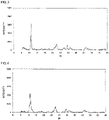
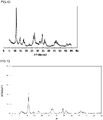
- An XRD chart of the powder of the raw material mixture is shown in FIG. 1 .
- the XRD pattern of the obtained raw material mixture had no crystalline peak, and therefore, it was found that the raw material mixture was amorphous.
- the raw material mixture was confirmed to be an amorphous silicotitanate gel.
- the raw material mixture in the gel form was charged in a stainless steel autoclave (trade name: KH-02, manufactured by HIRO COMPANY) with stirring.
- the raw material mixture was crystallized by heating at 180°C for 72 hours, to obtain a crystallized product.
- the pressure during crystallization was 0.8 MPa, which corresponded to a water vapor pressure at 180°C.
- the crystallized product was cooled, filtered, washed, and dried to obtain a silicotitanate composition in a powder form.
- the silicotitanate composition of this example was confirmed to be a single phase of S-type silicotitanate.
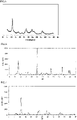
- the XRD chart of the silicotitanate composition of this example is shown in FIG. 2 .
- the Si/Ti mole ratio of the obtained silicotitanate composition was 0.68, and the Na/Ti mole ratio was 1.07. Results of composition analysis of the obtained silicotitanate composition are shown in Table 6.
- a crystallized product was obtained in the same manner as in Example 1 except that a raw material mixture had the following composition.
- the obtained raw material mixture was an amorphous silicotitanate gel, and the pressure during crystallization was 0.8 MPa.
- the crystallized product was cooled, filtered, washed, and dried to obtain a silicotitanate composition in a powder form.
- the silicotitanate composition of this example was confirmed to be a single phase of S-type silicotitanate.
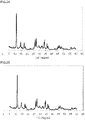
- the XRD chart of the silicotitanate composition of this example is shown in FIG. 3 .
- the Si/Ti mole ratio of the obtained silicotitanate composition was 0.75, and the Na/Ti mole ratio was 1.31. Results of composition analysis of the obtained silicotitanate composition are shown in Table 6.
- the Sr selective adsorption properties from simulated seawater were evaluated.
- an aqueous solution containing the following composition was prepared using NaCl, MgCl 2 , CaCl 2 , Na 2 SO 4 , KCl, and a Sr standard solution. This aqueous solution was used as a measurement solution.
- the silicotitanate composition was added to 1 L of the measurement solution, 0.05 g of the silicotitanate composition was added, and the mixture was mixed with stirring at 25°C and 800 rpm for 24 hours. Thus, the adsorption properties were evaluated. As a pre-treatment, the silicotitanate composition was heated at 100°C in the air for 1 hour. After mixing, the silicotitanate composition was separated from the measurement solution by filtration. The Sr concentration in the collected measurement solution was measured.
- Kd (Sr) was determined by the aforementioned equation (1), and the removal ratio was determined by the aforementioned equation (2).
- the Sr concentration in the measurement solution was 0.52 ppm by weight
- the calcium concentration was 38 ppm by weight
- the magnesium concentration was 110 ppm by weight.
- Kd of each metal was as follows.
- the removal ratio of each metal was as follows.
- Kd (Sr) was 10, 000 mL/g or more, and was larger than Kd (Ca) and Kd (Mg) .
- the Sr removal ratio was larger than calcium and magnesium removal ratios.
- the silicotitanate composition of this example was confirmed to have Sr adsorption selectivity in the coexistence of seawater component.
- the Cs selective adsorption properties from simulated seawater were evaluated.
- an aqueous solution containing the following composition was prepared using NaCl, MgCl 2 , CaCl 2 , Na 2 SO 4 , KCl, and a Cs standard solution. This aqueous solution was used as a measurement solution.
- the silicotitanate composition was added to 1 L of the measurement solution, 0.05 g of the silicotitanate composition was added, and the mixture was mixed with stirring at 25°C and 800 rpm for 24 hours. As a pre-treatment, the silicotitanate composition was heated at 100°C in the air for 1 hour. After mixing, the silicotitanate composition was separated from the measurement solution by filtration. The Cs concentration in the collected measurement solution was measured.
- the Cs concentration in the measurement solution was 0.08 ppm by weight.
- Kd (Cs) was determined by the aforementioned equation (1), and the removal ratio was determined by the aforementioned equation (2).
- Kd (Cs) was 230,000 mL/g. The Cs removal ratio was 92%. In the silicotitanate composition of this example, Kd (Cs) was 100,000 mL/g or more, and the Cs removal ratio was larger. Results of Cs and Sr adsorptivities of the silicotitanate composition of this example are shown in Table 6.
- a crystallized product was obtained in the same manner as in Example 1 except that a raw material mixture had the following composition.
- the obtained raw material mixture was an amorphous silicotitanate gel, and the pressure during crystallization was 0.8 MPa.
- the crystallized product was cooled, filtered, washed, and dried to obtain a silicotitanate composition in a powder form.
- the silicotitanate composition of this example was confirmed to be a single phase of S-type silicotitanate.
- the XRD chart of the silicotitanate composition of this example is shown in FIG. 4 .
- the Si/Ti mole ratio of the obtained silicotitanate composition was 0.72, and the Na/Ti mole ratio was 1.25. Results of composition analysis of the obtained silicotitanate composition are shown in Table 6.
- a silicotitanate having a crystal of sitinakite structure was added as a seed crystal in an amount of 1% by weight relative to the amorphous silicotitanate gel. Subsequently, the gel was crystallized in the same manner as in Example 1. The crystallized product was further cooled, filtered, washed, and dried to obtain a silicotitanate composition.
- the Sr and Cs selective adsorption properties of the silicotitanate composition obtained in this example were evaluated using simulated seawater containing Sr and Cs as a medium to be treated.
- an aqueous solution containing the following composition was prepared using NaCl, MgCl 2 , CaCl 2 , Na 2 SO 4 , KCl, a Sr standard solution, and a Cs standard solution.
- silicotitanate composition of this example was added, and the simulated seawater was stirred at 25°C and 800 rpm for 24 hours .
- the Sr and Cs adsorption properties of the silicotitanate composition were evaluated.
- the silicotitanate composition was heated at 100°C in the air for 1 hour.
- the Sr concentration in the simulated seawater was 0.86 ppm by weight, and the Cs concentration was 0.021 ppm by weight.
- Kd of each metal was as follows.
- the removal ratio of each metal was as follows.
- the obtained raw material composition was a silicotitanate gel.
- the silicotitanate gel included 6.6% by weight of ethyl alcohol and 7.5% by weight of isopropyl alcohol as byproducts . Since a large amount of alcohol was included, crystallization was not achieved by heating at 180°C using the same autoclave as in Examples.
- a raw material mixture and a crystallized product were obtained in the same manner as in Example 1 except that titanium oxide (anatase type TiO 2 powder) was used instead of a titanium sulfate aqueous solution.
- the resulting crystallized product was cooled, filtered, washed, and dried to obtain a powder product.
- niobium oxide (Nb 2 O 5 ) powder was added, to obtain a raw material mixture including an amorphous silicotitanate gel of the following composition.
- a crystallized product was obtained by crystallizing the raw material mixture in the same manner as in Example 1 except that the aforementioned raw material mixture was used. The pressure during crystallization was 0.8 MPa. The crystallized product was cooled, filtered, washed, and dried in the same manner as in Example 1 to obtain a niobium-containing silicotitanate composition in a powder form.
- XRD chart of the obtained niobium-containing silicotitanate composition From an XRD chart of the obtained niobium-containing silicotitanate composition, an XRD peak attributable to a component other than a sitinakite structure was not confirmed.
- the silicotitanate composition of this example was confirmed to be a single phase of S-type silicotitanate.
- the XRD chart of the silicotitanate composition of this example is shown in FIG. 7 .
- the Si/Ti mole ratio of the obtained niobium-containing silicotitanate composition was 0.67, the Na/Ti mole ratio was 1.35, and the Nb/Ti mole ratio was 0.16. Results of composition analysis of the obtained silicotitanate composition are shown in Table 9.
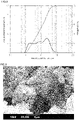
- FIG. 8 shows a cumulative curve of particle diameter distribution of this example.
- the average particle diameter of the obtained niobium-containing silicotitanate composition was 8.5 ⁇ m, and the cumulative value at which the particle diameter was 10 ⁇ m was 55%.
- FIG. 9 shows a SEM observation image of the silicotitanate composition of this example.
- the Sr selective adsorption properties were evaluated in the same manner as in Example 2. After the evaluation of the adsorption properties, the Sr concentration in the measurement solution was 0.50 ppm by weight, the calcium concentration that was a seawater component was 39.5 ppm by weight, and the magnesium concentration was 115 ppm by weight. Kd of each metal determined by the above-described equation (1) was as follows.
- Kd (Sr) was 10, 000 mL/g or more, and was larger than Kd of calcium and magnesium.
- the Sr removal ratio was larger than calcium and magnesium removal ratios.
- the silicotitanate composition of this example was confirmed to have Sr adsorption selectivity in the coexistence of seawater component.
- Example 2 As compared with Example 2 in which Nb was not contained, the Sr removal ratio was larger.
- the silicotitanate composition was confirmed to have excellent Sr adsorption selectivity in the coexistence of seawater component.
- Kd (Cs) was very large as described above, and the removal ratio was also larger.
- Example 4 As compared with Example 2 in which Nb was not contained, the Sr and Cs removal ratios in the coexistence of seawater component in Example 4 were larger. A performance effect of a niobium additive was confirmed.
- niobium hydroxide (Nb (OH) 5 ) powder was added to obtain a raw material mixture including an amorphous silicotitanate gel of the following composition.
- a crystallized product was obtained by crystallizing the raw material mixture in the same manner as in Example 1 except that the aforementioned raw material mixture was used.
- the crystallized product was cooled, filtered, washed, and dried in the same manner as in Example 1 to obtain a niobium-containing silicotitanate composition in a powder form.
- XRD chart of the obtained niobium-containing silicotitanate composition From an XRD chart of the obtained niobium-containing silicotitanate composition, an XRD peak attributable to a component other than a sitinakite structure was not confirmed.
- the silicotitanate composition of this example was confirmed to be a single phase of S-type silicotitanate.
- the XRD chart of the silicotitanate composition of this example is shown in FIG. 10 .
- the Si/Ti mole ratio of the obtained niobium-containing silicotitanate composition was 0.73, the Na/Ti mole ratio was 1.35, and the Nb/Ti mole ratio was 0.33. Results of composition analysis of the obtained silicotitanate composition are shown in Table 9.
- the Sr and Cs selective adsorption properties from simulated seawater were evaluated.
- Simulated seawater having the following composition was prepared using NaCl, MgCl 2 , CaCl 2 , a Sr standard solution, and a Cs standard solution.
- Kd (Sr) was 10,000 mL/g or more
- Kd (Cs) was 100,000 mL/g or more
- Sr and Cs removal ratios were larger than calcium and magnesium removal ratios.
- the silicotitanate composition of this example was confirmed to have Sr and Cs adsorption selectivities in the coexistence of seawater component.
- Example 2 As compared with Example 2 in which the composition of simulated seawater was different but Nb was not contained, the Sr and Cs removal ratios were larger.
- the silicotitanate composition was confirmed to have excellent Sr and Cs adsorption selectivities in the coexistence of seawater component.
- An amorphous silicotitanate gel was obtained in the same manner as in Example 4 except that the amorphous silicotitanate gel had the following composition.
- the amorphous silicotitanate gel was crystallized in the same manner as in Example 1, and the crystallized product was further cooled, filtered, washed, and dried to obtain a silicotitanate composition.
- the Sr and Cs selective adsorption properties were evaluated in the same manner as in Example 4. After the evaluation of the adsorption properties, the Sr concentration in the simulated seawater was 0.85 ppm by weight, and the Cs concentration was 0.007 ppm by weight. Kd of each metal was as follows.
- the removal ratio of each metal was as follows.
- An amorphous silicotitanate gel was obtained in the same manner as in Example 4 except that the amorphous silicotitanate gel had the following composition.
- the amorphous silicotitanate gel was crystallized in the same manner as in Example 1, and the crystallized product was further cooled, filtered, washed, and dried to obtain a silicotitanate composition.
- the Sr and Cs selective adsorption properties were evaluated in the same manner as in Example 1. After the evaluation of the adsorption properties, the Sr concentration in the simulated seawater was 0.73 ppm by weight, and the Cs concentration was 0.008 ppm by weight. Kd of each metal was as follows.
- the removal ratio of each metal was as follows.
- the obtained raw material mixture was a silicotitanate gel.
- the silicotitanate gel included 6.5% by weight of ethyl alcohol and 7. 6% by weight of isopropyl alcohol as byproducts .
- a nitrogen gas was blown into the silicotitanate gel from an upper portion of an autoclave.
- 0.73 g of niobium oxide (Nb 2 O 5 ) powder was added, to obtain a raw material mixture including an amorphous silicotitanate gel of the following composition.
- a crystallized product was obtained by crystallizing the raw material mixture in the same manner as in Example 1 except that the aforementioned raw material mixture was used. The pressure during crystallization was 0.8 MPa. The crystallized product was cooled, filtered, washed, and dried in the same manner as in Example 1 to obtain a niobium-containing silicotitanate composition in a powder form.
- the silicotitanate composition of this comparative example was confirmed to be a single phase of S-type silicotitanate.
- the XRD chart of the silicotitanate composition of this comparative example is shown in FIG. 13 .
- the Si/Ti mole ratio of the obtained niobium-containing silicotitanate composition was 0.66, the Na/Ti mole ratio was 1.23, and the Nb/Ti mole ratio was 0.17. Results of composition analysis of the obtained silicotitanate composition are shown in Table 9.
- FIG. 14 shows a cumulative curve of particle diameter distribution of this comparative example.
- the average particle diameter of the niobium-containing silicotitanate composition was 3.1 ⁇ m, and the cumulative value at which the particle diameter was 10 ⁇ m was 97%.
- the Sr and Cs selective adsorption properties from simulated seawater were evaluated.
- Simulated seawater having the following composition was prepared using NaCl, MgCl 2 , CaCl 2 , a Sr standard solution, and a Cs standard solution.
- the Sr concentration in the simulated seawater was 0.85 ppm by weight
- the Cs concentration was 0.34 ppm
- the calcium concentration that was a seawater component was 38.0 ppm by weight
- the magnesium concentration was 110 ppm by weight.
- Kd (Sr) was less than 10,000 mL/g, and Kd (Cs) was less than 100,000 mL/g.
- the silicotitanate composition of this comparative example was confirmed to have inferior Sr and Cs adsorption selectivities in the coexistence of seawater component.
- Example 5 As compared with Example 5 (Reference Example)in which the composition of simulated seawater was different but Nb was contained, Kd (Sr) and Kd (Cs) were lower. This shows that the Sr and Cs adsorption selectivities in the coexistence of seawater component are inferior.
- amorphous silicotitanate gel 8.0 g of niobium hydroxide (Nb(OH) 5 ) powder and a silicotitanate having a crystal of sitinakite structure as a seed crystal in an amount of 1% by weight relative to the amorphous silicotitanate gel were added. Subsequently, an amorphous silicotitanate gel including an amorphous silicotitanate gel of the following composition was obtained.
- the amorphous silicotitanate gel was charged in a stainless steel autoclave (trade name: KH-02, manufactured by HIRO COMPANY) with stirring.
- the amorphous silicotitanate gel was crystallized by heating at 180°C for 72 hours, to obtain a crystallized product.
- the pressure during crystallization was 0.8 MPa, which corresponded to a water vapor pressure at 180°C.
- the crystallized product was cooled, filtered, washed, and dried to obtain a silicotitanate composition.
- the obtained silicotitanate composition was confirmed to have an X-ray diffraction angle and a diffraction peak intensity ratio shown in Table 10.
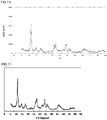
- the XRD pattern is shown in FIG. 15 .
- the obtained XRD pattern was compared with XRD peaks described in Reference HP.
- the silicotitanate composition of this example was confirmed to include an S-type silicotitanate and a V-type silicotitanate.
- Results of composition analysis of the obtained silicotitanate composition are shown in Table 13. [Table 10] DIFFRACTION ANGLE 2 ⁇ [° ] XRD PEAK INTENSITY RATIO 11.3 100 27.7 57 29.4 54
- the Cs and Sr selective adsorption properties were evaluated in the same manner as in Example 4. After the evaluation of the adsorption properties, the Cs concentration in the simulated seawater was 0.020 ppm by weight, and the Sr concentration was 0.40 ppm by weight. Kd of each metal was as follows.
- the removal ratio of each metal was as follows.
- amorphous silicotitanate gel was prepared in the same manner as in Example 9 except that the amorphous silicotitanate gel had the following composition:
- the amorphous silicotitanate gel was crystallized in the same manner as in Example 1, and the crystallized product was further cooled, filtered, washed, and dried to obtain a silicotitanate composition.
- the obtained silicotitanate composition was confirmed to have an X-ray diffraction angle and a diffraction peak intensity ratio shown in Table 11.
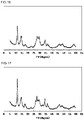
- the XRD pattern is shown in FIG. 16 .
- the obtained XRD pattern was compared with XRD peaks described in Reference HP.
- the silicotitanate composition of this example was confirmed to include an S-type silicotitanate and a V-type silicotitanate.
- Results of composition analysis of the obtained silicotitanate composition are shown in Table 13. [Table 11] DIFFRACTION ANGLE 2 ⁇ [° ] XRD PEAK INTENSITY RATIO 11.3 100 27.8 56 29.5 57
- the Sr and Cs selective adsorption properties were evaluated in the same manner as in Example 4. After the evaluation of the adsorption properties, the Cs concentration in the simulated seawater was 0.032 ppm by weight, and the Sr concentration was 0.35 ppm by weight. Kd of each metal was as follows.
- the removal ratio of each metal was as follows.
- An amorphous silicotitanate gel was prepared in the same manner as in Example 9 except that the amorphous silicotitanate gel had the following composition.
- the amorphous silicotitanate gel was crystallized in the same manner as in Example 1, and the crystallized product was further cooled, filtered, washed, and dried to obtain a silicotitanate composition.
- the obtained silicotitanate composition was confirmed to have an X-ray diffraction angle and a diffraction peak intensity ratio shown in Table 12.
- the XRD pattern is shown in FIG. 17 .
- the obtained XRD pattern was compared with XRD peaks described in Reference HP.
- the silicotitanate composition of this example was confirmed to include an S-type silicotitanate and a V-type silicotitanate.
- Results of composition analysis of the obtained silicotitanate composition are shown in Table 13. [Table 12] DIFFRACTION ANGLE 2 ⁇ [° ] XRD PEAK INTENSITY RATIO 11.3 100 27.5 47 29.5 36
- the Cs and Sr selective adsorption properties were evaluated in the same manner as in Example 4. After the evaluation of the adsorption properties, the Cs concentration in the simulated seawater was 0.012 ppm by weight, and the Sr concentration was 0.54 ppm by weight. Kd of each metal was as follows.
- the removal ratio of each metal was as follows.
- An amorphous silicotitanate gel was prepared in the same manner as in Example 9 except that the amorphous silicotitanate gel had the following composition.
- the amorphous silicotitanate gel was charged in a stainless steel autoclave (trade name: KH-02, manufactured by HIRO COMPANY) with stirring.
- the amorphous silicotitanate gel was crystallized by heating at 180°C for 72 hours, to obtain a crystallized product.
- the pressure during crystallization was 0.8 MPa, which corresponded to a water vapor pressure at 180°C.
- the crystallized product was cooled, filtered, washed, and dried to obtain a silicotitanate composition.
- the Cs and Sr selective adsorption properties were evaluated in the same manner as in Example 4. After the evaluation of the adsorption properties, the Cs concentration in the simulated seawater was 0.017 ppm by weight, and the Sr concentration was 0.53 ppm by weight. Kd of each metal was as follows.
- the removal ratio of each metal was as follows.
- An amorphous silicotitanate gel was prepared in the same manner as in Example 9 except that the amorphous silicotitanate gel had the following composition.
- the amorphous silicotitanate gel was crystallized in the same manner as in Example 1, and the crystallized product was further cooled, filtered, washed, and dried to obtain a silicotitanate composition.
- the obtained silicotitanate composition was confirmed to have an X-ray diffraction angle and a diffraction peak intensity ratio shown in Table 15.
- the XRD pattern is shown in FIG. 19 .
- the crystallized product of this example was confirmed to include an S-type silicotitanate and a niobate.
- Results of composition analysis of the obtained silicotitanate composition are shown in Table 22. [Table 15] DIFFRACTION ANGLE 2 ⁇ [° ] XRD PEAK INTENSITY RATIO 8.8 17 10.0 14 11.3 100 29.7 30
- the Cs and Sr selective adsorption properties were evaluated in the same manner as in Example 4. After the evaluation of the adsorption properties, the Cs concentration in the simulated seawater was 0.021 ppm by weight, and the Sr concentration was 0.44 ppm by weight. Kd of each metal was as follows.
- the removal ratio of each metal was as follows.
- An amorphous silicotitanate gel was prepared in the same manner as in Example 9 except that the amorphous silicotitanate gel had the following composition.
- the amorphous silicotitanate gel was crystallized in the same manner as in Example 1, and the crystallized product was further cooled, filtered, washed, and dried to obtain a silicotitanate composition.
- the obtained silicotitanate composition was confirmed to have an X-ray diffraction angle and a diffraction peak intensity ratio shown in Table 16.
- the XRD pattern is shown in FIG. 20 .
- the crystallized product of this example was confirmed to include an S-type silicotitanate and a niobate.
- Results of composition analysis of the obtained silicotitanate composition are shown in Table 22. [Table 16] DIFFRACTION ANGLE 2 ⁇ [° ] XRD PEAK INTENSITY RATIO 8.7 9 9.9 8 11.2 100 29.6 10
- the Cs and Sr selective adsorption properties were evaluated in the same manner as in Example 4. After the evaluation of the adsorption properties, the Cs concentration in the simulated seawater was 0.0038 ppm by weight, and the Sr concentration was 0.71 ppm by weight. Kd of each metal was as follows.
- the removal ratio of each metal was as follows.
- An amorphous silicotitanate gel was prepared in the same manner as in Example 9 except that the amorphous silicotitanate gel had the following composition.
- the amorphous silicotitanate gel was charged in a stainless steel autoclave (trade name: KH-02, manufactured by HIRO COMPANY) with stirring.
- the amorphous silicotitanate gel was crystallized by heating at 180°C for 72 hours, to obtain a crystallized product.
- the pressure during crystallization was 0.8 MPa, which corresponded to a water vapor pressure at 180°C.
- the crystallized product was cooled, filtered, washed, and dried to obtain a silicotitanate composition.
- the obtained silicotitanate composition was confirmed to have an X-ray diffraction angle and a diffraction peak intensity ratio shown in Table 17.
- the XRD pattern is shown in FIG. 21 .
- the crystallized product of this example was confirmed to include an S-type silicotitanate and a niobate.
- Results of composition analysis of the obtained silicotitanate composition are shown in Table 22. [Table 17] DIFFRACTION ANGLE 2 ⁇ [° ] XRD PEAK INTENSITY RATIO 8.8 10 10.0 10 11.2 100 29.6 14
- the Cs and Sr selective adsorption properties were evaluated in the same manner as in Example 4. After the evaluation of the adsorption properties, the Cs concentration in the simulated seawater was 0.0037 ppm by weight, and the Sr concentration was 0.67 ppm by weight. Kd of each metal was as follows.
- the removal ratio of each metal was as follows.
- An amorphous silicotitanate gel was prepared in the same manner as in Example 9 except that the amorphous silicotitanate gel had the following composition.
- the amorphous silicotitanate gel was crystallized in the same manner as in Example 1, and the crystallized product was further cooled, filtered, washed, and dried to obtain a silicotitanate composition.
- the obtained silicotitanate composition was confirmed to have an X-ray diffraction angle and a diffraction peak intensity ratio shown in Table 18.
- the XRD pattern is shown in FIG. 22 .
- the crystallized product of this example was confirmed to include an S-type silicotitanate and a niobate.
- Results of composition analysis of the obtained silicotitanate composition are shown in Table 22. [Table 18] DIFFRACTION ANGLE 2 ⁇ [° ] XRD PEAK INTENSITY RATIO 8.8 14 10.0 11 11.2 100 29.6 20
- the Cs and Sr selective adsorption properties were evaluated in the same manner as in Example 4. After the evaluation of the absorption properties, the Cs concentration in the simulated seawater was 0.0044 ppm by weight, and the Sr concentration was 0.64 ppm by weight. Kd of each metal was as follows.
- the removal ratio of each metal was as follows.
- An amorphous silicotitanate gel was prepared in the same manner as in Example 9 except that the amorphous silicotitanate gel had the following composition.
- the amorphous silicotitanate gel was crystallized in the same manner as in Example 1, and the crystallized product was further cooled, filtered, washed, and dried to obtain a silicotitanate composition.
- the obtained silicotitanate composition was confirmed to have an X-ray diffraction angle and a diffraction peak intensity ratio shown in Table 19.
- the XRD pattern is shown in FIG. 23 .
- the crystallized product of this example was confirmed to include an S-type silicotitanate and a niobate.
- Results of composition analysis of the obtained silicotitanate composition are shown in Table 22. [Table 19] DIFFRACTION ANGLE 2 ⁇ [° ] XRD PEAK INTENSITY RATIO 8.7 11 10.0 10 11.2 100 29.6 18
- the Cs and Sr selective adsorption properties were evaluated in the same manner as in Example 4. After the evaluation of the adsorption properties, the Cs concentration in the simulated seawater was 0.0029 ppm by weight, and the Sr concentration was 0.62 ppm by weight. Kd of each metal was as follows.
- the removal ratio of each metal was as follows.
- An amorphous silicotitanate gel was prepared in the same manner as in Example 9 except that the amorphous silicotitanate gel had the following composition.
- the amorphous silicotitanate gel was crystallized in the same manner as in Example 1 except that the crystallization time was changed to 24 hours, and the crystallized product was further cooled, filtered, washed, and dried to obtain a silicotitanate composition.
- the obtained silicotitanate composition was confirmed to have an X-ray diffraction angle and a diffraction peak intensity ratio shown in Table 20.
- the XRD pattern is shown in FIG. 24 .
- the crystallized product of this example was confirmed to include an S-type silicotitanate and a niobate.
- Results of composition analysis of the obtained silicotitanate composition are shown in Table 22. [Table 20] DIFFRACTION ANGLE 2 ⁇ [° ] XRD PEAK INTENSITY RATIO 8.8 9 10.0 8 11.3 100 29.7 11
- Kd( Sr ) was as follows. Kd(sr) : 9,700 mL/g
- An amorphous silicotitanate gel was prepared in the same manner as in Example 9 except that the amorphous silicotitanate gel had the following composition and a seed crystal was not added to the gel.
- the amorphous silicotitanate gel was crystallized in the same manner as in Example 1 except that the crystallization time was changed to 24 hours, and the crystallized product was further cooled, filtered, washed, and dried to obtain a silicotitanate composition.
- the obtained silicotitanate composition was confirmed to have an X-ray diffraction angle and a diffraction peak intensity ratio shown in Table 21.
- the XRD pattern is shown in FIG. 25 .
- the crystallized product of this example was confirmed to include an S-type silicotitanate and a niobate.
- Results of composition analysis of the obtained silicotitanate composition are shown in Table 22. [Table 21] DIFFRACTION ANGLE 2 ⁇ [° ] XRD PEAK INTENSITY RATIO 8.8 10 10.0 10 11.2 100 29.6 15
- Kd( Sr ) was as follows. Kd (Sr) : 9,850 mL/g
- the Sr removal ratio was as follows. Sr: 33%
- the present invention provides the use of a composition including asilicotitanate having a sitinakite structure in an adsorption method for at least any of cesium and strontium.
- the obtained silicotitanate composition allows harmful ions such as Cs and Sr in the coexistent of seawater, groundwater, and contaminated water to be efficiently treated.
Landscapes
- Chemical & Material Sciences (AREA)
- Organic Chemistry (AREA)
- Analytical Chemistry (AREA)
- Chemical Kinetics & Catalysis (AREA)
- Inorganic Chemistry (AREA)
- Engineering & Computer Science (AREA)
- General Engineering & Computer Science (AREA)
- High Energy & Nuclear Physics (AREA)
- Physics & Mathematics (AREA)
- Life Sciences & Earth Sciences (AREA)
- Hydrology & Water Resources (AREA)
- Environmental & Geological Engineering (AREA)
- Water Supply & Treatment (AREA)
- Silicates, Zeolites, And Molecular Sieves (AREA)
- Solid-Sorbent Or Filter-Aiding Compositions (AREA)
Claims (8)
- Verwendung einer Silicotitanat-Zusammensetzung,wobei die Zusammensetzung ein Silicotitanat mit einer Sitinakit-Struktur und Niob umfasst, und mindestens zwei oder mehr Beugungsscheitelpunkte bei Röntgenbeugungswinkeln aufweist, die ausgewählt sind aus der Gruppe bestehend aus 2θ = 8,8 ± 0,5°, 2θ = 10,0 ± 0,5° und 2θ = 29,6 ± 0,5°, wobei2θ ein Wert des Röntgenbeugungswinkels in einem Pulver-Röntgenbeugungsmuster ist, der unter Verwendung eines allgemeinen Röntgendiffraktometers gemessen wurde, und die Messbedingungen wie folgt sind:Strahlungsquelle: CuKα-Strahlung, λ = 1,5405 ÅMessmodus: SchrittabtastungAbtastbedingung: 0,04°/SekundeDivergenzschlitz: 1.00 GradStreuungsschliz: 1,00 GradEmpfangsschlitz: 0,30 mmMesszeit: 3,00 SekundenMessbereich: 2θ = 5,0° bis 60,0°,in einem Adsorptionsverfahren für mindestens eines von Cäsium und Strontium, wobei die Zusammensetzung mindestens Röntgenbeugungswinkel 2θ und Röntgenbeugungsscheitelpunkt-Intensitätsverhältnisse aufweist, die in der folgenden Tabelle 1 gezeigt sind: [Tabelle 1]
RÖNTGENBEUGUNGSWINKEL 2θ [° ] RÖNTGENBEUGUNGSSCHEITELPUNKT-INTENSITÄTSVERHÄLTNIS 8,8 ± 0.5 5 ODER MEHR UND 20 ODER WENIGER 10,0 ± 0.5 5 ODER MEHR UND 20 ODER WENIGER 11,3 ± 0.5 100 29,6 ± 0.5 5 ODER MEHR UND 40 ODER WENIGER - Verwendung nach Anspruch 1, wobei die Zusammensetzung eine kristalline Substanz mit mindestens zwei oder mehr Beugungsscheitelpunkten bei Röntgenbeugungswinkeln, ausgewählt aus der Gruppe bestehend aus 2θ = 8,8 ± 0,5°, 2θ = 10,0 ± 0,5° und 2θ = 29,6 ± 0,5°, umfasst.
- Verwendung nach Anspruch 2, wobei die kristalline Substanz ein Niobat ist.
- Verwendung einer Silicotitanat-Zusammensetzung,wobei die Zusammensetzung ein Silicotitanat mit einer Sitinakit-Struktur und Niob umfasst und mindestens Beugungsscheitelpunkte bei Röntgenbeugungswinkeln von 2θ = 27,8 ± 0,5° und 2θ = 29,4 ± 0,5° aufweist, wobei2θ ein Wert des Röntgenbeugungswinkels in einem Pulver-Röntgenbeugungsmuster ist, das unter Verwendung eines allgemeinen Röntgendiffraktometers gemessen wurde, und die Messbedingungen wie folgt sind:Strahlungsquelle: CuKα-Strahlung, λ = 1,5405 ÅMessmodus: SchrittabtastungAbtastbedingung: 0,04°/SekundeDivergenzschlitz: 1.00 GradStreuungsschliz: 1,00 GradEmpfangsschlitz: 0,30 mmMesszeit: 3,00 SekundenMessbereich: 2θ = 5,0° bis 60,0°,
wobei die Zusammensetzung mindestens Röntgenbeugungswinkel 2θ und Röntgenbeugungsscheitelpunkt-Intensitätsverhältnisse aufweist, die in der folgenden Tabelle 2 gezeigt sind: (Tabelle 2)RÖNTGENBEUGUNGSWINKEL 2θ [° ] RÖNTGENBEUGUNGSSCHEITELPUNKT-INTENSITÄTSVERHÄLTNIS 11,3 ± 0.5 100 27,8 ± 0.5 30 ODER MEHR UND 70 ODER WENIGER 29,4 ± 0.5 30 ODER MEHR UND 70 ODER WENIGER , wobei das Röntgenbeugungsscheitelpunkt-Intensitätsverhältnis in Tabelle 2 ein relativer Wert der Röntgenbeugungsscheitelpunkthöhe bei jedem 2θ relativ zu einer Röntgenbeugungsscheitelpunkthöhe ist, wenn die Scheitelpunkthöhe bei 2θ =11,3 ± 0,5 als 100 genommen wird,in einem Adsorptionsverfahren für mindestens eines der Elemente Cäsium und Strontium. - Verwendung nach Anspruch 4, wobei die Zusammensetzung eine kristalline Substanz mit Beugungsscheitelpunkts bei Röntgenbeugungswinkeln von mindestens 2θ = 27,8 ± 0,5° und 2θ = 29,4 ± 0,5° umfasst.
- Verwendung nach Anspruch 5, wobei die kristalline Substanz ein Silicotitanat mit einer Vinogradovit-Struktur ist.
- Verwendung nach einem der Ansprüche 1 bis 6, wobei das Silicotitanat einen Cäsiumverteilungskoeffizienten von 100 000 mL/g oder mehr aufweist, der durch die Gleichung (1) erhalten wird:
 Kd(cs) der Cäsiumverteilungskoeffizient (mL/g) ist,C0(cs) die Metallionenkonzentration in der cäsiumhaltigen wässrigen Lösung vor der Adsorptionsbehandlung (ppm) ist,C(cs) die Metallionenkonzentration in der cäsiumhaltigen wässrigen Lösung während der Äquilibrierung der Adsorption (ppm) ist,V(cs) das Volumen der cäsiumhaltigen wässrigen Lösung (mL) ist undm das Gewicht der Silicotitanat-Zusammensetzung (g) ist,wobei die Größenverteilung bestimmt wird und die Adsorptionsgleichgewichtseinstellung durchgeführt wird wie in der Beschreibung angegeben.
 - Verwendung nach Anspruch 7, wobei das Silicotitanat einen Strontiumverteilungskoeffizienten von 3 000 mL/g oder mehr aufweist, der durch die Gleichung (1') erhalten wird:
 Kd(sr) der Strontiumverteilungskoeffizient (mL/g) ist,C0(sr) die Metallionenkonzentration in strontiumhaltiger wässriger Lösung vor der Adsorptionsbehandlung (ppm) ist,C(sr) die Metallionenkonzentration in der strontiumhaltigen wässrigen Lösung während der Äquilibrierung der Adsorption (ppm) ist,V(sr) das Volumen der strontiumhaltigen wässrigen Lösung (mL) ist undm das Gewicht der Silicotitanat-Zusammensetzung (g) ist,wobei die Größenverteilung bestimmt wird und die Adsorptionsäquilibrierung durchgeführt wird wie in der Beschreibung angegeben.
Applications Claiming Priority (6)
| Application Number | Priority Date | Filing Date | Title |
|---|---|---|---|
| JP2014147677 | 2014-07-18 | ||
| JP2015039326 | 2015-02-27 | ||
| JP2015096691 | 2015-05-11 | ||
| JP2015096690 | 2015-05-11 | ||
| EP15822329.7A EP3170794B1 (de) | 2014-07-18 | 2015-07-17 | Zusammensetzung mit silicotitanat mit sitinakitstruktur und herstellungsverfahren dafür |
| PCT/JP2015/070555 WO2016010142A1 (ja) | 2014-07-18 | 2015-07-17 | シチナカイト構造を有するシリコチタネートを含む組成物およびその製造方法 |
Related Parent Applications (2)
| Application Number | Title | Priority Date | Filing Date |
|---|---|---|---|
| EP15822329.7A Division EP3170794B1 (de) | 2014-07-18 | 2015-07-17 | Zusammensetzung mit silicotitanat mit sitinakitstruktur und herstellungsverfahren dafür |
| EP15822329.7A Division-Into EP3170794B1 (de) | 2014-07-18 | 2015-07-17 | Zusammensetzung mit silicotitanat mit sitinakitstruktur und herstellungsverfahren dafür |
Publications (2)
| Publication Number | Publication Date |
|---|---|
| EP3556729A1 EP3556729A1 (de) | 2019-10-23 |
| EP3556729B1 true EP3556729B1 (de) | 2022-04-13 |
Family
ID=55078628
Family Applications (2)
| Application Number | Title | Priority Date | Filing Date |
|---|---|---|---|
| EP15822329.7A Active EP3170794B1 (de) | 2014-07-18 | 2015-07-17 | Zusammensetzung mit silicotitanat mit sitinakitstruktur und herstellungsverfahren dafür |
| EP18212548.4A Active EP3556729B1 (de) | 2014-07-18 | 2015-07-17 | Verwendung einer zusammensetzung enthaltend silikotitanat mit sitinakitstruktur und niobium |
Family Applications Before (1)
| Application Number | Title | Priority Date | Filing Date |
|---|---|---|---|
| EP15822329.7A Active EP3170794B1 (de) | 2014-07-18 | 2015-07-17 | Zusammensetzung mit silicotitanat mit sitinakitstruktur und herstellungsverfahren dafür |
Country Status (6)
| Country | Link |
|---|---|
| US (2) | US10343136B2 (de) |
| EP (2) | EP3170794B1 (de) |
| KR (2) | KR20180085066A (de) |
| CN (2) | CN109956480B (de) |
| CA (2) | CA2953912C (de) |
| WO (1) | WO2016010142A1 (de) |
Families Citing this family (5)
| Publication number | Priority date | Publication date | Assignee | Title |
|---|---|---|---|---|
| EP3170794B1 (de) | 2014-07-18 | 2022-01-19 | Tosoh Corporation | Zusammensetzung mit silicotitanat mit sitinakitstruktur und herstellungsverfahren dafür |
| WO2017141931A1 (ja) * | 2016-02-17 | 2017-08-24 | 日本化学工業株式会社 | セシウム又は/及びストロンチウム吸着剤 |
| KR102355889B1 (ko) * | 2018-12-26 | 2022-01-27 | 서강대학교산학협력단 | 층상 바나도실리케이트를 이용한 Sr(Ⅱ) 이온 흡착제 및 이를 이용한 Sr(Ⅱ) 이온의 제거 방법 |
| US12036528B2 (en) | 2020-09-30 | 2024-07-16 | Uop Llc | Process for removing lead ions from boldily fluids using metallate ion exchange compositions |
| FR3129091B1 (fr) | 2021-11-18 | 2025-01-10 | Commissariat Energie Atomique | Procédé de préparation d’un matériau silicotitanate de structure sitinakite utilisable pour la décontamination d’un effluent aqueux |
Family Cites Families (23)
| Publication number | Priority date | Publication date | Assignee | Title |
|---|---|---|---|---|
| JPS4919528B1 (de) | 1968-10-01 | 1974-05-18 | ||
| JPS4919528A (de) | 1972-06-13 | 1974-02-21 | ||
| JPS5858621B2 (ja) | 1979-12-28 | 1983-12-26 | 富士電機株式会社 | ガス中の亜硫酸ガス濃度の測定法 |
| US5208006A (en) * | 1990-05-28 | 1993-05-04 | Engelhard Corporation | Large-pored molecular sieves containing at least one octahedral site comprising titanium and at least silicon as a tetrahedral site |
| AU6268594A (en) * | 1993-02-25 | 1994-09-14 | Sandia National Laboratories | Novel silico-titanates and their methods of making and using |
| US6068682A (en) * | 1997-12-22 | 2000-05-30 | Engelhard Corporation | Small-pored crystalline titanium molecular sieve zeolites and their use in gas separation processes |
| CN1133587C (zh) * | 1998-06-12 | 2004-01-07 | 环球油品公司 | 从水流中除去金属离子污染物的方法 |
| JP2000015001A (ja) * | 1998-06-15 | 2000-01-18 | Uop Inc | 液体流から金属イオン不純物を除去する方法 |
| JP3840506B2 (ja) | 2004-03-17 | 2006-11-01 | 有限会社山口ティー・エル・オー | 混合物分離膜の製造方法 |
| JP5612857B2 (ja) * | 2007-08-30 | 2014-10-22 | 石原産業株式会社 | チタン酸化合物及びその製造方法並びに該チタン酸化合物を含む電極活物質、電極活物質を用いてなる蓄電デバイス |
| JP2010159245A (ja) * | 2008-09-19 | 2010-07-22 | Sumitomo Chemical Co Ltd | 酸化化合物の製造方法 |
| US9269954B2 (en) * | 2009-02-04 | 2016-02-23 | National Institute Of Advanced Industrial Science And Technology | Production process for lithium-silicate-system compound |
| KR101907048B1 (ko) * | 2011-03-11 | 2018-10-11 | 히타치가세이가부시끼가이샤 | 알루미늄 규산염, 금속 이온 흡착제 및 이들의 제조 방법 |
| JP4919528B1 (ja) | 2011-10-09 | 2012-04-18 | 株式会社太平洋コンサルタント | 放射性セシウムによる汚染物の収納容器、及び放射性セシウムによる汚染物の収納方法 |
| JP5734807B2 (ja) | 2011-10-21 | 2015-06-17 | 株式会社東芝 | 放射性セシウム及び放射性ストロンチウム含有物質の処理方法 |
| CN102623698A (zh) * | 2012-04-16 | 2012-08-01 | 南京大学 | 一种钛硅酸锂及其制法和作为锂电池电极材料的用途 |
| JP6266265B2 (ja) | 2013-08-21 | 2018-01-24 | 株式会社ソーエー | 煮沸装置 |
| JP6163409B2 (ja) | 2013-11-15 | 2017-07-12 | 大成建設株式会社 | 鉄骨建方方法および柱転倒防止装置 |
| JP6239947B2 (ja) | 2013-11-16 | 2017-11-29 | ノダック株式会社 | 通船ゲート装置 |
| JP5679242B2 (ja) | 2013-12-05 | 2015-03-04 | タイヨーエレック株式会社 | 遊技機 |
| JP5696244B1 (ja) | 2014-03-27 | 2015-04-08 | 日本化学工業株式会社 | 吸着材 |
| KR20150137201A (ko) * | 2014-05-28 | 2015-12-09 | 경북대학교 산학협력단 | 실리코타이타내이트 제조방법 및 세슘 흡착제 |
| EP3170794B1 (de) | 2014-07-18 | 2022-01-19 | Tosoh Corporation | Zusammensetzung mit silicotitanat mit sitinakitstruktur und herstellungsverfahren dafür |
-
2015
- 2015-07-17 EP EP15822329.7A patent/EP3170794B1/de active Active
- 2015-07-17 CN CN201811545244.2A patent/CN109956480B/zh active Active
- 2015-07-17 KR KR1020187020550A patent/KR20180085066A/ko not_active Ceased
- 2015-07-17 CA CA2953912A patent/CA2953912C/en active Active
- 2015-07-17 KR KR1020177004537A patent/KR102408127B1/ko active Active
- 2015-07-17 EP EP18212548.4A patent/EP3556729B1/de active Active
- 2015-07-17 US US15/322,918 patent/US10343136B2/en active Active
- 2015-07-17 CA CA3199622A patent/CA3199622A1/en active Pending
- 2015-07-17 WO PCT/JP2015/070555 patent/WO2016010142A1/ja not_active Ceased
- 2015-07-17 CN CN201580039390.6A patent/CN106573787B/zh active Active
-
2019
- 2019-01-03 US US16/239,177 patent/US11471855B2/en active Active
Also Published As
| Publication number | Publication date |
|---|---|
| KR102408127B1 (ko) | 2022-06-13 |
| US20190134599A1 (en) | 2019-05-09 |
| CA2953912A1 (en) | 2016-01-21 |
| KR20170032435A (ko) | 2017-03-22 |
| CA3199622A1 (en) | 2016-01-21 |
| US11471855B2 (en) | 2022-10-18 |
| WO2016010142A1 (ja) | 2016-01-21 |
| CA2953912C (en) | 2024-03-05 |
| EP3556729A1 (de) | 2019-10-23 |
| CN109956480A (zh) | 2019-07-02 |
| CN109956480B (zh) | 2022-10-21 |
| EP3170794B1 (de) | 2022-01-19 |
| KR20180085066A (ko) | 2018-07-25 |
| CN106573787A (zh) | 2017-04-19 |
| US10343136B2 (en) | 2019-07-09 |
| US20170165634A1 (en) | 2017-06-15 |
| EP3170794A4 (de) | 2018-05-16 |
| EP3170794A1 (de) | 2017-05-24 |
| CN106573787B (zh) | 2019-11-05 |
Similar Documents
| Publication | Publication Date | Title |
|---|---|---|
| JP6645202B2 (ja) | シチナカイト構造を有するシリコチタネートを含む組成物およびその製造方法 | |
| US11471855B2 (en) | Adsorption method for at least one of cesium and strontium employing silicotitanate having sitinakite structure | |
| JP6697415B2 (ja) | シチナカイト構造を有するシリコチタネートを含む組成物を用いるセシウム又はストロンチウムの少なくともいずれかの吸着方法 | |
| JP2016195981A (ja) | 吸着剤及び吸着剤の製造方法 | |
| JP6025795B2 (ja) | 結晶性シリコチタネートの製造方法 | |
| JP6580085B2 (ja) | シチナカイト構造を有するシリコチタネートを用いるセシウム又はストロンチウムの少なくともいずれかの吸着方法 | |
| JPWO2017141931A1 (ja) | セシウム又は/及びストロンチウム吸着剤 | |
| JP5992646B2 (ja) | アルカリ金属の9チタン酸塩の製造方法 | |
| JP2019189516A (ja) | シリコチタネート組成物およびその製造方法 | |
| JP2016102053A (ja) | シリコチタネート成形体 | |
| JP6673841B2 (ja) | 吸着材 | |
| JP6356567B2 (ja) | 結晶性シリコチタネートの製造方法 | |
| JP7852362B2 (ja) | 高耐摩耗性シリコチタネート成形体およびその製造方法 | |
| WO2018079500A1 (ja) | 結晶性シリコチタネートの製造方法 |
Legal Events
| Date | Code | Title | Description |
|---|---|---|---|
| PUAI | Public reference made under article 153(3) epc to a published international application that has entered the european phase |
Free format text: ORIGINAL CODE: 0009012 |
|
| STAA | Information on the status of an ep patent application or granted ep patent |
Free format text: STATUS: THE APPLICATION HAS BEEN PUBLISHED |
|
| AC | Divisional application: reference to earlier application |
Ref document number: 3170794 Country of ref document: EP Kind code of ref document: P |
|
| AK | Designated contracting states |
Kind code of ref document: A1 Designated state(s): AL AT BE BG CH CY CZ DE DK EE ES FI FR GB GR HR HU IE IS IT LI LT LU LV MC MK MT NL NO PL PT RO RS SE SI SK SM TR |
|
| STAA | Information on the status of an ep patent application or granted ep patent |
Free format text: STATUS: REQUEST FOR EXAMINATION WAS MADE |
|
| 17P | Request for examination filed |
Effective date: 20200407 |
|
| RBV | Designated contracting states (corrected) |
Designated state(s): AL AT BE BG CH CY CZ DE DK EE ES FI FR GB GR HR HU IE IS IT LI LT LU LV MC MK MT NL NO PL PT RO RS SE SI SK SM TR |
|
| STAA | Information on the status of an ep patent application or granted ep patent |
Free format text: STATUS: EXAMINATION IS IN PROGRESS |
|
| 17Q | First examination report despatched |
Effective date: 20210401 |
|
| GRAP | Despatch of communication of intention to grant a patent |
Free format text: ORIGINAL CODE: EPIDOSNIGR1 |
|
| STAA | Information on the status of an ep patent application or granted ep patent |
Free format text: STATUS: GRANT OF PATENT IS INTENDED |
|
| GRAJ | Information related to disapproval of communication of intention to grant by the applicant or resumption of examination proceedings by the epo deleted |
Free format text: ORIGINAL CODE: EPIDOSDIGR1 |
|
| GRAP | Despatch of communication of intention to grant a patent |
Free format text: ORIGINAL CODE: EPIDOSNIGR1 |
|
| INTG | Intention to grant announced |
Effective date: 20211014 |
|
| INTG | Intention to grant announced |
Effective date: 20211026 |
|
| GRAS | Grant fee paid |
Free format text: ORIGINAL CODE: EPIDOSNIGR3 |
|
| GRAA | (expected) grant |
Free format text: ORIGINAL CODE: 0009210 |
|
| STAA | Information on the status of an ep patent application or granted ep patent |
Free format text: STATUS: THE PATENT HAS BEEN GRANTED |
|
| AC | Divisional application: reference to earlier application |
Ref document number: 3170794 Country of ref document: EP Kind code of ref document: P |
|
| AK | Designated contracting states |
Kind code of ref document: B1 Designated state(s): AL AT BE BG CH CY CZ DE DK EE ES FI FR GB GR HR HU IE IS IT LI LT LU LV MC MK MT NL NO PL PT RO RS SE SI SK SM TR |
|
| REG | Reference to a national code |
Ref country code: GB Ref legal event code: FG4D |
|
| REG | Reference to a national code |
Ref country code: CH Ref legal event code: EP |
|
| REG | Reference to a national code |
Ref country code: DE Ref legal event code: R096 Ref document number: 602015078292 Country of ref document: DE |
|
| REG | Reference to a national code |
Ref country code: IE Ref legal event code: FG4D |
|
| REG | Reference to a national code |
Ref country code: AT Ref legal event code: REF Ref document number: 1483292 Country of ref document: AT Kind code of ref document: T Effective date: 20220515 |
|
| REG | Reference to a national code |
Ref country code: LT Ref legal event code: MG9D |
|
| REG | Reference to a national code |
Ref country code: NL Ref legal event code: MP Effective date: 20220413 |
|
| REG | Reference to a national code |
Ref country code: AT Ref legal event code: MK05 Ref document number: 1483292 Country of ref document: AT Kind code of ref document: T Effective date: 20220413 |
|
| PG25 | Lapsed in a contracting state [announced via postgrant information from national office to epo] |
Ref country code: NL Free format text: LAPSE BECAUSE OF FAILURE TO SUBMIT A TRANSLATION OF THE DESCRIPTION OR TO PAY THE FEE WITHIN THE PRESCRIBED TIME-LIMIT Effective date: 20220413 |
|
| PG25 | Lapsed in a contracting state [announced via postgrant information from national office to epo] |
Ref country code: SE Free format text: LAPSE BECAUSE OF FAILURE TO SUBMIT A TRANSLATION OF THE DESCRIPTION OR TO PAY THE FEE WITHIN THE PRESCRIBED TIME-LIMIT Effective date: 20220413 Ref country code: PT Free format text: LAPSE BECAUSE OF FAILURE TO SUBMIT A TRANSLATION OF THE DESCRIPTION OR TO PAY THE FEE WITHIN THE PRESCRIBED TIME-LIMIT Effective date: 20220816 Ref country code: NO Free format text: LAPSE BECAUSE OF FAILURE TO SUBMIT A TRANSLATION OF THE DESCRIPTION OR TO PAY THE FEE WITHIN THE PRESCRIBED TIME-LIMIT Effective date: 20220713 Ref country code: LT Free format text: LAPSE BECAUSE OF FAILURE TO SUBMIT A TRANSLATION OF THE DESCRIPTION OR TO PAY THE FEE WITHIN THE PRESCRIBED TIME-LIMIT Effective date: 20220413 Ref country code: HR Free format text: LAPSE BECAUSE OF FAILURE TO SUBMIT A TRANSLATION OF THE DESCRIPTION OR TO PAY THE FEE WITHIN THE PRESCRIBED TIME-LIMIT Effective date: 20220413 Ref country code: GR Free format text: LAPSE BECAUSE OF FAILURE TO SUBMIT A TRANSLATION OF THE DESCRIPTION OR TO PAY THE FEE WITHIN THE PRESCRIBED TIME-LIMIT Effective date: 20220714 Ref country code: FI Free format text: LAPSE BECAUSE OF FAILURE TO SUBMIT A TRANSLATION OF THE DESCRIPTION OR TO PAY THE FEE WITHIN THE PRESCRIBED TIME-LIMIT Effective date: 20220413 Ref country code: ES Free format text: LAPSE BECAUSE OF FAILURE TO SUBMIT A TRANSLATION OF THE DESCRIPTION OR TO PAY THE FEE WITHIN THE PRESCRIBED TIME-LIMIT Effective date: 20220413 Ref country code: BG Free format text: LAPSE BECAUSE OF FAILURE TO SUBMIT A TRANSLATION OF THE DESCRIPTION OR TO PAY THE FEE WITHIN THE PRESCRIBED TIME-LIMIT Effective date: 20220713 Ref country code: AT Free format text: LAPSE BECAUSE OF FAILURE TO SUBMIT A TRANSLATION OF THE DESCRIPTION OR TO PAY THE FEE WITHIN THE PRESCRIBED TIME-LIMIT Effective date: 20220413 |
|
| PG25 | Lapsed in a contracting state [announced via postgrant information from national office to epo] |
Ref country code: RS Free format text: LAPSE BECAUSE OF FAILURE TO SUBMIT A TRANSLATION OF THE DESCRIPTION OR TO PAY THE FEE WITHIN THE PRESCRIBED TIME-LIMIT Effective date: 20220413 Ref country code: PL Free format text: LAPSE BECAUSE OF FAILURE TO SUBMIT A TRANSLATION OF THE DESCRIPTION OR TO PAY THE FEE WITHIN THE PRESCRIBED TIME-LIMIT Effective date: 20220413 Ref country code: LV Free format text: LAPSE BECAUSE OF FAILURE TO SUBMIT A TRANSLATION OF THE DESCRIPTION OR TO PAY THE FEE WITHIN THE PRESCRIBED TIME-LIMIT Effective date: 20220413 Ref country code: IS Free format text: LAPSE BECAUSE OF FAILURE TO SUBMIT A TRANSLATION OF THE DESCRIPTION OR TO PAY THE FEE WITHIN THE PRESCRIBED TIME-LIMIT Effective date: 20220813 |
|
| REG | Reference to a national code |
Ref country code: DE Ref legal event code: R097 Ref document number: 602015078292 Country of ref document: DE |
|
| PG25 | Lapsed in a contracting state [announced via postgrant information from national office to epo] |
Ref country code: SM Free format text: LAPSE BECAUSE OF FAILURE TO SUBMIT A TRANSLATION OF THE DESCRIPTION OR TO PAY THE FEE WITHIN THE PRESCRIBED TIME-LIMIT Effective date: 20220413 Ref country code: SK Free format text: LAPSE BECAUSE OF FAILURE TO SUBMIT A TRANSLATION OF THE DESCRIPTION OR TO PAY THE FEE WITHIN THE PRESCRIBED TIME-LIMIT Effective date: 20220413 Ref country code: RO Free format text: LAPSE BECAUSE OF FAILURE TO SUBMIT A TRANSLATION OF THE DESCRIPTION OR TO PAY THE FEE WITHIN THE PRESCRIBED TIME-LIMIT Effective date: 20220413 Ref country code: EE Free format text: LAPSE BECAUSE OF FAILURE TO SUBMIT A TRANSLATION OF THE DESCRIPTION OR TO PAY THE FEE WITHIN THE PRESCRIBED TIME-LIMIT Effective date: 20220413 Ref country code: DK Free format text: LAPSE BECAUSE OF FAILURE TO SUBMIT A TRANSLATION OF THE DESCRIPTION OR TO PAY THE FEE WITHIN THE PRESCRIBED TIME-LIMIT Effective date: 20220413 Ref country code: CZ Free format text: LAPSE BECAUSE OF FAILURE TO SUBMIT A TRANSLATION OF THE DESCRIPTION OR TO PAY THE FEE WITHIN THE PRESCRIBED TIME-LIMIT Effective date: 20220413 |
|
| REG | Reference to a national code |
Ref country code: DE Ref legal event code: R119 Ref document number: 602015078292 Country of ref document: DE |
|
| PLBE | No opposition filed within time limit |
Free format text: ORIGINAL CODE: 0009261 |
|
| STAA | Information on the status of an ep patent application or granted ep patent |
Free format text: STATUS: NO OPPOSITION FILED WITHIN TIME LIMIT |
|
| PG25 | Lapsed in a contracting state [announced via postgrant information from national office to epo] |
Ref country code: MC Free format text: LAPSE BECAUSE OF FAILURE TO SUBMIT A TRANSLATION OF THE DESCRIPTION OR TO PAY THE FEE WITHIN THE PRESCRIBED TIME-LIMIT Effective date: 20220413 |
|
| REG | Reference to a national code |
Ref country code: CH Ref legal event code: PL |
|
| 26N | No opposition filed |
Effective date: 20230116 |
|
| REG | Reference to a national code |
Ref country code: BE Ref legal event code: MM Effective date: 20220731 |
|
| PG25 | Lapsed in a contracting state [announced via postgrant information from national office to epo] |
Ref country code: AL Free format text: LAPSE BECAUSE OF FAILURE TO SUBMIT A TRANSLATION OF THE DESCRIPTION OR TO PAY THE FEE WITHIN THE PRESCRIBED TIME-LIMIT Effective date: 20220413 |
|
| PG25 | Lapsed in a contracting state [announced via postgrant information from national office to epo] |
Ref country code: LU Free format text: LAPSE BECAUSE OF NON-PAYMENT OF DUE FEES Effective date: 20220717 Ref country code: LI Free format text: LAPSE BECAUSE OF NON-PAYMENT OF DUE FEES Effective date: 20220731 Ref country code: CH Free format text: LAPSE BECAUSE OF NON-PAYMENT OF DUE FEES Effective date: 20220731 |
|
| PG25 | Lapsed in a contracting state [announced via postgrant information from national office to epo] |
Ref country code: SI Free format text: LAPSE BECAUSE OF FAILURE TO SUBMIT A TRANSLATION OF THE DESCRIPTION OR TO PAY THE FEE WITHIN THE PRESCRIBED TIME-LIMIT Effective date: 20220413 Ref country code: DE Free format text: LAPSE BECAUSE OF NON-PAYMENT OF DUE FEES Effective date: 20230201 Ref country code: BE Free format text: LAPSE BECAUSE OF NON-PAYMENT OF DUE FEES Effective date: 20220731 |
|
| P01 | Opt-out of the competence of the unified patent court (upc) registered |
Effective date: 20230523 |
|
| PG25 | Lapsed in a contracting state [announced via postgrant information from national office to epo] |
Ref country code: IE Free format text: LAPSE BECAUSE OF NON-PAYMENT OF DUE FEES Effective date: 20220717 |
|
| PG25 | Lapsed in a contracting state [announced via postgrant information from national office to epo] |
Ref country code: IT Free format text: LAPSE BECAUSE OF FAILURE TO SUBMIT A TRANSLATION OF THE DESCRIPTION OR TO PAY THE FEE WITHIN THE PRESCRIBED TIME-LIMIT Effective date: 20220413 |
|
| PG25 | Lapsed in a contracting state [announced via postgrant information from national office to epo] |
Ref country code: HU Free format text: LAPSE BECAUSE OF FAILURE TO SUBMIT A TRANSLATION OF THE DESCRIPTION OR TO PAY THE FEE WITHIN THE PRESCRIBED TIME-LIMIT; INVALID AB INITIO Effective date: 20150717 |
|
| PG25 | Lapsed in a contracting state [announced via postgrant information from national office to epo] |
Ref country code: MK Free format text: LAPSE BECAUSE OF FAILURE TO SUBMIT A TRANSLATION OF THE DESCRIPTION OR TO PAY THE FEE WITHIN THE PRESCRIBED TIME-LIMIT Effective date: 20220413 Ref country code: CY Free format text: LAPSE BECAUSE OF FAILURE TO SUBMIT A TRANSLATION OF THE DESCRIPTION OR TO PAY THE FEE WITHIN THE PRESCRIBED TIME-LIMIT Effective date: 20220413 |
|
| PG25 | Lapsed in a contracting state [announced via postgrant information from national office to epo] |
Ref country code: TR Free format text: LAPSE BECAUSE OF FAILURE TO SUBMIT A TRANSLATION OF THE DESCRIPTION OR TO PAY THE FEE WITHIN THE PRESCRIBED TIME-LIMIT Effective date: 20220413 |
|
| PG25 | Lapsed in a contracting state [announced via postgrant information from national office to epo] |
Ref country code: MT Free format text: LAPSE BECAUSE OF FAILURE TO SUBMIT A TRANSLATION OF THE DESCRIPTION OR TO PAY THE FEE WITHIN THE PRESCRIBED TIME-LIMIT Effective date: 20220413 |
|
| PG25 | Lapsed in a contracting state [announced via postgrant information from national office to epo] |
Ref country code: BG Free format text: LAPSE BECAUSE OF FAILURE TO SUBMIT A TRANSLATION OF THE DESCRIPTION OR TO PAY THE FEE WITHIN THE PRESCRIBED TIME-LIMIT Effective date: 20220413 |
|
| PG25 | Lapsed in a contracting state [announced via postgrant information from national office to epo] |
Ref country code: BG Free format text: LAPSE BECAUSE OF FAILURE TO SUBMIT A TRANSLATION OF THE DESCRIPTION OR TO PAY THE FEE WITHIN THE PRESCRIBED TIME-LIMIT Effective date: 20220413 |
|
| PGFP | Annual fee paid to national office [announced via postgrant information from national office to epo] |
Ref country code: GB Payment date: 20250529 Year of fee payment: 11 |
|
| PGFP | Annual fee paid to national office [announced via postgrant information from national office to epo] |
Ref country code: FR Payment date: 20250610 Year of fee payment: 11 |