EP3551893B1 - Dispositif de fermeture à monter sur un robot de revêtement - Google Patents
Dispositif de fermeture à monter sur un robot de revêtement Download PDFInfo
- Publication number
- EP3551893B1 EP3551893B1 EP17818071.7A EP17818071A EP3551893B1 EP 3551893 B1 EP3551893 B1 EP 3551893B1 EP 17818071 A EP17818071 A EP 17818071A EP 3551893 B1 EP3551893 B1 EP 3551893B1
- Authority
- EP
- European Patent Office
- Prior art keywords
- closure
- robot according
- coating robot
- nose
- closure element
- Prior art date
- Legal status (The legal status is an assumption and is not a legal conclusion. Google has not performed a legal analysis and makes no representation as to the accuracy of the status listed.)
- Active
Links
Images




Classifications
-
- E—FIXED CONSTRUCTIONS
- E05—LOCKS; KEYS; WINDOW OR DOOR FITTINGS; SAFES
- E05B—LOCKS; ACCESSORIES THEREFOR; HANDCUFFS
- E05B17/00—Accessories in connection with locks
- E05B17/20—Means independent of the locking mechanism for preventing unauthorised opening, e.g. for securing the bolt in the fastening position
- E05B17/2007—Securing, deadlocking or "dogging" the bolt in the fastening position
- E05B17/203—Securing, deadlocking or "dogging" the bolt in the fastening position not following the movement of the bolt
- E05B17/2042—Securing, deadlocking or "dogging" the bolt in the fastening position not following the movement of the bolt moving otherwise than only rectilinearly and only pivotally or rotatively
- E05B17/2046—Securing, deadlocking or "dogging" the bolt in the fastening position not following the movement of the bolt moving otherwise than only rectilinearly and only pivotally or rotatively performing both movements simultaneously, e.g. screwing
-
- F—MECHANICAL ENGINEERING; LIGHTING; HEATING; WEAPONS; BLASTING
- F16—ENGINEERING ELEMENTS AND UNITS; GENERAL MEASURES FOR PRODUCING AND MAINTAINING EFFECTIVE FUNCTIONING OF MACHINES OR INSTALLATIONS; THERMAL INSULATION IN GENERAL
- F16B—DEVICES FOR FASTENING OR SECURING CONSTRUCTIONAL ELEMENTS OR MACHINE PARTS TOGETHER, e.g. NAILS, BOLTS, CIRCLIPS, CLAMPS, CLIPS OR WEDGES; JOINTS OR JOINTING
- F16B5/00—Joining sheets or plates, e.g. panels, to one another or to strips or bars parallel to them
- F16B5/10—Joining sheets or plates, e.g. panels, to one another or to strips or bars parallel to them by means of bayonet connections
-
- F—MECHANICAL ENGINEERING; LIGHTING; HEATING; WEAPONS; BLASTING
- F16—ENGINEERING ELEMENTS AND UNITS; GENERAL MEASURES FOR PRODUCING AND MAINTAINING EFFECTIVE FUNCTIONING OF MACHINES OR INSTALLATIONS; THERMAL INSULATION IN GENERAL
- F16B—DEVICES FOR FASTENING OR SECURING CONSTRUCTIONAL ELEMENTS OR MACHINE PARTS TOGETHER, e.g. NAILS, BOLTS, CIRCLIPS, CLAMPS, CLIPS OR WEDGES; JOINTS OR JOINTING
- F16B21/00—Means for preventing relative axial movement of a pin, spigot, shaft or the like and a member surrounding it; Stud-and-socket releasable fastenings
- F16B21/02—Releasable fastening devices locking by rotation
- F16B21/04—Releasable fastening devices locking by rotation with bayonet catch
-
- B—PERFORMING OPERATIONS; TRANSPORTING
- B25—HAND TOOLS; PORTABLE POWER-DRIVEN TOOLS; MANIPULATORS
- B25J—MANIPULATORS; CHAMBERS PROVIDED WITH MANIPULATION DEVICES
- B25J11/00—Manipulators not otherwise provided for
- B25J11/0075—Manipulators for painting or coating
-
- B—PERFORMING OPERATIONS; TRANSPORTING
- B25—HAND TOOLS; PORTABLE POWER-DRIVEN TOOLS; MANIPULATORS
- B25J—MANIPULATORS; CHAMBERS PROVIDED WITH MANIPULATION DEVICES
- B25J19/00—Accessories fitted to manipulators, e.g. for monitoring, for viewing; Safety devices combined with or specially adapted for use in connection with manipulators
- B25J19/0075—Means for protecting the manipulator from its environment or vice versa
-
- E—FIXED CONSTRUCTIONS
- E05—LOCKS; KEYS; WINDOW OR DOOR FITTINGS; SAFES
- E05B—LOCKS; ACCESSORIES THEREFOR; HANDCUFFS
- E05B41/00—Locks with visible indication as to whether the lock is locked or unlocked
-
- E—FIXED CONSTRUCTIONS
- E05—LOCKS; KEYS; WINDOW OR DOOR FITTINGS; SAFES
- E05C—BOLTS OR FASTENING DEVICES FOR WINGS, SPECIALLY FOR DOORS OR WINDOWS
- E05C3/00—Fastening devices with bolts moving pivotally or rotatively
- E05C3/12—Fastening devices with bolts moving pivotally or rotatively with latching action
- E05C3/14—Fastening devices with bolts moving pivotally or rotatively with latching action with operating handle or equivalent member rigid with the latch
-
- F—MECHANICAL ENGINEERING; LIGHTING; HEATING; WEAPONS; BLASTING
- F16—ENGINEERING ELEMENTS AND UNITS; GENERAL MEASURES FOR PRODUCING AND MAINTAINING EFFECTIVE FUNCTIONING OF MACHINES OR INSTALLATIONS; THERMAL INSULATION IN GENERAL
- F16B—DEVICES FOR FASTENING OR SECURING CONSTRUCTIONAL ELEMENTS OR MACHINE PARTS TOGETHER, e.g. NAILS, BOLTS, CIRCLIPS, CLAMPS, CLIPS OR WEDGES; JOINTS OR JOINTING
- F16B21/00—Means for preventing relative axial movement of a pin, spigot, shaft or the like and a member surrounding it; Stud-and-socket releasable fastenings
- F16B21/02—Releasable fastening devices locking by rotation
-
- F—MECHANICAL ENGINEERING; LIGHTING; HEATING; WEAPONS; BLASTING
- F16—ENGINEERING ELEMENTS AND UNITS; GENERAL MEASURES FOR PRODUCING AND MAINTAINING EFFECTIVE FUNCTIONING OF MACHINES OR INSTALLATIONS; THERMAL INSULATION IN GENERAL
- F16B—DEVICES FOR FASTENING OR SECURING CONSTRUCTIONAL ELEMENTS OR MACHINE PARTS TOGETHER, e.g. NAILS, BOLTS, CIRCLIPS, CLAMPS, CLIPS OR WEDGES; JOINTS OR JOINTING
- F16B5/00—Joining sheets or plates, e.g. panels, to one another or to strips or bars parallel to them
- F16B5/02—Joining sheets or plates, e.g. panels, to one another or to strips or bars parallel to them by means of fastening members using screw-thread
- F16B5/0208—Joining sheets or plates, e.g. panels, to one another or to strips or bars parallel to them by means of fastening members using screw-thread using panel fasteners, i.e. permanent attachments allowing for quick assembly
-
- Y—GENERAL TAGGING OF NEW TECHNOLOGICAL DEVELOPMENTS; GENERAL TAGGING OF CROSS-SECTIONAL TECHNOLOGIES SPANNING OVER SEVERAL SECTIONS OF THE IPC; TECHNICAL SUBJECTS COVERED BY FORMER USPC CROSS-REFERENCE ART COLLECTIONS [XRACs] AND DIGESTS
- Y10—TECHNICAL SUBJECTS COVERED BY FORMER USPC
- Y10T—TECHNICAL SUBJECTS COVERED BY FORMER US CLASSIFICATION
- Y10T292/00—Closure fasteners
- Y10T292/08—Bolts
- Y10T292/1039—Swinging and camming
-
- Y—GENERAL TAGGING OF NEW TECHNOLOGICAL DEVELOPMENTS; GENERAL TAGGING OF CROSS-SECTIONAL TECHNOLOGIES SPANNING OVER SEVERAL SECTIONS OF THE IPC; TECHNICAL SUBJECTS COVERED BY FORMER USPC CROSS-REFERENCE ART COLLECTIONS [XRACs] AND DIGESTS
- Y10—TECHNICAL SUBJECTS COVERED BY FORMER USPC
- Y10T—TECHNICAL SUBJECTS COVERED BY FORMER US CLASSIFICATION
- Y10T292/00—Closure fasteners
- Y10T292/08—Bolts
- Y10T292/1099—Screw
Definitions
- the invention relates to a coating robot with a closure device that can be attached to the robot, preferably a quick-closing device that serves to seal a cavity of the robot in a pressure-tight manner, up to at least 175, 200 or 225 mbar.
- the robot is, for example, a painting or coating robot.
- Industrial robots usually have robot housings or robot arms with hollow spaces. For optimal rigidity and weight distribution, most of the material of the robot housings and robot arms is arranged in such a way that the force and moment curve is used via an external support structure.
- the cavities are usually accessible from the outside and are sometimes used to route cables, accommodate components (e.g. motors, gears, etc.).
- a major challenge is to develop robots, especially painting robots, in such a way that country-specific explosion protection requirements are met.
- Other required components such as drives, motors, plugs, terminals, etc., can also be positioned in the same rooms.
- covers are usually equipped with flexible seals.
- a major challenge in creating pressure-tight cavities is that the seals are not dissolved or swell when the robots are cleaned with solvents or cleaning agents and that any paint residues that may be present do not enter gaps and thereby additionally stick the seals.
- One goal is to flush a robot with an air volume of 200 liters and various branched air areas with air or inert gas in less than 3 minutes.
- covers are usually attached to the robots with screws. Depending on the size of the cover, up to 20 or even more than 20 screws are usually used. Depending on the size, a cover usually has to be held with 2 hands, while a second operator attempts to screw in the screws one after the other in different steps. It is important to note that all screws must be attached to the corresponding thread. Since the thread is usually not visible, a certain amount of practice, skill and experience is required from the operator. The screws are usually only tightened provisionally at first. Afterwards, all screws are usually tightened one after the other with a nominal torque and checked again. If, for example, a thread is damaged when tightening the screw, the damaged thread must be replaced or repaired, if at all possible.
- the screw-based assembly process not only takes a lot of time and often two operators, but also requires a certain amount of practice, experience and skill.
- seals are often glued on the covers to prevent them from slipping when the screws are tightened.
- the contact surface for the flat seal is usually relatively small.
- the seal is weakened in the area of the screws by the screw holes. Holes for the screws are usually punched freely and penetrate the seals. If the seal is slightly worn, leaks usually occur in the area of the screws.
- Some flat seals often age due to excessive pressure as a result of incorrect cover assembly and at the same time due to contact in the edge area with solvents and UV exposure.
- Closure devices for different purposes, but not for closing a cavity of a coating robot, are known from GB 2 257 461 A , WO 2009/015162 A as well as FR 2 818 252 A .
- CN 202684913 U discloses a coating robot with an overpressure sensor which is arranged in the robot base in an explosion-proof manner.
- One object of the invention is to create a closure device for attachment to a robot, which enables a simple, quick and secure, in particular pressure-tight, covering and in particular sealing of a cavity of a robot.
- at least one, but preferably all of the above-mentioned criteria A to N should be able to be met.
- the invention relates to a closure device for attachment to a robot, preferably for the pressure-tight closure of a cavity of the robot up to an overpressure of at least 175 mbar, 200 mbar or 225 mbar, preferably without significant leakage, in particular up to at least 5 times the flushing pressure.
- the locking device is preferably designed as a quick-release device.
- the robot is a coating robot.
- the closure device comprises a conveniently removable cover element (e.g. cover and/or housing plate) for covering a cavity of the robot (e.g. a housing or arm of the robot) and a fastening device for fastening the cover element to the robot.
- the fastening device comprises a rotatable closure element (e.g. locking bolt).
- the fastening device can preferably also comprise a locking bushing for the closure element.
- the fastening device is characterized in particular by the fact that it has a rotary closing movement between 45° and 215° and can thus be brought into a preferably latchable and/or frictionally fixable closed position by a rotary closing movement between 45° and 215°.
- the fastening device thus enables in particular the realization of a securely closing quick-release device.
- the fastening device has a rotary closing movement between 60° and 120°, preferably 80° and 100°, and thus by a rotary closing movement between 60° and 120°, preferably 80° and 100°, into a closed position.
- the closure element has at least one nose, wherein the at least one nose can be rotated together with the closure element.
- the at least one nose serves for fastening in the closure bushing of the fastening device.
- the at least one nose can preferably serve for pre-centering the closure element, in particular by means of a shape. The at least one nose can therefore make it possible for the closure element to find the correct alignment relative to the closure bushing itself by means of a shape with the help of pre-centering.
- the closure element prefferably has a first contact ring and/or a second contact ring, between which the cover element can be arranged.
- the first and/or second contact ring can, for example, be essentially circular, essentially square or rectangular, etc. and can optionally be closed or open or slotted in the circumferential direction ("slotted ring").
- the fastening device has a locking bushing for receiving and fastening the locking element in sections.
- the locking mechanism can preferably be mounted on or in the robot, preferably robot-proof, but preferably replaceable.
- the closure bushing can in particular have at least one gradient construction (e.g. ramp construction) for the at least have a nose to produce a closing stroke of the closure element.
- gradient construction e.g. ramp construction
- a locking position that can be locked in place and/or fixed by friction is particularly possible.
- the at least one slope construction can, for example, lead to a locking recess (e.g. a latching recess) for locking (e.g. latching) the at least one lug.
- a locking recess e.g. a latching recess
- locking of the at least one lug in the locking sleeve can be achieved by friction.
- the at least one gradient structure can have a gradient towards a high or turning point (e.g. bend point).
- the at least one gradient structure can, for example, have a section with a reduced or negative gradient behind the high or turning point in the closing rotation direction of the closure element.
- the at least one gradient construction can, for example, have at least one discontinuity (e.g. a high, low and/or turning point and alternatively or additionally an increase in gradient and/or decrease in gradient) which is haptically perceptible to an operator when passing the at least one nose.
- This can, for example, make it possible for the operator to be able to haptically sense that the locking position has been reached (e.g. a click-in) and/or the progress of the closing process during the rotation of the locking element.
- the at least one slope construction may preferably have at least two discontinuities.
- the at least two discontinuities can be formed, for example, by the high or turning point and an additional turning point (e.g. kink point) in the closing rotation direction of the closure element behind the partial area and/or in the closing rotation direction of the closure element in front of the locking recess.
- an additional turning point e.g. kink point
- an operator can haptically sense when the locking position is reached by the at least one lug engaging and/or a stop for the at least one lug.
- the locking recess can preferably be formed behind the high or turning point, behind the partial section and/or behind the additional turning point in the closing rotation direction of the closure element.
- the closure bushing can have at least one stop for the at least one nose, in particular for limiting the closing rotational movement of the closure element.
- the stop preferably limits the at least one pitch structure in the closing rotational direction of the closure element.
- the closure bushing can comprise at least one centering opening for the at least one nose for pre-centering the closure element.
- an inlet opening of the closure bushing can be formed non-circularly and/or rotationally asymmetrically by means of the at least one centering opening.
- the fastening device can, for example, comprise a loading element for generating a supplementary pressure force in the direction of the cover element and thus in particular in the direction of the robot.
- the loading element thus preferably serves as a closing force amplifier and as a compensating element. to compensate for the minimally reduced stroke after "exceeding" the turning point described above in lines 28 and 30
- the loading element can comprise, for example, a spring, a spiral spring, a disc spring and/or an elastically deformable plastic component.
- two lugs, two pitch structures and/or two centering openings are provided, which are preferably each oriented in opposite directions, e.g. offset by substantially 180°.
- the closure device may comprise, for example, an elastic seal for arrangement between the cover element and the robot (e.g. robot housing, robot arm, etc.) and the seal can be pressed by means of the fastening device.
- an elastic seal for arrangement between the cover element and the robot (e.g. robot housing, robot arm, etc.) and the seal can be pressed by means of the fastening device.
- the seal is preferably a plastic seal, e.g. made of an elastic material.
- the seal prefferably be an air chamber seal, to have at least one sealing lip and/or to run in a groove.
- the groove can be formed in the cover element and/or in the robot.
- closure element and/or the closure bushing can preferably be designed without a thread in order to achieve the closure position.
- the seal can, for example, be arranged at a distance from the fastening device and/or be shielded from the outside of the robot by the cover element.
- closure element has a head portion with a tool engagement structure (e.g. 3-edge, 4-edge, 5-edge or 6-edge or other suitable shapes).
- a tool engagement structure e.g. 3-edge, 4-edge, 5-edge or 6-edge or other suitable shapes.
- the closure element has a shaft portion, wherein the at least one nose protrudes from the shaft portion, the first abutment ring and/or the second abutment ring is arranged around the shaft portion, and/or the loading element is arranged around the shaft portion.
- the fastening device can, for example, have an indicator whose position makes it possible to visually determine whether the fastening device is in the closed position or not.
- the closure device is preferably designed to form a pressurized enclosure.
- the cover element is used in particular to cover a cavity of the robot, e.g. to cover and/or close a robot arm or robot housing.
- the at least one discontinuity, the high point and/or the turning point can preferably be designed in the form of a bend or a threshold, e.g. in order to be haptically perceived by an operator as an essentially abrupt transition.
- the at least one discontinuity, the high point and/or the turning point can also be expediently realized by an increase in gradient and/or decrease in gradient, e.g. in order to be haptically perceived by the operator as an essentially "smoother" (e.g. even, smooth, curved and/or non-bent) transition.
- the fastening device can preferably be closed by a clockwise turning closing movement and opened by a counterclockwise turning opening movement, although the reverse variant is also possible.
- the cavity can, for example, be part of a pressurized enclosure.
- the invention also includes a robot, preferably a painting or coating robot, with at least one closure device as disclosed herein.
- closure device with the cover element serves to cover and pressure-tightly close a robot arm or robot housing, so that, for example, a pressurized enclosure can be formed.
- Figure 1 shows a perspective view of a robot 100, in particular a painting or coating robot 100, with a closure device according to an embodiment of the invention and with a cover element 1 mounted on the robot 100.
- Figure 2 shows the robot 100 with the cover element 1 removed, where Figure 3 shows a perspective view of the cover element 1.
- the closure device is described below with common reference to the Figures 1 to 3 described.
- the closure device is designed as a quick-closing device and is used in particular for sealing and covering a cavity 101 of the robot 100 (e.g. a robot housing or a robot arm) with an overpressure of at least 200 mbar.
- the cover element 1 is attached to the robot 100 by means of six fastening devices 2, 3. For the purposes of clarity, the Figure 1 to 3 only two fastening devices are provided with reference symbols.
- the fastening device 2, 3 comprises a rotatable closure element (closure bolt) 2 and a closure bushing 3 mounted on or in the robot 100 for the closure element 2, in particular for receiving and fastening the closure element 2 in sections.
- the fastening device 2, 3 has a rotary closing movement of essentially 90°, so that it can be brought into a closed position by a rotary closing movement of essentially 90°.
- a rotary closing movement of essentially 90° can, for example, produce a closing stroke of approximately 3mm.
- the assembly process of the cover element 1 is essentially as follows: The cover element 1 is placed by an operator (worker) with two hands on the robot 100, in particular a housing or robot arm of the robot 100. The operator then holds the cover element 1 with one hand on the robot 100 and then gradually closes the six closure elements 2 with the other hand with an approx. 90° rotation. The entire closing process can be carried out in less than 30 seconds.
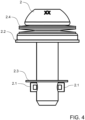
- FIGS 4 and 5 show different views of the closure element 2.
- FIGs 6 to 12 show different views of the locking bush 3.
- the locking element 2 and the locking bush 3 are described below with joint reference to the Figures 4 to 12 described, whereby in the Figures 4 to 12 For the sake of clarity, not all parts are provided with reference symbols.
- the closure element 2 comprises (in Figure 4 and 5 above) a head section with tool engagement structure (e.g. hexagon socket) and (in Figure 4 and 5 below) a shaft section.
- tool engagement structure e.g. hexagon socket
- the closure element 2 is provided with a first contact ring 2.2 and a second contact ring 2.3, between which the cover element 1 is arranged.
- the first contact ring 2.2 can expediently be designed separately from the head section or as part of the head section.
- a loading element 2.4 arranged around the shaft section serves to generate a pressure force in the direction of the cover element 1.
- an axial stroke can be compensated by the loading element 2.4, e.g. in terms of tolerances.
- the loading element 2.4 is preferably a spring, e.g. a spiral or disc spring, but can also be an elastically deformable plastic component.
- the closure bushing 3 comprises two pitch structures 3.1 for the two lugs 2.1, whereby a closing stroke of the closure element 2 can be generated.
- the two slope constructions 3.1 are essentially identical in construction, but offset by essentially 180°, so that only one slope construction 3.1 is described below.
- the slope construction 3.1 ends in a locking recess 3.5 for locking, in particular latching, the nose 2.1, whereby alternatively or additionally locking the nose 2.1 by friction is also possible.
- the slope construction 3.1 initially comprises a slope towards a high/turning point 3.2.
- the locking recess 3.5 is formed behind the further turning point 3.4.
- a stop 3.6 is formed for the nose 2.1 to limit the closing rotation movement of the closure element 2.
- the gradient construction 3.1 comprises two discontinuities through the high/turning point 3.2 and the further turning point 3.4.
- the two discontinuities 3.2 and 3.4 can be felt haptically by an operator when passing through the nose 2.1 during a rotational movement of the closure element 2. This allows the operator to haptically feel the progress of the closing process during the rotation of the closure element 2, in particular the reaching of the closed position, i.e. in particular the engagement of the nose 2.1 in the locking recess 3.5.
- discontinuities 3.2 and 3.4 are haptically perceptible by the operator as essentially abrupt transitions, whereby “smooth" transitions are also possible within the scope of the invention, e.g. through a uniform or continuous increase or decrease in the gradient of the gradient construction 3.1.
- the two lugs 2.1 also serve to pre-center the closure element 2 by shaping it, with the closure sleeve 3 having two centering openings 3.7 for this purpose.
- FIGS. 13 and 14 show sectional views of the closure element 2 and the closure sleeve 3, whereby for explanation and to avoid repetition, reference is made to the description already given.
- FIG. 15 shows a sectional view of a robot 100 with mounted locking device, which can be designed as described with reference to the Figures 1 to 14 described.
- FIG 15 For the sake of clarity, not all parts are provided with reference symbols.
- Figure 15 shows, in addition to the closure device with in particular the cover element 1, the closure element 2 and the closure bushing 3, a seal 102 designed as an air chamber seal.
- the cover element 1 serves to cover a cavity 101 of the robot 101, e.g. a cavity 101 of a robot housing or a robot arm. This makes it possible to conveniently form a pressurized enclosure.
- the seal 102 comprises two sealing lips and is arranged between the cover element 1 and the robot 100 and runs in a groove in the cover element 1.
- the seal 102 is pressed (compressed) by means of the fastening device 2, 3, so that the cavity 101 is tightly sealed despite an overpressure of up to at least approx. 200 mbar and at least no significant leakage occurs.
- the seal 102 is spaced from the fastening device 2, 3 and is shielded from the outside of the robot 100 by the cover element 1.
- the inner sealing lip ensures that the overpressure of up to 5 times the flushing pressure, in practice at least 200 mbar, does not escape to the outside.
- the outer sealing lip protects against Penetration of dirt, liquid, etc., even though the cover element 1 is already essentially tightly fitted to the robot 100 (e.g. housing or robot arm).
- the outer sealing lip thus conveniently represents redundancy and additionally protects against pressure leakage.
- the invention also includes embodiments with only one nose 2.1, only one pitch construction 3.1 and optionally only one centering opening 3.7.
Landscapes
- Engineering & Computer Science (AREA)
- General Engineering & Computer Science (AREA)
- Mechanical Engineering (AREA)
- Robotics (AREA)
- Manipulator (AREA)
- Automatic Assembly (AREA)
- Connection Of Plates (AREA)
- Bolts, Nuts, And Washers (AREA)
- Snaps, Bayonet Connections, Set Pins, And Snap Rings (AREA)
- Gasket Seals (AREA)
Claims (22)
- Robot de revêtement avec une cavité (101) qui peut être obturée de manière étanche à des surpressions de 175 mbar, 200 mbar ou 225 mbar par un élément de recouvrement démontable (1), et avec un dispositif de fermeture pouvant être monté sur le robot (100), qui comprend, pour la fixation de l'élément de recouvrement (1) au robot (100), un dispositif de fixation (2, 3) avec un élément de fermeture rotatif (2),
caractérisé en ce quele dispositif de fixation (2, 3) comprend une douille de fermeture (3) pour le logement partiel et la fixation de l'élément de fermeture (2),l'élément de fermeture (2) comprend au moins un embout (2.1), qui s'étend à partir de celui-ci et qui peut tourner avec celui-ci, qui permet la fixation de l'élément de fermeture (2) dans la douille de fermeture (3),et le dispositif de fixation (2, 3) présente un mouvement de fermeture rotatif entre 45° et 215° et peut donc être mis dans une position de fermeture par un mouvement de fermeture rotatif entre 45° et 215°. - Robot de revêtement selon la revendication 1, caractérisé en ce que le dispositif de fixation (2, 3) présente un mouvement de fermeture rotatif entre 60° et 120°, de préférence entre 80° et 100°, et peut donc être mis dans une position de fermeture par un mouvement de fermeture rotatif entre 60° et 120°, de préférence entre 80° et 100°.
- Robot de revêtement selon la revendication 1 ou 2, caractérisé en ce que l'au moins un embout (2.1) permet de pré-centrer l'élément de fermeture (2) dans la douille de fermeture (3) du dispositif de fixation (2, 3).
- Robot de revêtement selon l'une des revendications précédentes, caractérisé en ce que l'élément de fermeture (2) comprend une première bague d'appui (2.2) et une deuxième bague d'appui (2.3), entre lesquelles l'élément de recouvrement (1) peut être disposé.
- Robot de revêtement selon la revendication 3, caractérisé en ce que la douille de fermeture (3) présente au moins une structure en pente (3.1) pour l'au moins un embout (2.1), afin d'obtenir une course de fermeture de l'élément de fermeture (2).
- Robot de revêtement selon la revendication 5, caractérisé en ce que l'au moins une structure en pente (3.1) conduit à un renfoncement d'arrêt (3.5) pour l'arrêt de l'au moins un embout (2.1) et/ou l'arrêt de l'au moins un embout (2.1) dans la douille de fermeture (3) par friction.
- Robot de revêtement selon la revendication 5 ou 6, caractérisé en ce que l'au moins une structure en pente (3.1) présente une pente en direction d'un point supérieur ou d'inflexion (3.2), dans lequel l'au moins une structure en pente (3.1) présente, dans la direction de fermeture (C) de l'élément de fermeture (2), derrière le point supérieur ou d'inflexion (3.2), une portion (3.3) avec une pente réduite ou négative.
- Robot de revêtement selon l'une des revendications 5 à 7, caractérisé en ce que l'au moins une structure en pente (3.1) présente au moins une discontinuité (3.2, 3.4) qui est perceptible de manière haptique par un opérateur lors du passage de l'au moins un embout (2.1), de sorte que l'arrivée à la position de fermeture et/ou la progression d'un processus de fermeture pendant une rotation de l'élément de fermeture (2) peut être transmise de façon à être perceptible de manière haptique par l'opérateur.
- Robot de revêtement selon la revendication 8, caractérisé en ce que l'au moins une discontinuité (3.2, 3.4) est réalisée à l'aide du point supérieur ou d'inflexion (3.2) ou au moins deux discontinuités (3.2, 3.4) sont réalisées à l'aide du point supérieur ou d'inflexion (3.2) et d'un point d'inflexion supplémentaire (3.4) dans la direction de rotation de fermeture (C) de l'élément de fermeture (2) derrière la portion (3.3) et/ou dans la direction de rotation de fermeture (C) de l'élément de fermeture (2) avant le renfoncement d'arrêt (3.5).
- Robot de revêtement selon l'une des revendications 3 à 9, caractérisé en ce que, pour un opérateur, l'arrivée à la position de fermeture est perceptible de manière haptique grâce à un encliquetage de l'au moins un embout (2.1) et/ou une butée (3.6) pour l'au moins un embout (2.1).
- Robot de revêtement selon l'une des revendications 6 à 10, caractérisé en ce que le renfoncement d'arrêt (3.5) est réalisé, dans la direction de rotation de fermeture (C) de l'élément de fermeture (2), derrière le point supérieur ou d'inflexion (3.2), derrière la portion (3.3) et/ou derrière le point d'inflexion supplémentaire (3.4).
- Robot de revêtement selon l'une des revendications 3 à 11, caractérisé en ce que la douille de fermeture (3) comprend au moins une butée (3.6) pour l'au moins un embout (2.1), afin de limiter le mouvement de rotation de fermeture de l'élément de fermeture (2).
- Robot de revêtement selon l'une des revendications 3 à 12, caractérisé en ce que la douille de fermeture (3) comprend au moins une ouverture de centrage (3.7) pour l'au moins un embout (2.1), pour le pré-centrage de l'élément de fermeture (2).
- Robot de revêtement selon l'une des revendications précédentes, caractérisé en ce que le dispositif de fixation (2, 3) comprend un élément de sollicitation (2.4) pour la production d'une force en direction de l'élément de recouvrement (1) et de préférence l'élément de sollicitation (2.4) agit comme un amplificateur de force de fermeture ainsi que comme un élément de compensation de course lors de l'application d'une force.
- Robot de revêtement selon la revendication 14, caractérisé en ce que l'élément de sollicitation (2.4) comprend au moins un des éléments suivants :- un ressort,- un ressort hélicoïdal,- un ressort à lames,- une pièce en matière plastique déformable élastiquement.
- Robot de revêtement selon l'une des revendications précédentes, caractérisé par au moins une des caractéristiques suivantes :- deux embouts (2.1),- deux structures en pente (3.1),- deux ouvertures de centrage (3.6).
- Robot de revêtement selon l'une des revendications précédentes, caractérisé en ce que le dispositif de fermeture comprend un joint d'étanchéité (102) destiné à être disposé entre l'élément de recouvrement (1) et le robot (100) et le joint d'étanchéité (102) peut être comprimé et/ou déformé élastiquement au moyen du dispositif de fixation (2, 3).
- Robot de revêtement selon la revendication 17, caractérisé en ce que le joint d'étanchéité (102) est un joint d'étanchéité à chambre à air, comprend une lèvre d'étanchéité et/ou s'étend dans une rainure.
- Robot de revêtement selon la revendication 17 ou 18, caractérisé en ce que le joint d'étanchéité (102) présente, par rapport au dispositif de fixation (2, 3), une distance pour un appui suffisant du joint d'étanchéité et est isolé par rapport au côté externe du robot (100) par l'élément de recouvrement (1).
- Robot de revêtement selon l'une des revendications précédentes, caractérisé en ce que, afin d'obtenir la position de fermeture, l'élément de fermeture (2) et/ou la douille de fermeture (3) sont réalisés sans filetage.
- Robot de revêtement selon l'une des revendications précédentes, caractérisé en ce que l'élément de fermeture (2) comprend une portion de tête avec une structure d'emboîtement d'outil et une portion de tige, dans lequel au moins un embout (2) part de la portion de tige, la première bague d'appui et la deuxième bague d'appui sont disposées autour de la portion de tige et/ou l'élément de sollicitation (2.4) est disposé autour de la portion de tige.
- Robot de revêtement selon l'une des revendications précédentes, caractérisé en ce que le dispositif de fixation (2, 3) comprend un indicateur grâce à la position duquel il peut être détecté optiquement si le dispositif de fixation (2, 3) est dans la position de fermeture ou non.
Applications Claiming Priority (2)
| Application Number | Priority Date | Filing Date | Title |
|---|---|---|---|
| DE102016014660.5A DE102016014660A1 (de) | 2016-12-09 | 2016-12-09 | Verschluss-Vorrichtung zur Anbringung an einen Roboter |
| PCT/EP2017/081130 WO2018104161A1 (fr) | 2016-12-09 | 2017-12-01 | Dispositif de fermeture à monter sur un robot |
Publications (2)
| Publication Number | Publication Date |
|---|---|
| EP3551893A1 EP3551893A1 (fr) | 2019-10-16 |
| EP3551893B1 true EP3551893B1 (fr) | 2024-06-05 |
Family
ID=60782178
Family Applications (1)
| Application Number | Title | Priority Date | Filing Date |
|---|---|---|---|
| EP17818071.7A Active EP3551893B1 (fr) | 2016-12-09 | 2017-12-01 | Dispositif de fermeture à monter sur un robot de revêtement |
Country Status (7)
| Country | Link |
|---|---|
| US (1) | US12559971B2 (fr) |
| EP (1) | EP3551893B1 (fr) |
| JP (1) | JP7282033B2 (fr) |
| KR (1) | KR102598444B1 (fr) |
| CN (1) | CN110050131A (fr) |
| DE (1) | DE102016014660A1 (fr) |
| WO (1) | WO2018104161A1 (fr) |
Families Citing this family (7)
| Publication number | Priority date | Publication date | Assignee | Title |
|---|---|---|---|---|
| KR20250057106A (ko) * | 2018-12-20 | 2025-04-28 | 캔리그 로보틱스 테크놀로지스 에이에스 | 내부식성 기능이 강화된 ex 인증된 로봇 시스템 |
| WO2020126897A1 (fr) * | 2018-12-20 | 2020-06-25 | Nabors Lux 2 Sarl | Système robotique certifié pour une utilisation dans des atmosphères explosives et présentant une résistance à la corrosion améliorée |
| TWI722828B (zh) * | 2020-03-13 | 2021-03-21 | 英業達股份有限公司 | 鎖固組件 |
| CN111648887A (zh) * | 2020-04-22 | 2020-09-11 | 嘉兴宏欣汽车零部件有限公司 | 一种可快速拆卸的燃油管滤清器 |
| JP7504011B2 (ja) * | 2020-12-09 | 2024-06-21 | 株式会社安川電機 | ロボットシステム |
| US11794358B2 (en) * | 2021-08-30 | 2023-10-24 | Volvo Car Corporation | Bumper cover device for a manufacturing robot |
| CN113898252B (zh) * | 2021-09-29 | 2022-11-18 | 珠海优特电力科技股份有限公司 | 机器人及其对机柜锁的解闭锁方法以及机柜锁 |
Family Cites Families (69)
| Publication number | Priority date | Publication date | Assignee | Title |
|---|---|---|---|---|
| GB462482A (en) * | 1935-11-21 | 1937-03-10 | Harold Randolph Barnicoat | Improvements relating to fastening devices for engine cowlings, inspection covers, and like purposes |
| US2378122A (en) * | 1941-07-31 | 1945-06-12 | Camloc Fastener Corp | Fastening device |
| US2315335A (en) * | 1942-04-18 | 1943-03-30 | Mills Summers J | Fastening device |
| US2368713A (en) * | 1942-05-22 | 1945-02-06 | Camloc Fastener Corp | Fastening device |
| US2395695A (en) * | 1943-06-05 | 1946-02-26 | Camloc Fastener Corp | Water and gas proof separable fastener |
| GB590483A (en) * | 1943-10-14 | 1947-07-18 | Camlock Fastener Corp | Floating type separable fastener |
| US2406007A (en) * | 1943-10-15 | 1946-08-20 | Camloc Fastener Corp | Fastener |
| US2486670A (en) * | 1943-12-20 | 1949-11-01 | Nigg Engineering Company | Stud for cowl fasteners |
| US2601213A (en) * | 1947-12-12 | 1952-06-17 | Illinois Tool Works | Panel fastening device |
| GB646555A (en) * | 1948-06-25 | 1950-11-22 | Fairey Aviat Co Ltd | Improvements in or relating to fastening devices |
| US2839808A (en) * | 1956-02-15 | 1958-06-24 | Victor F Zahodiakin | Fastening devices |
| US3209425A (en) * | 1962-05-31 | 1965-10-05 | South Chester Corp | Fastener assembly |
| NL300147A (fr) * | 1962-11-07 | |||
| US3327363A (en) * | 1965-05-03 | 1967-06-27 | Dzus Fastener Co | Fastener and retainer assembly |
| US3709086A (en) * | 1968-11-07 | 1973-01-09 | Rex Chainbelt Inc | High strength adjustable quarter turn fastener |
| US3673913A (en) * | 1970-09-04 | 1972-07-04 | Southco | Panel fastener with expandable sleeve |
| US3811157A (en) * | 1972-10-26 | 1974-05-21 | Dzus Fastener Co | Tamper-proof fastener |
| US3802033A (en) * | 1972-12-01 | 1974-04-09 | Chainbelt Inc R | Integral clip-on receptacle |
| FR2276494A1 (fr) * | 1974-06-26 | 1976-01-23 | Citroen Sa | Dispositif destine a etre fixe rapidement sur une paroi, notamment pour servir de passage a un cable |
| DE2534375C2 (de) * | 1975-08-01 | 1983-12-22 | Brown, Boveri & Cie Ag, 6800 Mannheim | Stiftförmige Vorrichtung zum federnden Verspannen zweier Bauteile |
| US4207655A (en) * | 1977-04-25 | 1980-06-17 | Rexnord Inc. | Self-aligning quarter-turn fastener assembly |
| USD255772S (en) * | 1977-10-04 | 1980-07-08 | United Products Inc. | Quarter-turn fastener |
| US4385851A (en) * | 1980-12-31 | 1983-05-31 | Camloc Industrial Fixings (Uk) Limited | Clamping method and device |
| US4408429A (en) * | 1981-10-13 | 1983-10-11 | Neal Larry V | Plug for holes in walls |
| US4442571A (en) * | 1982-08-04 | 1984-04-17 | Dzus Fastener Co., Inc. | Self-ejecting fastener stud |
| EP0117217A1 (fr) * | 1983-02-18 | 1984-08-29 | Rexnord Inc. | Dispositif de fixation à commande positive bi-directionnelle du type à action rapide |
| US4929185A (en) * | 1989-04-03 | 1990-05-29 | Nrc Corporation | Printed circuit board assembly |
| JP2811027B2 (ja) * | 1991-05-24 | 1998-10-15 | 松下電器産業株式会社 | 電子機器筐体の蓋装置 |
| DE9110236U1 (de) * | 1991-08-19 | 1991-12-19 | Hans-Joachim Bernstein Compact-Gehäuse GmbH, 4955 Hille | Klemmengehäuse |
| KR100215538B1 (ko) * | 1992-09-18 | 1999-08-16 | 한스 퀼 | 2이상의 부재를 결합하는 장치 |
| EP0674056A1 (fr) * | 1994-03-22 | 1995-09-27 | Poly-Bauelemente AG | Dispositif de verrouillage d'une grille de recouvrement sur un caniveau d'écoulement |
| DE19530034C2 (de) * | 1995-08-16 | 1998-05-20 | Kostal Leopold Gmbh & Co Kg | Verriegelungsvorrichtung zwischen einem Deckel und einem Sockel |
| US5690460A (en) * | 1996-12-11 | 1997-11-25 | Pilgrim Screw Corporation | Fastener assembly for attaching a cover to a panel |
| JP2887668B2 (ja) * | 1997-04-28 | 1999-04-26 | タキゲン製造株式会社 | 蓋止部材及び蓋止構造 |
| US6287442B1 (en) * | 2000-05-24 | 2001-09-11 | Patent Holding Company | Injection molded thermoplastic integrated front end reinforcement and method of making same |
| JP2002127073A (ja) * | 2000-10-18 | 2002-05-08 | Honda Motor Co Ltd | 内圧防爆型ロボットのアーム構造 |
| FR2818252B1 (fr) * | 2000-12-20 | 2003-03-21 | Schneider Electric Ind Sa | Dispositif de fermeture etanche pour boitier |
| EP1220592A1 (fr) * | 2000-12-28 | 2002-07-03 | TELEFONAKTIEBOLAGET L M ERICSSON (publ) | Appareil et méthode assurant une connection électrique et flexible entre deux composants |
| ITMI20022602A1 (it) * | 2002-12-06 | 2004-06-07 | Gewiss Spa | Scatola di derivazione perfezionata, particolarmente |
| KR200332153Y1 (ko) * | 2003-07-25 | 2003-11-05 | 안준영 | 진공용기 |
| US7032708B2 (en) * | 2003-08-27 | 2006-04-25 | Russound/Fmp, Inc. | Flush mountable vibration reducing loudspeaker mounting assembly |
| FR2861783A1 (fr) * | 2003-10-30 | 2005-05-06 | Bouvet Sa Soc | Moyen elastique de rappel d'une bequille pour un ensemble de serrure de porte et ensemble de serrure de porte. |
| US7152892B2 (en) * | 2004-11-16 | 2006-12-26 | Actron Manufacturing, Inc. | Push latch |
| JP4145903B2 (ja) * | 2005-07-28 | 2008-09-03 | 内外電機株式会社 | 封印装置 |
| GB2429503B (en) * | 2005-08-24 | 2008-07-23 | Engineering Dynamics | Screw-threaded fastening devices |
| DE102006043060B4 (de) * | 2006-03-13 | 2011-07-21 | A. Raymond Et Cie | Befestigungsanordnung |
| JP2008055560A (ja) * | 2006-08-31 | 2008-03-13 | Fanuc Ltd | ロボットの関節部の密封装置及び関節ロボット |
| US7874779B2 (en) * | 2007-07-23 | 2011-01-25 | The Monadnock Company | Fasteners, fastener components and fastener receptacles |
| FR2922934B1 (fr) * | 2007-10-31 | 2012-08-24 | Tordo Belgrano Sa | Verrou pour battant. |
| GB2469855B (en) * | 2009-04-30 | 2013-05-22 | Harwin Plc | Locking apparatus for electrical connectors |
| US7997843B2 (en) * | 2009-10-19 | 2011-08-16 | Bowers Ned C | Fastener for securing together two panels |
| US8475098B2 (en) * | 2010-04-22 | 2013-07-02 | Concorde International | Accessory retaining device |
| CN202118044U (zh) * | 2011-07-08 | 2012-01-18 | 贵州航天精工制造有限公司 | 一种平圆头锁销式快卸锁 |
| GB2494474A (en) * | 2011-09-12 | 2013-03-13 | Land Rover Uk Ltd | Motor vehicle with anchor point apparatus and method |
| DE102011055591A1 (de) * | 2011-11-22 | 2013-05-23 | Pfannenberg Gmbh | Signalgerät zur Aussendung eines akustischen und/oder visuellen Signals |
| DE202011052482U1 (de) * | 2011-12-23 | 2012-01-11 | Cagent (Shanghai) Sports Goods Co., Ltd. | Schnellverbinder für Sattlereiwaren |
| PT2632002E (pt) * | 2012-02-22 | 2014-09-22 | Berker Gmbh & Co Kg | Aparelho eléctrico estanque com elemento tampão |
| JP5970921B2 (ja) * | 2012-04-02 | 2016-08-17 | セイコーエプソン株式会社 | ロボット |
| CN202684913U (zh) | 2012-07-17 | 2013-01-23 | 昆山华恒焊接股份有限公司 | 六自由度喷涂机器人 |
| EP2898574A1 (fr) | 2012-09-20 | 2015-07-29 | ABB Technology AG | Dispositif de connexion |
| DE202013004176U1 (de) * | 2013-05-06 | 2014-08-07 | GM Global Technology Operations LLC (n. d. Gesetzen des Staates Delaware) | Bajonettverschluss |
| USD747952S1 (en) * | 2013-05-25 | 2016-01-26 | Gerald E. Attanasio | Quick connect receptacle |
| JP6240956B2 (ja) * | 2013-11-05 | 2017-12-06 | 株式会社デンソーウェーブ | ロボットのカバー取付構造、及びロボット |
| US20150174740A1 (en) * | 2013-12-19 | 2015-06-25 | GM Global Technology Operations LLC | Elastic retaining assembly and method |
| CN203684982U (zh) * | 2014-01-06 | 2014-07-02 | 台山平安五金制品有限公司 | 一种大型空气闸门及其密封装置 |
| AR098441A1 (es) * | 2014-11-17 | 2016-05-26 | Ambros Rodolfo | Caja electroaislante con dos opciones de grados de hermeticidad para electricidad, computación y/o telefonía |
| US10427616B2 (en) * | 2015-12-03 | 2019-10-01 | Textron Innovations Inc. | Accessory attachment system |
| US20180051735A1 (en) * | 2016-08-22 | 2018-02-22 | Hyperloop Transportation Technologies, Inc. | Twist lock swivel / twist lock coupling |
| DE102021001649A1 (de) * | 2021-03-29 | 2022-09-29 | Mercedes-Benz Group AG | Befestigungseinrichtung zum Befestigen eines ersten Bauteils an einem zweiten Bauteil, insbesondere für ein Kraftfahrzeug |
-
2016
- 2016-12-09 DE DE102016014660.5A patent/DE102016014660A1/de not_active Ceased
-
2017
- 2017-12-01 CN CN201780075773.8A patent/CN110050131A/zh active Pending
- 2017-12-01 KR KR1020197015859A patent/KR102598444B1/ko active Active
- 2017-12-01 JP JP2019531174A patent/JP7282033B2/ja active Active
- 2017-12-01 WO PCT/EP2017/081130 patent/WO2018104161A1/fr not_active Ceased
- 2017-12-01 EP EP17818071.7A patent/EP3551893B1/fr active Active
- 2017-12-01 US US16/464,320 patent/US12559971B2/en active Active
Also Published As
| Publication number | Publication date |
|---|---|
| US20200347868A1 (en) | 2020-11-05 |
| JP7282033B2 (ja) | 2023-05-26 |
| KR20190094159A (ko) | 2019-08-12 |
| US12559971B2 (en) | 2026-02-24 |
| KR102598444B1 (ko) | 2023-11-06 |
| EP3551893A1 (fr) | 2019-10-16 |
| JP2020500731A (ja) | 2020-01-16 |
| DE102016014660A1 (de) | 2018-06-14 |
| WO2018104161A1 (fr) | 2018-06-14 |
| CN110050131A (zh) | 2019-07-23 |
Similar Documents
| Publication | Publication Date | Title |
|---|---|---|
| EP3551893B1 (fr) | Dispositif de fermeture à monter sur un robot de revêtement | |
| DE102016111324B4 (de) | Spannvorrichtung | |
| DE112014006878T5 (de) | Operationsbox und Verfahren zum Ersetzen von Handschuhen derselben | |
| EP2928034A1 (fr) | Passage de câble | |
| EP3123576B1 (fr) | Boîtier, en particulier un boîtier industriel | |
| DE102004044672A1 (de) | Scharnieraufbau und Schutzvorrichtung mit einem Scharnieraufbau | |
| DE102019206287B4 (de) | Verschließvorrichtung | |
| DE102014114568A1 (de) | Anordnung aufweisend eine Tülle zur Montage an einer Gehäusewandöffnung und Verfahren zur Montage der Tülle an der Gehäusewandöffnung | |
| DE102016116518A1 (de) | Halteadapter für die Fixierung von Befehls- und Meldegeräten sowie Anordnung | |
| DE102011013828A1 (de) | Verkleidungsübergang und Fahrzeug mit einem bewegbaren und einem feststehenden Körper mit einem Verkleidungsübergang | |
| DE102014114261A1 (de) | Schrank, insbesondere zur Aufnahme elektrischer Baugruppen | |
| EP2105186B1 (fr) | Dispositif d'aération pour une installation de traitement de l'air comprimé et procédé de démontage d'une cartouche de dessiccateur d'une installation de traitement de l'air comprimé | |
| EP3997768A1 (fr) | Passage de câbles pour armoire de commande | |
| EP2851656B1 (fr) | Boîtier pour un capteur | |
| DE102009004822B4 (de) | Korrosionsprüftruhe | |
| DE102019110945A1 (de) | Entlüftungseinrichtung für Schaltschränke | |
| DE202014100373U1 (de) | Installationsdose | |
| DE102019134807A1 (de) | Aktuator für einen pneumatischen Linearantrieb und Verfahren zur Montage des Aktuators | |
| DE202006007914U1 (de) | Wasserdichter Aufbau eines Werkzeugkastens | |
| DE102005005128A1 (de) | Dichtung für eine Abdeckung einer elektrischen Anschlussbuchse | |
| WO2019141837A1 (fr) | Système de raccord à vis coudé | |
| DE202025001382U1 (de) | Lackschutzkappen für Sprinklerköpfe | |
| DE202020102570U1 (de) | Elektropneumatisches Feldgerät | |
| DE202011104136U1 (de) | Vorrichtung zum Verschließen einer Revisonsöffnung | |
| EP2881642A1 (fr) | Couvercle de protection |
Legal Events
| Date | Code | Title | Description |
|---|---|---|---|
| STAA | Information on the status of an ep patent application or granted ep patent |
Free format text: STATUS: UNKNOWN |
|
| STAA | Information on the status of an ep patent application or granted ep patent |
Free format text: STATUS: THE INTERNATIONAL PUBLICATION HAS BEEN MADE |
|
| PUAI | Public reference made under article 153(3) epc to a published international application that has entered the european phase |
Free format text: ORIGINAL CODE: 0009012 |
|
| STAA | Information on the status of an ep patent application or granted ep patent |
Free format text: STATUS: REQUEST FOR EXAMINATION WAS MADE |
|
| 17P | Request for examination filed |
Effective date: 20190506 |
|
| AK | Designated contracting states |
Kind code of ref document: A1 Designated state(s): AL AT BE BG CH CY CZ DE DK EE ES FI FR GB GR HR HU IE IS IT LI LT LU LV MC MK MT NL NO PL PT RO RS SE SI SK SM TR |
|
| AX | Request for extension of the european patent |
Extension state: BA ME |
|
| DAV | Request for validation of the european patent (deleted) | ||
| DAX | Request for extension of the european patent (deleted) | ||
| STAA | Information on the status of an ep patent application or granted ep patent |
Free format text: STATUS: EXAMINATION IS IN PROGRESS |
|
| 17Q | First examination report despatched |
Effective date: 20210708 |
|
| P01 | Opt-out of the competence of the unified patent court (upc) registered |
Effective date: 20230512 |
|
| GRAP | Despatch of communication of intention to grant a patent |
Free format text: ORIGINAL CODE: EPIDOSNIGR1 |
|
| STAA | Information on the status of an ep patent application or granted ep patent |
Free format text: STATUS: GRANT OF PATENT IS INTENDED |
|
| INTG | Intention to grant announced |
Effective date: 20240215 |
|
| GRAS | Grant fee paid |
Free format text: ORIGINAL CODE: EPIDOSNIGR3 |
|
| GRAA | (expected) grant |
Free format text: ORIGINAL CODE: 0009210 |
|
| STAA | Information on the status of an ep patent application or granted ep patent |
Free format text: STATUS: THE PATENT HAS BEEN GRANTED |
|
| AK | Designated contracting states |
Kind code of ref document: B1 Designated state(s): AL AT BE BG CH CY CZ DE DK EE ES FI FR GB GR HR HU IE IS IT LI LT LU LV MC MK MT NL NO PL PT RO RS SE SI SK SM TR |
|
| REG | Reference to a national code |
Ref country code: GB Ref legal event code: FG4D Free format text: NOT ENGLISH |
|
| REG | Reference to a national code |
Ref country code: CH Ref legal event code: EP |
|
| REG | Reference to a national code |
Ref country code: DE Ref legal event code: R096 Ref document number: 502017016166 Country of ref document: DE |
|
| REG | Reference to a national code |
Ref country code: IE Ref legal event code: FG4D Free format text: LANGUAGE OF EP DOCUMENT: GERMAN |
|
| REG | Reference to a national code |
Ref country code: LT Ref legal event code: MG9D |
|
| PG25 | Lapsed in a contracting state [announced via postgrant information from national office to epo] |
Ref country code: BG Free format text: LAPSE BECAUSE OF FAILURE TO SUBMIT A TRANSLATION OF THE DESCRIPTION OR TO PAY THE FEE WITHIN THE PRESCRIBED TIME-LIMIT Effective date: 20240605 |
|
| REG | Reference to a national code |
Ref country code: NL Ref legal event code: MP Effective date: 20240605 |
|
| PG25 | Lapsed in a contracting state [announced via postgrant information from national office to epo] |
Ref country code: FI Free format text: LAPSE BECAUSE OF FAILURE TO SUBMIT A TRANSLATION OF THE DESCRIPTION OR TO PAY THE FEE WITHIN THE PRESCRIBED TIME-LIMIT Effective date: 20240605 Ref country code: HR Free format text: LAPSE BECAUSE OF FAILURE TO SUBMIT A TRANSLATION OF THE DESCRIPTION OR TO PAY THE FEE WITHIN THE PRESCRIBED TIME-LIMIT Effective date: 20240605 |
|
| PG25 | Lapsed in a contracting state [announced via postgrant information from national office to epo] |
Ref country code: GR Free format text: LAPSE BECAUSE OF FAILURE TO SUBMIT A TRANSLATION OF THE DESCRIPTION OR TO PAY THE FEE WITHIN THE PRESCRIBED TIME-LIMIT Effective date: 20240906 |
|
| PG25 | Lapsed in a contracting state [announced via postgrant information from national office to epo] |
Ref country code: ES Free format text: LAPSE BECAUSE OF FAILURE TO SUBMIT A TRANSLATION OF THE DESCRIPTION OR TO PAY THE FEE WITHIN THE PRESCRIBED TIME-LIMIT Effective date: 20240605 |
|
| PG25 | Lapsed in a contracting state [announced via postgrant information from national office to epo] |
Ref country code: LV Free format text: LAPSE BECAUSE OF FAILURE TO SUBMIT A TRANSLATION OF THE DESCRIPTION OR TO PAY THE FEE WITHIN THE PRESCRIBED TIME-LIMIT Effective date: 20240605 |
|
| PG25 | Lapsed in a contracting state [announced via postgrant information from national office to epo] |
Ref country code: LV Free format text: LAPSE BECAUSE OF FAILURE TO SUBMIT A TRANSLATION OF THE DESCRIPTION OR TO PAY THE FEE WITHIN THE PRESCRIBED TIME-LIMIT Effective date: 20240605 Ref country code: HR Free format text: LAPSE BECAUSE OF FAILURE TO SUBMIT A TRANSLATION OF THE DESCRIPTION OR TO PAY THE FEE WITHIN THE PRESCRIBED TIME-LIMIT Effective date: 20240605 Ref country code: GR Free format text: LAPSE BECAUSE OF FAILURE TO SUBMIT A TRANSLATION OF THE DESCRIPTION OR TO PAY THE FEE WITHIN THE PRESCRIBED TIME-LIMIT Effective date: 20240906 Ref country code: FI Free format text: LAPSE BECAUSE OF FAILURE TO SUBMIT A TRANSLATION OF THE DESCRIPTION OR TO PAY THE FEE WITHIN THE PRESCRIBED TIME-LIMIT Effective date: 20240605 Ref country code: ES Free format text: LAPSE BECAUSE OF FAILURE TO SUBMIT A TRANSLATION OF THE DESCRIPTION OR TO PAY THE FEE WITHIN THE PRESCRIBED TIME-LIMIT Effective date: 20240605 Ref country code: BG Free format text: LAPSE BECAUSE OF FAILURE TO SUBMIT A TRANSLATION OF THE DESCRIPTION OR TO PAY THE FEE WITHIN THE PRESCRIBED TIME-LIMIT Effective date: 20240605 Ref country code: RS Free format text: LAPSE BECAUSE OF FAILURE TO SUBMIT A TRANSLATION OF THE DESCRIPTION OR TO PAY THE FEE WITHIN THE PRESCRIBED TIME-LIMIT Effective date: 20240905 |
|
| PG25 | Lapsed in a contracting state [announced via postgrant information from national office to epo] |
Ref country code: NL Free format text: LAPSE BECAUSE OF FAILURE TO SUBMIT A TRANSLATION OF THE DESCRIPTION OR TO PAY THE FEE WITHIN THE PRESCRIBED TIME-LIMIT Effective date: 20240605 |
|
| PG25 | Lapsed in a contracting state [announced via postgrant information from national office to epo] |
Ref country code: NL Free format text: LAPSE BECAUSE OF FAILURE TO SUBMIT A TRANSLATION OF THE DESCRIPTION OR TO PAY THE FEE WITHIN THE PRESCRIBED TIME-LIMIT Effective date: 20240605 |
|
| PG25 | Lapsed in a contracting state [announced via postgrant information from national office to epo] |
Ref country code: PT Free format text: LAPSE BECAUSE OF FAILURE TO SUBMIT A TRANSLATION OF THE DESCRIPTION OR TO PAY THE FEE WITHIN THE PRESCRIBED TIME-LIMIT Effective date: 20241007 |
|
| PG25 | Lapsed in a contracting state [announced via postgrant information from national office to epo] |
Ref country code: PT Free format text: LAPSE BECAUSE OF FAILURE TO SUBMIT A TRANSLATION OF THE DESCRIPTION OR TO PAY THE FEE WITHIN THE PRESCRIBED TIME-LIMIT Effective date: 20241007 |
|
| PG25 | Lapsed in a contracting state [announced via postgrant information from national office to epo] |
Ref country code: PL Free format text: LAPSE BECAUSE OF FAILURE TO SUBMIT A TRANSLATION OF THE DESCRIPTION OR TO PAY THE FEE WITHIN THE PRESCRIBED TIME-LIMIT Effective date: 20240605 |
|
| PG25 | Lapsed in a contracting state [announced via postgrant information from national office to epo] |
Ref country code: EE Free format text: LAPSE BECAUSE OF FAILURE TO SUBMIT A TRANSLATION OF THE DESCRIPTION OR TO PAY THE FEE WITHIN THE PRESCRIBED TIME-LIMIT Effective date: 20240605 |
|
| PG25 | Lapsed in a contracting state [announced via postgrant information from national office to epo] |
Ref country code: IS Free format text: LAPSE BECAUSE OF FAILURE TO SUBMIT A TRANSLATION OF THE DESCRIPTION OR TO PAY THE FEE WITHIN THE PRESCRIBED TIME-LIMIT Effective date: 20241005 |
|
| PG25 | Lapsed in a contracting state [announced via postgrant information from national office to epo] |
Ref country code: CZ Free format text: LAPSE BECAUSE OF FAILURE TO SUBMIT A TRANSLATION OF THE DESCRIPTION OR TO PAY THE FEE WITHIN THE PRESCRIBED TIME-LIMIT Effective date: 20240605 |
|
| PG25 | Lapsed in a contracting state [announced via postgrant information from national office to epo] |
Ref country code: RO Free format text: LAPSE BECAUSE OF FAILURE TO SUBMIT A TRANSLATION OF THE DESCRIPTION OR TO PAY THE FEE WITHIN THE PRESCRIBED TIME-LIMIT Effective date: 20240605 Ref country code: SK Free format text: LAPSE BECAUSE OF FAILURE TO SUBMIT A TRANSLATION OF THE DESCRIPTION OR TO PAY THE FEE WITHIN THE PRESCRIBED TIME-LIMIT Effective date: 20240605 |
|
| PG25 | Lapsed in a contracting state [announced via postgrant information from national office to epo] |
Ref country code: SM Free format text: LAPSE BECAUSE OF FAILURE TO SUBMIT A TRANSLATION OF THE DESCRIPTION OR TO PAY THE FEE WITHIN THE PRESCRIBED TIME-LIMIT Effective date: 20240605 |
|
| PG25 | Lapsed in a contracting state [announced via postgrant information from national office to epo] |
Ref country code: SM Free format text: LAPSE BECAUSE OF FAILURE TO SUBMIT A TRANSLATION OF THE DESCRIPTION OR TO PAY THE FEE WITHIN THE PRESCRIBED TIME-LIMIT Effective date: 20240605 Ref country code: SK Free format text: LAPSE BECAUSE OF FAILURE TO SUBMIT A TRANSLATION OF THE DESCRIPTION OR TO PAY THE FEE WITHIN THE PRESCRIBED TIME-LIMIT Effective date: 20240605 Ref country code: RO Free format text: LAPSE BECAUSE OF FAILURE TO SUBMIT A TRANSLATION OF THE DESCRIPTION OR TO PAY THE FEE WITHIN THE PRESCRIBED TIME-LIMIT Effective date: 20240605 Ref country code: PL Free format text: LAPSE BECAUSE OF FAILURE TO SUBMIT A TRANSLATION OF THE DESCRIPTION OR TO PAY THE FEE WITHIN THE PRESCRIBED TIME-LIMIT Effective date: 20240605 Ref country code: IS Free format text: LAPSE BECAUSE OF FAILURE TO SUBMIT A TRANSLATION OF THE DESCRIPTION OR TO PAY THE FEE WITHIN THE PRESCRIBED TIME-LIMIT Effective date: 20241005 Ref country code: EE Free format text: LAPSE BECAUSE OF FAILURE TO SUBMIT A TRANSLATION OF THE DESCRIPTION OR TO PAY THE FEE WITHIN THE PRESCRIBED TIME-LIMIT Effective date: 20240605 Ref country code: CZ Free format text: LAPSE BECAUSE OF FAILURE TO SUBMIT A TRANSLATION OF THE DESCRIPTION OR TO PAY THE FEE WITHIN THE PRESCRIBED TIME-LIMIT Effective date: 20240605 |
|
| PG25 | Lapsed in a contracting state [announced via postgrant information from national office to epo] |
Ref country code: IT Free format text: LAPSE BECAUSE OF FAILURE TO SUBMIT A TRANSLATION OF THE DESCRIPTION OR TO PAY THE FEE WITHIN THE PRESCRIBED TIME-LIMIT Effective date: 20240605 |
|
| REG | Reference to a national code |
Ref country code: DE Ref legal event code: R097 Ref document number: 502017016166 Country of ref document: DE |
|
| PLBE | No opposition filed within time limit |
Free format text: ORIGINAL CODE: 0009261 |
|
| STAA | Information on the status of an ep patent application or granted ep patent |
Free format text: STATUS: NO OPPOSITION FILED WITHIN TIME LIMIT |
|
| PG25 | Lapsed in a contracting state [announced via postgrant information from national office to epo] |
Ref country code: DK Free format text: LAPSE BECAUSE OF FAILURE TO SUBMIT A TRANSLATION OF THE DESCRIPTION OR TO PAY THE FEE WITHIN THE PRESCRIBED TIME-LIMIT Effective date: 20240605 |
|
| 26N | No opposition filed |
Effective date: 20250306 |
|
| PG25 | Lapsed in a contracting state [announced via postgrant information from national office to epo] |
Ref country code: MC Free format text: LAPSE BECAUSE OF FAILURE TO SUBMIT A TRANSLATION OF THE DESCRIPTION OR TO PAY THE FEE WITHIN THE PRESCRIBED TIME-LIMIT Effective date: 20240605 |
|
| REG | Reference to a national code |
Ref country code: CH Ref legal event code: PL |
|
| GBPC | Gb: european patent ceased through non-payment of renewal fee |
Effective date: 20241201 |
|
| PG25 | Lapsed in a contracting state [announced via postgrant information from national office to epo] |
Ref country code: SE Free format text: LAPSE BECAUSE OF FAILURE TO SUBMIT A TRANSLATION OF THE DESCRIPTION OR TO PAY THE FEE WITHIN THE PRESCRIBED TIME-LIMIT Effective date: 20240605 |
|
| REG | Reference to a national code |
Ref country code: BE Ref legal event code: MM Effective date: 20241231 |
|
| PG25 | Lapsed in a contracting state [announced via postgrant information from national office to epo] |
Ref country code: BE Free format text: LAPSE BECAUSE OF NON-PAYMENT OF DUE FEES Effective date: 20241231 Ref country code: GB Free format text: LAPSE BECAUSE OF NON-PAYMENT OF DUE FEES Effective date: 20241201 |
|
| PG25 | Lapsed in a contracting state [announced via postgrant information from national office to epo] |
Ref country code: FR Free format text: LAPSE BECAUSE OF NON-PAYMENT OF DUE FEES Effective date: 20241231 |
|
| PG25 | Lapsed in a contracting state [announced via postgrant information from national office to epo] |
Ref country code: CH Free format text: LAPSE BECAUSE OF NON-PAYMENT OF DUE FEES Effective date: 20241231 |
|
| PG25 | Lapsed in a contracting state [announced via postgrant information from national office to epo] |
Ref country code: IE Free format text: LAPSE BECAUSE OF NON-PAYMENT OF DUE FEES Effective date: 20241201 |
|
| PGFP | Annual fee paid to national office [announced via postgrant information from national office to epo] |
Ref country code: DE Payment date: 20251211 Year of fee payment: 9 |
|
| PGFP | Annual fee paid to national office [announced via postgrant information from national office to epo] |
Ref country code: LU Payment date: 20251219 Year of fee payment: 9 |
|
| REG | Reference to a national code |
Ref country code: AT Ref legal event code: MM01 Ref document number: 1692643 Country of ref document: AT Kind code of ref document: T Effective date: 20241201 |
|
| PG25 | Lapsed in a contracting state [announced via postgrant information from national office to epo] |
Ref country code: CY Free format text: LAPSE BECAUSE OF FAILURE TO SUBMIT A TRANSLATION OF THE DESCRIPTION OR TO PAY THE FEE WITHIN THE PRESCRIBED TIME-LIMIT; INVALID AB INITIO Effective date: 20171201 |
|
| PGFP | Annual fee paid to national office [announced via postgrant information from national office to epo] |
Ref country code: NO Payment date: 20251230 Year of fee payment: 9 |
|
| PG25 | Lapsed in a contracting state [announced via postgrant information from national office to epo] |
Ref country code: AT Free format text: LAPSE BECAUSE OF NON-PAYMENT OF DUE FEES Effective date: 20241201 |