EP3551893B1 - Closure device for attaching to a coating robot - Google Patents
Closure device for attaching to a coating robot Download PDFInfo
- Publication number
- EP3551893B1 EP3551893B1 EP17818071.7A EP17818071A EP3551893B1 EP 3551893 B1 EP3551893 B1 EP 3551893B1 EP 17818071 A EP17818071 A EP 17818071A EP 3551893 B1 EP3551893 B1 EP 3551893B1
- Authority
- EP
- European Patent Office
- Prior art keywords
- closure
- robot according
- coating robot
- nose
- closure element
- Prior art date
- Legal status (The legal status is an assumption and is not a legal conclusion. Google has not performed a legal analysis and makes no representation as to the accuracy of the status listed.)
- Active
Links
Images




Classifications
-
- E—FIXED CONSTRUCTIONS
- E05—LOCKS; KEYS; WINDOW OR DOOR FITTINGS; SAFES
- E05B—LOCKS; ACCESSORIES THEREFOR; HANDCUFFS
- E05B17/00—Accessories in connection with locks
- E05B17/20—Means independent of the locking mechanism for preventing unauthorised opening, e.g. for securing the bolt in the fastening position
- E05B17/2007—Securing, deadlocking or "dogging" the bolt in the fastening position
- E05B17/203—Securing, deadlocking or "dogging" the bolt in the fastening position not following the movement of the bolt
- E05B17/2042—Securing, deadlocking or "dogging" the bolt in the fastening position not following the movement of the bolt moving otherwise than only rectilinearly and only pivotally or rotatively
- E05B17/2046—Securing, deadlocking or "dogging" the bolt in the fastening position not following the movement of the bolt moving otherwise than only rectilinearly and only pivotally or rotatively performing both movements simultaneously, e.g. screwing
-
- F—MECHANICAL ENGINEERING; LIGHTING; HEATING; WEAPONS; BLASTING
- F16—ENGINEERING ELEMENTS AND UNITS; GENERAL MEASURES FOR PRODUCING AND MAINTAINING EFFECTIVE FUNCTIONING OF MACHINES OR INSTALLATIONS; THERMAL INSULATION IN GENERAL
- F16B—DEVICES FOR FASTENING OR SECURING CONSTRUCTIONAL ELEMENTS OR MACHINE PARTS TOGETHER, e.g. NAILS, BOLTS, CIRCLIPS, CLAMPS, CLIPS OR WEDGES; JOINTS OR JOINTING
- F16B5/00—Joining sheets or plates, e.g. panels, to one another or to strips or bars parallel to them
- F16B5/10—Joining sheets or plates, e.g. panels, to one another or to strips or bars parallel to them by means of bayonet connections
-
- F—MECHANICAL ENGINEERING; LIGHTING; HEATING; WEAPONS; BLASTING
- F16—ENGINEERING ELEMENTS AND UNITS; GENERAL MEASURES FOR PRODUCING AND MAINTAINING EFFECTIVE FUNCTIONING OF MACHINES OR INSTALLATIONS; THERMAL INSULATION IN GENERAL
- F16B—DEVICES FOR FASTENING OR SECURING CONSTRUCTIONAL ELEMENTS OR MACHINE PARTS TOGETHER, e.g. NAILS, BOLTS, CIRCLIPS, CLAMPS, CLIPS OR WEDGES; JOINTS OR JOINTING
- F16B21/00—Means for preventing relative axial movement of a pin, spigot, shaft or the like and a member surrounding it; Stud-and-socket releasable fastenings
- F16B21/02—Releasable fastening devices locking by rotation
- F16B21/04—Releasable fastening devices locking by rotation with bayonet catch
-
- B—PERFORMING OPERATIONS; TRANSPORTING
- B25—HAND TOOLS; PORTABLE POWER-DRIVEN TOOLS; MANIPULATORS
- B25J—MANIPULATORS; CHAMBERS PROVIDED WITH MANIPULATION DEVICES
- B25J11/00—Manipulators not otherwise provided for
- B25J11/0075—Manipulators for painting or coating
-
- B—PERFORMING OPERATIONS; TRANSPORTING
- B25—HAND TOOLS; PORTABLE POWER-DRIVEN TOOLS; MANIPULATORS
- B25J—MANIPULATORS; CHAMBERS PROVIDED WITH MANIPULATION DEVICES
- B25J19/00—Accessories fitted to manipulators, e.g. for monitoring, for viewing; Safety devices combined with or specially adapted for use in connection with manipulators
- B25J19/0075—Means for protecting the manipulator from its environment or vice versa
-
- E—FIXED CONSTRUCTIONS
- E05—LOCKS; KEYS; WINDOW OR DOOR FITTINGS; SAFES
- E05B—LOCKS; ACCESSORIES THEREFOR; HANDCUFFS
- E05B41/00—Locks with visible indication as to whether the lock is locked or unlocked
-
- E—FIXED CONSTRUCTIONS
- E05—LOCKS; KEYS; WINDOW OR DOOR FITTINGS; SAFES
- E05C—BOLTS OR FASTENING DEVICES FOR WINGS, SPECIALLY FOR DOORS OR WINDOWS
- E05C3/00—Fastening devices with bolts moving pivotally or rotatively
- E05C3/12—Fastening devices with bolts moving pivotally or rotatively with latching action
- E05C3/14—Fastening devices with bolts moving pivotally or rotatively with latching action with operating handle or equivalent member rigid with the latch
-
- F—MECHANICAL ENGINEERING; LIGHTING; HEATING; WEAPONS; BLASTING
- F16—ENGINEERING ELEMENTS AND UNITS; GENERAL MEASURES FOR PRODUCING AND MAINTAINING EFFECTIVE FUNCTIONING OF MACHINES OR INSTALLATIONS; THERMAL INSULATION IN GENERAL
- F16B—DEVICES FOR FASTENING OR SECURING CONSTRUCTIONAL ELEMENTS OR MACHINE PARTS TOGETHER, e.g. NAILS, BOLTS, CIRCLIPS, CLAMPS, CLIPS OR WEDGES; JOINTS OR JOINTING
- F16B21/00—Means for preventing relative axial movement of a pin, spigot, shaft or the like and a member surrounding it; Stud-and-socket releasable fastenings
- F16B21/02—Releasable fastening devices locking by rotation
-
- F—MECHANICAL ENGINEERING; LIGHTING; HEATING; WEAPONS; BLASTING
- F16—ENGINEERING ELEMENTS AND UNITS; GENERAL MEASURES FOR PRODUCING AND MAINTAINING EFFECTIVE FUNCTIONING OF MACHINES OR INSTALLATIONS; THERMAL INSULATION IN GENERAL
- F16B—DEVICES FOR FASTENING OR SECURING CONSTRUCTIONAL ELEMENTS OR MACHINE PARTS TOGETHER, e.g. NAILS, BOLTS, CIRCLIPS, CLAMPS, CLIPS OR WEDGES; JOINTS OR JOINTING
- F16B5/00—Joining sheets or plates, e.g. panels, to one another or to strips or bars parallel to them
- F16B5/02—Joining sheets or plates, e.g. panels, to one another or to strips or bars parallel to them by means of fastening members using screw-thread
- F16B5/0208—Joining sheets or plates, e.g. panels, to one another or to strips or bars parallel to them by means of fastening members using screw-thread using panel fasteners, i.e. permanent attachments allowing for quick assembly
-
- Y—GENERAL TAGGING OF NEW TECHNOLOGICAL DEVELOPMENTS; GENERAL TAGGING OF CROSS-SECTIONAL TECHNOLOGIES SPANNING OVER SEVERAL SECTIONS OF THE IPC; TECHNICAL SUBJECTS COVERED BY FORMER USPC CROSS-REFERENCE ART COLLECTIONS [XRACs] AND DIGESTS
- Y10—TECHNICAL SUBJECTS COVERED BY FORMER USPC
- Y10T—TECHNICAL SUBJECTS COVERED BY FORMER US CLASSIFICATION
- Y10T292/00—Closure fasteners
- Y10T292/08—Bolts
- Y10T292/1039—Swinging and camming
-
- Y—GENERAL TAGGING OF NEW TECHNOLOGICAL DEVELOPMENTS; GENERAL TAGGING OF CROSS-SECTIONAL TECHNOLOGIES SPANNING OVER SEVERAL SECTIONS OF THE IPC; TECHNICAL SUBJECTS COVERED BY FORMER USPC CROSS-REFERENCE ART COLLECTIONS [XRACs] AND DIGESTS
- Y10—TECHNICAL SUBJECTS COVERED BY FORMER USPC
- Y10T—TECHNICAL SUBJECTS COVERED BY FORMER US CLASSIFICATION
- Y10T292/00—Closure fasteners
- Y10T292/08—Bolts
- Y10T292/1099—Screw
Definitions
- the invention relates to a coating robot with a closure device that can be attached to the robot, preferably a quick-closing device that serves to seal a cavity of the robot in a pressure-tight manner, up to at least 175, 200 or 225 mbar.
- the robot is, for example, a painting or coating robot.
- Industrial robots usually have robot housings or robot arms with hollow spaces. For optimal rigidity and weight distribution, most of the material of the robot housings and robot arms is arranged in such a way that the force and moment curve is used via an external support structure.
- the cavities are usually accessible from the outside and are sometimes used to route cables, accommodate components (e.g. motors, gears, etc.).
- a major challenge is to develop robots, especially painting robots, in such a way that country-specific explosion protection requirements are met.
- Other required components such as drives, motors, plugs, terminals, etc., can also be positioned in the same rooms.
- covers are usually equipped with flexible seals.
- a major challenge in creating pressure-tight cavities is that the seals are not dissolved or swell when the robots are cleaned with solvents or cleaning agents and that any paint residues that may be present do not enter gaps and thereby additionally stick the seals.
- One goal is to flush a robot with an air volume of 200 liters and various branched air areas with air or inert gas in less than 3 minutes.
- covers are usually attached to the robots with screws. Depending on the size of the cover, up to 20 or even more than 20 screws are usually used. Depending on the size, a cover usually has to be held with 2 hands, while a second operator attempts to screw in the screws one after the other in different steps. It is important to note that all screws must be attached to the corresponding thread. Since the thread is usually not visible, a certain amount of practice, skill and experience is required from the operator. The screws are usually only tightened provisionally at first. Afterwards, all screws are usually tightened one after the other with a nominal torque and checked again. If, for example, a thread is damaged when tightening the screw, the damaged thread must be replaced or repaired, if at all possible.
- the screw-based assembly process not only takes a lot of time and often two operators, but also requires a certain amount of practice, experience and skill.
- seals are often glued on the covers to prevent them from slipping when the screws are tightened.
- the contact surface for the flat seal is usually relatively small.
- the seal is weakened in the area of the screws by the screw holes. Holes for the screws are usually punched freely and penetrate the seals. If the seal is slightly worn, leaks usually occur in the area of the screws.
- Some flat seals often age due to excessive pressure as a result of incorrect cover assembly and at the same time due to contact in the edge area with solvents and UV exposure.
- Closure devices for different purposes, but not for closing a cavity of a coating robot, are known from GB 2 257 461 A , WO 2009/015162 A as well as FR 2 818 252 A .
- CN 202684913 U discloses a coating robot with an overpressure sensor which is arranged in the robot base in an explosion-proof manner.
- One object of the invention is to create a closure device for attachment to a robot, which enables a simple, quick and secure, in particular pressure-tight, covering and in particular sealing of a cavity of a robot.
- at least one, but preferably all of the above-mentioned criteria A to N should be able to be met.
- the invention relates to a closure device for attachment to a robot, preferably for the pressure-tight closure of a cavity of the robot up to an overpressure of at least 175 mbar, 200 mbar or 225 mbar, preferably without significant leakage, in particular up to at least 5 times the flushing pressure.
- the locking device is preferably designed as a quick-release device.
- the robot is a coating robot.
- the closure device comprises a conveniently removable cover element (e.g. cover and/or housing plate) for covering a cavity of the robot (e.g. a housing or arm of the robot) and a fastening device for fastening the cover element to the robot.
- the fastening device comprises a rotatable closure element (e.g. locking bolt).
- the fastening device can preferably also comprise a locking bushing for the closure element.
- the fastening device is characterized in particular by the fact that it has a rotary closing movement between 45° and 215° and can thus be brought into a preferably latchable and/or frictionally fixable closed position by a rotary closing movement between 45° and 215°.
- the fastening device thus enables in particular the realization of a securely closing quick-release device.
- the fastening device has a rotary closing movement between 60° and 120°, preferably 80° and 100°, and thus by a rotary closing movement between 60° and 120°, preferably 80° and 100°, into a closed position.
- the closure element has at least one nose, wherein the at least one nose can be rotated together with the closure element.
- the at least one nose serves for fastening in the closure bushing of the fastening device.
- the at least one nose can preferably serve for pre-centering the closure element, in particular by means of a shape. The at least one nose can therefore make it possible for the closure element to find the correct alignment relative to the closure bushing itself by means of a shape with the help of pre-centering.
- the closure element prefferably has a first contact ring and/or a second contact ring, between which the cover element can be arranged.
- the first and/or second contact ring can, for example, be essentially circular, essentially square or rectangular, etc. and can optionally be closed or open or slotted in the circumferential direction ("slotted ring").
- the fastening device has a locking bushing for receiving and fastening the locking element in sections.
- the locking mechanism can preferably be mounted on or in the robot, preferably robot-proof, but preferably replaceable.
- the closure bushing can in particular have at least one gradient construction (e.g. ramp construction) for the at least have a nose to produce a closing stroke of the closure element.
- gradient construction e.g. ramp construction
- a locking position that can be locked in place and/or fixed by friction is particularly possible.
- the at least one slope construction can, for example, lead to a locking recess (e.g. a latching recess) for locking (e.g. latching) the at least one lug.
- a locking recess e.g. a latching recess
- locking of the at least one lug in the locking sleeve can be achieved by friction.
- the at least one gradient structure can have a gradient towards a high or turning point (e.g. bend point).
- the at least one gradient structure can, for example, have a section with a reduced or negative gradient behind the high or turning point in the closing rotation direction of the closure element.
- the at least one gradient construction can, for example, have at least one discontinuity (e.g. a high, low and/or turning point and alternatively or additionally an increase in gradient and/or decrease in gradient) which is haptically perceptible to an operator when passing the at least one nose.
- This can, for example, make it possible for the operator to be able to haptically sense that the locking position has been reached (e.g. a click-in) and/or the progress of the closing process during the rotation of the locking element.
- the at least one slope construction may preferably have at least two discontinuities.
- the at least two discontinuities can be formed, for example, by the high or turning point and an additional turning point (e.g. kink point) in the closing rotation direction of the closure element behind the partial area and/or in the closing rotation direction of the closure element in front of the locking recess.
- an additional turning point e.g. kink point
- an operator can haptically sense when the locking position is reached by the at least one lug engaging and/or a stop for the at least one lug.
- the locking recess can preferably be formed behind the high or turning point, behind the partial section and/or behind the additional turning point in the closing rotation direction of the closure element.
- the closure bushing can have at least one stop for the at least one nose, in particular for limiting the closing rotational movement of the closure element.
- the stop preferably limits the at least one pitch structure in the closing rotational direction of the closure element.
- the closure bushing can comprise at least one centering opening for the at least one nose for pre-centering the closure element.
- an inlet opening of the closure bushing can be formed non-circularly and/or rotationally asymmetrically by means of the at least one centering opening.
- the fastening device can, for example, comprise a loading element for generating a supplementary pressure force in the direction of the cover element and thus in particular in the direction of the robot.
- the loading element thus preferably serves as a closing force amplifier and as a compensating element. to compensate for the minimally reduced stroke after "exceeding" the turning point described above in lines 28 and 30
- the loading element can comprise, for example, a spring, a spiral spring, a disc spring and/or an elastically deformable plastic component.
- two lugs, two pitch structures and/or two centering openings are provided, which are preferably each oriented in opposite directions, e.g. offset by substantially 180°.
- the closure device may comprise, for example, an elastic seal for arrangement between the cover element and the robot (e.g. robot housing, robot arm, etc.) and the seal can be pressed by means of the fastening device.
- an elastic seal for arrangement between the cover element and the robot (e.g. robot housing, robot arm, etc.) and the seal can be pressed by means of the fastening device.
- the seal is preferably a plastic seal, e.g. made of an elastic material.
- the seal prefferably be an air chamber seal, to have at least one sealing lip and/or to run in a groove.
- the groove can be formed in the cover element and/or in the robot.
- closure element and/or the closure bushing can preferably be designed without a thread in order to achieve the closure position.
- the seal can, for example, be arranged at a distance from the fastening device and/or be shielded from the outside of the robot by the cover element.
- closure element has a head portion with a tool engagement structure (e.g. 3-edge, 4-edge, 5-edge or 6-edge or other suitable shapes).
- a tool engagement structure e.g. 3-edge, 4-edge, 5-edge or 6-edge or other suitable shapes.
- the closure element has a shaft portion, wherein the at least one nose protrudes from the shaft portion, the first abutment ring and/or the second abutment ring is arranged around the shaft portion, and/or the loading element is arranged around the shaft portion.
- the fastening device can, for example, have an indicator whose position makes it possible to visually determine whether the fastening device is in the closed position or not.
- the closure device is preferably designed to form a pressurized enclosure.
- the cover element is used in particular to cover a cavity of the robot, e.g. to cover and/or close a robot arm or robot housing.
- the at least one discontinuity, the high point and/or the turning point can preferably be designed in the form of a bend or a threshold, e.g. in order to be haptically perceived by an operator as an essentially abrupt transition.
- the at least one discontinuity, the high point and/or the turning point can also be expediently realized by an increase in gradient and/or decrease in gradient, e.g. in order to be haptically perceived by the operator as an essentially "smoother" (e.g. even, smooth, curved and/or non-bent) transition.
- the fastening device can preferably be closed by a clockwise turning closing movement and opened by a counterclockwise turning opening movement, although the reverse variant is also possible.
- the cavity can, for example, be part of a pressurized enclosure.
- the invention also includes a robot, preferably a painting or coating robot, with at least one closure device as disclosed herein.
- closure device with the cover element serves to cover and pressure-tightly close a robot arm or robot housing, so that, for example, a pressurized enclosure can be formed.
- Figure 1 shows a perspective view of a robot 100, in particular a painting or coating robot 100, with a closure device according to an embodiment of the invention and with a cover element 1 mounted on the robot 100.
- Figure 2 shows the robot 100 with the cover element 1 removed, where Figure 3 shows a perspective view of the cover element 1.
- the closure device is described below with common reference to the Figures 1 to 3 described.
- the closure device is designed as a quick-closing device and is used in particular for sealing and covering a cavity 101 of the robot 100 (e.g. a robot housing or a robot arm) with an overpressure of at least 200 mbar.
- the cover element 1 is attached to the robot 100 by means of six fastening devices 2, 3. For the purposes of clarity, the Figure 1 to 3 only two fastening devices are provided with reference symbols.
- the fastening device 2, 3 comprises a rotatable closure element (closure bolt) 2 and a closure bushing 3 mounted on or in the robot 100 for the closure element 2, in particular for receiving and fastening the closure element 2 in sections.
- the fastening device 2, 3 has a rotary closing movement of essentially 90°, so that it can be brought into a closed position by a rotary closing movement of essentially 90°.
- a rotary closing movement of essentially 90° can, for example, produce a closing stroke of approximately 3mm.
- the assembly process of the cover element 1 is essentially as follows: The cover element 1 is placed by an operator (worker) with two hands on the robot 100, in particular a housing or robot arm of the robot 100. The operator then holds the cover element 1 with one hand on the robot 100 and then gradually closes the six closure elements 2 with the other hand with an approx. 90° rotation. The entire closing process can be carried out in less than 30 seconds.
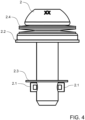
- FIGS 4 and 5 show different views of the closure element 2.
- FIGs 6 to 12 show different views of the locking bush 3.
- the locking element 2 and the locking bush 3 are described below with joint reference to the Figures 4 to 12 described, whereby in the Figures 4 to 12 For the sake of clarity, not all parts are provided with reference symbols.
- the closure element 2 comprises (in Figure 4 and 5 above) a head section with tool engagement structure (e.g. hexagon socket) and (in Figure 4 and 5 below) a shaft section.
- tool engagement structure e.g. hexagon socket
- the closure element 2 is provided with a first contact ring 2.2 and a second contact ring 2.3, between which the cover element 1 is arranged.
- the first contact ring 2.2 can expediently be designed separately from the head section or as part of the head section.
- a loading element 2.4 arranged around the shaft section serves to generate a pressure force in the direction of the cover element 1.
- an axial stroke can be compensated by the loading element 2.4, e.g. in terms of tolerances.
- the loading element 2.4 is preferably a spring, e.g. a spiral or disc spring, but can also be an elastically deformable plastic component.
- the closure bushing 3 comprises two pitch structures 3.1 for the two lugs 2.1, whereby a closing stroke of the closure element 2 can be generated.
- the two slope constructions 3.1 are essentially identical in construction, but offset by essentially 180°, so that only one slope construction 3.1 is described below.
- the slope construction 3.1 ends in a locking recess 3.5 for locking, in particular latching, the nose 2.1, whereby alternatively or additionally locking the nose 2.1 by friction is also possible.
- the slope construction 3.1 initially comprises a slope towards a high/turning point 3.2.
- the locking recess 3.5 is formed behind the further turning point 3.4.
- a stop 3.6 is formed for the nose 2.1 to limit the closing rotation movement of the closure element 2.
- the gradient construction 3.1 comprises two discontinuities through the high/turning point 3.2 and the further turning point 3.4.
- the two discontinuities 3.2 and 3.4 can be felt haptically by an operator when passing through the nose 2.1 during a rotational movement of the closure element 2. This allows the operator to haptically feel the progress of the closing process during the rotation of the closure element 2, in particular the reaching of the closed position, i.e. in particular the engagement of the nose 2.1 in the locking recess 3.5.
- discontinuities 3.2 and 3.4 are haptically perceptible by the operator as essentially abrupt transitions, whereby “smooth" transitions are also possible within the scope of the invention, e.g. through a uniform or continuous increase or decrease in the gradient of the gradient construction 3.1.
- the two lugs 2.1 also serve to pre-center the closure element 2 by shaping it, with the closure sleeve 3 having two centering openings 3.7 for this purpose.
- FIGS. 13 and 14 show sectional views of the closure element 2 and the closure sleeve 3, whereby for explanation and to avoid repetition, reference is made to the description already given.
- FIG. 15 shows a sectional view of a robot 100 with mounted locking device, which can be designed as described with reference to the Figures 1 to 14 described.
- FIG 15 For the sake of clarity, not all parts are provided with reference symbols.
- Figure 15 shows, in addition to the closure device with in particular the cover element 1, the closure element 2 and the closure bushing 3, a seal 102 designed as an air chamber seal.
- the cover element 1 serves to cover a cavity 101 of the robot 101, e.g. a cavity 101 of a robot housing or a robot arm. This makes it possible to conveniently form a pressurized enclosure.
- the seal 102 comprises two sealing lips and is arranged between the cover element 1 and the robot 100 and runs in a groove in the cover element 1.
- the seal 102 is pressed (compressed) by means of the fastening device 2, 3, so that the cavity 101 is tightly sealed despite an overpressure of up to at least approx. 200 mbar and at least no significant leakage occurs.
- the seal 102 is spaced from the fastening device 2, 3 and is shielded from the outside of the robot 100 by the cover element 1.
- the inner sealing lip ensures that the overpressure of up to 5 times the flushing pressure, in practice at least 200 mbar, does not escape to the outside.
- the outer sealing lip protects against Penetration of dirt, liquid, etc., even though the cover element 1 is already essentially tightly fitted to the robot 100 (e.g. housing or robot arm).
- the outer sealing lip thus conveniently represents redundancy and additionally protects against pressure leakage.
- the invention also includes embodiments with only one nose 2.1, only one pitch construction 3.1 and optionally only one centering opening 3.7.
Landscapes
- Engineering & Computer Science (AREA)
- General Engineering & Computer Science (AREA)
- Mechanical Engineering (AREA)
- Robotics (AREA)
- Manipulator (AREA)
- Automatic Assembly (AREA)
- Connection Of Plates (AREA)
- Bolts, Nuts, And Washers (AREA)
- Snaps, Bayonet Connections, Set Pins, And Snap Rings (AREA)
- Gasket Seals (AREA)
Description
Die Erfindung betrifft einen Beschichtungsroboter mit einer an dem Roboter anbringbaren Verschluss-Vorrichtung, vorzugsweise einer Schnell-Verschluss-Vorrichtung, die zum überdruckdichten Verschließen eines Hohlraums des Roboters dient, bis zu mindestens 175, 200 oder 225 mbar. Der Roboter ist z. B. ein Lackier- oder Beschichtungsroboter.The invention relates to a coating robot with a closure device that can be attached to the robot, preferably a quick-closing device that serves to seal a cavity of the robot in a pressure-tight manner, up to at least 175, 200 or 225 mbar. The robot is, for example, a painting or coating robot.
Industrieroboter weisen in der Regel Roboter-Gehäuse oder Roboter-Arme mit Hohlräumen auf. Für eine optimale Steifigkeit und Gewichtsverteilung ist das meiste Material der Roboter-Gehäuse und Roboter-Arme so angeordnet, dass der Kräfte- und Momenten-Verlauf über eine äußere Tragstruktur genutzt wird.Industrial robots usually have robot housings or robot arms with hollow spaces. For optimal rigidity and weight distribution, most of the material of the robot housings and robot arms is arranged in such a way that the force and moment curve is used via an external support structure.
Die Hohlräume sind in der Regel von außen zugänglich und werden teilweise zum Führen von Kabeln, zum Aufnehmen von Bauteilen (z. B. Motoren, Getriebe usw.) etc. genutzt.The cavities are usually accessible from the outside and are sometimes used to route cables, accommodate components (e.g. motors, gears, etc.).
Für Schweiß- oder Handlings-Roboter spielt es in der Regel eine untergeordnete Rolle, ob die Hohlräume zur Außenseite hin offen sind oder nicht.For welding or handling robots, it usually plays a minor role whether the cavities are open to the outside or not.
Werden Roboter allerdings zum Beschichten, speziell zum Lackieren, eingesetzt, ist es vorteilhaft oder sogar zwingend erforderlich, dass die Hohlräume zur Außenseite hin verschlossen sind, z. B. aus Explosionsschutzgründen oder um darin angeordnete Kabel, Bauteile etc. vor Verschmutzung oder Verschleiß zu schützen. Insbesondere Farb-/Lacknebel, Overspray und anderer Schmutz stellen für Beschichtungs- und Lackier-Roboter große Probleme dar.However, if robots are used for coating, especially for painting, it is advantageous or even essential that the cavities are closed to the outside, e.g. for explosion protection reasons or to protect cables, components, etc. arranged therein from contamination or wear. In particular, paint/varnish mist, overspray and other dirt pose major problems for coating and painting robots.
Eine große Herausforderung ist es, Roboter, insbesondere Lackierroboter, so zu entwickeln, dass landestypische Explosionsschutz-Anforderungen erfüllt werden. Da es im Lauf der Zeit immer wichtiger wurde, die Prozess- und Reaktionszeiten so schnell und präzise als möglich auszuführen, ist es wichtig, die hierzu erforderlichen Regelventile in Räumen so nah wie möglich zum Applikationsgerät zu positionieren. Ebenso können weitere erforderliche Bauteile, wie z. B. Antriebe, Motoren, Stecker, Klemmen usw., in den gleichen Räumen positioniert werden.A major challenge is to develop robots, especially painting robots, in such a way that country-specific explosion protection requirements are met. As it has become increasingly important over time to carry out the process and reaction times as quickly and precisely as possible, it is important to position the control valves required for this in rooms as close as possible to the application device. Other required components, such as drives, motors, plugs, terminals, etc., can also be positioned in the same rooms.
Diese Räume werden in der Regel durch Abdeckungen luftdicht verschlossen. Durch Erfahrung hat sich herausgestellt, dass landesspezifische Explosionsschutz-Zulassungen meist nur mit einer Überdruckkapselung oder zumindest mit einem luftdichten sowie Staub- und Sprühnebel-resistenten und auch flüssigkeitsdicht Hohlraum (insbesondere Roboter-Gehäuse) möglich sind.These rooms are usually hermetically sealed with covers. Experience has shown that country-specific explosion protection approvals are usually only possible with a pressurized enclosure or at least with an airtight, dust and spray-resistant and also liquid-tight cavity (particularly robot housings).
Je besser die konstruktive Ausführung der Abdeckungen zur Abdeckung/Schließung der Hohlräume in Bezug auf die oben genannten erforderlichen Eigenschaften, desto besser ist eine Wartung durchführbar und desto geringer ist die Fehlerhäufigkeit.The better the design of the covers for covering/closing the cavities in relation to the required properties mentioned above, the better maintenance can be carried out and the lower the frequency of errors.
In der Praxis werden Abdeckungen meist mit flexiblen Abdichtungen ausgestattet. Eine große Herausforderung bei der Erzeugung druckdichter Hohlräume ist, dass die Dichtungen beim Reinigen der Roboter durch Löse- oder Reinigungsmittel nicht angelöst werden oder aufquellen und Farbreste, die ggf. vorhanden sind, nicht in Spalte eintreten und die Dichtungen dadurch zusätzlich verkleben.In practice, covers are usually equipped with flexible seals. A major challenge in creating pressure-tight cavities is that the seals are not dissolved or swell when the robots are cleaned with solvents or cleaning agents and that any paint residues that may be present do not enter gaps and thereby additionally stick the seals.
Folgende Normen / Anforderungen müssen in Bezug auf den Explosionsschutz mit Überdruckkapselung für Lackierroboter erfüllt werden. Es wird teilweise zwischen verschiedenen Betriebs-Phasen unterschieden:
- Spülphase mit Überdruck zum Freispülen von explosionsfähigem Gemisch vor dem Betrieb
- Betriebsphase mit leichtem Überdruck
- Im Kompensationsbetrieb bei kleinen Leckagen wird der erforderliche Überdruck durch Ausregeln mit einer Luftregelung und elektronischer Drucküberwachung kompensiert. Je nach Lacksystem und Anforderung sind z. B. nach ATEX-Richtlinie 94 und/oder 95 EG weitere verschiedene Normen zu beachten. Teilweise ist eine Redundanz erforderlich.
- Flushing phase with overpressure to flush out explosive mixture before operation
- Operating phase with slight overpressure
- In compensation mode for small leaks, the required overpressure is compensated by regulating it with an air control and electronic pressure monitoring. Depending on the paint system and requirements, other different standards must be observed, e.g. according to ATEX Directive 94 and/or 95 EC. Redundancy is sometimes required.
Alle Anforderungen für den europäischen Betrieb sind durch die Norm DIN EN 60079-2 (Geräteschutz durch Überdruckkapselung "p") geregelt.All requirements for European operation are regulated by the standard DIN EN 60079-2 (equipment protection by pressurized enclosure "p").
Je nach Anforderung und Schutzgrad herrscht während der Spülphase ein Überdruck von bis zu 40 mbar, da der Roboter schnell gespült werden soll und ein gewisser Staudruck durch den Luftauslass mit integriertem Rückschlagventil entsteht. Ein Ziel ist es beispielsweise, einen Roboter mit einem Luftvolumen von 200 Liter Inhalt und verschiedenen verzweigten Luftbereichen in weniger als 3 Minuten mit Luft oder interten Gas durchzuspülen.Depending on the requirements and level of protection, there is an overpressure of up to 40 mbar during the flushing phase, as the robot needs to be flushed quickly and a certain back pressure is created by the air outlet with integrated check valve. One goal, for example, is to flush a robot with an air volume of 200 liters and various branched air areas with air or inert gas in less than 3 minutes.
Zum Erhalt des Schutzes im Betrieb muss je nach Einteilung in der speziellen Gerätegruppe beispielsweise beim vereinfachten System "2py" 50 Pa und beim System "pz" 25 Pa dauerhaft vorhanden sein (Jeweils Kapitel 7.1 in der o.g. Norm).To maintain protection during operation, depending on the classification in the specific device group, for example 50 Pa for the simplified system "2py" and 25 Pa for the system "pz" must be permanently present (see Chapter 7.1 in the above-mentioned standard).
Für den amerikanischen Explosionsschutz liegen die Druck-Anforderungen und die Anforderungen an die Dichtheit noch höher.For American explosion protection, the pressure requirements and the tightness requirements are even higher.
Die amerikanische Vorschrift der standard fire protection association NFPA 496 - STANDARD FOR PURGED AND PRESSURIZED ENCLOSURES FOR ELECTRICAL EQUIPMENT - schreibt ähnlich der Europäischen Norm eine 5-fache Überdrucksicherheit in Bezug auf den gewählten oder konstruktiv vorgesehenen max. Druck vor. Die Leckage-Rate darf bei dieser Überdruckprüfung zudem einen gewissen Wert nicht überschreitenThe American standard fire protection association NFPA 496 - STANDARD FOR PURGED AND PRESSURIZED ENCLOSURES FOR ELECTRICAL EQUIPMENT - similar to the European standard, requires a 5-fold overpressure safety factor in relation to the selected or structurally intended maximum pressure. The leakage rate must also not exceed a certain value during this overpressure test.
Verschiedene andere Normen schreiben folgende weitere Anforderungen vor:
- Die DIN EN 60079-0 Abschnitt 20 schreibt z. B. für Abdeckungen von Überdruck-gekapselten Systemen wie beispielsweise Lackierrobotern mit Überdruckkapselung folgendes vor: Das Öffnen von Gehäusen (und Abdeckungen) muss durch den Zwang der Verwendung eines entsprechenden Werkzeuges (z.B. Innensechskantschraube oder Torxschraube) verhindert werden
- Die EN 13463-5 - Nicht-elektrische Geräte für den Einsatz in explosionsgefährdeten Bereichen, Teil 5 -: Schutz durch Konstruktive Sicherheit "c" schreibt zum Beispiel eine Fallprüfung mit einem entsprechenden Prüfwerkzeug vor.
- DIN EN 60079-0 Section 20, for example, prescribes the following for covers of pressurized systems such as painting robots with pressurized enclosures: The opening of housings (and covers) must be prevented by the use of an appropriate tool (e.g. hexagon socket screw or Torx screw).
- For example, EN 13463-5 - Non-electrical equipment for use in potentially explosive atmospheres, Part 5 -: Protection by constructional safety "c" prescribes a drop test with an appropriate test tool.
Ähnliche Anforderungen gelten in der oben genannten amerikanischen Verordnung NFPA 496 sowie der NFPA 33.Similar requirements apply in the above-mentioned American regulation NFPA 496 and NFPA 33.
Herausforderungen in Bezug auf die Abdeckungen und deren Montage am Roboter bestehen in erster Linie darin, die oben genannten Normen und deren Bedingungen einzuhalten.Challenges related to the covers and their installation on the robot are primarily to comply with the above mentioned standards and their conditions.
Die Anforderungen sind insbesondere:
- A. Abdeckungen zumindest an einem Punkt nur mit einem Werkzeug zu öffnen
- B. Hohlräume druckdicht bis zu einem Überdruck von min. 200 mbar ohne nennenswerte Leckage
- C. Abdeckung und Dichtungsqualität lebensdauerfest oder Dichtung über einen definierten Zeitraum Alterungs-resistent, siehe NFPA 496
- D. Alle Bauteile wie auch Abdeckungen, Verschlüsse usw. müssen einer Fallprüfung mit einem definierten Prüfkörper aus 1 m aushalten, siehe ATEX-Richtlinie
- A. Covers can only be opened with a tool at least at one point
- B. Cavities pressure-tight up to an overpressure of min. 200 mbar without significant leakage
- C. Cover and seal quality lifetime or seal ageing resistant over a defined period, see NFPA 496
- D. All components such as covers, closures, etc. must withstand a drop test with a defined test object from 1 m, see ATEX Directive
Weitere Ziele oder spezifische Anforderungen aus verschiedenen Erfahrungen in Bezug auf Lackierroboter sind insbesondere :
- E. Dichtungen lösemittelfest und zusätzlich von außen geschützt, so dass keine Farbreste die Dichtung erreichen und/oder verkleben
- F. Dichtungen in einer Abdeckungsnut fixiert, jedoch einfach austauschbar
- G. Eindeutiger und definierter Verschluss- und Entriegelungsvorgang der Abdeckungen
- H. Entriegelung und Abnahme von Abdeckelementen, die Zugang für eine schnelle Wartung erfordern, unter 30 Sekunden durch eine Person
- I. Reduzierung der Verschlüsse je Abdeckung
- J. Öffnungs- und Schließbewegung für Abdeckungen mit einer Hand durchführbar
- K. Öffnungs- und Schließbewegung schnell durchführbar
- L. An der Stellung des Verschlusses optisch erkennbar, ob der Verschluss offen oder geschlossen ist.
- M. Verschlusssystem austauschbar
- N. Notentriegelung durch Hilfswerkzeug, falls das Öffnungsmerkmal durch falschen Gebrauch oder Verschleiß unbrauchbar ist.
- E. Seals are solvent-resistant and additionally protected from the outside so that no paint residues reach the seal and/or stick to it
- F. Seals fixed in a cover groove, but easily replaceable
- G. Clear and defined locking and unlocking process of the covers
- H. Unlocking and removal of cover elements that require access for quick maintenance can be carried out by one person in less than 30 seconds
- I. Reduction of closures per cover
- J. Opening and closing movement for covers can be carried out with one hand
- K. Opening and closing movements can be carried out quickly
- L. The position of the shutter indicates visually whether the shutter is open or closed.
- M. Interchangeable locking system
- N. Emergency release using an auxiliary tool if the opening feature is unusable due to misuse or wear.
In der Praxis werden Abdeckungen üblicherweise mit Schrauben an die Roboter montiert. In Abhängigkeit der Größe der Abdeckungen werden meist bis zu 20 oder sogar mehr als 20 Schrauben verwendet. Eine Abdeckung muss in Abhängigkeit der Größe meist mit 2 Händen gehalten werden, wobei eine zweite Bedienperson versucht, die Schrauben in verschiedenen Schritten nacheinander einzuschrauben. Dabei ist zu beachten, dass alle Schrauben jeweils am zugehörigen Gewinde ansetzen müssen. Da das Gewinde meist nicht sichtbar ist, wird von der Bedienperson eine gewisse Übung, Geschicklichkeit und Erfahrung abverlangt. Die Schrauben werden in der Regel zunächst nur provisorisch angezogen. In der Folge werden dann alle Schrauben meist mit einem Nennmoment nacheinander angezogen und nochmals kontrolliert. Wird z. B. ein Gewinde beim Anziehen der Schraube beschädigt, so muss das beschädigte Gewinde ersetzt oder repariert werden, wenn überhaupt möglich.In practice, covers are usually attached to the robots with screws. Depending on the size of the cover, up to 20 or even more than 20 screws are usually used. Depending on the size, a cover usually has to be held with 2 hands, while a second operator attempts to screw in the screws one after the other in different steps. It is important to note that all screws must be attached to the corresponding thread. Since the thread is usually not visible, a certain amount of practice, skill and experience is required from the operator. The screws are usually only tightened provisionally at first. Afterwards, all screws are usually tightened one after the other with a nominal torque and checked again. If, for example, a thread is damaged when tightening the screw, the damaged thread must be replaced or repaired, if at all possible.
Der Schrauben-basierte Montagevorgang benötigt nicht nur viel Zeit und oftmals zwei Bedienpersonen, sondern erfordert auch eine gewisse Übung, Erfahrung und Geschicklichkeit.The screw-based assembly process not only takes a lot of time and often two operators, but also requires a certain amount of practice, experience and skill.
In der Praxis sind Dichtungen, insbesondere Flachdichtungen, für die Abdeckungen oftmals aufgeklebt, um ein Verrutschen beim Anziehen der Schrauben zu verhindern. Die Auflagefläche für die Flachdichtung ist meist relativ klein. Die Dichtung wird im Bereich der Schrauben durch die Schraubenlöcher geschwächt. Löcher für die Schrauben sind in der Regel frei gestanzt und durchdringen die Dichtungen. Ist die Dichtung leicht verschlissen, so treten in der Regel Leckagen im Bereich der Schrauben auf. Einige Flachdichtungen altern oft durch zu große Pressung in Folge falscher Deckelmontage und gleichzeitig durch Kontakt im Randbereich durch Lösemittel und UV-Einwirkung.In practice, seals, particularly flat seals, are often glued on the covers to prevent them from slipping when the screws are tightened. The contact surface for the flat seal is usually relatively small. The seal is weakened in the area of the screws by the screw holes. Holes for the screws are usually punched freely and penetrate the seals. If the seal is slightly worn, leaks usually occur in the area of the screws. Some flat seals often age due to excessive pressure as a result of incorrect cover assembly and at the same time due to contact in the edge area with solvents and UV exposure.
Verschluss-Vorrichtungen für unterschiedliche Zwecke, allerdings nicht zum Verschließen eines Hohlraums eines Beschichtungsroboters, sind u. a. bekannt aus
Eine Aufgabe der Erfindung ist es, eine Verschluss-Vorrichtung zur Anbringung an einen Roboter zu schaffen, die eine einfache, schnelle und sichere, insbesondere druckdichte, Abdeckung und insbesondere Abdichtung eines Hohlraums eines Roboters ermöglicht. Darüber hinaus sollen z. B. zumindest eine, aber vorzugsweise alle genannten Kriterien A bis N erfüllt werden können.One object of the invention is to create a closure device for attachment to a robot, which enables a simple, quick and secure, in particular pressure-tight, covering and in particular sealing of a cavity of a robot. In addition, for example, at least one, but preferably all of the above-mentioned criteria A to N should be able to be met.
Diese Aufgabe kann mit den Merkmalen des Hauptanspruchs gelöst werden. Vorteilhafte Weiterbildungen der Erfindung können den Unteransprüchen und der folgenden Beschreibung bevorzugter Ausführungsformen der Erfindung entnommen werden.This object can be achieved with the features of the main claim. Advantageous further developments of the invention can be found in the subclaims and the following description of preferred embodiments of the invention.
Die Erfindung betrifft eine Verschluss-Vorrichtung zur Anbringung an einen Roboter, vorzugsweise zum überdruckdichten Verschließen eines Hohlraums des Roboters bis zu einem Überdruck von mindestens 175mbar, 200mbar oder 225mbar, zweckmäßig ohne nennenswerte Leckage, insbesondere bis mindestens zum 5-fachen des Spüldruckes.The invention relates to a closure device for attachment to a robot, preferably for the pressure-tight closure of a cavity of the robot up to an overpressure of at least 175 mbar, 200 mbar or 225 mbar, preferably without significant leakage, in particular up to at least 5 times the flushing pressure.
Die Verschluss-Vorrichtung ist vorzugsweise als Schnell-Verschluss-Vorrichtung ausgeführt.The locking device is preferably designed as a quick-release device.
Der Roboter ist ein Beschichtungsroboter sein.The robot is a coating robot.
Die Verschluss-Vorrichtung umfasst ein zweckmäßig demontierbares Abdeckelement (z. B. Deckel und/oder Gehäuseplatte) zum Abdecken eines Hohlraums des Roboters (z. B. eines Gehäuses oder Arms des Roboters) und eine Befestigungseinrichtung zur Befestigung des Abdeckelements an dem Roboter. Die Befestigungseinrichtung umfasst ein drehbares Verschlusselement (z. B. Verschlussbolzen). Die Befestigungseinrichtung kann vorzugsweise auch eine Verschlussbuchse für das Verschlusselement umfassen.The closure device comprises a conveniently removable cover element (e.g. cover and/or housing plate) for covering a cavity of the robot (e.g. a housing or arm of the robot) and a fastening device for fastening the cover element to the robot. The fastening device comprises a rotatable closure element (e.g. locking bolt). The fastening device can preferably also comprise a locking bushing for the closure element.
Die Befestigungseinrichtung zeichnet sich insbesondere dadurch aus, dass sie eine Dreh-Schließbewegung zwischen 45° und 215° aufweist und somit durch eine Dreh-Schließbewegung zwischen 45° und 215° in eine vorzugsweise einrastbare und/oder reibungsfixierbare Verschlussstellung gebracht werden kann.The fastening device is characterized in particular by the fact that it has a rotary closing movement between 45° and 215° and can thus be brought into a preferably latchable and/or frictionally fixable closed position by a rotary closing movement between 45° and 215°.
Die Befestigungseinrichtung ermöglicht hierdurch insbesondere die Realisierung einer sicher schließenden Schnell-Verschluss-Vorrichtung.The fastening device thus enables in particular the realization of a securely closing quick-release device.
Es ist möglich, dass die Befestigungseinrichtung eine Dreh-Schließbewegung zwischen 60° und 120°, vorzugsweise 80° und 100°, aufweist und somit durch eine Dreh-Schließbewegung zwischen 60° und 120°, vorzugsweise 80° und 100°, in eine Verschlussstellung gebracht werden kann.It is possible that the fastening device has a rotary closing movement between 60° and 120°, preferably 80° and 100°, and thus by a rotary closing movement between 60° and 120°, preferably 80° and 100°, into a closed position.
Das Verschlusselement weist zumindest eine Nase auf, wobei die zumindest eine Nase zusammen mit dem Verschlusselement drehbar ist. Die zumindest eine Nase dient zur Befestigung in der Verschlussbuchse der Befestigungseinrichtung. Ergänzend kann die zumindest eine Nase vorzugsweise zur Vorzentrierung des Verschlusselements insbesondere mittels Formgestalt dienen. Durch die zumindest eine Nase kann also ermöglicht werden, dass das Verschlusselement durch Formgestalt die jeweils richtige Ausrichtung relativ zur Verschlussbuchse mit Hilfe einer Vorzentrierung selbst finden kann.The closure element has at least one nose, wherein the at least one nose can be rotated together with the closure element. The at least one nose serves for fastening in the closure bushing of the fastening device. In addition, the at least one nose can preferably serve for pre-centering the closure element, in particular by means of a shape. The at least one nose can therefore make it possible for the closure element to find the correct alignment relative to the closure bushing itself by means of a shape with the help of pre-centering.
Es ist möglich, dass das Verschlusselement einen ersten Anlagering und/oder einen zweiten Anlagering aufweist, zwischen denen das Abdeckelement angeordnet werden kann. Der erste und/oder zweite Anlagering kann z. B. im Wesentlichen kreisringförmig, im Wesentlichen quadrat- oder rechteckförmig sein etc. und wahlweise z. B. in Umfangsrichtung geschlossen oder offen oder geschlitzt ("Schlitzring") ausgebildet sein.It is possible for the closure element to have a first contact ring and/or a second contact ring, between which the cover element can be arranged. The first and/or second contact ring can, for example, be essentially circular, essentially square or rectangular, etc. and can optionally be closed or open or slotted in the circumferential direction ("slotted ring").
Die Befestigungseinrichtung weist eine Verschlussbuchse zur abschnittsweisen Aufnahme und Befestigung des Verschlusselements auf.The fastening device has a locking bushing for receiving and fastening the locking element in sections.
Die Verschlussbuche ist vorzugsweise an oder in dem Roboter montierbar, zweckmäßig roboterfest, aber vorzugsweise austauschbar.The locking mechanism can preferably be mounted on or in the robot, preferably robot-proof, but preferably replaceable.
Die Verschlussbuchse kann insbesondere zumindest eine Steigungskonstruktion (z. B. Rampenkonstruktion) für die zuminddest eine Nase aufweisen, um einen Schließhub des Verschlusselements zu erzeugen.The closure bushing can in particular have at least one gradient construction (e.g. ramp construction) for the at least have a nose to produce a closing stroke of the closure element.
Im Rahmen der Erfindung ist insbesondere eine einrastbare und/oder reibungsfixierbare Verschlussstellung möglich.Within the scope of the invention, a locking position that can be locked in place and/or fixed by friction is particularly possible.
Die zumindest eine Steigungskonstruktion kann z. B. zu einer Arretiervertiefung (z. B. eine Einrastvertiefung) zum Arretieren (z. B. Einrasten) der zumindest einen Nase führen. Alternativ oder ergänzend kann z. B. ein Arretieren der zumindest einen Nase in der Verschlussbuchse durch Reibung erzielt werden.The at least one slope construction can, for example, lead to a locking recess (e.g. a latching recess) for locking (e.g. latching) the at least one lug. Alternatively or additionally, locking of the at least one lug in the locking sleeve can be achieved by friction.
Es ist möglich, dass die zumindest eine Steigungskonstruktion eine Steigung hin zu einem Hoch- oder Wendepunkt (z. B. Knickpunkt) aufweist. Die zumindest eine Steigungskonstruktion kann z. B. in Schließ-Drehrichtung des Verschlusselements hinter dem Hoch- oder Wendepunkt einen Teilabschnitt mit reduzierter oder negativer Steigung aufweisen.It is possible for the at least one gradient structure to have a gradient towards a high or turning point (e.g. bend point). The at least one gradient structure can, for example, have a section with a reduced or negative gradient behind the high or turning point in the closing rotation direction of the closure element.
Die zumindest eine Steigungskonstruktion kann z. B. zumindest eine Diskontinuität (z. B. einen Hoch-, Tief- und/oder Wendepunkt und alternativ oder ergänzend eine Steigungszunahme und/oder Steigungsabnahme) aufweisen, welche beim Passieren der zumindest einen Nase für eine Bedienperson haptisch spürbar ist. Dadurch kann z.B. ermöglicht werden, dass der Bedienperson ein Erreichen der Verschlussstellung (z. B. ein Einrasten) und/oder der Fortschritt des Schließvorgangs während der Drehung des Verschlusselements haptisch spürbar vermittelt werden kann.The at least one gradient construction can, for example, have at least one discontinuity (e.g. a high, low and/or turning point and alternatively or additionally an increase in gradient and/or decrease in gradient) which is haptically perceptible to an operator when passing the at least one nose. This can, for example, make it possible for the operator to be able to haptically sense that the locking position has been reached (e.g. a click-in) and/or the progress of the closing process during the rotation of the locking element.
Die zumindest eine Steigungskonstruktion kann vorzugsweise zumindest zwei Diskontinuitäten aufweisen.The at least one slope construction may preferably have at least two discontinuities.
Die zumindest zwei Diskontinuitäten können z. B. durch den Hoch- oder Wendepunkt und einen zusätzlichen Wendepunkt (z. B. Knickpunkt) in Schließ-Drehrichtung des Verschlusselements hinter dem Teilbereich und/oder in Schließ-Drehrichtung des Verschlusselements vor der Arretiervertiefung ausgebildet werden.The at least two discontinuities can be formed, for example, by the high or turning point and an additional turning point (e.g. kink point) in the closing rotation direction of the closure element behind the partial area and/or in the closing rotation direction of the closure element in front of the locking recess.
Besonders bevorzugt ist, dass für eine Bedienperson ein Erreichen der Verschlussstellung durch ein Einrasten der zumindest einen Nase und/oder einen Anschlag für die zumindest eine Nase haptisch spürbar ist.It is particularly preferred that an operator can haptically sense when the locking position is reached by the at least one lug engaging and/or a stop for the at least one lug.
Die Arretiervertiefung kann in Schließ-Drehrichtung des Verschlusselements vorzugsweise hinter dem Hoch- oder Wendepunkt, hinter dem Teilabschnitt und/oder hinter dem zusätzlichen Wendepunkt ausgebildet sein.The locking recess can preferably be formed behind the high or turning point, behind the partial section and/or behind the additional turning point in the closing rotation direction of the closure element.
Die Verschlussbuchse kann zumindest einen Anschlag für die zumindest eine Nase aufweisen, insbesondere zur Begrenzung der Schließ-Drehbewegung des Verschlusselements. Der Anschlag begrenzt vorzugsweise in Schließ-Drehrichtung des Verschlusselements die zumindest eine Steigungskonstruktion.The closure bushing can have at least one stop for the at least one nose, in particular for limiting the closing rotational movement of the closure element. The stop preferably limits the at least one pitch structure in the closing rotational direction of the closure element.
Die Verschlussbuchse kann zumindest eine Zentrieröffnung für die zumindest eine Nase umfassen, zur Vorzentrierung des Verschlusselements. Zu diesem Zweck kann eine Einlassöffnung der Verschlussbuchse mittels der zumindest einen Zentrieröffnung unrund und/oder rotationsunsymmetrisch ausgeformt sein.The closure bushing can comprise at least one centering opening for the at least one nose for pre-centering the closure element. For this purpose, an inlet opening of the closure bushing can be formed non-circularly and/or rotationally asymmetrically by means of the at least one centering opening.
Die Befestigungseinrichtung kann z. B. ein Beaufschlagungselement zur Erzeugung einer ergänzenden Druckkraft in Richtung des Abdeckelements und somit insbesondere in Richtung des Roboters umfassen. Das Beaufschlagungselement dient somit vorzugsweise als Schließkraftverstärker sowie als Ausgleichselement um den minimal verringerten Hub nach dem "überschreiten" des oben in Zeile 28 und 30 beschriebenen Wendepunkts auszugleichenThe fastening device can, for example, comprise a loading element for generating a supplementary pressure force in the direction of the cover element and thus in particular in the direction of the robot. The loading element thus preferably serves as a closing force amplifier and as a compensating element. to compensate for the minimally reduced stroke after "exceeding" the turning point described above in lines 28 and 30
Das Beaufschlagungselement kann z. B. eine Feder, eine Spiralfeder, eine Tellerfeder und/oder ein elastisch verformbares Kunststoffbauteil umfassen.The loading element can comprise, for example, a spring, a spiral spring, a disc spring and/or an elastically deformable plastic component.
Es ist möglich, dass zwei Nasen, zwei Steigungskonstruktionen und/oder zwei Zentrieröffnungen vorgesehen sind, die vorzugsweise jeweils in entgegengesetzte Richtungen orientiert sind, z. B. um im Wesentlichen 180° versetzt.It is possible that two lugs, two pitch structures and/or two centering openings are provided, which are preferably each oriented in opposite directions, e.g. offset by substantially 180°.
Die Verschluss-Vorrichtung kann eine z.B. elastische Dichtung zur Anordnung zwischen dem Abdeckelement und dem Roboter (z. B. Robotergehäuse, Roboterarm usw.) umfassen und die Dichtung kann mittels der Befestigungseinrichtung gepresst werden.The closure device may comprise, for example, an elastic seal for arrangement between the cover element and the robot (e.g. robot housing, robot arm, etc.) and the seal can be pressed by means of the fastening device.
Die Dichtung ist vorzugsweise eine Kunststoffdichtung, z. B. aus einem elastischen Material.The seal is preferably a plastic seal, e.g. made of an elastic material.
Es ist möglich, dass die Dichtung eine Luftkammerdichtung ist, zumindest eine Dichtlippe aufweist und/oder in einer Nut verläuft. Die Nut kann im Abdeckelement und/oder im Roboter ausgebildet sein.It is possible for the seal to be an air chamber seal, to have at least one sealing lip and/or to run in a groove. The groove can be formed in the cover element and/or in the robot.
Das Verschlusselement und/oder die Verschlussbuchse kann zur Erzielung der Verschlussstellung vorzugsweise gewindefrei ausgeführt sein.The closure element and/or the closure bushing can preferably be designed without a thread in order to achieve the closure position.
Die Dichtung kann z. B. von der Befestigungseinrichtung in einem Abstand angeordnet sein und/oder gegenüber der Außenseite des Roboters durch das Abdeckelement abgeschirmt sein.The seal can, for example, be arranged at a distance from the fastening device and/or be shielded from the outside of the robot by the cover element.
Es ist möglich, dass das Verschlusselement einen Kopfabschnitt mit einer Werkzeugeingriffsstruktur (z. B. 3-Kant, 4-Kant, 5-Kant oder 6-Kant oder andere geeignete Formen) aufweist.It is possible that the closure element has a head portion with a tool engagement structure (e.g. 3-edge, 4-edge, 5-edge or 6-edge or other suitable shapes).
Es ist möglich, dass das Verschlusselement einen Schaftabschnitt aufweist, wobei die zumindest eine Nase von dem Schaftabschnitt absteht, der erste Anlagering und/oder der zweite Anlagering um den Schaftabschnitt herum angeordnet ist, und/oder das Beaufschlagungselement um den Schaftabschnitt herum angeordnet ist.It is possible that the closure element has a shaft portion, wherein the at least one nose protrudes from the shaft portion, the first abutment ring and/or the second abutment ring is arranged around the shaft portion, and/or the loading element is arranged around the shaft portion.
Die Befestigungseinrichtung kann z. B. einen Indikator aufweisen, an dessen Stellung optisch erkennbar ist, ob die Befestigungseinrichtung in Schließstellung ist oder nicht.The fastening device can, for example, have an indicator whose position makes it possible to visually determine whether the fastening device is in the closed position or not.
Die Verschluss-Vorrichtung ist vorzugsweise zur Bildung einer Überdruckkapselung ausgeführt. Das Abdeckelement dient insbesondere zum Abdecken eines Hohlraums des Roboters, z. B. zur Abdeckung und/oder zum Verschluss eines Roboterarms oder Robotergehäuses.The closure device is preferably designed to form a pressurized enclosure. The cover element is used in particular to cover a cavity of the robot, e.g. to cover and/or close a robot arm or robot housing.
Zu erwähnen ist, dass die zumindest eine Diskontinuität, der Hochpunkt und/oder der Wendepunkt vorzugsweise knick- oder schwellenförmig ausgebildet sein kann, z. B. um für eine Bedienperson als im Wesentlichen abrupter Übergang haptisch gespürt zu werden. Allerdings kann die zumindest eine Diskontinuität, der Hochpunkt und/oder der Wendepunkt auch zweckmäßig durch eine Steigungszunahme und/oder Steigungsabnahme realisiert werden, z. B. um für die Bedienperson als im Wesentlichen "smoother" (z. B. gleichmäßiger, geschmeidiger, gekrümmter und/oder nicht knickförmiger) Übergang haptisch gespürt werden zu können.It should be mentioned that the at least one discontinuity, the high point and/or the turning point can preferably be designed in the form of a bend or a threshold, e.g. in order to be haptically perceived by an operator as an essentially abrupt transition. However, the at least one discontinuity, the high point and/or the turning point can also be expediently realized by an increase in gradient and/or decrease in gradient, e.g. in order to be haptically perceived by the operator as an essentially "smoother" (e.g. even, smooth, curved and/or non-bent) transition.
Die Befestigungseinrichtung ist vorzugsweise durch eine Dreh-Schließbewegung im Uhrzeigersinn schließbar und durch eine Dreh-Öffnungsbewegung im Gegenuhrzeigersinn öffenbar, wobei auch die umgekehrte Variante möglich ist.The fastening device can preferably be closed by a clockwise turning closing movement and opened by a counterclockwise turning opening movement, although the reverse variant is also possible.
Der Hohlraum kann z. B. Teil einer Überdruckkapselung sein.The cavity can, for example, be part of a pressurized enclosure.
Die Erfindung umfasst auch einen Roboter, vorzugsweise einen Lackier- oder Beschichtungsroboter, mit zumindest einer Verschluss-Vorrichtung wie hierin offenbart.The invention also includes a robot, preferably a painting or coating robot, with at least one closure device as disclosed herein.
Es ist möglich, dass die Verschluss-Vorrichtung mit dem Abdeckelement zur Abdeckung und zum druckdichten Verschluss eines Roboterarms oder Robotergehäuses dient, so dass hierdurch z. B. eine Überdruckkapselung ausgebildet werden kann.It is possible that the closure device with the cover element serves to cover and pressure-tightly close a robot arm or robot housing, so that, for example, a pressurized enclosure can be formed.
Die zuvor beschriebenen bevorzugten Ausführungsformen und Merkmale der Erfindung sind miteinander kombinierbar. Andere vorteilhafte Weiterbildungen der Erfindung sind in den Unteransprüchen offenbart oder ergeben sich aus der folgenden Beschreibung bevorzugter Ausführungsformen der Erfindung in Verbindung mit den beigefügten Figuren.
Figur 1- zeigt einen Roboter mit einer VerschlussVorrichtung gemäß einer Ausführungsform der Erfindung,
Figur 2- zeigt den
Roboter der Figur 1 mit abmontiertem Abdeckelement, Figur 3- zeigt eine perspektivische Ansicht des Abdeckelements der
Figur 1 , - Figur 4
- zeigt eine Seitenansicht eines Verschlusselements einer Verschluss-Vorrichtung gemäß einer Ausführungsform der Erfindung,
- Figur 5
- zeigt eine perspektivische Ansicht des Verschlusselements,
- Figur 6
- zeigt eine perspektivische Ansicht einer Verschlussbuchse der Verschluss-Vorrichtung gemäß einer Ausführungsform der Erfindung,
- Figur 7
- zeigt eine Seitenansicht der Verschlussbuchse,
- Figur 8
- zeigt eine Draufsicht auf die Verschlussbuchse,
- Figur 9
- zeigt eine andere perspektivische Ansicht der Verschlussbuchse,
- Figur 10
- zeigt eine Schnittansicht der Verschlussbuchse,
- Figur 11
- zeigt eine perspektivische Schnittansicht der Verschlussbuchse,
- Figur 12
- zeigt eine andere perspektivische Schnittansicht der Verschlussbuchse,
- Figur 13
- zeigt eine Schnittansicht des Verschlusselements,
- Figur 14
- zeigt eine Schnittansicht der Verschlussbuchse, und
- Figur 15
- zeigt eine Schnittansicht einer VerschlussVorrichtung gemäß einer Ausführungsform der Erfindung in einem montierten Zustand.
- Figure 1
- shows a robot with a locking device according to an embodiment of the invention,
- Figure 2
- shows the robot of
Figure 1 with cover element removed, - Figure 3
- shows a perspective view of the cover element of the
Figure 1 , - Figure 4
- shows a side view of a closure element of a closure device according to an embodiment of the invention,
- Figure 5
- shows a perspective view of the closure element,
- Figure 6
- shows a perspective view of a closure sleeve of the closure device according to an embodiment of the invention,
- Figure 7
- shows a side view of the locking bushing,
- Figure 8
- shows a top view of the locking bush,
- Figure 9
- shows another perspective view of the locking bushing,
- Figure 10
- shows a sectional view of the locking bush,
- Figure 11
- shows a perspective sectional view of the locking bush,
- Figure 12
- shows another perspective sectional view of the locking bushing,
- Figure 13
- shows a sectional view of the closure element,
- Figure 14
- shows a sectional view of the locking bushing, and
- Figure 15
- shows a sectional view of a closure device according to an embodiment of the invention in an assembled state.
Die Verschluss-Vorrichtung ist als Schnell-Verschluss-Vorrichtung ausgeführt und dient insbesondere zur bis zu mindestens 200mbar überdruckdichten Abdichtung und Abdeckung eines Hohlraums 101 des Roboters 100 (z. B. ein Robotergehäuse oder ein Roboterarm) . Das Abdeckelement 1 ist mittels sechs Befestigungseinrichtungen 2, 3 an dem Roboter 100 befestigt. Zu Klarheitszwecken sind in den
Die Befestigungseinrichtung 2, 3 umfasst ein drehbares Verschlusselement (Verschlussbolzen) 2 und eine am oder im Roboter 100 montierte Verschlussbuchse 3 für das Verschlusselement 2, insbesondere zur abschnittsweisen Aufnahme und Befestigung des Verschlusselements 2.The
Die Befestigungseinrichtung 2, 3 weist eine Dreh-Schließbewegung von im Wesentlichen 90° auf, so dass sie durch eine Dreh-Schließbewegung von im Wesentlichen 90° in eine Verschlussstellung gebracht werden kann. Im Rahmen der Erfindung sind allerdings auch größere und kleinere Dreh-Schließbewegungen möglich. Eine Dreh-Schließbewegung von im Wesentlichen 90° kann z. B. einen Schließhub von ungefähr 3mm erzeugen.The
Der Montagevorgang des Abdeckelements 1 erfolgt im Wesentlichen wie folgt: Das Abdeckelement 1 wird von einer Bedienperson (Werker) mit zwei Händen auf dem Roboter 100, insbesondere einem Gehäuse oder Roboterarm des Roboters 100, angesetzt. Die Bedienperson hält dann das Abdeckelement 1 mit einer Hand am Roboter 100 und schließt dann nach und nach die sechs Verschlusselemente 2 mit der anderen Hand mit einer ca. 90°-Umdrehung. Der gesamte Schließvorgang kann unter 30 Sekunden realisiert werden.The assembly process of the
Die
Das Verschlusselement 2 umfasst (in
Zwei Nasen 2.1 stehen von dem Verschlusselement 2 ab, sind zusammen mit dem Verschlusselement 2 drehbar und dienen zur einrast- und/oder reibungsfixierten Befestigung in der Verschlussbuchse 3.Two lugs 2.1 protrude from the
Das Verschlusselement 2 ist mit einem ersten Anlagering 2.2 und einem zweiten Anlagering 2.3 versehen, zwischen denen das Abdeckelement 1 angeordnet wird. Der erste Anlagering 2.2 kann zweckmäßig separat zum Kopfabschnitt oder als Teil des Kopfabschnitts ausgeführt sein.The
Ein um den Schaftabschnitt herum angeordnetes Beaufschlagungselement 2.4 dient zur Erzeugung einer Druckkraft in Richtung des Abdeckelements 1. Außerdem kann ein Axial-Hub durch das Beaufschlagungselement 2.4 z. B. in Bezug auf Toleranzen ausgeglichen werden. Das Beaufschlagungselement 2.4 ist vorzugsweise eine Feder, z. B. eine Spiral- oder Tellerfeder, kann aber auch ein elastisch verformbares Kunststoffbauteil sein.A loading element 2.4 arranged around the shaft section serves to generate a pressure force in the direction of the
Die Verschlussbuchse 3 umfasst zwei Steigungskonstruktionen 3.1 für die zwei Nasen 2.1, wodurch ein Schließhub des Verschlusselements 2 erzeugbar ist.The
Die zwei Steigungskonstruktionen 3.1 sind im Wesentlichen baugleich ausgeführt, allerdings um im Wesentlichen 180° versetzt, so dass nachfolgend nur eine Steigungskonstruktion 3.1 beschrieben wird.The two slope constructions 3.1 are essentially identical in construction, but offset by essentially 180°, so that only one slope construction 3.1 is described below.
Die Steigungskonstruktion 3.1 mündet in einer Arretiervertiefung 3.5 zum Arretieren, insbesondere Einrasten, der Nase 2.1, wobei alternativ oder ergänzend ebenfalls ein Arretieren der Nase 2.1 durch Reibung möglich ist.The slope construction 3.1 ends in a locking recess 3.5 for locking, in particular latching, the nose 2.1, whereby alternatively or additionally locking the nose 2.1 by friction is also possible.
Die Steigungskonstruktion 3.1 umfasst zunächst eine Steigung hin zu einem Hoch-/Wendepunkt 3.2.The slope construction 3.1 initially comprises a slope towards a high/turning point 3.2.
In Schließ-Drehrichtung C des Verschlusselements 2 hinter dem Hoch-/Wendepunkt 3.2 ist ein Teilabschnitt 3.3 mit negativer Steigung ausgebildet.In the closing rotation direction C of the
In Schließ-Drehrichtung C des Verschlusselements 2 hinter dem Teilabschnitt 3.3 ist ein weiterer Wendepunkt 3.4 ausgebildet.In the closing rotation direction C of the
In Schließ-Drehrichtung C des Verschlusselements 2 hinter dem weiteren Wendepunkt 3.4 ist die Arretiervertiefung 3.5 ausgebildet.In the closing rotation direction C of the
In Schließ-Drehrichtung C des Verschlusselements 2 hinter der Arretiervertiefung 3.5 ist ein Anschlag 3.6 für die Nase 2.1 ausgebildet und zwar zur Begrenzung der Schließ-Drehbewegung des Verschlusselements 2.In the closing rotation direction C of the
Die Steigungskonstruktion 3.1 umfasst durch den Hoch-/Wendepunkt 3.2 und den weiteren Wendepunkt 3.4 zwei Diskontinuitäten. Die zwei Diskontinuitäten 3.2 und 3.4 sind beim Passieren durch die Nase 2.1 während einer Drehbewegung des Verschlusselements 2 für eine Bedienperson haptisch spürbar. Dadurch kann der Bedienperson der Fortschritt des Schließvorgangs während der Drehung des Verschlusselements 2 haptisch vermittelt werden, insbesondere das Erreichen der Verschlussstellung, also insbesondere das Einrasten der Nase 2.1 in der Arretiervertiefung 3.5.The gradient construction 3.1 comprises two discontinuities through the high/turning point 3.2 and the further turning point 3.4. The two discontinuities 3.2 and 3.4 can be felt haptically by an operator when passing through the nose 2.1 during a rotational movement of the
Die Diskontinuitäten 3.2 und 3.4 sind durch die Bedienperson als im Wesentlichen abrupte Übergange haptisch spürbar, wobei im Rahmen der Erfindung auch "smoothe" Übergänge möglich sind, z. B. durch eine gleichmäßige oder kontinuierliche Steigungszunahme oder Steigungsabnahme der Steigungskonstruktion 3.1.The discontinuities 3.2 and 3.4 are haptically perceptible by the operator as essentially abrupt transitions, whereby "smooth" transitions are also possible within the scope of the invention, e.g. through a uniform or continuous increase or decrease in the gradient of the gradient construction 3.1.
Die zwei Nasen 2.1 dienen zugleich zur Vorzentrierung des Verschlusselements 2 durch Formgestalt, wobei hierzu die Verschlussbuchse 3 zwei Zentrieröffnungen 3.7 aufweist.The two lugs 2.1 also serve to pre-center the
Die
Die
Das Abdeckelement 1 dient zur Abdeckung eines Hohlraums 101 des Roboters 101, z. B. eines Hohlraums 101 eines Robotergehäuses oder eines Roboterarms. Dadurch kann zweckmäßig eine Überdruckkapselung ausgebildet werden.The
Die Dichtung 102 umfasst zwei Dichtlippen und ist zwischen dem Abdeckelement 1 und dem Roboter 100 angeordnet und verläuft in einer Nut im Abdeckelement 1. Die Dichtung 102 wird mittels der Befestigungseinrichtung 2, 3 gepresst (komprimiert), so dass der Hohlraum 101 trotz einem Überdruck von bis zu mindestens ca. 200 mbar dicht verschlossen ist und zumindest keine nennenswerte Leckage erfolgt.The
Die Dichtung 102 hat von der Befestigungseinrichtung 2, 3 eine Distanz und ist gegenüber der Außenseite des Roboters 100 durch das Abdeckelement 1 abgeschirmt.The
Die innere Dichtlippe ermöglicht, dass der Überdruck von bis zu 5 fachen des Spüldrucks in der Praxis mindestens 200 mbar nicht nach außen entweicht. Die äußere Dichtlippe schützt vor Eindringen von Schmutz, Flüssigkeit etc., obwohl hier schon das Abdeckelement 1 im Wesentlichen dicht am Roboter 100 (z. B. Gehäuse oder Roboterarm) anliegt. Die äußere Dichtlippe stellt somit zweckmäßig eine Redundanz dar und schützt zusätzlich vor einer Druckleckage.The inner sealing lip ensures that the overpressure of up to 5 times the flushing pressure, in practice at least 200 mbar, does not escape to the outside. The outer sealing lip protects against Penetration of dirt, liquid, etc., even though the
Zu erwähnen ist, dass die Erfindung auch Ausführungsformen mit nur einer Nase 2.1, nur einer Steigungskonstruktion 3.1 und optional nur einer Zentrieröffnung 3.7 umfasst.It should be mentioned that the invention also includes embodiments with only one nose 2.1, only one pitch construction 3.1 and optionally only one centering opening 3.7.
Zu erwähnen ist ferner, dass mittels der Verschluss-Vorrichtung vorteilhaft eine, mehrere oder sogar alle der folgenden Anforderungen erfüllt werden können:
- A.Abdeckelement zumindest an einer Stelle nur mit einem Werkzeug zu öffnen,
- B. Hohlraum / Überdruckkapselung (z. B. Gehäuse oder Arm des Roboters) druckdicht bis zu einem Überdruck von mindestens 200 mbar ohne nennenswerte Leckage,
- C.Abdeckelement und Dichtungsqualität lebensdauerfest und/oder Dichtung über einen definierten Zeitraum alterungs-resistent, siehe z. B. NFPA 496
- D.Bauteile, insbesondere Abdeckelement und Befestigungseinrichtung, müssen einer Fallprüfung mit einem definierten Prüfkörper aus 1 m standhalten, siehe z. B. ATEX-Richtlinie,
- E. Dichtung lösemittelfest und zusätzlich von außen geschützt, so dass z. B. keine Farbreste die Dichtung erreichen und/oder verkleben,
- F. Dichtung in einer Nut fixiert, jedoch einfach austauschbar,
- G.Eindeutiger und definierter Verschluss- und Entriegelungsvorgang,
- H.Entriegelung und Abnahme des Abdeckelements für eine schnelle Wartung unter 30 Sekunden durch eine einzige Person,
- I.Reduzierung der Verschlüsse je Abdeckelement,
- J.Öffnungs- und Schließbewegung für Abdeckelement mit einer Hand durchführbar,
- K.Öffnungs- und/oder Schließzustand mit einer einzigen Hand-Umdrehung realisierbar, z. B. um maximal 215°, vorzugsweise um ca. 90°,
- L.An der Stellung des Verschlusses optisch erkennbar, ob Verschluss offen oder geschlossen ist,
- M.Verschlusselement und/oder Verschlussbuchse austauschbar, z. B. im Schadensfall,
- N.Notentriegelung durch Hilfswerkzeug falls das Öffnungsmerkmal (z. B. Werkzeugeingriffsstruktur) durch falschen Gebrauch oder Verschleiß unbrauchbar ist.
- A.Cover element can only be opened at least in one place with a tool,
- B. Cavity / pressurized enclosure (e.g. housing or arm of the robot) pressure-tight up to an overpressure of at least 200 mbar without significant leakage,
- C. Cover element and seal quality are durable and/or seal is resistant to aging over a defined period of time, see e.g. NFPA 496
- D. Components, in particular cover elements and fastening devices, must withstand a drop test with a defined test object from 1 m, see e.g. ATEX Directive,
- E. Sealing solvent-resistant and additionally protected from the outside, so that, for example, no paint residues reach the seal and/or stick to it,
- F. Seal fixed in a groove, but easily replaceable,
- G.Clear and defined locking and unlocking process,
- H.Release and removal of the cover element for quick maintenance in less than 30 seconds by a single person,
- I.Reduction of closures per cover element,
- J.Opening and closing movement for cover element can be carried out with one hand,
- K.Opening and/or closing position can be achieved with a single turn of the hand, e.g. by a maximum of 215°, preferably by approx. 90°,
- L.The position of the shutter indicates visually whether the shutter is open or closed,
- M.Locking element and/or locking bushing replaceable, e.g. in case of damage,
- N.Emergency release by auxiliary tool if the opening feature (e.g. tool engagement structure) is unusable due to misuse or wear.
Die Erfindung ist nicht auf die oben beschriebenen bevorzugten Ausführungsformen beschränkt. Vielmehr ist eine Vielzahl von Varianten und Abwandlungen möglich, die ebenfalls von dem Erfindungsgedanken Gebrauch machen, wenn sie im Schutzbereich der Ansprüche fallen. Darüber hinaus beansprucht die Erfindung auch Schutz für den Gegenstand und die Merkmale der abhängigen AnsprücheThe invention is not limited to the preferred embodiments described above. Rather, a large number of variants and modifications are possible, which also make use of the inventive concept if they fall within the scope of the claims. In addition, the invention also claims protection for the subject matter and features of the dependent claims.
- 11
- AbdeckelementCover element
- 22
- Befestigungseinrichtung, insbesondere Verschlusselement, z. B. VerschlussbolzenFastening device, in particular locking element, e.g. locking bolt
- 2.12.1
- Zumindest eine NaseAt least a nose
- 2.22.2
- Erster AnlageringFirst investment ring
- 2.32.3
- Zweiter AnlageringSecond investment ring
- 2.42.4
- BeaufschlagungselementLoading element
- 33
- Befestigungseinrichtung, insbesondere VerschlussbuchseFastening device, in particular locking bush
- 3.13.1
- Zumindest eine Steigungs-/RampenkonstruktionAt least one slope/ramp construction
- 3.23.2
- Hoch- oder WendepunktHigh or turning point
- 3.33.3
- Teilbereich mit reduzierter oder negativer SteigungPartial area with reduced or negative gradient
- 3.43.4
- WendepunktTurning point
- 3.53.5
- Arretier-/RastvertiefungLocking/latching recess
- 3.63.6
- Anschlagattack
- 3.73.7
- Zumindest eine ZentrieröffnungAt least one centering hole
- CC
- Schließ-Drehrichtung des VerschlusselementsClosing direction of the locking element
- 100100
- Roboter, insbesondere Lackier- oder BeschichtungsroboterRobots, especially painting or coating robots
- 101101
- Hohlraum, insbesondere Überdruckkapselung, z. B. eines Robotergehäuses oder RoboterarmsCavity, especially pressurized enclosure, e.g. of a robot housing or robot arm
- 102102
- Dichtung, insbesondere elastische KunststoffdichtungSeal, especially elastic plastic seal
Claims (22)
- Coating robot with a cavity (101) which can be closed in a pressure-tight manner up to at least 175 mbar, 200 mbar or 225 mbar by a removable covering element (1), and with a closure device which can be attached to the robot (100) and which comprises a fastening apparatus (2, 3) with a rotatable closure element (2) for fastening the covering element (1) to the robot (100), characterized inthat the fastening apparatus (2, 3) comprises a closure bushing (3) for receiving and fastening the closure element (2) in sections,that the closure element (2) has at least one nose (2.1) projecting from it and rotatable with it, which serves to fasten the closure element (2) in the closure bushing (3),and in that the fastening apparatus (2, 3) has a rotary closing movement of between 45° and 215° and can thus be brought into a closed position by a rotary closing movement of between 45° and 215°.
- Coating robot according to claim 1, characterized in that the fastening apparatus (2, 3) has a rotary closing movement between 60° and 120°, preferably 80° and 100°, and can thus be brought into a closed position by a rotary closing movement between 60° and 120°, preferably 80° and 100°.
- Coating robot according to claim 1 or 2, characterized in that the at least one nose (2.1) serves to pre-centre the closure element (2) in the closure bushing (3) of the fastening apparatus (2, 3).
- Coating robot according to one of the preceding claims, characterized in that the closure element (2) has a first abutment ring (2.2) and a second abutment ring (2.3), between which the covering element (1) can be arranged.
- Coating robot according to claim 3, characterized in that the closure bushing (3) comprises at least one pitch structure (3.1) for the at least one nose (2.1) in order to generate a closing stroke of the closure element (2).
- Coating robot according to claim 5, characterized in that the at least one pitch structure (3.1) leads to a locking recess (3.5) for locking the at least one nose (2.1) and/or locking of the at least one nose (2.1) in the closure bushing (3) can be achieved by friction.
- Coating robot according to claim 5 or 6, characterized in that the at least one pitch structure (3.1) has a pitch towards a high or turning point (3.2), the at least one pitch structure (3.1) having a partial section (3.3) with a reduced or negative pitch in the closing direction of rotation (C) of the closure element (2) behind the high or turning point (3.2).
- Coating robot according to one of claims 5 to 7, characterized in that the at least one pitch structure (3.1) has at least one discontinuity (3.2, 3.4), which is haptically perceptible to an operator when passing the at least one nose (2.1), so that the operator can haptically perceptibly be informed that the closure position has been reached and/or the progress of a closing process during a rotation of the closure element (2).
- Coating robot according to claim 8, characterized in that the at least one discontinuity (3.2, 3.4) is formed by the high or turning point (3.2) or at least two discontinuities (3.2, 3.4) are formed by the high or turning point (3. 2) and an additional turning point (3.4) in the closing direction of rotation (C) of the closure element (2) behind the partial section (3.3) and/or in the closing direction of rotation (C) of the closure element (2) in front of the locking recess (3.5).
- Coating robot according to one of claims 3 to 9, characterized in that an operator can feel the locking position being reached by a latching of the at least one nose (2.1) and/or a stop (3.6) for the at least one nose (2.1).
- Coating robot according to one of claims 6 to 10, characterized in that the locking recess (3.5) is formed behind the high or turning point (3.2), behind the partial section (3.3) and/or behind the additional turning point (3.4) in the closing direction of rotation (C) of the closure element (2).
- Coating robot according to one of claims 3 to 11, characterized in that the closure bushing (3) comprises at least one stop (3.6) for the at least one nose (2.1), for limiting the closing rotary movement of the closure element (2).
- Coating robot according to one of claims 3 to 12, characterized in that the closure bushing (3) comprises at least one centering opening (3.7) for the at least one nose (2.1), for pre-centering the closure element (2).
- Coating robot according to one of the preceding claims, characterized in that the fastening apparatus (2, 3) has a loading element (2.4) for generating a force in the direction of the covering element (1) and preferably the loading element (2.4) acts as a closing force amplifier and as a stroke compensation function when a force is generated.
- Coating robot according to claim 14, characterized in that the loading element (2.4) comprises at least one of the following:- a spring,- a coil spring,- a disk spring,- an elastically deformable plastic component.
- Coating robot according to one of the preceding claims, characterized by at least one of the following features:- two noses (2.1),- two pitch structures (3.1),- two centering openings (3.6).
- Coating robot according to one of the preceding claims, characterized in that the sealing device comprises a seal (102) for arrangement between the covering element (1) and the robot (100) and the seal (102) can be pressed and/or elastically deformed by means of the fastening apparatus (2, 3).
- Coating robot according to claim 17, characterized in that the seal (102) is an air chamber seal, has at least one sealing lip and/or runs in a groove.
- Coating robot according to claim 17 or 18, characterized in that the seal (102) has a distance from the fastening apparatus (2, 3) for a sufficient sealing gap and is shielded from the outside of the robot (100) by the covering element (1).
- Coating robot according to one of the preceding claims, characterized in that, in order to achieve the sealing position, the sealing element (2) and/or the sealing bush (3) is designed to be threadless.
- Coating robot according to one of the preceding claims, characterized in that the fastening element (2) has a head portion with a tool-engaging structure and a shank portion, at least one nose (2) projecting from the shank portion, the first abutment ring and the second abutment ring being arranged around the shank portion, and/or the loading element (2.4) being arranged around the shank portion.
- Coating robot according to one of the preceding claims, characterized in that the fastening apparatus (2, 3) has an indicator, by the position of which it is optically recognizable whether the fastening apparatus (2, 3) is in the closed position or not.
Applications Claiming Priority (2)
| Application Number | Priority Date | Filing Date | Title |
|---|---|---|---|
| DE102016014660.5A DE102016014660A1 (en) | 2016-12-09 | 2016-12-09 | Closure device for attachment to a robot |
| PCT/EP2017/081130 WO2018104161A1 (en) | 2016-12-09 | 2017-12-01 | Closure device for attaching to a robot |
Publications (2)
| Publication Number | Publication Date |
|---|---|
| EP3551893A1 EP3551893A1 (en) | 2019-10-16 |
| EP3551893B1 true EP3551893B1 (en) | 2024-06-05 |
Family
ID=60782178
Family Applications (1)
| Application Number | Title | Priority Date | Filing Date |
|---|---|---|---|
| EP17818071.7A Active EP3551893B1 (en) | 2016-12-09 | 2017-12-01 | Closure device for attaching to a coating robot |
Country Status (7)
| Country | Link |
|---|---|
| US (1) | US12559971B2 (en) |
| EP (1) | EP3551893B1 (en) |
| JP (1) | JP7282033B2 (en) |
| KR (1) | KR102598444B1 (en) |
| CN (1) | CN110050131A (en) |
| DE (1) | DE102016014660A1 (en) |
| WO (1) | WO2018104161A1 (en) |
Families Citing this family (7)
| Publication number | Priority date | Publication date | Assignee | Title |
|---|---|---|---|---|
| KR20250057106A (en) * | 2018-12-20 | 2025-04-28 | 캔리그 로보틱스 테크놀로지스 에이에스 | Ex certified robotic system with enhanced corrosion resistance |
| WO2020126897A1 (en) * | 2018-12-20 | 2020-06-25 | Nabors Lux 2 Sarl | Ex certified robotic system with enhanced corrosion resistance |
| TWI722828B (en) * | 2020-03-13 | 2021-03-21 | 英業達股份有限公司 | Locking assembly |
| CN111648887A (en) * | 2020-04-22 | 2020-09-11 | 嘉兴宏欣汽车零部件有限公司 | Fuel pipe filter capable of being quickly disassembled |
| JP7504011B2 (en) * | 2020-12-09 | 2024-06-21 | 株式会社安川電機 | Robot System |
| US11794358B2 (en) * | 2021-08-30 | 2023-10-24 | Volvo Car Corporation | Bumper cover device for a manufacturing robot |
| CN113898252B (en) * | 2021-09-29 | 2022-11-18 | 珠海优特电力科技股份有限公司 | Robot, unlocking and locking method of robot to cabinet lock and cabinet lock |
Family Cites Families (69)
| Publication number | Priority date | Publication date | Assignee | Title |
|---|---|---|---|---|
| GB462482A (en) * | 1935-11-21 | 1937-03-10 | Harold Randolph Barnicoat | Improvements relating to fastening devices for engine cowlings, inspection covers, and like purposes |
| US2378122A (en) * | 1941-07-31 | 1945-06-12 | Camloc Fastener Corp | Fastening device |
| US2315335A (en) * | 1942-04-18 | 1943-03-30 | Mills Summers J | Fastening device |
| US2368713A (en) * | 1942-05-22 | 1945-02-06 | Camloc Fastener Corp | Fastening device |
| US2395695A (en) * | 1943-06-05 | 1946-02-26 | Camloc Fastener Corp | Water and gas proof separable fastener |
| GB590483A (en) * | 1943-10-14 | 1947-07-18 | Camlock Fastener Corp | Floating type separable fastener |
| US2406007A (en) * | 1943-10-15 | 1946-08-20 | Camloc Fastener Corp | Fastener |
| US2486670A (en) * | 1943-12-20 | 1949-11-01 | Nigg Engineering Company | Stud for cowl fasteners |
| US2601213A (en) * | 1947-12-12 | 1952-06-17 | Illinois Tool Works | Panel fastening device |
| GB646555A (en) * | 1948-06-25 | 1950-11-22 | Fairey Aviat Co Ltd | Improvements in or relating to fastening devices |
| US2839808A (en) * | 1956-02-15 | 1958-06-24 | Victor F Zahodiakin | Fastening devices |
| US3209425A (en) * | 1962-05-31 | 1965-10-05 | South Chester Corp | Fastener assembly |
| NL300147A (en) * | 1962-11-07 | |||
| US3327363A (en) * | 1965-05-03 | 1967-06-27 | Dzus Fastener Co | Fastener and retainer assembly |
| US3709086A (en) * | 1968-11-07 | 1973-01-09 | Rex Chainbelt Inc | High strength adjustable quarter turn fastener |
| US3673913A (en) * | 1970-09-04 | 1972-07-04 | Southco | Panel fastener with expandable sleeve |
| US3811157A (en) * | 1972-10-26 | 1974-05-21 | Dzus Fastener Co | Tamper-proof fastener |
| US3802033A (en) * | 1972-12-01 | 1974-04-09 | Chainbelt Inc R | Integral clip-on receptacle |
| FR2276494A1 (en) * | 1974-06-26 | 1976-01-23 | Citroen Sa | DEVICE INTENDED TO BE FIXED QUICKLY ON A WALL, IN PARTICULAR TO SERVE AS A CABLE PASSAGE |
| DE2534375C2 (en) * | 1975-08-01 | 1983-12-22 | Brown, Boveri & Cie Ag, 6800 Mannheim | Pin-shaped device for resilient tensioning of two components |
| US4207655A (en) * | 1977-04-25 | 1980-06-17 | Rexnord Inc. | Self-aligning quarter-turn fastener assembly |
| USD255772S (en) * | 1977-10-04 | 1980-07-08 | United Products Inc. | Quarter-turn fastener |
| US4385851A (en) * | 1980-12-31 | 1983-05-31 | Camloc Industrial Fixings (Uk) Limited | Clamping method and device |
| US4408429A (en) * | 1981-10-13 | 1983-10-11 | Neal Larry V | Plug for holes in walls |
| US4442571A (en) * | 1982-08-04 | 1984-04-17 | Dzus Fastener Co., Inc. | Self-ejecting fastener stud |
| EP0117217A1 (en) * | 1983-02-18 | 1984-08-29 | Rexnord Inc. | Fast-acting bi-directional positive drive fastener assembly |
| US4929185A (en) * | 1989-04-03 | 1990-05-29 | Nrc Corporation | Printed circuit board assembly |
| JP2811027B2 (en) * | 1991-05-24 | 1998-10-15 | 松下電器産業株式会社 | Electronic equipment housing lid device |
| DE9110236U1 (en) * | 1991-08-19 | 1991-12-19 | Hans-Joachim Bernstein Compact-Gehäuse GmbH, 4955 Hille | Terminal housing |
| KR100215538B1 (en) * | 1992-09-18 | 1999-08-16 | 한스 퀼 | Device for joining two or more members |
| EP0674056A1 (en) * | 1994-03-22 | 1995-09-27 | Poly-Bauelemente AG | Device for locking a grating on a drainage channel |
| DE19530034C2 (en) * | 1995-08-16 | 1998-05-20 | Kostal Leopold Gmbh & Co Kg | Locking device between a lid and a base |
| US5690460A (en) * | 1996-12-11 | 1997-11-25 | Pilgrim Screw Corporation | Fastener assembly for attaching a cover to a panel |
| JP2887668B2 (en) * | 1997-04-28 | 1999-04-26 | タキゲン製造株式会社 | Lid stopper member and lid lid structure |
| US6287442B1 (en) * | 2000-05-24 | 2001-09-11 | Patent Holding Company | Injection molded thermoplastic integrated front end reinforcement and method of making same |
| JP2002127073A (en) * | 2000-10-18 | 2002-05-08 | Honda Motor Co Ltd | Arm structure of internal pressure explosion-proof robot |
| FR2818252B1 (en) * | 2000-12-20 | 2003-03-21 | Schneider Electric Ind Sa | SEALED CLOSURE DEVICE FOR HOUSING |
| EP1220592A1 (en) * | 2000-12-28 | 2002-07-03 | TELEFONAKTIEBOLAGET L M ERICSSON (publ) | An apparatus and a method of providing a flexible electrical connection between two components |
| ITMI20022602A1 (en) * | 2002-12-06 | 2004-06-07 | Gewiss Spa | PERFECTED JUNCTION BOX, PARTICULARLY |
| KR200332153Y1 (en) * | 2003-07-25 | 2003-11-05 | 안준영 | Vaccum container |
| US7032708B2 (en) * | 2003-08-27 | 2006-04-25 | Russound/Fmp, Inc. | Flush mountable vibration reducing loudspeaker mounting assembly |
| FR2861783A1 (en) * | 2003-10-30 | 2005-05-06 | Bouvet Sa Soc | Lever handles elastic return unit e.g. flat spiral spring, for door lock assembly, has part with internal contour following external contour of kelly joint, and another part with anchor point fixed with respect to door |
| US7152892B2 (en) * | 2004-11-16 | 2006-12-26 | Actron Manufacturing, Inc. | Push latch |
| JP4145903B2 (en) * | 2005-07-28 | 2008-09-03 | 内外電機株式会社 | Sealing device |
| GB2429503B (en) * | 2005-08-24 | 2008-07-23 | Engineering Dynamics | Screw-threaded fastening devices |
| DE102006043060B4 (en) * | 2006-03-13 | 2011-07-21 | A. Raymond Et Cie | mounting assembly |
| JP2008055560A (en) * | 2006-08-31 | 2008-03-13 | Fanuc Ltd | Sealing device for joint section of robot and articulated robot |
| US7874779B2 (en) * | 2007-07-23 | 2011-01-25 | The Monadnock Company | Fasteners, fastener components and fastener receptacles |
| FR2922934B1 (en) * | 2007-10-31 | 2012-08-24 | Tordo Belgrano Sa | LOCK FOR FLYING. |
| GB2469855B (en) * | 2009-04-30 | 2013-05-22 | Harwin Plc | Locking apparatus for electrical connectors |
| US7997843B2 (en) * | 2009-10-19 | 2011-08-16 | Bowers Ned C | Fastener for securing together two panels |
| US8475098B2 (en) * | 2010-04-22 | 2013-07-02 | Concorde International | Accessory retaining device |
| CN202118044U (en) * | 2011-07-08 | 2012-01-18 | 贵州航天精工制造有限公司 | Flat round head lock pin type quick-dismount lock |
| GB2494474A (en) * | 2011-09-12 | 2013-03-13 | Land Rover Uk Ltd | Motor vehicle with anchor point apparatus and method |
| DE102011055591A1 (en) * | 2011-11-22 | 2013-05-23 | Pfannenberg Gmbh | Signal device for emitting an acoustic and / or visual signal |
| DE202011052482U1 (en) * | 2011-12-23 | 2012-01-11 | Cagent (Shanghai) Sports Goods Co., Ltd. | Quick connector for saddlery |
| PT2632002E (en) * | 2012-02-22 | 2014-09-22 | Berker Gmbh & Co Kg | Sealed electrical appliance with buffer element |
| JP5970921B2 (en) * | 2012-04-02 | 2016-08-17 | セイコーエプソン株式会社 | robot |
| CN202684913U (en) | 2012-07-17 | 2013-01-23 | 昆山华恒焊接股份有限公司 | Six-degree-of-freedom spraying robot |
| EP2898574A1 (en) | 2012-09-20 | 2015-07-29 | ABB Technology AG | Connecting device |
| DE202013004176U1 (en) * | 2013-05-06 | 2014-08-07 | GM Global Technology Operations LLC (n. d. Gesetzen des Staates Delaware) | bayonet catch |
| USD747952S1 (en) * | 2013-05-25 | 2016-01-26 | Gerald E. Attanasio | Quick connect receptacle |
| JP6240956B2 (en) * | 2013-11-05 | 2017-12-06 | 株式会社デンソーウェーブ | Robot cover mounting structure and robot |
| US20150174740A1 (en) * | 2013-12-19 | 2015-06-25 | GM Global Technology Operations LLC | Elastic retaining assembly and method |
| CN203684982U (en) * | 2014-01-06 | 2014-07-02 | 台山平安五金制品有限公司 | Large air gate and sealing device thereof |
| AR098441A1 (en) * | 2014-11-17 | 2016-05-26 | Ambros Rodolfo | ELECTRIC INSULATING BOX WITH TWO OPTIONS OF HERMETICITY DEGREES FOR ELECTRICITY, COMPUTER AND / OR TELEPHONY |
| US10427616B2 (en) * | 2015-12-03 | 2019-10-01 | Textron Innovations Inc. | Accessory attachment system |
| US20180051735A1 (en) * | 2016-08-22 | 2018-02-22 | Hyperloop Transportation Technologies, Inc. | Twist lock swivel / twist lock coupling |
| DE102021001649A1 (en) * | 2021-03-29 | 2022-09-29 | Mercedes-Benz Group AG | Fastening device for fastening a first component to a second component, in particular for a motor vehicle |
-
2016
- 2016-12-09 DE DE102016014660.5A patent/DE102016014660A1/en not_active Ceased
-
2017
- 2017-12-01 CN CN201780075773.8A patent/CN110050131A/en active Pending
- 2017-12-01 KR KR1020197015859A patent/KR102598444B1/en active Active
- 2017-12-01 JP JP2019531174A patent/JP7282033B2/en active Active
- 2017-12-01 WO PCT/EP2017/081130 patent/WO2018104161A1/en not_active Ceased
- 2017-12-01 EP EP17818071.7A patent/EP3551893B1/en active Active
- 2017-12-01 US US16/464,320 patent/US12559971B2/en active Active
Also Published As
| Publication number | Publication date |
|---|---|
| US20200347868A1 (en) | 2020-11-05 |
| JP7282033B2 (en) | 2023-05-26 |
| KR20190094159A (en) | 2019-08-12 |
| US12559971B2 (en) | 2026-02-24 |
| KR102598444B1 (en) | 2023-11-06 |
| EP3551893A1 (en) | 2019-10-16 |
| JP2020500731A (en) | 2020-01-16 |
| DE102016014660A1 (en) | 2018-06-14 |
| WO2018104161A1 (en) | 2018-06-14 |
| CN110050131A (en) | 2019-07-23 |
Similar Documents
| Publication | Publication Date | Title |
|---|---|---|
| EP3551893B1 (en) | Closure device for attaching to a coating robot | |
| DE102016111324B4 (en) | clamping device | |
| DE112014006878T5 (en) | Operation box and method for replacing gloves thereof | |
| EP2928034A1 (en) | Cable bushing | |
| EP3123576B1 (en) | Housing, in particular an industrial housing | |
| DE102004044672A1 (en) | Hinge assembly and guard with a hinge construction | |
| DE102019206287B4 (en) | locking device | |
| DE102014114568A1 (en) | Arrangement comprising a grommet for mounting on a housing wall opening and method for mounting the grommet on the housing wall opening | |
| DE102016116518A1 (en) | Holding adapter for the fixation of command and signaling devices as well as arrangement | |
| DE102011013828A1 (en) | Panel transfer and vehicle with a movable and a fixed body with a fairing transition | |
| DE102014114261A1 (en) | Cabinet, in particular for receiving electrical assemblies | |
| EP2105186B1 (en) | Ventilation device for a compressed air preparation device and method for dismantling a compressed air preparation device | |
| EP3997768A1 (en) | Cable feedthrough for a control cabinet | |
| EP2851656B1 (en) | Housing for a sensor | |
| DE102009004822B4 (en) | Corrosion Testing rest | |
| DE102019110945A1 (en) | Ventilation device for switch cabinets | |
| DE202014100373U1 (en) | installation box | |
| DE102019134807A1 (en) | Actuator for a pneumatic linear drive and method for assembling the actuator | |
| DE202006007914U1 (en) | Water-tight tool box for storing tools comprises a casing and a cover each having a recessed frame groove and a frame protrusion on opposing sides | |
| DE102005005128A1 (en) | Seal for cover of electrical connecting socket, has sealing lip whose circular edge contacts contact surface when seal is in compressed condition, where seal is fixed at side of cover facing base plate and surface surrounds socket | |
| WO2019141837A1 (en) | Elbow screw joint system | |
| DE202025001382U1 (en) | Paint protection caps for sprinkler heads | |
| DE202020102570U1 (en) | Electropneumatic field device | |
| DE202011104136U1 (en) | Device for closing a revision opening | |
| EP2881642A1 (en) | Protection cap |
Legal Events
| Date | Code | Title | Description |
|---|---|---|---|
| STAA | Information on the status of an ep patent application or granted ep patent |
Free format text: STATUS: UNKNOWN |
|
| STAA | Information on the status of an ep patent application or granted ep patent |
Free format text: STATUS: THE INTERNATIONAL PUBLICATION HAS BEEN MADE |
|
| PUAI | Public reference made under article 153(3) epc to a published international application that has entered the european phase |
Free format text: ORIGINAL CODE: 0009012 |
|
| STAA | Information on the status of an ep patent application or granted ep patent |
Free format text: STATUS: REQUEST FOR EXAMINATION WAS MADE |
|
| 17P | Request for examination filed |
Effective date: 20190506 |
|
| AK | Designated contracting states |
Kind code of ref document: A1 Designated state(s): AL AT BE BG CH CY CZ DE DK EE ES FI FR GB GR HR HU IE IS IT LI LT LU LV MC MK MT NL NO PL PT RO RS SE SI SK SM TR |
|
| AX | Request for extension of the european patent |
Extension state: BA ME |
|
| DAV | Request for validation of the european patent (deleted) | ||
| DAX | Request for extension of the european patent (deleted) | ||
| STAA | Information on the status of an ep patent application or granted ep patent |
Free format text: STATUS: EXAMINATION IS IN PROGRESS |
|
| 17Q | First examination report despatched |
Effective date: 20210708 |
|
| P01 | Opt-out of the competence of the unified patent court (upc) registered |
Effective date: 20230512 |
|
| GRAP | Despatch of communication of intention to grant a patent |
Free format text: ORIGINAL CODE: EPIDOSNIGR1 |
|
| STAA | Information on the status of an ep patent application or granted ep patent |
Free format text: STATUS: GRANT OF PATENT IS INTENDED |
|
| INTG | Intention to grant announced |
Effective date: 20240215 |
|
| GRAS | Grant fee paid |
Free format text: ORIGINAL CODE: EPIDOSNIGR3 |
|
| GRAA | (expected) grant |
Free format text: ORIGINAL CODE: 0009210 |
|
| STAA | Information on the status of an ep patent application or granted ep patent |
Free format text: STATUS: THE PATENT HAS BEEN GRANTED |
|
| AK | Designated contracting states |
Kind code of ref document: B1 Designated state(s): AL AT BE BG CH CY CZ DE DK EE ES FI FR GB GR HR HU IE IS IT LI LT LU LV MC MK MT NL NO PL PT RO RS SE SI SK SM TR |
|
| REG | Reference to a national code |
Ref country code: GB Ref legal event code: FG4D Free format text: NOT ENGLISH |
|
| REG | Reference to a national code |
Ref country code: CH Ref legal event code: EP |
|
| REG | Reference to a national code |
Ref country code: DE Ref legal event code: R096 Ref document number: 502017016166 Country of ref document: DE |
|
| REG | Reference to a national code |
Ref country code: IE Ref legal event code: FG4D Free format text: LANGUAGE OF EP DOCUMENT: GERMAN |
|
| REG | Reference to a national code |
Ref country code: LT Ref legal event code: MG9D |
|
| PG25 | Lapsed in a contracting state [announced via postgrant information from national office to epo] |
Ref country code: BG Free format text: LAPSE BECAUSE OF FAILURE TO SUBMIT A TRANSLATION OF THE DESCRIPTION OR TO PAY THE FEE WITHIN THE PRESCRIBED TIME-LIMIT Effective date: 20240605 |
|
| REG | Reference to a national code |
Ref country code: NL Ref legal event code: MP Effective date: 20240605 |
|
| PG25 | Lapsed in a contracting state [announced via postgrant information from national office to epo] |
Ref country code: FI Free format text: LAPSE BECAUSE OF FAILURE TO SUBMIT A TRANSLATION OF THE DESCRIPTION OR TO PAY THE FEE WITHIN THE PRESCRIBED TIME-LIMIT Effective date: 20240605 Ref country code: HR Free format text: LAPSE BECAUSE OF FAILURE TO SUBMIT A TRANSLATION OF THE DESCRIPTION OR TO PAY THE FEE WITHIN THE PRESCRIBED TIME-LIMIT Effective date: 20240605 |
|
| PG25 | Lapsed in a contracting state [announced via postgrant information from national office to epo] |
Ref country code: GR Free format text: LAPSE BECAUSE OF FAILURE TO SUBMIT A TRANSLATION OF THE DESCRIPTION OR TO PAY THE FEE WITHIN THE PRESCRIBED TIME-LIMIT Effective date: 20240906 |
|
| PG25 | Lapsed in a contracting state [announced via postgrant information from national office to epo] |
Ref country code: ES Free format text: LAPSE BECAUSE OF FAILURE TO SUBMIT A TRANSLATION OF THE DESCRIPTION OR TO PAY THE FEE WITHIN THE PRESCRIBED TIME-LIMIT Effective date: 20240605 |
|
| PG25 | Lapsed in a contracting state [announced via postgrant information from national office to epo] |
Ref country code: LV Free format text: LAPSE BECAUSE OF FAILURE TO SUBMIT A TRANSLATION OF THE DESCRIPTION OR TO PAY THE FEE WITHIN THE PRESCRIBED TIME-LIMIT Effective date: 20240605 |
|
| PG25 | Lapsed in a contracting state [announced via postgrant information from national office to epo] |
Ref country code: LV Free format text: LAPSE BECAUSE OF FAILURE TO SUBMIT A TRANSLATION OF THE DESCRIPTION OR TO PAY THE FEE WITHIN THE PRESCRIBED TIME-LIMIT Effective date: 20240605 Ref country code: HR Free format text: LAPSE BECAUSE OF FAILURE TO SUBMIT A TRANSLATION OF THE DESCRIPTION OR TO PAY THE FEE WITHIN THE PRESCRIBED TIME-LIMIT Effective date: 20240605 Ref country code: GR Free format text: LAPSE BECAUSE OF FAILURE TO SUBMIT A TRANSLATION OF THE DESCRIPTION OR TO PAY THE FEE WITHIN THE PRESCRIBED TIME-LIMIT Effective date: 20240906 Ref country code: FI Free format text: LAPSE BECAUSE OF FAILURE TO SUBMIT A TRANSLATION OF THE DESCRIPTION OR TO PAY THE FEE WITHIN THE PRESCRIBED TIME-LIMIT Effective date: 20240605 Ref country code: ES Free format text: LAPSE BECAUSE OF FAILURE TO SUBMIT A TRANSLATION OF THE DESCRIPTION OR TO PAY THE FEE WITHIN THE PRESCRIBED TIME-LIMIT Effective date: 20240605 Ref country code: BG Free format text: LAPSE BECAUSE OF FAILURE TO SUBMIT A TRANSLATION OF THE DESCRIPTION OR TO PAY THE FEE WITHIN THE PRESCRIBED TIME-LIMIT Effective date: 20240605 Ref country code: RS Free format text: LAPSE BECAUSE OF FAILURE TO SUBMIT A TRANSLATION OF THE DESCRIPTION OR TO PAY THE FEE WITHIN THE PRESCRIBED TIME-LIMIT Effective date: 20240905 |
|
| PG25 | Lapsed in a contracting state [announced via postgrant information from national office to epo] |
Ref country code: NL Free format text: LAPSE BECAUSE OF FAILURE TO SUBMIT A TRANSLATION OF THE DESCRIPTION OR TO PAY THE FEE WITHIN THE PRESCRIBED TIME-LIMIT Effective date: 20240605 |
|
| PG25 | Lapsed in a contracting state [announced via postgrant information from national office to epo] |
Ref country code: NL Free format text: LAPSE BECAUSE OF FAILURE TO SUBMIT A TRANSLATION OF THE DESCRIPTION OR TO PAY THE FEE WITHIN THE PRESCRIBED TIME-LIMIT Effective date: 20240605 |
|
| PG25 | Lapsed in a contracting state [announced via postgrant information from national office to epo] |
Ref country code: PT Free format text: LAPSE BECAUSE OF FAILURE TO SUBMIT A TRANSLATION OF THE DESCRIPTION OR TO PAY THE FEE WITHIN THE PRESCRIBED TIME-LIMIT Effective date: 20241007 |
|
| PG25 | Lapsed in a contracting state [announced via postgrant information from national office to epo] |
Ref country code: PT Free format text: LAPSE BECAUSE OF FAILURE TO SUBMIT A TRANSLATION OF THE DESCRIPTION OR TO PAY THE FEE WITHIN THE PRESCRIBED TIME-LIMIT Effective date: 20241007 |
|
| PG25 | Lapsed in a contracting state [announced via postgrant information from national office to epo] |
Ref country code: PL Free format text: LAPSE BECAUSE OF FAILURE TO SUBMIT A TRANSLATION OF THE DESCRIPTION OR TO PAY THE FEE WITHIN THE PRESCRIBED TIME-LIMIT Effective date: 20240605 |
|
| PG25 | Lapsed in a contracting state [announced via postgrant information from national office to epo] |
Ref country code: EE Free format text: LAPSE BECAUSE OF FAILURE TO SUBMIT A TRANSLATION OF THE DESCRIPTION OR TO PAY THE FEE WITHIN THE PRESCRIBED TIME-LIMIT Effective date: 20240605 |
|
| PG25 | Lapsed in a contracting state [announced via postgrant information from national office to epo] |
Ref country code: IS Free format text: LAPSE BECAUSE OF FAILURE TO SUBMIT A TRANSLATION OF THE DESCRIPTION OR TO PAY THE FEE WITHIN THE PRESCRIBED TIME-LIMIT Effective date: 20241005 |
|
| PG25 | Lapsed in a contracting state [announced via postgrant information from national office to epo] |
Ref country code: CZ Free format text: LAPSE BECAUSE OF FAILURE TO SUBMIT A TRANSLATION OF THE DESCRIPTION OR TO PAY THE FEE WITHIN THE PRESCRIBED TIME-LIMIT Effective date: 20240605 |
|
| PG25 | Lapsed in a contracting state [announced via postgrant information from national office to epo] |
Ref country code: RO Free format text: LAPSE BECAUSE OF FAILURE TO SUBMIT A TRANSLATION OF THE DESCRIPTION OR TO PAY THE FEE WITHIN THE PRESCRIBED TIME-LIMIT Effective date: 20240605 Ref country code: SK Free format text: LAPSE BECAUSE OF FAILURE TO SUBMIT A TRANSLATION OF THE DESCRIPTION OR TO PAY THE FEE WITHIN THE PRESCRIBED TIME-LIMIT Effective date: 20240605 |
|
| PG25 | Lapsed in a contracting state [announced via postgrant information from national office to epo] |
Ref country code: SM Free format text: LAPSE BECAUSE OF FAILURE TO SUBMIT A TRANSLATION OF THE DESCRIPTION OR TO PAY THE FEE WITHIN THE PRESCRIBED TIME-LIMIT Effective date: 20240605 |
|
| PG25 | Lapsed in a contracting state [announced via postgrant information from national office to epo] |
Ref country code: SM Free format text: LAPSE BECAUSE OF FAILURE TO SUBMIT A TRANSLATION OF THE DESCRIPTION OR TO PAY THE FEE WITHIN THE PRESCRIBED TIME-LIMIT Effective date: 20240605 Ref country code: SK Free format text: LAPSE BECAUSE OF FAILURE TO SUBMIT A TRANSLATION OF THE DESCRIPTION OR TO PAY THE FEE WITHIN THE PRESCRIBED TIME-LIMIT Effective date: 20240605 Ref country code: RO Free format text: LAPSE BECAUSE OF FAILURE TO SUBMIT A TRANSLATION OF THE DESCRIPTION OR TO PAY THE FEE WITHIN THE PRESCRIBED TIME-LIMIT Effective date: 20240605 Ref country code: PL Free format text: LAPSE BECAUSE OF FAILURE TO SUBMIT A TRANSLATION OF THE DESCRIPTION OR TO PAY THE FEE WITHIN THE PRESCRIBED TIME-LIMIT Effective date: 20240605 Ref country code: IS Free format text: LAPSE BECAUSE OF FAILURE TO SUBMIT A TRANSLATION OF THE DESCRIPTION OR TO PAY THE FEE WITHIN THE PRESCRIBED TIME-LIMIT Effective date: 20241005 Ref country code: EE Free format text: LAPSE BECAUSE OF FAILURE TO SUBMIT A TRANSLATION OF THE DESCRIPTION OR TO PAY THE FEE WITHIN THE PRESCRIBED TIME-LIMIT Effective date: 20240605 Ref country code: CZ Free format text: LAPSE BECAUSE OF FAILURE TO SUBMIT A TRANSLATION OF THE DESCRIPTION OR TO PAY THE FEE WITHIN THE PRESCRIBED TIME-LIMIT Effective date: 20240605 |
|
| PG25 | Lapsed in a contracting state [announced via postgrant information from national office to epo] |
Ref country code: IT Free format text: LAPSE BECAUSE OF FAILURE TO SUBMIT A TRANSLATION OF THE DESCRIPTION OR TO PAY THE FEE WITHIN THE PRESCRIBED TIME-LIMIT Effective date: 20240605 |
|
| REG | Reference to a national code |
Ref country code: DE Ref legal event code: R097 Ref document number: 502017016166 Country of ref document: DE |
|
| PLBE | No opposition filed within time limit |
Free format text: ORIGINAL CODE: 0009261 |
|
| STAA | Information on the status of an ep patent application or granted ep patent |
Free format text: STATUS: NO OPPOSITION FILED WITHIN TIME LIMIT |
|
| PG25 | Lapsed in a contracting state [announced via postgrant information from national office to epo] |
Ref country code: DK Free format text: LAPSE BECAUSE OF FAILURE TO SUBMIT A TRANSLATION OF THE DESCRIPTION OR TO PAY THE FEE WITHIN THE PRESCRIBED TIME-LIMIT Effective date: 20240605 |
|
| 26N | No opposition filed |
Effective date: 20250306 |
|
| PG25 | Lapsed in a contracting state [announced via postgrant information from national office to epo] |
Ref country code: MC Free format text: LAPSE BECAUSE OF FAILURE TO SUBMIT A TRANSLATION OF THE DESCRIPTION OR TO PAY THE FEE WITHIN THE PRESCRIBED TIME-LIMIT Effective date: 20240605 |
|
| REG | Reference to a national code |
Ref country code: CH Ref legal event code: PL |
|
| GBPC | Gb: european patent ceased through non-payment of renewal fee |
Effective date: 20241201 |
|
| PG25 | Lapsed in a contracting state [announced via postgrant information from national office to epo] |
Ref country code: SE Free format text: LAPSE BECAUSE OF FAILURE TO SUBMIT A TRANSLATION OF THE DESCRIPTION OR TO PAY THE FEE WITHIN THE PRESCRIBED TIME-LIMIT Effective date: 20240605 |
|
| REG | Reference to a national code |
Ref country code: BE Ref legal event code: MM Effective date: 20241231 |
|
| PG25 | Lapsed in a contracting state [announced via postgrant information from national office to epo] |
Ref country code: BE Free format text: LAPSE BECAUSE OF NON-PAYMENT OF DUE FEES Effective date: 20241231 Ref country code: GB Free format text: LAPSE BECAUSE OF NON-PAYMENT OF DUE FEES Effective date: 20241201 |
|
| PG25 | Lapsed in a contracting state [announced via postgrant information from national office to epo] |
Ref country code: FR Free format text: LAPSE BECAUSE OF NON-PAYMENT OF DUE FEES Effective date: 20241231 |
|
| PG25 | Lapsed in a contracting state [announced via postgrant information from national office to epo] |
Ref country code: CH Free format text: LAPSE BECAUSE OF NON-PAYMENT OF DUE FEES Effective date: 20241231 |
|
| PG25 | Lapsed in a contracting state [announced via postgrant information from national office to epo] |
Ref country code: IE Free format text: LAPSE BECAUSE OF NON-PAYMENT OF DUE FEES Effective date: 20241201 |
|
| PGFP | Annual fee paid to national office [announced via postgrant information from national office to epo] |
Ref country code: DE Payment date: 20251211 Year of fee payment: 9 |
|
| PGFP | Annual fee paid to national office [announced via postgrant information from national office to epo] |
Ref country code: LU Payment date: 20251219 Year of fee payment: 9 |
|
| REG | Reference to a national code |
Ref country code: AT Ref legal event code: MM01 Ref document number: 1692643 Country of ref document: AT Kind code of ref document: T Effective date: 20241201 |
|
| PG25 | Lapsed in a contracting state [announced via postgrant information from national office to epo] |
Ref country code: CY Free format text: LAPSE BECAUSE OF FAILURE TO SUBMIT A TRANSLATION OF THE DESCRIPTION OR TO PAY THE FEE WITHIN THE PRESCRIBED TIME-LIMIT; INVALID AB INITIO Effective date: 20171201 |
|
| PGFP | Annual fee paid to national office [announced via postgrant information from national office to epo] |
Ref country code: NO Payment date: 20251230 Year of fee payment: 9 |
|
| PG25 | Lapsed in a contracting state [announced via postgrant information from national office to epo] |
Ref country code: AT Free format text: LAPSE BECAUSE OF NON-PAYMENT OF DUE FEES Effective date: 20241201 |