EP3549839B1 - Steuerungsvorrichtung und -verfahren für autonomes fahren - Google Patents
Steuerungsvorrichtung und -verfahren für autonomes fahren Download PDFInfo
- Publication number
- EP3549839B1 EP3549839B1 EP17875158.2A EP17875158A EP3549839B1 EP 3549839 B1 EP3549839 B1 EP 3549839B1 EP 17875158 A EP17875158 A EP 17875158A EP 3549839 B1 EP3549839 B1 EP 3549839B1
- Authority
- EP
- European Patent Office
- Prior art keywords
- vehicle
- driving
- road
- width
- ego vehicle
- Prior art date
- Legal status (The legal status is an assumption and is not a legal conclusion. Google has not performed a legal analysis and makes no representation as to the accuracy of the status listed.)
- Active
Links
Images



Classifications
-
- B—PERFORMING OPERATIONS; TRANSPORTING
- B60—VEHICLES IN GENERAL
- B60W—CONJOINT CONTROL OF VEHICLE SUB-UNITS OF DIFFERENT TYPE OR DIFFERENT FUNCTION; CONTROL SYSTEMS SPECIALLY ADAPTED FOR HYBRID VEHICLES; ROAD VEHICLE DRIVE CONTROL SYSTEMS FOR PURPOSES NOT RELATED TO THE CONTROL OF A PARTICULAR SUB-UNIT
- B60W30/00—Purposes of road vehicle drive control systems not related to the control of a particular sub-unit, e.g. of systems using conjoint control of vehicle sub-units
- B60W30/10—Path keeping
-
- B—PERFORMING OPERATIONS; TRANSPORTING
- B60—VEHICLES IN GENERAL
- B60W—CONJOINT CONTROL OF VEHICLE SUB-UNITS OF DIFFERENT TYPE OR DIFFERENT FUNCTION; CONTROL SYSTEMS SPECIALLY ADAPTED FOR HYBRID VEHICLES; ROAD VEHICLE DRIVE CONTROL SYSTEMS FOR PURPOSES NOT RELATED TO THE CONTROL OF A PARTICULAR SUB-UNIT
- B60W60/00—Drive control systems specially adapted for autonomous road vehicles
- B60W60/001—Planning or execution of driving tasks
-
- B—PERFORMING OPERATIONS; TRANSPORTING
- B60—VEHICLES IN GENERAL
- B60W—CONJOINT CONTROL OF VEHICLE SUB-UNITS OF DIFFERENT TYPE OR DIFFERENT FUNCTION; CONTROL SYSTEMS SPECIALLY ADAPTED FOR HYBRID VEHICLES; ROAD VEHICLE DRIVE CONTROL SYSTEMS FOR PURPOSES NOT RELATED TO THE CONTROL OF A PARTICULAR SUB-UNIT
- B60W60/00—Drive control systems specially adapted for autonomous road vehicles
- B60W60/001—Planning or execution of driving tasks
- B60W60/0015—Planning or execution of driving tasks specially adapted for safety
- B60W60/0016—Planning or execution of driving tasks specially adapted for safety of the vehicle or its occupants
-
- B—PERFORMING OPERATIONS; TRANSPORTING
- B60—VEHICLES IN GENERAL
- B60W—CONJOINT CONTROL OF VEHICLE SUB-UNITS OF DIFFERENT TYPE OR DIFFERENT FUNCTION; CONTROL SYSTEMS SPECIALLY ADAPTED FOR HYBRID VEHICLES; ROAD VEHICLE DRIVE CONTROL SYSTEMS FOR PURPOSES NOT RELATED TO THE CONTROL OF A PARTICULAR SUB-UNIT
- B60W30/00—Purposes of road vehicle drive control systems not related to the control of a particular sub-unit, e.g. of systems using conjoint control of vehicle sub-units
- B60W30/08—Active safety systems predicting or avoiding probable or impending collision or attempting to minimise its consequences
-
- B—PERFORMING OPERATIONS; TRANSPORTING
- B60—VEHICLES IN GENERAL
- B60W—CONJOINT CONTROL OF VEHICLE SUB-UNITS OF DIFFERENT TYPE OR DIFFERENT FUNCTION; CONTROL SYSTEMS SPECIALLY ADAPTED FOR HYBRID VEHICLES; ROAD VEHICLE DRIVE CONTROL SYSTEMS FOR PURPOSES NOT RELATED TO THE CONTROL OF A PARTICULAR SUB-UNIT
- B60W30/00—Purposes of road vehicle drive control systems not related to the control of a particular sub-unit, e.g. of systems using conjoint control of vehicle sub-units
- B60W30/08—Active safety systems predicting or avoiding probable or impending collision or attempting to minimise its consequences
- B60W30/095—Predicting travel path or likelihood of collision
- B60W30/0956—Predicting travel path or likelihood of collision the prediction being responsive to traffic or environmental parameters
-
- B—PERFORMING OPERATIONS; TRANSPORTING
- B60—VEHICLES IN GENERAL
- B60W—CONJOINT CONTROL OF VEHICLE SUB-UNITS OF DIFFERENT TYPE OR DIFFERENT FUNCTION; CONTROL SYSTEMS SPECIALLY ADAPTED FOR HYBRID VEHICLES; ROAD VEHICLE DRIVE CONTROL SYSTEMS FOR PURPOSES NOT RELATED TO THE CONTROL OF A PARTICULAR SUB-UNIT
- B60W30/00—Purposes of road vehicle drive control systems not related to the control of a particular sub-unit, e.g. of systems using conjoint control of vehicle sub-units
- B60W30/14—Adaptive cruise control
-
- B—PERFORMING OPERATIONS; TRANSPORTING
- B60—VEHICLES IN GENERAL
- B60W—CONJOINT CONTROL OF VEHICLE SUB-UNITS OF DIFFERENT TYPE OR DIFFERENT FUNCTION; CONTROL SYSTEMS SPECIALLY ADAPTED FOR HYBRID VEHICLES; ROAD VEHICLE DRIVE CONTROL SYSTEMS FOR PURPOSES NOT RELATED TO THE CONTROL OF A PARTICULAR SUB-UNIT
- B60W30/00—Purposes of road vehicle drive control systems not related to the control of a particular sub-unit, e.g. of systems using conjoint control of vehicle sub-units
- B60W30/14—Adaptive cruise control
- B60W30/16—Control of distance between vehicles, e.g. keeping a distance to preceding vehicle
-
- B—PERFORMING OPERATIONS; TRANSPORTING
- B60—VEHICLES IN GENERAL
- B60W—CONJOINT CONTROL OF VEHICLE SUB-UNITS OF DIFFERENT TYPE OR DIFFERENT FUNCTION; CONTROL SYSTEMS SPECIALLY ADAPTED FOR HYBRID VEHICLES; ROAD VEHICLE DRIVE CONTROL SYSTEMS FOR PURPOSES NOT RELATED TO THE CONTROL OF A PARTICULAR SUB-UNIT
- B60W30/00—Purposes of road vehicle drive control systems not related to the control of a particular sub-unit, e.g. of systems using conjoint control of vehicle sub-units
- B60W30/18—Propelling the vehicle
- B60W30/18009—Propelling the vehicle related to particular drive situations
- B60W30/18163—Lane change; Overtaking manoeuvres
-
- B—PERFORMING OPERATIONS; TRANSPORTING
- B60—VEHICLES IN GENERAL
- B60W—CONJOINT CONTROL OF VEHICLE SUB-UNITS OF DIFFERENT TYPE OR DIFFERENT FUNCTION; CONTROL SYSTEMS SPECIALLY ADAPTED FOR HYBRID VEHICLES; ROAD VEHICLE DRIVE CONTROL SYSTEMS FOR PURPOSES NOT RELATED TO THE CONTROL OF A PARTICULAR SUB-UNIT
- B60W40/00—Estimation or calculation of non-directly measurable driving parameters for road vehicle drive control systems not related to the control of a particular sub unit, e.g. by using mathematical models
- B60W40/02—Estimation or calculation of non-directly measurable driving parameters for road vehicle drive control systems not related to the control of a particular sub unit, e.g. by using mathematical models related to ambient conditions
- B60W40/06—Road conditions
-
- G—PHYSICS
- G05—CONTROLLING; REGULATING
- G05D—SYSTEMS FOR CONTROLLING OR REGULATING NON-ELECTRIC VARIABLES
- G05D1/00—Control of position, course, altitude or attitude of land, water, air or space vehicles, e.g. using automatic pilots
- G05D1/02—Control of position or course in two dimensions
- G05D1/021—Control of position or course in two dimensions specially adapted to land vehicles
- G05D1/0231—Control of position or course in two dimensions specially adapted to land vehicles using optical position detecting means
- G05D1/0246—Control of position or course in two dimensions specially adapted to land vehicles using optical position detecting means using a video camera in combination with image processing means
-
- G—PHYSICS
- G05—CONTROLLING; REGULATING
- G05D—SYSTEMS FOR CONTROLLING OR REGULATING NON-ELECTRIC VARIABLES
- G05D1/00—Control of position, course, altitude or attitude of land, water, air or space vehicles, e.g. using automatic pilots
- G05D1/02—Control of position or course in two dimensions
- G05D1/021—Control of position or course in two dimensions specially adapted to land vehicles
- G05D1/0276—Control of position or course in two dimensions specially adapted to land vehicles using signals provided by a source external to the vehicle
-
- B—PERFORMING OPERATIONS; TRANSPORTING
- B60—VEHICLES IN GENERAL
- B60W—CONJOINT CONTROL OF VEHICLE SUB-UNITS OF DIFFERENT TYPE OR DIFFERENT FUNCTION; CONTROL SYSTEMS SPECIALLY ADAPTED FOR HYBRID VEHICLES; ROAD VEHICLE DRIVE CONTROL SYSTEMS FOR PURPOSES NOT RELATED TO THE CONTROL OF A PARTICULAR SUB-UNIT
- B60W2420/00—Indexing codes relating to the type of sensors based on the principle of their operation
- B60W2420/40—Photo, light or radio wave sensitive means, e.g. infrared sensors
- B60W2420/403—Image sensing, e.g. optical camera
-
- B—PERFORMING OPERATIONS; TRANSPORTING
- B60—VEHICLES IN GENERAL
- B60W—CONJOINT CONTROL OF VEHICLE SUB-UNITS OF DIFFERENT TYPE OR DIFFERENT FUNCTION; CONTROL SYSTEMS SPECIALLY ADAPTED FOR HYBRID VEHICLES; ROAD VEHICLE DRIVE CONTROL SYSTEMS FOR PURPOSES NOT RELATED TO THE CONTROL OF A PARTICULAR SUB-UNIT
- B60W2420/00—Indexing codes relating to the type of sensors based on the principle of their operation
- B60W2420/40—Photo, light or radio wave sensitive means, e.g. infrared sensors
- B60W2420/408—Radar; Laser, e.g. lidar
-
- B—PERFORMING OPERATIONS; TRANSPORTING
- B60—VEHICLES IN GENERAL
- B60W—CONJOINT CONTROL OF VEHICLE SUB-UNITS OF DIFFERENT TYPE OR DIFFERENT FUNCTION; CONTROL SYSTEMS SPECIALLY ADAPTED FOR HYBRID VEHICLES; ROAD VEHICLE DRIVE CONTROL SYSTEMS FOR PURPOSES NOT RELATED TO THE CONTROL OF A PARTICULAR SUB-UNIT
- B60W2552/00—Input parameters relating to infrastructure
-
- B—PERFORMING OPERATIONS; TRANSPORTING
- B60—VEHICLES IN GENERAL
- B60W—CONJOINT CONTROL OF VEHICLE SUB-UNITS OF DIFFERENT TYPE OR DIFFERENT FUNCTION; CONTROL SYSTEMS SPECIALLY ADAPTED FOR HYBRID VEHICLES; ROAD VEHICLE DRIVE CONTROL SYSTEMS FOR PURPOSES NOT RELATED TO THE CONTROL OF A PARTICULAR SUB-UNIT
- B60W2552/00—Input parameters relating to infrastructure
- B60W2552/10—Number of lanes
-
- B—PERFORMING OPERATIONS; TRANSPORTING
- B60—VEHICLES IN GENERAL
- B60W—CONJOINT CONTROL OF VEHICLE SUB-UNITS OF DIFFERENT TYPE OR DIFFERENT FUNCTION; CONTROL SYSTEMS SPECIALLY ADAPTED FOR HYBRID VEHICLES; ROAD VEHICLE DRIVE CONTROL SYSTEMS FOR PURPOSES NOT RELATED TO THE CONTROL OF A PARTICULAR SUB-UNIT
- B60W2552/00—Input parameters relating to infrastructure
- B60W2552/50—Barriers
-
- B—PERFORMING OPERATIONS; TRANSPORTING
- B60—VEHICLES IN GENERAL
- B60W—CONJOINT CONTROL OF VEHICLE SUB-UNITS OF DIFFERENT TYPE OR DIFFERENT FUNCTION; CONTROL SYSTEMS SPECIALLY ADAPTED FOR HYBRID VEHICLES; ROAD VEHICLE DRIVE CONTROL SYSTEMS FOR PURPOSES NOT RELATED TO THE CONTROL OF A PARTICULAR SUB-UNIT
- B60W2554/00—Input parameters relating to objects
-
- B—PERFORMING OPERATIONS; TRANSPORTING
- B60—VEHICLES IN GENERAL
- B60W—CONJOINT CONTROL OF VEHICLE SUB-UNITS OF DIFFERENT TYPE OR DIFFERENT FUNCTION; CONTROL SYSTEMS SPECIALLY ADAPTED FOR HYBRID VEHICLES; ROAD VEHICLE DRIVE CONTROL SYSTEMS FOR PURPOSES NOT RELATED TO THE CONTROL OF A PARTICULAR SUB-UNIT
- B60W2554/00—Input parameters relating to objects
- B60W2554/20—Static objects
-
- B—PERFORMING OPERATIONS; TRANSPORTING
- B60—VEHICLES IN GENERAL
- B60W—CONJOINT CONTROL OF VEHICLE SUB-UNITS OF DIFFERENT TYPE OR DIFFERENT FUNCTION; CONTROL SYSTEMS SPECIALLY ADAPTED FOR HYBRID VEHICLES; ROAD VEHICLE DRIVE CONTROL SYSTEMS FOR PURPOSES NOT RELATED TO THE CONTROL OF A PARTICULAR SUB-UNIT
- B60W2554/00—Input parameters relating to objects
- B60W2554/40—Dynamic objects, e.g. animals, windblown objects
- B60W2554/404—Characteristics
- B60W2554/4041—Position
-
- B—PERFORMING OPERATIONS; TRANSPORTING
- B60—VEHICLES IN GENERAL
- B60W—CONJOINT CONTROL OF VEHICLE SUB-UNITS OF DIFFERENT TYPE OR DIFFERENT FUNCTION; CONTROL SYSTEMS SPECIALLY ADAPTED FOR HYBRID VEHICLES; ROAD VEHICLE DRIVE CONTROL SYSTEMS FOR PURPOSES NOT RELATED TO THE CONTROL OF A PARTICULAR SUB-UNIT
- B60W2554/00—Input parameters relating to objects
- B60W2554/80—Spatial relation or speed relative to objects
- B60W2554/802—Longitudinal distance
-
- B—PERFORMING OPERATIONS; TRANSPORTING
- B60—VEHICLES IN GENERAL
- B60W—CONJOINT CONTROL OF VEHICLE SUB-UNITS OF DIFFERENT TYPE OR DIFFERENT FUNCTION; CONTROL SYSTEMS SPECIALLY ADAPTED FOR HYBRID VEHICLES; ROAD VEHICLE DRIVE CONTROL SYSTEMS FOR PURPOSES NOT RELATED TO THE CONTROL OF A PARTICULAR SUB-UNIT
- B60W2556/00—Input parameters relating to data
- B60W2556/10—Historical data
-
- B—PERFORMING OPERATIONS; TRANSPORTING
- B60—VEHICLES IN GENERAL
- B60W—CONJOINT CONTROL OF VEHICLE SUB-UNITS OF DIFFERENT TYPE OR DIFFERENT FUNCTION; CONTROL SYSTEMS SPECIALLY ADAPTED FOR HYBRID VEHICLES; ROAD VEHICLE DRIVE CONTROL SYSTEMS FOR PURPOSES NOT RELATED TO THE CONTROL OF A PARTICULAR SUB-UNIT
- B60W2556/00—Input parameters relating to data
- B60W2556/45—External transmission of data to or from the vehicle
-
- B—PERFORMING OPERATIONS; TRANSPORTING
- B60—VEHICLES IN GENERAL
- B60W—CONJOINT CONTROL OF VEHICLE SUB-UNITS OF DIFFERENT TYPE OR DIFFERENT FUNCTION; CONTROL SYSTEMS SPECIALLY ADAPTED FOR HYBRID VEHICLES; ROAD VEHICLE DRIVE CONTROL SYSTEMS FOR PURPOSES NOT RELATED TO THE CONTROL OF A PARTICULAR SUB-UNIT
- B60W2556/00—Input parameters relating to data
- B60W2556/45—External transmission of data to or from the vehicle
- B60W2556/65—Data transmitted between vehicles
-
- B—PERFORMING OPERATIONS; TRANSPORTING
- B60—VEHICLES IN GENERAL
- B60W—CONJOINT CONTROL OF VEHICLE SUB-UNITS OF DIFFERENT TYPE OR DIFFERENT FUNCTION; CONTROL SYSTEMS SPECIALLY ADAPTED FOR HYBRID VEHICLES; ROAD VEHICLE DRIVE CONTROL SYSTEMS FOR PURPOSES NOT RELATED TO THE CONTROL OF A PARTICULAR SUB-UNIT
- B60W2754/00—Output or target parameters relating to objects
- B60W2754/10—Spatial relation or speed relative to objects
- B60W2754/30—Longitudinal distance
-
- B—PERFORMING OPERATIONS; TRANSPORTING
- B60—VEHICLES IN GENERAL
- B60W—CONJOINT CONTROL OF VEHICLE SUB-UNITS OF DIFFERENT TYPE OR DIFFERENT FUNCTION; CONTROL SYSTEMS SPECIALLY ADAPTED FOR HYBRID VEHICLES; ROAD VEHICLE DRIVE CONTROL SYSTEMS FOR PURPOSES NOT RELATED TO THE CONTROL OF A PARTICULAR SUB-UNIT
- B60W30/00—Purposes of road vehicle drive control systems not related to the control of a particular sub-unit, e.g. of systems using conjoint control of vehicle sub-units
- B60W30/08—Active safety systems predicting or avoiding probable or impending collision or attempting to minimise its consequences
- B60W30/09—Taking automatic action to avoid collision, e.g. braking and steering
Definitions
- the present invention relates to an autonomous driving control apparatus and method, and more particularly, to an autonomous driving control apparatus and method which can control autonomous driving of a vehicle driving on a road with no lines.
- An autonomous vehicle refers to a vehicle which autonomously decides a driving route by recognizing the surrounding environment through an external information sensing and processing function during driving, and independently drives using it own power.
- the autonomous vehicle can travel to its destination by itself while preventing a collision with an obstacle on the driving route and adjusting the speed and driving direction of the vehicle, depending on the shape of a road.
- the autonomous vehicle may accelerate on a straight road, and decelerate on a curved road while changing the driving direction in response to the curvature of the road.
- a lane keeping assist system As a system for guaranteeing stable driving of the autonomous vehicle, a lane keeping assist system (LKAS) is applied to the autonomous vehicle.
- the LKAS serves to detect lines on the road where the autonomous vehicle is traveling, and assist steering of the vehicle, thereby preventing a lane deviation.
- the function of the LKAS is limited. In other words, when the autonomous vehicle is driving on a road with no lines, the LKAS inevitably relies on a driver's manual steering.
- DE 10 2014 222058 A1 describes a method for operating a driver assistance function of a motor vehicle for maintaining a lane, including monitoring a lane on which the motor vehicle is moving, ascertaining a lane boundary of the lane, ascertaining a relative position of the motor vehicle with respect to the lane boundary, carrying out a control intervention in the motor vehicle as a function of a setpoint position of the motor vehicle relative to the lane boundary in order to keep the motor vehicle in the lane, ascertaining objects in the area of the lane, and adapting the control intervention as a function of the objects.
- Embodiments of the present invention are directed to an autonomous driving control apparatus and method which can improve the ease of driving and remove driving congestion by preventing a collision with a front vehicle or obstacle, when an autonomous vehicle drives on a road with no lines.
- the present invention provides an autonomous driving control apparatus according to claim 1 and an autonomous driving control method according to claim 8. Further embodiments are described in the dependent claims.
- the reference road width may be equal to or more than double a road width which is preset in consideration of a vehicle width.
- control unit may generate the virtual lanes by generating a virtual center line on the road with no lines and then generating virtual lines such that one or more virtual lanes having the vehicle width are generated on both sides of the virtual center line.
- control unit may control the autonomous driving of the ego vehicle to maintain a distance from the front vehicle.
- the control unit may determine whether the ego vehicle can bypass the fixed obstacle on a driving lane, based on the width of the driving lane, the size of the fixed obstacle and the vehicle width, and control autonomous driving of the ego vehicle according to the determination result, wherein the driving lane includes total virtual lanes generated in the direction where the ego vehicle is located based on the virtual center line.
- control unit may control the autonomous driving of the ego vehicle to bypass the fixed obstacle through an opposite lane, wherein the opposite lane includes a virtual lane generated in the opposite side of the driving lane based on the virtual center line.
- control unit may control the autonomous driving of the ego vehicle to maintain a distance from the front vehicle.
- the control unit may calculate an avoidance reversing distance of the ego vehicle through the driving history information of the ego vehicle, and compares the avoidance reversing distance of the ego vehicle to an avoidance reversing distance of the front vehicle which is received through the vehicle communication unit, in order to decide which vehicle is to reverse, wherein the avoidance reversing distance is a reversing distance from the current location of the corresponding vehicle to a point where the width of the road with no lines becomes equal to or more than the reference road width.
- the control unit may determine whether the ego vehicle can bypass the fixed obstacle on the virtual lane where the ego vehicle is driving, based on the width of the virtual lane, the size of the fixed obstacle and the vehicle width, and control the autonomous driving of the ego vehicle according to the determination result.
- control unit may rescan a driving route, and control the ego vehicle to autonomously drive along the rescanned driving route.
- the autonomous driving apparatus and method can control a vehicle to autonomously drive along a virtual driving lane generated on a road with no lines.
- the autonomous driving apparatus and method can remove driving congestion even when a number of vehicles are driving, and effectively prevent a collision with a front obstacle even when visibility for the front vehicle is not secured depending on the surrounding environment, thereby avoiding an accident risk.
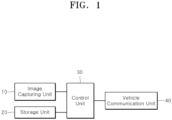
- FIG. 1 is a block diagram for describing an autonomous driving control apparatus in accordance with an embodiment of the present invention
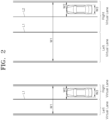
- FIG. 2 is a diagram for describing a process in which the autonomous driving control apparatus in accordance with the embodiment of the present invention generates virtual lanes
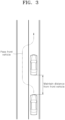
- FIG. 3 is a diagram for describing a process in which the autonomous driving control apparatus in accordance with the embodiment of the present invention avoids a front vehicle
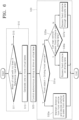
- FIG. 4 is a diagram for describing a process in which the autonomous driving control apparatus in accordance with the embodiment of the present invention decides which vehicle needs to reverse.
- the autonomous driving control apparatus in accordance with the embodiment of the present invention may include an image capturing unit 10, a storage unit 20, a control unit 30 and a vehicle communication unit 40.
- the image capturing unit 10 may capture a driving road image of an ego vehicle.
- the driving road image may include a forward image and a backward image on the driving route of the ego vehicle, and the image capturing unit 10 may include a front camera and a rear camera for capturing the forward image and the rearward image, respectively.
- the storage unit 20 may store driving history information. That is, when the ego vehicle enters a road with no lines as described later, the control unit 30 may store driving history information in the storage unit 20 in real time, the driving history information including distance information and width information of the road with no lines.
- the distance information may indicate the distance that the ego vehicle has traveled on the road with no lines.
- the driving history information stored in the storage unit 20 may be used to decide which vehicle needs to reverse, between the ego vehicle and a front vehicle driving toward the ego vehicle.
- the storage unit 20 may be implemented as a typical memory device such as a hard disk drive (HDD), a solid state drive (SSD), RAM or ROM to store the driving history information.
- the vehicle communication unit 40 may receive vehicle information from surrounding vehicles or transmit vehicle information of the ego vehicle to the surrounding vehicles, based on vehicle-to-everything (V2X) communication with the surrounding vehicles.
- V2X communication technology may be mounted as a communication function in a vehicle, and enable the vehicle to communicate with not only other vehicles (V2V) but also external objects including road infrastructures (V2I) or pedestrians (V2P).
- V2X communication technology may automatically recognize the road environment where the vehicle is traveling, and provide the recognized information to a driver, thereby supporting autonomous driving and safe driving.
- the vehicle communication unit 40 may receive driving history information of a surrounding vehicle from the surrounding vehicle, and transmit the driving history information of the ego vehicle to the surrounding vehicle.
- the control unit 30 may generate virtual lanes on the road with no lines by the number of lanes which are decided based on the width of the road with no lines, and control autonomous driving of the ego vehicle to drive on one of the generated virtual lanes. Furthermore, the control unit 30 may control the autonomous driving of the ego vehicle to drive on the road with no lines while avoiding a front object detected from the driving road image.
- the control unit may be implemented as a processor such as an electronic control unit (ECU) mounted in the vehicle.
- the width of the road with no lines may be calculated by applying a predetermined image processing algorithm to a forward image captured by the image capturing unit 10, or calculated through a method of detecting the edges of the road through a radar sensor or lidar sensor mounted in the vehicle.
- the control unit 30 may generate virtual lanes by the number of lanes which are decided based on a comparison result between the width of the road with no lanes and a preset reference road width, and the reference road width may be set to more than double a road width which is preset in consideration of the width of the vehicle.
- the width of the virtual lane to be generated may be preset in consideration of the width of the ego vehicle (for example, a legal lane width of a general road), such that the ego vehicle can easily drive.
- the reference road width may indicate a road width which is set to determine whether two or more virtual lanes can be generated on the road with no lines or whether a right virtual lane on which the ego vehicle can drive and a left virtual lane on which another vehicle can drive in the opposite direction can be generated based on a virtual center line.
- the reference road width may be set to more than double the vehicle width.
- the process of generating virtual lanes according to the width of the road with no lines and the process of controlling autonomous driving to avoid a front object may be separately performed.
- the following descriptions will be divided into the case in which the width of the road with no lines is equal to or more than the reference road width and the case in which the width of the road with no lines is less than the reference road width, and the process of generating virtual lanes and the process of controlling autonomous driving to avoid a front object will be described in each of the cases.
- control unit 30 may generate virtual lanes by generating a virtual center line on the road with no lines and then generating a virtual line such that one or more virtual lanes having a preset vehicle width are generated on both sides of the virtual center line.
- the control unit 30 may generate a virtual center line L1 on the road with no lines to generate a right virtual lane on which the ego vehicle can drive and a left virtual lane on which another vehicle can drive in the opposite direction. Furthermore, the control unit 30 may generate a virtual line L2 such that one or more virtual lanes having a vehicle width W2 are generated on both sides of the virtual center line L1 and distinguished by the virtual line L2.
- control unit 30 may generate two virtual lanes having the vehicle width on each of the left and right virtual lanes when the widths of the left and right virtual lanes are two times or more larger than the vehicle width, and generate three virtual lanes having the vehicle width on each of the left and right virtual lanes, when the widths of the left and right virtual lanes are three times or more larger than the vehicle width.
- the control unit 30 may generate N virtual lanes having the vehicle width on each of the right and left virtual lanes.
- the control unit 30 may generate one or more virtual lanes by generating a virtual line only on the right virtual lane, because the ego vehicle travels on the right virtual lane.
- the present embodiment is described based on the road transport system of Korea in which vehicles travel on the right side. However, the configuration of the present embodiment may also be applied to the road transport systems of other countries in which vehicles travel on the left side.
- the control unit 30 may control autonomous driving of the ego vehicle to drive on the virtual lane generated through the above-described process. That is, the control unit 30 may select one virtual lane of the one or more virtual lanes and control the autonomous driving of the ego vehicle to drive along the selected virtual lane. When a front object is detected from the driving road image inputted from the image capturing unit 10, the control unit 30 may control the autonomous driving of the ego vehicle to avoid the detected front object.
- the control unit 30 may control autonomous driving of the ego vehicle to maintain a distance from the front vehicle.
- FIG. 3 is based on the supposition that the front vehicle is driving on the same virtual lane in the same direction as the ego vehicle, because two or more virtual lanes including the right virtual lane and the left virtual lane are generated.
- the control unit 30 may control the autonomous driving of the ego vehicle to measure a distance from the front vehicle and to maintain a preset reference inter-vehicle distance.
- control unit 30 may transmit a pulse signal to the front vehicle through an ultrasonic sensor, a radar sensor or a lidar sensor installed at the front of the vehicle, and then measure the time required until the pulse signal is reflected from the front vehicle and returns to the ego vehicle.
- the control unit 30 may decide whether to pass the front vehicle, based on the speed of the front vehicle driving in front of the ego vehicle, and control the autonomous driving of the ego vehicle to pass the front vehicle. That is, when the speed of the front vehicle driving in front of the ego vehicle is equal to or less than a preset reference vehicle speed, the control unit 30 may determine that the front vehicle is driving at low speed, and determine whether the ego vehicle can pass the front vehicle on the driving lane, based on a distance from the front vehicle to the virtual center line or a distance from the front vehicle to the edge of the driving lane. When it is determined that the ego vehicle can pass the front vehicle on the driving lane, the control unit 30 may control the autonomous driving of the ego vehicle to pass the front vehicle on the driving lane.
- the control unit 30 may control the autonomous driving of the ego vehicle to pass the front vehicle using the opposite lane.
- the driving lane may be defined as all virtual lanes generated in the direction where the ego vehicle is positioned, based on the virtual center line, and the opposite lane may be defined as a virtual lane generated in the opposite side of the driving lane based on the virtual center line. That is, in the present embodiment, the driving lane is the right virtual lane, and the opposite lane is the left virtual lane.
- the control unit 30 may determine whether the ego vehicle can bypass the fixed obstacle on the driving lane, based on the width of the driving lane, the size of the fixed obstacle and the vehicle width, and control autonomous driving of the ego vehicle according to the determination result.
- the fixed obstacle may include all objects which are located on the road with no lines and interfere with the driving of the ego vehicle.
- the fixed obstacle may include a stopped or parked vehicle.
- the control unit 30 may calculate a distance from the fixed obstacle to the virtual center line or a distance from the fixed obstacle to the edge of the driving lane, compare the calculated distance and the vehicle width to determine whether the ego vehicle can bypass the fixed obstacle on the driving lane, and control the autonomous driving of the ego vehicle according to the determination result.
- the control unit 30 may apply a predetermined image processing algorithm to the driving road image or use the above-described ultrasonic sensor and radar sensor.
- the control unit 30 may control the autonomous vehicle of the ego vehicle to bypass the fixed obstacle on the driving lane. That is, the control unit 30 may control the autonomous driving of the ego vehicle to bypass the fixed obstacle on the driving lane through the virtual lane where the ego vehicle is driving or another virtual lane.
- the control unit 30 may determine that the ego vehicle cannot bypass the fixed obstacle on the driving lane, and control the autonomous driving of the ego vehicle to bypass the fixed obstacle through the opposite lane. At this time, when another vehicle driving on the opposite lane is detected from the driving road image inputted from the image capturing unit 10, the control unit 30 may control the autonomous driving of the ego vehicle to bypass the fixed obstacle through the opposite lane after waiting until the another vehicle passes.
- the control unit 30 may generate a virtual lane as the road with no lines. That is, when the width of the road with no lines is less than the reference road width, the control unit 30 may determine that two or more virtual lanes cannot be generated, and generate one virtual lane as the detected road with no lines.
- the control unit 30 may control the autonomous driving of the ego vehicle to drive on the virtual lane generated through the above-described process, and control the autonomous driving of the ego vehicle to drive on the right side of the virtual lane, by considering that only one virtual lane was generated.
- the control unit 30 may control the autonomous driving of the ego vehicle to drive on the road with no lines while avoiding the detected front object.
- control unit 30 may control the autonomous driving of the ego vehicle in consideration of the driving direction of the front vehicle, such that the ego vehicle avoids the front vehicle.
- control unit 30 may control the autonomous driving of the ego vehicle to maintain a distance from the front vehicle. Since the operation is performed in the same manner as described above, the detailed descriptions thereof will be omitted herein.
- the control unit 30 may decide which vehicle needs to reverse between the ego vehicle and the front vehicle, based on driving history information of the ego vehicle and driving history information of the front vehicle which is inputted through the vehicle communication unit 40.
- the driving history information may include width information of the road with no lines and distance information indicating the distance that the corresponding vehicle has traveled on the road with no lines.
- the control unit 30 may store the driving history information in the storage unit 20 in real time, in the case that the ego vehicle enters the road with no lines.
- the driving history information may include the driving distance information and the width information of the road with no lines where the ego vehicle is driving.
- the driving distance information and the width information of the driving history information may be used to calculate an avoidance reversing distance.
- the avoidance reversing distance may be defined as a reversing distance from the current location of the vehicle to a point where two or more vehicles can enter because the width of a road with no lines is equal to or more than the reference road width.
- the control unit 30 may calculate an avoidance reversing distance d1 of the ego vehicle through the driving history information, and compare the avoidance reversing distance d1 to an avoidance reversing distance d2 of the front vehicle, inputted through the vehicle communication unit 40, in order to decide which vehicle needs to reverse between the ego vehicle and the front vehicle.
- the control unit 30 may decide that the ego vehicle needs to reverse.
- the control unit 30 may decide that the front vehicle needs to reverse, and wait for the front vehicle to reverse.
- the control unit 30 may decide the vehicle by further considering the number of other vehicles located behind the ego vehicle and the number of other vehicles located behind the front vehicle. For example, when the number of other vehicles located behind the front vehicle far exceeds the number of other vehicles located behind the ego vehicle even though the avoidance reversing distance of the ego vehicle is larger than the avoidance reversing distance of the front vehicle, the control unit 30 may decide that the ego vehicle needs to reverse, in order to avoid driving congestion.
- control unit 30 may decide which vehicle needs to reverse, by considering the comparison result between the avoidance reversing distance of the ego vehicle and the avoidance reversing distance of the front vehicle and the comparison result between the number of other vehicles located behind the ego vehicle and the number of other vehicles located behind the front vehicle.
- any one of the avoidance reversing distance and the number of other vehicles behind, which is to be preferentially considered, may be designed in various manners depending on their values, and preset in the control unit 30.
- the control unit 30 may preferentially consider the avoidance reversing distance to decide which vehicle needs to reverse. Furthermore, when a difference between the number of other vehicles located behind the ego vehicle and the number of other vehicles located behind the front vehicle is equal to or more than a second threshold value, the control unit 30 may preferentially consider the number of other vehicles behind to decide which vehicle needs to reverse. The number of other vehicles behind may be calculated from a backward image captured by the image capturing unit 10. When a vehicle which needs to reverse is decided, the other vehicles behind the vehicle may sequentially reverse from the vehicle located at the rearm ost.
- control unit 30 may determine whether the ego vehicle can bypass the fixed obstacle on the virtual lane where the ego vehicle is driving, based on the width of the virtual lane, the size of the fixed obstacle and the vehicle width, and control autonomous driving of the ego vehicle according to the determination result.
- control unit 30 may calculate a distance from the fixed obstacle to the edge of the virtual lane where the ego vehicle is driving, compare the calculated distance to the vehicle width to determine whether the ego vehicle can bypass the fixed obstacle on the virtual lane, and control the autonomous driving of the ego vehicle according to the determination result.
- control unit 30 may control the autonomous vehicle of the ego vehicle to bypass the fixed obstacle on the virtual lane where the ego vehicle is driving.
- control unit 30 may determine that the ego vehicle cannot bypass the fixed obstacle on the virtual lane where the ego vehicle is driving, rescan a driving route, and control the ego vehicle to autonomously drive along the rescanned driving route.
- FIG. 5 is a flowchart for describing an autonomous driving control method in accordance with an embodiment of the present invention
- FIG. 6 is a flowchart for describing a virtual lane generation step and first and second autonomous driving control steps in the autonomous driving control method in accordance with the embodiment of the present invention, when the width of a road with no lines is equal to or more than a reference road width
- FIG. 7 is a flowchart for describing the virtual lane generation step and the first and second autonomous driving control steps in the autonomous driving control method in accordance with the embodiment of the present invention, when the width of the road with no lines is less than the reference road width.
- the autonomous driving control method in accordance with the embodiment of the present invention may include a virtual lane generation step S10, a first autonomous driving control step S20 and a second autonomous driving control step S30.
- the virtual lane generation step S10 may include generating virtual lanes on a road with no lines by the number of lanes which are decided based on the width of the road with no lines, when the road with no lines is detected in front of the ego vehicle through a driving road image.
- the first autonomous driving control step S20 may include controlling autonomous driving of the ego vehicle to drive on one of the generated virtual lanes.
- the second autonomous driving control step S30 may include controlling the autonomous driving of the ego vehicle to avoid a front object on the road with no lines, when the front object is detected from the driving road image.
- the control unit 30 may generate virtual lanes by the number of lanes which are decided based on a comparison result between the width of the road with no lines and the preset reference road width.
- the reference road width may be set to more than double a lane width which is preset in consideration of the width of the vehicle.
- the virtual lane generation step S10 and the first and second autonomous driving control steps S20 and S30 are separately performed according to the comparison result between the width of the road with no lines and the preset reference road width. Therefore, the following descriptions will be divided into the case in which the width of the road with no lines is equal to or more than the reference road width and the case in which the width of the road with no lines is less than the reference road width, and the virtual lane generation step S10 and the first and second autonomous driving control steps S20 and S30 will be described for each of the cases.
- the control unit 30 may generate virtual lanes by generating a virtual center line on the road with no lines and then generating virtual lines such that one or more virtual lanes having a preset vehicle width are generated on both sides of the virtual center line, in step S13. Then, the control unit 30 may control autonomous driving of the ego vehicle to drive on one of the generated virtual lanes.
- step S30 when it is determined in step S31a that a front object detected from the driving road image is a driving front vehicle, the control unit 30 may control autonomous driving of the ego vehicle to maintain a distance from the front vehicle. Then, the control unit 30 may decide whether to pass the front vehicle, based on the speed of the front vehicle, in step S33a.
- the control unit 30 may determine whether the ego vehicle can bypass the fixed obstacle on the driving lane, based on the width of the driving lane, the size of the fixed obstacle and the vehicle width, in step S35a, and control the autonomous driving of the ego vehicle according to the determination result.
- the driving lane may be defined as all virtual lanes generated in the direction where the ego vehicle is located, based on the virtual center line.
- control unit 30 may control the autonomous driving of the ego vehicle to bypass the fixed obstacle on the driving lane through the virtual lane on which the ego vehicle is driving or another virtual lane, in step S36a.
- the control unit 30 may control autonomous driving of the ego vehicle to bypass the fixed obstacle through the opposite lane, in step S37a.
- the opposite lane may be defined as a virtual lane generated in the opposite side of the driving lane based on the virtual center line.
- the control unit 30 may control the autonomous driving of the ego vehicle to bypass the fixed obstacle through the opposite lane after waiting until the another vehicle passes.
- the control unit 30 may generate a virtual lane as the road with no lines in step S15. That is, when the width of the road with no lines is less than the reference road width, the control unit 30 may determine that two or more virtual lanes cannot be generated, and generate one virtual lane as the detected road with no lines. Then, the control unit 30 may control autonomous driving of the ego vehicle to drive on the generated virtual lanes.
- the control unit 30 may control the autonomous driving of the ego vehicle in consideration of the driving direction of the front vehicle, such that the ego vehicle avoids the front vehicle.
- control unit 30 may control the autonomous driving of the ego vehicle to maintain a distance from the front vehicle in step S33b.
- the control unit 30 may decide which vehicle needs to reverse between the ego vehicle and the front vehicle, based on driving history information of the ego vehicle and driving history information of the front vehicle which is inputted through the vehicle communication unit 40, in step S34b.
- the driving history information may include width information of the road with no lines and distance information indicating the distance that the corresponding vehicle has traveled on the road with no lines. Therefore, the control unit 30 may calculate an avoidance reversing distance of the ego vehicle through the driving history information of the ego vehicle, and compare the calculated avoidance reversing distance of the ego vehicle to an avoidance reversing distance of the front vehicle, in order to decide the vehicle which needs to reverse.
- the control unit 30 may further consider the number of other vehicles located behind the ego vehicle and the number of other vehicles located behind the front vehicle, as described above.
- control unit 30 may determine whether the ego vehicle can bypass the fixed obstacle on the virtual lane where the ego vehicle is driving, based on the width of the virtual lane, the size of the fixed obstacle and the vehicle width, in step S35b, and control the autonomous driving of the ego vehicle according to the determination result.
- control unit 30 may control the autonomous driving of the ego vehicle to bypass the fixed obstacle on the virtual lane, in step S36b.
- control unit 30 may rescan a driving route, and control the ego vehicle to autonomously travel on the rescanned driving route, in step S37b.
- the autonomous driving apparatus and method can control a vehicle to autonomously drive along a virtual driving lane generated on a road with no lines.
- the autonomous driving apparatus and method can remove driving congestion even when a number of vehicles are driving, and effectively prevent a collision with a front obstacle even when visibility for the front vehicle is not secured depending on the surrounding environment, thereby avoiding an accident risk.
Landscapes
- Engineering & Computer Science (AREA)
- Automation & Control Theory (AREA)
- Transportation (AREA)
- Mechanical Engineering (AREA)
- Physics & Mathematics (AREA)
- Aviation & Aerospace Engineering (AREA)
- Human Computer Interaction (AREA)
- General Physics & Mathematics (AREA)
- Remote Sensing (AREA)
- Radar, Positioning & Navigation (AREA)
- Mathematical Physics (AREA)
- Computer Vision & Pattern Recognition (AREA)
- Multimedia (AREA)
- Electromagnetism (AREA)
- Traffic Control Systems (AREA)
- Game Theory and Decision Science (AREA)
- Medical Informatics (AREA)
- Evolutionary Computation (AREA)
- Artificial Intelligence (AREA)
- Health & Medical Sciences (AREA)
- Business, Economics & Management (AREA)
Claims (12)
- Steuerungsvorrichtung für autonomes Fahren, aufweisend:eine Bilderfassungseinheit (10), die so konfiguriert ist, dass sie ein Fahrstraßenbild eines Ego-Fahrzeugs erfasst;eine Steuereinheit (30), die konfiguriert ist, um virtuelle Spuren auf einer Straße ohne Linien zu erzeugen, wobei die Anzahl der virtuellen Spuren auf der Grundlage eines Vergleichsergebnisses zwischen der Breite der Straße ohne Linien und einer voreingestellten Referenzstraßenbreite entschieden wird, wenn die Straße ohne Linien vor dem Ego-Fahrzeug durch das von der Bilderfassungseinheit (10) erfasste Fahrstraßenbild detektiert wird, und um das autonome Fahren des Ego-Fahrzeugs zu steuern, um auf einer der erzeugten virtuellen Spuren zu fahren; undeine Fahrzeugkommunikationseinheit (40), die für die Kommunikation mit einem anderen Fahrzeug konfiguriert ist,wobei, wenn ein Frontobjekt aus dem Fahrstraßenbild detektiert wird, die Steuereinheit (30) das autonome Fahren des Ego-Fahrzeugs steuert, um das Frontobjekt zu vermeiden und auf der Straße ohne Linien zu fahren,wobei die Steuereinheit (30) nur eine virtuelle Spur erzeugt, die der Straße ohne Linien entspricht, wenn die Breite der Straße ohne Linien geringer ist als die Referenzstraßenbreite, wobei, wenn es sich bei dem aus dem Fahrstraßenbild detektierten Frontobjekt um ein fahrendes Frontfahrzeug handelt, die Steuereinheit (30) das autonome Fahren des Ego-Fahrzeugs unter Berücksichtigung der Fahrtrichtung des Frontfahrzeugs so steuert, dass das Ego-Fahrzeug dem Frontfahrzeug ausweicht,wobei, wenn das Frontfahrzeug auf das Ego-Fahrzeug zufährt, die Steuereinheit (30) entscheidet, welches Fahrzeug von dem Ego-Fahrzeug und dem Frontfahrzeug umkehren soll, basierend auf Fahrverlaufsinformationen des Ego-Fahrzeugs und Fahrverlaufsinformationen des Frontfahrzeugs, die über die Fahrzeugkommunikationseinheit (40) empfangen werden, undwobei die Fahrverlaufsinformationen Breiteninformationen der Straße ohne Linien und Distanzinformationen umfassen, die die Distanz angeben, die das entsprechende Fahrzeug auf der Straße ohne Linien gefahren ist.
- Steuerungsvorrichtung für autonomes Fahren nach Anspruch 1, wobei die Referenzstraßenbreite gleich oder mehr als doppelt so groß ist wie eine Straßenbreite, die unter Berücksichtigung einer Fahrzeugbreite voreingestellt ist.
- Steuerungsvorrichtung für autonomes Fahren nach Anspruch 2, wobei, wenn die Breite der Straße ohne Linien gleich oder größer als die Referenzstraßenbreite ist, die Steuereinheit (30) die virtuellen Spuren erzeugt, indem sie eine virtuelle Mittellinie auf der Straße ohne Linien erzeugt und dann virtuelle Linien erzeugt, so dass eine oder mehrere virtuelle Spuren mit der Fahrzeugbreite auf beiden Seiten der virtuellen Mittellinie erzeugt werden.
- Steuerungsvorrichtung für autonomes Fahren nach Anspruch 3, wobei die Steuereinheit (30), wenn es sich bei dem aus dem Fahrstraßenbild detektierten Frontobjekt um ein festes Hindernis handelt, feststellt, ob das Ego-Fahrzeug das feste Hindernis auf einer Fahrspur umfahren kann auf der Grundlage der Breite der Fahrspur, der Größe des festen Hindernisses und der Fahrzeugbreite, und das autonome Fahren des Ego-Fahrzeugs entsprechend dem Feststellungsergebnis steuert,
wobei die Fahrspur definiert ist als alle virtuellen Spuren, die in der Richtung erzeugt werden, in der sich das Ego-Fahrzeug befindet, basierend auf der virtuellen Mittellinie. - Steuerungsvorrichtung für autonomes Fahren nach Anspruch 4, wobei, wenn festgestellt wird, dass das Ego-Fahrzeug das feste Hindernis auf der Fahrspur nicht umfahren kann, die Steuereinheit (30) das autonome Fahren des Ego-Fahrzeugs so steuert, dass es das feste Hindernis über eine Gegenspur umfährt,
wobei die Gegenspur eine virtuelle Spur aufweist, die auf der gegenüberliegenden Seite der Fahrspur auf der Grundlage der virtuellen Mittellinie erzeugt wird. - Steuerungsvorrichtung für autonomes Fahren nach einem der Ansprüche 1 bis 5, wobei die Steuereinheit (30) das autonome Fahren des Ego-Fahrzeugs so steuert, dass ein Abstand zum Frontfahrzeug eingehalten wird, wenn das Frontfahrzeug in dieselbe Richtung wie das Ego-Fahrzeug fährt.
- Steuerungsvorrichtung für autonomes Fahren nach einem der Ansprüche 1 bis 6, wobei die Steuereinheit (30) eine Ausweich-Rückfahrdistanz des Ego-Fahrzeugs anhand der Fahrverlaufsinformationen des Ego-Fahrzeugs berechnet und die Ausweich-Rückfahrdistanz des Ego-Fahrzeugs mit einer Ausweich-Rückfahrdistanz des Frontfahrzeugs vergleicht, die über die Fahrzeugkommunikationseinheit (40) empfangen wird, um zu entscheiden, welches Fahrzeug rückwärts fahren soll,
wobei die Ausweich-Rückfahrdistanz eine Rückfahrdistanz von der aktuellen Position des entsprechenden Fahrzeugs zu einem Punkt ist, an dem die Breite der Straße ohne Linien gleich oder größer als die Referenzstraßenbreite wird. - Steuerungsverfahren für autonomes Fahren, aufweisend:einen Schritt (S10) zur Erzeugung virtueller Spuren, in dem eine Steuereinheit virtuelle Spuren auf einer Straße ohne Linien erzeugt, wobei die Anzahl der virtuellen Spuren auf der Grundlage eines Vergleichsergebnisses zwischen der Breite der Straße ohne Linien und einer voreingestellten Referenzstraßenbreite entschieden wird, wenn die Straße ohne Linien vor einem Ego-Fahrzeug durch ein Fahrstraßenbild detektiert wird;einen ersten Schritt (S20) zur Steuerung des autonomen Fahrens, in dem die Steuereinheit das autonome Fahren des Ego-Fahrzeugs steuert, um auf einer der erzeugten virtuellen Spuren zu fahren; undeinen zweiten Schritt (S30) zur Steuerung des autonomen Fahrens, in dem die Steuereinheit das autonome Fahren des Ego-Fahrzeugs steuert, um ein Frontobjekt zu vermeiden und auf der Straße ohne Linien zu fahren, wenn das Frontobjekt aus dem Bild der Fahrstraße detektiert wird,wobei die Referenzstraßenbreite gleich oder mehr als doppelt so groß ist wie eine Straßenbreite, die unter Berücksichtigung einer Fahrzeugbreite voreingestellt ist,wobei in dem Schritt (S10) zur Erzeugung virtueller Spuren,wenn die Breite der Straße ohne Linien geringer ist als die Referenzstraßenbreite, die Steuereinheit nur eine virtuelle Spur erzeugt, die der Straße ohne Linien entspricht,wobei in dem zweiten Schritt (S30) zur Steuerung des autonomen Fahrens,wenn es sich bei dem aus dem Fahrstraßenbild detektierten Frontobjekt um ein fahrendes Frontfahrzeug handelt, die Steuereinheit das autonome Fahren des Ego-Fahrzeugs unter Berücksichtigung der Fahrtrichtung des Frontfahrzeugs so steuert, dass das Ego-Fahrzeug dem Frontfahrzeug ausweicht,wobei in dem zweiten Schritt (S30) zur Steuerung des autonomen Fahrens,wenn das Frontfahrzeug auf das Ego-Fahrzeug zufährt, die Steuereinheit entscheidet, welches Fahrzeug von dem Ego-Fahrzeug und dem Frontfahrzeug rückwärts fahren soll, basierend auf Fahrverlaufsinformationen des Ego-Fahrzeugs und Fahrverlaufsinformationen des Frontfahrzeugs,wobei die Fahrverlaufsinformationen Breiteninformationen der Straße ohne Linien und Distanzinformationen umfassen, die die Distanz angeben, die das Ego-Fahrzeug auf der Straße ohne Linien gefahren ist.
- Steuerungsverfahren für autonomes Fahren nach Anspruch 8, wobei in dem Schritt (S10) zur Erzeugung virtueller Spuren,
wenn die Breite der Straße ohne Linien gleich oder größer als die Referenzstraßenbreite ist, die Steuereinheit die virtuellen Spuren erzeugt, indem sie eine virtuelle Mittellinie auf der Straße ohne Linien erzeugt und dann virtuelle Linien erzeugt, so dass eine oder mehrere virtuelle Spuren mit der Fahrzeugbreite auf beiden Seiten der virtuellen Mittellinie erzeugt werden. - Steuerungsverfahren für autonomes Fahren nach Anspruch 9, wobei in dem zweiten Schritt (S30) zur Steuerung des autonomen Fahrens,wenn das Frontobjekt, das aus dem Fahrstraßenbild detektiert wird, ein festes Hindernis ist, die Steuereinheit feststellt, ob das Ego-Fahrzeug das feste Hindernis auf einer Fahrspur umfahren kann, basierend auf der Breite der Fahrspur, der Größe des festen Hindernisses und der Fahrzeugbreite, und das autonome Fahren des Ego-Fahrzeugs gemäß dem Feststellungsergebnis steuert, wobei die Fahrspur definiert ist als alle virtuellen Spuren, die in der Richtung erzeugt werden, in der sich das Ego-Fahrzeug befindet, basierend auf der virtuellen Mittellinie, wobei in dem zweiten Schritt (S30) zur Steuerung des autonomen Fahrens,wenn festgestellt wird, dass das Ego-Fahrzeug das feste Hindernis auf der Fahrspur nicht umfahren kann, die Steuereinheit das autonome Fahren des Ego-Fahrzeugs steuert, um das feste Hindernis über eine Gegenspur zu umfahren,wobei die Gegenspur eine virtuelle Spur aufweist, die auf der gegenüberliegenden Seite der Fahrspur auf der Grundlage der virtuellen Mittellinie erzeugt wird.
- Steuerungsverfahren für autonomes Fahren nach einem der Ansprüche 8 bis 10, wobei in dem zweiten Schritt (S30) zur Steuerung des autonomen Fahrens,
wenn das Frontfahrzeug in die gleiche Richtung wie das Ego-Fahrzeug fährt, die Steuereinheit das autonome Fahren des Ego-Fahrzeugs steuert, um einen Abstand zum Frontfahrzeug einzuhalten. - Steuerungsverfahren für autonomes Fahren nach Anspruch 11, wobei in dem zweiten Schritt (S30) zur Steuerung des autonomen Fahrens,die Steuereinheit eine Ausweich-Rückfahrdistanz des Ego-Fahrzeugs anhand der Fahrverlaufsinformationen des Ego-Fahrzeugs berechnet und die Ausweich-Rückfahrdistanz des Ego-Fahrzeugs mit einer Ausweich-Rückfahrdistanz des Frontfahrzeugs vergleicht, die anhand der Fahrverlaufsinformationen des Frontfahrzeugs berechnet wird, um zu entscheiden, welches Fahrzeug rückwärts fahren soll,wobei die Ausweich-Rückfahrdistanz eine Rückfahrdistanz von der aktuellen Position des entsprechenden Fahrzeugs zu einem Punkt ist, an dem die Breite der Straße ohne Linien gleich oder größer als die Referenzstraßenbreite wird.
Applications Claiming Priority (2)
| Application Number | Priority Date | Filing Date | Title |
|---|---|---|---|
| KR1020160161365A KR102568114B1 (ko) | 2016-11-30 | 2016-11-30 | 자율 주행 제어 장치 및 방법 |
| PCT/KR2017/013708 WO2018101709A1 (ko) | 2016-11-30 | 2017-11-28 | 자율 주행 제어 장치 및 방법 |
Publications (3)
| Publication Number | Publication Date |
|---|---|
| EP3549839A1 EP3549839A1 (de) | 2019-10-09 |
| EP3549839A4 EP3549839A4 (de) | 2020-08-12 |
| EP3549839B1 true EP3549839B1 (de) | 2023-05-17 |
Family
ID=62241597
Family Applications (1)
| Application Number | Title | Priority Date | Filing Date |
|---|---|---|---|
| EP17875158.2A Active EP3549839B1 (de) | 2016-11-30 | 2017-11-28 | Steuerungsvorrichtung und -verfahren für autonomes fahren |
Country Status (4)
| Country | Link |
|---|---|
| US (1) | US11194332B2 (de) |
| EP (1) | EP3549839B1 (de) |
| KR (1) | KR102568114B1 (de) |
| WO (1) | WO2018101709A1 (de) |
Families Citing this family (23)
| Publication number | Priority date | Publication date | Assignee | Title |
|---|---|---|---|---|
| US10982961B2 (en) * | 2015-10-16 | 2021-04-20 | Hitachi Automotive Systems, Ltd. | Vehicle control system and vehicle control device |
| US10684134B2 (en) * | 2017-12-15 | 2020-06-16 | Waymo Llc | Using prediction models for scene difficulty in vehicle routing |
| KR102621703B1 (ko) * | 2018-08-08 | 2024-01-08 | 현대자동차주식회사 | 차량의 영상 표시 장치 및 방법 |
| US11561546B2 (en) * | 2018-09-28 | 2023-01-24 | Baidu Usa Llc | Tunnel-based planning system for autonomous driving vehicles |
| KR102387603B1 (ko) | 2018-10-24 | 2022-04-18 | 주식회사 스프링클라우드 | 자율 주행 차량에서의 장애물 회피 경로 생성 장치 및 방법 |
| KR20200068098A (ko) * | 2018-11-28 | 2020-06-15 | (주)팔로우테크닉스 | 선행차량의 운전제어 정보를 이용한 자율주행 기반의 후행차량 주행 장치 및 방법 |
| US11192548B2 (en) * | 2019-03-25 | 2021-12-07 | Ford Global Technologies, Llc | Methods and systems for limiting a vehicle speed and changing vehicle dynamics drive mode |
| CN110136222B (zh) * | 2019-04-17 | 2023-05-26 | 阿波罗智能技术(北京)有限公司 | 虚拟车道线生成方法、装置及系统 |
| US11059480B2 (en) * | 2019-04-26 | 2021-07-13 | Caterpillar Inc. | Collision avoidance system with elevation compensation |
| KR102779827B1 (ko) | 2019-12-20 | 2025-03-12 | 주식회사 에이치엘클레무브 | 운전자 보조 장치 및 운전자 보조 방법 |
| CN113077528A (zh) * | 2020-01-06 | 2021-07-06 | 阿里巴巴集团控股有限公司 | 一种添加车道线的方法、装置和存储介质 |
| CN111267862B (zh) * | 2020-01-13 | 2021-04-02 | 清华大学 | 一种依赖跟随目标的虚拟车道线构造方法和系统 |
| US11683660B2 (en) | 2020-02-06 | 2023-06-20 | Huawei Technologies Co., Ltd. | Method, apparatus and system for determining a location of a mobile device |
| US12010583B2 (en) | 2020-02-06 | 2024-06-11 | Huawei Technologies Co., Ltd. | Method, apparatus and system for mobile device location determination |
| US12190721B2 (en) * | 2020-02-14 | 2025-01-07 | Huawei Technologies Co., Ltd. | System, method and apparatus supporting navigation |
| US12200571B2 (en) | 2020-02-14 | 2025-01-14 | Huawei Technologies Co., Ltd. | Terrestrial positioning system |
| CN111857127B (zh) * | 2020-06-12 | 2021-10-01 | 珠海市一微半导体有限公司 | 一种机器人沿边行走的清洁分区规划方法、芯片及机器人 |
| US12005923B2 (en) * | 2020-08-25 | 2024-06-11 | Gm Cruise Holdings Llc | Blockage routing and maneuver arbitration |
| CN114690755B (zh) * | 2020-12-25 | 2025-05-20 | 尚科宁家(中国)科技有限公司 | 清洁机器人及其绕障方法 |
| GB2609482A (en) * | 2021-08-05 | 2023-02-08 | Continental Automotive Gmbh | Method and system for creating a virtual lane for a vehicle |
| DE102023200695A1 (de) * | 2023-01-27 | 2024-08-14 | Volkswagen Aktiengesellschaft | Verfahren zum Betreiben eines Fahrzeuges, Computerprogrammprodukt sowie Fahrzeug |
| US12280783B2 (en) * | 2023-03-22 | 2025-04-22 | Commuter Cars Corporation | Autonomous narrow vehicle lane sharing, filtering, and splitting system |
| CN119190080A (zh) * | 2024-10-31 | 2024-12-27 | 江铃汽车股份有限公司 | 无车道线自动驾驶的控制方法、系统、存储介质及设备 |
Family Cites Families (15)
| Publication number | Priority date | Publication date | Assignee | Title |
|---|---|---|---|---|
| KR19980068399A (ko) | 1997-02-19 | 1998-10-15 | 김영환 | 차량 자율 주행 장치 및 제어 방법 |
| JP2005326963A (ja) * | 2004-05-12 | 2005-11-24 | Fujitsu Ten Ltd | 運転支援装置 |
| JP4654796B2 (ja) * | 2005-06-29 | 2011-03-23 | トヨタ自動車株式会社 | 車両用運転支援装置 |
| JP4888761B2 (ja) | 2005-10-31 | 2012-02-29 | 株式会社エクォス・リサーチ | 仮想車線表示装置 |
| JP4687395B2 (ja) * | 2005-11-02 | 2011-05-25 | 株式会社エクォス・リサーチ | 駐車制御装置 |
| KR101163446B1 (ko) | 2009-03-18 | 2012-07-18 | 기아자동차주식회사 | 가상 차선을 이용하는 차선 이탈 경보 방법 및 그에 따른 시스템 |
| KR101936862B1 (ko) * | 2011-11-17 | 2019-04-04 | 현대모비스 주식회사 | 차량의 전방 영상 및 측방 영상을 이용한 차선 인식 향상 시스템 및 그 방법 |
| JP5757900B2 (ja) * | 2012-03-07 | 2015-08-05 | 日立オートモティブシステムズ株式会社 | 車両走行制御装置 |
| KR101787996B1 (ko) * | 2013-04-11 | 2017-10-19 | 주식회사 만도 | 차선 추정 장치 및 그 방법 |
| US9199668B2 (en) * | 2013-10-28 | 2015-12-01 | GM Global Technology Operations LLC | Path planning for evasive steering maneuver employing a virtual potential field technique |
| JP5831530B2 (ja) * | 2013-11-18 | 2015-12-09 | トヨタ自動車株式会社 | 車両制御装置 |
| KR101502511B1 (ko) | 2013-11-28 | 2015-03-13 | 현대모비스 주식회사 | 가상 차선 생성 장치와 방법 및 상기 장치를 구비하는 차선 유지 제어 시스템 |
| DE102014222058A1 (de) | 2014-10-29 | 2016-05-04 | Robert Bosch Gmbh | Verfahren zum Betreiben einer Fahrassistenzfunktion |
| US20180224856A1 (en) * | 2016-04-11 | 2018-08-09 | Aqua Products, Inc. | Method for modifying an onboard control system of a pool cleaner, and power source for a pool cleaner |
| KR20180099280A (ko) * | 2017-02-28 | 2018-09-05 | 삼성전자주식회사 | 가상 차로 생성 장치 및 방법 |
-
2016
- 2016-11-30 KR KR1020160161365A patent/KR102568114B1/ko active Active
-
2017
- 2017-11-28 US US16/465,105 patent/US11194332B2/en active Active
- 2017-11-28 EP EP17875158.2A patent/EP3549839B1/de active Active
- 2017-11-28 WO PCT/KR2017/013708 patent/WO2018101709A1/ko not_active Ceased
Also Published As
| Publication number | Publication date |
|---|---|
| KR102568114B1 (ko) | 2023-08-18 |
| KR20180062503A (ko) | 2018-06-11 |
| US20190384293A1 (en) | 2019-12-19 |
| WO2018101709A1 (ko) | 2018-06-07 |
| US11194332B2 (en) | 2021-12-07 |
| EP3549839A4 (de) | 2020-08-12 |
| EP3549839A1 (de) | 2019-10-09 |
Similar Documents
| Publication | Publication Date | Title |
|---|---|---|
| EP3549839B1 (de) | Steuerungsvorrichtung und -verfahren für autonomes fahren | |
| US9457809B2 (en) | Collision possibility determination apparatus, drive assist apparatus, collision possibility determination method, and collision possibility determination program | |
| CN110371125B (zh) | 用于提供车辆的行驶路径的装置及方法 | |
| EP3552911B1 (de) | Vorrichtung und verfahren zur bereitstellung einer sicherheitsstrategie in einem fahrzeug | |
| CN109844843B (zh) | 用于检查超车可能性条件的方法 | |
| US11377103B2 (en) | Vehicle control device and recording medium | |
| US10150476B2 (en) | Methods and systems for controlling a vehicle being overtaken | |
| JP6421716B2 (ja) | 車両の運転支援制御装置 | |
| JP6614353B2 (ja) | 走行制御方法及び走行制御装置 | |
| KR20100101566A (ko) | 자동차 주차시의 경로 플래닝 방법 및 장치 | |
| CN110371116A (zh) | 用于控制车辆的驾驶的装置和方法 | |
| US10421394B2 (en) | Driving assistance device, and storage medium | |
| KR101552017B1 (ko) | 성능이 개선된 운전보조시스템 및 그 제어방법 | |
| JP7377822B2 (ja) | 運転支援方法及び運転支援装置 | |
| US12397704B1 (en) | Method for automatically actuating a direction indicator and vehicle | |
| KR101602021B1 (ko) | 주행상황 예측을 통한 적응형 순항제어장치 및 적응형 순항 제어 방법 | |
| JP7049188B2 (ja) | 車両制御装置、車両制御方法およびプログラム | |
| KR101511861B1 (ko) | 운전보조시스템 및 그 제어방법 | |
| JP7043982B2 (ja) | 車両制御装置 | |
| JP4661602B2 (ja) | 後方車両解析装置及び衝突予測装置 | |
| KR20210057897A (ko) | 자율주행차량의 안전주행 제어 장치 및 그 방법 | |
| CN112991817B (zh) | 用于自动或半自动交通工具操作的适应性物体路径中检测模型 | |
| KR20150130056A (ko) | 운전자 편의 장치 및 그의 제어 방법 | |
| JP7244398B2 (ja) | 移動物体判定装置 | |
| KR20190068070A (ko) | 차량의 차로 진입 제어 장치 및 방법 |
Legal Events
| Date | Code | Title | Description |
|---|---|---|---|
| STAA | Information on the status of an ep patent application or granted ep patent |
Free format text: STATUS: THE INTERNATIONAL PUBLICATION HAS BEEN MADE |
|
| PUAI | Public reference made under article 153(3) epc to a published international application that has entered the european phase |
Free format text: ORIGINAL CODE: 0009012 |
|
| STAA | Information on the status of an ep patent application or granted ep patent |
Free format text: STATUS: REQUEST FOR EXAMINATION WAS MADE |
|
| 17P | Request for examination filed |
Effective date: 20190627 |
|
| AK | Designated contracting states |
Kind code of ref document: A1 Designated state(s): AL AT BE BG CH CY CZ DE DK EE ES FI FR GB GR HR HU IE IS IT LI LT LU LV MC MK MT NL NO PL PT RO RS SE SI SK SM TR |
|
| AX | Request for extension of the european patent |
Extension state: BA ME |
|
| DAV | Request for validation of the european patent (deleted) | ||
| DAX | Request for extension of the european patent (deleted) | ||
| A4 | Supplementary search report drawn up and despatched |
Effective date: 20200709 |
|
| RIC1 | Information provided on ipc code assigned before grant |
Ipc: B60W 30/18 20120101ALI20200704BHEP Ipc: B60W 30/10 20060101ALI20200704BHEP Ipc: B60W 30/14 20060101AFI20200704BHEP Ipc: B60W 40/06 20120101ALI20200704BHEP Ipc: B60W 30/16 20200101ALI20200704BHEP Ipc: B60W 30/08 20120101ALI20200704BHEP |
|
| RAP1 | Party data changed (applicant data changed or rights of an application transferred) |
Owner name: HYUNDAI AUTOEVER CORP. |
|
| GRAP | Despatch of communication of intention to grant a patent |
Free format text: ORIGINAL CODE: EPIDOSNIGR1 |
|
| STAA | Information on the status of an ep patent application or granted ep patent |
Free format text: STATUS: GRANT OF PATENT IS INTENDED |
|
| INTG | Intention to grant announced |
Effective date: 20230131 |
|
| GRAS | Grant fee paid |
Free format text: ORIGINAL CODE: EPIDOSNIGR3 |
|
| GRAA | (expected) grant |
Free format text: ORIGINAL CODE: 0009210 |
|
| STAA | Information on the status of an ep patent application or granted ep patent |
Free format text: STATUS: THE PATENT HAS BEEN GRANTED |
|
| AK | Designated contracting states |
Kind code of ref document: B1 Designated state(s): AL AT BE BG CH CY CZ DE DK EE ES FI FR GB GR HR HU IE IS IT LI LT LU LV MC MK MT NL NO PL PT RO RS SE SI SK SM TR |
|
| REG | Reference to a national code |
Ref country code: GB Ref legal event code: FG4D |
|
| REG | Reference to a national code |
Ref country code: DE Ref legal event code: R096 Ref document number: 602017068904 Country of ref document: DE |
|
| REG | Reference to a national code |
Ref country code: CH Ref legal event code: EP |
|
| REG | Reference to a national code |
Ref country code: IE Ref legal event code: FG4D |
|
| REG | Reference to a national code |
Ref country code: AT Ref legal event code: REF Ref document number: 1568282 Country of ref document: AT Kind code of ref document: T Effective date: 20230615 |
|
| P01 | Opt-out of the competence of the unified patent court (upc) registered |
Effective date: 20230601 |
|
| REG | Reference to a national code |
Ref country code: LT Ref legal event code: MG9D |
|
| REG | Reference to a national code |
Ref country code: NL Ref legal event code: MP Effective date: 20230517 |
|
| REG | Reference to a national code |
Ref country code: AT Ref legal event code: MK05 Ref document number: 1568282 Country of ref document: AT Kind code of ref document: T Effective date: 20230517 |
|
| PG25 | Lapsed in a contracting state [announced via postgrant information from national office to epo] |
Ref country code: SE Free format text: LAPSE BECAUSE OF FAILURE TO SUBMIT A TRANSLATION OF THE DESCRIPTION OR TO PAY THE FEE WITHIN THE PRESCRIBED TIME-LIMIT Effective date: 20230517 Ref country code: PT Free format text: LAPSE BECAUSE OF FAILURE TO SUBMIT A TRANSLATION OF THE DESCRIPTION OR TO PAY THE FEE WITHIN THE PRESCRIBED TIME-LIMIT Effective date: 20230918 Ref country code: NO Free format text: LAPSE BECAUSE OF FAILURE TO SUBMIT A TRANSLATION OF THE DESCRIPTION OR TO PAY THE FEE WITHIN THE PRESCRIBED TIME-LIMIT Effective date: 20230817 Ref country code: NL Free format text: LAPSE BECAUSE OF FAILURE TO SUBMIT A TRANSLATION OF THE DESCRIPTION OR TO PAY THE FEE WITHIN THE PRESCRIBED TIME-LIMIT Effective date: 20230517 Ref country code: ES Free format text: LAPSE BECAUSE OF FAILURE TO SUBMIT A TRANSLATION OF THE DESCRIPTION OR TO PAY THE FEE WITHIN THE PRESCRIBED TIME-LIMIT Effective date: 20230517 Ref country code: AT Free format text: LAPSE BECAUSE OF FAILURE TO SUBMIT A TRANSLATION OF THE DESCRIPTION OR TO PAY THE FEE WITHIN THE PRESCRIBED TIME-LIMIT Effective date: 20230517 |
|
| PG25 | Lapsed in a contracting state [announced via postgrant information from national office to epo] |
Ref country code: RS Free format text: LAPSE BECAUSE OF FAILURE TO SUBMIT A TRANSLATION OF THE DESCRIPTION OR TO PAY THE FEE WITHIN THE PRESCRIBED TIME-LIMIT Effective date: 20230517 Ref country code: PL Free format text: LAPSE BECAUSE OF FAILURE TO SUBMIT A TRANSLATION OF THE DESCRIPTION OR TO PAY THE FEE WITHIN THE PRESCRIBED TIME-LIMIT Effective date: 20230517 Ref country code: LV Free format text: LAPSE BECAUSE OF FAILURE TO SUBMIT A TRANSLATION OF THE DESCRIPTION OR TO PAY THE FEE WITHIN THE PRESCRIBED TIME-LIMIT Effective date: 20230517 Ref country code: LT Free format text: LAPSE BECAUSE OF FAILURE TO SUBMIT A TRANSLATION OF THE DESCRIPTION OR TO PAY THE FEE WITHIN THE PRESCRIBED TIME-LIMIT Effective date: 20230517 Ref country code: IS Free format text: LAPSE BECAUSE OF FAILURE TO SUBMIT A TRANSLATION OF THE DESCRIPTION OR TO PAY THE FEE WITHIN THE PRESCRIBED TIME-LIMIT Effective date: 20230917 Ref country code: HR Free format text: LAPSE BECAUSE OF FAILURE TO SUBMIT A TRANSLATION OF THE DESCRIPTION OR TO PAY THE FEE WITHIN THE PRESCRIBED TIME-LIMIT Effective date: 20230517 Ref country code: GR Free format text: LAPSE BECAUSE OF FAILURE TO SUBMIT A TRANSLATION OF THE DESCRIPTION OR TO PAY THE FEE WITHIN THE PRESCRIBED TIME-LIMIT Effective date: 20230818 |
|
| PG25 | Lapsed in a contracting state [announced via postgrant information from national office to epo] |
Ref country code: FI Free format text: LAPSE BECAUSE OF FAILURE TO SUBMIT A TRANSLATION OF THE DESCRIPTION OR TO PAY THE FEE WITHIN THE PRESCRIBED TIME-LIMIT Effective date: 20230517 |
|
| PG25 | Lapsed in a contracting state [announced via postgrant information from national office to epo] |
Ref country code: SK Free format text: LAPSE BECAUSE OF FAILURE TO SUBMIT A TRANSLATION OF THE DESCRIPTION OR TO PAY THE FEE WITHIN THE PRESCRIBED TIME-LIMIT Effective date: 20230517 |
|
| PG25 | Lapsed in a contracting state [announced via postgrant information from national office to epo] |
Ref country code: SM Free format text: LAPSE BECAUSE OF FAILURE TO SUBMIT A TRANSLATION OF THE DESCRIPTION OR TO PAY THE FEE WITHIN THE PRESCRIBED TIME-LIMIT Effective date: 20230517 Ref country code: SK Free format text: LAPSE BECAUSE OF FAILURE TO SUBMIT A TRANSLATION OF THE DESCRIPTION OR TO PAY THE FEE WITHIN THE PRESCRIBED TIME-LIMIT Effective date: 20230517 Ref country code: RO Free format text: LAPSE BECAUSE OF FAILURE TO SUBMIT A TRANSLATION OF THE DESCRIPTION OR TO PAY THE FEE WITHIN THE PRESCRIBED TIME-LIMIT Effective date: 20230517 Ref country code: EE Free format text: LAPSE BECAUSE OF FAILURE TO SUBMIT A TRANSLATION OF THE DESCRIPTION OR TO PAY THE FEE WITHIN THE PRESCRIBED TIME-LIMIT Effective date: 20230517 Ref country code: DK Free format text: LAPSE BECAUSE OF FAILURE TO SUBMIT A TRANSLATION OF THE DESCRIPTION OR TO PAY THE FEE WITHIN THE PRESCRIBED TIME-LIMIT Effective date: 20230517 Ref country code: CZ Free format text: LAPSE BECAUSE OF FAILURE TO SUBMIT A TRANSLATION OF THE DESCRIPTION OR TO PAY THE FEE WITHIN THE PRESCRIBED TIME-LIMIT Effective date: 20230517 |
|
| REG | Reference to a national code |
Ref country code: DE Ref legal event code: R097 Ref document number: 602017068904 Country of ref document: DE |
|
| PLBE | No opposition filed within time limit |
Free format text: ORIGINAL CODE: 0009261 |
|
| STAA | Information on the status of an ep patent application or granted ep patent |
Free format text: STATUS: NO OPPOSITION FILED WITHIN TIME LIMIT |
|
| 26N | No opposition filed |
Effective date: 20240220 |
|
| PG25 | Lapsed in a contracting state [announced via postgrant information from national office to epo] |
Ref country code: SI Free format text: LAPSE BECAUSE OF FAILURE TO SUBMIT A TRANSLATION OF THE DESCRIPTION OR TO PAY THE FEE WITHIN THE PRESCRIBED TIME-LIMIT Effective date: 20230517 |
|
| PG25 | Lapsed in a contracting state [announced via postgrant information from national office to epo] |
Ref country code: SI Free format text: LAPSE BECAUSE OF FAILURE TO SUBMIT A TRANSLATION OF THE DESCRIPTION OR TO PAY THE FEE WITHIN THE PRESCRIBED TIME-LIMIT Effective date: 20230517 Ref country code: IT Free format text: LAPSE BECAUSE OF FAILURE TO SUBMIT A TRANSLATION OF THE DESCRIPTION OR TO PAY THE FEE WITHIN THE PRESCRIBED TIME-LIMIT Effective date: 20230517 |
|
| REG | Reference to a national code |
Ref country code: CH Ref legal event code: PL |
|
| PG25 | Lapsed in a contracting state [announced via postgrant information from national office to epo] |
Ref country code: MC Free format text: LAPSE BECAUSE OF FAILURE TO SUBMIT A TRANSLATION OF THE DESCRIPTION OR TO PAY THE FEE WITHIN THE PRESCRIBED TIME-LIMIT Effective date: 20230517 |
|
| PG25 | Lapsed in a contracting state [announced via postgrant information from national office to epo] |
Ref country code: LU Free format text: LAPSE BECAUSE OF NON-PAYMENT OF DUE FEES Effective date: 20231128 |
|
| PG25 | Lapsed in a contracting state [announced via postgrant information from national office to epo] |
Ref country code: CH Free format text: LAPSE BECAUSE OF NON-PAYMENT OF DUE FEES Effective date: 20231130 |
|
| PG25 | Lapsed in a contracting state [announced via postgrant information from national office to epo] |
Ref country code: MC Free format text: LAPSE BECAUSE OF FAILURE TO SUBMIT A TRANSLATION OF THE DESCRIPTION OR TO PAY THE FEE WITHIN THE PRESCRIBED TIME-LIMIT Effective date: 20230517 Ref country code: LU Free format text: LAPSE BECAUSE OF NON-PAYMENT OF DUE FEES Effective date: 20231128 Ref country code: CH Free format text: LAPSE BECAUSE OF NON-PAYMENT OF DUE FEES Effective date: 20231130 |
|
| REG | Reference to a national code |
Ref country code: BE Ref legal event code: MM Effective date: 20231130 |
|
| REG | Reference to a national code |
Ref country code: IE Ref legal event code: MM4A |
|
| PG25 | Lapsed in a contracting state [announced via postgrant information from national office to epo] |
Ref country code: IE Free format text: LAPSE BECAUSE OF NON-PAYMENT OF DUE FEES Effective date: 20231128 |
|
| PG25 | Lapsed in a contracting state [announced via postgrant information from national office to epo] |
Ref country code: BE Free format text: LAPSE BECAUSE OF NON-PAYMENT OF DUE FEES Effective date: 20231130 |
|
| PG25 | Lapsed in a contracting state [announced via postgrant information from national office to epo] |
Ref country code: IE Free format text: LAPSE BECAUSE OF NON-PAYMENT OF DUE FEES Effective date: 20231128 Ref country code: BE Free format text: LAPSE BECAUSE OF NON-PAYMENT OF DUE FEES Effective date: 20231130 |
|
| PG25 | Lapsed in a contracting state [announced via postgrant information from national office to epo] |
Ref country code: BG Free format text: LAPSE BECAUSE OF FAILURE TO SUBMIT A TRANSLATION OF THE DESCRIPTION OR TO PAY THE FEE WITHIN THE PRESCRIBED TIME-LIMIT Effective date: 20230517 |
|
| PG25 | Lapsed in a contracting state [announced via postgrant information from national office to epo] |
Ref country code: BG Free format text: LAPSE BECAUSE OF FAILURE TO SUBMIT A TRANSLATION OF THE DESCRIPTION OR TO PAY THE FEE WITHIN THE PRESCRIBED TIME-LIMIT Effective date: 20230517 |
|
| PGFP | Annual fee paid to national office [announced via postgrant information from national office to epo] |
Ref country code: DE Payment date: 20241021 Year of fee payment: 8 |
|
| PGFP | Annual fee paid to national office [announced via postgrant information from national office to epo] |
Ref country code: GB Payment date: 20241021 Year of fee payment: 8 |
|
| PGFP | Annual fee paid to national office [announced via postgrant information from national office to epo] |
Ref country code: FR Payment date: 20241022 Year of fee payment: 8 |
|
| PG25 | Lapsed in a contracting state [announced via postgrant information from national office to epo] |
Ref country code: CY Free format text: LAPSE BECAUSE OF FAILURE TO SUBMIT A TRANSLATION OF THE DESCRIPTION OR TO PAY THE FEE WITHIN THE PRESCRIBED TIME-LIMIT; INVALID AB INITIO Effective date: 20171128 |
|
| PG25 | Lapsed in a contracting state [announced via postgrant information from national office to epo] |
Ref country code: HU Free format text: LAPSE BECAUSE OF FAILURE TO SUBMIT A TRANSLATION OF THE DESCRIPTION OR TO PAY THE FEE WITHIN THE PRESCRIBED TIME-LIMIT; INVALID AB INITIO Effective date: 20171128 |