EP3538612B1 - Synthetisches papier mit verbesserten reisseigenschaften und verfahren zur herstellung - Google Patents
Synthetisches papier mit verbesserten reisseigenschaften und verfahren zur herstellung Download PDFInfo
- Publication number
- EP3538612B1 EP3538612B1 EP17869144.0A EP17869144A EP3538612B1 EP 3538612 B1 EP3538612 B1 EP 3538612B1 EP 17869144 A EP17869144 A EP 17869144A EP 3538612 B1 EP3538612 B1 EP 3538612B1
- Authority
- EP
- European Patent Office
- Prior art keywords
- percent
- synthetic paper
- composition
- present
- weight
- Prior art date
- Legal status (The legal status is an assumption and is not a legal conclusion. Google has not performed a legal analysis and makes no representation as to the accuracy of the status listed.)
- Active
Links
Images





Classifications
-
- B—PERFORMING OPERATIONS; TRANSPORTING
- B32—LAYERED PRODUCTS
- B32B—LAYERED PRODUCTS, i.e. PRODUCTS BUILT-UP OF STRATA OF FLAT OR NON-FLAT, e.g. CELLULAR OR HONEYCOMB, FORM
- B32B23/00—Layered products comprising a layer of cellulosic plastic substances, i.e. substances obtained by chemical modification of cellulose, e.g. cellulose ethers, cellulose esters, viscose
- B32B23/04—Layered products comprising a layer of cellulosic plastic substances, i.e. substances obtained by chemical modification of cellulose, e.g. cellulose ethers, cellulose esters, viscose comprising such cellulosic plastic substance as the main or only constituent of a layer, which is next to another layer of the same or of a different material
-
- B—PERFORMING OPERATIONS; TRANSPORTING
- B32—LAYERED PRODUCTS
- B32B—LAYERED PRODUCTS, i.e. PRODUCTS BUILT-UP OF STRATA OF FLAT OR NON-FLAT, e.g. CELLULAR OR HONEYCOMB, FORM
- B32B27/00—Layered products comprising a layer of synthetic resin
- B32B27/06—Layered products comprising a layer of synthetic resin as the main or only constituent of a layer, which is next to another layer of the same or of a different material
- B32B27/08—Layered products comprising a layer of synthetic resin as the main or only constituent of a layer, which is next to another layer of the same or of a different material of synthetic resin
-
- B—PERFORMING OPERATIONS; TRANSPORTING
- B32—LAYERED PRODUCTS
- B32B—LAYERED PRODUCTS, i.e. PRODUCTS BUILT-UP OF STRATA OF FLAT OR NON-FLAT, e.g. CELLULAR OR HONEYCOMB, FORM
- B32B27/00—Layered products comprising a layer of synthetic resin
- B32B27/18—Layered products comprising a layer of synthetic resin characterised by the use of special additives
-
- B—PERFORMING OPERATIONS; TRANSPORTING
- B32—LAYERED PRODUCTS
- B32B—LAYERED PRODUCTS, i.e. PRODUCTS BUILT-UP OF STRATA OF FLAT OR NON-FLAT, e.g. CELLULAR OR HONEYCOMB, FORM
- B32B27/00—Layered products comprising a layer of synthetic resin
- B32B27/18—Layered products comprising a layer of synthetic resin characterised by the use of special additives
- B32B27/20—Layered products comprising a layer of synthetic resin characterised by the use of special additives using fillers, pigments, thixotroping agents
-
- B—PERFORMING OPERATIONS; TRANSPORTING
- B32—LAYERED PRODUCTS
- B32B—LAYERED PRODUCTS, i.e. PRODUCTS BUILT-UP OF STRATA OF FLAT OR NON-FLAT, e.g. CELLULAR OR HONEYCOMB, FORM
- B32B27/00—Layered products comprising a layer of synthetic resin
- B32B27/30—Layered products comprising a layer of synthetic resin comprising vinyl (co)polymers; comprising acrylic (co)polymers
- B32B27/306—Layered products comprising a layer of synthetic resin comprising vinyl (co)polymers; comprising acrylic (co)polymers comprising vinyl acetate or vinyl alcohol (co)polymers
-
- B—PERFORMING OPERATIONS; TRANSPORTING
- B32—LAYERED PRODUCTS
- B32B—LAYERED PRODUCTS, i.e. PRODUCTS BUILT-UP OF STRATA OF FLAT OR NON-FLAT, e.g. CELLULAR OR HONEYCOMB, FORM
- B32B27/00—Layered products comprising a layer of synthetic resin
- B32B27/30—Layered products comprising a layer of synthetic resin comprising vinyl (co)polymers; comprising acrylic (co)polymers
- B32B27/308—Layered products comprising a layer of synthetic resin comprising vinyl (co)polymers; comprising acrylic (co)polymers comprising acrylic (co)polymers
-
- B—PERFORMING OPERATIONS; TRANSPORTING
- B32—LAYERED PRODUCTS
- B32B—LAYERED PRODUCTS, i.e. PRODUCTS BUILT-UP OF STRATA OF FLAT OR NON-FLAT, e.g. CELLULAR OR HONEYCOMB, FORM
- B32B27/00—Layered products comprising a layer of synthetic resin
- B32B27/32—Layered products comprising a layer of synthetic resin comprising polyolefins
-
- B—PERFORMING OPERATIONS; TRANSPORTING
- B32—LAYERED PRODUCTS
- B32B—LAYERED PRODUCTS, i.e. PRODUCTS BUILT-UP OF STRATA OF FLAT OR NON-FLAT, e.g. CELLULAR OR HONEYCOMB, FORM
- B32B27/00—Layered products comprising a layer of synthetic resin
- B32B27/32—Layered products comprising a layer of synthetic resin comprising polyolefins
- B32B27/325—Layered products comprising a layer of synthetic resin comprising polyolefins comprising polycycloolefins
-
- B—PERFORMING OPERATIONS; TRANSPORTING
- B32—LAYERED PRODUCTS
- B32B—LAYERED PRODUCTS, i.e. PRODUCTS BUILT-UP OF STRATA OF FLAT OR NON-FLAT, e.g. CELLULAR OR HONEYCOMB, FORM
- B32B27/00—Layered products comprising a layer of synthetic resin
- B32B27/32—Layered products comprising a layer of synthetic resin comprising polyolefins
- B32B27/327—Layered products comprising a layer of synthetic resin comprising polyolefins comprising polyolefins obtained by a metallocene or single-site catalyst
-
- B—PERFORMING OPERATIONS; TRANSPORTING
- B32—LAYERED PRODUCTS
- B32B—LAYERED PRODUCTS, i.e. PRODUCTS BUILT-UP OF STRATA OF FLAT OR NON-FLAT, e.g. CELLULAR OR HONEYCOMB, FORM
- B32B27/00—Layered products comprising a layer of synthetic resin
- B32B27/36—Layered products comprising a layer of synthetic resin comprising polyesters
-
- B—PERFORMING OPERATIONS; TRANSPORTING
- B32—LAYERED PRODUCTS
- B32B—LAYERED PRODUCTS, i.e. PRODUCTS BUILT-UP OF STRATA OF FLAT OR NON-FLAT, e.g. CELLULAR OR HONEYCOMB, FORM
- B32B29/00—Layered products comprising a layer of paper or cardboard
- B32B29/002—Layered products comprising a layer of paper or cardboard as the main or only constituent of a layer, which is next to another layer of the same or of a different material
- B32B29/005—Layered products comprising a layer of paper or cardboard as the main or only constituent of a layer, which is next to another layer of the same or of a different material next to another layer of paper or cardboard layer
-
- B—PERFORMING OPERATIONS; TRANSPORTING
- B32—LAYERED PRODUCTS
- B32B—LAYERED PRODUCTS, i.e. PRODUCTS BUILT-UP OF STRATA OF FLAT OR NON-FLAT, e.g. CELLULAR OR HONEYCOMB, FORM
- B32B5/00—Layered products characterised by the non- homogeneity or physical structure, i.e. comprising a fibrous, filamentary, particulate or foam layer; Layered products characterised by having a layer differing constitutionally or physically in different parts
- B32B5/16—Layered products characterised by the non- homogeneity or physical structure, i.e. comprising a fibrous, filamentary, particulate or foam layer; Layered products characterised by having a layer differing constitutionally or physically in different parts characterised by features of a layer formed of particles, e.g. chips, powder or granules
-
- B—PERFORMING OPERATIONS; TRANSPORTING
- B32—LAYERED PRODUCTS
- B32B—LAYERED PRODUCTS, i.e. PRODUCTS BUILT-UP OF STRATA OF FLAT OR NON-FLAT, e.g. CELLULAR OR HONEYCOMB, FORM
- B32B5/00—Layered products characterised by the non- homogeneity or physical structure, i.e. comprising a fibrous, filamentary, particulate or foam layer; Layered products characterised by having a layer differing constitutionally or physically in different parts
- B32B5/22—Layered products characterised by the non- homogeneity or physical structure, i.e. comprising a fibrous, filamentary, particulate or foam layer; Layered products characterised by having a layer differing constitutionally or physically in different parts characterised by the presence of two or more layers which are next to each other and are fibrous, filamentary, formed of particles or foamed
- B32B5/30—Layered products characterised by the non- homogeneity or physical structure, i.e. comprising a fibrous, filamentary, particulate or foam layer; Layered products characterised by having a layer differing constitutionally or physically in different parts characterised by the presence of two or more layers which are next to each other and are fibrous, filamentary, formed of particles or foamed one layer being formed of particles, e.g. chips, granules, powder
-
- B—PERFORMING OPERATIONS; TRANSPORTING
- B32—LAYERED PRODUCTS
- B32B—LAYERED PRODUCTS, i.e. PRODUCTS BUILT-UP OF STRATA OF FLAT OR NON-FLAT, e.g. CELLULAR OR HONEYCOMB, FORM
- B32B7/00—Layered products characterised by the relation between layers; Layered products characterised by the relative orientation of features between layers, or by the relative values of a measurable parameter between layers, i.e. products comprising layers having different physical, chemical or physicochemical properties; Layered products characterised by the interconnection of layers
- B32B7/02—Physical, chemical or physicochemical properties
-
- C—CHEMISTRY; METALLURGY
- C08—ORGANIC MACROMOLECULAR COMPOUNDS; THEIR PREPARATION OR CHEMICAL WORKING-UP; COMPOSITIONS BASED THEREON
- C08J—WORKING-UP; GENERAL PROCESSES OF COMPOUNDING; AFTER-TREATMENT NOT COVERED BY SUBCLASSES C08B, C08C, C08F, C08G or C08H
- C08J5/00—Manufacture of articles or shaped materials containing macromolecular substances
- C08J5/18—Manufacture of films or sheets
-
- C—CHEMISTRY; METALLURGY
- C08—ORGANIC MACROMOLECULAR COMPOUNDS; THEIR PREPARATION OR CHEMICAL WORKING-UP; COMPOSITIONS BASED THEREON
- C08K—Use of inorganic or non-macromolecular organic substances as compounding ingredients
- C08K3/00—Use of inorganic substances as compounding ingredients
- C08K3/18—Oxygen-containing compounds, e.g. metal carbonyls
- C08K3/24—Acids; Salts thereof
- C08K3/26—Carbonates; Bicarbonates
-
- C—CHEMISTRY; METALLURGY
- C08—ORGANIC MACROMOLECULAR COMPOUNDS; THEIR PREPARATION OR CHEMICAL WORKING-UP; COMPOSITIONS BASED THEREON
- C08L—COMPOSITIONS OF MACROMOLECULAR COMPOUNDS
- C08L23/00—Compositions of homopolymers or copolymers of unsaturated aliphatic hydrocarbons having only one carbon-to-carbon double bond; Compositions of derivatives of such polymers
- C08L23/02—Compositions of homopolymers or copolymers of unsaturated aliphatic hydrocarbons having only one carbon-to-carbon double bond; Compositions of derivatives of such polymers not modified by chemical after-treatment
- C08L23/04—Homopolymers or copolymers of ethene
- C08L23/06—Polyethylene
-
- B—PERFORMING OPERATIONS; TRANSPORTING
- B32—LAYERED PRODUCTS
- B32B—LAYERED PRODUCTS, i.e. PRODUCTS BUILT-UP OF STRATA OF FLAT OR NON-FLAT, e.g. CELLULAR OR HONEYCOMB, FORM
- B32B2250/00—Layers arrangement
- B32B2250/02—2 layers
-
- B—PERFORMING OPERATIONS; TRANSPORTING
- B32—LAYERED PRODUCTS
- B32B—LAYERED PRODUCTS, i.e. PRODUCTS BUILT-UP OF STRATA OF FLAT OR NON-FLAT, e.g. CELLULAR OR HONEYCOMB, FORM
- B32B2250/00—Layers arrangement
- B32B2250/03—3 layers
-
- B—PERFORMING OPERATIONS; TRANSPORTING
- B32—LAYERED PRODUCTS
- B32B—LAYERED PRODUCTS, i.e. PRODUCTS BUILT-UP OF STRATA OF FLAT OR NON-FLAT, e.g. CELLULAR OR HONEYCOMB, FORM
- B32B2250/00—Layers arrangement
- B32B2250/04—4 layers
-
- B—PERFORMING OPERATIONS; TRANSPORTING
- B32—LAYERED PRODUCTS
- B32B—LAYERED PRODUCTS, i.e. PRODUCTS BUILT-UP OF STRATA OF FLAT OR NON-FLAT, e.g. CELLULAR OR HONEYCOMB, FORM
- B32B2250/00—Layers arrangement
- B32B2250/05—5 or more layers
-
- B—PERFORMING OPERATIONS; TRANSPORTING
- B32—LAYERED PRODUCTS
- B32B—LAYERED PRODUCTS, i.e. PRODUCTS BUILT-UP OF STRATA OF FLAT OR NON-FLAT, e.g. CELLULAR OR HONEYCOMB, FORM
- B32B2250/00—Layers arrangement
- B32B2250/24—All layers being polymeric
- B32B2250/242—All polymers belonging to those covered by group B32B27/32
-
- B—PERFORMING OPERATIONS; TRANSPORTING
- B32—LAYERED PRODUCTS
- B32B—LAYERED PRODUCTS, i.e. PRODUCTS BUILT-UP OF STRATA OF FLAT OR NON-FLAT, e.g. CELLULAR OR HONEYCOMB, FORM
- B32B2250/00—Layers arrangement
- B32B2250/26—All layers being made of paper or paperboard
-
- B—PERFORMING OPERATIONS; TRANSPORTING
- B32—LAYERED PRODUCTS
- B32B—LAYERED PRODUCTS, i.e. PRODUCTS BUILT-UP OF STRATA OF FLAT OR NON-FLAT, e.g. CELLULAR OR HONEYCOMB, FORM
- B32B2255/00—Coating on the layer surface
- B32B2255/04—Coating on the layer surface on a particulate layer
-
- B—PERFORMING OPERATIONS; TRANSPORTING
- B32—LAYERED PRODUCTS
- B32B—LAYERED PRODUCTS, i.e. PRODUCTS BUILT-UP OF STRATA OF FLAT OR NON-FLAT, e.g. CELLULAR OR HONEYCOMB, FORM
- B32B2255/00—Coating on the layer surface
- B32B2255/10—Coating on the layer surface on synthetic resin layer or on natural or synthetic rubber layer
-
- B—PERFORMING OPERATIONS; TRANSPORTING
- B32—LAYERED PRODUCTS
- B32B—LAYERED PRODUCTS, i.e. PRODUCTS BUILT-UP OF STRATA OF FLAT OR NON-FLAT, e.g. CELLULAR OR HONEYCOMB, FORM
- B32B2255/00—Coating on the layer surface
- B32B2255/12—Coating on the layer surface on paper layer
-
- B—PERFORMING OPERATIONS; TRANSPORTING
- B32—LAYERED PRODUCTS
- B32B—LAYERED PRODUCTS, i.e. PRODUCTS BUILT-UP OF STRATA OF FLAT OR NON-FLAT, e.g. CELLULAR OR HONEYCOMB, FORM
- B32B2255/00—Coating on the layer surface
- B32B2255/20—Inorganic coating
-
- B—PERFORMING OPERATIONS; TRANSPORTING
- B32—LAYERED PRODUCTS
- B32B—LAYERED PRODUCTS, i.e. PRODUCTS BUILT-UP OF STRATA OF FLAT OR NON-FLAT, e.g. CELLULAR OR HONEYCOMB, FORM
- B32B2255/00—Coating on the layer surface
- B32B2255/26—Polymeric coating
-
- B—PERFORMING OPERATIONS; TRANSPORTING
- B32—LAYERED PRODUCTS
- B32B—LAYERED PRODUCTS, i.e. PRODUCTS BUILT-UP OF STRATA OF FLAT OR NON-FLAT, e.g. CELLULAR OR HONEYCOMB, FORM
- B32B2264/00—Composition or properties of particles which form a particulate layer or are present as additives
- B32B2264/10—Inorganic particles
-
- B—PERFORMING OPERATIONS; TRANSPORTING
- B32—LAYERED PRODUCTS
- B32B—LAYERED PRODUCTS, i.e. PRODUCTS BUILT-UP OF STRATA OF FLAT OR NON-FLAT, e.g. CELLULAR OR HONEYCOMB, FORM
- B32B2264/00—Composition or properties of particles which form a particulate layer or are present as additives
- B32B2264/10—Inorganic particles
- B32B2264/102—Oxide or hydroxide
-
- B—PERFORMING OPERATIONS; TRANSPORTING
- B32—LAYERED PRODUCTS
- B32B—LAYERED PRODUCTS, i.e. PRODUCTS BUILT-UP OF STRATA OF FLAT OR NON-FLAT, e.g. CELLULAR OR HONEYCOMB, FORM
- B32B2264/00—Composition or properties of particles which form a particulate layer or are present as additives
- B32B2264/10—Inorganic particles
- B32B2264/104—Oxysalt, e.g. carbonate, sulfate, phosphate or nitrate particles
-
- B—PERFORMING OPERATIONS; TRANSPORTING
- B32—LAYERED PRODUCTS
- B32B—LAYERED PRODUCTS, i.e. PRODUCTS BUILT-UP OF STRATA OF FLAT OR NON-FLAT, e.g. CELLULAR OR HONEYCOMB, FORM
- B32B2264/00—Composition or properties of particles which form a particulate layer or are present as additives
- B32B2264/10—Inorganic particles
- B32B2264/105—Metal
-
- B—PERFORMING OPERATIONS; TRANSPORTING
- B32—LAYERED PRODUCTS
- B32B—LAYERED PRODUCTS, i.e. PRODUCTS BUILT-UP OF STRATA OF FLAT OR NON-FLAT, e.g. CELLULAR OR HONEYCOMB, FORM
- B32B2264/00—Composition or properties of particles which form a particulate layer or are present as additives
- B32B2264/12—Mixture of at least two particles made of different materials
-
- B—PERFORMING OPERATIONS; TRANSPORTING
- B32—LAYERED PRODUCTS
- B32B—LAYERED PRODUCTS, i.e. PRODUCTS BUILT-UP OF STRATA OF FLAT OR NON-FLAT, e.g. CELLULAR OR HONEYCOMB, FORM
- B32B2270/00—Resin or rubber layer containing a blend of at least two different polymers
-
- B—PERFORMING OPERATIONS; TRANSPORTING
- B32—LAYERED PRODUCTS
- B32B—LAYERED PRODUCTS, i.e. PRODUCTS BUILT-UP OF STRATA OF FLAT OR NON-FLAT, e.g. CELLULAR OR HONEYCOMB, FORM
- B32B2272/00—Resin or rubber layer comprising scrap, waste or recycling material
-
- B—PERFORMING OPERATIONS; TRANSPORTING
- B32—LAYERED PRODUCTS
- B32B—LAYERED PRODUCTS, i.e. PRODUCTS BUILT-UP OF STRATA OF FLAT OR NON-FLAT, e.g. CELLULAR OR HONEYCOMB, FORM
- B32B2307/00—Properties of the layers or laminate
- B32B2307/40—Properties of the layers or laminate having particular optical properties
- B32B2307/41—Opaque
-
- B—PERFORMING OPERATIONS; TRANSPORTING
- B32—LAYERED PRODUCTS
- B32B—LAYERED PRODUCTS, i.e. PRODUCTS BUILT-UP OF STRATA OF FLAT OR NON-FLAT, e.g. CELLULAR OR HONEYCOMB, FORM
- B32B2307/00—Properties of the layers or laminate
- B32B2307/50—Properties of the layers or laminate having particular mechanical properties
- B32B2307/582—Tearability
- B32B2307/5825—Tear resistant
-
- B—PERFORMING OPERATIONS; TRANSPORTING
- B32—LAYERED PRODUCTS
- B32B—LAYERED PRODUCTS, i.e. PRODUCTS BUILT-UP OF STRATA OF FLAT OR NON-FLAT, e.g. CELLULAR OR HONEYCOMB, FORM
- B32B2307/00—Properties of the layers or laminate
- B32B2307/70—Other properties
- B32B2307/724—Permeability to gases, adsorption
- B32B2307/7242—Non-permeable
- B32B2307/7244—Oxygen barrier
-
- B—PERFORMING OPERATIONS; TRANSPORTING
- B32—LAYERED PRODUCTS
- B32B—LAYERED PRODUCTS, i.e. PRODUCTS BUILT-UP OF STRATA OF FLAT OR NON-FLAT, e.g. CELLULAR OR HONEYCOMB, FORM
- B32B2307/00—Properties of the layers or laminate
- B32B2307/70—Other properties
- B32B2307/724—Permeability to gases, adsorption
- B32B2307/7242—Non-permeable
- B32B2307/7246—Water vapor barrier
-
- B—PERFORMING OPERATIONS; TRANSPORTING
- B32—LAYERED PRODUCTS
- B32B—LAYERED PRODUCTS, i.e. PRODUCTS BUILT-UP OF STRATA OF FLAT OR NON-FLAT, e.g. CELLULAR OR HONEYCOMB, FORM
- B32B2307/00—Properties of the layers or laminate
- B32B2307/70—Other properties
- B32B2307/732—Dimensional properties
-
- B—PERFORMING OPERATIONS; TRANSPORTING
- B32—LAYERED PRODUCTS
- B32B—LAYERED PRODUCTS, i.e. PRODUCTS BUILT-UP OF STRATA OF FLAT OR NON-FLAT, e.g. CELLULAR OR HONEYCOMB, FORM
- B32B2323/00—Polyalkenes
- B32B2323/04—Polyethylene
- B32B2323/043—HDPE, i.e. high density polyethylene
-
- B—PERFORMING OPERATIONS; TRANSPORTING
- B32—LAYERED PRODUCTS
- B32B—LAYERED PRODUCTS, i.e. PRODUCTS BUILT-UP OF STRATA OF FLAT OR NON-FLAT, e.g. CELLULAR OR HONEYCOMB, FORM
- B32B2323/00—Polyalkenes
- B32B2323/04—Polyethylene
- B32B2323/046—LDPE, i.e. low density polyethylene
-
- B—PERFORMING OPERATIONS; TRANSPORTING
- B32—LAYERED PRODUCTS
- B32B—LAYERED PRODUCTS, i.e. PRODUCTS BUILT-UP OF STRATA OF FLAT OR NON-FLAT, e.g. CELLULAR OR HONEYCOMB, FORM
- B32B2439/00—Containers; Receptacles
- B32B2439/40—Closed containers
- B32B2439/46—Bags
-
- B—PERFORMING OPERATIONS; TRANSPORTING
- B32—LAYERED PRODUCTS
- B32B—LAYERED PRODUCTS, i.e. PRODUCTS BUILT-UP OF STRATA OF FLAT OR NON-FLAT, e.g. CELLULAR OR HONEYCOMB, FORM
- B32B2439/00—Containers; Receptacles
- B32B2439/70—Food packaging
-
- B—PERFORMING OPERATIONS; TRANSPORTING
- B32—LAYERED PRODUCTS
- B32B—LAYERED PRODUCTS, i.e. PRODUCTS BUILT-UP OF STRATA OF FLAT OR NON-FLAT, e.g. CELLULAR OR HONEYCOMB, FORM
- B32B2451/00—Decorative or ornamental articles
-
- B—PERFORMING OPERATIONS; TRANSPORTING
- B32—LAYERED PRODUCTS
- B32B—LAYERED PRODUCTS, i.e. PRODUCTS BUILT-UP OF STRATA OF FLAT OR NON-FLAT, e.g. CELLULAR OR HONEYCOMB, FORM
- B32B2553/00—Packaging equipment or accessories not otherwise provided for
-
- C—CHEMISTRY; METALLURGY
- C08—ORGANIC MACROMOLECULAR COMPOUNDS; THEIR PREPARATION OR CHEMICAL WORKING-UP; COMPOSITIONS BASED THEREON
- C08K—Use of inorganic or non-macromolecular organic substances as compounding ingredients
- C08K3/00—Use of inorganic substances as compounding ingredients
- C08K3/18—Oxygen-containing compounds, e.g. metal carbonyls
- C08K3/24—Acids; Salts thereof
- C08K3/26—Carbonates; Bicarbonates
- C08K2003/265—Calcium, strontium or barium carbonate
-
- C—CHEMISTRY; METALLURGY
- C08—ORGANIC MACROMOLECULAR COMPOUNDS; THEIR PREPARATION OR CHEMICAL WORKING-UP; COMPOSITIONS BASED THEREON
- C08K—Use of inorganic or non-macromolecular organic substances as compounding ingredients
- C08K2201/00—Specific properties of additives
- C08K2201/002—Physical properties
- C08K2201/005—Additives being defined by their particle size in general
Definitions
- the present invention relates to synthetic paper, and more particularly to synthetic paper that includes at least one resin layer formed from a composition including a high density polyethylene resin, a particulate filler, and a cyclic olefin copolymer, having tear and fold properties like paper. Also disclosed are methods for making the synthetic paper.
- the research and technological developments on synthetic paper have been focused on the production of a film or sheet capable of being printed and written by a number of inks, including the aqueous inks, from virgin plastic resins.
- the surface proprieties of at least one of the sides of the film are adequate to be printed or written, by means of the variation of components types and concentration, kind of surface treatment, or even by means of application of different surface coatings.
- the mechanical and optical proprieties are also qualitatively and quantitatively described, where the film rigidity, opacity, and density are taken into account when producing synthetic paper or film for printing, with balanced proprieties.
- U.S. Patent No. 5,128,183 generally describes a biaxially oriented film including a blend of high density polypropylene and isotactic polyethylene, and at least 15 percent by weight of an amorphous, glassy, low molecular weight resin (such as pine resins and saturated terpenes) to improve twist retention.
- an amorphous, glassy, low molecular weight resin such as pine resins and saturated terpenes
- synthetic paper to date lacks the ability to fold and tear like paper.
- synthetic papers to date are typically coated to achieve desired moisture resistance and odor resistance.
- synthetic paper developed to date has poor dead fold properties, i.e., the material lacks the ability to maintain the desired angle of a fold and not to "spring back.”
- the synthetic papers developed to date are difficult, if not impossible, to tear without being first cut and will distort when stretched.
- JP 2005 199514 A which is concerned with a multilayered laminated resin film and laminated material using it.
- US 2015/072131 A1 is mentioned which is concerned with a film comprising a resin and a filler.
- the present invention provides a synthetic paper synthetic paper including one or more layers of a resin film formed from a composition comprising:
- the one or more layers of a resin film include a continuous olefin resin matrix having calcium carbonate (CaCO 3 ) uniformly dispersed therein,
- CaCO 3 calcium carbonate
- the particle size of CaCO 3 is at least 20 ⁇ m.
- the synthetic paper has a tissue paper-like texture and appearance. For example, the synthetic paper can be torn without stretching or distorting the paper or cutting the paper to start the tear.
- the polyolefin resin also includes low density polyethylene linear low density polyethylene, or a mixture thereof.
- the particulate filler is present in the composition in an amount of 10% to 40% by weight.
- the particulate filler includes calcium carbonate.
- the synthetic paper may include at least two resin layers. In one embodiment, the synthetic paper includes at least three resin layers. In another embodiment, the synthetic paper has a thickness of about 0.5 mils to about 4 mils.
- the composition includes a cyclic olefin copolymer.
- the synthetic paper has an Elmendorf tear strength of about 50 mN to about 750 mN in a machine direction.
- the particulate filler is present in the composition in an amount of about 10 percent to about 40 percent by weight.
- the particulate filler includes calcium carbonate.
- the synthetic paper may include at least two layers. In this aspect, the at least two layers may include a first layer and a second layer, wherein the polyolefin resin in the first layer is different from the polyolefin in the second layer.
- the cyclic olefin copolymer may be present in an amount of about 2 percent to about 10 percent by weight of the composition.
- Ranges can be expressed herein as from “about” one particular value, and/or to "about” another particular value. When such a range is expressed, another embodiment includes from the one particular value and/or to the other particular value. Similarly, when values are expressed as approximations, by use of the antecedent "about,” it will be understood that the particular value forms another embodiment. It will be further understood that the endpoints of each of the ranges are significant both in relation to the other endpoint, and independently of the other endpoint. It is also understood that there are a number of values disclosed herein, and that each value is also herein disclosed as “about” that particular value in addition to the value itself. For example, if the value “10” is disclosed, then “about 10" is also disclosed.
- the synthetic paper of the present invention includes one or more layers of a resin film.
- the one or more layers of a resin film used to form the synthetic paper are formed from a composition that includes a polymeric resin, a low aspect ratio filler, and a tear additive.
- Other additives, discussed in more detail below may also be included in any of the compositions outlined above.
- Each component of the compositions used to form the resin film that ultimately becomes the synthetic paper of the present invention is discussed in more detail below.
- a synthetic paper of the present invention includes one or more layers of a resin film formed from a composition that comprises a high density polyethylene resin present in an amount of 40 percent to 60 percent by weight of the composition.
- polyolefin that may include low density polyethylene (LDPE), linear low density polyethylene (LLDPE), high density polyethylene (HDPE), medium density polyethylene (MDPE), very low density polyethylene (VLDPE), high molecular weight polyethylene (HMWPE), ultra high molecular weight polyethylene (UHMWPE), ultra low molecular weight polyethylene (ULMWPE or PE-WAX), cross-linked polyethylene (PEX or XLPE), high density cross-linked polyethylene (HDXLPE), and combinations thereof.
- LDPE low density polyethylene
- LLDPE linear low density polyethylene
- HDPE high density polyethylene
- MDPE medium density polyethylene
- VLDPE very low density polyethylene
- HMWPE high molecular weight polyethylene
- UHMWPE ultra high molecular weight polyethylene
- ULMWPE or PE-WAX ultra low molecular weight polyethylene
- PEX or XLPE high density cross-linked polyethylene
- HDXLPE high density cross-linked polyethylene
- polypropylene (PP) polymers low density polypropylene (LDPP), high density polypropylene (HDPP), and combinations thereof are suitable for use as the polyolefin.
- ethylene vinyl acetate (EVA) copolymer is ethylene vinyl acetate (EVA) copolymer.
- EVA ethylene vinyl acetate
- plastomer a metallocene catalyzed polyolefin
- Combinations of polyethylene polyolefins, polypropylene polyolefins, EVA copolymer, and plastomers are also disclosed for use as a polymeric resin.
- mixtures or blends of low density polyethylene (LDPE), with or without other polymer materials may be used.
- mixtures or blends of high density polyethylene (HDPE), with or without other polymer materials may be used.
- Polymeric resins may either be homopolymers or copolymers.
- the polymeric resin is an olefin-copolymer.
- olefin copolymers include polyethylene butylacrylate, polyethylene methacrylate, polyethylene vinyl acetate, and combinations thereof.
- a polymeric resin is a low density polyethylene (LDPE).
- the LDPE may have a density ranging from about 0.910 g/cm 3 to about 0.940 g/cm 3 .
- LLDPE linear low density polyethylene
- the LLDPE may have a density ranging from about 0.915 g/cm 3 to about 0.925 g/cm 3 .
- the synthetic paper of the present invention is one including one or more layers of a resin film formed from a composition comprising a high density polyethylene (HDPE) resin present in an amount of 40 percent to 60 percent by weight of the composition.
- the density of the HDPE may be from about 0.940 g/cm3 to about 0.960 g/cm3 and, in one embodiment, is greater than about 0.941 g/cm3.
- the HDPE may have a molecular weight of at least about 200,000. In one embodiment, the molecular weight of the HDPE is between about 200,000 and 3,000,000. In another embodiment, the HDPE has a molecular weight of at least about 500,000. In another embodiment, the HDPE has a molecular weight of at least about 750,000. For example, the HDPE may have a molecular weight ranging from about 1,000,000 to about 1,500,000. In yet another embodiment, the HDPE has a molecular weight of less than about 2,000,000.
- a polymeric resin that is a very low density polyethylene (VLDPE).
- VLDPE very low density polyethylene
- MDPE medium density polyethylene
- the density of the MDPE is between about 0.926 g/cm3 and about 0.940 g/cm3.
- polymeric resin that is a recycled or biodegradable polyolefin resins.
- a polymeric resin may be a polyolefin resin constructed from bioplastics derived from renewable raw materials or plastics made from petrochemicals containing biodegradable additives that enhance biodegradation.
- polymeric resin that includes polyolefin resins made from aromatic polyesters (e.g., polyhydroxyalkanoates (PHAs) such as the poly-3-hydroxybutyrate (PHB), polyhydroxyvalerate (PHV), and polyhydroxyhexanoate (PHH), polylactic acid (PLA), polybutylene succinate (PBS), and polycaprolactone (PCL)); polyanhydrides; polyvinyl alcohol, start derivatives; or cellulose esters.
- PHAs polyhydroxyalkanoates
- PBS polybutylene succinate
- PCL polycaprolactone
- the high density polyethylene resin is present in an amount of 40 percent to 60 percent by weight of the composition.
- the composition includes about 50 percent to about 60 percent of the polymeric resin, by weight of the composition.
- a composition of the invention includes a low aspect ratio filler material.
- Suitable low aspect ratio fillers include, but are not limited to, alkali metal and alkaline earth metal carbonates, sulphates and phosphates, and mixtures thereof.
- the low aspect ratio filler material includes calcium carbonate, sodium carbonate, barium sulphate, calcium sulphate, sodium sulphate, sodium phosphate, potassium phosphate, calcium phosphate, and mixtures thereof.
- Other low aspect ratio fillers are also contemplated, e.g., talc, silica, mica, and the like.
- the low aspect ratio filler includes calcium carbonate (CaCO 3 ).
- the particle size of the low aspect ratio filler has an effect on the properties of the resulting film. It is also understood and contemplated that a low aspect ratio filler may have particles therein that are diverse in size. As such, the mean particle size (or average particle size) is used to define the low aspect ratio filler described herein.
- the particulate filler employed is one having a mean particle size of 10 ⁇ m to 30 ⁇ m.
- the size of the particles in the low aspect ratio filler may be determined according to ASTM E2651-10, Standard Guide for Powder Particle Size Analysis.
- the low aspect ratio filler has a mean particle size from about 12 microns to about 21 microns.
- the low aspect ratio filler may have a mean particle size of about 12 microns, about 17 microns, about 21 microns, or other specific sizes within the range of about 12 microns to about 21 microns.
- the mean particle size of the low aspect ratio filler is at least about 18 microns, but not more than 30 microns.
- the mean particle size of the low aspect ratio filler may range from about 20 to about 30 microns, or other ranges therebetween.
- the low aspect ratio filler may be included in the composition in an amount of about 10 percent to about 60 percent by weight of the composition. In one embodiment, the composition includes about 20 percent about 60 percent of the low aspect ratio filler by weight of the composition. In another embodiment, the composition includes about 20 percent to about 50 percent of the low aspect ratio filler by weight of the composition. In yet another embodiment, the low aspect ratio filler is included in the composition in an amount of about 20 percent to about 40 percent by weight of the composition.
- the low aspect ratio filler is contemplated for use in the present invention depending on the amounts of the other components included in the composition, provided that the composition comprises the high density polyethylene resin present in an amount of 40 percent to 60 percent by weight of the composition and also the cyclic olefin copolymer.
- the low aspect ratio filler may be included in an amount about 10 percent to about 50 percent, and about 10 percent to about 40 percent by weight of the composition.
- compositions may include a polymeric resin including polyethylene, such as LDPE or LLDPE, and a low aspect ratio filler, such as CaCO 3 .
- polymeric resin may be present in the composition in an amount of about 40 percent to about 60 percent by weight of the composition and the low aspect ratio filler may uniformly dispersed in the composition in an amount of about 20 percent to about 40 percent by weight of the composition.
- the resin film is formed from a composition that includes about 45 percent to about 55 percent LDPE or LLDPE and about 30 percent to about 40 percent CaCO 3 .
- the CaCO 3 may have a mean particle size from about 12 microns to about 21 microns.
- composition used to form the one or more layers of a resin film in a synthetic paper of the present invention is one comprising a cyclic olefin as a tear additive.
- tear additives disclosed include block copolymers, alternating polymers, stereoblock copolymers, and combinations thereof.
- the tear additive may be a branched (e.g., star, brush, or comb) or linear copolymer.
- the copolymer can be a copolymer of poly(lactide), a poly(glycolide), a poly(lactide-co-glycolide), a poly(caprolactone), a poly(orthoester), a poly(phosphazene), a poly(hydroxybutyrate) a copolymer containing a poly(hydroxybutarate), a poly(lactide-co-caprolactone), a polycarbonate, a polyesteramide, a polyanhydride, a poly(dioxanone), a poly(alkylene alkylate), a copolymer of polyethylene glycol and a polyorthoester, a biodegradable polyurethane, a poly(lact
- the copolymer can be can be poly(lactide), 95:5 poly(lactide-co-glycolide) 85:15 poly(lactide-co-glycolide), 75:25 poly(lactide-co-glycolide), 65:35 poly(lactide-co-glycolide), 50:50 poly(lactide-co-glycolide), or combinations thereof, where the ratios are mole ratios.
- a resin film that is formed from a composition that includes a polymeric resin, a low aspect ratio filler, and a tear additive, where the tear additive includes a block copolymer, alternating polymer, stereoblock copolymer, or a combination thereof.
- the low aspect ratio filler includes calcium carbonate (CaCO 3 ) and is uniformly dispersed in the composition.
- a resin film is formed from a composition that includes a polymeric resin and a tear additive, where the tear additive includes a block copolymer, alternating polymer, stereoblock copolymer, or a combination thereof.
- the tear additive comprises a cyclic olefin copolymer ("COC").
- COCs may be produced by copolymerization of ethylene with a cyclic olefin monomer.
- the cyclic olefin monomers may be derivatives of cyclopentadiene or dicyclopentadiene.
- the cyclic olefin monomers include norbornene, dihydrodicyclopentadiene, phenyl norbornene, tetracyclododecene, or combinations thereof.
- the COC to be used as the tear additive may also be produced by ring-opening metathesis polymerization of various cyclic monomers followed by hydrogenation (cyclic olefin polymers).
- the COC may be a chain copolymerization of cyclic monomers such as 8,9,10-trinorborn-2-ene (norbornene) or 1,2,3,4,4a,5,8,8a-octahydro-1,4:5,8-dimethanonaphthalene (tetracyclododecene) with ethane.
- the tear additive may be a COC of ethylene and norbonene.
- the COC is a 5:95, 10:80, 15:85, 20:80, 25:75, 30:70, 35:65, 40:60, 45:55, 50:50, 55:45, 60:40, 65:35, 70:30, 75:25, 80:20, 85:15, 90:10, or 95:5 molar ratio of ethylene and norbonene.
- the resin film is formed from a composition that includes a polymeric resin, a low aspect ratio filler, and a tear additive, where the tear additive includes a COC.
- the low aspect ratio filler includes calcium carbonate (CaCO 3 ) and is uniformly dispersed in the composition.
- the resin film is formed from a composition that includes a polymeric resin and a tear additive, where the tear additive includes a COC.
- the tear additive may be present in the composition in an amount of about 1 percent to about 20 percent by weight of the composition. In one embodiment, the tear additive may be present in the composition in an amount of about 2 percent to about 15 percent by weight of the composition. In another embodiment, the tear additive may be present in the composition in an amount of about 2 percent to about 10 percent by weight of the composition. In yet another embodiment, the composition includes about 5 percent to about 10 percent of the tear additive, by weight of the composition.
- compositions of the invention may also include "special effect agents.”
- Special effect agents refers to any agent that can create a visual effect including, but not limited to, colored pigments, pearlescent pigments, light interference pigments, matte additives, or other special effect pigments.
- Special effect agents may be included in the composition in amounts ranging from about 1 percent to about 30 percent by weight of the composition depending on the particular desired result of the additive. For example, the special effect agent may be included in an amount of about 5 percent to about 25 percent by weight of the composition.
- the compositions of the invention include a matte additive in an amount of about 20 percent to about 25 percent by weight of the composition.
- a colored pigment is included in the compositions of the invention in an amount of about 5 percent to about 10 percent by weight of the composition.
- the compositions of the invention include a pearlescent pigment in an amount of about 5 percent to about 20 percent by weight of the composition.
- compositions of the invention may also include functional additives such as antistatic agents, anti-fog agents, flame retardants, desiccants, antioxidants, oxygen scavengers, ultraviolet inhibitors, moisture blockers, and combinations thereof.
- functional additives such as antistatic agents, anti-fog agents, flame retardants, desiccants, antioxidants, oxygen scavengers, ultraviolet inhibitors, moisture blockers, and combinations thereof.
- Suitable non-limiting examples of antistatic additives include fatty acid esters of polyethylene glycol, such as glycerol monostearate, whether present in a mixture or not with ethoxylated amines and alkyl amines or fatty acid amides, such as stearamide, with the possibility of being mixed with sliding additives, such as erucamide amides and oleamide.
- antistatic agents are generally available in migratory and non-migratory chemistries. Both are independently contemplated for use in the compositions of the present invention.
- the antistatic agent is present in a migratory masterbatch such that the antistatic properties take affect when the final polymer is formed. More specifically, the low molecular weight antistatic agent begins to migrate to the polymer's surface to form a microscopically thin coating at which point the coating actively captures water vapor from the air. The captured water, in turn, becomes the conductor to dissipate static electricity. Should the antistatic agent present on the surface be wiped away through use, more of the antistatic agent migrates out of the polymer to replace it.
- anti-static agents may include amines or be amine-free depending on the end use of the synthetic paper.
- antistatic agents including amines are not recommended for use for electronics packaging or packaging that includes or has contact with polycarbonates.
- the amine may comprise about 1 percent to about 5 percent by weight of the antistatic agent.
- the antistatic agent is present in a non-migratory masterbatch.
- Such a masterbatch is independent of atmospheric humidity and provides antistatic properties to the composition (and ultimately the synthetic paper) by forming static electricity percolating networks.
- the agent itself is conductive and, if present in a sufficient amount, electricity can tunnel through the polymer providing that the gaps between the agent and the nonconductive polymer are of a size that allows such a tunneling effect.
- antioxidants for use with the present invention include phenol-, aromatic amine-, sulfate-, mercaptan-, phosphite-, benzophenone- and its derivatives-, benzotriazol-, sterically obstructed amine-, salicylic acid-, chromo- and manganese salt-, phosphorus compound-based compounds, and combinations thereof.
- Functional additives may be included in the composition in amounts ranging from about 1 percent to about 40 percent by weight of the composition depending on the particular desired result of the additive. For example, these types of additives may be included in an amount of about 2 percent to about 30 percent by weight of the composition.
- the compositions of the invention include at least one desiccant in an amount of about 5 percent to about 30 percent by weight of the composition.
- an antioxidant is included in the compositions of the invention in an amount of about 2 percent to about 5 percent by weight of the composition.
- the compositions of the invention include an oxygen scavenger in an amount of about 5 percent to about 20 percent by weight of the composition.
- an ultraviolet inhibitor is included in the compositions of the invention in an amount of about 2 percent to about 5 percent by weight of the composition.
- the compositions of the invention include at least one moisture blocker in an amount of about 2 percent to about 20 percent by weight of the composition.
- Anti-fog agents, and flame retardants may each be included in the compositions of the invention in an amount of about 2 percent to about 5 percent by weight of the composition.
- Migratory antistatic agents may be included in the compositions of the invention in an amount of about 1 percent to about 8 percent by weight of the composition.
- the composition includes about 2 percent to about 4 percent by weight of a migratory antistatic agent.
- the composition includes about 1 percent to about 5 percent by weight of a migratory antistatic agent. In yet another embodiment, the composition includes about 5 percent to about 8 percent by weight of a migratory antistatic agent.
- Non-migratory antistatic agents may be included in the compositions of the invention in an amount of about 15 percent to about 40 percent by weight of the composition.
- Compatibilizer agents may also be included in the compositions of the invention.
- Suitable compatibilizer agents include, but are not limited to diblock SB styrene-butadiene copolymers, triblocks SBS or star and linear multiblocks or "graphitized” (grafted), multiblocks SB hydrogenated copolymers such as styrene-ethylene-butylene-styrene (SEBS), graphitized copolymers of polypropylene and polyethylene with styrene (S) or maleic anhydrous (MAH), such as PP-g-S, PP-g-MAH, PE-g-S, PE-g-MAH, and combinations thereof.
- SEBS styrene-ethylene-butylene-styrene
- MAH maleic anhydrous
- compatibilizer agents may be included in an amount of about 1 percent to about 10 percent by weight of the composition.
- a compatibilizer agent is included in the composition of the invention in an amount of about 2 percent to
- Antiblockage additives may be employed to prevent the film from sticking together.
- suitable antiblockage additives useful in the such compositions include, but are not limited to, porous and non-porous synthetic sylic with or without surface treatment, silicates, thin spheres of poly (methyl methacrylate) and silicone with the possibility of being mixed with sliding additives, such as erucamide amides and oleamide, or present in a mixture with fatty acid amides, such as stearamide.
- the composition of the invention includes at least one antiblockage additive in an amount of about 1 percent to about 5 percent by weight of the composition. When present, the sliding additive is present in an amount of about 1 percent to about 5 percent by weight of the composition.
- the synthetic paper of the present invention is formed from a single layer of resin film, where the resin film is formed from a composition of the invention.
- the synthetic paper includes multiple layers of resin film, provided that the synthetic paper still is as defined in the claims.
- the synthetic paper may include at least two layers.
- the synthetic paper includes at least three layers.
- the synthetic paper includes more than four layers.
- the synthetic paper may include 1, 2, 3, 4, 5, 6, 7, 8, 9, 10, 11, 12, 13, 14, 15, 16, 17, 18, 29, 20, 25, 30, 35, 40, 45, or 50 or more layers.
- each layer of the synthetic paper can include the same or different polyolefin resins.
- the synthetic paper includes a plurality of layers where the compositions used to form each layer all include the same polymeric resin. In another embodiment, the synthetic paper includes a plurality of layers where the compositions used to form each layer all include different polymeric resins.
- the synthetic paper includes a plurality of layers where at least one layer is formed from a composition that uses a different polymeric resin than the polymeric resin included in the composition used to form the other layer(s).
- a synthetic paper is disclosed that includes at least two layers where a first layer is formed from a composition that includes low density polyethylene (LDPE) and a second layer is formed from a composition that includes linear low density polyethylene (LLDPE), high density polyethylene (HDPE), or any of other polymeric resins described above.
- LDPE low density polyethylene
- HDPE high density polyethylene
- each layer of the synthetic paper may include the same or different composition and that the ratio of individual layers may be modified to achieve different visual effects.
- each layer may comprise about 50 percent by weight of the synthetic paper.
- each layer may comprise 1, 2,3 ,4, 5,6, 7, 8, 9, 10, 11, 12, 13, 14, 15, 16, 17, 18, 19, 20, 21, 22, 23, 24, 25, 26, 27, 28, 29, 30, 31, 32, 33, 34, 35, 36, 37, 38, 39, 40, 41, 42, 43, 44, 45, 46, 47, 48, 49, 50, 51, 52, 53, 54, 55, 56, 57, 58, 59, 60, 61, 62, 63, 64, 65, 66, 67, 68, 69, 70, 71, 72, 73, 74, 75, 76, 77, 78, 79, 80, 81, 82, 83, 84, 85, 86, 87, 88, 89, 90, 91, 92, 93, 94, 95, 96, 97, 98, or 99 percent by weight of the synthetic paper while the remaining layer includes the remaining percentage of the synthetic paper.
- each layer may comprise the same portion ( i.e., a 1/3 portion) of the weight of the synthetic paper or be differently proportioned such that at most two of the layers comprise the same amount while the remaining layer includes a different weight percentage of the overall weight of the synthetic paper or all three layers comprise different weight percentages of the overall weight of the synthetic paper.
- the first (i.e., the outer) layer and the third layer (i.e., innermost layer) may each comprise 20 percent by weight of the synthetic paper (a total of 40 percent) while the second (middle or core layer) includes the remaining 60 percent of the overall weight of the synthetic paper.
- any combination of layer weight ratios can exist in the synthetic paper, including, but not limited to, an outer:middle:inner percentage of 5:90:5; 10:80:10; 15:70:15; 20:60:20; 25:50:25; 30:40:30; 35:30:35; 40:20:40; 45:10:45; 5:5:90; 10:10:80; 15:15:70; 20:20:60; 25:25:50; 30:30:40; 35:35:30; 40:40:20; 45:45:10; 90:5:5; 80:10:10; 70:15:15; 60:20:20; 50:25:25; 40:30:30; 30:35:35; 20:40:40; 10:45:45; 5:10:85; 10:15:75; 15:20:65; 20:25:55; 25:30:45; 10:5:85; 15:10:75; 20:15:65; 25:20:55; 30:25
- the relative compositions used for building multiple layers of synthetic paper mainly vary with the application and type of layer, i.e., outer, inner, or core.
- the middle or core layer may be composed of about 40 percent to about 80 percent polyolefin resin, 20 percent to about 40 percent low aspect ratio filler, and about 1 percent to about 20 percent tear additive.
- one layer may include a tear additive and another layer may not.
- a special effect agent is an agent that can create a visual effect.
- special effect agents may be used in a synthetic paper including a single layer of resin film.
- the resin film includes multiple layers, special effect agents can be incorporated into any layer of the multilayered polymeric film.
- the synthetic paper of the present invention includes at least two layers of resin film where both layers include a composition of the invention that has a special effect agent dispersed therein.
- the synthetic paper of the present invention may include more than two layers, e.g., three layers, where each of the second and third layers is formed from a composition including a special effect agent.
- the synthetic paper of the present invention includes three layers, where each of the layers is formed from a composition including a special effect agent.
- the special effect agent included in each layer may be the same or different.
- the synthetic paper can be any thickness needed given the desired application. Thickness can be determined by the number of layers and/or the thickness of the one or more individual layers. In one aspect, the thickness of the synthetic paper can be generally in the range of about 0.5 mils to about 4.0 mils. In one embodiment, the synthetic paper may have a thickness of about 0.5 mils to about 3.0 mils. In another embodiment, the synthetic paper may have a thickness of about 0.5 mils to about 2.0 mils. If the synthetic paper includes multiple layers, the thickness of each layer may be the same or different. For example, if the synthetic paper has an overall thickness of about 1.0 mil but includes multiple layers, the thickness of each layer may be about 0.5 mils. Alternatively, if the synthetic paper has an overall thickness of about 2.0 mils but includes multiple layers, the thickness of the first layer may be about 1.5 mils and the thickness of the second layer may be about 0.5 mils.
- each layer may account for 1, 2,3 ,4, 5,6, 7, 8, 9, 10, 11, 12, 13, 14, 15, 16, 17, 18, 19, 20, 21, 22, 23, 24, 25, 26, 27, 28, 29, 30, 31, 32, 33, 34, 35, 36, 37, 38, 39, 40, 41, 42, 43, 44, 45, 46, 47, 48, 49, 50, 51, 52, 53, 54, 55, 56, 57, 58, 59, 60, 61, 62, 63, 64, 65, 66, 67, 68, 69, 70, 71, 72, 73, 74, 75, 76, 77, 78, 79, 80, 81, 82, 83, 84, 85, 86, 87, 88, 89, 90, 91, 92, 93, 94, 95, 96, 97, 98, or 99 percent of the total thickness of the synthetic paper while the remaining layers includes the remaining percentage of the synthetic paper.
- the synthetic paper includes at least two layers where the first layer accounts for about 20 percent to about 40 percent of the total thickness of the synthetic paper and the second layer accounts for about 60 percent to about 80 percent of the total thickness of the synthetic paper. In another embodiment, the first layer accounts for about 10 percent to about 20 percent of the total thickness of the synthetic paper and the second layer accounts for about 80 percent to about 90 percent of the total thickness of the synthetic paper. In still another embodiment, the first layer accounts for about 30 percent to about 50 percent of the total thickness of the synthetic paper and the second layer accounts for about 50 percent to about 70 percent of the total thickness of the synthetic paper.
- the synthetic paper may be produced with blown or cast extrusion processes.
- the order and method of mixing the components in the compositions used to prepare the films of the present invention is not critical. In one embodiment, the components can be combined simultaneously.
- the synthetic papers of the present invention may also be treated with a glossy surface treatment or hazy surface treatment, depending on the intended end use.
- a glossy surface treatment or hazy surface treatment depending on the intended end use.
- both water borne coatings and non-water borne coatings can be used to coat the synthetic papers of the present invention.
- the formulation of water borne coating may include acrylic resin, isopropanol, polyvinyl alcohol, clays, an anti-static agent, 28 percent aqueous ammonia, pure water, and vinyl acetate.
- the synthetic papers of the present invention have a surface that will accept most common printing methods and ink systems. As such, it is contemplated that flexography, gravure, letterpress, screen or offset presses will be used to print line work or multi-color process on the synthetic papers of the present invention.
- a synthetic paper of the present invention is one that has a synthetic paper has a dead fold angle of 20° to 30°.
- “Dead fold” refers to the synthetic paper's ability to retain a fold or crease.
- materials with superior dead fold properties include metal foils, paper, polystyrene and PVC.
- a conventional test for dead fold property may be conducted by making a 180° fold in the material at ambient temperature and then measuring the angle to which the fold opens after a period of time. Lower or smaller angles are desirable since this indicates greater dead fold retention.
- a dead fold angle is intended to refer to the angle of the fold after a period of about five minutes.
- virgin HDPE film with a thickness of 2 mils has a dead fold angle of about 75° after five minutes.
- a piece of copy paper with a thickness of about 3.75 mils has a dead fold angle of about 20° after five minutes.
- the synthetic papers of the present invention exhibit improved dead fold properties over virgin polyethylene film and comparable dead fold properties to copy paper. More specifically, the synthetic paper of the present invention may have a dead fold angle after five minutes of about 50° or less. In one embodiment, the dead fold angle of the synthetic paper of the present invention after a period of five minutes is about 10° to about 40°. In another embodiment, the synthetic paper of the present invention has a dead fold angle after five minutes of about 20° to about 30°.
- the use of a tear additive in the compositions of the invention results in synthetic paper that allows for the paper to be torn with minimal or no stretching of the synthetic paper without the need for a priming cut.
- the tear strength can be adjusted by adjusting the let-down ratio of the tear additive in the composition (i.e ., the weight percent of tear additive by weight of the total composition).
- the Elmendorf Tear Strength (ASTM D1922) is 100 mN to 1000 mN in a transverse direction.
- transverse direction means a direction perpendicular to the direction of working.
- the synthetic paper of the present invention may have an Elmendorf Tear Strength ranging from about 100 mN to about 600 mN in the transverse direction.
- the Elmendorf Tear Strength (ASTM D1922) ranges from about 50 mN to about 3500 mN in the machine direction.
- machine direction means a direction parallel to the direction of working.
- the Elmendorf Tear Strength ranges from about 100 mN to about 2000 mN in the machine direction.
- the Elmendorf Tear Strength ranges from about 100 mN to about 1000 mN in the machine direction.
- the synthetic paper of the present invention may have an Elmendorf Tear Strength ranging from about 50 mN to about 1500 mN in the machine direction.
- the synthetic paper of the present invention when formed using LDPE, may have an Elmendorf Tear Strength ranging from about 50 mN to about 500 mN in the machine direction. In another embodiment, when formed using HDPE, the synthetic paper of the present invention may have an Elmendorf Tear Strength ranging from about 50 mN to about 400 mN in the machine direction. In another embodiment, when formed using HDPE, the synthetic paper of the present invention may have an Elmendorf Tear Strength ranging from about 50 mN to about 150 mN in the machine direction.
- the tear properties of the synthetic paper of the present invention may also be measured in comparison to virgin film.
- the synthetic paper of the present invention when compared to virgin LLDPE film, may have a drop in Elmendorf Tear Strength of at least about 5 percent in the transverse direction and at least about 10 percent in the machine direction.
- the Elmendorf Tear Strength of the synthetic paper of the present invention in the transverse direction, is about 95 percent to about 45 percent of the Elmendorf Tear Strength of virgin LLDPE film.
- the Elmendorf Tear Strength of the synthetic paper of the present invention is about 85 percent to about 45 percent of the Elmendorf Tear Strength of virgin LLDPE film.
- the Elmendorf Tear Strength of the synthetic paper of the present invention in the transverse direction, is about 55 percent to about 45 percent of the Elmendorf Tear Strength of virgin LLDPE film. In another embodiment, in the machine direction, the Elmendorf Tear Strength of the synthetic paper of the present invention is about 90 percent to about 45 percent in the machine direction of the Elmendorf Tear Strength of virgin LLDPE film. In still another embodiment, in the machine direction, the Elmendorf Tear Strength of the synthetic paper of the present invention is about 65 percent to about 45 percent of the Elmendorf Tear Strength of virgin LLDPE film. In yet another embodiment, in the machine direction, the Elmendorf Tear Strength of the synthetic paper of the present invention is about 55 percent to about 45 percent of the Elmendorf Tear Strength of virgin LLDPE film.
- a synthetic paper when formed from a resin film including LDPE and a tear additive, may have a drop in Elmendorf Tear Strength of at least about 35 percent in the transverse direction and at least about 10 percent in the machine direction.
- the Elmendorf Tear Strength of the synthetic paper of the present invention in the transverse direction, is about 65 percent to about 20 percent of the Elmendorf Tear Strength of virgin LDPE film.
- the Elmendorf Tear Strength of the synthetic paper of the present invention is about 50 percent to about 20 percent of the Elmendorf Tear Strength of virgin LDPE film.
- the Elmendorf Tear Strength of the synthetic paper of the present invention in the transverse direction, is about 25 percent to about 20 percent of the Elmendorf Tear Strength of virgin LDPE film. In another embodiment, in the machine direction, the Elmendorf Tear Strength of the synthetic paper of the present invention is about 90 percent to about 50 percent of the Elmendorf Tear Strength of virgin LDPE film. In still another embodiment, in the machine direction, the Elmendorf Tear Strength of the synthetic paper of the present invention is about 70 percent to about 50 percent of the Elmendorf Tear Strength of virgin LDPE film. In yet another embodiment, the Elmendorf Tear Strength of the synthetic paper of the present invention is about 60 percent to about 50 percent of the Elmendorf Tear Strength of virgin LDPE film.
- a synthetic paper when formed from a resin film including LDPE, a low aspect ratio filler, and a tear additive, may have a drop in Elmendorf Tear Strength of at least about 15 percent in the transverse direction.
- the Elmendorf Tear Strength of the synthetic paper of the present invention in the transverse direction, is about 85 percent to about 15 percent of the Elmendorf Tear Strength of virgin LDPE film.
- the Elmendorf Tear Strength of the synthetic paper of the present invention is about 82 percent to about 15 percent of the Elmendorf Tear Strength of virgin LDPE film.
- the Elmendorf Tear Strength of the synthetic paper of the present invention in the transverse direction, is about 25 percent to about 15 percent of the Elmendorf Tear Strength of virgin LDPE film. In another embodiment, in the machine direction, the Elmendorf Tear Strength of the synthetic paper of the present invention is about 100 percent to about 20 percent of the Elmendorf Tear Strength of virgin LDPE film. In still another embodiment, in the machine direction, the Elmendorf Tear Strength of the synthetic paper of the present invention is about 45 percent to about 20 percent of the Elmendorf Tear Strength of virgin LDPE film. In yet another embodiment, the Elmendorf Tear Strength of the synthetic paper of the present invention is about 30 percent to about 20 percent of the Elmendorf Tear Strength of virgin LDPE film.
- the synthetic paper of the present invention When compared to virgin HDPE film, the synthetic paper of the present invention, formed from a resin film including HDPE, a low aspect ratio filler, and a tear additive, may have a drop in Elmendorf Tear Strength of at least about 5 percent in the machine direction. In one embodiment, in the transverse direction, the Elmendorf Tear Strength of the synthetic paper of the present invention is about 100 percent to about 60 percent of the Elmendorf Tear Strength of virgin HDPE film. In another embodiment, in the transverse direction, the Elmendorf Tear Strength of the synthetic paper of the present invention is about 80 percent to about 60 percent of the Elmendorf Tear Strength of virgin HDPE film.
- the Elmendorf Tear Strength of the synthetic paper of the present invention in the transverse direction, is about 75 percent to about 65 percent of the Elmendorf Tear Strength of virgin HDPE film. In another embodiment, in the machine direction, the Elmendorf Tear Strength of the synthetic paper of the present invention is about 95 percent to about 70 percent of the Elmendorf Tear Strength of virgin HDPE film. In still another embodiment, in the machine direction, the Elmendorf Tear Strength of the synthetic paper of the present invention is about 85 percent to about 70 percent of the Elmendorf Tear Strength of virgin HDPE film. In yet another embodiment, the Elmendorf Tear Strength of the synthetic paper of the present invention is about 80 percent to about 70 percent of the Elmendorf Tear Strength of virgin LDPE film.
- tearing the synthetic papers of the present invention occurs with less noise.
- tearing the synthetic paper of the present invention is at least 20 percent quieter than tearing copy or bond paper.
- the synthetic papers of the present invention are useful for packaging in movie theaters, public rest rooms, and the like.
- the synthetic paper of the present invention has superior water, oil, and grease resistance. Another significant advantage of the synthetic papers of the present invention is the improved oxygen and moisture barrier properties.
- the synthetic papers of the present invention provide about 30 to about 60 percent improvement in oxygen barrier and up to about 40 percent improvement in moisture barrier properties relative to uncoated packaging material. In other words, the synthetic papers of the present invention have a similar MVTR value to that of waxed paper.
- the moisture vapor transmission of a synthetic paper of the present invention may be expressed in terms of absorption, e.g., weight gain or size gain over a period of time at a specific conditions, and transmission, e.g., moisture vapor transmission rate (MVTR) according to ASTM E96-00.
- MVTR moisture vapor transmission rate
- weight changes of synthetic paper monitored over a period of seven weeks in 100 percent relative humidity and 72°F help to demonstrate that the synthetic papers of the present invention have comparable water resistance to conventional wax paper.
- the synthetic papers of the present invention have a weight gain of about 0.15 grams or less after seven weeks.
- the synthetic papers of the present invention have a weight gain of about 0.13 grams or less after a seven-week storage period.
- the weight gain of the synthetic papers of the present invention is about 0.09 grams or less after seven weeks.
- the weight gain is about 0.06 grams or less after a seven-week period.
- the synthetic papers of the present invention preferably have a weight gain of about 0.03 grams or less over a seven-week storage period.
- the synthetic papers of the present invention may be about 50 to about 95 percent opaque. In one embodiment, the opacity of the synthetic paper of the present invention is about 60 percent to about 95 percent. In still another embodiment, the synthetic papers of the present invention may be about 70 to about 85 percent opaque.
- recycled or biodegradable polyolefins may be used in the compositions that form the resin films.
- synthetic papers of the present invention may be formulated to be completely recyclable.
- the papers manufactured according to the present invention can be applied to the field of printing, packaging, and decoration.
- the synthetic papers of the present invention may be used in food, deli, and meat wrap, bakery packaging, chewing gum packaging, condiment / sweetener packets, personal care packets, snack bag pouches, gift wrap, floral wrap, craft application, concrete bags, and merchandise bags.
- the synthetic paper of the present invention reduces or eliminates grease stains as compared to conventional paper food wraps and prevents the migration of chemicals and waxes into foods.
- Example 1 Composition Including Polyolefin Resin and Low Aspect Ratio Filler
- compositions of the invention including a polyolefin resin and a low ratio aspect filler were formed as shown in Table 2 below: Table 2.
- Resin Film Compositions Component A B C D E F LDPE 50 50 50 50 50 50 50 103805 1 30 40 LR-241679 2 30 40 LR-241680 3 30 40 1 103805 is calcium carbonate with an average particle size of 21 ⁇ m.
- 2 LR-241679 is calcium carbonate with an average particle size of 12 ⁇ m.
- 3 LR-241680 is calcium carbonate with an average particle size of 17 ⁇ m.
- Example 2 Composition Including Polyolefin Resin and Tear Additive
- compositions of the invention including different types of polyolefin resin and varying amounts of tear additive were used to form resin films according to the present invention.
- the polyolefin resin was used in an amount of 50 percent to 55 percent by weight of the composition.
- FIG. 3A shows the effects of the tear additive in varying amounts on LLDPE film.
- the tear additive at two percent loading of the tear additive, there was a 5 percent drop in Elmendorf tear strength in the machine direction and a 12 percent drop in the Elmendorf tear strength in the transverse direction.
- At five percent loading of the tear additive there was a 19 percent drop in Elmendorf tear strength in the machine direction and a 39 percent drop in the Elmendorf tear strength in the transverse direction.
- At ten percent loading of the tear additive there was a 53 percent drop in Elmendorf tear strength in the machine direction and a 51 percent drop in the Elmendorf tear strength in the transverse direction.
- FIG. 3B shows the effects of the tear additive in varying amounts on LDPE film.
- the tear additive at two percent loading of the tear additive, there was a 36 percent drop in Elmendorf tear strength in the machine direction and a 12 percent drop in the Elmendorf tear strength in the transverse direction.
- At five percent loading of the tear additive there was a 52 percent drop in Elmendorf tear strength in the machine direction and a 36 percent drop in the Elmendorf tear strength in the transverse direction.
- At ten percent loading of the tear additive there was a 78 percent drop in Elmendorf tear strength in the machine direction and a 44 percent drop in the Elmendorf tear strength in the transverse direction.
- FIG. 3C shows the effects of the tear additive in varying amounts on HDPE film.
- the tear additive in varying amounts on HDPE film.
- At ten percent loading of the tear additive there was a 8 percent drop in Elmendorf tear strength in the machine direction and no drop in the Elmendorf tear strength in the transverse direction. There was no effect on the Elmendorf tear strength in either the machine direction or transverse direction at 2 percent loading.
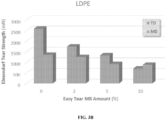
- Example 3 Composition Including Low Density Polyolefin, Low Aspect Ratio Filler, Tear Additive, and Color Additive
- compositions of the invention including polyolefin resin, a color additive, varying amounts of tear additive, and low ratio aspect filler were used to form resin films according to the present invention.
- the polyolefin resin was LDPE, which was included in an amount of 40 percent by weight of the composition
- the color additive was brown masterbatch, which was included in an amount of 10 percent by weight of the composition
- the low aspect ratio filler was calcium carbonate with an average particle size of 21 ⁇ m, which was included in an amount of 40 percent by weight of the composition.
- FIG. 4 shows the effects of the tear additive.
- the tear additive In particular, at two percent loading of the tear additive, there was a 16 percent drop in Elmendorf tear strength in the machine direction and no drop in the Elmendorf tear strength in the transverse direction. At five percent loading of the tear additive, there was a 19 percent drop in Elmendorf tear strength in the machine direction and a 60 percent drop in the Elmendorf tear strength in the transverse direction. At ten percent loading of the tear additive, there was a 80 percent drop in Elmendorf tear strength in the machine direction and a 75 percent drop in the Elmendorf tear strength in the transverse direction.
- the testing shows that a composition that includes LDPE, a low aspect ratio filler, and the tear additive forms a resin film that has superior tear properties over that of a composition that includes only LDPE and the tear additive.
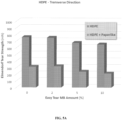
- Example 4 Composition Including High Density Polyolefin, Low Aspect Ratio Filler, and Tear Additive
- compositions of the invention including polyolefin resin, varying amounts of tear additive, and low ratio aspect filler were used to form resin films according to the present invention.
- the polyolefin resin was HDPE, which was included in an amount of 40 percent by weight of the composition and the low aspect ratio filler was calcium carbonate with an average particle size of 21 ⁇ m, which was included in an amount of 40 percent by weight of the composition.
- the control included only HDPE, but no low aspect ratio filler.
- FIGS. 5A and 5B show that the results obtained in Example 3 with LDPE are not realized with HDPE.
- the tear additive there was a 10 percent drop in Elmendorf tear strength in the machine direction and no drop in the Elmendorf tear strength in the transverse direction.
- At five percent loading of the tear additive there was a 20 percent drop in Elmendorf tear strength in the machine direction and a 28 percent drop in the Elmendorf tear strength in the transverse direction.
- At ten percent loading of the tear additive there was a 25 percent drop in Elmendorf tear strength in the machine direction and a 30 percent drop in the Elmendorf tear strength in the transverse direction.
Landscapes
- Chemical & Material Sciences (AREA)
- Chemical Kinetics & Catalysis (AREA)
- Health & Medical Sciences (AREA)
- Medicinal Chemistry (AREA)
- Polymers & Plastics (AREA)
- Organic Chemistry (AREA)
- Engineering & Computer Science (AREA)
- Manufacturing & Machinery (AREA)
- Materials Engineering (AREA)
- Life Sciences & Earth Sciences (AREA)
- Wood Science & Technology (AREA)
- Laminated Bodies (AREA)
- Compositions Of Macromolecular Compounds (AREA)
- Paper (AREA)
- Manufacture Of Macromolecular Shaped Articles (AREA)
- Wrappers (AREA)
- Sanitary Thin Papers (AREA)
Claims (6)
- Synthetisches Papier, das eine oder mehrere Schichten eines Harzfilms beinhaltet, der aus einer Zusammensetzung ausgebildet ist, umfassend:ein Polyethylenharz hoher Dichte, das in einer Menge von 40 Gewichtsprozent bis 60 Gewichtsprozent der Zusammensetzung vorhanden ist;einen teilchenförmigen Füllstoff mit einer mittleren Teilchengröße von 10 µm bis 30 µm; undein cyclisches Olefin-Copolymer, das durch Copolymerisation von Ethylen mit wenigstens einem cyclischen Olefin hergestellt wird, wobei das wenigstens eine cyclische Olefinmonomer wenigstens eines umfasst von: Cyclopentadien, einem Cyclopentadienderivat, Dicyclopentadien, einem Dicyclopentadienderivat, Norbomen, Dihydrodicyclopentadien, Phenylnorbomen und Tetracyclododecen, oder einer Kombination davon,wobei das synthetische Papier aufweist:- einen Totfaltenwinkel von 20° bis 30°, gemessen durch Herstellen einer 180°-Falte in dem Material bei Umgebungstemperatur und anschließendes Messen des Winkels, bis zu dem sich die Falte nach einer gewissen Zeitspanne öffnet; und- eine Elmendorf-Reißfestigkeit von 100 mN bis 1000 mN in einer Querrichtung, wenn gemäß ASTM D1922 gemessen.
- Synthetische Papier nach Anspruch 1, wobei der teilchenförmige Füllstoff:(a) in der Zusammensetzung in einer Menge von 10 bis 40 Gew.-% vorhanden ist; und/oder(b) Calciumcarbonat umfasst.
- Synthetisches Papier nach Anspruch 1, wobei das synthetische Papier umfasst:(a) wenigstens zwei Harzschichten; oder(b) wenigstens drei Harzschichten.
- Synthetisches Papier nach Anspruch 1 mit einer Dicke von 0,0127 mm (0,5 mils) bis 0,1016 mm (4 mils).
- Synthetisches Papier nach Anspruch 1, wobei die wenigstens zwei Schichten eine erste Schicht und eine zweite Schicht umfassen, wobei sich das Polyolefinharz in der ersten Schicht von dem Polyolefin in der zweiten Schicht unterscheidet.
- Synthetisches Papier nach Anspruch 1, wobei das zyklische Olefin-Copolymer in einer Menge von 2 Gewichtsprozent bis 10 Gewichtsprozent der Zusammensetzung vorhanden ist.
Applications Claiming Priority (2)
| Application Number | Priority Date | Filing Date | Title |
|---|---|---|---|
| US201662421641P | 2016-11-14 | 2016-11-14 | |
| PCT/US2017/061535 WO2018089999A1 (en) | 2016-11-14 | 2017-11-14 | Synthetic paper with improved tear properties and methods of manufacturing |
Publications (4)
| Publication Number | Publication Date |
|---|---|
| EP3538612A1 EP3538612A1 (de) | 2019-09-18 |
| EP3538612A4 EP3538612A4 (de) | 2020-04-15 |
| EP3538612B1 true EP3538612B1 (de) | 2024-11-06 |
| EP3538612C0 EP3538612C0 (de) | 2024-11-06 |
Family
ID=62106596
Family Applications (1)
| Application Number | Title | Priority Date | Filing Date |
|---|---|---|---|
| EP17869144.0A Active EP3538612B1 (de) | 2016-11-14 | 2017-11-14 | Synthetisches papier mit verbesserten reisseigenschaften und verfahren zur herstellung |
Country Status (15)
| Country | Link |
|---|---|
| US (1) | US12420535B2 (de) |
| EP (1) | EP3538612B1 (de) |
| JP (1) | JP7169273B2 (de) |
| KR (1) | KR102435258B1 (de) |
| CN (1) | CN110121536B (de) |
| AR (2) | AR110085A1 (de) |
| BR (1) | BR112019009621B1 (de) |
| CA (1) | CA3043603A1 (de) |
| EA (1) | EA201991187A1 (de) |
| IL (1) | IL266536B2 (de) |
| MX (1) | MX2019005624A (de) |
| PL (1) | PL3538612T3 (de) |
| UA (1) | UA125471C2 (de) |
| WO (1) | WO2018089999A1 (de) |
| ZA (1) | ZA201903547B (de) |
Families Citing this family (7)
| Publication number | Priority date | Publication date | Assignee | Title |
|---|---|---|---|---|
| PL3538612T3 (pl) | 2016-11-14 | 2025-03-17 | Ampacet Corporation | Papier syntetyczny o ulepszonych właściwościach rozdzierania i sposoby wytwarzania |
| US10611893B2 (en) * | 2018-04-16 | 2020-04-07 | United Arab Emirates University | Method for obtaining paper from sand and products obtained therefrom |
| CN112126177B (zh) * | 2020-09-30 | 2022-09-13 | 福建省永春佳威塑料包装制品有限公司 | 一种抗撕裂保护膜及其制备方法 |
| JP7545318B2 (ja) | 2020-12-22 | 2024-09-04 | 株式会社キッチニスタ | クラフト用フィルム |
| CN113199832B (zh) * | 2021-04-07 | 2022-01-18 | 无锡环宇包装材料有限公司 | 一种可降解压延标签合成纸制备工艺 |
| CN113185772A (zh) * | 2021-04-16 | 2021-07-30 | 阜阳市尤美新材料科技有限公司 | 一种新冠检测盒专用合成纸及其制作方法 |
| CN115891353A (zh) * | 2022-10-08 | 2023-04-04 | 佛山佛塑科技集团股份有限公司 | 一种直线易撕裂、透明的合成纸及其制备方法和应用 |
Family Cites Families (33)
| Publication number | Priority date | Publication date | Assignee | Title |
|---|---|---|---|---|
| GB1384556A (en) | 1971-12-22 | 1975-02-19 | Mitsubishi Petrochemical Co | Synthetic papers and method of making the same |
| JPS5090644A (de) * | 1973-12-17 | 1975-07-19 | ||
| JPS5258779A (en) * | 1975-11-08 | 1977-05-14 | Mitsui Petrochem Ind Ltd | Process for producing synthetic papers |
| US5128183A (en) | 1990-08-01 | 1992-07-07 | Borden, Inc. | Modified polyolefin film with stable twist retention, dead fold properties and barrier characteristics |
| GB9219656D0 (en) | 1992-09-17 | 1992-10-28 | Du Pont Canada | Paper-like film and method and compositions for making it |
| JP3773273B2 (ja) | 1994-05-30 | 2006-05-10 | 株式会社ユポ・コーポレーション | 印刷性に優れた積層構造の合成紙 |
| US6028028A (en) * | 1995-11-30 | 2000-02-22 | Oji-Yuka Synthetic Paper Co., Ltd. | Recording sheet |
| JP4053175B2 (ja) | 1999-04-02 | 2008-02-27 | 株式会社ユポ・コーポレーション | 多層樹脂延伸フィルム |
| JP4662607B2 (ja) | 1999-06-11 | 2011-03-30 | 三井化学株式会社 | 合成紙 |
| JP2003034760A (ja) * | 2001-05-18 | 2003-02-07 | Maruo Calcium Co Ltd | 表面処理重質炭酸カルシウム、その製造方法、及び表面処理重質炭酸カルシウムを配合してなる樹脂組成物 |
| WO2002102593A1 (en) | 2001-06-20 | 2002-12-27 | Byron Le Roux | Paper like polymeric material |
| JP2003026866A (ja) * | 2001-07-16 | 2003-01-29 | Maruo Calcium Co Ltd | オレフィン系樹脂シート用添加剤、及びそれを配合してなるシート用樹脂組成物 |
| US7144635B2 (en) * | 2001-09-13 | 2006-12-05 | Meadwestvaco Corporation | Tear resistant heat sealable packaging structure |
| JP3773439B2 (ja) * | 2001-10-24 | 2006-05-10 | 株式会社ユポ・コーポレーション | 樹脂フィルム |
| DE60319070T2 (de) * | 2002-03-20 | 2009-02-05 | Yupo Corp. | Aufzeichnungspapier und etikettenpapier, bei dem dieses verwendet wird |
| JP4357194B2 (ja) * | 2002-03-20 | 2009-11-04 | 株式会社ユポ・コーポレーション | 感熱記録用紙 |
| CN100491120C (zh) * | 2002-07-25 | 2009-05-27 | 优泊公司 | 拉伸树脂膜和包含该拉伸树脂膜的标签 |
| US7776413B2 (en) | 2002-09-10 | 2010-08-17 | Yupo Corporation | Melt thermal transfer recording paper |
| JP4344570B2 (ja) * | 2002-09-10 | 2009-10-14 | 株式会社ユポ・コーポレーション | 溶融熱転写記録用紙 |
| JP4259980B2 (ja) | 2003-10-27 | 2009-04-30 | 南亜塑膠工業股▲ふん▼有限公司 | 五層共押出二軸延伸ポリプロピレンパール光沢合成紙及びその製造法 |
| JP2005199514A (ja) * | 2004-01-14 | 2005-07-28 | Dainippon Printing Co Ltd | 多層積層樹脂フィルムおよびそれを使用した積層材 |
| US7582716B2 (en) * | 2004-03-17 | 2009-09-01 | Dow Global Technologies Inc. | Compositions of ethylene/α-olefin multi-block interpolymer for blown films with high hot tack |
| US20100204379A1 (en) | 2005-08-04 | 2010-08-12 | Alejandro Pira | Synthetic Paper |
| CN101351389A (zh) * | 2005-12-27 | 2009-01-21 | 优泊公司 | 环绕型标签和带有该标签的物品 |
| WO2007114056A1 (ja) * | 2006-03-30 | 2007-10-11 | Asahi Kasei Chemicals Corporation | 樹脂組成物およびその成形品 |
| JP2010077297A (ja) * | 2008-09-26 | 2010-04-08 | Toyobo Co Ltd | 空洞含有ポリプロピレン系フィルムの製造方法 |
| CN105330876B (zh) * | 2010-01-12 | 2018-04-10 | 绿岩有限责任公司 | 仿纸膜和其制备方法 |
| US8722963B2 (en) * | 2010-08-20 | 2014-05-13 | The Procter & Gamble Company | Absorbent article and components thereof having improved softness signals, and methods for manufacturing |
| JP6457716B2 (ja) * | 2011-01-14 | 2019-01-23 | ダブリュー・アール・グレイス・アンド・カンパニー−コネチカット | 修飾メタロセン触媒の作成法、生成された触媒およびそれらの使用 |
| US9529287B2 (en) * | 2012-12-14 | 2016-12-27 | Yupo Corporation | Recording sheet |
| WO2015050438A1 (en) * | 2013-10-01 | 2015-04-09 | Coldenhove Know How B.V. | Lidding material for blister packaging and the like |
| JP2015151649A (ja) * | 2014-02-17 | 2015-08-24 | 三井化学株式会社 | 合成紙の表面処理方法、積層体および印刷物 |
| PL3538612T3 (pl) | 2016-11-14 | 2025-03-17 | Ampacet Corporation | Papier syntetyczny o ulepszonych właściwościach rozdzierania i sposoby wytwarzania |
-
2017
- 2017-11-14 PL PL17869144.0T patent/PL3538612T3/pl unknown
- 2017-11-14 UA UAA201906625A patent/UA125471C2/uk unknown
- 2017-11-14 KR KR1020197016677A patent/KR102435258B1/ko active Active
- 2017-11-14 WO PCT/US2017/061535 patent/WO2018089999A1/en not_active Ceased
- 2017-11-14 EA EA201991187A patent/EA201991187A1/ru unknown
- 2017-11-14 MX MX2019005624A patent/MX2019005624A/es unknown
- 2017-11-14 IL IL266536A patent/IL266536B2/en unknown
- 2017-11-14 BR BR112019009621-3A patent/BR112019009621B1/pt active IP Right Grant
- 2017-11-14 CA CA3043603A patent/CA3043603A1/en active Pending
- 2017-11-14 JP JP2019525007A patent/JP7169273B2/ja active Active
- 2017-11-14 US US15/812,276 patent/US12420535B2/en active Active
- 2017-11-14 CN CN201780076377.7A patent/CN110121536B/zh active Active
- 2017-11-14 EP EP17869144.0A patent/EP3538612B1/de active Active
- 2017-11-15 AR ARP170103178A patent/AR110085A1/es unknown
- 2017-12-04 AR ARP170103390A patent/AR110484A1/es active IP Right Grant
-
2019
- 2019-06-03 ZA ZA2019/03547A patent/ZA201903547B/en unknown
Also Published As
| Publication number | Publication date |
|---|---|
| IL266536A (en) | 2019-07-31 |
| JP7169273B2 (ja) | 2022-11-10 |
| US12420535B2 (en) | 2025-09-23 |
| IL266536B (en) | 2022-12-01 |
| MX2019005624A (es) | 2020-02-07 |
| IL266536B2 (en) | 2023-04-01 |
| CN110121536B (zh) | 2021-12-14 |
| AR110484A1 (es) | 2019-04-03 |
| CA3043603A1 (en) | 2018-05-17 |
| UA125471C2 (uk) | 2022-03-23 |
| ZA201903547B (en) | 2023-12-20 |
| EP3538612C0 (de) | 2024-11-06 |
| US20180134014A1 (en) | 2018-05-17 |
| EP3538612A1 (de) | 2019-09-18 |
| BR112019009621B1 (pt) | 2023-01-10 |
| PL3538612T3 (pl) | 2025-03-17 |
| CN110121536A (zh) | 2019-08-13 |
| EA201991187A1 (ru) | 2019-10-31 |
| BR112019009621A2 (pt) | 2019-08-13 |
| KR102435258B1 (ko) | 2022-08-24 |
| KR20190079673A (ko) | 2019-07-05 |
| EP3538612A4 (de) | 2020-04-15 |
| WO2018089999A1 (en) | 2018-05-17 |
| JP2019536867A (ja) | 2019-12-19 |
| AR110085A1 (es) | 2019-02-20 |
Similar Documents
| Publication | Publication Date | Title |
|---|---|---|
| US12420535B2 (en) | Synthetic paper with improved tear properties and methods of manufacturing | |
| US5492757A (en) | Opaque, matte, multilayer polypropylene film, process for the production thereof, and the use thereof | |
| EP2939948B1 (de) | Verpackungsfolie | |
| JP2008545558A (ja) | 少なくとも1つのエチレン−ビニルアルコール−共重合体(evoh)から成るフィルム層を備え同時押出成形された多層保護フィルム、その製造方法及びその使用方法 | |
| EP3119604A1 (de) | Mehrschichtige kunststofffolie mit trennwirkung | |
| CN1827362B (zh) | 模内成型用标签以及使用该标签的成型品 | |
| JPH09272188A (ja) | シクロオレフィンポリマー含有ポリオレフィンフィルムとその製法およびその用途 | |
| CN1252026A (zh) | 膜结构 | |
| JP2008156641A (ja) | 二軸延伸ポリエステルフィルム及びその製造方法 | |
| TWI862871B (zh) | 含有空洞之聚酯系膜、標籤用基材、標籤用膜以及輥標籤 | |
| JP2022185386A (ja) | 包装材料および包装袋 | |
| US11976176B2 (en) | Method for producing a film comprising thermoplastic polymer and inorganic filler | |
| CA2557498C (en) | Pla film with good sliding and antistatic properties | |
| AU772959B2 (en) | Biaxially oriented polypropylene multilayer opaque-pearlised films with improved properties | |
| EA043585B1 (ru) | Синтетическая бумага с улучшенными свойствами на разрыв и способы получения | |
| EP1768079A1 (de) | In-form-label und harzformstück mit label | |
| JP2005022299A (ja) | 二軸延伸多層ポリプロピレンフィルム | |
| US20220111624A1 (en) | Polymeric film and uses thereof | |
| JP2008105428A (ja) | ポリ乳酸系積層2軸延伸フィルム | |
| JP5353026B2 (ja) | 再生樹脂を配合した積層耐水シート | |
| JP7232929B2 (ja) | 積層体及びホットメルト型粘着ラベル | |
| KR20130029934A (ko) | 전자제품 포장용 다층필름 | |
| JP4989852B2 (ja) | 乳酸系ポリマーの延伸積層フィルム | |
| JP4515702B2 (ja) | 印刷用シート | |
| JP2011093259A (ja) | 二軸延伸積層ポリプロピレンフィルム |
Legal Events
| Date | Code | Title | Description |
|---|---|---|---|
| STAA | Information on the status of an ep patent application or granted ep patent |
Free format text: STATUS: THE INTERNATIONAL PUBLICATION HAS BEEN MADE |
|
| PUAI | Public reference made under article 153(3) epc to a published international application that has entered the european phase |
Free format text: ORIGINAL CODE: 0009012 |
|
| STAA | Information on the status of an ep patent application or granted ep patent |
Free format text: STATUS: REQUEST FOR EXAMINATION WAS MADE |
|
| 17P | Request for examination filed |
Effective date: 20190514 |
|
| AK | Designated contracting states |
Kind code of ref document: A1 Designated state(s): AL AT BE BG CH CY CZ DE DK EE ES FI FR GB GR HR HU IE IS IT LI LT LU LV MC MK MT NL NO PL PT RO RS SE SI SK SM TR |
|
| AX | Request for extension of the european patent |
Extension state: BA ME |
|
| DAV | Request for validation of the european patent (deleted) | ||
| DAX | Request for extension of the european patent (deleted) | ||
| REG | Reference to a national code |
Ref country code: DE Ref legal event code: R079 Free format text: PREVIOUS MAIN CLASS: C08L0101000000 Ipc: B32B0027200000 Ref country code: DE Ref legal event code: R079 Ref document number: 602017086004 Country of ref document: DE Free format text: PREVIOUS MAIN CLASS: C08L0101000000 Ipc: B32B0027200000 |
|
| A4 | Supplementary search report drawn up and despatched |
Effective date: 20200313 |
|
| RIC1 | Information provided on ipc code assigned before grant |
Ipc: B32B 27/08 20060101ALI20200309BHEP Ipc: B32B 7/02 20190101ALI20200309BHEP Ipc: B32B 23/04 20060101ALI20200309BHEP Ipc: C08L 101/12 20060101ALI20200309BHEP Ipc: C08K 3/26 20060101ALI20200309BHEP Ipc: B32B 27/30 20060101ALI20200309BHEP Ipc: B32B 27/20 20060101AFI20200309BHEP Ipc: B32B 5/30 20060101ALI20200309BHEP Ipc: B32B 27/32 20060101ALI20200309BHEP Ipc: B32B 29/00 20060101ALI20200309BHEP Ipc: B32B 5/16 20060101ALI20200309BHEP Ipc: C08L 101/00 20060101ALI20200309BHEP Ipc: B32B 27/18 20060101ALI20200309BHEP Ipc: B32B 27/36 20060101ALI20200309BHEP |
|
| STAA | Information on the status of an ep patent application or granted ep patent |
Free format text: STATUS: EXAMINATION IS IN PROGRESS |
|
| 17Q | First examination report despatched |
Effective date: 20221028 |
|
| GRAP | Despatch of communication of intention to grant a patent |
Free format text: ORIGINAL CODE: EPIDOSNIGR1 |
|
| STAA | Information on the status of an ep patent application or granted ep patent |
Free format text: STATUS: GRANT OF PATENT IS INTENDED |
|
| INTG | Intention to grant announced |
Effective date: 20240618 |
|
| GRAS | Grant fee paid |
Free format text: ORIGINAL CODE: EPIDOSNIGR3 |
|
| GRAA | (expected) grant |
Free format text: ORIGINAL CODE: 0009210 |
|
| STAA | Information on the status of an ep patent application or granted ep patent |
Free format text: STATUS: THE PATENT HAS BEEN GRANTED |
|
| AK | Designated contracting states |
Kind code of ref document: B1 Designated state(s): AL AT BE BG CH CY CZ DE DK EE ES FI FR GB GR HR HU IE IS IT LI LT LU LV MC MK MT NL NO PL PT RO RS SE SI SK SM TR |
|
| REG | Reference to a national code |
Ref country code: GB Ref legal event code: FG4D |
|
| REG | Reference to a national code |
Ref country code: CH Ref legal event code: EP |
|
| REG | Reference to a national code |
Ref country code: DE Ref legal event code: R096 Ref document number: 602017086004 Country of ref document: DE |
|
| REG | Reference to a national code |
Ref country code: IE Ref legal event code: FG4D |
|
| U01 | Request for unitary effect filed |
Effective date: 20241107 |
|
| U07 | Unitary effect registered |
Designated state(s): AT BE BG DE DK EE FI FR IT LT LU LV MT NL PT RO SE SI Effective date: 20241115 |
|
| U21 | Renewal fee for the european patent with unitary effect paid with additional fee |
Year of fee payment: 8 Effective date: 20250227 |
|
| PG25 | Lapsed in a contracting state [announced via postgrant information from national office to epo] |
Ref country code: HR Free format text: LAPSE BECAUSE OF FAILURE TO SUBMIT A TRANSLATION OF THE DESCRIPTION OR TO PAY THE FEE WITHIN THE PRESCRIBED TIME-LIMIT Effective date: 20241106 Ref country code: IS Free format text: LAPSE BECAUSE OF FAILURE TO SUBMIT A TRANSLATION OF THE DESCRIPTION OR TO PAY THE FEE WITHIN THE PRESCRIBED TIME-LIMIT Effective date: 20250306 |
|
| PG25 | Lapsed in a contracting state [announced via postgrant information from national office to epo] |
Ref country code: ES Free format text: LAPSE BECAUSE OF FAILURE TO SUBMIT A TRANSLATION OF THE DESCRIPTION OR TO PAY THE FEE WITHIN THE PRESCRIBED TIME-LIMIT Effective date: 20241106 |
|
| PG25 | Lapsed in a contracting state [announced via postgrant information from national office to epo] |
Ref country code: NO Free format text: LAPSE BECAUSE OF FAILURE TO SUBMIT A TRANSLATION OF THE DESCRIPTION OR TO PAY THE FEE WITHIN THE PRESCRIBED TIME-LIMIT Effective date: 20250206 |
|
| PG25 | Lapsed in a contracting state [announced via postgrant information from national office to epo] |
Ref country code: GR Free format text: LAPSE BECAUSE OF FAILURE TO SUBMIT A TRANSLATION OF THE DESCRIPTION OR TO PAY THE FEE WITHIN THE PRESCRIBED TIME-LIMIT Effective date: 20250207 |
|
| PG25 | Lapsed in a contracting state [announced via postgrant information from national office to epo] |
Ref country code: RS Free format text: LAPSE BECAUSE OF FAILURE TO SUBMIT A TRANSLATION OF THE DESCRIPTION OR TO PAY THE FEE WITHIN THE PRESCRIBED TIME-LIMIT Effective date: 20250206 |
|
| PG25 | Lapsed in a contracting state [announced via postgrant information from national office to epo] |
Ref country code: SM Free format text: LAPSE BECAUSE OF FAILURE TO SUBMIT A TRANSLATION OF THE DESCRIPTION OR TO PAY THE FEE WITHIN THE PRESCRIBED TIME-LIMIT Effective date: 20241106 |
|
| PG25 | Lapsed in a contracting state [announced via postgrant information from national office to epo] |
Ref country code: SK Free format text: LAPSE BECAUSE OF FAILURE TO SUBMIT A TRANSLATION OF THE DESCRIPTION OR TO PAY THE FEE WITHIN THE PRESCRIBED TIME-LIMIT Effective date: 20241106 |
|
| PLBE | No opposition filed within time limit |
Free format text: ORIGINAL CODE: 0009261 |
|
| STAA | Information on the status of an ep patent application or granted ep patent |
Free format text: STATUS: NO OPPOSITION FILED WITHIN TIME LIMIT |
|
| PG25 | Lapsed in a contracting state [announced via postgrant information from national office to epo] |
Ref country code: MC Free format text: LAPSE BECAUSE OF FAILURE TO SUBMIT A TRANSLATION OF THE DESCRIPTION OR TO PAY THE FEE WITHIN THE PRESCRIBED TIME-LIMIT Effective date: 20241106 |
|
| 26N | No opposition filed |
Effective date: 20250807 |
|
| PG25 | Lapsed in a contracting state [announced via postgrant information from national office to epo] |
Ref country code: IE Free format text: LAPSE BECAUSE OF NON-PAYMENT OF DUE FEES Effective date: 20241114 |
|
| REG | Reference to a national code |
Ref country code: CH Ref legal event code: U11 Free format text: ST27 STATUS EVENT CODE: U-0-0-U10-U11 (AS PROVIDED BY THE NATIONAL OFFICE) Effective date: 20251201 |
|
| U20 | Renewal fee for the european patent with unitary effect paid |
Year of fee payment: 9 Effective date: 20251126 |
|
| PGFP | Annual fee paid to national office [announced via postgrant information from national office to epo] |
Ref country code: GB Payment date: 20251127 Year of fee payment: 9 |
|
| PGFP | Annual fee paid to national office [announced via postgrant information from national office to epo] |
Ref country code: CH Payment date: 20251201 Year of fee payment: 9 |
|
| PGFP | Annual fee paid to national office [announced via postgrant information from national office to epo] |
Ref country code: CZ Payment date: 20251024 Year of fee payment: 9 |
|
| PGFP | Annual fee paid to national office [announced via postgrant information from national office to epo] |
Ref country code: PL Payment date: 20251021 Year of fee payment: 9 |
|
| PG25 | Lapsed in a contracting state [announced via postgrant information from national office to epo] |
Ref country code: HU Free format text: LAPSE BECAUSE OF FAILURE TO SUBMIT A TRANSLATION OF THE DESCRIPTION OR TO PAY THE FEE WITHIN THE PRESCRIBED TIME-LIMIT; INVALID AB INITIO Effective date: 20171114 |
|
| PG25 | Lapsed in a contracting state [announced via postgrant information from national office to epo] |
Ref country code: CY Free format text: LAPSE BECAUSE OF FAILURE TO SUBMIT A TRANSLATION OF THE DESCRIPTION OR TO PAY THE FEE WITHIN THE PRESCRIBED TIME-LIMIT; INVALID AB INITIO Effective date: 20171114 |