EP3515900B1 - Verbindungen mit zwei oder mehr exovinylen-cyclocarbonateinheiten - Google Patents
Verbindungen mit zwei oder mehr exovinylen-cyclocarbonateinheiten Download PDFInfo
- Publication number
- EP3515900B1 EP3515900B1 EP17761910.3A EP17761910A EP3515900B1 EP 3515900 B1 EP3515900 B1 EP 3515900B1 EP 17761910 A EP17761910 A EP 17761910A EP 3515900 B1 EP3515900 B1 EP 3515900B1
- Authority
- EP
- European Patent Office
- Prior art keywords
- groups
- compounds
- formula
- group
- diol
- Prior art date
- Legal status (The legal status is an assumption and is not a legal conclusion. Google has not performed a legal analysis and makes no representation as to the accuracy of the status listed.)
- Active
Links
- 0 CC(BC(OC)O*O)(C(O1)=C)OC1=O Chemical compound CC(BC(OC)O*O)(C(O1)=C)OC1=O 0.000 description 4
Classifications
-
- C—CHEMISTRY; METALLURGY
- C07—ORGANIC CHEMISTRY
- C07D—HETEROCYCLIC COMPOUNDS
- C07D317/00—Heterocyclic compounds containing five-membered rings having two oxygen atoms as the only ring hetero atoms
- C07D317/08—Heterocyclic compounds containing five-membered rings having two oxygen atoms as the only ring hetero atoms having the hetero atoms in positions 1 and 3
- C07D317/10—Heterocyclic compounds containing five-membered rings having two oxygen atoms as the only ring hetero atoms having the hetero atoms in positions 1 and 3 not condensed with other rings
- C07D317/32—Heterocyclic compounds containing five-membered rings having two oxygen atoms as the only ring hetero atoms having the hetero atoms in positions 1 and 3 not condensed with other rings with hetero atoms or with carbon atoms having three bonds to hetero atoms with at the most one bond to halogen, e.g. ester or nitrile radicals, directly attached to ring carbon atoms
- C07D317/34—Oxygen atoms
- C07D317/36—Alkylene carbonates; Substituted alkylene carbonates
- C07D317/38—Ethylene carbonate
-
- C—CHEMISTRY; METALLURGY
- C08—ORGANIC MACROMOLECULAR COMPOUNDS; THEIR PREPARATION OR CHEMICAL WORKING-UP; COMPOSITIONS BASED THEREON
- C08G—MACROMOLECULAR COMPOUNDS OBTAINED OTHERWISE THAN BY REACTIONS ONLY INVOLVING UNSATURATED CARBON-TO-CARBON BONDS
- C08G64/00—Macromolecular compounds obtained by reactions forming a carbonic ester link in the main chain of the macromolecule
- C08G64/02—Aliphatic polycarbonates
- C08G64/0208—Aliphatic polycarbonates saturated
- C08G64/0225—Aliphatic polycarbonates saturated containing atoms other than carbon, hydrogen or oxygen
- C08G64/0241—Aliphatic polycarbonates saturated containing atoms other than carbon, hydrogen or oxygen containing nitrogen
-
- C—CHEMISTRY; METALLURGY
- C09—DYES; PAINTS; POLISHES; NATURAL RESINS; ADHESIVES; COMPOSITIONS NOT OTHERWISE PROVIDED FOR; APPLICATIONS OF MATERIALS NOT OTHERWISE PROVIDED FOR
- C09D—COATING COMPOSITIONS, e.g. PAINTS, VARNISHES OR LACQUERS; FILLING PASTES; CHEMICAL PAINT OR INK REMOVERS; INKS; CORRECTING FLUIDS; WOODSTAINS; PASTES OR SOLIDS FOR COLOURING OR PRINTING; USE OF MATERIALS THEREFOR
- C09D169/00—Coating compositions based on polycarbonates; Coating compositions based on derivatives of polycarbonates
Definitions
- the invention relates to compounds with two or more exovinylene cyclocarbonate units, the exovinylene cyclocarbonate units being connected to one another via at least one organic, siloxane-free connecting group which is not directly connected to the exovinylene double bonds and with the exception of connecting groups formed by polymerization of (meth) acrylic monomers are. Also described is a process for preparing the compounds, two-component binders which contain the compounds, and uses of the compounds.
- compositions which contain, inter alia, an oligomeric or polymeric compound having at least two alkylidene-1,3-dioxolan-2-one groups.
- the dioxolanones are linked via the alkylidene groups.
- Exovinylene cyclocarbonates can react with amines to form urethanes at room temperature and are therefore a potential alternative to polyurethane formation through isocyanate / alcohol reactions.
- acrylate monomers which contain an exovinylene cyclocarbonate group.
- Multifunctional derivatives (copolymers) made from these monomers are described in the unpublished European patent application with the application number 15172703.9 described. However, these derivatives and monomers have to be synthesized in several stages with a significant loss in yield.
- exovinylene cyclocarbonate units are 5-vinylidene-1,3-dioxolan-2-one units of the general formula (I) wherein the at least one organic, siloxane-free connecting group is located between the 4-positions of the 5-vinylidene-1,3-dioxolan-2-one units and where R1 and R2 stand for hydrogen and R3 stands for a methyl group.
- Groups derived from the alcoholic hardeners mentioned below are particularly suitable as groups derived from a polyol, preferably selected from ethylene glycol, 1,3-propanediol, 1,4-butanediol, diethylene glycol, triethylene glycol, neopentyl glycol, 1,5-pentanediol, 1, 6-hexanediol, 1,8-octanediol, 3-methyl-1,5-pentanediol, 1,4-bis-hydroxymethyl-cyclohexane, 1,6-bis-hydroxymethyl-cyclohexane, glycerine, diglycerine, polyethylene glycol, polypropylene glycol, poly- THF, pentaerythritol, dipentaerythritol, sugar alcohols such as sorbitol and mannitol.
- a polyol preferably selected from ethylene glycol, 1,3-propanediol, 1,4-but
- -OQO- in the formulas VIa, IVc, Vd and Ve each stands for the remainder of a dihydric alcohol, preferably selected from ethylene glycol, 1,3-propanediol, 1,4-butanediol, diethylene glycol, triethylene glycol, neopentyl glycol, 1.5- Pentanediol, 1,6-hexanediol, 1,8-octanediol, 3-methyl-1,5-pentanediol, 1,4-bis-hydroxymethyl-cyclohexane, 1,6-bis-hydroxymethyl-cyclohexane, glycerine, diglycerine, polyethylene glycol, Polypropylene glycol, poly-THF, pentaerythritol, dipentaerythritol, sugar alcohols such as sorbitol and mannitol.
- ethylene glycol 1,3-propanediol, 1,4-butaned
- Compounds according to the invention can be prepared, for example, by transacetalization of an exovinylene cyclocarbonate of the formula (VII) where R10 and R11 are, independently of one another, an organic radical.
- R1 to R3 have the same meaning as in formula (I).
- R9 stands for an H atom.
- R10 and R11 preferably represent a C1 to C10 alkyl group, a C1 to C6 alkyl group or a C1 to C3 alkyl group, particularly preferably a methyl group.
- R 10 and R 11 independently of one another, preferably represent hydrocarbon groups, in particular C 1 to C 10 alkyl groups or alkyl groups having 1 to 4 carbon atoms, particularly preferably methyl groups.
- B stands for an alkylene group with 1 to 4 carbon atoms, in particular for methylene.
- a compound of the formula (VIIa) is particularly preferred:
- the implementation of the first stage is a known addition of triple bonds to a carbonyl group.
- Suitable compounds with a terminal triple bond are in particular compounds of the formula (VIII) Y-CH ⁇ CH, where Y stands for an H atom, a hydrocarbon group with 1 to 10 C atoms, for example an alkyl or aryl group or a protective group with a maximum of 10 C atoms. If Y is not a protective group, the substituents of the Y-substituted carbon atom determine the later radicals R1, R2, R5 and R6 in formulas (I) to (V).
- one of the radicals R1 or R2 or one of the radicals R5 or R6 in formulas (I) to (V) is an H atom and the other is Y.
- the preferred meanings of Y therefore correspond to the above preferred meanings of R1, R2, R5 and R6.
- Y can also stand for a protective group.
- Protective groups are split off again during or after the synthesis has taken place, so that in this case the later radicals R1 and R2 or R5 and R6 in formulas (I) to (V) and (VII) each represent an H atom.
- a suitable protective group is e.g. the trimethylsilyl group (TMS for short)
- the starting compounds are preferably reacted in the presence of a strong base.
- Preferred strong bases are metal alcoholates. These are preferably metal salts of aliphatic alcohols, in particular metal salts of C1 to C8, preferably C2 to C6 alcohols, such as ethanol, n-propanol, iso-propanol, n-butanol or tertiary butanol.
- the metal cations of the metal alcoholates are preferably alkali cations, e.g. the cations of sodium or potassium.
- Preferred metal alcoholates include potassium tert-butoxide, sodium tert-butoxide, potassium isopropoxide and sodium isopropoxide.
- the reaction is preferably carried out in the presence of a solvent.
- Preferred solvents are inert solvents; these do not contain any reactive groups which react with the starting compounds. Inert, polar, aprotic solvents are particularly preferred. Cyclic ether compounds, in particular THF, may be mentioned as such.
- the reaction is generally exothermic, so it is preferred to cool the reaction.
- the temperature of the reaction mixture is preferably a maximum of 50 ° C., in particular a maximum of 25 ° C .; it is preferably between 0 and 25 ° C.
- the starting compounds are preferably reacted in the presence of a strong base.
- Preferred strong bases are metal alcoholates. These are preferably metal salts of aliphatic alcohols, in particular metal salts of C1 to C8, preferably C2 to C6 alcohols, such as ethanol, n-propanol, iso-propanol, n-butanol or tertiary butanol.
- the metal cations of the metal alcoholates are preferably alkali cations, e.g. the cations of sodium or potassium.
- Preferred metal alcoholates include potassium tert-butoxide, sodium tert-butoxide, potassium isopropoxide and sodium isopropoxide.
- the reaction is preferably carried out in the presence of a solvent.
- Preferred solvents are inert solvents; these do not contain any reactive groups which react with the starting compounds.
- Inert, polar, aprotic solvents are particularly preferred.
- Cyclic ether compounds, in particular THF, for example, may be mentioned as such.
- the reaction is generally exothermic, so it is preferred to cool the reaction.
- the temperature of the reaction mixture is preferably a maximum of 50 ° C., in particular a maximum of 25 ° C .; it is preferably between 0 and 25 ° C.
- water, optionally acid and optionally a non-polar organic solvent can be added. If the valuable product of the 1st stage already forms an independent organic phase, the organic solvent can be dispensed with. Two phases are formed, of which the organic phase contains the product of the 1st stage (addition products). The organic phase can be dried to remove water. Solvent can easily be separated off by distillation. The product can be obtained in pure form by vacuum distillation. Alternatively, the work-up can also be carried out by the usual crystallization or extraction processes, especially if the product of the 1st stage has a very high boiling point.
- stage 2 the ring closure takes place with carbon dioxide to form the cyclic carbonate group.
- the second stage product is a compound having a cyclic carbonate group and an acetal group.
- carbon dioxide is preferably brought into contact with the starting compound in gaseous form or in a supercritical state under pressure. The reaction is therefore preferably carried out in an autoclave. Carbon dioxide can also be used in admixture with inert gas.
- the reaction is preferably carried out in the presence of catalysts. It is preferably carried out in the presence of a base as a catalyst or particularly preferably in the presence of a catalyst system composed of a base and a metal salt.
- a base as a catalyst or particularly preferably in the presence of a catalyst system composed of a base and a metal salt.
- Compounds with at least one tertiary amino group, e.g. with one to three tertiary amino groups, are preferred as the base.
- Such bases are known. They usually have a molecular weight below 500 g / mol, in particular below 300 g / mol. In particular, these are aliphatic or cycloaliphatic compounds.
- the metal salt is preferably a salt with one to three valent cations, in particular cations of Cu, Ag or Au.
- the anion of the metal salts is preferably a carboxylate, in particular a C1 to C6 carboxylate.
- Silver acetate or copper acetate may be mentioned as preferred metal salts.
- Phosphines can also be used as catalysts.
- these are trialkyl or triaryl phosphines. These can be used alone or also in combination with a metal salt.
- the reaction is preferably carried out at a pressure of 1 to 100 bar, in particular 5 to 70 bar.
- the temperature of the reaction mixture is preferably from 10 to 100.degree. C., in particular from 10 to 80.degree.
- the reaction can be monitored, for example, by gas chromatography.
- the product obtained can be worked up.
- An organic solvent preferably an inert, hydrophobic organic solvent such as dichloromethane or toluene, and aqueous acid, e.g. aqueous HCl, can be added so that two phases are formed.
- the organic phase contains the desired product.
- Water can be removed from the organic phase by drying.
- Solvent can be removed by distillation.
- the product can be purified by distillation.
- a gentle and therefore preferred distillation is, for example, distillation in a thin-film evaporator. Thin-film evaporators with a wiper system are particularly suitable for this purpose.
- the product of the second stage has high boiling points, it can also be worked up and purified by crystallization or extraction.
- Acid catalysts are, for example, acidic inorganic, organometallic or organic catalysts or mixtures of several acidic inorganic, organometallic or organic catalysts.
- acidic inorganic catalysts are sulfuric acid, sulfates and hydrogen sulfates, such as sodium hydrogen sulfate, phosphoric acid, phosphonic acid, hypophosphorous acid, aluminum sulfate hydrate, alum, acidic silica gel (pH 6, in particular 5) and acidic aluminum oxide.
- aluminum compounds of the general formula Al (OR 1 ) 3 and titanates of the general formula Ti (OR 1 ) 4 can be used as acidic inorganic catalysts, where the radicals R 1 can each be the same or different and are selected independently of one another from C 1 - C 20 -alkyl radicals, for example methyl, ethyl, n-propyl, iso-propyl, n-butyl, iso-butyl, sec-butyl, tert-butyl, n-pentyl, iso-pentyl, sec-pentyl, neo -Pentyl, 1,2-dimethylpropyl, iso-amyl, n-hexyl, iso-hexyl, sec-hexyl, n-heptyl, iso-heptyl, n-octyl, 2-ethylhexyl, n-nonyl, n-decyl
- Preferred acidic organometallic catalysts are selected, for example, from dialkyltin oxides R 1 2 SnO or dialkyltin esters R 1 2 Sn (OR 2 ) 2 where R 1 is defined as above and can be identical or different.
- R 2 can have the same meanings as R 1 and additionally be C 6 -C 12 aryl, for example phenyl, o-, m- or p-tolyl, xylyl or naphthyl.
- R 2 can in each case be the same or different.
- organotin catalysts examples include tin (II) n-octanoate, tin (II) -2-ethylhexanoate, tin (II) laurate, dibutyltin oxide, diphenyltin oxide, dibutyltin dichloride, Dibutyltin diacetate, dibutyltin dilaurate, dibutyltin dimaleate or dioctyltin diacetate.
- acidic organometallic catalysts are dibutyltin oxide, diphenyltin oxide and dibutyltin dilaurate.
- Preferred acidic organic catalysts are acidic organic compounds with, for example, phosphate groups, sulfonic acid groups, sulfate groups or phosphonic acid groups. It is also possible to use acidic ion exchangers as acidic organic catalysts, for example polystyrene resins which contain sulfonic acid groups and which are crosslinked with about 2 mol% of divinylbenzene. Sulphonic acids such as p-toluenesulphonic acid or methanesulphonic acid are particularly preferred; and trifluoroacetic acid.
- the catalysts can be homogeneous or heterogeneous or supported. Stronger acids tend to discolour the reaction products, weaker acids require higher temperatures.
- the ratio of OR groups of the acetal groups to OH groups can be 4: 1 to 1: 4, preferably 2: 1 to 1: 2, very particularly preferably 1.5: 1 to 1: 1.5.
- the reaction can be carried out in various solvents, polar solvents such as acetonitrile are preferred. Reaction temperatures are between room temperature (20.degree. C.) and 100.degree. C., preferably ⁇ 80.degree. C., particularly preferably ⁇ 60.degree.
- the reaction is particularly preferably carried out under vacuum to effectively remove the methanol from the equilibrium. For this purpose, it is particularly preferred if the reaction is carried out solvent-free over long distances.
- the reaction mixture can first be made up in solution and the solvent can then be removed under vacuum. It can also be recovered and reused.
- reaction products according to the invention can be worked up by simply washing out the catalyst. If it is worn, it only needs to be filtered. Higher purities are obtained by shaking out with water, buffers or very weak bases and drying with desiccants. Precipitations in water and non-solvents are also possible, whereby care must be taken that the acetal groups are not hydrolyzed.
- the exovinylene cyclocarbonates according to the invention have weight average molecular weights Mw preferably between 500 and 50,000 g / mol, particularly preferably between 1000 and 10,000 g / mol, measured by gel permeation chromatography (GPC in THF; standard polystyrene).
- the viscosity is preferably 0.5 to 5000 Pa s (measured as zero viscosity).
- the zero viscosity is the limit value of the viscosity function at infinitely low shear rates. It is measured with an Anton Paar rheometer MCR 100 (US 200 evaluation software) in plate / plate geometry.
- the samples are measured in oscillatory shear at a small shear amplitude of 10% and at a temperature of 23 ° C., angular frequency ramp log 100-0.1 1 / s, measuring gap 0.5 mm, evaluation according to Carreau-Gahleitner I, punch diameter 25 mm.
- exovinylene cyclocarbonates according to the invention can be chain-extended with isocyanates, acid chlorides and / or acid anhydrides without destroying the exovinylene carbonate ring. They can also be reacted with polyamines to form polyurethanes with ring opening. They can also be converted to polycarbonates with ring opening with other polyols and strongly basic catalysis.
- the invention also relates to a process for the preparation of a compound having two or more exovinylene cyclocarbonate units, a compound having an exovinylene cyclocarbonate unit and at least one acetal group being reacted in a transacetalization reaction with at least one compound selected from the group consisting of diols and polyols.
- the reaction is preferably carried out under catalysis with Lewis acids or with protic acids.
- the invention also relates to the use of the compounds according to the invention as a constituent of coating materials, lacquers, paints, inks, building materials, elastomers, foams or for binding fibers and / or particles.
- the invention therefore also relates to uses of two-component binders containing at least one compound according to the invention in a first component and at least one multifunctional hardener which has at least two functional groups selected from the group consisting of primary amino groups, secondary amino groups and hydroxyl groups in a second component , Phosphine groups, phosphonate groups and mercaptan groups.
- the two-component binder preferably contains at least one catalyst for catalyzing the reaction of the exovinylene cyclocarbonate groups with the functional groups of the hardener.
- the two-component binder can be applied as a solution in an organic solvent or as a solvent-free and water-free one hundred percent system.
- the functional groups of the hardener are preferably selected from aliphatic hydroxyl groups, aliphatic primary amino groups, aliphatic secondary amino groups, aliphatic phosphine groups, aliphatic phosphonate groups and aliphatic mercaptan groups.
- 2K binder compositions preferably also contain at least one compound which has at least 2 functional groups F, for example 2, 3, 4, 5, 6, 7, 8, 9 or 10 functional groups F, which among aliphatic Hydroxyl groups, aliphatic primary or secondary amino groups, aliphatic phosphine groups, aliphatic phosphonate groups and the like. Groups and aliphatic mercaptan groups are selected. These compounds are also referred to below as hardeners.
- Preferred functional groups F are aliphatic hydroxyl groups and aliphatic primary and secondary amino groups.
- the amount of hardener is preferably chosen so that the molar ratio of functional alkylidene-1,3-dioxolan-2-one groups of the formula I to the functional groups F in the hardener is in the range from 1:10 to 10: 1, in particular in Range from 5: 1 to 1: 5 and especially in the range from 1: 2 to 2: 1.
- the hardener can be a low molecular weight substance, i. That is, its molecular weight is below 500 g / mol, or an oligomeric or polymeric substance which has a number average molecular weight above 500 g / mol.
- the hardeners preferred according to the invention include amine hardeners, i.e. hardeners which have at least two primary or secondary amino groups, and alcoholic hardeners, i.e. compounds which have at least two hydroxyl groups.
- Preferred amine hardeners are aliphatic polyamines, especially 2,2-dimethylpropylenediamine, aromatic diamines, especially m-xylylenediamine (MXDA) and cycloaliphatic diamines, especially isophoronediamine, N-cyclohexylpropylene-1,3-diamine and 4,4'-diaminodicyclohexylmethane (dicycanic) .
- MXDA m-xylylenediamine
- cycloaliphatic diamines especially isophoronediamine, N-cyclohexylpropylene-1,3-diamine and 4,4'-diaminodicyclohexylmethane (dicycanic) .
- Preference is also given to difunctional or trifunctional primary polyether amines based on polypropylene glycol, such as. B. Jeffamine® D 230 or Jeffamine® T 403.
- polyamines in which there is high mobility and low steric hindrance around the amino group for example 4,9-dioxadodecane-1,12-diamine, 4,7, 10-trioxatridecane-1,13-diamine, PolyTHF amine 350 (BASF SE).
- Mixtures of the amines mentioned as preferred are also preferred, for example mixtures containing 2,2-dimethylpropylenamine and isophoronamine.
- the alcoholic hardeners include, in particular, low molecular weight and higher molecular weight aliphatic and cycloaliphatic alcohols.
- Alcoholic hardeners crosslink to form carbonate polymers by reaction of the primary or secondary alcohol functions with the 1,3-dioxolan-2-one groups with the formation of diesters of carbonic acid.
- Preferred alcoholic hardeners have on average at least two primary or secondary hydroxyl groups per molecule, e.g. B. two, three or four primary or secondary hydroxyl groups per molecule on.
- Suitable low molecular weight alcoholic hardeners are, for. B.
- 1,4-butanediol ethylene glycol, diethylene glycol, triethylene glycol, neopentyl glycol, 1,3-propanediol, 1,5-pentanediol, 1,6-hexanediol, glycerol, diglycerol, pentaerythritol, dipentaerythritol, sugar alcohols such as sorbitol and mannitol.
- Suitable alcoholic hardeners are also higher molecular weight, polymeric polyols, for example polyester polyols, polycarbonate polyols, polyether polyols, polyacrylate polyols and polyvinyl alcohols.
- Suitable polymeric polyol hardeners preferably have an average OH functionality of at least 1.5 mol and especially at least 1.8, e.g. B. in the range from 1.5 to 10 and in particular in the range from 1.8 to 4 on.
- the mean OH functionality is understood to mean the mean number of OH groups per polymer chain.
- Typical polymeric polyol components preferably have a number average molecular weight of from about 250 to 50,000 g / mol, preferably from about 500 to 10,000 g / mol.
- at least 50 mol% of the hydroxyl groups contained in the polymeric polyol component are primary hydroxyl groups.
- Polyester polyols are preferably linear or branched polymeric compounds with ester groups in the polymer backbone which have free hydroxyl groups at the ends of the polymer chain. These are preferably polyesters obtained by polycondensation of dihydric alcohols with dihydric carboxylic acids, optionally in the presence of higher-valent alcohols (e.g. 3, 4, 5 or 6-valent alcohols) and / or higher-valent polycarboxylic acids. Instead of the free di- or polycarboxylic acids, the corresponding di- or polycarboxylic acid anhydrides or corresponding di- or polycarboxylic acid esters of lower alcohols or mixtures thereof can also be used to prepare the polyester polyols.
- the di- or polycarboxylic acids can be aliphatic, cycloaliphatic, araliphatic, aromatic or heterocyclic, preferably have 2 to 50 and in particular 4 to 20 carbon atoms and can optionally, for. B. substituted by halogen atoms and / or unsaturated.
- polyester polyols examples include: suberic acid, azelaic acid, phthalic acid, isophthalic acid, phthalic anhydride, tetrahydrophthalic anhydride, hexahydrophthalic anhydride, tetrachlorophthalic anhydride, endomethylenetetrahydrophthalic anhydride, glutaric anhydride, fatty acid anhydride, maleic anhydride, maleic anhydride, allyic anhydride, maleic anhydride, and phthalic anhydride.
- Suitable diols for the preparation of the polyester polyols are, in particular, aliphatic and cycloaliphatic diols having preferably 2 to 40 and in particular 2 to 20 carbon atoms, e.g. B.
- ethylene glycol propane-1,2-diol, propane-1,3-diol, butane-1,3-diol, butane-1,4-diol, butene-1,4-diol, butyne-1,4- diol, pentane-1,5-diol, neopentyl glycol, bis (hydroxymethyl) cyclohexanes such as 1,4-bis (hydroxymethyl) cyclohexane, 2-methylpropane-1,3-diol, methylpentanediols, and also diethylene glycol, triethylene glycol, tetraethylene glycol, polyethylene glycol , Dipropylene glycol, polypropylene glycol, dibutylene glycol and polybutylene glycols.
- Alcohols of the general formula HO- (CH 2 ) x -OH, where x is a number from 2 to 20, preferably an even number from 2 to 12, are preferred.
- Examples are ethylene glycol, butane-1,4-diol, hexane-1,6-diol, octane-1,8-diol and dodecane-1,12-diol.
- Neopentyl glycol and pentane-1,5-diol are also preferred.
- polyester polyols based on lactones are also suitable as alcoholic hardeners, these being homopolymers or copolymers of lactones, preferably addition products of lactones with suitable difunctional starter molecules containing terminal hydroxyl groups.
- Preferred lactones are those which are derived from compounds of the general formula HO- (CH 2 ) z -COOH, where z is a number from 1 to 20 and an H atom of a methylene unit is also denoted by a C 1 to C 1 4 alkyl radical can be substituted. Examples are ⁇ -caprolactone, ⁇ -propiolactone, ⁇ -butyrolactone and / or methyl- ⁇ -caprolactone and mixtures thereof.
- Suitable starter molecules are, for. B.
- polyester polyols the low molecular weight dihydric alcohols mentioned above as a structural component for the polyester polyols.
- the corresponding polymers of ⁇ -caprolactone are particularly preferred.
- Lower polyester diols or polyether diols can also be used as starters for the production of the lactone polymers.
- the polymers of lactones it is also possible to use the corresponding, chemically equivalent polycondensates of the hydroxycarboxylic acids corresponding to the lactones.
- suitable polyester polyols are e.g. B. the from Ullmann's Encyclopedia of Technical Chemistry, 4th edition, Volume 19, pages 62 to 65 known polyester polyols.
- Polycarbonate polyols such as those used, for. B. can be obtained by reacting phosgene with an excess of the low molecular weight alcohols mentioned as structural components for the polyester polyols, into consideration.
- the polyether polyols are in particular polyether polyols which are formed by polymerizing ethylene oxide, propylene oxide, butylene oxide, tetrahydrofuran, styrene oxide or epichlorohydrin with themselves, e.g. B. in the presence of BF 3 or by addition of these compounds, optionally in a mixture or in succession, to bifunctional or polyfunctional starting components with reactive hydrogen atoms, such as polyols or polyfunctional amines, eg. B.
- Polyhydroxyolefins are also suitable, preferably those with 2 terminal hydroxyl groups, e.g. B. ⁇ - ⁇ -dihydroxy polybutadiene.
- Polyhydroxypolyacrylates are also suitable, it being possible for the hydroxyl groups to be arranged laterally or terminally.
- ⁇ , ⁇ -dihydroxypoly (meth) acrylic esters which are produced by homo- or copolymerization of alkyl esters of acrylic acid and / or methacrylic acid in the presence of regulators containing OH groups such as mercaptoethanol or mercaptopropanol and subsequent transesterification with a low molecular weight polyol, for example an alkylene glycol such as butanediol.
- Such polymers are, for example, from EP-A 622 378 famous.
- polymers which can be obtained by copolymerizing alkyl esters of acrylic acid and / or methacrylic acid with hydroxyalkyl esters of ethylenically unsaturated carboxylic acid such as hydroxyethyl acrylate, hydroxypropyl acrylate, hydroxybutyl acrylate, hydroxyethyl methacrylate, hydroxypropyl methacrylate or hydroxybutyl methacrylate.
- Polyvinyl alcohols which can preferably be obtained by complete or partial saponification of polyvinyl esters, in particular polyvinyl acetate, are also suitable. If the polyvinyl esters, preferably polyvinyl acetate, are partially saponified, preferably at most 50 to 95% of the ester groups are saponified as hydroxyl groups. If the polyvinyl esters, preferably polyvinyl acetate, are completely saponified, generally more than 95% up to 100% of the ester groups are saponified as hydroxyl groups.
- preferred alcoholic hardeners are, in particular, polyacrylate polyols; these are available, for example, under the brand name Joncryl® from BASF SE, e.g. B. Joncryl® 945.
- Suitable hardeners are also amino acids, e.g. B. lysine, arginine, glutamine and asparagine and their stereoisomers and their mixtures.
- Mixtures of different hardeners can of course also be used, e.g. B. Mixtures of one or more amine hardeners with one or more alcoholic hardeners, mixtures of one or more amine hardeners with one or more amino acids or mixtures of one or more alcoholic hardeners with one or more amino acids.
- the total amount of hardeners is preferably 0.1% by weight to 50% by weight, frequently 0.5 to 40% by weight and in particular 1 to 30% by weight, based on the total amount of exovinylene -cyclocarbonate compounds plus hardeners used.
- the curing of the binder composition can take place thermally by heating the mixture of polymer according to the invention and hardener to a temperature above the mixing temperature. Curing can also take place at lower temperatures.
- the binder compositions according to the invention are typically cured at temperatures in the range from -10.degree. C. to 150.degree. C., preferably in the range from 0 to 100.degree. C. and in particular in the range from 10 to 70.degree.
- Hardening at temperatures of 20-30 ° C is particularly advantageous. Which temperature is suitable depends on the particular hardener and the desired hardening rate and can be determined in individual cases by a person skilled in the art, for example using simple preliminary tests. In the lower temperature range (5 to approx. 35 C), which corresponds to the mostly prevailing ambient temperature, it is of course sufficient to mix the polymer according to the invention and the hardener.
- the curing is preferably microwave-induced.
- Catalysts used with preference are basic catalysts, particularly preferably organic amines and organic phosphines.
- organic amines are amidine bases such as 1,8-diazabicyclo [5.4.0] undec-7-ene (DBU) and 1,5-diazabicyclo [4.3.0] non-5-ene (DBN), Mono-C 1 -C 6 -alkyl-, di-C 1 -C 6 -alkyl- and tri-C 1 -C 6 -alkylamines, in particular triethylamine and tert-butylamine, are preferred.
- DBU 1,8-diazabicyclo [5.4.0] undec-7-ene
- DBN 1,5-diazabicyclo [4.3.0] non-5-ene
- Mono-C 1 -C 6 -alkyl-, di-C 1 -C 6 -alkyl- and tri-C 1 -C 6 -alkylamines in particular triethyl
- organic phosphines trialkylphosphines and triarylphosphines are preferred, for example tri-n-butylphosphine and triphenylphosphine.
- the catalysts can of course also be used as mixtures, optionally in combination with tri-C 1 -C 6 -alkylammonium halides and copper salts, for example triphenylphosphine in combination with a tri-C 1 -C 6 -alkylammonium halide and a copper salt, e.g. B. copper (I) chloride, copper (I) bromide, copper (II) chloride or copper (II) sulfate.
- Suitable additives include, for example, antioxidants, UV absorbers / light stabilizers, metal deactivators, antistatic agents, reinforcing agents, fillers, anti-fogging agents, propellants, biocides, plasticizers, lubricants, emulsifiers, colorants, pigments, rheological agents, impact strength improvers, nucleating agents, adhesion regulators, anti-inflammatory agents, optical brighteners , Wetting agents, thickeners, protective colloids, defoamers, tackifiers, solvents and reactive thinners and mixtures thereof.
- Montmorillonite aluminum magnesium silicate
- hectorite magnesium lithium silicate
- synthetic fluorohectorite and exfoliated, organically modified smectites are particularly preferred.
- the phyllosilicates can be modified or unmodified.
- Cationically modified phyllosilicates are preferred.
- Cationically modified means that inorganic cations of the sheet silicate are at least partially exchanged for organic cations, for example by an ion exchange process.
- Organic cations are organic compounds which have at least one cationic group, for example quaternary ammonium group, phosphonium group, pyridinium group or the like or a cationic amine salt.
- Example 13 transacetalization with a hydroxyalkyl acrylate copolymer (acrylate polymer as a connecting group)
- a peel strength of greater than 1 N after 4 hours is sufficient for applications of the coating agent, e.g. for the production of flexible packaging, and builds up in a sufficiently short time to be industrially usable.
Landscapes
- Chemical & Material Sciences (AREA)
- Organic Chemistry (AREA)
- Life Sciences & Earth Sciences (AREA)
- Engineering & Computer Science (AREA)
- Materials Engineering (AREA)
- Wood Science & Technology (AREA)
- Health & Medical Sciences (AREA)
- Chemical Kinetics & Catalysis (AREA)
- Medicinal Chemistry (AREA)
- Polymers & Plastics (AREA)
- Polyethers (AREA)
- Polyurethanes Or Polyureas (AREA)
- Paints Or Removers (AREA)
- Plural Heterocyclic Compounds (AREA)
- Low-Molecular Organic Synthesis Reactions Using Catalysts (AREA)
- Inks, Pencil-Leads, Or Crayons (AREA)
- Macromolecular Compounds Obtained By Forming Nitrogen-Containing Linkages In General (AREA)
- Organic Low-Molecular-Weight Compounds And Preparation Thereof (AREA)
- Adhesives Or Adhesive Processes (AREA)
Description
- Die Erfindung betrifft Verbindungen mit zwei oder mehr Exovinylen-cyclocarbonateinheiten, wobei die Exovinylen-cyclocarbonateinheiten über mindestens eine organische, siloxanfreie Verbindungsgruppe miteinander verbunden sind, die nicht direkt mit den Exovinylen-Doppelbindungen verbunden ist und wobei durch Polymerisation von (Meth)acrylmonomeren gebildete Verbindungsgruppen ausgenommen sind. Beschrieben wird auch ein Verfahren zur Herstellung der Verbindungen, Zweikomponenten-Bindemittel, welche die Verbindungen enthalten und Verwendungen der Verbindungen.
- Als Beschichtungsstoffe werden häufig zweikomponentige Systeme verwendet, in denen Isocyanatkomponenten mit Polyolkomponenten zu einem hochmolekularen Polyurethanpolymer reagieren. Diese Systeme werden entweder als lösemittelfreie und wasserfreie reaktive Einhundertprozentsysteme appliziert oder als in einem organischen Lösemittel gelöster Beschichtungsstoff. Die Beschichtungsstoffe werden mittels eines geeigneten Auftragssystems auf ein erstes Substrat aufgetragen und dann wird ggf. nach Verdampfen des Lösemittels ausgehärtet. Die in herkömmlichen Beschichtungsstoffen enthaltenen reaktiven Isocyanate stellen ein toxikologisches Risiko dar. Das betrifft zum einen die Verarbeitung dieser Beschichtungsstoffe bei deren Anwendung, weil die Isocyanate in der Regel eine hohe Toxizität und ein hohes allergenes Potential aufweisen. Zum anderen besteht die Gefahr, dass bei flexiblen Substraten nicht vollständig abreagiertes aromatisches Isocyanat durch das Substrat migriert und dort durch Wasseranteile zu carzinogenen aromatischen Aminen hydrolysiert. Gewünscht sind daher Isocyanat-freie Zweikomponentensysteme für härtbare Beschichtungszusammensetzungen mit guten Härtungseigenschaften möglichst bereits bei Raumtemperatur.
-
WO 2011/157671 offenbart eine cyclische Carbonatverbindung mit einer Doppelbindung direkt am Ringsystem, welche auch als Exovinylen-cyclocarbonat bezeichnet wird. Es werden keine Verbindungen mit zwei oder mehr Exovinylen-cyclocarbonatverbindungen beschrieben. - In der
US 3,541,087 werden Verbindungen mit zwei Exovinylen-cyclocarbonatgruppen beschrieben welche durch eine direkte Bindung zwischen den Vinylengruppen miteinander verbunden sind. In derWO 2015/010924 werden Beschichtungsmassen beschrieben, enthaltend eine Verbindung mit mindestens zwei cyclischen Exovinylen-carbonatgruppen, welche über eine Siloxangruppe miteinander verbunden sind. In derWO 2013/144299 werden polymerisierbare Alkyliden-1,3-dioxolan-2-one beschrieben, wobei die Polymerisation über eine ethylenisch ungesättigte Gruppe erfolgt, die sich als Substituent über einen Spacer an der Alkylidengruppe befindet. In derWO 2015/039807 werden Beschichtungsmittelzusammensetzungen beschrieben, welche unter anderem eine oligomere oder polymere Verbindung mit mindestens zwei Alkyliden-1,3-dioxolan-2-on-Gruppen enthalten. Die Verknüpfung der Dioxolanone erfolgt dabei über die Alkylidengruppen. - In der
WO 2015/164703 und in derWO 2015/164692 werden Polycyclocarbonatverbindungen und daraus hergestellte Polymere beschrieben. Ausführbare Offenbarungen sind nur für Verbindungen mit zwei Polycyclocarbonatgruppen beschrieben. - Exovinylen-cyclocarbonate können bei Raumtemperatur mit Aminen zu Urethanen reagieren und sind damit eine potentielle Alternative zur Polyurethanbildung durch Isocyanat/Alkohol-Reaktionen. In der unveröffentlichten europäischen Patentanmeldung mit der Anmeldenummer
15164849.0 15172703.9 - Die Aufgabe der Erfindung bestand darin, aus möglichst einfachen Vorstufen eine Verbindung zu synthetisieren, die mehr als eine exo-Vinylencyclocarbonatgruppe enthält und als Reaktivbaustein für isocyanatfreie 2-Komponeten Beschichtungsmittel dienen kann, die möglichst bereits bei Raumtemperatur aushärten können.
- Gegenstand der Erfindung ist eine Verbindung mit zwei oder mehr Exovinylen-cyclocarbonateinheiten, wobei die Exovinylen-cyclocarbonateinheiten über mindestens eine organische, siloxanfreie Verbindungsgruppe miteinander verbunden sind, wobei sich die Verbindungsgruppe nicht zwischen den Exovinylengruppen befindet und wobei durch Polymerisation von (Meth)acrylmonomeren gebildete Verbindungsgruppen ausgenommen sind. Die Verbindungsgruppe weist für den Fall, dass die erfindungsgemäße Verbindung zwei Exovinylen-cyclocarbonateinheiten aufweist, mindestens eine Acetalgruppe auf. Die Verbindungsgruppe weist mindestens eine Acetalgruppe auf und es handelt sich um Verbindungen der nachstehend beschriebenen Formel (Vb), (Vc, (IVb) oder (VI).
- Es handelt sich bei den Exovinylen-cyclocarbonateinheiten um 5-Vinyliden-1,3-dioxolan-2-on-Einheiten der allgemeinen Formel (I)

- Geeignete erfindungsgemäße Verbindungen sind solche der Formel (Vb)

- wobei B eine Alkylengruppe mit vorzugsweise 1 bis 6 C-Atomen, z.B. Butylen, Propylen, Ethylen oder besonders bevorzugt Methylen bedeutet;
- Q eine von einem Poylol abgeleitete Gruppe bedeutet, wobei ein Polyol ein Alkohol mit mindestens zwei Hydroxygruppen ist;
- und n eine Zahl größer oder gleich 2 ist, vorzugsweise 2 bis 10 oder 3 bis 10.
- Als von einem Poylol abgeleitete Gruppen sind insbesondere die von den unten genannten alkoholischen Härtern abgeleiteten Gruppen geeignet, vorzugsweise ausgewählt aus Ethylenglykol, 1,3-Propandiol, 1,4-Butandiol, Diethylenglykol, Triethylenglykol, Neopentylglykol, 1,5-Pentandiol, 1,6-Hexandiol, 1,8-Octandiol, 3-Methyl-1,5-pentandiol, 1,4-bis-Hydroxymethyl-cyclohexan, 1,6-bis-Hydroxymethyl-cyclohexan, Glycerin, Diglycerin, Polyethylenglykol, Polypropylenglykol, Poly-THF, Pentaerythrit, Dipentaerythrit, Zuckeralkohole wie Sorbit und Mannit.
- Erfindungsgemäße Verbindungen sind auch solche der Formel (Vc)

- Erfindungsgemäße Verbindungen sind auch solche der Formel (IVb)

- wobei B und Q die gleiche Bedeutung haben wie bei Formel (Vb) und
- n eine Zahl größer oder gleich 1 ist, vorzugsweise 1 bis 10 oder 2 bis 10.
- Erfindungsgemäße Verbindungen sind auch solche der Formel (VI)

- wobei B und Q die gleiche Bedeutung haben wie bei Formel (Vb) und
- n eine Zahl größer oder gleich 0 ist, vorzugsweise 0 bis 10 oder 1 bis 5.
- Als Beispiele für erfindungsgemäße Verbindungen seien die folgenden bevorzugten Verbindungen genannt:
- Verbindung der Formel (VIa):

- Verbindung der Formel (IVc):

- Verbindung der Formel (Vd):

- Verbindung der Formel (Ve):

- Wobei -O-Q-O- in den Formeln VIa, IVc, Vd und Ve jeweils für den Rest eines zweiwertigen Alkohols steht, vorzugsweise ausgewählt aus Ethylenglykol, 1,3-Propandiol, 1,4-Butandiol, Diethylenglykol, Triethylenglykol, Neopentylglykol, 1,5-Pentandiol, 1,6-Hexandiol, 1,8-Octandiol, 3-Methyl-1,5-pentandiol, 1,4-bis-Hydroxymethyl-cyclohexan, 1,6-bis-Hydroxymethyl-cyclohexan, Glycerin, Diglycerin, Polyethylenglykol, Polypropylenglykol, Poly-THF, Pentaerythrit, Dipentaerythrit, Zuckeralkohole wie Sorbit und Mannit.
- Erfindungsgemäße Verbindungen können beispielsweise hergestellt werden durch Umacetalisierung eines Exovinylen-cyclocarbonats der Formel (VII)

- Besonders bevorzugt ist eine Verbindung der Formel (Vlla):

- Für eine Umacetalisierung geeignete Exovinylen-cyclocarbonate können beispielsweise hergestellt werden durch ein Verfahren, bei dem
- in einer ersten Stufe eine Verbindung mit einer endständigen Dreifachbindung mit einem Alkanon oder Alkanal, welches eine Acetalgruppe enthält, umgesetzt wird, wobei sich die Dreifachbindung an die Carbonylgruppe des Alkanon oder Alkanals unter Ausbildung einer Hydroxyverbindung addiert,
- in einer zweiten Stufe mit Kohlendioxid der Ringschluss zur Carbonatgruppe erfolgt.
- Die Umsetzung der ersten Stufe ist eine an sich bekannte Addition von Dreifachbindungen an eine Carbonylgruppe. Geeignete Verbindungen mit einer endständigen Dreifachbindung sind insbesondere Verbindungen der Formel (VIII)
Y-CH≡CH,
wobei Y für ein H-Atom, eine Kohlenwasserstoffgruppe mit 1 bis 10 C- Atomen, z.B. eine Alkyl- oder Arylgruppe oder eine Schutzgruppe mit maximal 10 C-Atomen steht. Soweit es sich bei Y nicht um eine Schutzgruppe handelt, bestimmen die Substituenten des Y-substituierten C-Atoms die späteren Reste R1, R2, R5 und R6 in den Formeln (I) bis (V). Ausgehend von Formel (VIII) ist daher einer der Reste R1 oder R2 bzw. einer der Reste R5 oder R6 in Formeln (I) bis (V) ein H-Atom und der jeweils andere Y. Die bevorzugten Bedeutungen von Y entsprechen daher den obigen bevorzugten Bedeutungen von R1, R2, R5 und R6. - Y kann jedoch auch für eine Schutzgruppe stehen. Schutzgruppen werden während oder nach der erfolgten Synthese wieder abgespalten, so dass in diesem Fall die späteren Reste R1 und R2 bzw. R5 und R6 in Formeln (I) bis (V) und (VII) jeweils für ein H-Atom stehen. Eine geeignete Schutzgruppe ist z.B. die Trimethylsilylgruppe (kurz TMS)
- Zur Durchführung der Additionsreaktion sind verschiedene Methoden bekannt. Vorzugsweise werden die Ausgangsverbindungen in Gegenwart einer starken Base umgesetzt. Bevorzugte starke Basen sind Metallalkoholate. Es handelt sich dabei vorzugsweise um Metallsalze aliphatischer Alkohole, insbesondere Metallsalze von C1- bis C8-, vorzugsweise C2- bis C6- Alkoholen, wie Ethanol, n-Propanol, iso-Propanol, n-Butanol oder tertiär-Butanol. Bei den Metallkationen der Metallalkoholate handelt es sich vorzugsweise um Alkali-kationen, z.B. die Kationen von Natrium oder Kalium. Als bevorzugtes Metallalkoholat seien z.B. Kalium-tert.-butylat, Natrium-tert.-butylat, Kaliumisopropylat und Natriumisopropylat genannt.
- Die Umsetzung wird vorzugsweise in Gegenwart eines Lösemittels durchgeführt. Als Lösemittel bevorzugt sind inerte Lösemittel; diese enthalten keine reaktiven Gruppen, welche mit den Ausgangsverbindungen reagieren. Besonders bevorzugt sind inerte, polare, aprotische Lösemittel. Als solche genannt seien z.B. cyclische Etherverbindungen, insbesondere THF. Die Umsetzung ist im Allgemeinen exotherm, daher wird bei der Umsetzung vorzugsweise gekühlt. Die Temperatur des Reaktionsgemisches beträgt vorzugsweise maximal 50 °C, insbesondere maximal 25°C; vorzugsweise liegt sie zwischen 0 und 25°C.
- Zur Aufarbeitung des erhaltenen Produktgemisches kann Wasser, gegebenenfalls Säure und gegebenenfalls ein unpolares organisches Lösemittel zugegeben. Soweit das Wertprodukt der 1.Stufe bereits eine eigenständige organische Phase ausbildet, kann auf das organische Lösemittel verzichtet werden. Es bilden sich zwei Phasen aus, von denen die organische Phase das Produkt der 1. Stufe (Additionsprodukte) enthält. Die organische Phase kann zur Entfernung von Wasser getrocknet werden. Lösemittel kann leicht destillativ abgetrennt werden. Das Produkt kann durch Vakuumdestillation in Reinform erhalten werden. Alternativ kann die Aufarbeitung auch nach üblichen Verfahren der Kristallisation oder Extraktion erfolgen, insbesondere wenn das Produkt der 1. Stufe einen sehr hohen Siedepunkt hat.
- Die verwendeten Alkanone oder Alkanale enthalten eine Acetalgruppe. Bevorzugte Alkanone oder Alkanale mit einer Acetalgruppe sind solche der Formel IX


- Zur Durchführung der Additionsreaktion sind verschiedene Methoden bekannt. Vorzugsweise werden die Ausgangsverbindungen in Gegenwart einer starken Base umgesetzt. Bevorzugte starke Basen sind Metallalkoholate. Es handelt sich dabei vorzugsweise um Metallsalze aliphatischer Alkohole, insbesondere Metallsalze von C1- bis C8-, vorzugsweise C2- bis C6- Alkoholen, wie Ethanol, n-Propanol, iso-Propanol, n-Butanol oder tertiär-Butanol. Bei den Metallkationen der Metallalkoholate handelt es sich vorzugsweise um Alkalikationen, z.B. die Kationen von Natrium oder Kalium. Als bevorzugtes Metallalkoholat seien z.B. Kalium-tert.-butylat, Natrium-tert.-butylat, Kaliumisopropylat und Natriumisopropylat genannt.
- Die Umsetzung wird vorzugsweise in Gegenwart eines Lösemittels durchgeführt. Als Lösemittel bevorzugt sind inerte Lösemittel; diese enthalten keine reaktiven Gruppen, welche mit den Ausgangsverbindungen reagieren. Besonders bevorzugt sind inerte, polare, aprotische Lösemittel. Als solche genannt seien z.B. cyclische Etherverbindungen, insbesondere THF. Die Umsetzung ist im Allgemeinen exotherm, daher wird bei der Umsetzung vorzugsweise gekühlt. Die Temperatur des Reaktionsgemisches beträgt vorzugsweise maximal 50 °C, insbesondere maximal 25°C; vorzugsweise liegt sie zwischen 0 und 25°C.
- Zur Aufarbeitung des erhaltenen Produktgemisches kann Wasser, gegebenenfalls Säure und gegebenenfalls ein unpolares organisches Lösemittel zugegeben. Soweit das Wertprodukt der 1.Stufe bereits eine eigenständige organische Phase ausbildet, kann auf das organische Lösemittel verzichtet werden. Es bilden sich zwei Phasen aus, von denen die organische Phase das Produkt der 1. Stufe (Additionsprodukte) enthält. Die organische Phase kann zur Entfernung von Wasser getrocknet werden. Lösemittel kann leicht destillativ abgetrennt werden. Das Produkt kann durch Vakuumdestillation in Reinform erhalten werden. Alternativ kann die Aufarbeitung auch nach üblichen Verfahren der Kristallisation oder Extraktion erfolgen, insbesondere wenn das Produkt der 1.Stufe einen sehr hohen Siedepunkt hat.
- In Stufe 2 erfolgt der Ringschluss mit Kohlendioxid zur Ausbildung der cyclischen Carbonatgruppe. Produkt der zweiten Stufe ist eine Verbindung mit einer cyclischen Carbonatgruppe und einer Acetalgruppe. Dazu wird Kohlendioxid vorzugsweise gasförmig oder in überkritischem Zustand unter Druck mit der Ausgangsverbindung in Kontakt gebracht. Die Umsetzung wird daher vorzugsweise in einem Autoklaven durchgeführt. Kohlendioxid kann auch in Gemisch mit Inertgas verwendet werden.
- Die Umsetzung erfolgt vorzugsweise in Gegenwart von Katalysatoren. Vorzugsweise erfolgt sie in Gegenwart einer Base als Katalysator oder besonders bevorzugt in Gegenwart eines Katalysatorsystems aus einer Base und einem Metallsalz. Als Base sind Verbindungen mit mindestens einer tertiären Aminogruppe, z.B. mit ein bis drei tertiären Aminogruppen bevorzugt. Derartige Basen sind bekannt. Sie haben üblicherweise ein Molgewicht unter 500 g/mol, insbesondere unter 300 g/mol. Insbesondere handelt es sich dabei um aliphatische oder cycloaliphatische Verbindungen.
- Als Basen genannt seien z.B.
- TMTACN (N,N',N"-trimethyl-1,4,7-triazacyclononan),
- PMDETA (Pentamethyldiethylentriamin)
- TMEDA (Tetramethylethylendiamin)
- DBU (1,8-Diazabicyclo[5.4.0]undec-7-en) oder
- DBN (1,5-Diazabicyclo[4.3.0]non-5-en).
- Bei dem Metallsalz handelt es sich vorzugsweise um Salze mit ein bis drei wertigen Kationen, insbesondere Kationen des Cu, Ag oder Au. Das Anion der Metallsalze ist vorzugsweise ein Carboxylat, insbesondere ein C1- bis C6-Carboxylat. Als bevorzugte Metallsalze genannt seien Silberacetat oder Kupferacetat.
- Als Katalysatoren kommen auch Phosphane in Betracht. Insbesondere handelt es sich dabei um Trialkyl- oder Triarylphosphane. Diese können allein oder ebenfalls in Kombination mit einem Metallsalz eingesetzt werden.
- Die Umsetzung wird vorzugsweise bei einem Druck von 1 bis 100 bar, insbesondere 5 bis 70 bar durchgeführt. Die Temperatur des Reaktionsgemisches beträgt vorzugsweise 10 bis 100°C, insbesondere 10 bis 80°C. Die Umsetzung kann z.B. durch Gaschromatographie überwacht werden.
- Nach Abkühlung und Druckentspannung kann das erhaltene Produkt aufgearbeitet werden. Es kann ein organisches Lösemittel, vorzugsweise ein inertes, hydrophobes organisches Lösemittel wie Dichlormethan oder Toluol, und wässrige Säure, z.B. wässrige HCl, zugegeben werden, so dass sich zwei Phasen bilden. Die organische Phase enthält das gewünschte Produkt. Aus der organischen Phase kann Wasser durch Trocknung entfernt werden. Lösemittel kann destillativ entfernt werden. Das Produkt kann durch Destillation gereinigt werden. Eine schonende und daher bevorzugte Destillation ist z.B. die Destillation in einem Dünnschichtverdampfer. Insbesondere sind dazu Dünnschichtverdampfer mit Wischersystem geeignet. Alternativ kommt bei hohen Siedepunkten des Produkts der zweiten Stufe auch eine Aufarbeitung und Reinigung durch Kristallisation oder Extraktion in Betracht.
- Die Umacetalisierung, z.B. von Reaktionsprodukten der Stufe 2, kann mit Alkoholen unter Katalyse mit Lewissäuren oder Protonensäuren durchgeführt werden, wobei die letzteren bessere Ausbeuten ergeben. Saure Katalysatoren sind z.B. saure anorganische, metallorganische oder organische Katalysatoren oder Gemische aus mehreren sauren anorganischen, metallorganischen oder organischen Katalysatoren. Als saure anorganische Katalysatoren sind beispielsweise Schwefelsäure, Sulfate und Hydrogensyulfate, wie Natriumhydrogensulfat, Phosphorsäure, Phosphonsäure, hypophosphorige Säure, Aluminiumsulfathydrat, Alaun, saures Kieselgel (pH ≤ 6, insbesondere ≤ 5) und saures Aluminiumoxid zu nennen. Weiterhin sind beispielsweise Alumiumverbindungen der allgemeinen Formel Al(OR1)3 und Titanate der allgemeinen Formel Ti(OR1)4 als saure anorganische Katalysatoren einsetzbar, wobei die Reste R1 jeweils gleich oder verschieden sein können und unabhängig voneinander gewählt sind aus C1-C20-Alkylresten, beispielsweise Methyl, Ethyl, n-Propyl, iso-Propyl, n-Butyl, iso-Butyl, sec.-Butyl, tert.-Butyl, n-Pentyl, iso-Pentyl, sec.-Pentyl, neo-Pentyl, 1,2-Dimethylpropyl, iso-Amyl, n-Hexyl, isoHexyl, sec.-Hexyl, n-Heptyl, iso-Heptyl, n-Octyl, 2-Ethylhexyl, n-Nonyl, n-Decyl, n-Dodecyl, n-Hexadecyl oder n-Octadecyl; C3-C12-Cycloalkylresten, beispielsweise Cyclopropyl, Cyclobutyl, Cyclopentyl, Cyclohexyl, Cycloheptyl, Cyclooctyl, Cyclononyl, Cyclodecyl, Cycloundecyl und Cyclododecyl; bevorzugt sind Cyclopentyl, Cyclohexyl und Cycloheptyl. Bevorzugte saure metallorganische Katalysatoren sind beispielsweise gewählt aus Dialkylzinnoxiden R1 2SnO oder Dialkylzinnestern R1 2Sn(OR2)2 wobei R1 wie oben stehend definiert ist und gleich oder verschieden sein kann. R2 kann die gleichen Bedeutungen haben wie R1 und zusätzlich C6-C12-Aryl sein, beispielsweise Phenyl, o-, m- oder p-Tolyl, Xylyl oder Naphthyl. R2 kann jeweils gleich oder verschieden sein. Beispiele sind für zinnorganische Katalysatoren sind Zinn(II)-n-octanoat, Zinn-(II)-2-ethylhexanoat, Zinn-(II)-laurat, Dibutylzinnoxid, Diphenylzinnoxid, Dibutylzinndichlorid, Dibutylzinndiacetat, Dibutylzinndilaurat, Dibutylzinndimaleat oder Dioctylzinndiacetat. Besonders bevorzugte Vertreter für saure metallorganische Katalysatoren sind Dibutylzinnoxid, Diphenylzinnoxid und Dibutylzinndilaurat.
- Bevorzugte saure organische Katalysatoren sind saure organische Verbindungen mit beispielsweise Phosphatgruppen, Sulfonsäuregruppen, Sulfatgruppen oder Phosphonsäuregruppen. Man kann auch saure lonentauscher als saure organische Katalysatoren einsetzen, beispielsweise Sulfonsäuregruppen-haltige Polystyrolharze, die mit etwa 2 mol-% Divinylbenzol vernetzt sind. Besonders bevorzugt sind Sulfonsäuren wie beispielsweise p-Toluolsulfonsäure oder Methansulfonsäure; sowie Trifluoressigsäure. Die Katalysatoren können homogen oder auch heterogen oder geträgert sein. Stärkere Säuren tendieren zu Verfärbungen der Reaktionsprodukte, schwächere Säuren benötigen höhere Temperaturen.
- Die Alkohole können primär sekundär oder tertiär sein, wobei primäre Alkohole bevorzugt sind. Diole sind besonders bevorzugt, da sie zu linearen Oligomeren führen. Setzt man Polyole mit drei oder mehr Hydroxygruppen ein, können zur Regelung des Molekulargewichtes und der Verzweigung auch Monoole zusätzlich mitverwendet werden. Mischungen von Alkoholen sind ebenfalls möglich. Die Molekulargewichte der Diole betragen vorzugsweise von 62 bis 5000 g/mol, besonders bevorzugt von 90 bis 2000 g/mol (im Fall von Polymeren: zahlenmittleres Molekulargewicht Mn aus Endgruppenanalyse).
- Das Verhältnis von OR-Gruppen der Acetalgruppen zu OH Gruppen kann 4:1 bis 1:4 sein, bevorzugt 2:1 bis 1:2, ganz besonders bevorzugt 1,5:1 bis 1:1,5.
- Die Reaktion kann in verschiedenen Lösungsmitteln durchgeführt werden, bevorzugt sind polare Lösungsmittel wie z.B. Acetonitril. Reaktionstemperaturen liegen zwischen Raumtemperatur (20°C) und 100°C, bevorzugt < 80°C, besonders bevorzugt < 60°C. Besonders bevorzugt wird die Reaktion unter Vakuum durchgeführt zur effektiven Entfernung des Methanols aus dem Gleichgewicht. Dazu ist es besonders bevorzugt, wenn die Reaktion über weite Strecken lösungsmittelfrei geführt wird. So kann die Reaktionsmischung zur besseren Homogenisierung erst in Lösung angesetzt werden und das Lösungsmittel dann unter Vakuum entfernt werden. Es kann auch zurückgewonnen und wiederverwendet werden.
- Die Aufarbeitung der erfindungsmäßen Reaktionsprodukte (oligomere Exovinylen-cyclocarbonatacetale) kann durch einfaches Auswaschen des Katalysators erfolgen. Ist er geträgert, muss nur filtriert werden. Höhere Reinheiten ergeben sich durch Ausschütteln mit Wasser, Puffern oder ganz schwachen Basen und Trocknung mit Trockenmitteln. Auch Fällungen in Wasser und Nichtlösemitteln sind möglich, wobei darauf zu achten ist, dass die Acetalgruppen nicht hydrolysiert werden.
- Die erfindungsgemäßen Exovinylen-cyclocarbonate haben gewichtsmittlere Molekulargewichte Mw vorzugsweise zwischen 500 und 50 0000 g/mol, besonders bevorzugt zwischen 1000 und 10 000 g/mol, gemessen über Gelpermeationschromatographie (GPC in THF; Standard Polystyrol). Die Viskosität beträgt vorzugsweise 0,5 bis 5000 Pa s (gemessen als Nullviskosität). Die Nullviskosität ist der Grenzwert der Viskositätsfunktion bei unendlich niedrigen Scherraten. Sie wird gemessen mit einem Anton Paar Rheometer MCR 100 (US 200 Auswertesoftware) in Platte/Platte Geometrie. Die Proben werden in oszillatorischer Scherung bei kleiner Scheramplitude von 10% und bei einer Temperatur von 23 °C vermessen, Kreisfrequenzrampe log 100-0,1 1/s, Messspalt 0,5 mm, Auswertung nach Carreau-Gahleitner I, Stempeldurchmesser 25 mm.
- Die erfindungsgemäßen Exovinylen-cyclocarbonate können ohne Zerstörung des Exovinylencarbonat-Rings mit Isocyanaten, Säurechloriden und/oder Säureanhydriden kettenverlängert werden. Sie können auch unter Ringöffnung mit Polyaminen zu Polyurethanen umgesetzt werden. Sie können auch unter Ringöffnung mit weiteren Polyolen und stark basischer Katalyse zu Polycarbonaten umgesetzt werden.
- Gegenstand der Erfindung ist auch ein Verfahren zur Herstellung einer Verbindung mit zwei oder mehr Exovinylen-cyclocarbonateinheiten, wobei eine Verbindung, welche eine Exovinylen-cyclocarbonateinheit und mindestens eine Acetalgruppe aufweist, umgesetzt wird in einer Umacetalisierungsreaktion mit mindestens einer Verbindung ausgewählt aus der Gruppe bestehend aus Diolen und Polyolen. Die Umsetzung wird vorzugsweise unter Katalyse mit Lewissäuren oder mit Protonensäuren durchgeführt.
- Gegenstand der Erfindung sind auch die Reaktionsprodukte des Verfahrens.
- Gegenstand der Erfindung ist auch die Verwendung der erfindungsgemäßen Verbindungen als Bestandteil von Beschichtungsstoffen, Lacken, Farben, Tinten, Baustoffen, Elastomeren, Schäumen oder zur Bindung von Fasern und/oder Partikeln.
- Abmischungen der erfindungsgemäßen Verbindungen mit einer mehrfunktionellen Härterkomponente können als Zwei-Komponenten Bindemittel eingesetzt werden. Gegenstand der Erfindung sind daher auch Verwendungen von Zwei-Komponenten Bindemitteln enthaltend in einer ersten Komponente mindestens eine erfindungsgemäße Verbindung und in einer zweiten Komponente mindestens einen mehrfunktionellen Härter, welcher mindestens zwei funktionelle Gruppen aufweist ausgewählt aus der Gruppe bestehend aus primären Aminogruppen, sekundären Aminogruppen, Hydroxygruppen, Phosphingruppen, Phosphonatgruppen und Mercaptangruppen. Vorzugsweise enthält das Zwei-Komponenten Bindemittel mindestens einen Katalysator für die Katalysierung der Reaktion der Exovinylen-cyclocarbonatgruppen mit den funktionellen Gruppen des Härters. Das Zwei-Komponenten Bindemittel kann als Lösung in einem organischen Lösemittel oder als lösemittel- und wasserfreies Einhundertprozentsystem appliziert werden.
- Vorzugsweise sind die funktionellen Gruppen des Härters ausgewählt aus aliphatischen Hydroxylgruppen, aliphatischen primären Aminogruppen, aliphatischen sekundären Aminogruppen, aliphatischen Phosphingruppen, aliphatischen Phosphonatgruppen und aliphatischen Mercaptangruppen.
- Unter Zweikomponenten-Bindemitteln (2K-Bindemittel) versteht man ein Bindemittel, das wenigstens zwei polyfunktionelle Bindemittelbestandteile enthält, die miteinander unter Bindungsbildung reagieren und dabei ein polymeres Netzwerk ausbilden. Die erfindungsgemäßen Polymere können aufgrund der darin vorhandenen Alkyliden-1,3-dioxolan-2-on-Gruppen mit zahlreichen nucleophilen Gruppen unter Bindungsbildung reagieren. Beispiele für solche nucleophilen Gruppen sind vor allem aliphatische Hydroxylgruppen, aliphatische primäre und sekundäre Aminogruppen, Phosphingruppen, insbesondere aliphatische Phosphingruppen, Phosphonatgruppen, insbesondere aliphatische Phosphonatgruppen, sowie analoge Phosphorverbindungen, außerdem Mercaptangruppen, insbesondere aliphatische Mercaptangruppen.
- Dementsprechend enthalten 2K-Bindemittelzusammensetzungen neben wenigstens einem erfindungsgemäßen Polymer vorzugsweise zusätzlich wenigstens eine Verbindung, die wenigstens 2 funktionelle Gruppen F, z.B. 2, 3, 4, 5, 6, 7, 8, 9 oder 10 funktionelle Gruppen F, aufweist, welche unter aliphatischen Hydroxylgruppen, aliphatischen primären oder sekundären Aminogruppen, aliphatischen Phosphingruppen, aliphatischen Phosphonatgruppen u.ä. Gruppen und aliphatischen Mercaptangruppen ausgewählt sind. Diese Verbindungen werden im Folgenden auch als Härter bezeichnet. Bevorzugte funktionelle Gruppen F sind aliphatische Hydroxylgruppen und aliphatische primäre und sekundäre Aminogruppen. Vorzugsweise wird die Menge an Härter so gewählt, dass das Molverhältnis von funktionellen Alkyliden-1,3-dioxolan-2-on-Gruppen der Formel I zu den funktionellen Gruppen F im Härter im Bereich von 1 : 10 bis 10:1, insbesondere im Bereich von 5 : 1 bis 1 : 5 und speziell im Bereich von 1 : 2 bis 2 : 1 liegt.
- Der Härter kann eine niedermolekulare Substanz sein, d. h., sein Molekulargewicht liegt unterhalb 500 g/mol, oder eine oligomere oder polymere Substanz, die ein zahlenmittleres Molekulargewicht oberhalb 500 g/mol aufweist.
- Zu den erfindungsgemäß bevorzugten Härtern gehören aminische Härter, d.h. Härter, die wenigstens zwei primäre oder sekundäre Aminogruppen aufweisen, und alkoholische Härter, also Verbindungen, die wenigstens zwei Hydroxylgruppen aufweisen.
- Zu den aminischen Härtern, im Folgenden auch Aminhärter, zählen beispielsweise aliphatische und cycloaliphatische Polyamine, aromatische und araliphatische Polyamine sowie polymere Amine, z. B. Aminoplaste und Polyamidoamine. Aminhärter vernetzen Polymere mit 1,3-Dioxolan-2-on-Gruppen, im Folgenden auch Carbonatpolymere genannt, durch Reaktion der primären oder sekundären Aminofunktionen der Polyamine mit den 1,3-Dioxolan-2-on-Gruppen der Carbonatpolymere unter Ausbildung von Urethanfunktionen. Bevorzugte Polyaminhärter weisen im Mittel wenigstens zwei primäre oder sekundäre Aminogruppen pro Molekül, z. B. zwei, drei oder vier primäre oder sekundäre Aminogruppen pro Molekül, auf. Sie können auch zusätzlich ein oder mehrere tertiäre Aminogruppen enthalten. Geeignete Polyamine sind beispielsweise
- aliphatische Polyamine wie Ethylendiamin, 1,2- und 1,3-Propandiamin, Neopentandiamin, Hexamethylendiamin, Octamethylendiamin, 1,10-Diaminodecan, 1,12-Diaminododecan, Diethylentriamin, Triethylentetramin, Tetraethylenpentamin, 2,2-Dimethylpropylendiamin, Trimethylhexamethylendiamin, 1-(3-Aminopropyl)-3-aminopropan, 1,3-Bis-(3-aminopropyl)propan, 4-Ethyl-4-methylamino-1-octylamin und dergleichen;
- cycloaliphatische Diamine wie 1,2-Diaminocyclohexan, 1,2-, 1,3-, 1,4-Bis(aminomethyl)-cyclohexan, 1-Methyl-2,4-diaminocyclohexan, N-Cyclohexylpropylen-1,3-diamin, 4-(2-Aminopropan-2-yl)-1-methylcyclohexan-1-amin, Isophorondiamin, 4,4'-Diaminodicyclohexylmethan (Dicykan), 3,3'-Dimethyl-4,4'-diaminodicyclohexylmethan, 3,3',5,5'-Tetramethyl-4,4'-diaminodicyclohexylmethan, 4,8-Diamino-tricyclo[5.2.1.0]decan, Norbornandiamin, Menthandiamin, Menthendiamin und dergleichen;
- aromatische Diamine wie Toluylendiamin, Xylylendiamin, insbesondere meta-Xylylendiamin (MXDA), Bis(4-aminophenyl)methan (MDA oder Methylendianilin), Bis(4-aminophenyl)sulfon (auch als DADS, DDS oder Dapson bekannt) und dergleichen;
- cyclische Polyamine wie Piperazin, N-Aminoethylpiperazin und dergleichen;
- Polyetheramine, insbesondere difunktionelle und trifunktionelle primäre Polyetheramine auf der Basis von Polypropylenglykol, Polyethylenglykol, Polybutylenoxid, Poly-(1,4-butandiol), Poly-Tetrahydrofuran (Poly-THF) oder Polypentylenoxid, z. B. 4,7,10-Trioxatridecan-1,3-diamin, 4,7,10-Trioxatridecan-1,13-diamin, 1,8-Diamino-3,6-dioxaoctan (XTJ-504, Fa. Huntsman), 1,10-Diamino-4,7-dioxadecan (XTJ-590, Fa. Huntsman), 1,12-Diamino-4,9-dioxadodecan (Fa. BASF SE), 1,3-Diamino-4,7,10-trioxatridecan (Fa. BASF SE), primäre Polyetheramine auf der Basis von Polypropylenglykol mit einer mittleren Molmasse von 230 wie z. B. Polyetheramine D 230 (Fa. BASF SE) oder Jeffamine® D 230 (Fa. Huntsman), difunktionelle, primäre Polyetheramine auf der Basis von Polypropylenglykol mit einer mittleren Molmasse von 400, z. B. Polyetheramine D 400 (Fa. BASF SE) oder Jeffamine® XTJ 582 (Fa. Huntsman), difunktionelle, primäre Polyetheramine auf Basis von Polypropylenglykol mit einer mittleren Molmasse von 2000 wie z. B. Polyetheramine D 2000 (Fa. BASF SE), Jeffamine® D2000 oder Jeffamine® XTJ 578 (jeweils Fa. Huntsman), difunktionelle, primäre Polyetheramine auf der Basis von Propylenoxid mit einer mittleren Molmasse von 4000 wie z. B. Polyetheramin D 4000 (Fa. BASF SE), trifunktionelle, primäre Polyetheramine hergestellt durch Reaktion von Propylenoxid mit Trimethylolpropan, gefolgt durch eine Aminierung der endständigen OH-Gruppen mit einer mittleren Molmasse von 403 wie z. B. Polyetheramine T 403 (Fa. BASF SE) oder Jeffamine® T 403 (Fa. Huntsman), trifunktionelle, primären Polyetheramin, hergestellt durch Reaktion von Propylenoxid mit Glycerin, gefolgt durch eine Aminierung der endständigen OH-Gruppen mit einer mittleren Molmasse von 5000 wie z. B. Polyetheramine T 5000 (Fa. BASF SE) oder Jeffamine® T 5000 (Fa. Huntsman), aliphatische Polyetheramine, die aus einem mit Propylenoxid gepfropften Polyethylenglykol aufgebaut sind und eine mittlere Molmasse von 600 aufweisen, wie z. B. Jeffamine® ED-600 bzw. Jeffamine® XTJ-501 (jeweils Fa. Huntsman), aliphatische Polyetheramine, die aus einem mit Propylenoxid gepfropften Polyethylenglykol aufgebaut sind und eine mittlere Molmasse von 900 aufweisen, wie z. B. Jeffamine® ED-900 (Fa. Huntsman), aliphatische Polyetheramine, die aus einem mit Propylenoxid gepfropften Polyethylenglykol aufgebaut sind und eine mittlere Molmasse von 2000 aufweisen, wie z. B. Jeffamine® ED-2003 (Fa. Huntsman), difunktionelle, primäre Polyetheramin, hergestellt durch Aminierung eines mit Propylenoxid gepfropften Diethylenglykols mit einer mittleren Molmasse von 220 wie z. B. Jeffamine® HK-511 (Fa. Huntsman), aliphatische Polyetheramine auf der Basis eines Copolymers aus Poly(tetramethylenetherglykol) und Polypropylenglykol mit einer mittleren Molmasse von 1000 wie z. B. Jeffamine® XTJ-542 (Fa. Huntsman), aliphatische Polyetheramine auf der Basis eines Copolymers aus Poly(tetramethylenetherglykol) und Polypropylenglykol mit einer mittleren Molmasse von 1900 wie z. B. Jeffamine® XTJ-548 (Fa. Huntsman), aliphatische Polyetheramine auf der Basis eines Copolymers aus Poly(tetramethylenetherglykol) und Polypropylenglykol mit einer mittleren Molmasse von 1400 wie z. B. Jeffamine® XTJ-559 (Fa. Huntsman), Polyethertriamine auf der Basis eines mit Butylenoxid gepfropften mindestens dreiwertigen Alkohols mit einer mittleren Molmasse von 400 wie z. B. Jeffamine® XTJ-566 (Fa. Huntsman), aliphatische Polyetheramine, hergestellt durch Aminierung von mit Butylenoxid aufgepfropften Alkoholen mit einer mittleren Molmasse von 219 wie z. B. Jeffamine® XTJ-568 (Fa. Huntsman), Polyetheramine auf der Basis von Pentaerythrit und Propylenoxid mit einer mittleren Molmasse von 600 wie z. B. Jeffamine® XTJ-616 (Fa. Huntsman), Polyetheramine auf der Basis von Triethylenglykol mit einer mittleren Molmasse von 148, z. B. Jeffamine® EDR-148 (Fa. Huntsman), difunktionelle, primäre Polyetheramine, hergestellt durch Aminierung eines mit Propylenoxid gepfropften Ethylenglykols mit einer mittleren Molmasse von 176 wie z. B. Jeffamine® EDR-176 (Fa. Huntsman) sowie Polyetheramine, hergestellt durch Aminierung von Poly-Tetrahydrofuran (Poly-THF) mit einer mittleren Molmasse von 250, z. B. PolyTHF-Amin 350 (Fa. BASF SE) und Mischungen dieser Amine;
- Polyamidoamine (Amidopolyamine), die durch die Reaktion von dimeren Fettsäuren (z. B. dimere Linolsäure) mit niedermolekularen Polyaminen wie Diethylentriamin, 1-(3-Aminopropyl)-3-aminopropan oder Triethylentetramin oder anderen Diaminen wie den zuvor genannten aliphatischen oder cycloaliphatischen Diaminen erhältlich sind;
- Addukte, die durch Umsetzung von Aminen, insbesondere Diaminen, mit einem Unterschuss an Epoxidharz bzw. Reaktivverdünner erhältlich sind, wobei man vorzugsweise solche Addukte einsetzt, worin etwa 5 bis 20 % der Epoxidgruppen mit Aminen, insbesondere Diaminen, umgesetzt worden sind;
- Phenalkamine, wie aus der Epoxidchemie bekannt;
- Mannichbasen, welche z. B. durch Kondensation von Polyaminen, vorzugsweise Diethylentriamin, Triethylentetramin, Isophorondiamin, 2,2,4- bzw. 2,4,4-Trimethylhexamethylendiamin, 1,3- und 1,4-Bis(aminomethyl)cyclohexan mit Aldehyden, vorzugsweise Formaldehyd und ein- oder mehrwertigen Phenolen mit mindestens einer aldehydreaktiven Kernstelle, z. B. die verschiedenen Kresole und Xylenole, p-tert.-Butylphenol, Resorcin, 4,4'-Dihydroxydiphenylmethan, 4,4'-Dihydroxydiphenyl-2,2-propan, vorzugsweise aber Phenol, hergestellt werden;
- Bevorzugte aminische Härter sind aliphatische Polyamine, insbesondere 2,2-Dimethylpropylendiamin, aromatische Diamine, insbesondere m-Xylylendiamin (MXDA) und cycloaliphatische Diamine, insbesondere Isophorondiamin, N-Cyclohexylpropylen-1,3-diamin und 4,4'-Diaminodicyclohexylmethan (Dicykan). Bevorzugt sind auch difunktionelle oder trifunktionelle primäre Polyetheramine auf der Basis von Polypropylenglykol, wie z. B. Jeffamine® D 230 oder Jeffamine® T 403. Besonders bevorzugt sind Polyamine, bei denen eine hohe Beweglichkeit und eine geringe sterische Hinderung rund um die Aminogruppe vorherrschen, z.B. 4,9-Dioxadodecan-1,12-diamin, 4,7,10-Trioxatridecan-1,13-diamin, PolyTHF Amin 350 (BASF SE).
- Bevorzugt sind auch Mischungen der als bevorzugt genannten Amine, beispielsweise Mischungen, die 2,2-Dimethylpropylenamin und Isophoronamin enthalten.
- Zu den alkoholischen Härtern zählen vor allem niedermolekulare und höhermolekulare aliphatische und cycloaliphatische Alkohole. Alkoholische Härter vernetzen zu Carbonatpolymeren durch Reaktion der primären oder sekundären Alkoholfunktionen mit den 1,3-Dioxolan-2-on-Gruppen unter Ausbildung von Diestern der Kohlensäure. Bevorzugte alkoholische Härter weisen im Mittel wenigstens zwei primäre oder sekundäre Hydroxygruppen pro Molekül, z. B. zwei, drei oder vier primäre oder sekundäre Hydroxygruppen pro Molekül, auf. Geeignete niedermolekulare alkoholische Härter sind z. B. 1,4-Butandiol, Ethylenglykol, Diethylenglykol, Triethylenglykol, Neopentylglykol, 1,3-Propandiol, 1,5-Pentandiol, 1,6-Hexandiol, Glycerin, Diglycerin, Pentaerythrit, Dipentaerythrit, Zuckeralkohole wie Sorbit und Mannit.
- Geeignete alkoholische Härter sind auch höhermolekulare, polymere Polyole, beispielsweise Polyesterpolyole, Polycarbonatpolyole, Polyetherpolyole, Polyacrylatpolyole und Polyvinylalkohole. Geeignete polymere Polyolhärter weisen vorzugsweise eine mittlere OH-Funktionalität von wenigstens 1,5 mol und speziell wenigstens 1,8, z. B. im Bereich von 1,5 bis 10 und insbesondere im Bereich von 1,8 bis 4, auf. Unter der mittleren OH-Funktionalität versteht man die mittlere Anzahl OH-Gruppen je Polymerkette. Typische polymere Polyolkomponenten weisen vorzugsweise ein zahlenmittleres Molekulargewicht von etwa 250 bis 50000 g/mol, vorzugsweise von etwa 500 bis 10000 g/mol auf. Vorzugsweise sind wenigstens 50 mol-% der in der polymeren Polyolkomponente enthaltenen Hydroxylgruppen primäre Hydroxylgruppen.
- Vorzugsweise handelt es sich bei Polyesterpolyolen um lineare oder verzweigte polymere Verbindungen mit Estergruppen im Polymerrückgrat, die an den Enden der Polymerkette freie Hydroxylgruppen aufweisen. Vorzugsweise handelt es sich hierbei um Polyester, die durch Polykondensation von zweiwertigen Alkoholen mit zweiwertigen Carbonsäuren, gegebenenfalls in Gegenwart höherwertiger Alkohole (z. B. 3, 4, 5 oder 6-wertiger Alkohole) und/oder höherwertiger Polycarbonsäuren, erhalten werden. Anstelle der freien Di- bzw. Polycarbonsäuren können auch die entsprechenden Di- bzw. Polycarbonsäureanhydride oder entsprechende Di- bzw. Polycarbonsäureester von niederen Alkoholen oder deren Gemische zur Herstellung der Polyesterpolyole verwendet werden. Die Di- bzw. Polycarbonsäuren können aliphatisch, cycloaliphatisch, araliphatisch, aromatisch oder heterocyclisch sein, weisen vorzugsweise 2 bis 50 und insbesondere 4 bis 20 C-Atome auf und können gegebenenfalls, z. B. durch Halogenatome, substituiert und/oder ungesättigt sein. Als Beispiele hierfür seien genannt: Korksäure, Azelainsäure, Phthalsäure, Isophthalsäure, Phthalsäureanhydrid, Tetrahydrophthalsäureanhydrid, Hexahydrophthalsäureanhydrid, Tetrachlorphthalsäureanhydrid, Endomethylentetrahydrophthalsäureanhydrid, Glutarsäureanhydrid, Maleinsäure, Maleinsäureanhydrid, Alkenylbernsteinsäure, Fumarsäure und dimere Fettsäuren. Für die Herstellung der Polyesterpolyole kommen als Diole insbesondere aliphatische und cycloaliphatische Diole mit vorzugsweise 2 bis 40 und insbesondere 2 bis 20 C-Atomen in Betracht, z. B. Ethylenglykol, Propan-1,2-diol, Propan-1,3-diol, Butan-1,3-diol, Butan-1,4-diol, Buten-1,4-diol, Butin-1,4-diol, Pentan-1,5-diol, Neopentylglykol, Bis-(hydroxymethyl)cyclohexane wie 1,4-Bis-(hydroxymethyl)cyclohexan, 2-Methylpropan-1,3-diol, Methylpentandiole, ferner Diethylenglykol, Triethylenglykol, Tetraethylenglykol, Polyethylenglykol, Dipropylenglykol, Polypropylenglykol, Dibutylenglykol und Polybutylenglykole. Bevorzugt sind Alkohole der allgemeinen Formel HO-(CH2)x-OH, wobei x eine Zahl von 2 bis 20, bevorzugt eine gerade Zahl von 2 bis 12 ist. Beispiele hierfür sind Ethylenglykol, Butan-1,4-diol, Hexan-1,6-diol, Octan-1,8-diol und Dodecan-1,12-diol. Weiterhin bevorzugt sind Neopentylglykol und Pentan-1,5-diol.
- Geeignet als alkoholische Härter sind auch Polyesterpolyole auf Lacton-Basis, wobei es sich um Homo- oder Mischpolymerisate von Lactonen, bevorzugt um endständige Hydroxylgruppenaufweisende Anlagerungsprodukte von Lactonen an geeignete difunktionelle Startermoleküle handelt. Als Lactone kommen bevorzugt solche in Betracht, die sich von Verbindungen der allgemeinen Formel HO-(CH2)z-COOH ableiten, wobei z eine Zahl von 1 bis 20 ist und ein H-Atom einer Methyleneinheit auch durch einen C1- bis C4-Alkylrest substituiert sein kann. Beispiele sind ε-Caprolacton, β-Propiolacton, γ-Butyrolacton und/oder Methyl-ε-caprolacton sowie deren Gemische. Geeignete Startermoleküle sind z. B. die vorstehend als Aufbaukomponente für die Polyesterpolyole genannten niedermolekularen zweiwertigen Alkohole. Die entsprechenden Polymerisate des ε-Caprolactons sind besonders bevorzugt. Auch niedere Polyesterdiole oder Polyetherdiole können als Starter zur Herstellung der Lacton-Polymerisate eingesetzt sein. Anstelle der Polymerisate von Lactonen können auch die entsprechenden, chemisch äquivalenten Polykondensate der den Lactonen entsprechenden Hydroxycarbonsäuren eingesetzt werden. Beispiele für geeignete Polyesterpolyole sind z. B. die aus Ullmanns Enzyklopädie der Technischen Chemie, 4. Auflage, Band 19, Seiten 62 bis 65 bekannten Polyesterpolyole.
- Ferner kommen auch Polycarbonatpolyole, wie sie z. B. durch Umsetzung von Phosgen mit einem Überschuss von den als Aufbaukomponenten für die Polyesterpolyole genannten niedermolekularen Alkohole erhalten werden können, in Betracht.
- Bei den Polyetherpolyolen handelt es sich insbesondere um Polyetherpolyole, die durch Polymerisation von Ethylenoxid, Propylenoxid, Butylenoxid, Tetrahydrofuran, Styroloxid oder Epichlorhydrin mit sich selbst, z. B. in Gegenwart von BF3 oder durch Anlagerung dieser Verbindungen gegebenenfalls im Gemisch oder nacheinander, an bi- oder polyfunktionelle Startkomponenten mit reaktionsfähigen Wasserstoffatomen, wie Polyole oder polyfunktionelle Amine, z. B. Wasser, Ethylenglykol, Propan-1,2-diol, Propan-1,3-diol, 1,1-Bis-(4-hydroxyphenyl)propan, Trimethylolpropan, Glycerin, Sorbit, Ethanolamin oder Ethylendiamin, hergestellt werden können. Auch Succrosepolyether (siehe
DE 1176358 undDE 1064938 ) sowie auf Formit oder Formose gestartete Polyether (sieheDE 2639083 undDE 2737951 ) kommen in Frage. - Geeignet sind ebenfalls Polyhydroxyolefine, bevorzugt solche mit 2 endständigen Hydroxylgruppen, z. B. α-ω-Dihydroxypolybutadien.
- Geeignet sind ebenfalls Polyhydroxypolyacrylate, wobei die Hydroxylgruppen seitenständig oder endständig angeordnet sein können. Beispiel hierfür sind α,ω-Dihydroxypoly(meth)acrylester, die durch Homo- oder Copolymerisation von Alkylestern der Acrylsäure und/oder der Methacrylsäure in Gegenwart von OH-Gruppen-enthaltenden Reglern wie Mercaptoethanol oder Mercaptopropanol und anschließende Umesterung mit einem niedermolekularen Polyol, beispielsweise einem Alkylenglykol wie Butandiol, erhältlich sind. Solche Polymere sind beispielsweise aus der
EP-A 622 378 - Geeignet sind auch Polyvinylalkohole, die vorzugsweise durch vollständige oder teilweise Verseifung von Polyvinylestern, insbesondere Polyvinylacetat, erhalten werden können. Sofern die Polyvinylester, bevorzugt Polyvinylacetat, teilverseift vorliegen, liegen bevorzugt höchstens 50 bis 95 % der Estergruppen verseift als Hydroxylgruppen vor. Sofern die Polyvinylester, bevorzugt Polyvinylacetat, vollständig verseift vorliegen, liegen im Allgemeinen mehr als 95 % bis zu 100 % der Estergruppen verseift als Hydroxylgruppen vor.
- Unter den höhermolekularen, polymeren Polyolen bevorzugte alkoholische Härter sind insbesondere Polyacrylatpolyole, diese sind beispielsweise unter dem Markennamen Joncryl® der Fa. BASF SE erhältlich, z. B. Joncryl® 945.
- Geeignete Härter sind auch Aminosäuren, z. B. Lysin, Arginin, Glutamin und Asparagin und deren Stereoisomere und deren Mischungen.
- Selbstredend können auch Mischungen unterschiedlicher Härter eingesetzt werden, z. B. Mischungen eines oder mehrerer aminischer Härter mit einem oder mehreren alkoholischen Härtern, Mischungen eines oder mehrerer aminischer Härter mit einer oder mehreren Aminosäuren oder Mischungen eines oder mehrerer alkoholischer Härter mit einer oder mehreren Aminosäuren.
- In den erfindungsgemäßen Bindemittelzusammensetzungen beträgt die Gesamtmenge an Härtern vorzugsweise 0,1 Gew.-% bis 50 Gew.-%, häufig 0,5 bis 40 Gew.-% und insbesondere 1 bis 30 Gew.-%, bezogen auf die Gesamtmenge an Exovinylen-cyclocarbonatverbindungen plus eingesetzten Härtern.
- Die Härtung der Bindemittelzusammensetzung kann thermisch durch Erwärmen des Gemischs aus erfindungsgemäßem Polymer und Härter auf eine Temperatur oberhalb der Mischtemperatur erfolgen. Die Härtung kann auch bei niedrigeren Temperaturen erfolgen. Typischerweise erfolgt die Härtung der erfindungsgemäßen Bindemittelzusammensetzungen bei Temperaturen im Bereich von -10°C bis 150 °C, vorzugsweise im Bereich von 0 bis 100 °C und insbesondere im Bereich von 10 bis 70 °C. Besonders vorteilhaft ist die Härtung bei Temperaturen von 20-30°C. Welche Temperatur geeignet ist, hängt von den jeweiligen Härtern und der gewünschten Härtungsgeschwindigkeit ab und kann im Einzelfall vom Fachmann beispielsweise anhand einfacher Vorversuche ermittelt werden. Im unteren Temperaturbereich (5 bis ca. 35 C), der ja der meist vorherrschenden Umgebungstemperatur entspricht, reicht es selbstverständlich aus, erfindungsgemäßes Polymer und Härter zu mischen. Alternativ erfolgt die Härtung vorzugsweise mikrowelleninduziert.
- Die 2K-Bindemittelzusammensetzungen können auch einen oder mehrere geeignete Katalysatoren für die Aushärtung enthalten, die sich in bekannter Weise nach der Art der reaktiven funktionellen Gruppen F richten. Die Katalysatoren werden, sofern erwünscht, in Anteilen von 0,01 Gew.-% bis etwa 10 Gew.-%, bezogen auf das Gesamtgewicht der erfindungsgemäßen Polymere mit funktionellen Alkyliden-1,3-dioxolan-2-on-Gruppen der Formel I und des Härters, eingesetzt. In einer Ausgestaltung werden keine Katalysatoren benötigt, insbesondere bei Härtern, die als funktionelle Gruppen Aminogruppen aufweisen, d.h., der Gehalt an Katalysatoren in der Zusammensetzung beträgt dann weniger als 0,01 Gew.-%. Katalysatoren werden bevorzugt dann eingesetzt, wenn der Härter reaktive Gruppen F aufweist, die von Aminogruppen verschieden sind, insbesondere wenn der Härter Hydroxylgruppen aufweist.
- Bevorzugt eingesetzte Katalysatoren sind basische Katalysatoren, besonders bevorzugt organische Amine und organische Phosphine. Unter den organischen Aminen sind Amidinbasen, wie beispielsweise 1,8-Diazabicyclo[5.4.0]undec-7-en (DBU) und 1,5-Diazabicyclo[4.3.0]non-5-en (DBN), Mono-C1-C6-alkyl-, Di-C1-C6-alkyl- und Tri-C1-C6-alkylamine, insbesondere Triethylamin und tert.-Butylamin, bevorzugt. Unter den organischen Phosphinen sind Trialkylphosphine und Triarylphosphine bevorzugt, beispielsweise Tri-n-butylphosphin und Triphenylphosphin. Die Katalysatoren können selbstverständlich auch als Mischungen eingesetzt werden, gegebenenfalls in Kombination mit Tri-C1-C6-alkylammoniumhalogeniden und Kupfersalzen, zum Beispiel Triphenylphosphin in Kombination mit einem Tri-C1-C6-alkylammoniumhalogenid und einem Kupfersalz, z. B. Kupfer(I)-chlorid, Kupfer(I)-bromid, Kupfer(II)-chlorid oder Kupfer(II)-sulfat.
- Neben den vorgenannten Bestandteilen kann die 2K-Bindemittelzusammensetzung die hierfür üblichen Additive enthalten. Die Wahl geeigneter herkömmlicher Additive für die erfindungsgemäße Zusammensetzung hängt vom jeweiligen Verwendungszweck der 2K-Bindemittelzusammensetzung ab und kann im Einzelfall vom Fachmann bestimmt werden.
- Geeignete Additive umfassen beispielsweise Antioxidantien, UV-Absorber/Lichtstabilisatoren, Metalldeaktivatoren, Antistatika, Verstärkungsstoffe, Füllstoffe, Antifoggingmittel, Treibmittel, Biozide, Weichmacher, Gleitmittel, Emulgatoren, Farbmittel, Pigmente, Rheologiemittel, Schlagzähigkeitsverbesserer, Adhäsionsregulatoren, optische Aufheller, Flammschutzmittel, Antitropfmittel, Nukleierungsmittel, Netzmittel, Verdicker, Schutzkolloide, Entschäumer, Tackifier, Lösungsmittel und Reaktivverdünner sowie Gemische davon.
- Füllstoffe können organischer und anorganischer Natur sein; bevorzugte anorganische Füllstoffe liegen in Form von Plättchen vor, die sich zu Schichten mit verstärkter Barrierewirkung gegenüber Flüssigkeiten und Gasen ausrichten lassen. Beispiel sind Schichtsilikate wie Montmorillonit und Hectorit, wie sie z.B. in der
WO 2011/089089 ,WO 2012/175427 oder in derWO 2012/175431 beschrieben sind. Bevorzugt sind Schichtsilikate, die ein Aspektverhältnis von mindestens 50, mindestens 400, oder mindestens 1000 und insbesondere größer oder gleich 10000 aufweisen. Die Schichtdicke ist z.B. ungefähr 1 nm. Die Schichtsilikate können natürlichen oder synthetischen Ursprungs sein. Geeignete Schichtsilikate sind z.B. Montmorillonit, Bentonit, Kaolinit, Mica, Hectorit, Fluorohectorit, Saponit, Beidellit, Nontronit, Stevensite, Vermiculit, Fluorovermiculit, Halloysit, Volkonskoit, Suconit, Magadit, Sauconit, Stibensit, Stipulgit, Attapulgit, Illit, Kenyait, Smectit, Allevardit, Muscovit, Palygorskit, Sepiolit, Silinait, Grumantit, Revdit, Zeolit, Fuller's earth, natürlicher oder synthetischer Talk oder Mica, oder Permutit. Besonders bevorzugt sind Montmorillonit (Aluminiummagnesiumsilikat), Hectorit (Magnesiumlithiumsilikat), synthetisches Fluorohectorit und exfolierte, organisch modifizierte Smectite. Die Schichtsilikate können modifiziert oder unmodifiziert sein. Bevorzugt sind kationisch modifizierte Schichtsilikate. Kationisch modifiziert bedeutet, dass anorganische Kationen des Schichtsilikats zumindest zum Teil gegen organische Kationen ausgetauscht sind, z.B. durch ein Ionenaustauschverfahren. Organische Kationen sind organische Verbindungen, welche mindestens eine kationische Gruppe aufweisen, z.B. quaternäre Ammoniumgruppe, Phosphoniumgruppe, Pyridiniumgruppe oder ähnliche oder ein kationisches Aminsalz. - Die gegebenenfalls verwendeten Lichtstabilisatoren/UV-Absorber, Antioxidantien und Metalldeaktivatoren weisen vorzugsweise eine hohe Migrationsstabilität und Temperaturbeständigkeit auf. Sie sind beispielsweise aus den Gruppen a) bis t) ausgewählt. Die Verbindungen der Gruppen a) bis g) und i) stellen Lichtstabilisatoren/UV-Absorber dar, während Verbindungen j) bis t) als Stabilisatoren wirken.
- a) 4,4-Diarylbutadiene,
- b) Zimtsäureester,
- c) Benzotriazole,
- d) Hydroxybenzophenone,
- e) Diphenylcyanacrylate,
- f) Oxamide,
- g) 2-Phenyl-1,3,5-triazine,
- h) Antioxidantien,
- i) Nickelverbindungen,
- j) sterisch gehinderte Amine,
- k) Metalldesaktivatoren,
- l) Phosphite und Phosphonite,
- m) Hydroxylamine,
- n) Nitrone,
- o) Aminoxide,
- p) Benzofuranone und Indolinone,
- q) Thiosynergisten,
- r) Peroxid-zerstörende Verbindungen,
- s) Polyamidstabilisatoren und
- t) basische Costabilisatoren.
- Das Zweikomponenten-Bindemittel ist vorzugsweise frei von Isocyanaten, d.h. er enthält vorzugsweise keine Isocyanatverbindungen als Härter. Das Zweikomponenten-Bindemittel liegt vorzugsweise entweder in Form einer Lösung in einem organischen Lösungsmittel vor oder es ist lösemittelfrei. Lösemittelfrei bedeutet, dass weniger als 5 Gew.%, besonders bevorzugt weniger als 2 Gew.% oder kein organisches Lösungsmittel oder Wasser enthalten ist.
- Das erfindungsgemäße Zweikomponenten-Bindemittel ist in der Lage, in kurzer Zeit und insbesondere mit Aminhärtern bereits bei Raumtemperatur hohe Bindekräfte aufzubauen.
- Beispiel 1: Synthese eines Exovinylen-cyclocarbonat-dimethylacetals Die Herstellung erfolgt in zwei Stufen.

- 1.) Ethinylierung von 4,4-Dimethoxybutan-2-on:
TMS-Acetylen (982 g, 10 mol) wird in THF (17 L, getrocknet über Molsieb) unter Argon vorgelegt und auf-68 °C abgekühlt. Unter Rühren wird innerhalb von 1 h n-Butyllithium (2,5 M in Hexan, 4 L) bei -68 °C zugetropft und 1 h nachgerührt. Innerhalb von 30 min wird dann das Keton (1,319 kg, 10 mol) bei -68°C bis -54°C zugetropft und in Anschluss 15 min nachgerührt. Danach wird auf 9°C erwärmt und Wasser (2,9 L) wird in einer Portion zugegeben. Dabei steigt die Temperatur auf ca. 17°C an. Das Reaktionsgemisch wird bei 45°C/8 Torr gründlich eingeengt. Durch GC-Analytik wird sichergestellt, dass kein TMS-geschütztes Produkt mehr enthalten ist. Der Rückstand wird in Diethylether (750 ml) aufgeschlämmt, filtriert und der Filtrationsrückstand nochmals mit Diethylether gewaschen. Das Filtrat wird im Vakuum eingeengt. Es bleiben ca. 1,2 kg Rohmaterial als braune Flüssigkeit. Durch Vakuumdestillation (5 mbar) werden daraus bei 64-68 °C ca. 1,1 kg (7 mol, 70%) ethinyliertes Produkt als farbloses Öl erhalten. Reinheit: >96% (GC-Flächen%) - 2.) Ringschluss mit CO2:
Der in Stufe 1 erhaltene Acetylenalkohol (1233 g; 7,79 mol) wird in Acetonitril (1,2 L) vorgelegt und in einem Rührautoklaven mit PMDETA (Pentamethyldiethylentriamin; 138,9 g; 0,8 mol) und AgOAc (12,9 g; 0,078 mol) versetzt. Es werden 50 bar CO2 aufgepresst und 2,5 h gerührt. Die Temperatur steigt bis auf 75°C. Das Reaktionsgemisch wird nach Abkühlen auf Raumtemperatur auf Normaldruck entspannt, filtriert und bei 100°C/5 mbar eingeengt. Es bleiben ca. 1,5 kg Rohmaterial als braune Flüssigkeit. Durch Vakuumdestillation bei 5 mbar werden daraus bei 114-115°C ca. 1,39 kg des Carbonats als orangefarbenes Öl erhalten, welches (ggfs. nach Zusatz einiger Impfkristalle) über Nacht durchkristallisiert. Die Kristallmasse wird mit Cyclohexan (1,34 L) verrührt, abgesaugt und der Rückstand nochmals mit Cyclohexan (0,45 L) nachgewaschen. Nach Trocknen im Vakuum werden 1,29 kg (6,38 mol, 64%) fast farbloser Feststoff erhalten.
Reinheit: >99% (GC-Flächen%) - In einem 3- Halskolben mit Rührer Thermometer und Vakuumanschluss wurden 30 g der Verbindung aus Beispiel 1, 22,8 g 1,6 Hexandiol, 0,5 g p-Toluolsulfonsäure in 30 g Acetonitril suspendiert und auf 45°C erwärmt. Es wurde Vakuum gezogen und das Lösungsmittel abdestilliert, insgesamt 8 h bei 45°C und 40 h bei Raumtemperatur destilliert. Dann wurde 3 mal mit 150 ml VE-Wasser gewaschen und abdekantiert, und im Vakuum getrocknet.
Ausbeute : 40 g gelbe, viskose Flüssigkeit
Nullviskosität bei 23°C: 2 Pa s - In einem 3- Halskolben mit Rührer Thermometer und Vakuumanschluss wurden 100 g der Verbindung aus Beispiel 1, 57,9 g 1,4-Butandiol in 50 g Acetonitril gelöst. 1,5 g p-Toluolsulfonsäure wurden in 10 g Acetonitril gelöst und dem Ansatz zugesetzt. Es wurde das Lösungsmittel abdestilliert und 40 h bei Raumtemperatur Vakuum gezogen und weiterhin 8 h bei 45° C destilliert. Dann wurde 3 mal mit 50 ml VE-Wasser gewaschen und abdekantiert, und im Vakuum getrocknet.
Ausbeute : 100 g braune , viskose Flüssigkeit - In einem 3- Halskolben mit Rührer Thermometer und Vakuumanschluss wurden 100 g der Verbindung aus Beispiel 1, 96,5 g Triethylenglykol (über Molsieb getrocknet), 1,36 g p-Toluolsulfonsäure in 50 g Acetonitril suspendiert und auf 45°C erwärmt. Es wurde Vakuum gezogen und das Lösungsmittel abdestilliert, weiterhin 8 h bei 45°C und 40 h bei Raumtemperatur destilliert. Dann wurde 3 mal mit 150 ml VE-Wasser gewaschen und abdekantiert, und im Vakuum getrocknet.
Ausbeute : 153 g braune , viskose Flüssigkeit - In einem 3-Halskolben mit Rührer Thermometer und Vakuumanschluss wurden 100 g der Verbindung aus Beispiel 1, 75,98 g 1,6 Hexandiol, 1,7 g p-Toluolsulfonsäure in 100 g Acetonitril suspendiert und auf 45°C erwärmt. Es wurde Vakuum gezogen und das Lösungsmittel abdestilliert , insgesamt 8 h bei 45°C und 12 h bei Raumtemperatur destilliert. Dann wurde in 200 g Methyl-tert.-butylether aufgenommen, 3 mal mit 50 ml Pufferlösung pH7 gewaschen, mit MgSO4 getrocknet, filtriert und das Lösungsmittel abrotiert.
Ausbeute : 131 g gelbe, viskose Flüssigkeit - In einem 3- Halskolben mit Rührer Thermometer und Vakuumanschluss wurden 20 g der Verbindung aus Beispiel 1, 15,2 g 1,6-Hexandiol , 2,5g Amberlyst 15 trocken, sauer (Sigma-Aldrich) in 20 ml Acetonitril suspendiert und auf 45°C erwärmt. Es wurde Vakuum gezogen und das Lösungsmittel abdestilliert , insgesamt 8 h bei 45° C und 40 h bei Raumtemperatur destilliert. Dann wurde in 100 g Methyl-tert.-butylether (MTBE) aufgenommen, der heterogene Katalysator abfiltriert und das Lösungsmittel abrotiert.
Ausbeute : 19 g braune, viskose Flüssigkeit - In einem 3-Halskolben mit Rührer Thermometer und Vakuumanschluss wurden 20 g der Verbindung aus Beispiel 1, 32 g poly-THF 250, 0,34 g p-Toluolsulfonsäure in 20 g Acetonitril gelöst und auf 45°C erwärmt. Es wurde Vakuum gezogen und das Lösungsmittel abdestilliert, danach insgesamt 8 h bei 45°C und 40 h bei Raumtemperatur destilliert. Dann wurde in 100g Methyl-tert.-butylether aufgenommen, 3 mal mit 50 ml Pufferlösung pH7 gewaschen, mit MgSO4 getrocknet filtriert und das Lösungsmittel abrotiert.
Ausbeute : 37 g gelbe, viskose Flüssigkeit - In einem 3-Halskolben mit Rührer Thermometer und Vakuumanschluss wurden 50 g der Verbindung aus Beispiel 1, 38 g 3-Methylpentandiol-1,5, 0,85 g p-Toluolsulfonsäure in 50 g Acetonitril suspendiert und auf 45°C erwärmt. Es wurde Vakuum gezogen und das Lösungsmittel abdestilliert, insgesamt 8 h bei 45° und 12 h bei Raumtemperatur destilliert. Dann wurde in 100 g Methyl-tert.-butylether aufgenommen, 3 mal mit 50 ml Pufferlösung pH7 gewaschen, mit MgSO4 getrocknet, filtriert und das Lösungsmittel abrotiert.
Ausbeute: 50,5 g gelbe, viskose Flüssigkeit
Nullviskosität bei 23°C: 40 Pa s - In einem 3-Halskolben mit Rührer Thermometer und Vakuumanschluss wurden 20 g der Verbindung aus Beispiel 1, 18,5 g 1,6-Cyclohexandimethanol, 0,34 g p-Toluolsulfonsäure in 20 g Acetonitril suspendiert und auf 45°C erwärmt. Es wurde Vakuum gezogen und das Lösungsmittel abdestilliert, insgesamt 8 h bei 45° und 12 h bei Raumtemperatur destilliert. Dann wurde in 100 g Methyl-tert.-butylether aufgenommen, 3 mal mit 50 ml Pufferlösung pH7 gewaschen, mit MgSO4 getrocknet, filtriert und das Lösungsmittel abrotiert.
Ausbeute: 27 g gelbe, hochviskose Flüssigkeit
Nullviskosität bei 23°C: 425 Pa s - In einem 3-Halskolben mit Rührer, Thermometer und Vakuumanschluss wurden 30 g der Verbindung aus Beispiel 1, 17,4 g 1,4-Butandiol in 30 g Methanol gelöst. 0,51 g Methansulfonsäure wurden in 10 g Methanol gelöst und dem Ansatz zugesetzt. Es wurde das Lösungsmittel abdestilliert und 40 h bei Raumtemperatur Vakuum gezogen und weiterhin 8 h bei 45° C destilliert. Dann wurde 3 mal mit 150 ml kaltem VE-Wasser und 3 mal mit 150 ml warmen VE-Wasser gewaschen, abdekantiert und im Vakuum getrocknet.
Ausbeute 14 g braune , viskose Flüssigkeit - In einem 3-Halskolben mit Rührer, Thermometer und Vakuumanschluss wurden 300 g der Verbindung aus Beispiel 1, 282 g 1,8-Oktandiol, 2,5 g p-Toluolsulfonsäure in 410 g Acetonitril suspendiert und auf 55°C Außentemperatur erwärmt. Es wurde Vakuum gezogen und das Lösungsmittel abdestilliert, dabei sollte die Innentemperatur nicht unter 50°C fallen (insgesamt 8 h). Dann 15 h bei Raumtemperatur Vakuum gezogen und nochmals 8 h bei 50°C Außentemperatur entgast. Dann wurde in 400 g Methyl-tert.-butylether aufgenommen, 3 mal mit 150 ml Pufferlösung pH7 gewaschen, mit MgSO4 getrocknet, filtriert und das Lösungsmittel abrotiert.
Ausbeute : 457 g rot-braune viskose Flüssigkeit
Nullviskosität bei 23°C: 14 Pa s - In einem 3-Halskolben mit Rührer, Thermometer und Vakuumanschluss wurden 300 g der Verbindung aus Beispiel 1, 123,3 g Diglycerin (CAS.No 59113-36-9 Inovyn) in 100 g Methanol gelöst. 2,5 g p-Toluolsulfonsäure wurden in 10 g Methanol gelöst und dem Ansatz zugesetzt. Es wurde das Lösungsmittel abdestilliert und 8h bei Raumtemperatur destilliert. Dann wurde mit 150 ml Pufferlösung pH 8 ausgerührt, und in 300 ml Essigsäureethylester aufgenommen, 2 mal mit 150 ml Pufferlösung pH 7 ausgeschüttelt, mit MgSO4 getrocknet und das Lösungsmittel abdestilliert.
Ausbeute: 298 g sehr dunkle, sehr viskose Flüssigkeit
Nullviskosität bei 23°C: 4298 Pa s - In einem 3-Halskolben mit Rührer Thermometer und Vakuumanschluss wurden 7 g der Verbindung aus Beispiel 1 mit 22,8 g eines Hydroxyalkylacrylat Copolymers mit einer OH-Zahl von 85 mg KOH/g (Joncryl® 960, BASF) in 10 g Acetonitril gelöst. 0,07 g Methansulfonsäure wurden in 5 g Acetonitril gelöst und dem Ansatz zugesetzt. Es wurde das Lösungsmittel abdestilliert und 48 h bei Raumtemperatur Vakuum gezogen bis im IR-Spektrum keine OH-Bande mehr zu sehen war. Das Produkt ist sehr hochviskos und kaum mehr rührbar. Dann wurde 3 mal mit 50 ml VE-Wasser gewaschen und abdekantiert und im Vakuum getrocknet.
Ausbeute: 20 g gelbes, sehr viskoses Gel, nicht mehr rührbar - 10 g des im Beispiel 3 beschriebenen Produktes wurden mit 2,0 g des Diamins 4,9-Dioxadodecan-1,12-diamin (DODA) als Härter abgemischt und das resultierende reaktive Zweikomponenten-Beschichtungsmittel wurde unmittelbar nach dem Mischen in einer Schichtdicke von 3 µm auf eine bedruckte 36 µm starke Polyesterfolie aufgetragen. Dann wurde in einem Kalander eine zweite 36 µm starke Polyesterfolie, unter einem Druck von 6,5 bar mit einer Kalandergeschwindigkeit von 5 m/min auf die Beschichtungsschicht kaschiert. Das resultierende Laminat wurde in 15 mm breite Streifen geschnitten und von diesen Streifen wurde nach 4 h die Schälfestigkeit bei Raumtemperatur (23 °C) ermittelt [N/15 mm]. Dazu bediente man sich einer Reißmaschine und führte die Schälfestigkeitsprüfung unter einem Reißwinkel von 90° durch (T-Test). Die Ergebnisse sind in Tabelle 1 wiedergegeben.
- Analog wurden 10 g des in Beispiel 5 beschriebenen Produktes mit 3,15 g DODA als Härter abgemischt, verarbeitet und untersucht.
Tabelle 1: Ergebnisse der Schälfestigkeitsmessungen Schälfestigkeit nach 4 h [N/15 mm] 10 g Beispiel 3 abgemischt mit 2 g DODA 3,2 10 g Beispiel 5 abgemischt mit 3,15 g DODA 1,6 - Eine Schälfestigkeit von größer 1 N nach 4 h ist für Anwendungen des Beschichtungsmittels, z.B. zur Herstellung von flexiblen Verpackungen ausreichend und baut sich in einer hinreichend kurzen Zeit auf, um industriell verwertbar zu sein.
Claims (7)
- Verbindung mit zwei oder mehr Exovinylen-cyclocarbonateinheiten, wobei die Exovinylen-cyclocarbonateinheiten über mindestens eine organische, siloxanfreie Verbindungsgruppe miteinander verbunden sind, wobei die Verbindungsgruppe nicht direkt mit den Exovinylen-Doppelbindungen verbunden ist und wobei durch Polymerisation von (Meth)acrylmonomeren gebildete Verbindungsgruppen ausgenommen sind,
dadurch gekennzeichnet, dass die Verbindungsgruppe mindestens eine Acetalgruppe aufweist und es sich um Verbindungen der Formel (Vb) handelt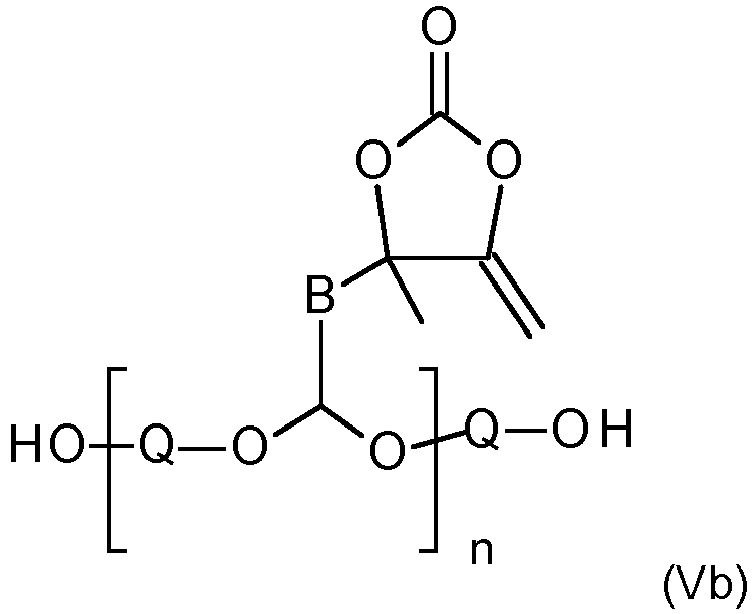


 wobei B eine Alkylengruppe mit vorzugsweise 1 bis 6 C-Atomen bedeutet;Q eine von einem Poylol abgeleitete Gruppe bedeutet, wobei ein Polyol ein Alkohol mit mindestens zwei Hydroxygruppen ist;n in den Formeln (Vb) und (Vc) eine Zahl größer oder gleich 2, vorzugsweise 2 bis 10 ist,n in Formel (IVb) eine Zahl größer oder gleich 1, vorzugsweise 1 bis 10, ist, undn in Formel (VI) eine Zahl größer oder gleich 0, vorzugsweise 0 bis 10, ist.
 - Verbindung gemäß Anspruch 1, dadurch gekennzeichnet, dass es sich um Verbindungen der Formel (VIa) handelt


 wobei -O-Q-O- in den Formeln VIa, IVc, Vd und Ve jeweils für den Rest eines zweiwertigen Alkohols steht, vorzugsweise ausgewählt aus Ethylenglykol, 1,3-Propandiol, 1,4-Butandiol, Diethylenglykol, Triethylenglykol, Neopentylglykol, 1,5-Pentandiol, 1,6-Hexandiol, 1,8-Octandiol, 3-Methyl-1,5-pentandiol, 1,4-bis-Hydroxymethyl-cyclohexan, 1,6-bis-Hydroxymethyl-cyclohexan, Glycerin, Diglycerin, Polyethylenglykol, Polypropylenglykol, Poly-THF, Pentaerythrit, Dipentaerythrit, Zuckeralkohole wie Sorbit und Mannit,n in Formel (IVc) 1, 2 oder 3 ist, undn in den Formeln (Vd) und (Ve) eine Zahl größer oder gleich 2, vorzugsweise 2 oder 3 ist.
 - Verfahren zur Herstellung einer Verbindung gemäß einem der Ansprüche 1 bis 2, wobei eine Verbindung, welche eine Exovinylen-cyclocarbonateinheit und mindestens eine Acetalgruppe aufweist, umgesetzt wird mit mindestens einer Verbindung ausgewählt aus der Gruppe bestehend aus Diolen und Polyolen.
- Verfahren gemäß dem vorhergehenden Anspruch, dadurch gekennzeichnet, dass die Umsetzung unter Katalyse mit Lewissäuren oder mit Protonensäuren durchgeführt wird.
- Verwendung einer Zwei-Komponentenzusammensetzung als Bindemittel für Lacke, Farben, Tinten, Baustoffe, Elastomere, Schäume, Fasern oder Partikel, wobei eine erste Komponente mindestens eine Verbindung gemäß einem der Ansprüche 1 bis 2 enthält und eine zweite Komponente mindestens einen mehrfunktionellen Härter enthält, welcher mindestens zwei funktionelle Gruppen aufweist ausgewählt aus der Gruppe bestehend aus primären Aminogruppen, sekundären Aminogruppen, Hydroxygruppen, Phosphingruppen, Phosphonatgruppen und Mercaptangruppen.
- Verwendung gemäß dem vorhergehenden Anspruch, dadurch gekennzeichnet, dass die Zwei-Komponentenzusammensetzung mindestens einen Katalysator enthält für die Katalysierung der Reaktion der Exovinylen-cyclocarbonatgruppen mit den funktionellen Gruppen des Härters.
- Verwendung einer Verbindung gemäß einem der Ansprüche 1 bis 2 als Bestandteil von Beschichtungsstoffen, Lacken, Farben, Tinten, Baustoffen, Elastomeren, Schäumen oder zur Bindung von Fasern und/oder Partikeln.
Applications Claiming Priority (2)
| Application Number | Priority Date | Filing Date | Title |
|---|---|---|---|
| EP16189808 | 2016-09-21 | ||
| PCT/EP2017/072767 WO2018054713A1 (de) | 2016-09-21 | 2017-09-11 | Verbindungen mit zwei oder mehr exovinylen-cyclocarbonateinheiten |
Publications (2)
| Publication Number | Publication Date |
|---|---|
| EP3515900A1 EP3515900A1 (de) | 2019-07-31 |
| EP3515900B1 true EP3515900B1 (de) | 2021-08-11 |
Family
ID=57130157
Family Applications (1)
| Application Number | Title | Priority Date | Filing Date |
|---|---|---|---|
| EP17761910.3A Active EP3515900B1 (de) | 2016-09-21 | 2017-09-11 | Verbindungen mit zwei oder mehr exovinylen-cyclocarbonateinheiten |
Country Status (8)
| Country | Link |
|---|---|
| US (1) | US10604500B2 (de) |
| EP (1) | EP3515900B1 (de) |
| JP (1) | JP6982838B2 (de) |
| CN (1) | CN109715611B (de) |
| AU (1) | AU2017329469B2 (de) |
| BR (1) | BR112019005387A2 (de) |
| ES (1) | ES2895718T3 (de) |
| WO (1) | WO2018054713A1 (de) |
Families Citing this family (3)
| Publication number | Priority date | Publication date | Assignee | Title |
|---|---|---|---|---|
| US11292780B2 (en) | 2017-08-14 | 2022-04-05 | Basf Se | Process for preparing cyclic carbonates |
| EP3569597A1 (de) | 2018-05-18 | 2019-11-20 | Basf Se | Monomere mit mindestens einer 4-(2-oxyethylidene)-1,3-dioxolan-2-on-einheit und ihre verwendung |
| EP3818097B1 (de) | 2018-07-04 | 2022-08-17 | Basf Se | Klebeverfahren unter verwendung von 2-komponentenklebstoffen auf basis von verbindungen mit cyclothiocarbonat-einheiten |
Family Cites Families (23)
| Publication number | Priority date | Publication date | Assignee | Title |
|---|---|---|---|---|
| DE1064938B (de) | 1956-12-24 | 1959-09-10 | Dow Chemical Co | Verfahren zur Oxypropylierung von mehrwertigen Alkoholen |
| BE593754A (de) | 1959-08-12 | |||
| US3541087A (en) | 1967-06-29 | 1970-11-17 | Air Reduction | Preparation of cyclic carbonates from acetylenic glycols |
| DE2639083C2 (de) | 1976-08-31 | 1983-02-10 | Bayer Ag, 5090 Leverkusen | Verfahren zur Herstellung von Polyätherpolyolen und ihre Verwendung als Ausgangsmaterialien für Polyurethankunststoffe |
| DE2737951A1 (de) | 1977-08-23 | 1979-03-08 | Bayer Ag | Verfahren zur herstellung von polyaetherpolyolen |
| DE4314111A1 (de) | 1993-04-29 | 1994-11-03 | Goldschmidt Ag Th | alpha,omega-Polymethacrylatdiole, Verfahren zu ihrer Herstellung und deren Verwendung zur Herstellung von Polymeren, insbesondere Polyurethanen und Polyestern |
| WO2003016298A2 (en) * | 2001-08-17 | 2003-02-27 | Ucb, S.A. | Process for making a compound containing cyclic and linear carbonate groups |
| US6627762B1 (en) * | 2002-10-23 | 2003-09-30 | John G. Woods | Acetal and hemiacetal ester linked propylene carbonate functional (meth)acrylic esters and method of making same |
| EP2301977A1 (de) * | 2009-09-25 | 2011-03-30 | Construction Research & Technology GmbH | Wasserdispergierbares, cyclocarbonatfunktionalisiertes vinylcopolymer-system |
| JP2013517215A (ja) | 2010-01-20 | 2013-05-16 | バイエル・インテレクチュアル・プロパティ・ゲゼルシャフト・ミット・ベシュレンクテル・ハフツング | 高アスペクト比を有するフィロシリケートプレートレットの製造方法 |
| KR20140004615A (ko) * | 2010-06-15 | 2014-01-13 | 바스프 에스이 | 에폭시 수지 조성물에서의 시클릭 카르보네이트의 용도 |
| WO2012175431A2 (de) | 2011-06-20 | 2012-12-27 | Bayer Intellectual Property Gmbh | Herstellung von folien mit flexiblen barrierebeschichtungen enthaltend schichtsilicate |
| WO2012175427A2 (de) | 2011-06-20 | 2012-12-27 | Bayer Intellectual Property Gmbh | Herstellung von folien mit flexiblen barrierebeschichtungen enthaltend schichtsilicate |
| FR2981931B1 (fr) * | 2011-10-28 | 2014-07-04 | Gen Produits Ind S E G Soc D Expl | Procede de preparation d'un compose comprenant au moins un motif beta-hydroxy-urethane et/ou au moins un motif gamma-hydroxy-urethane. |
| KR102070052B1 (ko) | 2012-03-29 | 2020-01-29 | 바스프 에스이 | 중합성 알킬리덴-1,3-디옥솔란-2-온 및 그의 용도 |
| JP2014105265A (ja) * | 2012-11-27 | 2014-06-09 | Mitsubishi Rayon Co Ltd | (メタ)アクリル酸エステル、およびその(共)重合体 |
| KR20160032019A (ko) * | 2013-05-16 | 2016-03-23 | 사이클리코어 에이비 | 환식 탄산염으로부터의 우레탄, 이의 중합체, 코팅 조성물과 그 제조 |
| CN105189675B (zh) * | 2013-07-22 | 2017-10-31 | 巴斯夫欧洲公司 | 包含具有至少两个环状碳酸酯基团和硅氧烷基团的化合物的涂布材料 |
| EP2851403A1 (de) | 2013-09-23 | 2015-03-25 | BASF Coatings GmbH | Beschichtungsmittelzusammensetzungen und daraus hergestellte, bei niedrigen temperaturen härtbare beschichtungen und sowie deren verwendung |
| CN106255723B (zh) | 2014-04-25 | 2019-03-22 | 宣伟投资管理有限公司 | 多环碳酸酯化合物以及由其形成的聚合物和组合物 |
| CN106459658B (zh) | 2014-04-25 | 2019-04-23 | 宣伟投资管理有限公司 | 多环碳酸酯化合物以及由其形成的聚合物 |
| EP3286173B1 (de) | 2015-04-23 | 2019-07-03 | Basf Se | Cyclische carbonate |
| CA2989696A1 (en) | 2015-06-18 | 2016-12-22 | Basf Se | Copolymer made from cyclic exo-vinyl carbonate acrylates |
-
2017
- 2017-09-11 WO PCT/EP2017/072767 patent/WO2018054713A1/de not_active Ceased
- 2017-09-11 AU AU2017329469A patent/AU2017329469B2/en not_active Ceased
- 2017-09-11 US US16/335,153 patent/US10604500B2/en active Active
- 2017-09-11 BR BR112019005387A patent/BR112019005387A2/pt not_active Application Discontinuation
- 2017-09-11 EP EP17761910.3A patent/EP3515900B1/de active Active
- 2017-09-11 CN CN201780057907.3A patent/CN109715611B/zh active Active
- 2017-09-11 ES ES17761910T patent/ES2895718T3/es active Active
- 2017-09-11 JP JP2019536651A patent/JP6982838B2/ja active Active
Non-Patent Citations (1)
| Title |
|---|
| None * |
Also Published As
| Publication number | Publication date |
|---|---|
| BR112019005387A2 (pt) | 2019-06-11 |
| US20190241538A1 (en) | 2019-08-08 |
| AU2017329469B2 (en) | 2021-04-08 |
| US10604500B2 (en) | 2020-03-31 |
| JP2019530747A (ja) | 2019-10-24 |
| JP6982838B2 (ja) | 2021-12-17 |
| AU2017329469A1 (en) | 2019-05-02 |
| CN109715611A (zh) | 2019-05-03 |
| CN109715611B (zh) | 2022-09-09 |
| ES2895718T3 (es) | 2022-02-22 |
| WO2018054713A1 (de) | 2018-03-29 |
| EP3515900A1 (de) | 2019-07-31 |
Similar Documents
| Publication | Publication Date | Title |
|---|---|---|
| EP2651876B1 (de) | Polyamine mit sekundären aliphatischen aminogruppen | |
| EP3024901B1 (de) | Beschichtungsmassen, enthaltend eine verbindung mit mindestens zwei cyclischen carbonatgruppen und einer siloxangruppe | |
| EP3310866B1 (de) | Copolymere aus cyclischen exo-vinylencarbonatacrylaten | |
| DE202009019002U1 (de) | Neue Alkoxysilylgruppen tragende Polyetheralkohole | |
| WO2012080264A1 (de) | Amine mit sekundären aliphatischen aminogruppen | |
| DE112015003321T5 (de) | Aus natürlichem Material gewonnenes hochfunktionelles Epoxidharz, Herstellungsverfahren dafür und Epoxidharz-Härterzusammensetzung unter Verwendung desselben | |
| US20190211238A1 (en) | Two-Component Composition Based on Compounds With At Least Two Exo-Vinylene Cyclic Carbonate Units | |
| EP3515900A1 (de) | Verbindungen mit zwei oder mehr exovinylen-cyclocarbonateinheiten | |
| EP2776486B1 (de) | Pyridinylgruppen aufweisende härter für epoxidharze | |
| EP3033372A1 (de) | Verwendung von polypropylenimin als härter für epoxidharze | |
| EP3390562A1 (de) | Selbsttragender klebekörper für strukturelle verklebungen | |
| EP3286173B1 (de) | Cyclische carbonate | |
| WO2007065798A1 (de) | Enaminöle und verfahren zu ihrer herstellung | |
| DE1668633C (de) | ||
| WO2015104278A1 (de) | Epoxidharzsysteme mit piperidinderivaten als härter | |
| EP0041048A2 (de) | Gemische zur Herstellung von stickstoffhaltigen Polyaddukten |
Legal Events
| Date | Code | Title | Description |
|---|---|---|---|
| STAA | Information on the status of an ep patent application or granted ep patent |
Free format text: STATUS: UNKNOWN |
|
| STAA | Information on the status of an ep patent application or granted ep patent |
Free format text: STATUS: THE INTERNATIONAL PUBLICATION HAS BEEN MADE |
|
| PUAI | Public reference made under article 153(3) epc to a published international application that has entered the european phase |
Free format text: ORIGINAL CODE: 0009012 |
|
| STAA | Information on the status of an ep patent application or granted ep patent |
Free format text: STATUS: REQUEST FOR EXAMINATION WAS MADE |
|
| 17P | Request for examination filed |
Effective date: 20190423 |
|
| AK | Designated contracting states |
Kind code of ref document: A1 Designated state(s): AL AT BE BG CH CY CZ DE DK EE ES FI FR GB GR HR HU IE IS IT LI LT LU LV MC MK MT NL NO PL PT RO RS SE SI SK SM TR |
|
| AX | Request for extension of the european patent |
Extension state: BA ME |
|
| DAV | Request for validation of the european patent (deleted) | ||
| DAX | Request for extension of the european patent (deleted) | ||
| STAA | Information on the status of an ep patent application or granted ep patent |
Free format text: STATUS: EXAMINATION IS IN PROGRESS |
|
| 17Q | First examination report despatched |
Effective date: 20200217 |
|
| GRAP | Despatch of communication of intention to grant a patent |
Free format text: ORIGINAL CODE: EPIDOSNIGR1 |
|
| STAA | Information on the status of an ep patent application or granted ep patent |
Free format text: STATUS: GRANT OF PATENT IS INTENDED |
|
| INTG | Intention to grant announced |
Effective date: 20210322 |
|
| GRAS | Grant fee paid |
Free format text: ORIGINAL CODE: EPIDOSNIGR3 |
|
| GRAA | (expected) grant |
Free format text: ORIGINAL CODE: 0009210 |
|
| STAA | Information on the status of an ep patent application or granted ep patent |
Free format text: STATUS: THE PATENT HAS BEEN GRANTED |
|
| AK | Designated contracting states |
Kind code of ref document: B1 Designated state(s): AL AT BE BG CH CY CZ DE DK EE ES FI FR GB GR HR HU IE IS IT LI LT LU LV MC MK MT NL NO PL PT RO RS SE SI SK SM TR |
|
| REG | Reference to a national code |
Ref country code: CH Ref legal event code: EP |
|
| REG | Reference to a national code |
Ref country code: DE Ref legal event code: R096 Ref document number: 502017011188 Country of ref document: DE |
|
| REG | Reference to a national code |
Ref country code: IE Ref legal event code: FG4D Free format text: LANGUAGE OF EP DOCUMENT: GERMAN Ref country code: AT Ref legal event code: REF Ref document number: 1419268 Country of ref document: AT Kind code of ref document: T Effective date: 20210915 |
|
| REG | Reference to a national code |
Ref country code: LT Ref legal event code: MG9D |
|
| REG | Reference to a national code |
Ref country code: NL Ref legal event code: MP Effective date: 20210811 |
|
| PG25 | Lapsed in a contracting state [announced via postgrant information from national office to epo] |
Ref country code: HR Free format text: LAPSE BECAUSE OF FAILURE TO SUBMIT A TRANSLATION OF THE DESCRIPTION OR TO PAY THE FEE WITHIN THE PRESCRIBED TIME-LIMIT Effective date: 20210811 Ref country code: SE Free format text: LAPSE BECAUSE OF FAILURE TO SUBMIT A TRANSLATION OF THE DESCRIPTION OR TO PAY THE FEE WITHIN THE PRESCRIBED TIME-LIMIT Effective date: 20210811 Ref country code: RS Free format text: LAPSE BECAUSE OF FAILURE TO SUBMIT A TRANSLATION OF THE DESCRIPTION OR TO PAY THE FEE WITHIN THE PRESCRIBED TIME-LIMIT Effective date: 20210811 Ref country code: LT Free format text: LAPSE BECAUSE OF FAILURE TO SUBMIT A TRANSLATION OF THE DESCRIPTION OR TO PAY THE FEE WITHIN THE PRESCRIBED TIME-LIMIT Effective date: 20210811 Ref country code: BG Free format text: LAPSE BECAUSE OF FAILURE TO SUBMIT A TRANSLATION OF THE DESCRIPTION OR TO PAY THE FEE WITHIN THE PRESCRIBED TIME-LIMIT Effective date: 20211111 Ref country code: NO Free format text: LAPSE BECAUSE OF FAILURE TO SUBMIT A TRANSLATION OF THE DESCRIPTION OR TO PAY THE FEE WITHIN THE PRESCRIBED TIME-LIMIT Effective date: 20211111 Ref country code: PT Free format text: LAPSE BECAUSE OF FAILURE TO SUBMIT A TRANSLATION OF THE DESCRIPTION OR TO PAY THE FEE WITHIN THE PRESCRIBED TIME-LIMIT Effective date: 20211213 Ref country code: FI Free format text: LAPSE BECAUSE OF FAILURE TO SUBMIT A TRANSLATION OF THE DESCRIPTION OR TO PAY THE FEE WITHIN THE PRESCRIBED TIME-LIMIT Effective date: 20210811 |
|
| REG | Reference to a national code |
Ref country code: ES Ref legal event code: FG2A Ref document number: 2895718 Country of ref document: ES Kind code of ref document: T3 Effective date: 20220222 |
|
| PG25 | Lapsed in a contracting state [announced via postgrant information from national office to epo] |
Ref country code: PL Free format text: LAPSE BECAUSE OF FAILURE TO SUBMIT A TRANSLATION OF THE DESCRIPTION OR TO PAY THE FEE WITHIN THE PRESCRIBED TIME-LIMIT Effective date: 20210811 Ref country code: LV Free format text: LAPSE BECAUSE OF FAILURE TO SUBMIT A TRANSLATION OF THE DESCRIPTION OR TO PAY THE FEE WITHIN THE PRESCRIBED TIME-LIMIT Effective date: 20210811 Ref country code: GR Free format text: LAPSE BECAUSE OF FAILURE TO SUBMIT A TRANSLATION OF THE DESCRIPTION OR TO PAY THE FEE WITHIN THE PRESCRIBED TIME-LIMIT Effective date: 20211112 |
|
| PG25 | Lapsed in a contracting state [announced via postgrant information from national office to epo] |
Ref country code: NL Free format text: LAPSE BECAUSE OF FAILURE TO SUBMIT A TRANSLATION OF THE DESCRIPTION OR TO PAY THE FEE WITHIN THE PRESCRIBED TIME-LIMIT Effective date: 20210811 |
|
| PG25 | Lapsed in a contracting state [announced via postgrant information from national office to epo] |
Ref country code: DK Free format text: LAPSE BECAUSE OF FAILURE TO SUBMIT A TRANSLATION OF THE DESCRIPTION OR TO PAY THE FEE WITHIN THE PRESCRIBED TIME-LIMIT Effective date: 20210811 |
|
| REG | Reference to a national code |
Ref country code: DE Ref legal event code: R097 Ref document number: 502017011188 Country of ref document: DE |
|
| REG | Reference to a national code |
Ref country code: CH Ref legal event code: PL |
|
| REG | Reference to a national code |
Ref country code: BE Ref legal event code: MM Effective date: 20210930 |
|
| PG25 | Lapsed in a contracting state [announced via postgrant information from national office to epo] |
Ref country code: SM Free format text: LAPSE BECAUSE OF FAILURE TO SUBMIT A TRANSLATION OF THE DESCRIPTION OR TO PAY THE FEE WITHIN THE PRESCRIBED TIME-LIMIT Effective date: 20210811 Ref country code: SK Free format text: LAPSE BECAUSE OF FAILURE TO SUBMIT A TRANSLATION OF THE DESCRIPTION OR TO PAY THE FEE WITHIN THE PRESCRIBED TIME-LIMIT Effective date: 20210811 Ref country code: RO Free format text: LAPSE BECAUSE OF FAILURE TO SUBMIT A TRANSLATION OF THE DESCRIPTION OR TO PAY THE FEE WITHIN THE PRESCRIBED TIME-LIMIT Effective date: 20210811 Ref country code: MC Free format text: LAPSE BECAUSE OF FAILURE TO SUBMIT A TRANSLATION OF THE DESCRIPTION OR TO PAY THE FEE WITHIN THE PRESCRIBED TIME-LIMIT Effective date: 20210811 Ref country code: EE Free format text: LAPSE BECAUSE OF FAILURE TO SUBMIT A TRANSLATION OF THE DESCRIPTION OR TO PAY THE FEE WITHIN THE PRESCRIBED TIME-LIMIT Effective date: 20210811 Ref country code: CZ Free format text: LAPSE BECAUSE OF FAILURE TO SUBMIT A TRANSLATION OF THE DESCRIPTION OR TO PAY THE FEE WITHIN THE PRESCRIBED TIME-LIMIT Effective date: 20210811 Ref country code: AL Free format text: LAPSE BECAUSE OF FAILURE TO SUBMIT A TRANSLATION OF THE DESCRIPTION OR TO PAY THE FEE WITHIN THE PRESCRIBED TIME-LIMIT Effective date: 20210811 |
|
| PLBE | No opposition filed within time limit |
Free format text: ORIGINAL CODE: 0009261 |
|
| STAA | Information on the status of an ep patent application or granted ep patent |
Free format text: STATUS: NO OPPOSITION FILED WITHIN TIME LIMIT |
|
| 26N | No opposition filed |
Effective date: 20220512 |
|
| PG25 | Lapsed in a contracting state [announced via postgrant information from national office to epo] |
Ref country code: LU Free format text: LAPSE BECAUSE OF NON-PAYMENT OF DUE FEES Effective date: 20210911 Ref country code: IE Free format text: LAPSE BECAUSE OF NON-PAYMENT OF DUE FEES Effective date: 20210911 Ref country code: BE Free format text: LAPSE BECAUSE OF NON-PAYMENT OF DUE FEES Effective date: 20210930 |
|
| PG25 | Lapsed in a contracting state [announced via postgrant information from national office to epo] |
Ref country code: SI Free format text: LAPSE BECAUSE OF FAILURE TO SUBMIT A TRANSLATION OF THE DESCRIPTION OR TO PAY THE FEE WITHIN THE PRESCRIBED TIME-LIMIT Effective date: 20210811 Ref country code: LI Free format text: LAPSE BECAUSE OF NON-PAYMENT OF DUE FEES Effective date: 20210930 Ref country code: CH Free format text: LAPSE BECAUSE OF NON-PAYMENT OF DUE FEES Effective date: 20210930 |
|
| PG25 | Lapsed in a contracting state [announced via postgrant information from national office to epo] |
Ref country code: CY Free format text: LAPSE BECAUSE OF FAILURE TO SUBMIT A TRANSLATION OF THE DESCRIPTION OR TO PAY THE FEE WITHIN THE PRESCRIBED TIME-LIMIT Effective date: 20210811 |
|
| PG25 | Lapsed in a contracting state [announced via postgrant information from national office to epo] |
Ref country code: HU Free format text: LAPSE BECAUSE OF FAILURE TO SUBMIT A TRANSLATION OF THE DESCRIPTION OR TO PAY THE FEE WITHIN THE PRESCRIBED TIME-LIMIT; INVALID AB INITIO Effective date: 20170911 |
|
| REG | Reference to a national code |
Ref country code: AT Ref legal event code: MM01 Ref document number: 1419268 Country of ref document: AT Kind code of ref document: T Effective date: 20220911 |
|
| PG25 | Lapsed in a contracting state [announced via postgrant information from national office to epo] |
Ref country code: AT Free format text: LAPSE BECAUSE OF NON-PAYMENT OF DUE FEES Effective date: 20220911 |
|
| PG25 | Lapsed in a contracting state [announced via postgrant information from national office to epo] |
Ref country code: MK Free format text: LAPSE BECAUSE OF FAILURE TO SUBMIT A TRANSLATION OF THE DESCRIPTION OR TO PAY THE FEE WITHIN THE PRESCRIBED TIME-LIMIT Effective date: 20210811 |
|
| PG25 | Lapsed in a contracting state [announced via postgrant information from national office to epo] |
Ref country code: TR Free format text: LAPSE BECAUSE OF FAILURE TO SUBMIT A TRANSLATION OF THE DESCRIPTION OR TO PAY THE FEE WITHIN THE PRESCRIBED TIME-LIMIT Effective date: 20210811 |
|
| PG25 | Lapsed in a contracting state [announced via postgrant information from national office to epo] |
Ref country code: MT Free format text: LAPSE BECAUSE OF FAILURE TO SUBMIT A TRANSLATION OF THE DESCRIPTION OR TO PAY THE FEE WITHIN THE PRESCRIBED TIME-LIMIT Effective date: 20210811 |
|
| PGFP | Annual fee paid to national office [announced via postgrant information from national office to epo] |
Ref country code: DE Payment date: 20250926 Year of fee payment: 9 |
|
| PGFP | Annual fee paid to national office [announced via postgrant information from national office to epo] |
Ref country code: IT Payment date: 20250922 Year of fee payment: 9 |
|
| PGFP | Annual fee paid to national office [announced via postgrant information from national office to epo] |
Ref country code: GB Payment date: 20250923 Year of fee payment: 9 |
|
| PGFP | Annual fee paid to national office [announced via postgrant information from national office to epo] |
Ref country code: FR Payment date: 20250925 Year of fee payment: 9 |
|
| PGFP | Annual fee paid to national office [announced via postgrant information from national office to epo] |
Ref country code: ES Payment date: 20251015 Year of fee payment: 9 |