EP3501040B1 - Dual deep trenches for high voltage isolation - Google Patents
Dual deep trenches for high voltage isolation Download PDFInfo
- Publication number
- EP3501040B1 EP3501040B1 EP17842059.2A EP17842059A EP3501040B1 EP 3501040 B1 EP3501040 B1 EP 3501040B1 EP 17842059 A EP17842059 A EP 17842059A EP 3501040 B1 EP3501040 B1 EP 3501040B1
- Authority
- EP
- European Patent Office
- Prior art keywords
- trench
- buried layer
- substrate
- layer
- conductor
- Prior art date
- Legal status (The legal status is an assumption and is not a legal conclusion. Google has not performed a legal analysis and makes no representation as to the accuracy of the status listed.)
- Active
Links
Images





Classifications
-
- H—ELECTRICITY
- H10—SEMICONDUCTOR DEVICES; ELECTRIC SOLID-STATE DEVICES NOT OTHERWISE PROVIDED FOR
- H10D—INORGANIC ELECTRIC SEMICONDUCTOR DEVICES
- H10D84/00—Integrated devices formed in or on semiconductor substrates that comprise only semiconducting layers, e.g. on Si wafers or on GaAs-on-Si wafers
- H10D84/80—Integrated devices formed in or on semiconductor substrates that comprise only semiconducting layers, e.g. on Si wafers or on GaAs-on-Si wafers characterised by the integration of at least one component covered by groups H10D12/00 or H10D30/00, e.g. integration of IGFETs
- H10D84/82—Integrated devices formed in or on semiconductor substrates that comprise only semiconducting layers, e.g. on Si wafers or on GaAs-on-Si wafers characterised by the integration of at least one component covered by groups H10D12/00 or H10D30/00, e.g. integration of IGFETs of only field-effect components
- H10D84/83—Integrated devices formed in or on semiconductor substrates that comprise only semiconducting layers, e.g. on Si wafers or on GaAs-on-Si wafers characterised by the integration of at least one component covered by groups H10D12/00 or H10D30/00, e.g. integration of IGFETs of only field-effect components of only insulated-gate FETs [IGFET]
- H10D84/85—Complementary IGFETs, e.g. CMOS
- H10D84/856—Complementary IGFETs, e.g. CMOS the complementary IGFETs having different architectures than each other, e.g. high-voltage and low-voltage CMOS
-
- H—ELECTRICITY
- H01—ELECTRIC ELEMENTS
- H01L—SEMICONDUCTOR DEVICES NOT COVERED BY CLASS H10
- H01L21/00—Processes or apparatus adapted for the manufacture or treatment of semiconductor or solid state devices or of parts thereof
- H01L21/70—Manufacture or treatment of devices consisting of a plurality of solid state components formed in or on a common substrate or of parts thereof; Manufacture of integrated circuit devices or of parts thereof
- H01L21/71—Manufacture of specific parts of devices defined in group H01L21/70
- H01L21/76—Making of isolation regions between components
- H01L21/762—Dielectric regions, e.g. EPIC dielectric isolation, LOCOS; Trench refilling techniques, SOI technology, use of channel stoppers
- H01L21/76224—Dielectric regions, e.g. EPIC dielectric isolation, LOCOS; Trench refilling techniques, SOI technology, use of channel stoppers using trench refilling with dielectric materials
- H01L21/76229—Concurrent filling of a plurality of trenches having a different trench shape or dimension, e.g. rectangular and V-shaped trenches, wide and narrow trenches, shallow and deep trenches
-
- H—ELECTRICITY
- H01—ELECTRIC ELEMENTS
- H01L—SEMICONDUCTOR DEVICES NOT COVERED BY CLASS H10
- H01L21/00—Processes or apparatus adapted for the manufacture or treatment of semiconductor or solid state devices or of parts thereof
- H01L21/70—Manufacture or treatment of devices consisting of a plurality of solid state components formed in or on a common substrate or of parts thereof; Manufacture of integrated circuit devices or of parts thereof
- H01L21/71—Manufacture of specific parts of devices defined in group H01L21/70
- H01L21/76—Making of isolation regions between components
- H01L21/763—Polycrystalline semiconductor regions
-
- H—ELECTRICITY
- H01—ELECTRIC ELEMENTS
- H01L—SEMICONDUCTOR DEVICES NOT COVERED BY CLASS H10
- H01L21/00—Processes or apparatus adapted for the manufacture or treatment of semiconductor or solid state devices or of parts thereof
- H01L21/70—Manufacture or treatment of devices consisting of a plurality of solid state components formed in or on a common substrate or of parts thereof; Manufacture of integrated circuit devices or of parts thereof
- H01L21/71—Manufacture of specific parts of devices defined in group H01L21/70
- H01L21/76—Making of isolation regions between components
- H01L21/765—Making of isolation regions between components by field effect
-
- H—ELECTRICITY
- H10—SEMICONDUCTOR DEVICES; ELECTRIC SOLID-STATE DEVICES NOT OTHERWISE PROVIDED FOR
- H10D—INORGANIC ELECTRIC SEMICONDUCTOR DEVICES
- H10D62/00—Semiconductor bodies, or regions thereof, of devices having potential barriers
- H10D62/10—Shapes, relative sizes or dispositions of the regions of the semiconductor bodies; Shapes of the semiconductor bodies
- H10D62/102—Constructional design considerations for preventing surface leakage or controlling electric field concentration
- H10D62/103—Constructional design considerations for preventing surface leakage or controlling electric field concentration for increasing or controlling the breakdown voltage of reverse-biased devices
- H10D62/105—Constructional design considerations for preventing surface leakage or controlling electric field concentration for increasing or controlling the breakdown voltage of reverse-biased devices by having particular doping profiles, shapes or arrangements of PN junctions; by having supplementary regions, e.g. junction termination extension [JTE]
-
- H—ELECTRICITY
- H10—SEMICONDUCTOR DEVICES; ELECTRIC SOLID-STATE DEVICES NOT OTHERWISE PROVIDED FOR
- H10D—INORGANIC ELECTRIC SEMICONDUCTOR DEVICES
- H10D62/00—Semiconductor bodies, or regions thereof, of devices having potential barriers
- H10D62/10—Shapes, relative sizes or dispositions of the regions of the semiconductor bodies; Shapes of the semiconductor bodies
- H10D62/113—Isolations within a component, i.e. internal isolations
- H10D62/115—Dielectric isolations, e.g. air gaps
-
- H—ELECTRICITY
- H10—SEMICONDUCTOR DEVICES; ELECTRIC SOLID-STATE DEVICES NOT OTHERWISE PROVIDED FOR
- H10D—INORGANIC ELECTRIC SEMICONDUCTOR DEVICES
- H10D84/00—Integrated devices formed in or on semiconductor substrates that comprise only semiconducting layers, e.g. on Si wafers or on GaAs-on-Si wafers
- H10D84/01—Manufacture or treatment
- H10D84/0123—Integrating together multiple components covered by H10D12/00 or H10D30/00, e.g. integrating multiple IGBTs
- H10D84/0126—Integrating together multiple components covered by H10D12/00 or H10D30/00, e.g. integrating multiple IGBTs the components including insulated gates, e.g. IGFETs
- H10D84/0165—Integrating together multiple components covered by H10D12/00 or H10D30/00, e.g. integrating multiple IGBTs the components including insulated gates, e.g. IGFETs the components including complementary IGFETs, e.g. CMOS devices
- H10D84/0186—Manufacturing their interconnections or electrodes, e.g. source or drain electrodes
-
- H—ELECTRICITY
- H10—SEMICONDUCTOR DEVICES; ELECTRIC SOLID-STATE DEVICES NOT OTHERWISE PROVIDED FOR
- H10D—INORGANIC ELECTRIC SEMICONDUCTOR DEVICES
- H10D84/00—Integrated devices formed in or on semiconductor substrates that comprise only semiconducting layers, e.g. on Si wafers or on GaAs-on-Si wafers
- H10D84/01—Manufacture or treatment
- H10D84/0123—Integrating together multiple components covered by H10D12/00 or H10D30/00, e.g. integrating multiple IGBTs
- H10D84/0126—Integrating together multiple components covered by H10D12/00 or H10D30/00, e.g. integrating multiple IGBTs the components including insulated gates, e.g. IGFETs
- H10D84/0165—Integrating together multiple components covered by H10D12/00 or H10D30/00, e.g. integrating multiple IGBTs the components including insulated gates, e.g. IGFETs the components including complementary IGFETs, e.g. CMOS devices
- H10D84/0188—Manufacturing their isolation regions
-
- H—ELECTRICITY
- H10—SEMICONDUCTOR DEVICES; ELECTRIC SOLID-STATE DEVICES NOT OTHERWISE PROVIDED FOR
- H10D—INORGANIC ELECTRIC SEMICONDUCTOR DEVICES
- H10D84/00—Integrated devices formed in or on semiconductor substrates that comprise only semiconducting layers, e.g. on Si wafers or on GaAs-on-Si wafers
- H10D84/01—Manufacture or treatment
- H10D84/0123—Integrating together multiple components covered by H10D12/00 or H10D30/00, e.g. integrating multiple IGBTs
- H10D84/0126—Integrating together multiple components covered by H10D12/00 or H10D30/00, e.g. integrating multiple IGBTs the components including insulated gates, e.g. IGFETs
- H10D84/0165—Integrating together multiple components covered by H10D12/00 or H10D30/00, e.g. integrating multiple IGBTs the components including insulated gates, e.g. IGFETs the components including complementary IGFETs, e.g. CMOS devices
- H10D84/0191—Manufacturing their doped wells
-
- H—ELECTRICITY
- H10—SEMICONDUCTOR DEVICES; ELECTRIC SOLID-STATE DEVICES NOT OTHERWISE PROVIDED FOR
- H10D—INORGANIC ELECTRIC SEMICONDUCTOR DEVICES
- H10D84/00—Integrated devices formed in or on semiconductor substrates that comprise only semiconducting layers, e.g. on Si wafers or on GaAs-on-Si wafers
- H10D84/01—Manufacture or treatment
- H10D84/02—Manufacture or treatment characterised by using material-based technologies
- H10D84/03—Manufacture or treatment characterised by using material-based technologies using Group IV technology, e.g. silicon technology or silicon-carbide [SiC] technology
- H10D84/038—Manufacture or treatment characterised by using material-based technologies using Group IV technology, e.g. silicon technology or silicon-carbide [SiC] technology using silicon technology, e.g. SiGe
Definitions
- Integrated circuits with high voltage capabilities have wide industrial applications, including power management systems for use in automobiles. These integrated circuits include high voltage transistors that operate at a high voltage range (e.g., 80v to 120v) and low voltage transistors that operate at a much lower voltage range (e.g., 1v to 5v).
- a buried layer e.g., an N-type buried layer
- a bulk substrate e.g., a P-type substrate
- the buried layer is usually biased at a high voltage corresponding to the operating range of the high voltage transistors, whereas the bulk substrate is usually biased at a ground supply voltage.
- the difference between the high bias voltage and the ground supply voltage may exceed a breakdown voltage threshold of a PN junction between the buried layer and the bulk substrate, thereby causing leakages and impacting the performance and reliability of the integrated circuit.
- US2013/328123 relates to a semiconductor including a first trench structure and a second trench structure.
- EP 1 710 834 discloses a double trench for isolation of semiconductor devices.
- the semiconductor device may be a standalone discrete component or incorporated as a part of an integrated circuit.
- the semiconductor device adopts an isolation scheme to protect low voltage transistors from high voltage operations.
- the described isolation scheme allows the high voltage transistors to operate at a high voltage range while reducing the voltage stress between a buried layer and a bulk substrate of the semiconductor device.
- the described isolation scheme provides a low-cost and high-performance solution to alleviate junction breakdowns of the semiconductor device.
- an integrated circuit includes a substrate, a buried layer, a transistor well region, a first trench, and a second trench.
- the substrate has a top surface and a bottom surface.
- the buried layer is positioned within the substrate, and the transistor well region is positioned above the buried layer.
- the first trench extends from the top surface to penetrate the buried layer, and the first trench has a first trench depth.
- the second trench extends from the top surface to penetrate the buried layer.
- the second trench is interposed between the first trench and the transistor well region.
- the second trench has a second trench depth that is less than the first trench depth.
- the substrate has a first conductivity type
- the buried layer has a second conductivity type opposite of the first conductivity type.
- the first trench includes a first conductor that is insulated from the buried layer and making an ohmic contact with the substrate around a bottom portion of the first trench, whereas the second trench includes a second conductor insulated from the buried layer and the substrate.
- the method includes forming a buried layer within a substrate.
- the method also includes forming a transistor well region above the buried layer.
- the method further includes forming a first trench extending from a top surface of the substrate to penetrate the buried layer, and forming a second trench extending from the top surface of the substrate to penetrate the buried layer. More specifically, the second trench is interposed between the first trench and the transistor well region, and the second trench has a trench depth less than that of the first trench.
- the method further includes the step of forming a first conductor within the first trench, the first conductor insulated from the buried layer and making an ohmic contact with the substrate around a bottom portion of the first trench; and the step of forming a second conductor within the second trench, the second conductor insulated from the buried layer and the substrate.
- FIG. 1A shows a top view of a semiconductor device 100
- FIG. 1B shows a cross-sectional view of the semiconductor device 100 to illustrate its vertical structure.
- the semiconductor device 100 includes a substrate 102, which can be subdivided into a lower semiconductor layer 104 and an upper semiconductor layer 108.
- the lower semiconductor layer 104 forms a bottom surface 102b of the substrate 102
- the upper semiconductor layer 108 forms a top surface 102a of the substrate 102.
- the lower semiconductor layer 104 may be a part of a bulk silicon substrate (e.g., 102), an epitaxial layer on a bulk silicon wafer, or a silicon-on-insulator (SOI) wafer.
- SOI silicon-on-insulator
- the upper semiconductor layer 108 may be an epitaxial layer formed above the lower semiconductor layer 102, or as an extension of a bulk silicon substrate (e.g., 102).
- the lower and upper semiconductor layer 104 and 108 usually have the same conductivity type (e.g., P-type).
- the semiconductor device 100 includes a buried layer 106 positioned within the substrate 102.
- the buried layer 106 may be developed by doping the lower semiconductor layer 104.
- the buried layer 106 may be formed by growing an epitaxial layer with in situ doping on top of the lower semiconductor layer 104.
- the buried layer 106 is interposed between the lower and upper semiconductor layers 104 and 108, and the buried layer 106 has the opposite conductivity type from these two layers 104 and 108. Accordingly, the buried layer 106 forms a first PN junction 105 with the lower semiconductor layer 104 and a second PN junction 107 with the upper semiconductor layer 108.
- the buried layer 106 may have an average doping density of at least 1 ⁇ 10 18 cm-3 and commonly has an opposite conductivity type from the lower semiconductor layer 104.
- a top boundary 112 of the buried layer 106 is at least 2 microns below the top surface 102a of the substrate 102, and may extend 5 microns to 10 microns below the top surface 102a of the substrate 102.
- the buried layer 106 may extend laterally across the semiconductor device 100 as depicted in FIG. 1 , or alternatively, the buried layer may be developed or formed within a finite lateral region that is coplanar with the substrate 102.
- the semiconductor device 100 includes a transistor well region 101 that is positioned within the upper semiconductor layer 108 and above the buried layer 106.
- the transistor well region 101 includes transistors for forming one or more active circuits.
- the transistor well region 101 includes a low voltage circuit (e.g., a circuit that operates with less than 10v)
- the transistor well region 101 is isolated and protected from a high voltage circuit (e.g., a circuit that operates with more than 50v) formed outside of the transistor well region 101.
- the transistor well region 101 includes a high voltage circuit
- the transistor well region 101 is isolated to protect a low voltage circuit formed outside of the transistor well region 101.
- the semiconductor device 100 includes one or more deep trench structures 114 arranged to laterally surround the transistor well region 101 and intersect the buried layer 106. More specifically, the deep trench structure 114 extends from the top surface 102a to penetrate through the buried layer 106, thereby reaching the lower semiconductor layer 104.
- the deep trench structure 114 may have a trench width 120 of less than 6 um. In one example implementation, the trench width 120 may range from 1 micron to 4 microns.
- the deep trench structure 114 includes dielectric liners 116 disposed along the interior sidewalls. The dielectric liners 116 may include thermal silicon dioxide.
- the deep trench structure 114 defines a bottom opening for accessing the lower semiconductor layer 104 of the substrate 102.
- the access point is doped with a dopant of the same conductivity type as the lower semiconductor layer 104 to form a doped region 117. In one implementation, the doped region 117 may have a higher doping concentration than the lower semiconductor layer 104.
- the deep trench structure 114 includes trench fill material 118 disposed onto the dielectric liners 116.
- the trench fill material 118 is conductive, and it is insulated from the upper semiconductor layer 108 and the buried layer 106.
- the trench fill material 118 includes polycrystalline silicon, which is commonly referred to as polysilicon.
- the trench fill material (i.e., trench conductor) 118 establishes an ohmic contact with the lower semiconductor layer 104 of the substrate 102 via the bottom opening and the doped region 117. Through this ohmic contact, the trench conductor 118 can be used for biasing the lower semiconductor layer 104 of the substrate 102.
- the trench conductor 118 may be structured to receive a ground supply voltage V GND to bias the lower semiconductor layer 104 of the substrate 102.
- the buried layer 106 When being biased at a voltage V BIAS corresponding to the operation voltage range of the high voltage circuit, the buried layer 106 can be used as an isolation structure as well.
- the bias voltage V BIAS of the buried layer 106 may range from 100v to 170v.
- the semiconductor device 100 includes vertical doped structures (a.k.a. sinkers) 122 that extend from the top surface 102a to reach the buried layer 106.
- the sinkers 122 are doped with dopants of the same conductivity type as the buried layer 106 so as to provide electrical connections to the buried layer 106.
- the sinkers 122 are doped with N-type materials where the buried layer 106 is N-doped as well.
- the sinkers 122 may be formed alongside the deep trench structure 114.
- the sinkers 122 extend laterally from the deep trench structure 114 to have a thickness 124, and the sinkers 122 coextend with the deep trench structure 114 to provide a conductive path between the top surface 102a and the buried layer 106.
- the thickness 124 of the sinkers is less than 2.5 microns, which may advantageously reduce the size of the semiconductor device 100 when compared to semiconductor devices without self-alignment sinkers.
- the trench structure 114 and the sinkers 122 form a contiguous ring that circumscribes the transistor well region 101.
- the trench structure 114 and the sinkers 122 may be arranged as disconnected and discrete segments to approximate the contiguous ring for isolating the transistor well region 101.
- the upper semiconductor layer 108 may incur a relatively high voltage where the transistor well region 101 includes one or more high voltage circuits.
- the upper semiconductor layer 108 may incur a voltage ranges from 80v to 100v.
- the buried layer 106 is biased with a voltage V BIAS that is higher than the voltage incurred by the upper semiconductor layer 108.
- the bias voltage V BIAS may range from 100v to 170v.
- the bias voltage V BIAS may range from 140v to 170v.
- the bias voltage V BIAS may range from 145v to 155v.
- the potential difference between the buried layer 106 and the lower semiconductor layer 104 can become significantly large. And when this potential difference becomes larger than the breakdown voltage (e.g., less than 80v) of the first PN junction 105, the semiconductor device 100 may experience a substantial amount of current leakage.
- This potential difference can be illustrated by an electric field density spread across a high electric field line V 1 and a low electric field line V 2 .
- the high electric field line V 1 represents a potential distribution closer to the bias voltage V BIAS
- the low electric field line V 2 represents a potential distribution closer to the ground supply voltage V GND .
- the likelihood of having a breakdown at the first PN junction 105 is directly proportional to the potential difference between V 1 and V 2 , and inversely proportional to a distance between V 1 and V 2 .
- thickening the dielectric liner 116 may help increase the low electric field line V 2 as the ground potential carried by the trench conductor 118 exerts less capacitive coupling to the adjacent P-region of the lower semiconductor layer 104.
- the potential difference between V 1 and V 2 can be reduced to lower the likelihood of having a breakdown along the first PN junction 105.
- This approach may be less effective where V 1 is substantially higher than V 2 (e.g., V 1 - V 2 ⁇ 100v) and the maximum thickness of the dielectric liner 116 is limited by one or more process parameters.
- increasing the thickness of the buried layer 106 may help reduce the electric field density between V 1 and V 2 to avoid electric field crowding along the first PN junction 105.
- the potential gradient at the first PN junction 105 can be reduced to lower the likelihood of having a breakdown along the first PN junction 105.
- This approach may be costly where V 1 is substantially higher than V 2 (e.g., V 1 - V 2 ⁇ 100v) because a thickened buried layer 106 usually requires more material and time to develop, and it can be more difficult to etch in forming the deep trench structure 114.
- the buried layer 106 may include an upper buried layer 106a with a first doping concentration and a lower buried layer 106b with a second doping concentration that is lower than the first doping concentration.
- the upper buried layer 106a may have a doping concentration that is greater than 5 ⁇ 10 18 cm -3
- the lower buried layer 106b may have a doping concentration ranging from 1 ⁇ 10 16 cm -3 to 1 ⁇ 10 17 cm -3 .
- example embodiments introduce a dual-trench configuration that alleviates electric field crowding around the first PN junction 105 between the buried layer 106 and the lower semiconductor layer 104 of the substrate 102.
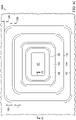
- FIG. 1C shows a top view of a semiconductor device 100A with a dual-trench configuration
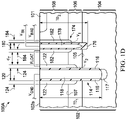
- FIG. ID shows a cross-sectional view of the semiconductor device 100A according to an aspect of example embodiments.
- the semiconductor device 100A is similar to the semiconductor device 100 to the extent that these two devices include components identified with the same numeric labels.
- the semiconductor device 100A differs from the semiconductor device 100 in that the semiconductor device 100A includes a second deep trench structure 174.
- the second deep trench structure 174 is arranged to laterally surround the transistor well region 101 and intersect the buried layer 106. More specifically, the second deep trench structure 174 extends from the top surface 102a to penetrate the buried layer 106. In one example implementation, the second deep trench structure 174 may penetrate through the buried layer 106 to reach the lower semiconductor layer 104 of the substrate 102. In another example implementation, the second deep trench structure 174 may partially penetrate the buried layer 106 and terminate within the buried layer 106. The second deep trench structure 174 is interposed between the first deep trench structure 114 and the transistor well region 101. As shown in FIG. 1C , the second deep trench structure 174 circumscribes the transistor well region 101, while being circumscribed by the first deep trench structure 114.
- each of the first and second deep trench structures 114 and 174 may be divided into disconnected and discrete segments to approximate a contiguous ring for isolating the transistor well region 101.
- the second deep trench structure 174 may be formed concurrently with the first deep trench structure 114.
- the second deep trench structure 174 may have a second trench width (i.e., second trench aperture) 180 that is less than the first trench width (i.e., first trench aperture) 120 of the first deep trench structure 114.
- the second trench width 180 ranges from 1.5 um to 1.8 um, whereas the first trench width 120 is about (e.g., +/- 10% margin) 2.65 um.
- the second trench width 180 is about (e.g., +/- 10% margin) 1.7 um, whereas the first trench width 120 is about (e.g., +/- 10% margin) 2.65 um.
- the first deep trench structure 114 has a first trench depth TD 1 that is greater than a second trench depth TD 2 of the second deep trench structure 174 when they are simultaneously etched for the same amount of time.
- the first trench depth TD 1 ranges from 20 um to 28 um
- the second trench depth TD 2 ranges from 8 um to 16 um.
- the first trench depth TD 1 ranges from 23 um to 27 um
- the second trench depth TD 2 ranges from 13 um to 15 um.
- the first trench depth TD 1 is about (e.g., +/- 10% margin) 24 um
- the second trench depth TD 2 is about (e.g., +/- 10% margin) 14 um.
- the second deep trench structure 174 may have a second trench width 180 that is substantially the same (e.g., +/- 5% margin) as the first trench width 120 of the first deep trench structure 114.
- the first trench depth TD 1 may be substantially the same (e.g., +/- 5% margin) as the second trench depth TD 2 .
- each of the first and second trench depths TD 1 and TD 2 ranges from 20 um to 28 um.
- each of the first and second trench depths TD 1 and TD 2 ranges from 23 um to 27 um.
- each of the first and second trench depths TD 1 and TD 2 is about (e.g., +/- 10% margin) 24 um.
- the second deep trench structure 174 includes dielectric liners 176 disposed along the sidewalls and a bottom portion of thereof.
- the dielectric liners 176 may include thermal silicon dioxide.
- the dielectric liner 176 seals off the second deep trench structure 174 to prevent any access to the lower semiconductor layer 104 of the substrate 102.
- a simultaneous dielectric formation process may cause the dielectric liners 176 to be slightly sloped and thicker around the bottom portion of the second deep trench structure 174.
- the second deep trench structure 174 includes trench fill material 178 disposed onto the dielectric liners 176.
- the trench fill material 178 is conductive where the second deep trench structure 174 is configured to receive a trench bias voltage V TR .
- the trench fill material 178 is conductive also where the second deep trench structure 174 is configured to a floating state.
- the trench conductor 178 is insulated from the upper semiconductor layer 108, the buried layer 106, and the lower semiconductor layer 104.
- the trench fill material 178 includes polycrystalline silicon, which is commonly referred to as polysilicon.
- the trench fill conductor 178 does not establish any ohmic contact with the lower semiconductor layer 104 of the substrate 102. Rather, the trench fill conductor 178 establishes a capacitive coupling with the buried layer 106 and the lower semiconductor layer 104. Through this capacitive coupling, the trench conductor 178 can be used for influencing the electric field density of the buried layer 106, and the lower semiconductor layer 104 of the substrate 102.
- the trench conductor 178 may be structured to receive a trench bias voltage V TR to reduce the electric field density around the first PN junction 105 between the buried layer 106 and the lower semiconductor layer 104.
- the semiconductor device 100A includes vertical doped structures (a.k.a. sinkers) 182.
- the sinkers 182 serve as a conduit for biasing the buried layer 106 to a bias voltage V BIAS , thereby establishing a reverse bias between the P-type upper semiconductor layer 108 and the N-type buried layer 106.
- the sinkers 182 extend from the top surface 102a to reach the buried layer 106.
- the sinkers 182 are doped with dopants of the same conductivity type as the buried layer 106 so as to provide electrical connections to the buried layer 106.
- the sinkers 182 are doped with N-type materials where the buried layer 106 is N-doped as well.
- the sinkers 182 may be formed alongside the second deep trench structure 174.
- the sinkers 182 extend laterally from the second deep trench structure 174 to have a thickness 184, and the sinkers 182 coextend with the second deep trench structure 174 to provide a conductive path between the top surface 102a and the buried layer 106.
- the thickness 184 of the sinkers may be less than 2.5 microns, which may advantageously reduce the size of the semiconductor device 100 when compared to semiconductor devices without self-alignment sinkers.
- the second trench width 180 is less than the first trench width 120
- the second sinker thickness 184 may be less than the first sinker thickness 124.
- the dual-trench configuration provides several advantages over the single-trench configuration in sustaining a high operation voltage range while preventing breakdowns around an isolation junction.
- the first advantage includes widening the electric field line distributions between the high electric field line V 1 and the low electric field line V 2 .
- the widened distribution reduces the potential difference around the first PN junction 105.
- the high electric field line V1 and the low electric field line V2 are spaced further apart, such that the potential difference across the first PN junction 105 may be substantially reduced.
- the widened distribution of electric field lines can be attributed to the structural features of the second deep trench structure 174.
- the second deep trench structure 174 helps sustain a relatively low potential difference across the first PN junction 105 around a region surrounding the second deep trench structure 174.
- the second deep trench structure 174 helps reduce the potential difference across the first PN junction 105 by having a thicker dielectric liner 178 around the bottom portion thereof.
- the relative positioning of the second deep trench structure 174 helps spread the electric field lines between the biased sinker 182 and the floating sinkers 182' and 122.
- the second deep trench structure 174 serves as a voltage buffer between these two regions.
- the inter-trench distance d T between the first deep trench structure 114 and the second deep trench structure 174 is associated with a breakdown voltage of the first PN junction 105 between the buried layer 106 and the lower semiconductor layer 104 of the substrate 102.
- the breakdown voltage is inversely proportional to the inter-trench distance d T .
- an inter-trench distance d T of at least 1 um may be sufficient to prevent junction breakdown of the first PN junction 105 where the breakdown voltage of 100v or lower.
- an inter-trench distance d T of about (e.g., +/- 10% margin) 1.5 um may be sufficient to prevent junction breakdown of the first PN junction 105 where the breakdown voltage is about (e.g., +/- 10% margin) 80v.
- the inter-trench distance d T may also be associated with an electric field density threshold of the first PN junction 105 between the buried layer 106 and the lower semiconductor layer 104 of the substrate 102. Assuming the semiconductor device 100A has an electric field density of 10v/um, the inter-trench distance d T is about (e.g., +/- 10 % margin) 2um to sustain a 20v potential difference between the high electric field line V 1 and the low electric field line V 2 .
- the inter-trench distance d T is about (e.g., +/- 10 % margin) 1um to sustain a 20v potential difference between the high electric field line V 1 and the low electric field line V 2 .
- the inter-trench distance dT is inversely proportional to the electric field density threshold of the first PN junction 105.
- the second advantage of the dual-trench configuration includes lowering the a potential spectrum across the high electric field line V 1 and the low electric field line V 2 .
- the second deep trench structure 174 can be configured to receive a trench bias voltage V TR .
- the trench bias voltage V TR may lower the value of the high electric field line V 2 relative to the bias voltage V BIAS as applied to the buried layer 106.
- the high electric field line V 2 may be reduced to 100v where the bias voltage V BIAS is set to 140v and the trench bias voltage V TR is set to 40v.
- the high electric field line V 2 may be reduced to 80v where the bias voltage V BIAS is set to 140v and the trench bias voltage V TR is set to 60v.
- the trench bias voltage V TR can be associated with a breakdown voltage of the first PN junction 105 between the buried layer 106 and the lower semiconductor layer 104 of the substrate 102.
- the trench bias voltage V TR can be set to 40v where the breakdown voltage is 80v and the buried layer bias voltage V BIAS is less than 120v.
- the trench bias voltage V TR can be set to 60v where the break down voltage is 60v and the buried layer bias voltage V BIAS is less than 120v.
- the trench bias voltage V TR is inversely proportional to the breakdown voltage of the first PN junction 105 between the buried layer 106 and the lower semiconductor layer 104 of the substrate 102.
- the trench bias voltage V TR can also be associate with an electric field density threshold of the first PN junction 105 between the buried layer 106 and the lower semiconductor layer 104 of the substrate 102. Assuming the semiconductor device 100A has an electric field density of 10v/um and an inter-trench distance d T of 2um, the trench bias voltage V TR can be set to 40v to sustain a 80v potential difference between the high electric field line V 1 and the low electric field line V 2 where the buried layer bias voltage V BIAS is at 140v.
- the trench bias voltage V TR can be set to 20v to sustain a 80v potential difference between the high electric field line V 1 and the low electric field line V 2 where the buried layer bias voltage V BIAS is at 140v..
- the trench bias voltage V TR is inversely proportional to the electric field density threshold of the first PN junction 105.
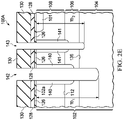
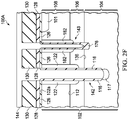
- FIGS. 2A-2G show a manufacturing process depicting cross-sectional views of the semiconductor device 100A with the due-trench configuration according to an aspect of example embodiments.
- the buried layer 106 and the upper semiconductor layer 108 are formed on the lower semiconductor layer 104.
- the buried layer 106 and the upper semiconductor layer 108 may be formed by implanting N-type dopants into the P-type lower semiconductor layer 104, followed by a thermal drive and a subsequent epitaxial process to grow the P-type upper semiconductor layer 108, so that the buried layer 106 is formed by diffusion and activation of the implanted N-type dopants.
- a transistor well region 101 is formed within the upper semiconductor layer 108 and above the buried layer 106.
- a pad oxide layer 126 is formed at the top surface 102a of the substrate 102, such as by thermal oxidation.
- the pad oxide layer 126 may include 5 nanometers to 30 nanometers of silicon dioxide.
- a pad nitride layer 128 is formed on the pad oxide layer 126, such as by low pressure chemical vapor deposition (LPCVD) using ammonia and silane.
- the pad nitride layer 128 may include 100 nanometers to 300 nanometers of silicon nitride.
- a hard mask oxide layer 130 is formed over the pad nitride layer 128, such as by a plasma enhanced chemical vapor deposition (PECVD) using tetraethyl orthosilicate, which is also known as tetraethoxysilane (TEOS), or using a high density plasma (HDP) process.
- PECVD plasma enhanced chemical vapor deposition
- TEOS tetraethoxysilane
- HDP high density plasma
- the hard mask oxide layer 130 may include 500 nanometers to 2 microns of silicon dioxide.
- the pad nitride layer 128 provides an etch stop layer for subsequent etching of the hard mask oxide layer 130.
- a trench mask 132 is formed over the hard mask oxide layer 130 so as to expose areas for forming the first deep trench structure 114 and the second deep trench structure 174 as shown and described in FIGS. 1C and ID. More specifically, the trench mask 132 is patterned with a first aperture API and a second aperture AP2.
- the first aperture API defines the first trench width 120
- the second aperture AP2 defines the second trench width 180. Accordingly, the first aperture API is generally bigger than the second aperture AP2.
- the second aperture AP2 ranges from 1.5 um to 1.8 um, whereas the first aperture API is about (e.g., +/- 10% margin) 2.65 um.
- the second aperture AP2 is about (e.g., +/- 10% margin) 1.7 um
- the first aperture API is about (e.g., +/- 10% margin) 2.65 um.
- the trench mask 132 may include a photoresist material formed by a photolithographic process, and may further include a hard mask layer and/or an anti-reflection layer.
- a hard mask etch process removes material from the hard mask oxide layer 130 in the areas exposed by the trench mask 132.
- the hard mask etch process may include a reactive ion etch (RIE) process using fluorine radicals, and/or may include a wet etch process using a dilute buffered aqueous solution of hydrofluoric acid.
- RIE reactive ion etch
- a portion of the pad nitride layer 128 may be removed by the hard mask etch process, as depicted in FIG. 2B .
- a portion or all of the trench mask 132 may be eroded by the hard mask etch process.
- a stop layer etch process removes the pad nitride layer 128 and the pad oxide layer 126 in the areas exposed by the trench mask 132.
- the stop layer etch process may include an RIE process with a different combination of gases from the hard mask etch process described in reference to FIG. 2B .
- the trench mask 132 may be further eroded by the stop layer etch process.
- the stop layer etch includes a first trench etch process removing material from the substrate 102 in the areas exposed by the trench mask 132 to simultaneously form a first partial deep trench 134 and a second partial deep trench 138.
- the first partial deep trench 134 extends to the buried layer 106 deeper than the second partial deep trench 138 given the first aperture API is wider than the second aperture AP2.
- the first trench etch process may include a continuous etch process which simultaneously removes material from the bottoms of the first and second partial deep trenches 134 and 138, and passivates sidewalls of the first and second partial deep trenches 134 and 138.
- the first deep trench etch process may include a two-step process.
- the first deep trench etch process removes material from the bottoms of the first and second partial deep trenches 134 and 138.
- the first deep trench etch process removes passivates sidewalls of the first and second partial deep trenches 134 and 138.
- the trench mask 132 may be further eroded by the first trench etch process.
- N-type dopants 139 are implanted into the substrate 102 along the sidewalls of the first partial deep trench 134 to form the first N-type sinker implanted layers 140 and along the sidewalls of the second partial deep trench 138 to form the second N-type sinker implanted layers 141.
- the N-type dopants 139 may be implanted in multiple sub-doses at tilt angles. In one example implementation, the tilt angles range from 10 degrees to 30 degrees to provide continuous coverage of the first and second sinker implanted layers 140 and 141 along the respective sidewalls of the first and second partial deep trenches 134 and 138.
- the N-type dopants 139 may also be implanted at twist angles of about 45 degrees to reduce the amount of the N-type dopants 139 implanted into bottom surfaces of the first and second partial deep trenches 134 and 138.
- An example implant process may include four sub-doses rotated at 90 degrees apart, at tilt angles of 10 degrees to 30 degrees, and at twist angles of 45 degrees. Reducing the amount of the N-type dopants 139 implanted into bottom surfaces of the first and second partial deep trench 134 and 138 may advantageously improve the process margin of a second trench etch process subsequent to the first trench etch process.
- the N-type dopants 139 may be implanted at a total dose of 1 ⁇ 10 14 cm -2 to 2 ⁇ 10 15 cm -2 so as to provide desirably low resistance of the subsequent formed sinkers.
- the N-type dopants 139 may include phosphorus and/or arsenic.
- a pad oxide layer (not shown) may be formed on the sidewalls of the first and second partial deep trenches 134 and 138. If N-type dopants 139 include arsenic, a pad oxide layer of 30 nanometers of silicon dioxide formed by a PECVD process using TEOS may improve retention of the implanted arsenic in the first and second sinker implanted layers 140 and 141.
- a pad oxide on the sidewalls of the first and second partial deep trench 134 and 138 may be omitted because the pad oxide may increases stress in the substrate 102, which may lead to degrading performance of the semiconductor device 100A.
- Implanting the n-type dopants 139 after forming the first and second partial deep trenches 134 and 138 and before forming full deeper trenches therefrom may advantageously prevent the first and second sinker implanted layers 140 and 141 from extending beyond the buried layer 106. Such a process may also improve a breakdown voltage of the PN junctions in the semiconductor device 100A.
- the first and second partial deep trenches 134 and 138 serve as a self-alignment means for forming the first and second sinker implanted layers 140 and 141, such that no additional mask is required. Because the first aperture API is wider than the second aperture AP2, the first sinker implanted layer 140 has a greater lateral thickness than the second sinker implanted layer 141.
- a second trench etch process is performed to remove additional material from the substrate 102 so as to further extend the first and second partial deep trenches 134 and 138 to simultaneously form a first and second full deep trenches 142 and 143 respectively.
- the first full trench 142 has a first trench depth TD 1 greater than a second trench depth TD 2 of the second full trench 143.
- the first full trench 142 extends below the buried layer 106 by at least 17 um whereas the second full trench 143 extends below the buried layer 106 by less than 17 um.
- the first full trench 142 extends below the buried layer 106 whereas the second full trench 143 does not extend below the buried layer 106.
- a dielectric deposition process is performed to form first and second dielectric liners 116 and 176 on the sides and bottoms of the first and second full deep trenches 142 and 143 respectively.
- the dielectric liners 116 and 176 may each have a thickness ranges from 100 nanometers to 800 nanometers.
- the first and second dielectric liners 116 and 176 may include a thermal oxide layer having a thickness ranges from 200 nanometers to 300 nanometers on the sides and bottoms of the first and second full deep trenches 142 and 143.
- a silicon dioxide layer having a thickness ranges from 300 nanometers to 500 nanometers may be formed on the thermal oxide by a sub-atmospheric chemical vapor deposition (SACVD) process.
- SACVD sub-atmospheric chemical vapor deposition
- the second dielectric layer 176 forms a pinch off section 177 around the bottom portion of the second full deep trench 143, while the first dielectric layer 116 forms a relatively uniform thickness around the bottom portion of the first full deep trench 142.
- the pinch off section 177 in the second full deep trench 142 is thicker than the first dielectric layer 116 around the bottom portion of the first full deep trench 142.
- an oxide etch process is performed to create a bottom opening within the first full deep trench 142 for accessing the lower semiconductor layer 104. Because of the thicker pinch off section 177, the bottom portion of the second full deep trench 143 remains closed to the lower semiconductor layer 104 after the oxide etch process is completed.
- a P-type doping process may be performed to create a contact doped region 117 directly under the bottom opening.
- a layer of trench fill material 144 is formed in the first and second full deep trenches 142 and 143 on the first and second dielectric liners 116 and 176.
- the layer of trench fill material 144 may include a polysilicon material that fills in the first and second full deep trenches 142 and 143, and covers the hard mask oxide layer 130.
- the layer of trench fill material 144 may include silicon dioxide or other dielectric material for filling the second full deep trench 143 where the second deep trench 174 is configured to a floating state.
- first and second dielectric liners 116 and 176, and the trench fill material 144 cause the implanted N-type dopants in the first and second sinker implanted layers 140 and 141 to diffuse and become activated.
- the first and second sinkers 122 and 182 are formed without requiring a separate annealing process.
- the hard mask oxide layer 130 and the overlying portion of the layer of trench fill material 144 are subsequently removed, such as by a chemical mechanical polish (CMP) process.
- CMP chemical mechanical polish
- the first trench fill material 118 is left in the first deep trench structure 114, while the second trench fill material 178 is left in the second deep trench structure 174.
- the pad nitride layer 128 serves as an etch stop layer for removal of the hard mask oxide layer 130.
- the pad nitride layer 128 and the pad oxide layer 126 are subsequently removed, to result in the structure as shown in FIGS. 1C and ID.
- a first resistor may have a first resistance that is substantially equal to a second resistance of the second resistor, where the first and second resistors are purported to have the same resistance, yet the fabrication process introduces slight variations between the first resistance and the second resistance.
- the first resistance can be substantially equal to the second resistance, even when the fabricated first and second resistors demonstrate a slight difference in resistance. This slight difference may be within 5% of the design target.
- a first resistor may have a first resistance that is substantially equal to a second resistance of a second resistor, where the process variations are known a priori, such that the first resistance and the second resistance can be preset at slightly different values to account for the known process variations.
- the first resistance can be substantially equal to the second resistance, even when the design values of the first and second resistance are preset to include a slight difference to account for the known process variations. This slight difference may be within 5% of the design target.
- the term “configured to” describes structural and functional characteristics of one or more tangible non-transitory components.
- a “configured to” component has a particular configuration that is designed or dedicated for performing a certain function.
- a device is “configured to” perform a recited function if the device includes tangible non-transitory components that can be enabled, activated or powered to perform that recited function.
- the term “configured to” may encompass being configurable, but it is not limited to such a narrow definition. Thus, when used for describing a device, the term “configured to” does not require the described device to be configurable at any given point of time.
Landscapes
- Engineering & Computer Science (AREA)
- Physics & Mathematics (AREA)
- Condensed Matter Physics & Semiconductors (AREA)
- General Physics & Mathematics (AREA)
- Manufacturing & Machinery (AREA)
- Computer Hardware Design (AREA)
- Microelectronics & Electronic Packaging (AREA)
- Power Engineering (AREA)
- Chemical & Material Sciences (AREA)
- Crystallography & Structural Chemistry (AREA)
- Element Separation (AREA)
Applications Claiming Priority (2)
| Application Number | Priority Date | Filing Date | Title |
|---|---|---|---|
| US15/238,198 US9786665B1 (en) | 2016-08-16 | 2016-08-16 | Dual deep trenches for high voltage isolation |
| PCT/US2017/047151 WO2018035229A2 (en) | 2016-08-16 | 2017-08-16 | Dual deep trenches for high voltage isolation |
Publications (3)
| Publication Number | Publication Date |
|---|---|
| EP3501040A4 EP3501040A4 (en) | 2019-06-26 |
| EP3501040A2 EP3501040A2 (en) | 2019-06-26 |
| EP3501040B1 true EP3501040B1 (en) | 2022-04-27 |
Family
ID=59982153
Family Applications (1)
| Application Number | Title | Priority Date | Filing Date |
|---|---|---|---|
| EP17842059.2A Active EP3501040B1 (en) | 2016-08-16 | 2017-08-16 | Dual deep trenches for high voltage isolation |
Country Status (5)
| Country | Link |
|---|---|
| US (2) | US9786665B1 (enExample) |
| EP (1) | EP3501040B1 (enExample) |
| JP (2) | JP6936454B2 (enExample) |
| CN (1) | CN109564895B (enExample) |
| WO (1) | WO2018035229A2 (enExample) |
Families Citing this family (11)
| Publication number | Priority date | Publication date | Assignee | Title |
|---|---|---|---|---|
| US9786665B1 (en) * | 2016-08-16 | 2017-10-10 | Texas Instruments Incorporated | Dual deep trenches for high voltage isolation |
| US10262997B2 (en) * | 2017-09-14 | 2019-04-16 | Vanguard International Semiconductor Corporation | High-voltage LDMOSFET devices having polysilicon trench-type guard rings |
| CN111341847B (zh) * | 2018-12-19 | 2023-03-28 | 联华电子股份有限公司 | 半导体结构及其制作方法 |
| US10811543B2 (en) * | 2018-12-26 | 2020-10-20 | Texas Instruments Incorporated | Semiconductor device with deep trench isolation and trench capacitor |
| US11158750B2 (en) | 2019-07-03 | 2021-10-26 | Texas Instruments Incorporated | Superlattice photo detector |
| US11502036B2 (en) * | 2020-02-07 | 2022-11-15 | Renesas Electronics Corporation | Semiconductor device and method of manufacturing the same |
| DE112021006557B4 (de) | 2021-01-15 | 2025-02-20 | Rohm Co., Ltd. | Halbleitervorrichtungen |
| JP7724087B2 (ja) * | 2021-06-16 | 2025-08-15 | ローム株式会社 | 半導体装置および半導体装置の製造方法 |
| JP7748832B2 (ja) * | 2021-08-26 | 2025-10-03 | ローム株式会社 | 半導体装置 |
| US12087813B2 (en) * | 2021-08-31 | 2024-09-10 | Texas Instruments Incorporated | Deep trench isolation with field oxide |
| US12159910B2 (en) * | 2022-02-15 | 2024-12-03 | Globalfoundries U.S. Inc. | Isolation regions for charge collection and removal |
Family Cites Families (25)
| Publication number | Priority date | Publication date | Assignee | Title |
|---|---|---|---|---|
| US4819052A (en) * | 1986-12-22 | 1989-04-04 | Texas Instruments Incorporated | Merged bipolar/CMOS technology using electrically active trench |
| JP3189743B2 (ja) * | 1997-06-26 | 2001-07-16 | 日本電気株式会社 | 半導体集積回路装置及びその製造方法 |
| US6316336B1 (en) * | 1999-03-01 | 2001-11-13 | Richard A. Blanchard | Method for forming buried layers with top-side contacts and the resulting structure |
| GB0507157D0 (en) | 2005-04-08 | 2005-05-18 | Ami Semiconductor Belgium Bvba | Double trench for isolation of semiconductor devices |
| JP2007201220A (ja) | 2006-01-27 | 2007-08-09 | Mitsubishi Electric Corp | 半導体装置 |
| JP2008034649A (ja) * | 2006-07-28 | 2008-02-14 | Sanyo Electric Co Ltd | 半導体装置 |
| EP2006900B1 (en) * | 2007-05-25 | 2020-11-18 | Semiconductor Components Industries, LLC | Deep trench isolation for power semiconductors |
| US7982282B2 (en) * | 2008-04-25 | 2011-07-19 | Freescale Semiconductor, Inc. | High efficiency amplifier with reduced parasitic capacitance |
| JP2010062377A (ja) * | 2008-09-04 | 2010-03-18 | Sanyo Electric Co Ltd | 半導体装置及びその製造方法 |
| US20100181639A1 (en) * | 2009-01-19 | 2010-07-22 | Vanguard International Semiconductor Corporation | Semiconductor devices and fabrication methods thereof |
| JP2011171602A (ja) | 2010-02-19 | 2011-09-01 | Oki Semiconductor Co Ltd | 半導体装置およびその製造方法 |
| EP2498280B1 (en) * | 2011-03-11 | 2020-04-29 | Soitec | DRAM with trench capacitors and logic back-biased transistors integrated on an SOI substrate comprising an intrinsic semiconductor layer and manufacturing method thereof |
| FR2991502B1 (fr) * | 2012-05-29 | 2014-07-11 | Commissariat Energie Atomique | Procede de fabrication d'un circuit integre ayant des tranchees d'isolation avec des profondeurs distinctes |
| US9159791B2 (en) * | 2012-06-06 | 2015-10-13 | United Microelectronics Corp. | Semiconductor device comprising a conductive region |
| US9343526B2 (en) * | 2013-03-13 | 2016-05-17 | Freescale Semiconductor, Inc. | Deep trench isolation |
| KR102057340B1 (ko) * | 2013-03-29 | 2019-12-19 | 매그나칩 반도체 유한회사 | 반도체 소자 및 그 제조방법 |
| CN104701172B (zh) * | 2013-12-05 | 2018-03-09 | 中芯国际集成电路制造(上海)有限公司 | Vdmos场效应晶体管及其形成方法 |
| US9252213B2 (en) * | 2013-12-19 | 2016-02-02 | Globalfoundries Singapore Pte. Ltd. | Integrated circuits with a buried N layer and methods for producing such integrated circuits |
| FR3021457B1 (fr) * | 2014-05-21 | 2017-10-13 | St Microelectronics Rousset | Composant, par exemple transistor nmos, a region active a contraintes en compression relachees, et condensateur de decouplage associe |
| JP6238234B2 (ja) | 2014-06-03 | 2017-11-29 | ルネサスエレクトロニクス株式会社 | 半導体装置 |
| US9660074B2 (en) | 2014-08-07 | 2017-05-23 | Texas Instruments Incorporated | Methods and apparatus for LDMOS devices with cascaded RESURF implants and double buffers |
| US9401410B2 (en) * | 2014-11-26 | 2016-07-26 | Texas Instruments Incorporated | Poly sandwich for deep trench fill |
| US9673084B2 (en) | 2014-12-04 | 2017-06-06 | Globalfoundries Singapore Pte. Ltd. | Isolation scheme for high voltage device |
| JP6695188B2 (ja) * | 2016-03-29 | 2020-05-20 | ルネサスエレクトロニクス株式会社 | 半導体装置およびその製造方法 |
| US9786665B1 (en) * | 2016-08-16 | 2017-10-10 | Texas Instruments Incorporated | Dual deep trenches for high voltage isolation |
-
2016
- 2016-08-16 US US15/238,198 patent/US9786665B1/en active Active
-
2017
- 2017-08-16 WO PCT/US2017/047151 patent/WO2018035229A2/en not_active Ceased
- 2017-08-16 JP JP2019509513A patent/JP6936454B2/ja active Active
- 2017-08-16 CN CN201780049630.XA patent/CN109564895B/zh active Active
- 2017-08-16 EP EP17842059.2A patent/EP3501040B1/en active Active
- 2017-08-21 US US15/681,466 patent/US10580775B2/en active Active
-
2021
- 2021-08-18 JP JP2021133052A patent/JP7293293B2/ja active Active
Also Published As
| Publication number | Publication date |
|---|---|
| EP3501040A4 (en) | 2019-06-26 |
| WO2018035229A2 (en) | 2018-02-22 |
| JP7293293B2 (ja) | 2023-06-19 |
| JP6936454B2 (ja) | 2021-09-15 |
| JP2019526932A (ja) | 2019-09-19 |
| US20180053765A1 (en) | 2018-02-22 |
| CN109564895A (zh) | 2019-04-02 |
| WO2018035229A3 (en) | 2018-04-05 |
| CN109564895B (zh) | 2023-08-11 |
| EP3501040A2 (en) | 2019-06-26 |
| JP2021184491A (ja) | 2021-12-02 |
| US10580775B2 (en) | 2020-03-03 |
| US9786665B1 (en) | 2017-10-10 |
Similar Documents
| Publication | Publication Date | Title |
|---|---|---|
| EP3501040B1 (en) | Dual deep trenches for high voltage isolation | |
| US10163680B1 (en) | Sinker to buried layer connection region for narrow deep trenches | |
| US9917186B2 (en) | Semiconductor device with control structure including buried portions and method of manufacturing | |
| US10672901B2 (en) | Power transistor with terminal trenches in terminal resurf regions | |
| EP2706566B1 (en) | Semiconductor device and method of manufacturing same | |
| US8709895B2 (en) | Manufacturing method power semiconductor device | |
| US10707342B2 (en) | Transistor having at least one transistor cell with a field electrode | |
| US9431286B1 (en) | Deep trench with self-aligned sinker | |
| US8492221B2 (en) | Method for fabricating power semiconductor device with super junction structure | |
| CA2425289A1 (en) | Semiconductor structure and method for processing such a structure | |
| US20170110537A1 (en) | Deep trench isolation structures and systems and methods including the same | |
| JP2020129597A (ja) | 半導体装置及び半導体装置の製造方法 | |
| US10749028B2 (en) | Transistor with gate/field plate structure | |
| US20090085104A1 (en) | Semiconductor device and method for manufacturing | |
| TW201338049A (zh) | 溝渠式井區電場屏護功率金氧半場效電晶體結構及製程方法 | |
| KR20160092337A (ko) | 초접합 구조체 및 트렌치 게이트를 포함하는 전력 모스형 다이오드의 제조방법 |
Legal Events
| Date | Code | Title | Description |
|---|---|---|---|
| STAA | Information on the status of an ep patent application or granted ep patent |
Free format text: STATUS: THE INTERNATIONAL PUBLICATION HAS BEEN MADE |
|
| PUAI | Public reference made under article 153(3) epc to a published international application that has entered the european phase |
Free format text: ORIGINAL CODE: 0009012 |
|
| STAA | Information on the status of an ep patent application or granted ep patent |
Free format text: STATUS: REQUEST FOR EXAMINATION WAS MADE |
|
| 17P | Request for examination filed |
Effective date: 20190318 |
|
| A4 | Supplementary search report drawn up and despatched |
Effective date: 20190528 |
|
| AK | Designated contracting states |
Kind code of ref document: A2 Designated state(s): AL AT BE BG CH CY CZ DE DK EE ES FI FR GB GR HR HU IE IS IT LI LT LU LV MC MK MT NL NO PL PT RO RS SE SI SK SM TR |
|
| AX | Request for extension of the european patent |
Extension state: BA ME |
|
| DAV | Request for validation of the european patent (deleted) | ||
| DAX | Request for extension of the european patent (deleted) | ||
| GRAP | Despatch of communication of intention to grant a patent |
Free format text: ORIGINAL CODE: EPIDOSNIGR1 |
|
| STAA | Information on the status of an ep patent application or granted ep patent |
Free format text: STATUS: GRANT OF PATENT IS INTENDED |
|
| INTG | Intention to grant announced |
Effective date: 20211215 |
|
| GRAS | Grant fee paid |
Free format text: ORIGINAL CODE: EPIDOSNIGR3 |
|
| GRAA | (expected) grant |
Free format text: ORIGINAL CODE: 0009210 |
|
| STAA | Information on the status of an ep patent application or granted ep patent |
Free format text: STATUS: THE PATENT HAS BEEN GRANTED |
|
| AK | Designated contracting states |
Kind code of ref document: B1 Designated state(s): AL AT BE BG CH CY CZ DE DK EE ES FI FR GB GR HR HU IE IS IT LI LT LU LV MC MK MT NL NO PL PT RO RS SE SI SK SM TR |
|
| REG | Reference to a national code |
Ref country code: GB Ref legal event code: FG4D |
|
| REG | Reference to a national code |
Ref country code: CH Ref legal event code: EP |
|
| REG | Reference to a national code |
Ref country code: DE Ref legal event code: R096 Ref document number: 602017056668 Country of ref document: DE |
|
| REG | Reference to a national code |
Ref country code: AT Ref legal event code: REF Ref document number: 1487621 Country of ref document: AT Kind code of ref document: T Effective date: 20220515 |
|
| REG | Reference to a national code |
Ref country code: IE Ref legal event code: FG4D |
|
| REG | Reference to a national code |
Ref country code: LT Ref legal event code: MG9D |
|
| REG | Reference to a national code |
Ref country code: NL Ref legal event code: MP Effective date: 20220427 |
|
| REG | Reference to a national code |
Ref country code: AT Ref legal event code: MK05 Ref document number: 1487621 Country of ref document: AT Kind code of ref document: T Effective date: 20220427 |
|
| PG25 | Lapsed in a contracting state [announced via postgrant information from national office to epo] |
Ref country code: NL Free format text: LAPSE BECAUSE OF FAILURE TO SUBMIT A TRANSLATION OF THE DESCRIPTION OR TO PAY THE FEE WITHIN THE PRESCRIBED TIME-LIMIT Effective date: 20220427 |
|
| PG25 | Lapsed in a contracting state [announced via postgrant information from national office to epo] |
Ref country code: SE Free format text: LAPSE BECAUSE OF FAILURE TO SUBMIT A TRANSLATION OF THE DESCRIPTION OR TO PAY THE FEE WITHIN THE PRESCRIBED TIME-LIMIT Effective date: 20220427 Ref country code: PT Free format text: LAPSE BECAUSE OF FAILURE TO SUBMIT A TRANSLATION OF THE DESCRIPTION OR TO PAY THE FEE WITHIN THE PRESCRIBED TIME-LIMIT Effective date: 20220829 Ref country code: NO Free format text: LAPSE BECAUSE OF FAILURE TO SUBMIT A TRANSLATION OF THE DESCRIPTION OR TO PAY THE FEE WITHIN THE PRESCRIBED TIME-LIMIT Effective date: 20220727 Ref country code: LT Free format text: LAPSE BECAUSE OF FAILURE TO SUBMIT A TRANSLATION OF THE DESCRIPTION OR TO PAY THE FEE WITHIN THE PRESCRIBED TIME-LIMIT Effective date: 20220427 Ref country code: HR Free format text: LAPSE BECAUSE OF FAILURE TO SUBMIT A TRANSLATION OF THE DESCRIPTION OR TO PAY THE FEE WITHIN THE PRESCRIBED TIME-LIMIT Effective date: 20220427 Ref country code: GR Free format text: LAPSE BECAUSE OF FAILURE TO SUBMIT A TRANSLATION OF THE DESCRIPTION OR TO PAY THE FEE WITHIN THE PRESCRIBED TIME-LIMIT Effective date: 20220728 Ref country code: FI Free format text: LAPSE BECAUSE OF FAILURE TO SUBMIT A TRANSLATION OF THE DESCRIPTION OR TO PAY THE FEE WITHIN THE PRESCRIBED TIME-LIMIT Effective date: 20220427 Ref country code: ES Free format text: LAPSE BECAUSE OF FAILURE TO SUBMIT A TRANSLATION OF THE DESCRIPTION OR TO PAY THE FEE WITHIN THE PRESCRIBED TIME-LIMIT Effective date: 20220427 Ref country code: BG Free format text: LAPSE BECAUSE OF FAILURE TO SUBMIT A TRANSLATION OF THE DESCRIPTION OR TO PAY THE FEE WITHIN THE PRESCRIBED TIME-LIMIT Effective date: 20220727 Ref country code: AT Free format text: LAPSE BECAUSE OF FAILURE TO SUBMIT A TRANSLATION OF THE DESCRIPTION OR TO PAY THE FEE WITHIN THE PRESCRIBED TIME-LIMIT Effective date: 20220427 |
|
| PG25 | Lapsed in a contracting state [announced via postgrant information from national office to epo] |
Ref country code: RS Free format text: LAPSE BECAUSE OF FAILURE TO SUBMIT A TRANSLATION OF THE DESCRIPTION OR TO PAY THE FEE WITHIN THE PRESCRIBED TIME-LIMIT Effective date: 20220427 Ref country code: PL Free format text: LAPSE BECAUSE OF FAILURE TO SUBMIT A TRANSLATION OF THE DESCRIPTION OR TO PAY THE FEE WITHIN THE PRESCRIBED TIME-LIMIT Effective date: 20220427 Ref country code: LV Free format text: LAPSE BECAUSE OF FAILURE TO SUBMIT A TRANSLATION OF THE DESCRIPTION OR TO PAY THE FEE WITHIN THE PRESCRIBED TIME-LIMIT Effective date: 20220427 Ref country code: IS Free format text: LAPSE BECAUSE OF FAILURE TO SUBMIT A TRANSLATION OF THE DESCRIPTION OR TO PAY THE FEE WITHIN THE PRESCRIBED TIME-LIMIT Effective date: 20220827 |
|
| REG | Reference to a national code |
Ref country code: DE Ref legal event code: R097 Ref document number: 602017056668 Country of ref document: DE |
|
| PG25 | Lapsed in a contracting state [announced via postgrant information from national office to epo] |
Ref country code: SM Free format text: LAPSE BECAUSE OF FAILURE TO SUBMIT A TRANSLATION OF THE DESCRIPTION OR TO PAY THE FEE WITHIN THE PRESCRIBED TIME-LIMIT Effective date: 20220427 Ref country code: SK Free format text: LAPSE BECAUSE OF FAILURE TO SUBMIT A TRANSLATION OF THE DESCRIPTION OR TO PAY THE FEE WITHIN THE PRESCRIBED TIME-LIMIT Effective date: 20220427 Ref country code: RO Free format text: LAPSE BECAUSE OF FAILURE TO SUBMIT A TRANSLATION OF THE DESCRIPTION OR TO PAY THE FEE WITHIN THE PRESCRIBED TIME-LIMIT Effective date: 20220427 Ref country code: EE Free format text: LAPSE BECAUSE OF FAILURE TO SUBMIT A TRANSLATION OF THE DESCRIPTION OR TO PAY THE FEE WITHIN THE PRESCRIBED TIME-LIMIT Effective date: 20220427 Ref country code: DK Free format text: LAPSE BECAUSE OF FAILURE TO SUBMIT A TRANSLATION OF THE DESCRIPTION OR TO PAY THE FEE WITHIN THE PRESCRIBED TIME-LIMIT Effective date: 20220427 Ref country code: CZ Free format text: LAPSE BECAUSE OF FAILURE TO SUBMIT A TRANSLATION OF THE DESCRIPTION OR TO PAY THE FEE WITHIN THE PRESCRIBED TIME-LIMIT Effective date: 20220427 |
|
| PLBE | No opposition filed within time limit |
Free format text: ORIGINAL CODE: 0009261 |
|
| STAA | Information on the status of an ep patent application or granted ep patent |
Free format text: STATUS: NO OPPOSITION FILED WITHIN TIME LIMIT |
|
| PG25 | Lapsed in a contracting state [announced via postgrant information from national office to epo] |
Ref country code: MC Free format text: LAPSE BECAUSE OF FAILURE TO SUBMIT A TRANSLATION OF THE DESCRIPTION OR TO PAY THE FEE WITHIN THE PRESCRIBED TIME-LIMIT Effective date: 20220427 Ref country code: AL Free format text: LAPSE BECAUSE OF FAILURE TO SUBMIT A TRANSLATION OF THE DESCRIPTION OR TO PAY THE FEE WITHIN THE PRESCRIBED TIME-LIMIT Effective date: 20220427 |
|
| REG | Reference to a national code |
Ref country code: CH Ref legal event code: PL |
|
| 26N | No opposition filed |
Effective date: 20230130 |
|
| PG25 | Lapsed in a contracting state [announced via postgrant information from national office to epo] |
Ref country code: LU Free format text: LAPSE BECAUSE OF NON-PAYMENT OF DUE FEES Effective date: 20220816 Ref country code: LI Free format text: LAPSE BECAUSE OF NON-PAYMENT OF DUE FEES Effective date: 20220831 Ref country code: CH Free format text: LAPSE BECAUSE OF NON-PAYMENT OF DUE FEES Effective date: 20220831 |
|
| REG | Reference to a national code |
Ref country code: BE Ref legal event code: MM Effective date: 20220831 |
|
| PG25 | Lapsed in a contracting state [announced via postgrant information from national office to epo] |
Ref country code: SI Free format text: LAPSE BECAUSE OF FAILURE TO SUBMIT A TRANSLATION OF THE DESCRIPTION OR TO PAY THE FEE WITHIN THE PRESCRIBED TIME-LIMIT Effective date: 20220427 |
|
| P01 | Opt-out of the competence of the unified patent court (upc) registered |
Effective date: 20230523 |
|
| PG25 | Lapsed in a contracting state [announced via postgrant information from national office to epo] |
Ref country code: IE Free format text: LAPSE BECAUSE OF NON-PAYMENT OF DUE FEES Effective date: 20220816 |
|
| PG25 | Lapsed in a contracting state [announced via postgrant information from national office to epo] |
Ref country code: BE Free format text: LAPSE BECAUSE OF NON-PAYMENT OF DUE FEES Effective date: 20220831 |
|
| PG25 | Lapsed in a contracting state [announced via postgrant information from national office to epo] |
Ref country code: IT Free format text: LAPSE BECAUSE OF FAILURE TO SUBMIT A TRANSLATION OF THE DESCRIPTION OR TO PAY THE FEE WITHIN THE PRESCRIBED TIME-LIMIT Effective date: 20220427 |
|
| PG25 | Lapsed in a contracting state [announced via postgrant information from national office to epo] |
Ref country code: HU Free format text: LAPSE BECAUSE OF FAILURE TO SUBMIT A TRANSLATION OF THE DESCRIPTION OR TO PAY THE FEE WITHIN THE PRESCRIBED TIME-LIMIT; INVALID AB INITIO Effective date: 20170816 |
|
| PG25 | Lapsed in a contracting state [announced via postgrant information from national office to epo] |
Ref country code: CY Free format text: LAPSE BECAUSE OF FAILURE TO SUBMIT A TRANSLATION OF THE DESCRIPTION OR TO PAY THE FEE WITHIN THE PRESCRIBED TIME-LIMIT Effective date: 20220427 |
|
| PG25 | Lapsed in a contracting state [announced via postgrant information from national office to epo] |
Ref country code: MK Free format text: LAPSE BECAUSE OF FAILURE TO SUBMIT A TRANSLATION OF THE DESCRIPTION OR TO PAY THE FEE WITHIN THE PRESCRIBED TIME-LIMIT Effective date: 20220427 |
|
| PG25 | Lapsed in a contracting state [announced via postgrant information from national office to epo] |
Ref country code: MT Free format text: LAPSE BECAUSE OF FAILURE TO SUBMIT A TRANSLATION OF THE DESCRIPTION OR TO PAY THE FEE WITHIN THE PRESCRIBED TIME-LIMIT Effective date: 20220427 |
|
| PG25 | Lapsed in a contracting state [announced via postgrant information from national office to epo] |
Ref country code: BG Free format text: LAPSE BECAUSE OF FAILURE TO SUBMIT A TRANSLATION OF THE DESCRIPTION OR TO PAY THE FEE WITHIN THE PRESCRIBED TIME-LIMIT Effective date: 20220427 |
|
| PG25 | Lapsed in a contracting state [announced via postgrant information from national office to epo] |
Ref country code: BG Free format text: LAPSE BECAUSE OF FAILURE TO SUBMIT A TRANSLATION OF THE DESCRIPTION OR TO PAY THE FEE WITHIN THE PRESCRIBED TIME-LIMIT Effective date: 20220427 |
|
| PGFP | Annual fee paid to national office [announced via postgrant information from national office to epo] |
Ref country code: DE Payment date: 20250724 Year of fee payment: 9 |
|
| PGFP | Annual fee paid to national office [announced via postgrant information from national office to epo] |
Ref country code: GB Payment date: 20250724 Year of fee payment: 9 |
|
| PGFP | Annual fee paid to national office [announced via postgrant information from national office to epo] |
Ref country code: FR Payment date: 20250725 Year of fee payment: 9 |