EP3490560B1 - Niraparib for use in a method of treating prostate cancer - Google Patents
Niraparib for use in a method of treating prostate cancer Download PDFInfo
- Publication number
- EP3490560B1 EP3490560B1 EP17754226.3A EP17754226A EP3490560B1 EP 3490560 B1 EP3490560 B1 EP 3490560B1 EP 17754226 A EP17754226 A EP 17754226A EP 3490560 B1 EP3490560 B1 EP 3490560B1
- Authority
- EP
- European Patent Office
- Prior art keywords
- niraparib
- prostate cancer
- cells
- treatment
- tumor
- Prior art date
- Legal status (The legal status is an assumption and is not a legal conclusion. Google has not performed a legal analysis and makes no representation as to the accuracy of the status listed.)
- Active
Links
Images


Classifications
-
- A—HUMAN NECESSITIES
- A61—MEDICAL OR VETERINARY SCIENCE; HYGIENE
- A61K—PREPARATIONS FOR MEDICAL, DENTAL OR TOILETRY PURPOSES
- A61K31/00—Medicinal preparations containing organic active ingredients
- A61K31/33—Heterocyclic compounds
- A61K31/395—Heterocyclic compounds having nitrogen as a ring hetero atom, e.g. guanethidine or rifamycins
- A61K31/435—Heterocyclic compounds having nitrogen as a ring hetero atom, e.g. guanethidine or rifamycins having six-membered rings with one nitrogen as the only ring hetero atom
- A61K31/44—Non condensed pyridines; Hydrogenated derivatives thereof
- A61K31/445—Non condensed piperidines, e.g. piperocaine
- A61K31/4523—Non condensed piperidines, e.g. piperocaine containing further heterocyclic ring systems
- A61K31/454—Non condensed piperidines, e.g. piperocaine containing further heterocyclic ring systems containing a five-membered ring with nitrogen as a ring hetero atom, e.g. pimozide, domperidone
-
- A—HUMAN NECESSITIES
- A61—MEDICAL OR VETERINARY SCIENCE; HYGIENE
- A61K—PREPARATIONS FOR MEDICAL, DENTAL OR TOILETRY PURPOSES
- A61K9/00—Medicinal preparations characterised by special physical form
- A61K9/0012—Galenical forms characterised by the site of application
- A61K9/0053—Mouth and digestive tract, i.e. intraoral and peroral administration
-
- A—HUMAN NECESSITIES
- A61—MEDICAL OR VETERINARY SCIENCE; HYGIENE
- A61P—SPECIFIC THERAPEUTIC ACTIVITY OF CHEMICAL COMPOUNDS OR MEDICINAL PREPARATIONS
- A61P13/00—Drugs for disorders of the urinary system
- A61P13/08—Drugs for disorders of the urinary system of the prostate
-
- A—HUMAN NECESSITIES
- A61—MEDICAL OR VETERINARY SCIENCE; HYGIENE
- A61P—SPECIFIC THERAPEUTIC ACTIVITY OF CHEMICAL COMPOUNDS OR MEDICINAL PREPARATIONS
- A61P35/00—Antineoplastic agents
-
- A—HUMAN NECESSITIES
- A61—MEDICAL OR VETERINARY SCIENCE; HYGIENE
- A61P—SPECIFIC THERAPEUTIC ACTIVITY OF CHEMICAL COMPOUNDS OR MEDICINAL PREPARATIONS
- A61P35/00—Antineoplastic agents
- A61P35/04—Antineoplastic agents specific for metastasis
Definitions
- the present invention relates to niraparib or a salt thereof for use in a method of treating prostate cancer in a human in need of such treatment comprising administering to the human a therapeutically effective amount of niraparib, wherein the human is carrying at least one DNA repair anomaly selected from the group consisting of BRCA-1 and BRCA-2.
- Prostate cancer is the most common non-cutaneous malignancy in men and the second leading cause of death in men from cancer in the western world. Prostate cancer results from the uncontrolled growth of abnormal cells in the prostate gland. Once a prostate cancer tumor develops, androgens, such as testosterone, promote prostate cancer tumor growth. At its early stages, localized prostate cancer is often treated with local therapy including, for example, surgical removal of the prostate gland and radiotherapy. However, when local therapy fails to cure prostate cancer, as it does in up to a third of men, the disease progresses into incurable metastatic disease (i.e., disease in which the cancer has spread from one part of the body to other parts).
- incurable metastatic disease i.e., disease in which the cancer has spread from one part of the body to other parts.
- ADT Treatment of metastatic prostate cancer Androgen deprivation therapy (“ADT”) or androgen suppression therapy is performed to reduce the testicular production of testosterone.
- ADT includes surgical castration (orchiectomy) or the use of luteinizing hormone-releasing hormone (“LHRH”) antagonists or agonists.
- LHRH antagonists include degarelix.
- LHRH agonists include goserelin acetate, histrelin acetate, leuprolide acetate, and triptorelin palmoate.
- Abiraterone acetate is a prodrug of abiraterone, inhibits 17 ⁇ hydroxylase/C17, 20-lyase (cytochrome P450c17 [CYP17]), a key enzyme in androgen biosynthesis.
- Abiraterone acetate in combination with prednisone has been approved for the treatment of men with metastatic castration-resistant prostate cancer ("mCRPC") who have received prior chemotherapy containing docetaxel.
- COU-AA-302 demonstrated significantly improved overall survival (“OS”) and radiographic progression-free survival (“rPFS”) in chemotherapy-na ⁇ ve patients with mCRPC treated with abiraterone acetate plus prednisone compared with placebo plus prednisone.
- OS overall survival
- rPFS radiographic progression-free survival
- niraparib may present another treatment option.
- the present invention is directed to niraparib or a salt thereof for use in a method of treating prostate cancer in a human in need of such treatment comprising administering to the human a therapeutically effective amount of niraparib, wherein the human is carrying at least one DNA repair anomaly selected from the group consisting of BRCA-1 and BRCA-2.
- the prostate cancer is castration-resistant prostate cancer ("CRPC"), metastatic castration-resistant prostate cancer, and/or antiandrogen resistant prostate cancer.
- CRPC castration-resistant prostate cancer
- metastatic castration-resistant prostate cancer metastatic castration-resistant prostate cancer
- antiandrogen resistant prostate cancer antiandrogen resistant prostate cancer
- the human is carrying at least one DNA repair anomaly selected from the group consisting of BRCA-1 and BRCA-2.
- the human is also carrying at least one DNA repair anomaly selected from the group consisting of BRCA-1, BRCA-2, FANCA, PALB2, CHEK2, BRIP1, HDAC2, and ATM.
- the human is carrying at least one DNA repair anomaly that is either BRCA-1 or BRCA-2.
- the human is administered niraparib in an amount of, preferably, from about 30 mg/day to about 400 mg/day, more preferably 300 mg/day, and most preferably once daily oral administration in three 100 mg oral dosage forms.
- the present invention is directed to a composition comprising niraparib or a salt for use in the treatment of prostate cancer, antiandrogen resistant prostate cancer, castration-resistant prostate cancer, and metastatic castration-resistant prostate cancer.
- subject refers to a mammal, most preferably a human, who has been or is the object of treatment, observation or experiment.
- treatment refers to the treatment of a subject afflicted with a pathological condition and refers to an effect that alleviates the condition by killing the cancerous cells, but also to an effect that results in the inhibition of the progress of the condition, and includes a reduction in the rate of progress, a halt in the rate of progress, amelioration of the condition, and cure of the condition.
- Treatment as a prophylactic measure i.e., prophylaxis is also included.
- terapéuticaally effective amount refers to an amount of niraparib that elicits the biological or medicinal response in a tissue system that is being sought by a researcher, veterinarian, medical doctor or other clinician, which includes alleviation or partial alleviation of the symptoms of the disease, syndrome, condition, or disorder being treated.
- safe and effective amount refers to an amount of niraparib that elicits the prevention or amelioration of disease progression and acceptable toxicity in the human.
- composition refers to a pharmaceutical product that includes the specified ingredients sometimes in therapeutically effective amounts, as well as any product that results, directly, or indirectly, from combinations of the specified ingredients in the specified amounts.
- pharmaceutically acceptable refers to compound, materials, compositions and/or dosage forms that are, within the scope of sound medical judgement, suitable for use in contact with the tissues of a human without excessive toxicity, irritations, allergic response, or other problem or complication, commensurate with a reasonable benefit/risk ratio.
- Each carrier, excipient, etc. must all be “acceptable” in the sense of being compatible with the other ingredients of the formulation.
- androgen receptor as used herein is intended to include the wild-type androgen receptor as well as androgen-resistant ARs and/or AR mutants associated with castration-resistant prostate cancer.
- antiandrogen refers to a group of hormone receptor antagonist compounds that is capable of preventing or inhibiting the biologic effects of androgens on normally responsive tissues in the body.
- an anti-androgen is a small molecule.
- Antiandrogens include enzalutamide, apalutamide, and abiraterone acetate.
- first-generation anti-androgen refers to an agent that exhibits antagonist activity against a wild-type AR polypeptide.
- first-generation anti-androgens differ from second-generation anti-androgens in that first-generation anti-androgens can potentially act as agonists in CRPC.
- Exemplary first-generation anti-androgens include, but are not limited to, flutamide, nilutamide and bicalutamide.
- second-generation anti-androgen refers to an agent that exhibits full antagonist activity against a wild-type AR polypeptide. Second-generation anti- androgens differ from first-generation anti-androgens in that second-generation anti-androgens act as full antagonists in cells expressing elevated levels of AR, such as for example, in CRPC.
- Exemplary second-generation anti-androgens include 4-[7-(6-cyano-5-trifluoromethylpyridin-3-yl)-8-oxo-6-thioxo-5,7-diazaspiro[3.4]oct-5-yl]-2-fluoro-N methylbenzamide (also known as ARN-509; CAS No.
- a second-generation anti-androgen binds to an AR polypeptide at or near the ligand binding site of the AR polypeptide.
- third-generation anti-androgen refers to an agent that exhibits full antagonist activity against a wild-type AR polypeptide and against mutant forms of the AR polypeptide, with mutations arising in the ligand binding domain (LBD) of the AR polypeptide as set forth below.
- LBD ligand binding domain
- Third-generation anti- androgens retain the differentiation from first-generation anti-androgens in that third-generation anti-androgens act as full antagonists in cells expressing elevated levels of AR, such as for example, in CRPC.
- mutant refers to an altered (as compared with a reference) nucleic acid or polypeptide, or to a cell or organism containing or expressing such altered nucleic acid or polypeptide.
- the term "affect" or “affected” when referring to a disease, syndrome, condition or disorder that is affected by antagonism of AR, includes a reduction in the frequency and / or severity of one or more symptoms or manifestations of said disease, syndrome, condition or disorder; and / or include the prevention of the development of one or more symptoms or manifestations of said disease, syndrome, condition or disorder or the development of the disease, condition, syndrome or disorder.
- Embodiments of the present invention include prodrugs of niraparib.
- such prodrugs will be functional derivatives of the compounds that are readily convertible in vivo into the required compound.
- the term “administering” encompasses the treatment or prevention of the various diseases, conditions, syndromes and disorders described with the compound specifically disclosed or with a compound that may not be specifically disclosed, but which converts to the specified compound in vivo after administration to a patient.
- Conventional procedures for the selection and preparation of suitable prodrug derivatives are described, for example, in " Design of Prodrugs", ed. H. Bundgaard, Elsevier, 1985 .
- Androgens bind to a specific receptor, the androgen receptor (AR), inside the cells of target tissues.
- the AR is expressed in numerous tissues of the body and is the receptor through which the physiological as well as the pathophysiological effects of endogenous androgen ligands, such as testosterone (T) and dihydrotestosterone (DHT), are expressed.
- the AR is composed of three main functional domains: the ligand binding domain (LBD), the DNA-binding domain, and amino-terminal domain.
- LBD ligand binding domain
- a compound that binds to the AR and mimics the effects of an endogenous AR ligand is referred to as an AR agonist, whereas a compound that inhibits the effects of an endogenous AR ligand is termed an AR antagonist.
- Binding of androgen to the receptor activates it and causes it to bind to DNA binding sites adjacent to target genes. From there it interacts with coactivator proteins and basic transcription factors to regulate the expression of the gene. Thus, via its receptor, androgens cause changes in gene expression in cells. These changes ultimately have consequences on the metabolic output, differentiation or proliferation of the cell that are visible in the physiology of the target tissue. In the prostate, androgens stimulate the growth of prostate tissue and prostate cancer cells by binding to the AR that is present within the cytoplasm of androgen sensitive tissue.
- Compounds that selectively modulate AR are of clinical importance in the treatment of or prevention of a variety of diseases, conditions, and cancers, including, but not limited to, prostate cancer, benign prostatic hyperplasia, hirsutism in women, alopecia, anorexia nervosa, breast cancer, acne, musculoskeletal conditions, such as bone disease, hematopoietic conditions, neuromuscular disease, rheumatological disease, cancer, AIDS, cachexia, for hormone replacement therapy (HRT), employed in male contraception, for male performance enhancement, for male reproductive conditions, and primary or secondary male hypogonadism.
- HRT hormone replacement therapy
- agents that block the action (antiandrogens) of endogenous hormones are highly effective and routinely used for the treatment of prostate cancer (androgen ablation therapy). While initially effective at suppressing tumor growth, these androgen ablation therapies eventually fail in almost all cases, leading CRPC. Most, but not all, prostate cancer cells initially respond to androgen withdrawal therapy. However, with time, surviving populations of prostate cancer cells emerge because they have responded to the selective pressure created by androgen ablation therapy and are now refractory to it. Not only is the primary cancer refractory to available therapies, but cancer cells may also break away from the primary tumor and travel in the bloodstream, spreading the disease to distant sites (especially bone). This is known as metastatic castration resistant prostate cancer ("mCRPC"). Among other effects, this causes significant pain and further bone fragility in the subject.
- mCRPC metastatic castration resistant prostate cancer
- the subject's prostate cancer is resistant to or non-responsive to antiandrogen treatment, for example treatement including, but not limited to, enzalutamide, apalutamide and abiraterone acetate ("antiandrogen resistance").
- treatement including, but not limited to, enzalutamide, apalutamide and abiraterone acetate ("antiandrogen resistance").
- niraparib or a salt for use according to the claims may be provided in the form of pharmaceutical compositions comprising niraparib or a salt and a pharmaceutically acceptable carrier.
- the pharmaceutical compositions containing the active ingredient may be in a form suitable for oral use, for example, as tablets, troches, lozenges, aqueous or oily suspensions, dispersible powders or granules, emulsions, hard or soft capsules, or syrups or elixirs.
- compositions intended for oral use may be prepared according to any method known to the art for the manufacture of pharmaceutical compositions and such compositions may contain one or more agents selected from the group consisting of sweetening agents, flavoring agents, coloring agents and preserving agents in order to provide pharmaceutically elegant and palatable preparations.
- Tablets contain the active ingredient in admixture with non-toxic pharmaceutically acceptable excipients which are suitable for the manufacture of tablets.
- excipients may be for example, inert diluents, such as calcium carbonate, sodium carbonate, lactose, calcium phosphate or sodium phosphate; granulating and disintegrating agents, for example, microcrystalline cellulose, sodium croscarmellose, corn starch, or alginic acid; binding agents, for example starch, gelatin, polyvinyl-pyrrolidone or acacia, and lubricating agents, for example, magnesium stearate, stearic acid or talc.
- the tablets may be uncoated or they may be coated by known techniques to mask the unpleasant taste of the drug or delay disintegration and absorption in the gastrointestinal tract and thereby provide a sustained action over a longer period.
- a water-soluble taste masking material such as hydroxypropyl-methylcellulose or hydroxypropylcellulose, or a time delay material such as ethyl cellulose, cellulose acetate butyrate may be employed.
- Formulations for oral use may also be presented as hard gelatin capsules wherein the active ingredient is mixed with an inert solid diluent, for example, calcium carbonate, calcium phosphate or kaolin, or as soft gelatin capsules wherein the active ingredient is mixed with water-soluble carrier such as polyethyleneglycol or an oil medium, for example peanut oil, liquid paraffin, or olive oil.
- an inert solid diluent for example, calcium carbonate, calcium phosphate or kaolin
- water-soluble carrier such as polyethyleneglycol or an oil medium, for example peanut oil, liquid paraffin, or olive oil.
- Aqueous suspensions contain the active material in admixture with excipients suitable for the manufacture of aqueous suspensions.
- excipients are suspending agents, for example sodium carboxymethylcellulose, methylcellulose, hydroxypropylmethyl-cellulose, sodium alginate, polyvinylpyrrolidone, gum tragacanth and gum acacia; dispersing or wetting agents may be a naturally-occurring phosphatide, for example lecithin, or condensation products of an alkylene oxide with fatty acids, for example polyoxyethylene stearate, or condensation products of ethylene oxide with long chain aliphatic alcohols, for example heptadecaethyleneoxycetanal, or condensation products of ethylene oxide with partial esters derived from fatty acids and a hexitol such as polyoxyethylene sorbitol monooleate, or condensation products of ethylene oxide with partial esters derived from fatty acids and hexitol anhydrides, for example polyethylene sorbitan monooleate
- the aqueous suspensions may also contain one or more preservatives, for example ethyl, or n-propyl p-hydroxybenzoate, one or more coloring agents, one or more flavoring agents, and one or more sweetening agents, such as sucrose, saccharin or aspartame.
- preservatives for example ethyl, or n-propyl p-hydroxybenzoate
- coloring agents for example ethyl, or n-propyl p-hydroxybenzoate
- flavoring agents such as sucrose, saccharin or aspartame.
- sweetening agents such as sucrose, saccharin or aspartame.
- Oily suspensions may be formulated by suspending the active ingredient in a vegetable oil, for example arachis oil, olive oil, sesame oil or coconut oil, or in mineral oil such as liquid paraffin.
- the oily suspensions may contain a thickening agent, for example beeswax, hard paraffin or cetyl alcohol.
- Sweetening agents such as those set forth above, and flavoring agents may be added to provide a palatable oral preparation.
- These compositions may be preserved by the addition of an anti-oxidant such as butylated hydroxyanisol or alpha-tocopherol.
- Dispersible powders and granules suitable for preparation of an aqueous suspension by the addition of water provide the active ingredient in admixture with a dispersing or wetting agent, suspending agent and one or more preservatives.
- Suitable dispersing or wetting agents and suspending agents are exemplified by those already mentioned above. Additional excipients, for example sweetening, flavoring and coloring agents, may also be present. These compositions may be preserved by the addition of an anti-oxidant such as ascorbic acid.
- compositions may also be in the form of an oil-in-water emulsion.
- the oily phase may be a vegetable oil, for example olive oil or arachisoil, or a mineral oil, for example liquid paraffin or mixtures of these.
- Suitable emulsifying agents may be naturally occurring phosphatides, for example soy bean lecithin, and esters or partial esters derived from fatty acids and hexitol anhydrides, for example sorbitan monooleate, and condensation products of the said partial esters with ethylene oxide, for example polyoxyethylene sorbitan monooleate.
- the emulsions may also contain sweetening, flavoring agents, preservatives and antioxidants.
- Syrups and elixirs may be formulated with sweetening agents, for example glycerol, propylene glycol, sorbitol or sucrose. Such formulations may also contain a demulcent, a preservative, flavoring and coloring agents and antioxidant.
- the pharmaceutical compositions may be in the form of a sterile injectable aqueous solution. Among the acceptable vehicles and solvents that may be employed are water, Ringer's solution and isotonic sodium chloride solution.
- the sterile injectable preparation may also be a sterile injectable oil-in-water microemulsion where the active ingredient is dissolved in the oily phase.
- the active ingredient may be first dissolved in a mixture of soybean oil and lecithin. The oil solution then introduced into a water and glycerol mixture and processed to form a microemulsion.
- the injectable solutions or microemulsions may be introduced into a patient's blood stream by local bolus injection. Alternatively, it may be advantageous to administer the solution or microemulsion in such a way as to maintain a constant circulating concentration of the instant compound.
- a continuous intravenous delivery device may be utilized.
- An example of such a device is the Deltec CADD-PLUS TM model 5400 intravenous pump.
- the pharmaceutical compositions may be in the form of a sterile injectable aqueous or oleagenous suspension for intramuscular and subcutaneous administration.
- This suspension may be formulated according to the known art using those suitable dispersing or wetting agents and suspending agents which have been mentioned above.
- the sterile injectable preparation may also be a sterile injectable solution or suspension in a non-toxic parenterally acceptable diluent or solvent, for example as a solution in 1,3-butanediol.
- sterile, fixed oils are conventionally employed as a solvent or suspending medium.
- any bland fixed oil may be employed including synthetic mono- or diglycerides.
- fatty acids such as oleic acid find use in the preparation of injectables.
- Niraparib or a salt may also be administered in the form of suppositories for rectal administration of the drug.
- These compositions can be prepared by mixing the drug with a suitable non-irritating excipient which is solid at ordinary temperatures but liquid at the rectal temperature and will therefore melt in the rectum to release the drug.
- suitable non-irritating excipient include cocoa butter, glycerinated gelatin, hydrogenated vegetable oils, mixtures of polyethylene glycols of various molecular weights and fatty acid esters of polyethylene glycol.
- topical use creams, ointments, jellies, solutions or suspensions, etc., containing the instant compounds are employed. (For purposes of this application, topical application shall include mouth washes and gargles.)
- Niraparib or a salt can be administered in intranasal form via topical use of suitable intranasal vehicles and delivery devices, or via transdermal routes, using those forms of transdermal skin patches well known to those of ordinary skill in the art.
- the dosage administration will, of course, be continuous rather than intermittent throughout the dosage regimen.
- Niraparib or a salt may also be delivered as a suppository employing bases such as cocoa butter, glycerinated gelatin, hydrogenated vegetable oils, mixtures of polyethylene glycols of various molecular weights and fatty acid esters of polyethylene glycol.
- niraparib or a salt When niraparib or a salt is administered to a subject, the selected dosage level will depend on a variety of factors including, but not limited to, the activity of the particular compound, the severity of the individual's symptoms, the route of administration, the time of administration, the rate of excretion of the compound, the duration of the treatment, other drugs, compounds, and/or materials used in combination, and the age, sex, weight, condition, general health, and prior medical history of the patient.
- the amount of niraparib and route of administration will ultimately be at the discretion of the physician, although generally the dosage will be to achieve local concentrations at the site of action which achieve the desired effect without causing substantial harmful or deleterious side-effects.
- Administration in vivo can be effected in one dose, continuously or intermittently (e.g. in divided doses at appropriate intervals) throughout the course of treatment. Methods of determining the most effective means and dosage of administration are well known to those of skill in the art and will vary with the formulation used for therapy, the purpose of the therapy, the target cell being treated, and the subject being treated. Single or multiple administrations can be carried out with the dose level and pattern being selected by the treating physician.
- a suitable dose of niraparib is in the range of about 100 ⁇ g to about 250 mg per kilogram body weight of the subject per day.
- the active compound is a salt, an ester, prodrug, or the like
- the amount administered is calculated on the basis of the parent compound and so the actual weight to be used is increased proportionately.
- a therapeutically effective amount of niraparib or a pharmaceutical composition thereof for the treatment of prostate cancer as defined in the claims includes a dose range from about 30 mg/day to about 400 mg/day of niraparib, or any particular amount or range therein, in particular about 300 mg/day, and once daily oral administration in three 100 mg oral dosage forms.
- Optimal dosages of niraparib to be administered may be readily determined and will vary with the particular compound used, the mode of administration, the strength of the preparation and the advancement of the disease, syndrome, condition or disorder.
- factors associated with the particular subject being treated, including subject gender, age, weight, diet and time of administration will result in the need to adjust the dose to achieve an appropriate therapeutic level and desired therapeutic effect.
- the above dosages are thus exemplary of the average case. There can be, of course, individual instances wherein higher or lower dosage ranges are merited, and such are within the scope of this invention.
- Niraparib may be administered as defined in the claims in any of the foregoing compositions and dosage regimens or by means of those compositions and dosage regimens established in the art whenever use of niraparib is required for a subject in need thereof.
- cytotoxicity of niraparib was tested in several human prostate tumor lines in vitro. None of the tumor lines is known to be BRCA-1 or BRCA-2 deficient.
- C4-2B, LNCaP, LNCaP AR.TB, and 22Rv1 cell lines were grown in RPMI1640+GlutaMAX TM -I medium (Life Technologies #61870-036) supplemented with 10% heat-inactivated fetal bovine serum (FBS) (Life Technologies #16140-071) and non-essential amino acids (NEAA) (Life Technologies #11140-050); and VCaP cells were grown in DMEM+GlutaMAX TM -I medium (Life Technologies ##10569-010) with 10% FBS and NEAA. VCaP cells were subcultured every 7 days; other lines were split every 3-4 days.
- Cell growth kinetics of each cell line were determined by seeding cells at several densities and monitoring growth at intervals up to 7 days. Growth was determined using the Promega Cell TiterGlo reagent (#G7571) to measure cellular ATP by means of a chemiluminescent luciferin-luciferase reaction. Plates were read on a Perkin-Elmer Envision plate reader, and luminescence values were plotted in order to identify seeding densities that resulted in log-phase growth and a cell density within the linear range of the Cell TiterGlo assay at the desired time point.
- niraparib cytotoxicity experiments cells were harvested by brief trypsinization and each line was seeded to the inner 60 wells of 96-well plates in 100 ⁇ L of medium at an appropriate density for a 7-day treatment.
- the outer wells of each plate were filled with Dulbecco's phosphate buffered saline (DPBS; Life Technologies #14190-144) to reduce evaporation from test wells.
- DPBS Dulbecco's phosphate buffered saline
- Cells were rested overnight in the plates at 37 °C in a humidified 5% CO 2 incubator.
- Treatment was initiated by addition of 50 ⁇ L of 3X niraparib (final concentrations 500, 125, 31.3, 7.8, 1.95, 0.49, 0.12, 0.03 ⁇ M) in the appropriate medium to triplicate wells.
- the final vehicle concentration was 0.5% DMSO.
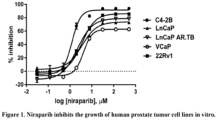
- Results of the cytotoxicity assay are shown in Figure 1 and Table 1. Growth of each cell line was reduced in a dose-dependent fashion by increasing concentrations of niraparib. C4-2B cells appeared to be the most sensitive, with an EC 50 value of ⁇ 1.2 ⁇ M. VCaP cells appeared to be the least sensitive with an EC 50 value of 4.1 ⁇ M. Table 1. EC 50 values for 7-day niraparib treatment of human prostate tumor cell lines. Cell Line EC 50 , ⁇ M C4-2B 1.222 LNCaP 3.502 LNCaP AR.TB 2.140 VCaP 4.099 22Rv1 3.517
- niraparib to inhibit the formation of poly(ADP)ribose (PAR) was tested in two human prostate tumor lines in vitro. Neither of the tumor lines is known to be BRCA-1 or BRCA-2 deficient.
- C4-2B and VCaP PAR inhibition using niraparib was assessed in 2 human prostate cancer cell lines, C4-2B and VCaP.
- the C4-2B cell line was grown in RPMI1640+GlutaMAX TM -I medium supplemented with 10% FBS and NEAA and split every 3-4 days.
- VCaP cells were grown in DMEM+GlutaMAX TM -I medium with FBS and NEAA and subcultured every 7 days.
- Cells were harvested by brief trypsinization and each line was seeded into 6-well plates in 1 mL of medium at an appropriate density. An extra 500 ⁇ L of complete medium was added, for a total volume per well of 1.5 mL. Cells were rested overnight in the plates at 37°C in a humidified 5% CO 2 incubator. The next day, medium was removed from plates and cells were washed using 1 mL serum free medium (RPMI or DMEM respectively). Treatment was initiated by addition of 1 mL of niraparib (final concentrations 100, 10, 1, 0.1, 0.01 and 0 ⁇ M in 0.1% DMSO) in the appropriate medium to triplicate wells. Plates were returned to the incubator for two hours.
- RPMI or DMEM 1 mL serum free medium
- Lysis buffer was prepared using 24.5 mL of cell lysis reagent with 250 ⁇ L of 100 mM PMSF (in ethanol; Sigma #93482) and 250 ⁇ L 100X Protease Inhibitor Cocktail (Thermo Scientific #78429). Lysis buffer (300 ⁇ L) was added to each well of the plates, on ice.
- Adherent cells were scraped into lysis buffer and kept on ice for at least 15 minutes. Supernatant was removed from the microfuge tubes, and the cell lysates from the 6-well plates were added to each tube from the corresponding tubes. SDS (20% w/v) was added to bring the final SDS concentration to 1%. The cell extracts were heated to 95-100°C for 5 minutes. After cooling to room temperature, 0.01 volume of 100X magnesium cation and 3 ⁇ L DNase were added to each tube. Tubes were briefly vortexed and returned to a 37°C incubator for 90 minutes. After the incubation, tubes were centrifuged at 10,000 ⁇ g for 10 minutes at room temperature.
- Protein quantitation was performed using the detergent-compatible Biorad DC protein assay kit II (#500-0002) with the Biorad Quick Start Bovine Serum Albumin Standard Set (#5000207) according to the manufacturer's 96-well plate protocol.
- ELISA lysis buffer was spiked into the standards, and an equal volume of PBS was added to all sample wells to correct for any effect of the lysis buffer on protein readings. Samples were assayed in duplicate. Buffer A' (25 ⁇ L) was added to all wells of the plate, and 200 ⁇ L of Buffer B was immediately added to each well. Plates were incubated for 15 minutes at room temperature on a shaker.
- Luminescence values of PAR ELISA standards and samples were analyzed in GraphPad Prism version 7, where linear regression of the standard curve and interpolation of sample values were calculated. Interpolated PAR values (pg PAR/mL) were corrected for sample dilution and divided by the corresponding protein concentration to yield pg PAR/mg of protein. These values were graphed in GraphPad Prism v7.
- Niraparib induces ⁇ -H2AX in human prostate tumor lines in vitro
- niraparib to induce double stranded breaks in DNA was measured in 3 human prostate cancer cell lines 22RV1, LNCaP AR.TB, and C4-2B. Double stranded breaks in DNA are followed by phosphorylation of adjacent histone ⁇ -H2AX, and this phosphorylation can be measured by antibody staining and flow cytometry.
- 22RV1, LNCaP AR.TB, and C4-2B cell lines were grown as outlined above. Cell lines were passaged every 3-4 days.
- each well of cells was harvested by first transferring the 2 mL of media into a 15 mL conical tube (Corning #430798). 500 ⁇ L of cell dissociation buffer (Gibco #13151-014) was then added to the well and allowed to sit for 5 minutes. Using a 1 mL pipette, 1 mL of media was added to the well, cells were dislodged by pipetting, and the cell-containing media was transferred to the corresponding 15 mL conical tube.
- cell dissociation buffer Gibco #13151-014
- Tubes were centrifuged at 1200 rpm for 5 minutes, the supernatant was discarded, and the pelleted cells were resuspended and transferred to a 96-well v-bottom plate (Costar #3896). Plates were centrifuged at 1800 rpm for 3 minutes, supernatant discarded, then wells were washed with 200 ⁇ L of DPBS. This process was repeated for a total of 3 washes. Cells were then stained with 100 ⁇ L of DPBS containing a 1:800 dilution of Invitrogen Live/Dead fixable aqua (Invitrogen #L34957) for 20 minutes at 4°C.
- BD Pharmingen Stain Buffer stain buffer; BD #554657
- DPBS DPBS
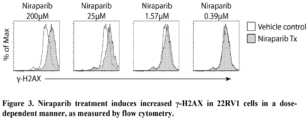
- FIG. 3 Representative histograms for the 22RV1 cell line are shown in Figure 3 , depicting the effect of different concentrations of niraparib.
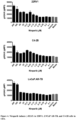
- Drug-treated samples were compared to vehicle and media controls and are graphed in Figure 4 .
- the lowest concentrations where ⁇ -H2AX signal rises significantly above vehicle control are indicated in Table 2.
- the results show that, in each prostate tumor line, niraparib induces ⁇ -H2AX in a dose-dependent manner.
- Table 2 Minimum concentration of niraparib that induces significant change in ⁇ -H2AX Cell line 1 st Significant Concentration ( ⁇ M) 22RV1 1.57 LnCaP.AR.TB 3.13 C4-2B 1.57
- Niraparib inhibits the growth of C4-2B human prostate tumors in mice
- niraparib was tested in the pre-established human prostate subcutaneous C4-2B model in non-obese diabetic (NOD) severe combined immunodeficient (scid) gamma (NOD.Cg-Prkdc Il2rg/SzJ) (NSG) mice. This tumor model is not believed to be BRCA-1 or BRCA-2 deficient.
- Methyl cellulose (Methocel TM F4M) prepared and kept at 4°C in the dark. All formulations were made to be dosed at a volume of 10 ml/kg body weight. NSG male mice (Jackson Laboratories) were used. Animals were habituated for one week prior to any experimental procedures being performed. Mice were group housed (5 per cage) in disposable IVC-cages (Innovive, San Diego, CA, USA) under a 12-h light:dark cycle at a temperature of 19 to 22 °C and 35 to 40% humidity. Mice were fed an autoclaved high fat (6%) diet laboratory chow and water ad libitum.
- Tumor Volume (mm3) (a ⁇ b 2 /2); where 'a' represents the length, and 'b' the width of the tumor as determined by caliper measurements], were monitored twice weekly throughout the study.
- mice started to reach ethical limits for tumor volume around study day 22 onwards (see Figure 5 for individual tumor volumes). Tumor volume data was presented up to study day 24 (when 9 of 10 vehicle-treated mice remained on study).
- group 3 dosed daily with 50 mg/kg niraparib p.o. showed significant inhibition/delay in tumor growth, with tumor growth inhibition (TGI) values of ⁇ 40% on these days. Significant differences in tumor growth were observed on days 18, 22 and 24 (*p ⁇ 0.05; **p ⁇ 0.01; ***p ⁇ 0.001). Mice dosed at 25 mg/kg of niraparib did not show significant tumor growth inhibition, though there was modest TGI of ⁇ 12% on days 22 and 24.
- a multicenter, open-label study is carried out to assess the efficacy and safety of once daily dosing of 300 mg niraparib in male subjects over the age of 18 years with mCRPC and DNA-repair anomalies who have had at least one line of taxane-based chemotherapy and at least one line of antiandrogen therapy (e.g., abiraterone acetate, enzalutamide, apalutamide).
- the study will enroll approximately 100 subjects. Subjects will be monitored for safety during the study period, and up to 30 days after the last dose of study drug. Treatment will continue until disease progression, unacceptable toxicity, death, or the sponsor terminates the study.
- the study will consist of 4 phases; a Prescreening Phase for biomarker evaluation only, a Screening Phase, a Treatment Phase, and a Follow-up Phase.
- the efficacy evaluations include the following: Tumor measurements: chest, abdomen , and pelvis CT or MRI scans and whole body bone scans ( 99mTc ), serum PSA, survival status, CTC, and symptomatic skeletal event (SSE).
- Niraparib 300 mg, will be provided as capsules (3 ⁇ 100 mg) for once daily oral administration. The capsules must be swallowed whole. Subjects should take their dose in the morning (with or without food). Although not considered study medication, subjects who have not undergone surgical castration must continue to receive regularly prescribed GnRHa. All GnRHa therapies should be recorded in the concomitant medication section of the eCRF.
- a treatment cycle is defined as 28 days. Subjects will begin taking niraparib on Day 1 of Cycle 1. Sufficient quantities of niraparib for each treatment cycle will be distributed on the first day of each cycle. If subjects miss a dose, then that dose should be replaced if the subject remembers within an approximate 12-hour window. Otherwise, subjects should take the next dose the following day, without compensating for the missed dose. Missed doses should be recorded in the eCRF.
- the Prescreening Phase will evaluate if a potential subject is biomarker-positive for DNA-repair anomalies. All subjects will be required to sign a specific ICF for the Prescreening Phase and provide baseline demographic characteristics and disease-specific medical history. The Prescreening Phase may occur any time prior to the Screening Phase.
- the process for determining biomarker-positivity will be different for subjects who enter the Prescreening Phase before a blood-based assay is available, compared with those subjects who enter after a blood-based assay is available.
- the 2 processes are described below.
- the Subject signs the prescreening ICF. If the subject has had tumor tissue previously analyzed by the FoundationOne ® gene panel, then after the subject grants a release, the FoundationOne ® data can be reviewed to determine eligibility based on the criteria defined in Table 1 If the subject is biomarker-positive, they are eligible to enter the Screening Phase. If the subject has not had tumor tissue previously analyzed by the FoundationOne ® gene panel, then they must have either archival or recently collected (recommended) tumor tissue analyzed for biomarker-positivity by a sponsor-approved test. If the subject is biomarker-positive, they are eligible to enter the Screening Phase.
- Blood samples will also be collected from all subjects during the Prescreening Phase and stored for when a blood-based assay becomes available. At the time a blood-based assay becomes available, the stored blood sample will be analyzed for concordance with the tumor tissue sample results. This analysis may occur at any time after the blood-based assay becomes available.
- Subject signs the prescreening ICF. Subject has blood collected and sent for analysis of biomarker-positivity. If the subject has had tumor tissue previously analyzed by the FoundationOne ® gene panel, then after the subject grants a release, the FoundationOne ® data can be reviewed to determine eligibility based on the criteria defined in Table 1. If the subject is biomarker-positive, they are eligible to enter the Screening Phase and do not need to wait for results of the blood-based analysis. If the FoundationOne ® gene panel is negative, the subject may still be considered eligible if they are determined to be biomarker-positive by the blood-based assay. If the subject has not had tumor tissue previously analyzed by the FoundationOne ® gene panel and archival tissue is available, then a request for retrieval and analysis of the archived tumor tissue is initiated.
- the subject is eligible to enter the Screening Phase and does not need to wait for results of the archival tumor tissue-based analysis.
- the results from the archival tumor tissue-based analysis when they are available, may be used in conjunction with the blood-based results for concordance and bridging studies.
- the archival tumor tissue-based results may be used to determine eligibility.
- the blood-based assay results are biomarker-positive, then the recent tumor tissue must be collected prior to Cycle 1 Day 1 for later use in concordance and bridging studies. Analysis of the recently collected tumor tissue may occur any time during the study and the results may not be required prior to the subject entering the Screening Phase.
- the recently collected tumor tissue may be used to determine eligibility.
- the Screening Phase should start within 30 days.
- Subjects who do not meet all inclusion criteria, or who meet an exclusion criterion, may be rescreened once. Rescreening is at the discretion of the investigator and requires sponsor approval and agreement. Subjects who are to be rescreened must sign a new ICF before rescreening. Subjects rescreened within 35 days of planned enrollment may use the initial screening laboratory results, computed tomography (CT)/magnetic resonance imaging (MRI) and bone scans (if still within 8 weeks of Cycle 1 Day 1) to determine eligibility if not the reason for the rescreening.
- CT computed tomography
- MRI magnetic resonance imaging
- the Treatment Phase will begin at Cycle 1 Day 1 and will continue until the study drug is discontinued.
- the last measurements taken on Day 1 of Cycle 1 before administration of the study drug or at screening (whichever value was last) will be defined as the baseline values.
- Visits for each cycle will have a ⁇ 3-day window, unless otherwise specified. Study visits will be calculated from the Cycle 1 Day 1 date. Subjects may have imaging performed within ⁇ 7 days of visits requiring images. Refer to the Time and Events Schedule for treatment visits and assessments during the Treatment Phase.
- PK and pharmacodynamics sampling days For PK and pharmacodynamics sampling days, the subject must not take the study drug at home on the morning of study visits. Study drug should be taken at the site. Details of PK and pharmacodynamics sampling days and times are provided in the Time and Events Schedule. Additional details regarding PK sampling are provided in Section 9.3. Details of blood sample handling and storage procedures for PK and pharmacodynamics are provided in the laboratory manual.
- An End of Treatment visit must be scheduled within 30 days after the last dose of study drug or prior to administration of a new anti-prostate cancer therapy, whichever occurs first. If a subject is unable to return to the site for the EoT visit, the subject should be contacted to collect AEs that occurred within 30 days after the last dose of study drug.
- survival follow-up and SSEs will be performed every 3 months either via clinic visits, telephone interview, chart review, or other convenient methods. Deaths regardless of causality and SAEs thought to be related to study drugs will be collected and reported within 24 hours of discovery or notification of the event. If the follow-up information is obtained via telephone contact, then written documentation of the communication must be available for review in the source documents.
- a blood-based assay may become available during the study that will provide a more rapid method than tissue-based analysis for determining biomarker-positive status, while being more convenient for the subjects.
- tumor tissue either archival or recently collected
- both tumor tissue and blood samples will be collected from all subjects who sign the prescreening informed consent form (ICF).
- biomarker-positivity will be different for subjects who enter the Prescreening Phase before the blood-based assay is available, compared with those subjects who enter after the blood-based assay is available. However, the status of biomarker-positivity in both tumor tissue and blood will be assessed for all subjects.
- biomarker-positive by tumor tissue either archival or recently collected
- blood testing when available.
- the biomarkers of interest for this study and the biomarker-positivity criteria are listed in Table 3. Analyses will be performed to define a proxy for bi-allelic loss (e.g., mutation co-expression frequency with copy number loss) and these proxies may be used to determine biomarker-positivity as that information becomes available.
- Blood samples will be collected in a Cellsave tube at timepoints specified in the Time and Events Schedule. CTC enumeration will be evaluated at the central laboratory, to assess response to study drug.
- RNA transcripts found in prostate tumors are detectable in the RNA and analysis of these samples will allow evaluation of potential mechanisms of resistance that may emerge with niraparib.
- Plasma samples collected during the course of treatment will be used to screen for changes in the levels or types of DNA-repair anomalies observed over time by circulating tumor DNA (ctDNA), and to monitor for potential markers of resistance to niraparib.
- ctDNA circulating tumor DNA
Landscapes
- Health & Medical Sciences (AREA)
- Animal Behavior & Ethology (AREA)
- Life Sciences & Earth Sciences (AREA)
- Public Health (AREA)
- Chemical & Material Sciences (AREA)
- Medicinal Chemistry (AREA)
- Veterinary Medicine (AREA)
- General Health & Medical Sciences (AREA)
- Pharmacology & Pharmacy (AREA)
- Organic Chemistry (AREA)
- General Chemical & Material Sciences (AREA)
- Chemical Kinetics & Catalysis (AREA)
- Nuclear Medicine, Radiotherapy & Molecular Imaging (AREA)
- Epidemiology (AREA)
- Oncology (AREA)
- Bioinformatics & Cheminformatics (AREA)
- Urology & Nephrology (AREA)
- Engineering & Computer Science (AREA)
- Nutrition Science (AREA)
- Physiology (AREA)
- Pharmaceuticals Containing Other Organic And Inorganic Compounds (AREA)
- Medicinal Preparation (AREA)
- Medicines That Contain Protein Lipid Enzymes And Other Medicines (AREA)
Priority Applications (7)
| Application Number | Priority Date | Filing Date | Title |
|---|---|---|---|
| EP25153097.8A EP4552698A3 (en) | 2016-07-29 | 2017-07-28 | Methods of treating prostate cancer |
| HRP20250157TT HRP20250157T1 (hr) | 2016-07-29 | 2017-07-28 | Niraparib za primjenu u postupku liječenja raka prostate |
| RS20250220A RS66574B1 (sr) | 2016-07-29 | 2017-07-28 | Niraparib za upotrebu u postupku lečenja raka prostate |
| SM20250082T SMT202500082T1 (it) | 2016-07-29 | 2017-07-28 | Niraparib per l'uso in un metodo di trattamento di cancro della prostata |
| MA45780A MA45780B1 (fr) | 2016-07-29 | 2017-07-28 | Niraparib pour son utilisation dans une méthode de traitement du cancer de la prostate |
| SI201731596T SI3490560T1 (sl) | 2016-07-29 | 2017-07-28 | Niraparib za uporabo pri metodi zdravljenja raka prostate |
| HUS2500030C HUS2500030I1 (hu) | 2016-07-29 | 2025-07-21 | Niraparib a prosztatarák kezelésére szolgáló eljárásban való felhasználásra |
Applications Claiming Priority (3)
| Application Number | Priority Date | Filing Date | Title |
|---|---|---|---|
| US201662368466P | 2016-07-29 | 2016-07-29 | |
| US201662369239P | 2016-08-01 | 2016-08-01 | |
| PCT/US2017/044413 WO2018023017A1 (en) | 2016-07-29 | 2017-07-28 | Methods of treating prostate cancer |
Related Child Applications (1)
| Application Number | Title | Priority Date | Filing Date |
|---|---|---|---|
| EP25153097.8A Division EP4552698A3 (en) | 2016-07-29 | 2017-07-28 | Methods of treating prostate cancer |
Publications (2)
| Publication Number | Publication Date |
|---|---|
| EP3490560A1 EP3490560A1 (en) | 2019-06-05 |
| EP3490560B1 true EP3490560B1 (en) | 2025-01-22 |
Family
ID=59649991
Family Applications (2)
| Application Number | Title | Priority Date | Filing Date |
|---|---|---|---|
| EP17754226.3A Active EP3490560B1 (en) | 2016-07-29 | 2017-07-28 | Niraparib for use in a method of treating prostate cancer |
| EP25153097.8A Pending EP4552698A3 (en) | 2016-07-29 | 2017-07-28 | Methods of treating prostate cancer |
Family Applications After (1)
| Application Number | Title | Priority Date | Filing Date |
|---|---|---|---|
| EP25153097.8A Pending EP4552698A3 (en) | 2016-07-29 | 2017-07-28 | Methods of treating prostate cancer |
Country Status (33)
Families Citing this family (12)
| Publication number | Priority date | Publication date | Assignee | Title |
|---|---|---|---|---|
| US10654809B2 (en) | 2016-06-10 | 2020-05-19 | University Of Tennessee Research Foundation | Selective androgen receptor degrader (SARD) ligands and methods of use thereof |
| US10806720B2 (en) | 2015-04-21 | 2020-10-20 | University Of Tennessee Research Foundation | Selective androgen receptor degrader (SARD) ligands and methods of use thereof |
| US10441570B2 (en) | 2015-04-21 | 2019-10-15 | University Of Tennessee Research Foundation | Selective androgen receptor degrader (SARD) Ligands and methods of use thereof |
| US10865184B2 (en) | 2015-04-21 | 2020-12-15 | University Of Tennessee Research Foundation | Selective androgen receptor degrader (SARD) ligands and methods of use thereof |
| US10093613B2 (en) | 2015-04-21 | 2018-10-09 | Gtx, Inc. | Selective androgen receptor degrader (SARD) ligands and methods of use thereof |
| HRP20240136T1 (hr) | 2016-06-29 | 2024-04-12 | Tesaro, Inc. | Metode liječenja raka jajnika |
| WO2018023017A1 (en) | 2016-07-29 | 2018-02-01 | Janssen Pharmaceutica Nv | Methods of treating prostate cancer |
| TW201929902A (zh) * | 2017-12-27 | 2019-08-01 | 美商提薩羅有限公司 | 治療癌症之方法 |
| KR20210120819A (ko) * | 2018-05-16 | 2021-10-07 | 온크터널 테라퓨틱스 인코포레이티드 | 선택적 안드로겐 수용체 분해제(sard) 리간드 및 이의 사용 방법 |
| US12202815B2 (en) | 2018-09-05 | 2025-01-21 | University Of Tennessee Research Foundation | Selective androgen receptor degrader (SARD) ligands and methods of use thereof |
| US20240052423A1 (en) * | 2020-12-07 | 2024-02-15 | Pfizer Inc. | Methods of identifying a tumor that is sensitive to treatment with talazoparib and methods of treatment thereof |
| US20240325369A1 (en) * | 2021-07-19 | 2024-10-03 | Janssen Pharmaceutica Nv | Treatment of metastatic castration-resistant prostate cancer with niraparib |
Family Cites Families (130)
| Publication number | Priority date | Publication date | Assignee | Title |
|---|---|---|---|---|
| US5120722A (en) | 1984-02-08 | 1992-06-09 | Hoffmann-La Roche Inc. | Trihydroxy-cholecacliferol and trihydroxy-ergocalciferol for treating leukemia |
| US4857518A (en) | 1984-10-04 | 1989-08-15 | Wisconsin Alumni Research Foundation | Hydroxylated 24-homo-vitamin D derivatives and methods for preparing same |
| US4717721A (en) | 1985-05-30 | 1988-01-05 | Howard W. Bremer | Sidechain homo-vitamin D compounds with preferential anti-cancer activity |
| WO1987000834A1 (en) | 1985-08-02 | 1987-02-12 | Leo Pharmaceutical Products Ltd. A/S | Novel vitamin d analogues |
| US5145846A (en) | 1988-01-20 | 1992-09-08 | Hoffmann-La Roche Inc. | Vitamin D3 analogs |
| US4851401A (en) | 1988-07-14 | 1989-07-25 | Wisconsin Alumni Research Foundation | Novel cyclopentano-vitamin D analogs |
| CA1333616C (en) | 1989-03-09 | 1994-12-20 | Hector F. Deluca | 19-nor-vitamin d compounds |
| GB8915770D0 (en) | 1989-07-10 | 1989-08-31 | Leo Pharm Prod Ltd | Chemical compounds |
| US4966898A (en) | 1989-08-15 | 1990-10-30 | Merrell Dow Pharmaceuticals Inc. | 4-substituted 17β-(cyclopropylamino)androst-5-en-3β-ol and related compounds useful as C17-20 lyase inhibitors |
| DE4021433A1 (de) | 1990-07-04 | 1992-01-09 | Schering Ag | Antiandrogene mit steroid(3,2-c)pyrazol-struktur |
| DE4101953A1 (de) | 1991-01-19 | 1992-07-23 | Schering Ag | 23-oxa-derivate in der vitamin-d-reihe, verfahren zu ihrer herstellung diese derivate enthaltende pharmazeutische praeparate sowie deren verwendung als arzneimittel |
| DE4141746A1 (de) | 1991-12-13 | 1993-06-17 | Schering Ag | 20-methyl-substituierte vitamin d-derivate |
| US5604213A (en) | 1992-03-31 | 1997-02-18 | British Technology Group Limited | 17-substituted steroids useful in cancer treatment |
| ES2138618T3 (es) | 1992-03-31 | 2000-01-16 | Btg Int Ltd | Esteroides 17-sustituidos utiles en el tratamiento del cancer. |
| US5547947A (en) | 1993-03-11 | 1996-08-20 | Hoffmann-La Roche Inc. | Methods of treatment |
| ES2127413T3 (es) | 1993-09-30 | 1999-04-16 | Btg Int Ltd | Sintesis de esteroides 17-(3-piridilo). |
| US5688977A (en) | 1996-02-29 | 1997-11-18 | Napro Biotherapeutics, Inc. | Method for docetaxel synthesis |
| US5795909A (en) | 1996-05-22 | 1998-08-18 | Neuromedica, Inc. | DHA-pharmaceutical agent conjugates of taxanes |
| US5919815A (en) | 1996-05-22 | 1999-07-06 | Neuromedica, Inc. | Taxane compounds and compositions |
| EP0914116B1 (en) | 1996-05-22 | 2000-10-11 | Protarga Inc. | Compositions comprising conjugates of cis-docosahexaenoic acid and taxotere |
| GB9622590D0 (en) | 1996-10-30 | 1997-01-08 | Leo Pharm Prod Ltd | Chemical compounds |
| US20020128240A1 (en) | 1996-12-30 | 2002-09-12 | Bone Care International, Inc. | Treatment of hyperproliferative diseases using active vitamin D analogues |
| US6872568B1 (en) | 1997-03-17 | 2005-03-29 | Human Genome Sciences, Inc. | Death domain containing receptor 5 antibodies |
| US20050233958A1 (en) | 1997-03-17 | 2005-10-20 | Human Genome Sciences, Inc. | Death domain containing receptor 5 |
| US6087350A (en) | 1997-08-29 | 2000-07-11 | University Of Pittsburgh Of The Commonwealth System Of Higher Education | Use of pretreatment chemicals to enhance efficacy of cytotoxic agents |
| JP2002509888A (ja) | 1998-03-27 | 2002-04-02 | オレゴン ヘルス サイエンシーズ ユニバーシティー | 腫瘍および他の過増殖性疾患の治療におけるビタミンdおよびその類似体 |
| US20030083231A1 (en) | 1998-11-24 | 2003-05-01 | Ahlem Clarence N. | Blood cell deficiency treatment method |
| WO2000038715A2 (en) | 1998-12-23 | 2000-07-06 | G.D. Searle & Co. | Use of an integrin antagonist and radiation in the treatment of neoplasia |
| CA2401304A1 (en) | 2000-03-02 | 2001-09-07 | University Of Pittsburgh Of The Commonwealth System Of Higher Education | Combination chemotherapy |
| JPWO2001081364A1 (ja) | 2000-04-24 | 2004-01-08 | 協和醗酵工業株式会社 | エストラ−1,3,5(10)−トリエン誘導体 |
| NZ522767A (en) | 2000-05-15 | 2004-07-30 | Celgene Corp | Thalidomide and a topoisomerase inhibitor for the treatment of cancer |
| EP1676577A1 (en) | 2000-05-15 | 2006-07-05 | Celgene Corporation | Compositions for the treatment of cancer comprising a topoisomerase inhibitor and thalidomide |
| CN1981873A (zh) | 2000-06-09 | 2007-06-20 | 莱古伦公司 | 制备微胶粒的方法和所述微胶粒的用途 |
| WO2002003286A1 (en) | 2000-07-05 | 2002-01-10 | Bryan Muehlberger | Systems and methods of facilitating electronic payment transactions |
| US6960590B2 (en) | 2000-10-17 | 2005-11-01 | Merck & Co. Inc. | Orally active salts with tyrosine kinase activity |
| US6750213B2 (en) | 2000-10-19 | 2004-06-15 | Merck & Co., Inc. | Estrogen receptor modulators |
| DE10061137B4 (de) | 2000-12-07 | 2016-10-06 | Takeda Gmbh | Neue pharmazeutische Zubereitung |
| EP1351678A2 (en) | 2001-01-02 | 2003-10-15 | Elizabeth Shanahan-Prendergast | Treatment for inhibiting neoplastic lesions using incensole and/or furanogermacrens |
| ATE410165T1 (de) | 2001-04-18 | 2008-10-15 | Euro Celtique Sa | Nociceptin-analoga |
| EP2033644A1 (en) | 2001-04-18 | 2009-03-11 | Euro-Celtique S.A. | Spiroindene and spiroindane compounds |
| CN1516584A (zh) | 2001-04-18 | 2004-07-28 | ŷ�����ǹɷ�����˾ | 螺吡唑化合物 |
| ATE403431T1 (de) | 2001-04-18 | 2008-08-15 | Euro Celtique Sa | Benzimidazolon-verbindungen |
| US6838584B2 (en) | 2001-05-10 | 2005-01-04 | Merck & Co., Inc. | Estrogen receptor modulators |
| WO2004016753A2 (en) | 2002-08-15 | 2004-02-26 | Human Genome Sciences, Inc. | Antibodies that immunospecifically bind to trail receptors |
| US20040171630A1 (en) | 2001-06-19 | 2004-09-02 | Yuntae Kim | Tyrosine kinase inhibitors |
| US6740641B2 (en) | 2001-07-27 | 2004-05-25 | Euro-Celtique, S.A. | Sugar derivatives of hydromorphone, dihydromorphine and dihydromorphine, compositions thereof and uses for treating or preventing pain |
| WO2003020699A2 (en) | 2001-08-30 | 2003-03-13 | Merck & Co., Inc. | Tyrosine kinase inhibitors |
| MY141661A (en) | 2001-09-06 | 2010-05-31 | Schering Corp | 17b-hydroxysteroid dehydrogenase type 3 inhibitors for the treatment of androgen dependent diseases |
| WO2003037252A2 (en) | 2001-10-30 | 2003-05-08 | Merck & Co., Inc. | Tyrosine kinase inhibitors |
| CA2465491A1 (en) | 2001-11-07 | 2003-05-15 | Merck & Co., Inc. | Mitotic kinesin inhibitors |
| ATE372341T1 (de) | 2001-12-06 | 2007-09-15 | Merck & Co Inc | Inhibitoren von mitotischem kinesin |
| WO2005016236A2 (en) | 2003-05-06 | 2005-02-24 | Human Genome Sciences, Inc. | Antibodies that immunospecifically bind to trail receptors |
| AU2003212882A1 (en) | 2002-02-01 | 2003-09-02 | Euro-Celtique S.A. | 2 - piperazine - pyridines useful for treating pain |
| EP1336602A1 (en) | 2002-02-13 | 2003-08-20 | Giovanni Scaramuzzino | Nitrate prodrugs able to release nitric oxide in a controlled and selective way and their use for prevention and treatment of inflammatory, ischemic and proliferative diseases |
| US6974818B2 (en) | 2002-03-01 | 2005-12-13 | Euro-Celtique S.A. | 1,2,5-thiadiazol-3-YL-piperazine therapeutic agents useful for treating pain |
| WO2003075958A1 (fr) | 2002-03-11 | 2003-09-18 | Takeda Chemical Industries, Ltd. | Medicaments permettant de traiter une maladie dependant d'une hormone sexuelle |
| WO2003086404A1 (en) | 2002-04-08 | 2003-10-23 | Merck & Co., Inc. | Fused quinoxaline derivatives as inhibitors of akt activity |
| EP1927858B1 (en) | 2002-04-29 | 2013-01-09 | Euro-Celtique S.A. | Conformationally constrained peptides that bind the ORL-1 receptor |
| US7125888B2 (en) | 2002-05-02 | 2006-10-24 | Merck & Co., Inc. | Tyrosine kinase inhibitors |
| AU2003276005B2 (en) | 2002-06-14 | 2009-01-15 | Merck Sharp & Dohme Corp. | Mitotic kinesin inhibitors |
| DE60318875T2 (de) | 2002-06-28 | 2009-01-15 | Euro-Celtique S.A. | Therapeutische piperazin-derivate für die behandlung von schmerzen |
| US7985422B2 (en) | 2002-08-05 | 2011-07-26 | Torrent Pharmaceuticals Limited | Dosage form |
| US8216609B2 (en) | 2002-08-05 | 2012-07-10 | Torrent Pharmaceuticals Limited | Modified release composition of highly soluble drugs |
| US8268352B2 (en) | 2002-08-05 | 2012-09-18 | Torrent Pharmaceuticals Limited | Modified release composition for highly soluble drugs |
| US20050101581A1 (en) | 2002-08-28 | 2005-05-12 | Reading Christopher L. | Therapeutic treatment methods 2 |
| WO2004019953A1 (en) | 2002-08-28 | 2004-03-11 | Hollis-Eden Pharmaceuticals, Inc. | Therapeutic treatment methods |
| US7157462B2 (en) | 2002-09-24 | 2007-01-02 | Euro-Celtique S.A. | Therapeutic agents useful for treating pain |
| WO2004037269A1 (en) | 2002-10-23 | 2004-05-06 | Pantarhei Bioscience B.V. | Pharmaceutical compositions comprising estetrol derivatives for use in cancer therapy |
| EP1558609A4 (en) | 2002-10-30 | 2008-05-28 | Merck & Co Inc | KINASE INHIBITORS |
| US7202259B2 (en) | 2002-11-18 | 2007-04-10 | Euro-Celtique S.A. | Therapeutic agents useful for treating pain |
| AU2003293555A1 (en) | 2002-12-17 | 2004-07-29 | Schering Corporation | 17 beta-hydroxysteroid dehydrogenase type 3 inhibitors for the treatment of androgen dependent diseases |
| US7582635B2 (en) | 2002-12-24 | 2009-09-01 | Purdue Pharma, L.P. | Therapeutic agents useful for treating pain |
| EP1583539A2 (en) | 2003-01-13 | 2005-10-12 | Cedars-Sinai Medical Center | Paricalcitol as a chemotherapeutic agent |
| TWI330079B (en) | 2003-01-15 | 2010-09-11 | Synta Pharmaceuticals Corp | Treatment for cancers |
| US20050020546A1 (en) | 2003-06-11 | 2005-01-27 | Novacea, Inc. | Pharmaceutical compositions comprising active vitamin D compounds |
| AR044688A1 (es) | 2003-06-12 | 2005-09-21 | Euro Celtique Sa | Agentes terapeuticos utiles para el tratamiento del dolor |
| ES2327684T3 (es) | 2003-07-24 | 2009-11-02 | Euro-Celtique S.A. | Compuestos heteroaril-tetrahidropiridilo utiles para el tratamiento o la prevencion del dolor. |
| PL1867644T3 (pl) | 2003-07-24 | 2009-10-30 | Euro Celtique Sa | Związki heteroarylo-tetrahydropiperydylowe przydatne w leczeniu lub zapobieganiu bólu |
| US7071333B2 (en) | 2003-07-30 | 2006-07-04 | Bristol-Myers Squibb Company | Triazolopurine-based tricyclic compounds and pharmaceutical compositions comprising same |
| MXPA06001331A (es) | 2003-08-01 | 2006-05-04 | Euro Celtique Sa | Agentes terapeuticos utiles para el tratamiento del dolor. |
| US20060287402A1 (en) | 2003-08-27 | 2006-12-21 | Christopher Bayly | Cathepsin inhibitors |
| MXPA06003123A (es) | 2003-09-22 | 2006-05-31 | Euro Celtique Sa | Agentes terapeuticos utiles para el tratamiento del dolor. |
| SI1664041T1 (sl) | 2003-09-22 | 2008-12-31 | Euro Celtique Sa | Fenil-karboksamidne spojine, uporabne za tretiranje bolečine |
| PT1673092E (pt) | 2003-10-17 | 2007-11-23 | 4 Aza Ip Nv | ''derivados de pteridina substituídos com heterociclos e sua utilização em terapia'' |
| WO2005107801A2 (en) | 2004-04-29 | 2005-11-17 | The Regents Of The University Of Colorado | Systems and methods for treating human inflammatory and proliferative diseases, with a combination of fatty acid metabolism inhibitors and glycolytic inhibitors and/or ucp and/or fas antibodies |
| US20060003950A1 (en) | 2004-06-30 | 2006-01-05 | Bone Care International, Inc. | Method of treating prostatic diseases using a combination of vitamin D analogues and other agents |
| US7094775B2 (en) | 2004-06-30 | 2006-08-22 | Bone Care International, Llc | Method of treating breast cancer using a combination of vitamin D analogues and other agents |
| US20060030608A1 (en) | 2004-08-04 | 2006-02-09 | Boehringer Ingelheim Pharmaceuticals, Inc. | Anti aromatase compounds pharmaceutical compositions and uses thereof |
| GB0418900D0 (en) | 2004-08-24 | 2004-09-29 | Btg Int Ltd | Novel salt forms |
| CA2579732C (en) | 2004-09-10 | 2014-08-12 | Nitec Pharma Ag | Tablets with site time-controlled gastrointestinal release of active ingredient |
| AR051597A1 (es) | 2004-11-01 | 2007-01-24 | Merck & Co Inc | Moduladores de los receptores de estrogeno |
| EP1674479A1 (en) | 2004-12-22 | 2006-06-28 | Memorial Sloan-Kettering Cancer Center | Modulation of Fc Gamma receptors for optimizing immunotherapy |
| WO2006081152A2 (en) | 2005-01-24 | 2006-08-03 | Merck & Co., Inc. | Estrogen receptor modulators |
| JP2008539276A (ja) | 2005-04-27 | 2008-11-13 | ユニバーシティ オブ フロリダ リサーチ ファウンデーション,インコーポレイティド | ヒト疾患に関連する変異体タンパク質の分解能を改善するための材料及び方法 |
| EP1877060A2 (en) | 2005-04-28 | 2008-01-16 | The Regents of the University of Colorado | Therapeutic bifunctional compounds |
| US7709517B2 (en) | 2005-05-13 | 2010-05-04 | The Regents Of The University Of California | Diarylhydantoin compounds |
| CN101267779A (zh) | 2005-07-27 | 2008-09-17 | 福罗里达大学研究基金会有限公司 | 使用热休克治疗眼睛疾病 |
| US20090275619A1 (en) | 2006-04-03 | 2009-11-05 | BOUERES Julia | Amide Substituted Indazole and Benzotriazole Derivatives as Poly(ADP-Ribose)Polymerase (PARP) Inhibitors |
| AU2007300734A1 (en) | 2006-06-02 | 2008-04-03 | Government Of The United States Of America, As Represented By The Secretary, Department Of Health And Human Services | RNA nanoparticles and nanotubes |
| CA2656393A1 (en) | 2006-06-30 | 2008-01-10 | Schering Corporation | Method of using substituted piperidines that increase p53 activity |
| WO2008005268A1 (en) | 2006-06-30 | 2008-01-10 | Schering Corporation | Substituted piperidines that increase p53 activity and the uses thereof |
| HRP20130961T1 (hr) | 2006-08-25 | 2013-11-22 | Janssen Oncology, Inc. | Kombinacije za tretman raka |
| US20080051375A1 (en) | 2006-08-25 | 2008-02-28 | Auerbach Alan H | Methods for treating cancer comprising the administration of a vitamin d compound and an additional therapeutic agent, and compositions containing the same |
| US20080051380A1 (en) | 2006-08-25 | 2008-02-28 | Auerbach Alan H | Methods and compositions for treating cancer |
| EP2081964A4 (en) | 2006-10-12 | 2012-07-11 | Univ Johns Hopkins | ALGINATE AND ALGINATLYASE COMPOSITIONS AND USE METHOD |
| EP2081565A2 (en) | 2006-10-13 | 2009-07-29 | Reliance Life Sciences Pvt., Ltd. | Cinnamic acid, vanillic acid and benzofuran derivatives for use in the treatment of inflammation and cancer |
| BRPI0806245B1 (pt) | 2007-01-10 | 2022-01-25 | Msd Italia S.R.L. | Compostos de fórmula i e seus usos |
| CA2677651A1 (en) | 2007-02-15 | 2008-08-21 | Novartis Ag | Combinations of therapeutic agents for treating cancer |
| WO2008109740A2 (en) | 2007-03-06 | 2008-09-12 | Colby Pharmaceutical Company | Mitochondria targeted cationic anti-oxidant compounds for prevention, therapy or treatment of hyper-proliferative disease, neoplasias and cancers |
| US20090124587A1 (en) | 2007-07-12 | 2009-05-14 | Auerbach Alan H | METHODS FOR TREATING CANCER USING 17alpha-HYDROXYLASE/C17,20-LYASE INHIBITORS |
| EP2240466B1 (en) * | 2008-01-08 | 2015-07-29 | Merck Sharp & Dohme Limited | Pharmaceutically acceptable salts of 2-{4-[(3s)-piperidin-3- yl]phenyl} -2h-indazole-7-carboxamide |
| ES2480994T3 (es) | 2008-03-31 | 2014-07-29 | Genentech, Inc. | Compuestos de tipo benzopirano y benzoxepina inhibidores de PI3K y métodos de uso |
| DK2278975T3 (en) | 2008-05-07 | 2016-12-19 | Cardioxyl Pharmaceuticals Inc | NOVEL nitroso compounds WHICH NITROXYLDONORER AND METHODS OF USE THEREOF |
| WO2012009475A1 (en) | 2010-07-14 | 2012-01-19 | Oregon Health & Science University | Methods of treating cancer with inhibition of lysine-specific demethylase 1 |
| US8658128B2 (en) | 2011-02-03 | 2014-02-25 | Pop Test Cortisol Llc | System and method for diagnosis and treatment |
| US9314473B2 (en) | 2011-02-03 | 2016-04-19 | Pop Test Oncology Limited Liability Company | System and method for diagnosis and treatment |
| WO2014052237A1 (en) * | 2012-09-26 | 2014-04-03 | Aragon Pharmaceuticals, Inc. | Anti-androgens for the treatment of non-metastatic castrate-resistant prostate cancer |
| WO2014089324A1 (en) | 2012-12-07 | 2014-06-12 | Calitor Sciences, Llc | Substituted cyclic compounds and methods of use |
| US9797771B2 (en) | 2013-03-21 | 2017-10-24 | Isp Investments Inc. | Diacetylene film sensitized with photoinitiator and applications of the film |
| US9192609B2 (en) | 2013-04-17 | 2015-11-24 | Hedgepath Pharmaceuticals, Inc. | Treatment and prognostic monitoring of proliferation disorders using hedgehog pathway inhibitors |
| KR20160058774A (ko) * | 2013-08-12 | 2016-05-25 | 토카이 파마슈티컬, 아이엔씨. | 안드로겐-표적 치료제를 이용하는 종양 질환 치료를 위한 바이오마커 |
| WO2015164586A1 (en) | 2014-04-23 | 2015-10-29 | The Brigham And Women's Hospital, Inc. | Targeting parp1 for treatment of tsc and cancers |
| US20150344968A1 (en) | 2014-05-30 | 2015-12-03 | Institute For Cancer Research D/B/A The Research Institute Of Fox Chase Cancer Center | Methods for determining parp inhibitor and platinum resistance in cancer therapy |
| US20160160294A1 (en) | 2014-12-08 | 2016-06-09 | Tesaro | Methods and materials for predicting response to niraparib |
| US9598459B2 (en) | 2015-08-03 | 2017-03-21 | Pop Test Oncology Llc | Pharmaceutical compositions and methods |
| WO2018023017A1 (en) | 2016-07-29 | 2018-02-01 | Janssen Pharmaceutica Nv | Methods of treating prostate cancer |
| US11702443B2 (en) | 2016-10-04 | 2023-07-18 | Pop Test Oncology Llc | Therapeutic agents and methods |
| WO2018067520A2 (en) | 2016-10-04 | 2018-04-12 | Pop Test Oncology Llc | Therapeutic agents and methods: |
| EA201992430A1 (ru) | 2017-04-13 | 2020-02-28 | Янссен Фармацевтика Нв | Комбинированная терапия рака предстательной железы |
| JOP20200072A1 (ar) | 2017-10-11 | 2020-04-29 | Janssen Oncology Inc | طرق علاج سرطان البروستاتا من خلال إعطاء أسيتات الأبيراتيرون إلى جانب البريدنيزون مع المعالجة بحرمان الأندروجين |
-
2017
- 2017-07-28 WO PCT/US2017/044413 patent/WO2018023017A1/en not_active Ceased
- 2017-07-28 KR KR1020197005783A patent/KR20190033599A/ko not_active Ceased
- 2017-07-28 CA CA3031705A patent/CA3031705A1/en active Pending
- 2017-07-28 EP EP17754226.3A patent/EP3490560B1/en active Active
- 2017-07-28 BR BR112019001398-9A patent/BR112019001398A2/pt not_active Application Discontinuation
- 2017-07-28 FI FIEP17754226.3T patent/FI3490560T3/fi active
- 2017-07-28 HR HRP20250157TT patent/HRP20250157T1/hr unknown
- 2017-07-28 SG SG11201900361RA patent/SG11201900361RA/en unknown
- 2017-07-28 ES ES17754226T patent/ES3014630T3/es active Active
- 2017-07-28 JP JP2019504790A patent/JP2019522032A/ja not_active Withdrawn
- 2017-07-28 RS RS20250220A patent/RS66574B1/sr unknown
- 2017-07-28 MA MA45780A patent/MA45780B1/fr unknown
- 2017-07-28 KR KR1020247023937A patent/KR20240115925A/ko not_active Ceased
- 2017-07-28 LT LTEPPCT/US2017/044413T patent/LT3490560T/lt unknown
- 2017-07-28 PL PL17754226.3T patent/PL3490560T3/pl unknown
- 2017-07-28 CN CN202411391879.7A patent/CN119606966A/zh active Pending
- 2017-07-28 KR KR1020267015462A patent/KR20260085326A/ko active Pending
- 2017-07-28 CN CN201780046876.1A patent/CN109640991A/zh active Pending
- 2017-07-28 MX MX2019001224A patent/MX2019001224A/es unknown
- 2017-07-28 US US15/663,082 patent/US20180028521A1/en not_active Abandoned
- 2017-07-28 PE PE2019000269A patent/PE20190403A1/es unknown
- 2017-07-28 SI SI201731596T patent/SI3490560T1/sl unknown
- 2017-07-28 IL IL322013A patent/IL322013A/en unknown
- 2017-07-28 AU AU2017302660A patent/AU2017302660B2/en active Active
- 2017-07-28 CN CN202411390355.6A patent/CN119606965A/zh active Pending
- 2017-07-28 HU HUE17754226A patent/HUE070253T2/hu unknown
- 2017-07-28 UA UAA201901979A patent/UA124972C2/uk unknown
- 2017-07-28 KR KR1020267015460A patent/KR20260080492A/ko active Pending
- 2017-07-28 EP EP25153097.8A patent/EP4552698A3/en active Pending
- 2017-07-28 DK DK17754226.3T patent/DK3490560T3/da active
- 2017-07-28 PT PT177542263T patent/PT3490560T/pt unknown
- 2017-07-28 SM SM20250082T patent/SMT202500082T1/it unknown
-
2018
- 2018-09-14 US US16/131,772 patent/US11207311B2/en active Active
-
2019
- 2019-01-18 PH PH12019500135A patent/PH12019500135A1/en unknown
- 2019-01-24 IL IL264443A patent/IL264443A/en unknown
- 2019-01-25 NI NI201900009A patent/NI201900009A/es unknown
- 2019-01-28 CO CONC2019/0000753A patent/CO2019000753A2/es unknown
- 2019-01-28 DO DO2019000019A patent/DOP2019000019A/es unknown
- 2019-01-28 SV SV2019005822A patent/SV2019005822A/es unknown
- 2019-01-28 MX MX2023011187A patent/MX2023011187A/es unknown
-
2021
- 2021-11-16 US US17/528,050 patent/US20220071980A1/en not_active Abandoned
- 2021-11-16 US US17/528,017 patent/US12383543B2/en active Active
-
2022
- 2022-05-25 JP JP2022084991A patent/JP7569353B2/ja active Active
- 2022-11-17 US US17/989,462 patent/US11986469B2/en active Active
- 2022-11-17 US US17/989,420 patent/US11986468B2/en active Active
- 2022-11-17 US US17/989,329 patent/US11992486B2/en active Active
-
2023
- 2023-05-05 AU AU2023202813A patent/AU2023202813B2/en active Active
- 2023-09-13 US US18/466,547 patent/US11986470B2/en active Active
-
2024
- 2024-07-23 JP JP2024117499A patent/JP7752220B2/ja active Active
-
2025
- 2025-03-24 CY CY20251100199T patent/CY1127713T1/el unknown
- 2025-07-18 LT LTPA2025528C patent/LTPA2025528I1/lt unknown
- 2025-07-21 HU HUS2500030C patent/HUS2500030I1/hu unknown
- 2025-07-21 FI FIC20250026C patent/FIC20250026I1/fi unknown
- 2025-07-21 FR FR25C1027C patent/FR25C1027I1/fr active Active
- 2025-07-21 CY CY2025021C patent/CY2025021I1/el unknown
-
2026
- 2026-07-17 AU AU2026206207A patent/AU2026206207A1/en active Pending
Non-Patent Citations (30)
| Title |
|---|
| ANONYMOUS: "A Study of MK4827 in Participants With Advanced Solid Tumors or Hematologic Malignancies (MK-4827-001 AMS)", CLINICALTRIALS.GOV, U.S. NATIONAL LIBRARY OF MEDICINE, 25 July 2013 (2013-07-25), XP093071664 |
| ANONYMOUS: "Janssen Announces Preliminary Results from Phase 2 GALAHAD Study in Adults with Metastatic Castration-Resistant Prostate Cancer and DNA-Repair Pathway Defects (DRD)", 14 February 2019 (2019-02-14), XP093071757 |
| ANONYMOUS: "Monetizing Focus: Tesaro Adds Runway By Out-licensing Niraparib In Prostate Cancer", THE PINK SHEET DAILY, PHARMA INTELLIGENCE UK LIMITED (CITELINE), 6 April 2016 (2016-04-06), pages 1 - 3, XP093124841, Retrieved from the Internet <URL:https://pink.pharmaintelligence.informa.com/PS079383> [retrieved on 20240129] |
| CHI KIM N, RATHKOPF DANA, SMITH MATTHEW R, EFSTATHIOU ELENI, ATTARD GERHARDT, OLMOS DAVID, JI ;, LEE YOUL, SMALL ERIC J, PEREIRA D: "Niraparib and Abiraterone Acetate for Metastatic Castration-Resistant Prostate Cancer", 23 March 2023 (2023-03-23), pages 1 - 15, XP093071658, [retrieved on 20230808], DOI: 10.1200/JCO.22 |
| D26 - JANSSEN PHARMACEUTICA N.V.; SUBMISSION MADE DURING THE EXAMINATION OF EUROPEAN PATENT APPLICATION NO. 17754226.3; 27 APRIL 2023. |
| DESHMUKH DHANRAJ, QIU YUN: "Role of PARP-1 in prostate cancer", AM J CLIN EXP UROL, UNITED STATES, vol. 3, no. 1, 30 April 2015 (2015-04-30), United States , pages 1 - 12, XP093329809, ISSN: 2330-1910 |
| DHAWAN MALLIKA, RYAN CHARLES J., ASHWORTH ALAN: "DNA Repair Deficiency Is Common in Advanced Prostate Cancer: New Therapeutic Opportunities", THE ONCOLOGIST, ALPHAMED PRESS, vol. 21, no. 8, 1 August 2016 (2016-08-01), pages 940 - 945, XP093089119, ISSN: 1083-7159, DOI: 10.1634/theoncologist.2016-0135 |
| FLORES JOHN PAUL, MATHEW PAUL: "Combination therapy with enzalutamide and the poly (ADP-ribose) polymerase-1 (PARP1) inhibitor niraparib in castration-resistant prostate cancer (CRPC): HCRN GU 14-202.", 2024 ASCO GASTROINTESTINAL CANCERS SYMPOSIUM, AMERICAN SOCIETY OF CLINICAL ONCOLOGY, POSTER L3, vol. 34, no. 15_suppl, 20 May 2016 (2016-05-20), Poster L3, pages TPS5095 - TPS5095, XP093317781, ISSN: 0732-183X, DOI: 10.1200/JCO.2016.34.15_suppl.TPS5095 |
| GRAS JORDI: "Niraparib hydrochloride. Poly [ADP-ribose] polymerase (PARP) inhibitor, Oncolytic.", DRUGS OF THE FUTURE, PROUS SCIENCE, ES, vol. 38, no. 10, 1 October 2013 (2013-10-01), ES , pages 679 - 685, XP009195509, ISSN: 0377-8282, DOI: 10.1358/dof.2013.38.10.2059820 |
| H. FARMER ET AL.: "Targeting the DNA repair defect in BRCA mutant cells as a therapeutic strategy", NATURE, vol. 434, 2005, XP002516395, DOI: 10.1038/nature03445 |
| H.E. BRYANT ET AL.: "Specific killing of BRCA2-deficient tumours with inhibitors of poly(ADP-ribose) polymerase", NATURE, vol. 434, 2005, XP007906257, DOI: 10.1038/nature03443 |
| J. MURAI, S.-Y. N. HUANG, B. B. DAS, A. RENAUD, Y. ZHANG, J. H. DOROSHOW, J. JI, S. TAKEDA, Y. POMMIER: "Trapping of PARP1 and PARP2 by Clinical PARP Inhibitors", CANCER RESEARCH, AMERICAN ASSOCIATION FOR CANCER RESEARCH, vol. 72, no. 21, 1 November 2012 (2012-11-01), pages 5588 - 5599, XP055094093, ISSN: 00085472, DOI: 10.1158/0008-5472.CAN-12-2753 |
| J. ZHANG: "Poly (ADP‑ribose) polymerase inhibitor: an evolving paradigm in the treatment of prostate cancer", ASIAN JOURNAL OF ANDROLOGY, vol. 16, 2014, XP055472262, DOI: 10.4103/1008-682X.123684 |
| JANSSEN RESEARCH & DEVELOPMENT, LLC: "An Efficacy and Safety Study of Niraparib in Men With Metastatic Castration-Resistant Prostate Cancer and DNA-Repair Anomalies (Galahad); NCT02854436 ", CLINICAL TRIALS, CLINICALTRIALS.GOV, 1 August 2016 (2016-08-01), XP093329789, Retrieved from the Internet <URL:https://clinicaltrials.gov/study/NCT02854436?term=NCT02854436%20&rank=1&a=1> |
| JANSSEN RESEARCH & DEVELOPMENT, LLC: "An Efficacy and Safety Study of Niraparib in Men With Metastatic Castration-Resistant Prostate Cancer and DNA-Repair Anomalies (Galahad); NCT02854436 ", CLINICAL TRIALS, CLINICALTRIALS.GOV, 26 May 2017 (2017-05-26), XP093329793, Retrieved from the Internet <URL:https://clinicaltrials.gov/study/NCT02854436?term=NCT02854436%20&rank=1&a=12> |
| MARCIA HALL, ET AL.: "An update on PARP inhibitors for the treatment of cancer", ONCOTARGETS AND THERAPY, 1 January 2015 (2015-01-01), pages 519 - 528, XP055689802, DOI: 10.2147/OTT.S30793 |
| MATEO JOAQUIN, CARREIRA SUZANNE, SANDHU SHAHNEEN, MIRANDA SUSANA, MOSSOP HELEN, PEREZ-LOPEZ RAQUEL, NAVA RODRIGUES DANIEL, ROBINSO: "DNA-Repair Defects and Olaparib in Metastatic Prostate Cancer", THE NEW ENGLAND JOURNAL OF MEDICINE, ELI LILY AND COMPANY, USA, vol. 373, no. 18, 29 October 2015 (2015-10-29), USA, pages 1697 - 1708, XP093089060, DOI: 10.1056/NEJMoa1506859 |
| MICHIE CAROLINE OGILVIE ET AL: "Final results of the phase I trial of niraparib (MK4827), a poly(ADP)ribose polymerase (PARP) inhibitor incorporating proof of concept biomarker studies and expansion cohorts involving BRCA1/2 mutation carriers, sporadic ovarian, and castration resistant prostate cancer (CRPC).", JOURNAL OF CLINICAL ONCOLOGY, vol. 31, no. 15_suppl, 20 May 2013 (2013-05-20), US, pages 2513 - 2513, XP093022104, ISSN: 0732-183X, DOI: 10.1200/jco.2013.31.15_suppl.2513 * |
| MICHIE CAROLINE OGILVIE, SANDHU SHAHNEEN KAUR, SCHELMAN WILLIAM R., MOLIFE L RHODA, WILDING GEORGE, OMLIN AURELIUS GABRIEL, KANSRA: "Final results of the phase I trial of niraparib (MK4827), a poly(ADP)ribose polymerase (PARP) inhibitor incorporating proof of concept biomarker studies and expansion cohorts involving BRCA1/2 mutation carriers, sporadic ovarian, and castration resistant prostate cancer (CRPC).", JOURNAL OF CLINICAL ONCOLOGY, vol. 31, no. 15_suppl, 20 May 2013 (2013-05-20), pages 2513 - 2513, XP093022104, DOI: 10.1200/jco.2013.31.15_suppl.2513 |
| P. JONES ET AL.: "Discovery of 2-{4-[(3S)-Piperidin-3-yl]phenyl}-2H-indazole-7-carboxamide (MK-4827): A Novel Oral Poly(ADP-ribose)polymerase (PARP) Inhibitor Efficacious in BRCA-1 and -2 Mutant Tumors", J. MED. CHEM., vol. 52, 2009, XP055263725, DOI: 10.1021/jm901188v |
| P. JONES ET AL.: "Niraparib: A Poly(ADP-ribose) Polymerase (PARP) Inhibitor for the Treatment of Tumors with Defective Homologous Recombination", JOURNAL OF MEDICINAL CHEMISTRY, vol. 58, 2015, XP055855855, DOI: 10.1021/jm5018237 |
| PARK SOOK RYUN, CHEN ALICE: "Poly(Adenosine Diphosphate–Ribose) Polymerase Inhibitors in Cancer Treatment", HEMATOLOGY - ONCOLOGY CLINICS OF NORTH AMERICA, W.B. SAUNDERS, US, vol. 26, no. 3, 1 June 2012 (2012-06-01), US , pages 649 - 670, XP093317775, ISSN: 0889-8588, DOI: 10.1016/j.hoc.2012.02.012 |
| PETER C. FONG, DAVID S. BOSS, TIMOTHY A. YAP, ANDREW TUTT, PEIJUN WU, MARJA MERGUI-ROELVINK, PETER MORTIMER, HELEN SWAISLAND, ALAN: "Inhibition of Poly(ADP-Ribose) Polymerase in Tumors from BRCA Mutation Carriers", THE NEW ENGLAND JOURNAL OF MEDICINE, ELI LILY AND COMPANY, USA, vol. 361, no. 2, 9 July 2009 (2009-07-09), USA, pages 123 - 134, XP003030947, DOI: 10.1056/NEJMoa0900212 |
| PHILIP JONES ET AL: "Discovery of 2-{4-[(3 S )-Piperidin-3-yl]phenyl}-2 H -indazole-7-carboxamide (MK-4827): A Novel Oral Poly(ADP-ribose)polymerase (PARP) Inhibitor Efficacious in BRCA-1 and -2 Mutant Tumors", JOURNAL OF MEDICINAL CHEMISTRY, vol. 52, no. 22, 26 November 2009 (2009-11-26), US, pages 7170 - 7185, XP055263725, ISSN: 0022-2623, DOI: 10.1021/jm901188v * |
| SANDHU S. K., V. MORENO, G. WILDING, A. OMLIN, W.R. SCHELMAN ET AL.: "112. PHASE I STUDY OF A POLY(ADP)-RIBOSE POLYMERASE (PARP) INHIBITOR MK-4827 (MK) WITH ANTITUMOUR ACTIVITY IN SPORADIC CASTRATION RESISTANT PROSTATE CANCER (CRPC)", ASIA-PACIFIC JOURNAL OF CLINICAL ONCOLOGY, JOHN WILEY & SONS, INC., HOBOKEN, USA, vol. 8, no. suppl. 1, 1 July 2012 (2012-07-01) - 2012-07-17, Hoboken, USA, pages 33, XP093122422, ISSN: 1743-7555, DOI: 10.1111/j.1743-7563.2012.01575.x |
| SANDHU S.K., A. OMLIN, L. HYLANDS, S. MIRANDA, L. J. BARBER, R. RIISNAES, A. H. REID, G. ATTARD, L. CHEN, I. KOZAREWA, H. GEVENSLE: "Poly (ADP-ribose) polymerase (PARP) inhibitors for the treatment of advanced germline BRCA2 mutant prostate cancer", ANNALS OF ONCOLOGY, vol. 24, no. 5, 1 May 2013 (2013-05-01), pages 1416 - 1418, XP093329805, DOI: 10.1093/annonc/mdt074 |
| SHAHNEEN K SANDHU, WILLIAM R SCHELMAN, GEORGE WILDING, VICTOR MORENO, RICHARD D BAIRD, SUSANA MIRANDA, LUCY HYLANDS, RUTH RIISNAES: "The poly(ADP-ribose) polymerase inhibitor niraparib (MK4827) in BRCA mutation carriers and patients with sporadic cancer: a phase 1 dose-escalation trial", THE LANCET ONCOLOGY, ELSEVIER, AMSTERDAM, NL, vol. 14, no. 9, 1 August 2013 (2013-08-01), AMSTERDAM, NL , pages 882 - 892, XP055407449, DOI: 10.1016/S1470-2045(13)70240-7 |
| T. HELLEDAY: "PARP inhibitor receives FDA breakthrough therapy designation in castration resistant prostate cancer: beyond germline BRCA mutations", vol. 27, no. 5, 1 May 2016 (2016-05-01), pages 755 - 757, XP055489846, DOI: 10.1093/annonc/mdw048 |
| UNDERHILL C., TOULMONDE M., BONNEFOI H.: "A review of PARP inhibitors: from bench to bedside", ANNALS OF ONCOLOGY, ELSEVIER LTD, vol. 22, no. 2, 1 February 2011 (2011-02-01), pages 268 - 279, XP093329799, ISSN: 0923-7534, DOI: 10.1093/annonc/mdq322 |
| VIGNANI FRANCESCA; TAMBARO ROSA; DE GIORGI UGO; GIANNATEMPO PATRIZIA; BIMBATTI DAVIDE; CARELLA CLAUDIA; STELLATO MARCO; ATZORI FRA: "Addition of Niraparib to Best Supportive Care as Maintenance Treatment in Patients with Advanced Urothelial Carcinoma Whose Disease Did Not Progress After First-line Platinum-based Chemotherapy: The Meet-URO12 Randomized Phase 2 Trial", EUROPEAN UROLOGY, ELSEVIER, AMSTERDAM, NL, vol. 83, no. 1, 8 October 2022 (2022-10-08), AMSTERDAM, NL , pages 82 - 89, XP087225415, ISSN: 0302-2838, DOI: 10.1016/j.eururo.2022.09.025 |
Also Published As
Similar Documents
| Publication | Publication Date | Title |
|---|---|---|
| US11986470B2 (en) | Methods of treating prostate cancer | |
| HK40126976A (en) | Methods of treating prostate cancer | |
| HK40126973A (zh) | 治疗前列腺癌的方法 | |
| EA040279B1 (ru) | Способы лечения рака предстательной железы | |
| EA049291B1 (ru) | Способы лечения рака предстательной железы | |
| EA053167B1 (ru) | Способы лечения рака предстательной железы | |
| HK40007092A (en) | Methods of treating prostate cancer | |
| BR122024017981A2 (pt) | Composição, forma de dosagem, produto e usos de niraparibe no tratamento de câncer de próstata | |
| BR122024017955A2 (pt) | Usos de niraparibe no tratamento de câncer de próstata metastático sensível à castração | |
| US20250170146A1 (en) | Niraparib and abiraterone acetate plus prednisone to improve clinical outcomes in patients with metastatic castration-resistant prostate cancer and hrr alterations | |
| US20250213563A1 (en) | Substituted pyrimidin-4(3h)-ones for use in treating cancer | |
| KR20240037954A (ko) | 니라파립을 이용한 전이성 거세-저항성 전립선암의 치료 |
Legal Events
| Date | Code | Title | Description |
|---|---|---|---|
| REG | Reference to a national code |
Ref country code: HR Ref legal event code: TUEP Ref document number: P20250157T Country of ref document: HR |
|
| STAA | Information on the status of an ep patent application or granted ep patent |
Free format text: STATUS: UNKNOWN |
|
| STAA | Information on the status of an ep patent application or granted ep patent |
Free format text: STATUS: THE INTERNATIONAL PUBLICATION HAS BEEN MADE |
|
| PUAI | Public reference made under article 153(3) epc to a published international application that has entered the european phase |
Free format text: ORIGINAL CODE: 0009012 |
|
| STAA | Information on the status of an ep patent application or granted ep patent |
Free format text: STATUS: REQUEST FOR EXAMINATION WAS MADE |
|
| 17P | Request for examination filed |
Effective date: 20190206 |
|
| AK | Designated contracting states |
Kind code of ref document: A1 Designated state(s): AL AT BE BG CH CY CZ DE DK EE ES FI FR GB GR HR HU IE IS IT LI LT LU LV MC MK MT NL NO PL PT RO RS SE SI SK SM TR |
|
| AX | Request for extension of the european patent |
Extension state: BA ME |
|
| STAA | Information on the status of an ep patent application or granted ep patent |
Free format text: STATUS: EXAMINATION IS IN PROGRESS |
|
| 17Q | First examination report despatched |
Effective date: 20201109 |
|
| P01 | Opt-out of the competence of the unified patent court (upc) registered |
Effective date: 20230511 |
|
| GRAP | Despatch of communication of intention to grant a patent |
Free format text: ORIGINAL CODE: EPIDOSNIGR1 |
|
| STAA | Information on the status of an ep patent application or granted ep patent |
Free format text: STATUS: GRANT OF PATENT IS INTENDED |
|
| INTG | Intention to grant announced |
Effective date: 20240814 |
|
| GRAS | Grant fee paid |
Free format text: ORIGINAL CODE: EPIDOSNIGR3 |
|
| GRAA | (expected) grant |
Free format text: ORIGINAL CODE: 0009210 |
|
| STAA | Information on the status of an ep patent application or granted ep patent |
Free format text: STATUS: THE PATENT HAS BEEN GRANTED |
|
| AK | Designated contracting states |
Kind code of ref document: B1 Designated state(s): AL AT BE BG CH CY CZ DE DK EE ES FI FR GB GR HR HU IE IS IT LI LT LU LV MC MK MT NL NO PL PT RO RS SE SI SK SM TR |
|
| REG | Reference to a national code |
Ref country code: GB Ref legal event code: FG4D |
|
| REG | Reference to a national code |
Ref country code: CH Ref legal event code: EP |
|
| REG | Reference to a national code |
Ref country code: IE Ref legal event code: FG4D |
|
| REG | Reference to a national code |
Ref country code: DE Ref legal event code: R096 Ref document number: 602017087441 Country of ref document: DE |
|
| REG | Reference to a national code |
Ref country code: DK Ref legal event code: T3 Effective date: 20250211 |
|
| REG | Reference to a national code |
Ref country code: NL Ref legal event code: FP |
|
| REG | Reference to a national code |
Ref country code: FI Ref legal event code: FGE |
|
| REG | Reference to a national code |
Ref country code: SE Ref legal event code: TRGR |
|
| REG | Reference to a national code |
Ref country code: PT Ref legal event code: SC4A Ref document number: 3490560 Country of ref document: PT Date of ref document: 20250320 Kind code of ref document: T Free format text: AVAILABILITY OF NATIONAL TRANSLATION Effective date: 20250314 |
|
| REG | Reference to a national code |
Ref country code: MA Ref legal event code: VAGR Ref document number: 45780 Country of ref document: MA Kind code of ref document: B1 Ref country code: HR Ref legal event code: T1PR Ref document number: P20250157 Country of ref document: HR |
|
| REG | Reference to a national code |
Ref country code: ES Ref legal event code: FG2A Ref document number: 3014630 Country of ref document: ES Kind code of ref document: T3 Effective date: 20250423 |
|
| REG | Reference to a national code |
Ref country code: EE Ref legal event code: FG4A Ref document number: E024948 Country of ref document: EE Effective date: 20250213 |
|
| REG | Reference to a national code |
Ref country code: HU Ref legal event code: AG4A Ref document number: E070253 Country of ref document: HU Ref country code: SK Ref legal event code: T3 Ref document number: E 46145 Country of ref document: SK |
|
| REG | Reference to a national code |
Ref country code: GR Ref legal event code: EP Ref document number: 20250400645 Country of ref document: GR Effective date: 20250514 |
|
| PGFP | Annual fee paid to national office [announced via postgrant information from national office to epo] |
Ref country code: SM Payment date: 20250630 Year of fee payment: 9 |
|
| PGFP | Annual fee paid to national office [announced via postgrant information from national office to epo] |
Ref country code: PT Payment date: 20250630 Year of fee payment: 9 |
|
| REG | Reference to a national code |
Ref country code: FR Ref legal event code: CP Free format text: PRODUCT NAME: NIRAPARIB OU UN SEL PHARMACEUTIQUEMENT ACCEPTABLE DE CELUI-CI EN PARTICULIER LE TOSYLATE DE NIRAPARIB EN PARTICULIER LE MONOHYDRATE DE TOSYLATE DE NIRAPARIB, EVENTUELLEMENT EN COMBINAISON AVEC L'ABIRATERONE EN PARTICULIER L'ACETATE D'ABIRATERONE; REGISTRATION NO/DATE: EU/1/23/1722 20230420 Spc suppl protection certif: 25C1027 Filing date: 20250721 Ref country code: FI Ref legal event code: SPCF Ref document number: C20250026 Country of ref document: FI Spc suppl protection certif: C20250026 Filing date: 20250721 Expiry date: 20370728 |
|
| REG | Reference to a national code |
Ref country code: NL Ref legal event code: SPCF Free format text: PRODUCT NAME: NIRAPARIB OF EEN FARMACEUTISCH AANVAARDBAAR ZOUT DAARVAN IN HET BIJZONDER NIRAPARIBTOSYLAAT IN HET BIJZONDER NIRAPARIBTOSYLAATMONOHYDRAAT, DESGEWENST IN COMBINATIE MET ABIRATERON IN HET BIJZONDER ABIRATERONACETAAT; REGISTRATION NO/DATE: EU/1/23/1722 20230420 Spc suppl protection certif: 301336 Filing date: 20250721 Expiry date: 20370727 Extension date: 20380419 |
|
| REG | Reference to a national code |
Ref country code: HR Ref legal event code: ODRP Ref document number: P20250157 Country of ref document: HR Payment date: 20250626 Year of fee payment: 9 |
|
| REG | Reference to a national code |
Ref country code: DK Ref legal event code: CTFF Free format text: PRODUCT NAME: NIRAPARIB OR A PHARMACEUTICALLY ACCEPTABLE SALT THEREOF IN PARTICULAR NIRAPARIB TOSYLATE IN PARTICU-LAR NIRAPARIB TOSYLATE MONOHYDRATE, OPTIONALLY IN COMBINATION WITH ABIRATERONE IN PARTICULAR ABI-RATERONE ACETATE; REG. NO/DATE: EU/1/23/1722 20230420 Spc suppl protection certif: CA 2025 00023 Filing date: 20250721 Expiry date: 20370728 Extension date: 20380420 |
|
| REG | Reference to a national code |
Ref country code: LU Ref legal event code: SPCF Free format text: PRODUCT NAME: NIRAPARIB OR A PHARMACEUTICALLY ACCEPTABLE SALT THEREOF IN PARTICULAR NIRAPARIB TOSYLATE IN PARTICULAR NIRAPARIB TOSYLATE MONOHYDRATE, OPTIONALLY IN COMBINATION WITH ABIRATERONE IN PARTICULAR ABIRATERONE ACETATE; AUTHORISATION NUMBER AND DATE: EU/1/23/1722 20230420 Spc suppl protection certif: LUC50015 Filing date: 20250718 Expiry date: 20370728 Extension date: 20380420 |
|
| PGFP | Annual fee paid to national office [announced via postgrant information from national office to epo] |
Ref country code: HU Payment date: 20250630 Year of fee payment: 9 |
|
| REG | Reference to a national code |
Ref country code: LT Ref legal event code: SPCF Free format text: PRODUCT NAME: NIRAPARIBAS ARBA JO FARMACINIU POZIURIU PRIIMTINA DRUSKA, YPAC NIRAPARIBO TOZILATAS, YPAC NIRAPARIBO TOZILATO MONOHIDRATAS, PASIRINKTINAI DERINYJE SU ABIRATERONU, YPAC ABIRATERONO ACETATU; REGISTRATION NO/DATE: EU/1/23/1722 20230419 Spc suppl protection certif: PA2025528 Filing date: 20250718 Expiry date: 20370728 |
|
| REG | Reference to a national code |
Ref country code: SE Ref legal event code: SPCF Free format text: PRODUCT NAME: NIRAPARIB OR A PHARMACEUTICALLY ACCEPTABLE SALT THEREOF, IN PARTICULAR NIRAPARIB TOSYLATE MONOHYDRATE, OPTIONALLY IN COMBINATION WITH ABIRATERONE IN PARTICULAR ABIRATERONE ACETATE; REG. NO/DATE: EU/1/23/1722 20230419 Spc suppl protection certif: 2590021-8 |
|
| REG | Reference to a national code |
Ref country code: IE Ref legal event code: SPCF Free format text: PRODUCT NAME: NIRAPARIB OR A PHARMACEUTICALLY ACCEPTABLE SALT THEREOF IN PARTICULAR NIRAPARIB TOSYLATE IN PARTICULAR NIRAPARIB TOSYLATE MONOHYDRATE, OPTIONALLY IN COMBINATION WITH ABIRATERONE IN PARTICULAR ABIRATERONE ACETATE.; REGISTRATION NO/DATE: EU/1/23/1722 20230420 Spc suppl protection certif: 2025/027 Filing date: 20250721 |
|
| PGFP | Annual fee paid to national office [announced via postgrant information from national office to epo] |
Ref country code: LU Payment date: 20250714 Year of fee payment: 9 |
|
| REG | Reference to a national code |
Ref country code: GB Ref legal event code: CTFF Free format text: PRODUCT NAME: NIRAPARIB OR A PHARMACEUTICALLY ACCEPTABLE SALT THEREOF IN PARTICULAR NIRAPARIB TOSYLATE IN PARTICULAR NIRAPARIB TOSYLATE MONOHYDRATE, OPTIONALLY IN COMBINATION WITH ABIRATERONE IN PARTICULAR ABIRATERONE ACETATE; REGISTERED: EU EU/1/23/1722 20230420; UK PLGB 00242/0747 20230721; UK PLGB 00242/0748 20230721 Spc suppl protection certif: SPC/GB25/034 Filing date: 20250721 |
|
| REG | Reference to a national code |
Ref country code: DE Ref legal event code: R065 Ref document number: 602017087441 Country of ref document: DE Free format text: PRODUCT NAME: NIRAPARIB ODER EIN PHARMAZEUTISCH ANNEHMBARES SALZ DAVON INSBESONDERE NIRAPARIBTOSYLAT INSBESONDERE NIRAPARIBTOSYLAT-MONOHYDRAT, GEGEBENENFALLS IN KOMBINATION MIT ABIRATERON INSBESONDERE ABIRATERONACETAT.; REGISTRATION NO/DATE: EU/1/23/1722 20230419 Spc suppl protection certif: 122025000033 Filing date: 20250721 Expiry date: 20370729 Ref country code: DE Ref legal event code: R065 Ref document number: 602017087441 Country of ref document: DE Free format text: PRODUCT NAME: NIRAPARIB ODER EIN PHARMAZEUTISCH ANNEHMBARES SALZ DAVON INSBESONDERE NIRAPARIBTOSYLAT INSBESONDERE NIRAPARIBTOSYLAT-MONOHYDRAT, GEGEBENENFALLS IN KOMBINATION MIT ABIRATERON INSBESONDERE ABIRATERONACETAT.; AUTHORISATION NO/DATE: EU/1/23/1722 20230419 Spc suppl protection certif: 122025000033 |
|
| REG | Reference to a national code |
Ref country code: HU Ref legal event code: AA1S Ref document number: E070253 Country of ref document: HU Spc suppl protection certif: S2500030 Filing date: 20250721 |
|
| REG | Reference to a national code |
Ref country code: SI Ref legal event code: SPCF Ref document number: 3490560 Country of ref document: SI Kind code of ref document: T1 Free format text: PRODUCT NAME: NIRAPARIB OR A PHARMACEUTICALLY ACCEPTABLE SALT THEREOF IN PARTICULAR NIRAPARIB TOSYLATE IN PARTICULAR NIRAPARIB TOSYLATE MONOHYDRATE, OPTIONALLY IN COMBINATION WITH ABIRATERONE IN PARTICULAR ABIRATERONE ACETATE; NATIONAL AUTHORISATION NUMBER: EU/1/23/1722; DATE OF NATIONAL AUTHORISATION: 20230419; AUTHORITY FOR NATIONAL AUTHORISATION: EU Spc suppl protection certif: 202540024 Filing date: 20250721 |
|
| REG | Reference to a national code |
Ref country code: NL Ref legal event code: SPCT Owner name: JANSSEN PHARMACEUTICA NV; BE Free format text: DETAILS ASSIGNMENT: CHANGE OF OWNER(S), CHANGE OF OWNER(S) NAME Spc suppl protection certif: 301336 Filing date: 20250721 Expiry date: 20370727 Extension date: 20380419 Effective date: 20250820 |
|
| REG | Reference to a national code |
Ref country code: BE Ref legal event code: SPCF Free format text: PRODUCT NAME: NIRAPARIB OF EEN FARMACEUTISCH AANVAARDBAAR ZOUT DAARVAN IN HET BIJZONDER NIRAPARIB-TOSYLAAT IN HET BIJZONDER NIRAPARIB-TOSYLAATMONOHYDRAAT, OPTIONEEL IN COMBINATIE MET ABIRATERON IN HET BIJZONDER ABIRATERONACETAAT; AUTHORISATION NUMBER AND DATE: EU/1/23/1722 20230420 Spc suppl protection certif: 2025C/531 Filing date: 20250722 Expiry date: 20370728 Extension date: 20380420 |
|
| REG | Reference to a national code |
Ref country code: AT Ref legal event code: SPCF Ref document number: 1760975 Country of ref document: AT Kind code of ref document: T Free format text: PRODUCT NAME: NIRAPARIB ODER EIN PHARMAZEUTISCH VERTRAEGLICHES SALZ DAVON INSBESONDERE NIRAPARIBTOSYLAT INSBESONDERE NIRAPARIBTOSYLATMONOHYDRAT, OPTIONAL IN KOMBINATION MIT ABIRATERON INSBESONDERE ABIRATERONACETAT; REGISTRATION NO/DATE: EU/1/23/1722 (MITTEILUNG) 20230420 Spc suppl protection certif: 25/2025 Filing date: 20250721 Effective date: 20250915 |
|
| REG | Reference to a national code |
Ref country code: ES Ref legal event code: SPCF Free format text: PRODUCT NAME: NIRAPARIB O UNA SAL FARMACEUTICAMENTE ACEPTABLE DEL MISMO EN PARTICULAR TOSILATO DE NIRAPARIB EN PARTICULAR TOSILATO DE NIRAPARIB EN PARTICULAR TPSILATO DE NIRAPARIB MONOHIDRATADO, OPCIONALMENTE EN COMBINACION CON ABIRATERONA EN PARTICULAR ACETATO DE ABIRATERONA; NATIONAL AUTHORISATION NUMBER: EU/1/23/1722; DATE OF AUTHORISATION: 20230419; NUMBER OF FIRST AUTHORISATION IN EUROPEAN ECONOMIC AREA (EEA): EU/1/23/1722; DATE OF FIRST AUTHORISATION IN EEA: 20230419 Spc suppl protection certif: C202530036 Effective date: 20250721 Ref country code: DE Ref legal event code: R026 Ref document number: 602017087441 Country of ref document: DE |
|
| PLBI | Opposition filed |
Free format text: ORIGINAL CODE: 0009260 |
|
| REG | Reference to a national code |
Ref country code: HR Ref legal event code: PNAN Ref document number: P20250157 Country of ref document: HR Owner name: JANSSEN PHARMACEUTICA NV, BE |
|
| REG | Reference to a national code |
Ref country code: CH Ref legal event code: SPCF Free format text: PRODUCT NAME: NIRAPARIB; REGISTRATION NO/DATE: SWISSMEDIC-ZULASSUNG 68977 18.04.2024 Filing date: 20250723 |
|
| REG | Reference to a national code |
Ref country code: DE Ref legal event code: R081 Ref document number: 602017087441 Country of ref document: DE Owner name: JANSSEN PHARMACEUTICA NV, BE Free format text: FORMER OWNER: JANSSEN PHARMACEUTICA N.V., BEERSE, BE Ref country code: DE Ref legal event code: SP81 Ref document number: 602017087441 Country of ref document: DE Owner name: JANSSEN PHARMACEUTICA NV, 2340 BEERSE, BE Free format text: PREVIOUS APPLICANT: JANSSEN PHARMACEUTICA N.V., 2340 BEERSE, BE; PRODUCT NAME: NIRAPARIB ODER EIN PHARMAZEUTISCH ANNEHMBARES SALZ DAVON INSBESONDERE NIRAPARIBTOSYLAT INSBESONDERE NIRAPARIBTOSYLAT-MONOHYDRAT, GEGEBENENFALLS IN KOMBINATION MIT ABIRATERON INSBESONDERE ABIRATERONACETAT.; AUTHORISATION NO/DATE: EU/1/23/1722 20230419 Spc suppl protection certif: 122025000033 |
|
| PGFP | Annual fee paid to national office [announced via postgrant information from national office to epo] |
Ref country code: FI Payment date: 20250715 Year of fee payment: 9 Ref country code: ES Payment date: 20250807 Year of fee payment: 9 |
|
| PGFP | Annual fee paid to national office [announced via postgrant information from national office to epo] |
Ref country code: DE Payment date: 20250604 Year of fee payment: 9 Ref country code: DK Payment date: 20250714 Year of fee payment: 9 |
|
| PGFP | Annual fee paid to national office [announced via postgrant information from national office to epo] |
Ref country code: NO Payment date: 20250709 Year of fee payment: 9 |
|
| PGFP | Annual fee paid to national office [announced via postgrant information from national office to epo] |
Ref country code: TR Payment date: 20250711 Year of fee payment: 9 |
|
| VS25 | Lapsed in a validation state [announced via postgrant information from nat. office to epo] |
Ref country code: MD Free format text: LAPSE BECAUSE OF FAILURE TO SUBMIT A TRANSLATION OF THE DESCRIPTION OR TO PAY THE FEE WITHIN THE PRESCRIBED TIME-LIMIT Effective date: 20250122 |
|
| PGFP | Annual fee paid to national office [announced via postgrant information from national office to epo] |
Ref country code: AL Payment date: 20250710 Year of fee payment: 9 Ref country code: AT Payment date: 20250625 Year of fee payment: 9 |
|
| PGFP | Annual fee paid to national office [announced via postgrant information from national office to epo] |
Ref country code: CH Payment date: 20250801 Year of fee payment: 9 Ref country code: MT Payment date: 20250718 Year of fee payment: 9 |
|
| 26 | Opposition filed |
Opponent name: SANDOZ AG Effective date: 20250917 |
|
| PGFP | Annual fee paid to national office [announced via postgrant information from national office to epo] |
Ref country code: CZ Payment date: 20250718 Year of fee payment: 9 |
|
| PLBI | Opposition filed |
Free format text: ORIGINAL CODE: 0009260 |
|
| PGFP | Annual fee paid to national office [announced via postgrant information from national office to epo] |
Ref country code: IS Payment date: 20250709 Year of fee payment: 9 |
|
| REG | Reference to a national code |
Ref country code: CH Ref legal event code: L10 Free format text: ST27 STATUS EVENT CODE: U-0-0-L10-L00 (AS PROVIDED BY THE NATIONAL OFFICE) Effective date: 20251029 |
|
| PLAX | Notice of opposition and request to file observation + time limit sent |
Free format text: ORIGINAL CODE: EPIDOSNOBS2 |
|
| REG | Reference to a national code |
Ref country code: LU Ref legal event code: HC Owner name: JANSSEN PHARMACEUTICA NV; BE Free format text: FORMER OWNER: JANSSEN PHARMACEUTICA, N.V. Effective date: 20250925 Ref country code: LU Ref legal event code: SPCT Owner name: JANSSEN PHARMACEUTICA NV; BE Spc suppl protection certif: LUC50015 Effective date: 20250925 |
|
| PGFP | Annual fee paid to national office [announced via postgrant information from national office to epo] |
Ref country code: MK Payment date: 20250610 Year of fee payment: 9 |
|
| VSFP | Annual fee paid to validation state [announced via postgrant information from national office to epo] |
Ref country code: MA Payment date: 20250805 Year of fee payment: 9 |
|
| PLAF | Information modified related to communication of a notice of opposition and request to file observations + time limit |
Free format text: ORIGINAL CODE: EPIDOSCOBS2 |
|
| 26 | Opposition filed |
Opponent name: GENERICS (UK) LIMITED Effective date: 20251020 Opponent name: HAMM&WITTKOPP PATENTANWAELTE PARTMBB Effective date: 20251021 Opponent name: TEVA PHARMACEUTICAL INDUSTRIES, LTD. Effective date: 20251021 |
|
| RAP4 | Party data changed (patent owner data changed or rights of a patent transferred) |
Owner name: JANSSEN PHARMACEUTICA NV |
|
| REG | Reference to a national code |
Ref country code: CH Ref legal event code: Y10 Free format text: ST27 STATUS EVENT CODE: U-0-0-Y10-Y00 (AS PROVIDED BY THE NATIONAL OFFICE) Effective date: 20251217 |
|
| REG | Reference to a national code |
Ref country code: SK Ref legal event code: TB4A Ref document number: E 46145 Country of ref document: SK Free format text: CORRECTION TO GAZETTE 10/2025 - SPRISTUPNENE PREKLADY EUROPSKYCH PATENTOVYCH SPISOV #HEADERMARGIN_11837:(73) JANSSEN PHARMACEUTICA NV, BEERSE, BE |
|
| PGFP | Annual fee paid to national office [announced via postgrant information from national office to epo] |
Ref country code: CY Payment date: 20250606 Year of fee payment: 9 |
|
| REG | Reference to a national code |
Ref country code: SI Ref legal event code: SP73 Owner name: JANSSEN PHARMACEUTICA NV; BE Effective date: 20251217 |
|
| REG | Reference to a national code |
Ref country code: BE Ref legal event code: SPCT Owner name: JANSSEN PHARMACEUTICA NV; BE Free format text: DETAILS ASSIGNMENT: CHANGE OF OWNER(S), CHANGE OF OWNER(S) NAME Spc suppl protection certif: 2025C/531 Effective date: 20251223 |
|
| REG | Reference to a national code |
Ref country code: SI Ref legal event code: SPC1 Ref document number: 3490560 Country of ref document: SI Kind code of ref document: T1 Free format text: PRODUCT NAME: NIRAPARIB OR A PHARMACEUTICALLY ACCEPTABLE SALT THEREOF IN PARTICULAR NIRAPARIB TOSYLATE IN PARTICULAR NIRAPARIB TOSYLATE MONOHYDRATE, OPTIONALLY IN COMBINATION WITH ABIRATERONE IN PARTICULAR ABIRATERONE ACETATE; NATIONAL AUTHORISATION NUMBER: EU/1/23/1722; DATE OF NATIONAL AUTHORISATION: 20230419; AUTHORITY FOR NATIONAL AUTHORISATION: EU Spc suppl protection certif: 202540024 Filing date: 20250721 |
|
| PLBB | Reply of patent proprietor to notice(s) of opposition received |
Free format text: ORIGINAL CODE: EPIDOSNOBS3 |
|
| PGFP | Annual fee paid to national office [announced via postgrant information from national office to epo] |
Ref country code: RS Payment date: 20260619 Year of fee payment: 10 Ref country code: PL Payment date: 20260607 Year of fee payment: 10 Ref country code: GB Payment date: 20260608 Year of fee payment: 10 |
|
| PGFP | Annual fee paid to national office [announced via postgrant information from national office to epo] |
Ref country code: IT Payment date: 20260622 Year of fee payment: 10 Ref country code: GR Payment date: 20260611 Year of fee payment: 10 Ref country code: MC Payment date: 20260630 Year of fee payment: 10 |
|
| PGFP | Annual fee paid to national office [announced via postgrant information from national office to epo] |
Ref country code: LT Payment date: 20260619 Year of fee payment: 10 |
|
| PGFP | Annual fee paid to national office [announced via postgrant information from national office to epo] |
Ref country code: SE Payment date: 20260610 Year of fee payment: 10 |
|
| REG | Reference to a national code |
Ref country code: AT Ref legal event code: SPCG Ref document number: 1760975 Country of ref document: AT Kind code of ref document: T Free format text: PRODUCT NAME: NIRAPARIB ODER EIN PHARMAZEUTISCH VERTRAEGLICHES SALZ DAVON INSBESONDERE NIRAPARIBTOSYLAT INSBESONDERE NIRAPARIBTOSYLATMONOHYDRAT; REGISTRATION NO/DATE: EU/1/23/1722 (MITTEILUNG) 20230420 Spc suppl protection certif: 25/2025 Filing date: 20250721 Expiry date: 20370728 Extension date: 20380420 Effective date: 20260715 |
|
| PGFP | Annual fee paid to national office [announced via postgrant information from national office to epo] |
Ref country code: RO Payment date: 20260630 Year of fee payment: 10 Ref country code: IE Payment date: 20260619 Year of fee payment: 10 Ref country code: BE Payment date: 20260615 Year of fee payment: 10 |
|
| PGFP | Annual fee paid to national office [announced via postgrant information from national office to epo] |
Ref country code: HR Payment date: 20260609 Year of fee payment: 10 Ref country code: EE Payment date: 20260626 Year of fee payment: 10 |
|
| PGFP | Annual fee paid to national office [announced via postgrant information from national office to epo] |
Ref country code: NL Payment date: 20260615 Year of fee payment: 10 |
|
| PGFP | Annual fee paid to national office [announced via postgrant information from national office to epo] |
Ref country code: FR Payment date: 20260608 Year of fee payment: 10 |
|
| PGFP | Annual fee paid to national office [announced via postgrant information from national office to epo] |
Ref country code: LV Payment date: 20260603 Year of fee payment: 10 |
|
| PGFP | Annual fee paid to national office [announced via postgrant information from national office to epo] |
Ref country code: SK Payment date: 20260612 Year of fee payment: 10 |
|
| PGFP | Annual fee paid to national office [announced via postgrant information from national office to epo] |
Ref country code: BG Payment date: 20260615 Year of fee payment: 10 |
|
| PGFP | Annual fee paid to national office [announced via postgrant information from national office to epo] |
Ref country code: SI Payment date: 20260615 Year of fee payment: 10 |
|
| REG | Reference to a national code |
Ref country code: HR Ref legal event code: ODRP Ref document number: P20250157 Country of ref document: HR Payment date: 20260609 Year of fee payment: 10 |
|
| REG | Reference to a national code |
Ref country code: CH Ref legal event code: U11 Free format text: ST27 STATUS EVENT CODE: U-0-0-U10-U11 (AS PROVIDED BY THE NATIONAL OFFICE) Effective date: 20260801 |