EP3483089B1 - Verfahren und vorrichtung zum sterilisieren einer hülse - Google Patents
Verfahren und vorrichtung zum sterilisieren einer hülse Download PDFInfo
- Publication number
- EP3483089B1 EP3483089B1 EP17824273.1A EP17824273A EP3483089B1 EP 3483089 B1 EP3483089 B1 EP 3483089B1 EP 17824273 A EP17824273 A EP 17824273A EP 3483089 B1 EP3483089 B1 EP 3483089B1
- Authority
- EP
- European Patent Office
- Prior art keywords
- sterilizer
- sleeve
- paper container
- bottom part
- heated air
- Prior art date
- Legal status (The legal status is an assumption and is not a legal conclusion. Google has not performed a legal analysis and makes no representation as to the accuracy of the status listed.)
- Active
Links
Images



Classifications
-
- B—PERFORMING OPERATIONS; TRANSPORTING
- B65—CONVEYING; PACKING; STORING; HANDLING THIN OR FILAMENTARY MATERIAL
- B65B—MACHINES, APPARATUS OR DEVICES FOR, OR METHODS OF, PACKAGING ARTICLES OR MATERIALS; UNPACKING
- B65B55/00—Preserving, protecting or purifying packages or package contents in association with packaging
- B65B55/02—Sterilising, e.g. of complete packages
- B65B55/04—Sterilising wrappers or receptacles prior to, or during, packaging
- B65B55/06—Sterilising wrappers or receptacles prior to, or during, packaging by heat
-
- A—HUMAN NECESSITIES
- A61—MEDICAL OR VETERINARY SCIENCE; HYGIENE
- A61L—METHODS OR APPARATUS FOR STERILISING MATERIALS OR OBJECTS IN GENERAL; DISINFECTION, STERILISATION OR DEODORISATION OF AIR; CHEMICAL ASPECTS OF BANDAGES, DRESSINGS, ABSORBENT PADS OR SURGICAL ARTICLES; MATERIALS FOR BANDAGES, DRESSINGS, ABSORBENT PADS OR SURGICAL ARTICLES
- A61L2/00—Disinfection or sterilisation of materials or objects, in general; Accessories therefor
- A61L2/16—Disinfection or sterilisation of materials or objects, in general; Accessories therefor using chemical substances
- A61L2/20—Gaseous substances, e.g. vapours
- A61L2/208—Hydrogen peroxide
-
- B—PERFORMING OPERATIONS; TRANSPORTING
- B65—CONVEYING; PACKING; STORING; HANDLING THIN OR FILAMENTARY MATERIAL
- B65B—MACHINES, APPARATUS OR DEVICES FOR, OR METHODS OF, PACKAGING ARTICLES OR MATERIALS; UNPACKING
- B65B3/00—Packaging plastic material, semiliquids, liquids or mixed solids and liquids, in individual containers or receptacles, e.g. bags, sacks, boxes, cartons, cans, or jars
- B65B3/02—Machines characterised by the incorporation of means for making the containers or receptacles
- B65B3/025—Making parallelepipedal containers from a single carton blank
-
- B—PERFORMING OPERATIONS; TRANSPORTING
- B65—CONVEYING; PACKING; STORING; HANDLING THIN OR FILAMENTARY MATERIAL
- B65B—MACHINES, APPARATUS OR DEVICES FOR, OR METHODS OF, PACKAGING ARTICLES OR MATERIALS; UNPACKING
- B65B51/00—Devices for, or methods of, sealing or securing package folds or closures; Devices for gathering or twisting wrappers, or necks of bags
- B65B51/10—Applying or generating heat or pressure or combinations thereof
- B65B51/14—Applying or generating heat or pressure or combinations thereof by reciprocating or oscillating members
- B65B51/144—Closing paperboard containers
-
- B—PERFORMING OPERATIONS; TRANSPORTING
- B65—CONVEYING; PACKING; STORING; HANDLING THIN OR FILAMENTARY MATERIAL
- B65B—MACHINES, APPARATUS OR DEVICES FOR, OR METHODS OF, PACKAGING ARTICLES OR MATERIALS; UNPACKING
- B65B55/00—Preserving, protecting or purifying packages or package contents in association with packaging
- B65B55/02—Sterilising, e.g. of complete packages
- B65B55/027—Packaging in aseptic chambers
-
- B—PERFORMING OPERATIONS; TRANSPORTING
- B65—CONVEYING; PACKING; STORING; HANDLING THIN OR FILAMENTARY MATERIAL
- B65B—MACHINES, APPARATUS OR DEVICES FOR, OR METHODS OF, PACKAGING ARTICLES OR MATERIALS; UNPACKING
- B65B55/00—Preserving, protecting or purifying packages or package contents in association with packaging
- B65B55/02—Sterilising, e.g. of complete packages
- B65B55/04—Sterilising wrappers or receptacles prior to, or during, packaging
- B65B55/10—Sterilising wrappers or receptacles prior to, or during, packaging by liquids or gases
-
- B—PERFORMING OPERATIONS; TRANSPORTING
- B65—CONVEYING; PACKING; STORING; HANDLING THIN OR FILAMENTARY MATERIAL
- B65D—CONTAINERS FOR STORAGE OR TRANSPORT OF ARTICLES OR MATERIALS, e.g. BAGS, BARRELS, BOTTLES, BOXES, CANS, CARTONS, CRATES, DRUMS, JARS, TANKS, HOPPERS, FORWARDING CONTAINERS; ACCESSORIES, CLOSURES, OR FITTINGS THEREFOR; PACKAGING ELEMENTS; PACKAGES
- B65D55/00—Accessories for container closures not otherwise provided for
- B65D55/02—Locking devices; Means for discouraging or indicating unauthorised opening or removal of closure
- B65D55/04—Spring clips, e.g. of wire or of sheet metal
-
- A—HUMAN NECESSITIES
- A61—MEDICAL OR VETERINARY SCIENCE; HYGIENE
- A61L—METHODS OR APPARATUS FOR STERILISING MATERIALS OR OBJECTS IN GENERAL; DISINFECTION, STERILISATION OR DEODORISATION OF AIR; CHEMICAL ASPECTS OF BANDAGES, DRESSINGS, ABSORBENT PADS OR SURGICAL ARTICLES; MATERIALS FOR BANDAGES, DRESSINGS, ABSORBENT PADS OR SURGICAL ARTICLES
- A61L2/00—Disinfection or sterilisation of materials or objects, in general; Accessories therefor
- A61L2/02—Disinfection or sterilisation of materials or objects, in general; Accessories therefor using physical processes
- A61L2/08—Radiation
- A61L2/10—Ultraviolet [UV] radiation
-
- A—HUMAN NECESSITIES
- A61—MEDICAL OR VETERINARY SCIENCE; HYGIENE
- A61L—METHODS OR APPARATUS FOR STERILISING MATERIALS OR OBJECTS IN GENERAL; DISINFECTION, STERILISATION OR DEODORISATION OF AIR; CHEMICAL ASPECTS OF BANDAGES, DRESSINGS, ABSORBENT PADS OR SURGICAL ARTICLES; MATERIALS FOR BANDAGES, DRESSINGS, ABSORBENT PADS OR SURGICAL ARTICLES
- A61L2/00—Disinfection or sterilisation of materials or objects, in general; Accessories therefor
- A61L2/16—Disinfection or sterilisation of materials or objects, in general; Accessories therefor using chemical substances
- A61L2/20—Gaseous substances, e.g. vapours
- A61L2/202—Ozone
-
- A—HUMAN NECESSITIES
- A61—MEDICAL OR VETERINARY SCIENCE; HYGIENE
- A61L—METHODS OR APPARATUS FOR STERILISING MATERIALS OR OBJECTS IN GENERAL; DISINFECTION, STERILISATION OR DEODORISATION OF AIR; CHEMICAL ASPECTS OF BANDAGES, DRESSINGS, ABSORBENT PADS OR SURGICAL ARTICLES; MATERIALS FOR BANDAGES, DRESSINGS, ABSORBENT PADS OR SURGICAL ARTICLES
- A61L2/00—Disinfection or sterilisation of materials or objects, in general; Accessories therefor
- A61L2/16—Disinfection or sterilisation of materials or objects, in general; Accessories therefor using chemical substances
- A61L2/22—Phase substances, e.g. smokes or aerosols
-
- A—HUMAN NECESSITIES
- A61—MEDICAL OR VETERINARY SCIENCE; HYGIENE
- A61L—METHODS OR APPARATUS FOR STERILISING MATERIALS OR OBJECTS IN GENERAL; DISINFECTION, STERILISATION OR DEODORISATION OF AIR; CHEMICAL ASPECTS OF BANDAGES, DRESSINGS, ABSORBENT PADS OR SURGICAL ARTICLES; MATERIALS FOR BANDAGES, DRESSINGS, ABSORBENT PADS OR SURGICAL ARTICLES
- A61L2103/00—Materials or objects being the target of disinfection or sterilisation
- A61L2103/23—Containers other than laboratory or medical, e.g. bottles or mail
-
- A—HUMAN NECESSITIES
- A61—MEDICAL OR VETERINARY SCIENCE; HYGIENE
- A61L—METHODS OR APPARATUS FOR STERILISING MATERIALS OR OBJECTS IN GENERAL; DISINFECTION, STERILISATION OR DEODORISATION OF AIR; CHEMICAL ASPECTS OF BANDAGES, DRESSINGS, ABSORBENT PADS OR SURGICAL ARTICLES; MATERIALS FOR BANDAGES, DRESSINGS, ABSORBENT PADS OR SURGICAL ARTICLES
- A61L2202/00—Aspects relating to methods or apparatus for disinfecting or sterilising materials or objects
- A61L2202/10—Apparatus features
- A61L2202/11—Apparatus for generating biocidal substances, e.g. vaporisers, UV lamps
-
- A—HUMAN NECESSITIES
- A61—MEDICAL OR VETERINARY SCIENCE; HYGIENE
- A61L—METHODS OR APPARATUS FOR STERILISING MATERIALS OR OBJECTS IN GENERAL; DISINFECTION, STERILISATION OR DEODORISATION OF AIR; CHEMICAL ASPECTS OF BANDAGES, DRESSINGS, ABSORBENT PADS OR SURGICAL ARTICLES; MATERIALS FOR BANDAGES, DRESSINGS, ABSORBENT PADS OR SURGICAL ARTICLES
- A61L2202/00—Aspects relating to methods or apparatus for disinfecting or sterilising materials or objects
- A61L2202/10—Apparatus features
- A61L2202/15—Biocide distribution means, e.g. nozzles, pumps, manifolds, fans, baffles, sprayers
-
- B—PERFORMING OPERATIONS; TRANSPORTING
- B65—CONVEYING; PACKING; STORING; HANDLING THIN OR FILAMENTARY MATERIAL
- B65B—MACHINES, APPARATUS OR DEVICES FOR, OR METHODS OF, PACKAGING ARTICLES OR MATERIALS; UNPACKING
- B65B55/00—Preserving, protecting or purifying packages or package contents in association with packaging
- B65B55/02—Sterilising, e.g. of complete packages
- B65B55/04—Sterilising wrappers or receptacles prior to, or during, packaging
- B65B55/08—Sterilising wrappers or receptacles prior to, or during, packaging by irradiation
-
- B—PERFORMING OPERATIONS; TRANSPORTING
- B65—CONVEYING; PACKING; STORING; HANDLING THIN OR FILAMENTARY MATERIAL
- B65B—MACHINES, APPARATUS OR DEVICES FOR, OR METHODS OF, PACKAGING ARTICLES OR MATERIALS; UNPACKING
- B65B55/00—Preserving, protecting or purifying packages or package contents in association with packaging
- B65B55/02—Sterilising, e.g. of complete packages
- B65B55/12—Sterilising contents prior to, or during, packaging
- B65B55/16—Sterilising contents prior to, or during, packaging by irradiation
Definitions
- the present invention relates to a method and an apparatus for sterilizing a paper container sleeve that is aseptic filled by an aseptic filling/packaging machine with milk, other milk beverages, alcohol, soup, juice, tea, water, other soft drinks, or food.
- Patent Literature 2 It has also been proposed to sterilize the sleeve by exposing the sleeve to ethylene oxide gas or irradiating the sleeve with an electron beam before the sleeve is fed to the aseptic filling/packaging machine.
- Patent Literature 2 By sterilizing the sleeve in advance, the sterilization of the bottom part of the sleeve in the aseptic filling/packaging machine is omitted.
- Patent Literature 2 The method of omitting the sterilization of the bottom part by sterilizing the sleeve in advance described in Patent Literature 2 also has a disadvantage. Specifically, if ethylene oxide gas is used for sterilization, a harmful substance can be produced in the paper which is laminated material of forming the sleeve. If a radiation such as an electron beam is used for sterilization, the radiation can cause cross-linking of polyethylene forming the innermost layer to inhibit heat sealing or decompose polyethylene to produce a strange smell. In any sterilization method, the operation is complicated, and it is also difficult to maintain the aseptic condition in the aseptic filling/packaging machine until formation of the bottom part is completed.
- An object of the present invention is to provide a method and an apparatus for sterilizing a sleeve that can simplify the process of sterilization and closing by performing sterilization of a part of a paper container sleeve that is to form a bottom part of a paper container and heating for closing the bottom part by heat sealing at the same time.
- a method and an apparatus for sterilizing a sleeve according to the present invention is as defined in the appended set of claims.
- the process of sterilization and closing can be simplified by performing sterilization of the inner surface of the bottom part of the sleeve and heating for closing of the bottom part at the same time by blasting heated air containing the sterilizer to the inner surface of the bottom part of the sleeve that is to form the paper container.
- an aseptic filling system 15 that incorporates a sleeve sterilizing apparatus according to an embodiment of the present invention includes a sleeve feeding apparatus 2 that feeds a sleeve 1, a bottom part assembly apparatus 6 that receives the sleeve 1 fed from the sleeve feeding apparatus 2 and molds the sleeve 1 into a paper container 10, a conveyor 12 that conveys the molded paper container 10, an inner surface sterilizing apparatus 13 that sterilizes an inner surface of the paper container 10, a filling apparatus 19, and a top part sealing apparatus 22 that seals the paper container after filling.
- the aseptic filling system 15 is covered by an aseptic chamber 3.
- the sleeve 1 which is a tubular body having walls formed by laminating at least paper, is introduced into the aseptic chamber 3 by the sleeve feeding apparatus 2.
- the sleeve 1 excluding a part used to close the sleeve 1 is fitted on a mandrel 4 provided on a turret 9.
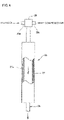
- a mandrel 5 having small openings is inserted into the part of the sleeve 1 that is to form a bottom part of a paper container 10 molded from the sleeve 1 that the mandrel 4 is not inserted into, and heated air containing a sterilizer is blasted from the mandrel 5 having small openings to an inner surface of the part of the sleeve 1.
- the sleeve 1 is formed by a sheet member formed by laminating at least paper and has an overlapping part 24 for shaping the sheet member into a tubular form, and further has a trunk part forming line 23a, a bottom part forming line 23b and a top part forming line 23c along which the sleeve 1 is folded to form the paper container.
- the sleeve 1 shown in FIG. 2 is molded into a gable top carton such as an aseptic filled product 11 shown in FIG. 3 .
- the sleeve 1 has a layer of a thermoplastic resin capable of heat sealing such as polyethylene or polypropylene on both surfaces of the paper.
- a film of a thermoplastic resin such as polyethylene terephthalate or polyamide, an aluminum foil, a film on which a metal or metal oxide such as aluminum, silica or aluminum oxide is vapor-deposited, or a layer of a thermoplastic resin having barrier properties such as an ethylene vinyl alcohol copolymer or a copolymer of an aromatic diamine and a dibasic acid may be provided on the inside of the paper.
- a print may be on the outside or the outer most surface of the paper.
- the structure of the sleeve 1 may be polyethylene/print/paper/polyethylene, polyethylene/print/paper/polyethylene or ethylene-methacrylate copolymer/aluminum foil/polyethylene, print/polyethylene/paper/polyethylene/ethylene vinyl alcohol copolymer/polyethylene, print/polyethylene/paper/ethylene-methacrylate copolymer/polyester film having vapor-deposited silica/adhesive/polyethylene.
- the basis weight of the laminated paper is preferably 80 g/m 2 to 500 g/m 2 .
- the layer capable of heat sealing preferably has a thickness of 15 ⁇ m to 150 ⁇ m. If the thickness is smaller than 15 ⁇ m, a sufficient heat seal strength cannot be achieved, and if the thickness is greater than 150 ⁇ m, the heat seal strength is sufficient but excessive.
- the sleeve 1 is formed by punching such a laminate and bonding the edges of the trunk part of the punched laminate together by heat sealing.
- the overlapping part 24 of the sleeve 1 is formed by heat-sealing the overlapping edges of the sleeve 1.
- the overlapping part 24 is formed in such a manner that the edge face of the inner laminate of the overlapping part 24 is not exposed. This is achieved by hemming, in which the tip of the end part of the inner stack is folded back to the outside, by skive hemming, in which an inner part of the tip of the end part of the inner stack is skived and the skived part is folded back to the outside, or by applying a tape that achieves heat sealing on both sides to the end part.
- the content can be prevented from being contaminated by a bacteria entering from the edge face of the inner paper laminate of the overlapping part 24 and from penetrating into the paper.
- the sleeve 1 is folded along the trunk part forming line 23a into a tubular shape so as to provide the overlapping part 24. If the trunk part forming line 23a is shallow or the paper is thin, however, the sides of the resulting tubular sleeve 1 are arc-shaped. If the trunk part forming line 23a is partially omitted, the cross section of the part of the sleeve 1 may be substantially circular. Furthermore, the sleeve 1 can also partially have a hexagonal or other polygonal cross-sectional shape.
- the sleeve 1 is further folded along the bottom part forming line 23b by a bottom part permanently folding apparatus 7, heated air containing a sterilizer is blasted to the inner surface of the sleeve 1 to melt the thermoplastic resin on the inner surface, and the folded parts forming the bottom part are bonded together under pressure by a bottom part sealing apparatus 8.
- the aseptic filling system has an aseptically closing device according to this embodiment that sterilizes the surface of one open end part of the sleeve 1 and closes the open end part to form a paper container 10 having a bottomed tubular shape.
- Molded paper containers 10 are intermittently conveyed by the conveyor 12.
- a sterilizer gas is blasted from a nozzle 14 to the inner surface of the paper container 10.
- the sterilizer blasted to the inner surface of the paper container 10 is removed by hot air blasted from a hot air nozzle 17 to the inner surface of the paper container 10.
- the hot air is supplied by a hot air supplying apparatus 16.
- aseptic air may be blasted from an aseptic air nozzle 18 to the inner surface of the paper container 10.
- the sterilized paper container 10 is filled with a content sterilized by a content sterilizing apparatus (not shown) by the filling apparatus 19. Furthermore, a top part permanently folding apparatus 20 folds the paper container 10 along the top part forming line 23c, a top part heating apparatus 21 heats the inner surface of the paper container 10, and the top part sealing apparatus 22 bonds the folded parts together under pressure to seal the top part of the paper container 10.
- the sealed paper container 10 is the aseptic filled product 11.
- the sleeve 1 excluding the part to form the bottom part of the paper container 10 is fitted on the mandrel 4.
- the mandrel 5 having small openings 32 as shown in FIG. 6 is inserted into the sleeve 1, and heated air containing a sterilizer is blasted from the small openings 32 to the part of the sleeve 1 that is not in contact with the mandrel 4 as shown in FIG. 7 .
- the mandrel 5 having small openings has a similar rectangular cross section, and the heated air containing a sterilizer is blasted from the small openings 32 in the four surfaces of the mandrel 5 to the four inner surfaces of the sleeve 1, as shown in FIG. 8 .
- the inner surface of the sleeve 1 that is to form the bottom part of the paper container 10 is sterilized.
- the sterilizer is decomposed and evaporated by the heat of the heated air and does not remain on the inner surface of the sleeve 1.
- the blasted heated air also heats the inner surface of the sleeve 1 to a temperature at which heat sealing for closing the sleeve 1 can be achieved.
- the bottom part permanently folding apparatus 7 folds the sleeve 1 along the bottom part forming line 23b in such a manner that triangular parts are folded back to the inside, and the bottom part sealing apparatus 8 bonds the folded parts together under pressure with the apexes of the triangles abutting against each other, thereby forming the paper container 10.
- the triangular parts may be folded to the outside and, after bonding, the triangular parts may be folded onto the side surface of the paper container and pasted to the outer surface of the paper container 10 or folded to the side of the heat-sealed part to form the bottom part of the paper container 10.
- the sterilizer according to the present invention contains at least hydrogen peroxide.
- An appropriate range of the content of the hydrogen peroxide is from 0.5 % by mass to 65 % by mass. If the content is lower than 0.5 % by mass, the sterilizing power may be insufficient. If the content is higher than 65 % by mass, the sterilizer is difficult to handle from the viewpoint of safety.
- a more appropriate range is from 0.5 % by mass to 40 % by mass. When the content is equal to or lower than 40 % by mass, the sterilizer is easy to handle, and the amount of the sterilizer remaining after sterilization can be reduced since the concentration is low.
- the sterilizer may contain one or more of alcohols such as methyl alcohol, ethyl alcohol, isopropyl alcohol, n-propyl alcohol and butyl alcohol, ketones such as acetone, methyl ethyl ketone and acetyl acetone, and glycol ethers.
- alcohols such as methyl alcohol, ethyl alcohol, isopropyl alcohol, n-propyl alcohol and butyl alcohol
- ketones such as acetone, methyl ethyl ketone and acetyl acetone
- glycol ethers glycol ethers
- the sterilizer may further contain an additive agent such as a compound having a sterilizing effect such as peracetic acid, acetic acid, a chlorine compound or ozone; a cationic surface active agent, a non-ionic surface active agent and a phosphate compound.
- an additive agent such as a compound having a sterilizing effect such as peracetic acid, acetic acid, a chlorine compound or ozone; a cationic surface active agent, a non-ionic surface active agent and a phosphate compound.
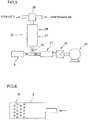
- the sterilizer is gasified by a sterilizer gas generator 25.
- the sterilizer gas generator 25 is provided with a sterilizer supplying portion 26 that is a twin-fluid spray nozzle for supplying the sterilizer in the form of liquid drops and an evaporating portion 27 for evaporating the sterilizer by heating the sterilizer supplied from the sterilizer supplying portion 26 to a temperature equal to or lower than the decomposition temperature of sterilizer.
- the sterilizer supplying portion 26 has a structure in which the sterilizer from a sterilizer supply path 26a and compressed air from a compressed air supply path 26b introduced into the sterilizer supplying portion 26 are then sprayed into the evaporating portion 27.
- the evaporating portion 27 is in the form of a pipe with a heater 27a interposed between inner and outer walls thereof, and the sterilizer blasted into the pipe is heated and evaporated.
- the evaporated sterilizer gas is jetted out of the evaporating portion 27 through a sterilizer jet nozzle 28.
- the evaporating portion 27 may be heated by dielectric heating.
- the pressure of the compressed air is adjusted to fall within a range from 0.05 MPa to 0.6 MPa, for example.
- the sterilizer may be supplied by gravity or under pressure, and the supply amount can be arbitrarily set.
- the sterilizer may be supplied at a rate of 1 g/min to 100 g/min.
- the inner surface of the evaporating portion 27 is heated to 140°C to 450°C to evaporate the sprayed sterilizer.
- the sterilizer gas is mixed with heated air by a mixing apparatus 33.
- the mixing apparatus 33 mixes the sterilizer gas jetted from the sterilizer gas jet nozzle 28 with heated air obtained by sterilizing air generated by a blower 29 by passing the air through a sterilizing filter 30 and heating the air in a heating apparatus 31.
- the heated air mixed with the sterilizer is supplied to the mandrel 5 having small openings.
- the amount of the air generated by the blower 29 varies with the volume or shape of the relevant paper container or the filling rate of the aseptic filling system 15, and can be arbitrarily set. For example, the amount of the air is set to fall within a range from 100 L/min to 1000 L/min per nozzle.
- the temperature of the heated air can also be arbitrarily set as far as the thermoplastic resin on the inner surface of the sleeve 1 can be molten.
- the temperature of the heated air is typically set at 130°C to 650°C. At a temperature lower than 130°C, the thermoplastic resin cannot be molten, and at a temperature higher than 650°C, the thermoplastic resin decomposes.
- the heated air containing the sterilizer is blasted to the inner surface of the bottom part of the sleeve 1 from the small openings 32 of the mandrel 5 having small openings.
- the small openings 32 preferably have a circular shape and a diameter of 0.5 mm to 10 mm.
- the small openings 32 can have a larger size at a part that needs to be intensively heated.
- small openings 32 for blasting heated air to triangular parts of the sleeve 1 to be heat-sealed indicated by the bottom part forming line 23b may have a larger size than the other small openings 32.
- the apexes abutting against each other need to be embedded in the thermoplastic resin on the innermost surface of the sleeve 1, and the thermoplastic resin needs to be sufficiently heated in order to achieve this.
- the corners of the sleeve 1 are at greater distances from the small openings 32 than the sides of the sleeve 1. The corners of the sleeve 1 also need to be sufficiently heated.
- small openings 32 may be formed in the corners of the mandrel 5 having small openings, and furthermore, those small openings 32 may have a larger size than the other small openings 32. Increasing the number of the small openings 32 can have the same effect as increasing the size of the small openings 32.
- the bottom part permanently folding apparatus 7 folds the triangular parts of the sleeve 1 to the inside along the bottom part forming line 23b. After that, the folded parts are bonded together under pressure between the bottom part sealing apparatus 8 and the mandrel 4 on which the sleeve 1 is fitted to form the bottom part. In this way, the sleeve 1 is molded into the paper container 10.
- the triangular parts are folded to the outside along the bottom part forming line 23b, the triangular parts are folded back onto the side surface or outer surface of the paper container 10 after the parts to be heat-sealed are bonded under pressure.
- hot air may be blasted to the parts to be bonded, or a hot-melt adhesive may be applied to the parts to be bonded.
- the triangular parts are folded to the inside to abut against each other or folded to the outside, there is a part that is not exposed to the inside of the paper container 10 on the inner surface of the bottom part of the molded paper container 10.
- the sterilizer gas is blasted to the inner surface of the paper container 10 for sterilization in the next step, the part that is not exposed is difficult to sterilize.
- the parts of the sleeve 1 to form the bottom part of the paper container 10 are sterilized before forming the bottom part, and therefore, an aseptic filled product 11 that is highly sterilized can be advantageously obtained.
- the sterilizer gas is blasted from the nozzle 14 to the inner surface of the paper container 10.
- the nozzle 14 may blast the sterilizer gas to the inner surface of the paper container 10 from above the open end of the paper container 10.
- the nozzle 14 may be inserted into the paper container 10 before blasting the sterilizer gas.
- the sterilizer is gasified by a sterilizer gas generator, which is similar to the sterilizer gas generator 25 shown in FIG. 4 .
- the sterilizer may be the same as the sterilizer used to sterilize the bottom part of the sleeve 1.
- the sterilizer gas exiting the nozzle 14 flows to the inner surface of the paper container 10 in the form of gas, mist of the condensate thereof, of a mixture thereof.
- Hot air which is produced by sterilizing air through a sterilizing filter and heating the sterilized air, may be supplied at a middle of the nozzle 14. This increases the injection pressure of the sterilizer gas from the nozzle 14 and thus the blast pressure of the sterilizer gas.
- the hot air prevents condensation of the sterilizer gas to improve the efficiency of sterilization.
- the temperature of the hot air can be set at 50°C to 150°C. If the temperature is lower than 50°C, the hot air promotes condensation of the sterilizer gas. If the temperature is higher than 150°C, when the innermost layer of the paper container 10 is made of polyethylene, the heat-sealed polyethylene layers may peel off.
- the paper container 10 immediately before the sterilizer gas is blasted to the paper container 10, the paper container 10 may be preliminarily heated by blasting heated air to the paper container 10. The preliminary heating can further improve the sterilization effect on the inner surface of the paper container 10.
- a plurality of nozzles 14 may be arranged along the traveling path of the paper container 10, and the sterilizer gas may be blasted to the paper container 10 from the nozzles 14 at a plurality of times.
- Hot air may be further blasted to the paper container 10 after the sterilizer gas is blasted to the paper container 10.
- the blasted hot air activates the hydrogen peroxide on the surface of the paper container 10. By blasting the hot air, the sterilizer on the paper container 10 is quickly removed from the surface of the paper container 10.
- the temperature of the hot air can be set at 50°C to 150°C. A temperature lower than 50°C is insufficient to activate the sterilizer. If the temperature is higher than 150°C, when the innermost layer of the paper container 10 is made of polyethylene, the heat-sealed polyethylene layers may peel off.
- a plurality of hot air nozzles 17 may be arranged along the traveling path of the paper container 10, and the hot air may be blasted to the paper container 10 from the hot air nozzles 17 at a plurality of times.
- the hot air nozzle 17 may blast the hot air to the inner surface of the paper container 10 from above the open end of the paper container 10, to ensure removal of the sterilizer on the inner surface of the paper container 10, the hot air nozzle 17 may be inserted into the paper container 10 before blasting the hot air.
- aseptic air which is produced by sterilizing air through a sterilizing filter, may be blasted to the inner surface of the paper container 10 from an aseptic air nozzle 18.
- the blasted aseptic air removes the sterilizer remaining in the paper container 10 or a substance giving out a strange smell that derives from polyethylene forming the innermost surface of the paper container 10 and is produced because of the hot air.
- the inner surfaces of the open end part of the paper container 10 are heat-sealed to close the paper container 10.
- the aseptic filled product 11 is obtained.
- triangular parts may be folded to the inside along the top part forming line 23c and bonded together under pressure with the apexes of the triangles abutting against each other.
- the triangular parts may be folded to the outside, and after bonding under pressure, the triangular parts may be folded onto the side surface of the paper container and pasted to the outer surface of the paper container 10 or folded to the side of the heat-sealed parts.
- the top part is flat, and the aseptic filled product 11 has a brick shape, rather than the gable top shape shown in FIG. 3 .
- the heat sealing may be achieved by folding the triangular parts to the outside and performing external heating, ultrasonic heat sealing, or high frequency heat sealing if the sleeve 1 includes a layer of aluminum foil.
- a spout may be provided on the top part of the aseptic filled product 11 shown in FIG. 3 .
- Aseptic air is supplied into the aseptic chamber 3 to constantly keep the interior of the aseptic chamber 3 at positive pressure, so that the aseptic filling system 15 can maintain the aseptic condition achieved by the sterilization operation in the aseptic chamber 3 performed before operation of the aseptic filling system 15 and prevent the interior from being contaminated by bacteria in the outside air.
- the sterilization operation performed before operation of the aseptic filling system 15 may be sterilization of the interior of the aseptic chamber 3 by a mist of 1 mg/L to 300 mg/L of hydrogen peroxide, for example.
- the portions that are to come into contact with the sleeve 1 or paper container 10 may be irradiated with light containing ultraviolet rays, or a chemical containing 1 % by mass of ethanol or hydrogen peroxide may be sprayed to those portions.
- the bottom part assembly apparatus 6, the inner surface sterilizing apparatus 13 including the nozzle 14 for blasting the sterilizer gas and the hot air nozzle 17, the filling apparatus 19, the sealing apparatuses including the top part sealing apparatus 22 may be partitioned into zones, and aseptic air may be supplied to each zone with the pressure of the supplied aseptic air being changed stepwise from the zone of the filling apparatus 19 to the outer zones.
- Sleeve 1 that had a square cross section having a side length of 75 mm and were to form a paper container 10 having a volume of 1000 ml as shown in FIG. 2 were produced.
- the structure of the sleeves 1 was as follows: a polyethylene layer having a thickness of 25 ⁇ m, a layer of paper having a basis weight of 300 g/m 2 , a layer of ethylene-methacrylate copolymer having a thickness of 20 ⁇ m, a polyester film including deposited silica having a thickness of 12 ⁇ m, a layer of an adhesive, and a layer of polyethylene having a thickness of 55 ⁇ m.
- a polyethylene layer having a thickness of 25 ⁇ m
- a layer of paper having a basis weight of 300 g/m 2
- a layer of ethylene-methacrylate copolymer having a thickness of 20 ⁇ m
- a polyester film including deposited silica having a thickness of 12 ⁇ m
- a layer of an adhesive a layer of
- a hydrogen peroxide solution containing 35 % by mass of hydrogen peroxide was used as the sterilizer.
- the sterilizer gas was generated by supplying compressed air at 0.5 MPa and the hydrogen peroxide solution as the sterilizer at a rate of 10 ml/min to the sterilizer gas generator 25 shown in FIG. 4 and heating the evaporating portion 27 until the surface temperature reached 300°C.
- the sterilizer gas was mixed, in the mixing apparatus 33, with aseptic air produced by passing air through the sterilizing filter 30 and heating the sterilized air to 300°C by the heating apparatus 31.
- the heated air mixed with the sterilizer was supplied to the mandrel 5 having small openings, the mandrel 5 having small openings was inserted into the part of the sleeve 1 that was to form the bottom part of the paper container 10, and the heated air containing the sterilizer was blasted from the small openings 32 for 2 seconds.
- the sleeves 1 were molded into the paper containers 10 by the bottom part permanently folding apparatus 7 permanently folding each sleeve 1 along the bottom part forming line 23b, and bonding the folded parts together under pressure with the triangular parts abutting against each other to form the bottom part of the paper container 10, as shown in FIG. 1 . Furthermore, the same sterilizer gas as the sterilizer gas used for sterilization of the bottom part was blasted to the inner surfaces of the paper containers 10 for 2 seconds. Furthermore, hot air at 120°C was blasted to the inner surfaces of the paper containers 10 from the hot air nozzles 17 shown in FIG. 1 at a flowrate of 400 L/min per nozzle for 4 seconds.
- the paper containers 10 were filled with 200 ml of SCD bouillon medium and sealed by heat sealing by blasting heated air to the inner surfaces of the top parts of the paper containers 10.
- the resulting sealed aseptic filled products 11 were kept 35°C for one week for culture.
- the number of living bacteria was calculated by MPN, and the sterilization effect was calculated in units of Log (number of adhering bacteria/MPN).
- the sterilization effect in the example was 6.8, whereas the sterilization effect in the comparative examples was 1.6.
- the bacteria adhering to the inner surface of the bottom part of the sleeve 1 was able to be killed by blasting the heated air containing hydrogen peroxide to the surface.
- blasting heated air containing no sterilizer did not provide a sufficient sterilization effect.
Landscapes
- Mechanical Engineering (AREA)
- Engineering & Computer Science (AREA)
- Health & Medical Sciences (AREA)
- Epidemiology (AREA)
- General Chemical & Material Sciences (AREA)
- Chemical Kinetics & Catalysis (AREA)
- Chemical & Material Sciences (AREA)
- Life Sciences & Earth Sciences (AREA)
- Animal Behavior & Ethology (AREA)
- General Health & Medical Sciences (AREA)
- Public Health (AREA)
- Veterinary Medicine (AREA)
- Apparatus For Disinfection Or Sterilisation (AREA)
Claims (2)
- Verfahren zum Sterilisieren einer Hülse (1) in einem aseptischen Abfüllsystem (15), welches die Hülse (1) durch Schließen von Oberflächen eines offenen Endteils der Hülse (1) zu einem Papierbehälter (10) mit einer Röhrenform mit Boden formt und welches Sterilisation, Füllen und Verschließen des Papierbehälters (10) durchführt, wobei die Hülse (1) ein röhrenförmiger Körper mit Wänden ist, der durch Laminieren von mindestens Papier gebildet ist,wobei in einem Zustand, in dem die Hülse (1) in einer säulenartigen Form steht, ein Dorn (5) mit kleinen Öffnungen (32) in den Teil der Hülse (1) eingeführt wird, der einen Bodenteil des aus der Hülse (1) geformten Papierbehälters (10) bilden soll, und wobei erwärmte Luft, enthaltend einen Sterilisator, der mindestens Wasserstoffperoxid enthält, und die in der Lage ist, ein thermoplastisches Harz auf vier Innenflächen der Hülse (1) zu schmelzen, von den kleinen Öffnungen (32) in vier Oberflächen des Dorns (5) zu vier Innenflächen der Hülse (1), die den Bodenteil des Papierbehälters (10) bilden sollen, geblasen wird, um gleichzeitig Sterilisation und Erwärmen der Innenfläche des Bodens der Hülse (1) durchzuführen, undnachdem die erwärmte Luft, enthaltend den Sterilisator, auf die Hülse (1) geblasen wurde, gefaltete dreieckige Teile unter Druck miteinander verbunden werden, worauf der Bodenteil der Hülse (1) gebildet wird, dadurch gekennzeichnet, dass die erwärmte Luft, enthaltend den Sterilisator, durch Zuführen des Sterilisators in der Form von Flüssigkeitstropfen aus einem Sterilisator-Zuführungskanal (26a) und von Druckluft aus einem Druckluft-Zuführungskanal (26b), Einführen des Sterilisators und der Druckluft in einen Sterilisator-Zuführungsabschnitt (26), Sprühen des Sterilisators in einen Verdampfungsabschnitt (27), um den Sterilisator durch Erwärmen in Gas zu verwandeln, wodurch ein sterilisiertes Gas erzeugt wird, Erzeugen von erwärmter Luft aus einer Heizvorrichtung (31) und Mischen des Sterilisator-Gases mit der erwärmten Luft in einer Mischvorrichtung (33) erzeugt wird.
- Vorrichtung zum Sterilisieren einer Hülse (1), wobei die Vorrichtung umfasst:einen Dorn (5), der kleine Öffnungen (32) aufweist, der in den Teil der Hülse (1) eingeführt wird, der einen Bodenteil eines aus der Hülse (1) geformten Papierbehälters (10) bilden soll, und der erwärmte Luft, enthaltend einen Sterilisator, der mindestens Wasserstoffperoxid enthält, von den kleinen Öffnungen (32) in vier Oberflächen des Dorns (5) zu vier Innenflächen der Hülse (1), die den Bodenteil des Papierbehälters (10) bilden sollen, bläst, in einem Zustand, in dem die Hülse (1) in einer säulenartigen Form steht, wobei der Dorn (5), der die kleinen Öffnungen (32) aufweist, eine Sterilisations- und Verschlussvorrichtung bildet, die gleichzeitig Sterilisation der Innenfläche des Bodenteils und Erwärmen für das Verschließen durchführt, undeine Vorrichtung zum Verschließen des Bodenteils (8), welche die gefalteten Teile unter Druck miteinander verbindet, um den Bodenteil zu bilden, nachdem die erwärmte Luft, enthaltend den Sterilisator, auf die Hülse (1) geblasen wurde, wobei die Vorrichtung zum Sterilisieren einer Hülse (1) weiter einen Sterilisator-Gas-Erzeuger (25), der mit einem Sterilisator-Zuführungsabschnitt (26) versehen ist, der eine Struktur aufweist, in welcher der Sterilisator von einem Sterilisator-Zuführungskanal (26a) und Druckluft von einem Druckluft-Zuführungskanal (26b) in den Sterilisator-Zuführungsabschnitt (26) eingeführt und dann in einen Verdampfungsabschnitt (27) gesprüht werden, den Verdampfungsabschnitt (27) zum Verdampfen des Sterilisators durch Erwärmen des Sterilisators, eine Heizvorrichtung (31) und eine Mischvorrichtung (33), die ein Sterilisator-Gas von dem Sterilisator-Gas-Erzeuger (25) mit erwärmter Luft, die von der Heizvorrichtung (31) kommt, mischt, umfasst, wobei die erwärmter Luft, enthaltend den Sterilisator, in der Lage ist, ein thermoplastisches Harz auf vier Innenflächen der Hülse (1) zu schmelzen.
Priority Applications (1)
| Application Number | Priority Date | Filing Date | Title |
|---|---|---|---|
| EP22177933.3A EP4091964B1 (de) | 2016-07-07 | 2017-07-05 | Verfahren zum sterilisieren einer hülse |
Applications Claiming Priority (2)
| Application Number | Priority Date | Filing Date | Title |
|---|---|---|---|
| JP2016135152A JP6213621B1 (ja) | 2016-07-07 | 2016-07-07 | スリーブの殺菌方法及び装置 |
| PCT/JP2017/024597 WO2018008670A1 (ja) | 2016-07-07 | 2017-07-05 | スリーブの殺菌方法及び装置 |
Related Child Applications (2)
| Application Number | Title | Priority Date | Filing Date |
|---|---|---|---|
| EP22177933.3A Division-Into EP4091964B1 (de) | 2016-07-07 | 2017-07-05 | Verfahren zum sterilisieren einer hülse |
| EP22177933.3A Division EP4091964B1 (de) | 2016-07-07 | 2017-07-05 | Verfahren zum sterilisieren einer hülse |
Publications (3)
| Publication Number | Publication Date |
|---|---|
| EP3483089A1 EP3483089A1 (de) | 2019-05-15 |
| EP3483089A4 EP3483089A4 (de) | 2020-05-06 |
| EP3483089B1 true EP3483089B1 (de) | 2022-12-14 |
Family
ID=60107403
Family Applications (2)
| Application Number | Title | Priority Date | Filing Date |
|---|---|---|---|
| EP22177933.3A Active EP4091964B1 (de) | 2016-07-07 | 2017-07-05 | Verfahren zum sterilisieren einer hülse |
| EP17824273.1A Active EP3483089B1 (de) | 2016-07-07 | 2017-07-05 | Verfahren und vorrichtung zum sterilisieren einer hülse |
Family Applications Before (1)
| Application Number | Title | Priority Date | Filing Date |
|---|---|---|---|
| EP22177933.3A Active EP4091964B1 (de) | 2016-07-07 | 2017-07-05 | Verfahren zum sterilisieren einer hülse |
Country Status (5)
| Country | Link |
|---|---|
| US (1) | US11382996B2 (de) |
| EP (2) | EP4091964B1 (de) |
| JP (1) | JP6213621B1 (de) |
| CN (1) | CN108698739B (de) |
| WO (1) | WO2018008670A1 (de) |
Families Citing this family (11)
| Publication number | Priority date | Publication date | Assignee | Title |
|---|---|---|---|---|
| JP6729671B2 (ja) * | 2018-12-12 | 2020-07-22 | 大日本印刷株式会社 | 無菌充填機チャンバー内の殺菌方法 |
| JP7660080B2 (ja) * | 2019-06-28 | 2025-04-10 | テトラ ラバル ホールディングス アンド ファイナンス エス エイ | カートンベースの包装材料のウェブから過剰な殺菌剤を除去する方法及びそのシステム |
| WO2021035326A2 (en) * | 2019-08-28 | 2021-03-04 | Shandong Bihai Packaging Materials Co. Ltd. | Processes and equipment to manufacture aseptic carton packages provided with longitudinal joining and sealing side regions and process to manufacture multilayer laminated packaging material used to produce said aseptic carton packages provided with longitudinal joining and sealing side regions |
| JP7285190B2 (ja) * | 2019-10-16 | 2023-06-01 | 日立造船株式会社 | 容器の製造装置、製造設備、および製造方法 |
| DE102019128672A1 (de) * | 2019-10-23 | 2021-04-29 | Sig Technology Ag | Vorrichtung und Verfahren zum Formen und Sterilisieren einseitig offener Packungen |
| CN111150866B (zh) * | 2020-02-09 | 2021-02-12 | 河南科技大学第一附属医院 | 一种手术用具酒精喷淋消毒设备 |
| US11731415B2 (en) * | 2020-04-30 | 2023-08-22 | Sergio Ribeiro Romeiro | Process to manufacture multilayer laminated packaging material |
| JP7585650B2 (ja) * | 2020-08-07 | 2024-11-19 | 大日本印刷株式会社 | 殺菌剤のガス化装置 |
| CN112093163A (zh) * | 2020-09-09 | 2020-12-18 | 浙江霄腾智能科技有限公司 | 一种提高产品合格率的瓶装药片灌装的数片机 |
| CN115626344A (zh) * | 2022-10-31 | 2023-01-20 | 康美包(苏州)有限公司 | 包装套筒及其灭菌和质量检测方法、液体食品的灌装方法 |
| CN120171855B (zh) * | 2025-05-20 | 2025-08-29 | 常州京林医疗器械有限公司 | 一种注射器胶塞无菌自动包装设备 |
Citations (1)
| Publication number | Priority date | Publication date | Assignee | Title |
|---|---|---|---|---|
| US4590740A (en) * | 1983-07-15 | 1986-05-27 | Ex-Cell-O Corporation | Container sterilization apparatus and method |
Family Cites Families (15)
| Publication number | Priority date | Publication date | Assignee | Title |
|---|---|---|---|---|
| US3120089A (en) * | 1960-11-07 | 1964-02-04 | Ex Cell O Corp | Machine for forming plastic coated paperboard containers |
| DE3235476C2 (de) | 1981-11-14 | 1986-09-11 | Jagenberg AG, 4000 Düsseldorf | Verfahren und Einrichtung zum Entkeimen von Verpackungsmaterial, insbesondere von Verpackungsbehältern |
| US4506491A (en) * | 1982-04-16 | 1985-03-26 | Ex Cell O Corp | Container sterilization apparatus and method |
| JPS60251014A (ja) * | 1984-05-23 | 1985-12-11 | 凸版印刷株式会社 | 筒状包材の殺菌装置 |
| US4566251A (en) * | 1985-01-07 | 1986-01-28 | Ex-Cell-O Corporation | Carton forming, sterilizing, filling and sealing machine |
| US4683701A (en) * | 1986-02-13 | 1987-08-04 | Ex-Cell-O Corporation | Container sterilization apparatus |
| US5368828A (en) * | 1992-11-12 | 1994-11-29 | Tetra Laval Holdings & Finance S.A. | Method and apparatus for carton sterilization |
| JPH09240629A (ja) | 1996-03-06 | 1997-09-16 | Dainippon Printing Co Ltd | 無菌充填装置における紙容器の殺菌方法及び殺菌装置 |
| AU8767798A (en) * | 1997-08-15 | 1999-03-08 | Tetra Laval Holdings & Finance Sa | Method and apparatus for the sterilization of a carton |
| US6039922A (en) * | 1997-08-15 | 2000-03-21 | Tetra Laval Holdings & Finance, Sa | UV radiation and vapor-phase hydrogen peroxide sterilization packaging |
| ES2292611T3 (es) * | 2000-08-08 | 2008-03-16 | Evergreen Packaging International B.V. | Procedimiento para la activacion de componentes secuestradores de oxigeno durante un proceso de llenado de cajas de carton con tapa de pico. |
| US7157046B2 (en) * | 2001-02-16 | 2007-01-02 | Steris Inc. | High capacity flash vapor generation systems |
| JP2004299738A (ja) * | 2003-03-31 | 2004-10-28 | Daiwa Can Co Ltd | 無菌成形・充填システムの環境監視装置 |
| JP2012136257A (ja) * | 2010-12-27 | 2012-07-19 | Shibuya Kogyo Co Ltd | 紙製容器の充填シール方法 |
| JP2013018535A (ja) | 2011-07-14 | 2013-01-31 | Toppan Printing Co Ltd | 液体用紙容器の殺菌方法およびそれを用いた液体用紙容器および殺菌装置 |
-
2016
- 2016-07-07 JP JP2016135152A patent/JP6213621B1/ja active Active
-
2017
- 2017-07-05 EP EP22177933.3A patent/EP4091964B1/de active Active
- 2017-07-05 CN CN201780012315.XA patent/CN108698739B/zh active Active
- 2017-07-05 WO PCT/JP2017/024597 patent/WO2018008670A1/ja not_active Ceased
- 2017-07-05 US US16/064,648 patent/US11382996B2/en active Active
- 2017-07-05 EP EP17824273.1A patent/EP3483089B1/de active Active
Patent Citations (1)
| Publication number | Priority date | Publication date | Assignee | Title |
|---|---|---|---|---|
| US4590740A (en) * | 1983-07-15 | 1986-05-27 | Ex-Cell-O Corporation | Container sterilization apparatus and method |
Also Published As
| Publication number | Publication date |
|---|---|
| EP3483089A4 (de) | 2020-05-06 |
| US11382996B2 (en) | 2022-07-12 |
| JP2018002285A (ja) | 2018-01-11 |
| CN108698739A (zh) | 2018-10-23 |
| CN108698739B (zh) | 2020-06-30 |
| EP3483089A1 (de) | 2019-05-15 |
| WO2018008670A1 (ja) | 2018-01-11 |
| JP6213621B1 (ja) | 2017-10-18 |
| EP4091964A1 (de) | 2022-11-23 |
| US20180369436A1 (en) | 2018-12-27 |
| EP4091964B1 (de) | 2024-01-31 |
Similar Documents
| Publication | Publication Date | Title |
|---|---|---|
| EP4091964B1 (de) | Verfahren zum sterilisieren einer hülse | |
| US6096358A (en) | Method of manufacturing an aseptically sterilized package containing a liquid nutritional product | |
| JP5676882B2 (ja) | 包装容器の製造方法および装置 | |
| US6094887A (en) | Ultraviolet energy and vapor-phase hydrogen peroxide sterilization of containers | |
| US20100221146A1 (en) | Method of aseptically treating, forming, filling, and sealing flexible bag packages in a bag packaging machine | |
| US6868873B2 (en) | Method for filling, apparatus for filling, and container for filling and packaging | |
| JP2003237742A (ja) | スパウト付きパウチの無菌充填方法 | |
| JP2020172297A (ja) | 無菌充填機及び無菌充填方法 | |
| JP5573020B2 (ja) | カップ状容器の殺菌方法 | |
| JP7626321B2 (ja) | 蓋材の殺菌方法及び蓋材の殺菌装置 | |
| JPH09240629A (ja) | 無菌充填装置における紙容器の殺菌方法及び殺菌装置 | |
| JP4033337B2 (ja) | 食品用包装容器の殺菌方法、殺菌装置及び包装充填装置 | |
| Benyathiar et al. | Aseptic filling and packaging for retail products and food service | |
| JP6386135B2 (ja) | 無菌包装物を製造する方法 | |
| JPH1143118A (ja) | 液体用紙容器の無菌充填方法 | |
| JP7835679B2 (ja) | 滅菌ステーションを備える充填機 | |
| JP6119806B2 (ja) | 無菌袋詰め方法及び装置 | |
| JP5359183B2 (ja) | カップ状容器の殺菌方法及び装置 | |
| JP2012246050A (ja) | 液体用紙容器の殺菌方法およびそれを用いた液体用紙容器および殺菌装置 | |
| JP2021062873A (ja) | 無菌充填機及び無菌充填方法 | |
| JP5573004B2 (ja) | カップ状容器の殺菌方法 | |
| JPH01111633A (ja) | 無菌包装機 | |
| Tripathi et al. | Aseptic Packaging Technology | |
| JP6439946B2 (ja) | プリフォームの殺菌方法及び装置 | |
| JP2001002029A (ja) | 無菌包装方法及び装置、並びにそれらに用いる密封袋 |
Legal Events
| Date | Code | Title | Description |
|---|---|---|---|
| STAA | Information on the status of an ep patent application or granted ep patent |
Free format text: STATUS: THE INTERNATIONAL PUBLICATION HAS BEEN MADE |
|
| PUAI | Public reference made under article 153(3) epc to a published international application that has entered the european phase |
Free format text: ORIGINAL CODE: 0009012 |
|
| STAA | Information on the status of an ep patent application or granted ep patent |
Free format text: STATUS: REQUEST FOR EXAMINATION WAS MADE |
|
| 17P | Request for examination filed |
Effective date: 20190207 |
|
| AK | Designated contracting states |
Kind code of ref document: A1 Designated state(s): AL AT BE BG CH CY CZ DE DK EE ES FI FR GB GR HR HU IE IS IT LI LT LU LV MC MK MT NL NO PL PT RO RS SE SI SK SM TR |
|
| AX | Request for extension of the european patent |
Extension state: BA ME |
|
| DAV | Request for validation of the european patent (deleted) | ||
| DAX | Request for extension of the european patent (deleted) | ||
| A4 | Supplementary search report drawn up and despatched |
Effective date: 20200402 |
|
| RIC1 | Information provided on ipc code assigned before grant |
Ipc: B65B 55/06 20060101ALI20200328BHEP Ipc: A61L 2/20 20060101ALI20200328BHEP Ipc: B65B 55/10 20060101ALI20200328BHEP Ipc: A61L 101/10 20060101ALI20200328BHEP Ipc: A61L 101/06 20060101ALI20200328BHEP Ipc: B65B 55/04 20060101ALI20200328BHEP Ipc: A61L 101/22 20060101ALI20200328BHEP Ipc: A61L 101/36 20060101ALI20200328BHEP Ipc: B65D 55/04 20060101AFI20200328BHEP |
|
| STAA | Information on the status of an ep patent application or granted ep patent |
Free format text: STATUS: EXAMINATION IS IN PROGRESS |
|
| 17Q | First examination report despatched |
Effective date: 20210407 |
|
| REG | Reference to a national code |
Ref country code: DE Ref legal event code: R079 Ref document number: 602017064645 Country of ref document: DE Free format text: PREVIOUS MAIN CLASS: B65D0055040000 Ipc: A61L0002200000 |
|
| RIC1 | Information provided on ipc code assigned before grant |
Ipc: B65B 51/14 20060101ALI20220531BHEP Ipc: B65B 55/10 20060101ALI20220531BHEP Ipc: B65B 55/08 20060101ALI20220531BHEP Ipc: B65B 55/06 20060101ALI20220531BHEP Ipc: B65B 55/02 20060101ALI20220531BHEP Ipc: B65B 51/12 20060101ALI20220531BHEP Ipc: B65B 3/02 20060101ALI20220531BHEP Ipc: A61L 2/22 20060101ALI20220531BHEP Ipc: A61L 2/10 20060101ALI20220531BHEP Ipc: A61L 2/20 20060101AFI20220531BHEP |
|
| GRAP | Despatch of communication of intention to grant a patent |
Free format text: ORIGINAL CODE: EPIDOSNIGR1 |
|
| STAA | Information on the status of an ep patent application or granted ep patent |
Free format text: STATUS: GRANT OF PATENT IS INTENDED |
|
| INTG | Intention to grant announced |
Effective date: 20220711 |
|
| GRAS | Grant fee paid |
Free format text: ORIGINAL CODE: EPIDOSNIGR3 |
|
| GRAA | (expected) grant |
Free format text: ORIGINAL CODE: 0009210 |
|
| STAA | Information on the status of an ep patent application or granted ep patent |
Free format text: STATUS: THE PATENT HAS BEEN GRANTED |
|
| AK | Designated contracting states |
Kind code of ref document: B1 Designated state(s): AL AT BE BG CH CY CZ DE DK EE ES FI FR GB GR HR HU IE IS IT LI LT LU LV MC MK MT NL NO PL PT RO RS SE SI SK SM TR |
|
| REG | Reference to a national code |
Ref country code: GB Ref legal event code: FG4D |
|
| REG | Reference to a national code |
Ref country code: CH Ref legal event code: EP |
|
| REG | Reference to a national code |
Ref country code: DE Ref legal event code: R096 Ref document number: 602017064645 Country of ref document: DE |
|
| REG | Reference to a national code |
Ref country code: IE Ref legal event code: FG4D |
|
| REG | Reference to a national code |
Ref country code: AT Ref legal event code: REF Ref document number: 1537283 Country of ref document: AT Kind code of ref document: T Effective date: 20230115 |
|
| REG | Reference to a national code |
Ref country code: SE Ref legal event code: TRGR |
|
| REG | Reference to a national code |
Ref country code: LT Ref legal event code: MG9D |
|
| REG | Reference to a national code |
Ref country code: NL Ref legal event code: MP Effective date: 20221214 |
|
| PG25 | Lapsed in a contracting state [announced via postgrant information from national office to epo] |
Ref country code: NO Free format text: LAPSE BECAUSE OF FAILURE TO SUBMIT A TRANSLATION OF THE DESCRIPTION OR TO PAY THE FEE WITHIN THE PRESCRIBED TIME-LIMIT Effective date: 20230314 Ref country code: LT Free format text: LAPSE BECAUSE OF FAILURE TO SUBMIT A TRANSLATION OF THE DESCRIPTION OR TO PAY THE FEE WITHIN THE PRESCRIBED TIME-LIMIT Effective date: 20221214 Ref country code: FI Free format text: LAPSE BECAUSE OF FAILURE TO SUBMIT A TRANSLATION OF THE DESCRIPTION OR TO PAY THE FEE WITHIN THE PRESCRIBED TIME-LIMIT Effective date: 20221214 |
|
| REG | Reference to a national code |
Ref country code: AT Ref legal event code: MK05 Ref document number: 1537283 Country of ref document: AT Kind code of ref document: T Effective date: 20221214 |
|
| PG25 | Lapsed in a contracting state [announced via postgrant information from national office to epo] |
Ref country code: RS Free format text: LAPSE BECAUSE OF FAILURE TO SUBMIT A TRANSLATION OF THE DESCRIPTION OR TO PAY THE FEE WITHIN THE PRESCRIBED TIME-LIMIT Effective date: 20221214 Ref country code: LV Free format text: LAPSE BECAUSE OF FAILURE TO SUBMIT A TRANSLATION OF THE DESCRIPTION OR TO PAY THE FEE WITHIN THE PRESCRIBED TIME-LIMIT Effective date: 20221214 Ref country code: HR Free format text: LAPSE BECAUSE OF FAILURE TO SUBMIT A TRANSLATION OF THE DESCRIPTION OR TO PAY THE FEE WITHIN THE PRESCRIBED TIME-LIMIT Effective date: 20221214 Ref country code: GR Free format text: LAPSE BECAUSE OF FAILURE TO SUBMIT A TRANSLATION OF THE DESCRIPTION OR TO PAY THE FEE WITHIN THE PRESCRIBED TIME-LIMIT Effective date: 20230315 |
|
| P01 | Opt-out of the competence of the unified patent court (upc) registered |
Effective date: 20230524 |
|
| PG25 | Lapsed in a contracting state [announced via postgrant information from national office to epo] |
Ref country code: NL Free format text: LAPSE BECAUSE OF FAILURE TO SUBMIT A TRANSLATION OF THE DESCRIPTION OR TO PAY THE FEE WITHIN THE PRESCRIBED TIME-LIMIT Effective date: 20221214 |
|
| PG25 | Lapsed in a contracting state [announced via postgrant information from national office to epo] |
Ref country code: SM Free format text: LAPSE BECAUSE OF FAILURE TO SUBMIT A TRANSLATION OF THE DESCRIPTION OR TO PAY THE FEE WITHIN THE PRESCRIBED TIME-LIMIT Effective date: 20221214 Ref country code: RO Free format text: LAPSE BECAUSE OF FAILURE TO SUBMIT A TRANSLATION OF THE DESCRIPTION OR TO PAY THE FEE WITHIN THE PRESCRIBED TIME-LIMIT Effective date: 20221214 Ref country code: PT Free format text: LAPSE BECAUSE OF FAILURE TO SUBMIT A TRANSLATION OF THE DESCRIPTION OR TO PAY THE FEE WITHIN THE PRESCRIBED TIME-LIMIT Effective date: 20230414 Ref country code: ES Free format text: LAPSE BECAUSE OF FAILURE TO SUBMIT A TRANSLATION OF THE DESCRIPTION OR TO PAY THE FEE WITHIN THE PRESCRIBED TIME-LIMIT Effective date: 20221214 Ref country code: EE Free format text: LAPSE BECAUSE OF FAILURE TO SUBMIT A TRANSLATION OF THE DESCRIPTION OR TO PAY THE FEE WITHIN THE PRESCRIBED TIME-LIMIT Effective date: 20221214 Ref country code: CZ Free format text: LAPSE BECAUSE OF FAILURE TO SUBMIT A TRANSLATION OF THE DESCRIPTION OR TO PAY THE FEE WITHIN THE PRESCRIBED TIME-LIMIT Effective date: 20221214 Ref country code: AT Free format text: LAPSE BECAUSE OF FAILURE TO SUBMIT A TRANSLATION OF THE DESCRIPTION OR TO PAY THE FEE WITHIN THE PRESCRIBED TIME-LIMIT Effective date: 20221214 |
|
| PG25 | Lapsed in a contracting state [announced via postgrant information from national office to epo] |
Ref country code: SK Free format text: LAPSE BECAUSE OF FAILURE TO SUBMIT A TRANSLATION OF THE DESCRIPTION OR TO PAY THE FEE WITHIN THE PRESCRIBED TIME-LIMIT Effective date: 20221214 Ref country code: PL Free format text: LAPSE BECAUSE OF FAILURE TO SUBMIT A TRANSLATION OF THE DESCRIPTION OR TO PAY THE FEE WITHIN THE PRESCRIBED TIME-LIMIT Effective date: 20221214 Ref country code: IS Free format text: LAPSE BECAUSE OF FAILURE TO SUBMIT A TRANSLATION OF THE DESCRIPTION OR TO PAY THE FEE WITHIN THE PRESCRIBED TIME-LIMIT Effective date: 20230414 Ref country code: AL Free format text: LAPSE BECAUSE OF FAILURE TO SUBMIT A TRANSLATION OF THE DESCRIPTION OR TO PAY THE FEE WITHIN THE PRESCRIBED TIME-LIMIT Effective date: 20221214 |
|
| REG | Reference to a national code |
Ref country code: DE Ref legal event code: R097 Ref document number: 602017064645 Country of ref document: DE |
|
| PLBE | No opposition filed within time limit |
Free format text: ORIGINAL CODE: 0009261 |
|
| STAA | Information on the status of an ep patent application or granted ep patent |
Free format text: STATUS: NO OPPOSITION FILED WITHIN TIME LIMIT |
|
| PG25 | Lapsed in a contracting state [announced via postgrant information from national office to epo] |
Ref country code: DK Free format text: LAPSE BECAUSE OF FAILURE TO SUBMIT A TRANSLATION OF THE DESCRIPTION OR TO PAY THE FEE WITHIN THE PRESCRIBED TIME-LIMIT Effective date: 20221214 |
|
| 26N | No opposition filed |
Effective date: 20230915 |
|
| PG25 | Lapsed in a contracting state [announced via postgrant information from national office to epo] |
Ref country code: SI Free format text: LAPSE BECAUSE OF FAILURE TO SUBMIT A TRANSLATION OF THE DESCRIPTION OR TO PAY THE FEE WITHIN THE PRESCRIBED TIME-LIMIT Effective date: 20221214 |
|
| PG25 | Lapsed in a contracting state [announced via postgrant information from national office to epo] |
Ref country code: MC Free format text: LAPSE BECAUSE OF FAILURE TO SUBMIT A TRANSLATION OF THE DESCRIPTION OR TO PAY THE FEE WITHIN THE PRESCRIBED TIME-LIMIT Effective date: 20221214 |
|
| PG25 | Lapsed in a contracting state [announced via postgrant information from national office to epo] |
Ref country code: MC Free format text: LAPSE BECAUSE OF FAILURE TO SUBMIT A TRANSLATION OF THE DESCRIPTION OR TO PAY THE FEE WITHIN THE PRESCRIBED TIME-LIMIT Effective date: 20221214 |
|
| REG | Reference to a national code |
Ref country code: BE Ref legal event code: MM Effective date: 20230731 |
|
| PG25 | Lapsed in a contracting state [announced via postgrant information from national office to epo] |
Ref country code: LU Free format text: LAPSE BECAUSE OF NON-PAYMENT OF DUE FEES Effective date: 20230705 |
|
| GBPC | Gb: european patent ceased through non-payment of renewal fee |
Effective date: 20230705 |
|
| PG25 | Lapsed in a contracting state [announced via postgrant information from national office to epo] |
Ref country code: LU Free format text: LAPSE BECAUSE OF NON-PAYMENT OF DUE FEES Effective date: 20230705 |
|
| REG | Reference to a national code |
Ref country code: IE Ref legal event code: MM4A |
|
| PG25 | Lapsed in a contracting state [announced via postgrant information from national office to epo] |
Ref country code: GB Free format text: LAPSE BECAUSE OF NON-PAYMENT OF DUE FEES Effective date: 20230705 |
|
| PG25 | Lapsed in a contracting state [announced via postgrant information from national office to epo] |
Ref country code: IT Free format text: LAPSE BECAUSE OF FAILURE TO SUBMIT A TRANSLATION OF THE DESCRIPTION OR TO PAY THE FEE WITHIN THE PRESCRIBED TIME-LIMIT Effective date: 20221214 Ref country code: FR Free format text: LAPSE BECAUSE OF NON-PAYMENT OF DUE FEES Effective date: 20230731 Ref country code: BE Free format text: LAPSE BECAUSE OF NON-PAYMENT OF DUE FEES Effective date: 20230731 |
|
| PG25 | Lapsed in a contracting state [announced via postgrant information from national office to epo] |
Ref country code: IE Free format text: LAPSE BECAUSE OF NON-PAYMENT OF DUE FEES Effective date: 20230705 |
|
| PG25 | Lapsed in a contracting state [announced via postgrant information from national office to epo] |
Ref country code: IE Free format text: LAPSE BECAUSE OF NON-PAYMENT OF DUE FEES Effective date: 20230705 |
|
| PG25 | Lapsed in a contracting state [announced via postgrant information from national office to epo] |
Ref country code: BG Free format text: LAPSE BECAUSE OF FAILURE TO SUBMIT A TRANSLATION OF THE DESCRIPTION OR TO PAY THE FEE WITHIN THE PRESCRIBED TIME-LIMIT Effective date: 20221214 |
|
| PG25 | Lapsed in a contracting state [announced via postgrant information from national office to epo] |
Ref country code: BG Free format text: LAPSE BECAUSE OF FAILURE TO SUBMIT A TRANSLATION OF THE DESCRIPTION OR TO PAY THE FEE WITHIN THE PRESCRIBED TIME-LIMIT Effective date: 20221214 |
|
| PG25 | Lapsed in a contracting state [announced via postgrant information from national office to epo] |
Ref country code: CY Free format text: LAPSE BECAUSE OF FAILURE TO SUBMIT A TRANSLATION OF THE DESCRIPTION OR TO PAY THE FEE WITHIN THE PRESCRIBED TIME-LIMIT; INVALID AB INITIO Effective date: 20170705 |
|
| PG25 | Lapsed in a contracting state [announced via postgrant information from national office to epo] |
Ref country code: HU Free format text: LAPSE BECAUSE OF FAILURE TO SUBMIT A TRANSLATION OF THE DESCRIPTION OR TO PAY THE FEE WITHIN THE PRESCRIBED TIME-LIMIT; INVALID AB INITIO Effective date: 20170705 |
|
| PGFP | Annual fee paid to national office [announced via postgrant information from national office to epo] |
Ref country code: DE Payment date: 20250722 Year of fee payment: 9 |
|
| PGFP | Annual fee paid to national office [announced via postgrant information from national office to epo] |
Ref country code: SE Payment date: 20250722 Year of fee payment: 9 Ref country code: CH Payment date: 20250801 Year of fee payment: 9 |
|
| PG25 | Lapsed in a contracting state [announced via postgrant information from national office to epo] |
Ref country code: TR Free format text: LAPSE BECAUSE OF FAILURE TO SUBMIT A TRANSLATION OF THE DESCRIPTION OR TO PAY THE FEE WITHIN THE PRESCRIBED TIME-LIMIT Effective date: 20221214 |
|
| REG | Reference to a national code |
Ref country code: CH Ref legal event code: U11 Free format text: ST27 STATUS EVENT CODE: U-0-0-U10-U11 (AS PROVIDED BY THE NATIONAL OFFICE) Effective date: 20260801 |