EP3481796B1 - Materials for organic electroluminescent devices - Google Patents
Materials for organic electroluminescent devices Download PDFInfo
- Publication number
- EP3481796B1 EP3481796B1 EP17740324.3A EP17740324A EP3481796B1 EP 3481796 B1 EP3481796 B1 EP 3481796B1 EP 17740324 A EP17740324 A EP 17740324A EP 3481796 B1 EP3481796 B1 EP 3481796B1
- Authority
- EP
- European Patent Office
- Prior art keywords
- formula
- group
- substituted
- atoms
- groups
- Prior art date
- Legal status (The legal status is an assumption and is not a legal conclusion. Google has not performed a legal analysis and makes no representation as to the accuracy of the status listed.)
- Not-in-force
Links
- 0 CC1C=C*C(C)(C)CC(C)=NCCC1(C)C Chemical compound CC1C=C*C(C)(C)CC(C)=NCCC1(C)C 0.000 description 18
- RSZPMKWKAFAEBO-UHFFFAOYSA-N CC(CCC=C)(C1(C)C(C)=C)C(C)=C(C)CC1=C(C)C Chemical compound CC(CCC=C)(C1(C)C(C)=C)C(C)=C(C)CC1=C(C)C RSZPMKWKAFAEBO-UHFFFAOYSA-N 0.000 description 1
- JIPKFYROCWUUQF-UHFFFAOYSA-N CC(NC)[IH]NC Chemical compound CC(NC)[IH]NC JIPKFYROCWUUQF-UHFFFAOYSA-N 0.000 description 1
- ANWHVVWCIAVROP-UHFFFAOYSA-N CC1(C)C=CC2C=C3Nc(cc(c4ccccc4[nH]4)c4c4)c4C3=CC2C=C1 Chemical compound CC1(C)C=CC2C=C3Nc(cc(c4ccccc4[nH]4)c4c4)c4C3=CC2C=C1 ANWHVVWCIAVROP-UHFFFAOYSA-N 0.000 description 1
- QQZOBKDVPVBDAA-UHFFFAOYSA-N Cc(cc1)cc2c1c(ccc1c3[nH]c4ccccc14)c3[nH]2 Chemical compound Cc(cc1)cc2c1c(ccc1c3[nH]c4ccccc14)c3[nH]2 QQZOBKDVPVBDAA-UHFFFAOYSA-N 0.000 description 1
- MGXKDMHWOKYHHZ-UHFFFAOYSA-N Cc1ccc(c(c([nH]2)c3)cc4c3c(cccc3)c3[nH]4)c2c1 Chemical compound Cc1ccc(c(c([nH]2)c3)cc4c3c(cccc3)c3[nH]4)c2c1 MGXKDMHWOKYHHZ-UHFFFAOYSA-N 0.000 description 1
- UQCIBLSXERBIJX-UHFFFAOYSA-N c(cc1)cc(c2c3)c1[nH]c2cc1c3[nH]c2cc3ccccc3cc12 Chemical compound c(cc1)cc(c2c3)c1[nH]c2cc1c3[nH]c2cc3ccccc3cc12 UQCIBLSXERBIJX-UHFFFAOYSA-N 0.000 description 1
- MTUFUGQEYFESPU-UHFFFAOYSA-N c(cc1)cc2c1[nH]c1c2ccc2c1[nH]c1ccc(cccc3)c3c21 Chemical compound c(cc1)cc2c1[nH]c1c2ccc2c1[nH]c1ccc(cccc3)c3c21 MTUFUGQEYFESPU-UHFFFAOYSA-N 0.000 description 1
Classifications
-
- C—CHEMISTRY; METALLURGY
- C07—ORGANIC CHEMISTRY
- C07C—ACYCLIC OR CARBOCYCLIC COMPOUNDS
- C07C13/00—Cyclic hydrocarbons containing rings other than, or in addition to, six-membered aromatic rings
- C07C13/28—Polycyclic hydrocarbons or acyclic hydrocarbon derivatives thereof
- C07C13/32—Polycyclic hydrocarbons or acyclic hydrocarbon derivatives thereof with condensed rings
- C07C13/62—Polycyclic hydrocarbons or acyclic hydrocarbon derivatives thereof with condensed rings with more than three condensed rings
-
- C—CHEMISTRY; METALLURGY
- C07—ORGANIC CHEMISTRY
- C07C—ACYCLIC OR CARBOCYCLIC COMPOUNDS
- C07C13/00—Cyclic hydrocarbons containing rings other than, or in addition to, six-membered aromatic rings
- C07C13/28—Polycyclic hydrocarbons or acyclic hydrocarbon derivatives thereof
- C07C13/32—Polycyclic hydrocarbons or acyclic hydrocarbon derivatives thereof with condensed rings
- C07C13/70—Polycyclic hydrocarbons or acyclic hydrocarbon derivatives thereof with condensed rings with a condensed ring system consisting of at least two, mutually uncondensed aromatic ring systems, linked by an annular structure formed by carbon chains on non-adjacent positions of the aromatic ring, e.g. cyclophanes
-
- C—CHEMISTRY; METALLURGY
- C07—ORGANIC CHEMISTRY
- C07D—HETEROCYCLIC COMPOUNDS
- C07D209/00—Heterocyclic compounds containing five-membered rings, condensed with other rings, with one nitrogen atom as the only ring hetero atom
- C07D209/56—Ring systems containing three or more rings
- C07D209/80—[b, c]- or [b, d]-condensed
- C07D209/82—Carbazoles; Hydrogenated carbazoles
-
- C—CHEMISTRY; METALLURGY
- C07—ORGANIC CHEMISTRY
- C07D—HETEROCYCLIC COMPOUNDS
- C07D307/00—Heterocyclic compounds containing five-membered rings having one oxygen atom as the only ring hetero atom
- C07D307/77—Heterocyclic compounds containing five-membered rings having one oxygen atom as the only ring hetero atom ortho- or peri-condensed with carbocyclic rings or ring systems
- C07D307/91—Dibenzofurans; Hydrogenated dibenzofurans
-
- C—CHEMISTRY; METALLURGY
- C07—ORGANIC CHEMISTRY
- C07D—HETEROCYCLIC COMPOUNDS
- C07D311/00—Heterocyclic compounds containing six-membered rings having one oxygen atom as the only hetero atom, condensed with other rings
- C07D311/02—Heterocyclic compounds containing six-membered rings having one oxygen atom as the only hetero atom, condensed with other rings ortho- or peri-condensed with carbocyclic rings or ring systems
- C07D311/78—Ring systems having three or more relevant rings
- C07D311/80—Dibenzopyrans; Hydrogenated dibenzopyrans
-
- C—CHEMISTRY; METALLURGY
- C07—ORGANIC CHEMISTRY
- C07D—HETEROCYCLIC COMPOUNDS
- C07D333/00—Heterocyclic compounds containing five-membered rings having one sulfur atom as the only ring hetero atom
- C07D333/50—Heterocyclic compounds containing five-membered rings having one sulfur atom as the only ring hetero atom condensed with carbocyclic rings or ring systems
- C07D333/76—Dibenzothiophenes
-
- C—CHEMISTRY; METALLURGY
- C07—ORGANIC CHEMISTRY
- C07D—HETEROCYCLIC COMPOUNDS
- C07D409/00—Heterocyclic compounds containing two or more hetero rings, at least one ring having sulfur atoms as the only ring hetero atoms
- C07D409/02—Heterocyclic compounds containing two or more hetero rings, at least one ring having sulfur atoms as the only ring hetero atoms containing two hetero rings
- C07D409/04—Heterocyclic compounds containing two or more hetero rings, at least one ring having sulfur atoms as the only ring hetero atoms containing two hetero rings directly linked by a ring-member-to-ring-member bond
-
- C—CHEMISTRY; METALLURGY
- C09—DYES; PAINTS; POLISHES; NATURAL RESINS; ADHESIVES; COMPOSITIONS NOT OTHERWISE PROVIDED FOR; APPLICATIONS OF MATERIALS NOT OTHERWISE PROVIDED FOR
- C09K—MATERIALS FOR MISCELLANEOUS APPLICATIONS, NOT PROVIDED FOR ELSEWHERE
- C09K11/00—Luminescent materials, e.g. electroluminescent or chemiluminescent
- C09K11/06—Luminescent materials, e.g. electroluminescent or chemiluminescent containing organic luminescent materials
-
- H—ELECTRICITY
- H10—SEMICONDUCTOR DEVICES; ELECTRIC SOLID-STATE DEVICES NOT OTHERWISE PROVIDED FOR
- H10K—ORGANIC ELECTRIC SOLID-STATE DEVICES
- H10K85/00—Organic materials used in the body or electrodes of devices covered by this subclass
- H10K85/10—Organic polymers or oligomers
- H10K85/111—Organic polymers or oligomers comprising aromatic, heteroaromatic, or aryl chains, e.g. polyaniline, polyphenylene or polyphenylene vinylene
-
- H—ELECTRICITY
- H10—SEMICONDUCTOR DEVICES; ELECTRIC SOLID-STATE DEVICES NOT OTHERWISE PROVIDED FOR
- H10K—ORGANIC ELECTRIC SOLID-STATE DEVICES
- H10K85/00—Organic materials used in the body or electrodes of devices covered by this subclass
- H10K85/30—Coordination compounds
- H10K85/321—Metal complexes comprising a group IIIA element, e.g. Tris (8-hydroxyquinoline) gallium [Gaq3]
- H10K85/322—Metal complexes comprising a group IIIA element, e.g. Tris (8-hydroxyquinoline) gallium [Gaq3] comprising boron
-
- H—ELECTRICITY
- H10—SEMICONDUCTOR DEVICES; ELECTRIC SOLID-STATE DEVICES NOT OTHERWISE PROVIDED FOR
- H10K—ORGANIC ELECTRIC SOLID-STATE DEVICES
- H10K85/00—Organic materials used in the body or electrodes of devices covered by this subclass
- H10K85/40—Organosilicon compounds, e.g. TIPS pentacene
-
- H—ELECTRICITY
- H10—SEMICONDUCTOR DEVICES; ELECTRIC SOLID-STATE DEVICES NOT OTHERWISE PROVIDED FOR
- H10K—ORGANIC ELECTRIC SOLID-STATE DEVICES
- H10K85/00—Organic materials used in the body or electrodes of devices covered by this subclass
- H10K85/60—Organic compounds having low molecular weight
- H10K85/615—Polycyclic condensed aromatic hydrocarbons, e.g. anthracene
- H10K85/624—Polycyclic condensed aromatic hydrocarbons, e.g. anthracene containing six or more rings
-
- H—ELECTRICITY
- H10—SEMICONDUCTOR DEVICES; ELECTRIC SOLID-STATE DEVICES NOT OTHERWISE PROVIDED FOR
- H10K—ORGANIC ELECTRIC SOLID-STATE DEVICES
- H10K85/00—Organic materials used in the body or electrodes of devices covered by this subclass
- H10K85/60—Organic compounds having low molecular weight
- H10K85/649—Aromatic compounds comprising a hetero atom
- H10K85/654—Aromatic compounds comprising a hetero atom comprising only nitrogen as heteroatom
-
- H—ELECTRICITY
- H10—SEMICONDUCTOR DEVICES; ELECTRIC SOLID-STATE DEVICES NOT OTHERWISE PROVIDED FOR
- H10K—ORGANIC ELECTRIC SOLID-STATE DEVICES
- H10K85/00—Organic materials used in the body or electrodes of devices covered by this subclass
- H10K85/60—Organic compounds having low molecular weight
- H10K85/649—Aromatic compounds comprising a hetero atom
- H10K85/657—Polycyclic condensed heteroaromatic hydrocarbons
- H10K85/6572—Polycyclic condensed heteroaromatic hydrocarbons comprising only nitrogen in the heteroaromatic polycondensed ring system, e.g. phenanthroline or carbazole
-
- H—ELECTRICITY
- H10—SEMICONDUCTOR DEVICES; ELECTRIC SOLID-STATE DEVICES NOT OTHERWISE PROVIDED FOR
- H10K—ORGANIC ELECTRIC SOLID-STATE DEVICES
- H10K85/00—Organic materials used in the body or electrodes of devices covered by this subclass
- H10K85/60—Organic compounds having low molecular weight
- H10K85/649—Aromatic compounds comprising a hetero atom
- H10K85/657—Polycyclic condensed heteroaromatic hydrocarbons
- H10K85/6574—Polycyclic condensed heteroaromatic hydrocarbons comprising only oxygen in the heteroaromatic polycondensed ring system, e.g. cumarine dyes
-
- H—ELECTRICITY
- H10—SEMICONDUCTOR DEVICES; ELECTRIC SOLID-STATE DEVICES NOT OTHERWISE PROVIDED FOR
- H10K—ORGANIC ELECTRIC SOLID-STATE DEVICES
- H10K85/00—Organic materials used in the body or electrodes of devices covered by this subclass
- H10K85/60—Organic compounds having low molecular weight
- H10K85/649—Aromatic compounds comprising a hetero atom
- H10K85/657—Polycyclic condensed heteroaromatic hydrocarbons
- H10K85/6576—Polycyclic condensed heteroaromatic hydrocarbons comprising only sulfur in the heteroaromatic polycondensed ring system, e.g. benzothiophene
-
- H—ELECTRICITY
- H10—SEMICONDUCTOR DEVICES; ELECTRIC SOLID-STATE DEVICES NOT OTHERWISE PROVIDED FOR
- H10K—ORGANIC ELECTRIC SOLID-STATE DEVICES
- H10K85/00—Organic materials used in the body or electrodes of devices covered by this subclass
- H10K85/60—Organic compounds having low molecular weight
- H10K85/658—Organoboranes
-
- C—CHEMISTRY; METALLURGY
- C07—ORGANIC CHEMISTRY
- C07C—ACYCLIC OR CARBOCYCLIC COMPOUNDS
- C07C2603/00—Systems containing at least three condensed rings
- C07C2603/02—Ortho- or ortho- and peri-condensed systems
- C07C2603/54—Ortho- or ortho- and peri-condensed systems containing more than five condensed rings
-
- C—CHEMISTRY; METALLURGY
- C07—ORGANIC CHEMISTRY
- C07C—ACYCLIC OR CARBOCYCLIC COMPOUNDS
- C07C2603/00—Systems containing at least three condensed rings
- C07C2603/92—Systems containing at least three condensed rings with a condensed ring system consisting of at least two mutually uncondensed aromatic ring systems, linked by an annular structure formed by carbon chains on non-adjacent positions of the aromatic system, e.g. cyclophanes
-
- C—CHEMISTRY; METALLURGY
- C09—DYES; PAINTS; POLISHES; NATURAL RESINS; ADHESIVES; COMPOSITIONS NOT OTHERWISE PROVIDED FOR; APPLICATIONS OF MATERIALS NOT OTHERWISE PROVIDED FOR
- C09K—MATERIALS FOR MISCELLANEOUS APPLICATIONS, NOT PROVIDED FOR ELSEWHERE
- C09K2211/00—Chemical nature of organic luminescent or tenebrescent compounds
- C09K2211/10—Non-macromolecular compounds
- C09K2211/1003—Carbocyclic compounds
- C09K2211/1011—Condensed systems
-
- C—CHEMISTRY; METALLURGY
- C09—DYES; PAINTS; POLISHES; NATURAL RESINS; ADHESIVES; COMPOSITIONS NOT OTHERWISE PROVIDED FOR; APPLICATIONS OF MATERIALS NOT OTHERWISE PROVIDED FOR
- C09K—MATERIALS FOR MISCELLANEOUS APPLICATIONS, NOT PROVIDED FOR ELSEWHERE
- C09K2211/00—Chemical nature of organic luminescent or tenebrescent compounds
- C09K2211/10—Non-macromolecular compounds
- C09K2211/1018—Heterocyclic compounds
- C09K2211/1025—Heterocyclic compounds characterised by ligands
- C09K2211/1088—Heterocyclic compounds characterised by ligands containing oxygen as the only heteroatom
-
- H—ELECTRICITY
- H10—SEMICONDUCTOR DEVICES; ELECTRIC SOLID-STATE DEVICES NOT OTHERWISE PROVIDED FOR
- H10K—ORGANIC ELECTRIC SOLID-STATE DEVICES
- H10K50/00—Organic light-emitting devices
- H10K50/10—OLEDs or polymer light-emitting diodes [PLED]
- H10K50/11—OLEDs or polymer light-emitting diodes [PLED] characterised by the electroluminescent [EL] layers
Definitions
- the present invention relates to a compound of the formula (1), to the use of the compound in an electronic device, and to an electronic device comprising a compound of the formula (1).
- the present invention furthermore relates to a process for the preparation of a compound of the formula (1) and to a formulation comprising one or more compounds of the formula (1).
- the development of functional compounds for use in electronic devices is currently the subject of intensive research.
- the aim is, in particular, the development of compounds with which improved properties of electronic devices in one or more relevant points can be achieved, such as, for example, power efficiency, lifetime or colour coordinates of the emitted light.
- the term electronic device is taken to mean, inter alia, organic integrated circuits (OICs), organic field-effect transistors (OFETs), organic thin-film transistors (OTFTs), organic light-emitting transistors (OLETs), organic solar cells (OSCs), organic optical detectors, organic photoreceptors, organic field-quench devices (OFQDs), organic light-emitting electrochemical cells (OLECs), organic laser diodes (O-lasers) and organic electroluminescent devices (OLEDs).
- OICs organic integrated circuits
- OFETs organic field-effect transistors
- OFTs organic thin-film transistors
- OLETs organic light-emitting transistors
- OSCs organic solar cells
- OFQDs organic field-quench devices
- OLEDs organic light-emitting electrochemical cells
- O-lasers organic laser diodes
- OEDs organic electroluminescent devices
- OLEDs Of particular interest is the provision of compounds for use in the last-mentioned electronic devices called OLEDs.
- the general structure and the functional principle of OLEDs are known to the person skilled in the art and are described, for example, in US 4539507 .
- Blue-fluorescent emitters known from the prior art are a multiplicity of compounds, in particular arylamines containing one or more condensed aryl groups and/or indenofluorene groups. Examples thereof are benzoindenofluorenamines, for example in accordance with WO 2008/006449 , and dibenzoindenofluorenamines, for example in accordance with WO 2007/140847 . More recently, benzoindenofluorene derivatives as fluorescent emitters have been disclosed in WO 2014/111269 .
- Benzoindenofluorene derivatives and dibenzoindenofluorene derivatives may also be employed as matrix materials in OLEDs and in other electronic devices, for examples in accordance with WO 2008/006449 and WO 2007/140847 .
- indenofluorene derivatives may be employed as hole-transport materials in OLEDs and in other electronic devices, for examples in accordance with WO 2006/108497 .
- the present invention is thus based on the technical object of providing compounds which are suitable for use in electronic devices, such as OLEDs, which can be employed as blue emitters, as matrix materials and/or as hole-transport materials and which are suitable for solution processing.
- the invention thus relates to a compound of a formula (1), where the following applies to the symbols and indices used:
- the bonding between a group E and the groups Ar 1 and Ar 2 that are adjacent to this group E can occur at each free position of the adjacent groups Ar 1 and Ar 2 .
- the bonding between a group E and two groups Ar 2 that are adjacent to this group E can occur at each free position of these two adjacent groups Ar 2 .
- the groups E can be in cis- or in trans-position relative to each other, as mentioned in the definition of the group E above.
- Adjacent substituents in the sense of the present invention are substituents which are bonded to atoms which are linked directly to one another or which are bonded to the same atom.
- An aryl group in the sense of this invention contains 6 to 60 aromatic ring atoms, preferably 6 to 40 aromatic ring atoms, more preferably 6 to 20 aromatic ring atoms; a heteroaryl group in the sense of this invention contains 5 to 60 aromatic ring atoms, preferably 5 to 40 aromatic ring atoms, more preferably 5 to 20 aromatic ring atoms, at least one of which is a heteroatom.
- the heteroatoms are preferably selected from N, O and S. This represents the basic definition. If other preferences are indicated in the description of the present invention, for example with respect to the number of aromatic ring atoms or the heteroatoms present, these apply.
- An aryl group or heteroaryl group here is taken to mean either a simple aromatic ring, i.e. benzene, or a simple heteroaromatic ring, for example pyridine, pyrimidine or thiophene, or a condensed (annellated) aromatic or heteroaromatic polycycle, for example naphthalene, phenanthrene, quinoline or carbazole.
- a condensed (annellated) aromatic or heteroaromatic polycycle in the sense of the present application consists of two or more simple aromatic or heteroaromatic rings condensed with one another.
- An aryl or heteroaryl group which may in each case be substituted by the above-mentioned radicals and which may be linked to the aromatic or heteroaromatic ring system via any desired positions, is taken to mean, in particular, groups derived from benzene, naphthalene, anthracene, phenanthrene, pyrene, dihydropyrene, chrysene, perylene, fluoranthene, benzanthracene, benzophenanthrene, tetracene, pentacene, benzopyrene, furan, benzofuran, isobenzofuran, dibenzofuran, thiophene, benzothiophene, isobenzothiophene, dibenzothiophene, pyrrole, indole, isoindole, carbazole, pyridine, quinoline, isoquinoline, acridine, phenanthridine, benzo-5,6-quinoline,
- aryloxy group in accordance with the definition of the present invention is taken to mean an aryl group, as defined above, which is bonded via an oxygen atom.
- An analogous definition applies to heteroaryloxy groups.
- An aromatic ring system in the sense of this invention contains 6 to 60 C atoms in the ring system, preferably 6 to 40 C atoms, more preferably 6 to 20 C atoms.
- a heteroaromatic ring system in the sense of this invention contains 5 to 60 aromatic ring atoms, preferably 5 to 40 aromatic ring atoms, more preferably 5 to 20 aromatic ring atoms, at least one of which is a heteroatom.
- the heteroatoms are preferably selected from N, O and/or S.
- An aromatic or heteroaromatic ring system in the sense of this invention is intended to be taken to mean a system which does not necessarily contain only aryl or heteroaryl groups, but instead in which, in addition, a plurality of aryl or heteroaryl groups may be connected by a non-aromatic unit (preferably less than 10% of the atoms other than H), such as, for example, an sp 3 -hybridised C, Si, N or O atom, an sp 2 -hybridised C or N atom or an sp-hybridised C atom.
- systems such as 9,9'-spirobifluorene, 9,9'-diarylfluorene, triarylamine, diaryl ether, stilbene, etc., are also intended to be taken to be aromatic ring systems in the sense of this invention, as are systems in which two or more aryl groups are connected, for example, by a linear or cyclic alkyl, alkenyl or alkynyl group or by a silyl group.
- systems in which two or more aryl or heteroaryl groups are linked to one another via single bonds are also taken to be aromatic or heteroaromatic ring systems in the sense of this invention, such as, for example, systems such as biphenyl, terphenyl or diphenyltriazine.
- An aromatic or heteroaromatic ring system having 5 - 60 aromatic ring atoms, which may in each case also be substituted by radicals as defined above and which may be linked to the aromatic or heteroaromatic group via any desired positions, is taken to mean, in particular, groups derived from benzene, naphthalene, anthracene, benzanthracene, phenanthrene, benzophenanthrene, pyrene, chrysene, perylene, fluoranthene, naphthacene, pentacene, benzopyrene, biphenyl, biphenylene, terphenyl, terphenylene, quaterphenyl, fluorene, spirobifluorene, dihydrophenanthrene, dihydropyrene, tetrahydropyrene, cis- or trans-indenofluorene, truxene, isotruxene, spirotruxene,
- a straight-chain alkyl group having 1 to 40 C atoms or a branched or cyclic alkyl group having 3 to 40 C atoms or an alkenyl or alkynyl group having 2 to 40 C atoms in which, in addition, individual H atoms or CH 2 groups may be substituted by the groups mentioned above under the definition of the radicals, is preferably taken to mean the radicals methyl, ethyl, n-propyl, i-propyl, n-butyl, i-butyl, s-butyl, t-butyl, 2-methylbutyl, n-pentyl, s-pentyl, cyclopentyl, neopentyl, n-hexyl, cyclohexyl, neohexyl, n-heptyl, cycloheptyl, n-octyl, cyclooctyl, cyclooct
- An alkoxy or thioalkyl group having 1 to 40 C atoms is preferably taken to mean methoxy, trifluoromethoxy, ethoxy, n-propoxy, i-propoxy, n-butoxy, i-butoxy, s-butoxy, t-butoxy, n-pentoxy, s-pentoxy, 2-methylbutoxy, n-hexoxy, cyclohexyloxy, n-heptoxy, cycloheptyloxy, n-octyloxy, cyclooctyloxy, 2-ethylhexyloxy, pentafluoroethoxy, 2,2,2-trifluoroethoxy, methylthio, ethylthio, n-propylthio, i-propylthio, n-butylthio, i-butylthio, s-butylthio, t-butylthio, n-penty
- the bond between two adjacent groups Ar 2 and Ar 1 and the bond between two adjacent groups Ar 2 are in para positions.
- n is an integer from 2 to 10, more preferably from 2 to 8, particularly preferably from 2 to 4.
- the compounds of formula (1) bear at least one group R 0 or R 1 , which stands for a straight-chain alkyl group having 2 to 40 C atoms, preferably 3 to 20 C atoms, very preferably 6 to 10 C atoms, or a branched or cyclic alkyl group having 3 to 40 C atoms, preferably 4 to 20 C atoms, very preferably 6 to 10 C atoms, each of which may be substituted by one or more radicals R 2 .
- R 0 or R 1 stands for a straight-chain alkyl group having 2 to 40 C atoms, preferably 3 to 20 C atoms, very preferably 6 to 10 C atoms, or a branched or cyclic alkyl group having 3 to 40 C atoms, preferably 4 to 20 C atoms, very preferably 6 to 10 C atoms, each of which may be substituted by one or more radicals R 2 .
- the compounds of formula (1) contain two adjacent groups R 0 , which are selected, identically or differently, from a straight-chain alkyl group having 2 to 40 C atoms, preferably 3 to 20 C atoms, very preferably 6 to 10 C atoms, and a branched or cyclic alkyl group having 3 to 40 C atoms, preferably 4 to 20 C atoms, very preferably 6 to 10 C atoms, each of which may be substituted by one or more radicals R 2 .
- R 0 are selected, identically or differently, from a straight-chain alkyl group having 2 to 40 C atoms, preferably 3 to 20 C atoms, very preferably 6 to 10 C atoms, and a branched or cyclic alkyl group having 3 to 40 C atoms, preferably 4 to 20 C atoms, very preferably 6 to 10 C atoms, each of which may be substituted by one or more radicals R 2 .
- Ar 1 stands on each occurrence, identically or differently, for an aryl or heteroaryl group having 6 to 14 aromatic ring atoms, which may in each case be substituted by one or more radicals R 1 , wherein at least one of the group Ar 1 in formula (1) has 10 or more aromatic ring atoms.
- Ar 2 stands for a phenyl group, which may in each case be substituted by one or more radicals R 1 ;
- both groups Ar 1 in formula (1) stand on each occurrence, identically or differently, for an aryl or heteroaryl group having 10 to 14 aromatic ring atoms, which may in each case be substituted by one or more radicals R 1 .
- both groups Ar 1 in formula (1) stand for an aryl group having 10 aromatic ring atoms, which may in each case be substituted by one or more radicals R 1 .
- both groups Ar 1 stand for a naphthyl group, which may be substituted by one or more radicals R 1 and Ar 2 stand for a phenyl group, which may be substituted by one or more radicals R 1 .
- one group Ar 1 in formula (1) stands for an aryl or heteroaryl group having 10 aromatic ring atoms and one group Ar 1 stands for an aryl or heteroaryl group having 6 aromatic ring, which may in each case be substituted by one or more radicals R 1 .
- one group Ar 1 stands for a naphthyl group and one group Ar 1 stands for a phenyl, which may in each case be substituted by one or more radicals R 1 , and Ar 2 stand for a phenyl group, which may be substituted by one or more radicals R 1 .
- R 0 is selected on each occurrence, identically or differently, from the group consisting of H, D, F, CN, Si(R 2 ) 3 , a straight-chain alkyl having 1 to 10 C atoms or a branched or cyclic alkyl group having 3 to 10 C atoms, each of which may be substituted by one or more radicals R 2 , where in each case one or more H atoms may be replaced by F, or an aryl or heteroaryl group having 5 to 40 aromatic ring atoms, which may in each case be substituted by one or more radicals R 2 , where two adjacent substituents R 0 , may form a mono- or polycyclic, aliphatic ring system or aromatic ring system, which may be substituted by one or more radicals R 2 .
- E stands for -C(R 0 ) 2 and the two adjacent substituents R 0 of the group -C(R 0 ) 2 - form a ring system, so that a spiro group is formed. More preferably, the two adjacent substituent R 0 form a spiro-cyclohexane ring or a spiro-cyclopentane ring.
- R 1 is selected, identically or differently on each occurrence, from the group consisting of H, D, F, CN, a straight-chain alkyl or alkoxy group having 1 to 10 C atoms or a branched or cyclic alkyl or alkoxy group having 3 to 10 C atoms, each of which may be substituted by one or more radicals R 2 , where one or more non-adjacent CH 2 groups may be replaced by O and where one or more H atoms may be replaced by F, an aromatic or heteroaromatic ring system having 5 to 24 aromatic ring atoms, which may in each case be substituted by one or more radicals R 2 .
- R 2 is selected, identically or differently on each occurrence, from the group consisting of H, D, F, CN, a straight-chain alkyl or alkoxy group having 1 to 10 C atoms or a branched or cyclic alkyl or alkoxy group having 3 to 10 C atoms, each of which may be substituted by one or more radicals R 3 , where one or more non-adjacent CH 2 groups may be replaced by O and where one or more H atoms may be replaced by F, an aromatic or heteroaromatic ring system having 5 to 24 aromatic ring atoms, which may in each case be substituted by one or more radicals R 3 .
- the compounds of formula (1) are preferably selected from the compounds of formula (1-1) and formula (1-2), where the symbols E, Ar 3 , Ar 4 and the index n have the same meaning as above, and where: V is on each occurrence, identically or differently, CR 1 or N, wherein V is C when V is bonded to a group Ar 3 or to a group E.
- maximal two groups V per 6-membered ring are equal to N. More preferably, V stands on each occurrence for CR 1 .
- the compounds of formula (1), (1-1) and (1-2) are selected from the compounds of the following formulae (1-1-1) to (1-1-11) and (1-2-1) to (1-2-7), formula (1-1-1) formula (1-1-2) formula (1-1-3) formula (1-1-4) formula (1-1-5) formula (1-1-6) formula (1-1-7) formula (1-1-8) formula (1-1-9) formula (1-1-10) formula (1-1-11) formula (1-2-1) formula (1-2-2) formula (1-2-3) formula (1-2-4) formula (1-2-5) formula (1-2-6) formula (1-2-7) where the symbols V, E, Ar 3 , Ar 4 and the index n have the same meaning as above.
- formulae (1-1-1) to (1-1-11) and (1-2-1) to (1-2-7) the formulae (1-1-1) to (1-1-11) are preferred.
- Formulae (1-1-1) and (1-1-2) are particularly preferred.
- Formula (1-1-1) is very particularly preferred.
- the compounds of formula (1), (1-1) and (1-2), (1 -1 -1) to (1-1-11) and (1-2-1) to (1-2-7) are selected from the compounds of the formulae (1-1-1-a) to (1-1-11-a) and (1-2-1-a) to (1-2-7-a), formula (1-1-1-a) formula (1-1-2-a) formula (1-1-3-a) formula (1-1-4-a) formula (1-1-5-a) formula (1-1-6-a) formula (1-1-7-a) formula (1-1-8-a) formula (1-1-9-a) formula (1-1-10-a) formula (1-1-11-a) formula (1-2-1-a) formula (1-2-2-a) formula (1-2-3-a) formula (1-2-4-a) formula (1-2-5-a) formula (1-2-6-a) formula (1-2-7-a) where the symbols V, E, Ar 3 , Ar 4 and the index n have the same meaning as above.
- formulae (1-1-1 -a) to (1-1-11-a) and (1-2-1-a) to (1-2-7-a) are preferred.
- Formulae (1-1-1-a) and (1-1-2-a) are particularly preferred.
- Formula (1-1-1-a) is very particularly preferred.
- E 1 is selected from -C(R 0 ) 2 -, -C(R 0 ) 2 -C(R 0 ) 2 -, -O-, -S- and -N(R 0 )-, where the substituent R 0 has the same meaning as above.
- E 1 stands for -C(R 0 ) 2 -.
- formulae (Ar3-1) to (Ar3-25) formulae (Ar3-1), (Ar3-2), (Ar3-4), (Ar3-10), (Ar3-13), (Ar3-16), (Ar3-19) and (Ar3-22) are preferred.
- Formulae (Ar3-1), (Ar3-2), (Ar3-4) and (Ar3-19) are particularly preferred.
- Ar 3 is selected from one of the formulae (Ar3-1-1) to (Ar3-25-3), where the dashed bonds indicate the bonding to Ar 1 and to a group Ar 3 or Ar 4 and the groups of formulae (Ar3-1-1) to (Ar3-25-3) may be substituted at each free position by a group R 1 , which has the same meaning as above, and where E 1 has the same meaning as above.
- formulae (Ar3-1-1) to (Ar3-25-3) formulae (Ar3-1-1), (Ar3-2-1), (Ar3-4-1), (Ar3-10-1), (Ar3-13-1), (Ar3-16-1), (Ar3-19-1) and (Ar3-22-1) are preferred.
- Formulae (Ar3-1-1), (Ar3-2-1) and (Ar3-4-1) and (Ar3-19-1) are particularly preferred.
- Ar 4 is selected from one of the formulae (Ar4-1) to (Ar4-27), where the dashed bond indicates the bonding to Ar 3 and where E 1 has the same meaning as above and the groups of formulae (Ar4-1) to (Ar4-27) may be substituted at each free position by a group R 1 , which has the same meaning as above.
- Ar 4 is selected from one of the formulae (Ar4-1-1) to (Ar4-27-3), where the dashed bond indicates the bonding to Ar 3 and where E 1 has the same meaning as above and the groups of formulae (Ar4-1-1) to (Ar4-27-3) may be substituted at each free position by a group R 1 , which has the same meaning as above.
- formulae (Ar4-1-1) to (Ar4-27-3) formulae (Ar4-1-1), (Ar4-2-1), (Ar4-3-1), (Ar4-9-1), (Ar4-15-1), (Ar4-23-1) and (Ar4-25-1) are preferred.
- Formulae (Ar4-1), (Ar4-2-1) and (Ar4-3-1) are particularly preferred.
- compounds of formula (1), (1-1) and (1-2), (1-1-1) to (1-1-11) and (1-2-1) to (1-2-7) as well as (1-1-1-a) to (1-1-11-a) and (1-2-1-a) to (1-2-7-a) contain at least one group Ar 3 , which stands for a group of formula (Ar3-2) and/or at least one group Ar 4 , which stands for a group of formula (Ar4-2), where
- the compounds of formula (1) and the compounds corresponding to the preferred embodiments of formula (1) contain at least contain at least one group Ar 3 , which stands for a group of formula (Ar3-2) and/or at least one group Ar 4 , which stands for a group of formula (Ar4-2), in both chains "Ar 4 -(Ar 3 ) n ---" that are represented in formulae (1), (1-1) and (1-2), (1-1-1) to (1-1-11) and (1-2-1) to (1-2-7) as well as (1-1-1-a) to (1-1-11-a) and (1-2-1-a) to (1-2-7-a).
- compounds of formula (1), (1-1) and (1-2), (1-1-1) to (1-1-11) and (1-2-1) to (1-2-7) as well as (1-1-1-a) to (1-1-11-a) and (1-2-1-a) to (1-2-7-a) contain at least one group Ar 3 , which stands for a group of formula (Ar3-2-1) and/or at least one group Ar 4 , which stands for a group of formula (Ar4-2-1), where
- the compounds of formula (1) and the compounds corresponding to the preferred embodiments of formula (1) contain at least contain at least one group Ar 3 , which stands for a group of formula (Ar3-2-1) and/or at least one group Ar 4 , which stands for a group of formula (Ar4-2-1), in both chains "Ar 4 -(Ar 3 ) n ---" that are represented in formulae (1), (1-1) and (1-2), (1-1-1) to (1-1-11) and (1-2-1) to (1-2-7) as well as (1-1-1-a) to (1-1-11-a) and (1-2-1-a) to (1-2-7-a).
- compounds of formula (1), (1-1) and (1-2), (1-1-1) to (1-1-11) and (1-2-1) to (1-2-7) as well as (1-1-1-a) to (1-1-11-a) and (1-2-1-a) to (1-2-7-a) contain at least one group Ar 3 , which stands for a group of formula (Ar3-2-1b) and/or at least one group Ar 4 , which stands for a group of formula (Ar4-2-1b), where
- the compounds of formula (1) and the compounds corresponding to the preferred embodiments of formula (1) contain at least contain at least one group Ar 3 , which stands for a group of formula (Ar3-2-1b) and/or at least one group Ar 4 , which stands for a group of formula (Ar4-2-1b), in both chains "Ar 4 -(Ar 3 ) n ---" that are represented in formulae (1), (1-1) and (1-2), (1-1-1) to (1-1-11) and (1-2-1) to (1-2-7) as well as (1-1-1-a) to (1-1-11-a) and (1-2-1-a) to (1-2-7-a).
- the compounds according to the invention can be prepared, for example, in accordance with the following reaction scheme:
- Reactive groups are introduced in a starting compound, which is commercially available in many cases, for example by bromination, or by bromination and subsequent boronation. Subsequently, two other aromatic groups are introduced via a double coupling reaction, for example a Suzuki coupling reaction. These other aromatic groups contain a functional group E* which can form a ring comprising the bridging group E.
- step 1 The compound obtained in step 1 is further functionalized (introduction of reactive groups via bromination or via bromination and subsequent boronation), so that two other aromatic groups are introduced via a double coupling reaction, for example a Suzuki coupling reaction.
- the application therefore relates to a process for the preparation of a compound of the formula 1, characterized in that it
- Suitable reactive leaving groups are, for example, bromine, iodine, chlorine, boronic acids, boronic acid esters, amines, alkenyl or alkynyl groups having a terminal C-C double bond or C-C triple bond, oxiranes, oxetanes, groups which undergo a cycloaddition, for example a 1,3-dipolar cycloaddition, such as, for example, dienes or azides, carboxylic acid derivatives, alcohols and silanes.
- the invention therefore furthermore relates to oligomers, polymers or dendrimers containing one or more compounds of the formula (1), where the bond(s) to the polymer, oligomer or dendrimer may be localised at any desired positions in formula (1) that are substituted by R 1 .
- the compound is a constituent of a side chain of the oligomer or polymer or a constituent of the main chain.
- An oligomer in the sense of this invention is taken to mean a compound which is built up from at least three monomer units.
- a polymer in the sense of the invention is taken to mean a compound which is built up from at least ten monomer units.
- the polymers, oligomers or dendrimers according to the invention may be conjugated, partially conjugated or non-conjugated.
- the oligomers or polymers according to the invention may be linear, branched or dendritic.
- the units of the formula (1) may be linked directly to one another or they may be linked to one another via a divalent group, for example via a substituted or unsubstituted alkylene group, via a heteroatom or via a divalent aromatic or heteroaromatic group.
- three or more units of the formula (1) may be linked via a trivalent or polyvalent group, for example via a trivalent or polyvalent aromatic or heteroaromatic group, to form a branched or dendritic oligomer or polymer.
- the monomers according to the invention are homopolymerised or copolymerised with further monomers.
- Suitable and preferred comonomers are selected from fluorenes (for example in accordance with EP 842208 or WO 00/22026 ), spirobifluorenes (for example in accordance with EP 707020 , EP 894107 or WO 06/ 061181), para-phenylenes (for example in accordance with WO 1992/ 18552 ), carbazoles (for example in accordance with WO 04/070772 or WO 2004/113468 ), thiophenes (for example in accordance with EP 1028136 ), dihydrophenanthrenes (for example in accordance with WO 2005/014689 or WO 2007/006383 ), cis- and trans-indenofluorenes (for example in accordance with WO 2004/041901 or WO 2004/113412 ), ketones (for example in accordance with
- the polymers, oligomers and dendrimers usually also contain further units, for example emitting (fluorescent or phosphorescent) units, such as, for example, vinyltriarylamines (for example in accordance with WO 2007/068325 ) or phosphorescent metal complexes (for example in accordance with WO 2006/003000 ), and/or charge-transport units, in particular those based on triarylamines.
- emitting fluorescent or phosphorescent
- vinyltriarylamines for example in accordance with WO 2007/068325
- phosphorescent metal complexes for example in accordance with WO 2006/003000
- charge-transport units in particular those based on triarylamines.
- the polymers and oligomers according to the invention are generally prepared by polymerisation of one or more types of monomer, at least one monomer of which results in recurring units of the formula (1) in the polymer.
- Suitable polymerisation reactions are known to the person skilled in the art and are described in the literature.
- Particularly suitable and preferred polymerisation reactions which result in C-C or C-N links are the following:
- formulations of the compounds according to the invention are necessary. These formulations can be, for example, solutions, dispersions or emulsions. It may be preferred to use mixtures of two or more solvents for this purpose.
- Suitable and preferred solvents are, for example, toluene, anisole, o-, m- or p-xylene, methyl benzoate, mesitylene, tetralin, veratrol, THF, methyl-THF, THP, chlorobenzene, dioxane, phenoxytoluene, in particular 3-phenoxytoluene, (-)-fenchone, 1,2,3,5-tetramethylbenzene, 1,2,4,5-tetramethylbenzene, 1-methylnaphthalene, 2-methylbenzothiazole, 2-phenoxyethanol, 2-pyrrolidinone, 3-methylanisole, 4-methylanisole, 3,4-dimethylanisole, 3,5-dimethylanisole, acetophenone, ⁇ -terpineol, benzothiazole, butyl benzoate, cumene, cyclohexanol, cyclohexanone, cyclohexylbenzene, decalin, do
- the invention therefore furthermore relates to a formulation, in particular a solution, dispersion or emulsion, comprising at least one compound of the formula (1) or at least one polymer, oligomer or dendrimer containing at least one unit of the formula (1), and at least one solvent, preferably an organic solvent.
- a formulation in particular a solution, dispersion or emulsion, comprising at least one compound of the formula (1) or at least one polymer, oligomer or dendrimer containing at least one unit of the formula (1), and at least one solvent, preferably an organic solvent.
- the compounds according to the invention are suitable for use in electronic devices, in particular in organic electroluminescent devices (OLEDs). Depending on the substitution, the compounds are employed in different functions and layers.
- OLEDs organic electroluminescent devices
- the compounds according to the invention can be employed in any function in the organic electroluminescent device, for example as emitting material, as matrix material, as hole-transporting material or as electron-transporting material. Preference is given to the use as emitting material, preferably as fluorescent emitting material, in an emitting layer of an organic electroluminescent device and the use as matrix material in an emitting layer, preferably a fluorescent emitting layer.
- the invention therefore furthermore relates to the use of a compound of the formula (1) in an electronic device.
- the electronic device here is preferably selected from the group consisting of organic integrated circuits (OICs), organic field-effect transistors (OFETs), organic thin-film transistors (OTFTs), organic light-emitting transistors (OLETs), organic solar cells (OSCs), organic optical detectors, organic photoreceptors, organic field-quench devices (OFQDs), organic light-emitting electrochemical cells (OLECs), organic laser diodes (O-lasers), organic plasmon-emitting devices and particularly preferably organic electroluminescent devices (OLEDs).
- OICs organic integrated circuits
- OFETs organic field-effect transistors
- OFTs organic thin-film transistors
- OLETs organic light-emitting transistors
- OSCs organic solar cells
- OFQDs organic field-quench devices
- OLEDs organic light-emitting electrochemical cells
- O-lasers
- the invention furthermore relates to an electronic device comprising at least one compound of the formula (1).
- the electronic device here is preferably selected from the devices indicated above.
- Particular preference is given to an organic electroluminescent device comprising anode, cathode and at least one emitting layer, characterised in that at least one organic layer comprises at least one organic compound of the formula (1).
- Very particular preference is given to an organic electroluminescent device comprising anode, cathode and at least one emitting layer comprising at least one organic compound of the formula (1).
- the organic electroluminescent device may also comprise further layers. These are selected, for example, from in each case one or more hole-injection layers, hole-transport layers, hole-blocking layers, electron-transport layers, electron-injection layers, electron-blocking layers, exciton-blocking layers, interlayers, charge-generation layers ( IDMC 2003, Taiwan; Session 21 OLED (5), T. Matsumoto, T. Nakada, J. Endo, K. Mori, N. Kawamura, A. Yokoi, J. Kido, Multiphoton Organic EL Device Having Charge Generation Layer ) and/or organic or inorganic p/n junctions.
- the sequence of the layers of the organic electroluminescent device is preferably the following: anode-hole-injection layer-hole-transport layer-emitting layer-electron-transport layer-electron-injection layer-cathode. It is not necessary for all of the said layers to be resent here, and in addition further layers may be present, for example an electron-blocking layer adjacent to the emitting layer on the anode side, or a hole-blocking layer adjacent to the emitting layer on the cathode side.
- the organic electroluminescent device may comprise a plurality of emitting layers. These emission layers in this case particularly preferably have in total a plurality of emission maxima between 380 nm and 750 nm, resulting overall in white emission, i.e. various emitting compounds which are able to fluoresce or phosphoresce and which emit blue or yellow or orange or red light are used in the emitting layers. Particular preference is given to three-layer systems, i.e. systems having three emitting layers, where at least one of these layers preferably comprises at least one compound of the formula (1) and where the three layers exhibit blue, green and orange or red emission (for the basic structure see, for example, WO 2005/011013 ).
- an emitter compound used individually which emits in a broad wavelength range may also be suitable instead of a plurality of emitter compounds emitting in colour.
- the compounds according to the invention may alternatively and/or additionally also be present in the hole-transport layer or in another layer in an organic electroluminescent device of this type.
- the compound according to the invention is particularly suitable for use as matrix compound for an emitter compound, preferably a blue-emitting emitter compound, or as emitter compound, preferably as blue-emitting emitter compound.
- the compound according to the invention is preferably employed as emitting compound in an emitting layer. In this case, it is preferably employed in combination with one or more matrix materials.
- the preferred proportions of emitting compound and matrix material here are as indicated below.
- the compound according to the invention can also be used as matrix compound for emitter compounds. Preference is given to the use as matrix compound for fluorescent emitter compounds. However, the compound according to the invention can also be used as matrix compound for emitter compounds which exhibit thermally activated delayed fluorescence (TADF).
- TADF thermally activated delayed fluorescence
- the compound according to the invention is employed as matrix material, it can be employed combined with any desired emitting compounds known to the person skilled in the art. It is preferably employed in combination with the preferred emitting compounds indicated below, particularly the preferred fluorescent compounds indicated below.
- the emitting layer of the organic electroluminescent device comprises a mixture of an emitting compound and a matrix compound
- the proportion of the emitting compound in the mixture of the emitting layer is preferably between 0.1 and 50.0%, particularly preferably between 0.5 and 20.0%, and very particularly preferably between 1.0 and 10.0%.
- the proportion of the matrix material or matrix materials is preferably between 50.0 and 99.9%, particularly preferably between 80.0 and 99.5%, and very particularly preferably between 90.0 and 99.0%.
- the compound according to the invention can furthermore also be employed as electron-transporting compound in an electron-transport layer, a hole-blocking layer or an electron-injection layer.
- the compound according to the invention it is preferred for the compound according to the invention to contain one or more substituents selected from electron-deficient heteroaryl groups, such as, for example, triazine, pyrimidine or benzimidazole.
- Suitable phosphorescent emitting compounds are, in particular, compounds which emit light, preferably in the visible region, on suitable excitation and in addition contain at least one atom having an atomic number greater than 20, preferably greater than 38 and less than 84, particularly preferably greater than 56 and less than 80.
- the phosphorescent emitting compounds used are preferably compounds which contain copper, molybdenum, tungsten, rhenium, ruthenium, osmium, rhodium, iridium, palladium, platinum, silver, gold or europium, in particular compounds which contain iridium, platinum or copper.
- luminescent iridium, platinum or copper complexes are regarded as phosphorescent compounds.
- Examples of the phosphorescent emitting compounds described above are revealed by the applications WO 2000/70655 , WO 2001/41512 , WO 2002/ 02714 , WO 2002/15645 , EP 1191613 , EP 1191612 , EP 1191614 , WO 2005/033244 , WO 2005/019373 and US 2005/0258742 .
- all phosphorescent complexes as used in accordance with the prior art for phosphorescent OLEDs and as are known to the person skilled in the art in the area of organic electroluminescent devices are suitable for use in the devices according to the invention.
- the person skilled in the art will also be able, without inventive step, to employ further phosphorescent complexes in combination with the compounds according to the invention in OLEDs.
- Preferred fluorescent emitters are selected from the class of the arylamines.
- An arylamine in the sense of this invention is taken to mean a compound which contains three substituted or unsubstituted aromatic or heteroaromatic ring systems bonded directly to the nitrogen. At least one of these aromatic or heteroaromatic ring systems is preferably a condensed ring system, particularly preferably having at least 14 aromatic ring atoms.
- Preferred examples thereof are aromatic anthracenamines, aromatic anthracenediamines, aromatic pyrenamines, aromatic pyrenediamines, aromatic chrysenamines or aromatic chrysenediamines.
- An aromatic anthracenamine is taken to mean a compound in which one diarylamino group is bonded directly to an anthracene group, preferably in the 9-position.
- An aromatic anthracenediamine is taken to mean a compound in which two diarylamino groups are bonded directly to an anthracene group, preferably in the 9,10-position.
- Aromatic pyrenamines, pyrenediamines, chrysenamines and chrysenediamines are defined analogously thereto, where the diarylamino groups are preferably bonded to the pyrene in the 1-position or in the 1,6-position.
- indenofluorenamines or indenofluorenediamines for example in accordance with WO 2006/108497 or WO 2006/ 122630
- benzoindenofluorenamines or benzoindenofluorenediamines for example in accordance with WO 2008/006449
- dibenzoindenofluorenamines or dibenzoindenofluorenediamines for example in accordance with WO 2007/140847
- the indenofluorene derivatives containing condensed aryl groups which are disclosed in WO 2010/012328 .
- Preference is likewise given to the pyrenarylamines disclosed in WO 2012/048780 and WO 2013/185871 .
- Preferred fluorescent emitting compounds besides the compounds according to the invention, are depicted in the following table:
- Preferred matrix materials for phosphorescent emitting compounds are aromatic amines, in particular triarylamines, for example in accordance with US 2005/0069729 , carbazole derivatives (for example CBP, N,N-biscarbazolylbiphenyl) or compounds in accordance with WO 2005/039246 , US 2005/0069729 , JP 2004/288381 , EP 1205527 or WO 2008/086851 , bridged carbazole derivatives, for example in accordance with WO 2011/ 088877 and WO 2011/128017 , indenocarbazole derivatives, for example in accordance with WO 2010/ 136109 and WO 2011/000455 , azacarbazole derivatives, for example in accordance with EP 1617710 , EP 1617711 , EP 1731584 , JP 2005/347160 , indolocarbazole derivatives, for example in accordance with WO 2007/ 063754 or WO 2008/056746 , ketones
- Preferred matrix materials for use in combination with fluorescent emitting compounds are selected from the classes of the oligoarylenes (for example 2,2',7,7'-tetraphenylspirobifluorene in accordance with EP 676461 or dinaphthyl-anthracene), in particular the oligoarylenes containing condensed aromatic groups, the oligoarylenevinylenes (for example DPVBi or spiro-DPVBi in accordance with EP 676461 ), the polypodal metal complexes (for example in accordance with WO 2004/081017 ), the hole-conducting compounds (for example in accordance with WO 2004/058911 ), the electron-conducting compounds, in particular ketones, phosphine oxides, sulfoxides, etc.
- the oligoarylenes for example 2,2',7,7'-tetraphenylspirobifluorene in accordance with EP 676461 or dinaphthy
- Particularly preferred matrix materials are selected from the classes of the oligoarylenes, comprising naphthalene, anthracene, benzanthracene and/or pyrene or atropisomers of these compounds, the oligoarylenevinylenes, the ketones, the phosphine oxides and the sulfoxides.
- Very particularly preferred matrix materials are selected from the classes of the oligoarylenes, comprising anthracene, benzanthracene, benzophenanthrene and/or pyrene or atropisomers of these compounds.
- An oligoarylene in the sense of this invention is intended to be taken to mean a compound in which at least three aryl or arylene groups are bonded to one another.
- Suitable charge-transport materials are, for example, the compounds disclosed in Y. Shirota et al., Chem. Rev. 2007, 107(4), 953-1010 , or other materials as are employed in these layers in accordance with the prior art.
- Examples of preferred hole-transport materials which can be used in a hole-transport, hole-injection or electron-blocking layer in the electroluminescent device according to the invention, besides the compounds of the formula (1), are indenofluorenamine derivatives (for example in accordance with WO 06/122630 or WO 06/100896 ), the amine derivatives disclosed in EP 1661888 , hexaazatriphenylene derivatives (for example in accordance with WO 01/049806 ), amine derivatives containing condensed aromatic rings (for example in accordance with US 5,061,569 ), the amine derivatives disclosed in WO 95/09147 , monobenzoindenofluorenamines (for example in accordance with WO 08/006449 ), dibenzoindenofluorenamines (for example in accordance with WO 07/140847 ), spirobifluorenamines (for example in accordance with WO 2012/034627 or WO 2013/120577 ), fluorenamines (for
- the cathode of the organic electroluminescent device preferably comprises metals having a low work function, metal alloys or multilayered structures comprising various metals, such as, for example, alkaline-earth metals, alkali metals, main-group metals or lanthanoids (for example Ca, Ba, Mg, Al, In, Mg, Yb, Sm, etc.). Also suitable are alloys comprising an alkali metal or alkaline-earth metal and silver, for example an alloy comprising magnesium and silver.
- further metals which have a relatively high work function such as, for example, Ag or Al
- lithium quinolinate (LiQ) can be used for this purpose.
- the layer thickness of this layer is preferably between 0.5 and 5 nm.
- the anode preferably comprises materials having a high work function.
- the anode preferably has a work function of greater than 4.5 eV vs. vacuum. Suitable for this purpose are on the one hand metals having a high redox potential, such as, for example, Ag, Pt or Au.
- metal/metal oxide electrodes for example Al/Ni/NiO x , Al/PtO x ) may also be preferred.
- at least one of the electrodes must be transparent or partially transparent in order to facilitate either irradiation of the organic material (organic solar cells) or the coupling-out of light (OLEDs, O-lasers).
- Preferred anode materials here are conductive mixed metal oxides. Particular preference is given to indium tin oxide (ITO) or indium zinc oxide (IZO). Preference is furthermore given to conductive, doped organic materials, in particular conductive, doped polymers.
- the device is appropriately (depending on the application) structured, provided with contacts and finally sealed, since the lifetime of the devices according to the invention is shortened in the presence of water and/or air.
- the organic electroluminescent device according to the invention is characterised in that one or more layers are applied by means of a sublimation process, in which the materials are applied by vapour deposition in vacuum sublimation units at an initial pressure of less than 10 -5 mbar, preferably less than 10 -6 mbar.
- the initial pressure it is also possible here for the initial pressure to be even lower, for example less than 10- 7 mbar.
- an organic electroluminescent device characterised in that one or more layers are applied by means of the OVPD (organic vapour phase deposition) process or with the aid of carrier-gas sublimation, in which the materials are applied at a pressure of between 10 -5 mbar and 1 bar.
- OVPD organic vapour phase deposition
- carrier-gas sublimation in which the materials are applied at a pressure of between 10 -5 mbar and 1 bar.
- OVJP organic vapour jet printing
- an organic electroluminescent device characterised in that one or more layers are produced from solution, such as, for example, by spin coating, or by means of any desired printing process, such as, for example, screen printing, flexographic printing, nozzle printing or offset printing, but particularly preferably LITI (light induced thermal imaging, thermal transfer printing) or ink-jet printing.
- solution such as, for example, by spin coating, or by means of any desired printing process, such as, for example, screen printing, flexographic printing, nozzle printing or offset printing, but particularly preferably LITI (light induced thermal imaging, thermal transfer printing) or ink-jet printing.
- LITI light induced thermal imaging, thermal transfer printing
- an organic electroluminescent device For the production of an organic electroluminescent device according to the invention, it is furthermore preferred to apply one or more layers from solution and one or more layers by a sublimation process.
- the layer comprising one or more compounds of the formula (1) is applied from solution.
- This is preferably the emitting layer of an organic electroluminescent device.
- the electronic devices comprising one or more compounds according to the invention can be employed in displays, as light sources in lighting applications and as light sources in medical and/or cosmetic applications (for example light therapy).
- Step 1 2,7-Bispinacolato-9,9-dioctyl-9H-fluoren (94 g, 0.146 mol), 1-bromnaphthaline-2-ethyl ester (104 g, 0.37 mmol) and sodium carbonate (56 g, 0.5 mol) were added to water/toluene/dioxane (1:1:1, 1.5 L). The solution was saturated with argon. Tetrakis(triphenylphosphin)-palladium(0) (15.2 g, 0.01 mol) was added and the reaction mixture was refluxed for 6 hours.
- Step 2 115g (0.145 mol) of the intermediate (Step 1) diluted in 1 LTHF were added 145 g (0.60 mol) cerium(III) chloride and 500 ml THF and the mixture was stirred for 30 minutes and cooled to 0 °C. 390 ml (1.17 mol) methylmagnesiumchloride (3M in THF) was added dropwise to the reaction mixture at 0 °C. The reaction mixture was allowed to warm to room temperature. After 16 hours 800 ml sat. aq. ammonium chloride was added at 0 °C. Ethyl acetate (2x500 mL) was added, the combined organic phases were washed with water (2x500 mL) and concentrated under reduced pressure. The residue was purified by recrystallization from ethanol. Yield: 103 g (0.146 mol, 93%).
- Step 3 103 g (0.14 mol) of the intermediate (Step 2) were solved in 1.5 L toluene and 275 g amberlyst 15 were added. The reaction mixture was refluxed for 16 hours using a Dean-Stark apparatus. After cooling down to room temperature amberlyst was removed by filtration and the organic phase was concentrated under reduced pressure. The residue was purified by several recrystallizations from ethanol or heptane/toluene. Yield: 73 g (0.101 mol; 75 %).
- Compound B can be synthesized in an analogous manner to Int-B:
- Compounds F can be synthesized in an analogous manner to E1: Compound Starting material A Starting material B Product Yield F1 CAS 1679-18-1 E1 68% F2 CAS 1679-18-1 E2 67 % F3 CAS 1679-18-1 E3 72 % F4 CAS 1679-18-1 E4 69% F5 CAS 1679-18-1 E8 72 %
- Compounds G can be synthesized in an analogous manner to D1: Compound Starting material Product Yield G1 E5 82 % G2 E6 79 % G3 F1 78 % G4 F2 81 % G5 F3 83 % G6 F4 70 % G7 E7 72 % G9 F5 69 % G10 E9 73 % G11 E10 81 %
- Starting material A Yield IIb* lnt-C1 D1 52 % IIc lnt-C1 G5 58 % IId lnt-C1 G4 62 % IIe lnt-C1 G1 63 % IIf lnt-C1 G6 59 % IIg lnt-C1 G3 57 % IIh lnt-C1 G2 55 % IIi lnt-C1 G7 54 % IIj* lnt-C1 C 58 % IIk lnt-C1 G9 57 % IIl lnt-C1 G10 62 % IIm lnt-C1 G11 67 % *Not according to the invention
- the device structure used is thus as follows:
- the substrates used are glass plates coated with structured ITO (indium tin oxide) in a thickness of 50 nm.
- these are coated with the buffer (PEDOT) Clevios P VP AI 4083 (Heraeus Clevios GmbH, Lever-kusen).
- the spin coating of the buffer is carried out from water in air.
- the layer is subsequently dried by heating at 180°C for 10 minutes.
- the hole-transport and emission layers are applied to the glass plates coated in this way.
- the hole-transport layer is the polymer of the structure shown in Table 2, which was synthesised in accordance with WO 2010/097155 .
- the polymer is dissolved in toluene, so that the solution typically has a solid content of approx. 5 g/l if, as here, the layer thickness of 20 nm which is typical for a device is to be achieved by means of spin coating.
- the layers are applied by spin coating in an inert-gas atmosphere, in the present case argon, and dried by heating at 180°C for 60 min.
- the mixture for the emission layer is dissolved in toluene.
- the typical solid content of such solutions is approx. 18 g/l if, as here, the layer thickness of 60 nm which is typical for a device is to be achieved by means of spin coating.
- the layers are applied by spin coating in an inert-gas atmosphere, in the present case argon, and dried by heating at 140°C for 10 minutes.
- the materials used are shown in Table 2.
- the materials for the electron-transport layer, the electron-injection layer and for the cathode are applied by thermal vapour deposition in a vacuum chamber.
- the electron-transport layer for example, may consist of more than one material, which are admixed with one another in a certain proportion by volume by co-evaporation.
- An expression such as ETM:EIL (50%:50%) would mean that materials ETM and EIL are present in the layer in a proportion by volume of 50% each.
- the materials used in the present case are shown in Table 2.
- the OLEDs are characterised by standard methods. For this purpose, the electroluminescence spectra are recorded, the current efficiency (measured in cd/A) and the external quantum efficiency (EQE, measured in percent) as a function of the luminous density assuming Lambert emission characteristics are calculated from current/voltage/luminous density characteristic lines (IUL characteristic lines), and finally the lifetime of the components is determined.
- the electroluminescence spectra are recorded at a luminous density of 1000 cd/m 2 , and the CIE 1931 x and y colour coordinates are calculated from this data.
- the term EQE @ 1000 cd/m 2 denotes the external quantum efficiency at an operating luminous density of 1000 cd/m 2 .
- the lifetime LD80 @ 10 mA/cm 2 is the time which passes until the initial luminance at a driving current desity of 10 mA/cm 2 has dropped by 20%.
- Table 1 The data obtained for the various OLEDs are summarised in Table 1.
- the compounds according to the invention are particularly suitable as emitter materials in blue-fluorescent OLEDs.
- Emitters D1, D2, D3 and D4 are shown as compounds according to the invention.
- the state-of-the-art compound for comparison is represented by V-D1 and V-D2. All emitters are used in combination with either host H1 or H2.
- Examples E1 to E8 show in a comparative examination with Comparative Examples V1 and V2 that compounds D1, D2, D3 and D4 according to the invention achieve an improved external quantum efficiency (EQE) and an increased lifetime (LD80) with deep-blue emission as compared to comparative material V-D1 and V-D2.
- EQE external quantum efficiency
- LD80 increased lifetime
- Especially the comparison of material V-D1 (Device V1 and V2) with D3 (Example E5) and D4 (Example E6) shows the technical effect of the present invention, in which an expansion of the Bis-Indenofluorene-Core leads to an improved device performance compared to the state-of-the-art while maintaining the same deep blue color.
- Table 1 Data of the OLEDs Example Host Emitter EQE @ 1000 cd / m 2 LD80 @ 10mA / cm 2 CIE 92 % 8% % [h] x y V1 H1 V-D1 2.9 140 0.144 0.132 V2 H2 V-D1 3.2 150 0.142 0.138 V3 H1 V-D2 3.1 150 0.144 0.129 V4 H2 V-D2 3.3 160 0.147 0.134 E1 H1 D1 4.1 200 0.146 0.158 E2 H2 D1 4.3 220 0.138 0.164 E3 H1 D2 4.5 220 0.139 0.162 E4 H2 D2 4.6 230 0.137 0.165 E5 H2 D3 4.5 190 0.142 0.130 E6 H1 D4 4.3 210 0.144 0.128 Table 2: Structures of the materials used HTL H1 H2 V-D1 V-D2 D1* D2 D3 D4 EIL ETL *Not according to the invention
- the compounds according to the invention may serve as host materials inside the emission layer (EML), as hole injection material (HIL), as hole transporting material (HTL), as electron transporting material (ETL) or as electron-injection material (EIL) in an organic light emitting diode.
- EML emission layer
- HIL hole injection material
- HTL hole transporting material
- ETL electron transporting material
- EIL electron-injection material
Landscapes
- Chemical & Material Sciences (AREA)
- Organic Chemistry (AREA)
- Engineering & Computer Science (AREA)
- Materials Engineering (AREA)
- Physics & Mathematics (AREA)
- Spectroscopy & Molecular Physics (AREA)
- Crystallography & Structural Chemistry (AREA)
- Inorganic Chemistry (AREA)
- Electroluminescent Light Sources (AREA)
- Plural Heterocyclic Compounds (AREA)
- Organic Low-Molecular-Weight Compounds And Preparation Thereof (AREA)
Description
- The present invention relates to a compound of the formula (1), to the use of the compound in an electronic device, and to an electronic device comprising a compound of the formula (1). The present invention furthermore relates to a process for the preparation of a compound of the formula (1) and to a formulation comprising one or more compounds of the formula (1).
- The development of functional compounds for use in electronic devices is currently the subject of intensive research. The aim is, in particular, the development of compounds with which improved properties of electronic devices in one or more relevant points can be achieved, such as, for example, power efficiency, lifetime or colour coordinates of the emitted light.
- In accordance with the present invention, the term electronic device is taken to mean, inter alia, organic integrated circuits (OICs), organic field-effect transistors (OFETs), organic thin-film transistors (OTFTs), organic light-emitting transistors (OLETs), organic solar cells (OSCs), organic optical detectors, organic photoreceptors, organic field-quench devices (OFQDs), organic light-emitting electrochemical cells (OLECs), organic laser diodes (O-lasers) and organic electroluminescent devices (OLEDs).
- Of particular interest is the provision of compounds for use in the last-mentioned electronic devices called OLEDs. The general structure and the functional principle of OLEDs are known to the person skilled in the art and are described, for example, in
US 4539507 . - Further improvements are still necessary with respect to the performance data of OLEDs, in particular with a view to broad commercial use, for example in display devices or as light sources. Of particular importance in this connection are the lifetime, the efficiency and the operating voltage of the OLEDs and as well as the colour values achieved. In particular in the case of blue-emitting OLEDs, there is potential for improvement with respect to the lifetime of the devices.
- An important starting point for achieving the said improvements is the choice of the emitter compound employed in the electronic device.
- Blue-fluorescent emitters known from the prior art are a multiplicity of compounds, in particular arylamines containing one or more condensed aryl groups and/or indenofluorene groups. Examples thereof are benzoindenofluorenamines, for example in accordance with
WO 2008/006449 , and dibenzoindenofluorenamines, for example in accordance withWO 2007/140847 . More recently, benzoindenofluorene derivatives as fluorescent emitters have been disclosed inWO 2014/111269 . - Benzoindenofluorene derivatives and dibenzoindenofluorene derivatives may also be employed as matrix materials in OLEDs and in other electronic devices, for examples in accordance with
WO 2008/006449 andWO 2007/140847 . - Furthermore, indenofluorene derivatives may be employed as hole-transport materials in OLEDs and in other electronic devices, for examples in accordance with
WO 2006/108497 . - Thus, compounds based on indenofluorene derivatives, benzoindenofluorene derivatives and dibenzoindenofluorene derivatives have been successfully used as materials in OLEDs over the past years.
- However, further improvements with regard to this type of compounds are still necessary with respect to the lifetime, the efficiency and the colour values achieved in the case of blue-emitting OLEDs. More particularly, there is a need for deep-blue fluorescent emitters for OLEDs, which exhibit very good colour properties in terms of colour-depth and narrow emission band and at the same time still exhibit good properties in terms of lifetime, efficiency and operating voltage of the OLEDs. Furthermore, there is a need for compounds that are suitable for solution processing, especially in the case of blue-emitting OLEDs.
- The present invention is thus based on the technical object of providing compounds which are suitable for use in electronic devices, such as OLEDs, which can be employed as blue emitters, as matrix materials and/or as hole-transport materials and which are suitable for solution processing.
- In investigations on novel compounds for use in electronic devices, it has now been found, unexpectedly, that compounds of formula (1) as defined below are eminently suitable for use in electronic devices. In particular, they achieve one or more, preferably all, of the above-mentioned technical objects of provision of OLEDs having deep-blue colour coordinates of the emitted light, provision of OLEDs having a long lifetime and provision of compounds having good solubility in organic solvents.
- The invention thus relates to a compound of a formula (1),
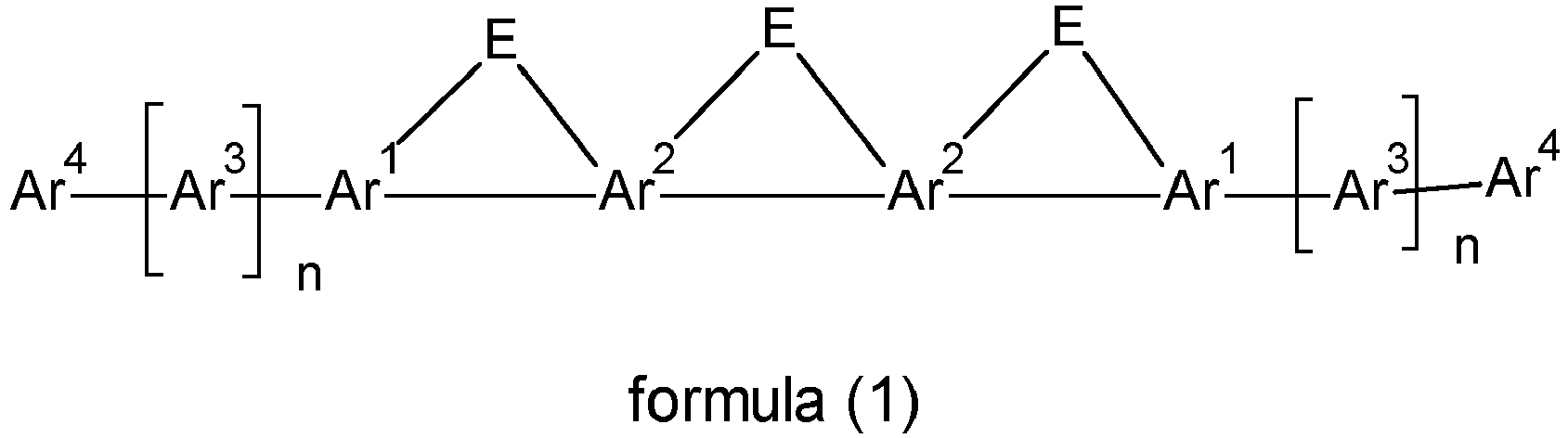
- Ar1 stands on each occurrence, identically or differently, for an aryl or heteroaryl group having 6 to 18 aromatic ring atoms, which may in each case be substituted by one or more radicals R1, wherein at least one of the group Ar1 in formula (1) has 10 or more aromatic ring atoms;
- Ar2 stands on each occurrence, identically or differently, for an aryl or heteroaryl group having 6 aromatic ring atoms, which may in each case be substituted by one or more radicals R1;
- Ar3, Ar4 stand on each occurrence, identically or differently, for an aromatic or heteroaromatic ring systems having 5 to 25 aromatic ring atoms, which may in each case be substituted by one or more radicals R1;
- E is identically or differently on each occurrence, selected from -BR0-, - C(R0)2-, -C(R0)2-C(R0)2-, -C(R0)2-O-, -C(R0)2-S-, -R0C=CR0-, -R0C=N-, Si(R0)2, -Si(R0)2-Si(R0)2-, -C(=O)-, -C(=NR0)-, -C(=C(R0)2)-, -O-, -S-, -S(=O)-, -SO2-, -N(R0)-, -P(R0)- and -P((=O)R0)-, and two groups E may be in a cis- or trans-position relative to each other;
- R0, R1 stand on each occurrence, identically or differently, for H, D, F, CI, Br, I, CHO, CN, N(Ar5)2, C(=O)Ar5 , P(=O)(Ar5)2, S(=O)Ar5, S(=O)2Ar5, NO2, Si(R2)3, B(OR2)2, OSO2R 2, a straight-chain alkyl, alkoxy or thioalkyl groups having 1 to 40 C atoms or branched or a cyclic alkyl, alkoxy or thioalkyl groups having 3 to 40 C atoms, each of which may be substituted by one or more radicals R2, where in each case one or more non-adjacent CH2 groups may be replaced by R2C=CR2, C=C, Si(R2)2, Ge(R2)2, Sn(R2)2, C=O, C=S, C=Se, P(=O)(R2), SO, SO2, O, S or CONR2 and where one or more H atoms may be replaced by D, F, CI, Br, I, CN or NO2, an aromatic or heteroaromatic ring systems having 5 to 60 aromatic ring atoms, which may in each case be substituted by one or more radicals R2, or an aryloxy groups having 5 to 40 aromatic ring atoms, which may be substituted by one or more radicals R2, where two adjacent substituents R0 and/or two adjacent substituents R1 may form a mono- or polycyclic, aliphatic ring system or aromatic ring system, which may be substituted by one or more radicals R2;
- R2 stands on each occurrence, identically or differently, for H, D, F, CI, Br, I, CHO, CN, N(Ar5)2, C(=O)Ar5, P(=O)(Ar5)2, S(=O)Ar5, S(=O)2Ar5, NO2, Si(R3)3, B(OR3)2, OSO2R3, a straight-chain alkyl, alkoxy or thioalkyl groups having 1 to 40 C atoms or branched or cyclic alkyl, alkoxy or thioalkyl groups having 3 to 40 C atoms, each of which may be substituted by one or more radicals R3, where in each case one or more non-adjacent CH2 groups may be replaced by R3C=CR3, C=C, Si(R3)2, Ge(R3)2, Sn(R3)2, C=O, C=S, C=Se, P(=O)(R3), SO, SO2, O, S or CONR3 and where one or more H atoms may be replaced by D, F, CI, Br, I, CN or NO2, an aromatic or heteroaromatic ring systems having 5 to 60 aromatic ring atoms, which may in each case be substituted by one or more radicals R3, or an aryloxy group having 5 to 60 aromatic ring atoms, which may be substituted by one or more radicals R3, where two adjacent substituents R2 may form a mono- or polycyclic, aliphatic ring system or aromatic ring system, which may be substituted by one or more radicals R3;
- R3 stands on each occurrence, identically or differently, for H, D, F, CI, Br, I, CN, a straight-chain alkyl, alkoxy or thioalkyl groups having 1 to 20 C atoms or branched or cyclic alkyl, alkoxy or thioalkyl groups having 3 to 20 C atoms, where in each case one or more non-adjacent CH2 groups may be replaced by SO, SO2, O, S and where one or more H atoms may be replaced by D, F, CI, Br or I, or an aromatic or heteroaromatic ring system having 5 to 24 C atoms;
- Ar5 is an aromatic or heteroaromatic ring system having 5 to 24 aromatic ring atoms, preferably 5 to 18 aromatic ring atoms, which may in each case also be substituted by one or more radicals R3;
- n is an integer from 2 to 20.
- Concerning formula (1), the bonding between a group E and the groups Ar1 and Ar2 that are adjacent to this group E can occur at each free position of the adjacent groups Ar1 and Ar2. In the same way, the bonding between a group E and two groups Ar2 that are adjacent to this group E can occur at each free position of these two adjacent groups Ar2. Thus, it is to be understood that the groups E can be in cis- or in trans-position relative to each other, as mentioned in the definition of the group E above.
- Adjacent substituents in the sense of the present invention are substituents which are bonded to atoms which are linked directly to one another or which are bonded to the same atom.
- Furthermore, the following definitions of chemical groups apply for the purposes of the present application:
An aryl group in the sense of this invention contains 6 to 60 aromatic ring atoms, preferably 6 to 40 aromatic ring atoms, more preferably 6 to 20 aromatic ring atoms; a heteroaryl group in the sense of this invention contains 5 to 60 aromatic ring atoms, preferably 5 to 40 aromatic ring atoms, more preferably 5 to 20 aromatic ring atoms, at least one of which is a heteroatom. The heteroatoms are preferably selected from N, O and S. This represents the basic definition. If other preferences are indicated in the description of the present invention, for example with respect to the number of aromatic ring atoms or the heteroatoms present, these apply. - An aryl group or heteroaryl group here is taken to mean either a simple aromatic ring, i.e. benzene, or a simple heteroaromatic ring, for example pyridine, pyrimidine or thiophene, or a condensed (annellated) aromatic or heteroaromatic polycycle, for example naphthalene, phenanthrene, quinoline or carbazole. A condensed (annellated) aromatic or heteroaromatic polycycle in the sense of the present application consists of two or more simple aromatic or heteroaromatic rings condensed with one another.
- An aryl or heteroaryl group, which may in each case be substituted by the above-mentioned radicals and which may be linked to the aromatic or heteroaromatic ring system via any desired positions, is taken to mean, in particular, groups derived from benzene, naphthalene, anthracene, phenanthrene, pyrene, dihydropyrene, chrysene, perylene, fluoranthene, benzanthracene, benzophenanthrene, tetracene, pentacene, benzopyrene, furan, benzofuran, isobenzofuran, dibenzofuran, thiophene, benzothiophene, isobenzothiophene, dibenzothiophene, pyrrole, indole, isoindole, carbazole, pyridine, quinoline, isoquinoline, acridine, phenanthridine, benzo-5,6-quinoline, benzo-6,7-quinoline, benzo-7,8-quinoline, phenothiazine, phenoxazine, pyrazole, indazole, imidazole, benzimidazole, naphthimidazole, phenanthrimidazole, pyridimidazole, pyrazinimidazole, quinoxalinimidazole, oxazole, benzoxazole, naphthoxazole, anthroxazole, phenanthroxazole, isoxazole, 1,2-thiazole, 1,3-thiazole, benzothiazole, pyridazine, benzopyridazine, pyrimidine, benzopyrimidine, quinoxaline, pyrazine, phenazine, naphthyridine, azacarbazole, benzocarboline, phenanthroline, 1,2,3-triazole, 1,2,4-triazole, benzotriazole, 1,2,3-oxadiazole, 1,2,4-oxadiazole, 1,2,5-oxadiazole, 1,3,4-oxadiazole, 1,2,3-thiadiazole, 1,2,4-thiadiazole, 1,2,5-thiadiazole, 1,3,4-thiadiazole, 1,3,5-triazine, 1,2,4-triazine, 1,2,3-triazine, tetrazole, 1,2,4,5-tetrazine, 1,2,3,4-tetrazine, 1,2,3,5-tetrazine, purine, pteridine, indolizine and benzothiadiazole.
- An aryloxy group in accordance with the definition of the present invention is taken to mean an aryl group, as defined above, which is bonded via an oxygen atom. An analogous definition applies to heteroaryloxy groups.
- An aromatic ring system in the sense of this invention contains 6 to 60 C atoms in the ring system, preferably 6 to 40 C atoms, more preferably 6 to 20 C atoms. A heteroaromatic ring system in the sense of this invention contains 5 to 60 aromatic ring atoms, preferably 5 to 40 aromatic ring atoms, more preferably 5 to 20 aromatic ring atoms, at least one of which is a heteroatom. The heteroatoms are preferably selected from N, O and/or S. An aromatic or heteroaromatic ring system in the sense of this invention is intended to be taken to mean a system which does not necessarily contain only aryl or heteroaryl groups, but instead in which, in addition, a plurality of aryl or heteroaryl groups may be connected by a non-aromatic unit (preferably less than 10% of the atoms other than H), such as, for example, an sp3-hybridised C, Si, N or O atom, an sp2-hybridised C or N atom or an sp-hybridised C atom. Thus, for example, systems such as 9,9'-spirobifluorene, 9,9'-diarylfluorene, triarylamine, diaryl ether, stilbene, etc., are also intended to be taken to be aromatic ring systems in the sense of this invention, as are systems in which two or more aryl groups are connected, for example, by a linear or cyclic alkyl, alkenyl or alkynyl group or by a silyl group. Furthermore, systems in which two or more aryl or heteroaryl groups are linked to one another via single bonds are also taken to be aromatic or heteroaromatic ring systems in the sense of this invention, such as, for example, systems such as biphenyl, terphenyl or diphenyltriazine.
- An aromatic or heteroaromatic ring system having 5 - 60 aromatic ring atoms, which may in each case also be substituted by radicals as defined above and which may be linked to the aromatic or heteroaromatic group via any desired positions, is taken to mean, in particular, groups derived from benzene, naphthalene, anthracene, benzanthracene, phenanthrene, benzophenanthrene, pyrene, chrysene, perylene, fluoranthene, naphthacene, pentacene, benzopyrene, biphenyl, biphenylene, terphenyl, terphenylene, quaterphenyl, fluorene, spirobifluorene, dihydrophenanthrene, dihydropyrene, tetrahydropyrene, cis- or trans-indenofluorene, truxene, isotruxene, spirotruxene, spiroisotruxene, furan, benzofuran, isobenzofuran, dibenzofuran, thiophene, benzothiophene, isobenzothiophene, dibenzothiophene, pyrrole, indole, isoindole, carbazole, indolocarbazole, indenocarbazole, pyridine, quinoline, isoquinoline, acridine, phenanthridine, benzo-5,6-quinoline, benzo-6,7-quinoline, benzo-7,8-quinoline, phenothiazine, phenoxazine, pyrazole, indazole, imidazole, benzimidazole, naphthimidazole, phenanthrimidazole, pyridimidazole, pyrazinimidazole, quinoxalinimidazole, oxazole, benzoxazole, naphthoxazole, anthroxazole, phenanthroxazole, isoxazole, 1,2-thiazole, 1,3-thiazole, benzothiazole, pyridazine, benzopyridazine, pyrimidine, benzopyrimidine, quinoxaline, 1,5-diazaanthracene, 2,7-diazapyrene, 2,3-diazapyrene, 1,6-diazapyrene, 1,8-diazapyrene, 4,5-diazapyrene, 4,5,9,10-tetraazaperylene, pyrazine, phenazine, phenoxazine, phenothiazine, fluorubin, naphthyridine, azacarbazole, benzocarboline, phenanthroline, 1,2,3-triazole, 1,2,4-triazole, benzotriazole, 1,2,3-oxadiazole, 1,2,4-oxadiazole, 1,2,5-oxadiazole, 1,3,4-oxadiazole, 1,2,3-thiadiazole, 1,2,4-thiadiazole, 1,2,5-thiadiazole, 1,3,4-thiadiazole, 1,3,5-triazine, 1,2,4-triazine, 1,2,3-triazine, tetrazole, 1,2,4,5-tetrazine, 1,2,3,4-tetrazine, 1,2,3,5-tetrazine, purine, pteridine, indolizine and benzothiadiazole, or combinations of these groups.
- For the purposes of the present invention, a straight-chain alkyl group having 1 to 40 C atoms or a branched or cyclic alkyl group having 3 to 40 C atoms or an alkenyl or alkynyl group having 2 to 40 C atoms, in which, in addition, individual H atoms or CH2 groups may be substituted by the groups mentioned above under the definition of the radicals, is preferably taken to mean the radicals methyl, ethyl, n-propyl, i-propyl, n-butyl, i-butyl, s-butyl, t-butyl, 2-methylbutyl, n-pentyl, s-pentyl, cyclopentyl, neopentyl, n-hexyl, cyclohexyl, neohexyl, n-heptyl, cycloheptyl, n-octyl, cyclooctyl, 2-ethylhexyl, trifluoromethyl, pentafluoroethyl, 2,2,2-trifluoroethyl, ethenyl, propenyl, butenyl, pentenyl, cyclopentenyl, hexenyl, cyclohexenyl, heptenyl, cycloheptenyl, octenyl, cyclooctenyl, ethynyl, propynyl, butynyl, pentynyl, hexynyl or octynyl. An alkoxy or thioalkyl group having 1 to 40 C atoms is preferably taken to mean methoxy, trifluoromethoxy, ethoxy, n-propoxy, i-propoxy, n-butoxy, i-butoxy, s-butoxy, t-butoxy, n-pentoxy, s-pentoxy, 2-methylbutoxy, n-hexoxy, cyclohexyloxy, n-heptoxy, cycloheptyloxy, n-octyloxy, cyclooctyloxy, 2-ethylhexyloxy, pentafluoroethoxy, 2,2,2-trifluoroethoxy, methylthio, ethylthio, n-propylthio, i-propylthio, n-butylthio, i-butylthio, s-butylthio, t-butylthio, n-pentylthio, s-pentylthio, n-hexylthio, cyclohexylthio, n-heptylthio, cycloheptylthio, n-octylthio, cyclooctylthio, 2-ethylhexylthio, trifluoromethylthio, pentafluoroethylthio, 2,2,2-trifluoroethylthio, ethenylthio, propenylthio, butenylthio, pentenylthio, cyclopentenylthio, hexenylthio, cyclohexenylthio, heptenylthio, cycloheptenylthio, octenylthio, cyclooctenylthio, ethynylthio, propynylthio, butynylthio, pentynylthio, hexynylthio, heptynylthio or octynylthio.
- The formulation that two or more radicals may form a ring with one another is, for the purposes of the present application, intended to be taken to mean, inter alia, that the two radicals are linked to one another by a chemical bond. This is illustrated by the following schemes:


- In accordance with a preferred embodiment, the bond between two adjacent groups Ar2 and Ar1 and the bond between two adjacent groups Ar2 are in para positions.
- In accordance with a preferred embodiment, n is an integer from 2 to 10, more preferably from 2 to 8, particularly preferably from 2 to 4.
- In accordance with a preferred embodiment of the invention, the compounds of formula (1) bear at least one group R0 or R1, which stands for a straight-chain alkyl group having 2 to 40 C atoms, preferably 3 to 20 C atoms, very preferably 6 to 10 C atoms, or a branched or cyclic alkyl group having 3 to 40 C atoms, preferably 4 to 20 C atoms, very preferably 6 to 10 C atoms, each of which may be substituted by one or more radicals R2.
- It is very preferred that the compounds of formula (1) contain two adjacent groups R0, which are selected, identically or differently, from a straight-chain alkyl group having 2 to 40 C atoms, preferably 3 to 20 C atoms, very preferably 6 to 10 C atoms, and a branched or cyclic alkyl group having 3 to 40 C atoms, preferably 4 to 20 C atoms, very preferably 6 to 10 C atoms, each of which may be substituted by one or more radicals R2.
- It is furthermore preferred that Ar1 stands on each occurrence, identically or differently, for an aryl or heteroaryl group having 6 to 14 aromatic ring atoms, which may in each case be substituted by one or more radicals R1, wherein at least one of the group Ar1 in formula (1) has 10 or more aromatic ring atoms.
- It is furthermore preferred that Ar2 stands for a phenyl group, which may in each case be substituted by one or more radicals R1;
- In accordance to a preferred embodiment, both groups Ar1 in formula (1) stand on each occurrence, identically or differently, for an aryl or heteroaryl group having 10 to 14 aromatic ring atoms, which may in each case be substituted by one or more radicals R1.
- More preferably, both groups Ar1 in formula (1) stand for an aryl group having 10 aromatic ring atoms, which may in each case be substituted by one or more radicals R1.
- Particularly preferably, both groups Ar1 stand for a naphthyl group, which may be substituted by one or more radicals R1 and Ar2 stand for a phenyl group, which may be substituted by one or more radicals R1.
- In accordance to a further preferred embodiment, one group Ar1 in formula (1) stands for an aryl or heteroaryl group having 10 aromatic ring atoms and one group Ar1 stands for an aryl or heteroaryl group having 6 aromatic ring, which may in each case be substituted by one or more radicals R1.
- Particularly preferably, one group Ar1 stands for a naphthyl group and one group Ar1 stands for a phenyl, which may in each case be substituted by one or more radicals R1, and Ar2 stand for a phenyl group, which may be substituted by one or more radicals R1.
- It is preferred that the group E is, identically or differently, on each occurrence, selected from -C(R0)2-, -C(R0)2-C(R0)2-, -R0C=CR0-, -Si(R0)2-, - C(=O)-, -O-, -S-, -S(O2)- and N(R0), more preferably from -C(R0)2-, -C(R0)2-C(R0)2-, -O-, -S- and N(R0). It is particularly preferred that E stands for - C(R0)2-.
- Preferably, R0 is selected on each occurrence, identically or differently, from the group consisting of H, D, F, CN, Si(R2)3, a straight-chain alkyl having 1 to 10 C atoms or a branched or cyclic alkyl group having 3 to 10 C atoms, each of which may be substituted by one or more radicals R2, where in each case one or more H atoms may be replaced by F, or an aryl or heteroaryl group having 5 to 40 aromatic ring atoms, which may in each case be substituted by one or more radicals R2, where two adjacent substituents R0, may form a mono- or polycyclic, aliphatic ring system or aromatic ring system, which may be substituted by one or more radicals R2.
- According to a preferred embodiment of the invention, E stands for -C(R0)2 and the two adjacent substituents R0 of the group -C(R0)2- form a ring system, so that a spiro group is formed. More preferably, the two adjacent substituent R0 form a spiro-cyclohexane ring or a spiro-cyclopentane ring.
- It is furthermore preferred that R1 is selected, identically or differently on each occurrence, from the group consisting of H, D, F, CN, a straight-chain alkyl or alkoxy group having 1 to 10 C atoms or a branched or cyclic alkyl or alkoxy group having 3 to 10 C atoms, each of which may be substituted by one or more radicals R2, where one or more non-adjacent CH2 groups may be replaced by O and where one or more H atoms may be replaced by F, an aromatic or heteroaromatic ring system having 5 to 24 aromatic ring atoms, which may in each case be substituted by one or more radicals R2.
- It is furthermore preferred that R2 is selected, identically or differently on each occurrence, from the group consisting of H, D, F, CN, a straight-chain alkyl or alkoxy group having 1 to 10 C atoms or a branched or cyclic alkyl or alkoxy group having 3 to 10 C atoms, each of which may be substituted by one or more radicals R3, where one or more non-adjacent CH2 groups may be replaced by O and where one or more H atoms may be replaced by F, an aromatic or heteroaromatic ring system having 5 to 24 aromatic ring atoms, which may in each case be substituted by one or more radicals R3.
- The compounds of formula (1) are preferably selected from the compounds of formula (1-1) and formula (1-2),


V is on each occurrence, identically or differently, CR1 or N, wherein V is C when V is bonded to a group Ar3 or to a group E. - Concerning formulae (1-1) and (1-2), the bonding between a group E and an adjacent 6-membered ring containing X or an adjacent 10-membered ring containing E can occur at each free position. Thus, it is to be understood that the groups E can be in cis- or in trans-position relative to each other, as mentioned in the definition of the group E above.
- It is preferred that maximal two groups V per 6-membered ring are equal to N. More preferably, V stands on each occurrence for CR1.
- In accordance with a preferred embodiment of the invention, the compounds of formula (1), (1-1) and (1-2) are selected from the compounds of the following formulae (1-1-1) to (1-1-11) and (1-2-1) to (1-2-7),

formula (1-1-1) 
formula (1-1-2) 
formula (1-1-3) 
formula (1-1-4) 
formula (1-1-5) 
formula (1-1-6) 
formula (1-1-7) 
formula (1-1-8) 
formula (1-1-9) 
formula (1-1-10) 
formula (1-1-11) 
formula (1-2-1) 
formula (1-2-2) 
formula (1-2-3) 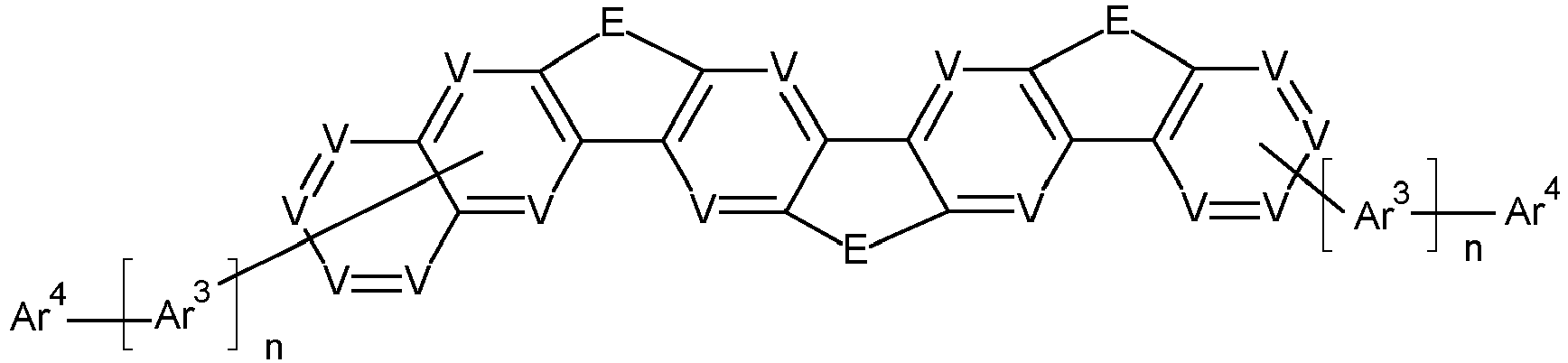
formula (1-2-4) 
formula (1-2-5) 
formula (1-2-6) 
formula (1-2-7)
Among formulae (1-1-1) to (1-1-11) and (1-2-1) to (1-2-7), the formulae (1-1-1) to (1-1-11) are preferred. Formulae (1-1-1) and (1-1-2) are particularly preferred. Formula (1-1-1) is very particularly preferred. - In accordance with a very preferred embodiment of the invention, the compounds of formula (1), (1-1) and (1-2), (1 -1 -1) to (1-1-11) and (1-2-1) to (1-2-7) are selected from the compounds of the formulae (1-1-1-a) to (1-1-11-a) and (1-2-1-a) to (1-2-7-a),

formula (1-1-1-a) 
formula (1-1-2-a) 
formula (1-1-3-a) 
formula (1-1-4-a) 
formula (1-1-5-a) 
formula (1-1-6-a) 
formula (1-1-7-a) 
formula (1-1-8-a) 
formula (1-1-9-a) 
formula (1-1-10-a) 
formula (1-1-11-a) 
formula (1-2-1-a) 
formula (1-2-2-a) 
formula (1-2-3-a) 
formula (1-2-4-a) 
formula (1-2-5-a) 
formula (1-2-6-a) 
formula (1-2-7-a)
Among formulae (1-1-1 -a) to (1-1-11-a) and (1-2-1-a) to (1-2-7-a), the formulae (1-1-1-a) to (1-1-11-a) are preferred. Formulae (1-1-1-a) and (1-1-2-a) are particularly preferred. Formula (1-1-1-a) is very particularly preferred. - In accordance with a preferred embodiment, Ar3 is selected from one of the formulae (Ar3-1) to (Ar3-25),


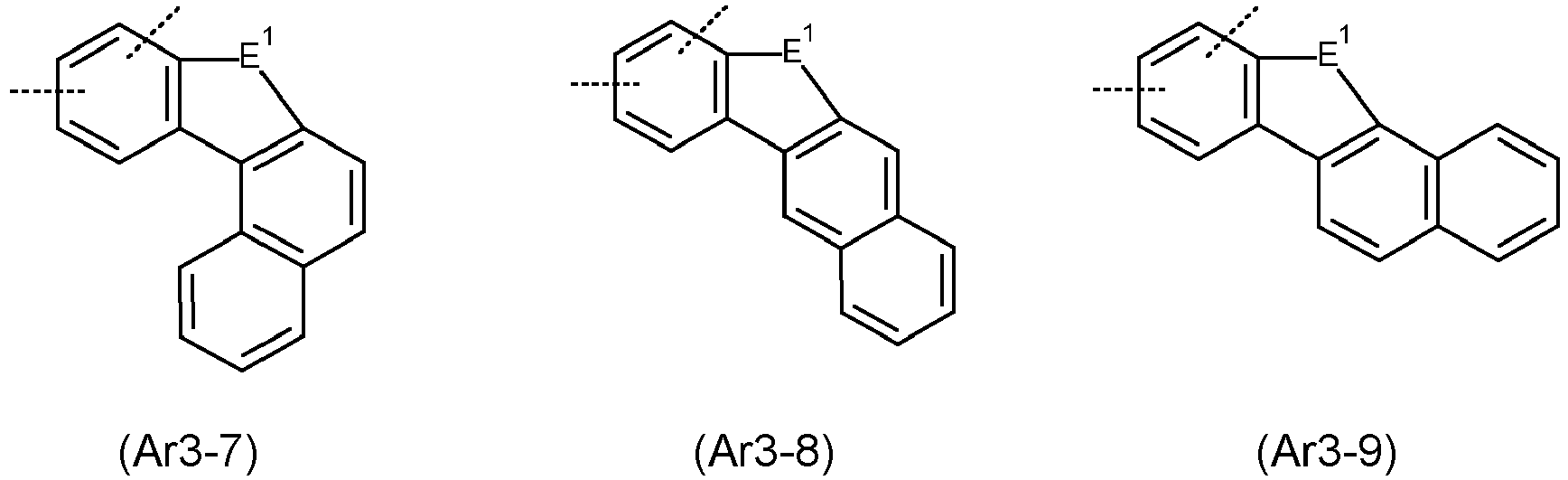


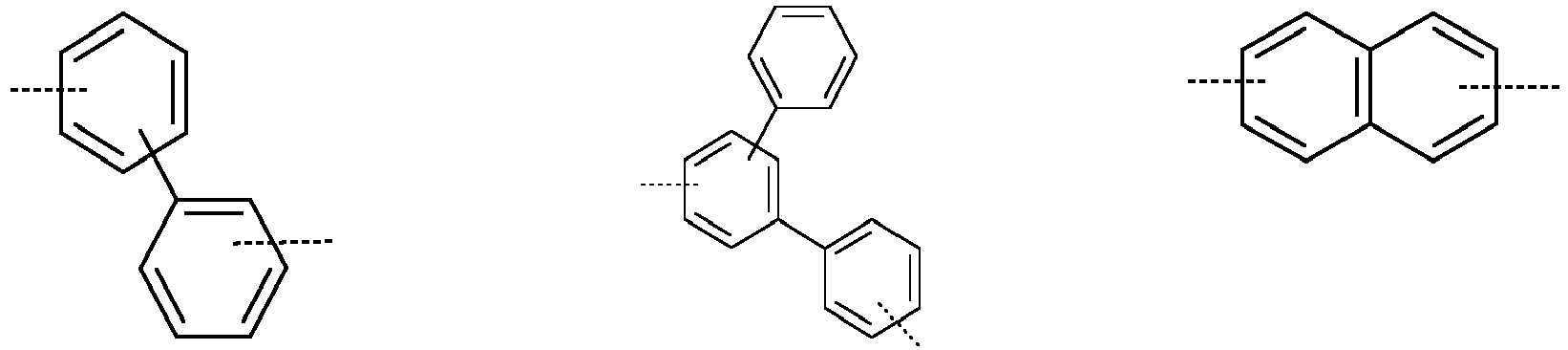


E1 is selected from -B(R0-), -C(R0)2-, -C(R0)2-C(R0)2-, -Si(R0)2-, -C(=O)-, - C(=NR0)-, -C=(C(R0))2-, -O-, -S-, -S(=O)-, -SO2-, -N(R0)-, -P(R0)- and - P((=O)R0)-, where the substituent R0 has the same meaning as above. - Preferably, E1 is selected from -C(R0)2-, -C(R0)2-C(R0)2-, -O-, -S- and -N(R0)-, where the substituent R0 has the same meaning as above. Very preferably, E1 stands for -C(R0)2-.
- Among formulae (Ar3-1) to (Ar3-25), formulae (Ar3-1), (Ar3-2), (Ar3-4), (Ar3-10), (Ar3-13), (Ar3-16), (Ar3-19) and (Ar3-22) are preferred. Formulae (Ar3-1), (Ar3-2), (Ar3-4) and (Ar3-19) are particularly preferred.
- In accordance with a very preferred embodiment, Ar3 is selected from one of the formulae (Ar3-1-1) to (Ar3-25-3),
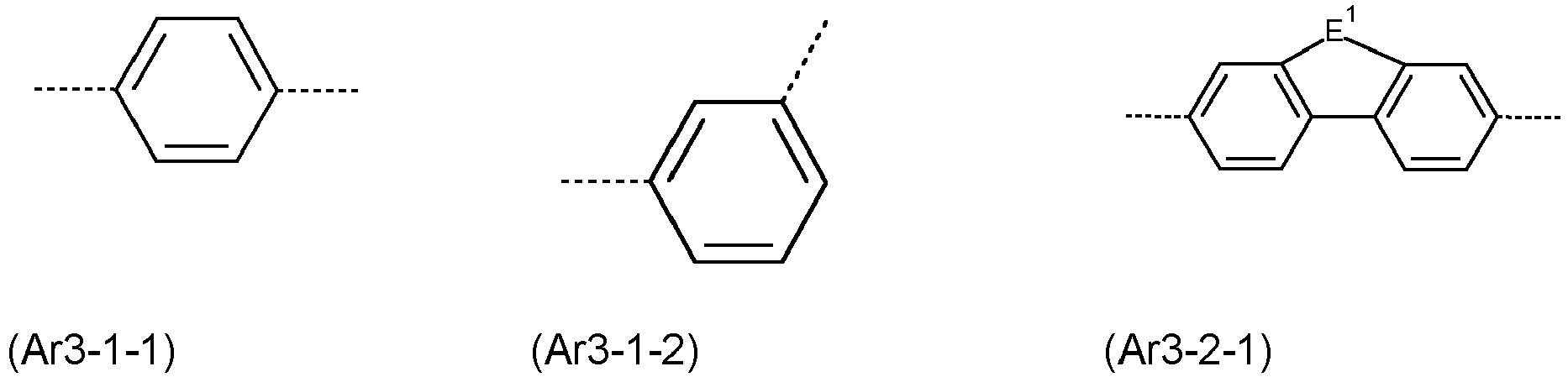


- Among formulae (Ar3-1-1) to (Ar3-25-3), formulae (Ar3-1-1), (Ar3-2-1), (Ar3-4-1), (Ar3-10-1), (Ar3-13-1), (Ar3-16-1), (Ar3-19-1) and (Ar3-22-1) are preferred. Formulae (Ar3-1-1), (Ar3-2-1) and (Ar3-4-1) and (Ar3-19-1) are particularly preferred.
- In accordance with a preferred embodiment, Ar4 is selected from one of the formulae (Ar4-1) to (Ar4-27),


- Among formulae (Ar4-1) to (Ar4-27), formulae (Ar4-1), (Ar4-2), (Ar4-3), (Ar4-9), (Ar4-15), (Ar4-23), and (Ar4-25) are preferred. Formulae (Ar4-1), (Ar4-2) and (Ar4-3) are particularly preferred.
- In accordance with a very preferred embodiment, Ar4 is selected from one of the formulae (Ar4-1-1) to (Ar4-27-3),
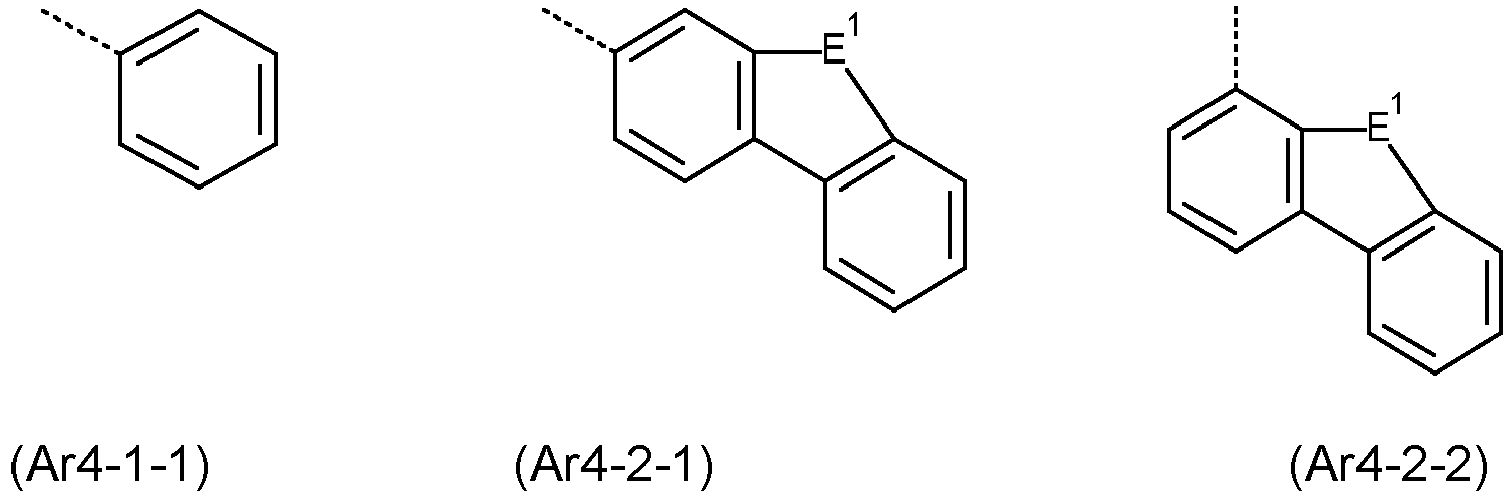


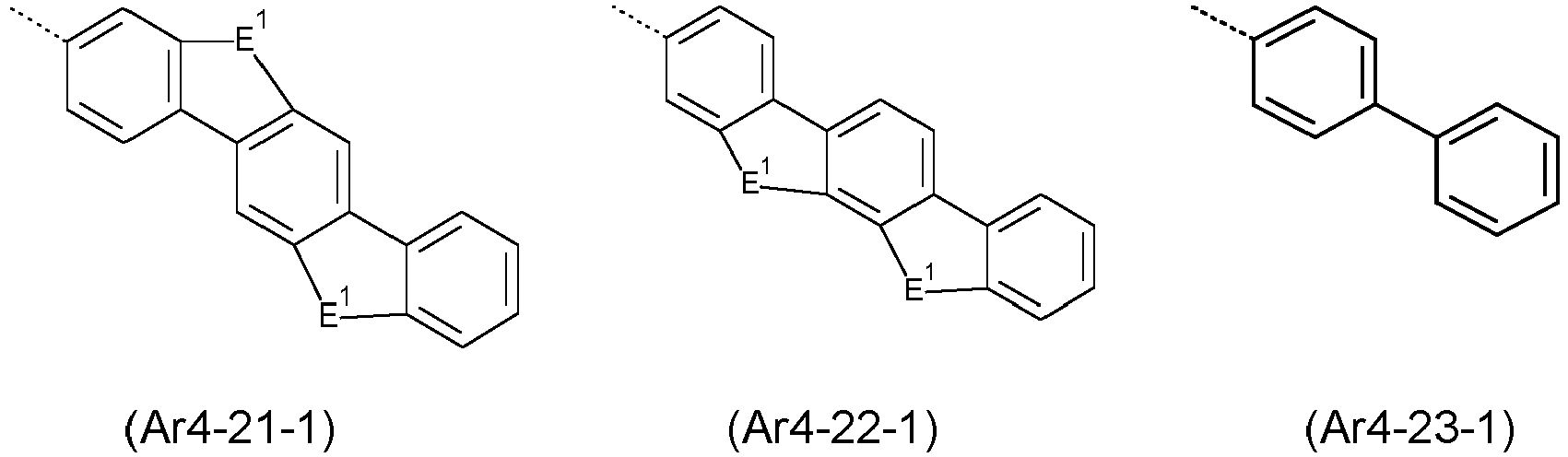


- Among formulae (Ar4-1-1) to (Ar4-27-3), formulae (Ar4-1-1), (Ar4-2-1), (Ar4-3-1), (Ar4-9-1), (Ar4-15-1), (Ar4-23-1) and (Ar4-25-1) are preferred. Formulae (Ar4-1-1), (Ar4-2-1) and (Ar4-3-1) are particularly preferred.
- In accordance with a preferred embodiment, compounds of formula (1), (1-1) and (1-2), (1-1-1) to (1-1-11) and (1-2-1) to (1-2-7) as well as (1-1-1-a) to (1-1-11-a) and (1-2-1-a) to (1-2-7-a) contain at least one group Ar3, which stands for a group of formula (Ar3-2) and/or at least one group Ar4, which stands for a group of formula (Ar4-2),
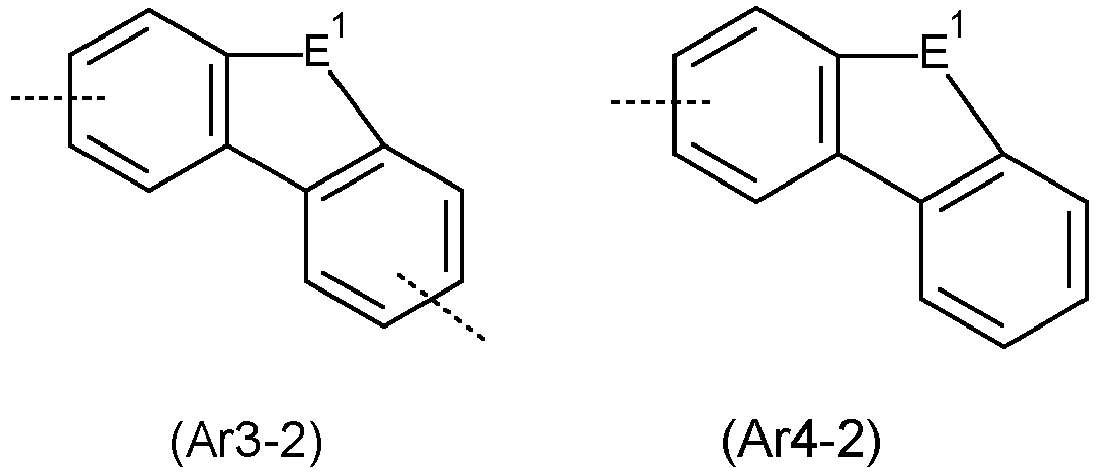
- the dashed bonds in formula (Ar3-2) indicate the bonding to Ar1 and to a group Ar3 or Ar4;
- the dashed bond in formula (Ar4-2) indicates the bonding to Ar3;
- E1 has the same meaning as above; and
- the groups of formulae (Ar3-2) and (Ar4-2) may be substituted at each free position by a group R1, which has the same meaning as above.
- It is very particularly preferred that the compounds of formula (1) and the compounds corresponding to the preferred embodiments of formula (1) contain at least contain at least one group Ar3, which stands for a group of formula (Ar3-2) and/or at least one group Ar4, which stands for a group of formula (Ar4-2), in both chains "Ar4-(Ar3)n---" that are represented in formulae (1), (1-1) and (1-2), (1-1-1) to (1-1-11) and (1-2-1) to (1-2-7) as well as (1-1-1-a) to (1-1-11-a) and (1-2-1-a) to (1-2-7-a).
- In accordance with a very preferred embodiment, compounds of formula (1), (1-1) and (1-2), (1-1-1) to (1-1-11) and (1-2-1) to (1-2-7) as well as (1-1-1-a) to (1-1-11-a) and (1-2-1-a) to (1-2-7-a) contain at least one group Ar3, which stands for a group of formula (Ar3-2-1) and/or at least one group Ar4, which stands for a group of formula (Ar4-2-1),

- the dashed bonds in formula (Ar3-2-1) indicate the bonding to Ar1 and to a group Ar3 or Ar4;
- the dashed bond in formula (Ar4-2-1) indicates the bonding to Ar3;
- E1 has the same meaning as above; and
- the groups of formulae (Ar3-2-1) and (Ar4-2-1) may be substituted at each free position by a group R1, which has the same meaning as above.
- It is particularly preferred that the compounds of formula (1) and the compounds corresponding to the preferred embodiments of formula (1) contain at least contain at least one group Ar3, which stands for a group of formula (Ar3-2-1) and/or at least one group Ar4, which stands for a group of formula (Ar4-2-1), in both chains "Ar4-(Ar3)n---" that are represented in formulae (1), (1-1) and (1-2), (1-1-1) to (1-1-11) and (1-2-1) to (1-2-7) as well as (1-1-1-a) to (1-1-11-a) and (1-2-1-a) to (1-2-7-a).
- In accordance with a preferred embodiment, compounds of formula (1), (1-1) and (1-2), (1-1-1) to (1-1-11) and (1-2-1) to (1-2-7) as well as (1-1-1-a) to (1-1-11-a) and (1-2-1-a) to (1-2-7-a) contain at least one group Ar3, which stands for a group of formula (Ar3-2-1b) and/or at least one group Ar4, which stands for a group of formula (Ar4-2-1b),

- the dashed bonds in formula (Ar3-2-1b) indicate the bonding to Ar1 and to a group Ar3 or Ar 4 ;
- the dashed bonds in formula (Ar4-2-1b) indicates the bonding to Ar3;
- R0 has the same meaning as in claim 1; and
- the groups of formulae (Ar3-2-1b) and (Ar4-2-1b) may be substituted at each free position by a group R1, which has the same meaning as in claim 1.
- It is very particularly preferred that the compounds of formula (1) and the compounds corresponding to the preferred embodiments of formula (1) contain at least contain at least one group Ar3, which stands for a group of formula (Ar3-2-1b) and/or at least one group Ar4, which stands for a group of formula (Ar4-2-1b), in both chains "Ar4-(Ar3)n---" that are represented in formulae (1), (1-1) and (1-2), (1-1-1) to (1-1-11) and (1-2-1) to (1-2-7) as well as (1-1-1-a) to (1-1-11-a) and (1-2-1-a) to (1-2-7-a).
- The following compounds are examples of compounds of the formula (1):


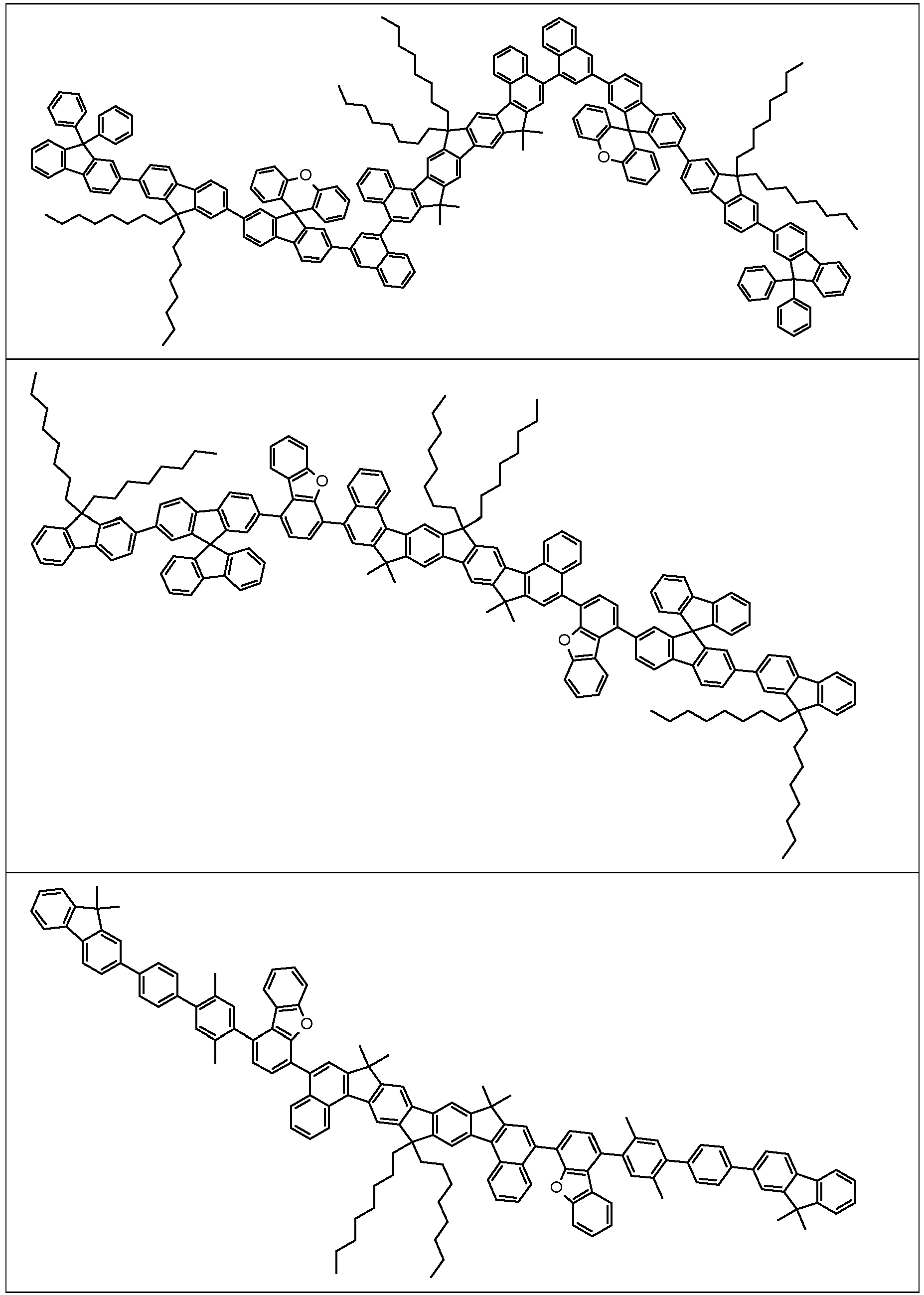


- The compounds according to the invention can be prepared, for example, in accordance with the following reaction scheme:
-

- Ar: aromatic or heteroaromatic group
- E: bridging group
- E*: precursor of the bridging group
- Y*: reactive group like CI, Br, I
- Reactive groups are introduced in a starting compound, which is commercially available in many cases, for example by bromination, or by bromination and subsequent boronation. Subsequently, two other aromatic groups are introduced via a double coupling reaction, for example a Suzuki coupling reaction. These other aromatic groups contain a functional group E* which can form a ring comprising the bridging group E.
- Alternatively, as shown in scheme 2, one can start from a compound which already contains two bridging groups E. A process for the preparation of such compounds is known to the skilled person, for example from
WO 2008/006449 . The subsequent steps are the same as in scheme 1.
- Ar: arromatic or heteroaromatic group
- E: bridging group
- E*: precursor of the bridging group
- Y*: reactive group like CI, Br, I
-


- Ar: aromatic or heteroaromatic group
- E: bridging group
- E*: precursor of the bridging group
- Y*: reactive group like CI, Br, I
- The compound obtained in step 1 is further functionalized (introduction of reactive groups via bromination or via bromination and subsequent boronation), so that two other aromatic groups are introduced via a double coupling reaction, for example a Suzuki coupling reaction.
- The application therefore relates to a process for the preparation of a compound of the formula 1, characterized in that it
- a) at least one coupling reaction occurs, preferably via a transition metal-catalyzed coupling reaction, more preferably via a Suzuki coupling reaction;
- b) a ring formation reaction occurs;
- c) at least two further coupling reaction occur, preferably via a transition metal-catalyzed coupling reaction, more preferably via a Suzuki coupling reaction.
- The compounds according to the invention described above, in particular compounds which are substituted by reactive leaving groups, such as bromine, iodine, chlorine, boronic acid or boronic acid ester, can be used as monomers for the production of corresponding oligomers, dendrimers or polymers. Suitable reactive leaving groups are, for example, bromine, iodine, chlorine, boronic acids, boronic acid esters, amines, alkenyl or alkynyl groups having a terminal C-C double bond or C-C triple bond, oxiranes, oxetanes, groups which undergo a cycloaddition, for example a 1,3-dipolar cycloaddition, such as, for example, dienes or azides, carboxylic acid derivatives, alcohols and silanes.
- The invention therefore furthermore relates to oligomers, polymers or dendrimers containing one or more compounds of the formula (1), where the bond(s) to the polymer, oligomer or dendrimer may be localised at any desired positions in formula (1) that are substituted by R1. Depending on the linking of the compound of the formula (1), the compound is a constituent of a side chain of the oligomer or polymer or a constituent of the main chain. An oligomer in the sense of this invention is taken to mean a compound which is built up from at least three monomer units. A polymer in the sense of the invention is taken to mean a compound which is built up from at least ten monomer units. The polymers, oligomers or dendrimers according to the invention may be conjugated, partially conjugated or non-conjugated. The oligomers or polymers according to the invention may be linear, branched or dendritic. In the structures linked in a linear manner, the units of the formula (1) may be linked directly to one another or they may be linked to one another via a divalent group, for example via a substituted or unsubstituted alkylene group, via a heteroatom or via a divalent aromatic or heteroaromatic group. In branched and dendritic structures, for example, three or more units of the formula (1) may be linked via a trivalent or polyvalent group, for example via a trivalent or polyvalent aromatic or heteroaromatic group, to form a branched or dendritic oligomer or polymer.
- The same preferences as described above for compounds of the formula (1) apply to the recurring units of the formula (1) in oligomers, dendrimers and polymers.
- For the preparation of the oligomers or polymers, the monomers according to the invention are homopolymerised or copolymerised with further monomers. Suitable and preferred comonomers are selected from fluorenes (for example in accordance with
EP 842208 WO 00/22026 EP 707020 EP 894107 WO 1992/ 18552 WO 04/070772 WO 2004/113468 ), thiophenes (for example in accordance withEP 1028136 ), dihydrophenanthrenes (for example in accordance withWO 2005/014689 orWO 2007/006383 ), cis- and trans-indenofluorenes (for example in accordance withWO 2004/041901 orWO 2004/113412 ), ketones (for example in accordance withWO 2005/040302 ), phenanthrenes (for example in accordance withWO 2005/104264 orWO 2007/017066 ) or also a plurality of these units. The polymers, oligomers and dendrimers usually also contain further units, for example emitting (fluorescent or phosphorescent) units, such as, for example, vinyltriarylamines (for example in accordance withWO 2007/068325 ) or phosphorescent metal complexes (for example in accordance withWO 2006/003000 ), and/or charge-transport units, in particular those based on triarylamines. - The polymers and oligomers according to the invention are generally prepared by polymerisation of one or more types of monomer, at least one monomer of which results in recurring units of the formula (1) in the polymer. Suitable polymerisation reactions are known to the person skilled in the art and are described in the literature. Particularly suitable and preferred polymerisation reactions which result in C-C or C-N links are the following:
- (A) SUZUKI polymerisation;
- (B) YAMAMOTO polymerisation;
- (C) STILLE polymerisation; and
- (D) HARTWIG-BUCHWALD polymerisation.
- The way in which the polymerisation can be carried out by these methods and the way in which the polymers can then be separated off from the reaction medium and purified is known to the person skilled in the art and is described in detail in the literature, for example in
WO 2003/048225 ,WO 2004/037887 andWO 2004/037887 . - For the processing of the compounds according to the invention from the liquid phase, for example by spin coating or by printing processes, formulations of the compounds according to the invention are necessary. These formulations can be, for example, solutions, dispersions or emulsions. It may be preferred to use mixtures of two or more solvents for this purpose. Suitable and preferred solvents are, for example, toluene, anisole, o-, m- or p-xylene, methyl benzoate, mesitylene, tetralin, veratrol, THF, methyl-THF, THP, chlorobenzene, dioxane, phenoxytoluene, in particular 3-phenoxytoluene, (-)-fenchone, 1,2,3,5-tetramethylbenzene, 1,2,4,5-tetramethylbenzene, 1-methylnaphthalene, 2-methylbenzothiazole, 2-phenoxyethanol, 2-pyrrolidinone, 3-methylanisole, 4-methylanisole, 3,4-dimethylanisole, 3,5-dimethylanisole, acetophenone, □-terpineol, benzothiazole, butyl benzoate, cumene, cyclohexanol, cyclohexanone, cyclohexylbenzene, decalin, dodecylbenzene, ethyl benzoate, indane, methyl benzoate, NMP, p-cymene, phenetol, 1,4-diisopropylbenzene, dibenzyl ether, diethylene glycol butyl methyl ether, triethylene glycol butyl methyl ether, diethylene glycol dibutyl ether, triethylene glycol dimethyl ether, diethylene glycol monobutyl ether, tripropylene glycol dimethyl ether, tetraethylene glycol dimethyl ether, 2-isopropylnaphthalene, pentylbenzene, hexylbenzene, heptylbenzene, octylbenzene, 1,1-bis(3,4-dimethylphenyl)ethane or mixtures of these solvents.
- The invention therefore furthermore relates to a formulation, in particular a solution, dispersion or emulsion, comprising at least one compound of the formula (1) or at least one polymer, oligomer or dendrimer containing at least one unit of the formula (1), and at least one solvent, preferably an organic solvent. The way in which solutions of this type can be prepared is known to the person skilled in the art and is described, for example, in
WO 2002/072714 ,WO 2003/019694 and the literature cited therein. - The compounds according to the invention are suitable for use in electronic devices, in particular in organic electroluminescent devices (OLEDs). Depending on the substitution, the compounds are employed in different functions and layers.
- The compounds according to the invention can be employed in any function in the organic electroluminescent device, for example as emitting material, as matrix material, as hole-transporting material or as electron-transporting material. Preference is given to the use as emitting material, preferably as fluorescent emitting material, in an emitting layer of an organic electroluminescent device and the use as matrix material in an emitting layer, preferably a fluorescent emitting layer.
- The invention therefore furthermore relates to the use of a compound of the formula (1) in an electronic device. The electronic device here is preferably selected from the group consisting of organic integrated circuits (OICs), organic field-effect transistors (OFETs), organic thin-film transistors (OTFTs), organic light-emitting transistors (OLETs), organic solar cells (OSCs), organic optical detectors, organic photoreceptors, organic field-quench devices (OFQDs), organic light-emitting electrochemical cells (OLECs), organic laser diodes (O-lasers), organic plasmon-emitting devices and particularly preferably organic electroluminescent devices (OLEDs).
- The invention furthermore relates to an electronic device comprising at least one compound of the formula (1). The electronic device here is preferably selected from the devices indicated above. Particular preference is given to an organic electroluminescent device comprising anode, cathode and at least one emitting layer, characterised in that at least one organic layer comprises at least one organic compound of the formula (1). Very particular preference is given to an organic electroluminescent device comprising anode, cathode and at least one emitting layer comprising at least one organic compound of the formula (1).
- Apart from cathode, anode and the emitting layer, the organic electroluminescent device may also comprise further layers. These are selected, for example, from in each case one or more hole-injection layers, hole-transport layers, hole-blocking layers, electron-transport layers, electron-injection layers, electron-blocking layers, exciton-blocking layers, interlayers, charge-generation layers (IDMC 2003, Taiwan; Session 21 OLED (5), T. Matsumoto, T. Nakada, J. Endo, K. Mori, N. Kawamura, A. Yokoi, J. Kido, Multiphoton Organic EL Device Having Charge Generation Layer ) and/or organic or inorganic p/n junctions.
- The sequence of the layers of the organic electroluminescent device is preferably the following:
anode-hole-injection layer-hole-transport layer-emitting layer-electron-transport layer-electron-injection layer-cathode. It is not necessary for all of the said layers to be resent here, and in addition further layers may be present, for example an electron-blocking layer adjacent to the emitting layer on the anode side, or a hole-blocking layer adjacent to the emitting layer on the cathode side. - The organic electroluminescent device according to the invention may comprise a plurality of emitting layers. These emission layers in this case particularly preferably have in total a plurality of emission maxima between 380 nm and 750 nm, resulting overall in white emission, i.e. various emitting compounds which are able to fluoresce or phosphoresce and which emit blue or yellow or orange or red light are used in the emitting layers. Particular preference is given to three-layer systems, i.e. systems having three emitting layers, where at least one of these layers preferably comprises at least one compound of the formula (1) and where the three layers exhibit blue, green and orange or red emission (for the basic structure see, for example,
WO 2005/011013 ). It should be noted that, for the generation of white light, an emitter compound used individually which emits in a broad wavelength range may also be suitable instead of a plurality of emitter compounds emitting in colour. The compounds according to the invention may alternatively and/or additionally also be present in the hole-transport layer or in another layer in an organic electroluminescent device of this type. - The compound according to the invention is particularly suitable for use as matrix compound for an emitter compound, preferably a blue-emitting emitter compound, or as emitter compound, preferably as blue-emitting emitter compound.
- The compound according to the invention is preferably employed as emitting compound in an emitting layer. In this case, it is preferably employed in combination with one or more matrix materials. The preferred proportions of emitting compound and matrix material here are as indicated below.
- The compound according to the invention can also be used as matrix compound for emitter compounds. Preference is given to the use as matrix compound for fluorescent emitter compounds. However, the compound according to the invention can also be used as matrix compound for emitter compounds which exhibit thermally activated delayed fluorescence (TADF). The basic principles of the emission mechanism in TADF are disclosed in H. Uoyama et al., Nature 2012, 492, 234.
- If the compound according to the invention is employed as matrix material, it can be employed combined with any desired emitting compounds known to the person skilled in the art. It is preferably employed in combination with the preferred emitting compounds indicated below, particularly the preferred fluorescent compounds indicated below.
- In the case where the emitting layer of the organic electroluminescent device comprises a mixture of an emitting compound and a matrix compound, the following applies:
The proportion of the emitting compound in the mixture of the emitting layer is preferably between 0.1 and 50.0%, particularly preferably between 0.5 and 20.0%, and very particularly preferably between 1.0 and 10.0%. Correspondingly, the proportion of the matrix material or matrix materials is preferably between 50.0 and 99.9%, particularly preferably between 80.0 and 99.5%, and very particularly preferably between 90.0 and 99.0%. - The indications of the proportions in % in the context of the present application are taken to mean % by vol. if the compounds are applied from the gas phase, and they are taken to mean % by weight if the compounds are applied from solution.
- The compound according to the invention can furthermore also be employed as electron-transporting compound in an electron-transport layer, a hole-blocking layer or an electron-injection layer. For this purpose, it is preferred for the compound according to the invention to contain one or more substituents selected from electron-deficient heteroaryl groups, such as, for example, triazine, pyrimidine or benzimidazole.
- Generally preferred classes of material for use as corresponding functional materials in the organic electroluminescent devices according to the invention are indicated below.
- Suitable phosphorescent emitting compounds are, in particular, compounds which emit light, preferably in the visible region, on suitable excitation and in addition contain at least one atom having an atomic number greater than 20, preferably greater than 38 and less than 84, particularly preferably greater than 56 and less than 80. The phosphorescent emitting compounds used are preferably compounds which contain copper, molybdenum, tungsten, rhenium, ruthenium, osmium, rhodium, iridium, palladium, platinum, silver, gold or europium, in particular compounds which contain iridium, platinum or copper.
- For the purposes of the present invention, all luminescent iridium, platinum or copper complexes are regarded as phosphorescent compounds.
- Examples of the phosphorescent emitting compounds described above are revealed by the applications
WO 2000/70655 WO 2001/41512 WO 2002/ 02714 WO 2002/15645 EP 1191613 ,EP 1191612 ,EP 1191614 ,WO 2005/033244 ,WO 2005/019373 andUS 2005/0258742 . In general, all phosphorescent complexes as used in accordance with the prior art for phosphorescent OLEDs and as are known to the person skilled in the art in the area of organic electroluminescent devices are suitable for use in the devices according to the invention. The person skilled in the art will also be able, without inventive step, to employ further phosphorescent complexes in combination with the compounds according to the invention in OLEDs. - Preferred fluorescent emitters, besides the compounds according to the invention, are selected from the class of the arylamines. An arylamine in the sense of this invention is taken to mean a compound which contains three substituted or unsubstituted aromatic or heteroaromatic ring systems bonded directly to the nitrogen. At least one of these aromatic or heteroaromatic ring systems is preferably a condensed ring system, particularly preferably having at least 14 aromatic ring atoms. Preferred examples thereof are aromatic anthracenamines, aromatic anthracenediamines, aromatic pyrenamines, aromatic pyrenediamines, aromatic chrysenamines or aromatic chrysenediamines. An aromatic anthracenamine is taken to mean a compound in which one diarylamino group is bonded directly to an anthracene group, preferably in the 9-position. An aromatic anthracenediamine is taken to mean a compound in which two diarylamino groups are bonded directly to an anthracene group, preferably in the 9,10-position. Aromatic pyrenamines, pyrenediamines, chrysenamines and chrysenediamines are defined analogously thereto, where the diarylamino groups are preferably bonded to the pyrene in the 1-position or in the 1,6-position. Further preferred emitters are indenofluorenamines or indenofluorenediamines, for example in accordance with
WO 2006/108497 orWO 2006/ 122630 , benzoindenofluorenamines or benzoindenofluorenediamines, for example in accordance withWO 2008/006449 , and dibenzoindenofluorenamines or dibenzoindenofluorenediamines, for example in accordance withWO 2007/140847 , and the indenofluorene derivatives containing condensed aryl groups which are disclosed inWO 2010/012328 . Preference is likewise given to the pyrenarylamines disclosed inWO 2012/048780 andWO 2013/185871 . Preference is likewise given to the benzoindenofluorenamines disclosed inWO 2014/037077 , the benzofluorene-amines disclosed inWO 2014/106522 and the extended indenofluorenes disclosed inWO 2014/111269 . - Preferred fluorescent emitting compounds, besides the compounds according to the invention, are depicted in the following table:


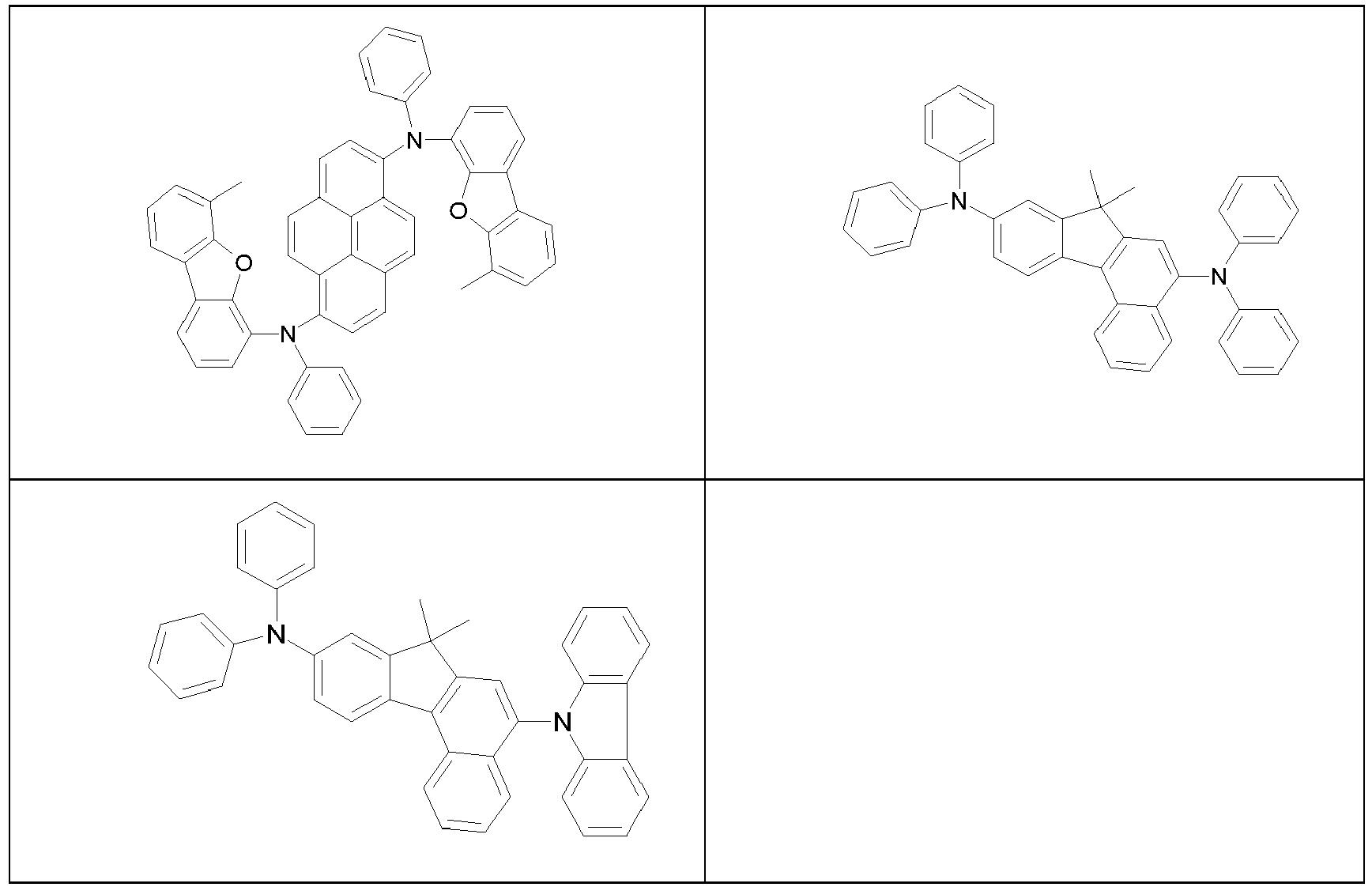
- Preferred matrix materials for phosphorescent emitting compounds are aromatic amines, in particular triarylamines, for example in accordance with
US 2005/0069729 , carbazole derivatives (for example CBP, N,N-biscarbazolylbiphenyl) or compounds in accordance withWO 2005/039246 ,US 2005/0069729 ,JP 2004/288381 EP 1205527 orWO 2008/086851 , bridged carbazole derivatives, for example in accordance withWO 2011/ 088877 andWO 2011/128017 , indenocarbazole derivatives, for example in accordance withWO 2010/ 136109 andWO 2011/000455 , azacarbazole derivatives, for example in accordance withEP 1617710 ,EP 1617711 ,EP 1731584 ,JP 2005/347160 WO 2007/ 063754 orWO 2008/056746 , ketones, for example in accordance withWO 2004/093207 orWO 2010/006680 , phosphine oxides, sulfoxides and sulfones, for example in accordance withWO 2005/003253 , oligophenylenes, bipolar matrix materials, for example in accordance withWO 2007/137725 , silanes, for example in accordance withWO 2005/ 111172 , azaboroles or boronic esters, for example in accordance withWO 2006/117052 , triazine derivatives, for example in accordance withWO 2010/015306 ,WO 2007/063754 orWO 2008/056746 , zinc complexes, for example in accordance withEP 652273 WO 2009/062578 , aluminium complexes, for example BAlq, diazasilole and tetraazasilole derivatives, for example in accordance withWO 2010/054729 , and diazaphosphole derivatives, for example in accordance withWO 2010/054730 . - Preferred matrix materials for use in combination with fluorescent emitting compounds, besides the compounds according to the invention, are selected from the classes of the oligoarylenes (for example 2,2',7,7'-tetraphenylspirobifluorene in accordance with
EP 676461 EP 676461 WO 2004/081017 ), the hole-conducting compounds (for example in accordance withWO 2004/058911 ), the electron-conducting compounds, in particular ketones, phosphine oxides, sulfoxides, etc. (for example in accordance withWO 2005/084081 andWO 2005/084082 ), the atropisomers (for example in accordance withWO 2006/048268 ), the boronic acid derivatives (for example in accordance withWO 2006/117052 ) or the benzanthracenes (for example in accordance withWO 2008/145239 ). Particularly preferred matrix materials are selected from the classes of the oligoarylenes, comprising naphthalene, anthracene, benzanthracene and/or pyrene or atropisomers of these compounds, the oligoarylenevinylenes, the ketones, the phosphine oxides and the sulfoxides. Very particularly preferred matrix materials are selected from the classes of the oligoarylenes, comprising anthracene, benzanthracene, benzophenanthrene and/or pyrene or atropisomers of these compounds. An oligoarylene in the sense of this invention is intended to be taken to mean a compound in which at least three aryl or arylene groups are bonded to one another. - Examples of preferred matrix materials for use in combination with fluorescent emitting compounds, besides the compounds according to the invention, are represented in the table below:


- Suitable charge-transport materials, as can be used in the hole-injection or hole-transport layer or electron-blocking layer or in the electron-transport layer of the organic electroluminescent device according to the invention, are, for example, the compounds disclosed in Y. Shirota et al., Chem. Rev. 2007, 107(4), 953-1010, or other materials as are employed in these layers in accordance with the prior art.
- Examples of preferred hole-transport materials which can be used in a hole-transport, hole-injection or electron-blocking layer in the electroluminescent device according to the invention, besides the compounds of the formula (1), are indenofluorenamine derivatives (for example in accordance with
WO 06/122630 WO 06/100896 EP 1661888 , hexaazatriphenylene derivatives (for example in accordance withWO 01/049806 US 5,061,569 ), the amine derivatives disclosed inWO 95/09147 WO 08/006449 WO 07/140847 WO 2012/034627 orWO 2013/120577 ), fluorenamines (for example in accordance withWO 2014/015937 ,WO 2014/015938 andWO 2014/015935 ), spirodibenzopyranamines (for example in accordance withWO 2013/083216 ) and dihydroacridine derivatives (for example in accordance withWO 2012/150001 ). - The cathode of the organic electroluminescent device preferably comprises metals having a low work function, metal alloys or multilayered structures comprising various metals, such as, for example, alkaline-earth metals, alkali metals, main-group metals or lanthanoids (for example Ca, Ba, Mg, Al, In, Mg, Yb, Sm, etc.). Also suitable are alloys comprising an alkali metal or alkaline-earth metal and silver, for example an alloy comprising magnesium and silver. In the case of multilayered structures, further metals which have a relatively high work function, such as, for example, Ag or Al, can also be used in addition to the said metals, in which case combinations of the metals, such as, for example, Ca/Ag, Mg/Ag or Ag/Ag, are generally used. It may also be preferred to introduce a thin interlayer of a material having a high dielectric constant between a metallic cathode and the organic semiconductor. Suitable for this purpose are, for example, alkali metal fluorides or alkaline-earth metal fluorides, but also the corresponding oxides or carbonates (for example LiF, Li2O, BaF2, MgO, NaF, CsF, Cs2CO3, etc.). Furthermore, lithium quinolinate (LiQ) can be used for this purpose. The layer thickness of this layer is preferably between 0.5 and 5 nm.
- The anode preferably comprises materials having a high work function. The anode preferably has a work function of greater than 4.5 eV vs. vacuum. Suitable for this purpose are on the one hand metals having a high redox potential, such as, for example, Ag, Pt or Au. On the other hand, metal/metal oxide electrodes (for example Al/Ni/NiOx, Al/PtOx) may also be preferred. For some applications, at least one of the electrodes must be transparent or partially transparent in order to facilitate either irradiation of the organic material (organic solar cells) or the coupling-out of light (OLEDs, O-lasers). Preferred anode materials here are conductive mixed metal oxides. Particular preference is given to indium tin oxide (ITO) or indium zinc oxide (IZO). Preference is furthermore given to conductive, doped organic materials, in particular conductive, doped polymers.
- The device is appropriately (depending on the application) structured, provided with contacts and finally sealed, since the lifetime of the devices according to the invention is shortened in the presence of water and/or air.
- In a preferred embodiment, the organic electroluminescent device according to the invention is characterised in that one or more layers are applied by means of a sublimation process, in which the materials are applied by vapour deposition in vacuum sublimation units at an initial pressure of less than 10-5 mbar, preferably less than 10-6 mbar. However, it is also possible here for the initial pressure to be even lower, for example less than 10-7 mbar.
- Preference is likewise given to an organic electroluminescent device, characterised in that one or more layers are applied by means of the OVPD (organic vapour phase deposition) process or with the aid of carrier-gas sublimation, in which the materials are applied at a pressure of between 10-5 mbar and 1 bar. A special case of this process is the OVJP (organic vapour jet printing) process, in which the materials are applied directly through a nozzle and are thus structured (for example M. S. Arnold et al., Appl. Phys. Lett. 2008, 92, 053301).
- Preference is furthermore given to an organic electroluminescent device, characterised in that one or more layers are produced from solution, such as, for example, by spin coating, or by means of any desired printing process, such as, for example, screen printing, flexographic printing, nozzle printing or offset printing, but particularly preferably LITI (light induced thermal imaging, thermal transfer printing) or ink-jet printing.
- For the production of an organic electroluminescent device according to the invention, it is furthermore preferred to apply one or more layers from solution and one or more layers by a sublimation process.
- Owing to the good solubility of the compounds of the formula (1), it is preferred for the layer comprising one or more compounds of the formula (1) to be applied from solution. This is preferably the emitting layer of an organic electroluminescent device.
- In accordance with the invention, the electronic devices comprising one or more compounds according to the invention can be employed in displays, as light sources in lighting applications and as light sources in medical and/or cosmetic applications (for example light therapy).
-

Compound 
Synthesis/ Yield Int-a1 
commercially available CAS 198964-46-4 -

- 2,7-Dibromo-9,9-dioctyl-9H-fluorene (100 g, 0.17 mol), bis(pinacolato)-diboron (94,9 g, 0.37 mol) and potassium acetate (50 g, 0.51 mol) were suspended in 1.4 L dioxane. The solution was saturated with argon. PdCl2(dppf)-CH2Cl2 (4.2 g, 0.01 mol) was added. The reaction mixture was refluxed for sixteen hours and then cooled to room temperature. Ethyl acetate and water were added. The organic phase was washed with water (3x500 mL).The organic phase was concentrated under reduced pressure and the residue was purified by recrystallization from ethanol. Yield: 98 g (90 %). Purity >95 % (NMR in CDCl3).
-

- Step 1: 2,7-Bispinacolato-9,9-dioctyl-9H-fluoren (94 g, 0.146 mol), 1-bromnaphthaline-2-ethyl ester (104 g, 0.37 mmol) and sodium carbonate (56 g, 0.5 mol) were added to water/toluene/dioxane (1:1:1, 1.5 L). The solution was saturated with argon. Tetrakis(triphenylphosphin)-palladium(0) (15.2 g, 0.01 mol) was added and the reaction mixture was refluxed for 6 hours. After cooling down to room temperature toluene (500 mL) was added and the organic phase was washed with water (3x500 mL) and then concentrated under reduced pressure. The residue was purified by recrystallization from ethanol. Yield: 115 g (0.145 mol; 99 %). Purity > 95 % (NMR, CDCl3)
- Step 2: 115g (0.145 mol) of the intermediate (Step 1) diluted in 1 LTHF were added 145 g (0.60 mol) cerium(III) chloride and 500 ml THF and the mixture was stirred for 30 minutes and cooled to 0 °C. 390 ml (1.17 mol) methylmagnesiumchloride (3M in THF) was added dropwise to the reaction mixture at 0 °C. The reaction mixture was allowed to warm to room temperature. After 16 hours 800 ml sat. aq. ammonium chloride was added at 0 °C. Ethyl acetate (2x500 mL) was added, the combined organic phases were washed with water (2x500 mL) and concentrated under reduced pressure. The residue was purified by recrystallization from ethanol. Yield: 103 g (0.146 mol, 93%).
- Step 3: 103 g (0.14 mol) of the intermediate (Step 2) were solved in 1.5 L toluene and 275 g amberlyst 15 were added. The reaction mixture was refluxed for 16 hours using a Dean-Stark apparatus. After cooling down to room temperature amberlyst was removed by filtration and the organic phase was concentrated under reduced pressure. The residue was purified by several recrystallizations from ethanol or heptane/toluene.
Yield: 73 g (0.101 mol; 75 %). -

- la (73 g, 101 mmol) was dissolved in 1 L DCM and cooled to -10 °C. Br2 (33.1 g, 207 mmol) in 500 ml DCM was added dropwise. The reaction mixture was stirred one hour at 0 °C and then allowed to warm to room temperature. After 16 hours, 20 ml aqueous, saturated sodium thiosulfate solution was added and the mixture was stirred for 15 minutes. Water (1 L) was added, the organic phase was washed with water (3x500 mL) and the combined organic phases were concentrated under reduced pressure. The residue was purified by several recrystallizations from ethanol or heptane/toluene.
Yield: 66.4 g (75 mmol; 74%) - Compound B can be synthesized in an analogous manner to Int-B:

-

- 30 g (97.5 mmol) 2-Bromo-7-Chloro-9,9-dimethyl-9H-fluorene (see
JP 2003277305 A
Yield: 39.1 g (93 mmol; 96%) - Following compounds can be synthesized in an analogous manner:
Compound Starting material Product Yield C2 
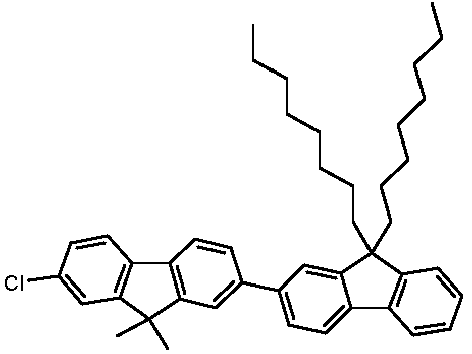
89 % CAS 302554-81-0 C3 D2 
78 % 
-

- 40 g (95 mmol) C1, 38.6 g (152 mmol) bis-(pinacolato)-diboron, 4.2 g (5.7 mmol) trans-dichloro(tricyclohexylphosphine)palladium(II) and 28 g (285 mmol) potassium acetate were dissolved in 400 ml dioxane and stirred for 16 h at reflux. The reaction mixture was allowed to cool to room temperature and 400 ml toluene were added. The organic phase was separated, washed with water (2x200 mL) and filtered through Celite. The solution was concentrated to dryness under reduced pressure. The residue was purified by recrystallization from toluene/heptane.
Yield: 36 g (70 mmol; 74 %) - Following compounds can be synthesized in an analogous manner:
compound Starting material Product Yield D2 C2 
89 % D3 C3 
87 % -

- 5.5 g (17.8 mmol) 2-Bromo-5-iodo-1,3-dimethylbenzene, 6.5 g (12.7 mmol) D1, 366 mg (0.3 mmol) tetrakis(triphenylphosphin)-palladium(0) and 2.7 g (13 mmol) sodium carbonate were dissolved in 200 ml toluene, ethanol and water (2:1:1) and stirred for 16 hours at 90 °C. After cooling down to room temperature 100 ml toluene were added, the organic phase was separated and washed with water (2x50 ml). The organic phase was concentrated to dryness under reduced pressure. The residue was purified by recrystallization from toluene/heptane.
Yield: 6.2 g (11 mmol; 86 %) - The following compounds can be synthesized in an analogous manner:
Compound Starting material A Starting material B Product Yield E2 D2 CAS 689260-53-5 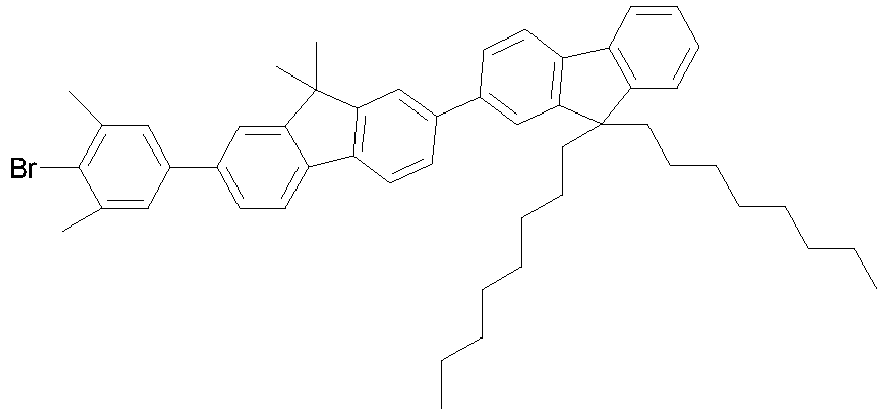
89 % E3 D2 CAS 699119-05-6 
87 % E4 D1 CAS 699119-05-6 
83 % E5 D2 CAS 844856-42-4 
85 % E6 D1 CAS 844856-42-4 
81 % E7 D2 

78 % see JP 20032 77305 A E8 D3 CAS 689260-53-5 
82 % E9 D2 CAS 637-87-6 
87 % E10 D2 CAS 23055-77-8 
78 % - Compounds F can be synthesized in an analogous manner to E1:
Compound Starting material A Starting material B Product Yield F1 CAS 1679-18-1 E1 
68% F2 CAS 1679-18-1 E2 
67 % F3 CAS 1679-18-1 E3 
72 % F4 CAS 1679-18-1 E4 
69% F5 CAS 1679-18-1 E8 
72 % - Compounds G can be synthesized in an analogous manner to D1:
Compound Starting material Product Yield G1 E5 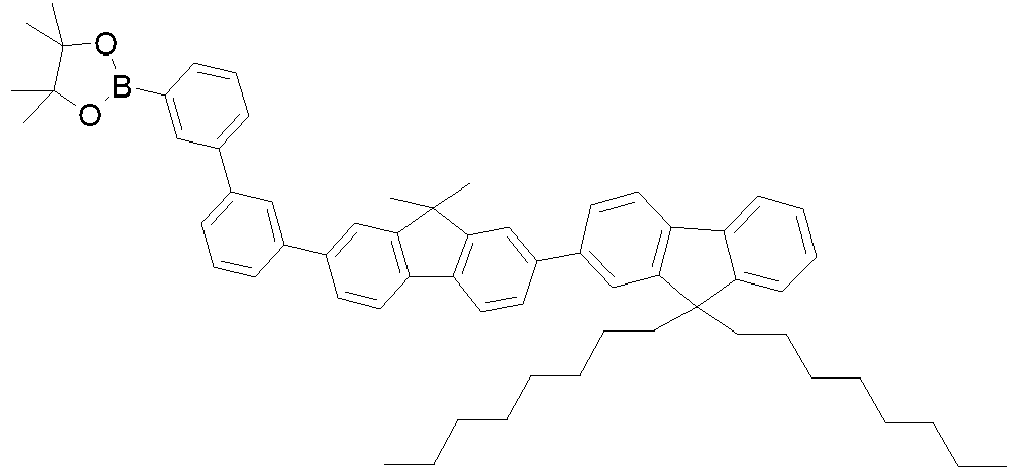
82 % G2 E6 
79 % G3 F1 
78 % G4 F2 
81 % G5 F3 
83 % G6 F4 
70 % G7 E7 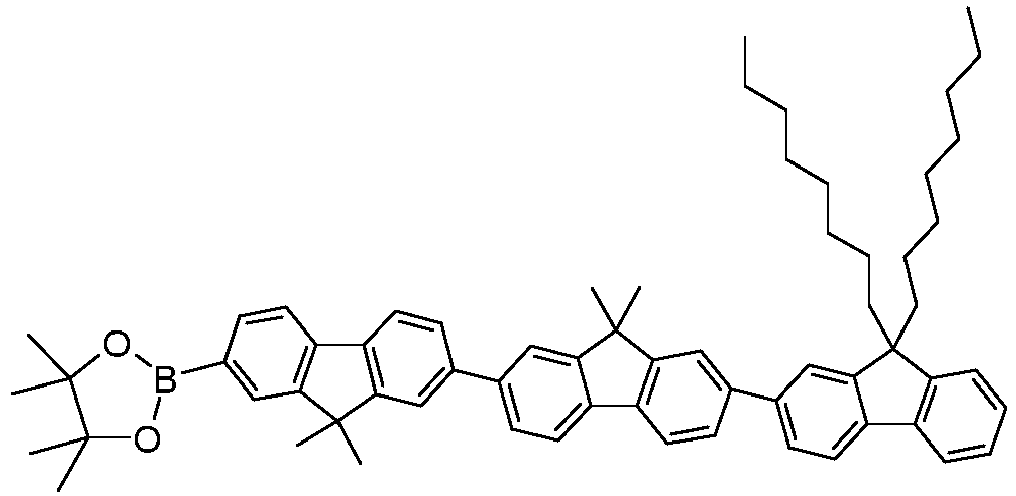
72 % G9 F5 
69 % G10 E9 
73 % G11 E10 
81 % 
- Int-c (18.7 g, 21.2 mmol), 4-biphenylboronic acid (9.25 g, 46.7 mmol) and sodium carbonate (4.5 g, 42.4 mmol) were dissolved in a mixture of toluene, ethanol and water (2:1:1) and the solution was saturated with argon. Tetrakis(triphenylphosphine)-palladium(0) (613 mg, 0.53 mmol) was added and stirred for 6 hours at 110 °C. The reaction mixture was allowed to cool to room temperature, toluene (400 mL) and water (200 mL) were added and the organic phase was separated and washed twice with water (400 mL). The organic phase was concentrated under reduced pressure. The residue was further purified by filtration through silica (eluting with toluene), recrystallization from heptane/toluene.
Yield: 13.3 g (12.9 mmol; 61 %)*Not according to the invention - Following compounds IIb to IIm can be synthesized in an analogous manner:
Starting material A Starting material B 
Yield IIb* lnt-C1 D1 
52 % IIc lnt-C1 G5 
58 % IId lnt-C1 G4 
62 % IIe lnt-C1 G1 
63 % IIf lnt-C1 G6 
59 % IIg lnt-C1 G3 
57 % IIh lnt-C1 G2 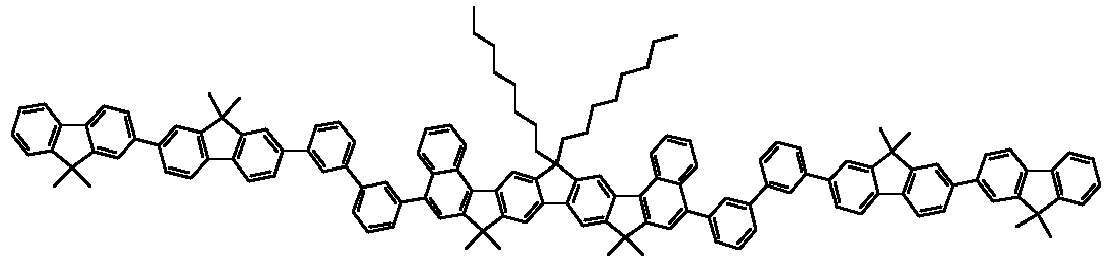
55 % IIi lnt-C1 G7 
54 % IIj* lnt-C1 C 
58 % IIk lnt-C1 G9 
57 % IIl lnt-C1 G10 
62 % IIm lnt-C1 G11 
67 % *Not according to the invention - The production of solution-based OLEDs is described in principle in the literature, for example in
WO 2004/037887 andWO 2010/097155 . In the following examples, the two production methods (application from gas phase and solution processing) were combined, so that processing up to and including the emission layer was carried out from solution and the subsequent layers (hole-blocking layer / electron-transport layer) were applied by vacuum vapour deposition. The general processes described above are for this purpose adapted to the circumstances described here (layer-thickness variation, materials) and combined as follows. - The device structure used is thus as follows:
- substrate,
- ITO (50 nm),
- PEDOT (20 nm),
- hole-transport layer (HTL) (20 nm),
- emission layer (92% of host, 8% of dopant) (60 nm),
- electron-transport layer (ETL) (20 nm),
- electron-injection layer (EIL) (3nm)
- cathode (Al) (100nm).
- The substrates used are glass plates coated with structured ITO (indium tin oxide) in a thickness of 50 nm. For better processing, these are coated with the buffer (PEDOT) Clevios P VP AI 4083 (Heraeus Clevios GmbH, Lever-kusen). The spin coating of the buffer is carried out from water in air. The layer is subsequently dried by heating at 180°C for 10 minutes. The hole-transport and emission layers are applied to the glass plates coated in this way.
- The hole-transport layer is the polymer of the structure shown in Table 2, which was synthesised in accordance with
WO 2010/097155 . The polymer is dissolved in toluene, so that the solution typically has a solid content of approx. 5 g/l if, as here, the layer thickness of 20 nm which is typical for a device is to be achieved by means of spin coating. The layers are applied by spin coating in an inert-gas atmosphere, in the present case argon, and dried by heating at 180°C for 60 min. - The emission layer (EML) is always composed of at least one matrix material (host=H) and an emitting dopant (emitter=D). An expression such as H1 (92%) : D1 (8%) here means that material H1 is present in the emission layer in a proportion by weight of 92% and dopant D1 is present in the emission layer in a proportion by weight of 8%. The mixture for the emission layer is dissolved in toluene. The typical solid content of such solutions is approx. 18 g/l if, as here, the layer thickness of 60 nm which is typical for a device is to be achieved by means of spin coating. The layers are applied by spin coating in an inert-gas atmosphere, in the present case argon, and dried by heating at 140°C for 10 minutes. The materials used are shown in Table 2.
- The materials for the electron-transport layer, the electron-injection layer and for the cathode are applied by thermal vapour deposition in a vacuum chamber. The electron-transport layer, for example, may consist of more than one material, which are admixed with one another in a certain proportion by volume by co-evaporation. An expression such as ETM:EIL (50%:50%) would mean that materials ETM and EIL are present in the layer in a proportion by volume of 50% each. The materials used in the present case are shown in Table 2.
- The OLEDs are characterised by standard methods. For this purpose, the electroluminescence spectra are recorded, the current efficiency (measured in cd/A) and the external quantum efficiency (EQE, measured in percent) as a function of the luminous density assuming Lambert emission characteristics are calculated from current/voltage/luminous density characteristic lines (IUL characteristic lines), and finally the lifetime of the components is determined. The electroluminescence spectra are recorded at a luminous density of 1000 cd/m2, and the CIE 1931 x and y colour coordinates are calculated from this data. The term EQE @ 1000 cd/m2 denotes the external quantum efficiency at an operating luminous density of 1000 cd/m2. The lifetime LD80 @ 10 mA/cm2 is the time which passes until the initial luminance at a driving current desity of 10 mA/cm2 has dropped by 20%. The data obtained for the various OLEDs are summarised in Table 1.
- The compounds according to the invention are particularly suitable as emitter materials in blue-fluorescent OLEDs. Emitters D1, D2, D3 and D4 are shown as compounds according to the invention. The state-of-the-art compound for comparison is represented by V-D1 and V-D2. All emitters are used in combination with either host H1 or H2.
- Examples E1 to E8 show in a comparative examination with Comparative Examples V1 and V2 that compounds D1, D2, D3 and D4 according to the invention achieve an improved external quantum efficiency (EQE) and an increased lifetime (LD80) with deep-blue emission as compared to comparative material V-D1 and V-D2. Especially the comparison of material V-D1 (Device V1 and V2) with D3 (Example E5) and D4 (Example E6) shows the technical effect of the present invention, in which an expansion of the Bis-Indenofluorene-Core leads to an improved device performance compared to the state-of-the-art while maintaining the same deep blue color.
Table 1: Data of the OLEDs Example Host Emitter EQE @ 1000 cd/m2 LD80 @ 10mA/ cm2 CIE 92 % 8% % [h] x y V1 H1 V-D1 2.9 140 0.144 0.132 V2 H2 V-D1 3.2 150 0.142 0.138 V3 H1 V-D2 3.1 150 0.144 0.129 V4 H2 V-D2 3.3 160 0.147 0.134 E1 H1 D1 4.1 200 0.146 0.158 E2 H2 D1 4.3 220 0.138 0.164 E3 H1 D2 4.5 220 0.139 0.162 E4 H2 D2 4.6 230 0.137 0.165 E5 H2 D3 4.5 190 0.142 0.130 E6 H1 D4 4.3 210 0.144 0.128 Table 2: Structures of the materials used 
HTL 

H1 H2 
V-D1 
V-D2 
D1* 
D2 
D3 
D4 

EIL ETL *Not according to the invention - Compounds according to the invention possess decent solubility and thus are well suitable for solution processing. By this technique, electronic devices based on blue fluorescent emitters with excellent performance data can be generated.
- Alternatively, or in addition, the compounds according to the invention may serve as host materials inside the emission layer (EML), as hole injection material (HIL), as hole transporting material (HTL), as electron transporting material (ETL) or as electron-injection material (EIL) in an organic light emitting diode.
Claims (18)
- Compound of the formula (1),
 Ar1 stands on each occurrence, identically or differently, for an aryl or heteroaryl group having 6 to 18 aromatic ring atoms, which may in each case be substituted by one or more radicals R1, wherein at least one of the group Ar1 in formula (1) has 10 or more aromatic ring atoms;Ar2 stands on each occurrence, identically or differently, for an aryl or heteroaryl group having 6 aromatic ring atoms, which may in each case be substituted by one or more radicals R1;Ar3, Ar4 stand on each occurrence, identically or differently, for an aromatic or heteroaromatic ring systems having 5 to 25 aromatic ring atoms, which may in each case be substituted by one or more radicals R1;E is identically or differently on each occurrence, selected from -BR0-,-C(R0)2-, -C(R0)2-C(R0)2-, -C(R0)2-O-, -C(R0)2-S-, -R0C=CR0-, -R0C=N-, Si(R0)2, -Si(R0)2-Si(R0)2-, -C(=O)-, -C(=NR0)-, -C(=C(R0)2)-, -O-, -S-, -S(=O)-, -SO2-, -N(R0)-, -P(R0)- and -P((=O)R0)-, and two groups E may be in a cis- or trans-position relative to each other;R0, R1 stand on each occurrence, identically or differently, for H, D, F, Cl, Br, I, CHO, CN, N(Ar5)2, C(=O)Ar5, P(=O)(Ar5)2, S(=O)Ar5, S(=O)2Ar5, NO2, Si(R2)3, B(OR2)2, OSO2R2, a straight-chain alkyl, alkoxy or thioalkyl groups having 1 to 40 C atoms or branched or a cyclic alkyl, alkoxy or thioalkyl groups having 3 to 40 C atoms, each of which may be substituted by one or more radicals R2, where in each case one or more non-adjacent CH2 groups may be replaced by R2C=CR2, C≡C, Si(R2)2, Ge(R2)2, Sn(R2)2, C=O, C=S, C=Se, P(=O)(R2), SO, SO2, O, S or CONR2 and where one or more H atoms may be replaced by D, F, Cl, Br, I, CN or NO2, an aromatic or heteroaromatic ring systems having 5 to 60 aromatic ring atoms, which may in each case be substituted by one or more radicals R2, or an aryloxy groups having 5 to 40 aromatic ring atoms, which may be substituted by one or more radicals R2, where two adjacent substituents R0 and/or two adjacent substituents R1 may form a mono- or polycyclic, aliphatic ring system or aromatic ring system, which may be substituted by one or more radicals R2;R2 stands on each occurrence, identically or differently, for H, D, F, Cl, Br, I, CHO, CN, N(Ar5)2, C(=O)Ar5 , P(=O)(Ar5)2, S(=O)Ar5, S(=O)2Ar5, NO2, Si(R3)3, B(OR3)2, OSO2R3, a straight-chain alkyl, alkoxy or thioalkyl groups having 1 to 40 C atoms or branched or cyclic alkyl, alkoxy or thioalkyl groups having 3 to 40 C atoms, each of which may be substituted by one or more radicals R3, where in each case one or more non-adjacent CH2 groups may be replaced by R3C=CR3, C≡C, Si(R3)2, Ge(R3)2, Sn(R3)2, C=O, C=S, C=Se, P(=0)(R 3), SO, SO2, O, S or CONR3 and where one or more H atoms may be replaced by D, F, Cl, Br, I, CN or NO2, an aromatic or heteroaromatic ring systems having 5 to 60 aromatic ring atoms, which may in each case be substituted by one or more radicals R3, or an aryloxy group having 5 to 60 aromatic ring atoms, which may be substituted by one or more radicals R3, where two adjacent substituents R2 may form a mono- or polycyclic, aliphatic ring system or aromatic ring system, which may be substituted by one or more radicals R3;R3 stands on each occurrence, identically or differently, for H, D, F, Cl, Br, I, CN, a straight-chain alkyl, alkoxy or thioalkyl groups having 1 to 20 C atoms or branched or cyclic alkyl, alkoxy or thioalkyl groups having 3 to 20 C atoms, where in each case one or more non-adjacent CH2 groups may be replaced by SO, SO2, O, S and where one or more H atoms may be replaced by D, F, Cl, Br or I, or an aromatic or heteroaromatic ring system having 5 to 24 C atoms;Ar5 is an aromatic or heteroaromatic ring system having 5 to 24 aromatic ring atoms, which may in each case also be substituted by one or more radicals R3;n is an integer from 2 to 20.
 - Compound according to claim 1, characterized in that n is an integer from 2 to 8.
- Compound according to claim 1 or 2, characterized in that the compounds of formula (1) contain at least one group R0 or R1, which stands for a straight-chain alkyl group having 2 to 40 C atoms or a branched or cyclic alkyl group having 3 to 40 C atoms, each of which may be substituted by one or more radicals R2.
- Compound according to one or more of the preceding claims, characterized in that the compound of formula (1) is selected from compounds of formula (1-1) and formula (1-2),


V is on each occurrence, identically or differently, CR1 or N, wherein V is C when V is bonded to a group Ar3 or to a group E. - Compound according to one or more of the preceding claims, characterized in that the compound of formula (1) is selected from compounds of formulae (1 -1 -1) to (1-1-11) and (1-2-1) to (1-2-7),

formula (1-1-1) 
formula (1-1-2) 
formula (1-1-3) 
formula (1-1-4) 
formula (1-1-5) 
formula (1-1-6) 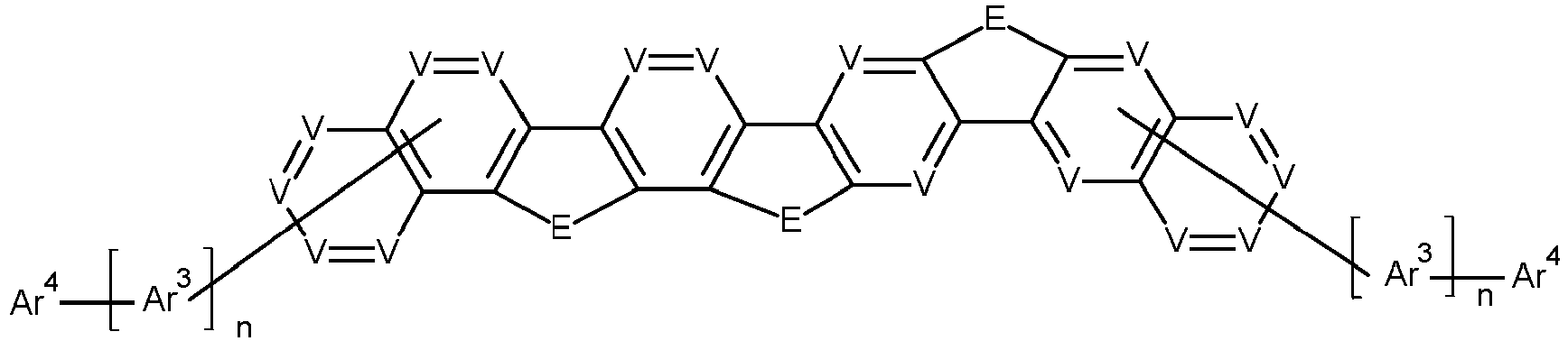
formula (1-1-7) 
formula (1-1-8) 
formula (1-1-9) 
formula (1-1-10) 
formula (1-1-11) 
formula (1-2-1) 
formula (1-2-2) 
formula (1-2-3) 
formula (1-2-4) 
formula (1-2-5) 
formula (1-2-6) 
formula (1-2-7) - Compound according to one or more of the preceding claims, characterized in that the compound of formula (1) is selected from compounds of formulae (1-1-1-a) to (1-1-11-a) and (1 -2-1 -a) to (1-2-7-a),

formula (1-1-1-a) 
formula (1-1-2-a) 
formula (1-1-3-a) 
formula (1-1-4-a) 
formula (1-1-5-a) 
formula (1-1-6-a) 
formula (1-1-7-a) 
formula (1-1-8-a) 
formula (1-1-9-a) 
formula (1-1-10-a) 
formula (1-1-11-a) 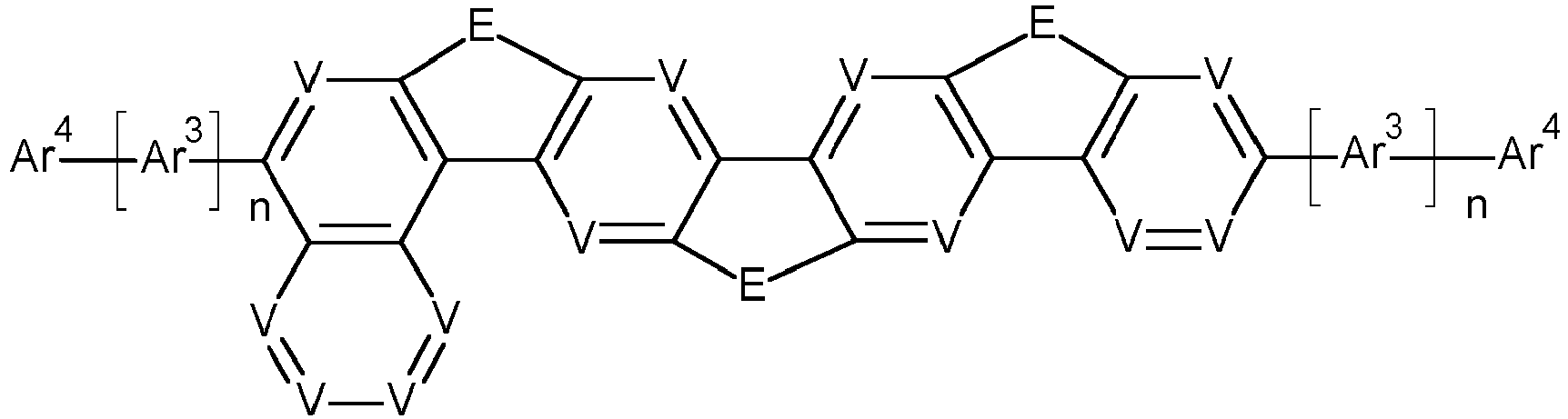
formula (1-2-1-a) 
formula (1-2-2-a) 
formula (1-2-3-a) 
formula (1-2-4-a) 
formula (1-2-5-a) 
formula (1-2-6-a) 
formula (1-2-7-a) - Compound according to one or more of the preceding claims, characterized in that Ar3 is selected from one of the formulae (Ar3-1) to (Ar3-25),


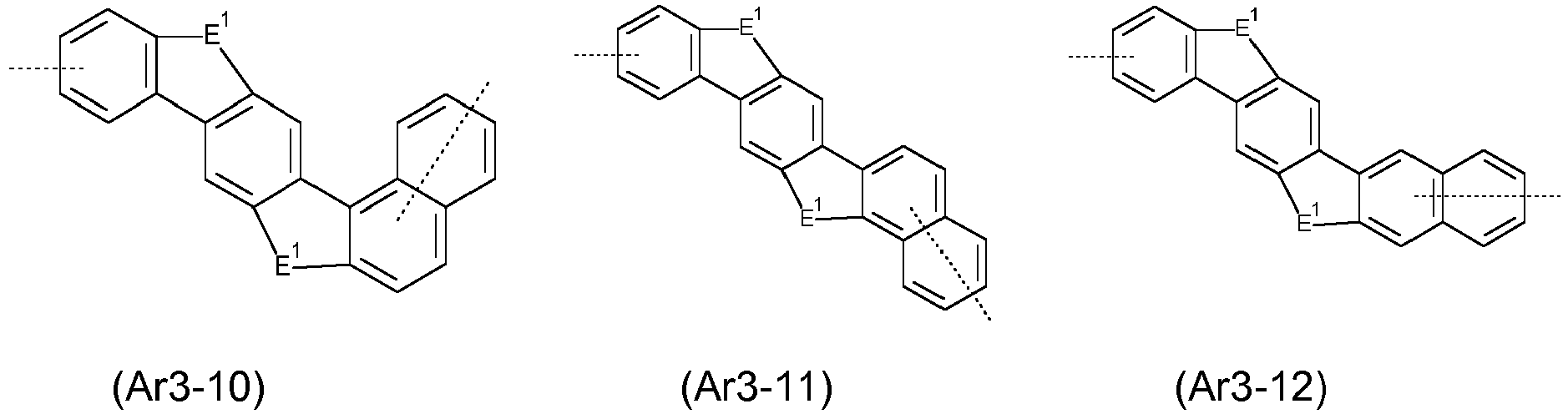


E1 is selected from -B(R0-), -C(R0)2-, -C(R0)2-C(R0)2-, -Si(R0)2-, -C(=O)-,-C(=NR0)-, -C=(C(R0))2-, -O-, -S-, -S(=O)-, -SO2-, -N(R0)-, -P(R0)- and-P((=O)R0)-, where the substituent R0 has the same meaning as in claim 1. - Compound according to one or more of the preceding claims, characterized in that Ar4 is selected from one of the formulae (Ar4-1) to (Ar4-27),


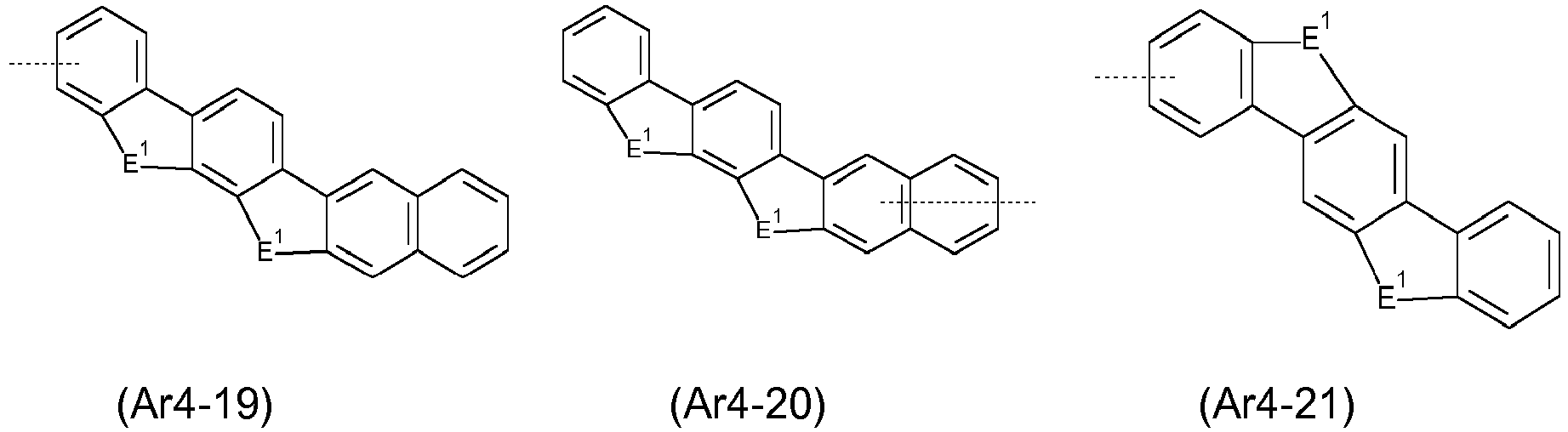


- Compound according to one or more of the preceding claims, characterized in that at least one group Ar3 stands for a group of formula (Ar3-2) and/or at least one group Ar4 stands for a group of formula (Ar4-2),
 - the dashed bonds in formula (Ar3-2) indicate the bonding to Ar1 and to a group Ar3 or Ar4;- the dashed bond in formula (Ar4-2) indicates the bonding to Ar3;- E1 has the same meaning as in claim 7; and- the groups of formulae (Ar3-2) and (Ar4-2) may be substituted at each free position by a group R1, which has the same meaning as in claim 1.
 - Compound according to one or more of the preceding claims, characterized in that at least one group Ar3 stands for a group of formula (Ar3-2-1) and/or at least one group Ar4 stands for a group of formula (Ar4-2-1)
 - the dashed bonds in formula (Ar3-2-1) indicate the bonding to Ar1 and to a group Ar3 or Ar4;- the dashed bond in formula (Ar4-2-1) indicates the bonding to Ar3;- E1 has the same meaning as in claim 7; and- the groups of formulae (Ar3-2-1) and (Ar4-2-1) may be substituted at each free position by a group R1, which has the same meaning as in claim 1.
 - Compound according to one or more of the preceding claims, characterized in that at least one group Ar3 stands for a group of formula (Ar3-2-1b) and/or at least one group Ar4 stands for a group of formula (Ar4-2-1b)
 - the dashed bonds in formula (Ar3-2-1b) indicate the bonding to Ar1 and to a group Ar3 or Ar4;- the dashed bonds in formula (Ar4-2-1b) indicates the bonding to Ar3;- R0 has the same meaning as in claim 1; and- the groups of formulae (Ar3-2-1b) and (Ar4-2-1b) may be substituted at each free position by a group R1, which has the same meaning as in claim 1.
 - Compound according to one or more of the preceding claims, characterised in that E and E1 are, identically or differently, on each occurrence, selected from -C(R0)2-, -C(R0)2-C(R0)2-, -O-, -S- and -N(R0)-.
- Compound according to one or more of the preceding claims, characterised in that E stands for -C(R0)2-.
- Compound according to one or more of the preceding claims, characterized in that R0 stands on each occurrence, identically or differently, for H, D, F, CN, Si(R2)3, a straight-chain alkyl groups having 1 to 10 C atoms or a branched or cyclic alkyl groups having 3 to 10 C atoms, each of which may be substituted by one or more radicals R2, where in each case one or more H atoms may be replaced by F, or an aryl or heteroaryl groups having 5 to 40 aromatic ring atoms, which may in each case be substituted by one or more radicals R2, where two adjacent substituents R0 may form a mono- or polycyclic, aliphatic ring system or aromatic ring system, which may be substituted by one or more radicals R2.
- Oligomer, polymer or dendrimer containing one or more compounds according to one or more of the preceding claims, where the bond(s) to the polymer, oligomer or dendrimer may be localised at any desired positions in formula (1) which are substituted by R1.
- Formulation comprising at least one compound according to one or more of the claims 1 to 14 or at least one oligomer, polymer or dendrimer according to claim 15 and at least one solvent.
- Electronic device comprising at least one compound according to one or more of claims 1 to 14 or at least one oligomer, polymer or dendrimer according to claim 15, selected from the group consisting of organic electroluminescent devices, organic integrated circuits, organic field-effect transistors, organic thin-film transistors, organic light-emitting transistors, organic solar cells, dye-sensitised organic solar cells, organic optical detectors, organic photoreceptors, organic field-quench devices, light-emitting electrochemical cells, organic laser diodes and organic plasmon emitting devices.
- Electronic device according to claim 17, which is an organic electroluminescent device, characterised in that the compound according to one or more of claims 1 to 14 or the oligomer, polymer or dendrimer according to claim 15 is employed as a fluorescent emitter or as a matrix material for fluorescent emitters.
Priority Applications (1)
| Application Number | Priority Date | Filing Date | Title |
|---|---|---|---|
| EP20205087.8A EP3792235A1 (en) | 2016-07-08 | 2017-07-05 | Materials for organic electroluminescent devices |
Applications Claiming Priority (2)
| Application Number | Priority Date | Filing Date | Title |
|---|---|---|---|
| EP16178596 | 2016-07-08 | ||
| PCT/EP2017/066712 WO2018007421A1 (en) | 2016-07-08 | 2017-07-05 | Materials for organic electroluminescent devices |
Related Child Applications (2)
| Application Number | Title | Priority Date | Filing Date |
|---|---|---|---|
| EP20205087.8A Division-Into EP3792235A1 (en) | 2016-07-08 | 2017-07-05 | Materials for organic electroluminescent devices |
| EP20205087.8A Division EP3792235A1 (en) | 2016-07-08 | 2017-07-05 | Materials for organic electroluminescent devices |
Publications (2)
| Publication Number | Publication Date |
|---|---|
| EP3481796A1 EP3481796A1 (en) | 2019-05-15 |
| EP3481796B1 true EP3481796B1 (en) | 2021-02-17 |
Family
ID=56411426
Family Applications (2)
| Application Number | Title | Priority Date | Filing Date |
|---|---|---|---|
| EP17740324.3A Not-in-force EP3481796B1 (en) | 2016-07-08 | 2017-07-05 | Materials for organic electroluminescent devices |
| EP20205087.8A Withdrawn EP3792235A1 (en) | 2016-07-08 | 2017-07-05 | Materials for organic electroluminescent devices |
Family Applications After (1)
| Application Number | Title | Priority Date | Filing Date |
|---|---|---|---|
| EP20205087.8A Withdrawn EP3792235A1 (en) | 2016-07-08 | 2017-07-05 | Materials for organic electroluminescent devices |
Country Status (7)
| Country | Link |
|---|---|
| US (1) | US11365167B2 (en) |
| EP (2) | EP3481796B1 (en) |
| JP (1) | JP7030768B2 (en) |
| KR (1) | KR102599160B1 (en) |
| CN (1) | CN109311784B (en) |
| TW (1) | TWI745395B (en) |
| WO (1) | WO2018007421A1 (en) |
Families Citing this family (22)
| Publication number | Priority date | Publication date | Assignee | Title |
|---|---|---|---|---|
| CN109134418B (en) * | 2018-08-20 | 2023-11-28 | 东莞伏安光电科技有限公司 | Dibenzopyran seven-membered fused ring unit and derivative thereof, preparation method and application |
| CN113646315A (en) | 2019-04-11 | 2021-11-12 | 默克专利有限公司 | Materials for organic electroluminescent devices |
| TW202134252A (en) * | 2019-11-12 | 2021-09-16 | 德商麥克專利有限公司 | Materials for organic electroluminescent devices |
| TW202200529A (en) | 2020-03-13 | 2022-01-01 | 德商麥克專利有限公司 | Materials for organic electroluminescent devices |
| CN115885599A (en) | 2020-07-22 | 2023-03-31 | 默克专利有限公司 | Materials for Organic Electroluminescent Devices |
| KR20230043106A (en) | 2020-07-22 | 2023-03-30 | 메르크 파텐트 게엠베하 | Materials for organic electroluminescent devices |
| TW202237797A (en) | 2020-11-30 | 2022-10-01 | 德商麥克專利有限公司 | Materials for organic electroluminescent devices |
| KR20230114756A (en) | 2020-12-08 | 2023-08-01 | 메르크 파텐트 게엠베하 | Ink Systems and Methods for Inkjet Printing |
| EP4320649A1 (en) | 2021-04-09 | 2024-02-14 | Merck Patent GmbH | Materials for organic electroluminescent devices |
| TW202309243A (en) | 2021-04-09 | 2023-03-01 | 德商麥克專利有限公司 | Materials for organic electroluminescent devices |
| CN117084000A (en) | 2021-04-09 | 2023-11-17 | 默克专利有限公司 | Material for organic electroluminescent device |
| EP4079742B1 (en) | 2021-04-14 | 2026-04-01 | UDC Ireland Limited | Metal complexes |
| JP2024515366A (en) | 2021-04-23 | 2024-04-09 | メルク パテント ゲーエムベーハー | Organic functional materials formulations |
| EP4402141A1 (en) | 2021-09-13 | 2024-07-24 | Merck Patent GmbH | Materials for organic electroluminescent devices |
| US20250275349A1 (en) | 2022-04-28 | 2025-08-28 | Merck Patent Gmbh | Materials for organic electroluminescent devices |
| CN120379993A (en) | 2022-08-09 | 2025-07-25 | 默克专利有限公司 | Material for organic electroluminescent device |
| TW202438505A (en) | 2022-12-19 | 2024-10-01 | 德商麥克專利有限公司 | Materials for organic electroluminescent devices |
| CN120379953A (en) | 2022-12-20 | 2025-07-25 | 默克专利有限公司 | Process for preparing deuterated aromatic compounds |
| WO2025083015A1 (en) | 2023-10-19 | 2025-04-24 | Merck Patent Gmbh | Materials for organic electroluminescent devices |
| WO2025119821A1 (en) | 2023-12-05 | 2025-06-12 | Merck Patent Gmbh | Material composition for organic electroluminescent devices |
| WO2025119813A1 (en) | 2023-12-06 | 2025-06-12 | Merck Patent Gmbh | Materials for organic electroluminescent devices |
| WO2025132547A1 (en) | 2023-12-21 | 2025-06-26 | Merck Patent Gmbh | Mechanochemical method for deuterating organic compounds |
Family Cites Families (95)
| Publication number | Priority date | Publication date | Assignee | Title |
|---|---|---|---|---|
| US4539507A (en) | 1983-03-25 | 1985-09-03 | Eastman Kodak Company | Organic electroluminescent devices having improved power conversion efficiencies |
| US5061569A (en) | 1990-07-26 | 1991-10-29 | Eastman Kodak Company | Electroluminescent device with organic electroluminescent medium |
| DE4111878A1 (en) | 1991-04-11 | 1992-10-15 | Wacker Chemie Gmbh | LADDER POLYMERS WITH CONJUGATED DOUBLE BINDINGS |
| JP3295088B2 (en) | 1993-09-29 | 2002-06-24 | 出光興産株式会社 | Organic electroluminescence device |
| JPH07133483A (en) | 1993-11-09 | 1995-05-23 | Shinko Electric Ind Co Ltd | Organic light emitting material for EL device and EL device |
| EP0676461B1 (en) | 1994-04-07 | 2002-08-14 | Covion Organic Semiconductors GmbH | Spiro compounds and their application as electroluminescence materials |
| DE4436773A1 (en) | 1994-10-14 | 1996-04-18 | Hoechst Ag | Conjugated polymers with spirocenters and their use as electroluminescent materials |
| JP3865406B2 (en) | 1995-07-28 | 2007-01-10 | 住友化学株式会社 | 2,7-Aryl-9-substituted fluorene and 9-substituted fluorene oligomers and polymers |
| DE19614971A1 (en) | 1996-04-17 | 1997-10-23 | Hoechst Ag | Polymers with spiro atoms and their use as electroluminescent materials |
| DE19846766A1 (en) | 1998-10-10 | 2000-04-20 | Aventis Res & Tech Gmbh & Co | A conjugated fluorene-based polymer useful as an organic semiconductor, electroluminescence material, and for display elements |
| US6166172A (en) | 1999-02-10 | 2000-12-26 | Carnegie Mellon University | Method of forming poly-(3-substituted) thiophenes |
| KR100913568B1 (en) | 1999-05-13 | 2009-08-26 | 더 트러스티즈 오브 프린스턴 유니버시티 | Very high efficiency organic light emitting devices based on electrophosphorescence |
| WO2001041512A1 (en) | 1999-12-01 | 2001-06-07 | The Trustees Of Princeton University | Complexes of form l2mx as phosphorescent dopants for organic leds |
| KR100377321B1 (en) | 1999-12-31 | 2003-03-26 | 주식회사 엘지화학 | Electronic device comprising organic compound having p-type semiconducting characteristics |
| TW532048B (en) | 2000-03-27 | 2003-05-11 | Idemitsu Kosan Co | Organic electroluminescence element |
| US20020121638A1 (en) | 2000-06-30 | 2002-09-05 | Vladimir Grushin | Electroluminescent iridium compounds with fluorinated phenylpyridines, phenylpyrimidines, and phenylquinolines and devices made with such compounds |
| CN101924190B (en) | 2000-08-11 | 2012-07-04 | 普林斯顿大学理事会 | Organometallic compounds and emission-shifting organic electrophosphorescence |
| JP4154140B2 (en) | 2000-09-26 | 2008-09-24 | キヤノン株式会社 | Metal coordination compounds |
| JP4154138B2 (en) | 2000-09-26 | 2008-09-24 | キヤノン株式会社 | Light emitting element, display device and metal coordination compound |
| JP4154139B2 (en) | 2000-09-26 | 2008-09-24 | キヤノン株式会社 | Light emitting element |
| EP1370619B1 (en) | 2001-03-10 | 2006-06-21 | MERCK PATENT GmbH | Solutions and dispersions of organic semiconductors |
| DE10141624A1 (en) | 2001-08-24 | 2003-03-06 | Covion Organic Semiconductors | Solutions of polymeric semiconductors |
| DE10159946A1 (en) | 2001-12-06 | 2003-06-18 | Covion Organic Semiconductors | Process for the production of aryl-aryl coupled compounds |
| JP2003277305A (en) | 2002-03-19 | 2003-10-02 | Mitsui Chemicals Inc | Fluorene compound |
| DE10249723A1 (en) | 2002-10-25 | 2004-05-06 | Covion Organic Semiconductors Gmbh | Conjugated polymers containing arylamine units, their preparation and use |
| GB0226010D0 (en) | 2002-11-08 | 2002-12-18 | Cambridge Display Tech Ltd | Polymers for use in organic electroluminescent devices |
| KR101030158B1 (en) | 2002-12-23 | 2011-04-18 | 메르크 파텐트 게엠베하 | Organic electroluminescent parts |
| DE10304819A1 (en) | 2003-02-06 | 2004-08-19 | Covion Organic Semiconductors Gmbh | Carbazole-containing conjugated polymers and blends, their preparation and use |
| DE10310887A1 (en) | 2003-03-11 | 2004-09-30 | Covion Organic Semiconductors Gmbh | Matallkomplexe |
| JP4411851B2 (en) | 2003-03-19 | 2010-02-10 | コニカミノルタホールディングス株式会社 | Organic electroluminescence device |
| US7345301B2 (en) | 2003-04-15 | 2008-03-18 | Merck Patent Gmbh | Mixtures of matrix materials and organic semiconductors capable of emission, use of the same and electronic components containing said mixtures |
| JP4635870B2 (en) | 2003-04-23 | 2011-02-23 | コニカミノルタホールディングス株式会社 | Organic electroluminescence element, lighting device and display device |
| EP1491568A1 (en) | 2003-06-23 | 2004-12-29 | Covion Organic Semiconductors GmbH | Semiconductive Polymers |
| DE10328627A1 (en) | 2003-06-26 | 2005-02-17 | Covion Organic Semiconductors Gmbh | New materials for electroluminescence |
| JP4773346B2 (en) | 2003-07-07 | 2011-09-14 | メルク パテント ゲーエムベーハー | Mixtures of organic light emitting semiconductors and matrix materials, their use and electronic components comprising said materials. |
| DE10333232A1 (en) | 2003-07-21 | 2007-10-11 | Merck Patent Gmbh | Organic electroluminescent element |
| DE10337346A1 (en) | 2003-08-12 | 2005-03-31 | Covion Organic Semiconductors Gmbh | Conjugated polymers containing dihydrophenanthrene units and their use |
| DE10338550A1 (en) | 2003-08-19 | 2005-03-31 | Basf Ag | Transition metal complexes with carbene ligands as emitters for organic light-emitting diodes (OLEDs) |
| DE10345572A1 (en) | 2003-09-29 | 2005-05-19 | Covion Organic Semiconductors Gmbh | metal complexes |
| US7795801B2 (en) | 2003-09-30 | 2010-09-14 | Konica Minolta Holdings, Inc. | Organic electroluminescent element, illuminator, display and compound |
| EP2366752B1 (en) | 2003-10-22 | 2016-07-20 | Merck Patent GmbH | New materials for electroluminescence and use of same |
| DE102004008304A1 (en) | 2004-02-20 | 2005-09-08 | Covion Organic Semiconductors Gmbh | Organic electronic devices |
| US7790890B2 (en) | 2004-03-31 | 2010-09-07 | Konica Minolta Holdings, Inc. | Organic electroluminescence element material, organic electroluminescence element, display device and illumination device |
| KR100787425B1 (en) | 2004-11-29 | 2007-12-26 | 삼성에스디아이 주식회사 | Phenylcarbazole compound and organic electroluminescent device using same |
| DE102004020298A1 (en) | 2004-04-26 | 2005-11-10 | Covion Organic Semiconductors Gmbh | Electroluminescent polymers and their use |
| DE102004023277A1 (en) | 2004-05-11 | 2005-12-01 | Covion Organic Semiconductors Gmbh | New material mixtures for electroluminescence |
| US7598388B2 (en) | 2004-05-18 | 2009-10-06 | The University Of Southern California | Carbene containing metal complexes as OLEDs |
| JP4862248B2 (en) | 2004-06-04 | 2012-01-25 | コニカミノルタホールディングス株式会社 | Organic electroluminescence element, lighting device and display device |
| DE102004032527A1 (en) | 2004-07-06 | 2006-02-02 | Covion Organic Semiconductors Gmbh | Electroluminescent polymers |
| EP1655359A1 (en) | 2004-11-06 | 2006-05-10 | Covion Organic Semiconductors GmbH | Organic electroluminescent device |
| EP1669386A1 (en) | 2004-12-06 | 2006-06-14 | Covion Organic Semiconductors GmbH | Conjugated polymers, representation thereof, and use |
| KR20090040398A (en) | 2005-03-18 | 2009-04-23 | 이데미쓰 고산 가부시키가이샤 | Aromatic Amine Derivatives and Organic Electroluminescent Devices Using The Same |
| JP5295756B2 (en) | 2005-04-14 | 2013-09-18 | メルク パテント ゲーエムベーハー | Compounds for organic electronic devices |
| WO2006117052A1 (en) | 2005-05-03 | 2006-11-09 | Merck Patent Gmbh | Organic electroluminescent device and boric acid and borinic acid derivatives used therein |
| DE102005023437A1 (en) * | 2005-05-20 | 2006-11-30 | Merck Patent Gmbh | Connections for organic electronic devices |
| BRPI0613785A2 (en) | 2005-07-08 | 2011-02-01 | Unilever Nv | starch-containing food product, process for preparing intact starch-containing plant cells and process for preparing starch-containing food product |
| DE102005037734B4 (en) | 2005-08-10 | 2018-02-08 | Merck Patent Gmbh | Electroluminescent polymers, their use and bifunctional monomeric compounds |
| EP1956022B1 (en) | 2005-12-01 | 2012-07-25 | Nippon Steel Chemical Co., Ltd. | Compound for organic electroluminescent element and organic electroluminescent element |
| DE102005060473A1 (en) | 2005-12-17 | 2007-06-28 | Merck Patent Gmbh | Conjugated polymers, their preparation and use |
| US7438981B2 (en) | 2005-12-21 | 2008-10-21 | Lg. Philips Lcd Co., Ltd. | Indenofluorene compounds and organic electroluminescent devices using the same |
| DE102006025777A1 (en) | 2006-05-31 | 2007-12-06 | Merck Patent Gmbh | New materials for organic electroluminescent devices |
| DE102006025846A1 (en) | 2006-06-02 | 2007-12-06 | Merck Patent Gmbh | New materials for organic electroluminescent devices |
| DE102006031990A1 (en) | 2006-07-11 | 2008-01-17 | Merck Patent Gmbh | New materials for organic electroluminescent devices |
| ATE538157T1 (en) | 2006-07-21 | 2012-01-15 | Merck Patent Gmbh | INDENOFLUORENE AND THIOPHENE COPOLYMERS |
| EP2080762B1 (en) | 2006-11-09 | 2016-09-14 | Nippon Steel & Sumikin Chemical Co., Ltd. | Compound for organic electroluminescent device and organic electroluminescent device |
| DE102007002714A1 (en) | 2007-01-18 | 2008-07-31 | Merck Patent Gmbh | New materials for organic electroluminescent devices |
| DE102007024850A1 (en) | 2007-05-29 | 2008-12-04 | Merck Patent Gmbh | New materials for organic electroluminescent devices |
| WO2009016964A1 (en) | 2007-07-27 | 2009-02-05 | Toray Industries, Inc. | Light-emitting device material and light-emitting device |
| DE102007053771A1 (en) | 2007-11-12 | 2009-05-14 | Merck Patent Gmbh | Organic electroluminescent devices |
| DE102008033943A1 (en) | 2008-07-18 | 2010-01-21 | Merck Patent Gmbh | New materials for organic electroluminescent devices |
| DE102008035413A1 (en) | 2008-07-29 | 2010-02-04 | Merck Patent Gmbh | Connections for organic electronic devices |
| DE102008036982A1 (en) | 2008-08-08 | 2010-02-11 | Merck Patent Gmbh | Organic electroluminescent device |
| JP5701766B2 (en) | 2008-11-11 | 2015-04-15 | メルク パテント ゲーエムベーハー | Organic electroluminescent device |
| DE102008056688A1 (en) | 2008-11-11 | 2010-05-12 | Merck Patent Gmbh | Materials for organic electroluminescent devices |
| CN102333809A (en) | 2009-02-27 | 2012-01-25 | 默克专利有限公司 | Polymers having aldehyde groups, conversion and crosslinking of said polymers, crosslinked polymers and electroluminescent devices comprising said polymers |
| DE102009023155A1 (en) | 2009-05-29 | 2010-12-02 | Merck Patent Gmbh | Materials for organic electroluminescent devices |
| DE102009031021A1 (en) | 2009-06-30 | 2011-01-05 | Merck Patent Gmbh | Materials for organic electroluminescent devices |
| DE102010005697A1 (en) | 2010-01-25 | 2011-07-28 | Merck Patent GmbH, 64293 | Connections for electronic devices |
| DE102010014933A1 (en) | 2010-04-14 | 2011-10-20 | Merck Patent Gmbh | Materials for electronic devices |
| DE102010045405A1 (en) | 2010-09-15 | 2012-03-15 | Merck Patent Gmbh | Materials for organic electroluminescent devices |
| DE102010048607A1 (en) | 2010-10-15 | 2012-04-19 | Merck Patent Gmbh | Connections for electronic devices |
| KR101884496B1 (en) | 2011-05-05 | 2018-08-01 | 메르크 파텐트 게엠베하 | Compounds for electronic devices |
| WO2013083216A1 (en) | 2011-11-17 | 2013-06-13 | Merck Patent Gmbh | Spiro dihydroacridine derivatives and the use thereof as materials for organic electroluminescence devices |
| EP3101088B1 (en) | 2012-02-14 | 2017-11-29 | Merck Patent GmbH | Materials for organic electroluminescent devices |
| DE112013002910T5 (en) | 2012-06-12 | 2015-03-19 | Merck Patent Gmbh | Connections for electronic devices |
| CN104603111A (en) | 2012-07-23 | 2015-05-06 | 默克专利有限公司 | Fluorene and electronic devices containing said fluorene |
| KR102284234B1 (en) | 2012-07-23 | 2021-07-30 | 메르크 파텐트 게엠베하 | Derivatives of 2-diarylaminofluorene and organic electronic compounds containing them |
| JP6382193B2 (en) | 2012-07-23 | 2018-08-29 | メルク パテント ゲーエムベーハー | Compound and organic electroluminescence element |
| KR102143742B1 (en) | 2012-09-04 | 2020-08-12 | 메르크 파텐트 게엠베하 | Connections for electronic devices |
| US10003024B2 (en) | 2012-09-27 | 2018-06-19 | Merck Patent Gmbh | Materials for organic electroluminescent devices |
| WO2014094954A1 (en) | 2012-12-18 | 2014-06-26 | Merck Patent Gmbh | Indenophenanthrene based compounds |
| WO2014106522A1 (en) | 2013-01-03 | 2014-07-10 | Merck Patent Gmbh | Materials for electronic devices |
| US9166177B2 (en) * | 2013-02-20 | 2015-10-20 | Feng-wen Yen | Ditriphenylene derivative and organic electroluminescent device using the same |
| JP6419802B2 (en) | 2013-10-14 | 2018-11-07 | メルク、パテント、ゲゼルシャフト、ミット、ベシュレンクテル、ハフツングMerck Patent GmbH | Materials for electronic devices |
| US11158816B2 (en) | 2015-08-28 | 2021-10-26 | Merck Patent Gmbh | 6,9,15,18-tetrahydro-s-indaceno[1,2-b:5,6-b′]difluorene derivatives and use thereof in electronic devices |
-
2017
- 2017-07-05 CN CN201780038216.9A patent/CN109311784B/en active Active
- 2017-07-05 JP JP2019500427A patent/JP7030768B2/en not_active Expired - Fee Related
- 2017-07-05 EP EP17740324.3A patent/EP3481796B1/en not_active Not-in-force
- 2017-07-05 KR KR1020197003563A patent/KR102599160B1/en active Active
- 2017-07-05 TW TW106122575A patent/TWI745395B/en not_active IP Right Cessation
- 2017-07-05 WO PCT/EP2017/066712 patent/WO2018007421A1/en not_active Ceased
- 2017-07-05 EP EP20205087.8A patent/EP3792235A1/en not_active Withdrawn
- 2017-07-05 US US16/316,177 patent/US11365167B2/en active Active
Non-Patent Citations (1)
| Title |
|---|
| None * |
Also Published As
| Publication number | Publication date |
|---|---|
| TWI745395B (en) | 2021-11-11 |
| KR20190025998A (en) | 2019-03-12 |
| US20210053894A1 (en) | 2021-02-25 |
| US11365167B2 (en) | 2022-06-21 |
| KR102599160B1 (en) | 2023-11-07 |
| JP7030768B2 (en) | 2022-03-07 |
| TW201815734A (en) | 2018-05-01 |
| JP2019523246A (en) | 2019-08-22 |
| WO2018007421A1 (en) | 2018-01-11 |
| CN109311784A (en) | 2019-02-05 |
| CN109311784B (en) | 2022-03-25 |
| EP3481796A1 (en) | 2019-05-15 |
| EP3792235A1 (en) | 2021-03-17 |
Similar Documents
| Publication | Publication Date | Title |
|---|---|---|
| US11365167B2 (en) | Materials for organic electroluminescent devices | |
| US11578063B2 (en) | Materials for organic electroluminescent devices | |
| EP3274419B1 (en) | Materials for organic electroluminescent devices | |
| EP3544985B1 (en) | Bisbenzofuran-fused indeno[1,2-b]fluorene derivatives and related compounds as materials for organic electroluminescent devices (oled) | |
| EP3334732B1 (en) | Phenoxazine derivatives for organic electroluminescent devices | |
| EP3334731B1 (en) | Phenoxazine derivatives for organic electroluminescent devices | |
| EP3341448B1 (en) | Compounds for electronic devices | |
| US10559756B2 (en) | Materials for electronic devices | |
| EP3844244B1 (en) | Materials for organic electroluminescent devices | |
| EP2782975B1 (en) | Materials for electronic devices | |
| EP3844242B1 (en) | Materials for organic electroluminescent devices | |
| EP3844243B1 (en) | Materials for organic electroluminescent devices | |
| WO2019170572A1 (en) | Materials for organic electroluminescent devices | |
| EP3250658B1 (en) | Materials for electronic devices | |
| US20210024481A1 (en) | Materials for organic eletroluminescent devices | |
| US20160133854A1 (en) | Materials for Electronic Devices | |
| EP3642185B1 (en) | Materials for organic electroluminescent devices | |
| EP3762373B1 (en) | Materials for organic electroluminescent devices |
Legal Events
| Date | Code | Title | Description |
|---|---|---|---|
| STAA | Information on the status of an ep patent application or granted ep patent |
Free format text: STATUS: UNKNOWN |
|
| STAA | Information on the status of an ep patent application or granted ep patent |
Free format text: STATUS: THE INTERNATIONAL PUBLICATION HAS BEEN MADE |
|
| PUAI | Public reference made under article 153(3) epc to a published international application that has entered the european phase |
Free format text: ORIGINAL CODE: 0009012 |
|
| STAA | Information on the status of an ep patent application or granted ep patent |
Free format text: STATUS: REQUEST FOR EXAMINATION WAS MADE |
|
| 17P | Request for examination filed |
Effective date: 20181218 |
|
| AK | Designated contracting states |
Kind code of ref document: A1 Designated state(s): AL AT BE BG CH CY CZ DE DK EE ES FI FR GB GR HR HU IE IS IT LI LT LU LV MC MK MT NL NO PL PT RO RS SE SI SK SM TR |
|
| AX | Request for extension of the european patent |
Extension state: BA ME |
|
| DAV | Request for validation of the european patent (deleted) | ||
| DAX | Request for extension of the european patent (deleted) | ||
| STAA | Information on the status of an ep patent application or granted ep patent |
Free format text: STATUS: EXAMINATION IS IN PROGRESS |
|
| 17Q | First examination report despatched |
Effective date: 20200220 |
|
| GRAP | Despatch of communication of intention to grant a patent |
Free format text: ORIGINAL CODE: EPIDOSNIGR1 |
|
| STAA | Information on the status of an ep patent application or granted ep patent |
Free format text: STATUS: GRANT OF PATENT IS INTENDED |
|
| INTG | Intention to grant announced |
Effective date: 20200925 |
|
| GRAS | Grant fee paid |
Free format text: ORIGINAL CODE: EPIDOSNIGR3 |
|
| GRAA | (expected) grant |
Free format text: ORIGINAL CODE: 0009210 |
|
| STAA | Information on the status of an ep patent application or granted ep patent |
Free format text: STATUS: THE PATENT HAS BEEN GRANTED |
|
| AK | Designated contracting states |
Kind code of ref document: B1 Designated state(s): AL AT BE BG CH CY CZ DE DK EE ES FI FR GB GR HR HU IE IS IT LI LT LU LV MC MK MT NL NO PL PT RO RS SE SI SK SM TR |
|
| REG | Reference to a national code |
Ref country code: GB Ref legal event code: FG4D |
|
| REG | Reference to a national code |
Ref country code: CH Ref legal event code: EP |
|
| REG | Reference to a national code |
Ref country code: DE Ref legal event code: R096 Ref document number: 602017032701 Country of ref document: DE |
|
| REG | Reference to a national code |
Ref country code: AT Ref legal event code: REF Ref document number: 1361272 Country of ref document: AT Kind code of ref document: T Effective date: 20210315 |
|
| REG | Reference to a national code |
Ref country code: IE Ref legal event code: FG4D |
|
| REG | Reference to a national code |
Ref country code: LT Ref legal event code: MG9D |
|
| REG | Reference to a national code |
Ref country code: NL Ref legal event code: MP Effective date: 20210217 |
|
| PG25 | Lapsed in a contracting state [announced via postgrant information from national office to epo] |
Ref country code: BG Free format text: LAPSE BECAUSE OF FAILURE TO SUBMIT A TRANSLATION OF THE DESCRIPTION OR TO PAY THE FEE WITHIN THE PRESCRIBED TIME-LIMIT Effective date: 20210517 Ref country code: LT Free format text: LAPSE BECAUSE OF FAILURE TO SUBMIT A TRANSLATION OF THE DESCRIPTION OR TO PAY THE FEE WITHIN THE PRESCRIBED TIME-LIMIT Effective date: 20210217 Ref country code: NO Free format text: LAPSE BECAUSE OF FAILURE TO SUBMIT A TRANSLATION OF THE DESCRIPTION OR TO PAY THE FEE WITHIN THE PRESCRIBED TIME-LIMIT Effective date: 20210517 Ref country code: PT Free format text: LAPSE BECAUSE OF FAILURE TO SUBMIT A TRANSLATION OF THE DESCRIPTION OR TO PAY THE FEE WITHIN THE PRESCRIBED TIME-LIMIT Effective date: 20210617 Ref country code: HR Free format text: LAPSE BECAUSE OF FAILURE TO SUBMIT A TRANSLATION OF THE DESCRIPTION OR TO PAY THE FEE WITHIN THE PRESCRIBED TIME-LIMIT Effective date: 20210217 Ref country code: FI Free format text: LAPSE BECAUSE OF FAILURE TO SUBMIT A TRANSLATION OF THE DESCRIPTION OR TO PAY THE FEE WITHIN THE PRESCRIBED TIME-LIMIT Effective date: 20210217 Ref country code: GR Free format text: LAPSE BECAUSE OF FAILURE TO SUBMIT A TRANSLATION OF THE DESCRIPTION OR TO PAY THE FEE WITHIN THE PRESCRIBED TIME-LIMIT Effective date: 20210518 |
|
| REG | Reference to a national code |
Ref country code: AT Ref legal event code: MK05 Ref document number: 1361272 Country of ref document: AT Kind code of ref document: T Effective date: 20210217 |
|
| PG25 | Lapsed in a contracting state [announced via postgrant information from national office to epo] |
Ref country code: PL Free format text: LAPSE BECAUSE OF FAILURE TO SUBMIT A TRANSLATION OF THE DESCRIPTION OR TO PAY THE FEE WITHIN THE PRESCRIBED TIME-LIMIT Effective date: 20210217 Ref country code: RS Free format text: LAPSE BECAUSE OF FAILURE TO SUBMIT A TRANSLATION OF THE DESCRIPTION OR TO PAY THE FEE WITHIN THE PRESCRIBED TIME-LIMIT Effective date: 20210217 Ref country code: LV Free format text: LAPSE BECAUSE OF FAILURE TO SUBMIT A TRANSLATION OF THE DESCRIPTION OR TO PAY THE FEE WITHIN THE PRESCRIBED TIME-LIMIT Effective date: 20210217 Ref country code: NL Free format text: LAPSE BECAUSE OF FAILURE TO SUBMIT A TRANSLATION OF THE DESCRIPTION OR TO PAY THE FEE WITHIN THE PRESCRIBED TIME-LIMIT Effective date: 20210217 Ref country code: SE Free format text: LAPSE BECAUSE OF FAILURE TO SUBMIT A TRANSLATION OF THE DESCRIPTION OR TO PAY THE FEE WITHIN THE PRESCRIBED TIME-LIMIT Effective date: 20210217 |
|
| PG25 | Lapsed in a contracting state [announced via postgrant information from national office to epo] |
Ref country code: IS Free format text: LAPSE BECAUSE OF FAILURE TO SUBMIT A TRANSLATION OF THE DESCRIPTION OR TO PAY THE FEE WITHIN THE PRESCRIBED TIME-LIMIT Effective date: 20210617 |
|
| PG25 | Lapsed in a contracting state [announced via postgrant information from national office to epo] |
Ref country code: AT Free format text: LAPSE BECAUSE OF FAILURE TO SUBMIT A TRANSLATION OF THE DESCRIPTION OR TO PAY THE FEE WITHIN THE PRESCRIBED TIME-LIMIT Effective date: 20210217 Ref country code: SM Free format text: LAPSE BECAUSE OF FAILURE TO SUBMIT A TRANSLATION OF THE DESCRIPTION OR TO PAY THE FEE WITHIN THE PRESCRIBED TIME-LIMIT Effective date: 20210217 Ref country code: CZ Free format text: LAPSE BECAUSE OF FAILURE TO SUBMIT A TRANSLATION OF THE DESCRIPTION OR TO PAY THE FEE WITHIN THE PRESCRIBED TIME-LIMIT Effective date: 20210217 Ref country code: EE Free format text: LAPSE BECAUSE OF FAILURE TO SUBMIT A TRANSLATION OF THE DESCRIPTION OR TO PAY THE FEE WITHIN THE PRESCRIBED TIME-LIMIT Effective date: 20210217 |
|
| REG | Reference to a national code |
Ref country code: DE Ref legal event code: R097 Ref document number: 602017032701 Country of ref document: DE |
|
| PG25 | Lapsed in a contracting state [announced via postgrant information from national office to epo] |
Ref country code: RO Free format text: LAPSE BECAUSE OF FAILURE TO SUBMIT A TRANSLATION OF THE DESCRIPTION OR TO PAY THE FEE WITHIN THE PRESCRIBED TIME-LIMIT Effective date: 20210217 Ref country code: SK Free format text: LAPSE BECAUSE OF FAILURE TO SUBMIT A TRANSLATION OF THE DESCRIPTION OR TO PAY THE FEE WITHIN THE PRESCRIBED TIME-LIMIT Effective date: 20210217 Ref country code: DK Free format text: LAPSE BECAUSE OF FAILURE TO SUBMIT A TRANSLATION OF THE DESCRIPTION OR TO PAY THE FEE WITHIN THE PRESCRIBED TIME-LIMIT Effective date: 20210217 |
|
| PLBE | No opposition filed within time limit |
Free format text: ORIGINAL CODE: 0009261 |
|
| STAA | Information on the status of an ep patent application or granted ep patent |
Free format text: STATUS: NO OPPOSITION FILED WITHIN TIME LIMIT |
|
| 26N | No opposition filed |
Effective date: 20211118 |
|
| PG25 | Lapsed in a contracting state [announced via postgrant information from national office to epo] |
Ref country code: AL Free format text: LAPSE BECAUSE OF FAILURE TO SUBMIT A TRANSLATION OF THE DESCRIPTION OR TO PAY THE FEE WITHIN THE PRESCRIBED TIME-LIMIT Effective date: 20210217 Ref country code: ES Free format text: LAPSE BECAUSE OF FAILURE TO SUBMIT A TRANSLATION OF THE DESCRIPTION OR TO PAY THE FEE WITHIN THE PRESCRIBED TIME-LIMIT Effective date: 20210217 |
|
| PG25 | Lapsed in a contracting state [announced via postgrant information from national office to epo] |
Ref country code: SI Free format text: LAPSE BECAUSE OF FAILURE TO SUBMIT A TRANSLATION OF THE DESCRIPTION OR TO PAY THE FEE WITHIN THE PRESCRIBED TIME-LIMIT Effective date: 20210217 |
|
| REG | Reference to a national code |
Ref country code: CH Ref legal event code: PL |
|
| GBPC | Gb: european patent ceased through non-payment of renewal fee |
Effective date: 20210705 |
|
| PG25 | Lapsed in a contracting state [announced via postgrant information from national office to epo] |
Ref country code: MC Free format text: LAPSE BECAUSE OF FAILURE TO SUBMIT A TRANSLATION OF THE DESCRIPTION OR TO PAY THE FEE WITHIN THE PRESCRIBED TIME-LIMIT Effective date: 20210217 |
|
| REG | Reference to a national code |
Ref country code: BE Ref legal event code: MM Effective date: 20210731 |
|
| PG25 | Lapsed in a contracting state [announced via postgrant information from national office to epo] |
Ref country code: LI Free format text: LAPSE BECAUSE OF NON-PAYMENT OF DUE FEES Effective date: 20210731 Ref country code: IT Free format text: LAPSE BECAUSE OF FAILURE TO SUBMIT A TRANSLATION OF THE DESCRIPTION OR TO PAY THE FEE WITHIN THE PRESCRIBED TIME-LIMIT Effective date: 20210217 Ref country code: GB Free format text: LAPSE BECAUSE OF NON-PAYMENT OF DUE FEES Effective date: 20210705 Ref country code: CH Free format text: LAPSE BECAUSE OF NON-PAYMENT OF DUE FEES Effective date: 20210731 |
|
| PG25 | Lapsed in a contracting state [announced via postgrant information from national office to epo] |
Ref country code: IS Free format text: LAPSE BECAUSE OF FAILURE TO SUBMIT A TRANSLATION OF THE DESCRIPTION OR TO PAY THE FEE WITHIN THE PRESCRIBED TIME-LIMIT Effective date: 20210617 Ref country code: LU Free format text: LAPSE BECAUSE OF NON-PAYMENT OF DUE FEES Effective date: 20210705 Ref country code: FR Free format text: LAPSE BECAUSE OF NON-PAYMENT OF DUE FEES Effective date: 20210731 |
|
| PG25 | Lapsed in a contracting state [announced via postgrant information from national office to epo] |
Ref country code: IE Free format text: LAPSE BECAUSE OF NON-PAYMENT OF DUE FEES Effective date: 20210705 Ref country code: BE Free format text: LAPSE BECAUSE OF NON-PAYMENT OF DUE FEES Effective date: 20210731 |
|
| P01 | Opt-out of the competence of the unified patent court (upc) registered |
Effective date: 20230519 |
|
| PG25 | Lapsed in a contracting state [announced via postgrant information from national office to epo] |
Ref country code: CY Free format text: LAPSE BECAUSE OF FAILURE TO SUBMIT A TRANSLATION OF THE DESCRIPTION OR TO PAY THE FEE WITHIN THE PRESCRIBED TIME-LIMIT Effective date: 20210217 |
|
| PG25 | Lapsed in a contracting state [announced via postgrant information from national office to epo] |
Ref country code: HU Free format text: LAPSE BECAUSE OF FAILURE TO SUBMIT A TRANSLATION OF THE DESCRIPTION OR TO PAY THE FEE WITHIN THE PRESCRIBED TIME-LIMIT; INVALID AB INITIO Effective date: 20170705 |
|
| PG25 | Lapsed in a contracting state [announced via postgrant information from national office to epo] |
Ref country code: MK Free format text: LAPSE BECAUSE OF FAILURE TO SUBMIT A TRANSLATION OF THE DESCRIPTION OR TO PAY THE FEE WITHIN THE PRESCRIBED TIME-LIMIT Effective date: 20210217 |
|
| PG25 | Lapsed in a contracting state [announced via postgrant information from national office to epo] |
Ref country code: TR Free format text: LAPSE BECAUSE OF FAILURE TO SUBMIT A TRANSLATION OF THE DESCRIPTION OR TO PAY THE FEE WITHIN THE PRESCRIBED TIME-LIMIT Effective date: 20210217 |
|
| PG25 | Lapsed in a contracting state [announced via postgrant information from national office to epo] |
Ref country code: MT Free format text: LAPSE BECAUSE OF FAILURE TO SUBMIT A TRANSLATION OF THE DESCRIPTION OR TO PAY THE FEE WITHIN THE PRESCRIBED TIME-LIMIT Effective date: 20210217 |
|
| PGFP | Annual fee paid to national office [announced via postgrant information from national office to epo] |
Ref country code: DE Payment date: 20240604 Year of fee payment: 8 |
|
| REG | Reference to a national code |
Ref country code: DE Ref legal event code: R119 Ref document number: 602017032701 Country of ref document: DE |
|
| PG25 | Lapsed in a contracting state [announced via postgrant information from national office to epo] |
Ref country code: DE Free format text: LAPSE BECAUSE OF NON-PAYMENT OF DUE FEES Effective date: 20260203 |